
A English
Blood and Blood Group Questions in English
Class 11 Biology · Body Fluids and Circulations · Blood and Blood Group
639+
Questions
English
Language
100%
With Solutions
Showing 50 of 639 questions in English
551
MediumMCQ
State the percentage of water and proteins in blood plasma.
Water $\quad$ Proteins
Water $\quad$ Proteins
A
$90-92\, \% \quad 6-8\, \%$
B
$92-94\, \% \quad 6-8\, \%$
C
$80-82\, \% \quad 8-10\, \%$
D
$92-94\, \% \quad 8-10\, \%$
Solution
(A) Blood plasma is a straw-colored,viscous fluid constituting the matrix of the blood.
It consists of $90-92\, \%$ water and proteins contribute $6-8\, \%$ of the plasma.
The major proteins present in plasma are fibrinogen,globulins,and albumins.
Therefore,the correct composition is $90-92\, \%$ water and $6-8\, \%$ proteins.
It consists of $90-92\, \%$ water and proteins contribute $6-8\, \%$ of the plasma.
The major proteins present in plasma are fibrinogen,globulins,and albumins.
Therefore,the correct composition is $90-92\, \%$ water and $6-8\, \%$ proteins.
0 likes
View Solution552
MediumMCQ
Match the following columns:
| Column-$I$ | Column-$II$ |
| $P$. Fibrinogen | $I$. Needed for blood clotting |
| $Q$. Globulins | $II$. Useful in osmotic balance |
| $R$. Albumins | $III$. Involved in defense mechanisms |
A
$(P-III), (Q-II), (R-I)$
B
$(P-I), (Q-II), (R-III)$
C
$(P-I), (Q-III), (R-II)$
D
$(P-III), (Q-I), (R-II)$
Solution
(C) The plasma proteins are essential for various physiological functions:
$1$. $P$. Fibrinogen: These are blood clotting factors that are converted into fibrin during the process of blood coagulation. Thus, $P-I$.
$2$. $Q$. Globulins: These are primarily involved in the defense mechanisms of the body (e.g., antibodies are immunoglobulins). Thus, $Q-III$.
$3$. $R$. Albumins: These are plasma proteins that help in maintaining the osmotic balance of the blood. Thus, $R-II$.
Therefore, the correct matching is $(P-I), (Q-III), (R-II)$.
$1$. $P$. Fibrinogen: These are blood clotting factors that are converted into fibrin during the process of blood coagulation. Thus, $P-I$.
$2$. $Q$. Globulins: These are primarily involved in the defense mechanisms of the body (e.g., antibodies are immunoglobulins). Thus, $Q-III$.
$3$. $R$. Albumins: These are plasma proteins that help in maintaining the osmotic balance of the blood. Thus, $R-II$.
Therefore, the correct matching is $(P-I), (Q-III), (R-II)$.
0 likes
View Solution553
MediumMCQ
$Serum = .........$
A
$Plasma - Formed elements$
B
$Plasma + Formed elements$
C
$Plasma + Clotting factors$
D
$Plasma - Clotting factors$
Solution
(D) Blood plasma is the straw-colored, viscous fluid constituting the matrix of the blood.
When blood is allowed to clot, the fluid that remains is called serum.
During the process of blood coagulation, clotting factors (like fibrinogen) are consumed or removed from the plasma.
Therefore, serum is defined as plasma from which the clotting factors have been removed.
Thus, $Serum = \text{Plasma} - \text{Clotting factors}$.
When blood is allowed to clot, the fluid that remains is called serum.
During the process of blood coagulation, clotting factors (like fibrinogen) are consumed or removed from the plasma.
Therefore, serum is defined as plasma from which the clotting factors have been removed.
Thus, $Serum = \text{Plasma} - \text{Clotting factors}$.
0 likes
View Solution554
MediumMCQ
Match the following columns:
| Column-$I$ (Cells) | Column-$II$ (Average number per $mm^3$) |
| $P$. Erythrocytes | $I$. $1.5$ to $3.5$ Lakhs |
| $Q$. Leukocytes | $II$. $6,000$ to $8,000$ |
| $R$. Thrombocytes | $III$. $5$ to $5.5$ Million |
A
$(P-III), (Q-II), (R-I)$
B
$(P-I), (Q-II), (R-III)$
C
$(P-II), (Q-I), (R-III)$
D
$(P-I), (Q-III), (R-II)$
Solution
(A) The average count of blood cells per $mm^3$ of blood is as follows:
$1$. Erythrocytes (RBCs): Healthy adult men have on average $5$ to $5.5$ million RBCs per $mm^3$ of blood $(P-III)$.
$2$. Leukocytes (WBCs): The average count of WBCs is $6,000$ to $8,000$ per $mm^3$ of blood $(Q-II)$.
$3$. Thrombocytes (Platelets): The number of platelets in the blood ranges from $1.5$ to $3.5$ lakh per $mm^3$ of blood $(R-I)$.
Therefore,the correct matching is $(P-III), (Q-II), (R-I)$.
$1$. Erythrocytes (RBCs): Healthy adult men have on average $5$ to $5.5$ million RBCs per $mm^3$ of blood $(P-III)$.
$2$. Leukocytes (WBCs): The average count of WBCs is $6,000$ to $8,000$ per $mm^3$ of blood $(Q-II)$.
$3$. Thrombocytes (Platelets): The number of platelets in the blood ranges from $1.5$ to $3.5$ lakh per $mm^3$ of blood $(R-I)$.
Therefore,the correct matching is $(P-III), (Q-II), (R-I)$.
0 likes
View Solution555
MediumMCQ
In a healthy individual,every $100 \text{ mL}$ of blood contains $........$ grams of hemoglobin.
A
$12 - 16 \text{ grams}$
B
$24 - 32 \text{ grams}$
C
$6 - 8 \text{ grams}$
D
$16 - 20 \text{ grams}$
Solution
(A) In a healthy human adult,the average concentration of hemoglobin is approximately $12 - 16 \text{ grams}$ per $100 \text{ mL}$ of blood.
This protein is essential for the transport of oxygen throughout the body.
Therefore,the correct option is $A$.
This protein is essential for the transport of oxygen throughout the body.
Therefore,the correct option is $A$.
0 likes
View Solution556
MediumMCQ
Which of the following statements is incorrect regarding erythrocytes?
A
They are the most abundant blood cells.
B
They are produced in the red bone marrow.
C
Erythrocytes are enucleated in all mammals.
D
They have a biconcave shape.
Solution
(C) Erythrocytes (Red Blood Cells) are the most abundant cells in the blood. In humans,they are produced in the red bone marrow. They possess a biconcave shape to increase surface area for gas exchange. However,the statement that 'erythrocytes are enucleated in all mammals' is incorrect. While most mammals have enucleated RBCs,members of the family Camelidae (such as camels and llamas) possess nucleated erythrocytes.
0 likes
View Solution557
EasyMCQ
Which organ is known as the 'graveyard of red blood cells'?
A
Liver
B
Bone marrow
C
Spleen
D
Small intestine
Solution
(C) The $Spleen$ is a bean-shaped organ located in the upper-left part of the abdomen.
It acts as a filter for the blood and is responsible for removing old, damaged, or worn-out red blood cells $(RBCs)$ from the circulation.
Because it destroys these aged cells, it is commonly referred to as the 'graveyard of red blood cells'.
It acts as a filter for the blood and is responsible for removing old, damaged, or worn-out red blood cells $(RBCs)$ from the circulation.
Because it destroys these aged cells, it is commonly referred to as the 'graveyard of red blood cells'.
0 likes
View Solution558
MediumMCQ
Select the correct option regarding the classification of white blood cells (leukocytes).
A
Granulocytes: Lymphocytes,Monocytes; Agranulocytes: Eosinophils,Basophils,Neutrophils
B
Granulocytes: Eosinophils,Basophils,Neutrophils; Agranulocytes: Lymphocytes,Monocytes
C
Agranulocytes: Basophils,Lymphocytes,Monocytes; Granulocytes: Neutrophils,Eosinophils
D
Agranulocytes: Neutrophils,Eosinophils; Granulocytes: Basophils,Lymphocytes,Monocytes
Solution
(B) White blood cells $(WBCs)$ are classified into two main categories based on the presence or absence of granules in their cytoplasm:
$1$. Granulocytes: These contain granules in their cytoplasm. They include Neutrophils,Eosinophils,and Basophils.
$2$. Agranulocytes: These lack granules in their cytoplasm. They include Lymphocytes and Monocytes.
Therefore,the correct classification is: Granulocytes $(Eosinophils, Basophils, Neutrophils)$ and Agranulocytes $(Lymphocytes, Monocytes)$.
$1$. Granulocytes: These contain granules in their cytoplasm. They include Neutrophils,Eosinophils,and Basophils.
$2$. Agranulocytes: These lack granules in their cytoplasm. They include Lymphocytes and Monocytes.
Therefore,the correct classification is: Granulocytes $(Eosinophils, Basophils, Neutrophils)$ and Agranulocytes $(Lymphocytes, Monocytes)$.
0 likes
View Solution559
MediumMCQ
Match the following columns:
| Column-$I$ (Cells) | Column-$II$ (Percentage) |
| $P$. Neutrophils | $I$. $0.5-1.0\%$ |
| $Q$. Eosinophils | $II$. $6-8\%$ |
| $R$. Basophils | $III$. $2-3\%$ |
| $S$. Monocytes | $IV$. $60-65\%$ |
| $T$. Lymphocytes | $V$. $20-25\%$ |
A
$(P-IV), (Q-I), (R-III), (S-II), (T-V)$
B
$(P-IV), (Q-III), (R-I), (S-V), (T-II)$
C
$(P-IV), (Q-III), (R-I), (S-II), (T-V)$
D
$(P-V), (Q-II), (R-I), (S-IV), (T-III)$
Solution
(C) The percentage of different types of white blood cells (WBCs) in human blood is as follows:
$1$. Neutrophils: $60-65\%$ $(P-IV)$
$2$. Eosinophils: $2-3\%$ $(Q-III)$
$3$. Basophils: $0.5-1.0\%$ $(R-I)$
$4$. Monocytes: $6-8\%$ $(S-II)$
$5$. Lymphocytes: $20-25\%$ $(T-V)$
Therefore,the correct matching is $(P-IV), (Q-III), (R-I), (S-II), (T-V)$.
$1$. Neutrophils: $60-65\%$ $(P-IV)$
$2$. Eosinophils: $2-3\%$ $(Q-III)$
$3$. Basophils: $0.5-1.0\%$ $(R-I)$
$4$. Monocytes: $6-8\%$ $(S-II)$
$5$. Lymphocytes: $20-25\%$ $(T-V)$
Therefore,the correct matching is $(P-IV), (Q-III), (R-I), (S-II), (T-V)$.
0 likes
View Solution560
MediumMCQ
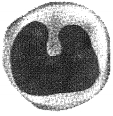
What is the percentage of the white blood cell shown below in the blood?
A
$60-65\%$
B
$0.5-1\%$
C
$2-3\%$
D
$6-8\%$
Solution
(D) The white blood cell shown in the image has a large,kidney-shaped or bean-shaped nucleus,which is characteristic of a monocyte.
Monocytes are agranulocytes and constitute approximately $6-8\%$ of the total white blood cells (WBCs) in the blood.
Therefore,the correct percentage is $6-8\%$.
Monocytes are agranulocytes and constitute approximately $6-8\%$ of the total white blood cells (WBCs) in the blood.
Therefore,the correct percentage is $6-8\%$.
0 likes
View Solution561
MediumMCQ
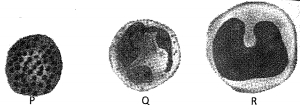
Which of the following cells acts as a phagocytic cell?
A
$P$
B
$Q$
C
$R$
D
$Q$ and $R$
Solution
(D) Based on the provided image:
$P$ represents an Eosinophil,which is involved in allergic reactions and parasitic infections.
$Q$ represents a Neutrophil,which is a polymorphonuclear leukocyte and acts as a primary phagocytic cell.
$R$ represents a Monocyte,which differentiates into macrophages and acts as a major phagocytic cell.
Both Neutrophils $(Q)$ and Monocytes $(R)$ are phagocytic in nature.
Therefore,the correct option is $Q$ and $R$.
$P$ represents an Eosinophil,which is involved in allergic reactions and parasitic infections.
$Q$ represents a Neutrophil,which is a polymorphonuclear leukocyte and acts as a primary phagocytic cell.
$R$ represents a Monocyte,which differentiates into macrophages and acts as a major phagocytic cell.
Both Neutrophils $(Q)$ and Monocytes $(R)$ are phagocytic in nature.
Therefore,the correct option is $Q$ and $R$.
0 likes
View Solution562
MediumMCQ
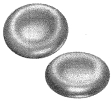
Identify the blood cells shown below.
A
Erythrocytes
B
Lymphocytes
C
Platelets
D
Monocytes
Solution
(A) The image shows biconcave,disc-shaped cells without a nucleus. These are characteristic features of erythrocytes (Red Blood Cells or RBCs).
Erythrocytes are responsible for the transport of respiratory gases like $O_2$ and $CO_2$ in the blood.
Erythrocytes are responsible for the transport of respiratory gases like $O_2$ and $CO_2$ in the blood.
0 likes
View Solution563
MediumMCQ
Which of the following cells act as phagocytes?
$I$ - Neutrophils,$II$ - Monocytes
$III$ - Lymphocytes,$IV$ - Eosinophils,$V$ - Basophils
$I$ - Neutrophils,$II$ - Monocytes
$III$ - Lymphocytes,$IV$ - Eosinophils,$V$ - Basophils
A
$I, V$
B
$III, IV$
C
$II, III$
D
$I, II$
Solution
(D) Phagocytosis is a process by which cells engulf and digest cellular debris,foreign substances,or pathogens.
Among the given white blood cells (leukocytes):
$1$. Neutrophils $(I)$ are the most abundant leukocytes and are highly active phagocytic cells that destroy foreign organisms entering the body.
$2$. Monocytes $(II)$ are large leukocytes that differentiate into macrophages in tissues,which are professional phagocytes.
$3$. Lymphocytes $(III)$ are primarily involved in immune responses ($B$-cells and $T$-cells) and are not phagocytic.
$4$. Eosinophils $(IV)$ are mainly involved in allergic reactions and parasitic infections.
$5$. Basophils $(V)$ are involved in inflammatory reactions and release histamine,serotonin,and heparin.
Therefore,Neutrophils and Monocytes are the primary phagocytic cells.
Among the given white blood cells (leukocytes):
$1$. Neutrophils $(I)$ are the most abundant leukocytes and are highly active phagocytic cells that destroy foreign organisms entering the body.
$2$. Monocytes $(II)$ are large leukocytes that differentiate into macrophages in tissues,which are professional phagocytes.
$3$. Lymphocytes $(III)$ are primarily involved in immune responses ($B$-cells and $T$-cells) and are not phagocytic.
$4$. Eosinophils $(IV)$ are mainly involved in allergic reactions and parasitic infections.
$5$. Basophils $(V)$ are involved in inflammatory reactions and release histamine,serotonin,and heparin.
Therefore,Neutrophils and Monocytes are the primary phagocytic cells.
0 likes
View Solution564
MediumMCQ
Which of the following cells secrete substances like histamine,serotonin,and heparin?
A
Neutrophils
B
Eosinophils
C
Basophils
D
Lymphocytes
Solution
(C) Basophils are a type of granulocyte white blood cell.
They contain granules that store various chemical mediators.
These cells are responsible for secreting substances such as histamine (a vasodilator),serotonin (a neurotransmitter),and heparin (an anticoagulant).
Therefore,the correct option is $C$.
They contain granules that store various chemical mediators.
These cells are responsible for secreting substances such as histamine (a vasodilator),serotonin (a neurotransmitter),and heparin (an anticoagulant).
Therefore,the correct option is $C$.
0 likes
View Solution565
MediumMCQ
Which of the following cells are involved in inflammatory reactions?
A
Neutrophils
B
Eosinophils
C
Basophils
D
Monocytes
Solution
(C) Basophils are a type of white blood cell that play a crucial role in inflammatory reactions.
They secrete chemicals such as histamine,serotonin,and heparin.
Histamine is a vasodilator that increases blood flow to the site of injury or infection,which is a key component of the inflammatory response.
Neutrophils and monocytes are primarily involved in phagocytosis (engulfing pathogens).
Eosinophils are primarily associated with allergic reactions and parasitic infections.
They secrete chemicals such as histamine,serotonin,and heparin.
Histamine is a vasodilator that increases blood flow to the site of injury or infection,which is a key component of the inflammatory response.
Neutrophils and monocytes are primarily involved in phagocytosis (engulfing pathogens).
Eosinophils are primarily associated with allergic reactions and parasitic infections.
0 likes
View Solution566
MediumMCQ
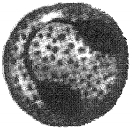
Identify the function of the cell shown in the image.
A
Destroys microorganisms entering the body.
B
Involved in inflammatory reactions.
C
Protects against infections and is associated with allergic reactions.
D
Responsible for immunity.
Solution
(B) The image shows a basophil,which is a type of white blood cell (leukocyte).
Basophils are characterized by their coarse,dark-staining granules in the cytoplasm and a lobed nucleus.
They secrete chemicals like histamine,serotonin,and heparin.
These chemicals are involved in inflammatory reactions and are also associated with allergic reactions.
Basophils are characterized by their coarse,dark-staining granules in the cytoplasm and a lobed nucleus.
They secrete chemicals like histamine,serotonin,and heparin.
These chemicals are involved in inflammatory reactions and are also associated with allergic reactions.
0 likes
View Solution567
MediumMCQ
Which of the following statements are correct regarding thrombocytes?
$I$ - Also known as blood platelets.
$II$ - They are cell fragments.
$III$ - Produced from megakaryocytes.
$IV$ - Their count in a normal individual ranges from $3,50,000$ to $6,00,000$ per $mm^3$.
$V$ - Involved in the process of blood coagulation.
$I$ - Also known as blood platelets.
$II$ - They are cell fragments.
$III$ - Produced from megakaryocytes.
$IV$ - Their count in a normal individual ranges from $3,50,000$ to $6,00,000$ per $mm^3$.
$V$ - Involved in the process of blood coagulation.
A
$I, II, III, IV, V$
B
$I, II, III, V$
C
$I, III, V$
D
$I, III, IV, V$
Solution
(B) Thrombocytes,or blood platelets,are cell fragments produced from special cells in the bone marrow called megakaryocytes ($I, II, III$ are correct).
They are essential for the process of blood coagulation or clotting ($V$ is correct).
The normal count of platelets in a healthy human individual is $1,50,000$ to $3,50,000$ per $mm^3$. Therefore,statement $IV$ is incorrect because the range provided in the option is higher than the standard physiological range.
Thus,the correct statements are $I, II, III,$ and $V$.
They are essential for the process of blood coagulation or clotting ($V$ is correct).
The normal count of platelets in a healthy human individual is $1,50,000$ to $3,50,000$ per $mm^3$. Therefore,statement $IV$ is incorrect because the range provided in the option is higher than the standard physiological range.
Thus,the correct statements are $I, II, III,$ and $V$.
0 likes
View Solution568
MediumMCQ
Which blood group is the universal donor?
A
$O^{+}$
B
$O^{-}$
C
$AB^{+}$
D
$AB^{-}$
Solution
(B) The universal donor is the blood group that can be given to individuals of any blood type without causing an immune reaction.
$O^{-}$ blood type lacks both $A$ and $B$ antigens on the surface of red blood cells and also lacks the $Rh$ factor.
Because it does not have these antigens,it does not trigger an immune response in the recipient's body,making $O^{-}$ the universal donor.
$O^{-}$ blood type lacks both $A$ and $B$ antigens on the surface of red blood cells and also lacks the $Rh$ factor.
Because it does not have these antigens,it does not trigger an immune response in the recipient's body,making $O^{-}$ the universal donor.
0 likes
View Solution569
MediumMCQ
Which blood group is considered the universal recipient?
A
$O^{+}$
B
$O^{-}$
C
$AB^{+}$
D
$AB^{-}$
Solution
(C) The $AB^{+}$ blood group is considered the universal recipient.
This is because individuals with $AB^{+}$ blood have both $A$ and $B$ antigens on the surface of their red blood cells and possess the $Rh$ factor.
Consequently,their immune system does not produce antibodies against $A$,$B$,or $Rh$ antigens,allowing them to receive blood from any $ABO$ or $Rh$ blood group type without an adverse immune reaction.
This is because individuals with $AB^{+}$ blood have both $A$ and $B$ antigens on the surface of their red blood cells and possess the $Rh$ factor.
Consequently,their immune system does not produce antibodies against $A$,$B$,or $Rh$ antigens,allowing them to receive blood from any $ABO$ or $Rh$ blood group type without an adverse immune reaction.
0 likes
View Solution570
MediumMCQ
To whom can a person with $A^+$ blood group donate blood?
A
$A^+, AB^+$
B
$A^+, A^-, AB^+, AB^-$
C
$A^+, O^+, A^-, O^-$
D
None of these
Solution
(A) person with $A^+$ blood group has $A$ antigens and $Rh$ antigens on their red blood cells.
They can donate blood to individuals who have both $A$ and $Rh$ antigens,which means they can donate to $A^+$ and $AB^+$ blood groups.
$A^+$ individuals can receive blood from $A^+, A^-, O^+, O^-$,but they can only donate to those who possess the $Rh$ factor and the $A$ antigen.
They can donate blood to individuals who have both $A$ and $Rh$ antigens,which means they can donate to $A^+$ and $AB^+$ blood groups.
$A^+$ individuals can receive blood from $A^+, A^-, O^+, O^-$,but they can only donate to those who possess the $Rh$ factor and the $A$ antigen.
0 likes
View Solution571
MediumMCQ
Which blood group contains both $a$ and $b$ antibodies?
A
Blood group $A$
B
Blood group $B$
C
Blood group $AB$
D
Blood group $O$
Solution
(D) In the $ABO$ blood grouping system,the presence or absence of antigens on the surface of red blood cells determines the blood group.
Blood group $O$ individuals possess neither $A$ nor $B$ antigens on their red blood cells.
However,their plasma contains both anti-$A$ and anti-$B$ antibodies.
Therefore,individuals with blood group $O$ are considered universal donors because their red blood cells lack antigens that could trigger an immune response in recipients.
Blood group $O$ individuals possess neither $A$ nor $B$ antigens on their red blood cells.
However,their plasma contains both anti-$A$ and anti-$B$ antibodies.
Therefore,individuals with blood group $O$ are considered universal donors because their red blood cells lack antigens that could trigger an immune response in recipients.
0 likes
View Solution572
MediumMCQ
Match the following columns:
| Column-$I$ (Blood Group) | Column-$II$ (Antibodies) |
| $P$. $A$ | $I$. Absent |
| $Q$. $B$ | $II$. $a$ (anti-$B$) |
| $R$. $AB$ | $III$. $b$ (anti-$A$) |
| $S$. $O$ | $IV$. $a, b$ (anti-$A$ and anti-$B$) |
A
$P-IV, Q-I, R-II, S-III$
B
$P-I, Q-IV, R-III, S-II$
C
$P-III, Q-II, R-I, S-IV$
D
$P-II, Q-III, R-I, S-IV$
Solution
(C) In the $ABO$ blood grouping system, the presence or absence of surface antigens on red blood cells determines the blood type.
$1$. Blood group $A$ has antigen $A$ on RBCs and antibody $b$ (anti-$A$) in plasma.
$2$. Blood group $B$ has antigen $B$ on RBCs and antibody $a$ (anti-$B$) in plasma.
$3$. Blood group $AB$ has both antigens $A$ and $B$ on RBCs and no antibodies in plasma.
$4$. Blood group $O$ has no antigens on RBCs and both antibodies $a$ and $b$ in plasma.
Therefore, the correct matching is:
$P$ (Blood group $A$) matches with $III$ (antibody $b$).
$Q$ (Blood group $B$) matches with $II$ (antibody $a$).
$R$ (Blood group $AB$) matches with $I$ (absent).
$S$ (Blood group $O$) matches with $IV$ (antibodies $a, b$).
Thus, the correct sequence is $P-III, Q-II, R-I, S-IV$.
$1$. Blood group $A$ has antigen $A$ on RBCs and antibody $b$ (anti-$A$) in plasma.
$2$. Blood group $B$ has antigen $B$ on RBCs and antibody $a$ (anti-$B$) in plasma.
$3$. Blood group $AB$ has both antigens $A$ and $B$ on RBCs and no antibodies in plasma.
$4$. Blood group $O$ has no antigens on RBCs and both antibodies $a$ and $b$ in plasma.
Therefore, the correct matching is:
$P$ (Blood group $A$) matches with $III$ (antibody $b$).
$Q$ (Blood group $B$) matches with $II$ (antibody $a$).
$R$ (Blood group $AB$) matches with $I$ (absent).
$S$ (Blood group $O$) matches with $IV$ (antibodies $a, b$).
Thus, the correct sequence is $P-III, Q-II, R-I, S-IV$.
0 likes
View Solution573
MediumMCQ
Match the following columns:
| Column-$I$ (Blood Group) | Column-$II$ (Can donate blood to) |
| $P$. $A$ | $I$. $AB$ |
| $Q$. $B$ | $II$. $B, AB$ |
| $R$. $AB$ | $III$. $A, B, AB, O$ |
| $S$. $O$ | $IV$. $A, AB$ |
A
$P-II, Q-IV, R-I, S-III$
B
$P-IV, Q-II, R-I, S-III$
C
$P-IV, Q-II, R-III, S-I$
D
$P-II, Q-IV, R-III, S-I$
Solution
(B) The compatibility of blood groups for donation is based on the presence of antigens on the surface of red blood cells and antibodies in the plasma.
$1$. Blood group $A$ has antigen $A$ and can donate to $A$ and $AB$ $(P-IV)$.
$2$. Blood group $B$ has antigen $B$ and can donate to $B$ and $AB$ $(Q-II)$.
$3$. Blood group $AB$ has both antigens $A$ and $B$ and can donate only to $AB$ $(R-I)$.
$4$. Blood group $O$ has no antigens and is the universal donor, meaning it can donate to $A, B, AB,$ and $O$ $(S-III)$.
Therefore, the correct matching is $P-IV, Q-II, R-I, S-III$.
$1$. Blood group $A$ has antigen $A$ and can donate to $A$ and $AB$ $(P-IV)$.
$2$. Blood group $B$ has antigen $B$ and can donate to $B$ and $AB$ $(Q-II)$.
$3$. Blood group $AB$ has both antigens $A$ and $B$ and can donate only to $AB$ $(R-I)$.
$4$. Blood group $O$ has no antigens and is the universal donor, meaning it can donate to $A, B, AB,$ and $O$ $(S-III)$.
Therefore, the correct matching is $P-IV, Q-II, R-I, S-III$.
0 likes
View Solution574
MediumMCQ
Which blood group possesses both $A$ and $B$ antigens on the surface of red blood cells?
A
Blood group $A$
B
Blood group $B$
C
Blood group $AB$
D
Blood group $O$
Solution
(C) The $ABO$ blood grouping system is based on the presence or absence of two surface antigens,$A$ and $B$,on the red blood cells.
Individuals with blood group $A$ have antigen $A$ on their red blood cells.
Individuals with blood group $B$ have antigen $B$ on their red blood cells.
Individuals with blood group $AB$ possess both antigen $A$ and antigen $B$ on their red blood cells.
Individuals with blood group $O$ do not have either antigen $A$ or antigen $B$ on their red blood cells.
Therefore,the correct answer is blood group $AB$.
Individuals with blood group $A$ have antigen $A$ on their red blood cells.
Individuals with blood group $B$ have antigen $B$ on their red blood cells.
Individuals with blood group $AB$ possess both antigen $A$ and antigen $B$ on their red blood cells.
Individuals with blood group $O$ do not have either antigen $A$ or antigen $B$ on their red blood cells.
Therefore,the correct answer is blood group $AB$.
0 likes
View Solution575
MediumMCQ
Which of the following conditions is responsible for Erythroblastosis fetalis?
A
Mother $- Rh^{-ve}$; Father $- Rh^{-ve}$
B
Mother $- Rh^{+ve}$; Father $- Rh^{+ve}$
C
Mother $- Rh^{+ve}$; Father $- Rh^{-ve}$
D
Mother $- Rh^{-ve}$; Father $- Rh^{+ve}$
Solution
(D) Erythroblastosis fetalis is a hemolytic disease of the newborn caused by an $Rh$ incompatibility between the mother and the fetus.
This condition occurs when the mother is $Rh$-negative $(Rh^{-ve})$ and the father is $Rh$-positive $(Rh^{+ve})$.
If the fetus inherits the $Rh$ antigen from the father,the fetus becomes $Rh$-positive.
During the first delivery,the mother's blood is exposed to the $Rh$ antigen of the fetus,leading to the formation of anti-$Rh$ antibodies in the mother's blood.
In subsequent pregnancies,if the fetus is again $Rh$-positive,these maternal anti-$Rh$ antibodies can cross the placenta and destroy the fetal red blood cells,leading to severe anemia and jaundice.
This condition occurs when the mother is $Rh$-negative $(Rh^{-ve})$ and the father is $Rh$-positive $(Rh^{+ve})$.
If the fetus inherits the $Rh$ antigen from the father,the fetus becomes $Rh$-positive.
During the first delivery,the mother's blood is exposed to the $Rh$ antigen of the fetus,leading to the formation of anti-$Rh$ antibodies in the mother's blood.
In subsequent pregnancies,if the fetus is again $Rh$-positive,these maternal anti-$Rh$ antibodies can cross the placenta and destroy the fetal red blood cells,leading to severe anemia and jaundice.
0 likes
View Solution576
MediumMCQ
In the human population,what percentage of individuals possess the $Rh$ antigen (in $,\%$)?
A
$80$
B
$20$
C
$60$
D
$0$
Solution
(A) The $Rh$ antigen is a protein found on the surface of red blood cells.
It is named after the Rhesus monkey,in which it was first discovered.
In the human population,approximately $80 \%$ of individuals are $Rh$-positive $(Rh^+)$,meaning they possess the $Rh$ antigen on their red blood cells.
The remaining $20 \%$ are $Rh$-negative $(Rh^-)$,meaning they lack this antigen.
Therefore,the correct percentage of the population that possesses the $Rh$ antigen is $80 \%$.
It is named after the Rhesus monkey,in which it was first discovered.
In the human population,approximately $80 \%$ of individuals are $Rh$-positive $(Rh^+)$,meaning they possess the $Rh$ antigen on their red blood cells.
The remaining $20 \%$ are $Rh$-negative $(Rh^-)$,meaning they lack this antigen.
Therefore,the correct percentage of the population that possesses the $Rh$ antigen is $80 \%$.
0 likes
View Solution577
MediumMCQ
The $Rh$ factor was first discovered in which organism?
A
Human
B
Monkey
C
Butterfly
D
Earthworm
Solution
(B) The $Rh$ factor is an inherited protein found on the surface of red blood cells. It was first discovered by Karl Landsteiner and Alexander $S$. Wiener in $1940$. They identified this antigen on the surface of red blood cells of the Rhesus monkey (Macaca mulatta). Hence,it is named '$Rh$' factor after the Rhesus monkey.
0 likes
View Solution578
MediumMCQ
Which of the following is required for the conversion of prothrombin into thrombin?
A
Thrombokinase
B
Stuart factor
C
Fibrin
D
Calcium
Solution
(D) The process of blood clotting involves a cascade of enzymatic reactions.
Prothrombin is an inactive plasma protein that is converted into its active form,thrombin,by the enzyme complex known as prothrombinase or thrombokinase (Factor $X_a$).
This reaction is strictly dependent on the presence of calcium ions $(Ca^{2+})$ and phospholipids.
While thrombokinase acts as the enzyme,calcium ions are essential cofactors for the activation of prothrombin.
In the context of standard biological questions regarding the conversion of prothrombin,calcium is often cited as the critical requirement for the activation process.
Prothrombin is an inactive plasma protein that is converted into its active form,thrombin,by the enzyme complex known as prothrombinase or thrombokinase (Factor $X_a$).
This reaction is strictly dependent on the presence of calcium ions $(Ca^{2+})$ and phospholipids.
While thrombokinase acts as the enzyme,calcium ions are essential cofactors for the activation of prothrombin.
In the context of standard biological questions regarding the conversion of prothrombin,calcium is often cited as the critical requirement for the activation process.
0 likes
View Solution579
MediumMCQ
Which of the following is required for the conversion of fibrinogen into fibrin?
A
Thrombokinase
B
Thromboplastin
C
Thrombin
D
Calcium
Solution
(C) During the process of blood coagulation,an enzyme complex called thrombokinase helps in the formation of the enzyme thrombin from inactive prothrombin present in the plasma.
Thrombin then acts as a catalyst to convert the soluble protein fibrinogen into insoluble fibrin threads.
Therefore,thrombin is the specific enzyme required for the conversion of fibrinogen into fibrin.
Thrombin then acts as a catalyst to convert the soluble protein fibrinogen into insoluble fibrin threads.
Therefore,thrombin is the specific enzyme required for the conversion of fibrinogen into fibrin.
0 likes
View Solution580
MediumMCQ
Which of the following is formed last during the process of blood coagulation?
A
Fibrin
B
Thrombin
C
Thromboplastin
D
Thrombokinase
Solution
(A) The process of blood coagulation involves a cascade of enzymatic reactions.
$1$. Injury to a blood vessel triggers the release of factors that form an enzyme complex called $Thrombokinase$ (or $Prothrombin$ activator).
$2$. $Thrombokinase$ converts inactive $Prothrombin$ in the plasma into active $Thrombin$.
$3$. $Thrombin$ then converts inactive $Fibrinogen$ into insoluble $Fibrin$ threads.
$4$. These $Fibrin$ threads form a meshwork that traps blood cells to form a clot.
Therefore,$Fibrin$ is the final product formed in the coagulation cascade.
$1$. Injury to a blood vessel triggers the release of factors that form an enzyme complex called $Thrombokinase$ (or $Prothrombin$ activator).
$2$. $Thrombokinase$ converts inactive $Prothrombin$ in the plasma into active $Thrombin$.
$3$. $Thrombin$ then converts inactive $Fibrinogen$ into insoluble $Fibrin$ threads.
$4$. These $Fibrin$ threads form a meshwork that traps blood cells to form a clot.
Therefore,$Fibrin$ is the final product formed in the coagulation cascade.
0 likes
View Solution581
MediumMCQ
If a daughter has blood group $O$ and the father has blood group $B$,what will be the genotype of the father?
A
$I^B I^B$
B
$ii$
C
$I^A I^B$
D
$I^B i$
Solution
(D) The blood group $O$ is represented by the genotype $ii$,meaning the daughter must have inherited one $i$ allele from each parent.
Since the father has blood group $B$,his possible genotypes are $I^B I^B$ (homozygous) or $I^B i$ (heterozygous).
For the daughter to have the $ii$ genotype,the father must contribute an $i$ allele.
Therefore,the father must be heterozygous for blood group $B$,which is represented by the genotype $I^B i$.
Since the father has blood group $B$,his possible genotypes are $I^B I^B$ (homozygous) or $I^B i$ (heterozygous).
For the daughter to have the $ii$ genotype,the father must contribute an $i$ allele.
Therefore,the father must be heterozygous for blood group $B$,which is represented by the genotype $I^B i$.
0 likes
View Solution582
MediumMCQ
If a child has blood group $O$ and the mother has blood group $A$,which blood group cannot be the father's?
A
$AB$
B
$A$
C
$B$
D
$O$
Solution
(A) The child has blood group $O$,which means the genotype is $ii$.
One $i$ allele is inherited from the mother and the other $i$ allele is inherited from the father.
The mother has blood group $A$,so her genotype must be $I^A i$ to provide an $i$ allele to the child.
The father must provide the other $i$ allele.
Therefore,the father's genotype must contain at least one $i$ allele ($I^A i$,$I^B i$,or $ii$).
$A$ person with blood group $AB$ has the genotype $I^A I^B$.
Since an $AB$ individual does not possess the $i$ allele,they cannot be the father of a child with blood group $O$.
One $i$ allele is inherited from the mother and the other $i$ allele is inherited from the father.
The mother has blood group $A$,so her genotype must be $I^A i$ to provide an $i$ allele to the child.
The father must provide the other $i$ allele.
Therefore,the father's genotype must contain at least one $i$ allele ($I^A i$,$I^B i$,or $ii$).
$A$ person with blood group $AB$ has the genotype $I^A I^B$.
Since an $AB$ individual does not possess the $i$ allele,they cannot be the father of a child with blood group $O$.
0 likes
View Solution583
MediumMCQ
In which cells are the alleles for blood group expressed?
A
Platelets
B
Red blood cells
C
White blood cells
D
All cells of the body
Solution
(B) The alleles for the $ABO$ blood group system code for specific sugar polymers (antigens) that are present on the surface of the plasma membrane of red blood cells $(RBCs)$.
These antigens are determined by the gene $I$,which has three alleles: $I^A$,$I^B$,and $i$.
Therefore,the expression of these alleles in the form of antigens occurs on the surface of red blood cells.
These antigens are determined by the gene $I$,which has three alleles: $I^A$,$I^B$,and $i$.
Therefore,the expression of these alleles in the form of antigens occurs on the surface of red blood cells.
0 likes
View Solution584
EasyMCQ
What is the full form of $PMNL$?
A
Polymorphonuclear Leucocytes
B
Polymorphonucleolus Leucocytes
C
Polymorphonuclear Lymphocytes
D
Polymorphonucleolus Lymphocytes
Solution
(A) $PMNL$ stands for Polymorphonuclear Leucocytes.
These are a type of white blood cell characterized by having a multi-lobed nucleus.
They are also known as neutrophils and are a key component of the innate immune system,acting as phagocytes to engulf pathogens.
These are a type of white blood cell characterized by having a multi-lobed nucleus.
They are also known as neutrophils and are a key component of the innate immune system,acting as phagocytes to engulf pathogens.
0 likes
View Solution585
EasyMCQ
Which of the following blood cells are capable of phagocytosis?
A
Eosinophils
B
Basophils
C
Lymphocytes
D
Neutrophils
Solution
(D) Phagocytosis is the process by which cells engulf and digest cellular debris,foreign substances,or pathogens.
Among the given options,$Neutrophils$ and $Monocytes$ are the primary phagocytic cells in the blood.
$Neutrophils$ are the most abundant type of white blood cells and act as the first line of defense by performing phagocytosis to destroy invading bacteria.
$Eosinophils$ are primarily involved in allergic reactions and parasitic infections.
$Basophils$ release histamine and heparin during inflammatory responses.
$Lymphocytes$ are responsible for the specific immune response ($T$-cells and $B$-cells).
Therefore,the correct option is $D$.
Among the given options,$Neutrophils$ and $Monocytes$ are the primary phagocytic cells in the blood.
$Neutrophils$ are the most abundant type of white blood cells and act as the first line of defense by performing phagocytosis to destroy invading bacteria.
$Eosinophils$ are primarily involved in allergic reactions and parasitic infections.
$Basophils$ release histamine and heparin during inflammatory responses.
$Lymphocytes$ are responsible for the specific immune response ($T$-cells and $B$-cells).
Therefore,the correct option is $D$.
0 likes
View Solution586
EasyMCQ
Where are the non-nucleated blood cells produced?
A
Thymus
B
Bone marrow
C
Liver
D
Spleen
Solution
(B) Non-nucleated blood cells,specifically mature mammalian red blood cells ($RBCs$ or erythrocytes),are produced in the bone marrow. During erythropoiesis in the bone marrow,the developing red blood cells lose their nucleus to provide more space for hemoglobin,which increases the oxygen-carrying capacity of the blood.
0 likes
View Solution587
MediumMCQ
Arrange the following formed elements in the decreasing order of their abundance in blood in humans :
$(a)$ Platelets
$(b)$ Neutrophils
$(c)$ Erythrocytes
$(d)$ Eosinophils
$(e)$ Monocytes
Choose the most appropriate answer from the options given below :
$(a)$ Platelets
$(b)$ Neutrophils
$(c)$ Erythrocytes
$(d)$ Eosinophils
$(e)$ Monocytes
Choose the most appropriate answer from the options given below :
A
$(c), (a), (b), (e), (d)$
B
$(c), (b), (a), (e), (d)$
C
$(d), (e), (b), (a), (c)$
D
$(a), (c), (b), (d), (e)$
Solution
(A) The abundance of formed elements in human blood is as follows:
$1$. Erythrocytes $(RBCs)$: $5.0-5.5$ million/$mm^3$ (Most abundant).
$2$. Platelets: $150,000-350,000$ per $mm^3$.
$3$. Neutrophils: $60-65\%$ of total $WBCs$.
$4$. Monocytes: $6-8\%$ of total $WBCs$.
$5$. Eosinophils: $2-3\%$ of total $WBCs$.
Comparing the absolute numbers, the order of abundance is: Erythrocytes > Platelets > Neutrophils > Monocytes > Eosinophils.
Thus, the correct sequence is $(c), (a), (b), (e), (d)$.
$1$. Erythrocytes $(RBCs)$: $5.0-5.5$ million/$mm^3$ (Most abundant).
$2$. Platelets: $150,000-350,000$ per $mm^3$.
$3$. Neutrophils: $60-65\%$ of total $WBCs$.
$4$. Monocytes: $6-8\%$ of total $WBCs$.
$5$. Eosinophils: $2-3\%$ of total $WBCs$.
Comparing the absolute numbers, the order of abundance is: Erythrocytes > Platelets > Neutrophils > Monocytes > Eosinophils.
Thus, the correct sequence is $(c), (a), (b), (e), (d)$.
0 likes
View Solution588
MediumMCQ
Which of the following statements are correct?
$A$. Basophils are most abundant cells of the total WBCs
$B$. Basophils secrete histamine, serotonin and heparin
$C$. Basophils are involved in inflammatory response
$D$. Basophils have kidney shaped nudeus
$E$. Basophils are agranulocytes
Choose the correct answer from the options given below:
A
$A$ and $B$ only
B
$D$ and $E$ only
C
$C$ and $E$ only
D
$B$ and $C$ only
Solution
Option (4) is the answer because, basophils secrete histamine, serotonin, heparin etc. and are involved in inflammatory response.
Option (3) is not the answer because, basophils are granulocytes.
Option (1) is not the answer because, neutrophils are the most abundant cells $(60-65 \%)$ of the total WBCs whereas basophils are least $(0.5-1 \%)$ abundant of all WBCs.
Option (2) is not the answer because, monocytes have a kidney-shaped nucleus.
0 likes
View Solution589
EasyMCQ
The $\text{WBCs}$ which make up the maximum count amongst leucocytes are $:-$
A
Monocytes $- 60-65\%$
B
Acidophils $- 60-65\%$
C
Basophils $- 50-55\%$
D
Neutrophils $- 60-65\%$
Solution
(D) Leucocytes (White Blood Cells) are categorized into granulocytes and agranulocytes.
Among the different types of leucocytes,neutrophils are the most abundant cells,constituting approximately $60-65\%$ of the total $\text{WBC}$ count.
Monocytes constitute about $6-8\%$,basophils $0.5-1\%$,and acidophils (eosinophils) $2-3\%$.
Therefore,the correct option is $D$.
Among the different types of leucocytes,neutrophils are the most abundant cells,constituting approximately $60-65\%$ of the total $\text{WBC}$ count.
Monocytes constitute about $6-8\%$,basophils $0.5-1\%$,and acidophils (eosinophils) $2-3\%$.
Therefore,the correct option is $D$.
0 likes
View Solution590
EasyMCQ
Which $\text{WBCs}$ are phagocytic cells that destroy foreign organisms entering the body?
A
Acidophils and basophils
B
Basophils and monocytes
C
Neutrophils and monocytes
D
Neutrophils and lymphocytes
Solution
(C) White blood cells $(\text{WBCs})$ or leukocytes are classified into granulocytes and agranulocytes.
Among the granulocytes,$\text{neutrophils}$ are the most abundant cells (about $60-65\%$ of total $\text{WBCs}$) and are phagocytic in nature,meaning they engulf and destroy foreign organisms.
Among the agranulocytes,$\text{monocytes}$ (about $6-8\%$) are also phagocytic cells that destroy foreign substances.
Therefore,$\text{neutrophils}$ and $\text{monocytes}$ are the primary phagocytic cells of the blood.
Among the granulocytes,$\text{neutrophils}$ are the most abundant cells (about $60-65\%$ of total $\text{WBCs}$) and are phagocytic in nature,meaning they engulf and destroy foreign organisms.
Among the agranulocytes,$\text{monocytes}$ (about $6-8\%$) are also phagocytic cells that destroy foreign substances.
Therefore,$\text{neutrophils}$ and $\text{monocytes}$ are the primary phagocytic cells of the blood.
0 likes
View Solution591
MediumMCQ
How many statements is/are incorrect?
$(A)$ Blood is a special epithelial tissue
$(B)$ Albumins are needed for clotting
$(C)$ Plasma with the clotting factors is called serum
$(D)$ Plasma is a straw coloured, viscous fluid
$(A)$ Blood is a special epithelial tissue
$(B)$ Albumins are needed for clotting
$(C)$ Plasma with the clotting factors is called serum
$(D)$ Plasma is a straw coloured, viscous fluid
A
$1$
B
$2$
C
$3$
D
$4$
Solution
$(C)$ Let us analyze each statement:
$(A)$ Blood is a special connective tissue, not an epithelial tissue. Thus, this statement is incorrect.
$(B)$ Albumins are primarily involved in osmotic balance, whereas clotting factors like fibrinogen are needed for clotting. Thus, this statement is incorrect.
$(C)$ Plasma without the clotting factors is called serum. The statement says 'with', which is incorrect.
$(D)$ Plasma is a straw-coloured, viscous fluid constituting $55\%$ of the blood. This statement is correct.
Therefore, statements $(A)$, $(B)$, and $(C)$ are incorrect. The total number of incorrect statements is $3$.
$(A)$ Blood is a special connective tissue, not an epithelial tissue. Thus, this statement is incorrect.
$(B)$ Albumins are primarily involved in osmotic balance, whereas clotting factors like fibrinogen are needed for clotting. Thus, this statement is incorrect.
$(C)$ Plasma without the clotting factors is called serum. The statement says 'with', which is incorrect.
$(D)$ Plasma is a straw-coloured, viscous fluid constituting $55\%$ of the blood. This statement is correct.
Therefore, statements $(A)$, $(B)$, and $(C)$ are incorrect. The total number of incorrect statements is $3$.
0 likes
View Solution592
MediumMCQ
How many antigens are present on the surface of $RBC$ in blood group $AB$ positive?
A
$1$
B
$2$
C
$3$
D
$4$
Solution
(C) In the $ABO$ blood grouping system,the presence of antigens on the surface of $RBC$s is determined by the alleles $I^A$,$I^B$,and $i$.
For blood group $AB$,both $A$ and $B$ antigens are present on the $RBC$ surface.
In the $Rh$ blood grouping system,the presence of the $Rh$ factor (also known as the $D$ antigen) determines the positive $(+)$ or negative $(-)$ status.
Since the blood group is $AB$ positive $(AB+)$,it possesses $A$ antigen,$B$ antigen,and $Rh$ $(D)$ antigen.
Therefore,a total of $3$ antigens are present on the surface of the $RBC$.
For blood group $AB$,both $A$ and $B$ antigens are present on the $RBC$ surface.
In the $Rh$ blood grouping system,the presence of the $Rh$ factor (also known as the $D$ antigen) determines the positive $(+)$ or negative $(-)$ status.
Since the blood group is $AB$ positive $(AB+)$,it possesses $A$ antigen,$B$ antigen,and $Rh$ $(D)$ antigen.
Therefore,a total of $3$ antigens are present on the surface of the $RBC$.
0 likes
View Solution593
EasyMCQ
. . . . . . $A$ . . . . . . grouping is based on the presence or absence of . . . . . . $B$ . . . . . . surface antigen on the $RBC$:
A
$ABO$,Three
B
$Rh$,Two
C
$ABO$,Two
D
$Rh$,One
Solution
(C) The $ABO$ blood grouping system is based on the presence or absence of two surface antigens,namely antigen $A$ and antigen $B$,on the surface of red blood cells $(RBCs)$.
Therefore,the correct grouping is $ABO$ and the number of surface antigens involved is two.
Therefore,the correct grouping is $ABO$ and the number of surface antigens involved is two.
0 likes
View Solution594
MediumMCQ
Incompatibility between $\text{Rh}$-positive and $\text{Rh}$-negative blood during transfusion can lead to $:-$
A
Haemolysis
B
Blood clotting
C
Thrombocytopenia
D
Leukemia
Solution
(A) When $\text{Rh}$-positive blood is transfused into an $\text{Rh}$-negative individual,the recipient's immune system recognizes the $\text{Rh}$ antigen as foreign.
This triggers the production of anti-$\text{Rh}$ antibodies by the recipient.
These antibodies attack and destroy the transfused $\text{Rh}$-positive red blood cells,a process known as haemolysis (or destruction of red blood cells).
Therefore,the correct consequence of this incompatibility is haemolysis.
This triggers the production of anti-$\text{Rh}$ antibodies by the recipient.
These antibodies attack and destroy the transfused $\text{Rh}$-positive red blood cells,a process known as haemolysis (or destruction of red blood cells).
Therefore,the correct consequence of this incompatibility is haemolysis.
0 likes
View Solution595
MediumMCQ
Statement-$I$ : Two surface antigens may be present on the $\text{RBCs}$.
Statement-$II$ : Antigens are chemicals that can induce immune response.
Statement-$II$ : Antigens are chemicals that can induce immune response.
A
Statement-$I$ and Statement-$II$ are correct.
B
Statement-$I$ and Statement-$II$ are incorrect.
C
Statement-$I$ is correct and Statement-$II$ is incorrect.
D
Statement-$I$ is incorrect and Statement-$II$ is correct.
Solution
(A) Statement-$I$ is correct because in the $ABO$ blood grouping system,$A$ and $B$ antigens are present on the surface of $\text{RBCs}$. An individual can have $A$ antigen,$B$ antigen,both $A$ and $B$ antigens,or neither.
Statement-$II$ is correct because antigens are defined as substances (often proteins or polysaccharides) that,when introduced into the body,are recognized by the immune system as foreign and trigger an immune response,such as the production of antibodies.
Statement-$II$ is correct because antigens are defined as substances (often proteins or polysaccharides) that,when introduced into the body,are recognized by the immune system as foreign and trigger an immune response,such as the production of antibodies.
0 likes
View Solution596
EasyMCQ
Rohit has '$A$' blood group. It indicates. . . .
A
presence of $A$ antigen on the surface of RBCs.
B
presence of $A$ antigen in the plasma.
C
'a' antibodies on the surface of WBCs.
D
'a' antibodies in the serum.
Solution
(A) Blood group $A$ is determined by the presence of the $A$ antigen on the surface of red blood cells $(RBCs)$.
In individuals with blood group $A$,the plasma (or serum) contains anti-$B$ antibodies,not anti-$A$ antibodies.
In individuals with blood group $A$,the plasma (or serum) contains anti-$B$ antibodies,not anti-$A$ antibodies.
0 likes
View Solution597
EasyMCQ
Rh factor (Antigen '$D$') was first discovered by . . . . . . in $1940$.
A
Decastello and Sturli
B
Landsteiner and Weiner
C
Edward Jenner
D
Fleming
Solution
(B) The $Rh$ factor,also known as the $Rh$ antigen or antigen '$D$',is a protein found on the surface of red blood cells.
It was first discovered by Karl Landsteiner and Alexander $S$. Weiner in $1940$ while they were studying the blood of Rhesus monkeys.
This discovery is crucial for blood transfusion compatibility and for understanding $Rh$ incompatibility during pregnancy.
It was first discovered by Karl Landsteiner and Alexander $S$. Weiner in $1940$ while they were studying the blood of Rhesus monkeys.
This discovery is crucial for blood transfusion compatibility and for understanding $Rh$ incompatibility during pregnancy.
0 likes
View Solution598
EasyMCQ
Select the correct statement/s regarding blood groups in human.
$i$. Some genetically determined blood group systems are $ABO$, $Rh$, $Duffy$, $Lewis$, $Bombay$ blood group etc.
$ii$. Three types of agglutinogens are present on surface of human $RBCs$ such as $A$, $B$ and $D$.
$iii$. Individuals with blood group "$AB$ $Rh$ $+ve$" have $A$, $B$ and $D$ antigens on the surface of their $RBCs$ and both antibodies 'a' and 'b' in their plasma.
$iv$. Haemolytic disease of Newborn occurs when mother with $Rh$ $-ve$ blood group conceives $Rh$ $-ve$ foetus.
$v$. Individuals with '$AB$' blood group are called universal donors while those with '$O$' blood group are called universal acceptors, with reference to blood transfusion.
$i$. Some genetically determined blood group systems are $ABO$, $Rh$, $Duffy$, $Lewis$, $Bombay$ blood group etc.
$ii$. Three types of agglutinogens are present on surface of human $RBCs$ such as $A$, $B$ and $D$.
$iii$. Individuals with blood group "$AB$ $Rh$ $+ve$" have $A$, $B$ and $D$ antigens on the surface of their $RBCs$ and both antibodies 'a' and 'b' in their plasma.
$iv$. Haemolytic disease of Newborn occurs when mother with $Rh$ $-ve$ blood group conceives $Rh$ $-ve$ foetus.
$v$. Individuals with '$AB$' blood group are called universal donors while those with '$O$' blood group are called universal acceptors, with reference to blood transfusion.
A
$iv$ only.
B
$i$ and $v$ only.
C
$iii, iv$ and $v$ only.
D
$i$ and $ii$ only.
Solution
(D) $i$. Correct: $ABO$, $Rh$, $Duffy$, $Lewis$, and $Bombay$ are recognized blood group systems.
$ii$. Correct: $A$ and $B$ are $ABO$ antigens, and $D$ is the primary $Rh$ antigen found on $RBC$ surfaces.
$iii$. Incorrect: Individuals with $AB$ $Rh$ $+ve$ blood have $A, B,$ and $D$ antigens, but they lack anti-$A$ and anti-$B$ antibodies in their plasma.
$iv$. Incorrect: Erythroblastosis foetalis occurs when an $Rh$-negative mother carries an $Rh$-positive foetus.
$v$. Incorrect: $AB$ blood group individuals are universal recipients, and $O$ blood group individuals are universal donors.
$ii$. Correct: $A$ and $B$ are $ABO$ antigens, and $D$ is the primary $Rh$ antigen found on $RBC$ surfaces.
$iii$. Incorrect: Individuals with $AB$ $Rh$ $+ve$ blood have $A, B,$ and $D$ antigens, but they lack anti-$A$ and anti-$B$ antibodies in their plasma.
$iv$. Incorrect: Erythroblastosis foetalis occurs when an $Rh$-negative mother carries an $Rh$-positive foetus.
$v$. Incorrect: $AB$ blood group individuals are universal recipients, and $O$ blood group individuals are universal donors.
0 likes
View Solution599
EasyMCQ
Duffy,Kidd,and Lewis are the names of . . . . . . .
A
transgenic animals
B
blood group systems
C
antibody producing cells
D
scientists who discovered different glycoproteins
Solution
(B) In addition to the well-known $ABO$ and $Rh$ blood group systems,there are several other blood group systems identified in humans. $Duffy$,$Kidd$,and $Lewis$ are specific examples of these additional blood group systems,which are determined by the presence of specific antigens on the surface of red blood cells. Therefore,the correct option is $B$.
0 likes
View Solution600
EasyMCQ
Which one of the following blood cells produce antibodies as an immune response of the body?
A
Eosinophils
B
Neutrophils
C
Lymphocytes
D
Basophils
Solution
(C) The immune system of the body is primarily mediated by white blood cells (leukocytes).
Among these,$B$-lymphocytes are a specific type of white blood cell responsible for the production of antibodies.
When $B$-lymphocytes encounter an antigen,they differentiate into plasma cells,which then secrete large quantities of antibodies into the blood and lymph to neutralize the pathogen.
$Eosinophils$,$Neutrophils$,and $Basophils$ are primarily involved in non-specific immune responses like phagocytosis or inflammatory reactions,but they do not produce antibodies.
Among these,$B$-lymphocytes are a specific type of white blood cell responsible for the production of antibodies.
When $B$-lymphocytes encounter an antigen,they differentiate into plasma cells,which then secrete large quantities of antibodies into the blood and lymph to neutralize the pathogen.
$Eosinophils$,$Neutrophils$,and $Basophils$ are primarily involved in non-specific immune responses like phagocytosis or inflammatory reactions,but they do not produce antibodies.
0 likes
View SolutionBody Fluids and Circulations — Blood and Blood Group · Frequently Asked Questions
1Are these Body Fluids and Circulations questions useful for JEE and NEET?
Yes. All questions in this section are mapped to JEE Main and NEET exam patterns. Previous year questions from JEE Main, NEET, GUJCET and state-level exams are included with full solutions.
2Can I switch to Hindi or Gujarati for these questions?
Yes. Use the language tabs in the hero section or the sidebar to view the same questions and solutions in English, Hindi or Gujarati.
3How do I generate a question paper from this subtopic?
Use the Vedclass Exam Paper Generator — select the chapter and subtopic, set difficulty, and generate Sets A, B, C, D automatically. First 3 chapters of every subject are free.
Vedclass Products
For Students
Vedclass Test Series
Mock tests in real JEE/NEET style with performance analysis. 5-day free trial.
Start Free TrialFor Teachers
Exam Paper Generator
Generate Set A/B/C/D papers from this chapter in 2 minutes. 3 chapters free.
Try FreeFor Institutes
Online Exam Module
Live online exams with unlimited students, 360° analytics & white-label branding.
See DemoFor Teachers & Institutes
Generate a Body Fluids and Circulations Exam Paper in 2 Minutes
Select subtopic & difficulty — Sets A, B, C, D auto-generated with No Repeat logic.
First 3 chapters of every subject are free — no payment required.