
ChemistryQ101–144 of 244 questions
Page 3 of 3 · English
101
ChemistryMediumMCQTS EAMCET · 2025
At $298 \ K$,a flask '$A$' of unknown volume $(V)$ contains oxygen at $5 \ atm$. Another flask '$B$' of volume $2 \ L$ contains helium at $3 \ atm$. Two flasks are connected together by a small tube of zero volume. After the two gases are completely mixed,if the resulting mixture is found to have the mole fraction of oxygen as $0.2$,the volume of flask '$A$' (in $L$) is (Assume oxygen and helium as ideal gases)
A
$0.1$
B
$0.3$
C
$0.2$
D
$0.4$
Solution
(B) Using the ideal gas equation $PV = nRT$,the number of moles of oxygen in flask '$A$' is $n_{O_2} = \frac{P_A V_A}{RT} = \frac{5 \times V}{RT}$.
Similarly,the number of moles of helium in flask '$B$' is $n_{He} = \frac{P_B V_B}{RT} = \frac{3 \times 2}{RT} = \frac{6}{RT}$.
The mole fraction of oxygen in the mixture is given by $x_{O_2} = \frac{n_{O_2}}{n_{O_2} + n_{He}} = 0.2$.
Substituting the values: $\frac{5V/RT}{5V/RT + 6/RT} = 0.2$.
This simplifies to $\frac{5V}{5V + 6} = 0.2$.
$5V = 0.2(5V + 6) \implies 5V = V + 1.2$.
$4V = 1.2 \implies V = 0.3 \ L$.
Similarly,the number of moles of helium in flask '$B$' is $n_{He} = \frac{P_B V_B}{RT} = \frac{3 \times 2}{RT} = \frac{6}{RT}$.
The mole fraction of oxygen in the mixture is given by $x_{O_2} = \frac{n_{O_2}}{n_{O_2} + n_{He}} = 0.2$.
Substituting the values: $\frac{5V/RT}{5V/RT + 6/RT} = 0.2$.
This simplifies to $\frac{5V}{5V + 6} = 0.2$.
$5V = 0.2(5V + 6) \implies 5V = V + 1.2$.
$4V = 1.2 \implies V = 0.3 \ L$.
0 likesView Solution
102
ChemistryMediumMCQTS EAMCET · 2025
The isobars of one mole of an ideal gas were obtained at three different pressures ($p_1$,$p_2$ and $p_3$). The slopes of these isobars are $m_1$,$m_2$ and $m_3$ respectively. If $p_1 < p_2 < p_3$,then the correct relation of the slopes is
A
$m_1 > m_2 > m_3$
B
$m_1 < m_2 < m_3$
C
$m_1 > m_3 > m_2$
D
$m_1 = m_2 = m_3$
Solution
(A) For one mole of an ideal gas,the ideal gas equation is $pV = RT$,which can be rearranged as $V = (R/p)T$.
Comparing this with the equation of a straight line $y = mx + c$,where $y = V$ and $x = T$,the slope $m$ is given by $m = R/p$.
Since $R$ is a constant,the slope $m$ is inversely proportional to the pressure $p$ $(m \propto 1/p)$.
Given the condition $p_1 < p_2 < p_3$,it follows that $1/p_1 > 1/p_2 > 1/p_3$.
Therefore,the relation between the slopes is $m_1 > m_2 > m_3$.
Comparing this with the equation of a straight line $y = mx + c$,where $y = V$ and $x = T$,the slope $m$ is given by $m = R/p$.
Since $R$ is a constant,the slope $m$ is inversely proportional to the pressure $p$ $(m \propto 1/p)$.
Given the condition $p_1 < p_2 < p_3$,it follows that $1/p_1 > 1/p_2 > 1/p_3$.
Therefore,the relation between the slopes is $m_1 > m_2 > m_3$.
0 likesView Solution
103
ChemistryMediumMCQTS EAMCET · 2025
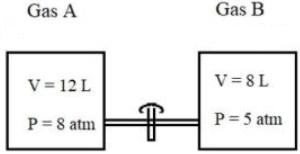
Two vessels are filled with ideal gases $A$ and $B$ and are connected through a pipe of zero volume as shown in the figure. The stop cock is opened and the gases are allowed to mix homogeneously and the temperature is kept constant. The partial pressures of $A$ and $B$ respectively (in $atm$) are:
A
$8.0, 5.0$
B
$9.6, 4.0$
C
$6.4, 4.0$
D
$4.8, 2.0$
Solution
(D) Initial state for gas $A$: $P_1 = 8 \ atm$,$V_1 = 12 \ L$. Total volume after opening the stop cock: $V_{total} = 12 \ L + 8 \ L = 20 \ L$.
Since the temperature is constant,we use Boyle's Law $(P_1V_1 = P_2V_2)$ for each gas independently.
For gas $A$: $8 \ atm \times 12 \ L = P_A \times 20 \ L \implies P_A = \frac{96}{20} = 4.8 \ atm$.
For gas $B$: $5 \ atm \times 8 \ L = P_B \times 20 \ L \implies P_B = \frac{40}{20} = 2.0 \ atm$.
Thus,the partial pressures of $A$ and $B$ are $4.8 \ atm$ and $2.0 \ atm$ respectively.
Since the temperature is constant,we use Boyle's Law $(P_1V_1 = P_2V_2)$ for each gas independently.
For gas $A$: $8 \ atm \times 12 \ L = P_A \times 20 \ L \implies P_A = \frac{96}{20} = 4.8 \ atm$.
For gas $B$: $5 \ atm \times 8 \ L = P_B \times 20 \ L \implies P_B = \frac{40}{20} = 2.0 \ atm$.
Thus,the partial pressures of $A$ and $B$ are $4.8 \ atm$ and $2.0 \ atm$ respectively.
0 likesView Solution
104
ChemistryMediumMCQTS EAMCET · 2025
The $RMS$ velocity of dihydrogen $(H_2)$ is $\sqrt{7}$ times more than that of dinitrogen $(N_2)$. If $T_{H_2}$ and $T_{N_2}$ are the temperatures of dihydrogen and dinitrogen respectively,then the correct relationship between them is:
A
$T_{H_2} = T_{N_2}$
B
$T_{H_2} > T_{N_2}$
C
$T_{H_2} = \frac{T_{N_2}}{2}$
D
$T_{H_2} = \frac{T_{N_2}}{4}$
Solution
(C) The formula for $RMS$ velocity is $v_{rms} = \sqrt{\frac{3RT}{M}}$.
Given: $v_{H_2} = \sqrt{7} \times v_{N_2}$.
Substituting the formula: $\sqrt{\frac{3RT_{H_2}}{M_{H_2}}} = \sqrt{7} \times \sqrt{\frac{3RT_{N_2}}{M_{N_2}}}$.
Squaring both sides: $\frac{3RT_{H_2}}{M_{H_2}} = 7 \times \frac{3RT_{N_2}}{M_{N_2}}$.
Given molar masses: $M_{H_2} = 2 \ g/mol$ and $M_{N_2} = 28 \ g/mol$.
Substituting these values: $\frac{T_{H_2}}{2} = 7 \times \frac{T_{N_2}}{28}$.
Simplifying: $\frac{T_{H_2}}{2} = \frac{T_{N_2}}{4}$.
Therefore,$T_{H_2} = \frac{T_{N_2}}{2}$.
Given: $v_{H_2} = \sqrt{7} \times v_{N_2}$.
Substituting the formula: $\sqrt{\frac{3RT_{H_2}}{M_{H_2}}} = \sqrt{7} \times \sqrt{\frac{3RT_{N_2}}{M_{N_2}}}$.
Squaring both sides: $\frac{3RT_{H_2}}{M_{H_2}} = 7 \times \frac{3RT_{N_2}}{M_{N_2}}$.
Given molar masses: $M_{H_2} = 2 \ g/mol$ and $M_{N_2} = 28 \ g/mol$.
Substituting these values: $\frac{T_{H_2}}{2} = 7 \times \frac{T_{N_2}}{28}$.
Simplifying: $\frac{T_{H_2}}{2} = \frac{T_{N_2}}{4}$.
Therefore,$T_{H_2} = \frac{T_{N_2}}{2}$.
0 likesView Solution
105
ChemistryMediumMCQTS EAMCET · 2025
At $T(K)$,the root mean square (rms) velocity of argon (molar mass $40 \ g \ mol^{-1}$) is $20 \ ms^{-1}$. The average kinetic energy of the same gas at $T(K)$ (in $J \ mol^{-1}$) is:
A
$8$
B
$16$
C
$4$
D
$2$
Solution
(A) The root mean square velocity $(u_{rms})$ is given by the formula: $u_{rms} = \sqrt{\frac{3RT}{M}}$.
Given $u_{rms} = 20 \ ms^{-1}$ and $M = 40 \ g \ mol^{-1} = 0.04 \ kg \ mol^{-1}$.
Squaring both sides: $u_{rms}^2 = \frac{3RT}{M} \implies 20^2 = \frac{3RT}{0.04}$.
$400 = \frac{3RT}{0.04} \implies 3RT = 400 \times 0.04 = 16$.
$RT = \frac{16}{3} \ J \ mol^{-1}$.
The average kinetic energy $(KE_{avg})$ for one mole of an ideal gas is given by: $KE_{avg} = \frac{3}{2}RT$.
Substituting the value of $RT$: $KE_{avg} = \frac{3}{2} \times \frac{16}{3} = 8 \ J \ mol^{-1}$.
Thus,the correct option is $A$.
Given $u_{rms} = 20 \ ms^{-1}$ and $M = 40 \ g \ mol^{-1} = 0.04 \ kg \ mol^{-1}$.
Squaring both sides: $u_{rms}^2 = \frac{3RT}{M} \implies 20^2 = \frac{3RT}{0.04}$.
$400 = \frac{3RT}{0.04} \implies 3RT = 400 \times 0.04 = 16$.
$RT = \frac{16}{3} \ J \ mol^{-1}$.
The average kinetic energy $(KE_{avg})$ for one mole of an ideal gas is given by: $KE_{avg} = \frac{3}{2}RT$.
Substituting the value of $RT$: $KE_{avg} = \frac{3}{2} \times \frac{16}{3} = 8 \ J \ mol^{-1}$.
Thus,the correct option is $A$.
0 likesView Solution
106
ChemistryEasyMCQTS EAMCET · 2025
The force $(F)$ required to maintain the flow of layers of a liquid is equal to ($A = \text{area of contact of layers}$,$dz = \text{distance between the layers}$,$du = \text{change in velocity}$,$\eta = \text{coefficient of viscosity}$)
A
$\eta \frac{du}{dz} \cdot \frac{1}{A}$
B
$\eta \frac{dz}{du} \cdot A$
C
$\eta A \frac{du}{dz}$
D
$\eta \frac{dz}{A} \cdot \frac{1}{du}$
Solution
(C) According to Newton's law of viscosity,the viscous force $(F)$ acting between two layers of a liquid is directly proportional to the area of contact $(A)$ and the velocity gradient $(\frac{du}{dz})$.
Mathematically,this is expressed as $F \propto A \frac{du}{dz}$.
Introducing the coefficient of viscosity $(\eta)$ as the constant of proportionality,we get $F = \eta A \frac{du}{dz}$.
Mathematically,this is expressed as $F \propto A \frac{du}{dz}$.
Introducing the coefficient of viscosity $(\eta)$ as the constant of proportionality,we get $F = \eta A \frac{du}{dz}$.
0 likesView Solution
107
ChemistryEasyMCQTS EAMCET · 2025
Observe the following statements:
Statement-$I$: Rutherford model of an atom cannot explain the stability of an atom.
Statement-$II$: The wavelength of $X$-rays is higher than the wavelength of microwaves.
The correct answer is:
Statement-$I$: Rutherford model of an atom cannot explain the stability of an atom.
Statement-$II$: The wavelength of $X$-rays is higher than the wavelength of microwaves.
The correct answer is:
A
Both statements $I$ and $II$ are correct
B
Both statements $I$ and $II$ are not correct
C
Statement $I$ is correct,but statement $II$ is not correct
D
Statement $I$ is not correct,but statement $II$ is correct
Solution
(C) Statement-$I$ is correct because according to classical electromagnetic theory,an accelerating charged particle must emit energy. Thus,an electron revolving around the nucleus should lose energy and eventually fall into the nucleus,which Rutherford's model could not explain.
Statement-$II$ is incorrect because,in the electromagnetic spectrum,the wavelength of $X$-rays ($10^{-10} \ m$ to $10^{-8} \ m$) is significantly smaller than the wavelength of microwaves ($10^{-3} \ m$ to $10^{-1} \ m$).
Therefore,Statement-$I$ is correct,but Statement-$II$ is not correct.
Statement-$II$ is incorrect because,in the electromagnetic spectrum,the wavelength of $X$-rays ($10^{-10} \ m$ to $10^{-8} \ m$) is significantly smaller than the wavelength of microwaves ($10^{-3} \ m$ to $10^{-1} \ m$).
Therefore,Statement-$I$ is correct,but Statement-$II$ is not correct.
0 likesView Solution
108
ChemistryMediumMCQTS EAMCET · 2025
The radius of stationary state $(n=2)$ of hydrogen atom is $x \ pm$. The radius of stationary state $(n=3)$ of $He^{+}$ ion (in $pm$) is
A
$\frac{9}{8} x$
B
$\frac{27}{8} x$
C
$\frac{16}{9} x$
D
$\frac{9}{16} x$
Solution
(A) The radius of the $n^{th}$ orbit of a hydrogen-like species is given by the formula: $r_n = a_0 \times \frac{n^2}{Z}$,where $a_0$ is the Bohr radius,$n$ is the principal quantum number,and $Z$ is the atomic number.
For the hydrogen atom $(Z=1)$ at $n=2$: $x = a_0 \times \frac{2^2}{1} = 4a_0$,which implies $a_0 = \frac{x}{4}$.
For the $He^{+}$ ion $(Z=2)$ at $n=3$: $r_3 = a_0 \times \frac{3^2}{2} = a_0 \times \frac{9}{2}$.
Substituting $a_0 = \frac{x}{4}$ into the equation for $r_3$: $r_3 = (\frac{x}{4}) \times \frac{9}{2} = \frac{9}{8} x$.
For the hydrogen atom $(Z=1)$ at $n=2$: $x = a_0 \times \frac{2^2}{1} = 4a_0$,which implies $a_0 = \frac{x}{4}$.
For the $He^{+}$ ion $(Z=2)$ at $n=3$: $r_3 = a_0 \times \frac{3^2}{2} = a_0 \times \frac{9}{2}$.
Substituting $a_0 = \frac{x}{4}$ into the equation for $r_3$: $r_3 = (\frac{x}{4}) \times \frac{9}{2} = \frac{9}{8} x$.
0 likesView Solution
109
ChemistryMediumMCQTS EAMCET · 2025
The electron in a hydrogen atom undergoes a transition from higher orbits to an orbit of radius $476.1 \text{ pm}$. This transition corresponds to which of the following series?
A
Lyman
B
Paschen
C
Balmer
D
Pfund
Solution
(B) The radius of the $n^{th}$ orbit of a hydrogen atom is given by the formula $r_n = 0.529 \times n^2 \mathring{A} = 52.9 \times n^2 \text{ pm}$.
Given $r_n = 476.1 \text{ pm}$, we have $52.9 \times n^2 = 476.1$.
$n^2 = \frac{476.1}{52.9} = 9$.
Therefore, $n = 3$.
A transition to the $n = 3$ orbit corresponds to the Paschen series.
Given $r_n = 476.1 \text{ pm}$, we have $52.9 \times n^2 = 476.1$.
$n^2 = \frac{476.1}{52.9} = 9$.
Therefore, $n = 3$.
A transition to the $n = 3$ orbit corresponds to the Paschen series.
0 likesView Solution
110
ChemistryMediumMCQTS EAMCET · 2025
The energy associated with the electron in the first orbit of a hydrogen atom is $-2.18 \times 10^{-18} \ J$. The frequency of the light required (in $Hz$) to excite the electron to the fifth orbit is $(h = 6.6 \times 10^{-34} \ Js)$
A
$2.17 \times 10^{16}$
B
$3.17 \times 10^{14}$
C
$2.17 \times 10^{15}$
D
$3.17 \times 10^{15}$
Solution
(D) The energy of an electron in the $n^{th}$ orbit is given by $E_n = \frac{E_1}{n^2}$,where $E_1 = -2.18 \times 10^{-18} \ J$.
For the fifth orbit $(n = 5)$,$E_5 = \frac{-2.18 \times 10^{-18}}{5^2} = \frac{-2.18 \times 10^{-18}}{25} = -0.0872 \times 10^{-18} \ J$.
The energy difference required for excitation is $\Delta E = E_5 - E_1 = (-0.0872 \times 10^{-18}) - (-2.18 \times 10^{-18}) = 2.0928 \times 10^{-18} \ J$.
Using the relation $\Delta E = h \nu$,the frequency $\nu$ is $\nu = \frac{\Delta E}{h} = \frac{2.0928 \times 10^{-18}}{6.6 \times 10^{-34}} \approx 3.17 \times 10^{15} \ Hz$.
For the fifth orbit $(n = 5)$,$E_5 = \frac{-2.18 \times 10^{-18}}{5^2} = \frac{-2.18 \times 10^{-18}}{25} = -0.0872 \times 10^{-18} \ J$.
The energy difference required for excitation is $\Delta E = E_5 - E_1 = (-0.0872 \times 10^{-18}) - (-2.18 \times 10^{-18}) = 2.0928 \times 10^{-18} \ J$.
Using the relation $\Delta E = h \nu$,the frequency $\nu$ is $\nu = \frac{\Delta E}{h} = \frac{2.0928 \times 10^{-18}}{6.6 \times 10^{-34}} \approx 3.17 \times 10^{15} \ Hz$.
0 likesView Solution
111
ChemistryMediumMCQTS EAMCET · 2025
The radius of the second orbit of a hydrogen atom is the same as that of orbit $n$ of an ion $x$. $n$ and $x$ are respectively:
A
$4, Be^{3+}$
B
$3, Li^{2+}$
C
$4, Be^{2+}$
D
$2, He^{+}$
Solution
(A) The radius of an orbit in a hydrogen-like species is given by the formula $r_n = 0.529 \times \frac{n^2}{Z} \ \mathring{A}$.
For the second orbit of a hydrogen atom $(H)$,$n_1 = 2$ and $Z_1 = 1$. So,$r_1 = 0.529 \times \frac{2^2}{1} = 0.529 \times 4$.
For the orbit $n$ of an ion $x$ with atomic number $Z_2$,$r_2 = 0.529 \times \frac{n^2}{Z_2}$.
Given $r_1 = r_2$,we have $4 = \frac{n^2}{Z_2}$,which implies $n^2 = 4Z_2$.
Checking the options:
For $A$: $Be^{3+}$ has $Z=4$. $n^2 = 4 \times 4 = 16$,so $n=4$. This matches.
For $B$: $Li^{2+}$ has $Z=3$. $n^2 = 4 \times 3 = 12$ (not a perfect square).
For $C$: $Be^{2+}$ has $Z=4$. $n^2 = 16$,$n=4$. However,$Be^{2+}$ is not a hydrogen-like species (it has $2$ electrons).
For $D$: $He^{+}$ has $Z=2$. $n^2 = 4 \times 2 = 8$ (not a perfect square).
Thus,the correct option is $A$.
For the second orbit of a hydrogen atom $(H)$,$n_1 = 2$ and $Z_1 = 1$. So,$r_1 = 0.529 \times \frac{2^2}{1} = 0.529 \times 4$.
For the orbit $n$ of an ion $x$ with atomic number $Z_2$,$r_2 = 0.529 \times \frac{n^2}{Z_2}$.
Given $r_1 = r_2$,we have $4 = \frac{n^2}{Z_2}$,which implies $n^2 = 4Z_2$.
Checking the options:
For $A$: $Be^{3+}$ has $Z=4$. $n^2 = 4 \times 4 = 16$,so $n=4$. This matches.
For $B$: $Li^{2+}$ has $Z=3$. $n^2 = 4 \times 3 = 12$ (not a perfect square).
For $C$: $Be^{2+}$ has $Z=4$. $n^2 = 16$,$n=4$. However,$Be^{2+}$ is not a hydrogen-like species (it has $2$ electrons).
For $D$: $He^{+}$ has $Z=2$. $n^2 = 4 \times 2 = 8$ (not a perfect square).
Thus,the correct option is $A$.
0 likesView Solution
112
ChemistryMediumMCQTS EAMCET · 2025
In a hydrogen atom,an electron is transferred from an orbit of radius $1.3225 \ nm$ to another orbit of radius $0.2116 \ nm$. What is the energy (in $J$) of the emitted radiation?
A
$1.635 \times 10^{-18}$
B
$3.027 \times 10^{-19}$
C
$4.087 \times 10^{-19}$
D
$0.4578 \times 10^{-18}$
Solution
(D) The radius of an orbit in a hydrogen atom is given by $r_n = 0.0529 \times n^2 \ nm$.
For $r_1 = 1.3225 \ nm$,$n_1^2 = 1.3225 / 0.0529 = 25$,so $n_1 = 5$.
For $r_2 = 0.2116 \ nm$,$n_2^2 = 0.2116 / 0.0529 = 4$,so $n_2 = 2$.
The energy of an electron in the $n$-th orbit is $E_n = -2.18 \times 10^{-18} / n^2 \ J$.
The energy change is $\Delta E = E_{n_2} - E_{n_1} = -2.18 \times 10^{-18} \times (1/n_2^2 - 1/n_1^2)$.
$\Delta E = -2.18 \times 10^{-18} \times (1/4 - 1/25) = -2.18 \times 10^{-18} \times (0.25 - 0.04) = -2.18 \times 10^{-18} \times 0.21 = -0.4578 \times 10^{-18} \ J$.
The energy of the emitted radiation is $|\Delta E| = 0.4578 \times 10^{-18} \ J$.
For $r_1 = 1.3225 \ nm$,$n_1^2 = 1.3225 / 0.0529 = 25$,so $n_1 = 5$.
For $r_2 = 0.2116 \ nm$,$n_2^2 = 0.2116 / 0.0529 = 4$,so $n_2 = 2$.
The energy of an electron in the $n$-th orbit is $E_n = -2.18 \times 10^{-18} / n^2 \ J$.
The energy change is $\Delta E = E_{n_2} - E_{n_1} = -2.18 \times 10^{-18} \times (1/n_2^2 - 1/n_1^2)$.
$\Delta E = -2.18 \times 10^{-18} \times (1/4 - 1/25) = -2.18 \times 10^{-18} \times (0.25 - 0.04) = -2.18 \times 10^{-18} \times 0.21 = -0.4578 \times 10^{-18} \ J$.
The energy of the emitted radiation is $|\Delta E| = 0.4578 \times 10^{-18} \ J$.
0 likesView Solution
113
ChemistryMediumMCQTS EAMCET · 2025
In the atomic spectrum of hydrogen,the wavelengths of the spectral lines corresponding to electronic transitions $(i)$ $n=4$ to $n=2$ and $(ii)$ $n=3$ to $n=1$ are $\lambda_1$ and $\lambda_2$ $\mathring{A}$ respectively. The value of $(\lambda_1-\lambda_2)$ (in cm) is ($R_H$ = Rydberg constant)
A
$\frac{1}{R_H} \left[ \frac{24}{101} \right]$
B
$R_H \left[ \frac{24}{101} \right]$
C
$\frac{1}{R_H} \left[ \frac{101}{24} \right]$
D
$R_H \left[ \frac{101}{24} \right]$
Solution
(C) Using the Rydberg formula: $\frac{1}{\lambda} = R_H Z^2 \left( \frac{1}{n_1^2} - \frac{1}{n_2^2} \right)$. For hydrogen,$Z=1$.
For transition $(i)$ $n=4$ to $n=2$: $\frac{1}{\lambda_1} = R_H \left( \frac{1}{2^2} - \frac{1}{4^2} \right) = R_H \left( \frac{1}{4} - \frac{1}{16} \right) = R_H \left( \frac{3}{16} \right)$. Thus,$\lambda_1 = \frac{16}{3R_H}$.
For transition $(ii)$ $n=3$ to $n=1$: $\frac{1}{\lambda_2} = R_H \left( \frac{1}{1^2} - \frac{1}{3^2} \right) = R_H \left( 1 - \frac{1}{9} \right) = R_H \left( \frac{8}{9} \right)$. Thus,$\lambda_2 = \frac{9}{8R_H}$.
Calculating $(\lambda_1 - \lambda_2)$: $\frac{16}{3R_H} - \frac{9}{8R_H} = \frac{1}{R_H} \left( \frac{128 - 27}{24} \right) = \frac{1}{R_H} \left( \frac{101}{24} \right)$.
For transition $(i)$ $n=4$ to $n=2$: $\frac{1}{\lambda_1} = R_H \left( \frac{1}{2^2} - \frac{1}{4^2} \right) = R_H \left( \frac{1}{4} - \frac{1}{16} \right) = R_H \left( \frac{3}{16} \right)$. Thus,$\lambda_1 = \frac{16}{3R_H}$.
For transition $(ii)$ $n=3$ to $n=1$: $\frac{1}{\lambda_2} = R_H \left( \frac{1}{1^2} - \frac{1}{3^2} \right) = R_H \left( 1 - \frac{1}{9} \right) = R_H \left( \frac{8}{9} \right)$. Thus,$\lambda_2 = \frac{9}{8R_H}$.
Calculating $(\lambda_1 - \lambda_2)$: $\frac{16}{3R_H} - \frac{9}{8R_H} = \frac{1}{R_H} \left( \frac{128 - 27}{24} \right) = \frac{1}{R_H} \left( \frac{101}{24} \right)$.
0 likesView Solution
114
ChemistryDifficultMCQTS EAMCET · 2025
When electromagnetic radiation of wavelength $310 \ nm$ falls on the surface of a metal having work function $3.55 \ eV$,the velocity of photoelectrons emitted is $x \times 10^5 \ ms^{-1}$. The value of $x$ is (Nearest integer). Given: $m_{e} = 9 \times 10^{-31} \ kg$,$h = 6.63 \times 10^{-34} \ J \cdot s$,$c = 3 \times 10^8 \ m/s$,$1 \ eV = 1.6 \times 10^{-19} \ J$.
A
$2$
B
$4$
C
$5$
D
$6$
Solution
(B) Energy of incident photon $E = \frac{hc}{\lambda} = \frac{6.63 \times 10^{-34} \times 3 \times 10^8}{310 \times 10^{-9}} \approx 6.416 \times 10^{-19} \ J$.
Converting to $eV$: $E = \frac{6.416 \times 10^{-19}}{1.6 \times 10^{-19}} \approx 4.01 \ eV$.
Kinetic energy $K.E. = E - \Phi = 4.01 \ eV - 3.55 \ eV = 0.46 \ eV$.
$K.E. = 0.46 \times 1.6 \times 10^{-19} \ J = 0.736 \times 10^{-19} \ J$.
Using $K.E. = \frac{1}{2} m_e v^2$:
$0.736 \times 10^{-19} = \frac{1}{2} \times 9 \times 10^{-31} \times v^2$.
$v^2 = \frac{1.472 \times 10^{-19}}{9 \times 10^{-31}} \approx 0.1635 \times 10^{12} = 16.35 \times 10^{10}$.
$v \approx 4.04 \times 10^5 \ ms^{-1}$.
Thus,$x \approx 4$.
Converting to $eV$: $E = \frac{6.416 \times 10^{-19}}{1.6 \times 10^{-19}} \approx 4.01 \ eV$.
Kinetic energy $K.E. = E - \Phi = 4.01 \ eV - 3.55 \ eV = 0.46 \ eV$.
$K.E. = 0.46 \times 1.6 \times 10^{-19} \ J = 0.736 \times 10^{-19} \ J$.
Using $K.E. = \frac{1}{2} m_e v^2$:
$0.736 \times 10^{-19} = \frac{1}{2} \times 9 \times 10^{-31} \times v^2$.
$v^2 = \frac{1.472 \times 10^{-19}}{9 \times 10^{-31}} \approx 0.1635 \times 10^{12} = 16.35 \times 10^{10}$.
$v \approx 4.04 \times 10^5 \ ms^{-1}$.
Thus,$x \approx 4$.
0 likesView Solution
115
ChemistryDifficultMCQTS EAMCET · 2025
Work functions of four metals $M_1, M_2, M_3$ and $M_4$ are $4.8, 4.3, 4.75$ and $3.75 \ eV$ respectively. The metals which do not show photoelectric effect when light of wavelength $310 \ nm$ falls on the metals are
A
$M_1, M_2$ only
B
$M_1, M_3$ only
C
$M_1, M_2, M_3$ only
D
$M_1, M_2, M_4$ only
Solution
(C) The energy of the incident photon is given by $E = \frac{hc}{\lambda}$.
Given $\lambda = 310 \ nm = 310 \times 10^{-9} \ m$.
Using $h = 6.626 \times 10^{-34} \ J \cdot s$ and $c = 3 \times 10^8 \ m/s$,$E = \frac{6.626 \times 10^{-34} \times 3 \times 10^8}{310 \times 10^{-9}} \approx 6.41 \times 10^{-19} \ J$.
Converting to $eV$: $E = \frac{6.41 \times 10^{-19}}{1.602 \times 10^{-19}} \approx 4.0 \ eV$.
Photoelectric effect occurs if the energy of the incident photon is greater than or equal to the work function $(\Phi)$ of the metal. If $E < \Phi$,the photoelectric effect does not occur.
Here,$E = 4.0 \ eV$.
Comparing with work functions:
$M_1: 4.8 \ eV > 4.0 \ eV$ (No effect)
$M_2: 4.3 \ eV > 4.0 \ eV$ (No effect)
$M_3: 4.75 \ eV > 4.0 \ eV$ (No effect)
$M_4: 3.75 \ eV < 4.0 \ eV$ (Effect occurs)
Thus,$M_1, M_2$ and $M_3$ do not show the photoelectric effect.
Given $\lambda = 310 \ nm = 310 \times 10^{-9} \ m$.
Using $h = 6.626 \times 10^{-34} \ J \cdot s$ and $c = 3 \times 10^8 \ m/s$,$E = \frac{6.626 \times 10^{-34} \times 3 \times 10^8}{310 \times 10^{-9}} \approx 6.41 \times 10^{-19} \ J$.
Converting to $eV$: $E = \frac{6.41 \times 10^{-19}}{1.602 \times 10^{-19}} \approx 4.0 \ eV$.
Photoelectric effect occurs if the energy of the incident photon is greater than or equal to the work function $(\Phi)$ of the metal. If $E < \Phi$,the photoelectric effect does not occur.
Here,$E = 4.0 \ eV$.
Comparing with work functions:
$M_1: 4.8 \ eV > 4.0 \ eV$ (No effect)
$M_2: 4.3 \ eV > 4.0 \ eV$ (No effect)
$M_3: 4.75 \ eV > 4.0 \ eV$ (No effect)
$M_4: 3.75 \ eV < 4.0 \ eV$ (Effect occurs)
Thus,$M_1, M_2$ and $M_3$ do not show the photoelectric effect.
0 likesView Solution
116
ChemistryDifficultMCQTS EAMCET · 2025
An electromagnetic radiation of wavelength $331.5 \ nm$ is made to strike the surface of a metal. Electrons are emitted with a kinetic energy of $1.2 \times 10^5 \ J \ mol^{-1}$. The work function (in $eV$) of the metal is (given: $h=6.63 \times 10^{-34} \ Js$,$N_{A}=6 \times 10^{23} \ mol^{-1}$,$1 \ eV = 1.6 \times 10^{-19} \ J$)?
A
$1.5$
B
$3.0$
C
$3.5$
D
$2.5$
Solution
(D) The energy of the incident photon is given by $E = \frac{hc}{\lambda}$.
Converting wavelength to meters: $\lambda = 331.5 \times 10^{-9} \ m$.
Energy per photon: $E = \frac{6.63 \times 10^{-34} \times 3 \times 10^8}{331.5 \times 10^{-9}} = 6 \times 10^{-19} \ J$.
Energy per mole: $E_{mol} = E \times N_A = 6 \times 10^{-19} \times 6 \times 10^{23} = 3.6 \times 10^5 \ J \ mol^{-1}$.
Using the photoelectric equation: $E_{mol} = W + KE_{mol}$,where $W$ is the work function.
$W = 3.6 \times 10^5 - 1.2 \times 10^5 = 2.4 \times 10^5 \ J \ mol^{-1}$.
To convert to $eV$ per atom: $W_{eV} = \frac{2.4 \times 10^5}{6 \times 10^{23} \times 1.6 \times 10^{-19}} = \frac{2.4 \times 10^5}{9.6 \times 10^4} = 2.5 \ eV$.
Converting wavelength to meters: $\lambda = 331.5 \times 10^{-9} \ m$.
Energy per photon: $E = \frac{6.63 \times 10^{-34} \times 3 \times 10^8}{331.5 \times 10^{-9}} = 6 \times 10^{-19} \ J$.
Energy per mole: $E_{mol} = E \times N_A = 6 \times 10^{-19} \times 6 \times 10^{23} = 3.6 \times 10^5 \ J \ mol^{-1}$.
Using the photoelectric equation: $E_{mol} = W + KE_{mol}$,where $W$ is the work function.
$W = 3.6 \times 10^5 - 1.2 \times 10^5 = 2.4 \times 10^5 \ J \ mol^{-1}$.
To convert to $eV$ per atom: $W_{eV} = \frac{2.4 \times 10^5}{6 \times 10^{23} \times 1.6 \times 10^{-19}} = \frac{2.4 \times 10^5}{9.6 \times 10^4} = 2.5 \ eV$.
0 likesView Solution
117
ChemistryMediumMCQTS EAMCET · 2025
Identify the incorrect statement from the following:
A
$m_l$ designates the orientation of the orbital
B
The probability density of electron is expressed by $|\psi|^2$
C
The total information about electron in atom is stored in its $\psi$
D
Total number of orbitals in a sub level is equal to $(2l+1)$
Solution
(C) The wave function $\psi$ itself does not have any direct physical meaning. It is a mathematical function that describes the state of an electron in an atom. The physical significance of $\psi$ is that the square of its magnitude,$|\psi|^2$,represents the probability density of finding an electron at a particular point in space. Therefore,the statement that the total information about an electron in an atom is stored in its $\psi$ is incorrect because $\psi$ is just a mathematical amplitude,whereas the physical probability is given by $|\psi|^2$.
0 likesView Solution
118
ChemistryMediumMCQTS EAMCET · 2025
In $Sr$ $(Z=38)$,the number of electrons with $l=0$ is $x$,and the number of electrons with $l=2$ is $y$. The value of $(x-y)$ is equal to:
($l=$ Azimuthal quantum number)
($l=$ Azimuthal quantum number)
A
$0$
B
$8$
C
$-2$
D
$2$
Solution
(A) The electronic configuration of $Sr$ $(Z=38)$ is $1s^2, 2s^2, 2p^6, 3s^2, 3p^6, 4s^2, 3d^{10}, 4p^6, 5s^2$.
Electrons with $l=0$ (s-orbitals) are: $1s^2, 2s^2, 3s^2, 4s^2, 5s^2$. Total electrons $x = 2+2+2+2+2 = 10$.
Electrons with $l=2$ (d-orbitals) are: $3d^{10}$. Total electrons $y = 10$.
Therefore,$(x-y) = 10 - 10 = 0$.
Electrons with $l=0$ (s-orbitals) are: $1s^2, 2s^2, 3s^2, 4s^2, 5s^2$. Total electrons $x = 2+2+2+2+2 = 10$.
Electrons with $l=2$ (d-orbitals) are: $3d^{10}$. Total electrons $y = 10$.
Therefore,$(x-y) = 10 - 10 = 0$.
0 likesView Solution
119
ChemistryMediumMCQTS EAMCET · 2025
One mole of an ideal gas at $300 \ K$ and $20 \ atm$ expands to $2 \ atm$ under isothermal and reversible conditions. The work done by the gas is $-x \ kJ \ mol^{-1}$. The value of $x$ is $(R = 8.3 \ J \ K^{-1} \ mol^{-1})$
A
$5.73$
B
$7.37$
C
$3.75$
D
$4.57$
Solution
(A) For an isothermal reversible expansion of an ideal gas,the work done $(w)$ is given by the formula: $w = -nRT \ln(\frac{P_1}{P_2})$.
Given: $n = 1 \ mol$,$T = 300 \ K$,$P_1 = 20 \ atm$,$P_2 = 2 \ atm$,and $R = 8.3 \ J \ K^{-1} \ mol^{-1}$.
Substituting the values: $w = -1 \times 8.3 \times 300 \times \ln(\frac{20}{2})$.
$w = -2490 \times \ln(10)$.
Using $\ln(10) \approx 2.303$: $w = -2490 \times 2.303 = -5734.47 \ J \ mol^{-1}$.
Converting to $kJ \ mol^{-1}$: $w = -5.734 \ kJ \ mol^{-1}$.
Since the work done is $-x \ kJ \ mol^{-1}$,we have $-x = -5.734$,so $x = 5.73$.
Given: $n = 1 \ mol$,$T = 300 \ K$,$P_1 = 20 \ atm$,$P_2 = 2 \ atm$,and $R = 8.3 \ J \ K^{-1} \ mol^{-1}$.
Substituting the values: $w = -1 \times 8.3 \times 300 \times \ln(\frac{20}{2})$.
$w = -2490 \times \ln(10)$.
Using $\ln(10) \approx 2.303$: $w = -2490 \times 2.303 = -5734.47 \ J \ mol^{-1}$.
Converting to $kJ \ mol^{-1}$: $w = -5.734 \ kJ \ mol^{-1}$.
Since the work done is $-x \ kJ \ mol^{-1}$,we have $-x = -5.734$,so $x = 5.73$.
0 likesView Solution
120
ChemistryMediumMCQTS EAMCET · 2025
Which of the following processes are reversible?
$I$. Vaporization of a liquid at its boiling point.
$II$. Expansion of gas into vacuum.
$III$. Transformation of a solid substance into liquid at its melting point.
$IV$. Neutralization of an acid by a base.
$I$. Vaporization of a liquid at its boiling point.
$II$. Expansion of gas into vacuum.
$III$. Transformation of a solid substance into liquid at its melting point.
$IV$. Neutralization of an acid by a base.
A
$I$ & $III$
B
$II$ & $III$
C
$II$ & $IV$
D
$I$ & $IV$
Solution
(A) process is reversible if it occurs in equilibrium,meaning the driving force is infinitesimally small.
$I$. Vaporization of a liquid at its boiling point occurs at constant temperature and pressure where liquid and vapor are in equilibrium. Thus,it is a reversible process.
$II$. Expansion of gas into vacuum is a free expansion,which is irreversible.
$III$. Transformation of a solid substance into liquid at its melting point occurs at constant temperature and pressure where solid and liquid are in equilibrium. Thus,it is a reversible process.
$IV$. Neutralization of an acid by a base is a spontaneous,highly exothermic reaction that proceeds to completion,making it irreversible.
Therefore,$I$ and $III$ are reversible processes.
$I$. Vaporization of a liquid at its boiling point occurs at constant temperature and pressure where liquid and vapor are in equilibrium. Thus,it is a reversible process.
$II$. Expansion of gas into vacuum is a free expansion,which is irreversible.
$III$. Transformation of a solid substance into liquid at its melting point occurs at constant temperature and pressure where solid and liquid are in equilibrium. Thus,it is a reversible process.
$IV$. Neutralization of an acid by a base is a spontaneous,highly exothermic reaction that proceeds to completion,making it irreversible.
Therefore,$I$ and $III$ are reversible processes.
0 likesView Solution
121
ChemistryMediumMCQTS EAMCET · 2025
The $C_p$ of an ideal gas is $10.314 \ J \ mol^{-1} \ K^{-1}$. One mole of this gas is expanded against a constant pressure of $p \ atm$. The change in temperature during expansion is $1.0 \ K$. The values of $q$ (in $J$) and $\Delta H$ (in $J \ mol^{-1}$) are respectively
A
$10.314, 10.314$
B
$2.000, 10.314$
C
$10.314, 2.000$
D
$2.000, 2.000$
Solution
(B) For an ideal gas,the change in enthalpy is given by $\Delta H = n C_p \Delta T$.
Given $n = 1 \ mol$,$C_p = 10.314 \ J \ mol^{-1} \ K^{-1}$,and $\Delta T = 1.0 \ K$.
Thus,$\Delta H = 1 \times 10.314 \times 1.0 = 10.314 \ J \ mol^{-1}$.
For an ideal gas,the internal energy change is $\Delta U = n C_v \Delta T$.
Since $C_p - C_v = R$,$C_v = C_p - R = 10.314 - 8.314 = 2.000 \ J \ mol^{-1} \ K^{-1}$.
So,$\Delta U = 1 \times 2.000 \times 1.0 = 2.000 \ J$.
According to the first law of thermodynamics,$\Delta U = q + w$.
For expansion against constant external pressure,$w = -p_{ext} \Delta V$.
However,for an ideal gas,$\Delta H = \Delta U + \Delta(pV) = \Delta U + nR\Delta T$.
$10.314 = \Delta U + 8.314 \times 1.0$,which gives $\Delta U = 2.000 \ J$.
Since the process is an expansion,the heat $q$ exchanged is equal to the change in internal energy if $w$ is considered in terms of work done by the system.
Given the options and the standard interpretation of such problems,$q = 2.000 \ J$ and $\Delta H = 10.314 \ J \ mol^{-1}$.
Given $n = 1 \ mol$,$C_p = 10.314 \ J \ mol^{-1} \ K^{-1}$,and $\Delta T = 1.0 \ K$.
Thus,$\Delta H = 1 \times 10.314 \times 1.0 = 10.314 \ J \ mol^{-1}$.
For an ideal gas,the internal energy change is $\Delta U = n C_v \Delta T$.
Since $C_p - C_v = R$,$C_v = C_p - R = 10.314 - 8.314 = 2.000 \ J \ mol^{-1} \ K^{-1}$.
So,$\Delta U = 1 \times 2.000 \times 1.0 = 2.000 \ J$.
According to the first law of thermodynamics,$\Delta U = q + w$.
For expansion against constant external pressure,$w = -p_{ext} \Delta V$.
However,for an ideal gas,$\Delta H = \Delta U + \Delta(pV) = \Delta U + nR\Delta T$.
$10.314 = \Delta U + 8.314 \times 1.0$,which gives $\Delta U = 2.000 \ J$.
Since the process is an expansion,the heat $q$ exchanged is equal to the change in internal energy if $w$ is considered in terms of work done by the system.
Given the options and the standard interpretation of such problems,$q = 2.000 \ J$ and $\Delta H = 10.314 \ J \ mol^{-1}$.
0 likesView Solution
122
ChemistryMediumMCQTS EAMCET · 2025
At $298 \ K$,the enthalpy change (in $kJ$) for the reaction given below is: $CH_{4(g)} + O_{2(g)} \rightarrow C_{(s)} + 2H_2O_{(l)}$
Given:
$1) \ H_{2(g)} + \frac{1}{2}O_{2(g)} \rightarrow H_2O_{(l)} ; \Delta H^{\ominus} = -286 \ kJ$
$2) \ C_{(s)} + O_{2(g)} \rightarrow CO_{2(g)} ; \Delta H^{\ominus} = -394 \ kJ$
$3) \ CH_{4(g)} + 2O_{2(g)} \rightarrow CO_{2(g)} + 2H_2O_{(l)} ; \Delta H^{\ominus} = -890 \ kJ$
Given:
$1) \ H_{2(g)} + \frac{1}{2}O_{2(g)} \rightarrow H_2O_{(l)} ; \Delta H^{\ominus} = -286 \ kJ$
$2) \ C_{(s)} + O_{2(g)} \rightarrow CO_{2(g)} ; \Delta H^{\ominus} = -394 \ kJ$
$3) \ CH_{4(g)} + 2O_{2(g)} \rightarrow CO_{2(g)} + 2H_2O_{(l)} ; \Delta H^{\ominus} = -890 \ kJ$
A
$+496$
B
$-496$
C
$-1284$
D
$+680$
Solution
(B) To find the enthalpy change for the reaction $CH_{4(g)} + O_{2(g)} \rightarrow C_{(s)} + 2H_2O_{(l)}$,we manipulate the given equations:
Equation $(3): CH_{4(g)} + 2O_{2(g)} \rightarrow CO_{2(g)} + 2H_2O_{(l)} ; \Delta H^{\ominus} = -890 \ kJ$
Reverse Equation $(2): CO_{2(g)} \rightarrow C_{(s)} + O_{2(g)} ; \Delta H^{\ominus} = +394 \ kJ$
Adding these two equations:
$CH_{4(g)} + 2O_{2(g)} + CO_{2(g)} \rightarrow CO_{2(g)} + 2H_2O_{(l)} + C_{(s)} + O_{2(g)}$
Simplifying,we get:
$CH_{4(g)} + O_{2(g)} \rightarrow C_{(s)} + 2H_2O_{(l)}$
The enthalpy change is the sum of the enthalpy changes of the steps:
$\Delta H = -890 \ kJ + 394 \ kJ = -496 \ kJ$.
Equation $(3): CH_{4(g)} + 2O_{2(g)} \rightarrow CO_{2(g)} + 2H_2O_{(l)} ; \Delta H^{\ominus} = -890 \ kJ$
Reverse Equation $(2): CO_{2(g)} \rightarrow C_{(s)} + O_{2(g)} ; \Delta H^{\ominus} = +394 \ kJ$
Adding these two equations:
$CH_{4(g)} + 2O_{2(g)} + CO_{2(g)} \rightarrow CO_{2(g)} + 2H_2O_{(l)} + C_{(s)} + O_{2(g)}$
Simplifying,we get:
$CH_{4(g)} + O_{2(g)} \rightarrow C_{(s)} + 2H_2O_{(l)}$
The enthalpy change is the sum of the enthalpy changes of the steps:
$\Delta H = -890 \ kJ + 394 \ kJ = -496 \ kJ$.
0 likesView Solution
123
ChemistryMediumMCQTS EAMCET · 2025
At $298 \ K$,if the standard Gibbs energy change $\Delta_r G^{\ominus}$ of a reaction is $-115 \ kJ \ mol^{-1}$,the value of $\log_{10} K_{p}$ will be $(R = 8.314 \ J \ K^{-1} \ mol^{-1})$.
A
$+20.15$
B
$-20.15$
C
$-10.30$
D
$+10.30$
Solution
(A) The relationship between standard Gibbs energy change and equilibrium constant is given by the equation: $\Delta_r G^{\ominus} = -RT \ln K_p$.
Converting natural logarithm to base $10$: $\Delta_r G^{\ominus} = -2.303 RT \log_{10} K_p$.
Given $\Delta_r G^{\ominus} = -115 \ kJ \ mol^{-1} = -115000 \ J \ mol^{-1}$,$R = 8.314 \ J \ K^{-1} \ mol^{-1}$,and $T = 298 \ K$.
Substituting the values: $-115000 = -2.303 \times 8.314 \times 298 \times \log_{10} K_p$.
$\log_{10} K_p = \frac{115000}{2.303 \times 8.314 \times 298}$.
$\log_{10} K_p = \frac{115000}{5705.84} \approx 20.15$.
Converting natural logarithm to base $10$: $\Delta_r G^{\ominus} = -2.303 RT \log_{10} K_p$.
Given $\Delta_r G^{\ominus} = -115 \ kJ \ mol^{-1} = -115000 \ J \ mol^{-1}$,$R = 8.314 \ J \ K^{-1} \ mol^{-1}$,and $T = 298 \ K$.
Substituting the values: $-115000 = -2.303 \times 8.314 \times 298 \times \log_{10} K_p$.
$\log_{10} K_p = \frac{115000}{2.303 \times 8.314 \times 298}$.
$\log_{10} K_p = \frac{115000}{5705.84} \approx 20.15$.
0 likesView Solution
124
ChemistryMediumMCQTS EAMCET · 2025
The entropy and enthalpy changes for the reaction $CO_{(g)} + H_2O_{(g)} \rightleftharpoons CO_{2(g)} + H_{2(g)}$ at $300 \ K$ and $1 \ atm$ are respectively $-42.4 \ J \ K^{-1}$ and $-41.2 \ kJ$. The temperature at which the reaction will go in the reverse direction is (in $K$)
A
$761.8$
B
$671.8$
C
$961.8$
D
$971.8$
Solution
(D) For a reaction to be spontaneous,the Gibbs free energy change $\Delta G$ must be negative. $\Delta G = \Delta H - T \Delta S$.
For the reaction to be in equilibrium,$\Delta G = 0$,so $T = \frac{\Delta H}{\Delta S}$.
Given: $\Delta H = -41.2 \ kJ = -41200 \ J$ and $\Delta S = -42.4 \ J \ K^{-1}$.
Calculating the equilibrium temperature: $T = \frac{-41200 \ J}{-42.4 \ J \ K^{-1}} \approx 971.7 \ K$.
For the reaction to proceed in the reverse direction,the reverse reaction must be spontaneous,which means $\Delta G_{reverse} < 0$,or $\Delta G_{forward} > 0$.
Since $\Delta H$ and $\Delta S$ are both negative,the forward reaction is spontaneous at temperatures below the equilibrium temperature $(T < 971.7 \ K)$.
Therefore,the reaction will proceed in the reverse direction at temperatures above $971.7 \ K$.
For the reaction to be in equilibrium,$\Delta G = 0$,so $T = \frac{\Delta H}{\Delta S}$.
Given: $\Delta H = -41.2 \ kJ = -41200 \ J$ and $\Delta S = -42.4 \ J \ K^{-1}$.
Calculating the equilibrium temperature: $T = \frac{-41200 \ J}{-42.4 \ J \ K^{-1}} \approx 971.7 \ K$.
For the reaction to proceed in the reverse direction,the reverse reaction must be spontaneous,which means $\Delta G_{reverse} < 0$,or $\Delta G_{forward} > 0$.
Since $\Delta H$ and $\Delta S$ are both negative,the forward reaction is spontaneous at temperatures below the equilibrium temperature $(T < 971.7 \ K)$.
Therefore,the reaction will proceed in the reverse direction at temperatures above $971.7 \ K$.
0 likesView Solution
125
ChemistryEasyMCQTS EAMCET · 2025
Neoprene is the polymer of a monomer $X$. The $IUPAC$ name of $X$ is
A
$1,3-$Butadiene
B
$2-$Methyl$-1,3-$butadiene
C
$2-$Iodo$-1,3-$butadiene
D
$2-$Chloro$-1,3-$butadiene
Solution
(D) Neoprene is a synthetic rubber formed by the polymerization of chloroprene.
The chemical name of chloroprene is $2-$chloro$-1,3-$butadiene.
Therefore,the monomer $X$ is $2-$chloro$-1,3-$butadiene.
The chemical name of chloroprene is $2-$chloro$-1,3-$butadiene.
Therefore,the monomer $X$ is $2-$chloro$-1,3-$butadiene.
0 likesView Solution
126
ChemistryMediumMCQTS EAMCET · 2025
Match the following:
| List-$I$ (Type of polymer) | List-$II$ (Structure of the example) |
|---|---|
| $A$. Fibre | $I$. Nylon-$6$,$6$ |
| $B$. Elastomer | $II$. Neoprene |
| $C$. Thermosetting polymer | $III$. Bakelite |
| $D$. Thermoplastic polymer | $IV$. Polyvinyl chloride |
A
$A-II, B-IV, C-I, D-III$
B
$A-II, B-III, C-IV, D-I$
C
$A-III, B-I, C-IV, D-II$
D
$A-I, B-II, C-III, D-IV$
Solution
(D) The classification of polymers based on molecular forces is as follows:
$A$. Fibre: These have strong intermolecular forces like hydrogen bonding. Example: Nylon-$6$,$6$ $(I)$.
$B$. Elastomer: These have weak intermolecular forces allowing stretching. Example: Neoprene $(II)$.
$C$. Thermosetting polymer: These are cross-linked polymers that become hard on heating. Example: Bakelite $(III)$.
$D$. Thermoplastic polymer: These soften on heating and harden on cooling. Example: Polyvinyl chloride $(IV)$.
Therefore,the correct matching is $A-I, B-II, C-III, D-IV$.
$A$. Fibre: These have strong intermolecular forces like hydrogen bonding. Example: Nylon-$6$,$6$ $(I)$.
$B$. Elastomer: These have weak intermolecular forces allowing stretching. Example: Neoprene $(II)$.
$C$. Thermosetting polymer: These are cross-linked polymers that become hard on heating. Example: Bakelite $(III)$.
$D$. Thermoplastic polymer: These soften on heating and harden on cooling. Example: Polyvinyl chloride $(IV)$.
Therefore,the correct matching is $A-I, B-II, C-III, D-IV$.
0 likesView Solution
127
ChemistryEasyMCQTS EAMCET · 2025
Polymer $X$ is an example of polyester and $Y$ is an example of polyamide. $X$ and $Y$ are respectively:
A
Novolac,Terylene
B
Dacron,Nylon $6,6$
C
Nylon $6$,Terylene
D
Teflon,Terylene
Solution
(B) Polyester is a polymer containing the ester functional group in the main chain. $Dacron$ (also known as $Terylene$) is a well-known polyester formed by the condensation polymerization of ethylene glycol and terephthalic acid.
Polyamide is a polymer containing the amide functional group in the main chain. $Nylon$ $6,6$ is a classic example of a polyamide,formed by the condensation polymerization of hexamethylenediamine and adipic acid.
Therefore,$X$ is $Dacron$ and $Y$ is $Nylon$ $6,6$.
Polyamide is a polymer containing the amide functional group in the main chain. $Nylon$ $6,6$ is a classic example of a polyamide,formed by the condensation polymerization of hexamethylenediamine and adipic acid.
Therefore,$X$ is $Dacron$ and $Y$ is $Nylon$ $6,6$.
0 likesView Solution
128
ChemistryEasyMCQTS EAMCET · 2025
The incorrect statement about the Castner-Kellner cell process is
A
Sodium hydroxide is prepared
B
Brine solution is the electrolyte
C
Mercury acts as anode and carbon rod acts as cathode
D
Chlorine gas liberates at anode
Solution
(C) In the Castner-Kellner cell process,electrolysis of brine ($NaCl$ solution) is performed.
In this process,a mercury cathode and a carbon or graphite anode are used.
At the anode,$Cl^-$ ions are oxidized to produce $Cl_2$ gas: $2Cl^- \rightarrow Cl_2 + 2e^-$.
At the cathode,$Na^+$ ions are reduced and dissolve in mercury to form sodium amalgam $(Na-Hg)$: $Na^+ + e^- + Hg \rightarrow Na-Hg$.
Therefore,the statement that mercury acts as the anode and carbon as the cathode is incorrect; it is the reverse.
Thus,the correct option is $C$.
In this process,a mercury cathode and a carbon or graphite anode are used.
At the anode,$Cl^-$ ions are oxidized to produce $Cl_2$ gas: $2Cl^- \rightarrow Cl_2 + 2e^-$.
At the cathode,$Na^+$ ions are reduced and dissolve in mercury to form sodium amalgam $(Na-Hg)$: $Na^+ + e^- + Hg \rightarrow Na-Hg$.
Therefore,the statement that mercury acts as the anode and carbon as the cathode is incorrect; it is the reverse.
Thus,the correct option is $C$.
0 likesView Solution
129
ChemistryEasyMCQTS EAMCET · 2025
$A$ metal $(M)$ crystallizes in an $fcc$ lattice with an edge length of $4.242 \mathring{A}$. What is the radius of the $M$ atom (in $\mathring{A}$)?
A
$1.25$
B
$1.75$
C
$1.5$
D
$1.0$
Solution
(C) For an $fcc$ (face-centered cubic) lattice,the relationship between the edge length $(a)$ and the atomic radius $(r)$ is given by the formula: $a = 2\sqrt{2}r$.
Given that $a = 4.242 \mathring{A}$ and $\sqrt{2} \approx 1.414$.
Substituting the values: $4.242 = 2 \times 1.414 \times r$.
$4.242 = 2.828 \times r$.
$r = \frac{4.242}{2.828} \approx 1.5 \mathring{A}$.
Therefore,the radius of the $M$ atom is $1.5 \mathring{A}$.
Given that $a = 4.242 \mathring{A}$ and $\sqrt{2} \approx 1.414$.
Substituting the values: $4.242 = 2 \times 1.414 \times r$.
$4.242 = 2.828 \times r$.
$r = \frac{4.242}{2.828} \approx 1.5 \mathring{A}$.
Therefore,the radius of the $M$ atom is $1.5 \mathring{A}$.
0 likesView Solution
130
ChemistryMediumMCQTS EAMCET · 2025
$A$ substance has a density of $2 \ g \ cm^{-3}$. It crystallizes in the $fcc$ crystal with an edge length of $600 \ pm$. The molar mass of the substance (in $g \ mol^{-1}$) is
$(N_{A} = 6 \times 10^{23} \ mol^{-1})$
$(N_{A} = 6 \times 10^{23} \ mol^{-1})$
A
$54.8$
B
$64.8$
C
$74.8$
D
$84.7$
Solution
(B) The density of a unit cell is given by the formula: $d = \frac{Z \times M}{a^3 \times N_A}$
For an $fcc$ crystal,the number of atoms per unit cell,$Z = 4$.
Given: $d = 2 \ g \ cm^{-3}$,$a = 600 \ pm = 600 \times 10^{-10} \ cm = 6 \times 10^{-8} \ cm$,$N_A = 6 \times 10^{23} \ mol^{-1}$.
Substituting the values: $2 = \frac{4 \times M}{(6 \times 10^{-8})^3 \times 6 \times 10^{23}}$
$2 = \frac{4 \times M}{216 \times 10^{-24} \times 6 \times 10^{23}}$
$2 = \frac{4 \times M}{216 \times 0.1} = \frac{4 \times M}{21.6}$
$M = \frac{2 \times 21.6}{4} = 10.8 \times 1 = 10.8$
Wait,recalculating: $2 = \frac{4 \times M}{216 \times 10^{-24} \times 6 \times 10^{23}} = \frac{4 \times M}{1296 \times 10^{-1}} = \frac{4 \times M}{129.6}$
$M = \frac{2 \times 129.6}{4} = 64.8 \ g \ mol^{-1}$.
For an $fcc$ crystal,the number of atoms per unit cell,$Z = 4$.
Given: $d = 2 \ g \ cm^{-3}$,$a = 600 \ pm = 600 \times 10^{-10} \ cm = 6 \times 10^{-8} \ cm$,$N_A = 6 \times 10^{23} \ mol^{-1}$.
Substituting the values: $2 = \frac{4 \times M}{(6 \times 10^{-8})^3 \times 6 \times 10^{23}}$
$2 = \frac{4 \times M}{216 \times 10^{-24} \times 6 \times 10^{23}}$
$2 = \frac{4 \times M}{216 \times 0.1} = \frac{4 \times M}{21.6}$
$M = \frac{2 \times 21.6}{4} = 10.8 \times 1 = 10.8$
Wait,recalculating: $2 = \frac{4 \times M}{216 \times 10^{-24} \times 6 \times 10^{23}} = \frac{4 \times M}{1296 \times 10^{-1}} = \frac{4 \times M}{129.6}$
$M = \frac{2 \times 129.6}{4} = 64.8 \ g \ mol^{-1}$.
0 likesView Solution
131
ChemistryMediumMCQTS EAMCET · 2025
$A$ solid contains elements $A$ and $B$. Anions of $B$ form $ccp$ lattice. Cations of $A$ occupy $50 \%$ of octahedral voids and $50 \%$ of tetrahedral voids. What is the molecular formula of the solid?
A
$AB_3$
B
$A_3B_2$
C
$A_2B_3$
D
$AB$
Solution
(B) Let the number of atoms of $B$ in the $ccp$ lattice be $n$.
Since $B$ forms a $ccp$ lattice,the number of octahedral voids is $n$ and the number of tetrahedral voids is $2n$.
Cations of $A$ occupy $50 \%$ of octahedral voids,so number of $A$ atoms in octahedral voids $= 0.5 \times n = 0.5n$.
Cations of $A$ occupy $50 \%$ of tetrahedral voids,so number of $A$ atoms in tetrahedral voids $= 0.5 \times 2n = n$.
Total number of $A$ atoms $= 0.5n + n = 1.5n$.
The ratio of $A:B = 1.5n : n = 1.5 : 1 = 3 : 2$.
Therefore,the molecular formula of the solid is $A_3B_2$.
Since $B$ forms a $ccp$ lattice,the number of octahedral voids is $n$ and the number of tetrahedral voids is $2n$.
Cations of $A$ occupy $50 \%$ of octahedral voids,so number of $A$ atoms in octahedral voids $= 0.5 \times n = 0.5n$.
Cations of $A$ occupy $50 \%$ of tetrahedral voids,so number of $A$ atoms in tetrahedral voids $= 0.5 \times 2n = n$.
Total number of $A$ atoms $= 0.5n + n = 1.5n$.
The ratio of $A:B = 1.5n : n = 1.5 : 1 = 3 : 2$.
Therefore,the molecular formula of the solid is $A_3B_2$.
0 likesView Solution
132
ChemistryMediumMCQTS EAMCET · 2025
$A$ metal crystallises in two cubic phases,$fcc$ and $bcc$ with edge lengths $3.5 \ \mathring{A}$ and $3 \ \mathring{A}$ respectively. The ratio of densities of $fcc$ and $bcc$ is approximately
A
$1.36$
B
$1.26$
C
$2.16$
D
$6.13$
Solution
(B) The density of a unit cell is given by the formula $\rho = \frac{Z \times M}{N_A \times a^3}$,where $Z$ is the number of atoms per unit cell,$M$ is the molar mass,$N_A$ is Avogadro's number,and $a$ is the edge length.
For $fcc$,$Z_{fcc} = 4$ and $a_{fcc} = 3.5 \ \mathring{A}$.
For $bcc$,$Z_{bcc} = 2$ and $a_{bcc} = 3 \ \mathring{A}$.
The ratio of densities is $\frac{\rho_{fcc}}{\rho_{bcc}} = \frac{Z_{fcc}}{Z_{bcc}} \times \left(\frac{a_{bcc}}{a_{fcc}}\right)^3$.
Substituting the values: $\frac{\rho_{fcc}}{\rho_{bcc}} = \frac{4}{2} \times \left(\frac{3}{3.5}\right)^3 = 2 \times \left(\frac{6}{7}\right)^3 = 2 \times \frac{216}{343} = \frac{432}{343} \approx 1.26$.
For $fcc$,$Z_{fcc} = 4$ and $a_{fcc} = 3.5 \ \mathring{A}$.
For $bcc$,$Z_{bcc} = 2$ and $a_{bcc} = 3 \ \mathring{A}$.
The ratio of densities is $\frac{\rho_{fcc}}{\rho_{bcc}} = \frac{Z_{fcc}}{Z_{bcc}} \times \left(\frac{a_{bcc}}{a_{fcc}}\right)^3$.
Substituting the values: $\frac{\rho_{fcc}}{\rho_{bcc}} = \frac{4}{2} \times \left(\frac{3}{3.5}\right)^3 = 2 \times \left(\frac{6}{7}\right)^3 = 2 \times \frac{216}{343} = \frac{432}{343} \approx 1.26$.
0 likesView Solution
133
ChemistryMediumMCQTS EAMCET · 2025
Sodium metal crystallises in a body-centred cubic $(BCC)$ lattice with an edge length of $x \ \mathring{A}$. If the radius of the sodium atom is $1.86 \ \mathring{A}$,the value of $x$ is:
A
$4.29$
B
$3.29$
C
$2.39$
D
$3.93$
Solution
(A) For a body-centred cubic $(BCC)$ lattice,the relationship between the edge length $(x)$ and the atomic radius $(r)$ is given by the formula: $x = \frac{4r}{\sqrt{3}}$.
Given that the radius $r = 1.86 \ \mathring{A}$,we substitute this value into the equation:
$x = \frac{4 \times 1.86}{\sqrt{3}}$
$x = \frac{7.44}{1.732}$
$x \approx 4.29 \ \mathring{A}$.
Therefore,the correct value of $x$ is $4.29 \ \mathring{A}$.
Given that the radius $r = 1.86 \ \mathring{A}$,we substitute this value into the equation:
$x = \frac{4 \times 1.86}{\sqrt{3}}$
$x = \frac{7.44}{1.732}$
$x \approx 4.29 \ \mathring{A}$.
Therefore,the correct value of $x$ is $4.29 \ \mathring{A}$.
0 likesView Solution
134
ChemistryEasyMCQTS EAMCET · 2025
The incorrect statement about crystals with $Schottky$ defect is:
A
It is due to the missing of an equal number of cations and anions from lattice points.
B
On the whole,the crystal is electrically neutral.
C
It is shown by ionic compounds in which the cation and anion are of almost the same size.
D
The density of the crystal increases.
Solution
(D) $Schottky$ defect is a type of point defect in ionic crystals where an equal number of cations and anions are missing from their lattice sites to maintain electrical neutrality.
Because atoms/ions are missing from the lattice,the total mass of the crystal decreases while the volume remains constant.
Therefore,the density of the crystal decreases,not increases.
Thus,the statement in option $D$ is incorrect.
Because atoms/ions are missing from the lattice,the total mass of the crystal decreases while the volume remains constant.
Therefore,the density of the crystal decreases,not increases.
Thus,the statement in option $D$ is incorrect.
0 likesView Solution
135
ChemistryMediumMCQTS EAMCET · 2025
Which of the following solutions has the highest amount of solute (in grams)?
A
$A$. $1.0 \ L$ of $0.25 \ M \ Na_2CO_3$ $(106 \ u)$
B
$B$. $0.25 \ L$ of $0.2 \ M \ Na_2SO_4$ $(142 \ u)$
C
$C$. $0.5 \ L$ of $1.0 \ M \ KMnO_4$ $(158 \ u)$
D
$D$. $0.75 \ L$ of $0.5 \ M \ (NH_2)_2CO$ $(60 \ u)$
Solution
(C) The amount of solute in grams is calculated using the formula: $\text{Mass} = \text{Molarity} (M) \times \text{Volume} (V \text{ in } L) \times \text{Molar Mass} (MW)$.
For $A$: $\text{Mass} = 0.25 \times 1.0 \times 106 = 26.5 \ g$.
For $B$: $\text{Mass} = 0.2 \times 0.25 \times 142 = 7.1 \ g$.
For $C$: $\text{Mass} = 1.0 \times 0.5 \times 158 = 79.0 \ g$.
For $D$: $\text{Mass} = 0.5 \times 0.75 \times 60 = 22.5 \ g$.
Comparing the values,$79.0 \ g$ is the highest amount. Therefore,option $C$ is correct.
For $A$: $\text{Mass} = 0.25 \times 1.0 \times 106 = 26.5 \ g$.
For $B$: $\text{Mass} = 0.2 \times 0.25 \times 142 = 7.1 \ g$.
For $C$: $\text{Mass} = 1.0 \times 0.5 \times 158 = 79.0 \ g$.
For $D$: $\text{Mass} = 0.5 \times 0.75 \times 60 = 22.5 \ g$.
Comparing the values,$79.0 \ g$ is the highest amount. Therefore,option $C$ is correct.
0 likesView Solution
136
ChemistryMediumMCQTS EAMCET · 2025
Two liquids '$A$' and '$B$' form an ideal solution. At $300 \ K$,the vapour pressure of a solution containing $1 \ mole$ of '$A$' and $3 \ moles$ of '$B$' is $550 \ mm \ Hg$. At the same temperature,if one more mole of '$B$' is added to the solution,the vapour pressure of solution increases to $560 \ mm \ Hg$. Then the ratio of vapour pressures of $A$ and $B$ in their pure state is
A
$1:3$
B
$3:1$
C
$2:3$
D
$3:2$
Solution
(C) According to Raoult's law,the total vapour pressure of an ideal solution is given by $P_{total} = X_A P_A^o + X_B P_B^o$.
For the first case: $n_A = 1, n_B = 3$. Total moles = $4$. $X_A = 1/4, X_B = 3/4$.
$550 = (1/4)P_A^o + (3/4)P_B^o \implies P_A^o + 3P_B^o = 2200$ (Equation $1$).
For the second case: $n_A = 1, n_B = 4$. Total moles = $5$. $X_A = 1/5, X_B = 4/5$.
$560 = (1/5)P_A^o + (4/5)P_B^o \implies P_A^o + 4P_B^o = 2800$ (Equation $2$).
Subtracting Equation $1$ from Equation $2$: $(P_A^o + 4P_B^o) - (P_A^o + 3P_B^o) = 2800 - 2200 \implies P_B^o = 600 \ mm \ Hg$.
Substituting $P_B^o$ in Equation $1$: $P_A^o + 3(600) = 2200 \implies P_A^o + 1800 = 2200 \implies P_A^o = 400 \ mm \ Hg$.
The ratio $P_A^o : P_B^o = 400 : 600 = 2 : 3$.
For the first case: $n_A = 1, n_B = 3$. Total moles = $4$. $X_A = 1/4, X_B = 3/4$.
$550 = (1/4)P_A^o + (3/4)P_B^o \implies P_A^o + 3P_B^o = 2200$ (Equation $1$).
For the second case: $n_A = 1, n_B = 4$. Total moles = $5$. $X_A = 1/5, X_B = 4/5$.
$560 = (1/5)P_A^o + (4/5)P_B^o \implies P_A^o + 4P_B^o = 2800$ (Equation $2$).
Subtracting Equation $1$ from Equation $2$: $(P_A^o + 4P_B^o) - (P_A^o + 3P_B^o) = 2800 - 2200 \implies P_B^o = 600 \ mm \ Hg$.
Substituting $P_B^o$ in Equation $1$: $P_A^o + 3(600) = 2200 \implies P_A^o + 1800 = 2200 \implies P_A^o = 400 \ mm \ Hg$.
The ratio $P_A^o : P_B^o = 400 : 600 = 2 : 3$.
0 likesView Solution
137
ChemistryMediumMCQTS EAMCET · 2025
In a mixture of liquids $A$ and $B$,if the mole fractions of component $A$ in vapour phase and liquid mixture are $x_1$ and $x_2$ respectively,then the total vapour pressure of liquid mixture is (where $P_{A}^{\circ}$ and $P_{B}^{\circ}$ are the vapour pressures of pure $A$ and $B$)
A
$\frac{P_{B}^{\circ} x_1}{x_2}$
B
$\frac{P_{B}^{\circ} x_2}{x_1}$
C
$\frac{P_{A}^{\circ} x_2}{x_1}$
D
$\frac{P_{A}^{\circ} x_1}{x_2}$
Solution
(C) According to Raoult's law,the partial pressure of component $A$ in the liquid phase is $P_A = P_{A}^{\circ} x_2$.
From Dalton's law of partial pressures,the partial pressure of component $A$ in the vapour phase is $P_A = y_A P_{total}$,where $y_A$ is the mole fraction in the vapour phase ($x_1$ in this question).
So,$P_{A}^{\circ} x_2 = x_1 P_{total}$.
Rearranging for the total vapour pressure $(P_{total})$,we get $P_{total} = \frac{P_{A}^{\circ} x_2}{x_1}$.
From Dalton's law of partial pressures,the partial pressure of component $A$ in the vapour phase is $P_A = y_A P_{total}$,where $y_A$ is the mole fraction in the vapour phase ($x_1$ in this question).
So,$P_{A}^{\circ} x_2 = x_1 P_{total}$.
Rearranging for the total vapour pressure $(P_{total})$,we get $P_{total} = \frac{P_{A}^{\circ} x_2}{x_1}$.
0 likesView Solution
138
ChemistryMediumMCQTS EAMCET · 2025
Observe the following data given in the table $(K_H = \text{Henry's law constant})$. The correct order of solubility of these gases is:
| Gas | $K_H$ (kbar at $298 \ K$) |
| $CO_2$ | $1.67$ |
| $Ar$ | $40.3$ |
| $HCHO$ | $1.83 \times 10^{-5}$ |
| $CH_4$ | $0.413$ |
A
$CO_2 > CH_4 > HCHO > Ar$
B
$Ar > HCHO > CH_4 > CO_2$
C
$HCHO > CH_4 > CO_2 > Ar$
D
$CO_2 > HCHO > CH_4 > Ar$
Solution
(C) According to Henry's law,$p = K_H \cdot x$,where $x$ is the mole fraction of the gas in the solution (solubility).
Therefore,solubility $x = \frac{p}{K_H}$.
At a constant pressure,solubility is inversely proportional to the Henry's law constant $(x \propto \frac{1}{K_H})$.
Given $K_H$ values: $HCHO \ (1.83 \times 10^{-5}) < CH_4 \ (0.413) < CO_2 \ (1.67) < Ar \ (40.3)$.
Thus,the order of solubility is: $HCHO > CH_4 > CO_2 > Ar$.
Therefore,solubility $x = \frac{p}{K_H}$.
At a constant pressure,solubility is inversely proportional to the Henry's law constant $(x \propto \frac{1}{K_H})$.
Given $K_H$ values: $HCHO \ (1.83 \times 10^{-5}) < CH_4 \ (0.413) < CO_2 \ (1.67) < Ar \ (40.3)$.
Thus,the order of solubility is: $HCHO > CH_4 > CO_2 > Ar$.
0 likesView Solution
139
ChemistryMediumMCQTS EAMCET · 2025
Observe the following statements:
Statement-$I$: The boiling point of $0.1 \ M$ urea solution is less than that of $0.1 \ M$ $KCl$ solution.
Statement-$II$: Elevation of boiling point is inversely proportional to molar mass of solute.
The correct answer is:
Statement-$I$: The boiling point of $0.1 \ M$ urea solution is less than that of $0.1 \ M$ $KCl$ solution.
Statement-$II$: Elevation of boiling point is inversely proportional to molar mass of solute.
The correct answer is:
A
Both statements $I$ and $II$ are correct
B
Statement $I$ is correct,but statement $II$ is not correct
C
Statement $I$ is not correct,but statement $II$ is correct
D
Both statements $I$ and $II$ are not correct
Solution
(B) Statement-$I$: The elevation in boiling point $\Delta T_b$ is given by $\Delta T_b = i \times K_b \times m$.
For $0.1 \ M$ urea (non-electrolyte),the van't Hoff factor $i = 1$.
For $0.1 \ M$ $KCl$ (electrolyte),$KCl$ dissociates as $K^+ + Cl^-$,so $i = 2$.
Since $\Delta T_b \propto i$,the boiling point of $KCl$ solution is higher than that of urea solution. Thus,Statement-$I$ is correct.
Statement-$II$: Elevation of boiling point is a colligative property,which depends on the number of solute particles,not on the molar mass of the solute. Thus,Statement-$II$ is incorrect.
For $0.1 \ M$ urea (non-electrolyte),the van't Hoff factor $i = 1$.
For $0.1 \ M$ $KCl$ (electrolyte),$KCl$ dissociates as $K^+ + Cl^-$,so $i = 2$.
Since $\Delta T_b \propto i$,the boiling point of $KCl$ solution is higher than that of urea solution. Thus,Statement-$I$ is correct.
Statement-$II$: Elevation of boiling point is a colligative property,which depends on the number of solute particles,not on the molar mass of the solute. Thus,Statement-$II$ is incorrect.
0 likesView Solution
140
ChemistryMediumMCQTS EAMCET · 2025
The osmotic pressure (in $atm$) of an aqueous solution containing $0.01 \ mol$ of $NaCl$ (degree of dissociation $0.94$) and $0.03 \ mol$ of glucose in $500 \ mL$ at $27^{\circ} C$ is $\left(R=0.082 \ L \ atm \ K^{-1} \ mol^{-1}\right)$
A
$2.43$
B
$4.23$
C
$3.24$
D
$3.42$
Solution
(A) The osmotic pressure $\pi$ is given by the formula $\pi = iCRT$,where $i$ is the van't Hoff factor,$C$ is the total molarity,$R$ is the gas constant,and $T$ is the temperature in Kelvin.
First,calculate the van't Hoff factor for $NaCl$: $i = 1 + \alpha(n-1)$. Here $\alpha = 0.94$ and $n = 2$,so $i = 1 + 0.94(2-1) = 1.94$.
The effective moles of $NaCl$ particles = $i \times \text{moles} = 1.94 \times 0.01 = 0.0194 \ mol$.
Glucose is a non-electrolyte,so its moles remain $0.03 \ mol$.
Total moles of solute = $0.0194 + 0.03 = 0.0494 \ mol$.
Volume of solution = $500 \ mL = 0.5 \ L$.
Total molarity $C = \frac{0.0494 \ mol}{0.5 \ L} = 0.0988 \ M$.
Temperature $T = 27 + 273 = 300 \ K$.
Osmotic pressure $\pi = 0.0988 \times 0.082 \times 300 = 2.43048 \ atm \approx 2.43 \ atm$.
First,calculate the van't Hoff factor for $NaCl$: $i = 1 + \alpha(n-1)$. Here $\alpha = 0.94$ and $n = 2$,so $i = 1 + 0.94(2-1) = 1.94$.
The effective moles of $NaCl$ particles = $i \times \text{moles} = 1.94 \times 0.01 = 0.0194 \ mol$.
Glucose is a non-electrolyte,so its moles remain $0.03 \ mol$.
Total moles of solute = $0.0194 + 0.03 = 0.0494 \ mol$.
Volume of solution = $500 \ mL = 0.5 \ L$.
Total molarity $C = \frac{0.0494 \ mol}{0.5 \ L} = 0.0988 \ M$.
Temperature $T = 27 + 273 = 300 \ K$.
Osmotic pressure $\pi = 0.0988 \times 0.082 \times 300 = 2.43048 \ atm \approx 2.43 \ atm$.
0 likesView Solution
141
ChemistryMediumMCQTS EAMCET · 2025
Which of the following is not correct about Freundlich adsorption isotherm?
A
$\frac{x}{m} = kp^{1/n} \quad (n > 1)$
B
Extent of adsorption of gas is more at high temperature than at low temperature
C
$\frac{1}{n}$ represents the slope of the isotherm
D
$\log \frac{x}{m} = \log k + \frac{1}{n} \log p$ holds good over a limited range of pressures
Solution
(B) The Freundlich adsorption isotherm is given by the equation $\frac{x}{m} = kp^{1/n}$.
Physical adsorption is an exothermic process,which means that the extent of adsorption decreases with an increase in temperature.
Therefore,the statement that the extent of adsorption of gas is more at high temperature than at low temperature is incorrect.
Option $B$ is the correct answer.
Physical adsorption is an exothermic process,which means that the extent of adsorption decreases with an increase in temperature.
Therefore,the statement that the extent of adsorption of gas is more at high temperature than at low temperature is incorrect.
Option $B$ is the correct answer.
0 likesView Solution
142
ChemistryMediumMCQTS EAMCET · 2025
Match the following:
The correct answer is:
| List-$I$ (Colloid Type) | List-$II$ (Example) |
|---|---|
| $A$. Sol | $I$. Cloud |
| $B$. Foam | $II$. Whipped cream |
| $C$. Gel | $III$. Paint |
| $D$. Aerosol | $IV$. Butter |
The correct answer is:
A
$A-IV, B-II, C-III, D-I$
B
$A-III, B-I, C-IV, D-II$
C
$A-III, B-II, C-IV, D-I$
D
$A-IV, B-I, C-II, D-III$
Solution
(C) The classification of colloids based on the physical state of the dispersed phase and dispersion medium is as follows:
$1$. $A$. Sol (Solid in Liquid): Example is $Paint$.
$2$. $B$. Foam (Gas in Liquid): Example is $Whipped \ cream$.
$3$. $C$. Gel (Liquid in Solid): Example is $Butter$.
$4$. $D$. Aerosol (Liquid in Gas): Example is $Cloud$.
Therefore,the correct matching is $A-III, B-II, C-IV, D-I$.
$1$. $A$. Sol (Solid in Liquid): Example is $Paint$.
$2$. $B$. Foam (Gas in Liquid): Example is $Whipped \ cream$.
$3$. $C$. Gel (Liquid in Solid): Example is $Butter$.
$4$. $D$. Aerosol (Liquid in Gas): Example is $Cloud$.
Therefore,the correct matching is $A-III, B-II, C-IV, D-I$.
0 likesView Solution
143
ChemistryMediumMCQTS EAMCET · 2025
The correct statements about the properties of colloidal solutions are:
$A$. Tyndall effect is used to distinguish between a colloidal solution and a true solution
$B$. Zeta potential is related to movement of colloidal particles
$C$. Brownian motion in colloidal solution is faster if the viscosity of the solution is very high.
$D$. Brownian motion stabilises the sols
$A$. Tyndall effect is used to distinguish between a colloidal solution and a true solution
$B$. Zeta potential is related to movement of colloidal particles
$C$. Brownian motion in colloidal solution is faster if the viscosity of the solution is very high.
$D$. Brownian motion stabilises the sols
A
$A$ & $B$
B
$B$ & $C$
C
$A$ & $D$
D
$B$ & $D$
Solution
(A) . The Tyndall effect is a phenomenon where light is scattered by colloidal particles,which is not observed in true solutions. Thus,it is used to distinguish between them. This statement is correct.
$B$. Zeta potential is the potential difference between the fixed layer and the diffused layer of ions surrounding the colloidal particle,which influences the stability and movement of particles in an electric field. This statement is correct.
$C$. Brownian motion is inversely proportional to the viscosity of the medium. If the viscosity is very high,the Brownian motion becomes slower,not faster. This statement is incorrect.
$D$. Brownian motion is a random zig-zag motion of colloidal particles that prevents them from settling down due to gravity,but it does not stabilize the sol; rather,it is the charge on the particles that provides stability. This statement is incorrect.
Therefore,the correct statements are $A$ and $B$.
$B$. Zeta potential is the potential difference between the fixed layer and the diffused layer of ions surrounding the colloidal particle,which influences the stability and movement of particles in an electric field. This statement is correct.
$C$. Brownian motion is inversely proportional to the viscosity of the medium. If the viscosity is very high,the Brownian motion becomes slower,not faster. This statement is incorrect.
$D$. Brownian motion is a random zig-zag motion of colloidal particles that prevents them from settling down due to gravity,but it does not stabilize the sol; rather,it is the charge on the particles that provides stability. This statement is incorrect.
Therefore,the correct statements are $A$ and $B$.
0 likesView Solution
144
ChemistryMediumMCQTS EAMCET · 2025
The most effective coagulating agent for antimony sulphide sol is
A
$Na_2SO_4$
B
$CaCl_2$
C
$NH_4Cl$
D
$Al_2(SO_4)_3$
Solution
(D) Antimony sulphide $(Sb_2S_3)$ sol is a negatively charged sol.
According to the Hardy-Schulze rule,the coagulating power of an electrolyte depends on the valency of the active ion (the ion with a charge opposite to that of the colloidal particles).
For a negatively charged sol,the coagulating power increases with the increase in the valency of the cation.
The cations in the given options are:
$A) Na^+$ (valency $1$)
$B) Ca^{2+}$ (valency $2$)
$C) NH_4^+$ (valency $1$)
$D) Al^{3+}$ (valency $3$)
Since $Al^{3+}$ has the highest valency $(3)$,it is the most effective coagulating agent for the negatively charged $Sb_2S_3$ sol.
According to the Hardy-Schulze rule,the coagulating power of an electrolyte depends on the valency of the active ion (the ion with a charge opposite to that of the colloidal particles).
For a negatively charged sol,the coagulating power increases with the increase in the valency of the cation.
The cations in the given options are:
$A) Na^+$ (valency $1$)
$B) Ca^{2+}$ (valency $2$)
$C) NH_4^+$ (valency $1$)
$D) Al^{3+}$ (valency $3$)
Since $Al^{3+}$ has the highest valency $(3)$,it is the most effective coagulating agent for the negatively charged $Sb_2S_3$ sol.
0 likesView Solution
Vedclass Products
For Students
Vedclass Test Series
Mock tests in real TS EAMCET style covering Chemistry with performance analysis. 5-day free trial.
Start Free TrialFor Teachers
Exam Paper Generator
Generate Set A/B/C/D Chemistry papers from 7.5L+ questions in 2 minutes. 3 chapters free.
Try FreeFor Institutes
Online Exam Module
Run live TS EAMCET mock exams with unlimited students, 360° analytics & white-label branding.
See DemoFrequently Asked Questions
How many Chemistry questions are in TS EAMCET 2025?
There are 244 Chemistry questions from the TS EAMCET 2025 paper on Vedclass, each with a detailed step-by-step solution in English.
Are TS EAMCET 2025 Chemistry solutions available in English?
Yes. All solutions on this page are in English. You can also switch to English or Hindi using the language buttons above the questions.
Can I practice TS EAMCET 2025 Chemistry as a timed test?
Yes. Use the Vedclass Test Series to attempt a full TS EAMCET mock test covering Chemistry with time limits and instant score analysis.
Can teachers create Chemistry papers from TS EAMCET previous year questions?
Yes. The Vedclass Exam Paper Generator lets teachers mix TS EAMCET Chemistry questions and generate Set A/B/C/D papers in minutes.
For Teachers & Institutes
Build a Custom Chemistry Paper
Pick TS EAMCET 2025 Chemistry questions, set difficulty, and generate Set A/B/C/D in 2 minutes.