
ChemistryQ101–150 of 212 questions
Page 3 of 4 · English
101
ChemistryMCQTS EAMCET · 2003
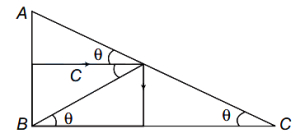
$A$ ray of light is incident on the hypotenuse of a right-angled prism after travelling parallel to the base inside the prism. If $\mu$ is the refractive index of the material of the prism,the maximum value of the base angle for which light is totally reflected from the hypotenuse is
A
$\sin ^{-1}\left(\frac{1}{\mu}\right)$
B
$\tan ^{-1}\left(\frac{1}{\mu}\right)$
C
$\sin ^{-1}\left(\frac{\mu-1}{\mu}\right)$
D
$\cos ^{-1}\left(\frac{1}{\mu}\right)$
Solution
(D) For total internal reflection to occur at the hypotenuse,the angle of incidence $i$ must be greater than or equal to the critical angle $C$.
Here,the ray travels parallel to the base. From the geometry of the right-angled prism,the angle of incidence $i$ at the hypotenuse is $(90^{\circ} - \theta)$,where $\theta$ is the base angle.
For total internal reflection,$i \geq C$,where $\sin C = \frac{1}{\mu}$.
Thus,the condition is $i \geq \sin^{-1}\left(\frac{1}{\mu}\right)$.
Substituting $i = 90^{\circ} - \theta$,we get $90^{\circ} - \theta \geq \sin^{-1}\left(\frac{1}{\mu}\right)$.
Taking the sine of both sides: $\sin(90^{\circ} - \theta) \geq \frac{1}{\mu}$.
This simplifies to $\cos \theta \geq \frac{1}{\mu}$.
Therefore,the maximum value of the base angle $\theta$ is $\cos^{-1}\left(\frac{1}{\mu}\right)$.
Here,the ray travels parallel to the base. From the geometry of the right-angled prism,the angle of incidence $i$ at the hypotenuse is $(90^{\circ} - \theta)$,where $\theta$ is the base angle.
For total internal reflection,$i \geq C$,where $\sin C = \frac{1}{\mu}$.
Thus,the condition is $i \geq \sin^{-1}\left(\frac{1}{\mu}\right)$.
Substituting $i = 90^{\circ} - \theta$,we get $90^{\circ} - \theta \geq \sin^{-1}\left(\frac{1}{\mu}\right)$.
Taking the sine of both sides: $\sin(90^{\circ} - \theta) \geq \frac{1}{\mu}$.
This simplifies to $\cos \theta \geq \frac{1}{\mu}$.
Therefore,the maximum value of the base angle $\theta$ is $\cos^{-1}\left(\frac{1}{\mu}\right)$.
0 likesView Solution
102
ChemistryMCQTS EAMCET · 2003
$A$ prism of refractive index $\mu$ and angle $A$ is placed in the minimum deviation position. If the angle of minimum deviation is $A$,then the value of $A$ in terms of $\mu$ is :
A
$\sin ^{-1}\left(\frac{\mu}{2}\right)$
B
$\sin ^{-1} \sqrt{\frac{\mu-1}{2}}$
C
$2 \cos ^{-1}\left(\frac{\mu}{2}\right)$
D
$\cos ^{-1}\left(\frac{\mu}{2}\right)$
Solution
(C) The refractive index of the material of the prism is given by the formula:
$\mu = \frac{\sin \left(\frac{A+\delta_m}{2}\right)}{\sin \frac{A}{2}}$
Given that the angle of minimum deviation $\delta_m = A$,we substitute this into the formula:
$\mu = \frac{\sin \left(\frac{A+A}{2}\right)}{\sin \frac{A}{2}}$
$\mu = \frac{\sin A}{\sin \frac{A}{2}}$
Using the trigonometric identity $\sin A = 2 \sin \frac{A}{2} \cos \frac{A}{2}$,we get:
$\mu = \frac{2 \sin \frac{A}{2} \cos \frac{A}{2}}{\sin \frac{A}{2}}$
$\mu = 2 \cos \frac{A}{2}$
$\cos \frac{A}{2} = \frac{\mu}{2}$
$\frac{A}{2} = \cos ^{-1}\left(\frac{\mu}{2}\right)$
$A = 2 \cos ^{-1}\left(\frac{\mu}{2}\right)$
$\mu = \frac{\sin \left(\frac{A+\delta_m}{2}\right)}{\sin \frac{A}{2}}$
Given that the angle of minimum deviation $\delta_m = A$,we substitute this into the formula:
$\mu = \frac{\sin \left(\frac{A+A}{2}\right)}{\sin \frac{A}{2}}$
$\mu = \frac{\sin A}{\sin \frac{A}{2}}$
Using the trigonometric identity $\sin A = 2 \sin \frac{A}{2} \cos \frac{A}{2}$,we get:
$\mu = \frac{2 \sin \frac{A}{2} \cos \frac{A}{2}}{\sin \frac{A}{2}}$
$\mu = 2 \cos \frac{A}{2}$
$\cos \frac{A}{2} = \frac{\mu}{2}$
$\frac{A}{2} = \cos ^{-1}\left(\frac{\mu}{2}\right)$
$A = 2 \cos ^{-1}\left(\frac{\mu}{2}\right)$
0 likesView Solution
103
ChemistryMCQTS EAMCET · 2003
The oxidation state of $Xe$ in $XeO_3$ and the bond angle in it respectively are:
A
$+6, 109^{\circ}$
B
$+8, 103^{\circ}$
C
$+6, 103^{\circ}$
D
$+8, 120^{\circ}$
Solution
(C) The oxidation state of $Xe$ in $XeO_3$ is calculated as follows:
$x + 3(-2) = 0 \implies x = +6$.
$XeO_3$ has a trigonal pyramidal geometry due to $sp^3$ hybridization with one lone pair on the $Xe$ atom.
Due to the presence of the lone pair,the bond angle is compressed from the ideal tetrahedral angle of $109.5^{\circ}$ to approximately $103^{\circ}$.
$x + 3(-2) = 0 \implies x = +6$.
$XeO_3$ has a trigonal pyramidal geometry due to $sp^3$ hybridization with one lone pair on the $Xe$ atom.
Due to the presence of the lone pair,the bond angle is compressed from the ideal tetrahedral angle of $109.5^{\circ}$ to approximately $103^{\circ}$.
0 likesView Solution
104
ChemistryMCQTS EAMCET · 2003
Which one of the following electrolytes is used in Down's process of extracting sodium metal?
A
$NaCl + KCl + KF$
B
$NaCl$
C
$NaOH + KCl + KF$
D
$NaCl + NaOH$
Solution
(A) Sodium metal is manufactured by the electrolysis of fused sodium chloride mixed with $KCl$ and $KF$.
On electrolysis:
At iron cathode: $Na^{+} + e^{-} \longrightarrow Na_{(s)}$ (metallic sodium)
At graphite anode: $2Cl^{-} \longrightarrow Cl_{2(g)} + 2e^{-}$
$NaCl$ melts at $800^{\circ}C$. It is difficult to attain and maintain this melting point. So,$KCl$ and $KF$ are added to lower the melting point of the mixture to about $600^{\circ}C$. $KCl$ and $KF$ are not electrolyzed under the voltage conditions used for sodium.
On electrolysis:
At iron cathode: $Na^{+} + e^{-} \longrightarrow Na_{(s)}$ (metallic sodium)
At graphite anode: $2Cl^{-} \longrightarrow Cl_{2(g)} + 2e^{-}$
$NaCl$ melts at $800^{\circ}C$. It is difficult to attain and maintain this melting point. So,$KCl$ and $KF$ are added to lower the melting point of the mixture to about $600^{\circ}C$. $KCl$ and $KF$ are not electrolyzed under the voltage conditions used for sodium.
0 likesView Solution
105
ChemistryMCQTS EAMCET · 2003
Which one of the following reactions occurs at the anode in the Castner process of extracting sodium metal?
A
$H_2 \longrightarrow 2 H^{+} + 2 e^{-}$
B
$2 Cl^{-} \longrightarrow Cl_2 + 2 e^{-}$
C
$4 OH^{-} \longrightarrow 2 H_2 O + O_2 + 4 e^{-}$
D
$Na^{+} + e^{-} \longrightarrow Na$
Solution
(C) In the Castner process,the extraction of sodium metal involves the electrolysis of molten sodium hydroxide $(NaOH)$.
The dissociation of sodium hydroxide is represented as: $4 NaOH \longrightarrow 4 Na^{+} + 4 OH^{-}$.
At the anode,oxidation occurs,where hydroxide ions $(OH^{-})$ lose electrons to form water and oxygen gas:
$4 OH^{-} \longrightarrow 2 H_2 O + O_2 + 4 e^{-}$.
The dissociation of sodium hydroxide is represented as: $4 NaOH \longrightarrow 4 Na^{+} + 4 OH^{-}$.
At the anode,oxidation occurs,where hydroxide ions $(OH^{-})$ lose electrons to form water and oxygen gas:
$4 OH^{-} \longrightarrow 2 H_2 O + O_2 + 4 e^{-}$.
0 likesView Solution
106
ChemistryMCQTS EAMCET · 2003
What are the products formed when an aqueous solution of magnesium bicarbonate is boiled?
A
$MgO, H_2O, CO_2$
B
$Mg(HCO_3)_2, H_2O$
C
$Mg(OH)_2, H_2O$
D
$Mg, CO_2, H_2O$
Solution
(A) When an aqueous solution of magnesium bicarbonate is boiled,it undergoes thermal decomposition to form magnesium oxide,water,and carbon dioxide gas.
The chemical equation is:
$Mg(HCO_3)_2(aq) \xrightarrow{\Delta} MgO(s) + H_2O(l) + 2CO_2(g)$
The chemical equation is:
$Mg(HCO_3)_2(aq) \xrightarrow{\Delta} MgO(s) + H_2O(l) + 2CO_2(g)$
0 likesView Solution
107
ChemistryDifficultMCQTS EAMCET · 2003
$A$ mixture of sodium oxide and calcium oxide is dissolved in water and saturated with excess carbon dioxide gas. The resulting solution is ...... It contains ......... :
A
basic; $NaOH$ and $Ca(OH)_2$
B
neutral; $Na_2CO_3$ and $CaCO_3$
C
basic; $Na_2CO_3$ and $Ca(HCO_3)_2$
D
acidic; $NaHCO_3$ and $Ca(HCO_3)_2$
Solution
(C) When $Na_2O$ and $CaO$ are dissolved in water,they form $NaOH$ and $Ca(OH)_2$ respectively.
$Na_2O + H_2O \longrightarrow 2NaOH$
$CaO + H_2O \longrightarrow Ca(OH)_2$
When this mixture is saturated with excess $CO_2$,the hydroxides react to form bicarbonates:
$2NaOH + 2CO_2 \longrightarrow 2NaHCO_3$
$Ca(OH)_2 + 2CO_2 \longrightarrow Ca(HCO_3)_2$
Since $NaHCO_3$ is a salt of a strong base $(NaOH)$ and a weak acid $(H_2CO_3)$,the solution is basic due to the hydrolysis of the bicarbonate ion $(HCO_3^- + H_2O \rightleftharpoons H_2CO_3 + OH^-)$.
$Na_2O + H_2O \longrightarrow 2NaOH$
$CaO + H_2O \longrightarrow Ca(OH)_2$
When this mixture is saturated with excess $CO_2$,the hydroxides react to form bicarbonates:
$2NaOH + 2CO_2 \longrightarrow 2NaHCO_3$
$Ca(OH)_2 + 2CO_2 \longrightarrow Ca(HCO_3)_2$
Since $NaHCO_3$ is a salt of a strong base $(NaOH)$ and a weak acid $(H_2CO_3)$,the solution is basic due to the hydrolysis of the bicarbonate ion $(HCO_3^- + H_2O \rightleftharpoons H_2CO_3 + OH^-)$.
0 likesView Solution
108
ChemistryMCQTS EAMCET · 2003
When $n-p-n$ transistor is used as an amplifier:
A
electrons move from base to collector
B
holes move from emitter to base
C
holes move from collector to base
D
holes move from base to emitter
Solution
(A) In an $n-p-n$ transistor,the emitter is $n$-type,the base is $p$-type,and the collector is $n$-type.
When used as an amplifier,the base-emitter junction is forward-biased and the collector-base junction is reverse-biased.
Due to the forward bias,electrons are injected from the emitter into the base.
Because the base is very thin and lightly doped,most of these electrons diffuse through the base into the collector region.
The collector is kept at a positive potential relative to the base to attract these electrons.
Therefore,electrons move from the base to the collector.
When used as an amplifier,the base-emitter junction is forward-biased and the collector-base junction is reverse-biased.
Due to the forward bias,electrons are injected from the emitter into the base.
Because the base is very thin and lightly doped,most of these electrons diffuse through the base into the collector region.
The collector is kept at a positive potential relative to the base to attract these electrons.
Therefore,electrons move from the base to the collector.
0 likesView Solution
109
ChemistryMCQTS EAMCET · 2003
The differential equation of the family of parabolas with the focus at the origin and the axis along the $X$-axis is:
A
$y\left(\frac{dy}{dx}\right)^2+4x\frac{dy}{dx}=4y$
B
$-y\left(\frac{dy}{dx}\right)^2=2x\frac{dy}{dx}-y$
C
$y\left(\frac{dy}{dx}\right)^2+y=2xy\frac{dy}{dx}$
D
$y\left(\frac{dy}{dx}\right)^2+2xy\frac{dy}{dx}+y=0$
Solution
(B) The standard equation of a parabola with focus at $(0,0)$ and axis along the $X$-axis is $(y-0)^2 = 4a(x+a)$,where $a$ is a parameter.
This simplifies to $y^2 = 4ax + 4a^2$.
Differentiating both sides with respect to $x$,we get $2y \frac{dy}{dx} = 4a$,which implies $a = \frac{y}{2} \frac{dy}{dx}$.
Substituting this value of $a$ into the original equation:
$y^2 = 4\left(\frac{y}{2} \frac{dy}{dx}\right)x + 4\left(\frac{y}{2} \frac{dy}{dx}\right)^2$.
$y^2 = 2xy \frac{dy}{dx} + 4\left(\frac{y^2}{4} \left(\frac{dy}{dx}\right)^2\right)$.
$y^2 = 2xy \frac{dy}{dx} + y^2 \left(\frac{dy}{dx}\right)^2$.
Dividing by $y$ (assuming $y \neq 0$):
$y = 2x \frac{dy}{dx} + y \left(\frac{dy}{dx}\right)^2$.
Rearranging the terms gives $-y \left(\frac{dy}{dx}\right)^2 = 2x \frac{dy}{dx} - y$.
This simplifies to $y^2 = 4ax + 4a^2$.
Differentiating both sides with respect to $x$,we get $2y \frac{dy}{dx} = 4a$,which implies $a = \frac{y}{2} \frac{dy}{dx}$.
Substituting this value of $a$ into the original equation:
$y^2 = 4\left(\frac{y}{2} \frac{dy}{dx}\right)x + 4\left(\frac{y}{2} \frac{dy}{dx}\right)^2$.
$y^2 = 2xy \frac{dy}{dx} + 4\left(\frac{y^2}{4} \left(\frac{dy}{dx}\right)^2\right)$.
$y^2 = 2xy \frac{dy}{dx} + y^2 \left(\frac{dy}{dx}\right)^2$.
Dividing by $y$ (assuming $y \neq 0$):
$y = 2x \frac{dy}{dx} + y \left(\frac{dy}{dx}\right)^2$.
Rearranging the terms gives $-y \left(\frac{dy}{dx}\right)^2 = 2x \frac{dy}{dx} - y$.
0 likesView Solution
110
ChemistryMCQTS EAMCET · 2003
The solution of $\frac{dy}{dx} = \frac{x \log x^2 + x}{\sin y + y \cos y}$ is
A
$y \sin y = x^2 \log x + C$
B
$y \sin y = x^2 + C$
C
$y \sin y = x^2 + \log x$
D
$y \sin y = x \log x + C$
Solution
(A) Given the differential equation: $\frac{dy}{dx} = \frac{x \log x^2 + x}{\sin y + y \cos y}$
By separating the variables,we get: $(\sin y + y \cos y) dy = (x \log x^2 + x) dx$
Integrating both sides: $\int (\sin y + y \cos y) dy = \int (x \log x^2 + x) dx$
For the left side,using integration by parts on $\int y \cos y dy$: $\int \sin y dy + (y \sin y - \int \sin y dy) = y \sin y$
For the right side,$\int (2x \log x + x) dx = 2 \int x \log x dx + \int x dx$
Using integration by parts for $\int x \log x dx = \frac{x^2}{2} \log x - \int \frac{x^2}{2} \cdot \frac{1}{x} dx = \frac{x^2}{2} \log x - \frac{x^2}{4}$
Thus,$\int (x \log x^2 + x) dx = 2(\frac{x^2}{2} \log x - \frac{x^2}{4}) + \frac{x^2}{2} + C = x^2 \log x - \frac{x^2}{2} + \frac{x^2}{2} + C = x^2 \log x + C$
Therefore,the solution is $y \sin y = x^2 \log x + C$.
By separating the variables,we get: $(\sin y + y \cos y) dy = (x \log x^2 + x) dx$
Integrating both sides: $\int (\sin y + y \cos y) dy = \int (x \log x^2 + x) dx$
For the left side,using integration by parts on $\int y \cos y dy$: $\int \sin y dy + (y \sin y - \int \sin y dy) = y \sin y$
For the right side,$\int (2x \log x + x) dx = 2 \int x \log x dx + \int x dx$
Using integration by parts for $\int x \log x dx = \frac{x^2}{2} \log x - \int \frac{x^2}{2} \cdot \frac{1}{x} dx = \frac{x^2}{2} \log x - \frac{x^2}{4}$
Thus,$\int (x \log x^2 + x) dx = 2(\frac{x^2}{2} \log x - \frac{x^2}{4}) + \frac{x^2}{2} + C = x^2 \log x - \frac{x^2}{2} + \frac{x^2}{2} + C = x^2 \log x + C$
Therefore,the solution is $y \sin y = x^2 \log x + C$.
0 likesView Solution
111
ChemistryMCQTS EAMCET · 2003
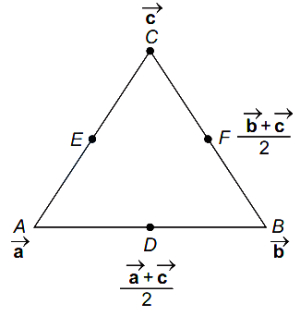
If $D, E$ and $F$ are respectively the mid-points of $AB, AC$ and $BC$ in $\triangle ABC$,then $\overrightarrow{BE} + \overrightarrow{AF}$ is equal to :
A
$\overrightarrow{DC}$
B
$\frac{1}{2} \overrightarrow{BF}$
C
$2 \overrightarrow{BF}$
D
$\frac{3}{2} \overrightarrow{BF}$
Solution
(A) Let the position vectors of vertices $A, B, C$ be $\vec{a}, \vec{b}, \vec{c}$ respectively.
Since $D, E, F$ are mid-points of $AB, AC, BC$ respectively,their position vectors are:
$\vec{d} = \frac{\vec{a} + \vec{b}}{2}$,$\vec{e} = \frac{\vec{a} + \vec{c}}{2}$,$\vec{f} = \frac{\vec{b} + \vec{c}}{2}$.
Now,we calculate the vectors $\overrightarrow{BE}$ and $\overrightarrow{AF}$:
$\overrightarrow{BE} = \vec{e} - \vec{b} = \frac{\vec{a} + \vec{c}}{2} - \vec{b} = \frac{\vec{a} + \vec{c} - 2\vec{b}}{2}$
$\overrightarrow{AF} = \vec{f} - \vec{a} = \frac{\vec{b} + \vec{c}}{2} - \vec{a} = \frac{\vec{b} + \vec{c} - 2\vec{a}}{2}$
Adding these two vectors:
$\overrightarrow{BE} + \overrightarrow{AF} = \frac{\vec{a} + \vec{c} - 2\vec{b} + \vec{b} + \vec{c} - 2\vec{a}}{2} = \frac{2\vec{c} - \vec{a} - \vec{b}}{2} = \vec{c} - \frac{\vec{a} + \vec{b}}{2}$
Since $\vec{d} = \frac{\vec{a} + \vec{b}}{2}$,we have $\overrightarrow{BE} + \overrightarrow{AF} = \vec{c} - \vec{d} = \overrightarrow{DC}$.
Since $D, E, F$ are mid-points of $AB, AC, BC$ respectively,their position vectors are:
$\vec{d} = \frac{\vec{a} + \vec{b}}{2}$,$\vec{e} = \frac{\vec{a} + \vec{c}}{2}$,$\vec{f} = \frac{\vec{b} + \vec{c}}{2}$.
Now,we calculate the vectors $\overrightarrow{BE}$ and $\overrightarrow{AF}$:
$\overrightarrow{BE} = \vec{e} - \vec{b} = \frac{\vec{a} + \vec{c}}{2} - \vec{b} = \frac{\vec{a} + \vec{c} - 2\vec{b}}{2}$
$\overrightarrow{AF} = \vec{f} - \vec{a} = \frac{\vec{b} + \vec{c}}{2} - \vec{a} = \frac{\vec{b} + \vec{c} - 2\vec{a}}{2}$
Adding these two vectors:
$\overrightarrow{BE} + \overrightarrow{AF} = \frac{\vec{a} + \vec{c} - 2\vec{b} + \vec{b} + \vec{c} - 2\vec{a}}{2} = \frac{2\vec{c} - \vec{a} - \vec{b}}{2} = \vec{c} - \frac{\vec{a} + \vec{b}}{2}$
Since $\vec{d} = \frac{\vec{a} + \vec{b}}{2}$,we have $\overrightarrow{BE} + \overrightarrow{AF} = \vec{c} - \vec{d} = \overrightarrow{DC}$.
0 likesView Solution
112
ChemistryMCQTS EAMCET · 2003
If $\overrightarrow{a}, \overrightarrow{b}, \overrightarrow{c}$ are three non-coplanar vectors,then the vector equation $\overrightarrow{r}=(1-p-q) \overrightarrow{a}+p \overrightarrow{b}+q \overrightarrow{c}$ represents a :
A
straight line
B
plane
C
plane passing through the origin
D
sphere
Solution
(B) The given vector equation is $\overrightarrow{r}=(1-p-q) \overrightarrow{a}+p \overrightarrow{b}+q \overrightarrow{c}$.
This can be rewritten as $\overrightarrow{r} = \overrightarrow{a} + p(\overrightarrow{b} - \overrightarrow{a}) + q(\overrightarrow{c} - \overrightarrow{a})$.
Let $\overrightarrow{u} = \overrightarrow{b} - \overrightarrow{a}$ and $\overrightarrow{v} = \overrightarrow{c} - \overrightarrow{a}$.
Then the equation becomes $\overrightarrow{r} = \overrightarrow{a} + p\overrightarrow{u} + q\overrightarrow{v}$.
Since $\overrightarrow{a}, \overrightarrow{b}, \overrightarrow{c}$ are non-coplanar,the vectors $\overrightarrow{u}$ and $\overrightarrow{v}$ are non-collinear.
An equation of the form $\overrightarrow{r} = \overrightarrow{a} + p\overrightarrow{u} + q\overrightarrow{v}$ represents a plane passing through the point with position vector $\overrightarrow{a}$ and parallel to the vectors $\overrightarrow{u}$ and $\overrightarrow{v}$.
This can be rewritten as $\overrightarrow{r} = \overrightarrow{a} + p(\overrightarrow{b} - \overrightarrow{a}) + q(\overrightarrow{c} - \overrightarrow{a})$.
Let $\overrightarrow{u} = \overrightarrow{b} - \overrightarrow{a}$ and $\overrightarrow{v} = \overrightarrow{c} - \overrightarrow{a}$.
Then the equation becomes $\overrightarrow{r} = \overrightarrow{a} + p\overrightarrow{u} + q\overrightarrow{v}$.
Since $\overrightarrow{a}, \overrightarrow{b}, \overrightarrow{c}$ are non-coplanar,the vectors $\overrightarrow{u}$ and $\overrightarrow{v}$ are non-collinear.
An equation of the form $\overrightarrow{r} = \overrightarrow{a} + p\overrightarrow{u} + q\overrightarrow{v}$ represents a plane passing through the point with position vector $\overrightarrow{a}$ and parallel to the vectors $\overrightarrow{u}$ and $\overrightarrow{v}$.
0 likesView Solution
113
ChemistryMCQTS EAMCET · 2003
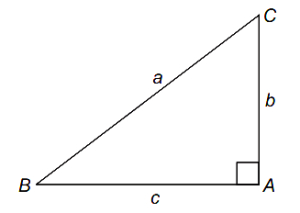
If $\overrightarrow{a}, \overrightarrow{b}, \overrightarrow{c}$ are three vectors such that $\overrightarrow{a}=\overrightarrow{b}+\overrightarrow{c}$ and the angle between $\overrightarrow{b}$ and $\overrightarrow{c}$ is $\frac{\pi}{2}$,then:
A
$a^2=b^2+c^2$
B
$b^2=c^2+a^2$
C
$c^2=a^2+b^2$
D
$2 a^2-b^2=c^2$
Solution
(A) Given that $\overrightarrow{a} = \overrightarrow{b} + \overrightarrow{c}$.
Taking the dot product of both sides with themselves:
$(\overrightarrow{a}) \cdot (\overrightarrow{a}) = (\overrightarrow{b} + \overrightarrow{c}) \cdot (\overrightarrow{b} + \overrightarrow{c})$
$|\overrightarrow{a}|^2 = |\overrightarrow{b}|^2 + |\overrightarrow{c}|^2 + 2(\overrightarrow{b} \cdot \overrightarrow{c})$
Since the angle between $\overrightarrow{b}$ and $\overrightarrow{c}$ is $\frac{\pi}{2}$,their dot product $\overrightarrow{b} \cdot \overrightarrow{c} = |\overrightarrow{b}||\overrightarrow{c}| \cos(\frac{\pi}{2}) = 0$.
Therefore,$a^2 = b^2 + c^2$.
Taking the dot product of both sides with themselves:
$(\overrightarrow{a}) \cdot (\overrightarrow{a}) = (\overrightarrow{b} + \overrightarrow{c}) \cdot (\overrightarrow{b} + \overrightarrow{c})$
$|\overrightarrow{a}|^2 = |\overrightarrow{b}|^2 + |\overrightarrow{c}|^2 + 2(\overrightarrow{b} \cdot \overrightarrow{c})$
Since the angle between $\overrightarrow{b}$ and $\overrightarrow{c}$ is $\frac{\pi}{2}$,their dot product $\overrightarrow{b} \cdot \overrightarrow{c} = |\overrightarrow{b}||\overrightarrow{c}| \cos(\frac{\pi}{2}) = 0$.
Therefore,$a^2 = b^2 + c^2$.
0 likesView Solution
114
ChemistryMCQTS EAMCET · 2003
Let $\overrightarrow{a}, \overrightarrow{b}, \overrightarrow{c}$ be the position vectors of the vertices $A, B, C$ respectively of $\triangle ABC$. The vector area of $\triangle ABC$ is :
A
$\frac{1}{2}\{\overrightarrow{a} \times(\overrightarrow{b} \times \overrightarrow{c})+\overrightarrow{b} \times(\overrightarrow{c} \times \overrightarrow{a})+\overrightarrow{c} \times(\overrightarrow{a} \times \overrightarrow{b})\}$
B
$\frac{1}{2}\{\overrightarrow{a} \times \overrightarrow{b}+\overrightarrow{b} \times \overrightarrow{c}+\overrightarrow{c} \times \overrightarrow{a}\}$
C
$\frac{1}{2}\{\overrightarrow{a}+\overrightarrow{b}+\overrightarrow{c}\}$
D
$\frac{1}{2}\{(\overrightarrow{b} \cdot \overrightarrow{c}) \overrightarrow{a}+(\overrightarrow{c} \cdot \overrightarrow{a}) \overrightarrow{b}+(\overrightarrow{a} \cdot \overrightarrow{b}) \overrightarrow{c}\}$
Solution
(B) The vector area of a triangle with vertices having position vectors $\overrightarrow{a}, \overrightarrow{b}, \overrightarrow{c}$ is given by the formula:
$\text{Vector Area} = \frac{1}{2} (\overrightarrow{AB} \times \overrightarrow{AC})$
Since $\overrightarrow{AB} = \overrightarrow{b} - \overrightarrow{a}$ and $\overrightarrow{AC} = \overrightarrow{c} - \overrightarrow{a}$,we have:
$\text{Vector Area} = \frac{1}{2} ((\overrightarrow{b} - \overrightarrow{a}) \times (\overrightarrow{c} - \overrightarrow{a}))$
$= \frac{1}{2} (\overrightarrow{b} \times \overrightarrow{c} - \overrightarrow{b} \times \overrightarrow{a} - \overrightarrow{a} \times \overrightarrow{c} + \overrightarrow{a} \times \overrightarrow{a})$
Since $\overrightarrow{a} \times \overrightarrow{a} = 0$,$-\overrightarrow{b} \times \overrightarrow{a} = \overrightarrow{a} \times \overrightarrow{b}$,and $-\overrightarrow{a} \times \overrightarrow{c} = \overrightarrow{c} \times \overrightarrow{a}$,we get:
$\text{Vector Area} = \frac{1}{2} (\overrightarrow{a} \times \overrightarrow{b} + \overrightarrow{b} \times \overrightarrow{c} + \overrightarrow{c} \times \overrightarrow{a})$
$\text{Vector Area} = \frac{1}{2} (\overrightarrow{AB} \times \overrightarrow{AC})$
Since $\overrightarrow{AB} = \overrightarrow{b} - \overrightarrow{a}$ and $\overrightarrow{AC} = \overrightarrow{c} - \overrightarrow{a}$,we have:
$\text{Vector Area} = \frac{1}{2} ((\overrightarrow{b} - \overrightarrow{a}) \times (\overrightarrow{c} - \overrightarrow{a}))$
$= \frac{1}{2} (\overrightarrow{b} \times \overrightarrow{c} - \overrightarrow{b} \times \overrightarrow{a} - \overrightarrow{a} \times \overrightarrow{c} + \overrightarrow{a} \times \overrightarrow{a})$
Since $\overrightarrow{a} \times \overrightarrow{a} = 0$,$-\overrightarrow{b} \times \overrightarrow{a} = \overrightarrow{a} \times \overrightarrow{b}$,and $-\overrightarrow{a} \times \overrightarrow{c} = \overrightarrow{c} \times \overrightarrow{a}$,we get:
$\text{Vector Area} = \frac{1}{2} (\overrightarrow{a} \times \overrightarrow{b} + \overrightarrow{b} \times \overrightarrow{c} + \overrightarrow{c} \times \overrightarrow{a})$
0 likesView Solution
115
ChemistryMCQTS EAMCET · 2003
If $\overrightarrow{a}=\hat{i}+\hat{j}+\hat{k}$,$\overrightarrow{b}=\hat{i}+\hat{j}$,$\overrightarrow{c}=\hat{i}$ and $(\overrightarrow{a} \times \overrightarrow{b}) \times \overrightarrow{c}=\lambda \overrightarrow{a}+\mu \overrightarrow{b}$,then $\lambda+\mu$ is equal to:
A
$0$
B
$1$
C
$-1$
D
$3$
Solution
(A) Given vectors are $\overrightarrow{a}=\hat{i}+\hat{j}+\hat{k}$,$\overrightarrow{b}=\hat{i}+\hat{j}$,and $\overrightarrow{c}=\hat{i}$.
First,calculate the cross product $\overrightarrow{a} \times \overrightarrow{b}$:
$\overrightarrow{a} \times \overrightarrow{b} = \begin{vmatrix} \hat{i} & \hat{j} & \hat{k} \\ 1 & 1 & 1 \\ 1 & 1 & 0 \end{vmatrix} = \hat{i}(0-1) - \hat{j}(0-1) + \hat{k}(1-1) = -\hat{i} + \hat{j}$.
Now,calculate $(\overrightarrow{a} \times \overrightarrow{b}) \times \overrightarrow{c}$:
$(-\hat{i} + \hat{j}) \times \hat{i} = \begin{vmatrix} \hat{i} & \hat{j} & \hat{k} \\ -1 & 1 & 0 \\ 1 & 0 & 0 \end{vmatrix} = \hat{k}(0-1) = -\hat{k}$.
We are given $(\overrightarrow{a} \times \overrightarrow{b}) \times \overrightarrow{c} = \lambda \overrightarrow{a} + \mu \overrightarrow{b}$.
Substituting the vectors:
$-\hat{k} = \lambda(\hat{i} + \hat{j} + \hat{k}) + \mu(\hat{i} + \hat{j})$
$-\hat{k} = (\lambda + \mu)\hat{i} + (\lambda + \mu)\hat{j} + \lambda\hat{k}$.
Comparing the coefficients of $\hat{i}$,$\hat{j}$,and $\hat{k}$:
$1$) $\lambda + \mu = 0$
$2$) $\lambda + \mu = 0$
$3$) $\lambda = -1$
From equation $(1)$,since $\lambda = -1$,we have $-1 + \mu = 0$,which implies $\mu = 1$.
Therefore,$\lambda + \mu = -1 + 1 = 0$.
First,calculate the cross product $\overrightarrow{a} \times \overrightarrow{b}$:
$\overrightarrow{a} \times \overrightarrow{b} = \begin{vmatrix} \hat{i} & \hat{j} & \hat{k} \\ 1 & 1 & 1 \\ 1 & 1 & 0 \end{vmatrix} = \hat{i}(0-1) - \hat{j}(0-1) + \hat{k}(1-1) = -\hat{i} + \hat{j}$.
Now,calculate $(\overrightarrow{a} \times \overrightarrow{b}) \times \overrightarrow{c}$:
$(-\hat{i} + \hat{j}) \times \hat{i} = \begin{vmatrix} \hat{i} & \hat{j} & \hat{k} \\ -1 & 1 & 0 \\ 1 & 0 & 0 \end{vmatrix} = \hat{k}(0-1) = -\hat{k}$.
We are given $(\overrightarrow{a} \times \overrightarrow{b}) \times \overrightarrow{c} = \lambda \overrightarrow{a} + \mu \overrightarrow{b}$.
Substituting the vectors:
$-\hat{k} = \lambda(\hat{i} + \hat{j} + \hat{k}) + \mu(\hat{i} + \hat{j})$
$-\hat{k} = (\lambda + \mu)\hat{i} + (\lambda + \mu)\hat{j} + \lambda\hat{k}$.
Comparing the coefficients of $\hat{i}$,$\hat{j}$,and $\hat{k}$:
$1$) $\lambda + \mu = 0$
$2$) $\lambda + \mu = 0$
$3$) $\lambda = -1$
From equation $(1)$,since $\lambda = -1$,we have $-1 + \mu = 0$,which implies $\mu = 1$.
Therefore,$\lambda + \mu = -1 + 1 = 0$.
0 likesView Solution
116
ChemistryMCQTS EAMCET · 2003
If the direction ratios of two lines are given by $3lm - 4ln + mn = 0$ and $l + 2m + 3n = 0$,then the angle between the lines is:
A
$\frac{\pi}{6}$
B
$\frac{\pi}{4}$
C
$\frac{\pi}{3}$
D
$\frac{\pi}{2}$
Solution
(D) Given equations are:
$3lm - 4ln + mn = 0$ ... $(i)$
$l + 2m + 3n = 0$ ... (ii)
From (ii),$l = -(2m + 3n)$.
Substituting this in $(i)$:
$-3(2m + 3n)m + 4(2m + 3n)n + mn = 0$
$-6m^2 - 9mn + 8mn + 12n^2 + mn = 0$
$-6m^2 + 12n^2 = 0$
$m^2 = 2n^2 \Rightarrow m = \pm \sqrt{2}n$.
Case $1$: $m = \sqrt{2}n$. Then $l = -(2\sqrt{2} + 3)n$.
Direction ratios $(l_1, m_1, n_1) = (-(3 + 2\sqrt{2}), \sqrt{2}, 1)$.
Case $2$: $m = -\sqrt{2}n$. Then $l = -(-2\sqrt{2} + 3)n = (2\sqrt{2} - 3)n$.
Direction ratios $(l_2, m_2, n_2) = (2\sqrt{2} - 3, -\sqrt{2}, 1)$.
For angle $\theta$ between lines:
$\cos \theta = \frac{l_1l_2 + m_1m_2 + n_1n_2}{\sqrt{l_1^2 + m_1^2 + n_1^2} \sqrt{l_2^2 + m_2^2 + n_2^2}}$
Numerator: $(-(3 + 2\sqrt{2}))(2\sqrt{2} - 3) + (\sqrt{2})(-\sqrt{2}) + (1)(1)$
$= -((2\sqrt{2})^2 - 3^2) - 2 + 1 = -(8 - 9) - 1 = 1 - 1 = 0$.
Since the numerator is $0$,$\cos \theta = 0$,which implies $\theta = \frac{\pi}{2}$.
$3lm - 4ln + mn = 0$ ... $(i)$
$l + 2m + 3n = 0$ ... (ii)
From (ii),$l = -(2m + 3n)$.
Substituting this in $(i)$:
$-3(2m + 3n)m + 4(2m + 3n)n + mn = 0$
$-6m^2 - 9mn + 8mn + 12n^2 + mn = 0$
$-6m^2 + 12n^2 = 0$
$m^2 = 2n^2 \Rightarrow m = \pm \sqrt{2}n$.
Case $1$: $m = \sqrt{2}n$. Then $l = -(2\sqrt{2} + 3)n$.
Direction ratios $(l_1, m_1, n_1) = (-(3 + 2\sqrt{2}), \sqrt{2}, 1)$.
Case $2$: $m = -\sqrt{2}n$. Then $l = -(-2\sqrt{2} + 3)n = (2\sqrt{2} - 3)n$.
Direction ratios $(l_2, m_2, n_2) = (2\sqrt{2} - 3, -\sqrt{2}, 1)$.
For angle $\theta$ between lines:
$\cos \theta = \frac{l_1l_2 + m_1m_2 + n_1n_2}{\sqrt{l_1^2 + m_1^2 + n_1^2} \sqrt{l_2^2 + m_2^2 + n_2^2}}$
Numerator: $(-(3 + 2\sqrt{2}))(2\sqrt{2} - 3) + (\sqrt{2})(-\sqrt{2}) + (1)(1)$
$= -((2\sqrt{2})^2 - 3^2) - 2 + 1 = -(8 - 9) - 1 = 1 - 1 = 0$.
Since the numerator is $0$,$\cos \theta = 0$,which implies $\theta = \frac{\pi}{2}$.
0 likesView Solution
117
ChemistryMCQTS EAMCET · 2003
$XOZ$-plane divides the line segment joining the points $(2, 3, 1)$ and $(6, 7, 1)$ in the ratio: (in $: 7$)
A
$3$
B
$2$
C
$-3$
D
$-2$
Solution
(C) Let the $XOZ$-plane divide the line segment joining the points $A(2, 3, 1)$ and $B(6, 7, 1)$ in the ratio $m: n$.
Using the section formula,the coordinates of the point of division are given by:
$\left(\frac{m x_2 + n x_1}{m + n}, \frac{m y_2 + n y_1}{m + n}, \frac{m z_2 + n z_1}{m + n}\right)$
Substituting the given values:
$\left(\frac{6m + 2n}{m + n}, \frac{7m + 3n}{m + n}, \frac{m + n}{m + n}\right)$
Since the point lies on the $XOZ$-plane,its $y$-coordinate must be $0$.
Therefore,$\frac{7m + 3n}{m + n} = 0$.
$7m + 3n = 0$
$7m = -3n$
$\frac{m}{n} = -\frac{3}{7}$.
Thus,the ratio is $-3: 7$.
Using the section formula,the coordinates of the point of division are given by:
$\left(\frac{m x_2 + n x_1}{m + n}, \frac{m y_2 + n y_1}{m + n}, \frac{m z_2 + n z_1}{m + n}\right)$
Substituting the given values:
$\left(\frac{6m + 2n}{m + n}, \frac{7m + 3n}{m + n}, \frac{m + n}{m + n}\right)$
Since the point lies on the $XOZ$-plane,its $y$-coordinate must be $0$.
Therefore,$\frac{7m + 3n}{m + n} = 0$.
$7m + 3n = 0$
$7m = -3n$
$\frac{m}{n} = -\frac{3}{7}$.
Thus,the ratio is $-3: 7$.
0 likesView Solution
118
ChemistryMCQTS EAMCET · 2003
$A$ plane $\pi$ makes intercepts $3$ and $4$ respectively on $Z$-axis and $X$-axis. If $\pi$ is parallel to $Y$-axis,then its equation is:
A
$3x + 4z = 12$
B
$3z + 4x = 12$
C
$3y + 4z = 12$
D
$3z + 4y = 12$
Solution
(A) The intercept form of a plane is $\frac{x}{a} + \frac{y}{b} + \frac{z}{c} = 1$,where $a, b, c$ are the intercepts on the $X, Y, Z$ axes respectively.
Given that the plane makes intercepts $4$ on the $X$-axis $(a=4)$ and $3$ on the $Z$-axis $(c=3)$.
Since the plane is parallel to the $Y$-axis,the intercept on the $Y$-axis is infinite,which means $\frac{1}{b} = 0$.
Substituting these values into the intercept form equation:
$\frac{x}{4} + \frac{y}{\infty} + \frac{z}{3} = 1$
$\frac{x}{4} + 0 + \frac{z}{3} = 1$
Multiplying the entire equation by $12$ to clear the denominators:
$3x + 4z = 12$.
Given that the plane makes intercepts $4$ on the $X$-axis $(a=4)$ and $3$ on the $Z$-axis $(c=3)$.
Since the plane is parallel to the $Y$-axis,the intercept on the $Y$-axis is infinite,which means $\frac{1}{b} = 0$.
Substituting these values into the intercept form equation:
$\frac{x}{4} + \frac{y}{\infty} + \frac{z}{3} = 1$
$\frac{x}{4} + 0 + \frac{z}{3} = 1$
Multiplying the entire equation by $12$ to clear the denominators:
$3x + 4z = 12$.
0 likesView Solution
119
ChemistryMCQTS EAMCET · 2003
The equation of the plane passing through $(1, 1, 1)$ and $(1, -1, -1)$ and perpendicular to $2x - y + z + 5 = 0$ is:
A
$2x + 5y + z + 8 = 0$
B
$x + y - z - 1 = 0$
C
$2x + 5y + z + 4 = 0$
D
$x - y + z - 1 = 0$
Solution
(B) Let the equation of the plane passing through $(1, 1, 1)$ be $a(x - 1) + b(y - 1) + c(z - 1) = 0$ $\dots (i)$.
Since the plane passes through $(1, -1, -1)$,we have $a(1 - 1) + b(-1 - 1) + c(-1 - 1) = 0$,which simplifies to $-2b - 2c = 0$,or $b + c = 0$ $\dots (ii)$.
The plane is perpendicular to $2x - y + z + 5 = 0$,so their normal vectors are perpendicular. Thus,$2a - b + c = 0$ $\dots (iii)$.
From $(ii)$,we have $b = -c$. Substituting this into $(iii)$,we get $2a - (-c) + c = 0$,which simplifies to $2a + 2c = 0$,or $a = -c$.
Let $c = -1$,then $a = 1$ and $b = 1$.
Substituting these values into $(i)$,we get $1(x - 1) + 1(y - 1) - 1(z - 1) = 0$.
$x - 1 + y - 1 - z + 1 = 0$.
$x + y - z - 1 = 0$.
Since the plane passes through $(1, -1, -1)$,we have $a(1 - 1) + b(-1 - 1) + c(-1 - 1) = 0$,which simplifies to $-2b - 2c = 0$,or $b + c = 0$ $\dots (ii)$.
The plane is perpendicular to $2x - y + z + 5 = 0$,so their normal vectors are perpendicular. Thus,$2a - b + c = 0$ $\dots (iii)$.
From $(ii)$,we have $b = -c$. Substituting this into $(iii)$,we get $2a - (-c) + c = 0$,which simplifies to $2a + 2c = 0$,or $a = -c$.
Let $c = -1$,then $a = 1$ and $b = 1$.
Substituting these values into $(i)$,we get $1(x - 1) + 1(y - 1) - 1(z - 1) = 0$.
$x - 1 + y - 1 - z + 1 = 0$.
$x + y - z - 1 = 0$.
0 likesView Solution
120
ChemistryMCQTS EAMCET · 2003
If $P(A \cup B)=0.8$ and $P(A \cap B)=0.3$,then $P(\bar{A})+P(\bar{B})$ is equal to:
A
$0.3$
B
$0.5$
C
$0.8$
D
$0.9$
Solution
(D) We know that for any two events $A$ and $B$,$P(A \cup B) = P(A) + P(B) - P(A \cap B)$.
Given $P(A \cup B) = 0.8$ and $P(A \cap B) = 0.3$,we have:
$P(A) + P(B) = P(A \cup B) + P(A \cap B) = 0.8 + 0.3 = 1.1$.
We know that $P(\bar{A}) = 1 - P(A)$ and $P(\bar{B}) = 1 - P(B)$.
Therefore,$P(\bar{A}) + P(\bar{B}) = (1 - P(A)) + (1 - P(B)) = 2 - (P(A) + P(B))$.
Substituting the value of $P(A) + P(B)$:
$P(\bar{A}) + P(\bar{B}) = 2 - 1.1 = 0.9$.
Given $P(A \cup B) = 0.8$ and $P(A \cap B) = 0.3$,we have:
$P(A) + P(B) = P(A \cup B) + P(A \cap B) = 0.8 + 0.3 = 1.1$.
We know that $P(\bar{A}) = 1 - P(A)$ and $P(\bar{B}) = 1 - P(B)$.
Therefore,$P(\bar{A}) + P(\bar{B}) = (1 - P(A)) + (1 - P(B)) = 2 - (P(A) + P(B))$.
Substituting the value of $P(A) + P(B)$:
$P(\bar{A}) + P(\bar{B}) = 2 - 1.1 = 0.9$.
0 likesView Solution
121
ChemistryMCQTS EAMCET · 2003
$A$ coin is tossed $n$ times. The probability of getting a head at least once is greater than $0.8$. Then,the least value of such $n$ is:
A
$2$
B
$3$
C
$4$
D
$5$
Solution
(B) The probability of getting a head in a single toss is $p = \frac{1}{2}$,and the probability of getting a tail is $q = 1 - p = \frac{1}{2}$.
The probability of getting no heads in $n$ tosses is $P(\text{no head}) = q^n = (\frac{1}{2})^n$.
The probability of getting at least one head is $P(\text{at least one head}) = 1 - P(\text{no head}) = 1 - (\frac{1}{2})^n$.
Given that $1 - (\frac{1}{2})^n > 0.8$,we have:
$1 - 0.8 > (\frac{1}{2})^n$
$0.2 > (\frac{1}{2})^n$
$\frac{1}{5} > \frac{1}{2^n}$
$2^n > 5$.
For $n = 2$,$2^2 = 4 < 5$.
For $n = 3$,$2^3 = 8 > 5$.
Thus,the least value of $n$ is $3$.
The probability of getting no heads in $n$ tosses is $P(\text{no head}) = q^n = (\frac{1}{2})^n$.
The probability of getting at least one head is $P(\text{at least one head}) = 1 - P(\text{no head}) = 1 - (\frac{1}{2})^n$.
Given that $1 - (\frac{1}{2})^n > 0.8$,we have:
$1 - 0.8 > (\frac{1}{2})^n$
$0.2 > (\frac{1}{2})^n$
$\frac{1}{5} > \frac{1}{2^n}$
$2^n > 5$.
For $n = 2$,$2^2 = 4 < 5$.
For $n = 3$,$2^3 = 8 > 5$.
Thus,the least value of $n$ is $3$.
0 likesView Solution
122
ChemistryMCQTS EAMCET · 2003
Which one of the following represents the graph between $\log p$ (on $Y$-axis) and $\frac{1}{T}$ (on $X$-axis)?
($p=$ vapour pressure of a liquid,$T=$ absolute temperature)
($p=$ vapour pressure of a liquid,$T=$ absolute temperature)
A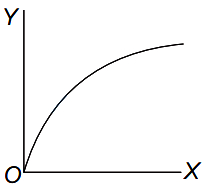
B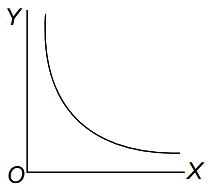
C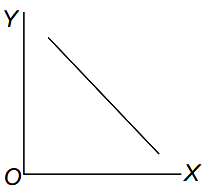
D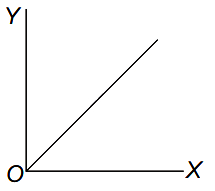
Solution
(C) According to the Clausius-Clapeyron equation,the relationship between vapour pressure $(p)$ and absolute temperature $(T)$ is given by:
$\log p = -\frac{\Delta H_{vap}}{2.303 R} \cdot \frac{1}{T} + C$
Here,$\Delta H_{vap}$ is the enthalpy of vaporization,$R$ is the gas constant,and $C$ is an integration constant.
This equation is in the form of a straight line $y = mx + c$,where $y = \log p$,$x = \frac{1}{T}$,and the slope $m = -\frac{\Delta H_{vap}}{2.303 R}$.
Since the slope is negative,the graph of $\log p$ versus $\frac{1}{T}$ is a straight line with a negative slope.
$\log p = -\frac{\Delta H_{vap}}{2.303 R} \cdot \frac{1}{T} + C$
Here,$\Delta H_{vap}$ is the enthalpy of vaporization,$R$ is the gas constant,and $C$ is an integration constant.
This equation is in the form of a straight line $y = mx + c$,where $y = \log p$,$x = \frac{1}{T}$,and the slope $m = -\frac{\Delta H_{vap}}{2.303 R}$.
Since the slope is negative,the graph of $\log p$ versus $\frac{1}{T}$ is a straight line with a negative slope.
0 likesView Solution
123
ChemistryMCQTS EAMCET · 2003
What is the volume (in litres) of oxygen required at $STP$ to completely convert $1.5 \ mol$ of sulphur into sulphur dioxide?
A
$11.2$
B
$22.4$
C
$33.6$
D
$44.8$
Solution
(C) The balanced chemical equation for the combustion of sulphur is:
$S(s) + O_2(g) \longrightarrow SO_2(g)$
From the stoichiometry of the reaction,$1 \ mol$ of $S$ reacts with $1 \ mol$ of $O_2$.
At $STP$,$1 \ mol$ of any gas occupies $22.4 \ L$.
Therefore,$1 \ mol$ of $S$ requires $22.4 \ L$ of $O_2$.
For $1.5 \ mol$ of $S$,the volume of $O_2$ required is:
$V = 1.5 \ mol \times 22.4 \ L/mol = 33.6 \ L$.
$S(s) + O_2(g) \longrightarrow SO_2(g)$
From the stoichiometry of the reaction,$1 \ mol$ of $S$ reacts with $1 \ mol$ of $O_2$.
At $STP$,$1 \ mol$ of any gas occupies $22.4 \ L$.
Therefore,$1 \ mol$ of $S$ requires $22.4 \ L$ of $O_2$.
For $1.5 \ mol$ of $S$,the volume of $O_2$ required is:
$V = 1.5 \ mol \times 22.4 \ L/mol = 33.6 \ L$.
0 likesView Solution
124
ChemistryMCQTS EAMCET · 2003
If a gas contains only three molecules that move with velocities of $100, 200, 500 \ ms^{-1}$. What is the $rms$ velocity of that gas in $ms^{-1}$?
A
$100 \frac{\sqrt{8}}{3}$
B
$100 \sqrt{30}$
C
$100 \sqrt{10}$
D
$\frac{800}{3}$
Solution
(C) Given velocities: $C_1 = 100 \ ms^{-1}, C_2 = 200 \ ms^{-1}, C_3 = 500 \ ms^{-1}$.
$rms$ velocity is defined as $C_{rms} = \sqrt{\frac{C_1^2 + C_2^2 + C_3^2}{n}}$.
Substituting the values: $C_{rms} = \sqrt{\frac{100^2 + 200^2 + 500^2}{3}}$.
$C_{rms} = \sqrt{\frac{10000 + 40000 + 250000}{3}} = \sqrt{\frac{300000}{3}}$.
$C_{rms} = \sqrt{100000} = 100 \sqrt{10} \ ms^{-1}$.
$rms$ velocity is defined as $C_{rms} = \sqrt{\frac{C_1^2 + C_2^2 + C_3^2}{n}}$.
Substituting the values: $C_{rms} = \sqrt{\frac{100^2 + 200^2 + 500^2}{3}}$.
$C_{rms} = \sqrt{\frac{10000 + 40000 + 250000}{3}} = \sqrt{\frac{300000}{3}}$.
$C_{rms} = \sqrt{100000} = 100 \sqrt{10} \ ms^{-1}$.
0 likesView Solution
125
ChemistryMCQTS EAMCET · 2003
If the mass defect of a nuclide is $3.32 \times 10^{-26} \ g$,its binding energy is (in $MeV$)?
A
$9.31$
B
$18.62$
C
$27.93$
D
$37.24$
Solution
(B) The mass defect is given as $3.32 \times 10^{-26} \ g$.
First,convert the mass defect from grams to atomic mass units $(amu)$ using the conversion factor $1 \ amu = 1.66 \times 10^{-24} \ g$.
$\text{Mass defect in } amu = \frac{3.32 \times 10^{-26} \ g}{1.66 \times 10^{-24} \ g/amu} = 0.02 \ amu$.
The binding energy is calculated by multiplying the mass defect in $amu$ by $931 \ MeV/amu$.
$\text{Binding energy} = 0.02 \ amu \times 931 \ MeV/amu = 18.62 \ MeV$.
First,convert the mass defect from grams to atomic mass units $(amu)$ using the conversion factor $1 \ amu = 1.66 \times 10^{-24} \ g$.
$\text{Mass defect in } amu = \frac{3.32 \times 10^{-26} \ g}{1.66 \times 10^{-24} \ g/amu} = 0.02 \ amu$.
The binding energy is calculated by multiplying the mass defect in $amu$ by $931 \ MeV/amu$.
$\text{Binding energy} = 0.02 \ amu \times 931 \ MeV/amu = 18.62 \ MeV$.
0 likesView Solution
126
ChemistryMCQTS EAMCET · 2003
If the electron of a hydrogen atom is present in the first orbit,the total energy of the electron is
A
$\frac{-e^2}{r}$
B
$\frac{-e^2}{r^2}$
C
$\frac{-e^2}{2r}$
D
$\frac{-e^2}{2r^2}$
Solution
(C) The kinetic energy $(KE)$ of an electron in an orbit is given by $KE = \frac{1}{2}mv^2$.
From the electrostatic force balance,the centripetal force is provided by the Coulombic attraction: $\frac{mv^2}{r} = \frac{e^2}{r^2}$,which implies $mv^2 = \frac{e^2}{r}$.
Substituting this into the $KE$ expression: $KE = \frac{1}{2} \times \frac{e^2}{r} = \frac{e^2}{2r}$.
The potential energy $(PE)$ of the electron is given by $PE = \frac{-e^2}{r}$.
The total energy $(E)$ is the sum of kinetic and potential energy: $E = KE + PE = \frac{e^2}{2r} - \frac{e^2}{r} = \frac{-e^2}{2r}$.
From the electrostatic force balance,the centripetal force is provided by the Coulombic attraction: $\frac{mv^2}{r} = \frac{e^2}{r^2}$,which implies $mv^2 = \frac{e^2}{r}$.
Substituting this into the $KE$ expression: $KE = \frac{1}{2} \times \frac{e^2}{r} = \frac{e^2}{2r}$.
The potential energy $(PE)$ of the electron is given by $PE = \frac{-e^2}{r}$.
The total energy $(E)$ is the sum of kinetic and potential energy: $E = KE + PE = \frac{e^2}{2r} - \frac{e^2}{r} = \frac{-e^2}{2r}$.
0 likesView Solution
127
ChemistryMCQTS EAMCET · 2003
If the wavelength of an electromagnetic radiation is $2000 \ \mathring{A}$,what is its energy in ergs?
A
$9.94 \times 10^{-12}$
B
$9.94 \times 10^{-19}$
C
$4.97 \times 10^{-12}$
D
$4.97 \times 10^{-19}$
Solution
(A) The energy $E$ of a photon is given by the formula $E = \frac{hc}{\lambda}$.
Given: $\lambda = 2000 \ \mathring{A} = 2000 \times 10^{-8} \ cm = 2 \times 10^{-5} \ cm$.
Speed of light $c = 3 \times 10^{10} \ cm/s$.
Planck's constant $h = 6.626 \times 10^{-27} \ erg \ s$.
Substituting the values: $E = \frac{6.626 \times 10^{-27} \ erg \ s \times 3 \times 10^{10} \ cm/s}{2 \times 10^{-5} \ cm}$.
$E = \frac{19.878 \times 10^{-17}}{2 \times 10^{-5}} \ erg = 9.939 \times 10^{-12} \ erg \approx 9.94 \times 10^{-12} \ erg$.
Given: $\lambda = 2000 \ \mathring{A} = 2000 \times 10^{-8} \ cm = 2 \times 10^{-5} \ cm$.
Speed of light $c = 3 \times 10^{10} \ cm/s$.
Planck's constant $h = 6.626 \times 10^{-27} \ erg \ s$.
Substituting the values: $E = \frac{6.626 \times 10^{-27} \ erg \ s \times 3 \times 10^{10} \ cm/s}{2 \times 10^{-5} \ cm}$.
$E = \frac{19.878 \times 10^{-17}}{2 \times 10^{-5}} \ erg = 9.939 \times 10^{-12} \ erg \approx 9.94 \times 10^{-12} \ erg$.
0 likesView Solution
128
ChemistryMCQTS EAMCET · 2003
Which one of the following equations represents the Freundlich adsorption isotherm?
A
$\frac{x}{m} = K p$
B
$\frac{x}{m} = K p^{1/n}$
C
$\log \frac{x}{m} = K p^n$
D
$\log \frac{x}{m} = K n \log p$
Solution
(B) The Freundlich adsorption isotherm is given by the empirical relation:
$\frac{x}{m} = K p^{1/n}$
where:
$x$ is the mass of the adsorbate,
$m$ is the mass of the adsorbent,
$p$ is the pressure,
$K$ and $n$ are constants which depend on the nature of the adsorbent and the gas at a particular temperature.
$\frac{x}{m} = K p^{1/n}$
where:
$x$ is the mass of the adsorbate,
$m$ is the mass of the adsorbent,
$p$ is the pressure,
$K$ and $n$ are constants which depend on the nature of the adsorbent and the gas at a particular temperature.
0 likesView Solution
129
ChemistryMCQTS EAMCET · 2003
The radiation emitted by a star $A$ is $10000$ times that of the sun. If the surface temperatures of the sun and the star $A$ are $6000 \ K$ and $2000 \ K$ respectively,the ratio of the radii of the star $A$ and the sun is : (in $: 1$)
A
$300$
B
$600$
C
$900$
D
$1200$
Solution
(C) The energy radiated per unit time is given by the Stefan-Boltzmann law: $E = \sigma A T^4$,where $\sigma$ is the Stefan-Boltzmann constant and $A = 4\pi R^2$ is the surface area of the star.
For the sun: $E_{\text{sun}} = \sigma (4\pi R_{\text{sun}}^2) T_{\text{sun}}^4$.
For the star $A$: $E_{\text{star}} = \sigma (4\pi R_{\text{star}}^2) T_{\text{star}}^4$.
Given that $E_{\text{star}} = 10000 E_{\text{sun}}$,we have:
$\sigma (4\pi R_{\text{star}}^2) T_{\text{star}}^4 = 10000 \times \sigma (4\pi R_{\text{sun}}^2) T_{\text{sun}}^4$.
Canceling $\sigma$ and $4\pi$ from both sides:
$R_{\text{star}}^2 T_{\text{star}}^4 = 10000 R_{\text{sun}}^2 T_{\text{sun}}^4$.
Rearranging to find the ratio of radii:
$\left(\frac{R_{\text{star}}}{R_{\text{sun}}}\right)^2 = 10000 \left(\frac{T_{\text{sun}}}{T_{\text{star}}}\right)^4$.
Substituting the given values $T_{\text{sun}} = 6000 \ K$ and $T_{\text{star}} = 2000 \ K$:
$\left(\frac{R_{\text{star}}}{R_{\text{sun}}}\right)^2 = 10000 \left(\frac{6000}{2000}\right)^4 = 10000 \times (3)^4 = 10000 \times 81 = 810000$.
Taking the square root of both sides:
$\frac{R_{\text{star}}}{R_{\text{sun}}} = \sqrt{810000} = 900$.
Thus,the ratio $R_{\text{star}} : R_{\text{sun}} = 900 : 1$.
For the sun: $E_{\text{sun}} = \sigma (4\pi R_{\text{sun}}^2) T_{\text{sun}}^4$.
For the star $A$: $E_{\text{star}} = \sigma (4\pi R_{\text{star}}^2) T_{\text{star}}^4$.
Given that $E_{\text{star}} = 10000 E_{\text{sun}}$,we have:
$\sigma (4\pi R_{\text{star}}^2) T_{\text{star}}^4 = 10000 \times \sigma (4\pi R_{\text{sun}}^2) T_{\text{sun}}^4$.
Canceling $\sigma$ and $4\pi$ from both sides:
$R_{\text{star}}^2 T_{\text{star}}^4 = 10000 R_{\text{sun}}^2 T_{\text{sun}}^4$.
Rearranging to find the ratio of radii:
$\left(\frac{R_{\text{star}}}{R_{\text{sun}}}\right)^2 = 10000 \left(\frac{T_{\text{sun}}}{T_{\text{star}}}\right)^4$.
Substituting the given values $T_{\text{sun}} = 6000 \ K$ and $T_{\text{star}} = 2000 \ K$:
$\left(\frac{R_{\text{star}}}{R_{\text{sun}}}\right)^2 = 10000 \left(\frac{6000}{2000}\right)^4 = 10000 \times (3)^4 = 10000 \times 81 = 810000$.
Taking the square root of both sides:
$\frac{R_{\text{star}}}{R_{\text{sun}}} = \sqrt{810000} = 900$.
Thus,the ratio $R_{\text{star}} : R_{\text{sun}} = 900 : 1$.
0 likesView Solution
130
ChemistryMCQTS EAMCET · 2003
The densities of a liquid at $0^{\circ} C$ and $100^{\circ} C$ are respectively $1.0127$ and $1$. $A$ specific gravity bottle is filled with $300 \ g$ of the liquid at $0^{\circ} C$ up to the brim and it is heated to $100^{\circ} C$. Then,the mass of the liquid expelled in grams is: (Coefficient of linear expansion of glass $= 9 \times 10^{-6} /^{\circ} C$)
A
$\frac{3}{10.1}$
B
$\frac{3}{1.01}$
C
$\frac{3.81}{1.0127}$
D
$\frac{3.81}{0.0127}$
Solution
(B) Density at $0^{\circ} C$,$\rho_0 = 1.0127$.
Density at $100^{\circ} C$,$\rho_{100} = 1$.
Coefficient of real expansion of liquid,$\gamma_{\text{real}} = \frac{\rho_0 - \rho_{100}}{\rho_{100} \times \Delta t} = \frac{1.0127 - 1}{1 \times 100} = 1.27 \times 10^{-4} /^{\circ} C$.
Coefficient of volume expansion of glass,$\gamma_g = 3 \alpha = 3 \times 9 \times 10^{-6} = 2.7 \times 10^{-5} = 0.27 \times 10^{-4} /^{\circ} C$.
Coefficient of apparent expansion,$\gamma_{\text{app}} = \gamma_{\text{real}} - \gamma_g = 1.27 \times 10^{-4} - 0.27 \times 10^{-4} = 1 \times 10^{-4} /^{\circ} C$.
The mass expelled is given by $\Delta m = m_0 \times \gamma_{\text{app}} \times \Delta t$ (approximately,for small changes) or using the relation $\frac{m_1}{m_2} = 1 + \gamma_{\text{app}} \Delta t$.
Here,$m_1 = 300 \ g$.
$\frac{300}{m_2} = 1 + (10^{-4} \times 100) = 1 + 0.01 = 1.01$.
$m_2 = \frac{300}{1.01}$.
Mass expelled $= m_1 - m_2 = 300 - \frac{300}{1.01} = 300 \left(1 - \frac{1}{1.01}\right) = 300 \left(\frac{0.01}{1.01}\right) = \frac{3}{1.01} \ g$.
Density at $100^{\circ} C$,$\rho_{100} = 1$.
Coefficient of real expansion of liquid,$\gamma_{\text{real}} = \frac{\rho_0 - \rho_{100}}{\rho_{100} \times \Delta t} = \frac{1.0127 - 1}{1 \times 100} = 1.27 \times 10^{-4} /^{\circ} C$.
Coefficient of volume expansion of glass,$\gamma_g = 3 \alpha = 3 \times 9 \times 10^{-6} = 2.7 \times 10^{-5} = 0.27 \times 10^{-4} /^{\circ} C$.
Coefficient of apparent expansion,$\gamma_{\text{app}} = \gamma_{\text{real}} - \gamma_g = 1.27 \times 10^{-4} - 0.27 \times 10^{-4} = 1 \times 10^{-4} /^{\circ} C$.
The mass expelled is given by $\Delta m = m_0 \times \gamma_{\text{app}} \times \Delta t$ (approximately,for small changes) or using the relation $\frac{m_1}{m_2} = 1 + \gamma_{\text{app}} \Delta t$.
Here,$m_1 = 300 \ g$.
$\frac{300}{m_2} = 1 + (10^{-4} \times 100) = 1 + 0.01 = 1.01$.
$m_2 = \frac{300}{1.01}$.
Mass expelled $= m_1 - m_2 = 300 - \frac{300}{1.01} = 300 \left(1 - \frac{1}{1.01}\right) = 300 \left(\frac{0.01}{1.01}\right) = \frac{3}{1.01} \ g$.
0 likesView Solution
131
ChemistryMCQTS EAMCET · 2003
Consider the two following statements $A$ and $B$,and identify the correct choice given in the answers: $(A)$ Duddell's thermo galvanometer is suitable to measure direct current only. $(B)$ Thermopile can measure temperature differences of the order of $10^{-3} {}^{\circ}C$.
A
Both $A$ and $B$ are true
B
Both $A$ and $B$ are false
C
$A$ is true but $B$ is false
D
$A$ is false but $B$ is true
Solution
(D) Statement $(A)$ is false because Duddell's thermo galvanometer is designed to measure both alternating current $(AC)$ and direct current $(DC)$ by utilizing the heating effect of the current.
Statement $(B)$ is true because a thermopile is a highly sensitive device consisting of several thermocouples connected in series,which allows it to detect very small temperature differences,typically on the order of $10^{-3} {}^{\circ}C$.
Statement $(B)$ is true because a thermopile is a highly sensitive device consisting of several thermocouples connected in series,which allows it to detect very small temperature differences,typically on the order of $10^{-3} {}^{\circ}C$.
0 likesView Solution
132
ChemistryMCQTS EAMCET · 2003
When $10 \ g$ of methane is completely burnt in oxygen,the heat evolved is $560 \ kJ$. What is the heat of combustion (in $kJ \ mol^{-1}$) of methane?
A
-$1120$
B
-$968$
C
-$896$
D
-$560$
Solution
(C) The combustion reaction of methane is: $CH_4 + 2O_2 \longrightarrow CO_2 + 2H_2O$.
The molar mass of methane $(CH_4)$ is $12 + (4 \times 1) = 16 \ g \ mol^{-1}$.
Given that the heat evolved for $10 \ g$ of $CH_4$ is $560 \ kJ$,the enthalpy change $\Delta H$ for $10 \ g$ is $-560 \ kJ$.
To find the heat of combustion per mole $(16 \ g)$,we use the unitary method:
Heat of combustion $= \frac{-560 \ kJ}{10 \ g} \times 16 \ g \ mol^{-1} = -896 \ kJ \ mol^{-1}$.
The molar mass of methane $(CH_4)$ is $12 + (4 \times 1) = 16 \ g \ mol^{-1}$.
Given that the heat evolved for $10 \ g$ of $CH_4$ is $560 \ kJ$,the enthalpy change $\Delta H$ for $10 \ g$ is $-560 \ kJ$.
To find the heat of combustion per mole $(16 \ g)$,we use the unitary method:
Heat of combustion $= \frac{-560 \ kJ}{10 \ g} \times 16 \ g \ mol^{-1} = -896 \ kJ \ mol^{-1}$.
0 likesView Solution
133
ChemistryMCQTS EAMCET · 2003
In Young's double slit experiment, an interference pattern is obtained on a screen by a light of wavelength $6000 \text{ } \mathring{A}$ coming from the coherent sources $S_1$ and $S_2$. At a certain point $P$ on the screen, the third dark fringe is formed. Then, the path difference $S_1 P - S_2 P$ in microns is:
A
$0.75$
B
$1.5$
C
$3$
D
$4.5$
Solution
(B) Given wavelength $\lambda = 6000 \text{ } \mathring{A} = 6 \times 10^{-7} \text{ m}$.
For dark fringes in Young's double slit experiment, the path difference $\Delta x$ is given by $\Delta x = (2n - 1) \frac{\lambda}{2}$ for $n = 1, 2, 3, \dots$ where $n$ represents the order of the dark fringe.
For the third dark fringe, we take $n = 3$.
Substituting the values: $\Delta x = (2 \times 3 - 1) \frac{6 \times 10^{-7}}{2} \text{ m}$.
$\Delta x = 5 \times 3 \times 10^{-7} \text{ m} = 15 \times 10^{-7} \text{ m}$.
$\Delta x = 1.5 \times 10^{-6} \text{ m} = 1.5 \text{ } \mu\text{m}$.
For dark fringes in Young's double slit experiment, the path difference $\Delta x$ is given by $\Delta x = (2n - 1) \frac{\lambda}{2}$ for $n = 1, 2, 3, \dots$ where $n$ represents the order of the dark fringe.
For the third dark fringe, we take $n = 3$.
Substituting the values: $\Delta x = (2 \times 3 - 1) \frac{6 \times 10^{-7}}{2} \text{ m}$.
$\Delta x = 5 \times 3 \times 10^{-7} \text{ m} = 15 \times 10^{-7} \text{ m}$.
$\Delta x = 1.5 \times 10^{-6} \text{ m} = 1.5 \text{ } \mu\text{m}$.
0 likesView Solution
134
ChemistryMCQTS EAMCET · 2003
If the length of a stretched string is shortened by $40 \%$ and the tension is increased by $44 \%$,then the ratio of the final and initial fundamental frequencies is :
A
$2: 1$
B
$3: 2$
C
$3: 4$
D
$1: 3$
Solution
(A) The fundamental frequency of a stretched string is given by $n = \frac{1}{2l} \sqrt{\frac{T}{m}}$,where $l$ is the length,$T$ is the tension,and $m$ is the mass per unit length.
Initial frequency $n_1 = \frac{1}{2l} \sqrt{\frac{T}{m}}$.
New length $l' = l - 0.40l = 0.6l$.
New tension $T' = T + 0.44T = 1.44T$.
New frequency $n_2 = \frac{1}{2l'} \sqrt{\frac{T'}{m}}$.
Taking the ratio of the final to initial frequency: $\frac{n_2}{n_1} = \frac{l}{l'} \sqrt{\frac{T'}{T}}$.
Substituting the values: $\frac{n_2}{n_1} = \frac{l}{0.6l} \sqrt{\frac{1.44T}{T}} = \frac{1}{0.6} \times \sqrt{1.44} = \frac{1.2}{0.6} = 2$.
Therefore,the ratio $n_2 : n_1 = 2 : 1$.
Initial frequency $n_1 = \frac{1}{2l} \sqrt{\frac{T}{m}}$.
New length $l' = l - 0.40l = 0.6l$.
New tension $T' = T + 0.44T = 1.44T$.
New frequency $n_2 = \frac{1}{2l'} \sqrt{\frac{T'}{m}}$.
Taking the ratio of the final to initial frequency: $\frac{n_2}{n_1} = \frac{l}{l'} \sqrt{\frac{T'}{T}}$.
Substituting the values: $\frac{n_2}{n_1} = \frac{l}{0.6l} \sqrt{\frac{1.44T}{T}} = \frac{1}{0.6} \times \sqrt{1.44} = \frac{1.2}{0.6} = 2$.
Therefore,the ratio $n_2 : n_1 = 2 : 1$.
0 likesView Solution
135
ChemistryMCQTS EAMCET · 2003
Two uniform strings $A$ and $B$ made of steel are made to vibrate under the same tension. If the first overtone of $A$ is equal to the second overtone of $B$ and if the radius of $A$ is twice that of $B$,the ratio of the lengths of the strings is :
A
$1: 2$
B
$1: 3$
C
$1: 4$
D
$1: 5$
Solution
(B) The fundamental frequency of a stretched string is given by $n = \frac{1}{2l} \sqrt{\frac{T}{m}}$,where $m = \pi r^2 \rho$ is the mass per unit length.
Thus,$n = \frac{1}{2lr} \sqrt{\frac{T}{\pi \rho}}$.
The frequency of the $p$-th overtone is $(p+1)n$.
For string $A$,the first overtone is $2n_A = \frac{2}{2l_A r_A} \sqrt{\frac{T}{\pi \rho}} = \frac{1}{l_A r_A} \sqrt{\frac{T}{\pi \rho}}$.
For string $B$,the second overtone is $3n_B = \frac{3}{2l_B r_B} \sqrt{\frac{T}{\pi \rho}}$.
Given $2n_A = 3n_B$ and $r_A = 2r_B$:
$\frac{1}{l_A r_A} = \frac{3}{2l_B r_B}$
$\frac{l_A}{l_B} = \frac{2 r_B}{3 r_A} = \frac{2 r_B}{3(2 r_B)} = \frac{2}{6} = \frac{1}{3}$.
Therefore,the ratio of the lengths $l_A : l_B = 1 : 3$.
Thus,$n = \frac{1}{2lr} \sqrt{\frac{T}{\pi \rho}}$.
The frequency of the $p$-th overtone is $(p+1)n$.
For string $A$,the first overtone is $2n_A = \frac{2}{2l_A r_A} \sqrt{\frac{T}{\pi \rho}} = \frac{1}{l_A r_A} \sqrt{\frac{T}{\pi \rho}}$.
For string $B$,the second overtone is $3n_B = \frac{3}{2l_B r_B} \sqrt{\frac{T}{\pi \rho}}$.
Given $2n_A = 3n_B$ and $r_A = 2r_B$:
$\frac{1}{l_A r_A} = \frac{3}{2l_B r_B}$
$\frac{l_A}{l_B} = \frac{2 r_B}{3 r_A} = \frac{2 r_B}{3(2 r_B)} = \frac{2}{6} = \frac{1}{3}$.
Therefore,the ratio of the lengths $l_A : l_B = 1 : 3$.
0 likesView Solution
136
ChemistryMCQTS EAMCET · 2003
Consider the following statements $A$ and $B$ and identify the correct answer given below:
$(A)$ $A$ body initially at rest is acted upon by a constant force. The rate of change of its kinetic energy varies linearly with time.
$(B)$ When a body is at rest,it must be in equilibrium.
$(A)$ $A$ body initially at rest is acted upon by a constant force. The rate of change of its kinetic energy varies linearly with time.
$(B)$ When a body is at rest,it must be in equilibrium.
A
$A$ and $B$ are correct
B
$A$ and $B$ are wrong
C
$A$ is correct and $B$ is wrong
D
$A$ is wrong and $B$ is correct
Solution
(C) For statement $A$: The kinetic energy $KE$ of a body starting from rest under a constant force $F$ is given by $KE = \frac{1}{2}mv^2$. Since $v = at$,we have $KE = \frac{1}{2}m(at)^2 = \frac{1}{2}ma^2t^2$.
The rate of change of kinetic energy is $\frac{d(KE)}{dt} = \frac{d}{dt}(\frac{1}{2}ma^2t^2) = ma^2t$.
Since $m$ and $a$ are constants,$\frac{d(KE)}{dt} \propto t$. Thus,the rate of change of kinetic energy varies linearly with time. Statement $A$ is correct.
For statement $B$: $A$ body at rest is in equilibrium only if the net force acting on it is zero. $A$ body can be momentarily at rest (e.g.,a ball thrown vertically upward at its highest point) while being acted upon by a non-zero net force (gravity). Thus,it is not necessarily in equilibrium. Statement $B$ is wrong.
The rate of change of kinetic energy is $\frac{d(KE)}{dt} = \frac{d}{dt}(\frac{1}{2}ma^2t^2) = ma^2t$.
Since $m$ and $a$ are constants,$\frac{d(KE)}{dt} \propto t$. Thus,the rate of change of kinetic energy varies linearly with time. Statement $A$ is correct.
For statement $B$: $A$ body at rest is in equilibrium only if the net force acting on it is zero. $A$ body can be momentarily at rest (e.g.,a ball thrown vertically upward at its highest point) while being acted upon by a non-zero net force (gravity). Thus,it is not necessarily in equilibrium. Statement $B$ is wrong.
0 likesView Solution
137
ChemistryMCQTS EAMCET · 2003
Two particles having position vectors $r_1 = (3 \hat{i} + 5 \hat{j}) \ m$ and $r_2 = (-5 \hat{i} - 3 \hat{j}) \ m$ are moving with velocities $v_1 = (4 \hat{i} + 3 \hat{j}) \ m/s$ and $v_2 = (a \hat{i} + 7 \hat{j}) \ m/s$. If they collide after $2 \ s$,then the value of $a$ is:
A
$2$
B
$4$
C
$6$
D
$8$
Solution
(D) For two particles to collide,their position vectors at time $t$ must be equal: $r_1(t) = r_2(t)$.
Given $r_1(t) = r_1 + v_1 t$ and $r_2(t) = r_2 + v_2 t$,the condition for collision is $r_1 + v_1 t = r_2 + v_2 t$.
Rearranging,we get $r_1 - r_2 = (v_2 - v_1) t$.
Substitute the given values:
$r_1 - r_2 = (3 \hat{i} + 5 \hat{j}) - (-5 \hat{i} - 3 \hat{j}) = 8 \hat{i} + 8 \hat{j}$.
$v_2 - v_1 = (a \hat{i} + 7 \hat{j}) - (4 \hat{i} + 3 \hat{j}) = (a - 4) \hat{i} + 4 \hat{j}$.
Given $t = 2 \ s$,substitute into the equation:
$8 \hat{i} + 8 \hat{j} = ((a - 4) \hat{i} + 4 \hat{j}) \times 2$.
Dividing by $2$:
$4 \hat{i} + 4 \hat{j} = (a - 4) \hat{i} + 4 \hat{j}$.
Comparing the coefficients of $\hat{i}$:
$a - 4 = 4 \implies a = 8$.
Given $r_1(t) = r_1 + v_1 t$ and $r_2(t) = r_2 + v_2 t$,the condition for collision is $r_1 + v_1 t = r_2 + v_2 t$.
Rearranging,we get $r_1 - r_2 = (v_2 - v_1) t$.
Substitute the given values:
$r_1 - r_2 = (3 \hat{i} + 5 \hat{j}) - (-5 \hat{i} - 3 \hat{j}) = 8 \hat{i} + 8 \hat{j}$.
$v_2 - v_1 = (a \hat{i} + 7 \hat{j}) - (4 \hat{i} + 3 \hat{j}) = (a - 4) \hat{i} + 4 \hat{j}$.
Given $t = 2 \ s$,substitute into the equation:
$8 \hat{i} + 8 \hat{j} = ((a - 4) \hat{i} + 4 \hat{j}) \times 2$.
Dividing by $2$:
$4 \hat{i} + 4 \hat{j} = (a - 4) \hat{i} + 4 \hat{j}$.
Comparing the coefficients of $\hat{i}$:
$a - 4 = 4 \implies a = 8$.
0 likesView Solution
138
ChemistryMediumMCQTS EAMCET · 2003
Compound $X$ is the anhydride of sulphuric acid. The number of $\sigma$-bonds and the number of $\pi$-bonds present in $X$ are,respectively:
A
$3, 3$
B
$4, 2$
C
$2, 4$
D
$4, 3$
Solution
(A) The anhydride of sulphuric acid $(H_2SO_4)$ is sulphur trioxide $(SO_3)$.
In the structure of $SO_3$,there are three $S=O$ double bonds.
Each double bond consists of one $\sigma$-bond and one $\pi$-bond.
Therefore,the total number of $\sigma$-bonds is $3$ and the total number of $\pi$-bonds is $3$.
In the structure of $SO_3$,there are three $S=O$ double bonds.
Each double bond consists of one $\sigma$-bond and one $\pi$-bond.
Therefore,the total number of $\sigma$-bonds is $3$ and the total number of $\pi$-bonds is $3$.
0 likesView Solution
139
ChemistryMediumMCQTS EAMCET · 2003
Chlorine atom,in its third excited state,reacts with fluorine to form a compound $X$. The formula and shape of $X$ are :
A
$ClF_5$,pentagonal
B
$ClF_4$,tetrahedral
C
$ClF_4$,pentagonal bipyramidal
D
$ClF_7$,pentagonal bipyramidal
Solution
(D) The ground state electronic configuration of $Cl$ $(Z=17)$ is $[Ne] 3s^2 3p_x^2 3p_y^2 3p_z^1$.
In the first excited state,one electron from $3p$ moves to $3d$,giving $3$ unpaired electrons.
In the second excited state,one electron from $3s$ moves to $3d$,giving $5$ unpaired electrons.
In the third excited state,one more electron from $3p$ moves to $3d$,resulting in $7$ unpaired electrons $(3s^1, 3p_x^1, 3p_y^1, 3p_z^1, 3d^3)$.
These $7$ unpaired electrons react with $7$ fluorine atoms to form $ClF_7$.
The hybridization is $sp^3d^3$,which corresponds to a pentagonal bipyramidal geometry.
In the first excited state,one electron from $3p$ moves to $3d$,giving $3$ unpaired electrons.
In the second excited state,one electron from $3s$ moves to $3d$,giving $5$ unpaired electrons.
In the third excited state,one more electron from $3p$ moves to $3d$,resulting in $7$ unpaired electrons $(3s^1, 3p_x^1, 3p_y^1, 3p_z^1, 3d^3)$.
These $7$ unpaired electrons react with $7$ fluorine atoms to form $ClF_7$.
The hybridization is $sp^3d^3$,which corresponds to a pentagonal bipyramidal geometry.
0 likesView Solution
140
ChemistryEasyMCQTS EAMCET · 2003
Sulphur trioxide is dissolved in heavy water to form a compound $X$. The hybridisation state of sulphur in $X$ is :
A
$sp^2$
B
$sp^3$
C
$sp$
D
$dsp^2$
Solution
(B) When $SO_3$ is dissolved in heavy water $(D_2O)$,it forms deuterated sulphuric acid $(D_2SO_4)$ as the compound $X$.
The chemical reaction is: $SO_3 + D_2O \longrightarrow D_2SO_4$ $(X)$.
In $D_2SO_4$,the central sulphur atom is bonded to two $OD$ groups and two oxygen atoms via double bonds.
The steric number of sulphur is calculated as: $\text{Number of sigma bonds} + \text{Number of lone pairs} = 4 + 0 = 4$.
$A$ steric number of $4$ corresponds to $sp^3$ hybridisation.
The chemical reaction is: $SO_3 + D_2O \longrightarrow D_2SO_4$ $(X)$.
In $D_2SO_4$,the central sulphur atom is bonded to two $OD$ groups and two oxygen atoms via double bonds.
The steric number of sulphur is calculated as: $\text{Number of sigma bonds} + \text{Number of lone pairs} = 4 + 0 = 4$.
$A$ steric number of $4$ corresponds to $sp^3$ hybridisation.
0 likesView Solution
141
ChemistryEasyMCQTS EAMCET · 2003
Which one of the following is a correct set?
A
$H_2O, sp^3$,angular
B
$H_2O, sp^2$,linear
C
$NH_4^+, dsp^2$,square planar
D
$CH_4, dsp^2$,tetrahedral
Solution
(A) In $H_2O$,the oxygen atom is $sp^3$ hybridized with two lone pairs and two bond pairs,resulting in an angular (bent) shape.
$NH_4^+$ is $sp^3$ hybridized and tetrahedral.
$CH_4$ is $sp^3$ hybridized and tetrahedral.
Therefore,the correct set is $H_2O, sp^3$,angular.
$NH_4^+$ is $sp^3$ hybridized and tetrahedral.
$CH_4$ is $sp^3$ hybridized and tetrahedral.
Therefore,the correct set is $H_2O, sp^3$,angular.
0 likesView Solution
142
ChemistryDifficultMCQTS EAMCET · 2003
If the bond length and dipole moment of a diatomic molecule are $1.25 \ \mathring{A}$ and $1.0 \ D$ respectively,what is the percent ionic character of the bond?
A
$10.66$
B
$12.33$
C
$16.66$
D
$19.33$
Solution
(C) The dipole moment of a purely ionic bond is calculated as $\mu_{\text{theoretical}} = q \times d$.
Given: bond length $d = 1.25 \ \mathring{A} = 1.25 \times 10^{-8} \ cm$.
The charge of an electron $q = 4.8 \times 10^{-10} \ esu$.
$\mu_{\text{theoretical}} = 1.25 \times 10^{-8} \ cm \times 4.8 \times 10^{-10} \ esu = 6.0 \times 10^{-18} \ esu \ cm = 6.0 \ D$.
Given experimental dipole moment $\mu_{\text{experimental}} = 1.0 \ D$.
Percent ionic character $= \frac{\mu_{\text{experimental}}}{\mu_{\text{theoretical}}} \times 100 = \frac{1.0}{6.0} \times 100 = 16.66 \%$.
Given: bond length $d = 1.25 \ \mathring{A} = 1.25 \times 10^{-8} \ cm$.
The charge of an electron $q = 4.8 \times 10^{-10} \ esu$.
$\mu_{\text{theoretical}} = 1.25 \times 10^{-8} \ cm \times 4.8 \times 10^{-10} \ esu = 6.0 \times 10^{-18} \ esu \ cm = 6.0 \ D$.
Given experimental dipole moment $\mu_{\text{experimental}} = 1.0 \ D$.
Percent ionic character $= \frac{\mu_{\text{experimental}}}{\mu_{\text{theoretical}}} \times 100 = \frac{1.0}{6.0} \times 100 = 16.66 \%$.
0 likesView Solution
143
ChemistryMediumMCQTS EAMCET · 2003
Consider the following reaction equilibrium:
$N_{2(g)} + 3H_{2(g)} \rightleftharpoons 2NH_{3(g)}$
Initially,$1 \ mol$ of $N_2$ and $3 \ mol$ of $H_2$ are taken in a $2 \ L$ flask. At equilibrium,if the number of moles of $N_2$ is $0.6$,what is the total number of moles of all gases present in the flask?
$N_{2(g)} + 3H_{2(g)} \rightleftharpoons 2NH_{3(g)}$
Initially,$1 \ mol$ of $N_2$ and $3 \ mol$ of $H_2$ are taken in a $2 \ L$ flask. At equilibrium,if the number of moles of $N_2$ is $0.6$,what is the total number of moles of all gases present in the flask?
A
$0.8$
B
$1.6$
C
$3.2$
D
$6.4$
Solution
(C) The reaction is: $N_{2(g)} + 3H_{2(g)} \rightleftharpoons 2NH_{3(g)}$
Initially: $1 \ mol \ N_2, 3 \ mol \ H_2, 0 \ mol \ NH_3$.
At equilibrium: $(1-x) \ mol \ N_2, (3-3x) \ mol \ H_2, 2x \ mol \ NH_3$.
Given that at equilibrium,moles of $N_2 = 0.6$.
So,$1-x = 0.6 \implies x = 0.4$.
Now,calculate moles of each component at equilibrium:
Moles of $N_2 = 0.6 \ mol$.
Moles of $H_2 = 3 - 3(0.4) = 3 - 1.2 = 1.8 \ mol$.
Moles of $NH_3 = 2(0.4) = 0.8 \ mol$.
Total moles at equilibrium = $0.6 + 1.8 + 0.8 = 3.2 \ mol$.
Initially: $1 \ mol \ N_2, 3 \ mol \ H_2, 0 \ mol \ NH_3$.
At equilibrium: $(1-x) \ mol \ N_2, (3-3x) \ mol \ H_2, 2x \ mol \ NH_3$.
Given that at equilibrium,moles of $N_2 = 0.6$.
So,$1-x = 0.6 \implies x = 0.4$.
Now,calculate moles of each component at equilibrium:
Moles of $N_2 = 0.6 \ mol$.
Moles of $H_2 = 3 - 3(0.4) = 3 - 1.2 = 1.8 \ mol$.
Moles of $NH_3 = 2(0.4) = 0.8 \ mol$.
Total moles at equilibrium = $0.6 + 1.8 + 0.8 = 3.2 \ mol$.
0 likesView Solution
144
ChemistryMCQTS EAMCET · 2003
Which one of the following equations is correct for the reaction $N_{2(g)} + 3H_{2(g)} \longrightarrow 2NH_{3(g)}$?
A
$3 \frac{d[NH_3]}{dt} = 2 \frac{d[H_2]}{dt}$
B
$3 \frac{d[NH_3]}{dt} = 3 \frac{d[H_2]}{dt}$
C
$2 \frac{d[NH_3]}{dt} = -3 \frac{d[H_2]}{dt}$
D
$3 \frac{d[NH_3]}{dt} = -2 \frac{d[H_2]}{dt}$
Solution
(D) For the reaction $N_{2(g)} + 3H_{2(g)} \longrightarrow 2NH_{3(g)}$,the rate of reaction is expressed as:
$Rate = -\frac{d[N_2]}{dt} = -\frac{1}{3} \frac{d[H_2]}{dt} = \frac{1}{2} \frac{d[NH_3]}{dt}$
Equating the terms for $NH_3$ and $H_2$:
$-\frac{1}{3} \frac{d[H_2]}{dt} = \frac{1}{2} \frac{d[NH_3]}{dt}$
Multiplying both sides by $6$:
$-2 \frac{d[H_2]}{dt} = 3 \frac{d[NH_3]}{dt}$
Rearranging gives $3 \frac{d[NH_3]}{dt} = -2 \frac{d[H_2]}{dt}$.
$Rate = -\frac{d[N_2]}{dt} = -\frac{1}{3} \frac{d[H_2]}{dt} = \frac{1}{2} \frac{d[NH_3]}{dt}$
Equating the terms for $NH_3$ and $H_2$:
$-\frac{1}{3} \frac{d[H_2]}{dt} = \frac{1}{2} \frac{d[NH_3]}{dt}$
Multiplying both sides by $6$:
$-2 \frac{d[H_2]}{dt} = 3 \frac{d[NH_3]}{dt}$
Rearranging gives $3 \frac{d[NH_3]}{dt} = -2 \frac{d[H_2]}{dt}$.
0 likesView Solution
145
ChemistryEasyMCQTS EAMCET · 2003
Which one of the following is correct about the stability of the given ions?
A
$Pb^{2+} > Pb^{4+}$
B
$Pb^{4+} > Pb^{2+}$
C
$Si^{2+} > Si^{4+}$
D
$Sn^{4+} > Sn^{2+}$
Solution
(A) The stability of oxidation states in Group $14$ elements is governed by the inert pair effect.
As we move down the group from $Si$ to $Pb$,the stability of the $+2$ oxidation state increases,while the stability of the $+4$ oxidation state decreases.
For Lead $(Pb)$,which is at the bottom of the group,the $+2$ oxidation state is significantly more stable than the $+4$ oxidation state due to the inert pair effect.
Therefore,$Pb^{2+} > Pb^{4+}$ is the correct order of stability.
As we move down the group from $Si$ to $Pb$,the stability of the $+2$ oxidation state increases,while the stability of the $+4$ oxidation state decreases.
For Lead $(Pb)$,which is at the bottom of the group,the $+2$ oxidation state is significantly more stable than the $+4$ oxidation state due to the inert pair effect.
Therefore,$Pb^{2+} > Pb^{4+}$ is the correct order of stability.
0 likesView Solution
146
ChemistryMCQTS EAMCET · 2003
Let $a \neq 0$ and $p(x)$ be a polynomial of degree greater than $2$. If $p(x)$ leaves remainders $a$ and $-a$ when divided respectively by $x+a$ and $x-a$,then the remainder when $p(x)$ is divided by $x^2-a^2$ is:
A
$x$
B
$-x$
C
$-2x$
D
$2x$
Solution
(B) Let the remainder when $p(x)$ is divided by $x^2-a^2$ be $R(x) = mx + n$,where $x^2-a^2 = (x-a)(x+a)$.
By the Remainder Theorem,$p(a) = -a$ and $p(-a) = a$.
Since $p(x) = (x^2-a^2)q(x) + mx + n$,we have:
$p(a) = ma + n = -a$ ... $(i)$
$p(-a) = -ma + n = a$ ... (ii)
Adding $(i)$ and (ii),we get $2n = 0$,so $n = 0$.
Subtracting (ii) from $(i)$,we get $2ma = -2a$,so $m = -1$.
Thus,the remainder $R(x) = -1(x) + 0 = -x$.
By the Remainder Theorem,$p(a) = -a$ and $p(-a) = a$.
Since $p(x) = (x^2-a^2)q(x) + mx + n$,we have:
$p(a) = ma + n = -a$ ... $(i)$
$p(-a) = -ma + n = a$ ... (ii)
Adding $(i)$ and (ii),we get $2n = 0$,so $n = 0$.
Subtracting (ii) from $(i)$,we get $2ma = -2a$,so $m = -1$.
Thus,the remainder $R(x) = -1(x) + 0 = -x$.
0 likesView Solution
147
ChemistryEasyMCQTS EAMCET · 2003
Water is considered to be polluted if the dissolved oxygen $(D.O.)$ content is less than $...$ $ppm$ :
A
$5$
B
$10$
C
$15$
D
$100$
Solution
(A) The concentration of dissolved oxygen $(D.O.)$ in water is a key indicator of water quality.
According to environmental standards,water is considered to be polluted if the $D.O.$ content is less than $5 \ ppm$.
If the $D.O.$ value is below $5 \ ppm$,it indicates that the water is not suitable for the survival of aquatic life.
According to environmental standards,water is considered to be polluted if the $D.O.$ content is less than $5 \ ppm$.
If the $D.O.$ value is below $5 \ ppm$,it indicates that the water is not suitable for the survival of aquatic life.
0 likesView Solution
148
ChemistryMCQTS EAMCET · 2003
The value of $\cos \frac{2 \pi}{15} \cos \frac{4 \pi}{15} \cos \frac{8 \pi}{15} \cos \frac{14 \pi}{15}$ is :
A
$\frac{1}{16}$
B
$\frac{1}{8}$
C
$\frac{1}{12}$
D
$\frac{1}{4}$
Solution
(A) Let $P = \cos \frac{2 \pi}{15} \cos \frac{4 \pi}{15} \cos \frac{8 \pi}{15} \cos \frac{14 \pi}{15}$.
Note that $\frac{14 \pi}{15} = \pi - \frac{\pi}{15}$,so $\cos \frac{14 \pi}{15} = -\cos \frac{\pi}{15}$.
Thus,$P = -\cos \frac{\pi}{15} \cos \frac{2 \pi}{15} \cos \frac{4 \pi}{15} \cos \frac{8 \pi}{15}$.
Using the formula $\cos \theta \cos 2 \theta \cos 4 \theta \dots \cos 2^{n-1} \theta = \frac{\sin 2^n \theta}{2^n \sin \theta}$ with $\theta = \frac{\pi}{15}$ and $n = 4$:
$P = -\left( \frac{\sin(2^4 \cdot \frac{\pi}{15})}{2^4 \sin \frac{\pi}{15}} \right) = -\frac{\sin \frac{16 \pi}{15}}{16 \sin \frac{\pi}{15}}$.
Since $\sin \frac{16 \pi}{15} = \sin(\pi + \frac{\pi}{15}) = -\sin \frac{\pi}{15}$,
$P = -\left( \frac{-\sin \frac{\pi}{15}}{16 \sin \frac{\pi}{15}} \right) = \frac{1}{16}$.
Note that $\frac{14 \pi}{15} = \pi - \frac{\pi}{15}$,so $\cos \frac{14 \pi}{15} = -\cos \frac{\pi}{15}$.
Thus,$P = -\cos \frac{\pi}{15} \cos \frac{2 \pi}{15} \cos \frac{4 \pi}{15} \cos \frac{8 \pi}{15}$.
Using the formula $\cos \theta \cos 2 \theta \cos 4 \theta \dots \cos 2^{n-1} \theta = \frac{\sin 2^n \theta}{2^n \sin \theta}$ with $\theta = \frac{\pi}{15}$ and $n = 4$:
$P = -\left( \frac{\sin(2^4 \cdot \frac{\pi}{15})}{2^4 \sin \frac{\pi}{15}} \right) = -\frac{\sin \frac{16 \pi}{15}}{16 \sin \frac{\pi}{15}}$.
Since $\sin \frac{16 \pi}{15} = \sin(\pi + \frac{\pi}{15}) = -\sin \frac{\pi}{15}$,
$P = -\left( \frac{-\sin \frac{\pi}{15}}{16 \sin \frac{\pi}{15}} \right) = \frac{1}{16}$.
0 likesView Solution
149
ChemistryMCQTS EAMCET · 2003
$\cos \left[\cos ^{-1}\left(-\frac{1}{7}\right)+\sin ^{-1}\left(-\frac{1}{7}\right)\right]$ is equal to
A
$-\frac{1}{3}$
B
$0$
C
$\frac{1}{3}$
D
$\frac{4}{9}$
Solution
(B) We know that for any $x \in [-1, 1]$,the identity $\cos ^{-1} x + \sin ^{-1} x = \frac{\pi}{2}$ holds true.
Given the expression $\cos \left[\cos ^{-1}\left(-\frac{1}{7}\right)+\sin ^{-1}\left(-\frac{1}{7}\right)\right]$,we substitute $x = -\frac{1}{7}$.
This simplifies to $\cos \left( \frac{\pi}{2} \right)$.
Since $\cos \left( \frac{\pi}{2} \right) = 0$,the value of the expression is $0$.
Given the expression $\cos \left[\cos ^{-1}\left(-\frac{1}{7}\right)+\sin ^{-1}\left(-\frac{1}{7}\right)\right]$,we substitute $x = -\frac{1}{7}$.
This simplifies to $\cos \left( \frac{\pi}{2} \right)$.
Since $\cos \left( \frac{\pi}{2} \right) = 0$,the value of the expression is $0$.
0 likesView Solution
150
ChemistryMCQTS EAMCET · 2003
The solution set of $(5+4 \cos \theta)(2 \cos \theta+1)=0$ in the interval $[0, 2 \pi]$ is:
A
$\left\{\frac{\pi}{3}, \frac{2 \pi}{3}\right\}$
B
$\left\{\frac{\pi}{3}, \pi\right\}$
C
$\left\{\frac{2 \pi}{3}, \frac{4 \pi}{3}\right\}$
D
$\left\{\frac{2 \pi}{3}, \frac{5 \pi}{3}\right\}$
Solution
(C) Given the equation: $(5+4 \cos \theta)(2 \cos \theta+1)=0$.
Since $5+4 \cos \theta$ can never be $0$ (because $-1 \le \cos \theta \le 1$,so $1 \le 5+4 \cos \theta \le 9$),we must have $2 \cos \theta + 1 = 0$.
$\Rightarrow \cos \theta = -\frac{1}{2}$.
In the interval $[0, 2 \pi]$,$\cos \theta$ is negative in the second and third quadrants.
$\cos \theta = \cos \left(\pi - \frac{\pi}{3}\right) = \cos \left(\frac{2 \pi}{3}\right)$ and $\cos \theta = \cos \left(\pi + \frac{\pi}{3}\right) = \cos \left(\frac{4 \pi}{3}\right)$.
Thus,the solution set is $\left\{\frac{2 \pi}{3}, \frac{4 \pi}{3}\right\}$.
Since $5+4 \cos \theta$ can never be $0$ (because $-1 \le \cos \theta \le 1$,so $1 \le 5+4 \cos \theta \le 9$),we must have $2 \cos \theta + 1 = 0$.
$\Rightarrow \cos \theta = -\frac{1}{2}$.
In the interval $[0, 2 \pi]$,$\cos \theta$ is negative in the second and third quadrants.
$\cos \theta = \cos \left(\pi - \frac{\pi}{3}\right) = \cos \left(\frac{2 \pi}{3}\right)$ and $\cos \theta = \cos \left(\pi + \frac{\pi}{3}\right) = \cos \left(\frac{4 \pi}{3}\right)$.
Thus,the solution set is $\left\{\frac{2 \pi}{3}, \frac{4 \pi}{3}\right\}$.
0 likesView Solution
Vedclass Products
For Students
Vedclass Test Series
Mock tests in real TS EAMCET style covering Chemistry with performance analysis. 5-day free trial.
Start Free TrialFor Teachers
Exam Paper Generator
Generate Set A/B/C/D Chemistry papers from 7.5L+ questions in 2 minutes. 3 chapters free.
Try FreeFor Institutes
Online Exam Module
Run live TS EAMCET mock exams with unlimited students, 360° analytics & white-label branding.
See DemoFrequently Asked Questions
How many Chemistry questions are in TS EAMCET 2003?
There are 212 Chemistry questions from the TS EAMCET 2003 paper on Vedclass, each with a detailed step-by-step solution in English.
Are TS EAMCET 2003 Chemistry solutions available in English?
Yes. All solutions on this page are in English. You can also switch to English or Hindi using the language buttons above the questions.
Can I practice TS EAMCET 2003 Chemistry as a timed test?
Yes. Use the Vedclass Test Series to attempt a full TS EAMCET mock test covering Chemistry with time limits and instant score analysis.
Can teachers create Chemistry papers from TS EAMCET previous year questions?
Yes. The Vedclass Exam Paper Generator lets teachers mix TS EAMCET Chemistry questions and generate Set A/B/C/D papers in minutes.
For Teachers & Institutes
Build a Custom Chemistry Paper
Pick TS EAMCET 2003 Chemistry questions, set difficulty, and generate Set A/B/C/D in 2 minutes.