
ChemistryQ151–190 of 212 questions
Page 4 of 4 · English
151
ChemistryMCQTS EAMCET · 2003
If $A+B+C=270^{\circ}$,then $\cos 2A+\cos 2B+\cos 2C$ is equal to:
A
$4 \sin A \sin B \sin C$
B
$4 \cos A \cos B \cos C$
C
$1-4 \sin A \sin B \sin C$
D
$1-4 \cos A \cos B \cos C$
Solution
(C) Given $A+B+C=270^{\circ}$,so $A+B = 270^{\circ}-C$.
Using the identity $\cos 2A + \cos 2B = 2 \cos(A+B) \cos(A-B)$:
$\cos 2A + \cos 2B + \cos 2C = 2 \cos(A+B) \cos(A-B) + (2 \cos^2 C - 1)$
$= 2 \cos(270^{\circ}-C) \cos(A-B) + 2 \cos^2 C - 1$
$= 2(-\sin C) \cos(A-B) + 2 \cos^2 C - 1$
$= -2 \sin C \cos(A-B) + 2(1-\sin^2 C) - 1$
$= 1 - 2 \sin C [\cos(A-B) + \sin C]$
Since $\sin C = \sin(270^{\circ}-(A+B)) = -\cos(A+B)$:
$= 1 - 2 \sin C [\cos(A-B) - \cos(A+B)]$
$= 1 - 2 \sin C [2 \sin A \sin B]$
$= 1 - 4 \sin A \sin B \sin C$.
Using the identity $\cos 2A + \cos 2B = 2 \cos(A+B) \cos(A-B)$:
$\cos 2A + \cos 2B + \cos 2C = 2 \cos(A+B) \cos(A-B) + (2 \cos^2 C - 1)$
$= 2 \cos(270^{\circ}-C) \cos(A-B) + 2 \cos^2 C - 1$
$= 2(-\sin C) \cos(A-B) + 2 \cos^2 C - 1$
$= -2 \sin C \cos(A-B) + 2(1-\sin^2 C) - 1$
$= 1 - 2 \sin C [\cos(A-B) + \sin C]$
Since $\sin C = \sin(270^{\circ}-(A+B)) = -\cos(A+B)$:
$= 1 - 2 \sin C [\cos(A-B) - \cos(A+B)]$
$= 1 - 2 \sin C [2 \sin A \sin B]$
$= 1 - 4 \sin A \sin B \sin C$.
0 likesView Solution
152
ChemistryMCQTS EAMCET · 2003
$\cos \alpha \sin (\beta-\gamma)+\cos \beta \sin (\gamma-\alpha)+\cos \gamma \sin (\alpha-\beta)$ is equal to
A
$0$
B
$\frac{1}{2}$
C
$1$
D
$4 \cos \alpha \cos \beta \cos \gamma$
Solution
(A) Expand each term using the formula $\sin(x-y) = \sin x \cos y - \cos x \sin y$:
$\cos \alpha (\sin \beta \cos \gamma - \cos \beta \sin \gamma) + \cos \beta (\sin \gamma \cos \alpha - \cos \gamma \sin \alpha) + \cos \gamma (\sin \alpha \cos \beta - \cos \alpha \sin \beta)$
$= \cos \alpha \sin \beta \cos \gamma - \cos \alpha \cos \beta \sin \gamma + \cos \beta \sin \gamma \cos \alpha - \cos \beta \cos \gamma \sin \alpha + \cos \gamma \sin \alpha \cos \beta - \cos \gamma \cos \alpha \sin \beta$
Observe that all terms cancel out:
$(\cos \alpha \sin \beta \cos \gamma - \cos \gamma \cos \alpha \sin \beta) + (-\cos \alpha \cos \beta \sin \gamma + \cos \beta \sin \gamma \cos \alpha) + (-\cos \beta \cos \gamma \sin \alpha + \cos \gamma \sin \alpha \cos \beta) = 0 + 0 + 0 = 0$
$\cos \alpha (\sin \beta \cos \gamma - \cos \beta \sin \gamma) + \cos \beta (\sin \gamma \cos \alpha - \cos \gamma \sin \alpha) + \cos \gamma (\sin \alpha \cos \beta - \cos \alpha \sin \beta)$
$= \cos \alpha \sin \beta \cos \gamma - \cos \alpha \cos \beta \sin \gamma + \cos \beta \sin \gamma \cos \alpha - \cos \beta \cos \gamma \sin \alpha + \cos \gamma \sin \alpha \cos \beta - \cos \gamma \cos \alpha \sin \beta$
Observe that all terms cancel out:
$(\cos \alpha \sin \beta \cos \gamma - \cos \gamma \cos \alpha \sin \beta) + (-\cos \alpha \cos \beta \sin \gamma + \cos \beta \sin \gamma \cos \alpha) + (-\cos \beta \cos \gamma \sin \alpha + \cos \gamma \sin \alpha \cos \beta) = 0 + 0 + 0 = 0$
0 likesView Solution
153
ChemistryMCQTS EAMCET · 2003
If $\sin 6 \theta = 32 \cos^5 \theta \sin \theta - 32 \cos^3 \theta \sin \theta + 3x$,then $x$ is equal to:
A
$\cos \theta$
B
$\cos 2 \theta$
C
$\sin \theta$
D
$\sin 2 \theta$
Solution
(D) We know that $\sin 6 \theta = \sin 3(2 \theta)$.
Using the identity $\sin 3A = 3 \sin A - 4 \sin^3 A$,we get:
$\sin 6 \theta = 3 \sin 2 \theta - 4 \sin^3 2 \theta$.
Substitute $\sin 2 \theta = 2 \sin \theta \cos \theta$:
$\sin 6 \theta = 3(2 \sin \theta \cos \theta) - 4(2 \sin \theta \cos \theta)^3$
$= 6 \sin \theta \cos \theta - 4(8 \sin^3 \theta \cos^3 \theta)$
$= 6 \sin \theta \cos \theta - 32 \sin^3 \theta \cos^3 \theta$
$= 6 \sin \theta \cos \theta - 32 \sin \theta \cos^3 \theta (1 - \cos^2 \theta)$
$= 6 \sin \theta \cos \theta - 32 \sin \theta \cos^3 \theta + 32 \sin \theta \cos^5 \theta$
$= 32 \cos^5 \theta \sin \theta - 32 \cos^3 \theta \sin \theta + 3(2 \sin \theta \cos \theta)$
$= 32 \cos^5 \theta \sin \theta - 32 \cos^3 \theta \sin \theta + 3 \sin 2 \theta$.
Comparing this with the given equation $\sin 6 \theta = 32 \cos^5 \theta \sin \theta - 32 \cos^3 \theta \sin \theta + 3x$,we find $3x = 3 \sin 2 \theta$,which implies $x = \sin 2 \theta$.
Using the identity $\sin 3A = 3 \sin A - 4 \sin^3 A$,we get:
$\sin 6 \theta = 3 \sin 2 \theta - 4 \sin^3 2 \theta$.
Substitute $\sin 2 \theta = 2 \sin \theta \cos \theta$:
$\sin 6 \theta = 3(2 \sin \theta \cos \theta) - 4(2 \sin \theta \cos \theta)^3$
$= 6 \sin \theta \cos \theta - 4(8 \sin^3 \theta \cos^3 \theta)$
$= 6 \sin \theta \cos \theta - 32 \sin^3 \theta \cos^3 \theta$
$= 6 \sin \theta \cos \theta - 32 \sin \theta \cos^3 \theta (1 - \cos^2 \theta)$
$= 6 \sin \theta \cos \theta - 32 \sin \theta \cos^3 \theta + 32 \sin \theta \cos^5 \theta$
$= 32 \cos^5 \theta \sin \theta - 32 \cos^3 \theta \sin \theta + 3(2 \sin \theta \cos \theta)$
$= 32 \cos^5 \theta \sin \theta - 32 \cos^3 \theta \sin \theta + 3 \sin 2 \theta$.
Comparing this with the given equation $\sin 6 \theta = 32 \cos^5 \theta \sin \theta - 32 \cos^3 \theta \sin \theta + 3x$,we find $3x = 3 \sin 2 \theta$,which implies $x = \sin 2 \theta$.
0 likesView Solution
154
ChemistryMCQTS EAMCET · 2003
The point $P$ is equidistant from $A(1, 3)$,$B(-3, 5)$,and $C(5, -1)$. Then $PA$ is equal to:
A
$5$
B
$5 \sqrt{5}$
C
$25$
D
$5 \sqrt{10}$
Solution
(D) Let the coordinates of $P$ be $(x, y)$.
Since $P$ is equidistant from $A, B, C$,we have $PA^2 = PB^2$ and $PB^2 = PC^2$.
From $PA^2 = PB^2$:
$(x-1)^2 + (y-3)^2 = (x+3)^2 + (y-5)^2$
$x^2 - 2x + 1 + y^2 - 6y + 9 = x^2 + 6x + 9 + y^2 - 10y + 25$
$-2x - 6y + 10 = 6x - 10y + 34$
$8x - 4y + 24 = 0 \Rightarrow 2x - y + 6 = 0$ ... $(i)$
From $PB^2 = PC^2$:
$(x+3)^2 + (y-5)^2 = (x-5)^2 + (y+1)^2$
$x^2 + 6x + 9 + y^2 - 10y + 25 = x^2 - 10x + 25 + y^2 + 2y + 1$
$16x - 12y + 8 = 0 \Rightarrow 4x - 3y + 2 = 0$ ... (ii)
Solving $(i)$ and (ii):
Multiply $(i)$ by $2$: $4x - 2y + 12 = 0$ ... (iii)
Subtract (ii) from (iii): $(-2y - (-3y)) + (12 - 2) = 0$ $\Rightarrow y + 10 = 0$ $\Rightarrow y = -10$
Substitute $y = -10$ into $(i)$: $2x - (-10) + 6 = 0$ $\Rightarrow 2x + 16 = 0$ $\Rightarrow x = -8$
Thus,$P$ is $(-8, -10)$.
$PA = \sqrt{(-8-1)^2 + (-10-3)^2} = \sqrt{(-9)^2 + (-13)^2} = \sqrt{81 + 169} = \sqrt{250} = 5 \sqrt{10}$.
Since $P$ is equidistant from $A, B, C$,we have $PA^2 = PB^2$ and $PB^2 = PC^2$.
From $PA^2 = PB^2$:
$(x-1)^2 + (y-3)^2 = (x+3)^2 + (y-5)^2$
$x^2 - 2x + 1 + y^2 - 6y + 9 = x^2 + 6x + 9 + y^2 - 10y + 25$
$-2x - 6y + 10 = 6x - 10y + 34$
$8x - 4y + 24 = 0 \Rightarrow 2x - y + 6 = 0$ ... $(i)$
From $PB^2 = PC^2$:
$(x+3)^2 + (y-5)^2 = (x-5)^2 + (y+1)^2$
$x^2 + 6x + 9 + y^2 - 10y + 25 = x^2 - 10x + 25 + y^2 + 2y + 1$
$16x - 12y + 8 = 0 \Rightarrow 4x - 3y + 2 = 0$ ... (ii)
Solving $(i)$ and (ii):
Multiply $(i)$ by $2$: $4x - 2y + 12 = 0$ ... (iii)
Subtract (ii) from (iii): $(-2y - (-3y)) + (12 - 2) = 0$ $\Rightarrow y + 10 = 0$ $\Rightarrow y = -10$
Substitute $y = -10$ into $(i)$: $2x - (-10) + 6 = 0$ $\Rightarrow 2x + 16 = 0$ $\Rightarrow x = -8$
Thus,$P$ is $(-8, -10)$.
$PA = \sqrt{(-8-1)^2 + (-10-3)^2} = \sqrt{(-9)^2 + (-13)^2} = \sqrt{81 + 169} = \sqrt{250} = 5 \sqrt{10}$.
0 likesView Solution
155
ChemistryMCQTS EAMCET · 2003
The coordinate axes are rotated through an angle $135^{\circ}$. If the coordinates of a point $P$ in the new system are known to be $(4, -3)$,then the coordinates of $P$ in the original system are
A
$\left(\frac{1}{\sqrt{2}}, \frac{7}{\sqrt{2}}\right)$
B
$\left(\frac{1}{\sqrt{2}},-\frac{7}{\sqrt{2}}\right)$
C
$\left(-\frac{1}{\sqrt{2}},-\frac{7}{\sqrt{2}}\right)$
D
$\left(-\frac{1}{\sqrt{2}}, \frac{7}{\sqrt{2}}\right)$
Solution
(D) Let $(x, y)$ be the coordinates in the original system and $(x', y')$ be the coordinates in the new system after rotation by an angle $\theta = 135^{\circ}$.
The transformation equations are:
$x' = x \cos \theta + y \sin \theta$
$y' = -x \sin \theta + y \cos \theta$
Given $(x', y') = (4, -3)$ and $\theta = 135^{\circ}$,we have $\cos 135^{\circ} = -\frac{1}{\sqrt{2}}$ and $\sin 135^{\circ} = \frac{1}{\sqrt{2}}$.
Substituting these values:
$4 = x(-\frac{1}{\sqrt{2}}) + y(\frac{1}{\sqrt{2}}) \implies -x + y = 4\sqrt{2} \quad (i)$
$-3 = -x(\frac{1}{\sqrt{2}}) + y(-\frac{1}{\sqrt{2}}) \implies -x - y = -3\sqrt{2} \implies x + y = 3\sqrt{2} \quad (ii)$
Adding $(i)$ and $(ii)$:
$2y = 7\sqrt{2} \implies y = \frac{7\sqrt{2}}{2} = \frac{7}{\sqrt{2}}$
Subtracting $(i)$ from $(ii)$:
$2x = -\sqrt{2} \implies x = -\frac{\sqrt{2}}{2} = -\frac{1}{\sqrt{2}}$
Thus,the original coordinates are $(x, y) = \left(-\frac{1}{\sqrt{2}}, \frac{7}{\sqrt{2}}\right)$.
The transformation equations are:
$x' = x \cos \theta + y \sin \theta$
$y' = -x \sin \theta + y \cos \theta$
Given $(x', y') = (4, -3)$ and $\theta = 135^{\circ}$,we have $\cos 135^{\circ} = -\frac{1}{\sqrt{2}}$ and $\sin 135^{\circ} = \frac{1}{\sqrt{2}}$.
Substituting these values:
$4 = x(-\frac{1}{\sqrt{2}}) + y(\frac{1}{\sqrt{2}}) \implies -x + y = 4\sqrt{2} \quad (i)$
$-3 = -x(\frac{1}{\sqrt{2}}) + y(-\frac{1}{\sqrt{2}}) \implies -x - y = -3\sqrt{2} \implies x + y = 3\sqrt{2} \quad (ii)$
Adding $(i)$ and $(ii)$:
$2y = 7\sqrt{2} \implies y = \frac{7\sqrt{2}}{2} = \frac{7}{\sqrt{2}}$
Subtracting $(i)$ from $(ii)$:
$2x = -\sqrt{2} \implies x = -\frac{\sqrt{2}}{2} = -\frac{1}{\sqrt{2}}$
Thus,the original coordinates are $(x, y) = \left(-\frac{1}{\sqrt{2}}, \frac{7}{\sqrt{2}}\right)$.
0 likesView Solution
156
ChemistryMCQTS EAMCET · 2003
The line passing through $\left(-1, \frac{\pi}{2}\right)$ and perpendicular to $\sqrt{3} \sin \theta + 2 \cos \theta = \frac{4}{r}$ is :
A
$2 = \sqrt{3} r \cos \theta - 2 r \sin \theta$
B
$5 = -2 \sqrt{3} r \sin \theta + 4 r \cos \theta$
C
$2 = \sqrt{3} r \cos \theta + 2 r \sin \theta$
D
$5 = 2 \sqrt{3} r \sin \theta + 4 r \cos \theta$
Solution
(A) The given equation is $\sqrt{3} \sin \theta + 2 \cos \theta = \frac{4}{r}$.
Multiplying by $r$,we get $\sqrt{3} r \sin \theta + 2 r \cos \theta = 4$.
Using polar coordinates $x = r \cos \theta$ and $y = r \sin \theta$,the equation becomes $\sqrt{3} y + 2 x = 4$,or $2x + \sqrt{3}y - 4 = 0$.
The slope of this line is $m_1 = -\frac{2}{\sqrt{3}}$.
$A$ line perpendicular to this will have a slope $m_2 = \frac{\sqrt{3}}{2}$.
The equation of a line with slope $m_2$ passing through the point $(x_1, y_1) = (-1, \frac{\pi}{2})$ in polar form is tricky,so we convert the point to Cartesian coordinates: $x = r \cos \theta = -1 \cos(\frac{\pi}{2}) = 0$ and $y = r \sin \theta = -1 \sin(\frac{\pi}{2}) = -1$.
So the point is $(0, -1)$.
The equation of the line is $y - (-1) = \frac{\sqrt{3}}{2}(x - 0)$,which simplifies to $2y + 2 = \sqrt{3}x$,or $\sqrt{3}x - 2y = 2$.
Substituting $x = r \cos \theta$ and $y = r \sin \theta$,we get $\sqrt{3} r \cos \theta - 2 r \sin \theta = 2$.
Multiplying by $r$,we get $\sqrt{3} r \sin \theta + 2 r \cos \theta = 4$.
Using polar coordinates $x = r \cos \theta$ and $y = r \sin \theta$,the equation becomes $\sqrt{3} y + 2 x = 4$,or $2x + \sqrt{3}y - 4 = 0$.
The slope of this line is $m_1 = -\frac{2}{\sqrt{3}}$.
$A$ line perpendicular to this will have a slope $m_2 = \frac{\sqrt{3}}{2}$.
The equation of a line with slope $m_2$ passing through the point $(x_1, y_1) = (-1, \frac{\pi}{2})$ in polar form is tricky,so we convert the point to Cartesian coordinates: $x = r \cos \theta = -1 \cos(\frac{\pi}{2}) = 0$ and $y = r \sin \theta = -1 \sin(\frac{\pi}{2}) = -1$.
So the point is $(0, -1)$.
The equation of the line is $y - (-1) = \frac{\sqrt{3}}{2}(x - 0)$,which simplifies to $2y + 2 = \sqrt{3}x$,or $\sqrt{3}x - 2y = 2$.
Substituting $x = r \cos \theta$ and $y = r \sin \theta$,we get $\sqrt{3} r \cos \theta - 2 r \sin \theta = 2$.
0 likesView Solution
157
ChemistryMCQTS EAMCET · 2003
If the lines $4x + 3y - 1 = 0$,$x - y + 5 = 0$,and $kx + 5y - 3 = 0$ are concurrent,then $k$ is equal to:
A
$4$
B
$5$
C
$6$
D
$7$
Solution
(C) Since the given three lines are concurrent,the determinant of their coefficients must be zero:
$\left|\begin{array}{rrr} 4 & 3 & -1 \\ 1 & -1 & 5 \\ k & 5 & -3 \end{array}\right| = 0$
Expanding the determinant along the first row:
$4((-1)(-3) - (5)(5)) - 3((1)(-3) - (5)(k)) - 1((1)(5) - (-1)(k)) = 0$
$4(3 - 25) - 3(-3 - 5k) - 1(5 + k) = 0$
$4(-22) + 9 + 15k - 5 - k = 0$
$-88 + 9 - 5 + 14k = 0$
$-84 + 14k = 0$
$14k = 84$
$k = 6$
$\left|\begin{array}{rrr} 4 & 3 & -1 \\ 1 & -1 & 5 \\ k & 5 & -3 \end{array}\right| = 0$
Expanding the determinant along the first row:
$4((-1)(-3) - (5)(5)) - 3((1)(-3) - (5)(k)) - 1((1)(5) - (-1)(k)) = 0$
$4(3 - 25) - 3(-3 - 5k) - 1(5 + k) = 0$
$4(-22) + 9 + 15k - 5 - k = 0$
$-88 + 9 - 5 + 14k = 0$
$-84 + 14k = 0$
$14k = 84$
$k = 6$
0 likesView Solution
158
ChemistryMCQTS EAMCET · 2003
If the pair of straight lines given by $A x^2+2 H x y+B y^2=0$ $(H^2>A B)$ forms an equilateral triangle with the line $a x+b y+c=0$,then $(A+3 B)(3 A+B)$ is equal to :
A
$H^2$
B
$-H^2$
C
$2 H^2$
D
$4 H^2$
Solution
(D) The pair of lines is given by $A x^2+2 H x y+B y^2=0$.
Since the triangle formed by these lines and $a x+b y+c=0$ is equilateral,the angle between the lines of the pair must be $60^{\circ}$.
The angle $\theta$ between the lines $A x^2+2 H x y+B y^2=0$ is given by $\tan \theta = \frac{2\sqrt{H^2-A B}}{|A+B|}$.
For an equilateral triangle,$\theta = 60^{\circ}$,so $\tan 60^{\circ} = \sqrt{3} = \frac{2\sqrt{H^2-A B}}{|A+B|}$.
Squaring both sides,we get $3 = \frac{4(H^2-A B)}{(A+B)^2}$.
$3(A+B)^2 = 4(H^2-A B)$.
$3(A^2+B^2+2 A B) = 4 H^2-4 A B$.
$3 A^2+3 B^2+6 A B = 4 H^2-4 A B$.
$3 A^2+10 A B+3 B^2 = 4 H^2$.
Factoring the left side,we get $(3 A+B)(A+3 B) = 4 H^2$.
Since the triangle formed by these lines and $a x+b y+c=0$ is equilateral,the angle between the lines of the pair must be $60^{\circ}$.
The angle $\theta$ between the lines $A x^2+2 H x y+B y^2=0$ is given by $\tan \theta = \frac{2\sqrt{H^2-A B}}{|A+B|}$.
For an equilateral triangle,$\theta = 60^{\circ}$,so $\tan 60^{\circ} = \sqrt{3} = \frac{2\sqrt{H^2-A B}}{|A+B|}$.
Squaring both sides,we get $3 = \frac{4(H^2-A B)}{(A+B)^2}$.
$3(A+B)^2 = 4(H^2-A B)$.
$3(A^2+B^2+2 A B) = 4 H^2-4 A B$.
$3 A^2+3 B^2+6 A B = 4 H^2-4 A B$.
$3 A^2+10 A B+3 B^2 = 4 H^2$.
Factoring the left side,we get $(3 A+B)(A+3 B) = 4 H^2$.
0 likesView Solution
159
ChemistryMCQTS EAMCET · 2003
The area (in sq units) of the quadrilateral formed by two pairs of lines $\lambda^2 x^2 - m^2 y^2 - n(\lambda x + m y) = 0$ and $\lambda^2 x^2 - m^2 y^2 + n(\lambda x + m y) = 0$ is:
A
$\frac{n^2}{2|\lambda m|}$
B
$\frac{n^2}{|\lambda m|}$
C
$\frac{n}{2|\lambda m|}$
D
$\frac{n^2}{4|\lambda m|}$
Solution
(A) The given equations are $\lambda^2 x^2 - m^2 y^2 \mp n(\lambda x + m y) = 0$.
Factoring these,we get:
$(\lambda x - m y)(\lambda x + m y) - n(\lambda x + m y) = 0 \implies (\lambda x + m y)(\lambda x - m y - n) = 0$
$(\lambda x - m y)(\lambda x + m y) + n(\lambda x + m y) = 0 \implies (\lambda x + m y)(\lambda x - m y + n) = 0$
This represents two pairs of parallel lines:
Pair $1$: $\lambda x + m y = 0$ and $\lambda x + m y + n = 0$
Pair $2$: $\lambda x - m y = 0$ and $\lambda x - m y - n = 0$
The area of the parallelogram formed by lines $a_1 x + b_1 y + c_1 = 0, a_1 x + b_1 y + c_2 = 0$ and $a_2 x + b_2 y + d_1 = 0, a_2 x + b_2 y + d_2 = 0$ is given by $\left| \frac{(c_1 - c_2)(d_1 - d_2)}{a_1 b_2 - a_2 b_1} \right|$.
Here,$c_1 = 0, c_2 = n$ and $d_1 = 0, d_2 = -n$.
$a_1 = \lambda, b_1 = m$ and $a_2 = \lambda, b_2 = -m$.
Area $= \left| \frac{(0 - n)(0 - (-n))}{\lambda(-m) - \lambda(m)} \right| = \left| \frac{-n^2}{-2\lambda m} \right| = \frac{n^2}{2|\lambda m|}$ sq units.
Factoring these,we get:
$(\lambda x - m y)(\lambda x + m y) - n(\lambda x + m y) = 0 \implies (\lambda x + m y)(\lambda x - m y - n) = 0$
$(\lambda x - m y)(\lambda x + m y) + n(\lambda x + m y) = 0 \implies (\lambda x + m y)(\lambda x - m y + n) = 0$
This represents two pairs of parallel lines:
Pair $1$: $\lambda x + m y = 0$ and $\lambda x + m y + n = 0$
Pair $2$: $\lambda x - m y = 0$ and $\lambda x - m y - n = 0$
The area of the parallelogram formed by lines $a_1 x + b_1 y + c_1 = 0, a_1 x + b_1 y + c_2 = 0$ and $a_2 x + b_2 y + d_1 = 0, a_2 x + b_2 y + d_2 = 0$ is given by $\left| \frac{(c_1 - c_2)(d_1 - d_2)}{a_1 b_2 - a_2 b_1} \right|$.
Here,$c_1 = 0, c_2 = n$ and $d_1 = 0, d_2 = -n$.
$a_1 = \lambda, b_1 = m$ and $a_2 = \lambda, b_2 = -m$.
Area $= \left| \frac{(0 - n)(0 - (-n))}{\lambda(-m) - \lambda(m)} \right| = \left| \frac{-n^2}{-2\lambda m} \right| = \frac{n^2}{2|\lambda m|}$ sq units.
0 likesView Solution
160
ChemistryEasyMCQTS EAMCET · 2003
$2, 3-$dimethylhexane contains tertiary,secondary,and primary carbon atoms,respectively:
A
$2, 2, 4$
B
$2, 4, 3$
C
$4, 3, 2$
D
$3, 2, 4$
Solution
(A) The structure of $2, 3-$dimethylhexane is: $CH_3-CH(CH_3)-CH(CH_3)-CH_2-CH_2-CH_3$.
$1$. Tertiary $(3^{\circ})$ carbon atoms: These are carbon atoms bonded to three other carbon atoms. In this structure,the carbons at positions $2$ and $3$ of the hexane chain are tertiary. Total $= 2$.
$2$. Secondary $(2^{\circ})$ carbon atoms: These are carbon atoms bonded to two other carbon atoms. In this structure,the carbons at positions $4$ and $5$ of the hexane chain are secondary. Total $= 2$.
$3$. Primary $(1^{\circ})$ carbon atoms: These are carbon atoms bonded to only one other carbon atom. In this structure,the two methyl groups attached at positions $2$ and $3$,and the terminal carbons at positions $1$ and $6$ are primary. Total $= 4$.
Thus,the number of tertiary,secondary,and primary carbon atoms are $2, 2, 4$ respectively. However,looking at the options provided,the correct sequence is $2, 2, 4$. Since $2, 2, 4$ is not explicitly listed as an option,we evaluate the provided options. Option $A$ is $2, 2, 4$.
$1$. Tertiary $(3^{\circ})$ carbon atoms: These are carbon atoms bonded to three other carbon atoms. In this structure,the carbons at positions $2$ and $3$ of the hexane chain are tertiary. Total $= 2$.
$2$. Secondary $(2^{\circ})$ carbon atoms: These are carbon atoms bonded to two other carbon atoms. In this structure,the carbons at positions $4$ and $5$ of the hexane chain are secondary. Total $= 2$.
$3$. Primary $(1^{\circ})$ carbon atoms: These are carbon atoms bonded to only one other carbon atom. In this structure,the two methyl groups attached at positions $2$ and $3$,and the terminal carbons at positions $1$ and $6$ are primary. Total $= 4$.
Thus,the number of tertiary,secondary,and primary carbon atoms are $2, 2, 4$ respectively. However,looking at the options provided,the correct sequence is $2, 2, 4$. Since $2, 2, 4$ is not explicitly listed as an option,we evaluate the provided options. Option $A$ is $2, 2, 4$.
0 likesView Solution
161
ChemistryMCQTS EAMCET · 2003
$A$ satellite is launched into a circular orbit of radius $R$ around the Earth,while a second satellite is launched into an orbit of radius $1.02 R$. The percentage difference in the time periods of the two satellites is:
A
$0.7$
B
$1$
C
$1.5$
D
$3$
Solution
(D) According to Kepler's third law of planetary motion,the square of the time period $T$ is proportional to the cube of the orbital radius $R$,i.e.,$T^2 \propto R^3$.
Let $T_1$ be the time period for radius $R_1 = R$ and $T_2$ be the time period for radius $R_2 = 1.02 R$.
Then,$\frac{T_2}{T_1} = \left( \frac{R_2}{R_1} \right)^{3/2} = (1.02)^{3/2}$.
Using the binomial approximation $(1 + x)^n \approx 1 + nx$ for small $x$:
$\frac{T_2}{T_1} = (1 + 0.02)^{3/2} \approx 1 + \frac{3}{2} \times 0.02 = 1 + 0.03 = 1.03$.
Thus,$T_2 = 1.03 T_1$.
The percentage difference is given by $\frac{T_2 - T_1}{T_1} \times 100 = \frac{1.03 T_1 - T_1}{T_1} \times 100 = 0.03 \times 100 = 3\%$.
Let $T_1$ be the time period for radius $R_1 = R$ and $T_2$ be the time period for radius $R_2 = 1.02 R$.
Then,$\frac{T_2}{T_1} = \left( \frac{R_2}{R_1} \right)^{3/2} = (1.02)^{3/2}$.
Using the binomial approximation $(1 + x)^n \approx 1 + nx$ for small $x$:
$\frac{T_2}{T_1} = (1 + 0.02)^{3/2} \approx 1 + \frac{3}{2} \times 0.02 = 1 + 0.03 = 1.03$.
Thus,$T_2 = 1.03 T_1$.
The percentage difference is given by $\frac{T_2 - T_1}{T_1} \times 100 = \frac{1.03 T_1 - T_1}{T_1} \times 100 = 0.03 \times 100 = 3\%$.
0 likesView Solution
162
ChemistryMediumMCQTS EAMCET · 2003
Which of the following reactions proceeds via a secondary free radical?
A
$CH_3-CH=CH_2 \xrightarrow{HBr} CH_3-CH(Br)-CH_3$
B
$CH_3-CH=CH_2 \underset{\text{Peroxide}}{\xrightarrow{HBr}} CH_3-CH_2-CH_2Br$
C
$C_6H_6 \xrightarrow{Br_2 / FeBr_3} C_6H_5Br$
D
$CH_3-CH_3 \xrightarrow{Br_2 / \text{UV light}} CH_3-CH_2Br$
Solution
(B) The reaction of propene with $HBr$ in the presence of peroxide (Kharasch effect) proceeds via a free radical mechanism.
In this mechanism,the bromine radical $(\dot{Br})$ attacks the double bond to form a more stable secondary free radical intermediate $(CH_3-\dot{C}H-CH_2Br)$.
This secondary free radical then abstracts a hydrogen atom from $HBr$ to form the final product,$1$-bromopropane $(CH_3-CH_2-CH_2Br)$.
In this mechanism,the bromine radical $(\dot{Br})$ attacks the double bond to form a more stable secondary free radical intermediate $(CH_3-\dot{C}H-CH_2Br)$.
This secondary free radical then abstracts a hydrogen atom from $HBr$ to form the final product,$1$-bromopropane $(CH_3-CH_2-CH_2Br)$.
0 likesView Solution
163
ChemistryMediumMCQTS EAMCET · 2003
When acetylene is passed through a red hot iron tube,compound $X$ is formed. Which one of the following reactions will yield $X$ as the major product?
A
$C_6H_5OH + Zn \xrightarrow{\text{distillation}} C_6H_6 + ZnO$
B
$C_6H_5SO_3H + NaHCO_3 \longrightarrow C_6H_5SO_3Na + H_2O + CO_2$
C
$C_6H_{12} + 3H_2 \xrightarrow{Ni} C_6H_{12}$ (No reaction)
D
$C_6H_5Cl + H_2O \xrightarrow{\Delta} C_6H_5OH + HCl$
Solution
(A) When acetylene $(C_2H_2)$ is passed through a red hot iron tube,it undergoes cyclic polymerization to form benzene $(C_6H_6)$,which is compound $X$.
$3C_2H_2 \xrightarrow{\text{red hot iron tube}} C_6H_6 (X)$
Option $A$ represents the reduction of phenol using zinc dust,which is a standard laboratory method to produce benzene:
$C_6H_5OH + Zn \xrightarrow{\text{distillation}} C_6H_6 + ZnO$
Thus,reaction $A$ yields $X$ as the major product.
$3C_2H_2 \xrightarrow{\text{red hot iron tube}} C_6H_6 (X)$
Option $A$ represents the reduction of phenol using zinc dust,which is a standard laboratory method to produce benzene:
$C_6H_5OH + Zn \xrightarrow{\text{distillation}} C_6H_6 + ZnO$
Thus,reaction $A$ yields $X$ as the major product.
0 likesView Solution
164
ChemistryMediumMCQTS EAMCET · 2003
Consider the following reactions:
$X + HCl \xrightarrow{\text{Anhydrous } AlCl_3} C_2H_5Cl$ (Addition)
$Y \xrightarrow{\text{Anhydrous } ZnCl_2 / HCl} C_2H_5Cl$ (Substitution)
$Y$ can be converted to $X$ on heating with $...$ at $...$ temperature:
$X + HCl \xrightarrow{\text{Anhydrous } AlCl_3} C_2H_5Cl$ (Addition)
$Y \xrightarrow{\text{Anhydrous } ZnCl_2 / HCl} C_2H_5Cl$ (Substitution)
$Y$ can be converted to $X$ on heating with $...$ at $...$ temperature:
A
$Al_2O_3, 350^{\circ}C$
B
$Cu, 300^{\circ}C$
C
$Ca(OH)_2 + CaOCl_2, 60^{\circ}C$
D
$NaOH / I_2, 60^{\circ}C$
Solution
(A) From the given reactions:
$1$. $X + HCl \rightarrow C_2H_5Cl$ (Addition reaction indicates $X$ is an alkene,$C_2H_4$).
$2$. $Y + HCl \rightarrow C_2H_5Cl$ (Substitution reaction indicates $Y$ is an alcohol,$C_2H_5OH$).
$3$. The conversion of $Y$ $(C_2H_5OH)$ to $X$ $(C_2H_4)$ is a dehydration reaction.
$4$. Dehydration of ethanol to ethene occurs by heating with $Al_2O_3$ at $350^{\circ}C$.
$\underset{(Y)}{C_2H_5OH} \xrightarrow[350^{\circ}C]{Al_2O_3} \underset{(X)}{C_2H_4} + H_2O$
$1$. $X + HCl \rightarrow C_2H_5Cl$ (Addition reaction indicates $X$ is an alkene,$C_2H_4$).
$2$. $Y + HCl \rightarrow C_2H_5Cl$ (Substitution reaction indicates $Y$ is an alcohol,$C_2H_5OH$).
$3$. The conversion of $Y$ $(C_2H_5OH)$ to $X$ $(C_2H_4)$ is a dehydration reaction.
$4$. Dehydration of ethanol to ethene occurs by heating with $Al_2O_3$ at $350^{\circ}C$.
$\underset{(Y)}{C_2H_5OH} \xrightarrow[350^{\circ}C]{Al_2O_3} \underset{(X)}{C_2H_4} + H_2O$
0 likesView Solution
165
ChemistryMCQTS EAMCET · 2003
The number of solutions of the system of equations $2x + y - z = 7$,$x - 3y + 2z = 1$,and $x + 4y - 3z = 5$ is
A
$0$
B
$1$
C
$2$
D
$3$
Solution
(A) Given the system of equations:
$2x + y - z = 7$ $(i)$
$x - 3y + 2z = 1$ $(ii)$
$x + 4y - 3z = 5$ $(iii)$
To find the number of solutions,we check the consistency of the system.
Let $D$ be the determinant of the coefficient matrix:
$D = \begin{vmatrix} 2 & 1 & -1 \\ 1 & -3 & 2 \\ 1 & 4 & -3 \end{vmatrix} = 2(9 - 8) - 1(-3 - 2) - 1(4 + 3) = 2(1) - 1(-5) - 1(7) = 2 + 5 - 7 = 0$.
Since $D = 0$,the system is either inconsistent or has infinitely many solutions.
Let us check the consistency using the augmented matrix or by eliminating variables.
From $(i) + (ii) \times 2$: $(2x + y - z) + 2(x - 3y + 2z) = 7 + 2(1) \implies 4x - 5y + 3z = 9$.
Alternatively,consider $(ii) + (iii)$: $(x - 3y + 2z) + (x + 4y - 3z) = 1 + 5 \implies 2x + y - z = 6$.
Comparing this with equation $(i)$,which is $2x + y - z = 7$,we see a contradiction $(6 = 7)$.
Therefore,the system is inconsistent and has $0$ solutions.
$2x + y - z = 7$ $(i)$
$x - 3y + 2z = 1$ $(ii)$
$x + 4y - 3z = 5$ $(iii)$
To find the number of solutions,we check the consistency of the system.
Let $D$ be the determinant of the coefficient matrix:
$D = \begin{vmatrix} 2 & 1 & -1 \\ 1 & -3 & 2 \\ 1 & 4 & -3 \end{vmatrix} = 2(9 - 8) - 1(-3 - 2) - 1(4 + 3) = 2(1) - 1(-5) - 1(7) = 2 + 5 - 7 = 0$.
Since $D = 0$,the system is either inconsistent or has infinitely many solutions.
Let us check the consistency using the augmented matrix or by eliminating variables.
From $(i) + (ii) \times 2$: $(2x + y - z) + 2(x - 3y + 2z) = 7 + 2(1) \implies 4x - 5y + 3z = 9$.
Alternatively,consider $(ii) + (iii)$: $(x - 3y + 2z) + (x + 4y - 3z) = 1 + 5 \implies 2x + y - z = 6$.
Comparing this with equation $(i)$,which is $2x + y - z = 7$,we see a contradiction $(6 = 7)$.
Therefore,the system is inconsistent and has $0$ solutions.
0 likesView Solution
166
ChemistryMCQTS EAMCET · 2003
If $f(x) = \begin{cases} \frac{x-1}{2x^2-7x+5}, & \text{for } x \neq 1 \\ -\frac{1}{3}, & \text{for } x=1 \end{cases}$,then $f'(1)$ is equal to:
A
$-\frac{1}{9}$
B
$-\frac{2}{9}$
C
$-\frac{1}{3}$
D
$\frac{1}{3}$
Solution
(B) Given $f(x) = \frac{x-1}{2x^2-7x+5}$ for $x \neq 1$.
Factoring the denominator: $2x^2-7x+5 = 2x^2-2x-5x+5 = 2x(x-1)-5(x-1) = (2x-5)(x-1)$.
Thus,for $x \neq 1$,$f(x) = \frac{x-1}{(2x-5)(x-1)} = \frac{1}{2x-5}$.
The function is $f(x) = \begin{cases} \frac{1}{2x-5}, & x \neq 1 \\ -\frac{1}{3}, & x=1 \end{cases}$.
By the definition of the derivative,$f'(1) = \lim_{h \to 0} \frac{f(1+h)-f(1)}{h}$.
$f'(1) = \lim_{h \to 0} \frac{\frac{1}{2(1+h)-5} - (-\frac{1}{3})}{h} = \lim_{h \to 0} \frac{\frac{1}{2h-3} + \frac{1}{3}}{h}$.
$f'(1) = \lim_{h \to 0} \frac{3 + (2h-3)}{3h(2h-3)} = \lim_{h \to 0} \frac{2h}{3h(2h-3)} = \lim_{h \to 0} \frac{2}{3(2h-3)}$.
Substituting $h=0$,we get $f'(1) = \frac{2}{3(-3)} = -\frac{2}{9}$.
Factoring the denominator: $2x^2-7x+5 = 2x^2-2x-5x+5 = 2x(x-1)-5(x-1) = (2x-5)(x-1)$.
Thus,for $x \neq 1$,$f(x) = \frac{x-1}{(2x-5)(x-1)} = \frac{1}{2x-5}$.
The function is $f(x) = \begin{cases} \frac{1}{2x-5}, & x \neq 1 \\ -\frac{1}{3}, & x=1 \end{cases}$.
By the definition of the derivative,$f'(1) = \lim_{h \to 0} \frac{f(1+h)-f(1)}{h}$.
$f'(1) = \lim_{h \to 0} \frac{\frac{1}{2(1+h)-5} - (-\frac{1}{3})}{h} = \lim_{h \to 0} \frac{\frac{1}{2h-3} + \frac{1}{3}}{h}$.
$f'(1) = \lim_{h \to 0} \frac{3 + (2h-3)}{3h(2h-3)} = \lim_{h \to 0} \frac{2h}{3h(2h-3)} = \lim_{h \to 0} \frac{2}{3(2h-3)}$.
Substituting $h=0$,we get $f'(1) = \frac{2}{3(-3)} = -\frac{2}{9}$.
0 likesView Solution
167
ChemistryMCQTS EAMCET · 2003
If $f(x) = \frac{x}{1+|x|}$,for $x \in \mathbb{R}$,then $f^{\prime}(0)$ is equal to :
A
$0$
B
$1$
C
$2$
D
$3$
Solution
(B) Given the function $f(x) = \frac{x}{1+|x|}$.
To find $f^{\prime}(0)$,we check the left-hand derivative and right-hand derivative at $x = 0$.
For $x > 0$,$|x| = x$,so $f(x) = \frac{x}{1+x}$. Then $f^{\prime}(x) = \frac{(1+x)(1) - x(1)}{(1+x)^2} = \frac{1}{(1+x)^2}$. Thus,$f^{\prime}(0^+) = \lim_{x \to 0^+} \frac{1}{(1+x)^2} = 1$.
For $x < 0$,$|x| = -x$,so $f(x) = \frac{x}{1-x}$. Then $f^{\prime}(x) = \frac{(1-x)(1) - x(-1)}{(1-x)^2} = \frac{1}{(1-x)^2}$. Thus,$f^{\prime}(0^-) = \lim_{x \to 0^-} \frac{1}{(1-x)^2} = 1$.
Since $f^{\prime}(0^+) = f^{\prime}(0^-) = 1$,the derivative $f^{\prime}(0)$ exists and is equal to $1$.
To find $f^{\prime}(0)$,we check the left-hand derivative and right-hand derivative at $x = 0$.
For $x > 0$,$|x| = x$,so $f(x) = \frac{x}{1+x}$. Then $f^{\prime}(x) = \frac{(1+x)(1) - x(1)}{(1+x)^2} = \frac{1}{(1+x)^2}$. Thus,$f^{\prime}(0^+) = \lim_{x \to 0^+} \frac{1}{(1+x)^2} = 1$.
For $x < 0$,$|x| = -x$,so $f(x) = \frac{x}{1-x}$. Then $f^{\prime}(x) = \frac{(1-x)(1) - x(-1)}{(1-x)^2} = \frac{1}{(1-x)^2}$. Thus,$f^{\prime}(0^-) = \lim_{x \to 0^-} \frac{1}{(1-x)^2} = 1$.
Since $f^{\prime}(0^+) = f^{\prime}(0^-) = 1$,the derivative $f^{\prime}(0)$ exists and is equal to $1$.
0 likesView Solution
168
ChemistryMCQTS EAMCET · 2003
If $u(x, y)=y \log x+x \log y$,then $u_x u_y-u_x \log x-u_y \log y+\log x \log y$ is equal to :
A
$0$
B
-$1$
C
$1$
D
$2$
Solution
(C) Given,$u(x, y) = y \log x + x \log y$.
First,we find the partial derivatives $u_x$ and $u_y$:
$u_x = \frac{\partial}{\partial x}(y \log x + x \log y) = \frac{y}{x} + \log y$.
$u_y = \frac{\partial}{\partial y}(y \log x + x \log y) = \log x + \frac{x}{y}$.
Now,consider the expression $E = u_x u_y - u_x \log x - u_y \log y + \log x \log y$.
We can factor this expression as:
$E = u_x(u_y - \log x) - \log y(u_y - \log x) = (u_x - \log y)(u_y - \log x)$.
Substituting the values of $u_x$ and $u_y$:
$u_x - \log y = (\frac{y}{x} + \log y) - \log y = \frac{y}{x}$.
$u_y - \log x = (\log x + \frac{x}{y}) - \log x = \frac{x}{y}$.
Therefore,$E = (\frac{y}{x}) \times (\frac{x}{y}) = 1$.
First,we find the partial derivatives $u_x$ and $u_y$:
$u_x = \frac{\partial}{\partial x}(y \log x + x \log y) = \frac{y}{x} + \log y$.
$u_y = \frac{\partial}{\partial y}(y \log x + x \log y) = \log x + \frac{x}{y}$.
Now,consider the expression $E = u_x u_y - u_x \log x - u_y \log y + \log x \log y$.
We can factor this expression as:
$E = u_x(u_y - \log x) - \log y(u_y - \log x) = (u_x - \log y)(u_y - \log x)$.
Substituting the values of $u_x$ and $u_y$:
$u_x - \log y = (\frac{y}{x} + \log y) - \log y = \frac{y}{x}$.
$u_y - \log x = (\log x + \frac{x}{y}) - \log x = \frac{x}{y}$.
Therefore,$E = (\frac{y}{x}) \times (\frac{x}{y}) = 1$.
0 likesView Solution
169
ChemistryMediumMCQTS EAMCET · 2003
If the ionic product of water $(K_w)$ is $1.96 \times 10^{-14}$ at $35^{\circ} C$,what is its value at $10^{\circ} C$?
A
$1.96 \times 10^{-14}$
B
$3.92 \times 10^{-14}$
C
$2.95 \times 10^{-15}$
D
$1.96 \times 10^{-13}$
Solution
(C) The auto-ionization of water,$H_2O_{(l)} \rightleftharpoons H^+_{(aq)} + OH^-_{(aq)}$,is an endothermic process $(\Delta H > 0)$.
According to Le Chatelier's principle,an increase in temperature shifts the equilibrium to the right,increasing the value of the ionic product $(K_w)$.
Conversely,a decrease in temperature shifts the equilibrium to the left,decreasing the value of $K_w$.
Since the temperature is decreased from $35^{\circ} C$ to $10^{\circ} C$,the value of $K_w$ must be less than $1.96 \times 10^{-14}$.
Among the given options,$2.95 \times 10^{-15}$ is the only value smaller than $1.96 \times 10^{-14}$.
According to Le Chatelier's principle,an increase in temperature shifts the equilibrium to the right,increasing the value of the ionic product $(K_w)$.
Conversely,a decrease in temperature shifts the equilibrium to the left,decreasing the value of $K_w$.
Since the temperature is decreased from $35^{\circ} C$ to $10^{\circ} C$,the value of $K_w$ must be less than $1.96 \times 10^{-14}$.
Among the given options,$2.95 \times 10^{-15}$ is the only value smaller than $1.96 \times 10^{-14}$.
0 likesView Solution
170
ChemistryMCQTS EAMCET · 2003
The temperature of $5$ moles of a gas at constant volume is changed from $100^{\circ} C$ to $120^{\circ} C$. The change in internal energy is $80 \ J$. The total heat capacity of the gas at constant volume in $J/K$ is:
A
$8$
B
$4$
C
$0.8$
D
$0.4$
Solution
(B) Given: Number of moles $n = 5$,initial temperature $T_1 = 100^{\circ} C$,final temperature $T_2 = 120^{\circ} C$,change in internal energy $\Delta U = 80 \ J$.
The change in temperature is $\Delta T = T_2 - T_1 = 120^{\circ} C - 100^{\circ} C = 20 \ K$.
The change in internal energy for a gas at constant volume is given by the formula $\Delta U = C_V \Delta T$,where $C_V$ is the total heat capacity of the gas at constant volume.
Rearranging the formula to solve for $C_V$: $C_V = \frac{\Delta U}{\Delta T}$.
Substituting the values: $C_V = \frac{80 \ J}{20 \ K} = 4 \ J/K$.
Therefore,the total heat capacity of the gas at constant volume is $4 \ J/K$.
The change in temperature is $\Delta T = T_2 - T_1 = 120^{\circ} C - 100^{\circ} C = 20 \ K$.
The change in internal energy for a gas at constant volume is given by the formula $\Delta U = C_V \Delta T$,where $C_V$ is the total heat capacity of the gas at constant volume.
Rearranging the formula to solve for $C_V$: $C_V = \frac{\Delta U}{\Delta T}$.
Substituting the values: $C_V = \frac{80 \ J}{20 \ K} = 4 \ J/K$.
Therefore,the total heat capacity of the gas at constant volume is $4 \ J/K$.
0 likesView Solution
171
ChemistryMCQTS EAMCET · 2003
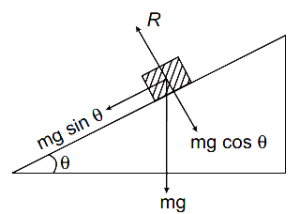
The horizontal acceleration that should be given to a smooth inclined plane of angle $\theta = \sin^{-1}\left(\frac{1}{l}\right)$ to keep an object stationary on the plane,relative to the inclined plane is:
A
$\frac{g}{\sqrt{l^2-1}}$
B
$g \sqrt{l^2-1}$
C
$\frac{\sqrt{l^2-1}}{g}$
D
$-\frac{g}{\sqrt{l^2+1}}$
Solution
(A) Let the horizontal acceleration given to the inclined plane be $a$. To keep the object stationary relative to the plane,the pseudo force $ma$ acting on the object in the horizontal direction must balance the component of gravity acting down the plane.
Resolving the forces parallel to the inclined plane:
The component of the pseudo force $ma$ along the plane is $ma \cos \theta$.
The component of gravity $mg$ along the plane is $mg \sin \theta$.
For the object to remain stationary relative to the plane,these forces must be equal: $ma \cos \theta = mg \sin \theta$.
Thus,$a = g \tan \theta$.
Given $\sin \theta = \frac{1}{l}$,we can find $\tan \theta$. In a right-angled triangle with opposite side $1$ and hypotenuse $l$,the adjacent side is $\sqrt{l^2 - 1}$.
Therefore,$\tan \theta = \frac{1}{\sqrt{l^2 - 1}}$.
Substituting this into the expression for $a$,we get $a = \frac{g}{\sqrt{l^2 - 1}}$.
Resolving the forces parallel to the inclined plane:
The component of the pseudo force $ma$ along the plane is $ma \cos \theta$.
The component of gravity $mg$ along the plane is $mg \sin \theta$.
For the object to remain stationary relative to the plane,these forces must be equal: $ma \cos \theta = mg \sin \theta$.
Thus,$a = g \tan \theta$.
Given $\sin \theta = \frac{1}{l}$,we can find $\tan \theta$. In a right-angled triangle with opposite side $1$ and hypotenuse $l$,the adjacent side is $\sqrt{l^2 - 1}$.
Therefore,$\tan \theta = \frac{1}{\sqrt{l^2 - 1}}$.
Substituting this into the expression for $a$,we get $a = \frac{g}{\sqrt{l^2 - 1}}$.
0 likesView Solution
172
ChemistryMCQTS EAMCET · 2003
Gas is being pumped into a spherical balloon at the rate of $30 \ ft^3 / min$. The rate at which the radius increases when it reaches the value $15 \ ft$,is:
A
$\frac{1}{30 \pi} \ ft / min$
B
$\frac{1}{15 \pi} \ ft / min$
C
$\frac{1}{20} \ ft / min$
D
$\frac{1}{25} \ ft / min$
Solution
(A) Given that,the rate of change of volume is $\frac{dV}{dt} = 30 \ ft^3 / min$ and the radius is $r = 15 \ ft$.
The volume of a sphere is given by $V = \frac{4}{3} \pi r^3$.
Differentiating both sides with respect to time $t$,we get $\frac{dV}{dt} = 4 \pi r^2 \frac{dr}{dt}$.
Substituting the given values: $30 = 4 \pi (15)^2 \frac{dr}{dt}$.
$30 = 4 \pi (225) \frac{dr}{dt} = 900 \pi \frac{dr}{dt}$.
Therefore,$\frac{dr}{dt} = \frac{30}{900 \pi} = \frac{1}{30 \pi} \ ft / min$.
The volume of a sphere is given by $V = \frac{4}{3} \pi r^3$.
Differentiating both sides with respect to time $t$,we get $\frac{dV}{dt} = 4 \pi r^2 \frac{dr}{dt}$.
Substituting the given values: $30 = 4 \pi (15)^2 \frac{dr}{dt}$.
$30 = 4 \pi (225) \frac{dr}{dt} = 900 \pi \frac{dr}{dt}$.
Therefore,$\frac{dr}{dt} = \frac{30}{900 \pi} = \frac{1}{30 \pi} \ ft / min$.
0 likesView Solution
173
ChemistryMCQTS EAMCET · 2003
$\int \frac{1+x+\sqrt{x+x^2}}{\sqrt{x}+\sqrt{1+x}} d x$ is equal to
A
$\frac{1}{2} \sqrt{1+x}+C$
B
$\frac{2}{3}(1+x)^{3 / 2}+C$
C
$\sqrt{1+x}+C$
D
$2(1+x)^{3 / 2}+C$
Solution
(B) Given integral is $I = \int \frac{1+x+\sqrt{x+x^2}}{\sqrt{x}+\sqrt{1+x}} d x$.
We can rewrite the numerator as: $1+x+\sqrt{x(1+x)} = \sqrt{1+x} \cdot \sqrt{1+x} + \sqrt{x} \cdot \sqrt{1+x}$.
Factoring out $\sqrt{1+x}$,we get: $\sqrt{1+x}(\sqrt{1+x} + \sqrt{x})$.
Substituting this back into the integral: $I = \int \frac{\sqrt{1+x}(\sqrt{1+x} + \sqrt{x})}{\sqrt{x}+\sqrt{1+x}} d x$.
The term $(\sqrt{x}+\sqrt{1+x})$ cancels out from the numerator and denominator.
Thus,$I = \int \sqrt{1+x} d x$.
Using the power rule $\int u^n du = \frac{u^{n+1}}{n+1} + C$,we get: $I = \frac{(1+x)^{3/2}}{3/2} + C = \frac{2}{3}(1+x)^{3/2} + C$.
We can rewrite the numerator as: $1+x+\sqrt{x(1+x)} = \sqrt{1+x} \cdot \sqrt{1+x} + \sqrt{x} \cdot \sqrt{1+x}$.
Factoring out $\sqrt{1+x}$,we get: $\sqrt{1+x}(\sqrt{1+x} + \sqrt{x})$.
Substituting this back into the integral: $I = \int \frac{\sqrt{1+x}(\sqrt{1+x} + \sqrt{x})}{\sqrt{x}+\sqrt{1+x}} d x$.
The term $(\sqrt{x}+\sqrt{1+x})$ cancels out from the numerator and denominator.
Thus,$I = \int \sqrt{1+x} d x$.
Using the power rule $\int u^n du = \frac{u^{n+1}}{n+1} + C$,we get: $I = \frac{(1+x)^{3/2}}{3/2} + C = \frac{2}{3}(1+x)^{3/2} + C$.
0 likesView Solution
174
ChemistryMCQTS EAMCET · 2003
If $[2,6]$ is divided into four intervals of equal length,then the approximate value of $\int_2^6 \frac{1}{x^2-x} dx$ using Simpson's rule is
A
$0.3222$
B
$0.2333$
C
$0.5222$
D
$0.2555$
Solution
(C) Given the interval $[2,6]$ is divided into $n=4$ equal sub-intervals.
The step size is $h = \frac{6-2}{4} = 1$.
Let $f(x) = \frac{1}{x^2-x}$.
The values of $x_i$ and $y_i = f(x_i)$ are:
$x_0 = 2, y_0 = \frac{1}{2^2-2} = \frac{1}{2} = 0.5$
$x_1 = 3, y_1 = \frac{1}{3^2-3} = \frac{1}{6} \approx 0.1667$
$x_2 = 4, y_2 = \frac{1}{4^2-4} = \frac{1}{12} \approx 0.0833$
$x_3 = 5, y_3 = \frac{1}{5^2-5} = \frac{1}{20} = 0.05$
$x_4 = 6, y_4 = \frac{1}{6^2-6} = \frac{1}{30} \approx 0.0333$
By Simpson's rule:
$\int_2^6 f(x) dx \approx \frac{h}{3} [y_0 + y_4 + 4(y_1 + y_3) + 2y_2]$
$\approx \frac{1}{3} [\frac{1}{2} + \frac{1}{30} + 4(\frac{1}{6} + \frac{1}{20}) + 2(\frac{1}{12})]$
$\approx \frac{1}{3} [\frac{16}{30} + 4(\frac{10+3}{60}) + \frac{1}{6}]$
$\approx \frac{1}{3} [\frac{16}{30} + \frac{52}{60} + \frac{5}{30}] = \frac{1}{3} [\frac{32+52+10}{60}] = \frac{94}{180} = \frac{47}{90} \approx 0.5222$.
The step size is $h = \frac{6-2}{4} = 1$.
Let $f(x) = \frac{1}{x^2-x}$.
The values of $x_i$ and $y_i = f(x_i)$ are:
$x_0 = 2, y_0 = \frac{1}{2^2-2} = \frac{1}{2} = 0.5$
$x_1 = 3, y_1 = \frac{1}{3^2-3} = \frac{1}{6} \approx 0.1667$
$x_2 = 4, y_2 = \frac{1}{4^2-4} = \frac{1}{12} \approx 0.0833$
$x_3 = 5, y_3 = \frac{1}{5^2-5} = \frac{1}{20} = 0.05$
$x_4 = 6, y_4 = \frac{1}{6^2-6} = \frac{1}{30} \approx 0.0333$
By Simpson's rule:
$\int_2^6 f(x) dx \approx \frac{h}{3} [y_0 + y_4 + 4(y_1 + y_3) + 2y_2]$
$\approx \frac{1}{3} [\frac{1}{2} + \frac{1}{30} + 4(\frac{1}{6} + \frac{1}{20}) + 2(\frac{1}{12})]$
$\approx \frac{1}{3} [\frac{16}{30} + 4(\frac{10+3}{60}) + \frac{1}{6}]$
$\approx \frac{1}{3} [\frac{16}{30} + \frac{52}{60} + \frac{5}{30}] = \frac{1}{3} [\frac{32+52+10}{60}] = \frac{94}{180} = \frac{47}{90} \approx 0.5222$.
0 likesView Solution
175
ChemistryMCQTS EAMCET · 2003
The general solution of $y^2 dx + (x^2 - xy + y^2) dy = 0$ is:
A
$\tan^{-1}\left(\frac{y}{x}\right) = \log y + C$
B
$2 \tan^{-1}\left(\frac{x}{y}\right) + \log x + C = 0$
C
$\log(y + \sqrt{x^2 + y^2}) + \log y + C = 0$
D
$\sinh^{-1}\left(\frac{x}{y}\right) + \log y + C = 0$
Solution
(A) Given the differential equation: $y^2 dx + (x^2 - xy + y^2) dy = 0$.
Rearranging,we get: $\frac{dy}{dx} = \frac{-y^2}{x^2 - xy + y^2}$.
This is a homogeneous differential equation. Let $y = vx$,then $\frac{dy}{dx} = v + x \frac{dv}{dx}$.
Substituting these into the equation: $v + x \frac{dv}{dx} = \frac{-(vx)^2}{x^2 - x(vx) + (vx)^2} = \frac{-v^2}{1 - v + v^2}$.
$x \frac{dv}{dx} = \frac{-v^2}{v^2 - v + 1} - v = \frac{-v^2 - v(v^2 - v + 1)}{v^2 - v + 1} = \frac{-v^2 - v^3 + v^2 - v}{v^2 - v + 1} = \frac{-(v^3 + v)}{v^2 - v + 1}$.
Separating variables: $\frac{v^2 - v + 1}{v^3 + v} dv = -\frac{1}{x} dx$.
Using partial fractions: $\frac{v^2 - v + 1}{v(v^2 + 1)} = \frac{A}{v} + \frac{Bv + D}{v^2 + 1}$.
Solving gives $A = 1, B = 0, D = -1$.
So,$\left(\frac{1}{v} - \frac{1}{v^2 + 1}\right) dv = -\frac{1}{x} dx$.
Integrating both sides: $\log|v| - \tan^{-1}(v) = -\log|x| + C$.
$\log|v| + \log|x| = \tan^{-1}(v) + C$.
$\log|vx| = \tan^{-1}(v) + C$.
Since $y = vx$,we have $\log|y| = \tan^{-1}\left(\frac{y}{x}\right) + C$,or $\tan^{-1}\left(\frac{y}{x}\right) = \log y + C$.
Rearranging,we get: $\frac{dy}{dx} = \frac{-y^2}{x^2 - xy + y^2}$.
This is a homogeneous differential equation. Let $y = vx$,then $\frac{dy}{dx} = v + x \frac{dv}{dx}$.
Substituting these into the equation: $v + x \frac{dv}{dx} = \frac{-(vx)^2}{x^2 - x(vx) + (vx)^2} = \frac{-v^2}{1 - v + v^2}$.
$x \frac{dv}{dx} = \frac{-v^2}{v^2 - v + 1} - v = \frac{-v^2 - v(v^2 - v + 1)}{v^2 - v + 1} = \frac{-v^2 - v^3 + v^2 - v}{v^2 - v + 1} = \frac{-(v^3 + v)}{v^2 - v + 1}$.
Separating variables: $\frac{v^2 - v + 1}{v^3 + v} dv = -\frac{1}{x} dx$.
Using partial fractions: $\frac{v^2 - v + 1}{v(v^2 + 1)} = \frac{A}{v} + \frac{Bv + D}{v^2 + 1}$.
Solving gives $A = 1, B = 0, D = -1$.
So,$\left(\frac{1}{v} - \frac{1}{v^2 + 1}\right) dv = -\frac{1}{x} dx$.
Integrating both sides: $\log|v| - \tan^{-1}(v) = -\log|x| + C$.
$\log|v| + \log|x| = \tan^{-1}(v) + C$.
$\log|vx| = \tan^{-1}(v) + C$.
Since $y = vx$,we have $\log|y| = \tan^{-1}\left(\frac{y}{x}\right) + C$,or $\tan^{-1}\left(\frac{y}{x}\right) = \log y + C$.
0 likesView Solution
176
ChemistryMCQTS EAMCET · 2003
If the direction ratios of two lines are given by $3lm - 4ln + mn = 0$ and $l + 2m + 3n = 0$,then the angle between the lines is:
A
$\frac{\pi}{6}$
B
$\frac{\pi}{4}$
C
$\frac{\pi}{3}$
D
$\frac{\pi}{2}$
Solution
(D) We have the equations for the direction ratios $(l, m, n)$ as:
$3lm - 4ln + mn = 0$ $\ldots$ $(i)$
$l + 2m + 3n = 0$ $\ldots$ (ii)
From (ii),we get $l = -(2m + 3n)$.
Substituting this into $(i)$:
$-3(2m + 3n)m + 4(2m + 3n)n + mn = 0$
$-6m^2 - 9mn + 8mn + 12n^2 + mn = 0$
$-6m^2 + 12n^2 = 0 \Rightarrow m^2 = 2n^2 \Rightarrow m = \pm \sqrt{2}n$.
Case $1$: $m = \sqrt{2}n$. Then $l = -(2\sqrt{2} + 3)n$. The direction ratios are $(l_1, m_1, n_1) = (-(3 + 2\sqrt{2}), \sqrt{2}, 1)$.
Case $2$: $m = -\sqrt{2}n$. Then $l = -(-2\sqrt{2} + 3)n = (2\sqrt{2} - 3)n$. The direction ratios are $(l_2, m_2, n_2) = (-(3 - 2\sqrt{2}), -\sqrt{2}, 1)$.
For the angle $\theta$ between the lines:
$\cos \theta = \frac{l_1l_2 + m_1m_2 + n_1n_2}{\sqrt{l_1^2 + m_1^2 + n_1^2} \sqrt{l_2^2 + m_2^2 + n_2^2}}$
The numerator is $(3 + 2\sqrt{2})(3 - 2\sqrt{2}) + (\sqrt{2})(-\sqrt{2}) + (1)(1) = (9 - 8) - 2 + 1 = 1 - 2 + 1 = 0$.
Since the numerator is $0$,$\cos \theta = 0$,which implies $\theta = \frac{\pi}{2}$.
$3lm - 4ln + mn = 0$ $\ldots$ $(i)$
$l + 2m + 3n = 0$ $\ldots$ (ii)
From (ii),we get $l = -(2m + 3n)$.
Substituting this into $(i)$:
$-3(2m + 3n)m + 4(2m + 3n)n + mn = 0$
$-6m^2 - 9mn + 8mn + 12n^2 + mn = 0$
$-6m^2 + 12n^2 = 0 \Rightarrow m^2 = 2n^2 \Rightarrow m = \pm \sqrt{2}n$.
Case $1$: $m = \sqrt{2}n$. Then $l = -(2\sqrt{2} + 3)n$. The direction ratios are $(l_1, m_1, n_1) = (-(3 + 2\sqrt{2}), \sqrt{2}, 1)$.
Case $2$: $m = -\sqrt{2}n$. Then $l = -(-2\sqrt{2} + 3)n = (2\sqrt{2} - 3)n$. The direction ratios are $(l_2, m_2, n_2) = (-(3 - 2\sqrt{2}), -\sqrt{2}, 1)$.
For the angle $\theta$ between the lines:
$\cos \theta = \frac{l_1l_2 + m_1m_2 + n_1n_2}{\sqrt{l_1^2 + m_1^2 + n_1^2} \sqrt{l_2^2 + m_2^2 + n_2^2}}$
The numerator is $(3 + 2\sqrt{2})(3 - 2\sqrt{2}) + (\sqrt{2})(-\sqrt{2}) + (1)(1) = (9 - 8) - 2 + 1 = 1 - 2 + 1 = 0$.
Since the numerator is $0$,$\cos \theta = 0$,which implies $\theta = \frac{\pi}{2}$.
0 likesView Solution
177
ChemistryMCQTS EAMCET · 2003
$A$ random variate $X$ takes the values $0, 1, 2, 3$ and its mean is $1.3$. If $P(X=3) = 2 P(X=1)$ and $P(X=2) = 0.3$,then $P(X=0)$ is equal to:
A
$0.1$
B
$0.2$
C
$0.3$
D
$0.4$
Solution
(D) Let $P(X=0) = p_0, P(X=1) = p_1, P(X=2) = p_2, P(X=3) = p_3$.
Given that the mean is $1.3$,we have:
$0 \cdot p_0 + 1 \cdot p_1 + 2 \cdot p_2 + 3 \cdot p_3 = 1.3$
Substituting $p_2 = 0.3$ and $p_3 = 2 p_1$:
$0 + p_1 + 2(0.3) + 3(2 p_1) = 1.3$
$p_1 + 0.6 + 6 p_1 = 1.3$
$7 p_1 = 0.7 \Rightarrow p_1 = 0.1$
Now,$p_3 = 2 p_1 = 2(0.1) = 0.2$.
Since the sum of probabilities is $1$:
$p_0 + p_1 + p_2 + p_3 = 1$
$p_0 + 0.1 + 0.3 + 0.2 = 1$
$p_0 + 0.6 = 1 \Rightarrow p_0 = 0.4$
Thus,$P(X=0) = 0.4$.
Given that the mean is $1.3$,we have:
$0 \cdot p_0 + 1 \cdot p_1 + 2 \cdot p_2 + 3 \cdot p_3 = 1.3$
Substituting $p_2 = 0.3$ and $p_3 = 2 p_1$:
$0 + p_1 + 2(0.3) + 3(2 p_1) = 1.3$
$p_1 + 0.6 + 6 p_1 = 1.3$
$7 p_1 = 0.7 \Rightarrow p_1 = 0.1$
Now,$p_3 = 2 p_1 = 2(0.1) = 0.2$.
Since the sum of probabilities is $1$:
$p_0 + p_1 + p_2 + p_3 = 1$
$p_0 + 0.1 + 0.3 + 0.2 = 1$
$p_0 + 0.6 = 1 \Rightarrow p_0 = 0.4$
Thus,$P(X=0) = 0.4$.
0 likesView Solution
178
ChemistryMCQTS EAMCET · 2003
For a Poisson variate $X$,if $P(X=2)=3 P(X=3)$,then the mean of $X$ is :
A
$1$
B
$2$
C
$3$
D
$4$
Solution
(A) The probability mass function of a Poisson distribution is given by $P(X=k) = \frac{\lambda^k e^{-\lambda}}{k!}$,where $\lambda$ is the mean of the distribution.
Given the condition $P(X=2) = 3 P(X=3)$.
Substituting the formula:
$\frac{\lambda^2 e^{-\lambda}}{2!} = 3 \cdot \frac{\lambda^3 e^{-\lambda}}{3!}$
Dividing both sides by $e^{-\lambda}$ (since $e^{-\lambda} \neq 0$) and $\lambda^2$ (assuming $\lambda > 0$):
$\frac{1}{2} = 3 \cdot \frac{\lambda}{3 \times 2 \times 1}$
$\frac{1}{2} = \frac{3\lambda}{6}$
$\frac{1}{2} = \frac{\lambda}{2}$
$\lambda = 1$.
Thus,the mean of the Poisson distribution is $1$.
Given the condition $P(X=2) = 3 P(X=3)$.
Substituting the formula:
$\frac{\lambda^2 e^{-\lambda}}{2!} = 3 \cdot \frac{\lambda^3 e^{-\lambda}}{3!}$
Dividing both sides by $e^{-\lambda}$ (since $e^{-\lambda} \neq 0$) and $\lambda^2$ (assuming $\lambda > 0$):
$\frac{1}{2} = 3 \cdot \frac{\lambda}{3 \times 2 \times 1}$
$\frac{1}{2} = \frac{3\lambda}{6}$
$\frac{1}{2} = \frac{\lambda}{2}$
$\lambda = 1$.
Thus,the mean of the Poisson distribution is $1$.
0 likesView Solution
179
ChemistryMCQTS EAMCET · 2003
$A$ bag $X$ contains $2$ white and $3$ black balls and another bag $Y$ contains $4$ white and $2$ black balls. One bag is selected at random and a ball is drawn from it. Then,the probability for the ball chosen to be white is:
A
$\frac{2}{15}$
B
$\frac{7}{15}$
C
$\frac{8}{15}$
D
$\frac{14}{15}$
Solution
(C) Let $E_1$ be the event of selecting bag $X$ and $E_2$ be the event of selecting bag $Y$. Since the bag is selected at random,$P(E_1) = P(E_2) = \frac{1}{2}$.
Let $W$ be the event of drawing a white ball.
The probability of drawing a white ball from bag $X$ is $P(W|E_1) = \frac{2}{2+3} = \frac{2}{5}$.
The probability of drawing a white ball from bag $Y$ is $P(W|E_2) = \frac{4}{4+2} = \frac{4}{6} = \frac{2}{3}$.
Using the law of total probability,the probability of drawing a white ball is $P(W) = P(E_1) \cdot P(W|E_1) + P(E_2) \cdot P(W|E_2)$.
$P(W) = \left(\frac{1}{2} \cdot \frac{2}{5}\right) + \left(\frac{1}{2} \cdot \frac{2}{3}\right) = \frac{1}{5} + \frac{1}{3} = \frac{3+5}{15} = \frac{8}{15}$.
Let $W$ be the event of drawing a white ball.
The probability of drawing a white ball from bag $X$ is $P(W|E_1) = \frac{2}{2+3} = \frac{2}{5}$.
The probability of drawing a white ball from bag $Y$ is $P(W|E_2) = \frac{4}{4+2} = \frac{4}{6} = \frac{2}{3}$.
Using the law of total probability,the probability of drawing a white ball is $P(W) = P(E_1) \cdot P(W|E_1) + P(E_2) \cdot P(W|E_2)$.
$P(W) = \left(\frac{1}{2} \cdot \frac{2}{5}\right) + \left(\frac{1}{2} \cdot \frac{2}{3}\right) = \frac{1}{5} + \frac{1}{3} = \frac{3+5}{15} = \frac{8}{15}$.
0 likesView Solution
180
ChemistryMCQTS EAMCET · 2003
The rate of steady volume flow of water through a capillary tube of length $l$ and radius $r$,under a pressure difference of $p$ is $V$. This tube is connected with another tube of the same length but half the radius,in series. Then,the rate of steady volume flow through them is (The pressure difference across the combination is $p$.)
A
$\frac{V}{16}$
B
$\frac{V}{17}$
C
$\frac{16V}{17}$
D
$\frac{17V}{16}$
Solution
(B) The rate of flow of water through a capillary tube is given by Poiseuille's equation: $V = \frac{\pi p r^4}{8 \eta l}$.
This can be rewritten as a pressure drop: $p = V \left( \frac{8 \eta l}{\pi r^4} \right) = V R_h$,where $R_h = \frac{8 \eta l}{\pi r^4}$ is the hydraulic resistance.
For the first tube,$R_1 = \frac{8 \eta l}{\pi r^4}$.
For the second tube,$R_2 = \frac{8 \eta l}{\pi (r/2)^4} = \frac{8 \eta l}{\pi r^4 / 16} = 16 R_1$.
In a series combination,the total pressure difference $p$ is the sum of pressure drops: $p = p_1 + p_2 = V' R_1 + V' R_2$,where $V'$ is the new flow rate.
Since $p = V R_1$,we have $V R_1 = V' (R_1 + 16 R_1) = V' (17 R_1)$.
Therefore,$V' = \frac{V}{17}$.
This can be rewritten as a pressure drop: $p = V \left( \frac{8 \eta l}{\pi r^4} \right) = V R_h$,where $R_h = \frac{8 \eta l}{\pi r^4}$ is the hydraulic resistance.
For the first tube,$R_1 = \frac{8 \eta l}{\pi r^4}$.
For the second tube,$R_2 = \frac{8 \eta l}{\pi (r/2)^4} = \frac{8 \eta l}{\pi r^4 / 16} = 16 R_1$.
In a series combination,the total pressure difference $p$ is the sum of pressure drops: $p = p_1 + p_2 = V' R_1 + V' R_2$,where $V'$ is the new flow rate.
Since $p = V R_1$,we have $V R_1 = V' (R_1 + 16 R_1) = V' (17 R_1)$.
Therefore,$V' = \frac{V}{17}$.
0 likesView Solution
181
ChemistryMCQTS EAMCET · 2003
Two spherical soap bubbles of radii $r_1$ and $r_2$ in vacuum combine under isothermal conditions. The resulting bubble has a radius equal to:
A
$\frac{r_1+r_2}{2}$
B
$\frac{r_1 r_2}{r_1+r_2}$
C
$\sqrt{r_1 r_2}$
D
$\sqrt{r_1^2+r_2^2}$
Solution
(D) The excess pressure inside a soap bubble of radius $r$ is given by $p = \frac{4T}{r}$,where $T$ is the surface tension.
For the two initial bubbles,the excess pressures are $p_1 = \frac{4T}{r_1}$ and $p_2 = \frac{4T}{r_2}$.
The volumes of these bubbles are $V_1 = \frac{4}{3}\pi r_1^3$ and $V_2 = \frac{4}{3}\pi r_2^3$.
Let the radius of the resulting bubble be $R$. The excess pressure inside it is $p = \frac{4T}{R}$ and its volume is $V = \frac{4}{3}\pi R^3$.
Under isothermal conditions,the total number of moles of gas remains constant. Since $PV = nRT$,and $T$ is constant,the product $PV$ is conserved (assuming the external pressure is zero in vacuum).
Thus,$PV = p_1V_1 + p_2V_2$.
Substituting the values: $\frac{4T}{R} \left( \frac{4}{3}\pi R^3 \right) = \frac{4T}{r_1} \left( \frac{4}{3}\pi r_1^3 \right) + \frac{4T}{r_2} \left( \frac{4}{3}\pi r_2^3 \right)$.
Simplifying this,we get $R^2 = r_1^2 + r_2^2$.
Therefore,$R = \sqrt{r_1^2 + r_2^2}$.
For the two initial bubbles,the excess pressures are $p_1 = \frac{4T}{r_1}$ and $p_2 = \frac{4T}{r_2}$.
The volumes of these bubbles are $V_1 = \frac{4}{3}\pi r_1^3$ and $V_2 = \frac{4}{3}\pi r_2^3$.
Let the radius of the resulting bubble be $R$. The excess pressure inside it is $p = \frac{4T}{R}$ and its volume is $V = \frac{4}{3}\pi R^3$.
Under isothermal conditions,the total number of moles of gas remains constant. Since $PV = nRT$,and $T$ is constant,the product $PV$ is conserved (assuming the external pressure is zero in vacuum).
Thus,$PV = p_1V_1 + p_2V_2$.
Substituting the values: $\frac{4T}{R} \left( \frac{4}{3}\pi R^3 \right) = \frac{4T}{r_1} \left( \frac{4}{3}\pi r_1^3 \right) + \frac{4T}{r_2} \left( \frac{4}{3}\pi r_2^3 \right)$.
Simplifying this,we get $R^2 = r_1^2 + r_2^2$.
Therefore,$R = \sqrt{r_1^2 + r_2^2}$.
0 likesView Solution
182
ChemistryMCQTS EAMCET · 2003
The mass defect in a particular nuclear reaction is $0.3 ~g$. The amount of energy liberated in kilowatt hour is: (Velocity of light $= 3 \times 10^8 ~m/s$)
A
$1.5 \times 10^6$
B
$2.5 \times 10^6$
C
$3 \times 10^6$
D
$7.5 \times 10^6$
Solution
(D) Given mass defect,$\Delta m = 0.3 ~g = 0.3 \times 10^{-3} ~kg = 3 \times 10^{-4} ~kg$.
Velocity of light,$c = 3 \times 10^8 ~m/s$.
The energy liberated is given by Einstein's mass-energy equivalence formula,$E = \Delta m c^2$.
$E = (3 \times 10^{-4} ~kg) \times (3 \times 10^8 ~m/s)^2$.
$E = 3 \times 10^{-4} \times 9 \times 10^{16} ~J = 27 \times 10^{12} ~J$.
To convert Joules to kilowatt-hour $(kWh)$,we divide by $3.6 \times 10^6 ~J/kWh$.
$E = \frac{27 \times 10^{12}}{3.6 \times 10^6} ~kWh = 7.5 \times 10^6 ~kWh$.
Velocity of light,$c = 3 \times 10^8 ~m/s$.
The energy liberated is given by Einstein's mass-energy equivalence formula,$E = \Delta m c^2$.
$E = (3 \times 10^{-4} ~kg) \times (3 \times 10^8 ~m/s)^2$.
$E = 3 \times 10^{-4} \times 9 \times 10^{16} ~J = 27 \times 10^{12} ~J$.
To convert Joules to kilowatt-hour $(kWh)$,we divide by $3.6 \times 10^6 ~J/kWh$.
$E = \frac{27 \times 10^{12}}{3.6 \times 10^6} ~kWh = 7.5 \times 10^6 ~kWh$.
0 likesView Solution
183
ChemistryMCQTS EAMCET · 2003
$A$ prism of refractive index $\mu$ and angle $A$ is placed in the minimum deviation position. If the angle of minimum deviation is $A$,then the value of $A$ in terms of $\mu$ is :
A
$\sin ^{-1}\left(\frac{\mu}{2}\right)$
B
$\sin ^{-1} \sqrt{\frac{\mu-1}{2}}$
C
$2 \cos ^{-1}\left(\frac{\mu}{2}\right)$
D
$\cos ^{-1}\left(\frac{\mu}{2}\right)$
Solution
(C) The refractive index of the prism material is given by the formula: $\mu = \frac{\sin((A + \delta_m)/2)}{\sin(A/2)}$.
Given that the angle of minimum deviation $\delta_m = A$,we substitute this into the formula:
$\mu = \frac{\sin((A + A)/2)}{\sin(A/2)}$
$\mu = \frac{\sin(2A/2)}{\sin(A/2)} = \frac{\sin A}{\sin(A/2)}$.
Using the trigonometric identity $\sin A = 2 \sin(A/2) \cos(A/2)$,we get:
$\mu = \frac{2 \sin(A/2) \cos(A/2)}{\sin(A/2)}$.
Simplifying the expression,we have $\mu = 2 \cos(A/2)$.
Therefore,$\cos(A/2) = \mu/2$.
Taking the inverse cosine on both sides,$A/2 = \cos^{-1}(\mu/2)$.
Thus,$A = 2 \cos^{-1}(\mu/2)$.
Given that the angle of minimum deviation $\delta_m = A$,we substitute this into the formula:
$\mu = \frac{\sin((A + A)/2)}{\sin(A/2)}$
$\mu = \frac{\sin(2A/2)}{\sin(A/2)} = \frac{\sin A}{\sin(A/2)}$.
Using the trigonometric identity $\sin A = 2 \sin(A/2) \cos(A/2)$,we get:
$\mu = \frac{2 \sin(A/2) \cos(A/2)}{\sin(A/2)}$.
Simplifying the expression,we have $\mu = 2 \cos(A/2)$.
Therefore,$\cos(A/2) = \mu/2$.
Taking the inverse cosine on both sides,$A/2 = \cos^{-1}(\mu/2)$.
Thus,$A = 2 \cos^{-1}(\mu/2)$.
0 likesView Solution
184
ChemistryEasyMCQTS EAMCET · 2003
What are the products formed when an aqueous solution of magnesium bicarbonate is boiled?
A
$MgO, H_2O, CO_2$
B
$Mg(HCO_3)_2, H_2O$
C
$Mg(OH)_2, CO_2, H_2O$
D
$Mg, CO_2, H_2O$
Solution
(C) When an aqueous solution of magnesium bicarbonate is boiled,it undergoes thermal decomposition to form magnesium hydroxide,carbon dioxide,and water.
The balanced chemical equation is:
$Mg(HCO_3)_{2(aq)} \xrightarrow{\Delta} Mg(OH)_{2(s)} + 2CO_{2(g)} + 2H_2O_{(l)}$
The balanced chemical equation is:
$Mg(HCO_3)_{2(aq)} \xrightarrow{\Delta} Mg(OH)_{2(s)} + 2CO_{2(g)} + 2H_2O_{(l)}$
0 likesView Solution
185
ChemistryEasyMCQTS EAMCET · 2003
$A$ mixture of sodium oxide $(Na_2O)$ and calcium oxide $(CaO)$ is dissolved in water and saturated with excess carbon dioxide $(CO_2)$ gas. The resulting solution is $......$ It contains $.........$ :
A
basic; $NaOH$ and $Ca(OH)_2$
B
neutral; $Na_2CO_3$ and $CaCO_3$
C
acidic; $NaHCO_3$ and $Ca(HCO_3)_2$
D
basic; $Na_2CO_3$ and $CaCO_3$
Solution
(C) $1$. When $Na_2O$ and $CaO$ are dissolved in water,they form their respective hydroxides: $Na_2O + H_2O \rightarrow 2NaOH$ and $CaO + H_2O \rightarrow Ca(OH)_2$.
$2$. When this solution is saturated with excess $CO_2$,the hydroxides react to form bicarbonates: $NaOH + CO_2 \rightarrow NaHCO_3$ and $Ca(OH)_2 + 2CO_2 \rightarrow Ca(HCO_3)_2$.
$3$. Both $NaHCO_3$ and $Ca(HCO_3)_2$ are soluble in water.
$4$. The resulting solution contains these bicarbonates,which make the solution slightly acidic due to the presence of excess dissolved $CO_2$ (forming carbonic acid) and the nature of the bicarbonate salts.
$2$. When this solution is saturated with excess $CO_2$,the hydroxides react to form bicarbonates: $NaOH + CO_2 \rightarrow NaHCO_3$ and $Ca(OH)_2 + 2CO_2 \rightarrow Ca(HCO_3)_2$.
$3$. Both $NaHCO_3$ and $Ca(HCO_3)_2$ are soluble in water.
$4$. The resulting solution contains these bicarbonates,which make the solution slightly acidic due to the presence of excess dissolved $CO_2$ (forming carbonic acid) and the nature of the bicarbonate salts.
0 likesView Solution
186
ChemistryEasyMCQTS EAMCET · 2003
What is the volume (in litres) of oxygen required at $STP$ to completely convert $1.5 \ mol$ of sulphur into sulphur dioxide?
A
$11.2$
B
$22.4$
C
$33.6$
D
$44.8$
Solution
(C) The balanced chemical equation for the combustion of sulphur is: $S(s) + O_2(g) \longrightarrow SO_2(g)$.
From the stoichiometry of the reaction,$1 \ mol$ of $S$ reacts with $1 \ mol$ of $O_2$.
At $STP$,$1 \ mol$ of any gas occupies a volume of $22.4 \ L$.
Therefore,$1 \ mol$ of $S$ requires $22.4 \ L$ of $O_2$.
For $1.5 \ mol$ of $S$,the volume of $O_2$ required is: $1.5 \ mol \times 22.4 \ L/mol = 33.6 \ L$.
From the stoichiometry of the reaction,$1 \ mol$ of $S$ reacts with $1 \ mol$ of $O_2$.
At $STP$,$1 \ mol$ of any gas occupies a volume of $22.4 \ L$.
Therefore,$1 \ mol$ of $S$ requires $22.4 \ L$ of $O_2$.
For $1.5 \ mol$ of $S$,the volume of $O_2$ required is: $1.5 \ mol \times 22.4 \ L/mol = 33.6 \ L$.
0 likesView Solution
187
ChemistryMediumMCQTS EAMCET · 2003
If a gas contains only three molecules that move with velocities of $100, 200, 500 \ ms^{-1}$. What is the rms velocity of that gas in $ms^{-1}$?
A
$100 \frac{\sqrt{8}}{3}$
B
$100 \sqrt{30}$
C
$100 \sqrt{10}$
D
$\frac{800}{3}$
Solution
(C) Given velocities: $C_1 = 100 \ ms^{-1}, C_2 = 200 \ ms^{-1}, C_3 = 500 \ ms^{-1}$.
Root mean square (rms) velocity is given by the formula: $C_{rms} = \sqrt{\frac{C_1^2 + C_2^2 + C_3^2}{n}}$.
Substituting the values: $C_{rms} = \sqrt{\frac{100^2 + 200^2 + 500^2}{3}}$.
$C_{rms} = \sqrt{\frac{10000 + 40000 + 250000}{3}}$.
$C_{rms} = \sqrt{\frac{300000}{3}} = \sqrt{100000}$.
$C_{rms} = 100 \sqrt{10} \ ms^{-1}$.
Root mean square (rms) velocity is given by the formula: $C_{rms} = \sqrt{\frac{C_1^2 + C_2^2 + C_3^2}{n}}$.
Substituting the values: $C_{rms} = \sqrt{\frac{100^2 + 200^2 + 500^2}{3}}$.
$C_{rms} = \sqrt{\frac{10000 + 40000 + 250000}{3}}$.
$C_{rms} = \sqrt{\frac{300000}{3}} = \sqrt{100000}$.
$C_{rms} = 100 \sqrt{10} \ ms^{-1}$.
0 likesView Solution
188
ChemistryMediumMCQTS EAMCET · 2003
If the electron of a hydrogen atom is present in the first orbit,the total energy of the electron is
A
$\frac{-e^2}{r}$
B
$\frac{-e^2}{r^2}$
C
$\frac{-e^2}{2r}$
D
$\frac{-e^2}{2r^2}$
Solution
(C) The kinetic energy $(KE)$ of an electron in an orbit is given by $KE = \frac{1}{2} mv^2$.
From the electrostatic force balance,$\frac{mv^2}{r} = \frac{e^2}{r^2}$,which implies $mv^2 = \frac{e^2}{r}$.
Substituting this into the kinetic energy expression,we get $KE = \frac{1}{2} \frac{e^2}{r}$.
The potential energy $(PE)$ of the electron is $PE = \frac{-e^2}{r}$.
The total energy $(E)$ is the sum of kinetic and potential energy: $E = KE + PE = \frac{1}{2} \frac{e^2}{r} - \frac{e^2}{r} = \frac{-e^2}{2r}$.
From the electrostatic force balance,$\frac{mv^2}{r} = \frac{e^2}{r^2}$,which implies $mv^2 = \frac{e^2}{r}$.
Substituting this into the kinetic energy expression,we get $KE = \frac{1}{2} \frac{e^2}{r}$.
The potential energy $(PE)$ of the electron is $PE = \frac{-e^2}{r}$.
The total energy $(E)$ is the sum of kinetic and potential energy: $E = KE + PE = \frac{1}{2} \frac{e^2}{r} - \frac{e^2}{r} = \frac{-e^2}{2r}$.
0 likesView Solution
189
ChemistryDifficultMCQTS EAMCET · 2003
If the wavelength of an electromagnetic radiation is $2000 \ \text{Å}$,what is its energy in ergs?
A
$9.94 \times 10^{-12}$
B
$9.94 \times 10^{-19}$
C
$4.97 \times 10^{-12}$
D
$4.97 \times 10^{-19}$
Solution
(A) The energy $E$ of a photon is given by $E = h \nu = \frac{hc}{\lambda}$.
Given: $\lambda = 2000 \ \text{Å} = 2000 \times 10^{-8} \ \text{cm} = 2 \times 10^{-5} \ \text{cm}$.
Speed of light $c = 3 \times 10^{10} \ \text{cm/s}$.
Planck's constant $h = 6.626 \times 10^{-27} \ \text{erg} \cdot \text{s}$.
Frequency $\nu = \frac{c}{\lambda} = \frac{3 \times 10^{10}}{2 \times 10^{-5}} = 1.5 \times 10^{15} \ \text{s}^{-1}$.
Energy $E = h \nu = (6.626 \times 10^{-27} \ \text{erg} \cdot \text{s}) \times (1.5 \times 10^{15} \ \text{s}^{-1}) \approx 9.94 \times 10^{-12} \ \text{erg}$.
Given: $\lambda = 2000 \ \text{Å} = 2000 \times 10^{-8} \ \text{cm} = 2 \times 10^{-5} \ \text{cm}$.
Speed of light $c = 3 \times 10^{10} \ \text{cm/s}$.
Planck's constant $h = 6.626 \times 10^{-27} \ \text{erg} \cdot \text{s}$.
Frequency $\nu = \frac{c}{\lambda} = \frac{3 \times 10^{10}}{2 \times 10^{-5}} = 1.5 \times 10^{15} \ \text{s}^{-1}$.
Energy $E = h \nu = (6.626 \times 10^{-27} \ \text{erg} \cdot \text{s}) \times (1.5 \times 10^{15} \ \text{s}^{-1}) \approx 9.94 \times 10^{-12} \ \text{erg}$.
0 likesView Solution
190
ChemistryEasyMCQTS EAMCET · 2003
When $10 \ g$ of methane is completely burnt in oxygen,the heat evolved is $560 \ kJ$. What is the heat of combustion (in $kJ \ mol^{-1}$) of methane?
A
$-1120$
B
$-968$
C
$-896$
D
$-560$
Solution
(C) The combustion reaction of methane is: $CH_4(g) + 2O_2(g) \longrightarrow CO_2(g) + 2H_2O(l)$.
Given that $10 \ g$ of $CH_4$ releases $560 \ kJ$ of heat,the enthalpy change $\Delta H$ for $10 \ g$ is $-560 \ kJ$.
The molar mass of methane $(CH_4)$ is $12 + (4 \times 1) = 16 \ g \ mol^{-1}$.
Heat of combustion is defined as the heat evolved per mole of substance.
For $10 \ g$ of $CH_4$,$\Delta H = -560 \ kJ$.
For $1 \ g$ of $CH_4$,$\Delta H = \frac{-560}{10} \ kJ$.
For $16 \ g$ $(1 \ mole)$ of $CH_4$,$\Delta H = \frac{-560}{10} \times 16 = -896 \ kJ \ mol^{-1}$.
Given that $10 \ g$ of $CH_4$ releases $560 \ kJ$ of heat,the enthalpy change $\Delta H$ for $10 \ g$ is $-560 \ kJ$.
The molar mass of methane $(CH_4)$ is $12 + (4 \times 1) = 16 \ g \ mol^{-1}$.
Heat of combustion is defined as the heat evolved per mole of substance.
For $10 \ g$ of $CH_4$,$\Delta H = -560 \ kJ$.
For $1 \ g$ of $CH_4$,$\Delta H = \frac{-560}{10} \ kJ$.
For $16 \ g$ $(1 \ mole)$ of $CH_4$,$\Delta H = \frac{-560}{10} \times 16 = -896 \ kJ \ mol^{-1}$.
0 likesView Solution
Vedclass Products
For Students
Vedclass Test Series
Mock tests in real TS EAMCET style covering Chemistry with performance analysis. 5-day free trial.
Start Free TrialFor Teachers
Exam Paper Generator
Generate Set A/B/C/D Chemistry papers from 7.5L+ questions in 2 minutes. 3 chapters free.
Try FreeFor Institutes
Online Exam Module
Run live TS EAMCET mock exams with unlimited students, 360° analytics & white-label branding.
See DemoFrequently Asked Questions
How many Chemistry questions are in TS EAMCET 2003?
There are 212 Chemistry questions from the TS EAMCET 2003 paper on Vedclass, each with a detailed step-by-step solution in English.
Are TS EAMCET 2003 Chemistry solutions available in English?
Yes. All solutions on this page are in English. You can also switch to English or Hindi using the language buttons above the questions.
Can I practice TS EAMCET 2003 Chemistry as a timed test?
Yes. Use the Vedclass Test Series to attempt a full TS EAMCET mock test covering Chemistry with time limits and instant score analysis.
Can teachers create Chemistry papers from TS EAMCET previous year questions?
Yes. The Vedclass Exam Paper Generator lets teachers mix TS EAMCET Chemistry questions and generate Set A/B/C/D papers in minutes.
For Teachers & Institutes
Build a Custom Chemistry Paper
Pick TS EAMCET 2003 Chemistry questions, set difficulty, and generate Set A/B/C/D in 2 minutes.