
ChemistryQ1–72 of 212 questions
Page 1 of 4 · English
1
ChemistryMCQTS EAMCET · 2003
$A$ satellite is launched into a circular orbit of radius $R$ around the Earth,while a second satellite is launched into an orbit of radius $1.02 R$. The percentage difference in the time periods of the two satellites is ......... $\%$
A
$0.7$
B
$1$
C
$1.5$
D
$3$
Solution
(D) According to Kepler's Third Law of Planetary Motion,the square of the time period $T$ is proportional to the cube of the orbital radius $R$,i.e.,$T^2 \propto R^3$ or $T \propto R^{3/2}$.
Taking the logarithmic derivative,we get $\frac{dT}{T} = \frac{3}{2} \frac{dR}{R}$.
The percentage change in radius is $\frac{dR}{R} \times 100 = \frac{1.02R - R}{R} \times 100 = 0.02 \times 100 = 2\%$.
Therefore,the percentage change in the time period is $\frac{dT}{T} \times 100 = \frac{3}{2} \times (\frac{dR}{R} \times 100) = \frac{3}{2} \times 2\% = 3\%$.
Thus,the percentage difference in the time periods is $3\%$.
Taking the logarithmic derivative,we get $\frac{dT}{T} = \frac{3}{2} \frac{dR}{R}$.
The percentage change in radius is $\frac{dR}{R} \times 100 = \frac{1.02R - R}{R} \times 100 = 0.02 \times 100 = 2\%$.
Therefore,the percentage change in the time period is $\frac{dT}{T} \times 100 = \frac{3}{2} \times (\frac{dR}{R} \times 100) = \frac{3}{2} \times 2\% = 3\%$.
Thus,the percentage difference in the time periods is $3\%$.
1 likesView Solution
2
ChemistryMCQTS EAMCET · 2003
The rate of steady volume flow of water through a capillary tube of length $l$ and radius $r$ under a pressure difference of $P$ is $V$. This tube is connected with another tube of the same length but half the radius in series. Then the rate of steady volume flow through them is (The pressure difference across the combination is $P$).
A
$\frac{V}{16}$
B
$\frac{V}{17}$
C
$\frac{16V}{17}$
D
$\frac{17V}{16}$
Solution
(B) The rate of steady volume flow of a liquid through a capillary tube is given by Poiseuille's equation: $V = \frac{P}{R}$,where $R$ is the fluid resistance.
Fluid resistance is defined as $R = \frac{8\eta l}{\pi r^4}$.
For the first tube,$R = \frac{8\eta l}{\pi r^4}$.
For the second tube of same length $l$ but radius $r' = \frac{r}{2}$,the resistance $R'$ is:
$R' = \frac{8\eta l}{\pi (r/2)^4} = \frac{8\eta l}{\pi r^4} \times 16 = 16R$.
When connected in series,the total resistance $R_{eq} = R + R' = R + 16R = 17R$.
The new rate of flow $V_{new}$ under the same pressure difference $P$ is:
$V_{new} = \frac{P}{R_{eq}} = \frac{P}{17R}$.
Since $V = \frac{P}{R}$,we get $V_{new} = \frac{V}{17}$.
Fluid resistance is defined as $R = \frac{8\eta l}{\pi r^4}$.
For the first tube,$R = \frac{8\eta l}{\pi r^4}$.
For the second tube of same length $l$ but radius $r' = \frac{r}{2}$,the resistance $R'$ is:
$R' = \frac{8\eta l}{\pi (r/2)^4} = \frac{8\eta l}{\pi r^4} \times 16 = 16R$.
When connected in series,the total resistance $R_{eq} = R + R' = R + 16R = 17R$.
The new rate of flow $V_{new}$ under the same pressure difference $P$ is:
$V_{new} = \frac{P}{R_{eq}} = \frac{P}{17R}$.
Since $V = \frac{P}{R}$,we get $V_{new} = \frac{V}{17}$.
0 likesView Solution
3
ChemistryMCQTS EAMCET · 2003
Three unequal resistors in parallel are equivalent to a resistance $1 \, \Omega$. If two of them are in the ratio $1 : 2$ and if no resistance value is fractional,the largest of the three resistances in $ohms$ is
A
$4$
B
$6$
C
$8$
D
$12$
Solution
(B) Let the three resistors be $x$,$2x$,and $R$. Since they are connected in parallel,their equivalent resistance is given by $\frac{1}{R_{eq}} = \frac{1}{x} + \frac{1}{2x} + \frac{1}{R}$.
Given $R_{eq} = 1 \, \Omega$,we have $\frac{1}{x} + \frac{1}{2x} + \frac{1}{R} = 1$.
Simplifying the expression: $\frac{3}{2x} + \frac{1}{R} = 1 \Rightarrow \frac{1}{R} = 1 - \frac{3}{2x} = \frac{2x - 3}{2x}$.
Thus,$R = \frac{2x}{2x - 3}$.
Since $R$ must be an integer (non-fractional),$2x - 3$ must be a divisor of $2x$.
We can rewrite $R = \frac{(2x - 3) + 3}{2x - 3} = 1 + \frac{3}{2x - 3}$.
For $R$ to be an integer,$2x - 3$ must be a factor of $3$. The factors of $3$ are $1$ and $3$.
Case $1$: $2x - 3 = 1 \Rightarrow 2x = 4 \Rightarrow x = 2$. Then $R = 1 + \frac{3}{1} = 4$. The resistors are $2, 4, 4$. (Rejected,as resistors must be unequal).
Case $2$: $2x - 3 = 3 \Rightarrow 2x = 6 \Rightarrow x = 3$. Then $R = 1 + \frac{3}{3} = 2$. The resistors are $3, 6, 2$.
Checking the values: $\frac{1}{3} + \frac{1}{6} + \frac{1}{2} = \frac{2+1+3}{6} = 1$. This satisfies the condition.
The resistances are $2 \, \Omega, 3 \, \Omega, 6 \, \Omega$. The largest resistance is $6 \, \Omega$.
Given $R_{eq} = 1 \, \Omega$,we have $\frac{1}{x} + \frac{1}{2x} + \frac{1}{R} = 1$.
Simplifying the expression: $\frac{3}{2x} + \frac{1}{R} = 1 \Rightarrow \frac{1}{R} = 1 - \frac{3}{2x} = \frac{2x - 3}{2x}$.
Thus,$R = \frac{2x}{2x - 3}$.
Since $R$ must be an integer (non-fractional),$2x - 3$ must be a divisor of $2x$.
We can rewrite $R = \frac{(2x - 3) + 3}{2x - 3} = 1 + \frac{3}{2x - 3}$.
For $R$ to be an integer,$2x - 3$ must be a factor of $3$. The factors of $3$ are $1$ and $3$.
Case $1$: $2x - 3 = 1 \Rightarrow 2x = 4 \Rightarrow x = 2$. Then $R = 1 + \frac{3}{1} = 4$. The resistors are $2, 4, 4$. (Rejected,as resistors must be unequal).
Case $2$: $2x - 3 = 3 \Rightarrow 2x = 6 \Rightarrow x = 3$. Then $R = 1 + \frac{3}{3} = 2$. The resistors are $3, 6, 2$.
Checking the values: $\frac{1}{3} + \frac{1}{6} + \frac{1}{2} = \frac{2+1+3}{6} = 1$. This satisfies the condition.
The resistances are $2 \, \Omega, 3 \, \Omega, 6 \, \Omega$. The largest resistance is $6 \, \Omega$.
0 likesView Solution
4
ChemistryMCQTS EAMCET · 2003
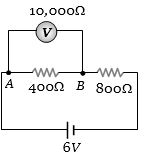
Two resistances of $400 \ \Omega$ and $800 \ \Omega$ are connected in series with a $6 \ V$ battery of negligible internal resistance. $A$ voltmeter of resistance $10,000 \ \Omega$ is used to measure the potential difference across the $400 \ \Omega$ resistor. The error in the measurement of the potential difference in volts is approximately:
A
$0.01$
B
$0.02$
C
$0.03$
D
$0.05$
Solution
(D) Before connecting the voltmeter,the potential difference across the $400 \ \Omega$ resistance is calculated using the voltage divider rule:
$V_i = \frac{400}{400 + 800} \times 6 = \frac{400}{1200} \times 6 = 2 \ V$
After connecting the voltmeter,the $400 \ \Omega$ resistor and the $10,000 \ \Omega$ voltmeter are in parallel. The equivalent resistance $R_p$ between points $A$ and $B$ is:
$R_p = \frac{400 \times 10,000}{400 + 10,000} = \frac{4,000,000}{10,400} \approx 384.6 \ \Omega$
The potential difference measured by the voltmeter $(V_f)$ is the voltage across this parallel combination:
$V_f = \frac{R_p}{R_p + 800} \times 6 = \frac{384.6}{384.6 + 800} \times 6 = \frac{384.6}{1184.6} \times 6 \approx 1.948 \ V \approx 1.95 \ V$
The error in measurement is the difference between the ideal and measured values:
$\text{Error} = V_i - V_f = 2 - 1.95 = 0.05 \ V$.
$V_i = \frac{400}{400 + 800} \times 6 = \frac{400}{1200} \times 6 = 2 \ V$
After connecting the voltmeter,the $400 \ \Omega$ resistor and the $10,000 \ \Omega$ voltmeter are in parallel. The equivalent resistance $R_p$ between points $A$ and $B$ is:
$R_p = \frac{400 \times 10,000}{400 + 10,000} = \frac{4,000,000}{10,400} \approx 384.6 \ \Omega$
The potential difference measured by the voltmeter $(V_f)$ is the voltage across this parallel combination:
$V_f = \frac{R_p}{R_p + 800} \times 6 = \frac{384.6}{384.6 + 800} \times 6 = \frac{384.6}{1184.6} \times 6 \approx 1.948 \ V \approx 1.95 \ V$
The error in measurement is the difference between the ideal and measured values:
$\text{Error} = V_i - V_f = 2 - 1.95 = 0.05 \ V$.
0 likesView Solution
5
ChemistryMCQTS EAMCET · 2003
The mass defect in a particular nuclear reaction is $0.3\, g$. The amount of energy liberated in kilowatt-hours $(kWh)$ is (Velocity of light = $3 \times 10^8\, m/s$)
A
$1.5 \times 10^6$
B
$2.5 \times 10^6$
C
$3 \times 10^6$
D
$7.5 \times 10^6$
Solution
(D) Given mass defect $\Delta m = 0.3\, g = 0.3 \times 10^{-3}\, kg$.
Velocity of light $c = 3 \times 10^8\, m/s$.
Using Einstein's mass-energy equivalence formula,$E = \Delta m c^2$.
$E = (0.3 \times 10^{-3}) \times (3 \times 10^8)^2$.
$E = 0.3 \times 10^{-3} \times 9 \times 10^{16} = 2.7 \times 10^{13}\, J$.
To convert Joules to kilowatt-hours $(kWh)$,we divide by $3.6 \times 10^6\, J/kWh$.
$E = \frac{2.7 \times 10^{13}}{3.6 \times 10^6} = 0.75 \times 10^7 = 7.5 \times 10^6\, kWh$.
Velocity of light $c = 3 \times 10^8\, m/s$.
Using Einstein's mass-energy equivalence formula,$E = \Delta m c^2$.
$E = (0.3 \times 10^{-3}) \times (3 \times 10^8)^2$.
$E = 0.3 \times 10^{-3} \times 9 \times 10^{16} = 2.7 \times 10^{13}\, J$.
To convert Joules to kilowatt-hours $(kWh)$,we divide by $3.6 \times 10^6\, J/kWh$.
$E = \frac{2.7 \times 10^{13}}{3.6 \times 10^6} = 0.75 \times 10^7 = 7.5 \times 10^6\, kWh$.
0 likesView Solution
6
ChemistryMCQTS EAMCET · 2003
The solution set of $(5 + 4\cos \theta )(2\cos \theta + 1) = 0$ in the interval $[0, 2\pi ]$ is
A
$\left\{ \frac{\pi }{3}, \frac{2\pi }{3} \right\}$
B
$\left\{ \frac{\pi }{3}, \pi \right\}$
C
$\left\{ \frac{2\pi }{3}, \frac{4\pi }{3} \right\}$
D
$\left\{ \frac{2\pi }{3}, \frac{5\pi }{3} \right\}$
Solution
(C) Given the equation: $(5 + 4\cos \theta )(2\cos \theta + 1) = 0$
Case $1$: $5 + 4\cos \theta = 0 \implies \cos \theta = -\frac{5}{4}$.
Since the range of $\cos \theta$ is $[-1, 1]$,this case has no real solution.
Case $2$: $2\cos \theta + 1 = 0 \implies \cos \theta = -\frac{1}{2}$.
In the interval $[0, 2\pi ]$,$\cos \theta = -\frac{1}{2}$ at $\theta = \pi - \frac{\pi}{3} = \frac{2\pi}{3}$ and $\theta = \pi + \frac{\pi}{3} = \frac{4\pi}{3}$.
Thus,the solution set is $\left\{ \frac{2\pi}{3}, \frac{4\pi}{3} \right\}$.
Case $1$: $5 + 4\cos \theta = 0 \implies \cos \theta = -\frac{5}{4}$.
Since the range of $\cos \theta$ is $[-1, 1]$,this case has no real solution.
Case $2$: $2\cos \theta + 1 = 0 \implies \cos \theta = -\frac{1}{2}$.
In the interval $[0, 2\pi ]$,$\cos \theta = -\frac{1}{2}$ at $\theta = \pi - \frac{\pi}{3} = \frac{2\pi}{3}$ and $\theta = \pi + \frac{\pi}{3} = \frac{4\pi}{3}$.
Thus,the solution set is $\left\{ \frac{2\pi}{3}, \frac{4\pi}{3} \right\}$.
0 likesView Solution
7
ChemistryMCQTS EAMCET · 2003
The point $P$ is equidistant from $A(1, 3)$,$B(-3, 5)$,and $C(5, -1)$. Then $PA =$
A
$5$
B
$5\sqrt{5}$
C
$25$
D
$5\sqrt{10}$
Solution
(D) Let the point $P$ be $(x, y)$. Since $P$ is equidistant from $A, B,$ and $C$,$P$ is the circumcenter of $\triangle ABC$.
$PA^2 = PB^2 = PC^2$.
$PA^2 = (x-1)^2 + (y-3)^2 = x^2 - 2x + 1 + y^2 - 6y + 9 = x^2 + y^2 - 2x - 6y + 10$.
$PB^2 = (x+3)^2 + (y-5)^2 = x^2 + 6x + 9 + y^2 - 10y + 25 = x^2 + y^2 + 6x - 10y + 34$.
$PC^2 = (x-5)^2 + (y+1)^2 = x^2 - 10x + 25 + y^2 + 2y + 1 = x^2 + y^2 - 10x + 2y + 26$.
Equating $PA^2 = PB^2$:
$-2x - 6y + 10 = 6x - 10y + 34$ $\Rightarrow 8x - 4y + 24 = 0$ $\Rightarrow 2x - y + 6 = 0$ .....$(i)$.
Equating $PA^2 = PC^2$:
$-2x - 6y + 10 = -10x + 2y + 26$ $\Rightarrow 8x - 8y - 16 = 0$ $\Rightarrow x - y - 2 = 0$ .....$(ii)$.
Subtracting $(ii)$ from $(i)$:
$(2x - y + 6) - (x - y - 2) = 0$ $\Rightarrow x + 8 = 0$ $\Rightarrow x = -8$.
Substituting $x = -8$ in $(ii)$:
$-8 - y - 2 = 0 \Rightarrow y = -10$.
Thus,$P = (-8, -10)$.
$PA = \sqrt{(-8 - 1)^2 + (-10 - 3)^2} = \sqrt{(-9)^2 + (-13)^2} = \sqrt{81 + 169} = \sqrt{250} = 5\sqrt{10}$.
$PA^2 = PB^2 = PC^2$.
$PA^2 = (x-1)^2 + (y-3)^2 = x^2 - 2x + 1 + y^2 - 6y + 9 = x^2 + y^2 - 2x - 6y + 10$.
$PB^2 = (x+3)^2 + (y-5)^2 = x^2 + 6x + 9 + y^2 - 10y + 25 = x^2 + y^2 + 6x - 10y + 34$.
$PC^2 = (x-5)^2 + (y+1)^2 = x^2 - 10x + 25 + y^2 + 2y + 1 = x^2 + y^2 - 10x + 2y + 26$.
Equating $PA^2 = PB^2$:
$-2x - 6y + 10 = 6x - 10y + 34$ $\Rightarrow 8x - 4y + 24 = 0$ $\Rightarrow 2x - y + 6 = 0$ .....$(i)$.
Equating $PA^2 = PC^2$:
$-2x - 6y + 10 = -10x + 2y + 26$ $\Rightarrow 8x - 8y - 16 = 0$ $\Rightarrow x - y - 2 = 0$ .....$(ii)$.
Subtracting $(ii)$ from $(i)$:
$(2x - y + 6) - (x - y - 2) = 0$ $\Rightarrow x + 8 = 0$ $\Rightarrow x = -8$.
Substituting $x = -8$ in $(ii)$:
$-8 - y - 2 = 0 \Rightarrow y = -10$.
Thus,$P = (-8, -10)$.
$PA = \sqrt{(-8 - 1)^2 + (-10 - 3)^2} = \sqrt{(-9)^2 + (-13)^2} = \sqrt{81 + 169} = \sqrt{250} = 5\sqrt{10}$.
0 likesView Solution
8
ChemistryMCQTS EAMCET · 2003
If the pair of straight lines given by $Ax^2 + 2Hxy + By^2 = 0$ $(H^2 > AB)$ forms an equilateral triangle with the line $ax + by + c = 0$,then $(A + 3B)(3A + B)$ is equal to:
A
$H^2$
B
$-H^2$
C
$2H^2$
D
$4H^2$
Solution
(D) The pair of lines $Ax^2 + 2Hxy + By^2 = 0$ forms an equilateral triangle with the line $ax + by + c = 0$ if and only if the angle between the lines is $60^\circ$ and the lines are symmetric with respect to the line $ax + by + c = 0$.
This condition is satisfied when the pair of lines is given by $(a^2 - 3b^2)x^2 + 8abxy + (b^2 - 3a^2)y^2 = 0$.
Comparing this with $Ax^2 + 2Hxy + By^2 = 0$,we get:
$A = a^2 - 3b^2$,$B = b^2 - 3a^2$,and $2H = 8ab$.
Now,calculate $(A + 3B)(3A + B)$:
$A + 3B = (a^2 - 3b^2) + 3(b^2 - 3a^2) = a^2 - 3b^2 + 3b^2 - 9a^2 = -8a^2$.
$3A + B = 3(a^2 - 3b^2) + (b^2 - 3a^2) = 3a^2 - 9b^2 + b^2 - 3a^2 = -8b^2$.
Therefore,$(A + 3B)(3A + B) = (-8a^2)(-8b^2) = 64a^2b^2$.
Since $2H = 8ab$,we have $H = 4ab$,so $H^2 = 16a^2b^2$.
Thus,$64a^2b^2 = 4(16a^2b^2) = 4H^2$.
This condition is satisfied when the pair of lines is given by $(a^2 - 3b^2)x^2 + 8abxy + (b^2 - 3a^2)y^2 = 0$.
Comparing this with $Ax^2 + 2Hxy + By^2 = 0$,we get:
$A = a^2 - 3b^2$,$B = b^2 - 3a^2$,and $2H = 8ab$.
Now,calculate $(A + 3B)(3A + B)$:
$A + 3B = (a^2 - 3b^2) + 3(b^2 - 3a^2) = a^2 - 3b^2 + 3b^2 - 9a^2 = -8a^2$.
$3A + B = 3(a^2 - 3b^2) + (b^2 - 3a^2) = 3a^2 - 9b^2 + b^2 - 3a^2 = -8b^2$.
Therefore,$(A + 3B)(3A + B) = (-8a^2)(-8b^2) = 64a^2b^2$.
Since $2H = 8ab$,we have $H = 4ab$,so $H^2 = 16a^2b^2$.
Thus,$64a^2b^2 = 4(16a^2b^2) = 4H^2$.
0 likesView Solution
9
ChemistryMCQTS EAMCET · 2003
$A$ bag $X$ contains $2$ white and $3$ black balls and another bag $Y$ contains $4$ white and $2$ black balls. One bag is selected at random and a ball is drawn from it. Then the probability for the ball chosen to be white is
A
$\frac{2}{15}$
B
$\frac{7}{15}$
C
$\frac{8}{15}$
D
$\frac{14}{15}$
Solution
(C) Let $A$ be the event of selecting bag $X$,$B$ be the event of selecting bag $Y$,and $E$ be the event of drawing a white ball.
Since one bag is selected at random,$P(A) = \frac{1}{2}$ and $P(B) = \frac{1}{2}$.
The probability of drawing a white ball from bag $X$ is $P(E|A) = \frac{2}{2+3} = \frac{2}{5}$.
The probability of drawing a white ball from bag $Y$ is $P(E|B) = \frac{4}{4+2} = \frac{4}{6} = \frac{2}{3}$.
Using the law of total probability,$P(E) = P(A)P(E|A) + P(B)P(E|B)$.
$P(E) = \left(\frac{1}{2} \times \frac{2}{5}\right) + \left(\frac{1}{2} \times \frac{2}{3}\right) = \frac{1}{5} + \frac{1}{3} = \frac{3+5}{15} = \frac{8}{15}$.
Since one bag is selected at random,$P(A) = \frac{1}{2}$ and $P(B) = \frac{1}{2}$.
The probability of drawing a white ball from bag $X$ is $P(E|A) = \frac{2}{2+3} = \frac{2}{5}$.
The probability of drawing a white ball from bag $Y$ is $P(E|B) = \frac{4}{4+2} = \frac{4}{6} = \frac{2}{3}$.
Using the law of total probability,$P(E) = P(A)P(E|A) + P(B)P(E|B)$.
$P(E) = \left(\frac{1}{2} \times \frac{2}{5}\right) + \left(\frac{1}{2} \times \frac{2}{3}\right) = \frac{1}{5} + \frac{1}{3} = \frac{3+5}{15} = \frac{8}{15}$.
0 likesView Solution
10
ChemistryMCQTS EAMCET · 2003
$A$ circular disc of radius $R$ and thickness $\frac{R}{6}$ has moment of inertia $I$ about an axis passing through its centre and perpendicular to its plane. It is melted and recasted into a solid sphere. The moment of inertia of the sphere about its diameter as axis of rotation is
A
$I$
B
$\frac{2I}{8}$
C
$\frac{I}{5}$
D
$\frac{I}{10}$
Solution
(C) The volume of the disc is $V = \pi R^2 t = \pi R^2 (\frac{R}{6}) = \frac{\pi R^3}{6}$.
Let the radius of the sphere be $r$. The volume of the sphere is $V = \frac{4}{3} \pi r^3$.
Since the volume remains constant,$\frac{\pi R^3}{6} = \frac{4}{3} \pi r^3$,which gives $r^3 = \frac{R^3}{8}$,so $r = \frac{R}{2}$.
The moment of inertia of the disc is $I = \frac{1}{2} M R^2$.
The moment of inertia of the sphere is $I' = \frac{2}{5} M r^2$.
Substituting $r = \frac{R}{2}$,we get $I' = \frac{2}{5} M (\frac{R}{2})^2 = \frac{2}{5} M \frac{R^2}{4} = \frac{1}{10} M R^2$.
Comparing with $I = \frac{1}{2} M R^2$,we have $M R^2 = 2I$.
Therefore,$I' = \frac{1}{10} (2I) = \frac{I}{5}$.
Let the radius of the sphere be $r$. The volume of the sphere is $V = \frac{4}{3} \pi r^3$.
Since the volume remains constant,$\frac{\pi R^3}{6} = \frac{4}{3} \pi r^3$,which gives $r^3 = \frac{R^3}{8}$,so $r = \frac{R}{2}$.
The moment of inertia of the disc is $I = \frac{1}{2} M R^2$.
The moment of inertia of the sphere is $I' = \frac{2}{5} M r^2$.
Substituting $r = \frac{R}{2}$,we get $I' = \frac{2}{5} M (\frac{R}{2})^2 = \frac{2}{5} M \frac{R^2}{4} = \frac{1}{10} M R^2$.
Comparing with $I = \frac{1}{2} M R^2$,we have $M R^2 = 2I$.
Therefore,$I' = \frac{1}{10} (2I) = \frac{I}{5}$.
0 likesView Solution
11
ChemistryMCQTS EAMCET · 2003
The moment of inertia of a meter scale of mass $0.6\, kg$ about an axis perpendicular to the scale and located at the $20\, cm$ position on the scale in $kg\, m^2$ is (Breadth of the scale is negligible).
A
$0.074$
B
$0.104$
C
$0.148$
D
$0.208$
Solution
(B) The mass of the meter scale is $M = 0.6\, kg$ and its length is $L = 1\, m$.
The center of mass of the scale is at the $50\, cm$ mark.
The axis of rotation is at the $20\, cm$ mark.
The distance $r$ between the center of mass and the axis of rotation is $r = |50\, cm - 20\, cm| = 30\, cm = 0.3\, m$.
Using the parallel axis theorem,$I = I_{CM} + Mr^2$,where $I_{CM} = \frac{ML^2}{12}$.
Substituting the values: $I = \frac{0.6 \times (1)^2}{12} + 0.6 \times (0.3)^2$.
$I = 0.05 + 0.6 \times 0.09$.
$I = 0.05 + 0.054 = 0.104\, kg\, m^2$.
The center of mass of the scale is at the $50\, cm$ mark.
The axis of rotation is at the $20\, cm$ mark.
The distance $r$ between the center of mass and the axis of rotation is $r = |50\, cm - 20\, cm| = 30\, cm = 0.3\, m$.
Using the parallel axis theorem,$I = I_{CM} + Mr^2$,where $I_{CM} = \frac{ML^2}{12}$.
Substituting the values: $I = \frac{0.6 \times (1)^2}{12} + 0.6 \times (0.3)^2$.
$I = 0.05 + 0.6 \times 0.09$.
$I = 0.05 + 0.054 = 0.104\, kg\, m^2$.
1 likesView Solution
12
ChemistryMCQTS EAMCET · 2003
The coordinate axes are rotated through an angle of $135^o$. If the coordinates of a point $P$ in the new system are $(4, -3)$,then the coordinates of $P$ in the original system are:
A
$\left( \frac{1}{\sqrt{2}}, \frac{7}{\sqrt{2}} \right)$
B
$\left( \frac{1}{\sqrt{2}}, \frac{-7}{\sqrt{2}} \right)$
C
$\left( \frac{-1}{\sqrt{2}}, \frac{-7}{\sqrt{2}} \right)$
D
$\left( \frac{-1}{\sqrt{2}}, \frac{7}{\sqrt{2}} \right)$
Solution
(D) Let the original coordinates be $(x, y)$ and the new coordinates be $(x', y')$.
Given $\theta = 135^o$,$x' = 4$,and $y' = -3$.
The transformation formulas are:
$x = x' \cos \theta - y' \sin \theta$
$y = x' \sin \theta + y' \cos \theta$
Substituting the values:
$x = 4 \cos(135^o) - (-3) \sin(135^o) = 4 \left( -\frac{1}{\sqrt{2}} \right) + 3 \left( \frac{1}{\sqrt{2}} \right) = -\frac{4}{\sqrt{2}} + \frac{3}{\sqrt{2}} = -\frac{1}{\sqrt{2}}$
$y = 4 \sin(135^o) + (-3) \cos(135^o) = 4 \left( \frac{1}{\sqrt{2}} \right) - 3 \left( -\frac{1}{\sqrt{2}} \right) = \frac{4}{\sqrt{2}} + \frac{3}{\sqrt{2}} = \frac{7}{\sqrt{2}}$
Thus,the original coordinates are $\left( -\frac{1}{\sqrt{2}}, \frac{7}{\sqrt{2}} \right)$.
Given $\theta = 135^o$,$x' = 4$,and $y' = -3$.
The transformation formulas are:
$x = x' \cos \theta - y' \sin \theta$
$y = x' \sin \theta + y' \cos \theta$
Substituting the values:
$x = 4 \cos(135^o) - (-3) \sin(135^o) = 4 \left( -\frac{1}{\sqrt{2}} \right) + 3 \left( \frac{1}{\sqrt{2}} \right) = -\frac{4}{\sqrt{2}} + \frac{3}{\sqrt{2}} = -\frac{1}{\sqrt{2}}$
$y = 4 \sin(135^o) + (-3) \cos(135^o) = 4 \left( \frac{1}{\sqrt{2}} \right) - 3 \left( -\frac{1}{\sqrt{2}} \right) = \frac{4}{\sqrt{2}} + \frac{3}{\sqrt{2}} = \frac{7}{\sqrt{2}}$
Thus,the original coordinates are $\left( -\frac{1}{\sqrt{2}}, \frac{7}{\sqrt{2}} \right)$.
0 likesView Solution
13
ChemistryMCQTS EAMCET · 2003
$A$ circular disc of radius $R$ and thickness $\frac{R}{6}$ has a moment of inertia $I$ about an axis passing through its center and perpendicular to its plane. It is melted and recast into a solid sphere. The moment of inertia of this sphere about its diameter is:
A
$I$
B
$\frac{2I}{8}$
C
$\frac{I}{5}$
D
$\frac{I}{10}$
Solution
(C) The mass of the disc and the sphere remains the same because the disc is melted and recast into a sphere.
Volume of disc = Volume of sphere
$\pi R^2 t = \frac{4}{3} \pi R_s^3$
Given $t = \frac{R}{6}$,so $\pi R^2 (\frac{R}{6}) = \frac{4}{3} \pi R_s^3$
$\frac{R^3}{6} = \frac{4}{3} R_s^3 \implies R_s^3 = \frac{R^3}{8} \implies R_s = \frac{R}{2}$
The moment of inertia of the disc is $I = \frac{1}{2} M R^2$,so $M R^2 = 2I$.
The moment of inertia of the sphere about its diameter is $I_s = \frac{2}{5} M R_s^2$.
Substituting $R_s = \frac{R}{2}$,we get $I_s = \frac{2}{5} M (\frac{R}{2})^2 = \frac{2}{5} M \frac{R^2}{4} = \frac{M R^2}{10}$.
Since $M R^2 = 2I$,then $I_s = \frac{2I}{10} = \frac{I}{5}$.
Volume of disc = Volume of sphere
$\pi R^2 t = \frac{4}{3} \pi R_s^3$
Given $t = \frac{R}{6}$,so $\pi R^2 (\frac{R}{6}) = \frac{4}{3} \pi R_s^3$
$\frac{R^3}{6} = \frac{4}{3} R_s^3 \implies R_s^3 = \frac{R^3}{8} \implies R_s = \frac{R}{2}$
The moment of inertia of the disc is $I = \frac{1}{2} M R^2$,so $M R^2 = 2I$.
The moment of inertia of the sphere about its diameter is $I_s = \frac{2}{5} M R_s^2$.
Substituting $R_s = \frac{R}{2}$,we get $I_s = \frac{2}{5} M (\frac{R}{2})^2 = \frac{2}{5} M \frac{R^2}{4} = \frac{M R^2}{10}$.
Since $M R^2 = 2I$,then $I_s = \frac{2I}{10} = \frac{I}{5}$.
0 likesView Solution
14
ChemistryMCQTS EAMCET · 2003
Two resistances of $400\,\Omega$ and $800\,\Omega$ are connected in series with a $6\,V$ battery of negligible internal resistance. $A$ voltmeter of resistance $10,000\,\Omega$ is used to measure the potential difference across the $400\,\Omega$ resistor. The error in the measurement of potential difference (in volts) is approximately:
A
$0.01$
B
$0.02$
C
$0.04$
D
$0.05$
Solution
(D) The actual voltage drop across the $400\,\Omega$ resistor without the voltmeter is calculated using the voltage divider rule:
$V_{actual} = V \times \frac{R_1}{R_1 + R_2} = 6 \times \frac{400}{400 + 800} = 6 \times \frac{400}{1200} = 6 \times \frac{1}{3} = 2\,V$.
When a voltmeter of resistance $R_v = 10,000\,\Omega$ is connected in parallel with the $400\,\Omega$ resistor,the equivalent resistance $R_p$ of this parallel combination is:
$R_p = \frac{400 \times 10,000}{400 + 10,000} = \frac{4,000,000}{10,400} = \frac{10,000}{26} \approx 384.62\,\Omega$.
The new total resistance of the circuit is $R_{total} = R_p + 800 = 384.62 + 800 = 1184.62\,\Omega$.
The current in the circuit is $I = \frac{V}{R_{total}} = \frac{6}{1184.62} \approx 0.005065\,A$.
The measured voltage $V_{measured}$ is the voltage drop across $R_p$:
$V_{measured} = I \times R_p = 0.005065 \times 384.62 \approx 1.9487\,V$.
The error in measurement is $\Delta V = V_{actual} - V_{measured} = 2 - 1.9487 = 0.0513\,V$.
Rounding to the nearest option,the error is approximately $0.05\,V$.
$V_{actual} = V \times \frac{R_1}{R_1 + R_2} = 6 \times \frac{400}{400 + 800} = 6 \times \frac{400}{1200} = 6 \times \frac{1}{3} = 2\,V$.
When a voltmeter of resistance $R_v = 10,000\,\Omega$ is connected in parallel with the $400\,\Omega$ resistor,the equivalent resistance $R_p$ of this parallel combination is:
$R_p = \frac{400 \times 10,000}{400 + 10,000} = \frac{4,000,000}{10,400} = \frac{10,000}{26} \approx 384.62\,\Omega$.
The new total resistance of the circuit is $R_{total} = R_p + 800 = 384.62 + 800 = 1184.62\,\Omega$.
The current in the circuit is $I = \frac{V}{R_{total}} = \frac{6}{1184.62} \approx 0.005065\,A$.
The measured voltage $V_{measured}$ is the voltage drop across $R_p$:
$V_{measured} = I \times R_p = 0.005065 \times 384.62 \approx 1.9487\,V$.
The error in measurement is $\Delta V = V_{actual} - V_{measured} = 2 - 1.9487 = 0.0513\,V$.
Rounding to the nearest option,the error is approximately $0.05\,V$.
0 likesView Solution
15
ChemistryMCQTS EAMCET · 2003
Which one of the following gases is liberated when ethyl alcohol is heated with methyl magnesium iodide?
A
Methane
B
Ethane
C
Carbon dioxide
D
Propane
Solution
(A) Ethyl alcohol $(C_2H_5OH)$ reacts with methyl magnesium iodide $(CH_3MgI)$ to form ethoxy magnesium iodide and methane gas $(CH_4)$.
The chemical reaction is as follows:
$C_2H_5OH + CH_3MgI \rightarrow C_2H_5OMgI + CH_4 \uparrow$
Thus,methane gas is liberated.
The chemical reaction is as follows:
$C_2H_5OH + CH_3MgI \rightarrow C_2H_5OMgI + CH_4 \uparrow$
Thus,methane gas is liberated.
0 likesView Solution
16
ChemistryMCQTS EAMCET · 2003
In the reaction,$C_2H_5OC_2H_5 + CO \xrightarrow[150^{\circ}C, 500 \text{ atm pressure}]{BF_3} X$. What is $X$?
A
Diethyl carbonate
B
Ethyl carbonate
C
Diethyl peroxide
D
Ethyl propionate
Solution
(D) The reaction between diethyl ether $(C_2H_5OC_2H_5)$ and carbon monoxide $(CO)$ in the presence of a Lewis acid catalyst like $BF_3$ at high temperature $(150^{\circ}C)$ and high pressure $(500 \text{ atm})$ is a carbonylation reaction.
This reaction results in the insertion of $CO$ into the $C-O$ bond of the ether to form an ester.
The reaction is: $C_2H_5OC_2H_5 + CO \xrightarrow{BF_3, 150^{\circ}C, 500 \text{ atm}} C_2H_5COOC_2H_5$.
The product $C_2H_5COOC_2H_5$ is ethyl propionate.
This reaction results in the insertion of $CO$ into the $C-O$ bond of the ether to form an ester.
The reaction is: $C_2H_5OC_2H_5 + CO \xrightarrow{BF_3, 150^{\circ}C, 500 \text{ atm}} C_2H_5COOC_2H_5$.
The product $C_2H_5COOC_2H_5$ is ethyl propionate.
0 likesView Solution
17
ChemistryMCQTS EAMCET · 2003
Acetaldehyde forms a white crystalline precipitate on mixing with a ...... solution of
A
acidic,$Zn-Hg$
B
alcoholic,$Na_2SO_3$
C
saturated aqueous,$NaHSO_3$
D
aqueous,$NaCl$
Solution
(C) Acetaldehyde $(CH_3CHO)$ reacts with a saturated aqueous solution of sodium bisulphite $(NaHSO_3)$ to form an addition product known as acetaldehyde sodium bisulphite.
This product is a white crystalline precipitate.
The reaction is as follows:
$CH_3CHO + NaHSO_3 \rightarrow CH_3CH(OH)SO_3Na$
Therefore,the correct option is $C$.
This product is a white crystalline precipitate.
The reaction is as follows:
$CH_3CHO + NaHSO_3 \rightarrow CH_3CH(OH)SO_3Na$
Therefore,the correct option is $C$.
0 likesView Solution
18
ChemistryMCQTS EAMCET · 2003
$A$ parallel plate capacitor of capacity $C_0$ is charged to a potential $V_0$. $(i)$ The energy stored in the capacitor when the battery is disconnected and the plate separation is doubled is $E_1$. (ii) The energy stored in the capacitor when the charging battery is kept connected and the separation between the capacitor plates is doubled is $E_2$. Then,the value of $E_1 / E_2$ is:
A
$4$
B
$3 / 2$
C
$2$
D
$1 / 2$
Solution
(A) The capacitance of a parallel plate capacitor is given by $C_0 = \frac{\varepsilon_0 A}{d}$,where $A$ is the area and $d$ is the separation.
Initially,the charge stored is $Q = C_0 V_0$.
Case $(i)$: Battery is disconnected. The charge $Q$ remains constant. When the separation is doubled,the new capacitance becomes $C' = \frac{C_0}{2}$. The energy stored is $E_1 = \frac{Q^2}{2C'} = \frac{(C_0 V_0)^2}{2(C_0 / 2)} = C_0 V_0^2$.
Case (ii): Battery remains connected. The potential $V_0$ remains constant. When the separation is doubled,the new capacitance becomes $C' = \frac{C_0}{2}$. The energy stored is $E_2 = \frac{1}{2} C' V_0^2 = \frac{1}{2} (\frac{C_0}{2}) V_0^2 = \frac{1}{4} C_0 V_0^2$.
Therefore,the ratio is $\frac{E_1}{E_2} = \frac{C_0 V_0^2}{\frac{1}{4} C_0 V_0^2} = 4$.
Initially,the charge stored is $Q = C_0 V_0$.
Case $(i)$: Battery is disconnected. The charge $Q$ remains constant. When the separation is doubled,the new capacitance becomes $C' = \frac{C_0}{2}$. The energy stored is $E_1 = \frac{Q^2}{2C'} = \frac{(C_0 V_0)^2}{2(C_0 / 2)} = C_0 V_0^2$.
Case (ii): Battery remains connected. The potential $V_0$ remains constant. When the separation is doubled,the new capacitance becomes $C' = \frac{C_0}{2}$. The energy stored is $E_2 = \frac{1}{2} C' V_0^2 = \frac{1}{2} (\frac{C_0}{2}) V_0^2 = \frac{1}{4} C_0 V_0^2$.
Therefore,the ratio is $\frac{E_1}{E_2} = \frac{C_0 V_0^2}{\frac{1}{4} C_0 V_0^2} = 4$.
0 likesView Solution
19
ChemistryMCQTS EAMCET · 2003
Which one of the following compounds gives aspirin on reacting with acetic anhydride in the presence of conc. $H_2SO_4$?
A
Salicylaldehyde
B
Salicylic acid
C
$2-$Formylbenzoic acid
D
p-Aminophenol
Solution
(B) Aspirin (acetylsalicylic acid) is prepared by the acetylation of salicylic acid. When salicylic acid reacts with acetic anhydride in the presence of a small amount of concentrated $H_2SO_4$ (as a catalyst),the phenolic $-OH$ group is acetylated to form an ester group $(-OCOCH_3)$. The reaction is as follows:
Salicylic acid + $(CH_3CO)_2O \xrightarrow{conc. H_2SO_4} \text{Aspirin} + CH_3COOH$.
Thus,the correct compound is salicylic acid,which corresponds to option $B$.
Salicylic acid + $(CH_3CO)_2O \xrightarrow{conc. H_2SO_4} \text{Aspirin} + CH_3COOH$.
Thus,the correct compound is salicylic acid,which corresponds to option $B$.
0 likesView Solution
20
ChemistryMCQTS EAMCET · 2003
Acid hydrolysis of $X$ yields two different organic compounds. Which one of the following is $X$?
A
$CH_3COOH$
B
$CH_3CONH_2$
C
$CH_3COOC_2H_5$
D
$(CH_3CO)_2O$
Solution
(C) Acid hydrolysis of an ester $(X = CH_3COOC_2H_5)$ produces a carboxylic acid and an alcohol.
$CH_3COOC_2H_5 + H_2O \xrightarrow{H^+} CH_3COOH + C_2H_5OH$
Here,$CH_3COOH$ (acetic acid) and $C_2H_5OH$ (ethanol) are two different organic compounds.
$CH_3COOC_2H_5 + H_2O \xrightarrow{H^+} CH_3COOH + C_2H_5OH$
Here,$CH_3COOH$ (acetic acid) and $C_2H_5OH$ (ethanol) are two different organic compounds.
0 likesView Solution
21
ChemistryMCQTS EAMCET · 2003
Two objects of masses $200 \text{ g}$ and $500 \text{ g}$ possess velocities $10 \hat{i} \text{ m/s}$ and $(3 \hat{i} + 5 \hat{j}) \text{ m/s}$ respectively. The velocity of their centre of mass in $\text{m/s}$ is:
A
$5 \hat{i} - 25 \hat{j}$
B
$\frac{5}{7} \hat{i} - 25 \hat{j}$
C
$5 \hat{i} + \frac{25}{7} \hat{j}$
D
$25 \hat{j} - \frac{5}{7} \hat{j}$
Solution
(C) Given masses are $m_1 = 200 \text{ g}$ and $m_2 = 500 \text{ g}$.
Velocities are $v_1 = 10 \hat{i} \text{ m/s}$ and $v_2 = (3 \hat{i} + 5 \hat{j}) \text{ m/s}$.
The velocity of the centre of mass $(v_{CM})$ is given by the formula:
$v_{CM} = \frac{m_1 v_1 + m_2 v_2}{m_1 + m_2}$
Substituting the values:
$v_{CM} = \frac{200(10 \hat{i}) + 500(3 \hat{i} + 5 \hat{j})}{200 + 500}$
$v_{CM} = \frac{2000 \hat{i} + 1500 \hat{i} + 2500 \hat{j}}{700}$
$v_{CM} = \frac{3500 \hat{i} + 2500 \hat{j}}{700}$
$v_{CM} = 5 \hat{i} + \frac{25}{7} \hat{j} \text{ m/s}$.
Velocities are $v_1 = 10 \hat{i} \text{ m/s}$ and $v_2 = (3 \hat{i} + 5 \hat{j}) \text{ m/s}$.
The velocity of the centre of mass $(v_{CM})$ is given by the formula:
$v_{CM} = \frac{m_1 v_1 + m_2 v_2}{m_1 + m_2}$
Substituting the values:
$v_{CM} = \frac{200(10 \hat{i}) + 500(3 \hat{i} + 5 \hat{j})}{200 + 500}$
$v_{CM} = \frac{2000 \hat{i} + 1500 \hat{i} + 2500 \hat{j}}{700}$
$v_{CM} = \frac{3500 \hat{i} + 2500 \hat{j}}{700}$
$v_{CM} = 5 \hat{i} + \frac{25}{7} \hat{j} \text{ m/s}$.
0 likesView Solution
22
ChemistryMCQTS EAMCET · 2003
Compound $X$ is the anhydride of sulphuric acid. The number of $\sigma$-bonds and the number of $\pi$-bonds present in $X$ are,respectively:
A
$3, 3$
B
$4, 2$
C
$2, 4$
D
$4, 3$
Solution
(A) The anhydride of sulphuric acid $(H_2SO_4)$ is sulphur trioxide $(SO_3)$.
In the structure of $SO_3$,the sulphur atom is double-bonded to three oxygen atoms.
Each $S=O$ bond consists of one $\sigma$-bond and one $\pi$-bond.
Therefore,there are $3$ $\sigma$-bonds and $3$ $\pi$-bonds in $SO_3$.
In the structure of $SO_3$,the sulphur atom is double-bonded to three oxygen atoms.
Each $S=O$ bond consists of one $\sigma$-bond and one $\pi$-bond.
Therefore,there are $3$ $\sigma$-bonds and $3$ $\pi$-bonds in $SO_3$.
0 likesView Solution
23
ChemistryMCQTS EAMCET · 2003
Chlorine atom,in its third excited state,reacts with fluorine to form a compound $X$. The formula and shape of $X$ are :
A
$ClF_5$,pentagonal
B
$ClF_4$,tetrahedral
C
$ClF_4$,pentagonal bipyramidal
D
$ClF_7$,pentagonal bipyramidal
Solution
(D) The ground state electronic configuration of $Cl$ $(Z=17)$ is $[Ne] 3s^2 3p_x^2 3p_y^2 3p_z^1$.
In the first excited state,one electron from $3p$ moves to $3d$.
In the second excited state,one electron from $3p$ moves to $3d$.
In the third excited state,one electron from $3s$ moves to $3d$,resulting in $7$ unpaired electrons $(3s^1, 3p_x^1, 3p_y^1, 3p_z^1, 3d^1, 3d^1, 3d^1)$.
Thus,$Cl$ can form $7$ bonds with $F$ to form $ClF_7$.
The hybridization is $sp^3d^3$,which corresponds to a pentagonal bipyramidal geometry.
In the first excited state,one electron from $3p$ moves to $3d$.
In the second excited state,one electron from $3p$ moves to $3d$.
In the third excited state,one electron from $3s$ moves to $3d$,resulting in $7$ unpaired electrons $(3s^1, 3p_x^1, 3p_y^1, 3p_z^1, 3d^1, 3d^1, 3d^1)$.
Thus,$Cl$ can form $7$ bonds with $F$ to form $ClF_7$.
The hybridization is $sp^3d^3$,which corresponds to a pentagonal bipyramidal geometry.
0 likesView Solution
24
ChemistryMCQTS EAMCET · 2003
Sulphur trioxide is dissolved in heavy water to form a compound $X$. The hybridisation state of sulphur in $X$ is :
A
$sp^2$
B
$sp^3$
C
$sp$
D
$dsp^2$
Solution
(B) When $SO_3$ is dissolved in heavy water $(D_2O)$,$D_2SO_4$ (deuterated sulphuric acid) is formed as the compound $X$.
$SO_3 + D_2O \longrightarrow D_2SO_4 (X)$
In $D_2SO_4$,the central sulphur atom is bonded to two $OD$ groups and two oxygen atoms via double bonds.
The steric number of sulphur is $4$ (two single bonds and two double bonds,where double bonds count as one electron domain for hybridisation).
Therefore,the hybridisation state of $S$ in $D_2SO_4$ is $sp^3$.
$SO_3 + D_2O \longrightarrow D_2SO_4 (X)$
In $D_2SO_4$,the central sulphur atom is bonded to two $OD$ groups and two oxygen atoms via double bonds.
The steric number of sulphur is $4$ (two single bonds and two double bonds,where double bonds count as one electron domain for hybridisation).
Therefore,the hybridisation state of $S$ in $D_2SO_4$ is $sp^3$.
0 likesView Solution
25
ChemistryMCQTS EAMCET · 2003
Which one of the following is a correct set?
A
$H_2O, sp^3$,angular
B
$H_2O, sp^2$,linear
C
$NH_4^+, dsp^2$,square planar
D
$CH_4, dsp^2$,tetrahedral
Solution
(A) In $H_2O$,the central oxygen atom is bonded to two hydrogen atoms and has two lone pairs of electrons.
According to $VSEPR$ theory,the steric number is $4$ ($2$ bond pairs + $2$ lone pairs),which corresponds to $sp^3$ hybridization.
Due to the presence of two lone pairs,the geometry is distorted,resulting in an angular (or bent) shape.
According to $VSEPR$ theory,the steric number is $4$ ($2$ bond pairs + $2$ lone pairs),which corresponds to $sp^3$ hybridization.
Due to the presence of two lone pairs,the geometry is distorted,resulting in an angular (or bent) shape.
0 likesView Solution
26
ChemistryMCQTS EAMCET · 2003
If the bond length and dipole moment of a diatomic molecule are $1.25 \ \mathring{A}$ and $1.0 \ D$ respectively,what is the per cent ionic character of the bond?
A
$10.66$
B
$12.33$
C
$16.66$
D
$19.33$
Solution
(C) The experimental dipole moment $\mu_{exp} = 1.0 \ D = 1.0 \times 10^{-18} \ esu \ cm$.
The theoretical dipole moment $\mu_{theo} = q \times d$,where $q = 4.8 \times 10^{-10} \ esu$ (charge of an electron) and $d = 1.25 \ \mathring{A} = 1.25 \times 10^{-8} \ cm$.
$\mu_{theo} = 1.25 \times 10^{-8} \ cm \times 4.8 \times 10^{-10} \ esu = 6.0 \times 10^{-18} \ esu \ cm = 6.0 \ D$.
The per cent ionic character is given by $\frac{\mu_{exp}}{\mu_{theo}} \times 100$.
$\text{Per cent ionic character} = \frac{1.0}{6.0} \times 100 = 16.66 \%$.
The theoretical dipole moment $\mu_{theo} = q \times d$,where $q = 4.8 \times 10^{-10} \ esu$ (charge of an electron) and $d = 1.25 \ \mathring{A} = 1.25 \times 10^{-8} \ cm$.
$\mu_{theo} = 1.25 \times 10^{-8} \ cm \times 4.8 \times 10^{-10} \ esu = 6.0 \times 10^{-18} \ esu \ cm = 6.0 \ D$.
The per cent ionic character is given by $\frac{\mu_{exp}}{\mu_{theo}} \times 100$.
$\text{Per cent ionic character} = \frac{1.0}{6.0} \times 100 = 16.66 \%$.
0 likesView Solution
27
ChemistryMCQTS EAMCET · 2003
Consider the following reaction equilibrium:
$N_{2(g)} + 3H_{2(g)} \rightleftharpoons 2NH_{3(g)}$
Initially,$1 \text{ mole}$ of $N_2$ and $3 \text{ moles}$ of $H_2$ are taken in a $2 \text{ L}$ flask. At equilibrium state,if the number of moles of $N_2$ is $0.6$,what is the total number of moles of all gases present in the flask?
$N_{2(g)} + 3H_{2(g)} \rightleftharpoons 2NH_{3(g)}$
Initially,$1 \text{ mole}$ of $N_2$ and $3 \text{ moles}$ of $H_2$ are taken in a $2 \text{ L}$ flask. At equilibrium state,if the number of moles of $N_2$ is $0.6$,what is the total number of moles of all gases present in the flask?
A
$0.8$
B
$1.6$
C
$3.2$
D
$6.4$
Solution
(C) The reaction is $N_{2(g)} + 3H_{2(g)} \rightleftharpoons 2NH_{3(g)}$.
Let the initial moles be $n(N_2) = 1$,$n(H_2) = 3$,and $n(NH_3) = 0$.
At equilibrium,let $x$ be the extent of reaction:
$n(N_2) = 1 - x$
$n(H_2) = 3 - 3x$
$n(NH_3) = 2x$
Given that at equilibrium,$n(N_2) = 0.6$.
So,$1 - x = 0.6 \implies x = 0.4$.
Now,calculate the moles of each component at equilibrium:
$n(N_2) = 0.6 \text{ mol}$
$n(H_2) = 3 - 3(0.4) = 3 - 1.2 = 1.8 \text{ mol}$
$n(NH_3) = 2(0.4) = 0.8 \text{ mol}$
The total number of moles at equilibrium is the sum of the moles of all gases:
$\text{Total moles} = n(N_2) + n(H_2) + n(NH_3) = 0.6 + 1.8 + 0.8 = 3.2 \text{ mol}$.
Let the initial moles be $n(N_2) = 1$,$n(H_2) = 3$,and $n(NH_3) = 0$.
At equilibrium,let $x$ be the extent of reaction:
$n(N_2) = 1 - x$
$n(H_2) = 3 - 3x$
$n(NH_3) = 2x$
Given that at equilibrium,$n(N_2) = 0.6$.
So,$1 - x = 0.6 \implies x = 0.4$.
Now,calculate the moles of each component at equilibrium:
$n(N_2) = 0.6 \text{ mol}$
$n(H_2) = 3 - 3(0.4) = 3 - 1.2 = 1.8 \text{ mol}$
$n(NH_3) = 2(0.4) = 0.8 \text{ mol}$
The total number of moles at equilibrium is the sum of the moles of all gases:
$\text{Total moles} = n(N_2) + n(H_2) + n(NH_3) = 0.6 + 1.8 + 0.8 = 3.2 \text{ mol}$.
0 likesView Solution
28
ChemistryMCQTS EAMCET · 2003
Which one of the following equations is correct for the reaction $N_{2(g)} + 3H_{2(g)} \longrightarrow 2NH_{3(g)}$?
A
$3 \frac{d[NH_3]}{dt} = 2 \frac{d[H_2]}{dt}$
B
$3 \frac{d[NH_3]}{dt} = 3 \frac{d[H_2]}{dt}$
C
$2 \frac{d[NH_3]}{dt} = -3 \frac{d[H_2]}{dt}$
D
$3 \frac{d[NH_3]}{dt} = -2 \frac{d[H_2]}{dt}$
Solution
(D) For the reaction $N_{2(g)} + 3H_{2(g)} \longrightarrow 2NH_{3(g)}$,the rate of reaction is given by the expression:
Rate $= -\frac{d[N_2]}{dt} = -\frac{1}{3} \frac{d[H_2]}{dt} = \frac{1}{2} \frac{d[NH_3]}{dt}$.
Equating the terms for $NH_3$ and $H_2$:
$-\frac{1}{3} \frac{d[H_2]}{dt} = \frac{1}{2} \frac{d[NH_3]}{dt}$.
Multiplying both sides by $6$,we get:
$-2 \frac{d[H_2]}{dt} = 3 \frac{d[NH_3]}{dt}$.
Rearranging gives $3 \frac{d[NH_3]}{dt} = -2 \frac{d[H_2]}{dt}$.
Rate $= -\frac{d[N_2]}{dt} = -\frac{1}{3} \frac{d[H_2]}{dt} = \frac{1}{2} \frac{d[NH_3]}{dt}$.
Equating the terms for $NH_3$ and $H_2$:
$-\frac{1}{3} \frac{d[H_2]}{dt} = \frac{1}{2} \frac{d[NH_3]}{dt}$.
Multiplying both sides by $6$,we get:
$-2 \frac{d[H_2]}{dt} = 3 \frac{d[NH_3]}{dt}$.
Rearranging gives $3 \frac{d[NH_3]}{dt} = -2 \frac{d[H_2]}{dt}$.
0 likesView Solution
29
ChemistryMCQTS EAMCET · 2003
Which one of the following is correct about the stability of the given ions?
A
$Pb^{2+} > Pb^{4+}$
B
$Pb^{4+} > Pb^{2+}$
C
$Si^{2+} > Si^{4+}$
D
$Sn^{4+} > Sn^{2+}$
Solution
(A) The stability of oxidation states in Group $14$ elements is governed by the inert pair effect.
As we move down the group from $C$ to $Pb$,the stability of the $+4$ oxidation state decreases,while the stability of the $+2$ oxidation state increases due to the poor shielding effect of $d$ and $f$ orbitals.
For $Pb$ (Lead),the $+2$ oxidation state is more stable than the $+4$ oxidation state.
Therefore,the correct order is $Pb^{2+} > Pb^{4+}$.
As we move down the group from $C$ to $Pb$,the stability of the $+4$ oxidation state decreases,while the stability of the $+2$ oxidation state increases due to the poor shielding effect of $d$ and $f$ orbitals.
For $Pb$ (Lead),the $+2$ oxidation state is more stable than the $+4$ oxidation state.
Therefore,the correct order is $Pb^{2+} > Pb^{4+}$.
0 likesView Solution
30
ChemistryMCQTS EAMCET · 2003
$A$ galvanometer,having a resistance of $50 \Omega$,gives a full-scale deflection for a current of $0.05 \text{ A}$. The length in metres of a resistance wire of cross-sectional area $2.97 \times 10^{-2} \text{ cm}^2$ that can be used to convert the galvanometer into an ammeter which can read a maximum of $5 \text{ A}$ current is: (Specific resistance of the wire $= 5 \times 10^{-7} \Omega\text{-m}$)
A
$9$
B
$6$
C
$3$
D
$1.5$
Solution
(C) Resistance of galvanometer,$G = 50 \Omega$.
Full-scale current,$i_g = 0.05 \text{ A}$.
Area of cross-section,$A = 2.97 \times 10^{-2} \text{ cm}^2 = 2.97 \times 10^{-6} \text{ m}^2$.
Maximum current to be measured,$i = 5 \text{ A}$.
Specific resistance,$\rho = 5 \times 10^{-7} \Omega\text{-m}$.
The shunt resistance $S$ required to convert the galvanometer into an ammeter is given by $S = \frac{i_g G}{i - i_g}$.
$S = \frac{0.05 \times 50}{5 - 0.05} = \frac{2.5}{4.95} = \frac{250}{495} = \frac{50}{99} \Omega$.
Since $S = \rho \frac{l}{A}$,we have $l = \frac{S \cdot A}{\rho}$.
$l = \frac{50}{99} \times \frac{2.97 \times 10^{-6}}{5 \times 10^{-7}} = \frac{50}{99} \times \frac{29.7}{5} = 10 \times 0.3 = 3 \text{ m}$.
Full-scale current,$i_g = 0.05 \text{ A}$.
Area of cross-section,$A = 2.97 \times 10^{-2} \text{ cm}^2 = 2.97 \times 10^{-6} \text{ m}^2$.
Maximum current to be measured,$i = 5 \text{ A}$.
Specific resistance,$\rho = 5 \times 10^{-7} \Omega\text{-m}$.
The shunt resistance $S$ required to convert the galvanometer into an ammeter is given by $S = \frac{i_g G}{i - i_g}$.
$S = \frac{0.05 \times 50}{5 - 0.05} = \frac{2.5}{4.95} = \frac{250}{495} = \frac{50}{99} \Omega$.
Since $S = \rho \frac{l}{A}$,we have $l = \frac{S \cdot A}{\rho}$.
$l = \frac{50}{99} \times \frac{2.97 \times 10^{-6}}{5 \times 10^{-7}} = \frac{50}{99} \times \frac{29.7}{5} = 10 \times 0.3 = 3 \text{ m}$.
0 likesView Solution
31
ChemistryMCQTS EAMCET · 2003
Ferrous ion changes to $X$ ion upon reacting with acidified hydrogen peroxide. The number of $d$-electrons present in $X$ and its magnetic moment (in $BM$) are,respectively:
A
$6$ and $6.93$
B
$5$ and $5.92$
C
$5$ and $4.9$
D
$4$ and $5.92$
Solution
(B) Ferrous ion $(Fe^{2+})$ is oxidized to ferric ion $(Fe^{3+})$ by acidified hydrogen peroxide $(H_2O_2)$.
Here,$X$ is the $Fe^{3+}$ ion.
The electronic configuration of $Fe^{3+}$ is $[Ar] 3d^5$.
Thus,the number of $d$-electrons is $5$.
The magnetic moment $(\mu)$ is calculated using the formula $\mu = \sqrt{n(n+2)} \ BM$,where $n$ is the number of unpaired electrons.
For $Fe^{3+}$,$n = 5$.
$\mu = \sqrt{5(5+2)} = \sqrt{35} \approx 5.92 \ BM$.
Here,$X$ is the $Fe^{3+}$ ion.
The electronic configuration of $Fe^{3+}$ is $[Ar] 3d^5$.
Thus,the number of $d$-electrons is $5$.
The magnetic moment $(\mu)$ is calculated using the formula $\mu = \sqrt{n(n+2)} \ BM$,where $n$ is the number of unpaired electrons.
For $Fe^{3+}$,$n = 5$.
$\mu = \sqrt{5(5+2)} = \sqrt{35} \approx 5.92 \ BM$.
0 likesView Solution
32
ChemistryMCQTS EAMCET · 2003
When radiation of the wavelength $\lambda$ is incident on a metallic surface,the stopping potential is $4.8 \ V$. If the same surface is illuminated with radiation of double the wavelength,then the stopping potential becomes $1.6 \ V$. Then,the threshold wavelength for the surface is:
A
$2 \lambda$
B
$4 \lambda$
C
$6 \lambda$
D
$8 \lambda$
Solution
(B) The Einstein's photoelectric equation is given by $eV_0 = \frac{hc}{\lambda} - \phi$,where $\phi = \frac{hc}{\lambda_0}$ is the work function and $\lambda_0$ is the threshold wavelength.
Thus,$V_0 = \frac{hc}{e} \left( \frac{1}{\lambda} - \frac{1}{\lambda_0} \right)$.
For the first case: $4.8 = \frac{hc}{e} \left( \frac{1}{\lambda} - \frac{1}{\lambda_0} \right) \quad \dots (i)$
For the second case: $1.6 = \frac{hc}{e} \left( \frac{1}{2\lambda} - \frac{1}{\lambda_0} \right) \quad \dots (ii)$
Dividing equation $(i)$ by $(ii)$:
$\frac{4.8}{1.6} = \frac{\frac{1}{\lambda} - \frac{1}{\lambda_0}}{\frac{1}{2\lambda} - \frac{1}{\lambda_0}}$
$3 = \frac{\frac{1}{\lambda} - \frac{1}{\lambda_0}}{\frac{1}{2\lambda} - \frac{1}{\lambda_0}}$
$3 \left( \frac{1}{2\lambda} - \frac{1}{\lambda_0} \right) = \frac{1}{\lambda} - \frac{1}{\lambda_0}$
$\frac{3}{2\lambda} - \frac{3}{\lambda_0} = \frac{1}{\lambda} - \frac{1}{\lambda_0}$
$\frac{3}{2\lambda} - \frac{1}{\lambda} = \frac{3}{\lambda_0} - \frac{1}{\lambda_0}$
$\frac{1}{2\lambda} = \frac{2}{\lambda_0}$
$\lambda_0 = 4\lambda$.
Thus,$V_0 = \frac{hc}{e} \left( \frac{1}{\lambda} - \frac{1}{\lambda_0} \right)$.
For the first case: $4.8 = \frac{hc}{e} \left( \frac{1}{\lambda} - \frac{1}{\lambda_0} \right) \quad \dots (i)$
For the second case: $1.6 = \frac{hc}{e} \left( \frac{1}{2\lambda} - \frac{1}{\lambda_0} \right) \quad \dots (ii)$
Dividing equation $(i)$ by $(ii)$:
$\frac{4.8}{1.6} = \frac{\frac{1}{\lambda} - \frac{1}{\lambda_0}}{\frac{1}{2\lambda} - \frac{1}{\lambda_0}}$
$3 = \frac{\frac{1}{\lambda} - \frac{1}{\lambda_0}}{\frac{1}{2\lambda} - \frac{1}{\lambda_0}}$
$3 \left( \frac{1}{2\lambda} - \frac{1}{\lambda_0} \right) = \frac{1}{\lambda} - \frac{1}{\lambda_0}$
$\frac{3}{2\lambda} - \frac{3}{\lambda_0} = \frac{1}{\lambda} - \frac{1}{\lambda_0}$
$\frac{3}{2\lambda} - \frac{1}{\lambda} = \frac{3}{\lambda_0} - \frac{1}{\lambda_0}$
$\frac{1}{2\lambda} = \frac{2}{\lambda_0}$
$\lambda_0 = 4\lambda$.
0 likesView Solution
33
ChemistryMCQTS EAMCET · 2003
Consider the two following statements $A$ and $B$,and identify the correct choice given in the answers :
$(A)$ In photovoltaic cells the photoelectric current produced is not proportional to the intensity of incident light.
$(B)$ In gas-filled photoemissive cells,the velocity of photoelectrons depends on the wavelength of the incident radiation.
$(A)$ In photovoltaic cells the photoelectric current produced is not proportional to the intensity of incident light.
$(B)$ In gas-filled photoemissive cells,the velocity of photoelectrons depends on the wavelength of the incident radiation.
A
both $A$ and $B$ are true
B
both $A$ and $B$ are false
C
$A$ is true but $B$ is false
D
$A$ is false but $B$ is true
Solution
(D) In photovoltaic cells,the photoelectric current produced is directly proportional to the intensity of the incident light. Therefore,statement $A$ is false.
According to Einstein's photoelectric equation,the maximum kinetic energy of photoelectrons is given by $K_{max} = h\nu - \Phi$,where $\nu$ is the frequency of incident radiation. Since frequency $\nu = c/\lambda$,the kinetic energy and consequently the velocity of photoelectrons depend on the wavelength $\lambda$ of the incident radiation. Therefore,statement $B$ is true.
According to Einstein's photoelectric equation,the maximum kinetic energy of photoelectrons is given by $K_{max} = h\nu - \Phi$,where $\nu$ is the frequency of incident radiation. Since frequency $\nu = c/\lambda$,the kinetic energy and consequently the velocity of photoelectrons depend on the wavelength $\lambda$ of the incident radiation. Therefore,statement $B$ is true.
0 likesView Solution
34
ChemistryMCQTS EAMCET · 2003
When $X$ amperes of current is passed through molten $AlCl_3$ for $96.5 \ s$,$0.09 \ g$ of aluminium is deposited. What is the value of $X$?
A
$10 \ \text{ampere}$
B
$20 \ \text{ampere}$
C
$30 \ \text{ampere}$
D
$40 \ \text{ampere}$
Solution
(A) The reaction for the deposition of aluminium is: $Al^{3+} + 3e^- \rightarrow Al(s)$.
According to Faraday's law of electrolysis,the mass deposited $w = \frac{M \times i \times t}{n \times F}$,where $M$ is the molar mass $(27 \ g/mol)$,$n$ is the number of electrons $(3)$,$i$ is the current in amperes,$t$ is the time in seconds $(96.5 \ s)$,and $F$ is Faraday's constant $(96500 \ C/mol)$.
Substituting the values: $0.09 = \frac{27 \times i \times 96.5}{3 \times 96500}$.
$0.09 = \frac{9 \times i \times 96.5}{96500}$.
$0.09 = \frac{9 \times i}{1000}$.
$i = \frac{0.09 \times 1000}{9} = 10 \ \text{ampere}$.
Therefore,the value of $X$ is $10$.
According to Faraday's law of electrolysis,the mass deposited $w = \frac{M \times i \times t}{n \times F}$,where $M$ is the molar mass $(27 \ g/mol)$,$n$ is the number of electrons $(3)$,$i$ is the current in amperes,$t$ is the time in seconds $(96.5 \ s)$,and $F$ is Faraday's constant $(96500 \ C/mol)$.
Substituting the values: $0.09 = \frac{27 \times i \times 96.5}{3 \times 96500}$.
$0.09 = \frac{9 \times i \times 96.5}{96500}$.
$0.09 = \frac{9 \times i}{1000}$.
$i = \frac{0.09 \times 1000}{9} = 10 \ \text{ampere}$.
Therefore,the value of $X$ is $10$.
0 likesView Solution
35
ChemistryMCQTS EAMCET · 2003
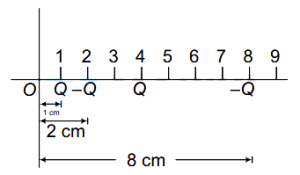
An infinite number of electric charges each equal to $5 \text{ nC}$ (magnitude) are placed along the $X$-axis at $x=1 \text{ cm}, x=2 \text{ cm}, x=4 \text{ cm}, x=8 \text{ cm} \dots$ and so on. In this setup, if the consecutive charges have opposite signs, then the electric field in $\text{N/C}$ at $x=0$ is: $\left(\frac{1}{4 \pi \varepsilon_0}=9 \times 10^9 \text{ N} \cdot \text{m}^2/\text{C}^2\right)$
A
$12 \times 10^4$
B
$24 \times 10^4$
C
$36 \times 10^4$
D
$48 \times 10^4$
Solution
(C) The electric field intensity $E$ due to a point charge $Q$ at a distance $r$ is given by $E = \frac{1}{4 \pi \varepsilon_0} \cdot \frac{Q}{r^2}$.
Since the charges are placed at $x = 1, 2, 4, 8, \dots \text{ cm}$ and have alternating signs, the net electric field at the origin $(x=0)$ is the vector sum of the fields produced by each charge.
Let $Q = 5 \times 10^{-9} \text{ C}$. The distances are $r_n = 2^{n-1} \times 10^{-2} \text{ m}$ for $n = 1, 2, 3, \dots$.
The field at $x=0$ is directed towards the negative $X$-axis for positive charges and positive $X$-axis for negative charges. Summing the magnitudes with appropriate signs:
$E = \frac{1}{4 \pi \varepsilon_0} \left[ \frac{Q}{(1 \times 10^{-2})^2} - \frac{Q}{(2 \times 10^{-2})^2} + \frac{Q}{(4 \times 10^{-2})^2} - \frac{Q}{(8 \times 10^{-2})^2} + \dots \right]$
$E = \frac{Q}{4 \pi \varepsilon_0 \times 10^{-4}} \left[ \frac{1}{1^2} - \frac{1}{2^2} + \frac{1}{4^2} - \frac{1}{8^2} + \dots \right]$
$E = (9 \times 10^9) \times (5 \times 10^{-9}) \times 10^4 \left[ 1 - \frac{1}{4} + \frac{1}{16} - \frac{1}{64} + \dots \right]$
The term in the bracket is an infinite geometric series with first term $a = 1$ and common ratio $r = -1/4$.
The sum $S = \frac{a}{1-r} = \frac{1}{1 - (-1/4)} = \frac{1}{5/4} = \frac{4}{5}$.
$E = 45 \times 10^4 \times \frac{4}{5} = 36 \times 10^4 \text{ N/C}$.
Since the charges are placed at $x = 1, 2, 4, 8, \dots \text{ cm}$ and have alternating signs, the net electric field at the origin $(x=0)$ is the vector sum of the fields produced by each charge.
Let $Q = 5 \times 10^{-9} \text{ C}$. The distances are $r_n = 2^{n-1} \times 10^{-2} \text{ m}$ for $n = 1, 2, 3, \dots$.
The field at $x=0$ is directed towards the negative $X$-axis for positive charges and positive $X$-axis for negative charges. Summing the magnitudes with appropriate signs:
$E = \frac{1}{4 \pi \varepsilon_0} \left[ \frac{Q}{(1 \times 10^{-2})^2} - \frac{Q}{(2 \times 10^{-2})^2} + \frac{Q}{(4 \times 10^{-2})^2} - \frac{Q}{(8 \times 10^{-2})^2} + \dots \right]$
$E = \frac{Q}{4 \pi \varepsilon_0 \times 10^{-4}} \left[ \frac{1}{1^2} - \frac{1}{2^2} + \frac{1}{4^2} - \frac{1}{8^2} + \dots \right]$
$E = (9 \times 10^9) \times (5 \times 10^{-9}) \times 10^4 \left[ 1 - \frac{1}{4} + \frac{1}{16} - \frac{1}{64} + \dots \right]$
The term in the bracket is an infinite geometric series with first term $a = 1$ and common ratio $r = -1/4$.
The sum $S = \frac{a}{1-r} = \frac{1}{1 - (-1/4)} = \frac{1}{5/4} = \frac{4}{5}$.
$E = 45 \times 10^4 \times \frac{4}{5} = 36 \times 10^4 \text{ N/C}$.
0 likesView Solution
36
ChemistryMCQTS EAMCET · 2003
Water is considered to be polluted if the dissolved oxygen $(D.O.)$ content is less than ... $ppm$ :
A
$5$
B
$10$
C
$15$
D
$100$
Solution
(A) The quality of water is determined by the concentration of dissolved oxygen $(D.O.)$.
Clean water should have a $D.O.$ value of approximately $6.0 \ ppm$ or higher.
If the $D.O.$ value falls below $5.0 \ ppm$,the water is considered to be polluted because it cannot support the survival of aquatic life effectively.
Clean water should have a $D.O.$ value of approximately $6.0 \ ppm$ or higher.
If the $D.O.$ value falls below $5.0 \ ppm$,the water is considered to be polluted because it cannot support the survival of aquatic life effectively.
0 likesView Solution
37
ChemistryMCQTS EAMCET · 2003
$2, 3$-dimethylhexane contains tertiary,secondary,and primary carbon atoms,respectively:
A
$2, 2, 4$
B
$2, 4, 3$
C
$4, 3, 2$
D
$3, 2, 4$
Solution
(A) The structure of $2, 3$-dimethylhexane is $CH_3-CH(CH_3)-CH(CH_3)-CH_2-CH_2-CH_3$.
By analyzing the structure:
- Tertiary $(3^{\circ})$ carbon atoms: The carbon atoms at positions $2$ and $3$ are bonded to three other carbon atoms. So,the number of tertiary carbon atoms $= 2$.
- Secondary $(2^{\circ})$ carbon atoms: The carbon atoms at positions $4$ and $5$ are bonded to two other carbon atoms. So,the number of secondary carbon atoms $= 2$.
- Primary $(1^{\circ})$ carbon atoms: The carbon atoms at positions $1$,$6$,and the two methyl groups attached to positions $2$ and $3$ are bonded to only one other carbon atom. So,the number of primary carbon atoms $= 4$.
Therefore,the number of tertiary,secondary,and primary carbon atoms are $2, 2, 4$ respectively.
By analyzing the structure:
- Tertiary $(3^{\circ})$ carbon atoms: The carbon atoms at positions $2$ and $3$ are bonded to three other carbon atoms. So,the number of tertiary carbon atoms $= 2$.
- Secondary $(2^{\circ})$ carbon atoms: The carbon atoms at positions $4$ and $5$ are bonded to two other carbon atoms. So,the number of secondary carbon atoms $= 2$.
- Primary $(1^{\circ})$ carbon atoms: The carbon atoms at positions $1$,$6$,and the two methyl groups attached to positions $2$ and $3$ are bonded to only one other carbon atom. So,the number of primary carbon atoms $= 4$.
Therefore,the number of tertiary,secondary,and primary carbon atoms are $2, 2, 4$ respectively.
0 likesView Solution
38
ChemistryMCQTS EAMCET · 2003
During the electrolysis of cryolite,aluminium and fluorine are formed in ........ molar ratio :
A
$1:2$
B
$2:3$
C
$1:1$
D
$1:3$
Solution
(B) During the electrolysis of cryolite $(Na_3AlF_6)$,the reactions are:
At Cathode: $Al^{3+} + 3e^- \rightarrow Al$
At Anode: $2F^- \rightarrow F_2 + 2e^-$
To balance the electrons,multiply the cathode reaction by $2$ and the anode reaction by $3$:
Cathode: $2Al^{3+} + 6e^- \rightarrow 2Al$
Anode: $6F^- \rightarrow 3F_2 + 6e^-$
The overall reaction is: $2Al^{3+} + 6F^- \rightarrow 2Al + 3F_2$
Therefore,the molar ratio of $Al$ to $F_2$ is $2:3$.
At Cathode: $Al^{3+} + 3e^- \rightarrow Al$
At Anode: $2F^- \rightarrow F_2 + 2e^-$
To balance the electrons,multiply the cathode reaction by $2$ and the anode reaction by $3$:
Cathode: $2Al^{3+} + 6e^- \rightarrow 2Al$
Anode: $6F^- \rightarrow 3F_2 + 6e^-$
The overall reaction is: $2Al^{3+} + 6F^- \rightarrow 2Al + 3F_2$
Therefore,the molar ratio of $Al$ to $F_2$ is $2:3$.
0 likesView Solution
39
ChemistryMCQTS EAMCET · 2003
In planetary motion,the areal velocity of the position vector of a planet depends on the angular velocity $\omega$ and the distance of the planet from the sun $r$. The correct relation for areal velocity is:
A
$\frac{dA}{dt} \propto \omega r$
B
$\frac{dA}{dt} \propto \omega^2 r$
C
$\frac{dA}{dt} \propto \omega r^2$
D
$\frac{dA}{dt} \propto \sqrt{\omega r}$
Solution
(C) The areal velocity $\frac{dA}{dt}$ is defined as the rate at which the area is swept by the position vector of the planet.
Given that $\frac{dA}{dt}$ depends on angular velocity $\omega$ and distance $r$,we can write: $\frac{dA}{dt} = K \omega^a r^b$.
The dimensional formula for areal velocity $\frac{dA}{dt}$ is $[L^2 T^{-1}]$.
The dimensional formula for angular velocity $\omega$ is $[T^{-1}]$ and for distance $r$ is $[L]$.
Substituting these into the equation: $[L^2 T^{-1}] = [T^{-1}]^a [L]^b$.
Comparing the exponents of $L$ and $T$ on both sides:
For $T$: $-a = -1 \Rightarrow a = 1$.
For $L$: $b = 2$.
Therefore,the relation is $\frac{dA}{dt} \propto \omega r^2$.
Given that $\frac{dA}{dt}$ depends on angular velocity $\omega$ and distance $r$,we can write: $\frac{dA}{dt} = K \omega^a r^b$.
The dimensional formula for areal velocity $\frac{dA}{dt}$ is $[L^2 T^{-1}]$.
The dimensional formula for angular velocity $\omega$ is $[T^{-1}]$ and for distance $r$ is $[L]$.
Substituting these into the equation: $[L^2 T^{-1}] = [T^{-1}]^a [L]^b$.
Comparing the exponents of $L$ and $T$ on both sides:
For $T$: $-a = -1 \Rightarrow a = 1$.
For $L$: $b = 2$.
Therefore,the relation is $\frac{dA}{dt} \propto \omega r^2$.
0 likesView Solution
40
ChemistryMCQTS EAMCET · 2003
In the reaction sequence,$C_2H_5Cl + KCN$ $\xrightarrow{C_2H_5OH} X$ $\xrightarrow[\Delta]{H_3O^+} Y$. What is the molecular formula of $Y$?
A
$C_3H_6O_2$
B
$C_3H_5N$
C
$C_2H_4O_2$
D
$C_2H_6O$
Solution
(A) Step $1$: Nucleophilic substitution of $C_2H_5Cl$ with $KCN$ in the presence of $C_2H_5OH$ gives propanenitrile $(X)$:
$C_2H_5Cl + KCN \rightarrow C_2H_5CN (X) + KCl$
Step $2$: Acidic hydrolysis of $X$ $(C_2H_5CN)$ followed by heating gives propanoic acid $(Y)$:
$C_2H_5CN + H_3O^+ + H_2O \xrightarrow{\Delta} C_2H_5COOH (Y) + NH_3$
The molecular formula of propanoic acid $(C_2H_5COOH)$ is $C_3H_6O_2$.
$C_2H_5Cl + KCN \rightarrow C_2H_5CN (X) + KCl$
Step $2$: Acidic hydrolysis of $X$ $(C_2H_5CN)$ followed by heating gives propanoic acid $(Y)$:
$C_2H_5CN + H_3O^+ + H_2O \xrightarrow{\Delta} C_2H_5COOH (Y) + NH_3$
The molecular formula of propanoic acid $(C_2H_5COOH)$ is $C_3H_6O_2$.
0 likesView Solution
41
ChemistryEasyMCQTS EAMCET · 2003
Which of the following reactions proceeds via a secondary free radical?
A
$CH_3-CH=CH_2 \xrightarrow{HBr} CH_3-CH(Br)-CH_3$
B
$CH_3-CH=CH_2 \xrightarrow[UV \text{ light}]{HBr, R_2O_2} CH_3-CH_2-CH_2Br$
C
$C_6H_6 \xrightarrow{Br_2 / FeBr_3} C_6H_5Br$
D
$CH_3-CH_2-CH_3 \xrightarrow{Br_2, h\nu} CH_3-CH(Br)-CH_3$
Solution
(D) The reaction $CH_3-CH_2-CH_3 \xrightarrow{Br_2, h\nu} CH_3-CH(Br)-CH_3$ is a free radical substitution reaction.
In the propagation step,a bromine radical abstracts a hydrogen atom from the secondary carbon of propane to form a secondary propyl radical $(CH_3-\dot{C}H-CH_3)$.
This secondary free radical is more stable than a primary free radical,making this the preferred pathway.
In the propagation step,a bromine radical abstracts a hydrogen atom from the secondary carbon of propane to form a secondary propyl radical $(CH_3-\dot{C}H-CH_3)$.
This secondary free radical is more stable than a primary free radical,making this the preferred pathway.
0 likesView Solution
42
ChemistryMCQTS EAMCET · 2003
When acetylene is passed through a red-hot iron tube,compound $X$ is formed. Which one of the following reactions will yield $X$ as the major product?
A
$C_6H_5OH + Zn \xrightarrow{\text{distillation}} C_6H_6 + ZnO$
B
$C_6H_5SO_3H + NaHCO_3 \longrightarrow C_6H_5SO_3Na + H_2O + CO_2$
C
$C_6H_{12} + 3H_2 \xrightarrow{Ni} C_6H_{12} + 3H_2$ (No reaction)
D
$C_6H_5Cl + H_2O \xrightarrow{\Delta} C_6H_5OH + HCl$
Solution
(A) When acetylene $(C_2H_2)$ is passed through a red-hot iron tube,it undergoes cyclic polymerization to form benzene $(C_6H_6)$,which is compound $X$:
$3C_2H_2 \xrightarrow{\text{red hot tube}} C_6H_6$ $(X)$
Reaction $(A)$ involves the reduction of phenol with zinc dust,which is a standard laboratory method to produce benzene:
$C_6H_5OH + Zn \xrightarrow{\text{distillation}} C_6H_6 + ZnO$
Therefore,reaction $(A)$ yields $X$ (benzene) as the major product.
$3C_2H_2 \xrightarrow{\text{red hot tube}} C_6H_6$ $(X)$
Reaction $(A)$ involves the reduction of phenol with zinc dust,which is a standard laboratory method to produce benzene:
$C_6H_5OH + Zn \xrightarrow{\text{distillation}} C_6H_6 + ZnO$
Therefore,reaction $(A)$ yields $X$ (benzene) as the major product.
0 likesView Solution
43
ChemistryMCQTS EAMCET · 2003
If the ionic product of water $(K_w)$ is $1.96 \times 10^{-14}$ at $35^{\circ} C$,what is its value at $10^{\circ} C$?
A
$1.96 \times 10^{-14}$
B
$3.92 \times 10^{-14}$
C
$2.95 \times 10^{-15}$
D
$1.96 \times 10^{-13}$
Solution
(C) The auto-ionization of water $(H_2O \rightleftharpoons H^{+} + OH^{-})$ is an endothermic process $(\Delta H > 0)$.
According to Le Chatelier's principle,an increase in temperature shifts the equilibrium to the right,increasing the value of the ionic product $(K_w)$.
Conversely,a decrease in temperature shifts the equilibrium to the left,decreasing the value of $K_w$.
Since $10^{\circ} C < 35^{\circ} C$,the value of $K_w$ at $10^{\circ} C$ must be less than $1.96 \times 10^{-14}$.
Among the given options,only $2.95 \times 10^{-15}$ is less than $1.96 \times 10^{-14}$.
According to Le Chatelier's principle,an increase in temperature shifts the equilibrium to the right,increasing the value of the ionic product $(K_w)$.
Conversely,a decrease in temperature shifts the equilibrium to the left,decreasing the value of $K_w$.
Since $10^{\circ} C < 35^{\circ} C$,the value of $K_w$ at $10^{\circ} C$ must be less than $1.96 \times 10^{-14}$.
Among the given options,only $2.95 \times 10^{-15}$ is less than $1.96 \times 10^{-14}$.
0 likesView Solution
44
ChemistryMCQTS EAMCET · 2003
Two identical blocks $A$ and $B$,each of mass $m$,resting on a smooth floor,are connected by a light spring of natural length $L$ and spring constant $k$. $A$ third identical block $C$ (mass $m$) moving with a speed $v$ along the line joining $A$ and $B$ collides with $A$. The maximum compression in the spring is proportional to:
A
$v \sqrt{\frac{m}{2 k}}$
B
$m \sqrt{\frac{v}{2 k}}$
C
$\sqrt{\frac{m v}{k}}$
D
$\frac{m v}{2 k}$
Solution
(A) Let the collision between $C$ and $A$ be perfectly inelastic. By conservation of linear momentum,the velocity of the combined system $(C+A)$ immediately after collision is $v' = \frac{mv}{m+m} = \frac{v}{2}$.
At the state of maximum compression $x$,the blocks $A$,$B$,and $C$ move with a common velocity $V$. By conservation of linear momentum,$mv = (m+m+m)V$,so $V = \frac{v}{3}$.
By conservation of mechanical energy,the initial kinetic energy of the system $(C+A)$ equals the sum of the final kinetic energy and the potential energy stored in the spring:
$\frac{1}{2}(2m)v'^2 = \frac{1}{2}(3m)V^2 + \frac{1}{2}kx^2$
$m(\frac{v}{2})^2 = \frac{3}{2}m(\frac{v}{3})^2 + \frac{1}{2}kx^2$
$\frac{mv^2}{4} = \frac{mv^2}{6} + \frac{1}{2}kx^2$
$\frac{1}{2}kx^2 = \frac{mv^2}{4} - \frac{mv^2}{6} = \frac{mv^2}{12}$
$x^2 = \frac{mv^2}{6k} \implies x = v \sqrt{\frac{m}{6k}}$.
Since the question asks for proportionality,we look at the reduced mass system. The effective mass for the oscillation of $A$ and $B$ is $\mu = \frac{m \cdot m}{m+m} = \frac{m}{2}$. The maximum compression is proportional to $v \sqrt{\frac{\mu}{k}} = v \sqrt{\frac{m}{2k}}$.
At the state of maximum compression $x$,the blocks $A$,$B$,and $C$ move with a common velocity $V$. By conservation of linear momentum,$mv = (m+m+m)V$,so $V = \frac{v}{3}$.
By conservation of mechanical energy,the initial kinetic energy of the system $(C+A)$ equals the sum of the final kinetic energy and the potential energy stored in the spring:
$\frac{1}{2}(2m)v'^2 = \frac{1}{2}(3m)V^2 + \frac{1}{2}kx^2$
$m(\frac{v}{2})^2 = \frac{3}{2}m(\frac{v}{3})^2 + \frac{1}{2}kx^2$
$\frac{mv^2}{4} = \frac{mv^2}{6} + \frac{1}{2}kx^2$
$\frac{1}{2}kx^2 = \frac{mv^2}{4} - \frac{mv^2}{6} = \frac{mv^2}{12}$
$x^2 = \frac{mv^2}{6k} \implies x = v \sqrt{\frac{m}{6k}}$.
Since the question asks for proportionality,we look at the reduced mass system. The effective mass for the oscillation of $A$ and $B$ is $\mu = \frac{m \cdot m}{m+m} = \frac{m}{2}$. The maximum compression is proportional to $v \sqrt{\frac{\mu}{k}} = v \sqrt{\frac{m}{2k}}$.

0 likesView Solution
45
ChemistryMCQTS EAMCET · 2003
$A$ long straight wire carrying a current of $30 ~A$ is placed in an external uniform magnetic field of induction $4 \times 10^{-4} ~T$. The magnetic field is acting parallel to the direction of current. The magnitude of the resultant magnetic induction in tesla at a point $2.0 ~cm$ away from the wire is
$\left(\mu_0=4 \pi \times 10^{-7} ~H/m\right)$
$\left(\mu_0=4 \pi \times 10^{-7} ~H/m\right)$
A
$10^{-4}$
B
$3 \times 10^{-4}$
C
$5 \times 10^{-4}$
D
$6 \times 10^{-4}$
Solution
(C) Given: Current $i = 30 ~A$,External magnetic field $B_1 = 4 \times 10^{-4} ~T$,Distance $r = 2.0 ~cm = 2 \times 10^{-2} ~m$.
The magnetic field produced by the straight wire at a distance $r$ is given by $B_2 = \frac{\mu_0 i}{2 \pi r}$.
Substituting the values: $B_2 = \frac{2 \times 10^{-7} \times 30}{2 \times 10^{-2}} = 3 \times 10^{-4} ~T$.
Since the external magnetic field $B_1$ is parallel to the current,it is perpendicular to the magnetic field $B_2$ produced by the wire (which circles the wire).
The resultant magnetic field $B$ is given by $B = \sqrt{B_1^2 + B_2^2}$.
$B = \sqrt{(4 \times 10^{-4})^2 + (3 \times 10^{-4})^2} = \sqrt{16 \times 10^{-8} + 9 \times 10^{-8}} = \sqrt{25 \times 10^{-8}} = 5 \times 10^{-4} ~T$.
The magnetic field produced by the straight wire at a distance $r$ is given by $B_2 = \frac{\mu_0 i}{2 \pi r}$.
Substituting the values: $B_2 = \frac{2 \times 10^{-7} \times 30}{2 \times 10^{-2}} = 3 \times 10^{-4} ~T$.
Since the external magnetic field $B_1$ is parallel to the current,it is perpendicular to the magnetic field $B_2$ produced by the wire (which circles the wire).
The resultant magnetic field $B$ is given by $B = \sqrt{B_1^2 + B_2^2}$.
$B = \sqrt{(4 \times 10^{-4})^2 + (3 \times 10^{-4})^2} = \sqrt{16 \times 10^{-8} + 9 \times 10^{-8}} = \sqrt{25 \times 10^{-8}} = 5 \times 10^{-4} ~T$.
0 likesView Solution
46
ChemistryMCQTS EAMCET · 2003
Two ions having masses in the ratio $1: 1$ and charges $1: 2$ are projected into a uniform magnetic field perpendicular to the field with speeds in the ratio $2: 3$. The ratio of the radii of circular paths along which the two particles move is :
A
$4: 3$
B
$2: 3$
C
$3: 1$
D
$1: 4$
Solution
(A) Given ratios: $m_1: m_2 = 1: 1$,$q_1: q_2 = 1: 2$,and $v_1: v_2 = 2: 3$.
When a charged particle moves in a uniform magnetic field perpendicular to the field,it follows a circular path with radius $r = \frac{mv}{Bq}$.
Therefore,the ratio of the radii is given by $\frac{r_1}{r_2} = \left(\frac{m_1}{m_2}\right) \left(\frac{v_1}{v_2}\right) \left(\frac{q_2}{q_1}\right)$.
Substituting the given values: $\frac{r_1}{r_2} = \left(\frac{1}{1}\right) \times \left(\frac{2}{3}\right) \times \left(\frac{2}{1}\right) = \frac{4}{3}$.
Thus,the ratio of the radii is $4: 3$.
When a charged particle moves in a uniform magnetic field perpendicular to the field,it follows a circular path with radius $r = \frac{mv}{Bq}$.
Therefore,the ratio of the radii is given by $\frac{r_1}{r_2} = \left(\frac{m_1}{m_2}\right) \left(\frac{v_1}{v_2}\right) \left(\frac{q_2}{q_1}\right)$.
Substituting the given values: $\frac{r_1}{r_2} = \left(\frac{1}{1}\right) \times \left(\frac{2}{3}\right) \times \left(\frac{2}{1}\right) = \frac{4}{3}$.
Thus,the ratio of the radii is $4: 3$.
0 likesView Solution
47
ChemistryMCQTS EAMCET · 2003
The magnetic susceptibility of the material of a rod is $499$. Permeability of vacuum is $4 \pi \times 10^{-7} \ H/m$. Absolute permeability of the material of the rod in $H/m$ is:
A
$\pi \times 10^{-4}$
B
$2 \pi \times 10^{-4}$
C
$3 \pi \times 10^{-4}$
D
$4 \pi \times 10^{-4}$
Solution
(B) Magnetic susceptibility,$\chi = 499$.
Permeability of vacuum,$\mu_0 = 4 \pi \times 10^{-7} \ H/m$.
Relative permeability of the rod is given by $\mu_r = 1 + \chi$.
Substituting the value,$\mu_r = 1 + 499 = 500$.
Absolute permeability $\mu$ is given by $\mu = \mu_r \mu_0$.
$\mu = 500 \times 4 \pi \times 10^{-7} \ H/m$.
$\mu = 2000 \pi \times 10^{-7} \ H/m$.
$\mu = 2 \pi \times 10^{-4} \ H/m$.
Permeability of vacuum,$\mu_0 = 4 \pi \times 10^{-7} \ H/m$.
Relative permeability of the rod is given by $\mu_r = 1 + \chi$.
Substituting the value,$\mu_r = 1 + 499 = 500$.
Absolute permeability $\mu$ is given by $\mu = \mu_r \mu_0$.
$\mu = 500 \times 4 \pi \times 10^{-7} \ H/m$.
$\mu = 2000 \pi \times 10^{-7} \ H/m$.
$\mu = 2 \pi \times 10^{-4} \ H/m$.
0 likesView Solution
48
ChemistryMCQTS EAMCET · 2003
If $\alpha, \beta, \gamma$ are the roots of the equation $x^3+4x+1=0$,then $(\alpha+\beta)^{-1}+(\beta+\gamma)^{-1}+(\gamma+\alpha)^{-1}$ is equal to
A
$2$
B
$3$
C
$4$
D
$5$
Solution
(C) Given that $\alpha, \beta, \gamma$ are the roots of the cubic equation $x^3+0x^2+4x+1=0$.
By Vieta's formulas,the sum of the roots is $\alpha+\beta+\gamma = 0$.
Therefore,$\alpha+\beta = -\gamma$,$\beta+\gamma = -\alpha$,and $\gamma+\alpha = -\beta$.
The expression becomes:
$(\alpha+\beta)^{-1}+(\beta+\gamma)^{-1}+(\gamma+\alpha)^{-1} = \frac{1}{-\gamma} + \frac{1}{-\alpha} + \frac{1}{-\beta} = -(\frac{1}{\alpha} + \frac{1}{\beta} + \frac{1}{\gamma})$.
This simplifies to:
$-(\frac{\alpha\beta + \beta\gamma + \gamma\alpha}{\alpha\beta\gamma})$.
From the equation $x^3+0x^2+4x+1=0$,we have $\alpha\beta + \beta\gamma + \gamma\alpha = 4$ and $\alpha\beta\gamma = -1$.
Substituting these values:
$-(\frac{4}{-1}) = -(-4) = 4$.
By Vieta's formulas,the sum of the roots is $\alpha+\beta+\gamma = 0$.
Therefore,$\alpha+\beta = -\gamma$,$\beta+\gamma = -\alpha$,and $\gamma+\alpha = -\beta$.
The expression becomes:
$(\alpha+\beta)^{-1}+(\beta+\gamma)^{-1}+(\gamma+\alpha)^{-1} = \frac{1}{-\gamma} + \frac{1}{-\alpha} + \frac{1}{-\beta} = -(\frac{1}{\alpha} + \frac{1}{\beta} + \frac{1}{\gamma})$.
This simplifies to:
$-(\frac{\alpha\beta + \beta\gamma + \gamma\alpha}{\alpha\beta\gamma})$.
From the equation $x^3+0x^2+4x+1=0$,we have $\alpha\beta + \beta\gamma + \gamma\alpha = 4$ and $\alpha\beta\gamma = -1$.
Substituting these values:
$-(\frac{4}{-1}) = -(-4) = 4$.
0 likesView Solution
49
ChemistryMCQTS EAMCET · 2003
If the sum of two of the roots of $x^3+p x^2-q x+r=0$ is zero,then $p q$ is equal to
A
$-r$
B
$r$
C
$2 r$
D
$-2 r$
Solution
(A) Let the roots of the equation $x^3+p x^2-q x+r=0$ be $\alpha, \beta, \gamma$.
Given that the sum of two roots is zero,let $\alpha+\beta=0$,which implies $\beta=-\alpha$.
From the relation between roots and coefficients:
$1) \alpha+\beta+\gamma = -p \implies 0+\gamma = -p \implies \gamma = -p$.
$2) \alpha \beta + \beta \gamma + \gamma \alpha = -q \implies \alpha(-\alpha) + \gamma(\alpha+\beta) = -q$.
Since $\alpha+\beta=0$,we have $-\alpha^2 + 0 = -q$,so $\alpha^2 = q$.
$3) \alpha \beta \gamma = -r \implies \alpha(-\alpha)\gamma = -r \implies -\alpha^2 \gamma = -r$.
Substituting $\alpha^2=q$ and $\gamma=-p$ into the equation $-\alpha^2 \gamma = -r$:
$-q(-p) = -r \implies pq = -r$.
Given that the sum of two roots is zero,let $\alpha+\beta=0$,which implies $\beta=-\alpha$.
From the relation between roots and coefficients:
$1) \alpha+\beta+\gamma = -p \implies 0+\gamma = -p \implies \gamma = -p$.
$2) \alpha \beta + \beta \gamma + \gamma \alpha = -q \implies \alpha(-\alpha) + \gamma(\alpha+\beta) = -q$.
Since $\alpha+\beta=0$,we have $-\alpha^2 + 0 = -q$,so $\alpha^2 = q$.
$3) \alpha \beta \gamma = -r \implies \alpha(-\alpha)\gamma = -r \implies -\alpha^2 \gamma = -r$.
Substituting $\alpha^2=q$ and $\gamma=-p$ into the equation $-\alpha^2 \gamma = -r$:
$-q(-p) = -r \implies pq = -r$.
0 likesView Solution
50
ChemistryMCQTS EAMCET · 2003
If $\omega$ is a complex cube root of unity,then $225+(3 \omega+8 \omega^2)^2+(3 \omega^2+8 \omega)^2$ is equal to:
A
$72$
B
$192$
C
$200$
D
$248$
Solution
(D) Given expression: $225+(3 \omega+8 \omega^2)^2+(3 \omega^2+8 \omega)^2$
Expanding the squares using $(a+b)^2 = a^2+2ab+b^2$ and using $\omega^3 = 1$ and $\omega^4 = \omega$:
$= 225 + (9 \omega^2 + 48 \omega^3 + 64 \omega^4) + (9 \omega^4 + 48 \omega^3 + 64 \omega^2)$
$= 225 + (9 \omega^2 + 48(1) + 64 \omega) + (9 \omega + 48(1) + 64 \omega^2)$
Grouping the terms:
$= 225 + 48 + 48 + (9+64) \omega^2 + (64+9) \omega$
$= 225 + 96 + 73(\omega^2 + \omega)$
Since $1 + \omega + \omega^2 = 0$,we have $\omega^2 + \omega = -1$:
$= 321 + 73(-1)$
$= 321 - 73 = 248$
Expanding the squares using $(a+b)^2 = a^2+2ab+b^2$ and using $\omega^3 = 1$ and $\omega^4 = \omega$:
$= 225 + (9 \omega^2 + 48 \omega^3 + 64 \omega^4) + (9 \omega^4 + 48 \omega^3 + 64 \omega^2)$
$= 225 + (9 \omega^2 + 48(1) + 64 \omega) + (9 \omega + 48(1) + 64 \omega^2)$
Grouping the terms:
$= 225 + 48 + 48 + (9+64) \omega^2 + (64+9) \omega$
$= 225 + 96 + 73(\omega^2 + \omega)$
Since $1 + \omega + \omega^2 = 0$,we have $\omega^2 + \omega = -1$:
$= 321 + 73(-1)$
$= 321 - 73 = 248$
0 likesView Solution
51
ChemistryEasyMCQTS EAMCET · 2003
Aniline is not the major product in one of the following reactions. Identify that reaction.
A
$C_6H_5OH + NH_3 \xrightarrow[300^{\circ}C]{ZnCl_2}$
B
$C_6H_5NO_2 + Zn \text{ powder } \xrightarrow{\text{alcoholic } KOH}$
C
$C_6H_5Cl + NH_3 \xrightarrow[Cu_2O]{200^{\circ}C, \text{high pressure}}$
D
$C_6H_5NO_2 + 6[H] \xrightarrow[HCl]{Fe + H_2O}$
Solution
(B) In the reaction of $C_6H_5NO_2$ with $Zn$ powder in the presence of alcoholic $KOH$,the major product is azoxybenzene or hydrazobenzene depending on conditions,not aniline.
$C_6H_5OH + NH_3 \xrightarrow[300^{\circ}C]{ZnCl_2}$ gives aniline.
$C_6H_5Cl + NH_3 \xrightarrow[Cu_2O]{200^{\circ}C, \text{high pressure}}$ gives aniline.
$C_6H_5NO_2 + 6[H] \xrightarrow[HCl]{Fe + H_2O}$ is the reduction of nitrobenzene to aniline.
Therefore,the reaction that does not produce aniline as the major product is $C_6H_5NO_2 + Zn \text{ powder } \xrightarrow{\text{alcoholic } KOH}$.
$C_6H_5OH + NH_3 \xrightarrow[300^{\circ}C]{ZnCl_2}$ gives aniline.
$C_6H_5Cl + NH_3 \xrightarrow[Cu_2O]{200^{\circ}C, \text{high pressure}}$ gives aniline.
$C_6H_5NO_2 + 6[H] \xrightarrow[HCl]{Fe + H_2O}$ is the reduction of nitrobenzene to aniline.
Therefore,the reaction that does not produce aniline as the major product is $C_6H_5NO_2 + Zn \text{ powder } \xrightarrow{\text{alcoholic } KOH}$.
0 likesView Solution
52
ChemistryMediumMCQTS EAMCET · 2003
Which one of the following equations is correct for the reaction $N_{2(g)} + 3H_{2(g)} \longrightarrow 2NH_{3(g)}$?
A
$3 \frac{d[NH_3]}{dt} = 2 \frac{d[H_2]}{dt}$
B
$3 \frac{d[NH_3]}{dt} = 3 \frac{d[H_2]}{dt}$
C
$2 \frac{d[NH_3]}{dt} = -3 \frac{d[H_2]}{dt}$
D
$3 \frac{d[NH_3]}{dt} = -2 \frac{d[H_2]}{dt}$
Solution
(D) For the reaction $N_{2(g)} + 3H_{2(g)} \longrightarrow 2NH_{3(g)}$,the rate of reaction is expressed as:
$Rate = -\frac{d[N_2]}{dt} = -\frac{1}{3} \frac{d[H_2]}{dt} = \frac{1}{2} \frac{d[NH_3]}{dt}$
Equating the terms for $NH_3$ and $H_2$:
$-\frac{1}{3} \frac{d[H_2]}{dt} = \frac{1}{2} \frac{d[NH_3]}{dt}$
Multiplying both sides by $6$:
$-2 \frac{d[H_2]}{dt} = 3 \frac{d[NH_3]}{dt}$
Rearranging gives $3 \frac{d[NH_3]}{dt} = -2 \frac{d[H_2]}{dt}$.
$Rate = -\frac{d[N_2]}{dt} = -\frac{1}{3} \frac{d[H_2]}{dt} = \frac{1}{2} \frac{d[NH_3]}{dt}$
Equating the terms for $NH_3$ and $H_2$:
$-\frac{1}{3} \frac{d[H_2]}{dt} = \frac{1}{2} \frac{d[NH_3]}{dt}$
Multiplying both sides by $6$:
$-2 \frac{d[H_2]}{dt} = 3 \frac{d[NH_3]}{dt}$
Rearranging gives $3 \frac{d[NH_3]}{dt} = -2 \frac{d[H_2]}{dt}$.
0 likesView Solution
53
ChemistryMediumMCQTS EAMCET · 2003
An organic compound $X$ gives a red precipitate on heating with Fehling's solution. Which one of the following reactions yields $X$ as a major product?
A
$HCHO \xrightarrow[(ii) H_2O]{(i) CH_3MgI}$
B
$C_2H_5Br + AgOH \xrightarrow{\Delta} C_2H_5OH$
C
$2C_2H_5Br + Ag_2O \xrightarrow{\Delta} (C_2H_5)_2O$
D
$C_2H_2 + H_2O \xrightarrow[1\% HgSO_4]{40\% H_2SO_4} CH_3CHO$
Solution
(D) Fehling's solution is a test for aliphatic aldehydes. The compound $X$ that gives a red precipitate with Fehling's solution is acetaldehyde $(CH_3CHO)$.
The reaction of acetylene $(C_2H_2)$ with water in the presence of $40\% H_2SO_4$ and $1\% HgSO_4$ (Kucherov reaction) yields acetaldehyde $(CH_3CHO)$ as the major product.
$C_2H_2 + H_2O \xrightarrow[1\% HgSO_4]{40\% H_2SO_4} CH_3CHO$
Acetaldehyde then reacts with Fehling's solution to give a red precipitate of cuprous oxide $(Cu_2O)$.
The reaction of acetylene $(C_2H_2)$ with water in the presence of $40\% H_2SO_4$ and $1\% HgSO_4$ (Kucherov reaction) yields acetaldehyde $(CH_3CHO)$ as the major product.
$C_2H_2 + H_2O \xrightarrow[1\% HgSO_4]{40\% H_2SO_4} CH_3CHO$
Acetaldehyde then reacts with Fehling's solution to give a red precipitate of cuprous oxide $(Cu_2O)$.
0 likesView Solution
54
ChemistryEasyMCQTS EAMCET · 2003
Which one of the following gases is liberated when ethyl alcohol is heated with methyl magnesium iodide?
A
Methane
B
Ethane
C
Carbon dioxide
D
Propane
Solution
(A) Ethyl alcohol $(C_2H_5OH)$ contains an active hydrogen atom attached to an oxygen atom. When it reacts with a Grignard reagent like methyl magnesium iodide $(CH_3MgI)$,the active hydrogen is replaced by the methyl group to form methane gas $(CH_4)$.
The reaction is as follows:
$C_2H_5OH + CH_3MgI \rightarrow CH_4 \uparrow + C_2H_5OMgI$
The reaction is as follows:
$C_2H_5OH + CH_3MgI \rightarrow CH_4 \uparrow + C_2H_5OMgI$
0 likesView Solution
55
ChemistryDifficultMCQTS EAMCET · 2003
In the reaction,$C_2H_5OC_2H_5 + CO \xrightarrow[150^{\circ}C, 500 \text{ atm pressure}]{BF_3} X$. What is $X$?
A
Diethyl carbonate
B
Ethyl carbonate
C
Diethyl peroxide
D
Ethyl propionate
Solution
(D) The reaction of diethyl ether $(C_2H_5OC_2H_5)$ with carbon monoxide $(CO)$ in the presence of a Lewis acid catalyst like $BF_3$ at high temperature $(150^{\circ}C)$ and high pressure $(500 \text{ atm})$ is a carbonylation reaction.
This reaction results in the insertion of $CO$ into the $C-O$ bond of the ether to form an ester.
The product formed is ethyl propionate $(C_2H_5COOC_2H_5)$.
This reaction results in the insertion of $CO$ into the $C-O$ bond of the ether to form an ester.
The product formed is ethyl propionate $(C_2H_5COOC_2H_5)$.
0 likesView Solution
56
ChemistryEasyMCQTS EAMCET · 2003
Acetaldehyde forms a white crystalline precipitate on mixing with a ...... solution of
A
acidic,$Zn-Hg$
B
alcoholic,$Na_2SO_3$
C
saturated aqueous,$NaHSO_3$
D
aqueous,$NaCl$
Solution
(C) Acetaldehyde $(CH_3CHO)$ reacts with a saturated aqueous solution of sodium bisulphite $(NaHSO_3)$ to form an addition product known as acetaldehyde sodium bisulphite.
This product appears as a white crystalline precipitate.
The reaction is as follows:
$CH_3CHO + NaHSO_3 \rightarrow CH_3-CH(OH)-SO_3Na$
(Acetaldehyde sodium bisulphite,white crystalline precipitate).
This product appears as a white crystalline precipitate.
The reaction is as follows:
$CH_3CHO + NaHSO_3 \rightarrow CH_3-CH(OH)-SO_3Na$
(Acetaldehyde sodium bisulphite,white crystalline precipitate).
0 likesView Solution
57
ChemistryMediumMCQTS EAMCET · 2003
Aniline is not the major product in one of the following reactions. Identify that reaction.
A
$C_6H_5OH + NH_3 \xrightarrow[300^{\circ}C]{ZnCl_2} C_6H_5NH_2$
B
$C_6H_5NO_2 + Zn \text{ (powder)} \xrightarrow{\text{alcoholic } KOH}$
C
$C_6H_5Cl + NH_3 \xrightarrow[Cu_2O, \text{high pressure}]{200^{\circ}C} C_6H_5NH_2$
D
$C_6H_5NO_2 + 6[H] \xrightarrow{Fe + HCl} C_6H_5NH_2 + 2H_2O$
Solution
(B) In the reaction of nitrobenzene $(C_6H_5NO_2)$ with zinc powder in the presence of alcoholic $KOH$,the product formed is azoxybenzene or other reduction products depending on conditions,but not aniline as the major product.
Option $A$ is the ammonolysis of phenol.
Option $C$ is the reaction of chlorobenzene with ammonia (ammonolysis).
Option $D$ is the standard reduction of nitrobenzene to aniline using $Fe/HCl$.
Option $A$ is the ammonolysis of phenol.
Option $C$ is the reaction of chlorobenzene with ammonia (ammonolysis).
Option $D$ is the standard reduction of nitrobenzene to aniline using $Fe/HCl$.
0 likesView Solution
58
ChemistryEasyMCQTS EAMCET · 2003
Which one of the following compounds gives aspirin on reacting with acetic anhydride in the presence of conc. $H_2SO_4$?
A
Salicylaldehyde
B
Salicylic acid
C
$2-$Formylbenzoic acid
D
p-Aminophenol
Solution
(B) $2-$Hydroxybenzoic acid (salicylic acid) reacts with acetic anhydride in the presence of conc. $H_2SO_4$ to form $2-$acetoxybenzoic acid,which is commonly known as aspirin. The reaction is an acetylation reaction of the phenolic $-OH$ group.
0 likesView Solution
59
ChemistryEasyMCQTS EAMCET · 2003
Acid hydrolysis of $X$ yields two different organic compounds. Which one of the following is $X$?
A
$CH_3COOH$
B
$CH_3CONH_2$
C
$CH_3COOC_2H_5$
D
$(CH_3CO)_2O$
Solution
(C) Acid hydrolysis of an ester $(X = CH_3COOC_2H_5)$ produces a carboxylic acid and an alcohol.
The reaction is: $CH_3COOC_2H_5 + H_2O \xrightarrow{H^+} CH_3COOH + C_2H_5OH$.
Here,$CH_3COOH$ (acetic acid) and $C_2H_5OH$ (ethanol) are two different organic compounds.
The reaction is: $CH_3COOC_2H_5 + H_2O \xrightarrow{H^+} CH_3COOH + C_2H_5OH$.
Here,$CH_3COOH$ (acetic acid) and $C_2H_5OH$ (ethanol) are two different organic compounds.
0 likesView Solution
60
ChemistryEasyMCQTS EAMCET · 2003
Ferrous ion changes to $X$ ion upon reacting with acidified hydrogen peroxide. The number of $d$-electrons present in $X$ and its magnetic moment (in $BM$) are,respectively:
A
$6$ and $6.93$
B
$5$ and $5.92$
C
$5$ and $4.9$
D
$4$ and $5.92$
Solution
(B) The reaction of ferrous ion $(Fe^{2+})$ with acidified hydrogen peroxide $(H_2O_2)$ results in the oxidation of $Fe^{2+}$ to ferric ion $(Fe^{3+})$:
$2Fe^{2+} + H_2O_2 + 2H^+ \longrightarrow 2Fe^{3+} + 2H_2O$
Thus,the ion $X$ is $Fe^{3+}$.
The electronic configuration of $Fe^{3+}$ is $[Ar] 3d^5$.
The number of $d$-electrons is $5$.
The magnetic moment $(\mu)$ is calculated using the formula $\mu = \sqrt{n(n+2)} \ BM$,where $n$ is the number of unpaired electrons.
For $Fe^{3+}$,$n = 5$.
$\mu = \sqrt{5(5+2)} = \sqrt{35} \approx 5.92 \ BM$.
$2Fe^{2+} + H_2O_2 + 2H^+ \longrightarrow 2Fe^{3+} + 2H_2O$
Thus,the ion $X$ is $Fe^{3+}$.
The electronic configuration of $Fe^{3+}$ is $[Ar] 3d^5$.
The number of $d$-electrons is $5$.
The magnetic moment $(\mu)$ is calculated using the formula $\mu = \sqrt{n(n+2)} \ BM$,where $n$ is the number of unpaired electrons.
For $Fe^{3+}$,$n = 5$.
$\mu = \sqrt{5(5+2)} = \sqrt{35} \approx 5.92 \ BM$.
0 likesView Solution
61
ChemistryEasyMCQTS EAMCET · 2003
When $X$ amperes of current is passed through molten $AlCl_3$ for $96.5$ $s$,$0.09$ $g$ of aluminium is deposited. What is the value of $X$?
A
$10$ ampere
B
$20$ ampere
C
$30$ ampere
D
$40$ ampere
Solution
(A) The reaction for the deposition of aluminium is: $Al^{3+} + 3e^- \rightarrow Al(s)$.
According to Faraday's law of electrolysis,the mass deposited $w$ is given by $w = \frac{M \times I \times t}{n \times F}$,where $M$ is the molar mass of $Al$ $(27 \ g/mol)$,$I$ is the current in amperes,$t$ is the time in seconds $(96.5 \ s)$,$n$ is the number of electrons involved $(3)$,and $F$ is Faraday's constant $(96500 \ C/mol)$.
Substituting the values: $0.09 = \frac{27 \times I \times 96.5}{3 \times 96500}$.
$0.09 = \frac{27 \times I \times 96.5}{289500}$.
$I = \frac{0.09 \times 289500}{27 \times 96.5} = \frac{26055}{2605.5} = 10 \ A$.
Therefore,the value of $X$ is $10$.
According to Faraday's law of electrolysis,the mass deposited $w$ is given by $w = \frac{M \times I \times t}{n \times F}$,where $M$ is the molar mass of $Al$ $(27 \ g/mol)$,$I$ is the current in amperes,$t$ is the time in seconds $(96.5 \ s)$,$n$ is the number of electrons involved $(3)$,and $F$ is Faraday's constant $(96500 \ C/mol)$.
Substituting the values: $0.09 = \frac{27 \times I \times 96.5}{3 \times 96500}$.
$0.09 = \frac{27 \times I \times 96.5}{289500}$.
$I = \frac{0.09 \times 289500}{27 \times 96.5} = \frac{26055}{2605.5} = 10 \ A$.
Therefore,the value of $X$ is $10$.
0 likesView Solution
62
ChemistryEasyMCQTS EAMCET · 2003
During the electrolysis of cryolite,aluminium and fluorine are formed in $........$ molar ratio :
A
$1: 2$
B
$2: 3$
C
$1: 1$
D
$1: 3$
Solution
(B) The electrolysis of cryolite $(Na_3AlF_6)$ involves the following reactions:
$Na_3AlF_6 \rightleftharpoons 3NaF + AlF_3$
$4AlF_3 \rightleftharpoons 4Al^{3+} + 12F^-$
At the cathode: $4Al^{3+} + 12e^- \rightarrow 4Al$
At the anode: $12F^- \rightarrow 6F_2 + 12e^-$
Thus,the molar ratio of $Al$ to $F_2$ produced is $4:6$,which simplifies to $2:3$.
$Na_3AlF_6 \rightleftharpoons 3NaF + AlF_3$
$4AlF_3 \rightleftharpoons 4Al^{3+} + 12F^-$
At the cathode: $4Al^{3+} + 12e^- \rightarrow 4Al$
At the anode: $12F^- \rightarrow 6F_2 + 12e^-$
Thus,the molar ratio of $Al$ to $F_2$ produced is $4:6$,which simplifies to $2:3$.
0 likesView Solution
63
ChemistryEasyMCQTS EAMCET · 2003
In the reaction sequence,$C_2H_5Cl + KCN$ $\xrightarrow{C_2H_5OH} X$ $\xrightarrow{H_3O^{\oplus}, \Delta} Y$. What is the molecular formula of $Y$?
A
$C_3H_6O_2$
B
$C_3H_5N$
C
$C_2H_4O_2$
D
$C_2H_6O$
Solution
(A) The reaction sequence is as follows:
$1$. $C_2H_5Cl + KCN \xrightarrow{C_2H_5OH} C_2H_5CN (X) + KCl$
This is a nucleophilic substitution reaction where $CN^{-}$ replaces $Cl^{-}$.
$2$. $C_2H_5CN + 2H_2O \xrightarrow{H_3O^{\oplus}, \Delta} C_2H_5COOH (Y) + NH_3$
Acidic hydrolysis of the nitrile $(X)$ yields the corresponding carboxylic acid $(Y)$,which is propanoic acid $(C_2H_5COOH)$.
The molecular formula of propanoic acid $(C_2H_5COOH)$ is $C_3H_6O_2$.
$1$. $C_2H_5Cl + KCN \xrightarrow{C_2H_5OH} C_2H_5CN (X) + KCl$
This is a nucleophilic substitution reaction where $CN^{-}$ replaces $Cl^{-}$.
$2$. $C_2H_5CN + 2H_2O \xrightarrow{H_3O^{\oplus}, \Delta} C_2H_5COOH (Y) + NH_3$
Acidic hydrolysis of the nitrile $(X)$ yields the corresponding carboxylic acid $(Y)$,which is propanoic acid $(C_2H_5COOH)$.
The molecular formula of propanoic acid $(C_2H_5COOH)$ is $C_3H_6O_2$.
0 likesView Solution
64
ChemistryDifficultMCQTS EAMCET · 2003
An organic compound $X$ gives a red precipitate on heating with Fehling's solution. Which one of the following reactions yields $X$ as a major product?
A
$HCHO \xrightarrow[(ii) H_2O]{(i) CH_3MgI} X$
B
$C_2H_5Br + AgOH \xrightarrow{\Delta} X$
C
$2 C_2H_5Br + Ag_2O \xrightarrow{\Delta} X$
D
$C_2H_2 + H_2O \xrightarrow[1 \% HgSO_4, 60^{\circ}C]{40 \% H_2SO_4} X$
Solution
(D) The organic compound $X$ gives a red precipitate with Fehling's solution,which indicates that $X$ is an aliphatic aldehyde (specifically,acetaldehyde,$CH_3CHO$).
Reaction $D$ is the hydration of acetylene $(C_2H_2)$ in the presence of $40 \% H_2SO_4$ and $1 \% HgSO_4$ at $60^{\circ}C$,which yields acetaldehyde $(CH_3CHO)$ as the major product.
$C_2H_2 + H_2O \xrightarrow[1 \% HgSO_4, 60^{\circ}C]{40 \% H_2SO_4} CH_3CHO$ (Acetaldehyde)
Acetaldehyde reacts with Fehling's solution upon heating to form a red precipitate of cuprous oxide $(Cu_2O)$.
Reaction $D$ is the hydration of acetylene $(C_2H_2)$ in the presence of $40 \% H_2SO_4$ and $1 \% HgSO_4$ at $60^{\circ}C$,which yields acetaldehyde $(CH_3CHO)$ as the major product.
$C_2H_2 + H_2O \xrightarrow[1 \% HgSO_4, 60^{\circ}C]{40 \% H_2SO_4} CH_3CHO$ (Acetaldehyde)
Acetaldehyde reacts with Fehling's solution upon heating to form a red precipitate of cuprous oxide $(Cu_2O)$.
0 likesView Solution
65
ChemistryEasyMCQTS EAMCET · 2003
Two oxides of nitrogen,$NO$ and $NO_2$,react together at $253 \ K$ to form a compound of nitrogen $X$. $X$ reacts with water to yield another compound of nitrogen $Y$. The shape of the anion of $Y$ is:
A
tetrahedral
B
triangular planar
C
square planar
D
pyramidal
Solution
(B) $NO + NO_2 \xrightarrow{253 \ K} N_2O_3 \ (X)$
$N_2O_3 + H_2O \longrightarrow 2HNO_2 \ (Y)$
The anion of $Y$ $(HNO_2)$ is $NO_2^-$.
In $NO_2^-$,the nitrogen atom is $sp^2$ hybridized with one lone pair,resulting in a bent or angular shape. However,among the given options,the geometry of the electron domain is triangular planar. Given the options provided,the intended answer is triangular planar.
$N_2O_3 + H_2O \longrightarrow 2HNO_2 \ (Y)$
The anion of $Y$ $(HNO_2)$ is $NO_2^-$.
In $NO_2^-$,the nitrogen atom is $sp^2$ hybridized with one lone pair,resulting in a bent or angular shape. However,among the given options,the geometry of the electron domain is triangular planar. Given the options provided,the intended answer is triangular planar.
0 likesView Solution
66
ChemistryMediumMCQTS EAMCET · 2003
The product obtained at the anode when $50 \%$ $H_2SO_4$ aqueous solution is electrolysed using platinum electrodes is:
A
$H_2SO_3$
B
$H_2S_2O_8$
C
$O_2$
D
$H_2$
Solution
(B) During the electrolysis of $50 \% H_2SO_4$ using platinum electrodes,the concentration of the acid is high enough that the oxidation of the hydrogen sulfate ion $(HSO_4^-)$ occurs at the anode instead of the oxidation of water.
The reaction at the anode is: $2HSO_4^- \longrightarrow H_2S_2O_8 + 2e^-$.
Thus,the product obtained at the anode is peroxodisulfuric acid $(H_2S_2O_8)$.
The reaction at the anode is: $2HSO_4^- \longrightarrow H_2S_2O_8 + 2e^-$.
Thus,the product obtained at the anode is peroxodisulfuric acid $(H_2S_2O_8)$.
0 likesView Solution
67
ChemistryMediumMCQTS EAMCET · 2003
The oxidation state of $Xe$ in $XeO_3$ and the bond angle in it respectively are:
A
$+6, 109^{\circ}$
B
$+8, 103^{\circ}$
C
$+6, 103^{\circ}$
D
$+8, 120^{\circ}$
Solution
(C) The oxidation state of $Xe$ in $XeO_3$ is calculated as follows:
$x + 3(-2) = 0$
$x - 6 = 0$
$x = +6$
In $XeO_3$,$Xe$ undergoes $sp^3$ hybridization with one lone pair,resulting in a pyramidal geometry.
The bond angle in $XeO_3$ is approximately $103^{\circ}$.
$x + 3(-2) = 0$
$x - 6 = 0$
$x = +6$
In $XeO_3$,$Xe$ undergoes $sp^3$ hybridization with one lone pair,resulting in a pyramidal geometry.
The bond angle in $XeO_3$ is approximately $103^{\circ}$.
0 likesView Solution
68
ChemistryMediumMCQTS EAMCET · 2003
Which one of the following electrolytes is used in Down's process of extracting sodium metal?
A
$NaCl + KCl + KF$
B
$NaCl$
C
$NaOH + KCl + KF$
D
$NaCl + NaOH$
Solution
(A) In Down's process,metallic sodium is extracted by the electrolysis of a fused mixture of $NaCl$,$CaCl_2$,and $KF$.
The addition of $CaCl_2$ and $KF$ lowers the melting point of $NaCl$ from $801^{\circ}C$ to approximately $600^{\circ}C$,which helps in reducing energy consumption and prevents the vaporization of sodium metal.
Therefore,the electrolyte used is a mixture of $NaCl$,$CaCl_2$,and $KF$.
The addition of $CaCl_2$ and $KF$ lowers the melting point of $NaCl$ from $801^{\circ}C$ to approximately $600^{\circ}C$,which helps in reducing energy consumption and prevents the vaporization of sodium metal.
Therefore,the electrolyte used is a mixture of $NaCl$,$CaCl_2$,and $KF$.
0 likesView Solution
69
ChemistryMediumMCQTS EAMCET · 2003
Which one of the following reactions occurs at the anode in the Castner process of extracting sodium metal?
A
$H_2 \longrightarrow 2 H^{+} + 2 e^{-}$
B
$2 Cl^{-} \longrightarrow Cl_2 + 2 e^{-}$
C
$4 OH^{-} \longrightarrow 2 H_2 O + O_2 + 4 e^{-}$
D
$Na^{+} + e^{-} \longrightarrow Na$
Solution
(B) The Castner process involves the electrolysis of fused sodium chloride $(NaCl)$.
At the cathode,sodium ions are reduced: $Na^{+} + e^{-} \longrightarrow Na$.
At the anode,chloride ions are oxidized to chlorine gas: $2 Cl^{-} \longrightarrow Cl_2 + 2 e^{-}$.
Therefore,the reaction occurring at the anode is $2 Cl^{-} \longrightarrow Cl_2 + 2 e^{-}$.
At the cathode,sodium ions are reduced: $Na^{+} + e^{-} \longrightarrow Na$.
At the anode,chloride ions are oxidized to chlorine gas: $2 Cl^{-} \longrightarrow Cl_2 + 2 e^{-}$.
Therefore,the reaction occurring at the anode is $2 Cl^{-} \longrightarrow Cl_2 + 2 e^{-}$.
0 likesView Solution
70
ChemistryMediumMCQTS EAMCET · 2003
Which one of the following represents the graph between $\log p$ (on $Y$-axis) and $\frac{1}{T}$ (on $X$-axis)?
($p=$ vapour pressure of a liquid,$T=$ absolute temperature)
($p=$ vapour pressure of a liquid,$T=$ absolute temperature)
A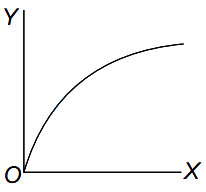
B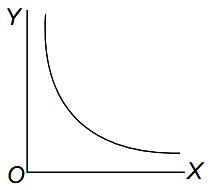
C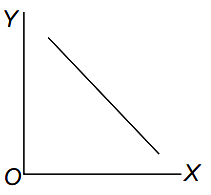
D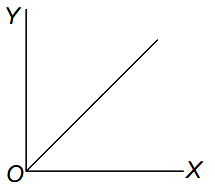
Solution
(C) According to the Clausius-Clapeyron equation,the relationship between vapour pressure $(p)$ and absolute temperature $(T)$ is given by:
$\log p = -\frac{\Delta H_{vap}}{2.303 R} \left(\frac{1}{T}\right) + C$
where $\Delta H_{vap}$ is the enthalpy of vaporization,$R$ is the gas constant,and $C$ is a constant.
This equation is in the form of a straight line equation $y = mx + c$,where the slope $m = -\frac{\Delta H_{vap}}{2.303 R}$.
Since the slope is negative,the graph of $\log p$ versus $\frac{1}{T}$ is a straight line with a negative slope,which corresponds to the graph shown in option $C$.
$\log p = -\frac{\Delta H_{vap}}{2.303 R} \left(\frac{1}{T}\right) + C$
where $\Delta H_{vap}$ is the enthalpy of vaporization,$R$ is the gas constant,and $C$ is a constant.
This equation is in the form of a straight line equation $y = mx + c$,where the slope $m = -\frac{\Delta H_{vap}}{2.303 R}$.
Since the slope is negative,the graph of $\log p$ versus $\frac{1}{T}$ is a straight line with a negative slope,which corresponds to the graph shown in option $C$.
0 likesView Solution
71
ChemistryEasyMCQTS EAMCET · 2003
If the mass defect of a nuclide is $3.32 \times 10^{-26} \ g$,its binding energy in $MeV$ is:
A
$9.31$
B
$18.62$
C
$27.93$
D
$37.24$
Solution
(B) The mass defect is given as $3.32 \times 10^{-26} \ g$.
First,convert the mass defect into atomic mass units $(amu)$ by dividing by the mass of one $amu$ $(1.66 \times 10^{-24} \ g)$:
$\text{Mass defect in } amu = \frac{3.32 \times 10^{-26} \ g}{1.66 \times 10^{-24} \ g/amu} = 0.02 \ amu$.
The binding energy is calculated using the relation: $\text{Binding energy} = \text{Mass defect in } amu \times 931 \ MeV/amu$.
$\text{Binding energy} = 0.02 \times 931 \ MeV = 18.62 \ MeV$.
First,convert the mass defect into atomic mass units $(amu)$ by dividing by the mass of one $amu$ $(1.66 \times 10^{-24} \ g)$:
$\text{Mass defect in } amu = \frac{3.32 \times 10^{-26} \ g}{1.66 \times 10^{-24} \ g/amu} = 0.02 \ amu$.
The binding energy is calculated using the relation: $\text{Binding energy} = \text{Mass defect in } amu \times 931 \ MeV/amu$.
$\text{Binding energy} = 0.02 \times 931 \ MeV = 18.62 \ MeV$.
0 likesView Solution
72
ChemistryEasyMCQTS EAMCET · 2003
Which one of the following equations represents the Freundlich adsorption isotherm?
A
$\frac{x}{m} = K p$
B
$\frac{x}{m} = K p^{1/n}$
C
$\log \frac{x}{m} = K p^n$
D
$\log \frac{x}{m} = K n \log p$
Solution
(B) The Freundlich adsorption isotherm is given by the empirical relationship:
$\frac{x}{m} = K p^{1/n}$
where:
$x$ is the mass of the adsorbate,
$m$ is the mass of the adsorbent,
$p$ is the pressure,
$K$ and $n$ are constants that depend on the nature of the adsorbent and adsorbate at a particular temperature.
$\frac{x}{m} = K p^{1/n}$
where:
$x$ is the mass of the adsorbate,
$m$ is the mass of the adsorbent,
$p$ is the pressure,
$K$ and $n$ are constants that depend on the nature of the adsorbent and adsorbate at a particular temperature.
0 likesView Solution
Vedclass Products
For Students
Vedclass Test Series
Mock tests in real TS EAMCET style covering Chemistry with performance analysis. 5-day free trial.
Start Free TrialFor Teachers
Exam Paper Generator
Generate Set A/B/C/D Chemistry papers from 7.5L+ questions in 2 minutes. 3 chapters free.
Try FreeFor Institutes
Online Exam Module
Run live TS EAMCET mock exams with unlimited students, 360° analytics & white-label branding.
See DemoFrequently Asked Questions
How many Chemistry questions are in TS EAMCET 2003?
There are 212 Chemistry questions from the TS EAMCET 2003 paper on Vedclass, each with a detailed step-by-step solution in English.
Are TS EAMCET 2003 Chemistry solutions available in English?
Yes. All solutions on this page are in English. You can also switch to English or Hindi using the language buttons above the questions.
Can I practice TS EAMCET 2003 Chemistry as a timed test?
Yes. Use the Vedclass Test Series to attempt a full TS EAMCET mock test covering Chemistry with time limits and instant score analysis.
Can teachers create Chemistry papers from TS EAMCET previous year questions?
Yes. The Vedclass Exam Paper Generator lets teachers mix TS EAMCET Chemistry questions and generate Set A/B/C/D papers in minutes.
For Teachers & Institutes
Build a Custom Chemistry Paper
Pick TS EAMCET 2003 Chemistry questions, set difficulty, and generate Set A/B/C/D in 2 minutes.