
MathematicsQ351–400 of 546 questions
Page 8 of 9 · English
351
MathematicsEasyMCQMHT CET · 2022
The value of $k$,such that the line $\frac{x-4}{1}=\frac{y-2}{1}=\frac{z-k}{2}$ lies on the plane $2x-4y+z=7$,is
A
no real value
B
$4$
C
-$7$
D
$7$
Solution
(D) For the line to lie on the plane,every point on the line must satisfy the equation of the plane.
Since the line passes through the point $(4, 2, k)$,this point must satisfy the plane equation $2x - 4y + z = 7$.
Substituting the coordinates of the point into the plane equation:
$2(4) - 4(2) + k = 7$
$8 - 8 + k = 7$
$k = 7$
Thus,the value of $k$ is $7$.
Since the line passes through the point $(4, 2, k)$,this point must satisfy the plane equation $2x - 4y + z = 7$.
Substituting the coordinates of the point into the plane equation:
$2(4) - 4(2) + k = 7$
$8 - 8 + k = 7$
$k = 7$
Thus,the value of $k$ is $7$.
0 likesView Solution
352
MathematicsMediumMCQMHT CET · 2022
If $P(3, 2, 6)$ is a point in space and $Q$ is a point on the line $\vec{r} = (\hat{i} - \hat{j} + 2\hat{k}) + \mu(-3\hat{i} + \hat{j} + 5\hat{k})$,then the value of $\mu$ for which the vector $\vec{PQ}$ is parallel to the plane $x - 4y + 3z = 1$ is:
A
$\frac{1}{4}$
B
$-\frac{1}{8}$
C
$\frac{1}{8}$
D
$-\frac{1}{4}$
Solution
(A) Given point $P = (3, 2, 6)$.
Point $Q$ on the line is $(1 - 3\mu, -1 + \mu, 2 + 5\mu)$.
The vector $\vec{PQ} = (1 - 3\mu - 3)\hat{i} + (-1 + \mu - 2)\hat{j} + (2 + 5\mu - 6)\hat{k} = (-2 - 3\mu)\hat{i} + (-3 + \mu)\hat{j} + (-4 + 5\mu)\hat{k}$.
The normal vector to the plane $x - 4y + 3z = 1$ is $\vec{n} = \hat{i} - 4\hat{j} + 3\hat{k}$.
Since $\vec{PQ}$ is parallel to the plane,$\vec{PQ} \cdot \vec{n} = 0$.
$(-2 - 3\mu)(1) + (-3 + \mu)(-4) + (-4 + 5\mu)(3) = 0$.
$-2 - 3\mu + 12 - 4\mu - 12 + 15\mu = 0$.
$8\mu - 2 = 0$.
$8\mu = 2$.
$\mu = \frac{2}{8} = \frac{1}{4}$.
Point $Q$ on the line is $(1 - 3\mu, -1 + \mu, 2 + 5\mu)$.
The vector $\vec{PQ} = (1 - 3\mu - 3)\hat{i} + (-1 + \mu - 2)\hat{j} + (2 + 5\mu - 6)\hat{k} = (-2 - 3\mu)\hat{i} + (-3 + \mu)\hat{j} + (-4 + 5\mu)\hat{k}$.
The normal vector to the plane $x - 4y + 3z = 1$ is $\vec{n} = \hat{i} - 4\hat{j} + 3\hat{k}$.
Since $\vec{PQ}$ is parallel to the plane,$\vec{PQ} \cdot \vec{n} = 0$.
$(-2 - 3\mu)(1) + (-3 + \mu)(-4) + (-4 + 5\mu)(3) = 0$.
$-2 - 3\mu + 12 - 4\mu - 12 + 15\mu = 0$.
$8\mu - 2 = 0$.
$8\mu = 2$.
$\mu = \frac{2}{8} = \frac{1}{4}$.
0 likesView Solution
353
MathematicsEasyMCQMHT CET · 2022
Let $S$ be the set of all real values of $\lambda$ such that a plane passing through the points $(-\lambda^2, 1, 1), (1, -\lambda^2, 1)$ and $(1, 1, -\lambda^2)$ also passes through the point $(-1, -1, 1)$. Then $S$ is equal to
A
$\{\sqrt{3}\}$
B
$\{-1, 1\}$
C
$\{-\sqrt{3}, \sqrt{3}\}$
D
$\{-3, 3\}$
Solution
(C) For the four points to be coplanar,the determinant of the vectors formed by them must be zero. Let the points be $A(-\lambda^2, 1, 1)$,$B(1, -\lambda^2, 1)$,$C(1, 1, -\lambda^2)$,and $D(-1, -1, 1)$.
The vectors $\vec{AB} = (1+\lambda^2, -\lambda^2-1, 0)$,$\vec{AC} = (1+\lambda^2, 0, -\lambda^2-1)$,and $\vec{AD} = (-1+\lambda^2, -2, 0)$ must be coplanar.
Alternatively,using the condition that the four points $(x_1, y_1, z_1), (x_2, y_2, z_2), (x_3, y_3, z_3), (x_4, y_4, z_4)$ are coplanar:
$\begin{vmatrix} x_1-x_4 & y_1-y_4 & z_1-z_4 \\ x_2-x_4 & y_2-y_4 & z_2-z_4 \\ x_3-x_4 & y_3-y_4 & z_3-z_4 \end{vmatrix} = 0$
Substituting the points:
$\begin{vmatrix} -\lambda^2+1 & 2 & 0 \\ 2 & -\lambda^2+1 & 0 \\ 2 & 2 & -\lambda^2-1 \end{vmatrix} = 0$
Expanding along the third column:
$(-\lambda^2-1) [(-\lambda^2+1)^2 - 4] = 0$
$(-\lambda^2-1) [(\lambda^4 - 2\lambda^2 + 1) - 4] = 0$
$(-\lambda^2-1) (\lambda^4 - 2\lambda^2 - 3) = 0$
$(-\lambda^2-1) (\lambda^2-3) (\lambda^2+1) = 0$
Since $\lambda$ is real,$\lambda^2+1 \neq 0$. Thus,$\lambda^2-3 = 0$,which gives $\lambda^2 = 3$.
Therefore,$\lambda = \pm \sqrt{3}$.
So,$S = \{-\sqrt{3}, \sqrt{3}\}$.
The vectors $\vec{AB} = (1+\lambda^2, -\lambda^2-1, 0)$,$\vec{AC} = (1+\lambda^2, 0, -\lambda^2-1)$,and $\vec{AD} = (-1+\lambda^2, -2, 0)$ must be coplanar.
Alternatively,using the condition that the four points $(x_1, y_1, z_1), (x_2, y_2, z_2), (x_3, y_3, z_3), (x_4, y_4, z_4)$ are coplanar:
$\begin{vmatrix} x_1-x_4 & y_1-y_4 & z_1-z_4 \\ x_2-x_4 & y_2-y_4 & z_2-z_4 \\ x_3-x_4 & y_3-y_4 & z_3-z_4 \end{vmatrix} = 0$
Substituting the points:
$\begin{vmatrix} -\lambda^2+1 & 2 & 0 \\ 2 & -\lambda^2+1 & 0 \\ 2 & 2 & -\lambda^2-1 \end{vmatrix} = 0$
Expanding along the third column:
$(-\lambda^2-1) [(-\lambda^2+1)^2 - 4] = 0$
$(-\lambda^2-1) [(\lambda^4 - 2\lambda^2 + 1) - 4] = 0$
$(-\lambda^2-1) (\lambda^4 - 2\lambda^2 - 3) = 0$
$(-\lambda^2-1) (\lambda^2-3) (\lambda^2+1) = 0$
Since $\lambda$ is real,$\lambda^2+1 \neq 0$. Thus,$\lambda^2-3 = 0$,which gives $\lambda^2 = 3$.
Therefore,$\lambda = \pm \sqrt{3}$.
So,$S = \{-\sqrt{3}, \sqrt{3}\}$.
0 likesView Solution
354
MathematicsEasyMCQMHT CET · 2022
The value of $k$ such that the line $\frac{x-4}{1}=\frac{y-2}{1}=\frac{z-k}{2}$ lies in the plane $2x-4y+z=7$ is:
A
No real value
B
$4$
C
$7$
D
-$7$
Solution
(C) The line is given by $\frac{x-4}{1}=\frac{y-2}{1}=\frac{z-k}{2}$. The direction vector of the line is $\vec{b} = (1, 1, 2)$ and the normal to the plane $2x-4y+z=7$ is $\vec{n} = (2, -4, 1)$.
First,check if the line is parallel to the plane by calculating the dot product $\vec{b} \cdot \vec{n} = (1)(2) + (1)(-4) + (2)(1) = 2 - 4 + 2 = 0$. Since the dot product is $0$,the line is parallel to the plane.
For the line to lie in the plane,any point on the line must satisfy the plane equation. Let the point on the line be $(4, 2, k)$.
Substituting this point into the plane equation $2x-4y+z=7$:
$2(4) - 4(2) + k = 7$
$8 - 8 + k = 7$
$k = 7$.
First,check if the line is parallel to the plane by calculating the dot product $\vec{b} \cdot \vec{n} = (1)(2) + (1)(-4) + (2)(1) = 2 - 4 + 2 = 0$. Since the dot product is $0$,the line is parallel to the plane.
For the line to lie in the plane,any point on the line must satisfy the plane equation. Let the point on the line be $(4, 2, k)$.
Substituting this point into the plane equation $2x-4y+z=7$:
$2(4) - 4(2) + k = 7$
$8 - 8 + k = 7$
$k = 7$.
0 likesView Solution
355
MathematicsMediumMCQMHT CET · 2022
The equation of a line passing through the point $(2,1,3)$ and perpendicular to the lines $\frac{x-1}{1}=\frac{y-2}{2}=\frac{z-3}{3}$ and $\frac{x}{-3}=\frac{y}{2}=\frac{z}{5}$ is
A
$\frac{x-2}{-2}=\frac{y-1}{7}=\frac{z-3}{4}$
B
$\frac{x-2}{2}=\frac{1-y}{7}=\frac{z-3}{4}$
C
$\frac{x-2}{2}=\frac{y-1}{4}=\frac{z-3}{7}$
D
$\frac{x-2}{2}=\frac{1-y}{4}=\frac{z-3}{7}$
Solution
(B) Let the direction ratios of the required line be $\langle a, b, c \rangle$.
Since the line is perpendicular to the lines with direction ratios $\langle 1, 2, 3 \rangle$ and $\langle -3, 2, 5 \rangle$,we have:
$1a + 2b + 3c = 0$
$-3a + 2b + 5c = 0$
Using the cross product to find the direction ratios $\langle a, b, c \rangle$:
$a = (2)(5) - (3)(2) = 10 - 6 = 4$
$b = (3)(-3) - (1)(5) = -9 - 5 = -14$
$c = (1)(2) - (2)(-3) = 2 + 6 = 8$
Thus,the direction ratios are $\langle 4, -14, 8 \rangle$,which simplifies to $\langle 2, -7, 4 \rangle$.
The equation of the line passing through $(2, 1, 3)$ with direction ratios $\langle 2, -7, 4 \rangle$ is:
$\frac{x-2}{2} = \frac{y-1}{-7} = \frac{z-3}{4}$
This can be rewritten as:
$\frac{x-2}{2} = \frac{1-y}{7} = \frac{z-3}{4}$
Since the line is perpendicular to the lines with direction ratios $\langle 1, 2, 3 \rangle$ and $\langle -3, 2, 5 \rangle$,we have:
$1a + 2b + 3c = 0$
$-3a + 2b + 5c = 0$
Using the cross product to find the direction ratios $\langle a, b, c \rangle$:
$a = (2)(5) - (3)(2) = 10 - 6 = 4$
$b = (3)(-3) - (1)(5) = -9 - 5 = -14$
$c = (1)(2) - (2)(-3) = 2 + 6 = 8$
Thus,the direction ratios are $\langle 4, -14, 8 \rangle$,which simplifies to $\langle 2, -7, 4 \rangle$.
The equation of the line passing through $(2, 1, 3)$ with direction ratios $\langle 2, -7, 4 \rangle$ is:
$\frac{x-2}{2} = \frac{y-1}{-7} = \frac{z-3}{4}$
This can be rewritten as:
$\frac{x-2}{2} = \frac{1-y}{7} = \frac{z-3}{4}$
0 likesView Solution
356
MathematicsEasyMCQMHT CET · 2022
The value of $\cos ^{-1}\left(\tan \left(\frac{7 \pi}{4}\right)\right)$ is
A
$\frac{\pi}{4}$
B
$\frac{\pi}{2}$
C
$\pi$
D
$\frac{2 \pi}{3}$
Solution
(C) We know that $\tan \left(\frac{7 \pi}{4}\right) = \tan \left(2 \pi - \frac{\pi}{4}\right) = -\tan \left(\frac{\pi}{4}\right) = -1$.
Therefore,$\cos ^{-1}\left(\tan \left(\frac{7 \pi}{4}\right)\right) = \cos ^{-1}(-1)$.
Since $\cos (\pi) = -1$,we have $\cos ^{-1}(-1) = \pi$.
Therefore,$\cos ^{-1}\left(\tan \left(\frac{7 \pi}{4}\right)\right) = \cos ^{-1}(-1)$.
Since $\cos (\pi) = -1$,we have $\cos ^{-1}(-1) = \pi$.
0 likesView Solution
357
MathematicsEasyMCQMHT CET · 2022
The value of $\tan \left\{\frac{1}{2} \cos ^{-1} \frac{\sqrt{5}}{3}\right\}$ is
A
$\frac{3-\sqrt{5}}{2}$
B
$\frac{3+\sqrt{5}}{2}$
C
$\frac{\sqrt{5}-1}{2}$
D
$\frac{\sqrt{5}+1}{2}$
Solution
(A) Let $\theta = \frac{1}{2} \cos ^{-1} \frac{\sqrt{5}}{3}$.
Then $2\theta = \cos ^{-1} \frac{\sqrt{5}}{3}$,which implies $\cos 2\theta = \frac{\sqrt{5}}{3}$.
We need to find $\tan \theta$.
Using the formula $\tan \theta = \sqrt{\frac{1-\cos 2\theta}{1+\cos 2\theta}}$:
$\tan \theta = \sqrt{\frac{1-\frac{\sqrt{5}}{3}}{1+\frac{\sqrt{5}}{3}}} = \sqrt{\frac{3-\sqrt{5}}{3+\sqrt{5}}}$.
Rationalizing the denominator:
$\tan \theta = \sqrt{\frac{(3-\sqrt{5})(3-\sqrt{5})}{(3+\sqrt{5})(3-\sqrt{5})}} = \sqrt{\frac{(3-\sqrt{5})^2}{9-5}} = \sqrt{\frac{(3-\sqrt{5})^2}{4}} = \frac{3-\sqrt{5}}{2}$.
Then $2\theta = \cos ^{-1} \frac{\sqrt{5}}{3}$,which implies $\cos 2\theta = \frac{\sqrt{5}}{3}$.
We need to find $\tan \theta$.
Using the formula $\tan \theta = \sqrt{\frac{1-\cos 2\theta}{1+\cos 2\theta}}$:
$\tan \theta = \sqrt{\frac{1-\frac{\sqrt{5}}{3}}{1+\frac{\sqrt{5}}{3}}} = \sqrt{\frac{3-\sqrt{5}}{3+\sqrt{5}}}$.
Rationalizing the denominator:
$\tan \theta = \sqrt{\frac{(3-\sqrt{5})(3-\sqrt{5})}{(3+\sqrt{5})(3-\sqrt{5})}} = \sqrt{\frac{(3-\sqrt{5})^2}{9-5}} = \sqrt{\frac{(3-\sqrt{5})^2}{4}} = \frac{3-\sqrt{5}}{2}$.
0 likesView Solution
358
MathematicsEasyMCQMHT CET · 2022
If $\sin \left(\cot ^{-1}(x+1)\right)=\cos \left(\tan ^{-1} x\right)$,then the value of $x$ is equal to
A
$-\frac{1}{2}$
B
$-\frac{1}{3}$
C
$\frac{1}{2}$
D
$\frac{1}{3}$
Solution
(A) Given equation: $\sin \left(\cot ^{-1}(x+1)\right)=\cos \left(\tan ^{-1} x\right)$
Let $\cot ^{-1}(x+1) = \theta$,then $\cot \theta = x+1$. Using the identity $\sin \theta = \frac{1}{\sqrt{1+\cot^2 \theta}}$,we get $\sin \theta = \frac{1}{\sqrt{1+(x+1)^2}} = \frac{1}{\sqrt{x^2+2x+2}}$.
Let $\tan ^{-1} x = \phi$,then $\tan \phi = x$. Using the identity $\cos \phi = \frac{1}{\sqrt{1+\tan^2 \phi}}$,we get $\cos \phi = \frac{1}{\sqrt{1+x^2}}$.
Equating both sides: $\frac{1}{\sqrt{x^2+2x+2}} = \frac{1}{\sqrt{x^2+1}}$.
Squaring both sides: $x^2+1 = x^2+2x+2$.
$2x = -1 \Rightarrow x = -\frac{1}{2}$.
Let $\cot ^{-1}(x+1) = \theta$,then $\cot \theta = x+1$. Using the identity $\sin \theta = \frac{1}{\sqrt{1+\cot^2 \theta}}$,we get $\sin \theta = \frac{1}{\sqrt{1+(x+1)^2}} = \frac{1}{\sqrt{x^2+2x+2}}$.
Let $\tan ^{-1} x = \phi$,then $\tan \phi = x$. Using the identity $\cos \phi = \frac{1}{\sqrt{1+\tan^2 \phi}}$,we get $\cos \phi = \frac{1}{\sqrt{1+x^2}}$.
Equating both sides: $\frac{1}{\sqrt{x^2+2x+2}} = \frac{1}{\sqrt{x^2+1}}$.
Squaring both sides: $x^2+1 = x^2+2x+2$.
$2x = -1 \Rightarrow x = -\frac{1}{2}$.
0 likesView Solution
359
MathematicsMediumMCQMHT CET · 2022
Let $\vec{a}, \vec{b}, \vec{c}$ be vectors of lengths $3, 4, 5$ respectively. Let $\vec{a}$ be perpendicular to $\vec{b}+\vec{c}$,$\vec{b}$ be perpendicular to $\vec{c}+\vec{a}$,and $\vec{c}$ be perpendicular to $\vec{a}+\vec{b}$. Then the length of vector $\vec{a}+\vec{b}+\vec{c}$ is:
A
$5$
B
$5 \sqrt{3}$
C
$5 \sqrt{2}$
D
$5 \sqrt{6}$
Solution
(C) Given that $\vec{a} \perp (\vec{b}+\vec{c}) \implies \vec{a} \cdot (\vec{b}+\vec{c}) = 0 \implies \vec{a} \cdot \vec{b} + \vec{a} \cdot \vec{c} = 0 \quad (i)$
$\vec{b} \perp (\vec{c}+\vec{a}) \implies \vec{b} \cdot (\vec{c}+\vec{a}) = 0 \implies \vec{b} \cdot \vec{c} + \vec{b} \cdot \vec{a} = 0 \quad (ii)$
$\vec{c} \perp (\vec{a}+\vec{b}) \implies \vec{c} \cdot (\vec{a}+\vec{b}) = 0 \implies \vec{c} \cdot \vec{a} + \vec{c} \cdot \vec{b} = 0 \quad (iii)$
Adding $(i), (ii),$ and $(iii)$,we get:
$2(\vec{a} \cdot \vec{b} + \vec{b} \cdot \vec{c} + \vec{c} \cdot \vec{a}) = 0 \implies \vec{a} \cdot \vec{b} + \vec{b} \cdot \vec{c} + \vec{c} \cdot \vec{a} = 0 \quad (iv)$
Now,the length of $\vec{a}+\vec{b}+\vec{c}$ is given by:
$|\vec{a}+\vec{b}+\vec{c}| = \sqrt{|\vec{a}|^2+|\vec{b}|^2+|\vec{c}|^2 + 2(\vec{a} \cdot \vec{b} + \vec{b} \cdot \vec{c} + \vec{c} \cdot \vec{a})}$
Substituting the given values $|\vec{a}|=3, |\vec{b}|=4, |\vec{c}|=5$ and the result from $(iv)$:
$|\vec{a}+\vec{b}+\vec{c}| = \sqrt{3^2+4^2+5^2 + 2(0)}$
$|\vec{a}+\vec{b}+\vec{c}| = \sqrt{9+16+25} = \sqrt{50} = 5\sqrt{2}$
$\vec{b} \perp (\vec{c}+\vec{a}) \implies \vec{b} \cdot (\vec{c}+\vec{a}) = 0 \implies \vec{b} \cdot \vec{c} + \vec{b} \cdot \vec{a} = 0 \quad (ii)$
$\vec{c} \perp (\vec{a}+\vec{b}) \implies \vec{c} \cdot (\vec{a}+\vec{b}) = 0 \implies \vec{c} \cdot \vec{a} + \vec{c} \cdot \vec{b} = 0 \quad (iii)$
Adding $(i), (ii),$ and $(iii)$,we get:
$2(\vec{a} \cdot \vec{b} + \vec{b} \cdot \vec{c} + \vec{c} \cdot \vec{a}) = 0 \implies \vec{a} \cdot \vec{b} + \vec{b} \cdot \vec{c} + \vec{c} \cdot \vec{a} = 0 \quad (iv)$
Now,the length of $\vec{a}+\vec{b}+\vec{c}$ is given by:
$|\vec{a}+\vec{b}+\vec{c}| = \sqrt{|\vec{a}|^2+|\vec{b}|^2+|\vec{c}|^2 + 2(\vec{a} \cdot \vec{b} + \vec{b} \cdot \vec{c} + \vec{c} \cdot \vec{a})}$
Substituting the given values $|\vec{a}|=3, |\vec{b}|=4, |\vec{c}|=5$ and the result from $(iv)$:
$|\vec{a}+\vec{b}+\vec{c}| = \sqrt{3^2+4^2+5^2 + 2(0)}$
$|\vec{a}+\vec{b}+\vec{c}| = \sqrt{9+16+25} = \sqrt{50} = 5\sqrt{2}$
0 likesView Solution
360
MathematicsEasyMCQMHT CET · 2022
The sum of the lengths of projections of $p \hat{i} + q \hat{j} + r \hat{k}$ on the coordinate axes, where $p = 4, q = -5, r = 7$, is: (in $\text{ units}$)
A
$6$
B
$16$
C
$20$
D
$28$
Solution
(B) The projection of a vector $\vec{v} = p \hat{i} + q \hat{j} + r \hat{k}$ on the coordinate axes are the absolute values of its components.
The projection on the $x$-axis is $|p| = |4| = 4$.
The projection on the $y$-axis is $|q| = |-5| = 5$.
The projection on the $z$-axis is $|r| = |7| = 7$.
The sum of the lengths of these projections is $|p| + |q| + |r| = 4 + 5 + 7 = 16 \text{ units}$.
The projection on the $x$-axis is $|p| = |4| = 4$.
The projection on the $y$-axis is $|q| = |-5| = 5$.
The projection on the $z$-axis is $|r| = |7| = 7$.
The sum of the lengths of these projections is $|p| + |q| + |r| = 4 + 5 + 7 = 16 \text{ units}$.
0 likesView Solution
361
MathematicsEasyMCQMHT CET · 2022
If $\vec{a}, \vec{b}, \vec{c}$ are position vectors of points $A, B, C$ respectively,with $2 \vec{a}+3 \vec{b}-5 \vec{c}=\vec{0}$,then the ratio in which point $C$ divides segment $AB$ is
A
$2:3$ internally
B
$2:3$ externally
C
$3:2$ internally
D
$3:2$ externally
Solution
(C) Given the equation $2 \vec{a} + 3 \vec{b} - 5 \vec{c} = \vec{0}$.
Rearranging the terms,we get $2 \vec{a} + 3 \vec{b} = 5 \vec{c}$.
Dividing by $5$,we have $\vec{c} = \frac{2 \vec{a} + 3 \vec{b}}{5} = \frac{2 \vec{a} + 3 \vec{b}}{2 + 3}$.
This is in the form of the section formula for internal division,$\vec{r} = \frac{m \vec{b} + n \vec{a}}{m + n}$,where the point divides the segment joining $\vec{a}$ and $\vec{b}$ in the ratio $m:n$.
Here,$m = 3$ and $n = 2$.
Therefore,point $C$ divides the segment $AB$ in the ratio $3:2$ internally.
Rearranging the terms,we get $2 \vec{a} + 3 \vec{b} = 5 \vec{c}$.
Dividing by $5$,we have $\vec{c} = \frac{2 \vec{a} + 3 \vec{b}}{5} = \frac{2 \vec{a} + 3 \vec{b}}{2 + 3}$.
This is in the form of the section formula for internal division,$\vec{r} = \frac{m \vec{b} + n \vec{a}}{m + n}$,where the point divides the segment joining $\vec{a}$ and $\vec{b}$ in the ratio $m:n$.
Here,$m = 3$ and $n = 2$.
Therefore,point $C$ divides the segment $AB$ in the ratio $3:2$ internally.
0 likesView Solution
362
MathematicsEasyMCQMHT CET · 2022
$A$ vector with magnitude of $3$ units,which is perpendicular to each of the vectors $\vec{a}=3 \hat{i}+\hat{j}-4 \hat{k}$ and $\vec{b}=6 \hat{i}+5 \hat{j}-2 \hat{k}$,is given by
A
$\pm(2 \hat{i}-2 \hat{j}+\hat{k})$
B
$\pm(2 \hat{i}+2 \hat{j}-\hat{k})$
C
$\pm(2 \hat{i}-2 \hat{j}-\hat{k})$
D
$\pm(2 \hat{i}+2 \hat{j}+\hat{k})$
Solution
(A) First,find the cross product $\vec{a} \times \vec{b}$:
$\vec{a} \times \vec{b} = \begin{vmatrix} \hat{i} & \hat{j} & \hat{k} \\ 3 & 1 & -4 \\ 6 & 5 & -2 \end{vmatrix} = \hat{i}(-2 - (-20)) - \hat{j}(-6 - (-24)) + \hat{k}(15 - 6) = 18 \hat{i} - 18 \hat{j} + 9 \hat{k}$
Next,find the magnitude of the cross product:
$|\vec{a} \times \vec{b}| = \sqrt{18^2 + (-18)^2 + 9^2} = \sqrt{324 + 324 + 81} = \sqrt{729} = 27$
The unit vector perpendicular to both $\vec{a}$ and $\vec{b}$ is $\frac{\vec{a} \times \vec{b}}{|\vec{a} \times \vec{b}|} = \frac{18 \hat{i} - 18 \hat{j} + 9 \hat{k}}{27} = \frac{2}{3} \hat{i} - \frac{2}{3} \hat{j} + \frac{1}{3} \hat{k}$
The required vector with magnitude $3$ is $\pm 3 \left( \frac{2}{3} \hat{i} - \frac{2}{3} \hat{j} + \frac{1}{3} \hat{k} \right) = \pm(2 \hat{i} - 2 \hat{j} + \hat{k})$.
$\vec{a} \times \vec{b} = \begin{vmatrix} \hat{i} & \hat{j} & \hat{k} \\ 3 & 1 & -4 \\ 6 & 5 & -2 \end{vmatrix} = \hat{i}(-2 - (-20)) - \hat{j}(-6 - (-24)) + \hat{k}(15 - 6) = 18 \hat{i} - 18 \hat{j} + 9 \hat{k}$
Next,find the magnitude of the cross product:
$|\vec{a} \times \vec{b}| = \sqrt{18^2 + (-18)^2 + 9^2} = \sqrt{324 + 324 + 81} = \sqrt{729} = 27$
The unit vector perpendicular to both $\vec{a}$ and $\vec{b}$ is $\frac{\vec{a} \times \vec{b}}{|\vec{a} \times \vec{b}|} = \frac{18 \hat{i} - 18 \hat{j} + 9 \hat{k}}{27} = \frac{2}{3} \hat{i} - \frac{2}{3} \hat{j} + \frac{1}{3} \hat{k}$
The required vector with magnitude $3$ is $\pm 3 \left( \frac{2}{3} \hat{i} - \frac{2}{3} \hat{j} + \frac{1}{3} \hat{k} \right) = \pm(2 \hat{i} - 2 \hat{j} + \hat{k})$.
0 likesView Solution
363
MathematicsEasyMCQMHT CET · 2022
If $\vec{a}=\hat{i}+\hat{j}+\hat{k}$,$\vec{b}=\hat{i}-\hat{j}+2\hat{k}$,$\vec{c}=x\hat{i}+(x-2)\hat{j}-\hat{k}$ and $\vec{c}$ is a linear combination of $\vec{a}$ and $\vec{b}$,then the value of $x$ is:
A
$1$
B
$-2$
C
$0$
D
$-4$
Solution
(B) Since $\vec{c}$ is a linear combination of $\vec{a}$ and $\vec{b}$,we can write $\vec{c} = m\vec{a} + n\vec{b}$ for some scalars $m$ and $n$.
Alternatively,since $\vec{c}$ lies in the plane of $\vec{a}$ and $\vec{b}$,the scalar triple product $[\vec{a}, \vec{b}, \vec{c}] = 0$.
Calculating the determinant:
$\begin{vmatrix} 1 & 1 & 1 \\ 1 & -1 & 2 \\ x & x-2 & -1 \end{vmatrix} = 0$
Expanding along the first row:
$1(1 - 2(x-2)) - 1(-1 - 2x) + 1((x-2) - (-x)) = 0$
$1(1 - 2x + 4) - 1(-1 - 2x) + 1(x - 2 + x) = 0$
$(5 - 2x) + (1 + 2x) + (2x - 2) = 0$
$2x + 4 = 0$
$2x = -4$
$x = -2$
Alternatively,since $\vec{c}$ lies in the plane of $\vec{a}$ and $\vec{b}$,the scalar triple product $[\vec{a}, \vec{b}, \vec{c}] = 0$.
Calculating the determinant:
$\begin{vmatrix} 1 & 1 & 1 \\ 1 & -1 & 2 \\ x & x-2 & -1 \end{vmatrix} = 0$
Expanding along the first row:
$1(1 - 2(x-2)) - 1(-1 - 2x) + 1((x-2) - (-x)) = 0$
$1(1 - 2x + 4) - 1(-1 - 2x) + 1(x - 2 + x) = 0$
$(5 - 2x) + (1 + 2x) + (2x - 2) = 0$
$2x + 4 = 0$
$2x = -4$
$x = -2$
0 likesView Solution
364
MathematicsEasyMCQMHT CET · 2022
The position vectors of the vertices of $\triangle ABC$ are $4\hat{i} - 2\hat{j}$,$\hat{i} + 4\hat{j} - 3\hat{k}$,and $-\hat{i} + 5\hat{j} + \hat{k}$ respectively. Then,$m \angle ABC = $
A
$\frac{\pi}{3}$
B
$\frac{\pi}{4}$
C
$\frac{\pi}{6}$
D
$\frac{\pi}{2}$
Solution
(D) Let the position vectors of vertices $A, B, C$ be $\vec{a} = 4\hat{i} - 2\hat{j}$,$\vec{b} = \hat{i} + 4\hat{j} - 3\hat{k}$,and $\vec{c} = -\hat{i} + 5\hat{j} + \hat{k}$.
The angle $\angle ABC$ is the angle between vectors $\vec{BA}$ and $\vec{BC}$.
$\vec{BA} = \vec{a} - \vec{b} = (4-1)\hat{i} + (-2-4)\hat{j} + (0-(-3))\hat{k} = 3\hat{i} - 6\hat{j} + 3\hat{k}$.
$\vec{BC} = \vec{c} - \vec{b} = (-1-1)\hat{i} + (5-4)\hat{j} + (1-(-3))\hat{k} = -2\hat{i} + \hat{j} + 4\hat{k}$.
The cosine of the angle $\theta$ is given by $\cos \theta = \frac{\vec{BA} \cdot \vec{BC}}{|\vec{BA}| |\vec{BC}|}$.
$\vec{BA} \cdot \vec{BC} = (3)(-2) + (-6)(1) + (3)(4) = -6 - 6 + 12 = 0$.
Since the dot product is $0$,the vectors are perpendicular.
Therefore,$\theta = \cos^{-1}(0) = \frac{\pi}{2}$.
The angle $\angle ABC$ is the angle between vectors $\vec{BA}$ and $\vec{BC}$.
$\vec{BA} = \vec{a} - \vec{b} = (4-1)\hat{i} + (-2-4)\hat{j} + (0-(-3))\hat{k} = 3\hat{i} - 6\hat{j} + 3\hat{k}$.
$\vec{BC} = \vec{c} - \vec{b} = (-1-1)\hat{i} + (5-4)\hat{j} + (1-(-3))\hat{k} = -2\hat{i} + \hat{j} + 4\hat{k}$.
The cosine of the angle $\theta$ is given by $\cos \theta = \frac{\vec{BA} \cdot \vec{BC}}{|\vec{BA}| |\vec{BC}|}$.
$\vec{BA} \cdot \vec{BC} = (3)(-2) + (-6)(1) + (3)(4) = -6 - 6 + 12 = 0$.
Since the dot product is $0$,the vectors are perpendicular.
Therefore,$\theta = \cos^{-1}(0) = \frac{\pi}{2}$.
0 likesView Solution
365
MathematicsEasyMCQMHT CET · 2022
If $\overrightarrow{AB} = (2\hat{i} + 3\hat{j} - \hat{k})$ and $A(1, 2, -1)$ is the given point,then the coordinates of $B$ are
A
$(2, 4, 1)$
B
$(3, 5, 2)$
C
$(3, 5, -2)$
D
$(2, 4, -1)$
Solution
(C) Let the coordinates of point $B$ be $(x, y, z)$.
Given the position vector of point $A$ is $\vec{a} = (1\hat{i} + 2\hat{j} - 1\hat{k})$.
The vector $\overrightarrow{AB}$ is given by $\vec{b} - \vec{a}$.
So,$\overrightarrow{AB} = (x - 1)\hat{i} + (y - 2)\hat{j} + (z - (-1))\hat{k} = (x - 1)\hat{i} + (y - 2)\hat{j} + (z + 1)\hat{k}$.
We are given $\overrightarrow{AB} = 2\hat{i} + 3\hat{j} - 1\hat{k}$.
Comparing the components,we get:
$x - 1 = 2 \Rightarrow x = 3$
$y - 2 = 3 \Rightarrow y = 5$
$z + 1 = -1 \Rightarrow z = -2$
Therefore,the coordinates of $B$ are $(3, 5, -2)$.
Given the position vector of point $A$ is $\vec{a} = (1\hat{i} + 2\hat{j} - 1\hat{k})$.
The vector $\overrightarrow{AB}$ is given by $\vec{b} - \vec{a}$.
So,$\overrightarrow{AB} = (x - 1)\hat{i} + (y - 2)\hat{j} + (z - (-1))\hat{k} = (x - 1)\hat{i} + (y - 2)\hat{j} + (z + 1)\hat{k}$.
We are given $\overrightarrow{AB} = 2\hat{i} + 3\hat{j} - 1\hat{k}$.
Comparing the components,we get:
$x - 1 = 2 \Rightarrow x = 3$
$y - 2 = 3 \Rightarrow y = 5$
$z + 1 = -1 \Rightarrow z = -2$
Therefore,the coordinates of $B$ are $(3, 5, -2)$.
0 likesView Solution
366
MathematicsEasyMCQMHT CET · 2022
Let $\vec{u}, \vec{v}$ and $\vec{w}$ be vectors such that $|\vec{u}+\vec{v}+\vec{w}|=0$. If $|\vec{u}|=3$,$|\vec{v}|=4$ and $|\vec{w}|=5$,then the value of $|\vec{u} \cdot \vec{v}+\vec{v} \cdot \vec{w}+\vec{w} \cdot \vec{u}|$ is
A
$0$
B
$25$
C
$47$
D
$50$
Solution
(B) Given that $|\vec{u}+\vec{v}+\vec{w}|=0$.
Squaring both sides,we get $|\vec{u}+\vec{v}+\vec{w}|^2 = 0^2$.
Using the identity $|\vec{a}+\vec{b}+\vec{c}|^2 = |\vec{a}|^2+|\vec{b}|^2+|\vec{c}|^2+2(\vec{a} \cdot \vec{b}+\vec{b} \cdot \vec{c}+\vec{c} \cdot \vec{a})$,we have:
$|\vec{u}|^2+|\vec{v}|^2+|\vec{w}|^2+2(\vec{u} \cdot \vec{v}+\vec{v} \cdot \vec{w}+\vec{w} \cdot \vec{u}) = 0$.
Substituting the given values $|\vec{u}|=3, |\vec{v}|=4, |\vec{w}|=5$:
$3^2+4^2+5^2+2(\vec{u} \cdot \vec{v}+\vec{v} \cdot \vec{w}+\vec{w} \cdot \vec{u}) = 0$.
$9+16+25+2(\vec{u} \cdot \vec{v}+\vec{v} \cdot \vec{w}+\vec{w} \cdot \vec{u}) = 0$.
$50+2(\vec{u} \cdot \vec{v}+\vec{v} \cdot \vec{w}+\vec{w} \cdot \vec{u}) = 0$.
$2(\vec{u} \cdot \vec{v}+\vec{v} \cdot \vec{w}+\vec{w} \cdot \vec{u}) = -50$.
$\vec{u} \cdot \vec{v}+\vec{v} \cdot \vec{w}+\vec{w} \cdot \vec{u} = -25$.
Taking the absolute value as requested:
$|\vec{u} \cdot \vec{v}+\vec{v} \cdot \vec{w}+\vec{w} \cdot \vec{u}| = |-25| = 25$.
Squaring both sides,we get $|\vec{u}+\vec{v}+\vec{w}|^2 = 0^2$.
Using the identity $|\vec{a}+\vec{b}+\vec{c}|^2 = |\vec{a}|^2+|\vec{b}|^2+|\vec{c}|^2+2(\vec{a} \cdot \vec{b}+\vec{b} \cdot \vec{c}+\vec{c} \cdot \vec{a})$,we have:
$|\vec{u}|^2+|\vec{v}|^2+|\vec{w}|^2+2(\vec{u} \cdot \vec{v}+\vec{v} \cdot \vec{w}+\vec{w} \cdot \vec{u}) = 0$.
Substituting the given values $|\vec{u}|=3, |\vec{v}|=4, |\vec{w}|=5$:
$3^2+4^2+5^2+2(\vec{u} \cdot \vec{v}+\vec{v} \cdot \vec{w}+\vec{w} \cdot \vec{u}) = 0$.
$9+16+25+2(\vec{u} \cdot \vec{v}+\vec{v} \cdot \vec{w}+\vec{w} \cdot \vec{u}) = 0$.
$50+2(\vec{u} \cdot \vec{v}+\vec{v} \cdot \vec{w}+\vec{w} \cdot \vec{u}) = 0$.
$2(\vec{u} \cdot \vec{v}+\vec{v} \cdot \vec{w}+\vec{w} \cdot \vec{u}) = -50$.
$\vec{u} \cdot \vec{v}+\vec{v} \cdot \vec{w}+\vec{w} \cdot \vec{u} = -25$.
Taking the absolute value as requested:
$|\vec{u} \cdot \vec{v}+\vec{v} \cdot \vec{w}+\vec{w} \cdot \vec{u}| = |-25| = 25$.
0 likesView Solution
367
MathematicsEasyMCQMHT CET · 2022
If the points $A(3,2,1)$,$B(4, x, 5)$,$C(4,2,-2)$,and $D(6,5,-1)$ are coplanar,then $x$ has the value:
A
$-5$
B
$5$
C
$-6$
D
$6$
Solution
(B) Four points $A, B, C, D$ are coplanar if the scalar triple product of vectors $\vec{AB}, \vec{AC},$ and $\vec{AD}$ is zero,i.e.,$[\vec{AB}, \vec{AC}, \vec{AD}] = 0$.
Given points are $A(3,2,1), B(4, x, 5), C(4,2,-2), D(6,5,-1)$.
Vectors are:
$\vec{AB} = (4-3)\hat{i} + (x-2)\hat{j} + (5-1)\hat{k} = \hat{i} + (x-2)\hat{j} + 4\hat{k}$
$\vec{AC} = (4-3)\hat{i} + (2-2)\hat{j} + (-2-1)\hat{k} = \hat{i} + 0\hat{j} - 3\hat{k}$
$\vec{AD} = (6-3)\hat{i} + (5-2)\hat{j} + (-1-1)\hat{k} = 3\hat{i} + 3\hat{j} - 2\hat{k}$
For coplanarity,the determinant of these vectors must be zero:
$\begin{vmatrix} 1 & x-2 & 4 \\ 1 & 0 & -3 \\ 3 & 3 & -2 \end{vmatrix} = 0$
Expanding along the first row:
$1(0 - (-9)) - (x-2)(-2 - (-9)) + 4(3 - 0) = 0$
$1(9) - (x-2)(7) + 4(3) = 0$
$9 - 7x + 14 + 12 = 0$
$-7x + 35 = 0$
$7x = 35$
$x = 5$
Given points are $A(3,2,1), B(4, x, 5), C(4,2,-2), D(6,5,-1)$.
Vectors are:
$\vec{AB} = (4-3)\hat{i} + (x-2)\hat{j} + (5-1)\hat{k} = \hat{i} + (x-2)\hat{j} + 4\hat{k}$
$\vec{AC} = (4-3)\hat{i} + (2-2)\hat{j} + (-2-1)\hat{k} = \hat{i} + 0\hat{j} - 3\hat{k}$
$\vec{AD} = (6-3)\hat{i} + (5-2)\hat{j} + (-1-1)\hat{k} = 3\hat{i} + 3\hat{j} - 2\hat{k}$
For coplanarity,the determinant of these vectors must be zero:
$\begin{vmatrix} 1 & x-2 & 4 \\ 1 & 0 & -3 \\ 3 & 3 & -2 \end{vmatrix} = 0$
Expanding along the first row:
$1(0 - (-9)) - (x-2)(-2 - (-9)) + 4(3 - 0) = 0$
$1(9) - (x-2)(7) + 4(3) = 0$
$9 - 7x + 14 + 12 = 0$
$-7x + 35 = 0$
$7x = 35$
$x = 5$
0 likesView Solution
368
MathematicsEasyMCQMHT CET · 2022
For any two non-zero vectors $\vec{a}$ and $\vec{b}$,$(a \vec{b} + b \vec{a}) \cdot (a \vec{b} - b \vec{a})$ is equal to:
A
$2|\vec{b}|^2$
B
$0$
C
$|\vec{a}|^2$
D
$|\vec{a}|^2 + |\vec{b}|^2$
Solution
(B) We are given the expression $(a \vec{b} + b \vec{a}) \cdot (a \vec{b} - b \vec{a})$.
Using the distributive property of the dot product,we expand the expression:
$= (a \vec{b}) \cdot (a \vec{b}) - (a \vec{b}) \cdot (b \vec{a}) + (b \vec{a}) \cdot (a \vec{b}) - (b \vec{a}) \cdot (b \vec{a})$
$= a^2 (\vec{b} \cdot \vec{b}) - ab (\vec{b} \cdot \vec{a}) + ab (\vec{a} \cdot \vec{b}) - b^2 (\vec{a} \cdot \vec{a})$
Since the dot product is commutative,$\vec{a} \cdot \vec{b} = \vec{b} \cdot \vec{a}$,so the middle terms cancel out:
$= a^2 |\vec{b}|^2 - b^2 |\vec{a}|^2$
Wait,let us re-evaluate the expression given in the prompt: $(a \vec{b} + b \vec{a}) \cdot (a \vec{b} - b \vec{a})$.
$= a^2 (\vec{b} \cdot \vec{b}) - b^2 (\vec{a} \cdot \vec{a})$
$= a^2 |\vec{b}|^2 - b^2 |\vec{a}|^2$
If $a$ and $b$ are scalars representing the magnitudes $|\vec{a}|$ and $|\vec{b}|$,then $a^2 |\vec{b}|^2 - b^2 |\vec{a}|^2 = |\vec{a}|^2 |\vec{b}|^2 - |\vec{b}|^2 |\vec{a}|^2 = 0$.
Using the distributive property of the dot product,we expand the expression:
$= (a \vec{b}) \cdot (a \vec{b}) - (a \vec{b}) \cdot (b \vec{a}) + (b \vec{a}) \cdot (a \vec{b}) - (b \vec{a}) \cdot (b \vec{a})$
$= a^2 (\vec{b} \cdot \vec{b}) - ab (\vec{b} \cdot \vec{a}) + ab (\vec{a} \cdot \vec{b}) - b^2 (\vec{a} \cdot \vec{a})$
Since the dot product is commutative,$\vec{a} \cdot \vec{b} = \vec{b} \cdot \vec{a}$,so the middle terms cancel out:
$= a^2 |\vec{b}|^2 - b^2 |\vec{a}|^2$
Wait,let us re-evaluate the expression given in the prompt: $(a \vec{b} + b \vec{a}) \cdot (a \vec{b} - b \vec{a})$.
$= a^2 (\vec{b} \cdot \vec{b}) - b^2 (\vec{a} \cdot \vec{a})$
$= a^2 |\vec{b}|^2 - b^2 |\vec{a}|^2$
If $a$ and $b$ are scalars representing the magnitudes $|\vec{a}|$ and $|\vec{b}|$,then $a^2 |\vec{b}|^2 - b^2 |\vec{a}|^2 = |\vec{a}|^2 |\vec{b}|^2 - |\vec{b}|^2 |\vec{a}|^2 = 0$.
0 likesView Solution
369
MathematicsEasyMCQMHT CET · 2022
If $|\vec{a}|=\sqrt{26}$,$|\vec{b}|=7$ and $|\vec{a} \times \vec{b}|=35$,then $\vec{a} \cdot \vec{b}$ is-
A
$7 \sqrt{26}$
B
$7$
C
$\frac{\sqrt{26}}{7}$
D
$\frac{7}{\sqrt{26}}$
Solution
(B) We know that $|\vec{a} \times \vec{b}| = |\vec{a}| |\vec{b}| \sin \theta$.
Substituting the given values: $35 = \sqrt{26} \times 7 \times \sin \theta$.
$\sin \theta = \frac{35}{7 \sqrt{26}} = \frac{5}{\sqrt{26}}$.
Since $\cos^2 \theta = 1 - \sin^2 \theta$,we have $\cos^2 \theta = 1 - \frac{25}{26} = \frac{1}{26}$.
Thus,$\cos \theta = \frac{1}{\sqrt{26}}$ (assuming $\theta$ is acute).
Now,the dot product is given by $\vec{a} \cdot \vec{b} = |\vec{a}| |\vec{b}| \cos \theta$.
$\vec{a} \cdot \vec{b} = \sqrt{26} \times 7 \times \frac{1}{\sqrt{26}} = 7$.
Substituting the given values: $35 = \sqrt{26} \times 7 \times \sin \theta$.
$\sin \theta = \frac{35}{7 \sqrt{26}} = \frac{5}{\sqrt{26}}$.
Since $\cos^2 \theta = 1 - \sin^2 \theta$,we have $\cos^2 \theta = 1 - \frac{25}{26} = \frac{1}{26}$.
Thus,$\cos \theta = \frac{1}{\sqrt{26}}$ (assuming $\theta$ is acute).
Now,the dot product is given by $\vec{a} \cdot \vec{b} = |\vec{a}| |\vec{b}| \cos \theta$.
$\vec{a} \cdot \vec{b} = \sqrt{26} \times 7 \times \frac{1}{\sqrt{26}} = 7$.
0 likesView Solution
370
MathematicsDifficultMCQMHT CET · 2022
Let $\vec{a}=2 \hat{i}+\hat{j}-2 \hat{k}$,$\vec{b}=\hat{i}+\hat{j}$ and $\vec{c}$ be a vector such that $|\vec{c}-\vec{a}|=3$. If $\vec{p}=\vec{a} \times \vec{b}$,then the angle between $\vec{p}$ and $\vec{c}$ is $\frac{\pi}{6}$ and $|\vec{p} \times \vec{c}|=3$. Thus,$\vec{a} \cdot \vec{c}$ is equal to:
A
$\frac{1}{8}$
B
$1$
C
$2$
D
$4$
Solution
(C) Given $\vec{a}=2 \hat{i}+\hat{j}-2 \hat{k}$,$\vec{b}=\hat{i}+\hat{j}$,and $|\vec{c}-\vec{a}|=3$.
First,calculate $\vec{p} = \vec{a} \times \vec{b}$:
$\vec{p} = \begin{vmatrix} \hat{i} & \hat{j} & \hat{k} \\ 2 & 1 & -2 \\ 1 & 1 & 0 \end{vmatrix} = \hat{i}(0 - (-2)) - \hat{j}(0 - (-2)) + \hat{k}(2 - 1) = 2\hat{i} - 2\hat{j} + \hat{k}$.
The magnitude $|\vec{p}| = \sqrt{2^2 + (-2)^2 + 1^2} = \sqrt{4+4+1} = 3$.
Given $|\vec{p} \times \vec{c}| = 3$ and the angle between $\vec{p}$ and $\vec{c}$ is $\frac{\pi}{6}$,we have:
$|\vec{p}||\vec{c}| \sin(\frac{\pi}{6}) = 3$
$3 \cdot |\vec{c}| \cdot \frac{1}{2} = 3 \implies |\vec{c}| = 2$.
Now,use the condition $|\vec{c}-\vec{a}|=3$:
$|\vec{c}-\vec{a}|^2 = 3^2 = 9$
$|\vec{c}|^2 + |\vec{a}|^2 - 2(\vec{a} \cdot \vec{c}) = 9$.
We know $|\vec{a}| = \sqrt{2^2 + 1^2 + (-2)^2} = \sqrt{4+1+4} = 3$,so $|\vec{a}|^2 = 9$.
Substituting the values: $4 + 9 - 2(\vec{a} \cdot \vec{c}) = 9$
$13 - 2(\vec{a} \cdot \vec{c}) = 9$
$2(\vec{a} \cdot \vec{c}) = 4$
$\vec{a} \cdot \vec{c} = 2$.
First,calculate $\vec{p} = \vec{a} \times \vec{b}$:
$\vec{p} = \begin{vmatrix} \hat{i} & \hat{j} & \hat{k} \\ 2 & 1 & -2 \\ 1 & 1 & 0 \end{vmatrix} = \hat{i}(0 - (-2)) - \hat{j}(0 - (-2)) + \hat{k}(2 - 1) = 2\hat{i} - 2\hat{j} + \hat{k}$.
The magnitude $|\vec{p}| = \sqrt{2^2 + (-2)^2 + 1^2} = \sqrt{4+4+1} = 3$.
Given $|\vec{p} \times \vec{c}| = 3$ and the angle between $\vec{p}$ and $\vec{c}$ is $\frac{\pi}{6}$,we have:
$|\vec{p}||\vec{c}| \sin(\frac{\pi}{6}) = 3$
$3 \cdot |\vec{c}| \cdot \frac{1}{2} = 3 \implies |\vec{c}| = 2$.
Now,use the condition $|\vec{c}-\vec{a}|=3$:
$|\vec{c}-\vec{a}|^2 = 3^2 = 9$
$|\vec{c}|^2 + |\vec{a}|^2 - 2(\vec{a} \cdot \vec{c}) = 9$.
We know $|\vec{a}| = \sqrt{2^2 + 1^2 + (-2)^2} = \sqrt{4+1+4} = 3$,so $|\vec{a}|^2 = 9$.
Substituting the values: $4 + 9 - 2(\vec{a} \cdot \vec{c}) = 9$
$13 - 2(\vec{a} \cdot \vec{c}) = 9$
$2(\vec{a} \cdot \vec{c}) = 4$
$\vec{a} \cdot \vec{c} = 2$.
0 likesView Solution
371
MathematicsEasyMCQMHT CET · 2022
If $\bar{a}$ and $\bar{b}$ are vectors such that $|\bar{a}|=3$,$|\bar{b}|=2$ and $\bar{a} \cdot \bar{b}=5$,then $|\bar{a}-\bar{b}|=$
A
$\sqrt{23}$
B
$\sqrt{3}$
C
$5$
D
$3$
Solution
(B) We know that the magnitude of the difference of two vectors is given by the formula:
$|\bar{a}-\bar{b}| = \sqrt{|\bar{a}|^2 + |\bar{b}|^2 - 2(\bar{a} \cdot \bar{b})}$
Given that $|\bar{a}| = 3$,$|\bar{b}| = 2$,and $\bar{a} \cdot \bar{b} = 5$.
Substituting these values into the formula:
$|\bar{a}-\bar{b}| = \sqrt{3^2 + 2^2 - 2(5)}$
$|\bar{a}-\bar{b}| = \sqrt{9 + 4 - 10}$
$|\bar{a}-\bar{b}| = \sqrt{13 - 10}$
$|\bar{a}-\bar{b}| = \sqrt{3}$
$|\bar{a}-\bar{b}| = \sqrt{|\bar{a}|^2 + |\bar{b}|^2 - 2(\bar{a} \cdot \bar{b})}$
Given that $|\bar{a}| = 3$,$|\bar{b}| = 2$,and $\bar{a} \cdot \bar{b} = 5$.
Substituting these values into the formula:
$|\bar{a}-\bar{b}| = \sqrt{3^2 + 2^2 - 2(5)}$
$|\bar{a}-\bar{b}| = \sqrt{9 + 4 - 10}$
$|\bar{a}-\bar{b}| = \sqrt{13 - 10}$
$|\bar{a}-\bar{b}| = \sqrt{3}$
0 likesView Solution
372
MathematicsEasyMCQMHT CET · 2022
If the angle between the vectors $\vec{a} = 2\lambda^2 \hat{i} + 4\lambda \hat{j} + \hat{k}$ and $\vec{b} = 7\hat{i} - 2\hat{j} + \lambda \hat{k}$ is obtuse,then the values of $\lambda$ lie in:
A
$\left(\frac{1}{2}, \infty\right)$
B
$\left[0, \frac{1}{2}\right]$
C
$\left(0, \frac{1}{2}\right)$
D
$(-\infty, 0)$
Solution
(C) The angle between two vectors $\vec{a}$ and $\vec{b}$ is obtuse if and only if their dot product is negative,i.e.,$\vec{a} \cdot \vec{b} < 0$.
Given $\vec{a} = 2\lambda^2 \hat{i} + 4\lambda \hat{j} + \hat{k}$ and $\vec{b} = 7\hat{i} - 2\hat{j} + \lambda \hat{k}$.
Calculating the dot product:
$\vec{a} \cdot \vec{b} = (2\lambda^2)(7) + (4\lambda)(-2) + (1)(\lambda) < 0$
$\Rightarrow 14\lambda^2 - 8\lambda + \lambda < 0$
$\Rightarrow 14\lambda^2 - 7\lambda < 0$
$\Rightarrow 7\lambda(2\lambda - 1) < 0$
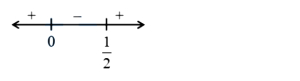
To solve this inequality,we find the critical points $\lambda = 0$ and $\lambda = \frac{1}{2}$.
Testing the intervals,the expression $7\lambda(2\lambda - 1)$ is negative for $\lambda \in \left(0, \frac{1}{2}\right)$.
Thus,the values of $\lambda$ lie in $\left(0, \frac{1}{2}\right)$.
Given $\vec{a} = 2\lambda^2 \hat{i} + 4\lambda \hat{j} + \hat{k}$ and $\vec{b} = 7\hat{i} - 2\hat{j} + \lambda \hat{k}$.
Calculating the dot product:
$\vec{a} \cdot \vec{b} = (2\lambda^2)(7) + (4\lambda)(-2) + (1)(\lambda) < 0$
$\Rightarrow 14\lambda^2 - 8\lambda + \lambda < 0$
$\Rightarrow 14\lambda^2 - 7\lambda < 0$
$\Rightarrow 7\lambda(2\lambda - 1) < 0$
To solve this inequality,we find the critical points $\lambda = 0$ and $\lambda = \frac{1}{2}$.
Testing the intervals,the expression $7\lambda(2\lambda - 1)$ is negative for $\lambda \in \left(0, \frac{1}{2}\right)$.
Thus,the values of $\lambda$ lie in $\left(0, \frac{1}{2}\right)$.
0 likesView Solution
373
MathematicsDifficultMCQMHT CET · 2022
If $\bar{a}, \bar{b}, \bar{c}$ are three unit vectors such that $|\bar{a}+\bar{b}+\bar{c}|=1$ and $\bar{b}$ is perpendicular to $\bar{c}$. If $\bar{a}$ makes angles $\alpha$ and $\beta$ with $\bar{b}$ and $\bar{c}$ respectively,then the value of $\cos \alpha+\cos \beta$ is:
A
$-1$
B
$-2$
C
$4$
D
$2$
Solution
(A) Given that $\bar{a}, \bar{b}, \bar{c}$ are unit vectors,so $|\bar{a}| = |\bar{b}| = |\bar{c}| = 1$.
We are given $|\bar{a}+\bar{b}+\bar{c}|=1$. Squaring both sides,we get:
$|\bar{a}+\bar{b}+\bar{c}|^2 = 1^2$
$|\bar{a}|^2+|\bar{b}|^2+|\bar{c}|^2+2(\bar{a} \cdot \bar{b} + \bar{b} \cdot \bar{c} + \bar{c} \cdot \bar{a}) = 1$
Since $\bar{b} \perp \bar{c}$,we have $\bar{b} \cdot \bar{c} = 0$.
Also,$\bar{a} \cdot \bar{b} = |\bar{a}||\bar{b}| \cos \alpha = \cos \alpha$ and $\bar{a} \cdot \bar{c} = |\bar{a}||\bar{c}| \cos \beta = \cos \beta$.
Substituting these values into the equation:
$1+1+1+2(\cos \alpha + 0 + \cos \beta) = 1$
$3 + 2(\cos \alpha + \cos \beta) = 1$
$2(\cos \alpha + \cos \beta) = 1 - 3$
$2(\cos \alpha + \cos \beta) = -2$
$\cos \alpha + \cos \beta = -1$
We are given $|\bar{a}+\bar{b}+\bar{c}|=1$. Squaring both sides,we get:
$|\bar{a}+\bar{b}+\bar{c}|^2 = 1^2$
$|\bar{a}|^2+|\bar{b}|^2+|\bar{c}|^2+2(\bar{a} \cdot \bar{b} + \bar{b} \cdot \bar{c} + \bar{c} \cdot \bar{a}) = 1$
Since $\bar{b} \perp \bar{c}$,we have $\bar{b} \cdot \bar{c} = 0$.
Also,$\bar{a} \cdot \bar{b} = |\bar{a}||\bar{b}| \cos \alpha = \cos \alpha$ and $\bar{a} \cdot \bar{c} = |\bar{a}||\bar{c}| \cos \beta = \cos \beta$.
Substituting these values into the equation:
$1+1+1+2(\cos \alpha + 0 + \cos \beta) = 1$
$3 + 2(\cos \alpha + \cos \beta) = 1$
$2(\cos \alpha + \cos \beta) = 1 - 3$
$2(\cos \alpha + \cos \beta) = -2$
$\cos \alpha + \cos \beta = -1$
0 likesView Solution
374
MathematicsMediumMCQMHT CET · 2022
Let $\vec{a}=\hat{i}+\hat{j}+\hat{k}$,$\vec{b}=\hat{i}-\hat{j}+\hat{k}$ and $\vec{c}=\hat{i}-\hat{j}-\hat{k}$ be three vectors. $A$ vector $\vec{V}$ in the plane of $\vec{a}$ and $\vec{b}$,whose projection on $\vec{c}$ is $\frac{1}{\sqrt{3}}$,is given by:
A
$\hat{i}+3\hat{j}-3\hat{k}$
B
$3\hat{i}-\hat{j}+3\hat{k}$
C
$\hat{i}-3\hat{j}+3\hat{k}$
D
$-3\hat{i}-3\hat{j}-\hat{k}$
Solution
(B) Any vector $\vec{V}$ in the plane of $\vec{a}$ and $\vec{b}$ can be expressed as a linear combination: $\vec{V} = x\vec{a} + y\vec{b}$. For simplicity,we can write $\vec{V} = \vec{a} + \lambda\vec{b}$ (assuming the coefficient of $\vec{a}$ is non-zero).
$\vec{V} = (\hat{i}+\hat{j}+\hat{k}) + \lambda(\hat{i}-\hat{j}+\hat{k}) = (1+\lambda)\hat{i} + (1-\lambda)\hat{j} + (1+\lambda)\hat{k}$.
The projection of $\vec{V}$ on $\vec{c}$ is given by $\frac{\vec{V} \cdot \vec{c}}{|\vec{c}|} = \frac{1}{\sqrt{3}}$.
Given $\vec{c} = \hat{i}-\hat{j}-\hat{k}$,we have $|\vec{c}| = \sqrt{1^2 + (-1)^2 + (-1)^2} = \sqrt{3}$.
So,$\frac{\vec{V} \cdot \vec{c}}{\sqrt{3}} = \frac{1}{\sqrt{3}} \Rightarrow \vec{V} \cdot \vec{c} = 1$.
$((1+\lambda)\hat{i} + (1-\lambda)\hat{j} + (1+\lambda)\hat{k}) \cdot (\hat{i}-\hat{j}-\hat{k}) = 1$.
$(1+\lambda) - (1-\lambda) - (1+\lambda) = 1$.
$1 + \lambda - 1 + \lambda - 1 - \lambda = 1$.
$\lambda - 1 = 1 \Rightarrow \lambda = 2$.
Substituting $\lambda = 2$ into the expression for $\vec{V}$:
$\vec{V} = (1+2)\hat{i} + (1-2)\hat{j} + (1+2)\hat{k} = 3\hat{i} - \hat{j} + 3\hat{k}$.
$\vec{V} = (\hat{i}+\hat{j}+\hat{k}) + \lambda(\hat{i}-\hat{j}+\hat{k}) = (1+\lambda)\hat{i} + (1-\lambda)\hat{j} + (1+\lambda)\hat{k}$.
The projection of $\vec{V}$ on $\vec{c}$ is given by $\frac{\vec{V} \cdot \vec{c}}{|\vec{c}|} = \frac{1}{\sqrt{3}}$.
Given $\vec{c} = \hat{i}-\hat{j}-\hat{k}$,we have $|\vec{c}| = \sqrt{1^2 + (-1)^2 + (-1)^2} = \sqrt{3}$.
So,$\frac{\vec{V} \cdot \vec{c}}{\sqrt{3}} = \frac{1}{\sqrt{3}} \Rightarrow \vec{V} \cdot \vec{c} = 1$.
$((1+\lambda)\hat{i} + (1-\lambda)\hat{j} + (1+\lambda)\hat{k}) \cdot (\hat{i}-\hat{j}-\hat{k}) = 1$.
$(1+\lambda) - (1-\lambda) - (1+\lambda) = 1$.
$1 + \lambda - 1 + \lambda - 1 - \lambda = 1$.
$\lambda - 1 = 1 \Rightarrow \lambda = 2$.
Substituting $\lambda = 2$ into the expression for $\vec{V}$:
$\vec{V} = (1+2)\hat{i} + (1-2)\hat{j} + (1+2)\hat{k} = 3\hat{i} - \hat{j} + 3\hat{k}$.
0 likesView Solution
375
MathematicsMediumMCQMHT CET · 2022
Let $\vec{a}=\hat{i}-2\hat{j}+\hat{k}$ and $\vec{b}=\hat{i}-\hat{j}+\hat{k}$ be two vectors. If $\vec{c}$ is a vector such that $\vec{b} \times \vec{c}=\vec{b} \times \vec{a}$ and $\vec{c} \cdot \vec{a}=0$,then $\vec{c} \cdot \vec{b}$ is equal to
A
$-\frac{1}{2}$
B
$-\frac{3}{2}$
C
$\frac{1}{2}$
D
$\frac{3}{2}$
Solution
(A) Given $\vec{b} \times \vec{c} = \vec{b} \times \vec{a}$.
This implies $\vec{b} \times (\vec{c} - \vec{a}) = \vec{0}$.
Therefore,$\vec{c} - \vec{a} = \lambda \vec{b}$ for some scalar $\lambda$,so $\vec{c} = \vec{a} + \lambda \vec{b}$.
Given $\vec{c} \cdot \vec{a} = 0$,we have $(\vec{a} + \lambda \vec{b}) \cdot \vec{a} = 0$,which means $\vec{a} \cdot \vec{a} + \lambda (\vec{b} \cdot \vec{a}) = 0$.
Calculating the dot products:
$\vec{a} \cdot \vec{a} = (1)^2 + (-2)^2 + (1)^2 = 1 + 4 + 1 = 6$.
$\vec{b} \cdot \vec{a} = (1)(1) + (-1)(-2) + (1)(1) = 1 + 2 + 1 = 4$.
Substituting these values: $6 + \lambda(4) = 0 \Rightarrow 4\lambda = -6 \Rightarrow \lambda = -\frac{3}{2}$.
Now,$\vec{c} \cdot \vec{b} = (\vec{a} + \lambda \vec{b}) \cdot \vec{b} = \vec{a} \cdot \vec{b} + \lambda (\vec{b} \cdot \vec{b})$.
$\vec{b} \cdot \vec{b} = (1)^2 + (-1)^2 + (1)^2 = 3$.
$\vec{c} \cdot \vec{b} = 4 + (-\frac{3}{2})(3) = 4 - \frac{9}{2} = -\frac{1}{2}$.
This implies $\vec{b} \times (\vec{c} - \vec{a}) = \vec{0}$.
Therefore,$\vec{c} - \vec{a} = \lambda \vec{b}$ for some scalar $\lambda$,so $\vec{c} = \vec{a} + \lambda \vec{b}$.
Given $\vec{c} \cdot \vec{a} = 0$,we have $(\vec{a} + \lambda \vec{b}) \cdot \vec{a} = 0$,which means $\vec{a} \cdot \vec{a} + \lambda (\vec{b} \cdot \vec{a}) = 0$.
Calculating the dot products:
$\vec{a} \cdot \vec{a} = (1)^2 + (-2)^2 + (1)^2 = 1 + 4 + 1 = 6$.
$\vec{b} \cdot \vec{a} = (1)(1) + (-1)(-2) + (1)(1) = 1 + 2 + 1 = 4$.
Substituting these values: $6 + \lambda(4) = 0 \Rightarrow 4\lambda = -6 \Rightarrow \lambda = -\frac{3}{2}$.
Now,$\vec{c} \cdot \vec{b} = (\vec{a} + \lambda \vec{b}) \cdot \vec{b} = \vec{a} \cdot \vec{b} + \lambda (\vec{b} \cdot \vec{b})$.
$\vec{b} \cdot \vec{b} = (1)^2 + (-1)^2 + (1)^2 = 3$.
$\vec{c} \cdot \vec{b} = 4 + (-\frac{3}{2})(3) = 4 - \frac{9}{2} = -\frac{1}{2}$.
0 likesView Solution
376
MathematicsMediumMCQMHT CET · 2022
If $\vec{a}=\hat{i}+\hat{j}+\hat{k}$,$\vec{b}=\hat{i}-\hat{j}+\hat{k}$,and $\vec{c}=\hat{i}-\hat{j}-\hat{k}$ are three vectors,then the vector $\vec{r}$ in the plane of $\vec{a}$ and $\vec{b}$,whose projection on $\vec{c}$ is $\frac{1}{\sqrt{3}}$,is given by:
A
$(2t-1)\hat{i}-\hat{j}+(2t+1)\hat{k}, \forall t \in R$
B
$(2t+1)\hat{i}-\hat{j}+(2t+1)\hat{k}, \forall t \in R$
C
$(2t-1)\hat{i}-\hat{j}+(2t-1)\hat{k}, \forall t \in R$
D
$(2t+1)\hat{i}-\hat{j}+(2t-1)\hat{k}, \forall t \in R$
Solution
(B) Since $\vec{r}$ lies in the plane of $\vec{a}$ and $\vec{b}$,we can write $\vec{r} = t\vec{a} + u\vec{b}$ for some scalars $t$ and $u$.
$\vec{r} = t(\hat{i}+\hat{j}+\hat{k}) + u(\hat{i}-\hat{j}+\hat{k}) = (t+u)\hat{i} + (t-u)\hat{j} + (t+u)\hat{k} \dots (i)$
Given that the projection of $\vec{r}$ on $\vec{c}$ is $\frac{1}{\sqrt{3}}$,we have $\frac{\vec{r} \cdot \vec{c}}{|\vec{c}|} = \frac{1}{\sqrt{3}}$.
$|\vec{c}| = \sqrt{1^2 + (-1)^2 + (-1)^2} = \sqrt{3}$.
$\vec{r} \cdot \vec{c} = (t+u)(1) + (t-u)(-1) + (t+u)(-1) = t+u - t+u - t-u = u-t$.
So,$\frac{u-t}{\sqrt{3}} = \frac{1}{\sqrt{3}} \Rightarrow u-t = 1 \Rightarrow u = t+1$.
Substituting $u = t+1$ into equation $(i)$:
$\vec{r} = (t + t + 1)\hat{i} + (t - (t + 1))\hat{j} + (t + t + 1)\hat{k}$
$\vec{r} = (2t+1)\hat{i} - \hat{j} + (2t+1)\hat{k}$.
$\vec{r} = t(\hat{i}+\hat{j}+\hat{k}) + u(\hat{i}-\hat{j}+\hat{k}) = (t+u)\hat{i} + (t-u)\hat{j} + (t+u)\hat{k} \dots (i)$
Given that the projection of $\vec{r}$ on $\vec{c}$ is $\frac{1}{\sqrt{3}}$,we have $\frac{\vec{r} \cdot \vec{c}}{|\vec{c}|} = \frac{1}{\sqrt{3}}$.
$|\vec{c}| = \sqrt{1^2 + (-1)^2 + (-1)^2} = \sqrt{3}$.
$\vec{r} \cdot \vec{c} = (t+u)(1) + (t-u)(-1) + (t+u)(-1) = t+u - t+u - t-u = u-t$.
So,$\frac{u-t}{\sqrt{3}} = \frac{1}{\sqrt{3}} \Rightarrow u-t = 1 \Rightarrow u = t+1$.
Substituting $u = t+1$ into equation $(i)$:
$\vec{r} = (t + t + 1)\hat{i} + (t - (t + 1))\hat{j} + (t + t + 1)\hat{k}$
$\vec{r} = (2t+1)\hat{i} - \hat{j} + (2t+1)\hat{k}$.
0 likesView Solution
377
MathematicsEasyMCQMHT CET · 2022
Given three vectors $\bar{a}, \bar{b}, \bar{c}$,two of which are collinear. If $\bar{a}+\bar{b}$ is collinear with $\bar{c}$ and $\bar{b}+\bar{c}$ is collinear with $\bar{a}$,and $|\bar{a}|=|\bar{b}|=|\bar{c}|=\sqrt{2}$,then $\bar{a} \cdot \bar{b}+\bar{b} \cdot \bar{c}+\bar{c} \cdot \bar{a}=$
A
$5$
B
$-3$
C
$3$
D
$-1$
Solution
(B) Given $\vec{a}+\vec{b} = \lambda \vec{c} \quad \dots(i)$ and $\vec{b}+\vec{c} = \mu \vec{a} \quad \dots(ii)$.
Subtracting $(ii)$ from $(i)$,we get $\vec{a}-\vec{c} = \lambda \vec{c} - \mu \vec{a}$.
Rearranging terms,$(1+\mu)\vec{a} = (1+\lambda)\vec{c}$.
Since two vectors are collinear,let $\vec{a}$ and $\vec{b}$ be collinear,then $\vec{b} = k\vec{a}$.
Given $|\vec{a}|=|\vec{b}|=|\vec{c}|=\sqrt{2}$,we have $|k\vec{a}| = |\vec{a}| \Rightarrow |k|=1$,so $k=1$ or $k=-1$.
If $k=1$,$\vec{b}=\vec{a}$,then $\vec{a}+\vec{a} = 2\vec{a}$ is collinear with $\vec{c}$,so $\vec{c} = \pm \vec{a}$.
If $\vec{c} = -\vec{a}$,then $\vec{a}+\vec{b}+\vec{c} = \vec{a}+\vec{a}-\vec{a} = \vec{a} \neq 0$. However,the condition $\vec{a}+\vec{b}+\vec{c}=0$ is derived from the collinearity constraints.
Using $|\vec{a}+\vec{b}+\vec{c}|^2 = |\vec{a}|^2+|\vec{b}|^2+|\vec{c}|^2+2(\vec{a} \cdot \vec{b}+\vec{b} \cdot \vec{c}+\vec{c} \cdot \vec{a})$.
Since $\vec{a}+\vec{b}+\vec{c}=0$,we have $0 = 2+2+2+2(\vec{a} \cdot \vec{b}+\vec{b} \cdot \vec{c}+\vec{c} \cdot \vec{a})$.
Thus,$2(\vec{a} \cdot \vec{b}+\vec{b} \cdot \vec{c}+\vec{c} \cdot \vec{a}) = -6$.
Therefore,$\vec{a} \cdot \vec{b}+\vec{b} \cdot \vec{c}+\vec{c} \cdot \vec{a} = -3$.
Subtracting $(ii)$ from $(i)$,we get $\vec{a}-\vec{c} = \lambda \vec{c} - \mu \vec{a}$.
Rearranging terms,$(1+\mu)\vec{a} = (1+\lambda)\vec{c}$.
Since two vectors are collinear,let $\vec{a}$ and $\vec{b}$ be collinear,then $\vec{b} = k\vec{a}$.
Given $|\vec{a}|=|\vec{b}|=|\vec{c}|=\sqrt{2}$,we have $|k\vec{a}| = |\vec{a}| \Rightarrow |k|=1$,so $k=1$ or $k=-1$.
If $k=1$,$\vec{b}=\vec{a}$,then $\vec{a}+\vec{a} = 2\vec{a}$ is collinear with $\vec{c}$,so $\vec{c} = \pm \vec{a}$.
If $\vec{c} = -\vec{a}$,then $\vec{a}+\vec{b}+\vec{c} = \vec{a}+\vec{a}-\vec{a} = \vec{a} \neq 0$. However,the condition $\vec{a}+\vec{b}+\vec{c}=0$ is derived from the collinearity constraints.
Using $|\vec{a}+\vec{b}+\vec{c}|^2 = |\vec{a}|^2+|\vec{b}|^2+|\vec{c}|^2+2(\vec{a} \cdot \vec{b}+\vec{b} \cdot \vec{c}+\vec{c} \cdot \vec{a})$.
Since $\vec{a}+\vec{b}+\vec{c}=0$,we have $0 = 2+2+2+2(\vec{a} \cdot \vec{b}+\vec{b} \cdot \vec{c}+\vec{c} \cdot \vec{a})$.
Thus,$2(\vec{a} \cdot \vec{b}+\vec{b} \cdot \vec{c}+\vec{c} \cdot \vec{a}) = -6$.
Therefore,$\vec{a} \cdot \vec{b}+\vec{b} \cdot \vec{c}+\vec{c} \cdot \vec{a} = -3$.
0 likesView Solution
378
MathematicsEasyMCQMHT CET · 2022
If $\vec{a}$ and $\vec{b}$ are two vectors such that $|\vec{a}|=|\vec{b}|=\sqrt{2}$ and $\vec{a} \cdot \vec{b}=-1$,then the angle between $\vec{a}$ and $\vec{b}$ is
A
$\frac{3 \pi}{4}$
B
$\frac{5 \pi}{6}$
C
$\frac{5 \pi}{9}$
D
$\frac{2 \pi}{3}$
Solution
(D) The angle $\theta$ between two vectors $\vec{a}$ and $\vec{b}$ is given by the formula: $\cos \theta = \frac{\vec{a} \cdot \vec{b}}{|\vec{a}| |\vec{b}|}$.
Given that $|\vec{a}| = \sqrt{2}$,$|\vec{b}| = \sqrt{2}$,and $\vec{a} \cdot \vec{b} = -1$.
Substituting these values into the formula:
$\cos \theta = \frac{-1}{\sqrt{2} \times \sqrt{2}} = \frac{-1}{2}$.
Since $\cos \theta = -\frac{1}{2}$,the angle $\theta$ is $\cos^{-1}\left(-\frac{1}{2}\right) = \frac{2\pi}{3}$.
Given that $|\vec{a}| = \sqrt{2}$,$|\vec{b}| = \sqrt{2}$,and $\vec{a} \cdot \vec{b} = -1$.
Substituting these values into the formula:
$\cos \theta = \frac{-1}{\sqrt{2} \times \sqrt{2}} = \frac{-1}{2}$.
Since $\cos \theta = -\frac{1}{2}$,the angle $\theta$ is $\cos^{-1}\left(-\frac{1}{2}\right) = \frac{2\pi}{3}$.
0 likesView Solution
379
MathematicsEasyMCQMHT CET · 2022
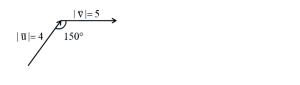
If $\bar{u}$ and $\bar{v}$ are two vectors represented in the following figure,then the value of $|\bar{u} \times \bar{v}|$ is:
A
$20$
B
$10 \sqrt{3}$
C
$10$
D
$5 \sqrt{3}$
Solution
(C) The magnitude of the cross product of two vectors $\vec{u}$ and $\vec{v}$ is given by the formula:
$|\vec{u} \times \vec{v}| = |\vec{u}| |\vec{v}| \sin \theta$
From the given figure,we have:
$|\vec{u}| = 4$
$|\vec{v}| = 5$
$\theta = 150^{\circ}$
Substituting these values into the formula:
$|\vec{u} \times \vec{v}| = 4 \times 5 \times \sin 150^{\circ}$
Since $\sin 150^{\circ} = \sin(180^{\circ} - 30^{\circ}) = \sin 30^{\circ} = \frac{1}{2}$,we get:
$|\vec{u} \times \vec{v}| = 20 \times \frac{1}{2} = 10$
$|\vec{u} \times \vec{v}| = |\vec{u}| |\vec{v}| \sin \theta$
From the given figure,we have:
$|\vec{u}| = 4$
$|\vec{v}| = 5$
$\theta = 150^{\circ}$
Substituting these values into the formula:
$|\vec{u} \times \vec{v}| = 4 \times 5 \times \sin 150^{\circ}$
Since $\sin 150^{\circ} = \sin(180^{\circ} - 30^{\circ}) = \sin 30^{\circ} = \frac{1}{2}$,we get:
$|\vec{u} \times \vec{v}| = 20 \times \frac{1}{2} = 10$
0 likesView Solution
380
MathematicsEasyMCQMHT CET · 2022
If $|\bar{a}|=\sqrt{26}$,$|\bar{b}|=7$,and $|\bar{a} \times \bar{b}|=35$,then $\bar{a} \cdot \bar{b}=$
A
$\pm 5 \sqrt{26}$
B
$\pm \sqrt{26}$
C
$\pm 7$
D
$\pm 7 \sqrt{26}$
Solution
(C) Given: $|\vec{a}| = \sqrt{26}$,$|\vec{b}| = 7$,and $|\vec{a} \times \vec{b}| = 35$.
We know that $|\vec{a} \times \vec{b}| = |\vec{a}| |\vec{b}| \sin \theta$.
Substituting the values: $35 = \sqrt{26} \times 7 \times \sin \theta$.
$\sin \theta = \frac{35}{7 \sqrt{26}} = \frac{5}{\sqrt{26}}$.
Using the identity $\cos^2 \theta = 1 - \sin^2 \theta$:
$\cos^2 \theta = 1 - (\frac{5}{\sqrt{26}})^2 = 1 - \frac{25}{26} = \frac{1}{26}$.
Therefore,$\cos \theta = \pm \frac{1}{\sqrt{26}}$.
Now,the dot product is given by $\vec{a} \cdot \vec{b} = |\vec{a}| |\vec{b}| \cos \theta$.
$\vec{a} \cdot \vec{b} = \sqrt{26} \times 7 \times (\pm \frac{1}{\sqrt{26}}) = \pm 7$.
We know that $|\vec{a} \times \vec{b}| = |\vec{a}| |\vec{b}| \sin \theta$.
Substituting the values: $35 = \sqrt{26} \times 7 \times \sin \theta$.
$\sin \theta = \frac{35}{7 \sqrt{26}} = \frac{5}{\sqrt{26}}$.
Using the identity $\cos^2 \theta = 1 - \sin^2 \theta$:
$\cos^2 \theta = 1 - (\frac{5}{\sqrt{26}})^2 = 1 - \frac{25}{26} = \frac{1}{26}$.
Therefore,$\cos \theta = \pm \frac{1}{\sqrt{26}}$.
Now,the dot product is given by $\vec{a} \cdot \vec{b} = |\vec{a}| |\vec{b}| \cos \theta$.
$\vec{a} \cdot \vec{b} = \sqrt{26} \times 7 \times (\pm \frac{1}{\sqrt{26}}) = \pm 7$.
0 likesView Solution
381
MathematicsMediumMCQMHT CET · 2022
If $|\vec{a}|=3, |\vec{b}|=5$ and $|\vec{c}|=7$ and $\vec{a}+\vec{b}+\vec{c}=\vec{0}$,then the angle between $\vec{a}$ and $\vec{b}$ is
A
$\frac{\pi}{4}$
B
$\frac{\pi}{2}$
C
$\frac{\pi}{3}$
D
$\frac{\pi}{6}$
Solution
(C) Given that $\vec{a}+\vec{b}+\vec{c}=\vec{0}$.
Rearranging the terms,we get $\vec{a}+\vec{b}=-\vec{c}$.
Squaring both sides,we have $|\vec{a}+\vec{b}|^2 = |-\vec{c}|^2$,which implies $|\vec{a}|^2+|\vec{b}|^2+2(\vec{a} \cdot \vec{b}) = |\vec{c}|^2$.
Substituting the given magnitudes $|\vec{a}|=3, |\vec{b}|=5, |\vec{c}|=7$:
$3^2+5^2+2|\vec{a}||\vec{b}| \cos \theta = 7^2$,where $\theta$ is the angle between $\vec{a}$ and $\vec{b}$.
$9+25+2(3)(5) \cos \theta = 49$.
$34+30 \cos \theta = 49$.
$30 \cos \theta = 49-34 = 15$.
$\cos \theta = \frac{15}{30} = \frac{1}{2}$.
Since $\cos \theta = \frac{1}{2}$,we have $\theta = \frac{\pi}{3}$.
Rearranging the terms,we get $\vec{a}+\vec{b}=-\vec{c}$.
Squaring both sides,we have $|\vec{a}+\vec{b}|^2 = |-\vec{c}|^2$,which implies $|\vec{a}|^2+|\vec{b}|^2+2(\vec{a} \cdot \vec{b}) = |\vec{c}|^2$.
Substituting the given magnitudes $|\vec{a}|=3, |\vec{b}|=5, |\vec{c}|=7$:
$3^2+5^2+2|\vec{a}||\vec{b}| \cos \theta = 7^2$,where $\theta$ is the angle between $\vec{a}$ and $\vec{b}$.
$9+25+2(3)(5) \cos \theta = 49$.
$34+30 \cos \theta = 49$.
$30 \cos \theta = 49-34 = 15$.
$\cos \theta = \frac{15}{30} = \frac{1}{2}$.
Since $\cos \theta = \frac{1}{2}$,we have $\theta = \frac{\pi}{3}$.
0 likesView Solution
382
MathematicsEasyMCQMHT CET · 2022
If $\vec{a}+2 \vec{b}+3 \vec{c}=\vec{0}$ and $(\vec{a} \times \vec{b})+(\vec{b} \times \vec{c})+(\vec{c} \times \vec{a})=\lambda(\vec{b} \times \vec{c})$,then the value of $\lambda$ is
A
$4$
B
$5$
C
$3$
D
$6$
Solution
(D) Given: $\vec{a}+2 \vec{b}+3 \vec{c}=\vec{0} \quad \dots(1)$
Taking the cross product with $\vec{b}$ on both sides:
$\vec{a} \times \vec{b} + 2(\vec{b} \times \vec{b}) + 3(\vec{c} \times \vec{b}) = \vec{0} \times \vec{b}$
$\Rightarrow \vec{a} \times \vec{b} + 0 - 3(\vec{b} \times \vec{c}) = \vec{0}$
$\Rightarrow \vec{a} \times \vec{b} = 3(\vec{b} \times \vec{c}) \quad \dots(2)$
Taking the cross product with $\vec{c}$ on both sides of $(1)$:
$\vec{a} \times \vec{c} + 2(\vec{b} \times \vec{c}) + 3(\vec{c} \times \vec{c}) = \vec{0} \times \vec{c}$
$\Rightarrow \vec{a} \times \vec{c} + 2(\vec{b} \times \vec{c}) + 0 = \vec{0}$
$\Rightarrow \vec{c} \times \vec{a} = 2(\vec{b} \times \vec{c}) \quad \dots(3)$
Now,substitute $(2)$ and $(3)$ into the given expression $(\vec{a} \times \vec{b})+(\vec{b} \times \vec{c})+(\vec{c} \times \vec{a})$:
$= 3(\vec{b} \times \vec{c}) + (\vec{b} \times \vec{c}) + 2(\vec{b} \times \vec{c})$
$= (3+1+2)(\vec{b} \times \vec{c}) = 6(\vec{b} \times \vec{c})$
Comparing this with $\lambda(\vec{b} \times \vec{c})$,we get $\lambda = 6$.
Taking the cross product with $\vec{b}$ on both sides:
$\vec{a} \times \vec{b} + 2(\vec{b} \times \vec{b}) + 3(\vec{c} \times \vec{b}) = \vec{0} \times \vec{b}$
$\Rightarrow \vec{a} \times \vec{b} + 0 - 3(\vec{b} \times \vec{c}) = \vec{0}$
$\Rightarrow \vec{a} \times \vec{b} = 3(\vec{b} \times \vec{c}) \quad \dots(2)$
Taking the cross product with $\vec{c}$ on both sides of $(1)$:
$\vec{a} \times \vec{c} + 2(\vec{b} \times \vec{c}) + 3(\vec{c} \times \vec{c}) = \vec{0} \times \vec{c}$
$\Rightarrow \vec{a} \times \vec{c} + 2(\vec{b} \times \vec{c}) + 0 = \vec{0}$
$\Rightarrow \vec{c} \times \vec{a} = 2(\vec{b} \times \vec{c}) \quad \dots(3)$
Now,substitute $(2)$ and $(3)$ into the given expression $(\vec{a} \times \vec{b})+(\vec{b} \times \vec{c})+(\vec{c} \times \vec{a})$:
$= 3(\vec{b} \times \vec{c}) + (\vec{b} \times \vec{c}) + 2(\vec{b} \times \vec{c})$
$= (3+1+2)(\vec{b} \times \vec{c}) = 6(\vec{b} \times \vec{c})$
Comparing this with $\lambda(\vec{b} \times \vec{c})$,we get $\lambda = 6$.
0 likesView Solution
383
MathematicsEasyMCQMHT CET · 2022
If the area of the triangle with vertices $\hat{i}+y \hat{j}$,$\hat{i}+2 \hat{k}$,and $3 \hat{j}+\hat{k}$ is $\sqrt{6}$ sq. units,then the values of $y$ are
A
$2, 4$
B
$3, 4$
C
$-2, 4$
D
$2, -4$
Solution
(A) Let the vertices be $A = (1, y, 0)$,$B = (1, 0, 2)$,and $C = (0, 3, 1)$.
$\overrightarrow{AB} = (1-1)\hat{i} + (0-y)\hat{j} + (2-0)\hat{k} = -y\hat{j} + 2\hat{k}$.
$\overrightarrow{AC} = (0-1)\hat{i} + (3-y)\hat{j} + (1-0)\hat{k} = -\hat{i} + (3-y)\hat{j} + \hat{k}$.
The area of the triangle is given by $\frac{1}{2} |\overrightarrow{AB} \times \overrightarrow{AC}| = \sqrt{6}$.
$\overrightarrow{AB} \times \overrightarrow{AC} = \begin{vmatrix} \hat{i} & \hat{j} & \hat{k} \\ 0 & -y & 2 \\ -1 & 3-y & 1 \end{vmatrix} = \hat{i}(-y - 2(3-y)) - \hat{j}(0 - (-2)) + \hat{k}(0 - y) = \hat{i}(y-6) - 2\hat{j} - y\hat{k}$.
$|\overrightarrow{AB} \times \overrightarrow{AC}| = \sqrt{(y-6)^2 + (-2)^2 + (-y)^2} = \sqrt{y^2 - 12y + 36 + 4 + y^2} = \sqrt{2y^2 - 12y + 40}$.
Since $\frac{1}{2} \sqrt{2y^2 - 12y + 40} = \sqrt{6}$,we have $\sqrt{2y^2 - 12y + 40} = 2\sqrt{6} = \sqrt{24}$.
Squaring both sides: $2y^2 - 12y + 40 = 24 \Rightarrow 2y^2 - 12y + 16 = 0 \Rightarrow y^2 - 6y + 8 = 0$.
Factoring: $(y-2)(y-4) = 0$,so $y = 2, 4$.
$\overrightarrow{AB} = (1-1)\hat{i} + (0-y)\hat{j} + (2-0)\hat{k} = -y\hat{j} + 2\hat{k}$.
$\overrightarrow{AC} = (0-1)\hat{i} + (3-y)\hat{j} + (1-0)\hat{k} = -\hat{i} + (3-y)\hat{j} + \hat{k}$.
The area of the triangle is given by $\frac{1}{2} |\overrightarrow{AB} \times \overrightarrow{AC}| = \sqrt{6}$.
$\overrightarrow{AB} \times \overrightarrow{AC} = \begin{vmatrix} \hat{i} & \hat{j} & \hat{k} \\ 0 & -y & 2 \\ -1 & 3-y & 1 \end{vmatrix} = \hat{i}(-y - 2(3-y)) - \hat{j}(0 - (-2)) + \hat{k}(0 - y) = \hat{i}(y-6) - 2\hat{j} - y\hat{k}$.
$|\overrightarrow{AB} \times \overrightarrow{AC}| = \sqrt{(y-6)^2 + (-2)^2 + (-y)^2} = \sqrt{y^2 - 12y + 36 + 4 + y^2} = \sqrt{2y^2 - 12y + 40}$.
Since $\frac{1}{2} \sqrt{2y^2 - 12y + 40} = \sqrt{6}$,we have $\sqrt{2y^2 - 12y + 40} = 2\sqrt{6} = \sqrt{24}$.
Squaring both sides: $2y^2 - 12y + 40 = 24 \Rightarrow 2y^2 - 12y + 16 = 0 \Rightarrow y^2 - 6y + 8 = 0$.
Factoring: $(y-2)(y-4) = 0$,so $y = 2, 4$.
0 likesView Solution
384
MathematicsMediumMCQMHT CET · 2022
For non-zero vectors $\vec{a}, \vec{b}, \vec{c}$,the condition $|(\vec{a} \times \vec{b}) \cdot \vec{c}| = |\vec{a}||\vec{b}||\vec{c}|$ holds if and only if:
A
$\vec{b} \cdot \vec{c} = 0, \vec{c} \cdot \vec{a} = 0$
B
$\vec{c} \cdot \vec{a} = 0, \vec{a} \cdot \vec{b} = 0$
C
$\vec{a} \cdot \vec{b} = \vec{b} \cdot \vec{c} = \vec{c} \cdot \vec{a} = 0$
D
$\vec{a} \times \vec{b} = 0, \vec{b} \times \vec{c} = 0$
Solution
(C) Given $|(\vec{a} \times \vec{b}) \cdot \vec{c}| = |\vec{a}||\vec{b}||\vec{c}|$.
Since $|(\vec{a} \times \vec{b}) \cdot \vec{c}| = |\vec{a} \times \vec{b}| |\vec{c}| |\cos \theta|$,where $\theta$ is the angle between $(\vec{a} \times \vec{b})$ and $\vec{c}$,we have $|\vec{a} \times \vec{b}| |\vec{c}| |\cos \theta| = |\vec{a}||\vec{b}||\vec{c}|$.
Substituting $|\vec{a} \times \vec{b}| = |\vec{a}||\vec{b}| \sin \phi$,where $\phi$ is the angle between $\vec{a}$ and $\vec{b}$,we get $|\vec{a}||\vec{b}| \sin \phi |\vec{c}| |\cos \theta| = |\vec{a}||\vec{b}||\vec{c}|$.
This implies $\sin \phi = 1$ and $|\cos \theta| = 1$.
Thus,$\phi = 90^{\circ}$ (meaning $\vec{a} \perp \vec{b}$) and $\theta = 0^{\circ}$ or $180^{\circ}$ (meaning $\vec{c}$ is parallel to the normal of the plane containing $\vec{a}$ and $\vec{b}$).
Since $\vec{c}$ is parallel to $\vec{a} \times \vec{b}$,it follows that $\vec{c} \perp \vec{a}$ and $\vec{c} \perp \vec{b}$.
Therefore,$\vec{a} \cdot \vec{b} = 0$,$\vec{b} \cdot \vec{c} = 0$,and $\vec{c} \cdot \vec{a} = 0$.
Since $|(\vec{a} \times \vec{b}) \cdot \vec{c}| = |\vec{a} \times \vec{b}| |\vec{c}| |\cos \theta|$,where $\theta$ is the angle between $(\vec{a} \times \vec{b})$ and $\vec{c}$,we have $|\vec{a} \times \vec{b}| |\vec{c}| |\cos \theta| = |\vec{a}||\vec{b}||\vec{c}|$.
Substituting $|\vec{a} \times \vec{b}| = |\vec{a}||\vec{b}| \sin \phi$,where $\phi$ is the angle between $\vec{a}$ and $\vec{b}$,we get $|\vec{a}||\vec{b}| \sin \phi |\vec{c}| |\cos \theta| = |\vec{a}||\vec{b}||\vec{c}|$.
This implies $\sin \phi = 1$ and $|\cos \theta| = 1$.
Thus,$\phi = 90^{\circ}$ (meaning $\vec{a} \perp \vec{b}$) and $\theta = 0^{\circ}$ or $180^{\circ}$ (meaning $\vec{c}$ is parallel to the normal of the plane containing $\vec{a}$ and $\vec{b}$).
Since $\vec{c}$ is parallel to $\vec{a} \times \vec{b}$,it follows that $\vec{c} \perp \vec{a}$ and $\vec{c} \perp \vec{b}$.
Therefore,$\vec{a} \cdot \vec{b} = 0$,$\vec{b} \cdot \vec{c} = 0$,and $\vec{c} \cdot \vec{a} = 0$.
0 likesView Solution
385
MathematicsMediumMCQMHT CET · 2022
If $\bar{a}$ and $\bar{b}$ are vectors such that $|\bar{a}+\bar{b}|=\sqrt{29}$ and $\bar{a} \times(2 \hat{i}+3 \hat{j}+4 \hat{k})=(2 \hat{i}+3 \hat{j}+4 \hat{k}) \times \bar{b}$,then a possible value of $(\bar{a}+\bar{b}) \cdot(-7 \hat{i}+2 \hat{j}+3 \hat{k})$ is
A
$4$
B
$0$
C
$1$
D
$8$
Solution
(A) Given $\vec{a} \times(2 \hat{i}+3 \hat{j}+4 \hat{k})=(2 \hat{i}+3 \hat{j}+4 \hat{k}) \times \vec{b}$.
We know that $\vec{u} \times \vec{v} = -\vec{v} \times \vec{u}$,so $(2 \hat{i}+3 \hat{j}+4 \hat{k}) \times \vec{b} = -\vec{b} \times (2 \hat{i}+3 \hat{j}+4 \hat{k})$.
Substituting this into the equation,we get $\vec{a} \times(2 \hat{i}+3 \hat{j}+4 \hat{k}) + \vec{b} \times(2 \hat{i}+3 \hat{j}+4 \hat{k}) = \vec{0}$.
This implies $(\vec{a}+\vec{b}) \times(2 \hat{i}+3 \hat{j}+4 \hat{k}) = \vec{0}$.
This means the vector $(\vec{a}+\vec{b})$ is parallel to $(2 \hat{i}+3 \hat{j}+4 \hat{k})$.
Let $\vec{a}+\vec{b} = \lambda(2 \hat{i}+3 \hat{j}+4 \hat{k})$ for some scalar $\lambda$.
Taking the magnitude on both sides,$|\vec{a}+\vec{b}| = |\lambda| \sqrt{2^2+3^2+4^2} = |\lambda| \sqrt{4+9+16} = |\lambda| \sqrt{29}$.
Given $|\vec{a}+\vec{b}| = \sqrt{29}$,we have $|\lambda| \sqrt{29} = \sqrt{29}$,which gives $\lambda = \pm 1$.
Thus,$\vec{a}+\vec{b} = \pm(2 \hat{i}+3 \hat{j}+4 \hat{k})$.
Now,calculate the dot product: $(\vec{a}+\vec{b}) \cdot(-7 \hat{i}+2 \hat{j}+3 \hat{k}) = \pm(2 \hat{i}+3 \hat{j}+4 \hat{k}) \cdot(-7 \hat{i}+2 \hat{j}+3 \hat{k})$.
$= \pm((2)(-7) + (3)(2) + (4)(3)) = \pm(-14 + 6 + 12) = \pm 4$.
Therefore,a possible value is $4$.
We know that $\vec{u} \times \vec{v} = -\vec{v} \times \vec{u}$,so $(2 \hat{i}+3 \hat{j}+4 \hat{k}) \times \vec{b} = -\vec{b} \times (2 \hat{i}+3 \hat{j}+4 \hat{k})$.
Substituting this into the equation,we get $\vec{a} \times(2 \hat{i}+3 \hat{j}+4 \hat{k}) + \vec{b} \times(2 \hat{i}+3 \hat{j}+4 \hat{k}) = \vec{0}$.
This implies $(\vec{a}+\vec{b}) \times(2 \hat{i}+3 \hat{j}+4 \hat{k}) = \vec{0}$.
This means the vector $(\vec{a}+\vec{b})$ is parallel to $(2 \hat{i}+3 \hat{j}+4 \hat{k})$.
Let $\vec{a}+\vec{b} = \lambda(2 \hat{i}+3 \hat{j}+4 \hat{k})$ for some scalar $\lambda$.
Taking the magnitude on both sides,$|\vec{a}+\vec{b}| = |\lambda| \sqrt{2^2+3^2+4^2} = |\lambda| \sqrt{4+9+16} = |\lambda| \sqrt{29}$.
Given $|\vec{a}+\vec{b}| = \sqrt{29}$,we have $|\lambda| \sqrt{29} = \sqrt{29}$,which gives $\lambda = \pm 1$.
Thus,$\vec{a}+\vec{b} = \pm(2 \hat{i}+3 \hat{j}+4 \hat{k})$.
Now,calculate the dot product: $(\vec{a}+\vec{b}) \cdot(-7 \hat{i}+2 \hat{j}+3 \hat{k}) = \pm(2 \hat{i}+3 \hat{j}+4 \hat{k}) \cdot(-7 \hat{i}+2 \hat{j}+3 \hat{k})$.
$= \pm((2)(-7) + (3)(2) + (4)(3)) = \pm(-14 + 6 + 12) = \pm 4$.
Therefore,a possible value is $4$.
0 likesView Solution
386
MathematicsEasyMCQMHT CET · 2022
If the vectors $\vec{a}=2 \hat{i}+2 \hat{j}+3 \hat{k}$,$\vec{b}=-\hat{i}+2 \hat{j}+\hat{k}$ and $\vec{c}=3 \hat{i}+\hat{j}$ are such that $(\vec{a}+\lambda \vec{b})$ is perpendicular to $\vec{c}$,then the value of $\lambda$ is
A
-$8$
B
$10$
C
$8$
D
$\frac{8}{3}$
Solution
(C) Given that $(\vec{a}+\lambda \vec{b})$ is perpendicular to $\vec{c}$,their dot product must be zero:
$(\vec{a}+\lambda \vec{b}) \cdot \vec{c} = 0$
First,calculate $(\vec{a}+\lambda \vec{b})$:
$\vec{a}+\lambda \vec{b} = (2 \hat{i}+2 \hat{j}+3 \hat{k}) + \lambda(-\hat{i}+2 \hat{j}+\hat{k}) = (2-\lambda) \hat{i} + (2+2\lambda) \hat{j} + (3+\lambda) \hat{k}$
Now,take the dot product with $\vec{c} = 3 \hat{i} + \hat{j} + 0 \hat{k}$:
$((2-\lambda) \hat{i} + (2+2\lambda) \hat{j} + (3+\lambda) \hat{k}) \cdot (3 \hat{i} + \hat{j} + 0 \hat{k}) = 0$
$3(2-\lambda) + 1(2+2\lambda) + 0(3+\lambda) = 0$
$6 - 3\lambda + 2 + 2\lambda = 0$
$8 - \lambda = 0$
$\lambda = 8$
$(\vec{a}+\lambda \vec{b}) \cdot \vec{c} = 0$
First,calculate $(\vec{a}+\lambda \vec{b})$:
$\vec{a}+\lambda \vec{b} = (2 \hat{i}+2 \hat{j}+3 \hat{k}) + \lambda(-\hat{i}+2 \hat{j}+\hat{k}) = (2-\lambda) \hat{i} + (2+2\lambda) \hat{j} + (3+\lambda) \hat{k}$
Now,take the dot product with $\vec{c} = 3 \hat{i} + \hat{j} + 0 \hat{k}$:
$((2-\lambda) \hat{i} + (2+2\lambda) \hat{j} + (3+\lambda) \hat{k}) \cdot (3 \hat{i} + \hat{j} + 0 \hat{k}) = 0$
$3(2-\lambda) + 1(2+2\lambda) + 0(3+\lambda) = 0$
$6 - 3\lambda + 2 + 2\lambda = 0$
$8 - \lambda = 0$
$\lambda = 8$
0 likesView Solution
387
MathematicsMediumMCQMHT CET · 2022
If $\vec{a}, \vec{b}, \vec{c}$ are unit vectors such that $\vec{a}+\vec{b}+\vec{c}=\vec{0}$,then the value of $\vec{a} \cdot \vec{b}+\vec{b} \cdot \vec{c}+\vec{c} \cdot \vec{a}$ is
A
$0$
B
$\frac{-1}{2}$
C
$2$
D
$\frac{-3}{2}$
Solution
(D) Given that $\vec{a}, \vec{b}, \vec{c}$ are unit vectors,so $|\vec{a}| = |\vec{b}| = |\vec{c}| = 1$.
Also,$\vec{a} + \vec{b} + \vec{c} = \vec{0}$.
Squaring both sides of the equation,we get:
$|\vec{a} + \vec{b} + \vec{c}|^2 = |\vec{0}|^2$
$(\vec{a} + \vec{b} + \vec{c}) \cdot (\vec{a} + \vec{b} + \vec{c}) = 0$
$|\vec{a}|^2 + |\vec{b}|^2 + |\vec{c}|^2 + 2(\vec{a} \cdot \vec{b} + \vec{b} \cdot \vec{c} + \vec{c} \cdot \vec{a}) = 0$
Substituting the values $|\vec{a}| = 1, |\vec{b}| = 1, |\vec{c}| = 1$:
$1^2 + 1^2 + 1^2 + 2(\vec{a} \cdot \vec{b} + \vec{b} \cdot \vec{c} + \vec{c} \cdot \vec{a}) = 0$
$3 + 2(\vec{a} \cdot \vec{b} + \vec{b} \cdot \vec{c} + \vec{c} \cdot \vec{a}) = 0$
$2(\vec{a} \cdot \vec{b} + \vec{b} \cdot \vec{c} + \vec{c} \cdot \vec{a}) = -3$
$\vec{a} \cdot \vec{b} + \vec{b} \cdot \vec{c} + \vec{c} \cdot \vec{a} = -\frac{3}{2}$
Also,$\vec{a} + \vec{b} + \vec{c} = \vec{0}$.
Squaring both sides of the equation,we get:
$|\vec{a} + \vec{b} + \vec{c}|^2 = |\vec{0}|^2$
$(\vec{a} + \vec{b} + \vec{c}) \cdot (\vec{a} + \vec{b} + \vec{c}) = 0$
$|\vec{a}|^2 + |\vec{b}|^2 + |\vec{c}|^2 + 2(\vec{a} \cdot \vec{b} + \vec{b} \cdot \vec{c} + \vec{c} \cdot \vec{a}) = 0$
Substituting the values $|\vec{a}| = 1, |\vec{b}| = 1, |\vec{c}| = 1$:
$1^2 + 1^2 + 1^2 + 2(\vec{a} \cdot \vec{b} + \vec{b} \cdot \vec{c} + \vec{c} \cdot \vec{a}) = 0$
$3 + 2(\vec{a} \cdot \vec{b} + \vec{b} \cdot \vec{c} + \vec{c} \cdot \vec{a}) = 0$
$2(\vec{a} \cdot \vec{b} + \vec{b} \cdot \vec{c} + \vec{c} \cdot \vec{a}) = -3$
$\vec{a} \cdot \vec{b} + \vec{b} \cdot \vec{c} + \vec{c} \cdot \vec{a} = -\frac{3}{2}$
0 likesView Solution
388
MathematicsMediumMCQMHT CET · 2022
Let $O$ be the origin and $PQR$ be an arbitrary triangle. If a point $S$ satisfies the condition $\overrightarrow{OP} \cdot \overrightarrow{OQ} + \overrightarrow{OR} \cdot \overrightarrow{OS} = \overrightarrow{OR} \cdot \overrightarrow{OP} + \overrightarrow{OQ} \cdot \overrightarrow{OS} = \overrightarrow{OQ} \cdot \overrightarrow{OR} + \overrightarrow{OP} \cdot \overrightarrow{OS}$,then the point $S$ is the:
A
Incentre.
B
Centroid.
C
Orthocentre.
D
Circumcentre.
Solution
(C) Given the condition: $\overrightarrow{OP} \cdot \overrightarrow{OQ} + \overrightarrow{OR} \cdot \overrightarrow{OS} = \overrightarrow{OR} \cdot \overrightarrow{OP} + \overrightarrow{OQ} \cdot \overrightarrow{OS} = \overrightarrow{OQ} \cdot \overrightarrow{OR} + \overrightarrow{OP} \cdot \overrightarrow{OS}$.
Consider the first equality: $\overrightarrow{OP} \cdot \overrightarrow{OQ} + \overrightarrow{OR} \cdot \overrightarrow{OS} = \overrightarrow{OR} \cdot \overrightarrow{OP} + \overrightarrow{OQ} \cdot \overrightarrow{OS}$.
Rearranging the terms: $\overrightarrow{OP} \cdot \overrightarrow{OQ} - \overrightarrow{OR} \cdot \overrightarrow{OP} = \overrightarrow{OQ} \cdot \overrightarrow{OS} - \overrightarrow{OR} \cdot \overrightarrow{OS}$.
Factoring out the common vectors: $\overrightarrow{OP} \cdot (\overrightarrow{OQ} - \overrightarrow{OR}) = \overrightarrow{OS} \cdot (\overrightarrow{OQ} - \overrightarrow{OR})$.
This implies: $(\overrightarrow{OP} - \overrightarrow{OS}) \cdot (\overrightarrow{OQ} - \overrightarrow{OR}) = 0$.
Since $\overrightarrow{OP} - \overrightarrow{OS} = \overrightarrow{SP}$ and $\overrightarrow{OQ} - \overrightarrow{OR} = \overrightarrow{RQ}$,we have $\overrightarrow{SP} \cdot \overrightarrow{RQ} = 0$,which means $\overrightarrow{PS} \perp \overrightarrow{QR}$.
Similarly,by considering the other parts of the equality,we get $\overrightarrow{QS} \perp \overrightarrow{PR}$ and $\overrightarrow{RS} \perp \overrightarrow{PQ}$.
Since $S$ is the point where the altitudes of the triangle $PQR$ intersect,$S$ is the orthocentre.
Consider the first equality: $\overrightarrow{OP} \cdot \overrightarrow{OQ} + \overrightarrow{OR} \cdot \overrightarrow{OS} = \overrightarrow{OR} \cdot \overrightarrow{OP} + \overrightarrow{OQ} \cdot \overrightarrow{OS}$.
Rearranging the terms: $\overrightarrow{OP} \cdot \overrightarrow{OQ} - \overrightarrow{OR} \cdot \overrightarrow{OP} = \overrightarrow{OQ} \cdot \overrightarrow{OS} - \overrightarrow{OR} \cdot \overrightarrow{OS}$.
Factoring out the common vectors: $\overrightarrow{OP} \cdot (\overrightarrow{OQ} - \overrightarrow{OR}) = \overrightarrow{OS} \cdot (\overrightarrow{OQ} - \overrightarrow{OR})$.
This implies: $(\overrightarrow{OP} - \overrightarrow{OS}) \cdot (\overrightarrow{OQ} - \overrightarrow{OR}) = 0$.
Since $\overrightarrow{OP} - \overrightarrow{OS} = \overrightarrow{SP}$ and $\overrightarrow{OQ} - \overrightarrow{OR} = \overrightarrow{RQ}$,we have $\overrightarrow{SP} \cdot \overrightarrow{RQ} = 0$,which means $\overrightarrow{PS} \perp \overrightarrow{QR}$.
Similarly,by considering the other parts of the equality,we get $\overrightarrow{QS} \perp \overrightarrow{PR}$ and $\overrightarrow{RS} \perp \overrightarrow{PQ}$.
Since $S$ is the point where the altitudes of the triangle $PQR$ intersect,$S$ is the orthocentre.
0 likesView Solution
389
MathematicsMediumMCQMHT CET · 2022
If the area of the parallelogram with $\vec{a}$ and $\vec{b}$ as two adjacent sides is $15$ sq. units,then the area of the parallelogram having $3 \vec{a}+\vec{b}$ and $\vec{a}+3 \vec{b}$ as two adjacent sides,in square units,is
A
$135$
B
$90$
C
$150$
D
$120$
Solution
(D) The area of a parallelogram with adjacent sides $\vec{a}$ and $\vec{b}$ is given by $|\vec{a} \times \vec{b}| = 15$.
Now,consider the parallelogram with adjacent sides $(3 \vec{a} + \vec{b})$ and $(\vec{a} + 3 \vec{b})$.
The area of this parallelogram is $|(3 \vec{a} + \vec{b}) \times (\vec{a} + 3 \vec{b})|$.
Expanding the cross product:
$|(3 \vec{a} + \vec{b}) \times (\vec{a} + 3 \vec{b})| = |3 \vec{a} \times \vec{a} + 9 \vec{a} \times \vec{b} + \vec{b} \times \vec{a} + 3 \vec{b} \times \vec{b}|$.
Since $\vec{a} \times \vec{a} = 0$ and $\vec{b} \times \vec{b} = 0$,and $\vec{b} \times \vec{a} = -(\vec{a} \times \vec{b})$,we have:
$|0 + 9(\vec{a} \times \vec{b}) - (\vec{a} \times \vec{b}) + 0| = |8(\vec{a} \times \vec{b})| = 8 |\vec{a} \times \vec{b}|$.
Substituting the given area $|\vec{a} \times \vec{b}| = 15$:
Area $= 8 \times 15 = 120$ sq. units.
Now,consider the parallelogram with adjacent sides $(3 \vec{a} + \vec{b})$ and $(\vec{a} + 3 \vec{b})$.
The area of this parallelogram is $|(3 \vec{a} + \vec{b}) \times (\vec{a} + 3 \vec{b})|$.
Expanding the cross product:
$|(3 \vec{a} + \vec{b}) \times (\vec{a} + 3 \vec{b})| = |3 \vec{a} \times \vec{a} + 9 \vec{a} \times \vec{b} + \vec{b} \times \vec{a} + 3 \vec{b} \times \vec{b}|$.
Since $\vec{a} \times \vec{a} = 0$ and $\vec{b} \times \vec{b} = 0$,and $\vec{b} \times \vec{a} = -(\vec{a} \times \vec{b})$,we have:
$|0 + 9(\vec{a} \times \vec{b}) - (\vec{a} \times \vec{b}) + 0| = |8(\vec{a} \times \vec{b})| = 8 |\vec{a} \times \vec{b}|$.
Substituting the given area $|\vec{a} \times \vec{b}| = 15$:
Area $= 8 \times 15 = 120$ sq. units.
0 likesView Solution
390
MathematicsEasyMCQMHT CET · 2022
$A$ unit vector $\hat{a}$ makes angles $\frac{\pi}{3}$ with $\hat{i}$,$\frac{\pi}{4}$ with $\hat{j}$,and $\theta \in (0, \pi)$ with $\hat{k}$. Then a value of $\theta$ is:
A
$\frac{2 \pi}{3}$
B
$\frac{5 \pi}{12}$
C
$\frac{5 \pi}{6}$
D
$\frac{\pi}{4}$
Solution
(A) Let the direction angles of the unit vector $\hat{a}$ be $\alpha, \beta, \text{ and } \gamma$.
Given $\alpha = \frac{\pi}{3}$,$\beta = \frac{\pi}{4}$,and $\gamma = \theta$.
We know that for any unit vector,the sum of the squares of the direction cosines is $1$:
$\cos^2 \alpha + \cos^2 \beta + \cos^2 \gamma = 1$
Substituting the given values:
$\cos^2 \left(\frac{\pi}{3}\right) + \cos^2 \left(\frac{\pi}{4}\right) + \cos^2 \theta = 1$
$\left(\frac{1}{2}\right)^2 + \left(\frac{1}{\sqrt{2}}\right)^2 + \cos^2 \theta = 1$
$\frac{1}{4} + \frac{1}{2} + \cos^2 \theta = 1$
$\frac{3}{4} + \cos^2 \theta = 1$
$\cos^2 \theta = 1 - \frac{3}{4} = \frac{1}{4}$
$\cos \theta = \pm \frac{1}{2}$
Since $\theta \in (0, \pi)$,we have two possible values:
If $\cos \theta = \frac{1}{2}$,then $\theta = \frac{\pi}{3}$.
If $\cos \theta = -\frac{1}{2}$,then $\theta = \frac{2\pi}{3}$.
Comparing with the given options,$\frac{2\pi}{3}$ is the correct value.
Given $\alpha = \frac{\pi}{3}$,$\beta = \frac{\pi}{4}$,and $\gamma = \theta$.
We know that for any unit vector,the sum of the squares of the direction cosines is $1$:
$\cos^2 \alpha + \cos^2 \beta + \cos^2 \gamma = 1$
Substituting the given values:
$\cos^2 \left(\frac{\pi}{3}\right) + \cos^2 \left(\frac{\pi}{4}\right) + \cos^2 \theta = 1$
$\left(\frac{1}{2}\right)^2 + \left(\frac{1}{\sqrt{2}}\right)^2 + \cos^2 \theta = 1$
$\frac{1}{4} + \frac{1}{2} + \cos^2 \theta = 1$
$\frac{3}{4} + \cos^2 \theta = 1$
$\cos^2 \theta = 1 - \frac{3}{4} = \frac{1}{4}$
$\cos \theta = \pm \frac{1}{2}$
Since $\theta \in (0, \pi)$,we have two possible values:
If $\cos \theta = \frac{1}{2}$,then $\theta = \frac{\pi}{3}$.
If $\cos \theta = -\frac{1}{2}$,then $\theta = \frac{2\pi}{3}$.
Comparing with the given options,$\frac{2\pi}{3}$ is the correct value.
0 likesView Solution
391
MathematicsEasyMCQMHT CET · 2022
If $\vec{a}=\hat{i}+\hat{j}+\hat{k}$,$\vec{b}=-\hat{i}+2\hat{j}-2\hat{k}$ and $\vec{c}=2\hat{i}-\hat{j}+2\hat{k}$,then $(\vec{a}-\vec{b}) \cdot [(\vec{a} \times \vec{b}) \times (\vec{a} \times \vec{c})]$ is
A
$-18$
B
$18$
C
$12$
D
$-12$
Solution
(D) Using the vector triple product identity $(\vec{u} \times \vec{v}) \times \vec{w} = (\vec{u} \cdot \vec{w})\vec{v} - (\vec{v} \cdot \vec{w})\vec{u}$,let $\vec{u} = \vec{a}$,$\vec{v} = \vec{b}$,and $\vec{w} = (\vec{a} \times \vec{c})$.
Then $(\vec{a} \times \vec{b}) \times (\vec{a} \times \vec{c}) = [\vec{a} \vec{b} (\vec{a} \times \vec{c})] \vec{a} - [\vec{b} (\vec{a} \times \vec{c}) \vec{a}] \vec{a} = [\vec{a} \vec{b} \vec{c}] \vec{a} - 0 = [\vec{a} \vec{b} \vec{c}] \vec{a}$.
Now,$(\vec{a}-\vec{b}) \cdot [(\vec{a} \times \vec{b}) \times (\vec{a} \times \vec{c})] = (\vec{a}-\vec{b}) \cdot ((\vec{a} \cdot \vec{c})\vec{b} - (\vec{a} \cdot \vec{b})\vec{c}) = [\vec{a} \vec{b} \vec{c}] (\vec{a} \cdot \vec{a} - \vec{b} \cdot \vec{a})$.
Calculating the scalar triple product $[\vec{a} \vec{b} \vec{c}] = \begin{vmatrix} 1 & 1 & 1 \\ -1 & 2 & -2 \\ 2 & -1 & 2 \end{vmatrix} = 1(4-2) - 1(-2+4) + 1(1-4) = 2 - 2 - 3 = -3$.
Calculating $(\vec{a} \cdot \vec{a} - \vec{b} \cdot \vec{a}) = (3) - (-1+2-2) = 3 - (-1) = 4$.
Thus,the result is $(-3) \times 4 = -12$.
Then $(\vec{a} \times \vec{b}) \times (\vec{a} \times \vec{c}) = [\vec{a} \vec{b} (\vec{a} \times \vec{c})] \vec{a} - [\vec{b} (\vec{a} \times \vec{c}) \vec{a}] \vec{a} = [\vec{a} \vec{b} \vec{c}] \vec{a} - 0 = [\vec{a} \vec{b} \vec{c}] \vec{a}$.
Now,$(\vec{a}-\vec{b}) \cdot [(\vec{a} \times \vec{b}) \times (\vec{a} \times \vec{c})] = (\vec{a}-\vec{b}) \cdot ((\vec{a} \cdot \vec{c})\vec{b} - (\vec{a} \cdot \vec{b})\vec{c}) = [\vec{a} \vec{b} \vec{c}] (\vec{a} \cdot \vec{a} - \vec{b} \cdot \vec{a})$.
Calculating the scalar triple product $[\vec{a} \vec{b} \vec{c}] = \begin{vmatrix} 1 & 1 & 1 \\ -1 & 2 & -2 \\ 2 & -1 & 2 \end{vmatrix} = 1(4-2) - 1(-2+4) + 1(1-4) = 2 - 2 - 3 = -3$.
Calculating $(\vec{a} \cdot \vec{a} - \vec{b} \cdot \vec{a}) = (3) - (-1+2-2) = 3 - (-1) = 4$.
Thus,the result is $(-3) \times 4 = -12$.
0 likesView Solution
392
MathematicsEasyMCQMHT CET · 2022
If $\bar{a}=\hat{i}+\hat{j}$ and $\bar{b}=2 \hat{i}-\hat{k}$,then the point of intersection of the lines $\bar{r} \times \bar{a}=\bar{b} \times \bar{a}$ and $\bar{r} \times \bar{b}=\bar{a} \times \bar{b}$ is
A
$(-3,1,-1)$
B
$(-3,-1,1)$
C
$(3,1,-1)$
D
$(3,1,1)$
Solution
(C) Given equations are:
$(i)$ $\vec{r} \times \vec{a} = \vec{b} \times \vec{a}$
(ii) $\vec{r} \times \vec{b} = \vec{a} \times \vec{b}$
From (ii),we know that $\vec{a} \times \vec{b} = -(\vec{b} \times \vec{a})$,so $\vec{r} \times \vec{b} = -(\vec{b} \times \vec{a})$.
Adding $(i)$ and (ii):
$(\vec{r} \times \vec{a}) + (\vec{r} \times \vec{b}) = (\vec{b} \times \vec{a}) - (\vec{b} \times \vec{a}) = \vec{0}$
$\vec{r} \times (\vec{a} + \vec{b}) = \vec{0}$
This implies $\vec{r}$ is parallel to $(\vec{a} + \vec{b})$.
Given $\vec{a} = \hat{i} + \hat{j}$ and $\vec{b} = 2\hat{i} - \hat{k}$,then $\vec{a} + \vec{b} = (1+2)\hat{i} + 1\hat{j} - 1\hat{k} = 3\hat{i} + \hat{j} - \hat{k}$.
Thus,$\vec{r} = \lambda(3\hat{i} + \hat{j} - \hat{k})$.
For the intersection point,we test the options. For $\lambda = 1$,$\vec{r} = 3\hat{i} + \hat{j} - \hat{k}$,which corresponds to the point $(3, 1, -1)$.
Checking this in equation $(i)$: $(3\hat{i} + \hat{j} - \hat{k}) \times (\hat{i} + \hat{j}) = 3(\hat{i} \times \hat{j}) + 1(\hat{j} \times \hat{i}) - 1(\hat{k} \times \hat{i}) - 1(\hat{k} \times \hat{j}) = 3\hat{k} - \hat{k} - \hat{j} + \hat{i} = \hat{i} - \hat{j} + 2\hat{k}$.
And $\vec{b} \times \vec{a} = (2\hat{i} - \hat{k}) \times (\hat{i} + \hat{j}) = 2(\hat{i} \times \hat{j}) - (\hat{k} \times \hat{i}) - (\hat{k} \times \hat{j}) = 2\hat{k} - \hat{j} + \hat{i} = \hat{i} - \hat{j} + 2\hat{k}$.
Since both sides are equal,the point $(3, 1, -1)$ is the intersection point.
$(i)$ $\vec{r} \times \vec{a} = \vec{b} \times \vec{a}$
(ii) $\vec{r} \times \vec{b} = \vec{a} \times \vec{b}$
From (ii),we know that $\vec{a} \times \vec{b} = -(\vec{b} \times \vec{a})$,so $\vec{r} \times \vec{b} = -(\vec{b} \times \vec{a})$.
Adding $(i)$ and (ii):
$(\vec{r} \times \vec{a}) + (\vec{r} \times \vec{b}) = (\vec{b} \times \vec{a}) - (\vec{b} \times \vec{a}) = \vec{0}$
$\vec{r} \times (\vec{a} + \vec{b}) = \vec{0}$
This implies $\vec{r}$ is parallel to $(\vec{a} + \vec{b})$.
Given $\vec{a} = \hat{i} + \hat{j}$ and $\vec{b} = 2\hat{i} - \hat{k}$,then $\vec{a} + \vec{b} = (1+2)\hat{i} + 1\hat{j} - 1\hat{k} = 3\hat{i} + \hat{j} - \hat{k}$.
Thus,$\vec{r} = \lambda(3\hat{i} + \hat{j} - \hat{k})$.
For the intersection point,we test the options. For $\lambda = 1$,$\vec{r} = 3\hat{i} + \hat{j} - \hat{k}$,which corresponds to the point $(3, 1, -1)$.
Checking this in equation $(i)$: $(3\hat{i} + \hat{j} - \hat{k}) \times (\hat{i} + \hat{j}) = 3(\hat{i} \times \hat{j}) + 1(\hat{j} \times \hat{i}) - 1(\hat{k} \times \hat{i}) - 1(\hat{k} \times \hat{j}) = 3\hat{k} - \hat{k} - \hat{j} + \hat{i} = \hat{i} - \hat{j} + 2\hat{k}$.
And $\vec{b} \times \vec{a} = (2\hat{i} - \hat{k}) \times (\hat{i} + \hat{j}) = 2(\hat{i} \times \hat{j}) - (\hat{k} \times \hat{i}) - (\hat{k} \times \hat{j}) = 2\hat{k} - \hat{j} + \hat{i} = \hat{i} - \hat{j} + 2\hat{k}$.
Since both sides are equal,the point $(3, 1, -1)$ is the intersection point.
0 likesView Solution
393
MathematicsEasyMCQMHT CET · 2022
If $|\vec{a}|=5, |\vec{b}|=13$ and $|\vec{a} \times \vec{b}|=25$. If $\frac{\pi}{2} < \theta < \pi$ where $\theta$ is the angle between $\vec{a}$ and $\vec{b}$,then the value of $\vec{a} \cdot \vec{b}$ is:
A
-$60$
B
-$30$
C
$60$
D
$30$
Solution
(A) We are given $|\vec{a}|=5$,$|\vec{b}|=13$,and $|\vec{a} \times \vec{b}|=25$.
Using the formula $|\vec{a} \times \vec{b}| = |\vec{a}| |\vec{b}| \sin \theta$,we have:
$25 = 5 \times 13 \sin \theta$
$25 = 65 \sin \theta$
$\sin \theta = \frac{25}{65} = \frac{5}{13}$.
Since $\frac{\pi}{2} < \theta < \pi$,the angle $\theta$ lies in the second quadrant,where $\cos \theta$ is negative.
Using $\cos^2 \theta = 1 - \sin^2 \theta$:
$\cos \theta = -\sqrt{1 - (\frac{5}{13})^2} = -\sqrt{1 - \frac{25}{169}} = -\sqrt{\frac{144}{169}} = -\frac{12}{13}$.
Now,the dot product is given by $\vec{a} \cdot \vec{b} = |\vec{a}| |\vec{b}| \cos \theta$:
$\vec{a} \cdot \vec{b} = 5 \times 13 \times (-\frac{12}{13}) = -60$.
Using the formula $|\vec{a} \times \vec{b}| = |\vec{a}| |\vec{b}| \sin \theta$,we have:
$25 = 5 \times 13 \sin \theta$
$25 = 65 \sin \theta$
$\sin \theta = \frac{25}{65} = \frac{5}{13}$.
Since $\frac{\pi}{2} < \theta < \pi$,the angle $\theta$ lies in the second quadrant,where $\cos \theta$ is negative.
Using $\cos^2 \theta = 1 - \sin^2 \theta$:
$\cos \theta = -\sqrt{1 - (\frac{5}{13})^2} = -\sqrt{1 - \frac{25}{169}} = -\sqrt{\frac{144}{169}} = -\frac{12}{13}$.
Now,the dot product is given by $\vec{a} \cdot \vec{b} = |\vec{a}| |\vec{b}| \cos \theta$:
$\vec{a} \cdot \vec{b} = 5 \times 13 \times (-\frac{12}{13}) = -60$.
0 likesView Solution
394
MathematicsMediumMCQMHT CET · 2022
The vector projection of $\overline{PQ}$ on $\overline{AB}$,where $P \equiv (-2, 1, 3)$,$Q \equiv (3, 2, 5)$,$A \equiv (4, -3, 5)$ and $B \equiv (7, -5, -1)$ is
A
$\frac{1}{49}(3 \hat{i} - 2 \hat{j} - 6 \hat{k})$
B
$\frac{1}{7}(3 \hat{i} - 2 \hat{j} + 6 \hat{k})$
C
$(3 \hat{i} - 2 \hat{j} - 6 \hat{k})$
D
$\frac{1}{7}(3 \hat{i} - 2 \hat{j} - 6 \hat{k})$
Solution
(A) First,we find the vectors $\overline{PQ}$ and $\overline{AB}$:
$\overline{PQ} = (3 - (-2)) \hat{i} + (2 - 1) \hat{j} + (5 - 3) \hat{k} = 5 \hat{i} + \hat{j} + 2 \hat{k}$
$\overline{AB} = (7 - 4) \hat{i} + (-5 - (-3)) \hat{j} + (-1 - 5) \hat{k} = 3 \hat{i} - 2 \hat{j} - 6 \hat{k}$
The vector projection of $\overline{PQ}$ on $\overline{AB}$ is given by the formula:
$\text{Vector Projection} = \frac{(\overline{PQ} \cdot \overline{AB}) \overline{AB}}{|\overline{AB}|^2}$
Calculate the dot product $\overline{PQ} \cdot \overline{AB}$:
$\overline{PQ} \cdot \overline{AB} = (5)(3) + (1)(-2) + (2)(-6) = 15 - 2 - 12 = 1$
Calculate the magnitude squared $|\overline{AB}|^2$:
$|\overline{AB}|^2 = 3^2 + (-2)^2 + (-6)^2 = 9 + 4 + 36 = 49$
Thus,the vector projection is:
$\frac{1}{49}(3 \hat{i} - 2 \hat{j} - 6 \hat{k})$
$\overline{PQ} = (3 - (-2)) \hat{i} + (2 - 1) \hat{j} + (5 - 3) \hat{k} = 5 \hat{i} + \hat{j} + 2 \hat{k}$
$\overline{AB} = (7 - 4) \hat{i} + (-5 - (-3)) \hat{j} + (-1 - 5) \hat{k} = 3 \hat{i} - 2 \hat{j} - 6 \hat{k}$
The vector projection of $\overline{PQ}$ on $\overline{AB}$ is given by the formula:
$\text{Vector Projection} = \frac{(\overline{PQ} \cdot \overline{AB}) \overline{AB}}{|\overline{AB}|^2}$
Calculate the dot product $\overline{PQ} \cdot \overline{AB}$:
$\overline{PQ} \cdot \overline{AB} = (5)(3) + (1)(-2) + (2)(-6) = 15 - 2 - 12 = 1$
Calculate the magnitude squared $|\overline{AB}|^2$:
$|\overline{AB}|^2 = 3^2 + (-2)^2 + (-6)^2 = 9 + 4 + 36 = 49$
Thus,the vector projection is:
$\frac{1}{49}(3 \hat{i} - 2 \hat{j} - 6 \hat{k})$
0 likesView Solution
395
MathematicsEasyMCQMHT CET · 2022
If the vectors $2 \hat{i}-3 \hat{j}+6 \hat{k}$ and $\vec{b}$ are collinear and $|\vec{b}|=14$,then $\vec{b}$ has the value
A
$4 \hat{i}+6 \hat{j}+12 \hat{k}$
B
$-4 \hat{i}-6 \hat{j}-12 \hat{k}$
C
$4 \hat{i}-6 \hat{j}+12 \hat{k}$
D
$12 \hat{i}+5 \hat{j}+\sqrt{17} \hat{k}$
Solution
(C) Let $\vec{a} = 2 \hat{i}-3 \hat{j}+6 \hat{k}$.
Since $\vec{b}$ is collinear to $\vec{a}$,we can write $\vec{b} = \lambda \vec{a}$ for some scalar $\lambda$.
The magnitude of $\vec{a}$ is $|\vec{a}| = \sqrt{2^2 + (-3)^2 + 6^2} = \sqrt{4 + 9 + 36} = \sqrt{49} = 7$.
The unit vector in the direction of $\vec{a}$ is $\hat{a} = \frac{\vec{a}}{|\vec{a}|} = \frac{2 \hat{i}-3 \hat{j}+6 \hat{k}}{7}$.
Given $|\vec{b}| = 14$,the vector $\vec{b}$ can be expressed as $\vec{b} = \pm |\vec{b}| \hat{a}$.
Taking the positive direction,$\vec{b} = 14 \left( \frac{2 \hat{i}-3 \hat{j}+6 \hat{k}}{7} \right) = 2(2 \hat{i}-3 \hat{j}+6 \hat{k}) = 4 \hat{i}-6 \hat{j}+12 \hat{k}$.
Since $\vec{b}$ is collinear to $\vec{a}$,we can write $\vec{b} = \lambda \vec{a}$ for some scalar $\lambda$.
The magnitude of $\vec{a}$ is $|\vec{a}| = \sqrt{2^2 + (-3)^2 + 6^2} = \sqrt{4 + 9 + 36} = \sqrt{49} = 7$.
The unit vector in the direction of $\vec{a}$ is $\hat{a} = \frac{\vec{a}}{|\vec{a}|} = \frac{2 \hat{i}-3 \hat{j}+6 \hat{k}}{7}$.
Given $|\vec{b}| = 14$,the vector $\vec{b}$ can be expressed as $\vec{b} = \pm |\vec{b}| \hat{a}$.
Taking the positive direction,$\vec{b} = 14 \left( \frac{2 \hat{i}-3 \hat{j}+6 \hat{k}}{7} \right) = 2(2 \hat{i}-3 \hat{j}+6 \hat{k}) = 4 \hat{i}-6 \hat{j}+12 \hat{k}$.
0 likesView Solution
396
MathematicsEasyMCQMHT CET · 2022
$\int_0^1 \frac{8 \log (1+x)}{1+x^2} \,d x=$
A
$\frac{\pi}{2} \log 2$
B
$\pi \log 2$
C
$-\pi \log 2$
D
$\frac{-\pi}{2} \log 3$
Solution
(B) Let $I = \int_0^1 \frac{8 \log (1+x)}{1+x^2} \,dx$.
Substitute $x = \tan \theta$, so $dx = \sec^2 \theta \,d\theta$.
When $x = 0$, $\theta = 0$; when $x = 1$, $\theta = \frac{\pi}{4}$.
$I = \int_0^{\frac{\pi}{4}} \frac{8 \log (1+\tan \theta)}{1+\tan^2 \theta} \cdot \sec^2 \theta \,d\theta = \int_0^{\frac{\pi}{4}} 8 \log (1+\tan \theta) \,d\theta \quad \dots(i)$
Using the property $\int_0^a f(\theta) \,d\theta = \int_0^a f(a-\theta) \,d\theta$:
$I = \int_0^{\frac{\pi}{4}} 8 \log \left(1 + \tan\left(\frac{\pi}{4} - \theta\right)\right) \,d\theta$
Since $\tan\left(\frac{\pi}{4} - \theta\right) = \frac{1-\tan \theta}{1+\tan \theta}$, we have:
$I = \int_0^{\frac{\pi}{4}} 8 \log \left(1 + \frac{1-\tan \theta}{1+\tan \theta}\right) \,d\theta = \int_0^{\frac{\pi}{4}} 8 \log \left(\frac{2}{1+\tan \theta}\right) \,d\theta \quad \dots(ii)$
Adding $(i)$ and $(ii)$:
$2I = \int_0^{\frac{\pi}{4}} 8 \left[ \log(1+\tan \theta) + \log\left(\frac{2}{1+\tan \theta}\right) \right] \,d\theta$
$2I = 8 \int_0^{\frac{\pi}{4}} \log \left( (1+\tan \theta) \cdot \frac{2}{1+\tan \theta} \right) \,d\theta$
$2I = 8 \int_0^{\frac{\pi}{4}} \log 2 \,d\theta = 8 \log 2 [\theta]_0^{\frac{\pi}{4}} = 8 \log 2 \cdot \frac{\pi}{4} = 2\pi \log 2$.
Therefore, $I = \pi \log 2$.
Substitute $x = \tan \theta$, so $dx = \sec^2 \theta \,d\theta$.
When $x = 0$, $\theta = 0$; when $x = 1$, $\theta = \frac{\pi}{4}$.
$I = \int_0^{\frac{\pi}{4}} \frac{8 \log (1+\tan \theta)}{1+\tan^2 \theta} \cdot \sec^2 \theta \,d\theta = \int_0^{\frac{\pi}{4}} 8 \log (1+\tan \theta) \,d\theta \quad \dots(i)$
Using the property $\int_0^a f(\theta) \,d\theta = \int_0^a f(a-\theta) \,d\theta$:
$I = \int_0^{\frac{\pi}{4}} 8 \log \left(1 + \tan\left(\frac{\pi}{4} - \theta\right)\right) \,d\theta$
Since $\tan\left(\frac{\pi}{4} - \theta\right) = \frac{1-\tan \theta}{1+\tan \theta}$, we have:
$I = \int_0^{\frac{\pi}{4}} 8 \log \left(1 + \frac{1-\tan \theta}{1+\tan \theta}\right) \,d\theta = \int_0^{\frac{\pi}{4}} 8 \log \left(\frac{2}{1+\tan \theta}\right) \,d\theta \quad \dots(ii)$
Adding $(i)$ and $(ii)$:
$2I = \int_0^{\frac{\pi}{4}} 8 \left[ \log(1+\tan \theta) + \log\left(\frac{2}{1+\tan \theta}\right) \right] \,d\theta$
$2I = 8 \int_0^{\frac{\pi}{4}} \log \left( (1+\tan \theta) \cdot \frac{2}{1+\tan \theta} \right) \,d\theta$
$2I = 8 \int_0^{\frac{\pi}{4}} \log 2 \,d\theta = 8 \log 2 [\theta]_0^{\frac{\pi}{4}} = 8 \log 2 \cdot \frac{\pi}{4} = 2\pi \log 2$.
Therefore, $I = \pi \log 2$.
0 likesView Solution
397
MathematicsMediumMCQMHT CET · 2022
If $|\vec{a}|=5, |\vec{b}|=3, |\vec{c}|=4$ and $\vec{a}$ is perpendicular to both $\vec{b}$ and $\vec{c}$ such that the angle between $\vec{b}$ and $\vec{c}$ is $\frac{5 \pi}{6}$,then $[\vec{a} \vec{b} \vec{c}]=$
A
$25$
B
$10$
C
$30$
D
$20$
Solution
(C) The scalar triple product is defined as $[\vec{a} \vec{b} \vec{c}] = \vec{a} \cdot (\vec{b} \times \vec{c})$.
Since $\vec{a}$ is perpendicular to both $\vec{b}$ and $\vec{c}$,$\vec{a}$ must be parallel to the vector $\vec{b} \times \vec{c}$.
Thus,the angle between $\vec{a}$ and $\vec{b} \times \vec{c}$ is $0$ or $\pi$.
Assuming $\vec{a}$ is in the direction of $\vec{b} \times \vec{c}$,we have:
$[\vec{a} \vec{b} \vec{c}] = |\vec{a}| |\vec{b} \times \vec{c}| \cos(0) = |\vec{a}| |\vec{b}| |\vec{c}| \sin\left(\frac{5 \pi}{6}\right)$.
Substituting the given values:
$[\vec{a} \vec{b} \vec{c}] = 5 \times 3 \times 4 \times \sin\left(\frac{5 \pi}{6}\right)$.
Since $\sin\left(\frac{5 \pi}{6}\right) = \sin\left(\pi - \frac{\pi}{6}\right) = \sin\left(\frac{\pi}{6}\right) = \frac{1}{2}$.
$[\vec{a} \vec{b} \vec{c}] = 60 \times \frac{1}{2} = 30$.
Since $\vec{a}$ is perpendicular to both $\vec{b}$ and $\vec{c}$,$\vec{a}$ must be parallel to the vector $\vec{b} \times \vec{c}$.
Thus,the angle between $\vec{a}$ and $\vec{b} \times \vec{c}$ is $0$ or $\pi$.
Assuming $\vec{a}$ is in the direction of $\vec{b} \times \vec{c}$,we have:
$[\vec{a} \vec{b} \vec{c}] = |\vec{a}| |\vec{b} \times \vec{c}| \cos(0) = |\vec{a}| |\vec{b}| |\vec{c}| \sin\left(\frac{5 \pi}{6}\right)$.
Substituting the given values:
$[\vec{a} \vec{b} \vec{c}] = 5 \times 3 \times 4 \times \sin\left(\frac{5 \pi}{6}\right)$.
Since $\sin\left(\frac{5 \pi}{6}\right) = \sin\left(\pi - \frac{\pi}{6}\right) = \sin\left(\frac{\pi}{6}\right) = \frac{1}{2}$.
$[\vec{a} \vec{b} \vec{c}] = 60 \times \frac{1}{2} = 30$.
0 likesView Solution
398
MathematicsMediumMCQMHT CET · 2022
If $\vec{a}=\hat{i}-\hat{k}, \vec{b}=x \hat{i}+\hat{j}+(1-x) \hat{k}$ and $\vec{c}=y \hat{i}+x \hat{j}+(1+x-y) \hat{k}$,then $[\vec{a} \vec{b} \vec{c}]$ depends on
A
neither $x$ nor $y$
B
only $x$
C
only $y$
D
both $x$ and $y$
Solution
(A) The scalar triple product $[\vec{a} \vec{b} \vec{c}]$ is given by the determinant of the components of the vectors $\vec{a}, \vec{b},$ and $\vec{c}$.
$[\vec{a} \vec{b} \vec{c}] = \begin{vmatrix} 1 & 0 & -1 \\ x & 1 & 1-x \\ y & x & 1+x-y \end{vmatrix}$
Applying the column operation $C_3 \to C_3 + C_1$:
$[\vec{a} \vec{b} \vec{c}] = \begin{vmatrix} 1 & 0 & 0 \\ x & 1 & 1 \\ y & x & 1+x \end{vmatrix}$
Expanding along the first row:
$[\vec{a} \vec{b} \vec{c}] = 1 \cdot \begin{vmatrix} 1 & 1 \\ x & 1+x \end{vmatrix} - 0 + 0$
$[\vec{a} \vec{b} \vec{c}] = (1+x) - x = 1$
Since the result is $1$,which is a constant,the value of $[\vec{a} \vec{b} \vec{c}]$ depends on neither $x$ nor $y$.
$[\vec{a} \vec{b} \vec{c}] = \begin{vmatrix} 1 & 0 & -1 \\ x & 1 & 1-x \\ y & x & 1+x-y \end{vmatrix}$
Applying the column operation $C_3 \to C_3 + C_1$:
$[\vec{a} \vec{b} \vec{c}] = \begin{vmatrix} 1 & 0 & 0 \\ x & 1 & 1 \\ y & x & 1+x \end{vmatrix}$
Expanding along the first row:
$[\vec{a} \vec{b} \vec{c}] = 1 \cdot \begin{vmatrix} 1 & 1 \\ x & 1+x \end{vmatrix} - 0 + 0$
$[\vec{a} \vec{b} \vec{c}] = (1+x) - x = 1$
Since the result is $1$,which is a constant,the value of $[\vec{a} \vec{b} \vec{c}]$ depends on neither $x$ nor $y$.
0 likesView Solution
399
MathematicsEasyMCQMHT CET · 2022
The volume of the tetrahedron having vertices $(1, -6, 10)$,$(-1, -3, 7)$,$(5, -1, \lambda)$ and $(7, -4, 7)$ is $11 \text{ cubic units}$. Then $\lambda = $
A
$3$
B
$1$
C
$5$
D
$7$
Solution
(D) The volume of a tetrahedron with vertices $A(x_1, y_1, z_1)$,$B(x_2, y_2, z_2)$,$C(x_3, y_3, z_3)$,and $D(x_4, y_4, z_4)$ is given by the formula:
$V = \frac{1}{6} |(\vec{AB}) \cdot (\vec{AC} \times \vec{AD})| = \frac{1}{6} \left| \det \begin{bmatrix} x_2-x_1 & y_2-y_1 & z_2-z_1 \\ x_3-x_1 & y_3-y_1 & z_3-z_1 \\ x_4-x_1 & y_4-y_1 & z_4-z_1 \end{bmatrix} \right|$
Given vertices are $A(1, -6, 10)$,$B(-1, -3, 7)$,$C(5, -1, \lambda)$,and $D(7, -4, 7)$.
Calculating the vectors:
$\vec{AB} = (-1-1, -3-(-6), 7-10) = (-2, 3, -3)$
$\vec{AC} = (5-1, -1-(-6), \lambda-10) = (4, 5, \lambda-10)$
$\vec{AD} = (7-1, -4-(-6), 7-10) = (6, 2, -3)$
The volume is $11$,so:
$11 = \frac{1}{6} \left| \det \begin{bmatrix} -2 & 3 & -3 \\ 4 & 5 & \lambda-10 \\ 6 & 2 & -3 \end{bmatrix} \right|$
$66 = | -2(-15 - 2(\lambda-10)) - 3(-12 - 6(\lambda-10)) - 3(8 - 30) |$
$66 = | -2(-15 - 2\lambda + 20) - 3(-12 - 6\lambda + 60) - 3(-22) |$
$66 = | -2(5 - 2\lambda) - 3(48 - 6\lambda) + 66 |$
$66 = | -10 + 4\lambda - 144 + 18\lambda + 66 |$
$66 = | 22\lambda - 88 |$
Dividing by $22$: $3 = | \lambda - 4 |$
This gives two cases:
$1) \lambda - 4 = 3 \Rightarrow \lambda = 7$
$2) \lambda - 4 = -3 \Rightarrow \lambda = 1$
Since the options provided include $7$,we select $\lambda = 7$.
$V = \frac{1}{6} |(\vec{AB}) \cdot (\vec{AC} \times \vec{AD})| = \frac{1}{6} \left| \det \begin{bmatrix} x_2-x_1 & y_2-y_1 & z_2-z_1 \\ x_3-x_1 & y_3-y_1 & z_3-z_1 \\ x_4-x_1 & y_4-y_1 & z_4-z_1 \end{bmatrix} \right|$
Given vertices are $A(1, -6, 10)$,$B(-1, -3, 7)$,$C(5, -1, \lambda)$,and $D(7, -4, 7)$.
Calculating the vectors:
$\vec{AB} = (-1-1, -3-(-6), 7-10) = (-2, 3, -3)$
$\vec{AC} = (5-1, -1-(-6), \lambda-10) = (4, 5, \lambda-10)$
$\vec{AD} = (7-1, -4-(-6), 7-10) = (6, 2, -3)$
The volume is $11$,so:
$11 = \frac{1}{6} \left| \det \begin{bmatrix} -2 & 3 & -3 \\ 4 & 5 & \lambda-10 \\ 6 & 2 & -3 \end{bmatrix} \right|$
$66 = | -2(-15 - 2(\lambda-10)) - 3(-12 - 6(\lambda-10)) - 3(8 - 30) |$
$66 = | -2(-15 - 2\lambda + 20) - 3(-12 - 6\lambda + 60) - 3(-22) |$
$66 = | -2(5 - 2\lambda) - 3(48 - 6\lambda) + 66 |$
$66 = | -10 + 4\lambda - 144 + 18\lambda + 66 |$
$66 = | 22\lambda - 88 |$
Dividing by $22$: $3 = | \lambda - 4 |$
This gives two cases:
$1) \lambda - 4 = 3 \Rightarrow \lambda = 7$
$2) \lambda - 4 = -3 \Rightarrow \lambda = 1$
Since the options provided include $7$,we select $\lambda = 7$.
0 likesView Solution
400
MathematicsEasyMCQMHT CET · 2022
The value of $a$,so that the volume of the parallelepiped formed by $\hat{i} + a \hat{j} + \hat{k}$,$\hat{j} + a \hat{k}$,and $a \hat{i} + \hat{k}$ becomes minimum is
A
$\frac{1}{\sqrt{3}}$
B
$3$
C
$-3$
D
$\sqrt{3}$
Solution
(A) The volume $V$ of a parallelepiped formed by vectors $\vec{u}, \vec{v}, \vec{w}$ is given by the absolute value of their scalar triple product: $V = |\vec{u} \cdot (\vec{v} \times \vec{w})|$.
The vectors are $\vec{u} = (1, a, 1)$,$\vec{v} = (0, 1, a)$,and $\vec{w} = (a, 0, 1)$.
The scalar triple product is given by the determinant:
$V(a) = \left|\begin{array}{ccc} 1 & a & 1 \\ 0 & 1 & a \\ a & 0 & 1 \end{array}\right|$
Expanding along the first row:
$V(a) = 1(1 - 0) - a(0 - a^2) + 1(0 - a) = 1 + a^3 - a = a^3 - a + 1$.
To find the minimum volume,we find the derivative $V'(a)$ and set it to $0$:
$V'(a) = 3a^2 - 1 = 0$.
$3a^2 = 1 \Rightarrow a^2 = \frac{1}{3} \Rightarrow a = \pm \frac{1}{\sqrt{3}}$.
Using the second derivative test: $V''(a) = 6a$.
For $a = \frac{1}{\sqrt{3}}$,$V''(a) = 6(\frac{1}{\sqrt{3}}) > 0$,which indicates a local minimum.
Therefore,the volume is minimum at $a = \frac{1}{\sqrt{3}}$.
The vectors are $\vec{u} = (1, a, 1)$,$\vec{v} = (0, 1, a)$,and $\vec{w} = (a, 0, 1)$.
The scalar triple product is given by the determinant:
$V(a) = \left|\begin{array}{ccc} 1 & a & 1 \\ 0 & 1 & a \\ a & 0 & 1 \end{array}\right|$
Expanding along the first row:
$V(a) = 1(1 - 0) - a(0 - a^2) + 1(0 - a) = 1 + a^3 - a = a^3 - a + 1$.
To find the minimum volume,we find the derivative $V'(a)$ and set it to $0$:
$V'(a) = 3a^2 - 1 = 0$.
$3a^2 = 1 \Rightarrow a^2 = \frac{1}{3} \Rightarrow a = \pm \frac{1}{\sqrt{3}}$.
Using the second derivative test: $V''(a) = 6a$.
For $a = \frac{1}{\sqrt{3}}$,$V''(a) = 6(\frac{1}{\sqrt{3}}) > 0$,which indicates a local minimum.
Therefore,the volume is minimum at $a = \frac{1}{\sqrt{3}}$.
0 likesView Solution
Vedclass Products
For Students
Vedclass Test Series
Mock tests in real MHT CET style covering Mathematics with performance analysis. 5-day free trial.
Start Free TrialFor Teachers
Exam Paper Generator
Generate Set A/B/C/D Mathematics papers from 7.5L+ questions in 2 minutes. 3 chapters free.
Try FreeFor Institutes
Online Exam Module
Run live MHT CET mock exams with unlimited students, 360° analytics & white-label branding.
See DemoFrequently Asked Questions
How many Mathematics questions are in MHT CET 2022?
There are 546 Mathematics questions from the MHT CET 2022 paper on Vedclass, each with a detailed step-by-step solution in English.
Are MHT CET 2022 Mathematics solutions available in English?
Yes. All solutions on this page are in English. You can also switch to English or Hindi using the language buttons above the questions.
Can I practice MHT CET 2022 Mathematics as a timed test?
Yes. Use the Vedclass Test Series to attempt a full MHT CET mock test covering Mathematics with time limits and instant score analysis.
Can teachers create Mathematics papers from MHT CET previous year questions?
Yes. The Vedclass Exam Paper Generator lets teachers mix MHT CET Mathematics questions and generate Set A/B/C/D papers in minutes.
For Teachers & Institutes
Build a Custom Mathematics Paper
Pick MHT CET 2022 Mathematics questions, set difficulty, and generate Set A/B/C/D in 2 minutes.