
MathematicsQ201–250 of 546 questions
Page 5 of 9 · English
201
MathematicsMediumMCQMHT CET · 2022
$\int \frac{\sin 4x}{\sin x} \, dx =$ (where $C$ is a constant of integration.)
A
$\frac{\sin 3x}{3} + 4 \sin x + C$
B
$\frac{1}{3} \sin 3x - \frac{2}{3} \sin x + C$
C
$\frac{2 \sin 3x}{3} + 2 \sin x + C$
D
$\frac{2}{3} \sin 3x - 2 \sin x + C$
Solution
(C) We have the integral $I = \int \frac{\sin 4x}{\sin x} \, dx$.
Using the identity $\sin 4x = 2 \sin 2x \cos 2x = 4 \sin x \cos x \cos 2x$,we get:
$I = \int \frac{4 \sin x \cos x \cos 2x}{\sin x} \, dx = 4 \int \cos x \cos 2x \, dx$.
Using the formula $2 \cos A \cos B = \cos(A+B) + \cos(A-B)$,we have $2 \cos 2x \cos x = \cos(2x+x) + \cos(2x-x) = \cos 3x + \cos x$.
Thus,$I = 2 \int (\cos 3x + \cos x) \, dx$.
Integrating term by term,we get:
$I = 2 \left( \frac{\sin 3x}{3} + \sin x \right) + C = \frac{2}{3} \sin 3x + 2 \sin x + C$.
Using the identity $\sin 4x = 2 \sin 2x \cos 2x = 4 \sin x \cos x \cos 2x$,we get:
$I = \int \frac{4 \sin x \cos x \cos 2x}{\sin x} \, dx = 4 \int \cos x \cos 2x \, dx$.
Using the formula $2 \cos A \cos B = \cos(A+B) + \cos(A-B)$,we have $2 \cos 2x \cos x = \cos(2x+x) + \cos(2x-x) = \cos 3x + \cos x$.
Thus,$I = 2 \int (\cos 3x + \cos x) \, dx$.
Integrating term by term,we get:
$I = 2 \left( \frac{\sin 3x}{3} + \sin x \right) + C = \frac{2}{3} \sin 3x + 2 \sin x + C$.
0 likesView Solution
202
MathematicsMediumMCQMHT CET · 2022
The value of $\int \frac{2 x^3-1}{x^4+x} \,d x$ is equal to (where $C$ is a constant of integration.)
A
$\frac{1}{2} \log \frac{\left(x^3+1\right)^2}{x^3}+C$
B
$\log \frac{\left(x^3+1\right)}{x}+C$
C
$\log \left(\frac{x^3+1}{x^2}\right)+C$
D
$\frac{1}{2} \log \frac{\left(x^3+1\right)}{x^2}+C$
Solution
(B) Let $I = \int \frac{2 x^3-1}{x^4+x} \,d x$.
We can rewrite the denominator as $x(x^3+1)$.
So,$I = \int \frac{2 x^3-1}{x(x^3+1)} \,d x$.
Using partial fractions or observation,we can write $\frac{2x^3-1}{x(x^3+1)} = \frac{A}{x} + \frac{B x^2}{x^3+1}$.
By inspection,$\frac{2x^3-1}{x(x^3+1)} = \frac{-1}{x} + \frac{3x^2}{x^3+1}$.
Integrating both terms:
$I = \int \left( \frac{3x^2}{x^3+1} - \frac{1}{x} \right) \,d x$.
$I = \log|x^3+1| - \log|x| + C$.
$I = \log \left| \frac{x^3+1}{x} \right| + C$.
We can rewrite the denominator as $x(x^3+1)$.
So,$I = \int \frac{2 x^3-1}{x(x^3+1)} \,d x$.
Using partial fractions or observation,we can write $\frac{2x^3-1}{x(x^3+1)} = \frac{A}{x} + \frac{B x^2}{x^3+1}$.
By inspection,$\frac{2x^3-1}{x(x^3+1)} = \frac{-1}{x} + \frac{3x^2}{x^3+1}$.
Integrating both terms:
$I = \int \left( \frac{3x^2}{x^3+1} - \frac{1}{x} \right) \,d x$.
$I = \log|x^3+1| - \log|x| + C$.
$I = \log \left| \frac{x^3+1}{x} \right| + C$.
0 likesView Solution
203
MathematicsMediumMCQMHT CET · 2022
The integral $\int \frac{\sin ^2 x \cos ^2 x \,dx}{(\sin ^5 x+\cos ^3 x \sin ^2 x+\sin ^3 x \cos ^2 x+\cos ^5 x)^2}$ is equal to (where $C$ is a constant of integration).
A
$\frac{1}{3(1+\tan ^3 x)}+C$
B
$\frac{-1}{3(1+\tan ^3 x)}+C$
C
$\frac{-1}{1+\cot ^3 x}+C$
D
$\frac{1}{1+\cot ^3 x}+C$
Solution
(B) Let $I = \int \frac{\sin ^2 x \cos ^2 x \,dx}{(\sin ^5 x+\cos ^3 x \sin ^2 x+\sin ^3 x \cos ^2 x+\cos ^5 x)^2}$.
Factor the denominator: $\sin ^5 x+\cos ^3 x \sin ^2 x+\sin ^3 x \cos ^2 x+\cos ^5 x = \sin ^2 x(\sin ^3 x+\cos ^3 x) + \cos ^2 x(\sin ^3 x+\cos ^3 x) = (\sin ^2 x+\cos ^2 x)(\sin ^3 x+\cos ^3 x) = \sin ^3 x+\cos ^3 x$.
Thus,$I = \int \frac{\sin ^2 x \cos ^2 x \,dx}{(\sin ^3 x+\cos ^3 x)^2}$.
Divide the numerator and denominator by $\cos ^6 x$: $I = \int \frac{\tan ^2 x \sec ^2 x \,dx}{(\tan ^3 x+1)^2}$.
Let $u = \tan ^3 x+1$,then $du = 3 \tan ^2 x \sec ^2 x \,dx$,so $\tan ^2 x \sec ^2 x \,dx = \frac{du}{3}$.
Substituting these into the integral: $I = \int \frac{1}{u^2} \cdot \frac{du}{3} = \frac{1}{3} \int u^{-2} \,du = \frac{1}{3} \left(\frac{u^{-1}}{-1}\right) + C = -\frac{1}{3u} + C$.
Substituting back $u = \tan ^3 x+1$: $I = \frac{-1}{3(1+\tan ^3 x)}+C$.
Factor the denominator: $\sin ^5 x+\cos ^3 x \sin ^2 x+\sin ^3 x \cos ^2 x+\cos ^5 x = \sin ^2 x(\sin ^3 x+\cos ^3 x) + \cos ^2 x(\sin ^3 x+\cos ^3 x) = (\sin ^2 x+\cos ^2 x)(\sin ^3 x+\cos ^3 x) = \sin ^3 x+\cos ^3 x$.
Thus,$I = \int \frac{\sin ^2 x \cos ^2 x \,dx}{(\sin ^3 x+\cos ^3 x)^2}$.
Divide the numerator and denominator by $\cos ^6 x$: $I = \int \frac{\tan ^2 x \sec ^2 x \,dx}{(\tan ^3 x+1)^2}$.
Let $u = \tan ^3 x+1$,then $du = 3 \tan ^2 x \sec ^2 x \,dx$,so $\tan ^2 x \sec ^2 x \,dx = \frac{du}{3}$.
Substituting these into the integral: $I = \int \frac{1}{u^2} \cdot \frac{du}{3} = \frac{1}{3} \int u^{-2} \,du = \frac{1}{3} \left(\frac{u^{-1}}{-1}\right) + C = -\frac{1}{3u} + C$.
Substituting back $u = \tan ^3 x+1$: $I = \frac{-1}{3(1+\tan ^3 x)}+C$.
0 likesView Solution
204
MathematicsMediumMCQMHT CET · 2022
The integral $\int \frac{\sin ^2 x \cos ^2 x}{\left(\sin ^5 x+\cos ^3 x \sin ^2 x+\sin ^3 x \cos ^2 x+\cos ^5 x\right)^2} d x$ is equal to (Where $C$ is a constant of integration).
A
$\frac{1}{1+\cot ^3 x}+C$
B
$\frac{-1}{1+\cot ^3 x}+C$
C
$\frac{1}{3\left(1+\tan ^3 x\right)}+C$
D
$\frac{-1}{3\left(1+\tan ^3 x\right)}+C$
Solution
(D) Let $I = \int \frac{\sin ^2 x \cos ^2 x}{\left(\sin ^5 x+\cos ^3 x \sin ^2 x+\sin ^3 x \cos ^2 x+\cos ^5 x\right)^2} d x$.
Factor the denominator: $\sin ^5 x+\cos ^3 x \sin ^2 x+\sin ^3 x \cos ^2 x+\cos ^5 x = \sin ^2 x(\sin ^3 x + \cos ^3 x) + \cos ^2 x(\sin ^3 x + \cos ^3 x) = (\sin ^2 x + \cos ^2 x)(\sin ^3 x + \cos ^3 x) = (\sin ^3 x + \cos ^3 x)$.
Thus,$I = \int \frac{\sin ^2 x \cos ^2 x}{(\sin ^3 x + \cos ^3 x)^2} d x$.
Divide the numerator and denominator by $\cos ^6 x$: $I = \int \frac{\tan ^2 x \cdot \sec ^2 x}{(\tan ^3 x + 1)^2} d x$.
Let $t = \tan ^3 x + 1$,then $dt = 3 \tan ^2 x \sec ^2 x d x$,so $\tan ^2 x \sec ^2 x d x = \frac{dt}{3}$.
Substituting these into the integral: $I = \int \frac{1}{t^2} \cdot \frac{dt}{3} = \frac{1}{3} \int t^{-2} dt = \frac{1}{3} \left( \frac{t^{-1}}{-1} \right) + C = -\frac{1}{3t} + C$.
Substituting back $t = \tan ^3 x + 1$,we get $I = \frac{-1}{3(1 + \tan ^3 x)} + C$.
Factor the denominator: $\sin ^5 x+\cos ^3 x \sin ^2 x+\sin ^3 x \cos ^2 x+\cos ^5 x = \sin ^2 x(\sin ^3 x + \cos ^3 x) + \cos ^2 x(\sin ^3 x + \cos ^3 x) = (\sin ^2 x + \cos ^2 x)(\sin ^3 x + \cos ^3 x) = (\sin ^3 x + \cos ^3 x)$.
Thus,$I = \int \frac{\sin ^2 x \cos ^2 x}{(\sin ^3 x + \cos ^3 x)^2} d x$.
Divide the numerator and denominator by $\cos ^6 x$: $I = \int \frac{\tan ^2 x \cdot \sec ^2 x}{(\tan ^3 x + 1)^2} d x$.
Let $t = \tan ^3 x + 1$,then $dt = 3 \tan ^2 x \sec ^2 x d x$,so $\tan ^2 x \sec ^2 x d x = \frac{dt}{3}$.
Substituting these into the integral: $I = \int \frac{1}{t^2} \cdot \frac{dt}{3} = \frac{1}{3} \int t^{-2} dt = \frac{1}{3} \left( \frac{t^{-1}}{-1} \right) + C = -\frac{1}{3t} + C$.
Substituting back $t = \tan ^3 x + 1$,we get $I = \frac{-1}{3(1 + \tan ^3 x)} + C$.
0 likesView Solution
205
MathematicsMediumMCQMHT CET · 2022
$\int \frac{4 x^2 \cot ^{-1}\left(x^3\right)}{1+x^6} \,d x=$ (where $C$ is a constant of integration.)
A
$\frac{-2}{3}\left(\cot ^{-1} x^3\right)+C$
B
$\frac{-2}{3}\left(\cot ^{-1} x^3\right)^2+C$
C
$\frac{2}{3}\left(\cot ^{-1} x^3\right)+C$
D
$\frac{2}{3}\left(\cot ^{-1} x^3\right)^2+C$
Solution
(B) Let $I = \int \frac{4 x^2 \cot ^{-1}\left(x^3\right)}{1+x^6} \,d x$.
Substitute $t = \cot ^{-1}\left(x^3\right)$.
Then,the derivative is $\frac{dt}{dx} = -\frac{1}{1+(x^3)^2} \cdot 3x^2 = -\frac{3x^2}{1+x^6}$.
This implies $\frac{x^2}{1+x^6} dx = -\frac{1}{3} dt$.
Substituting these into the integral:
$I = 4 \int t \left(-\frac{1}{3} dt\right) = -\frac{4}{3} \int t \,dt$.
Integrating with respect to $t$:
$I = -\frac{4}{3} \cdot \frac{t^2}{2} + C = -\frac{2}{3} t^2 + C$.
Substituting back $t = \cot ^{-1}\left(x^3\right)$:
$I = -\frac{2}{3} \left(\cot ^{-1} x^3\right)^2 + C$.
Substitute $t = \cot ^{-1}\left(x^3\right)$.
Then,the derivative is $\frac{dt}{dx} = -\frac{1}{1+(x^3)^2} \cdot 3x^2 = -\frac{3x^2}{1+x^6}$.
This implies $\frac{x^2}{1+x^6} dx = -\frac{1}{3} dt$.
Substituting these into the integral:
$I = 4 \int t \left(-\frac{1}{3} dt\right) = -\frac{4}{3} \int t \,dt$.
Integrating with respect to $t$:
$I = -\frac{4}{3} \cdot \frac{t^2}{2} + C = -\frac{2}{3} t^2 + C$.
Substituting back $t = \cot ^{-1}\left(x^3\right)$:
$I = -\frac{2}{3} \left(\cot ^{-1} x^3\right)^2 + C$.
0 likesView Solution
206
MathematicsMediumMCQMHT CET · 2022
If $\int \frac{x+1}{\sqrt{2x-1}} \, dx = f(x) \sqrt{2x-1} + C$,where $C$ is an arbitrary constant,then $f(x)$ is equal to
A
$\frac{2}{3}(x+2)$
B
$\frac{2}{3}(x-4)$
C
$\frac{1}{3}(x+4)$
D
$\frac{1}{3}(x+1)$
Solution
(C) Let $I = \int \frac{x+1}{\sqrt{2x-1}} \, dx$.
Substitute $2x-1 = t$,which implies $x = \frac{t+1}{2}$ and $dx = \frac{1}{2} dt$.
$I = \int \frac{\frac{t+1}{2} + 1}{\sqrt{t}} \cdot \frac{1}{2} \, dt$
$I = \frac{1}{2} \int \frac{\frac{t+3}{2}}{\sqrt{t}} \, dt = \frac{1}{4} \int \left( \frac{t}{\sqrt{t}} + \frac{3}{\sqrt{t}} \right) \, dt$
$I = \frac{1}{4} \int (t^{1/2} + 3t^{-1/2}) \, dt$
$I = \frac{1}{4} \left( \frac{t^{3/2}}{3/2} + 3 \cdot \frac{t^{1/2}}{1/2} \right) + C$
$I = \frac{1}{4} \left( \frac{2}{3} t^{3/2} + 6 t^{1/2} \right) + C$
$I = \left( \frac{1}{6} t^{3/2} + \frac{3}{2} t^{1/2} \right) + C$
$I = \frac{1}{6} t^{1/2} (t + 9) + C$
Substituting $t = 2x-1$ back:
$I = \frac{1}{6} \sqrt{2x-1} (2x-1+9) + C$
$I = \frac{1}{6} \sqrt{2x-1} (2x+8) + C$
$I = \frac{1}{6} \cdot 2(x+4) \sqrt{2x-1} + C = \frac{1}{3}(x+4) \sqrt{2x-1} + C$
Comparing with $f(x) \sqrt{2x-1} + C$,we get $f(x) = \frac{1}{3}(x+4)$.
Substitute $2x-1 = t$,which implies $x = \frac{t+1}{2}$ and $dx = \frac{1}{2} dt$.
$I = \int \frac{\frac{t+1}{2} + 1}{\sqrt{t}} \cdot \frac{1}{2} \, dt$
$I = \frac{1}{2} \int \frac{\frac{t+3}{2}}{\sqrt{t}} \, dt = \frac{1}{4} \int \left( \frac{t}{\sqrt{t}} + \frac{3}{\sqrt{t}} \right) \, dt$
$I = \frac{1}{4} \int (t^{1/2} + 3t^{-1/2}) \, dt$
$I = \frac{1}{4} \left( \frac{t^{3/2}}{3/2} + 3 \cdot \frac{t^{1/2}}{1/2} \right) + C$
$I = \frac{1}{4} \left( \frac{2}{3} t^{3/2} + 6 t^{1/2} \right) + C$
$I = \left( \frac{1}{6} t^{3/2} + \frac{3}{2} t^{1/2} \right) + C$
$I = \frac{1}{6} t^{1/2} (t + 9) + C$
Substituting $t = 2x-1$ back:
$I = \frac{1}{6} \sqrt{2x-1} (2x-1+9) + C$
$I = \frac{1}{6} \sqrt{2x-1} (2x+8) + C$
$I = \frac{1}{6} \cdot 2(x+4) \sqrt{2x-1} + C = \frac{1}{3}(x+4) \sqrt{2x-1} + C$
Comparing with $f(x) \sqrt{2x-1} + C$,we get $f(x) = \frac{1}{3}(x+4)$.
0 likesView Solution
207
MathematicsMediumMCQMHT CET · 2022
$\int \frac{1}{3-2 \cos 2 x} \,d x=$ (where $C$ is constant of integration.)
A
$\frac{2}{5} \tan ^{-1}(5 \tan x)+C$
B
$\frac{1}{\sqrt{5}} \tan ^{-1}(\sqrt{5} \tan x)+C$
C
$\frac{2}{\sqrt{5}} \tan ^{-1}(\sqrt{5} \tan x)+C$
D
$\frac{1}{5} \tan ^{-1}(5 \tan x)+C$
Solution
(B) We have the integral $I = \int \frac{d x}{3-2 \cos 2 x}$.
Using the identity $\cos 2x = \frac{1-\tan^2 x}{1+\tan^2 x}$,we get:
$I = \int \frac{d x}{3-2 \left(\frac{1-\tan^2 x}{1+\tan^2 x}\right)} = \int \frac{1+\tan^2 x}{3(1+\tan^2 x) - 2(1-\tan^2 x)} \,d x$.
Since $1+\tan^2 x = \sec^2 x$,the integral becomes:
$I = \int \frac{\sec^2 x}{3+3\tan^2 x - 2 + 2\tan^2 x} \,d x = \int \frac{\sec^2 x}{5\tan^2 x + 1} \,d x$.
Let $t = \tan x$,then $dt = \sec^2 x \,d x$.
Substituting these into the integral:
$I = \int \frac{dt}{5t^2 + 1} = \int \frac{dt}{(\sqrt{5}t)^2 + 1^2}$.
Using the standard formula $\int \frac{dx}{x^2+a^2} = \frac{1}{a} \tan^{-1}(\frac{x}{a}) + C$,we get:
$I = \frac{1}{\sqrt{5}} \tan^{-1}(\sqrt{5}t) + C$.
Substituting $t = \tan x$ back,we get:
$I = \frac{1}{\sqrt{5}} \tan^{-1}(\sqrt{5} \tan x) + C$.
Using the identity $\cos 2x = \frac{1-\tan^2 x}{1+\tan^2 x}$,we get:
$I = \int \frac{d x}{3-2 \left(\frac{1-\tan^2 x}{1+\tan^2 x}\right)} = \int \frac{1+\tan^2 x}{3(1+\tan^2 x) - 2(1-\tan^2 x)} \,d x$.
Since $1+\tan^2 x = \sec^2 x$,the integral becomes:
$I = \int \frac{\sec^2 x}{3+3\tan^2 x - 2 + 2\tan^2 x} \,d x = \int \frac{\sec^2 x}{5\tan^2 x + 1} \,d x$.
Let $t = \tan x$,then $dt = \sec^2 x \,d x$.
Substituting these into the integral:
$I = \int \frac{dt}{5t^2 + 1} = \int \frac{dt}{(\sqrt{5}t)^2 + 1^2}$.
Using the standard formula $\int \frac{dx}{x^2+a^2} = \frac{1}{a} \tan^{-1}(\frac{x}{a}) + C$,we get:
$I = \frac{1}{\sqrt{5}} \tan^{-1}(\sqrt{5}t) + C$.
Substituting $t = \tan x$ back,we get:
$I = \frac{1}{\sqrt{5}} \tan^{-1}(\sqrt{5} \tan x) + C$.
0 likesView Solution
208
MathematicsEasyMCQMHT CET · 2022
The value of $\int \frac{2 x^{12}+5 x^9}{\left(x^5+x^3+1\right)^3} \,d x$ is equal to (where $C$ is an arbitrary constant.)
A
$\frac{x^5}{2\left(x^5+x^3+1\right)^2}+C$
B
$\frac{x^{10}}{2\left(x^5+x^3+1\right)^2}+C$
C
$\frac{-x^5}{\left(x^5+x^3+1\right)^2}+C$
D
$\frac{-x^{10}}{2\left(x^5+x^3+1\right)^2}+C$
Solution
(B) To solve the integral $I = \int \frac{2 x^{12}+5 x^9}{\left(x^5+x^3+1\right)^3} \,d x$, we factor out $x^5$ from the denominator term inside the cube:
$I = \int \frac{2 x^{12}+5 x^9}{\left[x^5\left(1+\frac{1}{x^2}+\frac{1}{x^5}\right)\right]^3} \,d x$
$I = \int \frac{2 x^{12}+5 x^9}{x^{15}\left(1+\frac{1}{x^2}+\frac{1}{x^5}\right)^3} \,d x$
$I = \int \frac{\frac{2}{x^3}+\frac{5}{x^6}}{\left(1+\frac{1}{x^2}+\frac{1}{x^5}\right)^3} \,d x$
Let $t = 1+\frac{1}{x^2}+\frac{1}{x^5}$. Then $dt = \left(-\frac{2}{x^3}-\frac{5}{x^6}\right) dx$, which implies $-dt = \left(\frac{2}{x^3}+\frac{5}{x^6}\right) dx$.
Substituting these into the integral:
$I = \int \frac{-dt}{t^3} = -\int t^{-3} dt = -\frac{t^{-2}}{-2} + C = \frac{1}{2t^2} + C$
Substituting $t$ back:
$I = \frac{1}{2\left(1+\frac{1}{x^2}+\frac{1}{x^5}\right)^2} + C = \frac{1}{2\left(\frac{x^5+x^3+1}{x^5}\right)^2} + C = \frac{x^{10}}{2\left(x^5+x^3+1\right)^2} + C$
$I = \int \frac{2 x^{12}+5 x^9}{\left[x^5\left(1+\frac{1}{x^2}+\frac{1}{x^5}\right)\right]^3} \,d x$
$I = \int \frac{2 x^{12}+5 x^9}{x^{15}\left(1+\frac{1}{x^2}+\frac{1}{x^5}\right)^3} \,d x$
$I = \int \frac{\frac{2}{x^3}+\frac{5}{x^6}}{\left(1+\frac{1}{x^2}+\frac{1}{x^5}\right)^3} \,d x$
Let $t = 1+\frac{1}{x^2}+\frac{1}{x^5}$. Then $dt = \left(-\frac{2}{x^3}-\frac{5}{x^6}\right) dx$, which implies $-dt = \left(\frac{2}{x^3}+\frac{5}{x^6}\right) dx$.
Substituting these into the integral:
$I = \int \frac{-dt}{t^3} = -\int t^{-3} dt = -\frac{t^{-2}}{-2} + C = \frac{1}{2t^2} + C$
Substituting $t$ back:
$I = \frac{1}{2\left(1+\frac{1}{x^2}+\frac{1}{x^5}\right)^2} + C = \frac{1}{2\left(\frac{x^5+x^3+1}{x^5}\right)^2} + C = \frac{x^{10}}{2\left(x^5+x^3+1\right)^2} + C$
0 likesView Solution
209
MathematicsMediumMCQMHT CET · 2022
$\int \cos \sqrt{x} \, dx =$ (where $C$ is a constant of integration.)
A
$2[\sqrt{x} \sin \sqrt{x} + \cos \sqrt{x}] + C$
B
$[\sqrt{x} \sin \sqrt{x} - \cos \sqrt{x}] + C$
C
$2[\sqrt{x} \sin \sqrt{x} - \cos \sqrt{x}] + C$
D
$[\sqrt{x} \sin \sqrt{x} + \cos \sqrt{x}] + C$
Solution
(A) To evaluate the integral $I = \int \cos \sqrt{x} \, dx$,we use the substitution method.
Let $\sqrt{x} = t$. Then $x = t^2$,which implies $dx = 2t \, dt$.
Substituting these into the integral,we get:
$I = \int \cos(t) \cdot (2t \, dt) = 2 \int t \cos t \, dt$.
Now,we apply integration by parts,where $\int u \, dv = uv - \int v \, du$.
Let $u = t$ and $dv = \cos t \, dt$. Then $du = dt$ and $v = \sin t$.
$I = 2 [t \sin t - \int \sin t \, dt]$.
$I = 2 [t \sin t - (-\cos t)] + C$.
$I = 2 [t \sin t + \cos t] + C$.
Substituting $t = \sqrt{x}$ back into the expression:
$I = 2[\sqrt{x} \sin \sqrt{x} + \cos \sqrt{x}] + C$.
Let $\sqrt{x} = t$. Then $x = t^2$,which implies $dx = 2t \, dt$.
Substituting these into the integral,we get:
$I = \int \cos(t) \cdot (2t \, dt) = 2 \int t \cos t \, dt$.
Now,we apply integration by parts,where $\int u \, dv = uv - \int v \, du$.
Let $u = t$ and $dv = \cos t \, dt$. Then $du = dt$ and $v = \sin t$.
$I = 2 [t \sin t - \int \sin t \, dt]$.
$I = 2 [t \sin t - (-\cos t)] + C$.
$I = 2 [t \sin t + \cos t] + C$.
Substituting $t = \sqrt{x}$ back into the expression:
$I = 2[\sqrt{x} \sin \sqrt{x} + \cos \sqrt{x}] + C$.
0 likesView Solution
210
MathematicsMediumMCQMHT CET · 2022
If $\int \frac{e^{\frac{x}{2}}}{\sqrt{e^{-x}-e^x}} \, dx = \sin^{-1}(f(x)) + C$,(where $C$ is the constant of integration),then $f(2)$ has the value:
A
$e$
B
$e^2$
C
$e^{\frac{1}{2}}$
D
$e^{\frac{3}{2}}$
Solution
(B) Let $I = \int \frac{e^{\frac{x}{2}}}{\sqrt{e^{-x}-e^x}} \, dx$.
Multiply the numerator and denominator by $e^{\frac{x}{2}}$:
$I = \int \frac{e^{\frac{x}{2}} \cdot e^{\frac{x}{2}}}{\sqrt{e^{-x}-e^x} \cdot e^{\frac{x}{2}}} \, dx = \int \frac{e^x}{\sqrt{e^{-x} \cdot e^{\frac{x}{2}} - e^x \cdot e^{\frac{x}{2}}}} \, dx$.
Wait,let us simplify the denominator differently:
$I = \int \frac{e^{\frac{x}{2}}}{\sqrt{\frac{1}{e^x} - e^x}} \, dx = \int \frac{e^{\frac{x}{2}}}{\sqrt{\frac{1 - e^{2x}}{e^x}}} \, dx = \int \frac{e^{\frac{x}{2}} \cdot \sqrt{e^x}}{\sqrt{1 - e^{2x}}} \, dx$.
Since $\sqrt{e^x} = e^{\frac{x}{2}}$,we have:
$I = \int \frac{e^{\frac{x}{2}} \cdot e^{\frac{x}{2}}}{\sqrt{1 - (e^x)^2}} \, dx = \int \frac{e^x}{\sqrt{1 - (e^x)^2}} \, dx$.
Let $t = e^x$,then $dt = e^x \, dx$.
$I = \int \frac{dt}{\sqrt{1 - t^2}} = \sin^{-1}(t) + C = \sin^{-1}(e^x) + C$.
Comparing this with $\sin^{-1}(f(x)) + C$,we get $f(x) = e^x$.
Therefore,$f(2) = e^2$.
Multiply the numerator and denominator by $e^{\frac{x}{2}}$:
$I = \int \frac{e^{\frac{x}{2}} \cdot e^{\frac{x}{2}}}{\sqrt{e^{-x}-e^x} \cdot e^{\frac{x}{2}}} \, dx = \int \frac{e^x}{\sqrt{e^{-x} \cdot e^{\frac{x}{2}} - e^x \cdot e^{\frac{x}{2}}}} \, dx$.
Wait,let us simplify the denominator differently:
$I = \int \frac{e^{\frac{x}{2}}}{\sqrt{\frac{1}{e^x} - e^x}} \, dx = \int \frac{e^{\frac{x}{2}}}{\sqrt{\frac{1 - e^{2x}}{e^x}}} \, dx = \int \frac{e^{\frac{x}{2}} \cdot \sqrt{e^x}}{\sqrt{1 - e^{2x}}} \, dx$.
Since $\sqrt{e^x} = e^{\frac{x}{2}}$,we have:
$I = \int \frac{e^{\frac{x}{2}} \cdot e^{\frac{x}{2}}}{\sqrt{1 - (e^x)^2}} \, dx = \int \frac{e^x}{\sqrt{1 - (e^x)^2}} \, dx$.
Let $t = e^x$,then $dt = e^x \, dx$.
$I = \int \frac{dt}{\sqrt{1 - t^2}} = \sin^{-1}(t) + C = \sin^{-1}(e^x) + C$.
Comparing this with $\sin^{-1}(f(x)) + C$,we get $f(x) = e^x$.
Therefore,$f(2) = e^2$.
0 likesView Solution
211
MathematicsMediumMCQMHT CET · 2022
$\int \frac{\log \left(x+\sqrt{1+x^2}\right)}{\sqrt{1+x^2}} \,dx = \frac{1}{2}(g(x))^2 + C$,(where $C$ is the constant of integration). Then $g(x) =$
A
$\log \left(x+\sqrt{1+x^2}\right)$
B
$\log \left(x+\sqrt{1+2x^2}\right)$
C
$\log \left(x-\sqrt{1+x^2}\right)$
D
$\log \left(\sqrt{1+x^2}\right)$
Solution
(A) Let $t = \log \left(x+\sqrt{1+x^2}\right)$.
Then,differentiating both sides with respect to $x$,we get:
$\frac{dt}{dx} = \frac{1}{x+\sqrt{1+x^2}} \cdot \left(1 + \frac{1}{2\sqrt{1+x^2}} \cdot 2x\right) = \frac{1}{x+\sqrt{1+x^2}} \cdot \left(\frac{\sqrt{1+x^2}+x}{\sqrt{1+x^2}}\right) = \frac{1}{\sqrt{1+x^2}}$.
Thus,$dt = \frac{dx}{\sqrt{1+x^2}}$.
Substituting these into the integral:
$\int \frac{\log \left(x+\sqrt{1+x^2}\right)}{\sqrt{1+x^2}} \,dx = \int t \,dt = \frac{t^2}{2} + C$.
Comparing this with the given expression $\frac{1}{2}(g(x))^2 + C$,we have:
$\frac{1}{2}(g(x))^2 = \frac{1}{2} \left(\log \left(x+\sqrt{1+x^2}\right)\right)^2$.
Therefore,$g(x) = \log \left(x+\sqrt{1+x^2}\right)$.
Then,differentiating both sides with respect to $x$,we get:
$\frac{dt}{dx} = \frac{1}{x+\sqrt{1+x^2}} \cdot \left(1 + \frac{1}{2\sqrt{1+x^2}} \cdot 2x\right) = \frac{1}{x+\sqrt{1+x^2}} \cdot \left(\frac{\sqrt{1+x^2}+x}{\sqrt{1+x^2}}\right) = \frac{1}{\sqrt{1+x^2}}$.
Thus,$dt = \frac{dx}{\sqrt{1+x^2}}$.
Substituting these into the integral:
$\int \frac{\log \left(x+\sqrt{1+x^2}\right)}{\sqrt{1+x^2}} \,dx = \int t \,dt = \frac{t^2}{2} + C$.
Comparing this with the given expression $\frac{1}{2}(g(x))^2 + C$,we have:
$\frac{1}{2}(g(x))^2 = \frac{1}{2} \left(\log \left(x+\sqrt{1+x^2}\right)\right)^2$.
Therefore,$g(x) = \log \left(x+\sqrt{1+x^2}\right)$.
0 likesView Solution
212
MathematicsDifficultMCQMHT CET · 2022
If $\int \frac{\sqrt{1-x^2}}{x^4} \,dx = A(x)\left(\sqrt{1-x^2}\right)^{m} + c$ for a suitably chosen integer $m$ and a function $A(x)$,where $c$ is a constant of integration,then $(A(x))^{m}$ equals
A
$\frac{1}{9 x^4}$
B
$\frac{-1}{3 x^3}$
C
$\frac{-1}{27 x^9}$
D
$\frac{1}{27 x^6}$
Solution
(C) Let $I = \int \frac{\sqrt{1-x^2}}{x^4} \,dx$.
We can rewrite the integral as $I = \int \frac{x \sqrt{\frac{1}{x^2}-1}}{x^4} \,dx = \int \frac{\sqrt{\frac{1}{x^2}-1}}{x^3} \,dx$.
Let $\frac{1}{x^2}-1 = t$. Then $-\frac{2}{x^3} \,dx = dt$,which implies $\frac{1}{x^3} \,dx = -\frac{dt}{2}$.
Substituting these into the integral,we get $I = -\frac{1}{2} \int \sqrt{t} \,dt = -\frac{1}{2} \cdot \frac{t^{3/2}}{3/2} + c = -\frac{1}{3} t^{3/2} + c$.
Substituting $t = \frac{1-x^2}{x^2}$ back,we get $I = -\frac{1}{3} \left(\frac{1-x^2}{x^2}\right)^{3/2} + c = -\frac{1}{3} \frac{(\sqrt{1-x^2})^3}{(x^2)^{3/2}} + c = -\frac{1}{3x^3} (\sqrt{1-x^2})^3 + c$.
Comparing this with $A(x)(\sqrt{1-x^2})^m + c$,we identify $A(x) = -\frac{1}{3x^3}$ and $m = 3$.
Therefore,$(A(x))^m = \left(-\frac{1}{3x^3}\right)^3 = -\frac{1}{27x^9}$.
We can rewrite the integral as $I = \int \frac{x \sqrt{\frac{1}{x^2}-1}}{x^4} \,dx = \int \frac{\sqrt{\frac{1}{x^2}-1}}{x^3} \,dx$.
Let $\frac{1}{x^2}-1 = t$. Then $-\frac{2}{x^3} \,dx = dt$,which implies $\frac{1}{x^3} \,dx = -\frac{dt}{2}$.
Substituting these into the integral,we get $I = -\frac{1}{2} \int \sqrt{t} \,dt = -\frac{1}{2} \cdot \frac{t^{3/2}}{3/2} + c = -\frac{1}{3} t^{3/2} + c$.
Substituting $t = \frac{1-x^2}{x^2}$ back,we get $I = -\frac{1}{3} \left(\frac{1-x^2}{x^2}\right)^{3/2} + c = -\frac{1}{3} \frac{(\sqrt{1-x^2})^3}{(x^2)^{3/2}} + c = -\frac{1}{3x^3} (\sqrt{1-x^2})^3 + c$.
Comparing this with $A(x)(\sqrt{1-x^2})^m + c$,we identify $A(x) = -\frac{1}{3x^3}$ and $m = 3$.
Therefore,$(A(x))^m = \left(-\frac{1}{3x^3}\right)^3 = -\frac{1}{27x^9}$.
0 likesView Solution
213
MathematicsMediumMCQMHT CET · 2022
$\int \frac{3x-2}{(x+1)(x-2)^2} dx = $ (where $C$ is a constant of integration.)
A
$\frac{-5}{9} \log |x+1| + \frac{5}{9} \log |x-2| - \frac{4}{3(x-2)} + C$
B
$\frac{1}{9} \log |x+1| + \frac{5}{9} \log |x-2| - \frac{4}{3(x-2)} + C$
C
$\frac{-5}{9} \log |x+1| + \frac{5}{9} \log |x-2| - \frac{4}{3(x-2)} + C$
D
$\frac{-5}{9} \log |x+1| + \frac{1}{9} \log |x-2| + \frac{1}{x-2} + C$
Solution
(A) To evaluate the integral $\int \frac{3x-2}{(x+1)(x-2)^2} dx$,we use partial fractions.
Let $\frac{3x-2}{(x+1)(x-2)^2} = \frac{A}{x+1} + \frac{B}{x-2} + \frac{C}{(x-2)^2}$.
Multiplying by $(x+1)(x-2)^2$,we get $3x-2 = A(x-2)^2 + B(x+1)(x-2) + C(x+1)$.
Setting $x = -1$: $3(-1)-2 = A(-1-2)^2 \implies -5 = 9A \implies A = -\frac{5}{9}$.
Setting $x = 2$: $3(2)-2 = C(2+1) \implies 4 = 3C \implies C = \frac{4}{3}$.
Comparing coefficients of $x^2$: $0 = A + B \implies B = -A = \frac{5}{9}$.
Thus,$\int \left( \frac{-5/9}{x+1} + \frac{5/9}{x-2} + \frac{4/3}{(x-2)^2} \right) dx = -\frac{5}{9} \log |x+1| + \frac{5}{9} \log |x-2| - \frac{4}{3(x-2)} + C$.
Let $\frac{3x-2}{(x+1)(x-2)^2} = \frac{A}{x+1} + \frac{B}{x-2} + \frac{C}{(x-2)^2}$.
Multiplying by $(x+1)(x-2)^2$,we get $3x-2 = A(x-2)^2 + B(x+1)(x-2) + C(x+1)$.
Setting $x = -1$: $3(-1)-2 = A(-1-2)^2 \implies -5 = 9A \implies A = -\frac{5}{9}$.
Setting $x = 2$: $3(2)-2 = C(2+1) \implies 4 = 3C \implies C = \frac{4}{3}$.
Comparing coefficients of $x^2$: $0 = A + B \implies B = -A = \frac{5}{9}$.
Thus,$\int \left( \frac{-5/9}{x+1} + \frac{5/9}{x-2} + \frac{4/3}{(x-2)^2} \right) dx = -\frac{5}{9} \log |x+1| + \frac{5}{9} \log |x-2| - \frac{4}{3(x-2)} + C$.
0 likesView Solution
214
MathematicsDifficultMCQMHT CET · 2022
For $-\frac{\pi}{2} < x < \frac{\pi}{2}$,evaluate the integral $\int \tan^{-1} \left( \sqrt{\frac{1 - \sin x}{1 + \sin x}} \right) dx$ (where $C$ is a constant of integration).
A
$\frac{\pi}{4} x + \frac{x^2}{2} + C$
B
$\frac{\pi}{4} - \frac{x^2}{2} + C$
C
$\frac{\pi}{4} + \frac{x^2}{2} + C$
D
$\frac{\pi}{4} x - \frac{x^2}{4} + C$
Solution
(D) Given the integral $I = \int \tan^{-1} \left( \sqrt{\frac{1 - \sin x}{1 + \sin x}} \right) dx$.
Using the identities $1 - \sin x = (\cos \frac{x}{2} - \sin \frac{x}{2})^2$ and $1 + \sin x = (\cos \frac{x}{2} + \sin \frac{x}{2})^2$,we have:
$I = \int \tan^{-1} \sqrt{\frac{(\cos \frac{x}{2} - \sin \frac{x}{2})^2}{(\cos \frac{x}{2} + \sin \frac{x}{2})^2}} dx$
$I = \int \tan^{-1} \left( \frac{\cos \frac{x}{2} - \sin \frac{x}{2}}{\cos \frac{x}{2} + \sin \frac{x}{2}} \right) dx$
Dividing numerator and denominator by $\cos \frac{x}{2}$,we get:
$I = \int \tan^{-1} \left( \frac{1 - \tan \frac{x}{2}}{1 + \tan \frac{x}{2}} \right) dx$
Using the formula $\tan(\frac{\pi}{4} - \theta) = \frac{1 - \tan \theta}{1 + \tan \theta}$:
$I = \int \tan^{-1} \left( \tan \left( \frac{\pi}{4} - \frac{x}{2} \right) \right) dx$
$I = \int \left( \frac{\pi}{4} - \frac{x}{2} \right) dx$
Integrating term by term:
$I = \frac{\pi}{4} x - \frac{x^2}{4} + C$.
Using the identities $1 - \sin x = (\cos \frac{x}{2} - \sin \frac{x}{2})^2$ and $1 + \sin x = (\cos \frac{x}{2} + \sin \frac{x}{2})^2$,we have:
$I = \int \tan^{-1} \sqrt{\frac{(\cos \frac{x}{2} - \sin \frac{x}{2})^2}{(\cos \frac{x}{2} + \sin \frac{x}{2})^2}} dx$
$I = \int \tan^{-1} \left( \frac{\cos \frac{x}{2} - \sin \frac{x}{2}}{\cos \frac{x}{2} + \sin \frac{x}{2}} \right) dx$
Dividing numerator and denominator by $\cos \frac{x}{2}$,we get:
$I = \int \tan^{-1} \left( \frac{1 - \tan \frac{x}{2}}{1 + \tan \frac{x}{2}} \right) dx$
Using the formula $\tan(\frac{\pi}{4} - \theta) = \frac{1 - \tan \theta}{1 + \tan \theta}$:
$I = \int \tan^{-1} \left( \tan \left( \frac{\pi}{4} - \frac{x}{2} \right) \right) dx$
$I = \int \left( \frac{\pi}{4} - \frac{x}{2} \right) dx$
Integrating term by term:
$I = \frac{\pi}{4} x - \frac{x^2}{4} + C$.
0 likesView Solution
215
MathematicsDifficultMCQMHT CET · 2022
If $f(x) = \frac{1}{\log x}$ and $g(x) = \frac{1}{(\log x)^2}$,then evaluate the integral $\int \{f(x) - g(x)\} dx$. (Where $C$ is a constant of integration.)
A
$(\log x)^2 + C$
B
$x \log x + C$
C
$\frac{x}{\log x} + C$
D
$\frac{1}{\log x} + C$
Solution
(C) We need to evaluate the integral $I = \int \left( \frac{1}{\log x} - \frac{1}{(\log x)^2} \right) dx$.
Applying the linearity property of integrals:
$I = \int \frac{1}{\log x} dx - \int \frac{1}{(\log x)^2} dx$.
Using integration by parts on the first term $\int \frac{1}{\log x} dx$,let $u = \frac{1}{\log x}$ and $dv = dx$.
Then $du = -\frac{1}{(\log x)^2} \cdot \frac{1}{x} dx$ and $v = x$.
Using the formula $\int u dv = uv - \int v du$:
$\int \frac{1}{\log x} dx = \frac{x}{\log x} - \int x \left( -\frac{1}{(\log x)^2} \cdot \frac{1}{x} \right) dx$
$= \frac{x}{\log x} + \int \frac{1}{(\log x)^2} dx$.
Substituting this back into the original expression for $I$:
$I = \left( \frac{x}{\log x} + \int \frac{1}{(\log x)^2} dx \right) - \int \frac{1}{(\log x)^2} dx$
$I = \frac{x}{\log x} + C$.
Applying the linearity property of integrals:
$I = \int \frac{1}{\log x} dx - \int \frac{1}{(\log x)^2} dx$.
Using integration by parts on the first term $\int \frac{1}{\log x} dx$,let $u = \frac{1}{\log x}$ and $dv = dx$.
Then $du = -\frac{1}{(\log x)^2} \cdot \frac{1}{x} dx$ and $v = x$.
Using the formula $\int u dv = uv - \int v du$:
$\int \frac{1}{\log x} dx = \frac{x}{\log x} - \int x \left( -\frac{1}{(\log x)^2} \cdot \frac{1}{x} \right) dx$
$= \frac{x}{\log x} + \int \frac{1}{(\log x)^2} dx$.
Substituting this back into the original expression for $I$:
$I = \left( \frac{x}{\log x} + \int \frac{1}{(\log x)^2} dx \right) - \int \frac{1}{(\log x)^2} dx$
$I = \frac{x}{\log x} + C$.
0 likesView Solution
216
MathematicsDifficultMCQMHT CET · 2022
$\int \sin \sqrt{x} \,d x=\ldots+C$ (where $C$ is a constant of integration.)
A
$2(-\sqrt{x} \cos \sqrt{x}+\sin \sqrt{x})$
B
$2(-\cos \sqrt{x}+\sin \sqrt{x})$
C
$2(\cos \sqrt{x}+\sqrt{x} \sin \sqrt{x})$
D
$2(\sqrt{x} \cos \sqrt{x}+\sin \sqrt{x})$
Solution
(A) To evaluate $\int \sin \sqrt{x} \,d x$,let $\sqrt{x} = t$.
Then $x = t^2$,which implies $d x = 2t \,d t$.
Substituting these into the integral,we get:
$\int \sin \sqrt{x} \,d x = \int \sin t (2t \,d t) = 2 \int t \sin t \,d t$.
Using integration by parts,where $\int u \,dv = uv - \int v \,du$,let $u = t$ and $dv = \sin t \,d t$.
Then $du = d t$ and $v = -\cos t$.
$2 \int t \sin t \,d t = 2 \left[ t(-\cos t) - \int (-\cos t) \,d t \right]$
$= 2 [-t \cos t + \int \cos t \,d t]$
$= 2 [-t \cos t + \sin t] + C$.
Substituting $t = \sqrt{x}$ back,we get:
$= 2(-\sqrt{x} \cos \sqrt{x} + \sin \sqrt{x}) + C$.
Then $x = t^2$,which implies $d x = 2t \,d t$.
Substituting these into the integral,we get:
$\int \sin \sqrt{x} \,d x = \int \sin t (2t \,d t) = 2 \int t \sin t \,d t$.
Using integration by parts,where $\int u \,dv = uv - \int v \,du$,let $u = t$ and $dv = \sin t \,d t$.
Then $du = d t$ and $v = -\cos t$.
$2 \int t \sin t \,d t = 2 \left[ t(-\cos t) - \int (-\cos t) \,d t \right]$
$= 2 [-t \cos t + \int \cos t \,d t]$
$= 2 [-t \cos t + \sin t] + C$.
Substituting $t = \sqrt{x}$ back,we get:
$= 2(-\sqrt{x} \cos \sqrt{x} + \sin \sqrt{x}) + C$.
0 likesView Solution
217
MathematicsDifficultMCQMHT CET · 2022
$\int \frac{\sin 2x}{4 \sin^2 x + 9 \cos^2 x} \, dx = $ (Where $C$ is a constant of integration).
A
$-\log(4 \sin^2 x + 9 \cos^2 x) + C$
B
$\frac{1}{5} \log(4 \sin^2 x + 9 \cos^2 x) + C$
C
$-\frac{1}{5} \log(4 \sin^2 x + 9 \cos^2 x) + C$
D
$\log(4 \sin^2 x + 9 \cos^2 x) + C$
Solution
(C) Let $I = \int \frac{\sin 2x}{4 \sin^2 x + 9 \cos^2 x} \, dx$.
Let $t = 4 \sin^2 x + 9 \cos^2 x$.
Differentiating both sides with respect to $x$:
$dt = (4 \cdot 2 \sin x \cos x - 9 \cdot 2 \cos x \sin x) \, dx$.
$dt = (4 \sin 2x - 9 \sin 2x) \, dx$.
$dt = -5 \sin 2x \, dx$.
Therefore,$\sin 2x \, dx = -\frac{1}{5} dt$.
Substituting these into the integral:
$I = \int \frac{-\frac{1}{5} dt}{t} = -\frac{1}{5} \int \frac{1}{t} \, dt$.
$I = -\frac{1}{5} \log |t| + C$.
Substituting back $t = 4 \sin^2 x + 9 \cos^2 x$:
$I = -\frac{1}{5} \log |4 \sin^2 x + 9 \cos^2 x| + C$.
Let $t = 4 \sin^2 x + 9 \cos^2 x$.
Differentiating both sides with respect to $x$:
$dt = (4 \cdot 2 \sin x \cos x - 9 \cdot 2 \cos x \sin x) \, dx$.
$dt = (4 \sin 2x - 9 \sin 2x) \, dx$.
$dt = -5 \sin 2x \, dx$.
Therefore,$\sin 2x \, dx = -\frac{1}{5} dt$.
Substituting these into the integral:
$I = \int \frac{-\frac{1}{5} dt}{t} = -\frac{1}{5} \int \frac{1}{t} \, dt$.
$I = -\frac{1}{5} \log |t| + C$.
Substituting back $t = 4 \sin^2 x + 9 \cos^2 x$:
$I = -\frac{1}{5} \log |4 \sin^2 x + 9 \cos^2 x| + C$.
0 likesView Solution
218
MathematicsMediumMCQMHT CET · 2022
Considering only the principal values of the inverse trigonometric functions,the set $\{x \geq 0 : \tan^{-1}(2x) + \tan^{-1}(3x) = \frac{\pi}{4}\}$
A
is a singleton set.
B
contains more than two elements.
C
contains two elements.
D
is an empty set.
Solution
(A) Given the equation: $\tan^{-1}(2x) + \tan^{-1}(3x) = \frac{\pi}{4}$
Applying the formula $\tan^{-1} A + \tan^{-1} B = \tan^{-1} \left( \frac{A+B}{1-AB} \right)$,we get:
$\tan^{-1} \left( \frac{2x + 3x}{1 - (2x)(3x)} \right) = \frac{\pi}{4}$
$\frac{5x}{1 - 6x^2} = \tan \left( \frac{\pi}{4} \right) = 1$
$5x = 1 - 6x^2$
$6x^2 + 5x - 1 = 0$
Factoring the quadratic equation: $(6x - 1)(x + 1) = 0$
This gives $x = \frac{1}{6}$ or $x = -1$.
Since the condition is $x \geq 0$,we reject $x = -1$.
Thus,the only solution is $x = \frac{1}{6}$.
Therefore,the set contains only one element,which is a singleton set.
Applying the formula $\tan^{-1} A + \tan^{-1} B = \tan^{-1} \left( \frac{A+B}{1-AB} \right)$,we get:
$\tan^{-1} \left( \frac{2x + 3x}{1 - (2x)(3x)} \right) = \frac{\pi}{4}$
$\frac{5x}{1 - 6x^2} = \tan \left( \frac{\pi}{4} \right) = 1$
$5x = 1 - 6x^2$
$6x^2 + 5x - 1 = 0$
Factoring the quadratic equation: $(6x - 1)(x + 1) = 0$
This gives $x = \frac{1}{6}$ or $x = -1$.
Since the condition is $x \geq 0$,we reject $x = -1$.
Thus,the only solution is $x = \frac{1}{6}$.
Therefore,the set contains only one element,which is a singleton set.
0 likesView Solution
219
MathematicsMediumMCQMHT CET · 2022
The value of $\sin \left(2 \sin ^{-1} 0.8\right)$ is equal to
A
$0.48$
B
$0.16$
C
$0.96$
D
$0.12$
Solution
(C) Let $\theta = \sin ^{-1} 0.8$. Then $\sin \theta = 0.8$.
We need to find the value of $\sin(2\theta)$.
Using the identity $\sin(2\theta) = 2 \sin \theta \cos \theta$,we first find $\cos \theta$.
Since $\cos \theta = \sqrt{1 - \sin^2 \theta} = \sqrt{1 - (0.8)^2} = \sqrt{1 - 0.64} = \sqrt{0.36} = 0.6$.
Now,substitute the values into the identity:
$\sin(2\theta) = 2 \times 0.8 \times 0.6 = 0.96$.
We need to find the value of $\sin(2\theta)$.
Using the identity $\sin(2\theta) = 2 \sin \theta \cos \theta$,we first find $\cos \theta$.
Since $\cos \theta = \sqrt{1 - \sin^2 \theta} = \sqrt{1 - (0.8)^2} = \sqrt{1 - 0.64} = \sqrt{0.36} = 0.6$.
Now,substitute the values into the identity:
$\sin(2\theta) = 2 \times 0.8 \times 0.6 = 0.96$.
0 likesView Solution
220
MathematicsMediumMCQMHT CET · 2022
The principal value of $\sin ^{-1}\left(\sin \left(\frac{2 \pi}{3}\right)\right)$ is
A
$-\left(\frac{2 \pi}{3}\right)$
B
$\frac{5 \pi}{3}$
C
$\frac{\pi}{3}$
D
$\frac{2 \pi}{3}$
Solution
(C) We know that the range of the principal value branch of $\sin ^{-1}(x)$ is $[-\frac{\pi}{2}, \frac{\pi}{2}]$.
Since $\frac{2 \pi}{3}$ does not lie in the interval $[-\frac{\pi}{2}, \frac{\pi}{2}]$,we use the property $\sin(\pi - \theta) = \sin(\theta)$.
$\sin ^{-1}\left(\sin \left(\frac{2 \pi}{3}\right)\right) = \sin ^{-1}\left(\sin \left(\pi - \frac{\pi}{3}\right)\right)$
$= \sin ^{-1}\left(\sin \left(\frac{\pi}{3}\right)\right)$
$= \frac{\pi}{3}$
Since $\frac{2 \pi}{3}$ does not lie in the interval $[-\frac{\pi}{2}, \frac{\pi}{2}]$,we use the property $\sin(\pi - \theta) = \sin(\theta)$.
$\sin ^{-1}\left(\sin \left(\frac{2 \pi}{3}\right)\right) = \sin ^{-1}\left(\sin \left(\pi - \frac{\pi}{3}\right)\right)$
$= \sin ^{-1}\left(\sin \left(\frac{\pi}{3}\right)\right)$
$= \frac{\pi}{3}$
0 likesView Solution
221
MathematicsEasyMCQMHT CET · 2022
If $\tan ^{-1} \sqrt{x^2+x}+\sin ^{-1} \sqrt{x^2+x+1}=\frac{\pi}{2}$,then the value of $x$ is
A
$\frac{1}{2}$
B
$-\frac{1}{2}$
C
$1$
D
$0$
Solution
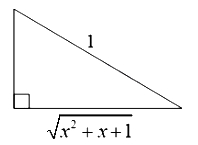
(D) Given the equation: $\tan ^{-1} \sqrt{x^2+x}+\sin ^{-1} \sqrt{x^2+x+1}=\frac{\pi}{2}$
Since $\sin ^{-1} \theta + \cos ^{-1} \theta = \frac{\pi}{2}$,we can write:
$\tan ^{-1} \sqrt{x^2+x} = \frac{\pi}{2} - \sin ^{-1} \sqrt{x^2+x+1} = \cos ^{-1} \sqrt{x^2+x+1}$
Let $\tan ^{-1} \sqrt{x^2+x} = \theta$. Then $\tan \theta = \sqrt{x^2+x}$.
This implies $\cos \theta = \frac{1}{\sqrt{1 + (x^2+x)}}$.
Thus,$\cos ^{-1} \left( \frac{1}{\sqrt{x^2+x+1}} \right) = \cos ^{-1} \sqrt{x^2+x+1}$.
Comparing the arguments: $\frac{1}{\sqrt{x^2+x+1}} = \sqrt{x^2+x+1}$
$1 = x^2+x+1$
$x^2+x = 0$
$x(x+1) = 0$
So,$x = 0$ or $x = -1$.
Checking the domain of $\sin ^{-1} \sqrt{x^2+x+1}$,we require $0 \le x^2+x+1 \le 1$,which implies $x^2+x \le 0$.
For $x=0$,$x^2+x=0$ (valid). For $x=-1$,$x^2+x=0$ (valid).
However,$\tan ^{-1} \sqrt{x^2+x}$ requires $x^2+x \ge 0$.
Thus,$x^2+x=0$ is the only solution,giving $x=0$ or $x=-1$.
Since $\sin ^{-1} \theta + \cos ^{-1} \theta = \frac{\pi}{2}$,we can write:
$\tan ^{-1} \sqrt{x^2+x} = \frac{\pi}{2} - \sin ^{-1} \sqrt{x^2+x+1} = \cos ^{-1} \sqrt{x^2+x+1}$
Let $\tan ^{-1} \sqrt{x^2+x} = \theta$. Then $\tan \theta = \sqrt{x^2+x}$.
This implies $\cos \theta = \frac{1}{\sqrt{1 + (x^2+x)}}$.
Thus,$\cos ^{-1} \left( \frac{1}{\sqrt{x^2+x+1}} \right) = \cos ^{-1} \sqrt{x^2+x+1}$.
Comparing the arguments: $\frac{1}{\sqrt{x^2+x+1}} = \sqrt{x^2+x+1}$
$1 = x^2+x+1$
$x^2+x = 0$
$x(x+1) = 0$
So,$x = 0$ or $x = -1$.
Checking the domain of $\sin ^{-1} \sqrt{x^2+x+1}$,we require $0 \le x^2+x+1 \le 1$,which implies $x^2+x \le 0$.
For $x=0$,$x^2+x=0$ (valid). For $x=-1$,$x^2+x=0$ (valid).
However,$\tan ^{-1} \sqrt{x^2+x}$ requires $x^2+x \ge 0$.
Thus,$x^2+x=0$ is the only solution,giving $x=0$ or $x=-1$.
0 likesView Solution
222
MathematicsEasyMCQMHT CET · 2022
The principal value of $\cot ^{-1}\left(\frac{-1}{\sqrt{3}}\right)$ is
A
$\frac{2 \pi}{3}$
B
$\frac{\pi}{3}$
C
$\frac{-\pi}{3}$
D
$\frac{\pi}{6}$
Solution
(A) We know that the range of the principal value branch of $\cot ^{-1} x$ is $(0, \pi)$.
Since the argument $\frac{-1}{\sqrt{3}}$ is negative,we use the property $\cot ^{-1}(-x) = \pi - \cot ^{-1}(x)$.
Therefore,$\cot ^{-1}\left(\frac{-1}{\sqrt{3}}\right) = \pi - \cot ^{-1}\left(\frac{1}{\sqrt{3}}\right)$.
We know that $\cot \left(\frac{\pi}{3}\right) = \frac{1}{\sqrt{3}}$,so $\cot ^{-1}\left(\frac{1}{\sqrt{3}}\right) = \frac{\pi}{3}$.
Substituting this value,we get $\pi - \frac{\pi}{3} = \frac{2 \pi}{3}$.
Since the argument $\frac{-1}{\sqrt{3}}$ is negative,we use the property $\cot ^{-1}(-x) = \pi - \cot ^{-1}(x)$.
Therefore,$\cot ^{-1}\left(\frac{-1}{\sqrt{3}}\right) = \pi - \cot ^{-1}\left(\frac{1}{\sqrt{3}}\right)$.
We know that $\cot \left(\frac{\pi}{3}\right) = \frac{1}{\sqrt{3}}$,so $\cot ^{-1}\left(\frac{1}{\sqrt{3}}\right) = \frac{\pi}{3}$.
Substituting this value,we get $\pi - \frac{\pi}{3} = \frac{2 \pi}{3}$.
0 likesView Solution
223
MathematicsDifficultMCQMHT CET · 2022
The value of $\tan \left\{\frac{1}{2} \sin ^{-1}\left(\frac{2 x}{1+x^2}\right)+\frac{1}{2} \cos ^{-1}\left(\frac{1-y^2}{1+y^2}\right)\right\}$ is
A
$\frac{x+y}{1-x y}$
B
$\frac{x-y}{1+x y}$
C
$\frac{x-y}{1-x y}$
D
$\frac{x+y}{1+x y}$
Solution
(A) Let $x = \tan \theta$ and $y = \tan \phi$.
Substituting these into the expression:
$\frac{1}{2} \sin ^{-1} \left( \frac{2 \tan \theta}{1 + \tan^2 \theta} \right) = \frac{1}{2} \sin ^{-1} (\sin 2 \theta) = \frac{1}{2} (2 \theta) = \theta$.
Similarly,$\frac{1}{2} \cos ^{-1} \left( \frac{1 - \tan^2 \phi}{1 + \tan^2 \phi} \right) = \frac{1}{2} \cos ^{-1} (\cos 2 \phi) = \frac{1}{2} (2 \phi) = \phi$.
Now,the expression becomes $\tan (\theta + \phi)$.
Using the trigonometric identity $\tan (\theta + \phi) = \frac{\tan \theta + \tan \phi}{1 - \tan \theta \tan \phi}$,we get:
$\frac{x + y}{1 - xy}$.
Substituting these into the expression:
$\frac{1}{2} \sin ^{-1} \left( \frac{2 \tan \theta}{1 + \tan^2 \theta} \right) = \frac{1}{2} \sin ^{-1} (\sin 2 \theta) = \frac{1}{2} (2 \theta) = \theta$.
Similarly,$\frac{1}{2} \cos ^{-1} \left( \frac{1 - \tan^2 \phi}{1 + \tan^2 \phi} \right) = \frac{1}{2} \cos ^{-1} (\cos 2 \phi) = \frac{1}{2} (2 \phi) = \phi$.
Now,the expression becomes $\tan (\theta + \phi)$.
Using the trigonometric identity $\tan (\theta + \phi) = \frac{\tan \theta + \tan \phi}{1 - \tan \theta \tan \phi}$,we get:
$\frac{x + y}{1 - xy}$.
0 likesView Solution
224
MathematicsEasyMCQMHT CET · 2022
If $\sin \left(\sin ^{-1} \frac{1}{5}+\cos ^{-1} x\right)=1$,then the value of $x$ is
A
$\frac{\pi}{2}+\frac{1}{5}$
B
$\frac{\pi}{2}-\frac{1}{5}$
C
$-\frac{1}{5}$
D
$\frac{1}{5}$
Solution
(D) Given the equation: $\sin \left(\sin ^{-1} \frac{1}{5}+\cos ^{-1} x\right)=1$
Since $\sin \frac{\pi}{2} = 1$,we have:
$\sin ^{-1} \frac{1}{5}+\cos ^{-1} x = \frac{\pi}{2}$
Using the identity $\sin ^{-1} \theta + \cos ^{-1} \theta = \frac{\pi}{2}$,we can rewrite the equation as:
$\cos ^{-1} x = \frac{\pi}{2} - \sin ^{-1} \frac{1}{5}$
Since $\frac{\pi}{2} - \sin ^{-1} \theta = \cos ^{-1} \theta$,we get:
$\cos ^{-1} x = \cos ^{-1} \frac{1}{5}$
Therefore,$x = \frac{1}{5}$.
Since $\sin \frac{\pi}{2} = 1$,we have:
$\sin ^{-1} \frac{1}{5}+\cos ^{-1} x = \frac{\pi}{2}$
Using the identity $\sin ^{-1} \theta + \cos ^{-1} \theta = \frac{\pi}{2}$,we can rewrite the equation as:
$\cos ^{-1} x = \frac{\pi}{2} - \sin ^{-1} \frac{1}{5}$
Since $\frac{\pi}{2} - \sin ^{-1} \theta = \cos ^{-1} \theta$,we get:
$\cos ^{-1} x = \cos ^{-1} \frac{1}{5}$
Therefore,$x = \frac{1}{5}$.
0 likesView Solution
225
MathematicsDifficultMCQMHT CET · 2022
If $A=2 \tan ^{-1}\left(\frac{1+x}{1-x}\right)$ and $B=\cos ^{-1}\left(\frac{1-x^2}{1+x^2}\right)$,where $x \in(0,1)$,then $A-B=$
A
$\frac{\pi}{4}$
B
$4 \tan ^{-1} x$
C
$\tan ^{-1} x$
D
$\frac{\pi}{2}$
Solution
(D) Let $x = \tan \theta$. Since $x \in (0, 1)$,we have $\theta \in (0, \frac{\pi}{4})$.
First,consider $A = 2 \tan^{-1}\left(\frac{1+x}{1-x}\right)$.
Using the formula $\tan^{-1}\left(\frac{1+\tan \theta}{1-\tan \theta}\right) = \tan^{-1}(\tan(\frac{\pi}{4} + \theta)) = \frac{\pi}{4} + \theta$,we get $A = 2(\frac{\pi}{4} + \theta) = \frac{\pi}{2} + 2\theta$.
Next,consider $B = \cos^{-1}\left(\frac{1-x^2}{1+x^2}\right)$.
Using the formula $\cos^{-1}\left(\frac{1-\tan^2 \theta}{1+\tan^2 \theta}\right) = \cos^{-1}(\cos 2\theta) = 2\theta$.
Finally,$A - B = (\frac{\pi}{2} + 2\theta) - 2\theta = \frac{\pi}{2}$.
First,consider $A = 2 \tan^{-1}\left(\frac{1+x}{1-x}\right)$.
Using the formula $\tan^{-1}\left(\frac{1+\tan \theta}{1-\tan \theta}\right) = \tan^{-1}(\tan(\frac{\pi}{4} + \theta)) = \frac{\pi}{4} + \theta$,we get $A = 2(\frac{\pi}{4} + \theta) = \frac{\pi}{2} + 2\theta$.
Next,consider $B = \cos^{-1}\left(\frac{1-x^2}{1+x^2}\right)$.
Using the formula $\cos^{-1}\left(\frac{1-\tan^2 \theta}{1+\tan^2 \theta}\right) = \cos^{-1}(\cos 2\theta) = 2\theta$.
Finally,$A - B = (\frac{\pi}{2} + 2\theta) - 2\theta = \frac{\pi}{2}$.
0 likesView Solution
226
MathematicsEasyMCQMHT CET · 2022
The value of $2 \sin ^{-1}\left(\frac{1}{2}\right)+\cot ^{-1}\left(\frac{1}{\sqrt{3}}\right)$ is
A
$\frac{\pi}{4}$
B
$\frac{\pi}{3}$
C
$\frac{\pi}{6}$
D
$\frac{2 \pi}{3}$
Solution
(D) We know that $\sin ^{-1}\left(\frac{1}{2}\right) = \frac{\pi}{6}$ since $\sin\left(\frac{\pi}{6}\right) = \frac{1}{2}$.
We also know that $\cot ^{-1}\left(\frac{1}{\sqrt{3}}\right) = \frac{\pi}{3}$ since $\cot\left(\frac{\pi}{3}\right) = \frac{1}{\sqrt{3}}$.
Substituting these values into the expression:
$2 \sin ^{-1}\left(\frac{1}{2}\right) + \cot ^{-1}\left(\frac{1}{\sqrt{3}}\right) = 2 \times \left(\frac{\pi}{6}\right) + \frac{\pi}{3}$.
$= \frac{\pi}{3} + \frac{\pi}{3} = \frac{2\pi}{3}$.
We also know that $\cot ^{-1}\left(\frac{1}{\sqrt{3}}\right) = \frac{\pi}{3}$ since $\cot\left(\frac{\pi}{3}\right) = \frac{1}{\sqrt{3}}$.
Substituting these values into the expression:
$2 \sin ^{-1}\left(\frac{1}{2}\right) + \cot ^{-1}\left(\frac{1}{\sqrt{3}}\right) = 2 \times \left(\frac{\pi}{6}\right) + \frac{\pi}{3}$.
$= \frac{\pi}{3} + \frac{\pi}{3} = \frac{2\pi}{3}$.
0 likesView Solution
227
MathematicsEasyMCQMHT CET · 2022
The value of $\operatorname{cosec}^{-1}(\sqrt{2})+\cos ^{-1}\left(\frac{-1}{2}\right)-\sec ^{-1}\left(\frac{2}{\sqrt{3}}\right)$ is equal to
A
$\frac{3 \pi}{4}$
B
$\frac{\pi}{6}$
C
$\frac{2 \pi}{3}$
D
$\frac{\pi}{4}$
Solution
(A) We know the principal values of the inverse trigonometric functions:
$\operatorname{cosec}^{-1}(\sqrt{2}) = \frac{\pi}{4}$
$\cos^{-1}\left(\frac{-1}{2}\right) = \pi - \cos^{-1}\left(\frac{1}{2}\right) = \pi - \frac{\pi}{3} = \frac{2\pi}{3}$
$\sec^{-1}\left(\frac{2}{\sqrt{3}}\right) = \frac{\pi}{6}$
Substituting these values into the expression:
$\frac{\pi}{4} + \frac{2\pi}{3} - \frac{\pi}{6}$
Finding a common denominator $(12)$:
$\frac{3\pi + 8\pi - 2\pi}{12} = \frac{9\pi}{12} = \frac{3\pi}{4}$
$\operatorname{cosec}^{-1}(\sqrt{2}) = \frac{\pi}{4}$
$\cos^{-1}\left(\frac{-1}{2}\right) = \pi - \cos^{-1}\left(\frac{1}{2}\right) = \pi - \frac{\pi}{3} = \frac{2\pi}{3}$
$\sec^{-1}\left(\frac{2}{\sqrt{3}}\right) = \frac{\pi}{6}$
Substituting these values into the expression:
$\frac{\pi}{4} + \frac{2\pi}{3} - \frac{\pi}{6}$
Finding a common denominator $(12)$:
$\frac{3\pi + 8\pi - 2\pi}{12} = \frac{9\pi}{12} = \frac{3\pi}{4}$
0 likesView Solution
228
MathematicsMediumMCQMHT CET · 2022
If $\tan ^{-1} a+\tan ^{-1} b+\tan ^{-1} c=\pi$,then which of the following is true?
A
$a b c=1$
B
$a+b-c=\frac{a b}{c}$
C
$a+b+c=a b c$
D
$a+b+c=1$
Solution
(C) We are given the equation: $\tan ^{-1} a+\tan ^{-1} b+\tan ^{-1} c=\pi$.
Using the formula for the sum of three inverse tangent functions: $\tan ^{-1} x + \tan ^{-1} y + \tan ^{-1} z = \tan ^{-1} \left( \frac{x+y+z-xyz}{1-xy-yz-zx} \right)$.
Applying this to the given equation: $\tan ^{-1} \left( \frac{a+b+c-abc}{1-ab-bc-ca} \right) = \pi$.
Taking the tangent of both sides: $\frac{a+b+c-abc}{1-ab-bc-ca} = \tan \pi$.
Since $\tan \pi = 0$,we have: $\frac{a+b+c-abc}{1-ab-bc-ca} = 0$.
This implies that the numerator must be zero: $a+b+c-abc = 0$.
Therefore,$a+b+c = abc$.
Using the formula for the sum of three inverse tangent functions: $\tan ^{-1} x + \tan ^{-1} y + \tan ^{-1} z = \tan ^{-1} \left( \frac{x+y+z-xyz}{1-xy-yz-zx} \right)$.
Applying this to the given equation: $\tan ^{-1} \left( \frac{a+b+c-abc}{1-ab-bc-ca} \right) = \pi$.
Taking the tangent of both sides: $\frac{a+b+c-abc}{1-ab-bc-ca} = \tan \pi$.
Since $\tan \pi = 0$,we have: $\frac{a+b+c-abc}{1-ab-bc-ca} = 0$.
This implies that the numerator must be zero: $a+b+c-abc = 0$.
Therefore,$a+b+c = abc$.
0 likesView Solution
229
MathematicsMediumMCQMHT CET · 2022
If $\tan ^{-1}\left(\frac{1-x}{1+x}\right)=\frac{1}{2} \tan ^{-1} x$,then $x$ has the value
A
$1$
B
$\sqrt{3}$
C
$3$
D
$\frac{1}{\sqrt{3}}$
Solution
(D) Given equation: $\tan ^{-1}\left(\frac{1-x}{1+x}\right)=\frac{1}{2} \tan ^{-1} x$
Let $x = \tan \theta$,then $\theta = \tan ^{-1} x$.
Substituting $x = \tan \theta$ in the equation:
$\tan ^{-1}\left(\frac{1-\tan \theta}{1+\tan \theta}\right)=\frac{1}{2} \theta$
Using the formula $\tan(\frac{\pi}{4} - \theta) = \frac{1-\tan \theta}{1+\tan \theta}$:
$\tan ^{-1}\left(\tan \left(\frac{\pi}{4}-\theta\right)\right)=\frac{1}{2} \theta$
$\frac{\pi}{4}-\theta=\frac{1}{2} \theta$
$\frac{\pi}{4}=\frac{3 \theta}{2}$
$\theta=\frac{\pi}{6}$
Since $x = \tan \theta$,we have $x = \tan \frac{\pi}{6} = \frac{1}{\sqrt{3}}$.
Let $x = \tan \theta$,then $\theta = \tan ^{-1} x$.
Substituting $x = \tan \theta$ in the equation:
$\tan ^{-1}\left(\frac{1-\tan \theta}{1+\tan \theta}\right)=\frac{1}{2} \theta$
Using the formula $\tan(\frac{\pi}{4} - \theta) = \frac{1-\tan \theta}{1+\tan \theta}$:
$\tan ^{-1}\left(\tan \left(\frac{\pi}{4}-\theta\right)\right)=\frac{1}{2} \theta$
$\frac{\pi}{4}-\theta=\frac{1}{2} \theta$
$\frac{\pi}{4}=\frac{3 \theta}{2}$
$\theta=\frac{\pi}{6}$
Since $x = \tan \theta$,we have $x = \tan \frac{\pi}{6} = \frac{1}{\sqrt{3}}$.
0 likesView Solution
230
MathematicsEasyMCQMHT CET · 2022
With reference to the principal values,if $\sin ^{-1} x + \sin ^{-1} y + \sin ^{-1} z = \frac{3 \pi}{2}$,then $x^{100} + y^{100} + z^{100} =$
A
$2$
B
$3$
C
$1$
D
$6$
Solution
(B) The principal value range of $\sin ^{-1} x$ is $[-\frac{\pi}{2}, \frac{\pi}{2}]$.
Given that $\sin ^{-1} x + \sin ^{-1} y + \sin ^{-1} z = \frac{3 \pi}{2}$.
Since the maximum value of each $\sin ^{-1}$ term is $\frac{\pi}{2}$,the sum can only be $\frac{3 \pi}{2}$ if each term is individually equal to its maximum value.
Therefore,$\sin ^{-1} x = \frac{\pi}{2}$,$\sin ^{-1} y = \frac{\pi}{2}$,and $\sin ^{-1} z = \frac{\pi}{2}$.
This implies $x = \sin(\frac{\pi}{2}) = 1$,$y = \sin(\frac{\pi}{2}) = 1$,and $z = \sin(\frac{\pi}{2}) = 1$.
Substituting these values into the expression $x^{100} + y^{100} + z^{100}$:
$1^{100} + 1^{100} + 1^{100} = 1 + 1 + 1 = 3$.
Given that $\sin ^{-1} x + \sin ^{-1} y + \sin ^{-1} z = \frac{3 \pi}{2}$.
Since the maximum value of each $\sin ^{-1}$ term is $\frac{\pi}{2}$,the sum can only be $\frac{3 \pi}{2}$ if each term is individually equal to its maximum value.
Therefore,$\sin ^{-1} x = \frac{\pi}{2}$,$\sin ^{-1} y = \frac{\pi}{2}$,and $\sin ^{-1} z = \frac{\pi}{2}$.
This implies $x = \sin(\frac{\pi}{2}) = 1$,$y = \sin(\frac{\pi}{2}) = 1$,and $z = \sin(\frac{\pi}{2}) = 1$.
Substituting these values into the expression $x^{100} + y^{100} + z^{100}$:
$1^{100} + 1^{100} + 1^{100} = 1 + 1 + 1 = 3$.
0 likesView Solution
231
MathematicsEasyMCQMHT CET · 2022
If $\tan ^{-1} 2 x+\tan ^{-1} 3 x=\frac{\pi}{4}$,then the value of $x$ is
A
$\frac{1}{6}$
B
$-\frac{1}{6}$
C
$1$
D
$\frac{5}{6}$
Solution
(A) Given the equation: $\tan ^{-1} 2 x+\tan ^{-1} 3 x=\frac{\pi}{4}$
Using the formula $\tan ^{-1} A+\tan ^{-1} B=\tan ^{-1}\left(\frac{A+B}{1-AB}\right)$,we get:
$\tan ^{-1}\left(\frac{2 x+3 x}{1-(2 x)(3 x)}\right)=\frac{\pi}{4}$
$\tan ^{-1}\left(\frac{5 x}{1-6 x^2}\right)=\frac{\pi}{4}$
Taking $\tan$ on both sides:
$\frac{5 x}{1-6 x^2}=\tan\left(\frac{\pi}{4}\right)=1$
$5 x=1-6 x^2$
$6 x^2+5 x-1=0$
Factoring the quadratic equation:
$(6 x-1)(x+1)=0$
So,$x=\frac{1}{6}$ or $x=-1$.
Checking the values: If $x=-1$,$\tan ^{-1}(-2)+\tan ^{-1}(-3)$ is negative,which cannot be $\frac{\pi}{4}$.
Thus,$x=\frac{1}{6}$ is the only valid solution.
Using the formula $\tan ^{-1} A+\tan ^{-1} B=\tan ^{-1}\left(\frac{A+B}{1-AB}\right)$,we get:
$\tan ^{-1}\left(\frac{2 x+3 x}{1-(2 x)(3 x)}\right)=\frac{\pi}{4}$
$\tan ^{-1}\left(\frac{5 x}{1-6 x^2}\right)=\frac{\pi}{4}$
Taking $\tan$ on both sides:
$\frac{5 x}{1-6 x^2}=\tan\left(\frac{\pi}{4}\right)=1$
$5 x=1-6 x^2$
$6 x^2+5 x-1=0$
Factoring the quadratic equation:
$(6 x-1)(x+1)=0$
So,$x=\frac{1}{6}$ or $x=-1$.
Checking the values: If $x=-1$,$\tan ^{-1}(-2)+\tan ^{-1}(-3)$ is negative,which cannot be $\frac{\pi}{4}$.
Thus,$x=\frac{1}{6}$ is the only valid solution.
0 likesView Solution
232
MathematicsDifficultMCQMHT CET · 2022
If $\cos ^{-1} x - \cos ^{-1} \frac{y}{2} = \alpha$,where $-1 \leq x \leq 1, -2 \leq y \leq 2, x \leq \frac{y}{2}$,then for all $x, y$,$4x^2 - 4xy \cos \alpha + y^2$ is equal to
A
$2 \sin ^2 \alpha$
B
$4 \sin ^2 \alpha$
C
$4 \cos ^2 \alpha + 2x^2y^2$
D
$4 \sin ^2 \alpha - 2x^2y^2$
Solution
(B) Given $\cos ^{-1} x - \cos ^{-1} \frac{y}{2} = \alpha$.
Using the formula $\cos ^{-1} A - \cos ^{-1} B = \cos ^{-1} (AB + \sqrt{1-A^2} \sqrt{1-B^2})$,we get:
$\cos ^{-1} \left( x \cdot \frac{y}{2} + \sqrt{1-x^2} \sqrt{1-\frac{y^2}{4}} \right) = \alpha$.
Taking cosine on both sides:
$\frac{xy}{2} + \frac{\sqrt{(1-x^2)(4-y^2)}}{2} = \cos \alpha$.
$\sqrt{(1-x^2)(4-y^2)} = 2 \cos \alpha - xy$.
Squaring both sides:
$(1-x^2)(4-y^2) = (2 \cos \alpha - xy)^2$.
$4 - y^2 - 4x^2 + x^2y^2 = 4 \cos ^2 \alpha - 4xy \cos \alpha + x^2y^2$.
Subtracting $x^2y^2$ from both sides:
$4 - y^2 - 4x^2 = 4 \cos ^2 \alpha - 4xy \cos \alpha$.
Rearranging the terms:
$4x^2 - 4xy \cos \alpha + y^2 = 4 - 4 \cos ^2 \alpha$.
Since $1 - \cos ^2 \alpha = \sin ^2 \alpha$,we have:
$4x^2 - 4xy \cos \alpha + y^2 = 4 \sin ^2 \alpha$.
Using the formula $\cos ^{-1} A - \cos ^{-1} B = \cos ^{-1} (AB + \sqrt{1-A^2} \sqrt{1-B^2})$,we get:
$\cos ^{-1} \left( x \cdot \frac{y}{2} + \sqrt{1-x^2} \sqrt{1-\frac{y^2}{4}} \right) = \alpha$.
Taking cosine on both sides:
$\frac{xy}{2} + \frac{\sqrt{(1-x^2)(4-y^2)}}{2} = \cos \alpha$.
$\sqrt{(1-x^2)(4-y^2)} = 2 \cos \alpha - xy$.
Squaring both sides:
$(1-x^2)(4-y^2) = (2 \cos \alpha - xy)^2$.
$4 - y^2 - 4x^2 + x^2y^2 = 4 \cos ^2 \alpha - 4xy \cos \alpha + x^2y^2$.
Subtracting $x^2y^2$ from both sides:
$4 - y^2 - 4x^2 = 4 \cos ^2 \alpha - 4xy \cos \alpha$.
Rearranging the terms:
$4x^2 - 4xy \cos \alpha + y^2 = 4 - 4 \cos ^2 \alpha$.
Since $1 - \cos ^2 \alpha = \sin ^2 \alpha$,we have:
$4x^2 - 4xy \cos \alpha + y^2 = 4 \sin ^2 \alpha$.
0 likesView Solution
233
MathematicsMediumMCQMHT CET · 2022
The value of $\cos \left(\tan ^{-1}\left(\sin \left(\cot ^{-1} x\right)\right)\right)$ is
A
$\sqrt{\frac{x^2+1}{x^2-1}}$
B
$\sqrt{\frac{1-x^2}{2+x^2}}$
C
$\sqrt{\frac{1-x^2}{1+x^2}}$
D
$\sqrt{\frac{x^2+1}{x^2+2}}$
Solution
(D) Let $\theta = \cot^{-1} x$,then $\cot \theta = x$. Since $\cot \theta = \frac{x}{1}$,we have $\sin \theta = \frac{1}{\sqrt{1+x^2}}$.
Thus,$\sin(\cot^{-1} x) = \frac{1}{\sqrt{1+x^2}}$.
Now,let $\phi = \tan^{-1} \left( \frac{1}{\sqrt{1+x^2}} \right)$,then $\tan \phi = \frac{1}{\sqrt{1+x^2}}$.
We need to find $\cos \phi$. Using the identity $\sec^2 \phi = 1 + \tan^2 \phi$,we get $\sec^2 \phi = 1 + \frac{1}{1+x^2} = \frac{1+x^2+1}{1+x^2} = \frac{x^2+2}{x^2+1}$.
Therefore,$\cos^2 \phi = \frac{x^2+1}{x^2+2}$,which implies $\cos \phi = \sqrt{\frac{x^2+1}{x^2+2}}$.
Thus,$\sin(\cot^{-1} x) = \frac{1}{\sqrt{1+x^2}}$.
Now,let $\phi = \tan^{-1} \left( \frac{1}{\sqrt{1+x^2}} \right)$,then $\tan \phi = \frac{1}{\sqrt{1+x^2}}$.
We need to find $\cos \phi$. Using the identity $\sec^2 \phi = 1 + \tan^2 \phi$,we get $\sec^2 \phi = 1 + \frac{1}{1+x^2} = \frac{1+x^2+1}{1+x^2} = \frac{x^2+2}{x^2+1}$.
Therefore,$\cos^2 \phi = \frac{x^2+1}{x^2+2}$,which implies $\cos \phi = \sqrt{\frac{x^2+1}{x^2+2}}$.
0 likesView Solution
234
MathematicsMediumMCQMHT CET · 2022
The value of $\cos \left(2 \cos ^{-1} x+\sin ^{-1} x\right)$ at $x=\frac{1}{5}$,where $0 \leq \cos ^{-1} x \leq \pi$ and $-\frac{\pi}{2} \leq \sin ^{-1} x \leq \frac{\pi}{2}$,is
A
$-\frac{\sqrt{6}}{5}$
B
$\frac{\sqrt{6}}{5}$
C
$-\frac{2 \sqrt{6}}{5}$
D
$\frac{2 \sqrt{6}}{5}$
Solution
(C) Given expression: $\cos \left(2 \cos ^{-1} x+\sin ^{-1} x\right)$
We can rewrite this as: $\cos \left(\cos ^{-1} x + (\cos ^{-1} x+\sin ^{-1} x)\right)$
Using the property $\cos ^{-1} x+\sin ^{-1} x=\frac{\pi}{2}$,the expression becomes:
$\cos \left(\cos ^{-1} x+\frac{\pi}{2}\right)$
Using the trigonometric identity $\cos \left(\theta+\frac{\pi}{2}\right) = -\sin \theta$:
$= -\sin \left(\cos ^{-1} x\right)$
Since $\cos ^{-1} x = \sin ^{-1} \sqrt{1-x^2}$,we have:
$= -\sin \left(\sin ^{-1} \sqrt{1-x^2}\right) = -\sqrt{1-x^2}$
Substituting $x=\frac{1}{5}$:
$= -\sqrt{1-\left(\frac{1}{5}\right)^2} = -\sqrt{1-\frac{1}{25}} = -\sqrt{\frac{24}{25}} = -\frac{2 \sqrt{6}}{5}$
We can rewrite this as: $\cos \left(\cos ^{-1} x + (\cos ^{-1} x+\sin ^{-1} x)\right)$
Using the property $\cos ^{-1} x+\sin ^{-1} x=\frac{\pi}{2}$,the expression becomes:
$\cos \left(\cos ^{-1} x+\frac{\pi}{2}\right)$
Using the trigonometric identity $\cos \left(\theta+\frac{\pi}{2}\right) = -\sin \theta$:
$= -\sin \left(\cos ^{-1} x\right)$
Since $\cos ^{-1} x = \sin ^{-1} \sqrt{1-x^2}$,we have:
$= -\sin \left(\sin ^{-1} \sqrt{1-x^2}\right) = -\sqrt{1-x^2}$
Substituting $x=\frac{1}{5}$:
$= -\sqrt{1-\left(\frac{1}{5}\right)^2} = -\sqrt{1-\frac{1}{25}} = -\sqrt{\frac{24}{25}} = -\frac{2 \sqrt{6}}{5}$
0 likesView Solution
235
MathematicsEasyMCQMHT CET · 2022
$\tan ^{-1} \frac{1}{3}+\tan ^{-1} \frac{1}{5}+\tan ^{-1} \frac{1}{7}+\tan ^{-1} \frac{1}{8}$ has the value
A
$\frac{\pi}{4}$
B
$\frac{\pi}{6}$
C
$\frac{\pi}{2}$
D
$\frac{\pi}{3}$
Solution
(A) We use the formula $\tan ^{-1} x + \tan ^{-1} y = \tan ^{-1} \left( \frac{x+y}{1-xy} \right)$.
First,group the terms:
$\left( \tan ^{-1} \frac{1}{3} + \tan ^{-1} \frac{1}{5} \right) + \left( \tan ^{-1} \frac{1}{7} + \tan ^{-1} \frac{1}{8} \right)$
Apply the formula to the first pair:
$\tan ^{-1} \left( \frac{\frac{1}{3} + \frac{1}{5}}{1 - \frac{1}{3} \times \frac{1}{5}} \right) = \tan ^{-1} \left( \frac{\frac{8}{15}}{\frac{14}{15}} \right) = \tan ^{-1} \left( \frac{8}{14} \right) = \tan ^{-1} \left( \frac{4}{7} \right)$
Apply the formula to the second pair:
$\tan ^{-1} \left( \frac{\frac{1}{7} + \frac{1}{8}}{1 - \frac{1}{7} \times \frac{1}{8}} \right) = \tan ^{-1} \left( \frac{\frac{15}{56}}{\frac{55}{56}} \right) = \tan ^{-1} \left( \frac{15}{55} \right) = \tan ^{-1} \left( \frac{3}{11} \right)$
Now add the results:
$\tan ^{-1} \left( \frac{4}{7} \right) + \tan ^{-1} \left( \frac{3}{11} \right) = \tan ^{-1} \left( \frac{\frac{4}{7} + \frac{3}{11}}{1 - \frac{4}{7} \times \frac{3}{11}} \right)$
$= \tan ^{-1} \left( \frac{\frac{44+21}{77}}{\frac{77-12}{77}} \right) = \tan ^{-1} \left( \frac{65}{65} \right) = \tan ^{-1} (1) = \frac{\pi}{4}$
First,group the terms:
$\left( \tan ^{-1} \frac{1}{3} + \tan ^{-1} \frac{1}{5} \right) + \left( \tan ^{-1} \frac{1}{7} + \tan ^{-1} \frac{1}{8} \right)$
Apply the formula to the first pair:
$\tan ^{-1} \left( \frac{\frac{1}{3} + \frac{1}{5}}{1 - \frac{1}{3} \times \frac{1}{5}} \right) = \tan ^{-1} \left( \frac{\frac{8}{15}}{\frac{14}{15}} \right) = \tan ^{-1} \left( \frac{8}{14} \right) = \tan ^{-1} \left( \frac{4}{7} \right)$
Apply the formula to the second pair:
$\tan ^{-1} \left( \frac{\frac{1}{7} + \frac{1}{8}}{1 - \frac{1}{7} \times \frac{1}{8}} \right) = \tan ^{-1} \left( \frac{\frac{15}{56}}{\frac{55}{56}} \right) = \tan ^{-1} \left( \frac{15}{55} \right) = \tan ^{-1} \left( \frac{3}{11} \right)$
Now add the results:
$\tan ^{-1} \left( \frac{4}{7} \right) + \tan ^{-1} \left( \frac{3}{11} \right) = \tan ^{-1} \left( \frac{\frac{4}{7} + \frac{3}{11}}{1 - \frac{4}{7} \times \frac{3}{11}} \right)$
$= \tan ^{-1} \left( \frac{\frac{44+21}{77}}{\frac{77-12}{77}} \right) = \tan ^{-1} \left( \frac{65}{65} \right) = \tan ^{-1} (1) = \frac{\pi}{4}$
0 likesView Solution
236
MathematicsEasyMCQMHT CET · 2022
$2 \tan ^{-1}\left(\frac{1}{3}\right)+\cos ^{-1}\left(\frac{3}{5}\right)=$
A
$\frac{\pi}{4}$
B
$0$
C
$\tan ^{-1}\left(\frac{5}{4}\right)$
D
$\frac{\pi}{2}$
Solution
(D) We use the formula $2 \tan ^{-1}(x) = \tan ^{-1}\left(\frac{2x}{1-x^2}\right)$ for $|x| < 1$.
First,calculate $2 \tan ^{-1}\left(\frac{1}{3}\right) = \tan ^{-1}\left(\frac{2 \times \frac{1}{3}}{1-(\frac{1}{3})^2}\right) = \tan ^{-1}\left(\frac{2/3}{8/9}\right) = \tan ^{-1}\left(\frac{3}{4}\right)$.
Now,convert $\cos ^{-1}\left(\frac{3}{5}\right)$ to $\tan ^{-1}$. Let $\theta = \cos ^{-1}\left(\frac{3}{5}\right)$,then $\cos \theta = \frac{3}{5}$. Since $\cos^2 \theta + \sin^2 \theta = 1$,$\sin \theta = \sqrt{1 - (3/5)^2} = 4/5$. Thus,$\tan \theta = \frac{4/5}{3/5} = \frac{4}{3}$,so $\cos ^{-1}\left(\frac{3}{5}\right) = \tan ^{-1}\left(\frac{4}{3}\right)$.
The expression becomes $\tan ^{-1}\left(\frac{3}{4}\right) + \tan ^{-1}\left(\frac{4}{3}\right)$.
Using $\tan ^{-1}(x) + \tan ^{-1}(1/x) = \frac{\pi}{2}$ for $x > 0$,we get $\tan ^{-1}\left(\frac{3}{4}\right) + \tan ^{-1}\left(\frac{1}{3/4}\right) = \frac{\pi}{2}$.
First,calculate $2 \tan ^{-1}\left(\frac{1}{3}\right) = \tan ^{-1}\left(\frac{2 \times \frac{1}{3}}{1-(\frac{1}{3})^2}\right) = \tan ^{-1}\left(\frac{2/3}{8/9}\right) = \tan ^{-1}\left(\frac{3}{4}\right)$.
Now,convert $\cos ^{-1}\left(\frac{3}{5}\right)$ to $\tan ^{-1}$. Let $\theta = \cos ^{-1}\left(\frac{3}{5}\right)$,then $\cos \theta = \frac{3}{5}$. Since $\cos^2 \theta + \sin^2 \theta = 1$,$\sin \theta = \sqrt{1 - (3/5)^2} = 4/5$. Thus,$\tan \theta = \frac{4/5}{3/5} = \frac{4}{3}$,so $\cos ^{-1}\left(\frac{3}{5}\right) = \tan ^{-1}\left(\frac{4}{3}\right)$.
The expression becomes $\tan ^{-1}\left(\frac{3}{4}\right) + \tan ^{-1}\left(\frac{4}{3}\right)$.
Using $\tan ^{-1}(x) + \tan ^{-1}(1/x) = \frac{\pi}{2}$ for $x > 0$,we get $\tan ^{-1}\left(\frac{3}{4}\right) + \tan ^{-1}\left(\frac{1}{3/4}\right) = \frac{\pi}{2}$.
0 likesView Solution
237
MathematicsEasyMCQMHT CET · 2022
The value of $\tan ^{-1}\left(\frac{1}{3}\right)+\tan ^{-1}\left(\frac{1}{5}\right)+\tan ^{-1}\left(\frac{1}{7}\right)+\tan ^{-1}\left(\frac{1}{8}\right)$ is
A
$\frac{4 \pi}{3}$
B
$\frac{\pi}{4}$
C
$\frac{2 \pi}{4}$
D
$\frac{3 \pi}{4}$
Solution
(B) We use the formula $\tan ^{-1} x + \tan ^{-1} y = \tan ^{-1} \left( \frac{x+y}{1-xy} \right)$.
First,group the terms:
$\left( \tan ^{-1} \frac{1}{3} + \tan ^{-1} \frac{1}{5} \right) + \left( \tan ^{-1} \frac{1}{7} + \tan ^{-1} \frac{1}{8} \right)$
Applying the formula to the first pair:
$\tan ^{-1} \left( \frac{\frac{1}{3} + \frac{1}{5}}{1 - \frac{1}{3} \times \frac{1}{5}} \right) = \tan ^{-1} \left( \frac{\frac{8}{15}}{\frac{14}{15}} \right) = \tan ^{-1} \left( \frac{8}{14} \right) = \tan ^{-1} \left( \frac{4}{7} \right)$
Applying the formula to the second pair:
$\tan ^{-1} \left( \frac{\frac{1}{7} + \frac{1}{8}}{1 - \frac{1}{7} \times \frac{1}{8}} \right) = \tan ^{-1} \left( \frac{\frac{15}{56}}{\frac{55}{56}} \right) = \tan ^{-1} \left( \frac{15}{55} \right) = \tan ^{-1} \left( \frac{3}{11} \right)$
Now,add the results:
$\tan ^{-1} \left( \frac{4}{7} \right) + \tan ^{-1} \left( \frac{3}{11} \right) = \tan ^{-1} \left( \frac{\frac{4}{7} + \frac{3}{11}}{1 - \frac{4}{7} \times \frac{3}{11}} \right)$
$= \tan ^{-1} \left( \frac{\frac{44+21}{77}}{\frac{77-12}{77}} \right) = \tan ^{-1} \left( \frac{65}{65} \right) = \tan ^{-1} (1) = \frac{\pi}{4}$
First,group the terms:
$\left( \tan ^{-1} \frac{1}{3} + \tan ^{-1} \frac{1}{5} \right) + \left( \tan ^{-1} \frac{1}{7} + \tan ^{-1} \frac{1}{8} \right)$
Applying the formula to the first pair:
$\tan ^{-1} \left( \frac{\frac{1}{3} + \frac{1}{5}}{1 - \frac{1}{3} \times \frac{1}{5}} \right) = \tan ^{-1} \left( \frac{\frac{8}{15}}{\frac{14}{15}} \right) = \tan ^{-1} \left( \frac{8}{14} \right) = \tan ^{-1} \left( \frac{4}{7} \right)$
Applying the formula to the second pair:
$\tan ^{-1} \left( \frac{\frac{1}{7} + \frac{1}{8}}{1 - \frac{1}{7} \times \frac{1}{8}} \right) = \tan ^{-1} \left( \frac{\frac{15}{56}}{\frac{55}{56}} \right) = \tan ^{-1} \left( \frac{15}{55} \right) = \tan ^{-1} \left( \frac{3}{11} \right)$
Now,add the results:
$\tan ^{-1} \left( \frac{4}{7} \right) + \tan ^{-1} \left( \frac{3}{11} \right) = \tan ^{-1} \left( \frac{\frac{4}{7} + \frac{3}{11}}{1 - \frac{4}{7} \times \frac{3}{11}} \right)$
$= \tan ^{-1} \left( \frac{\frac{44+21}{77}}{\frac{77-12}{77}} \right) = \tan ^{-1} \left( \frac{65}{65} \right) = \tan ^{-1} (1) = \frac{\pi}{4}$
0 likesView Solution
238
MathematicsEasyMCQMHT CET · 2022
$\tan ^{-1} 2+\tan ^{-1} 3=$
A
$\frac{5 \pi}{4}$
B
$\frac{\pi}{4}$
C
$-\frac{\pi}{4}$
D
$\frac{3 \pi}{4}$
Solution
(D) We use the formula $\tan ^{-1} x + \tan ^{-1} y = \pi + \tan ^{-1} \left( \frac{x+y}{1-xy} \right)$ when $xy > 1$.
Here,$x = 2$ and $y = 3$. Since $xy = 2 \times 3 = 6 > 1$,we apply the formula:
$\tan ^{-1} 2 + \tan ^{-1} 3 = \pi + \tan ^{-1} \left( \frac{2+3}{1-(2 \times 3)} \right)$
$= \pi + \tan ^{-1} \left( \frac{5}{1-6} \right)$
$= \pi + \tan ^{-1} \left( \frac{5}{-5} \right)$
$= \pi + \tan ^{-1} (-1)$
Since $\tan ^{-1} (-1) = -\frac{\pi}{4}$,we have:
$= \pi - \frac{\pi}{4} = \frac{3 \pi}{4}$.
Here,$x = 2$ and $y = 3$. Since $xy = 2 \times 3 = 6 > 1$,we apply the formula:
$\tan ^{-1} 2 + \tan ^{-1} 3 = \pi + \tan ^{-1} \left( \frac{2+3}{1-(2 \times 3)} \right)$
$= \pi + \tan ^{-1} \left( \frac{5}{1-6} \right)$
$= \pi + \tan ^{-1} \left( \frac{5}{-5} \right)$
$= \pi + \tan ^{-1} (-1)$
Since $\tan ^{-1} (-1) = -\frac{\pi}{4}$,we have:
$= \pi - \frac{\pi}{4} = \frac{3 \pi}{4}$.
0 likesView Solution
239
MathematicsEasyMCQMHT CET · 2022
The value of $\tan \left[2 \tan ^{-1}\left(\frac{1}{5}\right)-\frac{\pi}{4}\right]$ is
A
$\frac{7}{17}$
B
$-\frac{7}{17}$
C
$-\frac{17}{7}$
D
$\frac{17}{7}$
Solution
(B) We know that $2 \tan ^{-1}(x) = \tan ^{-1} \left( \frac{2x}{1-x^2} \right)$.
Therefore,$2 \tan ^{-1} \left( \frac{1}{5} \right) = \tan ^{-1} \left( \frac{2 \times \frac{1}{5}}{1 - (\frac{1}{5})^2} \right) = \tan ^{-1} \left( \frac{\frac{2}{5}}{1 - \frac{1}{25}} \right) = \tan ^{-1} \left( \frac{\frac{2}{5}}{\frac{24}{25}} \right) = \tan ^{-1} \left( \frac{2}{5} \times \frac{25}{24} \right) = \tan ^{-1} \left( \frac{5}{12} \right)$.
Now,the expression becomes $\tan \left[ \tan ^{-1} \left( \frac{5}{12} \right) - \tan ^{-1} (1) \right]$.
Using the formula $\tan ^{-1}(x) - \tan ^{-1}(y) = \tan ^{-1} \left( \frac{x-y}{1+xy} \right)$,we get:
$\tan ^{-1} \left( \frac{\frac{5}{12} - 1}{1 + \frac{5}{12} \times 1} \right) = \tan ^{-1} \left( \frac{-\frac{7}{12}}{\frac{17}{12}} \right) = \tan ^{-1} \left( -\frac{7}{17} \right)$.
Finally,$\tan \left[ \tan ^{-1} \left( -\frac{7}{17} \right) \right] = -\frac{7}{17}$.
Therefore,$2 \tan ^{-1} \left( \frac{1}{5} \right) = \tan ^{-1} \left( \frac{2 \times \frac{1}{5}}{1 - (\frac{1}{5})^2} \right) = \tan ^{-1} \left( \frac{\frac{2}{5}}{1 - \frac{1}{25}} \right) = \tan ^{-1} \left( \frac{\frac{2}{5}}{\frac{24}{25}} \right) = \tan ^{-1} \left( \frac{2}{5} \times \frac{25}{24} \right) = \tan ^{-1} \left( \frac{5}{12} \right)$.
Now,the expression becomes $\tan \left[ \tan ^{-1} \left( \frac{5}{12} \right) - \tan ^{-1} (1) \right]$.
Using the formula $\tan ^{-1}(x) - \tan ^{-1}(y) = \tan ^{-1} \left( \frac{x-y}{1+xy} \right)$,we get:
$\tan ^{-1} \left( \frac{\frac{5}{12} - 1}{1 + \frac{5}{12} \times 1} \right) = \tan ^{-1} \left( \frac{-\frac{7}{12}}{\frac{17}{12}} \right) = \tan ^{-1} \left( -\frac{7}{17} \right)$.
Finally,$\tan \left[ \tan ^{-1} \left( -\frac{7}{17} \right) \right] = -\frac{7}{17}$.
0 likesView Solution
240
MathematicsEasyMCQMHT CET · 2022
The value of $\tan \left(\cos ^{-1}\left(\frac{4}{5}\right)+\tan ^{-1}\left(\frac{2}{3}\right)\right)$ is
A
$\frac{6}{17}$
B
$\frac{7}{16}$
C
$\frac{16}{7}$
D
$\frac{17}{6}$
Solution
(D) We know that $\cos ^{-1}\left(\frac{4}{5}\right) = \tan ^{-1}\left(\frac{3}{4}\right)$ because in a right-angled triangle with base $4$ and hypotenuse $5$,the perpendicular is $\sqrt{5^2 - 4^2} = 3$.
Substituting this into the expression:
$\tan \left(\tan ^{-1}\left(\frac{3}{4}\right) + \tan ^{-1}\left(\frac{2}{3}\right)\right)$
Using the formula $\tan ^{-1}(x) + \tan ^{-1}(y) = \tan ^{-1}\left(\frac{x+y}{1-xy}\right)$:
$= \tan \left(\tan ^{-1}\left(\frac{\frac{3}{4} + \frac{2}{3}}{1 - \frac{3}{4} \times \frac{2}{3}}\right)\right)$
$= \tan \left(\tan ^{-1}\left(\frac{\frac{9+8}{12}}{1 - \frac{6}{12}}\right)\right)$
$= \tan \left(\tan ^{-1}\left(\frac{\frac{17}{12}}{\frac{6}{12}}\right)\right)$
$= \tan \left(\tan ^{-1}\left(\frac{17}{6}\right)\right) = \frac{17}{6}$
Substituting this into the expression:
$\tan \left(\tan ^{-1}\left(\frac{3}{4}\right) + \tan ^{-1}\left(\frac{2}{3}\right)\right)$
Using the formula $\tan ^{-1}(x) + \tan ^{-1}(y) = \tan ^{-1}\left(\frac{x+y}{1-xy}\right)$:
$= \tan \left(\tan ^{-1}\left(\frac{\frac{3}{4} + \frac{2}{3}}{1 - \frac{3}{4} \times \frac{2}{3}}\right)\right)$
$= \tan \left(\tan ^{-1}\left(\frac{\frac{9+8}{12}}{1 - \frac{6}{12}}\right)\right)$
$= \tan \left(\tan ^{-1}\left(\frac{\frac{17}{12}}{\frac{6}{12}}\right)\right)$
$= \tan \left(\tan ^{-1}\left(\frac{17}{6}\right)\right) = \frac{17}{6}$
0 likesView Solution
241
MathematicsMediumMCQMHT CET · 2022
If $f(x) = [x] - [\frac{x}{4}]$,$x \in R$,where $[x]$ denotes the greatest integer function,then:
A
$\lim_{x \rightarrow 4^{-}} f(x)$ exists,but $\lim_{x \rightarrow 4^{+}} f(x)$ does not exist.
B
$f(x)$ is continuous at $x = 4$.
C
$\lim_{x \rightarrow 4^{+}} f(x)$ exists,but $\lim_{x \rightarrow 4^{-}} f(x)$ does not exist.
D
Both $\lim_{x \rightarrow 4^{-}} f(x)$ and $\lim_{x \rightarrow 4^{+}} f(x)$ exist,but are not equal.
Solution
(B) We evaluate the left-hand limit at $x = 4$: $\lim_{x \rightarrow 4^{-}} f(x) = [4^{-}] - [\frac{4^{-}}{4}] = 3 - 0 = 3$.
We evaluate the right-hand limit at $x = 4$: $\lim_{x \rightarrow 4^{+}} f(x) = [4^{+}] - [\frac{4^{+}}{4}] = 4 - 1 = 3$.
We evaluate the function value at $x = 4$: $f(4) = [4] - [\frac{4}{4}] = 4 - 1 = 3$.
Since $\lim_{x \rightarrow 4^{-}} f(x) = \lim_{x \rightarrow 4^{+}} f(x) = f(4) = 3$,the function $f(x)$ is continuous at $x = 4$.
We evaluate the right-hand limit at $x = 4$: $\lim_{x \rightarrow 4^{+}} f(x) = [4^{+}] - [\frac{4^{+}}{4}] = 4 - 1 = 3$.
We evaluate the function value at $x = 4$: $f(4) = [4] - [\frac{4}{4}] = 4 - 1 = 3$.
Since $\lim_{x \rightarrow 4^{-}} f(x) = \lim_{x \rightarrow 4^{+}} f(x) = f(4) = 3$,the function $f(x)$ is continuous at $x = 4$.
0 likesView Solution
242
MathematicsMediumMCQMHT CET · 2022
Mrs. Rajni deposited $Rs. 10,000$ in a bank that pays $4 \%$ interest compounded continuously. The amount she gets after $10$ years is approximately $Rs.$ . . . . . . . (Given $e^{(0.4)} = 1.49182$)
A
$15150$
B
$16000$
C
$14918$
D
$13000$
Solution
(C) The formula for continuous compounding is $A = P \cdot e^{rt}$,where $P$ is the principal amount,$r$ is the annual interest rate,and $t$ is the time in years.
Given: $P = 10000$,$r = 4 \% = 0.04$,and $t = 10$ years.
Substituting the values: $A = 10000 \times e^{(0.04 \times 10)} = 10000 \times e^{0.4}$.
Using the given value $e^{0.4} = 1.49182$:
$A = 10000 \times 1.49182 = 14918.2$.
Rounding to the nearest integer,the amount is $Rs. 14918$.
Given: $P = 10000$,$r = 4 \% = 0.04$,and $t = 10$ years.
Substituting the values: $A = 10000 \times e^{(0.04 \times 10)} = 10000 \times e^{0.4}$.
Using the given value $e^{0.4} = 1.49182$:
$A = 10000 \times 1.49182 = 14918.2$.
Rounding to the nearest integer,the amount is $Rs. 14918$.
0 likesView Solution
243
MathematicsEasyMCQMHT CET · 2022
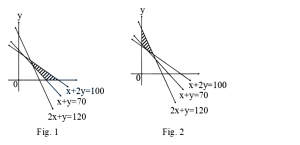
The graphical solution set of the system of in-equations $x+y \leq 70, x+2y \leq 100, 2x+y \leq 120, x \geq 0, y \geq 0$ is given by:
A
Fig. $2$
B
Fig. $1$
C
Fig. $4$
D
Fig. $3$
Solution
(D) The given system of in-equations is:
$x+y \leq 70$
$x+2y \leq 100$
$2x+y \leq 120$
$x \geq 0, y \geq 0$
Since all the inequalities $x+y \leq 70$,$x+2y \leq 100$,and $2x+y \leq 120$ are satisfied by the origin $(0,0)$ (as $0+0 \leq 70$,$0+0 \leq 100$,and $0+0 \leq 120$ are all true),the feasible region must lie towards the origin in the first quadrant.
By analyzing the lines and the constraints $x \geq 0, y \geq 0$,the common shaded region that satisfies all these conditions is represented by Fig. $3$.
$x+y \leq 70$
$x+2y \leq 100$
$2x+y \leq 120$
$x \geq 0, y \geq 0$
Since all the inequalities $x+y \leq 70$,$x+2y \leq 100$,and $2x+y \leq 120$ are satisfied by the origin $(0,0)$ (as $0+0 \leq 70$,$0+0 \leq 100$,and $0+0 \leq 120$ are all true),the feasible region must lie towards the origin in the first quadrant.
By analyzing the lines and the constraints $x \geq 0, y \geq 0$,the common shaded region that satisfies all these conditions is represented by Fig. $3$.
0 likesView Solution
244
MathematicsEasyMCQMHT CET · 2022
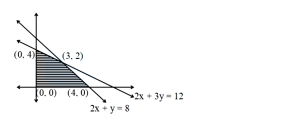
The maximum value of the objective function $z=4x+5y$ subject to the constraints $2x+3y \leq 12$,$2x+y \leq 8$ and $x \geq 0, y \geq 0$ is:
A
$24$
B
$23$
C
$22$
D
$21$
Solution
(C) The feasible region is determined by the constraints $2x+3y \leq 12$,$2x+y \leq 8$,$x \geq 0$,and $y \geq 0$. The corner points of the feasible region are $(0, 0)$,$(4, 0)$,$(3, 2)$,and $(0, 4)$.
We evaluate the objective function $z=4x+5y$ at these corner points:
At $(0, 0)$: $z = 4(0) + 5(0) = 0$
At $(4, 0)$: $z = 4(4) + 5(0) = 16$
At $(3, 2)$: $z = 4(3) + 5(2) = 12 + 10 = 22$
At $(0, 4)$: $z = 4(0) + 5(4) = 20$
The maximum value of $z$ is $22$ at the point $(3, 2)$.
We evaluate the objective function $z=4x+5y$ at these corner points:
At $(0, 0)$: $z = 4(0) + 5(0) = 0$
At $(4, 0)$: $z = 4(4) + 5(0) = 16$
At $(3, 2)$: $z = 4(3) + 5(2) = 12 + 10 = 22$
At $(0, 4)$: $z = 4(0) + 5(4) = 20$
The maximum value of $z$ is $22$ at the point $(3, 2)$.
0 likesView Solution
245
MathematicsEasyMCQMHT CET · 2022
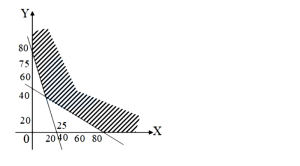
The cost function $Z$ is given by $Z = 4x + 6y$. It is to be minimized. The feasible region for this function $Z$ is the shaded region represented in the following figure. Then the minimum value of $Z$ is and occurs at the point:
A
$260, (20, 30)$
B
$240, (0, 40)$
C
$100, (25, 0)$
D
$254, (14, 33)$
Solution
(D) The feasible region is bounded by the corner points $(0, 80)$,$(14, 33)$,and $(80, 0)$.
We evaluate the objective function $Z = 4x + 6y$ at each corner point:
$1$. At $(0, 80)$: $Z = 4(0) + 6(80) = 480$
$2$. At $(14, 33)$: $Z = 4(14) + 6(33) = 56 + 198 = 254$
$3$. At $(80, 0)$: $Z = 4(80) + 6(0) = 320$
Comparing these values,the minimum value of $Z$ is $254$,which occurs at the point $(14, 33)$.
We evaluate the objective function $Z = 4x + 6y$ at each corner point:
$1$. At $(0, 80)$: $Z = 4(0) + 6(80) = 480$
$2$. At $(14, 33)$: $Z = 4(14) + 6(33) = 56 + 198 = 254$
$3$. At $(80, 0)$: $Z = 4(80) + 6(0) = 320$
Comparing these values,the minimum value of $Z$ is $254$,which occurs at the point $(14, 33)$.
0 likesView Solution
246
MathematicsDifficultMCQMHT CET · 2022
The maximum value of $Z = 5x + 2y$,subject to the constraints $2x - y \geq 2$,$x + 2y \leq 8$,and $x, y \geq 0$,is:
A
$40$
B
$25.6$
C
$20$
D
$17.6$
Solution
(A) To find the maximum value of $Z = 5x + 2y$,we identify the feasible region defined by the constraints:
$1$. $2x - y \geq 2$
$2$. $x + 2y \leq 8$
$3$. $x, y \geq 0$
The boundary lines are $2x - y = 2$ and $x + 2y = 8$.
- For $2x - y = 2$,the intercepts are $(1, 0)$ and $(0, -2)$.
- For $x + 2y = 8$,the intercepts are $(8, 0)$ and $(0, 4)$.
To find the intersection point of $2x - y = 2$ and $x + 2y = 8$:
Multiply the first equation by $2$: $4x - 2y = 4$.
Adding this to $x + 2y = 8$,we get $5x = 12$,so $x = 2.4$.
Substituting $x = 2.4$ into $2x - y = 2$: $2(2.4) - y = 2 \implies 4.8 - y = 2 \implies y = 2.8$.
The vertices of the feasible region are $(1, 0)$,$(8, 0)$,and $(2.4, 2.8)$.
Now,evaluate $Z = 5x + 2y$ at these vertices:
- At $(1, 0)$: $Z = 5(1) + 2(0) = 5$
- At $(8, 0)$: $Z = 5(8) + 2(0) = 40$
- At $(2.4, 2.8)$: $Z = 5(2.4) + 2(2.8) = 12 + 5.6 = 17.6$
Comparing these values,the maximum value is $40$ at $(8, 0)$.
$1$. $2x - y \geq 2$
$2$. $x + 2y \leq 8$
$3$. $x, y \geq 0$
The boundary lines are $2x - y = 2$ and $x + 2y = 8$.
- For $2x - y = 2$,the intercepts are $(1, 0)$ and $(0, -2)$.
- For $x + 2y = 8$,the intercepts are $(8, 0)$ and $(0, 4)$.
To find the intersection point of $2x - y = 2$ and $x + 2y = 8$:
Multiply the first equation by $2$: $4x - 2y = 4$.
Adding this to $x + 2y = 8$,we get $5x = 12$,so $x = 2.4$.
Substituting $x = 2.4$ into $2x - y = 2$: $2(2.4) - y = 2 \implies 4.8 - y = 2 \implies y = 2.8$.
The vertices of the feasible region are $(1, 0)$,$(8, 0)$,and $(2.4, 2.8)$.
Now,evaluate $Z = 5x + 2y$ at these vertices:
- At $(1, 0)$: $Z = 5(1) + 2(0) = 5$
- At $(8, 0)$: $Z = 5(8) + 2(0) = 40$
- At $(2.4, 2.8)$: $Z = 5(2.4) + 2(2.8) = 12 + 5.6 = 17.6$
Comparing these values,the maximum value is $40$ at $(8, 0)$.
0 likesView Solution
247
MathematicsEasyMCQMHT CET · 2022
The objective function of a Linear Programming Problem $(L.P.P.)$ defined over a convex set attains its optimum value at
A
all the corner points.
B
at least two of the corner points.
C
none of the corner points.
D
at least one of the corner points.
Solution
(D) According to the Fundamental Theorem of Linear Programming,if an optimal solution exists for a linear programming problem,it must occur at one of the corner points (vertices) of the feasible region. If the objective function attains the same optimal value at two corner points,then every point on the line segment joining these two points is also an optimal solution. Therefore,the objective function always attains its optimum value at at least one of the corner points.
0 likesView Solution
248
MathematicsEasyMCQMHT CET · 2022
The maximum value of $z=50x+15y$ subject to the constraints $x+y \leq 60$,$5x+y \leq 100$,$x \geq 0$,$y \geq 0$ is at the point:
A
$2650$ at $(50, 10)$
B
$1000$ at $(20, 0)$
C
$900$ at $(0, 60)$
D
$1250$ at $(10, 50)$
Solution
(D) To find the maximum value of $z=50x+15y$,we evaluate the objective function at the corner points of the feasible region.
The corner points of the feasible region are $(0, 0)$,$(20, 0)$,$(10, 50)$,and $(0, 60)$.
Evaluating $z$ at each point:
$1$. At $(0, 0)$: $z = 50(0) + 15(0) = 0$
$2$. At $(20, 0)$: $z = 50(20) + 15(0) = 1000$
$3$. At $(10, 50)$: $z = 50(10) + 15(50) = 500 + 750 = 1250$
$4$. At $(0, 60)$: $z = 50(0) + 15(60) = 900$
The maximum value is $1250$,which occurs at the point $(10, 50)$.
The corner points of the feasible region are $(0, 0)$,$(20, 0)$,$(10, 50)$,and $(0, 60)$.
Evaluating $z$ at each point:
$1$. At $(0, 0)$: $z = 50(0) + 15(0) = 0$
$2$. At $(20, 0)$: $z = 50(20) + 15(0) = 1000$
$3$. At $(10, 50)$: $z = 50(10) + 15(50) = 500 + 750 = 1250$
$4$. At $(0, 60)$: $z = 50(0) + 15(60) = 900$
The maximum value is $1250$,which occurs at the point $(10, 50)$.
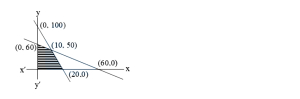
0 likesView Solution
249
MathematicsEasyMCQMHT CET · 2022
For the following shaded region,the linear constraints are:
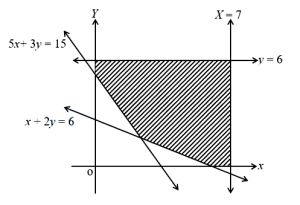
A
$x+2 y \leq 6, 5 x+3 y \leq 15, x \leq 7, y \leq 6, x, y \geq 0$
B
$x+2 y \leq 6, 5 x+3 y \geq 15, x \leq 7, y \leq 6, x, y \geq 0$
C
$x+2 y \geq 6, 5 x+3 y \leq 15, x \leq 7, y \leq 6, x, y \geq 0$
D
$x+2 y \geq 6, 5 x+3 y \geq 15, x \leq 7, y \leq 6, x, y \geq 0$
Solution
(D) To determine the linear constraints for the shaded region,we analyze each boundary line:
$1$. The line $x+2y=6$ has the shaded region on the side away from the origin (since the point $(7, 6)$ satisfies $7+12=19 \geq 6$). Thus,the constraint is $x+2y \geq 6$.
$2$. The line $5x+3y=15$ has the shaded region on the side away from the origin (since the point $(7, 6)$ satisfies $35+18=53 \geq 15$). Thus,the constraint is $5x+3y \geq 15$.
$3$. The vertical line $x=7$ has the shaded region to its left,so $x \leq 7$.
$4$. The horizontal line $y=6$ has the shaded region below it,so $y \leq 6$.
$5$. The region is in the first quadrant,so $x, y \geq 0$.
Combining these,the constraints are $x+2y \geq 6, 5x+3y \geq 15, x \leq 7, y \leq 6, x, y \geq 0$.
$1$. The line $x+2y=6$ has the shaded region on the side away from the origin (since the point $(7, 6)$ satisfies $7+12=19 \geq 6$). Thus,the constraint is $x+2y \geq 6$.
$2$. The line $5x+3y=15$ has the shaded region on the side away from the origin (since the point $(7, 6)$ satisfies $35+18=53 \geq 15$). Thus,the constraint is $5x+3y \geq 15$.
$3$. The vertical line $x=7$ has the shaded region to its left,so $x \leq 7$.
$4$. The horizontal line $y=6$ has the shaded region below it,so $y \leq 6$.
$5$. The region is in the first quadrant,so $x, y \geq 0$.
Combining these,the constraints are $x+2y \geq 6, 5x+3y \geq 15, x \leq 7, y \leq 6, x, y \geq 0$.
0 likesView Solution
250
MathematicsEasyMCQMHT CET · 2022
The function to be maximized is given by $Z=2x+y$. The feasible region for this function $Z$ is the shaded region shown in the figure. The maximum value of $Z$ is . . . . . . and occurs at the point . . . . . . .
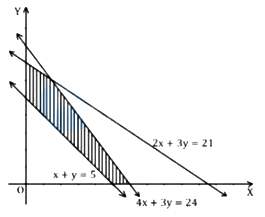
A
$10, (5,0)$
B
$12, (6,0)$
C
$9, (1.5, 6)$
D
$21, (0.5, 0)$
Solution
(B) The feasible region is bounded by the lines $x+y=5$,$4x+3y=24$,$x=0$,and $y=0$.
To find the corner points,we identify the vertices of the shaded region:
$1$. The intersection of $x=0$ and $4x+3y=24$ gives $(0, 8)$.
$2$. The intersection of $x=0$ and $x+y=5$ gives $(0, 5)$.
$3$. The intersection of $x+y=5$ and $4x+3y=24$ is found by solving the system: $y=5-x \implies 4x+3(5-x)=24 \implies x=9, y=-4$ (Not in the first quadrant).
Looking at the graph,the vertices are $(0, 5)$,$(0, 8)$,and the intersection of $4x+3y=24$ with the $x$-axis $(6, 0)$ and $x+y=5$ with the $x$-axis $(5, 0)$.
Evaluating $Z=2x+y$ at the corner points:
At $(0, 5)$,$Z = 2(0) + 5 = 5$.
At $(0, 8)$,$Z = 2(0) + 8 = 8$.
At $(5, 0)$,$Z = 2(5) + 0 = 10$.
At $(6, 0)$,$Z = 2(6) + 0 = 12$.
The maximum value is $12$ at the point $(6, 0)$.
To find the corner points,we identify the vertices of the shaded region:
$1$. The intersection of $x=0$ and $4x+3y=24$ gives $(0, 8)$.
$2$. The intersection of $x=0$ and $x+y=5$ gives $(0, 5)$.
$3$. The intersection of $x+y=5$ and $4x+3y=24$ is found by solving the system: $y=5-x \implies 4x+3(5-x)=24 \implies x=9, y=-4$ (Not in the first quadrant).
Looking at the graph,the vertices are $(0, 5)$,$(0, 8)$,and the intersection of $4x+3y=24$ with the $x$-axis $(6, 0)$ and $x+y=5$ with the $x$-axis $(5, 0)$.
Evaluating $Z=2x+y$ at the corner points:
At $(0, 5)$,$Z = 2(0) + 5 = 5$.
At $(0, 8)$,$Z = 2(0) + 8 = 8$.
At $(5, 0)$,$Z = 2(5) + 0 = 10$.
At $(6, 0)$,$Z = 2(6) + 0 = 12$.
The maximum value is $12$ at the point $(6, 0)$.
0 likesView Solution
Vedclass Products
For Students
Vedclass Test Series
Mock tests in real MHT CET style covering Mathematics with performance analysis. 5-day free trial.
Start Free TrialFor Teachers
Exam Paper Generator
Generate Set A/B/C/D Mathematics papers from 7.5L+ questions in 2 minutes. 3 chapters free.
Try FreeFor Institutes
Online Exam Module
Run live MHT CET mock exams with unlimited students, 360° analytics & white-label branding.
See DemoFrequently Asked Questions
How many Mathematics questions are in MHT CET 2022?
There are 546 Mathematics questions from the MHT CET 2022 paper on Vedclass, each with a detailed step-by-step solution in English.
Are MHT CET 2022 Mathematics solutions available in English?
Yes. All solutions on this page are in English. You can also switch to English or Hindi using the language buttons above the questions.
Can I practice MHT CET 2022 Mathematics as a timed test?
Yes. Use the Vedclass Test Series to attempt a full MHT CET mock test covering Mathematics with time limits and instant score analysis.
Can teachers create Mathematics papers from MHT CET previous year questions?
Yes. The Vedclass Exam Paper Generator lets teachers mix MHT CET Mathematics questions and generate Set A/B/C/D papers in minutes.
For Teachers & Institutes
Build a Custom Mathematics Paper
Pick MHT CET 2022 Mathematics questions, set difficulty, and generate Set A/B/C/D in 2 minutes.