
MathematicsQ301–350 of 546 questions
Page 7 of 9 · English
301
MathematicsEasyMCQMHT CET · 2022
$A$ player tosses $2$ fair coins. He wins $Rs. 5$ if $2$ heads appear,$Rs. 2$ if $1$ head appears,and $Rs. 1$ if no head appears. Then,the variance of his winning amount is
A
$\frac{9}{4}$
B
$6$
C
$\frac{5}{2}$
D
$\frac{17}{2}$
Solution
(A) The sample space for tossing $2$ coins is $\{HH, HT, TH, TT\}$.
The probabilities are:
$P(X=5) = P(HH) = \frac{1}{4}$
$P(X=2) = P(HT, TH) = \frac{2}{4} = \frac{1}{2}$
$P(X=1) = P(TT) = \frac{1}{4}$
We calculate the mean $E(X) = \sum p_i x_i = (5 \times \frac{1}{4}) + (2 \times \frac{1}{2}) + (1 \times \frac{1}{4}) = \frac{5}{4} + 1 + \frac{1}{4} = \frac{6}{4} + 1 = \frac{3}{2} + 1 = \frac{5}{2}$.
Next,we calculate $E(X^2) = \sum p_i x_i^2 = (5^2 \times \frac{1}{4}) + (2^2 \times \frac{1}{2}) + (1^2 \times \frac{1}{4}) = \frac{25}{4} + 2 + \frac{1}{4} = \frac{26}{4} + 2 = \frac{13}{2} + 2 = \frac{17}{2}$.
Variance $Var(X) = E(X^2) - [E(X)]^2 = \frac{17}{2} - (\frac{5}{2})^2 = \frac{17}{2} - \frac{25}{4} = \frac{34-25}{4} = \frac{9}{4}$.
The probabilities are:
$P(X=5) = P(HH) = \frac{1}{4}$
$P(X=2) = P(HT, TH) = \frac{2}{4} = \frac{1}{2}$
$P(X=1) = P(TT) = \frac{1}{4}$
We calculate the mean $E(X) = \sum p_i x_i = (5 \times \frac{1}{4}) + (2 \times \frac{1}{2}) + (1 \times \frac{1}{4}) = \frac{5}{4} + 1 + \frac{1}{4} = \frac{6}{4} + 1 = \frac{3}{2} + 1 = \frac{5}{2}$.
Next,we calculate $E(X^2) = \sum p_i x_i^2 = (5^2 \times \frac{1}{4}) + (2^2 \times \frac{1}{2}) + (1^2 \times \frac{1}{4}) = \frac{25}{4} + 2 + \frac{1}{4} = \frac{26}{4} + 2 = \frac{13}{2} + 2 = \frac{17}{2}$.
Variance $Var(X) = E(X^2) - [E(X)]^2 = \frac{17}{2} - (\frac{5}{2})^2 = \frac{17}{2} - \frac{25}{4} = \frac{34-25}{4} = \frac{9}{4}$.
0 likesView Solution
302
MathematicsMediumMCQMHT CET · 2022
If the function $P[X = x] = \begin{cases} \frac{K \cdot 2^x}{x!}, & x = 0, 1, 2, 3 \\ 0, & \text{otherwise} \end{cases}$ forms a probability mass function (p.m.f.),then the value of $K$ is:
A
$\frac{5}{19}$
B
$\frac{2}{19}$
C
$\frac{3}{19}$
D
$\frac{1}{19}$
Solution
(C) For a function to be a probability mass function (p.m.f.),the sum of all probabilities must be equal to $1$.
$\sum_{x=0}^{3} P(X=x) = 1$
$P(0) + P(1) + P(2) + P(3) = 1$
$K \cdot \frac{2^0}{0!} + K \cdot \frac{2^1}{1!} + K \cdot \frac{2^2}{2!} + K \cdot \frac{2^3}{3!} = 1$
$K \cdot (\frac{1}{1} + \frac{2}{1} + \frac{4}{2} + \frac{8}{6}) = 1$
$K \cdot (1 + 2 + 2 + \frac{4}{3}) = 1$
$K \cdot (5 + \frac{4}{3}) = 1$
$K \cdot (\frac{15+4}{3}) = 1$
$K \cdot \frac{19}{3} = 1$
$K = \frac{3}{19}$
$\sum_{x=0}^{3} P(X=x) = 1$
$P(0) + P(1) + P(2) + P(3) = 1$
$K \cdot \frac{2^0}{0!} + K \cdot \frac{2^1}{1!} + K \cdot \frac{2^2}{2!} + K \cdot \frac{2^3}{3!} = 1$
$K \cdot (\frac{1}{1} + \frac{2}{1} + \frac{4}{2} + \frac{8}{6}) = 1$
$K \cdot (1 + 2 + 2 + \frac{4}{3}) = 1$
$K \cdot (5 + \frac{4}{3}) = 1$
$K \cdot (\frac{15+4}{3}) = 1$
$K \cdot \frac{19}{3} = 1$
$K = \frac{3}{19}$
0 likesView Solution
303
MathematicsMediumMCQMHT CET · 2022
Two cards are drawn successively with replacement from a well-shuffled pack of $52$ cards. Then the probability distribution of the number of kings is:
A
| $X$ | $0$ | $1$ | $2$ |
|---|---|---|---|
| $P(X)$ | $\frac{1}{169}$ | $\frac{144}{169}$ | $\frac{24}{169}$ |
B
| $X$ | $0$ | $1$ | $2$ |
|---|---|---|---|
| $P(X)$ | $\frac{144}{169}$ | $\frac{1}{169}$ | $\frac{24}{169}$ |
C
| $X$ | $0$ | $1$ | $2$ |
|---|---|---|---|
| $P(X)$ | $\frac{144}{169}$ | $\frac{24}{169}$ | $\frac{1}{169}$ |
D
| $X$ | $0$ | $1$ | $2$ |
|---|---|---|---|
| $P(X)$ | $\frac{24}{169}$ | $\frac{1}{169}$ | $\frac{144}{169}$ |
Solution
(C) Let $X$ be the random variable representing the number of kings drawn.
Since the cards are drawn with replacement,the trials are independent.
Total number of cards = $52$.
Number of kings = $4$.
Probability of drawing a king in a single trial,$p = \frac{4}{52} = \frac{1}{13}$.
Probability of not drawing a king in a single trial,$q = 1 - p = 1 - \frac{1}{13} = \frac{12}{13}$.
Since there are $n = 2$ trials,$X$ follows a binomial distribution $B(n, p) = B(2, \frac{1}{13})$.
The probability distribution is given by $P(X = k) = {}^nC_k p^k q^{n-k}$.
For $X = 0$: $P(X = 0) = {}^2C_0 (\frac{1}{13})^0 (\frac{12}{13})^2 = 1 \cdot 1 \cdot \frac{144}{169} = \frac{144}{169}$.
For $X = 1$: $P(X = 1) = {}^2C_1 (\frac{1}{13})^1 (\frac{12}{13})^1 = 2 \cdot \frac{1}{13} \cdot \frac{12}{13} = \frac{24}{169}$.
For $X = 2$: $P(X = 2) = {}^2C_2 (\frac{1}{13})^2 (\frac{12}{13})^0 = 1 \cdot \frac{1}{169} \cdot 1 = \frac{1}{169}$.
Thus,the probability distribution is:
$X=0, P(X)=\frac{144}{169}$
$X=1, P(X)=\frac{24}{169}$
$X=2, P(X)=\frac{1}{169}$
Therefore,option $(C)$ is correct.
Since the cards are drawn with replacement,the trials are independent.
Total number of cards = $52$.
Number of kings = $4$.
Probability of drawing a king in a single trial,$p = \frac{4}{52} = \frac{1}{13}$.
Probability of not drawing a king in a single trial,$q = 1 - p = 1 - \frac{1}{13} = \frac{12}{13}$.
Since there are $n = 2$ trials,$X$ follows a binomial distribution $B(n, p) = B(2, \frac{1}{13})$.
The probability distribution is given by $P(X = k) = {}^nC_k p^k q^{n-k}$.
For $X = 0$: $P(X = 0) = {}^2C_0 (\frac{1}{13})^0 (\frac{12}{13})^2 = 1 \cdot 1 \cdot \frac{144}{169} = \frac{144}{169}$.
For $X = 1$: $P(X = 1) = {}^2C_1 (\frac{1}{13})^1 (\frac{12}{13})^1 = 2 \cdot \frac{1}{13} \cdot \frac{12}{13} = \frac{24}{169}$.
For $X = 2$: $P(X = 2) = {}^2C_2 (\frac{1}{13})^2 (\frac{12}{13})^0 = 1 \cdot \frac{1}{169} \cdot 1 = \frac{1}{169}$.
Thus,the probability distribution is:
$X=0, P(X)=\frac{144}{169}$
$X=1, P(X)=\frac{24}{169}$
$X=2, P(X)=\frac{1}{169}$
Therefore,option $(C)$ is correct.
0 likesView Solution
304
MathematicsEasyMCQMHT CET · 2022
If the probability mass function (p.m.f.) of a random variable $X$ is $P(X=x) = \frac{1}{10}$ for $x = 1, 2, 3, \ldots, 10$,and $0$ otherwise,then $\operatorname{Var}(X)$ is equal to:
A
$\frac{11}{2}$
B
$\frac{33}{4}$
C
$\frac{121}{4}$
D
$\frac{77}{2}$
Solution
(B) The variance of a random variable $X$ is given by $\operatorname{Var}(X) = E(X^2) - [E(X)]^2$.
First,we calculate $E(X) = \sum_{x=1}^{10} x P(X=x) = \frac{1}{10} (1 + 2 + 3 + \ldots + 10) = \frac{1}{10} \times \frac{10 \times 11}{2} = 5.5$.
Next,we calculate $E(X^2) = \sum_{x=1}^{10} x^2 P(X=x) = \frac{1}{10} (1^2 + 2^2 + 3^2 + \ldots + 10^2) = \frac{1}{10} \times \frac{10 \times 11 \times 21}{6} = \frac{231}{6} = 38.5$.
Finally,$\operatorname{Var}(X) = 38.5 - (5.5)^2 = 38.5 - 30.25 = 8.25$.
Since $8.25 = \frac{33}{4}$,the correct option is $B$.
First,we calculate $E(X) = \sum_{x=1}^{10} x P(X=x) = \frac{1}{10} (1 + 2 + 3 + \ldots + 10) = \frac{1}{10} \times \frac{10 \times 11}{2} = 5.5$.
Next,we calculate $E(X^2) = \sum_{x=1}^{10} x^2 P(X=x) = \frac{1}{10} (1^2 + 2^2 + 3^2 + \ldots + 10^2) = \frac{1}{10} \times \frac{10 \times 11 \times 21}{6} = \frac{231}{6} = 38.5$.
Finally,$\operatorname{Var}(X) = 38.5 - (5.5)^2 = 38.5 - 30.25 = 8.25$.
Since $8.25 = \frac{33}{4}$,the correct option is $B$.
0 likesView Solution
305
MathematicsMediumMCQMHT CET · 2022
In a pizza hut,the following distribution is found for the daily demand of pizzas. Then the expected daily demand and variance are respectively:
| No. of Pizzas $(x_i)$ | $5$ | $6$ | $7$ | $8$ | $9$ | $10$ |
|---|---|---|---|---|---|---|
| Probability $(P_i)$ | $0.07$ | $0.2$ | $0.3$ | $0.3$ | $0.07$ | $0.06$ |
A
$7.28$ and $1.52$
B
$1.52$ and $7.28$
C
$7.28$ and $54.52$
D
$7.28$ and $53$
Solution
(A) The expected daily demand (mean) is given by $E(X) = \Sigma P_i x_i$.
$E(X) = (5 \times 0.07) + (6 \times 0.2) + (7 \times 0.3) + (8 \times 0.3) + (9 \times 0.07) + (10 \times 0.06)$
$E(X) = 0.35 + 1.2 + 2.1 + 2.4 + 0.63 + 0.6 = 7.28$.
The variance is given by $Var(X) = \Sigma P_i x_i^2 - (E(X))^2$.
First,calculate $\Sigma P_i x_i^2$:
$\Sigma P_i x_i^2 = (25 \times 0.07) + (36 \times 0.2) + (49 \times 0.3) + (64 \times 0.3) + (81 \times 0.07) + (100 \times 0.06)$
$\Sigma P_i x_i^2 = 1.75 + 7.2 + 14.7 + 19.2 + 5.67 + 6.0 = 54.52$.
Now,calculate variance:
$Var(X) = 54.52 - (7.28)^2$
$Var(X) = 54.52 - 52.9984 \approx 1.52$.
Thus,the expected demand is $7.28$ and the variance is $1.52$.
$E(X) = (5 \times 0.07) + (6 \times 0.2) + (7 \times 0.3) + (8 \times 0.3) + (9 \times 0.07) + (10 \times 0.06)$
$E(X) = 0.35 + 1.2 + 2.1 + 2.4 + 0.63 + 0.6 = 7.28$.
The variance is given by $Var(X) = \Sigma P_i x_i^2 - (E(X))^2$.
First,calculate $\Sigma P_i x_i^2$:
$\Sigma P_i x_i^2 = (25 \times 0.07) + (36 \times 0.2) + (49 \times 0.3) + (64 \times 0.3) + (81 \times 0.07) + (100 \times 0.06)$
$\Sigma P_i x_i^2 = 1.75 + 7.2 + 14.7 + 19.2 + 5.67 + 6.0 = 54.52$.
Now,calculate variance:
$Var(X) = 54.52 - (7.28)^2$
$Var(X) = 54.52 - 52.9984 \approx 1.52$.
Thus,the expected demand is $7.28$ and the variance is $1.52$.
0 likesView Solution
306
MathematicsEasyMCQMHT CET · 2022
The position vector of a point that divides the line segment joining $P \equiv(1,2,-1)$ and $Q \equiv(-1,1,1)$ externally in the ratio $1: 2$ is:
A
$3 \hat{i}-3 \hat{k}$
B
$3 \hat{i}+3 \hat{j}-3 \hat{k}$
C
$-3 \hat{i}+3 \hat{k}$
D
$3 \hat{i}+\hat{j}+3 \hat{k}$
Solution
(B) Let the points be $\vec{p} = \hat{i} + 2\hat{j} - \hat{k}$ and $\vec{q} = -\hat{i} + \hat{j} + \hat{k}$.
For external division in the ratio $m:n = 1:2$,the position vector $\vec{r}$ is given by the formula:
$\vec{r} = \frac{m\vec{q} - n\vec{p}}{m - n}$
Substituting the values:
$\vec{r} = \frac{1(-\hat{i} + \hat{j} + \hat{k}) - 2(\hat{i} + 2\hat{j} - \hat{k})}{1 - 2}$
$\vec{r} = \frac{-\hat{i} + \hat{j} + \hat{k} - 2\hat{i} - 4\hat{j} + 2\hat{k}}{-1}$
$\vec{r} = \frac{-3\hat{i} - 3\hat{j} + 3\hat{k}}{-1}$
$\vec{r} = 3\hat{i} + 3\hat{j} - 3\hat{k}$
For external division in the ratio $m:n = 1:2$,the position vector $\vec{r}$ is given by the formula:
$\vec{r} = \frac{m\vec{q} - n\vec{p}}{m - n}$
Substituting the values:
$\vec{r} = \frac{1(-\hat{i} + \hat{j} + \hat{k}) - 2(\hat{i} + 2\hat{j} - \hat{k})}{1 - 2}$
$\vec{r} = \frac{-\hat{i} + \hat{j} + \hat{k} - 2\hat{i} - 4\hat{j} + 2\hat{k}}{-1}$
$\vec{r} = \frac{-3\hat{i} - 3\hat{j} + 3\hat{k}}{-1}$
$\vec{r} = 3\hat{i} + 3\hat{j} - 3\hat{k}$
0 likesView Solution
307
MathematicsMediumMCQMHT CET · 2022
$A$ line makes angles $\frac{\alpha}{2}, \frac{\beta}{2}, \frac{\gamma}{2}$ with the positive directions of the coordinate axes ($x, y, z$ axes respectively). Then,the value of $\cos \alpha + \cos \beta + \cos \gamma$ is:
A
$1$
B
$2$
C
$3$
D
$-1$
Solution
(D) Let the direction cosines of the line be $l, m, n$. Since the line makes angles $\frac{\alpha}{2}, \frac{\beta}{2}, \frac{\gamma}{2}$ with the axes,we have $l = \cos(\frac{\alpha}{2}), m = \cos(\frac{\beta}{2}), n = \cos(\frac{\gamma}{2})$.
Since $l^2 + m^2 + n^2 = 1$,we have $\cos^2(\frac{\alpha}{2}) + \cos^2(\frac{\beta}{2}) + \cos^2(\frac{\gamma}{2}) = 1$.
We know that $\cos \theta = 2 \cos^2(\frac{\theta}{2}) - 1$,so $\cos^2(\frac{\theta}{2}) = \frac{1 + \cos \theta}{2}$.
Substituting this into the identity:
$\frac{1 + \cos \alpha}{2} + \frac{1 + \cos \beta}{2} + \frac{1 + \cos \gamma}{2} = 1$
$\frac{3 + \cos \alpha + \cos \beta + \cos \gamma}{2} = 1$
$3 + \cos \alpha + \cos \beta + \cos \gamma = 2$
$\cos \alpha + \cos \beta + \cos \gamma = 2 - 3 = -1$.
Since $l^2 + m^2 + n^2 = 1$,we have $\cos^2(\frac{\alpha}{2}) + \cos^2(\frac{\beta}{2}) + \cos^2(\frac{\gamma}{2}) = 1$.
We know that $\cos \theta = 2 \cos^2(\frac{\theta}{2}) - 1$,so $\cos^2(\frac{\theta}{2}) = \frac{1 + \cos \theta}{2}$.
Substituting this into the identity:
$\frac{1 + \cos \alpha}{2} + \frac{1 + \cos \beta}{2} + \frac{1 + \cos \gamma}{2} = 1$
$\frac{3 + \cos \alpha + \cos \beta + \cos \gamma}{2} = 1$
$3 + \cos \alpha + \cos \beta + \cos \gamma = 2$
$\cos \alpha + \cos \beta + \cos \gamma = 2 - 3 = -1$.
0 likesView Solution
308
MathematicsMediumMCQMHT CET · 2022
$A$ line makes the same angle $\alpha$ with each of the $x$ and $y$ axes. If the angle $\theta$,which it makes with the $z$-axis,is such that $\sin^2 \theta = 2 \sin^2 \alpha$,then the angle $\alpha$ is
A
$\frac{\pi}{6}$
B
$\frac{\pi}{4}$
C
$\frac{\pi}{2}$
D
$\frac{\pi}{3}$
Solution
(B) Let the direction cosines of the line be $l, m, n$. Since the line makes the same angle $\alpha$ with the $x$ and $y$ axes,we have $l = \cos \alpha$ and $m = \cos \alpha$. Let the angle with the $z$-axis be $\theta$,so $n = \cos \theta$.
We know that $l^2 + m^2 + n^2 = 1$,which implies $\cos^2 \alpha + \cos^2 \alpha + \cos^2 \theta = 1$.
Using the identity $\cos^2 \phi = 1 - \sin^2 \phi$,we get $(1 - \sin^2 \alpha) + (1 - \sin^2 \alpha) + (1 - \sin^2 \theta) = 1$.
$3 - 2 \sin^2 \alpha - \sin^2 \theta = 1$.
Given $\sin^2 \theta = 2 \sin^2 \alpha$,substituting this into the equation:
$3 - 2 \sin^2 \alpha - 2 \sin^2 \alpha = 1$.
$3 - 4 \sin^2 \alpha = 1$.
$4 \sin^2 \alpha = 2$.
$\sin^2 \alpha = \frac{1}{2} = \sin^2 \frac{\pi}{4}$.
Thus,$\alpha = \frac{\pi}{4}$.
We know that $l^2 + m^2 + n^2 = 1$,which implies $\cos^2 \alpha + \cos^2 \alpha + \cos^2 \theta = 1$.
Using the identity $\cos^2 \phi = 1 - \sin^2 \phi$,we get $(1 - \sin^2 \alpha) + (1 - \sin^2 \alpha) + (1 - \sin^2 \theta) = 1$.
$3 - 2 \sin^2 \alpha - \sin^2 \theta = 1$.
Given $\sin^2 \theta = 2 \sin^2 \alpha$,substituting this into the equation:
$3 - 2 \sin^2 \alpha - 2 \sin^2 \alpha = 1$.
$3 - 4 \sin^2 \alpha = 1$.
$4 \sin^2 \alpha = 2$.
$\sin^2 \alpha = \frac{1}{2} = \sin^2 \frac{\pi}{4}$.
Thus,$\alpha = \frac{\pi}{4}$.
0 likesView Solution
309
MathematicsMediumMCQMHT CET · 2022
The magnitude of the projection of the vector $2 \hat{i}+3 \hat{j}+\hat{k}$ on the vector perpendicular to the plane containing the vectors $\hat{i}+\hat{j}+\hat{k}$ and $\hat{i}+2 \hat{j}+3 \hat{k}$ is
A
$\sqrt{\frac{3}{2}}$ units
B
$\frac{\sqrt{3}}{2}$ units
C
$\frac{3}{\sqrt{2}}$ units
D
$3 \sqrt{6}$ units
Solution
(A) Let $\vec{a} = 2\hat{i}+3\hat{j}+\hat{k}$,$\vec{b} = \hat{i}+\hat{j}+\hat{k}$,and $\vec{c} = \hat{i}+2\hat{j}+3\hat{k}$.
The vector perpendicular to the plane containing $\vec{b}$ and $\vec{c}$ is given by $\vec{n} = \vec{b} \times \vec{c}$.
$\vec{n} = \begin{vmatrix} \hat{i} & \hat{j} & \hat{k} \\ 1 & 1 & 1 \\ 1 & 2 & 3 \end{vmatrix} = \hat{i}(3-2) - \hat{j}(3-1) + \hat{k}(2-1) = \hat{i} - 2\hat{j} + \hat{k}$.
The projection of $\vec{a}$ on $\vec{n}$ is given by $\frac{|\vec{a} \cdot \vec{n}|}{|\vec{n}|}$.
$\vec{a} \cdot \vec{n} = (2\hat{i}+3\hat{j}+\hat{k}) \cdot (\hat{i}-2\hat{j}+\hat{k}) = (2)(1) + (3)(-2) + (1)(1) = 2 - 6 + 1 = -3$.
$|\vec{n}| = \sqrt{1^2 + (-2)^2 + 1^2} = \sqrt{1+4+1} = \sqrt{6}$.
Magnitude of projection = $\frac{|-3|}{\sqrt{6}} = \frac{3}{\sqrt{6}} = \frac{3}{\sqrt{2} \times \sqrt{3}} = \frac{\sqrt{3}}{\sqrt{2}} = \sqrt{\frac{3}{2}}$ units.
The vector perpendicular to the plane containing $\vec{b}$ and $\vec{c}$ is given by $\vec{n} = \vec{b} \times \vec{c}$.
$\vec{n} = \begin{vmatrix} \hat{i} & \hat{j} & \hat{k} \\ 1 & 1 & 1 \\ 1 & 2 & 3 \end{vmatrix} = \hat{i}(3-2) - \hat{j}(3-1) + \hat{k}(2-1) = \hat{i} - 2\hat{j} + \hat{k}$.
The projection of $\vec{a}$ on $\vec{n}$ is given by $\frac{|\vec{a} \cdot \vec{n}|}{|\vec{n}|}$.
$\vec{a} \cdot \vec{n} = (2\hat{i}+3\hat{j}+\hat{k}) \cdot (\hat{i}-2\hat{j}+\hat{k}) = (2)(1) + (3)(-2) + (1)(1) = 2 - 6 + 1 = -3$.
$|\vec{n}| = \sqrt{1^2 + (-2)^2 + 1^2} = \sqrt{1+4+1} = \sqrt{6}$.
Magnitude of projection = $\frac{|-3|}{\sqrt{6}} = \frac{3}{\sqrt{6}} = \frac{3}{\sqrt{2} \times \sqrt{3}} = \frac{\sqrt{3}}{\sqrt{2}} = \sqrt{\frac{3}{2}}$ units.
0 likesView Solution
310
MathematicsMediumMCQMHT CET · 2022
The vector projection of $\vec{b}$ on $\vec{a}$ where $\vec{a}=3 \hat{i}+2 \hat{j}+5 \hat{k}$ and $\vec{b}=7 \hat{i}-5 \hat{j}-\hat{k}$ is:
A
$\frac{6(3 \hat{i}+2 \hat{j}+5 \hat{k})}{\sqrt{38}}$
B
$\frac{3(3 \hat{i}+2 \hat{j}+5 \hat{k})}{38}$
C
$\frac{3(3 \hat{i}+2 \hat{j}+5 \hat{k})}{19}$
D
$\frac{3(3 \hat{i}+2 \hat{j}+5 \hat{k})}{\sqrt{38}}$
Solution
(C) The vector projection of $\vec{b}$ on $\vec{a}$ is given by the formula: $\left(\frac{\vec{b} \cdot \vec{a}}{|\vec{a}|^2}\right) \vec{a}$.
First,calculate the dot product $\vec{b} \cdot \vec{a} = (7)(3) + (-5)(2) + (-1)(5) = 21 - 10 - 5 = 6$.
Next,calculate the square of the magnitude of $\vec{a}$: $|\vec{a}|^2 = 3^2 + 2^2 + 5^2 = 9 + 4 + 25 = 38$.
Now,substitute these values into the formula:
Vector projection = $\frac{6}{38} (3 \hat{i} + 2 \hat{j} + 5 \hat{k}) = \frac{3}{19} (3 \hat{i} + 2 \hat{j} + 5 \hat{k})$.
First,calculate the dot product $\vec{b} \cdot \vec{a} = (7)(3) + (-5)(2) + (-1)(5) = 21 - 10 - 5 = 6$.
Next,calculate the square of the magnitude of $\vec{a}$: $|\vec{a}|^2 = 3^2 + 2^2 + 5^2 = 9 + 4 + 25 = 38$.
Now,substitute these values into the formula:
Vector projection = $\frac{6}{38} (3 \hat{i} + 2 \hat{j} + 5 \hat{k}) = \frac{3}{19} (3 \hat{i} + 2 \hat{j} + 5 \hat{k})$.
0 likesView Solution
311
MathematicsMediumMCQMHT CET · 2022
The angle between two lines $\frac{x+1}{2}=\frac{y+3}{2}=\frac{z-4}{-1}$ and $\frac{x-4}{1}=\frac{y+4}{2}=\frac{z+1}{2}$ is
A
$\cos ^{-1}\left(\frac{4}{9}\right)$
B
$\cos ^{-1}\left(\frac{2}{9}\right)$
C
$\cos ^{-1}\left(\frac{1}{9}\right)$
D
$\cos ^{-1}\left(\frac{5}{9}\right)$
Solution
(A) The direction ratios of the first line are $\vec{a_1} = (2, 2, -1)$.
The direction ratios of the second line are $\vec{a_2} = (1, 2, 2)$.
The angle $\theta$ between two lines with direction ratios $(a_1, b_1, c_1)$ and $(a_2, b_2, c_2)$ is given by $\cos \theta = \frac{|a_1 a_2 + b_1 b_2 + c_1 c_2|}{\sqrt{a_1^2 + b_1^2 + c_1^2} \sqrt{a_2^2 + b_2^2 + c_2^2}}$.
Substituting the values:
$\cos \theta = \frac{|(2)(1) + (2)(2) + (-1)(2)|}{\sqrt{2^2 + 2^2 + (-1)^2} \sqrt{1^2 + 2^2 + 2^2}}$
$\cos \theta = \frac{|2 + 4 - 2|}{\sqrt{4 + 4 + 1} \sqrt{1 + 4 + 4}}$
$\cos \theta = \frac{4}{\sqrt{9} \sqrt{9}} = \frac{4}{3 \times 3} = \frac{4}{9}$.
Therefore,$\theta = \cos ^{-1}\left(\frac{4}{9}\right)$.
The direction ratios of the second line are $\vec{a_2} = (1, 2, 2)$.
The angle $\theta$ between two lines with direction ratios $(a_1, b_1, c_1)$ and $(a_2, b_2, c_2)$ is given by $\cos \theta = \frac{|a_1 a_2 + b_1 b_2 + c_1 c_2|}{\sqrt{a_1^2 + b_1^2 + c_1^2} \sqrt{a_2^2 + b_2^2 + c_2^2}}$.
Substituting the values:
$\cos \theta = \frac{|(2)(1) + (2)(2) + (-1)(2)|}{\sqrt{2^2 + 2^2 + (-1)^2} \sqrt{1^2 + 2^2 + 2^2}}$
$\cos \theta = \frac{|2 + 4 - 2|}{\sqrt{4 + 4 + 1} \sqrt{1 + 4 + 4}}$
$\cos \theta = \frac{4}{\sqrt{9} \sqrt{9}} = \frac{4}{3 \times 3} = \frac{4}{9}$.
Therefore,$\theta = \cos ^{-1}\left(\frac{4}{9}\right)$.
0 likesView Solution
312
MathematicsEasyMCQMHT CET · 2022
The direction cosines of the line which is perpendicular to the lines $\frac{x-7}{2}=\frac{y+17}{-3}=\frac{z-6}{1}$ and $\frac{x+5}{1}=\frac{y+3}{2}=\frac{z-6}{-2}$ are
A
$\pm \frac{3}{\sqrt{50}}, \pm \frac{4}{\sqrt{50}}, \pm \frac{5}{\sqrt{50}}$
B
$\pm \frac{4}{\sqrt{90}}, \pm \frac{5}{\sqrt{90}}, \pm \frac{7}{\sqrt{90}}$
C
$\pm \frac{4}{\sqrt{29}}, \pm \frac{3}{\sqrt{29}}, \pm \frac{2}{\sqrt{29}}$
D
$\pm \frac{1}{\sqrt{26}}, \pm \frac{3}{\sqrt{26}}, \pm \frac{4}{\sqrt{26}}$
Solution
(B) Let the direction ratios of the two lines be $\vec{v_1} = (2, -3, 1)$ and $\vec{v_2} = (1, 2, -2)$.
Since the required line is perpendicular to both lines,its direction ratios $(a, b, c)$ are given by the cross product $\vec{v_1} \times \vec{v_2}$.
$\vec{v_1} \times \vec{v_2} = \begin{vmatrix} \hat{i} & \hat{j} & \hat{k} \\ 2 & -3 & 1 \\ 1 & 2 & -2 \end{vmatrix} = \hat{i}(6-2) - \hat{j}(-4-1) + \hat{k}(4+3) = 4\hat{i} + 5\hat{j} + 7\hat{k}$.
Thus,the direction ratios are $(4, 5, 7)$.
The magnitude is $\sqrt{4^2 + 5^2 + 7^2} = \sqrt{16 + 25 + 49} = \sqrt{90}$.
The direction cosines are $\pm \frac{4}{\sqrt{90}}, \pm \frac{5}{\sqrt{90}}, \pm \frac{7}{\sqrt{90}}$.
Since the required line is perpendicular to both lines,its direction ratios $(a, b, c)$ are given by the cross product $\vec{v_1} \times \vec{v_2}$.
$\vec{v_1} \times \vec{v_2} = \begin{vmatrix} \hat{i} & \hat{j} & \hat{k} \\ 2 & -3 & 1 \\ 1 & 2 & -2 \end{vmatrix} = \hat{i}(6-2) - \hat{j}(-4-1) + \hat{k}(4+3) = 4\hat{i} + 5\hat{j} + 7\hat{k}$.
Thus,the direction ratios are $(4, 5, 7)$.
The magnitude is $\sqrt{4^2 + 5^2 + 7^2} = \sqrt{16 + 25 + 49} = \sqrt{90}$.
The direction cosines are $\pm \frac{4}{\sqrt{90}}, \pm \frac{5}{\sqrt{90}}, \pm \frac{7}{\sqrt{90}}$.
0 likesView Solution
313
MathematicsMediumMCQMHT CET · 2022
The magnitude of the projection of the vector $2\hat{i}+\hat{j}+\hat{k}$ on the vector perpendicular to the plane containing the vectors $\hat{i}+\hat{j}+\hat{k}$ and $\hat{i}+2\hat{j}+3\hat{k}$ is:
A
$\frac{5}{\sqrt{6}}$ units
B
$\frac{1}{\sqrt{6}}$ units
C
$\sqrt{6}$ units
D
$\frac{2}{\sqrt{6}}$ units
Solution
(B) Let $\vec{a} = 2\hat{i}+\hat{j}+\hat{k}$,$\vec{b} = \hat{i}+\hat{j}+\hat{k}$,and $\vec{c} = \hat{i}+2\hat{j}+3\hat{k}$.
The vector perpendicular to the plane containing $\vec{b}$ and $\vec{c}$ is given by $\vec{n} = \vec{b} \times \vec{c}$.
$\vec{n} = \begin{vmatrix} \hat{i} & \hat{j} & \hat{k} \\ 1 & 1 & 1 \\ 1 & 2 & 3 \end{vmatrix} = \hat{i}(3-2) - \hat{j}(3-1) + \hat{k}(2-1) = \hat{i} - 2\hat{j} + \hat{k}$.
The magnitude of the projection of $\vec{a}$ on $\vec{n}$ is given by $\left| \frac{\vec{a} \cdot \vec{n}}{|\vec{n}|} \right|$.
$\vec{a} \cdot \vec{n} = (2)(1) + (1)(-2) + (1)(1) = 2 - 2 + 1 = 1$.
$|\vec{n}| = \sqrt{1^2 + (-2)^2 + 1^2} = \sqrt{1 + 4 + 1} = \sqrt{6}$.
Therefore,the required projection is $\frac{1}{\sqrt{6}}$ units.
The vector perpendicular to the plane containing $\vec{b}$ and $\vec{c}$ is given by $\vec{n} = \vec{b} \times \vec{c}$.
$\vec{n} = \begin{vmatrix} \hat{i} & \hat{j} & \hat{k} \\ 1 & 1 & 1 \\ 1 & 2 & 3 \end{vmatrix} = \hat{i}(3-2) - \hat{j}(3-1) + \hat{k}(2-1) = \hat{i} - 2\hat{j} + \hat{k}$.
The magnitude of the projection of $\vec{a}$ on $\vec{n}$ is given by $\left| \frac{\vec{a} \cdot \vec{n}}{|\vec{n}|} \right|$.
$\vec{a} \cdot \vec{n} = (2)(1) + (1)(-2) + (1)(1) = 2 - 2 + 1 = 1$.
$|\vec{n}| = \sqrt{1^2 + (-2)^2 + 1^2} = \sqrt{1 + 4 + 1} = \sqrt{6}$.
Therefore,the required projection is $\frac{1}{\sqrt{6}}$ units.
0 likesView Solution
314
MathematicsDifficultMCQMHT CET · 2022
The direction cosines of the line,which is perpendicular to the lines with direction ratios $-1, 2, 2$ and $0, 2, 1$,are respectively
A
$\frac{1}{3}, \frac{-2}{3}, \frac{-2}{3}$
B
$\frac{2}{3}, \frac{-1}{3}, \frac{2}{3}$
C
$\frac{-1}{3}, \frac{2}{3}, \frac{2}{3}$
D
$\frac{1}{3}, \frac{2}{3}, \frac{2}{3}$
Solution
(B) Let the direction ratios of the required line be $a, b, c$. Since the line is perpendicular to the lines with direction ratios $\langle -1, 2, 2 \rangle$ and $\langle 0, 2, 1 \rangle$,the vector $\vec{n} = \langle a, b, c \rangle$ is parallel to the cross product of the two given vectors.
$\vec{n} = \begin{vmatrix} \hat{i} & \hat{j} & \hat{k} \\ -1 & 2 & 2 \\ 0 & 2 & 1 \end{vmatrix} = \hat{i}(2-4) - \hat{j}(-1-0) + \hat{k}(-2-0) = -2\hat{i} + \hat{j} - 2\hat{k}$.
Thus,the direction ratios are $\langle -2, 1, -2 \rangle$ or $\langle 2, -1, 2 \rangle$.
The magnitude of the vector is $\sqrt{2^2 + (-1)^2 + 2^2} = \sqrt{4+1+4} = \sqrt{9} = 3$.
The direction cosines are $\langle \frac{2}{3}, \frac{-1}{3}, \frac{2}{3} \rangle$.
$\vec{n} = \begin{vmatrix} \hat{i} & \hat{j} & \hat{k} \\ -1 & 2 & 2 \\ 0 & 2 & 1 \end{vmatrix} = \hat{i}(2-4) - \hat{j}(-1-0) + \hat{k}(-2-0) = -2\hat{i} + \hat{j} - 2\hat{k}$.
Thus,the direction ratios are $\langle -2, 1, -2 \rangle$ or $\langle 2, -1, 2 \rangle$.
The magnitude of the vector is $\sqrt{2^2 + (-1)^2 + 2^2} = \sqrt{4+1+4} = \sqrt{9} = 3$.
The direction cosines are $\langle \frac{2}{3}, \frac{-1}{3}, \frac{2}{3} \rangle$.
0 likesView Solution
315
MathematicsEasyMCQMHT CET · 2022
The equation of the line passing through the point $(-1, 3, -2)$ and perpendicular to each of the lines $\frac{x}{1} = \frac{y}{2} = \frac{z}{3}$ and $\frac{x+2}{-3} = \frac{y-1}{2} = \frac{z+1}{5}$ is
A
$\frac{x+1}{2} = \frac{y-3}{7} = \frac{z+2}{4}$
B
$\frac{x+1}{2} = \frac{y-3}{-7} = \frac{z+2}{4}$
C
$\frac{x-1}{2} = \frac{y+3}{-7} = \frac{z+2}{4}$
D
$\frac{x-1}{2} = \frac{y+3}{7} = \frac{z-2}{4}$
Solution
(B) Let the direction ratios of the required line be $a, b, c$.
Since the line is perpendicular to the lines with direction ratios $(1, 2, 3)$ and $(-3, 2, 5)$,we have:
$a + 2b + 3c = 0$ --- $(i)$
$-3a + 2b + 5c = 0$ --- $(ii)$
Using the cross-multiplication method to solve for $a, b, c$:
$\frac{a}{(2)(5) - (3)(2)} = \frac{b}{(3)(-3) - (1)(5)} = \frac{c}{(1)(2) - (2)(-3)}$
$\frac{a}{10 - 6} = \frac{b}{-9 - 5} = \frac{c}{2 + 6}$
$\frac{a}{4} = \frac{b}{-14} = \frac{c}{8}$
Dividing by $2$,we get the direction ratios as $(2, -7, 4)$.
The line passes through the point $(-1, 3, -2)$.
Therefore,the equation of the line is $\frac{x - (-1)}{2} = \frac{y - 3}{-7} = \frac{z - (-2)}{4}$,which simplifies to $\frac{x+1}{2} = \frac{y-3}{-7} = \frac{z+2}{4}$.
Since the line is perpendicular to the lines with direction ratios $(1, 2, 3)$ and $(-3, 2, 5)$,we have:
$a + 2b + 3c = 0$ --- $(i)$
$-3a + 2b + 5c = 0$ --- $(ii)$
Using the cross-multiplication method to solve for $a, b, c$:
$\frac{a}{(2)(5) - (3)(2)} = \frac{b}{(3)(-3) - (1)(5)} = \frac{c}{(1)(2) - (2)(-3)}$
$\frac{a}{10 - 6} = \frac{b}{-9 - 5} = \frac{c}{2 + 6}$
$\frac{a}{4} = \frac{b}{-14} = \frac{c}{8}$
Dividing by $2$,we get the direction ratios as $(2, -7, 4)$.
The line passes through the point $(-1, 3, -2)$.
Therefore,the equation of the line is $\frac{x - (-1)}{2} = \frac{y - 3}{-7} = \frac{z - (-2)}{4}$,which simplifies to $\frac{x+1}{2} = \frac{y-3}{-7} = \frac{z+2}{4}$.
0 likesView Solution
316
MathematicsEasyMCQMHT CET · 2022
The angle between the lines $\bar{r}=(3 \hat{i}+2 \hat{j}-4 \hat{k})+\lambda(\hat{i}+2 \hat{j}+2 \hat{k})$ and $\bar{r}=(5 \hat{i}-2 \hat{k})+\mu(3 \hat{i}+2 \hat{j}+6 \hat{k})$ is:
A
$\cos ^{-1}\left(\frac{20}{21}\right)$
B
$\cos ^{-1}\left(\frac{4}{21}\right)$
C
$\cos ^{-1}\left(\frac{16}{21}\right)$
D
$\cos ^{-1}\left(\frac{19}{21}\right)$
Solution
(D) The direction vectors of the two lines are $\vec{a} = \hat{i} + 2\hat{j} + 2\hat{k}$ and $\vec{b} = 3\hat{i} + 2\hat{j} + 6\hat{k}$.
The angle $\theta$ between the lines is given by the formula $\cos \theta = \frac{|\vec{a} \cdot \vec{b}|}{|\vec{a}| |\vec{b}|}$.
First,calculate the dot product: $\vec{a} \cdot \vec{b} = (1)(3) + (2)(2) + (2)(6) = 3 + 4 + 12 = 19$.
Next,calculate the magnitudes: $|\vec{a}| = \sqrt{1^2 + 2^2 + 2^2} = \sqrt{1 + 4 + 4} = \sqrt{9} = 3$.
$|\vec{b}| = \sqrt{3^2 + 2^2 + 6^2} = \sqrt{9 + 4 + 36} = \sqrt{49} = 7$.
Therefore,$\cos \theta = \frac{19}{3 \times 7} = \frac{19}{21}$.
Thus,$\theta = \cos ^{-1}\left(\frac{19}{21}\right)$.
The angle $\theta$ between the lines is given by the formula $\cos \theta = \frac{|\vec{a} \cdot \vec{b}|}{|\vec{a}| |\vec{b}|}$.
First,calculate the dot product: $\vec{a} \cdot \vec{b} = (1)(3) + (2)(2) + (2)(6) = 3 + 4 + 12 = 19$.
Next,calculate the magnitudes: $|\vec{a}| = \sqrt{1^2 + 2^2 + 2^2} = \sqrt{1 + 4 + 4} = \sqrt{9} = 3$.
$|\vec{b}| = \sqrt{3^2 + 2^2 + 6^2} = \sqrt{9 + 4 + 36} = \sqrt{49} = 7$.
Therefore,$\cos \theta = \frac{19}{3 \times 7} = \frac{19}{21}$.
Thus,$\theta = \cos ^{-1}\left(\frac{19}{21}\right)$.
0 likesView Solution
317
MathematicsEasyMCQMHT CET · 2022
The acute angle between the lines $x=-y, z=0$ and $x=0, z=0$ is
A
$\frac{\pi}{3}$
B
$\frac{\pi}{6}$
C
$\frac{\pi}{4}$
D
$\frac{\pi}{18}$
Solution
(C) The given lines are $x = -y, z = 0$ and $x = 0, z = 0$.
We can write these lines in symmetric form:
Line $1$: $\frac{x}{1} = \frac{y}{-1} = \frac{z}{0}$,so the direction vector is $\vec{v_1} = (1, -1, 0)$.
Line $2$: $\frac{x}{0} = \frac{y}{1} = \frac{z}{0}$,so the direction vector is $\vec{v_2} = (0, 1, 0)$.
The angle $\theta$ between the lines is given by $\cos \theta = \left| \frac{\vec{v_1} \cdot \vec{v_2}}{|\vec{v_1}| |\vec{v_2}|} \right|$.
Calculating the dot product: $\vec{v_1} \cdot \vec{v_2} = (1)(0) + (-1)(1) + (0)(0) = -1$.
Calculating the magnitudes: $|\vec{v_1}| = \sqrt{1^2 + (-1)^2 + 0^2} = \sqrt{2}$ and $|\vec{v_2}| = \sqrt{0^2 + 1^2 + 0^2} = 1$.
Thus,$\cos \theta = \left| \frac{-1}{\sqrt{2} \times 1} \right| = \frac{1}{\sqrt{2}}$.
Therefore,$\theta = \cos^{-1}\left(\frac{1}{\sqrt{2}}\right) = \frac{\pi}{4}$.
We can write these lines in symmetric form:
Line $1$: $\frac{x}{1} = \frac{y}{-1} = \frac{z}{0}$,so the direction vector is $\vec{v_1} = (1, -1, 0)$.
Line $2$: $\frac{x}{0} = \frac{y}{1} = \frac{z}{0}$,so the direction vector is $\vec{v_2} = (0, 1, 0)$.
The angle $\theta$ between the lines is given by $\cos \theta = \left| \frac{\vec{v_1} \cdot \vec{v_2}}{|\vec{v_1}| |\vec{v_2}|} \right|$.
Calculating the dot product: $\vec{v_1} \cdot \vec{v_2} = (1)(0) + (-1)(1) + (0)(0) = -1$.
Calculating the magnitudes: $|\vec{v_1}| = \sqrt{1^2 + (-1)^2 + 0^2} = \sqrt{2}$ and $|\vec{v_2}| = \sqrt{0^2 + 1^2 + 0^2} = 1$.
Thus,$\cos \theta = \left| \frac{-1}{\sqrt{2} \times 1} \right| = \frac{1}{\sqrt{2}}$.
Therefore,$\theta = \cos^{-1}\left(\frac{1}{\sqrt{2}}\right) = \frac{\pi}{4}$.
0 likesView Solution
318
MathematicsEasyMCQMHT CET · 2022
The vector equation of the line passing through the point having position vector $2 \hat{i}+\hat{j}-3 \hat{k}$ and perpendicular to vectors $\hat{i}+\hat{j}+\hat{k}$ and $\hat{i}+2 \hat{j}-\hat{k}$ is
A
$\bar{r}=(2 \hat{i}+\hat{j}-3 \hat{k})+\lambda(-3 \hat{i}+2 \hat{j}+\hat{k})$
B
$\bar{r}=(2 \hat{i}+\hat{j}-3 \hat{k})+\lambda(\hat{i}+2 \hat{j}-\hat{k})$
C
$\bar{r}=(2 \hat{i}+\hat{j}-3 \hat{k})+\lambda(-3 \hat{i}-2 \hat{j}+\hat{k})$
D
$\bar{r}=(2 \hat{i}+\hat{j}-3 \hat{k})+\lambda(-3 \hat{i}+2 \hat{j}-\hat{k})$
Solution
(A) The line passes through the point with position vector $\vec{a} = 2 \hat{i} + \hat{j} - 3 \hat{k}$.
Since the line is perpendicular to the vectors $\vec{b}_1 = \hat{i} + \hat{j} + \hat{k}$ and $\vec{b}_2 = \hat{i} + 2 \hat{j} - \hat{k}$,its direction vector $\vec{v}$ is given by the cross product $\vec{b}_1 \times \vec{b}_2$.
$\vec{v} = \begin{vmatrix} \hat{i} & \hat{j} & \hat{k} \\ 1 & 1 & 1 \\ 1 & 2 & -1 \end{vmatrix} = \hat{i}(-1 - 2) - \hat{j}(-1 - 1) + \hat{k}(2 - 1) = -3 \hat{i} + 2 \hat{j} + \hat{k}$.
The vector equation of the line is $\vec{r} = \vec{a} + \lambda \vec{v}$.
Substituting the values,we get $\vec{r} = (2 \hat{i} + \hat{j} - 3 \hat{k}) + \lambda(-3 \hat{i} + 2 \hat{j} + \hat{k})$.
Since the line is perpendicular to the vectors $\vec{b}_1 = \hat{i} + \hat{j} + \hat{k}$ and $\vec{b}_2 = \hat{i} + 2 \hat{j} - \hat{k}$,its direction vector $\vec{v}$ is given by the cross product $\vec{b}_1 \times \vec{b}_2$.
$\vec{v} = \begin{vmatrix} \hat{i} & \hat{j} & \hat{k} \\ 1 & 1 & 1 \\ 1 & 2 & -1 \end{vmatrix} = \hat{i}(-1 - 2) - \hat{j}(-1 - 1) + \hat{k}(2 - 1) = -3 \hat{i} + 2 \hat{j} + \hat{k}$.
The vector equation of the line is $\vec{r} = \vec{a} + \lambda \vec{v}$.
Substituting the values,we get $\vec{r} = (2 \hat{i} + \hat{j} - 3 \hat{k}) + \lambda(-3 \hat{i} + 2 \hat{j} + \hat{k})$.
0 likesView Solution
319
MathematicsMediumMCQMHT CET · 2022
The line joining points $(3, 5, -7)$ and $(-2, 1, 8)$ meets the $yz$-plane at which point?
A
$\left(0, \frac{13}{5}, 2\right)$
B
$(0, 13, 2)$
C
$\left(0, \frac{13}{5}, -3\right)$
D
$\left(0, -\frac{13}{5}, 2\right)$
Solution
(A) Let the $yz$-plane divide the line segment joining the points $A(3, 5, -7)$ and $B(-2, 1, 8)$ in the ratio $\lambda : 1$.
Since the point lies on the $yz$-plane,its $x$-coordinate must be $0$.
Using the section formula for the $x$-coordinate:
$\frac{\lambda(-2) + 1(3)}{\lambda + 1} = 0$
$-2\lambda + 3 = 0 \Rightarrow \lambda = \frac{3}{2}$.
Thus,the ratio is $3 : 2$.
Now,find the $y$ and $z$ coordinates using the ratio $3 : 2$:
$y = \frac{3(1) + 2(5)}{3 + 2} = \frac{3 + 10}{5} = \frac{13}{5}$
$z = \frac{3(8) + 2(-7)}{3 + 2} = \frac{24 - 14}{5} = \frac{10}{5} = 2$
Therefore,the required point is $\left(0, \frac{13}{5}, 2\right)$.
Since the point lies on the $yz$-plane,its $x$-coordinate must be $0$.
Using the section formula for the $x$-coordinate:
$\frac{\lambda(-2) + 1(3)}{\lambda + 1} = 0$
$-2\lambda + 3 = 0 \Rightarrow \lambda = \frac{3}{2}$.
Thus,the ratio is $3 : 2$.
Now,find the $y$ and $z$ coordinates using the ratio $3 : 2$:
$y = \frac{3(1) + 2(5)}{3 + 2} = \frac{3 + 10}{5} = \frac{13}{5}$
$z = \frac{3(8) + 2(-7)}{3 + 2} = \frac{24 - 14}{5} = \frac{10}{5} = 2$
Therefore,the required point is $\left(0, \frac{13}{5}, 2\right)$.
0 likesView Solution
320
MathematicsEasyMCQMHT CET · 2022
The Cartesian equation of the line passing through the point $(-3,0,1)$ and perpendicular to vectors $\hat{i}-2\hat{j}+\hat{k}$ and $2\hat{i}+\hat{j}-\hat{k}$ is
A
$\frac{x+3}{1}=\frac{y}{3}=\frac{z-1}{-5}$
B
$\frac{x+3}{-1}=\frac{y}{3}=\frac{z-1}{5}$
C
$\frac{x+3}{1}=\frac{y}{3}=\frac{z-1}{5}$
D
$\frac{x+3}{1}=\frac{y}{-3}=\frac{z-1}{5}$
Solution
(C) Let the given vectors be $\vec{a} = \hat{i}-2\hat{j}+\hat{k}$ and $\vec{b} = 2\hat{i}+\hat{j}-\hat{k}$.
Since the line is perpendicular to both vectors,its direction vector $\vec{v}$ is given by the cross product $\vec{a} \times \vec{b}$.
$\vec{v} = \begin{vmatrix} \hat{i} & \hat{j} & \hat{k} \\ 1 & -2 & 1 \\ 2 & 1 & -1 \end{vmatrix} = \hat{i}(2-1) - \hat{j}(-1-2) + \hat{k}(1+4) = 1\hat{i} + 3\hat{j} + 5\hat{k}$.
The line passes through $(-3, 0, 1)$ with direction ratios $(1, 3, 5)$.
The Cartesian equation is $\frac{x - x_1}{a} = \frac{y - y_1}{b} = \frac{z - z_1}{c}$.
Substituting the values,we get $\frac{x - (-3)}{1} = \frac{y - 0}{3} = \frac{z - 1}{5}$,which simplifies to $\frac{x+3}{1} = \frac{y}{3} = \frac{z-1}{5}$.
Since the line is perpendicular to both vectors,its direction vector $\vec{v}$ is given by the cross product $\vec{a} \times \vec{b}$.
$\vec{v} = \begin{vmatrix} \hat{i} & \hat{j} & \hat{k} \\ 1 & -2 & 1 \\ 2 & 1 & -1 \end{vmatrix} = \hat{i}(2-1) - \hat{j}(-1-2) + \hat{k}(1+4) = 1\hat{i} + 3\hat{j} + 5\hat{k}$.
The line passes through $(-3, 0, 1)$ with direction ratios $(1, 3, 5)$.
The Cartesian equation is $\frac{x - x_1}{a} = \frac{y - y_1}{b} = \frac{z - z_1}{c}$.
Substituting the values,we get $\frac{x - (-3)}{1} = \frac{y - 0}{3} = \frac{z - 1}{5}$,which simplifies to $\frac{x+3}{1} = \frac{y}{3} = \frac{z-1}{5}$.
0 likesView Solution
321
MathematicsMediumMCQMHT CET · 2022
$A$ vector $\vec{a}$ has components $2p$ and $1$ with respect to a rectangular Cartesian system. This system is rotated through a certain angle about the origin in the counter-clockwise sense. If,with respect to the new system,$\vec{a}$ has components $p+1$ and $1$,then:
A
$p=0$
B
$p=-1$ or $p=\frac{1}{3}$
C
$p=1$ or $p=-\frac{1}{3}$
D
$p=1$ or $p=-1$
Solution
(C) The magnitude of a vector remains invariant under the rotation of the coordinate system about the origin.
Therefore,the magnitude of $\vec{a}$ before rotation is equal to the magnitude of $\vec{a}$ after rotation.
$|\vec{a}|^2 = (2p)^2 + 1^2 = (p+1)^2 + 1^2$
$4p^2 + 1 = p^2 + 2p + 1 + 1$
$4p^2 + 1 = p^2 + 2p + 2$
$3p^2 - 2p - 1 = 0$
Factoring the quadratic equation:
$3p^2 - 3p + p - 1 = 0$
$3p(p-1) + 1(p-1) = 0$
$(3p+1)(p-1) = 0$
Thus,$p=1$ or $p=-\frac{1}{3}$.
Therefore,the magnitude of $\vec{a}$ before rotation is equal to the magnitude of $\vec{a}$ after rotation.
$|\vec{a}|^2 = (2p)^2 + 1^2 = (p+1)^2 + 1^2$
$4p^2 + 1 = p^2 + 2p + 1 + 1$
$4p^2 + 1 = p^2 + 2p + 2$
$3p^2 - 2p - 1 = 0$
Factoring the quadratic equation:
$3p^2 - 3p + p - 1 = 0$
$3p(p-1) + 1(p-1) = 0$
$(3p+1)(p-1) = 0$
Thus,$p=1$ or $p=-\frac{1}{3}$.
0 likesView Solution
322
MathematicsEasyMCQMHT CET · 2022
The distance between the parallel lines $\frac{x-1}{2}=\frac{y-2}{-2}=\frac{z-3}{1}$ and $\frac{x}{2}=\frac{y}{-2}=\frac{z}{1}$ is
A
$\frac{2 \sqrt{5}}{3}$ units
B
$\frac{5 \sqrt{5}}{3}$ units
C
$\frac{\sqrt{5}}{3}$ units
D
$\frac{4 \sqrt{5}}{3}$ units
Solution
(B) The given lines are $L_1: \vec{r} = (\hat{i} + 2\hat{j} + 3\hat{k}) + \lambda(2\hat{i} - 2\hat{j} + \hat{k})$ and $L_2: \vec{r} = (0\hat{i} + 0\hat{j} + 0\hat{k}) + \mu(2\hat{i} - 2\hat{j} + \hat{k})$.
Here,$\vec{a_1} = \hat{i} + 2\hat{j} + 3\hat{k}$,$\vec{a_2} = 0$,and $\vec{b} = 2\hat{i} - 2\hat{j} + \hat{k}$.
The distance $d$ between two parallel lines is given by $d = \frac{|(\vec{a_2} - \vec{a_1}) \times \vec{b}|}{|\vec{b}|}$.
First,$\vec{a_2} - \vec{a_1} = -\hat{i} - 2\hat{j} - 3\hat{k}$.
Now,$(\vec{a_2} - \vec{a_1}) \times \vec{b} = \begin{vmatrix} \hat{i} & \hat{j} & \hat{k} \\ -1 & -2 & -3 \\ 2 & -2 & 1 \end{vmatrix} = \hat{i}(-2 - 6) - \hat{j}(-1 + 6) + \hat{k}(2 + 4) = -8\hat{i} - 5\hat{j} + 6\hat{k}$.
The magnitude is $|(\vec{a_2} - \vec{a_1}) \times \vec{b}| = \sqrt{(-8)^2 + (-5)^2 + 6^2} = \sqrt{64 + 25 + 36} = \sqrt{125} = 5\sqrt{5}$.
The magnitude of $\vec{b}$ is $|\vec{b}| = \sqrt{2^2 + (-2)^2 + 1^2} = \sqrt{4 + 4 + 1} = \sqrt{9} = 3$.
Thus,the distance $d = \frac{5\sqrt{5}}{3}$ units.
Here,$\vec{a_1} = \hat{i} + 2\hat{j} + 3\hat{k}$,$\vec{a_2} = 0$,and $\vec{b} = 2\hat{i} - 2\hat{j} + \hat{k}$.
The distance $d$ between two parallel lines is given by $d = \frac{|(\vec{a_2} - \vec{a_1}) \times \vec{b}|}{|\vec{b}|}$.
First,$\vec{a_2} - \vec{a_1} = -\hat{i} - 2\hat{j} - 3\hat{k}$.
Now,$(\vec{a_2} - \vec{a_1}) \times \vec{b} = \begin{vmatrix} \hat{i} & \hat{j} & \hat{k} \\ -1 & -2 & -3 \\ 2 & -2 & 1 \end{vmatrix} = \hat{i}(-2 - 6) - \hat{j}(-1 + 6) + \hat{k}(2 + 4) = -8\hat{i} - 5\hat{j} + 6\hat{k}$.
The magnitude is $|(\vec{a_2} - \vec{a_1}) \times \vec{b}| = \sqrt{(-8)^2 + (-5)^2 + 6^2} = \sqrt{64 + 25 + 36} = \sqrt{125} = 5\sqrt{5}$.
The magnitude of $\vec{b}$ is $|\vec{b}| = \sqrt{2^2 + (-2)^2 + 1^2} = \sqrt{4 + 4 + 1} = \sqrt{9} = 3$.
Thus,the distance $d = \frac{5\sqrt{5}}{3}$ units.
0 likesView Solution
323
MathematicsEasyMCQMHT CET · 2022
If the position vectors of the points $A$ and $B$ are $3 \hat{i}+\hat{j}+2 \hat{k}$ and $\hat{i}-2 \hat{j}-4 \hat{k}$ respectively,then the equation of the plane passing through $B$ and perpendicular to $AB$ is
A
$2 x+3 y+6 z+9=0$
B
$2 x+3 y+6 z-11=0$
C
$2 x+3 y+6 z+28=0$
D
$2 x-3 y-6 z-32=0$
Solution
(C) The normal vector $\vec{n}$ to the plane is along $\overrightarrow{AB}$.
$\overrightarrow{AB} = \vec{B} - \vec{A} = (\hat{i}-2 \hat{j}-4 \hat{k}) - (3 \hat{i}+\hat{j}+2 \hat{k}) = -2 \hat{i}-3 \hat{j}-6 \hat{k}$.
Since the plane is perpendicular to $\overrightarrow{AB}$,the normal vector to the plane can be taken as $\vec{n} = 2 \hat{i}+3 \hat{j}+6 \hat{k}$.
The equation of a plane passing through a point $(x_0, y_0, z_0)$ with normal vector $\vec{n} = a \hat{i}+b \hat{j}+c \hat{k}$ is $a(x-x_0) + b(y-y_0) + c(z-z_0) = 0$.
Substituting the point $B(1, -2, -4)$ and the normal vector components $(2, 3, 6)$:
$2(x-1) + 3(y+2) + 6(z+4) = 0$.
$2x - 2 + 3y + 6 + 6z + 24 = 0$.
$2x + 3y + 6z + 28 = 0$.
$\overrightarrow{AB} = \vec{B} - \vec{A} = (\hat{i}-2 \hat{j}-4 \hat{k}) - (3 \hat{i}+\hat{j}+2 \hat{k}) = -2 \hat{i}-3 \hat{j}-6 \hat{k}$.
Since the plane is perpendicular to $\overrightarrow{AB}$,the normal vector to the plane can be taken as $\vec{n} = 2 \hat{i}+3 \hat{j}+6 \hat{k}$.
The equation of a plane passing through a point $(x_0, y_0, z_0)$ with normal vector $\vec{n} = a \hat{i}+b \hat{j}+c \hat{k}$ is $a(x-x_0) + b(y-y_0) + c(z-z_0) = 0$.
Substituting the point $B(1, -2, -4)$ and the normal vector components $(2, 3, 6)$:
$2(x-1) + 3(y+2) + 6(z+4) = 0$.
$2x - 2 + 3y + 6 + 6z + 24 = 0$.
$2x + 3y + 6z + 28 = 0$.
0 likesView Solution
324
MathematicsMediumMCQMHT CET · 2022
If the line passing through the points $(a, 1, 6)$ and $(3, 4, b)$ crosses the $yz$-plane at the point $\left(0, \frac{17}{2}, \frac{-13}{2}\right)$,then:
A
$a=-5, b=1$
B
$a=5, b=1$
C
$a=-5, b=-1$
D
$a=5, b=-1$
Solution
(B) Let the $yz$-plane divide the line segment joining the points $(a, 1, 6)$ and $(3, 4, b)$ in the ratio $\lambda : 1$.
Using the section formula,the point of intersection is given by:
$\left(\frac{3\lambda + a}{\lambda + 1}, \frac{4\lambda + 1}{\lambda + 1}, \frac{b\lambda + 6}{\lambda + 1}\right) = \left(0, \frac{17}{2}, \frac{-13}{2}\right)$.
Equating the coordinates:
$1) \frac{3\lambda + a}{\lambda + 1} = 0 \Rightarrow 3\lambda + a = 0 \Rightarrow a = -3\lambda$.
$2) \frac{4\lambda + 1}{\lambda + 1} = \frac{17}{2} \Rightarrow 8\lambda + 2 = 17\lambda + 17 \Rightarrow -9\lambda = 15 \Rightarrow \lambda = -\frac{15}{9} = -\frac{5}{3}$.
Substituting $\lambda = -\frac{5}{3}$ into $a = -3\lambda$:
$a = -3\left(-\frac{5}{3}\right) = 5$.
$3) \frac{b\lambda + 6}{\lambda + 1} = -\frac{13}{2} \Rightarrow \frac{b(-\frac{5}{3}) + 6}{-\frac{5}{3} + 1} = -\frac{13}{2} \Rightarrow \frac{-\frac{5b}{3} + 6}{-\frac{2}{3}} = -\frac{13}{2}$.
Multiply both sides by $-\frac{2}{3}$:
$-\frac{5b}{3} + 6 = \left(-\frac{13}{2}\right) \times \left(-\frac{2}{3}\right) = \frac{13}{3}$.
$-\frac{5b}{3} = \frac{13}{3} - 6 = \frac{13 - 18}{3} = -\frac{5}{3}$.
$b = 1$.
Thus,$a = 5$ and $b = 1$.
Using the section formula,the point of intersection is given by:
$\left(\frac{3\lambda + a}{\lambda + 1}, \frac{4\lambda + 1}{\lambda + 1}, \frac{b\lambda + 6}{\lambda + 1}\right) = \left(0, \frac{17}{2}, \frac{-13}{2}\right)$.
Equating the coordinates:
$1) \frac{3\lambda + a}{\lambda + 1} = 0 \Rightarrow 3\lambda + a = 0 \Rightarrow a = -3\lambda$.
$2) \frac{4\lambda + 1}{\lambda + 1} = \frac{17}{2} \Rightarrow 8\lambda + 2 = 17\lambda + 17 \Rightarrow -9\lambda = 15 \Rightarrow \lambda = -\frac{15}{9} = -\frac{5}{3}$.
Substituting $\lambda = -\frac{5}{3}$ into $a = -3\lambda$:
$a = -3\left(-\frac{5}{3}\right) = 5$.
$3) \frac{b\lambda + 6}{\lambda + 1} = -\frac{13}{2} \Rightarrow \frac{b(-\frac{5}{3}) + 6}{-\frac{5}{3} + 1} = -\frac{13}{2} \Rightarrow \frac{-\frac{5b}{3} + 6}{-\frac{2}{3}} = -\frac{13}{2}$.
Multiply both sides by $-\frac{2}{3}$:
$-\frac{5b}{3} + 6 = \left(-\frac{13}{2}\right) \times \left(-\frac{2}{3}\right) = \frac{13}{3}$.
$-\frac{5b}{3} = \frac{13}{3} - 6 = \frac{13 - 18}{3} = -\frac{5}{3}$.
$b = 1$.
Thus,$a = 5$ and $b = 1$.
0 likesView Solution
325
MathematicsEasyMCQMHT CET · 2022
The vector equation of the plane containing the point $(1, -1, 2)$ and perpendicular to the planes $2x + 3y - 2z = 5$ and $x + 2y - 3z = 8$ is:
A
$\vec{r} \cdot (-5\hat{i} + 4\hat{j} + \hat{k}) = 7$
B
$\vec{r} \cdot (-5\hat{i} + 4\hat{j} - \hat{k}) = -7$
C
$\vec{r} \cdot (-5\hat{i} + 4\hat{j} + \hat{k}) = -7$
D
$\vec{r} \cdot (-5\hat{i} + 4\hat{j} - \hat{k}) = 7$
Solution
(C) The normal vector $\vec{n}$ of the required plane is perpendicular to the normals of the given planes $\vec{n}_1 = 2\hat{i} + 3\hat{j} - 2\hat{k}$ and $\vec{n}_2 = \hat{i} + 2\hat{j} - 3\hat{k}$.
Thus,$\vec{n} = \vec{n}_1 \times \vec{n}_2 = \begin{vmatrix} \hat{i} & \hat{j} & \hat{k} \\ 2 & 3 & -2 \\ 1 & 2 & -3 \end{vmatrix} = \hat{i}(-9 + 4) - \hat{j}(-6 + 2) + \hat{k}(4 - 3) = -5\hat{i} + 4\hat{j} + \hat{k}$.
The equation of the plane passing through $(x_0, y_0, z_0) = (1, -1, 2)$ with normal $\vec{n} = -5\hat{i} + 4\hat{j} + \hat{k}$ is given by $\vec{r} \cdot \vec{n} = \vec{a} \cdot \vec{n}$.
$\vec{a} \cdot \vec{n} = (1\hat{i} - 1\hat{j} + 2\hat{k}) \cdot (-5\hat{i} + 4\hat{j} + \hat{k}) = (1)(-5) + (-1)(4) + (2)(1) = -5 - 4 + 2 = -7$.
Therefore,the vector equation is $\vec{r} \cdot (-5\hat{i} + 4\hat{j} + \hat{k}) = -7$.
Thus,$\vec{n} = \vec{n}_1 \times \vec{n}_2 = \begin{vmatrix} \hat{i} & \hat{j} & \hat{k} \\ 2 & 3 & -2 \\ 1 & 2 & -3 \end{vmatrix} = \hat{i}(-9 + 4) - \hat{j}(-6 + 2) + \hat{k}(4 - 3) = -5\hat{i} + 4\hat{j} + \hat{k}$.
The equation of the plane passing through $(x_0, y_0, z_0) = (1, -1, 2)$ with normal $\vec{n} = -5\hat{i} + 4\hat{j} + \hat{k}$ is given by $\vec{r} \cdot \vec{n} = \vec{a} \cdot \vec{n}$.
$\vec{a} \cdot \vec{n} = (1\hat{i} - 1\hat{j} + 2\hat{k}) \cdot (-5\hat{i} + 4\hat{j} + \hat{k}) = (1)(-5) + (-1)(4) + (2)(1) = -5 - 4 + 2 = -7$.
Therefore,the vector equation is $\vec{r} \cdot (-5\hat{i} + 4\hat{j} + \hat{k}) = -7$.
0 likesView Solution
326
MathematicsEasyMCQMHT CET · 2022
Find the angle between the lines $\bar{r} = (\hat{i} + 2\hat{j} + 3\hat{k}) + \lambda(2\hat{i} - 2\hat{j} + \hat{k})$ and $\bar{r} = (\hat{i} + 2\hat{j} + 3\hat{k}) + \mu(\hat{i} + 2\hat{j} + 2\hat{k})$. (in $^{\circ}$)
A
$90$
B
$0$
C
$30$
D
$60$
Solution
(A) The direction vectors of the two lines are $\vec{b_1} = 2\hat{i} - 2\hat{j} + \hat{k}$ and $\vec{b_2} = \hat{i} + 2\hat{j} + 2\hat{k}$.
The angle $\theta$ between the lines is given by $\cos \theta = \frac{|\vec{b_1} \cdot \vec{b_2}|}{|\vec{b_1}| |\vec{b_2}|}$.
Calculating the dot product: $\vec{b_1} \cdot \vec{b_2} = (2)(1) + (-2)(2) + (1)(2) = 2 - 4 + 2 = 0$.
Since the dot product is $0$,the angle $\theta$ is $\cos^{-1}(0) = 90^{\circ}$.
The angle $\theta$ between the lines is given by $\cos \theta = \frac{|\vec{b_1} \cdot \vec{b_2}|}{|\vec{b_1}| |\vec{b_2}|}$.
Calculating the dot product: $\vec{b_1} \cdot \vec{b_2} = (2)(1) + (-2)(2) + (1)(2) = 2 - 4 + 2 = 0$.
Since the dot product is $0$,the angle $\theta$ is $\cos^{-1}(0) = 90^{\circ}$.
0 likesView Solution
327
MathematicsEasyMCQMHT CET · 2022
The Cartesian equation of a line is $\frac{x+2}{3}=\frac{y-4}{2}=\frac{z-5}{5}$,then the vector equation of the line is
A
$\bar{r}=(-2 \hat{i}+4 \hat{j}+5 \hat{k})+\lambda(3 \hat{i}+2 \hat{j}+5 \hat{k})$
B
$\bar{r}=(2 \hat{i}-4 \hat{j}-5 \hat{k})+\lambda(-3 \hat{i}+2 \hat{j}-5 \hat{k})$
C
$\bar{r}=(-2 \hat{i}+4 \hat{j}+5 \hat{k})+\lambda(10 \hat{i}+25 \hat{j}-16 \hat{k})$
D
$\bar{r}=(3 \hat{i}+2 \hat{j}+5 \hat{k})+\lambda(10 \hat{i}+25 \hat{j}-16 \hat{k})$
Solution
(A) The Cartesian equation of a line is given by $\frac{x-x_1}{a}=\frac{y-y_1}{b}=\frac{z-z_1}{c}$.
Comparing this with the given equation $\frac{x-(-2)}{3}=\frac{y-4}{2}=\frac{z-5}{5}$,we identify the point $(x_1, y_1, z_1) = (-2, 4, 5)$ through which the line passes.
The direction ratios $(a, b, c)$ are $(3, 2, 5)$.
The vector equation of a line passing through a point with position vector $\vec{a}$ and parallel to a vector $\vec{b}$ is given by $\vec{r} = \vec{a} + \lambda \vec{b}$.
Here,$\vec{a} = -2 \hat{i} + 4 \hat{j} + 5 \hat{k}$ and $\vec{b} = 3 \hat{i} + 2 \hat{j} + 5 \hat{k}$.
Thus,the vector equation is $\vec{r} = (-2 \hat{i} + 4 \hat{j} + 5 \hat{k}) + \lambda(3 \hat{i} + 2 \hat{j} + 5 \hat{k})$.
Comparing this with the given equation $\frac{x-(-2)}{3}=\frac{y-4}{2}=\frac{z-5}{5}$,we identify the point $(x_1, y_1, z_1) = (-2, 4, 5)$ through which the line passes.
The direction ratios $(a, b, c)$ are $(3, 2, 5)$.
The vector equation of a line passing through a point with position vector $\vec{a}$ and parallel to a vector $\vec{b}$ is given by $\vec{r} = \vec{a} + \lambda \vec{b}$.
Here,$\vec{a} = -2 \hat{i} + 4 \hat{j} + 5 \hat{k}$ and $\vec{b} = 3 \hat{i} + 2 \hat{j} + 5 \hat{k}$.
Thus,the vector equation is $\vec{r} = (-2 \hat{i} + 4 \hat{j} + 5 \hat{k}) + \lambda(3 \hat{i} + 2 \hat{j} + 5 \hat{k})$.
0 likesView Solution
328
MathematicsEasyMCQMHT CET · 2022
The distance between the lines $\frac{x}{2}=\frac{y}{-1}=\frac{z}{2}$ and $\frac{x-1}{2}=\frac{y-1}{-1}=\frac{z-2}{2}$ is
A
$\sqrt{3}$ units
B
$\sqrt{2}$ units
C
$1$ unit
D
$2$ units
Solution
(NONE) The given lines are parallel because their direction ratios are the same: $(2, -1, 2)$.
Let the lines be $L_1: \vec{r} = 0\hat{i} + 0\hat{j} + 0\hat{k} + \lambda(2\hat{i} - \hat{j} + 2\hat{k})$ and $L_2: \vec{r} = 1\hat{i} + 1\hat{j} + 2\hat{k} + \mu(2\hat{i} - \hat{j} + 2\hat{k})$.
Here,$\vec{a_1} = (0, 0, 0)$,$\vec{a_2} = (1, 1, 2)$,and $\vec{b} = (2, -1, 2)$.
The distance $d$ between two parallel lines is given by $d = \frac{|(\vec{a_2} - \vec{a_1}) \times \vec{b}|}{|\vec{b}|}$.
$\vec{a_2} - \vec{a_1} = (1-0)\hat{i} + (1-0)\hat{j} + (2-0)\hat{k} = \hat{i} + \hat{j} + 2\hat{k}$.
$(\vec{a_2} - \vec{a_1}) \times \vec{b} = \begin{vmatrix} \hat{i} & \hat{j} & \hat{k} \\ 1 & 1 & 2 \\ 2 & -1 & 2 \end{vmatrix} = \hat{i}(2 - (-2)) - \hat{j}(2 - 4) + \hat{k}(-1 - 2) = 4\hat{i} + 2\hat{j} - 3\hat{k}$.
Magnitude $|(\vec{a_2} - \vec{a_1}) \times \vec{b}| = \sqrt{4^2 + 2^2 + (-3)^2} = \sqrt{16 + 4 + 9} = \sqrt{29}$.
Magnitude $|\vec{b}| = \sqrt{2^2 + (-1)^2 + 2^2} = \sqrt{4 + 1 + 4} = \sqrt{9} = 3$.
Thus,$d = \frac{\sqrt{29}}{3}$ units. Note: The provided options do not match the calculated result. Based on standard evaluation,the correct distance is $\frac{\sqrt{29}}{3}$.
Let the lines be $L_1: \vec{r} = 0\hat{i} + 0\hat{j} + 0\hat{k} + \lambda(2\hat{i} - \hat{j} + 2\hat{k})$ and $L_2: \vec{r} = 1\hat{i} + 1\hat{j} + 2\hat{k} + \mu(2\hat{i} - \hat{j} + 2\hat{k})$.
Here,$\vec{a_1} = (0, 0, 0)$,$\vec{a_2} = (1, 1, 2)$,and $\vec{b} = (2, -1, 2)$.
The distance $d$ between two parallel lines is given by $d = \frac{|(\vec{a_2} - \vec{a_1}) \times \vec{b}|}{|\vec{b}|}$.
$\vec{a_2} - \vec{a_1} = (1-0)\hat{i} + (1-0)\hat{j} + (2-0)\hat{k} = \hat{i} + \hat{j} + 2\hat{k}$.
$(\vec{a_2} - \vec{a_1}) \times \vec{b} = \begin{vmatrix} \hat{i} & \hat{j} & \hat{k} \\ 1 & 1 & 2 \\ 2 & -1 & 2 \end{vmatrix} = \hat{i}(2 - (-2)) - \hat{j}(2 - 4) + \hat{k}(-1 - 2) = 4\hat{i} + 2\hat{j} - 3\hat{k}$.
Magnitude $|(\vec{a_2} - \vec{a_1}) \times \vec{b}| = \sqrt{4^2 + 2^2 + (-3)^2} = \sqrt{16 + 4 + 9} = \sqrt{29}$.
Magnitude $|\vec{b}| = \sqrt{2^2 + (-1)^2 + 2^2} = \sqrt{4 + 1 + 4} = \sqrt{9} = 3$.
Thus,$d = \frac{\sqrt{29}}{3}$ units. Note: The provided options do not match the calculated result. Based on standard evaluation,the correct distance is $\frac{\sqrt{29}}{3}$.
0 likesView Solution
329
MathematicsEasyMCQMHT CET · 2022
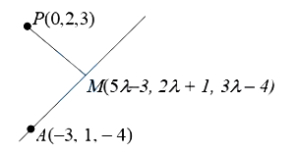
Find the foot of the perpendicular from the point $(0,2,3)$ on the line $\frac{x+3}{5}=\frac{y-1}{2}=\frac{z+4}{3}$.
A
$(2,3,1)$
B
$(2,3,-1)$
C
$(2,-3,1)$
D
$(-2,3,1)$
Solution
(B) Let the given line be $\frac{x+3}{5}=\frac{y-1}{2}=\frac{z+4}{3}=\lambda$.
Any point on this line can be represented as $M(5\lambda-3, 2\lambda+1, 3\lambda-4)$.
Let $P$ be the point $(0,2,3)$. The vector $\vec{PM}$ is given by $(5\lambda-3-0, 2\lambda+1-2, 3\lambda-4-3) = (5\lambda-3, 2\lambda-1, 3\lambda-7)$.
Since $PM$ is perpendicular to the line,the dot product of $\vec{PM}$ and the direction vector of the line $\vec{v} = (5, 2, 3)$ must be zero.
$5(5\lambda-3) + 2(2\lambda-1) + 3(3\lambda-7) = 0$
$25\lambda - 15 + 4\lambda - 2 + 9\lambda - 21 = 0$
$38\lambda - 38 = 0$
$\lambda = 1$.
Substituting $\lambda = 1$ in the coordinates of $M$,we get:
$x = 5(1)-3 = 2$
$y = 2(1)+1 = 3$
$z = 3(1)-4 = -1$
Thus,the foot of the perpendicular is $(2,3,-1)$.
Any point on this line can be represented as $M(5\lambda-3, 2\lambda+1, 3\lambda-4)$.
Let $P$ be the point $(0,2,3)$. The vector $\vec{PM}$ is given by $(5\lambda-3-0, 2\lambda+1-2, 3\lambda-4-3) = (5\lambda-3, 2\lambda-1, 3\lambda-7)$.
Since $PM$ is perpendicular to the line,the dot product of $\vec{PM}$ and the direction vector of the line $\vec{v} = (5, 2, 3)$ must be zero.
$5(5\lambda-3) + 2(2\lambda-1) + 3(3\lambda-7) = 0$
$25\lambda - 15 + 4\lambda - 2 + 9\lambda - 21 = 0$
$38\lambda - 38 = 0$
$\lambda = 1$.
Substituting $\lambda = 1$ in the coordinates of $M$,we get:
$x = 5(1)-3 = 2$
$y = 2(1)+1 = 3$
$z = 3(1)-4 = -1$
Thus,the foot of the perpendicular is $(2,3,-1)$.
0 likesView Solution
330
MathematicsEasyMCQMHT CET · 2022
The lines $\frac{x-1}{3}=\frac{y+1}{2}=\frac{z-1}{5}$ and $\frac{x+2}{4}=\frac{y-1}{3}=\frac{z+1}{-2}$:
A
intersect each other and point of intersection is $(4,3,-2)$.
B
do not intersect.
C
intersect each other and point of intersection is $(3,2,5)$.
D
intersect each other and point of intersection is $(-2,-1,-1)$.
Solution
(B) To check if the lines intersect,we calculate the shortest distance ($S$.$D$.) between them. The lines are given by $\vec{r_1} = (1, -1, 1) + \lambda(3, 2, 5)$ and $\vec{r_2} = (-2, 1, -1) + \mu(4, 3, -2)$.
The shortest distance is given by the formula $S.D. = \left| \frac{(\vec{a_2} - \vec{a_1}) \cdot (\vec{b_1} \times \vec{b_2})}{|\vec{b_1} \times \vec{b_2}|} \right|$.
Here,$\vec{a_2} - \vec{a_1} = (-2-1, 1-(-1), -1-1) = (-3, 2, -2)$.
The cross product $\vec{b_1} \times \vec{b_2} = \begin{vmatrix} \hat{i} & \hat{j} & \hat{k} \\ 3 & 2 & 5 \\ 4 & 3 & -2 \end{vmatrix} = \hat{i}(-4-15) - \hat{j}(-6-20) + \hat{k}(9-8) = -19\hat{i} + 26\hat{j} + 1\hat{k}$.
Now,$(\vec{a_2} - \vec{a_1}) \cdot (\vec{b_1} \times \vec{b_2}) = (-3)(-19) + (2)(26) + (-2)(1) = 57 + 52 - 2 = 107$.
Since the shortest distance is $\frac{107}{\sqrt{(-19)^2 + 26^2 + 1^2}} = \frac{107}{\sqrt{361 + 676 + 1}} = \frac{107}{\sqrt{1038}} \neq 0$,the lines do not intersect.
The shortest distance is given by the formula $S.D. = \left| \frac{(\vec{a_2} - \vec{a_1}) \cdot (\vec{b_1} \times \vec{b_2})}{|\vec{b_1} \times \vec{b_2}|} \right|$.
Here,$\vec{a_2} - \vec{a_1} = (-2-1, 1-(-1), -1-1) = (-3, 2, -2)$.
The cross product $\vec{b_1} \times \vec{b_2} = \begin{vmatrix} \hat{i} & \hat{j} & \hat{k} \\ 3 & 2 & 5 \\ 4 & 3 & -2 \end{vmatrix} = \hat{i}(-4-15) - \hat{j}(-6-20) + \hat{k}(9-8) = -19\hat{i} + 26\hat{j} + 1\hat{k}$.
Now,$(\vec{a_2} - \vec{a_1}) \cdot (\vec{b_1} \times \vec{b_2}) = (-3)(-19) + (2)(26) + (-2)(1) = 57 + 52 - 2 = 107$.
Since the shortest distance is $\frac{107}{\sqrt{(-19)^2 + 26^2 + 1^2}} = \frac{107}{\sqrt{361 + 676 + 1}} = \frac{107}{\sqrt{1038}} \neq 0$,the lines do not intersect.
0 likesView Solution
331
MathematicsMediumMCQMHT CET · 2022
The length of the perpendicular from the point $(0, 2, 3)$ to the line $\frac{x+3}{5} = \frac{y-1}{2} = \frac{z+4}{3}$ is:
A
$\sqrt{15}$ units
B
$\sqrt{21}$ units
C
$\sqrt{33}$ units
D
$\sqrt{11}$ units
Solution
(B) Let the given line be $\frac{x+3}{5} = \frac{y-1}{2} = \frac{z+4}{3} = \lambda$.
Any point $P$ on this line is given by $(5\lambda - 3, 2\lambda + 1, 3\lambda - 4)$.
Let $A = (0, 2, 3)$ be the given point. The direction ratios of the line $AP$ are $(5\lambda - 3 - 0, 2\lambda + 1 - 2, 3\lambda - 4 - 3)$,which simplifies to $(5\lambda - 3, 2\lambda - 1, 3\lambda - 7)$.
Since $AP$ is perpendicular to the given line with direction ratios $(5, 2, 3)$,their dot product must be zero:
$5(5\lambda - 3) + 2(2\lambda - 1) + 3(3\lambda - 7) = 0$.
$25\lambda - 15 + 4\lambda - 2 + 9\lambda - 21 = 0$.
$38\lambda - 38 = 0 \Rightarrow \lambda = 1$.
The foot of the perpendicular is $P = (5(1) - 3, 2(1) + 1, 3(1) - 4) = (2, 3, -1)$.
The length of the perpendicular $AP$ is $\sqrt{(2-0)^2 + (3-2)^2 + (-1-3)^2} = \sqrt{2^2 + 1^2 + (-4)^2} = \sqrt{4 + 1 + 16} = \sqrt{21}$ units.
Any point $P$ on this line is given by $(5\lambda - 3, 2\lambda + 1, 3\lambda - 4)$.
Let $A = (0, 2, 3)$ be the given point. The direction ratios of the line $AP$ are $(5\lambda - 3 - 0, 2\lambda + 1 - 2, 3\lambda - 4 - 3)$,which simplifies to $(5\lambda - 3, 2\lambda - 1, 3\lambda - 7)$.
Since $AP$ is perpendicular to the given line with direction ratios $(5, 2, 3)$,their dot product must be zero:
$5(5\lambda - 3) + 2(2\lambda - 1) + 3(3\lambda - 7) = 0$.
$25\lambda - 15 + 4\lambda - 2 + 9\lambda - 21 = 0$.
$38\lambda - 38 = 0 \Rightarrow \lambda = 1$.
The foot of the perpendicular is $P = (5(1) - 3, 2(1) + 1, 3(1) - 4) = (2, 3, -1)$.
The length of the perpendicular $AP$ is $\sqrt{(2-0)^2 + (3-2)^2 + (-1-3)^2} = \sqrt{2^2 + 1^2 + (-4)^2} = \sqrt{4 + 1 + 16} = \sqrt{21}$ units.
0 likesView Solution
332
MathematicsEasyMCQMHT CET · 2022
The Cartesian equation of the line which passes through the points $(3,1,2)$ and $(-1,2,1)$ is
A
$\frac{x-3}{-4}=\frac{y-1}{1}=\frac{z-2}{1}$
B
$\frac{x-3}{-4}=\frac{y-1}{1}=\frac{z-2}{-1}$
C
$\frac{x-3}{-4}=\frac{y-1}{-1}=\frac{z-2}{-1}$
D
$\frac{x-3}{-4}=\frac{y-1}{-1}=\frac{z-2}{1}$
Solution
(B) The equation of a line passing through two points $(x_1, y_1, z_1)$ and $(x_2, y_2, z_2)$ is given by $\frac{x-x_1}{x_2-x_1} = \frac{y-y_1}{y_2-y_1} = \frac{z-z_1}{z_2-z_1}$.
Substituting the given points $(3, 1, 2)$ and $(-1, 2, 1)$ into the formula:
$\frac{x-3}{-1-3} = \frac{y-1}{2-1} = \frac{z-2}{1-2}$
$\frac{x-3}{-4} = \frac{y-1}{1} = \frac{z-2}{-1}$
Substituting the given points $(3, 1, 2)$ and $(-1, 2, 1)$ into the formula:
$\frac{x-3}{-1-3} = \frac{y-1}{2-1} = \frac{z-2}{1-2}$
$\frac{x-3}{-4} = \frac{y-1}{1} = \frac{z-2}{-1}$
0 likesView Solution
333
MathematicsEasyMCQMHT CET · 2022
If the foot of the perpendicular drawn from the origin to a plane is $M(-1, -2, 2)$,then the vector equation of the plane is
A
$\bar{r} \cdot(-\hat{i}-2 \hat{j}+2 \hat{k})=9$
B
$\bar{r} \cdot(\hat{i}+2 \hat{j}+2 \hat{k})=9$
C
$\bar{r} \cdot(-\hat{i}-2 \hat{j}-2 \hat{k})=9$
D
$\bar{r} \cdot(\hat{i}+2 \hat{j}-2 \hat{k})=9$
Solution
(A) The normal vector $\vec{n}$ to the plane is the vector from the origin $O(0, 0, 0)$ to the foot of the perpendicular $M(-1, -2, 2)$.
Thus,$\vec{n} = \vec{OM} = -\hat{i} - 2\hat{j} + 2\hat{k}$.
The equation of a plane passing through a point $M$ with normal vector $\vec{n}$ is given by $\vec{r} \cdot \vec{n} = \vec{OM} \cdot \vec{n}$.
Here,$\vec{OM} \cdot \vec{n} = (-1, -2, 2) \cdot (-1, -2, 2) = (-1)^2 + (-2)^2 + (2)^2 = 1 + 4 + 4 = 9$.
Therefore,the vector equation of the plane is $\vec{r} \cdot(-\hat{i} - 2\hat{j} + 2\hat{k}) = 9$.
Thus,$\vec{n} = \vec{OM} = -\hat{i} - 2\hat{j} + 2\hat{k}$.
The equation of a plane passing through a point $M$ with normal vector $\vec{n}$ is given by $\vec{r} \cdot \vec{n} = \vec{OM} \cdot \vec{n}$.
Here,$\vec{OM} \cdot \vec{n} = (-1, -2, 2) \cdot (-1, -2, 2) = (-1)^2 + (-2)^2 + (2)^2 = 1 + 4 + 4 = 9$.
Therefore,the vector equation of the plane is $\vec{r} \cdot(-\hat{i} - 2\hat{j} + 2\hat{k}) = 9$.
0 likesView Solution
334
MathematicsEasyMCQMHT CET · 2022
The shortest distance between the lines $\frac{x-3}{3}=\frac{y-8}{-1}=\frac{z-3}{1}$ and $\frac{x+3}{-3}=\frac{y+7}{2}=\frac{z-6}{4}$ is
A
$2 \sqrt{30}$ units
B
$\sqrt{30}$ units
C
$4 \sqrt{30}$ units
D
$3 \sqrt{30}$ units
Solution
(D) The lines are given by $\vec{r_1} = (3, 8, 3) + \lambda(3, -1, 1)$ and $\vec{r_2} = (-3, -7, 6) + \mu(-3, 2, 4)$.
The shortest distance $d$ between two lines $\vec{r} = \vec{a_1} + \lambda \vec{b_1}$ and $\vec{r} = \vec{a_2} + \mu \vec{b_2}$ is given by $d = \frac{|(\vec{a_2} - \vec{a_1}) \cdot (\vec{b_1} \times \vec{b_2})|}{ |\vec{b_1} \times \vec{b_2}| }$.
Here,$\vec{a_2} - \vec{a_1} = (-3-3, -7-8, 6-3) = (-6, -15, 3)$.
The cross product $\vec{b_1} \times \vec{b_2} = \begin{vmatrix} \hat{i} & \hat{j} & \hat{k} \\ 3 & -1 & 1 \\ -3 & 2 & 4 \end{vmatrix} = \hat{i}(-4-2) - \hat{j}(12+3) + \hat{k}(6-3) = -6\hat{i} - 15\hat{j} + 3\hat{k}$.
The magnitude $|\vec{b_1} \times \vec{b_2}| = \sqrt{(-6)^2 + (-15)^2 + 3^2} = \sqrt{36 + 225 + 9} = \sqrt{270} = 3\sqrt{30}$.
The dot product $(\vec{a_2} - \vec{a_1}) \cdot (\vec{b_1} \times \vec{b_2}) = (-6)(-6) + (-15)(-15) + (3)(3) = 36 + 225 + 9 = 270$.
Therefore,$d = \frac{|270|}{3\sqrt{30}} = \frac{270}{3\sqrt{30}} = \frac{90}{\sqrt{30}} = 3\sqrt{30}$ units.
The shortest distance $d$ between two lines $\vec{r} = \vec{a_1} + \lambda \vec{b_1}$ and $\vec{r} = \vec{a_2} + \mu \vec{b_2}$ is given by $d = \frac{|(\vec{a_2} - \vec{a_1}) \cdot (\vec{b_1} \times \vec{b_2})|}{ |\vec{b_1} \times \vec{b_2}| }$.
Here,$\vec{a_2} - \vec{a_1} = (-3-3, -7-8, 6-3) = (-6, -15, 3)$.
The cross product $\vec{b_1} \times \vec{b_2} = \begin{vmatrix} \hat{i} & \hat{j} & \hat{k} \\ 3 & -1 & 1 \\ -3 & 2 & 4 \end{vmatrix} = \hat{i}(-4-2) - \hat{j}(12+3) + \hat{k}(6-3) = -6\hat{i} - 15\hat{j} + 3\hat{k}$.
The magnitude $|\vec{b_1} \times \vec{b_2}| = \sqrt{(-6)^2 + (-15)^2 + 3^2} = \sqrt{36 + 225 + 9} = \sqrt{270} = 3\sqrt{30}$.
The dot product $(\vec{a_2} - \vec{a_1}) \cdot (\vec{b_1} \times \vec{b_2}) = (-6)(-6) + (-15)(-15) + (3)(3) = 36 + 225 + 9 = 270$.
Therefore,$d = \frac{|270|}{3\sqrt{30}} = \frac{270}{3\sqrt{30}} = \frac{90}{\sqrt{30}} = 3\sqrt{30}$ units.
0 likesView Solution
335
MathematicsDifficultMCQMHT CET · 2022
$A$ plane is parallel to two lines,whose direction ratios are $1, 0, -1$ and $-1, 1, 0$ and it contains the point $(1, 1, 1)$. If it cuts coordinate axes ($X, Y, Z$-axes respectively) at $A, B, C$,then the volume of the tetrahedron $OABC$ is (in cubic units):
A
$9$
B
$\frac{9}{4}$
C
$\frac{9}{2}$
D
$27$
Solution
(C) The equation of a plane passing through $(1, 1, 1)$ is given by $a(x-1) + b(y-1) + c(z-1) = 0$.
Since the plane is parallel to the lines with direction ratios $(1, 0, -1)$ and $(-1, 1, 0)$,the normal vector $(a, b, c)$ must be perpendicular to both direction vectors.
Thus,$a(1) + b(0) + c(-1) = 0 \Rightarrow a - c = 0$ and $a(-1) + b(1) + c(0) = 0 \Rightarrow -a + b = 0$.
This implies $a = c$ and $a = b$,so $a = b = c$.
Substituting $a=b=c$ into the plane equation,we get $a(x-1) + a(y-1) + a(z-1) = 0$,which simplifies to $x + y + z = 3$.
Dividing by $3$,we get the intercept form $\frac{x}{3} + \frac{y}{3} + \frac{z}{3} = 1$.
Thus,the coordinates of $A, B, C$ are $(3, 0, 0), (0, 3, 0),$ and $(0, 0, 3)$ respectively.
The volume of the tetrahedron $OABC$ is given by $V = \frac{1}{6} |x_A y_B z_C| = \frac{1}{6} |3 \times 3 \times 3| = \frac{27}{6} = \frac{9}{2}$ cubic units.
Since the plane is parallel to the lines with direction ratios $(1, 0, -1)$ and $(-1, 1, 0)$,the normal vector $(a, b, c)$ must be perpendicular to both direction vectors.
Thus,$a(1) + b(0) + c(-1) = 0 \Rightarrow a - c = 0$ and $a(-1) + b(1) + c(0) = 0 \Rightarrow -a + b = 0$.
This implies $a = c$ and $a = b$,so $a = b = c$.
Substituting $a=b=c$ into the plane equation,we get $a(x-1) + a(y-1) + a(z-1) = 0$,which simplifies to $x + y + z = 3$.
Dividing by $3$,we get the intercept form $\frac{x}{3} + \frac{y}{3} + \frac{z}{3} = 1$.
Thus,the coordinates of $A, B, C$ are $(3, 0, 0), (0, 3, 0),$ and $(0, 0, 3)$ respectively.
The volume of the tetrahedron $OABC$ is given by $V = \frac{1}{6} |x_A y_B z_C| = \frac{1}{6} |3 \times 3 \times 3| = \frac{27}{6} = \frac{9}{2}$ cubic units.
0 likesView Solution
336
MathematicsMediumMCQMHT CET · 2022
The equation of the plane passing through the intersection of the planes $x+y+z=1$ and $2x+3y-z+4=0$ and parallel to the $X$-axis is
A
$y+3z+6=0$
B
$3y-z+6=0$
C
$y-3z+6=0$
D
$3y-2z+6=0$
Solution
(C) The equation of any plane passing through the intersection of the planes $P_1: x+y+z-1=0$ and $P_2: 2x+3y-z+4=0$ is given by $P_1 + \lambda P_2 = 0$.
$(x+y+z-1) + \lambda(2x+3y-z+4) = 0$
$(1+2\lambda)x + (1+3\lambda)y + (1-\lambda)z + (4\lambda-1) = 0$
Since the plane is parallel to the $X$-axis,its normal vector must be perpendicular to the $X$-axis (direction vector $\vec{i} = (1, 0, 0)$).
Therefore,the coefficient of $x$ must be zero: $1+2\lambda = 0 \Rightarrow \lambda = -\frac{1}{2}$.
Substituting $\lambda = -\frac{1}{2}$ into the equation:
$(1+2(-\frac{1}{2}))x + (1+3(-\frac{1}{2}))y + (1-(-\frac{1}{2}))z + (4(-\frac{1}{2})-1) = 0$
$0x + (1-\frac{3}{2})y + (1+\frac{1}{2})z + (-2-1) = 0$
$-\frac{1}{2}y + \frac{3}{2}z - 3 = 0$
Multiplying by $-2$,we get $y-3z+6=0$.
$(x+y+z-1) + \lambda(2x+3y-z+4) = 0$
$(1+2\lambda)x + (1+3\lambda)y + (1-\lambda)z + (4\lambda-1) = 0$
Since the plane is parallel to the $X$-axis,its normal vector must be perpendicular to the $X$-axis (direction vector $\vec{i} = (1, 0, 0)$).
Therefore,the coefficient of $x$ must be zero: $1+2\lambda = 0 \Rightarrow \lambda = -\frac{1}{2}$.
Substituting $\lambda = -\frac{1}{2}$ into the equation:
$(1+2(-\frac{1}{2}))x + (1+3(-\frac{1}{2}))y + (1-(-\frac{1}{2}))z + (4(-\frac{1}{2})-1) = 0$
$0x + (1-\frac{3}{2})y + (1+\frac{1}{2})z + (-2-1) = 0$
$-\frac{1}{2}y + \frac{3}{2}z - 3 = 0$
Multiplying by $-2$,we get $y-3z+6=0$.
0 likesView Solution
337
MathematicsEasyMCQMHT CET · 2022
The coordinates of the foot of the perpendicular drawn from the origin to the plane $2x + 6y - 3z = 63$ are
A
$(4, 2, -4)$
B
$(\frac{18}{7}, \frac{54}{7}, \frac{-27}{7})$
C
$(\frac{2}{7}, \frac{6}{7}, \frac{-3}{7})$
D
$(\frac{9}{7}, \frac{6}{7}, \frac{-3}{7})$
Solution
(B) The coordinates of the foot of the perpendicular $(x, y, z)$ from the origin $(0, 0, 0)$ to the plane $ax + by + cz = d$ are given by the formula:
$\frac{x-x_1}{a} = \frac{y-y_1}{b} = \frac{z-z_1}{c} = \frac{-(ax_1 + by_1 + cz_1 - d)}{a^2 + b^2 + c^2}$
Here,$(x_1, y_1, z_1) = (0, 0, 0)$,$a = 2$,$b = 6$,$c = -3$,and $d = 63$.
Substituting these values:
$\frac{x-0}{2} = \frac{y-0}{6} = \frac{z-0}{-3} = \frac{-(2(0) + 6(0) - 3(0) - 63)}{2^2 + 6^2 + (-3)^2}$
$\frac{x}{2} = \frac{y}{6} = \frac{z}{-3} = \frac{-(-63)}{4 + 36 + 9}$
$\frac{x}{2} = \frac{y}{6} = \frac{z}{-3} = \frac{63}{49} = \frac{9}{7}$
Now,solving for $x, y, z$:
$x = 2 \times \frac{9}{7} = \frac{18}{7}$
$y = 6 \times \frac{9}{7} = \frac{54}{7}$
$z = -3 \times \frac{9}{7} = \frac{-27}{7}$
Thus,the coordinates are $(\frac{18}{7}, \frac{54}{7}, \frac{-27}{7})$.
$\frac{x-x_1}{a} = \frac{y-y_1}{b} = \frac{z-z_1}{c} = \frac{-(ax_1 + by_1 + cz_1 - d)}{a^2 + b^2 + c^2}$
Here,$(x_1, y_1, z_1) = (0, 0, 0)$,$a = 2$,$b = 6$,$c = -3$,and $d = 63$.
Substituting these values:
$\frac{x-0}{2} = \frac{y-0}{6} = \frac{z-0}{-3} = \frac{-(2(0) + 6(0) - 3(0) - 63)}{2^2 + 6^2 + (-3)^2}$
$\frac{x}{2} = \frac{y}{6} = \frac{z}{-3} = \frac{-(-63)}{4 + 36 + 9}$
$\frac{x}{2} = \frac{y}{6} = \frac{z}{-3} = \frac{63}{49} = \frac{9}{7}$
Now,solving for $x, y, z$:
$x = 2 \times \frac{9}{7} = \frac{18}{7}$
$y = 6 \times \frac{9}{7} = \frac{54}{7}$
$z = -3 \times \frac{9}{7} = \frac{-27}{7}$
Thus,the coordinates are $(\frac{18}{7}, \frac{54}{7}, \frac{-27}{7})$.
0 likesView Solution
338
MathematicsMediumMCQMHT CET · 2022
The equation of the plane passing through the point $(2,2,1)$ and the intersection of the planes $x+2y-3z+1=0$ and $3x-2y+4z+3=0$ is
A
$3x+26y+43z+3=0$
B
$3x+26y-43z-3=0$
C
$3x-26y-43z-3=0$
D
$3x-26y+43z+3=0$
Solution
(D) The equation of any plane passing through the intersection of the planes $P_1: x+2y-3z+1=0$ and $P_2: 3x-2y+4z+3=0$ is given by $P_1 + \lambda P_2 = 0$.
$(x+2y-3z+1) + \lambda(3x-2y+4z+3) = 0 \quad \dots(1)$
Since the plane passes through the point $(2,2,1)$,we substitute $x=2, y=2, z=1$ into equation $(1)$:
$(2 + 2(2) - 3(1) + 1) + \lambda(3(2) - 2(2) + 4(1) + 3) = 0$
$(2 + 4 - 3 + 1) + \lambda(6 - 4 + 4 + 3) = 0$
$4 + 9\lambda = 0$
$\lambda = -\frac{4}{9}$
Substituting $\lambda = -\frac{4}{9}$ back into equation $(1)$:
$(x+2y-3z+1) - \frac{4}{9}(3x-2y+4z+3) = 0$
$9(x+2y-3z+1) - 4(3x-2y+4z+3) = 0$
$9x + 18y - 27z + 9 - 12x + 8y - 16z - 12 = 0$
$-3x + 26y - 43z - 3 = 0$
Multiplying by $-1$,we get $3x - 26y + 43z + 3 = 0$.
$(x+2y-3z+1) + \lambda(3x-2y+4z+3) = 0 \quad \dots(1)$
Since the plane passes through the point $(2,2,1)$,we substitute $x=2, y=2, z=1$ into equation $(1)$:
$(2 + 2(2) - 3(1) + 1) + \lambda(3(2) - 2(2) + 4(1) + 3) = 0$
$(2 + 4 - 3 + 1) + \lambda(6 - 4 + 4 + 3) = 0$
$4 + 9\lambda = 0$
$\lambda = -\frac{4}{9}$
Substituting $\lambda = -\frac{4}{9}$ back into equation $(1)$:
$(x+2y-3z+1) - \frac{4}{9}(3x-2y+4z+3) = 0$
$9(x+2y-3z+1) - 4(3x-2y+4z+3) = 0$
$9x + 18y - 27z + 9 - 12x + 8y - 16z - 12 = 0$
$-3x + 26y - 43z - 3 = 0$
Multiplying by $-1$,we get $3x - 26y + 43z + 3 = 0$.
0 likesView Solution
339
MathematicsEasyMCQMHT CET · 2022
The coordinates of the foot of the perpendicular drawn from the origin to the plane $3x + 2y + 6z = 56$ are:
A
$\left(\frac{48}{7}, \frac{24}{7}, \frac{16}{7}\right)$
B
$\left(\frac{24}{7}, \frac{48}{7}, \frac{16}{7}\right)$
C
$\left(\frac{16}{7}, \frac{24}{7}, \frac{48}{7}\right)$
D
$\left(\frac{24}{7}, \frac{16}{7}, \frac{48}{7}\right)$
Solution
(D) The equation of the line passing through the origin $(0, 0, 0)$ and perpendicular to the plane $3x + 2y + 6z - 56 = 0$ is given by $\frac{x-0}{3} = \frac{y-0}{2} = \frac{z-0}{6} = k$.
Any point on this line is $(3k, 2k, 6k)$.
Since this point lies on the plane,we substitute it into the plane equation:
$3(3k) + 2(2k) + 6(6k) = 56$
$9k + 4k + 36k = 56$
$49k = 56$
$k = \frac{56}{49} = \frac{8}{7}$
Substituting $k$ back into the coordinates $(3k, 2k, 6k)$:
$x = 3 \times \frac{8}{7} = \frac{24}{7}$
$y = 2 \times \frac{8}{7} = \frac{16}{7}$
$z = 6 \times \frac{8}{7} = \frac{48}{7}$
Thus,the foot of the perpendicular is $\left(\frac{24}{7}, \frac{16}{7}, \frac{48}{7}\right)$.
Any point on this line is $(3k, 2k, 6k)$.
Since this point lies on the plane,we substitute it into the plane equation:
$3(3k) + 2(2k) + 6(6k) = 56$
$9k + 4k + 36k = 56$
$49k = 56$
$k = \frac{56}{49} = \frac{8}{7}$
Substituting $k$ back into the coordinates $(3k, 2k, 6k)$:
$x = 3 \times \frac{8}{7} = \frac{24}{7}$
$y = 2 \times \frac{8}{7} = \frac{16}{7}$
$z = 6 \times \frac{8}{7} = \frac{48}{7}$
Thus,the foot of the perpendicular is $\left(\frac{24}{7}, \frac{16}{7}, \frac{48}{7}\right)$.
0 likesView Solution
340
MathematicsMediumMCQMHT CET · 2022
$A$ tetrahedron has vertices $P(1,2,1), Q(2,1,3), R(-1,1,2)$ and $O(0,0,0)$. Then the angle between the faces $OPQ$ and $PQR$ is
A
$\cos ^{-1}\left(\frac{17}{35}\right)$
B
$\cos ^{-1}\left(\frac{19}{31}\right)$
C
$\cos ^{-1}\left(\frac{19}{35}\right)$
D
$\cos ^{-1}\left(\frac{17}{31}\right)$
Solution
(C) The equation of the plane $OPQ$ passing through $O(0,0,0), P(1,2,1)$,and $Q(2,1,3)$ is given by the determinant:
$\begin{vmatrix} x & y & z \\ 1 & 2 & 1 \\ 2 & 1 & 3 \end{vmatrix} = 0$
$x(6-1) - y(3-2) + z(1-4) = 0 \Rightarrow 5x - y - 3z = 0$.
The normal vector to plane $OPQ$ is $\vec{n_1} = 5\hat{i} - \hat{j} - 3\hat{k}$.
The equation of the plane $PQR$ passing through $P(1,2,1), Q(2,1,3)$,and $R(-1,1,2)$ is given by:
$\begin{vmatrix} x-1 & y-2 & z-1 \\ 2-1 & 1-2 & 3-1 \\ -1-1 & 1-2 & 2-1 \end{vmatrix} = 0 \Rightarrow \begin{vmatrix} x-1 & y-2 & z-1 \\ 1 & -1 & 2 \\ -2 & -1 & 1 \end{vmatrix} = 0$
$(x-1)(-1+2) - (y-2)(1+4) + (z-1)(-1-2) = 0$
$(x-1) - 5(y-2) - 3(z-1) = 0 \Rightarrow x - 5y - 3z + 12 = 0$.
The normal vector to plane $PQR$ is $\vec{n_2} = \hat{i} - 5\hat{j} - 3\hat{k}$.
The angle $\theta$ between the two planes is given by:
$\cos \theta = \frac{|\vec{n_1} \cdot \vec{n_2}|}{|\vec{n_1}| |\vec{n_2}|} = \frac{|(5)(1) + (-1)(-5) + (-3)(-3)|}{\sqrt{5^2 + (-1)^2 + (-3)^2} \sqrt{1^2 + (-5)^2 + (-3)^2}}$
$\cos \theta = \frac{|5 + 5 + 9|}{\sqrt{25+1+9} \sqrt{1+25+9}} = \frac{19}{\sqrt{35} \sqrt{35}} = \frac{19}{35}$
Therefore,$\theta = \cos^{-1}\left(\frac{19}{35}\right)$.
$\begin{vmatrix} x & y & z \\ 1 & 2 & 1 \\ 2 & 1 & 3 \end{vmatrix} = 0$
$x(6-1) - y(3-2) + z(1-4) = 0 \Rightarrow 5x - y - 3z = 0$.
The normal vector to plane $OPQ$ is $\vec{n_1} = 5\hat{i} - \hat{j} - 3\hat{k}$.
The equation of the plane $PQR$ passing through $P(1,2,1), Q(2,1,3)$,and $R(-1,1,2)$ is given by:
$\begin{vmatrix} x-1 & y-2 & z-1 \\ 2-1 & 1-2 & 3-1 \\ -1-1 & 1-2 & 2-1 \end{vmatrix} = 0 \Rightarrow \begin{vmatrix} x-1 & y-2 & z-1 \\ 1 & -1 & 2 \\ -2 & -1 & 1 \end{vmatrix} = 0$
$(x-1)(-1+2) - (y-2)(1+4) + (z-1)(-1-2) = 0$
$(x-1) - 5(y-2) - 3(z-1) = 0 \Rightarrow x - 5y - 3z + 12 = 0$.
The normal vector to plane $PQR$ is $\vec{n_2} = \hat{i} - 5\hat{j} - 3\hat{k}$.
The angle $\theta$ between the two planes is given by:
$\cos \theta = \frac{|\vec{n_1} \cdot \vec{n_2}|}{|\vec{n_1}| |\vec{n_2}|} = \frac{|(5)(1) + (-1)(-5) + (-3)(-3)|}{\sqrt{5^2 + (-1)^2 + (-3)^2} \sqrt{1^2 + (-5)^2 + (-3)^2}}$
$\cos \theta = \frac{|5 + 5 + 9|}{\sqrt{25+1+9} \sqrt{1+25+9}} = \frac{19}{\sqrt{35} \sqrt{35}} = \frac{19}{35}$
Therefore,$\theta = \cos^{-1}\left(\frac{19}{35}\right)$.
0 likesView Solution
341
MathematicsEasyMCQMHT CET · 2022
The equation of the plane passing through the points $(2, 3, 1)$ and $(4, -5, 3)$ and parallel to the $X$-axis is:
A
$3y + 4z = 13$
B
$y - 4z = -1$
C
$2y + 4z = 19$
D
$y + 4z = 7$
Solution
(D) plane parallel to the $X$-axis has the general equation $by + cz + d = 0$.
Since the plane passes through the points $(2, 3, 1)$ and $(4, -5, 3)$,these points must satisfy the equation.
For point $(2, 3, 1)$: $b(3) + c(1) + d = 0 \implies 3b + c + d = 0$.
For point $(4, -5, 3)$: $b(-5) + c(3) + d = 0 \implies -5b + 3c + d = 0$.
Subtracting the two equations: $(3b + c + d) - (-5b + 3c + d) = 0 \implies 8b - 2c = 0 \implies c = 4b$.
Substituting $c = 4b$ into the first equation: $3b + 4b + d = 0 \implies d = -7b$.
The equation becomes $by + (4b)z - 7b = 0$.
Dividing by $b$ (assuming $b \neq 0$),we get $y + 4z = 7$.
Thus,the correct option is $(D)$.
Since the plane passes through the points $(2, 3, 1)$ and $(4, -5, 3)$,these points must satisfy the equation.
For point $(2, 3, 1)$: $b(3) + c(1) + d = 0 \implies 3b + c + d = 0$.
For point $(4, -5, 3)$: $b(-5) + c(3) + d = 0 \implies -5b + 3c + d = 0$.
Subtracting the two equations: $(3b + c + d) - (-5b + 3c + d) = 0 \implies 8b - 2c = 0 \implies c = 4b$.
Substituting $c = 4b$ into the first equation: $3b + 4b + d = 0 \implies d = -7b$.
The equation becomes $by + (4b)z - 7b = 0$.
Dividing by $b$ (assuming $b \neq 0$),we get $y + 4z = 7$.
Thus,the correct option is $(D)$.
0 likesView Solution
342
MathematicsMediumMCQMHT CET · 2022
The Cartesian equation of a line passing through $(1, 2, 3)$ and parallel to the planes $x - y + 2z = 5$ and $3x + y + z = 6$ is:
A
$\frac{x-1}{-3} = \frac{y-2}{-5} = \frac{z-3}{4}$
B
$\frac{x-1}{-3} = \frac{y-2}{5} = \frac{z-3}{4}$
C
$\frac{x-1}{13} = \frac{y-2}{-1} = \frac{z-3}{1}$
D
$\frac{x-1}{3} = \frac{y-2}{1} = \frac{z-3}{1}$
Solution
(B) Let the direction ratios of the line be $(a, b, c)$. Since the line is parallel to the planes $x - y + 2z = 5$ and $3x + y + z = 6$,its direction vector is perpendicular to the normals of both planes.
The normals are $\vec{n_1} = (1, -1, 2)$ and $\vec{n_2} = (3, 1, 1)$.
The direction vector $\vec{v}$ is given by the cross product $\vec{n_1} \times \vec{n_2}$:
$\vec{v} = \begin{vmatrix} \hat{i} & \hat{j} & \hat{k} \\ 1 & -1 & 2 \\ 3 & 1 & 1 \end{vmatrix} = \hat{i}(-1 - 2) - \hat{j}(1 - 6) + \hat{k}(1 - (-3)) = -3\hat{i} + 5\hat{j} + 4\hat{k}$.
Thus,the direction ratios are $(-3, 5, 4)$.
The line passes through $(1, 2, 3)$,so the Cartesian equation is $\frac{x-1}{-3} = \frac{y-2}{5} = \frac{z-3}{4}$.
The normals are $\vec{n_1} = (1, -1, 2)$ and $\vec{n_2} = (3, 1, 1)$.
The direction vector $\vec{v}$ is given by the cross product $\vec{n_1} \times \vec{n_2}$:
$\vec{v} = \begin{vmatrix} \hat{i} & \hat{j} & \hat{k} \\ 1 & -1 & 2 \\ 3 & 1 & 1 \end{vmatrix} = \hat{i}(-1 - 2) - \hat{j}(1 - 6) + \hat{k}(1 - (-3)) = -3\hat{i} + 5\hat{j} + 4\hat{k}$.
Thus,the direction ratios are $(-3, 5, 4)$.
The line passes through $(1, 2, 3)$,so the Cartesian equation is $\frac{x-1}{-3} = \frac{y-2}{5} = \frac{z-3}{4}$.
0 likesView Solution
343
MathematicsEasyMCQMHT CET · 2022
The length of the perpendicular from the origin to the plane $\bar{r} \cdot (3 \hat{i} - 4 \hat{j} + 12 \hat{k}) = 8$ is
A
$8$ units
B
$\frac{13}{8}$ units
C
$\frac{8}{13}$ units
D
$13$ units
Solution
(C) The equation of the plane is given in the form $\bar{r} \cdot \bar{n} = d$,where $\bar{n} = 3 \hat{i} - 4 \hat{j} + 12 \hat{k}$ and $d = 8$.
The length of the perpendicular from the origin to the plane $\bar{r} \cdot \bar{n} = d$ is given by the formula $p = \frac{|d|}{|\bar{n}|}$.
Here,$|\bar{n}| = \sqrt{3^2 + (-4)^2 + 12^2} = \sqrt{9 + 16 + 144} = \sqrt{169} = 13$.
Therefore,the length of the perpendicular is $p = \frac{8}{13}$ units.
The length of the perpendicular from the origin to the plane $\bar{r} \cdot \bar{n} = d$ is given by the formula $p = \frac{|d|}{|\bar{n}|}$.
Here,$|\bar{n}| = \sqrt{3^2 + (-4)^2 + 12^2} = \sqrt{9 + 16 + 144} = \sqrt{169} = 13$.
Therefore,the length of the perpendicular is $p = \frac{8}{13}$ units.
0 likesView Solution
344
MathematicsEasyMCQMHT CET · 2022
The equation of the plane passing through the points $(1, 2, 3)$,$(-1, 4, 2)$ and $(3, 1, 1)$ is
A
$5x + 6y + 2z - 23 = 0$
B
$5x + y + 2z - 13 = 0$
C
$5x + y + 12z - 43 = 0$
D
$x + 6y + 2z - 19 = 0$
Solution
(A) The equation of a plane passing through three points $(x_1, y_1, z_1)$,$(x_2, y_2, z_2)$,and $(x_3, y_3, z_3)$ is given by the determinant equation:
$\begin{vmatrix} x-x_1 & y-y_1 & z-z_1 \\ x_2-x_1 & y_2-y_1 & z_2-z_1 \\ x_3-x_1 & y_3-y_1 & z_3-z_1 \end{vmatrix} = 0$
Substituting the given points $(1, 2, 3)$,$(-1, 4, 2)$,and $(3, 1, 1)$:
$\begin{vmatrix} x-1 & y-2 & z-3 \\ -1-1 & 4-2 & 2-3 \\ 3-1 & 1-2 & 1-3 \end{vmatrix} = 0$
$\begin{vmatrix} x-1 & y-2 & z-3 \\ -2 & 2 & -1 \\ 2 & -1 & -2 \end{vmatrix} = 0$
Expanding along the first row:
$(x-1)[(2)(-2) - (-1)(-1)] - (y-2)[(-2)(-2) - (2)(-1)] + (z-3)[(-2)(-1) - (2)(2)] = 0$
$(x-1)[-4 - 1] - (y-2)[4 + 2] + (z-3)[2 - 4] = 0$
$-5(x-1) - 6(y-2) - 2(z-3) = 0$
$-5x + 5 - 6y + 12 - 2z + 6 = 0$
$-5x - 6y - 2z + 23 = 0$
Multiplying by $-1$,we get:
$5x + 6y + 2z - 23 = 0$
$\begin{vmatrix} x-x_1 & y-y_1 & z-z_1 \\ x_2-x_1 & y_2-y_1 & z_2-z_1 \\ x_3-x_1 & y_3-y_1 & z_3-z_1 \end{vmatrix} = 0$
Substituting the given points $(1, 2, 3)$,$(-1, 4, 2)$,and $(3, 1, 1)$:
$\begin{vmatrix} x-1 & y-2 & z-3 \\ -1-1 & 4-2 & 2-3 \\ 3-1 & 1-2 & 1-3 \end{vmatrix} = 0$
$\begin{vmatrix} x-1 & y-2 & z-3 \\ -2 & 2 & -1 \\ 2 & -1 & -2 \end{vmatrix} = 0$
Expanding along the first row:
$(x-1)[(2)(-2) - (-1)(-1)] - (y-2)[(-2)(-2) - (2)(-1)] + (z-3)[(-2)(-1) - (2)(2)] = 0$
$(x-1)[-4 - 1] - (y-2)[4 + 2] + (z-3)[2 - 4] = 0$
$-5(x-1) - 6(y-2) - 2(z-3) = 0$
$-5x + 5 - 6y + 12 - 2z + 6 = 0$
$-5x - 6y - 2z + 23 = 0$
Multiplying by $-1$,we get:
$5x + 6y + 2z - 23 = 0$
0 likesView Solution
345
MathematicsEasyMCQMHT CET · 2022
If the planes $\bar{r} \cdot(2 \hat{i}-\lambda \hat{j}+\hat{k})=3$ and $\bar{r} \cdot(4 \hat{i}-\hat{j}+\mu \hat{k})=5$ are parallel,then the values of $\lambda$ and $\mu$ are respectively:
A
$\frac{1}{2}, 2$
B
$\frac{-1}{2}, 2$
C
$\frac{1}{2}, -2$
D
$\frac{-1}{2}, -2$
Solution
(A) Two planes $\bar{r} \cdot \bar{n}_1 = d_1$ and $\bar{r} \cdot \bar{n}_2 = d_2$ are parallel if their normal vectors $\bar{n}_1$ and $\bar{n}_2$ are proportional,i.e.,$\bar{n}_1 = k \bar{n}_2$.
Given normal vectors are $\bar{n}_1 = 2 \hat{i} - \lambda \hat{j} + \hat{k}$ and $\bar{n}_2 = 4 \hat{i} - \hat{j} + \mu \hat{k}$.
For the planes to be parallel,the ratios of the components of the normal vectors must be equal:
$\frac{2}{4} = \frac{-\lambda}{-1} = \frac{1}{\mu}$
From $\frac{2}{4} = \frac{-\lambda}{-1}$,we get $\frac{1}{2} = \lambda$,so $\lambda = \frac{1}{2}$.
From $\frac{2}{4} = \frac{1}{\mu}$,we get $\frac{1}{2} = \frac{1}{\mu}$,so $\mu = 2$.
Thus,the values are $\lambda = \frac{1}{2}$ and $\mu = 2$.
Given normal vectors are $\bar{n}_1 = 2 \hat{i} - \lambda \hat{j} + \hat{k}$ and $\bar{n}_2 = 4 \hat{i} - \hat{j} + \mu \hat{k}$.
For the planes to be parallel,the ratios of the components of the normal vectors must be equal:
$\frac{2}{4} = \frac{-\lambda}{-1} = \frac{1}{\mu}$
From $\frac{2}{4} = \frac{-\lambda}{-1}$,we get $\frac{1}{2} = \lambda$,so $\lambda = \frac{1}{2}$.
From $\frac{2}{4} = \frac{1}{\mu}$,we get $\frac{1}{2} = \frac{1}{\mu}$,so $\mu = 2$.
Thus,the values are $\lambda = \frac{1}{2}$ and $\mu = 2$.
0 likesView Solution
346
MathematicsEasyMCQMHT CET · 2022
The foot of the perpendicular drawn from the origin to the plane is $(4, -2, -5)$. Hence,the equation of the plane is
A
$4x - 2y - 5z = 45$
B
$4x - 2y - 5z = -45$
C
$4x + 2y - 5z = 37$
D
$4x + 2y + 5z + 13 = 0$
Solution
(A) The normal vector $\vec{n}$ to the plane is the vector from the origin $(0, 0, 0)$ to the foot of the perpendicular $(4, -2, -5)$.
Thus,$\vec{n} = \langle 4 - 0, -2 - 0, -5 - 0 \rangle = \langle 4, -2, -5 \rangle$.
The equation of a plane with normal $\vec{n} = \langle a, b, c \rangle$ passing through a point $(x_1, y_1, z_1)$ is given by $a(x - x_1) + b(y - y_1) + c(z - z_1) = 0$.
Substituting the values,we get $4(x - 4) - 2(y + 2) - 5(z + 5) = 0$.
Expanding this,$4x - 16 - 2y - 4 - 5z - 25 = 0$.
$4x - 2y - 5z - 45 = 0$,which simplifies to $4x - 2y - 5z = 45$.
Thus,$\vec{n} = \langle 4 - 0, -2 - 0, -5 - 0 \rangle = \langle 4, -2, -5 \rangle$.
The equation of a plane with normal $\vec{n} = \langle a, b, c \rangle$ passing through a point $(x_1, y_1, z_1)$ is given by $a(x - x_1) + b(y - y_1) + c(z - z_1) = 0$.
Substituting the values,we get $4(x - 4) - 2(y + 2) - 5(z + 5) = 0$.
Expanding this,$4x - 16 - 2y - 4 - 5z - 25 = 0$.
$4x - 2y - 5z - 45 = 0$,which simplifies to $4x - 2y - 5z = 45$.
0 likesView Solution
347
MathematicsMediumMCQMHT CET · 2022
The equation of the plane through the intersection of the planes $x+y+z=1$ and $2x+3y-z+4=0$ and parallel to the $x$-axis is:
A
$3y+z-6=0$
B
$3y-z+6=0$
C
$y-3z+6=0$
D
$y+3z-6=0$
Solution
(C) The equation of any plane passing through the intersection of the planes $P_1: x+y+z-1=0$ and $P_2: 2x+3y-z+4=0$ is given by $P_1 + \lambda P_2 = 0$.
$(x+y+z-1) + \lambda(2x+3y-z+4) = 0$
$(1+2\lambda)x + (1+3\lambda)y + (1-\lambda)z + (4\lambda-1) = 0$.
Since the plane is parallel to the $x$-axis,its normal vector $\vec{n} = (1+2\lambda, 1+3\lambda, 1-\lambda)$ must be perpendicular to the $x$-axis direction vector $\vec{i} = (1, 0, 0)$.
Therefore,the dot product is zero: $(1+2\lambda)(1) + (1+3\lambda)(0) + (1-\lambda)(0) = 0$.
$1+2\lambda = 0 \Rightarrow \lambda = -\frac{1}{2}$.
Substituting $\lambda = -\frac{1}{2}$ into the equation:
$(1+2(-\frac{1}{2}))x + (1+3(-\frac{1}{2}))y + (1-(-\frac{1}{2}))z + (4(-\frac{1}{2})-1) = 0$.
$0x + (1-\frac{3}{2})y + (1+\frac{1}{2})z + (-2-1) = 0$.
$-\frac{1}{2}y + \frac{3}{2}z - 3 = 0$.
Multiplying by $-2$,we get $y - 3z + 6 = 0$.
$(x+y+z-1) + \lambda(2x+3y-z+4) = 0$
$(1+2\lambda)x + (1+3\lambda)y + (1-\lambda)z + (4\lambda-1) = 0$.
Since the plane is parallel to the $x$-axis,its normal vector $\vec{n} = (1+2\lambda, 1+3\lambda, 1-\lambda)$ must be perpendicular to the $x$-axis direction vector $\vec{i} = (1, 0, 0)$.
Therefore,the dot product is zero: $(1+2\lambda)(1) + (1+3\lambda)(0) + (1-\lambda)(0) = 0$.
$1+2\lambda = 0 \Rightarrow \lambda = -\frac{1}{2}$.
Substituting $\lambda = -\frac{1}{2}$ into the equation:
$(1+2(-\frac{1}{2}))x + (1+3(-\frac{1}{2}))y + (1-(-\frac{1}{2}))z + (4(-\frac{1}{2})-1) = 0$.
$0x + (1-\frac{3}{2})y + (1+\frac{1}{2})z + (-2-1) = 0$.
$-\frac{1}{2}y + \frac{3}{2}z - 3 = 0$.
Multiplying by $-2$,we get $y - 3z + 6 = 0$.
0 likesView Solution
348
MathematicsMediumMCQMHT CET · 2022
Let $\bar{n}$ be a vector of magnitude $3\sqrt{3}$ such that it makes equal acute angles with the coordinate axes. Then the vector equation of a plane passing through $(1, -1, 2)$ and normal to $\bar{n}$ is:
A
$\bar{r} \cdot (\hat{i} + \hat{j} + \hat{k}) = 3$
B
$\bar{r} \cdot (3\hat{i} + 3\hat{j} + 3\hat{k}) = 12$
C
$\bar{r} \cdot (3\hat{i} + 3\hat{j} + 3\hat{k}) = 1$
D
$\bar{r} \cdot (3\hat{i} + 3\hat{j} + 3\hat{k}) = 6$
Solution
(D) Let the vector $\bar{n}$ be $a\hat{i} + a\hat{j} + a\hat{k}$ since it makes equal angles with the coordinate axes.
Given magnitude $|\bar{n}| = 3\sqrt{3}$,so $\sqrt{a^2 + a^2 + a^2} = 3\sqrt{3} \Rightarrow \sqrt{3a^2} = 3\sqrt{3} \Rightarrow a\sqrt{3} = 3\sqrt{3} \Rightarrow a = 3$.
Thus,$\bar{n} = 3\hat{i} + 3\hat{j} + 3\hat{k}$.
The equation of a plane passing through point $\vec{a} = (1, -1, 2)$ and normal to $\bar{n}$ is given by $\vec{r} \cdot \bar{n} = \vec{a} \cdot \bar{n}$.
$\vec{r} \cdot (3\hat{i} + 3\hat{j} + 3\hat{k}) = (1\hat{i} - 1\hat{j} + 2\hat{k}) \cdot (3\hat{i} + 3\hat{j} + 3\hat{k})$.
$\vec{r} \cdot (3\hat{i} + 3\hat{j} + 3\hat{k}) = (1)(3) + (-1)(3) + (2)(3) = 3 - 3 + 6 = 6$.
Therefore,the equation is $\bar{r} \cdot (3\hat{i} + 3\hat{j} + 3\hat{k}) = 6$.
Given magnitude $|\bar{n}| = 3\sqrt{3}$,so $\sqrt{a^2 + a^2 + a^2} = 3\sqrt{3} \Rightarrow \sqrt{3a^2} = 3\sqrt{3} \Rightarrow a\sqrt{3} = 3\sqrt{3} \Rightarrow a = 3$.
Thus,$\bar{n} = 3\hat{i} + 3\hat{j} + 3\hat{k}$.
The equation of a plane passing through point $\vec{a} = (1, -1, 2)$ and normal to $\bar{n}$ is given by $\vec{r} \cdot \bar{n} = \vec{a} \cdot \bar{n}$.
$\vec{r} \cdot (3\hat{i} + 3\hat{j} + 3\hat{k}) = (1\hat{i} - 1\hat{j} + 2\hat{k}) \cdot (3\hat{i} + 3\hat{j} + 3\hat{k})$.
$\vec{r} \cdot (3\hat{i} + 3\hat{j} + 3\hat{k}) = (1)(3) + (-1)(3) + (2)(3) = 3 - 3 + 6 = 6$.
Therefore,the equation is $\bar{r} \cdot (3\hat{i} + 3\hat{j} + 3\hat{k}) = 6$.
0 likesView Solution
349
MathematicsMediumMCQMHT CET · 2022
The line passing through $(4, -1, 2)$ and $(-3, 2, 3)$ meets the plane at right angles at the point $(-10, 5, 4)$. Then the equation of the plane is:
A
$2x - y - z + 29 = 0$
B
$7x - 3y - z + 89 = 0$
C
$x - y + z + 11 = 0$
D
$x + y + z + 1 = 0$
Solution
(B) The line passes through the points $A(4, -1, 2)$ and $B(-3, 2, 3)$. Since the line is perpendicular to the plane,the direction ratios of the line are the direction ratios of the normal to the plane.
Direction ratios of the line are $\langle 4 - (-3), -1 - 2, 2 - 3 \rangle = \langle 7, -3, -1 \rangle$.
The plane passes through the point $(-10, 5, 4)$.
The equation of a plane passing through $(x_0, y_0, z_0)$ with normal vector $\langle a, b, c \rangle$ is $a(x - x_0) + b(y - y_0) + c(z - z_0) = 0$.
Substituting the values,we get:
$7(x - (-10)) - 3(y - 5) - 1(z - 4) = 0$
$7(x + 10) - 3(y - 5) - 1(z - 4) = 0$
$7x + 70 - 3y + 15 - z + 4 = 0$
$7x - 3y - z + 89 = 0$.
Direction ratios of the line are $\langle 4 - (-3), -1 - 2, 2 - 3 \rangle = \langle 7, -3, -1 \rangle$.
The plane passes through the point $(-10, 5, 4)$.
The equation of a plane passing through $(x_0, y_0, z_0)$ with normal vector $\langle a, b, c \rangle$ is $a(x - x_0) + b(y - y_0) + c(z - z_0) = 0$.
Substituting the values,we get:
$7(x - (-10)) - 3(y - 5) - 1(z - 4) = 0$
$7(x + 10) - 3(y - 5) - 1(z - 4) = 0$
$7x + 70 - 3y + 15 - z + 4 = 0$
$7x - 3y - z + 89 = 0$.
0 likesView Solution
350
MathematicsMediumMCQMHT CET · 2022
The ratio in which the plane $\bar{r} \cdot (\hat{i}-2 \hat{j}+3 \hat{k})=17$ divides the line joining the points $-2 \hat{i}+4 \hat{j}+7 \hat{k}$ and $3 \hat{i}-5 \hat{j}+8 \hat{k}$ is:
A
$10:3$
B
$3:10$
C
$5:3$
D
$4:5$
Solution
(B) Let the required ratio be $\lambda:1$. The position vector of the point dividing the line segment joining $\vec{a} = -2\hat{i} + 4\hat{j} + 7\hat{k}$ and $\vec{b} = 3\hat{i} - 5\hat{j} + 8\hat{k}$ in the ratio $\lambda:1$ is given by $\vec{r} = \frac{\lambda\vec{b} + 1\vec{a}}{\lambda+1}$.
Substituting the coordinates,we get $\vec{r} = \frac{\lambda(3\hat{i}-5\hat{j}+8\hat{k}) + (-2\hat{i}+4\hat{j}+7\hat{k})}{\lambda+1} = \frac{(3\lambda-2)\hat{i} + (-5\lambda+4)\hat{j} + (8\lambda+7)\hat{k}}{\lambda+1}$.
Since this point lies on the plane $\vec{r} \cdot (\hat{i}-2\hat{j}+3\hat{k}) = 17$,we substitute the components:
$\frac{(3\lambda-2)(1) + (-5\lambda+4)(-2) + (8\lambda+7)(3)}{\lambda+1} = 17$.
$(3\lambda-2) + (10\lambda-8) + (24\lambda+21) = 17(\lambda+1)$.
$37\lambda + 11 = 17\lambda + 17$.
$20\lambda = 6$.
$\lambda = \frac{6}{20} = \frac{3}{10}$.
Thus,the required ratio is $3:10$.
Substituting the coordinates,we get $\vec{r} = \frac{\lambda(3\hat{i}-5\hat{j}+8\hat{k}) + (-2\hat{i}+4\hat{j}+7\hat{k})}{\lambda+1} = \frac{(3\lambda-2)\hat{i} + (-5\lambda+4)\hat{j} + (8\lambda+7)\hat{k}}{\lambda+1}$.
Since this point lies on the plane $\vec{r} \cdot (\hat{i}-2\hat{j}+3\hat{k}) = 17$,we substitute the components:
$\frac{(3\lambda-2)(1) + (-5\lambda+4)(-2) + (8\lambda+7)(3)}{\lambda+1} = 17$.
$(3\lambda-2) + (10\lambda-8) + (24\lambda+21) = 17(\lambda+1)$.
$37\lambda + 11 = 17\lambda + 17$.
$20\lambda = 6$.
$\lambda = \frac{6}{20} = \frac{3}{10}$.
Thus,the required ratio is $3:10$.
0 likesView Solution
Vedclass Products
For Students
Vedclass Test Series
Mock tests in real MHT CET style covering Mathematics with performance analysis. 5-day free trial.
Start Free TrialFor Teachers
Exam Paper Generator
Generate Set A/B/C/D Mathematics papers from 7.5L+ questions in 2 minutes. 3 chapters free.
Try FreeFor Institutes
Online Exam Module
Run live MHT CET mock exams with unlimited students, 360° analytics & white-label branding.
See DemoFrequently Asked Questions
How many Mathematics questions are in MHT CET 2022?
There are 546 Mathematics questions from the MHT CET 2022 paper on Vedclass, each with a detailed step-by-step solution in English.
Are MHT CET 2022 Mathematics solutions available in English?
Yes. All solutions on this page are in English. You can also switch to English or Hindi using the language buttons above the questions.
Can I practice MHT CET 2022 Mathematics as a timed test?
Yes. Use the Vedclass Test Series to attempt a full MHT CET mock test covering Mathematics with time limits and instant score analysis.
Can teachers create Mathematics papers from MHT CET previous year questions?
Yes. The Vedclass Exam Paper Generator lets teachers mix MHT CET Mathematics questions and generate Set A/B/C/D papers in minutes.
For Teachers & Institutes
Build a Custom Mathematics Paper
Pick MHT CET 2022 Mathematics questions, set difficulty, and generate Set A/B/C/D in 2 minutes.