
PhysicsQ1–50 of 50 questions
Page 1 of 1 · English
1
PhysicsEasyMCQMHT CET · 2007
Which one of the following processes depends on gravity?
A
Conduction
B
Convection
C
Radiation
D
None of these
Solution
(B) . Conduction is the process of heat transfer in a solid from a hotter region to a colder region without the actual movement of particles.
$B$. Convection involves the movement of fluid particles. Heated,less dense particles rise,while cooler,denser particles sink due to the gravitational force acting on them. Thus,convection depends on gravity.
$C$. Radiation is the transfer of heat via electromagnetic waves,which can occur even in a vacuum and does not depend on gravity.
Therefore,the correct option is $B$.
$B$. Convection involves the movement of fluid particles. Heated,less dense particles rise,while cooler,denser particles sink due to the gravitational force acting on them. Thus,convection depends on gravity.
$C$. Radiation is the transfer of heat via electromagnetic waves,which can occur even in a vacuum and does not depend on gravity.
Therefore,the correct option is $B$.
0 likesView Solution
2
PhysicsMediumMCQMHT CET · 2007
$A$ standing wave having $3$ nodes and $2$ antinodes is formed between two atoms having a distance of $1.21 \ Å$ between them. The wavelength of the standing wave is (in $Å$)
A
$1.21$
B
$1.42$
C
$6.05$
D
$3.63$
Solution
(A) Key Idea: The standing wave has $3$ nodes $(N)$ and $2$ antinodes $(A)$,which means it consists of $2$ loops or segments.
The distance between two consecutive nodes is $\frac{\lambda}{2}$.
Since there are $3$ nodes,there are $2$ such segments between the two atoms.
The total length $L$ of the standing wave is the sum of the lengths of these $2$ segments:
$L = 2 \times \left( \frac{\lambda}{2} \right) = \lambda$
Given that the distance between the two atoms is $1.21 \ Å$,we have:
$L = 1.21 \ Å$
Therefore,$\lambda = 1.21 \ Å$.
The distance between two consecutive nodes is $\frac{\lambda}{2}$.
Since there are $3$ nodes,there are $2$ such segments between the two atoms.
The total length $L$ of the standing wave is the sum of the lengths of these $2$ segments:
$L = 2 \times \left( \frac{\lambda}{2} \right) = \lambda$
Given that the distance between the two atoms is $1.21 \ Å$,we have:
$L = 1.21 \ Å$
Therefore,$\lambda = 1.21 \ Å$.

0 likesView Solution
3
PhysicsDifficultMCQMHT CET · 2007
$A$ $500 \,kg$ car takes a round turn of radius $50 \,m$ with a velocity of $36 \,km/h$. The centripetal force is (in $\,N$)
A
$250$
B
$750$
C
$1000$
D
$1200$
Solution
(C) The centripetal force $F$ required for a car of mass $m$ to take a turn of radius $r$ with velocity $v$ is given by the formula: $F = \frac{mv^2}{r}$.
Given values are:
Mass $m = 500 \,kg$
Radius $r = 50 \,m$
Velocity $v = 36 \,km/h = 36 \times \frac{5}{18} = 10 \,m/s$.
Substituting these values into the formula:
$F = \frac{500 \times (10)^2}{50} = \frac{500 \times 100}{50} = 10 \times 100 = 1000 \,N$.
Thus,the centripetal force is $1000 \,N$.
Given values are:
Mass $m = 500 \,kg$
Radius $r = 50 \,m$
Velocity $v = 36 \,km/h = 36 \times \frac{5}{18} = 10 \,m/s$.
Substituting these values into the formula:
$F = \frac{500 \times (10)^2}{50} = \frac{500 \times 100}{50} = 10 \times 100 = 1000 \,N$.
Thus,the centripetal force is $1000 \,N$.
0 likesView Solution
4
PhysicsEasyMCQMHT CET · 2007
If in a wire of Young's modulus $Y$,longitudinal strain $X$ is produced,then the potential energy stored in its unit volume will be
A
$0.5 Y X^{2}$
B
$0.5 Y^{2} X$
C
$2 Y X^{2}$
D
$Y X^{2}$
Solution
(A) When a wire is stretched,work is done against the interatomic forces. This work is stored in the wire in the form of elastic potential energy.
Elastic potential energy per unit volume $(U)$ is given by:
$U = \frac{1}{2} \times \text{stress} \times \text{strain}$
From the definition of Young's modulus $(Y)$:
$Y = \frac{\text{stress}}{\text{strain}}$
$\Rightarrow \text{stress} = Y \times \text{strain}$
Given that the longitudinal strain is $X$:
$U = \frac{1}{2} \times (Y \times X) \times X$
$U = 0.5 Y X^{2}$
Elastic potential energy per unit volume $(U)$ is given by:
$U = \frac{1}{2} \times \text{stress} \times \text{strain}$
From the definition of Young's modulus $(Y)$:
$Y = \frac{\text{stress}}{\text{strain}}$
$\Rightarrow \text{stress} = Y \times \text{strain}$
Given that the longitudinal strain is $X$:
$U = \frac{1}{2} \times (Y \times X) \times X$
$U = 0.5 Y X^{2}$
0 likesView Solution
5
PhysicsEasyMCQMHT CET · 2007
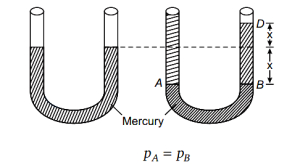
An open $U$-tube contains mercury. When $11.2 \,cm$ of water is poured into one of the arms of the tube, how high does the mercury rise in the other arm from its initial level (in $\,cm$)?
A
$0.56$
B
$1.35$
C
$0.41$
D
$2.32$
Solution
(C) Let the mercury level in the $U$-tube be initially at the same height in both arms. When $11.2 \,cm$ of water is poured into the left arm, the mercury level in the left arm drops by $x \,cm$ and rises by $x \,cm$ in the right arm. The total difference in the mercury levels between the two arms becomes $2x \,cm$.
Equating the pressure at the same horizontal level (the interface of water and mercury in the left arm, point $A$, and the corresponding level in the right arm, point $B$):
$p_A = p_B$
$h_{water} \times \rho_{water} \times g = h_{Hg} \times \rho_{Hg} \times g$
Given $h_{water} = 11.2 \,cm = 0.112 \,m$, $\rho_{water} = 1000 \,kg/m^3$, and $\rho_{Hg} = 13600 \,kg/m^3$.
$0.112 \times 1000 = 2x \times 13600$
$112 = 27200x$
$x = \frac{112}{27200} \,m \approx 0.004117 \,m = 0.41 \,cm$.
Thus, the mercury rises by $0.41 \,cm$ in the other arm.
Equating the pressure at the same horizontal level (the interface of water and mercury in the left arm, point $A$, and the corresponding level in the right arm, point $B$):
$p_A = p_B$
$h_{water} \times \rho_{water} \times g = h_{Hg} \times \rho_{Hg} \times g$
Given $h_{water} = 11.2 \,cm = 0.112 \,m$, $\rho_{water} = 1000 \,kg/m^3$, and $\rho_{Hg} = 13600 \,kg/m^3$.
$0.112 \times 1000 = 2x \times 13600$
$112 = 27200x$
$x = \frac{112}{27200} \,m \approx 0.004117 \,m = 0.41 \,cm$.
Thus, the mercury rises by $0.41 \,cm$ in the other arm.
0 likesView Solution
6
PhysicsMediumMCQMHT CET · 2007
If a source emitting waves of frequency $f$ moves towards an observer with a velocity $v/4$ and the observer moves away from the source with a velocity $v/6$,the apparent frequency as heard by the observer will be ($v =$ velocity of sound).
A
$14/15 f$
B
$14/9 f$
C
$10/9 f$
D
$2/3 f$
Solution
(C) The Doppler effect formula for sound is given by $f' = f \left( \frac{v - v_o}{v - v_s} \right)$,where $v$ is the speed of sound,$v_o$ is the velocity of the observer,and $v_s$ is the velocity of the source.
In this case,the source moves towards the observer,so $v_s = v/4$.
The observer moves away from the source,so $v_o = v/6$.
Substituting these values into the formula:
$f' = f \left( \frac{v - v/6}{v - v/4} \right)$
$f' = f \left( \frac{5v/6}{3v/4} \right)$
$f' = f \left( \frac{5}{6} \times \frac{4}{3} \right)$
$f' = f \left( \frac{20}{18} \right) = \frac{10}{9} f$.
In this case,the source moves towards the observer,so $v_s = v/4$.
The observer moves away from the source,so $v_o = v/6$.
Substituting these values into the formula:
$f' = f \left( \frac{v - v/6}{v - v/4} \right)$
$f' = f \left( \frac{5v/6}{3v/4} \right)$
$f' = f \left( \frac{5}{6} \times \frac{4}{3} \right)$
$f' = f \left( \frac{20}{18} \right) = \frac{10}{9} f$.
0 likesView Solution
7
PhysicsDifficultMCQMHT CET · 2007
We consider a thermodynamic system. If $\Delta U$ represents the increase in its internal energy and $W$ the work done by the system,which of the following statements is true?
A
$\Delta U = -W$ is an adiabatic process
B
$\Delta U = W$ in an isothermal process
C
$\Delta U = -W$ in an isothermal process
D
$\Delta U = W$ in an adiabatic process
Solution
(A) The first law of thermodynamics is given by $Q = \Delta U + W$,where $Q$ is the heat supplied to the system,$\Delta U$ is the change in internal energy,and $W$ is the work done by the system.
For an adiabatic process,there is no exchange of heat with the surroundings,so $Q = 0$.
Substituting $Q = 0$ into the first law equation: $0 = \Delta U + W$.
Rearranging this gives $\Delta U = -W$.
Therefore,the statement $\Delta U = -W$ represents an adiabatic process.
For an adiabatic process,there is no exchange of heat with the surroundings,so $Q = 0$.
Substituting $Q = 0$ into the first law equation: $0 = \Delta U + W$.
Rearranging this gives $\Delta U = -W$.
Therefore,the statement $\Delta U = -W$ represents an adiabatic process.
0 likesView Solution
8
PhysicsDifficultMCQMHT CET · 2007
According to Hooke's law of elasticity,if stress is increased,then the ratio of stress to strain
A
becomes zero
B
remains constant
C
decreases
D
increases
Solution
(B) Hooke in $1679$ showed experimentally that if strain is small,then the stress is proportional to strain.
The ratio of stress to strain is constant for a given material and is called the modulus of elasticity $E$.
Thus,$E = \frac{\text{stress}}{\text{strain}} = \text{constant}$.
Hence,if stress is increased (within the elastic limit),the ratio of stress to strain remains constant.
The ratio of stress to strain is constant for a given material and is called the modulus of elasticity $E$.
Thus,$E = \frac{\text{stress}}{\text{strain}} = \text{constant}$.
Hence,if stress is increased (within the elastic limit),the ratio of stress to strain remains constant.
0 likesView Solution
9
PhysicsEasyMCQMHT CET · 2007
$A$ couple produces
A
no motion
B
linear and rotational motion
C
purely rotational motion
D
purely linear motion
Solution
(C) couple is defined as a pair of two equal and opposite forces acting at a certain distance from each other.
Since the two forces are equal in magnitude and opposite in direction,their vector sum (net force) is zero,which means there is no linear (translatory) acceleration.
However,because the forces act at different points,they create a torque about any point,which causes the body to rotate.
Therefore,a couple produces purely rotational motion.
Since the two forces are equal in magnitude and opposite in direction,their vector sum (net force) is zero,which means there is no linear (translatory) acceleration.
However,because the forces act at different points,they create a torque about any point,which causes the body to rotate.
Therefore,a couple produces purely rotational motion.
0 likesView Solution
10
PhysicsEasyMCQMHT CET · 2007
In $SHM$,the restoring force is $F = -kx$,where $k$ is the force constant,$x$ is the displacement,and $A$ is the amplitude of motion. Then,the total energy depends upon:
A
$k, A$ and $M$
B
$k, x, M$
C
$k, A$
D
$k, x$
Solution
(C) In Simple Harmonic Motion $(SHM)$,the total energy $(E)$ is the sum of potential energy $(U)$ and kinetic energy $(K)$.
$E = U + K$
$E = \frac{1}{2} k x^2 + \frac{1}{2} m v^2$
Using the relations $v = \omega \sqrt{A^2 - x^2}$ and $k = m \omega^2$,we get:
$E = \frac{1}{2} k x^2 + \frac{1}{2} m (\omega^2 (A^2 - x^2))$
$E = \frac{1}{2} k x^2 + \frac{1}{2} k (A^2 - x^2)$
$E = \frac{1}{2} k x^2 + \frac{1}{2} k A^2 - \frac{1}{2} k x^2$
$E = \frac{1}{2} k A^2$
Thus,the total energy depends only on the force constant $(k)$ and the amplitude $(A)$.
$E = U + K$
$E = \frac{1}{2} k x^2 + \frac{1}{2} m v^2$
Using the relations $v = \omega \sqrt{A^2 - x^2}$ and $k = m \omega^2$,we get:
$E = \frac{1}{2} k x^2 + \frac{1}{2} m (\omega^2 (A^2 - x^2))$
$E = \frac{1}{2} k x^2 + \frac{1}{2} k (A^2 - x^2)$
$E = \frac{1}{2} k x^2 + \frac{1}{2} k A^2 - \frac{1}{2} k x^2$
$E = \frac{1}{2} k A^2$
Thus,the total energy depends only on the force constant $(k)$ and the amplitude $(A)$.
0 likesView Solution
11
PhysicsMediumMCQMHT CET · 2007
The potential energy of a simple harmonic oscillator,when the particle is halfway to its endpoint,is
A
$\frac{1}{4} E$
B
$\frac{1}{2} E$
C
$\frac{2}{3} E$
D
$\frac{1}{8} E$
Solution
(A) The potential energy $U$ of a simple harmonic oscillator at a displacement $y$ is given by $U = \frac{1}{2} m \omega^2 y^2$.
The total energy $E$ of the oscillator is given by $E = \frac{1}{2} m \omega^2 A^2$,where $A$ is the amplitude.
When the particle is halfway to its endpoint,the displacement $y$ is half of the amplitude,i.e.,$y = \frac{A}{2}$.
Substituting this value into the potential energy formula:
$U = \frac{1}{2} m \omega^2 (\frac{A}{2})^2$
$U = \frac{1}{2} m \omega^2 (\frac{A^2}{4})$
$U = \frac{1}{4} (\frac{1}{2} m \omega^2 A^2)$
Since $E = \frac{1}{2} m \omega^2 A^2$,we get:
$U = \frac{1}{4} E$.
The total energy $E$ of the oscillator is given by $E = \frac{1}{2} m \omega^2 A^2$,where $A$ is the amplitude.
When the particle is halfway to its endpoint,the displacement $y$ is half of the amplitude,i.e.,$y = \frac{A}{2}$.
Substituting this value into the potential energy formula:
$U = \frac{1}{2} m \omega^2 (\frac{A}{2})^2$
$U = \frac{1}{2} m \omega^2 (\frac{A^2}{4})$
$U = \frac{1}{4} (\frac{1}{2} m \omega^2 A^2)$
Since $E = \frac{1}{2} m \omega^2 A^2$,we get:
$U = \frac{1}{4} E$.
0 likesView Solution
12
PhysicsEasyMCQMHT CET · 2007
The acceleration due to gravity on the planet $A$ is $9$ times the acceleration due to gravity on planet $B$. $A$ man jumps to a height of $2 \,m$ on the surface of $A$. What is the height of jump by the same person on the planet $B$?
A
$6 \,m$
B
$\frac{2}{3} \,m$
C
$2/9 \,m$
D
$18 \,m$
Solution
(D) Given that the acceleration due to gravity on planet $A$ is $9$ times that on planet $B$:
$g_{A} = 9g_{B}$ $(i)$
Using the third equation of motion, $v^2 = u^2 + 2gh$. Since the initial velocity $u$ is the same for the jump on both planets and the final velocity $v$ at the maximum height is $0$, we have $u^2 = 2gh$, or $h = \frac{u^2}{2g}$.
Since $u$ is constant for the same person,
$h \propto \frac{1}{g}$
Therefore, $\frac{h_{B}}{h_{A}} = \frac{g_{A}}{g_{B}}$
Substituting the given values:
$\frac{h_{B}}{2} = \frac{9g_{B}}{g_{B}} = 9$
$h_{B} = 9 \times 2 = 18 \,m$.
$g_{A} = 9g_{B}$ $(i)$
Using the third equation of motion, $v^2 = u^2 + 2gh$. Since the initial velocity $u$ is the same for the jump on both planets and the final velocity $v$ at the maximum height is $0$, we have $u^2 = 2gh$, or $h = \frac{u^2}{2g}$.
Since $u$ is constant for the same person,
$h \propto \frac{1}{g}$
Therefore, $\frac{h_{B}}{h_{A}} = \frac{g_{A}}{g_{B}}$
Substituting the given values:
$\frac{h_{B}}{2} = \frac{9g_{B}}{g_{B}} = 9$
$h_{B} = 9 \times 2 = 18 \,m$.
0 likesView Solution
13
PhysicsMediumMCQMHT CET · 2007
Sound waves are not transmitted over long distances because:
A
they are absorbed by the atmosphere
B
they have a constant frequency
C
the height of the antenna required would be very high
D
the velocity of sound waves is very low
Solution
(A) Sound waves are mechanical waves that require a material medium for propagation. As they travel through the atmosphere,their energy is dissipated due to several factors:
$1$. Geometric spreading: The intensity of the wave decreases as it spreads out over a larger area.
$2$. Atmospheric absorption: Acoustic energy is absorbed by the atmosphere through molecular relaxation and viscosity effects.
$3$. Surface effects: Interaction with the ground and obstacles causes scattering and absorption.
Because of these energy losses,the intensity of sound waves decreases rapidly with distance,making long-distance transmission ineffective compared to electromagnetic waves. While atmospheric absorption is often negligible for short distances,it becomes significant over long distances.
$1$. Geometric spreading: The intensity of the wave decreases as it spreads out over a larger area.
$2$. Atmospheric absorption: Acoustic energy is absorbed by the atmosphere through molecular relaxation and viscosity effects.
$3$. Surface effects: Interaction with the ground and obstacles causes scattering and absorption.
Because of these energy losses,the intensity of sound waves decreases rapidly with distance,making long-distance transmission ineffective compared to electromagnetic waves. While atmospheric absorption is often negligible for short distances,it becomes significant over long distances.
0 likesView Solution
14
PhysicsMediumMCQMHT CET · 2007
$A$ pulse of a wave train travels along a stretched string and reaches the fixed end of the string. It will be reflected back with
A
a phase change of $180^{\circ}$ with velocity reversed
B
the same phase as the incident pulse with no reversal of velocity
C
a phase change of $180^{\circ}$ with no reversal of velocity
D
the same phase as the incident pulse but with velocity reversed
Solution
(A) When a pulse of a wave train travels along a stretched string and reaches a fixed end,it undergoes reflection.
According to the boundary conditions for a fixed end,the displacement at the boundary must be zero at all times.
This results in a phase change of $\pi$ $(180^{\circ})$ for the reflected pulse compared to the incident pulse.
However,the velocity of the wave after reflection is reversed in direction,but the magnitude remains the same.
Therefore,the pulse is reflected back with a phase change of $180^{\circ}$ and its velocity is reversed.
According to the boundary conditions for a fixed end,the displacement at the boundary must be zero at all times.
This results in a phase change of $\pi$ $(180^{\circ})$ for the reflected pulse compared to the incident pulse.
However,the velocity of the wave after reflection is reversed in direction,but the magnitude remains the same.
Therefore,the pulse is reflected back with a phase change of $180^{\circ}$ and its velocity is reversed.
0 likesView Solution
15
PhysicsEasyMCQMHT CET · 2007
$A$ rubber ball is dropped from a height of $5 \ m$ on a planet,where the acceleration due to gravity is not known. On bouncing,it rises to $1.8 \ m$. The ball loses its velocity on bouncing by a factor of
A
$\frac{16}{25}$
B
$\frac{2}{5}$
C
$\frac{3}{5}$
D
$\frac{9}{25}$
Solution
(B) The velocity of the ball just before hitting the ground is $v_1 = \sqrt{2gh_1}$.
The velocity of the ball just after bouncing is $v_2 = \sqrt{2gh_2}$.
The loss in velocity is $\Delta v = v_1 - v_2$.
The factor by which the velocity is lost is given by $\frac{\Delta v}{v_1} = \frac{v_1 - v_2}{v_1} = 1 - \frac{v_2}{v_1}$.
Substituting the expressions for $v_1$ and $v_2$,we get $\frac{\Delta v}{v_1} = 1 - \sqrt{\frac{h_2}{h_1}}$.
Given $h_1 = 5 \ m$ and $h_2 = 1.8 \ m$,we have $\frac{\Delta v}{v_1} = 1 - \sqrt{\frac{1.8}{5}} = 1 - \sqrt{0.36} = 1 - 0.6 = 0.4$.
Converting $0.4$ to a fraction,we get $\frac{4}{10} = \frac{2}{5}$.
The velocity of the ball just after bouncing is $v_2 = \sqrt{2gh_2}$.
The loss in velocity is $\Delta v = v_1 - v_2$.
The factor by which the velocity is lost is given by $\frac{\Delta v}{v_1} = \frac{v_1 - v_2}{v_1} = 1 - \frac{v_2}{v_1}$.
Substituting the expressions for $v_1$ and $v_2$,we get $\frac{\Delta v}{v_1} = 1 - \sqrt{\frac{h_2}{h_1}}$.
Given $h_1 = 5 \ m$ and $h_2 = 1.8 \ m$,we have $\frac{\Delta v}{v_1} = 1 - \sqrt{\frac{1.8}{5}} = 1 - \sqrt{0.36} = 1 - 0.6 = 0.4$.
Converting $0.4$ to a fraction,we get $\frac{4}{10} = \frac{2}{5}$.
0 likesView Solution
16
PhysicsEasyMCQMHT CET · 2007
The moment of inertia of a uniform circular disc of radius $R$ and mass $M$ about an axis touching the disc at its diameter and normal to the disc is
A
$M R^{2}$
B
$\frac{2}{5} M R^{2}$
C
$\frac{3}{2} M R^{2}$
D
$\frac{1}{2} M R^{2}$
Solution
(C) The moment of inertia of a uniform circular disc about an axis passing through its center of mass and perpendicular to its plane is given by $I_{CM} = \frac{1}{2} M R^{2}$.
According to the parallel axis theorem,the moment of inertia $I$ about an axis parallel to the central axis at a distance $d = R$ is given by $I = I_{CM} + M d^{2}$.
Substituting $d = R$ into the formula,we get:
$I = \frac{1}{2} M R^{2} + M R^{2} = \frac{3}{2} M R^{2}$.
According to the parallel axis theorem,the moment of inertia $I$ about an axis parallel to the central axis at a distance $d = R$ is given by $I = I_{CM} + M d^{2}$.
Substituting $d = R$ into the formula,we get:
$I = \frac{1}{2} M R^{2} + M R^{2} = \frac{3}{2} M R^{2}$.
0 likesView Solution
17
PhysicsDifficultMCQMHT CET · 2007
The thermal conductivity of a rod is $2$. What is its thermal resistivity?
A
$0.5$
B
$1$
C
$0.25$
D
$2$
Solution
(A) Key Idea: Thermal resistivity is the reciprocal of thermal conductivity.
Thermal resistivity = $\frac{1}{\text{Thermal conductivity}}$
Thermal resistivity = $\frac{1}{2} = 0.5$
Thermal resistivity = $\frac{1}{\text{Thermal conductivity}}$
Thermal resistivity = $\frac{1}{2} = 0.5$
0 likesView Solution
18
PhysicsEasyMCQMHT CET · 2007
In an adiabatic change,the pressure and temperature of a monoatomic gas are related by the relation $p \propto T^{C}$,where $C$ is equal to
A
$\frac{5}{4}$
B
$\frac{5}{3}$
C
$\frac{5}{2}$
D
$\frac{3}{5}$
Solution
(C) For an adiabatic process,the relation between pressure $p$ and volume $V$ is given by Poisson's equation: $p V^{\gamma} = \text{constant}$.
Using the ideal gas law $pV = RT$,we can write $V = \frac{RT}{p}$.
Substituting this into the adiabatic equation:
$p \left( \frac{RT}{p} \right)^{\gamma} = \text{constant}$
$p^{1-\gamma} T^{\gamma} = \text{constant}$
$p \propto T^{\frac{\gamma}{\gamma-1}}$.
Comparing this with the given relation $p \propto T^{C}$,we get $C = \frac{\gamma}{\gamma-1}$.
For a monoatomic gas,the adiabatic index $\gamma = \frac{5}{3}$.
Substituting the value of $\gamma$:
$C = \frac{5/3}{5/3 - 1} = \frac{5/3}{2/3} = \frac{5}{2}$.
Using the ideal gas law $pV = RT$,we can write $V = \frac{RT}{p}$.
Substituting this into the adiabatic equation:
$p \left( \frac{RT}{p} \right)^{\gamma} = \text{constant}$
$p^{1-\gamma} T^{\gamma} = \text{constant}$
$p \propto T^{\frac{\gamma}{\gamma-1}}$.
Comparing this with the given relation $p \propto T^{C}$,we get $C = \frac{\gamma}{\gamma-1}$.
For a monoatomic gas,the adiabatic index $\gamma = \frac{5}{3}$.
Substituting the value of $\gamma$:
$C = \frac{5/3}{5/3 - 1} = \frac{5/3}{2/3} = \frac{5}{2}$.
0 likesView Solution
19
PhysicsEasyMCQMHT CET · 2007
$A$ boat at anchor is rocked by waves whose crests are $100 \,m$ apart and velocity is $25 \,m/s$. The boat bounces up once in every (in $\,s$)
A
$2500$
B
$75$
C
$4$
D
$0.25$
Solution
(C) Key Idea: The distance between two consecutive crests in a wave is called the wavelength $(\lambda)$.
When a boat is rocked by waves,it completes one full bounce (up and down) as one full wavelength passes by the boat.
Given:
Wavelength $(\lambda)$ $= 100 \,m$
Velocity of wave $(v)$ $= 25 \,m/s$
The time period $(T)$ of the bounce is the time taken for one wavelength to pass a fixed point.
Using the formula: $T = \frac{\lambda}{v}$
$T = \frac{100 \,m}{25 \,m/s} = 4 \,s$
Therefore,the boat bounces up once every $4 \,s$.
When a boat is rocked by waves,it completes one full bounce (up and down) as one full wavelength passes by the boat.
Given:
Wavelength $(\lambda)$ $= 100 \,m$
Velocity of wave $(v)$ $= 25 \,m/s$
The time period $(T)$ of the bounce is the time taken for one wavelength to pass a fixed point.
Using the formula: $T = \frac{\lambda}{v}$
$T = \frac{100 \,m}{25 \,m/s} = 4 \,s$
Therefore,the boat bounces up once every $4 \,s$.
0 likesView Solution
20
PhysicsMediumMCQMHT CET · 2007
Two drops of equal radius coalesce to form a bigger drop. What is the ratio of the surface energy of the bigger drop to that of a smaller one?
A
$2^{1/3} : 1$
B
$1 : 1$
C
$2^{2/3} : 1$
D
$2^{1/2} : 1$
Solution
(C) The volume of the liquid remains constant when two drops coalesce. Let $r$ be the radius of each smaller drop and $R$ be the radius of the bigger drop.
Volume of two smaller drops = Volume of the bigger drop
$2 \times (\frac{4}{3} \pi r^3) = \frac{4}{3} \pi R^3$
$R^3 = 2r^3 \implies R = 2^{1/3} r$
Surface energy $W$ is given by $W = T \times A$,where $T$ is surface tension and $A$ is the surface area.
Surface energy of the bigger drop,$W_1 = T \times (4 \pi R^2) = 4 \pi T (2^{1/3} r)^2 = 2^{2/3} (4 \pi r^2 T)$.
Surface energy of one smaller drop,$W_2 = T \times (4 \pi r^2) = 4 \pi r^2 T$.
The ratio of the surface energy of the bigger drop to the smaller drop is:
$\frac{W_1}{W_2} = \frac{2^{2/3} (4 \pi r^2 T)}{4 \pi r^2 T} = 2^{2/3} : 1$.
Volume of two smaller drops = Volume of the bigger drop
$2 \times (\frac{4}{3} \pi r^3) = \frac{4}{3} \pi R^3$
$R^3 = 2r^3 \implies R = 2^{1/3} r$
Surface energy $W$ is given by $W = T \times A$,where $T$ is surface tension and $A$ is the surface area.
Surface energy of the bigger drop,$W_1 = T \times (4 \pi R^2) = 4 \pi T (2^{1/3} r)^2 = 2^{2/3} (4 \pi r^2 T)$.
Surface energy of one smaller drop,$W_2 = T \times (4 \pi r^2) = 4 \pi r^2 T$.
The ratio of the surface energy of the bigger drop to the smaller drop is:
$\frac{W_1}{W_2} = \frac{2^{2/3} (4 \pi r^2 T)}{4 \pi r^2 T} = 2^{2/3} : 1$.
0 likesView Solution
21
PhysicsMediumMCQMHT CET · 2007
We consider the radiation emitted by the human body. Which of the following statements is true?
A
The radiation is emitted during the summers and absorbed during the winters
B
The radiation emitted lies in the ultraviolet region and hence is not visible
C
The radiation emitted is in the infrared region
D
The radiation is emitted only during the day
Solution
(C) All bodies at a temperature above absolute zero emit electromagnetic radiation. The human body,being at a temperature of approximately $37^{\circ}C$ $(310 \ K)$,emits thermal radiation.
According to Wien's displacement law,the peak wavelength of this radiation corresponds to the infrared region of the electromagnetic spectrum.
The wavelength range for human body radiation is typically in the infrared region,specifically around $10 \ \mu m$.
Therefore,the radiation emitted by the human body is in the infrared region.
According to Wien's displacement law,the peak wavelength of this radiation corresponds to the infrared region of the electromagnetic spectrum.
The wavelength range for human body radiation is typically in the infrared region,specifically around $10 \ \mu m$.
Therefore,the radiation emitted by the human body is in the infrared region.
0 likesView Solution
22
PhysicsEasyMCQMHT CET · 2007
The gas having average speed four times as that of $SO_{2}$ (molecular mass $64$) is
A
$He$ (molecular mass $4$)
B
$O_{2}$ (molecular mass $32$)
C
$H_{2}$ (molecular mass $2$)
D
$CH_{4}$ (molecular mass $16$)
Solution
(A) The average speed $(v_{av})$ of gas molecules is given by the formula:
$v_{av} = \sqrt{\frac{8RT}{\pi M}}$
where $R$ is the universal gas constant,$T$ is the absolute temperature,and $M$ is the molar mass of the gas.
Assuming the temperature $T$ is constant for both gases,the average speed is inversely proportional to the square root of the molar mass:
$v_{av} \propto \frac{1}{\sqrt{M}}$
Let $v_{1}$ be the speed of $SO_{2}$ and $v_{2}$ be the speed of the unknown gas. Given $v_{2} = 4v_{1}$ and $M_{1} = 64$:
$\frac{v_{2}}{v_{1}} = \sqrt{\frac{M_{1}}{M_{2}}}$
$4 = \sqrt{\frac{64}{M_{2}}}$
Squaring both sides:
$16 = \frac{64}{M_{2}}$
$M_{2} = \frac{64}{16} = 4$
The gas with a molar mass of $4$ is Helium $(He)$.
Therefore,the correct option is $A$.
$v_{av} = \sqrt{\frac{8RT}{\pi M}}$
where $R$ is the universal gas constant,$T$ is the absolute temperature,and $M$ is the molar mass of the gas.
Assuming the temperature $T$ is constant for both gases,the average speed is inversely proportional to the square root of the molar mass:
$v_{av} \propto \frac{1}{\sqrt{M}}$
Let $v_{1}$ be the speed of $SO_{2}$ and $v_{2}$ be the speed of the unknown gas. Given $v_{2} = 4v_{1}$ and $M_{1} = 64$:
$\frac{v_{2}}{v_{1}} = \sqrt{\frac{M_{1}}{M_{2}}}$
$4 = \sqrt{\frac{64}{M_{2}}}$
Squaring both sides:
$16 = \frac{64}{M_{2}}$
$M_{2} = \frac{64}{16} = 4$
The gas with a molar mass of $4$ is Helium $(He)$.
Therefore,the correct option is $A$.
0 likesView Solution
23
PhysicsEasyMCQMHT CET · 2007
The displacement equation of a simple harmonic oscillator is given by $y = A \sin \omega t - B \cos \omega t$. The amplitude of the oscillator will be
A
$A - B$
B
$A + B$
C
$\sqrt{A^2 + B^2}$
D
$(A^2 + B^2)$
Solution
(C) The given displacement equation is $y = A \sin \omega t - B \cos \omega t$.
To find the amplitude,we express the equation in the form $y = R \sin(\omega t - \phi)$.
Let $A = R \cos \phi$ and $B = R \sin \phi$.
Then,$y = R \cos \phi \sin \omega t - R \sin \phi \cos \omega t = R \sin(\omega t - \phi)$.
Squaring and adding the expressions for $A$ and $B$:
$A^2 + B^2 = R^2 \cos^2 \phi + R^2 \sin^2 \phi = R^2(\cos^2 \phi + \sin^2 \phi) = R^2$.
Therefore,the amplitude $R = \sqrt{A^2 + B^2}$.
To find the amplitude,we express the equation in the form $y = R \sin(\omega t - \phi)$.
Let $A = R \cos \phi$ and $B = R \sin \phi$.
Then,$y = R \cos \phi \sin \omega t - R \sin \phi \cos \omega t = R \sin(\omega t - \phi)$.
Squaring and adding the expressions for $A$ and $B$:
$A^2 + B^2 = R^2 \cos^2 \phi + R^2 \sin^2 \phi = R^2(\cos^2 \phi + \sin^2 \phi) = R^2$.
Therefore,the amplitude $R = \sqrt{A^2 + B^2}$.
0 likesView Solution
24
PhysicsMediumMCQMHT CET · 2007
The gases carbon monoxide $(CO)$ and nitrogen $(N_{2})$ at the same temperature have kinetic energies $E_{1}$ and $E_{2}$ respectively. Then
A
$E_{1} = E_{2}$
B
$E_{1} > E_{2}$
C
$E_{1} < E_{2}$
D
$E_{1}$ and $E_{2}$ cannot be compared
Solution
(A) The average kinetic energy of a gas molecule depends only on its absolute temperature $T$ and is given by the formula $K.E. = \frac{f}{2} k T$,where $f$ is the number of degrees of freedom and $k$ is the Boltzmann constant.
Both carbon monoxide $(CO)$ and nitrogen $(N_{2})$ are diatomic gases.
For diatomic gases,the number of degrees of freedom $f = 5$ at moderate temperatures.
Since both gases are at the same temperature $T$,their average kinetic energies per molecule are equal.
Therefore,$E_{1} = E_{2}$.
Both carbon monoxide $(CO)$ and nitrogen $(N_{2})$ are diatomic gases.
For diatomic gases,the number of degrees of freedom $f = 5$ at moderate temperatures.
Since both gases are at the same temperature $T$,their average kinetic energies per molecule are equal.
Therefore,$E_{1} = E_{2}$.
0 likesView Solution
25
PhysicsEasyMCQMHT CET · 2007
$A$ parallel plate capacitor with oil between the plates (dielectric constant of oil $K = 2$) has a capacitance $C$. If the oil is removed,then the capacitance of the capacitor becomes:
A
$\sqrt{2} C$
B
$2C$
C
$\frac{C}{\sqrt{2}}$
D
$\frac{C}{2}$
Solution
(D) The capacitance of a parallel plate capacitor filled with a dielectric medium is given by $C_{medium} = \frac{K \epsilon_0 A}{d} = KC_0$,where $C_0$ is the capacitance with air/vacuum between the plates.
Given that $C_{medium} = C$ and $K = 2$,we have $C = 2C_0$.
Therefore,the capacitance with air (when oil is removed) is $C_0 = \frac{C}{2}$.
Thus,the correct option is $D$.
Given that $C_{medium} = C$ and $K = 2$,we have $C = 2C_0$.
Therefore,the capacitance with air (when oil is removed) is $C_0 = \frac{C}{2}$.
Thus,the correct option is $D$.
0 likesView Solution
26
PhysicsDifficultMCQMHT CET · 2007
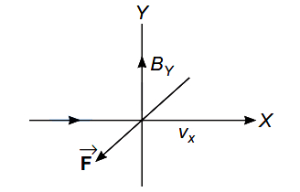
An electron is travelling along the $x$-direction. It encounters a magnetic field in the $y$-direction. Its subsequent motion will be
A
straight line along the $x$-direction
B
a circle in the $xz$-plane
C
a circle in the $yz$-plane
D
a circle in the $xz$-plane
Solution
(B) The magnetic force on a charged particle moving with velocity $\overrightarrow{v}$ in a magnetic field $\overrightarrow{B}$ is given by the Lorentz force formula: $\overrightarrow{F} = q(\overrightarrow{v} \times \overrightarrow{B})$.
For an electron,the charge $q = -e$.
The velocity of the electron is $\overrightarrow{v} = v_x \hat{i}$ and the magnetic field is $\overrightarrow{B} = B_y \hat{j}$.
Substituting these into the force equation:
$\overrightarrow{F} = -e(v_x \hat{i} \times B_y \hat{j})$
$\overrightarrow{F} = -e v_x B_y (\hat{i} \times \hat{j})$
Since $\hat{i} \times \hat{j} = \hat{k}$,we get $\overrightarrow{F} = -e v_x B_y \hat{k}$.
The force is always perpendicular to both the velocity and the magnetic field. Since the velocity is in the $x$-direction and the magnetic field is in the $y$-direction,the force acts in the $z$-direction (specifically $-z$ for an electron). The particle will move in a circle in the plane perpendicular to the magnetic field,which is the $xz$-plane.
For an electron,the charge $q = -e$.
The velocity of the electron is $\overrightarrow{v} = v_x \hat{i}$ and the magnetic field is $\overrightarrow{B} = B_y \hat{j}$.
Substituting these into the force equation:
$\overrightarrow{F} = -e(v_x \hat{i} \times B_y \hat{j})$
$\overrightarrow{F} = -e v_x B_y (\hat{i} \times \hat{j})$
Since $\hat{i} \times \hat{j} = \hat{k}$,we get $\overrightarrow{F} = -e v_x B_y \hat{k}$.
The force is always perpendicular to both the velocity and the magnetic field. Since the velocity is in the $x$-direction and the magnetic field is in the $y$-direction,the force acts in the $z$-direction (specifically $-z$ for an electron). The particle will move in a circle in the plane perpendicular to the magnetic field,which is the $xz$-plane.
0 likesView Solution
27
PhysicsDifficultMCQMHT CET · 2007
Barrier potential of a $p-n$ junction diode does not depend on:
A
forward bias
B
doping density
C
diode design
D
temperature
Solution
(C) The barrier potential $(V_B)$ of a $p-n$ junction diode is determined by the internal properties of the semiconductor material and the conditions under which it operates.
$1$. Doping density: The barrier potential increases with an increase in the doping concentration.
$2$. Temperature: The barrier potential decreases as the temperature increases.
$3$. Forward bias: Applying a forward bias reduces the effective barrier potential,allowing current to flow.
$4$. Diode design: The barrier potential is an intrinsic property of the $p-n$ junction itself and does not depend on the physical design or geometry of the diode.
Therefore,the correct option is $C$.
$1$. Doping density: The barrier potential increases with an increase in the doping concentration.
$2$. Temperature: The barrier potential decreases as the temperature increases.
$3$. Forward bias: Applying a forward bias reduces the effective barrier potential,allowing current to flow.
$4$. Diode design: The barrier potential is an intrinsic property of the $p-n$ junction itself and does not depend on the physical design or geometry of the diode.
Therefore,the correct option is $C$.
0 likesView Solution
28
PhysicsEasyMCQMHT CET · 2007
Tangent galvanometer measures
A
capacitance
B
current
C
resistance
D
potential difference
Solution
(B) When a current $I$ is passed through the galvanometer coil,a magnetic field $B$ is produced at right angles to the plane of the coil,i.e.,at right angles to the horizontal component of the Earth's magnetic field $H$. Under the influence of two crossed magnetic fields $B$ and $H$,the magnetic needle of the galvanometer undergoes a deflection $\theta$,which is given by the tangent law. Using the tangent law,we can find the relation $I = K \tan \theta$,where $K$ is the reduction factor. This clearly indicates that a tangent galvanometer is an instrument used for the measurement of electric current in a circuit. Note: $A$ tangent galvanometer is most accurate when its deflection is $45^{\circ}$.
0 likesView Solution
29
PhysicsMediumMCQMHT CET · 2007
Fleming's left and right hand rules are used in
A
$DC$ motor and $AC$ generator
B
$DC$ generator and $AC$ motor
C
$DC$ motor and $DC$ generator
D
Both rules are same,any one can be used
Solution
(C) $DC$ motor is a device that converts electrical energy into mechanical energy. It operates on the principle of the magnetic force on a current-carrying conductor,which is determined using Fleming's left-hand rule.
$A$ $DC$ generator is a device that converts mechanical energy into electrical energy in the form of $DC$. It operates on the principle of electromagnetic induction,and the direction of the induced current is determined using Fleming's right-hand rule.
$A$ $DC$ generator is a device that converts mechanical energy into electrical energy in the form of $DC$. It operates on the principle of electromagnetic induction,and the direction of the induced current is determined using Fleming's right-hand rule.
0 likesView Solution
30
PhysicsDifficultMCQMHT CET · 2007
If a coil is open,then its self-inductance $L$ and resistance $R$ become:
A
$\infty, 0$
B
$0, \infty$
C
$\infty, \infty$
D
$0, 0$
Solution
(B) When a coil is open,the circuit is broken,meaning no current can flow through it $(i = 0)$.
Since the circuit is open,the resistance $R$ of the path is effectively infinite $(R = \infty)$.
Regarding self-inductance $L$,it is defined as the property of the coil to oppose any change in current. Mathematically,$\phi = Li$,where $\phi$ is the magnetic flux.
For an open coil,there is no current $(i = 0)$,and consequently,no magnetic flux is generated by the coil $(\phi = 0)$.
Thus,$L = \frac{\phi}{i} = \frac{0}{0}$. In the context of an open circuit,the ability to store magnetic energy or induce an $EMF$ is absent,leading to $L = 0$.
Since the circuit is open,the resistance $R$ of the path is effectively infinite $(R = \infty)$.
Regarding self-inductance $L$,it is defined as the property of the coil to oppose any change in current. Mathematically,$\phi = Li$,where $\phi$ is the magnetic flux.
For an open coil,there is no current $(i = 0)$,and consequently,no magnetic flux is generated by the coil $(\phi = 0)$.
Thus,$L = \frac{\phi}{i} = \frac{0}{0}$. In the context of an open circuit,the ability to store magnetic energy or induce an $EMF$ is absent,leading to $L = 0$.
0 likesView Solution
31
PhysicsMediumMCQMHT CET · 2007
In a circuit,the current lags behind the voltage by a phase difference of $\pi / 2$. The circuit will contain which of the following?
A
Only $R$
B
Only $C$
C
$R$ and $C$
D
Only $L$
Solution
(D) In an alternating current circuit,the phase relationship between voltage and current depends on the components present.
For a purely inductive circuit (containing only an inductor $L$),the voltage leads the current by a phase angle of $\pi / 2$ $(90^{\circ})$,which is equivalent to saying the current lags behind the voltage by $\pi / 2$.
For a purely capacitive circuit (containing only a capacitor $C$),the current leads the voltage by a phase angle of $\pi / 2$ $(90^{\circ})$.
For a purely resistive circuit (containing only a resistor $R$),the current and voltage are in the same phase (phase difference is $0$).
Therefore,since the current lags behind the voltage by $\pi / 2$,the circuit must contain only an inductor $L$.
For a purely inductive circuit (containing only an inductor $L$),the voltage leads the current by a phase angle of $\pi / 2$ $(90^{\circ})$,which is equivalent to saying the current lags behind the voltage by $\pi / 2$.
For a purely capacitive circuit (containing only a capacitor $C$),the current leads the voltage by a phase angle of $\pi / 2$ $(90^{\circ})$.
For a purely resistive circuit (containing only a resistor $R$),the current and voltage are in the same phase (phase difference is $0$).
Therefore,since the current lags behind the voltage by $\pi / 2$,the circuit must contain only an inductor $L$.
0 likesView Solution
32
PhysicsEasyMCQMHT CET · 2007
In bringing an electron towards another electron,the electrostatic potential energy of the system
A
decreases
B
increases
C
remains same
D
becomes zero
Solution
(B) The electron has a negative charge. When an electron approaches another electron,a repulsive force is produced between them due to their like charges.
To bring them closer,work must be done against this repulsive force.
This work is stored in the system in the form of electrostatic potential energy.
Thus,the electrostatic potential energy of the system increases.
Alternatively,the electrostatic potential energy $U$ of a system of two electrons is given by:
$U = \frac{1}{4 \pi \varepsilon_{0}} \frac{(-e)(-e)}{r} = \frac{1}{4 \pi \varepsilon_{0}} \frac{e^{2}}{r}$
As the distance $r$ decreases,the potential energy $U$ increases.
To bring them closer,work must be done against this repulsive force.
This work is stored in the system in the form of electrostatic potential energy.
Thus,the electrostatic potential energy of the system increases.
Alternatively,the electrostatic potential energy $U$ of a system of two electrons is given by:
$U = \frac{1}{4 \pi \varepsilon_{0}} \frac{(-e)(-e)}{r} = \frac{1}{4 \pi \varepsilon_{0}} \frac{e^{2}}{r}$
As the distance $r$ decreases,the potential energy $U$ increases.
0 likesView Solution
33
PhysicsEasyMCQMHT CET · 2007
Which of the following phenomena exhibits the particle nature of light?
A
Interference
B
Diffraction
C
Polarisation
D
Photoelectric effect
Solution
(D) . Interference is a phenomenon in which two waves of the same frequency superpose to give a resultant intensity different from the sum of their separate intensities. Thus,it cannot exhibit the particle nature of light.
$B$. Diffraction is a phenomenon in which light bends at the sharp edges of an obstacle or an aperture. Thus,it also cannot exhibit the particle nature of light.
$C$. Polarisation of light is a property due to which a light ray,after emerging through a crystal (like tourmaline),has vibrations in a plane perpendicular to its direction of propagation. Thus,it also cannot explain the particle nature of light.
$D$. The Photoelectric effect states that light travels in the form of bundles or packets of energy,called photons. This effect is explained on the basis of the quantum (particle) nature of light. Hence,it clearly explains the particle nature of light.
Therefore,option $D$ is correct.
$B$. Diffraction is a phenomenon in which light bends at the sharp edges of an obstacle or an aperture. Thus,it also cannot exhibit the particle nature of light.
$C$. Polarisation of light is a property due to which a light ray,after emerging through a crystal (like tourmaline),has vibrations in a plane perpendicular to its direction of propagation. Thus,it also cannot explain the particle nature of light.
$D$. The Photoelectric effect states that light travels in the form of bundles or packets of energy,called photons. This effect is explained on the basis of the quantum (particle) nature of light. Hence,it clearly explains the particle nature of light.
Therefore,option $D$ is correct.
0 likesView Solution
34
PhysicsMediumMCQMHT CET · 2007
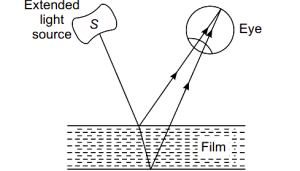
When exposed to sunlight,thin films of oil on water often exhibit brilliant colours due to the phenomenon of
A
interference
B
diffraction
C
dispersion
D
polarisation
Solution
(A) When a thin film of oil spreads over the surface of water and is viewed in broad daylight,brilliant colours are observed.
These colours arise due to the interference of sunlight reflected from the upper and lower surfaces of the thin oil film.
Diffraction is the bending of light rays around the corners of obstacles.
Dispersion is the splitting of white light into its constituent colours.
Polarisation is the restriction of the vibrations of a transverse wave to a single plane.
These colours arise due to the interference of sunlight reflected from the upper and lower surfaces of the thin oil film.
Diffraction is the bending of light rays around the corners of obstacles.
Dispersion is the splitting of white light into its constituent colours.
Polarisation is the restriction of the vibrations of a transverse wave to a single plane.
0 likesView Solution
35
PhysicsMediumMCQMHT CET · 2007
Potentiometer measures the potential difference more accurately than a voltmeter because
A
it has a wire of high resistance
B
it has a wire of low resistance
C
it does not draw current from external circuit
D
it draws a heavy current from external circuit
Solution
(C) When we measure the $EMF$ of a cell using a potentiometer,no current flows through the cell in the zero-deflection condition,meaning the cell is in an open circuit.
Thus,in this condition,the actual $EMF$ of the cell is measured without any voltage drop due to internal resistance.
In this way,a potentiometer acts as an ideal voltmeter with infinite resistance.
Note: The $EMF$ in the potentiometer is measured by the null method,where a zero-deflection position is found on the wire.
Thus,in this condition,the actual $EMF$ of the cell is measured without any voltage drop due to internal resistance.
In this way,a potentiometer acts as an ideal voltmeter with infinite resistance.
Note: The $EMF$ in the potentiometer is measured by the null method,where a zero-deflection position is found on the wire.
0 likesView Solution
36
PhysicsMediumMCQMHT CET · 2007
Ionization potential of a hydrogen atom is $13.6 \text{ eV}$. Hydrogen atoms in the ground state are excited by monochromatic radiation of photon energy $12.1 \text{ eV}$. According to Bohr's theory,the number of spectral lines emitted by the hydrogen atoms will be:
A
two
B
three
C
four
D
one
Solution
(B) The energy of the electron in the ground state $(n=1)$ is $E_1 = -13.6 \text{ eV}$.
When the atom absorbs a photon of energy $12.1 \text{ eV}$,the new energy level $E_n$ is given by:
$E_n = E_1 + 12.1 \text{ eV} = -13.6 \text{ eV} + 12.1 \text{ eV} = -1.5 \text{ eV}$.
Using the Bohr formula $E_n = -\frac{13.6}{n^2} \text{ eV}$:
$-1.5 = -\frac{13.6}{n^2} \implies n^2 = \frac{13.6}{1.5} \approx 9.06 \approx 9$.
Thus,$n = 3$.
The electron is excited to the $n=3$ state. The possible transitions for the electron to return to the ground state are:
$1$. From $n=3$ to $n=2$
$2$. From $n=3$ to $n=1$
$3$. From $n=2$ to $n=1$
The number of spectral lines is given by the formula $N = \frac{n(n-1)}{2} = \frac{3(3-1)}{2} = 3$.
Therefore,$3$ spectral lines are emitted.
When the atom absorbs a photon of energy $12.1 \text{ eV}$,the new energy level $E_n$ is given by:
$E_n = E_1 + 12.1 \text{ eV} = -13.6 \text{ eV} + 12.1 \text{ eV} = -1.5 \text{ eV}$.
Using the Bohr formula $E_n = -\frac{13.6}{n^2} \text{ eV}$:
$-1.5 = -\frac{13.6}{n^2} \implies n^2 = \frac{13.6}{1.5} \approx 9.06 \approx 9$.
Thus,$n = 3$.
The electron is excited to the $n=3$ state. The possible transitions for the electron to return to the ground state are:
$1$. From $n=3$ to $n=2$
$2$. From $n=3$ to $n=1$
$3$. From $n=2$ to $n=1$
The number of spectral lines is given by the formula $N = \frac{n(n-1)}{2} = \frac{3(3-1)}{2} = 3$.
Therefore,$3$ spectral lines are emitted.
0 likesView Solution
37
PhysicsMediumMCQMHT CET · 2007
In a radioactive material,the activity at time $t_{1}$ is $R_{1}$ and at a later time $t_{2}$,it is $R_{2}$. If the decay constant of the material is $\lambda$,then:
A
$R_{1}=R_{2} e^{-\lambda\left(t_{1}-t_{2}\right)}$
B
$R_{1}=R_{2} e^{\lambda\left(t_{1}-t_{2}\right)}$
C
$R_{1}=R_{2}\left(t_{2} / t_{1}\right)$
D
$R_{1}=R_{2}$
Solution
(A) The activity $R$ of a radioactive sample is given by the radioactive decay law: $R = R_{0} e^{-\lambda t}$,where $R_{0}$ is the initial activity at $t=0$.
At time $t_{1}$,the activity is $R_{1} = R_{0} e^{-\lambda t_{1}}$.
At time $t_{2}$,the activity is $R_{2} = R_{0} e^{-\lambda t_{2}}$.
Dividing the expression for $R_{1}$ by $R_{2}$,we get:
$\frac{R_{1}}{R_{2}} = \frac{R_{0} e^{-\lambda t_{1}}}{R_{0} e^{-\lambda t_{2}}} = e^{-\lambda t_{1} - (-\lambda t_{2})} = e^{-\lambda(t_{1}-t_{2})}$.
Therefore,$R_{1} = R_{2} e^{-\lambda(t_{1}-t_{2})}$.
At time $t_{1}$,the activity is $R_{1} = R_{0} e^{-\lambda t_{1}}$.
At time $t_{2}$,the activity is $R_{2} = R_{0} e^{-\lambda t_{2}}$.
Dividing the expression for $R_{1}$ by $R_{2}$,we get:
$\frac{R_{1}}{R_{2}} = \frac{R_{0} e^{-\lambda t_{1}}}{R_{0} e^{-\lambda t_{2}}} = e^{-\lambda t_{1} - (-\lambda t_{2})} = e^{-\lambda(t_{1}-t_{2})}$.
Therefore,$R_{1} = R_{2} e^{-\lambda(t_{1}-t_{2})}$.
0 likesView Solution
38
PhysicsEasyMCQMHT CET · 2007
$A$ charge $q$ is placed at the corner of a cube of side $a$. The electric flux through the cube is
A
$\frac{q}{\varepsilon_{0}}$
B
$\frac{q}{3 \varepsilon_{0}}$
C
$\frac{q}{6 \varepsilon_{0}}$
D
$\frac{q}{8 \varepsilon_{0}}$
Solution
(D) According to Gauss's law,the total electric flux through a closed surface is $\frac{1}{\varepsilon_{0}}$ times the net charge enclosed by the surface.
When a charge $q$ is placed at the corner of a cube,it is shared equally by $8$ adjacent cubes to form a symmetric closed Gaussian surface.
Therefore,the flux through one single cube is $\frac{1}{8}$ of the total flux produced by the charge $q$.
Thus,the electric flux through the cube is $\phi = \frac{q}{8 \varepsilon_{0}}$.
When a charge $q$ is placed at the corner of a cube,it is shared equally by $8$ adjacent cubes to form a symmetric closed Gaussian surface.
Therefore,the flux through one single cube is $\frac{1}{8}$ of the total flux produced by the charge $q$.
Thus,the electric flux through the cube is $\phi = \frac{q}{8 \varepsilon_{0}}$.
0 likesView Solution
39
PhysicsEasyMCQMHT CET · 2007
If a full wave rectifier circuit is operating from $50 \,Hz$ mains, the fundamental frequency in the ripple will be (in $\,Hz$)
A
$70.7$
B
$100$
C
$25$
D
$59$
Solution
(B) In a full wave rectifier, the output consists of two pulses for every single cycle of the input $AC$ supply.
Therefore, the ripple frequency is twice the input frequency.
Given, input frequency $f = 50 \,Hz$.
Ripple frequency $= 2 \times f = 2 \times 50 \,Hz = 100 \,Hz$.
Therefore, the ripple frequency is twice the input frequency.
Given, input frequency $f = 50 \,Hz$.
Ripple frequency $= 2 \times f = 2 \times 50 \,Hz = 100 \,Hz$.
0 likesView Solution
40
PhysicsEasyMCQMHT CET · 2007
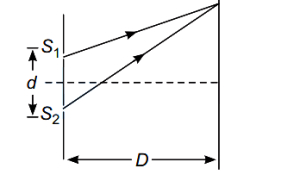
In a double slit experiment,the distance between slits is increased $10$ times whereas their distance from the screen is halved,then what is the fringe width?
A
It remains same
B
Becomes $1/10$ times
C
Becomes $1/20$ times
D
Becomes $1/90$ times
Solution
(C) Let $\lambda$ be the wavelength of monochromatic light,$d$ be the distance between the coherent sources,and $D$ be the distance between the screen and the source. The fringe width $\beta$ is given by:
$\beta = \frac{D \lambda}{d}$
Given the initial conditions: $d_1 = d$ and $D_1 = D$. The initial fringe width is $\beta_1 = \frac{D \lambda}{d}$.
Given the new conditions: $d_2 = 10d$ and $D_2 = \frac{D}{2}$.
The new fringe width $\beta_2$ is:
$\beta_2 = \frac{D_2 \lambda}{d_2} = \frac{(\frac{D}{2}) \lambda}{10d} = \frac{D \lambda}{20d}$
Comparing the new fringe width with the initial one:
$\beta_2 = \frac{1}{20} \left( \frac{D \lambda}{d} \right) = \frac{\beta_1}{20}$
Thus,the fringe width becomes $1/20$ times the original fringe width.
$\beta = \frac{D \lambda}{d}$
Given the initial conditions: $d_1 = d$ and $D_1 = D$. The initial fringe width is $\beta_1 = \frac{D \lambda}{d}$.
Given the new conditions: $d_2 = 10d$ and $D_2 = \frac{D}{2}$.
The new fringe width $\beta_2$ is:
$\beta_2 = \frac{D_2 \lambda}{d_2} = \frac{(\frac{D}{2}) \lambda}{10d} = \frac{D \lambda}{20d}$
Comparing the new fringe width with the initial one:
$\beta_2 = \frac{1}{20} \left( \frac{D \lambda}{d} \right) = \frac{\beta_1}{20}$
Thus,the fringe width becomes $1/20$ times the original fringe width.
0 likesView Solution
41
PhysicsMediumMCQMHT CET · 2007
The momentum of a photon of energy $1 \text{ MeV}$ in $\text{kg-m/s}$ will be
A
$0.33 \times 10^{6}$
B
$7 \times 10^{-24}$
C
$10^{-22}$
D
$5 \times 10^{-22}$
Solution
(D) The energy of a photon is given by $E = \frac{hc}{\lambda}$,where $h$ is Planck's constant,$c$ is the speed of light,and $\lambda$ is the wavelength.
According to the de-Broglie relation,the momentum $p$ is given by $p = \frac{h}{\lambda}$,which implies $\lambda = \frac{h}{p}$.
Substituting $\lambda$ into the energy equation: $E = \frac{hc}{h/p} = pc$.
Therefore,the momentum is $p = \frac{E}{c}$.
Given: $E = 1 \text{ MeV} = 1 \times 10^{6} \times 1.6 \times 10^{-19} \text{ J} = 1.6 \times 10^{-13} \text{ J}$ and $c = 3 \times 10^{8} \text{ m/s}$.
Substituting these values: $p = \frac{1.6 \times 10^{-13}}{3 \times 10^{8}} \approx 0.533 \times 10^{-21} \text{ kg-m/s} = 5.33 \times 10^{-22} \text{ kg-m/s}$.
Rounding to the nearest provided option,we get $p = 5 \times 10^{-22} \text{ kg-m/s}$.
According to the de-Broglie relation,the momentum $p$ is given by $p = \frac{h}{\lambda}$,which implies $\lambda = \frac{h}{p}$.
Substituting $\lambda$ into the energy equation: $E = \frac{hc}{h/p} = pc$.
Therefore,the momentum is $p = \frac{E}{c}$.
Given: $E = 1 \text{ MeV} = 1 \times 10^{6} \times 1.6 \times 10^{-19} \text{ J} = 1.6 \times 10^{-13} \text{ J}$ and $c = 3 \times 10^{8} \text{ m/s}$.
Substituting these values: $p = \frac{1.6 \times 10^{-13}}{3 \times 10^{8}} \approx 0.533 \times 10^{-21} \text{ kg-m/s} = 5.33 \times 10^{-22} \text{ kg-m/s}$.
Rounding to the nearest provided option,we get $p = 5 \times 10^{-22} \text{ kg-m/s}$.
0 likesView Solution
42
PhysicsDifficultMCQMHT CET · 2007
$m_{p}$ and $m_{n}$ are the masses of a proton and a neutron, respectively. For an element of mass $M$ having $Z$ protons and $N$ neutrons, which of the following is true?
A
$M > Z m_{p} + N m_{n}$
B
$M = Z m_{p} + N m_{n}$
C
$M < Z m_{p} + N m_{n}$
D
$M$ may be greater than, less than, or equal to $Z m_{p} + N m_{n}$, depending on the nature of the element.
Solution
(C) The mass of a stable nucleus is always found to be less than the sum of the masses of its constituent protons and neutrons. This difference in mass is known as the mass defect $(\Delta m)$.
The mass defect is given by $\Delta m = (Z m_{p} + N m_{n}) - M$.
Since the mass defect is positive for stable nuclei, it implies that $M < (Z m_{p} + N m_{n})$.
This missing mass is converted into binding energy, which holds the nucleus together.
The mass defect is given by $\Delta m = (Z m_{p} + N m_{n}) - M$.
Since the mass defect is positive for stable nuclei, it implies that $M < (Z m_{p} + N m_{n})$.
This missing mass is converted into binding energy, which holds the nucleus together.
0 likesView Solution
43
PhysicsMediumMCQMHT CET · 2007
$A$ photoelectric cell is illuminated by a point source of light $1 \ m$ away. When the source is shifted to $2 \ m$,then:
A
each emitted electron carries half the initial energy
B
number of electrons emitted is a quarter of the initial number
C
each emitted electron carries one quarter of the initial energy
D
number of electrons emitted is half the initial number
Solution
(B) The number of photoelectrons emitted per second is directly proportional to the intensity of the incident light.
For a point source of light,the intensity $I$ follows the inverse square law: $I \propto \frac{1}{d^2}$,where $d$ is the distance from the source.
When the distance is doubled $(d' = 2d)$,the new intensity $I'$ becomes $I' = \frac{I}{2^2} = \frac{I}{4}$.
Since the number of photoelectrons emitted is directly proportional to the intensity,the number of photoelectrons emitted becomes one-fourth of the initial number.
The energy of each emitted electron depends on the frequency of the incident light,not on its intensity. Therefore,the energy of each emitted electron remains unchanged.
For a point source of light,the intensity $I$ follows the inverse square law: $I \propto \frac{1}{d^2}$,where $d$ is the distance from the source.
When the distance is doubled $(d' = 2d)$,the new intensity $I'$ becomes $I' = \frac{I}{2^2} = \frac{I}{4}$.
Since the number of photoelectrons emitted is directly proportional to the intensity,the number of photoelectrons emitted becomes one-fourth of the initial number.
The energy of each emitted electron depends on the frequency of the incident light,not on its intensity. Therefore,the energy of each emitted electron remains unchanged.
0 likesView Solution
44
PhysicsMediumMCQMHT CET · 2007
When the intensity of incident light increases:
A
photo-current increases
B
photo-current decreases
C
kinetic energy of emitted photoelectrons increases
D
kinetic energy of emitted photoelectrons decreases
Solution
(A) According to Einstein's photoelectric equation,a single incident photon ejects a single electron.
When the intensity of light increases,the number of incident photons per unit area per unit time increases.
Since each photon ejects one electron,the number of emitted photoelectrons increases,which leads to an increase in the photo-current.
The maximum kinetic energy of emitted photoelectrons is given by $K_{\max} = h\nu - \Phi$,where $h\nu$ is the energy of the incident photon and $\Phi$ is the work function.
Since the energy of individual photons does not change with intensity,the maximum kinetic energy of the emitted photoelectrons remains independent of the intensity of incident light.
When the intensity of light increases,the number of incident photons per unit area per unit time increases.
Since each photon ejects one electron,the number of emitted photoelectrons increases,which leads to an increase in the photo-current.
The maximum kinetic energy of emitted photoelectrons is given by $K_{\max} = h\nu - \Phi$,where $h\nu$ is the energy of the incident photon and $\Phi$ is the work function.
Since the energy of individual photons does not change with intensity,the maximum kinetic energy of the emitted photoelectrons remains independent of the intensity of incident light.
0 likesView Solution
45
PhysicsMediumMCQMHT CET · 2007
Two plane mirrors are perpendicular to each other. $A$ ray after suffering reflection from the two mirrors will be
A
perpendicular to the original ray
B
parallel to the original ray
C
parallel to the first mirror
D
at $45^{\circ}$ to the original ray
Solution
(B) When two plane mirrors are placed at an angle $\theta$,the total deviation $\delta$ produced by two successive reflections is given by $\delta = 360^{\circ} - 2\theta$.
Given that the mirrors are perpendicular,$\theta = 90^{\circ}$.
Substituting the value of $\theta$ in the formula:
$\delta = 360^{\circ} - 2(90^{\circ}) = 360^{\circ} - 180^{\circ} = 180^{\circ}$.
$A$ deviation of $180^{\circ}$ means the final ray is directed exactly opposite to the incident ray,which implies the emergent ray is parallel to the incident ray.
Given that the mirrors are perpendicular,$\theta = 90^{\circ}$.
Substituting the value of $\theta$ in the formula:
$\delta = 360^{\circ} - 2(90^{\circ}) = 360^{\circ} - 180^{\circ} = 180^{\circ}$.
$A$ deviation of $180^{\circ}$ means the final ray is directed exactly opposite to the incident ray,which implies the emergent ray is parallel to the incident ray.
0 likesView Solution
46
PhysicsDifficultMCQMHT CET · 2007
If Young's double-slit experiment is performed in water,what happens to the fringe width?
A
The fringe width will decrease.
B
The fringe width will increase.
C
The fringe width will remain unchanged.
D
There will be no change.
Solution
(A) The fringe width $\beta$ in Young's double-slit experiment is given by the formula: $\beta = \frac{D \lambda}{d}$,where $D$ is the distance between the screen and the slits,$\lambda$ is the wavelength of light,and $d$ is the distance between the slits.
When the experiment is performed in water,the wavelength of light changes to $\lambda' = \frac{\lambda}{\mu}$,where $\mu$ is the refractive index of water $(\mu > 1)$.
Since $\beta \propto \lambda$,the new fringe width $\beta'$ becomes $\beta' = \frac{D \lambda'}{d} = \frac{D \lambda}{\mu d} = \frac{\beta}{\mu}$.
Since $\mu > 1$,the fringe width $\beta'$ will be less than the original fringe width $\beta$. Therefore,the fringe width decreases.
When the experiment is performed in water,the wavelength of light changes to $\lambda' = \frac{\lambda}{\mu}$,where $\mu$ is the refractive index of water $(\mu > 1)$.
Since $\beta \propto \lambda$,the new fringe width $\beta'$ becomes $\beta' = \frac{D \lambda'}{d} = \frac{D \lambda}{\mu d} = \frac{\beta}{\mu}$.
Since $\mu > 1$,the fringe width $\beta'$ will be less than the original fringe width $\beta$. Therefore,the fringe width decreases.
0 likesView Solution
47
PhysicsMediumMCQMHT CET · 2007
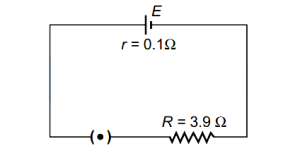
$A$ cell has an emf of $2 \, V$ and an internal resistance of $0.1 \, \Omega$. It is connected to an external resistance of $3.9 \, \Omega$. The terminal voltage across the cell will be: (in $V$)
A
$1.95$
B
$1.5$
C
$2$
D
$1.8$
Solution
(A) Key Idea: When a cell is supplying current, the potential difference across its terminals is less than its emf due to the potential drop across its internal resistance.
Given:
Emf of the cell, $E = 2 \, V$
Internal resistance, $r = 0.1 \, \Omega$
External resistance, $R = 3.9 \, \Omega$
The current $i$ flowing through the circuit is given by:
$i = \frac{E}{R + r} = \frac{2}{3.9 + 0.1} = \frac{2}{4.0} = 0.5 \, A$
The terminal voltage $V$ across the cell is given by the formula:
$V = E - ir$
Substituting the values:
$V = 2 - (0.5 \times 0.1)$
$V = 2 - 0.05$
$V = 1.95 \, V$
Thus, the terminal voltage across the cell is $1.95 \, V$.
Given:
Emf of the cell, $E = 2 \, V$
Internal resistance, $r = 0.1 \, \Omega$
External resistance, $R = 3.9 \, \Omega$
The current $i$ flowing through the circuit is given by:
$i = \frac{E}{R + r} = \frac{2}{3.9 + 0.1} = \frac{2}{4.0} = 0.5 \, A$
The terminal voltage $V$ across the cell is given by the formula:
$V = E - ir$
Substituting the values:
$V = 2 - (0.5 \times 0.1)$
$V = 2 - 0.05$
$V = 1.95 \, V$
Thus, the terminal voltage across the cell is $1.95 \, V$.
0 likesView Solution
48
PhysicsEasyMCQMHT CET · 2007
In a diode,when there is a saturation current,the plate resistance will be
A
data insufficient
B
zero
C
some finite quantity
D
infinite quantity
Solution
(D) Key Idea: At saturation,the change in current is zero.
We know that the plate resistance $r_p$ is defined as the ratio of the change in plate voltage $\delta V$ to the change in plate current $\delta I$:
$r_p = \frac{\delta V}{\delta I}$
At the saturation point,the current remains constant regardless of the increase in voltage,meaning the change in current $\delta I = 0$.
Therefore,the plate resistance becomes:
$r_p = \frac{\delta V}{0} = \infty$
Hence,the plate resistance is infinite.
We know that the plate resistance $r_p$ is defined as the ratio of the change in plate voltage $\delta V$ to the change in plate current $\delta I$:
$r_p = \frac{\delta V}{\delta I}$
At the saturation point,the current remains constant regardless of the increase in voltage,meaning the change in current $\delta I = 0$.
Therefore,the plate resistance becomes:
$r_p = \frac{\delta V}{0} = \infty$
Hence,the plate resistance is infinite.
0 likesView Solution
49
PhysicsMediumMCQMHT CET · 2007
If a magnetic substance is kept in a magnetic field,then which of the following substances is thrown out?
A
Paramagnetic
B
Ferromagnetic
C
Diamagnetic
D
Antiferromagnetic
Solution
(C) When a magnetic substance is placed in a magnetic field,it is feebly repelled or 'thrown out' if the substance is diamagnetic.
This occurs because the substance becomes feebly magnetized in a direction opposite to the applied magnetic field.
The magnetic susceptibility of a diamagnetic substance is negative.
In contrast,paramagnetic substances are feebly attracted by a magnetic field,and ferromagnetic substances are strongly attracted by a magnet.
This occurs because the substance becomes feebly magnetized in a direction opposite to the applied magnetic field.
The magnetic susceptibility of a diamagnetic substance is negative.
In contrast,paramagnetic substances are feebly attracted by a magnetic field,and ferromagnetic substances are strongly attracted by a magnet.
0 likesView Solution
50
PhysicsMediumMCQMHT CET · 2007
At a point on the equatorial line (right bisector) of a magnetic dipole,the magnetic:
A
potential varies as $\frac{1}{r^{2}}$
B
potential is zero at all points on the equatorial line
C
field varies as $r^{2}$
D
field is parallel to the axis of the dipole
Solution
(B) The magnetic potential $V$ due to a magnetic dipole of magnetic moment $M$ at a point $(r, \theta)$ is given by $V = \frac{\mu_{0}}{4 \pi} \frac{M \cos \theta}{r^{2}}$.
On the equatorial line (right bisector),the angle $\theta$ between the position vector and the dipole axis is $90^{\circ}$.
Since $\cos 90^{\circ} = 0$,the magnetic potential $V$ is zero at all points on the equatorial line.
Therefore,the correct option is $B$.
On the equatorial line (right bisector),the angle $\theta$ between the position vector and the dipole axis is $90^{\circ}$.
Since $\cos 90^{\circ} = 0$,the magnetic potential $V$ is zero at all points on the equatorial line.
Therefore,the correct option is $B$.
0 likesView Solution
Vedclass Products
For Students
Vedclass Test Series
Mock tests in real MHT CET style covering Physics with performance analysis. 5-day free trial.
Start Free TrialFor Teachers
Exam Paper Generator
Generate Set A/B/C/D Physics papers from 7.5L+ questions in 2 minutes. 3 chapters free.
Try FreeFor Institutes
Online Exam Module
Run live MHT CET mock exams with unlimited students, 360° analytics & white-label branding.
See DemoFrequently Asked Questions
How many Physics questions are in MHT CET 2007?
There are 50 Physics questions from the MHT CET 2007 paper on Vedclass, each with a detailed step-by-step solution in English.
Are MHT CET 2007 Physics solutions available in English?
Yes. All solutions on this page are in English. You can also switch to English or Hindi using the language buttons above the questions.
Can I practice MHT CET 2007 Physics as a timed test?
Yes. Use the Vedclass Test Series to attempt a full MHT CET mock test covering Physics with time limits and instant score analysis.
Can teachers create Physics papers from MHT CET previous year questions?
Yes. The Vedclass Exam Paper Generator lets teachers mix MHT CET Physics questions and generate Set A/B/C/D papers in minutes.
For Teachers & Institutes
Build a Custom Physics Paper
Pick MHT CET 2007 Physics questions, set difficulty, and generate Set A/B/C/D in 2 minutes.