
MathematicsQ1–50 of 50 questions
Page 1 of 1 · English
1
MathematicsEasyMCQMHT CET · 2007
The positive root of $x^{2}-78.8=0$ after the first approximation by the Newton-Raphson method,assuming the initial approximation to the root is $14$,is:
A
$9.821$
B
$9.814$
C
$9.715$
D
$9.915$
Solution
(B) Given the function $f(x) = x^{2} - 78.8$.
The derivative is $f^{\prime}(x) = 2x$.
The initial approximation is $x_{0} = 14$.
According to the Newton-Raphson formula,the first approximation $x_{1}$ is given by:
$x_{1} = x_{0} - \frac{f(x_{0})}{f^{\prime}(x_{0})}$
$x_{1} = 14 - \frac{(14)^{2} - 78.8}{2 \times 14}$
$x_{1} = 14 - \frac{196 - 78.8}{28}$
$x_{1} = 14 - \frac{117.2}{28}$
$x_{1} = 14 - 4.1857...$
$x_{1} \approx 9.814$.
The derivative is $f^{\prime}(x) = 2x$.
The initial approximation is $x_{0} = 14$.
According to the Newton-Raphson formula,the first approximation $x_{1}$ is given by:
$x_{1} = x_{0} - \frac{f(x_{0})}{f^{\prime}(x_{0})}$
$x_{1} = 14 - \frac{(14)^{2} - 78.8}{2 \times 14}$
$x_{1} = 14 - \frac{196 - 78.8}{28}$
$x_{1} = 14 - \frac{117.2}{28}$
$x_{1} = 14 - 4.1857...$
$x_{1} \approx 9.814$.
0 likesView Solution
2
MathematicsEasyMCQMHT CET · 2007
If the points $(2,0), (0,1), (4,5)$ and $(0, c)$ are concyclic,then the value of $c$ is
A
$1$
B
$\frac{14}{3}$
C
$5$
D
\text{None of these}
Solution
(B) Let the equation of the circle be $x^{2} + y^{2} + 2gx + 2fy + k = 0$.
Since it passes through $(2,0)$,we have $4 + 4g + k = 0 \Rightarrow k = -4 - 4g$.
Since it passes through $(0,1)$,we have $1 + 2f + k = 0 \Rightarrow k = -1 - 2f$.
Since it passes through $(4,5)$,we have $16 + 25 + 8g + 10f + k = 0 \Rightarrow 41 + 8g + 10f + k = 0$.
Solving these equations,we get $g = -\frac{13}{6}$,$f = -\frac{17}{6}$,and $k = \frac{14}{3}$.
The equation of the circle is $x^{2} + y^{2} - \frac{13}{3}x - \frac{17}{3}y + \frac{14}{3} = 0$,which simplifies to $3(x^{2} + y^{2}) - 13x - 17y + 14 = 0$.
Since $(0, c)$ lies on this circle,we substitute $x=0$ and $y=c$:
$3(0^{2} + c^{2}) - 13(0) - 17(c) + 14 = 0$.
$3c^{2} - 17c + 14 = 0$.
$(3c - 14)(c - 1) = 0$.
Thus,$c = 1$ or $c = \frac{14}{3}$.
Since $(0,1)$ is already a given point,the other point is $(0, \frac{14}{3})$,so $c = \frac{14}{3}$.
Since it passes through $(2,0)$,we have $4 + 4g + k = 0 \Rightarrow k = -4 - 4g$.
Since it passes through $(0,1)$,we have $1 + 2f + k = 0 \Rightarrow k = -1 - 2f$.
Since it passes through $(4,5)$,we have $16 + 25 + 8g + 10f + k = 0 \Rightarrow 41 + 8g + 10f + k = 0$.
Solving these equations,we get $g = -\frac{13}{6}$,$f = -\frac{17}{6}$,and $k = \frac{14}{3}$.
The equation of the circle is $x^{2} + y^{2} - \frac{13}{3}x - \frac{17}{3}y + \frac{14}{3} = 0$,which simplifies to $3(x^{2} + y^{2}) - 13x - 17y + 14 = 0$.
Since $(0, c)$ lies on this circle,we substitute $x=0$ and $y=c$:
$3(0^{2} + c^{2}) - 13(0) - 17(c) + 14 = 0$.
$3c^{2} - 17c + 14 = 0$.
$(3c - 14)(c - 1) = 0$.
Thus,$c = 1$ or $c = \frac{14}{3}$.
Since $(0,1)$ is already a given point,the other point is $(0, \frac{14}{3})$,so $c = \frac{14}{3}$.
0 likesView Solution
3
MathematicsEasyMCQMHT CET · 2007
The area of the circle centered at $(1, 2)$ and passing through $(4, 6)$ is
A
$5 \pi$ sq unit
B
$10 \pi$ sq unit
C
$25 \pi$ sq unit
D
None of these
Solution
(C) The radius $r$ of the circle is the distance between the center $(1, 2)$ and the point $(4, 6)$ on the circle.
Using the distance formula: $r = \sqrt{(4-1)^2 + (6-2)^2}$
$r = \sqrt{3^2 + 4^2} = \sqrt{9 + 16} = \sqrt{25} = 5$ units.
The area of the circle is given by the formula $A = \pi r^2$.
$A = \pi (5)^2 = 25 \pi$ sq unit.
Using the distance formula: $r = \sqrt{(4-1)^2 + (6-2)^2}$
$r = \sqrt{3^2 + 4^2} = \sqrt{9 + 16} = \sqrt{25} = 5$ units.
The area of the circle is given by the formula $A = \pi r^2$.
$A = \pi (5)^2 = 25 \pi$ sq unit.
0 likesView Solution
4
MathematicsDifficultMCQMHT CET · 2007
$A$ line is drawn through a fixed point $P(\alpha, \beta)$ to cut the circle $x^{2}+y^{2}=r^{2}$ at $A$ and $B$. Then $PA \cdot PB$ is equal to
A
$(\alpha+\beta)^{2}-r^{2}$
B
$\alpha^{2}+\beta^{2}-r^{2}$
C
$(\alpha-\beta)^{2}+r^{2}$
D
None of the above
Solution
(B) The equation of any line passing through the point $P(\alpha, \beta)$ is given by $\frac{x-\alpha}{\cos \theta} = \frac{y-\beta}{\sin \theta} = k$,where $k$ represents the distance from $P$ to any point on the line.
Any point on this line is $(\alpha + k \cos \theta, \beta + k \sin \theta)$.
Since this point lies on the circle $x^{2} + y^{2} = r^{2}$,we have:
$(\alpha + k \cos \theta)^{2} + (\beta + k \sin \theta)^{2} = r^{2}$
Expanding this,we get:
$\alpha^{2} + 2k\alpha \cos \theta + k^{2} \cos^{2} \theta + \beta^{2} + 2k\beta \sin \theta + k^{2} \sin^{2} \theta = r^{2}$
$k^{2}(\cos^{2} \theta + \sin^{2} \theta) + 2k(\alpha \cos \theta + \beta \sin \theta) + (\alpha^{2} + \beta^{2} - r^{2}) = 0$
$k^{2} + 2k(\alpha \cos \theta + \beta \sin \theta) + (\alpha^{2} + \beta^{2} - r^{2}) = 0$
This is a quadratic equation in $k$. Let the roots be $k_{1}$ and $k_{2}$,which represent the lengths $PA$ and $PB$.
The product of the roots $PA \cdot PB = k_{1}k_{2}$ is given by the constant term of the quadratic equation:
$PA \cdot PB = \alpha^{2} + \beta^{2} - r^{2}$.
Any point on this line is $(\alpha + k \cos \theta, \beta + k \sin \theta)$.
Since this point lies on the circle $x^{2} + y^{2} = r^{2}$,we have:
$(\alpha + k \cos \theta)^{2} + (\beta + k \sin \theta)^{2} = r^{2}$
Expanding this,we get:
$\alpha^{2} + 2k\alpha \cos \theta + k^{2} \cos^{2} \theta + \beta^{2} + 2k\beta \sin \theta + k^{2} \sin^{2} \theta = r^{2}$
$k^{2}(\cos^{2} \theta + \sin^{2} \theta) + 2k(\alpha \cos \theta + \beta \sin \theta) + (\alpha^{2} + \beta^{2} - r^{2}) = 0$
$k^{2} + 2k(\alpha \cos \theta + \beta \sin \theta) + (\alpha^{2} + \beta^{2} - r^{2}) = 0$
This is a quadratic equation in $k$. Let the roots be $k_{1}$ and $k_{2}$,which represent the lengths $PA$ and $PB$.
The product of the roots $PA \cdot PB = k_{1}k_{2}$ is given by the constant term of the quadratic equation:
$PA \cdot PB = \alpha^{2} + \beta^{2} - r^{2}$.
0 likesView Solution
5
MathematicsEasyMCQMHT CET · 2007
The parametric representation of a point on the ellipse whose foci are $(-1,0)$ and $(7,0)$ and eccentricity $1/2$ is
A
$(3+8 \cos \theta, 4 \sqrt{3} \sin \theta)$
B
$(8 \cos \theta, 4 \sqrt{3} \sin \theta)$
C
$(3+4 \sqrt{3} \cos \theta, 8 \sin \theta)$
D
None of the above
Solution
(A) The distance between the two foci is $2ae = 7 - (-1) = 8$.
Since $e = 1/2$,we have $2a(1/2) = 8$,which implies $a = 8$.
The center of the ellipse is the midpoint of the foci: $(\frac{-1+7}{2}, \frac{0+0}{2}) = (3, 0)$.
Using $b^2 = a^2(1 - e^2)$,we get $b^2 = 64(1 - 1/4) = 64(3/4) = 48$.
Thus,$b = \sqrt{48} = 4\sqrt{3}$.
The equation of the ellipse is $\frac{(x-3)^2}{8^2} + \frac{y^2}{(4\sqrt{3})^2} = 1$.
The parametric coordinates are given by $(x, y) = (h + a \cos \theta, k + b \sin \theta)$,where $(h, k)$ is the center.
Substituting the values,we get $(3 + 8 \cos \theta, 4\sqrt{3} \sin \theta)$.
Since $e = 1/2$,we have $2a(1/2) = 8$,which implies $a = 8$.
The center of the ellipse is the midpoint of the foci: $(\frac{-1+7}{2}, \frac{0+0}{2}) = (3, 0)$.
Using $b^2 = a^2(1 - e^2)$,we get $b^2 = 64(1 - 1/4) = 64(3/4) = 48$.
Thus,$b = \sqrt{48} = 4\sqrt{3}$.
The equation of the ellipse is $\frac{(x-3)^2}{8^2} + \frac{y^2}{(4\sqrt{3})^2} = 1$.
The parametric coordinates are given by $(x, y) = (h + a \cos \theta, k + b \sin \theta)$,where $(h, k)$ is the center.
Substituting the values,we get $(3 + 8 \cos \theta, 4\sqrt{3} \sin \theta)$.
0 likesView Solution
6
MathematicsEasyMCQMHT CET · 2007
$A$ common tangent to $9x^{2}-16y^{2}=144$ and $x^{2}+y^{2}=9$ is
A
$y=\frac{3}{\sqrt{7}}x+\frac{15}{\sqrt{7}}$
B
$y=3\sqrt{\frac{2}{7}}x+\frac{15}{\sqrt{7}}$
C
$y=2\sqrt{\frac{3}{7}}x+15\sqrt{7}$
D
None of the above
Solution
(B) Let $y=mx+c$ be a common tangent to the hyperbola $9x^{2}-16y^{2}=144$ and the circle $x^{2}+y^{2}=9$.
Rewriting the hyperbola as $\frac{x^{2}}{16}-\frac{y^{2}}{9}=1$,we have $a^{2}=16$ and $b^{2}=9$.
The condition for $y=mx+c$ to be a tangent to the hyperbola is $c^{2}=a^{2}m^{2}-b^{2}$,so $c^{2}=16m^{2}-9$ $(i)$.
The condition for $y=mx+c$ to be a tangent to the circle $x^{2}+y^{2}=3^{2}$ is $c^{2}=r^{2}(1+m^{2})$,so $c^{2}=9(1+m^{2})$ (ii).
Equating $(i)$ and (ii): $16m^{2}-9=9+9m^{2}$.
$7m^{2}=18$ $\Rightarrow m^{2}=\frac{18}{7}$ $\Rightarrow m=\pm 3\sqrt{\frac{2}{7}}$.
Substituting $m^{2}=\frac{18}{7}$ into (ii): $c^{2}=9(1+\frac{18}{7})=9(\frac{25}{7})=\frac{225}{7}$.
Thus,$c=\pm \frac{15}{\sqrt{7}}$.
The common tangent is $y=3\sqrt{\frac{2}{7}}x+\frac{15}{\sqrt{7}}$.
Rewriting the hyperbola as $\frac{x^{2}}{16}-\frac{y^{2}}{9}=1$,we have $a^{2}=16$ and $b^{2}=9$.
The condition for $y=mx+c$ to be a tangent to the hyperbola is $c^{2}=a^{2}m^{2}-b^{2}$,so $c^{2}=16m^{2}-9$ $(i)$.
The condition for $y=mx+c$ to be a tangent to the circle $x^{2}+y^{2}=3^{2}$ is $c^{2}=r^{2}(1+m^{2})$,so $c^{2}=9(1+m^{2})$ (ii).
Equating $(i)$ and (ii): $16m^{2}-9=9+9m^{2}$.
$7m^{2}=18$ $\Rightarrow m^{2}=\frac{18}{7}$ $\Rightarrow m=\pm 3\sqrt{\frac{2}{7}}$.
Substituting $m^{2}=\frac{18}{7}$ into (ii): $c^{2}=9(1+\frac{18}{7})=9(\frac{25}{7})=\frac{225}{7}$.
Thus,$c=\pm \frac{15}{\sqrt{7}}$.
The common tangent is $y=3\sqrt{\frac{2}{7}}x+\frac{15}{\sqrt{7}}$.
0 likesView Solution
7
MathematicsDifficultMCQMHT CET · 2007
The value of $\lim _{x \rightarrow 0} \frac{\cos (\sin x)-\cos x}{x^{4}}$ is equal to
A
$1/5$
B
$1/6$
C
$1/4$
D
$1/2$
Solution
(B) Let $L = \lim _{x \rightarrow 0} \frac{\cos (\sin x)-\cos x}{x^{4}}$.
Using the Taylor series expansion for $\cos \theta = 1 - \frac{\theta^2}{2!} + \frac{\theta^4}{4!} - O(\theta^6)$,we have:
$\sin x = x - \frac{x^3}{6} + O(x^5)$
$\cos(\sin x) = 1 - \frac{(x - x^3/6)^2}{2} + \frac{(x - x^3/6)^4}{24} = 1 - \frac{x^2 - x^4/3}{2} + \frac{x^4}{24} = 1 - \frac{x^2}{2} + \frac{x^4}{6} + \frac{x^4}{24} = 1 - \frac{x^2}{2} + \frac{5x^4}{24}$.
$\cos x = 1 - \frac{x^2}{2} + \frac{x^4}{24}$.
Substituting these into the limit:
$L = \lim _{x \rightarrow 0} \frac{(1 - \frac{x^2}{2} + \frac{5x^4}{24}) - (1 - \frac{x^2}{2} + \frac{x^4}{24})}{x^4}$.
$L = \lim _{x \rightarrow 0} \frac{\frac{5x^4}{24} - \frac{x^4}{24}}{x^4} = \lim _{x \rightarrow 0} \frac{4x^4/24}{x^4} = \frac{4}{24} = \frac{1}{6}$.
Using the Taylor series expansion for $\cos \theta = 1 - \frac{\theta^2}{2!} + \frac{\theta^4}{4!} - O(\theta^6)$,we have:
$\sin x = x - \frac{x^3}{6} + O(x^5)$
$\cos(\sin x) = 1 - \frac{(x - x^3/6)^2}{2} + \frac{(x - x^3/6)^4}{24} = 1 - \frac{x^2 - x^4/3}{2} + \frac{x^4}{24} = 1 - \frac{x^2}{2} + \frac{x^4}{6} + \frac{x^4}{24} = 1 - \frac{x^2}{2} + \frac{5x^4}{24}$.
$\cos x = 1 - \frac{x^2}{2} + \frac{x^4}{24}$.
Substituting these into the limit:
$L = \lim _{x \rightarrow 0} \frac{(1 - \frac{x^2}{2} + \frac{5x^4}{24}) - (1 - \frac{x^2}{2} + \frac{x^4}{24})}{x^4}$.
$L = \lim _{x \rightarrow 0} \frac{\frac{5x^4}{24} - \frac{x^4}{24}}{x^4} = \lim _{x \rightarrow 0} \frac{4x^4/24}{x^4} = \frac{4}{24} = \frac{1}{6}$.
0 likesView Solution
8
MathematicsEasyMCQMHT CET · 2007
The value of $\lim _{x \rightarrow \infty}\left(\frac{x^{2}-2 x+1}{x^{2}-4 x+2}\right)^{x}$ is
A
$e^{2}$
B
$e^{-2}$
C
$e^{6}$
D
None of these
Solution
(A) The given limit is of the form $1^{\infty}$.
We use the formula $\lim _{x \rightarrow a} [f(x)]^{g(x)} = e^{\lim _{x \rightarrow a} g(x)[f(x)-1]}$.
$\lim _{x \rightarrow \infty}\left(\frac{x^{2}-2 x+1}{x^{2}-4 x+2}\right)^{x} = e^{\lim _{x \rightarrow \infty} x \left(\frac{x^{2}-2 x+1}{x^{2}-4 x+2} - 1\right)}$
$= e^{\lim _{x \rightarrow \infty} x \left(\frac{x^{2}-2 x+1 - (x^{2}-4 x+2)}{x^{2}-4 x+2}\right)}$
$= e^{\lim _{x \rightarrow \infty} x \left(\frac{2 x-1}{x^{2}-4 x+2}\right)}$
$= e^{\lim _{x \rightarrow \infty} \frac{2 x^{2}-x}{x^{2}-4 x+2}}$
Dividing numerator and denominator by $x^{2}$,we get:
$= e^{\lim _{x \rightarrow \infty} \frac{2 - 1/x}{1 - 4/x + 2/x^{2}}} = e^{2/1} = e^{2}$.
We use the formula $\lim _{x \rightarrow a} [f(x)]^{g(x)} = e^{\lim _{x \rightarrow a} g(x)[f(x)-1]}$.
$\lim _{x \rightarrow \infty}\left(\frac{x^{2}-2 x+1}{x^{2}-4 x+2}\right)^{x} = e^{\lim _{x \rightarrow \infty} x \left(\frac{x^{2}-2 x+1}{x^{2}-4 x+2} - 1\right)}$
$= e^{\lim _{x \rightarrow \infty} x \left(\frac{x^{2}-2 x+1 - (x^{2}-4 x+2)}{x^{2}-4 x+2}\right)}$
$= e^{\lim _{x \rightarrow \infty} x \left(\frac{2 x-1}{x^{2}-4 x+2}\right)}$
$= e^{\lim _{x \rightarrow \infty} \frac{2 x^{2}-x}{x^{2}-4 x+2}}$
Dividing numerator and denominator by $x^{2}$,we get:
$= e^{\lim _{x \rightarrow \infty} \frac{2 - 1/x}{1 - 4/x + 2/x^{2}}} = e^{2/1} = e^{2}$.
0 likesView Solution
9
MathematicsEasyMCQMHT CET · 2007
The dual of the statement $[p \vee (\sim q)] \wedge (\sim p)$ is
A
$p \vee (\sim q) \vee \sim p$
B
$(p \wedge \sim q) \vee \sim p$
C
$p \wedge \sim (q \vee \sim p)$
D
None of these
Solution
(B) To find the dual of a logical statement,we replace $\vee$ with $\wedge$,$\wedge$ with $\vee$,$T$ with $F$,and $F$ with $T$.
Given statement: $[p \vee (\sim q)] \wedge (\sim p)$.
Replacing $\vee$ with $\wedge$ and $\wedge$ with $\vee$,we get:
$[p \wedge (\sim q)] \vee (\sim p)$.
Given statement: $[p \vee (\sim q)] \wedge (\sim p)$.
Replacing $\vee$ with $\wedge$ and $\wedge$ with $\vee$,we get:
$[p \wedge (\sim q)] \vee (\sim p)$.
0 likesView Solution
10
MathematicsEasyMCQMHT CET · 2007
Which of the following statements has the truth value '$F$'?
A
$A$ quadratic equation always has a real root.
B
The number of ways of seating $2$ persons in two chairs out of $n$ persons is $P(n, 2)$.
C
The cube roots of unity are in $GP$.
D
None of the above.
Solution
(A) quadratic equation $ax^2 + bx + c = 0$ can have imaginary roots if the discriminant $D = b^2 - 4ac < 0$.
Therefore,the statement '$A$ quadratic equation always has a real root' is false,meaning its truth value is '$F$'.
Option $B$ is true as it represents the permutation formula.
Option $C$ is true because the cube roots of unity are $1, \omega, \omega^2$,which form a $GP$ with common ratio $\omega$.
Therefore,the statement '$A$ quadratic equation always has a real root' is false,meaning its truth value is '$F$'.
Option $B$ is true as it represents the permutation formula.
Option $C$ is true because the cube roots of unity are $1, \omega, \omega^2$,which form a $GP$ with common ratio $\omega$.
0 likesView Solution
11
MathematicsMediumMCQMHT CET · 2007
If $x^{2}-2 p x y-y^{2}=0$ and $x^{2}-2 q x y-y^{2}=0$ bisect angles between each other,then
A
$p+q=1$
B
$p q=1$
C
$p q+1=0$
D
$p^{2}+p q+q^{2}=0$
Solution
(C) The equation of the bisectors of the angles between the lines $x^{2}-2 p x y-y^{2}=0$ is given by the formula $\frac{x^{2}-y^{2}}{a-b} = \frac{xy}{h}$.
Here,$a=1, b=-1, h=-p$.
So,$\frac{x^{2}-y^{2}}{1-(-1)} = \frac{xy}{-p}$.
$\Rightarrow \frac{x^{2}-y^{2}}{2} = \frac{-xy}{p}$.
$\Rightarrow px^{2} + 2xy - py^{2} = 0$.
Since this equation represents the same pair of lines as $x^{2}-2qxy-y^{2}=0$,we compare the coefficients:
$\frac{p}{1} = \frac{2}{-2q} = \frac{-p}{-1}$.
From $\frac{p}{1} = \frac{2}{-2q}$,we get $p = -\frac{1}{q}$,which implies $pq = -1$ or $pq+1=0$.
Here,$a=1, b=-1, h=-p$.
So,$\frac{x^{2}-y^{2}}{1-(-1)} = \frac{xy}{-p}$.
$\Rightarrow \frac{x^{2}-y^{2}}{2} = \frac{-xy}{p}$.
$\Rightarrow px^{2} + 2xy - py^{2} = 0$.
Since this equation represents the same pair of lines as $x^{2}-2qxy-y^{2}=0$,we compare the coefficients:
$\frac{p}{1} = \frac{2}{-2q} = \frac{-p}{-1}$.
From $\frac{p}{1} = \frac{2}{-2q}$,we get $p = -\frac{1}{q}$,which implies $pq = -1$ or $pq+1=0$.
0 likesView Solution
12
MathematicsEasyMCQMHT CET · 2007
Three letters,to each of which corresponds an envelope,are placed in the envelopes at random. The probability that all the letters are not placed in the right envelopes is
A
$\frac{1}{6}$
B
$\frac{5}{6}$
C
$\frac{1}{3}$
D
$\frac{2}{3}$
Solution
(B) The total number of ways to place $3$ letters in $3$ envelopes is $3! = 6$.
There is only $1$ way to place all letters in their correct envelopes.
The probability that all letters are placed in the correct envelopes is $\frac{1}{3!} = \frac{1}{6}$.
The probability that all letters are not placed in the right envelopes is $1 - \frac{1}{6} = \frac{5}{6}$.
There is only $1$ way to place all letters in their correct envelopes.
The probability that all letters are placed in the correct envelopes is $\frac{1}{3!} = \frac{1}{6}$.
The probability that all letters are not placed in the right envelopes is $1 - \frac{1}{6} = \frac{5}{6}$.
0 likesView Solution
13
MathematicsEasyMCQMHT CET · 2007
Two dice are rolled one after the other. The probability that the number on the first die is smaller than the number on the second die is:
A
$1/2$
B
$7/18$
C
$3/4$
D
$5/12$
Solution
(D) When two dice are rolled,the total number of possible outcomes is $6 \times 6 = 36$.
Let the outcome of the first die be $x$ and the second die be $y$. We want the probability that $x < y$.
The possible pairs $(x, y)$ such that $x < y$ are:
For $x=1$,$y \in \{2, 3, 4, 5, 6\}$ ($5$ outcomes).
For $x=2$,$y \in \{3, 4, 5, 6\}$ ($4$ outcomes).
For $x=3$,$y \in \{4, 5, 6\}$ ($3$ outcomes).
For $x=4$,$y \in \{5, 6\}$ ($2$ outcomes).
For $x=5$,$y \in \{6\}$ ($1$ outcome).
For $x=6$,there are no possible values for $y$.
Total favorable outcomes $= 5 + 4 + 3 + 2 + 1 = 15$.
The probability is $\frac{15}{36} = \frac{5}{12}$.
Let the outcome of the first die be $x$ and the second die be $y$. We want the probability that $x < y$.
The possible pairs $(x, y)$ such that $x < y$ are:
For $x=1$,$y \in \{2, 3, 4, 5, 6\}$ ($5$ outcomes).
For $x=2$,$y \in \{3, 4, 5, 6\}$ ($4$ outcomes).
For $x=3$,$y \in \{4, 5, 6\}$ ($3$ outcomes).
For $x=4$,$y \in \{5, 6\}$ ($2$ outcomes).
For $x=5$,$y \in \{6\}$ ($1$ outcome).
For $x=6$,there are no possible values for $y$.
Total favorable outcomes $= 5 + 4 + 3 + 2 + 1 = 15$.
The probability is $\frac{15}{36} = \frac{5}{12}$.
0 likesView Solution
14
MathematicsMediumMCQMHT CET · 2007
The odds against a certain event are $5: 2$ and the odds in favour of another independent event are $6: 5$. The probability that at least one of the events will happen,is
A
$\frac{25}{77}$
B
$\frac{52}{77}$
C
$\frac{12}{77}$
D
$\frac{65}{77}$
Solution
(B) Let $A$ and $B$ be two independent events.
The odds against event $A$ are $5:2$,so the probability of $A$ occurring is $P(A) = \frac{2}{5+2} = \frac{2}{7}$.
The probability of $A$ not occurring is $P(\bar{A}) = 1 - \frac{2}{7} = \frac{5}{7}$.
The odds in favour of event $B$ are $6:5$,so the probability of $B$ occurring is $P(B) = \frac{6}{6+5} = \frac{6}{11}$.
The probability of $B$ not occurring is $P(\bar{B}) = 1 - \frac{6}{11} = \frac{5}{11}$.
Since the events are independent,the probability that at least one event happens is $P(A \cup B) = 1 - P(\bar{A} \cap \bar{B}) = 1 - P(\bar{A})P(\bar{B})$.
$P(A \cup B) = 1 - (\frac{5}{7} \times \frac{5}{11}) = 1 - \frac{25}{77} = \frac{77-25}{77} = \frac{52}{77}$.
The odds against event $A$ are $5:2$,so the probability of $A$ occurring is $P(A) = \frac{2}{5+2} = \frac{2}{7}$.
The probability of $A$ not occurring is $P(\bar{A}) = 1 - \frac{2}{7} = \frac{5}{7}$.
The odds in favour of event $B$ are $6:5$,so the probability of $B$ occurring is $P(B) = \frac{6}{6+5} = \frac{6}{11}$.
The probability of $B$ not occurring is $P(\bar{B}) = 1 - \frac{6}{11} = \frac{5}{11}$.
Since the events are independent,the probability that at least one event happens is $P(A \cup B) = 1 - P(\bar{A} \cap \bar{B}) = 1 - P(\bar{A})P(\bar{B})$.
$P(A \cup B) = 1 - (\frac{5}{7} \times \frac{5}{11}) = 1 - \frac{25}{77} = \frac{77-25}{77} = \frac{52}{77}$.
0 likesView Solution
15
MathematicsMediumMCQMHT CET · 2007
The circumcentre of the triangle formed by the lines $xy+2x+2y+4=0$ and $x+y+2=0$ is
A
$(0,0)$
B
$(-2,-2)$
C
$(-1,-1)$
D
$(-1,-2)$
Solution
(C) The given equation $xy+2x+2y+4=0$ can be factored as $(x+2)(y+2)=0$,which represents the lines $x=-2$ and $y=-2$.
Given the third line is $x+y+2=0$.
To find the vertices of the triangle,we solve the equations in pairs:
$1$. Intersection of $x=-2$ and $y=-2$ gives vertex $C(-2,-2)$.
$2$. Intersection of $x=-2$ and $x+y+2=0$ gives $-2+y+2=0$,so $y=0$. Vertex $A(-2,0)$.
$3$. Intersection of $y=-2$ and $x+y+2=0$ gives $x-2+2=0$,so $x=0$. Vertex $B(0,-2)$.
The vertices are $A(-2,0)$,$B(0,-2)$,and $C(-2,-2)$.
Since the lines $x=-2$ and $y=-2$ are perpendicular,$\Delta ABC$ is a right-angled triangle with the right angle at $C(-2,-2)$.
The circumcentre of a right-angled triangle is the midpoint of the hypotenuse $AB$.
Midpoint of $AB = (\frac{-2+0}{2}, \frac{0-2}{2}) = (-1,-1)$.
Given the third line is $x+y+2=0$.
To find the vertices of the triangle,we solve the equations in pairs:
$1$. Intersection of $x=-2$ and $y=-2$ gives vertex $C(-2,-2)$.
$2$. Intersection of $x=-2$ and $x+y+2=0$ gives $-2+y+2=0$,so $y=0$. Vertex $A(-2,0)$.
$3$. Intersection of $y=-2$ and $x+y+2=0$ gives $x-2+2=0$,so $x=0$. Vertex $B(0,-2)$.
The vertices are $A(-2,0)$,$B(0,-2)$,and $C(-2,-2)$.
Since the lines $x=-2$ and $y=-2$ are perpendicular,$\Delta ABC$ is a right-angled triangle with the right angle at $C(-2,-2)$.
The circumcentre of a right-angled triangle is the midpoint of the hypotenuse $AB$.
Midpoint of $AB = (\frac{-2+0}{2}, \frac{0-2}{2}) = (-1,-1)$.
0 likesView Solution
16
MathematicsEasyMCQMHT CET · 2007
The equation of the line touching both parabolas $y^2=4x$ and $x^2=-32y$ is
A
$x+2y+4=0$
B
$2x+y-4=0$
C
$x-2y-4=0$
D
$x-2y+4=0$
Solution
(D) Let the equation of the tangent to the parabola $y^2=4x$ be $y=mx+\frac{1}{m}$.
For the parabola $x^2=-32y$,the equation of the tangent with slope $m$ is $y=mx-a m^2$,where $x^2=4ay$ gives $a=-8$.
Thus,the tangent is $y=mx-(-8)m^2$,which simplifies to $y=mx+8m^2$.
Comparing the two tangent equations,we have $\frac{1}{m}=8m^2$.
This implies $m^3=\frac{1}{8}$,so $m=\frac{1}{2}$.
Substituting $m=\frac{1}{2}$ into the first tangent equation: $y=\frac{1}{2}x+\frac{1}{1/2} = \frac{1}{2}x+2$.
Multiplying by $2$,we get $2y=x+4$,or $x-2y+4=0$.
For the parabola $x^2=-32y$,the equation of the tangent with slope $m$ is $y=mx-a m^2$,where $x^2=4ay$ gives $a=-8$.
Thus,the tangent is $y=mx-(-8)m^2$,which simplifies to $y=mx+8m^2$.
Comparing the two tangent equations,we have $\frac{1}{m}=8m^2$.
This implies $m^3=\frac{1}{8}$,so $m=\frac{1}{2}$.
Substituting $m=\frac{1}{2}$ into the first tangent equation: $y=\frac{1}{2}x+\frac{1}{1/2} = \frac{1}{2}x+2$.
Multiplying by $2$,we get $2y=x+4$,or $x-2y+4=0$.
0 likesView Solution
17
MathematicsEasyMCQMHT CET · 2007
The foci of the ellipse $\frac{x^2}{16}+\frac{y^2}{b^2}=1$ and the hyperbola $\frac{x^2}{144}-\frac{y^2}{81}=\frac{1}{25}$ coincide. Then,the value of $b^2$ is
A
$5$
B
$7$
C
$9$
D
$1$
Solution
(B) For the ellipse $\frac{x^2}{16}+\frac{y^2}{b^2}=1$,the foci are $(\pm ae, 0)$. Here $a^2=16$ and $b^2$ is the square of the semi-minor axis. The eccentricity $e_1 = \sqrt{1-\frac{b^2}{16}}$. The focus is $(\pm 4 \times \sqrt{1-\frac{b^2}{16}}, 0) = (\pm \sqrt{16-b^2}, 0)$.
For the hyperbola $\frac{x^2}{144}-\frac{y^2}{81}=\frac{1}{25}$,we rewrite it as $\frac{x^2}{(12/5)^2}-\frac{y^2}{(9/5)^2}=1$. Here $a^2 = \frac{144}{25}$ and $b^2 = \frac{81}{25}$.
The eccentricity $e_2 = \sqrt{1+\frac{b^2}{a^2}} = \sqrt{1+\frac{81/25}{144/25}} = \sqrt{1+\frac{81}{144}} = \sqrt{\frac{225}{144}} = \frac{15}{12} = \frac{5}{4}$.
The foci are $(\pm ae_2, 0) = (\pm \frac{12}{5} \times \frac{5}{4}, 0) = (\pm 3, 0)$.
Since the foci coincide,$\sqrt{16-b^2} = 3$.
Squaring both sides,$16-b^2 = 9$,which gives $b^2 = 7$.
For the hyperbola $\frac{x^2}{144}-\frac{y^2}{81}=\frac{1}{25}$,we rewrite it as $\frac{x^2}{(12/5)^2}-\frac{y^2}{(9/5)^2}=1$. Here $a^2 = \frac{144}{25}$ and $b^2 = \frac{81}{25}$.
The eccentricity $e_2 = \sqrt{1+\frac{b^2}{a^2}} = \sqrt{1+\frac{81/25}{144/25}} = \sqrt{1+\frac{81}{144}} = \sqrt{\frac{225}{144}} = \frac{15}{12} = \frac{5}{4}$.
The foci are $(\pm ae_2, 0) = (\pm \frac{12}{5} \times \frac{5}{4}, 0) = (\pm 3, 0)$.
Since the foci coincide,$\sqrt{16-b^2} = 3$.
Squaring both sides,$16-b^2 = 9$,which gives $b^2 = 7$.
0 likesView Solution
18
MathematicsEasyMCQMHT CET · 2007
The slope of the tangent at $(x, y)$ to a curve passing through $\left(1, \frac{\pi}{4}\right)$ is given by $\frac{y}{x}-\cos ^{2}\left(\frac{y}{x}\right)$,then the equation of the curve is
A
$y=\tan ^{-1}\left[\log \left(\frac{e}{x}\right)\right]$
B
$y=x \tan ^{-1}\left[\log \left(\frac{x}{e}\right)\right]$
C
$y=x \tan ^{-1}\left[\log \left(\frac{e}{x}\right)\right]$
D
None of the above
Solution
(C) Given the differential equation for the slope of the tangent:
$\frac{dy}{dx} = \frac{y}{x} - \cos^2\left(\frac{y}{x}\right)$
This is a homogeneous differential equation. Let $y = vx$,then $\frac{dy}{dx} = v + x\frac{dv}{dx}$.
Substituting these into the equation:
$v + x\frac{dv}{dx} = v - \cos^2(v)$
$x\frac{dv}{dx} = -\cos^2(v)$
Separating the variables:
$\sec^2(v) dv = -\frac{1}{x} dx$
Integrating both sides:
$\int \sec^2(v) dv = -\int \frac{1}{x} dx$
$\tan(v) = -\log|x| + C$
Substituting $v = \frac{y}{x}$ back:
$\tan\left(\frac{y}{x}\right) = -\log|x| + C$
The curve passes through $\left(1, \frac{\pi}{4}\right)$,so:
$\tan\left(\frac{\pi/4}{1}\right) = -\log(1) + C$
$\tan\left(\frac{\pi}{4}\right) = 0 + C \Rightarrow C = 1$
Thus,$\tan\left(\frac{y}{x}\right) = 1 - \log(x) = \log(e) - \log(x) = \log\left(\frac{e}{x}\right)$
Therefore,$y = x \tan^{-1}\left[\log\left(\frac{e}{x}\right)\right]$.
$\frac{dy}{dx} = \frac{y}{x} - \cos^2\left(\frac{y}{x}\right)$
This is a homogeneous differential equation. Let $y = vx$,then $\frac{dy}{dx} = v + x\frac{dv}{dx}$.
Substituting these into the equation:
$v + x\frac{dv}{dx} = v - \cos^2(v)$
$x\frac{dv}{dx} = -\cos^2(v)$
Separating the variables:
$\sec^2(v) dv = -\frac{1}{x} dx$
Integrating both sides:
$\int \sec^2(v) dv = -\int \frac{1}{x} dx$
$\tan(v) = -\log|x| + C$
Substituting $v = \frac{y}{x}$ back:
$\tan\left(\frac{y}{x}\right) = -\log|x| + C$
The curve passes through $\left(1, \frac{\pi}{4}\right)$,so:
$\tan\left(\frac{\pi/4}{1}\right) = -\log(1) + C$
$\tan\left(\frac{\pi}{4}\right) = 0 + C \Rightarrow C = 1$
Thus,$\tan\left(\frac{y}{x}\right) = 1 - \log(x) = \log(e) - \log(x) = \log\left(\frac{e}{x}\right)$
Therefore,$y = x \tan^{-1}\left[\log\left(\frac{e}{x}\right)\right]$.
0 likesView Solution
19
MathematicsMediumMCQMHT CET · 2007
The maximum area of the rectangle that can be inscribed in a circle of radius $r$ is:
A
$\pi r^{2}$
B
$r^{2}$
C
$\pi r^{2} / 4$
D
$2 r^{2}$
Solution
(D) Let the rectangle be inscribed in a circle of radius $r$. Let the sides of the rectangle be $2x$ and $2y$. Since the rectangle is inscribed in a circle,the diagonal of the rectangle is the diameter of the circle,so $(2x)^2 + (2y)^2 = (2r)^2$,which simplifies to $x^2 + y^2 = r^2$,or $y = \sqrt{r^2 - x^2}$.
The area $A$ of the rectangle is $A = (2x)(2y) = 4x\sqrt{r^2 - x^2}$.
To find the maximum area,differentiate $A$ with respect to $x$:
$\frac{dA}{dx} = 4 \left( \sqrt{r^2 - x^2} + x \cdot \frac{1}{2\sqrt{r^2 - x^2}} \cdot (-2x) \right) = 4 \left( \frac{r^2 - x^2 - x^2}{\sqrt{r^2 - x^2}} \right) = \frac{4(r^2 - 2x^2)}{\sqrt{r^2 - x^2}}$.
Setting $\frac{dA}{dx} = 0$ gives $r^2 - 2x^2 = 0$,so $x = \frac{r}{\sqrt{2}}$.
Substituting $x = \frac{r}{\sqrt{2}}$ into the area formula:
$A = 4 \left( \frac{r}{\sqrt{2}} \right) \sqrt{r^2 - \frac{r^2}{2}} = 4 \left( \frac{r}{\sqrt{2}} \right) \left( \frac{r}{\sqrt{2}} \right) = 4 \cdot \frac{r^2}{2} = 2r^2$.
Thus,the maximum area is $2r^2$.
The area $A$ of the rectangle is $A = (2x)(2y) = 4x\sqrt{r^2 - x^2}$.
To find the maximum area,differentiate $A$ with respect to $x$:
$\frac{dA}{dx} = 4 \left( \sqrt{r^2 - x^2} + x \cdot \frac{1}{2\sqrt{r^2 - x^2}} \cdot (-2x) \right) = 4 \left( \frac{r^2 - x^2 - x^2}{\sqrt{r^2 - x^2}} \right) = \frac{4(r^2 - 2x^2)}{\sqrt{r^2 - x^2}}$.
Setting $\frac{dA}{dx} = 0$ gives $r^2 - 2x^2 = 0$,so $x = \frac{r}{\sqrt{2}}$.
Substituting $x = \frac{r}{\sqrt{2}}$ into the area formula:
$A = 4 \left( \frac{r}{\sqrt{2}} \right) \sqrt{r^2 - \frac{r^2}{2}} = 4 \left( \frac{r}{\sqrt{2}} \right) \left( \frac{r}{\sqrt{2}} \right) = 4 \cdot \frac{r^2}{2} = 2r^2$.
Thus,the maximum area is $2r^2$.
0 likesView Solution
20
MathematicsEasyMCQMHT CET · 2007
If $f(x) = kx - \sin x$ is monotonically increasing,then
A
$k > 1$
B
$k > -1$
C
$k < 1$
D
$k < -1$
Solution
(A) function $f(x)$ is monotonically increasing if $f'(x) \geq 0$ for all $x \in R$.
Given $f(x) = kx - \sin x$.
Differentiating with respect to $x$,we get $f'(x) = k - \cos x$.
For $f(x)$ to be monotonically increasing,$f'(x) \geq 0$ for all $x \in R$.
$k - \cos x \geq 0 \implies k \geq \cos x$.
Since the maximum value of $\cos x$ is $1$,for $k \geq \cos x$ to hold for all $x$,$k$ must be greater than or equal to the maximum value of $\cos x$.
Therefore,$k \geq 1$.
Given $f(x) = kx - \sin x$.
Differentiating with respect to $x$,we get $f'(x) = k - \cos x$.
For $f(x)$ to be monotonically increasing,$f'(x) \geq 0$ for all $x \in R$.
$k - \cos x \geq 0 \implies k \geq \cos x$.
Since the maximum value of $\cos x$ is $1$,for $k \geq \cos x$ to hold for all $x$,$k$ must be greater than or equal to the maximum value of $\cos x$.
Therefore,$k \geq 1$.
0 likesView Solution
21
MathematicsEasyMCQMHT CET · 2007
The function $f(x) = \log(1+x) - \frac{2x}{2+x}$ is increasing on
A
$(0, \infty)$
B
$(-\infty, 0)$
C
$(-\infty, \infty)$
D
None of these
Solution
(A) Given,$f(x) = \log(1+x) - \frac{2x}{2+x}$.
First,we find the derivative $f'(x)$ with respect to $x$:
$f'(x) = \frac{1}{1+x} - \frac{(2+x)(2) - 2x(1)}{(2+x)^2}$
$f'(x) = \frac{1}{1+x} - \frac{4 + 2x - 2x}{(2+x)^2}$
$f'(x) = \frac{1}{1+x} - \frac{4}{(2+x)^2}$
$f'(x) = \frac{(2+x)^2 - 4(1+x)}{(1+x)(2+x)^2}$
$f'(x) = \frac{4 + 4x + x^2 - 4 - 4x}{(1+x)(2+x)^2} = \frac{x^2}{(1+x)(2+x)^2}$.
For the function to be increasing,we require $f'(x) > 0$.
Since $x^2 \geq 0$ and $(2+x)^2 > 0$ for $x > -1$ (domain of $\log(1+x)$),the sign of $f'(x)$ depends on $(1+x)$.
Thus,$f'(x) > 0$ when $1+x > 0$,which means $x > -1$.
However,checking the options provided,$f'(x) > 0$ for all $x > 0$ is clearly satisfied.
Therefore,the function is increasing on $(0, \infty)$.
First,we find the derivative $f'(x)$ with respect to $x$:
$f'(x) = \frac{1}{1+x} - \frac{(2+x)(2) - 2x(1)}{(2+x)^2}$
$f'(x) = \frac{1}{1+x} - \frac{4 + 2x - 2x}{(2+x)^2}$
$f'(x) = \frac{1}{1+x} - \frac{4}{(2+x)^2}$
$f'(x) = \frac{(2+x)^2 - 4(1+x)}{(1+x)(2+x)^2}$
$f'(x) = \frac{4 + 4x + x^2 - 4 - 4x}{(1+x)(2+x)^2} = \frac{x^2}{(1+x)(2+x)^2}$.
For the function to be increasing,we require $f'(x) > 0$.
Since $x^2 \geq 0$ and $(2+x)^2 > 0$ for $x > -1$ (domain of $\log(1+x)$),the sign of $f'(x)$ depends on $(1+x)$.
Thus,$f'(x) > 0$ when $1+x > 0$,which means $x > -1$.
However,checking the options provided,$f'(x) > 0$ for all $x > 0$ is clearly satisfied.
Therefore,the function is increasing on $(0, \infty)$.
0 likesView Solution
22
MathematicsMediumMCQMHT CET · 2007
On the interval $[0,1]$,the function $f(x) = x^{25}(1-x)^{75}$ takes its maximum value at the point
A
$0$
B
$1/4$
C
$1/2$
D
$1/3$
Solution
(B) Given,$f(x) = x^{25}(1-x)^{75}$.
To find the maximum value,we calculate the derivative $f'(x)$ using the product rule:
$f'(x) = 25x^{24}(1-x)^{75} - 75x^{25}(1-x)^{74}$.
Factor out the common terms:
$f'(x) = 25x^{24}(1-x)^{74} [ (1-x) - 3x ]$.
$f'(x) = 25x^{24}(1-x)^{74} (1-4x)$.
Setting $f'(x) = 0$ gives critical points $x = 0, 1, 1/4$.
For $x \in (0, 1/4)$,$f'(x) > 0$ (function is increasing).
For $x \in (1/4, 1)$,$f'(x) < 0$ (function is decreasing).
Since the derivative changes sign from positive to negative at $x = 1/4$,the function attains its maximum value at $x = 1/4$.
To find the maximum value,we calculate the derivative $f'(x)$ using the product rule:
$f'(x) = 25x^{24}(1-x)^{75} - 75x^{25}(1-x)^{74}$.
Factor out the common terms:
$f'(x) = 25x^{24}(1-x)^{74} [ (1-x) - 3x ]$.
$f'(x) = 25x^{24}(1-x)^{74} (1-4x)$.
Setting $f'(x) = 0$ gives critical points $x = 0, 1, 1/4$.
For $x \in (0, 1/4)$,$f'(x) > 0$ (function is increasing).
For $x \in (1/4, 1)$,$f'(x) < 0$ (function is decreasing).
Since the derivative changes sign from positive to negative at $x = 1/4$,the function attains its maximum value at $x = 1/4$.
0 likesView Solution
23
MathematicsMediumMCQMHT CET · 2007
If the function $f(x)=2 x^{3}-9 a x^{2}+12 a^{2} x+1$ attains its maximum and minimum at $p$ and $q$ respectively such that $p^{2}=q$,then $a$ equals
A
$0$
B
$1$
C
$2$
D
None of these
Solution
(C) Given,$f(x)=2 x^{3}-9 a x^{2}+12 a^{2} x+1$. The critical points are found by setting $f^{\prime}(x)=0$.
$f^{\prime}(x) = 6x^{2} - 18ax + 12a^{2} = 6(x^{2} - 3ax + 2a^{2}) = 6(x-a)(x-2a) = 0$.
So,the critical points are $x=a$ and $x=2a$.
We find the second derivative $f^{\prime \prime}(x) = 12x - 18a$.
For a maximum at $p$,$f^{\prime \prime}(p) < 0 \Rightarrow 12p - 18a < 0 \Rightarrow p < \frac{3}{2}a$.
For a minimum at $q$,$f^{\prime \prime}(q) > 0 \Rightarrow 12q - 18a > 0 \Rightarrow q > \frac{3}{2}a$.
Comparing the critical points $a$ and $2a$ with these conditions,we get $p=a$ and $q=2a$.
Given $p^{2}=q$,we substitute the values: $a^{2} = 2a$.
$a^{2} - 2a = 0 \Rightarrow a(a-2) = 0$.
Thus,$a=0$ or $a=2$.
If $a=0$,$f(x)=2x^{3}+1$,which is a strictly increasing function and has no local maxima or minima.
Therefore,$a=2$ is the only valid solution.
$f^{\prime}(x) = 6x^{2} - 18ax + 12a^{2} = 6(x^{2} - 3ax + 2a^{2}) = 6(x-a)(x-2a) = 0$.
So,the critical points are $x=a$ and $x=2a$.
We find the second derivative $f^{\prime \prime}(x) = 12x - 18a$.
For a maximum at $p$,$f^{\prime \prime}(p) < 0 \Rightarrow 12p - 18a < 0 \Rightarrow p < \frac{3}{2}a$.
For a minimum at $q$,$f^{\prime \prime}(q) > 0 \Rightarrow 12q - 18a > 0 \Rightarrow q > \frac{3}{2}a$.
Comparing the critical points $a$ and $2a$ with these conditions,we get $p=a$ and $q=2a$.
Given $p^{2}=q$,we substitute the values: $a^{2} = 2a$.
$a^{2} - 2a = 0 \Rightarrow a(a-2) = 0$.
Thus,$a=0$ or $a=2$.
If $a=0$,$f(x)=2x^{3}+1$,which is a strictly increasing function and has no local maxima or minima.
Therefore,$a=2$ is the only valid solution.
0 likesView Solution
24
MathematicsDifficultMCQMHT CET · 2007
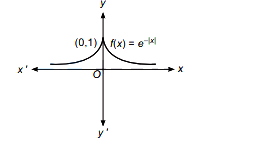
The function $f(x) = e^{-|x|}$ is
A
continuous everywhere but not differentiable at $x = 0$
B
continuous and differentiable everywhere
C
not continuous at $x = 0$
D
None of the above
Solution
(A) Given,$f(x) = \begin{cases} e^{-x}, & x \geq 0 \\ e^{x}, & x < 0 \end{cases}$
$LHL = \lim_{x \to 0^{-}} f(x) = \lim_{x \to 0} e^{x} = 1$
$RHL = \lim_{x \to 0^{+}} f(x) = \lim_{x \to 0} e^{-x} = 1$
Also,$f(0) = e^{0} = 1$
Since $LHL = RHL = f(0)$,the function is continuous for every value of $x$.
Now,we check for differentiability at $x = 0$:
$LHD = \left(\frac{d}{dx} e^{x}\right)_{x = 0} = \left[e^{x}\right]_{x = 0} = 1$
$RHD = \left(\frac{d}{dx} e^{-x}\right)_{x = 0} = \left[-e^{-x}\right]_{x = 0} = -1$
Since $LHD \neq RHD$,$f(x)$ is not differentiable at $x = 0$.
Therefore,$f(x) = e^{-|x|}$ is continuous everywhere but not differentiable at $x = 0$.
$LHL = \lim_{x \to 0^{-}} f(x) = \lim_{x \to 0} e^{x} = 1$
$RHL = \lim_{x \to 0^{+}} f(x) = \lim_{x \to 0} e^{-x} = 1$
Also,$f(0) = e^{0} = 1$
Since $LHL = RHL = f(0)$,the function is continuous for every value of $x$.
Now,we check for differentiability at $x = 0$:
$LHD = \left(\frac{d}{dx} e^{x}\right)_{x = 0} = \left[e^{x}\right]_{x = 0} = 1$
$RHD = \left(\frac{d}{dx} e^{-x}\right)_{x = 0} = \left[-e^{-x}\right]_{x = 0} = -1$
Since $LHD \neq RHD$,$f(x)$ is not differentiable at $x = 0$.
Therefore,$f(x) = e^{-|x|}$ is continuous everywhere but not differentiable at $x = 0$.
0 likesView Solution
25
MathematicsMediumMCQMHT CET · 2007
The set of points where the function $f(x)=|x-1| e^{x}$ is differentiable,is
A
$R$
B
$R-\{1\}$
C
$R-\{-1\}$
D
$R-\{0\}$
Solution
(B) The function $f(x) = |x-1| e^{x}$ is a product of two functions: $g(x) = |x-1|$ and $h(x) = e^{x}$.
We know that $e^{x}$ is differentiable for all $x \in R$.
The function $g(x) = |x-1|$ is continuous everywhere but is not differentiable at $x = 1$ because the left-hand derivative and right-hand derivative at $x = 1$ are not equal.
Specifically,at $x = 1$,the left-hand derivative is $-e^{1} = -e$ and the right-hand derivative is $e^{1} = e$.
Since the product of a non-differentiable function and a non-zero differentiable function at a point is non-differentiable at that point,$f(x)$ is not differentiable at $x = 1$.
Therefore,the set of points where $f(x)$ is differentiable is $R - \{1\}$.
We know that $e^{x}$ is differentiable for all $x \in R$.
The function $g(x) = |x-1|$ is continuous everywhere but is not differentiable at $x = 1$ because the left-hand derivative and right-hand derivative at $x = 1$ are not equal.
Specifically,at $x = 1$,the left-hand derivative is $-e^{1} = -e$ and the right-hand derivative is $e^{1} = e$.
Since the product of a non-differentiable function and a non-zero differentiable function at a point is non-differentiable at that point,$f(x)$ is not differentiable at $x = 1$.
Therefore,the set of points where $f(x)$ is differentiable is $R - \{1\}$.
0 likesView Solution
26
MathematicsMediumMCQMHT CET · 2007
If $f(x)=\sin ^{-1}\left(\frac{2 x}{1+x^{2}}\right)$,then $f(x)$ is differentiable on
A
$[-1,1]$
B
$R-\{-1,1\}$
C
$R-(-1,1)$
D
None of these
Solution
(B) Given,$f(x)=\sin ^{-1}\left(\frac{2 x}{1+x^{2}}\right)$.
On differentiating with respect to $x$,we get:
$f^{\prime}(x) = \frac{1}{\sqrt{1-\left(\frac{2 x}{1+x^{2}}\right)^{2}}} \times \frac{d}{d x}\left(\frac{2 x}{1+x^{2}}\right)$
$f^{\prime}(x) = \frac{1+x^{2}}{\sqrt{(1-x^{2})^{2}}} \times \frac{2(1-x^{2})}{(1+x^{2})^{2}}$
$f^{\prime}(x) = \frac{2}{1+x^{2}} \times \frac{1-x^{2}}{|1-x^{2}|}$
This simplifies to:
$f^{\prime}(x) = \begin{cases} \frac{2}{1+x^{2}}, & \text{if } |x| < 1 \\ -\frac{2}{1+x^{2}}, & \text{if } |x| > 1 \end{cases}$
At $x = 1$ and $x = -1$,the derivative does not exist because the left-hand derivative and right-hand derivative are not equal.
Therefore,$f(x)$ is differentiable on $R - \{-1, 1\}$.
On differentiating with respect to $x$,we get:
$f^{\prime}(x) = \frac{1}{\sqrt{1-\left(\frac{2 x}{1+x^{2}}\right)^{2}}} \times \frac{d}{d x}\left(\frac{2 x}{1+x^{2}}\right)$
$f^{\prime}(x) = \frac{1+x^{2}}{\sqrt{(1-x^{2})^{2}}} \times \frac{2(1-x^{2})}{(1+x^{2})^{2}}$
$f^{\prime}(x) = \frac{2}{1+x^{2}} \times \frac{1-x^{2}}{|1-x^{2}|}$
This simplifies to:
$f^{\prime}(x) = \begin{cases} \frac{2}{1+x^{2}}, & \text{if } |x| < 1 \\ -\frac{2}{1+x^{2}}, & \text{if } |x| > 1 \end{cases}$
At $x = 1$ and $x = -1$,the derivative does not exist because the left-hand derivative and right-hand derivative are not equal.
Therefore,$f(x)$ is differentiable on $R - \{-1, 1\}$.
0 likesView Solution
27
MathematicsDifficultMCQMHT CET · 2007
The value of $\int_{0}^{\pi / 2} \frac{\cos 3 x+1}{2 \cos x-1} d x$ is
A
$2$
B
$1$
C
$\frac{1}{2}$
D
$0$
Solution
(B) Let $I = \int_{0}^{\pi / 2} \frac{\cos 3x + 1}{2 \cos x - 1} dx$.
Using the identity $\cos 3x = 4 \cos^3 x - 3 \cos x$,we have $\cos 3x + 1 = 4 \cos^3 x - 3 \cos x + 1$.
Since $\cos(\pi/3) = 1/2$,we can write $2 \cos x - 1 = 2(\cos x - \cos(\pi/3))$.
Also,$4 \cos^3(\pi/3) - 3 \cos(\pi/3) + 1 = 4(1/8) - 3(1/2) + 1 = 1/2 - 3/2 + 1 = 0$.
Thus,the numerator is $4 \cos^3 x - 3 \cos x + 1 = 4 \cos^3 x - 3 \cos x - (4 \cos^3(\pi/3) - 3 \cos(\pi/3))$.
Using the algebraic identity $a^3 - b^3 = (a - b)(a^2 + ab + b^2)$,we simplify the integrand:
$\frac{4(\cos^3 x - \cos^3(\pi/3)) - 3(\cos x - \cos(\pi/3))}{2(\cos x - \cos(\pi/3))} = \frac{4(\cos^2 x + \cos x \cos(\pi/3) + \cos^2(\pi/3)) - 3}{2} = \frac{4 \cos^2 x + 2 \cos x + 1 - 3}{2} = 2 \cos^2 x + \cos x - 1$.
Using $\cos^2 x = \frac{1 + \cos 2x}{2}$,we get $2(\frac{1 + \cos 2x}{2}) + \cos x - 1 = 1 + \cos 2x + \cos x - 1 = \cos 2x + \cos x$.
Now,$I = \int_{0}^{\pi / 2} (\cos 2x + \cos x) dx = [\frac{1}{2} \sin 2x + \sin x]_{0}^{\pi / 2} = (\frac{1}{2} \sin \pi + \sin(\pi/2)) - (0 + 0) = 0 + 1 = 1$.
Using the identity $\cos 3x = 4 \cos^3 x - 3 \cos x$,we have $\cos 3x + 1 = 4 \cos^3 x - 3 \cos x + 1$.
Since $\cos(\pi/3) = 1/2$,we can write $2 \cos x - 1 = 2(\cos x - \cos(\pi/3))$.
Also,$4 \cos^3(\pi/3) - 3 \cos(\pi/3) + 1 = 4(1/8) - 3(1/2) + 1 = 1/2 - 3/2 + 1 = 0$.
Thus,the numerator is $4 \cos^3 x - 3 \cos x + 1 = 4 \cos^3 x - 3 \cos x - (4 \cos^3(\pi/3) - 3 \cos(\pi/3))$.
Using the algebraic identity $a^3 - b^3 = (a - b)(a^2 + ab + b^2)$,we simplify the integrand:
$\frac{4(\cos^3 x - \cos^3(\pi/3)) - 3(\cos x - \cos(\pi/3))}{2(\cos x - \cos(\pi/3))} = \frac{4(\cos^2 x + \cos x \cos(\pi/3) + \cos^2(\pi/3)) - 3}{2} = \frac{4 \cos^2 x + 2 \cos x + 1 - 3}{2} = 2 \cos^2 x + \cos x - 1$.
Using $\cos^2 x = \frac{1 + \cos 2x}{2}$,we get $2(\frac{1 + \cos 2x}{2}) + \cos x - 1 = 1 + \cos 2x + \cos x - 1 = \cos 2x + \cos x$.
Now,$I = \int_{0}^{\pi / 2} (\cos 2x + \cos x) dx = [\frac{1}{2} \sin 2x + \sin x]_{0}^{\pi / 2} = (\frac{1}{2} \sin \pi + \sin(\pi/2)) - (0 + 0) = 0 + 1 = 1$.
0 likesView Solution
28
MathematicsEasyMCQMHT CET · 2007
By the application of Simpson's one-third rule for numerical integration,with two subintervals,the value of $\int_{0}^{1} \frac{d x}{1+x}$ is
A
$\frac{17}{36}$
B
$\frac{17}{25}$
C
$\frac{25}{36}$
D
$\frac{17}{24}$
Solution
(C) Given the integral $\int_{0}^{1} \frac{1}{1+x} dx$ with $n=2$ subintervals.
Here,the interval is $[0, 1]$,so $h = \frac{1-0}{2} = \frac{1}{2}$.
The points are $x_0 = 0$,$x_1 = 0.5$,and $x_2 = 1$.
The corresponding values of $y = f(x) = \frac{1}{1+x}$ are:
$y_0 = f(0) = \frac{1}{1+0} = 1$
$y_1 = f(0.5) = \frac{1}{1+0.5} = \frac{1}{1.5} = \frac{2}{3}$
$y_2 = f(1) = \frac{1}{1+1} = \frac{1}{2}$
Using Simpson's one-third rule: $\int_{a}^{b} f(x) dx \approx \frac{h}{3} [y_0 + 4y_1 + y_2]$.
Substituting the values: $\int_{0}^{1} \frac{1}{1+x} dx \approx \frac{0.5}{3} [1 + 4(\frac{2}{3}) + 0.5] = \frac{1}{6} [1 + \frac{8}{3} + 0.5] = \frac{1}{6} [1.5 + \frac{8}{3}] = \frac{1}{6} [\frac{3}{2} + \frac{8}{3}] = \frac{1}{6} [\frac{9+16}{6}] = \frac{25}{36}$.
Here,the interval is $[0, 1]$,so $h = \frac{1-0}{2} = \frac{1}{2}$.
The points are $x_0 = 0$,$x_1 = 0.5$,and $x_2 = 1$.
The corresponding values of $y = f(x) = \frac{1}{1+x}$ are:
$y_0 = f(0) = \frac{1}{1+0} = 1$
$y_1 = f(0.5) = \frac{1}{1+0.5} = \frac{1}{1.5} = \frac{2}{3}$
$y_2 = f(1) = \frac{1}{1+1} = \frac{1}{2}$
Using Simpson's one-third rule: $\int_{a}^{b} f(x) dx \approx \frac{h}{3} [y_0 + 4y_1 + y_2]$.
Substituting the values: $\int_{0}^{1} \frac{1}{1+x} dx \approx \frac{0.5}{3} [1 + 4(\frac{2}{3}) + 0.5] = \frac{1}{6} [1 + \frac{8}{3} + 0.5] = \frac{1}{6} [1.5 + \frac{8}{3}] = \frac{1}{6} [\frac{3}{2} + \frac{8}{3}] = \frac{1}{6} [\frac{9+16}{6}] = \frac{25}{36}$.
0 likesView Solution
29
MathematicsMediumMCQMHT CET · 2007
The value of $\int_{0}^{1} \tan ^{-1}\left(\frac{2 x-1}{1+x-x^{2}}\right) d x$ is
A
$1$
B
$0$
C
$-1$
D
\text{None of these}
Solution
(B) Let $I = \int_{0}^{1} \tan ^{-1}\left(\frac{2 x-1}{1+x-x^{2}}\right) d x$.
We can rewrite the argument of the $\tan^{-1}$ function as:
$\frac{2x-1}{1+x-x^2} = \frac{x + (x-1)}{1 - x(x-1)}$.
Using the identity $\tan^{-1}(A) + \tan^{-1}(B) = \tan^{-1}\left(\frac{A+B}{1-AB}\right)$,we have:
$I = \int_{0}^{1} (\tan^{-1}(x) + \tan^{-1}(x-1)) d x$.
Using the property $\int_{0}^{a} f(x) d x = \int_{0}^{a} f(a-x) d x$,let $f(x) = \tan^{-1}(x-1)$.
Then $\int_{0}^{1} \tan^{-1}(x-1) d x = \int_{0}^{1} \tan^{-1}((1-x)-1) d x = \int_{0}^{1} \tan^{-1}(-x) d x = -\int_{0}^{1} \tan^{-1}(x) d x$.
Substituting this back into the integral:
$I = \int_{0}^{1} \tan^{-1}(x) d x - \int_{0}^{1} \tan^{-1}(x) d x = 0$.
We can rewrite the argument of the $\tan^{-1}$ function as:
$\frac{2x-1}{1+x-x^2} = \frac{x + (x-1)}{1 - x(x-1)}$.
Using the identity $\tan^{-1}(A) + \tan^{-1}(B) = \tan^{-1}\left(\frac{A+B}{1-AB}\right)$,we have:
$I = \int_{0}^{1} (\tan^{-1}(x) + \tan^{-1}(x-1)) d x$.
Using the property $\int_{0}^{a} f(x) d x = \int_{0}^{a} f(a-x) d x$,let $f(x) = \tan^{-1}(x-1)$.
Then $\int_{0}^{1} \tan^{-1}(x-1) d x = \int_{0}^{1} \tan^{-1}((1-x)-1) d x = \int_{0}^{1} \tan^{-1}(-x) d x = -\int_{0}^{1} \tan^{-1}(x) d x$.
Substituting this back into the integral:
$I = \int_{0}^{1} \tan^{-1}(x) d x - \int_{0}^{1} \tan^{-1}(x) d x = 0$.
0 likesView Solution
30
MathematicsEasyMCQMHT CET · 2007
For the equations $x+2y+3z=1$,$2x+y+3z=2$,and $5x+5y+9z=4$,which of the following is true?
A
there is only one solution
B
there exists infinitely many solutions
C
there is no solution
D
None of the above
Solution
(A) The system of equations can be represented as $AX = B$,where $A = \begin{bmatrix} 1 & 2 & 3 \\ 2 & 1 & 3 \\ 5 & 5 & 9 \end{bmatrix}$.
To determine the nature of the solution,we calculate the determinant $\Delta = |A|$.
$\Delta = 1(9-15) - 2(18-15) + 3(10-5)$
$\Delta = 1(-6) - 2(3) + 3(5)$
$\Delta = -6 - 6 + 15 = 3$.
Since $\Delta \neq 0$,the system of equations has a unique solution (only one solution).
To determine the nature of the solution,we calculate the determinant $\Delta = |A|$.
$\Delta = 1(9-15) - 2(18-15) + 3(10-5)$
$\Delta = 1(-6) - 2(3) + 3(5)$
$\Delta = -6 - 6 + 15 = 3$.
Since $\Delta \neq 0$,the system of equations has a unique solution (only one solution).
0 likesView Solution
31
MathematicsMediumMCQMHT CET · 2007
If the vectors $\overrightarrow{a}=\hat{i}+a \hat{j}+a^{2} \hat{k}$,$\overrightarrow{b}=\hat{i}+b \hat{j}+b^{2} \hat{k}$ and $\overrightarrow{c}=\hat{i}+c \hat{j}+c^{2} \hat{k}$ are three non-coplanar vectors and $\left|\begin{array}{lll}a & a^{2} & 1+a^{3} \\ b & b^{2} & 1+b^{3} \\ c & c^{2} & 1+c^{3}\end{array}\right|=0$,then the value of $abc$ is
A
$0$
B
$1$
C
$2$
D
$-1$
Solution
(D) Given that $\overrightarrow{a}, \overrightarrow{b}$,and $\overrightarrow{c}$ are non-coplanar vectors,their scalar triple product is non-zero:
$[\overrightarrow{a} \overrightarrow{b} \overrightarrow{c}] = \left|\begin{array}{lll}1 & a & a^2 \\ 1 & b & b^2 \\ 1 & c & c^2\end{array}\right| \neq 0$.
Let $\Delta = \left|\begin{array}{lll}1 & a & a^2 \\ 1 & b & b^2 \\ 1 & c & c^2\end{array}\right|$.
We are given the determinant equation:
$\left|\begin{array}{lll}a & a^2 & 1+a^3 \\ b & b^2 & 1+b^3 \\ c & c^2 & 1+c^3\end{array}\right| = 0$.
Using the property of determinants,we can split this into two determinants:
$\left|\begin{array}{lll}a & a^2 & 1 \\ b & b^2 & 1 \\ c & c^2 & 1\end{array}\right| + \left|\begin{array}{lll}a & a^2 & a^3 \\ b & b^2 & b^3 \\ c & c^2 & c^3\end{array}\right| = 0$.
In the second determinant,take $a, b, c$ common from rows $1, 2, 3$ respectively:
$\left|\begin{array}{lll}a & a^2 & 1 \\ b & b^2 & 1 \\ c & c^2 & 1\end{array}\right| + abc \left|\begin{array}{lll}1 & a & a^2 \\ 1 & b & b^2 \\ 1 & c & c^2\end{array}\right| = 0$.
Note that $\left|\begin{array}{lll}a & a^2 & 1 \\ b & b^2 & 1 \\ c & c^2 & 1\end{array}\right| = \left|\begin{array}{lll}1 & a & a^2 \\ 1 & b & b^2 \\ 1 & c & c^2\end{array}\right| = \Delta$ (by swapping columns twice).
Thus,$\Delta + abc \Delta = 0 \Rightarrow \Delta(1 + abc) = 0$.
Since $\Delta \neq 0$,we must have $1 + abc = 0$,which implies $abc = -1$.
$[\overrightarrow{a} \overrightarrow{b} \overrightarrow{c}] = \left|\begin{array}{lll}1 & a & a^2 \\ 1 & b & b^2 \\ 1 & c & c^2\end{array}\right| \neq 0$.
Let $\Delta = \left|\begin{array}{lll}1 & a & a^2 \\ 1 & b & b^2 \\ 1 & c & c^2\end{array}\right|$.
We are given the determinant equation:
$\left|\begin{array}{lll}a & a^2 & 1+a^3 \\ b & b^2 & 1+b^3 \\ c & c^2 & 1+c^3\end{array}\right| = 0$.
Using the property of determinants,we can split this into two determinants:
$\left|\begin{array}{lll}a & a^2 & 1 \\ b & b^2 & 1 \\ c & c^2 & 1\end{array}\right| + \left|\begin{array}{lll}a & a^2 & a^3 \\ b & b^2 & b^3 \\ c & c^2 & c^3\end{array}\right| = 0$.
In the second determinant,take $a, b, c$ common from rows $1, 2, 3$ respectively:
$\left|\begin{array}{lll}a & a^2 & 1 \\ b & b^2 & 1 \\ c & c^2 & 1\end{array}\right| + abc \left|\begin{array}{lll}1 & a & a^2 \\ 1 & b & b^2 \\ 1 & c & c^2\end{array}\right| = 0$.
Note that $\left|\begin{array}{lll}a & a^2 & 1 \\ b & b^2 & 1 \\ c & c^2 & 1\end{array}\right| = \left|\begin{array}{lll}1 & a & a^2 \\ 1 & b & b^2 \\ 1 & c & c^2\end{array}\right| = \Delta$ (by swapping columns twice).
Thus,$\Delta + abc \Delta = 0 \Rightarrow \Delta(1 + abc) = 0$.
Since $\Delta \neq 0$,we must have $1 + abc = 0$,which implies $abc = -1$.
0 likesView Solution
32
MathematicsEasyMCQMHT CET · 2007
The order of the differential equation whose solution is $y=a \cos x+b \sin x+c e^{-x}$ is
A
$3$
B
$4$
C
$2$
D
$1$
Solution
(A) The given solution is $y=a \cos x+b \sin x+c e^{-x}$.
Since the solution contains $3$ arbitrary constants $(a, b, c)$,the order of the corresponding differential equation is equal to the number of arbitrary constants.
Therefore,the order of the differential equation is $3$.
Since the solution contains $3$ arbitrary constants $(a, b, c)$,the order of the corresponding differential equation is equal to the number of arbitrary constants.
Therefore,the order of the differential equation is $3$.
0 likesView Solution
33
MathematicsMediumMCQMHT CET · 2007
The differential equation of all parabolas with axis parallel to the $y$-axis is
A
$y_{2} = 2y_{1} + x$
B
$y_{3} = 2y_{1}$
C
$y_{2}^{3} = y_{1}$
D
None of these
Solution
(D) The general equation of a parabola with its axis parallel to the $y$-axis is given by $(x-h)^{2} = 4a(y-k)$,where $h, k,$ and $a$ are arbitrary constants.
Since there are $3$ arbitrary constants,we need to differentiate the equation $3$ times.
Let $(x-h)^{2} = A(y-k)$,where $A = 4a$.
Differentiating with respect to $x$: $2(x-h) = A y_{1}$.
Differentiating again with respect to $x$: $2 = A y_{2}$.
Differentiating a third time with respect to $x$: $0 = A y_{3}$.
Since $A = 4a \neq 0$,we must have $y_{3} = 0$.
None of the given options match $y_{3} = 0$.
Since there are $3$ arbitrary constants,we need to differentiate the equation $3$ times.
Let $(x-h)^{2} = A(y-k)$,where $A = 4a$.
Differentiating with respect to $x$: $2(x-h) = A y_{1}$.
Differentiating again with respect to $x$: $2 = A y_{2}$.
Differentiating a third time with respect to $x$: $0 = A y_{3}$.
Since $A = 4a \neq 0$,we must have $y_{3} = 0$.
None of the given options match $y_{3} = 0$.
0 likesView Solution
34
MathematicsEasyMCQMHT CET · 2007
If $x=\phi(t)$ and $y=\psi(t)$,then $\frac{d^{2} y}{d x^{2}}$ is equal to
A
$\frac{\phi^{\prime} \psi^{\prime \prime}-\psi^{\prime} \phi^{\prime \prime}}{\left(\phi^{\prime}\right)^{2}}$
B
$\frac{\phi^{\prime} \psi^{\prime \prime}-\psi^{\prime} \phi^{\prime \prime}}{\left(\phi^{\prime}\right)^{3}}$
C
$\frac{\phi^{\prime \prime}}{\psi^{\prime \prime}}$
D
$\frac{\psi^{\prime \prime}}{\phi^{\prime \prime}}$
Solution
(B) Given $x=\phi(t)$ and $y=\psi(t)$.
First,we find the first derivative $\frac{dy}{dx}$ using the chain rule:
$\frac{dy}{dx} = \frac{dy/dt}{dx/dt} = \frac{\psi^{\prime}(t)}{\phi^{\prime}(t)}$.
Now,we differentiate $\frac{dy}{dx}$ with respect to $x$:
$\frac{d^{2}y}{dx^{2}} = \frac{d}{dx}\left(\frac{\psi^{\prime}}{\phi^{\prime}}\right) = \frac{d}{dt}\left(\frac{\psi^{\prime}}{\phi^{\prime}}\right) \cdot \frac{dt}{dx}$.
Using the quotient rule for $\frac{d}{dt}\left(\frac{\psi^{\prime}}{\phi^{\prime}}\right)$:
$= \frac{\phi^{\prime}\psi^{\prime\prime} - \psi^{\prime}\phi^{\prime\prime}}{(\phi^{\prime})^{2}} \cdot \frac{1}{\phi^{\prime}}$.
$= \frac{\phi^{\prime}\psi^{\prime\prime} - \psi^{\prime}\phi^{\prime\prime}}{(\phi^{\prime})^{3}}$.
First,we find the first derivative $\frac{dy}{dx}$ using the chain rule:
$\frac{dy}{dx} = \frac{dy/dt}{dx/dt} = \frac{\psi^{\prime}(t)}{\phi^{\prime}(t)}$.
Now,we differentiate $\frac{dy}{dx}$ with respect to $x$:
$\frac{d^{2}y}{dx^{2}} = \frac{d}{dx}\left(\frac{\psi^{\prime}}{\phi^{\prime}}\right) = \frac{d}{dt}\left(\frac{\psi^{\prime}}{\phi^{\prime}}\right) \cdot \frac{dt}{dx}$.
Using the quotient rule for $\frac{d}{dt}\left(\frac{\psi^{\prime}}{\phi^{\prime}}\right)$:
$= \frac{\phi^{\prime}\psi^{\prime\prime} - \psi^{\prime}\phi^{\prime\prime}}{(\phi^{\prime})^{2}} \cdot \frac{1}{\phi^{\prime}}$.
$= \frac{\phi^{\prime}\psi^{\prime\prime} - \psi^{\prime}\phi^{\prime\prime}}{(\phi^{\prime})^{3}}$.
0 likesView Solution
35
MathematicsEasyMCQMHT CET · 2007
If $y = \log_{\cos x} \sin x$,then $\frac{dy}{dx}$ is equal to
A
$\frac{\cot x \log \cos x + \tan x \log \sin x}{(\log \cos x)^2}$
B
$\frac{\tan x \log \cos x + \cot x \log \sin x}{(\log \cos x)^2}$
C
$\frac{\cot x \log \cos x + \tan x \log \sin x}{(\log \sin x)^2}$
D
None of the above
Solution
(A) Given,$y = \log_{\cos x} \sin x = \frac{\log \sin x}{\log \cos x}$.
Applying the quotient rule $\frac{d}{dx} \left( \frac{u}{v} \right) = \frac{v u' - u v'}{v^2}$,where $u = \log \sin x$ and $v = \log \cos x$.
Then $u' = \frac{1}{\sin x} \cdot \cos x = \cot x$ and $v' = \frac{1}{\cos x} \cdot (-\sin x) = -\tan x$.
$\frac{dy}{dx} = \frac{(\log \cos x)(\cot x) - (\log \sin x)(-\tan x)}{(\log \cos x)^2}$.
$\frac{dy}{dx} = \frac{\cot x \log \cos x + \tan x \log \sin x}{(\log \cos x)^2}$.
Applying the quotient rule $\frac{d}{dx} \left( \frac{u}{v} \right) = \frac{v u' - u v'}{v^2}$,where $u = \log \sin x$ and $v = \log \cos x$.
Then $u' = \frac{1}{\sin x} \cdot \cos x = \cot x$ and $v' = \frac{1}{\cos x} \cdot (-\sin x) = -\tan x$.
$\frac{dy}{dx} = \frac{(\log \cos x)(\cot x) - (\log \sin x)(-\tan x)}{(\log \cos x)^2}$.
$\frac{dy}{dx} = \frac{\cot x \log \cos x + \tan x \log \sin x}{(\log \cos x)^2}$.
0 likesView Solution
36
MathematicsEasyMCQMHT CET · 2007
The derivative of $\log |x|$ is
A
$\frac{1}{x}, x>0$
B
$\frac{1}{|x|}, x \neq 0$
C
$\frac{1}{x}, x \neq 0$
D
None of these
Solution
(C) We have,$y = \log |x| = \begin{cases} \log x, & x > 0 \\ \log (-x), & x < 0 \end{cases}$
For $x > 0$,$\frac{dy}{dx} = \frac{d}{dx}(\log x) = \frac{1}{x}$.
For $x < 0$,$\frac{dy}{dx} = \frac{d}{dx}(\log (-x)) = \frac{1}{-x} \times \frac{d}{dx}(-x) = \frac{1}{-x} \times (-1) = \frac{1}{x}$.
Combining both cases,we get $\frac{dy}{dx} = \frac{1}{x}$ for all $x \neq 0$.
For $x > 0$,$\frac{dy}{dx} = \frac{d}{dx}(\log x) = \frac{1}{x}$.
For $x < 0$,$\frac{dy}{dx} = \frac{d}{dx}(\log (-x)) = \frac{1}{-x} \times \frac{d}{dx}(-x) = \frac{1}{-x} \times (-1) = \frac{1}{x}$.
Combining both cases,we get $\frac{dy}{dx} = \frac{1}{x}$ for all $x \neq 0$.
0 likesView Solution
37
MathematicsEasyMCQMHT CET · 2007
If $y^{2}=a x^{2}+b x+c$,where $a, b, c$ are constants,then $y^{3} \frac{d^{2} y}{d x^{2}}$ is equal to
A
a constant
B
a function of $x$
C
a function of $y$
D
a function of $x$ and $y$ both
Solution
(A) Given,$y^{2}=a x^{2}+b x+c$.
On differentiating with respect to $x$,we get $2 y \frac{d y}{d x}=2 a x+b$,which implies $\frac{d y}{d x} = \frac{2 a x + b}{2 y}$.
Again differentiating with respect to $x$,we get $2(\frac{d y}{d x})^{2} + 2 y \frac{d^{2} y}{d x^{2}} = 2 a$.
Dividing by $2$,we have $(\frac{d y}{d x})^{2} + y \frac{d^{2} y}{d x^{2}} = a$.
Substituting $\frac{d y}{d x} = \frac{2 a x + b}{2 y}$,we get $y \frac{d^{2} y}{d x^{2}} = a - (\frac{2 a x + b}{2 y})^{2}$.
$y \frac{d^{2} y}{d x^{2}} = \frac{4 a y^{2} - (2 a x + b)^{2}}{4 y^{2}}$.
Substituting $y^{2} = a x^{2} + b x + c$,we get $y \frac{d^{2} y}{d x^{2}} = \frac{4 a (a x^{2} + b x + c) - (4 a^{2} x^{2} + 4 a b x + b^{2})}{4 y^{2}}$.
$y \frac{d^{2} y}{d x^{2}} = \frac{4 a^{2} x^{2} + 4 a b x + 4 a c - 4 a^{2} x^{2} - 4 a b x - b^{2}}{4 y^{2}}$.
$y \frac{d^{2} y}{d x^{2}} = \frac{4 a c - b^{2}}{4 y^{2}}$.
Multiplying both sides by $y^{2}$,we get $y^{3} \frac{d^{2} y}{d x^{2}} = \frac{4 a c - b^{2}}{4}$,which is a constant.
On differentiating with respect to $x$,we get $2 y \frac{d y}{d x}=2 a x+b$,which implies $\frac{d y}{d x} = \frac{2 a x + b}{2 y}$.
Again differentiating with respect to $x$,we get $2(\frac{d y}{d x})^{2} + 2 y \frac{d^{2} y}{d x^{2}} = 2 a$.
Dividing by $2$,we have $(\frac{d y}{d x})^{2} + y \frac{d^{2} y}{d x^{2}} = a$.
Substituting $\frac{d y}{d x} = \frac{2 a x + b}{2 y}$,we get $y \frac{d^{2} y}{d x^{2}} = a - (\frac{2 a x + b}{2 y})^{2}$.
$y \frac{d^{2} y}{d x^{2}} = \frac{4 a y^{2} - (2 a x + b)^{2}}{4 y^{2}}$.
Substituting $y^{2} = a x^{2} + b x + c$,we get $y \frac{d^{2} y}{d x^{2}} = \frac{4 a (a x^{2} + b x + c) - (4 a^{2} x^{2} + 4 a b x + b^{2})}{4 y^{2}}$.
$y \frac{d^{2} y}{d x^{2}} = \frac{4 a^{2} x^{2} + 4 a b x + 4 a c - 4 a^{2} x^{2} - 4 a b x - b^{2}}{4 y^{2}}$.
$y \frac{d^{2} y}{d x^{2}} = \frac{4 a c - b^{2}}{4 y^{2}}$.
Multiplying both sides by $y^{2}$,we get $y^{3} \frac{d^{2} y}{d x^{2}} = \frac{4 a c - b^{2}}{4}$,which is a constant.
0 likesView Solution
38
MathematicsEasyMCQMHT CET · 2007
Let $f(x) = \frac{ax + b}{cx + d}$. Then,$f \circ f(x) = x$ provided that
A
$d = -a$
B
$d = a$
C
$a = b = c = d = 1$
D
$a = b = 1$
Solution
(A) Given $f(x) = \frac{ax + b}{cx + d}$.
We are given that $f \circ f(x) = x$.
This implies $f(f(x)) = x$.
Substituting $f(x)$ into the function:
$f\left(\frac{ax + b}{cx + d}\right) = x$
$\frac{a\left(\frac{ax + b}{cx + d}\right) + b}{c\left(\frac{ax + b}{cx + d}\right) + d} = x$
Multiplying numerator and denominator by $(cx + d)$:
$\frac{a(ax + b) + b(cx + d)}{c(ax + b) + d(cx + d)} = x$
$\frac{a^2x + ab + bcx + bd}{acx + bc + cdx + d^2} = x$
$\frac{(a^2 + bc)x + (ab + bd)}{(ac + cd)x + (bc + d^2)} = x$
$(a^2 + bc)x + (ab + bd) = x((ac + cd)x + (bc + d^2))$
$(a^2 + bc)x + b(a + d) = (ac + cd)x^2 + (bc + d^2)x$
For this to hold for all $x$,the coefficients must match. Comparing the constant term,we have $b(a + d) = 0$. If $b \neq 0$,then $a + d = 0$,which means $d = -a$. If $d = -a$,the expression becomes $\frac{ax + b}{cx - a}$,and $f(f(x)) = \frac{a(\frac{ax+b}{cx-a}) + b}{c(\frac{ax+b}{cx-a}) - a} = \frac{a^2x + ab + bcx - ab}{acx + bc - acx + a^2} = \frac{x(a^2 + bc)}{a^2 + bc} = x$. Thus,$d = -a$ is the required condition.
We are given that $f \circ f(x) = x$.
This implies $f(f(x)) = x$.
Substituting $f(x)$ into the function:
$f\left(\frac{ax + b}{cx + d}\right) = x$
$\frac{a\left(\frac{ax + b}{cx + d}\right) + b}{c\left(\frac{ax + b}{cx + d}\right) + d} = x$
Multiplying numerator and denominator by $(cx + d)$:
$\frac{a(ax + b) + b(cx + d)}{c(ax + b) + d(cx + d)} = x$
$\frac{a^2x + ab + bcx + bd}{acx + bc + cdx + d^2} = x$
$\frac{(a^2 + bc)x + (ab + bd)}{(ac + cd)x + (bc + d^2)} = x$
$(a^2 + bc)x + (ab + bd) = x((ac + cd)x + (bc + d^2))$
$(a^2 + bc)x + b(a + d) = (ac + cd)x^2 + (bc + d^2)x$
For this to hold for all $x$,the coefficients must match. Comparing the constant term,we have $b(a + d) = 0$. If $b \neq 0$,then $a + d = 0$,which means $d = -a$. If $d = -a$,the expression becomes $\frac{ax + b}{cx - a}$,and $f(f(x)) = \frac{a(\frac{ax+b}{cx-a}) + b}{c(\frac{ax+b}{cx-a}) - a} = \frac{a^2x + ab + bcx - ab}{acx + bc - acx + a^2} = \frac{x(a^2 + bc)}{a^2 + bc} = x$. Thus,$d = -a$ is the required condition.
0 likesView Solution
39
MathematicsEasyMCQMHT CET · 2007
If $f: R \rightarrow R$ is a mapping defined by $f(x)=x^{3}+5$,then $f^{-1}(x)$ is equal to
A
$(x+5)^{1/3}$
B
$(x-5)^{1/3}$
C
$(5-x)^{1/3}$
D
$5-x$
Solution
(B) Let $y = f(x) = x^{3} + 5$.
To find the inverse,we express $x$ in terms of $y$:
$y - 5 = x^{3}$
$x = (y - 5)^{1/3}$
Since $f^{-1}(y) = x$,we have $f^{-1}(y) = (y - 5)^{1/3}$.
Replacing $y$ with $x$,we get $f^{-1}(x) = (x - 5)^{1/3}$.
To find the inverse,we express $x$ in terms of $y$:
$y - 5 = x^{3}$
$x = (y - 5)^{1/3}$
Since $f^{-1}(y) = x$,we have $f^{-1}(y) = (y - 5)^{1/3}$.
Replacing $y$ with $x$,we get $f^{-1}(x) = (x - 5)^{1/3}$.
0 likesView Solution
40
MathematicsEasyMCQMHT CET · 2007
$\int \cos ^{3} x \cdot e^{\log (\sin x)} d x$ is equal to
A
$-\frac{\sin ^{4} x}{4}+c$
B
$-\frac{\cos ^{4} x}{4}+c$
C
$\frac{e^{\sin x}}{4}+c$
D
None of these
Solution
(B) Let $I = \int \cos ^{3} x \cdot e^{\log (\sin x)} d x$.
Since $e^{\log (\sin x)} = \sin x$,the integral becomes $I = \int \cos ^{3} x \sin x d x$.
Let $u = \cos x$. Then $du = -\sin x d x$,which implies $\sin x d x = -du$.
Substituting these into the integral,we get $I = \int u^{3} (-du) = -\int u^{3} du$.
Integrating with respect to $u$,we get $I = -\frac{u^{4}}{4} + c$.
Substituting back $u = \cos x$,we obtain $I = -\frac{\cos ^{4} x}{4} + c$.
Since $e^{\log (\sin x)} = \sin x$,the integral becomes $I = \int \cos ^{3} x \sin x d x$.
Let $u = \cos x$. Then $du = -\sin x d x$,which implies $\sin x d x = -du$.
Substituting these into the integral,we get $I = \int u^{3} (-du) = -\int u^{3} du$.
Integrating with respect to $u$,we get $I = -\frac{u^{4}}{4} + c$.
Substituting back $u = \cos x$,we obtain $I = -\frac{\cos ^{4} x}{4} + c$.
0 likesView Solution
41
MathematicsDifficultMCQMHT CET · 2007
$\int \frac{x+\sin x}{1+\cos x} d x$ is equal to
A
$x \tan \frac{x}{2}+c$
B
$\log (1+\cos x)+c$
C
$\cot \frac{x}{2}+c$
D
$\log (x+\sin x)+c$
Solution
(A) Let $I = \int \frac{x + \sin x}{1 + \cos x} dx$.
Using the half-angle formulas,$\sin x = 2 \sin \frac{x}{2} \cos \frac{x}{2}$ and $1 + \cos x = 2 \cos^2 \frac{x}{2}$.
Substituting these into the integral:
$I = \int \frac{x + 2 \sin \frac{x}{2} \cos \frac{x}{2}}{2 \cos^2 \frac{x}{2}} dx$
$I = \int \left( \frac{x}{2 \cos^2 \frac{x}{2}} + \frac{2 \sin \frac{x}{2} \cos \frac{x}{2}}{2 \cos^2 \frac{x}{2}} \right) dx$
$I = \int \left( \frac{x}{2} \sec^2 \frac{x}{2} + \tan \frac{x}{2} \right) dx$
Now,apply integration by parts to the first term $\int \frac{x}{2} \sec^2 \frac{x}{2} dx$ taking $u = \frac{x}{2}$ and $dv = \sec^2 \frac{x}{2} dx$:
$\int \frac{x}{2} \sec^2 \frac{x}{2} dx = \frac{x}{2} \cdot 2 \tan \frac{x}{2} - \int (1) \cdot \tan \frac{x}{2} dx = x \tan \frac{x}{2} - \int \tan \frac{x}{2} dx$.
Substituting this back into the expression for $I$:
$I = x \tan \frac{x}{2} - \int \tan \frac{x}{2} dx + \int \tan \frac{x}{2} dx + c$
$I = x \tan \frac{x}{2} + c$.
Using the half-angle formulas,$\sin x = 2 \sin \frac{x}{2} \cos \frac{x}{2}$ and $1 + \cos x = 2 \cos^2 \frac{x}{2}$.
Substituting these into the integral:
$I = \int \frac{x + 2 \sin \frac{x}{2} \cos \frac{x}{2}}{2 \cos^2 \frac{x}{2}} dx$
$I = \int \left( \frac{x}{2 \cos^2 \frac{x}{2}} + \frac{2 \sin \frac{x}{2} \cos \frac{x}{2}}{2 \cos^2 \frac{x}{2}} \right) dx$
$I = \int \left( \frac{x}{2} \sec^2 \frac{x}{2} + \tan \frac{x}{2} \right) dx$
Now,apply integration by parts to the first term $\int \frac{x}{2} \sec^2 \frac{x}{2} dx$ taking $u = \frac{x}{2}$ and $dv = \sec^2 \frac{x}{2} dx$:
$\int \frac{x}{2} \sec^2 \frac{x}{2} dx = \frac{x}{2} \cdot 2 \tan \frac{x}{2} - \int (1) \cdot \tan \frac{x}{2} dx = x \tan \frac{x}{2} - \int \tan \frac{x}{2} dx$.
Substituting this back into the expression for $I$:
$I = x \tan \frac{x}{2} - \int \tan \frac{x}{2} dx + \int \tan \frac{x}{2} dx + c$
$I = x \tan \frac{x}{2} + c$.
0 likesView Solution
42
MathematicsEasyMCQMHT CET · 2007
The constraints $-x_{1} + x_{2} \leq 1$,$-x_{1} + 3x_{2} \leq 9$,and $x_{1}, x_{2} \geq 0$ define:
A
bounded feasible space
B
unbounded feasible space
C
both bounded and unbounded feasible space
D
None of the above
Solution
(B) The given constraints are $-x_{1} + x_{2} \leq 1$,$-x_{1} + 3x_{2} \leq 9$,and $x_{1}, x_{2} \geq 0$.
To determine the nature of the feasible region,we plot the lines $-x_{1} + x_{2} = 1$ and $-x_{1} + 3x_{2} = 9$.
For $-x_{1} + x_{2} = 1$,the intercepts are $(0, 1)$ and $(-1, 0)$.
For $-x_{1} + 3x_{2} = 9$,the intercepts are $(0, 3)$ and $(-9, 0)$.
Since the region is defined by $x_{1}, x_{2} \geq 0$ (first quadrant) and the inequalities allow the region to extend infinitely in the direction of increasing $x_{1}$ and $x_{2}$,the feasible region is unbounded.
To determine the nature of the feasible region,we plot the lines $-x_{1} + x_{2} = 1$ and $-x_{1} + 3x_{2} = 9$.
For $-x_{1} + x_{2} = 1$,the intercepts are $(0, 1)$ and $(-1, 0)$.
For $-x_{1} + 3x_{2} = 9$,the intercepts are $(0, 3)$ and $(-9, 0)$.
Since the region is defined by $x_{1}, x_{2} \geq 0$ (first quadrant) and the inequalities allow the region to extend infinitely in the direction of increasing $x_{1}$ and $x_{2}$,the feasible region is unbounded.
0 likesView Solution
43
MathematicsEasyMCQMHT CET · 2007
Which of the following terms is not used in a linear programming problem?
A
Optimal solution
B
Feasible solution
C
Concave region
D
Objective function
Solution
(C) In a linear programming problem,we deal with a convex feasible region formed by the intersection of linear inequalities. The terms 'Optimal solution','Feasible solution',and 'Objective function' are standard components of linear programming. The term 'Concave region' is not used in this context.
0 likesView Solution
44
MathematicsEasyMCQMHT CET · 2007
In the usual notation,the value of $\Delta \nabla$ is equal to
A
$\Delta-\nabla$
B
$\Delta+\nabla$
C
$\nabla-\Delta$
D
None of the above
Solution
(A) We know that the forward difference operator $\Delta$ is defined as $\Delta f(x) = f(x+h) - f(x)$ and the backward difference operator $\nabla$ is defined as $\nabla f(x) = f(x) - f(x-h)$.
Now,consider the expression $\Delta \nabla f(x)$:
$\Delta \nabla f(x) = \Delta [f(x) - f(x-h)]$
$= \Delta f(x) - \Delta f(x-h)$
$= [f(x+h) - f(x)] - [f(x) - f(x-h)]$
$= [f(x+h) - f(x)] - \nabla f(x)$
$= \Delta f(x) - \nabla f(x)$
Therefore,$\Delta \nabla = \Delta - \nabla$.
Now,consider the expression $\Delta \nabla f(x)$:
$\Delta \nabla f(x) = \Delta [f(x) - f(x-h)]$
$= \Delta f(x) - \Delta f(x-h)$
$= [f(x+h) - f(x)] - [f(x) - f(x-h)]$
$= [f(x+h) - f(x)] - \nabla f(x)$
$= \Delta f(x) - \nabla f(x)$
Therefore,$\Delta \nabla = \Delta - \nabla$.
0 likesView Solution
45
MathematicsMediumMCQMHT CET · 2007
If $A = \begin{bmatrix} \cos^2 \alpha & \cos \alpha \sin \alpha \\ \cos \alpha \sin \alpha & \sin^2 \alpha \end{bmatrix}$ and $B = \begin{bmatrix} \cos^2 \beta & \cos \beta \sin \beta \\ \cos \beta \sin \beta & \sin^2 \beta \end{bmatrix}$ are two matrices such that the product $AB$ is a null matrix,then $\alpha - \beta$ is:
A
$0$
B
multiple of $\pi$
C
an odd multiple of $\pi / 2$
D
None of the above
Solution
(C) Given matrices are $A = \begin{bmatrix} \cos^2 \alpha & \cos \alpha \sin \alpha \\ \cos \alpha \sin \alpha & \sin^2 \alpha \end{bmatrix}$ and $B = \begin{bmatrix} \cos^2 \beta & \cos \beta \sin \beta \\ \cos \beta \sin \beta & \sin^2 \beta \end{bmatrix}$.
Calculating the product $AB$:
$AB = \begin{bmatrix} \cos^2 \alpha & \cos \alpha \sin \alpha \\ \cos \alpha \sin \alpha & \sin^2 \alpha \end{bmatrix} \begin{bmatrix} \cos^2 \beta & \cos \beta \sin \beta \\ \cos \beta \sin \beta & \sin^2 \beta \end{bmatrix}$
$= \begin{bmatrix} \cos^2 \alpha \cos^2 \beta + \cos \alpha \sin \alpha \cos \beta \sin \beta & \cos^2 \alpha \cos \beta \sin \beta + \cos \alpha \sin \alpha \sin^2 \beta \\ \cos \alpha \sin \alpha \cos^2 \beta + \sin^2 \alpha \cos \beta \sin \beta & \cos \alpha \sin \alpha \cos \beta \sin \beta + \sin^2 \alpha \sin^2 \beta \end{bmatrix}$
$= \begin{bmatrix} \cos \alpha \cos \beta (\cos \alpha \cos \beta + \sin \alpha \sin \beta) & \cos \alpha \sin \beta (\cos \alpha \cos \beta + \sin \alpha \sin \beta) \\ \sin \alpha \cos \beta (\cos \alpha \cos \beta + \sin \alpha \sin \beta) & \sin \alpha \sin \beta (\cos \alpha \cos \beta + \sin \alpha \sin \beta) \end{bmatrix}$
$= \cos(\alpha - \beta) \begin{bmatrix} \cos \alpha \cos \beta & \cos \alpha \sin \beta \\ \sin \alpha \cos \beta & \sin \alpha \sin \beta \end{bmatrix}$.
For $AB$ to be a null matrix,we must have $\cos(\alpha - \beta) = 0$.
This implies $\alpha - \beta = (2n + 1) \frac{\pi}{2}$ for some integer $n$,which is an odd multiple of $\pi / 2$.
Calculating the product $AB$:
$AB = \begin{bmatrix} \cos^2 \alpha & \cos \alpha \sin \alpha \\ \cos \alpha \sin \alpha & \sin^2 \alpha \end{bmatrix} \begin{bmatrix} \cos^2 \beta & \cos \beta \sin \beta \\ \cos \beta \sin \beta & \sin^2 \beta \end{bmatrix}$
$= \begin{bmatrix} \cos^2 \alpha \cos^2 \beta + \cos \alpha \sin \alpha \cos \beta \sin \beta & \cos^2 \alpha \cos \beta \sin \beta + \cos \alpha \sin \alpha \sin^2 \beta \\ \cos \alpha \sin \alpha \cos^2 \beta + \sin^2 \alpha \cos \beta \sin \beta & \cos \alpha \sin \alpha \cos \beta \sin \beta + \sin^2 \alpha \sin^2 \beta \end{bmatrix}$
$= \begin{bmatrix} \cos \alpha \cos \beta (\cos \alpha \cos \beta + \sin \alpha \sin \beta) & \cos \alpha \sin \beta (\cos \alpha \cos \beta + \sin \alpha \sin \beta) \\ \sin \alpha \cos \beta (\cos \alpha \cos \beta + \sin \alpha \sin \beta) & \sin \alpha \sin \beta (\cos \alpha \cos \beta + \sin \alpha \sin \beta) \end{bmatrix}$
$= \cos(\alpha - \beta) \begin{bmatrix} \cos \alpha \cos \beta & \cos \alpha \sin \beta \\ \sin \alpha \cos \beta & \sin \alpha \sin \beta \end{bmatrix}$.
For $AB$ to be a null matrix,we must have $\cos(\alpha - \beta) = 0$.
This implies $\alpha - \beta = (2n + 1) \frac{\pi}{2}$ for some integer $n$,which is an odd multiple of $\pi / 2$.
0 likesView Solution
46
MathematicsEasyMCQMHT CET · 2007
If $A$ is a square matrix of order $n \times n$,then $\operatorname{adj}(\operatorname{adj} A)$ is equal to
A
$|A|^{n-2} A$
B
$|A|^{n-1} A$
C
$|A|^{n} A$
D
$|A|^{n-3} A$
Solution
(A) For any square matrix $B$,we have $B(\operatorname{adj} B) = |B| I_{n}$.
Taking $B = \operatorname{adj} A$,we get $(\operatorname{adj} A)[\operatorname{adj}(\operatorname{adj} A)] = |\operatorname{adj} A| I_{n}$.
Since $|\operatorname{adj} A| = |A|^{n-1}$,we have $(\operatorname{adj} A)[\operatorname{adj}(\operatorname{adj} A)] = |A|^{n-1} I_{n}$.
Multiplying both sides by $A$ on the left,we get $A(\operatorname{adj} A)[\operatorname{adj}(\operatorname{adj} A)] = |A|^{n-1} A$.
Since $A(\operatorname{adj} A) = |A| I_{n}$,we have $(|A| I_{n})[\operatorname{adj}(\operatorname{adj} A)] = |A|^{n-1} A$.
Dividing both sides by $|A|$ (assuming $|A| \neq 0$),we get $\operatorname{adj}(\operatorname{adj} A) = |A|^{n-2} A$.
Taking $B = \operatorname{adj} A$,we get $(\operatorname{adj} A)[\operatorname{adj}(\operatorname{adj} A)] = |\operatorname{adj} A| I_{n}$.
Since $|\operatorname{adj} A| = |A|^{n-1}$,we have $(\operatorname{adj} A)[\operatorname{adj}(\operatorname{adj} A)] = |A|^{n-1} I_{n}$.
Multiplying both sides by $A$ on the left,we get $A(\operatorname{adj} A)[\operatorname{adj}(\operatorname{adj} A)] = |A|^{n-1} A$.
Since $A(\operatorname{adj} A) = |A| I_{n}$,we have $(|A| I_{n})[\operatorname{adj}(\operatorname{adj} A)] = |A|^{n-1} A$.
Dividing both sides by $|A|$ (assuming $|A| \neq 0$),we get $\operatorname{adj}(\operatorname{adj} A) = |A|^{n-2} A$.
0 likesView Solution
47
MathematicsMediumMCQMHT CET · 2007
Let $\overrightarrow{a}=2 \hat{i}-\hat{j}+\hat{k}$,$\overrightarrow{b}=\hat{i}+2 \hat{j}-\hat{k}$ and $\overrightarrow{c}=\hat{i}+\hat{j}-2 \hat{k}$ be three vectors. $A$ vector in the plane of $\overrightarrow{b}$ and $\overrightarrow{c}$ whose projection on $\overrightarrow{a}$ is of magnitude $\sqrt{\frac{2}{3}}$,is
A
$2 \hat{i}+3 \hat{j}-3 \hat{k}$
B
$2 \hat{i}+3 \hat{j}+3 \hat{k}$
C
$2 \hat{i}-5 \hat{j}+5 \hat{k}$
D
$2 \hat{i}+\hat{j}+5 \hat{k}$
Solution
(A) Any vector $\overrightarrow{r}$ in the plane of $\overrightarrow{b}$ and $\overrightarrow{c}$ can be written as $\overrightarrow{r} = m\overrightarrow{b} + n\overrightarrow{c}$. For simplicity,consider $\overrightarrow{r} = m\overrightarrow{b} + \overrightarrow{c}$ (assuming the vector is not parallel to $\overrightarrow{c}$).
$\overrightarrow{r} = m(\hat{i} + 2\hat{j} - \hat{k}) + (\hat{i} + \hat{j} - 2\hat{k}) = (m+1)\hat{i} + (2m+1)\hat{j} + (-m-2)\hat{k}$.
The projection of $\overrightarrow{r}$ on $\overrightarrow{a}$ is given by $\frac{|\overrightarrow{r} \cdot \overrightarrow{a}|}{|\overrightarrow{a}|} = \sqrt{\frac{2}{3}}$.
$\overrightarrow{a} = 2\hat{i} - \hat{j} + \hat{k}$,so $|\overrightarrow{a}| = \sqrt{2^2 + (-1)^2 + 1^2} = \sqrt{6}$.
$\overrightarrow{r} \cdot \overrightarrow{a} = 2(m+1) - 1(2m+1) + 1(-m-2) = 2m + 2 - 2m - 1 - m - 2 = -m - 1$.
Thus,$\frac{|-m-1|}{\sqrt{6}} = \sqrt{\frac{2}{3}} = \frac{\sqrt{2}}{\sqrt{3}} = \frac{2}{\sqrt{6}}$.
$|-m-1| = 2$,which implies $-m-1 = 2$ or $-m-1 = -2$.
If $-m-1 = 2$,then $m = -3$. Substituting $m = -3$ into $\overrightarrow{r}$: $\overrightarrow{r} = -2\hat{i} - 5\hat{j} + \hat{k}$.
If $-m-1 = -2$,then $m = 1$. Substituting $m = 1$ into $\overrightarrow{r}$: $\overrightarrow{r} = 2\hat{i} + 3\hat{j} - 3\hat{k}$.
Comparing with the options,$2\hat{i} + 3\hat{j} - 3\hat{k}$ is present.
$\overrightarrow{r} = m(\hat{i} + 2\hat{j} - \hat{k}) + (\hat{i} + \hat{j} - 2\hat{k}) = (m+1)\hat{i} + (2m+1)\hat{j} + (-m-2)\hat{k}$.
The projection of $\overrightarrow{r}$ on $\overrightarrow{a}$ is given by $\frac{|\overrightarrow{r} \cdot \overrightarrow{a}|}{|\overrightarrow{a}|} = \sqrt{\frac{2}{3}}$.
$\overrightarrow{a} = 2\hat{i} - \hat{j} + \hat{k}$,so $|\overrightarrow{a}| = \sqrt{2^2 + (-1)^2 + 1^2} = \sqrt{6}$.
$\overrightarrow{r} \cdot \overrightarrow{a} = 2(m+1) - 1(2m+1) + 1(-m-2) = 2m + 2 - 2m - 1 - m - 2 = -m - 1$.
Thus,$\frac{|-m-1|}{\sqrt{6}} = \sqrt{\frac{2}{3}} = \frac{\sqrt{2}}{\sqrt{3}} = \frac{2}{\sqrt{6}}$.
$|-m-1| = 2$,which implies $-m-1 = 2$ or $-m-1 = -2$.
If $-m-1 = 2$,then $m = -3$. Substituting $m = -3$ into $\overrightarrow{r}$: $\overrightarrow{r} = -2\hat{i} - 5\hat{j} + \hat{k}$.
If $-m-1 = -2$,then $m = 1$. Substituting $m = 1$ into $\overrightarrow{r}$: $\overrightarrow{r} = 2\hat{i} + 3\hat{j} - 3\hat{k}$.
Comparing with the options,$2\hat{i} + 3\hat{j} - 3\hat{k}$ is present.
0 likesView Solution
48
MathematicsEasyMCQMHT CET · 2007
If the vectors $\overrightarrow{a}+\lambda \overrightarrow{b}+3 \overrightarrow{c}$,$-2 \overrightarrow{a}+3 \overrightarrow{b}-4 \overrightarrow{c}$ and $\overrightarrow{a}-3 \overrightarrow{b}+5 \overrightarrow{c}$ are coplanar,then the value of $\lambda$ is
A
$2$
B
$-1$
C
$1$
D
$-2$
Solution
(D) Since the three given vectors are coplanar,their scalar triple product must be zero. Alternatively,one vector can be expressed as a linear combination of the other two. Let $\overrightarrow{u} = \overrightarrow{a}+\lambda \overrightarrow{b}+3 \overrightarrow{c}$,$\overrightarrow{v} = -2 \overrightarrow{a}+3 \overrightarrow{b}-4 \overrightarrow{c}$,and $\overrightarrow{w} = \overrightarrow{a}-3 \overrightarrow{b}+5 \overrightarrow{c}$.
For coplanar vectors,the determinant of their coefficients must be zero:
$\begin{vmatrix} 1 & \lambda & 3 \\ -2 & 3 & -4 \\ 1 & -3 & 5 \end{vmatrix} = 0$
Expanding along the first row:
$1(3 \times 5 - (-4) \times (-3)) - \lambda((-2) \times 5 - (-4) \times 1) + 3((-2) \times (-3) - 3 \times 1) = 0$
$1(15 - 12) - \lambda(-10 + 4) + 3(6 - 3) = 0$
$1(3) - \lambda(-6) + 3(3) = 0$
$3 + 6\lambda + 9 = 0$
$6\lambda + 12 = 0$
$6\lambda = -12$
$\lambda = -2$
For coplanar vectors,the determinant of their coefficients must be zero:
$\begin{vmatrix} 1 & \lambda & 3 \\ -2 & 3 & -4 \\ 1 & -3 & 5 \end{vmatrix} = 0$
Expanding along the first row:
$1(3 \times 5 - (-4) \times (-3)) - \lambda((-2) \times 5 - (-4) \times 1) + 3((-2) \times (-3) - 3 \times 1) = 0$
$1(15 - 12) - \lambda(-10 + 4) + 3(6 - 3) = 0$
$1(3) - \lambda(-6) + 3(3) = 0$
$3 + 6\lambda + 9 = 0$
$6\lambda + 12 = 0$
$6\lambda = -12$
$\lambda = -2$
0 likesView Solution
49
MathematicsEasyMCQMHT CET · 2007
If the constant forces $2 \hat{i}-5 \hat{j}+6 \hat{k}$ and $-\hat{i}+2 \hat{j}-\hat{k}$ act on a particle due to which it is displaced from a point $A(4,-3,-2)$ to a point $B(6,1,-3)$, then the work done by the forces is (in $\text{ unit}$)
A
$15$
B
$9$
C
$-15$
D
$-9$
Solution
(C) The resultant force $\overrightarrow{F}$ is the sum of the individual forces:
$\overrightarrow{F} = (2 \hat{i}-5 \hat{j}+6 \hat{k}) + (-\hat{i}+2 \hat{j}-\hat{k}) = \hat{i}-3 \hat{j}+5 \hat{k}$
The displacement vector $\overrightarrow{d}$ is given by $\overrightarrow{AB} = \overrightarrow{B} - \overrightarrow{A}$:
$\overrightarrow{d} = (6 \hat{i}+\hat{j}-3 \hat{k}) - (4 \hat{i}-3 \hat{j}-2 \hat{k}) = 2 \hat{i}+4 \hat{j}-\hat{k}$
The work done $W$ is the dot product of the force and displacement vectors:
$W = \overrightarrow{F} \cdot \overrightarrow{d} = (\hat{i}-3 \hat{j}+5 \hat{k}) \cdot (2 \hat{i}+4 \hat{j}-\hat{k})$
$W = (1)(2) + (-3)(4) + (5)(-1) = 2 - 12 - 5 = -15 \text{ unit}$
$\overrightarrow{F} = (2 \hat{i}-5 \hat{j}+6 \hat{k}) + (-\hat{i}+2 \hat{j}-\hat{k}) = \hat{i}-3 \hat{j}+5 \hat{k}$
The displacement vector $\overrightarrow{d}$ is given by $\overrightarrow{AB} = \overrightarrow{B} - \overrightarrow{A}$:
$\overrightarrow{d} = (6 \hat{i}+\hat{j}-3 \hat{k}) - (4 \hat{i}-3 \hat{j}-2 \hat{k}) = 2 \hat{i}+4 \hat{j}-\hat{k}$
The work done $W$ is the dot product of the force and displacement vectors:
$W = \overrightarrow{F} \cdot \overrightarrow{d} = (\hat{i}-3 \hat{j}+5 \hat{k}) \cdot (2 \hat{i}+4 \hat{j}-\hat{k})$
$W = (1)(2) + (-3)(4) + (5)(-1) = 2 - 12 - 5 = -15 \text{ unit}$
0 likesView Solution
50
MathematicsMediumMCQMHT CET · 2007
If $\overrightarrow{a}+\overrightarrow{b}+\overrightarrow{c}=\overrightarrow{0}$,$|\overrightarrow{a}|=3$,$|\overrightarrow{b}|=5$,and $|\overrightarrow{c}|=7$,then the angle between $\overrightarrow{a}$ and $\overrightarrow{b}$ is
A
$\pi / 6$
B
$2 \pi / 3$
C
$5 \pi / 3$
D
$\pi / 3$
Solution
(D) Given,$\overrightarrow{a}+\overrightarrow{b}+\overrightarrow{c}=\overrightarrow{0}$
$\therefore \overrightarrow{c}=-(\overrightarrow{a}+\overrightarrow{b})$
Squaring both sides,we get:
$|\overrightarrow{c}|^2 = (\overrightarrow{a}+\overrightarrow{b}) \cdot (\overrightarrow{a}+\overrightarrow{b})$
$|\overrightarrow{c}|^2 = |\overrightarrow{a}|^2 + |\overrightarrow{b}|^2 + 2(\overrightarrow{a} \cdot \overrightarrow{b})$
Since $\overrightarrow{a} \cdot \overrightarrow{b} = |\overrightarrow{a}||\overrightarrow{b}| \cos \theta$,where $\theta$ is the angle between $\overrightarrow{a}$ and $\overrightarrow{b}$:
$|\overrightarrow{c}|^2 = |\overrightarrow{a}|^2 + |\overrightarrow{b}|^2 + 2|\overrightarrow{a}||\overrightarrow{b}| \cos \theta$
Substituting the given values:
$7^2 = 3^2 + 5^2 + 2(3)(5) \cos \theta$
$49 = 9 + 25 + 30 \cos \theta$
$49 = 34 + 30 \cos \theta$
$15 = 30 \cos \theta$
$\cos \theta = \frac{15}{30} = \frac{1}{2}$
Therefore,$\theta = \frac{\pi}{3}$.
$\therefore \overrightarrow{c}=-(\overrightarrow{a}+\overrightarrow{b})$
Squaring both sides,we get:
$|\overrightarrow{c}|^2 = (\overrightarrow{a}+\overrightarrow{b}) \cdot (\overrightarrow{a}+\overrightarrow{b})$
$|\overrightarrow{c}|^2 = |\overrightarrow{a}|^2 + |\overrightarrow{b}|^2 + 2(\overrightarrow{a} \cdot \overrightarrow{b})$
Since $\overrightarrow{a} \cdot \overrightarrow{b} = |\overrightarrow{a}||\overrightarrow{b}| \cos \theta$,where $\theta$ is the angle between $\overrightarrow{a}$ and $\overrightarrow{b}$:
$|\overrightarrow{c}|^2 = |\overrightarrow{a}|^2 + |\overrightarrow{b}|^2 + 2|\overrightarrow{a}||\overrightarrow{b}| \cos \theta$
Substituting the given values:
$7^2 = 3^2 + 5^2 + 2(3)(5) \cos \theta$
$49 = 9 + 25 + 30 \cos \theta$
$49 = 34 + 30 \cos \theta$
$15 = 30 \cos \theta$
$\cos \theta = \frac{15}{30} = \frac{1}{2}$
Therefore,$\theta = \frac{\pi}{3}$.
0 likesView Solution
Vedclass Products
For Students
Vedclass Test Series
Mock tests in real MHT CET style covering Mathematics with performance analysis. 5-day free trial.
Start Free TrialFor Teachers
Exam Paper Generator
Generate Set A/B/C/D Mathematics papers from 7.5L+ questions in 2 minutes. 3 chapters free.
Try FreeFor Institutes
Online Exam Module
Run live MHT CET mock exams with unlimited students, 360° analytics & white-label branding.
See DemoFrequently Asked Questions
How many Mathematics questions are in MHT CET 2007?
There are 50 Mathematics questions from the MHT CET 2007 paper on Vedclass, each with a detailed step-by-step solution in English.
Are MHT CET 2007 Mathematics solutions available in English?
Yes. All solutions on this page are in English. You can also switch to English or Hindi using the language buttons above the questions.
Can I practice MHT CET 2007 Mathematics as a timed test?
Yes. Use the Vedclass Test Series to attempt a full MHT CET mock test covering Mathematics with time limits and instant score analysis.
Can teachers create Mathematics papers from MHT CET previous year questions?
Yes. The Vedclass Exam Paper Generator lets teachers mix MHT CET Mathematics questions and generate Set A/B/C/D papers in minutes.
For Teachers & Institutes
Build a Custom Mathematics Paper
Pick MHT CET 2007 Mathematics questions, set difficulty, and generate Set A/B/C/D in 2 minutes.