
MathematicsQ1–43 of 43 questions
Page 1 of 1 · English
1
MathematicsMediumMCQKVPY · 2012
Three children,each accompanied by a guardian,seek admission in a school. The principal wants to interview all the $6$ persons one after the other subject to the condition that no child is interviewed before its guardian. In how many ways can this be done?
A
$60$
B
$90$
C
$120$
D
$180$
Solution
(B) Let the children be $C_1, C_2, C_3$ and their respective guardians be $G_1, G_2, G_3$.
There are $6$ persons in total.
The condition is that for each pair $(G_i, C_i)$,the guardian $G_i$ must be interviewed before the child $C_i$.
In any arrangement of $6$ persons,there are $2!$ ways to arrange the pair $(G_i, C_i)$ such that $G_i$ comes before $C_i$ or $C_i$ comes before $G_i$.
Since there are $3$ such pairs,the total number of unrestricted arrangements is $6!$.
For each pair,only $1$ out of $2!$ arrangements is valid (i.e.,$G_i$ before $C_i$).
Thus,the number of valid ways is $\frac{6!}{2! \times 2! \times 2!} = \frac{720}{8} = 90$.
There are $6$ persons in total.
The condition is that for each pair $(G_i, C_i)$,the guardian $G_i$ must be interviewed before the child $C_i$.
In any arrangement of $6$ persons,there are $2!$ ways to arrange the pair $(G_i, C_i)$ such that $G_i$ comes before $C_i$ or $C_i$ comes before $G_i$.
Since there are $3$ such pairs,the total number of unrestricted arrangements is $6!$.
For each pair,only $1$ out of $2!$ arrangements is valid (i.e.,$G_i$ before $C_i$).
Thus,the number of valid ways is $\frac{6!}{2! \times 2! \times 2!} = \frac{720}{8} = 90$.
0 likesView Solution
2
MathematicsDifficultMCQKVPY · 2012
In the real number system,the equation $\sqrt{x+3-4 \sqrt{x-1}}+\sqrt{x+8-6 \sqrt{x-1}}=1$ has
A
no solution
B
exactly two distinct solutions
C
exactly four distinct solutions
D
infinitely many solutions
Solution
(D) Given the equation: $\sqrt{x+3-4 \sqrt{x-1}}+\sqrt{x+8-6 \sqrt{x-1}}=1$
Let $u = \sqrt{x-1}$,where $u \ge 0$. Then $x-1 = u^2$,so $x = u^2+1$.
Substituting this into the equation:
$\sqrt{u^2+1+3-4u} + \sqrt{u^2+1+8-6u} = 1$
$\sqrt{u^2-4u+4} + \sqrt{u^2-6u+9} = 1$
$\sqrt{(u-2)^2} + \sqrt{(u-3)^2} = 1$
$|u-2| + |u-3| = 1$
This equation holds if and only if $2 \le u \le 3$.
Since $u = \sqrt{x-1}$,we have $2 \le \sqrt{x-1} \le 3$.
Squaring the inequality: $4 \le x-1 \le 9$,which gives $5 \le x \le 10$.
Thus,the equation has infinitely many solutions in the interval $[5, 10]$.
Let $u = \sqrt{x-1}$,where $u \ge 0$. Then $x-1 = u^2$,so $x = u^2+1$.
Substituting this into the equation:
$\sqrt{u^2+1+3-4u} + \sqrt{u^2+1+8-6u} = 1$
$\sqrt{u^2-4u+4} + \sqrt{u^2-6u+9} = 1$
$\sqrt{(u-2)^2} + \sqrt{(u-3)^2} = 1$
$|u-2| + |u-3| = 1$
This equation holds if and only if $2 \le u \le 3$.
Since $u = \sqrt{x-1}$,we have $2 \le \sqrt{x-1} \le 3$.
Squaring the inequality: $4 \le x-1 \le 9$,which gives $5 \le x \le 10$.
Thus,the equation has infinitely many solutions in the interval $[5, 10]$.
0 likesView Solution
3
MathematicsDifficultMCQKVPY · 2012
Suppose two perpendicular tangents can be drawn from the origin to the circle $x^2+y^2-6x-2py+17=0$,for some real $p$. Then,$|p|$ is equal to
A
$0$
B
$3$
C
$5$
D
$17$
Solution
(C) The equation of the circle is $x^2+y^2-6x-2py+17=0$.
Completing the square,we get $(x-3)^2+(y-p)^2 = 3^2+p^2-17 = p^2-8$.
Since two perpendicular tangents are drawn from the origin $(0,0)$ to the circle,the origin must lie on the director circle of the given circle.
The equation of the director circle is $(x-3)^2+(y-p)^2 = 2(p^2-8)$.
Since the origin $(0,0)$ lies on this circle,we substitute $x=0$ and $y=0$:
$(0-3)^2+(0-p)^2 = 2(p^2-8)$
$9+p^2 = 2p^2-16$
$p^2 = 25$
$|p| = 5$.
Completing the square,we get $(x-3)^2+(y-p)^2 = 3^2+p^2-17 = p^2-8$.
Since two perpendicular tangents are drawn from the origin $(0,0)$ to the circle,the origin must lie on the director circle of the given circle.
The equation of the director circle is $(x-3)^2+(y-p)^2 = 2(p^2-8)$.
Since the origin $(0,0)$ lies on this circle,we substitute $x=0$ and $y=0$:
$(0-3)^2+(0-p)^2 = 2(p^2-8)$
$9+p^2 = 2p^2-16$
$p^2 = 25$
$|p| = 5$.
0 likesView Solution
4
MathematicsAdvancedMCQKVPY · 2012
Let $a, b, c, d$ be numbers in the set $\{1, 2, 3, 4, 5, 6\}$ such that the curves $y = 2x^3 + ax + b$ and $y = 2x^3 + cx + d$ have no point in common. The maximum possible value of $(a - c)^2 + b - d$ is
A
$0$
B
$5$
C
$30$
D
$36$
Solution
(B) Given the equations of the curves:
$y = 2x^3 + ax + b$ $(i)$
$y = 2x^3 + cx + d$ $(ii)$
For the curves to have no point in common,the equation $2x^3 + ax + b = 2x^3 + cx + d$ must have no real solution for $x$.
This simplifies to $(a - c)x = d - b$.
If $a - c \neq 0$,then $x = \frac{d - b}{a - c}$ is always a real solution,which contradicts the condition.
Therefore,we must have $a - c = 0$,which implies $a = c$.
Substituting $a = c$ into the equation,we get $0 = d - b$,or $b = d$.
However,the problem implies the curves have no common point,which means the equation $(a - c)x = d - b$ must be inconsistent.
If $a = c$,then $0 = d - b$. For this to have no solution,we must have $d - b \neq 0$.
We want to maximize $(a - c)^2 + b - d$. Since $a = c$,this expression becomes $0 + b - d = b - d$.
To maximize $b - d$ where $b, d \in \{1, 2, 3, 4, 5, 6\}$ and $b \neq d$,we choose $b = 6$ and $d = 1$.
Thus,the maximum value is $6 - 1 = 5$.
$y = 2x^3 + ax + b$ $(i)$
$y = 2x^3 + cx + d$ $(ii)$
For the curves to have no point in common,the equation $2x^3 + ax + b = 2x^3 + cx + d$ must have no real solution for $x$.
This simplifies to $(a - c)x = d - b$.
If $a - c \neq 0$,then $x = \frac{d - b}{a - c}$ is always a real solution,which contradicts the condition.
Therefore,we must have $a - c = 0$,which implies $a = c$.
Substituting $a = c$ into the equation,we get $0 = d - b$,or $b = d$.
However,the problem implies the curves have no common point,which means the equation $(a - c)x = d - b$ must be inconsistent.
If $a = c$,then $0 = d - b$. For this to have no solution,we must have $d - b \neq 0$.
We want to maximize $(a - c)^2 + b - d$. Since $a = c$,this expression becomes $0 + b - d = b - d$.
To maximize $b - d$ where $b, d \in \{1, 2, 3, 4, 5, 6\}$ and $b \neq d$,we choose $b = 6$ and $d = 1$.
Thus,the maximum value is $6 - 1 = 5$.
0 likesView Solution
5
MathematicsDifficultMCQKVPY · 2012
Consider the conic $e x^2 + \pi y^2 - 2 e^2 x - 2 \pi^2 y + e^3 + \pi^3 = \pi e$.
Suppose $P$ is any point on the conic and $S_1, S_2$ are the foci of the conic,then the maximum value of $(P S_1 + P S_2)$ is
Suppose $P$ is any point on the conic and $S_1, S_2$ are the foci of the conic,then the maximum value of $(P S_1 + P S_2)$ is
A
$\pi e$
B
$\sqrt{\pi e}$
C
$2 \sqrt{\pi}$
D
$2 \sqrt{e}$
Solution
(C) The given equation is $e x^2 + \pi y^2 - 2 e^2 x - 2 \pi^2 y + e^3 + \pi^3 = \pi e$.
Rearranging the terms,we get $e(x^2 - 2ex) + \pi(y^2 - 2\pi y) = \pi e - e^3 - \pi^3$.
Completing the square,$e(x^2 - 2ex + e^2) + \pi(y^2 - 2\pi y + \pi^2) = \pi e - e^3 - \pi^3 + e^3 + \pi^3$.
This simplifies to $e(x - e)^2 + \pi(y - \pi)^2 = \pi e$.
Dividing by $\pi e$,we get $\frac{(x - e)^2}{\pi} + \frac{(y - \pi)^2}{e} = 1$.
This is the equation of an ellipse $\frac{(x - h)^2}{a^2} + \frac{(y - k)^2}{b^2} = 1$ where $a^2 = \pi$ and $b^2 = e$.
Since $\pi > e$,the major axis is along the $x$-direction,so $a = \sqrt{\pi}$.
For any point $P$ on an ellipse,the sum of the distances from the foci $P S_1 + P S_2$ is constant and equal to the length of the major axis,which is $2a$.
Therefore,$P S_1 + P S_2 = 2 \sqrt{\pi}$.
Rearranging the terms,we get $e(x^2 - 2ex) + \pi(y^2 - 2\pi y) = \pi e - e^3 - \pi^3$.
Completing the square,$e(x^2 - 2ex + e^2) + \pi(y^2 - 2\pi y + \pi^2) = \pi e - e^3 - \pi^3 + e^3 + \pi^3$.
This simplifies to $e(x - e)^2 + \pi(y - \pi)^2 = \pi e$.
Dividing by $\pi e$,we get $\frac{(x - e)^2}{\pi} + \frac{(y - \pi)^2}{e} = 1$.
This is the equation of an ellipse $\frac{(x - h)^2}{a^2} + \frac{(y - k)^2}{b^2} = 1$ where $a^2 = \pi$ and $b^2 = e$.
Since $\pi > e$,the major axis is along the $x$-direction,so $a = \sqrt{\pi}$.
For any point $P$ on an ellipse,the sum of the distances from the foci $P S_1 + P S_2$ is constant and equal to the length of the major axis,which is $2a$.
Therefore,$P S_1 + P S_2 = 2 \sqrt{\pi}$.
0 likesView Solution
6
MathematicsAdvancedMCQKVPY · 2012
Let $f(x) = \frac{\sin(x-a) + \sin(x+a)}{\cos(x-a) - \cos(x+a)}$,then
A
$f(x+2\pi) = f(x)$ but $f(x+\alpha) \neq f(x)$ for any $0 < \alpha < 2\pi$
B
$f$ is a strictly increasing function
C
$f$ is a strictly decreasing function
D
$f$ is a constant function
Solution
(D) Given the function $f(x) = \frac{\sin(x-a) + \sin(x+a)}{\cos(x-a) - \cos(x+a)}$.
Using the trigonometric identities $\sin(A-B) + \sin(A+B) = 2\sin A \cos B$ and $\cos(A-B) - \cos(A+B) = 2\sin A \sin B$,we get:
$f(x) = \frac{2\sin x \cos a}{2\sin x \sin a}$
Assuming $\sin x \neq 0$,we can simplify the expression:
$f(x) = \frac{\cos a}{\sin a} = \cot a$
Since $a$ is a constant,$\cot a$ is also a constant.
Therefore,$f(x)$ is a constant function.
Using the trigonometric identities $\sin(A-B) + \sin(A+B) = 2\sin A \cos B$ and $\cos(A-B) - \cos(A+B) = 2\sin A \sin B$,we get:
$f(x) = \frac{2\sin x \cos a}{2\sin x \sin a}$
Assuming $\sin x \neq 0$,we can simplify the expression:
$f(x) = \frac{\cos a}{\sin a} = \cot a$
Since $a$ is a constant,$\cot a$ is also a constant.
Therefore,$f(x)$ is a constant function.
0 likesView Solution
7
MathematicsAdvancedMCQKVPY · 2012
The value of $\tan 81^{\circ} - \tan 63^{\circ} - \tan 27^{\circ} + \tan 9^{\circ}$ is
A
$0$
B
$2$
C
$3$
D
$4$
Solution
(D) We have,$\tan 81^{\circ} - \tan 63^{\circ} - \tan 27^{\circ} + \tan 9^{\circ}$
$= (\tan 81^{\circ} + \tan 9^{\circ}) - (\tan 63^{\circ} + \tan 27^{\circ})$
$= (\cot 9^{\circ} + \tan 9^{\circ}) - (\cot 27^{\circ} + \tan 27^{\circ})$
$= \left(\frac{\cos 9^{\circ}}{\sin 9^{\circ}} + \frac{\sin 9^{\circ}}{\cos 9^{\circ}}\right) - \left(\frac{\cos 27^{\circ}}{\sin 27^{\circ}} + \frac{\sin 27^{\circ}}{\cos 27^{\circ}}\right)$
$= \left(\frac{\cos^2 9^{\circ} + \sin^2 9^{\circ}}{\sin 9^{\circ} \cos 9^{\circ}}\right) - \left(\frac{\cos^2 27^{\circ} + \sin^2 27^{\circ}}{\sin 27^{\circ} \cos 27^{\circ}}\right)$
$= \left(\frac{2}{2 \sin 9^{\circ} \cos 9^{\circ}}\right) - \left(\frac{2}{2 \sin 27^{\circ} \cos 27^{\circ}}\right)$
$= \frac{2}{\sin 18^{\circ}} - \frac{2}{\sin 54^{\circ}}$
$= 2 \left(\frac{1}{\sin 18^{\circ}} - \frac{1}{\cos 36^{\circ}}\right)$
$= 2 \left(\frac{4}{\sqrt{5} - 1} - \frac{4}{\sqrt{5} + 1}\right)$
$= 8 \left(\frac{\sqrt{5} + 1 - (\sqrt{5} - 1)}{5 - 1}\right)$
$= 8 \left(\frac{2}{4}\right) = 4$
$= (\tan 81^{\circ} + \tan 9^{\circ}) - (\tan 63^{\circ} + \tan 27^{\circ})$
$= (\cot 9^{\circ} + \tan 9^{\circ}) - (\cot 27^{\circ} + \tan 27^{\circ})$
$= \left(\frac{\cos 9^{\circ}}{\sin 9^{\circ}} + \frac{\sin 9^{\circ}}{\cos 9^{\circ}}\right) - \left(\frac{\cos 27^{\circ}}{\sin 27^{\circ}} + \frac{\sin 27^{\circ}}{\cos 27^{\circ}}\right)$
$= \left(\frac{\cos^2 9^{\circ} + \sin^2 9^{\circ}}{\sin 9^{\circ} \cos 9^{\circ}}\right) - \left(\frac{\cos^2 27^{\circ} + \sin^2 27^{\circ}}{\sin 27^{\circ} \cos 27^{\circ}}\right)$
$= \left(\frac{2}{2 \sin 9^{\circ} \cos 9^{\circ}}\right) - \left(\frac{2}{2 \sin 27^{\circ} \cos 27^{\circ}}\right)$
$= \frac{2}{\sin 18^{\circ}} - \frac{2}{\sin 54^{\circ}}$
$= 2 \left(\frac{1}{\sin 18^{\circ}} - \frac{1}{\cos 36^{\circ}}\right)$
$= 2 \left(\frac{4}{\sqrt{5} - 1} - \frac{4}{\sqrt{5} + 1}\right)$
$= 8 \left(\frac{\sqrt{5} + 1 - (\sqrt{5} - 1)}{5 - 1}\right)$
$= 8 \left(\frac{2}{4}\right) = 4$
0 likesView Solution
8
MathematicsAdvancedMCQKVPY · 2012
Let $f: R \rightarrow R$ be the function $f(x) = (x - a_1)(x - a_2) + (x - a_2)(x - a_3) + (x - a_3)(x - a_1)$ with $a_1, a_2, a_3 \in R$. Then,$f(x) \geq 0$ if and only if
A
at least two of $a_1, a_2, a_3$ are equal
B
$a_1 = a_2 = a_3$
C
$a_1, a_2, a_3$ are all distinct
D
$a_1, a_2, a_3$ are all positive and distinct
Solution
(B) We have $f(x) = (x - a_1)(x - a_2) + (x - a_2)(x - a_3) + (x - a_3)(x - a_1)$.
Expanding this,we get $f(x) = 3x^2 - 2(a_1 + a_2 + a_3)x + (a_1a_2 + a_2a_3 + a_3a_1)$.
For $f(x) \geq 0$ for all $x \in R$,the discriminant $D$ must be less than or equal to $0$.
$D = [-2(a_1 + a_2 + a_3)]^2 - 4(3)(a_1a_2 + a_2a_3 + a_3a_1) \leq 0$.
$4(a_1 + a_2 + a_3)^2 - 12(a_1a_2 + a_2a_3 + a_3a_1) \leq 0$.
Dividing by $4$,we get $(a_1 + a_2 + a_3)^2 - 3(a_1a_2 + a_2a_3 + a_3a_1) \leq 0$.
$a_1^2 + a_2^2 + a_3^2 + 2(a_1a_2 + a_2a_3 + a_3a_1) - 3(a_1a_2 + a_2a_3 + a_3a_1) \leq 0$.
$a_1^2 + a_2^2 + a_3^2 - (a_1a_2 + a_2a_3 + a_3a_1) \leq 0$.
Multiplying by $2$,we get $2a_1^2 + 2a_2^2 + 2a_3^2 - 2a_1a_2 - 2a_2a_3 - 2a_3a_1 \leq 0$.
$(a_1 - a_2)^2 + (a_2 - a_3)^2 + (a_3 - a_1)^2 \leq 0$.
Since the sum of squares is $\leq 0$,each term must be $0$.
Thus,$a_1 - a_2 = 0$,$a_2 - a_3 = 0$,and $a_3 - a_1 = 0$,which implies $a_1 = a_2 = a_3$.
Expanding this,we get $f(x) = 3x^2 - 2(a_1 + a_2 + a_3)x + (a_1a_2 + a_2a_3 + a_3a_1)$.
For $f(x) \geq 0$ for all $x \in R$,the discriminant $D$ must be less than or equal to $0$.
$D = [-2(a_1 + a_2 + a_3)]^2 - 4(3)(a_1a_2 + a_2a_3 + a_3a_1) \leq 0$.
$4(a_1 + a_2 + a_3)^2 - 12(a_1a_2 + a_2a_3 + a_3a_1) \leq 0$.
Dividing by $4$,we get $(a_1 + a_2 + a_3)^2 - 3(a_1a_2 + a_2a_3 + a_3a_1) \leq 0$.
$a_1^2 + a_2^2 + a_3^2 + 2(a_1a_2 + a_2a_3 + a_3a_1) - 3(a_1a_2 + a_2a_3 + a_3a_1) \leq 0$.
$a_1^2 + a_2^2 + a_3^2 - (a_1a_2 + a_2a_3 + a_3a_1) \leq 0$.
Multiplying by $2$,we get $2a_1^2 + 2a_2^2 + 2a_3^2 - 2a_1a_2 - 2a_2a_3 - 2a_3a_1 \leq 0$.
$(a_1 - a_2)^2 + (a_2 - a_3)^2 + (a_3 - a_1)^2 \leq 0$.
Since the sum of squares is $\leq 0$,each term must be $0$.
Thus,$a_1 - a_2 = 0$,$a_2 - a_3 = 0$,and $a_3 - a_1 = 0$,which implies $a_1 = a_2 = a_3$.
0 likesView Solution
9
MathematicsAdvancedMCQKVPY · 2012
Let $S_n = \sum_{k=1}^n k$ denote the sum of the first $n$ positive integers. The numbers $S_1, S_2, S_3, \ldots, S_{99}$ are written on $99$ cards. The probability of drawing a card with an even number written on it is
A
$\frac{1}{2}$
B
$\frac{49}{100}$
C
$\frac{49}{99}$
D
$\frac{48}{99}$
Solution
(C) We have $S_n = \frac{n(n+1)}{2}$.
The sequence of sums is $S_1=1, S_2=3, S_3=6, S_4=10, S_5=15, S_6=21, S_7=28, S_8=36, \ldots$.
Observing the parity of $S_n$:
$S_1$ (odd),$S_2$ (odd),$S_3$ (even),$S_4$ (even),$S_5$ (odd),$S_6$ (odd),$S_7$ (even),$S_8$ (even),...
The pattern of parity repeats every $4$ terms: (odd,odd,even,even).
In the set ${S_1, S_2, \ldots, S_{99}}$,there are $99$ terms.
Since $99 = 4 \times 24 + 3$,we have $24$ full cycles of (odd,odd,even,even) and the first $3$ terms of the next cycle (odd,odd,even).
Number of even terms = $24 \times 2 + 1 = 49$.
Total number of cards = $99$.
Probability of drawing an even number = $\frac{\text{Number of even terms}}{\text{Total number of terms}} = \frac{49}{99}$.
The sequence of sums is $S_1=1, S_2=3, S_3=6, S_4=10, S_5=15, S_6=21, S_7=28, S_8=36, \ldots$.
Observing the parity of $S_n$:
$S_1$ (odd),$S_2$ (odd),$S_3$ (even),$S_4$ (even),$S_5$ (odd),$S_6$ (odd),$S_7$ (even),$S_8$ (even),...
The pattern of parity repeats every $4$ terms: (odd,odd,even,even).
In the set ${S_1, S_2, \ldots, S_{99}}$,there are $99$ terms.
Since $99 = 4 \times 24 + 3$,we have $24$ full cycles of (odd,odd,even,even) and the first $3$ terms of the next cycle (odd,odd,even).
Number of even terms = $24 \times 2 + 1 = 49$.
Total number of cards = $99$.
Probability of drawing an even number = $\frac{\text{Number of even terms}}{\text{Total number of terms}} = \frac{49}{99}$.
0 likesView Solution
10
MathematicsAdvancedMCQKVPY · 2012
The number of ordered pairs $(m, n)$,where $m, n \in \{1, 2, 3, \ldots, 50\}$,such that $6^m + 9^n$ is a multiple of $5$ is
A
$1250$
B
$2500$
C
$625$
D
$500$
Solution
(A) We need $6^m + 9^n \equiv 0 \pmod{5}$.
Since $6 \equiv 1 \pmod{5}$,we have $6^m \equiv 1^m \equiv 1 \pmod{5}$ for all $m \in \{1, 2, \ldots, 50\}$.
Since $9 \equiv -1 \pmod{5}$,we have $9^n \equiv (-1)^n \pmod{5}$.
Thus,$6^m + 9^n \equiv 1 + (-1)^n \pmod{5}$.
For the expression to be a multiple of $5$,we require $1 + (-1)^n \equiv 0 \pmod{5}$,which implies $(-1)^n \equiv -1 \pmod{5}$.
This holds if and only if $n$ is an odd integer.
In the set $\{1, 2, 3, \ldots, 50\}$,there are $50$ possible values for $m$ and $25$ odd values for $n$ (i.e.,$\{1, 3, 5, \ldots, 49\}$).
Therefore,the total number of ordered pairs $(m, n)$ is $50 \times 25 = 1250$.
Since $6 \equiv 1 \pmod{5}$,we have $6^m \equiv 1^m \equiv 1 \pmod{5}$ for all $m \in \{1, 2, \ldots, 50\}$.
Since $9 \equiv -1 \pmod{5}$,we have $9^n \equiv (-1)^n \pmod{5}$.
Thus,$6^m + 9^n \equiv 1 + (-1)^n \pmod{5}$.
For the expression to be a multiple of $5$,we require $1 + (-1)^n \equiv 0 \pmod{5}$,which implies $(-1)^n \equiv -1 \pmod{5}$.
This holds if and only if $n$ is an odd integer.
In the set $\{1, 2, 3, \ldots, 50\}$,there are $50$ possible values for $m$ and $25$ odd values for $n$ (i.e.,$\{1, 3, 5, \ldots, 49\}$).
Therefore,the total number of ordered pairs $(m, n)$ is $50 \times 25 = 1250$.
0 likesView Solution
11
MathematicsAdvancedMCQKVPY · 2012
Suppose $a_1, a_2, a_3, \ldots, a_{2012}$ are integers arranged on a circle. Each number is equal to the average of its two adjacent numbers. If the sum of all even-indexed numbers is $3018$,what is the sum of all numbers?
A
$0$
B
$1509$
C
$3018$
D
$6036$
Solution
(D) Given that each number is the average of its neighbors,we have $a_i = \frac{a_{i-1} + a_{i+1}}{2}$,which implies $2a_i = a_{i-1} + a_{i+1}$ for all $i$ (with indices taken modulo $2012$).
This means $a_{i+1} - a_i = a_i - a_{i-1}$.
Let $d_i = a_{i+1} - a_i$. Then $d_i = d_{i-1}$,which implies all differences are equal to some constant $d$.
Since the numbers are arranged on a circle,$a_{2013} = a_1$,so $a_1 = a_1 + 2012d$,which implies $d = 0$.
Therefore,$a_1 = a_2 = a_3 = \ldots = a_{2012} = k$ for some integer $k$.
The sum of even-indexed numbers is $a_2 + a_4 + \ldots + a_{2012} = 1006k = 3018$.
Thus,$k = \frac{3018}{1006} = 3$.
The sum of all $2012$ numbers is $2012 \times k = 2012 \times 3 = 6036$.
This means $a_{i+1} - a_i = a_i - a_{i-1}$.
Let $d_i = a_{i+1} - a_i$. Then $d_i = d_{i-1}$,which implies all differences are equal to some constant $d$.
Since the numbers are arranged on a circle,$a_{2013} = a_1$,so $a_1 = a_1 + 2012d$,which implies $d = 0$.
Therefore,$a_1 = a_2 = a_3 = \ldots = a_{2012} = k$ for some integer $k$.
The sum of even-indexed numbers is $a_2 + a_4 + \ldots + a_{2012} = 1006k = 3018$.
Thus,$k = \frac{3018}{1006} = 3$.
The sum of all $2012$ numbers is $2012 \times k = 2012 \times 3 = 6036$.
0 likesView Solution
12
MathematicsAdvancedMCQKVPY · 2012
Let $S = \{1, 2, 3, \ldots, n\}$ and $A = \{(a, b) \mid 1 \leq a, b \leq n\} = S \times S$. $A$ subset $B$ of $A$ is said to be a good subset if $(x, x) \in B$ for every $x \in S$. Then,the number of good subsets of $A$ is
A
$1$
B
$2^n$
C
$2^{n(n-1)}$
D
$2^{n^2}$
Solution
(C) The set $A = S \times S$ contains $n^2$ elements.
$A$ subset $B$ of $A$ is a good subset if it contains all elements of the form $(x, x)$ for $x \in S$.
There are $n$ such elements: $(1, 1), (2, 2), \ldots, (n, n)$.
For $B$ to be a good subset,these $n$ elements must be present in $B$.
The remaining elements in $A$ are those $(a, b)$ where $a \neq b$. The number of such elements is $n^2 - n = n(n - 1)$.
Each of these $n(n - 1)$ elements can either be in $B$ or not in $B$.
Therefore,the number of ways to choose the remaining elements is $2^{n(n - 1)}$.
Thus,the total number of good subsets is $2^{n(n - 1)}$.
$A$ subset $B$ of $A$ is a good subset if it contains all elements of the form $(x, x)$ for $x \in S$.
There are $n$ such elements: $(1, 1), (2, 2), \ldots, (n, n)$.
For $B$ to be a good subset,these $n$ elements must be present in $B$.
The remaining elements in $A$ are those $(a, b)$ where $a \neq b$. The number of such elements is $n^2 - n = n(n - 1)$.
Each of these $n(n - 1)$ elements can either be in $B$ or not in $B$.
Therefore,the number of ways to choose the remaining elements is $2^{n(n - 1)}$.
Thus,the total number of good subsets is $2^{n(n - 1)}$.
0 likesView Solution
13
MathematicsAdvancedMCQKVPY · 2012
Suppose $a, b, c$ are real numbers,and each of the equations $x^2+2ax+b^2=0$ and $x^2+2bx+c^2=0$ has two distinct real roots. Then,the equation $x^2+2cx+a^2=0$ has
A
two distinct positive real roots
B
two equal roots
C
one positive and one negative root
D
no real roots
Solution
(D) Given that the equation $x^2+2ax+b^2=0$ has two distinct real roots,its discriminant $D_1 > 0$.
$D_1 = (2a)^2 - 4(1)(b^2) = 4a^2 - 4b^2 > 0 \Rightarrow a^2 > b^2$ $(i)$
Similarly,for the equation $x^2+2bx+c^2=0$,the discriminant $D_2 > 0$.
$D_2 = (2b)^2 - 4(1)(c^2) = 4b^2 - 4c^2 > 0 \Rightarrow b^2 > c^2$ $(ii)$
From $(i)$ and $(ii)$,we have $a^2 > b^2 > c^2$,which implies $a^2 > c^2$.
Now,consider the equation $x^2+2cx+a^2=0$. Its discriminant $D_3$ is:
$D_3 = (2c)^2 - 4(1)(a^2) = 4c^2 - 4a^2 = 4(c^2 - a^2)$.
Since $a^2 > c^2$,it follows that $c^2 - a^2 < 0$,so $D_3 < 0$.
Therefore,the equation $x^2+2cx+a^2=0$ has no real roots.
$D_1 = (2a)^2 - 4(1)(b^2) = 4a^2 - 4b^2 > 0 \Rightarrow a^2 > b^2$ $(i)$
Similarly,for the equation $x^2+2bx+c^2=0$,the discriminant $D_2 > 0$.
$D_2 = (2b)^2 - 4(1)(c^2) = 4b^2 - 4c^2 > 0 \Rightarrow b^2 > c^2$ $(ii)$
From $(i)$ and $(ii)$,we have $a^2 > b^2 > c^2$,which implies $a^2 > c^2$.
Now,consider the equation $x^2+2cx+a^2=0$. Its discriminant $D_3$ is:
$D_3 = (2c)^2 - 4(1)(a^2) = 4c^2 - 4a^2 = 4(c^2 - a^2)$.
Since $a^2 > c^2$,it follows that $c^2 - a^2 < 0$,so $D_3 < 0$.
Therefore,the equation $x^2+2cx+a^2=0$ has no real roots.
0 likesView Solution
14
MathematicsAdvancedMCQKVPY · 2012
The coefficient of $x^{2012}$ in $\frac{1+x}{(1+x^2)(1-x)}$ is
A
$1$
B
$2011$
C
$2012$
D
$2013$
Solution
(A) Let $f(x) = \frac{1+x}{(1+x^2)(1-x)}$.
Using partial fractions,we write $\frac{1+x}{(1+x^2)(1-x)} = \frac{Ax+B}{1+x^2} + \frac{C}{1-x}$.
$1+x = (Ax+B)(1-x) + C(1+x^2) = Ax - Ax^2 + B - Bx + C + Cx^2$.
Comparing coefficients:
$x^2: -A + C = 0 \implies A = C$.
$x^1: A - B = 1$.
$x^0: B + C = 1$.
Substituting $A=C$ into $A-B=1$ gives $C-B=1$. Adding $B+C=1$ gives $2C=2$,so $C=1$ and $A=1$. Then $B=0$.
Thus,$f(x) = \frac{x}{1+x^2} + \frac{1}{1-x} = x(1+x^2)^{-1} + (1-x)^{-1}$.
Using the binomial expansion $(1+z)^{-1} = \sum_{n=0}^{\infty} (-1)^n z^n$ and $(1-z)^{-1} = \sum_{n=0}^{\infty} z^n$:
$f(x) = x \sum_{n=0}^{\infty} (-1)^n x^{2n} + \sum_{n=0}^{\infty} x^n = \sum_{n=0}^{\infty} (-1)^n x^{2n+1} + \sum_{n=0}^{\infty} x^n$.
We want the coefficient of $x^{2012}$.
The first sum only contains odd powers of $x$,so the coefficient of $x^{2012}$ is $0$.
The second sum is $\sum_{n=0}^{\infty} x^n$,so the coefficient of $x^{2012}$ is $1$.
Total coefficient $= 0 + 1 = 1$.
Using partial fractions,we write $\frac{1+x}{(1+x^2)(1-x)} = \frac{Ax+B}{1+x^2} + \frac{C}{1-x}$.
$1+x = (Ax+B)(1-x) + C(1+x^2) = Ax - Ax^2 + B - Bx + C + Cx^2$.
Comparing coefficients:
$x^2: -A + C = 0 \implies A = C$.
$x^1: A - B = 1$.
$x^0: B + C = 1$.
Substituting $A=C$ into $A-B=1$ gives $C-B=1$. Adding $B+C=1$ gives $2C=2$,so $C=1$ and $A=1$. Then $B=0$.
Thus,$f(x) = \frac{x}{1+x^2} + \frac{1}{1-x} = x(1+x^2)^{-1} + (1-x)^{-1}$.
Using the binomial expansion $(1+z)^{-1} = \sum_{n=0}^{\infty} (-1)^n z^n$ and $(1-z)^{-1} = \sum_{n=0}^{\infty} z^n$:
$f(x) = x \sum_{n=0}^{\infty} (-1)^n x^{2n} + \sum_{n=0}^{\infty} x^n = \sum_{n=0}^{\infty} (-1)^n x^{2n+1} + \sum_{n=0}^{\infty} x^n$.
We want the coefficient of $x^{2012}$.
The first sum only contains odd powers of $x$,so the coefficient of $x^{2012}$ is $0$.
The second sum is $\sum_{n=0}^{\infty} x^n$,so the coefficient of $x^{2012}$ is $1$.
Total coefficient $= 0 + 1 = 1$.
0 likesView Solution
15
MathematicsAdvancedMCQKVPY · 2012
Let $(x, y)$ be a variable point on the curve $4x^2 + 9y^2 - 8x - 36y + 15 = 0$. Then,$\min (x^2 - 2x + y^2 - 4y + 5) + \max (x^2 - 2x + y^2 - 4y + 5)$ is
A
$\frac{325}{36}$
B
$\frac{36}{325}$
C
$\frac{13}{25}$
D
$\frac{25}{13}$
Solution
(A) Given the equation of the ellipse: $4x^2 + 9y^2 - 8x - 36y + 15 = 0$.
Completing the square,we get: $4(x^2 - 2x + 1) + 9(y^2 - 4y + 4) = -15 + 4 + 36$.
$4(x - 1)^2 + 9(y - 2)^2 = 25$.
Dividing by $25$,we have: $\frac{(x - 1)^2}{25/4} + \frac{(y - 2)^2}{25/9} = 1$.
Let $X = x - 1$ and $Y = y - 2$. The expression becomes $X^2 + Y^2$.
This represents the square of the distance from the center $(1, 2)$ to any point $(x, y)$ on the ellipse.
The distance squared $r^2 = X^2 + Y^2$ ranges from the square of the semi-minor axis to the square of the semi-major axis.
Here,$a^2 = \frac{25}{4} = 6.25$ and $b^2 = \frac{25}{9} \approx 2.77$.
Thus,$\min(X^2 + Y^2) = b^2 = \frac{25}{9}$ and $\max(X^2 + Y^2) = a^2 = \frac{25}{4}$.
The sum is $\frac{25}{9} + \frac{25}{4} = 25 \left( \frac{4 + 9}{36} \right) = \frac{25 \times 13}{36} = \frac{325}{36}$.
Completing the square,we get: $4(x^2 - 2x + 1) + 9(y^2 - 4y + 4) = -15 + 4 + 36$.
$4(x - 1)^2 + 9(y - 2)^2 = 25$.
Dividing by $25$,we have: $\frac{(x - 1)^2}{25/4} + \frac{(y - 2)^2}{25/9} = 1$.
Let $X = x - 1$ and $Y = y - 2$. The expression becomes $X^2 + Y^2$.
This represents the square of the distance from the center $(1, 2)$ to any point $(x, y)$ on the ellipse.
The distance squared $r^2 = X^2 + Y^2$ ranges from the square of the semi-minor axis to the square of the semi-major axis.
Here,$a^2 = \frac{25}{4} = 6.25$ and $b^2 = \frac{25}{9} \approx 2.77$.
Thus,$\min(X^2 + Y^2) = b^2 = \frac{25}{9}$ and $\max(X^2 + Y^2) = a^2 = \frac{25}{4}$.
The sum is $\frac{25}{9} + \frac{25}{4} = 25 \left( \frac{4 + 9}{36} \right) = \frac{25 \times 13}{36} = \frac{325}{36}$.
0 likesView Solution
16
MathematicsAdvancedMCQKVPY · 2012
The sum of all $x \in [0, \pi]$ which satisfy the equation $\sin x + \frac{1}{2} \cos x = \sin^2(x + \frac{\pi}{4})$ is
A
$\frac{\pi}{6}$
B
$\frac{5\pi}{6}$
C
$\pi$
D
$2\pi$
Solution
(C) Given equation: $\sin x + \frac{1}{2} \cos x = \sin^2(x + \frac{\pi}{4})$
Multiply by $2$: $2 \sin x + \cos x = 2 \sin^2(x + \frac{\pi}{4})$
Using the identity $\sin(A+B) = \sin A \cos B + \cos A \sin B$:
$2 \sin x + \cos x = 2 [\sin x \cos \frac{\pi}{4} + \cos x \sin \frac{\pi}{4}]^2$
$2 \sin x + \cos x = 2 [\frac{1}{\sqrt{2}}(\sin x + \cos x)]^2$
$2 \sin x + \cos x = 2 \times \frac{1}{2}(\sin x + \cos x)^2$
$2 \sin x + \cos x = \sin^2 x + \cos^2 x + 2 \sin x \cos x$
Since $\sin^2 x + \cos^2 x = 1$:
$2 \sin x + \cos x = 1 + 2 \sin x \cos x$
$2 \sin x - 2 \sin x \cos x + \cos x - 1 = 0$
$2 \sin x(1 - \cos x) - 1(1 - \cos x) = 0$
$(2 \sin x - 1)(1 - \cos x) = 0$
This gives $\sin x = \frac{1}{2}$ or $\cos x = 1$.
For $x \in [0, \pi]$,$\sin x = \frac{1}{2} \Rightarrow x = \frac{\pi}{6}, \frac{5\pi}{6}$.
For $x \in [0, \pi]$,$\cos x = 1 \Rightarrow x = 0$.
The sum of all such $x$ is $\frac{\pi}{6} + \frac{5\pi}{6} + 0 = \pi$.
Multiply by $2$: $2 \sin x + \cos x = 2 \sin^2(x + \frac{\pi}{4})$
Using the identity $\sin(A+B) = \sin A \cos B + \cos A \sin B$:
$2 \sin x + \cos x = 2 [\sin x \cos \frac{\pi}{4} + \cos x \sin \frac{\pi}{4}]^2$
$2 \sin x + \cos x = 2 [\frac{1}{\sqrt{2}}(\sin x + \cos x)]^2$
$2 \sin x + \cos x = 2 \times \frac{1}{2}(\sin x + \cos x)^2$
$2 \sin x + \cos x = \sin^2 x + \cos^2 x + 2 \sin x \cos x$
Since $\sin^2 x + \cos^2 x = 1$:
$2 \sin x + \cos x = 1 + 2 \sin x \cos x$
$2 \sin x - 2 \sin x \cos x + \cos x - 1 = 0$
$2 \sin x(1 - \cos x) - 1(1 - \cos x) = 0$
$(2 \sin x - 1)(1 - \cos x) = 0$
This gives $\sin x = \frac{1}{2}$ or $\cos x = 1$.
For $x \in [0, \pi]$,$\sin x = \frac{1}{2} \Rightarrow x = \frac{\pi}{6}, \frac{5\pi}{6}$.
For $x \in [0, \pi]$,$\cos x = 1 \Rightarrow x = 0$.
The sum of all such $x$ is $\frac{\pi}{6} + \frac{5\pi}{6} + 0 = \pi$.
0 likesView Solution
17
MathematicsAdvancedMCQKVPY · 2012
Define a sequence $\langle a_n \rangle$ by $a_1 = 5, a_n = a_1 a_2 \dots a_{n-1} + 4$ for $n > 1$. Then,$\lim_{n \to \infty} \frac{\sqrt{a_n}}{a_{n-1}}$
A
equals $\frac{1}{2}$
B
equals $1$
C
equals $\frac{2}{5}$
D
does not exist
Solution
(B) Given $a_1 = 5$ and $a_n = a_1 a_2 \dots a_{n-1} + 4$ for $n > 1$.
For $n > 2$,we have $a_n = (a_1 a_2 \dots a_{n-2}) a_{n-1} + 4$.
Since $a_{n-1} = a_1 a_2 \dots a_{n-2} + 4$,we have $a_1 a_2 \dots a_{n-2} = a_{n-1} - 4$.
Substituting this into the expression for $a_n$:
$a_n = (a_{n-1} - 4) a_{n-1} + 4 = a_{n-1}^2 - 4a_{n-1} + 4 = (a_{n-1} - 2)^2$.
Thus,for $n > 2$,$\sqrt{a_n} = |a_{n-1} - 2| = a_{n-1} - 2$ (since $a_n$ is clearly increasing and $a_n > 2$).
Therefore,$\lim_{n \to \infty} \frac{\sqrt{a_n}}{a_{n-1}} = \lim_{n \to \infty} \frac{a_{n-1} - 2}{a_{n-1}} = \lim_{n \to \infty} \left( 1 - \frac{2}{a_{n-1}} \right)$.
As $n \to \infty$,$a_n \to \infty$,so $\frac{2}{a_{n-1}} \to 0$.
The limit is $1 - 0 = 1$.
For $n > 2$,we have $a_n = (a_1 a_2 \dots a_{n-2}) a_{n-1} + 4$.
Since $a_{n-1} = a_1 a_2 \dots a_{n-2} + 4$,we have $a_1 a_2 \dots a_{n-2} = a_{n-1} - 4$.
Substituting this into the expression for $a_n$:
$a_n = (a_{n-1} - 4) a_{n-1} + 4 = a_{n-1}^2 - 4a_{n-1} + 4 = (a_{n-1} - 2)^2$.
Thus,for $n > 2$,$\sqrt{a_n} = |a_{n-1} - 2| = a_{n-1} - 2$ (since $a_n$ is clearly increasing and $a_n > 2$).
Therefore,$\lim_{n \to \infty} \frac{\sqrt{a_n}}{a_{n-1}} = \lim_{n \to \infty} \frac{a_{n-1} - 2}{a_{n-1}} = \lim_{n \to \infty} \left( 1 - \frac{2}{a_{n-1}} \right)$.
As $n \to \infty$,$a_n \to \infty$,so $\frac{2}{a_{n-1}} \to 0$.
The limit is $1 - 0 = 1$.
0 likesView Solution
18
MathematicsMediumMCQKVPY · 2012
Let $f(x)$ be a quadratic polynomial with $f(2)=10$ and $f(-2)=-2$. Then,the coefficient of $x$ in $f(x)$ is
A
$1$
B
$2$
C
$3$
D
$4$
Solution
(C) Let $f(x) = ax^2 + bx + c$.
Given that $f(2) = 10$,we have $4a + 2b + c = 10$ $(i)$.
Given that $f(-2) = -2$,we have $4a - 2b + c = -2$ $(ii)$.
Subtracting equation $(ii)$ from equation $(i)$:
$(4a + 2b + c) - (4a - 2b + c) = 10 - (-2)$
$4b = 12$
$b = 3$.
The coefficient of $x$ in $f(x)$ is $b$,which is $3$.
Given that $f(2) = 10$,we have $4a + 2b + c = 10$ $(i)$.
Given that $f(-2) = -2$,we have $4a - 2b + c = -2$ $(ii)$.
Subtracting equation $(ii)$ from equation $(i)$:
$(4a + 2b + c) - (4a - 2b + c) = 10 - (-2)$
$4b = 12$
$b = 3$.
The coefficient of $x$ in $f(x)$ is $b$,which is $3$.
0 likesView Solution
19
MathematicsDifficultMCQKVPY · 2012
The square root of $\frac{(0.75)^3}{1-0.75}+[0.75+(0.75)^2+1]$ is
A
$1$
B
$2$
C
$3$
D
$4$
Solution
(B) Let $x = 0.75$.
The given expression is $\frac{x^3}{1-x} + (x + x^2 + 1)$.
We know that $(1-x)(1+x+x^2) = 1-x^3$.
So,the expression becomes $\frac{x^3 + (1-x)(1+x+x^2)}{1-x} = \frac{x^3 + 1 - x^3}{1-x} = \frac{1}{1-x}$.
Substituting $x = 0.75$:
$\frac{1}{1-0.75} = \frac{1}{0.25} = 4$.
The square root of the result is $\sqrt{4} = 2$.
The given expression is $\frac{x^3}{1-x} + (x + x^2 + 1)$.
We know that $(1-x)(1+x+x^2) = 1-x^3$.
So,the expression becomes $\frac{x^3 + (1-x)(1+x+x^2)}{1-x} = \frac{x^3 + 1 - x^3}{1-x} = \frac{1}{1-x}$.
Substituting $x = 0.75$:
$\frac{1}{1-0.75} = \frac{1}{0.25} = 4$.
The square root of the result is $\sqrt{4} = 2$.
0 likesView Solution
20
MathematicsDifficultMCQKVPY · 2012
The sides of a triangle are distinct positive integers in an arithmetic progression. If the smallest side is $10$,the number of such triangles is
A
$8$
B
$9$
C
$10$
D
infinitely many
Solution
(B) Let the sides of the triangle be $a-d, a, a+d$ where $a$ and $d$ are positive integers and $d > 0$.
The smallest side is $a-d = 10$,which implies $a = 10+d$.
The sides are $10, 10+d, 10+2d$.
For these to form a triangle,the sum of the two smaller sides must be greater than the largest side:
$10 + (10+d) > 10+2d$
$20+d > 10+2d$
$10 > d$
Since $d$ is a positive integer,$d$ can take values from $1, 2, 3, 4, 5, 6, 7, 8, 9$.
Thus,there are $9$ possible values for $d$,and consequently $9$ such triangles.
The smallest side is $a-d = 10$,which implies $a = 10+d$.
The sides are $10, 10+d, 10+2d$.
For these to form a triangle,the sum of the two smaller sides must be greater than the largest side:
$10 + (10+d) > 10+2d$
$20+d > 10+2d$
$10 > d$
Since $d$ is a positive integer,$d$ can take values from $1, 2, 3, 4, 5, 6, 7, 8, 9$.
Thus,there are $9$ possible values for $d$,and consequently $9$ such triangles.
0 likesView Solution
21
MathematicsAdvancedMCQKVPY · 2012
For $\frac{2^2+4^2+6^2+\ldots+(2n)^2}{1^2+3^2+5^2+\ldots+(2n-1)^2}$ to exceed $1.01$,the maximum value of $n$ is
A
$99$
B
$100$
C
$101$
D
$150$
Solution
(D) Let $S = \frac{2^2+4^2+6^2+\ldots+(2n)^2}{1^2+3^2+5^2+\ldots+(2n-1)^2}$.
We know that the numerator is $4(1^2+2^2+3^2+\ldots+n^2) = 4 \times \frac{n(n+1)(2n+1)}{6} = \frac{2n(n+1)(2n+1)}{3}$.
The denominator is the sum of squares of the first $n$ odd numbers,which is $\frac{n(2n-1)(2n+1)}{3}$.
Thus,$S = \frac{2n(n+1)(2n+1)}{n(2n-1)(2n+1)} = \frac{2(n+1)}{2n-1}$.
We are given $S > 1.01$,so $\frac{2n+2}{2n-1} > \frac{101}{100}$.
Cross-multiplying,we get $200n + 200 > 202n - 101$.
$301 > 2n$,which implies $n < 150.5$.
Since $n$ must be an integer,the maximum value of $n$ is $150$.
We know that the numerator is $4(1^2+2^2+3^2+\ldots+n^2) = 4 \times \frac{n(n+1)(2n+1)}{6} = \frac{2n(n+1)(2n+1)}{3}$.
The denominator is the sum of squares of the first $n$ odd numbers,which is $\frac{n(2n-1)(2n+1)}{3}$.
Thus,$S = \frac{2n(n+1)(2n+1)}{n(2n-1)(2n+1)} = \frac{2(n+1)}{2n-1}$.
We are given $S > 1.01$,so $\frac{2n+2}{2n-1} > \frac{101}{100}$.
Cross-multiplying,we get $200n + 200 > 202n - 101$.
$301 > 2n$,which implies $n < 150.5$.
Since $n$ must be an integer,the maximum value of $n$ is $150$.
0 likesView Solution
22
MathematicsAdvancedMCQKVPY · 2012
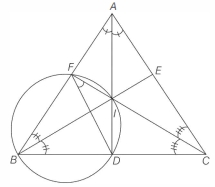
In $\triangle ABC$,let $AD, BE$ and $CF$ be the internal angle bisectors with $D, E$ and $F$ on the sides $BC, CA$ and $AB$ respectively. Suppose $AD, BE$ and $CF$ concur at $I$ and $B, D, I, F$ are concyclic,then $\angle IFD$ has measure $......$
A
$15^{\circ}$
B
$30^{\circ}$
C
$45^{\circ}$
D
any value $\leq 90^{\circ}$
Solution
(B) Given that $AD, BE, CF$ are the internal angle bisectors of $\triangle ABC$ and they concur at the incenter $I$.
Since $B, D, I, F$ are concyclic,the angles subtended by the same arc $ID$ are equal.
Therefore,$\angle IFD = \angle IBD$.
Since $BE$ is the angle bisector of $\angle B$,we have $\angle IBD = \frac{\angle B}{2}$.
In the cyclic quadrilateral $BDIF$,the sum of opposite angles is $180^{\circ}$.
Thus,$\angle FBD + \angle FID = 180^{\circ}$.
We know $\angle FBD = \angle B$.
In $\triangle ABD$,$\angle FID$ is an exterior angle to $\triangle BDI$,so $\angle FID = \angle IBD + \angle IDB = \frac{\angle B}{2} + \angle ADB$.
In $\triangle ABD$,$\angle ADB = 180^{\circ} - (\angle BAD + \angle ABD) = 180^{\circ} - (\frac{A}{2} + B)$.
So,$\angle FID = \frac{B}{2} + 180^{\circ} - \frac{A}{2} - B = 180^{\circ} - \frac{A+B}{2} = 180^{\circ} - \frac{180^{\circ}-C}{2} = 90^{\circ} + \frac{C}{2}$.
Substituting into the cyclic condition: $B + 90^{\circ} + \frac{C}{2} = 180^{\circ} \Rightarrow B + \frac{C}{2} = 90^{\circ}$.
Since $I$ is the incenter,$\angle BID = 180^{\circ} - (\frac{B}{2} + \angle IDB)$.
Alternatively,using the property of the cyclic quadrilateral $BDIF$,$\angle IFD = \angle IBD = \frac{B}{2}$.
From the condition $\angle FBD + \angle FID = 180^{\circ}$,we have $B + (180^{\circ} - \angle BDI) = 180^{\circ}$ is not correct. The correct condition is $\angle IFB + \angle IDB = 180^{\circ}$.
Given $BDIF$ is cyclic,$\angle IFD = \angle IBD = \frac{B}{2}$ and $\angle IDF = \angle IBF = \frac{B}{2}$.
In $\triangle BDF$,$\angle BFD = 180^{\circ} - (B + \frac{B}{2} + \frac{B}{2}) = 180^{\circ} - 2B$.
Also $\angle IFD = \frac{B}{2}$. For this configuration,$B=60^{\circ}$ is required.
Thus,$\angle IFD = \frac{60^{\circ}}{2} = 30^{\circ}$.
Since $B, D, I, F$ are concyclic,the angles subtended by the same arc $ID$ are equal.
Therefore,$\angle IFD = \angle IBD$.
Since $BE$ is the angle bisector of $\angle B$,we have $\angle IBD = \frac{\angle B}{2}$.
In the cyclic quadrilateral $BDIF$,the sum of opposite angles is $180^{\circ}$.
Thus,$\angle FBD + \angle FID = 180^{\circ}$.
We know $\angle FBD = \angle B$.
In $\triangle ABD$,$\angle FID$ is an exterior angle to $\triangle BDI$,so $\angle FID = \angle IBD + \angle IDB = \frac{\angle B}{2} + \angle ADB$.
In $\triangle ABD$,$\angle ADB = 180^{\circ} - (\angle BAD + \angle ABD) = 180^{\circ} - (\frac{A}{2} + B)$.
So,$\angle FID = \frac{B}{2} + 180^{\circ} - \frac{A}{2} - B = 180^{\circ} - \frac{A+B}{2} = 180^{\circ} - \frac{180^{\circ}-C}{2} = 90^{\circ} + \frac{C}{2}$.
Substituting into the cyclic condition: $B + 90^{\circ} + \frac{C}{2} = 180^{\circ} \Rightarrow B + \frac{C}{2} = 90^{\circ}$.
Since $I$ is the incenter,$\angle BID = 180^{\circ} - (\frac{B}{2} + \angle IDB)$.
Alternatively,using the property of the cyclic quadrilateral $BDIF$,$\angle IFD = \angle IBD = \frac{B}{2}$.
From the condition $\angle FBD + \angle FID = 180^{\circ}$,we have $B + (180^{\circ} - \angle BDI) = 180^{\circ}$ is not correct. The correct condition is $\angle IFB + \angle IDB = 180^{\circ}$.
Given $BDIF$ is cyclic,$\angle IFD = \angle IBD = \frac{B}{2}$ and $\angle IDF = \angle IBF = \frac{B}{2}$.
In $\triangle BDF$,$\angle BFD = 180^{\circ} - (B + \frac{B}{2} + \frac{B}{2}) = 180^{\circ} - 2B$.
Also $\angle IFD = \frac{B}{2}$. For this configuration,$B=60^{\circ}$ is required.
Thus,$\angle IFD = \frac{60^{\circ}}{2} = 30^{\circ}$.
0 likesView Solution
23
MathematicsAdvancedMCQKVPY · 2012
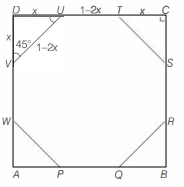
$A$ regular octagon is formed by cutting congruent isosceles right-angled triangles from the corners of a square. If the square has side length $1$,the side length of the octagon is
A
$\frac{\sqrt{2}-1}{2}$
B
$\sqrt{2}-1$
C
$\frac{\sqrt{5}-1}{4}$
D
$\frac{\sqrt{5}-1}{3}$
Solution
(B) Let the side length of the square be $1$. Let the legs of the isosceles right-angled triangles cut from the corners be $x$.
Since the octagon is regular,the hypotenuse of these triangles must be equal to the remaining segment of the square's side.
The hypotenuse of each triangle is $x\sqrt{2}$.
The side length of the octagon is $1-2x$.
Equating these,we get $x\sqrt{2} = 1-2x$.
$x(\sqrt{2}+2) = 1$
$x = \frac{1}{2+\sqrt{2}} = \frac{2-\sqrt{2}}{(2+\sqrt{2})(2-\sqrt{2})} = \frac{2-\sqrt{2}}{4-2} = \frac{2-\sqrt{2}}{2} = 1 - \frac{\sqrt{2}}{2}$.
The side length of the octagon is $1-2x = 1 - 2(1 - \frac{\sqrt{2}}{2}) = 1 - 2 + \sqrt{2} = \sqrt{2}-1$.
Since the octagon is regular,the hypotenuse of these triangles must be equal to the remaining segment of the square's side.
The hypotenuse of each triangle is $x\sqrt{2}$.
The side length of the octagon is $1-2x$.
Equating these,we get $x\sqrt{2} = 1-2x$.
$x(\sqrt{2}+2) = 1$
$x = \frac{1}{2+\sqrt{2}} = \frac{2-\sqrt{2}}{(2+\sqrt{2})(2-\sqrt{2})} = \frac{2-\sqrt{2}}{4-2} = \frac{2-\sqrt{2}}{2} = 1 - \frac{\sqrt{2}}{2}$.
The side length of the octagon is $1-2x = 1 - 2(1 - \frac{\sqrt{2}}{2}) = 1 - 2 + \sqrt{2} = \sqrt{2}-1$.
0 likesView Solution
24
MathematicsDifficultMCQKVPY · 2012
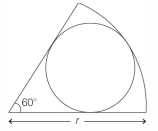
$A$ circle is drawn in a sector of a larger circle of radius $r$,as shown in the figure. The smaller circle is tangent to the two bounding radii and the arc of the sector. The radius of the small circle is
A
$\frac{r}{2}$
B
$\frac{r}{3}$
C
$\frac{2 \sqrt{3} r}{5}$
D
$\frac{r}{\sqrt{2}}$
Solution
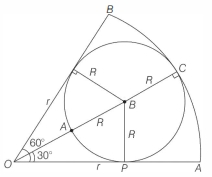
(B) Let the center of the sector be $O$ and the radius of the sector be $r$. Let the center of the small circle be $C$ and its radius be $R$.
The angle of the sector is $60^{\circ}$. The line $OC$ bisects this angle,so $\angle COP = 30^{\circ}$,where $P$ is the point of tangency on the radius of the sector.
In the right-angled triangle formed by the center of the small circle $C$,the point of tangency $P$,and the center of the sector $O$,we have:
$\sin 30^{\circ} = \frac{CP}{OC}$
$\frac{1}{2} = \frac{R}{OC}$
$OC = 2R$
Also,the distance from the center of the sector $O$ to the arc along the bisector is the radius of the sector $r$. This distance is the sum of the distance $OC$ and the radius of the small circle $R$ (since the small circle is tangent to the arc).
$r = OC + R$
$r = 2R + R = 3R$
$R = \frac{r}{3}$
The angle of the sector is $60^{\circ}$. The line $OC$ bisects this angle,so $\angle COP = 30^{\circ}$,where $P$ is the point of tangency on the radius of the sector.
In the right-angled triangle formed by the center of the small circle $C$,the point of tangency $P$,and the center of the sector $O$,we have:
$\sin 30^{\circ} = \frac{CP}{OC}$
$\frac{1}{2} = \frac{R}{OC}$
$OC = 2R$
Also,the distance from the center of the sector $O$ to the arc along the bisector is the radius of the sector $r$. This distance is the sum of the distance $OC$ and the radius of the small circle $R$ (since the small circle is tangent to the arc).
$r = OC + R$
$r = 2R + R = 3R$
$R = \frac{r}{3}$
0 likesView Solution
25
MathematicsAdvancedMCQKVPY · 2012
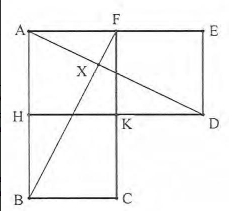
In the figure,$AHKF$,$FKDE$ and $HBCK$ are unit squares. $AD$ and $BF$ intersect at $X$. Then,the ratio of the areas of triangles $AXF$ and $ABF$ is
A
$\frac{1}{4}$
B
$\frac{1}{5}$
C
$\frac{1}{6}$
D
$\frac{1}{8}$
Solution
(B) Given that $AHKF$,$FKDE$,and $HBCK$ are unit squares. Let the side length of each square be $1$.
We can set up a coordinate system with $K$ at the origin $(0,0)$.
Then the coordinates are: $K(0,0)$,$H(-1,0)$,$F(0,1)$,$A(-1,1)$,$B(-1,-1)$,$D(1,0)$.
The line $AD$ passes through $A(-1,1)$ and $D(1,0)$. The slope $m_1 = \frac{0-1}{1-(-1)} = -\frac{1}{2}$. The equation is $y - 0 = -\frac{1}{2}(x - 1) \implies y = -\frac{1}{2}x + \frac{1}{2}$.
The line $BF$ passes through $B(-1,-1)$ and $F(0,1)$. The slope $m_2 = \frac{1-(-1)}{0-(-1)} = 2$. The equation is $y - 1 = 2(x - 0) \implies y = 2x + 1$.
To find $X$,set $- \frac{1}{2}x + \frac{1}{2} = 2x + 1 \implies -x + 1 = 4x + 2 \implies 5x = -1 \implies x = -\frac{1}{5}$.
Then $y = 2(-\frac{1}{5}) + 1 = \frac{3}{5}$. So $X(-\frac{1}{5}, \frac{3}{5})$.
In $\triangle ABF$,the base $AF = 1$ and height $AB = 2$. Area $= \frac{1}{2} \times 1 \times 2 = 1$.
In $\triangle AXF$,the base $AF = 1$ and the height is the perpendicular distance from $X$ to $AF$. Since $AF$ lies on the line $y=1$,the height is $|1 - \frac{3}{5}| = \frac{2}{5}$.
Area of $\triangle AXF = \frac{1}{2} \times 1 \times \frac{2}{5} = \frac{1}{5}$.
The ratio of the areas is $\frac{\text{Area}(\triangle AXF)}{\text{Area}(\triangle ABF)} = \frac{1/5}{1} = \frac{1}{5}$.
We can set up a coordinate system with $K$ at the origin $(0,0)$.
Then the coordinates are: $K(0,0)$,$H(-1,0)$,$F(0,1)$,$A(-1,1)$,$B(-1,-1)$,$D(1,0)$.
The line $AD$ passes through $A(-1,1)$ and $D(1,0)$. The slope $m_1 = \frac{0-1}{1-(-1)} = -\frac{1}{2}$. The equation is $y - 0 = -\frac{1}{2}(x - 1) \implies y = -\frac{1}{2}x + \frac{1}{2}$.
The line $BF$ passes through $B(-1,-1)$ and $F(0,1)$. The slope $m_2 = \frac{1-(-1)}{0-(-1)} = 2$. The equation is $y - 1 = 2(x - 0) \implies y = 2x + 1$.
To find $X$,set $- \frac{1}{2}x + \frac{1}{2} = 2x + 1 \implies -x + 1 = 4x + 2 \implies 5x = -1 \implies x = -\frac{1}{5}$.
Then $y = 2(-\frac{1}{5}) + 1 = \frac{3}{5}$. So $X(-\frac{1}{5}, \frac{3}{5})$.
In $\triangle ABF$,the base $AF = 1$ and height $AB = 2$. Area $= \frac{1}{2} \times 1 \times 2 = 1$.
In $\triangle AXF$,the base $AF = 1$ and the height is the perpendicular distance from $X$ to $AF$. Since $AF$ lies on the line $y=1$,the height is $|1 - \frac{3}{5}| = \frac{2}{5}$.
Area of $\triangle AXF = \frac{1}{2} \times 1 \times \frac{2}{5} = \frac{1}{5}$.
The ratio of the areas is $\frac{\text{Area}(\triangle AXF)}{\text{Area}(\triangle ABF)} = \frac{1/5}{1} = \frac{1}{5}$.
0 likesView Solution
26
MathematicsAdvancedMCQKVPY · 2012
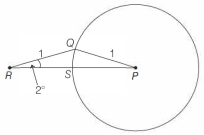
Suppose $Q$ is a point on the circle with centre $P$ and radius $1$,as shown in the figure. $R$ is a point outside the circle such that $QR = 1$ and $\angle QRP = 2^{\circ}$. Let $S$ be the point where the segment $RP$ intersects the given circle. Then,the measure of $\angle RQS$ equals $......^{\circ}$.
A
$86$
B
$87$
C
$88$
D
$89$
Solution
(B) Given that $PQ = 1$ (radius of the circle) and $QR = 1$.
In $\triangle PQR$,since $PQ = QR = 1$,it is an isosceles triangle.
Therefore,$\angle QPR = \angle QRP = 2^{\circ}$.
The sum of angles in $\triangle PQR$ is $180^{\circ}$,so $\angle RQP = 180^{\circ} - (2^{\circ} + 2^{\circ}) = 176^{\circ}$.
Now,consider $\triangle S P Q$. Since $SP = SQ = 1$ (radii of the circle),it is an isosceles triangle.
Thus,$\angle SQP = \angle QSP$.
In $\triangle SPQ$,$\angle SPQ = 2^{\circ}$,so $\angle SQP = \frac{180^{\circ} - 2^{\circ}}{2} = \frac{178^{\circ}}{2} = 89^{\circ}$.
Finally,$\angle RQS = \angle RQP - \angle SQP = 176^{\circ} - 89^{\circ} = 87^{\circ}$.
In $\triangle PQR$,since $PQ = QR = 1$,it is an isosceles triangle.
Therefore,$\angle QPR = \angle QRP = 2^{\circ}$.
The sum of angles in $\triangle PQR$ is $180^{\circ}$,so $\angle RQP = 180^{\circ} - (2^{\circ} + 2^{\circ}) = 176^{\circ}$.
Now,consider $\triangle S P Q$. Since $SP = SQ = 1$ (radii of the circle),it is an isosceles triangle.
Thus,$\angle SQP = \angle QSP$.
In $\triangle SPQ$,$\angle SPQ = 2^{\circ}$,so $\angle SQP = \frac{180^{\circ} - 2^{\circ}}{2} = \frac{178^{\circ}}{2} = 89^{\circ}$.
Finally,$\angle RQS = \angle RQP - \angle SQP = 176^{\circ} - 89^{\circ} = 87^{\circ}$.
0 likesView Solution
27
MathematicsAdvancedMCQKVPY · 2012
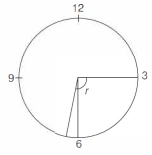
Observe that,at any instant,the minute and hour hands of a clock make two angles between them whose sum is $360^{\circ}$. At $6:15$,the difference between these two angles is $....^{\circ}$.
A
$165$
B
$170$
C
$175$
D
$180$
Solution
(A) The angle $\theta$ between the hour hand and the minute hand at $H:M$ is given by the formula $\theta = |30H - 5.5M|$.
For $H = 6$ and $M = 15$:
$\theta = |30(6) - 5.5(15)| = |180 - 82.5| = 97.5^{\circ}$.
Let the two angles be $\alpha$ and $\beta$. We have $\alpha = 97.5^{\circ}$ and $\alpha + \beta = 360^{\circ}$.
Then $\beta = 360^{\circ} - 97.5^{\circ} = 262.5^{\circ}$.
The difference between these two angles is $\beta - \alpha = 262.5^{\circ} - 97.5^{\circ} = 165^{\circ}$.
For $H = 6$ and $M = 15$:
$\theta = |30(6) - 5.5(15)| = |180 - 82.5| = 97.5^{\circ}$.
Let the two angles be $\alpha$ and $\beta$. We have $\alpha = 97.5^{\circ}$ and $\alpha + \beta = 360^{\circ}$.
Then $\beta = 360^{\circ} - 97.5^{\circ} = 262.5^{\circ}$.
The difference between these two angles is $\beta - \alpha = 262.5^{\circ} - 97.5^{\circ} = 165^{\circ}$.
0 likesView Solution
28
MathematicsDifficultMCQKVPY · 2012
How many ordered pairs of $(m, n)$ integers satisfy $\frac{m}{12} = \frac{12}{n}$?
A
$30$
B
$15$
C
$12$
D
$10$
Solution
(A) Given the equation $\frac{m}{12} = \frac{12}{n}$.
Multiplying both sides,we get $mn = 144$.
The prime factorization of $144$ is $2^4 \times 3^2$.
The number of positive divisors of $144$ is $(4+1)(2+1) = 5 \times 3 = 15$.
Since $m$ and $n$ can be integers,they can be both positive or both negative.
If $m, n > 0$,there are $15$ possible pairs $(m, n)$.
If $m, n < 0$,there are also $15$ possible pairs $(m, n)$.
Therefore,the total number of ordered pairs $(m, n)$ is $15 + 15 = 30$.
Multiplying both sides,we get $mn = 144$.
The prime factorization of $144$ is $2^4 \times 3^2$.
The number of positive divisors of $144$ is $(4+1)(2+1) = 5 \times 3 = 15$.
Since $m$ and $n$ can be integers,they can be both positive or both negative.
If $m, n > 0$,there are $15$ possible pairs $(m, n)$.
If $m, n < 0$,there are also $15$ possible pairs $(m, n)$.
Therefore,the total number of ordered pairs $(m, n)$ is $15 + 15 = 30$.
0 likesView Solution
29
MathematicsMediumMCQKVPY · 2012
Let $S = \{1, 2, 3, \ldots, 40\}$ and let $A$ be a subset of $S$ such that no two elements in $A$ have their sum divisible by $5$. What is the maximum number of elements possible in $A$?
A
$10$
B
$13$
C
$17$
D
$20$
Solution
(C) To find the maximum number of elements in $A$,we partition the set $S$ into subsets based on their remainders when divided by $5$:
$R_0 = \{5, 10, 15, 20, 25, 30, 35, 40\}$ (remainder $0$,size $8$)
$R_1 = \{1, 6, 11, 16, 21, 26, 31, 36\}$ (remainder $1$,size $8$)
$R_2 = \{2, 7, 12, 17, 22, 27, 32, 37\}$ (remainder $2$,size $8$)
$R_3 = \{3, 8, 13, 18, 23, 28, 33, 38\}$ (remainder $3$,size $8$)
$R_4 = \{4, 9, 14, 19, 24, 29, 34, 39\}$ (remainder $4$,size $8$)
For the sum of any two elements in $A$ not to be divisible by $5$,we must select elements such that their remainders do not sum to $5$ or $0$ (mod $5$).
$1$. We can pick at most one element from $R_0$ (if we pick two,their sum is divisible by $5$).
$2$. We can pick all elements from $R_1$ (since $1+1=2, 1+6=7$,etc.,none are divisible by $5$ except $1+4$,but we don't pick from $R_4$).
$3$. We can pick all elements from $R_2$ (since $2+2=4$,none are divisible by $5$ except $2+3$,but we don't pick from $R_3$).
Thus,we choose all elements from $R_1$ ($8$ elements),all elements from $R_2$ ($8$ elements),and one element from $R_0$ ($1$ element).
Total elements = $8 + 8 + 1 = 17$.
$R_0 = \{5, 10, 15, 20, 25, 30, 35, 40\}$ (remainder $0$,size $8$)
$R_1 = \{1, 6, 11, 16, 21, 26, 31, 36\}$ (remainder $1$,size $8$)
$R_2 = \{2, 7, 12, 17, 22, 27, 32, 37\}$ (remainder $2$,size $8$)
$R_3 = \{3, 8, 13, 18, 23, 28, 33, 38\}$ (remainder $3$,size $8$)
$R_4 = \{4, 9, 14, 19, 24, 29, 34, 39\}$ (remainder $4$,size $8$)
For the sum of any two elements in $A$ not to be divisible by $5$,we must select elements such that their remainders do not sum to $5$ or $0$ (mod $5$).
$1$. We can pick at most one element from $R_0$ (if we pick two,their sum is divisible by $5$).
$2$. We can pick all elements from $R_1$ (since $1+1=2, 1+6=7$,etc.,none are divisible by $5$ except $1+4$,but we don't pick from $R_4$).
$3$. We can pick all elements from $R_2$ (since $2+2=4$,none are divisible by $5$ except $2+3$,but we don't pick from $R_3$).
Thus,we choose all elements from $R_1$ ($8$ elements),all elements from $R_2$ ($8$ elements),and one element from $R_0$ ($1$ element).
Total elements = $8 + 8 + 1 = 17$.
0 likesView Solution
30
MathematicsAdvancedMCQKVPY · 2012
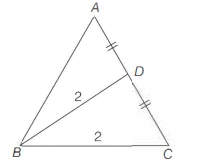
In a $\triangle ABC$,it is known that $AB=AC$. Suppose $D$ is the mid-point of $AC$ and $BD=BC=2$. Then,the area of the $\triangle ABC$ is
A
$2$
B
$2\sqrt{2}$
C
$\sqrt{7}$
D
$2\sqrt{7}$
Solution
(C) Let $AD = CD = x$. Then $AC = 2x$ and $AB = 2x$ (since $AB = AC$).
In $\triangle BCD$,by the Law of Cosines:
$BD^2 = BC^2 + CD^2 - 2(BC)(CD)\cos C$
$2^2 = 2^2 + x^2 - 2(2)(x)\cos C$
$4 = 4 + x^2 - 4x\cos C \Rightarrow \cos C = \frac{x}{4}$.
Since $AB = AC$,$\angle B = \angle C$,so $\cos B = \cos C = \frac{x}{4}$.
In $\triangle ABC$,$\angle A = 180^\circ - 2C$. Thus,$\cos A = \cos(180^\circ - 2C) = -\cos(2C) = -(2\cos^2 C - 1) = 1 - 2(\frac{x^2}{16}) = 1 - \frac{x^2}{8}$.
Using the Law of Cosines in $\triangle ABC$:
$BC^2 = AB^2 + AC^2 - 2(AB)(AC)\cos A$
$2^2 = (2x)^2 + (2x)^2 - 2(2x)(2x)(1 - \frac{x^2}{8})$
$4 = 4x^2 + 4x^2 - 8x^2(1 - \frac{x^2}{8})$
$4 = 8x^2 - 8x^2 + x^4$
$x^4 = 4$ $\Rightarrow x^2 = 2$ $\Rightarrow x = \sqrt{2}$.
Thus,$AC = 2\sqrt{2}$ and $BC = 2$.
$\cos C = \frac{\sqrt{2}}{4} = \frac{1}{2\sqrt{2}}$.
$\sin C = \sqrt{1 - \cos^2 C} = \sqrt{1 - \frac{1}{8}} = \sqrt{\frac{7}{8}} = \frac{\sqrt{7}}{2\sqrt{2}}$.
Area of $\triangle ABC = \frac{1}{2} \times AC \times BC \times \sin C = \frac{1}{2} \times 2\sqrt{2} \times 2 \times \frac{\sqrt{7}}{2\sqrt{2}} = \sqrt{7}$.
In $\triangle BCD$,by the Law of Cosines:
$BD^2 = BC^2 + CD^2 - 2(BC)(CD)\cos C$
$2^2 = 2^2 + x^2 - 2(2)(x)\cos C$
$4 = 4 + x^2 - 4x\cos C \Rightarrow \cos C = \frac{x}{4}$.
Since $AB = AC$,$\angle B = \angle C$,so $\cos B = \cos C = \frac{x}{4}$.
In $\triangle ABC$,$\angle A = 180^\circ - 2C$. Thus,$\cos A = \cos(180^\circ - 2C) = -\cos(2C) = -(2\cos^2 C - 1) = 1 - 2(\frac{x^2}{16}) = 1 - \frac{x^2}{8}$.
Using the Law of Cosines in $\triangle ABC$:
$BC^2 = AB^2 + AC^2 - 2(AB)(AC)\cos A$
$2^2 = (2x)^2 + (2x)^2 - 2(2x)(2x)(1 - \frac{x^2}{8})$
$4 = 4x^2 + 4x^2 - 8x^2(1 - \frac{x^2}{8})$
$4 = 8x^2 - 8x^2 + x^4$
$x^4 = 4$ $\Rightarrow x^2 = 2$ $\Rightarrow x = \sqrt{2}$.
Thus,$AC = 2\sqrt{2}$ and $BC = 2$.
$\cos C = \frac{\sqrt{2}}{4} = \frac{1}{2\sqrt{2}}$.
$\sin C = \sqrt{1 - \cos^2 C} = \sqrt{1 - \frac{1}{8}} = \sqrt{\frac{7}{8}} = \frac{\sqrt{7}}{2\sqrt{2}}$.
Area of $\triangle ABC = \frac{1}{2} \times AC \times BC \times \sin C = \frac{1}{2} \times 2\sqrt{2} \times 2 \times \frac{\sqrt{7}}{2\sqrt{2}} = \sqrt{7}$.
0 likesView Solution
31
MathematicsAdvancedMCQKVPY · 2012
The maximum value $M$ of $f(x) = 3^x + 5^x - 9^x + 15^x - 25^x$,as $x$ varies over all real numbers,satisfies:
A
$3 < M < 5$
B
$0 < M < 2$
C
$9 < M < 25$
D
$5 < M < 9$
Solution
(B) Let $f(x) = 3^x + 5^x - (3^x)^2 + (3^x)(5^x) - (5^x)^2$.
Let $a = 3^x$ and $b = 5^x$,where $a, b > 0$.
Then $f(x) = a + b - a^2 + ab - b^2$.
We can rewrite this as $f(x) = a + b - (a^2 - ab + b^2)$.
To find the maximum,consider the expression $-(a^2 - ab + b^2) = -(a - b/2)^2 - 3b^2/4$.
Alternatively,complete the square: $f(x) = -(a^2 - a(1+b) + b^2 + b) = -[(a - \frac{1+b}{2})^2 - \frac{(1+b)^2}{4} + b^2 + b]$.
$f(x) = -(a - \frac{1+b}{2})^2 + \frac{1 + 2b + b^2 - 4b^2 - 4b}{4} = -(a - \frac{1+b}{2})^2 + \frac{1 - 2b - 3b^2}{4}$.
The maximum value for a fixed $b$ occurs at $a = \frac{1+b}{2}$,giving $f_{max}(b) = \frac{1 - 2b - 3b^2}{4}$.
Since $b = 5^x > 0$,the function $g(b) = \frac{1 - 2b - 3b^2}{4}$ is decreasing for $b > 0$.
The maximum value of $g(b)$ as $b \to 0^+$ is $1/4$.
However,checking $x=0$: $f(0) = 3^0 + 5^0 - 9^0 + 15^0 - 25^0 = 1 + 1 - 1 + 1 - 1 = 1$.
Since $1$ is the value at $x=0$,and $0 < 1 < 2$,the condition $0 < M < 2$ is satisfied.
Let $a = 3^x$ and $b = 5^x$,where $a, b > 0$.
Then $f(x) = a + b - a^2 + ab - b^2$.
We can rewrite this as $f(x) = a + b - (a^2 - ab + b^2)$.
To find the maximum,consider the expression $-(a^2 - ab + b^2) = -(a - b/2)^2 - 3b^2/4$.
Alternatively,complete the square: $f(x) = -(a^2 - a(1+b) + b^2 + b) = -[(a - \frac{1+b}{2})^2 - \frac{(1+b)^2}{4} + b^2 + b]$.
$f(x) = -(a - \frac{1+b}{2})^2 + \frac{1 + 2b + b^2 - 4b^2 - 4b}{4} = -(a - \frac{1+b}{2})^2 + \frac{1 - 2b - 3b^2}{4}$.
The maximum value for a fixed $b$ occurs at $a = \frac{1+b}{2}$,giving $f_{max}(b) = \frac{1 - 2b - 3b^2}{4}$.
Since $b = 5^x > 0$,the function $g(b) = \frac{1 - 2b - 3b^2}{4}$ is decreasing for $b > 0$.
The maximum value of $g(b)$ as $b \to 0^+$ is $1/4$.
However,checking $x=0$: $f(0) = 3^0 + 5^0 - 9^0 + 15^0 - 25^0 = 1 + 1 - 1 + 1 - 1 = 1$.
Since $1$ is the value at $x=0$,and $0 < 1 < 2$,the condition $0 < M < 2$ is satisfied.
0 likesView Solution
32
MathematicsAdvancedMCQKVPY · 2012
The mid-point of the domain of the function $f(x) = \sqrt{4 - \sqrt{2x + 5}}$ for real $x$ is
A
$\frac{1}{4}$
B
$\frac{3}{2}$
C
$\frac{2}{3}$
D
$-\frac{2}{5}$
Solution
(B) The function $f(x) = \sqrt{4 - \sqrt{2x + 5}}$ is defined if the expressions under the square roots are non-negative.
First,for the inner square root: $2x + 5 \geq 0 \implies x \geq -\frac{5}{2}$.
Second,for the outer square root: $4 - \sqrt{2x + 5} \geq 0 \implies 4 \geq \sqrt{2x + 5}$.
Squaring both sides (since both are non-negative): $16 \geq 2x + 5 \implies 11 \geq 2x \implies x \leq \frac{11}{2}$.
Combining these conditions,the domain of $f(x)$ is $x \in \left[ -\frac{5}{2}, \frac{11}{2} \right]$.
The mid-point of the domain is calculated as $\frac{-\frac{5}{2} + \frac{11}{2}}{2} = \frac{\frac{6}{2}}{2} = \frac{3}{2}$.
First,for the inner square root: $2x + 5 \geq 0 \implies x \geq -\frac{5}{2}$.
Second,for the outer square root: $4 - \sqrt{2x + 5} \geq 0 \implies 4 \geq \sqrt{2x + 5}$.
Squaring both sides (since both are non-negative): $16 \geq 2x + 5 \implies 11 \geq 2x \implies x \leq \frac{11}{2}$.
Combining these conditions,the domain of $f(x)$ is $x \in \left[ -\frac{5}{2}, \frac{11}{2} \right]$.
The mid-point of the domain is calculated as $\frac{-\frac{5}{2} + \frac{11}{2}}{2} = \frac{\frac{6}{2}}{2} = \frac{3}{2}$.
0 likesView Solution
33
MathematicsAdvancedMCQKVPY · 2012
Let $n$ be a natural number and let $a$ be a real number. The number of zeroes of $x^{2n+1} - (2n+1)x + a = 0$ in the interval $[-1, 1]$ is:
A
$2$ if $a > 0$
B
$2$ if $a < 0$
C
at most one for every value of $a$
D
at least three for every value of $a$
Solution
(C) Let $f(x) = x^{2n+1} - (2n+1)x + a$.
To find the number of zeroes in the interval $[-1, 1]$,we examine the derivative of $f(x)$.
$f'(x) = (2n+1)x^{2n} - (2n+1) = (2n+1)(x^{2n} - 1)$.
For $x \in (-1, 1)$,we have $|x| < 1$,which implies $x^{2n} < 1$.
Thus,$x^{2n} - 1 < 0$,so $f'(x) < 0$ for all $x \in (-1, 1)$.
Since $f'(x) \leq 0$ for $x \in [-1, 1]$,the function $f(x)$ is strictly decreasing on the interval $[-1, 1]$.
$A$ strictly monotonic function can intersect the $X$-axis at most once.
Therefore,the equation $f(x) = 0$ has at most one root in the interval $[-1, 1]$ for any value of $a$.
To find the number of zeroes in the interval $[-1, 1]$,we examine the derivative of $f(x)$.
$f'(x) = (2n+1)x^{2n} - (2n+1) = (2n+1)(x^{2n} - 1)$.
For $x \in (-1, 1)$,we have $|x| < 1$,which implies $x^{2n} < 1$.
Thus,$x^{2n} - 1 < 0$,so $f'(x) < 0$ for all $x \in (-1, 1)$.
Since $f'(x) \leq 0$ for $x \in [-1, 1]$,the function $f(x)$ is strictly decreasing on the interval $[-1, 1]$.
$A$ strictly monotonic function can intersect the $X$-axis at most once.
Therefore,the equation $f(x) = 0$ has at most one root in the interval $[-1, 1]$ for any value of $a$.
0 likesView Solution
34
MathematicsAdvancedMCQKVPY · 2012
The value of $\frac{\int_0^{\pi / 2}(\sin x)^{\sqrt{2}+1} d x}{\int_0^{\pi / 2}(\sin x)^{\sqrt{2}-1} d x}$ is $........$
A
$\frac{\sqrt{2}+1}{\sqrt{2}-1}$
B
$\frac{\sqrt{2}-1}{\sqrt{2}+1}$
C
$\frac{\sqrt{2}+1}{\sqrt{2}}$
D
$2-\sqrt{2}$
Solution
(D) Let $I = \frac{\int_0^{\pi / 2}(\sin x)^{\sqrt{2}+1} dx}{\int_0^{\pi / 2}(\sin x)^{\sqrt{2}-1} dx}$.
Let $I_n = \int_0^{\pi / 2} (\sin x)^n dx$. Then $I = \frac{I_{\sqrt{2}+1}}{I_{\sqrt{2}-1}}$.
Using the reduction formula for $\int_0^{\pi / 2} (\sin x)^n dx = \frac{n-1}{n} I_{n-2}$,we have:
$I_{\sqrt{2}+1} = \int_0^{\pi / 2} (\sin x)^{\sqrt{2}+1} dx = \frac{(\sqrt{2}+1)-1}{\sqrt{2}+1} \int_0^{\pi / 2} (\sin x)^{\sqrt{2}-1} dx$.
$I_{\sqrt{2}+1} = \frac{\sqrt{2}}{\sqrt{2}+1} I_{\sqrt{2}-1}$.
Therefore,$I = \frac{I_{\sqrt{2}+1}}{I_{\sqrt{2}-1}} = \frac{\sqrt{2}}{\sqrt{2}+1}$.
Rationalizing the denominator:
$I = \frac{\sqrt{2}(\sqrt{2}-1)}{(\sqrt{2}+1)(\sqrt{2}-1)} = \frac{2-\sqrt{2}}{2-1} = 2-\sqrt{2}$.
Let $I_n = \int_0^{\pi / 2} (\sin x)^n dx$. Then $I = \frac{I_{\sqrt{2}+1}}{I_{\sqrt{2}-1}}$.
Using the reduction formula for $\int_0^{\pi / 2} (\sin x)^n dx = \frac{n-1}{n} I_{n-2}$,we have:
$I_{\sqrt{2}+1} = \int_0^{\pi / 2} (\sin x)^{\sqrt{2}+1} dx = \frac{(\sqrt{2}+1)-1}{\sqrt{2}+1} \int_0^{\pi / 2} (\sin x)^{\sqrt{2}-1} dx$.
$I_{\sqrt{2}+1} = \frac{\sqrt{2}}{\sqrt{2}+1} I_{\sqrt{2}-1}$.
Therefore,$I = \frac{I_{\sqrt{2}+1}}{I_{\sqrt{2}-1}} = \frac{\sqrt{2}}{\sqrt{2}+1}$.
Rationalizing the denominator:
$I = \frac{\sqrt{2}(\sqrt{2}-1)}{(\sqrt{2}+1)(\sqrt{2}-1)} = \frac{2-\sqrt{2}}{2-1} = 2-\sqrt{2}$.
0 likesView Solution
35
MathematicsAdvancedMCQKVPY · 2012
The value of $\int_{-2012}^{2012} (\sin(x^3) + x^5 + 1) dx$ is
A
$2012$
B
$2013$
C
$0$
D
$4024$
Solution
(D) Let $I = \int_{-2012}^{2012} (\sin(x^3) + x^5 + 1) dx$.
Using the property of linearity of integrals,we can write:
$I = \int_{-2012}^{2012} \sin(x^3) dx + \int_{-2012}^{2012} x^5 dx + \int_{-2012}^{2012} 1 dx$.
Since $f(x) = \sin(x^3)$ and $g(x) = x^5$ are odd functions (i.e.,$f(-x) = -f(x)$),the integral of these functions over a symmetric interval $[-a, a]$ is $0$.
Thus,$\int_{-2012}^{2012} \sin(x^3) dx = 0$ and $\int_{-2012}^{2012} x^5 dx = 0$.
Therefore,$I = 0 + 0 + \int_{-2012}^{2012} 1 dx$.
$I = [x]_{-2012}^{2012} = 2012 - (-2012) = 2012 + 2012 = 4024$.
Using the property of linearity of integrals,we can write:
$I = \int_{-2012}^{2012} \sin(x^3) dx + \int_{-2012}^{2012} x^5 dx + \int_{-2012}^{2012} 1 dx$.
Since $f(x) = \sin(x^3)$ and $g(x) = x^5$ are odd functions (i.e.,$f(-x) = -f(x)$),the integral of these functions over a symmetric interval $[-a, a]$ is $0$.
Thus,$\int_{-2012}^{2012} \sin(x^3) dx = 0$ and $\int_{-2012}^{2012} x^5 dx = 0$.
Therefore,$I = 0 + 0 + \int_{-2012}^{2012} 1 dx$.
$I = [x]_{-2012}^{2012} = 2012 - (-2012) = 2012 + 2012 = 4024$.
0 likesView Solution
36
MathematicsAdvancedMCQKVPY · 2012
Let $[x]$ and $\{x\}$ be the integer part and fractional part of a real number $x$ respectively. The value of the integral $\int_0^5 [x]\{x\} dx$ is
A
$2.5$
B
$5$
C
$34.5$
D
$35.5$
Solution
(B) Let $I = \int_0^5 [x]\{x\} dx$.
Since $[x]$ is constant on intervals $[n, n+1)$,we can split the integral:
$I = \sum_{n=0}^{4} \int_n^{n+1} [x]\{x\} dx$.
For $x \in [n, n+1)$,$[x] = n$ and $\{x\} = x - n$.
Thus,$I = \sum_{n=0}^{4} \int_n^{n+1} n(x-n) dx$.
Let $t = x-n$,then $dt = dx$. When $x=n, t=0$ and when $x=n+1, t=1$.
$I = \sum_{n=0}^{4} n \int_0^1 t dt = \sum_{n=0}^{4} n \left[ \frac{t^2}{2} \right]_0^1 = \sum_{n=0}^{4} n \left( \frac{1}{2} \right) = \frac{1}{2} (0+1+2+3+4) = \frac{10}{2} = 5$.
Since $[x]$ is constant on intervals $[n, n+1)$,we can split the integral:
$I = \sum_{n=0}^{4} \int_n^{n+1} [x]\{x\} dx$.
For $x \in [n, n+1)$,$[x] = n$ and $\{x\} = x - n$.
Thus,$I = \sum_{n=0}^{4} \int_n^{n+1} n(x-n) dx$.
Let $t = x-n$,then $dt = dx$. When $x=n, t=0$ and when $x=n+1, t=1$.
$I = \sum_{n=0}^{4} n \int_0^1 t dt = \sum_{n=0}^{4} n \left[ \frac{t^2}{2} \right]_0^1 = \sum_{n=0}^{4} n \left( \frac{1}{2} \right) = \frac{1}{2} (0+1+2+3+4) = \frac{10}{2} = 5$.
0 likesView Solution
37
MathematicsAdvancedMCQKVPY · 2012
$A$ purse contains $4$ copper coins and $3$ silver coins. $A$ second purse contains $6$ copper coins and $4$ silver coins. $A$ purse is chosen randomly and a coin is taken out of it. What is the probability that it is a copper coin?
A
$\frac{41}{70}$
B
$\frac{31}{70}$
C
$\frac{27}{70}$
D
$\frac{1}{3}$
Solution
(A) Let $E_1$ be the event of choosing the first purse and $E_2$ be the event of choosing the second purse. Since the purse is chosen randomly,$P(E_1) = P(E_2) = \frac{1}{2}$.
Let $A$ be the event of drawing a copper coin.
For the first purse,$P(A|E_1) = \frac{4}{4+3} = \frac{4}{7}$.
For the second purse,$P(A|E_2) = \frac{6}{6+4} = \frac{6}{10} = \frac{3}{5}$.
Using the law of total probability,the probability of drawing a copper coin is:
$P(A) = P(E_1) \times P(A|E_1) + P(E_2) \times P(A|E_2)$
$P(A) = \frac{1}{2} \times \frac{4}{7} + \frac{1}{2} \times \frac{3}{5}$
$P(A) = \frac{2}{7} + \frac{3}{10}$
$P(A) = \frac{20 + 21}{70} = \frac{41}{70}$.
Let $A$ be the event of drawing a copper coin.
For the first purse,$P(A|E_1) = \frac{4}{4+3} = \frac{4}{7}$.
For the second purse,$P(A|E_2) = \frac{6}{6+4} = \frac{6}{10} = \frac{3}{5}$.
Using the law of total probability,the probability of drawing a copper coin is:
$P(A) = P(E_1) \times P(A|E_1) + P(E_2) \times P(A|E_2)$
$P(A) = \frac{1}{2} \times \frac{4}{7} + \frac{1}{2} \times \frac{3}{5}$
$P(A) = \frac{2}{7} + \frac{3}{10}$
$P(A) = \frac{20 + 21}{70} = \frac{41}{70}$.
0 likesView Solution
38
MathematicsAdvancedMCQKVPY · 2012
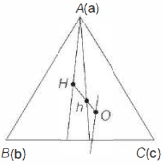
Let $H$ be the orthocentre of an acute angled $\triangle ABC$ and $O$ be its circumcenter. Then,$\vec{HA} + \vec{HB} + \vec{HC}$
A
is equal to $\vec{HO}$
B
is equal to $3\vec{HO}$
C
is equal to $2\vec{HO}$
D
is not a scalar multiple of $\vec{HO}$ in general
Solution
(C) Let the position vectors of vertices $A, B, C$ be $\vec{a}, \vec{b}, \vec{c}$ respectively. Let the origin be at the circumcenter $O$,so $\vec{O} = \vec{0}$.
Then the position vector of the orthocenter $H$ is $\vec{H} = \vec{a} + \vec{b} + \vec{c}$.
We need to evaluate $\vec{HA} + \vec{HB} + \vec{HC}$.
$\vec{HA} + \vec{HB} + \vec{HC} = (\vec{a} - \vec{H}) + (\vec{b} - \vec{H}) + (\vec{c} - \vec{H})$
$= (\vec{a} + \vec{b} + \vec{c}) - 3\vec{H}$
$= \vec{H} - 3\vec{H}$
$= -2\vec{H}$
Since $\vec{O} = \vec{0}$,$\vec{HO} = \vec{O} - \vec{H} = -\vec{H}$.
Therefore,$-2\vec{H} = 2(-\vec{H}) = 2\vec{HO}$.
Thus,$\vec{HA} + \vec{HB} + \vec{HC} = 2\vec{HO}$.
Then the position vector of the orthocenter $H$ is $\vec{H} = \vec{a} + \vec{b} + \vec{c}$.
We need to evaluate $\vec{HA} + \vec{HB} + \vec{HC}$.
$\vec{HA} + \vec{HB} + \vec{HC} = (\vec{a} - \vec{H}) + (\vec{b} - \vec{H}) + (\vec{c} - \vec{H})$
$= (\vec{a} + \vec{b} + \vec{c}) - 3\vec{H}$
$= \vec{H} - 3\vec{H}$
$= -2\vec{H}$
Since $\vec{O} = \vec{0}$,$\vec{HO} = \vec{O} - \vec{H} = -\vec{H}$.
Therefore,$-2\vec{H} = 2(-\vec{H}) = 2\vec{HO}$.
Thus,$\vec{HA} + \vec{HB} + \vec{HC} = 2\vec{HO}$.
0 likesView Solution
39
MathematicsAdvancedMCQKVPY · 2012
$A$ polynomial $P(x)$ with real coefficients has the property that $P^{\prime \prime}(x) \neq 0$ for all $x$. Suppose $P(0) = 1$ and $P^{\prime}(0) = -1$. What can you say about $P(1)$?
A
$P(1) \geq 0$
B
$P(1) \neq 0$
C
$P(1) \leq 0$
D
$-\frac{1}{2} < P(1) < \frac{1}{2}$
Solution
(B) Given that $P(x)$ is a polynomial with real coefficients and $P^{\prime \prime}(x) \neq 0$ for all $x$.
Since $P^{\prime \prime}(x)$ is a constant for a quadratic polynomial,let us consider the simplest case where $P(x)$ is a quadratic polynomial:
$P(x) = ax^2 + bx + c$,where $a \neq 0$.
Then,$P^{\prime}(x) = 2ax + b$ and $P^{\prime \prime}(x) = 2a$.
Given $P(0) = 1$,we have $c = 1$.
Given $P^{\prime}(0) = -1$,we have $b = -1$.
Thus,$P(x) = ax^2 - x + 1$.
Evaluating at $x = 1$:
$P(1) = a(1)^2 - (1) + 1 = a$.
Since $P^{\prime \prime}(x) = 2a \neq 0$,it follows that $a \neq 0$.
Therefore,$P(1) = a \neq 0$.
This property holds for higher-degree polynomials as well,as $P(1)$ cannot be zero under the constraint $P^{\prime \prime}(x) \neq 0$ given the initial conditions.
Thus,the correct option is $B$.
Since $P^{\prime \prime}(x)$ is a constant for a quadratic polynomial,let us consider the simplest case where $P(x)$ is a quadratic polynomial:
$P(x) = ax^2 + bx + c$,where $a \neq 0$.
Then,$P^{\prime}(x) = 2ax + b$ and $P^{\prime \prime}(x) = 2a$.
Given $P(0) = 1$,we have $c = 1$.
Given $P^{\prime}(0) = -1$,we have $b = -1$.
Thus,$P(x) = ax^2 - x + 1$.
Evaluating at $x = 1$:
$P(1) = a(1)^2 - (1) + 1 = a$.
Since $P^{\prime \prime}(x) = 2a \neq 0$,it follows that $a \neq 0$.
Therefore,$P(1) = a \neq 0$.
This property holds for higher-degree polynomials as well,as $P(1)$ cannot be zero under the constraint $P^{\prime \prime}(x) \neq 0$ given the initial conditions.
Thus,the correct option is $B$.
0 likesView Solution
40
MathematicsAdvancedMCQKVPY · 2012
The value of the integral $\int_{-\pi}^{\pi} \frac{\cos^2 x}{1+a^x} dx$,where $a > 0$,is
A
$\pi$
B
$a \pi$
C
$\frac{\pi}{2}$
D
$2 \pi$
Solution
(C) Let $I = \int_{-\pi}^{\pi} \frac{\cos^2 x}{1+a^x} dx$.
Using the property $\int_{a}^{b} f(x) dx = \int_{a}^{b} f(a+b-x) dx$,we get:
$I = \int_{-\pi}^{\pi} \frac{\cos^2(-\pi+\pi-x)}{1+a^{-\pi+\pi-x}} dx = \int_{-\pi}^{\pi} \frac{\cos^2 x}{1+a^{-x}} dx = \int_{-\pi}^{\pi} \frac{a^x \cos^2 x}{a^x+1} dx$.
Adding the two expressions for $I$:
$2I = \int_{-\pi}^{\pi} \frac{\cos^2 x}{1+a^x} dx + \int_{-\pi}^{\pi} \frac{a^x \cos^2 x}{1+a^x} dx = \int_{-\pi}^{\pi} \cos^2 x \left( \frac{1+a^x}{1+a^x} \right) dx = \int_{-\pi}^{\pi} \cos^2 x dx$.
Since $\cos^2 x$ is an even function,$2I = 2 \int_{0}^{\pi} \cos^2 x dx$,so $I = \int_{0}^{\pi} \cos^2 x dx$.
Using $\cos^2 x = \frac{1+\cos 2x}{2}$,we have $I = \int_{0}^{\pi} \frac{1+\cos 2x}{2} dx = \left[ \frac{x}{2} + \frac{\sin 2x}{4} \right]_{0}^{\pi} = \frac{\pi}{2} + 0 - (0+0) = \frac{\pi}{2}$.
Using the property $\int_{a}^{b} f(x) dx = \int_{a}^{b} f(a+b-x) dx$,we get:
$I = \int_{-\pi}^{\pi} \frac{\cos^2(-\pi+\pi-x)}{1+a^{-\pi+\pi-x}} dx = \int_{-\pi}^{\pi} \frac{\cos^2 x}{1+a^{-x}} dx = \int_{-\pi}^{\pi} \frac{a^x \cos^2 x}{a^x+1} dx$.
Adding the two expressions for $I$:
$2I = \int_{-\pi}^{\pi} \frac{\cos^2 x}{1+a^x} dx + \int_{-\pi}^{\pi} \frac{a^x \cos^2 x}{1+a^x} dx = \int_{-\pi}^{\pi} \cos^2 x \left( \frac{1+a^x}{1+a^x} \right) dx = \int_{-\pi}^{\pi} \cos^2 x dx$.
Since $\cos^2 x$ is an even function,$2I = 2 \int_{0}^{\pi} \cos^2 x dx$,so $I = \int_{0}^{\pi} \cos^2 x dx$.
Using $\cos^2 x = \frac{1+\cos 2x}{2}$,we have $I = \int_{0}^{\pi} \frac{1+\cos 2x}{2} dx = \left[ \frac{x}{2} + \frac{\sin 2x}{4} \right]_{0}^{\pi} = \frac{\pi}{2} + 0 - (0+0) = \frac{\pi}{2}$.
0 likesView Solution
41
MathematicsAdvancedMCQKVPY · 2012
Consider $L = \sqrt[3]{2012} + \sqrt[3]{2013} + \ldots + \sqrt[3]{3011}$,$R = \sqrt[3]{2013} + \sqrt[3]{2014} + \ldots + \sqrt[3]{3012}$,and $I = \int_{2012}^{3012} \sqrt[3]{x} \, dx$. Then,
A
$L + R < 2I$
B
$L + R = 2I$
C
$L + R > 2I$
D
$\sqrt{LR} = 1$
Solution
(A) Let $f(x) = x^{1/3}$. Since $f''(x) = \frac{1}{3} \cdot \left(-\frac{2}{3}\right) x^{-5/3} = -\frac{2}{9} x^{-5/3} < 0$ for $x > 0$,the function $f(x)$ is strictly concave down.
By the property of the definite integral for a concave function,the trapezoidal rule approximation $T$ with $n = 1000$ subintervals of width $h = 1$ satisfies $T < I$.
The trapezoidal sum is $T = \frac{h}{2} [f(2012) + 2f(2013) + \ldots + 2f(3011) + f(3012)]$.
Note that $L = \sum_{k=2012}^{3011} f(k)$ and $R = \sum_{k=2013}^{3012} f(k)$.
Then $L + R = f(2012) + 2f(2013) + \ldots + 2f(3011) + f(3012) = 2T$.
Since $T < I$,we have $2T < 2I$,which implies $L + R < 2I$.
By the property of the definite integral for a concave function,the trapezoidal rule approximation $T$ with $n = 1000$ subintervals of width $h = 1$ satisfies $T < I$.
The trapezoidal sum is $T = \frac{h}{2} [f(2012) + 2f(2013) + \ldots + 2f(3011) + f(3012)]$.
Note that $L = \sum_{k=2012}^{3011} f(k)$ and $R = \sum_{k=2013}^{3012} f(k)$.
Then $L + R = f(2012) + 2f(2013) + \ldots + 2f(3011) + f(3012) = 2T$.
Since $T < I$,we have $2T < 2I$,which implies $L + R < 2I$.
0 likesView Solution
42
MathematicsAdvancedMCQKVPY · 2012
$A$ man tosses a coin $10$ times,scoring $1$ point for each head and $2$ points for each tail. Let $P(K)$ be the probability of scoring at least $K$ points. The largest value of $K$ such that $P(K) > \frac{1}{2}$ is
A
$14$
B
$15$
C
$16$
D
$17$
Solution
(B) Let $H$ be the number of heads and $T$ be the number of tails. Since the coin is tossed $10$ times,$H + T = 10$.
The total score $S$ is given by $S = 1 \times H + 2 \times T = H + 2(10 - H) = 20 - H$.
We want to find the largest $K$ such that $P(S \geq K) > \frac{1}{2}$.
Substituting $S = 20 - H$,we get $P(20 - H \geq K) = P(H \leq 20 - K) > \frac{1}{2}$.
Let $m = 20 - K$. We need $P(H \leq m) > \frac{1}{2}$.
The probability distribution of $H$ is binomial with $n = 10$ and $p = \frac{1}{2}$.
$P(H \leq m) = \frac{1}{2^{10}} \sum_{i=0}^{m} \binom{10}{i}$.
We know that $\sum_{i=0}^{10} \binom{10}{i} = 2^{10} = 1024$. Since the distribution is symmetric,$P(H \leq 4) = \sum_{i=0}^{4} \binom{10}{i} / 1024 = (1 + 10 + 45 + 120 + 210) / 1024 = 386 / 1024 < \frac{1}{2}$.
$P(H \leq 5) = (386 + \binom{10}{5}) / 1024 = (386 + 252) / 1024 = 638 / 1024 > \frac{1}{2}$.
Thus,the largest $m$ is $5$.
Since $m = 20 - K$,we have $5 = 20 - K$,which gives $K = 15$.
The total score $S$ is given by $S = 1 \times H + 2 \times T = H + 2(10 - H) = 20 - H$.
We want to find the largest $K$ such that $P(S \geq K) > \frac{1}{2}$.
Substituting $S = 20 - H$,we get $P(20 - H \geq K) = P(H \leq 20 - K) > \frac{1}{2}$.
Let $m = 20 - K$. We need $P(H \leq m) > \frac{1}{2}$.
The probability distribution of $H$ is binomial with $n = 10$ and $p = \frac{1}{2}$.
$P(H \leq m) = \frac{1}{2^{10}} \sum_{i=0}^{m} \binom{10}{i}$.
We know that $\sum_{i=0}^{10} \binom{10}{i} = 2^{10} = 1024$. Since the distribution is symmetric,$P(H \leq 4) = \sum_{i=0}^{4} \binom{10}{i} / 1024 = (1 + 10 + 45 + 120 + 210) / 1024 = 386 / 1024 < \frac{1}{2}$.
$P(H \leq 5) = (386 + \binom{10}{5}) / 1024 = (386 + 252) / 1024 = 638 / 1024 > \frac{1}{2}$.
Thus,the largest $m$ is $5$.
Since $m = 20 - K$,we have $5 = 20 - K$,which gives $K = 15$.
0 likesView Solution
43
MathematicsAdvancedMCQKVPY · 2012
Let $f(x) = \frac{x+1}{x-1}$ for all $x \neq 1$. Let $f^1(x) = f(x)$,$f^2(x) = f(f(x))$ and generally $f^n(x) = f(f^{n-1}(x))$ for $n > 1$. Let $P = f^1(2) \cdot f^2(3) \cdot f^3(4) \cdot f^4(5)$. Which of the following is a multiple of $P$?
A
$125$
B
$375$
C
$250$
D
$147$
Solution
(B) Given $f(x) = \frac{x+1}{x-1}$.
First,calculate $f^2(x) = f(f(x)) = \frac{\frac{x+1}{x-1} + 1}{\frac{x+1}{x-1} - 1} = \frac{x+1+x-1}{x+1-(x-1)} = \frac{2x}{2} = x$.
Since $f^2(x) = x$,we have $f^3(x) = f(f^2(x)) = f(x)$ and $f^4(x) = f^2(f^2(x)) = x$.
Now,calculate the terms:
$f^1(2) = \frac{2+1}{2-1} = 3$.
$f^2(3) = 3$ (since $f^2(x) = x$).
$f^3(4) = f(4) = \frac{4+1}{4-1} = \frac{5}{3}$.
$f^4(5) = 5$ (since $f^4(x) = x$).
Thus,$P = 3 \cdot 3 \cdot \frac{5}{3} \cdot 5 = 75$.
The multiples of $75$ are $75, 150, 225, 300, 375, \dots$.
Comparing with the given options,$375$ is a multiple of $75$.
First,calculate $f^2(x) = f(f(x)) = \frac{\frac{x+1}{x-1} + 1}{\frac{x+1}{x-1} - 1} = \frac{x+1+x-1}{x+1-(x-1)} = \frac{2x}{2} = x$.
Since $f^2(x) = x$,we have $f^3(x) = f(f^2(x)) = f(x)$ and $f^4(x) = f^2(f^2(x)) = x$.
Now,calculate the terms:
$f^1(2) = \frac{2+1}{2-1} = 3$.
$f^2(3) = 3$ (since $f^2(x) = x$).
$f^3(4) = f(4) = \frac{4+1}{4-1} = \frac{5}{3}$.
$f^4(5) = 5$ (since $f^4(x) = x$).
Thus,$P = 3 \cdot 3 \cdot \frac{5}{3} \cdot 5 = 75$.
The multiples of $75$ are $75, 150, 225, 300, 375, \dots$.
Comparing with the given options,$375$ is a multiple of $75$.
0 likesView Solution
Vedclass Products
For Students
Vedclass Test Series
Mock tests in real KVPY style covering Mathematics with performance analysis. 5-day free trial.
Start Free TrialFor Teachers
Exam Paper Generator
Generate Set A/B/C/D Mathematics papers from 7.5L+ questions in 2 minutes. 3 chapters free.
Try FreeFor Institutes
Online Exam Module
Run live KVPY mock exams with unlimited students, 360° analytics & white-label branding.
See DemoFrequently Asked Questions
How many Mathematics questions are in KVPY 2012?
There are 43 Mathematics questions from the KVPY 2012 paper on Vedclass, each with a detailed step-by-step solution in English.
Are KVPY 2012 Mathematics solutions available in English?
Yes. All solutions on this page are in English. You can also switch to English or Hindi using the language buttons above the questions.
Can I practice KVPY 2012 Mathematics as a timed test?
Yes. Use the Vedclass Test Series to attempt a full KVPY mock test covering Mathematics with time limits and instant score analysis.
Can teachers create Mathematics papers from KVPY previous year questions?
Yes. The Vedclass Exam Paper Generator lets teachers mix KVPY Mathematics questions and generate Set A/B/C/D papers in minutes.
For Teachers & Institutes
Build a Custom Mathematics Paper
Pick KVPY 2012 Mathematics questions, set difficulty, and generate Set A/B/C/D in 2 minutes.