
PhysicsQ1–49 of 49 questions
Page 1 of 1 · English
1
PhysicsMediumMCQKVPY · 2012
Two identical bodies are made of a material for which the heat capacity increases with temperature. One of these is held at a temperature of $100^{\circ} C$,while the other one is kept at $0^{\circ} C$. If the two are brought into contact,then assuming no heat loss to the environment,the final temperature that they will reach is
A
less than $50^{\circ} C$ but greater than $0^{\circ} C$
B
$0^{\circ} C$
C
$50^{\circ} C$
D
more than $50^{\circ} C$
Solution
(D) Let the heat capacity of the bodies be $C(T)$,where $C(T)$ is an increasing function of temperature $T$.
When the two bodies are brought into contact,heat flows from the hotter body $(100^{\circ} C)$ to the colder body $(0^{\circ} C)$ until they reach a common final temperature $T_f$.
According to the principle of calorimetry,the heat lost by the hotter body equals the heat gained by the colder body:
$\int_{T_f}^{100} C(T) dT = \int_{0}^{T_f} C(T) dT$.
Since $C(T)$ increases with temperature,the heat capacity of the hotter body is higher than that of the colder body throughout the process of reaching equilibrium.
Because the hotter body has a higher heat capacity,it requires more energy to change its temperature by a certain amount compared to the colder body.
Therefore,the final equilibrium temperature $T_f$ will be closer to the initial temperature of the body with the higher heat capacity.
Thus,$T_f > 50^{\circ} C$.
When the two bodies are brought into contact,heat flows from the hotter body $(100^{\circ} C)$ to the colder body $(0^{\circ} C)$ until they reach a common final temperature $T_f$.
According to the principle of calorimetry,the heat lost by the hotter body equals the heat gained by the colder body:
$\int_{T_f}^{100} C(T) dT = \int_{0}^{T_f} C(T) dT$.
Since $C(T)$ increases with temperature,the heat capacity of the hotter body is higher than that of the colder body throughout the process of reaching equilibrium.
Because the hotter body has a higher heat capacity,it requires more energy to change its temperature by a certain amount compared to the colder body.
Therefore,the final equilibrium temperature $T_f$ will be closer to the initial temperature of the body with the higher heat capacity.
Thus,$T_f > 50^{\circ} C$.
0 likesView Solution
2
PhysicsMediumMCQKVPY · 2012
An ideal monoatomic gas expands to twice its volume. If the process is isothermal,the magnitude of work done by the gas is $W_i$. If the process is adiabatic,the magnitude of work done by the gas is $W_a$. Which of the following is true?
A
$W_i=W_a > 0$
B
$W_i > W_{a} > 0$
C
$W_i > W_{a}=0$
D
$W_{a} > W_i=0$
Solution
(B) The work done by a gas during an expansion process is equal to the area under the $p-V$ curve.
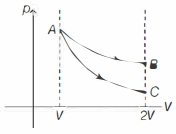
For an ideal gas expanding from volume $V$ to $2V$,the isothermal process is represented by the curve $AB$ and the adiabatic process is represented by the curve $AC$ on the $p-V$ diagram.
Since the adiabatic curve is steeper than the isothermal curve,the area under the isothermal curve $AB$ is greater than the area under the adiabatic curve $AC$ for the same change in volume.
Therefore,the work done in the isothermal process $(W_i)$ is greater than the work done in the adiabatic process $(W_a)$.
Since the gas is expanding,the work done is positive in both cases.
Thus,$W_i > W_a > 0$.
For an ideal gas expanding from volume $V$ to $2V$,the isothermal process is represented by the curve $AB$ and the adiabatic process is represented by the curve $AC$ on the $p-V$ diagram.
Since the adiabatic curve is steeper than the isothermal curve,the area under the isothermal curve $AB$ is greater than the area under the adiabatic curve $AC$ for the same change in volume.
Therefore,the work done in the isothermal process $(W_i)$ is greater than the work done in the adiabatic process $(W_a)$.
Since the gas is expanding,the work done is positive in both cases.
Thus,$W_i > W_a > 0$.
0 likesView Solution
3
PhysicsAdvancedMCQKVPY · 2012
$A$ liquid drop placed on a horizontal plane has a near spherical shape (slightly flattened due to gravity). Let $R$ be the radius of its largest horizontal section. $A$ small disturbance causes the drop to vibrate with frequency $v$ about its equilibrium shape. By dimensional analysis,the ratio $\frac{v}{\sqrt{\sigma / \rho R^3}}$ can be (Here,$\sigma$ is surface tension,$\rho$ is density,$g$ is acceleration due to gravity and $k$ is an arbitrary dimensionless constant)
A
$k \rho g R^2 / \sigma$
B
$k \rho R^3 / g \sigma$
C
$k \rho R^2 / g \sigma$
D
$k \rho / g \sigma$
Solution
(A) The frequency of vibration $v$ of a liquid drop is governed by surface tension $\sigma$,density $\rho$,and radius $R$. The given ratio is $\frac{v}{\sqrt{\sigma / \rho R^3}}$.
Dimensions of frequency $v = [T^{-1}]$.
Dimensions of surface tension $\sigma = [MT^{-2}]$.
Dimensions of density $\rho = [ML^{-3}]$.
Dimensions of radius $R = [L]$.
Let the ratio be $X = \frac{v}{\sqrt{\sigma / \rho R^3}}$.
Dimensions of $\sqrt{\frac{\sigma}{\rho R^3}} = \sqrt{\frac{MT^{-2}}{ML^{-3} \cdot L^3}} = \sqrt{\frac{MT^{-2}}{M}} = [T^{-1}]$.
Thus,the ratio $\frac{v}{\sqrt{\sigma / \rho R^3}}$ is dimensionless.
We check the dimensions of option $(A)$:
$\frac{k \rho g R^2}{\sigma} = \frac{[ML^{-3}] \cdot [LT^{-2}] \cdot [L^2]}{[MT^{-2}]} = \frac{[ML^0T^{-2}]}{[MT^{-2}]} = [M^0L^0T^0]$.
Since this expression is dimensionless,it is consistent with the dimensional analysis of the given ratio.
Dimensions of frequency $v = [T^{-1}]$.
Dimensions of surface tension $\sigma = [MT^{-2}]$.
Dimensions of density $\rho = [ML^{-3}]$.
Dimensions of radius $R = [L]$.
Let the ratio be $X = \frac{v}{\sqrt{\sigma / \rho R^3}}$.
Dimensions of $\sqrt{\frac{\sigma}{\rho R^3}} = \sqrt{\frac{MT^{-2}}{ML^{-3} \cdot L^3}} = \sqrt{\frac{MT^{-2}}{M}} = [T^{-1}]$.
Thus,the ratio $\frac{v}{\sqrt{\sigma / \rho R^3}}$ is dimensionless.
We check the dimensions of option $(A)$:
$\frac{k \rho g R^2}{\sigma} = \frac{[ML^{-3}] \cdot [LT^{-2}] \cdot [L^2]}{[MT^{-2}]} = \frac{[ML^0T^{-2}]}{[MT^{-2}]} = [M^0L^0T^0]$.
Since this expression is dimensionless,it is consistent with the dimensional analysis of the given ratio.
0 likesView Solution
4
PhysicsDifficultMCQKVPY · 2012
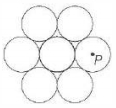
Seven identical coins are rigidly arranged on a flat table in the pattern shown below,so that each coin touches its neighbours. Each coin is a thin disc of mass $m$ and radius $r$. Note that the moment of inertia of an individual coin about an axis passing through its centre and perpendicular to the plane of the coin is $\frac{m r^2}{2}$. The moment of inertia of the system of seven coins about an axis that passes through the point $P$ (the centre of the coin positioned directly to the right of the central coin) and perpendicular to the plane of the coins is ..........$m r^2$.
A
$\frac{55}{2}$
B
$\frac{127}{2}$
C
$\frac{111}{2}$
D
$55$
Solution
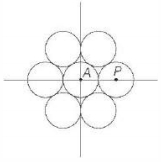
(C) Let $A$ be the centre of the central coin. The moment of inertia of the central coin about an axis through $A$ is $I_{central} = \frac{m r^2}{2}$.
For the six surrounding coins,the distance of their centres from $A$ is $2r$. Using the parallel axis theorem,the moment of inertia of each surrounding coin about the axis through $A$ is $I_{surrounding} = \frac{m r^2}{2} + m(2r)^2 = \frac{m r^2}{2} + 4mr^2 = \frac{9}{2} mr^2$.
The total moment of inertia of the system about the axis through $A$ is $I_A = I_{central} + 6 \times I_{surrounding} = \frac{m r^2}{2} + 6 \times \frac{9}{2} mr^2 = \frac{m r^2}{2} + 27 mr^2 = \frac{55}{2} mr^2$.
Now,we need the moment of inertia about point $P$,which is at a distance $d = 2r$ from $A$. Using the parallel axis theorem,$I_P = I_A + M_{total} \times d^2$,where $M_{total} = 7m$.
$I_P = \frac{55}{2} mr^2 + (7m)(2r)^2 = \frac{55}{2} mr^2 + 28 mr^2 = \frac{55 + 56}{2} mr^2 = \frac{111}{2} mr^2$.
For the six surrounding coins,the distance of their centres from $A$ is $2r$. Using the parallel axis theorem,the moment of inertia of each surrounding coin about the axis through $A$ is $I_{surrounding} = \frac{m r^2}{2} + m(2r)^2 = \frac{m r^2}{2} + 4mr^2 = \frac{9}{2} mr^2$.
The total moment of inertia of the system about the axis through $A$ is $I_A = I_{central} + 6 \times I_{surrounding} = \frac{m r^2}{2} + 6 \times \frac{9}{2} mr^2 = \frac{m r^2}{2} + 27 mr^2 = \frac{55}{2} mr^2$.
Now,we need the moment of inertia about point $P$,which is at a distance $d = 2r$ from $A$. Using the parallel axis theorem,$I_P = I_A + M_{total} \times d^2$,where $M_{total} = 7m$.
$I_P = \frac{55}{2} mr^2 + (7m)(2r)^2 = \frac{55}{2} mr^2 + 28 mr^2 = \frac{55 + 56}{2} mr^2 = \frac{111}{2} mr^2$.
0 likesView Solution
5
PhysicsMediumMCQKVPY · 2012
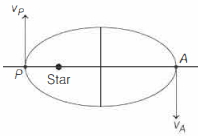
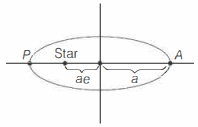
$A$ planet orbits in an elliptical path of eccentricity $e$ around a massive star considered fixed at one of the foci. The point in space,where it is closest to the star is denoted by $P$ and the point,where it is farthest is denoted by $A$. Let $v_P$ and $v_A$ be the respective speeds at $P$ and $A$,then
A
$\frac{v_P}{v_A}=\frac{1+e}{1-e}$
B
$\frac{v_P}{v_A}=1$
C
$\frac{v_P}{v_A}=\frac{1+e^2}{1-e}$
D
$\frac{v_P}{v_A}=\frac{1+e^2}{1-e^2}$
Solution
(A) By the law of conservation of angular momentum,the angular momentum $L$ of the planet remains constant at all points in its orbit.
At the perihelion $P$ and aphelion $A$,the velocity vector is perpendicular to the position vector,so the angular momentum is given by $L = mvr$.
Since $L_P = L_A$,we have $m v_P r_P = m v_A r_A$,which implies $\frac{v_P}{v_A} = \frac{r_A}{r_P}$.
For an ellipse with semi-major axis $a$ and eccentricity $e$,the distance of the closest point (perihelion) is $r_P = a(1-e)$ and the distance of the farthest point (aphelion) is $r_A = a(1+e)$.
Substituting these values,we get $\frac{v_P}{v_A} = \frac{a(1+e)}{a(1-e)} = \frac{1+e}{1-e}$.
At the perihelion $P$ and aphelion $A$,the velocity vector is perpendicular to the position vector,so the angular momentum is given by $L = mvr$.
Since $L_P = L_A$,we have $m v_P r_P = m v_A r_A$,which implies $\frac{v_P}{v_A} = \frac{r_A}{r_P}$.
For an ellipse with semi-major axis $a$ and eccentricity $e$,the distance of the closest point (perihelion) is $r_P = a(1-e)$ and the distance of the farthest point (aphelion) is $r_A = a(1+e)$.
Substituting these values,we get $\frac{v_P}{v_A} = \frac{a(1+e)}{a(1-e)} = \frac{1+e}{1-e}$.
0 likesView Solution
6
PhysicsMediumMCQKVPY · 2012
$A$ body is executing simple harmonic motion of amplitude $a$ and period $T$ about the equilibrium position $x=0$. Large numbers of snapshots are taken at random of this body in motion. The probability of the body being found in a very small interval $x$ to $x+|dx|$ is highest at
A
$x=\pm a$
B
$x=0$
C
$x=\pm \frac{a}{2}$
D
$x=\pm \frac{a}{\sqrt{2}}$
Solution
(A) In simple harmonic motion,the velocity of the body is given by $v = \omega \sqrt{a^2 - x^2}$.
The time $dt$ spent by the body in a small interval $dx$ is given by $dt = \frac{dx}{v} = \frac{dx}{\omega \sqrt{a^2 - x^2}}$.
The probability $P(x)dx$ of finding the body in the interval $dx$ is proportional to the time spent in that interval,i.e.,$P(x) \propto \frac{1}{v} = \frac{1}{\omega \sqrt{a^2 - x^2}}$.
As $x \to \pm a$,the velocity $v \to 0$,which means the time spent $dt \to \infty$.
Therefore,the probability of finding the body is highest at the extreme positions $x = \pm a$.
Thus,the correct option is $A$.
The time $dt$ spent by the body in a small interval $dx$ is given by $dt = \frac{dx}{v} = \frac{dx}{\omega \sqrt{a^2 - x^2}}$.
The probability $P(x)dx$ of finding the body in the interval $dx$ is proportional to the time spent in that interval,i.e.,$P(x) \propto \frac{1}{v} = \frac{1}{\omega \sqrt{a^2 - x^2}}$.
As $x \to \pm a$,the velocity $v \to 0$,which means the time spent $dt \to \infty$.
Therefore,the probability of finding the body is highest at the extreme positions $x = \pm a$.
Thus,the correct option is $A$.
0 likesView Solution
7
PhysicsDifficultMCQKVPY · 2012
$A$ particle is acted upon by a force given by $F=-\alpha x^3-\beta x^4$,where $\alpha$ and $\beta$ are positive constants. At the point $x=0$,the particle is
A
in stable equilibrium
B
in unstable equilibrium
C
in neutral equilibrium
D
not in equilibrium
Solution
(A) The force acting on the particle is given by $F = -\alpha x^3 - \beta x^4$.
Since $F = -\frac{dU}{dx}$,we have $\frac{dU}{dx} = \alpha x^3 + \beta x^4$.
At $x = 0$,$\frac{dU}{dx} = 0$,which implies the particle is in equilibrium.
To determine the stability,we examine the derivatives of the potential energy $U$ at $x = 0$:
$\frac{d^2U}{dx^2} = 3\alpha x^2 + 4\beta x^3$,which is $0$ at $x = 0$.
$\frac{d^3U}{dx^3} = 6\alpha x + 12\beta x^2$,which is $0$ at $x = 0$.
$\frac{d^4U}{dx^4} = 6\alpha + 24\beta x$,which is $6\alpha$ at $x = 0$.
Since $\alpha > 0$,the first non-zero derivative at $x = 0$ is of an even order ($4^{th}$ order) and is positive. This indicates that $U$ has a local minimum at $x = 0$.
Therefore,the particle is in stable equilibrium.
Since $F = -\frac{dU}{dx}$,we have $\frac{dU}{dx} = \alpha x^3 + \beta x^4$.
At $x = 0$,$\frac{dU}{dx} = 0$,which implies the particle is in equilibrium.
To determine the stability,we examine the derivatives of the potential energy $U$ at $x = 0$:
$\frac{d^2U}{dx^2} = 3\alpha x^2 + 4\beta x^3$,which is $0$ at $x = 0$.
$\frac{d^3U}{dx^3} = 6\alpha x + 12\beta x^2$,which is $0$ at $x = 0$.
$\frac{d^4U}{dx^4} = 6\alpha + 24\beta x$,which is $6\alpha$ at $x = 0$.
Since $\alpha > 0$,the first non-zero derivative at $x = 0$ is of an even order ($4^{th}$ order) and is positive. This indicates that $U$ has a local minimum at $x = 0$.
Therefore,the particle is in stable equilibrium.
0 likesView Solution
8
PhysicsDifficultMCQKVPY · 2012
The potential energy of a point particle is given by the expression $V(x) = -\alpha x + \beta \sin(x / \gamma)$. $A$ dimensionless combination of the constants $\alpha, \beta$ and $\gamma$ is
A
$\frac{\alpha}{\beta \gamma}$
B
$\frac{\alpha^2}{\beta \gamma}$
C
$\frac{\gamma}{\alpha \beta}$
D
$\frac{\alpha \gamma}{\beta}$
Solution
(D) The potential energy of the particle is given by $V(x) = -\alpha x + \beta \sin(x / \gamma)$.
For the equation to be dimensionally consistent,the dimensions of each term must be the same as the dimensions of potential energy $[V] = [ML^2T^{-2}]$.
$1$. For the term $\alpha x$: $[\alpha][x] = [V] \implies [\alpha][L] = [ML^2T^{-2}] \implies [\alpha] = [MLT^{-2}]$.
$2$. For the term $\beta \sin(x / \gamma)$: The argument of the sine function must be dimensionless,so $[x / \gamma] = [M^0L^0T^0] \implies [L] / [\gamma] = 1 \implies [\gamma] = [L]$.
$3$. Also,$[\beta] = [V] = [ML^2T^{-2}]$.
Now,check the dimensions of the given options:
For option $(d)$: $\frac{[\alpha][\gamma]}{[\beta]} = \frac{[MLT^{-2}][L]}{[ML^2T^{-2}]} = \frac{[ML^2T^{-2}]}{[ML^2T^{-2}]} = [M^0L^0T^0]$.
Since this combination is dimensionless,the correct option is $(d)$.
For the equation to be dimensionally consistent,the dimensions of each term must be the same as the dimensions of potential energy $[V] = [ML^2T^{-2}]$.
$1$. For the term $\alpha x$: $[\alpha][x] = [V] \implies [\alpha][L] = [ML^2T^{-2}] \implies [\alpha] = [MLT^{-2}]$.
$2$. For the term $\beta \sin(x / \gamma)$: The argument of the sine function must be dimensionless,so $[x / \gamma] = [M^0L^0T^0] \implies [L] / [\gamma] = 1 \implies [\gamma] = [L]$.
$3$. Also,$[\beta] = [V] = [ML^2T^{-2}]$.
Now,check the dimensions of the given options:
For option $(d)$: $\frac{[\alpha][\gamma]}{[\beta]} = \frac{[MLT^{-2}][L]}{[ML^2T^{-2}]} = \frac{[ML^2T^{-2}]}{[ML^2T^{-2}]} = [M^0L^0T^0]$.
Since this combination is dimensionless,the correct option is $(d)$.
0 likesView Solution
9
PhysicsDifficultMCQKVPY · 2012
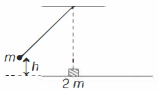
$A$ ball of mass $m$ suspended from a rigid support by an inextensible massless string is released from a height $h$ above its lowest point. At its lowest point, it collides elastically with a block of mass $2m$ at rest on a frictionless surface. Neglect the dimensions of the ball and the block. After the collision, the ball rises to a maximum height of
A
$\frac{h}{3}$
B
$\frac{h}{2}$
C
$\frac{h}{8}$
D
$\frac{h}{9}$
Solution
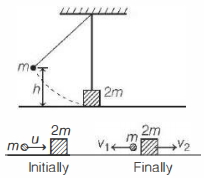
(D) Let the velocity of the ball of mass $m$ just before the collision be $u$. By conservation of energy, $\frac{1}{2}mu^2 = mgh$, so $u = \sqrt{2gh}$.
In an elastic collision, both kinetic energy and linear momentum are conserved.
Let $v_1$ be the velocity of the ball (in the opposite direction) and $v_2$ be the velocity of the block after the collision.
Conservation of momentum: $mu = 2mv_2 - mv_1 \Rightarrow u = 2v_2 - v_1 \quad \dots (i)$
Conservation of kinetic energy: $\frac{1}{2}mu^2 = \frac{1}{2}mv_1^2 + \frac{1}{2}(2m)v_2^2 \Rightarrow u^2 = v_1^2 + 2v_2^2 \quad \dots (ii)$
From $(i)$, $2v_2 = u + v_1$. Substituting this into $(ii)$:
$u^2 = v_1^2 + 2\left(\frac{u+v_1}{2}\right)^2 = v_1^2 + \frac{(u+v_1)^2}{2}$
$2u^2 = 2v_1^2 + u^2 + v_1^2 + 2uv_1$
$u^2 - 2uv_1 - 3v_1^2 = 0$
$(u - 3v_1)(u + v_1) = 0$
Since $v_1$ is the speed in the opposite direction, $v_1 = \frac{u}{3}$.
The new height $h'$ reached by the ball is given by $mgh' = \frac{1}{2}mv_1^2$.
$h' = \frac{v_1^2}{2g} = \frac{(u/3)^2}{2g} = \frac{u^2}{18g} = \frac{2gh}{18g} = \frac{h}{9}$.
In an elastic collision, both kinetic energy and linear momentum are conserved.
Let $v_1$ be the velocity of the ball (in the opposite direction) and $v_2$ be the velocity of the block after the collision.
Conservation of momentum: $mu = 2mv_2 - mv_1 \Rightarrow u = 2v_2 - v_1 \quad \dots (i)$
Conservation of kinetic energy: $\frac{1}{2}mu^2 = \frac{1}{2}mv_1^2 + \frac{1}{2}(2m)v_2^2 \Rightarrow u^2 = v_1^2 + 2v_2^2 \quad \dots (ii)$
From $(i)$, $2v_2 = u + v_1$. Substituting this into $(ii)$:
$u^2 = v_1^2 + 2\left(\frac{u+v_1}{2}\right)^2 = v_1^2 + \frac{(u+v_1)^2}{2}$
$2u^2 = 2v_1^2 + u^2 + v_1^2 + 2uv_1$
$u^2 - 2uv_1 - 3v_1^2 = 0$
$(u - 3v_1)(u + v_1) = 0$
Since $v_1$ is the speed in the opposite direction, $v_1 = \frac{u}{3}$.
The new height $h'$ reached by the ball is given by $mgh' = \frac{1}{2}mv_1^2$.
$h' = \frac{v_1^2}{2g} = \frac{(u/3)^2}{2g} = \frac{u^2}{18g} = \frac{2gh}{18g} = \frac{h}{9}$.
0 likesView Solution
10
PhysicsMediumMCQKVPY · 2012
$A$ particle released from rest is falling through a thick fluid under gravity. The fluid exerts a resistive force on the particle proportional to the square of its speed. Which one of the following graphs best depicts the variation of its speed $v$ with time $t$ ?
A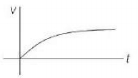
B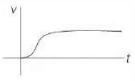
C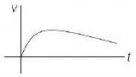
D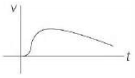
Solution
(A) When a particle falls through a fluid,it is acted upon by three forces: gravitational force $(mg)$ acting downwards,buoyant force $(F_B)$ acting upwards,and a resistive force $(F_R)$ acting upwards.
The net force on the particle is $F_{net} = mg - F_B - F_R$.
Given that the resistive force is proportional to the square of its speed,we have $F_R = kv^2$,where $k$ is a constant.
Initially,at $t = 0$,the speed $v = 0$,so the resistive force $F_R = 0$. The acceleration is maximum,and the speed starts increasing.
As the speed $v$ increases,the resistive force $F_R = kv^2$ also increases. Consequently,the net force $F_{net} = mg - F_B - kv^2$ decreases,which means the acceleration $(a = F_{net}/m)$ decreases.
Eventually,the resistive force increases to a point where the net force becomes zero $(mg - F_B - kv^2 = 0)$. At this point,the acceleration becomes zero,and the particle attains a constant terminal velocity.
The graph of speed $v$ versus time $t$ should show an initial increase in speed with a decreasing slope,eventually approaching a constant value (asymptote). Graph $(a)$ correctly represents this behavior.
The net force on the particle is $F_{net} = mg - F_B - F_R$.
Given that the resistive force is proportional to the square of its speed,we have $F_R = kv^2$,where $k$ is a constant.
Initially,at $t = 0$,the speed $v = 0$,so the resistive force $F_R = 0$. The acceleration is maximum,and the speed starts increasing.
As the speed $v$ increases,the resistive force $F_R = kv^2$ also increases. Consequently,the net force $F_{net} = mg - F_B - kv^2$ decreases,which means the acceleration $(a = F_{net}/m)$ decreases.
Eventually,the resistive force increases to a point where the net force becomes zero $(mg - F_B - kv^2 = 0)$. At this point,the acceleration becomes zero,and the particle attains a constant terminal velocity.
The graph of speed $v$ versus time $t$ should show an initial increase in speed with a decreasing slope,eventually approaching a constant value (asymptote). Graph $(a)$ correctly represents this behavior.
0 likesView Solution
11
PhysicsMediumMCQKVPY · 2012
$A$ cylindrical steel rod of length $0.10 \,m$ and thermal conductivity $50 \,Wm^{-1}K^{-1}$ is welded end to end to a copper rod of thermal conductivity $400 \,Wm^{-1}K^{-1}$ and of the same area of cross-section but $0.20 \,m$ long. The free end of the steel rod is maintained at $100^{\circ}C$ and that of the copper rod at $0^{\circ}C$. Assuming that the rods are perfectly insulated from the surroundings,the temperature at the junction of the two rods is ................... $^{\circ}C$.
A
$20$
B
$30$
C
$40$
D
$50$
Solution
(A) In steady state,the rate of heat flow through both rods is equal.
Let $T$ be the temperature at the junction.
$\left(\frac{kA(T_1 - T)}{l}\right)_{\text{steel}} = \left(\frac{kA(T - T_2)}{l}\right)_{\text{copper}}$
Since the area $A$ is the same for both rods,it cancels out:
$\frac{50(100 - T)}{0.1} = \frac{400(T - 0)}{0.2}$
$500(100 - T) = 2000(T)$
$100 - T = 4T$
$5T = 100$
$T = 20^{\circ}C$
Let $T$ be the temperature at the junction.
$\left(\frac{kA(T_1 - T)}{l}\right)_{\text{steel}} = \left(\frac{kA(T - T_2)}{l}\right)_{\text{copper}}$
Since the area $A$ is the same for both rods,it cancels out:
$\frac{50(100 - T)}{0.1} = \frac{400(T - 0)}{0.2}$
$500(100 - T) = 2000(T)$
$100 - T = 4T$
$5T = 100$
$T = 20^{\circ}C$

0 likesView Solution
12
PhysicsDifficultMCQKVPY · 2012
The total energy of a black body radiation source is collected for five minutes and used to heat water. The temperature of the water increases from $10.0^{\circ} C$ to $11.0^{\circ} C$. The absolute temperature of the black body is doubled and its surface area halved and the experiment repeated for the same time. Which of the following statements would be most nearly correct?
A
The temperature of the water would increase from $10.0^{\circ} C$ to a final temperature of $12^{\circ} C$
B
The temperature of the water would increase from $10.0^{\circ} C$ to a final temperature of $18^{\circ} C$
C
The temperature of the water would increase from $10.0^{\circ} C$ to a final temperature of $14^{\circ} C$
D
The temperature of the water would increase from $10.0^{\circ} C$ to a final temperature of $11^{\circ} C$
Solution
(B) The energy radiated from a black body is given by the Stefan-Boltzmann law: $U = \sigma A T^4 t$,where $\sigma$ is Stefan's constant,$A$ is the surface area,$T$ is the absolute temperature,and $t$ is the time.
In the first case,the energy collected is $U_1 = \sigma A T^4 t$. The temperature rise is $\Delta T_1 = 11.0^{\circ} C - 10.0^{\circ} C = 1.0^{\circ} C$.
In the second case,the new area is $A' = A/2$ and the new temperature is $T' = 2T$. The energy collected is $U_2 = \sigma (A/2) (2T)^4 t = \sigma (A/2) (16T^4) t = 8 \sigma A T^4 t = 8 U_1$.
Since the energy absorbed by the water is proportional to the temperature rise $(\Delta Q = ms \Delta T)$,we have $\frac{\Delta T_2}{\Delta T_1} = \frac{U_2}{U_1} = 8$.
Therefore,$\Delta T_2 = 8 \times \Delta T_1 = 8 \times 1.0^{\circ} C = 8.0^{\circ} C$.
The final temperature of the water will be $10.0^{\circ} C + 8.0^{\circ} C = 18.0^{\circ} C$.
In the first case,the energy collected is $U_1 = \sigma A T^4 t$. The temperature rise is $\Delta T_1 = 11.0^{\circ} C - 10.0^{\circ} C = 1.0^{\circ} C$.
In the second case,the new area is $A' = A/2$ and the new temperature is $T' = 2T$. The energy collected is $U_2 = \sigma (A/2) (2T)^4 t = \sigma (A/2) (16T^4) t = 8 \sigma A T^4 t = 8 U_1$.
Since the energy absorbed by the water is proportional to the temperature rise $(\Delta Q = ms \Delta T)$,we have $\frac{\Delta T_2}{\Delta T_1} = \frac{U_2}{U_1} = 8$.
Therefore,$\Delta T_2 = 8 \times \Delta T_1 = 8 \times 1.0^{\circ} C = 8.0^{\circ} C$.
The final temperature of the water will be $10.0^{\circ} C + 8.0^{\circ} C = 18.0^{\circ} C$.
0 likesView Solution
13
PhysicsDifficultMCQKVPY · 2012
$A$ small asteroid is orbiting around the sun in a circular orbit of radius $r_0$ with speed $v_0$. $A$ rocket is launched from the asteroid with speed $v = \alpha v_0$,where $v$ is the speed relative to the sun. The highest value of $\alpha$ for which the rocket will remain bound to the solar system is (ignoring gravity due to the asteroid and effects of other planets).
A
$\sqrt{2}$
B
$2$
C
$\sqrt{3}$
D
$1$
Solution
(A) The total energy of the rocket at the instant of launch must be less than or equal to zero for it to remain bound to the solar system.
The orbital speed of the asteroid is given by $v_0 = \sqrt{\frac{GM}{r_0}}$,which implies $v_0^2 = \frac{GM}{r_0}$.
The total energy $E$ of the rocket relative to the sun is the sum of its gravitational potential energy and its kinetic energy:
$E = -\frac{GMm}{r_0} + \frac{1}{2}mv^2$
Given that the speed of the rocket relative to the sun is $v = \alpha v_0$,we substitute this into the energy equation:
$E = -\frac{GMm}{r_0} + \frac{1}{2}m(\alpha v_0)^2$
For the rocket to remain bound,$E \leq 0$:
$-\frac{GMm}{r_0} + \frac{1}{2}m \alpha^2 v_0^2 \leq 0$
Substituting $v_0^2 = \frac{GM}{r_0}$:
$-\frac{GMm}{r_0} + \frac{1}{2}m \alpha^2 \left(\frac{GM}{r_0}\right) \leq 0$
Dividing by $\frac{GMm}{r_0}$:
$-1 + \frac{1}{2} \alpha^2 \leq 0$
$\frac{1}{2} \alpha^2 \leq 1$
$\alpha^2 \leq 2$
$\alpha \leq \sqrt{2}$
Wait,re-evaluating the launch condition: If the rocket is launched *from* the asteroid,its initial velocity relative to the sun is the vector sum of the asteroid's orbital velocity and the launch velocity. However,the problem states $v = \alpha v_0$ is the speed relative to the sun. Thus,the condition for being bound is $E \leq 0$,leading to $\alpha \leq \sqrt{2}$. The highest value is $\sqrt{2}$.
The orbital speed of the asteroid is given by $v_0 = \sqrt{\frac{GM}{r_0}}$,which implies $v_0^2 = \frac{GM}{r_0}$.
The total energy $E$ of the rocket relative to the sun is the sum of its gravitational potential energy and its kinetic energy:
$E = -\frac{GMm}{r_0} + \frac{1}{2}mv^2$
Given that the speed of the rocket relative to the sun is $v = \alpha v_0$,we substitute this into the energy equation:
$E = -\frac{GMm}{r_0} + \frac{1}{2}m(\alpha v_0)^2$
For the rocket to remain bound,$E \leq 0$:
$-\frac{GMm}{r_0} + \frac{1}{2}m \alpha^2 v_0^2 \leq 0$
Substituting $v_0^2 = \frac{GM}{r_0}$:
$-\frac{GMm}{r_0} + \frac{1}{2}m \alpha^2 \left(\frac{GM}{r_0}\right) \leq 0$
Dividing by $\frac{GMm}{r_0}$:
$-1 + \frac{1}{2} \alpha^2 \leq 0$
$\frac{1}{2} \alpha^2 \leq 1$
$\alpha^2 \leq 2$
$\alpha \leq \sqrt{2}$
Wait,re-evaluating the launch condition: If the rocket is launched *from* the asteroid,its initial velocity relative to the sun is the vector sum of the asteroid's orbital velocity and the launch velocity. However,the problem states $v = \alpha v_0$ is the speed relative to the sun. Thus,the condition for being bound is $E \leq 0$,leading to $\alpha \leq \sqrt{2}$. The highest value is $\sqrt{2}$.
0 likesView Solution
14
PhysicsMediumMCQKVPY · 2012
$A$ standing wave in a pipe with a length $L=1.2 \,m$ is described by $y(x, t)=y_0 \sin [(2 \pi / L) x] \sin [(2 \pi / L) x+\pi / 4]$. Based on the above information,which one of the following statements is incorrect? (Speed of sound in air is $300 \,ms^{-1}$)
A
The pipe is closed at both ends.
B
The wavelength of the wave could be $1.2 \,m$.
C
There could be a node at $x=0$ and an antinode at $x=L/2$.
D
The frequency of the fundamental mode of vibrations is $137.5 \,Hz$.
Solution
(D) The given wave equation is $y(x, t) = y_0 \sin \left( \frac{2\pi}{L} x \right) \sin \left( \frac{2\pi}{L} x + \frac{\pi}{4} \right)$.
Comparing this with the general form of a standing wave $k = \frac{2\pi}{\lambda} = \frac{2\pi}{L}$,we get $\lambda = L = 1.2 \,m$.
For a pipe closed at both ends,the allowed wavelengths are $\lambda_n = \frac{2L}{n}$. For $n=2$,$\lambda = L = 1.2 \,m$,which is consistent with the wave equation.
At $x=0$,$y(0, t) = y_0 \sin(0) \sin(\pi/4) = 0$,so there is a node at $x=0$.
At $x=L/2$,$y(L/2, t) = y_0 \sin(\pi) \sin(\pi + \pi/4) = 0$,which implies a node at $x=L/2$. However,the statement in option $(c)$ claims an antinode at $x=L/2$,which is incorrect based on the equation,but the question asks for the incorrect statement among the choices provided.
The fundamental frequency is $f = \frac{v}{\lambda_{max}} = \frac{v}{2L} = \frac{300}{2 \times 1.2} = \frac{300}{2.4} = 125 \,Hz$.
Since $125 \,Hz \neq 137.5 \,Hz$,option $(d)$ is clearly incorrect.
Comparing this with the general form of a standing wave $k = \frac{2\pi}{\lambda} = \frac{2\pi}{L}$,we get $\lambda = L = 1.2 \,m$.
For a pipe closed at both ends,the allowed wavelengths are $\lambda_n = \frac{2L}{n}$. For $n=2$,$\lambda = L = 1.2 \,m$,which is consistent with the wave equation.
At $x=0$,$y(0, t) = y_0 \sin(0) \sin(\pi/4) = 0$,so there is a node at $x=0$.
At $x=L/2$,$y(L/2, t) = y_0 \sin(\pi) \sin(\pi + \pi/4) = 0$,which implies a node at $x=L/2$. However,the statement in option $(c)$ claims an antinode at $x=L/2$,which is incorrect based on the equation,but the question asks for the incorrect statement among the choices provided.
The fundamental frequency is $f = \frac{v}{\lambda_{max}} = \frac{v}{2L} = \frac{300}{2 \times 1.2} = \frac{300}{2.4} = 125 \,Hz$.
Since $125 \,Hz \neq 137.5 \,Hz$,option $(d)$ is clearly incorrect.
0 likesView Solution
15
PhysicsDifficultMCQKVPY · 2012
Two blocks $1$ and $2$ of equal mass $m$ are connected by an ideal string over a frictionless pulley. The blocks are attached to the ground by springs having spring constants $k_1$ and $k_2$ such that $k_1 > k_2$. Initially,both springs are unstretched. Block $1$ is slowly pulled down a distance $x$ and released. Just after the release,the possible values of the magnitudes of the accelerations of the blocks $a_1$ and $a_2$ can be
A
either $(a_1=a_2=\frac{(k_1+k_2) x}{2 m})$ or $(a_1=\frac{k_1 x}{m}-g$ and $a_2=\frac{k_2 x}{m}+g)$
B
$(a_1=a_2=\frac{(k_1+k_2) x}{2 m})$ only
C
$(a_1=a_2=\frac{(k_1-k_2) x}{2 m})$ only
D
either $(a_1=a_2=\frac{(k_1-k_2) x}{2 m})$ or $(a_1=a_2=\frac{(k_1 k_2) x}{(k_1+k_2) m}-g)$
Solution
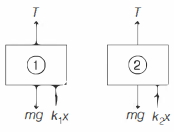
(B) The free body diagrams for block $1$ and $2$ are shown in the figure.
Let $T$ be the tension in the string.
For block $1$,the forces are tension $T$ upwards,and gravity $mg$ and spring force $k_1 x$ downwards. The equation of motion is:
$T + k_1 x - mg = ma_1$ (assuming downward acceleration $a_1$)
For block $2$,the forces are tension $T$ upwards,and gravity $mg$ downwards,and spring force $k_2 x$ upwards. The equation of motion is:
$k_2 x + mg - T = ma_2$ (assuming upward acceleration $a_2$)
Since the string is inextensible,the magnitudes of accelerations must be equal,so $a_1 = a_2 = a$.
Adding the two equations:
$(T + k_1 x - mg) + (k_2 x + mg - T) = ma_1 + ma_2$
$(k_1 + k_2) x = 2ma$
$a = \frac{(k_1 + k_2) x}{2m}$
Thus,the magnitude of acceleration for both blocks is $a = \frac{(k_1 + k_2) x}{2m}$.
Let $T$ be the tension in the string.
For block $1$,the forces are tension $T$ upwards,and gravity $mg$ and spring force $k_1 x$ downwards. The equation of motion is:
$T + k_1 x - mg = ma_1$ (assuming downward acceleration $a_1$)
For block $2$,the forces are tension $T$ upwards,and gravity $mg$ downwards,and spring force $k_2 x$ upwards. The equation of motion is:
$k_2 x + mg - T = ma_2$ (assuming upward acceleration $a_2$)
Since the string is inextensible,the magnitudes of accelerations must be equal,so $a_1 = a_2 = a$.
Adding the two equations:
$(T + k_1 x - mg) + (k_2 x + mg - T) = ma_1 + ma_2$
$(k_1 + k_2) x = 2ma$
$a = \frac{(k_1 + k_2) x}{2m}$
Thus,the magnitude of acceleration for both blocks is $a = \frac{(k_1 + k_2) x}{2m}$.
0 likesView Solution
16
PhysicsDifficultMCQKVPY · 2012
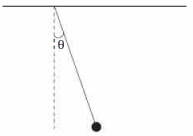
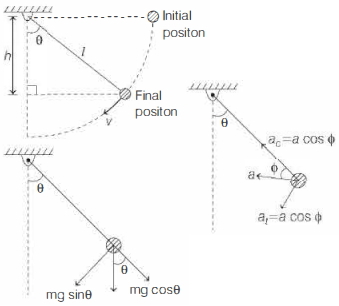
$A$ simple pendulum is released from rest at the horizontally stretched position. When the string makes an angle $\theta$ with the vertical,the angle $\phi$ which the acceleration vector of the bob makes with the string is given by
A
$\phi=0$
B
$\phi=\tan ^{-1}\left(\frac{\tan \theta}{2}\right)$
C
$\phi=\tan ^{-1}(2 \tan \theta)$
D
$\phi=\frac{\pi}{2}$
Solution
(B) Let $v$ be the velocity of the bob at position $\theta$ after being released from the horizontal position.
From the law of conservation of energy,the potential energy lost equals the kinetic energy gained:
$mgh = \frac{1}{2}mv^2$
Since the height $h$ dropped from the horizontal is $l \cos \theta$,we have:
$mg(l \cos \theta) = \frac{1}{2}mv^2$
$\Rightarrow \frac{v^2}{l} = 2g \cos \theta$
The radial (centripetal) acceleration is $a_c = \frac{v^2}{l} = 2g \cos \theta$.
The tangential acceleration is due to the component of gravity perpendicular to the string:
$a_t = g \sin \theta$.
If the total acceleration vector $\vec{a}$ makes an angle $\phi$ with the string (which is the direction of the radial acceleration),then:
$\tan \phi = \frac{a_t}{a_c}$
Substituting the expressions for $a_t$ and $a_c$:
$\tan \phi = \frac{g \sin \theta}{2g \cos \theta} = \frac{\tan \theta}{2}$
Therefore,$\phi = \tan^{-1}\left(\frac{\tan \theta}{2}\right)$.
From the law of conservation of energy,the potential energy lost equals the kinetic energy gained:
$mgh = \frac{1}{2}mv^2$
Since the height $h$ dropped from the horizontal is $l \cos \theta$,we have:
$mg(l \cos \theta) = \frac{1}{2}mv^2$
$\Rightarrow \frac{v^2}{l} = 2g \cos \theta$
The radial (centripetal) acceleration is $a_c = \frac{v^2}{l} = 2g \cos \theta$.
The tangential acceleration is due to the component of gravity perpendicular to the string:
$a_t = g \sin \theta$.
If the total acceleration vector $\vec{a}$ makes an angle $\phi$ with the string (which is the direction of the radial acceleration),then:
$\tan \phi = \frac{a_t}{a_c}$
Substituting the expressions for $a_t$ and $a_c$:
$\tan \phi = \frac{g \sin \theta}{2g \cos \theta} = \frac{\tan \theta}{2}$
Therefore,$\phi = \tan^{-1}\left(\frac{\tan \theta}{2}\right)$.
0 likesView Solution
17
PhysicsMediumMCQKVPY · 2012
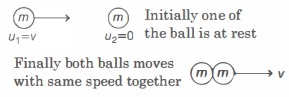
$A$ clay ball of mass $m$ and speed $v$ strikes another metal ball of the same mass $m$,which is at rest. They stick together after the collision. The kinetic energy of the system after the collision is
A
$m v^2 / 2$
B
$m v^2 / 4$
C
$2 m v^2$
D
$m v^2$
Solution
(B) According to the law of conservation of linear momentum,the total momentum before the collision is equal to the total momentum after the collision.
Let $V$ be the final velocity of the combined system of mass $(m + m) = 2m$.
$m v + m(0) = (2m)V$
$m v = 2m V$
$V = v / 2$
Now,the kinetic energy of the system after the collision is given by:
$K_f = \frac{1}{2} (2m) V^2$
Substituting the value of $V$:
$K_f = \frac{1}{2} (2m) \left(\frac{v}{2}\right)^2$
$K_f = m \times \frac{v^2}{4} = \frac{m v^2}{4}$
Let $V$ be the final velocity of the combined system of mass $(m + m) = 2m$.
$m v + m(0) = (2m)V$
$m v = 2m V$
$V = v / 2$
Now,the kinetic energy of the system after the collision is given by:
$K_f = \frac{1}{2} (2m) V^2$
Substituting the value of $V$:
$K_f = \frac{1}{2} (2m) \left(\frac{v}{2}\right)^2$
$K_f = m \times \frac{v^2}{4} = \frac{m v^2}{4}$
0 likesView Solution
18
PhysicsAdvancedMCQKVPY · 2012
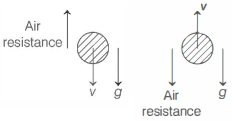
$A$ ball falls vertically downward and bounces off a horizontal floor. The speed of the ball just before reaching the floor $(u_1)$ is equal to the speed just after leaving contact with the floor $(u_2)$,where $u_1 = u_2$. The corresponding magnitudes of accelerations are denoted respectively by $a_1$ and $a_2$. The air resistance during motion is proportional to speed and is not negligible. If $g$ is the acceleration due to gravity,then:
A
$a_1 < a_2$
B
$a_1 > a_2$
C
$a_1 = a_2 \neq g$
D
$a_1 = a_2 = g$
Solution
(A) Let the speed of the ball be $v$ at the instant just before and just after the collision. The air resistance force $F_r$ is proportional to the speed,so $F_r = kv$,where $k$ is a constant.
When the ball is moving downwards,the gravitational force $mg$ acts downwards and the air resistance $kv$ acts upwards. The net force is $F_{net} = mg - kv$. The acceleration $a_1$ is given by:
$a_1 = \frac{mg - kv}{m} = g - \frac{k}{m}v$
When the ball is moving upwards,the gravitational force $mg$ acts downwards and the air resistance $kv$ also acts downwards (opposing the motion). The net force is $F_{net} = mg + kv$. The acceleration $a_2$ is given by:
$a_2 = \frac{mg + kv}{m} = g + \frac{k}{m}v$
Comparing the two expressions,it is clear that $a_2 > a_1$ or $a_1 < a_2$.
When the ball is moving downwards,the gravitational force $mg$ acts downwards and the air resistance $kv$ acts upwards. The net force is $F_{net} = mg - kv$. The acceleration $a_1$ is given by:
$a_1 = \frac{mg - kv}{m} = g - \frac{k}{m}v$
When the ball is moving upwards,the gravitational force $mg$ acts downwards and the air resistance $kv$ also acts downwards (opposing the motion). The net force is $F_{net} = mg + kv$. The acceleration $a_2$ is given by:
$a_2 = \frac{mg + kv}{m} = g + \frac{k}{m}v$
Comparing the two expressions,it is clear that $a_2 > a_1$ or $a_1 < a_2$.
0 likesView Solution
19
PhysicsMediumMCQKVPY · 2012
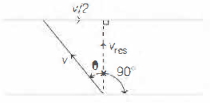
$A$ boat crossing a river moves with a velocity $v$ relative to still water. The river is flowing with a velocity $v/2$ with respect to the bank. The angle with respect to the flow direction with which the boat should move to minimize the drift is (in $^{\circ}$)
A
$30$
B
$60$
C
$150$
D
$120$
Solution
(D) To minimize the drift,the boat must be steered such that its resultant velocity is perpendicular to the river bank.
Let the boat be directed at an angle $\theta$ with the normal to the river flow,as shown in the diagram.
From the velocity triangle,the component of the boat's velocity $v$ along the river flow must cancel the river's velocity $v/2$.
Thus,$v \sin \theta = v/2$.
$\sin \theta = 1/2$,which gives $\theta = 30^{\circ}$.
The angle with respect to the direction of flow is $90^{\circ} + \theta = 90^{\circ} + 30^{\circ} = 120^{\circ}$.
Let the boat be directed at an angle $\theta$ with the normal to the river flow,as shown in the diagram.
From the velocity triangle,the component of the boat's velocity $v$ along the river flow must cancel the river's velocity $v/2$.
Thus,$v \sin \theta = v/2$.
$\sin \theta = 1/2$,which gives $\theta = 30^{\circ}$.
The angle with respect to the direction of flow is $90^{\circ} + \theta = 90^{\circ} + 30^{\circ} = 120^{\circ}$.
0 likesView Solution
20
PhysicsMediumMCQKVPY · 2012
In the Arctic region,hemispherical houses called Igloos are made of ice. It is possible to maintain a temperature inside an Igloo as high as $20^{\circ} C$ because
A
ice has high thermal conductivity
B
ice has low thermal conductivity
C
ice has high specific heat
D
ice has higher density than water
Solution
(B) The correct answer is $(B)$.
Ice is a poor conductor of heat,meaning it has a very low thermal conductivity.
Because of this low thermal conductivity,the ice walls of the Igloo act as an insulator,preventing the heat generated inside (by the occupants or a small fire) from escaping to the cold external environment and preventing the cold from entering the interior.
This allows the temperature inside the Igloo to be maintained at a comfortable level,such as $20^{\circ} C$,even when the outside temperature is extremely low.
The thermal conductivity of ice is approximately $1.6 \, W m^{-1} K^{-1}$ (note: the value $16 \, W m^{-1} K^{-1}$ is often cited in simplified contexts,though the physical value is closer to $1.6 \, W m^{-1} K^{-1}$).
Ice is a poor conductor of heat,meaning it has a very low thermal conductivity.
Because of this low thermal conductivity,the ice walls of the Igloo act as an insulator,preventing the heat generated inside (by the occupants or a small fire) from escaping to the cold external environment and preventing the cold from entering the interior.
This allows the temperature inside the Igloo to be maintained at a comfortable level,such as $20^{\circ} C$,even when the outside temperature is extremely low.
The thermal conductivity of ice is approximately $1.6 \, W m^{-1} K^{-1}$ (note: the value $16 \, W m^{-1} K^{-1}$ is often cited in simplified contexts,though the physical value is closer to $1.6 \, W m^{-1} K^{-1}$).
0 likesView Solution
21
PhysicsMediumMCQKVPY · 2012
$A$ circular metallic ring of radius $R$ has a small gap of width $d$. The coefficient of thermal expansion of the metal is $\alpha$. If we increase the temperature of the ring by an amount $\Delta T$,then the width of the gap:
A
will increase by an amount $d \alpha \Delta T$
B
will not change
C
will increase by an amount $(2 \pi R - d) \alpha \Delta T$
D
will decrease by an amount $d \alpha \Delta T$
Solution
(A) The thermal expansion of a solid with a hole or a gap behaves as if the hole or gap were made of the same material as the solid.
When the temperature of the ring increases by $\Delta T$,every linear dimension of the ring,including the gap width $d$,expands according to the linear expansion formula $\Delta L = L \alpha \Delta T$.
Therefore,the change in the width of the gap is given by $\Delta d = d \alpha \Delta T$.
Since $\Delta T > 0$,the width of the gap increases by $d \alpha \Delta T$.
When the temperature of the ring increases by $\Delta T$,every linear dimension of the ring,including the gap width $d$,expands according to the linear expansion formula $\Delta L = L \alpha \Delta T$.
Therefore,the change in the width of the gap is given by $\Delta d = d \alpha \Delta T$.
Since $\Delta T > 0$,the width of the gap increases by $d \alpha \Delta T$.
0 likesView Solution
22
PhysicsMediumMCQKVPY · 2012
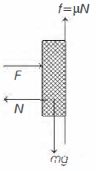
$A$ girl holds a book of mass $m$ against a vertical wall with a horizontal force $F$ using her finger,so that the book does not move. The frictional force on the book by the wall is
A
$F$ and along the finger but pointing towards the girl
B
$mg$ and upwards
C
$\mu F$ upwards,where $\mu$ is the coefficient of static friction
D
equal and opposite to the resultant of $F$ and $mg$
Solution
(B) For the book to remain in equilibrium,the net force acting on it must be zero.
$1$. The vertical forces acting on the book are its weight $mg$ acting downwards and the static frictional force $f$ acting upwards from the wall.
$2$. For the book not to move vertically,the frictional force must balance the weight of the book: $f = mg$.
$3$. The horizontal forces are the applied force $F$ and the normal reaction $N$ from the wall. Since there is no horizontal motion,$N = F$.
$4$. The maximum possible static friction is $f_{max} = \mu N = \mu F$. However,the actual static friction $f$ adjusts itself to balance the weight,provided $f \le f_{max}$.
$5$. Therefore,the frictional force is $mg$ and acts upwards to prevent the book from falling.
$1$. The vertical forces acting on the book are its weight $mg$ acting downwards and the static frictional force $f$ acting upwards from the wall.
$2$. For the book not to move vertically,the frictional force must balance the weight of the book: $f = mg$.
$3$. The horizontal forces are the applied force $F$ and the normal reaction $N$ from the wall. Since there is no horizontal motion,$N = F$.
$4$. The maximum possible static friction is $f_{max} = \mu N = \mu F$. However,the actual static friction $f$ adjusts itself to balance the weight,provided $f \le f_{max}$.
$5$. Therefore,the frictional force is $mg$ and acts upwards to prevent the book from falling.
0 likesView Solution
23
PhysicsDifficultMCQKVPY · 2012
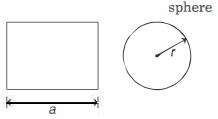
$A$ solid cube and a solid sphere,both made of the same material,are completely submerged in water but at different depths. The sphere and the cube have the same surface area. The buoyant force is
A
greater for the cube than the sphere
B
greater for the sphere than the cube
C
same for the sphere and the cube
D
greater for the object that is submerged deeper
Solution
(B) Given,surface area of cube $=$ surface area of sphere.
$6a^2 = 4\pi r^2 \Rightarrow \frac{a}{r} = \sqrt{\frac{4\pi}{6}} = \sqrt{\frac{2\pi}{3}}$.
Buoyant force $F_B = V \cdot \rho_f \cdot g$. Since both are completely submerged in the same fluid,the ratio of buoyant forces is equal to the ratio of their volumes:
$\frac{(F_B)_{\text{cube}}}{(F_B)_{\text{sphere}}} = \frac{V_{\text{cube}}}{V_{\text{sphere}}} = \frac{a^3}{\frac{4}{3}\pi r^3} = \frac{3}{4\pi} \left( \frac{a}{r} \right)^3$.
Substituting $\frac{a}{r} = \sqrt{\frac{2\pi}{3}}$:
$\frac{(F_B)_{\text{cube}}}{(F_B)_{\text{sphere}}} = \frac{3}{4\pi} \left( \sqrt{\frac{2\pi}{3}} \right)^3 = \frac{3}{4\pi} \cdot \frac{2\pi}{3} \cdot \sqrt{\frac{2\pi}{3}} = \frac{1}{2} \sqrt{\frac{2\pi}{3}} = \sqrt{\frac{2\pi}{3 \cdot 4}} = \sqrt{\frac{\pi}{6}}$.
Since $\pi \approx 3.14$,$\frac{\pi}{6} < 1$,therefore $\sqrt{\frac{\pi}{6}} < 1$.
This implies $(F_B)_{\text{cube}} < (F_B)_{\text{sphere}}$.
Thus,the buoyant force is greater for the sphere.
$6a^2 = 4\pi r^2 \Rightarrow \frac{a}{r} = \sqrt{\frac{4\pi}{6}} = \sqrt{\frac{2\pi}{3}}$.
Buoyant force $F_B = V \cdot \rho_f \cdot g$. Since both are completely submerged in the same fluid,the ratio of buoyant forces is equal to the ratio of their volumes:
$\frac{(F_B)_{\text{cube}}}{(F_B)_{\text{sphere}}} = \frac{V_{\text{cube}}}{V_{\text{sphere}}} = \frac{a^3}{\frac{4}{3}\pi r^3} = \frac{3}{4\pi} \left( \frac{a}{r} \right)^3$.
Substituting $\frac{a}{r} = \sqrt{\frac{2\pi}{3}}$:
$\frac{(F_B)_{\text{cube}}}{(F_B)_{\text{sphere}}} = \frac{3}{4\pi} \left( \sqrt{\frac{2\pi}{3}} \right)^3 = \frac{3}{4\pi} \cdot \frac{2\pi}{3} \cdot \sqrt{\frac{2\pi}{3}} = \frac{1}{2} \sqrt{\frac{2\pi}{3}} = \sqrt{\frac{2\pi}{3 \cdot 4}} = \sqrt{\frac{\pi}{6}}$.
Since $\pi \approx 3.14$,$\frac{\pi}{6} < 1$,therefore $\sqrt{\frac{\pi}{6}} < 1$.
This implies $(F_B)_{\text{cube}} < (F_B)_{\text{sphere}}$.
Thus,the buoyant force is greater for the sphere.
0 likesView Solution
24
PhysicsDifficultMCQKVPY · 2012
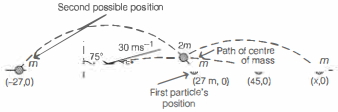
$A$ firecracker is thrown with a velocity of $30 \, ms^{-1}$ in a direction that makes an angle of $75^{\circ}$ with the vertical axis. At some point on its trajectory,the firecracker splits into two identical pieces in such a way that one piece falls $27 \, m$ far from the shooting point. Assuming that all trajectories are contained in the same plane,how far will the other piece fall from the shooting point? (Take $g = 10 \, ms^{-2}$ and neglect air resistance)
A
$63 \, m$ or $144 \, m$
B
$72 \, m$ or $99 \, m$
C
$28 \, m$ or $72 \, m$
D
$63 \, m$ or $117 \, m$
Solution
(D) The explosion force that splits the firecracker is internal to the system,so the path of the centre of mass of the system remains unchanged.
The range of the centre of mass of the system is given by $R = \frac{u^2 \sin 2\theta}{g}$.
Here,$u = 30 \, ms^{-1}$ and the angle with the horizontal is $\theta = 90^{\circ} - 75^{\circ} = 15^{\circ}$.
Therefore,$R = \frac{30 \times 30 \times \sin(2 \times 15^{\circ})}{10} = 90 \times \sin(30^{\circ}) = 90 \times 0.5 = 45 \, m$.
So,the position ($x$-coordinate) of the centre of mass is at $45 \, m$ distance from the origin.
Using the formula for the centre of mass,$X_{CM} = \frac{m_1 x_1 + m_2 x_2}{m_1 + m_2}$,where $m_1 = m_2 = m$ and $X_{CM} = 45 \, m$:
$45 = \frac{m(27) + m(x)}{m + m}$
$45 = \frac{27 + x}{2}$
$90 = 27 + x \Rightarrow x = 63 \, m$.
However,the first piece could also fall at $-27 \, m$ (behind the origin) if the explosion is strong enough to reverse its direction:
$45 = \frac{m(-27) + m(x)}{2m}$
$90 = -27 + x \Rightarrow x = 117 \, m$.
Thus,the other piece will fall at $63 \, m$ or $117 \, m$ from the shooting point.
The range of the centre of mass of the system is given by $R = \frac{u^2 \sin 2\theta}{g}$.
Here,$u = 30 \, ms^{-1}$ and the angle with the horizontal is $\theta = 90^{\circ} - 75^{\circ} = 15^{\circ}$.
Therefore,$R = \frac{30 \times 30 \times \sin(2 \times 15^{\circ})}{10} = 90 \times \sin(30^{\circ}) = 90 \times 0.5 = 45 \, m$.
So,the position ($x$-coordinate) of the centre of mass is at $45 \, m$ distance from the origin.
Using the formula for the centre of mass,$X_{CM} = \frac{m_1 x_1 + m_2 x_2}{m_1 + m_2}$,where $m_1 = m_2 = m$ and $X_{CM} = 45 \, m$:
$45 = \frac{m(27) + m(x)}{m + m}$
$45 = \frac{27 + x}{2}$
$90 = 27 + x \Rightarrow x = 63 \, m$.
However,the first piece could also fall at $-27 \, m$ (behind the origin) if the explosion is strong enough to reverse its direction:
$45 = \frac{m(-27) + m(x)}{2m}$
$90 = -27 + x \Rightarrow x = 117 \, m$.
Thus,the other piece will fall at $63 \, m$ or $117 \, m$ from the shooting point.
0 likesView Solution
25
PhysicsMediumMCQKVPY · 2012
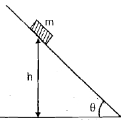
$A$ block of mass $m$ is sliding down an inclined plane with constant speed. At a certain instant $t_0$,its height above the ground is $h$. The coefficient of kinetic friction between the block and the plane is $\mu$. If the block reaches the ground at a later instant $t_g$,then the energy dissipated by friction in the time interval $(t_g - t_0)$ is
A
$\mu m g h$
B
$\mu m g h / \sin \theta$
C
$m g h$
D
$\mu m g h / \cos \theta$
Solution
(C) Since the block is sliding down the inclined plane with a constant speed,its acceleration is zero. Therefore,the change in kinetic energy $(\Delta KE)$ of the block as it moves from height $h$ to the ground is zero.
According to the work-energy theorem,the total work done on the block is equal to the change in its kinetic energy:
$W_{\text{total}} = \Delta KE = 0$
The total work done is the sum of the work done by gravity $(W_{\text{gravity}})$ and the work done by friction $(W_{\text{friction}})$:
$W_{\text{gravity}} + W_{\text{friction}} = 0$
The work done by gravity as the block descends a vertical height $h$ is $W_{\text{gravity}} = mgh$.
Substituting this into the equation:
$mgh + W_{\text{friction}} = 0$
$W_{\text{friction}} = -mgh$
The energy dissipated by friction is the magnitude of the work done by the friction force:
$\text{Energy dissipated} = |W_{\text{friction}}| = mgh$.
According to the work-energy theorem,the total work done on the block is equal to the change in its kinetic energy:
$W_{\text{total}} = \Delta KE = 0$
The total work done is the sum of the work done by gravity $(W_{\text{gravity}})$ and the work done by friction $(W_{\text{friction}})$:
$W_{\text{gravity}} + W_{\text{friction}} = 0$
The work done by gravity as the block descends a vertical height $h$ is $W_{\text{gravity}} = mgh$.
Substituting this into the equation:
$mgh + W_{\text{friction}} = 0$
$W_{\text{friction}} = -mgh$
The energy dissipated by friction is the magnitude of the work done by the friction force:
$\text{Energy dissipated} = |W_{\text{friction}}| = mgh$.
0 likesView Solution
26
PhysicsMediumMCQKVPY · 2012
$150 \,g$ of ice is mixed with $100 \,g$ of water at temperature $80^{\circ} C$. The latent heat of ice is $80 \,cal/g$ and the specific heat of water is $1 \,cal/g^{\circ} C$. Assuming no heat loss to the environment,the amount of ice which does not melt is ........... $g$.
A
$100$
B
$0$
C
$150$
D
$50$
Solution
(D) Let $m$ be the mass of ice that melts to reach a final equilibrium temperature of $0^{\circ} C$.
According to the principle of calorimetry,Heat lost by water = Heat gained by ice.
Heat lost by $100 \,g$ of water cooling from $80^{\circ} C$ to $0^{\circ} C$ is $Q_{lost} = m_w \cdot s_w \cdot \Delta T = 100 \times 1 \times (80 - 0) = 8000 \,cal$.
Heat required to melt $m$ grams of ice at $0^{\circ} C$ is $Q_{gained} = m \cdot L_f = m \times 80$.
Equating the two: $80m = 8000$.
Solving for $m$: $m = 100 \,g$.
Since the total mass of ice is $150 \,g$,the amount of ice that does not melt is $150 \,g - 100 \,g = 50 \,g$.
According to the principle of calorimetry,Heat lost by water = Heat gained by ice.
Heat lost by $100 \,g$ of water cooling from $80^{\circ} C$ to $0^{\circ} C$ is $Q_{lost} = m_w \cdot s_w \cdot \Delta T = 100 \times 1 \times (80 - 0) = 8000 \,cal$.
Heat required to melt $m$ grams of ice at $0^{\circ} C$ is $Q_{gained} = m \cdot L_f = m \times 80$.
Equating the two: $80m = 8000$.
Solving for $m$: $m = 100 \,g$.
Since the total mass of ice is $150 \,g$,the amount of ice that does not melt is $150 \,g - 100 \,g = 50 \,g$.
0 likesView Solution
27
PhysicsDifficultMCQKVPY · 2012
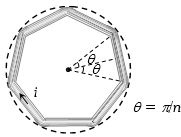
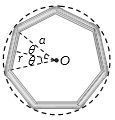
In the following figure,a wire bent in the form of a regular polygon of $n$ sides is inscribed in a circle of radius $a$. The net magnetic field at the centre will be
A
$\frac{{{\mu _0}i}}{{2\pi a}}\tan \frac{\pi }{n}$
B
$\frac{{{\mu _0}ni}}{{2\pi a}}\tan \frac{\pi }{n}$
C
$\frac{2}{\pi }\frac{{ni}}{a}{\mu _0}\tan \frac{\pi }{n}$
D
$\frac{{ni}}{{2a}}{\mu _0}\tan \frac{\pi }{n}$
Solution
(B) The magnetic field at the centre due to a straight wire of length $L$ carrying current $i$ at a perpendicular distance $r$ is given by $B = \frac{{{\mu _0}i}}{{4\pi r}}(\sin \phi_1 + \sin \phi_2)$.
For one side of the regular polygon,the angle subtended by half the side at the centre is $\theta = \frac{\pi}{n}$.
The perpendicular distance from the centre to the side is $r = a \cos \theta = a \cos(\frac{\pi}{n})$.
The angles at the ends of the side are $\phi_1 = \phi_2 = \theta = \frac{\pi}{n}$.
Thus,the magnetic field due to one side is $B_1 = \frac{{{\mu _0}i}}{{4\pi (a \cos \theta)}} (2 \sin \theta) = \frac{{{\mu _0}i}}{{2\pi a}} \tan \theta = \frac{{{\mu _0}i}}{{2\pi a}} \tan(\frac{\pi}{n})$.
Since there are $n$ such sides,the net magnetic field at the centre is $B_{net} = n \times B_1 = \frac{{n{\mu _0}i}}{{2\pi a}} \tan(\frac{\pi}{n})$.
For one side of the regular polygon,the angle subtended by half the side at the centre is $\theta = \frac{\pi}{n}$.
The perpendicular distance from the centre to the side is $r = a \cos \theta = a \cos(\frac{\pi}{n})$.
The angles at the ends of the side are $\phi_1 = \phi_2 = \theta = \frac{\pi}{n}$.
Thus,the magnetic field due to one side is $B_1 = \frac{{{\mu _0}i}}{{4\pi (a \cos \theta)}} (2 \sin \theta) = \frac{{{\mu _0}i}}{{2\pi a}} \tan \theta = \frac{{{\mu _0}i}}{{2\pi a}} \tan(\frac{\pi}{n})$.
Since there are $n$ such sides,the net magnetic field at the centre is $B_{net} = n \times B_1 = \frac{{n{\mu _0}i}}{{2\pi a}} \tan(\frac{\pi}{n})$.
0 likesView Solution
28
PhysicsDifficultMCQKVPY · 2012
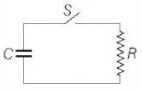
The capacitor of capacitance $C$ in the circuit shown is fully charged initially. The resistance is $R$. After the switch $S$ is closed,the time taken to reduce the stored energy in the capacitor to half its initial value is
A
$\frac{R C}{2}$
B
$R C \ln 2$
C
$2 R C \ln 2$
D
$\frac{R C \ln 2}{2}$
Solution
(D) The energy stored in a capacitor is given by $U = \frac{q^2}{2C}$.
During the discharging of an $RC$ circuit,the charge on the capacitor at any time $t$ is given by $q = q_0 e^{-t / RC}$.
Substituting this into the energy formula,we get $U = \frac{(q_0 e^{-t / RC})^2}{2C} = \frac{q_0^2}{2C} e^{-2t / RC} = U_0 e^{-2t / RC}$,where $U_0$ is the initial energy.
We want the time $t$ when $U = \frac{U_0}{2}$.
Setting the equations equal: $\frac{U_0}{2} = U_0 e^{-2t / RC}$.
Dividing by $U_0$: $\frac{1}{2} = e^{-2t / RC}$.
Taking the natural logarithm on both sides: $\ln(1/2) = -2t / RC$.
Since $\ln(1/2) = -\ln 2$,we have $-\ln 2 = -2t / RC$.
Solving for $t$: $t = \frac{RC \ln 2}{2}$.
During the discharging of an $RC$ circuit,the charge on the capacitor at any time $t$ is given by $q = q_0 e^{-t / RC}$.
Substituting this into the energy formula,we get $U = \frac{(q_0 e^{-t / RC})^2}{2C} = \frac{q_0^2}{2C} e^{-2t / RC} = U_0 e^{-2t / RC}$,where $U_0$ is the initial energy.
We want the time $t$ when $U = \frac{U_0}{2}$.
Setting the equations equal: $\frac{U_0}{2} = U_0 e^{-2t / RC}$.
Dividing by $U_0$: $\frac{1}{2} = e^{-2t / RC}$.
Taking the natural logarithm on both sides: $\ln(1/2) = -2t / RC$.
Since $\ln(1/2) = -\ln 2$,we have $-\ln 2 = -2t / RC$.
Solving for $t$: $t = \frac{RC \ln 2}{2}$.
0 likesView Solution
29
PhysicsMediumMCQKVPY · 2012
In a Young's double slit experiment,the intensity of light at each slit is $I_0$. An interference pattern is observed along a direction parallel to the line $S_1 S_2$ on screen $S$. Find the minimum,maximum,and the intensity averaged over the entire screen,respectively.
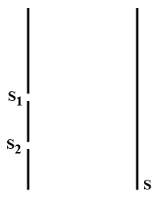
A
$0, 4 I_0, 2 I_0$
B
$I_0, 2 I_0, 3 I_0 / 2$
C
$0, 4 I_0, I_0$
D
$0, 2 I_0, I_0$
Solution
(A) In a Young's double slit experiment,the resultant intensity $I$ at any point on the screen is given by $I = I_1 + I_2 + 2\sqrt{I_1 I_2} \cos \phi$,where $I_1 = I_2 = I_0$.
Thus,$I = 2 I_0 + 2 I_0 \cos \phi = 4 I_0 \cos^2(\phi / 2)$.
$1$. The minimum intensity occurs when $\cos^2(\phi / 2) = 0$,so $I_{\min} = 0$.
$2$. The maximum intensity occurs when $\cos^2(\phi / 2) = 1$,so $I_{\max} = 4 I_0$.
$3$. The average intensity $I_{\text{avg}}$ over the entire screen is the average of $I_{\max}$ and $I_{\min}$ for a sinusoidal interference pattern,which is $I_{\text{avg}} = \frac{I_{\max} + I_{\min}}{2} = \frac{4 I_0 + 0}{2} = 2 I_0$.
Therefore,the values are $0, 4 I_0, 2 I_0$.
Thus,$I = 2 I_0 + 2 I_0 \cos \phi = 4 I_0 \cos^2(\phi / 2)$.
$1$. The minimum intensity occurs when $\cos^2(\phi / 2) = 0$,so $I_{\min} = 0$.
$2$. The maximum intensity occurs when $\cos^2(\phi / 2) = 1$,so $I_{\max} = 4 I_0$.
$3$. The average intensity $I_{\text{avg}}$ over the entire screen is the average of $I_{\max}$ and $I_{\min}$ for a sinusoidal interference pattern,which is $I_{\text{avg}} = \frac{I_{\max} + I_{\min}}{2} = \frac{4 I_0 + 0}{2} = 2 I_0$.
Therefore,the values are $0, 4 I_0, 2 I_0$.
0 likesView Solution
30
PhysicsMediumMCQKVPY · 2012
$A$ conducting rod of mass $m$ and length $l$ is free to move without friction on two parallel long conducting rails,as shown in the figure. There is a resistance $R$ across the rails. In the entire space,there is a uniform magnetic field $B$ normal to the plane of the rod and rails. The rod is given an impulsive velocity $v_0$. What happens to the initial kinetic energy $\frac{1}{2} m v_0^2$?
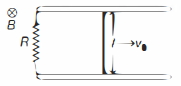
A
It will be converted fully into heat energy in the resistor.
B
It will enable the rod to continue to move with velocity $v_0$,since the rails are frictionless.
C
It will be converted fully into magnetic energy due to induced current.
D
It will be converted into the work done against the magnetic field.
Solution
(A) When the conducting rod moves with velocity $v$ in a uniform magnetic field $B$,a motional $emf$ $\varepsilon = Blv$ is induced across the rod.
This $emf$ drives an induced current $I = \frac{\varepsilon}{R} = \frac{Blv}{R}$ through the circuit.
The current-carrying rod in the magnetic field experiences a magnetic force $F_m = IlB = \frac{B^2l^2v}{R}$ acting in the direction opposite to the velocity $v$.
This force causes the rod to decelerate. As the rod moves,the kinetic energy is dissipated as heat in the resistor due to the Joule heating effect $(P = I^2R)$.
Since there is no other external force or energy storage mechanism (like a capacitor or inductor),the entire initial kinetic energy $\frac{1}{2} m v_0^2$ will eventually be dissipated as heat in the resistor $R$ as the rod comes to rest.
This $emf$ drives an induced current $I = \frac{\varepsilon}{R} = \frac{Blv}{R}$ through the circuit.
The current-carrying rod in the magnetic field experiences a magnetic force $F_m = IlB = \frac{B^2l^2v}{R}$ acting in the direction opposite to the velocity $v$.
This force causes the rod to decelerate. As the rod moves,the kinetic energy is dissipated as heat in the resistor due to the Joule heating effect $(P = I^2R)$.
Since there is no other external force or energy storage mechanism (like a capacitor or inductor),the entire initial kinetic energy $\frac{1}{2} m v_0^2$ will eventually be dissipated as heat in the resistor $R$ as the rod comes to rest.
0 likesView Solution
31
PhysicsMediumMCQKVPY · 2012
$A$ steady current $I$ flows through a wire of radius $r$,length $L$ and resistivity $\rho$. The current produces heat in the wire. The rate of heat loss in a wire is proportional to its surface area. The steady temperature of the wire is independent of
A
$L$
B
$r$
C
$I$
D
$\rho$
Solution
(A) The rate of heat generated in the wire is given by $Q_2 = I^2 R$. Since resistance $R = \frac{\rho L}{\pi r^2}$,we have $Q_2 = \frac{I^2 \rho L}{\pi r^2}$.
The rate of heat loss $Q_1$ is proportional to the surface area $A = 2 \pi r L$. Thus,$Q_1 = k (2 \pi r L) \Delta T$,where $k$ is a constant and $\Delta T$ is the temperature difference.
In a steady state,the rate of heat generated equals the rate of heat loss: $Q_2 = Q_1$.
$\frac{I^2 \rho L}{\pi r^2} = k (2 \pi r L) \Delta T$.
Solving for $\Delta T$: $\Delta T = \frac{I^2 \rho L}{\pi r^2 \cdot 2 \pi r L k} = \frac{I^2 \rho}{2 \pi^2 r^3 k}$.
Since the length $L$ cancels out from both sides,the steady-state temperature difference $\Delta T$ is independent of the length $L$ of the wire.
The rate of heat loss $Q_1$ is proportional to the surface area $A = 2 \pi r L$. Thus,$Q_1 = k (2 \pi r L) \Delta T$,where $k$ is a constant and $\Delta T$ is the temperature difference.
In a steady state,the rate of heat generated equals the rate of heat loss: $Q_2 = Q_1$.
$\frac{I^2 \rho L}{\pi r^2} = k (2 \pi r L) \Delta T$.
Solving for $\Delta T$: $\Delta T = \frac{I^2 \rho L}{\pi r^2 \cdot 2 \pi r L k} = \frac{I^2 \rho}{2 \pi^2 r^3 k}$.
Since the length $L$ cancels out from both sides,the steady-state temperature difference $\Delta T$ is independent of the length $L$ of the wire.
0 likesView Solution
32
PhysicsDifficultMCQKVPY · 2012
In one model of the electron,the electron of mass $m_e$ is thought to be a uniformly charged shell of radius $R$ and total charge $e$,whose electrostatic energy $E$ is equivalent to its mass $m_e$ via Einstein's mass-energy relation $E = m_e c^2$. In this model,$R$ is approximately ($m_e = 9.1 \times 10^{-31} \, kg$,$c = 3 \times 10^8 \, ms^{-1}$,$1 / 4 \pi \varepsilon_0 = 9 \times 10^9 \, Nm^2C^{-2}$,magnitude of the electron charge $e = 1.6 \times 10^{-19} \, C$).
A
$1.4 \times 10^{-15} \, m$
B
$2 \times 10^{-13} \, m$
C
$5.3 \times 10^{-11} \, m$
D
$2.8 \times 10^{-35} \, m$
Solution
(A) The electrostatic potential energy $E$ of a uniformly charged spherical shell of radius $R$ and charge $e$ is given by $E = \frac{e^2}{8 \pi \varepsilon_0 R}$.
According to Einstein's mass-energy equivalence,$E = m_e c^2$.
Equating the two expressions for energy,we get $\frac{e^2}{8 \pi \varepsilon_0 R} = m_e c^2$.
Rearranging for $R$,we have $R = \frac{e^2}{8 \pi \varepsilon_0 m_e c^2} = \frac{1}{2} \left( \frac{e^2}{4 \pi \varepsilon_0 m_e c^2} \right)$.
Substituting the given values: $R = \frac{(1.6 \times 10^{-19})^2 \times 9 \times 10^9}{2 \times 9.1 \times 10^{-31} \times (3 \times 10^8)^2}$.
$R = \frac{2.56 \times 10^{-38} \times 9 \times 10^9}{2 \times 9.1 \times 10^{-31} \times 9 \times 10^{16}} = \frac{2.56 \times 10^{-29}}{18.2 \times 10^{-15}} \approx 0.14 \times 10^{-14} \, m = 1.4 \times 10^{-15} \, m$.
According to Einstein's mass-energy equivalence,$E = m_e c^2$.
Equating the two expressions for energy,we get $\frac{e^2}{8 \pi \varepsilon_0 R} = m_e c^2$.
Rearranging for $R$,we have $R = \frac{e^2}{8 \pi \varepsilon_0 m_e c^2} = \frac{1}{2} \left( \frac{e^2}{4 \pi \varepsilon_0 m_e c^2} \right)$.
Substituting the given values: $R = \frac{(1.6 \times 10^{-19})^2 \times 9 \times 10^9}{2 \times 9.1 \times 10^{-31} \times (3 \times 10^8)^2}$.
$R = \frac{2.56 \times 10^{-38} \times 9 \times 10^9}{2 \times 9.1 \times 10^{-31} \times 9 \times 10^{16}} = \frac{2.56 \times 10^{-29}}{18.2 \times 10^{-15}} \approx 0.14 \times 10^{-14} \, m = 1.4 \times 10^{-15} \, m$.
0 likesView Solution
33
PhysicsMediumMCQKVPY · 2012
$A$ parent nucleus $X$ decays into a daughter nucleus $Y$,which in turn decays into $Z$. The half-lives of $X$ and $Y$ are $40000 \, yr$ and $20 \, yr$,respectively. In a certain sample,it is found that the number of $Y$ nuclei hardly changes with time. If the number of $X$ nuclei in the sample is $4 \times 10^{20}$,the number of $Y$ nuclei present in it is
A
$2 \times 10^{17}$
B
$2 \times 10^{20}$
C
$4 \times 10^{23}$
D
$4 \times 10^{20}$
Solution
(A) The decay process is given by $X \xrightarrow{T_{1/2, X} = 40000 \, yr} Y \xrightarrow{T_{1/2, Y} = 20 \, yr} Z$.
Since the number of $Y$ nuclei remains constant over time,the rate of production of $Y$ must equal the rate of decay of $Y$.
This condition is known as secular equilibrium.
Therefore,$\lambda_X N_X = \lambda_Y N_Y$.
Using the relation $\lambda = \frac{\ln 2}{T_{1/2}}$,we get $\frac{\ln 2}{T_X} N_X = \frac{\ln 2}{T_Y} N_Y$.
This simplifies to $\frac{N_X}{T_X} = \frac{N_Y}{T_Y}$.
Rearranging for $N_Y$,we get $N_Y = N_X \times \frac{T_Y}{T_X}$.
Substituting the given values: $N_Y = (4 \times 10^{20}) \times \frac{20}{40000}$.
$N_Y = (4 \times 10^{20}) \times \frac{1}{2000} = 2 \times 10^{17}$ nuclei.
Since the number of $Y$ nuclei remains constant over time,the rate of production of $Y$ must equal the rate of decay of $Y$.
This condition is known as secular equilibrium.
Therefore,$\lambda_X N_X = \lambda_Y N_Y$.
Using the relation $\lambda = \frac{\ln 2}{T_{1/2}}$,we get $\frac{\ln 2}{T_X} N_X = \frac{\ln 2}{T_Y} N_Y$.
This simplifies to $\frac{N_X}{T_X} = \frac{N_Y}{T_Y}$.
Rearranging for $N_Y$,we get $N_Y = N_X \times \frac{T_Y}{T_X}$.
Substituting the given values: $N_Y = (4 \times 10^{20}) \times \frac{20}{40000}$.
$N_Y = (4 \times 10^{20}) \times \frac{1}{2000} = 2 \times 10^{17}$ nuclei.
0 likesView Solution
34
PhysicsMediumMCQKVPY · 2012
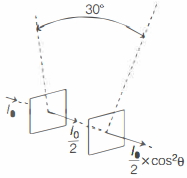
An unpolarised beam of light of intensity $I_0$ passes through two linear polarisers making an angle of $30^{\circ}$ with respect to each other. The emergent beam will have an intensity:
A
$\frac{3 I_0}{4}$
B
$\frac{\sqrt{3} I_0}{4}$
C
$\frac{3 I_0}{8}$
D
$\frac{I_0}{8}$
Solution
(C) When an unpolarised light of intensity $I_0$ passes through the first polariser,the intensity of the transmitted light becomes $I_1 = \frac{I_0}{2}$.
Now,this polarised light passes through the second polariser,which is at an angle $\theta = 30^{\circ}$ with respect to the first one. According to Malus' Law,the intensity of the emergent light $I'$ is given by:
$I' = I_1 \cos^2 \theta$
Substituting the values:
$I' = \frac{I_0}{2} \times \cos^2 30^{\circ}$
$I' = \frac{I_0}{2} \times \left( \frac{\sqrt{3}}{2} \right)^2$
$I' = \frac{I_0}{2} \times \frac{3}{4}$
$I' = \frac{3 I_0}{8}$
Now,this polarised light passes through the second polariser,which is at an angle $\theta = 30^{\circ}$ with respect to the first one. According to Malus' Law,the intensity of the emergent light $I'$ is given by:
$I' = I_1 \cos^2 \theta$
Substituting the values:
$I' = \frac{I_0}{2} \times \cos^2 30^{\circ}$
$I' = \frac{I_0}{2} \times \left( \frac{\sqrt{3}}{2} \right)^2$
$I' = \frac{I_0}{2} \times \frac{3}{4}$
$I' = \frac{3 I_0}{8}$
0 likesView Solution
35
PhysicsMediumMCQKVPY · 2012
$A$ radioactive nucleus $A$ has a single decay mode with half-life $\tau_A$. Another radioactive nucleus $B$ has two decay modes $1$ and $2$. If decay mode $2$ were absent,the half-life of $B$ would have been $\tau_A / 2$. If decay mode $1$ were absent,the half-life of $B$ would have been $3 \tau_A$. If the actual half-life of $B$ is $\tau_B$,then the ratio $\tau_B / \tau_A$ is
A
$3 / 7$
B
$7 / 2$
C
$7 / 3$
D
$1$
Solution
(A) For a radioactive nucleus with multiple decay modes,the total decay constant $\lambda_B$ is the sum of the individual decay constants: $\lambda_B = \lambda_1 + \lambda_2$.
Since the decay constant $\lambda$ is related to the half-life $\tau$ by $\lambda = \ln(2) / \tau$,we can write the relationship as $1 / \tau_B = 1 / \tau_1 + 1 / \tau_2$.
Given that if decay mode $2$ were absent,the half-life is $\tau_1 = \tau_A / 2$.
Given that if decay mode $1$ were absent,the half-life is $\tau_2 = 3 \tau_A$.
Substituting these into the formula for the actual half-life $\tau_B$:
$1 / \tau_B = 1 / (\tau_A / 2) + 1 / (3 \tau_A)$
$1 / \tau_B = 2 / \tau_A + 1 / (3 \tau_A)$
$1 / \tau_B = (6 + 1) / (3 \tau_A) = 7 / (3 \tau_A)$
Therefore,$\tau_B = (3 / 7) \tau_A$,which implies $\tau_B / \tau_A = 3 / 7$.
Since the decay constant $\lambda$ is related to the half-life $\tau$ by $\lambda = \ln(2) / \tau$,we can write the relationship as $1 / \tau_B = 1 / \tau_1 + 1 / \tau_2$.
Given that if decay mode $2$ were absent,the half-life is $\tau_1 = \tau_A / 2$.
Given that if decay mode $1$ were absent,the half-life is $\tau_2 = 3 \tau_A$.
Substituting these into the formula for the actual half-life $\tau_B$:
$1 / \tau_B = 1 / (\tau_A / 2) + 1 / (3 \tau_A)$
$1 / \tau_B = 2 / \tau_A + 1 / (3 \tau_A)$
$1 / \tau_B = (6 + 1) / (3 \tau_A) = 7 / (3 \tau_A)$
Therefore,$\tau_B = (3 / 7) \tau_A$,which implies $\tau_B / \tau_A = 3 / 7$.
0 likesView Solution
36
PhysicsMediumMCQKVPY · 2012
$A$ stream of photons having energy $3 \,eV$ each impinges on a potassium surface. The work function of potassium is $2.3 \,eV$. The emerging photo-electrons are slowed down by a copper plate placed $5 \,mm$ away. If the potential difference between the two metal plates is $1 \,V$,the maximum distance the electrons can move away from the potassium surface before being turned back is .......... $mm$.
A
$3.5$
B
$1.5$
C
$2.5$
D
$5.0$
Solution
(A) The energy of the emergent photo-electron is given by Einstein's photoelectric equation: $E_{max} = h\nu - \Phi_0$.
Given,incident photon energy $h\nu = 3 \,eV$ and work function $\Phi_0 = 2.3 \,eV$.
Therefore,the maximum kinetic energy $E_{max} = 3 - 2.3 = 0.7 \,eV$.
This implies that the electron will turn back when it encounters a retarding potential difference of $0.7 \,V$.
The potential difference between the two plates is $1 \,V$ over a distance of $5 \,mm$.
Assuming a uniform electric field,the potential gradient is $\frac{1 \,V}{5 \,mm} = 0.2 \,V/mm$.
The distance $d$ required to reach a potential difference of $0.7 \,V$ is given by $d = \frac{V_{stop}}{\text{gradient}} = \frac{0.7 \,V}{0.2 \,V/mm} = 3.5 \,mm$.
Thus,the photo-electron turns back after traveling $3.5 \,mm$.
Given,incident photon energy $h\nu = 3 \,eV$ and work function $\Phi_0 = 2.3 \,eV$.
Therefore,the maximum kinetic energy $E_{max} = 3 - 2.3 = 0.7 \,eV$.
This implies that the electron will turn back when it encounters a retarding potential difference of $0.7 \,V$.
The potential difference between the two plates is $1 \,V$ over a distance of $5 \,mm$.
Assuming a uniform electric field,the potential gradient is $\frac{1 \,V}{5 \,mm} = 0.2 \,V/mm$.
The distance $d$ required to reach a potential difference of $0.7 \,V$ is given by $d = \frac{V_{stop}}{\text{gradient}} = \frac{0.7 \,V}{0.2 \,V/mm} = 3.5 \,mm$.
Thus,the photo-electron turns back after traveling $3.5 \,mm$.
0 likesView Solution
37
PhysicsDifficultMCQKVPY · 2012
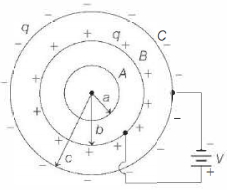
Consider three concentric metallic spheres $A, B$ and $C$ of radii $a, b, c$ respectively,where $a < b < c$. $A$ and $B$ are connected,whereas $C$ is grounded. The potential of the middle sphere $B$ is raised to $V$. Then the charge on the sphere $C$ is
A
$-4 \pi \varepsilon_0 V \frac{b c}{c-b}$
B
$+4 \pi \varepsilon_0 V \frac{b c}{c-b}$
C
$-4 \pi \varepsilon_0 V \frac{a c}{c-a}$
D
zero
Solution
(A) Since spheres $A$ and $B$ are connected,they act as a single conductor at the same potential. Let the charge on the combined system $(A+B)$ be $q$ and the charge on sphere $C$ be $Q_C$.
The potential of the system $(A+B)$ is given by:
$V_B = \frac{1}{4 \pi \varepsilon_0} \left( \frac{q}{b} + \frac{Q_C}{c} \right) = V$
Since sphere $C$ is grounded,its potential is zero:
$V_C = \frac{1}{4 \pi \varepsilon_0} \left( \frac{q}{c} + \frac{Q_C}{c} \right) = 0$
From the second equation,we get $q + Q_C = 0$,which implies $q = -Q_C$.
Substituting $q = -Q_C$ into the first equation:
$V = \frac{1}{4 \pi \varepsilon_0} \left( \frac{-Q_C}{b} + \frac{Q_C}{c} \right)$
$V = \frac{Q_C}{4 \pi \varepsilon_0} \left( \frac{1}{c} - \frac{1}{b} \right) = \frac{Q_C}{4 \pi \varepsilon_0} \left( \frac{b-c}{bc} \right)$
Solving for $Q_C$:
$Q_C = 4 \pi \varepsilon_0 V \left( \frac{bc}{b-c} \right) = -4 \pi \varepsilon_0 V \left( \frac{bc}{c-b} \right)$
The potential of the system $(A+B)$ is given by:
$V_B = \frac{1}{4 \pi \varepsilon_0} \left( \frac{q}{b} + \frac{Q_C}{c} \right) = V$
Since sphere $C$ is grounded,its potential is zero:
$V_C = \frac{1}{4 \pi \varepsilon_0} \left( \frac{q}{c} + \frac{Q_C}{c} \right) = 0$
From the second equation,we get $q + Q_C = 0$,which implies $q = -Q_C$.
Substituting $q = -Q_C$ into the first equation:
$V = \frac{1}{4 \pi \varepsilon_0} \left( \frac{-Q_C}{b} + \frac{Q_C}{c} \right)$
$V = \frac{Q_C}{4 \pi \varepsilon_0} \left( \frac{1}{c} - \frac{1}{b} \right) = \frac{Q_C}{4 \pi \varepsilon_0} \left( \frac{b-c}{bc} \right)$
Solving for $Q_C$:
$Q_C = 4 \pi \varepsilon_0 V \left( \frac{bc}{b-c} \right) = -4 \pi \varepsilon_0 V \left( \frac{bc}{c-b} \right)$
0 likesView Solution
38
PhysicsDifficultMCQKVPY · 2012
On a bright sunny day,a diver of height $h$ stands at the bottom of a lake of depth $H$. Looking upward,he can see objects outside the lake in a circular region of radius $R$. Beyond this circle,he sees the images of objects lying on the floor of the lake. If the refractive index of water is $4/3$,then the value of $R$ is:
A
$\frac{3(H-h)}{\sqrt{7}}$
B
$3h\sqrt{7}$
C
$\frac{(H-h)}{\sqrt{7/3}}$
D
$\frac{(H-h)}{\sqrt{5/3}}$
Solution
(A) Let $R$ be the radius of the circular region through which outside objects are visible.
Let $\theta$ be the critical angle for the water-air interface.
Then,$\sin \theta = \frac{1}{\mu} = \frac{1}{4/3} = \frac{3}{4}$.
Now,$\tan \theta = \frac{\sin \theta}{\cos \theta} = \frac{\sin \theta}{\sqrt{1 - \sin^2 \theta}}$.
Substituting the value of $\sin \theta$:
$\tan \theta = \frac{3/4}{\sqrt{1 - (3/4)^2}} = \frac{3/4}{\sqrt{1 - 9/16}} = \frac{3/4}{\sqrt{7/16}} = \frac{3/4}{\sqrt{7}/4} = \frac{3}{\sqrt{7}}$.
From the geometry of the problem,the diver's eyes are at a height $h$ from the bottom,so the distance from the water surface is $(H-h)$.
Thus,$\tan \theta = \frac{R}{H-h}$.
Equating the two expressions for $\tan \theta$:
$\frac{R}{H-h} = \frac{3}{\sqrt{7}}$.
Therefore,$R = \frac{3(H-h)}{\sqrt{7}}$.
Let $\theta$ be the critical angle for the water-air interface.
Then,$\sin \theta = \frac{1}{\mu} = \frac{1}{4/3} = \frac{3}{4}$.
Now,$\tan \theta = \frac{\sin \theta}{\cos \theta} = \frac{\sin \theta}{\sqrt{1 - \sin^2 \theta}}$.
Substituting the value of $\sin \theta$:
$\tan \theta = \frac{3/4}{\sqrt{1 - (3/4)^2}} = \frac{3/4}{\sqrt{1 - 9/16}} = \frac{3/4}{\sqrt{7/16}} = \frac{3/4}{\sqrt{7}/4} = \frac{3}{\sqrt{7}}$.
From the geometry of the problem,the diver's eyes are at a height $h$ from the bottom,so the distance from the water surface is $(H-h)$.
Thus,$\tan \theta = \frac{R}{H-h}$.
Equating the two expressions for $\tan \theta$:
$\frac{R}{H-h} = \frac{3}{\sqrt{7}}$.
Therefore,$R = \frac{3(H-h)}{\sqrt{7}}$.
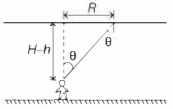
0 likesView Solution
39
PhysicsDifficultMCQKVPY · 2012
$A$ cube is formed with ten identical resistances $R$ (thick lines) and two shorting wires (dotted lines) along the arms $AC$ and $BD$ as shown in the figure below. The resistance between point $A$ and $B$ is ........... $\Omega$.
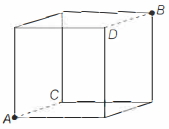
A
$\frac{R}{2}$
B
$\frac{5R}{6}$
C
$\frac{3R}{4}$
D
$R$
Solution
(A) To find the equivalent resistance between points $A$ and $B$,we first note that the shorting wires along $AC$ and $BD$ make the potential at $A$ equal to the potential at $C$ $(V_A = V_C)$ and the potential at $B$ equal to the potential at $D$ $(V_B = V_D)$.
By collapsing the nodes $A$ and $C$ into a single node and $B$ and $D$ into another single node,we can redraw the circuit.
In this configuration,the ten resistors are arranged such that they form two parallel branches,each consisting of five resistors in a series-parallel combination. Specifically,the symmetry of the cube allows us to simplify the network into two parallel paths,each having an equivalent resistance of $R$.
Thus,the total equivalent resistance $R_{AB}$ is given by the parallel combination of these two paths:
$R_{AB} = \frac{R \times R}{R + R} = \frac{R}{2} \, \Omega$.
By collapsing the nodes $A$ and $C$ into a single node and $B$ and $D$ into another single node,we can redraw the circuit.
In this configuration,the ten resistors are arranged such that they form two parallel branches,each consisting of five resistors in a series-parallel combination. Specifically,the symmetry of the cube allows us to simplify the network into two parallel paths,each having an equivalent resistance of $R$.
Thus,the total equivalent resistance $R_{AB}$ is given by the parallel combination of these two paths:
$R_{AB} = \frac{R \times R}{R + R} = \frac{R}{2} \, \Omega$.
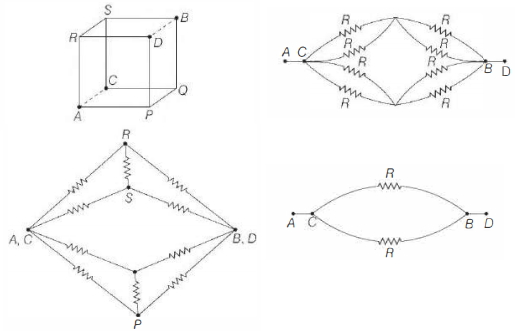
0 likesView Solution
40
PhysicsMediumMCQKVPY · 2012
Which of the following statements is true about the flow of electrons in an electric circuit?
A
Electrons always flow from lower to higher potential
B
Electrons always flow from higher to lower potential
C
Electrons flow from lower to higher potential,except through power sources
D
Electrons flow from higher to lower potential,except through power sources
Solution
(C) The correct answer is $(c)$.
In an external circuit,free electrons experience an electrostatic force in the direction opposite to the electric field because they carry a negative charge.
The electric field is always directed from higher potential to lower potential.
Therefore,electrons naturally flow from lower potential to higher potential in an external circuit to reach equilibrium.
However,inside a power source (like a battery),non-electrostatic forces (chemical or magnetic) do work to move electrons from higher potential to lower potential,maintaining the potential difference in the circuit.
Thus,electrons flow from lower to higher potential,except through power sources.
In an external circuit,free electrons experience an electrostatic force in the direction opposite to the electric field because they carry a negative charge.
The electric field is always directed from higher potential to lower potential.
Therefore,electrons naturally flow from lower potential to higher potential in an external circuit to reach equilibrium.
However,inside a power source (like a battery),non-electrostatic forces (chemical or magnetic) do work to move electrons from higher potential to lower potential,maintaining the potential difference in the circuit.
Thus,electrons flow from lower to higher potential,except through power sources.
0 likesView Solution
41
PhysicsMediumMCQKVPY · 2012
In the figure below,$PQRS$ denotes the path followed by a ray of light as it travels through three media in succession. The absolute refractive indices of the media are $\mu_1, \mu_2$ and $\mu_3$,respectively. (The line segment $RS$ in the figure is parallel to $PQ$). Then,
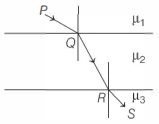
A
$\mu_1 > \mu_2 > \mu_3$
B
$\mu_1 = \mu_3 < \mu_2$
C
$\mu_1 < \mu_2 < \mu_3$
D
$\mu_1 < \mu_3 < \mu_2$
Solution
(B) According to Snell's Law,when a light ray travels from a medium with refractive index $\mu_1$ to a medium with refractive index $\mu_2$,it bends towards the normal if $\mu_2 > \mu_1$.
At point $Q$,the light ray bends towards the normal,which implies that $\mu_2 > \mu_1$.
At point $R$,the light ray bends away from the normal,which implies that $\mu_3 < \mu_2$.
Since the emergent ray $RS$ is parallel to the incident ray $PQ$,the total deviation produced by the two interfaces must be zero. This occurs when the refractive indices of the first and third media are equal,i.e.,$\mu_1 = \mu_3$.
Combining these observations,we get $\mu_1 = \mu_3 < \mu_2$.
At point $Q$,the light ray bends towards the normal,which implies that $\mu_2 > \mu_1$.
At point $R$,the light ray bends away from the normal,which implies that $\mu_3 < \mu_2$.
Since the emergent ray $RS$ is parallel to the incident ray $PQ$,the total deviation produced by the two interfaces must be zero. This occurs when the refractive indices of the first and third media are equal,i.e.,$\mu_1 = \mu_3$.
Combining these observations,we get $\mu_1 = \mu_3 < \mu_2$.
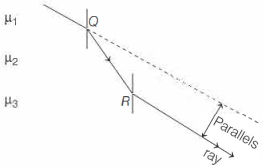
0 likesView Solution
42
PhysicsMediumMCQKVPY · 2012
$A$ ray of white light is incident on a spherical water drop whose centre is $C$ as shown below. When observed from the opposite side,the emergent light
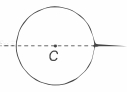
A
will be white and will emerge without deviating
B
will be internally reflected
C
will split into different colours such that the angles of deviation will be different for different colours
D
will split into different colours such that the angles of deviation will be the same for all colours
Solution
(A) The correct option is $A$.
When a ray of light is incident on a spherical surface such that it passes through the center $C$ of the sphere,the angle of incidence $i$ is $0^\circ$ because the ray is normal to the surface.
According to Snell's law,$n_1 \sin(i) = n_2 \sin(r)$,which implies $\sin(r) = 0$,so the angle of refraction $r$ is also $0^\circ$.
Since the ray passes through the center,it remains undeviated at both the entry and exit points of the spherical drop.
Because there is no deviation or refraction at an angle,there is no dispersion of white light into its constituent colors.
Therefore,the emergent light remains white and emerges without deviating.
When a ray of light is incident on a spherical surface such that it passes through the center $C$ of the sphere,the angle of incidence $i$ is $0^\circ$ because the ray is normal to the surface.
According to Snell's law,$n_1 \sin(i) = n_2 \sin(r)$,which implies $\sin(r) = 0$,so the angle of refraction $r$ is also $0^\circ$.
Since the ray passes through the center,it remains undeviated at both the entry and exit points of the spherical drop.
Because there is no deviation or refraction at an angle,there is no dispersion of white light into its constituent colors.
Therefore,the emergent light remains white and emerges without deviating.
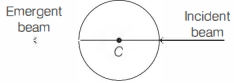
0 likesView Solution
43
PhysicsMediumMCQKVPY · 2012
$A$ convex lens of focal length $15 \,cm$ is placed in front of a plane mirror at a distance of $25 \,cm$ from the mirror. Where on the optical axis and from the centre of the lens should a small object be placed such that the final image coincides with the object?
A
$15 \,cm$ and on the opposite side of the mirror
B
$15 \,cm$ between the mirror and the lens
C
$7.5 \,cm$ and on the opposite side of the mirror
D
$7.5 \,cm$ and between the mirror and the lens
Solution
(A) For the final image to coincide with the object,the light rays must strike the plane mirror normally (perpendicularly).
This happens if the light rays emerging from the convex lens are parallel to the principal axis.
Light rays from an object placed at the focus of a convex lens become parallel to the principal axis after refraction.
Given the focal length of the convex lens is $f = 15 \,cm$,the object must be placed at a distance of $15 \,cm$ from the lens on the side opposite to the mirror.
When rays from the object at $15 \,cm$ pass through the lens,they become parallel to the principal axis.
These parallel rays strike the plane mirror perpendicularly and reflect back along the same path.
After passing through the lens again,they converge at the same point where the object is located,thus forming the final image at the object's position.
This happens if the light rays emerging from the convex lens are parallel to the principal axis.
Light rays from an object placed at the focus of a convex lens become parallel to the principal axis after refraction.
Given the focal length of the convex lens is $f = 15 \,cm$,the object must be placed at a distance of $15 \,cm$ from the lens on the side opposite to the mirror.
When rays from the object at $15 \,cm$ pass through the lens,they become parallel to the principal axis.
These parallel rays strike the plane mirror perpendicularly and reflect back along the same path.
After passing through the lens again,they converge at the same point where the object is located,thus forming the final image at the object's position.
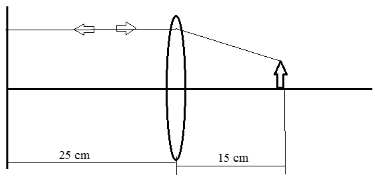
0 likesView Solution
44
PhysicsDifficultMCQKVPY · 2012
The following figures show different combinations of identical bulb$(s)$ connected to identical battery(ies). Which option is correct regarding the total power dissipated in the circuit?
A
$P < Q < R < S$
B
$P < Q < R = S$
C
$R < Q < P < S$
D
$P < R < Q < S$
Solution
(D) Let the resistance of each bulb be $R$ and the voltage of each battery be $V$.
For circuit $(P)$: Three bulbs are in series with one battery. Total resistance $= 3R$. Power $P_P = \frac{V^2}{3R} \approx 0.33 \frac{V^2}{R}$.
For circuit $(Q)$: Three bulbs are in parallel with one battery. Total resistance $= R/3$. Power $P_Q = \frac{V^2}{R/3} = \frac{3V^2}{R} = 3 \frac{V^2}{R}$.
For circuit $(R)$: One bulb is connected to one battery. Total resistance $= R$. Power $P_R = \frac{V^2}{R} = 1 \frac{V^2}{R}$.
For circuit $(S)$: One bulb is connected to two batteries in series. Total voltage $= 2V$. Total resistance $= R$. Power $P_S = \frac{(2V)^2}{R} = \frac{4V^2}{R} = 4 \frac{V^2}{R}$.
Comparing the values: $0.33 \frac{V^2}{R} < 1 \frac{V^2}{R} < 3 \frac{V^2}{R} < 4 \frac{V^2}{R}$.
Therefore,the order of increasing power consumption is $P < R < Q < S$.
For circuit $(P)$: Three bulbs are in series with one battery. Total resistance $= 3R$. Power $P_P = \frac{V^2}{3R} \approx 0.33 \frac{V^2}{R}$.
For circuit $(Q)$: Three bulbs are in parallel with one battery. Total resistance $= R/3$. Power $P_Q = \frac{V^2}{R/3} = \frac{3V^2}{R} = 3 \frac{V^2}{R}$.
For circuit $(R)$: One bulb is connected to one battery. Total resistance $= R$. Power $P_R = \frac{V^2}{R} = 1 \frac{V^2}{R}$.
For circuit $(S)$: One bulb is connected to two batteries in series. Total voltage $= 2V$. Total resistance $= R$. Power $P_S = \frac{(2V)^2}{R} = \frac{4V^2}{R} = 4 \frac{V^2}{R}$.
Comparing the values: $0.33 \frac{V^2}{R} < 1 \frac{V^2}{R} < 3 \frac{V^2}{R} < 4 \frac{V^2}{R}$.
Therefore,the order of increasing power consumption is $P < R < Q < S$.
0 likesView Solution
45
PhysicsMediumMCQKVPY · 2012
The ${ }_{92}^{238} U$ atom disintegrates to ${ }_{84}^{214} Po$ with a half-life of $4.5 \times 10^9$ years by emitting $6$ $\alpha$-particles and $n$ electrons. Here,$n$ is:
A
$6$
B
$4$
C
$10$
D
$7$
Solution
(B) The decay process is represented as: ${ }_{92}^{238} U \longrightarrow{ }_{84}^{214} Po + 6({ }_{2}^{4} He) + n({ }_{-1}^{0} e)$.
Applying the law of conservation of mass number:
$238 = 214 + 6(4) + n(0)$
$238 = 214 + 24 = 238$ (This is satisfied).
Applying the law of conservation of atomic number (charge):
$92 = 84 + 6(2) + n(-1)$
$92 = 84 + 12 - n$
$92 = 96 - n$
$n = 96 - 92 = 4$.
Therefore,the number of electrons emitted is $4$.
Applying the law of conservation of mass number:
$238 = 214 + 6(4) + n(0)$
$238 = 214 + 24 = 238$ (This is satisfied).
Applying the law of conservation of atomic number (charge):
$92 = 84 + 6(2) + n(-1)$
$92 = 84 + 12 - n$
$92 = 96 - n$
$n = 96 - 92 = 4$.
Therefore,the number of electrons emitted is $4$.
0 likesView Solution
46
PhysicsMediumMCQKVPY · 2012
Which statement about the Rutherford model of the atom is not true?
A
There is a positively charged centre in an atom called the nucleus
B
Nearly all the mass of an atom resides in the nucleus
C
Size of the nucleus is comparable to the atom
D
Electrons occupy the space surrounding the nucleus
Solution
(C) The correct answer is $(c)$.
According to the Rutherford model of the atom:
$1$. The entire positive charge and nearly all the mass of the atom are concentrated in a very small region at the center called the nucleus.
$2$. The size of the nucleus $(10^{-15} \ m)$ is extremely small compared to the size of the atom $(10^{-10} \ m)$.
$3$. Electrons revolve around the nucleus in circular orbits.
Since the size of the nucleus is much smaller than the size of the atom,the statement that the size of the nucleus is comparable to the atom is incorrect.
According to the Rutherford model of the atom:
$1$. The entire positive charge and nearly all the mass of the atom are concentrated in a very small region at the center called the nucleus.
$2$. The size of the nucleus $(10^{-15} \ m)$ is extremely small compared to the size of the atom $(10^{-10} \ m)$.
$3$. Electrons revolve around the nucleus in circular orbits.
Since the size of the nucleus is much smaller than the size of the atom,the statement that the size of the nucleus is comparable to the atom is incorrect.
0 likesView Solution
47
PhysicsMediumMCQKVPY · 2012
$A$ girl brings a positively charged rod near a thin neutral stream of water from a tap. She observes that the water stream bends towards her. Instead,if she were to bring a negatively charged rod near to the stream,it will
A
bend in the same direction
B
bend in the opposite direction
C
not bend at all
D
bend in the opposite direction above and below the rod
Solution
(A) The water molecule $(H_2O)$ is a polar molecule,meaning it has a permanent electric dipole moment.
When a charged rod (whether positively or negatively charged) is brought near a neutral stream of water,it induces a redistribution of charge within the water molecules due to electrostatic induction.
Because the water molecules are polar,the end of the molecule with the opposite charge to the rod is attracted,while the end with the same charge is repelled.
Since the attracted end is closer to the rod than the repelled end,the net force is always attractive.
Therefore,the water stream will bend towards the rod regardless of whether the rod is positively or negatively charged.
When a charged rod (whether positively or negatively charged) is brought near a neutral stream of water,it induces a redistribution of charge within the water molecules due to electrostatic induction.
Because the water molecules are polar,the end of the molecule with the opposite charge to the rod is attracted,while the end with the same charge is repelled.
Since the attracted end is closer to the rod than the repelled end,the net force is always attractive.
Therefore,the water stream will bend towards the rod regardless of whether the rod is positively or negatively charged.
0 likesView Solution
48
PhysicsDifficultMCQKVPY · 2012
In the circuit shown,$n$-identical resistors $R$ are connected in parallel $(n > 1)$ and the combination is connected in series to another resistor $R_0$. In the adjoining circuit,$n$ resistors of resistance $R$ are all connected in series along with $R_0$. The batteries in both circuits are identical and the net power dissipated in the $n$ resistors in both circuits is the same. The ratio $R_0 / R$ is
A
$1$
B
$n$
C
$n^2$
D
$1 / n$
Solution
(A) In case $I$ (parallel combination):
Total circuit resistance,$R_{\text{eq}, 1} = R_0 + \frac{R}{n} = \frac{n R_0 + R}{n}$.
Circuit current,$i_1 = \frac{E}{R_{\text{eq}, 1}} = \frac{n E}{n R_0 + R}$.
Power dissipated in the $n$ resistors,$P_1 = i_1^2 \cdot \left(\frac{R}{n}\right) = \left(\frac{n E}{n R_0 + R}\right)^2 \cdot \frac{R}{n} = \frac{n E^2 R}{(n R_0 + R)^2}$.
In case $II$ (series combination):
Total circuit resistance,$R_{\text{eq}, 2} = R_0 + n R$.
Circuit current,$i_2 = \frac{E}{R_{\text{eq}, 2}} = \frac{E}{R_0 + n R}$.
Power dissipated in the $n$ resistors,$P_2 = i_2^2 \cdot (n R) = \left(\frac{E}{R_0 + n R}\right)^2 \cdot n R = \frac{n E^2 R}{(R_0 + n R)^2}$.
Given $P_1 = P_2$:
$\frac{n E^2 R}{(n R_0 + R)^2} = \frac{n E^2 R}{(R_0 + n R)^2}$.
This implies $(n R_0 + R)^2 = (R_0 + n R)^2$.
Taking the square root,$n R_0 + R = R_0 + n R$ (since $R_0, R, n > 0$).
$(n - 1) R_0 = (n - 1) R$.
Since $n > 1$,we get $R_0 = R$,so $\frac{R_0}{R} = 1$.
Total circuit resistance,$R_{\text{eq}, 1} = R_0 + \frac{R}{n} = \frac{n R_0 + R}{n}$.
Circuit current,$i_1 = \frac{E}{R_{\text{eq}, 1}} = \frac{n E}{n R_0 + R}$.
Power dissipated in the $n$ resistors,$P_1 = i_1^2 \cdot \left(\frac{R}{n}\right) = \left(\frac{n E}{n R_0 + R}\right)^2 \cdot \frac{R}{n} = \frac{n E^2 R}{(n R_0 + R)^2}$.
In case $II$ (series combination):
Total circuit resistance,$R_{\text{eq}, 2} = R_0 + n R$.
Circuit current,$i_2 = \frac{E}{R_{\text{eq}, 2}} = \frac{E}{R_0 + n R}$.
Power dissipated in the $n$ resistors,$P_2 = i_2^2 \cdot (n R) = \left(\frac{E}{R_0 + n R}\right)^2 \cdot n R = \frac{n E^2 R}{(R_0 + n R)^2}$.
Given $P_1 = P_2$:
$\frac{n E^2 R}{(n R_0 + R)^2} = \frac{n E^2 R}{(R_0 + n R)^2}$.
This implies $(n R_0 + R)^2 = (R_0 + n R)^2$.
Taking the square root,$n R_0 + R = R_0 + n R$ (since $R_0, R, n > 0$).
$(n - 1) R_0 = (n - 1) R$.
Since $n > 1$,we get $R_0 = R$,so $\frac{R_0}{R} = 1$.
0 likesView Solution
49
PhysicsDifficultMCQKVPY · 2012
$A$ circular loop of wire is in the same plane as an infinitely long wire carrying a constant current $i$. Four possible motions of the loop are marked by $N, E, W$,and $S$ as shown below. $A$ clockwise current is induced in the loop when the loop is pulled towards:
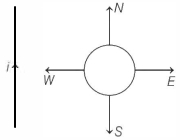
A
$N$
B
$E$
C
$W$
D
$S$
Solution
(B) The magnetic field produced by the long wire carrying current $i$ is directed into the plane of the paper (inward) at the location of the loop.
According to Lenz's law,the induced current in the loop will oppose the change in magnetic flux linked with it.
For a clockwise current to be induced in the loop,the magnetic flux through the loop must decrease (as per the right-hand rule,a clockwise current produces an inward magnetic field,which would oppose a decrease in the existing inward flux).
The magnetic flux linked with the loop decreases when the loop is moved away from the current-carrying wire.
Looking at the diagram,moving the loop in the direction $E$ (East) increases the distance from the wire,thereby decreasing the magnetic flux through the loop. Thus,a clockwise current is induced when the loop is pulled towards $E$.
According to Lenz's law,the induced current in the loop will oppose the change in magnetic flux linked with it.
For a clockwise current to be induced in the loop,the magnetic flux through the loop must decrease (as per the right-hand rule,a clockwise current produces an inward magnetic field,which would oppose a decrease in the existing inward flux).
The magnetic flux linked with the loop decreases when the loop is moved away from the current-carrying wire.
Looking at the diagram,moving the loop in the direction $E$ (East) increases the distance from the wire,thereby decreasing the magnetic flux through the loop. Thus,a clockwise current is induced when the loop is pulled towards $E$.
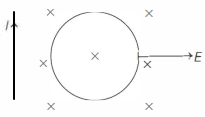
0 likesView Solution
Vedclass Products
For Students
Vedclass Test Series
Mock tests in real KVPY style covering Physics with performance analysis. 5-day free trial.
Start Free TrialFor Teachers
Exam Paper Generator
Generate Set A/B/C/D Physics papers from 7.5L+ questions in 2 minutes. 3 chapters free.
Try FreeFor Institutes
Online Exam Module
Run live KVPY mock exams with unlimited students, 360° analytics & white-label branding.
See DemoFrequently Asked Questions
How many Physics questions are in KVPY 2012?
There are 49 Physics questions from the KVPY 2012 paper on Vedclass, each with a detailed step-by-step solution in English.
Are KVPY 2012 Physics solutions available in English?
Yes. All solutions on this page are in English. You can also switch to English or Hindi using the language buttons above the questions.
Can I practice KVPY 2012 Physics as a timed test?
Yes. Use the Vedclass Test Series to attempt a full KVPY mock test covering Physics with time limits and instant score analysis.
Can teachers create Physics papers from KVPY previous year questions?
Yes. The Vedclass Exam Paper Generator lets teachers mix KVPY Physics questions and generate Set A/B/C/D papers in minutes.
For Teachers & Institutes
Build a Custom Physics Paper
Pick KVPY 2012 Physics questions, set difficulty, and generate Set A/B/C/D in 2 minutes.