
PhysicsQ51–150 of 459 questions
Page 2 of 5 · English
51
PhysicsMediumMCQJEE Main · 2026
$A$ spring of force constant $15 \ N/m$ is cut into two pieces. If the ratio of their lengths is $1 : 3$,then the force constant of the smaller piece is . . . . . . $N/m$.
A
$15$
B
$20$
C
$60$
D
$45$
Solution
(C) The force constant $K$ of a spring is inversely proportional to its length $\ell$,i.e.,$K \ell = \text{constant}$.
Let the original length be $\ell$ and the original force constant be $K = 15 \ N/m$.
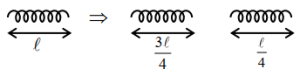
The spring is cut into two pieces with lengths in the ratio $1 : 3$. Thus,the lengths of the pieces are $\ell_1 = \frac{\ell}{4}$ and $\ell_2 = \frac{3\ell}{4}$.
The smaller piece has length $\ell_1 = \frac{\ell}{4}$.
Using the relation $K \ell = K^{\prime} \ell_1$,we get:
$15 \times \ell = K^{\prime} \times (\frac{\ell}{4})$
$K^{\prime} = 15 \times 4 = 60 \ N/m$.
Let the original length be $\ell$ and the original force constant be $K = 15 \ N/m$.
The spring is cut into two pieces with lengths in the ratio $1 : 3$. Thus,the lengths of the pieces are $\ell_1 = \frac{\ell}{4}$ and $\ell_2 = \frac{3\ell}{4}$.
The smaller piece has length $\ell_1 = \frac{\ell}{4}$.
Using the relation $K \ell = K^{\prime} \ell_1$,we get:
$15 \times \ell = K^{\prime} \times (\frac{\ell}{4})$
$K^{\prime} = 15 \times 4 = 60 \ N/m$.
0 likesView Solution
52
PhysicsDifficultMCQJEE Main · 2026
Density of water at $4 ^\circ C$ and $20 ^\circ C$ are $1000 \ kg/m^3$ and $998 \ kg/m^3$ respectively. The increase in internal energy of $4 \ kg$ water when it is heated from $4 ^\circ C$ to $20 ^\circ C$ is . . . . . . $J$. (Specific heat capacity of water $= 4.2 \ kJ/kg \cdot K$ and $1$ atmospheric pressure $= 10^5 \ Pa$)
A
$315826.2$
B
$234699.2$
C
$258700.8$
D
$268799.2$
Solution
(D) The heat supplied to the water is given by $Q = m S \Delta T$.
Given $m = 4 \ kg$,$S = 4200 \ J/kg \cdot K$,and $\Delta T = 20 - 4 = 16 \ K$.
$Q = 4 \times 4200 \times 16 = 268800 \ J$.
The work done by the water during expansion is $W = P \Delta V$.
The change in volume is $\Delta V = m(\frac{1}{\rho_f} - \frac{1}{\rho_i}) = 4(\frac{1}{998} - \frac{1}{1000}) = 4(\frac{1000 - 998}{998000}) = 4(\frac{2}{998000}) = \frac{8}{998000} \ m^3$.
Given $P = 10^5 \ Pa$,the work done is $W = 10^5 \times \frac{8}{998000} = \frac{800000}{998000} \approx 0.8016 \ J$.
According to the first law of thermodynamics,$\Delta U = Q - W$.
$\Delta U = 268800 - 0.8016 = 268799.1984 \ J \approx 268799.2 \ J$.
Given $m = 4 \ kg$,$S = 4200 \ J/kg \cdot K$,and $\Delta T = 20 - 4 = 16 \ K$.
$Q = 4 \times 4200 \times 16 = 268800 \ J$.
The work done by the water during expansion is $W = P \Delta V$.
The change in volume is $\Delta V = m(\frac{1}{\rho_f} - \frac{1}{\rho_i}) = 4(\frac{1}{998} - \frac{1}{1000}) = 4(\frac{1000 - 998}{998000}) = 4(\frac{2}{998000}) = \frac{8}{998000} \ m^3$.
Given $P = 10^5 \ Pa$,the work done is $W = 10^5 \times \frac{8}{998000} = \frac{800000}{998000} \approx 0.8016 \ J$.
According to the first law of thermodynamics,$\Delta U = Q - W$.
$\Delta U = 268800 - 0.8016 = 268799.1984 \ J \approx 268799.2 \ J$.
0 likesView Solution
53
PhysicsDifficultMCQJEE Main · 2026
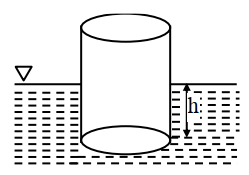
$A$ cylindrical block of mass $M$ and area of cross-section $A$ is floating in a liquid of density $\rho$ with its axis vertical. When depressed a little and released,the block starts oscillating. The period of oscillation is . . . . . . . . . . .
A
$2 \pi \sqrt{\frac{ M }{\rho A g}}$
B
$\pi \sqrt{\frac{2 M }{\rho A g}}$
C
$\pi \sqrt{\frac{\rho A}{M g}}$
D
$2 \pi \sqrt{\frac{\rho A}{M g}}$
Solution
(A) At equilibrium,the weight of the block is balanced by the buoyant force:
$\rho A h g = M g$
where $h$ is the submerged depth.
When the block is depressed by a small distance $x$,the additional buoyant force acting upwards is $F_b = \rho A x g$.
Since this force acts in the direction opposite to the displacement,the restoring force is $F = -\rho A x g$.
Using Newton's second law,$M a = -\rho A x g$,which gives the acceleration $a = -\left(\frac{\rho A g}{M}\right) x$.
Comparing this with the standard $SHM$ equation $a = -\omega^2 x$,we get $\omega^2 = \frac{\rho A g}{M}$,so $\omega = \sqrt{\frac{\rho A g}{M}}$.
The period of oscillation $T$ is given by $T = \frac{2 \pi}{\omega} = 2 \pi \sqrt{\frac{M}{\rho A g}}$.
$\rho A h g = M g$
where $h$ is the submerged depth.
When the block is depressed by a small distance $x$,the additional buoyant force acting upwards is $F_b = \rho A x g$.
Since this force acts in the direction opposite to the displacement,the restoring force is $F = -\rho A x g$.
Using Newton's second law,$M a = -\rho A x g$,which gives the acceleration $a = -\left(\frac{\rho A g}{M}\right) x$.
Comparing this with the standard $SHM$ equation $a = -\omega^2 x$,we get $\omega^2 = \frac{\rho A g}{M}$,so $\omega = \sqrt{\frac{\rho A g}{M}}$.
The period of oscillation $T$ is given by $T = \frac{2 \pi}{\omega} = 2 \pi \sqrt{\frac{M}{\rho A g}}$.
0 likesView Solution
54
PhysicsMediumMCQJEE Main · 2026
$A$ diatomic gas $(\gamma = 1.4)$ does $100 \ J$ of work when it is expanded isobarically. Then the heat given to the gas is . . . . . . $J$.
A
$250$
B
$350$
C
$450$
D
$100$
Solution
(B) For an isobaric process,the work done is given by $W = P \Delta V = nR \Delta T = 100 \ J$.
For a diatomic gas,the degree of freedom $f = 5$.
The molar heat capacity at constant pressure is $C_p = (\frac{f}{2} + 1)R = (\frac{5}{2} + 1)R = \frac{7}{2}R$.
The heat supplied to the gas is $Q = nC_p \Delta T = n(\frac{7}{2}R) \Delta T$.
Substituting $nR \Delta T = 100 \ J$,we get $Q = \frac{7}{2} \times 100 = 350 \ J$.
For a diatomic gas,the degree of freedom $f = 5$.
The molar heat capacity at constant pressure is $C_p = (\frac{f}{2} + 1)R = (\frac{5}{2} + 1)R = \frac{7}{2}R$.
The heat supplied to the gas is $Q = nC_p \Delta T = n(\frac{7}{2}R) \Delta T$.
Substituting $nR \Delta T = 100 \ J$,we get $Q = \frac{7}{2} \times 100 = 350 \ J$.
0 likesView Solution
55
PhysicsEasyMCQJEE Main · 2026
The terminal velocity of a metallic ball of radius $6 \ mm$ in a viscous fluid is $20 \ cm/s$. The terminal velocity of another ball of same material and having radius $3 \ mm$ in the same fluid will be . . . . . . $cm/s$.
A
$10$
B
$5$
C
$2.5$
D
$15$
Solution
(B) The terminal velocity $v_T$ of a spherical body falling through a viscous fluid is given by the formula: $v_T = \frac{2}{9} \frac{r^2 g (\rho - \sigma)}{\eta}$.
Here,$r$ is the radius of the ball,$\rho$ is the density of the material of the ball,$\sigma$ is the density of the fluid,$\eta$ is the coefficient of viscosity,and $g$ is the acceleration due to gravity.
Since the material of the ball and the fluid are the same,$v_T \propto r^2$.
Given: $r_1 = 6 \ mm$,$v_{T1} = 20 \ cm/s$,and $r_2 = 3 \ mm$.
Using the proportionality: $\frac{v_{T2}}{v_{T1}} = (\frac{r_2}{r_1})^2$.
Substituting the values: $\frac{v_{T2}}{20} = (\frac{3}{6})^2 = (\frac{1}{2})^2 = \frac{1}{4}$.
Therefore,$v_{T2} = \frac{20}{4} = 5 \ cm/s$.
Here,$r$ is the radius of the ball,$\rho$ is the density of the material of the ball,$\sigma$ is the density of the fluid,$\eta$ is the coefficient of viscosity,and $g$ is the acceleration due to gravity.
Since the material of the ball and the fluid are the same,$v_T \propto r^2$.
Given: $r_1 = 6 \ mm$,$v_{T1} = 20 \ cm/s$,and $r_2 = 3 \ mm$.
Using the proportionality: $\frac{v_{T2}}{v_{T1}} = (\frac{r_2}{r_1})^2$.
Substituting the values: $\frac{v_{T2}}{20} = (\frac{3}{6})^2 = (\frac{1}{2})^2 = \frac{1}{4}$.
Therefore,$v_{T2} = \frac{20}{4} = 5 \ cm/s$.
0 likesView Solution
56
PhysicsDifficultMCQJEE Main · 2026
$A$ body of mass $2 \ kg$ is moving along the $x$-direction such that its displacement as a function of time is given by $x(t) = \alpha t^2 + \beta t + \gamma \ m$,where $\alpha = 1 \ m/s^2$,$\beta = 1 \ m/s$,and $\gamma = 1 \ m$. The work done on the body during the time interval $t = 2 \ s$ to $t = 3 \ s$ is . . . . . . $J$.
A
$49$
B
$42$
C
$24$
D
$12$
Solution
(C) Given: $m = 2 \ kg$,$x(t) = t^2 + t + 1 \ m$.
The velocity is $v(t) = \frac{dx}{dt} = 2t + 1 \ m/s$.
The acceleration is $a(t) = \frac{dv}{dt} = 2 \ m/s^2$.
Since the acceleration is constant,the force acting on the body is $F = m \times a = 2 \ kg \times 2 \ m/s^2 = 4 \ N$.
The displacement $s$ during the interval $t = 2 \ s$ to $t = 3 \ s$ is $s = x(3) - x(2)$.
$x(3) = (3)^2 + 3 + 1 = 9 + 3 + 1 = 13 \ m$.
$x(2) = (2)^2 + 2 + 1 = 4 + 2 + 1 = 7 \ m$.
$s = 13 - 7 = 6 \ m$.
The work done is $W = F \times s = 4 \ N \times 6 \ m = 24 \ J$.
The velocity is $v(t) = \frac{dx}{dt} = 2t + 1 \ m/s$.
The acceleration is $a(t) = \frac{dv}{dt} = 2 \ m/s^2$.
Since the acceleration is constant,the force acting on the body is $F = m \times a = 2 \ kg \times 2 \ m/s^2 = 4 \ N$.
The displacement $s$ during the interval $t = 2 \ s$ to $t = 3 \ s$ is $s = x(3) - x(2)$.
$x(3) = (3)^2 + 3 + 1 = 9 + 3 + 1 = 13 \ m$.
$x(2) = (2)^2 + 2 + 1 = 4 + 2 + 1 = 7 \ m$.
$s = 13 - 7 = 6 \ m$.
The work done is $W = F \times s = 4 \ N \times 6 \ m = 24 \ J$.
0 likesView Solution
57
PhysicsDifficultMCQJEE Main · 2026
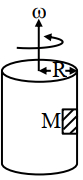
$A$ large drum having radius $R$ is spinning around its axis with angular velocity $\omega$,as shown in the figure. The minimum value of $\omega$ so that a body of mass $M$ remains stuck to the inner wall of the drum,taking the coefficient of friction between the drum surface and mass $M$ as $\mu$,is:
A
$\sqrt{\frac{\mu g}{R}}$
B
$\sqrt{\frac{2g}{\mu R}}$
C
$\sqrt{\frac{g}{2\mu R}}$
D
$\sqrt{\frac{g}{\mu R}}$
Solution
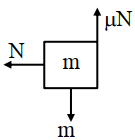
(D) For the body of mass $M$ to remain stuck to the inner wall of the rotating drum,the normal force $N$ exerted by the wall provides the necessary centripetal force:
$N = M \omega^2 R$
The frictional force $f$ acts vertically upwards to balance the gravitational force $Mg$ acting downwards:
$f = Mg$
Since the body is on the verge of slipping,the frictional force is at its maximum value,given by $f = \mu N$:
$Mg = \mu N$
Substituting the expression for $N$ into the friction equation:
$Mg = \mu (M \omega^2 R)$
Dividing both sides by $M$ and solving for $\omega$:
$g = \mu \omega^2 R$
$\omega^2 = \frac{g}{\mu R}$
$\omega = \sqrt{\frac{g}{\mu R}}$
$N = M \omega^2 R$
The frictional force $f$ acts vertically upwards to balance the gravitational force $Mg$ acting downwards:
$f = Mg$
Since the body is on the verge of slipping,the frictional force is at its maximum value,given by $f = \mu N$:
$Mg = \mu N$
Substituting the expression for $N$ into the friction equation:
$Mg = \mu (M \omega^2 R)$
Dividing both sides by $M$ and solving for $\omega$:
$g = \mu \omega^2 R$
$\omega^2 = \frac{g}{\mu R}$
$\omega = \sqrt{\frac{g}{\mu R}}$
0 likesView Solution
58
PhysicsDifficultMCQJEE Main · 2026
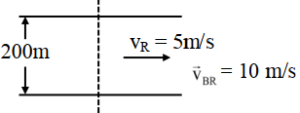
$A$ river of width $200 \ m$ is flowing from west to east with a speed of $18 \ km/h$. $A$ boat,moving with a speed of $36 \ km/h$ in still water,is made to travel one round trip (bank to bank of the river). The minimum time taken by the boat for this journey and the displacement along the river bank are . . . . . . and . . . . . . respectively.
A
$20 \ s$ and $100 \ m$
B
$40 \ s$ and $0 \ m$
C
$40 \ s$ and $200 \ m$
D
$40 \ s$ and $100 \ m$
Solution
(C) Given: Width of the river $d = 200 \ m$,velocity of river $v_R = 18 \ km/h = 18 \times \frac{5}{18} = 5 \ m/s$,velocity of boat in still water $v_{BR} = 36 \ km/h = 36 \times \frac{5}{18} = 10 \ m/s$.
To cross the river in minimum time,the boat must head perpendicular to the river flow.
The time taken to cross the river once is $t = \frac{d}{v_{BR}} = \frac{200}{10} = 20 \ s$.
For a round trip (going and coming back),the total time taken is $T = 20 + 20 = 40 \ s$.
During this time,the boat is carried downstream by the river flow. The velocity of the boat relative to the ground along the river bank is $v_R = 5 \ m/s$.
The displacement along the river bank is $x = v_R \times T = 5 \times 40 = 200 \ m$.
To cross the river in minimum time,the boat must head perpendicular to the river flow.
The time taken to cross the river once is $t = \frac{d}{v_{BR}} = \frac{200}{10} = 20 \ s$.
For a round trip (going and coming back),the total time taken is $T = 20 + 20 = 40 \ s$.
During this time,the boat is carried downstream by the river flow. The velocity of the boat relative to the ground along the river bank is $v_R = 5 \ m/s$.
The displacement along the river bank is $x = v_R \times T = 5 \times 40 = 200 \ m$.
0 likesView Solution
59
PhysicsDifficultMCQJEE Main · 2026
Surface tension of two liquids (having same densities),$T_1$ and $T_2$,are measured using the capillary rise method utilizing two tubes with inner radii of $r_1$ and $r_2$ where $r_1 > r_2$. The measured liquid heights in these tubes are $h_1$ and $h_2$ respectively. [Ignore the weight of the liquid above the lowest point of the meniscus]. If $T_1 = T_2$,which of the following relations is satisfied?
A
$h_1 < h_2$ and $T_1 = T_2$
B
$h_1 = h_2$ and $T_1 = T_2$
C
$h_1 > h_2$ and $T_1 = T_2$
D
$h_1 > h_2$ and $T_1 < T_2$
Solution
(A) The formula for capillary rise is given by $h = \frac{2T \cos \theta}{\rho g r}$.
Assuming the contact angle $\theta$ is the same for both liquids and the densities $\rho$ are equal,we have $h \propto \frac{1}{r}$.
Given $r_1 > r_2$,it follows that $\frac{1}{r_1} < \frac{1}{r_2}$.
Therefore,$h_1 < h_2$.
Since the problem specifies $T_1 = T_2$,the correct relation is $h_1 < h_2$ and $T_1 = T_2$.
Assuming the contact angle $\theta$ is the same for both liquids and the densities $\rho$ are equal,we have $h \propto \frac{1}{r}$.
Given $r_1 > r_2$,it follows that $\frac{1}{r_1} < \frac{1}{r_2}$.
Therefore,$h_1 < h_2$.
Since the problem specifies $T_1 = T_2$,the correct relation is $h_1 < h_2$ and $T_1 = T_2$.
0 likesView Solution
60
PhysicsDifficultMCQJEE Main · 2026
$A$ spherical body of radius $r$ and density $\sigma$ falls freely through a viscous liquid having density $\rho$ and viscosity $\eta$ and attains a terminal velocity $v_0$. The estimated maximum error in the quantity $\eta$ is: (Ignore errors associated with $\sigma, \rho$ and $g$,gravitational acceleration)
A
$2 \frac{\Delta r}{r} - \frac{\Delta v_0}{v_0}$
B
$2 \frac{\Delta r}{r} + \frac{\Delta v_0}{v_0}$
C
$2 \left[ \frac{\Delta r}{r} + \frac{\Delta v_0}{v_0} \right]$
D
$2 \left[ \frac{\Delta r}{r} - \frac{\Delta v_0}{v_0} \right]$
Solution
(B) The terminal velocity $v_0$ of a spherical body is given by Stokes' Law: $v_0 = \frac{2}{9} \frac{r^2 g}{\eta} (\sigma - \rho)$.
Rearranging the formula to solve for viscosity $\eta$: $\eta = \frac{2}{9} \frac{r^2 g}{v_0} (\sigma - \rho)$.
Since $\sigma, \rho$,and $g$ are constants with negligible errors,the relative error in $\eta$ is determined by the variables $r$ and $v_0$.
Using the rules of error propagation for multiplication and division,the maximum relative error is: $\frac{\Delta \eta}{\eta} = 2 \frac{\Delta r}{r} + \frac{\Delta v_0}{v_0}$.
Rearranging the formula to solve for viscosity $\eta$: $\eta = \frac{2}{9} \frac{r^2 g}{v_0} (\sigma - \rho)$.
Since $\sigma, \rho$,and $g$ are constants with negligible errors,the relative error in $\eta$ is determined by the variables $r$ and $v_0$.
Using the rules of error propagation for multiplication and division,the maximum relative error is: $\frac{\Delta \eta}{\eta} = 2 \frac{\Delta r}{r} + \frac{\Delta v_0}{v_0}$.
0 likesView Solution
61
PhysicsEasyMCQJEE Main · 2026
Keeping the significant figures in view,the sum of the physical quantities $52.01 \ m$,$153.2 \ m$,and $0.123 \ m$ is: (in $m$)
A
$205$
B
$205.333$
C
$205.33$
D
$205.3$
Solution
(D) To find the sum of physical quantities,we add the given values: $52.01 \ m + 153.2 \ m + 0.123 \ m = 205.333 \ m$.
According to the rules of significant figures for addition,the final result should be reported to the same number of decimal places as the measurement with the fewest decimal places.
The values are $52.01$ (two decimal places),$153.2$ (one decimal place),and $0.123$ (three decimal places).
The measurement with the fewest decimal places is $153.2 \ m$,which has one decimal place.
Therefore,we round the sum $205.333 \ m$ to one decimal place,which gives $205.3 \ m$.
According to the rules of significant figures for addition,the final result should be reported to the same number of decimal places as the measurement with the fewest decimal places.
The values are $52.01$ (two decimal places),$153.2$ (one decimal place),and $0.123$ (three decimal places).
The measurement with the fewest decimal places is $153.2 \ m$,which has one decimal place.
Therefore,we round the sum $205.333 \ m$ to one decimal place,which gives $205.3 \ m$.
0 likesView Solution
62
PhysicsMediumMCQJEE Main · 2026
The kinetic energy of a simple harmonic oscillator is oscillating with an angular frequency of $176 \ rad/s$. The frequency of this simple harmonic oscillator is . . . . . . $Hz$. $\left[\text{take } \pi=\frac{22}{7}\right]$
A
$14$
B
$88$
C
$28$
D
$176$
Solution
(A) The angular frequency of the kinetic energy oscillation is given as $\omega_k = 176 \ rad/s$.
For a simple harmonic oscillator,the kinetic energy $K = \frac{1}{2} m v^2 = \frac{1}{2} m \omega^2 A^2 \sin^2(\omega t + \phi)$.
Using the identity $\sin^2 \theta = \frac{1 - \cos(2\theta)}{2}$,we get $K = \frac{1}{4} m \omega^2 A^2 (1 - \cos(2\omega t + 2\phi))$.
This shows that the kinetic energy oscillates with an angular frequency $\omega_k = 2\omega$,where $\omega$ is the angular frequency of the oscillator.
Given $\omega_k = 176 \ rad/s$,we have $2\omega = 176 \ rad/s$,which implies $\omega = 88 \ rad/s$.
The frequency of the oscillator is $f = \frac{\omega}{2\pi} = \frac{88}{2 \times (22/7)} = \frac{88 \times 7}{44} = 2 \times 7 = 14 \ Hz$.
For a simple harmonic oscillator,the kinetic energy $K = \frac{1}{2} m v^2 = \frac{1}{2} m \omega^2 A^2 \sin^2(\omega t + \phi)$.
Using the identity $\sin^2 \theta = \frac{1 - \cos(2\theta)}{2}$,we get $K = \frac{1}{4} m \omega^2 A^2 (1 - \cos(2\omega t + 2\phi))$.
This shows that the kinetic energy oscillates with an angular frequency $\omega_k = 2\omega$,where $\omega$ is the angular frequency of the oscillator.
Given $\omega_k = 176 \ rad/s$,we have $2\omega = 176 \ rad/s$,which implies $\omega = 88 \ rad/s$.
The frequency of the oscillator is $f = \frac{\omega}{2\pi} = \frac{88}{2 \times (22/7)} = \frac{88 \times 7}{44} = 2 \times 7 = 14 \ Hz$.
0 likesView Solution
63
PhysicsDifficultMCQJEE Main · 2026
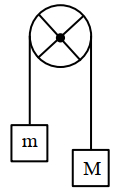
The pulley shown in the figure is made using a thin rim and two rods of length equal to the diameter of the rim. The rim and each rod have a mass of $M$. Two blocks of mass $M$ and $m$ are attached to two ends of a light string passing over the pulley,which is hinged to rotate freely in a vertical plane about its centre. The magnitude of the acceleration experienced by the blocks is . . . . . . (assume no slipping of the string on the pulley.)
A
$\frac{(M-m) g}{\left[\left(\frac{13}{6}\right) M+m\right]}$
B
$\frac{( M - m ) g }{ M + m }$
C
$\frac{( M - m ) g }{\left[\left(\frac{8}{3}\right) M + m \right]}$
D
$\frac{( M - m ) g }{2 M + m }$
Solution
(C) Let the radius of the rim be $r$. The moment of inertia $I$ of the pulley consists of the rim and two rods.
$I = I_{\text{rim}} + 2 \times I_{\text{rod}}$
$I = Mr^2 + 2 \times \left( \frac{M(2r)^2}{12} \right) = Mr^2 + 2 \times \left( \frac{4Mr^2}{12} \right) = Mr^2 + \frac{2}{3}Mr^2 = \frac{5}{3}Mr^2$.
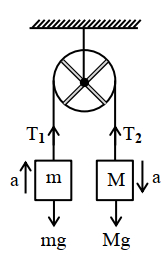
Let $a$ be the acceleration of the blocks and $T_1, T_2$ be the tensions in the string.
The equations of motion are:
$Mg - T_2 = Ma$ ... $(1)$
$T_1 - mg = ma$ ... $(2)$
$(T_2 - T_1)r = I \alpha = I \left( \frac{a}{r} \right) \implies T_2 - T_1 = \frac{I}{r^2} a = \frac{5}{3}Ma$ ... $(3)$
Adding $(1)$,$(2)$,and $(3)$:
$(M - m)g = (M + m + \frac{5}{3}M)a$
$(M - m)g = (\frac{8}{3}M + m)a$
$a = \frac{(M - m)g}{\frac{8}{3}M + m}$.
$I = I_{\text{rim}} + 2 \times I_{\text{rod}}$
$I = Mr^2 + 2 \times \left( \frac{M(2r)^2}{12} \right) = Mr^2 + 2 \times \left( \frac{4Mr^2}{12} \right) = Mr^2 + \frac{2}{3}Mr^2 = \frac{5}{3}Mr^2$.
Let $a$ be the acceleration of the blocks and $T_1, T_2$ be the tensions in the string.
The equations of motion are:
$Mg - T_2 = Ma$ ... $(1)$
$T_1 - mg = ma$ ... $(2)$
$(T_2 - T_1)r = I \alpha = I \left( \frac{a}{r} \right) \implies T_2 - T_1 = \frac{I}{r^2} a = \frac{5}{3}Ma$ ... $(3)$
Adding $(1)$,$(2)$,and $(3)$:
$(M - m)g = (M + m + \frac{5}{3}M)a$
$(M - m)g = (\frac{8}{3}M + m)a$
$a = \frac{(M - m)g}{\frac{8}{3}M + m}$.
0 likesView Solution
64
PhysicsEasyMCQJEE Main · 2026
Two cars $A$ and $B$ each of mass $10^3 \text{ kg}$ are moving on parallel tracks separated by a distance of $10 \text{ m}$,in the same direction with speeds $72 \text{ km/h}$ and $36 \text{ km/h}$. The magnitude of angular momentum of car $A$ with respect to car $B$ is . . . . . . $\text{J} \cdot \text{s}$.
A
$3.6 \times 10^5$
B
$10^5$
C
$3 \times 10^5$
D
$2 \times 10^5$
Solution
(B) The angular momentum of a particle relative to another particle is given by $L = m \cdot v_{\text{rel}} \cdot r_{\perp}$.
Here,the mass of car $A$ is $m = 10^3 \text{ kg}$.
The relative velocity of car $A$ with respect to car $B$ is $v_{\text{rel}} = v_A - v_B = 72 \text{ km/h} - 36 \text{ km/h} = 36 \text{ km/h}$.
Converting the relative velocity to $SI$ units: $v_{\text{rel}} = 36 \times \frac{5}{18} \text{ m/s} = 10 \text{ m/s}$.
The perpendicular distance between the tracks is $r_{\perp} = 10 \text{ m}$.
Substituting these values into the formula: $L = 1000 \times 10 \times 10 = 10^5 \text{ kg} \cdot \text{m}^2/\text{s}$ (or $\text{J} \cdot \text{s}$).
Here,the mass of car $A$ is $m = 10^3 \text{ kg}$.
The relative velocity of car $A$ with respect to car $B$ is $v_{\text{rel}} = v_A - v_B = 72 \text{ km/h} - 36 \text{ km/h} = 36 \text{ km/h}$.
Converting the relative velocity to $SI$ units: $v_{\text{rel}} = 36 \times \frac{5}{18} \text{ m/s} = 10 \text{ m/s}$.
The perpendicular distance between the tracks is $r_{\perp} = 10 \text{ m}$.
Substituting these values into the formula: $L = 1000 \times 10 \times 10 = 10^5 \text{ kg} \cdot \text{m}^2/\text{s}$ (or $\text{J} \cdot \text{s}$).
0 likesView Solution
65
PhysicsMediumMCQJEE Main · 2026
The r.m.s. speed of oxygen molecules at $47^{\circ} C$ is equal to that of the hydrogen molecules kept at . . . . . . ${ }^{\circ} C$. (Mass of oxygen molecule/mass of hydrogen molecule $= 32 / 2$)
A
$-235$
B
$-100$
C
$-253$
D
$-20$
Solution
(C) The formula for r.m.s. speed is given by $V_{rms} = \sqrt{\frac{3RT}{M}}$.
Given that $V_{rms, O_2} = V_{rms, H_2}$.
Temperature of oxygen $T_{O_2} = 273 + 47 = 320 \ K$.
Equating the speeds: $\sqrt{\frac{3RT_{O_2}}{M_{O_2}}} = \sqrt{\frac{3RT_{H_2}}{M_{H_2}}}$.
Squaring both sides and simplifying: $\frac{T_{O_2}}{M_{O_2}} = \frac{T_{H_2}}{M_{H_2}}$.
Substituting the values: $\frac{320}{32} = \frac{T_{H_2}}{2}$.
$10 = \frac{T_{H_2}}{2} \implies T_{H_2} = 20 \ K$.
Converting to Celsius: $T(^{\circ}C) = 20 - 273 = -253^{\circ}C$.
Given that $V_{rms, O_2} = V_{rms, H_2}$.
Temperature of oxygen $T_{O_2} = 273 + 47 = 320 \ K$.
Equating the speeds: $\sqrt{\frac{3RT_{O_2}}{M_{O_2}}} = \sqrt{\frac{3RT_{H_2}}{M_{H_2}}}$.
Squaring both sides and simplifying: $\frac{T_{O_2}}{M_{O_2}} = \frac{T_{H_2}}{M_{H_2}}$.
Substituting the values: $\frac{320}{32} = \frac{T_{H_2}}{2}$.
$10 = \frac{T_{H_2}}{2} \implies T_{H_2} = 20 \ K$.
Converting to Celsius: $T(^{\circ}C) = 20 - 273 = -253^{\circ}C$.
0 likesView Solution
66
PhysicsMediumMCQJEE Main · 2026
An insulated cylinder of volume $60\,cm^{3}$ is filled with a gas at $27^{\circ}C$ and $2$ atmospheric pressure. Then the gas is compressed making the final volume $20\,cm^{3}$ while allowing the temperature to rise to $77^{\circ}C$. The final pressure is . . . . . . atmospheric pressure.
A
$5$
B
$6$
C
$7$
D
$8$
Solution
(C) Using the ideal gas equation,$\frac{P_1 V_1}{T_1} = \frac{P_2 V_2}{T_2}$.
Given:
$P_1 = 2\,atm$
$V_1 = 60\,cm^{3}$
$T_1 = 27^{\circ}C = 27 + 273 = 300\,K$
$V_2 = 20\,cm^{3}$
$T_2 = 77^{\circ}C = 77 + 273 = 350\,K$
Substituting the values into the equation:
$\frac{2 \times 60}{300} = \frac{P_2 \times 20}{350}$
$\frac{120}{300} = \frac{P_2 \times 20}{350}$
$0.4 = P_2 \times \frac{20}{350}$
$P_2 = 0.4 \times \frac{350}{20} = 0.4 \times 17.5 = 7\,atm$.
Given:
$P_1 = 2\,atm$
$V_1 = 60\,cm^{3}$
$T_1 = 27^{\circ}C = 27 + 273 = 300\,K$
$V_2 = 20\,cm^{3}$
$T_2 = 77^{\circ}C = 77 + 273 = 350\,K$
Substituting the values into the equation:
$\frac{2 \times 60}{300} = \frac{P_2 \times 20}{350}$
$\frac{120}{300} = \frac{P_2 \times 20}{350}$
$0.4 = P_2 \times \frac{20}{350}$
$P_2 = 0.4 \times \frac{350}{20} = 0.4 \times 17.5 = 7\,atm$.
0 likesView Solution
67
PhysicsMediumMCQJEE Main · 2026
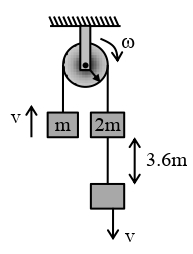
Two masses $m$ and $2m$ are connected by a light string passing over a pulley (disc) of mass $M = 30m$ and radius $r = 0.1 \ m$. The pulley is mounted in a vertical plane and is free to rotate about its axis. The $2m$ mass is released from rest. Find its speed when it has descended through a height of $h = 3.6 \ m$. (Assume the string does not slip and $g = 10 \ m/s^2$)
A
$1$
B
$2$
C
$3$
D
$4$
Solution
(B) Using the principle of conservation of mechanical energy,the loss in potential energy of the $2m$ mass equals the gain in kinetic energy of the system.
Loss in potential energy of $2m$ mass = $(2m)gh$.
Gain in potential energy of $m$ mass = $mgh$.
Net loss in potential energy = $(2m)gh - mgh = mgh$.
This energy is converted into the kinetic energy of the two masses and the rotational kinetic energy of the pulley.
Total kinetic energy = $K_{m} + K_{2m} + K_{pulley} = \frac{1}{2}mv^2 + \frac{1}{2}(2m)v^2 + \frac{1}{2}I\omega^2$.
Since $I = \frac{1}{2}Mr^2 = \frac{1}{2}(30m)r^2 = 15mr^2$ and $\omega = \frac{v}{r}$,we have $K_{pulley} = \frac{1}{2}(15mr^2)(\frac{v^2}{r^2}) = 7.5mv^2$.
Equating energy: $mgh = \frac{1}{2}mv^2 + mv^2 + 7.5mv^2 = 9mv^2$.
$v^2 = \frac{gh}{9} = \frac{10 \times 3.6}{9} = 4$.
$v = 2 \ m/s$.
Loss in potential energy of $2m$ mass = $(2m)gh$.
Gain in potential energy of $m$ mass = $mgh$.
Net loss in potential energy = $(2m)gh - mgh = mgh$.
This energy is converted into the kinetic energy of the two masses and the rotational kinetic energy of the pulley.
Total kinetic energy = $K_{m} + K_{2m} + K_{pulley} = \frac{1}{2}mv^2 + \frac{1}{2}(2m)v^2 + \frac{1}{2}I\omega^2$.
Since $I = \frac{1}{2}Mr^2 = \frac{1}{2}(30m)r^2 = 15mr^2$ and $\omega = \frac{v}{r}$,we have $K_{pulley} = \frac{1}{2}(15mr^2)(\frac{v^2}{r^2}) = 7.5mv^2$.
Equating energy: $mgh = \frac{1}{2}mv^2 + mv^2 + 7.5mv^2 = 9mv^2$.
$v^2 = \frac{gh}{9} = \frac{10 \times 3.6}{9} = 4$.
$v = 2 \ m/s$.
0 likesView Solution
68
PhysicsDifficultMCQJEE Main · 2026
Given below are two statements:
Statement $I$: For a mechanical system of many particles,the total kinetic energy is the sum of the kinetic energies of all the particles.
Statement $II$: The total kinetic energy can be expressed as the sum of the kinetic energy of the center of mass with respect to the origin and the kinetic energy of all the particles with respect to the center of mass as the reference frame.
In the light of the above statements,choose the correct answer from the options given below:
Statement $I$: For a mechanical system of many particles,the total kinetic energy is the sum of the kinetic energies of all the particles.
Statement $II$: The total kinetic energy can be expressed as the sum of the kinetic energy of the center of mass with respect to the origin and the kinetic energy of all the particles with respect to the center of mass as the reference frame.
In the light of the above statements,choose the correct answer from the options given below:
A
Both Statement $I$ and Statement $II$ are true
B
Statement $I$ is true but Statement $II$ is false
C
Statement $I$ is false but Statement $II$ is true
D
Both Statement $I$ and Statement $II$ are false
Solution
(A) Statement $I$ is true by definition: the total kinetic energy of a system of particles is the scalar sum of the kinetic energies of individual particles,$K = \sum \frac{1}{2} m_i v_i^2$.
Statement $II$ is also true based on the theorem of kinetic energy for a system of particles. If $\vec{v}_i$ is the velocity of the $i$-th particle relative to the origin,$\vec{V}_{cm}$ is the velocity of the center of mass,and $\vec{v}_i'$ is the velocity of the $i$-th particle relative to the center of mass,then $\vec{v}_i = \vec{V}_{cm} + \vec{v}_i'$.
The total kinetic energy is $K = \sum \frac{1}{2} m_i v_i^2 = \sum \frac{1}{2} m_i (\vec{V}_{cm} + \vec{v}_i')^2 = \frac{1}{2} M V_{cm}^2 + \sum \frac{1}{2} m_i (v_i')^2$,where $M = \sum m_i$.
Thus,the total kinetic energy is the sum of the kinetic energy of the center of mass and the kinetic energy relative to the center of mass.
Statement $II$ is also true based on the theorem of kinetic energy for a system of particles. If $\vec{v}_i$ is the velocity of the $i$-th particle relative to the origin,$\vec{V}_{cm}$ is the velocity of the center of mass,and $\vec{v}_i'$ is the velocity of the $i$-th particle relative to the center of mass,then $\vec{v}_i = \vec{V}_{cm} + \vec{v}_i'$.
The total kinetic energy is $K = \sum \frac{1}{2} m_i v_i^2 = \sum \frac{1}{2} m_i (\vec{V}_{cm} + \vec{v}_i')^2 = \frac{1}{2} M V_{cm}^2 + \sum \frac{1}{2} m_i (v_i')^2$,where $M = \sum m_i$.
Thus,the total kinetic energy is the sum of the kinetic energy of the center of mass and the kinetic energy relative to the center of mass.
0 likesView Solution
69
PhysicsMediumMCQJEE Main · 2026
Given below are two statements:
Statement $I$: An object moves from position $r_{1}$ to position $r_{2}$ under a conservative force field $\vec{F}$. The work done by the force is $W = -\int_{r_{1}}^{r_{2}} \vec{F} \cdot d\vec{r}$.
Statement $II$: Any object moving from one location to another location can follow an infinite number of paths. Therefore,the amount of work done by the object changes with the path it follows for a conservative force.
In the light of the above statements,choose the correct answer from the options given below:
Statement $I$: An object moves from position $r_{1}$ to position $r_{2}$ under a conservative force field $\vec{F}$. The work done by the force is $W = -\int_{r_{1}}^{r_{2}} \vec{F} \cdot d\vec{r}$.
Statement $II$: Any object moving from one location to another location can follow an infinite number of paths. Therefore,the amount of work done by the object changes with the path it follows for a conservative force.
In the light of the above statements,choose the correct answer from the options given below:
A
Both Statement $I$ and Statement $II$ are true
B
Statement $I$ is false but Statement $II$ is true
C
Statement $I$ is true but Statement $II$ is false
D
Both Statement $I$ and Statement $II$ are false
Solution
(D) Statement-$I$: Incorrect.
The work done by a force $\vec{F}$ is defined as $W = \int_{r_{1}}^{r_{2}} \vec{F} \cdot d\vec{r}$. The potential energy change $\Delta U$ is defined as $-\int_{r_{1}}^{r_{2}} \vec{F} \cdot d\vec{r}$. Thus,the given expression for work is incorrect.
Statement-$II$: Incorrect.
$A$ conservative force is defined as a force for which the work done is independent of the path taken between two points. Therefore,the work done does not change with the path followed.
The work done by a force $\vec{F}$ is defined as $W = \int_{r_{1}}^{r_{2}} \vec{F} \cdot d\vec{r}$. The potential energy change $\Delta U$ is defined as $-\int_{r_{1}}^{r_{2}} \vec{F} \cdot d\vec{r}$. Thus,the given expression for work is incorrect.
Statement-$II$: Incorrect.
$A$ conservative force is defined as a force for which the work done is independent of the path taken between two points. Therefore,the work done does not change with the path followed.
0 likesView Solution
70
PhysicsDifficultMCQJEE Main · 2026
Given below are two statements:
Statement $I$: $A$ satellite is moving around the Earth in an orbit very close to the Earth's surface. The time period of revolution of the satellite depends upon the density of the Earth.
Statement $II$: The time period of revolution of the satellite is $T = 2\pi\sqrt{\frac{R_e}{g}}$ (for a satellite very close to the Earth's surface),where $R_e$ is the radius of the Earth and $g$ is the acceleration due to gravity.
In the light of the above statements,choose the correct answer from the options given below:
Statement $I$: $A$ satellite is moving around the Earth in an orbit very close to the Earth's surface. The time period of revolution of the satellite depends upon the density of the Earth.
Statement $II$: The time period of revolution of the satellite is $T = 2\pi\sqrt{\frac{R_e}{g}}$ (for a satellite very close to the Earth's surface),where $R_e$ is the radius of the Earth and $g$ is the acceleration due to gravity.
In the light of the above statements,choose the correct answer from the options given below:
A
Both Statement $I$ and Statement $II$ are false
B
Both Statement $I$ and Statement $II$ are true
C
Statement $I$ is true but Statement $II$ is false
D
Statement $I$ is false but Statement $II$ is true
Solution
(B) The time period of a satellite orbiting close to the Earth's surface is given by $T = 2\pi\sqrt{\frac{R_e^3}{GM}}$.
Since the mass of the Earth $M = \rho \cdot \frac{4}{3}\pi R_e^3$,where $\rho$ is the density of the Earth,we can substitute $M$ into the formula:
$T = 2\pi\sqrt{\frac{R_e^3}{G(\rho \cdot \frac{4}{3}\pi R_e^3)}} = 2\pi\sqrt{\frac{3}{4\pi G\rho}}$.
This shows that $T$ depends on the density $\rho$ of the Earth. Thus,Statement $I$ is true.
For a satellite very close to the surface,the gravitational force provides the centripetal force,leading to $g = \frac{GM}{R_e^2}$.
Substituting $GM = gR_e^2$ into the general time period formula $T = 2\pi\sqrt{\frac{R_e^3}{GM}}$,we get $T = 2\pi\sqrt{\frac{R_e^3}{gR_e^2}} = 2\pi\sqrt{\frac{R_e}{g}}$.
Thus,Statement $II$ is true.
Since the mass of the Earth $M = \rho \cdot \frac{4}{3}\pi R_e^3$,where $\rho$ is the density of the Earth,we can substitute $M$ into the formula:
$T = 2\pi\sqrt{\frac{R_e^3}{G(\rho \cdot \frac{4}{3}\pi R_e^3)}} = 2\pi\sqrt{\frac{3}{4\pi G\rho}}$.
This shows that $T$ depends on the density $\rho$ of the Earth. Thus,Statement $I$ is true.
For a satellite very close to the surface,the gravitational force provides the centripetal force,leading to $g = \frac{GM}{R_e^2}$.
Substituting $GM = gR_e^2$ into the general time period formula $T = 2\pi\sqrt{\frac{R_e^3}{GM}}$,we get $T = 2\pi\sqrt{\frac{R_e^3}{gR_e^2}} = 2\pi\sqrt{\frac{R_e}{g}}$.
Thus,Statement $II$ is true.
0 likesView Solution
71
PhysicsMediumMCQJEE Main · 2026
When a part of a straight capillary tube is placed vertically in a liquid, the liquid rises up to a certain height $h$. If the inner radius of the capillary tube, density of the liquid, and surface tension of the liquid decrease by $1\%$ each, then the height of the liquid in the tube will change by . . . . . . $\%$.
A
-$1$
B
+$3$
C
-$3$
D
+$1$
Solution
(D) The height $h$ of a liquid in a capillary tube is given by the formula: $h = \frac{2T \cos \theta}{\rho gr}$.
Assuming the angle of contact $\theta$ and acceleration due to gravity $g$ remain constant, the relative change is given by: $\frac{\Delta h}{h} = \frac{\Delta T}{T} - \frac{\Delta \rho}{\rho} - \frac{\Delta r}{r}$.
Given that $T$, $\rho$, and $r$ each decrease by $1\%$, we have $\frac{\Delta T}{T} = -0.01$, $\frac{\Delta \rho}{\rho} = -0.01$, and $\frac{\Delta r}{r} = -0.01$.
Substituting these values: $\frac{\Delta h}{h} = (-0.01) - (-0.01) - (-0.01) = -0.01 + 0.01 + 0.01 = +0.01$.
Therefore, the height will change by $+1\%$.
Assuming the angle of contact $\theta$ and acceleration due to gravity $g$ remain constant, the relative change is given by: $\frac{\Delta h}{h} = \frac{\Delta T}{T} - \frac{\Delta \rho}{\rho} - \frac{\Delta r}{r}$.
Given that $T$, $\rho$, and $r$ each decrease by $1\%$, we have $\frac{\Delta T}{T} = -0.01$, $\frac{\Delta \rho}{\rho} = -0.01$, and $\frac{\Delta r}{r} = -0.01$.
Substituting these values: $\frac{\Delta h}{h} = (-0.01) - (-0.01) - (-0.01) = -0.01 + 0.01 + 0.01 = +0.01$.
Therefore, the height will change by $+1\%$.
0 likesView Solution
72
PhysicsMediumMCQJEE Main · 2026
In an open organ pipe,$v_3$ and $v_6$ are the $3^{\text{rd}}$ and $6^{\text{th}}$ harmonic frequencies,respectively. If $v_6 - v_3 = 2200 \text{ Hz}$,then the length of the pipe is . . . . . . mm. (Take the velocity of sound in air as $330 \text{ m/s}$.)
A
$275$
B
$225$
C
$200$
D
$250$
Solution
(B) For an open organ pipe,the frequency of the $n^{\text{th}}$ harmonic is given by $f_n = n \left( \frac{v}{2L} \right)$,where $v$ is the speed of sound and $L$ is the length of the pipe.
Given $v_3 = 3 \left( \frac{v}{2L} \right)$ and $v_6 = 6 \left( \frac{v}{2L} \right)$.
According to the problem,$v_6 - v_3 = 2200 \text{ Hz}$.
Substituting the expressions: $6 \left( \frac{v}{2L} \right) - 3 \left( \frac{v}{2L} \right) = 2200$.
$3 \left( \frac{v}{2L} \right) = 2200$.
Given $v = 330 \text{ m/s}$,we have $3 \left( \frac{330}{2L} \right) = 2200$.
$990 / (2L) = 2200$.
$2L = 990 / 2200 = 0.45 \text{ m}$.
$L = 0.225 \text{ m} = 225 \text{ mm}$.
Given $v_3 = 3 \left( \frac{v}{2L} \right)$ and $v_6 = 6 \left( \frac{v}{2L} \right)$.
According to the problem,$v_6 - v_3 = 2200 \text{ Hz}$.
Substituting the expressions: $6 \left( \frac{v}{2L} \right) - 3 \left( \frac{v}{2L} \right) = 2200$.
$3 \left( \frac{v}{2L} \right) = 2200$.
Given $v = 330 \text{ m/s}$,we have $3 \left( \frac{330}{2L} \right) = 2200$.
$990 / (2L) = 2200$.
$2L = 990 / 2200 = 0.45 \text{ m}$.
$L = 0.225 \text{ m} = 225 \text{ mm}$.
0 likesView Solution
73
PhysicsDifficultMCQJEE Main · 2026
Three small identical bubbles of water having the same charge on each coalesce to form a bigger bubble. Then the ratio of the potentials on one initial bubble and that on the resultant bigger bubble is:
A
$ 1:3^{1/3} $
B
$ 1:2^{2/3} $
C
$ 3^{2/3}: 1 $
D
$ 1:3^{2/3} $
Solution
(D) Let the radius of each small bubble be $r$ and the charge on each be $q$. The potential of each small bubble is $V_i = \frac{kq}{r}$.
When three such bubbles coalesce,the volume is conserved. Let the radius of the bigger bubble be $R$.
$3 \times (\frac{4}{3} \pi r^3) = \frac{4}{3} \pi R^3 \implies R^3 = 3r^3 \implies R = 3^{1/3}r$.
The total charge on the bigger bubble is $Q = 3q$. The potential of the bigger bubble is $V_f = \frac{kQ}{R} = \frac{k(3q)}{3^{1/3}r}$.
The ratio of the potentials is $\frac{V_i}{V_f} = \frac{kq/r}{3kq / (3^{1/3}r)} = \frac{1}{3 / 3^{1/3}} = \frac{3^{1/3}}{3} = \frac{1}{3^{1 - 1/3}} = \frac{1}{3^{2/3}}$.
When three such bubbles coalesce,the volume is conserved. Let the radius of the bigger bubble be $R$.
$3 \times (\frac{4}{3} \pi r^3) = \frac{4}{3} \pi R^3 \implies R^3 = 3r^3 \implies R = 3^{1/3}r$.
The total charge on the bigger bubble is $Q = 3q$. The potential of the bigger bubble is $V_f = \frac{kQ}{R} = \frac{k(3q)}{3^{1/3}r}$.
The ratio of the potentials is $\frac{V_i}{V_f} = \frac{kq/r}{3kq / (3^{1/3}r)} = \frac{1}{3 / 3^{1/3}} = \frac{3^{1/3}}{3} = \frac{1}{3^{1 - 1/3}} = \frac{1}{3^{2/3}}$.
0 likesView Solution
74
PhysicsDifficultMCQJEE Main · 2026
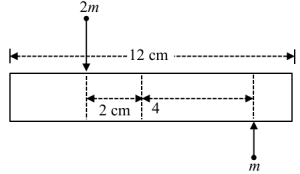
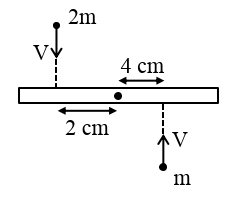
$A$ uniform bar of length $12 \text{ cm}$ and mass $20m$ lies on a smooth horizontal table. Two point masses $m$ and $2m$ are moving in opposite directions with the same speed $v$ and in the same plane as the bar. These masses strike the bar simultaneously and get stuck to it. After the collision,the entire system is rotating with an angular frequency $\omega$. The ratio of $v$ and $\omega$ is:
A
$33$
B
$2\sqrt{88}$
C
$66$
D
$32$
Solution
(A) Let the center of mass of the rod be the origin. The moment of inertia of the rod about its center is $I_{rod} = \frac{(20m)(12)^2}{12} = 240m \text{ cm}^2$.
Using the conservation of angular momentum about the center of mass of the rod:
$L_i = L_f$
Initial angular momentum $L_i = (2m)(v)(2) + (m)(v)(4) = 4mv + 4mv = 8mv$.
The final moment of inertia of the system is $I_f = I_{rod} + I_{mass1} + I_{mass2} = 240m + (2m)(2)^2 + (m)(4)^2 = 240m + 8m + 16m = 264m \text{ cm}^2$.
Since $L_f = I_f \omega$,we have $8mv = 264m \omega$.
Therefore,$\frac{v}{\omega} = \frac{264}{8} = 33$.
Using the conservation of angular momentum about the center of mass of the rod:
$L_i = L_f$
Initial angular momentum $L_i = (2m)(v)(2) + (m)(v)(4) = 4mv + 4mv = 8mv$.
The final moment of inertia of the system is $I_f = I_{rod} + I_{mass1} + I_{mass2} = 240m + (2m)(2)^2 + (m)(4)^2 = 240m + 8m + 16m = 264m \text{ cm}^2$.
Since $L_f = I_f \omega$,we have $8mv = 264m \omega$.
Therefore,$\frac{v}{\omega} = \frac{264}{8} = 33$.
0 likesView Solution
75
PhysicsDifficultMCQJEE Main · 2026
Consider two boxes containing ideal gases $A$ and $B$ such that their temperatures,pressures,and number densities are the same. The molecular size of $A$ is half of that of $B$ and the mass of molecule $A$ is four times that of $B$. If the collision frequency in gas $B$ is $32 \times 10^{18} /s$,then the collision frequency in gas $A$ is . . . . . . $/s$.
A
$32 \times 10^{18}$
B
$4 \times 10^{18}$
C
$2 \times 10^{18}$
D
$8 \times 10^{18}$
Solution
(B) The collision frequency $(Z)$ is given by the formula: $Z = \sqrt{2} \pi d^2 N \bar{v}$,where $\bar{v} = \sqrt{\frac{8RT}{\pi M}}$.
Since temperature $(T)$ and number density $(N)$ are the same for both gases,we have $Z \propto d^2 \sqrt{\frac{1}{M}}$.
Given: $d_A = \frac{d_B}{2}$ and $M_A = 4M_B$.
Therefore,the ratio of collision frequencies is:
$\frac{Z_A}{Z_B} = \left( \frac{d_A}{d_B} \right)^2 \sqrt{\frac{M_B}{M_A}}$
$\frac{Z_A}{Z_B} = \left( \frac{1}{2} \right)^2 \sqrt{\frac{M_B}{4M_B}} = \frac{1}{4} \times \frac{1}{2} = \frac{1}{8}$.
Given $Z_B = 32 \times 10^{18} /s$,we get:
$Z_A = \frac{32 \times 10^{18}}{8} = 4 \times 10^{18} /s$.
Since temperature $(T)$ and number density $(N)$ are the same for both gases,we have $Z \propto d^2 \sqrt{\frac{1}{M}}$.
Given: $d_A = \frac{d_B}{2}$ and $M_A = 4M_B$.
Therefore,the ratio of collision frequencies is:
$\frac{Z_A}{Z_B} = \left( \frac{d_A}{d_B} \right)^2 \sqrt{\frac{M_B}{M_A}}$
$\frac{Z_A}{Z_B} = \left( \frac{1}{2} \right)^2 \sqrt{\frac{M_B}{4M_B}} = \frac{1}{4} \times \frac{1}{2} = \frac{1}{8}$.
Given $Z_B = 32 \times 10^{18} /s$,we get:
$Z_A = \frac{32 \times 10^{18}}{8} = 4 \times 10^{18} /s$.
0 likesView Solution
76
PhysicsMediumMCQJEE Main · 2026
Using a simple pendulum experiment,$g$ is determined by measuring its time period $T$. Which of the following plots represents the correct relation between the pendulum length $L$ and time period $T$?
A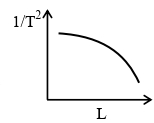
B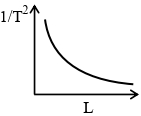
C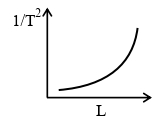
D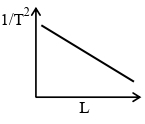
Solution
(B) The time period $T$ of a simple pendulum is given by the formula: $T = 2\pi \sqrt{\frac{L}{g}}$.
Squaring both sides,we get: $T^2 = \frac{4\pi^2 L}{g}$.
Taking the reciprocal of both sides,we get: $\frac{1}{T^2} = \frac{g}{4\pi^2 L}$.
This equation is of the form $y = \frac{k}{x}$,where $y = \frac{1}{T^2}$,$x = L$,and $k = \frac{g}{4\pi^2}$ is a constant.
This represents a rectangular hyperbola,which corresponds to the plot shown in option $B$.
Squaring both sides,we get: $T^2 = \frac{4\pi^2 L}{g}$.
Taking the reciprocal of both sides,we get: $\frac{1}{T^2} = \frac{g}{4\pi^2 L}$.
This equation is of the form $y = \frac{k}{x}$,where $y = \frac{1}{T^2}$,$x = L$,and $k = \frac{g}{4\pi^2}$ is a constant.
This represents a rectangular hyperbola,which corresponds to the plot shown in option $B$.
0 likesView Solution
77
PhysicsMediumMCQJEE Main · 2026
If $\epsilon_0$,$E$,and $t$ represent the free space permittivity,electric field,and time respectively,then the unit of $\frac{\epsilon_0 E}{t}$ will be:
A
$A \cdot m$
B
$A \cdot m^2$
C
$A / m^2$
D
$A / m$
Solution
(C) The expression is $\frac{\epsilon_0 E}{t}$.
We know that $\epsilon_0 E$ represents the electric displacement field $D$,which has the same dimensions as surface charge density $\sigma = \frac{q}{A}$.
Thus,the dimensions of $\epsilon_0 E$ are $[I T L^{-2}]$.
Dividing by time $t$ (dimension $[T]$),we get:
$\frac{[I T L^{-2}]}{[T]} = [I L^{-2}]$.
Since the dimension of current $I$ is $A$ (Ampere) and length $L$ is $m$ (meter),the unit is $A / m^2$.
We know that $\epsilon_0 E$ represents the electric displacement field $D$,which has the same dimensions as surface charge density $\sigma = \frac{q}{A}$.
Thus,the dimensions of $\epsilon_0 E$ are $[I T L^{-2}]$.
Dividing by time $t$ (dimension $[T]$),we get:
$\frac{[I T L^{-2}]}{[T]} = [I L^{-2}]$.
Since the dimension of current $I$ is $A$ (Ampere) and length $L$ is $m$ (meter),the unit is $A / m^2$.
0 likesView Solution
78
PhysicsMediumMCQJEE Main · 2026
In a screw gauge,the zero of the circular scale lies $3$ divisions above the horizontal pitch line when their metallic studs are brought in contact. Using this instrument,the thickness of a sheet is measured. If the pitch scale reading is $1 \ mm$ and the circular scale reading is $51$,then the correct thickness of the sheet is . . . . . . $mm$. [Assume least count is $0.01 \ mm$]
A
$1.50$
B
$1.48$
C
$1.54$
D
$1.51$
Solution
(C) The zero of the circular scale lies $3$ divisions above the pitch line,which indicates a negative zero error.
Zero error $e = -3 \times LC = -3 \times 0.01 \ mm = -0.03 \ mm$.
The observed reading is given by: $\text{Pitch scale reading} + (\text{Circular scale reading} \times LC)$.
Observed reading $= 1 \ mm + 51 \times 0.01 \ mm = 1 \ mm + 0.51 \ mm = 1.51 \ mm$.
The correct reading is calculated as: $\text{Correct reading} = \text{Observed reading} - \text{Zero error}$.
Correct reading $= 1.51 \ mm - (-0.03 \ mm) = 1.51 \ mm + 0.03 \ mm = 1.54 \ mm$.
Zero error $e = -3 \times LC = -3 \times 0.01 \ mm = -0.03 \ mm$.
The observed reading is given by: $\text{Pitch scale reading} + (\text{Circular scale reading} \times LC)$.
Observed reading $= 1 \ mm + 51 \times 0.01 \ mm = 1 \ mm + 0.51 \ mm = 1.51 \ mm$.
The correct reading is calculated as: $\text{Correct reading} = \text{Observed reading} - \text{Zero error}$.
Correct reading $= 1.51 \ mm - (-0.03 \ mm) = 1.51 \ mm + 0.03 \ mm = 1.54 \ mm$.
0 likesView Solution
79
PhysicsMediumMCQJEE Main · 2026
In a perfectly inelastic collision,two spheres made of the same material with masses $15 \ kg$ and $25 \ kg$,moving in opposite directions with speeds of $10 \ m/s$ and $30 \ m/s$,respectively,strike each other and stick together. The rise in temperature (in $^{\circ}C$),if all the heat produced during the collision is retained by these spheres,is: (specific heat of sphere material $31 \ cal/kg \cdot ^{\circ}C$ and $1 \ cal = 4.2 \ J$)
A
$1.75$
B
$1.44$
C
$1.15$
D
$1.95$
Solution
(B) The loss in kinetic energy during a perfectly inelastic collision is given by: $\Delta K = \frac{1}{2} \left( \frac{m_1 m_2}{m_1 + m_2} \right) (v_1 + v_2)^2$.
Substituting the given values: $m_1 = 15 \ kg$,$m_2 = 25 \ kg$,$v_1 = 10 \ m/s$,$v_2 = 30 \ m/s$.
$\Delta K = \frac{1}{2} \left( \frac{15 \times 25}{15 + 25} \right) (10 + 30)^2 = \frac{1}{2} \left( \frac{375}{40} \right) (40)^2 = \frac{1}{2} \times 375 \times 40 = 7500 \ J$.
This energy is converted into heat: $Q = (m_1 + m_2) S \Delta T$.
Given $S = 31 \ cal/kg \cdot ^{\circ}C = 31 \times 4.2 \ J/kg \cdot ^{\circ}C = 130.2 \ J/kg \cdot ^{\circ}C$.
$7500 = (15 + 25) \times 130.2 \times \Delta T$.
$7500 = 40 \times 130.2 \times \Delta T$.
$\Delta T = \frac{7500}{5208} \approx 1.44^{\circ}C$.
Substituting the given values: $m_1 = 15 \ kg$,$m_2 = 25 \ kg$,$v_1 = 10 \ m/s$,$v_2 = 30 \ m/s$.
$\Delta K = \frac{1}{2} \left( \frac{15 \times 25}{15 + 25} \right) (10 + 30)^2 = \frac{1}{2} \left( \frac{375}{40} \right) (40)^2 = \frac{1}{2} \times 375 \times 40 = 7500 \ J$.
This energy is converted into heat: $Q = (m_1 + m_2) S \Delta T$.
Given $S = 31 \ cal/kg \cdot ^{\circ}C = 31 \times 4.2 \ J/kg \cdot ^{\circ}C = 130.2 \ J/kg \cdot ^{\circ}C$.
$7500 = (15 + 25) \times 130.2 \times \Delta T$.
$7500 = 40 \times 130.2 \times \Delta T$.
$\Delta T = \frac{7500}{5208} \approx 1.44^{\circ}C$.
0 likesView Solution
80
PhysicsMediumMCQJEE Main · 2026
Two small balls with masses $m$ and $2m$ are attached to both ends of a rigid rod of length $d$ and negligible mass. If the angular momentum of this system is $L$ about an axis $(A)$ passing through its centre of mass and perpendicular to the rod,then the angular velocity of the system about $A$ is:
A
$ \frac{3}{2}\frac{L}{md^{2}} $
B
$ \frac{2L}{md^{2}} $
C
$ \frac{4}{3}\frac{L}{md^{2}} $
D
$ \frac{2L}{5md^{2}} $
Solution
(A) The angular momentum $L$ is given by $L = I\omega$,where $I$ is the moment of inertia and $\omega$ is the angular velocity. Thus,$\omega = \frac{L}{I}$.
First,locate the centre of mass $(CM)$ of the system. Let the mass $m$ be at $x = 0$ and $2m$ be at $x = d$. The position of the $CM$ is $x_{cm} = \frac{m(0) + 2m(d)}{m + 2m} = \frac{2md}{3m} = \frac{2d}{3}$.
The distance of mass $m$ from the $CM$ is $r_1 = \frac{2d}{3}$,and the distance of mass $2m$ from the $CM$ is $r_2 = d - \frac{2d}{3} = \frac{d}{3}$.
The moment of inertia $I$ about the axis passing through the $CM$ is $I = m(r_1)^2 + 2m(r_2)^2 = m(\frac{2d}{3})^2 + 2m(\frac{d}{3})^2$.
$I = m(\frac{4d^2}{9}) + 2m(\frac{d^2}{9}) = \frac{4md^2 + 2md^2}{9} = \frac{6md^2}{9} = \frac{2}{3}md^2$.
Substituting $I$ into the formula for angular velocity: $\omega = \frac{L}{\frac{2}{3}md^2} = \frac{3L}{2md^2}$.
First,locate the centre of mass $(CM)$ of the system. Let the mass $m$ be at $x = 0$ and $2m$ be at $x = d$. The position of the $CM$ is $x_{cm} = \frac{m(0) + 2m(d)}{m + 2m} = \frac{2md}{3m} = \frac{2d}{3}$.
The distance of mass $m$ from the $CM$ is $r_1 = \frac{2d}{3}$,and the distance of mass $2m$ from the $CM$ is $r_2 = d - \frac{2d}{3} = \frac{d}{3}$.
The moment of inertia $I$ about the axis passing through the $CM$ is $I = m(r_1)^2 + 2m(r_2)^2 = m(\frac{2d}{3})^2 + 2m(\frac{d}{3})^2$.
$I = m(\frac{4d^2}{9}) + 2m(\frac{d^2}{9}) = \frac{4md^2 + 2md^2}{9} = \frac{6md^2}{9} = \frac{2}{3}md^2$.
Substituting $I$ into the formula for angular velocity: $\omega = \frac{L}{\frac{2}{3}md^2} = \frac{3L}{2md^2}$.
0 likesView Solution
81
PhysicsMediumMCQJEE Main · 2026
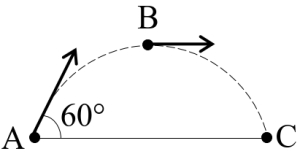
An object is projected with kinetic energy $K$ from a point $A$ at an angle $60^{\circ}$ with the horizontal. In the absence of air friction, what is the ratio of the difference in kinetic energies at points $B$ and $C$ to the kinetic energy at point $A$ (see figure)?
A
$1$ : $2$
B
$2$ : $3$
C
$1$ : $4$
D
$3$ : $4$
Solution
(D) At point $A$, the kinetic energy is $(KE)_A = K = \frac{1}{2}mu^2$.
At the highest point $B$, the vertical component of velocity is zero, so the velocity is $v_B = u \cos 60^{\circ} = \frac{u}{2}$.
The kinetic energy at point $B$ is $(KE)_B = \frac{1}{2}m(\frac{u}{2})^2 = \frac{1}{4}(\frac{1}{2}mu^2) = \frac{K}{4}$.
Since points $A$ and $C$ are at the same horizontal level, the speed at $C$ is equal to the speed at $A$. Thus, $(KE)_C = (KE)_A = K$.
The difference in kinetic energies at points $B$ and $C$ is $|(KE)_C - (KE)_B| = |K - \frac{K}{4}| = \frac{3K}{4}$.
The ratio of this difference to the kinetic energy at point $A$ is $\frac{3K/4}{K} = \frac{3}{4}$.
At the highest point $B$, the vertical component of velocity is zero, so the velocity is $v_B = u \cos 60^{\circ} = \frac{u}{2}$.
The kinetic energy at point $B$ is $(KE)_B = \frac{1}{2}m(\frac{u}{2})^2 = \frac{1}{4}(\frac{1}{2}mu^2) = \frac{K}{4}$.
Since points $A$ and $C$ are at the same horizontal level, the speed at $C$ is equal to the speed at $A$. Thus, $(KE)_C = (KE)_A = K$.
The difference in kinetic energies at points $B$ and $C$ is $|(KE)_C - (KE)_B| = |K - \frac{K}{4}| = \frac{3K}{4}$.
The ratio of this difference to the kinetic energy at point $A$ is $\frac{3K/4}{K} = \frac{3}{4}$.
0 likesView Solution
82
PhysicsMediumMCQJEE Main · 2026
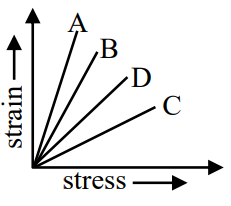
The strain-stress plot for materials $A$,$B$,$C$ and $D$ is shown in the figure. Which material has the largest Young's modulus?
A
$C$
B
$D$
C
$A$
D
$B$
Solution
(A) Young's modulus $(Y)$ is defined as the ratio of stress to strain: $Y = \frac{\text{Stress}}{\text{Strain}}$.
In the given graph,strain is plotted on the $y$-axis and stress is plotted on the $x$-axis.
Therefore,the slope of the graph is $\text{Slope} = \frac{\text{Strain}}{\text{Stress}} = \frac{1}{Y}$.
To have the largest Young's modulus $(Y)$,the value of $\frac{1}{Y}$ must be the smallest.
This means the slope of the strain-stress graph should be the minimum.
Looking at the figure,material $C$ has the smallest slope.
Thus,material $C$ has the largest Young's modulus.
In the given graph,strain is plotted on the $y$-axis and stress is plotted on the $x$-axis.
Therefore,the slope of the graph is $\text{Slope} = \frac{\text{Strain}}{\text{Stress}} = \frac{1}{Y}$.
To have the largest Young's modulus $(Y)$,the value of $\frac{1}{Y}$ must be the smallest.
This means the slope of the strain-stress graph should be the minimum.
Looking at the figure,material $C$ has the smallest slope.
Thus,material $C$ has the largest Young's modulus.
0 likesView Solution
83
PhysicsDifficultMCQJEE Main · 2026
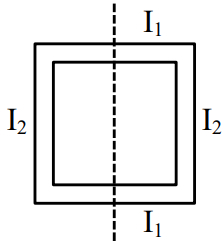
The moment of inertia of a square loop made of four uniform solid cylinders,each having radius $R$ and length $L$ $(R < L)$,about an axis passing through the midpoints of opposite sides,is (Take the mass of the entire loop as $M$):
A
$ \frac{3}{8}MR^{2}+\frac{7}{12}ML^{2} $
B
$ \frac{3}{4}MR^{2}+\frac{1}{6}ML^{2} $
C
$ \frac{3}{4}MR^{2}+\frac{7}{12}ML^{2} $
D
$ \frac{3}{8}MR^{2}+\frac{1}{6}ML^{2} $
Solution
(D) Let the mass of each cylinder be $M' = M/4$.
Consider the two cylinders perpendicular to the axis (labeled $I_1$ in the diagram). The axis passes through their centers perpendicular to their length. The moment of inertia of one such cylinder is $I_1 = \frac{M'R^2}{4} + \frac{M'L^2}{12}$.
Consider the two cylinders parallel to the axis (labeled $I_2$ in the diagram). The axis is at a distance $L/2$ from their centers. The moment of inertia of one such cylinder about its own center (axis along length) is $\frac{M'R^2}{2}$. By the parallel axis theorem,$I_2 = \frac{M'R^2}{2} + M'(L/2)^2 = \frac{M'R^2}{2} + \frac{M'L^2}{4}$.
The total moment of inertia is $I_{net} = 2I_1 + 2I_2 = 2(\frac{M'R^2}{4} + \frac{M'L^2}{12}) + 2(\frac{M'R^2}{2} + \frac{M'L^2}{4})$.
$I_{net} = \frac{M'R^2}{2} + \frac{M'L^2}{6} + M'R^2 + \frac{M'L^2}{2} = \frac{3}{2}M'R^2 + \frac{2}{3}M'L^2$.
Substituting $M' = M/4$: $I_{net} = \frac{3}{2}(M/4)R^2 + \frac{2}{3}(M/4)L^2 = \frac{3}{8}MR^2 + \frac{1}{6}ML^2$.
Consider the two cylinders perpendicular to the axis (labeled $I_1$ in the diagram). The axis passes through their centers perpendicular to their length. The moment of inertia of one such cylinder is $I_1 = \frac{M'R^2}{4} + \frac{M'L^2}{12}$.
Consider the two cylinders parallel to the axis (labeled $I_2$ in the diagram). The axis is at a distance $L/2$ from their centers. The moment of inertia of one such cylinder about its own center (axis along length) is $\frac{M'R^2}{2}$. By the parallel axis theorem,$I_2 = \frac{M'R^2}{2} + M'(L/2)^2 = \frac{M'R^2}{2} + \frac{M'L^2}{4}$.
The total moment of inertia is $I_{net} = 2I_1 + 2I_2 = 2(\frac{M'R^2}{4} + \frac{M'L^2}{12}) + 2(\frac{M'R^2}{2} + \frac{M'L^2}{4})$.
$I_{net} = \frac{M'R^2}{2} + \frac{M'L^2}{6} + M'R^2 + \frac{M'L^2}{2} = \frac{3}{2}M'R^2 + \frac{2}{3}M'L^2$.
Substituting $M' = M/4$: $I_{net} = \frac{3}{2}(M/4)R^2 + \frac{2}{3}(M/4)L^2 = \frac{3}{8}MR^2 + \frac{1}{6}ML^2$.
0 likesView Solution
84
PhysicsMediumMCQJEE Main · 2026
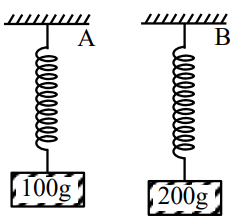
Two blocks with masses $100 \text{ g}$ and $200 \text{ g}$ are attached to the ends of springs $A$ and $B$ as shown in the figure. The energy stored in spring $A$ is $E$. The energy stored in spring $B$,when the spring constants $k_{A}$ and $k_{B}$ of springs $A$ and $B$ respectively satisfy the relation $4k_{A} = 3k_{B}$,is:
A
$4E$
B
$2E$
C
$3E$
D
$\frac{4}{3}E$
Solution
(C) For a spring-mass system in equilibrium,the spring force balances the gravitational force: $kx = mg$,where $x$ is the extension of the spring.
Thus,the extension is $x = \frac{mg}{k}$.
The elastic potential energy $U$ stored in the spring is given by $U = \frac{1}{2}kx^2$.
Substituting the value of $x$,we get $U = \frac{1}{2}k\left(\frac{mg}{k}\right)^2 = \frac{m^2g^2}{2k}$.
From this expression,we see that $U \propto \frac{m^2}{k}$.
Given $m_{A} = 100 \text{ g}$,$m_{B} = 200 \text{ g}$,and $4k_{A} = 3k_{B}$,we can write the ratio of energies as:
$\frac{U_{A}}{U_{B}} = \left(\frac{m_{A}}{m_{B}}\right)^2 \cdot \left(\frac{k_{B}}{k_{A}}\right)$.
Substituting the values: $\frac{E}{U_{B}} = \left(\frac{100}{200}\right)^2 \cdot \left(\frac{4}{3}\right) = \left(\frac{1}{2}\right)^2 \cdot \left(\frac{4}{3}\right) = \frac{1}{4} \cdot \frac{4}{3} = \frac{1}{3}$.
Therefore,$U_{B} = 3E$.
Thus,the extension is $x = \frac{mg}{k}$.
The elastic potential energy $U$ stored in the spring is given by $U = \frac{1}{2}kx^2$.
Substituting the value of $x$,we get $U = \frac{1}{2}k\left(\frac{mg}{k}\right)^2 = \frac{m^2g^2}{2k}$.
From this expression,we see that $U \propto \frac{m^2}{k}$.
Given $m_{A} = 100 \text{ g}$,$m_{B} = 200 \text{ g}$,and $4k_{A} = 3k_{B}$,we can write the ratio of energies as:
$\frac{U_{A}}{U_{B}} = \left(\frac{m_{A}}{m_{B}}\right)^2 \cdot \left(\frac{k_{B}}{k_{A}}\right)$.
Substituting the values: $\frac{E}{U_{B}} = \left(\frac{100}{200}\right)^2 \cdot \left(\frac{4}{3}\right) = \left(\frac{1}{2}\right)^2 \cdot \left(\frac{4}{3}\right) = \frac{1}{4} \cdot \frac{4}{3} = \frac{1}{3}$.
Therefore,$U_{B} = 3E$.
0 likesView Solution
85
PhysicsEasyMCQJEE Main · 2026
$A$ simple pendulum of string length $30 \ cm$ performs $20$ oscillations in $10 \ s$. The length of the string required for the pendulum to perform $40$ oscillations in the same time duration is . . . . . . $cm$. [Assume that the mass of the pendulum remains same.]
A
$120$
B
$0.75$
C
$7.5$
D
$15$
Solution
(C) The time period $T$ of a simple pendulum is given by $T = 2\pi \sqrt{\frac{\ell}{g}}$,which implies $T \propto \sqrt{\ell}$.
Given that the time duration $t$ is constant,the number of oscillations $n$ is inversely proportional to the time period $T$ $(n = \frac{t}{T})$.
Therefore,$n \propto \frac{1}{\sqrt{\ell}}$,which means $n^2 \propto \frac{1}{\ell}$ or $\ell \propto \frac{1}{n^2}$.
Initially,$n_1 = 20$ and $\ell_1 = 30 \ cm$.
Finally,$n_2 = 40$.
Using the ratio: $\frac{\ell_2}{\ell_1} = \left( \frac{n_1}{n_2} \right)^2$.
$\ell_2 = 30 \times \left( \frac{20}{40} \right)^2 = 30 \times \left( \frac{1}{2} \right)^2 = 30 \times \frac{1}{4} = 7.5 \ cm$.
Given that the time duration $t$ is constant,the number of oscillations $n$ is inversely proportional to the time period $T$ $(n = \frac{t}{T})$.
Therefore,$n \propto \frac{1}{\sqrt{\ell}}$,which means $n^2 \propto \frac{1}{\ell}$ or $\ell \propto \frac{1}{n^2}$.
Initially,$n_1 = 20$ and $\ell_1 = 30 \ cm$.
Finally,$n_2 = 40$.
Using the ratio: $\frac{\ell_2}{\ell_1} = \left( \frac{n_1}{n_2} \right)^2$.
$\ell_2 = 30 \times \left( \frac{20}{40} \right)^2 = 30 \times \left( \frac{1}{2} \right)^2 = 30 \times \frac{1}{4} = 7.5 \ cm$.
0 likesView Solution
86
PhysicsMediumMCQJEE Main · 2026
Four persons measure the length of a rod as $20.00 \ cm$,$19.75 \ cm$,$17.01 \ cm$,and $18.25 \ cm$. The relative error in the measurement of the average length of the rod is:
A
$0.24$
B
$0.18$
C
$0.06$
D
$0.08$
Solution
(C) Step $1$: Calculate the mean length of the rod:
$\ell_{\text{mean}} = \frac{20.00 + 19.75 + 17.01 + 18.25}{4} = \frac{75.01}{4} = 18.7525 \ cm \approx 18.75 \ cm$.
Step $2$: Calculate the absolute errors for each measurement:
$|\Delta \ell_1| = |20.00 - 18.75| = 1.25 \ cm$
$|\Delta \ell_2| = |19.75 - 18.75| = 1.00 \ cm$
$|\Delta \ell_3| = |17.01 - 18.75| = 1.74 \ cm$
$|\Delta \ell_4| = |18.25 - 18.75| = 0.50 \ cm$
Step $3$: Calculate the mean absolute error:
$\Delta \ell_{\text{mean}} = \frac{1.25 + 1.00 + 1.74 + 0.50}{4} = \frac{4.49}{4} = 1.1225 \ cm \approx 1.12 \ cm$.
Step $4$: Calculate the relative error:
$\text{Relative error} = \frac{\Delta \ell_{\text{mean}}}{\ell_{\text{mean}}} = \frac{1.12}{18.75} \approx 0.06$.
$\ell_{\text{mean}} = \frac{20.00 + 19.75 + 17.01 + 18.25}{4} = \frac{75.01}{4} = 18.7525 \ cm \approx 18.75 \ cm$.
Step $2$: Calculate the absolute errors for each measurement:
$|\Delta \ell_1| = |20.00 - 18.75| = 1.25 \ cm$
$|\Delta \ell_2| = |19.75 - 18.75| = 1.00 \ cm$
$|\Delta \ell_3| = |17.01 - 18.75| = 1.74 \ cm$
$|\Delta \ell_4| = |18.25 - 18.75| = 0.50 \ cm$
Step $3$: Calculate the mean absolute error:
$\Delta \ell_{\text{mean}} = \frac{1.25 + 1.00 + 1.74 + 0.50}{4} = \frac{4.49}{4} = 1.1225 \ cm \approx 1.12 \ cm$.
Step $4$: Calculate the relative error:
$\text{Relative error} = \frac{\Delta \ell_{\text{mean}}}{\ell_{\text{mean}}} = \frac{1.12}{18.75} \approx 0.06$.
0 likesView Solution
87
PhysicsDifficultMCQJEE Main · 2026
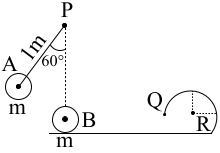
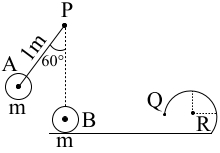
$A$ small bob $A$ of mass $m$ is attached to a massless rigid rod of length $1 \ m$ pivoted at point $P$ and kept at an angle of $60^{\circ}$ with the vertical as shown in the figure. At a distance of $1 \ m$ below point $P$,an identical bob $B$ is kept at rest on a smooth horizontal surface that extends to a circular track of radius $R$ as shown in the figure. If bob $B$ just manages to complete the circular path of radius $R$ up to a point $Q$ after being hit elastically by bob $A$,then the radius $R$ is . . . . . . $m$.
A
$ \frac{3}{5} $
B
$ \frac{1}{5} $
C
$ \frac{2+\sqrt{3}}{5} $
D
$ \frac{2-\sqrt{3}}{5} $
Solution
(B) $1$. Let $l = 1 \ m$ be the length of the rod. The velocity $V_A$ of bob $A$ at the lowest point is given by the conservation of mechanical energy:
$mgl(1 - \cos \theta) = \frac{1}{2} m V_A^2$
$V_A = \sqrt{2gl(1 - \cos 60^{\circ})} = \sqrt{2 \times 10 \times 1 \times (1 - 0.5)} = \sqrt{10} \ m/s$.
$2$. Since the collision between identical bobs $A$ and $B$ is elastic,the velocities are exchanged. Thus,after the collision,bob $B$ moves with velocity $V_B = V_A = \sqrt{10} \ m/s$.
$3$. For bob $B$ to just complete a vertical circular path of radius $R$,the minimum velocity at the bottom of the circular track must be $V_{min} = \sqrt{5gR}$.
$4$. Equating the velocities: $\sqrt{10} = \sqrt{5gR} \implies 10 = 5 \times 10 \times R \implies 10 = 50R \implies R = \frac{10}{50} = \frac{1}{5} \ m$.
$mgl(1 - \cos \theta) = \frac{1}{2} m V_A^2$
$V_A = \sqrt{2gl(1 - \cos 60^{\circ})} = \sqrt{2 \times 10 \times 1 \times (1 - 0.5)} = \sqrt{10} \ m/s$.
$2$. Since the collision between identical bobs $A$ and $B$ is elastic,the velocities are exchanged. Thus,after the collision,bob $B$ moves with velocity $V_B = V_A = \sqrt{10} \ m/s$.
$3$. For bob $B$ to just complete a vertical circular path of radius $R$,the minimum velocity at the bottom of the circular track must be $V_{min} = \sqrt{5gR}$.
$4$. Equating the velocities: $\sqrt{10} = \sqrt{5gR} \implies 10 = 5 \times 10 \times R \implies 10 = 50R \implies R = \frac{10}{50} = \frac{1}{5} \ m$.
0 likesView Solution
88
PhysicsMediumMCQJEE Main · 2026
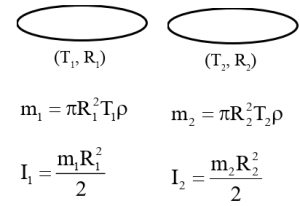
$A$ circular disc has radius $R_1$ and thickness $T_1$. Another circular disc made of the same material has radius $R_2$ and thickness $T_2$. If the moment of inertia of both discs are same and $\frac{R_1}{R_2}=2$,then $\frac{T_1}{T_2}=\frac{1}{\alpha}$. The value of $\alpha$ is . . . . . . .
A
$4$
B
$8$
C
$16$
D
$32$
Solution
(C) The moment of inertia of a circular disc about its central axis is given by $I = \frac{1}{2} M R^2$.
Since the discs are made of the same material,their density $\rho$ is the same.
The mass of a disc is $M = \text{Volume} \times \text{density} = (\pi R^2 T) \rho$.
Therefore,the moment of inertia is $I = \frac{1}{2} (\pi R^2 T \rho) R^2 = \frac{1}{2} \pi \rho R^4 T$.
Given that $I_1 = I_2$,we have:
$\frac{1}{2} \pi \rho R_1^4 T_1 = \frac{1}{2} \pi \rho R_2^4 T_2$
$R_1^4 T_1 = R_2^4 T_2$
$\frac{T_1}{T_2} = \frac{R_2^4}{R_1^4} = \left( \frac{R_2}{R_1} \right)^4$.
Given $\frac{R_1}{R_2} = 2$,so $\frac{R_2}{R_1} = \frac{1}{2}$.
$\frac{T_1}{T_2} = \left( \frac{1}{2} \right)^4 = \frac{1}{16}$.
Comparing this with $\frac{T_1}{T_2} = \frac{1}{\alpha}$,we get $\alpha = 16$.
Since the discs are made of the same material,their density $\rho$ is the same.
The mass of a disc is $M = \text{Volume} \times \text{density} = (\pi R^2 T) \rho$.
Therefore,the moment of inertia is $I = \frac{1}{2} (\pi R^2 T \rho) R^2 = \frac{1}{2} \pi \rho R^4 T$.
Given that $I_1 = I_2$,we have:
$\frac{1}{2} \pi \rho R_1^4 T_1 = \frac{1}{2} \pi \rho R_2^4 T_2$
$R_1^4 T_1 = R_2^4 T_2$
$\frac{T_1}{T_2} = \frac{R_2^4}{R_1^4} = \left( \frac{R_2}{R_1} \right)^4$.
Given $\frac{R_1}{R_2} = 2$,so $\frac{R_2}{R_1} = \frac{1}{2}$.
$\frac{T_1}{T_2} = \left( \frac{1}{2} \right)^4 = \frac{1}{16}$.
Comparing this with $\frac{T_1}{T_2} = \frac{1}{\alpha}$,we get $\alpha = 16$.
0 likesView Solution
89
PhysicsMediumMCQJEE Main · 2026
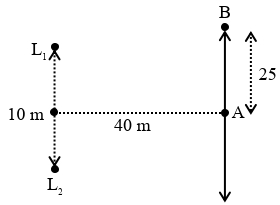
Two loudspeakers ($L_1$ and $L_2$) are placed with a separation of $10 \ m$,as shown in the figure. Both speakers are fed with an audio input signal of the same frequency with constant volume. $A$ voice recorder,initially at point $A$,at equidistance to both loudspeakers,is moved by $25 \ m$ along the line $AB$ while monitoring the audio signal. The measured signal was found to undergo $10$ cycles of minima and maxima during the movement. The frequency of the input signal is . . . . . . $Hz$. (Speed of sound in air is $324 \ m/s$ and $\sqrt{5} = 2.23$)
A
$300$
B
$600$
C
$450$
D
$150$
Solution
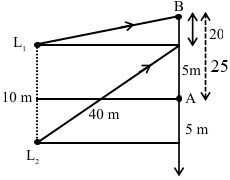
(B) Let the distance of point $A$ from the line joining the speakers be $D = 40 \ m$. The speakers $L_1$ and $L_2$ are separated by $10 \ m$,so their coordinates relative to the midpoint of the line joining them are $(0, 5)$ and $(0, -5)$. Point $A$ is at $(40, 0)$.
When the recorder moves to point $B$ at a distance of $25 \ m$ from $A$,its coordinates are $(40, 25)$.
The distances from the speakers to point $B$ are:
$L_1B = \sqrt{40^2 + (25-5)^2} = \sqrt{40^2 + 20^2} = \sqrt{1600 + 400} = \sqrt{2000} = 20\sqrt{5} \ m$.
Given $\sqrt{5} = 2.23$,$L_1B = 20 \times 2.23 = 44.6 \ m$.
$L_2B = \sqrt{40^2 + (25+5)^2} = \sqrt{40^2 + 30^2} = \sqrt{1600 + 900} = \sqrt{2500} = 50 \ m$.
The path difference at point $B$ is $\Delta x = L_2B - L_1B = 50 - 44.6 = 5.4 \ m$.
Since the recorder undergoes $10$ cycles of minima and maxima,point $B$ corresponds to the $10^{\text{th}}$ maxima,so $\Delta x = n\lambda$,where $n = 10$.
$5.4 = 10 \times \lambda \implies \lambda = 0.54 \ m$.
The frequency $f$ is given by $f = \frac{v}{\lambda} = \frac{324}{0.54} = 600 \ Hz$.
When the recorder moves to point $B$ at a distance of $25 \ m$ from $A$,its coordinates are $(40, 25)$.
The distances from the speakers to point $B$ are:
$L_1B = \sqrt{40^2 + (25-5)^2} = \sqrt{40^2 + 20^2} = \sqrt{1600 + 400} = \sqrt{2000} = 20\sqrt{5} \ m$.
Given $\sqrt{5} = 2.23$,$L_1B = 20 \times 2.23 = 44.6 \ m$.
$L_2B = \sqrt{40^2 + (25+5)^2} = \sqrt{40^2 + 30^2} = \sqrt{1600 + 900} = \sqrt{2500} = 50 \ m$.
The path difference at point $B$ is $\Delta x = L_2B - L_1B = 50 - 44.6 = 5.4 \ m$.
Since the recorder undergoes $10$ cycles of minima and maxima,point $B$ corresponds to the $10^{\text{th}}$ maxima,so $\Delta x = n\lambda$,where $n = 10$.
$5.4 = 10 \times \lambda \implies \lambda = 0.54 \ m$.
The frequency $f$ is given by $f = \frac{v}{\lambda} = \frac{324}{0.54} = 600 \ Hz$.
0 likesView Solution
90
PhysicsDifficultMCQJEE Main · 2026
Match the List-$I$ with List-$II$:
Choose the correct answer from the options given below:
| List-$I$ | List-$II$ |
| $A$. Spring constant | $I$. $ML^2 T^{-2} K^{-1}$ |
| $B$. Thermal conductivity | $II$. $ML^0 T^{-2}$ |
| $C$. Boltzmann constant | $III$. $ML^2 T^{-3} A^{-2}$ |
| $D$. Inductive reactance | $IV$. $MLT^{-3} K^{-1}$ |
Choose the correct answer from the options given below:
A
$A-II, B-I, C-IV, D-III$
B
$A-I, B-IV, C-II, D-III$
C
$A-III, B-II, C-IV, D-I$
D
$A-II, B-IV, C-I, D-III$
Solution
$(D)$. Spring constant $(k)$: From $F = kx$, we have $[k] = [F]/[x] = [MLT^{-2}]/[L] = [ML^0 T^{-2}]$. Thus, $A-II$.
$B$. Thermal conductivity $(k)$: From $dQ/dt = kA(\Delta T/l)$, we have $[k] = [ML^2 T^{-3}][L]/([L^2][K]) = [MLT^{-3} K^{-1}]$. Thus, $B-IV$.
$C$. Boltzmann constant $(k_B)$: From $E = (3/2)k_B T$, we have $[k_B] = [E]/[T] = [ML^2 T^{-2}]/[K] = [ML^2 T^{-2} K^{-1}]$. Thus, $C-I$.
$D$. Inductive reactance $(X_L)$: $X_L = \omega L$. The dimension is the same as resistance $(R = V/I)$. $[R] = [ML^2 T^{-3} A^{-2}]$. Thus, $D-III$.
Therefore, the correct matching is $A-II, B-IV, C-I, D-III$.
$B$. Thermal conductivity $(k)$: From $dQ/dt = kA(\Delta T/l)$, we have $[k] = [ML^2 T^{-3}][L]/([L^2][K]) = [MLT^{-3} K^{-1}]$. Thus, $B-IV$.
$C$. Boltzmann constant $(k_B)$: From $E = (3/2)k_B T$, we have $[k_B] = [E]/[T] = [ML^2 T^{-2}]/[K] = [ML^2 T^{-2} K^{-1}]$. Thus, $C-I$.
$D$. Inductive reactance $(X_L)$: $X_L = \omega L$. The dimension is the same as resistance $(R = V/I)$. $[R] = [ML^2 T^{-3} A^{-2}]$. Thus, $D-III$.
Therefore, the correct matching is $A-II, B-IV, C-I, D-III$.
0 likesView Solution
91
PhysicsDifficultMCQJEE Main · 2026
The volume of an ideal gas increases $8$ times and the temperature becomes $1/4$ of the initial temperature during a reversible adiabatic change. If there is no exchange of heat in this process $( \Delta Q=0 )$, identify the gas from the following options:
A
$ CO_{2} $
B
$ O_{2} $
C
$ NH_{3} $
D
$ He $
Solution
(D) For a reversible adiabatic process, the relation between temperature $T$ and volume $V$ is given by $TV^{\gamma-1} = \text{constant}$.
Let the initial state be $(T_1, V_1)$ and the final state be $(T_2, V_2)$.
Given: $V_2 = 8V_1$ and $T_2 = T_1/4$.
Using the adiabatic relation: $T_1 V_1^{\gamma-1} = T_2 V_2^{\gamma-1}$.
Substituting the values: $T_1 V_1^{\gamma-1} = (T_1/4) (8V_1)^{\gamma-1}$.
Dividing both sides by $T_1 V_1^{\gamma-1}$: $1 = (1/4) \cdot 8^{\gamma-1}$.
$4 = 8^{\gamma-1}$.
Expressing in base $2$: $2^2 = (2^3)^{\gamma-1} = 2^{3\gamma-3}$.
Equating the exponents: $2 = 3\gamma - 3$.
$3\gamma = 5$, which gives $\gamma = 5/3$.
A gas with adiabatic index $\gamma = 5/3$ is a monoatomic gas.
Among the given options, Helium (He) is a monoatomic gas. Therefore, the correct option is $D$.
Let the initial state be $(T_1, V_1)$ and the final state be $(T_2, V_2)$.
Given: $V_2 = 8V_1$ and $T_2 = T_1/4$.
Using the adiabatic relation: $T_1 V_1^{\gamma-1} = T_2 V_2^{\gamma-1}$.
Substituting the values: $T_1 V_1^{\gamma-1} = (T_1/4) (8V_1)^{\gamma-1}$.
Dividing both sides by $T_1 V_1^{\gamma-1}$: $1 = (1/4) \cdot 8^{\gamma-1}$.
$4 = 8^{\gamma-1}$.
Expressing in base $2$: $2^2 = (2^3)^{\gamma-1} = 2^{3\gamma-3}$.
Equating the exponents: $2 = 3\gamma - 3$.
$3\gamma = 5$, which gives $\gamma = 5/3$.
A gas with adiabatic index $\gamma = 5/3$ is a monoatomic gas.
Among the given options, Helium (He) is a monoatomic gas. Therefore, the correct option is $D$.
0 likesView Solution
92
PhysicsDifficultMCQJEE Main · 2026
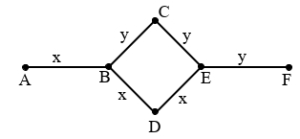
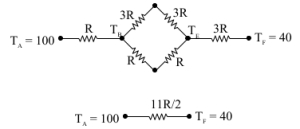
Rods $x$ and $y$ of equal dimensions but of different materials are joined as shown in the figure. Temperatures of end points $A$ and $F$ are maintained at $100^{\circ}C$ and $40^{\circ}C$ respectively. Given the thermal conductivity of rod $x$ is three times that of rod $y$,the temperatures at junction points $B$ and $E$ are (close to):
A
$89^{\circ}C$ and $73^{\circ}C$ respectively
B
$80^{\circ}C$ and $60^{\circ}C$ respectively
C
$80^{\circ}C$ and $70^{\circ}C$ respectively
D
$60^{\circ}C$ and $45^{\circ}C$ respectively
Solution
(A) Let the thermal resistance of rod $x$ be $R = \frac{\ell}{k_x A}$. Since the thermal conductivity of $x$ is $3$ times that of $y$ $(k_x = 3k_y)$,the thermal resistance of rod $y$ is $3R$.
From the figure,the network between $B$ and $E$ consists of two parallel branches: one with rods $y$ and $y$ (total resistance $3R + 3R = 6R$) and one with rods $x$ and $x$ (total resistance $R + R = 2R$).
The equivalent resistance $R_{BE}$ between $B$ and $E$ is $\frac{1}{R_{BE}} = \frac{1}{6R} + \frac{1}{2R} = \frac{1+3}{6R} = \frac{4}{6R} = \frac{2}{3R}$,so $R_{BE} = 1.5R$.
The total resistance of the circuit is $R_{total} = R_{AB} + R_{BE} + R_{EF} = R + 1.5R + 3R = 5.5R = \frac{11R}{2}$.
The total heat current $H = \frac{100 - 40}{5.5R} = \frac{60}{5.5R} = \frac{120}{11R}$.
Now,$T_B = 100 - H \cdot R = 100 - \frac{120}{11R} \cdot R = 100 - 10.91 \approx 89.09^{\circ}C$.
And $T_E = 40 + H \cdot (3R) = 40 + \frac{120}{11R} \cdot 3R = 40 + 32.73 \approx 72.73^{\circ}C$.
Thus,$T_B \approx 89^{\circ}C$ and $T_E \approx 73^{\circ}C$.
From the figure,the network between $B$ and $E$ consists of two parallel branches: one with rods $y$ and $y$ (total resistance $3R + 3R = 6R$) and one with rods $x$ and $x$ (total resistance $R + R = 2R$).
The equivalent resistance $R_{BE}$ between $B$ and $E$ is $\frac{1}{R_{BE}} = \frac{1}{6R} + \frac{1}{2R} = \frac{1+3}{6R} = \frac{4}{6R} = \frac{2}{3R}$,so $R_{BE} = 1.5R$.
The total resistance of the circuit is $R_{total} = R_{AB} + R_{BE} + R_{EF} = R + 1.5R + 3R = 5.5R = \frac{11R}{2}$.
The total heat current $H = \frac{100 - 40}{5.5R} = \frac{60}{5.5R} = \frac{120}{11R}$.
Now,$T_B = 100 - H \cdot R = 100 - \frac{120}{11R} \cdot R = 100 - 10.91 \approx 89.09^{\circ}C$.
And $T_E = 40 + H \cdot (3R) = 40 + \frac{120}{11R} \cdot 3R = 40 + 32.73 \approx 72.73^{\circ}C$.
Thus,$T_B \approx 89^{\circ}C$ and $T_E \approx 73^{\circ}C$.
0 likesView Solution
93
PhysicsDifficultMCQJEE Main · 2026
$A$ cylindrical tube $AB$ of length $l$,closed at both ends,contains an ideal gas of $1 \text{ mol}$ having molecular weight $M$. The tube is rotated in a horizontal plane with constant angular velocity $\omega$ about an axis perpendicular to $AB$ and passing through the edge at end $A$. If $P_{A}$ and $P_{B}$ are the pressures at $A$ and $B$ respectively,then (Consider the temperature is same at all points in the tube):
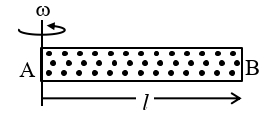
A
$P_{B}=P_{A} \exp(M\omega^{2}l^{2}/2RT)$
B
$P_{B}=P_{A}$
C
$P_{B}=P_{A} \exp(M\omega^{2}l^{2}/3RT)$
D
$P_{B}=P_{A} \exp(M\omega^{2}l^{2}/RT)$
Solution
(A) Consider a small element of gas of length $dx$ at a distance $x$ from the axis of rotation $A$. Let $A$ be the cross-sectional area of the tube.
The net force on this element providing the centripetal acceleration is $(P+dP)A - PA = (dm) \omega^2 x$.
$AdP = (dm) \omega^2 x$.
Since $dm = \rho A dx$,we have $dP = \rho \omega^2 x dx$.
Using the ideal gas law $PM = \rho RT$,we have $\rho = \frac{PM}{RT}$.
Substituting $\rho$,we get $dP = \left(\frac{PM}{RT}\right) \omega^2 x dx$.
Rearranging the terms,$\frac{dP}{P} = \frac{M \omega^2}{RT} x dx$.
Integrating from $x=0$ to $x=l$ and $P=P_A$ to $P=P_B$:
$\int_{P_A}^{P_B} \frac{dP}{P} = \frac{M \omega^2}{RT} \int_0^l x dx$.
$\ln\left(\frac{P_B}{P_A}\right) = \frac{M \omega^2}{RT} \left[\frac{x^2}{2}\right]_0^l = \frac{M \omega^2 l^2}{2RT}$.
Therefore,$P_B = P_A \exp\left(\frac{M \omega^2 l^2}{2RT}\right)$.
The net force on this element providing the centripetal acceleration is $(P+dP)A - PA = (dm) \omega^2 x$.
$AdP = (dm) \omega^2 x$.
Since $dm = \rho A dx$,we have $dP = \rho \omega^2 x dx$.
Using the ideal gas law $PM = \rho RT$,we have $\rho = \frac{PM}{RT}$.
Substituting $\rho$,we get $dP = \left(\frac{PM}{RT}\right) \omega^2 x dx$.
Rearranging the terms,$\frac{dP}{P} = \frac{M \omega^2}{RT} x dx$.
Integrating from $x=0$ to $x=l$ and $P=P_A$ to $P=P_B$:
$\int_{P_A}^{P_B} \frac{dP}{P} = \frac{M \omega^2}{RT} \int_0^l x dx$.
$\ln\left(\frac{P_B}{P_A}\right) = \frac{M \omega^2}{RT} \left[\frac{x^2}{2}\right]_0^l = \frac{M \omega^2 l^2}{2RT}$.
Therefore,$P_B = P_A \exp\left(\frac{M \omega^2 l^2}{2RT}\right)$.
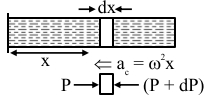
0 likesView Solution
94
PhysicsMediumMCQJEE Main · 2026
The net gravitational force at the centre of a square is found to be $F_{1}$ when four particles having masses $M, 2M, 3M,$ and $4M$ are placed at the four corners of the square as shown in the figure. It is $F_{2}$ when the positions of $3M$ and $4M$ are interchanged. The ratio $\frac{F_{1}}{F_{2}}$ is $\frac{\alpha}{\sqrt{5}}$. The value of $\alpha$ is . . . . . . .
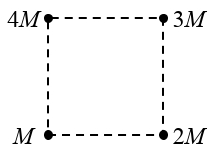
A
$2$
B
$3$
C
$1$
D
$2\sqrt{5}$
Solution
(A) Let the distance from the centre to each corner be $r$. Let a test mass $m_{0}$ be placed at the centre.
In the initial configuration,the forces exerted by the masses at the corners on $m_{0}$ are directed towards the corners. Let $k = \frac{Gm_{0}}{r^{2}}$.
The forces are $F_{M} = kM$,$F_{2M} = 2kM$,$F_{3M} = 3kM$,and $F_{4M} = 4kM$.
Opposite pairs are $(M, 3M)$ and $(2M, 4M)$.
The net force along the diagonal with $M$ and $3M$ is $F_{diag1} = (3M - M)k = 2kM$ (towards $3M$).
The net force along the diagonal with $2M$ and $4M$ is $F_{diag2} = (4M - 2M)k = 2kM$ (towards $4M$).
Since the diagonals are perpendicular,$F_{1} = \sqrt{(2kM)^{2} + (2kM)^{2}} = 2\sqrt{2}kM$.
In the new configuration,$3M$ and $4M$ are interchanged. The corners now have $M, 2M, 4M,$ and $3M$ in order.
Opposite pairs are $(M, 4M)$ and $(2M, 3M)$.
The net force along the diagonal with $M$ and $4M$ is $F'_{diag1} = (4M - M)k = 3kM$ (towards $4M$).
The net force along the diagonal with $2M$ and $3M$ is $F'_{diag2} = (3M - 2M)k = kM$ (towards $3M$).
$F_{2} = \sqrt{(3kM)^{2} + (kM)^{2}} = \sqrt{9+1}kM = \sqrt{10}kM$.
Ratio $\frac{F_{1}}{F_{2}} = \frac{2\sqrt{2}kM}{\sqrt{10}kM} = \frac{2\sqrt{2}}{\sqrt{2}\sqrt{5}} = \frac{2}{\sqrt{5}}$.
Comparing with $\frac{\alpha}{\sqrt{5}}$,we get $\alpha = 2$.
In the initial configuration,the forces exerted by the masses at the corners on $m_{0}$ are directed towards the corners. Let $k = \frac{Gm_{0}}{r^{2}}$.
The forces are $F_{M} = kM$,$F_{2M} = 2kM$,$F_{3M} = 3kM$,and $F_{4M} = 4kM$.
Opposite pairs are $(M, 3M)$ and $(2M, 4M)$.
The net force along the diagonal with $M$ and $3M$ is $F_{diag1} = (3M - M)k = 2kM$ (towards $3M$).
The net force along the diagonal with $2M$ and $4M$ is $F_{diag2} = (4M - 2M)k = 2kM$ (towards $4M$).
Since the diagonals are perpendicular,$F_{1} = \sqrt{(2kM)^{2} + (2kM)^{2}} = 2\sqrt{2}kM$.
In the new configuration,$3M$ and $4M$ are interchanged. The corners now have $M, 2M, 4M,$ and $3M$ in order.
Opposite pairs are $(M, 4M)$ and $(2M, 3M)$.
The net force along the diagonal with $M$ and $4M$ is $F'_{diag1} = (4M - M)k = 3kM$ (towards $4M$).
The net force along the diagonal with $2M$ and $3M$ is $F'_{diag2} = (3M - 2M)k = kM$ (towards $3M$).
$F_{2} = \sqrt{(3kM)^{2} + (kM)^{2}} = \sqrt{9+1}kM = \sqrt{10}kM$.
Ratio $\frac{F_{1}}{F_{2}} = \frac{2\sqrt{2}kM}{\sqrt{10}kM} = \frac{2\sqrt{2}}{\sqrt{2}\sqrt{5}} = \frac{2}{\sqrt{5}}$.
Comparing with $\frac{\alpha}{\sqrt{5}}$,we get $\alpha = 2$.
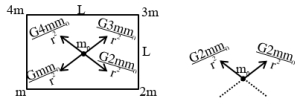
0 likesView Solution
95
PhysicsDifficultMCQJEE Main · 2026
Given below are two statements:
Statement $I$: Pressure of fluid is exerted only on a solid surface in contact as the fluid-pressure does not exist everywhere in a still fluid.
Statement $II$: Excess potential energy of the molecules on the surface of a liquid,when compared to interior,results in surface tension.
In the light of the above statements,choose the correct answer from the options given below.
Statement $I$: Pressure of fluid is exerted only on a solid surface in contact as the fluid-pressure does not exist everywhere in a still fluid.
Statement $II$: Excess potential energy of the molecules on the surface of a liquid,when compared to interior,results in surface tension.
In the light of the above statements,choose the correct answer from the options given below.
A
Statement $I$ is true but Statement $II$ is false
B
Both Statement $I$ and Statement $II$ are false
C
Both Statement $I$ and Statement $II$ are true
D
Statement $I$ is false but Statement $II$ is true
Solution
(D) According to Pascal's law,the pressure at any point in a fluid at rest is the same in all directions.
Fluid pressure exists at every point within the liquid,not just at the boundaries or on solid surfaces in contact. Therefore,Statement $I$ is false.
Regarding Statement $II$,molecules at the surface of a liquid have fewer neighbors than those in the interior,leading to a net inward force. This results in higher potential energy for surface molecules compared to interior molecules,which is the physical origin of surface tension. Therefore,Statement $II$ is true.
Fluid pressure exists at every point within the liquid,not just at the boundaries or on solid surfaces in contact. Therefore,Statement $I$ is false.
Regarding Statement $II$,molecules at the surface of a liquid have fewer neighbors than those in the interior,leading to a net inward force. This results in higher potential energy for surface molecules compared to interior molecules,which is the physical origin of surface tension. Therefore,Statement $II$ is true.
0 likesView Solution
96
PhysicsMediumMCQJEE Main · 2026
$A$ projectile is thrown upward at an angle $60^{\circ}$ with the horizontal. The speed of the projectile is $20 \text{ m/s}$ when its direction of motion is $45^{\circ}$ with the horizontal. The initial speed of the projectile is . . . . . . in $\text{m/s}$.
A
$40\sqrt{2}$
B
$40$
C
$20\sqrt{3}$
D
$20\sqrt{2}$
Solution
(D) In projectile motion,the horizontal component of velocity remains constant throughout the flight.
Let the initial speed be $u$. The horizontal component of the initial velocity is $u_x = u \cos 60^{\circ}$.
Given that at a certain point,the speed is $v = 20 \text{ m/s}$ at an angle of $45^{\circ}$ with the horizontal,the horizontal component of this velocity is $v_x = v \cos 45^{\circ} = 20 \cos 45^{\circ} = 20 \times \frac{1}{\sqrt{2}} = \frac{20}{\sqrt{2}} \text{ m/s}$.
Since $u_x = v_x$,we have:
$u \cos 60^{\circ} = \frac{20}{\sqrt{2}}$
$u \times \frac{1}{2} = \frac{20}{\sqrt{2}}$
$u = \frac{40}{\sqrt{2}} = 20\sqrt{2} \text{ m/s}$.
Let the initial speed be $u$. The horizontal component of the initial velocity is $u_x = u \cos 60^{\circ}$.
Given that at a certain point,the speed is $v = 20 \text{ m/s}$ at an angle of $45^{\circ}$ with the horizontal,the horizontal component of this velocity is $v_x = v \cos 45^{\circ} = 20 \cos 45^{\circ} = 20 \times \frac{1}{\sqrt{2}} = \frac{20}{\sqrt{2}} \text{ m/s}$.
Since $u_x = v_x$,we have:
$u \cos 60^{\circ} = \frac{20}{\sqrt{2}}$
$u \times \frac{1}{2} = \frac{20}{\sqrt{2}}$
$u = \frac{40}{\sqrt{2}} = 20\sqrt{2} \text{ m/s}$.
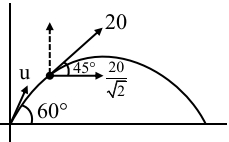
0 likesView Solution
97
PhysicsDifficultMCQJEE Main · 2026
The escape velocity from a spherical planet $A$ is $10 \ km/s$. The escape velocity from another planet $B$ whose density and radius are $10\%$ of those of planet $A$,is . . . . . . $m/s$.
A
$1000$
B
$ 200\sqrt{5} $
C
$ 100\sqrt{10} $
D
$ 1000\sqrt{2} $
Solution
(C) The formula for escape velocity is $V_{e} = \sqrt{\frac{2GM}{R}}$. Substituting mass $M = \rho \times \frac{4}{3}\pi R^{3}$,we get $V_{e} = \sqrt{\frac{2G \times \rho \times 4\pi R^{3}}{3R}} = R \sqrt{\frac{8\pi G \rho}{3}}$.
Thus,$V_{e} \propto R\sqrt{\rho}$.
Given that for planet $B$,$\rho_{B} = 0.1 \rho_{A}$ and $R_{B} = 0.1 R_{A}$.
The ratio of escape velocities is $\frac{(V_{e})_{B}}{(V_{e})_{A}} = \frac{R_{B}}{R_{A}} \times \sqrt{\frac{\rho_{B}}{\rho_{A}}} = (0.1) \times \sqrt{0.1} = \frac{1}{10} \times \frac{1}{\sqrt{10}} = \frac{1}{10\sqrt{10}}$.
Given $(V_{e})_{A} = 10 \ km/s = 10000 \ m/s$.
Therefore,$(V_{e})_{B} = 10000 \times \frac{1}{10\sqrt{10}} = \frac{1000}{\sqrt{10}} = 100\sqrt{10} \ m/s$.
Thus,$V_{e} \propto R\sqrt{\rho}$.
Given that for planet $B$,$\rho_{B} = 0.1 \rho_{A}$ and $R_{B} = 0.1 R_{A}$.
The ratio of escape velocities is $\frac{(V_{e})_{B}}{(V_{e})_{A}} = \frac{R_{B}}{R_{A}} \times \sqrt{\frac{\rho_{B}}{\rho_{A}}} = (0.1) \times \sqrt{0.1} = \frac{1}{10} \times \frac{1}{\sqrt{10}} = \frac{1}{10\sqrt{10}}$.
Given $(V_{e})_{A} = 10 \ km/s = 10000 \ m/s$.
Therefore,$(V_{e})_{B} = 10000 \times \frac{1}{10\sqrt{10}} = \frac{1000}{\sqrt{10}} = 100\sqrt{10} \ m/s$.
0 likesView Solution
98
PhysicsMediumMCQJEE Main · 2026
$A$ solid sphere of mass $5 \ kg$ and radius $10 \ cm$ is kept in contact with another solid sphere of mass $10 \ kg$ and radius $20 \ cm$. The moment of inertia of this pair of spheres about the tangent passing through the point of contact is . . . . . . $kg \cdot m^{2}$.
A
$0.36$
B
$0.72$
C
$0.18$
D
$0.63$
Solution
(D) The moment of inertia of a solid sphere about its tangent is given by the parallel axis theorem: $I = I_{cm} + MR^2 = \frac{2}{5}MR^2 + MR^2 = \frac{7}{5}MR^2$.
For the system of two spheres,the total moment of inertia about the common tangent passing through the point of contact is the sum of the moments of inertia of each sphere about that same axis.
$I_{total} = I_1 + I_2 = \frac{7}{5}m_1R_1^2 + \frac{7}{5}m_2R_2^2 = \frac{7}{5}[m_1R_1^2 + m_2R_2^2]$.
Given: $m_1 = 5 \ kg$,$R_1 = 0.1 \ m$; $m_2 = 10 \ kg$,$R_2 = 0.2 \ m$.
$I = \frac{7}{5} [5 \times (0.1)^2 + 10 \times (0.2)^2]$.
$I = \frac{7}{5} [5 \times 0.01 + 10 \times 0.04] = \frac{7}{5} [0.05 + 0.4] = \frac{7}{5} [0.45]$.
$I = 7 \times 0.09 = 0.63 \ kg \cdot m^{2}$.
For the system of two spheres,the total moment of inertia about the common tangent passing through the point of contact is the sum of the moments of inertia of each sphere about that same axis.
$I_{total} = I_1 + I_2 = \frac{7}{5}m_1R_1^2 + \frac{7}{5}m_2R_2^2 = \frac{7}{5}[m_1R_1^2 + m_2R_2^2]$.
Given: $m_1 = 5 \ kg$,$R_1 = 0.1 \ m$; $m_2 = 10 \ kg$,$R_2 = 0.2 \ m$.
$I = \frac{7}{5} [5 \times (0.1)^2 + 10 \times (0.2)^2]$.
$I = \frac{7}{5} [5 \times 0.01 + 10 \times 0.04] = \frac{7}{5} [0.05 + 0.4] = \frac{7}{5} [0.45]$.
$I = 7 \times 0.09 = 0.63 \ kg \cdot m^{2}$.
0 likesView Solution
99
PhysicsMediumMCQJEE Main · 2026
$10 \text{ mole}$ of oxygen is heated at constant volume from $30^{\circ} C$ to $40^{\circ} C$. The change in the internal energy of the gas is . . . . . . $\text{cal}$. (The molecular specific heat of oxygen at constant pressure,$C_p = 7 \text{ cal/mol}^{\circ} C$ and $R = 2 \text{ cal/mol}^{\circ} C$.)
A
$250$
B
$700$
C
$500$
D
$100$
Solution
(C) The change in internal energy $\Delta U$ for an ideal gas is given by the formula: $\Delta U = n C_v \Delta T$.
Given that the process occurs at constant volume,$C_v = C_p - R$.
Substituting the given values: $C_v = 7 - 2 = 5 \text{ cal/mol}^{\circ} C$.
Number of moles $n = 10 \text{ mol}$.
Change in temperature $\Delta T = 40^{\circ} C - 30^{\circ} C = 10^{\circ} C$.
Therefore,$\Delta U = 10 \times 5 \times 10 = 500 \text{ cal}$.
Given that the process occurs at constant volume,$C_v = C_p - R$.
Substituting the given values: $C_v = 7 - 2 = 5 \text{ cal/mol}^{\circ} C$.
Number of moles $n = 10 \text{ mol}$.
Change in temperature $\Delta T = 40^{\circ} C - 30^{\circ} C = 10^{\circ} C$.
Therefore,$\Delta U = 10 \times 5 \times 10 = 500 \text{ cal}$.
0 likesView Solution
100
PhysicsMediumMCQJEE Main · 2026
Two identical thin rods of mass $M \ kg$ and length $L \ m$ are connected as shown in the figure. The moment of inertia of the combined rod system about an axis passing through point $P$ and perpendicular to the plane of the rods is $\frac{x}{12} M L^2 \ kg \ m^2$. The value of $x$ is . . . . . . .
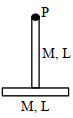
A
$12$
B
$17$
C
$13$
D
$15$
Solution
(B) Let the vertical rod be $1$ and the horizontal rod be $2$.
For rod $1$,the moment of inertia about an axis passing through $P$ (its end) and perpendicular to its length is $I_1 = \frac{ML^2}{3}$.
For rod $2$,the moment of inertia about its center of mass is $I_{cm} = \frac{ML^2}{12}$. Using the parallel axis theorem,the moment of inertia about an axis passing through $P$ and perpendicular to the plane is $I_2 = I_{cm} + Md^2$,where $d = L$ is the distance from $P$ to the center of rod $2$.
$I_2 = \frac{ML^2}{12} + M(L)^2 = \frac{13ML^2}{12}$.
The total moment of inertia is $I = I_1 + I_2 = \frac{ML^2}{3} + \frac{13ML^2}{12} = \frac{4ML^2 + 13ML^2}{12} = \frac{17ML^2}{12}$.
Comparing this with $\frac{x}{12} ML^2$,we get $x = 17$.
For rod $1$,the moment of inertia about an axis passing through $P$ (its end) and perpendicular to its length is $I_1 = \frac{ML^2}{3}$.
For rod $2$,the moment of inertia about its center of mass is $I_{cm} = \frac{ML^2}{12}$. Using the parallel axis theorem,the moment of inertia about an axis passing through $P$ and perpendicular to the plane is $I_2 = I_{cm} + Md^2$,where $d = L$ is the distance from $P$ to the center of rod $2$.
$I_2 = \frac{ML^2}{12} + M(L)^2 = \frac{13ML^2}{12}$.
The total moment of inertia is $I = I_1 + I_2 = \frac{ML^2}{3} + \frac{13ML^2}{12} = \frac{4ML^2 + 13ML^2}{12} = \frac{17ML^2}{12}$.
Comparing this with $\frac{x}{12} ML^2$,we get $x = 17$.
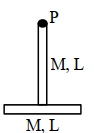
0 likesView Solution
101
PhysicsDifficultMCQJEE Main · 2026
The reading of the ammeter $(A)$ in steady state in the following circuit (assuming negligible internal resistance of the ammeter) is . . . . . . $A$.
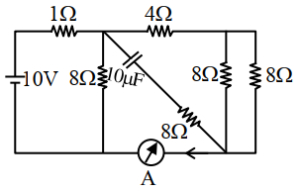
A
$2$
B
$1$
C
$1/2$
D
$0$
Solution
(B) In steady state,the capacitor acts as an open circuit,so no current flows through the branch containing the capacitor.
The circuit simplifies to a $10 \ V$ battery connected to a $1 \ \Omega$ resistor in series with a parallel combination of two $8 \ \Omega$ resistors.
The equivalent resistance of the two $8 \ \Omega$ resistors in parallel is $R_p = (8 \ \Omega \times 8 \ \Omega) / (8 \ \Omega + 8 \ \Omega) = 4 \ \Omega$.
The total resistance of the circuit is $R_{eq} = 1 \ \Omega + 4 \ \Omega = 5 \ \Omega$.
The total current drawn from the battery is $I = V / R_{eq} = 10 \ V / 5 \ \Omega = 2 \ A$.
The ammeter is placed in the return path of the circuit. Since the capacitor branch is open,the current $I = 2 \ A$ flows through the $1 \ \Omega$ resistor and then splits equally into the two $8 \ \Omega$ resistors. The ammeter measures the current flowing through the right-hand side of the circuit,which is the current through the rightmost $8 \ \Omega$ resistor. Since the current $I = 2 \ A$ splits equally into the two $8 \ \Omega$ resistors,the current through each is $I' = I / 2 = 2 \ A / 2 = 1 \ A$.
Therefore,the reading of the ammeter is $1 \ A$.
The circuit simplifies to a $10 \ V$ battery connected to a $1 \ \Omega$ resistor in series with a parallel combination of two $8 \ \Omega$ resistors.
The equivalent resistance of the two $8 \ \Omega$ resistors in parallel is $R_p = (8 \ \Omega \times 8 \ \Omega) / (8 \ \Omega + 8 \ \Omega) = 4 \ \Omega$.
The total resistance of the circuit is $R_{eq} = 1 \ \Omega + 4 \ \Omega = 5 \ \Omega$.
The total current drawn from the battery is $I = V / R_{eq} = 10 \ V / 5 \ \Omega = 2 \ A$.
The ammeter is placed in the return path of the circuit. Since the capacitor branch is open,the current $I = 2 \ A$ flows through the $1 \ \Omega$ resistor and then splits equally into the two $8 \ \Omega$ resistors. The ammeter measures the current flowing through the right-hand side of the circuit,which is the current through the rightmost $8 \ \Omega$ resistor. Since the current $I = 2 \ A$ splits equally into the two $8 \ \Omega$ resistors,the current through each is $I' = I / 2 = 2 \ A / 2 = 1 \ A$.
Therefore,the reading of the ammeter is $1 \ A$.
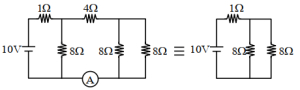
0 likesView Solution
102
PhysicsMediumMCQJEE Main · 2026
$A$ voltage regulating circuit consisting of a Zener diode,having a breakdown voltage of $10 \ V$ and a maximum power dissipation of $0.4 \ W$,is operated at $15 \ V$. The approximate value of the protective resistance in this circuit is . . . . . . $\Omega$.
A
$100$
B
$150$
C
$125$
D
$200$
Solution
(C) The Zener diode is used for voltage regulation. The power dissipation $P_D$ of the Zener diode is given by $P_D = V_Z \times i$,where $V_Z$ is the breakdown voltage and $i$ is the current through the diode.
Given $P_D = 0.4 \ W$ and $V_Z = 10 \ V$,we have:
$0.4 = 10 \times i$
$i = \frac{0.4}{10} = 0.04 \ A$
The protective resistance $R$ is connected in series with the Zener diode. The voltage drop across the resistance $R$ is $V_R = V_{source} - V_Z = 15 \ V - 10 \ V = 5 \ V$.
Using Ohm's law,$V_R = i \times R$,we get:
$R = \frac{V_R}{i} = \frac{5 \ V}{0.04 \ A} = 125 \ \Omega$.
Given $P_D = 0.4 \ W$ and $V_Z = 10 \ V$,we have:
$0.4 = 10 \times i$
$i = \frac{0.4}{10} = 0.04 \ A$
The protective resistance $R$ is connected in series with the Zener diode. The voltage drop across the resistance $R$ is $V_R = V_{source} - V_Z = 15 \ V - 10 \ V = 5 \ V$.
Using Ohm's law,$V_R = i \times R$,we get:
$R = \frac{V_R}{i} = \frac{5 \ V}{0.04 \ A} = 125 \ \Omega$.
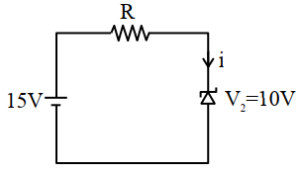
0 likesView Solution
103
PhysicsMediumMCQJEE Main · 2026
There are three concentric conducting spherical shells $A$,$B$,and $C$ of radii $a$,$b$,and $c$ respectively. The potentials of the spheres $A$,$B$,and $C$ respectively are:
A
$\frac{1}{4 \pi \epsilon_0}\left(\frac{q_1+q_2+q_3}{a}\right), \frac{1}{4 \pi \epsilon_0}\left(\frac{q_1+q_2+q_3}{b}\right), \frac{1}{4 \pi \epsilon_0}\left(\frac{q_1+q_2+q_3}{c}\right)$
B
$\frac{1}{4 \pi \epsilon_0}\left(\frac{q_1+q_2+q_3}{a}\right), \frac{1}{4 \pi \epsilon_0}\left(\frac{q_1+q_2}{b}+\frac{q_3}{c}\right), \frac{1}{4 \pi \epsilon_0}\left(\frac{q_1}{a}+\frac{q_2}{b}+\frac{q_3}{c}\right)$
C
$\frac{1}{4 \pi \epsilon_0}\left(\frac{q_1}{a}+\frac{q_2}{b}+\frac{q_3}{c}\right), \frac{1}{4 \pi \epsilon_0}\left(\frac{q_1+q_2}{b}+\frac{q_3}{c}\right), \frac{1}{4 \pi \epsilon_0}\left(\frac{q_1+q_2+q_3}{c}\right)$
D
$\frac{1}{4 \pi \epsilon_0}\left(\frac{q_1}{a}+\frac{q_2}{b}+\frac{q_3}{c}\right), \frac{1}{4 \pi \epsilon_0}\left(\frac{q_1+q_2+q_3}{b}\right), \frac{1}{4 \pi \epsilon_0}\left(\frac{q_1+q_2+q_3}{c}\right)$
Solution
(C) The potential at any point on a conducting spherical shell is the sum of the potentials due to all the charges present on the shells.
For a point at distance $r$ from the center,the potential due to a shell of radius $R$ and charge $q$ is $\frac{kq}{R}$ if $r \le R$ and $\frac{kq}{r}$ if $r > R$.
For sphere $A$ (radius $a$): It is inside $B$ and $C$,so the potential is $V_A = \frac{kq_1}{a} + \frac{kq_2}{b} + \frac{kq_3}{c} = \frac{1}{4 \pi \epsilon_0} \left( \frac{q_1}{a} + \frac{q_2}{b} + \frac{q_3}{c} \right)$.
For sphere $B$ (radius $b$): It is on the surface of $B$,inside $C$,and outside $A$. So,$V_B = \frac{kq_1}{b} + \frac{kq_2}{b} + \frac{kq_3}{c} = \frac{1}{4 \pi \epsilon_0} \left( \frac{q_1+q_2}{b} + \frac{q_3}{c} \right)$.
For sphere $C$ (radius $c$): It is on the surface of $C$,and outside $A$ and $B$. So,$V_C = \frac{kq_1}{c} + \frac{kq_2}{c} + \frac{kq_3}{c} = \frac{1}{4 \pi \epsilon_0} \left( \frac{q_1+q_2+q_3}{c} \right)$.
For a point at distance $r$ from the center,the potential due to a shell of radius $R$ and charge $q$ is $\frac{kq}{R}$ if $r \le R$ and $\frac{kq}{r}$ if $r > R$.
For sphere $A$ (radius $a$): It is inside $B$ and $C$,so the potential is $V_A = \frac{kq_1}{a} + \frac{kq_2}{b} + \frac{kq_3}{c} = \frac{1}{4 \pi \epsilon_0} \left( \frac{q_1}{a} + \frac{q_2}{b} + \frac{q_3}{c} \right)$.
For sphere $B$ (radius $b$): It is on the surface of $B$,inside $C$,and outside $A$. So,$V_B = \frac{kq_1}{b} + \frac{kq_2}{b} + \frac{kq_3}{c} = \frac{1}{4 \pi \epsilon_0} \left( \frac{q_1+q_2}{b} + \frac{q_3}{c} \right)$.
For sphere $C$ (radius $c$): It is on the surface of $C$,and outside $A$ and $B$. So,$V_C = \frac{kq_1}{c} + \frac{kq_2}{c} + \frac{kq_3}{c} = \frac{1}{4 \pi \epsilon_0} \left( \frac{q_1+q_2+q_3}{c} \right)$.
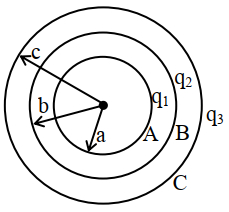
0 likesView Solution
104
PhysicsMediumMCQJEE Main · 2026
The electrostatic potential in a charged spherical region of radius $r$ varies as $V = ar^3 + b$,where $a$ and $b$ are constants. The total charge in the sphere of unit radius is $\alpha \times \pi a \epsilon_0$. The value of $\alpha$ is . . . . . . .
A
$-12$
B
$-6$
C
$-9$
D
$-8$
Solution
(A) The electrostatic potential is given by $V = ar^3 + b$.
The electric field $E$ is related to the potential by $E = -\frac{dV}{dr}$.
Differentiating $V$ with respect to $r$,we get $E = -\frac{d}{dr}(ar^3 + b) = -3ar^2$.
According to Gauss's Law,the total charge $q_{enc}$ enclosed in a sphere of radius $r=1$ is given by $q_{enc} = \epsilon_0 \oint E \cdot dA$.
For a spherical surface of radius $r=1$,the area $A = 4\pi r^2 = 4\pi(1)^2 = 4\pi$.
Substituting the values at $r=1$,$E = -3a(1)^2 = -3a$.
Thus,$q_{enc} = \epsilon_0 \times (-3a) \times 4\pi = -12\pi a \epsilon_0$.
Comparing this with the given expression $\alpha \times \pi a \epsilon_0$,we find $\alpha = -12$.
The electric field $E$ is related to the potential by $E = -\frac{dV}{dr}$.
Differentiating $V$ with respect to $r$,we get $E = -\frac{d}{dr}(ar^3 + b) = -3ar^2$.
According to Gauss's Law,the total charge $q_{enc}$ enclosed in a sphere of radius $r=1$ is given by $q_{enc} = \epsilon_0 \oint E \cdot dA$.
For a spherical surface of radius $r=1$,the area $A = 4\pi r^2 = 4\pi(1)^2 = 4\pi$.
Substituting the values at $r=1$,$E = -3a(1)^2 = -3a$.
Thus,$q_{enc} = \epsilon_0 \times (-3a) \times 4\pi = -12\pi a \epsilon_0$.
Comparing this with the given expression $\alpha \times \pi a \epsilon_0$,we find $\alpha = -12$.
0 likesView Solution
105
PhysicsMediumMCQJEE Main · 2026
Given below are two statements:
Statement $I$: For all elements,greater the mass of the nucleus,greater is the binding energy per nucleon.
Statement $II$: For all elements,nuclei with less binding energy per nucleon transform to nuclei with greater binding energy per nucleon.
In the light of the above statements,choose the correct answer from the options given below:
Statement $I$: For all elements,greater the mass of the nucleus,greater is the binding energy per nucleon.
Statement $II$: For all elements,nuclei with less binding energy per nucleon transform to nuclei with greater binding energy per nucleon.
In the light of the above statements,choose the correct answer from the options given below:
A
Both Statement $I$ and Statement $II$ are true
B
Statement $I$ is true but Statement $II$ is false
C
Both Statement $I$ and Statement $II$ are false
D
Statement $I$ is false but Statement $II$ is true
Solution
(D) Statement $I$ is false because the binding energy per nucleon is not a monotonically increasing function of the mass number. It increases initially,reaches a maximum for iron $(Fe)$,and then decreases for heavier nuclei.
Statement $II$ is true because nuclei with lower binding energy per nucleon are less stable. Through processes like nuclear fission (for heavy nuclei) or nuclear fusion (for light nuclei),they tend to transform into more stable nuclei with higher binding energy per nucleon to achieve a lower energy state.
Statement $II$ is true because nuclei with lower binding energy per nucleon are less stable. Through processes like nuclear fission (for heavy nuclei) or nuclear fusion (for light nuclei),they tend to transform into more stable nuclei with higher binding energy per nucleon to achieve a lower energy state.
0 likesView Solution
106
PhysicsMediumMCQJEE Main · 2026
Two resistors $2 \Omega$ and $3 \Omega$ are connected in the gaps of a meter bridge as shown in the figure. The null point is obtained with the contact of the jockey at some point on the wire $XY$. When an unknown resistor $R$ is connected in parallel with the $3 \Omega$ resistor,the null point is shifted by $22.5 \text{ cm}$ toward $Y$. The resistance of the unknown resistor $R$ is . . . . . . $\Omega$.
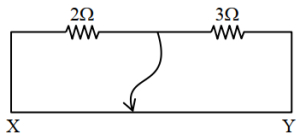
A
$3$
B
$2$
C
$4$
D
$1$
Solution
(B) Initially,for a meter bridge,the balance condition is given by $\frac{P}{Q} = \frac{l}{100-l}$.
Given $P = 2 \Omega$ and $Q = 3 \Omega$,we have $\frac{2}{3} = \frac{l}{100-l}$.
$2(100-l) = 3l \Rightarrow 200 - 2l = 3l \Rightarrow 5l = 200 \Rightarrow l = 40 \text{ cm}$.
When an unknown resistor $R$ is connected in parallel with $3 \Omega$,the new resistance $Q'$ becomes $\frac{3R}{3+R}$.
The null point shifts by $22.5 \text{ cm}$ toward $Y$,so the new length $l' = 40 + 22.5 = 62.5 \text{ cm}$.
The new balance condition is $\frac{2}{Q'} = \frac{62.5}{100-62.5} = \frac{62.5}{37.5} = \frac{5}{3}$.
Substituting $Q'$,we get $\frac{2}{\frac{3R}{3+R}} = \frac{5}{3} \Rightarrow \frac{2(3+R)}{3R} = \frac{5}{3}$.
$6(3+R) = 15R \Rightarrow 18 + 6R = 15R \Rightarrow 9R = 18 \Rightarrow R = 2 \Omega$.
Given $P = 2 \Omega$ and $Q = 3 \Omega$,we have $\frac{2}{3} = \frac{l}{100-l}$.
$2(100-l) = 3l \Rightarrow 200 - 2l = 3l \Rightarrow 5l = 200 \Rightarrow l = 40 \text{ cm}$.
When an unknown resistor $R$ is connected in parallel with $3 \Omega$,the new resistance $Q'$ becomes $\frac{3R}{3+R}$.
The null point shifts by $22.5 \text{ cm}$ toward $Y$,so the new length $l' = 40 + 22.5 = 62.5 \text{ cm}$.
The new balance condition is $\frac{2}{Q'} = \frac{62.5}{100-62.5} = \frac{62.5}{37.5} = \frac{5}{3}$.
Substituting $Q'$,we get $\frac{2}{\frac{3R}{3+R}} = \frac{5}{3} \Rightarrow \frac{2(3+R)}{3R} = \frac{5}{3}$.
$6(3+R) = 15R \Rightarrow 18 + 6R = 15R \Rightarrow 9R = 18 \Rightarrow R = 2 \Omega$.
0 likesView Solution
107
PhysicsMediumMCQJEE Main · 2026
Match the List-$I$ with List-$II$. Choose the correct answer from the options given below:
| List-$I$ | List-$II$ |
|---|---|
| $A.$ Radio-wave | $I.$ Produced by Magnetron valve |
| $B.$ Micro-wave | $II.$ Due to change in the vibrational modes of atoms |
| $C.$ Infrared-wave | $III.$ Due to inner shell electrons moving from higher energy level to lower energy level |
| $D.$ $X$-ray | $IV.$ Due to rapid acceleration of electrons |
A
$A - II, B - IV, C - III, D - I$
B
$A - IV, B - III, C - I, D - II$
C
$A - IV, B - I, C - II, D - III$
D
$A - IV, B - II, C - I, D - III$
Solution
(C) Radio waves are produced by the rapid acceleration and deceleration of electrons in aerials.
Microwaves are produced by special vacuum tubes like klystrons, magnetrons, and Gunn diodes.
Infrared waves are produced by hot bodies and molecules due to changes in their vibrational and rotational modes.
$X$-rays are produced when high-energy electrons are suddenly stopped or when inner-shell electrons transition from a higher energy level to a lower energy level.
Therefore, the correct matching is: $A - IV, B - I, C - II, D - III$.
Microwaves are produced by special vacuum tubes like klystrons, magnetrons, and Gunn diodes.
Infrared waves are produced by hot bodies and molecules due to changes in their vibrational and rotational modes.
$X$-rays are produced when high-energy electrons are suddenly stopped or when inner-shell electrons transition from a higher energy level to a lower energy level.
Therefore, the correct matching is: $A - IV, B - I, C - II, D - III$.
0 likesView Solution
108
PhysicsMediumMCQJEE Main · 2026
For the series $LCR$ circuit connected with a $220 \ V$,$50 \ Hz$ a.c. source as shown in the figure,the power factor is $\frac{\alpha}{10}$. The value of $\alpha$ is . . . . . .
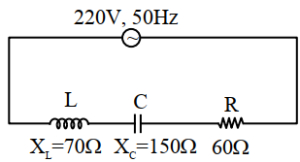
A
$4$
B
$10$
C
$6$
D
$8$
Solution
(C) The power factor of an $LCR$ series circuit is given by $\cos \phi = \frac{R}{Z}$.
First,we calculate the impedance $Z$ of the circuit:
$Z = \sqrt{R^{2} + (X_{L} - X_{C})^{2}}$
Given $R = 60 \ \Omega$,$X_{L} = 70 \ \Omega$,and $X_{C} = 150 \ \Omega$.
$Z = \sqrt{60^{2} + (70 - 150)^{2}}$
$Z = \sqrt{60^{2} + (-80)^{2}}$
$Z = \sqrt{3600 + 6400} = \sqrt{10000} = 100 \ \Omega$.
Now,the power factor is:
$\cos \phi = \frac{R}{Z} = \frac{60}{100} = \frac{6}{10}$.
Comparing this with the given power factor $\frac{\alpha}{10}$,we get $\alpha = 6$.
First,we calculate the impedance $Z$ of the circuit:
$Z = \sqrt{R^{2} + (X_{L} - X_{C})^{2}}$
Given $R = 60 \ \Omega$,$X_{L} = 70 \ \Omega$,and $X_{C} = 150 \ \Omega$.
$Z = \sqrt{60^{2} + (70 - 150)^{2}}$
$Z = \sqrt{60^{2} + (-80)^{2}}$
$Z = \sqrt{3600 + 6400} = \sqrt{10000} = 100 \ \Omega$.
Now,the power factor is:
$\cos \phi = \frac{R}{Z} = \frac{60}{100} = \frac{6}{10}$.
Comparing this with the given power factor $\frac{\alpha}{10}$,we get $\alpha = 6$.
0 likesView Solution
109
PhysicsDifficultMCQJEE Main · 2026
In a microscope of tube length $10 \ cm$,two convex lenses are arranged with focal lengths of $2 \ cm$ and $5 \ cm$. The total magnification obtained with this system for normal adjustment is $(5)^{k}$. The value of $k$ is . . . . . . .
A
$2$
B
$5$
C
$3.5$
D
$4$
Solution
(A) For a compound microscope in normal adjustment,the objective lens forms the image at the focal point of the eyepiece.
The tube length $L$ is the distance between the second focal point of the objective and the first focal point of the eyepiece.
The magnification $M$ of a compound microscope in normal adjustment is given by the formula: $M = \left( \frac{L}{f_o} \right) \times \left( \frac{D}{f_e} \right)$.
Given: $L = 10 \ cm$,$f_o = 2 \ cm$,$f_e = 5 \ cm$,and the least distance of distinct vision $D = 25 \ cm$.
Substituting the values: $M = \left( \frac{10}{2} \right) \times \left( \frac{25}{5} \right) = 5 \times 5 = 25$.
We are given $M = (5)^k$.
Therefore,$25 = (5)^k \implies 5^2 = 5^k$.
Comparing the exponents,we get $k = 2$.
The tube length $L$ is the distance between the second focal point of the objective and the first focal point of the eyepiece.
The magnification $M$ of a compound microscope in normal adjustment is given by the formula: $M = \left( \frac{L}{f_o} \right) \times \left( \frac{D}{f_e} \right)$.
Given: $L = 10 \ cm$,$f_o = 2 \ cm$,$f_e = 5 \ cm$,and the least distance of distinct vision $D = 25 \ cm$.
Substituting the values: $M = \left( \frac{10}{2} \right) \times \left( \frac{25}{5} \right) = 5 \times 5 = 25$.
We are given $M = (5)^k$.
Therefore,$25 = (5)^k \implies 5^2 = 5^k$.
Comparing the exponents,we get $k = 2$.
0 likesView Solution
110
PhysicsMediumMCQJEE Main · 2026
Two electrons are moving in orbits of two hydrogen-like atoms with speeds $3 \times 10^5 \ m/s$ and $2.5 \times 10^5 \ m/s$ respectively. If the radii of these orbits are nearly the same,then the possible order of energy states are . . . . . . respectively.
A
$6$ and $5$
B
$9$ and $8$
C
$8$ and $10$
D
$10$ and $12$
Solution
(A) For a hydrogen-like atom,the velocity of an electron in the $n^{th}$ orbit is given by $v \propto \frac{Z}{n}$.
The radius of the $n^{th}$ orbit is given by $r \propto \frac{n^2}{Z}$.
From these two relations,we can write $r \propto \frac{n}{v}$ (since $Z \propto \frac{n}{v} \cdot n = \frac{n^2}{r}$,substituting $Z$ into the velocity relation).
Given that the radii are nearly the same $(r_1 \approx r_2)$,we have $\frac{n_1}{v_1} = \frac{n_2}{v_2}$.
Therefore,$\frac{n_1}{n_2} = \frac{v_1}{v_2} = \frac{3 \times 10^5}{2.5 \times 10^5} = \frac{3}{2.5} = \frac{6}{5}$.
Thus,the possible order of energy states ($n_1$ and $n_2$) is $6$ and $5$.
The radius of the $n^{th}$ orbit is given by $r \propto \frac{n^2}{Z}$.
From these two relations,we can write $r \propto \frac{n}{v}$ (since $Z \propto \frac{n}{v} \cdot n = \frac{n^2}{r}$,substituting $Z$ into the velocity relation).
Given that the radii are nearly the same $(r_1 \approx r_2)$,we have $\frac{n_1}{v_1} = \frac{n_2}{v_2}$.
Therefore,$\frac{n_1}{n_2} = \frac{v_1}{v_2} = \frac{3 \times 10^5}{2.5 \times 10^5} = \frac{3}{2.5} = \frac{6}{5}$.
Thus,the possible order of energy states ($n_1$ and $n_2$) is $6$ and $5$.
0 likesView Solution
111
PhysicsDifficultMCQJEE Main · 2026
The exit surface of a prism with refractive index $n$ is coated with a material having refractive index $\frac{n}{2}$. When this prism is set for minimum angle of deviation,it exactly meets the condition of the critical angle. The prism angle is . . . . . . (in $^{\circ}$)
A
$60$
B
$15$
C
$30$
D
$45$
Solution
(A) For the condition of minimum deviation,the angle of incidence $i$ is equal to the angle of emergence $e$,and the angle of refraction $r$ is given by $r = \frac{A}{2}$,where $A$ is the prism angle.
At the exit surface,the light ray strikes the interface between the prism (refractive index $n$) and the coating (refractive index $n/2$).
For the condition of the critical angle $\theta_{c}$,the angle of refraction $r$ must be equal to $\theta_{c}$.
According to Snell's law at the exit surface: $n \sin(r) = (n/2) \sin(90^{\circ})$.
Since $\sin(90^{\circ}) = 1$,we have $n \sin(r) = n/2$.
Dividing both sides by $n$,we get $\sin(r) = 1/2$.
Since $r = A/2$,we have $\sin(A/2) = 1/2$.
Therefore,$A/2 = 30^{\circ}$,which gives $A = 60^{\circ}$.
At the exit surface,the light ray strikes the interface between the prism (refractive index $n$) and the coating (refractive index $n/2$).
For the condition of the critical angle $\theta_{c}$,the angle of refraction $r$ must be equal to $\theta_{c}$.
According to Snell's law at the exit surface: $n \sin(r) = (n/2) \sin(90^{\circ})$.
Since $\sin(90^{\circ}) = 1$,we have $n \sin(r) = n/2$.
Dividing both sides by $n$,we get $\sin(r) = 1/2$.
Since $r = A/2$,we have $\sin(A/2) = 1/2$.
Therefore,$A/2 = 30^{\circ}$,which gives $A = 60^{\circ}$.
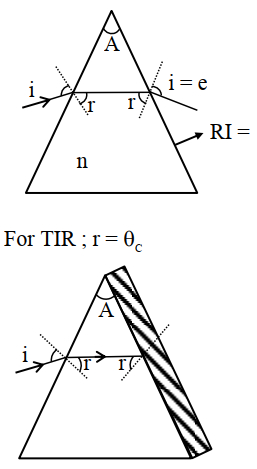
0 likesView Solution
112
PhysicsMediumMCQJEE Main · 2026
Two resistors of $100 \Omega$ each are connected in series with a $9 \text{ V}$ battery. $A$ voltmeter of $400 \Omega$ resistance is connected to measure the voltage drop across one of the resistors. The voltmeter reading is . . . . . . $V$.
A
$3$
B
$4.5$
C
$4$
D
$2$
Solution
(C) Let the two resistors be $R_1 = 100 \Omega$ and $R_2 = 100 \Omega$. The voltmeter with resistance $R_v = 400 \Omega$ is connected in parallel with $R_2$.
The equivalent resistance of the parallel combination of $R_2$ and $R_v$ is:
$R_p = \frac{R_2 \times R_v}{R_2 + R_v} = \frac{100 \times 400}{100 + 400} = \frac{40000}{500} = 80 \Omega$
The total resistance of the circuit is $R_{eq} = R_1 + R_p = 100 + 80 = 180 \Omega$.
The total current in the circuit is $I = \frac{V}{R_{eq}} = \frac{9}{180} = \frac{1}{20} \text{ A} = 0.05 \text{ A}$.
The voltage drop across the parallel combination (which is the voltmeter reading) is $V_v = I \times R_p = 0.05 \times 80 = 4 \text{ V}$.
The equivalent resistance of the parallel combination of $R_2$ and $R_v$ is:
$R_p = \frac{R_2 \times R_v}{R_2 + R_v} = \frac{100 \times 400}{100 + 400} = \frac{40000}{500} = 80 \Omega$
The total resistance of the circuit is $R_{eq} = R_1 + R_p = 100 + 80 = 180 \Omega$.
The total current in the circuit is $I = \frac{V}{R_{eq}} = \frac{9}{180} = \frac{1}{20} \text{ A} = 0.05 \text{ A}$.
The voltage drop across the parallel combination (which is the voltmeter reading) is $V_v = I \times R_p = 0.05 \times 80 = 4 \text{ V}$.
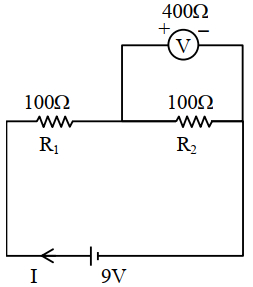
0 likesView Solution
113
PhysicsDifficultMCQJEE Main · 2026
Three charges $+2q$,$+3q$,and $-4q$ are situated at $(0, -3a)$,$(2a, 0)$,and $(-2a, 0)$ respectively in the $xy$ plane. The resultant dipole moment about the origin is . . . . . .
A
$2qa(3\hat{j}-\hat{i})$
B
$2qa(3\hat{i}-7\hat{j})$
C
$2qa(7\hat{i}-3\hat{j})$
D
$2qa(3\hat{j}-7\hat{i})$
Solution
(C) The dipole moment $\vec{p}$ of a system of charges is given by $\vec{p} = \sum q_i \vec{r}_i$.
Given charges are $q_1 = +2q$ at $\vec{r}_1 = (0, -3a) = -3a\hat{j}$,$q_2 = +3q$ at $\vec{r}_2 = (2a, 0) = 2a\hat{i}$,and $q_3 = -4q$ at $\vec{r}_3 = (-2a, 0) = -2a\hat{i}$.
Substituting these values into the formula:
$\vec{p} = (2q)(-3a\hat{j}) + (3q)(2a\hat{i}) + (-4q)(-2a\hat{i})$
$\vec{p} = -6qa\hat{j} + 6qa\hat{i} + 8qa\hat{i}$
$\vec{p} = (6qa + 8qa)\hat{i} - 6qa\hat{j}$
$\vec{p} = 14qa\hat{i} - 6qa\hat{j}$
$\vec{p} = 2qa(7\hat{i} - 3\hat{j})$
Given charges are $q_1 = +2q$ at $\vec{r}_1 = (0, -3a) = -3a\hat{j}$,$q_2 = +3q$ at $\vec{r}_2 = (2a, 0) = 2a\hat{i}$,and $q_3 = -4q$ at $\vec{r}_3 = (-2a, 0) = -2a\hat{i}$.
Substituting these values into the formula:
$\vec{p} = (2q)(-3a\hat{j}) + (3q)(2a\hat{i}) + (-4q)(-2a\hat{i})$
$\vec{p} = -6qa\hat{j} + 6qa\hat{i} + 8qa\hat{i}$
$\vec{p} = (6qa + 8qa)\hat{i} - 6qa\hat{j}$
$\vec{p} = 14qa\hat{i} - 6qa\hat{j}$
$\vec{p} = 2qa(7\hat{i} - 3\hat{j})$
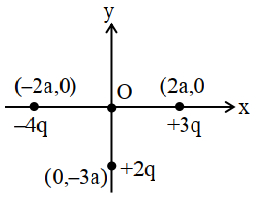
0 likesView Solution
114
PhysicsDifficultMCQJEE Main · 2026
Match the List-$I$ with List-$II$:
Choose the correct answer from the options given below:
| List-$I$ | List-$II$ |
| $A$. Magnetic induction | $I$. $MLT^{-2}A^{-2}$ |
| $B$. Magnetic flux | $II$. $ML^2T^{-2}A^{-2}$ |
| $C$. Magnetic permeability | $III$. $ML^0T^{-2}A^{-1}$ |
| $D$. Self inductance | $IV$. $ML^2T^{-2}A^{-1}$ |
Choose the correct answer from the options given below:
A
$A-IV, B-III, C-I, D-II$
B
$A-III, B-IV, C-II, D-I$
C
$A-I, B-III, C-IV, D-II$
D
$A-III, B-IV, C-I, D-II$
Solution
(D) $1$. Magnetic induction $(B)$: Using $F = qvB$, we have $[B] = [F] / ([q][v]) = [MLT^{-2}] / ([AT][LT^{-1}]) = [MT^{-2}A^{-1}]$. This matches $III$.
$2$. Magnetic flux $(\phi)$: $\phi = B \cdot A$. Thus, $[\phi] = [MT^{-2}A^{-1}] \cdot [L^2] = [ML^2T^{-2}A^{-1}]$. This matches $IV$.
$3$. Magnetic permeability $(\mu)$: Using $B = \mu_0 H$ or $F = \frac{\mu_0 I_1 I_2 L}{2\pi r}$, we find $[\mu] = [MLT^{-2}A^{-2}]$. This matches $I$.
$4$. Self inductance $(L)$: Using $U = \frac{1}{2}LI^2$, we have $[L] = [U] / [I^2] = [ML^2T^{-2}] / [A^2] = [ML^2T^{-2}A^{-2}]$. This matches $II$.
Therefore, the correct matching is $A-III, B-IV, C-I, D-II$.
$2$. Magnetic flux $(\phi)$: $\phi = B \cdot A$. Thus, $[\phi] = [MT^{-2}A^{-1}] \cdot [L^2] = [ML^2T^{-2}A^{-1}]$. This matches $IV$.
$3$. Magnetic permeability $(\mu)$: Using $B = \mu_0 H$ or $F = \frac{\mu_0 I_1 I_2 L}{2\pi r}$, we find $[\mu] = [MLT^{-2}A^{-2}]$. This matches $I$.
$4$. Self inductance $(L)$: Using $U = \frac{1}{2}LI^2$, we have $[L] = [U] / [I^2] = [ML^2T^{-2}] / [A^2] = [ML^2T^{-2}A^{-2}]$. This matches $II$.
Therefore, the correct matching is $A-III, B-IV, C-I, D-II$.
0 likesView Solution
115
PhysicsMediumMCQJEE Main · 2026
In a Young's double slit experiment setup,the two slits are kept $0.4 \ mm$ apart and the screen is placed at $1 \ m$ from the slits. If a thin transparent sheet of thickness $20 \ \mu m$ is introduced in front of one of the slits,then the central bright fringe shifts by $20 \ mm$ on the screen. The refractive index of the transparent sheet is given by $\frac{\alpha}{10}$,where $\alpha$ is . . . . . . .
A
$10$
B
$12$
C
$14$
D
$16$
Solution
(C) The shift in the central bright fringe in a Young's double slit experiment when a thin transparent sheet is introduced is given by the formula: $y_{\text{shift}} = \frac{(\mu - 1) t D}{d}$.
Given values are: $d = 0.4 \ mm = 0.4 \times 10^{-3} \ m$,$D = 1 \ m$,$t = 20 \ \mu m = 20 \times 10^{-6} \ m$,and $y_{\text{shift}} = 20 \ mm = 20 \times 10^{-3} \ m$.
Substituting these values into the formula:
$20 \times 10^{-3} = \frac{(\mu - 1) \times 20 \times 10^{-6} \times 1}{0.4 \times 10^{-3}}$
$20 \times 10^{-3} = \frac{(\mu - 1) \times 20 \times 10^{-6}}{0.4 \times 10^{-3}}$
$20 \times 10^{-3} = (\mu - 1) \times 50 \times 10^{-3}$
$\mu - 1 = \frac{20}{50} = 0.4$
$\mu = 1.4$
Since the refractive index is given as $\frac{\alpha}{10} = 1.4$,we get $\alpha = 14$.
Given values are: $d = 0.4 \ mm = 0.4 \times 10^{-3} \ m$,$D = 1 \ m$,$t = 20 \ \mu m = 20 \times 10^{-6} \ m$,and $y_{\text{shift}} = 20 \ mm = 20 \times 10^{-3} \ m$.
Substituting these values into the formula:
$20 \times 10^{-3} = \frac{(\mu - 1) \times 20 \times 10^{-6} \times 1}{0.4 \times 10^{-3}}$
$20 \times 10^{-3} = \frac{(\mu - 1) \times 20 \times 10^{-6}}{0.4 \times 10^{-3}}$
$20 \times 10^{-3} = (\mu - 1) \times 50 \times 10^{-3}$
$\mu - 1 = \frac{20}{50} = 0.4$
$\mu = 1.4$
Since the refractive index is given as $\frac{\alpha}{10} = 1.4$,we get $\alpha = 14$.
0 likesView Solution
116
PhysicsMediumMCQJEE Main · 2026
$A$ particle having electric charge $3 \times 10^{-19} \text{ C}$ and mass $6 \times 10^{-27} \text{ kg}$ is accelerated by applying an electric potential of $1.21 \text{ V}$. The wavelength of the matter wave associated with the particle is $\alpha \times 10^{-12} \text{ m}$. The value of $\alpha$ is . . . . . . . (Take Planck's constant $h = 6.6 \times 10^{-34} \text{ J} \cdot \text{s}$)
A
$5$
B
$15$
C
$10$
D
$20$
Solution
(C) The de Broglie wavelength $\lambda$ of a particle accelerated through a potential difference $V$ is given by the formula: $\lambda = \frac{h}{\sqrt{2mqV}}$.
Given: $h = 6.6 \times 10^{-34} \text{ J} \cdot \text{s}$,$q = 3 \times 10^{-19} \text{ C}$,$m = 6 \times 10^{-27} \text{ kg}$,and $V = 1.21 \text{ V}$.
Substituting the values into the formula:
$\lambda = \frac{6.6 \times 10^{-34}}{\sqrt{2 \times (6 \times 10^{-27}) \times (3 \times 10^{-19}) \times 1.21}}$
$\lambda = \frac{6.6 \times 10^{-34}}{\sqrt{36 \times 10^{-46} \times 1.21}}$
$\lambda = \frac{6.6 \times 10^{-34}}{6 \times 10^{-23} \times 1.1}$
$\lambda = \frac{6.6 \times 10^{-34}}{6.6 \times 10^{-23}}$
$\lambda = 10^{-11} \text{ m} = 10 \times 10^{-12} \text{ m}$.
Comparing this with $\alpha \times 10^{-12} \text{ m}$,we get $\alpha = 10$.
Given: $h = 6.6 \times 10^{-34} \text{ J} \cdot \text{s}$,$q = 3 \times 10^{-19} \text{ C}$,$m = 6 \times 10^{-27} \text{ kg}$,and $V = 1.21 \text{ V}$.
Substituting the values into the formula:
$\lambda = \frac{6.6 \times 10^{-34}}{\sqrt{2 \times (6 \times 10^{-27}) \times (3 \times 10^{-19}) \times 1.21}}$
$\lambda = \frac{6.6 \times 10^{-34}}{\sqrt{36 \times 10^{-46} \times 1.21}}$
$\lambda = \frac{6.6 \times 10^{-34}}{6 \times 10^{-23} \times 1.1}$
$\lambda = \frac{6.6 \times 10^{-34}}{6.6 \times 10^{-23}}$
$\lambda = 10^{-11} \text{ m} = 10 \times 10^{-12} \text{ m}$.
Comparing this with $\alpha \times 10^{-12} \text{ m}$,we get $\alpha = 10$.
0 likesView Solution
117
PhysicsDifficultMCQJEE Main · 2026
An electromagnetic wave of frequency $100 \text{ MHz}$ propagates through a medium of conductivity $\sigma = 10 \text{ mho/m}$. The ratio of maximum conducting current density to maximum displacement current density is . . . . . . . $\left[ \text{Take } \frac{1}{4 \pi \epsilon_0} = 9 \times 10^9 \text{ Nm}^2/\text{C}^2 \right]$
A
$1800$
B
$900$
C
$1000$
D
$2000$
Solution
(A) The conducting current density is given by $j_c = \sigma E$.
For an electromagnetic wave,$E = E_0 \sin(\omega t - kx)$,so the maximum conducting current density is $(j_c)_{\max} = \sigma E_0$.
The displacement current density is given by $j_d = \epsilon_0 \frac{\partial E}{\partial t}$.
Substituting $E$,we get $j_d = \epsilon_0 E_0 \omega \cos(\omega t - kx)$,so the maximum displacement current density is $(j_d)_{\max} = \epsilon_0 E_0 \omega$.
The ratio is $\frac{(j_c)_{\max}}{(j_d)_{\max}} = \frac{\sigma E_0}{\epsilon_0 \omega E_0} = \frac{\sigma}{\epsilon_0 \omega}$.
Given $\sigma = 10 \text{ mho/m}$,$f = 100 \times 10^6 \text{ Hz}$,and $\omega = 2 \pi f = 2 \pi \times 10^8 \text{ rad/s}$.
Also,$\frac{1}{4 \pi \epsilon_0} = 9 \times 10^9$,so $\frac{1}{\epsilon_0} = 4 \pi \times 9 \times 10^9 = 36 \pi \times 10^9$.
Ratio $= \frac{10 \times 36 \pi \times 10^9}{2 \pi \times 10^8} = \frac{360 \pi \times 10^9}{2 \pi \times 10^8} = 180 \times 10 = 1800$.
For an electromagnetic wave,$E = E_0 \sin(\omega t - kx)$,so the maximum conducting current density is $(j_c)_{\max} = \sigma E_0$.
The displacement current density is given by $j_d = \epsilon_0 \frac{\partial E}{\partial t}$.
Substituting $E$,we get $j_d = \epsilon_0 E_0 \omega \cos(\omega t - kx)$,so the maximum displacement current density is $(j_d)_{\max} = \epsilon_0 E_0 \omega$.
The ratio is $\frac{(j_c)_{\max}}{(j_d)_{\max}} = \frac{\sigma E_0}{\epsilon_0 \omega E_0} = \frac{\sigma}{\epsilon_0 \omega}$.
Given $\sigma = 10 \text{ mho/m}$,$f = 100 \times 10^6 \text{ Hz}$,and $\omega = 2 \pi f = 2 \pi \times 10^8 \text{ rad/s}$.
Also,$\frac{1}{4 \pi \epsilon_0} = 9 \times 10^9$,so $\frac{1}{\epsilon_0} = 4 \pi \times 9 \times 10^9 = 36 \pi \times 10^9$.
Ratio $= \frac{10 \times 36 \pi \times 10^9}{2 \pi \times 10^8} = \frac{360 \pi \times 10^9}{2 \pi \times 10^8} = 180 \times 10 = 1800$.
0 likesView Solution
118
PhysicsDifficultMCQJEE Main · 2026
As shown in the diagram,when the incident ray is parallel to the base of the prism,the emergent ray grazes along the second surface. If the refractive index of the material of the prism is $\sqrt{2}$,the angle $\theta$ of the prism is: (in $^{\circ}$)
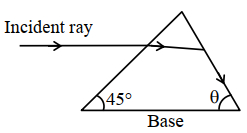
A
$60$
B
$75$
C
$90$
D
$45$
Solution
(A) Let the prism be $PDC$ with base $DC$. The incident ray is parallel to the base $DC$.
For grazing emergence at the second surface,the angle of refraction $r_2$ is equal to the critical angle $C$.
Given $\mu = \sqrt{2}$,we have $\sin r_2 = \frac{1}{\mu} = \frac{1}{\sqrt{2}}$,which gives $r_2 = 45^{\circ}$.
Since the incident ray is parallel to the base,the angle of incidence $i$ at the first surface is equal to the base angle $45^{\circ}$.
Applying Snell's Law at the first surface: $1 \times \sin(45^{\circ}) = \sqrt{2} \times \sin(r_1)$.
$\frac{1}{\sqrt{2}} = \sqrt{2} \sin(r_1) \implies \sin(r_1) = \frac{1}{2} \implies r_1 = 30^{\circ}$.
The angle of the prism $A$ at the top vertex is $A = r_1 + r_2 = 30^{\circ} + 45^{\circ} = 75^{\circ}$.
In the triangle formed by the prism,the sum of angles is $180^{\circ}$. Thus,$45^{\circ} + \theta + A = 180^{\circ}$.
$45^{\circ} + \theta + 75^{\circ} = 180^{\circ} \implies \theta + 120^{\circ} = 180^{\circ} \implies \theta = 60^{\circ}$.
For grazing emergence at the second surface,the angle of refraction $r_2$ is equal to the critical angle $C$.
Given $\mu = \sqrt{2}$,we have $\sin r_2 = \frac{1}{\mu} = \frac{1}{\sqrt{2}}$,which gives $r_2 = 45^{\circ}$.
Since the incident ray is parallel to the base,the angle of incidence $i$ at the first surface is equal to the base angle $45^{\circ}$.
Applying Snell's Law at the first surface: $1 \times \sin(45^{\circ}) = \sqrt{2} \times \sin(r_1)$.
$\frac{1}{\sqrt{2}} = \sqrt{2} \sin(r_1) \implies \sin(r_1) = \frac{1}{2} \implies r_1 = 30^{\circ}$.
The angle of the prism $A$ at the top vertex is $A = r_1 + r_2 = 30^{\circ} + 45^{\circ} = 75^{\circ}$.
In the triangle formed by the prism,the sum of angles is $180^{\circ}$. Thus,$45^{\circ} + \theta + A = 180^{\circ}$.
$45^{\circ} + \theta + 75^{\circ} = 180^{\circ} \implies \theta + 120^{\circ} = 180^{\circ} \implies \theta = 60^{\circ}$.
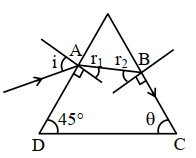
0 likesView Solution
119
PhysicsDifficultMCQJEE Main · 2026
An infinitely long straight wire carrying current $I$ is bent in a planar shape as shown in the diagram. The radius of the circular part is $r$. The magnetic field at the centre $O$ of the circular loop is:
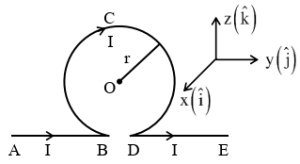
A
$\frac{\mu_0}{2 \pi} \frac{ I }{ r }(\pi+1) \hat{ i }$
B
$-\frac{\mu_0}{2 \pi} \frac{ I }{ r }(\pi-1) \hat{ i }$
C
$\frac{\mu_0}{2 \pi} \frac{ I }{ r }(\pi-1) \hat{ i }$
D
$-\frac{\mu_0}{2 \pi} \frac{ I }{ r }(\pi+1) \hat{ i }$
Solution
(B) The magnetic field at the centre $O$ is the vector sum of the fields due to the straight segments $AB$,$DE$ and the circular arc $BCD$.
Using the Biot-Savart law,the field due to a semi-infinite wire at a distance $r$ from its end is $\vec{B} = \frac{\mu_0 I}{4 \pi r} \hat{k}$.
For segment $AB$,the field at $O$ is $\vec{B}_{AB} = \frac{\mu_0 I}{4 \pi r} \hat{k}$.
For segment $DE$,the field at $O$ is $\vec{B}_{DE} = \frac{\mu_0 I}{4 \pi r} \hat{k}$.
For the circular arc $BCD$,the angle subtended is $2\pi - 0 = 2\pi$ (a full circle minus the gap). However,looking at the geometry,the arc is $2\pi - \theta$ where $\theta$ is the angle of the gap. Assuming the gap is negligible,the arc is a full circle. The field is $\vec{B}_{BCD} = -\frac{\mu_0 I}{2 r} \hat{k}$.
Summing these: $\vec{B}_O = \vec{B}_{AB} + \vec{B}_{DE} + \vec{B}_{BCD} = \frac{\mu_0 I}{4 \pi r} \hat{k} + \frac{\mu_0 I}{4 \pi r} \hat{k} - \frac{\mu_0 I}{2 r} \hat{k} = \frac{\mu_0 I}{2 \pi r} \hat{k} - \frac{\mu_0 I}{2 r} \hat{k} = \frac{\mu_0 I}{2 \pi r} (1 - \pi) \hat{k} = -\frac{\mu_0 I}{2 \pi r} (\pi - 1) \hat{k}$.
Note: The direction is along the $z$-axis $(\hat{k})$,not $\hat{i}$ as given in the options. Assuming the question intended $\hat{k}$ for the $z$-axis direction.
Using the Biot-Savart law,the field due to a semi-infinite wire at a distance $r$ from its end is $\vec{B} = \frac{\mu_0 I}{4 \pi r} \hat{k}$.
For segment $AB$,the field at $O$ is $\vec{B}_{AB} = \frac{\mu_0 I}{4 \pi r} \hat{k}$.
For segment $DE$,the field at $O$ is $\vec{B}_{DE} = \frac{\mu_0 I}{4 \pi r} \hat{k}$.
For the circular arc $BCD$,the angle subtended is $2\pi - 0 = 2\pi$ (a full circle minus the gap). However,looking at the geometry,the arc is $2\pi - \theta$ where $\theta$ is the angle of the gap. Assuming the gap is negligible,the arc is a full circle. The field is $\vec{B}_{BCD} = -\frac{\mu_0 I}{2 r} \hat{k}$.
Summing these: $\vec{B}_O = \vec{B}_{AB} + \vec{B}_{DE} + \vec{B}_{BCD} = \frac{\mu_0 I}{4 \pi r} \hat{k} + \frac{\mu_0 I}{4 \pi r} \hat{k} - \frac{\mu_0 I}{2 r} \hat{k} = \frac{\mu_0 I}{2 \pi r} \hat{k} - \frac{\mu_0 I}{2 r} \hat{k} = \frac{\mu_0 I}{2 \pi r} (1 - \pi) \hat{k} = -\frac{\mu_0 I}{2 \pi r} (\pi - 1) \hat{k}$.
Note: The direction is along the $z$-axis $(\hat{k})$,not $\hat{i}$ as given in the options. Assuming the question intended $\hat{k}$ for the $z$-axis direction.
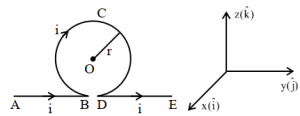
0 likesView Solution
120
PhysicsMediumMCQJEE Main · 2026
The energy of an electron in an orbit of the Bohr's atom is $-0.04 E_0 \text{ eV}$,where $E_0$ is the ground state energy. If $L$ is the angular momentum of the electron in this orbit and $h$ is the Planck's constant,then $\frac{2 \pi L}{h}$ is . . . . . . :
A
$2$
B
$4$
C
$5$
D
$6$
Solution
(C) According to Bohr's postulate,the angular momentum $L$ of an electron in an orbit is given by $L = \frac{nh}{2\pi}$,where $n$ is the principal quantum number.
Rearranging this,we get $\frac{2\pi L}{h} = n$.
The energy of an electron in the $n^{th}$ orbit is given by $E_n = -\frac{E_0}{n^2}$,where $E_0$ is the magnitude of the ground state energy.
Given that $E_n = -0.04 E_0$,we have $-\frac{E_0}{n^2} = -0.04 E_0$.
Dividing both sides by $-E_0$,we get $\frac{1}{n^2} = 0.04$.
$n^2 = \frac{1}{0.04} = \frac{100}{4} = 25$.
Therefore,$n = 5$.
Since $\frac{2\pi L}{h} = n$,the value is $5$.
Rearranging this,we get $\frac{2\pi L}{h} = n$.
The energy of an electron in the $n^{th}$ orbit is given by $E_n = -\frac{E_0}{n^2}$,where $E_0$ is the magnitude of the ground state energy.
Given that $E_n = -0.04 E_0$,we have $-\frac{E_0}{n^2} = -0.04 E_0$.
Dividing both sides by $-E_0$,we get $\frac{1}{n^2} = 0.04$.
$n^2 = \frac{1}{0.04} = \frac{100}{4} = 25$.
Therefore,$n = 5$.
Since $\frac{2\pi L}{h} = n$,the value is $5$.
0 likesView Solution
121
PhysicsMediumMCQJEE Main · 2026
Two known resistances of $R \ \Omega$ and $2R \ \Omega$ and one unknown resistance $X \ \Omega$ are connected in a circuit as shown in the figure. If the equivalent resistance between points $A$ and $B$ in the circuit is $X \ \Omega$,then the value of $X$ is . . . . . . $\Omega$.
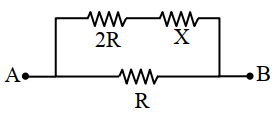
A
$(\sqrt{3}-1)R$
B
$R$
C
$2(\sqrt{3}-1)R$
D
$(\sqrt{3}+1)R$
Solution
(A) From the circuit diagram,the resistance $2R$ and $X$ are in series. Their equivalent resistance is $R_{s} = 2R + X$.
This combination is in parallel with the resistance $R$. The equivalent resistance $R_{eq}$ between points $A$ and $B$ is given by:
$R_{eq} = \frac{R \cdot (2R + X)}{R + (2R + X)}$
Given that $R_{eq} = X$,we have:
$X = \frac{R(2R + X)}{3R + X}$
$X(3R + X) = 2R^{2} + RX$
$3RX + X^{2} = 2R^{2} + RX$
$X^{2} + 2RX - 2R^{2} = 0$
Using the quadratic formula $X = \frac{-b \pm \sqrt{b^{2} - 4ac}}{2a}$:
$X = \frac{-2R \pm \sqrt{(2R)^{2} - 4(1)(-2R^{2})}}{2(1)}$
$X = \frac{-2R \pm \sqrt{4R^{2} + 8R^{2}}}{2}$
$X = \frac{-2R \pm \sqrt{12R^{2}}}{2} = \frac{-2R \pm 2R\sqrt{3}}{2}$
$X = -R \pm R\sqrt{3}$
Since resistance must be positive,we take the positive root:
$X = (\sqrt{3} - 1)R$
This combination is in parallel with the resistance $R$. The equivalent resistance $R_{eq}$ between points $A$ and $B$ is given by:
$R_{eq} = \frac{R \cdot (2R + X)}{R + (2R + X)}$
Given that $R_{eq} = X$,we have:
$X = \frac{R(2R + X)}{3R + X}$
$X(3R + X) = 2R^{2} + RX$
$3RX + X^{2} = 2R^{2} + RX$
$X^{2} + 2RX - 2R^{2} = 0$
Using the quadratic formula $X = \frac{-b \pm \sqrt{b^{2} - 4ac}}{2a}$:
$X = \frac{-2R \pm \sqrt{(2R)^{2} - 4(1)(-2R^{2})}}{2(1)}$
$X = \frac{-2R \pm \sqrt{4R^{2} + 8R^{2}}}{2}$
$X = \frac{-2R \pm \sqrt{12R^{2}}}{2} = \frac{-2R \pm 2R\sqrt{3}}{2}$
$X = -R \pm R\sqrt{3}$
Since resistance must be positive,we take the positive root:
$X = (\sqrt{3} - 1)R$
0 likesView Solution
122
PhysicsDifficultMCQJEE Main · 2026
$A$ battery with $EMF$ $E$ and internal resistance $r$ is connected across a resistance $R$. The power consumption in $R$ will be maximum when:
A
$R=2r$
B
$R=\frac{r}{2}$
C
$R=\sqrt{2}r$
D
$R=r$
Solution
(D) The current $I$ in the circuit is given by $I = \frac{E}{R+r}$.
The power $P$ consumed by the external resistance $R$ is $P = I^2 R = \left(\frac{E}{R+r}\right)^2 R$.
To find the condition for maximum power,we differentiate $P$ with respect to $R$ and set it to zero: $\frac{dP}{dR} = 0$.
$\frac{dP}{dR} = E^2 \left[ \frac{(R+r)^2(1) - R(2)(R+r)}{(R+r)^4} \right] = 0$.
This implies $(R+r)^2 - 2R(R+r) = 0$.
Dividing by $(R+r)$,we get $(R+r) - 2R = 0$,which simplifies to $r - R = 0$ or $R = r$.
Thus,the power consumption is maximum when the external resistance equals the internal resistance of the battery.
The power $P$ consumed by the external resistance $R$ is $P = I^2 R = \left(\frac{E}{R+r}\right)^2 R$.
To find the condition for maximum power,we differentiate $P$ with respect to $R$ and set it to zero: $\frac{dP}{dR} = 0$.
$\frac{dP}{dR} = E^2 \left[ \frac{(R+r)^2(1) - R(2)(R+r)}{(R+r)^4} \right] = 0$.
This implies $(R+r)^2 - 2R(R+r) = 0$.
Dividing by $(R+r)$,we get $(R+r) - 2R = 0$,which simplifies to $r - R = 0$ or $R = r$.
Thus,the power consumption is maximum when the external resistance equals the internal resistance of the battery.
0 likesView Solution
123
PhysicsDifficultMCQJEE Main · 2026
Given below are two statements:
Statement $I$: In a Young's double slit experiment,the angular separation of fringes will increase as the screen is moved away from the plane of the slits.
Statement $II$: In a Young's double slit experiment,the angular separation of fringes will increase when a monochromatic source is replaced by another monochromatic source of higher wavelength.
In the light of the above statements,choose the correct answer from the options given below:
Statement $I$: In a Young's double slit experiment,the angular separation of fringes will increase as the screen is moved away from the plane of the slits.
Statement $II$: In a Young's double slit experiment,the angular separation of fringes will increase when a monochromatic source is replaced by another monochromatic source of higher wavelength.
In the light of the above statements,choose the correct answer from the options given below:
A
Both Statement $I$ and Statement $II$ are true
B
Both Statement $I$ and Statement $II$ are false
C
Statement $I$ is false but Statement $II$ is true
D
Statement $I$ is true but Statement $II$ is false
Solution
(C) The angular fringe width $\theta$ in a Young's double slit experiment is given by the formula $\theta = \frac{\lambda}{d}$,where $\lambda$ is the wavelength of the light used and $d$ is the distance between the two slits.
Statement $I$: The angular fringe width depends only on the wavelength $\lambda$ and the slit separation $d$. It is independent of the distance $D$ between the screen and the slits. Therefore,moving the screen away does not change the angular separation. Thus,Statement $I$ is false.
Statement $II$: Since $\theta = \frac{\lambda}{d}$,the angular fringe width is directly proportional to the wavelength $\lambda$. If the source is replaced by one with a higher wavelength,$\theta$ will increase. Thus,Statement $II$ is true.
Conclusion: Statement $I$ is false and Statement $II$ is true.
Statement $I$: The angular fringe width depends only on the wavelength $\lambda$ and the slit separation $d$. It is independent of the distance $D$ between the screen and the slits. Therefore,moving the screen away does not change the angular separation. Thus,Statement $I$ is false.
Statement $II$: Since $\theta = \frac{\lambda}{d}$,the angular fringe width is directly proportional to the wavelength $\lambda$. If the source is replaced by one with a higher wavelength,$\theta$ will increase. Thus,Statement $II$ is true.
Conclusion: Statement $I$ is false and Statement $II$ is true.
0 likesView Solution
124
PhysicsMediumMCQJEE Main · 2026
The total length of the potentiometer wire $AB$ is $50 \text{ cm}$ in the arrangement as shown in the figure. If $P$ is the point where the galvanometer shows zero reading,then the length $AP$ is . . . . . . $\text{ cm}$.
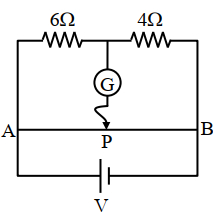
A
$15$
B
$30$
C
$25$
D
$20$
Solution
(B) The given circuit represents a Wheatstone bridge configuration where the galvanometer shows zero deflection at point $P$.
This implies that the bridge is balanced.
For a balanced Wheatstone bridge,the ratio of resistances in the arms must be equal:
$\frac{R_1}{R_2} = \frac{R_{AP}}{R_{PB}}$
Given $R_1 = 6 \ \Omega$ and $R_2 = 4 \ \Omega$.
Let $L$ be the total length of the wire $AB = 50 \text{ cm}$.
Let $\ell_{AP} = x$ and $\ell_{PB} = 50 - x$.
Since the resistance of the wire is proportional to its length $(R = \rho \frac{\ell}{A})$,we have:
$\frac{6}{4} = \frac{x}{50 - x}$
$\frac{3}{2} = \frac{x}{50 - x}$
$3(50 - x) = 2x$
$150 - 3x = 2x$
$5x = 150$
$x = 30 \text{ cm}$.
Therefore,the length $AP$ is $30 \text{ cm}$.
This implies that the bridge is balanced.
For a balanced Wheatstone bridge,the ratio of resistances in the arms must be equal:
$\frac{R_1}{R_2} = \frac{R_{AP}}{R_{PB}}$
Given $R_1 = 6 \ \Omega$ and $R_2 = 4 \ \Omega$.
Let $L$ be the total length of the wire $AB = 50 \text{ cm}$.
Let $\ell_{AP} = x$ and $\ell_{PB} = 50 - x$.
Since the resistance of the wire is proportional to its length $(R = \rho \frac{\ell}{A})$,we have:
$\frac{6}{4} = \frac{x}{50 - x}$
$\frac{3}{2} = \frac{x}{50 - x}$
$3(50 - x) = 2x$
$150 - 3x = 2x$
$5x = 150$
$x = 30 \text{ cm}$.
Therefore,the length $AP$ is $30 \text{ cm}$.
0 likesView Solution
125
PhysicsMediumMCQJEE Main · 2026
The charge stored by the capacitor $C$ in the given circuit in the steady state is . . . . . . $\mu C$.
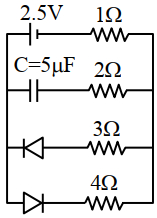
A
$12.5$
B
$10$
C
$7.5$
D
$5$
Solution
(B) In the steady state,the capacitor acts as an open circuit,so no current flows through the branch containing the capacitor.
Looking at the circuit,the diode in the branch with $3 \Omega$ is reverse-biased,so no current flows through that branch.
The diode in the branch with $4 \Omega$ is forward-biased,so current flows through the branch containing the $2.5 \text{ V}$ battery,the $1 \Omega$ resistor,and the $4 \Omega$ resistor.
The total resistance in this path is $R_{eq} = 1 \Omega + 4 \Omega = 5 \Omega$.
The current in the circuit is $i = \frac{V}{R_{eq}} = \frac{2.5 \text{ V}}{5 \Omega} = 0.5 \text{ A}$.
The voltage across the capacitor $V_C$ is equal to the voltage across the $4 \Omega$ resistor because they are in parallel.
$V_C = i \times 4 \Omega = 0.5 \text{ A} \times 4 \Omega = 2 \text{ V}$.
The charge stored by the capacitor is $Q = C \times V_C = 5 \mu\text{F} \times 2 \text{ V} = 10 \mu\text{C}$.
Looking at the circuit,the diode in the branch with $3 \Omega$ is reverse-biased,so no current flows through that branch.
The diode in the branch with $4 \Omega$ is forward-biased,so current flows through the branch containing the $2.5 \text{ V}$ battery,the $1 \Omega$ resistor,and the $4 \Omega$ resistor.
The total resistance in this path is $R_{eq} = 1 \Omega + 4 \Omega = 5 \Omega$.
The current in the circuit is $i = \frac{V}{R_{eq}} = \frac{2.5 \text{ V}}{5 \Omega} = 0.5 \text{ A}$.
The voltage across the capacitor $V_C$ is equal to the voltage across the $4 \Omega$ resistor because they are in parallel.
$V_C = i \times 4 \Omega = 0.5 \text{ A} \times 4 \Omega = 2 \text{ V}$.
The charge stored by the capacitor is $Q = C \times V_C = 5 \mu\text{F} \times 2 \text{ V} = 10 \mu\text{C}$.
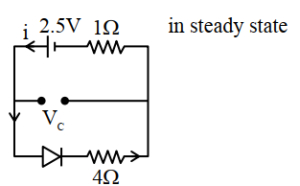
0 likesView Solution
126
PhysicsDifficultMCQJEE Main · 2026
Consider two identical metallic spheres of radius $R$ each having charge $Q$ and mass $m$. Their centers have an initial separation of $4 R$. Both the spheres are given an initial speed of $u$ towards each other. The minimum value of $u$,so that they can just touch each other is: (Take $k=\frac{1}{4 \pi \epsilon_0}$ and assume $k Q^2 > G m^2$ where $G$ is the Gravitational constant)
A
$\sqrt{\frac{k Q^2}{4 m R}\left(1-\frac{G m^2}{k Q^2}\right)}$
B
$\sqrt{\frac{k Q^2}{4 m R}\left(1+\frac{G m^2}{k Q^2}\right)}$
C
$\sqrt{\frac{k Q^2}{2 m R}\left(1-\frac{G m^2}{k Q^2}\right)}$
D
$\sqrt{\frac{k Q^2}{2 m R}\left(1-\frac{G m^2}{2 k Q^2}\right)}$
Solution
(A) Let the initial separation be $r_i = 4R$ and the final separation when they just touch be $r_f = 2R$.
By the principle of conservation of energy,the total initial energy equals the total final energy.
Initial Energy: $E_i = 2 \times (\frac{1}{2} m u^2) - \frac{G m^2}{4R} + \frac{k Q^2}{4R} = m u^2 - \frac{G m^2}{4R} + \frac{k Q^2}{4R}$.
Final Energy (at the moment of touching,speed is zero): $E_f = 0 - \frac{G m^2}{2R} + \frac{k Q^2}{2R}$.
Equating $E_i = E_f$:
$m u^2 - \frac{G m^2}{4R} + \frac{k Q^2}{4R} = - \frac{G m^2}{2R} + \frac{k Q^2}{2R}$.
$m u^2 = \frac{k Q^2}{2R} - \frac{k Q^2}{4R} - \frac{G m^2}{2R} + \frac{G m^2}{4R}$.
$m u^2 = \frac{k Q^2}{4R} - \frac{G m^2}{4R} = \frac{1}{4R} (k Q^2 - G m^2)$.
$u^2 = \frac{1}{4 m R} (k Q^2 - G m^2) = \frac{k Q^2}{4 m R} (1 - \frac{G m^2}{k Q^2})$.
$u = \sqrt{\frac{k Q^2}{4 m R} (1 - \frac{G m^2}{k Q^2})}$.
By the principle of conservation of energy,the total initial energy equals the total final energy.
Initial Energy: $E_i = 2 \times (\frac{1}{2} m u^2) - \frac{G m^2}{4R} + \frac{k Q^2}{4R} = m u^2 - \frac{G m^2}{4R} + \frac{k Q^2}{4R}$.
Final Energy (at the moment of touching,speed is zero): $E_f = 0 - \frac{G m^2}{2R} + \frac{k Q^2}{2R}$.
Equating $E_i = E_f$:
$m u^2 - \frac{G m^2}{4R} + \frac{k Q^2}{4R} = - \frac{G m^2}{2R} + \frac{k Q^2}{2R}$.
$m u^2 = \frac{k Q^2}{2R} - \frac{k Q^2}{4R} - \frac{G m^2}{2R} + \frac{G m^2}{4R}$.
$m u^2 = \frac{k Q^2}{4R} - \frac{G m^2}{4R} = \frac{1}{4R} (k Q^2 - G m^2)$.
$u^2 = \frac{1}{4 m R} (k Q^2 - G m^2) = \frac{k Q^2}{4 m R} (1 - \frac{G m^2}{k Q^2})$.
$u = \sqrt{\frac{k Q^2}{4 m R} (1 - \frac{G m^2}{k Q^2})}$.
0 likesView Solution
127
PhysicsMediumMCQJEE Main · 2026
$A$ cylindrical conductor of length $2 \ m$ and area of cross-section $0.2 \ mm^{2}$ carries an electric current of $1.6 \ A$ when its ends are connected to a $2 \ V$ battery. Mobility of electrons in the conductor is $\alpha \times 10^{-3} \ m^{2}/V \cdot s$. The value of $\alpha$ is: (electron concentration $n = 5 \times 10^{28} \ m^{-3}$ and electron charge $e = 1.6 \times 10^{-19} \ C$)
A
$1$
B
$2$
C
$0.5$
D
$4$
Solution
(A) Given: Length $l = 2 \ m$,Area $A = 0.2 \ mm^{2} = 0.2 \times 10^{-6} \ m^{2}$,Current $I = 1.6 \ A$,Voltage $V = 2 \ V$,Concentration $n = 5 \times 10^{28} \ m^{-3}$,Charge $e = 1.6 \times 10^{-19} \ C$.
The drift velocity $V_{d}$ is given by $V_{d} = \frac{I}{neA}$.
The mobility $\mu$ is defined as $\mu = \frac{V_{d}}{E}$,where $E = \frac{V}{l}$ is the electric field.
Substituting $V_{d}$ and $E$,we get $\mu = \frac{I}{neA} \times \frac{l}{V}$.
Substituting the values: $\mu = \frac{1.6 \times 2}{5 \times 10^{28} \times 1.6 \times 10^{-19} \times 0.2 \times 10^{-6} \times 2}$.
$\mu = \frac{3.2}{5 \times 10^{28} \times 1.6 \times 10^{-19} \times 0.2 \times 10^{-6} \times 2} = \frac{3.2}{3.2 \times 10^{3}} = 1 \times 10^{-3} \ m^{2}/V \cdot s$.
Comparing with $\alpha \times 10^{-3} \ m^{2}/V \cdot s$,we get $\alpha = 1$.
The drift velocity $V_{d}$ is given by $V_{d} = \frac{I}{neA}$.
The mobility $\mu$ is defined as $\mu = \frac{V_{d}}{E}$,where $E = \frac{V}{l}$ is the electric field.
Substituting $V_{d}$ and $E$,we get $\mu = \frac{I}{neA} \times \frac{l}{V}$.
Substituting the values: $\mu = \frac{1.6 \times 2}{5 \times 10^{28} \times 1.6 \times 10^{-19} \times 0.2 \times 10^{-6} \times 2}$.
$\mu = \frac{3.2}{5 \times 10^{28} \times 1.6 \times 10^{-19} \times 0.2 \times 10^{-6} \times 2} = \frac{3.2}{3.2 \times 10^{3}} = 1 \times 10^{-3} \ m^{2}/V \cdot s$.
Comparing with $\alpha \times 10^{-3} \ m^{2}/V \cdot s$,we get $\alpha = 1$.
0 likesView Solution
128
PhysicsMediumMCQJEE Main · 2026
$A$ capacitor $P$ with capacitance $10 \times 10^{-6} \text{ F}$ is fully charged with a potential difference of $6.0 \text{ V}$ and disconnected from the battery. The charged capacitor $P$ is connected across another capacitor $Q$ with capacitance $20 \times 10^{-6} \text{ F}$. The charge on capacitor $Q$ when equilibrium is established will be $\alpha \times 10^{-5} \text{ C}$. (Assume capacitor $Q$ does not have any charge initially). The value of $\alpha$ is . . . . . . .
A
$2$
B
$6$
C
$3$
D
$4$
Solution
(D) Initial charge on capacitor $P$ is $Q_1 = C_1 V_1 = (10 \times 10^{-6} \text{ F}) \times (6.0 \text{ V}) = 60 \times 10^{-6} \text{ C} = 6 \times 10^{-5} \text{ C}$.
When the two capacitors are connected in parallel,the charge is redistributed until they reach a common potential $V$.
The common potential $V$ is given by $V = \frac{Q_{total}}{C_{total}} = \frac{C_1 V_1 + C_2 V_2}{C_1 + C_2}$.
Given $C_1 = 10 \times 10^{-6} \text{ F}$,$V_1 = 6.0 \text{ V}$,$C_2 = 20 \times 10^{-6} \text{ F}$,and $V_2 = 0 \text{ V}$.
$V = \frac{(10 \times 10^{-6} \times 6) + (20 \times 10^{-6} \times 0)}{10 \times 10^{-6} + 20 \times 10^{-6}} = \frac{60 \times 10^{-6}}{30 \times 10^{-6}} = 2 \text{ V}$.
The charge on capacitor $Q$ at equilibrium is $Q_2 = C_2 V = (20 \times 10^{-6} \text{ F}) \times (2 \text{ V}) = 40 \times 10^{-6} \text{ C} = 4 \times 10^{-5} \text{ C}$.
Comparing this with $\alpha \times 10^{-5} \text{ C}$,we get $\alpha = 4$.
When the two capacitors are connected in parallel,the charge is redistributed until they reach a common potential $V$.
The common potential $V$ is given by $V = \frac{Q_{total}}{C_{total}} = \frac{C_1 V_1 + C_2 V_2}{C_1 + C_2}$.
Given $C_1 = 10 \times 10^{-6} \text{ F}$,$V_1 = 6.0 \text{ V}$,$C_2 = 20 \times 10^{-6} \text{ F}$,and $V_2 = 0 \text{ V}$.
$V = \frac{(10 \times 10^{-6} \times 6) + (20 \times 10^{-6} \times 0)}{10 \times 10^{-6} + 20 \times 10^{-6}} = \frac{60 \times 10^{-6}}{30 \times 10^{-6}} = 2 \text{ V}$.
The charge on capacitor $Q$ at equilibrium is $Q_2 = C_2 V = (20 \times 10^{-6} \text{ F}) \times (2 \text{ V}) = 40 \times 10^{-6} \text{ C} = 4 \times 10^{-5} \text{ C}$.
Comparing this with $\alpha \times 10^{-5} \text{ C}$,we get $\alpha = 4$.
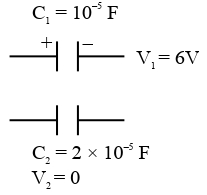
0 likesView Solution
129
PhysicsMediumMCQJEE Main · 2026
$A$ conducting circular loop is rotated about its diameter at a constant angular speed of $100 \ rad/s$ in a magnetic field of $0.5 \ T$ perpendicular to the axis of rotation. When the loop is rotated by $30^{\circ}$ from the horizontal position,the induced $EMF$ is $15.4 \ mV$. The radius of the loop is . . . . . . $mm$. (Take $\pi = 22/7$)
A
$7$
B
$14$
C
$21$
D
$28$
Solution
(B) The induced $EMF$ in a rotating loop is given by $E = B A \omega \sin(\theta)$,where $\theta = \omega t$ is the angle between the area vector and the magnetic field.
Given: $B = 0.5 \ T$,$\omega = 100 \ rad/s$,$E = 15.4 \ mV = 15.4 \times 10^{-3} \ V$,and $\theta = 30^{\circ}$.
The area of the circular loop is $A = \pi r^2$.
Substituting the values into the formula: $15.4 \times 10^{-3} = 0.5 \times (\pi r^2) \times 100 \times \sin(30^{\circ})$.
Since $\sin(30^{\circ}) = 0.5$,we have: $15.4 \times 10^{-3} = 0.5 \times \pi r^2 \times 100 \times 0.5$.
$15.4 \times 10^{-3} = 25 \times \pi r^2$.
Using $\pi = 22/7$: $15.4 \times 10^{-3} = 25 \times (22/7) \times r^2$.
$r^2 = \frac{15.4 \times 10^{-3} \times 7}{25 \times 22} = \frac{107.8 \times 10^{-3}}{550} = 0.196 \times 10^{-3} = 196 \times 10^{-6} \ m^2$.
$r = \sqrt{196 \times 10^{-6}} = 14 \times 10^{-3} \ m = 14 \ mm$.
Given: $B = 0.5 \ T$,$\omega = 100 \ rad/s$,$E = 15.4 \ mV = 15.4 \times 10^{-3} \ V$,and $\theta = 30^{\circ}$.
The area of the circular loop is $A = \pi r^2$.
Substituting the values into the formula: $15.4 \times 10^{-3} = 0.5 \times (\pi r^2) \times 100 \times \sin(30^{\circ})$.
Since $\sin(30^{\circ}) = 0.5$,we have: $15.4 \times 10^{-3} = 0.5 \times \pi r^2 \times 100 \times 0.5$.
$15.4 \times 10^{-3} = 25 \times \pi r^2$.
Using $\pi = 22/7$: $15.4 \times 10^{-3} = 25 \times (22/7) \times r^2$.
$r^2 = \frac{15.4 \times 10^{-3} \times 7}{25 \times 22} = \frac{107.8 \times 10^{-3}}{550} = 0.196 \times 10^{-3} = 196 \times 10^{-6} \ m^2$.
$r = \sqrt{196 \times 10^{-6}} = 14 \times 10^{-3} \ m = 14 \ mm$.
0 likesView Solution
130
PhysicsMediumMCQJEE Main · 2026
Light is incident on a metallic plate having a work function of $ 110 \times 10^{-20} \ J $. If the produced photoelectrons have zero kinetic energy,then the angular frequency of the incident light is . . . . . . $ rad/s $. $( h = 6.63 \times 10^{-34} \ J \cdot s )$
A
$ 1.04 \times 10^{16} $
B
$ 1.04 \times 10^{13} $
C
$ 1.66 \times 10^{16} $
D
$ 1.66 \times 10^{15} $
Solution
(A) According to Einstein's photoelectric equation,the energy of the incident photon is equal to the work function when the kinetic energy of the emitted photoelectrons is zero.
$ E = h\nu = \phi $
Where $ \phi = 110 \times 10^{-20} \ J $ is the work function and $ h = 6.63 \times 10^{-34} \ J \cdot s $ is Planck's constant.
The frequency $ \nu $ is given by $ \nu = \frac{\phi}{h} $.
The angular frequency $ \omega $ is related to frequency by $ \omega = 2\pi\nu $.
Substituting the values:
$ \omega = 2\pi \left( \frac{\phi}{h} \right) = \frac{2 \times 3.14 \times 110 \times 10^{-20}}{6.63 \times 10^{-34}} $
$ \omega \approx 1.04 \times 10^{16} \ rad/s $.
$ E = h\nu = \phi $
Where $ \phi = 110 \times 10^{-20} \ J $ is the work function and $ h = 6.63 \times 10^{-34} \ J \cdot s $ is Planck's constant.
The frequency $ \nu $ is given by $ \nu = \frac{\phi}{h} $.
The angular frequency $ \omega $ is related to frequency by $ \omega = 2\pi\nu $.
Substituting the values:
$ \omega = 2\pi \left( \frac{\phi}{h} \right) = \frac{2 \times 3.14 \times 110 \times 10^{-20}}{6.63 \times 10^{-34}} $
$ \omega \approx 1.04 \times 10^{16} \ rad/s $.
0 likesView Solution
131
PhysicsDifficultMCQJEE Main · 2026
$A$ laser beam has an intensity of $4.0 \times 10^{14} \ W/m^{2}$. The amplitude of the magnetic field associated with the beam is . . . . . . $T$. (Take $\epsilon_{0} = 8.85 \times 10^{-12} \ C^{2}/Nm^{2}$ and $c = 3 \times 10^{8} \ m/s$)
A
$2.0$
B
$18.3$
C
$5.5$
D
$1.83$
Solution
(D) The intensity $I$ of an electromagnetic wave is given by $I = \frac{1}{2} \epsilon_0 E_0^2 c$.
From this,the amplitude of the electric field $E_0$ is $E_0 = \sqrt{\frac{2I}{\epsilon_0 c}}$.
We know that the relation between the amplitudes of the electric and magnetic fields is $E_0 = B_0 c$,which implies $B_0 = \frac{E_0}{c}$.
Substituting $E_0$,we get $B_0 = \frac{1}{c} \sqrt{\frac{2I}{\epsilon_0 c}} = \sqrt{\frac{2I}{\epsilon_0 c^3}}$.
Given $I = 4.0 \times 10^{14} \ W/m^2$,$\epsilon_0 = 8.85 \times 10^{-12} \ C^2/Nm^2$,and $c = 3 \times 10^8 \ m/s$:
$B_0 = \sqrt{\frac{2 \times 4.0 \times 10^{14}}{8.85 \times 10^{-12} \times (3 \times 10^8)^3}} = \sqrt{\frac{8.0 \times 10^{14}}{8.85 \times 10^{-12} \times 27 \times 10^{24}}} = \sqrt{\frac{8.0 \times 10^{14}}{238.95 \times 10^{12}}} = \sqrt{\frac{800}{238.95}} \approx \sqrt{3.348} \approx 1.83 \ T$.
From this,the amplitude of the electric field $E_0$ is $E_0 = \sqrt{\frac{2I}{\epsilon_0 c}}$.
We know that the relation between the amplitudes of the electric and magnetic fields is $E_0 = B_0 c$,which implies $B_0 = \frac{E_0}{c}$.
Substituting $E_0$,we get $B_0 = \frac{1}{c} \sqrt{\frac{2I}{\epsilon_0 c}} = \sqrt{\frac{2I}{\epsilon_0 c^3}}$.
Given $I = 4.0 \times 10^{14} \ W/m^2$,$\epsilon_0 = 8.85 \times 10^{-12} \ C^2/Nm^2$,and $c = 3 \times 10^8 \ m/s$:
$B_0 = \sqrt{\frac{2 \times 4.0 \times 10^{14}}{8.85 \times 10^{-12} \times (3 \times 10^8)^3}} = \sqrt{\frac{8.0 \times 10^{14}}{8.85 \times 10^{-12} \times 27 \times 10^{24}}} = \sqrt{\frac{8.0 \times 10^{14}}{238.95 \times 10^{12}}} = \sqrt{\frac{800}{238.95}} \approx \sqrt{3.348} \approx 1.83 \ T$.
0 likesView Solution
132
PhysicsMediumMCQJEE Main · 2026
Five positive charges,each having charge $q$,are placed at the vertices of a regular pentagon as shown in the figure. The electric potential $(V)$ and the electric field $(\vec{E})$ at the center $O$ of the pentagon due to these five positive charges are:
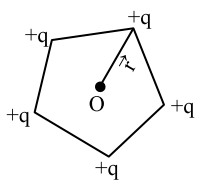
A
$V=\frac{5 q}{4 \pi \varepsilon_0 r}$ and $\vec{E}=0$
B
$V=\frac{5 q}{4 \pi \varepsilon_0 r}$ and $\vec{E}=\frac{5 \sqrt{3} q}{8 \pi \varepsilon_0 r^2} \hat{r}$
C
$V=\frac{5 q}{4 \pi \varepsilon_0 r}$ and $\vec{E}=\frac{5 q}{4 \pi \varepsilon_0 r^2} \hat{r}$
D
$V=0$ and $\vec{E}=0$
Solution
(A) $1$. Electric potential $(V)$ is a scalar quantity. The potential at the center $O$ due to a single charge $q$ at a distance $r$ is $V_i = \frac{1}{4 \pi \varepsilon_0} \frac{q}{r}$. Since there are five such charges,the total potential is the algebraic sum: $V = 5 \times \frac{1}{4 \pi \varepsilon_0} \frac{q}{r} = \frac{5 q}{4 \pi \varepsilon_0 r}$.
$2$. Electric field $(\vec{E})$ is a vector quantity. For a regular polygon with identical charges at all vertices,the electric field vectors due to individual charges cancel each other out due to symmetry. Therefore,the net electric field at the center $O$ is $\vec{E} = 0$.
$2$. Electric field $(\vec{E})$ is a vector quantity. For a regular polygon with identical charges at all vertices,the electric field vectors due to individual charges cancel each other out due to symmetry. Therefore,the net electric field at the center $O$ is $\vec{E} = 0$.
0 likesView Solution
133
PhysicsDifficultMCQJEE Main · 2026
Which of the following are true for a single slit diffraction?
$(A)$ Width of central maxima increases with increase in wavelength keeping slit width constant.
$(B)$ Width of central maxima increases with decrease in wavelength keeping slit width constant.
$(C)$ Width of central maxima increases with decrease in slit width at constant wavelength.
$(D)$ Width of central maxima increases with increase in slit width at constant wavelength.
$(E)$ Brightness of central maxima increases for decrease in wavelength at constant slit width.
$(A)$ Width of central maxima increases with increase in wavelength keeping slit width constant.
$(B)$ Width of central maxima increases with decrease in wavelength keeping slit width constant.
$(C)$ Width of central maxima increases with decrease in slit width at constant wavelength.
$(D)$ Width of central maxima increases with increase in slit width at constant wavelength.
$(E)$ Brightness of central maxima increases for decrease in wavelength at constant slit width.
A
$A$, $C$, $E$ only
B
$A$, $D$ only
C
$B$, $D$ only
D
$B$, $C$ only
Solution
(A) The angular width of the central maximum in single slit diffraction is given by $\theta = \frac{2\lambda}{a}$, and the linear width is $\beta_{cm} = \frac{2\lambda D}{a}$, where $\lambda$ is the wavelength, $D$ is the distance to the screen, and $a$ is the slit width.
$(A)$ Since $\beta_{cm} \propto \lambda$, the width of the central maximum increases as the wavelength increases. Thus, $(A)$ is correct.
$(B)$ Since $\beta_{cm} \propto \lambda$, the width decreases as wavelength decreases. Thus, $(B)$ is incorrect.
$(C)$ Since $\beta_{cm} \propto \frac{1}{a}$, the width increases as the slit width $a$ decreases. Thus, $(C)$ is correct.
$(D)$ Since $\beta_{cm} \propto \frac{1}{a}$, the width decreases as the slit width $a$ increases. Thus, $(D)$ is incorrect.
$(E)$ The intensity of the central maximum is proportional to the square of the slit width and inversely proportional to the square of the wavelength $(\text{Intensity} \propto \frac{a^2}{\lambda^2})$. Therefore, as $\lambda$ decreases, the intensity (brightness) of the central maximum increases. Thus, $(E)$ is correct.
Conclusion: Statements $(A)$, $(C)$, and $(E)$ are correct.
$(A)$ Since $\beta_{cm} \propto \lambda$, the width of the central maximum increases as the wavelength increases. Thus, $(A)$ is correct.
$(B)$ Since $\beta_{cm} \propto \lambda$, the width decreases as wavelength decreases. Thus, $(B)$ is incorrect.
$(C)$ Since $\beta_{cm} \propto \frac{1}{a}$, the width increases as the slit width $a$ decreases. Thus, $(C)$ is correct.
$(D)$ Since $\beta_{cm} \propto \frac{1}{a}$, the width decreases as the slit width $a$ increases. Thus, $(D)$ is incorrect.
$(E)$ The intensity of the central maximum is proportional to the square of the slit width and inversely proportional to the square of the wavelength $(\text{Intensity} \propto \frac{a^2}{\lambda^2})$. Therefore, as $\lambda$ decreases, the intensity (brightness) of the central maximum increases. Thus, $(E)$ is correct.
Conclusion: Statements $(A)$, $(C)$, and $(E)$ are correct.
0 likesView Solution
134
PhysicsMediumMCQJEE Main · 2026
The figure shows a circuit containing three resistors ($9 \ \Omega$ each) and two inductors ($4 \ mH$ each). The reading of the ammeter at the moment the switch $K$ is turned $ON$ is $...... \ A$.
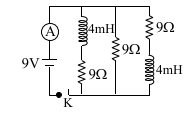
A
$1$
B
zero
C
$3$
D
$2$
Solution
(A) At the moment the switch $K$ is turned $ON$ $(t = 0)$,the current through the inductors cannot change instantaneously. Therefore,the inductors act as open circuits (infinite resistance).
In the given circuit,the branch containing the first inductor and the branch containing the second inductor will have zero current.
Only the middle branch,which contains a single resistor of $9 \ \Omega$,will conduct current.
The equivalent resistance of the circuit at $t = 0$ is $R_{eq} = 9 \ \Omega$.
The voltage of the battery is $V = 9 \ V$.
Using Ohm's law,the current $I$ through the ammeter is:
$I = \frac{V}{R_{eq}} = \frac{9 \ V}{9 \ \Omega} = 1 \ A$.
In the given circuit,the branch containing the first inductor and the branch containing the second inductor will have zero current.
Only the middle branch,which contains a single resistor of $9 \ \Omega$,will conduct current.
The equivalent resistance of the circuit at $t = 0$ is $R_{eq} = 9 \ \Omega$.
The voltage of the battery is $V = 9 \ V$.
Using Ohm's law,the current $I$ through the ammeter is:
$I = \frac{V}{R_{eq}} = \frac{9 \ V}{9 \ \Omega} = 1 \ A$.
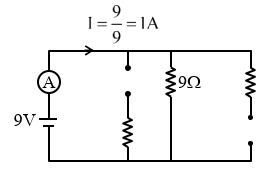
0 likesView Solution
135
PhysicsMediumMCQJEE Main · 2026
The wavelength of light,while it is passing through water,is $540 \ nm$. The refractive index of water is $\frac{4}{3}$. The wavelength of the same light when it is passing through a transparent medium having a refractive index of $\frac{3}{2}$ is . . . . . . $nm$.
A
$380$
B
$840$
C
$480$
D
$540$
Solution
(C) The frequency $f$ of light remains constant when it travels from one medium to another.
Since $v = f \lambda$ and $v = \frac{c}{\mu}$,we have $\frac{c}{\mu} = f \lambda$,which implies $\mu \lambda = \frac{c}{f} = \text{constant}$.
Therefore,$\mu_1 \lambda_1 = \mu_2 \lambda_2$.
Given: $\mu_1 = \frac{4}{3}$,$\lambda_1 = 540 \ nm$,and $\mu_2 = \frac{3}{2}$.
Substituting the values: $\left(\frac{4}{3}\right) \times 540 = \left(\frac{3}{2}\right) \times \lambda_2$.
$\lambda_2 = 540 \times \frac{4}{3} \times \frac{2}{3}$.
$\lambda_2 = 540 \times \frac{8}{9} = 60 \times 8 = 480 \ nm$.
Since $v = f \lambda$ and $v = \frac{c}{\mu}$,we have $\frac{c}{\mu} = f \lambda$,which implies $\mu \lambda = \frac{c}{f} = \text{constant}$.
Therefore,$\mu_1 \lambda_1 = \mu_2 \lambda_2$.
Given: $\mu_1 = \frac{4}{3}$,$\lambda_1 = 540 \ nm$,and $\mu_2 = \frac{3}{2}$.
Substituting the values: $\left(\frac{4}{3}\right) \times 540 = \left(\frac{3}{2}\right) \times \lambda_2$.
$\lambda_2 = 540 \times \frac{4}{3} \times \frac{2}{3}$.
$\lambda_2 = 540 \times \frac{8}{9} = 60 \times 8 = 480 \ nm$.
0 likesView Solution
136
PhysicsMediumMCQJEE Main · 2026
An electric power line having a total resistance of $2 \ \Omega$ delivers $1 \ kW$ of power at $250 \ V$. The percentage efficiency of the transmission line is: (in $\%$)
A
$96.9$
B
$86.5$
C
$100$
D
$92.5$
Solution
(A) Given: Power delivered $P_{out} = 1 \ kW = 1000 \ W$,Voltage $V = 250 \ V$,Resistance $R = 2 \ \Omega$.
The current $I$ flowing through the line is $I = \frac{P_{out}}{V} = \frac{1000}{250} = 4 \ A$.
The power loss in the transmission line is $P_{loss} = I^2 R = (4)^2 \times 2 = 16 \times 2 = 32 \ W$.
The total power generated at the source is $P_{in} = P_{out} + P_{loss} = 1000 + 32 = 1032 \ W$.
The efficiency $\eta$ is given by $\eta = \left( \frac{P_{out}}{P_{in}} \right) \times 100$.
$\eta = \left( \frac{1000}{1032} \right) \times 100 \approx 96.898 \% \approx 96.9 \%$.
The current $I$ flowing through the line is $I = \frac{P_{out}}{V} = \frac{1000}{250} = 4 \ A$.
The power loss in the transmission line is $P_{loss} = I^2 R = (4)^2 \times 2 = 16 \times 2 = 32 \ W$.
The total power generated at the source is $P_{in} = P_{out} + P_{loss} = 1000 + 32 = 1032 \ W$.
The efficiency $\eta$ is given by $\eta = \left( \frac{P_{out}}{P_{in}} \right) \times 100$.
$\eta = \left( \frac{1000}{1032} \right) \times 100 \approx 96.898 \% \approx 96.9 \%$.
0 likesView Solution
137
PhysicsMediumMCQJEE Main · 2026
The correct truth table for the given logic gate circuit is:
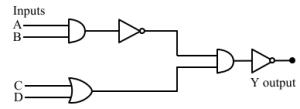
A
| Inputs $(A, B, C, D)$ | Output $(Y)$ |
|---|---|
| $1, 1, 0, 1$ | $1$ |
| $0, 0, 1, 1$ | $0$ |
| $1, 0, 1, 0$ | $1$ |
| $1, 1, 1, 1$ | $0$ |
B
| Inputs $(A, B, C, D)$ | Output $(Y)$ |
|---|---|
| $1, 1, 0, 1$ | $1$ |
| $0, 0, 1, 1$ | $0$ |
| $1, 0, 1, 0$ | $0$ |
| $1, 1, 1, 1$ | $1$ |
C
| Inputs $(A, B, C, D)$ | Output $(Y)$ |
|---|---|
| $1, 1, 0, 1$ | $0$ |
| $0, 0, 1, 1$ | $0$ |
| $1, 0, 1, 0$ | $1$ |
| $1, 1, 1, 1$ | $1$ |
D
| Inputs $(A, B, C, D)$ | Output $(Y)$ |
|---|---|
| $1, 1, 0, 1$ | $0$ |
| $0, 0, 1, 1$ | $1$ |
| $1, 0, 1, 0$ | $1$ |
| $1, 1, 1, 1$ | $1$ |
Solution
(B) The logic circuit consists of an $AND$ gate $(A, B)$,followed by a $NOT$ gate,an $OR$ gate $(C, D)$,an $AND$ gate,and a final $NOT$ gate.
Let the output of the first $AND$ gate be $A \cdot B$. After the $NOT$ gate,it becomes $\overline{A \cdot B}$.
The output of the $OR$ gate is $C + D$.
These two signals are fed into an $AND$ gate,giving $(\overline{A \cdot B}) \cdot (C + D)$.
The final $NOT$ gate gives the output $Y = \overline{(\overline{A \cdot B}) \cdot (C + D)}$.
Using De Morgan's Law,$Y = \overline{(\overline{A \cdot B})} + \overline{(C + D)} = (A \cdot B) + (\overline{C + D})$.
Evaluating for the given inputs:
$1$. $A=1, B=1, C=0, D=1$: $Y = (1 \cdot 1) + \overline{(0+1)} = 1 + 0 = 1$.
$2$. $A=0, B=0, C=1, D=1$: $Y = (0 \cdot 0) + \overline{(1+1)} = 0 + 0 = 0$.
$3$. $A=1, B=0, C=1, D=0$: $Y = (1 \cdot 0) + \overline{(1+0)} = 0 + 0 = 0$.
$4$. $A=1, B=1, C=1, D=1$: $Y = (1 \cdot 1) + \overline{(1+1)} = 1 + 0 = 1$.
Comparing with the options,option $B$ is correct.
Let the output of the first $AND$ gate be $A \cdot B$. After the $NOT$ gate,it becomes $\overline{A \cdot B}$.
The output of the $OR$ gate is $C + D$.
These two signals are fed into an $AND$ gate,giving $(\overline{A \cdot B}) \cdot (C + D)$.
The final $NOT$ gate gives the output $Y = \overline{(\overline{A \cdot B}) \cdot (C + D)}$.
Using De Morgan's Law,$Y = \overline{(\overline{A \cdot B})} + \overline{(C + D)} = (A \cdot B) + (\overline{C + D})$.
Evaluating for the given inputs:
$1$. $A=1, B=1, C=0, D=1$: $Y = (1 \cdot 1) + \overline{(0+1)} = 1 + 0 = 1$.
$2$. $A=0, B=0, C=1, D=1$: $Y = (0 \cdot 0) + \overline{(1+1)} = 0 + 0 = 0$.
$3$. $A=1, B=0, C=1, D=0$: $Y = (1 \cdot 0) + \overline{(1+0)} = 0 + 0 = 0$.
$4$. $A=1, B=1, C=1, D=1$: $Y = (1 \cdot 1) + \overline{(1+1)} = 1 + 0 = 1$.
Comparing with the options,option $B$ is correct.
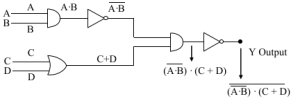
0 likesView Solution
138
PhysicsDifficultMCQJEE Main · 2026
The smallest wavelength of the Lyman series is $91 \ nm$. The difference between the largest wavelengths of the Paschen and Balmer series is nearly . . . . . . $nm$.
A
$1875$
B
$1550$
C
$1217$
D
$1784$
Solution
(C) The Rydberg formula is given by $\frac{1}{\lambda} = R \left( \frac{1}{n_1^2} - \frac{1}{n_2^2} \right)$.
For the Lyman series,the smallest wavelength corresponds to $n_1 = 1$ and $n_2 = \infty$.
$\frac{1}{\lambda_{L,min}} = R \left( \frac{1}{1^2} - \frac{1}{\infty^2} \right) = R = \frac{1}{91} \ nm^{-1}$.
For the Balmer series,the largest wavelength corresponds to $n_1 = 2$ and $n_2 = 3$.
$\frac{1}{\lambda_{B,max}} = R \left( \frac{1}{2^2} - \frac{1}{3^2} \right) = \frac{1}{91} \left( \frac{1}{4} - \frac{1}{9} \right) = \frac{1}{91} \left( \frac{5}{36} \right)$.
$\lambda_{B,max} = \frac{91 \times 36}{5} = 655.2 \ nm$.
For the Paschen series,the largest wavelength corresponds to $n_1 = 3$ and $n_2 = 4$.
$\frac{1}{\lambda_{P,max}} = R \left( \frac{1}{3^2} - \frac{1}{4^2} \right) = \frac{1}{91} \left( \frac{1}{9} - \frac{1}{16} \right) = \frac{1}{91} \left( \frac{7}{144} \right)$.
$\lambda_{P,max} = \frac{91 \times 144}{7} = 1872 \ nm$.
The difference is $\Delta\lambda = \lambda_{P,max} - \lambda_{B,max} = 1872 - 655.2 = 1216.8 \ nm \approx 1217 \ nm$.
For the Lyman series,the smallest wavelength corresponds to $n_1 = 1$ and $n_2 = \infty$.
$\frac{1}{\lambda_{L,min}} = R \left( \frac{1}{1^2} - \frac{1}{\infty^2} \right) = R = \frac{1}{91} \ nm^{-1}$.
For the Balmer series,the largest wavelength corresponds to $n_1 = 2$ and $n_2 = 3$.
$\frac{1}{\lambda_{B,max}} = R \left( \frac{1}{2^2} - \frac{1}{3^2} \right) = \frac{1}{91} \left( \frac{1}{4} - \frac{1}{9} \right) = \frac{1}{91} \left( \frac{5}{36} \right)$.
$\lambda_{B,max} = \frac{91 \times 36}{5} = 655.2 \ nm$.
For the Paschen series,the largest wavelength corresponds to $n_1 = 3$ and $n_2 = 4$.
$\frac{1}{\lambda_{P,max}} = R \left( \frac{1}{3^2} - \frac{1}{4^2} \right) = \frac{1}{91} \left( \frac{1}{9} - \frac{1}{16} \right) = \frac{1}{91} \left( \frac{7}{144} \right)$.
$\lambda_{P,max} = \frac{91 \times 144}{7} = 1872 \ nm$.
The difference is $\Delta\lambda = \lambda_{P,max} - \lambda_{B,max} = 1872 - 655.2 = 1216.8 \ nm \approx 1217 \ nm$.
0 likesView Solution
139
PhysicsDifficultMCQJEE Main · 2026
In the parallax method for the determination of the focal length of a concave mirror,the object should always be placed:
A
between the focus $(F)$ and the centre of curvature $(C)$ of the mirror $ONLY$
B
at any point beyond the focus $(F)$ of the mirror
C
beyond the centre of curvature $(C)$ of the mirror $ONLY$
D
between the pole $(P)$ and the focus $(F)$ of the concave mirror $ONLY$
Solution
(B) In the parallax method,we need to form a real image of the object to observe the parallax between the image and the needle.
For a concave mirror,a real image is formed only when the object is placed beyond the focus $(F)$.
If the object is placed between the pole $(P)$ and the focus $(F)$,the image formed is virtual,erect,and magnified,which cannot be used for the parallax method as it cannot be captured on a screen or observed as a real point of coincidence.
Therefore,the object must be placed at any point beyond the focus $(F)$.
For a concave mirror,a real image is formed only when the object is placed beyond the focus $(F)$.
If the object is placed between the pole $(P)$ and the focus $(F)$,the image formed is virtual,erect,and magnified,which cannot be used for the parallax method as it cannot be captured on a screen or observed as a real point of coincidence.
Therefore,the object must be placed at any point beyond the focus $(F)$.
0 likesView Solution
140
PhysicsDifficultMCQJEE Main · 2026
The space between the plates of a parallel-plate capacitor of capacitance C (without any dielectric) is now filled with three dielectric slabs of dielectric constants \(K _1=2, K_2=3\), and \(K _3=5\) (as shown in the figure). If new capacitance is \(\frac{ n }{3} C\) then the value of \(n\) is ___________.
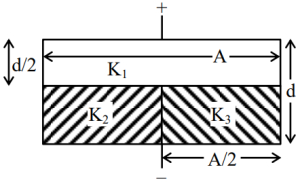
A
6
B
7
C
8
D
9
Solution
\(C _1=\frac{5 \in_0 A / 2}{d / 2}=\frac{5 \in_0 A}{ d }=5 C\)
\(C _2=\frac{2 \in_0 A / 2}{d / 2}=\frac{2 \in_0 A}{ d }=2 C\)
\(C _1 \& C _2\) in series.
\(C^{\prime}=\frac{C_1 C_2}{C_1+C_2}=\frac{(5 C)(2 C)}{7 C}=\frac{10}{7} C\)
\(C _3=\frac{3 \in_0 A / 2}{d / 2}=3 C\)
\(C _4=\frac{2 \epsilon_0 A / 2}{d / 2}=2 C\)
\(C _4 \& C _3\) in series; \(C ^{\prime \prime}=\frac{(2 C )(3 C )}{5 C }=\frac{6}{5} C\)
\(C ^{\prime} \& C ^{\prime \prime}\) in parallel;
So, \(C _{ eq }= C \left(\frac{6}{5}+\frac{10}{7}\right)= C \left(\frac{42+50}{35}\right)=\left(\frac{92}{35}\right) C\)
\(\frac{92}{35} C =\frac{ nC }{3}\)
\(n =\frac{92 \times 3}{35}=7.9 \Rightarrow n \simeq 8\)
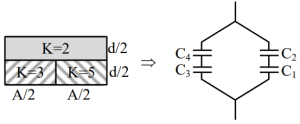
0 likesView Solution
141
PhysicsMediumMCQJEE Main · 2026
In two separate Young's double-slit experimental set-ups,two monochromatic light sources of different wavelengths are used to get fringes of equal width. The ratios of the slit separations and that of the wavelengths of light used are $2:1$ and $1:2$ respectively. The corresponding ratio of the distances between the slits and the respective screens $(D_1 / D_2)$ is . . . . . . .
A
$1$
B
$2$
C
$4$
D
$8$
Solution
(C) The fringe width $\beta$ in a Young's double-slit experiment is given by $\beta = \frac{D\lambda}{d}$.
Given that the fringe widths are equal,we have $\beta_1 = \beta_2$.
Therefore,$\frac{D_1 \lambda_1}{d_1} = \frac{D_2 \lambda_2}{d_2}$.
Rearranging the terms to find the ratio $\frac{D_1}{D_2}$,we get $\frac{D_1}{D_2} = \frac{\lambda_2}{\lambda_1} \times \frac{d_1}{d_2}$.
Given the ratios of slit separations $\frac{d_1}{d_2} = 2$ and the ratio of wavelengths $\frac{\lambda_1}{\lambda_2} = \frac{1}{2}$,which implies $\frac{\lambda_2}{\lambda_1} = 2$.
Substituting these values,we get $\frac{D_1}{D_2} = 2 \times 2 = 4$.
Given that the fringe widths are equal,we have $\beta_1 = \beta_2$.
Therefore,$\frac{D_1 \lambda_1}{d_1} = \frac{D_2 \lambda_2}{d_2}$.
Rearranging the terms to find the ratio $\frac{D_1}{D_2}$,we get $\frac{D_1}{D_2} = \frac{\lambda_2}{\lambda_1} \times \frac{d_1}{d_2}$.
Given the ratios of slit separations $\frac{d_1}{d_2} = 2$ and the ratio of wavelengths $\frac{\lambda_1}{\lambda_2} = \frac{1}{2}$,which implies $\frac{\lambda_2}{\lambda_1} = 2$.
Substituting these values,we get $\frac{D_1}{D_2} = 2 \times 2 = 4$.
0 likesView Solution
142
PhysicsMediumMCQJEE Main · 2026
Using a variable-frequency a.c. voltage source,the maximum current measured in the given $LCR$ circuit is $50 \text{ mA}$ for $V = 5 \sin(100t)$. The values of $L$ and $R$ are shown in the figure. The capacitance of the capacitor $(C)$ used is . . . . . . $\mu\text{F}$.
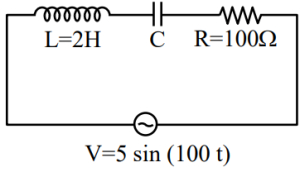
A
$25$
B
$50$
C
$75$
D
$100$
Solution
(B) In an $LCR$ circuit,the current is maximum at resonance.
At resonance,the angular frequency $\omega$ is given by $\omega = \frac{1}{\sqrt{LC}}$.
From the given voltage equation $V = 5 \sin(100t)$,we have $\omega = 100 \text{ rad/s}$.
Given $L = 2 \text{ H}$,we can substitute these values into the resonance formula:
$100 = \frac{1}{\sqrt{2 \times C}}$
Squaring both sides:
$10000 = \frac{1}{2C}$
$C = \frac{1}{2 \times 10000} = \frac{1}{20000} \text{ F}$
$C = 0.5 \times 10^{-4} \text{ F} = 50 \times 10^{-6} \text{ F} = 50 \mu\text{F}$.
At resonance,the angular frequency $\omega$ is given by $\omega = \frac{1}{\sqrt{LC}}$.
From the given voltage equation $V = 5 \sin(100t)$,we have $\omega = 100 \text{ rad/s}$.
Given $L = 2 \text{ H}$,we can substitute these values into the resonance formula:
$100 = \frac{1}{\sqrt{2 \times C}}$
Squaring both sides:
$10000 = \frac{1}{2C}$
$C = \frac{1}{2 \times 10000} = \frac{1}{20000} \text{ F}$
$C = 0.5 \times 10^{-4} \text{ F} = 50 \times 10^{-6} \text{ F} = 50 \mu\text{F}$.
0 likesView Solution
143
PhysicsMediumMCQJEE Main · 2026
The equation of the electric field of an electromagnetic wave propagating through free space is given by:
$E = \sqrt{377} \sin(6.27 \times 10^3 t - 2.09 \times 10^{-5} x) \text{ N/C}$.
The average power (intensity) of the electromagnetic wave is $\left(\frac{1}{\alpha}\right) \text{ W/m}^2$. The value of $\alpha$ is . . . . . . .
(Take $\sqrt{\frac{\mu_0}{\varepsilon_0}} = 377$ in $SI$ units)
$E = \sqrt{377} \sin(6.27 \times 10^3 t - 2.09 \times 10^{-5} x) \text{ N/C}$.
The average power (intensity) of the electromagnetic wave is $\left(\frac{1}{\alpha}\right) \text{ W/m}^2$. The value of $\alpha$ is . . . . . . .
(Take $\sqrt{\frac{\mu_0}{\varepsilon_0}} = 377$ in $SI$ units)
A
$1$
B
$2$
C
$3$
D
$4$
Solution
(B) The given electric field equation is $E = E_0 \sin(\omega t - kx)$,where $E_0 = \sqrt{377} \text{ V/m}$.
The intensity (average power per unit area) of an electromagnetic wave is given by $I = \frac{1}{2} c \varepsilon_0 E_0^2$.
Since $c = \frac{1}{\sqrt{\mu_0 \varepsilon_0}}$,we can write $I = \frac{1}{2} \frac{1}{\sqrt{\mu_0 \varepsilon_0}} \varepsilon_0 E_0^2 = \frac{1}{2} \sqrt{\frac{\varepsilon_0}{\mu_0}} E_0^2$.
Given $\sqrt{\frac{\mu_0}{\varepsilon_0}} = 377$,then $\sqrt{\frac{\varepsilon_0}{\mu_0}} = \frac{1}{377}$.
Substituting the values: $I = \frac{1}{2} \times \frac{1}{377} \times (\sqrt{377})^2 = \frac{1}{2} \times \frac{1}{377} \times 377 = \frac{1}{2} \text{ W/m}^2$.
Comparing this with $\frac{1}{\alpha} \text{ W/m}^2$,we get $\alpha = 2$.
The intensity (average power per unit area) of an electromagnetic wave is given by $I = \frac{1}{2} c \varepsilon_0 E_0^2$.
Since $c = \frac{1}{\sqrt{\mu_0 \varepsilon_0}}$,we can write $I = \frac{1}{2} \frac{1}{\sqrt{\mu_0 \varepsilon_0}} \varepsilon_0 E_0^2 = \frac{1}{2} \sqrt{\frac{\varepsilon_0}{\mu_0}} E_0^2$.
Given $\sqrt{\frac{\mu_0}{\varepsilon_0}} = 377$,then $\sqrt{\frac{\varepsilon_0}{\mu_0}} = \frac{1}{377}$.
Substituting the values: $I = \frac{1}{2} \times \frac{1}{377} \times (\sqrt{377})^2 = \frac{1}{2} \times \frac{1}{377} \times 377 = \frac{1}{2} \text{ W/m}^2$.
Comparing this with $\frac{1}{\alpha} \text{ W/m}^2$,we get $\alpha = 2$.
0 likesView Solution
144
PhysicsMediumMCQJEE Main · 2026
$A$ simple pendulum made of a mass of $10 \ g$ and a metallic wire of length $10 \ cm$ is suspended vertically in a uniform magnetic field of $2 \ T$. The magnetic field direction is perpendicular to the plane of oscillations of the pendulum. If the pendulum is released from an angle of $60^{\circ}$ with the vertical,then the maximum induced $EMF$ between the point of suspension and the point of oscillation is . . . . . . $mV$. (Take $g = 10 \ m/s^2$)
A
$50$
B
$100$
C
$150$
D
$200$
Solution
(B) The induced $EMF$ in a rotating rod of length $\ell$ with angular velocity $\omega$ in a magnetic field $B$ is given by $\varepsilon = \frac{B \omega \ell^2}{2}$.
To find the maximum angular velocity $\omega_{\max}$,we use the principle of conservation of energy.
The potential energy at the release angle $\theta = 60^{\circ}$ is converted into kinetic energy at the lowest point.
$mg\ell(1 - \cos 60^{\circ}) = \frac{1}{2} I \omega_{\max}^2$,where $I = m\ell^2$.
$mg\ell(1 - 0.5) = \frac{1}{2} m\ell^2 \omega_{\max}^2$.
$g(0.5) = \frac{1}{2} \ell \omega_{\max}^2$.
$\omega_{\max} = \sqrt{\frac{g}{\ell}} = \sqrt{\frac{10}{0.1}} = \sqrt{100} = 10 \ rad/s$.
Now,substitute the values into the $EMF$ formula:
$\varepsilon_{\max} = \frac{2 \times 10 \times (0.1)^2}{2} = 10 \times 0.01 = 0.1 \ V$.
Converting to $mV$: $0.1 \ V = 100 \ mV$.
To find the maximum angular velocity $\omega_{\max}$,we use the principle of conservation of energy.
The potential energy at the release angle $\theta = 60^{\circ}$ is converted into kinetic energy at the lowest point.
$mg\ell(1 - \cos 60^{\circ}) = \frac{1}{2} I \omega_{\max}^2$,where $I = m\ell^2$.
$mg\ell(1 - 0.5) = \frac{1}{2} m\ell^2 \omega_{\max}^2$.
$g(0.5) = \frac{1}{2} \ell \omega_{\max}^2$.
$\omega_{\max} = \sqrt{\frac{g}{\ell}} = \sqrt{\frac{10}{0.1}} = \sqrt{100} = 10 \ rad/s$.
Now,substitute the values into the $EMF$ formula:
$\varepsilon_{\max} = \frac{2 \times 10 \times (0.1)^2}{2} = 10 \times 0.01 = 0.1 \ V$.
Converting to $mV$: $0.1 \ V = 100 \ mV$.
0 likesView Solution
145
PhysicsDifficultMCQJEE Main · 2026
Given below are two statements: one is labelled as Assertion $(A)$ and the other is labelled as Reason $(R)$. Consider a ferromagnetic material:
Assertion $(A)$: The individual atoms in a ferromagnetic material possess a magnetic dipole moment and interact with one another in such a way that they spontaneously align themselves forming domains.
Reason $(R)$: At high enough temperature,the domain structure of a ferromagnetic material disintegrates. Thus,magnetization will disappear at a high enough temperature known as the Curie temperature.
In the light of the above statements,choose the correct answer from the options given below:
Assertion $(A)$: The individual atoms in a ferromagnetic material possess a magnetic dipole moment and interact with one another in such a way that they spontaneously align themselves forming domains.
Reason $(R)$: At high enough temperature,the domain structure of a ferromagnetic material disintegrates. Thus,magnetization will disappear at a high enough temperature known as the Curie temperature.
In the light of the above statements,choose the correct answer from the options given below:
A
$(A)$ is true but $(R)$ is false
B
Both true,but $(R)$ is $NOT$ the correct explanation
C
Both true,and $(R)$ is the correct explanation
D
$(A)$ is false but $(R)$ is true
Solution
(C) Assertion $(A)$ is true because ferromagnetic materials consist of small regions called domains where atomic magnetic dipoles are aligned due to strong exchange interactions.
Reason $(R)$ is also true because thermal agitation at high temperatures disrupts the alignment of these magnetic dipoles,causing the domain structure to break down.
When the temperature exceeds the Curie temperature $(T_c)$,the material transitions from ferromagnetic to paramagnetic behavior,meaning the spontaneous magnetization disappears.
Since the disintegration of the domain structure at high temperatures is the fundamental reason why the ferromagnetic property (and thus spontaneous magnetization) is lost,Reason $(R)$ correctly explains Assertion $(A)$.
Reason $(R)$ is also true because thermal agitation at high temperatures disrupts the alignment of these magnetic dipoles,causing the domain structure to break down.
When the temperature exceeds the Curie temperature $(T_c)$,the material transitions from ferromagnetic to paramagnetic behavior,meaning the spontaneous magnetization disappears.
Since the disintegration of the domain structure at high temperatures is the fundamental reason why the ferromagnetic property (and thus spontaneous magnetization) is lost,Reason $(R)$ correctly explains Assertion $(A)$.
0 likesView Solution
146
PhysicsMediumMCQJEE Main · 2026
$A$ $20 \ m$ long uniform copper wire held horizontally is allowed to fall under gravity $(g = 10 \ m/s^2)$ through a uniform horizontal magnetic field of $0.5 \ Gauss$ perpendicular to the length of the wire. The induced $EMF$ across the wire after it travels a vertical distance of $200 \ m$ is . . . . . . $mV$.
A
$0.2 \sqrt{10}$
B
$20 \sqrt{10}$
C
$2 \sqrt{10}$
D
$200 \sqrt{10}$
Solution
(B) The induced $EMF$ $(\varepsilon)$ in a conductor moving through a magnetic field is given by $\varepsilon = Bv\ell$.
First, calculate the velocity $(v)$ of the wire after falling a distance $(h = 200 \ m)$ under gravity using the equation $v^2 = u^2 + 2gh$. Since the initial velocity $(u = 0)$, $v = \sqrt{2gh} = \sqrt{2 \times 10 \times 200} = \sqrt{4000} = 20\sqrt{10} \ m/s$.
The magnetic field $(B)$ is $0.5 \ Gauss = 0.5 \times 10^{-4} \ T$.
The length of the wire $(\ell)$ is $20 \ m$.
Substituting these values into the $EMF$ formula: $\varepsilon = (0.5 \times 10^{-4} \ T) \times (20\sqrt{10} \ m/s) \times (20 \ m)$.
$\varepsilon = 20\sqrt{10} \times 10^{-4} \times 10 = 20\sqrt{10} \times 10^{-3} \ V$.
Since $1 \ V = 1000 \ mV$, the induced $EMF$ is $20\sqrt{10} \ mV$.
First, calculate the velocity $(v)$ of the wire after falling a distance $(h = 200 \ m)$ under gravity using the equation $v^2 = u^2 + 2gh$. Since the initial velocity $(u = 0)$, $v = \sqrt{2gh} = \sqrt{2 \times 10 \times 200} = \sqrt{4000} = 20\sqrt{10} \ m/s$.
The magnetic field $(B)$ is $0.5 \ Gauss = 0.5 \times 10^{-4} \ T$.
The length of the wire $(\ell)$ is $20 \ m$.
Substituting these values into the $EMF$ formula: $\varepsilon = (0.5 \times 10^{-4} \ T) \times (20\sqrt{10} \ m/s) \times (20 \ m)$.
$\varepsilon = 20\sqrt{10} \times 10^{-4} \times 10 = 20\sqrt{10} \times 10^{-3} \ V$.
Since $1 \ V = 1000 \ mV$, the induced $EMF$ is $20\sqrt{10} \ mV$.
0 likesView Solution
147
PhysicsDifficultMCQJEE Main · 2026
Two point charges $2q$ and $q$ are placed at vertex $A$ and the centre of face $CDEF$ of the cube,respectively,as shown in the figure. The electric flux passing through the cube is:
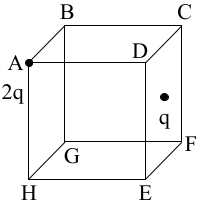
A
$\frac{3q}{\varepsilon_0}$
B
$\frac{q}{\varepsilon_0}$
C
$\frac{3q}{2\varepsilon_0}$
D
$\frac{3q}{4\varepsilon_0}$
Solution
(D) According to Gauss's Law,the total electric flux $\phi$ through a closed surface is $\phi = \frac{Q_{\text{in}}}{\varepsilon_0}$,where $Q_{\text{in}}$ is the net charge enclosed by the surface.
$1$. The charge $2q$ is placed at vertex $A$. $A$ vertex of a cube is shared by $8$ adjacent cubes. Therefore,the fraction of charge $2q$ enclosed within the cube is $\frac{2q}{8} = \frac{q}{4}$.
$2$. The charge $q$ is placed at the centre of the face $CDEF$. $A$ face of a cube is shared by $2$ adjacent cubes. Therefore,the fraction of charge $q$ enclosed within the cube is $\frac{q}{2}$.
$3$. The total enclosed charge $Q_{\text{in}}$ is the sum of these contributions: $Q_{\text{in}} = \frac{q}{4} + \frac{q}{2} = \frac{q + 2q}{4} = \frac{3q}{4}$.
$4$. Thus,the total electric flux passing through the cube is $\phi = \frac{Q_{\text{in}}}{\varepsilon_0} = \frac{3q}{4\varepsilon_0}$.
$1$. The charge $2q$ is placed at vertex $A$. $A$ vertex of a cube is shared by $8$ adjacent cubes. Therefore,the fraction of charge $2q$ enclosed within the cube is $\frac{2q}{8} = \frac{q}{4}$.
$2$. The charge $q$ is placed at the centre of the face $CDEF$. $A$ face of a cube is shared by $2$ adjacent cubes. Therefore,the fraction of charge $q$ enclosed within the cube is $\frac{q}{2}$.
$3$. The total enclosed charge $Q_{\text{in}}$ is the sum of these contributions: $Q_{\text{in}} = \frac{q}{4} + \frac{q}{2} = \frac{q + 2q}{4} = \frac{3q}{4}$.
$4$. Thus,the total electric flux passing through the cube is $\phi = \frac{Q_{\text{in}}}{\varepsilon_0} = \frac{3q}{4\varepsilon_0}$.
0 likesView Solution
148
PhysicsDifficultMCQJEE Main · 2026
In the hydrogen atom spectrum,($R$ is Rydberg's constant):
$A$. The maximum wavelength of the radiation of the Lyman series is $\frac{4}{3R}$.
$B$. The Balmer series lies in the visible region of the spectrum.
$C$. The minimum wavelength of the radiation of the Paschen series is $\frac{9}{R}$.
$D$. The minimum wavelength of the Lyman series is $\frac{5}{4R}$.
Choose the correct answer from the options given below:
$A$. The maximum wavelength of the radiation of the Lyman series is $\frac{4}{3R}$.
$B$. The Balmer series lies in the visible region of the spectrum.
$C$. The minimum wavelength of the radiation of the Paschen series is $\frac{9}{R}$.
$D$. The minimum wavelength of the Lyman series is $\frac{5}{4R}$.
Choose the correct answer from the options given below:
A
$B, D$ Only
B
$A, B$ and $C$ Only
C
$A, B$ and $D$ Only
D
$A, B$ Only
Solution
(B) The wavelength $\lambda$ for a transition is given by $\frac{1}{\lambda} = R \left( \frac{1}{n_f^2} - \frac{1}{n_i^2} \right)$.
For the Lyman series $(n_f = 1)$,the maximum wavelength occurs at $n_i = 2$: $\frac{1}{\lambda_{max}} = R \left( 1 - \frac{1}{4} \right) = \frac{3R}{4} \implies \lambda_{max} = \frac{4}{3R}$. Thus,statement $A$ is correct.
The Balmer series $(n_f = 2)$ corresponds to the visible region. Thus,statement $B$ is correct.
For the Paschen series $(n_f = 3)$,the minimum wavelength occurs at $n_i = \infty$: $\frac{1}{\lambda_{min}} = R \left( \frac{1}{3^2} - 0 \right) = \frac{R}{9} \implies \lambda_{min} = \frac{9}{R}$. Thus,statement $C$ is correct.
For the Lyman series $(n_f = 1)$,the minimum wavelength occurs at $n_i = \infty$: $\frac{1}{\lambda_{min}} = R \left( 1 - 0 \right) = R \implies \lambda_{min} = \frac{1}{R}$. Thus,statement $D$ is incorrect.
Therefore,statements $A, B,$ and $C$ are correct.
For the Lyman series $(n_f = 1)$,the maximum wavelength occurs at $n_i = 2$: $\frac{1}{\lambda_{max}} = R \left( 1 - \frac{1}{4} \right) = \frac{3R}{4} \implies \lambda_{max} = \frac{4}{3R}$. Thus,statement $A$ is correct.
The Balmer series $(n_f = 2)$ corresponds to the visible region. Thus,statement $B$ is correct.
For the Paschen series $(n_f = 3)$,the minimum wavelength occurs at $n_i = \infty$: $\frac{1}{\lambda_{min}} = R \left( \frac{1}{3^2} - 0 \right) = \frac{R}{9} \implies \lambda_{min} = \frac{9}{R}$. Thus,statement $C$ is correct.
For the Lyman series $(n_f = 1)$,the minimum wavelength occurs at $n_i = \infty$: $\frac{1}{\lambda_{min}} = R \left( 1 - 0 \right) = R \implies \lambda_{min} = \frac{1}{R}$. Thus,statement $D$ is incorrect.
Therefore,statements $A, B,$ and $C$ are correct.
0 likesView Solution
149
PhysicsDifficultMCQJEE Main · 2026
The following diagram shows a Zener diode as a voltage regulator. The Zener diode is rated at $V_Z = 5 \text{ V}$ and the desired current in the load is $5 \text{ mA}$. The unregulated voltage source can supply up to $25 \text{ V}$. Considering the Zener diode can withstand four times the load current,the value of resistor $R_S$ (shown in the circuit) should be . . . . . . $\Omega$. (in $\text{ } \Omega$)
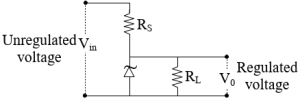
A
$4000$
B
$10$
C
$100$
D
$800$
Solution
(D) Given: Zener voltage $V_Z = 5 \text{ V}$,load current $I_L = 5 \text{ mA}$.
Maximum Zener current $I_Z = 4 \times I_L = 4 \times 5 \text{ mA} = 20 \text{ mA}$.
Total current through the series resistor $R_S$ is $I = I_L + I_Z = 5 \text{ mA} + 20 \text{ mA} = 25 \text{ mA} = 25 \times 10^{-3} \text{ A}$.
Maximum input voltage $V_{\text{in}} = 25 \text{ V}$.
The voltage drop across the series resistor $R_S$ is $V_{R_S} = V_{\text{in}} - V_Z = 25 \text{ V} - 5 \text{ V} = 20 \text{ V}$.
Using Ohm's law,$R_S = \frac{V_{R_S}}{I} = \frac{20 \text{ V}}{25 \times 10^{-3} \text{ A}} = 800 \Omega$.
Maximum Zener current $I_Z = 4 \times I_L = 4 \times 5 \text{ mA} = 20 \text{ mA}$.
Total current through the series resistor $R_S$ is $I = I_L + I_Z = 5 \text{ mA} + 20 \text{ mA} = 25 \text{ mA} = 25 \times 10^{-3} \text{ A}$.
Maximum input voltage $V_{\text{in}} = 25 \text{ V}$.
The voltage drop across the series resistor $R_S$ is $V_{R_S} = V_{\text{in}} - V_Z = 25 \text{ V} - 5 \text{ V} = 20 \text{ V}$.
Using Ohm's law,$R_S = \frac{V_{R_S}}{I} = \frac{20 \text{ V}}{25 \times 10^{-3} \text{ A}} = 800 \Omega$.
0 likesView Solution
150
PhysicsMediumMCQJEE Main · 2026
Consider light travelling from a medium $A$ to medium $B$ separated by a plane interface. If the light undergoes total internal reflection during its travel from medium $A$ to $B$ and the speed of light in media $A$ and $B$ are $2.4 \times 10^8 \ m/s$ and $2.7 \times 10^8 \ m/s$ respectively,then the value of critical angle is:
A
$\cot^{-1}(\frac{3}{\sqrt{13}})$
B
$\sin^{-1}(\frac{9}{8})$
C
$\tan^{-1}(\frac{8}{\sqrt{17}})$
D
$\cos^{-1}(\frac{8}{9})$
Solution
(C) For total internal reflection to occur,light must travel from a denser medium to a rarer medium. Here,the speed of light in medium $A$ $(v_A = 2.4 \times 10^8 \ m/s)$ is less than in medium $B$ $(v_B = 2.7 \times 10^8 \ m/s)$,so medium $A$ is denser.
At the critical angle $c$,the angle of refraction is $90^\circ$. According to Snell's Law:
$\mu_A \sin c = \mu_B \sin 90^\circ$
Since $\mu = \frac{c_{light}}{v}$,we have $\frac{c_{light}}{v_A} \sin c = \frac{c_{light}}{v_B} \times 1$
$\sin c = \frac{v_A}{v_B} = \frac{2.4 \times 10^8}{2.7 \times 10^8} = \frac{24}{27} = \frac{8}{9}$
Now,using the trigonometric identity $\tan c = \frac{\sin c}{\sqrt{1 - \sin^2 c}}$:
$\tan c = \frac{8/9}{\sqrt{1 - (8/9)^2}} = \frac{8/9}{\sqrt{1 - 64/81}} = \frac{8/9}{\sqrt{17/81}} = \frac{8}{\sqrt{17}}$
Therefore,$c = \tan^{-1}(\frac{8}{\sqrt{17}})$.
At the critical angle $c$,the angle of refraction is $90^\circ$. According to Snell's Law:
$\mu_A \sin c = \mu_B \sin 90^\circ$
Since $\mu = \frac{c_{light}}{v}$,we have $\frac{c_{light}}{v_A} \sin c = \frac{c_{light}}{v_B} \times 1$
$\sin c = \frac{v_A}{v_B} = \frac{2.4 \times 10^8}{2.7 \times 10^8} = \frac{24}{27} = \frac{8}{9}$
Now,using the trigonometric identity $\tan c = \frac{\sin c}{\sqrt{1 - \sin^2 c}}$:
$\tan c = \frac{8/9}{\sqrt{1 - (8/9)^2}} = \frac{8/9}{\sqrt{1 - 64/81}} = \frac{8/9}{\sqrt{17/81}} = \frac{8}{\sqrt{17}}$
Therefore,$c = \tan^{-1}(\frac{8}{\sqrt{17}})$.
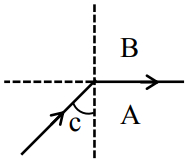
0 likesView Solution
Vedclass Products
For Students
Vedclass Test Series
Mock tests in real JEE Main style covering Physics with performance analysis. 5-day free trial.
Start Free TrialFor Teachers
Exam Paper Generator
Generate Set A/B/C/D Physics papers from 7.5L+ questions in 2 minutes. 3 chapters free.
Try FreeFor Institutes
Online Exam Module
Run live JEE Main mock exams with unlimited students, 360° analytics & white-label branding.
See DemoFrequently Asked Questions
How many Physics questions are in JEE Main 2026?
There are 459 Physics questions from the JEE Main 2026 paper on Vedclass, each with a detailed step-by-step solution in English.
Are JEE Main 2026 Physics solutions available in English?
Yes. All solutions on this page are in English. You can also switch to English or Hindi using the language buttons above the questions.
Can I practice JEE Main 2026 Physics as a timed test?
Yes. Use the Vedclass Test Series to attempt a full JEE Main mock test covering Physics with time limits and instant score analysis.
Can teachers create Physics papers from JEE Main previous year questions?
Yes. The Vedclass Exam Paper Generator lets teachers mix JEE Main Physics questions and generate Set A/B/C/D papers in minutes.
For Teachers & Institutes
Build a Custom Physics Paper
Pick JEE Main 2026 Physics questions, set difficulty, and generate Set A/B/C/D in 2 minutes.