
PhysicsQ51–70 of 120 questions
Page 2 of 2 · English
51
PhysicsMediumMCQJEE Main · 2018
The relative uncertainty in the period of a satellite orbiting around the Earth is $10^{-2}$. If the relative uncertainty in the radius of the orbit is negligible,the relative uncertainty in the mass of the Earth is:
A
$3 \times 10^{-2}$
B
$10^{-2}$
C
$2 \times 10^{-2}$
D
$6 \times 10^{-2}$
Solution
(C) According to Kepler's third law,the time period $T$ of a satellite orbiting a planet of mass $M$ at a radius $r$ is given by:
$T = 2\pi \sqrt{\frac{r^3}{GM}}$
Squaring both sides,we get:
$T^2 = \frac{4\pi^2}{GM} r^3$
Rearranging for the mass $M$:
$M = \frac{4\pi^2 r^3}{GT^2}$
Taking the natural logarithm and differentiating to find the relative uncertainty:
$\ln M = \ln(4\pi^2) + 3\ln r - \ln G - 2\ln T$
$\frac{\Delta M}{M} = 3\frac{\Delta r}{r} - 2\frac{\Delta T}{T}$
Given that the relative uncertainty in the radius $\frac{\Delta r}{r}$ is negligible (i.e.,$\frac{\Delta r}{r} = 0$):
$\left| \frac{\Delta M}{M} \right| = |-2| \frac{\Delta T}{T} = 2 \times 10^{-2}$
$T = 2\pi \sqrt{\frac{r^3}{GM}}$
Squaring both sides,we get:
$T^2 = \frac{4\pi^2}{GM} r^3$
Rearranging for the mass $M$:
$M = \frac{4\pi^2 r^3}{GT^2}$
Taking the natural logarithm and differentiating to find the relative uncertainty:
$\ln M = \ln(4\pi^2) + 3\ln r - \ln G - 2\ln T$
$\frac{\Delta M}{M} = 3\frac{\Delta r}{r} - 2\frac{\Delta T}{T}$
Given that the relative uncertainty in the radius $\frac{\Delta r}{r}$ is negligible (i.e.,$\frac{\Delta r}{r} = 0$):
$\left| \frac{\Delta M}{M} \right| = |-2| \frac{\Delta T}{T} = 2 \times 10^{-2}$
0 likesView Solution
52
PhysicsDifficultMCQJEE Main · 2018
Two moles of helium are mixed with $n$ moles of hydrogen. If $\frac{C_P}{C_V} = \frac{3}{2}$ for the mixture,then the value of $n$ is:
A
$1.5$
B
$2$
C
$1$
D
$3$
Solution
(B) For a mixture of gases,the adiabatic index $\gamma_{mix}$ is given by the formula:
$\gamma_{mix} = \frac{n_1 C_{P1} + n_2 C_{P2}}{n_1 C_{V1} + n_2 C_{V2}}$
Alternatively,using the degrees of freedom $f$:
$C_V = \frac{f}{2}R$ and $C_P = (\frac{f}{2} + 1)R$
For Helium (monoatomic),$f_1 = 3$,so $C_{V1} = \frac{3}{2}R$ and $C_{P1} = \frac{5}{2}R$.
For Hydrogen (diatomic),$f_2 = 5$,so $C_{V2} = \frac{5}{2}R$ and $C_{P2} = \frac{7}{2}R$.
Given $n_1 = 2$ and $n_2 = n$,the mixture ratio is $\frac{C_P}{C_V} = \frac{3}{2}$.
Using the relation $\frac{C_{P,mix}}{C_{V,mix}} = \frac{n_1 C_{P1} + n_2 C_{P2}}{n_1 C_{V1} + n_2 C_{V2}} = \frac{3}{2}$:
$\frac{2(\frac{5}{2}R) + n(\frac{7}{2}R)}{2(\frac{3}{2}R) + n(\frac{5}{2}R)} = \frac{3}{2}$
$\frac{5 + 3.5n}{3 + 2.5n} = \frac{3}{2}$
$10 + 7n = 9 + 7.5n$
$0.5n = 1$
$n = 2$.
$\gamma_{mix} = \frac{n_1 C_{P1} + n_2 C_{P2}}{n_1 C_{V1} + n_2 C_{V2}}$
Alternatively,using the degrees of freedom $f$:
$C_V = \frac{f}{2}R$ and $C_P = (\frac{f}{2} + 1)R$
For Helium (monoatomic),$f_1 = 3$,so $C_{V1} = \frac{3}{2}R$ and $C_{P1} = \frac{5}{2}R$.
For Hydrogen (diatomic),$f_2 = 5$,so $C_{V2} = \frac{5}{2}R$ and $C_{P2} = \frac{7}{2}R$.
Given $n_1 = 2$ and $n_2 = n$,the mixture ratio is $\frac{C_P}{C_V} = \frac{3}{2}$.
Using the relation $\frac{C_{P,mix}}{C_{V,mix}} = \frac{n_1 C_{P1} + n_2 C_{P2}}{n_1 C_{V1} + n_2 C_{V2}} = \frac{3}{2}$:
$\frac{2(\frac{5}{2}R) + n(\frac{7}{2}R)}{2(\frac{3}{2}R) + n(\frac{5}{2}R)} = \frac{3}{2}$
$\frac{5 + 3.5n}{3 + 2.5n} = \frac{3}{2}$
$10 + 7n = 9 + 7.5n$
$0.5n = 1$
$n = 2$.
0 likesView Solution
53
PhysicsDifficultMCQJEE Main · 2018
$A$ particle executes simple harmonic motion and is located at $x = a, b$ and $c$ at times $t_0, 2t_0$ and $3t_0$ respectively. The frequency of the oscillation is
A
$\frac{1}{2\pi t_0} \cos^{-1} \left( \frac{a+b}{2c} \right)$
B
$\frac{1}{2\pi t_0} \cos^{-1} \left( \frac{a+b}{3c} \right)$
C
$\frac{1}{2\pi t_0} \cos^{-1} \left( \frac{2a+3c}{b} \right)$
D
$\frac{1}{2\pi t_0} \cos^{-1} \left( \frac{a+c}{2b} \right)$
Solution
(D) Let the equation of motion be $x = A \cos(\omega t + \phi)$. However,for simplicity,we can use $x = A \cos(\omega t)$ if the phase is zero at $t=0$. Given the positions at specific times:
$a = A \cos(\omega t_0)$
$b = A \cos(2\omega t_0)$
$c = A \cos(3\omega t_0)$
Using the trigonometric identity $\cos(3\theta) + \cos(\theta) = 2 \cos(2\theta) \cos(\theta)$:
$a + c = A \cos(3\omega t_0) + A \cos(\omega t_0) = A [2 \cos(2\omega t_0) \cos(\omega t_0)]$
Substitute $b = A \cos(2\omega t_0)$:
$a + c = 2b \cos(\omega t_0)$
$\cos(\omega t_0) = \frac{a+c}{2b}$
$\omega t_0 = \cos^{-1} \left( \frac{a+c}{2b} \right)$
Since $\omega = 2\pi f$,we have $2\pi f t_0 = \cos^{-1} \left( \frac{a+c}{2b} \right)$
$f = \frac{1}{2\pi t_0} \cos^{-1} \left( \frac{a+c}{2b} \right)$
$a = A \cos(\omega t_0)$
$b = A \cos(2\omega t_0)$
$c = A \cos(3\omega t_0)$
Using the trigonometric identity $\cos(3\theta) + \cos(\theta) = 2 \cos(2\theta) \cos(\theta)$:
$a + c = A \cos(3\omega t_0) + A \cos(\omega t_0) = A [2 \cos(2\omega t_0) \cos(\omega t_0)]$
Substitute $b = A \cos(2\omega t_0)$:
$a + c = 2b \cos(\omega t_0)$
$\cos(\omega t_0) = \frac{a+c}{2b}$
$\omega t_0 = \cos^{-1} \left( \frac{a+c}{2b} \right)$
Since $\omega = 2\pi f$,we have $2\pi f t_0 = \cos^{-1} \left( \frac{a+c}{2b} \right)$
$f = \frac{1}{2\pi t_0} \cos^{-1} \left( \frac{a+c}{2b} \right)$
0 likesView Solution
54
PhysicsDifficultMCQJEE Main · 2018
Two sitar strings,$A$ and $B$,playing the note $'Dha'$ are slightly out of tune and produce beats at a frequency of $5 \, Hz$. The tension of string $B$ is slightly increased and the beat frequency is found to decrease to $3 \, Hz$. If the frequency of $A$ is $425 \, Hz$,the original frequency of $B$ is ... $Hz$.
A
$430$
B
$428$
C
$422$
D
$420$
Solution
(D) Given: Frequency of string $A$,$n_A = 425 \, Hz$. Initial beat frequency $x_1 = 5 \, Hz$.
Beat frequency is given by $|n_A - n_B| = 5 \, Hz$. This implies $n_B$ could be $420 \, Hz$ or $430 \, Hz$.
When the tension of string $B$ is increased,its frequency $n_B$ increases because $n \propto \sqrt{T}$.
Case $1$: If $n_B = 420 \, Hz$,increasing tension increases $n_B$. As $n_B$ approaches $n_A$ $(425 \, Hz)$,the beat frequency $|n_A - n_B|$ decreases. This matches the observation that the beat frequency decreased to $3 \, Hz$.
Case $2$: If $n_B = 430 \, Hz$,increasing tension increases $n_B$ further away from $n_A$ $(425 \, Hz)$,which would increase the beat frequency. This contradicts the observation.
Therefore,the original frequency of $B$ must be $420 \, Hz$.
Beat frequency is given by $|n_A - n_B| = 5 \, Hz$. This implies $n_B$ could be $420 \, Hz$ or $430 \, Hz$.
When the tension of string $B$ is increased,its frequency $n_B$ increases because $n \propto \sqrt{T}$.
Case $1$: If $n_B = 420 \, Hz$,increasing tension increases $n_B$. As $n_B$ approaches $n_A$ $(425 \, Hz)$,the beat frequency $|n_A - n_B|$ decreases. This matches the observation that the beat frequency decreased to $3 \, Hz$.
Case $2$: If $n_B = 430 \, Hz$,increasing tension increases $n_B$ further away from $n_A$ $(425 \, Hz)$,which would increase the beat frequency. This contradicts the observation.
Therefore,the original frequency of $B$ must be $420 \, Hz$.
1 likesView Solution
55
PhysicsMediumMCQJEE Main · 2018
Suppose that the angular velocity of rotation of the earth is increased. Then,as a consequence:
A
There will be no change in weight anywhere on the earth.
B
Weight of the object,everywhere on the earth,will decrease.
C
Weight of the object,everywhere on the earth,will increase.
D
Except at poles,weight of the object on the earth will decrease.
Solution
(D) The effective acceleration due to gravity $g'$ at a latitude $\phi$ is given by the formula: $g' = g - \omega^2 R \cos^2 \phi$,where $\omega$ is the angular velocity of the earth and $R$ is the radius of the earth.
At the poles,the latitude $\phi = 90^\circ$,so $\cos 90^\circ = 0$. Thus,$g' = g$,which means there is no change in gravity at the poles regardless of the change in $\omega$.
At all other latitudes,as the angular velocity $\omega$ increases,the term $\omega^2 R \cos^2 \phi$ increases.
Since $g' = g - \omega^2 R \cos^2 \phi$,an increase in $\omega$ leads to a decrease in $g'$.
Consequently,the weight of an object,$W = mg'$,will decrease at all points on the earth except at the poles.
At the poles,the latitude $\phi = 90^\circ$,so $\cos 90^\circ = 0$. Thus,$g' = g$,which means there is no change in gravity at the poles regardless of the change in $\omega$.
At all other latitudes,as the angular velocity $\omega$ increases,the term $\omega^2 R \cos^2 \phi$ increases.
Since $g' = g - \omega^2 R \cos^2 \phi$,an increase in $\omega$ leads to a decrease in $g'$.
Consequently,the weight of an object,$W = mg'$,will decrease at all points on the earth except at the poles.
0 likesView Solution
56
PhysicsDifficultMCQJEE Main · 2018
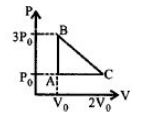
One mole of an ideal monoatomic gas is taken along the path $ABCA$ as shown in the $PV$ diagram. The maximum temperature attained by the gas along the path $BC$ is given by
A
$\frac{25}{8} \frac{P_0 V_0}{R}$
B
$\frac{25}{4} \frac{P_0 V_0}{R}$
C
$\frac{25}{16} \frac{P_0 V_0}{R}$
D
$\frac{5}{8} \frac{P_0 V_0}{R}$
Solution
(A) The path $BC$ is a straight line passing through points $(V_0, 3P_0)$ and $(2V_0, P_0)$.
The slope of the line $BC$ is $m = \frac{P_0 - 3P_0}{2V_0 - V_0} = \frac{-2P_0}{V_0}$.
The equation of the line $BC$ is $P - 3P_0 = \frac{-2P_0}{V_0}(V - V_0)$,which simplifies to $P = 3P_0 - \frac{2P_0}{V_0}(V - V_0) = P_0(5 - \frac{2V}{V_0})$.
Using the ideal gas law $PV = nRT$ with $n = 1$,we have $T = \frac{PV}{R} = \frac{P_0}{R}(5V - \frac{2V^2}{V_0})$.
To find the maximum temperature,we set $\frac{dT}{dV} = 0$:
$\frac{dT}{dV} = \frac{P_0}{R}(5 - \frac{4V}{V_0}) = 0 \implies V = \frac{5}{4}V_0$.
Substituting $V = \frac{5}{4}V_0$ back into the expression for $T$:
$T_{max} = \frac{P_0}{R}(5(\frac{5}{4}V_0) - \frac{2}{V_0}(\frac{25}{16}V_0^2)) = \frac{P_0}{R}(\frac{25}{4}V_0 - \frac{25}{8}V_0) = \frac{25}{8} \frac{P_0 V_0}{R}$.
The slope of the line $BC$ is $m = \frac{P_0 - 3P_0}{2V_0 - V_0} = \frac{-2P_0}{V_0}$.
The equation of the line $BC$ is $P - 3P_0 = \frac{-2P_0}{V_0}(V - V_0)$,which simplifies to $P = 3P_0 - \frac{2P_0}{V_0}(V - V_0) = P_0(5 - \frac{2V}{V_0})$.
Using the ideal gas law $PV = nRT$ with $n = 1$,we have $T = \frac{PV}{R} = \frac{P_0}{R}(5V - \frac{2V^2}{V_0})$.
To find the maximum temperature,we set $\frac{dT}{dV} = 0$:
$\frac{dT}{dV} = \frac{P_0}{R}(5 - \frac{4V}{V_0}) = 0 \implies V = \frac{5}{4}V_0$.
Substituting $V = \frac{5}{4}V_0$ back into the expression for $T$:
$T_{max} = \frac{P_0}{R}(5(\frac{5}{4}V_0) - \frac{2}{V_0}(\frac{25}{16}V_0^2)) = \frac{P_0}{R}(\frac{25}{4}V_0 - \frac{25}{8}V_0) = \frac{25}{8} \frac{P_0 V_0}{R}$.
0 likesView Solution
57
PhysicsDifficultMCQJEE Main · 2018
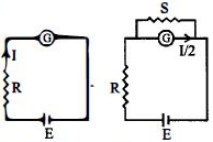
In a circuit for finding the resistance of a galvanometer by the half-deflection method,a $6\,V$ battery and a high resistance of $11\,k\Omega$ are used. The figure of merit of the galvanometer is $60\,\mu A/\text{division}$. In the absence of shunt resistance,the galvanometer produces a deflection of $\theta = 9$ divisions when current flows in the circuit. The value of the shunt resistance that can cause the deflection of $\theta/2$ is closest to .................. $\Omega$.
A
$55$
B
$110$
C
$220$
D
$550$
Solution
(B) Given: Battery voltage $E = 6\,V$,high resistance $R = 11\,k\Omega = 11000\,\Omega$,figure of merit $k = 60\,\mu A/\text{div}$,initial deflection $\theta = 9\,\text{div}$.
$1$. Calculate the current $I$ for full deflection $\theta = 9$:
$I = k \cdot \theta = 60 \times 10^{-6} \times 9 = 540 \times 10^{-6} = 5.4 \times 10^{-4}\,A$.
$2$. Using Ohm's law for the circuit without shunt:
$I = \frac{E}{R + G} \implies 5.4 \times 10^{-4} = \frac{6}{11000 + G}$.
Since $R \gg G$,$R + G \approx R = 11000\,\Omega$.
$G = \frac{E}{I} - R = \frac{6}{5.4 \times 10^{-4}} - 11000 = 11111 - 11000 = 111.1\,\Omega$.
$3$. In the half-deflection method,the shunt resistance $S$ is connected such that the deflection becomes $\theta/2 = 4.5\,\text{div}$.
The formula for shunt resistance in the half-deflection method is $S = \frac{G \cdot R}{R - G}$.
Given $R = 11000\,\Omega$ and $G \approx 111.1\,\Omega$:
$S = \frac{111.1 \times 11000}{11000 - 111.1} \approx \frac{111.1 \times 11000}{10888.9} \approx 112.2\,\Omega$.
Rounding to the nearest given option,the value is $110\,\Omega$.
$1$. Calculate the current $I$ for full deflection $\theta = 9$:
$I = k \cdot \theta = 60 \times 10^{-6} \times 9 = 540 \times 10^{-6} = 5.4 \times 10^{-4}\,A$.
$2$. Using Ohm's law for the circuit without shunt:
$I = \frac{E}{R + G} \implies 5.4 \times 10^{-4} = \frac{6}{11000 + G}$.
Since $R \gg G$,$R + G \approx R = 11000\,\Omega$.
$G = \frac{E}{I} - R = \frac{6}{5.4 \times 10^{-4}} - 11000 = 11111 - 11000 = 111.1\,\Omega$.
$3$. In the half-deflection method,the shunt resistance $S$ is connected such that the deflection becomes $\theta/2 = 4.5\,\text{div}$.
The formula for shunt resistance in the half-deflection method is $S = \frac{G \cdot R}{R - G}$.
Given $R = 11000\,\Omega$ and $G \approx 111.1\,\Omega$:
$S = \frac{111.1 \times 11000}{11000 - 111.1} \approx \frac{111.1 \times 11000}{10888.9} \approx 112.2\,\Omega$.
Rounding to the nearest given option,the value is $110\,\Omega$.
0 likesView Solution
58
PhysicsMediumMCQJEE Main · 2018
The de-Broglie wavelength $(\lambda_B)$ associated with the electron orbiting in the second excited state of a hydrogen atom is related to that in the ground state $(\lambda_G)$ by:
A
$\lambda_B = \lambda_G / 3$
B
$\lambda_B = \lambda_G / 2$
C
$\lambda_B = 2\lambda_G$
D
$\lambda_B = 3\lambda_G$
Solution
(D) The de-Broglie wavelength is given by $\lambda = \frac{h}{p}$,where $p$ is the momentum of the electron.
For an electron in a hydrogen atom,the orbital radius $r_n$ is proportional to $n^2$ and the velocity $v_n$ is proportional to $1/n$.
The angular momentum quantization condition is $mvr = \frac{nh}{2\pi}$,which implies $2\pi r = n\lambda$.
Thus,the de-Broglie wavelength $\lambda$ is proportional to the circumference of the orbit,$\lambda = \frac{2\pi r_n}{n}$.
Since $r_n \propto n^2$,we have $\lambda \propto \frac{n^2}{n} = n$.
For the ground state,$n_G = 1$,so $\lambda_G \propto 1$.
For the second excited state,$n_B = 3$,so $\lambda_B \propto 3$.
Therefore,$\frac{\lambda_B}{\lambda_G} = \frac{3}{1}$,which gives $\lambda_B = 3\lambda_G$.
For an electron in a hydrogen atom,the orbital radius $r_n$ is proportional to $n^2$ and the velocity $v_n$ is proportional to $1/n$.
The angular momentum quantization condition is $mvr = \frac{nh}{2\pi}$,which implies $2\pi r = n\lambda$.
Thus,the de-Broglie wavelength $\lambda$ is proportional to the circumference of the orbit,$\lambda = \frac{2\pi r_n}{n}$.
Since $r_n \propto n^2$,we have $\lambda \propto \frac{n^2}{n} = n$.
For the ground state,$n_G = 1$,so $\lambda_G \propto 1$.
For the second excited state,$n_B = 3$,so $\lambda_B \propto 3$.
Therefore,$\frac{\lambda_B}{\lambda_G} = \frac{3}{1}$,which gives $\lambda_B = 3\lambda_G$.
0 likesView Solution
59
PhysicsMediumMCQJEE Main · 2018
$A$ coil of cross-sectional area $A$ having $n$ turns is placed in a uniform magnetic field $B.$ When it is rotated with an angular velocity $\omega,$ the maximum $e.m.f.$ induced in the coil will be
A
$nBA\omega$
B
$\frac{3}{2} nBA\omega$
C
$3 nBA\omega$
D
$\frac{1}{2} nBA\omega$
Solution
(A) The magnetic flux $\phi$ linked with a coil of $n$ turns rotating in a magnetic field $B$ is given by $\phi = nBA \cos(\omega t).$
According to Faraday's law of electromagnetic induction,the induced $e.m.f.$ is $e = -\frac{d\phi}{dt}.$
Substituting the expression for $\phi,$ we get $e = -\frac{d}{dt}(nBA \cos(\omega t)) = nBA\omega \sin(\omega t).$
The maximum value of the induced $e.m.f.$ $(e_0)$ occurs when $\sin(\omega t) = 1.$
Therefore,$e_0 = nBA\omega.$
According to Faraday's law of electromagnetic induction,the induced $e.m.f.$ is $e = -\frac{d\phi}{dt}.$
Substituting the expression for $\phi,$ we get $e = -\frac{d}{dt}(nBA \cos(\omega t)) = nBA\omega \sin(\omega t).$
The maximum value of the induced $e.m.f.$ $(e_0)$ occurs when $\sin(\omega t) = 1.$
Therefore,$e_0 = nBA\omega.$
0 likesView Solution
60
PhysicsMediumMCQJEE Main · 2018
Unpolarized light of intensity $I$ is incident on a system of two polarizers,$A$ followed by $B$. The intensity of emergent light is $I/2$. If a third polarizer $C$ is placed between $A$ and $B$,the intensity of emergent light is reduced to $I/3$. The angle between the polarizers $A$ and $C$ is $\theta$. Then:
A
$\cos \theta = (2/3)^{1/4}$
B
$\cos \theta = (1/3)^{1/4}$
C
$\cos \theta = (1/3)^{1/2}$
D
$\cos \theta = (2/3)^{1/2}$
Solution
(A) When unpolarized light of intensity $I$ passes through the first polarizer $A$,the intensity becomes $I_A = I/2$.
Since the emergent intensity after $B$ is $I/2$,the polarizers $A$ and $B$ must be parallel (angle $0^\circ$ between them).
When a third polarizer $C$ is placed between $A$ and $B$ at an angle $\theta$ with $A$,the angle between $C$ and $B$ is $(90^\circ - \theta)$ if $A$ and $B$ were crossed,but here they are parallel,so the angle between $C$ and $B$ is $\theta$.
Using Malus' Law: $I_{final} = I_A \cos^2 \theta \cos^2 \theta = (I/2) \cos^4 \theta$.
Given $I_{final} = I/3$,we have $(I/2) \cos^4 \theta = I/3$.
$\cos^4 \theta = 2/3$.
Therefore,$\cos \theta = (2/3)^{1/4}$.
Since the emergent intensity after $B$ is $I/2$,the polarizers $A$ and $B$ must be parallel (angle $0^\circ$ between them).
When a third polarizer $C$ is placed between $A$ and $B$ at an angle $\theta$ with $A$,the angle between $C$ and $B$ is $(90^\circ - \theta)$ if $A$ and $B$ were crossed,but here they are parallel,so the angle between $C$ and $B$ is $\theta$.
Using Malus' Law: $I_{final} = I_A \cos^2 \theta \cos^2 \theta = (I/2) \cos^4 \theta$.
Given $I_{final} = I/3$,we have $(I/2) \cos^4 \theta = I/3$.
$\cos^4 \theta = 2/3$.
Therefore,$\cos \theta = (2/3)^{1/4}$.
0 likesView Solution
61
PhysicsMediumMCQJEE Main · 2018
$A$ power transmission line feeds input power at $2300\,V$ to a step-down transformer with its primary windings having $4000$ turns,giving the output power at $230\,V.$ If the current in the primary of the transformer is $5\,A,$ and its efficiency is $90\%,$ the output current would be......$A$
A
$20$
B
$40$
C
$45$
D
$25$
Solution
(C) Given: Primary voltage $V_{P} = 2300\,V$,Secondary voltage $V_{S} = 230\,V$,Primary current $I_{P} = 5\,A$,Efficiency $\eta = 90\% = 0.9$.
The efficiency of a transformer is defined as the ratio of output power $(P_{S})$ to input power $(P_{P})$:
$\eta = \frac{P_{S}}{P_{P}} \Rightarrow P_{S} = \eta \times P_{P}$.
Since power $P = V \times I$,we can write:
$V_{S} \times I_{S} = 0.9 \times (V_{P} \times I_{P})$.
Substituting the given values:
$230 \times I_{S} = 0.9 \times 2300 \times 5$.
Solving for $I_{S}$:
$I_{S} = \frac{0.9 \times 2300 \times 5}{230} = 0.9 \times 10 \times 5 = 45\,A$.
Therefore,the output current is $45\,A$.
The efficiency of a transformer is defined as the ratio of output power $(P_{S})$ to input power $(P_{P})$:
$\eta = \frac{P_{S}}{P_{P}} \Rightarrow P_{S} = \eta \times P_{P}$.
Since power $P = V \times I$,we can write:
$V_{S} \times I_{S} = 0.9 \times (V_{P} \times I_{P})$.
Substituting the given values:
$230 \times I_{S} = 0.9 \times 2300 \times 5$.
Solving for $I_{S}$:
$I_{S} = \frac{0.9 \times 2300 \times 5}{230} = 0.9 \times 10 \times 5 = 45\,A$.
Therefore,the output current is $45\,A$.
0 likesView Solution
62
PhysicsMediumMCQJEE Main · 2018
Both the nucleus and the atom of some element are in their respective first excited states. They get de-excited by emitting photons of wavelengths $\lambda_N$ and $\lambda_A$ respectively. The ratio $\frac{\lambda_N}{\lambda_A}$ is closest to
A
$10^{-6}$
B
$10$
C
$10^{-1}$
D
$10^{-10}$
Solution
(A) The energy of a photon is given by $E = \frac{hc}{\lambda}$.
From this,we have $\lambda = \frac{hc}{E}$,which implies $\frac{\lambda_N}{\lambda_A} = \frac{E_A}{E_N}$.
Here,$E_N$ is the energy of the photon emitted during nuclear de-excitation,which is typically in the order of $MeV$ $(10^6 \ eV)$.
$E_A$ is the energy of the photon emitted during atomic de-excitation,which is typically in the order of a few $eV$ (e.g.,$1-10 \ eV$).
Therefore,the ratio $\frac{\lambda_N}{\lambda_A} = \frac{E_A}{E_N} \approx \frac{1 \ eV}{10^6 \ eV} = 10^{-6}$.
From this,we have $\lambda = \frac{hc}{E}$,which implies $\frac{\lambda_N}{\lambda_A} = \frac{E_A}{E_N}$.
Here,$E_N$ is the energy of the photon emitted during nuclear de-excitation,which is typically in the order of $MeV$ $(10^6 \ eV)$.
$E_A$ is the energy of the photon emitted during atomic de-excitation,which is typically in the order of a few $eV$ (e.g.,$1-10 \ eV$).
Therefore,the ratio $\frac{\lambda_N}{\lambda_A} = \frac{E_A}{E_N} \approx \frac{1 \ eV}{10^6 \ eV} = 10^{-6}$.
0 likesView Solution
63
PhysicsDifficultMCQJEE Main · 2018
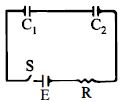
In the following circuit,the switch $S$ is closed at $t = 0.$ The charge on the capacitor $C_1$ as a function of time will be given by $\left( {{C_{eq}} = \frac{{{C_1}{C_2}}}{{{C_1} + {C_2}}}} \right).$
A
${C_{eq}}E\,[1 - \exp ( - t/R{C_{eq}})]$
B
${C_1}E\,[1 - \exp ( - tR/{C_1})]$
C
${C_2}E\,[1 - \exp ( - t/R{C_2})]$
D
${C_{eq}}E\,\exp ( - t/R{C_{eq}})$
Solution
(A) The circuit consists of two capacitors $C_1$ and $C_2$ connected in series with a resistor $R$ and a battery of $EMF$ $E$.
When the switch $S$ is closed at $t = 0$,the capacitors begin to charge.
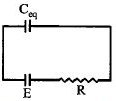
The equivalent capacitance of the series combination is given as $C_{eq} = \frac{C_1 C_2}{C_1 + C_2}$.
The charging equation for a series $RC$ circuit is $Q(t) = Q_0(1 - e^{-t/\tau})$,where $Q_0$ is the maximum charge and $\tau = RC_{eq}$ is the time constant.
The maximum charge on the equivalent capacitor is $Q_0 = C_{eq}E$.
Since the capacitors are in series,the charge on each capacitor is the same and equal to the charge on the equivalent capacitor.
Thus,the charge on $C_1$ as a function of time is $Q(t) = C_{eq}E[1 - \exp(-t/RC_{eq})]$.
When the switch $S$ is closed at $t = 0$,the capacitors begin to charge.
The equivalent capacitance of the series combination is given as $C_{eq} = \frac{C_1 C_2}{C_1 + C_2}$.
The charging equation for a series $RC$ circuit is $Q(t) = Q_0(1 - e^{-t/\tau})$,where $Q_0$ is the maximum charge and $\tau = RC_{eq}$ is the time constant.
The maximum charge on the equivalent capacitor is $Q_0 = C_{eq}E$.
Since the capacitors are in series,the charge on each capacitor is the same and equal to the charge on the equivalent capacitor.
Thus,the charge on $C_1$ as a function of time is $Q(t) = C_{eq}E[1 - \exp(-t/RC_{eq})]$.
0 likesView Solution
64
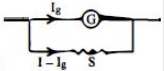
PhysicsDifficultMCQJEE Main · 2018
$A$ galvanometer with its coil resistance $25\,\Omega$ requires a current of $1\,mA$ for its full-scale deflection. In order to construct an ammeter to read up to a current of $2\,A$,the approximate value of the shunt resistance should be:
A
$2.5 \times 10^{-2}\,\Omega$
B
$1.25 \times 10^{-3}\,\Omega$
C
$2.5 \times 10^{-3}\,\Omega$
D
$1.25 \times 10^{-2}\,\Omega$
Solution
(D) Given:
Galvanometer resistance,$R_g = 25\,\Omega$
Full-scale deflection current,$I_g = 1\,mA = 10^{-3}\,A$
Maximum current to be measured,$I = 2\,A$
To convert a galvanometer into an ammeter,a shunt resistance $S$ is connected in parallel with the galvanometer.
The potential difference across the galvanometer and the shunt must be equal:
$I_g R_g = (I - I_g) S$
Substituting the values:
$10^{-3} \times 25 = (2 - 10^{-3}) S$
$0.025 = (2 - 0.001) S$
$0.025 = 1.999 S$
$S = \frac{0.025}{1.999} \approx \frac{0.025}{2} = 0.0125\,\Omega$
Thus,$S = 1.25 \times 10^{-2}\,\Omega$.
Galvanometer resistance,$R_g = 25\,\Omega$
Full-scale deflection current,$I_g = 1\,mA = 10^{-3}\,A$
Maximum current to be measured,$I = 2\,A$
To convert a galvanometer into an ammeter,a shunt resistance $S$ is connected in parallel with the galvanometer.
The potential difference across the galvanometer and the shunt must be equal:
$I_g R_g = (I - I_g) S$
Substituting the values:
$10^{-3} \times 25 = (2 - 10^{-3}) S$
$0.025 = (2 - 0.001) S$
$0.025 = 1.999 S$
$S = \frac{0.025}{1.999} \approx \frac{0.025}{2} = 0.0125\,\Omega$
Thus,$S = 1.25 \times 10^{-2}\,\Omega$.
0 likesView Solution
65
PhysicsDifficultMCQJEE Main · 2018
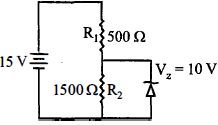
In the given circuit,the current through the zener diode is ...... $mA$.
A
$2.5$
B
$3.3$
C
$5.5$
D
$6.7$
Solution
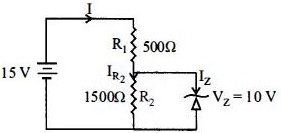
(B) The voltage across the zener diode is $V_{Z} = 10 \ V$. Since the zener diode is in parallel with resistor $R_{2} = 1500 \ \Omega$,the voltage across $R_{2}$ is $V_{R_{2}} = V_{Z} = 10 \ V$.
The current through $R_{2}$ is:
$I_{R_{2}} = \frac{V_{R_{2}}}{R_{2}} = \frac{10 \ V}{1500 \ \Omega} = \frac{1}{150} \ A \approx 6.67 \times 10^{-3} \ A = 6.67 \ mA$.
The voltage across $R_{1} = 500 \ \Omega$ is:
$V_{R_{1}} = V_{source} - V_{Z} = 15 \ V - 10 \ V = 5 \ V$.
The total current through $R_{1}$ is:
$I_{R_{1}} = \frac{V_{R_{1}}}{R_{1}} = \frac{5 \ V}{500 \ \Omega} = 0.01 \ A = 10 \ mA$.
Applying Kirchhoff's Current Law at the junction,the current through the zener diode $I_{Z}$ is:
$I_{Z} = I_{R_{1}} - I_{R_{2}} = 10 \ mA - 6.67 \ mA = 3.33 \ mA \approx 3.3 \ mA$.
The current through $R_{2}$ is:
$I_{R_{2}} = \frac{V_{R_{2}}}{R_{2}} = \frac{10 \ V}{1500 \ \Omega} = \frac{1}{150} \ A \approx 6.67 \times 10^{-3} \ A = 6.67 \ mA$.
The voltage across $R_{1} = 500 \ \Omega$ is:
$V_{R_{1}} = V_{source} - V_{Z} = 15 \ V - 10 \ V = 5 \ V$.
The total current through $R_{1}$ is:
$I_{R_{1}} = \frac{V_{R_{1}}}{R_{1}} = \frac{5 \ V}{500 \ \Omega} = 0.01 \ A = 10 \ mA$.
Applying Kirchhoff's Current Law at the junction,the current through the zener diode $I_{Z}$ is:
$I_{Z} = I_{R_{1}} - I_{R_{2}} = 10 \ mA - 6.67 \ mA = 3.33 \ mA \approx 3.3 \ mA$.
0 likesView Solution
66
PhysicsDifficultMCQJEE Main · 2018
Two identical conducting spheres $A$ and $B$ carry equal charge. They are separated by a distance much larger than their diameter,and the force between them is $F$. $A$ third identical conducting sphere,$C$,is uncharged. Sphere $C$ is first touched to $A$,then to $B$,and then removed. As a result,the force between $A$ and $B$ would be equal to
A
$\frac{3F}{4}$
B
$\frac{F}{2}$
C
$F$
D
$\frac{3F}{8}$
Solution
(D) Let the initial charge on spheres $A$ and $B$ be $q$. The force between them is given by $F = \frac{k q^2}{r^2}$.
When sphere $C$ (uncharged) is touched to $A$,the charge redistributes equally between them. Thus,the new charge on $A$ is $q_A = \frac{q + 0}{2} = \frac{q}{2}$. The charge on $C$ becomes $\frac{q}{2}$.
Next,sphere $C$ (now with charge $\frac{q}{2}$) is touched to $B$ (with charge $q$). The total charge is $\frac{q}{2} + q = \frac{3q}{2}$. This charge is shared equally,so the new charge on $B$ is $q_B = \frac{3q/2}{2} = \frac{3q}{4}$.
The new force between $A$ and $B$ is $F' = \frac{k q_A q_B}{r^2} = \frac{k (q/2) (3q/4)}{r^2} = \frac{3}{8} \frac{k q^2}{r^2} = \frac{3}{8} F$.
When sphere $C$ (uncharged) is touched to $A$,the charge redistributes equally between them. Thus,the new charge on $A$ is $q_A = \frac{q + 0}{2} = \frac{q}{2}$. The charge on $C$ becomes $\frac{q}{2}$.
Next,sphere $C$ (now with charge $\frac{q}{2}$) is touched to $B$ (with charge $q$). The total charge is $\frac{q}{2} + q = \frac{3q}{2}$. This charge is shared equally,so the new charge on $B$ is $q_B = \frac{3q/2}{2} = \frac{3q}{4}$.
The new force between $A$ and $B$ is $F' = \frac{k q_A q_B}{r^2} = \frac{k (q/2) (3q/4)}{r^2} = \frac{3}{8} \frac{k q^2}{r^2} = \frac{3}{8} F$.
0 likesView Solution
67
PhysicsDifficultMCQJEE Main · 2018
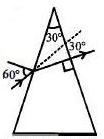
$A$ ray of light is incident at an angle of $60^o$ on one face of a prism of angle $30^o$. The emergent ray of light makes an angle of $30^o$ with the incident ray. The angle made by the emergent ray with the second face of the prism will be....$^o$
A
$30$
B
$0$
C
$90$
D
$45$
Solution
(C) Given: Angle of prism,$A = 30^o$,Angle of incidence,$i = 60^o$,Angle of deviation,$\delta = 30^o$.
Using the prism formula for deviation: $\delta = i + e - A$.
Substituting the values: $30^o = 60^o + e - 30^o$.
Solving for the angle of emergence $e$: $e = 30^o + 30^o - 60^o = 0^o$.
Since the angle of emergence $e = 0^o$,the emergent ray is normal (perpendicular) to the second face of the prism.
Therefore,the angle made by the emergent ray with the second face of the prism is $90^o$.
Using the prism formula for deviation: $\delta = i + e - A$.
Substituting the values: $30^o = 60^o + e - 30^o$.
Solving for the angle of emergence $e$: $e = 30^o + 30^o - 60^o = 0^o$.
Since the angle of emergence $e = 0^o$,the emergent ray is normal (perpendicular) to the second face of the prism.
Therefore,the angle made by the emergent ray with the second face of the prism is $90^o$.
0 likesView Solution
68
PhysicsDifficultMCQJEE Main · 2018
$A$ carrier wave of peak voltage $14\,V$ is used for transmitting a message signal. The peak voltage of the modulating signal required to achieve a modulation index of $80\%$ will be.......$V$
A
$11.2$
B
$7$
C
$22.4$
D
$28$
Solution
(A) Given: Modulation index $m = 80\% = 0.8$.
Carrier wave peak voltage $E_c = 14\,V$.
We know that the modulation index $m$ is defined as the ratio of the peak voltage of the modulating signal $(E_m)$ to the peak voltage of the carrier wave $(E_c)$.
Formula: $m = \frac{E_m}{E_c}$.
Rearranging the formula to find $E_m$: $E_m = m \times E_c$.
Substituting the values: $E_m = 0.8 \times 14\,V = 11.2\,V$.
Therefore,the peak voltage of the modulating signal is $11.2\,V$.
Carrier wave peak voltage $E_c = 14\,V$.
We know that the modulation index $m$ is defined as the ratio of the peak voltage of the modulating signal $(E_m)$ to the peak voltage of the carrier wave $(E_c)$.
Formula: $m = \frac{E_m}{E_c}$.
Rearranging the formula to find $E_m$: $E_m = m \times E_c$.
Substituting the values: $E_m = 0.8 \times 14\,V = 11.2\,V$.
Therefore,the peak voltage of the modulating signal is $11.2\,V$.
0 likesView Solution
69
PhysicsMediumMCQJEE Main · 2018
$A$ plane electromagnetic wave of wavelength $\lambda$ has an intensity $I$. It is propagating along the positive $Y$-direction. The allowed expressions for the electric and magnetic fields are given by:
A
$\vec E = \sqrt{\frac{I}{\varepsilon_0 c}} \cos \left[ \frac{2\pi}{\lambda}(y - ct) \right] \hat i; \vec B = \frac{1}{c} E \hat k$
B
$\vec E = \sqrt{\frac{I}{\varepsilon_0 c}} \cos \left[ \frac{2\pi}{\lambda}(y - ct) \right] \hat k; \vec B = -\frac{1}{c} E \hat i$
C
$\vec E = \sqrt{\frac{2I}{\varepsilon_0 c}} \cos \left[ \frac{2\pi}{\lambda}(y - ct) \right] \hat k; \vec B = +\frac{1}{c} E \hat i$
D
$\vec E = \sqrt{\frac{2I}{\varepsilon_0 c}} \cos \left[ \frac{2\pi}{\lambda}(y + ct) \right] \hat k; \vec B = \frac{1}{c} E \hat i$
Solution
(C) The intensity $I$ of an electromagnetic wave is related to the amplitude of the electric field $E_0$ by the formula $I = \frac{1}{2} \varepsilon_0 c E_0^2$.
Solving for $E_0$,we get $E_0 = \sqrt{\frac{2I}{\varepsilon_0 c}}$.
The magnitude of the magnetic field is $B_0 = \frac{E_0}{c}$.
The wave propagates in the direction of $\vec E \times \vec B$. Given the propagation is along the $+Y$ direction (unit vector $\hat j$),we check the cross product for option $C$: $\hat k \times \hat i = \hat j$. This matches the propagation direction. Thus,the correct expression is $\vec E = E_0 \cos[\frac{2\pi}{\lambda}(y - ct)] \hat k$ and $\vec B = \frac{E_0}{c} \cos[\frac{2\pi}{\lambda}(y - ct)] \hat i$.
Solving for $E_0$,we get $E_0 = \sqrt{\frac{2I}{\varepsilon_0 c}}$.
The magnitude of the magnetic field is $B_0 = \frac{E_0}{c}$.
The wave propagates in the direction of $\vec E \times \vec B$. Given the propagation is along the $+Y$ direction (unit vector $\hat j$),we check the cross product for option $C$: $\hat k \times \hat i = \hat j$. This matches the propagation direction. Thus,the correct expression is $\vec E = E_0 \cos[\frac{2\pi}{\lambda}(y - ct)] \hat k$ and $\vec B = \frac{E_0}{c} \cos[\frac{2\pi}{\lambda}(y - ct)] \hat i$.
0 likesView Solution
70
PhysicsMediumMCQJEE Main · 2018
The de Broglie wavelength of a proton and $\alpha$-particle are equal. The ratio of their velocities is ...... .
A
$4:1$
B
$1:4$
C
$2:1$
D
$1:2$
Solution
(A) The de Broglie wavelength $\lambda$ is given by the formula $\lambda = \frac{h}{mv}$,where $h$ is Planck's constant,$m$ is the mass,and $v$ is the velocity.
Given that the de Broglie wavelengths are equal,$\lambda_p = \lambda_{\alpha}$.
Therefore,$\frac{h}{m_p v_p} = \frac{h}{m_{\alpha} v_{\alpha}}$.
This implies $m_p v_p = m_{\alpha} v_{\alpha}$.
We know that the mass of an $\alpha$-particle is approximately $4$ times the mass of a proton,so $m_{\alpha} = 4m_p$.
Substituting this into the equation: $m_p v_p = (4m_p) v_{\alpha}$.
Dividing both sides by $m_p$,we get $v_p = 4v_{\alpha}$.
Thus,the ratio of their velocities is $\frac{v_p}{v_{\alpha}} = 4:1$.
Given that the de Broglie wavelengths are equal,$\lambda_p = \lambda_{\alpha}$.
Therefore,$\frac{h}{m_p v_p} = \frac{h}{m_{\alpha} v_{\alpha}}$.
This implies $m_p v_p = m_{\alpha} v_{\alpha}$.
We know that the mass of an $\alpha$-particle is approximately $4$ times the mass of a proton,so $m_{\alpha} = 4m_p$.
Substituting this into the equation: $m_p v_p = (4m_p) v_{\alpha}$.
Dividing both sides by $m_p$,we get $v_p = 4v_{\alpha}$.
Thus,the ratio of their velocities is $\frac{v_p}{v_{\alpha}} = 4:1$.
0 likesView Solution
Vedclass Products
For Students
Vedclass Test Series
Mock tests in real JEE Main style covering Physics with performance analysis. 5-day free trial.
Start Free TrialFor Teachers
Exam Paper Generator
Generate Set A/B/C/D Physics papers from 7.5L+ questions in 2 minutes. 3 chapters free.
Try FreeFor Institutes
Online Exam Module
Run live JEE Main mock exams with unlimited students, 360° analytics & white-label branding.
See DemoFrequently Asked Questions
How many Physics questions are in JEE Main 2018?
There are 120 Physics questions from the JEE Main 2018 paper on Vedclass, each with a detailed step-by-step solution in English.
Are JEE Main 2018 Physics solutions available in English?
Yes. All solutions on this page are in English. You can also switch to English or Hindi using the language buttons above the questions.
Can I practice JEE Main 2018 Physics as a timed test?
Yes. Use the Vedclass Test Series to attempt a full JEE Main mock test covering Physics with time limits and instant score analysis.
Can teachers create Physics papers from JEE Main previous year questions?
Yes. The Vedclass Exam Paper Generator lets teachers mix JEE Main Physics questions and generate Set A/B/C/D papers in minutes.
For Teachers & Institutes
Build a Custom Physics Paper
Pick JEE Main 2018 Physics questions, set difficulty, and generate Set A/B/C/D in 2 minutes.