
MathematicsQ1–37 of 37 questions
Page 1 of 1 · English
1
MathematicsDifficultMCQIIT JEE · 2012
Let $z$ be a complex number such that the imaginary part of $z$ is non-zero and $a = z^2 + z + 1$ is real. Then $a$ cannot take the value
A
$-1$
B
$\frac{1}{3}$
C
$\frac{1}{2}$
D
$\frac{3}{4}$
Solution
(D) Given $z^2 + z + 1 - a = 0$.
Using the quadratic formula,$z = \frac{-1 \pm \sqrt{1^2 - 4(1)(1-a)}}{2} = \frac{-1 \pm \sqrt{4a - 3}}{2}$.
Since the imaginary part of $z$ is non-zero,the discriminant must be negative.
Thus,$4a - 3 < 0$,which implies $a < \frac{3}{4}$.
Among the given options,$\frac{3}{4}$ is not less than $\frac{3}{4}$,so $a$ cannot take the value $\frac{3}{4}$.
Using the quadratic formula,$z = \frac{-1 \pm \sqrt{1^2 - 4(1)(1-a)}}{2} = \frac{-1 \pm \sqrt{4a - 3}}{2}$.
Since the imaginary part of $z$ is non-zero,the discriminant must be negative.
Thus,$4a - 3 < 0$,which implies $a < \frac{3}{4}$.
Among the given options,$\frac{3}{4}$ is not less than $\frac{3}{4}$,so $a$ cannot take the value $\frac{3}{4}$.
0 likesView Solution
2
MathematicsAdvancedMCQIIT JEE · 2012
The total number of ways in which $5$ balls of different colours can be distributed among $3$ persons so that each person gets at least one ball is
A
$75$
B
$150$
C
$210$
D
$243$
Solution
(B) To distribute $5$ distinct balls among $3$ distinct persons such that each person receives at least one ball,we use the principle of inclusion-exclusion or partition the balls into groups of sizes $(3, 1, 1)$ and $(2, 2, 1)$.
Case $1$: Group sizes $(3, 1, 1)$.
The number of ways to partition $5$ distinct balls into groups of sizes $3, 1, 1$ is $\frac{5!}{3!1!1! \cdot 2!} = \frac{120}{6 \cdot 2} = 10$.
Since the persons are distinct,we multiply by $3!$ to distribute these groups: $10 \times 6 = 60$.
Case $2$: Group sizes $(2, 2, 1)$.
The number of ways to partition $5$ distinct balls into groups of sizes $2, 2, 1$ is $\frac{5!}{2!2!1! \cdot 2!} = \frac{120}{4 \cdot 2} = 15$.
Since the persons are distinct,we multiply by $3!$ to distribute these groups: $15 \times 6 = 90$.
Total ways $= 60 + 90 = 150$.
Case $1$: Group sizes $(3, 1, 1)$.
The number of ways to partition $5$ distinct balls into groups of sizes $3, 1, 1$ is $\frac{5!}{3!1!1! \cdot 2!} = \frac{120}{6 \cdot 2} = 10$.
Since the persons are distinct,we multiply by $3!$ to distribute these groups: $10 \times 6 = 60$.
Case $2$: Group sizes $(2, 2, 1)$.
The number of ways to partition $5$ distinct balls into groups of sizes $2, 2, 1$ is $\frac{5!}{2!2!1! \cdot 2!} = \frac{120}{4 \cdot 2} = 15$.
Since the persons are distinct,we multiply by $3!$ to distribute these groups: $15 \times 6 = 90$.
Total ways $= 60 + 90 = 150$.
0 likesView Solution
3
MathematicsAdvancedMCQIIT JEE · 2012
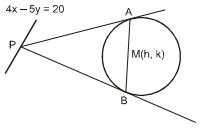
The locus of the mid-point of the chord of contact of tangents drawn from points lying on the straight line $4x - 5y = 20$ to the circle $x^2 + y^2 = 9$ is
A
$20(x^2 + y^2) - 36x + 45y = 0$
B
$20(x^2 + y^2) + 36x - 45y = 0$
C
$36(x^2 + y^2) - 20x + 45y = 0$
D
$36(x^2 + y^2) + 20x - 45y = 0$
Solution
(A) Let $P(t, \frac{4t - 20}{5})$ be a point on the line $4x - 5y = 20$.
The equation of the chord of contact of tangents drawn from $P(t, \frac{4t - 20}{5})$ to the circle $x^2 + y^2 = 9$ is given by $T = 0$:
$tx + (\frac{4t - 20}{5})y = 9$ --- $(1)$
Let $M(h, k)$ be the mid-point of this chord. The equation of a chord of a circle with mid-point $(h, k)$ is given by $T = S_1$:
$hx + ky = h^2 + k^2$ --- $(2)$
Comparing equations $(1)$ and $(2)$,we have:
$\frac{t}{h} = \frac{4t - 20}{5k} = \frac{9}{h^2 + k^2}$
From $\frac{t}{h} = \frac{9}{h^2 + k^2}$,we get $t = \frac{9h}{h^2 + k^2}$.
From $\frac{4t - 20}{5k} = \frac{9}{h^2 + k^2}$,we get $4t - 20 = \frac{45k}{h^2 + k^2}$.
Substituting $t$ in the second equation:
$4(\frac{9h}{h^2 + k^2}) - 20 = \frac{45k}{h^2 + k^2}$
$36h - 20(h^2 + k^2) = 45k$
$20(h^2 + k^2) - 36h + 45k = 0$
Replacing $(h, k)$ with $(x, y)$,the locus is:
$20(x^2 + y^2) - 36x + 45y = 0$
The equation of the chord of contact of tangents drawn from $P(t, \frac{4t - 20}{5})$ to the circle $x^2 + y^2 = 9$ is given by $T = 0$:
$tx + (\frac{4t - 20}{5})y = 9$ --- $(1)$
Let $M(h, k)$ be the mid-point of this chord. The equation of a chord of a circle with mid-point $(h, k)$ is given by $T = S_1$:
$hx + ky = h^2 + k^2$ --- $(2)$
Comparing equations $(1)$ and $(2)$,we have:
$\frac{t}{h} = \frac{4t - 20}{5k} = \frac{9}{h^2 + k^2}$
From $\frac{t}{h} = \frac{9}{h^2 + k^2}$,we get $t = \frac{9h}{h^2 + k^2}$.
From $\frac{4t - 20}{5k} = \frac{9}{h^2 + k^2}$,we get $4t - 20 = \frac{45k}{h^2 + k^2}$.
Substituting $t$ in the second equation:
$4(\frac{9h}{h^2 + k^2}) - 20 = \frac{45k}{h^2 + k^2}$
$36h - 20(h^2 + k^2) = 45k$
$20(h^2 + k^2) - 36h + 45k = 0$
Replacing $(h, k)$ with $(x, y)$,the locus is:
$20(x^2 + y^2) - 36x + 45y = 0$
0 likesView Solution
4
MathematicsAdvancedMCQIIT JEE · 2012
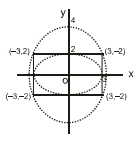
The ellipse $E_1: \frac{x^2}{9}+\frac{y^2}{4}=1$ is inscribed in a rectangle $R$ whose sides are parallel to the coordinate axes. Another ellipse $E_2$ passing through the point $(0,4)$ circumscribes the rectangle $R$. The eccentricity of the ellipse $E_2$ is
A
$\frac{\sqrt{2}}{2}$
B
$\frac{\sqrt{3}}{2}$
C
$\frac{1}{2}$
D
$\frac{3}{4}$
Solution
(C) The ellipse $E_1: \frac{x^2}{9}+\frac{y^2}{4}=1$ has vertices at $(\pm 3, 0)$ and $(0, \pm 2)$.
Since $E_1$ is inscribed in a rectangle $R$ with sides parallel to the coordinate axes,the vertices of the rectangle $R$ are $(\pm 3, \pm 2)$.
Let the equation of the ellipse $E_2$ be $\frac{x^2}{a^2}+\frac{y^2}{b^2}=1$.
Since $E_2$ passes through $(0, 4)$,we have $\frac{0}{a^2}+\frac{16}{b^2}=1$,which gives $b^2=16$.
Since $E_2$ circumscribes the rectangle $R$,it passes through the point $(3, 2)$.
Substituting $(3, 2)$ into the equation of $E_2$: $\frac{9}{a^2}+\frac{4}{b^2}=1$.
Substituting $b^2=16$: $\frac{9}{a^2}+\frac{4}{16}=1$ $\Rightarrow \frac{9}{a^2}+\frac{1}{4}=1$ $\Rightarrow \frac{9}{a^2}=\frac{3}{4}$ $\Rightarrow a^2=12$.
For the ellipse $E_2$,$b^2 > a^2$ (since $16 > 12$),so the eccentricity $e$ is given by $a^2=b^2(1-e^2)$.
$12=16(1-e^2) \Rightarrow 1-e^2=\frac{12}{16}=\frac{3}{4}$.
$e^2=1-\frac{3}{4}=\frac{1}{4} \Rightarrow e=\frac{1}{2}$.
Since $E_1$ is inscribed in a rectangle $R$ with sides parallel to the coordinate axes,the vertices of the rectangle $R$ are $(\pm 3, \pm 2)$.
Let the equation of the ellipse $E_2$ be $\frac{x^2}{a^2}+\frac{y^2}{b^2}=1$.
Since $E_2$ passes through $(0, 4)$,we have $\frac{0}{a^2}+\frac{16}{b^2}=1$,which gives $b^2=16$.
Since $E_2$ circumscribes the rectangle $R$,it passes through the point $(3, 2)$.
Substituting $(3, 2)$ into the equation of $E_2$: $\frac{9}{a^2}+\frac{4}{b^2}=1$.
Substituting $b^2=16$: $\frac{9}{a^2}+\frac{4}{16}=1$ $\Rightarrow \frac{9}{a^2}+\frac{1}{4}=1$ $\Rightarrow \frac{9}{a^2}=\frac{3}{4}$ $\Rightarrow a^2=12$.
For the ellipse $E_2$,$b^2 > a^2$ (since $16 > 12$),so the eccentricity $e$ is given by $a^2=b^2(1-e^2)$.
$12=16(1-e^2) \Rightarrow 1-e^2=\frac{12}{16}=\frac{3}{4}$.
$e^2=1-\frac{3}{4}=\frac{1}{4} \Rightarrow e=\frac{1}{2}$.
0 likesView Solution
5
MathematicsAdvancedMCQIIT JEE · 2012
Let $\theta, \phi \in [0, 2\pi]$ be such that $2 \cos \theta(1-\sin \phi) = \sin^2 \theta \left(\tan \frac{\theta}{2} + \cot \frac{\theta}{2}\right) \cos \phi - 1$,$\tan (2\pi - \theta) > 0$ and $-1 < \sin \theta < -\frac{\sqrt{3}}{2}$. Then $\phi$ cannot satisfy
A
$0 < \phi < \frac{\pi}{2}$
B
$\frac{\pi}{2} < \phi < \frac{4\pi}{3}$
C
$\frac{4\pi}{3} < \phi < \frac{3\pi}{2}$
D
$\frac{3\pi}{2} < \phi < 2\pi$
Solution
(C) Given $\tan (2\pi - \theta) > 0$ $\Rightarrow -\tan \theta > 0$ $\Rightarrow \tan \theta < 0$.
Also,$-1 < \sin \theta < -\frac{\sqrt{3}}{2}$ implies $\theta \in (\frac{4\pi}{3}, \frac{3\pi}{2}) \cup (\frac{3\pi}{2}, \frac{5\pi}{3})$.
Since $\tan \theta < 0$,we have $\theta \in (\frac{3\pi}{2}, \frac{5\pi}{3})$.
Using the identity $\tan \frac{\theta}{2} + \cot \frac{\theta}{2} = \frac{2}{\sin \theta}$,the equation becomes:
$2 \cos \theta (1 - \sin \phi) = \sin^2 \theta \left(\frac{2}{\sin \theta}\right) \cos \phi - 1$
$2 \cos \theta - 2 \cos \theta \sin \phi = 2 \sin \theta \cos \phi - 1$
$2 \cos \theta + 1 = 2(\sin \theta \cos \phi + \cos \theta \sin \phi) = 2 \sin(\theta + \phi)$.
For $\theta \in (\frac{3\pi}{2}, \frac{5\pi}{3})$,$2 \cos \theta + 1 \in (1, 2)$.
Thus,$1 < 2 \sin(\theta + \phi) < 2 \Rightarrow \frac{1}{2} < \sin(\theta + \phi) < 1$.
This implies $\theta + \phi \in (\frac{\pi}{6} + 2k\pi, \frac{5\pi}{6} + 2k\pi)$.
For $k=0$,$\phi \in (\frac{\pi}{6} - \theta, \frac{5\pi}{6} - \theta)$. Since $\theta \in (\frac{3\pi}{2}, \frac{5\pi}{3})$,$\phi \in (\frac{\pi}{6} - \frac{5\pi}{3}, \frac{5\pi}{6} - \frac{3\pi}{2}) = (-\frac{3\pi}{2}, -\frac{2\pi}{3})$. Adjusting to $[0, 2\pi]$,$\phi \in (\frac{\pi}{2}, \frac{4\pi}{3})$.
For $k=1$,$\phi \in (\frac{13\pi}{6} - \theta, \frac{17\pi}{6} - \theta) = (\frac{13\pi}{6} - \frac{5\pi}{3}, \frac{17\pi}{6} - \frac{3\pi}{2}) = (\frac{\pi}{2}, \frac{4\pi}{3})$.
Thus,$\phi \in (\frac{\pi}{2}, \frac{4\pi}{3})$.
Therefore,$\phi$ cannot satisfy $(A), (C), (D)$.
Also,$-1 < \sin \theta < -\frac{\sqrt{3}}{2}$ implies $\theta \in (\frac{4\pi}{3}, \frac{3\pi}{2}) \cup (\frac{3\pi}{2}, \frac{5\pi}{3})$.
Since $\tan \theta < 0$,we have $\theta \in (\frac{3\pi}{2}, \frac{5\pi}{3})$.
Using the identity $\tan \frac{\theta}{2} + \cot \frac{\theta}{2} = \frac{2}{\sin \theta}$,the equation becomes:
$2 \cos \theta (1 - \sin \phi) = \sin^2 \theta \left(\frac{2}{\sin \theta}\right) \cos \phi - 1$
$2 \cos \theta - 2 \cos \theta \sin \phi = 2 \sin \theta \cos \phi - 1$
$2 \cos \theta + 1 = 2(\sin \theta \cos \phi + \cos \theta \sin \phi) = 2 \sin(\theta + \phi)$.
For $\theta \in (\frac{3\pi}{2}, \frac{5\pi}{3})$,$2 \cos \theta + 1 \in (1, 2)$.
Thus,$1 < 2 \sin(\theta + \phi) < 2 \Rightarrow \frac{1}{2} < \sin(\theta + \phi) < 1$.
This implies $\theta + \phi \in (\frac{\pi}{6} + 2k\pi, \frac{5\pi}{6} + 2k\pi)$.
For $k=0$,$\phi \in (\frac{\pi}{6} - \theta, \frac{5\pi}{6} - \theta)$. Since $\theta \in (\frac{3\pi}{2}, \frac{5\pi}{3})$,$\phi \in (\frac{\pi}{6} - \frac{5\pi}{3}, \frac{5\pi}{6} - \frac{3\pi}{2}) = (-\frac{3\pi}{2}, -\frac{2\pi}{3})$. Adjusting to $[0, 2\pi]$,$\phi \in (\frac{\pi}{2}, \frac{4\pi}{3})$.
For $k=1$,$\phi \in (\frac{13\pi}{6} - \theta, \frac{17\pi}{6} - \theta) = (\frac{13\pi}{6} - \frac{5\pi}{3}, \frac{17\pi}{6} - \frac{3\pi}{2}) = (\frac{\pi}{2}, \frac{4\pi}{3})$.
Thus,$\phi \in (\frac{\pi}{2}, \frac{4\pi}{3})$.
Therefore,$\phi$ cannot satisfy $(A), (C), (D)$.
0 likesView Solution
6
MathematicsAdvancedMCQIIT JEE · 2012
Tangents are drawn to the hyperbola $\frac{x^2}{9}-\frac{y^2}{4}=1$,parallel to the straight line $2x-y=1$. The points of contact of the tangents on the hyperbola are:
$(A) \left(\frac{9}{2\sqrt{2}}, \frac{1}{\sqrt{2}}\right)$
$(B) \left(-\frac{9}{2\sqrt{2}}, -\frac{1}{\sqrt{2}}\right)$
$(C) (3\sqrt{3}, -2\sqrt{2})$
$(D) (-3\sqrt{3}, 2\sqrt{2})$
$(A) \left(\frac{9}{2\sqrt{2}}, \frac{1}{\sqrt{2}}\right)$
$(B) \left(-\frac{9}{2\sqrt{2}}, -\frac{1}{\sqrt{2}}\right)$
$(C) (3\sqrt{3}, -2\sqrt{2})$
$(D) (-3\sqrt{3}, 2\sqrt{2})$
A
$(B, D)$
B
$(B, C)$
C
$(A, D)$
D
$(A, B)$
Solution
(D) The slope of the line $2x - y = 1$ is $m = 2$.
The equation of the tangent to the hyperbola $\frac{x^2}{a^2} - \frac{y^2}{b^2} = 1$ with slope $m$ is $y = mx \pm \sqrt{a^2m^2 - b^2}$.
Here $a^2 = 9$ and $b^2 = 4$,so the tangent equations are $y = 2x \pm \sqrt{9(2)^2 - 4} = 2x \pm \sqrt{36 - 4} = 2x \pm \sqrt{32} = 2x \pm 4\sqrt{2}$.
The point of contact $(x_1, y_1)$ for a tangent $y = mx + c$ to the hyperbola $\frac{x^2}{a^2} - \frac{y^2}{b^2} = 1$ is given by $\left(\frac{a^2m}{c}, \frac{b^2}{c}\right)$.
For $c = 4\sqrt{2}$,the point is $\left(\frac{9(2)}{4\sqrt{2}}, \frac{4}{4\sqrt{2}}\right) = \left(\frac{18}{4\sqrt{2}}, \frac{1}{\sqrt{2}}\right) = \left(\frac{9}{2\sqrt{2}}, \frac{1}{\sqrt{2}}\right)$,which is point $(A)$.
For $c = -4\sqrt{2}$,the point is $\left(\frac{9(2)}{-4\sqrt{2}}, \frac{4}{-4\sqrt{2}}\right) = \left(-\frac{9}{2\sqrt{2}}, -\frac{1}{\sqrt{2}}\right)$,which is point $(B)$.
Thus,the points of contact are $(A)$ and $(B)$.
The equation of the tangent to the hyperbola $\frac{x^2}{a^2} - \frac{y^2}{b^2} = 1$ with slope $m$ is $y = mx \pm \sqrt{a^2m^2 - b^2}$.
Here $a^2 = 9$ and $b^2 = 4$,so the tangent equations are $y = 2x \pm \sqrt{9(2)^2 - 4} = 2x \pm \sqrt{36 - 4} = 2x \pm \sqrt{32} = 2x \pm 4\sqrt{2}$.
The point of contact $(x_1, y_1)$ for a tangent $y = mx + c$ to the hyperbola $\frac{x^2}{a^2} - \frac{y^2}{b^2} = 1$ is given by $\left(\frac{a^2m}{c}, \frac{b^2}{c}\right)$.
For $c = 4\sqrt{2}$,the point is $\left(\frac{9(2)}{4\sqrt{2}}, \frac{4}{4\sqrt{2}}\right) = \left(\frac{18}{4\sqrt{2}}, \frac{1}{\sqrt{2}}\right) = \left(\frac{9}{2\sqrt{2}}, \frac{1}{\sqrt{2}}\right)$,which is point $(A)$.
For $c = -4\sqrt{2}$,the point is $\left(\frac{9(2)}{-4\sqrt{2}}, \frac{4}{-4\sqrt{2}}\right) = \left(-\frac{9}{2\sqrt{2}}, -\frac{1}{\sqrt{2}}\right)$,which is point $(B)$.
Thus,the points of contact are $(A)$ and $(B)$.
0 likesView Solution
7
MathematicsAdvancedMCQIIT JEE · 2012
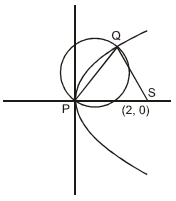
Let $S$ be the focus of the parabola $y^2=8x$ and let $PQ$ be the common chord of the circle $x^2+y^2-2x-4y=0$ and the given parabola. The area of the triangle $PQS$ is:
A
$1$
B
$2$
C
$3$
D
$4$
Solution
(D) The focus of the parabola $y^2=8x$ is $S \equiv (2, 0)$.
To find the common chord,subtract the equation of the parabola from the equation of the circle:
$(x^2+y^2-2x-4y) - (y^2-8x) = 0$
$x^2+6x-4y = 0$
Since $y^2=8x$,we substitute $x = \frac{y^2}{8}$ into the equation of the chord:
$(\frac{y^2}{8})^2 + 6(\frac{y^2}{8}) - 4y = 0$
$\frac{y^4}{64} + \frac{3y^2}{4} - 4y = 0$
$y^4 + 48y^2 - 256y = 0$
$y(y^3 + 48y - 256) = 0$
One solution is $y=0$,which gives $x=0$. Thus,$P \equiv (0, 0)$.
For $y^3 + 48y - 256 = 0$,by inspection,$y=4$ is a root $(64 + 192 - 256 = 0)$.
If $y=4$,then $x = \frac{16}{8} = 2$. Thus,$Q \equiv (2, 4)$.
The vertices of $\triangle PQS$ are $P(0, 0)$,$Q(2, 4)$,and $S(2, 0)$.
Area $= \frac{1}{2} |x_1(y_2-y_3) + x_2(y_3-y_1) + x_3(y_1-y_2)|$
Area $= \frac{1}{2} |0(4-0) + 2(0-0) + 2(0-4)|$
Area $= \frac{1}{2} |0 + 0 - 8| = \frac{1}{2} |-8| = 4$.
To find the common chord,subtract the equation of the parabola from the equation of the circle:
$(x^2+y^2-2x-4y) - (y^2-8x) = 0$
$x^2+6x-4y = 0$
Since $y^2=8x$,we substitute $x = \frac{y^2}{8}$ into the equation of the chord:
$(\frac{y^2}{8})^2 + 6(\frac{y^2}{8}) - 4y = 0$
$\frac{y^4}{64} + \frac{3y^2}{4} - 4y = 0$
$y^4 + 48y^2 - 256y = 0$
$y(y^3 + 48y - 256) = 0$
One solution is $y=0$,which gives $x=0$. Thus,$P \equiv (0, 0)$.
For $y^3 + 48y - 256 = 0$,by inspection,$y=4$ is a root $(64 + 192 - 256 = 0)$.
If $y=4$,then $x = \frac{16}{8} = 2$. Thus,$Q \equiv (2, 4)$.
The vertices of $\triangle PQS$ are $P(0, 0)$,$Q(2, 4)$,and $S(2, 0)$.
Area $= \frac{1}{2} |x_1(y_2-y_3) + x_2(y_3-y_1) + x_3(y_1-y_2)|$
Area $= \frac{1}{2} |0(4-0) + 2(0-0) + 2(0-4)|$
Area $= \frac{1}{2} |0 + 0 - 8| = \frac{1}{2} |-8| = 4$.
0 likesView Solution
8
MathematicsAdvancedMCQIIT JEE · 2012
The value of $6+\log_{\frac{3}{2}}\left(\frac{1}{3\sqrt{2}}\sqrt{4-\frac{1}{3\sqrt{2}}\sqrt{4-\frac{1}{3\sqrt{2}}\sqrt{4-\frac{1}{3\sqrt{2}}\dots}}}\right)$ is
A
$4$
B
$5$
C
$3$
D
$1$
Solution
(A) Let $t = \sqrt{4-\frac{1}{3\sqrt{2}}\sqrt{4-\frac{1}{3\sqrt{2}}\sqrt{4-\dots}}}$.
Then $t = \sqrt{4-\frac{1}{3\sqrt{2}}t}$.
Squaring both sides,we get $4-\frac{1}{3\sqrt{2}}t = t^2$,which implies $t^2 + \frac{1}{3\sqrt{2}}t - 4 = 0$.
Multiplying by $3\sqrt{2}$,we get $3\sqrt{2}t^2 + t - 12\sqrt{2} = 0$.
Using the quadratic formula $t = \frac{-b \pm \sqrt{b^2 - 4ac}}{2a}$,we have $t = \frac{-1 \pm \sqrt{1 - 4(3\sqrt{2})(-12\sqrt{2})}}{2(3\sqrt{2})} = \frac{-1 \pm \sqrt{1 + 288}}{6\sqrt{2}} = \frac{-1 \pm 17}{6\sqrt{2}}$.
Since $t > 0$,we take $t = \frac{16}{6\sqrt{2}} = \frac{8}{3\sqrt{2}}$.
The expression becomes $6 + \log_{\frac{3}{2}}\left(\frac{1}{3\sqrt{2}} \cdot \frac{8}{3\sqrt{2}}\right) = 6 + \log_{\frac{3}{2}}\left(\frac{8}{18}\right) = 6 + \log_{\frac{3}{2}}\left(\frac{4}{9}\right)$.
Since $\frac{4}{9} = (\frac{2}{3})^2 = (\frac{3}{2})^{-2}$,the expression is $6 + \log_{\frac{3}{2}}\left((\frac{3}{2})^{-2}\right) = 6 - 2 = 4$.
Then $t = \sqrt{4-\frac{1}{3\sqrt{2}}t}$.
Squaring both sides,we get $4-\frac{1}{3\sqrt{2}}t = t^2$,which implies $t^2 + \frac{1}{3\sqrt{2}}t - 4 = 0$.
Multiplying by $3\sqrt{2}$,we get $3\sqrt{2}t^2 + t - 12\sqrt{2} = 0$.
Using the quadratic formula $t = \frac{-b \pm \sqrt{b^2 - 4ac}}{2a}$,we have $t = \frac{-1 \pm \sqrt{1 - 4(3\sqrt{2})(-12\sqrt{2})}}{2(3\sqrt{2})} = \frac{-1 \pm \sqrt{1 + 288}}{6\sqrt{2}} = \frac{-1 \pm 17}{6\sqrt{2}}$.
Since $t > 0$,we take $t = \frac{16}{6\sqrt{2}} = \frac{8}{3\sqrt{2}}$.
The expression becomes $6 + \log_{\frac{3}{2}}\left(\frac{1}{3\sqrt{2}} \cdot \frac{8}{3\sqrt{2}}\right) = 6 + \log_{\frac{3}{2}}\left(\frac{8}{18}\right) = 6 + \log_{\frac{3}{2}}\left(\frac{4}{9}\right)$.
Since $\frac{4}{9} = (\frac{2}{3})^2 = (\frac{3}{2})^{-2}$,the expression is $6 + \log_{\frac{3}{2}}\left((\frac{3}{2})^{-2}\right) = 6 - 2 = 4$.
0 likesView Solution
9
MathematicsAdvancedMCQIIT JEE · 2012
Let $PQR$ be a triangle of area $\Delta$ with $a=2, b=\frac{7}{2}$ and $c=\frac{5}{2}$,where $a, b$ and $c$ are the lengths of the sides of the triangle opposite to the angles at $P, Q$ and $R$ respectively. Then $\frac{2 \sin P-\sin 2P}{2 \sin P+\sin 2P}$ equals
A
$\left(\frac{3}{4 \Delta}\right)^2$
B
$\frac{45}{4 \Delta}$
C
$\frac{3}{4 \Delta}$
D
$\left(\frac{45}{4 \Delta}\right)^2$
Solution
(A) Given $a=2, b=\frac{7}{2}, c=\frac{5}{2}$.
Semi-perimeter $s = \frac{a+b+c}{2} = \frac{2 + 3.5 + 2.5}{2} = \frac{8}{2} = 4$.
The expression is $\frac{2 \sin P - \sin 2P}{2 \sin P + \sin 2P} = \frac{2 \sin P - 2 \sin P \cos P}{2 \sin P + 2 \sin P \cos P} = \frac{2 \sin P(1 - \cos P)}{2 \sin P(1 + \cos P)} = \frac{1 - \cos P}{1 + \cos P}$.
Using half-angle formulas,$\frac{1 - \cos P}{1 + \cos P} = \frac{2 \sin^2(P/2)}{2 \cos^2(P/2)} = \tan^2(P/2)$.
We know $\tan^2(P/2) = \frac{(s-b)(s-c)}{s(s-a)}$.
Substituting the values: $s-a = 4-2 = 2$,$s-b = 4-3.5 = 0.5 = 1/2$,$s-c = 4-2.5 = 1.5 = 3/2$.
$\tan^2(P/2) = \frac{(1/2)(3/2)}{4(2)} = \frac{3/4}{8} = \frac{3}{32}$.
Also,$\Delta = \sqrt{s(s-a)(s-b)(s-c)} = \sqrt{4 \times 2 \times 0.5 \times 1.5} = \sqrt{6}$.
Thus,$\left(\frac{3}{4 \Delta}\right)^2 = \frac{9}{16 \Delta^2} = \frac{9}{16 \times 6} = \frac{9}{96} = \frac{3}{32}$.
Therefore,the expression equals $\left(\frac{3}{4 \Delta}\right)^2$.
Semi-perimeter $s = \frac{a+b+c}{2} = \frac{2 + 3.5 + 2.5}{2} = \frac{8}{2} = 4$.
The expression is $\frac{2 \sin P - \sin 2P}{2 \sin P + \sin 2P} = \frac{2 \sin P - 2 \sin P \cos P}{2 \sin P + 2 \sin P \cos P} = \frac{2 \sin P(1 - \cos P)}{2 \sin P(1 + \cos P)} = \frac{1 - \cos P}{1 + \cos P}$.
Using half-angle formulas,$\frac{1 - \cos P}{1 + \cos P} = \frac{2 \sin^2(P/2)}{2 \cos^2(P/2)} = \tan^2(P/2)$.
We know $\tan^2(P/2) = \frac{(s-b)(s-c)}{s(s-a)}$.
Substituting the values: $s-a = 4-2 = 2$,$s-b = 4-3.5 = 0.5 = 1/2$,$s-c = 4-2.5 = 1.5 = 3/2$.
$\tan^2(P/2) = \frac{(1/2)(3/2)}{4(2)} = \frac{3/4}{8} = \frac{3}{32}$.
Also,$\Delta = \sqrt{s(s-a)(s-b)(s-c)} = \sqrt{4 \times 2 \times 0.5 \times 1.5} = \sqrt{6}$.
Thus,$\left(\frac{3}{4 \Delta}\right)^2 = \frac{9}{16 \Delta^2} = \frac{9}{16 \times 6} = \frac{9}{96} = \frac{3}{32}$.
Therefore,the expression equals $\left(\frac{3}{4 \Delta}\right)^2$.
0 likesView Solution
10
MathematicsDifficultMCQIIT JEE · 2012
Let $a_1, a_2, a_3, \ldots$ be in harmonic progression with $a_1 = 5$ and $a_{20} = 25$. The least positive integer $n$ for which $a_n < 0$ is
A
$22$
B
$23$
C
$24$
D
$25$
Solution
(D) Since $a_1, a_2, \ldots$ are in harmonic progression,their reciprocals $\frac{1}{a_1}, \frac{1}{a_2}, \ldots$ are in arithmetic progression.
Let the arithmetic progression be $b_n = \frac{1}{a_n} = A + (n-1)D$.
Given $a_1 = 5 \Rightarrow b_1 = \frac{1}{5}$ and $a_{20} = 25 \Rightarrow b_{20} = \frac{1}{25}$.
$b_{20} = b_1 + 19D \Rightarrow \frac{1}{25} = \frac{1}{5} + 19D$.
$19D = \frac{1}{25} - \frac{1}{5} = \frac{1-5}{25} = -\frac{4}{25}$.
$D = -\frac{4}{19 \times 25} = -\frac{4}{475}$.
We want $a_n < 0$,which implies $\frac{1}{a_n} < 0$ is not necessarily true,but since $a_1 > 0$ and $a_{20} > 0$,we look for when the term becomes negative.
$b_n = \frac{1}{5} - (n-1)\frac{4}{475} < 0$.
$\frac{1}{5} < (n-1)\frac{4}{475}$.
$\frac{475}{20} < n-1$.
$23.75 < n-1$.
$n > 24.75$.
The least positive integer $n$ is $25$.
Let the arithmetic progression be $b_n = \frac{1}{a_n} = A + (n-1)D$.
Given $a_1 = 5 \Rightarrow b_1 = \frac{1}{5}$ and $a_{20} = 25 \Rightarrow b_{20} = \frac{1}{25}$.
$b_{20} = b_1 + 19D \Rightarrow \frac{1}{25} = \frac{1}{5} + 19D$.
$19D = \frac{1}{25} - \frac{1}{5} = \frac{1-5}{25} = -\frac{4}{25}$.
$D = -\frac{4}{19 \times 25} = -\frac{4}{475}$.
We want $a_n < 0$,which implies $\frac{1}{a_n} < 0$ is not necessarily true,but since $a_1 > 0$ and $a_{20} > 0$,we look for when the term becomes negative.
$b_n = \frac{1}{5} - (n-1)\frac{4}{475} < 0$.
$\frac{1}{5} < (n-1)\frac{4}{475}$.
$\frac{475}{20} < n-1$.
$23.75 < n-1$.
$n > 24.75$.
The least positive integer $n$ is $25$.
0 likesView Solution
11
MathematicsDifficultMCQIIT JEE · 2012
Let $\alpha(a)$ and $\beta(a)$ be the roots of the equation $(\sqrt[3]{1+a}-1) x^2+(\sqrt{1+a}-1) x+(\sqrt[6]{1+a}-1)=0$ where $a > -1$. Then $\lim _{a \rightarrow 0^{+}} \alpha(a)$ and $\lim _{a \rightarrow 0^{+}} \beta(a)$ are
A
$-\frac{5}{2}$ and $1$
B
$-\frac{1}{2}$ and $-1$
C
$-\frac{7}{2}$ and $2$
D
$-\frac{9}{2}$ and $3$
Solution
(B) The given equation is $((1+a)^{1/3}-1)x^2 + ((1+a)^{1/2}-1)x + ((1+a)^{1/6}-1) = 0$.
Let $1+a = t^6$. As $a \rightarrow 0^{+}$,$t \rightarrow 1^{+}$.
The equation becomes $(t^2-1)x^2 + (t^3-1)x + (t-1) = 0$.
Dividing by $(t-1)$ (since $t \neq 1$ as $a > 0$):
$(t+1)x^2 + (t^2+t+1)x + 1 = 0$.
Taking the limit as $t \rightarrow 1$:
$(1+1)x^2 + (1^2+1+1)x + 1 = 0$.
$2x^2 + 3x + 1 = 0$.
Factoring the quadratic equation:
$(2x+1)(x+1) = 0$.
Thus,the roots are $x = -\frac{1}{2}$ and $x = -1$.
Let $1+a = t^6$. As $a \rightarrow 0^{+}$,$t \rightarrow 1^{+}$.
The equation becomes $(t^2-1)x^2 + (t^3-1)x + (t-1) = 0$.
Dividing by $(t-1)$ (since $t \neq 1$ as $a > 0$):
$(t+1)x^2 + (t^2+t+1)x + 1 = 0$.
Taking the limit as $t \rightarrow 1$:
$(1+1)x^2 + (1^2+1+1)x + 1 = 0$.
$2x^2 + 3x + 1 = 0$.
Factoring the quadratic equation:
$(2x+1)(x+1) = 0$.
Thus,the roots are $x = -\frac{1}{2}$ and $x = -1$.
0 likesView Solution
12
MathematicsAdvancedMCQIIT JEE · 2012
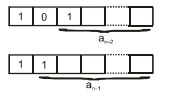
Let $a_n$ denote the number of all $n$-digit positive integers formed by the digits $0, 1$ or both such that no consecutive digits in them are $0$. Let $b_n$ be the number of such $n$-digit integers ending with digit $1$ and $c_n$ be the number of such $n$-digit integers ending with digit $0$.
$1.$ Which of the following is correct?
$(A)$ $a_{17} = a_{16} + a_{15}$
$(B)$ $c_{17} \neq c_{16} + c_{15}$
$(C)$ $b_{17} \neq b_{16} + c_{16}$
$(D)$ $a_{17} = c_{17} + b_{16}$
$2.$ The value of $b_6$ is
$(A)$ $7$ $(B)$ $8$ $(C)$ $9$ $(D)$ $11$
Give the answer for question $1$ and $2$.
$1.$ Which of the following is correct?
$(A)$ $a_{17} = a_{16} + a_{15}$
$(B)$ $c_{17} \neq c_{16} + c_{15}$
$(C)$ $b_{17} \neq b_{16} + c_{16}$
$(D)$ $a_{17} = c_{17} + b_{16}$
$2.$ The value of $b_6$ is
$(A)$ $7$ $(B)$ $8$ $(C)$ $9$ $(D)$ $11$
Give the answer for question $1$ and $2$.
A
$(A, B)$
B
$(B, D)$
C
$(B, C)$
D
$(A, D)$
Solution
(A) For an $n$-digit integer with no consecutive $0$s:
If it ends in $1$,the previous digit can be $0$ or $1$. Thus,$b_n = b_{n-1} + c_{n-1} = a_{n-1}$.
If it ends in $0$,the previous digit must be $1$. Thus,$c_n = b_{n-1}$.
Since $a_n = b_n + c_n$,we have $a_n = a_{n-1} + a_{n-2}$.
$1.$ For $(A)$,$a_{17} = a_{16} + a_{15}$ is true by the recurrence relation.
For $(B)$,$c_{17} = c_{16} + c_{15}$ is true,so $c_{17} \neq c_{16} + c_{15}$ is false.
For $(C)$,$b_{17} = b_{16} + c_{16}$ is true,so $b_{17} \neq b_{16} + c_{16}$ is false.
For $(D)$,$a_{17} = b_{17} + c_{17} = (b_{16} + c_{16}) + c_{17} = a_{16} + c_{17}$. Since $a_{16} = b_{16} + c_{16}$,this does not simplify to $a_{17} = c_{17} + b_{16}$.
Thus,only $(A)$ is correct.
$2.$ We have $b_n = a_{n-1}$.
$a_1 = 1$ $(1)$
$a_2 = 2$ $(10, 11)$
$a_3 = 3$ $(101, 110, 111)$
$a_4 = 5$ $(1010, 1011, 1101, 1110, 1111)$
$a_5 = 8$
Therefore,$b_6 = a_5 = 8$.
Correct option is $(B)$.
If it ends in $1$,the previous digit can be $0$ or $1$. Thus,$b_n = b_{n-1} + c_{n-1} = a_{n-1}$.
If it ends in $0$,the previous digit must be $1$. Thus,$c_n = b_{n-1}$.
Since $a_n = b_n + c_n$,we have $a_n = a_{n-1} + a_{n-2}$.
$1.$ For $(A)$,$a_{17} = a_{16} + a_{15}$ is true by the recurrence relation.
For $(B)$,$c_{17} = c_{16} + c_{15}$ is true,so $c_{17} \neq c_{16} + c_{15}$ is false.
For $(C)$,$b_{17} = b_{16} + c_{16}$ is true,so $b_{17} \neq b_{16} + c_{16}$ is false.
For $(D)$,$a_{17} = b_{17} + c_{17} = (b_{16} + c_{16}) + c_{17} = a_{16} + c_{17}$. Since $a_{16} = b_{16} + c_{16}$,this does not simplify to $a_{17} = c_{17} + b_{16}$.
Thus,only $(A)$ is correct.
$2.$ We have $b_n = a_{n-1}$.
$a_1 = 1$ $(1)$
$a_2 = 2$ $(10, 11)$
$a_3 = 3$ $(101, 110, 111)$
$a_4 = 5$ $(1010, 1011, 1101, 1110, 1111)$
$a_5 = 8$
Therefore,$b_6 = a_5 = 8$.
Correct option is $(B)$.
0 likesView Solution
13
MathematicsAdvancedMCQIIT JEE · 2012
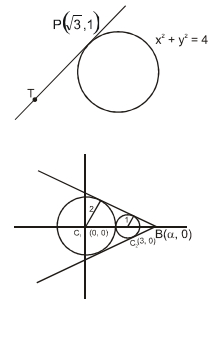
$A$ tangent $PT$ is drawn to the circle $x^2+y^2=4$ at the point $P(\sqrt{3}, 1)$. $A$ straight line $L$,perpendicular to $PT$,is a tangent to the circle $(x-3)^2+y^2=1$.
$1.$ $A$ common tangent of the two circles is
$(A)$ $x=4$ $(B)$ $y=2$ $(C)$ $x+\sqrt{3} y=4$ $(D)$ $x+2 \sqrt{2} y=6$
$2.$ $A$ possible equation of $L$ is
$(A)$ $x-\sqrt{3} y=1$ $(B)$ $x+\sqrt{3} y=1$ $(C)$ $x-\sqrt{3} y=-1$ $(D)$ $x+\sqrt{3} y=5$
$1.$ $A$ common tangent of the two circles is
$(A)$ $x=4$ $(B)$ $y=2$ $(C)$ $x+\sqrt{3} y=4$ $(D)$ $x+2 \sqrt{2} y=6$
$2.$ $A$ possible equation of $L$ is
$(A)$ $x-\sqrt{3} y=1$ $(B)$ $x+\sqrt{3} y=1$ $(C)$ $x-\sqrt{3} y=-1$ $(D)$ $x+\sqrt{3} y=5$
A
$(D, A)$
B
$(B, D)$
C
$(B, C)$
D
$(C, D)$
Solution
(A) $1.$ The equation of the tangent to $x^2+y^2=4$ at $P(\sqrt{3}, 1)$ is $\sqrt{3}x + y = 4$.
The centers of the circles are $C_1(0,0)$ with radius $r_1=2$ and $C_2(3,0)$ with radius $r_2=1$.
The external center of similitude $B$ divides $C_1C_2$ in the ratio $r_1:r_2 = 2:1$ externally.
$B = \left(\frac{2(3)-1(0)}{2-1}, \frac{2(0)-1(0)}{2-1}\right) = (6,0)$.
Let the common tangent be $y-0 = m(x-6)$,or $mx - y - 6m = 0$.
The perpendicular distance from $C_1(0,0)$ to this line equals $r_1=2$.
$\left|\frac{-6m}{\sqrt{m^2+1}}\right| = 2$ $\Rightarrow 3|m| = \sqrt{m^2+1}$ $\Rightarrow 9m^2 = m^2+1$ $\Rightarrow m^2 = \frac{1}{8}$ $\Rightarrow m = \pm \frac{1}{2\sqrt{2}}$.
The equations are $x \pm 2\sqrt{2}y = 6$. Thus,$(D)$ is a common tangent.
$2.$ The slope of $PT$ $(\sqrt{3}x+y=4)$ is $m_1 = -\sqrt{3}$.
Since $L$ is perpendicular to $PT$,the slope of $L$ is $m_2 = -\frac{1}{m_1} = \frac{1}{\sqrt{3}}$.
Let the equation of $L$ be $x - \sqrt{3}y + k = 0$.
$L$ is tangent to $(x-3)^2+y^2=1$,so the distance from $(3,0)$ to $L$ is $1$.
$\left|\frac{3 - \sqrt{3}(0) + k}{\sqrt{1^2 + (-\sqrt{3})^2}}\right| = 1 \Rightarrow \left|\frac{3+k}{2}\right| = 1$.
$3+k = 2$ or $3+k = -2$,so $k = -1$ or $k = -5$.
The possible equations are $x - \sqrt{3}y - 1 = 0$ or $x - \sqrt{3}y - 5 = 0$.
Comparing with options,$x - \sqrt{3}y = 1$ is not listed,but $x - \sqrt{3}y = -1$ is option $(C)$.
The centers of the circles are $C_1(0,0)$ with radius $r_1=2$ and $C_2(3,0)$ with radius $r_2=1$.
The external center of similitude $B$ divides $C_1C_2$ in the ratio $r_1:r_2 = 2:1$ externally.
$B = \left(\frac{2(3)-1(0)}{2-1}, \frac{2(0)-1(0)}{2-1}\right) = (6,0)$.
Let the common tangent be $y-0 = m(x-6)$,or $mx - y - 6m = 0$.
The perpendicular distance from $C_1(0,0)$ to this line equals $r_1=2$.
$\left|\frac{-6m}{\sqrt{m^2+1}}\right| = 2$ $\Rightarrow 3|m| = \sqrt{m^2+1}$ $\Rightarrow 9m^2 = m^2+1$ $\Rightarrow m^2 = \frac{1}{8}$ $\Rightarrow m = \pm \frac{1}{2\sqrt{2}}$.
The equations are $x \pm 2\sqrt{2}y = 6$. Thus,$(D)$ is a common tangent.
$2.$ The slope of $PT$ $(\sqrt{3}x+y=4)$ is $m_1 = -\sqrt{3}$.
Since $L$ is perpendicular to $PT$,the slope of $L$ is $m_2 = -\frac{1}{m_1} = \frac{1}{\sqrt{3}}$.
Let the equation of $L$ be $x - \sqrt{3}y + k = 0$.
$L$ is tangent to $(x-3)^2+y^2=1$,so the distance from $(3,0)$ to $L$ is $1$.
$\left|\frac{3 - \sqrt{3}(0) + k}{\sqrt{1^2 + (-\sqrt{3})^2}}\right| = 1 \Rightarrow \left|\frac{3+k}{2}\right| = 1$.
$3+k = 2$ or $3+k = -2$,so $k = -1$ or $k = -5$.
The possible equations are $x - \sqrt{3}y - 1 = 0$ or $x - \sqrt{3}y - 5 = 0$.
Comparing with options,$x - \sqrt{3}y = 1$ is not listed,but $x - \sqrt{3}y = -1$ is option $(C)$.
0 likesView Solution
14
MathematicsEasyMCQIIT JEE · 2012
If $\lim _{x \rightarrow \infty}\left(\frac{x^2+x+1}{x+1}-a x-b\right)=4$,then:
A
$a=1, b=4$
B
$a=1, b=-4$
C
$a=2, b=-3$
D
$a=2, b=3$
Solution
(B) Given $\lim _{x \rightarrow \infty}\left(\frac{x^2+x+1}{x+1}-a x-b\right)=4$.
Simplify the expression inside the limit:
$\lim _{x \rightarrow \infty}\left(\frac{x^2+x+1-ax(x+1)-b(x+1)}{x+1}\right)=4$
$\lim _{x \rightarrow \infty}\left(\frac{x^2+x+1-ax^2-ax-bx-b}{x+1}\right)=4$
$\lim _{x \rightarrow \infty}\left(\frac{(1-a)x^2+(1-a-b)x+(1-b)}{x+1}\right)=4$
For the limit to be finite,the coefficient of $x^2$ must be zero:
$1-a=0 \Rightarrow a=1$.
Now,substitute $a=1$ into the expression:
$\lim _{x \rightarrow \infty}\left(\frac{(1-1-b)x+(1-b)}{x+1}\right)=4$
$\lim _{x \rightarrow \infty}\left(\frac{-bx+(1-b)}{x+1}\right)=4$
Divide numerator and denominator by $x$:
$\lim _{x \rightarrow \infty}\left(\frac{-b+\frac{1-b}{x}}{1+\frac{1}{x}}\right)=4$
$-b=4 \Rightarrow b=-4$.
Thus,$a=1$ and $b=-4$.
Simplify the expression inside the limit:
$\lim _{x \rightarrow \infty}\left(\frac{x^2+x+1-ax(x+1)-b(x+1)}{x+1}\right)=4$
$\lim _{x \rightarrow \infty}\left(\frac{x^2+x+1-ax^2-ax-bx-b}{x+1}\right)=4$
$\lim _{x \rightarrow \infty}\left(\frac{(1-a)x^2+(1-a-b)x+(1-b)}{x+1}\right)=4$
For the limit to be finite,the coefficient of $x^2$ must be zero:
$1-a=0 \Rightarrow a=1$.
Now,substitute $a=1$ into the expression:
$\lim _{x \rightarrow \infty}\left(\frac{(1-1-b)x+(1-b)}{x+1}\right)=4$
$\lim _{x \rightarrow \infty}\left(\frac{-bx+(1-b)}{x+1}\right)=4$
Divide numerator and denominator by $x$:
$\lim _{x \rightarrow \infty}\left(\frac{-b+\frac{1-b}{x}}{1+\frac{1}{x}}\right)=4$
$-b=4 \Rightarrow b=-4$.
Thus,$a=1$ and $b=-4$.
0 likesView Solution
15
MathematicsAdvancedMCQIIT JEE · 2012
The point $P$ is the intersection of the straight line joining the points $Q(2, 3, 5)$ and $R(1, -1, 4)$ with the plane $5x - 4y - z = 1$. If $S$ is the foot of the perpendicular drawn from the point $T(2, 1, 4)$ to $QR$,then the length of the line segment $PS$ is
A
$\frac{1}{\sqrt{2}}$
B
$\sqrt{2}$
C
$2$
D
$2\sqrt{2}$
Solution
(A) The equation of the line $QR$ passing through $Q(2, 3, 5)$ and $R(1, -1, 4)$ is given by $\frac{x-2}{1-2} = \frac{y-3}{-1-3} = \frac{z-5}{4-5}$,which simplifies to $\frac{x-2}{-1} = \frac{y-3}{-4} = \frac{z-5}{-1} = \lambda$.
Thus,any point on the line is $P(2-\lambda, 3-4\lambda, 5-\lambda)$.
Since $P$ lies on the plane $5x - 4y - z = 1$,we have $5(2-\lambda) - 4(3-4\lambda) - (5-\lambda) = 1$.
$10 - 5\lambda - 12 + 16\lambda - 5 + \lambda = 1 \Rightarrow 12\lambda - 7 = 1 \Rightarrow 12\lambda = 8 \Rightarrow \lambda = \frac{2}{3}$.
Substituting $\lambda = \frac{2}{3}$,we get $P = (2-\frac{2}{3}, 3-\frac{8}{3}, 5-\frac{2}{3}) = (\frac{4}{3}, \frac{1}{3}, \frac{13}{3})$.
Now,for the foot of the perpendicular $S$ from $T(2, 1, 4)$ to $QR$,let $S = (2-\mu, 3-4\mu, 5-\mu)$.
The vector $\vec{TS} = (2-\mu-2, 3-4\mu-1, 5-\mu-4) = (-\mu, 2-4\mu, 1-\mu)$.
Since $\vec{TS}$ is perpendicular to the line direction vector $\vec{v} = (-1, -4, -1)$,their dot product is zero: $(-\mu)(-1) + (2-4\mu)(-4) + (1-\mu)(-1) = 0$.
$\mu - 8 + 16\mu - 1 + \mu = 0 \Rightarrow 18\mu = 9 \Rightarrow \mu = \frac{1}{2}$.
Thus,$S = (2-\frac{1}{2}, 3-2, 5-\frac{1}{2}) = (\frac{3}{2}, 1, \frac{9}{2})$.
The distance $PS = \sqrt{(\frac{4}{3}-\frac{3}{2})^2 + (\frac{1}{3}-1)^2 + (\frac{13}{3}-\frac{9}{2})^2} = \sqrt{(-\frac{1}{6})^2 + (-\frac{2}{3})^2 + (-\frac{1}{6})^2} = \sqrt{\frac{1}{36} + \frac{4}{9} + \frac{1}{36}} = \sqrt{\frac{2}{36} + \frac{16}{36}} = \sqrt{\frac{18}{36}} = \sqrt{\frac{1}{2}} = \frac{1}{\sqrt{2}}$.
Thus,any point on the line is $P(2-\lambda, 3-4\lambda, 5-\lambda)$.
Since $P$ lies on the plane $5x - 4y - z = 1$,we have $5(2-\lambda) - 4(3-4\lambda) - (5-\lambda) = 1$.
$10 - 5\lambda - 12 + 16\lambda - 5 + \lambda = 1 \Rightarrow 12\lambda - 7 = 1 \Rightarrow 12\lambda = 8 \Rightarrow \lambda = \frac{2}{3}$.
Substituting $\lambda = \frac{2}{3}$,we get $P = (2-\frac{2}{3}, 3-\frac{8}{3}, 5-\frac{2}{3}) = (\frac{4}{3}, \frac{1}{3}, \frac{13}{3})$.
Now,for the foot of the perpendicular $S$ from $T(2, 1, 4)$ to $QR$,let $S = (2-\mu, 3-4\mu, 5-\mu)$.
The vector $\vec{TS} = (2-\mu-2, 3-4\mu-1, 5-\mu-4) = (-\mu, 2-4\mu, 1-\mu)$.
Since $\vec{TS}$ is perpendicular to the line direction vector $\vec{v} = (-1, -4, -1)$,their dot product is zero: $(-\mu)(-1) + (2-4\mu)(-4) + (1-\mu)(-1) = 0$.
$\mu - 8 + 16\mu - 1 + \mu = 0 \Rightarrow 18\mu = 9 \Rightarrow \mu = \frac{1}{2}$.
Thus,$S = (2-\frac{1}{2}, 3-2, 5-\frac{1}{2}) = (\frac{3}{2}, 1, \frac{9}{2})$.
The distance $PS = \sqrt{(\frac{4}{3}-\frac{3}{2})^2 + (\frac{1}{3}-1)^2 + (\frac{13}{3}-\frac{9}{2})^2} = \sqrt{(-\frac{1}{6})^2 + (-\frac{2}{3})^2 + (-\frac{1}{6})^2} = \sqrt{\frac{1}{36} + \frac{4}{9} + \frac{1}{36}} = \sqrt{\frac{2}{36} + \frac{16}{36}} = \sqrt{\frac{18}{36}} = \sqrt{\frac{1}{2}} = \frac{1}{\sqrt{2}}$.
0 likesView Solution
16
MathematicsAdvancedMCQIIT JEE · 2012
The integral $\int \frac{\sec^2 x}{(\sec x+\tan x)^{9/2}} dx$ equals (for some arbitrary constant $K$):
A
$\frac{-1}{(\sec x+\tan x)^{11/2}} \left\{ \frac{1}{11} + \frac{1}{7}(\sec x+\tan x)^2 \right\} + K$
B
$\frac{1}{(\sec x+\tan x)^{1/12}} \left\{ \frac{1}{11} - \frac{1}{7}(\sec x+\tan x)^2 \right\} + K$
C
$\frac{-1}{(\sec x+\tan x)^{11/2}} \left\{ \frac{1}{11} - \frac{1}{7}(\sec x+\tan x)^2 \right\} + K$
D
$\frac{1}{(\sec x+\tan x)^{11/2}} \left\{ \frac{1}{11} + \frac{1}{7}(\sec x+\tan x)^2 \right\} + K$
Solution
(A) Let $t = \sec x + \tan x$. Then $dt = (\sec x \tan x + \sec^2 x) dx = \sec x(\tan x + \sec x) dx = \sec x \cdot t \cdot dx$.
Thus,$\sec x dx = \frac{dt}{t}$.
Also,$\sec x - \tan x = \frac{1}{t}$.
Adding the two equations: $2 \sec x = t + \frac{1}{t} \implies \sec x = \frac{1}{2} \left( t + \frac{1}{t} \right)$.
Substituting into the integral:
$I = \int \frac{\sec x \cdot (\sec x dx)}{t^{9/2}} = \int \frac{\frac{1}{2}(t + \frac{1}{t}) \cdot \frac{dt}{t}}{t^{9/2}} = \frac{1}{2} \int \frac{t + t^{-1}}{t^{11/2}} dt = \frac{1}{2} \int (t^{-9/2} + t^{-13/2}) dt$.
Integrating:
$I = \frac{1}{2} \left[ \frac{t^{-7/2}}{-7/2} + \frac{t^{-11/2}}{-11/2} \right] + K = -\left[ \frac{1}{7 t^{7/2}} + \frac{1}{11 t^{11/2}} \right] + K$.
Factoring out $-\frac{1}{t^{11/2}}$:
$I = -\frac{1}{t^{11/2}} \left[ \frac{t^2}{7} + \frac{1}{11} \right] + K$.
Substituting $t = \sec x + \tan x$ back,we get option $A$.
Thus,$\sec x dx = \frac{dt}{t}$.
Also,$\sec x - \tan x = \frac{1}{t}$.
Adding the two equations: $2 \sec x = t + \frac{1}{t} \implies \sec x = \frac{1}{2} \left( t + \frac{1}{t} \right)$.
Substituting into the integral:
$I = \int \frac{\sec x \cdot (\sec x dx)}{t^{9/2}} = \int \frac{\frac{1}{2}(t + \frac{1}{t}) \cdot \frac{dt}{t}}{t^{9/2}} = \frac{1}{2} \int \frac{t + t^{-1}}{t^{11/2}} dt = \frac{1}{2} \int (t^{-9/2} + t^{-13/2}) dt$.
Integrating:
$I = \frac{1}{2} \left[ \frac{t^{-7/2}}{-7/2} + \frac{t^{-11/2}}{-11/2} \right] + K = -\left[ \frac{1}{7 t^{7/2}} + \frac{1}{11 t^{11/2}} \right] + K$.
Factoring out $-\frac{1}{t^{11/2}}$:
$I = -\frac{1}{t^{11/2}} \left[ \frac{t^2}{7} + \frac{1}{11} \right] + K$.
Substituting $t = \sec x + \tan x$ back,we get option $A$.
0 likesView Solution
17
MathematicsAdvancedMCQIIT JEE · 2012
Let $f(x) = \begin{cases} x^2 \left| \cos \frac{\pi}{x} \right|, & x \neq 0 \\ 0, & x=0 \end{cases}$,$x \in \mathbb{R}$,then $f$ is
A
differentiable both at $x=0$ and at $x=2$
B
differentiable at $x=0$ but not differentiable at $x=2$
C
not differentiable at $x=0$ but differentiable at $x=2$
D
differentiable neither at $x=0$ nor at $x=2$
Solution
(B) $(i)$ Check for differentiability at $x=0$:
$LHD = f'(0^-) = \lim_{h \to 0^+} \frac{f(0-h) - f(0)}{-h} = \lim_{h \to 0^+} \frac{(-h)^2 |\cos(-\pi/h)| - 0}{-h} = \lim_{h \to 0^+} -h |\cos(\pi/h)| = 0$.
$RHD = f'(0^+) = \lim_{h \to 0^+} \frac{f(0+h) - f(0)}{h} = \lim_{h \to 0^+} \frac{h^2 |\cos(\pi/h)| - 0}{h} = \lim_{h \to 0^+} h |\cos(\pi/h)| = 0$.
Since $LHD = RHD = 0$,$f(x)$ is differentiable at $x=0$.
$(ii)$ Check for differentiability at $x=2$:
$f(2) = 2^2 |\cos(\pi/2)| = 0$.
$RHD = f'(2^+) = \lim_{h \to 0^+} \frac{f(2+h) - f(2)}{h} = \lim_{h \to 0^+} \frac{(2+h)^2 |\cos(\pi/(2+h))|}{h}$.
Since $\cos(\pi/(2+h)) > 0$ for small $h > 0$,$|\cos(\pi/(2+h))| = \cos(\pi/(2+h)) = \sin(\pi/2 - \pi/(2+h)) = \sin(\pi h / (2(2+h)))$.
$RHD = \lim_{h \to 0^+} \frac{(2+h)^2 \sin(\pi h / (2(2+h)))}{h} = 4 \cdot \frac{\pi}{4} = \pi$.
$LHD = f'(2^-) = \lim_{h \to 0^+} \frac{f(2-h) - f(2)}{-h} = \lim_{h \to 0^+} \frac{(2-h)^2 |\cos(\pi/(2-h))|}{-h}$.
Since $\cos(\pi/(2-h)) < 0$ for small $h > 0$,$|\cos(\pi/(2-h))| = -\cos(\pi/(2-h)) = -\sin(\pi/2 - \pi/(2-h)) = -\sin(-\pi h / (2(2-h))) = \sin(\pi h / (2(2-h)))$.
$LHD = \lim_{h \to 0^+} \frac{(2-h)^2 \sin(\pi h / (2(2-h)))}{-h} = 4 \cdot (-\pi/4) = -\pi$.
Since $LHD \neq RHD$,$f(x)$ is not differentiable at $x=2$.
$LHD = f'(0^-) = \lim_{h \to 0^+} \frac{f(0-h) - f(0)}{-h} = \lim_{h \to 0^+} \frac{(-h)^2 |\cos(-\pi/h)| - 0}{-h} = \lim_{h \to 0^+} -h |\cos(\pi/h)| = 0$.
$RHD = f'(0^+) = \lim_{h \to 0^+} \frac{f(0+h) - f(0)}{h} = \lim_{h \to 0^+} \frac{h^2 |\cos(\pi/h)| - 0}{h} = \lim_{h \to 0^+} h |\cos(\pi/h)| = 0$.
Since $LHD = RHD = 0$,$f(x)$ is differentiable at $x=0$.
$(ii)$ Check for differentiability at $x=2$:
$f(2) = 2^2 |\cos(\pi/2)| = 0$.
$RHD = f'(2^+) = \lim_{h \to 0^+} \frac{f(2+h) - f(2)}{h} = \lim_{h \to 0^+} \frac{(2+h)^2 |\cos(\pi/(2+h))|}{h}$.
Since $\cos(\pi/(2+h)) > 0$ for small $h > 0$,$|\cos(\pi/(2+h))| = \cos(\pi/(2+h)) = \sin(\pi/2 - \pi/(2+h)) = \sin(\pi h / (2(2+h)))$.
$RHD = \lim_{h \to 0^+} \frac{(2+h)^2 \sin(\pi h / (2(2+h)))}{h} = 4 \cdot \frac{\pi}{4} = \pi$.
$LHD = f'(2^-) = \lim_{h \to 0^+} \frac{f(2-h) - f(2)}{-h} = \lim_{h \to 0^+} \frac{(2-h)^2 |\cos(\pi/(2-h))|}{-h}$.
Since $\cos(\pi/(2-h)) < 0$ for small $h > 0$,$|\cos(\pi/(2-h))| = -\cos(\pi/(2-h)) = -\sin(\pi/2 - \pi/(2-h)) = -\sin(-\pi h / (2(2-h))) = \sin(\pi h / (2(2-h)))$.
$LHD = \lim_{h \to 0^+} \frac{(2-h)^2 \sin(\pi h / (2(2-h)))}{-h} = 4 \cdot (-\pi/4) = -\pi$.
Since $LHD \neq RHD$,$f(x)$ is not differentiable at $x=2$.
0 likesView Solution
18
MathematicsAdvancedMCQIIT JEE · 2012
The function $f:[0,3] \rightarrow [1,29]$,defined by $f(x)=2x^3-15x^2+36x+1$,is
A
one-one and onto
B
onto but not one-one
C
one-one but not onto
D
neither one-one nor onto
Solution
(B) Given function: $f(x) = 2x^3 - 15x^2 + 36x + 1$ for $x \in [0, 3]$.
Step $1$: Check for one-one property.
Find the derivative: $f'(x) = 6x^2 - 30x + 36 = 6(x^2 - 5x + 6) = 6(x-2)(x-3)$.
Since $f'(x)$ changes sign at $x=2$ within the interval $[0, 3]$,the function is not monotonic. Specifically,$f(x)$ increases on $[0, 2]$,decreases on $[2, 3]$,and increases on $[3, \infty)$. Since it is not strictly monotonic on $[0, 3]$,it is not one-one (many-one).
Step $2$: Check for onto property.
Find the range of $f(x)$ on $[0, 3]$.
$f(0) = 2(0)^3 - 15(0)^2 + 36(0) + 1 = 1$.
$f(2) = 2(8) - 15(4) + 36(2) + 1 = 16 - 60 + 72 + 1 = 29$.
$f(3) = 2(27) - 15(9) + 36(3) + 1 = 54 - 135 + 108 + 1 = 28$.
Since the function is continuous on $[0, 3]$,the range is $[min(f(0), f(2), f(3)), max(f(0), f(2), f(3))] = [1, 29]$.
Since the range $[1, 29]$ is equal to the codomain $[1, 29]$,the function is onto.
Conclusion: The function is onto but not one-one.
Step $1$: Check for one-one property.
Find the derivative: $f'(x) = 6x^2 - 30x + 36 = 6(x^2 - 5x + 6) = 6(x-2)(x-3)$.
Since $f'(x)$ changes sign at $x=2$ within the interval $[0, 3]$,the function is not monotonic. Specifically,$f(x)$ increases on $[0, 2]$,decreases on $[2, 3]$,and increases on $[3, \infty)$. Since it is not strictly monotonic on $[0, 3]$,it is not one-one (many-one).
Step $2$: Check for onto property.
Find the range of $f(x)$ on $[0, 3]$.
$f(0) = 2(0)^3 - 15(0)^2 + 36(0) + 1 = 1$.
$f(2) = 2(8) - 15(4) + 36(2) + 1 = 16 - 60 + 72 + 1 = 29$.
$f(3) = 2(27) - 15(9) + 36(3) + 1 = 54 - 135 + 108 + 1 = 28$.
Since the function is continuous on $[0, 3]$,the range is $[min(f(0), f(2), f(3)), max(f(0), f(2), f(3))] = [1, 29]$.
Since the range $[1, 29]$ is equal to the codomain $[1, 29]$,the function is onto.
Conclusion: The function is onto but not one-one.
0 likesView Solution
19
MathematicsDifficultMCQIIT JEE · 2012
Let $P = [a_{ij}]$ be a $3 \times 3$ matrix and let $Q = [b_{ij}]$,where $b_{ij} = 2^{i+j} a_{ij}$ for $1 \leq i, j \leq 3$. If the determinant of $P$ is $2$,then the determinant of the matrix $Q$ is:
A
$2^{10}$
B
$2^{11}$
C
$2^{12}$
D
$2^{13}$
Solution
(D) Given $P = [a_{ij}]_{3 \times 3}$ and $b_{ij} = 2^{i+j} a_{ij}$.
$Q = [b_{ij}]_{3 \times 3} = \begin{bmatrix} 2^{1+1}a_{11} & 2^{1+2}a_{12} & 2^{1+3}a_{13} \\ 2^{2+1}a_{21} & 2^{2+2}a_{22} & 2^{2+3}a_{23} \\ 2^{3+1}a_{31} & 2^{3+2}a_{32} & 2^{3+3}a_{33} \end{bmatrix} = \begin{bmatrix} 4a_{11} & 8a_{12} & 16a_{13} \\ 8a_{21} & 16a_{22} & 32a_{23} \\ 16a_{31} & 32a_{32} & 64a_{33} \end{bmatrix}$.
Taking common factors from each row:
Row $1$ has a factor of $4 = 2^2$.
Row $2$ has a factor of $8 = 2^3$.
Row $3$ has a factor of $16 = 2^4$.
$|Q| = (2^2 \cdot 2^3 \cdot 2^4) \begin{vmatrix} a_{11} & 2a_{12} & 4a_{13} \\ a_{21} & 2a_{22} & 4a_{23} \\ a_{31} & 2a_{32} & 4a_{33} \end{vmatrix}$.
Taking common factors from each column:
Column $2$ has a factor of $2 = 2^1$.
Column $3$ has a factor of $4 = 2^2$.
$|Q| = (2^2 \cdot 2^3 \cdot 2^4) \cdot (2^1 \cdot 2^2) \begin{vmatrix} a_{11} & a_{12} & a_{13} \\ a_{21} & a_{22} & a_{23} \\ a_{31} & a_{32} & a_{33} \end{vmatrix}$.
$|Q| = 2^{2+3+4+1+2} |P| = 2^{12} \cdot 2 = 2^{13}$.
$Q = [b_{ij}]_{3 \times 3} = \begin{bmatrix} 2^{1+1}a_{11} & 2^{1+2}a_{12} & 2^{1+3}a_{13} \\ 2^{2+1}a_{21} & 2^{2+2}a_{22} & 2^{2+3}a_{23} \\ 2^{3+1}a_{31} & 2^{3+2}a_{32} & 2^{3+3}a_{33} \end{bmatrix} = \begin{bmatrix} 4a_{11} & 8a_{12} & 16a_{13} \\ 8a_{21} & 16a_{22} & 32a_{23} \\ 16a_{31} & 32a_{32} & 64a_{33} \end{bmatrix}$.
Taking common factors from each row:
Row $1$ has a factor of $4 = 2^2$.
Row $2$ has a factor of $8 = 2^3$.
Row $3$ has a factor of $16 = 2^4$.
$|Q| = (2^2 \cdot 2^3 \cdot 2^4) \begin{vmatrix} a_{11} & 2a_{12} & 4a_{13} \\ a_{21} & 2a_{22} & 4a_{23} \\ a_{31} & 2a_{32} & 4a_{33} \end{vmatrix}$.
Taking common factors from each column:
Column $2$ has a factor of $2 = 2^1$.
Column $3$ has a factor of $4 = 2^2$.
$|Q| = (2^2 \cdot 2^3 \cdot 2^4) \cdot (2^1 \cdot 2^2) \begin{vmatrix} a_{11} & a_{12} & a_{13} \\ a_{21} & a_{22} & a_{23} \\ a_{31} & a_{32} & a_{33} \end{vmatrix}$.
$|Q| = 2^{2+3+4+1+2} |P| = 2^{12} \cdot 2 = 2^{13}$.
0 likesView Solution
20
MathematicsAdvancedMCQIIT JEE · 2012
If $y(x)$ satisfies the differential equation $y^{\prime}-y \tan x=2 x \sec x$ and $y(0)=0$,then which of the following is true?
A
$(A, D)$
B
$(B, C)$
C
$(A, C)$
D
$(C, D)$
Solution
(A) The given differential equation is $\frac{dy}{dx} - y \tan x = 2x \sec x$.
This is a linear differential equation of the form $\frac{dy}{dx} + Py = Q$,where $P = -\tan x$ and $Q = 2x \sec x$.
The integrating factor ($I$.$F$.) is $e^{\int P dx} = e^{-\int \tan x dx} = e^{-\ln(\sec x)} = \cos x$.
Multiplying both sides by the $I$.$F$.,we get $\frac{d}{dx}(y \cos x) = 2x \sec x \cdot \cos x = 2x$.
Integrating both sides,$y \cos x = x^2 + C$.
Given $y(0) = 0$,we have $0 = 0^2 + C$,so $C = 0$.
Thus,$y = x^2 \sec x$.
For option $(A)$: $y(\frac{\pi}{4}) = (\frac{\pi}{4})^2 \sec(\frac{\pi}{4}) = \frac{\pi^2}{16} \cdot \sqrt{2} = \frac{\pi^2}{8\sqrt{2}}$. This is true.
For option $(D)$: $y'(x) = 2x \sec x + x^2 \sec x \tan x$.
$y'(\frac{\pi}{3}) = 2(\frac{\pi}{3}) \sec(\frac{\pi}{3}) + (\frac{\pi}{3})^2 \sec(\frac{\pi}{3}) \tan(\frac{\pi}{3}) = 2(\frac{\pi}{3})(2) + \frac{\pi^2}{9}(2)(\sqrt{3}) = \frac{4\pi}{3} + \frac{2\pi^2\sqrt{3}}{9}$. This is true.
Therefore,options $(A)$ and $(D)$ are correct.
This is a linear differential equation of the form $\frac{dy}{dx} + Py = Q$,where $P = -\tan x$ and $Q = 2x \sec x$.
The integrating factor ($I$.$F$.) is $e^{\int P dx} = e^{-\int \tan x dx} = e^{-\ln(\sec x)} = \cos x$.
Multiplying both sides by the $I$.$F$.,we get $\frac{d}{dx}(y \cos x) = 2x \sec x \cdot \cos x = 2x$.
Integrating both sides,$y \cos x = x^2 + C$.
Given $y(0) = 0$,we have $0 = 0^2 + C$,so $C = 0$.
Thus,$y = x^2 \sec x$.
For option $(A)$: $y(\frac{\pi}{4}) = (\frac{\pi}{4})^2 \sec(\frac{\pi}{4}) = \frac{\pi^2}{16} \cdot \sqrt{2} = \frac{\pi^2}{8\sqrt{2}}$. This is true.
For option $(D)$: $y'(x) = 2x \sec x + x^2 \sec x \tan x$.
$y'(\frac{\pi}{3}) = 2(\frac{\pi}{3}) \sec(\frac{\pi}{3}) + (\frac{\pi}{3})^2 \sec(\frac{\pi}{3}) \tan(\frac{\pi}{3}) = 2(\frac{\pi}{3})(2) + \frac{\pi^2}{9}(2)(\sqrt{3}) = \frac{4\pi}{3} + \frac{2\pi^2\sqrt{3}}{9}$. This is true.
Therefore,options $(A)$ and $(D)$ are correct.
0 likesView Solution
21
MathematicsAdvancedMCQIIT JEE · 2012
$A$ ship is fitted with three engines $E_1, E_2$,and $E_3$. The engines function independently of each other with respective probabilities $\frac{1}{2}, \frac{1}{4}$,and $\frac{1}{4}$. For the ship to be operational,at least two of its engines must function. Let $X$ denote the event that the ship is operational and let $X_1, X_2$,and $X_3$ denote respectively the events that the engines $E_1, E_2$,and $E_3$ are functioning. Which of the following is (are) true?
$(A) P(X_1^c \mid X) = \frac{3}{16}$
$(B) P(\text{Exactly two engines are functioning} \mid X) = \frac{7}{8}$
$(C) P(X \mid X_2) = \frac{5}{16}$
$(D) P(X \mid X_1) = \frac{7}{16}$
$(A) P(X_1^c \mid X) = \frac{3}{16}$
$(B) P(\text{Exactly two engines are functioning} \mid X) = \frac{7}{8}$
$(C) P(X \mid X_2) = \frac{5}{16}$
$(D) P(X \mid X_1) = \frac{7}{16}$
A
$(B, D)$
B
$(B, C)$
C
$(A, D)$
D
$(C, D)$
Solution
(A) Given probabilities: $P(X_1) = \frac{1}{2}, P(X_2) = \frac{1}{4}, P(X_3) = \frac{1}{4}$.
Let $X_1^c, X_2^c, X_3^c$ be the events that engines do not function,so $P(X_1^c) = \frac{1}{2}, P(X_2^c) = \frac{3}{4}, P(X_3^c) = \frac{3}{4}$.
The ship is operational $(X)$ if at least two engines function:
$P(X) = P(X_1 X_2 X_3^c) + P(X_1 X_2^c X_3) + P(X_1^c X_2 X_3) + P(X_1 X_2 X_3)$
$P(X) = (\frac{1}{2} \cdot \frac{1}{4} \cdot \frac{3}{4}) + (\frac{1}{2} \cdot \frac{3}{4} \cdot \frac{1}{4}) + (\frac{1}{2} \cdot \frac{1}{4} \cdot \frac{1}{4}) + (\frac{1}{2} \cdot \frac{1}{4} \cdot \frac{1}{4}) = \frac{3}{32} + \frac{3}{32} + \frac{1}{32} + \frac{1}{32} = \frac{8}{32} = \frac{1}{4}$.
$(A) P(X_1^c \mid X) = \frac{P(X_1^c \cap X)}{P(X)} = \frac{P(X_1^c X_2 X_3)}{P(X)} = \frac{\frac{1}{2} \cdot \frac{1}{4} \cdot \frac{1}{4}}{\frac{1}{4}} = \frac{1}{8} \neq \frac{3}{16}$. (False)
$(B) P(\text{Exactly two} \mid X) = \frac{P(X_1 X_2 X_3^c) + P(X_1 X_2^c X_3) + P(X_1^c X_2 X_3)}{P(X)} = \frac{\frac{3}{32} + \frac{3}{32} + \frac{1}{32}}{\frac{1}{4}} = \frac{7/32}{1/4} = \frac{7}{8}$. (True)
$(C) P(X \mid X_2) = \frac{P(X \cap X_2)}{P(X_2)} = \frac{P(X_1 X_2 X_3^c) + P(X_1^c X_2 X_3) + P(X_1 X_2 X_3)}{P(X_2)} = \frac{\frac{3}{32} + \frac{1}{32} + \frac{1}{32}}{\frac{1}{4}} = \frac{5/32}{1/4} = \frac{5}{8} \neq \frac{5}{16}$. (False)
$(D) P(X \mid X_1) = \frac{P(X \cap X_1)}{P(X_1)} = \frac{P(X_1 X_2 X_3^c) + P(X_1 X_2^c X_3) + P(X_1 X_2 X_3)}{P(X_1)} = \frac{\frac{3}{32} + \frac{3}{32} + \frac{1}{32}}{\frac{1}{2}} = \frac{7/32}{1/2} = \frac{7}{16}$. (True)
Let $X_1^c, X_2^c, X_3^c$ be the events that engines do not function,so $P(X_1^c) = \frac{1}{2}, P(X_2^c) = \frac{3}{4}, P(X_3^c) = \frac{3}{4}$.
The ship is operational $(X)$ if at least two engines function:
$P(X) = P(X_1 X_2 X_3^c) + P(X_1 X_2^c X_3) + P(X_1^c X_2 X_3) + P(X_1 X_2 X_3)$
$P(X) = (\frac{1}{2} \cdot \frac{1}{4} \cdot \frac{3}{4}) + (\frac{1}{2} \cdot \frac{3}{4} \cdot \frac{1}{4}) + (\frac{1}{2} \cdot \frac{1}{4} \cdot \frac{1}{4}) + (\frac{1}{2} \cdot \frac{1}{4} \cdot \frac{1}{4}) = \frac{3}{32} + \frac{3}{32} + \frac{1}{32} + \frac{1}{32} = \frac{8}{32} = \frac{1}{4}$.
$(A) P(X_1^c \mid X) = \frac{P(X_1^c \cap X)}{P(X)} = \frac{P(X_1^c X_2 X_3)}{P(X)} = \frac{\frac{1}{2} \cdot \frac{1}{4} \cdot \frac{1}{4}}{\frac{1}{4}} = \frac{1}{8} \neq \frac{3}{16}$. (False)
$(B) P(\text{Exactly two} \mid X) = \frac{P(X_1 X_2 X_3^c) + P(X_1 X_2^c X_3) + P(X_1^c X_2 X_3)}{P(X)} = \frac{\frac{3}{32} + \frac{3}{32} + \frac{1}{32}}{\frac{1}{4}} = \frac{7/32}{1/4} = \frac{7}{8}$. (True)
$(C) P(X \mid X_2) = \frac{P(X \cap X_2)}{P(X_2)} = \frac{P(X_1 X_2 X_3^c) + P(X_1^c X_2 X_3) + P(X_1 X_2 X_3)}{P(X_2)} = \frac{\frac{3}{32} + \frac{1}{32} + \frac{1}{32}}{\frac{1}{4}} = \frac{5/32}{1/4} = \frac{5}{8} \neq \frac{5}{16}$. (False)
$(D) P(X \mid X_1) = \frac{P(X \cap X_1)}{P(X_1)} = \frac{P(X_1 X_2 X_3^c) + P(X_1 X_2^c X_3) + P(X_1 X_2 X_3)}{P(X_1)} = \frac{\frac{3}{32} + \frac{3}{32} + \frac{1}{32}}{\frac{1}{2}} = \frac{7/32}{1/2} = \frac{7}{16}$. (True)
0 likesView Solution
22
MathematicsAdvancedMCQIIT JEE · 2012
If $S$ be the area of the region enclosed by $y=e^{-x^2}, y=0, x=0$,and $x=1$. Then
$(A) S \geq \frac{1}{e}$
$(B) S \geq 1-\frac{1}{e}$
$(C) S \leq \frac{1}{4}\left(1+\frac{1}{\sqrt{e}}\right)$
$(D) S \leq \frac{1}{\sqrt{2}}+\frac{1}{\sqrt{e}}\left(1-\frac{1}{\sqrt{2}}\right)$
$(A) S \geq \frac{1}{e}$
$(B) S \geq 1-\frac{1}{e}$
$(C) S \leq \frac{1}{4}\left(1+\frac{1}{\sqrt{e}}\right)$
$(D) S \leq \frac{1}{\sqrt{2}}+\frac{1}{\sqrt{e}}\left(1-\frac{1}{\sqrt{2}}\right)$
A
$(A, B, C)$
B
$(A, B, D)$
C
$(A, C, D)$
D
$(B, C, D)$
Solution
(B) The area $S$ is given by the integral $S = \int_0^1 e^{-x^2} dx$.
$1$. For $x \in [0, 1]$,we have $0 \leq x^2 \leq x \leq 1$. Thus,$-x^2 \geq -x$,which implies $e^{-x^2} \geq e^{-x}$.
Integrating both sides from $0$ to $1$:
$S = \int_0^1 e^{-x^2} dx \geq \int_0^1 e^{-x} dx = [-e^{-x}]_0^1 = 1 - \frac{1}{e}$.
Since $1 - \frac{1}{e} \approx 1 - 0.367 = 0.633$ and $\frac{1}{e} \approx 0.367$,we have $S \geq 1 - \frac{1}{e} > \frac{1}{e}$. Thus,$(A)$ and $(B)$ are correct.
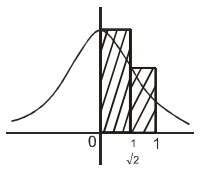
$2$. Using the upper Riemann sum with two rectangles of width $\frac{1}{\sqrt{2}}$ and $1-\frac{1}{\sqrt{2}}$:
The function $f(x) = e^{-x^2}$ is decreasing on $[0, 1]$.
$S = \int_0^{1/\sqrt{2}} e^{-x^2} dx + \int_{1/\sqrt{2}}^1 e^{-x^2} dx$.
Using the maximum value of $f(x)$ on each sub-interval:
$S \leq \left(\frac{1}{\sqrt{2}}\right) f(0) + \left(1 - \frac{1}{\sqrt{2}}\right) f\left(\frac{1}{\sqrt{2}}\right)$
$S \leq \frac{1}{\sqrt{2}}(1) + \left(1 - \frac{1}{\sqrt{2}}\right) e^{-(1/\sqrt{2})^2} = \frac{1}{\sqrt{2}} + \left(1 - \frac{1}{\sqrt{2}}\right) \frac{1}{\sqrt{e}}$.
Thus,$(D)$ is correct.
$1$. For $x \in [0, 1]$,we have $0 \leq x^2 \leq x \leq 1$. Thus,$-x^2 \geq -x$,which implies $e^{-x^2} \geq e^{-x}$.
Integrating both sides from $0$ to $1$:
$S = \int_0^1 e^{-x^2} dx \geq \int_0^1 e^{-x} dx = [-e^{-x}]_0^1 = 1 - \frac{1}{e}$.
Since $1 - \frac{1}{e} \approx 1 - 0.367 = 0.633$ and $\frac{1}{e} \approx 0.367$,we have $S \geq 1 - \frac{1}{e} > \frac{1}{e}$. Thus,$(A)$ and $(B)$ are correct.
$2$. Using the upper Riemann sum with two rectangles of width $\frac{1}{\sqrt{2}}$ and $1-\frac{1}{\sqrt{2}}$:
The function $f(x) = e^{-x^2}$ is decreasing on $[0, 1]$.
$S = \int_0^{1/\sqrt{2}} e^{-x^2} dx + \int_{1/\sqrt{2}}^1 e^{-x^2} dx$.
Using the maximum value of $f(x)$ on each sub-interval:
$S \leq \left(\frac{1}{\sqrt{2}}\right) f(0) + \left(1 - \frac{1}{\sqrt{2}}\right) f\left(\frac{1}{\sqrt{2}}\right)$
$S \leq \frac{1}{\sqrt{2}}(1) + \left(1 - \frac{1}{\sqrt{2}}\right) e^{-(1/\sqrt{2})^2} = \frac{1}{\sqrt{2}} + \left(1 - \frac{1}{\sqrt{2}}\right) \frac{1}{\sqrt{e}}$.
Thus,$(D)$ is correct.
0 likesView Solution
23
MathematicsDifficultMCQIIT JEE · 2012
Let $p(x)$ be a real polynomial of least degree which has a local maximum at $x=1$ and a local minimum at $x=3$. If $p(1)=6$ and $p(3)=2$,then $p^{\prime}(0)$ is
A
$6$
B
$7$
C
$8$
D
$9$
Solution
(D) Since $p(x)$ has a local maximum at $x=1$ and a local minimum at $x=3$,$p^{\prime}(x)$ must have roots at $x=1$ and $x=3$.
Thus,$p^{\prime}(x) = \lambda(x-1)(x-3) = \lambda(x^2-4x+3)$.
Integrating $p^{\prime}(x)$,we get $p(x) = \lambda(\frac{x^3}{3} - 2x^2 + 3x) + \mu$.
Given $p(1) = 6$,we have $6 = \lambda(\frac{1}{3} - 2 + 3) + \mu = \frac{4}{3}\lambda + \mu$,which implies $18 = 4\lambda + 3\mu \quad \dots (i)$.
Given $p(3) = 2$,we have $2 = \lambda(\frac{27}{3} - 2(9) + 3(3)) + \mu = \lambda(9 - 18 + 9) + \mu = \mu$.
So,$\mu = 2$.
Substituting $\mu = 2$ into equation $(i)$,$18 = 4\lambda + 3(2) \implies 18 = 4\lambda + 6 \implies 4\lambda = 12 \implies \lambda = 3$.
Thus,$p^{\prime}(x) = 3(x-1)(x-3)$.
Evaluating at $x=0$,$p^{\prime}(0) = 3(0-1)(0-3) = 3(-1)(-3) = 9$.
Thus,$p^{\prime}(x) = \lambda(x-1)(x-3) = \lambda(x^2-4x+3)$.
Integrating $p^{\prime}(x)$,we get $p(x) = \lambda(\frac{x^3}{3} - 2x^2 + 3x) + \mu$.
Given $p(1) = 6$,we have $6 = \lambda(\frac{1}{3} - 2 + 3) + \mu = \frac{4}{3}\lambda + \mu$,which implies $18 = 4\lambda + 3\mu \quad \dots (i)$.
Given $p(3) = 2$,we have $2 = \lambda(\frac{27}{3} - 2(9) + 3(3)) + \mu = \lambda(9 - 18 + 9) + \mu = \mu$.
So,$\mu = 2$.
Substituting $\mu = 2$ into equation $(i)$,$18 = 4\lambda + 3(2) \implies 18 = 4\lambda + 6 \implies 4\lambda = 12 \implies \lambda = 3$.
Thus,$p^{\prime}(x) = 3(x-1)(x-3)$.
Evaluating at $x=0$,$p^{\prime}(0) = 3(0-1)(0-3) = 3(-1)(-3) = 9$.
0 likesView Solution
24
MathematicsAdvancedMCQIIT JEE · 2012
Let $f: \mathbb{R} \rightarrow \mathbb{R}$ be defined as $f(x)=|x|+|x^2-1|$. The total number of points at which $f$ attains either a local maximum or a local minimum is
A
$3$
B
$4$
C
$5$
D
$6$
Solution
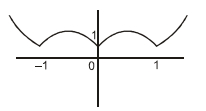
(C) The function is given by $f(x) = |x| + |x^2 - 1|$.
We analyze the function in different intervals:
$1$. For $x < -1$: $f(x) = -x + x^2 - 1 = x^2 - x - 1$. The vertex is at $x = 1/2$,which is not in this interval. As $x \to -1^-$,$f(x) \to 1$. There is no local extremum here.
$2$. For $-1 \leq x < 0$: $f(x) = -x - (x^2 - 1) = -x^2 - x + 1$. The derivative is $f'(x) = -2x - 1$. Setting $f'(x) = 0$ gives $x = -1/2$. Since $f''(-1/2) = -2 < 0$,there is a local maximum at $x = -1/2$ with $f(-1/2) = 5/4$.
$3$. At $x = -1$: $f(-1) = 1$. Since $f(x)$ decreases to $1$ from the left and increases to $5/4$ from the right,$x = -1$ is a local minimum.
$4$. At $x = 0$: $f(0) = 1$. Since $f(x)$ decreases to $1$ from the left and increases to $1$ from the right,$x = 0$ is a local minimum.
$5$. For $0 < x < 1$: $f(x) = x - (x^2 - 1) = -x^2 + x + 1$. The derivative is $f'(x) = -2x + 1$. Setting $f'(x) = 0$ gives $x = 1/2$. Since $f''(1/2) = -2 < 0$,there is a local maximum at $x = 1/2$ with $f(1/2) = 5/4$.
$6$. At $x = 1$: $f(1) = 1$. Since $f(x)$ decreases to $1$ from the left and increases to $1$ from the right,$x = 1$ is a local minimum.
Summarizing the points:
- Local minima at $x = -1, 0, 1$ ($3$ points).
- Local maxima at $x = -1/2, 1/2$ ($2$ points).
Total number of points = $3 + 2 = 5$.
We analyze the function in different intervals:
$1$. For $x < -1$: $f(x) = -x + x^2 - 1 = x^2 - x - 1$. The vertex is at $x = 1/2$,which is not in this interval. As $x \to -1^-$,$f(x) \to 1$. There is no local extremum here.
$2$. For $-1 \leq x < 0$: $f(x) = -x - (x^2 - 1) = -x^2 - x + 1$. The derivative is $f'(x) = -2x - 1$. Setting $f'(x) = 0$ gives $x = -1/2$. Since $f''(-1/2) = -2 < 0$,there is a local maximum at $x = -1/2$ with $f(-1/2) = 5/4$.
$3$. At $x = -1$: $f(-1) = 1$. Since $f(x)$ decreases to $1$ from the left and increases to $5/4$ from the right,$x = -1$ is a local minimum.
$4$. At $x = 0$: $f(0) = 1$. Since $f(x)$ decreases to $1$ from the left and increases to $1$ from the right,$x = 0$ is a local minimum.
$5$. For $0 < x < 1$: $f(x) = x - (x^2 - 1) = -x^2 + x + 1$. The derivative is $f'(x) = -2x + 1$. Setting $f'(x) = 0$ gives $x = 1/2$. Since $f''(1/2) = -2 < 0$,there is a local maximum at $x = 1/2$ with $f(1/2) = 5/4$.
$6$. At $x = 1$: $f(1) = 1$. Since $f(x)$ decreases to $1$ from the left and increases to $1$ from the right,$x = 1$ is a local minimum.
Summarizing the points:
- Local minima at $x = -1, 0, 1$ ($3$ points).
- Local maxima at $x = -1/2, 1/2$ ($2$ points).
Total number of points = $3 + 2 = 5$.
0 likesView Solution
25
MathematicsDifficultMCQIIT JEE · 2012
If $\vec{a}, \vec{b}$ and $\vec{c}$ are unit vectors satisfying $|\vec{a}-\vec{b}|^2+|\vec{b}-\vec{c}|^2+|\vec{c}-\vec{a}|^2=9$,then $|2 \vec{a}+5 \vec{b}+5 \vec{c}|$ is
A
$2$
B
$3$
C
$4$
D
$5$
Solution
(B) Given that $\vec{a}, \vec{b}, \vec{c}$ are unit vectors,so $|\vec{a}| = |\vec{b}| = |\vec{c}| = 1$.
Expanding the given equation: $|\vec{a}-\vec{b}|^2+|\vec{b}-\vec{c}|^2+|\vec{c}-\vec{a}|^2=9$.
This becomes $(|\vec{a}|^2+|\vec{b}|^2-2\vec{a} \cdot \vec{b}) + (|\vec{b}|^2+|\vec{c}|^2-2\vec{b} \cdot \vec{c}) + (|\vec{c}|^2+|\vec{a}|^2-2\vec{c} \cdot \vec{a}) = 9$.
Since $|\vec{a}|^2 = |\vec{b}|^2 = |\vec{c}|^2 = 1$,we have $6 - 2(\vec{a} \cdot \vec{b} + \vec{b} \cdot \vec{c} + \vec{c} \cdot \vec{a}) = 9$.
Thus,$\vec{a} \cdot \vec{b} + \vec{b} \cdot \vec{c} + \vec{c} \cdot \vec{a} = -\frac{3}{2}$.
Now,consider $|\vec{a}+\vec{b}+\vec{c}|^2 = |\vec{a}|^2+|\vec{b}|^2+|\vec{c}|^2 + 2(\vec{a} \cdot \vec{b} + \vec{b} \cdot \vec{c} + \vec{c} \cdot \vec{a}) = 3 + 2(-\frac{3}{2}) = 0$.
This implies $\vec{a}+\vec{b}+\vec{c} = \vec{0}$,so $\vec{b}+\vec{c} = -\vec{a}$.
We need to find $|2 \vec{a}+5 \vec{b}+5 \vec{c}| = |2 \vec{a}+5(\vec{b}+\vec{c})| = |2 \vec{a}+5(-\vec{a})| = |-3 \vec{a}| = 3|\vec{a}| = 3(1) = 3$.
Expanding the given equation: $|\vec{a}-\vec{b}|^2+|\vec{b}-\vec{c}|^2+|\vec{c}-\vec{a}|^2=9$.
This becomes $(|\vec{a}|^2+|\vec{b}|^2-2\vec{a} \cdot \vec{b}) + (|\vec{b}|^2+|\vec{c}|^2-2\vec{b} \cdot \vec{c}) + (|\vec{c}|^2+|\vec{a}|^2-2\vec{c} \cdot \vec{a}) = 9$.
Since $|\vec{a}|^2 = |\vec{b}|^2 = |\vec{c}|^2 = 1$,we have $6 - 2(\vec{a} \cdot \vec{b} + \vec{b} \cdot \vec{c} + \vec{c} \cdot \vec{a}) = 9$.
Thus,$\vec{a} \cdot \vec{b} + \vec{b} \cdot \vec{c} + \vec{c} \cdot \vec{a} = -\frac{3}{2}$.
Now,consider $|\vec{a}+\vec{b}+\vec{c}|^2 = |\vec{a}|^2+|\vec{b}|^2+|\vec{c}|^2 + 2(\vec{a} \cdot \vec{b} + \vec{b} \cdot \vec{c} + \vec{c} \cdot \vec{a}) = 3 + 2(-\frac{3}{2}) = 0$.
This implies $\vec{a}+\vec{b}+\vec{c} = \vec{0}$,so $\vec{b}+\vec{c} = -\vec{a}$.
We need to find $|2 \vec{a}+5 \vec{b}+5 \vec{c}| = |2 \vec{a}+5(\vec{b}+\vec{c})| = |2 \vec{a}+5(-\vec{a})| = |-3 \vec{a}| = 3|\vec{a}| = 3(1) = 3$.
0 likesView Solution
26
MathematicsAdvancedMCQIIT JEE · 2012
The equation of a plane passing through the line of intersection of the planes $x+2y+3z=2$ and $x-y+z=3$ and at a distance $\frac{2}{\sqrt{3}}$ from the point $(3,1,-1)$ is
A
$5x-11y+z=17$
B
$\sqrt{2}x+y=3\sqrt{2}-1$
C
$x+y+z=\sqrt{3}$
D
$x-\sqrt{2}y=1-\sqrt{2}$
Solution
(A) The equation of any plane passing through the line of intersection of the planes $x+2y+3z-2=0$ and $x-y+z-3=0$ is given by $(x+2y+3z-2) + \lambda(x-y+z-3) = 0$.
This simplifies to $(1+\lambda)x + (2-\lambda)y + (3+\lambda)z - (2+3\lambda) = 0$.
The distance of this plane from the point $(3,1,-1)$ is given by $\frac{|(1+\lambda)(3) + (2-\lambda)(1) + (3+\lambda)(-1) - (2+3\lambda)|}{\sqrt{(1+\lambda)^2 + (2-\lambda)^2 + (3+\lambda)^2}} = \frac{2}{\sqrt{3}}$.
Simplifying the numerator: $|3+3\lambda + 2-\lambda - 3-\lambda - 2-3\lambda| = |-2\lambda|$.
Simplifying the denominator: $\sqrt{(1+2\lambda+\lambda^2) + (4-4\lambda+\lambda^2) + (9+6\lambda+\lambda^2)} = \sqrt{3\lambda^2+4\lambda+14}$.
Thus,$\frac{|-2\lambda|}{\sqrt{3\lambda^2+4\lambda+14}} = \frac{2}{\sqrt{3}}$.
Squaring both sides: $\frac{4\lambda^2}{3\lambda^2+4\lambda+14} = \frac{4}{3}$.
$3\lambda^2 = 3\lambda^2+4\lambda+14$,which gives $4\lambda = -14$,so $\lambda = -\frac{7}{2}$.
Substituting $\lambda = -\frac{7}{2}$ into the equation: $(1-\frac{7}{2})x + (2+\frac{7}{2})y + (3-\frac{7}{2})z - (2-\frac{21}{2}) = 0$.
$-\frac{5}{2}x + \frac{11}{2}y - \frac{1}{2}z + \frac{17}{2} = 0$.
Multiplying by $-2$,we get $5x-11y+z-17=0$,or $5x-11y+z=17$.
This simplifies to $(1+\lambda)x + (2-\lambda)y + (3+\lambda)z - (2+3\lambda) = 0$.
The distance of this plane from the point $(3,1,-1)$ is given by $\frac{|(1+\lambda)(3) + (2-\lambda)(1) + (3+\lambda)(-1) - (2+3\lambda)|}{\sqrt{(1+\lambda)^2 + (2-\lambda)^2 + (3+\lambda)^2}} = \frac{2}{\sqrt{3}}$.
Simplifying the numerator: $|3+3\lambda + 2-\lambda - 3-\lambda - 2-3\lambda| = |-2\lambda|$.
Simplifying the denominator: $\sqrt{(1+2\lambda+\lambda^2) + (4-4\lambda+\lambda^2) + (9+6\lambda+\lambda^2)} = \sqrt{3\lambda^2+4\lambda+14}$.
Thus,$\frac{|-2\lambda|}{\sqrt{3\lambda^2+4\lambda+14}} = \frac{2}{\sqrt{3}}$.
Squaring both sides: $\frac{4\lambda^2}{3\lambda^2+4\lambda+14} = \frac{4}{3}$.
$3\lambda^2 = 3\lambda^2+4\lambda+14$,which gives $4\lambda = -14$,so $\lambda = -\frac{7}{2}$.
Substituting $\lambda = -\frac{7}{2}$ into the equation: $(1-\frac{7}{2})x + (2+\frac{7}{2})y + (3-\frac{7}{2})z - (2-\frac{21}{2}) = 0$.
$-\frac{5}{2}x + \frac{11}{2}y - \frac{1}{2}z + \frac{17}{2} = 0$.
Multiplying by $-2$,we get $5x-11y+z-17=0$,or $5x-11y+z=17$.
0 likesView Solution
27
MathematicsAdvancedMCQIIT JEE · 2012
Four fair dice $D_1, D_2, D_3$ and $D_4$,each having six faces numbered $1, 2, 3, 4, 5$ and $6$,are rolled simultaneously. The probability that $D_4$ shows a number appearing on at least one of $D_1, D_2$ and $D_3$ is
A
$\frac{91}{216}$
B
$\frac{108}{216}$
C
$\frac{125}{216}$
D
$\frac{127}{216}$
Solution
(A) Let $X$ be the number shown by $D_4$. The total number of outcomes for the four dice is $6^4 = 1296$.
Alternatively,consider the probability for a fixed value of $D_4$. For any specific number $k \in \{1, 2, 3, 4, 5, 6\}$ shown by $D_4$,the probability that $k$ does $NOT$ appear on any of $D_1, D_2, D_3$ is $(\frac{5}{6})^3 = \frac{125}{216}$.
Therefore,the probability that $k$ appears on at least one of $D_1, D_2, D_3$ is $1 - \frac{125}{216} = \frac{216 - 125}{216} = \frac{91}{216}$.
Since this probability is independent of the value shown by $D_4$,the overall probability is $\frac{91}{216}$.
Alternatively,consider the probability for a fixed value of $D_4$. For any specific number $k \in \{1, 2, 3, 4, 5, 6\}$ shown by $D_4$,the probability that $k$ does $NOT$ appear on any of $D_1, D_2, D_3$ is $(\frac{5}{6})^3 = \frac{125}{216}$.
Therefore,the probability that $k$ appears on at least one of $D_1, D_2, D_3$ is $1 - \frac{125}{216} = \frac{216 - 125}{216} = \frac{91}{216}$.
Since this probability is independent of the value shown by $D_4$,the overall probability is $\frac{91}{216}$.
0 likesView Solution
28
MathematicsAdvancedMCQIIT JEE · 2012
The value of the integral $\int_{-\pi / 2}^{\pi / 2}\left(x^2+\ln \frac{\pi+x}{\pi-x}\right) \cos x \, dx$ is
A
$0$
B
$\frac{\pi^2}{2}-4$
C
$\frac{\pi^2}{2}+4$
D
$\frac{\pi^2}{2}$
Solution
(B) Let $I = \int_{-\pi / 2}^{\pi / 2} \left(x^2 + \ln \frac{\pi+x}{\pi-x}\right) \cos x \, dx$.
We can split this into two integrals: $I = \int_{-\pi / 2}^{\pi / 2} x^2 \cos x \, dx + \int_{-\pi / 2}^{\pi / 2} \ln \left(\frac{\pi+x}{\pi-x}\right) \cos x \, dx$.
Let $f(x) = \ln \left(\frac{\pi+x}{\pi-x}\right) \cos x$. Since $\ln \left(\frac{\pi+x}{\pi-x}\right)$ is an odd function and $\cos x$ is an even function,their product is an odd function. Thus,$\int_{-\pi / 2}^{\pi / 2} f(x) \, dx = 0$.
Now,$I = \int_{-\pi / 2}^{\pi / 2} x^2 \cos x \, dx$. Since $x^2 \cos x$ is an even function,$I = 2 \int_0^{\pi / 2} x^2 \cos x \, dx$.
Using integration by parts: $\int x^2 \cos x \, dx = x^2 \sin x - \int 2x \sin x \, dx = x^2 \sin x - 2 \left( -x \cos x + \int \cos x \, dx \right) = x^2 \sin x + 2x \cos x - 2 \sin x$.
Evaluating from $0$ to $\pi / 2$: $2 \left[ (x^2 \sin x + 2x \cos x - 2 \sin x) \right]_0^{\pi / 2} = 2 \left[ ((\pi/2)^2 \cdot 1 + 0 - 2(1)) - (0 + 0 - 0) \right] = 2 \left( \frac{\pi^2}{4} - 2 \right) = \frac{\pi^2}{2} - 4$.
We can split this into two integrals: $I = \int_{-\pi / 2}^{\pi / 2} x^2 \cos x \, dx + \int_{-\pi / 2}^{\pi / 2} \ln \left(\frac{\pi+x}{\pi-x}\right) \cos x \, dx$.
Let $f(x) = \ln \left(\frac{\pi+x}{\pi-x}\right) \cos x$. Since $\ln \left(\frac{\pi+x}{\pi-x}\right)$ is an odd function and $\cos x$ is an even function,their product is an odd function. Thus,$\int_{-\pi / 2}^{\pi / 2} f(x) \, dx = 0$.
Now,$I = \int_{-\pi / 2}^{\pi / 2} x^2 \cos x \, dx$. Since $x^2 \cos x$ is an even function,$I = 2 \int_0^{\pi / 2} x^2 \cos x \, dx$.
Using integration by parts: $\int x^2 \cos x \, dx = x^2 \sin x - \int 2x \sin x \, dx = x^2 \sin x - 2 \left( -x \cos x + \int \cos x \, dx \right) = x^2 \sin x + 2x \cos x - 2 \sin x$.
Evaluating from $0$ to $\pi / 2$: $2 \left[ (x^2 \sin x + 2x \cos x - 2 \sin x) \right]_0^{\pi / 2} = 2 \left[ ((\pi/2)^2 \cdot 1 + 0 - 2(1)) - (0 + 0 - 0) \right] = 2 \left( \frac{\pi^2}{4} - 2 \right) = \frac{\pi^2}{2} - 4$.
0 likesView Solution
29
MathematicsAdvancedMCQIIT JEE · 2012
If $P$ is a $3 \times 3$ matrix such that $P^{\top}=2 P+I$,where $P^{\top}$ is the transpose of $P$ and $I$ is the $3 \times 3$ identity matrix,then there exists a column matrix $X=\left[\begin{array}{l}x \\ y \\ z\end{array}\right] \neq\left[\begin{array}{l}0 \\ 0 \\ 0\end{array}\right]$ such that
A
$PX =\left[\begin{array}{l}0 \\ 0 \\ 0\end{array}\right]$
B
$P X=X$
C
$P X=2 X$
D
$P X=-X$
Solution
(D) Given the equation $P^{\top} = 2P + I$.
Taking the transpose on both sides,we get $(P^{\top})^{\top} = (2P + I)^{\top}$.
Since $(P^{\top})^{\top} = P$,we have $P = 2P^{\top} + I$.
Substitute $P^{\top} = 2P + I$ into this equation:
$P = 2(2P + I) + I$.
$P = 4P + 2I + I$.
$P = 4P + 3I$.
Rearranging the terms,we get $3P = -3I$,which implies $P = -I$.
Therefore,for any column matrix $X \neq 0$,we have $PX = (-I)X = -X$.
Taking the transpose on both sides,we get $(P^{\top})^{\top} = (2P + I)^{\top}$.
Since $(P^{\top})^{\top} = P$,we have $P = 2P^{\top} + I$.
Substitute $P^{\top} = 2P + I$ into this equation:
$P = 2(2P + I) + I$.
$P = 4P + 2I + I$.
$P = 4P + 3I$.
Rearranging the terms,we get $3P = -3I$,which implies $P = -I$.
Therefore,for any column matrix $X \neq 0$,we have $PX = (-I)X = -X$.
0 likesView Solution
30
MathematicsAdvancedMCQIIT JEE · 2012
Let $f(x)=(1-x)^2 \sin ^2 x+x^2$ for all $x \in \mathbb{R}$ and let $g(x)=\int_1^x \left(\frac{2(t-1)}{t+1}-\ln t\right) f(t) dt$ for all $x \in (1, \infty)$.
$1.$ Which of the following is true?
$(A)$ $g$ is increasing on $(1, \infty)$
$(B)$ $g$ is decreasing on $(1, \infty)$
$(C)$ $g$ is increasing on $(1,2)$ and decreasing on $(2, \infty)$
$(D)$ $g$ is decreasing on $(1,2)$ and increasing on $(2, \infty)$
$2.$ Consider the statements:
$P$ : There exists some $x \in \mathbb{R}$ such that $f(x)+2x=2(1+x^2)$
$Q$ : There exists some $x \in \mathbb{R}$ such that $2f(x)+1=2x(1+x)$
Then
$(A)$ both $P$ and $Q$ are true
$(B)$ $P$ is true and $Q$ is false
$(C)$ $P$ is false and $Q$ is true
$(D)$ both $P$ and $Q$ are false
Give the answer for question $1$ and $2$.
$1.$ Which of the following is true?
$(A)$ $g$ is increasing on $(1, \infty)$
$(B)$ $g$ is decreasing on $(1, \infty)$
$(C)$ $g$ is increasing on $(1,2)$ and decreasing on $(2, \infty)$
$(D)$ $g$ is decreasing on $(1,2)$ and increasing on $(2, \infty)$
$2.$ Consider the statements:
$P$ : There exists some $x \in \mathbb{R}$ such that $f(x)+2x=2(1+x^2)$
$Q$ : There exists some $x \in \mathbb{R}$ such that $2f(x)+1=2x(1+x)$
Then
$(A)$ both $P$ and $Q$ are true
$(B)$ $P$ is true and $Q$ is false
$(C)$ $P$ is false and $Q$ is true
$(D)$ both $P$ and $Q$ are false
Give the answer for question $1$ and $2$.
A
$(B, D)$
B
$(B, C)$
C
$(A, D)$
D
$(C, D)$
Solution
(B) $1.$ Given $f(x)=(1-x)^2 \sin^2 x+x^2$ and $g(x)=\int_1^x \left(\frac{2(t-1)}{t+1}-\ln t\right) f(t) dt$.
By the Fundamental Theorem of Calculus,$g'(x) = \left(\frac{2(x-1)}{x+1}-\ln x\right) f(x)$.
Let $\phi(x) = \frac{2(x-1)}{x+1}-\ln x$. Then $\phi'(x) = \frac{2(x+1)-2(x-1)}{(x+1)^2} - \frac{1}{x} = \frac{4}{(x+1)^2} - \frac{1}{x} = \frac{4x - (x^2+2x+1)}{x(x+1)^2} = \frac{-(x-1)^2}{x(x+1)^2}$.
Since $\phi'(x) \leq 0$ for $x > 1$,$\phi(x)$ is decreasing. Since $\phi(1) = 0$,$\phi(x) < 0$ for $x > 1$. Also $f(x) = (1-x)^2 \sin^2 x + x^2 > 0$ for $x > 1$. Thus $g'(x) < 0$,so $g$ is decreasing on $(1, \infty)$.
$2.$ For $P$: $f(x)+2x = (1-x)^2 \sin^2 x + x^2 + 2x = 2(1+x^2) = 2+2x^2$.
$(1-x)^2 \sin^2 x = x^2 - 2x + 2 = (x-1)^2 + 1$.
Since $\sin^2 x \leq 1$,$(1-x)^2 \sin^2 x \leq (1-x)^2$,but $(1-x)^2 + 1 > (1-x)^2$. Thus $P$ is false.
For $Q$: Let $H(x) = 2f(x) + 1 - 2x(1+x)$. $H(0) = 2(1)^2(0) + 0 + 1 - 0 = 1$. $H(1) = 2(0+1) + 1 - 2(1)(2) = 3 - 4 = -1$. Since $H(x)$ is continuous and changes sign,there exists $x$ such that $H(x)=0$. Thus $Q$ is true.
By the Fundamental Theorem of Calculus,$g'(x) = \left(\frac{2(x-1)}{x+1}-\ln x\right) f(x)$.
Let $\phi(x) = \frac{2(x-1)}{x+1}-\ln x$. Then $\phi'(x) = \frac{2(x+1)-2(x-1)}{(x+1)^2} - \frac{1}{x} = \frac{4}{(x+1)^2} - \frac{1}{x} = \frac{4x - (x^2+2x+1)}{x(x+1)^2} = \frac{-(x-1)^2}{x(x+1)^2}$.
Since $\phi'(x) \leq 0$ for $x > 1$,$\phi(x)$ is decreasing. Since $\phi(1) = 0$,$\phi(x) < 0$ for $x > 1$. Also $f(x) = (1-x)^2 \sin^2 x + x^2 > 0$ for $x > 1$. Thus $g'(x) < 0$,so $g$ is decreasing on $(1, \infty)$.
$2.$ For $P$: $f(x)+2x = (1-x)^2 \sin^2 x + x^2 + 2x = 2(1+x^2) = 2+2x^2$.
$(1-x)^2 \sin^2 x = x^2 - 2x + 2 = (x-1)^2 + 1$.
Since $\sin^2 x \leq 1$,$(1-x)^2 \sin^2 x \leq (1-x)^2$,but $(1-x)^2 + 1 > (1-x)^2$. Thus $P$ is false.
For $Q$: Let $H(x) = 2f(x) + 1 - 2x(1+x)$. $H(0) = 2(1)^2(0) + 0 + 1 - 0 = 1$. $H(1) = 2(0+1) + 1 - 2(1)(2) = 3 - 4 = -1$. Since $H(x)$ is continuous and changes sign,there exists $x$ such that $H(x)=0$. Thus $Q$ is true.
0 likesView Solution
31
MathematicsAdvancedMCQIIT JEE · 2012
Let $X$ and $Y$ be two events such that $P(X \mid Y)=\frac{1}{2}$,$P(Y \mid X)=\frac{1}{3}$,and $P(X \cap Y)=\frac{1}{6}$. Which of the following is (are) correct?
$(A)$ $P(X \cup Y)=\frac{2}{3}$
$(B)$ $X$ and $Y$ are independent
$(C)$ $X$ and $Y$ are not independent
$(D)$ $P(X^C \cap Y)=\frac{1}{3}$
$(A)$ $P(X \cup Y)=\frac{2}{3}$
$(B)$ $X$ and $Y$ are independent
$(C)$ $X$ and $Y$ are not independent
$(D)$ $P(X^C \cap Y)=\frac{1}{3}$
A
$(AC)$
B
$(AB)$
C
$(AD)$
D
$(BC)$
Solution
(B) Given $P(X \mid Y) = \frac{P(X \cap Y)}{P(Y)} = \frac{1}{2}$.
Since $P(X \cap Y) = \frac{1}{6}$,we have $\frac{1/6}{P(Y)} = \frac{1}{2} \Rightarrow P(Y) = \frac{1}{3}$.
Given $P(Y \mid X) = \frac{P(X \cap Y)}{P(X)} = \frac{1}{3}$.
Since $P(X \cap Y) = \frac{1}{6}$,we have $\frac{1/6}{P(X)} = \frac{1}{3} \Rightarrow P(X) = \frac{1}{2}$.
Now,$P(X \cup Y) = P(X) + P(Y) - P(X \cap Y) = \frac{1}{2} + \frac{1}{3} - \frac{1}{6} = \frac{3+2-1}{6} = \frac{4}{6} = \frac{2}{3}$. Thus,$(A)$ is correct.
Check for independence: $P(X) \cdot P(Y) = \frac{1}{2} \cdot \frac{1}{3} = \frac{1}{6}$.
Since $P(X \cap Y) = \frac{1}{6} = P(X) \cdot P(Y)$,$X$ and $Y$ are independent. Thus,$(B)$ is correct.
$P(X^C \cap Y) = P(Y) - P(X \cap Y) = \frac{1}{3} - \frac{1}{6} = \frac{1}{6}$. Thus,$(D)$ is incorrect.
Since $P(X \cap Y) = \frac{1}{6}$,we have $\frac{1/6}{P(Y)} = \frac{1}{2} \Rightarrow P(Y) = \frac{1}{3}$.
Given $P(Y \mid X) = \frac{P(X \cap Y)}{P(X)} = \frac{1}{3}$.
Since $P(X \cap Y) = \frac{1}{6}$,we have $\frac{1/6}{P(X)} = \frac{1}{3} \Rightarrow P(X) = \frac{1}{2}$.
Now,$P(X \cup Y) = P(X) + P(Y) - P(X \cap Y) = \frac{1}{2} + \frac{1}{3} - \frac{1}{6} = \frac{3+2-1}{6} = \frac{4}{6} = \frac{2}{3}$. Thus,$(A)$ is correct.
Check for independence: $P(X) \cdot P(Y) = \frac{1}{2} \cdot \frac{1}{3} = \frac{1}{6}$.
Since $P(X \cap Y) = \frac{1}{6} = P(X) \cdot P(Y)$,$X$ and $Y$ are independent. Thus,$(B)$ is correct.
$P(X^C \cap Y) = P(Y) - P(X \cap Y) = \frac{1}{3} - \frac{1}{6} = \frac{1}{6}$. Thus,$(D)$ is incorrect.
0 likesView Solution
32
MathematicsDifficultMCQIIT JEE · 2012
If $f(x)=\int_0^x e^{t^2}(t-2)(t-3) dt$ for all $x \in(0, \infty)$,then
$(A)$ $f$ has a local maximum at $x=2$
$(B)$ $f$ is decreasing on $(2,3)$
$(C)$ there exists some $c \in(0, \infty)$ such that $f^{\prime \prime}(c)=0$
$(D)$ $f$ has a local minimum at $x=3$
$(A)$ $f$ has a local maximum at $x=2$
$(B)$ $f$ is decreasing on $(2,3)$
$(C)$ there exists some $c \in(0, \infty)$ such that $f^{\prime \prime}(c)=0$
$(D)$ $f$ has a local minimum at $x=3$
A
$(B, C, D)$
B
$(A, B, C)$
C
$(A, B, C, D)$
D
$(A, C, D)$
Solution
(C) Given $f(x)=\int_0^x e^{t^2}(t-2)(t-3) dt$.
By the Fundamental Theorem of Calculus,$f^{\prime}(x)=e^{x^2}(x-2)(x-3)$.
To find the critical points,set $f^{\prime}(x)=0$,which gives $x=2$ and $x=3$.
Analyzing the sign of $f^{\prime}(x)$:
For $x < 2$,$f^{\prime}(x) > 0$ (increasing).
For $2 < x < 3$,$f^{\prime}(x) < 0$ (decreasing).
For $x > 3$,$f^{\prime}(x) > 0$ (increasing).
Thus,$f$ has a local maximum at $x=2$ and a local minimum at $x=3$. This confirms $(A)$,$(B)$,and $(D)$ are correct.
Now,find $f^{\prime \prime}(x)$:
$f^{\prime \prime}(x) = \frac{d}{dx} [e^{x^2}(x^2-5x+6)] = e^{x^2}(2x)(x^2-5x+6) + e^{x^2}(2x-5) = e^{x^2}(2x^3-10x^2+12x+2x-5) = e^{x^2}(2x^3-10x^2+14x-5)$.
Let $g(x) = 2x^3-10x^2+14x-5$. Since $g(0) = -5$ and $g(1) = 2-10+14-5 = 1$,by the Intermediate Value Theorem,there exists $c \in (0, 1)$ such that $g(c) = 0$,implying $f^{\prime \prime}(c) = 0$. Thus,$(C)$ is also correct.
Therefore,all options $(A), (B), (C), (D)$ are correct.
By the Fundamental Theorem of Calculus,$f^{\prime}(x)=e^{x^2}(x-2)(x-3)$.
To find the critical points,set $f^{\prime}(x)=0$,which gives $x=2$ and $x=3$.
Analyzing the sign of $f^{\prime}(x)$:
For $x < 2$,$f^{\prime}(x) > 0$ (increasing).
For $2 < x < 3$,$f^{\prime}(x) < 0$ (decreasing).
For $x > 3$,$f^{\prime}(x) > 0$ (increasing).
Thus,$f$ has a local maximum at $x=2$ and a local minimum at $x=3$. This confirms $(A)$,$(B)$,and $(D)$ are correct.
Now,find $f^{\prime \prime}(x)$:
$f^{\prime \prime}(x) = \frac{d}{dx} [e^{x^2}(x^2-5x+6)] = e^{x^2}(2x)(x^2-5x+6) + e^{x^2}(2x-5) = e^{x^2}(2x^3-10x^2+12x+2x-5) = e^{x^2}(2x^3-10x^2+14x-5)$.
Let $g(x) = 2x^3-10x^2+14x-5$. Since $g(0) = -5$ and $g(1) = 2-10+14-5 = 1$,by the Intermediate Value Theorem,there exists $c \in (0, 1)$ such that $g(c) = 0$,implying $f^{\prime \prime}(c) = 0$. Thus,$(C)$ is also correct.
Therefore,all options $(A), (B), (C), (D)$ are correct.
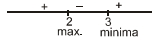
0 likesView Solution
33
MathematicsAdvancedMCQIIT JEE · 2012
For every integer $n$,let $a_n$ and $b_n$ be real numbers. Let function $f: \mathbb{R} \rightarrow \mathbb{R}$ be given by $f(x) = \begin{cases} a_n + \sin \pi x, & \text{for } x \in [2n, 2n+1] \\ b_n + \cos \pi x, & \text{for } x \in (2n-1, 2n) \end{cases}$,for all integers $n$. If $f$ is continuous,then which of the following hold$(s)$ for all $n$?
A
$(B, D)$
B
$(B, C)$
C
$(A, D)$
D
$(C, D)$
Solution
(A) For $f$ to be continuous at $x = 2n$,the left-hand limit and right-hand limit must be equal to $f(2n)$.
$f(2n) = a_n + \sin(2n\pi) = a_n$.
$f(2n^+) = a_n + \sin(2n\pi) = a_n$.
$f(2n^-) = b_n + \cos(2n\pi) = b_n + 1$.
Equating $f(2n^+) = f(2n^-)$,we get $a_n = b_n + 1$,which implies $a_n - b_n = 1$. Thus,$(B)$ is correct.
For $f$ to be continuous at $x = 2n+1$,the left-hand limit and right-hand limit must be equal to $f(2n+1)$.
$f(2n+1) = a_n + \sin((2n+1)\pi) = a_n$.
$f((2n+1)^-) = a_n + \sin((2n+1)\pi) = a_n$.
$f((2n+1)^+) = b_{n+1} + \cos((2n+1)\pi) = b_{n+1} - 1$.
Equating $f((2n+1)^-) = f((2n+1)^+)$,we get $a_n = b_{n+1} - 1$,which implies $a_n - b_{n+1} = -1$. Replacing $n$ with $n-1$,we get $a_{n-1} - b_n = -1$. Thus,$(D)$ is correct.
$f(2n) = a_n + \sin(2n\pi) = a_n$.
$f(2n^+) = a_n + \sin(2n\pi) = a_n$.
$f(2n^-) = b_n + \cos(2n\pi) = b_n + 1$.
Equating $f(2n^+) = f(2n^-)$,we get $a_n = b_n + 1$,which implies $a_n - b_n = 1$. Thus,$(B)$ is correct.
For $f$ to be continuous at $x = 2n+1$,the left-hand limit and right-hand limit must be equal to $f(2n+1)$.
$f(2n+1) = a_n + \sin((2n+1)\pi) = a_n$.
$f((2n+1)^-) = a_n + \sin((2n+1)\pi) = a_n$.
$f((2n+1)^+) = b_{n+1} + \cos((2n+1)\pi) = b_{n+1} - 1$.
Equating $f((2n+1)^-) = f((2n+1)^+)$,we get $a_n = b_{n+1} - 1$,which implies $a_n - b_{n+1} = -1$. Replacing $n$ with $n-1$,we get $a_{n-1} - b_n = -1$. Thus,$(D)$ is correct.
0 likesView Solution
34
MathematicsAdvancedMCQIIT JEE · 2012
If the straight lines $\frac{x-1}{2}=\frac{y+1}{k}=\frac{z}{2}$ and $\frac{x+1}{5}=\frac{y+1}{2}=\frac{z}{k}$ are coplanar,then the plane$(s)$ containing these two lines is(are):
A
$(B, D)$
B
$(B, C)$
C
$(A, D)$
D
$(C, D)$
Solution
(B) For two lines to be coplanar,the scalar triple product of the vector connecting a point on each line and the direction vectors of the lines must be zero: $[\vec{a}-\vec{c}, \vec{b}, \vec{d}] = 0$.
Given points $\vec{a} = (1, -1, 0)$ and $\vec{c} = (-1, -1, 0)$,the vector $\vec{a}-\vec{c} = (2, 0, 0)$.
The direction vectors are $\vec{b} = 2\hat{i} + k\hat{j} + 2\hat{k}$ and $\vec{d} = 5\hat{i} + 2\hat{j} + k\hat{k}$.
Setting the determinant to zero:
$\left|\begin{array}{lll} 2 & 0 & 0 \\ 2 & k & 2 \\ 5 & 2 & k \end{array}\right| = 0 \Rightarrow 2(k^2 - 4) = 0 \Rightarrow k^2 = 4 \Rightarrow k = \pm 2$.
Case $1$: If $k = 2$,the direction vectors are $\vec{b} = (2, 2, 2)$ and $\vec{d} = (5, 2, 2)$.
The normal vector is $\vec{n}_1 = \vec{b} \times \vec{d} = \left|\begin{array}{lll} \hat{i} & \hat{j} & \hat{k} \\ 2 & 2 & 2 \\ 5 & 2 & 2 \end{array}\right| = 0\hat{i} + 6\hat{j} - 6\hat{k}$.
The plane equation is $(\vec{r} - \vec{a}) \cdot \vec{n}_1 = 0 \Rightarrow 0(x-1) + 6(y+1) - 6(z-0) = 0 \Rightarrow y - z = -1$.
Case $2$: If $k = -2$,the direction vectors are $\vec{b} = (2, -2, 2)$ and $\vec{d} = (5, 2, -2)$.
The normal vector is $\vec{n}_2 = \vec{b} \times \vec{d} = \left|\begin{array}{lll} \hat{i} & \hat{j} & \hat{k} \\ 2 & -2 & 2 \\ 5 & 2 & -2 \end{array}\right| = 0\hat{i} + 14\hat{j} + 14\hat{k}$.
The plane equation is $(\vec{r} - \vec{a}) \cdot \vec{n}_2 = 0 \Rightarrow 0(x-1) + 14(y+1) + 14(z-0) = 0 \Rightarrow y + z = -1$.
Thus,the planes are $y-z=-1$ and $y+z=-1$,which correspond to options $(C)$ and $(B)$.
Given points $\vec{a} = (1, -1, 0)$ and $\vec{c} = (-1, -1, 0)$,the vector $\vec{a}-\vec{c} = (2, 0, 0)$.
The direction vectors are $\vec{b} = 2\hat{i} + k\hat{j} + 2\hat{k}$ and $\vec{d} = 5\hat{i} + 2\hat{j} + k\hat{k}$.
Setting the determinant to zero:
$\left|\begin{array}{lll} 2 & 0 & 0 \\ 2 & k & 2 \\ 5 & 2 & k \end{array}\right| = 0 \Rightarrow 2(k^2 - 4) = 0 \Rightarrow k^2 = 4 \Rightarrow k = \pm 2$.
Case $1$: If $k = 2$,the direction vectors are $\vec{b} = (2, 2, 2)$ and $\vec{d} = (5, 2, 2)$.
The normal vector is $\vec{n}_1 = \vec{b} \times \vec{d} = \left|\begin{array}{lll} \hat{i} & \hat{j} & \hat{k} \\ 2 & 2 & 2 \\ 5 & 2 & 2 \end{array}\right| = 0\hat{i} + 6\hat{j} - 6\hat{k}$.
The plane equation is $(\vec{r} - \vec{a}) \cdot \vec{n}_1 = 0 \Rightarrow 0(x-1) + 6(y+1) - 6(z-0) = 0 \Rightarrow y - z = -1$.
Case $2$: If $k = -2$,the direction vectors are $\vec{b} = (2, -2, 2)$ and $\vec{d} = (5, 2, -2)$.
The normal vector is $\vec{n}_2 = \vec{b} \times \vec{d} = \left|\begin{array}{lll} \hat{i} & \hat{j} & \hat{k} \\ 2 & -2 & 2 \\ 5 & 2 & -2 \end{array}\right| = 0\hat{i} + 14\hat{j} + 14\hat{k}$.
The plane equation is $(\vec{r} - \vec{a}) \cdot \vec{n}_2 = 0 \Rightarrow 0(x-1) + 14(y+1) + 14(z-0) = 0 \Rightarrow y + z = -1$.
Thus,the planes are $y-z=-1$ and $y+z=-1$,which correspond to options $(C)$ and $(B)$.
0 likesView Solution
35
MathematicsAdvancedMCQIIT JEE · 2012
If the adjoint of a $3 \times 3$ matrix $P$ is $\begin{bmatrix} 1 & 4 & 4 \\ 2 & 1 & 7 \\ 1 & 1 & 3 \end{bmatrix}$,then the possible value$(s)$ of the determinant of $P$ is (are):
A
$(A, D)$
B
$(B, C)$
C
$(A, B)$
D
$(C, D)$
Solution
(A, D) Let $P$ be a $3 \times 3$ matrix. We are given that $\operatorname{adj}(P) = \begin{bmatrix} 1 & 4 & 4 \\ 2 & 1 & 7 \\ 1 & 1 & 3 \end{bmatrix}$.
We know the property $|\operatorname{adj}(P)| = |P|^{n-1}$,where $n$ is the order of the matrix.
Here,$n = 3$,so $|\operatorname{adj}(P)| = |P|^{3-1} = |P|^2$.
First,calculate the determinant of $\operatorname{adj}(P)$:
$|\operatorname{adj}(P)| = 1(1 \times 3 - 7 \times 1) - 4(2 \times 3 - 7 \times 1) + 4(2 \times 1 - 1 \times 1)$
$|\operatorname{adj}(P)| = 1(3 - 7) - 4(6 - 7) + 4(2 - 1)$
$|\operatorname{adj}(P)| = 1(-4) - 4(-1) + 4(1)$
$|\operatorname{adj}(P)| = -4 + 4 + 4 = 4$.
Now,equate this to $|P|^2$:
$|P|^2 = 4$
$|P| = \pm 2$.
Thus,the possible values of the determinant of $P$ are $2$ and $-2$,which correspond to options $(A)$ and $(D)$.
We know the property $|\operatorname{adj}(P)| = |P|^{n-1}$,where $n$ is the order of the matrix.
Here,$n = 3$,so $|\operatorname{adj}(P)| = |P|^{3-1} = |P|^2$.
First,calculate the determinant of $\operatorname{adj}(P)$:
$|\operatorname{adj}(P)| = 1(1 \times 3 - 7 \times 1) - 4(2 \times 3 - 7 \times 1) + 4(2 \times 1 - 1 \times 1)$
$|\operatorname{adj}(P)| = 1(3 - 7) - 4(6 - 7) + 4(2 - 1)$
$|\operatorname{adj}(P)| = 1(-4) - 4(-1) + 4(1)$
$|\operatorname{adj}(P)| = -4 + 4 + 4 = 4$.
Now,equate this to $|P|^2$:
$|P|^2 = 4$
$|P| = \pm 2$.
Thus,the possible values of the determinant of $P$ are $2$ and $-2$,which correspond to options $(A)$ and $(D)$.
0 likesView Solution
36
MathematicsDifficultMCQIIT JEE · 2012
Let $f:(-1,1) \rightarrow \mathbb{R}$ be such that $f(\cos 4 \theta) = \frac{2}{2-\sec^2 \theta}$ for $\theta \in \left(0, \frac{\pi}{4}\right) \cup \left(\frac{\pi}{4}, \frac{\pi}{2}\right)$. Then the value$(s)$ of $f\left(\frac{1}{3}\right)$ is (are):
A
$1-\sqrt{\frac{3}{2}}$
B
$1+\sqrt{\frac{3}{2}}$
C
$1-\sqrt{\frac{2}{3}}$
D
$1+\sqrt{\frac{2}{3}}$
Solution
(AB) Given $f(\cos 4 \theta) = \frac{2}{2-\sec^2 \theta}$.
We know that $\sec^2 \theta = \frac{1}{\cos^2 \theta} = \frac{2}{1+\cos 2 \theta}$.
Substituting this into the expression for $f(\cos 4 \theta)$:
$f(\cos 4 \theta) = \frac{2}{2 - \frac{2}{1+\cos 2 \theta}} = \frac{2(1+\cos 2 \theta)}{2(1+\cos 2 \theta) - 2} = \frac{1+\cos 2 \theta}{\cos 2 \theta} = 1 + \frac{1}{\cos 2 \theta}$.
Now,let $\cos 4 \theta = \frac{1}{3}$.
Using the identity $\cos 4 \theta = 2 \cos^2 2 \theta - 1$,we have $2 \cos^2 2 \theta - 1 = \frac{1}{3} \Rightarrow 2 \cos^2 2 \theta = \frac{4}{3} \Rightarrow \cos^2 2 \theta = \frac{2}{3}$.
Thus,$\cos 2 \theta = \pm \sqrt{\frac{2}{3}}$.
Substituting this back into the expression for $f(\cos 4 \theta)$:
$f\left(\frac{1}{3}\right) = 1 + \frac{1}{\pm \sqrt{2/3}} = 1 \pm \sqrt{\frac{3}{2}}$.
Therefore,the values are $1+\sqrt{\frac{3}{2}}$ and $1-\sqrt{\frac{3}{2}}$.
We know that $\sec^2 \theta = \frac{1}{\cos^2 \theta} = \frac{2}{1+\cos 2 \theta}$.
Substituting this into the expression for $f(\cos 4 \theta)$:
$f(\cos 4 \theta) = \frac{2}{2 - \frac{2}{1+\cos 2 \theta}} = \frac{2(1+\cos 2 \theta)}{2(1+\cos 2 \theta) - 2} = \frac{1+\cos 2 \theta}{\cos 2 \theta} = 1 + \frac{1}{\cos 2 \theta}$.
Now,let $\cos 4 \theta = \frac{1}{3}$.
Using the identity $\cos 4 \theta = 2 \cos^2 2 \theta - 1$,we have $2 \cos^2 2 \theta - 1 = \frac{1}{3} \Rightarrow 2 \cos^2 2 \theta = \frac{4}{3} \Rightarrow \cos^2 2 \theta = \frac{2}{3}$.
Thus,$\cos 2 \theta = \pm \sqrt{\frac{2}{3}}$.
Substituting this back into the expression for $f(\cos 4 \theta)$:
$f\left(\frac{1}{3}\right) = 1 + \frac{1}{\pm \sqrt{2/3}} = 1 \pm \sqrt{\frac{3}{2}}$.
Therefore,the values are $1+\sqrt{\frac{3}{2}}$ and $1-\sqrt{\frac{3}{2}}$.
0 likesView Solution
37
MathematicsMediumMCQIIT JEE · 2012
If $\bar{a}$ and $\bar{b}$ are vectors such that $|\bar{a}+\bar{b}|=\sqrt{29}$ and $\bar{a} \times(2 \hat{i}+3 \hat{j}+4 \hat{k})=(2 \hat{i}+3 \hat{j}+4 \hat{k}) \times \bar{b}$,then a possible value of $(\bar{a}+\bar{b}) \cdot(-7 \hat{i}+2 \hat{j}+3 \hat{k})$ is
A
$4$
B
$0$
C
$1$
D
$8$
Solution
(A) Given $\vec{a} \times(2 \hat{i}+3 \hat{j}+4 \hat{k})=(2 \hat{i}+3 \hat{j}+4 \hat{k}) \times \vec{b}$.
We know that $\vec{u} \times \vec{v} = -\vec{v} \times \vec{u}$,so $(2 \hat{i}+3 \hat{j}+4 \hat{k}) \times \vec{b} = -\vec{b} \times (2 \hat{i}+3 \hat{j}+4 \hat{k})$.
Substituting this into the equation,we get $\vec{a} \times(2 \hat{i}+3 \hat{j}+4 \hat{k}) + \vec{b} \times(2 \hat{i}+3 \hat{j}+4 \hat{k}) = \vec{0}$.
This implies $(\vec{a}+\vec{b}) \times(2 \hat{i}+3 \hat{j}+4 \hat{k}) = \vec{0}$.
This means the vector $(\vec{a}+\vec{b})$ is parallel to $(2 \hat{i}+3 \hat{j}+4 \hat{k})$.
Let $\vec{a}+\vec{b} = \lambda(2 \hat{i}+3 \hat{j}+4 \hat{k})$ for some scalar $\lambda$.
Taking the magnitude on both sides,$|\vec{a}+\vec{b}| = |\lambda| \sqrt{2^2+3^2+4^2} = |\lambda| \sqrt{4+9+16} = |\lambda| \sqrt{29}$.
Given $|\vec{a}+\vec{b}| = \sqrt{29}$,we have $|\lambda| \sqrt{29} = \sqrt{29}$,which gives $\lambda = \pm 1$.
Thus,$\vec{a}+\vec{b} = \pm(2 \hat{i}+3 \hat{j}+4 \hat{k})$.
Now,calculate the dot product: $(\vec{a}+\vec{b}) \cdot(-7 \hat{i}+2 \hat{j}+3 \hat{k}) = \pm(2 \hat{i}+3 \hat{j}+4 \hat{k}) \cdot(-7 \hat{i}+2 \hat{j}+3 \hat{k})$.
$= \pm((2)(-7) + (3)(2) + (4)(3)) = \pm(-14 + 6 + 12) = \pm 4$.
Therefore,a possible value is $4$.
We know that $\vec{u} \times \vec{v} = -\vec{v} \times \vec{u}$,so $(2 \hat{i}+3 \hat{j}+4 \hat{k}) \times \vec{b} = -\vec{b} \times (2 \hat{i}+3 \hat{j}+4 \hat{k})$.
Substituting this into the equation,we get $\vec{a} \times(2 \hat{i}+3 \hat{j}+4 \hat{k}) + \vec{b} \times(2 \hat{i}+3 \hat{j}+4 \hat{k}) = \vec{0}$.
This implies $(\vec{a}+\vec{b}) \times(2 \hat{i}+3 \hat{j}+4 \hat{k}) = \vec{0}$.
This means the vector $(\vec{a}+\vec{b})$ is parallel to $(2 \hat{i}+3 \hat{j}+4 \hat{k})$.
Let $\vec{a}+\vec{b} = \lambda(2 \hat{i}+3 \hat{j}+4 \hat{k})$ for some scalar $\lambda$.
Taking the magnitude on both sides,$|\vec{a}+\vec{b}| = |\lambda| \sqrt{2^2+3^2+4^2} = |\lambda| \sqrt{4+9+16} = |\lambda| \sqrt{29}$.
Given $|\vec{a}+\vec{b}| = \sqrt{29}$,we have $|\lambda| \sqrt{29} = \sqrt{29}$,which gives $\lambda = \pm 1$.
Thus,$\vec{a}+\vec{b} = \pm(2 \hat{i}+3 \hat{j}+4 \hat{k})$.
Now,calculate the dot product: $(\vec{a}+\vec{b}) \cdot(-7 \hat{i}+2 \hat{j}+3 \hat{k}) = \pm(2 \hat{i}+3 \hat{j}+4 \hat{k}) \cdot(-7 \hat{i}+2 \hat{j}+3 \hat{k})$.
$= \pm((2)(-7) + (3)(2) + (4)(3)) = \pm(-14 + 6 + 12) = \pm 4$.
Therefore,a possible value is $4$.
0 likesView Solution
Vedclass Products
For Students
Vedclass Test Series
Mock tests in real IIT JEE style covering Mathematics with performance analysis. 5-day free trial.
Start Free TrialFor Teachers
Exam Paper Generator
Generate Set A/B/C/D Mathematics papers from 7.5L+ questions in 2 minutes. 3 chapters free.
Try FreeFor Institutes
Online Exam Module
Run live IIT JEE mock exams with unlimited students, 360° analytics & white-label branding.
See DemoFrequently Asked Questions
How many Mathematics questions are in IIT JEE 2012?
There are 37 Mathematics questions from the IIT JEE 2012 paper on Vedclass, each with a detailed step-by-step solution in English.
Are IIT JEE 2012 Mathematics solutions available in English?
Yes. All solutions on this page are in English. You can also switch to English or Hindi using the language buttons above the questions.
Can I practice IIT JEE 2012 Mathematics as a timed test?
Yes. Use the Vedclass Test Series to attempt a full IIT JEE mock test covering Mathematics with time limits and instant score analysis.
Can teachers create Mathematics papers from IIT JEE previous year questions?
Yes. The Vedclass Exam Paper Generator lets teachers mix IIT JEE Mathematics questions and generate Set A/B/C/D papers in minutes.
For Teachers & Institutes
Build a Custom Mathematics Paper
Pick IIT JEE 2012 Mathematics questions, set difficulty, and generate Set A/B/C/D in 2 minutes.