
PhysicsQ1–36 of 36 questions
Page 1 of 1 · English
1
PhysicsDifficultMCQIIT JEE · 2009
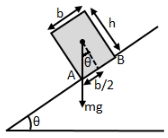
$A$ block of base $10 \ cm \times 10 \ cm$ and height $15 \ cm$ is kept on an inclined plane. The coefficient of friction between them is $\sqrt{3}$. The inclination $\theta$ of this inclined plane from the horizontal plane is gradually increased from $0^{\circ}$. Then
A
at $\theta=30^{\circ}$,the block will start sliding down the plane
B
the block will remain at rest on the plane up to certain $\theta$ and then it will topple
C
at $\theta=60^{\circ}$,the block will start sliding down the plane and continue to do so at higher angles
D
at $\theta=60^{\circ}$,the block will start sliding down the plane and on further increasing $\theta$,it will topple at certain $\theta$
Solution
(B) The condition for sliding is $\theta > \phi$,where $\phi$ is the angle of repose. Given $\mu = \sqrt{3}$,the angle of repose is $\phi = \tan^{-1}(\mu) = \tan^{-1}(\sqrt{3}) = 60^{\circ}$.
The condition for toppling is that the line of action of the weight must pass outside the base of the block. This occurs when $\tan \theta > \frac{b}{h}$,where $b$ is the base width and $h$ is the height.
For the given block,$b = 10 \ cm$ and $h = 15 \ cm$. The angle at which toppling begins is $\theta_{topple} = \tan^{-1}(\frac{b}{h}) = \tan^{-1}(\frac{10}{15}) = \tan^{-1}(\frac{2}{3}) \approx 33.7^{\circ}$.
Since $\theta_{topple} \approx 33.7^{\circ}$ is less than the angle of repose $\phi = 60^{\circ}$,the block will start toppling before it can start sliding. Therefore,as $\theta$ increases from $0^{\circ}$,the block remains at rest until $\theta \approx 33.7^{\circ}$,at which point it will topple.
The condition for toppling is that the line of action of the weight must pass outside the base of the block. This occurs when $\tan \theta > \frac{b}{h}$,where $b$ is the base width and $h$ is the height.
For the given block,$b = 10 \ cm$ and $h = 15 \ cm$. The angle at which toppling begins is $\theta_{topple} = \tan^{-1}(\frac{b}{h}) = \tan^{-1}(\frac{10}{15}) = \tan^{-1}(\frac{2}{3}) \approx 33.7^{\circ}$.
Since $\theta_{topple} \approx 33.7^{\circ}$ is less than the angle of repose $\phi = 60^{\circ}$,the block will start toppling before it can start sliding. Therefore,as $\theta$ increases from $0^{\circ}$,the block remains at rest until $\theta \approx 33.7^{\circ}$,at which point it will topple.
0 likesView Solution
2
PhysicsAdvancedMCQIIT JEE · 2009
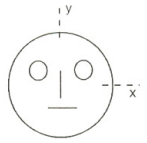
Look at the drawing given in the figure which has been drawn with ink of uniform line-thickness. The mass of ink used to draw each of the two inner circles,and each of the two line segments is $m$. The mass of the ink used to draw the outer circle is $6m$. The coordinates of the centres of the different parts are: outer circle $(0,0)$,left inner circle $(-a, a)$,right inner circle $(a, a)$,vertical line $(0,0)$ and horizontal line $(0,-a)$. The $y$-coordinate of the centre of mass of the ink in this drawing is
A
$\frac{a}{10}$
B
$\frac{a}{8}$
C
$\frac{a}{12}$
D
$\frac{a}{3}$
Solution
(A) To find the $y$-coordinate of the centre of mass $(Y_{CM})$,we use the formula: $Y_{CM} = \frac{\sum m_i y_i}{\sum m_i}$.
The components and their respective masses $(m_i)$ and $y$-coordinates $(y_i)$ are:
$1$. Outer circle: $m_1 = 6m$,$y_1 = 0$
$2$. Left inner circle: $m_2 = m$,$y_2 = a$
$3$. Right inner circle: $m_3 = m$,$y_3 = a$
$4$. Vertical line: $m_4 = m$,$y_4 = 0$
$5$. Horizontal line: $m_5 = m$,$y_5 = -a$
Total mass $M = 6m + m + m + m + m = 10m$.
Calculating $Y_{CM}$:
$Y_{CM} = \frac{(6m \times 0) + (m \times a) + (m \times a) + (m \times 0) + (m \times -a)}{10m}$
$Y_{CM} = \frac{0 + ma + ma + 0 - ma}{10m}$
$Y_{CM} = \frac{ma}{10m} = \frac{a}{10}$.
The components and their respective masses $(m_i)$ and $y$-coordinates $(y_i)$ are:
$1$. Outer circle: $m_1 = 6m$,$y_1 = 0$
$2$. Left inner circle: $m_2 = m$,$y_2 = a$
$3$. Right inner circle: $m_3 = m$,$y_3 = a$
$4$. Vertical line: $m_4 = m$,$y_4 = 0$
$5$. Horizontal line: $m_5 = m$,$y_5 = -a$
Total mass $M = 6m + m + m + m + m = 10m$.
Calculating $Y_{CM}$:
$Y_{CM} = \frac{(6m \times 0) + (m \times a) + (m \times a) + (m \times 0) + (m \times -a)}{10m}$
$Y_{CM} = \frac{0 + ma + ma + 0 - ma}{10m}$
$Y_{CM} = \frac{ma}{10m} = \frac{a}{10}$.
0 likesView Solution
3
PhysicsAdvancedMCQIIT JEE · 2009
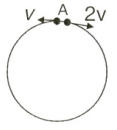
Two small particles of equal masses start moving in opposite directions from a point $A$ in a horizontal circular orbit. Their tangential velocities are $v$ and $2v$,respectively,as shown in the figure. Between collisions,the particles move with constant speeds. After making how many elastic collisions,other than that at $A$,will these two particles again reach the point $A$?
A
$4$
B
$3$
C
$2$
D
$1$
Solution
(C) Since the collision is elastic and the masses are equal,the velocities of the particles will be interchanged after each collision.
Let the particles collide at time $t$ at an angle $\theta$ from point $A$.
The distance traveled by the first particle is $R\theta = vt$.
The distance traveled by the second particle is $R(2\pi - \theta) = 2vt$.
Dividing the two equations: $\frac{\theta}{2\pi - \theta} = \frac{vt}{2vt} = \frac{1}{2}$.
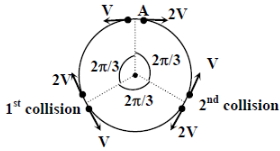
This gives $2\theta = 2\pi - \theta$,so $3\theta = 2\pi$,which means $\theta = \frac{2\pi}{3} = 120^{\circ}$.
After the first collision at $120^{\circ}$,the velocities are interchanged. The particle that had speed $v$ now has speed $2v$,and the particle that had speed $2v$ now has speed $v$.
They will collide again after traveling another $120^{\circ}$ relative to each other,which occurs at an angle of $240^{\circ}$ from point $A$.
After this second collision,the velocities are interchanged again. The particles will then travel the remaining $120^{\circ}$ to reach point $A$ simultaneously.
Thus,they reach point $A$ after $2$ collisions.
Let the particles collide at time $t$ at an angle $\theta$ from point $A$.
The distance traveled by the first particle is $R\theta = vt$.
The distance traveled by the second particle is $R(2\pi - \theta) = 2vt$.
Dividing the two equations: $\frac{\theta}{2\pi - \theta} = \frac{vt}{2vt} = \frac{1}{2}$.
This gives $2\theta = 2\pi - \theta$,so $3\theta = 2\pi$,which means $\theta = \frac{2\pi}{3} = 120^{\circ}$.
After the first collision at $120^{\circ}$,the velocities are interchanged. The particle that had speed $v$ now has speed $2v$,and the particle that had speed $2v$ now has speed $v$.
They will collide again after traveling another $120^{\circ}$ relative to each other,which occurs at an angle of $240^{\circ}$ from point $A$.
After this second collision,the velocities are interchanged again. The particles will then travel the remaining $120^{\circ}$ to reach point $A$ simultaneously.
Thus,they reach point $A$ after $2$ collisions.
0 likesView Solution
4
PhysicsMediumMCQIIT JEE · 2009
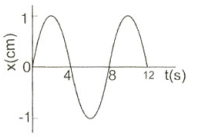
The $x-t$ graph of a particle undergoing simple harmonic motion is shown below. The acceleration of the particle at $t = 4/3 \,s$ is
A
$\frac{\sqrt{3}}{32} \pi^2 \,cm/s^2$
B
$-\frac{\pi^2}{32} \,cm/s^2$
C
$\frac{\pi^2}{32} \,cm/s^2$
D
$-\frac{\sqrt{3}}{32} \pi^2 \,cm/s^2$
Solution
(D) The correct option is $D$.
From the $x-t$ graph, at $t = 0$, the particle is at $x = 0$.
Hence, the particle starts its simple harmonic motion $(SHM)$ from the mean position.
The general equation for $SHM$ is $x = A \sin(\omega t)$.
From the graph, the time period $T = 8 \,s$ and the amplitude $A = 1 \,cm$.
The angular frequency is $\omega = \frac{2\pi}{T} = \frac{2\pi}{8} = \frac{\pi}{4} \,rad/s$.
Thus, the equation of motion is $x = 1 \sin\left(\frac{\pi t}{4}\right)$.
At $t = 4/3 \,s$, the displacement is $x = \sin\left(\frac{\pi}{4} \times \frac{4}{3}\right) = \sin\left(\frac{\pi}{3}\right) = \frac{\sqrt{3}}{2} \,cm$.
The acceleration $a$ is given by $a = -\omega^2 x$.
Substituting the values, $a = -\left(\frac{\pi}{4}\right)^2 \times \frac{\sqrt{3}}{2} = -\frac{\pi^2}{16} \times \frac{\sqrt{3}}{2} = -\frac{\sqrt{3}\pi^2}{32} \,cm/s^2$.
From the $x-t$ graph, at $t = 0$, the particle is at $x = 0$.
Hence, the particle starts its simple harmonic motion $(SHM)$ from the mean position.
The general equation for $SHM$ is $x = A \sin(\omega t)$.
From the graph, the time period $T = 8 \,s$ and the amplitude $A = 1 \,cm$.
The angular frequency is $\omega = \frac{2\pi}{T} = \frac{2\pi}{8} = \frac{\pi}{4} \,rad/s$.
Thus, the equation of motion is $x = 1 \sin\left(\frac{\pi t}{4}\right)$.
At $t = 4/3 \,s$, the displacement is $x = \sin\left(\frac{\pi}{4} \times \frac{4}{3}\right) = \sin\left(\frac{\pi}{3}\right) = \frac{\sqrt{3}}{2} \,cm$.
The acceleration $a$ is given by $a = -\omega^2 x$.
Substituting the values, $a = -\left(\frac{\pi}{4}\right)^2 \times \frac{\sqrt{3}}{2} = -\frac{\pi^2}{16} \times \frac{\sqrt{3}}{2} = -\frac{\sqrt{3}\pi^2}{32} \,cm/s^2$.
0 likesView Solution
5
PhysicsDifficultMCQIIT JEE · 2009
If the resultant of all the external forces acting on a system of particles is zero,then from an inertial frame,one can surely say that
A
linear momentum of the system does not change in time
B
kinetic energy of the system does not change in time
C
angular momentum of the system does not change in time
D
potential energy of the system does not change in time
Solution
(A) We know that Newton's second law is valid in an inertial frame and the law states that,
Linear momentum remains constant if the net external force on the system of particles is zero.
$F_{\text{resultant}} = \frac{dP}{dt}$
Hence,since $F_{\text{resultant}} = 0$,we can say that the linear momentum of the system will not change with time.
Linear momentum remains constant if the net external force on the system of particles is zero.
$F_{\text{resultant}} = \frac{dP}{dt}$
Hence,since $F_{\text{resultant}} = 0$,we can say that the linear momentum of the system will not change with time.
0 likesView Solution
6
PhysicsDifficultMCQIIT JEE · 2009
$C_{v}$ and $C_{p}$ denote the molar specific heat capacities of a gas at constant volume and constant pressure,respectively. Then
$(A)$ $C_{p}-C_{v}$ is larger for a diatomic ideal gas than for a monoatomic ideal gas
$(B)$ $C_{p}+C_{v}$ is larger for a diatomic ideal gas than for a monoatomic ideal gas
$(C)$ $C_{p} / C_{v}$ is larger for a diatomic ideal gas than for a monoatomic ideal gas
$(D)$ $C_{p} \cdot C_v$ is larger for a diatomic ideal gas than for a monoatomic ideal gas
$(A)$ $C_{p}-C_{v}$ is larger for a diatomic ideal gas than for a monoatomic ideal gas
$(B)$ $C_{p}+C_{v}$ is larger for a diatomic ideal gas than for a monoatomic ideal gas
$(C)$ $C_{p} / C_{v}$ is larger for a diatomic ideal gas than for a monoatomic ideal gas
$(D)$ $C_{p} \cdot C_v$ is larger for a diatomic ideal gas than for a monoatomic ideal gas
A
$(B, D)$
B
$(B, A)$
C
$(C, D)$
D
$(A, C)$
Solution
(A) For a monoatomic ideal gas:
$C_{v} = \frac{3}{2}R$,$C_{p} = \frac{5}{2}R$.
Thus,$C_{p} - C_{v} = R$,$C_{p} + C_{v} = 4R$,$C_{p}/C_{v} = 5/3 \approx 1.67$,and $C_{p} \cdot C_{v} = 3.75 R^2$.
For a diatomic ideal gas:
$C_{v} = \frac{5}{2}R$,$C_{p} = \frac{7}{2}R$.
Thus,$C_{p} - C_{v} = R$,$C_{p} + C_{v} = 6R$,$C_{p}/C_{v} = 7/5 = 1.4$,and $C_{p} \cdot C_{v} = 8.75 R^2$.
Comparing the values:
$1$. $C_{p} - C_{v} = R$ for both,so $(A)$ is incorrect.
$2$. $C_{p} + C_{v}$ is $6R$ (diatomic) > $4R$ (monoatomic),so $(B)$ is correct.
$3$. $C_{p}/C_{v}$ is $1.4$ (diatomic) < $1.67$ (monoatomic),so $(C)$ is incorrect.
$4$. $C_{p} \cdot C_{v}$ is $8.75 R^2$ (diatomic) > $3.75 R^2$ (monoatomic),so $(D)$ is correct.
Therefore,the correct options are $(B)$ and $(D)$.
$C_{v} = \frac{3}{2}R$,$C_{p} = \frac{5}{2}R$.
Thus,$C_{p} - C_{v} = R$,$C_{p} + C_{v} = 4R$,$C_{p}/C_{v} = 5/3 \approx 1.67$,and $C_{p} \cdot C_{v} = 3.75 R^2$.
For a diatomic ideal gas:
$C_{v} = \frac{5}{2}R$,$C_{p} = \frac{7}{2}R$.
Thus,$C_{p} - C_{v} = R$,$C_{p} + C_{v} = 6R$,$C_{p}/C_{v} = 7/5 = 1.4$,and $C_{p} \cdot C_{v} = 8.75 R^2$.
Comparing the values:
$1$. $C_{p} - C_{v} = R$ for both,so $(A)$ is incorrect.
$2$. $C_{p} + C_{v}$ is $6R$ (diatomic) > $4R$ (monoatomic),so $(B)$ is correct.
$3$. $C_{p}/C_{v}$ is $1.4$ (diatomic) < $1.67$ (monoatomic),so $(C)$ is incorrect.
$4$. $C_{p} \cdot C_{v}$ is $8.75 R^2$ (diatomic) > $3.75 R^2$ (monoatomic),so $(D)$ is correct.
Therefore,the correct options are $(B)$ and $(D)$.
0 likesView Solution
7
PhysicsAdvancedMCQIIT JEE · 2009
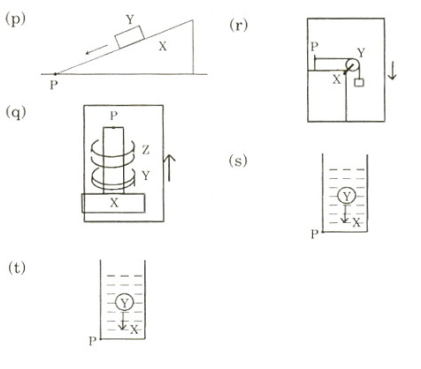
Column $II$ shows five systems in which two objects are labelled as $X$ and $Y$. Also in each case a point $P$ is shown. Column $I$ gives some statements about $X$ and/or $Y$. Match these statements to the appropriate system$(s)$ from Column $II$.
| Column $I$ | Column $II$ |
|---|---|
| $(A)$ The force exerted by $X$ on $Y$ has a magnitude $Mg$. | $(p)$ Block $Y$ of mass $M$ on a fixed inclined plane $X$,slides on it with a constant velocity. |
| $(B)$ The gravitational potential energy of $X$ is continuously increasing. | $(q)$ Two ring magnets $Y$ and $Z$,each of mass $M$,are kept in a frictionless vertical plastic stand. $Y$ rests on base $X$ and $Z$ hangs in equilibrium. The system is in a lift moving up with constant velocity. |
| $(C)$ Mechanical energy of the system $X+Y$ is continuously decreasing. | $(r)$ $A$ pulley $Y$ of mass $m_0$ is fixed to a table $X$. $A$ block of mass $M$ hangs from a string over the pulley,fixed at $P$. The system is in a lift moving down with constant velocity. |
| $(D)$ The torque of the weight of $Y$ about point $P$ is zero. | $(s)$ $A$ sphere $Y$ of mass $M$ is released in a non-viscous liquid $X$ and moves down. |
| $(t)$ $A$ sphere $Y$ of mass $M$ is falling with terminal velocity in a viscous liquid $X$. |
A
$(A) \rightarrow p, t; (B) \rightarrow q; (C) \rightarrow s, t; (D) \rightarrow p, r, s, t$
B
$(A) \rightarrow p, t; (B) \rightarrow q; (C) \rightarrow s, t; (D) \rightarrow p, r, s, t$
C
$(A) \rightarrow p, t; (B) \rightarrow q; (C) \rightarrow s, t; (D) \rightarrow p, r, s, t$
D
$(A) \rightarrow p, t; (B) \rightarrow q; (C) \rightarrow s, t; (D) \rightarrow p, r, s, t$
Solution
(A) Analysis of Column $I$ statements:
$(A)$ Force by $X$ on $Y$ is $Mg$: In $(p)$,$N = Mg \cos \theta \neq Mg$. In $(q)$,$X$ supports $Y$,$N = Mg$. In $(t)$,$X$ exerts buoyant force $F_B < Mg$. In $(r)$,$X$ is a clamp,force is complex. Actually,for $(p)$ and $(t)$,the normal/buoyant force is not $Mg$. Only in $(q)$,$X$ supports $Y$ at rest,so $N=Mg$.
$(B)$ $GPE$ of $X$ increasing: $X$ is the frame/base. In $(q)$,the lift moves up,so $X$ moves up,$GPE$ increases.
$(C)$ Mechanical energy decreasing: Occurs when non-conservative forces (friction/viscosity) do negative work. This happens in $(s)$ (if there were drag) or $(t)$ (viscous drag) and $(p)$ (friction).
$(D)$ Torque of weight of $Y$ about $P$ is zero: If the line of action of weight passes through $P$. In $(p)$,$(r)$,$(s)$,and $(t)$,the geometry allows this.
$(A)$ Force by $X$ on $Y$ is $Mg$: In $(p)$,$N = Mg \cos \theta \neq Mg$. In $(q)$,$X$ supports $Y$,$N = Mg$. In $(t)$,$X$ exerts buoyant force $F_B < Mg$. In $(r)$,$X$ is a clamp,force is complex. Actually,for $(p)$ and $(t)$,the normal/buoyant force is not $Mg$. Only in $(q)$,$X$ supports $Y$ at rest,so $N=Mg$.
$(B)$ $GPE$ of $X$ increasing: $X$ is the frame/base. In $(q)$,the lift moves up,so $X$ moves up,$GPE$ increases.
$(C)$ Mechanical energy decreasing: Occurs when non-conservative forces (friction/viscosity) do negative work. This happens in $(s)$ (if there were drag) or $(t)$ (viscous drag) and $(p)$ (friction).
$(D)$ Torque of weight of $Y$ about $P$ is zero: If the line of action of weight passes through $P$. In $(p)$,$(r)$,$(s)$,and $(t)$,the geometry allows this.
0 likesView Solution
8
PhysicsDifficultMCQIIT JEE · 2009
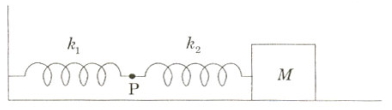
The mass $M$ shown in the figure oscillates in simple harmonic motion with amplitude $A$. The amplitude of the point $P$ is
A
$\frac{k_1 A}{k_2}$
B
$\frac{k_2 A}{k_1}$
C
$\frac{k_1 A}{k_1+k_2}$
D
$\frac{k_2 A}{k_1+k_2}$
Solution
(D) Let the extension in spring $k_1$ be $x_1$ and in spring $k_2$ be $x_2$.
Since the springs are in series,the force $F$ in both springs is the same.
$F = k_1 x_1 = k_2 x_2$
The total amplitude $A$ is the sum of the extensions of the two springs:
$A = x_1 + x_2$
From the force equation,$x_1 = \frac{F}{k_1}$ and $x_2 = \frac{F}{k_2}$.
Substituting these into the amplitude equation:
$A = \frac{F}{k_1} + \frac{F}{k_2} = F \left( \frac{1}{k_1} + \frac{1}{k_2} \right) = F \left( \frac{k_1 + k_2}{k_1 k_2} \right)$
Thus,the force $F$ is given by $F = \frac{k_1 k_2}{k_1 + k_2} A$.
The amplitude of point $P$ is the extension $x_1$ of the first spring:
$x_1 = \frac{F}{k_1} = \frac{1}{k_1} \left( \frac{k_1 k_2}{k_1 + k_2} A \right) = \frac{k_2 A}{k_1 + k_2}$.
Since the springs are in series,the force $F$ in both springs is the same.
$F = k_1 x_1 = k_2 x_2$
The total amplitude $A$ is the sum of the extensions of the two springs:
$A = x_1 + x_2$
From the force equation,$x_1 = \frac{F}{k_1}$ and $x_2 = \frac{F}{k_2}$.
Substituting these into the amplitude equation:
$A = \frac{F}{k_1} + \frac{F}{k_2} = F \left( \frac{1}{k_1} + \frac{1}{k_2} \right) = F \left( \frac{k_1 + k_2}{k_1 k_2} \right)$
Thus,the force $F$ is given by $F = \frac{k_1 k_2}{k_1 + k_2} A$.
The amplitude of point $P$ is the extension $x_1$ of the first spring:
$x_1 = \frac{F}{k_1} = \frac{1}{k_1} \left( \frac{k_1 k_2}{k_1 + k_2} A \right) = \frac{k_2 A}{k_1 + k_2}$.
0 likesView Solution
9
PhysicsDifficultMCQIIT JEE · 2009
$A$ piece of wire is bent in the shape of a parabola $y=kx^2$ ($y$-axis vertical) with a bead of mass $m$ on it. The bead can slide on the wire without friction. It stays at the lowest point of the parabola when the wire is at rest. The wire is now accelerated parallel to the $x$-axis with a constant acceleration $a$. The distance of the new equilibrium position of the bead,where the bead can stay at rest with respect to the wire,from the $y$-axis is
A
$\frac{a}{gk}$
B
$\frac{a}{2gk}$
C
$\frac{2a}{gk}$
D
$\frac{a}{4gk}$
Solution
(B) Step $1$: Choosing the frame of reference and drawing the $FBD$. Solving the problem from the frame of the wire which is accelerating towards the right.
So,a pseudo force on mass $m$ will act in the left direction.
Pseudo force $= m \times a$.
Step $2$: Equilibrium condition.
At the equilibrium position,the acceleration of the bead will be zero in the chosen frame.
Therefore,balancing the forces in the $x$ and $y$ directions,we get:
$N \sin \theta = ma \dots (1)$
$N \cos \theta = mg \dots (2)$
Dividing these two equations,we get:
$\tan \theta = \frac{a}{g} \dots (3)$
Step $3$: Slope of the curve.
The equation of the curve is $y = kx^2$.
The tangent to the curve at the equilibrium point makes an angle $\theta$ with the $x$-axis.
Therefore,the slope of the curve is $\frac{dy}{dx} = \tan \theta$.
$\frac{dy}{dx} = 2kx$.
Equating the slopes: $2kx = \frac{a}{g}$.
Therefore,$x = \frac{a}{2gk}$.
So,a pseudo force on mass $m$ will act in the left direction.
Pseudo force $= m \times a$.
Step $2$: Equilibrium condition.
At the equilibrium position,the acceleration of the bead will be zero in the chosen frame.
Therefore,balancing the forces in the $x$ and $y$ directions,we get:
$N \sin \theta = ma \dots (1)$
$N \cos \theta = mg \dots (2)$
Dividing these two equations,we get:
$\tan \theta = \frac{a}{g} \dots (3)$
Step $3$: Slope of the curve.
The equation of the curve is $y = kx^2$.
The tangent to the curve at the equilibrium point makes an angle $\theta$ with the $x$-axis.
Therefore,the slope of the curve is $\frac{dy}{dx} = \tan \theta$.
$\frac{dy}{dx} = 2kx$.
Equating the slopes: $2kx = \frac{a}{g}$.
Therefore,$x = \frac{a}{2gk}$.
0 likesView Solution
10
PhysicsDifficultMCQIIT JEE · 2009
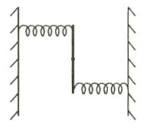
$A$ uniform rod of length $L$ and mass $M$ is pivoted at the centre. Its two ends are attached to two springs of equal spring constants $k$. The springs are fixed to rigid supports as shown in the figure,and the rod is free to oscillate in the horizontal plane. The rod is gently pushed through a small angle $\theta$ in one direction and released. The frequency of oscillation is
A
$\frac{1}{2 \pi} \sqrt{\frac{2 k}{M}}$
B
$\frac{1}{2 \pi} \sqrt{\frac{k}{M}}$
C
$\frac{1}{2 \pi} \sqrt{\frac{6 k}{M}}$
D
$\frac{1}{2 \pi} \sqrt{\frac{24 k}{M}}$
Solution
(C) When the rod is rotated by a small angle $\theta$,the displacement of each spring end is $x = \frac{L}{2} \sin \theta \approx \frac{L}{2} \theta$ for small $\theta$.
Each spring exerts a restoring force $F = kx = k \frac{L}{2} \theta$.
The restoring torque provided by each spring about the center is $\tau = F \cdot \frac{L}{2} = k \left( \frac{L}{2} \theta \right) \frac{L}{2} = \frac{k L^2}{4} \theta$.
Since there are two springs,the total restoring torque is $\tau_{total} = 2 \times \frac{k L^2}{4} \theta = \frac{k L^2}{2} \theta$.
The equation of motion for rotational oscillation is $\tau = I \alpha$,where $I = \frac{M L^2}{12}$ is the moment of inertia of the rod about its center.
So,$\frac{M L^2}{12} \frac{d^2 \theta}{dt^2} = - \frac{k L^2}{2} \theta$.
$\frac{d^2 \theta}{dt^2} = - \left( \frac{6 k}{M} \right) \theta$.
Comparing this with the standard $SHM$ equation $\frac{d^2 \theta}{dt^2} = - \omega^2 \theta$,we get $\omega^2 = \frac{6 k}{M}$,so $\omega = \sqrt{\frac{6 k}{M}}$.
The frequency of oscillation is $f = \frac{\omega}{2 \pi} = \frac{1}{2 \pi} \sqrt{\frac{6 k}{M}}$.
Each spring exerts a restoring force $F = kx = k \frac{L}{2} \theta$.
The restoring torque provided by each spring about the center is $\tau = F \cdot \frac{L}{2} = k \left( \frac{L}{2} \theta \right) \frac{L}{2} = \frac{k L^2}{4} \theta$.
Since there are two springs,the total restoring torque is $\tau_{total} = 2 \times \frac{k L^2}{4} \theta = \frac{k L^2}{2} \theta$.
The equation of motion for rotational oscillation is $\tau = I \alpha$,where $I = \frac{M L^2}{12}$ is the moment of inertia of the rod about its center.
So,$\frac{M L^2}{12} \frac{d^2 \theta}{dt^2} = - \frac{k L^2}{2} \theta$.
$\frac{d^2 \theta}{dt^2} = - \left( \frac{6 k}{M} \right) \theta$.
Comparing this with the standard $SHM$ equation $\frac{d^2 \theta}{dt^2} = - \omega^2 \theta$,we get $\omega^2 = \frac{6 k}{M}$,so $\omega = \sqrt{\frac{6 k}{M}}$.
The frequency of oscillation is $f = \frac{\omega}{2 \pi} = \frac{1}{2 \pi} \sqrt{\frac{6 k}{M}}$.
0 likesView Solution
11
PhysicsDifficultMCQIIT JEE · 2009
$A$ student performed an experiment to measure the speed of sound in air using the resonance air-column method. Two resonances in the air-column were obtained by lowering the water level. The resonance with the shorter air-column is the first resonance and that with the longer air-column is the second resonance. Then,
A
$(A, C)$
B
$(C, D)$
C
$(B, D)$
D
$(A, D)$
Solution
(D) In the resonance tube experiment,the first resonance occurs at length $l_1 \approx \lambda/4 - e$,where $e$ is the end correction. Since $e > 0$,$l_1$ is slightly shorter than $\lambda/4$. Thus,statement $(D)$ is correct.
At the first resonance,the air column is shorter,meaning the damping effect is less compared to the second resonance,resulting in higher intensity of sound. Thus,statement $(A)$ is correct.
Statement $(B)$ is incorrect because the prongs are typically held in a vertical plane to ensure the sound waves propagate down the tube.
Statement $(C)$ is incorrect because the amplitude of vibration of a tuning fork prong is typically in the range of $1 \ mm$,not $1 \ cm$.
At the first resonance,the air column is shorter,meaning the damping effect is less compared to the second resonance,resulting in higher intensity of sound. Thus,statement $(A)$ is correct.
Statement $(B)$ is incorrect because the prongs are typically held in a vertical plane to ensure the sound waves propagate down the tube.
Statement $(C)$ is incorrect because the amplitude of vibration of a tuning fork prong is typically in the range of $1 \ mm$,not $1 \ cm$.
0 likesView Solution
12
PhysicsAdvancedMCQIIT JEE · 2009
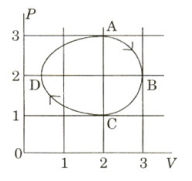
The figure shows the $P-V$ plot of an ideal gas taken through a cycle $ABCDA$. The part $ABC$ is a semi-circle and $CDA$ is half of an ellipse. Then,
$(A)$ the process during the path $A \rightarrow B$ is isothermal
$(B)$ heat flows out of the gas during the path $B \rightarrow C \rightarrow D$
$(C)$ work done during the path $A \rightarrow B \rightarrow C$ is zero
$(D)$ positive work is done by the gas in the cycle $ABCDA$
$(A)$ the process during the path $A \rightarrow B$ is isothermal
$(B)$ heat flows out of the gas during the path $B \rightarrow C \rightarrow D$
$(C)$ work done during the path $A \rightarrow B \rightarrow C$ is zero
$(D)$ positive work is done by the gas in the cycle $ABCDA$
A
$(B,D)$
B
$(C,D)$
C
$(A,B)$
D
$(A,C)$
Solution
(A) The correct options are $(B)$ and $(D)$.
$1$. Analysis of $(A)$: An isothermal process for an ideal gas follows $PV = \text{constant}$, which is a rectangular hyperbola on a $P-V$ diagram, not a circular or elliptical arc. Thus, $(A)$ is incorrect.
$2$. Analysis of $(B)$: For the path $B \rightarrow C \rightarrow D$, the volume decreases ($V$ goes from $3$ to $1$), so the work done by the gas $W = \int P \, dV$ is negative. Also, the temperature $T \propto PV$ decreases from $B$ to $C$ and $C$ to $D$ (as $P$ and $V$ both decrease or stay low), so the change in internal energy $\Delta U$ is negative. From the first law of thermodynamics, $\Delta Q = \Delta U + W$. Since both $\Delta U < 0$ and $W < 0$, the heat $\Delta Q$ must be negative, meaning heat flows out of the gas. Thus, $(B)$ is correct.
$3$. Analysis of $(C)$: The work done during $A \rightarrow B \rightarrow C$ is the area under the curve $ABC$ with the $V$-axis. Since the path $A \rightarrow B \rightarrow C$ involves expansion followed by compression, the net work is the area under the curve, which is clearly non-zero. Thus, $(C)$ is incorrect.
$4$. Analysis of $(D)$: The cycle $ABCDA$ is traversed in a clockwise direction on the $P-V$ diagram. For a clockwise cycle, the net work done by the gas is positive, equal to the area enclosed by the cycle. Thus, $(D)$ is correct.
$1$. Analysis of $(A)$: An isothermal process for an ideal gas follows $PV = \text{constant}$, which is a rectangular hyperbola on a $P-V$ diagram, not a circular or elliptical arc. Thus, $(A)$ is incorrect.
$2$. Analysis of $(B)$: For the path $B \rightarrow C \rightarrow D$, the volume decreases ($V$ goes from $3$ to $1$), so the work done by the gas $W = \int P \, dV$ is negative. Also, the temperature $T \propto PV$ decreases from $B$ to $C$ and $C$ to $D$ (as $P$ and $V$ both decrease or stay low), so the change in internal energy $\Delta U$ is negative. From the first law of thermodynamics, $\Delta Q = \Delta U + W$. Since both $\Delta U < 0$ and $W < 0$, the heat $\Delta Q$ must be negative, meaning heat flows out of the gas. Thus, $(B)$ is correct.
$3$. Analysis of $(C)$: The work done during $A \rightarrow B \rightarrow C$ is the area under the curve $ABC$ with the $V$-axis. Since the path $A \rightarrow B \rightarrow C$ involves expansion followed by compression, the net work is the area under the curve, which is clearly non-zero. Thus, $(C)$ is incorrect.
$4$. Analysis of $(D)$: The cycle $ABCDA$ is traversed in a clockwise direction on the $P-V$ diagram. For a clockwise cycle, the net work done by the gas is positive, equal to the area enclosed by the cycle. Thus, $(D)$ is correct.
0 likesView Solution
13
PhysicsDifficultMCQIIT JEE · 2009
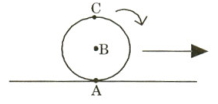
$A$ sphere is rolling without slipping on a fixed horizontal plane surface. In the figure,$A$ is the point of contact,$B$ is the centre of the sphere and $C$ is its topmost point. Then,
$(A)$ $\vec{V}_C-\vec{V}_A=2(\vec{V}_B-\vec{V}_C)$
$(B)$ $\vec{V}_C-\vec{V}_B=\vec{V}_B-\vec{V}_A$
$(C)$ $|\vec{V}_C-\vec{V}_A|=2|\vec{V}_B-\vec{V}_C|$
$(D)$ $|\vec{V}_C-\vec{V}_A|=4|\vec{V}_B|$
$(A)$ $\vec{V}_C-\vec{V}_A=2(\vec{V}_B-\vec{V}_C)$
$(B)$ $\vec{V}_C-\vec{V}_B=\vec{V}_B-\vec{V}_A$
$(C)$ $|\vec{V}_C-\vec{V}_A|=2|\vec{V}_B-\vec{V}_C|$
$(D)$ $|\vec{V}_C-\vec{V}_A|=4|\vec{V}_B|$
A
$(B, C)$
B
$(B, D)$
C
$(A, C)$
D
$(A, D)$
Solution
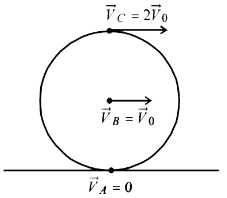
(C) Let $\vec{V}_0$ be the velocity of the centre of the sphere. For a sphere rolling without slipping on a fixed horizontal surface:
$\vec{V}_A = 0$ (velocity of the point of contact)
$\vec{V}_B = \vec{V}_0$ (velocity of the centre)
$\vec{V}_C = 2\vec{V}_0$ (velocity of the topmost point)
Now,let's evaluate the given options:
For $(B)$: $\vec{V}_C - \vec{V}_B = 2\vec{V}_0 - \vec{V}_0 = \vec{V}_0$ and $\vec{V}_B - \vec{V}_A = \vec{V}_0 - 0 = \vec{V}_0$. Thus,$\vec{V}_C - \vec{V}_B = \vec{V}_B - \vec{V}_A$ is correct.
For $(C)$: $|\vec{V}_C - \vec{V}_A| = |2\vec{V}_0 - 0| = 2|\vec{V}_0|$ and $2|\vec{V}_B - \vec{V}_C| = 2|\vec{V}_0 - 2\vec{V}_0| = 2|-\vec{V}_0| = 2|\vec{V}_0|$. Thus,$|\vec{V}_C - \vec{V}_A| = 2|\vec{V}_B - \vec{V}_C|$ is correct.
Therefore,both $(B)$ and $(C)$ are correct statements.
$\vec{V}_A = 0$ (velocity of the point of contact)
$\vec{V}_B = \vec{V}_0$ (velocity of the centre)
$\vec{V}_C = 2\vec{V}_0$ (velocity of the topmost point)
Now,let's evaluate the given options:
For $(B)$: $\vec{V}_C - \vec{V}_B = 2\vec{V}_0 - \vec{V}_0 = \vec{V}_0$ and $\vec{V}_B - \vec{V}_A = \vec{V}_0 - 0 = \vec{V}_0$. Thus,$\vec{V}_C - \vec{V}_B = \vec{V}_B - \vec{V}_A$ is correct.
For $(C)$: $|\vec{V}_C - \vec{V}_A| = |2\vec{V}_0 - 0| = 2|\vec{V}_0|$ and $2|\vec{V}_B - \vec{V}_C| = 2|\vec{V}_0 - 2\vec{V}_0| = 2|-\vec{V}_0| = 2|\vec{V}_0|$. Thus,$|\vec{V}_C - \vec{V}_A| = 2|\vec{V}_B - \vec{V}_C|$ is correct.
Therefore,both $(B)$ and $(C)$ are correct statements.
0 likesView Solution
14
PhysicsDifficultMCQIIT JEE · 2009
$A$ metal rod $AB$ of length $10x$ has its one end $A$ in ice at $0^{\circ}C$ and the other end $B$ in water at $100^{\circ}C$. If a point $P$ on the rod is maintained at $400^{\circ}C$,then it is found that equal amounts of water and ice evaporate and melt per unit time. The latent heat of evaporation of water is $540 \ cal/g$ and latent heat of melting of ice is $80 \ cal/g$. If the point $P$ is at a distance of $\lambda x$ from the ice end $A$,find the value of $\lambda$. (Neglect any heat loss to the surrounding.)
A
$4$
B
$9$
C
$5$
D
$2$
Solution
(B) Let $m$ be the mass of ice that melts and the mass of water that evaporates per unit time.
The heat flow rate required to melt ice at $A$ is $H_1 = m \times L_f = m \times 80$.
The heat flow rate required to evaporate water at $B$ is $H_2 = m \times L_v = m \times 540$.
Using the formula for heat conduction $H = \frac{KA \Delta T}{L}$,we have:
For segment $AP$: $H_1 = \frac{KA(400 - 0)}{\lambda x} = 80m \quad \dots(1)$
For segment $PB$: $H_2 = \frac{KA(400 - 100)}{(10 - \lambda)x} = 540m \quad \dots(2)$
Dividing equation $(1)$ by equation $(2)$:
$\frac{80m}{540m} = \frac{KA(400) / \lambda x}{KA(300) / (10 - \lambda)x}$
$\frac{8}{54} = \frac{400}{300} \times \frac{10 - \lambda}{\lambda}$
$\frac{4}{27} = \frac{4}{3} \times \frac{10 - \lambda}{\lambda}$
$\frac{1}{9} = \frac{10 - \lambda}{\lambda}$
$\lambda = 90 - 9\lambda$
$10\lambda = 90$
$\lambda = 9$.
The heat flow rate required to melt ice at $A$ is $H_1 = m \times L_f = m \times 80$.
The heat flow rate required to evaporate water at $B$ is $H_2 = m \times L_v = m \times 540$.
Using the formula for heat conduction $H = \frac{KA \Delta T}{L}$,we have:
For segment $AP$: $H_1 = \frac{KA(400 - 0)}{\lambda x} = 80m \quad \dots(1)$
For segment $PB$: $H_2 = \frac{KA(400 - 100)}{(10 - \lambda)x} = 540m \quad \dots(2)$
Dividing equation $(1)$ by equation $(2)$:
$\frac{80m}{540m} = \frac{KA(400) / \lambda x}{KA(300) / (10 - \lambda)x}$
$\frac{8}{54} = \frac{400}{300} \times \frac{10 - \lambda}{\lambda}$
$\frac{4}{27} = \frac{4}{3} \times \frac{10 - \lambda}{\lambda}$
$\frac{1}{9} = \frac{10 - \lambda}{\lambda}$
$\lambda = 90 - 9\lambda$
$10\lambda = 90$
$\lambda = 9$.
0 likesView Solution
15
PhysicsDifficultMCQIIT JEE · 2009
$A$ cylindrical vessel of height $500 \ mm$ has an orifice (small hole) at its bottom. The orifice is initially closed and water is filled in it up to height $H$. Now the top is completely sealed with a cap and the orifice at the bottom is opened. Some water comes out from the orifice and the water level in the vessel becomes steady with the height of the water column being $200 \ mm$. Find the fall in height (in $mm$) of the water level due to the opening of the orifice.
[Take atmospheric pressure $= 1.0 \times 10^5 \ N/m^2$,density of water $= 1000 \ kg/m^3$ and $g = 10 \ m/s^2$. Neglect any effect of surface tension.]
[Take atmospheric pressure $= 1.0 \times 10^5 \ N/m^2$,density of water $= 1000 \ kg/m^3$ and $g = 10 \ m/s^2$. Neglect any effect of surface tension.]
A
$6$
B
$5$
C
$4$
D
$3$
Solution
(A) Let $A$ be the cross-sectional area of the vessel and $L = 500 \ mm = 0.5 \ m$ be the total height of the vessel.
Initially,the water is filled to height $H$. The air volume above the water is $V_0 = A(L - H)$ at atmospheric pressure $P_0 = 10^5 \ N/m^2$.
When the orifice is opened,water flows out until the pressure at the bottom orifice equals the atmospheric pressure $P_0$. Let the final height of the water column be $h = 200 \ mm = 0.2 \ m$.
The pressure of the air trapped above the water $P$ is given by $P + \rho gh = P_0$.
$P = 10^5 - (1000)(10)(0.2) = 10^5 - 2000 = 98000 \ N/m^2 = 98 \times 10^3 \ N/m^2$.
Since the process is isothermal,$P_0 V_0 = P V_f$,where $V_f = A(L - h)$ is the final volume of air.
$10^5 \times A(0.5 - H) = 98 \times 10^3 \times A(0.5 - 0.2)$.
$100(0.5 - H) = 98(0.3)$.
$0.5 - H = 0.294$.
$H = 0.5 - 0.294 = 0.206 \ m = 206 \ mm$.
The fall in height of the water level is $H - h = 206 \ mm - 200 \ mm = 6 \ mm$.
Initially,the water is filled to height $H$. The air volume above the water is $V_0 = A(L - H)$ at atmospheric pressure $P_0 = 10^5 \ N/m^2$.
When the orifice is opened,water flows out until the pressure at the bottom orifice equals the atmospheric pressure $P_0$. Let the final height of the water column be $h = 200 \ mm = 0.2 \ m$.
The pressure of the air trapped above the water $P$ is given by $P + \rho gh = P_0$.
$P = 10^5 - (1000)(10)(0.2) = 10^5 - 2000 = 98000 \ N/m^2 = 98 \times 10^3 \ N/m^2$.
Since the process is isothermal,$P_0 V_0 = P V_f$,where $V_f = A(L - h)$ is the final volume of air.
$10^5 \times A(0.5 - H) = 98 \times 10^3 \times A(0.5 - 0.2)$.
$100(0.5 - H) = 98(0.3)$.
$0.5 - H = 0.294$.
$H = 0.5 - 0.294 = 0.206 \ m = 206 \ mm$.
The fall in height of the water level is $H - h = 206 \ mm - 200 \ mm = 6 \ mm$.
0 likesView Solution
16
PhysicsDifficultMCQIIT JEE · 2009
Two soap bubbles $A$ and $B$ are kept in a closed chamber where the air is maintained at pressure $8 \ N/m^2$. The radii of bubbles $A$ and $B$ are $2 \ cm$ and $4 \ cm$,respectively. The surface tension of the soap solution is $0.04 \ N/m$. Find the ratio $n_B / n_A$,where $n_A$ and $n_B$ are the number of moles of air in bubbles $A$ and $B$,respectively. [Neglect the effect of gravity.]
A
$4$
B
$6$
C
$7$
D
$8$
Solution
(B) The pressure inside a soap bubble is given by $P = P_0 + \frac{4T}{r}$,where $P_0 = 8 \ N/m^2$ is the external pressure,$T = 0.04 \ N/m$ is the surface tension,and $r$ is the radius.
For bubble $A$ $(r_A = 0.02 \ m)$: $P_A = 8 + \frac{4 \times 0.04}{0.02} = 8 + 8 = 16 \ N/m^2$.
For bubble $B$ $(r_B = 0.04 \ m)$: $P_B = 8 + \frac{4 \times 0.04}{0.04} = 8 + 4 = 12 \ N/m^2$.
Using the ideal gas law $PV = nRT$,and assuming temperature $T$ is constant,$n = \frac{PV}{RT}$.
For bubble $A$: $n_A = \frac{P_A V_A}{RT} = \frac{16 \times \frac{4}{3} \pi (0.02)^3}{RT}$.
For bubble $B$: $n_B = \frac{P_B V_B}{RT} = \frac{12 \times \frac{4}{3} \pi (0.04)^3}{RT}$.
Taking the ratio $\frac{n_B}{n_A} = \frac{12 \times (0.04)^3}{16 \times (0.02)^3} = \frac{12}{16} \times (2)^3 = \frac{3}{4} \times 8 = 6$.
For bubble $A$ $(r_A = 0.02 \ m)$: $P_A = 8 + \frac{4 \times 0.04}{0.02} = 8 + 8 = 16 \ N/m^2$.
For bubble $B$ $(r_B = 0.04 \ m)$: $P_B = 8 + \frac{4 \times 0.04}{0.04} = 8 + 4 = 12 \ N/m^2$.
Using the ideal gas law $PV = nRT$,and assuming temperature $T$ is constant,$n = \frac{PV}{RT}$.
For bubble $A$: $n_A = \frac{P_A V_A}{RT} = \frac{16 \times \frac{4}{3} \pi (0.02)^3}{RT}$.
For bubble $B$: $n_B = \frac{P_B V_B}{RT} = \frac{12 \times \frac{4}{3} \pi (0.04)^3}{RT}$.
Taking the ratio $\frac{n_B}{n_A} = \frac{12 \times (0.04)^3}{16 \times (0.02)^3} = \frac{12}{16} \times (2)^3 = \frac{3}{4} \times 8 = 6$.
0 likesView Solution
17
PhysicsDifficultMCQIIT JEE · 2009
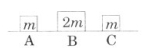
Three objects $A$,$B$,and $C$ are kept in a straight line on a frictionless horizontal surface. These have masses $m$,$2m$,and $m$,respectively. The object $A$ moves towards $B$ with a speed of $9 \ m/s$ and makes an elastic collision with it. Thereafter,$B$ makes a completely inelastic collision with $C$. All motions occur on the same straight line. Find the final speed (in $m/s$) of the object $C$.
A
$9$
B
$5$
C
$4$
D
$6$
Solution
(C) Step $1$: Elastic collision between $A$ and $B$.
Let $v_A = 9 \ m/s$ and $v_B = 0$. After the collision,let the velocities be $v_A'$ and $v_B'$.
By conservation of momentum: $m(9) + 2m(0) = m v_A' + 2m v_B' \Rightarrow 9 = v_A' + 2v_B'$.
By the coefficient of restitution for an elastic collision $(e=1)$: $v_B' - v_A' = e(v_A - v_B) = 1(9 - 0) = 9 \Rightarrow v_B' - v_A' = 9$.
Adding the two equations: $(v_A' + 2v_B') + (v_B' - v_A') = 9 + 9 \Rightarrow 3v_B' = 18 \Rightarrow v_B' = 6 \ m/s$.
Step $2$: Completely inelastic collision between $B$ and $C$.
Let $v_B' = 6 \ m/s$ and $v_C = 0$. After the collision,$B$ and $C$ move together with velocity $v_f$.
By conservation of momentum: $2m(v_B') + m(0) = (2m + m)v_f \Rightarrow 2m(6) = 3m v_f \Rightarrow 12 = 3v_f \Rightarrow v_f = 4 \ m/s$.
Thus,the final speed of object $C$ is $4 \ m/s$.
Let $v_A = 9 \ m/s$ and $v_B = 0$. After the collision,let the velocities be $v_A'$ and $v_B'$.
By conservation of momentum: $m(9) + 2m(0) = m v_A' + 2m v_B' \Rightarrow 9 = v_A' + 2v_B'$.
By the coefficient of restitution for an elastic collision $(e=1)$: $v_B' - v_A' = e(v_A - v_B) = 1(9 - 0) = 9 \Rightarrow v_B' - v_A' = 9$.
Adding the two equations: $(v_A' + 2v_B') + (v_B' - v_A') = 9 + 9 \Rightarrow 3v_B' = 18 \Rightarrow v_B' = 6 \ m/s$.
Step $2$: Completely inelastic collision between $B$ and $C$.
Let $v_B' = 6 \ m/s$ and $v_C = 0$. After the collision,$B$ and $C$ move together with velocity $v_f$.
By conservation of momentum: $2m(v_B') + m(0) = (2m + m)v_f \Rightarrow 2m(6) = 3m v_f \Rightarrow 12 = 3v_f \Rightarrow v_f = 4 \ m/s$.
Thus,the final speed of object $C$ is $4 \ m/s$.
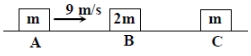
0 likesView Solution
18
PhysicsDifficultMCQIIT JEE · 2009
$A$ light inextensible string that goes over a smooth fixed pulley as shown in the figure connects two blocks of masses $m_1 = 0.36 \text{ kg}$ and $m_2 = 0.72 \text{ kg}$. Taking $g = 10 \text{ m/s}^2$,find the work done (in joules) by the string on the block of mass $0.36 \text{ kg}$ during the first second after the system is released from rest.

A
$5$
B
$6$
C
$8$
D
$9$
Solution
(C) Let $m_1 = 0.36 \text{ kg}$ and $m_2 = 0.72 \text{ kg}$.
For the block of mass $m_2$,the equation of motion is: $m_2 g - T = m_2 a$.
For the block of mass $m_1$,the equation of motion is: $T - m_1 g = m_1 a$.
Adding these two equations: $(m_2 - m_1) g = (m_1 + m_2) a$.
$a = \frac{(m_2 - m_1) g}{m_1 + m_2} = \frac{(0.72 - 0.36) \times 10}{0.72 + 0.36} = \frac{0.36 \times 10}{1.08} = \frac{3.6}{1.08} = \frac{10}{3} \text{ m/s}^2$.
The tension $T$ is given by: $T = m_1(g + a) = 0.36 \times (10 + \frac{10}{3}) = 0.36 \times \frac{40}{3} = 0.12 \times 40 = 4.8 \text{ N}$.
The displacement $s$ in $t = 1 \text{ s}$ starting from rest is: $s = \frac{1}{2} a t^2 = \frac{1}{2} \times \frac{10}{3} \times (1)^2 = \frac{5}{3} \text{ m}$.
The work done by the string on the block of mass $m_1$ is: $W = T \times s = 4.8 \times \frac{5}{3} = 1.6 \times 5 = 8 \text{ J}$.
For the block of mass $m_2$,the equation of motion is: $m_2 g - T = m_2 a$.
For the block of mass $m_1$,the equation of motion is: $T - m_1 g = m_1 a$.
Adding these two equations: $(m_2 - m_1) g = (m_1 + m_2) a$.
$a = \frac{(m_2 - m_1) g}{m_1 + m_2} = \frac{(0.72 - 0.36) \times 10}{0.72 + 0.36} = \frac{0.36 \times 10}{1.08} = \frac{3.6}{1.08} = \frac{10}{3} \text{ m/s}^2$.
The tension $T$ is given by: $T = m_1(g + a) = 0.36 \times (10 + \frac{10}{3}) = 0.36 \times \frac{40}{3} = 0.12 \times 40 = 4.8 \text{ N}$.
The displacement $s$ in $t = 1 \text{ s}$ starting from rest is: $s = \frac{1}{2} a t^2 = \frac{1}{2} \times \frac{10}{3} \times (1)^2 = \frac{5}{3} \text{ m}$.
The work done by the string on the block of mass $m_1$ is: $W = T \times s = 4.8 \times \frac{5}{3} = 1.6 \times 5 = 8 \text{ J}$.
0 likesView Solution
19
PhysicsDifficultMCQIIT JEE · 2009
$A$ $20 \ cm$ long string,having a mass of $1.0 \ g$,is fixed at both the ends. The tension in the string is $0.5 \ N$. The string is set into vibrations using an external vibrator of frequency $100 \ Hz$. Find the separation (in $cm$) between the successive nodes on the string.
A
$5$
B
$6$
C
$7$
D
$8$
Solution
(A) The velocity of a wave in a string is given by $v = \sqrt{\frac{T}{\mu}}$,where $T$ is the tension in the string and $\mu$ is the mass per unit length of the string.
Given: $T = 0.5 \ N$,mass $m = 1.0 \ g = 1.0 \times 10^{-3} \ kg$,and length $L = 20 \ cm = 0.2 \ m$.
The linear mass density $\mu = \frac{m}{L} = \frac{1.0 \times 10^{-3} \ kg}{0.2 \ m} = 0.5 \times 10^{-2} \ kg/m$.
Substituting these values into the velocity formula:
$v = \sqrt{\frac{0.5}{0.5 \times 10^{-2}}} = \sqrt{100} = 10 \ m/s$.
The wavelength $\lambda$ is given by $\lambda = \frac{v}{f}$,where $f = 100 \ Hz$.
$\lambda = \frac{10 \ m/s}{100 \ Hz} = 0.1 \ m = 10 \ cm$.
The separation between successive nodes in a stationary wave is $\frac{\lambda}{2}$.
Therefore,the separation $= \frac{10 \ cm}{2} = 5 \ cm$.
Given: $T = 0.5 \ N$,mass $m = 1.0 \ g = 1.0 \times 10^{-3} \ kg$,and length $L = 20 \ cm = 0.2 \ m$.
The linear mass density $\mu = \frac{m}{L} = \frac{1.0 \times 10^{-3} \ kg}{0.2 \ m} = 0.5 \times 10^{-2} \ kg/m$.
Substituting these values into the velocity formula:
$v = \sqrt{\frac{0.5}{0.5 \times 10^{-2}}} = \sqrt{100} = 10 \ m/s$.
The wavelength $\lambda$ is given by $\lambda = \frac{v}{f}$,where $f = 100 \ Hz$.
$\lambda = \frac{10 \ m/s}{100 \ Hz} = 0.1 \ m = 10 \ cm$.
The separation between successive nodes in a stationary wave is $\frac{\lambda}{2}$.
Therefore,the separation $= \frac{10 \ cm}{2} = 5 \ cm$.
0 likesView Solution
20
PhysicsMediumMCQIIT JEE · 2009
Three concentric metallic spherical shells of radii $R, 2R, 3R$ are given charges $Q_1, Q_2, Q_3$ respectively. It is found that the surface charge densities on the outer surfaces of the shells are equal. Then,the ratio of the charges given to the shells,$Q_1 : Q_2 : Q_3$,is
A
$1 : 2 : 3$
B
$1 : 4 : 9$
C
$1 : 3 : 5$
D
$1 : 8 : 18$
Solution
(B) Let the surface charge densities on the shells be $\sigma_1, \sigma_2, \sigma_3$ respectively.
Given that $\sigma_1 = \sigma_2 = \sigma_3 = \sigma$.
The surface charge density is defined as $\sigma = \frac{Q}{A}$,where $A = 4\pi r^2$ is the surface area of the sphere.
For the first shell: $Q_1 = \sigma \cdot 4\pi R^2$.
For the second shell: $Q_2 = \sigma \cdot 4\pi (2R)^2 = \sigma \cdot 16\pi R^2$.
For the third shell: $Q_3 = \sigma \cdot 4\pi (3R)^2 = \sigma \cdot 36\pi R^2$.
Now,the ratio $Q_1 : Q_2 : Q_3$ is:
$Q_1 : Q_2 : Q_3 = (\sigma \cdot 4\pi R^2) : (\sigma \cdot 16\pi R^2) : (\sigma \cdot 36\pi R^2)$.
Dividing by $4\pi R^2$,we get:
$Q_1 : Q_2 : Q_3 = 1 : 4 : 9$.
Given that $\sigma_1 = \sigma_2 = \sigma_3 = \sigma$.
The surface charge density is defined as $\sigma = \frac{Q}{A}$,where $A = 4\pi r^2$ is the surface area of the sphere.
For the first shell: $Q_1 = \sigma \cdot 4\pi R^2$.
For the second shell: $Q_2 = \sigma \cdot 4\pi (2R)^2 = \sigma \cdot 16\pi R^2$.
For the third shell: $Q_3 = \sigma \cdot 4\pi (3R)^2 = \sigma \cdot 36\pi R^2$.
Now,the ratio $Q_1 : Q_2 : Q_3$ is:
$Q_1 : Q_2 : Q_3 = (\sigma \cdot 4\pi R^2) : (\sigma \cdot 16\pi R^2) : (\sigma \cdot 36\pi R^2)$.
Dividing by $4\pi R^2$,we get:
$Q_1 : Q_2 : Q_3 = 1 : 4 : 9$.
0 likesView Solution
21
PhysicsDifficultMCQIIT JEE · 2009
$A$ ball is dropped from a height of $20 \,m$ above the surface of water in a lake. The refractive index of water is $4/3$. $A$ fish inside the lake, in the line of fall of the ball, is looking at the ball. At an instant, when the ball is $12.8 \,m$ above the water surface, the fish sees the speed of the ball as (Take $g = 10 \,m/s^2$): (in $\,m/s$)
A
$9$
B
$12$
C
$16$
D
$21.33$
Solution
(C) Let $h$ be the height of the ball above the water surface. The velocity of the ball at height $h$ is given by $v_b = \sqrt{2g(H - h)}$, where $H = 20 \,m$ is the initial height and $h = 12.8 \,m$.
$v_b = \sqrt{2 \times 10 \times (20 - 12.8)} = \sqrt{20 \times 7.2} = \sqrt{144} = 12 \,m/s$.
When an object is in a rarer medium (air) and viewed from a denser medium (water), the apparent height $h'$ is given by $h' = \mu h$, where $\mu = 4/3$ is the refractive index of water.
Therefore, the apparent velocity $v_a$ as seen by the fish is $v_a = \frac{d}{dt}(h') = \mu \frac{dh}{dt} = \mu v_b$.
$v_a = (4/3) \times 12 \,m/s = 16 \,m/s$.
$v_b = \sqrt{2 \times 10 \times (20 - 12.8)} = \sqrt{20 \times 7.2} = \sqrt{144} = 12 \,m/s$.
When an object is in a rarer medium (air) and viewed from a denser medium (water), the apparent height $h'$ is given by $h' = \mu h$, where $\mu = 4/3$ is the refractive index of water.
Therefore, the apparent velocity $v_a$ as seen by the fish is $v_a = \frac{d}{dt}(h') = \mu \frac{dh}{dt} = \mu v_b$.
$v_a = (4/3) \times 12 \,m/s = 16 \,m/s$.
0 likesView Solution
22
PhysicsDifficultMCQIIT JEE · 2009
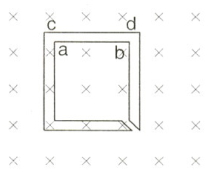
The figure shows certain wire segments joined together to form a coplanar loop. The loop is placed in a perpendicular magnetic field in the direction going into the plane of the figure. The magnitude of the field increases with time. $I_1$ and $I_2$ are the currents in the segments $ab$ and $cd$. Then,
A
$I_1 > I_2$
B
$I_1 < I_2$
C
$I_1$ is in the direction $ba$ and $I_2$ is in the direction $ed$
D
$I_1$ is in the direction $ab$ and $I_2$ is in the direction $de$
Solution
(C) According to Lenz's law,the induced current will oppose the change in magnetic flux.
The magnetic field is directed into the plane of the paper and its magnitude is increasing with time,so the magnetic flux through the loop is increasing into the plane.
To oppose this increase,the induced magnetic field must be directed out of the plane of the paper.
Using the right-hand thumb rule,an induced magnetic field directed out of the plane corresponds to an anticlockwise induced current in the loop.
Following the anticlockwise path in the loop,the current flows from $b$ to $a$ in segment $ab$ and from $c$ to $d$ in segment $cd$ (or $d$ to $c$ depending on the specific loop geometry shown).
Looking at the provided options and the loop structure,the current flows in an anticlockwise direction. Thus,in segment $ab$,the current is from $b$ to $a$,and in segment $cd$,the current is from $c$ to $d$. Since the question asks for the direction,and based on the standard interpretation of such problems,the correct choice is that the current flows anticlockwise.
The magnetic field is directed into the plane of the paper and its magnitude is increasing with time,so the magnetic flux through the loop is increasing into the plane.
To oppose this increase,the induced magnetic field must be directed out of the plane of the paper.
Using the right-hand thumb rule,an induced magnetic field directed out of the plane corresponds to an anticlockwise induced current in the loop.
Following the anticlockwise path in the loop,the current flows from $b$ to $a$ in segment $ab$ and from $c$ to $d$ in segment $cd$ (or $d$ to $c$ depending on the specific loop geometry shown).
Looking at the provided options and the loop structure,the current flows in an anticlockwise direction. Thus,in segment $ab$,the current is from $b$ to $a$,and in segment $cd$,the current is from $c$ to $d$. Since the question asks for the direction,and based on the standard interpretation of such problems,the correct choice is that the current flows anticlockwise.
0 likesView Solution
23
PhysicsAdvancedMCQIIT JEE · 2009
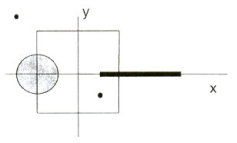
$A$ disk of radius $a/4$ having a uniformly distributed charge $6 \text{ C}$ is placed in the $x-y$ plane with its centre at $(-a/2, 0, 0)$. $A$ rod of length $a$ carrying a uniformly distributed charge $8 \text{ C}$ is placed on the $x$-axis from $x = a/4$ to $x = 5a/4$. Two point charges $-7 \text{ C}$ and $3 \text{ C}$ are placed at $(a/4, -a/4, 0)$ and $(-3a/4, 3a/4, 0)$,respectively. Consider a cubical surface formed by six surfaces $x = \pm a/2, y = \pm a/2, z = \pm a/2$. The electric flux through this cubical surface is
A
$\frac{-2 \text{ C}}{\varepsilon_0}$
B
$\frac{2 \text{ C}}{\varepsilon_0}$
C
$\frac{10 \text{ C}}{\varepsilon_0}$
D
$\frac{12 \text{ C}}{\varepsilon_0}$
Solution
(A) According to Gauss's Law,the electric flux $\phi$ through a closed surface is given by $\phi = \frac{Q_{\text{enclosed}}}{\varepsilon_0}$.
$1$. Disk: The disk has radius $a/4$ and center at $(-a/2, 0, 0)$. The cube extends from $x = -a/2$ to $x = a/2$. Since the disk is in the $x-y$ plane,only the part of the disk with $x > -a/2$ is inside the cube. The disk spans from $x = -a/2 - a/4 = -3a/4$ to $x = -a/2 + a/4 = -a/4$. The portion inside the cube is from $x = -a/2$ to $x = -a/4$. By symmetry,exactly half of the disk is inside the cube. Thus,$Q_{\text{disk, enclosed}} = 6 \text{ C} / 2 = 3 \text{ C}$.
$2$. Rod: The rod spans from $x = a/4$ to $x = 5a/4$. The cube boundary is at $x = a/2$. The portion of the rod inside the cube is from $x = a/4$ to $x = a/2$. The length of the rod inside the cube is $a/2 - a/4 = a/4$. Since the total length is $a$,the fraction of charge inside is $(a/4) / a = 1/4$. Thus,$Q_{\text{rod, enclosed}} = 8 \text{ C} \times (1/4) = 2 \text{ C}$.
$3$. Point charges: The point charge $-7 \text{ C}$ is at $(a/4, -a/4, 0)$,which is inside the cube (since $|a/4| < a/2$ and $|-a/4| < a/2$). The point charge $3 \text{ C}$ is at $(-3a/4, 3a/4, 0)$,which is outside the cube (since $|-3a/4| > a/2$).
$4$. Total enclosed charge: $Q_{\text{enclosed}} = 3 \text{ C} + 2 \text{ C} - 7 \text{ C} = -2 \text{ C}$.
Therefore,the electric flux is $\phi = \frac{-2 \text{ C}}{\varepsilon_0}$.
$1$. Disk: The disk has radius $a/4$ and center at $(-a/2, 0, 0)$. The cube extends from $x = -a/2$ to $x = a/2$. Since the disk is in the $x-y$ plane,only the part of the disk with $x > -a/2$ is inside the cube. The disk spans from $x = -a/2 - a/4 = -3a/4$ to $x = -a/2 + a/4 = -a/4$. The portion inside the cube is from $x = -a/2$ to $x = -a/4$. By symmetry,exactly half of the disk is inside the cube. Thus,$Q_{\text{disk, enclosed}} = 6 \text{ C} / 2 = 3 \text{ C}$.
$2$. Rod: The rod spans from $x = a/4$ to $x = 5a/4$. The cube boundary is at $x = a/2$. The portion of the rod inside the cube is from $x = a/4$ to $x = a/2$. The length of the rod inside the cube is $a/2 - a/4 = a/4$. Since the total length is $a$,the fraction of charge inside is $(a/4) / a = 1/4$. Thus,$Q_{\text{rod, enclosed}} = 8 \text{ C} \times (1/4) = 2 \text{ C}$.
$3$. Point charges: The point charge $-7 \text{ C}$ is at $(a/4, -a/4, 0)$,which is inside the cube (since $|a/4| < a/2$ and $|-a/4| < a/2$). The point charge $3 \text{ C}$ is at $(-3a/4, 3a/4, 0)$,which is outside the cube (since $|-3a/4| > a/2$).
$4$. Total enclosed charge: $Q_{\text{enclosed}} = 3 \text{ C} + 2 \text{ C} - 7 \text{ C} = -2 \text{ C}$.
Therefore,the electric flux is $\phi = \frac{-2 \text{ C}}{\varepsilon_0}$.
0 likesView Solution
24
PhysicsDifficultMCQIIT JEE · 2009
$A$ student performed the experiment of determination of focal length of a concave mirror by $u-v$ method using an optical bench of length $1.5 \ m$. The focal length of the mirror used is $24 \ cm$. The maximum error in the location of the image can be $0.2 \ cm$. The $5$ sets of $(u, v)$ values recorded by the student (in $cm$) are: $(42, 56), (48, 48), (60, 40), (66, 33), (78, 39)$. The data set$(s)$ that cannot come from the experiment and is (are) incorrectly recorded,is (are):
$(A) (42, 56)$
$(B) (48, 48)$
$(C) (66, 33)$
$(D) (78, 39)$
$(A) (42, 56)$
$(B) (48, 48)$
$(C) (66, 33)$
$(D) (78, 39)$
A
$(B, D)$
B
$(C, A)$
C
$(C, D)$
D
$(A, B)$
Solution
(C) For a concave mirror,the focal length $f = -24 \ cm$. The mirror formula is $\frac{1}{v} + \frac{1}{u} = \frac{1}{f}$,which gives $v = \frac{uf}{u-f}$.
We check the recorded values against the theoretical values calculated using the mirror formula:
$1$. For $u = -42 \ cm$: $v = \frac{(-42)(-24)}{-42+24} = \frac{1008}{-18} = -56 \ cm$. (Matches)
$2$. For $u = -48 \ cm$: $v = \frac{(-48)(-24)}{-48+24} = \frac{1152}{-24} = -48 \ cm$. (Matches)
$3$. For $u = -60 \ cm$: $v = \frac{(-60)(-24)}{-60+24} = \frac{1440}{-36} = -40 \ cm$. (Matches)
$4$. For $u = -66 \ cm$: $v = \frac{(-66)(-24)}{-66+24} = \frac{1584}{-42} \approx -37.71 \ cm$. The recorded value is $33 \ cm$. The difference $|37.71 - 33| = 4.71 \ cm$,which is much greater than the error limit of $0.2 \ cm$.
$5$. For $u = -78 \ cm$: $v = \frac{(-78)(-24)}{-78+24} = \frac{1872}{-54} \approx -34.66 \ cm$. The recorded value is $39 \ cm$. The difference $|34.66 - 39| = 4.34 \ cm$,which is much greater than the error limit of $0.2 \ cm$.
Thus,the data sets $(66, 33)$ and $(78, 39)$ are incorrectly recorded.
We check the recorded values against the theoretical values calculated using the mirror formula:
$1$. For $u = -42 \ cm$: $v = \frac{(-42)(-24)}{-42+24} = \frac{1008}{-18} = -56 \ cm$. (Matches)
$2$. For $u = -48 \ cm$: $v = \frac{(-48)(-24)}{-48+24} = \frac{1152}{-24} = -48 \ cm$. (Matches)
$3$. For $u = -60 \ cm$: $v = \frac{(-60)(-24)}{-60+24} = \frac{1440}{-36} = -40 \ cm$. (Matches)
$4$. For $u = -66 \ cm$: $v = \frac{(-66)(-24)}{-66+24} = \frac{1584}{-42} \approx -37.71 \ cm$. The recorded value is $33 \ cm$. The difference $|37.71 - 33| = 4.71 \ cm$,which is much greater than the error limit of $0.2 \ cm$.
$5$. For $u = -78 \ cm$: $v = \frac{(-78)(-24)}{-78+24} = \frac{1872}{-54} \approx -34.66 \ cm$. The recorded value is $39 \ cm$. The difference $|34.66 - 39| = 4.34 \ cm$,which is much greater than the error limit of $0.2 \ cm$.
Thus,the data sets $(66, 33)$ and $(78, 39)$ are incorrectly recorded.
0 likesView Solution
25
PhysicsDifficultMCQIIT JEE · 2009
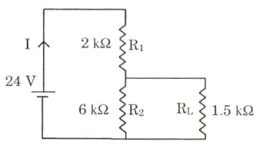
For the circuit shown in the figure:
$(A)$ The current $I$ through the battery is $7.5 \text{ mA}$.
$(B)$ The potential difference across $R_L$ is $18 \text{ V}$.
$(C)$ The ratio of powers dissipated in $R_1$ and $R_2$ is $3$.
$(D)$ If $R_1$ and $R_2$ are interchanged,the magnitude of the power dissipated in $R_L$ will decrease by a factor of $9$.
$(A)$ The current $I$ through the battery is $7.5 \text{ mA}$.
$(B)$ The potential difference across $R_L$ is $18 \text{ V}$.
$(C)$ The ratio of powers dissipated in $R_1$ and $R_2$ is $3$.
$(D)$ If $R_1$ and $R_2$ are interchanged,the magnitude of the power dissipated in $R_L$ will decrease by a factor of $9$.
A
$(B, D)$
B
$(A, D)$
C
$(B, C)$
D
$(A, C)$
Solution
(B) Given: $V = 24 \text{ V}$,$R_1 = 2 \text{ k}\Omega$,$R_2 = 6 \text{ k}\Omega$,$R_L = 1.5 \text{ k}\Omega$.
$1$. Calculate total resistance: $R_{\text{total}} = R_1 + \frac{R_2 \times R_L}{R_2 + R_L} = 2 + \frac{6 \times 1.5}{6 + 1.5} = 2 + \frac{9}{7.5} = 2 + 1.2 = 3.2 \text{ k}\Omega$.
$2$. Current through battery: $I = \frac{V}{R_{\text{total}}} = \frac{24 \text{ V}}{3.2 \text{ k}\Omega} = 7.5 \text{ mA}$. (Statement $A$ is correct).
$3$. Potential difference across $R_L$: $V_{R_L} = I \times R_{\text{parallel}} = 7.5 \text{ mA} \times 1.2 \text{ k}\Omega = 9 \text{ V}$. (Statement $B$ is incorrect).
$4$. Power in $R_1$: $P_{R_1} = I^2 R_1 = (7.5)^2 \times 2 = 56.25 \times 2 = 112.5 \text{ mW}$.
Current in $R_2$: $I_{R_2} = I \times \frac{R_L}{R_2 + R_L} = 7.5 \times \frac{1.5}{7.5} = 1.5 \text{ mA}$.
Power in $R_2$: $P_{R_2} = I_{R_2}^2 R_2 = (1.5)^2 \times 6 = 2.25 \times 6 = 13.5 \text{ mW}$.
Ratio: $\frac{P_{R_1}}{P_{R_2}} = \frac{112.5}{13.5} = 8.33 \neq 3$. (Statement $C$ is incorrect).
$5$. Interchange $R_1$ and $R_2$: New $R_{\text{total}} = 6 + \frac{2 \times 1.5}{2 + 1.5} = 6 + \frac{3}{3.5} = 6 + 0.857 = 6.857 \text{ k}\Omega$.
New total current $I' = \frac{24}{6.857} \approx 3.5 \text{ mA}$.
New $V_{R_L} = I' \times R_{\text{parallel}} = 3.5 \times 0.857 = 3 \text{ V}$.
Power $P_L = \frac{V^2}{R_L}$. Since $V$ changes from $9 \text{ V}$ to $3 \text{ V}$ (factor of $3$),power changes by $3^2 = 9$. (Statement $D$ is correct).
Thus,$(A)$ and $(D)$ are correct.
$1$. Calculate total resistance: $R_{\text{total}} = R_1 + \frac{R_2 \times R_L}{R_2 + R_L} = 2 + \frac{6 \times 1.5}{6 + 1.5} = 2 + \frac{9}{7.5} = 2 + 1.2 = 3.2 \text{ k}\Omega$.
$2$. Current through battery: $I = \frac{V}{R_{\text{total}}} = \frac{24 \text{ V}}{3.2 \text{ k}\Omega} = 7.5 \text{ mA}$. (Statement $A$ is correct).
$3$. Potential difference across $R_L$: $V_{R_L} = I \times R_{\text{parallel}} = 7.5 \text{ mA} \times 1.2 \text{ k}\Omega = 9 \text{ V}$. (Statement $B$ is incorrect).
$4$. Power in $R_1$: $P_{R_1} = I^2 R_1 = (7.5)^2 \times 2 = 56.25 \times 2 = 112.5 \text{ mW}$.
Current in $R_2$: $I_{R_2} = I \times \frac{R_L}{R_2 + R_L} = 7.5 \times \frac{1.5}{7.5} = 1.5 \text{ mA}$.
Power in $R_2$: $P_{R_2} = I_{R_2}^2 R_2 = (1.5)^2 \times 6 = 2.25 \times 6 = 13.5 \text{ mW}$.
Ratio: $\frac{P_{R_1}}{P_{R_2}} = \frac{112.5}{13.5} = 8.33 \neq 3$. (Statement $C$ is incorrect).
$5$. Interchange $R_1$ and $R_2$: New $R_{\text{total}} = 6 + \frac{2 \times 1.5}{2 + 1.5} = 6 + \frac{3}{3.5} = 6 + 0.857 = 6.857 \text{ k}\Omega$.
New total current $I' = \frac{24}{6.857} \approx 3.5 \text{ mA}$.
New $V_{R_L} = I' \times R_{\text{parallel}} = 3.5 \times 0.857 = 3 \text{ V}$.
Power $P_L = \frac{V^2}{R_L}$. Since $V$ changes from $9 \text{ V}$ to $3 \text{ V}$ (factor of $3$),power changes by $3^2 = 9$. (Statement $D$ is correct).
Thus,$(A)$ and $(D)$ are correct.
0 likesView Solution
26
PhysicsAdvancedMCQIIT JEE · 2009
Scientists are working hard to develop a nuclear fusion reactor. Nuclei of heavy hydrogen,${ }_1^2 H$,known as deuteron and denoted by $D$,can be thought of as a candidate for a fusion reactor. The $D-D$ reaction is ${ }_1^2 H+{ }_1^2 H \rightarrow{ }_2^3 He+n+$ energy. In the core of a fusion reactor,a gas of heavy hydrogen is fully ionized into deuteron nuclei and electrons. This collection of ${ }_1^2 H$ nuclei and electrons is known as plasma. The nuclei move randomly in the reactor core and occasionally come close enough for nuclear fusion to take place. Usually,the temperatures in the reactor core are too high and no material wall can be used to confine the plasma. Special techniques are used which confine the plasma for a time $t_0$ before the particles fly away from the core. If $n$ is the density (number/volume) of deuterons,the product $n t_0$ is called the Lawson number. In one of the criteria,a reactor is termed successful if the Lawson number is greater than $5 \times 10^{14} \, s/cm^3$.
It may be helpful to use the following: Boltzmann constant $k=8.6 \times 10^{-5} \, eV/K$; $\frac{e^2}{4 \pi \varepsilon_0}=1.44 \times 10^9 \, eV \cdot m$.
$1.$ In the core of a nuclear fusion reactor,the gas becomes plasma because of
$(A)$ strong nuclear force acting between the deuterons
$(B)$ Coulomb force acting between the deuterons
$(C)$ Coulomb force acting between deuteron-electron pairs
$(D)$ the high temperature maintained inside the reactor core
$2.$ Assume that two deuteron nuclei in the core of a fusion reactor at temperature $T$ are moving towards each other,each with kinetic energy $1.5 kT$,when the separation between them is large enough to neglect Coulomb potential energy. Also,neglect any interaction from other particles in the core. The minimum temperature $T$ required for them to reach a separation of $4 \times 10^{-15} \, m$ is in the range
$(A)$ $1.0 \times 10^9 \, K$ $(B)$ $2.0 \times 10^9 \, K$ $(C)$ $3.0 \times 10^9 \, K$ $(D)$ $4.0 \times 10^9 \, K$
$3.$ Results of calculations for four different designs of a fusion reactor using $D-D$ reaction are given below. Which of these is most promising based on the Lawson criterion?
$(A)$ deuteron density $=2.0 \times 10^{12} \, cm^{-3}$,confinement time $=5.0 \times 10^{-3} \, s$
$(B)$ deuteron density $=8.0 \times 10^{14} \, cm^{-3}$,confinement time $=9.0 \times 10^{-1} \, s$
$(C)$ deuteron density $=4.0 \times 10^{23} \, cm^{-3}$,confinement time $=1.0 \times 10^{-11} \, s$
$(D)$ deuteron density $=1.0 \times 10^{24} \, cm^{-3}$,confinement time $=4.0 \times 10^{-12} \, s$
Give the answer for questions $1, 2,$ and $3.$
It may be helpful to use the following: Boltzmann constant $k=8.6 \times 10^{-5} \, eV/K$; $\frac{e^2}{4 \pi \varepsilon_0}=1.44 \times 10^9 \, eV \cdot m$.
$1.$ In the core of a nuclear fusion reactor,the gas becomes plasma because of
$(A)$ strong nuclear force acting between the deuterons
$(B)$ Coulomb force acting between the deuterons
$(C)$ Coulomb force acting between deuteron-electron pairs
$(D)$ the high temperature maintained inside the reactor core
$2.$ Assume that two deuteron nuclei in the core of a fusion reactor at temperature $T$ are moving towards each other,each with kinetic energy $1.5 kT$,when the separation between them is large enough to neglect Coulomb potential energy. Also,neglect any interaction from other particles in the core. The minimum temperature $T$ required for them to reach a separation of $4 \times 10^{-15} \, m$ is in the range
$(A)$ $1.0 \times 10^9 \, K$ $(B)$ $2.0 \times 10^9 \, K$ $(C)$ $3.0 \times 10^9 \, K$ $(D)$ $4.0 \times 10^9 \, K$
$3.$ Results of calculations for four different designs of a fusion reactor using $D-D$ reaction are given below. Which of these is most promising based on the Lawson criterion?
$(A)$ deuteron density $=2.0 \times 10^{12} \, cm^{-3}$,confinement time $=5.0 \times 10^{-3} \, s$
$(B)$ deuteron density $=8.0 \times 10^{14} \, cm^{-3}$,confinement time $=9.0 \times 10^{-1} \, s$
$(C)$ deuteron density $=4.0 \times 10^{23} \, cm^{-3}$,confinement time $=1.0 \times 10^{-11} \, s$
$(D)$ deuteron density $=1.0 \times 10^{24} \, cm^{-3}$,confinement time $=4.0 \times 10^{-12} \, s$
Give the answer for questions $1, 2,$ and $3.$
A
$(A, A, B)$
B
$(D, C, B)$
C
$(D, A, B)$
D
$(C, A, C)$
Solution
(C) Solution:
$1.$ At very high temperatures,atoms are stripped of their electrons,creating a state of matter called plasma. Thus,the correct answer is $(D)$.
$2.$ Total initial kinetic energy of two deuterons $= 1.5 kT + 1.5 kT = 3 kT$. At the point of closest approach $(r = 4 \times 10^{-15} \, m)$,the kinetic energy is converted into electrostatic potential energy: $U = \frac{1}{4 \pi \varepsilon_0} \frac{e^2}{r}$.
Equating energy: $3 kT = \frac{1.44 \times 10^9 \, eV \cdot m}{4 \times 10^{-15} \, m} = 0.36 \times 10^{24} \, eV = 3.6 \times 10^{23} \, eV$.
$T = \frac{3.6 \times 10^{23}}{3 \times 8.6 \times 10^{-5}} \approx 1.4 \times 10^9 \, K$. This is closest to $1.0 \times 10^9 \, K$. Thus,$(A)$ is correct.
$3.$ Lawson criterion: $n t_0 > 5 \times 10^{14} \, s/cm^3$.
$(A) n t_0 = 2 \times 10^{12} \times 5 \times 10^{-3} = 10^{10} < 5 \times 10^{14}$.
$(B) n t_0 = 8 \times 10^{14} \times 0.9 = 7.2 \times 10^{14} > 5 \times 10^{14}$.
$(C) n t_0 = 4 \times 10^{23} \times 10^{-11} = 4 \times 10^{12} < 5 \times 10^{14}$.
$(D) n t_0 = 10^{24} \times 4 \times 10^{-12} = 4 \times 10^{12} < 5 \times 10^{14}$.
Only $(B)$ satisfies the criterion. Thus,$(B)$ is correct.
$1.$ At very high temperatures,atoms are stripped of their electrons,creating a state of matter called plasma. Thus,the correct answer is $(D)$.
$2.$ Total initial kinetic energy of two deuterons $= 1.5 kT + 1.5 kT = 3 kT$. At the point of closest approach $(r = 4 \times 10^{-15} \, m)$,the kinetic energy is converted into electrostatic potential energy: $U = \frac{1}{4 \pi \varepsilon_0} \frac{e^2}{r}$.
Equating energy: $3 kT = \frac{1.44 \times 10^9 \, eV \cdot m}{4 \times 10^{-15} \, m} = 0.36 \times 10^{24} \, eV = 3.6 \times 10^{23} \, eV$.
$T = \frac{3.6 \times 10^{23}}{3 \times 8.6 \times 10^{-5}} \approx 1.4 \times 10^9 \, K$. This is closest to $1.0 \times 10^9 \, K$. Thus,$(A)$ is correct.
$3.$ Lawson criterion: $n t_0 > 5 \times 10^{14} \, s/cm^3$.
$(A) n t_0 = 2 \times 10^{12} \times 5 \times 10^{-3} = 10^{10} < 5 \times 10^{14}$.
$(B) n t_0 = 8 \times 10^{14} \times 0.9 = 7.2 \times 10^{14} > 5 \times 10^{14}$.
$(C) n t_0 = 4 \times 10^{23} \times 10^{-11} = 4 \times 10^{12} < 5 \times 10^{14}$.
$(D) n t_0 = 10^{24} \times 4 \times 10^{-12} = 4 \times 10^{12} < 5 \times 10^{14}$.
Only $(B)$ satisfies the criterion. Thus,$(B)$ is correct.
0 likesView Solution
27
PhysicsDifficultMCQIIT JEE · 2009
When a particle is restricted to move along the $x$-axis between $x=0$ and $x=a$,where $a$ is of nanometer dimension,its energy can take only certain specific values. The allowed energies of the particle moving in such a restricted region correspond to the formation of standing waves with nodes at its ends $x=0$ and $x=a$. The wavelength of this standing wave is related to the linear momentum $p$ of the particle according to the de Broglie relation. The energy of the particle of mass $m$ is related to its linear momentum as $E = \frac{p^2}{2m}$. Thus,the energy of the particle can be denoted by a quantum number $n$ taking values $1, 2, 3, \ldots$ ($n=1$,called the ground state) corresponding to the number of loops in the standing wave. Use the model described above to answer the following three questions for a particle moving in the line $x=0$ to $x=a$. Take $h = 6.6 \times 10^{-34} \ J \ s$ and $e = 1.6 \times 10^{-19} \ C$.
$1.$ The allowed energy for the particle for a particular value of $n$ is proportional to
$(A) \ a^{-2} \ (B) \ a^{-3/2} \ (C) \ a^{-1} \ (D) \ a^2$
$2.$ If the mass of the particle is $m = 1.0 \times 10^{-30} \ kg$ and $a = 6.6 \ \text{nm}$,the energy of the particle in its ground state is closest to
$(A) \ 0.8 \ \text{meV} \ (B) \ 8 \ \text{meV} \ (C) \ 80 \ \text{meV} \ (D) \ 800 \ \text{meV}$
$3.$ The speed of the particle,that can take discrete values,is proportional to
$(A) \ n^{-3/2} \ (B) \ n^{-1} \ (C) \ n^{1/2} \ (D) \ n$
$1.$ The allowed energy for the particle for a particular value of $n$ is proportional to
$(A) \ a^{-2} \ (B) \ a^{-3/2} \ (C) \ a^{-1} \ (D) \ a^2$
$2.$ If the mass of the particle is $m = 1.0 \times 10^{-30} \ kg$ and $a = 6.6 \ \text{nm}$,the energy of the particle in its ground state is closest to
$(A) \ 0.8 \ \text{meV} \ (B) \ 8 \ \text{meV} \ (C) \ 80 \ \text{meV} \ (D) \ 800 \ \text{meV}$
$3.$ The speed of the particle,that can take discrete values,is proportional to
$(A) \ n^{-3/2} \ (B) \ n^{-1} \ (C) \ n^{1/2} \ (D) \ n$
A
$(D, B, C)$
B
$(A, B, D)$
C
$(B, B, D)$
D
$(A, D, C)$
Solution
(B) $1.$ For a standing wave with nodes at $x=0$ and $x=a$,the length $a$ must be an integer multiple of half-wavelengths: $a = \frac{n\lambda}{2} \Rightarrow \lambda = \frac{2a}{n}$.
Using the de Broglie relation $\lambda = \frac{h}{p}$,we get $\frac{2a}{n} = \frac{h}{p} \Rightarrow p = \frac{nh}{2a}$.
The energy is $E = \frac{p^2}{2m} = \frac{n^2h^2}{8ma^2}$. Thus,$E \propto a^{-2}$. Correct option is $(A)$.
$2.$ For the ground state,$n=1$. $E_1 = \frac{h^2}{8ma^2}$.
Given $h = 6.6 \times 10^{-34} \ J \ s$,$m = 1.0 \times 10^{-30} \ kg$,and $a = 6.6 \times 10^{-9} \ m$.
$E_1 = \frac{(6.6 \times 10^{-34})^2}{8 \times (1.0 \times 10^{-30}) \times (6.6 \times 10^{-9})^2} = \frac{6.6^2 \times 10^{-68}}{8 \times 10^{-30} \times 6.6^2 \times 10^{-18}} = \frac{10^{-68}}{8 \times 10^{-48}} = 0.125 \times 10^{-20} \ J$.
Converting to $\text{eV}$: $E_1 = \frac{0.125 \times 10^{-20}}{1.6 \times 10^{-19}} \approx 0.0078 \ \text{eV} = 7.8 \ \text{meV} \approx 8 \ \text{meV}$. Correct option is $(B)$.
$3.$ Since $p = mv = \frac{nh}{2a}$,we have $v = \frac{nh}{2ma}$. Since $h, m, a$ are constants,$v \propto n$. Correct option is $(D)$.
Using the de Broglie relation $\lambda = \frac{h}{p}$,we get $\frac{2a}{n} = \frac{h}{p} \Rightarrow p = \frac{nh}{2a}$.
The energy is $E = \frac{p^2}{2m} = \frac{n^2h^2}{8ma^2}$. Thus,$E \propto a^{-2}$. Correct option is $(A)$.
$2.$ For the ground state,$n=1$. $E_1 = \frac{h^2}{8ma^2}$.
Given $h = 6.6 \times 10^{-34} \ J \ s$,$m = 1.0 \times 10^{-30} \ kg$,and $a = 6.6 \times 10^{-9} \ m$.
$E_1 = \frac{(6.6 \times 10^{-34})^2}{8 \times (1.0 \times 10^{-30}) \times (6.6 \times 10^{-9})^2} = \frac{6.6^2 \times 10^{-68}}{8 \times 10^{-30} \times 6.6^2 \times 10^{-18}} = \frac{10^{-68}}{8 \times 10^{-48}} = 0.125 \times 10^{-20} \ J$.
Converting to $\text{eV}$: $E_1 = \frac{0.125 \times 10^{-20}}{1.6 \times 10^{-19}} \approx 0.0078 \ \text{eV} = 7.8 \ \text{meV} \approx 8 \ \text{meV}$. Correct option is $(B)$.
$3.$ Since $p = mv = \frac{nh}{2a}$,we have $v = \frac{nh}{2ma}$. Since $h, m, a$ are constants,$v \propto n$. Correct option is $(D)$.
0 likesView Solution
28
PhysicsDifficultMCQIIT JEE · 2009
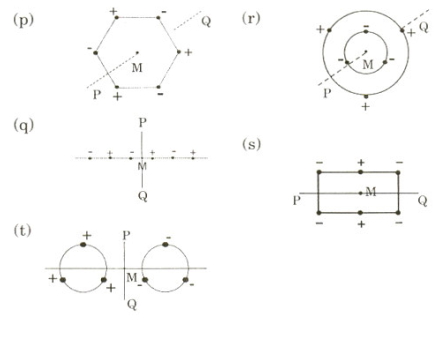
Six point charges,each of magnitude $q$,are arranged in different manners as shown in the image. In each case,a point $M$ and a line $PQ$ passing through $M$ are shown. Let $E$ be the electric field and $V$ be the electric potential at $M$ (potential at infinity is zero) due to the given charge distribution when it is at rest. Now,the whole system is set into rotation with a constant angular velocity about the line $PQ$. Let $B$ be the magnetic field at $M$ and $\mu$ be the magnetic moment of the system in this condition. Assume each rotating charge to be equivalent to a steady current. Match the conditions in Column $I$ with the configurations in Column $II$.
| Column $I$ | Column $II$ |
| $(A)$ $E=0$ | $(p)$ Charges at corners of a regular hexagon. $M$ is the centre. $PQ$ is perpendicular to the plane. |
| $(B)$ $V \neq 0$ | $(q)$ Charges on a line perpendicular to $PQ$ at equal intervals. $M$ is the mid-point. |
| $(C)$ $B=0$ | $(r)$ Charges on two coplanar concentric rings. $M$ is the common centre. $PQ$ is perpendicular to the plane. |
| $(D)$ $\mu \neq 0$ | $(s)$ Charges at corners and mid-points of a rectangle. $M$ is the centre. $PQ$ is parallel to the longer sides. |
| $(t)$ Charges on two coplanar,identical rings. $M$ is the mid-point between centres. $PQ$ is perpendicular to the line joining centres. |
A
$(A) \rightarrow p, r, s; (B) \rightarrow r, s; (C) \rightarrow p, q, t; (D) \rightarrow r, s$
B
$(A) \rightarrow p, t, s; (B) \rightarrow r, p; (C) \rightarrow r, q, t; (D) \rightarrow r, q$
C
$(A) \rightarrow q, r, s; (B) \rightarrow r, p; (C) \rightarrow t, q, t; (D) \rightarrow r, t$
D
$(A) \rightarrow t, q, p; (B) \rightarrow p, q; (C) \rightarrow r, q, s; (D) \rightarrow r, s$
Solution
(A) For $E=0$ at $M$,the charge distribution must be symmetric such that the vector sum of electric fields from all charges is zero. This occurs in $(p)$,$(r)$,and $(s)$.
For $V \neq 0$ at $M$,the potential due to positive and negative charges must not cancel out. In $(r)$ and $(s)$,the potential is zero due to symmetry of positive and negative charges at equal distances from $M$. Thus,$V \neq 0$ for $(p)$,$(q)$,and $(t)$.
For $B=0$ at $M$,the magnetic fields produced by rotating charges must cancel out. This occurs in $(p)$,$(q)$,and $(t)$ due to symmetric current loops.
For $\mu \neq 0$,the system must have a net magnetic moment. This occurs in $(r)$ and $(s)$ where the current loops do not cancel out.
For $V \neq 0$ at $M$,the potential due to positive and negative charges must not cancel out. In $(r)$ and $(s)$,the potential is zero due to symmetry of positive and negative charges at equal distances from $M$. Thus,$V \neq 0$ for $(p)$,$(q)$,and $(t)$.
For $B=0$ at $M$,the magnetic fields produced by rotating charges must cancel out. This occurs in $(p)$,$(q)$,and $(t)$ due to symmetric current loops.
For $\mu \neq 0$,the system must have a net magnetic moment. This occurs in $(r)$ and $(s)$ where the current loops do not cancel out.
0 likesView Solution
29
PhysicsDifficultMCQIIT JEE · 2009
The total number of $\alpha$ and $\beta$ particles emitted in the nuclear reaction ${ }_{92}^{238} U \rightarrow{ }_{82}^{214} Pb$ is
A
$6$
B
$8$
C
$10$
D
$12$
Solution
(B) Let $x$ be the number of $\alpha$ particles and $y$ be the number of $\beta$ particles emitted.
The nuclear reaction is: ${ }_{92}^{238} U \rightarrow{ }_{82}^{214} Pb + x { }_{2}^{4} He + y { }_{-1}^{0} e$.
Equating the mass numbers on both sides:
$238 = 214 + 4x$
$4x = 238 - 214 = 24$
$x = 6$.
Equating the atomic numbers on both sides:
$92 = 82 + 2x - y$
$92 = 82 + 2(6) - y$
$92 = 82 + 12 - y$
$92 = 94 - y$
$y = 94 - 92 = 2$.
The total number of particles emitted is $x + y = 6 + 2 = 8$.
The nuclear reaction is: ${ }_{92}^{238} U \rightarrow{ }_{82}^{214} Pb + x { }_{2}^{4} He + y { }_{-1}^{0} e$.
Equating the mass numbers on both sides:
$238 = 214 + 4x$
$4x = 238 - 214 = 24$
$x = 6$.
Equating the atomic numbers on both sides:
$92 = 82 + 2x - y$
$92 = 82 + 2(6) - y$
$92 = 82 + 12 - y$
$92 = 94 - y$
$y = 94 - 92 = 2$.
The total number of particles emitted is $x + y = 6 + 2 = 8$.
0 likesView Solution
30
PhysicsDifficultMCQIIT JEE · 2009
Photoelectric effect experiments are performed using three different metal plates $p, q$ and $r$ having work functions $\phi_p=2.0 \ eV, \phi_q=2.5 \ eV$ and $\phi_r=3.0 \ eV$,respectively. $A$ light beam containing wavelengths of $550 \ nm, 450 \ nm$ and $350 \ nm$ with equal intensities illuminates each of the plates. The correct $I-V$ graph for the experiment is:
A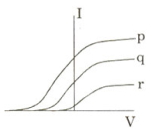
B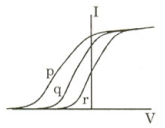
C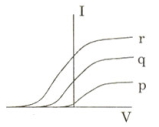
D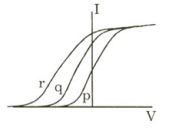
Solution
(A) Given work functions are $\phi_p=2.0 \ eV, \phi_q=2.5 \ eV$ and $\phi_r=3.0 \ eV$.
Using the relation $\lambda_0 = \frac{hc}{\phi}$,where $hc = 1240 \ eV \ nm$,we calculate the threshold wavelengths:
$\lambda_p = \frac{1240}{2.0} = 620 \ nm$
$\lambda_q = \frac{1240}{2.5} = 496 \ nm$
$\lambda_r = \frac{1240}{3.0} \approx 413.3 \ nm$
The incident light contains wavelengths $\lambda_1 = 550 \ nm, \lambda_2 = 450 \ nm, \lambda_3 = 350 \ nm$ with equal intensities.
For photoelectric emission,we must have $\lambda \le \lambda_0$:
- For plate $p$ $(\lambda_p = 620 \ nm)$: All three wavelengths $(550, 450, 350 \ nm)$ cause emission. Thus,the saturation current $I_p$ is proportional to the sum of intensities of all three wavelengths.
- For plate $q$ $(\lambda_q = 496 \ nm)$: Only $\lambda_2 = 450 \ nm$ and $\lambda_3 = 350 \ nm$ cause emission. Thus,$I_q$ is proportional to the sum of intensities of two wavelengths.
- For plate $r$ $(\lambda_r = 413.3 \ nm)$: Only $\lambda_3 = 350 \ nm$ causes emission. Thus,$I_r$ is proportional to the intensity of one wavelength.
Since intensities are equal,$I_p > I_q > I_r$. The saturation current is highest for $p$ and lowest for $r$. The correct graph is $A$.
Using the relation $\lambda_0 = \frac{hc}{\phi}$,where $hc = 1240 \ eV \ nm$,we calculate the threshold wavelengths:
$\lambda_p = \frac{1240}{2.0} = 620 \ nm$
$\lambda_q = \frac{1240}{2.5} = 496 \ nm$
$\lambda_r = \frac{1240}{3.0} \approx 413.3 \ nm$
The incident light contains wavelengths $\lambda_1 = 550 \ nm, \lambda_2 = 450 \ nm, \lambda_3 = 350 \ nm$ with equal intensities.
For photoelectric emission,we must have $\lambda \le \lambda_0$:
- For plate $p$ $(\lambda_p = 620 \ nm)$: All three wavelengths $(550, 450, 350 \ nm)$ cause emission. Thus,the saturation current $I_p$ is proportional to the sum of intensities of all three wavelengths.
- For plate $q$ $(\lambda_q = 496 \ nm)$: Only $\lambda_2 = 450 \ nm$ and $\lambda_3 = 350 \ nm$ cause emission. Thus,$I_q$ is proportional to the sum of intensities of two wavelengths.
- For plate $r$ $(\lambda_r = 413.3 \ nm)$: Only $\lambda_3 = 350 \ nm$ causes emission. Thus,$I_r$ is proportional to the intensity of one wavelength.
Since intensities are equal,$I_p > I_q > I_r$. The saturation current is highest for $p$ and lowest for $r$. The correct graph is $A$.
0 likesView Solution
31
PhysicsDifficultMCQIIT JEE · 2009
Two metallic rings $A$ and $B$,identical in shape and size but having different resistivities $\rho_A$ and $\rho_B$,are kept on top of two identical solenoids as shown in the figure. When current $I$ is switched on in both the solenoids in an identical manner,the rings $A$ and $B$ jump to heights $h_A$ and $h_B$,respectively,with $h_A > h_B$. The possible relation$(s)$ between their resistivities and their masses $m_A$ and $m_B$ is(are):
$(A)$ $\rho_A > \rho_B$ and $m_A = m_B$
$(B)$ $\rho_A < \rho_B$ and $m_A = m_B$
$(C)$ $\rho_A > \rho_B$ and $m_A > m_B$
$(D)$ $\rho_A < \rho_B$ and $m_A < m_B$
$(A)$ $\rho_A > \rho_B$ and $m_A = m_B$
$(B)$ $\rho_A < \rho_B$ and $m_A = m_B$
$(C)$ $\rho_A > \rho_B$ and $m_A > m_B$
$(D)$ $\rho_A < \rho_B$ and $m_A < m_B$
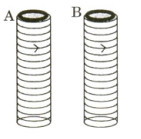
A
$(B, C)$
B
$(B, D)$
C
$(A, D)$
D
$(C, D)$
Solution
(B) When the current $I$ is switched on in the solenoid,the magnetic flux through the ring changes,inducing an electromotive force $(EMF)$ $\varepsilon = -\frac{d\phi}{dt}$.
The induced current in the ring is $i = \frac{\varepsilon}{R} = \frac{1}{R} \frac{d\phi}{dt}$,where $R = \rho \frac{L}{A_{cs}}$ is the resistance of the ring ($L$ is the circumference,$A_{cs}$ is the cross-sectional area of the wire).
The magnetic force on the ring is $F = i L B_r$,where $B_r$ is the radial component of the magnetic field. Since $i \propto \frac{1}{\rho}$,the impulse $J = \int F dt = \int i L B_r dt \propto \frac{1}{\rho} \int \frac{d\phi}{dt} dt = \frac{\Delta \phi}{\rho}$.
By the impulse-momentum theorem,$J = m v$,so $v = \frac{J}{m} \propto \frac{1}{\rho m}$.
The height reached is $h = \frac{v^2}{2g} \propto \frac{1}{\rho^2 m^2}$.
Given $h_A > h_B$,we have $\frac{1}{\rho_A^2 m_A^2} > \frac{1}{\rho_B^2 m_B^2}$,which implies $\rho_A m_A < \rho_B m_B$.
Checking the options:
$(A)$ If $\rho_A > \rho_B$ and $m_A = m_B$,then $\rho_A m_A > \rho_B m_B$ (Incorrect).
$(B)$ If $\rho_A < \rho_B$ and $m_A = m_B$,then $\rho_A m_A < \rho_B m_B$ (Correct).
$(C)$ If $\rho_A > \rho_B$ and $m_A > m_B$,then $\rho_A m_A > \rho_B m_B$ (Incorrect).
$(D)$ If $\rho_A < \rho_B$ and $m_A < m_B$,then $\rho_A m_A < \rho_B m_B$ (Correct).
Thus,the possible relations are $(B)$ and $(D)$.
The induced current in the ring is $i = \frac{\varepsilon}{R} = \frac{1}{R} \frac{d\phi}{dt}$,where $R = \rho \frac{L}{A_{cs}}$ is the resistance of the ring ($L$ is the circumference,$A_{cs}$ is the cross-sectional area of the wire).
The magnetic force on the ring is $F = i L B_r$,where $B_r$ is the radial component of the magnetic field. Since $i \propto \frac{1}{\rho}$,the impulse $J = \int F dt = \int i L B_r dt \propto \frac{1}{\rho} \int \frac{d\phi}{dt} dt = \frac{\Delta \phi}{\rho}$.
By the impulse-momentum theorem,$J = m v$,so $v = \frac{J}{m} \propto \frac{1}{\rho m}$.
The height reached is $h = \frac{v^2}{2g} \propto \frac{1}{\rho^2 m^2}$.
Given $h_A > h_B$,we have $\frac{1}{\rho_A^2 m_A^2} > \frac{1}{\rho_B^2 m_B^2}$,which implies $\rho_A m_A < \rho_B m_B$.
Checking the options:
$(A)$ If $\rho_A > \rho_B$ and $m_A = m_B$,then $\rho_A m_A > \rho_B m_B$ (Incorrect).
$(B)$ If $\rho_A < \rho_B$ and $m_A = m_B$,then $\rho_A m_A < \rho_B m_B$ (Correct).
$(C)$ If $\rho_A > \rho_B$ and $m_A > m_B$,then $\rho_A m_A > \rho_B m_B$ (Incorrect).
$(D)$ If $\rho_A < \rho_B$ and $m_A < m_B$,then $\rho_A m_A < \rho_B m_B$ (Correct).
Thus,the possible relations are $(B)$ and $(D)$.
0 likesView Solution
32
PhysicsDifficultMCQIIT JEE · 2009
Under the influence of the Coulomb field of charge $+Q$,a charge $-q$ is moving around it in an elliptical orbit. Find out the correct statement$(s)$.
A
The angular momentum of the charge $-q$ is constant.
B
The linear momentum of the charge $-q$ is constant.
C
The angular velocity of the charge $-q$ is constant.
D
The linear speed of the charge $-q$ is constant.
Solution
(A) The correct option is $A$.
In a central force field,such as the Coulomb field created by a stationary charge $+Q$,the force acting on the orbiting charge $-q$ is always directed towards the center (the position of $+Q$).
Since the force is a central force,the torque $\vec{\tau} = \vec{r} \times \vec{F}$ acting on the charge $-q$ about the center $+Q$ is zero.
According to the principle of conservation of angular momentum,if the net external torque on a system is zero,the angular momentum $\vec{L}$ remains constant.
Therefore,the angular momentum of the charge $-q$ is constant throughout its elliptical orbit.
Linear momentum,angular velocity,and linear speed are not constant in an elliptical orbit because the distance between the charges changes,leading to variations in speed and direction.
In a central force field,such as the Coulomb field created by a stationary charge $+Q$,the force acting on the orbiting charge $-q$ is always directed towards the center (the position of $+Q$).
Since the force is a central force,the torque $\vec{\tau} = \vec{r} \times \vec{F}$ acting on the charge $-q$ about the center $+Q$ is zero.
According to the principle of conservation of angular momentum,if the net external torque on a system is zero,the angular momentum $\vec{L}$ remains constant.
Therefore,the angular momentum of the charge $-q$ is constant throughout its elliptical orbit.
Linear momentum,angular velocity,and linear speed are not constant in an elliptical orbit because the distance between the charges changes,leading to variations in speed and direction.
0 likesView Solution
33
PhysicsAdvancedMCQIIT JEE · 2009
Column $II$ gives certain systems undergoing a process. Column $I$ suggests changes in some of the parameters related to the system. Match the statements in Column $I$ to the appropriate process$(es)$ from Column $II$.
| Column $I$ | Column $II$ |
| $(A)$ The energy of the system is increased | $(p)$ $System:$ $A$ capacitor, initially uncharged. $Process:$ It is connected to a battery. |
| $(B)$ Mechanical energy is provided to the system, which is converted into energy of random motion of its parts | $(q)$ $System:$ $A$ gas in an adiabatic container fitted with an adiabatic piston. $Process:$ The gas is compressed by pushing the piston. |
| $(C)$ Internal energy of the system is converted into its mechanical energy | $(r)$ $System:$ $A$ gas in a rigid container. $Process:$ The gas gets cooled due to colder atmosphere surrounding it. |
| $(D)$ Mass of the system is decreased | $(s)$ $System:$ $A$ heavy nucleus, initially at rest. $Process:$ The nucleus fissions into two fragments of nearly equal masses and some neutrons are emitted. |
| $(t)$ $System:$ $A$ resistive wire loop. $Process:$ The loop is placed in a time-varying magnetic field perpendicular to its plane. |
A
$A-p, q, t; B-q; C-s; D-s$
B
$A-p, q, t; B-q; C-s; D-s$
C
$A-p, s, t; B-r; C-s; D-t$
D
$A-p, r, s; B-q; C-q; D-p$
Solution
$(A)$ The energy of the system increases in $(p)$ (charging a capacitor), $(q)$ (adiabatic compression increases internal energy), and $(t)$ (induced current causes heating).
$(B)$ In $(q)$, mechanical work done on the piston increases the random kinetic energy of gas molecules.
$(C)$ In $(s)$, the mass-energy equivalence $E = mc^2$ implies that the decrease in mass is converted into the kinetic energy of the fragments (mechanical energy).
$(D)$ In $(s)$, nuclear fission results in a mass defect, meaning the mass of the system decreases.
Therefore, the correct matching is: $A-(p, q, t), B-q, C-s, D-s$.
$(B)$ In $(q)$, mechanical work done on the piston increases the random kinetic energy of gas molecules.
$(C)$ In $(s)$, the mass-energy equivalence $E = mc^2$ implies that the decrease in mass is converted into the kinetic energy of the fragments (mechanical energy).
$(D)$ In $(s)$, nuclear fission results in a mass defect, meaning the mass of the system decreases.
Therefore, the correct matching is: $A-(p, q, t), B-q, C-s, D-s$.
0 likesView Solution
34
PhysicsAdvancedMCQIIT JEE · 2009
Column $I$ shows four situations of standard Young's double slit arrangement with the screen placed far away from the slits $S_1$ and $S_2$. In each of these cases $S_1 P_0 = S_2 P_0$,$S_1 P_1 - S_2 P_1 = \lambda / 4$ and $S_1 P_2 - S_2 P_2 = \lambda / 3$,where $\lambda$ is the wavelength of the light used. In the cases $B, C$ and $D$,a transparent sheet of refractive index $\mu$ and thickness $t$ is pasted on slit $S_2$. The thicknesses of the sheets are different in different cases. The phase difference between the light waves reaching a point $P$ on the screen from the two slits is denoted by $\delta(P)$ and the intensity by $I(P)$. Match each situation given in Column $I$ with the statement$(s)$ in Column $II$ valid for that situation.
| Column $I$ | Column $II$ |
| $(A)$ No sheet | $(p)$ $\delta(P_0) = 0$ |
| $(B)$ $(\mu-1)t = \lambda / 4$ | $(q)$ $\delta(P_1) = 0$ |
| $(C)$ $(\mu-1)t = \lambda / 2$ | $(r)$ $I(P_1) = 0$ |
| $(D)$ $(\mu-1)t = 3\lambda / 4$ | $(s)$ $I(P_0) > I(P_1)$ |
| $(t)$ $I(P_2) > I(P_1)$ |
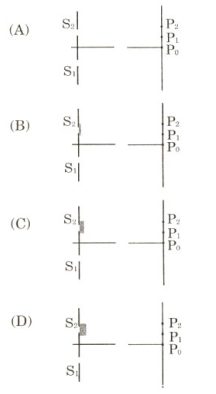
A
$A-p, q; B-q; C-r; D-r, q, t$
B
$A-p, s; B-q; C-t; D-r, s, t$
C
$A-p, t; B-s; C-p; D-r, s, q$
D
$A-q, s; B-p; C-s; D-r, q, s$
Solution
(A) The path difference at any point $P$ is given by $\Delta x = (S_1 P - S_2 P) - (\mu-1)t$. The phase difference is $\delta = (2\pi / \lambda) \Delta x$.
For $(A)$: $(\mu-1)t = 0$. $\delta(P_0) = (2\pi / \lambda)(0 - 0) = 0$ $(p)$. $\delta(P_1) = (2\pi / \lambda)(\lambda / 4) = \pi / 2$ (q is false).
For $(B)$: $(\mu-1)t = \lambda / 4$. $\delta(P_1) = (2\pi / \lambda)(\lambda / 4 - \lambda / 4) = 0$ $(q)$. $I(P_1) = I_{max} \cos^2(0) = I_{max}$.
For $(C)$: $(\mu-1)t = \lambda / 2$. $\delta(P_1) = (2\pi / \lambda)(\lambda / 4 - \lambda / 2) = -\pi / 2$. $I(P_1) = I_{max} \cos^2(-\pi / 4) = I_{max} / 2$. $\delta(P_2) = (2\pi / \lambda)(\lambda / 3 - \lambda / 2) = -\pi / 3$. $I(P_2) = I_{max} \cos^2(-\pi / 6) = 3I_{max} / 4$. Thus $I(P_2) > I(P_1)$ $(t)$.
For $(D)$: $(\mu-1)t = 3\lambda / 4$. $\delta(P_1) = (2\pi / \lambda)(\lambda / 4 - 3\lambda / 4) = -\pi$. $I(P_1) = I_{max} \cos^2(-\pi / 2) = 0$ $(r)$.
For $(A)$: $(\mu-1)t = 0$. $\delta(P_0) = (2\pi / \lambda)(0 - 0) = 0$ $(p)$. $\delta(P_1) = (2\pi / \lambda)(\lambda / 4) = \pi / 2$ (q is false).
For $(B)$: $(\mu-1)t = \lambda / 4$. $\delta(P_1) = (2\pi / \lambda)(\lambda / 4 - \lambda / 4) = 0$ $(q)$. $I(P_1) = I_{max} \cos^2(0) = I_{max}$.
For $(C)$: $(\mu-1)t = \lambda / 2$. $\delta(P_1) = (2\pi / \lambda)(\lambda / 4 - \lambda / 2) = -\pi / 2$. $I(P_1) = I_{max} \cos^2(-\pi / 4) = I_{max} / 2$. $\delta(P_2) = (2\pi / \lambda)(\lambda / 3 - \lambda / 2) = -\pi / 3$. $I(P_2) = I_{max} \cos^2(-\pi / 6) = 3I_{max} / 4$. Thus $I(P_2) > I(P_1)$ $(t)$.
For $(D)$: $(\mu-1)t = 3\lambda / 4$. $\delta(P_1) = (2\pi / \lambda)(\lambda / 4 - 3\lambda / 4) = -\pi$. $I(P_1) = I_{max} \cos^2(-\pi / 2) = 0$ $(r)$.
0 likesView Solution
35
PhysicsDifficultMCQIIT JEE · 2009
$A$ steady current $I$ flows through a wire loop $PQR$ having the shape of a right-angled triangle with $PQ = 3x$, $PR = 4x$, and $QR = 5x$. If the magnitude of the magnetic field at $P$ due to this loop is $k \left( \frac{\mu_0 I}{48 \pi x} \right)$, find the value of $k$.
A
$1$
B
$2$
C
$3$
D
$7$
Solution
(D) The magnetic field at point $P$ due to the segments $PQ$ and $PR$ is zero because point $P$ lies on the line of these conductors.
The magnetic field at $P$ is only due to the segment $QR$.
Let $PD$ be the perpendicular distance from $P$ to the side $QR$. Using the area of the triangle:
Area $= \frac{1}{2} \times PQ \times PR = \frac{1}{2} \times QR \times PD$
$\frac{1}{2} \times 3x \times 4x = \frac{1}{2} \times 5x \times PD$
$12x^2 = 5x \times PD \implies PD = \frac{12x}{5}$.
The magnetic field due to a finite wire segment at a perpendicular distance $d$ is given by $B = \frac{\mu_0 I}{4 \pi d} (\sin \phi_1 + \sin \phi_2)$.
In $\triangle PQR$, $\sin \phi_1 = \frac{PQ}{QR} = \frac{3x}{5x} = \frac{3}{5}$ and $\sin \phi_2 = \frac{PR}{QR} = \frac{4x}{5x} = \frac{4}{5}$.
Substituting these values:
$B = \frac{\mu_0 I}{4 \pi (12x/5)} \left( \frac{3}{5} + \frac{4}{5} \right)$
$B = \frac{5 \mu_0 I}{48 \pi x} \left( \frac{7}{5} \right)$
$B = \frac{7 \mu_0 I}{48 \pi x}$.
Comparing this with $k \left( \frac{\mu_0 I}{48 \pi x} \right)$, we get $k = 7$.
The magnetic field at $P$ is only due to the segment $QR$.
Let $PD$ be the perpendicular distance from $P$ to the side $QR$. Using the area of the triangle:
Area $= \frac{1}{2} \times PQ \times PR = \frac{1}{2} \times QR \times PD$
$\frac{1}{2} \times 3x \times 4x = \frac{1}{2} \times 5x \times PD$
$12x^2 = 5x \times PD \implies PD = \frac{12x}{5}$.
The magnetic field due to a finite wire segment at a perpendicular distance $d$ is given by $B = \frac{\mu_0 I}{4 \pi d} (\sin \phi_1 + \sin \phi_2)$.
In $\triangle PQR$, $\sin \phi_1 = \frac{PQ}{QR} = \frac{3x}{5x} = \frac{3}{5}$ and $\sin \phi_2 = \frac{PR}{QR} = \frac{4x}{5x} = \frac{4}{5}$.
Substituting these values:
$B = \frac{\mu_0 I}{4 \pi (12x/5)} \left( \frac{3}{5} + \frac{4}{5} \right)$
$B = \frac{5 \mu_0 I}{48 \pi x} \left( \frac{7}{5} \right)$
$B = \frac{7 \mu_0 I}{48 \pi x}$.
Comparing this with $k \left( \frac{\mu_0 I}{48 \pi x} \right)$, we get $k = 7$.
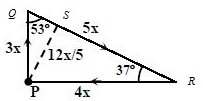
0 likesView Solution
36
PhysicsDifficultMCQIIT JEE · 2009
$A$ solid sphere of radius $R$ has a charge $Q$ distributed in its volume with a charge density $\rho = \kappa r^a$,where $\kappa$ and $a$ are constants and $r$ is the distance from its centre. If the electric field at $r = \frac{R}{2}$ is $\frac{1}{8}$ times that at $r = R$,find the value of $a$.
A
$1$
B
$2$
C
$3$
D
$4$
Solution
(B) According to Gauss's law,the electric field $E$ at a distance $r$ from the center of a spherically symmetric charge distribution is given by $E(4\pi r^2) = \frac{q_{enclosed}}{\epsilon_0}$.
The enclosed charge $q(r)$ within a sphere of radius $r$ is $\int_0^r \rho(r') 4\pi r'^2 dr' = \int_0^r \kappa r'^a 4\pi r'^2 dr' = \frac{4\pi \kappa r^{a+3}}{a+3}$.
Thus,the electric field is $E(r) = \frac{1}{4\pi \epsilon_0 r^2} \cdot \frac{4\pi \kappa r^{a+3}}{a+3} = \frac{\kappa r^{a+1}}{\epsilon_0(a+3)}$.
Given that $E(r = R/2) = \frac{1}{8} E(r = R)$,we substitute the expression for $E(r)$:
$\frac{\kappa (R/2)^{a+1}}{\epsilon_0(a+3)} = \frac{1}{8} \cdot \frac{\kappa R^{a+1}}{\epsilon_0(a+3)}$.
Simplifying this,we get $(1/2)^{a+1} = 1/8$.
Since $1/8 = (1/2)^3$,we have $a+1 = 3$,which gives $a = 2$.
The enclosed charge $q(r)$ within a sphere of radius $r$ is $\int_0^r \rho(r') 4\pi r'^2 dr' = \int_0^r \kappa r'^a 4\pi r'^2 dr' = \frac{4\pi \kappa r^{a+3}}{a+3}$.
Thus,the electric field is $E(r) = \frac{1}{4\pi \epsilon_0 r^2} \cdot \frac{4\pi \kappa r^{a+3}}{a+3} = \frac{\kappa r^{a+1}}{\epsilon_0(a+3)}$.
Given that $E(r = R/2) = \frac{1}{8} E(r = R)$,we substitute the expression for $E(r)$:
$\frac{\kappa (R/2)^{a+1}}{\epsilon_0(a+3)} = \frac{1}{8} \cdot \frac{\kappa R^{a+1}}{\epsilon_0(a+3)}$.
Simplifying this,we get $(1/2)^{a+1} = 1/8$.
Since $1/8 = (1/2)^3$,we have $a+1 = 3$,which gives $a = 2$.
0 likesView Solution
Vedclass Products
For Students
Vedclass Test Series
Mock tests in real IIT JEE style covering Physics with performance analysis. 5-day free trial.
Start Free TrialFor Teachers
Exam Paper Generator
Generate Set A/B/C/D Physics papers from 7.5L+ questions in 2 minutes. 3 chapters free.
Try FreeFor Institutes
Online Exam Module
Run live IIT JEE mock exams with unlimited students, 360° analytics & white-label branding.
See DemoFrequently Asked Questions
How many Physics questions are in IIT JEE 2009?
There are 36 Physics questions from the IIT JEE 2009 paper on Vedclass, each with a detailed step-by-step solution in English.
Are IIT JEE 2009 Physics solutions available in English?
Yes. All solutions on this page are in English. You can also switch to English or Hindi using the language buttons above the questions.
Can I practice IIT JEE 2009 Physics as a timed test?
Yes. Use the Vedclass Test Series to attempt a full IIT JEE mock test covering Physics with time limits and instant score analysis.
Can teachers create Physics papers from IIT JEE previous year questions?
Yes. The Vedclass Exam Paper Generator lets teachers mix IIT JEE Physics questions and generate Set A/B/C/D papers in minutes.
For Teachers & Institutes
Build a Custom Physics Paper
Pick IIT JEE 2009 Physics questions, set difficulty, and generate Set A/B/C/D in 2 minutes.