
ChemistryQ1–47 of 47 questions
Page 1 of 1 · English
1
ChemistryMCQIIT JEE · 2009
Among the electrolytes $Na_2SO_4$,$CaCl_2$,$Al_2(SO_4)_3$ and $NH_4Cl$,the most effective coagulating agent for $Sb_2S_3$ sol is
A
$Na_2SO_4$
B
$CaCl_2$
C
$Al_2(SO_4)_3$
D
$NH_4Cl$
Solution
(C) According to the Hardy-Schulze rule,the coagulating power of an electrolyte depends on the valency of the active ion (ion with charge opposite to that of the sol).
$Sb_2S_3$ sol is a negatively charged sol.
Therefore,the coagulating power depends on the charge of the cation.
The cations present in the given electrolytes are $Na^+$,$Ca^{2+}$,$Al^{3+}$,and $NH_4^+$.
According to the Hardy-Schulze rule,the higher the valency of the coagulating ion,the greater is its coagulating power.
Since $Al^{3+}$ has the highest charge $(+3)$,$Al_2(SO_4)_3$ is the most effective coagulating agent.
$Sb_2S_3$ sol is a negatively charged sol.
Therefore,the coagulating power depends on the charge of the cation.
The cations present in the given electrolytes are $Na^+$,$Ca^{2+}$,$Al^{3+}$,and $NH_4^+$.
According to the Hardy-Schulze rule,the higher the valency of the coagulating ion,the greater is its coagulating power.
Since $Al^{3+}$ has the highest charge $(+3)$,$Al_2(SO_4)_3$ is the most effective coagulating agent.
0 likesView Solution
2
ChemistryMCQIIT JEE · 2009
$A$ ball is dropped from a height of $20 \ m$ above the surface of water in a lake. The refractive index of water is $4/3$. $A$ fish inside the lake, in the line of fall of the ball, is looking at the ball. At an instant, when the ball is $12.8 \ m$ above the water surface, the fish sees the speed of the ball as ........ $m/s$ $[g = 10 \ m/s^2.]$
A
$9$
B
$12$
C
$16$
D
$21.33$
Solution
(C) Let the height of the ball above the water surface be $x$. The apparent height $x'$ of the ball as seen by the fish is given by $x' = \mu x$, where $\mu = 4/3$ is the refractive index of water.
The speed of the ball as seen by the fish is $v' = \frac{dx'}{dt} = \mu \frac{dx}{dt} = \mu v$, where $v$ is the actual speed of the ball.
First, we calculate the actual speed $v$ of the ball when it is at a height $x = 12.8 \ m$. The ball falls from $H = 20 \ m$. The distance fallen is $h = 20 - 12.8 = 7.2 \ m$.
Using the equation of motion $v^2 = u^2 + 2gh$, with $u = 0$:
$v^2 = 2 \times 10 \times 7.2 = 144$
$v = 12 \ m/s$.
Now, the apparent speed $v'$ seen by the fish is:
$v' = \mu v = (4/3) \times 12 = 16 \ m/s$.
The speed of the ball as seen by the fish is $v' = \frac{dx'}{dt} = \mu \frac{dx}{dt} = \mu v$, where $v$ is the actual speed of the ball.
First, we calculate the actual speed $v$ of the ball when it is at a height $x = 12.8 \ m$. The ball falls from $H = 20 \ m$. The distance fallen is $h = 20 - 12.8 = 7.2 \ m$.
Using the equation of motion $v^2 = u^2 + 2gh$, with $u = 0$:
$v^2 = 2 \times 10 \times 7.2 = 144$
$v = 12 \ m/s$.
Now, the apparent speed $v'$ seen by the fish is:
$v' = \mu v = (4/3) \times 12 = 16 \ m/s$.
0 likesView Solution
3
ChemistryMCQIIT JEE · 2009
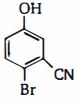
The $IUPAC$ name of the following compound is
A
$4-$Bromo$-3-$cyanophenol
B
$2-$Bromo$-5-$hydroxybenzonitrile
C
$2-$Cyano$-4-$hydroxybromobenzene
D
$6-$Bromo$-3-$hydroxybenzonitrile
Solution
(B) In this compound,the $-CN$ group is the principal functional group,so it is given the highest priority.
Numbering starts from the carbon atom attached to the $-CN$ group.
To assign the lowest locants to the substituents,we number the ring such that the $-Br$ group is at position $2$ and the $-OH$ group is at position $5$.
Thus,the $IUPAC$ name is $2-$bromo$-5-$hydroxybenzonitrile.
Numbering starts from the carbon atom attached to the $-CN$ group.
To assign the lowest locants to the substituents,we number the ring such that the $-Br$ group is at position $2$ and the $-OH$ group is at position $5$.
Thus,the $IUPAC$ name is $2-$bromo$-5-$hydroxybenzonitrile.
0 likesView Solution
4
ChemistryMCQIIT JEE · 2009
Under the influence of the Coulomb field of charge $+Q$,a charge $-q$ is moving around it in an elliptical orbit. Find out the correct statement$(s)$.
A
The angular momentum of the charge $-q$ is constant.
B
The linear momentum of the charge $-q$ is constant.
C
The angular velocity of the charge $-q$ is constant.
D
The linear speed of the charge $-q$ is constant.
Solution
(A) The electrostatic force between the charges $+Q$ and $-q$ is a central force,which acts along the line joining the two charges.
Since the force is central,the torque $\vec{\tau} = \vec{r} \times \vec{F}$ about the position of charge $+Q$ is zero.
According to the principle of conservation of angular momentum,if the net torque is zero,the angular momentum $\vec{L}$ remains constant.
In an elliptical orbit,the distance between the charges changes continuously,which causes the magnitude of the electrostatic force to change.
Consequently,the linear speed and the linear momentum of the charge $-q$ are not constant.
Additionally,since the distance from the center changes,the angular velocity is also not constant.
Since the force is central,the torque $\vec{\tau} = \vec{r} \times \vec{F}$ about the position of charge $+Q$ is zero.
According to the principle of conservation of angular momentum,if the net torque is zero,the angular momentum $\vec{L}$ remains constant.
In an elliptical orbit,the distance between the charges changes continuously,which causes the magnitude of the electrostatic force to change.
Consequently,the linear speed and the linear momentum of the charge $-q$ are not constant.
Additionally,since the distance from the center changes,the angular velocity is also not constant.
0 likesView Solution
5
ChemistryMCQIIT JEE · 2009
Three concentric metallic spherical shells of radii $R, 2R, 3R$ are given charges $Q_1, Q_2, Q_3$ respectively. It is found that the surface charge densities on the outer surfaces of the shells are equal. Then,the ratio of the charges given to the shells,$Q_1 : Q_2 : Q_3$ is
A
$1 : 2 : 3$
B
$1 : 3 : 5$
C
$1 : 4 : 9$
D
$1 : 8 : 18$
Solution
(B) Let the surface charge densities be $\sigma$. Since the surface charge densities on the outer surfaces are equal,we have:
$\sigma = \frac{q_1}{4\pi R^2} = \frac{q_2}{4\pi (2R)^2} = \frac{q_3}{4\pi (3R)^2}$,where $q_1, q_2, q_3$ are the charges on the outer surfaces of the shells.
From the property of induction,the charge on the outer surface of the first shell is $q_1 = Q_1$.
The charge on the outer surface of the second shell is $q_2 = Q_1 + Q_2$.
The charge on the outer surface of the third shell is $q_3 = Q_1 + Q_2 + Q_3$.
Equating the densities: $\frac{Q_1}{R^2} = \frac{Q_1 + Q_2}{4R^2} = \frac{Q_1 + Q_2 + Q_3}{9R^2}$.
From $\frac{Q_1}{1} = \frac{Q_1 + Q_2}{4}$,we get $4Q_1 = Q_1 + Q_2 \Rightarrow Q_2 = 3Q_1$.
From $\frac{Q_1}{1} = \frac{Q_1 + Q_2 + Q_3}{9}$,we get $9Q_1 = Q_1 + (3Q_1) + Q_3 \Rightarrow 9Q_1 = 4Q_1 + Q_3 \Rightarrow Q_3 = 5Q_1$.
Thus,the ratio $Q_1 : Q_2 : Q_3 = Q_1 : 3Q_1 : 5Q_1 = 1 : 3 : 5$.
$\sigma = \frac{q_1}{4\pi R^2} = \frac{q_2}{4\pi (2R)^2} = \frac{q_3}{4\pi (3R)^2}$,where $q_1, q_2, q_3$ are the charges on the outer surfaces of the shells.
From the property of induction,the charge on the outer surface of the first shell is $q_1 = Q_1$.
The charge on the outer surface of the second shell is $q_2 = Q_1 + Q_2$.
The charge on the outer surface of the third shell is $q_3 = Q_1 + Q_2 + Q_3$.
Equating the densities: $\frac{Q_1}{R^2} = \frac{Q_1 + Q_2}{4R^2} = \frac{Q_1 + Q_2 + Q_3}{9R^2}$.
From $\frac{Q_1}{1} = \frac{Q_1 + Q_2}{4}$,we get $4Q_1 = Q_1 + Q_2 \Rightarrow Q_2 = 3Q_1$.
From $\frac{Q_1}{1} = \frac{Q_1 + Q_2 + Q_3}{9}$,we get $9Q_1 = Q_1 + (3Q_1) + Q_3 \Rightarrow 9Q_1 = 4Q_1 + Q_3 \Rightarrow Q_3 = 5Q_1$.
Thus,the ratio $Q_1 : Q_2 : Q_3 = Q_1 : 3Q_1 : 5Q_1 = 1 : 3 : 5$.
0 likesView Solution
6
ChemistryMCQIIT JEE · 2009
Among the electrolytes $Na_2SO_4, CaCl_2, Al_2(SO_4)_3$ and $NH_4Cl,$ the most effective coagulating agent for $Sb_2S_3$ sol is
A
$Na_2SO_4$
B
$CaCl_2$
C
$Al_2(SO_4)_3$
D
$NH_4Cl$
Solution
(C) According to the Hardy-Schulze rule,the coagulating power of an electrolyte depends on the valency of the ion carrying a charge opposite to that of the colloidal particles.
$Sb_2S_3$ sol is a negatively charged sol.
Therefore,the coagulating power depends on the valency of the cation.
The cations present in the given electrolytes are $Na^+$,$Ca^{2+}$,$Al^{3+}$,and $NH_4^+$.
According to the Hardy-Schulze rule,the higher the valency of the coagulating ion,the greater is its coagulating power.
Since $Al^{3+}$ has the highest charge $(+3)$,$Al_2(SO_4)_3$ is the most effective coagulating agent.
$Sb_2S_3$ sol is a negatively charged sol.
Therefore,the coagulating power depends on the valency of the cation.
The cations present in the given electrolytes are $Na^+$,$Ca^{2+}$,$Al^{3+}$,and $NH_4^+$.
According to the Hardy-Schulze rule,the higher the valency of the coagulating ion,the greater is its coagulating power.
Since $Al^{3+}$ has the highest charge $(+3)$,$Al_2(SO_4)_3$ is the most effective coagulating agent.
0 likesView Solution
7
ChemistryMCQIIT JEE · 2009
The Henry's law constant for the solubility of $N_2$ gas in water at $298 \ K$ is $1.0 \times 10^5 \ atm$. The mole fraction of $N_2$ in air is $0.8$. The number of moles of $N_2$ from air dissolved in $10 \ moles$ of water at $298 \ K$ and $5 \ atm$ pressure will be:
A
$4.0 \times 10^{-5}$
B
$4.0 \times 10^{-4}$
C
$5.0 \times 10^{-4}$
D
$4.0 \times 10^{-6}$
Solution
(B) According to Henry's Law,$P_{N_2} = K_H \times X_{N_2}$.
First,calculate the partial pressure of $N_2$ in air: $P_{N_2} = \text{mole fraction of } N_2 \times \text{Total pressure} = 0.8 \times 5 \ atm = 4 \ atm$.
Now,calculate the mole fraction of $N_2$ in water $(X_{N_2})$: $X_{N_2} = P_{N_2} / K_H = 4 \ atm / (1.0 \times 10^5 \ atm) = 4 \times 10^{-5}$.
Since $X_{N_2} = n_{N_2} / (n_{N_2} + n_{H_2O})$ and $n_{N_2} \ll n_{H_2O}$,we can approximate $X_{N_2} \approx n_{N_2} / n_{H_2O}$.
Given $n_{H_2O} = 10 \ moles$,we have $n_{N_2} = X_{N_2} \times n_{H_2O} = (4 \times 10^{-5}) \times 10 = 4 \times 10^{-4} \ moles$.
First,calculate the partial pressure of $N_2$ in air: $P_{N_2} = \text{mole fraction of } N_2 \times \text{Total pressure} = 0.8 \times 5 \ atm = 4 \ atm$.
Now,calculate the mole fraction of $N_2$ in water $(X_{N_2})$: $X_{N_2} = P_{N_2} / K_H = 4 \ atm / (1.0 \times 10^5 \ atm) = 4 \times 10^{-5}$.
Since $X_{N_2} = n_{N_2} / (n_{N_2} + n_{H_2O})$ and $n_{N_2} \ll n_{H_2O}$,we can approximate $X_{N_2} \approx n_{N_2} / n_{H_2O}$.
Given $n_{H_2O} = 10 \ moles$,we have $n_{N_2} = X_{N_2} \times n_{H_2O} = (4 \times 10^{-5}) \times 10 = 4 \times 10^{-4} \ moles$.
0 likesView Solution
8
ChemistryMCQIIT JEE · 2009
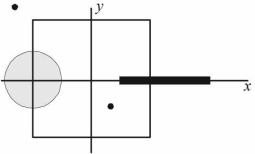
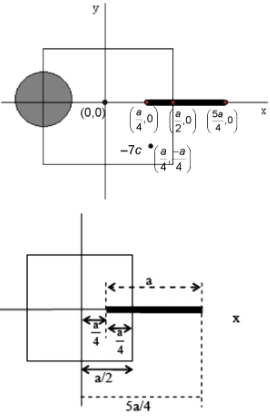
$A$ disk of radius $a/4$ having a uniformly distributed charge $6 \text{ C}$ is placed in the $x-y$ plane with its centre at $(-a/2, 0, 0)$. $A$ rod of length $a$ carrying a uniformly distributed charge $8 \text{ C}$ is placed on the $x$-axis from $x = a/4$ to $x = 5a/4$. Two point charges $-7 \text{ C}$ and $3 \text{ C}$ are placed at $(a/4, -a/4, 0)$ and $(-3a/4, 3a/4, 0)$,respectively. Consider a cubical surface formed by six surfaces $x = \pm a/2, y = \pm a/2, z = \pm a/2$. The electric flux through this cubical surface is
A
$\frac{-2 \text{ C}}{\varepsilon_0}$
B
$\frac{2 \text{ C}}{\varepsilon_0}$
C
$\frac{10 \text{ C}}{\varepsilon_0}$
D
$\frac{12 \text{ C}}{\varepsilon_0}$
Solution
(A) According to Gauss's Law,the electric flux $\Phi$ through a closed surface is given by $\Phi = \frac{q_{\text{enclosed}}}{\varepsilon_0}$.
$1$. The disk has a radius $a/4$ and center at $(-a/2, 0, 0)$. The cube extends from $x = -a/2$ to $x = a/2$. The disk lies in the $x-y$ plane. The part of the disk inside the cube is the region from $x = -a/2$ to $x = -a/2 + a/4 = -a/4$. This is exactly half of the disk. Thus,the charge enclosed is $6 \text{ C} / 2 = 3 \text{ C}$.
$2$. The rod has length $a$ and is placed from $x = a/4$ to $x = 5a/4$. The cube extends up to $x = a/2$. The part of the rod inside the cube is from $x = a/4$ to $x = a/2$,which is a length of $a/4$. Since the total length is $a$,the fraction of charge enclosed is $(a/4) / a = 1/4$. Thus,the charge enclosed is $8 \text{ C} \times (1/4) = 2 \text{ C}$.
$3$. The point charge $-7 \text{ C}$ is at $(a/4, -a/4, 0)$,which is inside the cube $(|x| < a/2, |y| < a/2, |z| < a/2)$.
$4$. The point charge $3 \text{ C}$ is at $(-3a/4, 3a/4, 0)$,which is outside the cube.
Total enclosed charge $q_{\text{enclosed}} = 3 \text{ C} + 2 \text{ C} - 7 \text{ C} = -2 \text{ C}$.
Therefore,the electric flux $\Phi = \frac{-2 \text{ C}}{\varepsilon_0}$.
$1$. The disk has a radius $a/4$ and center at $(-a/2, 0, 0)$. The cube extends from $x = -a/2$ to $x = a/2$. The disk lies in the $x-y$ plane. The part of the disk inside the cube is the region from $x = -a/2$ to $x = -a/2 + a/4 = -a/4$. This is exactly half of the disk. Thus,the charge enclosed is $6 \text{ C} / 2 = 3 \text{ C}$.
$2$. The rod has length $a$ and is placed from $x = a/4$ to $x = 5a/4$. The cube extends up to $x = a/2$. The part of the rod inside the cube is from $x = a/4$ to $x = a/2$,which is a length of $a/4$. Since the total length is $a$,the fraction of charge enclosed is $(a/4) / a = 1/4$. Thus,the charge enclosed is $8 \text{ C} \times (1/4) = 2 \text{ C}$.
$3$. The point charge $-7 \text{ C}$ is at $(a/4, -a/4, 0)$,which is inside the cube $(|x| < a/2, |y| < a/2, |z| < a/2)$.
$4$. The point charge $3 \text{ C}$ is at $(-3a/4, 3a/4, 0)$,which is outside the cube.
Total enclosed charge $q_{\text{enclosed}} = 3 \text{ C} + 2 \text{ C} - 7 \text{ C} = -2 \text{ C}$.
Therefore,the electric flux $\Phi = \frac{-2 \text{ C}}{\varepsilon_0}$.
0 likesView Solution
9
ChemistryDifficultMCQIIT JEE · 2009
Given that the abundances of isotopes $^{54}Fe$,$^{56}Fe$ and $^{57}Fe$ are $5 \%$,$90 \%$ and $5 \%$,respectively,the atomic mass of $Fe$ is
A
$55.85$
B
$55.95$
C
$55.75$
D
$56.05$
Solution
(B) The average atomic mass of an element is calculated by the weighted average of the masses of its isotopes.
Average atomic mass of $Fe = \frac{(5 \times 54) + (90 \times 56) + (5 \times 57)}{100}$
$= \frac{270 + 5040 + 285}{100}$
$= \frac{5595}{100} = 55.95 \ u$
Average atomic mass of $Fe = \frac{(5 \times 54) + (90 \times 56) + (5 \times 57)}{100}$
$= \frac{270 + 5040 + 285}{100}$
$= \frac{5595}{100} = 55.95 \ u$
0 likesView Solution
10
ChemistryDifficultMCQIIT JEE · 2009
The term that corrects for the attractive forces present in a real gas in the van der Waals equation is
A
$nb$
B
$\frac{an^2}{V^2}$
C
$-\frac{an^2}{V^2}$
D
$-nb$
Solution
(B) The van der Waals equation for $n$ moles of a real gas is given by:
$(P + \frac{an^2}{V^2})(V - nb) = nRT$
In this equation,the term $\frac{an^2}{V^2}$ is added to the measured pressure $P$ to account for the intermolecular attractive forces between gas molecules.
Thus,$\frac{an^2}{V^2}$ is the correction term for attractive forces.
$(P + \frac{an^2}{V^2})(V - nb) = nRT$
In this equation,the term $\frac{an^2}{V^2}$ is added to the measured pressure $P$ to account for the intermolecular attractive forces between gas molecules.
Thus,$\frac{an^2}{V^2}$ is the correction term for attractive forces.
0 likesView Solution
11
ChemistryDifficultMCQIIT JEE · 2009
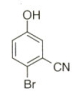
The $IUPAC$ name of the following compound is
A
$4-$Bromo-$3-$cyanophenol
B
$2-$Bromo-$5-$hydroxybenzonitrile
C
$2-$Cyano-$4-$hydroxybromobenzene
D
$6-$Bromo-$3-$hydroxybenzonitrile
Solution
(B) The correct option is $B$,$2-$Bromo-$5-$hydroxybenzonitrile.
In the given compound,the $-CN$ group is the principal functional group,so the parent chain is named as a derivative of benzonitrile.
The carbon atom attached to the $-CN$ group is assigned position $1$.
Numbering the ring to give the lowest possible locants to the substituents,the $-OH$ group is at position $5$ and the $-Br$ group is at position $2$.
According to alphabetical order,$Bromo$ comes before $hydroxy$.
Therefore,the $IUPAC$ name is $2-$Bromo-$5-$hydroxybenzonitrile.
In the given compound,the $-CN$ group is the principal functional group,so the parent chain is named as a derivative of benzonitrile.
The carbon atom attached to the $-CN$ group is assigned position $1$.
Numbering the ring to give the lowest possible locants to the substituents,the $-OH$ group is at position $5$ and the $-Br$ group is at position $2$.
According to alphabetical order,$Bromo$ comes before $hydroxy$.
Therefore,the $IUPAC$ name is $2-$Bromo-$5-$hydroxybenzonitrile.
0 likesView Solution
12
ChemistryDifficultMCQIIT JEE · 2009
The compound$(s)$ formed upon combustion of sodium metal in excess air is(are):
A
$Na_2O_2$
B
$Na_2O$
C
$NaO_2$
D
$NaOH$
Solution
(A) When sodium metal is heated in excess of air,it primarily forms sodium peroxide $(Na_2O_2)$.
The chemical reaction is: $2Na + O_2 (\text{excess}) \rightarrow Na_2O_2$.
Sodium oxide $(Na_2O)$ is formed when sodium is burned in a limited supply of air.
Therefore,the correct compound formed in excess air is $Na_2O_2$.
The chemical reaction is: $2Na + O_2 (\text{excess}) \rightarrow Na_2O_2$.
Sodium oxide $(Na_2O)$ is formed when sodium is burned in a limited supply of air.
Therefore,the correct compound formed in excess air is $Na_2O_2$.
0 likesView Solution
13
ChemistryDifficultMCQIIT JEE · 2009
The correct statement$(s)$ about the compound $H_3C-CH(OH)-CH=CH-CH(OH)-CH_3$ $(X)$ is(are):
$(A)$ The total number of stereoisomers possible for $X$ is $6$.
$(B)$ The total number of diastereomers possible for $X$ is $3$.
$(C)$ If the stereochemistry about the double bond in $X$ is trans,the number of enantiomers possible for $X$ is $4$.
$(D)$ If the stereochemistry about the double bond in $X$ is cis,the number of enantiomers possible for $X$ is $2$.
$(A)$ The total number of stereoisomers possible for $X$ is $6$.
$(B)$ The total number of diastereomers possible for $X$ is $3$.
$(C)$ If the stereochemistry about the double bond in $X$ is trans,the number of enantiomers possible for $X$ is $4$.
$(D)$ If the stereochemistry about the double bond in $X$ is cis,the number of enantiomers possible for $X$ is $2$.
A
$(A, D)$
B
$(A, B)$
C
$(A, C)$
D
$(B, D)$
Solution
(A) The compound $X$ is $hexa-2,4-diene-2,5-diol$. It has two chiral centers at $C_2$ and $C_5$ and one double bond at $C_3=C_4$.
For the $cis$ isomer ($Z$-isomer),the molecule is symmetrical. The number of stereoisomers is given by $2^{(n-1)} + 2^{(n/2 - 1)} = 2^{(2-1)} + 2^{(2/2 - 1)} = 2^1 + 2^0 = 2 + 1 = 3$.
For the $trans$ isomer ($E$-isomer),the molecule is also symmetrical. The number of stereoisomers is $2^{(n-1)} + 2^{(n/2 - 1)} = 2^1 + 2^0 = 3$.
Total stereoisomers = $3 (cis) + 3 (trans) = 6$. Thus,$(A)$ is correct.
For $cis$ isomer: $2$ enantiomers and $1$ meso compound. Thus,$(D)$ is correct.
For $trans$ isomer: $2$ enantiomers and $1$ meso compound. Thus,$(C)$ is incorrect as it states $4$ enantiomers.
Since $(A)$ and $(D)$ are correct,the answer is $(A, D)$.
For the $cis$ isomer ($Z$-isomer),the molecule is symmetrical. The number of stereoisomers is given by $2^{(n-1)} + 2^{(n/2 - 1)} = 2^{(2-1)} + 2^{(2/2 - 1)} = 2^1 + 2^0 = 2 + 1 = 3$.
For the $trans$ isomer ($E$-isomer),the molecule is also symmetrical. The number of stereoisomers is $2^{(n-1)} + 2^{(n/2 - 1)} = 2^1 + 2^0 = 3$.
Total stereoisomers = $3 (cis) + 3 (trans) = 6$. Thus,$(A)$ is correct.
For $cis$ isomer: $2$ enantiomers and $1$ meso compound. Thus,$(D)$ is correct.
For $trans$ isomer: $2$ enantiomers and $1$ meso compound. Thus,$(C)$ is incorrect as it states $4$ enantiomers.
Since $(A)$ and $(D)$ are correct,the answer is $(A, D)$.
0 likesView Solution
14
ChemistryDifficultMCQIIT JEE · 2009
Match each of the diatomic molecules in Column $I$ with its property / properties in Column $II$.
| Column $I$ | Column $II$ |
| $(A)$ $B_2$ | $(p)$ Paramagnetic |
| $(B)$ $N_2$ | $(q)$ Undergoes oxidation |
| $(C)$ $O_2^{-}$ | $(r)$ Undergoes reduction |
| $(D)$ $O_2$ | $(s)$ Bond order $\geq 2$ |
| $(t)$ Mixing of '$s$' and '$p$' orbitals |
A
$(A)$ $\rightarrow p, q, r \& \ t, (B)$ $\rightarrow q, r, s \& \ t, (C)$ $\rightarrow p, q, r, (D)$ $\rightarrow p, q, r \& \ s$
B
$(A)$ $\rightarrow s, t, r \& \ p, (B)$ $\rightarrow p, r, s \& \ t, (C)$ $\rightarrow p, s, r, (D)$ $\rightarrow p, q, r \& \ s$
C
$(A)$ $\rightarrow q, s, r \& \ t, (B)$ $\rightarrow p, r, s \& \ t, (C)$ $\rightarrow s, q, r, (D)$ $\rightarrow p, q, r \& \ s$
D
$(A)$ $\rightarrow p, s, q \& \ t, (B)$ $\rightarrow q, t, s \& \ p, (C)$ $\rightarrow p, q, r, (D)$ $\rightarrow r, q, p \& \ s$
Solution
(A) $B_2$: $\sigma 1s^2 \sigma^{\star} 1s^2 \sigma 2s^2 \sigma^{\star} 2s^2 \pi 2p_y^1 \pi 2p_z^1$. It is paramagnetic. Bond order $= (6-4)/2 = 1$. Mixing of $s$ and $p$ orbitals occurs. $B_2$ undergoes oxidation and reduction.
$(B)$ $N_2$: $\sigma 1s^2 \sigma^{\star} 1s^2 \sigma 2s^2 \sigma^{\star} 2s^2 \sigma 2p_x^2 \pi 2p_y^2 \pi 2p_z^2$. It is diamagnetic. Bond order $= (10-4)/2 = 3$. Mixing of $s$ and $p$ orbitals occurs. $N_2$ undergoes oxidation and reduction.
$(C)$ $O_2^{-}$: Paramagnetic with bond order $= 1.5$. $O_2^{-}$ undergoes oxidation and reduction.
$(D)$ $O_2$: $\sigma 1s^2 \sigma^{\star} 1s^2 \sigma 2s^2 \sigma^{\star} 2s^2 \sigma 2p_x^2 \pi 2p_y^2 \pi 2p_z^2 \pi^{\star} 2p_y^1 \pi^{\star} 2p_z^1$. Paramagnetic with bond order $= 2$. $O_2$ undergoes oxidation and reduction.
Correct mapping: $(A)$ $\rightarrow p, q, r, t; (B)$ $\rightarrow q, r, s, t; (C)$ $\rightarrow p, q, r; (D)$ $\rightarrow p, q, r, s$.
$(B)$ $N_2$: $\sigma 1s^2 \sigma^{\star} 1s^2 \sigma 2s^2 \sigma^{\star} 2s^2 \sigma 2p_x^2 \pi 2p_y^2 \pi 2p_z^2$. It is diamagnetic. Bond order $= (10-4)/2 = 3$. Mixing of $s$ and $p$ orbitals occurs. $N_2$ undergoes oxidation and reduction.
$(C)$ $O_2^{-}$: Paramagnetic with bond order $= 1.5$. $O_2^{-}$ undergoes oxidation and reduction.
$(D)$ $O_2$: $\sigma 1s^2 \sigma^{\star} 1s^2 \sigma 2s^2 \sigma^{\star} 2s^2 \sigma 2p_x^2 \pi 2p_y^2 \pi 2p_z^2 \pi^{\star} 2p_y^1 \pi^{\star} 2p_z^1$. Paramagnetic with bond order $= 2$. $O_2$ undergoes oxidation and reduction.
Correct mapping: $(A)$ $\rightarrow p, q, r, t; (B)$ $\rightarrow q, r, s, t; (C)$ $\rightarrow p, q, r; (D)$ $\rightarrow p, q, r, s$.
0 likesView Solution
15
ChemistryMCQIIT JEE · 2009
Let $P(3, 2, 6)$ be a point in space and $Q$ be a point on the line $\vec{r} = (\hat{i} - \hat{j} + 2\hat{k}) + \mu(-3\hat{i} + \hat{j} + 5\hat{k})$. Then the value of $\mu$ for which the vector $\overrightarrow{PQ}$ is parallel to the plane $x - 4y + 3z = 1$ is
A
$\frac{1}{4}$
B
$-\frac{1}{4}$
C
$\frac{1}{8}$
D
$-\frac{1}{8}$
Solution
(A) Any point $Q$ on the line $\vec{r}$ can be represented as $Q(1 - 3\mu, -1 + \mu, 2 + 5\mu)$.
The vector $\overrightarrow{PQ}$ is given by $\overrightarrow{PQ} = (1 - 3\mu - 3)\hat{i} + (-1 + \mu - 2)\hat{j} + (2 + 5\mu - 6)\hat{k} = (-3\mu - 2)\hat{i} + (\mu - 3)\hat{j} + (5\mu - 4)\hat{k}$.
Since $\overrightarrow{PQ}$ is parallel to the plane $x - 4y + 3z = 1$,it must be perpendicular to the normal vector $\vec{n} = \hat{i} - 4\hat{j} + 3\hat{k}$ of the plane.
Therefore,$\overrightarrow{PQ} \cdot \vec{n} = 0$.
$1(-3\mu - 2) - 4(\mu - 3) + 3(5\mu - 4) = 0$.
$-3\mu - 2 - 4\mu + 12 + 15\mu - 12 = 0$.
$8\mu - 2 = 0$.
$8\mu = 2$,which gives $\mu = \frac{1}{4}$.
The vector $\overrightarrow{PQ}$ is given by $\overrightarrow{PQ} = (1 - 3\mu - 3)\hat{i} + (-1 + \mu - 2)\hat{j} + (2 + 5\mu - 6)\hat{k} = (-3\mu - 2)\hat{i} + (\mu - 3)\hat{j} + (5\mu - 4)\hat{k}$.
Since $\overrightarrow{PQ}$ is parallel to the plane $x - 4y + 3z = 1$,it must be perpendicular to the normal vector $\vec{n} = \hat{i} - 4\hat{j} + 3\hat{k}$ of the plane.
Therefore,$\overrightarrow{PQ} \cdot \vec{n} = 0$.
$1(-3\mu - 2) - 4(\mu - 3) + 3(5\mu - 4) = 0$.
$-3\mu - 2 - 4\mu + 12 + 15\mu - 12 = 0$.
$8\mu - 2 = 0$.
$8\mu = 2$,which gives $\mu = \frac{1}{4}$.
0 likesView Solution
16
ChemistryMCQIIT JEE · 2009
Let $z=x+iy$ be a complex number where $x$ and $y$ are integers. Then the area of the rectangle whose vertices are the roots of the equation $z\bar{z}^3+\bar{z}z^3=350$ is
A
$48$
B
$32$
C
$40$
D
$80$
Solution
(A) Given the equation $z\bar{z}^3+\bar{z}z^3=350$.
We can factor this as $z\bar{z}(z^2+\bar{z}^2)=350$.
Let $z=x+iy$,then $z\bar{z}=x^2+y^2$ and $z^2+\bar{z}^2=(x+iy)^2+(x-iy)^2=2(x^2-y^2)$.
Substituting these into the equation: $(x^2+y^2)(2(x^2-y^2))=350$.
$(x^2+y^2)(x^2-y^2)=175$.
Since $175 = 25 \times 7$,we set $x^2+y^2=25$ and $x^2-y^2=7$.
Adding these equations gives $2x^2=32$,so $x^2=16$,which means $x=\pm 4$.
Subtracting gives $2y^2=18$,so $y^2=9$,which means $y=\pm 3$.
The vertices of the rectangle are $(4,3), (4,-3), (-4,-3),$ and $(-4,3)$.
The length of the rectangle is $|4 - (-4)| = 8$ and the breadth is $|3 - (-3)| = 6$.
Area $= 8 \times 6 = 48$ square units.
We can factor this as $z\bar{z}(z^2+\bar{z}^2)=350$.
Let $z=x+iy$,then $z\bar{z}=x^2+y^2$ and $z^2+\bar{z}^2=(x+iy)^2+(x-iy)^2=2(x^2-y^2)$.
Substituting these into the equation: $(x^2+y^2)(2(x^2-y^2))=350$.
$(x^2+y^2)(x^2-y^2)=175$.
Since $175 = 25 \times 7$,we set $x^2+y^2=25$ and $x^2-y^2=7$.
Adding these equations gives $2x^2=32$,so $x^2=16$,which means $x=\pm 4$.
Subtracting gives $2y^2=18$,so $y^2=9$,which means $y=\pm 3$.
The vertices of the rectangle are $(4,3), (4,-3), (-4,-3),$ and $(-4,3)$.
The length of the rectangle is $|4 - (-4)| = 8$ and the breadth is $|3 - (-3)| = 6$.
Area $= 8 \times 6 = 48$ square units.
0 likesView Solution
17
ChemistryMCQIIT JEE · 2009
Let $z = \cos \theta + i \sin \theta$. Then the value of $\sum_{m=1}^{15} \operatorname{Im}(z^{2m-1})$ at $\theta = 2^{\circ}$ is
A
$\frac{1}{\sin 2^{\circ}}$
B
$\frac{1}{3 \sin 2^{\circ}}$
C
$\frac{1}{2 \sin 2^{\circ}}$
D
$\frac{1}{4 \sin 2^{\circ}}$
Solution
(D) Given $z = \cos \theta + i \sin \theta$,by De Moivre's Theorem,$z^n = \cos(n\theta) + i \sin(n\theta)$.
Thus,$\operatorname{Im}(z^{2m-1}) = \sin((2m-1)\theta)$.
The sum is $S = \sum_{m=1}^{15} \sin((2m-1)\theta) = \sin \theta + \sin 3\theta + \sin 5\theta + \dots + \sin 29\theta$.
This is an arithmetic progression of angles with $n = 15$ terms,first term $a = \theta$,and common difference $d = 2\theta$.
The sum of the series $\sum_{k=0}^{n-1} \sin(a + kd) = \frac{\sin(nd/2)}{\sin(d/2)} \sin(a + (n-1)d/2)$.
Substituting $n=15, a=\theta, d=2\theta$:
$S = \frac{\sin(15 \times 2\theta / 2)}{\sin(2\theta / 2)} \sin(\theta + (14 \times 2\theta / 2)) = \frac{\sin(15\theta)}{\sin \theta} \sin(\theta + 14\theta) = \frac{\sin^2(15\theta)}{\sin \theta}$.
At $\theta = 2^{\circ}$,$15\theta = 30^{\circ}$.
$S = \frac{\sin^2(30^{\circ})}{\sin 2^{\circ}} = \frac{(1/2)^2}{\sin 2^{\circ}} = \frac{1}{4 \sin 2^{\circ}}$.
Thus,$\operatorname{Im}(z^{2m-1}) = \sin((2m-1)\theta)$.
The sum is $S = \sum_{m=1}^{15} \sin((2m-1)\theta) = \sin \theta + \sin 3\theta + \sin 5\theta + \dots + \sin 29\theta$.
This is an arithmetic progression of angles with $n = 15$ terms,first term $a = \theta$,and common difference $d = 2\theta$.
The sum of the series $\sum_{k=0}^{n-1} \sin(a + kd) = \frac{\sin(nd/2)}{\sin(d/2)} \sin(a + (n-1)d/2)$.
Substituting $n=15, a=\theta, d=2\theta$:
$S = \frac{\sin(15 \times 2\theta / 2)}{\sin(2\theta / 2)} \sin(\theta + (14 \times 2\theta / 2)) = \frac{\sin(15\theta)}{\sin \theta} \sin(\theta + 14\theta) = \frac{\sin^2(15\theta)}{\sin \theta}$.
At $\theta = 2^{\circ}$,$15\theta = 30^{\circ}$.
$S = \frac{\sin^2(30^{\circ})}{\sin 2^{\circ}} = \frac{(1/2)^2}{\sin 2^{\circ}} = \frac{1}{4 \sin 2^{\circ}}$.
0 likesView Solution
18
ChemistryDifficultMCQIIT JEE · 2009
In the following carbocation,the $H$ or $CH_3$ group that is most likely to migrate to the positively charged carbon is:
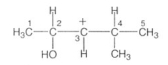
A
$CH_3$ at $C-4$
B
$H$ at $C-4$
C
$CH_3$ at $C-2$
D
$H$ at $C-2$
Solution
(D) The carbocation is at $C-3$. $A$ hydride shift from $C-2$ to $C-3$ occurs because it results in a more stable carbocation at $C-2$.
The positive charge at $C-2$ is stabilized by resonance (conjugation) from the lone pair of electrons on the oxygen atom of the $-OH$ group.
Therefore,the $H$ atom at $C-2$ is the most likely to migrate to the positively charged carbon at $C-3$.
The positive charge at $C-2$ is stabilized by resonance (conjugation) from the lone pair of electrons on the oxygen atom of the $-OH$ group.
Therefore,the $H$ atom at $C-2$ is the most likely to migrate to the positively charged carbon at $C-3$.
0 likesView Solution
19
ChemistryDifficultMCQIIT JEE · 2009
The correct stability order of the following resonance structures is:

A
$I > II > IV > III$
B
$I > III > II > IV$
C
$II > I > III > IV$
D
$III > I > IV > II$
Solution
(B) To determine the stability of resonance structures,we follow these rules:
$1$. Structures with more covalent bonds are more stable (complete octets).
$2$. Structures with fewer formal charges are more stable.
$3$. Negative charges should be on more electronegative atoms,and positive charges on less electronegative atoms.
Analyzing the structures:
$(I)$ $H_2C=N^+=N^-$: Has $4$ bonds,octets are complete for all atoms. It is the most stable.
$(III)$ $H_2C^--N^+=N$: Has $4$ bonds,but the negative charge is on the carbon atom (less electronegative than nitrogen). It is the next most stable.
$(II)$ $H_2C^+-N=N^-$: Has $3$ bonds,carbon has an incomplete octet. Less stable.
$(IV)$ $H_2C^--N=N^+$: Has $3$ bonds,nitrogen has an incomplete octet. Least stable.
Thus,the correct order is $I > III > II > IV$.
$1$. Structures with more covalent bonds are more stable (complete octets).
$2$. Structures with fewer formal charges are more stable.
$3$. Negative charges should be on more electronegative atoms,and positive charges on less electronegative atoms.
Analyzing the structures:
$(I)$ $H_2C=N^+=N^-$: Has $4$ bonds,octets are complete for all atoms. It is the most stable.
$(III)$ $H_2C^--N^+=N$: Has $4$ bonds,but the negative charge is on the carbon atom (less electronegative than nitrogen). It is the next most stable.
$(II)$ $H_2C^+-N=N^-$: Has $3$ bonds,carbon has an incomplete octet. Less stable.
$(IV)$ $H_2C^--N=N^+$: Has $3$ bonds,nitrogen has an incomplete octet. Least stable.
Thus,the correct order is $I > III > II > IV$.
0 likesView Solution
20
ChemistryAdvancedMCQIIT JEE · 2009
Among the following,the state function$(s)$ is(are):
$A$. Internal energy
$B$. Irreversible expansion work
$C$. Reversible expansion work
$D$. Molar enthalpy
$A$. Internal energy
$B$. Irreversible expansion work
$C$. Reversible expansion work
$D$. Molar enthalpy
A
$A, C$
B
$A, D$
C
$A, B$
D
$B, D$
Solution
(B) The correct option is $B$.
Explanation:
$1$. $A$ state function is a property whose value depends only on the current state of the system and not on the path taken to reach that state.
$2$. Internal energy $(U)$ and molar enthalpy $(H_m)$ are state functions because they depend only on the state variables of the system.
$3$. Work $(w)$ and heat $(q)$ are path functions,meaning their values depend on the specific process or path taken to change the state of the system.
$4$. Therefore,both $A$ (Internal energy) and $D$ (Molar enthalpy) are state functions.
Explanation:
$1$. $A$ state function is a property whose value depends only on the current state of the system and not on the path taken to reach that state.
$2$. Internal energy $(U)$ and molar enthalpy $(H_m)$ are state functions because they depend only on the state variables of the system.
$3$. Work $(w)$ and heat $(q)$ are path functions,meaning their values depend on the specific process or path taken to change the state of the system.
$4$. Therefore,both $A$ (Internal energy) and $D$ (Molar enthalpy) are state functions.
0 likesView Solution
21
ChemistryDifficultMCQIIT JEE · 2009
In the reaction $2X + B_2H_6 \rightarrow [BH_2(X)_2]^+ [BH_4]^-$,the amine$(s)$ $X$ is(are):
A
$A, B, C$
B
$A, B, D$
C
$B, C, D$
D
$A, C, D$
Solution
(A) Small amines such as $NH_3$,$CH_3NH_2$,and $(CH_3)_2NH$ undergo unsymmetrical cleavage of diborane to form ionic products of the type $[BH_2(X)_2]^+ [BH_4]^-$.
The reaction is: $B_2H_6 + 2X \rightarrow [BH_2(X)_2]^+ [BH_4]^-$.
Large amines,such as $(CH_3)_3N$,undergo symmetrical cleavage of diborane to form borane-amine adducts: $B_2H_6 + 2N(CH_3)_3 \rightarrow 2H_3B \leftarrow N(CH_3)_3$.
Therefore,$X$ can be $NH_3$,$CH_3NH_2$,or $(CH_3)_2NH$.
The reaction is: $B_2H_6 + 2X \rightarrow [BH_2(X)_2]^+ [BH_4]^-$.
Large amines,such as $(CH_3)_3N$,undergo symmetrical cleavage of diborane to form borane-amine adducts: $B_2H_6 + 2N(CH_3)_3 \rightarrow 2H_3B \leftarrow N(CH_3)_3$.
Therefore,$X$ can be $NH_3$,$CH_3NH_2$,or $(CH_3)_2NH$.
0 likesView Solution
22
ChemistryAdvancedMCQIIT JEE · 2009
Match each of the reactions given in Column $I$ with the corresponding product$(s)$ given in Column $II$.
| Column $I$ | Column $II$ |
| $(A)$ $Cu + \text{dil } HNO_3$ | $(p)$ $NO$ |
| $(B)$ $Cu + \text{conc } HNO_3$ | $(q)$ $NO_2$ |
| $(C)$ $Zn + \text{dil } HNO_3$ | $(r)$ $N_2O$ |
| $(D)$ $Zn + \text{conc } HNO_3$ | $(s)$ $Cu(NO_3)_2$ |
| $(t)$ $Zn(NO_3)_2$ |
A
$A-p, s; B-q, s; C-r, t; D-q, t$
B
$A-p, s; B-q, s; C-r, t; D-q, t$
C
$A-p, r; B-q, p; C-r, t; D-q, s$
D
$A-r, s; B-p, s; C-s, t; D-t, t$
Solution
(A) The reactions are as follows:
$(A)$ $3Cu + 8HNO_3 \text{ (dil)} \rightarrow 3Cu(NO_3)_2 + 2NO + 4H_2O$. Products are $NO$ $(p)$ and $Cu(NO_3)_2$ $(s)$.
$(B)$ $Cu + 4HNO_3 \text{ (conc)} \rightarrow Cu(NO_3)_2 + 2NO_2 + 2H_2O$. Products are $NO_2$ $(q)$ and $Cu(NO_3)_2$ $(s)$.
$(C)$ $4Zn + 10HNO_3 \text{ (dil)} \rightarrow 4Zn(NO_3)_2 + N_2O + 5H_2O$. Products are $N_2O$ $(r)$ and $Zn(NO_3)_2$ $(t)$.
$(D)$ $Zn + 4HNO_3 \text{ (conc)} \rightarrow Zn(NO_3)_2 + 2NO_2 + 2H_2O$. Products are $NO_2$ $(q)$ and $Zn(NO_3)_2$ $(t)$.
Thus,the correct matching is $A-p, s; B-q, s; C-r, t; D-q, t$.
$(A)$ $3Cu + 8HNO_3 \text{ (dil)} \rightarrow 3Cu(NO_3)_2 + 2NO + 4H_2O$. Products are $NO$ $(p)$ and $Cu(NO_3)_2$ $(s)$.
$(B)$ $Cu + 4HNO_3 \text{ (conc)} \rightarrow Cu(NO_3)_2 + 2NO_2 + 2H_2O$. Products are $NO_2$ $(q)$ and $Cu(NO_3)_2$ $(s)$.
$(C)$ $4Zn + 10HNO_3 \text{ (dil)} \rightarrow 4Zn(NO_3)_2 + N_2O + 5H_2O$. Products are $N_2O$ $(r)$ and $Zn(NO_3)_2$ $(t)$.
$(D)$ $Zn + 4HNO_3 \text{ (conc)} \rightarrow Zn(NO_3)_2 + 2NO_2 + 2H_2O$. Products are $NO_2$ $(q)$ and $Zn(NO_3)_2$ $(t)$.
Thus,the correct matching is $A-p, s; B-q, s; C-r, t; D-q, t$.
0 likesView Solution
23
ChemistryAdvancedMCQIIT JEE · 2009
In a constant volume calorimeter,$3.5 \ g$ of a gas with molecular weight $28$ was burnt in excess oxygen at $298.0 \ K$. The temperature of the calorimeter was found to increase from $298.0 \ K$ to $298.45 \ K$ due to the combustion process. Given that the heat capacity of the calorimeter is $2.5 \ kJ \ K^{-1}$,the numerical value for the enthalpy of combustion of the gas in $kJ \ mol^{-1}$ is
A
$9$
B
$4$
C
$5$
D
$6$
Solution
(A) The heat released during combustion is absorbed by the calorimeter: $q = C_V \times \Delta T$.
Given $C_V = 2.5 \ kJ \ K^{-1}$ and $\Delta T = 298.45 \ K - 298.0 \ K = 0.45 \ K$.
Heat released for $3.5 \ g$ of gas $= 2.5 \ kJ \ K^{-1} \times 0.45 \ K = 1.125 \ kJ$.
Moles of gas $= \frac{\text{mass}}{\text{molecular weight}} = \frac{3.5 \ g}{28 \ g \ mol^{-1}} = 0.125 \ mol$.
Enthalpy of combustion per mole $= \frac{\text{Heat released}}{\text{moles}} = \frac{1.125 \ kJ}{0.125 \ mol} = 9 \ kJ \ mol^{-1}$.
Given $C_V = 2.5 \ kJ \ K^{-1}$ and $\Delta T = 298.45 \ K - 298.0 \ K = 0.45 \ K$.
Heat released for $3.5 \ g$ of gas $= 2.5 \ kJ \ K^{-1} \times 0.45 \ K = 1.125 \ kJ$.
Moles of gas $= \frac{\text{mass}}{\text{molecular weight}} = \frac{3.5 \ g}{28 \ g \ mol^{-1}} = 0.125 \ mol$.
Enthalpy of combustion per mole $= \frac{\text{Heat released}}{\text{moles}} = \frac{1.125 \ kJ}{0.125 \ mol} = 9 \ kJ \ mol^{-1}$.
0 likesView Solution
24
ChemistryAdvancedMCQIIT JEE · 2009
At $400 \ K$,the root mean square $(rms)$ speed of a gas $X$ (molecular weight $= 40$) is equal to the most probable speed of gas $Y$ at $60 \ K$. The molecular weight of the gas $Y$ is:
A
$7$
B
$4$
C
$9$
D
$5$
Solution
(B) The formula for root mean square speed is $V_{rms} = \sqrt{\frac{3RT}{M_X}}$.
The formula for most probable speed is $V_{mp} = \sqrt{\frac{2RT}{M_Y}}$.
Given that $V_{rms} (X) = V_{mp} (Y)$,we have:
$\sqrt{\frac{3R(400)}{40}} = \sqrt{\frac{2R(60)}{M_Y}}$.
Squaring both sides:
$\frac{3 \times 400}{40} = \frac{2 \times 60}{M_Y}$.
$30 = \frac{120}{M_Y}$.
$M_Y = \frac{120}{30} = 4$.
Thus,the molecular weight of gas $Y$ is $4$. Hence,the correct answer is option $B$.
The formula for most probable speed is $V_{mp} = \sqrt{\frac{2RT}{M_Y}}$.
Given that $V_{rms} (X) = V_{mp} (Y)$,we have:
$\sqrt{\frac{3R(400)}{40}} = \sqrt{\frac{2R(60)}{M_Y}}$.
Squaring both sides:
$\frac{3 \times 400}{40} = \frac{2 \times 60}{M_Y}$.
$30 = \frac{120}{M_Y}$.
$M_Y = \frac{120}{30} = 4$.
Thus,the molecular weight of gas $Y$ is $4$. Hence,the correct answer is option $B$.
0 likesView Solution
25
ChemistryDifficultMCQIIT JEE · 2009
The dissociation constant of a substituted benzoic acid at $25^{\circ}C$ is $1.0 \times 10^{-4}$. The $pH$ of a $0.01 \ M$ solution of its sodium salt is
A
$5$
B
$2$
C
$8$
D
$9$
Solution
(C) The sodium salt of a weak acid and a strong base undergoes hydrolysis. The $pH$ of such a salt solution is calculated using the formula:
$pH = \frac{1}{2} (pK_w + pK_a + \log C)$
Given:
$K_a = 1.0 \times 10^{-4} \implies pK_a = -\log(1.0 \times 10^{-4}) = 4$
$K_w = 1.0 \times 10^{-14} \implies pK_w = 14$
$C = 0.01 \ M = 10^{-2} \ M \implies \log C = -2$
Substituting these values:
$pH = \frac{1}{2} (14 + 4 + (-2)) = \frac{1}{2} (16) = 8$
$pH = \frac{1}{2} (pK_w + pK_a + \log C)$
Given:
$K_a = 1.0 \times 10^{-4} \implies pK_a = -\log(1.0 \times 10^{-4}) = 4$
$K_w = 1.0 \times 10^{-14} \implies pK_w = 14$
$C = 0.01 \ M = 10^{-2} \ M \implies \log C = -2$
Substituting these values:
$pH = \frac{1}{2} (14 + 4 + (-2)) = \frac{1}{2} (16) = 8$
0 likesView Solution
26
ChemistryDifficultMCQIIT JEE · 2009
The coordination number of $Al$ in the crystalline state of $AlCl_3$ is
A
$7$
B
$6$
C
$5$
D
$4$
Solution
(B) In the crystalline state of $AlCl_3$,the $Cl^{-}$ ions form a close-packed lattice structure.
$Al^{3+}$ ions occupy the octahedral voids within this lattice.
Since each $Al^{3+}$ ion is surrounded by $6$ $Cl^{-}$ ions in an octahedral geometry,the coordination number of $Al$ is $6$.
$Al^{3+}$ ions occupy the octahedral voids within this lattice.
Since each $Al^{3+}$ ion is surrounded by $6$ $Cl^{-}$ ions in an octahedral geometry,the coordination number of $Al$ is $6$.
0 likesView Solution
27
ChemistryDifficultMCQIIT JEE · 2009
The total number of cyclic structural as well as stereo isomers possible for a compound with the molecular formula $C_5H_{10}$ is
A
$7$
B
$8$
C
$9$
D
$2$
Solution
(A) The molecular formula $C_5H_{10}$ corresponds to a degree of unsaturation $(DU)$ of $1$. This means the compound can either be cyclic or contain one double bond.
For cyclic isomers,we consider the following structures:
$1$. Cyclopentane
$2$. Methylcyclobutane
$3$. Ethylcyclopropane
$4$. $1,1$-Dimethylcyclopropane
$5$. cis-$1,2$-Dimethylcyclopropane (optically inactive,meso)
$6$. trans-$1,2$-Dimethylcyclopropane (optically active,$d$-isomer)
$7$. trans-$1,2$-Dimethylcyclopropane (optically active,$l$-isomer)
Counting these,we have $1$ (cyclopentane) + $1$ (methylcyclobutane) + $1$ (ethylcyclopropane) + $1$ ($1,1$-dimethylcyclopropane) + $1$ (cis-$1,2$-dimethylcyclopropane) + $2$ (enantiomers of trans-$1,2$-dimethylcyclopropane) = $7$ isomers.
Thus,the total number of cyclic structural and stereoisomers is $7$.
For cyclic isomers,we consider the following structures:
$1$. Cyclopentane
$2$. Methylcyclobutane
$3$. Ethylcyclopropane
$4$. $1,1$-Dimethylcyclopropane
$5$. cis-$1,2$-Dimethylcyclopropane (optically inactive,meso)
$6$. trans-$1,2$-Dimethylcyclopropane (optically active,$d$-isomer)
$7$. trans-$1,2$-Dimethylcyclopropane (optically active,$l$-isomer)
Counting these,we have $1$ (cyclopentane) + $1$ (methylcyclobutane) + $1$ (ethylcyclopropane) + $1$ ($1,1$-dimethylcyclopropane) + $1$ (cis-$1,2$-dimethylcyclopropane) + $2$ (enantiomers of trans-$1,2$-dimethylcyclopropane) = $7$ isomers.
Thus,the total number of cyclic structural and stereoisomers is $7$.
0 likesView Solution
28
ChemistryMCQIIT JEE · 2009
$A$ line with positive direction cosines passes through the point $P(2,-1,2)$ and makes equal angles with the coordinate axes. The line meets the plane $2x+y+z=9$ at point $Q$. The length of the line segment $PQ$ equals
A
$1$
B
$\sqrt{2}$
C
$\sqrt{3}$
D
$2$
Solution
(C) Since the line makes equal angles with the coordinate axes,its direction cosines are equal. Let the direction cosines be $l, m, n$. Since $l=m=n$ and $l^2+m^2+n^2=1$,we have $3l^2=1$,so $l=m=n=\frac{1}{\sqrt{3}}$ (given positive direction cosines).
The equation of the line passing through $P(2,-1,2)$ with direction cosines $(\frac{1}{\sqrt{3}}, \frac{1}{\sqrt{3}}, \frac{1}{\sqrt{3}})$ is $\frac{x-2}{1/\sqrt{3}} = \frac{y+1}{1/\sqrt{3}} = \frac{z-2}{1/\sqrt{3}} = t$.
Any point on this line is given by $(2+\frac{t}{\sqrt{3}}, -1+\frac{t}{\sqrt{3}}, 2+\frac{t}{\sqrt{3}})$.
Since this point lies on the plane $2x+y+z=9$,we substitute the coordinates into the plane equation:
$2(2+\frac{t}{\sqrt{3}}) + (-1+\frac{t}{\sqrt{3}}) + (2+\frac{t}{\sqrt{3}}) = 9$
$4 + \frac{2t}{\sqrt{3}} - 1 + \frac{t}{\sqrt{3}} + 2 + \frac{t}{\sqrt{3}} = 9$
$5 + \frac{4t}{\sqrt{3}} = 9$
$\frac{4t}{\sqrt{3}} = 4$
$t = \sqrt{3}$.
Since $t$ represents the distance $PQ$,the length of the line segment $PQ$ is $\sqrt{3}$.
The equation of the line passing through $P(2,-1,2)$ with direction cosines $(\frac{1}{\sqrt{3}}, \frac{1}{\sqrt{3}}, \frac{1}{\sqrt{3}})$ is $\frac{x-2}{1/\sqrt{3}} = \frac{y+1}{1/\sqrt{3}} = \frac{z-2}{1/\sqrt{3}} = t$.
Any point on this line is given by $(2+\frac{t}{\sqrt{3}}, -1+\frac{t}{\sqrt{3}}, 2+\frac{t}{\sqrt{3}})$.
Since this point lies on the plane $2x+y+z=9$,we substitute the coordinates into the plane equation:
$2(2+\frac{t}{\sqrt{3}}) + (-1+\frac{t}{\sqrt{3}}) + (2+\frac{t}{\sqrt{3}}) = 9$
$4 + \frac{2t}{\sqrt{3}} - 1 + \frac{t}{\sqrt{3}} + 2 + \frac{t}{\sqrt{3}} = 9$
$5 + \frac{4t}{\sqrt{3}} = 9$
$\frac{4t}{\sqrt{3}} = 4$
$t = \sqrt{3}$.
Since $t$ represents the distance $PQ$,the length of the line segment $PQ$ is $\sqrt{3}$.
0 likesView Solution
29
ChemistryMCQIIT JEE · 2009
Let $P(3, 2, 6)$ be a point in space and $Q$ be a point on the line $\vec{r} = (\hat{i} - \hat{j} + 2\hat{k}) + \mu(-3\hat{i} + \hat{j} + 5\hat{k})$. Then the value of $\mu$ for which the vector $\vec{PQ}$ is parallel to the plane $x - 4y + 3z = 1$ is:
A
$\frac{1}{4}$
B
$-\frac{1}{4}$
C
$\frac{1}{8}$
D
$-\frac{1}{8}$
Solution
(A) Any point $Q$ on the line $\vec{r}$ can be represented as $Q(1 - 3\mu, -1 + \mu, 2 + 5\mu)$.
Given $P(3, 2, 6)$,the vector $\vec{PQ}$ is calculated as:
$\vec{PQ} = (1 - 3\mu - 3)\hat{i} + (-1 + \mu - 2)\hat{j} + (2 + 5\mu - 6)\hat{k} = (-3\mu - 2)\hat{i} + (\mu - 3)\hat{j} + (5\mu - 4)\hat{k}$.
Since $\vec{PQ}$ is parallel to the plane $x - 4y + 3z = 1$,it must be perpendicular to the normal vector $\vec{n} = \hat{i} - 4\hat{j} + 3\hat{k}$ of the plane.
Therefore,$\vec{PQ} \cdot \vec{n} = 0$.
$1(-3\mu - 2) - 4(\mu - 3) + 3(5\mu - 4) = 0$.
$-3\mu - 2 - 4\mu + 12 + 15\mu - 12 = 0$.
$8\mu - 2 = 0$.
$8\mu = 2 \Rightarrow \mu = \frac{1}{4}$.
Given $P(3, 2, 6)$,the vector $\vec{PQ}$ is calculated as:
$\vec{PQ} = (1 - 3\mu - 3)\hat{i} + (-1 + \mu - 2)\hat{j} + (2 + 5\mu - 6)\hat{k} = (-3\mu - 2)\hat{i} + (\mu - 3)\hat{j} + (5\mu - 4)\hat{k}$.
Since $\vec{PQ}$ is parallel to the plane $x - 4y + 3z = 1$,it must be perpendicular to the normal vector $\vec{n} = \hat{i} - 4\hat{j} + 3\hat{k}$ of the plane.
Therefore,$\vec{PQ} \cdot \vec{n} = 0$.
$1(-3\mu - 2) - 4(\mu - 3) + 3(5\mu - 4) = 0$.
$-3\mu - 2 - 4\mu + 12 + 15\mu - 12 = 0$.
$8\mu - 2 = 0$.
$8\mu = 2 \Rightarrow \mu = \frac{1}{4}$.
0 likesView Solution
30
ChemistryDifficultMCQIIT JEE · 2009
Among the electrolytes $Na_2SO_4$,$CaCl_2$,$Al_2(SO_4)_3$,and $NH_4Cl$,the most effective coagulating agent for $Sb_2S_3$ sol is
A
$Na_2SO_4$
B
$CaCl_2$
C
$Al_2(SO_4)_3$
D
$NH_4Cl$
Solution
(C) According to the Hardy-Schulze rule,the coagulating power of an electrolyte depends on the valency of the active ion (the ion carrying a charge opposite to that of the colloidal particles).
$Sb_2S_3$ sol is a negatively charged sol. Therefore,it is coagulated by the positively charged ions of the added electrolytes.
The positively charged ions in the given electrolytes are:
$Na^+$ (from $Na_2SO_4$),
$Ca^{2+}$ (from $CaCl_2$),
$Al^{3+}$ (from $Al_2(SO_4)_3$),
$NH_4^+$ (from $NH_4Cl$).
According to the Hardy-Schulze rule,the coagulating power increases with the increase in the magnitude of the charge on the ion. The order of coagulating power is $Al^{3+} > Ca^{2+} > Na^+ = NH_4^+$.
Since $Al^{3+}$ has the highest charge $(+3)$,$Al_2(SO_4)_3$ is the most effective coagulating agent for $Sb_2S_3$ sol.
Hence,option $C$ is correct.
$Sb_2S_3$ sol is a negatively charged sol. Therefore,it is coagulated by the positively charged ions of the added electrolytes.
The positively charged ions in the given electrolytes are:
$Na^+$ (from $Na_2SO_4$),
$Ca^{2+}$ (from $CaCl_2$),
$Al^{3+}$ (from $Al_2(SO_4)_3$),
$NH_4^+$ (from $NH_4Cl$).
According to the Hardy-Schulze rule,the coagulating power increases with the increase in the magnitude of the charge on the ion. The order of coagulating power is $Al^{3+} > Ca^{2+} > Na^+ = NH_4^+$.
Since $Al^{3+}$ has the highest charge $(+3)$,$Al_2(SO_4)_3$ is the most effective coagulating agent for $Sb_2S_3$ sol.
Hence,option $C$ is correct.
0 likesView Solution
31
ChemistryDifficultMCQIIT JEE · 2009
The Henry's law constant for the solubility of $N_2$ gas in water at $298 \ K$ is $1.0 \times 10^5 \ atm$. The mole fraction of $N_2$ in air is $0.8$. The number of moles of $N_2$ from air dissolved in $10 \ moles$ of water at $298 \ K$ and $5 \ atm$ pressure is
A
$4.0 \times 10^{-4}$
B
$4.0 \times 10^{-5}$
C
$5.0 \times 10^{-4}$
D
$4.0 \times 10^{-6}$
Solution
(A) Total pressure $P_T = 5 \ atm$. The mole fraction of nitrogen in air is $0.8$.
Partial pressure of nitrogen $P_{N_2} = P_T \times X_{air} = 5 \times 0.8 = 4 \ atm$.
According to Henry's law,$P_{N_2} = K_H \cdot X_{sol}$,where $X_{sol}$ is the mole fraction of $N_2$ in the solution.
$X_{sol} = \frac{P_{N_2}}{K_H} = \frac{4}{1.0 \times 10^5} = 4 \times 10^{-5}$.
Since $X_{sol} = \frac{n_{N_2}}{n_{N_2} + n_{H_2O}} \approx \frac{n_{N_2}}{n_{H_2O}}$ because $n_{N_2} \ll n_{H_2O}$.
Given $n_{H_2O} = 10 \ moles$,we have $4 \times 10^{-5} = \frac{n_{N_2}}{10}$.
Therefore,$n_{N_2} = 4 \times 10^{-4} \ moles$.
Partial pressure of nitrogen $P_{N_2} = P_T \times X_{air} = 5 \times 0.8 = 4 \ atm$.
According to Henry's law,$P_{N_2} = K_H \cdot X_{sol}$,where $X_{sol}$ is the mole fraction of $N_2$ in the solution.
$X_{sol} = \frac{P_{N_2}}{K_H} = \frac{4}{1.0 \times 10^5} = 4 \times 10^{-5}$.
Since $X_{sol} = \frac{n_{N_2}}{n_{N_2} + n_{H_2O}} \approx \frac{n_{N_2}}{n_{H_2O}}$ because $n_{N_2} \ll n_{H_2O}$.
Given $n_{H_2O} = 10 \ moles$,we have $4 \times 10^{-5} = \frac{n_{N_2}}{10}$.
Therefore,$n_{N_2} = 4 \times 10^{-4} \ moles$.
0 likesView Solution
32
ChemistryDifficultMCQIIT JEE · 2009
The reaction of $P_4$ with $X$ leads selectively to $P_4O_6$. The $X$ is
A
Dry $O_2$
B
$A$ mixture of $O_2$ and $N_2$
C
Moist $O_2$
D
$O_2$ in the presence of aqueous $NaOH$
Solution
(B) Phosphorus trioxide $(P_4O_6)$ is prepared by burning white phosphorus in a limited supply of oxygen.
To ensure the reaction stops at $P_4O_6$ and does not proceed to $P_4O_{10}$,the reaction is carried out in an atmosphere of nitrogen $(N_2)$ which acts as an inert diluent.
The chemical equation is:
$P_4 + 3O_2 \xrightarrow{N_2} P_4O_6$
Thus,$X$ is a mixture of $O_2$ and $N_2$.
To ensure the reaction stops at $P_4O_6$ and does not proceed to $P_4O_{10}$,the reaction is carried out in an atmosphere of nitrogen $(N_2)$ which acts as an inert diluent.
The chemical equation is:
$P_4 + 3O_2 \xrightarrow{N_2} P_4O_6$
Thus,$X$ is a mixture of $O_2$ and $N_2$.
0 likesView Solution
33
ChemistryDifficultMCQIIT JEE · 2009
The correct acidity order of the following compounds is:
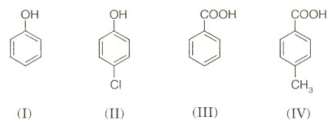
A
$III > IV > II > I$
B
$IV > III > I > II$
C
$III > II > I > IV$
D
$II > III > IV > I$
Solution
(A) The compounds are: $(I)$ Phenol,$(II)$ $4$-chlorophenol,$(III)$ Benzoic acid,$(IV)$ $4$-methylbenzoic acid.
$1$. Carboxylic acids are significantly more acidic than phenols due to the resonance stabilization of the carboxylate anion compared to the phenoxide ion.
$2$. Comparing $(III)$ and $(IV)$: $(III)$ is benzoic acid. In $(IV)$,the $-CH_3$ group is an electron-donating group (via inductive and hyperconjugation effects),which destabilizes the carboxylate anion,making $(IV)$ less acidic than $(III)$. Thus,$III > IV$.
$3$. Comparing $(I)$ and $(II)$: $(II)$ is $4$-chlorophenol. The $-Cl$ atom is an electron-withdrawing group (via inductive effect),which stabilizes the phenoxide ion,making $(II)$ more acidic than $(I)$. Thus,$II > I$.
$4$. Combining these,the overall order of acidity is $III > IV > II > I$.
Therefore,option $A$ is correct.
$1$. Carboxylic acids are significantly more acidic than phenols due to the resonance stabilization of the carboxylate anion compared to the phenoxide ion.
$2$. Comparing $(III)$ and $(IV)$: $(III)$ is benzoic acid. In $(IV)$,the $-CH_3$ group is an electron-donating group (via inductive and hyperconjugation effects),which destabilizes the carboxylate anion,making $(IV)$ less acidic than $(III)$. Thus,$III > IV$.
$3$. Comparing $(I)$ and $(II)$: $(II)$ is $4$-chlorophenol. The $-Cl$ atom is an electron-withdrawing group (via inductive effect),which stabilizes the phenoxide ion,making $(II)$ more acidic than $(I)$. Thus,$II > I$.
$4$. Combining these,the overall order of acidity is $III > IV > II > I$.
Therefore,option $A$ is correct.
0 likesView Solution
34
ChemistryDifficultMCQIIT JEE · 2009
Among cellulose,poly(vinyl chloride),nylon and natural rubber,the polymer in which the intermolecular force of attraction is weakest is
A
Nylon
B
Poly(vinyl chloride)
C
Cellulose
D
Natural Rubber
Solution
(D) The strength of intermolecular forces in polymers follows the order: $\text{Fibers} > \text{Thermoplastics} > \text{Elastomers}$.
$1$. $\text{Nylon}$ is a fiber and has strong hydrogen bonding.
$2$. $\text{Cellulose}$ is a natural polymer with strong hydrogen bonding.
$3$. $\text{Poly(vinyl chloride)}$ is a thermoplastic with dipole-dipole interactions.
$4$. $\text{Natural rubber}$ is an elastomer held together by weak van der Waals forces.
Therefore,$\text{natural rubber}$ has the weakest intermolecular forces.
$1$. $\text{Nylon}$ is a fiber and has strong hydrogen bonding.
$2$. $\text{Cellulose}$ is a natural polymer with strong hydrogen bonding.
$3$. $\text{Poly(vinyl chloride)}$ is a thermoplastic with dipole-dipole interactions.
$4$. $\text{Natural rubber}$ is an elastomer held together by weak van der Waals forces.
Therefore,$\text{natural rubber}$ has the weakest intermolecular forces.
0 likesView Solution
35
ChemistryDifficultMCQIIT JEE · 2009
The correct statement$(s)$ regarding defects in solids is(are):
$A$. Frenkel defect is usually favoured by a very small difference in the sizes of cation and anion.
$B$. Frenkel defect is a dislocation defect.
$C$. Trapping of an electron in the lattice leads to the formation of $F$-center.
$D$. Schottky defects have no effect on the physical properties of solids.
$A$. Frenkel defect is usually favoured by a very small difference in the sizes of cation and anion.
$B$. Frenkel defect is a dislocation defect.
$C$. Trapping of an electron in the lattice leads to the formation of $F$-center.
$D$. Schottky defects have no effect on the physical properties of solids.
A
$B, C$
B
$A, B, C$
C
$B, C, D$
D
$A, D$
Solution
(A) and $C$ are correct statements.
$A$. Incorrect: Frenkel defect is favoured by a large difference in the sizes of cation and anion.
$B$. Correct: Frenkel defect is a dislocation defect where an ion moves from its lattice site to an interstitial site.
$C$. Correct: Trapping of an electron in an anionic vacancy leads to the formation of $F$-centers,which impart color to the crystal.
$D$. Incorrect: Schottky defects decrease the density of the solid,thus affecting its physical properties.
$A$. Incorrect: Frenkel defect is favoured by a large difference in the sizes of cation and anion.
$B$. Correct: Frenkel defect is a dislocation defect where an ion moves from its lattice site to an interstitial site.
$C$. Correct: Trapping of an electron in an anionic vacancy leads to the formation of $F$-centers,which impart color to the crystal.
$D$. Incorrect: Schottky defects decrease the density of the solid,thus affecting its physical properties.
0 likesView Solution
36
ChemistryDifficultMCQIIT JEE · 2009
The compound$(s)$ that exhibit$(s)$ geometrical isomerism is(are):
$A$. $[Pt(en)Cl_2]$
$B$. $[Pt(en)_2]Cl_2$
$C$. $[Pt(en)_2Cl_2]Cl_2$
$D$. $[Pt(NH_3)_2Cl_2]$
$A$. $[Pt(en)Cl_2]$
$B$. $[Pt(en)_2]Cl_2$
$C$. $[Pt(en)_2Cl_2]Cl_2$
$D$. $[Pt(NH_3)_2Cl_2]$
A
$(C, B)$
B
$(C, D)$
C
$(A, D)$
D
$(B, D)$
Solution
(B) Geometrical isomerism in coordination compounds occurs when ligands can be arranged in different spatial orientations around the central metal atom.
$A$. $[Pt(en)Cl_2]$ is a square planar complex of the type $[M(AA)X_2]$. It does not show geometrical isomerism because the chelating ligand $(en)$ occupies adjacent positions,and the two $Cl$ ligands are also adjacent.
$B$. $[Pt(en)_2]Cl_2$ is a square planar complex of the type $[M(AA)_2]$. It does not show geometrical isomerism as all possible arrangements are identical.
$C$. $[Pt(en)_2Cl_2]Cl_2$ is an octahedral complex of the type $[M(AA)_2X_2]$. It exhibits geometrical isomerism,existing as $cis$ and $trans$ isomers.
$D$. $[Pt(NH_3)_2Cl_2]$ is a square planar complex of the type $[MA_2X_2]$. It exhibits geometrical isomerism,existing as $cis$ and $trans$ isomers.
Thus,compounds $C$ and $D$ exhibit geometrical isomerism.
$A$. $[Pt(en)Cl_2]$ is a square planar complex of the type $[M(AA)X_2]$. It does not show geometrical isomerism because the chelating ligand $(en)$ occupies adjacent positions,and the two $Cl$ ligands are also adjacent.
$B$. $[Pt(en)_2]Cl_2$ is a square planar complex of the type $[M(AA)_2]$. It does not show geometrical isomerism as all possible arrangements are identical.
$C$. $[Pt(en)_2Cl_2]Cl_2$ is an octahedral complex of the type $[M(AA)_2X_2]$. It exhibits geometrical isomerism,existing as $cis$ and $trans$ isomers.
$D$. $[Pt(NH_3)_2Cl_2]$ is a square planar complex of the type $[MA_2X_2]$. It exhibits geometrical isomerism,existing as $cis$ and $trans$ isomers.
Thus,compounds $C$ and $D$ exhibit geometrical isomerism.
0 likesView Solution
37
ChemistryDifficultMCQIIT JEE · 2009
$p$-Amino-$N,N$-dimethylaniline is added to a strongly acidic solution of $X$. The resulting solution is treated with a few drops of aqueous solution of $Y$ to yield blue coloration due to the formation of methylene blue. Treatment of the aqueous solution of $Y$ with the reagent potassium hexacyanoferrate$(II)$ leads to the formation of an intense blue precipitate. The precipitate dissolves on excess addition of the reagent. Similarly,treatment of the solution of $Y$ with the solution of potassium hexacyanoferrate$(III)$ leads to a brown coloration due to the formation of $Z$.
$1.$ The compound $X$ is
$(A)$ $NaNO_3$ $(B)$ $NaCl$ $(C)$ $Na_2SO_4$ $(D)$ $Na_2S$
$2.$ The compound $Y$ is
$(A)$ $MgCl_2$ $(B)$ $FeCl_2$ $(C)$ $FeCl_3$ $(D)$ $ZnCl_2$
$3.$ The compound $Z$ is
$(A)$ $Mg_2[Fe(CN)_6]$ $(B)$ $Fe[Fe(CN)_6]$
$(C)$ $Fe_4[Fe(CN)_6]_3$ $(D)$ $K_2Zn_3[Fe(CN)_6]_2$
Give the answer for questions $1, 2$ and $3$.
$1.$ The compound $X$ is
$(A)$ $NaNO_3$ $(B)$ $NaCl$ $(C)$ $Na_2SO_4$ $(D)$ $Na_2S$
$2.$ The compound $Y$ is
$(A)$ $MgCl_2$ $(B)$ $FeCl_2$ $(C)$ $FeCl_3$ $(D)$ $ZnCl_2$
$3.$ The compound $Z$ is
$(A)$ $Mg_2[Fe(CN)_6]$ $(B)$ $Fe[Fe(CN)_6]$
$(C)$ $Fe_4[Fe(CN)_6]_3$ $(D)$ $K_2Zn_3[Fe(CN)_6]_2$
Give the answer for questions $1, 2$ and $3$.
A
$D, C, B$
B
$D, B, A$
C
$A, C, D$
D
$A, C, C$
Solution
(A) The reaction described is the Lauth's violet or Methylene Blue test for sulfides.
$1.$ $X$ is $Na_2S$ because it provides $S^{2-}$ ions which react with $p$-amino-$N,N$-dimethylaniline in the presence of an oxidizing agent $(Y)$ to form methylene blue.
$2.$ $Y$ is $FeCl_3$ (an oxidizing agent). $FeCl_3$ reacts with potassium hexacyanoferrate$(II)$ $(K_4[Fe(CN)_6])$ to form Prussian blue $(Fe_4[Fe(CN)_6]_3)$,which is an intense blue precipitate. This precipitate dissolves in excess reagent to form a soluble complex.
$3.$ $FeCl_3$ reacts with potassium hexacyanoferrate$(III)$ $(K_3[Fe(CN)_6])$ to form $Fe[Fe(CN)_6]$ (iron$(III)$ hexacyanoferrate$(III)$),which gives a brown coloration.
Therefore,$X = Na_2S$,$Y = FeCl_3$,and $Z = Fe[Fe(CN)_6]$.
The correct option is $(D, C, B)$.
$1.$ $X$ is $Na_2S$ because it provides $S^{2-}$ ions which react with $p$-amino-$N,N$-dimethylaniline in the presence of an oxidizing agent $(Y)$ to form methylene blue.
$2.$ $Y$ is $FeCl_3$ (an oxidizing agent). $FeCl_3$ reacts with potassium hexacyanoferrate$(II)$ $(K_4[Fe(CN)_6])$ to form Prussian blue $(Fe_4[Fe(CN)_6]_3)$,which is an intense blue precipitate. This precipitate dissolves in excess reagent to form a soluble complex.
$3.$ $FeCl_3$ reacts with potassium hexacyanoferrate$(III)$ $(K_3[Fe(CN)_6])$ to form $Fe[Fe(CN)_6]$ (iron$(III)$ hexacyanoferrate$(III)$),which gives a brown coloration.
Therefore,$X = Na_2S$,$Y = FeCl_3$,and $Z = Fe[Fe(CN)_6]$.
The correct option is $(D, C, B)$.
0 likesView Solution
38
ChemistryDifficultMCQIIT JEE · 2009
$A$ carbonyl compound $P$,which gives a positive iodoform test,undergoes reaction with $MeMgBr$ followed by dehydration to give an olefin $Q$. Ozonolysis of $Q$ leads to a dicarbonyl compound $R$,which undergoes intramolecular aldol reaction to give predominantly $S$.
$P$ $\xrightarrow[\substack{2. H^{+}, H_2 O \\ 3. H_2 SO_4, \Delta}]{1. MeMgBr} Q$ $\xrightarrow[2. Zn, H_2 O]{1. O_3} R$ $\xrightarrow[2. \Delta]{1. OH^{-}} S$
$1.$ The structure of the carbonyl compound $P$ is
$2.$ The structures of the products $Q$ and $R$,respectively,are
$3.$ The structure of the product $S$ is
Give the answer for questions $1, 2$ and $3.$
$P$ $\xrightarrow[\substack{2. H^{+}, H_2 O \\ 3. H_2 SO_4, \Delta}]{1. MeMgBr} Q$ $\xrightarrow[2. Zn, H_2 O]{1. O_3} R$ $\xrightarrow[2. \Delta]{1. OH^{-}} S$
$1.$ The structure of the carbonyl compound $P$ is
$2.$ The structures of the products $Q$ and $R$,respectively,are
$3.$ The structure of the product $S$ is
Give the answer for questions $1, 2$ and $3.$
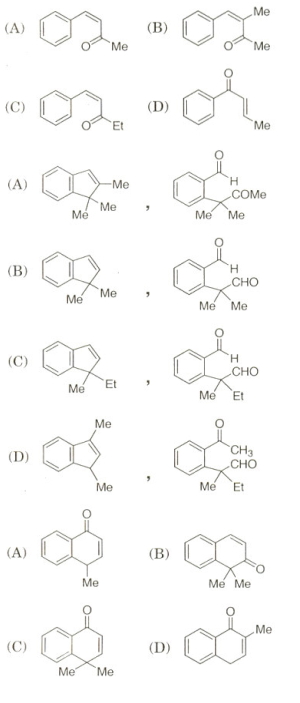
A
$(A, B, C)$
B
$(B, A, B)$
C
$(D, A, C)$
D
$(B, C, A)$
Solution
(B) $1$. Compound $P$ must be $4-$phenylbut$-3-$en$-2-$one (structure $B$ in the first set) because it contains a methyl ketone group (gives positive iodoform test) and has the correct carbon skeleton to form the subsequent products.
$2$. Reaction of $P$ with $MeMgBr$ followed by dehydration gives $Q$ ($1$,$1$-dimethyl-1H-indene,structure $A$ in the second set). Ozonolysis of $Q$ gives $R$ ($2$-($2$-acetylphenyl)$-2-$methylpropanal,structure $B$ in the second set).
$3$. Intramolecular aldol condensation of $R$ gives $S$ ($3$,$3$-dimethyl$-3,4-$dihydronaphthalen-$1$(2H)-one,structure $B$ in the third set).
Thus,the correct sequence is $P=B, Q=A, R=B, S=B$. The answer is $(B, A, B)$.
$2$. Reaction of $P$ with $MeMgBr$ followed by dehydration gives $Q$ ($1$,$1$-dimethyl-1H-indene,structure $A$ in the second set). Ozonolysis of $Q$ gives $R$ ($2$-($2$-acetylphenyl)$-2-$methylpropanal,structure $B$ in the second set).
$3$. Intramolecular aldol condensation of $R$ gives $S$ ($3$,$3$-dimethyl$-3,4-$dihydronaphthalen-$1$(2H)-one,structure $B$ in the third set).
Thus,the correct sequence is $P=B, Q=A, R=B, S=B$. The answer is $(B, A, B)$.
0 likesView Solution
39
ChemistryAdvancedMCQIIT JEE · 2009
Match each of the compounds in Column $I$ with its characteristic reaction$(s)$ in Column $II$.
| Column $I$ | Column $II$ |
|---|---|
| $A$. $CH_3CH_2CH_2CN$ | $p$. Reduction with $Pd-C/H_2$ |
| $B$. $CH_3CH_2OCOCH_3$ | $q$. Reduction with $SnCl_2/HCl$ |
| $C$. $CH_3-CH=CH-CH_2OH$ | $r$. Development of foul smell on treatment with chloroform and alcoholic $KOH$ |
| $D$. $CH_3CH_2CH_2CH_2NH_2$ | $s$. Reduction with diisobutylaluminium hydride $(DIBAL-H)$ |
| $t$. Alkaline hydrolysis |
A
$A-p, q, s; B-t; C-p, s; D-r$
B
$A-p, q, s; B-t; C-p; D-r$
C
$A-q, s; B-t; C-p, s; D-r$
D
$A-p, q, s; B-t; C-s; D-r$
Solution
(A) . $CH_3CH_2CH_2CN$ (nitrile) undergoes reduction with $Pd-C/H_2$ $(p)$,$SnCl_2/HCl$ (Stephen reduction,$q$),and $DIBAL-H$ $(s)$.
$B$. $CH_3CH_2OCOCH_3$ (ester) undergoes alkaline hydrolysis $(t)$.
$C$. $CH_3-CH=CH-CH_2OH$ (allylic alcohol) undergoes reduction of the double bond with $Pd-C/H_2$ $(p)$ and can be reduced with $DIBAL-H$ $(s)$.
$D$. $CH_3CH_2CH_2CH_2NH_2$ (primary amine) gives the carbylamine test (foul smell) with $CHCl_3/alc. KOH$ $(r)$.
$B$. $CH_3CH_2OCOCH_3$ (ester) undergoes alkaline hydrolysis $(t)$.
$C$. $CH_3-CH=CH-CH_2OH$ (allylic alcohol) undergoes reduction of the double bond with $Pd-C/H_2$ $(p)$ and can be reduced with $DIBAL-H$ $(s)$.
$D$. $CH_3CH_2CH_2CH_2NH_2$ (primary amine) gives the carbylamine test (foul smell) with $CHCl_3/alc. KOH$ $(r)$.
0 likesView Solution
40
ChemistryDifficultMCQIIT JEE · 2009
For a first order reaction $A \rightarrow P$,the temperature $(T)$ dependent rate constant $(k)$ was found to follow the equation $\log k = -(2000) \frac{1}{T} + 6.0$. The pre-exponential factor $A$ and the activation energy $E_{a}$,respectively,are
A
$1.0 \times 10^6 \ s^{-1}$ and $9.2 \ kJ \ mol^{-1}$
B
$6.0 \ s^{-1}$ and $16.6 \ kJ \ mol^{-1}$
C
$1.0 \times 10^6 \ s^{-1}$ and $16.6 \ kJ \ mol^{-1}$
D
$1.0 \times 10^6 \ s^{-1}$ and $38.3 \ kJ \ mol^{-1}$
Solution
(D) The Arrhenius equation is given by $k = Ae^{-E_a/RT}$.
Taking the logarithm on both sides,we get $\log k = \log A - \frac{E_a}{2.303RT}$.
Comparing this with the given equation $\log k = -(2000) \frac{1}{T} + 6.0$:
For the pre-exponential factor $A$,$\log A = 6.0$,which gives $A = 10^6 \ s^{-1}$.
For the activation energy $E_a$,$\frac{E_a}{2.303R} = 2000$.
$E_a = 2000 \times 2.303 \times 8.314 \ J \ mol^{-1} \approx 38314 \ J \ mol^{-1} = 38.3 \ kJ \ mol^{-1}$.
Thus,the correct option is $D$.
Taking the logarithm on both sides,we get $\log k = \log A - \frac{E_a}{2.303RT}$.
Comparing this with the given equation $\log k = -(2000) \frac{1}{T} + 6.0$:
For the pre-exponential factor $A$,$\log A = 6.0$,which gives $A = 10^6 \ s^{-1}$.
For the activation energy $E_a$,$\frac{E_a}{2.303R} = 2000$.
$E_a = 2000 \times 2.303 \times 8.314 \ J \ mol^{-1} \approx 38314 \ J \ mol^{-1} = 38.3 \ kJ \ mol^{-1}$.
Thus,the correct option is $D$.
0 likesView Solution
41
ChemistryDifficultMCQIIT JEE · 2009
The spin only magnetic moment value (in Bohr magneton units) of $Cr(CO)_6$ is
A
$0$
B
$2.84$
C
$4.90$
D
$5.92$
Solution
(A) In $Cr(CO)_6$, the central metal atom $Cr$ is in the $0$ oxidation state.
The ground state electronic configuration of $Cr$ is $[Ar] 3d^5 4s^1$.
$CO$ is a strong field ligand, which causes the pairing of all $6$ electrons ($5$ from $3d$ and $1$ from $4s$) into the $3d$ orbitals.
As a result, the number of unpaired electrons $(n)$ is $0$.
The spin-only magnetic moment $(\mu)$ is calculated using the formula $\mu = \sqrt{n(n+2)} \ BM$.
Substituting $n = 0$, we get $\mu = \sqrt{0(0+2)} = 0 \ BM$.
The ground state electronic configuration of $Cr$ is $[Ar] 3d^5 4s^1$.
$CO$ is a strong field ligand, which causes the pairing of all $6$ electrons ($5$ from $3d$ and $1$ from $4s$) into the $3d$ orbitals.
As a result, the number of unpaired electrons $(n)$ is $0$.
The spin-only magnetic moment $(\mu)$ is calculated using the formula $\mu = \sqrt{n(n+2)} \ BM$.
Substituting $n = 0$, we get $\mu = \sqrt{0(0+2)} = 0 \ BM$.
0 likesView Solution
42
ChemistryDifficultMCQIIT JEE · 2009
For the reduction of $NO_3^{-}$ ion in an aqueous solution,$E^0$ is $+0.96 \ V$. Values of $E^0$ for some metal ions are given below:
$V^{2+}_{(aq)} + 2e^{-} \rightarrow V \ \ \ \ E^0 = -1.19 \ V$
$Fe^{3+}_{(aq)} + 3e^{-} \rightarrow Fe \ \ \ \ E^0 = -0.04 \ V$
$Au^{3+}_{(aq)} + 3e^{-} \rightarrow Au \ \ \ \ E^0 = +1.40 \ V$
$Hg^{2+}_{(aq)} + 2e^{-} \rightarrow Hg \ \ \ \ E^0 = +0.86 \ V$
The pair$(s)$ of metals that is(are) oxidized by $NO_3^{-}$ in aqueous solution is(are):
$(A) V$ and $Hg$
$(B) Hg$ and $Fe$
$(C) Fe$ and $Au$
$(D) Fe$ and $V$
$V^{2+}_{(aq)} + 2e^{-} \rightarrow V \ \ \ \ E^0 = -1.19 \ V$
$Fe^{3+}_{(aq)} + 3e^{-} \rightarrow Fe \ \ \ \ E^0 = -0.04 \ V$
$Au^{3+}_{(aq)} + 3e^{-} \rightarrow Au \ \ \ \ E^0 = +1.40 \ V$
$Hg^{2+}_{(aq)} + 2e^{-} \rightarrow Hg \ \ \ \ E^0 = +0.86 \ V$
The pair$(s)$ of metals that is(are) oxidized by $NO_3^{-}$ in aqueous solution is(are):
$(A) V$ and $Hg$
$(B) Hg$ and $Fe$
$(C) Fe$ and $Au$
$(D) Fe$ and $V$
A
$(A), (B), (D)$
B
$(D), (B), (C)$
C
$(B), (C), (D)$
D
$(C), (A), (B)$
Solution
(A, B, D) The reduction potential of $NO_3^{-}$ is $E^0 = +0.96 \ V$.
$A$ metal is oxidized by $NO_3^{-}$ if its standard oxidation potential is greater than the reduction potential of $NO_3^{-}$,or equivalently,if its standard reduction potential $E^0_{red}$ is less than $E^0_{red}(NO_3^{-}) = +0.96 \ V$.
Comparing the given values:
$V: E^0 = -1.19 \ V < +0.96 \ V$ (Oxidized)
$Fe: E^0 = -0.04 \ V < +0.96 \ V$ (Oxidized)
$Hg: E^0 = +0.86 \ V < +0.96 \ V$ (Oxidized)
$Au: E^0 = +1.40 \ V > +0.96 \ V$ (Not oxidized)
Thus,$V, Fe,$ and $Hg$ are oxidized by $NO_3^{-}$.
The pairs containing these metals are $(A) V$ and $Hg$,$(B) Hg$ and $Fe$,and $(D) Fe$ and $V$.
$A$ metal is oxidized by $NO_3^{-}$ if its standard oxidation potential is greater than the reduction potential of $NO_3^{-}$,or equivalently,if its standard reduction potential $E^0_{red}$ is less than $E^0_{red}(NO_3^{-}) = +0.96 \ V$.
Comparing the given values:
$V: E^0 = -1.19 \ V < +0.96 \ V$ (Oxidized)
$Fe: E^0 = -0.04 \ V < +0.96 \ V$ (Oxidized)
$Hg: E^0 = +0.86 \ V < +0.96 \ V$ (Oxidized)
$Au: E^0 = +1.40 \ V > +0.96 \ V$ (Not oxidized)
Thus,$V, Fe,$ and $Hg$ are oxidized by $NO_3^{-}$.
The pairs containing these metals are $(A) V$ and $Hg$,$(B) Hg$ and $Fe$,and $(D) Fe$ and $V$.
0 likesView Solution
43
ChemistryDifficultMCQIIT JEE · 2009
The nitrogen oxide$(s)$ that contain$(s)$ $N-N$ bond$(s)$ is(are):
$A$. $N_2O$
$B$. $N_2O_3$
$C$. $N_2O_4$
$D$. $N_2O_5$
$A$. $N_2O$
$B$. $N_2O_3$
$C$. $N_2O_4$
$D$. $N_2O_5$
A
$A, B, C$
B
$B, C, D$
C
$A, B, D$
D
$A, C, D$
Solution
(A) $N_2O$ has the structure $N \equiv N^+ - O^-$,which contains an $N-N$ bond.
$N_2O_3$ has the structure $O=N-N(=O)-O$,which contains an $N-N$ bond.
$N_2O_4$ has the structure $O_2N-NO_2$,which contains an $N-N$ bond.
$N_2O_5$ has the structure $O_2N-O-NO_2$,which does not contain an $N-N$ bond.
Therefore,the oxides containing $N-N$ bonds are $N_2O, N_2O_3,$ and $N_2O_4$.
$N_2O_3$ has the structure $O=N-N(=O)-O$,which contains an $N-N$ bond.
$N_2O_4$ has the structure $O_2N-NO_2$,which contains an $N-N$ bond.
$N_2O_5$ has the structure $O_2N-O-NO_2$,which does not contain an $N-N$ bond.
Therefore,the oxides containing $N-N$ bonds are $N_2O, N_2O_3,$ and $N_2O_4$.
0 likesView Solution
44
ChemistryDifficultMCQIIT JEE · 2009
The correct statement$(s)$ about the following sugars $X$ and $Y$ is(are):
$(A)$ $X$ is a reducing sugar and $Y$ is a non-reducing sugar
$(B)$ $X$ is a non-reducing sugar and $Y$ is a reducing sugar
$(C)$ The glycosidic linkages in $X$ and $Y$ are $\alpha$ and $\beta$,respectively
$(D)$ The glycosidic linkages in $X$ and $Y$ are $\beta$ and $\alpha$,respectively
$(A)$ $X$ is a reducing sugar and $Y$ is a non-reducing sugar
$(B)$ $X$ is a non-reducing sugar and $Y$ is a reducing sugar
$(C)$ The glycosidic linkages in $X$ and $Y$ are $\alpha$ and $\beta$,respectively
$(D)$ The glycosidic linkages in $X$ and $Y$ are $\beta$ and $\alpha$,respectively
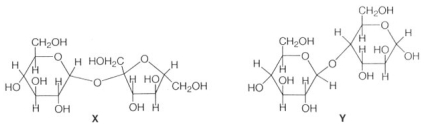
A
$(B, C)$
B
$(B, D)$
C
$(A, C)$
D
$(A, B)$
Solution
(A) In sugar $X$ (Sucrose),the glycosidic linkage is between $C1$ of $\alpha$-$D$-glucose and $C2$ of $\beta$-$D$-fructose. Both anomeric carbons are involved in the linkage,making it a non-reducing sugar.
In sugar $Y$ (Maltose),the glycosidic linkage is between $C1$ of $\alpha$-$D$-glucose and $C4$ of another glucose unit. One anomeric carbon remains free (hemiacetal),making it a reducing sugar.
Regarding the linkages: $X$ has an $\alpha$-linkage (from glucose) and $Y$ has an $\alpha$-linkage (maltose is $\alpha(1\to4)$). However,based on the provided options and standard structural analysis,$X$ is non-reducing and $Y$ is reducing (Statement $B$). The linkage in $X$ is $\alpha, \beta$ and in $Y$ is $\alpha$. Thus,$(B)$ and $(C)$ are the correct statements.
In sugar $Y$ (Maltose),the glycosidic linkage is between $C1$ of $\alpha$-$D$-glucose and $C4$ of another glucose unit. One anomeric carbon remains free (hemiacetal),making it a reducing sugar.
Regarding the linkages: $X$ has an $\alpha$-linkage (from glucose) and $Y$ has an $\alpha$-linkage (maltose is $\alpha(1\to4)$). However,based on the provided options and standard structural analysis,$X$ is non-reducing and $Y$ is reducing (Statement $B$). The linkage in $X$ is $\alpha, \beta$ and in $Y$ is $\alpha$. Thus,$(B)$ and $(C)$ are the correct statements.
0 likesView Solution
45
ChemistryDifficultMCQIIT JEE · 2009
Match each of the compounds given in Column $I$ with the reaction$(s)$ that they can undergo,given in Column $II$.
| Column $I$ | Column $II$ |
| :--- | :--- |
| $(A)$ $3-$bromobenzofuran derivative | $(p)$ Nucleophilic substitution |
| $(B)$ Benzyl alcohol | $(q)$ Elimination |
| $(C)$ Salicylaldehyde | $(r)$ Nucleophilic addition |
| $(D)$ $1-$bromo$-2-$nitrobenzene | $(s)$ Esterification with acetic anhydride |
| | $(t)$ Dehydrogenation |
| Column $I$ | Column $II$ |
| :--- | :--- |
| $(A)$ $3-$bromobenzofuran derivative | $(p)$ Nucleophilic substitution |
| $(B)$ Benzyl alcohol | $(q)$ Elimination |
| $(C)$ Salicylaldehyde | $(r)$ Nucleophilic addition |
| $(D)$ $1-$bromo$-2-$nitrobenzene | $(s)$ Esterification with acetic anhydride |
| | $(t)$ Dehydrogenation |
A
$A-p, q, t; B-p, s, t; C-r, s; D-p$
B
$A-p, q, t; B-p, s, t; C-r, s; D-p$
C
$A-p, q, s; B-p, s, q; C-r, q; D-s$
D
$A-p, q, t; B-p, s, t; C-r, s; D-p$
Solution
(A) Undergoes nucleophilic substitution of $Br^-$. Undergoes elimination of $HBr$. Does not undergo nucleophilic addition. Does not esterify with acetic anhydride,but can be dehydrogenated. Thus,$(A-p, q, t)$.
$(B)$ Undergoes nucleophilic substitution with $SOCl_2, PCl_5$ etc. Does not undergo elimination. Does not undergo nucleophilic addition. Undergoes esterification with acetic anhydride. Undergoes dehydrogenation to give $C_6H_5CHO$. Thus,$(B-p, s, t)$.
$(C)$ Does not undergo nucleophilic substitution (no leaving group). Does not undergo elimination. Undergoes nucleophilic addition at the carbonyl carbon of $-CHO$. Undergoes esterification with acetic anhydride (at $-OH$ group). Does not undergo dehydrogenation. Thus,$(C-r, s)$.
$(D)$ Undergoes aromatic nucleophilic substitution $(S_NAr)$. Does not undergo elimination,nucleophilic addition,esterification,or dehydrogenation. Thus,$(D-p)$.
$(B)$ Undergoes nucleophilic substitution with $SOCl_2, PCl_5$ etc. Does not undergo elimination. Does not undergo nucleophilic addition. Undergoes esterification with acetic anhydride. Undergoes dehydrogenation to give $C_6H_5CHO$. Thus,$(B-p, s, t)$.
$(C)$ Does not undergo nucleophilic substitution (no leaving group). Does not undergo elimination. Undergoes nucleophilic addition at the carbonyl carbon of $-CHO$. Undergoes esterification with acetic anhydride (at $-OH$ group). Does not undergo dehydrogenation. Thus,$(C-r, s)$.
$(D)$ Undergoes aromatic nucleophilic substitution $(S_NAr)$. Does not undergo elimination,nucleophilic addition,esterification,or dehydrogenation. Thus,$(D-p)$.
0 likesView Solution
46
ChemistryDifficultMCQIIT JEE · 2009
The oxidation number of $Mn$ in the product of alkaline oxidative fusion of $MnO_2$ is
A
$6$
B
$5$
C
$4$
D
$2$
Solution
(A) The reaction for the alkaline oxidative fusion of manganese dioxide is:
$2MnO_2 + 4KOH + O_2 \rightarrow 2K_2MnO_4 + 2H_2O$
The product formed is potassium manganate,$K_2MnO_4$,which contains the manganate ion,${MnO_4}^{2-}$.
To find the oxidation state of $Mn$ in ${MnO_4}^{2-}$:
Let the oxidation state of $Mn$ be $x$.
$x + 4 \times (-2) = -2$
$x - 8 = -2$
$x = +6$
Thus,the oxidation number of $Mn$ in the product is $6$.
$2MnO_2 + 4KOH + O_2 \rightarrow 2K_2MnO_4 + 2H_2O$
The product formed is potassium manganate,$K_2MnO_4$,which contains the manganate ion,${MnO_4}^{2-}$.
To find the oxidation state of $Mn$ in ${MnO_4}^{2-}$:
Let the oxidation state of $Mn$ be $x$.
$x + 4 \times (-2) = -2$
$x - 8 = -2$
$x = +6$
Thus,the oxidation number of $Mn$ in the product is $6$.
0 likesView Solution
47
ChemistryDifficultMCQIIT JEE · 2009
The number of water molecule$(s)$ directly bonded to the metal centre in $CuSO_4 \cdot 5 H_2 O$ is
A
$6$
B
$5$
C
$4$
D
$2$
Solution
(C) In $CuSO_4 \cdot 5 H_2 O$,the copper ion $(Cu^{2+})$ is six-coordinated.
Four water molecules are directly coordinated to the $Cu^{2+}$ ion.
The remaining fifth water molecule is held by hydrogen bonding between the coordinated water molecules and the sulphate $(SO_4^{2-})$ ions.
Therefore,the number of water molecules directly bonded to the metal centre is $4$.
Four water molecules are directly coordinated to the $Cu^{2+}$ ion.
The remaining fifth water molecule is held by hydrogen bonding between the coordinated water molecules and the sulphate $(SO_4^{2-})$ ions.
Therefore,the number of water molecules directly bonded to the metal centre is $4$.
0 likesView Solution
Vedclass Products
For Students
Vedclass Test Series
Mock tests in real IIT JEE style covering Chemistry with performance analysis. 5-day free trial.
Start Free TrialFor Teachers
Exam Paper Generator
Generate Set A/B/C/D Chemistry papers from 7.5L+ questions in 2 minutes. 3 chapters free.
Try FreeFor Institutes
Online Exam Module
Run live IIT JEE mock exams with unlimited students, 360° analytics & white-label branding.
See DemoFrequently Asked Questions
How many Chemistry questions are in IIT JEE 2009?
There are 47 Chemistry questions from the IIT JEE 2009 paper on Vedclass, each with a detailed step-by-step solution in English.
Are IIT JEE 2009 Chemistry solutions available in English?
Yes. All solutions on this page are in English. You can also switch to English or Hindi using the language buttons above the questions.
Can I practice IIT JEE 2009 Chemistry as a timed test?
Yes. Use the Vedclass Test Series to attempt a full IIT JEE mock test covering Chemistry with time limits and instant score analysis.
Can teachers create Chemistry papers from IIT JEE previous year questions?
Yes. The Vedclass Exam Paper Generator lets teachers mix IIT JEE Chemistry questions and generate Set A/B/C/D papers in minutes.
For Teachers & Institutes
Build a Custom Chemistry Paper
Pick IIT JEE 2009 Chemistry questions, set difficulty, and generate Set A/B/C/D in 2 minutes.