
PhysicsQ1–25 of 25 questions
Page 1 of 1 · English
1
PhysicsMediumMCQIIT JEE · 2002
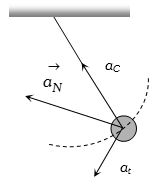
$A$ simple pendulum is oscillating without damping. When the displacement of the bob is less than maximum,its acceleration vector $\vec a$ is correctly shown in
A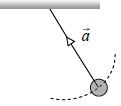
B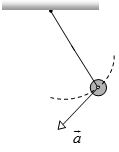
C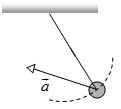
D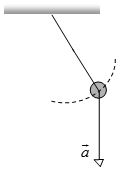
Solution
(C) The acceleration of the bob of a simple pendulum in motion consists of two components:
$1$. Centripetal acceleration $(a_c)$: Directed towards the point of suspension along the string.
$2$. Tangential acceleration $(a_t)$: Directed along the tangent to the circular path of the bob.
The net acceleration $\vec a$ is the vector sum of these two components: $\vec a = \vec a_c + \vec a_t$.
Since the bob is moving in a circular arc,the resultant acceleration vector $\vec a$ must point towards the interior of the arc,specifically between the string and the tangent,as shown in option $(C)$.
$1$. Centripetal acceleration $(a_c)$: Directed towards the point of suspension along the string.
$2$. Tangential acceleration $(a_t)$: Directed along the tangent to the circular path of the bob.
The net acceleration $\vec a$ is the vector sum of these two components: $\vec a = \vec a_c + \vec a_t$.
Since the bob is moving in a circular arc,the resultant acceleration vector $\vec a$ must point towards the interior of the arc,specifically between the string and the tangent,as shown in option $(C)$.
0 likesView Solution
2
PhysicsDifficultMCQIIT JEE · 2002
$A$ particle which is constrained to move along the $x-$axis is subjected to a force in the same direction which varies with the distance $x$ of the particle from the origin as $F(x) = -kx + ax^3$. Here $k$ and $a$ are positive constants. For $x \ge 0$,the functional form of the potential energy $U(x)$ of the particle is
A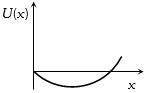
B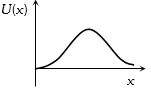
C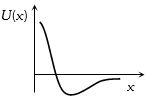
D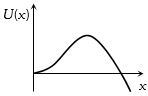
Solution
(D) The relationship between force $F(x)$ and potential energy $U(x)$ is given by $F(x) = -\frac{dU}{dx}$.
Integrating this,we get $U(x) = -\int F(x) dx$.
Substituting $F(x) = -kx + ax^3$,we have $U(x) = -\int (-kx + ax^3) dx = \frac{kx^2}{2} - \frac{ax^4}{4} + C$.
Assuming $U(0) = 0$,we get $C = 0$,so $U(x) = \frac{kx^2}{2} - \frac{ax^4}{4} = \frac{x^2}{4}(2k - ax^2)$.
For $x \ge 0$,$U(x) = 0$ at $x = 0$ and $x = \sqrt{\frac{2k}{a}}$.
Between $x = 0$ and $x = \sqrt{\frac{2k}{a}}$,$U(x)$ is positive. For $x > \sqrt{\frac{2k}{a}}$,$U(x)$ becomes negative.
The graph starts at the origin,rises to a maximum,and then decreases,crossing the $x-$axis at $x = \sqrt{\frac{2k}{a}}$. This matches Graph $D$.
Integrating this,we get $U(x) = -\int F(x) dx$.
Substituting $F(x) = -kx + ax^3$,we have $U(x) = -\int (-kx + ax^3) dx = \frac{kx^2}{2} - \frac{ax^4}{4} + C$.
Assuming $U(0) = 0$,we get $C = 0$,so $U(x) = \frac{kx^2}{2} - \frac{ax^4}{4} = \frac{x^2}{4}(2k - ax^2)$.
For $x \ge 0$,$U(x) = 0$ at $x = 0$ and $x = \sqrt{\frac{2k}{a}}$.
Between $x = 0$ and $x = \sqrt{\frac{2k}{a}}$,$U(x)$ is positive. For $x > \sqrt{\frac{2k}{a}}$,$U(x)$ becomes negative.
The graph starts at the origin,rises to a maximum,and then decreases,crossing the $x-$axis at $x = \sqrt{\frac{2k}{a}}$. This matches Graph $D$.
0 likesView Solution
3
PhysicsMediumMCQIIT JEE · 2002
$A$ geostationary satellite orbits around the earth in a circular orbit of radius $36000\, km$. Then,the time period of a satellite orbiting a few hundred kilometres above the earth's surface $(R_{\text{Earth}} = 6400\, km)$ will approximately be ....... $hours$.
A
$1/2$
B
$1$
C
$2$
D
$4$
Solution
(C) According to Kepler's Third Law of planetary motion,the square of the time period $T$ is proportional to the cube of the orbital radius $r$,i.e.,$T^2 \propto r^3$.
For a geostationary satellite,$T_1 = 24\, h$ and $r_1 = 36000\, km$.
For a satellite orbiting near the Earth's surface,$r_2 \approx R_{\text{Earth}} = 6400\, km$.
Using the ratio formula: $\frac{T_2}{T_1} = \left( \frac{r_2}{r_1} \right)^{3/2}$.
Substituting the values: $T_2 = 24 \times \left( \frac{6400}{36000} \right)^{3/2}$.
$T_2 = 24 \times \left( \frac{64}{360} \right)^{3/2} = 24 \times \left( \frac{8}{18.97} \right)^3 \approx 24 \times (0.177)^{3/2} \approx 24 \times 0.075 \approx 1.8\, h$.
Rounding to the nearest integer,the time period is approximately $2\, hours$.
For a geostationary satellite,$T_1 = 24\, h$ and $r_1 = 36000\, km$.
For a satellite orbiting near the Earth's surface,$r_2 \approx R_{\text{Earth}} = 6400\, km$.
Using the ratio formula: $\frac{T_2}{T_1} = \left( \frac{r_2}{r_1} \right)^{3/2}$.
Substituting the values: $T_2 = 24 \times \left( \frac{6400}{36000} \right)^{3/2}$.
$T_2 = 24 \times \left( \frac{64}{360} \right)^{3/2} = 24 \times \left( \frac{8}{18.97} \right)^3 \approx 24 \times (0.177)^{3/2} \approx 24 \times 0.075 \approx 1.8\, h$.
Rounding to the nearest integer,the time period is approximately $2\, hours$.
0 likesView Solution
4
PhysicsMediumMCQIIT JEE · 2002
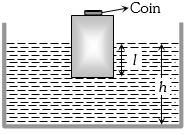
$A$ wooden block,with a coin placed on its top,floats in water as shown in the figure. The distances $l$ and $h$ are shown. After some time,the coin falls into the water. Then:
A
$l$ decreases and $h$ increases
B
$l$ increases and $h$ decreases
C
Both $l$ and $h$ increase
D
Both $l$ and $h$ decrease
Solution
(D) Initially,the block floats with the coin. According to the law of floatation,the total weight of the block and the coin is balanced by the buoyant force,which is equal to the weight of the water displaced by the submerged part of the block. Let $M$ be the mass of the block and $m$ be the mass of the coin. The total weight is $(M+m)g$. The volume of water displaced is $V_{disp} = (M+m)/\rho_w$,where $\rho_w$ is the density of water.
When the coin falls into the water,it sinks (assuming its density is greater than water). The block now only needs to support its own weight $Mg$. The new volume of water displaced by the block is $V'_{disp} = M/\rho_w$. Since $V'_{disp} < V_{disp}$,the submerged depth $l$ of the block decreases.
Regarding $h$,the total volume of water displaced initially was $V_{disp} = (M+m)/\rho_w$. After the coin falls,the block displaces $M/\rho_w$ and the coin displaces its own volume $V_c = m/\rho_c$. The new total volume of water displaced is $V'_{total} = M/\rho_w + m/\rho_c$. Since the density of the coin $\rho_c > \rho_w$,it follows that $m/\rho_c < m/\rho_w$. Therefore,$V'_{total} < V_{disp}$. As the total volume of water displaced decreases,the water level $h$ also decreases. Thus,both $l$ and $h$ decrease.
When the coin falls into the water,it sinks (assuming its density is greater than water). The block now only needs to support its own weight $Mg$. The new volume of water displaced by the block is $V'_{disp} = M/\rho_w$. Since $V'_{disp} < V_{disp}$,the submerged depth $l$ of the block decreases.
Regarding $h$,the total volume of water displaced initially was $V_{disp} = (M+m)/\rho_w$. After the coin falls,the block displaces $M/\rho_w$ and the coin displaces its own volume $V_c = m/\rho_c$. The new total volume of water displaced is $V'_{total} = M/\rho_w + m/\rho_c$. Since the density of the coin $\rho_c > \rho_w$,it follows that $m/\rho_c < m/\rho_w$. Therefore,$V'_{total} < V_{disp}$. As the total volume of water displaced decreases,the water level $h$ also decreases. Thus,both $l$ and $h$ decrease.
0 likesView Solution
5
PhysicsMediumMCQIIT JEE · 2002
An ideal black body at room temperature is thrown into a furnace. It is observed that:
A
Initially it is the darkest body and at later times the brightest.
B
It is the darkest body at all times.
C
It cannot be distinguished at all times.
D
Initially it is the darkest body and at later times it cannot be distinguished.
Solution
(A) Initially,an ideal black body absorbs all the radiant energy incident on it,making it appear as the darkest object in the furnace.
According to Kirchhoff's law of radiation,a good absorber is also a good emitter. Therefore,as the black body heats up to the temperature of the furnace,it radiates the maximum amount of energy compared to other bodies at the same temperature.
Once the black body reaches thermal equilibrium with the furnace,it emits the most intense radiation,making it appear the brightest.
According to Kirchhoff's law of radiation,a good absorber is also a good emitter. Therefore,as the black body heats up to the temperature of the furnace,it radiates the maximum amount of energy compared to other bodies at the same temperature.
Once the black body reaches thermal equilibrium with the furnace,it emits the most intense radiation,making it appear the brightest.
0 likesView Solution
6
PhysicsMediumMCQIIT JEE · 2002
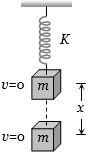
An ideal spring with spring-constant $K$ is hung from the ceiling and a block of mass $M$ is attached to its lower end. The mass is released with the spring initially unstretched. Then the maximum extension in the spring is
A
$4 Mg/K$
B
$2 Mg/K$
C
$Mg/K$
D
$Mg/2K$
Solution
(B) Let $x$ be the maximum extension of the spring.
Since the block starts from rest and momentarily comes to rest at the point of maximum extension,the change in kinetic energy is zero.
According to the work-energy theorem,the total work done by all forces is zero.
The forces acting on the block are gravity ($Mg$ downwards) and the spring force ($-Kx$ upwards).
Work done by gravity = $Mgx$
Work done by spring = $-\frac{1}{2}Kx^2$
Equating the total work to zero:
$Mgx - \frac{1}{2}Kx^2 = 0$
$Mgx = \frac{1}{2}Kx^2$
Since $x \neq 0$,we can divide by $x$:
$Mg = \frac{1}{2}Kx$
$x = \frac{2Mg}{K}$
Since the block starts from rest and momentarily comes to rest at the point of maximum extension,the change in kinetic energy is zero.
According to the work-energy theorem,the total work done by all forces is zero.
The forces acting on the block are gravity ($Mg$ downwards) and the spring force ($-Kx$ upwards).
Work done by gravity = $Mgx$
Work done by spring = $-\frac{1}{2}Kx^2$
Equating the total work to zero:
$Mgx - \frac{1}{2}Kx^2 = 0$
$Mgx = \frac{1}{2}Kx^2$
Since $x \neq 0$,we can divide by $x$:
$Mg = \frac{1}{2}Kx$
$x = \frac{2Mg}{K}$
0 likesView Solution
7
PhysicsDifficultMCQIIT JEE · 2002
$A$ sonometer wire resonates with a given tuning fork forming standing waves with five antinodes between the two bridges when a mass of $9 \ kg$ is suspended from the wire. When this mass is replaced by a mass $M$,the wire resonates with the same tuning fork forming three antinodes for the same positions of the bridges. The value of $M$ is ... $kg$.
A
$25$
B
$5$
C
$12.5$
D
$1/25$
Solution
(A) The frequency of vibration of a sonometer wire is given by $n = \frac{p}{2l} \sqrt{\frac{T}{\mu}}$,where $p$ is the number of loops (antinodes),$l$ is the length,$T$ is the tension,and $\mu$ is the mass per unit length.
In the first case,$p_1 = 5$ and $T_1 = 9g$. Thus,$n = \frac{5}{2l} \sqrt{\frac{9g}{\mu}}$.
In the second case,$p_2 = 3$ and $T_2 = Mg$. Thus,$n = \frac{3}{2l} \sqrt{\frac{Mg}{\mu}}$.
Since the tuning fork is the same,the frequency $n$ remains constant. Equating the two expressions:
$\frac{5}{2l} \sqrt{\frac{9g}{\mu}} = \frac{3}{2l} \sqrt{\frac{Mg}{\mu}}$
Squaring both sides:
$25 \times 9g = 9 \times Mg$
$225g = 9Mg$
$M = \frac{225}{9} = 25 \ kg$.
In the first case,$p_1 = 5$ and $T_1 = 9g$. Thus,$n = \frac{5}{2l} \sqrt{\frac{9g}{\mu}}$.
In the second case,$p_2 = 3$ and $T_2 = Mg$. Thus,$n = \frac{3}{2l} \sqrt{\frac{Mg}{\mu}}$.
Since the tuning fork is the same,the frequency $n$ remains constant. Equating the two expressions:
$\frac{5}{2l} \sqrt{\frac{9g}{\mu}} = \frac{3}{2l} \sqrt{\frac{Mg}{\mu}}$
Squaring both sides:
$25 \times 9g = 9 \times Mg$
$225g = 9Mg$
$M = \frac{225}{9} = 25 \ kg$.
0 likesView Solution
8
PhysicsDifficultMCQIIT JEE · 2002
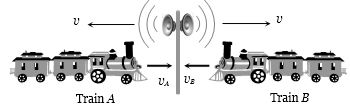
$A$ siren placed at a railway platform is emitting sound of frequency $5 \text{ kHz}$. $A$ passenger sitting in a moving train $A$ records a frequency of $5.5 \text{ kHz}$ while the train approaches the siren. During his return journey in a different train $B$,he records a frequency of $6.0 \text{ kHz}$ while approaching the same siren. The ratio of the velocity of train $B$ to that of train $A$ is
A
$242/252$
B
$2$
C
$5/6$
D
$11/6$
Solution
(B) According to the Doppler effect,when an observer moves towards a stationary source,the observed frequency $n'$ is given by:
$n' = n \left( \frac{v + v_0}{v} \right)$
where $n$ is the source frequency,$v$ is the speed of sound,and $v_0$ is the speed of the observer.
For train $A$:
$5.5 = 5 \left( \frac{v + v_A}{v} \right) \implies 1.1 = 1 + \frac{v_A}{v} \implies \frac{v_A}{v} = 0.1$ ... $(i)$
For train $B$:
$6.0 = 5 \left( \frac{v + v_B}{v} \right) \implies 1.2 = 1 + \frac{v_B}{v} \implies \frac{v_B}{v} = 0.2$ ... $(ii)$
Dividing equation $(ii)$ by equation $(i)$:
$\frac{v_B / v}{v_A / v} = \frac{0.2}{0.1} = 2$
Therefore,the ratio of the velocity of train $B$ to that of train $A$ is $2$.
$n' = n \left( \frac{v + v_0}{v} \right)$
where $n$ is the source frequency,$v$ is the speed of sound,and $v_0$ is the speed of the observer.
For train $A$:
$5.5 = 5 \left( \frac{v + v_A}{v} \right) \implies 1.1 = 1 + \frac{v_A}{v} \implies \frac{v_A}{v} = 0.1$ ... $(i)$
For train $B$:
$6.0 = 5 \left( \frac{v + v_B}{v} \right) \implies 1.2 = 1 + \frac{v_B}{v} \implies \frac{v_B}{v} = 0.2$ ... $(ii)$
Dividing equation $(ii)$ by equation $(i)$:
$\frac{v_B / v}{v_A / v} = \frac{0.2}{0.1} = 2$
Therefore,the ratio of the velocity of train $B$ to that of train $A$ is $2$.
0 likesView Solution
9
PhysicsMediumMCQIIT JEE · 2002
$A$ circular platform is free to rotate in a horizontal plane about a vertical axis passing through its center. $A$ tortoise is sitting at the edge of the platform. Now, the platform is given an angular velocity $\omega_0$. When the tortoise moves along a chord of the platform with a constant velocity (with respect to the platform), the angular velocity of the platform $\omega(t)$ will vary with time $t$ as:
A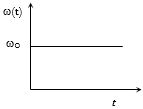
B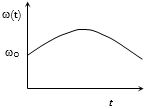
C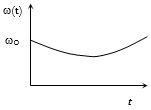
D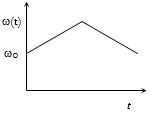
Solution
(B) The angular momentum $(L)$ of the system is conserved because there are no external torques acting on the system about the axis of rotation. Thus, $L = I\omega = \text{constant}$.
As the tortoise moves along a chord of the circular platform, its distance $(r)$ from the center of rotation changes. Specifically, the tortoise starts at the edge, moves towards the center (decreasing $r$), reaches the point on the chord closest to the center, and then moves back towards the edge (increasing $r$).
The moment of inertia $(I)$ of the system is given by $I = I_{\text{platform}} + m r^2$, where $m$ is the mass of the tortoise. As the tortoise moves towards the center, $r$ decreases, so $I$ decreases. As it moves away, $r$ increases, so $I$ increases.
Since $L = I\omega$ is constant, $\omega = L/I$. When $I$ decreases, $\omega$ increases, and when $I$ increases, $\omega$ decreases. Therefore, the angular velocity $\omega(t)$ will first increase and then decrease. The relationship between $r$ and time $t$ is $r^2 = r_{\text{min}}^2 + (vt)^2$, making $I$ a quadratic function of time, which implies that $\omega(t) = L / (I_0 + m(r_{\text{min}}^2 + v^2t^2))$ is a non-linear function of time. This corresponds to a smooth, curved graph.
As the tortoise moves along a chord of the circular platform, its distance $(r)$ from the center of rotation changes. Specifically, the tortoise starts at the edge, moves towards the center (decreasing $r$), reaches the point on the chord closest to the center, and then moves back towards the edge (increasing $r$).
The moment of inertia $(I)$ of the system is given by $I = I_{\text{platform}} + m r^2$, where $m$ is the mass of the tortoise. As the tortoise moves towards the center, $r$ decreases, so $I$ decreases. As it moves away, $r$ increases, so $I$ increases.
Since $L = I\omega$ is constant, $\omega = L/I$. When $I$ decreases, $\omega$ increases, and when $I$ increases, $\omega$ decreases. Therefore, the angular velocity $\omega(t)$ will first increase and then decrease. The relationship between $r$ and time $t$ is $r^2 = r_{\text{min}}^2 + (vt)^2$, making $I$ a quadratic function of time, which implies that $\omega(t) = L / (I_0 + m(r_{\text{min}}^2 + v^2t^2))$ is a non-linear function of time. This corresponds to a smooth, curved graph.
0 likesView Solution
10
PhysicsMediumMCQIIT JEE · 2002
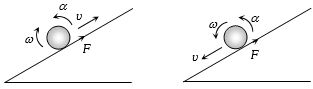
$A$ cylinder rolls up an inclined plane to a certain height and then rolls down. (During these motions,the cylinder rolls without slipping). What are the directions of the frictional force acting on the cylinder?
A
Up the incline while moving up and down the incline while moving down.
B
Up the incline in both upward and downward motion.
C
Down the incline while moving up and up the incline while moving down.
D
Down the incline in both upward and downward motion.
Solution
(B) When the cylinder rolls up the inclined plane,its linear velocity $v$ is directed up the incline and its angular velocity $\omega$ is clockwise. Since it is moving up,its linear velocity decreases,meaning it experiences a linear deceleration. To maintain rolling without slipping,it requires an angular deceleration. The torque provided by the frictional force $f$ acting up the incline creates a counter-clockwise torque,which provides the necessary angular deceleration.
When the cylinder rolls down the inclined plane,its linear velocity $v$ is directed down the incline and its angular velocity $\omega$ is counter-clockwise. As it moves down,its linear velocity increases,meaning it experiences linear acceleration. To maintain rolling without slipping,it requires an angular acceleration. The frictional force $f$ acting up the incline creates a torque that results in the necessary angular acceleration to increase the counter-clockwise angular velocity.
When the cylinder rolls down the inclined plane,its linear velocity $v$ is directed down the incline and its angular velocity $\omega$ is counter-clockwise. As it moves down,its linear velocity increases,meaning it experiences linear acceleration. To maintain rolling without slipping,it requires an angular acceleration. The frictional force $f$ acting up the incline creates a torque that results in the necessary angular acceleration to increase the counter-clockwise angular velocity.
0 likesView Solution
11
PhysicsDifficultMCQIIT JEE · 2002
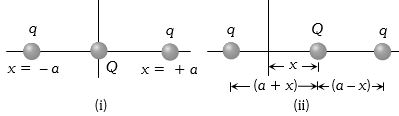
Two equal point charges are fixed at $x = -a$ and $x = +a$ on the $x$-axis. Another point charge $Q$ is placed at the origin. The change in the electrical potential energy of $Q$,when it is displaced by a small distance $x$ along the $x$-axis,is approximately proportional to
A
$x$
B
$x^2$
C
$x^3$
D
$1/x$
Solution
(B) Initially,according to figure $(i)$,the potential energy of $Q$ is $U_i = \frac{2kqQ}{a}$ ... $(i)$
According to figure $(ii)$,when charge $Q$ is displaced by a small distance $x$,its potential energy becomes:
$U_f = kqQ \left[ \frac{1}{a+x} + \frac{1}{a-x} \right] = kqQ \left[ \frac{(a-x) + (a+x)}{a^2 - x^2} \right] = \frac{2kqQa}{a^2 - x^2}$ ... $(ii)$
Hence,the change in potential energy is:
$\Delta U = U_f - U_i = 2kqQ \left[ \frac{a}{a^2 - x^2} - \frac{1}{a} \right] = 2kqQ \left[ \frac{a^2 - (a^2 - x^2)}{a(a^2 - x^2)} \right] = \frac{2kqQx^2}{a(a^2 - x^2)}$
Since $x << a$,we can approximate $a^2 - x^2 \approx a^2$. Therefore:
$\Delta U \approx \frac{2kqQx^2}{a(a^2)} = \frac{2kqQ}{a^3} x^2$
Thus,$\Delta U \propto x^2$.
According to figure $(ii)$,when charge $Q$ is displaced by a small distance $x$,its potential energy becomes:
$U_f = kqQ \left[ \frac{1}{a+x} + \frac{1}{a-x} \right] = kqQ \left[ \frac{(a-x) + (a+x)}{a^2 - x^2} \right] = \frac{2kqQa}{a^2 - x^2}$ ... $(ii)$
Hence,the change in potential energy is:
$\Delta U = U_f - U_i = 2kqQ \left[ \frac{a}{a^2 - x^2} - \frac{1}{a} \right] = 2kqQ \left[ \frac{a^2 - (a^2 - x^2)}{a(a^2 - x^2)} \right] = \frac{2kqQx^2}{a(a^2 - x^2)}$
Since $x << a$,we can approximate $a^2 - x^2 \approx a^2$. Therefore:
$\Delta U \approx \frac{2kqQx^2}{a(a^2)} = \frac{2kqQ}{a^3} x^2$
Thus,$\Delta U \propto x^2$.
0 likesView Solution
12
PhysicsMediumMCQIIT JEE · 2002
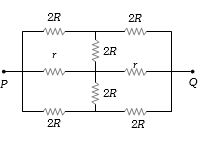
The effective resistance between points $P$ and $Q$ of the electrical circuit shown in the figure is
A
$2Rr/(R + r)$
B
$8R(R + r)/(3R + r)$
C
$2r + 4R$
D
$5R/2 + 2r$
Solution
(A) The circuit exhibits symmetry about the horizontal axis passing through the central branch. The vertical resistors of resistance $2R$ are connected between nodes that are at the same potential due to this symmetry. Therefore,no current flows through these vertical resistors,and they can be removed.
After removing the vertical resistors,the circuit simplifies to three parallel branches:
$1$. The top branch has two $2R$ resistors in series,giving a total resistance of $2R + 2R = 4R$.
$2$. The middle branch has two $r$ resistors in series,giving a total resistance of $r + r = 2r$.
$3$. The bottom branch has two $2R$ resistors in series,giving a total resistance of $2R + 2R = 4R$.
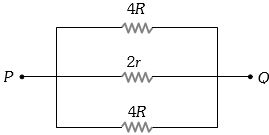
Now,we have three resistors $4R$,$2r$,and $4R$ in parallel. The equivalent resistance $R_{eq}$ is given by:
$\frac{1}{R_{eq}} = \frac{1}{4R} + \frac{1}{2r} + \frac{1}{4R} = \frac{2}{4R} + \frac{1}{2r} = \frac{1}{2R} + \frac{1}{2r} = \frac{r + R}{2Rr}$
Therefore,$R_{eq} = \frac{2Rr}{R + r}$.
After removing the vertical resistors,the circuit simplifies to three parallel branches:
$1$. The top branch has two $2R$ resistors in series,giving a total resistance of $2R + 2R = 4R$.
$2$. The middle branch has two $r$ resistors in series,giving a total resistance of $r + r = 2r$.
$3$. The bottom branch has two $2R$ resistors in series,giving a total resistance of $2R + 2R = 4R$.
Now,we have three resistors $4R$,$2r$,and $4R$ in parallel. The equivalent resistance $R_{eq}$ is given by:
$\frac{1}{R_{eq}} = \frac{1}{4R} + \frac{1}{2r} + \frac{1}{4R} = \frac{2}{4R} + \frac{1}{2r} = \frac{1}{2R} + \frac{1}{2r} = \frac{r + R}{2Rr}$
Therefore,$R_{eq} = \frac{2Rr}{R + r}$.
0 likesView Solution
13
PhysicsMediumMCQIIT JEE · 2002
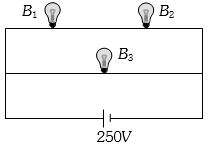
$A$ $100\, W$ bulb $B_1$,and two $60\, W$ bulbs $B_2$ and $B_3$,are connected to a $250\, V$ source,as shown in the figure. Now $W_1, W_2$ and $W_3$ are the output powers of the bulbs $B_1, B_2$ and $B_3$,respectively. Then
A
$W_1 > W_2 = W_3$
B
$W_1 > W_2 > W_3$
C
$W_1 < W_2 = W_3$
D
$W_1 < W_2 < W_3$
Solution
(D) The resistance of a bulb is given by $R = \frac{V^2}{P}$.
For bulb $B_1$ $(100\, W)$,$R_1 = \frac{V^2}{100}$.
For bulbs $B_2$ and $B_3$ $(60\, W)$,$R_2 = R_3 = \frac{V^2}{60}$.
Bulbs $B_1$ and $B_2$ are in series,and this combination is in parallel with bulb $B_3$ across the $250\, V$ source.
The power dissipated in $B_3$ is $W_3 = \frac{(250)^2}{R_3} = \frac{(250)^2}{V^2/60} = 60 \times \frac{(250)^2}{V^2}$.
The current through the series branch ($B_1$ and $B_2$) is $I = \frac{250}{R_1 + R_2} = \frac{250}{\frac{V^2}{100} + \frac{V^2}{60}} = \frac{250}{V^2(\frac{3+5}{300})} = \frac{250 \times 300}{8V^2} = \frac{75000}{8V^2} = \frac{9375}{V^2}$.
The power in $B_1$ is $W_1 = I^2 R_1 = (\frac{9375}{V^2})^2 \times \frac{V^2}{100} = \frac{9375^2}{100 V^2}$.
The power in $B_2$ is $W_2 = I^2 R_2 = (\frac{9375}{V^2})^2 \times \frac{V^2}{60} = \frac{9375^2}{60 V^2}$.
Comparing $W_1$ and $W_2$,since $R_1 < R_2$,$W_1 < W_2$. Since $B_3$ is connected directly across the source,it operates at its rated voltage,while $B_1$ and $B_2$ operate at lower voltages,thus $W_2 < W_3$. Therefore,$W_1 < W_2 < W_3$.
For bulb $B_1$ $(100\, W)$,$R_1 = \frac{V^2}{100}$.
For bulbs $B_2$ and $B_3$ $(60\, W)$,$R_2 = R_3 = \frac{V^2}{60}$.
Bulbs $B_1$ and $B_2$ are in series,and this combination is in parallel with bulb $B_3$ across the $250\, V$ source.
The power dissipated in $B_3$ is $W_3 = \frac{(250)^2}{R_3} = \frac{(250)^2}{V^2/60} = 60 \times \frac{(250)^2}{V^2}$.
The current through the series branch ($B_1$ and $B_2$) is $I = \frac{250}{R_1 + R_2} = \frac{250}{\frac{V^2}{100} + \frac{V^2}{60}} = \frac{250}{V^2(\frac{3+5}{300})} = \frac{250 \times 300}{8V^2} = \frac{75000}{8V^2} = \frac{9375}{V^2}$.
The power in $B_1$ is $W_1 = I^2 R_1 = (\frac{9375}{V^2})^2 \times \frac{V^2}{100} = \frac{9375^2}{100 V^2}$.
The power in $B_2$ is $W_2 = I^2 R_2 = (\frac{9375}{V^2})^2 \times \frac{V^2}{60} = \frac{9375^2}{60 V^2}$.
Comparing $W_1$ and $W_2$,since $R_1 < R_2$,$W_1 < W_2$. Since $B_3$ is connected directly across the source,it operates at its rated voltage,while $B_1$ and $B_2$ operate at lower voltages,thus $W_2 < W_3$. Therefore,$W_1 < W_2 < W_3$.
0 likesView Solution
14
PhysicsDifficultMCQIIT JEE · 2002
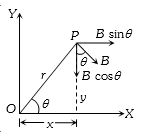
$A$ long straight wire along the $z$-axis carries a current $I$ in the negative $z$-direction. The magnetic vector field $\vec{B}$ at a point having coordinates $(x, y)$ in the $z = 0$ plane is
A
$\frac{\mu_0 I (y\hat{i} - x\hat{j})}{2\pi (x^2 + y^2)}$
B
$\frac{\mu_0 I (x\hat{i} + y\hat{j})}{2\pi (x^2 + y^2)}$
C
$\frac{\mu_0 I (x\hat{j} - y\hat{i})}{2\pi (x^2 + y^2)}$
D
$\frac{\mu_0 I (x\hat{i} - y\hat{j})}{2\pi (x^2 + y^2)}$
Solution
(A) The current $I$ flows in the negative $z$-direction,i.e.,along $-\hat{k}$.
The magnetic field $\vec{B}$ at a point $P(x, y)$ in the $xy$-plane is given by the right-hand grip rule.
The magnitude of the magnetic field at a distance $r = \sqrt{x^2 + y^2}$ from the wire is $B = \frac{\mu_0 I}{2\pi r}$.
The direction of the magnetic field is perpendicular to the position vector $\vec{r} = x\hat{i} + y\hat{j}$.
Using the cross product $\vec{B} = \frac{\mu_0 I}{2\pi r^2} (\hat{k} \times \vec{r})$,where $\hat{k}$ is the direction of current flow $(-I\hat{k})$,we get:
$\vec{B} = \frac{\mu_0 (-I)}{2\pi r^2} (\hat{k} \times (x\hat{i} + y\hat{j})) = \frac{-\mu_0 I}{2\pi (x^2 + y^2)} (x\hat{j} - y\hat{i}) = \frac{\mu_0 I (y\hat{i} - x\hat{j})}{2\pi (x^2 + y^2)}$.
The magnetic field $\vec{B}$ at a point $P(x, y)$ in the $xy$-plane is given by the right-hand grip rule.
The magnitude of the magnetic field at a distance $r = \sqrt{x^2 + y^2}$ from the wire is $B = \frac{\mu_0 I}{2\pi r}$.
The direction of the magnetic field is perpendicular to the position vector $\vec{r} = x\hat{i} + y\hat{j}$.
Using the cross product $\vec{B} = \frac{\mu_0 I}{2\pi r^2} (\hat{k} \times \vec{r})$,where $\hat{k}$ is the direction of current flow $(-I\hat{k})$,we get:
$\vec{B} = \frac{\mu_0 (-I)}{2\pi r^2} (\hat{k} \times (x\hat{i} + y\hat{j})) = \frac{-\mu_0 I}{2\pi (x^2 + y^2)} (x\hat{j} - y\hat{i}) = \frac{\mu_0 I (y\hat{i} - x\hat{j})}{2\pi (x^2 + y^2)}$.
0 likesView Solution
15
PhysicsDifficultMCQIIT JEE · 2002
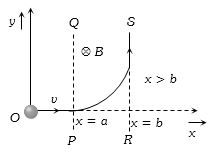
$A$ particle of mass $m$ and charge $q$ moves with a constant velocity $v$ along the positive $x$ direction. It enters a region containing a uniform magnetic field $B$ directed along the negative $z$ direction,extending from $x = a$ to $x = b$. The minimum value of $v$ required so that the particle can just enter the region $x > b$ is
A
$qbB/m$
B
$q(b - a)B/m$
C
$qaB/m$
D
$q(b + a)B/2m$
Solution
(B) The particle moves in a straight line until it reaches $x = a$. Upon entering the magnetic field region $(a \le x \le b)$,the magnetic force acts as a centripetal force,causing the particle to move in a circular path of radius $r = \frac{mv}{qB}$.
For the particle to just reach the region $x > b$,the radius of the circular path must be at least equal to the width of the magnetic field region,which is $(b - a)$.
Therefore,the condition is $r \ge (b - a)$.
Substituting the expression for $r$,we get $\frac{mv}{qB} \ge (b - a)$.
Solving for $v$,we find $v \ge \frac{q(b - a)B}{m}$.
Thus,the minimum velocity required is $v_{\min} = \frac{q(b - a)B}{m}$.
For the particle to just reach the region $x > b$,the radius of the circular path must be at least equal to the width of the magnetic field region,which is $(b - a)$.
Therefore,the condition is $r \ge (b - a)$.
Substituting the expression for $r$,we get $\frac{mv}{qB} \ge (b - a)$.
Solving for $v$,we find $v \ge \frac{q(b - a)B}{m}$.
Thus,the minimum velocity required is $v_{\min} = \frac{q(b - a)B}{m}$.
0 likesView Solution
16
PhysicsEasyMCQIIT JEE · 2002
The magnetic field lines due to a bar magnet are correctly shown in
A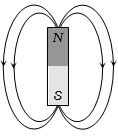
B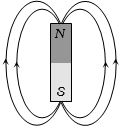
C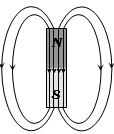
D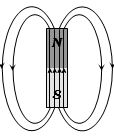
Solution
(D) is the correct option.
Magnetic field lines form continuous closed loops.
Outside the magnet,the field lines are directed from the north pole to the south pole.
Inside the magnet,the field lines are directed from the south pole to the north pole,ensuring the continuity of the closed loops.
Magnetic field lines form continuous closed loops.
Outside the magnet,the field lines are directed from the north pole to the south pole.
Inside the magnet,the field lines are directed from the south pole to the north pole,ensuring the continuity of the closed loops.
0 likesView Solution
17
PhysicsMediumMCQIIT JEE · 2002
As shown in the figure,$P$ and $Q$ are two coaxial conducting loops separated by some distance. When the switch $S$ is closed,a clockwise current $I_P$ flows in $P$ (as seen by $E$) and an induced current $I_{Q_1}$ flows in $Q$. The switch remains closed for a long time. When $S$ is opened,a current $I_{Q_2}$ flows in $Q$. Then the directions of $I_{Q_1}$ and $I_{Q_2}$ (as seen by $E$) are:
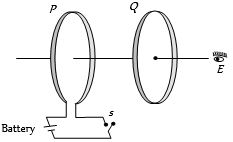
A
Respectively clockwise and anticlockwise
B
Both clockwise
C
Both anticlockwise
D
Respectively anticlockwise and clockwise
Solution
(D) When switch $S$ is closed,the current $I_P$ in loop $P$ increases from zero to a steady value. This creates an increasing magnetic flux through loop $Q$ in the direction from left to right (away from $P$). According to Lenz's law,the induced current $I_{Q_1}$ in $Q$ must oppose this change by creating a magnetic field in the opposite direction (right to left). For an observer $E$ looking at loop $Q$,a magnetic field pointing from right to left corresponds to an anticlockwise current. Thus,$I_{Q_1}$ is anticlockwise.
When switch $S$ is opened,the current $I_P$ decreases to zero. This causes a decreasing magnetic flux through loop $Q$ in the direction from left to right. According to Lenz's law,the induced current $I_{Q_2}$ in $Q$ must oppose this decrease by creating a magnetic field in the same direction (left to right). For an observer $E$,a magnetic field pointing from left to right corresponds to a clockwise current. Thus,$I_{Q_2}$ is clockwise.
When switch $S$ is opened,the current $I_P$ decreases to zero. This causes a decreasing magnetic flux through loop $Q$ in the direction from left to right. According to Lenz's law,the induced current $I_{Q_2}$ in $Q$ must oppose this decrease by creating a magnetic field in the same direction (left to right). For an observer $E$,a magnetic field pointing from left to right corresponds to a clockwise current. Thus,$I_{Q_2}$ is clockwise.
0 likesView Solution
18
PhysicsMediumMCQIIT JEE · 2002
$A$ short-circuited coil is placed in a time-varying magnetic field. Electrical power is dissipated due to the current induced in the coil. If the number of turns were to be quadrupled and the wire radius halved,the electrical power dissipated would be
A
Halved
B
The same
C
Doubled
D
Quadrupled
Solution
(B) The induced electromotive force $(e)$ is given by Faraday's law: $e = -N \frac{d\phi}{dt} = -NA \frac{dB}{dt}$.
Since $A = \pi r_c^2$ (where $r_c$ is the coil radius),$e \propto N$.
The resistance of the wire is $R = \rho \frac{L}{A_w} = \rho \frac{N(2\pi r_c)}{\pi r^2}$,where $r$ is the wire radius.
Thus,$R \propto \frac{N}{r^2}$.
The power dissipated is $P = \frac{e^2}{R} \propto \frac{N^2}{N/r^2} = N r^2$.
Given $N_2 = 4N_1$ and $r_2 = r_1/2$,the new power $P_2$ is:
$P_2 \propto (4N_1) \times (r_1/2)^2 = 4N_1 \times (r_1^2/4) = N_1 r_1^2 = P_1$.
Therefore,the electrical power dissipated remains the same.
Since $A = \pi r_c^2$ (where $r_c$ is the coil radius),$e \propto N$.
The resistance of the wire is $R = \rho \frac{L}{A_w} = \rho \frac{N(2\pi r_c)}{\pi r^2}$,where $r$ is the wire radius.
Thus,$R \propto \frac{N}{r^2}$.
The power dissipated is $P = \frac{e^2}{R} \propto \frac{N^2}{N/r^2} = N r^2$.
Given $N_2 = 4N_1$ and $r_2 = r_1/2$,the new power $P_2$ is:
$P_2 \propto (4N_1) \times (r_1/2)^2 = 4N_1 \times (r_1^2/4) = N_1 r_1^2 = P_1$.
Therefore,the electrical power dissipated remains the same.
0 likesView Solution
19
PhysicsEasyMCQIIT JEE · 2002
The potential difference applied to an $X$-ray tube is $5 \text{ kV}$ and the current through it is $3.2 \text{ mA}$. Then the number of electrons striking the target per second is
A
$2 \times 10^{16}$
B
$5 \times 10^{16}$
C
$1 \times 10^{17}$
D
$4 \times 10^{15}$
Solution
(A) The current $i$ is defined as the rate of flow of charge,given by the formula $i = \frac{Ne}{t}$,where $N$ is the number of electrons,$e$ is the elementary charge $(1.6 \times 10^{-19} \text{ C})$,and $t$ is the time.
To find the number of electrons striking the target per second,we rearrange the formula to solve for $\frac{N}{t}$:
$\frac{N}{t} = \frac{i}{e}$
Given $i = 3.2 \text{ mA} = 3.2 \times 10^{-3} \text{ A}$ and $e = 1.6 \times 10^{-19} \text{ C}$:
$\frac{N}{t} = \frac{3.2 \times 10^{-3}}{1.6 \times 10^{-19}}$
$\frac{N}{t} = 2 \times 10^{16} \text{ electrons/sec}$.
To find the number of electrons striking the target per second,we rearrange the formula to solve for $\frac{N}{t}$:
$\frac{N}{t} = \frac{i}{e}$
Given $i = 3.2 \text{ mA} = 3.2 \times 10^{-3} \text{ A}$ and $e = 1.6 \times 10^{-19} \text{ C}$:
$\frac{N}{t} = \frac{3.2 \times 10^{-3}}{1.6 \times 10^{-19}}$
$\frac{N}{t} = 2 \times 10^{16} \text{ electrons/sec}$.
0 likesView Solution
20
PhysicsMediumMCQIIT JEE · 2002
Which of the following processes represents a gamma-decay?
A
$^A{X_Z} + \gamma \to {\,^A}{X_{Z - 1}} + a + b$
B
$^A{X_Z} + {^1}{n_0} \to {\,^{A - 3}}{X_{Z - 2}} + c$
C
$^A{X_Z} \to {\,^A}{X_Z} + \gamma$
D
$^A{X_Z} + {e_{ - 1}} \to {\,^A}{X_{Z - 1}} + g$
Solution
(C) In a gamma-decay process,the nucleus transitions from an excited state to a lower energy state by emitting a gamma-ray photon.
During this process,there is no change in the mass number $A$ or the atomic number $Z$ of the nucleus.
The process is represented as: $^A{X_Z}^* \to {\,^A}{X_Z} + \gamma$.
Therefore,option $(c)$ correctly represents this process.
During this process,there is no change in the mass number $A$ or the atomic number $Z$ of the nucleus.
The process is represented as: $^A{X_Z}^* \to {\,^A}{X_Z} + \gamma$.
Therefore,option $(c)$ correctly represents this process.
0 likesView Solution
21
PhysicsMediumMCQIIT JEE · 2002
The half-life of $^{215}At$ is $100 \mu s$. The time taken for the radioactivity of a sample of $^{215}At$ to decay to $\frac{1}{16}$ of its initial value is .........$\mu s$.
A
$400$
B
$6.3$
C
$40$
D
$300$
Solution
(A) The law of radioactive decay states that the activity $A$ at time $t$ is given by $A = A_0 (\frac{1}{2})^n$,where $n$ is the number of half-lives.
Given that the activity decays to $\frac{1}{16}$ of its initial value,we have $\frac{A}{A_0} = \frac{1}{16}$.
Since $\frac{1}{16} = (\frac{1}{2})^4$,we find that $n = 4$.
The total time taken $t$ is given by $t = n \times T_{1/2}$,where $T_{1/2} = 100 \mu s$.
Therefore,$t = 4 \times 100 \mu s = 400 \mu s$.
Given that the activity decays to $\frac{1}{16}$ of its initial value,we have $\frac{A}{A_0} = \frac{1}{16}$.
Since $\frac{1}{16} = (\frac{1}{2})^4$,we find that $n = 4$.
The total time taken $t$ is given by $t = n \times T_{1/2}$,where $T_{1/2} = 100 \mu s$.
Therefore,$t = 4 \times 100 \mu s = 400 \mu s$.
0 likesView Solution
22
PhysicsMediumMCQIIT JEE · 2002
$A$ Hydrogen atom and a $Li^{++}$ ion are both in the second excited state. If $l_H$ and $l_{Li}$ are their respective electronic angular momenta,and $E_H$ and $E_{Li}$ are their respective energies,then:
A
$l_H > l_{Li}$ and $|E_H| > |E_{Li}|$
B
$l_H = l_{Li}$ and $|E_H| < |E_{Li}|$
C
$l_H = l_{Li}$ and $|E_H| > |E_{Li}|$
D
$l_H < l_{Li}$ and $|E_H| < |E_{Li}|$
Solution
(B) The second excited state corresponds to the principal quantum number $n = 3$.
According to Bohr's quantization condition,the angular momentum $l$ is given by $l = n \left( \frac{h}{2\pi} \right)$.
Since both are in the same state $n = 3$,their angular momenta are equal: $l_H = l_{Li} = 3 \left( \frac{h}{2\pi} \right)$.
The energy of an electron in a hydrogen-like atom is given by $E = -13.6 \frac{Z^2}{n^2} \text{ eV}$.
For Hydrogen $(Z_H = 1)$ and $Li^{++}$ $(Z_{Li} = 3)$,the energies are $E_H = -13.6 \frac{1^2}{3^2}$ and $E_{Li} = -13.6 \frac{3^2}{3^2}$.
Taking the magnitude,$|E_H| = \frac{13.6}{9} \text{ eV}$ and $|E_{Li}| = 13.6 \text{ eV}$.
Clearly,$|E_H| < |E_{Li}|$. Thus,option $(b)$ is correct.
According to Bohr's quantization condition,the angular momentum $l$ is given by $l = n \left( \frac{h}{2\pi} \right)$.
Since both are in the same state $n = 3$,their angular momenta are equal: $l_H = l_{Li} = 3 \left( \frac{h}{2\pi} \right)$.
The energy of an electron in a hydrogen-like atom is given by $E = -13.6 \frac{Z^2}{n^2} \text{ eV}$.
For Hydrogen $(Z_H = 1)$ and $Li^{++}$ $(Z_{Li} = 3)$,the energies are $E_H = -13.6 \frac{1^2}{3^2}$ and $E_{Li} = -13.6 \frac{3^2}{3^2}$.
Taking the magnitude,$|E_H| = \frac{13.6}{9} \text{ eV}$ and $|E_{Li}| = 13.6 \text{ eV}$.
Clearly,$|E_H| < |E_{Li}|$. Thus,option $(b)$ is correct.
0 likesView Solution
23
PhysicsDifficultMCQIIT JEE · 2002
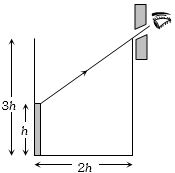
An observer can see through a pin-hole the top end of a thin rod of height $h$,placed as shown in the figure. The beaker height is $3h$ and its radius is $h$. When the beaker is filled with a liquid up to a height $2h$,the observer can see the lower end of the rod. Then the refractive index of the liquid is
A
$5/2$
B
$\sqrt{5/2}$
C
$\sqrt{3/2}$
D
$3/2$
Solution
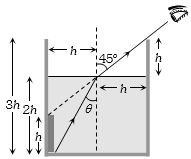
(B) The line of sight of the observer remains constant,making an angle of $45^{\circ}$ with the normal in the air.
From the geometry of the setup,when the liquid is filled to a height of $2h$,the light ray from the bottom of the rod travels to the liquid surface at a distance $h$ from the vertical axis of the beaker.
The angle of incidence $\theta$ in the liquid is given by $\tan \theta = \frac{h}{2h} = 1/2$.
Thus,$\sin \theta = \frac{1}{\sqrt{1^2 + 2^2}} = \frac{1}{\sqrt{5}}$.
Applying Snell's Law at the liquid-air interface: $\mu \sin \theta = 1 \cdot \sin 45^{\circ}$.
$\mu \left( \frac{1}{\sqrt{5}} \right) = \frac{1}{\sqrt{2}}$.
Therefore,$\mu = \frac{\sqrt{5}}{\sqrt{2}} = \sqrt{\frac{5}{2}}$.
From the geometry of the setup,when the liquid is filled to a height of $2h$,the light ray from the bottom of the rod travels to the liquid surface at a distance $h$ from the vertical axis of the beaker.
The angle of incidence $\theta$ in the liquid is given by $\tan \theta = \frac{h}{2h} = 1/2$.
Thus,$\sin \theta = \frac{1}{\sqrt{1^2 + 2^2}} = \frac{1}{\sqrt{5}}$.
Applying Snell's Law at the liquid-air interface: $\mu \sin \theta = 1 \cdot \sin 45^{\circ}$.
$\mu \left( \frac{1}{\sqrt{5}} \right) = \frac{1}{\sqrt{2}}$.
Therefore,$\mu = \frac{\sqrt{5}}{\sqrt{2}} = \sqrt{\frac{5}{2}}$.
0 likesView Solution
24
PhysicsEasyMCQIIT JEE · 2002
Which one of the following spherical lenses does not exhibit dispersion? The radii of curvature of the surfaces of the lenses are as given in the diagrams.
A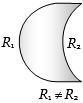
B
C
D
Solution
(C) The dispersion produced by a spherical surface depends on its radius of curvature.
For a lens,the total dispersion is the sum of the dispersions produced by its two surfaces.
$A$ lens will not exhibit dispersion if the dispersion produced by one surface is exactly cancelled by the other.
This occurs when the two surfaces have equal radii of curvature,with one being convex and the other concave,such that the lens acts as a parallel-sided plate for the light passing through it.
In the given options,the meniscus lens shown in option $C$ has both surfaces with the same radius of curvature $R$,where one is convex and the other is concave. Thus,it does not exhibit dispersion.
For a lens,the total dispersion is the sum of the dispersions produced by its two surfaces.
$A$ lens will not exhibit dispersion if the dispersion produced by one surface is exactly cancelled by the other.
This occurs when the two surfaces have equal radii of curvature,with one being convex and the other concave,such that the lens acts as a parallel-sided plate for the light passing through it.
In the given options,the meniscus lens shown in option $C$ has both surfaces with the same radius of curvature $R$,where one is convex and the other is concave. Thus,it does not exhibit dispersion.
0 likesView Solution
25
PhysicsMediumMCQIIT JEE · 2002
In the ideal double-slit experiment,when a glass plate (refractive index $\mu = 1.5$) of thickness $t$ is introduced in the path of one of the interfering beams (wavelength $\lambda$),the intensity at the position where the central maximum occurred previously remains unchanged. The minimum thickness of the glass plate is:
A
$2\lambda$
B
$\frac{2\lambda}{3}$
C
$\frac{\lambda}{3}$
D
$\lambda$
Solution
(A) When a glass plate of thickness $t$ and refractive index $\mu$ is introduced in the path of one of the beams,the path difference introduced is $\Delta x = (\mu - 1)t$.
For the intensity to remain unchanged at the position of the original central maximum,the new path difference must be an integer multiple of the wavelength,i.e.,$\Delta x = n\lambda$,where $n = 1, 2, 3, \dots$.
To find the minimum thickness $t_{\min}$,we set $n = 1$:
$(\mu - 1)t_{\min} = 1 \cdot \lambda$
Given $\mu = 1.5$,we have:
$(1.5 - 1)t_{\min} = \lambda$
$0.5 t_{\min} = \lambda$
$t_{\min} = \frac{\lambda}{0.5} = 2\lambda$.
For the intensity to remain unchanged at the position of the original central maximum,the new path difference must be an integer multiple of the wavelength,i.e.,$\Delta x = n\lambda$,where $n = 1, 2, 3, \dots$.
To find the minimum thickness $t_{\min}$,we set $n = 1$:
$(\mu - 1)t_{\min} = 1 \cdot \lambda$
Given $\mu = 1.5$,we have:
$(1.5 - 1)t_{\min} = \lambda$
$0.5 t_{\min} = \lambda$
$t_{\min} = \frac{\lambda}{0.5} = 2\lambda$.
0 likesView Solution
Vedclass Products
For Students
Vedclass Test Series
Mock tests in real IIT JEE style covering Physics with performance analysis. 5-day free trial.
Start Free TrialFor Teachers
Exam Paper Generator
Generate Set A/B/C/D Physics papers from 7.5L+ questions in 2 minutes. 3 chapters free.
Try FreeFor Institutes
Online Exam Module
Run live IIT JEE mock exams with unlimited students, 360° analytics & white-label branding.
See DemoFrequently Asked Questions
How many Physics questions are in IIT JEE 2002?
There are 25 Physics questions from the IIT JEE 2002 paper on Vedclass, each with a detailed step-by-step solution in English.
Are IIT JEE 2002 Physics solutions available in English?
Yes. All solutions on this page are in English. You can also switch to English or Hindi using the language buttons above the questions.
Can I practice IIT JEE 2002 Physics as a timed test?
Yes. Use the Vedclass Test Series to attempt a full IIT JEE mock test covering Physics with time limits and instant score analysis.
Can teachers create Physics papers from IIT JEE previous year questions?
Yes. The Vedclass Exam Paper Generator lets teachers mix IIT JEE Physics questions and generate Set A/B/C/D papers in minutes.
For Teachers & Institutes
Build a Custom Physics Paper
Pick IIT JEE 2002 Physics questions, set difficulty, and generate Set A/B/C/D in 2 minutes.