
ChemistryQ1–22 of 22 questions
Page 1 of 1 · English
1
ChemistryMCQIIT JEE · 2002
Two identical capacitors have the same capacitance $C$. One of them is charged to potential $V_1$ and the other to $V_2$. The negative ends of the capacitors are connected together. When the positive ends are also connected,the decrease in energy of the combined system is
A
$\frac{1}{4}C(V_1^2 - V_2^2)$
B
$\frac{1}{4}C(V_1^2 + V_2^2)$
C
$\frac{1}{4}C(V_1 - V_2)^2$
D
$\frac{1}{4}C(V_1 + V_2)^2$
Solution
(C) Initial energy of the system is $U_i = \frac{1}{2}CV_1^2 + \frac{1}{2}CV_2^2$.
When the capacitors are connected in parallel,the common potential is $V = \frac{CV_1 + CV_2}{2C} = \frac{V_1 + V_2}{2}$.
Final energy of the system is $U_f = \frac{1}{2}(2C)V^2 = C \left( \frac{V_1 + V_2}{2} \right)^2 = \frac{1}{4}C(V_1 + V_2)^2$.
The decrease in energy is $\Delta U = U_i - U_f = \frac{1}{2}C(V_1^2 + V_2^2) - \frac{1}{4}C(V_1 + V_2)^2$.
Simplifying this,$\Delta U = \frac{1}{4}C [2V_1^2 + 2V_2^2 - (V_1^2 + V_2^2 + 2V_1V_2)] = \frac{1}{4}C(V_1^2 + V_2^2 - 2V_1V_2) = \frac{1}{4}C(V_1 - V_2)^2$.
When the capacitors are connected in parallel,the common potential is $V = \frac{CV_1 + CV_2}{2C} = \frac{V_1 + V_2}{2}$.
Final energy of the system is $U_f = \frac{1}{2}(2C)V^2 = C \left( \frac{V_1 + V_2}{2} \right)^2 = \frac{1}{4}C(V_1 + V_2)^2$.
The decrease in energy is $\Delta U = U_i - U_f = \frac{1}{2}C(V_1^2 + V_2^2) - \frac{1}{4}C(V_1 + V_2)^2$.
Simplifying this,$\Delta U = \frac{1}{4}C [2V_1^2 + 2V_2^2 - (V_1^2 + V_2^2 + 2V_1V_2)] = \frac{1}{4}C(V_1^2 + V_2^2 - 2V_1V_2) = \frac{1}{4}C(V_1 - V_2)^2$.
0 likesView Solution
2
ChemistryMediumMCQIIT JEE · 2002
Polyphosphates are used as water softening agents because they
A
Form soluble complexes with anionic species
B
Precipitate anionic species
C
Form soluble complexes with cationic species
D
Precipitate cationic species
Solution
(C) Polyphosphates (such as sodium hexametaphosphate or $STPP$) are used as water softening agents because they form soluble complexes with metal cations like $Ca^{2+}$ and $Mg^{2+}$ present in hard water,thereby preventing them from forming precipitates with soap or detergents.
0 likesView Solution
3
ChemistryMCQIIT JEE · 2002
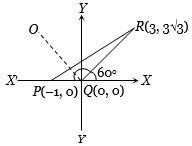
Let $P(-1, 0)$,$Q(0, 0)$,and $R(3, 3\sqrt{3})$ be three points. Then the equation of the bisector of the angle $\angle PQR$ is
A
$\frac{\sqrt{3}}{2}x + y = 0$
B
$x + \sqrt{3}y = 0$
C
$\sqrt{3}x + y = 0$
D
$x + \frac{\sqrt{3}}{2}y = 0$
Solution
(C) The slope of $QP$ is $0$ (since $P$ and $Q$ lie on the $x$-axis,specifically the negative $x$-axis).
The slope of $QR$ is $\frac{3\sqrt{3} - 0}{3 - 0} = \sqrt{3}$.
This means the angle made by $QR$ with the positive $x$-axis is $60^\circ$.
Since $QP$ lies along the negative $x$-axis,the angle $\angle PQR$ is $180^\circ - 60^\circ = 120^\circ$.
The angle bisector of $\angle PQR$ will make an angle of $120^\circ - 60^\circ = 60^\circ$ with $QP$ (the negative $x$-axis).
Thus,the angle made by the bisector with the positive $x$-axis is $180^\circ - 60^\circ = 120^\circ$.
The equation of a line passing through the origin $(0, 0)$ with slope $m = \tan(120^\circ) = -\sqrt{3}$ is $y = -\sqrt{3}x$,which simplifies to $\sqrt{3}x + y = 0$.
The slope of $QR$ is $\frac{3\sqrt{3} - 0}{3 - 0} = \sqrt{3}$.
This means the angle made by $QR$ with the positive $x$-axis is $60^\circ$.
Since $QP$ lies along the negative $x$-axis,the angle $\angle PQR$ is $180^\circ - 60^\circ = 120^\circ$.
The angle bisector of $\angle PQR$ will make an angle of $120^\circ - 60^\circ = 60^\circ$ with $QP$ (the negative $x$-axis).
Thus,the angle made by the bisector with the positive $x$-axis is $180^\circ - 60^\circ = 120^\circ$.
The equation of a line passing through the origin $(0, 0)$ with slope $m = \tan(120^\circ) = -\sqrt{3}$ is $y = -\sqrt{3}x$,which simplifies to $\sqrt{3}x + y = 0$.
0 likesView Solution
4
ChemistryMCQIIT JEE · 2002
Let $\vec{V} = 2\hat{i} + \hat{j} - \hat{k}$ and $\vec{W} = \hat{i} + 3\hat{k}$. If $\vec{U}$ is a unit vector,then the maximum value of the scalar triple product $[\vec{U} \, \vec{V} \, \vec{W}]$ is:
A
$-1$
B
$\sqrt{10} + \sqrt{6}$
C
$\sqrt{59}$
D
$\sqrt{60}$
Solution
(C) The scalar triple product is defined as $[\vec{U} \, \vec{V} \, \vec{W}] = \vec{U} \cdot (\vec{V} \times \vec{W})$.
First,calculate the cross product $\vec{V} \times \vec{W}$:
$\vec{V} \times \vec{W} = \begin{vmatrix} \hat{i} & \hat{j} & \hat{k} \\ 2 & 1 & -1 \\ 1 & 0 & 3 \end{vmatrix} = \hat{i}(3 - 0) - \hat{j}(6 - (-1)) + \hat{k}(0 - 1) = 3\hat{i} - 7\hat{j} - \hat{k}$.
Let $\vec{A} = \vec{V} \times \vec{W} = 3\hat{i} - 7\hat{j} - \hat{k}$.
Then $[\vec{U} \, \vec{V} \, \vec{W}] = \vec{U} \cdot \vec{A} = |\vec{U}| |\vec{A}| \cos \theta$,where $\theta$ is the angle between $\vec{U}$ and $\vec{A}$.
Since $\vec{U}$ is a unit vector,$|\vec{U}| = 1$.
Thus,the scalar triple product is $|\vec{A}| \cos \theta$.
The maximum value occurs when $\cos \theta = 1$,which is $|\vec{A}|$.
$|\vec{A}| = \sqrt{3^2 + (-7)^2 + (-1)^2} = \sqrt{9 + 49 + 1} = \sqrt{59}$.
Therefore,the maximum value is $\sqrt{59}$.
First,calculate the cross product $\vec{V} \times \vec{W}$:
$\vec{V} \times \vec{W} = \begin{vmatrix} \hat{i} & \hat{j} & \hat{k} \\ 2 & 1 & -1 \\ 1 & 0 & 3 \end{vmatrix} = \hat{i}(3 - 0) - \hat{j}(6 - (-1)) + \hat{k}(0 - 1) = 3\hat{i} - 7\hat{j} - \hat{k}$.
Let $\vec{A} = \vec{V} \times \vec{W} = 3\hat{i} - 7\hat{j} - \hat{k}$.
Then $[\vec{U} \, \vec{V} \, \vec{W}] = \vec{U} \cdot \vec{A} = |\vec{U}| |\vec{A}| \cos \theta$,where $\theta$ is the angle between $\vec{U}$ and $\vec{A}$.
Since $\vec{U}$ is a unit vector,$|\vec{U}| = 1$.
Thus,the scalar triple product is $|\vec{A}| \cos \theta$.
The maximum value occurs when $\cos \theta = 1$,which is $|\vec{A}|$.
$|\vec{A}| = \sqrt{3^2 + (-7)^2 + (-1)^2} = \sqrt{9 + 49 + 1} = \sqrt{59}$.
Therefore,the maximum value is $\sqrt{59}$.
0 likesView Solution
5
ChemistryMediumMCQIIT JEE · 2002
Which of the following volume $(V)$-temperature $(T)$ plots represents the behaviour of one mole of an ideal gas at one atmospheric pressure?
A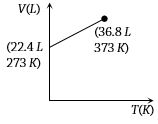
B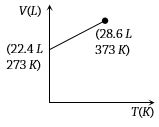
C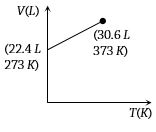
D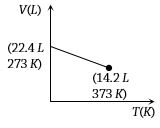
Solution
(C) According to Charles's Law,for a fixed amount of gas at constant pressure,the volume is directly proportional to the absolute temperature: $V \propto T$ or $\frac{V_1}{T_1} = \frac{V_2}{T_2}$.
Given: $V_1 = 22.4 \ L$,$T_1 = 273 \ K$,$T_2 = 373 \ K$.
We need to find $V_2$:
$V_2 = V_1 \times \frac{T_2}{T_1} = 22.4 \ L \times \frac{373 \ K}{273 \ K} \approx 30.6 \ L$.
Thus,the plot showing the point $(30.6 \ L, 373 \ K)$ is correct.
Given: $V_1 = 22.4 \ L$,$T_1 = 273 \ K$,$T_2 = 373 \ K$.
We need to find $V_2$:
$V_2 = V_1 \times \frac{T_2}{T_1} = 22.4 \ L \times \frac{373 \ K}{273 \ K} \approx 30.6 \ L$.
Thus,the plot showing the point $(30.6 \ L, 373 \ K)$ is correct.
0 likesView Solution
6
ChemistryDifficultMCQIIT JEE · 2002
$Ph-C \equiv C-CH_3 \xrightarrow{Hg^{2+}/H^{+}} A$. $A$ is
A
B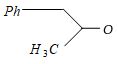
C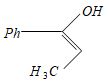
D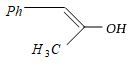
Solution
(A) The reaction of an internal alkyne with $Hg^{2+}/H^{+}$ (Kuccherov reaction) involves the hydration of the alkyne to form a ketone.
For the unsymmetrical alkyne $Ph-C \equiv C-CH_3$,the hydration can occur at either carbon of the triple bond.
However,the formation of the ketone is governed by the stability of the intermediate carbocation or the electronic effects of the substituents.
In this case,the reaction proceeds to form $Ph-CO-CH_2-CH_3$ (propiophenone derivative) as the major product,which corresponds to the structure in image $287-$a474.
For the unsymmetrical alkyne $Ph-C \equiv C-CH_3$,the hydration can occur at either carbon of the triple bond.
However,the formation of the ketone is governed by the stability of the intermediate carbocation or the electronic effects of the substituents.
In this case,the reaction proceeds to form $Ph-CO-CH_2-CH_3$ (propiophenone derivative) as the major product,which corresponds to the structure in image $287-$a474.
0 likesView Solution
7
ChemistryMCQIIT JEE · 2002
The number of integral values of $k$,for which the equation $7\cos x + 5\sin x = 2k + 1$ has a solution,is
A
$4$
B
$8$
C
$10$
D
$12$
Solution
(B) The range of the expression $a\cos x + b\sin x$ is $[-\sqrt{a^2 + b^2}, \sqrt{a^2 + b^2}]$.
For the equation $7\cos x + 5\sin x = 2k + 1$,the range of $7\cos x + 5\sin x$ is $[-\sqrt{7^2 + 5^2}, \sqrt{7^2 + 5^2}] = [-\sqrt{74}, \sqrt{74}]$.
Since $\sqrt{74} \approx 8.6$,the condition for a solution is $-\sqrt{74} \le 2k + 1 \le \sqrt{74}$.
Substituting the approximate value: $-8.6 \le 2k + 1 \le 8.6$.
Subtracting $1$ from all parts: $-9.6 \le 2k \le 7.6$.
Dividing by $2$: $-4.8 \le k \le 3.8$.
The integral values of $k$ are $\{-4, -3, -2, -1, 0, 1, 2, 3\}$.
Counting these,we find there are $8$ such values.
For the equation $7\cos x + 5\sin x = 2k + 1$,the range of $7\cos x + 5\sin x$ is $[-\sqrt{7^2 + 5^2}, \sqrt{7^2 + 5^2}] = [-\sqrt{74}, \sqrt{74}]$.
Since $\sqrt{74} \approx 8.6$,the condition for a solution is $-\sqrt{74} \le 2k + 1 \le \sqrt{74}$.
Substituting the approximate value: $-8.6 \le 2k + 1 \le 8.6$.
Subtracting $1$ from all parts: $-9.6 \le 2k \le 7.6$.
Dividing by $2$: $-4.8 \le k \le 3.8$.
The integral values of $k$ are $\{-4, -3, -2, -1, 0, 1, 2, 3\}$.
Counting these,we find there are $8$ such values.
0 likesView Solution
8
ChemistryMCQIIT JEE · 2002
If the tangent at the point $P$ on the circle $x^2 + y^2 + 6x + 6y = 2$ meets the straight line $5x - 2y + 6 = 0$ at a point $Q$ on the $y$-axis,then the length of $PQ$ is
A
$4$
B
$2\sqrt{5}$
C
$5$
D
$3\sqrt{5}$
Solution
(C) Let the point $P$ be $(x_1, y_1)$. The equation of the tangent at $P$ to the circle $x^2 + y^2 + 6x + 6y - 2 = 0$ is given by $x x_1 + y y_1 + 3(x + x_1) + 3(y + y_1) - 2 = 0$.
Since the point $Q$ lies on the $y$-axis,its $x$-coordinate is $0$.
Given that $Q$ lies on the line $5x - 2y + 6 = 0$,substituting $x = 0$ gives $5(0) - 2y + 6 = 0$,which implies $y = 3$. Thus,$Q = (0, 3)$.
Since $Q$ lies on the tangent,it must satisfy the tangent equation: $0(x_1) + 3(y_1) + 3(0 + x_1) + 3(3 + y_1) - 2 = 0$.
Simplifying this,we get $3y_1 + 3x_1 + 9 + 3y_1 - 2 = 0$,or $3x_1 + 6y_1 + 7 = 0$.
The length $PQ$ is given by $\sqrt{(x_1 - 0)^2 + (y_1 - 3)^2} = \sqrt{x_1^2 + y_1^2 - 6y_1 + 9}$.
Since $P$ lies on the circle,$x_1^2 + y_1^2 = 2 - 6x_1 - 6y_1$.
Substituting this into the expression for $PQ^2$: $PQ^2 = (2 - 6x_1 - 6y_1) - 6y_1 + 9 = 11 - 6x_1 - 12y_1 = 11 - 2(3x_1 + 6y_1)$.
Substituting $3x_1 + 6y_1 = -7$,we get $PQ^2 = 11 - 2(-7) = 11 + 14 = 25$.
Therefore,$PQ = 5$.
Since the point $Q$ lies on the $y$-axis,its $x$-coordinate is $0$.
Given that $Q$ lies on the line $5x - 2y + 6 = 0$,substituting $x = 0$ gives $5(0) - 2y + 6 = 0$,which implies $y = 3$. Thus,$Q = (0, 3)$.
Since $Q$ lies on the tangent,it must satisfy the tangent equation: $0(x_1) + 3(y_1) + 3(0 + x_1) + 3(3 + y_1) - 2 = 0$.
Simplifying this,we get $3y_1 + 3x_1 + 9 + 3y_1 - 2 = 0$,or $3x_1 + 6y_1 + 7 = 0$.
The length $PQ$ is given by $\sqrt{(x_1 - 0)^2 + (y_1 - 3)^2} = \sqrt{x_1^2 + y_1^2 - 6y_1 + 9}$.
Since $P$ lies on the circle,$x_1^2 + y_1^2 = 2 - 6x_1 - 6y_1$.
Substituting this into the expression for $PQ^2$: $PQ^2 = (2 - 6x_1 - 6y_1) - 6y_1 + 9 = 11 - 6x_1 - 12y_1 = 11 - 2(3x_1 + 6y_1)$.
Substituting $3x_1 + 6y_1 = -7$,we get $PQ^2 = 11 - 2(-7) = 11 + 14 = 25$.
Therefore,$PQ = 5$.
0 likesView Solution
9
ChemistryMCQIIT JEE · 2002
The equation of the common tangent to the curves $y^2 = 8x$ and $xy = -1$ is
A
$3y = 9x + 2$
B
$y = 2x + 1$
C
$2y = x + 8$
D
$y = x + 2$
Solution
(D) Let the equation of the tangent to the parabola $y^2 = 8x$ be $y = mx + \frac{2}{m}$,where $m \neq 0$.
This line is also a tangent to the hyperbola $xy = -1$,which can be written as $y = -\frac{1}{x}$.
Substituting $y = mx + \frac{2}{m}$ into $xy = -1$,we get $x(mx + \frac{2}{m}) = -1$,which simplifies to $mx^2 + \frac{2}{m}x + 1 = 0$.
For the line to be a tangent,the discriminant of this quadratic equation must be zero:
$D = (\frac{2}{m})^2 - 4(m)(1) = 0$
$\frac{4}{m^2} - 4m = 0$
$4 = 4m^3$ $\Rightarrow m^3 = 1$ $\Rightarrow m = 1$.
Substituting $m = 1$ into the tangent equation $y = mx + \frac{2}{m}$,we get $y = 1x + \frac{2}{1}$,which is $y = x + 2$.
This line is also a tangent to the hyperbola $xy = -1$,which can be written as $y = -\frac{1}{x}$.
Substituting $y = mx + \frac{2}{m}$ into $xy = -1$,we get $x(mx + \frac{2}{m}) = -1$,which simplifies to $mx^2 + \frac{2}{m}x + 1 = 0$.
For the line to be a tangent,the discriminant of this quadratic equation must be zero:
$D = (\frac{2}{m})^2 - 4(m)(1) = 0$
$\frac{4}{m^2} - 4m = 0$
$4 = 4m^3$ $\Rightarrow m^3 = 1$ $\Rightarrow m = 1$.
Substituting $m = 1$ into the tangent equation $y = mx + \frac{2}{m}$,we get $y = 1x + \frac{2}{1}$,which is $y = x + 2$.
0 likesView Solution
10
ChemistryMCQIIT JEE · 2002
If $a_1, a_2, \dots, a_n$ are positive real numbers whose product is a fixed number $c$,then the minimum value of $a_1 + a_2 + \dots + a_{n-1} + 2a_n$ is
A
$n(2c)^{1/n}$
B
$(n + 1)c^{1/n}$
C
$2nc^{1/n}$
D
$(n + 1)(2c)^{1/n}$
Solution
(A) By the Arithmetic Mean-Geometric Mean $(AM \geq GM)$ inequality,for positive real numbers $a_1, a_2, \dots, a_{n-1}, 2a_n$:
$\frac{a_1 + a_2 + \dots + a_{n-1} + 2a_n}{n} \geq (a_1 \cdot a_2 \cdot \dots \cdot a_{n-1} \cdot 2a_n)^{1/n}$
Given that the product $a_1 \cdot a_2 \cdot \dots \cdot a_n = c$,we can substitute this into the inequality:
$\frac{a_1 + a_2 + \dots + a_{n-1} + 2a_n}{n} \geq (2 \cdot a_1 \cdot a_2 \cdot \dots \cdot a_n)^{1/n}$
$\frac{a_1 + a_2 + \dots + a_{n-1} + 2a_n}{n} \geq (2c)^{1/n}$
$a_1 + a_2 + \dots + a_{n-1} + 2a_n \geq n(2c)^{1/n}$
Thus,the minimum value is $n(2c)^{1/n}$.
$\frac{a_1 + a_2 + \dots + a_{n-1} + 2a_n}{n} \geq (a_1 \cdot a_2 \cdot \dots \cdot a_{n-1} \cdot 2a_n)^{1/n}$
Given that the product $a_1 \cdot a_2 \cdot \dots \cdot a_n = c$,we can substitute this into the inequality:
$\frac{a_1 + a_2 + \dots + a_{n-1} + 2a_n}{n} \geq (2 \cdot a_1 \cdot a_2 \cdot \dots \cdot a_n)^{1/n}$
$\frac{a_1 + a_2 + \dots + a_{n-1} + 2a_n}{n} \geq (2c)^{1/n}$
$a_1 + a_2 + \dots + a_{n-1} + 2a_n \geq n(2c)^{1/n}$
Thus,the minimum value is $n(2c)^{1/n}$.
0 likesView Solution
11
ChemistryMCQIIT JEE · 2002
Two equal point charges are fixed at $x = -a$ and $x = +a$ on the $x$-axis. Another point charge $Q$ is placed at the origin. The change in the electrical potential energy of $Q$ when it is displaced by a small distance $x$ along the $x$-axis is approximately proportional to
A
$x$
B
$x^2$
C
$x^3$
D
$1/x$
Solution
(B) Let the two equal charges be $q$. The potential energy $U$ of charge $Q$ at a position $x$ is given by the sum of potentials due to the two charges: $U(x) = k q Q [\frac{1}{a-x} + \frac{1}{a+x}]$,where $k = \frac{1}{4 \pi \epsilon_0}$.
Simplifying the expression: $U(x) = k q Q [\frac{a+x+a-x}{a^2-x^2}] = k q Q [\frac{2a}{a^2-x^2}]$.
The potential energy at the origin $(x=0)$ is $U(0) = k q Q [\frac{2a}{a^2}] = \frac{2 k q Q}{a}$.
The change in potential energy is $\Delta U = U(x) - U(0) = k q Q [\frac{2a}{a^2-x^2} - \frac{2}{a}] = 2 k q Q a [\frac{1}{a^2-x^2} - \frac{1}{a^2}]$.
$\Delta U = 2 k q Q a [\frac{a^2 - (a^2-x^2)}{a^2(a^2-x^2)}] = 2 k q Q a [\frac{x^2}{a^2(a^2-x^2)}]$.
For small displacement $x$,$a^2-x^2 \approx a^2$. Thus,$\Delta U \approx 2 k q Q a [\frac{x^2}{a^4}] = \frac{2 k q Q}{a^3} x^2$.
Therefore,$\Delta U \propto x^2$.
Simplifying the expression: $U(x) = k q Q [\frac{a+x+a-x}{a^2-x^2}] = k q Q [\frac{2a}{a^2-x^2}]$.
The potential energy at the origin $(x=0)$ is $U(0) = k q Q [\frac{2a}{a^2}] = \frac{2 k q Q}{a}$.
The change in potential energy is $\Delta U = U(x) - U(0) = k q Q [\frac{2a}{a^2-x^2} - \frac{2}{a}] = 2 k q Q a [\frac{1}{a^2-x^2} - \frac{1}{a^2}]$.
$\Delta U = 2 k q Q a [\frac{a^2 - (a^2-x^2)}{a^2(a^2-x^2)}] = 2 k q Q a [\frac{x^2}{a^2(a^2-x^2)}]$.
For small displacement $x$,$a^2-x^2 \approx a^2$. Thus,$\Delta U \approx 2 k q Q a [\frac{x^2}{a^4}] = \frac{2 k q Q}{a^3} x^2$.
Therefore,$\Delta U \propto x^2$.
0 likesView Solution
12
ChemistryMCQIIT JEE · 2002
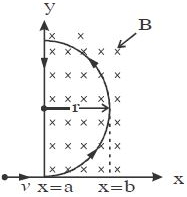
$A$ particle of mass $m$ and charge $q$ moves with a constant velocity $v$ along the positive $x$ direction. It enters a region containing a uniform magnetic field $B$ directed along the negative $z$ direction,extending from $x = a$ to $x = b$. The minimum value of $v$ required so that the particle can just enter the region $x > b$ is
A
$qbB/m$
B
$q(b - a)B/m$
C
$qaB/m$
D
$q(b + a)B/m$
Solution
(B) When a charged particle enters a perpendicular magnetic field,it follows a circular path of radius $r$ given by the balance between the magnetic force and the centripetal force:
$qvB = \frac{mv^2}{r}$
Rearranging for velocity,we get:
$v = \frac{qBr}{m}$
For the particle to just enter the region $x > b$,the radius of its circular path must be at least equal to the width of the magnetic field region,which is $(b - a)$.
Thus,the minimum radius required is $r_{\min} = b - a$.
Substituting this into the velocity equation:
$v_{\min} = \frac{qB(b - a)}{m}$
Therefore,the correct option is $B$.
$qvB = \frac{mv^2}{r}$
Rearranging for velocity,we get:
$v = \frac{qBr}{m}$
For the particle to just enter the region $x > b$,the radius of its circular path must be at least equal to the width of the magnetic field region,which is $(b - a)$.
Thus,the minimum radius required is $r_{\min} = b - a$.
Substituting this into the velocity equation:
$v_{\min} = \frac{qB(b - a)}{m}$
Therefore,the correct option is $B$.
0 likesView Solution
13
ChemistryMCQIIT JEE · 2002
$A$ long straight wire along the $z-$ axis carries a current $I$ in the negative $z$ direction. The magnetic field vector $\vec B$ at a point having coordinates $(x, y)$ in the $z = 0$ plane is
A
$\frac{{\mu _0}I(y\hat i - x\hat j)}{{2\pi ({x^2} + {y^2})}}$
B
$\frac{{\mu _0}I(x\hat i + y\hat j)}{{2\pi ({x^2} + {y^2})}}$
C
$\frac{{\mu _0}I(x\hat j - y\hat i)}{{2\pi ({x^2} + {y^2})}}$
D
$\frac{{\mu _0}I(x\hat i - y\hat j)}{{2\pi ({x^2} + {y^2})}}$
Solution
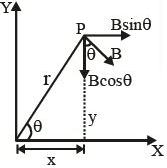
(A) The current $I$ flows in the negative $z-$ direction,i.e.,along $-\hat k$. The position vector of the point $P(x, y)$ is $\vec r = x\hat i + y\hat j$.
Using the Biot-Savart law or the right-hand rule for a long straight wire,the magnetic field $\vec B$ is given by $\vec B = \frac{\mu_0 I}{2\pi r^2} (\hat k \times \vec r)$.
Substituting $\vec r = x\hat i + y\hat j$ and the current direction $-\hat k$,the magnetic field is $\vec B = \frac{\mu_0 I}{2\pi r^2} ((-\hat k) \times (x\hat i + y\hat j))$.
Since $\hat k \times \hat i = \hat j$ and $\hat k \times \hat j = -\hat i$,we get $\vec B = \frac{\mu_0 I}{2\pi r^2} (-(x\hat j - y\hat i)) = \frac{\mu_0 I}{2\pi r^2} (y\hat i - x\hat j)$.
Substituting $r^2 = x^2 + y^2$,we get $\vec B = \frac{\mu_0 I (y\hat i - x\hat j)}{2\pi (x^2 + y^2)}$.
Using the Biot-Savart law or the right-hand rule for a long straight wire,the magnetic field $\vec B$ is given by $\vec B = \frac{\mu_0 I}{2\pi r^2} (\hat k \times \vec r)$.
Substituting $\vec r = x\hat i + y\hat j$ and the current direction $-\hat k$,the magnetic field is $\vec B = \frac{\mu_0 I}{2\pi r^2} ((-\hat k) \times (x\hat i + y\hat j))$.
Since $\hat k \times \hat i = \hat j$ and $\hat k \times \hat j = -\hat i$,we get $\vec B = \frac{\mu_0 I}{2\pi r^2} (-(x\hat j - y\hat i)) = \frac{\mu_0 I}{2\pi r^2} (y\hat i - x\hat j)$.
Substituting $r^2 = x^2 + y^2$,we get $\vec B = \frac{\mu_0 I (y\hat i - x\hat j)}{2\pi (x^2 + y^2)}$.
0 likesView Solution
14
ChemistryMCQIIT JEE · 2002
$A$ long straight wire along the $z$-axis carries a current $I$ in the negative $z$-direction. The magnetic vector field $\vec B$ at a point having coordinates $(x, y)$ in the $z = 0$ plane is
A
$\frac{{{\mu _0}I\,\left( {y\hat i - x\hat j} \right)}}{{2\pi \,\left( {{x^2} + {y^2}} \right)}}$
B
$\frac{{{\mu _0}I\,\left( {x\hat i + y\hat j} \right)}}{{2\pi \,\left( {{x^2} + {y^2}} \right)}}$
C
$\frac{{{\mu _0}I\,\left( {x\hat j - y\hat i} \right)}}{{2\pi \,\left( {{x^2} + {y^2}} \right)}}$
D
$\frac{{{\mu _0}I\,\left( {x\hat i - y\hat j} \right)}}{{2\pi \,\left( {{x^2} + {y^2}} \right)}}$
Solution
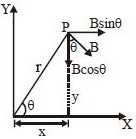
(A) The magnetic field $\vec B$ due to a long straight wire carrying current $I$ in the negative $z$-direction (along $-\hat k$) at a point $\vec r = x\hat i + y\hat j$ is given by the Biot-Savart law or Ampere's law. The direction of the magnetic field is given by the right-hand thumb rule. For a current in the $-\hat k$ direction,the magnetic field lines are clockwise in the $xy$-plane.
The magnitude of the magnetic field is $B = \frac{\mu_0 I}{2\pi r}$,where $r = \sqrt{x^2 + y^2}$.
The unit vector in the radial direction is $\hat r = \frac{x\hat i + y\hat j}{r}$.
The magnetic field vector is $\vec B = B (\hat k \times \hat r) = \frac{\mu_0 I}{2\pi r} (\hat k \times \frac{x\hat i + y\hat j}{r}) = \frac{\mu_0 I}{2\pi r^2} (x(\hat k \times \hat i) + y(\hat k \times \hat j))$.
Since $\hat k \times \hat i = \hat j$ and $\hat k \times \hat j = -\hat i$,we get $\vec B = \frac{\mu_0 I}{2\pi (x^2 + y^2)} (x\hat j - y\hat i) = \frac{\mu_0 I (y\hat i - x\hat j)}{2\pi (x^2 + y^2)}$ is incorrect; let's re-evaluate: $\vec B = \frac{\mu_0 I}{2\pi (x^2 + y^2)} (y\hat i - x\hat j)$.
Wait,for current in $-\hat k$,the field is $\vec B = \frac{\mu_0 I}{2\pi r^2} (y\hat i - x\hat j)$. Thus,option $A$ is correct.
The magnitude of the magnetic field is $B = \frac{\mu_0 I}{2\pi r}$,where $r = \sqrt{x^2 + y^2}$.
The unit vector in the radial direction is $\hat r = \frac{x\hat i + y\hat j}{r}$.
The magnetic field vector is $\vec B = B (\hat k \times \hat r) = \frac{\mu_0 I}{2\pi r} (\hat k \times \frac{x\hat i + y\hat j}{r}) = \frac{\mu_0 I}{2\pi r^2} (x(\hat k \times \hat i) + y(\hat k \times \hat j))$.
Since $\hat k \times \hat i = \hat j$ and $\hat k \times \hat j = -\hat i$,we get $\vec B = \frac{\mu_0 I}{2\pi (x^2 + y^2)} (x\hat j - y\hat i) = \frac{\mu_0 I (y\hat i - x\hat j)}{2\pi (x^2 + y^2)}$ is incorrect; let's re-evaluate: $\vec B = \frac{\mu_0 I}{2\pi (x^2 + y^2)} (y\hat i - x\hat j)$.
Wait,for current in $-\hat k$,the field is $\vec B = \frac{\mu_0 I}{2\pi r^2} (y\hat i - x\hat j)$. Thus,option $A$ is correct.
0 likesView Solution
15
ChemistryMCQIIT JEE · 2002
$A$ sonometer wire resonates with a given tuning fork,forming standing waves with five antinodes between the two bridges when a mass of $9 \, kg$ is suspended from the wire. When this mass is replaced by a mass $M$,the wire resonates with the same tuning fork,forming three antinodes for the same positions of the bridges. The value of $M$ is .... $kg$.
A
$25$
B
$5$
C
$12.5$
D
$1/25$
Solution
(A) The frequency of a vibrating string in a sonometer is given by $f = \frac{n}{2L} \sqrt{\frac{T}{\mu}}$,where $n$ is the number of antinodes,$L$ is the length of the wire,$T$ is the tension $(T = Mg)$,and $\mu$ is the linear mass density.
In the first case,$n_1 = 5$ and $T_1 = 9g$. Thus,$f = \frac{5}{2L} \sqrt{\frac{9g}{\mu}}$.
In the second case,$n_2 = 3$ and $T_2 = Mg$. Thus,$f = \frac{3}{2L} \sqrt{\frac{Mg}{\mu}}$.
Since the tuning fork is the same,the frequency $f$ remains constant. Equating the two expressions:
$\frac{5}{2L} \sqrt{\frac{9g}{\mu}} = \frac{3}{2L} \sqrt{\frac{Mg}{\mu}}$
$5 \sqrt{9g} = 3 \sqrt{Mg}$
$5 \times 3 \sqrt{g} = 3 \sqrt{Mg}$
$5 \sqrt{g} = \sqrt{Mg}$
Squaring both sides: $25g = Mg$
$M = 25 \, kg$.
In the first case,$n_1 = 5$ and $T_1 = 9g$. Thus,$f = \frac{5}{2L} \sqrt{\frac{9g}{\mu}}$.
In the second case,$n_2 = 3$ and $T_2 = Mg$. Thus,$f = \frac{3}{2L} \sqrt{\frac{Mg}{\mu}}$.
Since the tuning fork is the same,the frequency $f$ remains constant. Equating the two expressions:
$\frac{5}{2L} \sqrt{\frac{9g}{\mu}} = \frac{3}{2L} \sqrt{\frac{Mg}{\mu}}$
$5 \sqrt{9g} = 3 \sqrt{Mg}$
$5 \times 3 \sqrt{g} = 3 \sqrt{Mg}$
$5 \sqrt{g} = \sqrt{Mg}$
Squaring both sides: $25g = Mg$
$M = 25 \, kg$.

0 likesView Solution
16
ChemistryMCQIIT JEE · 2002
$A$ particle of mass $m$ and charge $q$ moves with a constant velocity $v$ along the positive $x$-direction. It enters a region containing a uniform magnetic field $B$ directed along the negative $z$-direction,extending from $x = a$ to $x = b$. The minimum value of $v$ required so that the particle can just enter the region $x > b$ is
A
$qbB/m$
B
$q(b-a)B/m$
C
$qaB/m$
D
$q(b+a)B/2m$
Solution
(B) When a charged particle enters a uniform magnetic field perpendicular to its velocity,it follows a circular path with radius $r = \frac{mv}{qB}$.
The magnetic field exists in the region $a \leq x \leq b$. The width of this region is $d = b - a$.
For the particle to emerge from the region $x > b$,the radius of the circular path $r$ must be greater than the width of the magnetic field region $d$.
If $r \leq (b - a)$,the particle will be deflected back into the region $x < a$ and will not reach $x > b$.
Therefore,the condition to just enter the region $x > b$ is $r = b - a$.
Substituting the expression for $r$,we get $\frac{mv}{qB} = b - a$.
Solving for $v$,we find the minimum velocity $v = \frac{q(b - a)B}{m}$.
The magnetic field exists in the region $a \leq x \leq b$. The width of this region is $d = b - a$.
For the particle to emerge from the region $x > b$,the radius of the circular path $r$ must be greater than the width of the magnetic field region $d$.
If $r \leq (b - a)$,the particle will be deflected back into the region $x < a$ and will not reach $x > b$.
Therefore,the condition to just enter the region $x > b$ is $r = b - a$.
Substituting the expression for $r$,we get $\frac{mv}{qB} = b - a$.
Solving for $v$,we find the minimum velocity $v = \frac{q(b - a)B}{m}$.
0 likesView Solution
17
ChemistryMCQIIT JEE · 2002
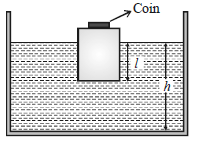
$A$ wooden block, with a coin placed on its top, floats in water as shown in the figure. The distances $l$ and $h$ are shown. After some time, the coin falls into the water. Then:
A
$l$ decreases and $h$ increases
B
$l$ increases and $h$ decreases
C
both $l$ and $h$ increase
D
both $l$ and $h$ decrease
Solution
(D) Initially, the block and the coin float together. The total weight is $W = (M_{block} + m_{coin})g$. According to Archimedes' principle, the buoyant force equals the total weight, so the volume of water displaced is $V_{displaced} = (M_{block} + m_{coin}) / \rho_{water}$.
When the coin falls into the water, it sinks to the bottom. The block now only supports its own weight $M_{block}g$. The new volume of water displaced by the block is $V'_{block} = M_{block} / \rho_{water}$.
The coin, now at the bottom, displaces water equal to its own volume $V_{coin} = m_{coin} / \rho_{coin}$.
Since the density of the coin $\rho_{coin}$ is much greater than the density of water $\rho_{water}$, the volume of water displaced by the coin when submerged $(m_{coin} / \rho_{coin})$ is less than the volume of water it displaced when floating on the block $(m_{coin} / \rho_{water})$.
Therefore, the total volume of water displaced decreases, causing the water level $h$ to decrease.
Since the block now supports less weight, it rises, meaning the submerged depth $l$ of the block decreases.
When the coin falls into the water, it sinks to the bottom. The block now only supports its own weight $M_{block}g$. The new volume of water displaced by the block is $V'_{block} = M_{block} / \rho_{water}$.
The coin, now at the bottom, displaces water equal to its own volume $V_{coin} = m_{coin} / \rho_{coin}$.
Since the density of the coin $\rho_{coin}$ is much greater than the density of water $\rho_{water}$, the volume of water displaced by the coin when submerged $(m_{coin} / \rho_{coin})$ is less than the volume of water it displaced when floating on the block $(m_{coin} / \rho_{water})$.
Therefore, the total volume of water displaced decreases, causing the water level $h$ to decrease.
Since the block now supports less weight, it rises, meaning the submerged depth $l$ of the block decreases.
0 likesView Solution
18
ChemistryMCQIIT JEE · 2002
The number of integral values of $k$ for which the equation $7 \cos x + 5 \sin x = 2k + 1$ has a solution is:
A
$4$
B
$8$
C
$10$
D
$12$
Solution
(B) The equation is of the form $a \cos x + b \sin x = c$,which has a solution if and only if $-\sqrt{a^2 + b^2} \leq c \leq \sqrt{a^2 + b^2}$.
Here,$a = 7$,$b = 5$,and $c = 2k + 1$.
Thus,$-\sqrt{7^2 + 5^2} \leq 2k + 1 \leq \sqrt{7^2 + 5^2}$.
$-\sqrt{49 + 25} \leq 2k + 1 \leq \sqrt{49 + 25}$.
$-\sqrt{74} \leq 2k + 1 \leq \sqrt{74}$.
Since $\sqrt{74} \approx 8.602$,we have $-8.602 \leq 2k + 1 \leq 8.602$.
Subtracting $1$ from all sides: $-9.602 \leq 2k \leq 7.602$.
Dividing by $2$: $-4.801 \leq k \leq 3.801$.
The integral values of $k$ are $\{-4, -3, -2, -1, 0, 1, 2, 3\}$.
The total number of such integral values is $8$.
Here,$a = 7$,$b = 5$,and $c = 2k + 1$.
Thus,$-\sqrt{7^2 + 5^2} \leq 2k + 1 \leq \sqrt{7^2 + 5^2}$.
$-\sqrt{49 + 25} \leq 2k + 1 \leq \sqrt{49 + 25}$.
$-\sqrt{74} \leq 2k + 1 \leq \sqrt{74}$.
Since $\sqrt{74} \approx 8.602$,we have $-8.602 \leq 2k + 1 \leq 8.602$.
Subtracting $1$ from all sides: $-9.602 \leq 2k \leq 7.602$.
Dividing by $2$: $-4.801 \leq k \leq 3.801$.
The integral values of $k$ are $\{-4, -3, -2, -1, 0, 1, 2, 3\}$.
The total number of such integral values is $8$.
0 likesView Solution
19
ChemistryDifficultMCQIIT JEE · 2002
Saturated solution of $KNO_3$ is used to make a 'salt-bridge' because:
A
Velocity of $K^+$ is greater than that of $NO_3^-$
B
Velocity of $NO_3^-$ is greater than that of $K^+$
C
Velocities of both $K^+$ and $NO_3^-$ are nearly the same
D
$KNO_3$ is highly soluble in water
Solution
(C) The primary requirement for an electrolyte in a salt-bridge is that the transport numbers (or ionic mobilities) of the cation and anion should be approximately equal.
In a $KNO_3$ solution,the ionic velocities of $K^+$ and $NO_3^-$ are nearly the same.
This ensures that the junction potential is minimized and the electrical neutrality is maintained efficiently across the two half-cells.
Therefore,option $(C)$ is correct.
In a $KNO_3$ solution,the ionic velocities of $K^+$ and $NO_3^-$ are nearly the same.
This ensures that the junction potential is minimized and the electrical neutrality is maintained efficiently across the two half-cells.
Therefore,option $(C)$ is correct.
0 likesView Solution
20
ChemistryDifficultMCQIIT JEE · 2002
Compound '$A$' (molecular formula $C_3H_8O$) is treated with acidified potassium dichromate to form a product '$B$' (molecular formula $C_3H_6O$). '$B$' forms a shining silver mirror on warming with ammoniacal silver nitrate. '$B$' when treated with an aqueous solution of $H_2NCONHNH_2 \cdot HCl$ and sodium acetate gives a product '$C$'. Identify the structure of '$C$.
A
$CH_3CH_2CH=NNHCONH_2$
B
$CH_3-C(CH_3)=NNHCONH_2$
C
$CH_3-C(CH_3)=NCONHNH_2$
D
$CH_3CH_2CH=NCONHNH_2$
Solution
(A) $(C_3H_8O)$ is a primary alcohol.
Since it oxidizes to an aldehyde $B$ $(C_3H_6O)$ that gives a positive Tollens' test (shining silver mirror),$B$ must be propanal.
$CH_3CH_2CH_2OH \xrightarrow{K_2Cr_2O_7/H^{+}} CH_3CH_2CHO$
$A$ (Propan$-1-$ol) $\rightarrow$ $B$ (Propanal)
Propanal reacts with semicarbazide $(NH_2NHCONH_2)$ in the presence of sodium acetate to form propanal semicarbazone $(C)$:
$CH_3CH_2CHO + NH_2NHCONH_2 \rightarrow CH_3CH_2CH=NNHCONH_2 + H_2O$
Thus,the structure of $C$ is $CH_3CH_2CH=NNHCONH_2$.
Since it oxidizes to an aldehyde $B$ $(C_3H_6O)$ that gives a positive Tollens' test (shining silver mirror),$B$ must be propanal.
$CH_3CH_2CH_2OH \xrightarrow{K_2Cr_2O_7/H^{+}} CH_3CH_2CHO$
$A$ (Propan$-1-$ol) $\rightarrow$ $B$ (Propanal)
Propanal reacts with semicarbazide $(NH_2NHCONH_2)$ in the presence of sodium acetate to form propanal semicarbazone $(C)$:
$CH_3CH_2CHO + NH_2NHCONH_2 \rightarrow CH_3CH_2CH=NNHCONH_2 + H_2O$
Thus,the structure of $C$ is $CH_3CH_2CH=NNHCONH_2$.
0 likesView Solution
21
ChemistryMediumMCQIIT JEE · 2002
Which of the following acids has the smallest dissociation constant?
A
$CH_3CHFCOOH$
B
$FCH_2CH_2COOH$
C
$BrCH_2CH_2COOH$
D
$CH_3CHBrCOOH$
Solution
(C) The dissociation constant $(K_a)$ of a carboxylic acid is directly proportional to its acidity. The acidity is increased by the electron-withdrawing inductive effect ($-I$ effect) of substituents.
$1$. Comparing the substituents: $F$ has a stronger $-I$ effect than $Br$.
$2$. Comparing the position: The closer the substituent is to the $-COOH$ group,the stronger the $-I$ effect.
$3$. In $CH_3CHFCOOH$ and $CH_3CHBrCOOH$,the halogen is on the $\alpha$-carbon,exerting a strong $-I$ effect.
$4$. In $FCH_2CH_2COOH$ and $BrCH_2CH_2COOH$,the halogen is on the $\beta$-carbon,exerting a weaker $-I$ effect.
$5$. Between $FCH_2CH_2COOH$ and $BrCH_2CH_2COOH$,$Br$ has a weaker $-I$ effect than $F$.
Therefore,$BrCH_2CH_2COOH$ has the weakest $-I$ effect,making it the least acidic and thus having the smallest dissociation constant $(K_a)$.
$1$. Comparing the substituents: $F$ has a stronger $-I$ effect than $Br$.
$2$. Comparing the position: The closer the substituent is to the $-COOH$ group,the stronger the $-I$ effect.
$3$. In $CH_3CHFCOOH$ and $CH_3CHBrCOOH$,the halogen is on the $\alpha$-carbon,exerting a strong $-I$ effect.
$4$. In $FCH_2CH_2COOH$ and $BrCH_2CH_2COOH$,the halogen is on the $\beta$-carbon,exerting a weaker $-I$ effect.
$5$. Between $FCH_2CH_2COOH$ and $BrCH_2CH_2COOH$,$Br$ has a weaker $-I$ effect than $F$.
Therefore,$BrCH_2CH_2COOH$ has the weakest $-I$ effect,making it the least acidic and thus having the smallest dissociation constant $(K_a)$.
0 likesView Solution
22
ChemistryDifficultMCQIIT JEE · 2002
Identify the correct order of boiling points of the following compounds: $CH_3CH_2CH_2CH_2OH$ $(1)$,$CH_3CH_2CH_2CHO$ $(2)$,$CH_3CH_2CH_2COOH$ $(3)$.
A
$1 > 2 > 3$
B
$3 > 1 > 2$
C
$1 > 3 > 2$
D
$3 > 2 > 1$
Solution
(B) The boiling point depends on the intermolecular forces present in the compounds.
$CH_3CH_2CH_2COOH$ $(3)$ contains a carboxylic acid group,which forms strong intermolecular hydrogen bonds,often existing as dimers,leading to the highest boiling point.
$CH_3CH_2CH_2CH_2OH$ $(1)$ contains a hydroxyl group,which also forms intermolecular hydrogen bonds,but they are generally weaker than those in carboxylic acids.
$CH_3CH_2CH_2CHO$ $(2)$ contains an aldehyde group,which is polar but cannot form intermolecular hydrogen bonds,resulting in the lowest boiling point among the three.
Therefore,the correct order of boiling points is $3 > 1 > 2$.
$CH_3CH_2CH_2COOH$ $(3)$ contains a carboxylic acid group,which forms strong intermolecular hydrogen bonds,often existing as dimers,leading to the highest boiling point.
$CH_3CH_2CH_2CH_2OH$ $(1)$ contains a hydroxyl group,which also forms intermolecular hydrogen bonds,but they are generally weaker than those in carboxylic acids.
$CH_3CH_2CH_2CHO$ $(2)$ contains an aldehyde group,which is polar but cannot form intermolecular hydrogen bonds,resulting in the lowest boiling point among the three.
Therefore,the correct order of boiling points is $3 > 1 > 2$.
0 likesView Solution
Vedclass Products
For Students
Vedclass Test Series
Mock tests in real IIT JEE style covering Chemistry with performance analysis. 5-day free trial.
Start Free TrialFor Teachers
Exam Paper Generator
Generate Set A/B/C/D Chemistry papers from 7.5L+ questions in 2 minutes. 3 chapters free.
Try FreeFor Institutes
Online Exam Module
Run live IIT JEE mock exams with unlimited students, 360° analytics & white-label branding.
See DemoFrequently Asked Questions
How many Chemistry questions are in IIT JEE 2002?
There are 22 Chemistry questions from the IIT JEE 2002 paper on Vedclass, each with a detailed step-by-step solution in English.
Are IIT JEE 2002 Chemistry solutions available in English?
Yes. All solutions on this page are in English. You can also switch to English or Hindi using the language buttons above the questions.
Can I practice IIT JEE 2002 Chemistry as a timed test?
Yes. Use the Vedclass Test Series to attempt a full IIT JEE mock test covering Chemistry with time limits and instant score analysis.
Can teachers create Chemistry papers from IIT JEE previous year questions?
Yes. The Vedclass Exam Paper Generator lets teachers mix IIT JEE Chemistry questions and generate Set A/B/C/D papers in minutes.
For Teachers & Institutes
Build a Custom Chemistry Paper
Pick IIT JEE 2002 Chemistry questions, set difficulty, and generate Set A/B/C/D in 2 minutes.