
MathematicsQ1–40 of 40 questions
Page 1 of 1 · English
1
MathematicsDifficultMCQIIT JEE · 2002
For all complex numbers $z_1, z_2$ satisfying $|z_1| = 12$ and $|z_2 - 3 - 4i| = 5$,the minimum value of $|z_1 - z_2|$ is
A
$0$
B
$2$
C
$7$
D
$17$
Solution
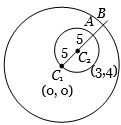
(B) The given equations represent two circles in the complex plane:
Circle $C_1$: Center $O(0, 0)$,radius $r_1 = 12$.
Circle $C_2$: Center $C(3, 4)$,radius $r_2 = 5$.
The distance between the centers is $d = |(3 + 4i) - 0| = \sqrt{3^2 + 4^2} = 5$.
Since $d + r_2 = 5 + 5 = 10 < r_1 = 12$,the circle $C_2$ lies entirely inside the circle $C_1$.
The minimum distance between a point on $C_1$ and a point on $C_2$ is given by $r_1 - (d + r_2) = 12 - (5 + 5) = 12 - 10 = 2$.
Circle $C_1$: Center $O(0, 0)$,radius $r_1 = 12$.
Circle $C_2$: Center $C(3, 4)$,radius $r_2 = 5$.
The distance between the centers is $d = |(3 + 4i) - 0| = \sqrt{3^2 + 4^2} = 5$.
Since $d + r_2 = 5 + 5 = 10 < r_1 = 12$,the circle $C_2$ lies entirely inside the circle $C_1$.
The minimum distance between a point on $C_1$ and a point on $C_2$ is given by $r_1 - (d + r_2) = 12 - (5 + 5) = 12 - 10 = 2$.
0 likesView Solution
2
MathematicsMediumMCQIIT JEE · 2002
If ${a_1}, {a_2}, ..., {a_n}$ are positive real numbers whose product is a fixed number $c$,then the minimum value of ${a_1} + {a_2} + ... + {a_{n-1}} + 2{a_n}$ is
A
$n(2c)^{1/n}$
B
$(n+1)c^{1/n}$
C
$2nc^{1/n}$
D
$(n+1)(2c)^{1/n}$
Solution
(A) By the $AM-GM$ inequality,for $n$ positive real numbers,the arithmetic mean is greater than or equal to the geometric mean.
Consider the $n$ numbers: ${a_1}, {a_2}, ..., {a_{n-1}}, 2{a_n}$.
Their arithmetic mean is $\frac{{a_1} + {a_2} + ... + {a_{n-1}} + 2{a_n}}{n}$.
Their geometric mean is $({a_1} \cdot {a_2} \cdot ... \cdot {a_{n-1}} \cdot 2{a_n})^{1/n} = (2 \cdot {a_1} \cdot {a_2} \cdot ... \cdot {a_n})^{1/n} = (2c)^{1/n}$.
Applying $AM \ge GM$:
$\frac{{a_1} + {a_2} + ... + {a_{n-1}} + 2{a_n}}{n} \ge (2c)^{1/n}$.
Therefore,the minimum value of ${a_1} + {a_2} + ... + {a_{n-1}} + 2{a_n}$ is $n(2c)^{1/n}$.
Consider the $n$ numbers: ${a_1}, {a_2}, ..., {a_{n-1}}, 2{a_n}$.
Their arithmetic mean is $\frac{{a_1} + {a_2} + ... + {a_{n-1}} + 2{a_n}}{n}$.
Their geometric mean is $({a_1} \cdot {a_2} \cdot ... \cdot {a_{n-1}} \cdot 2{a_n})^{1/n} = (2 \cdot {a_1} \cdot {a_2} \cdot ... \cdot {a_n})^{1/n} = (2c)^{1/n}$.
Applying $AM \ge GM$:
$\frac{{a_1} + {a_2} + ... + {a_{n-1}} + 2{a_n}}{n} \ge (2c)^{1/n}$.
Therefore,the minimum value of ${a_1} + {a_2} + ... + {a_{n-1}} + 2{a_n}$ is $n(2c)^{1/n}$.
0 likesView Solution
3
MathematicsDifficultMCQIIT JEE · 2002
Suppose $a, b, c$ are in $A.P.$ and $a^2, b^2, c^2$ are in $G.P.$ If $a < b < c$ and $a + b + c = \frac{3}{2}$,then the value of $a$ is
A
$\frac{1}{2\sqrt{2}}$
B
$\frac{1}{2\sqrt{3}}$
C
$\frac{1}{2} - \frac{1}{\sqrt{3}}$
D
$\frac{1}{2} - \frac{1}{\sqrt{2}}$
Solution
(D) Given $a, b, c$ are in $A.P.$,let $b = a + d$ and $c = a + 2d$,where $d > 0$ since $a < b < c$.
Given $a^2, b^2, c^2$ are in $G.P.$,we have $(b^2)^2 = a^2 c^2$,which implies $b^4 = a^2 c^2$.
Taking the square root,$b^2 = \pm ac$.
If $b^2 = ac$,then $a, b, c$ are in $G.P.$ Since they are also in $A.P.$,$a = b = c$,which contradicts $a < b < c$.
Thus,$b^2 = -ac$.
Substituting $b = a + d$ and $c = a + 2d$:
$(a + d)^2 = -a(a + 2d)$
$a^2 + d^2 + 2ad = -a^2 - 2ad$
$2a^2 + 4ad + d^2 = 0$.
Given $a + b + c = \frac{3}{2}$,we have $a + (a + d) + (a + 2d) = 3a + 3d = \frac{3}{2}$,so $a + d = \frac{1}{2}$,which means $d = \frac{1}{2} - a$.
Substituting $d$ into the equation $2a^2 + 4ad + d^2 = 0$:
$2a^2 + 4a(\frac{1}{2} - a) + (\frac{1}{2} - a)^2 = 0$
$2a^2 + 2a - 4a^2 + \frac{1}{4} - a + a^2 = 0$
$-a^2 + a + \frac{1}{4} = 0$
$4a^2 - 4a - 1 = 0$.
Using the quadratic formula $a = \frac{-(-4) \pm \sqrt{(-4)^2 - 4(4)(-1)}}{2(4)} = \frac{4 \pm \sqrt{16 + 16}}{8} = \frac{4 \pm 4\sqrt{2}}{8} = \frac{1}{2} \pm \frac{1}{\sqrt{2}}$.
Since $d = \frac{1}{2} - a > 0$,we must have $a < \frac{1}{2}$.
Therefore,$a = \frac{1}{2} - \frac{1}{\sqrt{2}}$.
Given $a^2, b^2, c^2$ are in $G.P.$,we have $(b^2)^2 = a^2 c^2$,which implies $b^4 = a^2 c^2$.
Taking the square root,$b^2 = \pm ac$.
If $b^2 = ac$,then $a, b, c$ are in $G.P.$ Since they are also in $A.P.$,$a = b = c$,which contradicts $a < b < c$.
Thus,$b^2 = -ac$.
Substituting $b = a + d$ and $c = a + 2d$:
$(a + d)^2 = -a(a + 2d)$
$a^2 + d^2 + 2ad = -a^2 - 2ad$
$2a^2 + 4ad + d^2 = 0$.
Given $a + b + c = \frac{3}{2}$,we have $a + (a + d) + (a + 2d) = 3a + 3d = \frac{3}{2}$,so $a + d = \frac{1}{2}$,which means $d = \frac{1}{2} - a$.
Substituting $d$ into the equation $2a^2 + 4ad + d^2 = 0$:
$2a^2 + 4a(\frac{1}{2} - a) + (\frac{1}{2} - a)^2 = 0$
$2a^2 + 2a - 4a^2 + \frac{1}{4} - a + a^2 = 0$
$-a^2 + a + \frac{1}{4} = 0$
$4a^2 - 4a - 1 = 0$.
Using the quadratic formula $a = \frac{-(-4) \pm \sqrt{(-4)^2 - 4(4)(-1)}}{2(4)} = \frac{4 \pm \sqrt{16 + 16}}{8} = \frac{4 \pm 4\sqrt{2}}{8} = \frac{1}{2} \pm \frac{1}{\sqrt{2}}$.
Since $d = \frac{1}{2} - a > 0$,we must have $a < \frac{1}{2}$.
Therefore,$a = \frac{1}{2} - \frac{1}{\sqrt{2}}$.
0 likesView Solution
4
MathematicsDifficultMCQIIT JEE · 2002
The set of all real numbers $x$ for which ${x^2} - |x + 2| + x > 0$ is
A
$( - \infty , - 2) \cup (2, \infty )$
B
$( - \infty , - \sqrt{2} ) \cup (\sqrt{2}, \infty )$
C
$( - \infty , - 1) \cup (1, \infty )$
D
$( \sqrt{2}, \infty )$
Solution
(B) Case $I$: When $x + 2 \ge 0$ i.e.,$x \ge -2,$
The given inequality becomes ${x^2} - (x + 2) + x > 0 \implies {x^2} - 2 > 0 \implies |x| > \sqrt{2}.$
This implies $x < -\sqrt{2}$ or $x > \sqrt{2}.$
Since $x \ge -2,$ the solution set for this case is $[ -2, -\sqrt{2} ) \cup (\sqrt{2}, \infty ).$
Case $II$: When $x + 2 < 0$ i.e.,$x < -2,$
The given inequality becomes ${x^2} + (x + 2) + x > 0 \implies {x^2} + 2x + 2 > 0.$
Since the discriminant $D = 2^2 - 4(1)(2) = 4 - 8 = -4 < 0$ and the coefficient of ${x^2}$ is positive,the expression ${x^2} + 2x + 2$ is always positive for all real $x.$
Thus,the solution set for this case is $( -\infty, -2).$
Combining the two cases,the total solution set is $( -\infty, -2) \cup [ -2, -\sqrt{2} ) \cup (\sqrt{2}, \infty ) = ( -\infty, -\sqrt{2} ) \cup (\sqrt{2}, \infty ).$
The given inequality becomes ${x^2} - (x + 2) + x > 0 \implies {x^2} - 2 > 0 \implies |x| > \sqrt{2}.$
This implies $x < -\sqrt{2}$ or $x > \sqrt{2}.$
Since $x \ge -2,$ the solution set for this case is $[ -2, -\sqrt{2} ) \cup (\sqrt{2}, \infty ).$
Case $II$: When $x + 2 < 0$ i.e.,$x < -2,$
The given inequality becomes ${x^2} + (x + 2) + x > 0 \implies {x^2} + 2x + 2 > 0.$
Since the discriminant $D = 2^2 - 4(1)(2) = 4 - 8 = -4 < 0$ and the coefficient of ${x^2}$ is positive,the expression ${x^2} + 2x + 2$ is always positive for all real $x.$
Thus,the solution set for this case is $( -\infty, -2).$
Combining the two cases,the total solution set is $( -\infty, -2) \cup [ -2, -\sqrt{2} ) \cup (\sqrt{2}, \infty ) = ( -\infty, -\sqrt{2} ) \cup (\sqrt{2}, \infty ).$
0 likesView Solution
5
MathematicsMediumMCQIIT JEE · 2002
The number of arrangements of the letters of the word $BANANA$ in which two $N$s do not appear adjacently is
A
$40$
B
$60$
C
$80$
D
$100$
Solution
(A) The word $BANANA$ contains $6$ letters: $B, A, N, A, N, A$.
Here,$A$ appears $3$ times and $N$ appears $2$ times.
Total number of arrangements = $\frac{6!}{3! \times 2!} = \frac{720}{6 \times 2} = 60$.
Number of arrangements where two $N$s are together: Treat $(NN)$ as one unit. Now we have $5$ units: $B, A, A, A, (NN)$.
Number of arrangements = $\frac{5!}{3! \times 1!} = \frac{120}{6} = 20$.
Number of arrangements where two $N$s do not appear adjacently = (Total arrangements) - (Arrangements where $N$s are together) = $60 - 20 = 40$.
Here,$A$ appears $3$ times and $N$ appears $2$ times.
Total number of arrangements = $\frac{6!}{3! \times 2!} = \frac{720}{6 \times 2} = 60$.
Number of arrangements where two $N$s are together: Treat $(NN)$ as one unit. Now we have $5$ units: $B, A, A, A, (NN)$.
Number of arrangements = $\frac{5!}{3! \times 1!} = \frac{120}{6} = 20$.
Number of arrangements where two $N$s do not appear adjacently = (Total arrangements) - (Arrangements where $N$s are together) = $60 - 20 = 40$.
0 likesView Solution
6
MathematicsDifficultMCQIIT JEE · 2002
The sum $\sum\limits_{i = 0}^m {\binom{10}{i}} {\binom{20}{m - i}}$,(where $\binom{p}{q} = 0$ if $p < q$),is maximum when $m$ is
A
$5$
B
$15$
C
$10$
D
$20$
Solution
(B) The given sum is $\sum\limits_{i = 0}^m {\binom{10}{i}} {\binom{20}{m - i}}$.
By Vandermonde's Identity,this sum is equal to the coefficient of $x^m$ in the expansion of $(1+x)^{10} (1+x)^{20} = (1+x)^{30}$.
Thus,the sum is equal to $\binom{30}{m}$.
We know that $\binom{n}{m}$ is maximum when $m = \frac{n}{2}$ if $n$ is even,or $m = \frac{n-1}{2}$ and $m = \frac{n+1}{2}$ if $n$ is odd.
Here,$n = 30$,which is even.
Therefore,the sum $\binom{30}{m}$ is maximum when $m = \frac{30}{2} = 15$.
Hence,the correct option is $B$.
By Vandermonde's Identity,this sum is equal to the coefficient of $x^m$ in the expansion of $(1+x)^{10} (1+x)^{20} = (1+x)^{30}$.
Thus,the sum is equal to $\binom{30}{m}$.
We know that $\binom{n}{m}$ is maximum when $m = \frac{n}{2}$ if $n$ is even,or $m = \frac{n-1}{2}$ and $m = \frac{n+1}{2}$ if $n$ is odd.
Here,$n = 30$,which is even.
Therefore,the sum $\binom{30}{m}$ is maximum when $m = \frac{30}{2} = 15$.
Hence,the correct option is $B$.
0 likesView Solution
7
MathematicsMediumMCQIIT JEE · 2002
The number of values of $k$ for which the system of equations $(k + 1)x + 8y = 4k$ and $kx + (k + 3)y = 3k - 1$ has infinitely many solutions,is
A
$0$
B
$1$
C
$2$
D
Infinite
Solution
(B) For a system of linear equations $a_1x + b_1y = c_1$ and $a_2x + b_2y = c_2$ to have infinitely many solutions,the condition is $\frac{a_1}{a_2} = \frac{b_1}{b_2} = \frac{c_1}{c_2}$.
Given equations: $(k + 1)x + 8y = 4k$ and $kx + (k + 3)y = 3k - 1$.
Applying the condition: $\frac{k + 1}{k} = \frac{8}{k + 3} = \frac{4k}{3k - 1}$.
First,solve $\frac{k + 1}{k} = \frac{8}{k + 3}$:
$(k + 1)(k + 3) = 8k \Rightarrow k^2 + 4k + 3 = 8k \Rightarrow k^2 - 4k + 3 = 0$.
Factoring gives $(k - 1)(k - 3) = 0$,so $k = 1$ or $k = 3$.
Next,check these values in the second equality $\frac{8}{k + 3} = \frac{4k}{3k - 1}$:
If $k = 1$: $\frac{8}{1 + 3} = \frac{8}{4} = 2$ and $\frac{4(1)}{3(1) - 1} = \frac{4}{2} = 2$. Since $2 = 2$,$k = 1$ is a solution.
If $k = 3$: $\frac{8}{3 + 3} = \frac{8}{6} = \frac{4}{3}$ and $\frac{4(3)}{3(3) - 1} = \frac{12}{8} = \frac{3}{2}$. Since $\frac{4}{3} \neq \frac{3}{2}$,$k = 3$ is not a solution.
Thus,there is only $1$ value of $k$ for which the system has infinitely many solutions.
Given equations: $(k + 1)x + 8y = 4k$ and $kx + (k + 3)y = 3k - 1$.
Applying the condition: $\frac{k + 1}{k} = \frac{8}{k + 3} = \frac{4k}{3k - 1}$.
First,solve $\frac{k + 1}{k} = \frac{8}{k + 3}$:
$(k + 1)(k + 3) = 8k \Rightarrow k^2 + 4k + 3 = 8k \Rightarrow k^2 - 4k + 3 = 0$.
Factoring gives $(k - 1)(k - 3) = 0$,so $k = 1$ or $k = 3$.
Next,check these values in the second equality $\frac{8}{k + 3} = \frac{4k}{3k - 1}$:
If $k = 1$: $\frac{8}{1 + 3} = \frac{8}{4} = 2$ and $\frac{4(1)}{3(1) - 1} = \frac{4}{2} = 2$. Since $2 = 2$,$k = 1$ is a solution.
If $k = 3$: $\frac{8}{3 + 3} = \frac{8}{6} = \frac{4}{3}$ and $\frac{4(3)}{3(3) - 1} = \frac{12}{8} = \frac{3}{2}$. Since $\frac{4}{3} \neq \frac{3}{2}$,$k = 3$ is not a solution.
Thus,there is only $1$ value of $k$ for which the system has infinitely many solutions.
0 likesView Solution
8
MathematicsDifficultMCQIIT JEE · 2002
If $a > 2b > 0$,then the positive value of $m$ for which $y = mx - b\sqrt{1 + m^2}$ is a common tangent to $x^2 + y^2 = b^2$ and $(x - a)^2 + y^2 = b^2$ is:
A
$\frac{2b}{\sqrt{a^2 - 4b^2}}$
B
$\frac{\sqrt{a^2 - 4b^2}}{2b}$
C
$\frac{2b}{a - 2b}$
D
$\frac{b}{a - 2b}$
Solution
(A) The equation of any tangent to the circle $x^2 + y^2 = b^2$ is given by $y = mx \pm b\sqrt{1 + m^2}$.
Since the given tangent is $y = mx - b\sqrt{1 + m^2}$,it is a tangent to the first circle.
For this line to be a tangent to the second circle $(x - a)^2 + y^2 = b^2$,the perpendicular distance from the center $(a, 0)$ to the line $mx - y - b\sqrt{1 + m^2} = 0$ must be equal to the radius $b$.
Thus,$\frac{|ma - 0 - b\sqrt{1 + m^2}|}{\sqrt{m^2 + 1}} = b$.
Since $a > 2b$,we have $ma > b\sqrt{1 + m^2}$,so $ma - b\sqrt{1 + m^2} = b\sqrt{m^2 + 1}$.
$ma = 2b\sqrt{1 + m^2}$.
Squaring both sides,$m^2 a^2 = 4b^2(1 + m^2) = 4b^2 + 4b^2 m^2$.
$m^2(a^2 - 4b^2) = 4b^2$.
$m^2 = \frac{4b^2}{a^2 - 4b^2}$.
Since we need the positive value of $m$,$m = \frac{2b}{\sqrt{a^2 - 4b^2}}$.
Since the given tangent is $y = mx - b\sqrt{1 + m^2}$,it is a tangent to the first circle.
For this line to be a tangent to the second circle $(x - a)^2 + y^2 = b^2$,the perpendicular distance from the center $(a, 0)$ to the line $mx - y - b\sqrt{1 + m^2} = 0$ must be equal to the radius $b$.
Thus,$\frac{|ma - 0 - b\sqrt{1 + m^2}|}{\sqrt{m^2 + 1}} = b$.
Since $a > 2b$,we have $ma > b\sqrt{1 + m^2}$,so $ma - b\sqrt{1 + m^2} = b\sqrt{m^2 + 1}$.
$ma = 2b\sqrt{1 + m^2}$.
Squaring both sides,$m^2 a^2 = 4b^2(1 + m^2) = 4b^2 + 4b^2 m^2$.
$m^2(a^2 - 4b^2) = 4b^2$.
$m^2 = \frac{4b^2}{a^2 - 4b^2}$.
Since we need the positive value of $m$,$m = \frac{2b}{\sqrt{a^2 - 4b^2}}$.
0 likesView Solution
9
MathematicsMediumMCQIIT JEE · 2002
The locus of the midpoint of the line segment joining the focus to a moving point on the parabola $y^2 = 4ax$ is another parabola with the directrix
A
$x = -a$
B
$x = -\frac{a}{2}$
C
$x = 0$
D
$x = \frac{a}{2}$
Solution
(C) Let the moving point on the parabola $y^2 = 4ax$ be $(at^2, 2at)$.
The focus of the parabola is $S(a, 0)$.
Let $(h, k)$ be the midpoint of the line segment joining $(at^2, 2at)$ and $(a, 0)$.
Then $h = \frac{at^2 + a}{2}$ and $k = \frac{2at + 0}{2} = at$.
From $k = at$,we have $t = \frac{k}{a}$.
Substituting $t$ into the expression for $h$: $h = \frac{a(\frac{k}{a})^2 + a}{2} = \frac{\frac{k^2}{a} + a}{2} = \frac{k^2 + a^2}{2a}$.
Thus,$2ah = k^2 + a^2$,which simplifies to $k^2 = 2a(h - \frac{a}{2})$.
The locus is $y^2 = 2a(x - \frac{a}{2})$.
Comparing this with the standard form $Y^2 = 4AX$,where $Y = y$,$X = x - \frac{a}{2}$,and $4A = 2a$ (so $A = \frac{a}{2}$).
The directrix is given by $X = -A$,which means $x - \frac{a}{2} = -\frac{a}{2}$.
Therefore,$x = 0$.
The focus of the parabola is $S(a, 0)$.
Let $(h, k)$ be the midpoint of the line segment joining $(at^2, 2at)$ and $(a, 0)$.
Then $h = \frac{at^2 + a}{2}$ and $k = \frac{2at + 0}{2} = at$.
From $k = at$,we have $t = \frac{k}{a}$.
Substituting $t$ into the expression for $h$: $h = \frac{a(\frac{k}{a})^2 + a}{2} = \frac{\frac{k^2}{a} + a}{2} = \frac{k^2 + a^2}{2a}$.
Thus,$2ah = k^2 + a^2$,which simplifies to $k^2 = 2a(h - \frac{a}{2})$.
The locus is $y^2 = 2a(x - \frac{a}{2})$.
Comparing this with the standard form $Y^2 = 4AX$,where $Y = y$,$X = x - \frac{a}{2}$,and $4A = 2a$ (so $A = \frac{a}{2}$).
The directrix is given by $X = -A$,which means $x - \frac{a}{2} = -\frac{a}{2}$.
Therefore,$x = 0$.
0 likesView Solution
10
MathematicsDifficultMCQIIT JEE · 2002
The equation of the common tangent to the curves ${y^2} = 8x$ and $xy = -1$ is
A
$3y = 9x + 2$
B
$y = 2x + 1$
C
$2y = x + 8$
D
$y = x + 2$
Solution
(D) Let the equation of the tangent to the parabola ${y^2} = 8x$ be $y = mx + \frac{2}{m}$.
Since this line is also a tangent to the hyperbola $xy = -1$,we substitute $x = \frac{-1}{y}$ into the tangent equation:
$y = m(\frac{-1}{y}) + \frac{2}{m}$
$y^2 = -m + \frac{2y}{m}$
$my^2 - 2y + m^2 = 0$.
For the line to be a tangent,the discriminant of this quadratic equation must be zero:
$D = (-2)^2 - 4(m)(m^2) = 0$
$4 - 4m^3 = 0$
$m^3 = 1 \implies m = 1$.
Substituting $m = 1$ into the tangent equation $y = mx + \frac{2}{m}$,we get:
$y = (1)x + \frac{2}{1}$
$y = x + 2$.
Since this line is also a tangent to the hyperbola $xy = -1$,we substitute $x = \frac{-1}{y}$ into the tangent equation:
$y = m(\frac{-1}{y}) + \frac{2}{m}$
$y^2 = -m + \frac{2y}{m}$
$my^2 - 2y + m^2 = 0$.
For the line to be a tangent,the discriminant of this quadratic equation must be zero:
$D = (-2)^2 - 4(m)(m^2) = 0$
$4 - 4m^3 = 0$
$m^3 = 1 \implies m = 1$.
Substituting $m = 1$ into the tangent equation $y = mx + \frac{2}{m}$,we get:
$y = (1)x + \frac{2}{1}$
$y = x + 2$.
0 likesView Solution
11
MathematicsDifficultMCQIIT JEE · 2002
The integer $n$ for which $\mathop {\lim }\limits_{x \to 0} \,\frac{(\cos x - 1)(\cos x - e^x)}{x^n}$ is a finite non-zero number is
A
$1$
B
$2$
C
$3$
D
$4$
Solution
(C) Let $L = \mathop {\lim }\limits_{x \to 0} \frac{(\cos x - 1)(\cos x - e^x)}{x^n}$.
Using Taylor series expansions near $x = 0$:
$\cos x = 1 - \frac{x^2}{2!} + \frac{x^4}{4!} - \dots$
$e^x = 1 + x + \frac{x^2}{2!} + \dots$
Substituting these into the expression:
$\cos x - 1 = -\frac{x^2}{2} + O(x^4)$
$\cos x - e^x = (1 - \frac{x^2}{2} + \dots) - (1 + x + \frac{x^2}{2} + \dots) = -x - x^2 + O(x^3)$
Thus,the numerator is $(- \frac{x^2}{2} + O(x^4))(-x - x^2 + O(x^3)) = \frac{x^3}{2} + O(x^4)$.
For the limit to be a finite non-zero number,the power of $x$ in the denominator must match the lowest power of $x$ in the numerator.
Therefore,$n = 3$.
Using Taylor series expansions near $x = 0$:
$\cos x = 1 - \frac{x^2}{2!} + \frac{x^4}{4!} - \dots$
$e^x = 1 + x + \frac{x^2}{2!} + \dots$
Substituting these into the expression:
$\cos x - 1 = -\frac{x^2}{2} + O(x^4)$
$\cos x - e^x = (1 - \frac{x^2}{2} + \dots) - (1 + x + \frac{x^2}{2} + \dots) = -x - x^2 + O(x^3)$
Thus,the numerator is $(- \frac{x^2}{2} + O(x^4))(-x - x^2 + O(x^3)) = \frac{x^3}{2} + O(x^4)$.
For the limit to be a finite non-zero number,the power of $x$ in the denominator must match the lowest power of $x$ in the numerator.
Therefore,$n = 3$.
0 likesView Solution
12
MathematicsDifficultMCQIIT JEE · 2002
An anti-aircraft gun takes a maximum of four shots at an enemy plane moving away from it. The probabilities of hitting the plane at the first,second,third,and fourth shot are $0.4, 0.3, 0.2$,and $0.1$ respectively. The probability that the gun hits the plane is
A
$0.25$
B
$0.21$
C
$0.16$
D
$0.6976$
Solution
(D) Let the probabilities of hitting the plane in the four shots be $p_1 = 0.4$,$p_2 = 0.3$,$p_3 = 0.2$,and $p_4 = 0.1$.
The probability that the gun hits the plane is equal to $1$ minus the probability that the gun misses the plane in all four shots.
Let $q_i = 1 - p_i$ be the probability of missing the shot $i$.
$q_1 = 1 - 0.4 = 0.6$
$q_2 = 1 - 0.3 = 0.7$
$q_3 = 1 - 0.2 = 0.8$
$q_4 = 1 - 0.1 = 0.9$
The probability of missing all four shots is $P(\text{miss}) = q_1 \times q_2 \times q_3 \times q_4 = 0.6 \times 0.7 \times 0.8 \times 0.9 = 0.3024$.
Therefore,the probability that the gun hits the plane is $P(\text{hit}) = 1 - P(\text{miss}) = 1 - 0.3024 = 0.6976$.
The probability that the gun hits the plane is equal to $1$ minus the probability that the gun misses the plane in all four shots.
Let $q_i = 1 - p_i$ be the probability of missing the shot $i$.
$q_1 = 1 - 0.4 = 0.6$
$q_2 = 1 - 0.3 = 0.7$
$q_3 = 1 - 0.2 = 0.8$
$q_4 = 1 - 0.1 = 0.9$
The probability of missing all four shots is $P(\text{miss}) = q_1 \times q_2 \times q_3 \times q_4 = 0.6 \times 0.7 \times 0.8 \times 0.9 = 0.3024$.
Therefore,the probability that the gun hits the plane is $P(\text{hit}) = 1 - P(\text{miss}) = 1 - 0.3024 = 0.6976$.
0 likesView Solution
13
MathematicsDifficultMCQIIT JEE · 2002
Let $P(-1, 0)$,$Q(0, 0)$,and $R(3, 3\sqrt{3})$ be three points. The equation of the bisector of the angle $\angle PQR$ is:
A
$\frac{\sqrt{3}}{2}x + y = 0$
B
$x + \sqrt{3}y = 0$
C
$\sqrt{3}x + y = 0$
D
$x + \frac{\sqrt{3}}{2}y = 0$
Solution
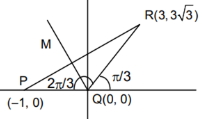
(C) The line $QP$ lies along the negative $x$-axis,so its angle with the positive $x$-axis is $\pi$. The line $QR$ passes through $(0, 0)$ and $(3, 3\sqrt{3})$,so its slope is $m = \frac{3\sqrt{3} - 0}{3 - 0} = \sqrt{3}$. The angle $\theta$ that $QR$ makes with the positive $x$-axis is $\tan \theta = \sqrt{3}$,which means $\theta = \frac{\pi}{3}$.
The angle $\angle PQR$ is the angle between the line $QP$ (angle $\pi$) and the line $QR$ (angle $\frac{\pi}{3}$).
The measure of $\angle PQR = \pi - \frac{\pi}{3} = \frac{2\pi}{3}$.
The bisector of $\angle PQR$ will make an angle $\alpha$ with the positive $x$-axis,where $\alpha = \frac{\pi + \frac{\pi}{3}}{2} = \frac{4\pi/3}{2} = \frac{2\pi}{3}$.
The slope of the bisector is $\tan(\frac{2\pi}{3}) = -\sqrt{3}$.
Since the bisector passes through the origin $Q(0, 0)$,its equation is $y - 0 = -\sqrt{3}(x - 0)$,which simplifies to $y = -\sqrt{3}x$,or $\sqrt{3}x + y = 0$.
The angle $\angle PQR$ is the angle between the line $QP$ (angle $\pi$) and the line $QR$ (angle $\frac{\pi}{3}$).
The measure of $\angle PQR = \pi - \frac{\pi}{3} = \frac{2\pi}{3}$.
The bisector of $\angle PQR$ will make an angle $\alpha$ with the positive $x$-axis,where $\alpha = \frac{\pi + \frac{\pi}{3}}{2} = \frac{4\pi/3}{2} = \frac{2\pi}{3}$.
The slope of the bisector is $\tan(\frac{2\pi}{3}) = -\sqrt{3}$.
Since the bisector passes through the origin $Q(0, 0)$,its equation is $y - 0 = -\sqrt{3}(x - 0)$,which simplifies to $y = -\sqrt{3}x$,or $\sqrt{3}x + y = 0$.
0 likesView Solution
14
MathematicsMediumMCQIIT JEE · 2002
Which of the following sets of data does not uniquely determine an acute-angled $\Delta ABC$ ($R$ = circum-radius)?
A
$a, \sin A, \sin B$
B
$a, b, c$
C
$a, \sin B, R$
D
$a, \sin A, R$
Solution
(D) In $\Delta ABC$,the Sine Rule states $\frac{a}{\sin A} = \frac{b}{\sin B} = \frac{c}{\sin C} = 2R$.
For option $(a)$: Given $a, \sin A, \sin B$. From $\frac{a}{\sin A} = 2R$,we find $R$. Then $b = 2R \sin B$ and $c = 2R \sin C = 2R \sin(180^{\circ} - (A+B)) = 2R \sin(A+B)$. Thus,the triangle is uniquely determined.
For option $(b)$: Given $a, b, c$. By the $SSS$ congruence criterion,the triangle is uniquely determined.
For option $(c)$: Given $a, \sin B, R$. We have $b = 2R \sin B$. Now we have two sides $a, b$ and the circum-radius $R$. Since $\sin A = \frac{a}{2R}$,angle $A$ is determined. Thus,the triangle is uniquely determined.
For option $(d)$: Given $a, \sin A, R$. We have $\frac{a}{\sin A} = 2R$. This is an identity that holds for any triangle with side $a$ and angle $A$ having circum-radius $R$. It does not provide enough information to fix the other sides or angles. Therefore,the triangle is not uniquely determined.
For option $(a)$: Given $a, \sin A, \sin B$. From $\frac{a}{\sin A} = 2R$,we find $R$. Then $b = 2R \sin B$ and $c = 2R \sin C = 2R \sin(180^{\circ} - (A+B)) = 2R \sin(A+B)$. Thus,the triangle is uniquely determined.
For option $(b)$: Given $a, b, c$. By the $SSS$ congruence criterion,the triangle is uniquely determined.
For option $(c)$: Given $a, \sin B, R$. We have $b = 2R \sin B$. Now we have two sides $a, b$ and the circum-radius $R$. Since $\sin A = \frac{a}{2R}$,angle $A$ is determined. Thus,the triangle is uniquely determined.
For option $(d)$: Given $a, \sin A, R$. We have $\frac{a}{\sin A} = 2R$. This is an identity that holds for any triangle with side $a$ and angle $A$ having circum-radius $R$. It does not provide enough information to fix the other sides or angles. Therefore,the triangle is not uniquely determined.
0 likesView Solution
15
MathematicsMediumMCQIIT JEE · 2002
The number of integral values of $k$,for which the equation $7 \cos x + 5 \sin x = 2k + 1$ has a solution,is
A
$4$
B
$8$
C
$10$
D
$2$
Solution
(B) The range of the expression $a \cos x + b \sin x$ is $[-\sqrt{a^2 + b^2}, \sqrt{a^2 + b^2}]$.
For the equation $7 \cos x + 5 \sin x = 2k + 1$,the range of the left side is $[-\sqrt{7^2 + 5^2}, \sqrt{7^2 + 5^2}] = [-\sqrt{74}, \sqrt{74}]$.
Since $\sqrt{74} \approx 8.602$,we have $-8.602 \leq 2k + 1 \leq 8.602$.
Subtracting $1$ from all sides: $-9.602 \leq 2k \leq 7.602$.
Dividing by $2$: $-4.801 \leq k \leq 3.801$.
The integral values of $k$ are $\{-4, -3, -2, -1, 0, 1, 2, 3\}$.
Counting these values,we get $8$ integral values.
For the equation $7 \cos x + 5 \sin x = 2k + 1$,the range of the left side is $[-\sqrt{7^2 + 5^2}, \sqrt{7^2 + 5^2}] = [-\sqrt{74}, \sqrt{74}]$.
Since $\sqrt{74} \approx 8.602$,we have $-8.602 \leq 2k + 1 \leq 8.602$.
Subtracting $1$ from all sides: $-9.602 \leq 2k \leq 7.602$.
Dividing by $2$: $-4.801 \leq k \leq 3.801$.
The integral values of $k$ are $\{-4, -3, -2, -1, 0, 1, 2, 3\}$.
Counting these values,we get $8$ integral values.
0 likesView Solution
16
MathematicsDifficultMCQIIT JEE · 2002
If the tangent at the point $P$ on the circle $x^2+y^2+6x+6y=2$ meets the straight line $5x-2y+6=0$ at a point $Q$ on the $Y$-axis,then the length of $PQ$ is
A
$4$
B
$2\sqrt{5}$
C
$5$
D
$3\sqrt{5}$
Solution
(C) The equation of the circle is $S: x^2+y^2+6x+6y-2=0$.
Point $Q$ lies on the $Y$-axis and on the line $5x-2y+6=0$.
Setting $x=0$ in the line equation: $5(0)-2y+6=0$ $\Rightarrow -2y=-6$ $\Rightarrow y=3$.
So,the coordinates of $Q$ are $(0, 3)$.
The length of the tangent from a point $(x_1, y_1)$ to a circle $S=0$ is given by $\sqrt{S_1}$.
Substituting $Q(0, 3)$ into the circle equation $S(x, y) = x^2+y^2+6x+6y-2$:
$S_1 = 0^2 + 3^2 + 6(0) + 6(3) - 2 = 0 + 9 + 0 + 18 - 2 = 25$.
Therefore,the length of the tangent $PQ = \sqrt{S_1} = \sqrt{25} = 5$.
Point $Q$ lies on the $Y$-axis and on the line $5x-2y+6=0$.
Setting $x=0$ in the line equation: $5(0)-2y+6=0$ $\Rightarrow -2y=-6$ $\Rightarrow y=3$.
So,the coordinates of $Q$ are $(0, 3)$.
The length of the tangent from a point $(x_1, y_1)$ to a circle $S=0$ is given by $\sqrt{S_1}$.
Substituting $Q(0, 3)$ into the circle equation $S(x, y) = x^2+y^2+6x+6y-2$:
$S_1 = 0^2 + 3^2 + 6(0) + 6(3) - 2 = 0 + 9 + 0 + 18 - 2 = 25$.
Therefore,the length of the tangent $PQ = \sqrt{S_1} = \sqrt{25} = 5$.
0 likesView Solution
17
MathematicsEasyMCQIIT JEE · 2002
Let $\omega = - \frac{1}{2} + i\frac{\sqrt{3}}{2}$. Then the value of the determinant $\left| \begin{array}{ccc} 1 & 1 & 1 \\ 1 & -1 - \omega^2 & \omega^2 \\ 1 & \omega^2 & \omega^4 \end{array} \right|$ is
A
$3\omega$
B
$3\omega(\omega - 1)$
C
$3\omega^2$
D
$3\omega(1 - \omega)$
Solution
(B) Given $\omega = - \frac{1}{2} + i\frac{\sqrt{3}}{2}$,we know that $\omega$ is a complex cube root of unity,so $1 + \omega + \omega^2 = 0$ and $\omega^3 = 1$. Also,$\omega^4 = \omega^3 \cdot \omega = \omega$.
Let $\Delta = \left| \begin{array}{ccc} 1 & 1 & 1 \\ 1 & -1 - \omega^2 & \omega^2 \\ 1 & \omega^2 & \omega^4 \end{array} \right|$.
Using the property $1 + \omega + \omega^2 = 0$,we have $-1 - \omega^2 = \omega$.
Substituting this and $\omega^4 = \omega$ into the determinant:
$\Delta = \left| \begin{array}{ccc} 1 & 1 & 1 \\ 1 & \omega & \omega^2 \\ 1 & \omega^2 & \omega \end{array} \right|$.
Applying the column operation $C_1 \to C_1 + C_2 + C_3$:
$\Delta = \left| \begin{array}{ccc} 1+1+1 & 1 & 1 \\ 1+\omega+\omega^2 & \omega & \omega^2 \\ 1+\omega^2+\omega & \omega^2 & \omega \end{array} \right| = \left| \begin{array}{ccc} 3 & 1 & 1 \\ 0 & \omega & \omega^2 \\ 0 & \omega^2 & \omega \end{array} \right|$.
Expanding along the first column:
$\Delta = 3(\omega \cdot \omega - \omega^2 \cdot \omega^2) = 3(\omega^2 - \omega^4) = 3(\omega^2 - \omega)$.
Factoring out $-\omega$:
$\Delta = 3\omega(\omega - 1)$.
Let $\Delta = \left| \begin{array}{ccc} 1 & 1 & 1 \\ 1 & -1 - \omega^2 & \omega^2 \\ 1 & \omega^2 & \omega^4 \end{array} \right|$.
Using the property $1 + \omega + \omega^2 = 0$,we have $-1 - \omega^2 = \omega$.
Substituting this and $\omega^4 = \omega$ into the determinant:
$\Delta = \left| \begin{array}{ccc} 1 & 1 & 1 \\ 1 & \omega & \omega^2 \\ 1 & \omega^2 & \omega \end{array} \right|$.
Applying the column operation $C_1 \to C_1 + C_2 + C_3$:
$\Delta = \left| \begin{array}{ccc} 1+1+1 & 1 & 1 \\ 1+\omega+\omega^2 & \omega & \omega^2 \\ 1+\omega^2+\omega & \omega^2 & \omega \end{array} \right| = \left| \begin{array}{ccc} 3 & 1 & 1 \\ 0 & \omega & \omega^2 \\ 0 & \omega^2 & \omega \end{array} \right|$.
Expanding along the first column:
$\Delta = 3(\omega \cdot \omega - \omega^2 \cdot \omega^2) = 3(\omega^2 - \omega^4) = 3(\omega^2 - \omega)$.
Factoring out $-\omega$:
$\Delta = 3\omega(\omega - 1)$.
0 likesView Solution
18
MathematicsMediumMCQIIT JEE · 2002
If $a$ and $b$ are two unit vectors such that $a+2b$ and $5a - 4b$ are perpendicular to each other,then the angle between $a$ and $b$ is ............. $^o$
A
$45$
B
$60$
C
$\cos^{-1}\left(\frac{1}{3}\right)$
D
$\cos^{-1}\left(\frac{2}{7}\right)$
Solution
(B) Given that $a$ and $b$ are unit vectors,so $|a| = 1$ and $|b| = 1$.
Since $(a + 2b)$ and $(5a - 4b)$ are perpendicular,their dot product is zero:
$(a + 2b) \cdot (5a - 4b) = 0$
Expanding the dot product:
$5(a \cdot a) - 4(a \cdot b) + 10(b \cdot a) - 8(b \cdot b) = 0$
Since $a \cdot a = |a|^2 = 1$ and $b \cdot b = |b|^2 = 1$,and $a \cdot b = b \cdot a$:
$5(1) + 6(a \cdot b) - 8(1) = 0$
$5 + 6(a \cdot b) - 8 = 0$
$6(a \cdot b) - 3 = 0$
$6(a \cdot b) = 3$
$a \cdot b = \frac{3}{6} = \frac{1}{2}$
Using the formula $a \cdot b = |a||b| \cos \theta$:
$(1)(1) \cos \theta = \frac{1}{2}$
$\cos \theta = \frac{1}{2}$
$\theta = 60^o$.
Since $(a + 2b)$ and $(5a - 4b)$ are perpendicular,their dot product is zero:
$(a + 2b) \cdot (5a - 4b) = 0$
Expanding the dot product:
$5(a \cdot a) - 4(a \cdot b) + 10(b \cdot a) - 8(b \cdot b) = 0$
Since $a \cdot a = |a|^2 = 1$ and $b \cdot b = |b|^2 = 1$,and $a \cdot b = b \cdot a$:
$5(1) + 6(a \cdot b) - 8(1) = 0$
$5 + 6(a \cdot b) - 8 = 0$
$6(a \cdot b) - 3 = 0$
$6(a \cdot b) = 3$
$a \cdot b = \frac{3}{6} = \frac{1}{2}$
Using the formula $a \cdot b = |a||b| \cos \theta$:
$(1)(1) \cos \theta = \frac{1}{2}$
$\cos \theta = \frac{1}{2}$
$\theta = 60^o$.
0 likesView Solution
19
MathematicsEasyMCQIIT JEE · 2002
Let the function $f:R \to R$ be defined by $f(x) = 2x + \sin x, x \in R$. Then $f$ is
A
One-to-one and onto
B
One-to-one but not onto
C
Onto but not one-to-one
D
Neither one-to-one nor onto
Solution
(A) Given the function $f(x) = 2x + \sin x$ for $x \in R$.
To check for one-to-one,we find the derivative: $f'(x) = 2 + \cos x$.
Since $-1 \le \cos x \le 1$,we have $f'(x) = 2 + \cos x \ge 2 - 1 = 1 > 0$.
Since $f'(x) > 0$ for all $x \in R$,the function $f(x)$ is strictly increasing,which implies it is one-to-one.
To check for onto,we observe the range of $f(x)$. Since $f(x)$ is a continuous function and $\lim_{x \to \infty} f(x) = \infty$ and $\lim_{x \to -\infty} f(x) = -\infty$,the range of $f(x)$ is $(-\infty, \infty) = R$.
Since the range equals the codomain,the function is onto.
Therefore,$f$ is one-to-one and onto.
To check for one-to-one,we find the derivative: $f'(x) = 2 + \cos x$.
Since $-1 \le \cos x \le 1$,we have $f'(x) = 2 + \cos x \ge 2 - 1 = 1 > 0$.
Since $f'(x) > 0$ for all $x \in R$,the function $f(x)$ is strictly increasing,which implies it is one-to-one.
To check for onto,we observe the range of $f(x)$. Since $f(x)$ is a continuous function and $\lim_{x \to \infty} f(x) = \infty$ and $\lim_{x \to -\infty} f(x) = -\infty$,the range of $f(x)$ is $(-\infty, \infty) = R$.
Since the range equals the codomain,the function is onto.
Therefore,$f$ is one-to-one and onto.
0 likesView Solution
20
MathematicsDifficultMCQIIT JEE · 2002
The domain of the derivative of the function $f(x) = \begin{cases} \tan^{-1}x, & |x| \le 1 \\ \frac{1}{2}(|x| - 1), & |x| > 1 \end{cases}$ is
A
$R - \{0\}$
B
$R - \{1\}$
C
$R - \{-1\}$
D
$R - \{-1, 1\}$
Solution
(C) The function $f(x)$ can be rewritten by expanding the absolute value as:
$f(x) = \begin{cases} \frac{1}{2}(-x - 1), & x < -1 \\ \tan^{-1}x, & -1 \le x \le 1 \\ \frac{1}{2}(x - 1), & x > 1 \end{cases}$
To find the domain of the derivative $f'(x)$,we check the differentiability at the transition points $x = -1$ and $x = 1$.
For $x < -1$,$f'(x) = -\frac{1}{2}$.
For $-1 < x < 1$,$f'(x) = \frac{1}{1+x^2}$.
For $x > 1$,$f'(x) = \frac{1}{2}$.
At $x = -1$:
Left-hand derivative $f'(-1^-) = -\frac{1}{2}$.
Right-hand derivative $f'(-1^+) = \frac{1}{1+(-1)^2} = \frac{1}{2}$.
Since $f'(-1^-) \neq f'(-1^+)$,the function is not differentiable at $x = -1$.
At $x = 1$:
Left-hand derivative $f'(1^-) = \frac{1}{1+(1)^2} = \frac{1}{2}$.
Right-hand derivative $f'(1^+) = \frac{1}{2}$.
Since $f'(1^-) = f'(1^+)$,the function is differentiable at $x = 1$.
Thus,the derivative $f'(x)$ exists for all $x \in R$ except $x = -1$.
Therefore,the domain of $f'(x)$ is $R - \{-1\}$.
$f(x) = \begin{cases} \frac{1}{2}(-x - 1), & x < -1 \\ \tan^{-1}x, & -1 \le x \le 1 \\ \frac{1}{2}(x - 1), & x > 1 \end{cases}$
To find the domain of the derivative $f'(x)$,we check the differentiability at the transition points $x = -1$ and $x = 1$.
For $x < -1$,$f'(x) = -\frac{1}{2}$.
For $-1 < x < 1$,$f'(x) = \frac{1}{1+x^2}$.
For $x > 1$,$f'(x) = \frac{1}{2}$.
At $x = -1$:
Left-hand derivative $f'(-1^-) = -\frac{1}{2}$.
Right-hand derivative $f'(-1^+) = \frac{1}{1+(-1)^2} = \frac{1}{2}$.
Since $f'(-1^-) \neq f'(-1^+)$,the function is not differentiable at $x = -1$.
At $x = 1$:
Left-hand derivative $f'(1^-) = \frac{1}{1+(1)^2} = \frac{1}{2}$.
Right-hand derivative $f'(1^+) = \frac{1}{2}$.
Since $f'(1^-) = f'(1^+)$,the function is differentiable at $x = 1$.
Thus,the derivative $f'(x)$ exists for all $x \in R$ except $x = -1$.
Therefore,the domain of $f'(x)$ is $R - \{-1\}$.
0 likesView Solution
21
MathematicsMediumMCQIIT JEE · 2002
The length of the longest interval,in which the function $f(x) = 3\sin x - 4\sin^3 x$ is increasing,is
A
$\frac{\pi}{3}$
B
$\frac{\pi}{2}$
C
$\frac{3\pi}{2}$
D
$\pi$
Solution
(A) Given function is $f(x) = 3\sin x - 4\sin^3 x$.
Using the trigonometric identity $\sin(3x) = 3\sin x - 4\sin^3 x$,we can write $f(x) = \sin(3x)$.
For the function to be increasing,its derivative must be positive: $f'(x) > 0$.
$f'(x) = \frac{d}{dx}(\sin(3x)) = 3\cos(3x)$.
Setting $3\cos(3x) > 0$,we get $\cos(3x) > 0$.
The cosine function is positive in the interval $(-\frac{\pi}{2}, \frac{\pi}{2})$ for its argument.
Thus,$-\frac{\pi}{2} < 3x < \frac{\pi}{2}$.
Dividing by $3$,we get $-\frac{\pi}{6} < x < \frac{\pi}{6}$.
The length of this interval is $\frac{\pi}{6} - (-\frac{\pi}{6}) = \frac{2\pi}{6} = \frac{\pi}{3}$.
Using the trigonometric identity $\sin(3x) = 3\sin x - 4\sin^3 x$,we can write $f(x) = \sin(3x)$.
For the function to be increasing,its derivative must be positive: $f'(x) > 0$.
$f'(x) = \frac{d}{dx}(\sin(3x)) = 3\cos(3x)$.
Setting $3\cos(3x) > 0$,we get $\cos(3x) > 0$.
The cosine function is positive in the interval $(-\frac{\pi}{2}, \frac{\pi}{2})$ for its argument.
Thus,$-\frac{\pi}{2} < 3x < \frac{\pi}{2}$.
Dividing by $3$,we get $-\frac{\pi}{6} < x < \frac{\pi}{6}$.
The length of this interval is $\frac{\pi}{6} - (-\frac{\pi}{6}) = \frac{2\pi}{6} = \frac{\pi}{3}$.
0 likesView Solution
22
MathematicsMediumMCQIIT JEE · 2002
The point$(s)$ on the curve $y^3 + 3x^2 = 12y$ where the tangent is vertical (parallel to $y$-axis) is (are):
A
$\left( \pm \frac{4}{\sqrt{3}}, -2 \right)$
B
$\left( \pm \frac{\sqrt{11}}{3}, 1 \right)$
C
$(0, 0)$
D
$\left( \pm \frac{4}{\sqrt{3}}, 2 \right)$
Solution
(D) Given the curve equation: $y^3 + 3x^2 = 12y$.
Differentiating both sides with respect to $x$:
$3y^2 \frac{dy}{dx} + 6x = 12 \frac{dy}{dx}$.
Rearranging to find $\frac{dy}{dx}$:
$\frac{dy}{dx}(3y^2 - 12) = -6x \implies \frac{dy}{dx} = \frac{-6x}{3y^2 - 12} = \frac{2x}{4 - y^2}$.
For the tangent to be vertical (parallel to the $y$-axis),the slope $\frac{dy}{dx}$ must be undefined,which occurs when the denominator is zero:
$4 - y^2 = 0 \implies y^2 = 4 \implies y = \pm 2$.
Case $1$: If $y = 2$,then $2^3 + 3x^2 = 12(2) \implies 8 + 3x^2 = 24 \implies 3x^2 = 16 \implies x^2 = \frac{16}{3} \implies x = \pm \frac{4}{\sqrt{3}}$.
Case $2$: If $y = -2$,then $(-2)^3 + 3x^2 = 12(-2) \implies -8 + 3x^2 = -24 \implies 3x^2 = -16$,which has no real solution for $x$.
Thus,the points are $\left( \pm \frac{4}{\sqrt{3}}, 2 \right)$.
Differentiating both sides with respect to $x$:
$3y^2 \frac{dy}{dx} + 6x = 12 \frac{dy}{dx}$.
Rearranging to find $\frac{dy}{dx}$:
$\frac{dy}{dx}(3y^2 - 12) = -6x \implies \frac{dy}{dx} = \frac{-6x}{3y^2 - 12} = \frac{2x}{4 - y^2}$.
For the tangent to be vertical (parallel to the $y$-axis),the slope $\frac{dy}{dx}$ must be undefined,which occurs when the denominator is zero:
$4 - y^2 = 0 \implies y^2 = 4 \implies y = \pm 2$.
Case $1$: If $y = 2$,then $2^3 + 3x^2 = 12(2) \implies 8 + 3x^2 = 24 \implies 3x^2 = 16 \implies x^2 = \frac{16}{3} \implies x = \pm \frac{4}{\sqrt{3}}$.
Case $2$: If $y = -2$,then $(-2)^3 + 3x^2 = 12(-2) \implies -8 + 3x^2 = -24 \implies 3x^2 = -16$,which has no real solution for $x$.
Thus,the points are $\left( \pm \frac{4}{\sqrt{3}}, 2 \right)$.
0 likesView Solution
23
MathematicsDifficultMCQIIT JEE · 2002
The value of $\int_{1/e}^{\tan x} \frac{t \, dt}{1 + t^2} + \int_{1/e}^{\cot x} \frac{dt}{t(1 + t^2)} = $
A
$ - 1$
B
$1$
C
$0$
D
None of these
Solution
(B) Let $I = \int_{1/e}^{\tan x} \frac{t \, dt}{1 + t^2} + \int_{1/e}^{\cot x} \frac{dt}{t(1 + t^2)}$.
For the first integral,let $u = 1 + t^2$,then $du = 2t \, dt$,so $\int \frac{t \, dt}{1 + t^2} = \frac{1}{2} \ln(1 + t^2)$.
Evaluating from $1/e$ to $\tan x$: $\frac{1}{2} [\ln(1 + \tan^2 x) - \ln(1 + 1/e^2)] = \frac{1}{2} [\ln(\sec^2 x) - \ln(1 + 1/e^2)]$.
For the second integral,$\int \frac{dt}{t(1 + t^2)} = \int (\frac{1}{t} - \frac{t}{1 + t^2}) \, dt = \ln|t| - \frac{1}{2} \ln(1 + t^2)$.
Evaluating from $1/e$ to $\cot x$: $[\ln(\cot x) - \frac{1}{2} \ln(1 + \cot^2 x)] - [\ln(1/e) - \frac{1}{2} \ln(1 + 1/e^2)]$.
Since $1 + \cot^2 x = \csc^2 x$,this becomes $[\ln(\cot x) - \frac{1}{2} \ln(\csc^2 x)] - [\ln(1/e) - \frac{1}{2} \ln(1 + 1/e^2)]$.
Combining both parts:
$I = \frac{1}{2} \ln(\sec^2 x) - \frac{1}{2} \ln(1 + 1/e^2) + \ln(\cot x) - \frac{1}{2} \ln(\csc^2 x) - \ln(1/e) + \frac{1}{2} \ln(1 + 1/e^2)$.
$I = \ln(\sec x) + \ln(\cot x) - \ln(\csc x) - \ln(1/e)$.
$I = \ln(\frac{\sec x \cdot \cot x}{\csc x}) - \ln(1/e) = \ln(1) - \ln(1/e) = 0 - (-1) = 1$.
For the first integral,let $u = 1 + t^2$,then $du = 2t \, dt$,so $\int \frac{t \, dt}{1 + t^2} = \frac{1}{2} \ln(1 + t^2)$.
Evaluating from $1/e$ to $\tan x$: $\frac{1}{2} [\ln(1 + \tan^2 x) - \ln(1 + 1/e^2)] = \frac{1}{2} [\ln(\sec^2 x) - \ln(1 + 1/e^2)]$.
For the second integral,$\int \frac{dt}{t(1 + t^2)} = \int (\frac{1}{t} - \frac{t}{1 + t^2}) \, dt = \ln|t| - \frac{1}{2} \ln(1 + t^2)$.
Evaluating from $1/e$ to $\cot x$: $[\ln(\cot x) - \frac{1}{2} \ln(1 + \cot^2 x)] - [\ln(1/e) - \frac{1}{2} \ln(1 + 1/e^2)]$.
Since $1 + \cot^2 x = \csc^2 x$,this becomes $[\ln(\cot x) - \frac{1}{2} \ln(\csc^2 x)] - [\ln(1/e) - \frac{1}{2} \ln(1 + 1/e^2)]$.
Combining both parts:
$I = \frac{1}{2} \ln(\sec^2 x) - \frac{1}{2} \ln(1 + 1/e^2) + \ln(\cot x) - \frac{1}{2} \ln(\csc^2 x) - \ln(1/e) + \frac{1}{2} \ln(1 + 1/e^2)$.
$I = \ln(\sec x) + \ln(\cot x) - \ln(\csc x) - \ln(1/e)$.
$I = \ln(\frac{\sec x \cdot \cot x}{\csc x}) - \ln(1/e) = \ln(1) - \ln(1/e) = 0 - (-1) = 1$.
0 likesView Solution
24
MathematicsDifficultMCQIIT JEE · 2002
The value of the integral $\int_{-\pi/4}^{\pi/4} \sin^4 x \, dx$ is
A
$3/2$
B
$-1/2$
C
$3/8$
D
$8/3$
Solution
(NONE) Let $I = \int_{-\pi/4}^{\pi/4} \sin^4 x \, dx$. Since $f(x) = \sin^4 x$ is an even function,$I = 2 \int_0^{\pi/4} \sin^4 x \, dx$.
Using the identity $\sin^2 x = \frac{1 - \cos 2x}{2}$,we have $\sin^4 x = (\frac{1 - \cos 2x}{2})^2 = \frac{1}{4}(1 - 2\cos 2x + \cos^2 2x)$.
Further,$\cos^2 2x = \frac{1 + \cos 4x}{2}$,so $\sin^4 x = \frac{1}{4}(1 - 2\cos 2x + \frac{1 + \cos 4x}{2}) = \frac{1}{4}(\frac{3}{2} - 2\cos 2x + \frac{1}{2}\cos 4x) = \frac{3}{8} - \frac{1}{2}\cos 2x + \frac{1}{8}\cos 4x$.
Integrating this,$I = 2 \int_0^{\pi/4} (\frac{3}{8} - \frac{1}{2}\cos 2x + \frac{1}{8}\cos 4x) \, dx = 2 [\frac{3}{8}x - \frac{1}{4}\sin 2x + \frac{1}{32}\sin 4x]_0^{\pi/4}$.
Evaluating at the limits: $I = 2 [(\frac{3}{8} \cdot \frac{\pi}{4} - \frac{1}{4}\sin \frac{\pi}{2} + \frac{1}{32}\sin \pi) - (0)] = 2 [\frac{3\pi}{32} - \frac{1}{4}] = \frac{3\pi}{16} - \frac{1}{2}$.
Using the identity $\sin^2 x = \frac{1 - \cos 2x}{2}$,we have $\sin^4 x = (\frac{1 - \cos 2x}{2})^2 = \frac{1}{4}(1 - 2\cos 2x + \cos^2 2x)$.
Further,$\cos^2 2x = \frac{1 + \cos 4x}{2}$,so $\sin^4 x = \frac{1}{4}(1 - 2\cos 2x + \frac{1 + \cos 4x}{2}) = \frac{1}{4}(\frac{3}{2} - 2\cos 2x + \frac{1}{2}\cos 4x) = \frac{3}{8} - \frac{1}{2}\cos 2x + \frac{1}{8}\cos 4x$.
Integrating this,$I = 2 \int_0^{\pi/4} (\frac{3}{8} - \frac{1}{2}\cos 2x + \frac{1}{8}\cos 4x) \, dx = 2 [\frac{3}{8}x - \frac{1}{4}\sin 2x + \frac{1}{32}\sin 4x]_0^{\pi/4}$.
Evaluating at the limits: $I = 2 [(\frac{3}{8} \cdot \frac{\pi}{4} - \frac{1}{4}\sin \frac{\pi}{2} + \frac{1}{32}\sin \pi) - (0)] = 2 [\frac{3\pi}{32} - \frac{1}{4}] = \frac{3\pi}{16} - \frac{1}{2}$.
0 likesView Solution
25
MathematicsMediumMCQIIT JEE · 2002
The value of $\int_1^5 (|x - 3| + |1 - x|) \, dx$ is
A
$10$
B
$\frac{5}{6}$
C
$21$
D
$12$
Solution
(D) Let $I = \int_1^5 (|x - 3| + |1 - x|) \, dx$.
Since $x \in [1, 5]$,$|1 - x| = x - 1$.
So,$I = \int_1^5 |x - 3| \, dx + \int_1^5 (x - 1) \, dx$.
For the first part,$\int_1^5 |x - 3| \, dx = \int_1^3 -(x - 3) \, dx + \int_3^5 (x - 3) \, dx$.
$= [-\frac{(x - 3)^2}{2}]_1^3 + [\frac{(x - 3)^2}{2}]_3^5 = (0 - (-2)) + (2 - 0) = 2 + 2 = 4$.
For the second part,$\int_1^5 (x - 1) \, dx = [\frac{x^2}{2} - x]_1^5 = (\frac{25}{2} - 5) - (\frac{1}{2} - 1) = 7.5 - (-0.5) = 8$.
Therefore,$I = 4 + 8 = 12$.
Since $x \in [1, 5]$,$|1 - x| = x - 1$.
So,$I = \int_1^5 |x - 3| \, dx + \int_1^5 (x - 1) \, dx$.
For the first part,$\int_1^5 |x - 3| \, dx = \int_1^3 -(x - 3) \, dx + \int_3^5 (x - 3) \, dx$.
$= [-\frac{(x - 3)^2}{2}]_1^3 + [\frac{(x - 3)^2}{2}]_3^5 = (0 - (-2)) + (2 - 0) = 2 + 2 = 4$.
For the second part,$\int_1^5 (x - 1) \, dx = [\frac{x^2}{2} - x]_1^5 = (\frac{25}{2} - 5) - (\frac{1}{2} - 1) = 7.5 - (-0.5) = 8$.
Therefore,$I = 4 + 8 = 12$.
0 likesView Solution
26
MathematicsMediumMCQIIT JEE · 2002
The integral $\int_{-1/2}^{1/2} \left( [x] + \log \left( \frac{1+x}{1-x} \right) \right) dx$ is equal to (where $[.]$ is the greatest integer function):
A
$-\frac{1}{2}$
B
$0$
C
$1$
D
$2 \log \frac{1}{2}$
Solution
(A) Let $I = \int_{-1/2}^{1/2} [x] dx + \int_{-1/2}^{1/2} \log \left( \frac{1+x}{1-x} \right) dx$.
Consider the function $f(x) = \log \left( \frac{1+x}{1-x} \right)$.
Since $f(-x) = \log \left( \frac{1-x}{1+x} \right) = -\log \left( \frac{1+x}{1-x} \right) = -f(x)$,$f(x)$ is an odd function.
Therefore,$\int_{-1/2}^{1/2} \log \left( \frac{1+x}{1-x} \right) dx = 0$.
Now,$I = \int_{-1/2}^{1/2} [x] dx$.
In the interval $[-1/2, 0)$,$[x] = -1$.
In the interval $[0, 1/2]$,$[x] = 0$.
Thus,$I = \int_{-1/2}^{0} (-1) dx + \int_{0}^{1/2} (0) dx = -[x]_{-1/2}^{0} = -(0 - (-1/2)) = -1/2$.
Consider the function $f(x) = \log \left( \frac{1+x}{1-x} \right)$.
Since $f(-x) = \log \left( \frac{1-x}{1+x} \right) = -\log \left( \frac{1+x}{1-x} \right) = -f(x)$,$f(x)$ is an odd function.
Therefore,$\int_{-1/2}^{1/2} \log \left( \frac{1+x}{1-x} \right) dx = 0$.
Now,$I = \int_{-1/2}^{1/2} [x] dx$.
In the interval $[-1/2, 0)$,$[x] = -1$.
In the interval $[0, 1/2]$,$[x] = 0$.
Thus,$I = \int_{-1/2}^{0} (-1) dx + \int_{0}^{1/2} (0) dx = -[x]_{-1/2}^{0} = -(0 - (-1/2)) = -1/2$.
0 likesView Solution
27
MathematicsMediumMCQIIT JEE · 2002
The points of intersection of ${F_1}(x) = \int_2^x {(2t - 5)\,dt} $ and ${F_2}(x) = \int_0^x {2t\,dt} $ are
A
$\left( \frac{6}{5}, \frac{36}{25} \right)$
B
$\left( \frac{2}{3}, \frac{4}{9} \right)$
C
$\left( \frac{1}{3}, \frac{1}{9} \right)$
D
$\left( \frac{1}{5}, \frac{1}{25} \right)$
Solution
(A) First,evaluate the integrals for ${F_1}(x)$ and ${F_2}(x)$.
${F_1}(x) = \int_2^x (2t - 5) dt = [t^2 - 5t]_2^x = (x^2 - 5x) - (2^2 - 5(2)) = x^2 - 5x + 6$.
${F_2}(x) = \int_0^x 2t dt = [t^2]_0^x = x^2 - 0^2 = x^2$.
To find the point of intersection,set ${F_1}(x) = {F_2}(x)$:
$x^2 - 5x + 6 = x^2$.
Subtracting $x^2$ from both sides,we get $-5x + 6 = 0$,which implies $5x = 6$,so $x = \frac{6}{5}$.
Now,substitute $x = \frac{6}{5}$ into ${F_2}(x)$ to find the $y$-coordinate:
$y = x^2 = \left( \frac{6}{5} \right)^2 = \frac{36}{25}$.
Thus,the point of intersection is $\left( \frac{6}{5}, \frac{36}{25} \right)$.
${F_1}(x) = \int_2^x (2t - 5) dt = [t^2 - 5t]_2^x = (x^2 - 5x) - (2^2 - 5(2)) = x^2 - 5x + 6$.
${F_2}(x) = \int_0^x 2t dt = [t^2]_0^x = x^2 - 0^2 = x^2$.
To find the point of intersection,set ${F_1}(x) = {F_2}(x)$:
$x^2 - 5x + 6 = x^2$.
Subtracting $x^2$ from both sides,we get $-5x + 6 = 0$,which implies $5x = 6$,so $x = \frac{6}{5}$.
Now,substitute $x = \frac{6}{5}$ into ${F_2}(x)$ to find the $y$-coordinate:
$y = x^2 = \left( \frac{6}{5} \right)^2 = \frac{36}{25}$.
Thus,the point of intersection is $\left( \frac{6}{5}, \frac{36}{25} \right)$.
0 likesView Solution
28
MathematicsMediumMCQIIT JEE · 2002
The greatest value of the function $F(x) = \int_1^x {|t| \, dt}$ on the interval $\left[ -\frac{1}{2}, \frac{1}{2} \right]$ is:
A
$\frac{3}{8}$
B
$-\frac{1}{2}$
C
$-\frac{3}{8}$
D
$\frac{2}{5}$
Solution
(C) The function is defined as $F(x) = \int_1^x {|t| \, dt}$.
By the Fundamental Theorem of Calculus,$F'(x) = |x|$.
Since $|x| \ge 0$ for all $x \in \left[ -\frac{1}{2}, \frac{1}{2} \right]$,the function $F(x)$ is non-decreasing on the given interval.
Therefore,the maximum value occurs at the right endpoint $x = \frac{1}{2}$.
$F\left( \frac{1}{2} \right) = \int_1^{1/2} {|t| \, dt} = -\int_{1/2}^1 {|t| \, dt}$.
Since $t > 0$ in the interval $\left[ \frac{1}{2}, 1 \right]$,we have $|t| = t$.
$F\left( \frac{1}{2} \right) = -\int_{1/2}^1 {t \, dt} = -\left[ \frac{t^2}{2} \right]_{1/2}^1 = -\left( \frac{1}{2} - \frac{1}{8} \right) = -\left( \frac{4-1}{8} \right) = -\frac{3}{8}$.
By the Fundamental Theorem of Calculus,$F'(x) = |x|$.
Since $|x| \ge 0$ for all $x \in \left[ -\frac{1}{2}, \frac{1}{2} \right]$,the function $F(x)$ is non-decreasing on the given interval.
Therefore,the maximum value occurs at the right endpoint $x = \frac{1}{2}$.
$F\left( \frac{1}{2} \right) = \int_1^{1/2} {|t| \, dt} = -\int_{1/2}^1 {|t| \, dt}$.
Since $t > 0$ in the interval $\left[ \frac{1}{2}, 1 \right]$,we have $|t| = t$.
$F\left( \frac{1}{2} \right) = -\int_{1/2}^1 {t \, dt} = -\left[ \frac{t^2}{2} \right]_{1/2}^1 = -\left( \frac{1}{2} - \frac{1}{8} \right) = -\left( \frac{4-1}{8} \right) = -\frac{3}{8}$.
0 likesView Solution
29
MathematicsDifficultMCQIIT JEE · 2002
Let $f(x) = \int_{1}^{x} \sqrt{2 - t^2} dt$. Then the real roots of the equation $x^2 - f'(x) = 0$ are
A
$\pm 1$
B
$\pm \frac{1}{\sqrt{2}}$
C
$\pm \frac{1}{2}$
D
$0$ and $1$
Solution
(A) Given $f(x) = \int_{1}^{x} \sqrt{2 - t^2} dt$.
Using the Leibniz integral rule,we differentiate $f(x)$ with respect to $x$:
$f'(x) = \frac{d}{dx} \int_{1}^{x} \sqrt{2 - t^2} dt = \sqrt{2 - x^2}$.
The given equation is $x^2 - f'(x) = 0$,which implies $x^2 = f'(x)$.
Substituting $f'(x)$,we get $x^2 = \sqrt{2 - x^2}$.
Squaring both sides,we obtain $x^4 = 2 - x^2$,which simplifies to $x^4 + x^2 - 2 = 0$.
Let $u = x^2$. Then the equation becomes $u^2 + u - 2 = 0$.
Factoring the quadratic,we get $(u + 2)(u - 1) = 0$.
Since $u = x^2$,we have $x^2 = -2$ (which gives no real roots) or $x^2 = 1$.
Thus,$x = \pm 1$.
Using the Leibniz integral rule,we differentiate $f(x)$ with respect to $x$:
$f'(x) = \frac{d}{dx} \int_{1}^{x} \sqrt{2 - t^2} dt = \sqrt{2 - x^2}$.
The given equation is $x^2 - f'(x) = 0$,which implies $x^2 = f'(x)$.
Substituting $f'(x)$,we get $x^2 = \sqrt{2 - x^2}$.
Squaring both sides,we obtain $x^4 = 2 - x^2$,which simplifies to $x^4 + x^2 - 2 = 0$.
Let $u = x^2$. Then the equation becomes $u^2 + u - 2 = 0$.
Factoring the quadratic,we get $(u + 2)(u - 1) = 0$.
Since $u = x^2$,we have $x^2 = -2$ (which gives no real roots) or $x^2 = 1$.
Thus,$x = \pm 1$.
0 likesView Solution
30
MathematicsDifficultMCQIIT JEE · 2002
The area bounded by the curves $y = |x| - 1$ and $y = -|x| + 1$ is
A
$1$
B
$2$
C
$2\sqrt{2}$
D
$4$
Solution
(B) The given curves are $y = |x| - 1$ and $y = -|x| + 1$.
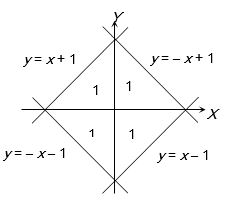
These curves represent a square with vertices at $(1, 0), (0, 1), (-1, 0),$ and $(0, -1)$.
Alternatively,we can analyze the regions:
For $x \ge 0$,the curves are $y = x - 1$ and $y = -x + 1$.
For $x < 0$,the curves are $y = -x - 1$ and $y = x + 1$.
The region is symmetric about both axes.
The area in the first quadrant is bounded by $y = x - 1$ (for $x \ge 1$,but here the intersection is at $x=1, y=0$) and $y = -x + 1$.
Actually,the region is a square formed by the lines $y = x - 1, y = -x - 1, y = -x + 1,$ and $y = x + 1$.
The area of this square is $4 \times (\text{Area of triangle in one quadrant})$.
Each triangle in a quadrant has base $1$ and height $1$.
Area $= 4 \times (\frac{1}{2} \times 1 \times 1) = 2$ square units.
These curves represent a square with vertices at $(1, 0), (0, 1), (-1, 0),$ and $(0, -1)$.
Alternatively,we can analyze the regions:
For $x \ge 0$,the curves are $y = x - 1$ and $y = -x + 1$.
For $x < 0$,the curves are $y = -x - 1$ and $y = x + 1$.
The region is symmetric about both axes.
The area in the first quadrant is bounded by $y = x - 1$ (for $x \ge 1$,but here the intersection is at $x=1, y=0$) and $y = -x + 1$.
Actually,the region is a square formed by the lines $y = x - 1, y = -x - 1, y = -x + 1,$ and $y = x + 1$.
The area of this square is $4 \times (\text{Area of triangle in one quadrant})$.
Each triangle in a quadrant has base $1$ and height $1$.
Area $= 4 \times (\frac{1}{2} \times 1 \times 1) = 2$ square units.
0 likesView Solution
31
MathematicsMediumMCQIIT JEE · 2002
If $A$ and $B$ are two independent events such that $P(A \cap B') = \frac{3}{25}$ and $P(A' \cap B) = \frac{8}{25}$,then $P(A) = $
A
$\frac{1}{5}$
B
$\frac{3}{8}$
C
$\frac{2}{5}$
D
$\frac{4}{5}$
Solution
(A) Since $A$ and $B$ are independent events,$A$ and $B'$ are also independent,and $A'$ and $B$ are independent.
Given $P(A \cap B') = P(A) \times P(B') = P(A)(1 - P(B)) = \frac{3}{25}$ .....$(i)$
Given $P(A' \cap B) = P(A') \times P(B) = (1 - P(A))P(B) = \frac{8}{25}$ .....$(ii)$
Let $P(A) = x$ and $P(B) = y$. Then the equations become:
$x(1 - y) = \frac{3}{25} \Rightarrow x - xy = \frac{3}{25}$
$y(1 - x) = \frac{8}{25} \Rightarrow y - xy = \frac{8}{25}$
Subtracting the two equations:
$x - y = \frac{3}{25} - \frac{8}{25} = -\frac{5}{25} = -\frac{1}{5}$
$y = x + \frac{1}{5}$
Substitute $y$ into the first equation:
$x(1 - (x + \frac{1}{5})) = \frac{3}{25}$
$x(\frac{4}{5} - x) = \frac{3}{25}$
$\frac{4}{5}x - x^2 = \frac{3}{25}$
$25x^2 - 20x + 3 = 0$
$(5x - 1)(5x - 3) = 0$
Thus,$P(A) = \frac{1}{5}$ or $P(A) = \frac{3}{5}$.
Comparing with the given options,the correct value is $\frac{1}{5}$.
Given $P(A \cap B') = P(A) \times P(B') = P(A)(1 - P(B)) = \frac{3}{25}$ .....$(i)$
Given $P(A' \cap B) = P(A') \times P(B) = (1 - P(A))P(B) = \frac{8}{25}$ .....$(ii)$
Let $P(A) = x$ and $P(B) = y$. Then the equations become:
$x(1 - y) = \frac{3}{25} \Rightarrow x - xy = \frac{3}{25}$
$y(1 - x) = \frac{8}{25} \Rightarrow y - xy = \frac{8}{25}$
Subtracting the two equations:
$x - y = \frac{3}{25} - \frac{8}{25} = -\frac{5}{25} = -\frac{1}{5}$
$y = x + \frac{1}{5}$
Substitute $y$ into the first equation:
$x(1 - (x + \frac{1}{5})) = \frac{3}{25}$
$x(\frac{4}{5} - x) = \frac{3}{25}$
$\frac{4}{5}x - x^2 = \frac{3}{25}$
$25x^2 - 20x + 3 = 0$
$(5x - 1)(5x - 3) = 0$
Thus,$P(A) = \frac{1}{5}$ or $P(A) = \frac{3}{5}$.
Comparing with the given options,the correct value is $\frac{1}{5}$.
0 likesView Solution
32
MathematicsDifficultMCQIIT JEE · 2002
If $A$ and $B$ are two events,then the probability of the event that at most one of $A$ and $B$ occurs is:
A
$P(A' \cap B) + P(A \cap B') + P(A' \cap B')$
B
$1 - P(A \cap B)$
C
$P(A') + P(B') + P(A \cup B) - 1$
D
All of these
Solution
(D) The event that at most one of $A$ and $B$ occurs means either none of them occur,or exactly one of them occurs.
This is represented by the set $(A' \cap B') \cup (A \cap B') \cup (A' \cap B)$.
Since these are mutually exclusive events,the probability is $P(A' \cap B') + P(A \cap B') + P(A' \cap B)$,which matches option $A$.
Also,the event 'at most one occurs' is the complement of the event 'both occur',which is $1 - P(A \cap B)$,matching option $B$.
Option $C$ is equivalent to $1 - P(A \cap B)$ as well,since $P(A') + P(B') + P(A \cup B) - 1 = (1 - P(A)) + (1 - P(B)) + (P(A) + P(B) - P(A \cap B)) - 1 = 1 - P(A \cap B)$.
Therefore,all options are correct.
This is represented by the set $(A' \cap B') \cup (A \cap B') \cup (A' \cap B)$.
Since these are mutually exclusive events,the probability is $P(A' \cap B') + P(A \cap B') + P(A' \cap B)$,which matches option $A$.
Also,the event 'at most one occurs' is the complement of the event 'both occur',which is $1 - P(A \cap B)$,matching option $B$.
Option $C$ is equivalent to $1 - P(A \cap B)$ as well,since $P(A') + P(B') + P(A \cup B) - 1 = (1 - P(A)) + (1 - P(B)) + (P(A) + P(B) - P(A \cap B)) - 1 = 1 - P(A \cap B)$.
Therefore,all options are correct.
0 likesView Solution
33
MathematicsMediumMCQIIT JEE · 2002
For how many values of $k$ does the system of linear equations $(k + 1)x + 8y = 4k$ and $kx + (k + 3)y = 3k - 1$ have no solutions?
A
Infinite
B
$1$
C
$2$
D
$3$
Solution
(B) For a system of linear equations to have no solutions,the determinant of the coefficient matrix $\Delta$ must be $0$,and at least one of the determinants $\Delta_1$ or $\Delta_2$ must be non-zero.
$\Delta = \begin{vmatrix} k+1 & 8 \\ k & k+3 \end{vmatrix} = (k+1)(k+3) - 8k = k^2 + 4k + 3 - 8k = k^2 - 4k + 3 = (k-3)(k-1)$.
Setting $\Delta = 0$,we get $k = 1$ or $k = 3$.
Now,calculate $\Delta_1$ and $\Delta_2$ for these values:
$\Delta_1 = \begin{vmatrix} 4k & 8 \\ 3k-1 & k+3 \end{vmatrix} = 4k(k+3) - 8(3k-1) = 4k^2 + 12k - 24k + 8 = 4k^2 - 12k + 8 = 4(k-1)(k-2)$.
$\Delta_2 = \begin{vmatrix} k+1 & 4k \\ k & 3k-1 \end{vmatrix} = (k+1)(3k-1) - 4k^2 = 3k^2 + 2k - 1 - 4k^2 = -k^2 + 2k - 1 = -(k-1)^2$.
Case $k=1$: $\Delta = 0, \Delta_1 = 0, \Delta_2 = 0$. This leads to infinitely many solutions (or consistency).
Case $k=3$: $\Delta = 0, \Delta_1 = 4(3-1)(3-2) = 8 \neq 0, \Delta_2 = -(3-1)^2 = -4 \neq 0$.
Since $\Delta = 0$ and $\Delta_1, \Delta_2 \neq 0$ for $k=3$,the system has no solutions.
Thus,there is only $1$ value of $k$.
$\Delta = \begin{vmatrix} k+1 & 8 \\ k & k+3 \end{vmatrix} = (k+1)(k+3) - 8k = k^2 + 4k + 3 - 8k = k^2 - 4k + 3 = (k-3)(k-1)$.
Setting $\Delta = 0$,we get $k = 1$ or $k = 3$.
Now,calculate $\Delta_1$ and $\Delta_2$ for these values:
$\Delta_1 = \begin{vmatrix} 4k & 8 \\ 3k-1 & k+3 \end{vmatrix} = 4k(k+3) - 8(3k-1) = 4k^2 + 12k - 24k + 8 = 4k^2 - 12k + 8 = 4(k-1)(k-2)$.
$\Delta_2 = \begin{vmatrix} k+1 & 4k \\ k & 3k-1 \end{vmatrix} = (k+1)(3k-1) - 4k^2 = 3k^2 + 2k - 1 - 4k^2 = -k^2 + 2k - 1 = -(k-1)^2$.
Case $k=1$: $\Delta = 0, \Delta_1 = 0, \Delta_2 = 0$. This leads to infinitely many solutions (or consistency).
Case $k=3$: $\Delta = 0, \Delta_1 = 4(3-1)(3-2) = 8 \neq 0, \Delta_2 = -(3-1)^2 = -4 \neq 0$.
Since $\Delta = 0$ and $\Delta_1, \Delta_2 \neq 0$ for $k=3$,the system has no solutions.
Thus,there is only $1$ value of $k$.
0 likesView Solution
34
MathematicsMediumMCQIIT JEE · 2002
Let $V = 2i + j - k$ and $W = i + 3k$. If $U$ is a unit vector,then the maximum value of the scalar triple product $[U V W]$ is
A
$-1$
B
$\sqrt{10} + \sqrt{6}$
C
$\sqrt{59}$
D
$\sqrt{60}$
Solution
(C) The scalar triple product is defined as $[U V W] = U \cdot (V \times W)$.
First,we calculate the cross product $V \times W$:
$V \times W = \begin{vmatrix} i & j & k \\ 2 & 1 & -1 \\ 1 & 0 & 3 \end{vmatrix} = i(3 - 0) - j(6 - (-1)) + k(0 - 1) = 3i - 7j - k$.
Let $A = V \times W = 3i - 7j - k$.
The scalar triple product is $[U V W] = U \cdot A = |U| |A| \cos \theta$,where $\theta$ is the angle between $U$ and $A$.
Since $U$ is a unit vector,$|U| = 1$.
Thus,$[U V W] = |A| \cos \theta$.
The maximum value occurs when $\cos \theta = 1$,which is $|A|$.
$|A| = \sqrt{3^2 + (-7)^2 + (-1)^2} = \sqrt{9 + 49 + 1} = \sqrt{59}$.
Therefore,the maximum value is $\sqrt{59}$.
First,we calculate the cross product $V \times W$:
$V \times W = \begin{vmatrix} i & j & k \\ 2 & 1 & -1 \\ 1 & 0 & 3 \end{vmatrix} = i(3 - 0) - j(6 - (-1)) + k(0 - 1) = 3i - 7j - k$.
Let $A = V \times W = 3i - 7j - k$.
The scalar triple product is $[U V W] = U \cdot A = |U| |A| \cos \theta$,where $\theta$ is the angle between $U$ and $A$.
Since $U$ is a unit vector,$|U| = 1$.
Thus,$[U V W] = |A| \cos \theta$.
The maximum value occurs when $\cos \theta = 1$,which is $|A|$.
$|A| = \sqrt{3^2 + (-7)^2 + (-1)^2} = \sqrt{9 + 49 + 1} = \sqrt{59}$.
Therefore,the maximum value is $\sqrt{59}$.
0 likesView Solution
35
MathematicsDifficultMCQIIT JEE · 2002
Suppose $f(x) = (x + 1)^2$ for $x \ge -1$. If $g(x)$ is the function whose graph is the reflection of the graph of $f(x)$ with respect to the line $y = x$,then $g(x)$ equals
A
$-\sqrt{x} - 1, x \ge 0$
B
$\frac{1}{(x + 1)^2}, x > -1$
C
$\sqrt{x + 1}, x \ge -1$
D
$\sqrt{x} - 1, x \ge 0$
Solution
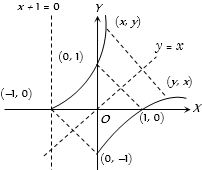
(D) The graph of $f(x)$ is given by the equation $y = (x + 1)^2$ for $x \ge -1$.
To find the reflection of the graph of $f(x)$ with respect to the line $y = x$,we interchange $x$ and $y$.
Thus,the equation for the graph of $g(x)$ becomes $x = (y + 1)^2$ for $y \ge -1$.
Solving for $y$:
$y + 1 = \pm\sqrt{x}$
Since $y \ge -1$,we have $y + 1 \ge 0$,so we take the positive root:
$y + 1 = \sqrt{x}$
$y = \sqrt{x} - 1$
Since the domain of $f(x)$ is $x \ge -1$ and its range is $y \ge 0$,the domain of $g(x)$ is $x \ge 0$ and its range is $y \ge -1$.
Therefore,$g(x) = \sqrt{x} - 1$ for $x \ge 0$.
To find the reflection of the graph of $f(x)$ with respect to the line $y = x$,we interchange $x$ and $y$.
Thus,the equation for the graph of $g(x)$ becomes $x = (y + 1)^2$ for $y \ge -1$.
Solving for $y$:
$y + 1 = \pm\sqrt{x}$
Since $y \ge -1$,we have $y + 1 \ge 0$,so we take the positive root:
$y + 1 = \sqrt{x}$
$y = \sqrt{x} - 1$
Since the domain of $f(x)$ is $x \ge -1$ and its range is $y \ge 0$,the domain of $g(x)$ is $x \ge 0$ and its range is $y \ge -1$.
Therefore,$g(x) = \sqrt{x} - 1$ for $x \ge 0$.
0 likesView Solution
36
MathematicsDifficultMCQIIT JEE · 2002
Let $f:R \to R$ be such that $f(1) = 3$ and $f'(1) = 6$. Then $\lim_{x \to 0} \left\{ \frac{f(1 + x)}{f(1)} \right\}^{\frac{1}{x}}$ equals
A
$1$
B
$e^{1/2}$
C
$e^2$
D
$e^3$
Solution
(C) Let $L = \lim_{x \to 0} \left\{ \frac{f(1 + x)}{f(1)} \right\}^{\frac{1}{x}}$.
Taking natural logarithm on both sides,$\ln L = \lim_{x \to 0} \frac{1}{x} \ln \left( \frac{f(1 + x)}{f(1)} \right)$.
Using the definition of the derivative or $L$'Hopital's rule,$\ln L = \lim_{x \to 0} \frac{\ln f(1 + x) - \ln f(1)}{x}$.
Applying $L$'Hopital's rule,$\ln L = \lim_{x \to 0} \frac{f'(1 + x)}{f(1 + x)} = \frac{f'(1)}{f(1)}$.
Given $f(1) = 3$ and $f'(1) = 6$,we have $\ln L = \frac{6}{3} = 2$.
Therefore,$L = e^2$.
Taking natural logarithm on both sides,$\ln L = \lim_{x \to 0} \frac{1}{x} \ln \left( \frac{f(1 + x)}{f(1)} \right)$.
Using the definition of the derivative or $L$'Hopital's rule,$\ln L = \lim_{x \to 0} \frac{\ln f(1 + x) - \ln f(1)}{x}$.
Applying $L$'Hopital's rule,$\ln L = \lim_{x \to 0} \frac{f'(1 + x)}{f(1 + x)} = \frac{f'(1)}{f(1)}$.
Given $f(1) = 3$ and $f'(1) = 6$,we have $\ln L = \frac{6}{3} = 2$.
Therefore,$L = e^2$.
0 likesView Solution
37
MathematicsDifficultMCQIIT JEE · 2002
The values of $\alpha$ which satisfy $\int_{\pi /2}^{\alpha} \sin x \, dx = \sin 2\alpha$,where $\alpha \in [0, 2\pi]$,are equal to:
A
$\frac{\pi}{2}$
B
$\frac{3\pi}{2}$
C
$\frac{7\pi}{6}$
D
All of the above
Solution
(D) Given the equation: $\int_{\pi /2}^{\alpha} \sin x \, dx = \sin 2\alpha$
Evaluating the integral: $[-\cos x]_{\pi /2}^{\alpha} = \sin 2\alpha$
$-(\cos \alpha - \cos(\pi /2)) = \sin 2\alpha$
$-\cos \alpha = \sin 2\alpha$
Using the identity $\sin 2\alpha = 2 \sin \alpha \cos \alpha$:
$-\cos \alpha = 2 \sin \alpha \cos \alpha$
$\cos \alpha (1 + 2 \sin \alpha) = 0$
Case $1$: $\cos \alpha = 0$. In the interval $[0, 2\pi]$,$\alpha = \frac{\pi}{2}, \frac{3\pi}{2}$.
Case $2$: $1 + 2 \sin \alpha = 0 \Rightarrow \sin \alpha = -1/2$. In the interval $[0, 2\pi]$,$\alpha = \frac{7\pi}{6}, \frac{11\pi}{6}$.
Comparing with the options provided,the values $\frac{\pi}{2}$ and $\frac{3\pi}{2}$ satisfy the equation.
Evaluating the integral: $[-\cos x]_{\pi /2}^{\alpha} = \sin 2\alpha$
$-(\cos \alpha - \cos(\pi /2)) = \sin 2\alpha$
$-\cos \alpha = \sin 2\alpha$
Using the identity $\sin 2\alpha = 2 \sin \alpha \cos \alpha$:
$-\cos \alpha = 2 \sin \alpha \cos \alpha$
$\cos \alpha (1 + 2 \sin \alpha) = 0$
Case $1$: $\cos \alpha = 0$. In the interval $[0, 2\pi]$,$\alpha = \frac{\pi}{2}, \frac{3\pi}{2}$.
Case $2$: $1 + 2 \sin \alpha = 0 \Rightarrow \sin \alpha = -1/2$. In the interval $[0, 2\pi]$,$\alpha = \frac{7\pi}{6}, \frac{11\pi}{6}$.
Comparing with the options provided,the values $\frac{\pi}{2}$ and $\frac{3\pi}{2}$ satisfy the equation.
0 likesView Solution
38
MathematicsDifficultMCQIIT JEE · 2002
Let $T > 0$ be a fixed number. Suppose $f$ is a continuous function such that for all $x \in \mathbb{R}, f(x + T) = f(x)$. If $I = \int_{0}^{T} f(x) dx$,then the value of $\int_{3}^{3 + 3T} f(2x) dx$ is
A
$\frac{3}{2}I$
B
$2I$
C
$3I$
D
$6I$
Solution
(C) Let $J = \int_{3}^{3 + 3T} f(2x) dx$. Substitute $u = 2x$,so $du = 2 dx$ or $dx = \frac{1}{2} du$.
When $x = 3, u = 6$. When $x = 3 + 3T, u = 6 + 6T$.
Thus,$J = \frac{1}{2} \int_{6}^{6 + 6T} f(u) du$.
Since $f$ is periodic with period $T$,$\int_{a}^{a + nT} f(x) dx = n \int_{0}^{T} f(x) dx$ for any $a \in \mathbb{R}$ and $n \in \mathbb{Z}$.
Here,the integral is over an interval of length $6T$,which is $6$ times the period $T$.
Therefore,$\int_{6}^{6 + 6T} f(u) du = 6 \int_{0}^{T} f(u) du = 6I$.
Substituting this back,$J = \frac{1}{2} \times 6I = 3I$.
When $x = 3, u = 6$. When $x = 3 + 3T, u = 6 + 6T$.
Thus,$J = \frac{1}{2} \int_{6}^{6 + 6T} f(u) du$.
Since $f$ is periodic with period $T$,$\int_{a}^{a + nT} f(x) dx = n \int_{0}^{T} f(x) dx$ for any $a \in \mathbb{R}$ and $n \in \mathbb{Z}$.
Here,the integral is over an interval of length $6T$,which is $6$ times the period $T$.
Therefore,$\int_{6}^{6 + 6T} f(u) du = 6 \int_{0}^{T} f(u) du = 6I$.
Substituting this back,$J = \frac{1}{2} \times 6I = 3I$.
0 likesView Solution
39
MathematicsMediumMCQIIT JEE · 2002
The points of extremum of $\int_0^{x^2} \frac{t^2 - 5t + 4}{2 + e^t} \,dt$ are
A
$x = -2$
B
$x = 1$
C
$x = 0$
D
All of these
Solution
(D) Let $F(x) = \int_0^{x^2} \frac{t^2 - 5t + 4}{2 + e^t} \,dt$.
Using the Leibniz integral rule,we differentiate $F(x)$ with respect to $x$:
$F'(x) = \frac{(x^2)^2 - 5(x^2) + 4}{2 + e^{x^2}} \cdot \frac{d}{dx}(x^2)$
$F'(x) = \frac{x^4 - 5x^2 + 4}{2 + e^{x^2}} \cdot 2x$
For extremum points,we set $F'(x) = 0$:
$\frac{(x^2 - 1)(x^2 - 4)}{2 + e^{x^2}} \cdot 2x = 0$
This implies $x = 0$ or $x^2 = 1$ or $x^2 = 4$.
Solving these,we get $x = 0$,$x = \pm 1$,and $x = \pm 2$.
Since all these values are included in the options provided,the correct answer is $D$.
Using the Leibniz integral rule,we differentiate $F(x)$ with respect to $x$:
$F'(x) = \frac{(x^2)^2 - 5(x^2) + 4}{2 + e^{x^2}} \cdot \frac{d}{dx}(x^2)$
$F'(x) = \frac{x^4 - 5x^2 + 4}{2 + e^{x^2}} \cdot 2x$
For extremum points,we set $F'(x) = 0$:
$\frac{(x^2 - 1)(x^2 - 4)}{2 + e^{x^2}} \cdot 2x = 0$
This implies $x = 0$ or $x^2 = 1$ or $x^2 = 4$.
Solving these,we get $x = 0$,$x = \pm 1$,and $x = \pm 2$.
Since all these values are included in the options provided,the correct answer is $D$.
0 likesView Solution
40
MathematicsMediumMCQIIT JEE · 2002
$A$ fair coin is tossed $n$ times. Let $X$ be the number of times head is observed. If $P(X = 4), P(X = 5)$ and $P(X = 6)$ are in $H.P.$,then $n$ is equal to
A
$7$
B
$10$
C
$14$
D
None of these
Solution
(D) The probability of getting $k$ heads in $n$ tosses of a fair coin is given by the binomial distribution: $P(X = k) = \binom{n}{k} (\frac{1}{2})^n$.
Given that $P(X = 4), P(X = 5), P(X = 6)$ are in $H.P.$,their reciprocals must be in $A.P.$
Thus,$\frac{1}{P(X = 4)}, \frac{1}{P(X = 5)}, \frac{1}{P(X = 6)}$ are in $A.P.$
This implies $\frac{2}{P(X = 5)} = \frac{1}{P(X = 4)} + \frac{1}{P(X = 6)}$.
Substituting the values: $\frac{2}{\binom{n}{5}} = \frac{1}{\binom{n}{4}} + \frac{1}{\binom{n}{6}}$.
Using $\binom{n}{k} = \frac{n!}{k!(n-k)!}$,we get $\frac{2 \times 5!(n-5)!}{n!} = \frac{4!(n-4)!}{n!} + \frac{6!(n-6)!}{n!}$.
Multiplying by $\frac{n!}{4!(n-6)!}$,we obtain: $2 \times 5 \times (n-5) = (n-4)(n-5) + 6 \times 5$.
$10n - 50 = n^2 - 9n + 20 + 30$.
$n^2 - 19n + 100 = 0$.
The discriminant $D = (-19)^2 - 4(1)(100) = 361 - 400 = -39$.
Since $D < 0$,there is no real integer solution for $n$. Thus,the correct option is $D$.
Given that $P(X = 4), P(X = 5), P(X = 6)$ are in $H.P.$,their reciprocals must be in $A.P.$
Thus,$\frac{1}{P(X = 4)}, \frac{1}{P(X = 5)}, \frac{1}{P(X = 6)}$ are in $A.P.$
This implies $\frac{2}{P(X = 5)} = \frac{1}{P(X = 4)} + \frac{1}{P(X = 6)}$.
Substituting the values: $\frac{2}{\binom{n}{5}} = \frac{1}{\binom{n}{4}} + \frac{1}{\binom{n}{6}}$.
Using $\binom{n}{k} = \frac{n!}{k!(n-k)!}$,we get $\frac{2 \times 5!(n-5)!}{n!} = \frac{4!(n-4)!}{n!} + \frac{6!(n-6)!}{n!}$.
Multiplying by $\frac{n!}{4!(n-6)!}$,we obtain: $2 \times 5 \times (n-5) = (n-4)(n-5) + 6 \times 5$.
$10n - 50 = n^2 - 9n + 20 + 30$.
$n^2 - 19n + 100 = 0$.
The discriminant $D = (-19)^2 - 4(1)(100) = 361 - 400 = -39$.
Since $D < 0$,there is no real integer solution for $n$. Thus,the correct option is $D$.
0 likesView Solution
Vedclass Products
For Students
Vedclass Test Series
Mock tests in real IIT JEE style covering Mathematics with performance analysis. 5-day free trial.
Start Free TrialFor Teachers
Exam Paper Generator
Generate Set A/B/C/D Mathematics papers from 7.5L+ questions in 2 minutes. 3 chapters free.
Try FreeFor Institutes
Online Exam Module
Run live IIT JEE mock exams with unlimited students, 360° analytics & white-label branding.
See DemoFrequently Asked Questions
How many Mathematics questions are in IIT JEE 2002?
There are 40 Mathematics questions from the IIT JEE 2002 paper on Vedclass, each with a detailed step-by-step solution in English.
Are IIT JEE 2002 Mathematics solutions available in English?
Yes. All solutions on this page are in English. You can also switch to English or Hindi using the language buttons above the questions.
Can I practice IIT JEE 2002 Mathematics as a timed test?
Yes. Use the Vedclass Test Series to attempt a full IIT JEE mock test covering Mathematics with time limits and instant score analysis.
Can teachers create Mathematics papers from IIT JEE previous year questions?
Yes. The Vedclass Exam Paper Generator lets teachers mix IIT JEE Mathematics questions and generate Set A/B/C/D papers in minutes.
For Teachers & Institutes
Build a Custom Mathematics Paper
Pick IIT JEE 2002 Mathematics questions, set difficulty, and generate Set A/B/C/D in 2 minutes.