
ChemistryQ1–53 of 53 questions
Page 1 of 1 · English
1
ChemistryMCQIIT JEE · 1998
$A$ force $F = -K(y\hat{i} + x\hat{j})$ (where $K$ is a positive constant) acts on a particle moving in the $xy$-plane. Starting from the origin,the particle is taken along the positive $x$-axis to the point $(a, 0)$ and then parallel to the $y$-axis to the point $(a, a)$. The total work done by the force $F$ on the particle is:
A
$-2Ka^2$
B
$2Ka^2$
C
$-Ka^2$
D
$Ka^2$
Solution
(C) The work done is given by $W = \int \vec{F} \cdot d\vec{r}$.
Path $1$: From $(0,0)$ to $(a,0)$ along the $x$-axis.
Here,$y = 0$ and $dy = 0$. The displacement vector is $d\vec{r} = dx\hat{i}$.
The force becomes $\vec{F} = -K(0\hat{i} + x\hat{j}) = -Kx\hat{j}$.
Work $W_1 = \int_{0}^{a} (-Kx\hat{j}) \cdot (dx\hat{i}) = 0$ (since $\hat{i} \cdot \hat{j} = 0$).
Path $2$: From $(a,0)$ to $(a,a)$ parallel to the $y$-axis.
Here,$x = a$ and $dx = 0$. The displacement vector is $d\vec{r} = dy\hat{j}$.
The force becomes $\vec{F} = -K(y\hat{i} + a\hat{j})$.
Work $W_2 = \int_{0}^{a} (-K(y\hat{i} + a\hat{j})) \cdot (dy\hat{j}) = \int_{0}^{a} -Ka \, dy = -Ka[y]_{0}^{a} = -Ka^2$.
Total work $W = W_1 + W_2 = 0 + (-Ka^2) = -Ka^2$.
Path $1$: From $(0,0)$ to $(a,0)$ along the $x$-axis.
Here,$y = 0$ and $dy = 0$. The displacement vector is $d\vec{r} = dx\hat{i}$.
The force becomes $\vec{F} = -K(0\hat{i} + x\hat{j}) = -Kx\hat{j}$.
Work $W_1 = \int_{0}^{a} (-Kx\hat{j}) \cdot (dx\hat{i}) = 0$ (since $\hat{i} \cdot \hat{j} = 0$).
Path $2$: From $(a,0)$ to $(a,a)$ parallel to the $y$-axis.
Here,$x = a$ and $dx = 0$. The displacement vector is $d\vec{r} = dy\hat{j}$.
The force becomes $\vec{F} = -K(y\hat{i} + a\hat{j})$.
Work $W_2 = \int_{0}^{a} (-K(y\hat{i} + a\hat{j})) \cdot (dy\hat{j}) = \int_{0}^{a} -Ka \, dy = -Ka[y]_{0}^{a} = -Ka^2$.
Total work $W = W_1 + W_2 = 0 + (-Ka^2) = -Ka^2$.
0 likesView Solution
2
ChemistryMediumMCQIIT JEE · 1998
The energy of an electron in the first Bohr orbit of $H$ atom is $-13.6 \ eV$. The possible energy value$(s)$ of the excited state$(s)$ for electrons in Bohr orbits of the hydrogen atom is(are) $............ \ eV$.
A
$-3.4$
B
$-4.2$
C
$-6.8$
D
$+6.8$
Solution
(A) The energy of an electron in the $n^{th}$ orbit of a hydrogen atom is given by the formula $E_n = -\frac{13.6}{n^2} \ eV$.
For the ground state,$n = 1$,so $E_1 = -13.6 \ eV$.
Excited states correspond to $n > 1$ (i.e.,$n = 2, 3, 4, \dots$).
For the first excited state,$n = 2$:
$E_2 = -\frac{13.6}{2^2} = -\frac{13.6}{4} = -3.4 \ eV$.
Thus,$-3.4 \ eV$ is a possible energy value for an excited state.
For the ground state,$n = 1$,so $E_1 = -13.6 \ eV$.
Excited states correspond to $n > 1$ (i.e.,$n = 2, 3, 4, \dots$).
For the first excited state,$n = 2$:
$E_2 = -\frac{13.6}{2^2} = -\frac{13.6}{4} = -3.4 \ eV$.
Thus,$-3.4 \ eV$ is a possible energy value for an excited state.
0 likesView Solution
3
ChemistryMediumMCQIIT JEE · 1998
The geometry and the type of hybrid orbital present about the central atom in $BF_3$ is
A
Linear,$sp$
B
Trigonal planar,$sp^2$
C
Tetrahedral,$sp^3$
D
Pyramidal,$sp^3$
Solution
(B) In $BF_3$,the central atom $B$ has $3$ valence electrons.
It forms $3$ single bonds with $3$ $F$ atoms,resulting in $3$ bond pairs and $0$ lone pairs.
The steric number is $3 + 0 = 3$,which corresponds to $sp^2$ hybridization.
These $3$ $sp^2$-hybrid orbitals are arranged in a trigonal planar geometry with a bond angle of $120^{\circ}$.
It forms $3$ single bonds with $3$ $F$ atoms,resulting in $3$ bond pairs and $0$ lone pairs.
The steric number is $3 + 0 = 3$,which corresponds to $sp^2$ hybridization.
These $3$ $sp^2$-hybrid orbitals are arranged in a trigonal planar geometry with a bond angle of $120^{\circ}$.
0 likesView Solution
4
ChemistryMediumMCQIIT JEE · 1998
According to Graham's law at a given temperature,the ratio of the rates of diffusion ${r_A}/{r_B}$ of gases $A$ and $B$ is given by
A
$({P_A}/{P_B})({M_A}/{M_B})^{1/2}$
B
$({M_A}/{M_B})({P_A}/{P_B})^{1/2}$
C
$({P_A}/{P_B})({M_B}/{M_A})^{1/2}$
D
$({M_A}/{M_B})({P_B}/{P_A})^{1/2}$
Solution
(C) According to Graham's law of diffusion,the rate of diffusion $r$ is directly proportional to the pressure $P$ and inversely proportional to the square root of the molar mass $M$ of the gas.
Mathematically,$r \propto \frac{P}{\sqrt{M}}$.
For two gases $A$ and $B$,the ratio of their rates of diffusion is given by:
$\frac{r_A}{r_B} = \frac{P_A}{P_B} \times \sqrt{\frac{M_B}{M_A}} = \frac{P_A}{P_B} \left(\frac{M_B}{M_A}\right)^{1/2}$
Mathematically,$r \propto \frac{P}{\sqrt{M}}$.
For two gases $A$ and $B$,the ratio of their rates of diffusion is given by:
$\frac{r_A}{r_B} = \frac{P_A}{P_B} \times \sqrt{\frac{M_B}{M_A}} = \frac{P_A}{P_B} \left(\frac{M_B}{M_A}\right)^{1/2}$
0 likesView Solution
5
ChemistryEasyMCQIIT JEE · 1998
For the reaction $CO_{(g)} + H_2O_{(g)} \rightleftharpoons CO_{2(g)} + H_{2(g)}$ at a given temperature,the equilibrium amount of $CO_{2(g)}$ can be increased by
A
Adding a suitable catalyst
B
Adding an inert gas
C
Decreasing the volume of the container
D
Increasing the amount of $CO_{(g)}$
Solution
(D) According to Le Chatelier's principle,if the concentration of one of the reactants is increased,the equilibrium shifts in the forward direction to counteract the change.
Since $CO_{(g)}$ is a reactant,increasing its amount will shift the equilibrium to the right,thereby increasing the production of the products $CO_{2(g)}$ and $H_{2(g)}$.
Adding a catalyst does not change the equilibrium position.
Adding an inert gas at constant volume has no effect on the equilibrium.
Decreasing the volume of the container has no effect on this reaction because the total number of moles of gaseous reactants equals the total number of moles of gaseous products $(1 + 1 = 1 + 1)$.
Since $CO_{(g)}$ is a reactant,increasing its amount will shift the equilibrium to the right,thereby increasing the production of the products $CO_{2(g)}$ and $H_{2(g)}$.
Adding a catalyst does not change the equilibrium position.
Adding an inert gas at constant volume has no effect on the equilibrium.
Decreasing the volume of the container has no effect on this reaction because the total number of moles of gaseous reactants equals the total number of moles of gaseous products $(1 + 1 = 1 + 1)$.
0 likesView Solution
6
ChemistryMediumMCQIIT JEE · 1998
Which of the following statement(s) is(are) correct?
A
The $pH$ of $1.0 \times 10^{-8} \ M$ solution of $HCl$ is $8$
B
The conjugate base of $H_2PO_4^-$ is $HPO_4^{2-}$
C
Autoprotolysis constant of water increases with temperature
D
When a solution of a weak monoprotic acid is titrated against a strong base, at half neutralization point $pH = \frac{1}{2}pK_a$
Solution
(B, C) Statement $A$ is incorrect because for a very dilute acid solution, the contribution of $H^+$ ions from water cannot be neglected. The $pH$ of $1.0 \times 10^{-8} \ M$ $HCl$ is approximately $6.98$, not $8$.
Statement $B$ is correct because the conjugate base is formed by the removal of one proton $(H^+)$ from the acid: $H_2PO_4^- \rightarrow H^+ + HPO_4^{2-}$.
Statement $C$ is correct because the autoprotolysis of water is an endothermic process $(\Delta H > 0)$, so the equilibrium constant $K_w$ increases with an increase in temperature.
Statement $D$ is incorrect because at the half-neutralization point of a weak acid, the concentration of the acid equals the concentration of its conjugate base $([HA] = [A^-])$. According to the Henderson-Hasselbalch equation, $pH = pK_a + \log(\frac{[A^-]}{[HA]})$, which simplifies to $pH = pK_a$.
Statement $B$ is correct because the conjugate base is formed by the removal of one proton $(H^+)$ from the acid: $H_2PO_4^- \rightarrow H^+ + HPO_4^{2-}$.
Statement $C$ is correct because the autoprotolysis of water is an endothermic process $(\Delta H > 0)$, so the equilibrium constant $K_w$ increases with an increase in temperature.
Statement $D$ is incorrect because at the half-neutralization point of a weak acid, the concentration of the acid equals the concentration of its conjugate base $([HA] = [A^-])$. According to the Henderson-Hasselbalch equation, $pH = pK_a + \log(\frac{[A^-]}{[HA]})$, which simplifies to $pH = pK_a$.
0 likesView Solution
7
ChemistryMediumMCQIIT JEE · 1998
Hydrogen gas is evolved by the action of cold dilute $HNO_3$ on which of the following metals?
A
$Fe$
B
$Mn$
C
$Cu$
D
$Al$
Solution
(B) Most metals react with dilute $HNO_3$ to produce nitrogen oxides instead of hydrogen gas because $HNO_3$ is a strong oxidizing agent.
However,very dilute $HNO_3$ (approx. $1\%$ concentration) reacts with very reactive metals like $Mn$ and $Mg$ to evolve hydrogen gas.
The reaction is: $Mn(s) + 2HNO_3(dil.) \to Mn(NO_3)_2(aq) + H_2(g)$.
However,very dilute $HNO_3$ (approx. $1\%$ concentration) reacts with very reactive metals like $Mn$ and $Mg$ to evolve hydrogen gas.
The reaction is: $Mn(s) + 2HNO_3(dil.) \to Mn(NO_3)_2(aq) + H_2(g)$.
0 likesView Solution
8
ChemistryMediumMCQIIT JEE · 1998
Tautomerism is exhibited by:
A
Phenyl-$CH$=$CH$-$OH$
B
p-Benzoquinone
C
Cyclohex$-2-$ene$-1,4-$dione
D
Cyclohexane$-1,2-$dione
Solution
(A, C, D) Tautomerism requires the presence of an $\alpha$-hydrogen atom adjacent to a carbonyl group or a similar system that allows for the migration of a proton between two polyvalent atoms.
$(a)$ $C_6H_5-CH=CH-OH$ (enol) can tautomerize to $C_6H_5-CH_2-CHO$ (phenylacetaldehyde).
$(b)$ $p$-Benzoquinone does not have any $\alpha$-hydrogen atoms,so it cannot exhibit tautomerism.
$(c)$ Cyclohex$-2-$ene$-1,4-$dione has $\alpha$-hydrogen atoms at the $C-5$ and $C-6$ positions,allowing it to exhibit tautomerism.
$(d)$ Cyclohexane$-1,2-$dione has $\alpha$-hydrogen atoms,allowing it to exhibit tautomerism.
Therefore,compounds $(a)$,$(c)$,and $(d)$ exhibit tautomerism.
$(a)$ $C_6H_5-CH=CH-OH$ (enol) can tautomerize to $C_6H_5-CH_2-CHO$ (phenylacetaldehyde).
$(b)$ $p$-Benzoquinone does not have any $\alpha$-hydrogen atoms,so it cannot exhibit tautomerism.
$(c)$ Cyclohex$-2-$ene$-1,4-$dione has $\alpha$-hydrogen atoms at the $C-5$ and $C-6$ positions,allowing it to exhibit tautomerism.
$(d)$ Cyclohexane$-1,2-$dione has $\alpha$-hydrogen atoms,allowing it to exhibit tautomerism.
Therefore,compounds $(a)$,$(c)$,and $(d)$ exhibit tautomerism.
0 likesView Solution
9
ChemistryMediumMCQIIT JEE · 1998
Which of the following compounds will show geometrical isomerism?
A
$2-$butene
B
Propene
C
$1-$phenylpropene
D
Both $(a)$ and $(c)$
Solution
(D) Geometrical isomerism is shown by alkenes where each carbon atom of the double bond is attached to two different groups.
For $2-$butene $(CH_3-CH=CH-CH_3)$,each double-bonded carbon is attached to a $-H$ and a $-CH_3$ group,thus it shows cis-trans isomerism.
For $1-$phenylpropene $(CH_3-CH=CH-C_6H_5)$,each double-bonded carbon is attached to two different groups ($-H$ and $-CH_3$ on one carbon; $-H$ and $-C_6H_5$ on the other),thus it also shows geometrical isomerism.
Propene $(CH_3-CH=CH_2)$ does not show geometrical isomerism because one of the double-bonded carbons is attached to two identical hydrogen atoms.
Therefore,both $(a)$ and $(c)$ show geometrical isomerism.
For $2-$butene $(CH_3-CH=CH-CH_3)$,each double-bonded carbon is attached to a $-H$ and a $-CH_3$ group,thus it shows cis-trans isomerism.
For $1-$phenylpropene $(CH_3-CH=CH-C_6H_5)$,each double-bonded carbon is attached to two different groups ($-H$ and $-CH_3$ on one carbon; $-H$ and $-C_6H_5$ on the other),thus it also shows geometrical isomerism.
Propene $(CH_3-CH=CH_2)$ does not show geometrical isomerism because one of the double-bonded carbons is attached to two identical hydrogen atoms.
Therefore,both $(a)$ and $(c)$ show geometrical isomerism.
0 likesView Solution
10
ChemistryMCQIIT JEE · 1998
In a college of $300$ students,every student reads $5$ newspapers and every newspaper is read by $60$ students. The number of newspapers is:
A
At least $30$
B
At most $20$
C
Exactly $25$
D
None of these
Solution
(C) Let the number of newspapers be $x$.
Each student reads $5$ newspapers,so the total number of readings by $300$ students is $300 \times 5 = 1500$.
Each newspaper is read by $60$ students,so the total number of readings is also $60 \times x$.
Equating the two,we get $60x = 1500$.
Solving for $x$,we get $x = \frac{1500}{60} = 25$.
Therefore,the number of newspapers is $25$.
Each student reads $5$ newspapers,so the total number of readings by $300$ students is $300 \times 5 = 1500$.
Each newspaper is read by $60$ students,so the total number of readings is also $60 \times x$.
Equating the two,we get $60x = 1500$.
Solving for $x$,we get $x = \frac{1500}{60} = 25$.
Therefore,the number of newspapers is $25$.
0 likesView Solution
11
ChemistryMCQIIT JEE · 1998
The number of values of $x$ in the interval $[0, 5\pi]$ satisfying the equation $3\sin^2 x - 7\sin x + 2 = 0$ is
A
$0$
B
$5$
C
$6$
D
$10$
Solution
(C) Given equation: $3\sin^2 x - 7\sin x + 2 = 0$
Factorizing the quadratic equation:
$3\sin^2 x - 6\sin x - \sin x + 2 = 0$
$3\sin x(\sin x - 2) - 1(\sin x - 2) = 0$
$(3\sin x - 1)(\sin x - 2) = 0$
This gives $\sin x = \frac{1}{3}$ or $\sin x = 2$.
Since the range of $\sin x$ is $[-1, 1]$,$\sin x = 2$ is not possible.
Thus,we solve $\sin x = \frac{1}{3}$.
Let $\alpha = \sin^{-1}(\frac{1}{3})$,where $0 < \alpha < \frac{\pi}{2}$.
In the interval $[0, 5\pi]$,the solutions for $\sin x = \frac{1}{3}$ occur in the following quadrants:
In $[0, 2\pi]$,solutions are $\alpha$ and $\pi - \alpha$.
In $[2\pi, 4\pi]$,solutions are $2\pi + \alpha$ and $3\pi - \alpha$.
In $[4\pi, 5\pi]$,solutions are $4\pi + \alpha$ and $5\pi - \alpha$.
Total solutions are $\alpha, \pi - \alpha, 2\pi + \alpha, 3\pi - \alpha, 4\pi + \alpha, 5\pi - \alpha$.
There are $6$ such values.
Factorizing the quadratic equation:
$3\sin^2 x - 6\sin x - \sin x + 2 = 0$
$3\sin x(\sin x - 2) - 1(\sin x - 2) = 0$
$(3\sin x - 1)(\sin x - 2) = 0$
This gives $\sin x = \frac{1}{3}$ or $\sin x = 2$.
Since the range of $\sin x$ is $[-1, 1]$,$\sin x = 2$ is not possible.
Thus,we solve $\sin x = \frac{1}{3}$.
Let $\alpha = \sin^{-1}(\frac{1}{3})$,where $0 < \alpha < \frac{\pi}{2}$.
In the interval $[0, 5\pi]$,the solutions for $\sin x = \frac{1}{3}$ occur in the following quadrants:
In $[0, 2\pi]$,solutions are $\alpha$ and $\pi - \alpha$.
In $[2\pi, 4\pi]$,solutions are $2\pi + \alpha$ and $3\pi - \alpha$.
In $[4\pi, 5\pi]$,solutions are $4\pi + \alpha$ and $5\pi - \alpha$.
Total solutions are $\alpha, \pi - \alpha, 2\pi + \alpha, 3\pi - \alpha, 4\pi + \alpha, 5\pi - \alpha$.
There are $6$ such values.
0 likesView Solution
12
ChemistryMCQIIT JEE · 1998
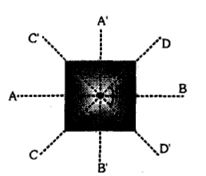
Let $I$ be the moment of inertia of a uniform square plate about an axis $AB$ passing through its center and parallel to two of its sides. $CD$ is an axis in the plane of the square and passing through the center,making an angle $\theta$ with $AB$. The moment of inertia of the plate about the axis $CD$ is:
A
$I$
B
$I \sin^2 \theta$
C
$I \cos^2 \theta$
D
$I \cos^2(\theta/2)$
Solution
(A) For a uniform square plate,the moment of inertia about any axis passing through its center and lying in its plane is constant,provided the axis is in the plane of the plate.
Let $I_{AB}$ be the moment of inertia about axis $AB$ (parallel to sides),so $I_{AB} = I$.
Let $I_{EF}$ be the moment of inertia about axis $EF$ (also parallel to sides and perpendicular to $AB$). By symmetry,$I_{EF} = I_{AB} = I$.
According to the perpendicular axis theorem,the moment of inertia about an axis perpendicular to the plane and passing through the center $(I_z)$ is $I_z = I_{AB} + I_{EF} = I + I = 2I$.
Now,consider any axis $CD$ in the plane of the square passing through the center. Let its moment of inertia be $I_{CD}$. Let $IJ$ be an axis in the plane,perpendicular to $CD$ and passing through the center. By symmetry,$I_{IJ} = I_{CD}$.
Applying the perpendicular axis theorem again: $I_z = I_{CD} + I_{IJ} = 2I_{CD}$.
Since $I_z = 2I$,we have $2I_{CD} = 2I$,which implies $I_{CD} = I$.
Thus,the moment of inertia is independent of the angle $\theta$ and remains $I$.
Let $I_{AB}$ be the moment of inertia about axis $AB$ (parallel to sides),so $I_{AB} = I$.
Let $I_{EF}$ be the moment of inertia about axis $EF$ (also parallel to sides and perpendicular to $AB$). By symmetry,$I_{EF} = I_{AB} = I$.
According to the perpendicular axis theorem,the moment of inertia about an axis perpendicular to the plane and passing through the center $(I_z)$ is $I_z = I_{AB} + I_{EF} = I + I = 2I$.
Now,consider any axis $CD$ in the plane of the square passing through the center. Let its moment of inertia be $I_{CD}$. Let $IJ$ be an axis in the plane,perpendicular to $CD$ and passing through the center. By symmetry,$I_{IJ} = I_{CD}$.
Applying the perpendicular axis theorem again: $I_z = I_{CD} + I_{IJ} = 2I_{CD}$.
Since $I_z = 2I$,we have $2I_{CD} = 2I$,which implies $I_{CD} = I$.
Thus,the moment of inertia is independent of the angle $\theta$ and remains $I$.
0 likesView Solution
13
ChemistryMCQIIT JEE · 1998
For three vectors $u, v, w$,which of the following expressions is not equal to the other three?
A
$u \cdot (v \times w)$
B
$(v \times w) \cdot u$
C
$v \cdot (u \times w)$
D
$(u \times v) \cdot w$
Solution
(C) The scalar triple product is defined as $[u, v, w] = u \cdot (v \times w)$.
By the properties of the scalar triple product,cyclic permutations of the vectors do not change the value of the product.
Thus,$u \cdot (v \times w) = v \cdot (w \times u) = w \cdot (u \times v) = [u, v, w]$.
Checking the options:
Option $A$: $u \cdot (v \times w) = [u, v, w]$.
Option $B$: $(v \times w) \cdot u = u \cdot (v \times w) = [u, v, w]$.
Option $C$: $v \cdot (u \times w) = -[u, v, w]$ (since swapping two vectors changes the sign).
Option $D$: $(u \times v) \cdot w = [u, v, w]$.
Therefore,option $C$ is not equal to the other three.
By the properties of the scalar triple product,cyclic permutations of the vectors do not change the value of the product.
Thus,$u \cdot (v \times w) = v \cdot (w \times u) = w \cdot (u \times v) = [u, v, w]$.
Checking the options:
Option $A$: $u \cdot (v \times w) = [u, v, w]$.
Option $B$: $(v \times w) \cdot u = u \cdot (v \times w) = [u, v, w]$.
Option $C$: $v \cdot (u \times w) = -[u, v, w]$ (since swapping two vectors changes the sign).
Option $D$: $(u \times v) \cdot w = [u, v, w]$.
Therefore,option $C$ is not equal to the other three.
0 likesView Solution
14
ChemistryMCQIIT JEE · 1998
The reaction of $CH_3-CH=CH-C_6H_4-OH$ with $HBr$ gives:
A
$CH_3-CHBr-CH_2-C_6H_4-OH$
B
$CH_3-CH_2-CHBr-C_6H_4-OH$
C
$CH_3-CHBr-CH_2-C_6H_4-Br$
D
$CH_3-CH_2-CHBr-C_6H_4-Br$
Solution
(A) The reaction involves the electrophilic addition of $HBr$ to the alkene group $(CH_3-CH=CH-)$ attached to the phenol ring. According to Markovnikov's rule,the $H^+$ ion attaches to the carbon atom with more hydrogen atoms,and the $Br^-$ ion attaches to the carbon atom with fewer hydrogen atoms. Therefore,the $Br$ atom will attach to the $CH$ group adjacent to the benzene ring. The product is $CH_3-CHBr-CH_2-C_6H_4-OH$.
0 likesView Solution
15
ChemistryMCQIIT JEE · 1998
The number of common tangents to the circles $x^2 + y^2 = 4$ and $x^2 + y^2 - 6x - 8y = 24$ is:
A
$0$
B
$1$
C
$3$
D
$4$
Solution
(B) For the circle $x^2 + y^2 = 4$,the center $C_1 = (0, 0)$ and radius $r_1 = 2$.
For the circle $x^2 + y^2 - 6x - 8y - 24 = 0$,the center $C_2 = (3, 4)$ and radius $r_2 = \sqrt{3^2 + 4^2 - (-24)} = \sqrt{9 + 16 + 24} = \sqrt{49} = 7$.
The distance between the centers $C_1$ and $C_2$ is $d = \sqrt{(3-0)^2 + (4-0)^2} = \sqrt{9 + 16} = 5$.
We compare $d$ with the sum and difference of the radii:
$r_1 + r_2 = 2 + 7 = 9$
$|r_1 - r_2| = |2 - 7| = 5$.
Since $d = |r_1 - r_2|$,the two circles touch each other internally.
When two circles touch internally,there is exactly $1$ common tangent.
For the circle $x^2 + y^2 - 6x - 8y - 24 = 0$,the center $C_2 = (3, 4)$ and radius $r_2 = \sqrt{3^2 + 4^2 - (-24)} = \sqrt{9 + 16 + 24} = \sqrt{49} = 7$.
The distance between the centers $C_1$ and $C_2$ is $d = \sqrt{(3-0)^2 + (4-0)^2} = \sqrt{9 + 16} = 5$.
We compare $d$ with the sum and difference of the radii:
$r_1 + r_2 = 2 + 7 = 9$
$|r_1 - r_2| = |2 - 7| = 5$.
Since $d = |r_1 - r_2|$,the two circles touch each other internally.
When two circles touch internally,there is exactly $1$ common tangent.
0 likesView Solution
16
ChemistryMCQIIT JEE · 1998
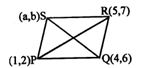
If $P(1, 2)$,$Q(4, 6)$,$R(5, 7)$,and $S(a, b)$ are the vertices of a parallelogram $PQRS$,then:
A
$a = 2, b = 4$
B
$a = 3, b = 4$
C
$a = 2, b = 3$
D
$a = 3, b = 5$
Solution
(C) In a parallelogram,the diagonals bisect each other at their midpoint.
Therefore,the midpoint of diagonal $PR$ is equal to the midpoint of diagonal $QS$.
Midpoint of $PR = (\frac{1+5}{2}, \frac{2+7}{2}) = (3, 4.5)$.
Midpoint of $QS = (\frac{a+4}{2}, \frac{b+6}{2})$.
Equating the coordinates:
$\frac{a+4}{2} = 3$ $\Rightarrow a+4 = 6$ $\Rightarrow a = 2$.
$\frac{b+6}{2} = 4.5$ $\Rightarrow b+6 = 9$ $\Rightarrow b = 3$.
Thus,$a = 2$ and $b = 3$.
Therefore,the midpoint of diagonal $PR$ is equal to the midpoint of diagonal $QS$.
Midpoint of $PR = (\frac{1+5}{2}, \frac{2+7}{2}) = (3, 4.5)$.
Midpoint of $QS = (\frac{a+4}{2}, \frac{b+6}{2})$.
Equating the coordinates:
$\frac{a+4}{2} = 3$ $\Rightarrow a+4 = 6$ $\Rightarrow a = 2$.
$\frac{b+6}{2} = 4.5$ $\Rightarrow b+6 = 9$ $\Rightarrow b = 3$.
Thus,$a = 2$ and $b = 3$.
0 likesView Solution
17
ChemistryMediumMCQIIT JEE · 1998
Which of the following statement$(s)$ is (are) correct?
A
The electronic configuration of $Cr$ is $[Ar] \ 3d^5 4s^1$ (Atomic no. of $Cr = 24$)
B
The magnetic quantum number may have a negative value
C
In silver atom,$23$ electrons have a spin of one type and $24$ of the opposite type (Atomic no. of $Ag = 47$)
D
All of the above
Solution
(D) : The electronic configuration of $Cr$ $(Z=24)$ is $[Ar] \ 3d^5 4s^1$ due to the extra stability of half-filled $d$-orbitals. This is correct.
$B$: The magnetic quantum number $(m_l)$ ranges from $-l$ to $+l$,including zero,so it can have negative values. This is correct.
$C$: For $Ag$ $(Z=47)$,the configuration is $[Kr] \ 4d^{10} 5s^1$. The $4d^{10}$ subshell has $5$ pairs of electrons (total $10$ electrons,$5$ spin up,$5$ spin down). The $5s^1$ has $1$ electron. In the filled inner shells ($[Kr]$ has $36$ electrons,$18$ up,$18$ down),we have $18$ up and $18$ down. Adding the $4d^{10}$ ($5$ up,$5$ down) and $5s^1$ ($1$ up),we get $18+5+1 = 24$ electrons of one spin and $18+5 = 23$ of the opposite spin. This is correct.
Therefore,all statements are correct.
$B$: The magnetic quantum number $(m_l)$ ranges from $-l$ to $+l$,including zero,so it can have negative values. This is correct.
$C$: For $Ag$ $(Z=47)$,the configuration is $[Kr] \ 4d^{10} 5s^1$. The $4d^{10}$ subshell has $5$ pairs of electrons (total $10$ electrons,$5$ spin up,$5$ spin down). The $5s^1$ has $1$ electron. In the filled inner shells ($[Kr]$ has $36$ electrons,$18$ up,$18$ down),we have $18$ up and $18$ down. Adding the $4d^{10}$ ($5$ up,$5$ down) and $5s^1$ ($1$ up),we get $18+5+1 = 24$ electrons of one spin and $18+5 = 23$ of the opposite spin. This is correct.
Therefore,all statements are correct.
0 likesView Solution
18
ChemistryMediumMCQIIT JEE · 1998
Sodium nitrate $(NaNO_3)$ decomposes above $800\ ^oC$ to give:
A
$O_2$
B
$N_2$
C
$NO_2$
D
$Na_2O$
Solution
(A) The thermal decomposition of sodium nitrate $(NaNO_3)$ at temperatures above $800\ ^oC$ follows the reaction:
$2NaNO_3(s) \xrightarrow{>800\ ^oC} 2NaNO_2(s) + O_2(g)$
Thus,the product obtained is oxygen gas $(O_2)$.
$2NaNO_3(s) \xrightarrow{>800\ ^oC} 2NaNO_2(s) + O_2(g)$
Thus,the product obtained is oxygen gas $(O_2)$.
0 likesView Solution
19
ChemistryMCQIIT JEE · 1998
The order of the differential equation whose general solution is given by $y = (c_1 + c_2) \cos(x + c_3) - c_4 e^{x + c_5}$,where $c_1, c_2, c_3, c_4, c_5$ are arbitrary constants,is
A
$5$
B
$4$
C
$3$
D
$2$
Solution
(C) The given general solution is $y = (c_1 + c_2) \cos(x + c_3) - c_4 e^{x + c_5}$.
Let $A = (c_1 + c_2)$ and $B = c_4 e^{c_5}$. Then the equation simplifies to $y = A \cos(x + c_3) - B e^x$.
Here,we have three independent arbitrary constants: $A$,$c_3$,and $B$.
To find the order of the differential equation,we differentiate $y$ with respect to $x$ three times:
$y' = -A \sin(x + c_3) - B e^x$
$y'' = -A \cos(x + c_3) - B e^x$
$y''' = A \sin(x + c_3) - B e^x$
From the original equation,$A \cos(x + c_3) = y + B e^x$. Substituting this into $y''$,we get $y'' = -(y + B e^x) - B e^x = -y - 2B e^x$.
Thus,$2B e^x = -y - y''$.
Differentiating this again,$2B e^x = -y' - y'''$.
Equating the two expressions for $2B e^x$,we get $-y - y'' = -y' - y'''$,which simplifies to $y''' - y'' + y' + y = 0$.
Since the highest derivative is of order $3$,the order of the differential equation is $3$.
Let $A = (c_1 + c_2)$ and $B = c_4 e^{c_5}$. Then the equation simplifies to $y = A \cos(x + c_3) - B e^x$.
Here,we have three independent arbitrary constants: $A$,$c_3$,and $B$.
To find the order of the differential equation,we differentiate $y$ with respect to $x$ three times:
$y' = -A \sin(x + c_3) - B e^x$
$y'' = -A \cos(x + c_3) - B e^x$
$y''' = A \sin(x + c_3) - B e^x$
From the original equation,$A \cos(x + c_3) = y + B e^x$. Substituting this into $y''$,we get $y'' = -(y + B e^x) - B e^x = -y - 2B e^x$.
Thus,$2B e^x = -y - y''$.
Differentiating this again,$2B e^x = -y' - y'''$.
Equating the two expressions for $2B e^x$,we get $-y - y'' = -y' - y'''$,which simplifies to $y''' - y'' + y' + y = 0$.
Since the highest derivative is of order $3$,the order of the differential equation is $3$.
0 likesView Solution
20
ChemistryMCQIIT JEE · 1998
If the circle $x^2 + y^2 = a^2$ intersects the hyperbola $xy = c^2$ in four points $P(x_1, y_1), Q(x_2, y_2), R(x_3, y_3), S(x_4, y_4)$,then:
A
$x_1 + x_2 + x_3 + x_4 = 0$
B
$y_1 + y_2 + y_3 + y_4 = 0$
C
$x_1 x_2 x_3 x_4 = c^4$
D
All of the above
Solution
(D) Given the equations $x^2 + y^2 = a^2$ and $xy = c^2$.
Substitute $y = \frac{c^2}{x}$ into the circle equation:
$x^2 + (\frac{c^2}{x})^2 = a^2$
$x^2 + \frac{c^4}{x^2} = a^2$
$x^4 - a^2x^2 + c^4 = 0$.
This is a biquadratic equation in $x$. Comparing it with $x^4 + Bx^3 + Cx^2 + Dx + E = 0$,we have the sum of roots $\sum x_i = 0$ and the product of roots $x_1 x_2 x_3 x_4 = c^4$.
Similarly,by substituting $x = \frac{c^2}{y}$,we get $y^4 - a^2y^2 + c^4 = 0$,which gives $\sum y_i = 0$ and $y_1 y_2 y_3 y_4 = c^4$.
Thus,all the given options are correct.
Substitute $y = \frac{c^2}{x}$ into the circle equation:
$x^2 + (\frac{c^2}{x})^2 = a^2$
$x^2 + \frac{c^4}{x^2} = a^2$
$x^4 - a^2x^2 + c^4 = 0$.
This is a biquadratic equation in $x$. Comparing it with $x^4 + Bx^3 + Cx^2 + Dx + E = 0$,we have the sum of roots $\sum x_i = 0$ and the product of roots $x_1 x_2 x_3 x_4 = c^4$.
Similarly,by substituting $x = \frac{c^2}{y}$,we get $y^4 - a^2y^2 + c^4 = 0$,which gives $\sum y_i = 0$ and $y_1 y_2 y_3 y_4 = c^4$.
Thus,all the given options are correct.
0 likesView Solution
21
ChemistryMCQIIT JEE · 1998
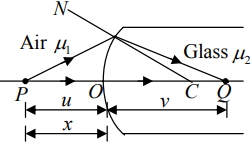
$A$ spherical surface of radius of curvature $R$ separates air (refractive index $1.0$) from glass (refractive index $1.5$). The centre of curvature is in the glass. $A$ point object $P$ placed in air is found to have a real image $Q$ in the glass. The line $PQ$ cuts the surface at the point $O$,and $PO = OQ$. The distance $PO$ is equal to: (in $,R$)
A
$5$
B
$3$
C
$2$
D
$1.5$
Solution
(A) When a ray of light travels from $\mu_{1}$ to $\mu_{2}$ after refraction at a single curved surface,the formula is:
$\frac{\mu_{2}}{v} - \frac{\mu_{1}}{u} = \frac{\mu_{2} - \mu_{1}}{R}$
As per the sign convention:
$u = -x$ (object is in air,distance $PO = x$)
$v = +x$ (image is real and in glass,distance $OQ = x$)
$R$ is positive as the center of curvature is in the glass.
Given $\mu_{1} = 1.0$ and $\mu_{2} = 1.5$:
$\frac{1.5}{x} - \frac{1}{-x} = \frac{1.5 - 1.0}{R}$
$\frac{1.5}{x} + \frac{1}{x} = \frac{0.5}{R}$
$\frac{2.5}{x} = \frac{0.5}{R}$
$x = \frac{2.5}{0.5} R = 5R$
Therefore,the distance $PO = 5R$.
$\frac{\mu_{2}}{v} - \frac{\mu_{1}}{u} = \frac{\mu_{2} - \mu_{1}}{R}$
As per the sign convention:
$u = -x$ (object is in air,distance $PO = x$)
$v = +x$ (image is real and in glass,distance $OQ = x$)
$R$ is positive as the center of curvature is in the glass.
Given $\mu_{1} = 1.0$ and $\mu_{2} = 1.5$:
$\frac{1.5}{x} - \frac{1}{-x} = \frac{1.5 - 1.0}{R}$
$\frac{1.5}{x} + \frac{1}{x} = \frac{0.5}{R}$
$\frac{2.5}{x} = \frac{0.5}{R}$
$x = \frac{2.5}{0.5} R = 5R$
Therefore,the distance $PO = 5R$.
0 likesView Solution
22
ChemistryMCQIIT JEE · 1998
$A$ satellite $S$ is moving in an elliptical orbit around the earth. The mass of the satellite is very small compared to the mass of the earth.
A
The acceleration of $S$ is always directed towards the centre of the earth.
B
The angular momentum of $S$ about the centre of the earth changes in direction,but its magnitude remains constant.
C
The total mechanical energy of $S$ varies periodically with time.
D
The linear momentum of $S$ remains constant in magnitude.
Solution
(A) The only force acting on the satellite is the gravitational force exerted by the earth.
According to Newton's law of gravitation,this force is always directed towards the centre of the earth.
Since $F = ma$,the acceleration $a$ of the satellite is also always directed towards the centre of the earth.
Angular momentum is conserved because the gravitational torque about the centre of the earth is zero.
Total mechanical energy remains constant in an elliptical orbit.
Linear momentum changes in both magnitude and direction due to the varying speed and path of the satellite.
According to Newton's law of gravitation,this force is always directed towards the centre of the earth.
Since $F = ma$,the acceleration $a$ of the satellite is also always directed towards the centre of the earth.
Angular momentum is conserved because the gravitational torque about the centre of the earth is zero.
Total mechanical energy remains constant in an elliptical orbit.
Linear momentum changes in both magnitude and direction due to the varying speed and path of the satellite.
0 likesView Solution
23
ChemistryMCQIIT JEE · 1998
The energy of an electron in the first Bohr's orbit of $H$ atom is $-13.6 \ eV$. The possible energy value$(s)$ of the excited state$(s)$ for an electron in Bohr's orbits of hydrogen is (are): ............. $eV$
A
$-3.4$
B
$-4.2$
C
$-6.8$
D
$+6.8$
Solution
(A) The energy of an electron in the $n^{th}$ orbit of a hydrogen-like atom is given by the formula: $E_n = -13.6 \times \frac{Z^2}{n^2} \ eV$.
For a hydrogen atom,$Z = 1$,so $E_n = -13.6 / n^2 \ eV$.
For the ground state $(n = 1)$,$E_1 = -13.6 \ eV$.
For the first excited state $(n = 2)$,$E_2 = -13.6 / 2^2 = -13.6 / 4 = -3.4 \ eV$.
For the second excited state $(n = 3)$,$E_3 = -13.6 / 3^2 = -13.6 / 9 \approx -1.51 \ eV$.
Comparing these values with the given options,$-3.4 \ eV$ is a possible energy value for the excited state.
Therefore,the correct option is $A$.
For a hydrogen atom,$Z = 1$,so $E_n = -13.6 / n^2 \ eV$.
For the ground state $(n = 1)$,$E_1 = -13.6 \ eV$.
For the first excited state $(n = 2)$,$E_2 = -13.6 / 2^2 = -13.6 / 4 = -3.4 \ eV$.
For the second excited state $(n = 3)$,$E_3 = -13.6 / 3^2 = -13.6 / 9 \approx -1.51 \ eV$.
Comparing these values with the given options,$-3.4 \ eV$ is a possible energy value for the excited state.
Therefore,the correct option is $A$.
0 likesView Solution
24
ChemistryMCQIIT JEE · 1998
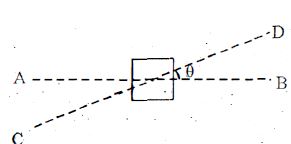
Let $I$ be the moment of inertia of a uniform square plate about an axis $AB$ that passes through its centre and is parallel to two of its sides. $CD$ is a line in the plane of the plate that passes through the centre of the plate and makes an angle $\theta$ with $AB$. The moment of inertia of the plate about the axis $CD$ is then equal to
A
$I$
B
$I \cos^2 \theta$
C
$I \sin^2 \theta$
D
$I \cos^2(\theta/2)$
Solution
(A) For a uniform square plate,let the sides be parallel to the $x$ and $y$ axes. The moment of inertia about an axis passing through the centre and parallel to the sides is $I_x = I_y = I = \frac{1}{12} M a^2$.
Since the square plate is symmetric about any axis passing through its centre in its plane,the moment of inertia about any axis passing through the centre and lying in the plane of the plate is the same.
Specifically,for a square plate,the moment of inertia about any axis passing through the centre and lying in the plane of the plate is independent of the angle $\theta$ it makes with the sides.
Therefore,the moment of inertia about the axis $CD$ is also $I$.
Since the square plate is symmetric about any axis passing through its centre in its plane,the moment of inertia about any axis passing through the centre and lying in the plane of the plate is the same.
Specifically,for a square plate,the moment of inertia about any axis passing through the centre and lying in the plane of the plate is independent of the angle $\theta$ it makes with the sides.
Therefore,the moment of inertia about the axis $CD$ is also $I$.
0 likesView Solution
25
ChemistryMCQIIT JEE · 1998
Two cylinders $A$ and $B$ fitted with pistons contain equal amounts of an ideal diatomic gas at $300\,K$. The piston of $A$ is free to move,while that of $B$ is held fixed. The same amount of heat is given to the gas in each cylinder. If the rise in temperature of the gas in $A$ is $30\,K$,then the rise in temperature of the gas in $B$ is .... $K$.
A
$30$
B
$18$
C
$50$
D
$42$
Solution
(D) In both cylinders $A$ and $B$,the gases are diatomic $(\gamma = 1.4)$.
For cylinder $A$,the piston is free to move,which implies an isobaric process. The heat supplied is given by $(\Delta Q)_A = \mu C_P (\Delta T)_A$.
For cylinder $B$,the piston is fixed,which implies an isochoric process. The heat supplied is given by $(\Delta Q)_B = \mu C_V (\Delta T)_B$.
Since the same amount of heat is given to both,$(\Delta Q)_A = (\Delta Q)_B$.
Therefore,$\mu C_P (\Delta T)_A = \mu C_V (\Delta T)_B$.
Rearranging for $(\Delta T)_B$,we get $(\Delta T)_B = \frac{C_P}{C_V} (\Delta T)_A = \gamma (\Delta T)_A$.
Given $\gamma = 1.4$ and $(\Delta T)_A = 30\,K$,we have $(\Delta T)_B = 1.4 \times 30 = 42\,K$.
For cylinder $A$,the piston is free to move,which implies an isobaric process. The heat supplied is given by $(\Delta Q)_A = \mu C_P (\Delta T)_A$.
For cylinder $B$,the piston is fixed,which implies an isochoric process. The heat supplied is given by $(\Delta Q)_B = \mu C_V (\Delta T)_B$.
Since the same amount of heat is given to both,$(\Delta Q)_A = (\Delta Q)_B$.
Therefore,$\mu C_P (\Delta T)_A = \mu C_V (\Delta T)_B$.
Rearranging for $(\Delta T)_B$,we get $(\Delta T)_B = \frac{C_P}{C_V} (\Delta T)_A = \gamma (\Delta T)_A$.
Given $\gamma = 1.4$ and $(\Delta T)_A = 30\,K$,we have $(\Delta T)_B = 1.4 \times 30 = 42\,K$.
0 likesView Solution
26
ChemistryMCQIIT JEE · 1998
$A$ vessel contains a mixture of one mole of oxygen and two moles of nitrogen at $300 \ K$. The ratio of the average rotational kinetic energy per $O_2$ molecule to that per $N_2$ molecule is
A
$1 : 1$
B
$1 : 2$
C
$2 : 1$
D
Depends on the moments of inertia of the two molecules
Solution
(A) According to the equipartition theorem,the average kinetic energy associated with each degree of freedom per molecule is $\frac{1}{2} k T$,where $k$ is the Boltzmann constant and $T$ is the absolute temperature.
Both oxygen $(O_2)$ and nitrogen $(N_2)$ are diatomic gases.
For a diatomic molecule,the number of rotational degrees of freedom is $2$.
Therefore,the average rotational kinetic energy per molecule for any diatomic gas is given by $E_{rot} = 2 \times \frac{1}{2} k T = k T$.
Since both gases are at the same temperature $(300 \ K)$,the average rotational kinetic energy per molecule for $O_2$ is $k(300)$ and for $N_2$ is $k(300)$.
Thus,the ratio of the average rotational kinetic energy per $O_2$ molecule to that per $N_2$ molecule is $k(300) : k(300) = 1 : 1$.
Both oxygen $(O_2)$ and nitrogen $(N_2)$ are diatomic gases.
For a diatomic molecule,the number of rotational degrees of freedom is $2$.
Therefore,the average rotational kinetic energy per molecule for any diatomic gas is given by $E_{rot} = 2 \times \frac{1}{2} k T = k T$.
Since both gases are at the same temperature $(300 \ K)$,the average rotational kinetic energy per molecule for $O_2$ is $k(300)$ and for $N_2$ is $k(300)$.
Thus,the ratio of the average rotational kinetic energy per $O_2$ molecule to that per $N_2$ molecule is $k(300) : k(300) = 1 : 1$.
0 likesView Solution
27
ChemistryMCQIIT JEE · 1998
Two cylinders $A$ and $B$ fitted with pistons contain equal amounts of an ideal diatomic gas at $300\ K.$ The piston of $A$ is free to move while that of $B$ is held fixed. The same amount of heat is given to the gas in each cylinder. If the rise in temperature of the gas in $A$ is $30\ K,$ then the rise in temperature of the gas in $B$ is ....... $K$
A
$30$
B
$18$
C
$50$
D
$42$
Solution
(D) In both cylinders $A$ and $B,$ the gases are diatomic.
For cylinder $A,$ the piston is free to move,which implies an isobaric process. The heat supplied is given by $\Delta Q = \mu C_p (\Delta T)_A.$
For cylinder $B,$ the piston is fixed,which implies an isochoric process. The heat supplied is given by $\Delta Q = \mu C_v (\Delta T)_B.$
Since the same amount of heat is supplied to both,we have:
$\mu C_p (\Delta T)_A = \mu C_v (\Delta T)_B$
$(\Delta T)_B = \frac{C_p}{C_v} (\Delta T)_A$
Since $\frac{C_p}{C_v} = \gamma$ and for a diatomic gas $\gamma = 1.4,$ we get:
$(\Delta T)_B = 1.4 \times 30\ K = 42\ K.$
For cylinder $A,$ the piston is free to move,which implies an isobaric process. The heat supplied is given by $\Delta Q = \mu C_p (\Delta T)_A.$
For cylinder $B,$ the piston is fixed,which implies an isochoric process. The heat supplied is given by $\Delta Q = \mu C_v (\Delta T)_B.$
Since the same amount of heat is supplied to both,we have:
$\mu C_p (\Delta T)_A = \mu C_v (\Delta T)_B$
$(\Delta T)_B = \frac{C_p}{C_v} (\Delta T)_A$
Since $\frac{C_p}{C_v} = \gamma$ and for a diatomic gas $\gamma = 1.4,$ we get:
$(\Delta T)_B = 1.4 \times 30\ K = 42\ K.$
0 likesView Solution
28
ChemistryMCQIIT JEE · 1998
The number of values of $x$ in the interval $[0, 5\pi]$ satisfying the equation $3\sin^2x - 7\sin x + 2 = 0$ is
A
$0$
B
$5$
C
$6$
D
$10$
Solution
(C) Given equation: $3\sin^2x - 7\sin x + 2 = 0$
Factorizing the quadratic equation: $(3\sin x - 1)(\sin x - 2) = 0$
This gives two possibilities: $3\sin x = 1$ or $\sin x = 2$
Since the range of $\sin x$ is $[-1, 1]$,$\sin x = 2$ is not possible.
Thus,we solve for $\sin x = \frac{1}{3}$.
In the interval $[0, 2\pi]$,$\sin x = \frac{1}{3}$ has $2$ solutions (one in the $I^{st}$ quadrant and one in the $II^{nd}$ quadrant).
In the interval $[0, 4\pi]$,there are $2 \times 2 = 4$ solutions.
In the interval $[4\pi, 5\pi]$,$\sin x = \frac{1}{3}$ has $2$ more solutions.
Total number of solutions in $[0, 5\pi]$ is $2 + 2 + 2 = 6$.
Factorizing the quadratic equation: $(3\sin x - 1)(\sin x - 2) = 0$
This gives two possibilities: $3\sin x = 1$ or $\sin x = 2$
Since the range of $\sin x$ is $[-1, 1]$,$\sin x = 2$ is not possible.
Thus,we solve for $\sin x = \frac{1}{3}$.
In the interval $[0, 2\pi]$,$\sin x = \frac{1}{3}$ has $2$ solutions (one in the $I^{st}$ quadrant and one in the $II^{nd}$ quadrant).
In the interval $[0, 4\pi]$,there are $2 \times 2 = 4$ solutions.
In the interval $[4\pi, 5\pi]$,$\sin x = \frac{1}{3}$ has $2$ more solutions.
Total number of solutions in $[0, 5\pi]$ is $2 + 2 + 2 = 6$.
0 likesView Solution
29
ChemistryMCQIIT JEE · 1998
If $g(f(x)) = |\sin x|$ and $f(g(x)) = (\sin \sqrt{x})^2$,then
A
$f(x) = \sin^2 x, g(x) = \sqrt{x}$
B
$f(x) = \sin x, g(x) = |x|$
C
$f(x) = x^2, g(x) = \sin \sqrt{x}$
D
$f$ and $g$ cannot be found
Solution
(A) Given $g(f(x)) = |\sin x| = \sqrt{\sin^2 x}$.
Also,$f(g(x)) = \sin^2 \sqrt{x}$.
Comparing $g(f(x)) = \sqrt{\sin^2 x}$ with $g(f(x))$,we can infer $f(x) = \sin^2 x$ and $g(x) = \sqrt{x}$.
Let us verify this:
If $f(x) = \sin^2 x$ and $g(x) = \sqrt{x}$,then $g(f(x)) = g(\sin^2 x) = \sqrt{\sin^2 x} = |\sin x|$.
And $f(g(x)) = f(\sqrt{x}) = \sin^2(\sqrt{x}) = (\sin \sqrt{x})^2$.
Both conditions are satisfied.
Therefore,the correct option is $A$.
Also,$f(g(x)) = \sin^2 \sqrt{x}$.
Comparing $g(f(x)) = \sqrt{\sin^2 x}$ with $g(f(x))$,we can infer $f(x) = \sin^2 x$ and $g(x) = \sqrt{x}$.
Let us verify this:
If $f(x) = \sin^2 x$ and $g(x) = \sqrt{x}$,then $g(f(x)) = g(\sin^2 x) = \sqrt{\sin^2 x} = |\sin x|$.
And $f(g(x)) = f(\sqrt{x}) = \sin^2(\sqrt{x}) = (\sin \sqrt{x})^2$.
Both conditions are satisfied.
Therefore,the correct option is $A$.
0 likesView Solution
30
ChemistryMCQIIT JEE · 1998
The reaction of $CH_3-CH=CH-C_6H_4-OH$ with $HBr$ gives:
A
$CH_3-CHBr-CH_2-C_6H_4-OH$
B
$CH_3-CH_2-CHBr-C_6H_4-OH$
C
$CH_3-CHBr-CH_2-C_6H_4-Br$
D
$CH_3-CH_2-CHBr-C_6H_4-Br$
Solution
(B) The reaction involves the electrophilic addition of $HBr$ to the alkene group $(CH_3-CH=CH-)$ attached to the benzene ring.
According to Markovnikov's rule,the proton $(H^+)$ adds to the carbon atom with more hydrogen atoms,and the bromide ion $(Br^-)$ adds to the more substituted carbon atom.
In the molecule $CH_3-CH=CH-C_6H_4-OH$,the double bond is between $C_2$ and $C_3$ of the propenyl chain.
The carbocation formed at the benzylic position $(CH_3-CH_2-CH^+-C_6H_4-OH)$ is more stable due to resonance with the benzene ring.
Therefore,the $Br^-$ attacks the benzylic carbon,resulting in the product $CH_3-CH_2-CHBr-C_6H_4-OH$.
According to Markovnikov's rule,the proton $(H^+)$ adds to the carbon atom with more hydrogen atoms,and the bromide ion $(Br^-)$ adds to the more substituted carbon atom.
In the molecule $CH_3-CH=CH-C_6H_4-OH$,the double bond is between $C_2$ and $C_3$ of the propenyl chain.
The carbocation formed at the benzylic position $(CH_3-CH_2-CH^+-C_6H_4-OH)$ is more stable due to resonance with the benzene ring.
Therefore,the $Br^-$ attacks the benzylic carbon,resulting in the product $CH_3-CH_2-CHBr-C_6H_4-OH$.
0 likesView Solution
31
ChemistryMCQIIT JEE · 1998
For the reaction $CO_{(g)} + H_2O_{(g)} \rightleftharpoons CO_{2(g)} + H_{2(g)}$,at a given temperature,the equilibrium amount of $CO_{2(g)}$ can be increased by
A
Adding a suitable catalyst
B
Adding an inert gas
C
Decreasing the volume of container
D
Increasing the amount of $CO_{(g)}$
Solution
(D) The given reaction is $CO_{(g)} + H_2O_{(g)} \rightleftharpoons CO_{2(g)} + H_{2(g)}$.
$1$. Adding a catalyst does not change the equilibrium position; it only speeds up the rate of reaching equilibrium.
$2$. Adding an inert gas at constant volume has no effect on the equilibrium. At constant pressure,since $\Delta n_g = (1+1) - (1+1) = 0$,adding an inert gas also has no effect.
$3$. Decreasing the volume of the container increases the pressure,but for reactions where $\Delta n_g = 0$,the equilibrium position remains unchanged.
$4$. According to Le Chatelier's principle,increasing the concentration of a reactant $(CO_{(g)})$ shifts the equilibrium in the forward direction,thereby increasing the amount of products ($CO_{2(g)}$ and $H_{2(g)}$).
$1$. Adding a catalyst does not change the equilibrium position; it only speeds up the rate of reaching equilibrium.
$2$. Adding an inert gas at constant volume has no effect on the equilibrium. At constant pressure,since $\Delta n_g = (1+1) - (1+1) = 0$,adding an inert gas also has no effect.
$3$. Decreasing the volume of the container increases the pressure,but for reactions where $\Delta n_g = 0$,the equilibrium position remains unchanged.
$4$. According to Le Chatelier's principle,increasing the concentration of a reactant $(CO_{(g)})$ shifts the equilibrium in the forward direction,thereby increasing the amount of products ($CO_{2(g)}$ and $H_{2(g)}$).
0 likesView Solution
32
ChemistryMCQIIT JEE · 1998
$A$ stone tied to a string of length $L$ is whirled in a vertical circle,with the other end of the string at the center. At a certain instant of time,the stone is at its lowest position and has a speed $u$. The magnitude of the change in its velocity as it reaches a position where the string is horizontal is
A
$\sqrt{u^2 - 2gL}$
B
$\sqrt{2gL}$
C
$\sqrt{u^2 - gL}$
D
$\sqrt{2(u^2 - gL)}$
Solution
(D) Let the velocity at the lowest point be $v_1 = u$ (directed horizontally).
When the string is horizontal,let the velocity be $v_2$. By the law of conservation of energy:
$\frac{1}{2}mu^2 = \frac{1}{2}mv_2^2 + mgL$
$v_2^2 = u^2 - 2gL$
$v_2 = \sqrt{u^2 - 2gL}$ (directed vertically upwards).
Since velocity is a vector,the change in velocity $\Delta \vec{v} = \vec{v}_2 - \vec{v}_1$.
The magnitude is $|\Delta \vec{v}| = \sqrt{v_1^2 + v_2^2 - 2v_1v_2 \cos(90^\circ)}$.
$|\Delta \vec{v}| = \sqrt{u^2 + (u^2 - 2gL)} = \sqrt{2u^2 - 2gL} = \sqrt{2(u^2 - gL)}$.
When the string is horizontal,let the velocity be $v_2$. By the law of conservation of energy:
$\frac{1}{2}mu^2 = \frac{1}{2}mv_2^2 + mgL$
$v_2^2 = u^2 - 2gL$
$v_2 = \sqrt{u^2 - 2gL}$ (directed vertically upwards).
Since velocity is a vector,the change in velocity $\Delta \vec{v} = \vec{v}_2 - \vec{v}_1$.
The magnitude is $|\Delta \vec{v}| = \sqrt{v_1^2 + v_2^2 - 2v_1v_2 \cos(90^\circ)}$.
$|\Delta \vec{v}| = \sqrt{u^2 + (u^2 - 2gL)} = \sqrt{2u^2 - 2gL} = \sqrt{2(u^2 - gL)}$.
0 likesView Solution
33
ChemistryMCQIIT JEE · 1998
$A$ metal rod moves at a constant velocity in a direction perpendicular to its length. $A$ constant uniform magnetic field exists in space in a direction perpendicular to the rod as well as its velocity. Select the correct statement from the following:
A
The entire rod is at the same electric potential
B
There is an electric field in the rod
C
The electric potential is highest at the centre of the rod and decreases towards its ends
D
The electric potential is lowest at the centre of the rod and increases towards its ends
Solution
(B) When a metal rod of length $l$ moves with velocity $v$ in a uniform magnetic field $B$ such that $v$,$B$,and $l$ are mutually perpendicular,the Lorentz force $F = q(v \times B)$ acts on the free electrons in the rod.
This force causes electrons to accumulate at one end of the rod,leaving the other end positively charged.
This separation of charges creates an internal electric field $E$ within the rod,which opposes further movement of charges.
Thus,there is an electric field present in the rod,and a potential difference is developed across its ends.
This force causes electrons to accumulate at one end of the rod,leaving the other end positively charged.
This separation of charges creates an internal electric field $E$ within the rod,which opposes further movement of charges.
Thus,there is an electric field present in the rod,and a potential difference is developed across its ends.
0 likesView Solution
34
ChemistryMCQIIT JEE · 1998
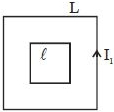
$A$ small square loop of wire of side $l$ is placed inside a large square loop of wire of side $L$ $(L \gg l)$. The loops are coplanar and their centers coincide. The mutual inductance of the system is proportional to
A
$l/L$
B
$l^2/L$
C
$L/l$
D
$L^2/l$
Solution
(B) Let the current in the large loop be $I_1$. The magnetic field $B_1$ produced by the large loop at its center is given by $B_1 = \frac{4\mu_0 I_1}{\sqrt{2}\pi L} = \frac{2\sqrt{2}\mu_0 I_1}{\pi L}$.
Since $L \gg l$,we can assume the magnetic field $B_1$ is approximately uniform over the area of the small loop.
The magnetic flux $\phi_2$ linked with the small loop is $\phi_2 = B_1 \times A_2$,where $A_2 = l^2$ is the area of the small loop.
$\phi_2 = \left( \frac{2\sqrt{2}\mu_0 I_1}{\pi L} \right) l^2$.
The mutual inductance $M$ is defined as $M = \frac{\phi_2}{I_1}$.
$M = \frac{2\sqrt{2}\mu_0 l^2}{\pi L}$.
Thus,$M \propto \frac{l^2}{L}$.
Since $L \gg l$,we can assume the magnetic field $B_1$ is approximately uniform over the area of the small loop.
The magnetic flux $\phi_2$ linked with the small loop is $\phi_2 = B_1 \times A_2$,where $A_2 = l^2$ is the area of the small loop.
$\phi_2 = \left( \frac{2\sqrt{2}\mu_0 I_1}{\pi L} \right) l^2$.
The mutual inductance $M$ is defined as $M = \frac{\phi_2}{I_1}$.
$M = \frac{2\sqrt{2}\mu_0 l^2}{\pi L}$.
Thus,$M \propto \frac{l^2}{L}$.
0 likesView Solution
35
ChemistryMCQIIT JEE · 1998
The isothermal Bulk modulus of an ideal gas at pressure $P$ is
A
$P$
B
$\gamma P$
C
$P/2$
D
$P/\gamma$
Solution
(A) For an isothermal process, the temperature $T$ remains constant.
From the ideal gas equation, $PV = nRT$. Since $T$ is constant, $PV = \text{constant}$.
Differentiating both sides with respect to $V$, we get $P + V(dP/dV) = 0$, which implies $dP/dV = -P/V$.
The Bulk modulus $B$ is defined as $B = -V(dP/dV)$.
Substituting the value of $dP/dV$, we get $B = -V(-P/V) = P$.
Therefore, the isothermal Bulk modulus of an ideal gas at pressure $P$ is $P$.
From the ideal gas equation, $PV = nRT$. Since $T$ is constant, $PV = \text{constant}$.
Differentiating both sides with respect to $V$, we get $P + V(dP/dV) = 0$, which implies $dP/dV = -P/V$.
The Bulk modulus $B$ is defined as $B = -V(dP/dV)$.
Substituting the value of $dP/dV$, we get $B = -V(-P/V) = P$.
Therefore, the isothermal Bulk modulus of an ideal gas at pressure $P$ is $P$.
0 likesView Solution
36
ChemistryMCQIIT JEE · 1998
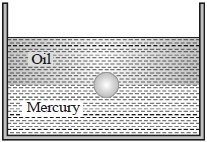
$A$ vessel contains oil (density $= 0.8 \, g/cm^3$) over mercury (density $= 13.6 \, g/cm^3$). $A$ homogeneous sphere floats with half of its volume immersed in mercury and the other half in oil. The density of the material of the sphere in $g/cm^3$ is
A
$3.3$
B
$6.4$
C
$7.2$
D
$12.8$
Solution
(C) Let $V$ be the total volume of the sphere and $\rho$ be the density of the material of the sphere.
Since the sphere is floating,its weight must be equal to the total buoyant force (upthrust) acting on it.
Weight of the sphere $= V \rho g$
Buoyant force due to oil $= (V/2) \times \rho_{oil} \times g = (V/2) \times 0.8 \times g = 0.4 Vg$
Buoyant force due to mercury $= (V/2) \times \rho_{Hg} \times g = (V/2) \times 13.6 \times g = 6.8 Vg$
Equating the weight to the total buoyant force:
$V \rho g = 0.4 Vg + 6.8 Vg$
$V \rho g = 7.2 Vg$
$\rho = 7.2 \, g/cm^3$
Since the sphere is floating,its weight must be equal to the total buoyant force (upthrust) acting on it.
Weight of the sphere $= V \rho g$
Buoyant force due to oil $= (V/2) \times \rho_{oil} \times g = (V/2) \times 0.8 \times g = 0.4 Vg$
Buoyant force due to mercury $= (V/2) \times \rho_{Hg} \times g = (V/2) \times 13.6 \times g = 6.8 Vg$
Equating the weight to the total buoyant force:
$V \rho g = 0.4 Vg + 6.8 Vg$
$V \rho g = 7.2 Vg$
$\rho = 7.2 \, g/cm^3$
0 likesView Solution
37
ChemistryMCQIIT JEE · 1998
Two identical containers $A$ and $B$ with frictionless pistons contain an ideal gas at the same temperature and the same volume $V$. The mass of the gas in $A$ is $m_A$ and in $B$ is $m_B$. The gas in each cylinder is now allowed to expand isothermally to the same final volume $2V$. The changes in pressure in $A$ and $B$ are found to be $\Delta P$ and $1.5\Delta P$ respectively. Then:
A
$4m_A = 9m_B$
B
$2m_A = 3m_B$
C
$3m_A = 2m_B$
D
$9m_A = 4m_B$
Solution
(C) The initial pressure in the two containers is given by the ideal gas law $PV = nRT = (m/M)RT$,where $M$ is the molar mass.
$P_A = \frac{m_A RT}{MV}$ and $P_B = \frac{m_B RT}{MV}$.
After isothermal expansion to volume $2V$,the final pressures are:
$P'_A = \frac{m_A RT}{M(2V)}$ and $P'_B = \frac{m_B RT}{M(2V)}$.
The change in pressure for each container is:
$\Delta P_A = P_A - P'_A = \frac{m_A RT}{MV} - \frac{m_A RT}{2MV} = \frac{m_A RT}{2MV}$.
$\Delta P_B = P_B - P'_B = \frac{m_B RT}{MV} - \frac{m_B RT}{2MV} = \frac{m_B RT}{2MV}$.
Given that $\Delta P_A = \Delta P$ and $\Delta P_B = 1.5 \Delta P$,we take the ratio:
$\frac{\Delta P_A}{\Delta P_B} = \frac{\Delta P}{1.5 \Delta P} = \frac{1}{1.5} = \frac{2}{3}$.
Substituting the expressions for $\Delta P_A$ and $\Delta P_B$:
$\frac{m_A RT / 2MV}{m_B RT / 2MV} = \frac{2}{3} \implies \frac{m_A}{m_B} = \frac{2}{3}$.
Therefore,$3m_A = 2m_B$.
$P_A = \frac{m_A RT}{MV}$ and $P_B = \frac{m_B RT}{MV}$.
After isothermal expansion to volume $2V$,the final pressures are:
$P'_A = \frac{m_A RT}{M(2V)}$ and $P'_B = \frac{m_B RT}{M(2V)}$.
The change in pressure for each container is:
$\Delta P_A = P_A - P'_A = \frac{m_A RT}{MV} - \frac{m_A RT}{2MV} = \frac{m_A RT}{2MV}$.
$\Delta P_B = P_B - P'_B = \frac{m_B RT}{MV} - \frac{m_B RT}{2MV} = \frac{m_B RT}{2MV}$.
Given that $\Delta P_A = \Delta P$ and $\Delta P_B = 1.5 \Delta P$,we take the ratio:
$\frac{\Delta P_A}{\Delta P_B} = \frac{\Delta P}{1.5 \Delta P} = \frac{1}{1.5} = \frac{2}{3}$.
Substituting the expressions for $\Delta P_A$ and $\Delta P_B$:
$\frac{m_A RT / 2MV}{m_B RT / 2MV} = \frac{2}{3} \implies \frac{m_A}{m_B} = \frac{2}{3}$.
Therefore,$3m_A = 2m_B$.
0 likesView Solution
38
ChemistryMediumMCQIIT JEE · 1998
White phosphorus $(P_4)$ has
A
Six $P-P$ single bonds
B
Four lone pairs of electrons
C
$P-P-P$ angle of $60^o$
D
Both $(a)$ and $(c)$
Solution
(D) The $P_4$ molecule has a tetrahedral structure.
It contains six $P-P$ single bonds.
Each phosphorus atom has one lone pair,so there are four lone pairs in total.
The bond angle $P-P-P$ is $60^o$.
Therefore,both $(a)$ and $(c)$ are correct statements.
It contains six $P-P$ single bonds.
Each phosphorus atom has one lone pair,so there are four lone pairs in total.
The bond angle $P-P-P$ is $60^o$.
Therefore,both $(a)$ and $(c)$ are correct statements.
0 likesView Solution
39
ChemistryDifficultMCQIIT JEE · 1998
Which of the following statement$(s)$ is(are) correct when a mixture of $NaCl$ and $K_2Cr_2O_7$ is gently warmed with conc. $H_2SO_4$?
A
$A$. $A$ deep red vapour is evolved
B
$B$. The vapour when passed into $NaOH$ solution gives a yellow solution of $Na_2CrO_4$
C
$C$. Chromyl chloride is formed
D
$D$. All of the above
Solution
(D) The correct answer is $D$. This is the Chromyl chloride test.
$4NaCl + K_2Cr_2O_7 + 3H_2SO_4 \xrightarrow{\Delta} K_2SO_4 + 2Na_2SO_4 + 2CrO_2Cl_2 + 3H_2O$
In this reaction,$CrO_2Cl_2$ (Chromyl chloride) is formed,which appears as deep red vapours.
When these vapours are passed into $NaOH$ solution,they form a yellow solution of sodium chromate:
$CrO_2Cl_2 + 4NaOH \to Na_2CrO_4 + 2NaCl + 2H_2O$
Since all statements $A$,$B$,and $C$ are correct,the correct option is $D$.
$4NaCl + K_2Cr_2O_7 + 3H_2SO_4 \xrightarrow{\Delta} K_2SO_4 + 2Na_2SO_4 + 2CrO_2Cl_2 + 3H_2O$
In this reaction,$CrO_2Cl_2$ (Chromyl chloride) is formed,which appears as deep red vapours.
When these vapours are passed into $NaOH$ solution,they form a yellow solution of sodium chromate:
$CrO_2Cl_2 + 4NaOH \to Na_2CrO_4 + 2NaCl + 2H_2O$
Since all statements $A$,$B$,and $C$ are correct,the correct option is $D$.
0 likesView Solution
40
ChemistryMediumMCQIIT JEE · 1998
Which of the following statement(s) is (are) correct?
A
The coordination number of each type of ion in $CsCl$ crystal is $8$.
B
The length of the unit cell in $NaCl$ is $552 \ pm$ $(r_{Na^{+}} = 95 \ pm; r_{Cl^{-}} = 181 \ pm)$.
C
$A$ unit cell of an ionic crystal shares some of its ions with other unit cells.
D
All of the above
Solution
(D) : In $CsCl$ crystal, $Cs^{+}$ is at the body center and $Cl^{-}$ at the corners, both having a coordination number of $8$. This is correct.
$B$: In $NaCl$ structure, the edge length $a = 2(r_{Na^{+}} + r_{Cl^{-}}) = 2(95 + 181) \ pm = 2(276) \ pm = 552 \ pm$. This is correct.
$C$: In any crystal lattice, ions at the faces, edges, or corners are shared between adjacent unit cells. This is correct.
Therefore, all statements are correct.
$B$: In $NaCl$ structure, the edge length $a = 2(r_{Na^{+}} + r_{Cl^{-}}) = 2(95 + 181) \ pm = 2(276) \ pm = 552 \ pm$. This is correct.
$C$: In any crystal lattice, ions at the faces, edges, or corners are shared between adjacent unit cells. This is correct.
Therefore, all statements are correct.
0 likesView Solution
41
ChemistryMediumMCQIIT JEE · 1998
Decrease in atomic number is observed during
A
Alpha emission
B
Electron capture
C
Positron emission
D
All of the above
Solution
(D) In $Alpha$ emission,the atomic number decreases by $2$ units.
In $Electron$ capture,a proton is converted into a neutron,decreasing the atomic number by $1$ unit.
In $Positron$ emission,a proton is converted into a neutron,decreasing the atomic number by $1$ unit.
Therefore,all these processes result in a decrease in atomic number.
In $Electron$ capture,a proton is converted into a neutron,decreasing the atomic number by $1$ unit.
In $Positron$ emission,a proton is converted into a neutron,decreasing the atomic number by $1$ unit.
Therefore,all these processes result in a decrease in atomic number.
0 likesView Solution
42
ChemistryDifficultMCQIIT JEE · 1998
For a first order reaction,which of the following statements is correct?
A
The degree of dissociation is equal to $(1 - e^{-kt})$
B
$A$ plot of reciprocal concentration of the reactant vs time gives a straight line
C
The pre-exponential factor in the Arrhenius equation has the dimension of time $T^{-1}$
D
Both $(a)$ and $(c)$
Solution
(D) For a first order reaction,the concentration at time $t$ is given by $[A]_t = [A]_0 e^{-kt}$.
The degree of dissociation $\alpha$ is defined as $\frac{[A]_0 - [A]_t}{[A]_0} = 1 - \frac{[A]_t}{[A]_0} = 1 - e^{-kt}$. Thus,$(a)$ is correct.
For a first order reaction,a plot of $\ln [A]$ vs $t$ gives a straight line,not the reciprocal concentration. Thus,$(b)$ is incorrect.
In the Arrhenius equation $k = A e^{-E_a/RT}$,the unit of $k$ for a first order reaction is $time^{-1}$. Since $e^{-E_a/RT}$ is dimensionless,the pre-exponential factor $A$ must have the same units as $k$,which is $T^{-1}$. Thus,$(c)$ is correct.
Since both $(a)$ and $(c)$ are correct,$(d)$ is the correct option.
The degree of dissociation $\alpha$ is defined as $\frac{[A]_0 - [A]_t}{[A]_0} = 1 - \frac{[A]_t}{[A]_0} = 1 - e^{-kt}$. Thus,$(a)$ is correct.
For a first order reaction,a plot of $\ln [A]$ vs $t$ gives a straight line,not the reciprocal concentration. Thus,$(b)$ is incorrect.
In the Arrhenius equation $k = A e^{-E_a/RT}$,the unit of $k$ for a first order reaction is $time^{-1}$. Since $e^{-E_a/RT}$ is dimensionless,the pre-exponential factor $A$ must have the same units as $k$,which is $T^{-1}$. Thus,$(c)$ is correct.
Since both $(a)$ and $(c)$ are correct,$(d)$ is the correct option.
0 likesView Solution
43
ChemistryMediumMCQIIT JEE · 1998
Standard reduction electrode potentials of three metals $A$,$B$,and $C$ are respectively $+0.5 \ V$,$-3.0 \ V$,and $-1.2 \ V$. The reducing powers of these metals are
A
$B > C > A$
B
$A > B > C$
C
$C > B > A$
D
$A > C > B$
Solution
(A) The reducing power of a metal is inversely proportional to its standard reduction potential.
Lower reduction potential indicates a greater tendency to lose electrons,hence higher reducing power.
Given reduction potentials: $E^{\circ}_{A} = +0.5 \ V$,$E^{\circ}_{B} = -3.0 \ V$,$E^{\circ}_{C} = -1.2 \ V$.
Comparing the values: $-3.0 \ V < -1.2 \ V < +0.5 \ V$.
Therefore,the order of reducing power is $B > C > A$.
Lower reduction potential indicates a greater tendency to lose electrons,hence higher reducing power.
Given reduction potentials: $E^{\circ}_{A} = +0.5 \ V$,$E^{\circ}_{B} = -3.0 \ V$,$E^{\circ}_{C} = -1.2 \ V$.
Comparing the values: $-3.0 \ V < -1.2 \ V < +0.5 \ V$.
Therefore,the order of reducing power is $B > C > A$.
0 likesView Solution
44
ChemistryEasyMCQIIT JEE · 1998
Addition of high proportions of manganese makes steel useful in making rails of rail-roads because manganese
A
Gives hardness to steel
B
Helps the formation of oxides of iron
C
Can remove oxygen and sulphur
D
Both $(a)$ and $(c)$
Solution
(D) Manganese is added to steel to increase its hardness and wear resistance,which is essential for railroad rails.
Additionally,manganese acts as a deoxidizer and desulfurizer during the steel-making process by removing oxygen and sulfur as slag.
$Fe_2O_3 + 3Mn \rightarrow 3MnO + 2Fe$
$MnO + SiO_2 \rightarrow MnSiO_3$
Additionally,manganese acts as a deoxidizer and desulfurizer during the steel-making process by removing oxygen and sulfur as slag.
$Fe_2O_3 + 3Mn \rightarrow 3MnO + 2Fe$
$MnO + SiO_2 \rightarrow MnSiO_3$
0 likesView Solution
45
ChemistryAdvancedMCQIIT JEE · 1998
Which of the following statement$(s)$ is(are) correct with reference to the ferrous and ferric ions?
A
$Fe^{3+}$ gives brown colour with potassium ferricyanide
B
$Fe^{2+}$ gives blue precipitate with potassium ferricyanide
C
$Fe^{3+}$ gives red colour with potassium thiocyanate
D
Both $(b)$ and $(c)$
Solution
(D) and $(c)$ are correct.
$Fe^{2+}$ ions react with potassium ferricyanide $(K_3[Fe(CN)_6])$ to form a blue precipitate known as Turnbull's blue,which is potassium ferric ferrocyanide,$KFe[Fe(CN)_6]$.
$Fe^{3+}$ ions react with potassium thiocyanate $(KSCN)$ to form a blood-red complex,$[Fe(SCN)(H_2O)_5]^{2+}$,or simply $Fe(SCN)_3$ in solution,which is a characteristic test for ferric ions.
$Fe^{2+}$ ions react with potassium ferricyanide $(K_3[Fe(CN)_6])$ to form a blue precipitate known as Turnbull's blue,which is potassium ferric ferrocyanide,$KFe[Fe(CN)_6]$.
$Fe^{3+}$ ions react with potassium thiocyanate $(KSCN)$ to form a blood-red complex,$[Fe(SCN)(H_2O)_5]^{2+}$,or simply $Fe(SCN)_3$ in solution,which is a characteristic test for ferric ions.
0 likesView Solution
46
ChemistryDifficultMCQIIT JEE · 1998
In nitroprusside ion,the iron and $NO$ exist as $Fe^{II}$ and $NO^+$ rather than $Fe^{III}$ and $NO$. These forms can be differentiated by
A
Estimating the concentration of iron
B
Measuring the concentration of $CN^-$
C
Measuring the solid state magnetic moment
D
Thermally decomposing the compound
Solution
(C) The existence of $Fe^{2+}$ and $NO^+$ in the nitroprusside ion $[Fe(CN)_5NO]^{2-}$ can be established by measuring the magnetic moment of the solid compound.
If iron were $Fe^{III}$ $(3d^5)$,the magnetic properties would differ significantly from the $Fe^{II}$ $(3d^6)$ state present in the complex.
Measuring the magnetic moment allows for the determination of the oxidation state of the metal center.
If iron were $Fe^{III}$ $(3d^5)$,the magnetic properties would differ significantly from the $Fe^{II}$ $(3d^6)$ state present in the complex.
Measuring the magnetic moment allows for the determination of the oxidation state of the metal center.
0 likesView Solution
47
ChemistryDifficultMCQIIT JEE · 1998
$A$ new carbon-carbon bond formation is possible in
A
Cannizzaro reaction
B
Friedel-Crafts alkylation
C
Reimer-Tiemann reaction
D
Both $(b)$ and $(c)$
Solution
(D) New carbon-carbon bond formation takes place in Friedel-Crafts alkylation and Reimer-Tiemann reaction.
In Friedel-Crafts alkylation,the following mechanism is involved:
$R-Cl + AlCl_3 \rightleftharpoons R^{\oplus} + AlCl_4^- + HCl$
Here,a new $C-C$ bond is formed between the carbon of the benzene ring and the alkyl group.
Similarly,in the Reimer-Tiemann reaction:
$C_6H_5OH + CHCl_3 + 3NaOH \rightarrow C_6H_4(OH)(CHO) + 3NaCl + 2H_2O$
Here,a new $C-C$ bond is formed between the carbon of the benzene ring and the $-CHO$ group.
In Friedel-Crafts alkylation,the following mechanism is involved:
$R-Cl + AlCl_3 \rightleftharpoons R^{\oplus} + AlCl_4^- + HCl$
Here,a new $C-C$ bond is formed between the carbon of the benzene ring and the alkyl group.
Similarly,in the Reimer-Tiemann reaction:
$C_6H_5OH + CHCl_3 + 3NaOH \rightarrow C_6H_4(OH)(CHO) + 3NaCl + 2H_2O$
Here,a new $C-C$ bond is formed between the carbon of the benzene ring and the $-CHO$ group.
0 likesView Solution
48
ChemistryDifficultMCQIIT JEE · 1998
Benzenediazonium chloride on reaction with phenol in weakly basic medium gives
A
Diphenyl ether
B
$p$-hydroxyazobenzene
C
Chlorobenzene
D
Benzene
Solution
(B) The reaction between benzenediazonium chloride and phenol in a weakly basic medium is a coupling reaction.
In this reaction,the diazonium group $(-N=N-)$ replaces the hydrogen atom at the para-position of the phenol ring.
The product formed is $p$-hydroxyazobenzene,which is an orange-red dye.
The reaction is: $C_6H_5N_2Cl + C_6H_5OH \xrightarrow{OH^-} C_6H_5-N=N-C_6H_4OH + HCl$.
In this reaction,the diazonium group $(-N=N-)$ replaces the hydrogen atom at the para-position of the phenol ring.
The product formed is $p$-hydroxyazobenzene,which is an orange-red dye.
The reaction is: $C_6H_5N_2Cl + C_6H_5OH \xrightarrow{OH^-} C_6H_5-N=N-C_6H_4OH + HCl$.
0 likesView Solution
49
ChemistryDifficultMCQIIT JEE · 1998
The reaction of $CH_3-CH=CH-C_6H_4-OH$ with $HBr$ gives:
A
$CH_3-CHBr-CH_2-C_6H_4-OH$
B
$CH_3-CH_2-CHBr-C_6H_4-OH$
C
$CH_3-CHBr-CH_2-C_6H_4-Br$
D
$CH_3-CH_2-CHBr-C_6H_4-Br$
Solution
(B) The reaction of $CH_3-CH=CH-C_6H_4-OH$ with $HBr$ follows Markovnikov's rule.
In this reaction,the proton $(H^+)$ adds to the carbon atom of the double bond that has more hydrogen atoms,and the bromide ion $(Br^-)$ adds to the more substituted carbon atom.
The carbocation formed at the benzylic position is more stable due to resonance with the benzene ring.
Therefore,the product is $CH_3-CH_2-CHBr-C_6H_4-OH$.
In this reaction,the proton $(H^+)$ adds to the carbon atom of the double bond that has more hydrogen atoms,and the bromide ion $(Br^-)$ adds to the more substituted carbon atom.
The carbocation formed at the benzylic position is more stable due to resonance with the benzene ring.
Therefore,the product is $CH_3-CH_2-CHBr-C_6H_4-OH$.
0 likesView Solution
50
ChemistryMediumMCQIIT JEE · 1998
Which of the following will undergo aldol condensation?
A
Acetaldehyde
B
Propanaldehyde
C
Trideuteroacetaldehyde
D
All of these
Solution
(D) Aldol condensation requires the presence of at least one $\alpha$-hydrogen atom in the carbonyl compound.
$A$ Acetaldehyde $(CH_3CHO)$ has three $\alpha$-hydrogens.
$B$ Propanaldehyde $(CH_3CH_2CHO)$ has two $\alpha$-hydrogens.
$C$ Trideuteroacetaldehyde $(CD_3CDO)$ has three $\alpha$-deuterium atoms. Since deuterium $(D)$ behaves chemically similar to hydrogen $(H)$,it can also undergo aldol condensation.
Therefore,all of these compounds will undergo aldol condensation.
$A$ Acetaldehyde $(CH_3CHO)$ has three $\alpha$-hydrogens.
$B$ Propanaldehyde $(CH_3CH_2CHO)$ has two $\alpha$-hydrogens.
$C$ Trideuteroacetaldehyde $(CD_3CDO)$ has three $\alpha$-deuterium atoms. Since deuterium $(D)$ behaves chemically similar to hydrogen $(H)$,it can also undergo aldol condensation.
Therefore,all of these compounds will undergo aldol condensation.
0 likesView Solution
51
ChemistryMediumMCQIIT JEE · 1998
Which of the following will react with water?
A
$CHCl_3$
B
$Cl_3C-CHO$
C
$CCl_4$
D
$Cl-CH_2-CH_2-Cl$
Solution
(B) Chloral $(Cl_3C-CHO)$ reacts with water to form chloral hydrate $(Cl_3C-CH(OH)_2)$.
This is a stable gem-diol due to the strong electron-withdrawing inductive effect of the three chlorine atoms and intramolecular hydrogen bonding.
This is a stable gem-diol due to the strong electron-withdrawing inductive effect of the three chlorine atoms and intramolecular hydrogen bonding.
0 likesView Solution
52
ChemistryMediumMCQIIT JEE · 1998
$p-$chloroaniline and anilinium hydrochloride can be distinguished by
A
Sandmeyer reaction
B
$NaHCO_3$
C
$AgNO_3$
D
Both $(b)$ and $(c)$
Solution
(D) . $(1)$ Anilinium hydrochloride is an acid salt and liberates $CO_2$ gas from $NaHCO_3$ solution. However,$p-$chloroaniline is basic and does not liberate $CO_2$.
$(2)$ Anilinium hydrochloride contains ionic chloride $(Cl^-)$ which reacts with $AgNO_3$ to form a white precipitate of $AgCl$. $p-$chloroaniline contains covalently bonded chlorine,so it does not give a white precipitate with $AgNO_3$.
$(2)$ Anilinium hydrochloride contains ionic chloride $(Cl^-)$ which reacts with $AgNO_3$ to form a white precipitate of $AgCl$. $p-$chloroaniline contains covalently bonded chlorine,so it does not give a white precipitate with $AgNO_3$.
0 likesView Solution
53
ChemistryDifficultMCQIIT JEE · 1998
Among the following compounds,which will react with acetone to give a product containing $> C = N -$?
A
$C_6H_5NH_2$
B
$(CH_3)_3N$
C
$C_6H_5NHNH_2$
D
$A$ or $C$ both
Solution
(D) Acetone $(CH_3COCH_3)$ reacts with primary amines $(R-NH_2)$ to form imines $(>C=N-)$ and with hydrazines $(R-NHNH_2)$ to form hydrazones $(>C=N-NH-R)$.
$C_6H_5NH_2$ (aniline) is a primary amine,which reacts with acetone to form an imine $(CH_3C(CH_3)=NC_6H_5)$.
$C_6H_5NHNH_2$ (phenylhydrazine) is a hydrazine derivative,which reacts with acetone to form a hydrazone $(CH_3C(CH_3)=NNHC_6H_5)$.
Both products contain the $>C=N-$ linkage.
Therefore,the correct option is $D$.
$C_6H_5NH_2$ (aniline) is a primary amine,which reacts with acetone to form an imine $(CH_3C(CH_3)=NC_6H_5)$.
$C_6H_5NHNH_2$ (phenylhydrazine) is a hydrazine derivative,which reacts with acetone to form a hydrazone $(CH_3C(CH_3)=NNHC_6H_5)$.
Both products contain the $>C=N-$ linkage.
Therefore,the correct option is $D$.
0 likesView Solution
Vedclass Products
For Students
Vedclass Test Series
Mock tests in real IIT JEE style covering Chemistry with performance analysis. 5-day free trial.
Start Free TrialFor Teachers
Exam Paper Generator
Generate Set A/B/C/D Chemistry papers from 7.5L+ questions in 2 minutes. 3 chapters free.
Try FreeFor Institutes
Online Exam Module
Run live IIT JEE mock exams with unlimited students, 360° analytics & white-label branding.
See DemoFrequently Asked Questions
How many Chemistry questions are in IIT JEE 1998?
There are 53 Chemistry questions from the IIT JEE 1998 paper on Vedclass, each with a detailed step-by-step solution in English.
Are IIT JEE 1998 Chemistry solutions available in English?
Yes. All solutions on this page are in English. You can also switch to English or Hindi using the language buttons above the questions.
Can I practice IIT JEE 1998 Chemistry as a timed test?
Yes. Use the Vedclass Test Series to attempt a full IIT JEE mock test covering Chemistry with time limits and instant score analysis.
Can teachers create Chemistry papers from IIT JEE previous year questions?
Yes. The Vedclass Exam Paper Generator lets teachers mix IIT JEE Chemistry questions and generate Set A/B/C/D papers in minutes.
For Teachers & Institutes
Build a Custom Chemistry Paper
Pick IIT JEE 1998 Chemistry questions, set difficulty, and generate Set A/B/C/D in 2 minutes.