
MathematicsQ1–41 of 41 questions
Page 1 of 1 · English
1
MathematicsMediumMCQIIT JEE · 1998
The value of the sum $\sum\limits_{n = 1}^{13} {({i^n} + {i^{n + 1}})} $,where $i = \sqrt { - 1} $,equals
A
$i$
B
$i - 1$
C
$-i$
D
$0$
Solution
(B) We are given the sum $S = \sum\limits_{n = 1}^{13} {({i^n} + {i^{n + 1}})} $.
This can be written as $S = \sum\limits_{n = 1}^{13} {i^n} + \sum\limits_{n = 1}^{13} {i^{n + 1}}$.
Both are geometric series with $13$ terms.
For the first series,the sum is $\frac{i(1 - i^{13})}{1 - i}$. Since $i^4 = 1$,$i^{13} = i^{12} \times i = 1 \times i = i$.
So,the first sum is $\frac{i(1 - i)}{1 - i} = i$.
For the second series,the sum is $\frac{i^2(1 - i^{13})}{1 - i} = \frac{-1(1 - i)}{1 - i} = -1$.
Therefore,$S = i + (-1) = i - 1$.
This can be written as $S = \sum\limits_{n = 1}^{13} {i^n} + \sum\limits_{n = 1}^{13} {i^{n + 1}}$.
Both are geometric series with $13$ terms.
For the first series,the sum is $\frac{i(1 - i^{13})}{1 - i}$. Since $i^4 = 1$,$i^{13} = i^{12} \times i = 1 \times i = i$.
So,the first sum is $\frac{i(1 - i)}{1 - i} = i$.
For the second series,the sum is $\frac{i^2(1 - i^{13})}{1 - i} = \frac{-1(1 - i)}{1 - i} = -1$.
Therefore,$S = i + (-1) = i - 1$.
0 likesView Solution
2
MathematicsMediumMCQIIT JEE · 1998
If $\omega$ is an imaginary cube root of unity,$(1 + \omega - \omega^2)^7$ equals
A
$128\omega$
B
$-128\omega$
C
$128\omega^2$
D
$-128\omega^2$
Solution
(D) We know that $1 + \omega + \omega^2 = 0$,which implies $1 + \omega = -\omega^2$.
Substituting this into the expression:
$(1 + \omega - \omega^2)^7 = (-\omega^2 - \omega^2)^7$
$= (-2\omega^2)^7$
$= (-2)^7 \times (\omega^2)^7$
$= -128 \times \omega^{14}$
Since $\omega^3 = 1$,we have $\omega^{14} = (\omega^3)^4 \times \omega^2 = 1^4 \times \omega^2 = \omega^2$.
Therefore,the expression equals $-128\omega^2$.
Substituting this into the expression:
$(1 + \omega - \omega^2)^7 = (-\omega^2 - \omega^2)^7$
$= (-2\omega^2)^7$
$= (-2)^7 \times (\omega^2)^7$
$= -128 \times \omega^{14}$
Since $\omega^3 = 1$,we have $\omega^{14} = (\omega^3)^4 \times \omega^2 = 1^4 \times \omega^2 = \omega^2$.
Therefore,the expression equals $-128\omega^2$.
0 likesView Solution
3
MathematicsEasyMCQIIT JEE · 1998
Let $T_r$ be the $r^{th}$ term of an $A.P.$ for $r = 1, 2, 3, \dots$. If for some positive integers $m, n$ we have $T_m = \frac{1}{n}$ and $T_n = \frac{1}{m}$,then $T_{mn}$ equals
A
$\frac{1}{mn}$
B
$\frac{1}{m} + \frac{1}{n}$
C
$1$
D
$0$
Solution
(C) Let the first term be $a$ and the common difference be $d$.
Given $T_m = a + (m - 1)d = \frac{1}{n}$ and $T_n = a + (n - 1)d = \frac{1}{m}$.
Subtracting the two equations: $(m - n)d = \frac{1}{n} - \frac{1}{m} = \frac{m - n}{mn}$.
Thus,$d = \frac{1}{mn}$.
Substituting $d$ into the first equation: $a + (m - 1)\frac{1}{mn} = \frac{1}{n} \implies a + \frac{1}{n} - \frac{1}{mn} = \frac{1}{n} \implies a = \frac{1}{mn}$.
Now,$T_{mn} = a + (mn - 1)d = \frac{1}{mn} + (mn - 1)\frac{1}{mn} = \frac{1 + mn - 1}{mn} = \frac{mn}{mn} = 1$.
Given $T_m = a + (m - 1)d = \frac{1}{n}$ and $T_n = a + (n - 1)d = \frac{1}{m}$.
Subtracting the two equations: $(m - n)d = \frac{1}{n} - \frac{1}{m} = \frac{m - n}{mn}$.
Thus,$d = \frac{1}{mn}$.
Substituting $d$ into the first equation: $a + (m - 1)\frac{1}{mn} = \frac{1}{n} \implies a + \frac{1}{n} - \frac{1}{mn} = \frac{1}{n} \implies a = \frac{1}{mn}$.
Now,$T_{mn} = a + (mn - 1)d = \frac{1}{mn} + (mn - 1)\frac{1}{mn} = \frac{1 + mn - 1}{mn} = \frac{mn}{mn} = 1$.
1 likesView Solution
4
MathematicsEasyMCQIIT JEE · 1998
If $x > 1, y > 1, z > 1$ are in $G.P.$,then $\frac{1}{1 + \ln x}, \frac{1}{1 + \ln y}, \frac{1}{1 + \ln z}$ are in
A
$A.P.$
B
$H.P.$
C
$G.P.$
D
None of these
Solution
(B) Given that $x, y, z$ are in $G.P.$,we have $y^2 = xz$.
Taking the natural logarithm on both sides,we get $2 \ln y = \ln x + \ln z$.
Adding $2$ to both sides,we get $2 + 2 \ln y = 2 + \ln x + \ln z$.
This can be rewritten as $2(1 + \ln y) = (1 + \ln x) + (1 + \ln z)$.
This implies that $(1 + \ln x), (1 + \ln y), (1 + \ln z)$ are in $A.P.$
Since the reciprocals of terms in $A.P.$ are in $H.P.$,it follows that $\frac{1}{1 + \ln x}, \frac{1}{1 + \ln y}, \frac{1}{1 + \ln z}$ are in $H.P.$
Taking the natural logarithm on both sides,we get $2 \ln y = \ln x + \ln z$.
Adding $2$ to both sides,we get $2 + 2 \ln y = 2 + \ln x + \ln z$.
This can be rewritten as $2(1 + \ln y) = (1 + \ln x) + (1 + \ln z)$.
This implies that $(1 + \ln x), (1 + \ln y), (1 + \ln z)$ are in $A.P.$
Since the reciprocals of terms in $A.P.$ are in $H.P.$,it follows that $\frac{1}{1 + \ln x}, \frac{1}{1 + \ln y}, \frac{1}{1 + \ln z}$ are in $H.P.$
0 likesView Solution
5
MathematicsMediumMCQIIT JEE · 1998
An $n$-digit number is a positive number with exactly $n$ digits. Nine hundred distinct $n$-digit numbers are to be formed using only the three digits $2, 5$ and $7$. The smallest value of $n$ for which this is possible is
A
$6$
B
$7$
C
$8$
D
$9$
Solution
(B) Since at any place,any of the digits $2, 5$ and $7$ can be used,the total number of such positive $n$-digit numbers is $3^n$.
We need to form at least $900$ distinct numbers,so we set the inequality $3^n \ge 900$.
Calculating powers of $3$:
$3^1 = 3$
$3^2 = 9$
$3^3 = 27$
$3^4 = 81$
$3^5 = 243$
$3^6 = 729$
$3^7 = 2187$
Since $3^6 = 729 < 900$ and $3^7 = 2187 \ge 900$,the smallest value of $n$ is $7$.
We need to form at least $900$ distinct numbers,so we set the inequality $3^n \ge 900$.
Calculating powers of $3$:
$3^1 = 3$
$3^2 = 9$
$3^3 = 27$
$3^4 = 81$
$3^5 = 243$
$3^6 = 729$
$3^7 = 2187$
Since $3^6 = 729 < 900$ and $3^7 = 2187 \ge 900$,the smallest value of $n$ is $7$.
0 likesView Solution
6
MathematicsEasyMCQIIT JEE · 1998
Which of the following number$(s)$ is/are rational?
A
$\sin 15^\circ$
B
$\cos 15^\circ$
C
$\sin 15^\circ \cos 15^\circ$
D
$\sin 15^\circ \cos 75^\circ$
Solution
(C) We evaluate each option:
$(a)$ $\sin 15^\circ = \sin(45^\circ - 30^\circ) = \frac{\sqrt{6} - \sqrt{2}}{4}$,which is irrational.
$(b)$ $\cos 15^\circ = \cos(45^\circ - 30^\circ) = \frac{\sqrt{6} + \sqrt{2}}{4}$,which is irrational.
$(c)$ $\sin 15^\circ \cos 15^\circ = \frac{1}{2}(2 \sin 15^\circ \cos 15^\circ) = \frac{1}{2} \sin 30^\circ = \frac{1}{2} \times \frac{1}{2} = \frac{1}{4}$,which is rational.
$(d)$ $\sin 15^\circ \cos 75^\circ = \sin 15^\circ \sin 15^\circ = \sin^2 15^\circ = \left(\frac{\sqrt{6} - \sqrt{2}}{4}\right)^2 = \frac{6 + 2 - 2\sqrt{12}}{16} = \frac{8 - 4\sqrt{3}}{16} = \frac{2 - \sqrt{3}}{4}$,which is irrational.
Thus,the correct option is $(c)$.
$(a)$ $\sin 15^\circ = \sin(45^\circ - 30^\circ) = \frac{\sqrt{6} - \sqrt{2}}{4}$,which is irrational.
$(b)$ $\cos 15^\circ = \cos(45^\circ - 30^\circ) = \frac{\sqrt{6} + \sqrt{2}}{4}$,which is irrational.
$(c)$ $\sin 15^\circ \cos 15^\circ = \frac{1}{2}(2 \sin 15^\circ \cos 15^\circ) = \frac{1}{2} \sin 30^\circ = \frac{1}{2} \times \frac{1}{2} = \frac{1}{4}$,which is rational.
$(d)$ $\sin 15^\circ \cos 75^\circ = \sin 15^\circ \sin 15^\circ = \sin^2 15^\circ = \left(\frac{\sqrt{6} - \sqrt{2}}{4}\right)^2 = \frac{6 + 2 - 2\sqrt{12}}{16} = \frac{8 - 4\sqrt{3}}{16} = \frac{2 - \sqrt{3}}{4}$,which is irrational.
Thus,the correct option is $(c)$.
1 likesView Solution
7
MathematicsDifficultMCQIIT JEE · 1998
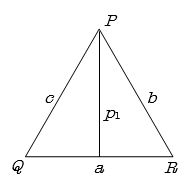
In a triangle $PQR$,if $\sin P, \sin Q, \sin R$ are in $A.P.$,then
A
The altitudes are in $A.P.$
B
The altitudes are in $H.P.$
C
The medians are in $G.P.$
D
The medians are in $A.P.$
Solution
(B) Given that $\sin P, \sin Q, \sin R$ are in $A.P.$
By the Sine Rule,$\frac{a}{\sin P} = \frac{b}{\sin Q} = \frac{c}{\sin R} = 2R$,where $R$ is the circumradius.
This implies $\sin P = \frac{a}{2R}, \sin Q = \frac{b}{2R}, \sin R = \frac{c}{2R}$.
Since $\sin P, \sin Q, \sin R$ are in $A.P.$,it follows that $a, b, c$ are in $A.P.$
Let $p_1, p_2, p_3$ be the altitudes from vertices $P, Q, R$ respectively.
The area of the triangle $\Delta = \frac{1}{2} a p_1 = \frac{1}{2} b p_2 = \frac{1}{2} c p_3$.
Thus,$p_1 = \frac{2\Delta}{a}, p_2 = \frac{2\Delta}{b}, p_3 = \frac{2\Delta}{c}$.
Since $a, b, c$ are in $A.P.$,their reciprocals $\frac{1}{a}, \frac{1}{b}, \frac{1}{c}$ are in $H.P.$
Multiplying by $2\Delta$,we get $\frac{2\Delta}{a}, \frac{2\Delta}{b}, \frac{2\Delta}{c}$ are in $H.P.$
Therefore,$p_1, p_2, p_3$ are in $H.P.$
By the Sine Rule,$\frac{a}{\sin P} = \frac{b}{\sin Q} = \frac{c}{\sin R} = 2R$,where $R$ is the circumradius.
This implies $\sin P = \frac{a}{2R}, \sin Q = \frac{b}{2R}, \sin R = \frac{c}{2R}$.
Since $\sin P, \sin Q, \sin R$ are in $A.P.$,it follows that $a, b, c$ are in $A.P.$
Let $p_1, p_2, p_3$ be the altitudes from vertices $P, Q, R$ respectively.
The area of the triangle $\Delta = \frac{1}{2} a p_1 = \frac{1}{2} b p_2 = \frac{1}{2} c p_3$.
Thus,$p_1 = \frac{2\Delta}{a}, p_2 = \frac{2\Delta}{b}, p_3 = \frac{2\Delta}{c}$.
Since $a, b, c$ are in $A.P.$,their reciprocals $\frac{1}{a}, \frac{1}{b}, \frac{1}{c}$ are in $H.P.$
Multiplying by $2\Delta$,we get $\frac{2\Delta}{a}, \frac{2\Delta}{b}, \frac{2\Delta}{c}$ are in $H.P.$
Therefore,$p_1, p_2, p_3$ are in $H.P.$
0 likesView Solution
8
MathematicsEasyMCQIIT JEE · 1998
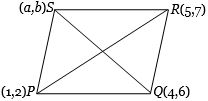
If $P(1, 2), Q(4, 6), R(5, 7)$ and $S(a, b)$ are the vertices of a parallelogram $PQRS$,then:
A
$a = 2, b = 4$
B
$a = 3, b = 4$
C
$a = 2, b = 3$
D
$a = 3, b = 5$
Solution
(C) In a parallelogram,the diagonals bisect each other at their midpoint.
Let the midpoint of diagonal $PR$ be $M_1$ and the midpoint of diagonal $QS$ be $M_2$.
Since $M_1 = M_2$,we have:
Midpoint of $PR = (\frac{1+5}{2}, \frac{2+7}{2}) = (3, 4.5)$
Midpoint of $QS = (\frac{4+a}{2}, \frac{6+b}{2})$
Equating the coordinates:
$\frac{4+a}{2} = 3$ $\Rightarrow 4+a = 6$ $\Rightarrow a = 2$
$\frac{6+b}{2} = 4.5$ $\Rightarrow 6+b = 9$ $\Rightarrow b = 3$
Thus,$a = 2$ and $b = 3$.
Let the midpoint of diagonal $PR$ be $M_1$ and the midpoint of diagonal $QS$ be $M_2$.
Since $M_1 = M_2$,we have:
Midpoint of $PR = (\frac{1+5}{2}, \frac{2+7}{2}) = (3, 4.5)$
Midpoint of $QS = (\frac{4+a}{2}, \frac{6+b}{2})$
Equating the coordinates:
$\frac{4+a}{2} = 3$ $\Rightarrow 4+a = 6$ $\Rightarrow a = 2$
$\frac{6+b}{2} = 4.5$ $\Rightarrow 6+b = 9$ $\Rightarrow b = 3$
Thus,$a = 2$ and $b = 3$.
0 likesView Solution
9
MathematicsEasyMCQIIT JEE · 1998
If the vertices $P, Q, R$ of a triangle $PQR$ are rational points,which of the following points of the triangle $PQR$ is (are) always a rational point $(s)$? ($A$ rational point is a point both of whose coordinates are rational numbers.)
A
Centroid
B
Circumcentre
C
Incentre
D
All of the above
Solution
(A) Let the vertices be $P(x_1, y_1), Q(x_2, y_2),$ and $R(x_3, y_3),$ where $x_i, y_i \in \mathbb{Q}$.
$1$. The Centroid is given by $\left( \frac{x_1+x_2+x_3}{3}, \frac{y_1+y_2+y_3}{3} \right)$. Since the sum and quotient of rational numbers are rational,the centroid is always a rational point.
$2$. The Circumcentre $(x, y)$ satisfies the equations $(x-x_1)^2 + (y-y_1)^2 = (x-x_2)^2 + (y-y_2)^2$ and $(x-x_2)^2 + (y-y_2)^2 = (x-x_3)^2 + (y-y_3)^2$. These simplify to linear equations in $x$ and $y$ with rational coefficients. Thus,the circumcentre is always a rational point.
$3$. The Incentre is given by $\left( \frac{ax_1+bx_2+cx_3}{a+b+c}, \frac{ay_1+by_2+cy_3}{a+b+c} \right)$,where $a, b, c$ are side lengths. Since side lengths involve square roots (e.g.,$a = \sqrt{(x_2-x_3)^2 + (y_2-y_3)^2}$),they are generally irrational. Thus,the incentre is not necessarily a rational point.
Therefore,both the Centroid and Circumcentre are always rational points. Given the options,the question implies identifying which of the listed points are rational. Since the Centroid and Circumcentre are rational,and the Incentre is not,the most appropriate choice is the one containing the rational points.
$1$. The Centroid is given by $\left( \frac{x_1+x_2+x_3}{3}, \frac{y_1+y_2+y_3}{3} \right)$. Since the sum and quotient of rational numbers are rational,the centroid is always a rational point.
$2$. The Circumcentre $(x, y)$ satisfies the equations $(x-x_1)^2 + (y-y_1)^2 = (x-x_2)^2 + (y-y_2)^2$ and $(x-x_2)^2 + (y-y_2)^2 = (x-x_3)^2 + (y-y_3)^2$. These simplify to linear equations in $x$ and $y$ with rational coefficients. Thus,the circumcentre is always a rational point.
$3$. The Incentre is given by $\left( \frac{ax_1+bx_2+cx_3}{a+b+c}, \frac{ay_1+by_2+cy_3}{a+b+c} \right)$,where $a, b, c$ are side lengths. Since side lengths involve square roots (e.g.,$a = \sqrt{(x_2-x_3)^2 + (y_2-y_3)^2}$),they are generally irrational. Thus,the incentre is not necessarily a rational point.
Therefore,both the Centroid and Circumcentre are always rational points. Given the options,the question implies identifying which of the listed points are rational. Since the Centroid and Circumcentre are rational,and the Incentre is not,the most appropriate choice is the one containing the rational points.
0 likesView Solution
10
MathematicsMediumMCQIIT JEE · 1998
The diagonals of a parallelogram $PQRS$ are along the lines $x + 3y = 4$ and $6x - 2y = 7$. Then $PQRS$ must be a
A
Rectangle
B
Square
C
Cyclic quadrilateral
D
Rhombus
Solution
(D) Let the equations of the diagonals be $L_1: x + 3y = 4$ and $L_2: 6x - 2y = 7$.
The slope of $L_1$ is $m_1 = -1/3$.
The slope of $L_2$ is $m_2 = -6/(-2) = 3$.
Since $m_1 \times m_2 = (-1/3) \times 3 = -1$,the diagonals are perpendicular to each other.
$A$ parallelogram whose diagonals are perpendicular is a rhombus.
The slope of $L_1$ is $m_1 = -1/3$.
The slope of $L_2$ is $m_2 = -6/(-2) = 3$.
Since $m_1 \times m_2 = (-1/3) \times 3 = -1$,the diagonals are perpendicular to each other.
$A$ parallelogram whose diagonals are perpendicular is a rhombus.
0 likesView Solution
11
MathematicsDifficultMCQIIT JEE · 1998
The number of common tangents to the circles $x^2 + y^2 = 4$ and $x^2 + y^2 - 6x - 8y = 24$ is
A
$0$
B
$1$
C
$3$
D
$4$
Solution
(B) Given circles are $S_1 \equiv x^2 + y^2 = 2^2$ and $S_2 \equiv x^2 + y^2 - 6x - 8y - 24 = 0$.
For $S_2$,the centre is $(3, 4)$ and radius $r_2 = \sqrt{3^2 + 4^2 - (-24)} = \sqrt{9 + 16 + 24} = \sqrt{49} = 7$.
For $S_1$,the centre is $C_1 = (0, 0)$ and radius $r_1 = 2$.
The distance between the centres $C_1(0, 0)$ and $C_2(3, 4)$ is $d = \sqrt{(3-0)^2 + (4-0)^2} = \sqrt{9 + 16} = 5$.
Since $d = |r_2 - r_1| = |7 - 2| = 5$,the two circles touch each other internally.
When two circles touch internally,there is exactly $1$ common tangent.
For $S_2$,the centre is $(3, 4)$ and radius $r_2 = \sqrt{3^2 + 4^2 - (-24)} = \sqrt{9 + 16 + 24} = \sqrt{49} = 7$.
For $S_1$,the centre is $C_1 = (0, 0)$ and radius $r_1 = 2$.
The distance between the centres $C_1(0, 0)$ and $C_2(3, 4)$ is $d = \sqrt{(3-0)^2 + (4-0)^2} = \sqrt{9 + 16} = 5$.
Since $d = |r_2 - r_1| = |7 - 2| = 5$,the two circles touch each other internally.
When two circles touch internally,there is exactly $1$ common tangent.
0 likesView Solution
12
MathematicsEasyMCQIIT JEE · 1998
If $P \equiv (x, y)$,$F_1 \equiv (3, 0)$,$F_2 \equiv (-3, 0)$ and $16x^2 + 25y^2 = 400$,then $PF_1 + PF_2$ equals
A
$8$
B
$6$
C
$10$
D
$12$
Solution
(C) The given equation is $16x^2 + 25y^2 = 400$. Dividing by $400$,we get $\frac{x^2}{25} + \frac{y^2}{16} = 1$,which is an ellipse with $a^2 = 25$ and $b^2 = 16$.
Here,$a = 5$ and $b = 4$. The eccentricity $e$ is given by $e = \sqrt{1 - \frac{b^2}{a^2}} = \sqrt{1 - \frac{16}{25}} = \sqrt{\frac{9}{25}} = \frac{3}{5}$.
The foci are $(\pm ae, 0) = (\pm 5 \times \frac{3}{5}, 0) = (\pm 3, 0)$,which match $F_1$ and $F_2$.
By the definition of an ellipse,the sum of the distances from any point $P$ on the ellipse to the two foci is equal to the length of the major axis,which is $2a$.
Thus,$PF_1 + PF_2 = 2a = 2 \times 5 = 10$.
Here,$a = 5$ and $b = 4$. The eccentricity $e$ is given by $e = \sqrt{1 - \frac{b^2}{a^2}} = \sqrt{1 - \frac{16}{25}} = \sqrt{\frac{9}{25}} = \frac{3}{5}$.
The foci are $(\pm ae, 0) = (\pm 5 \times \frac{3}{5}, 0) = (\pm 3, 0)$,which match $F_1$ and $F_2$.
By the definition of an ellipse,the sum of the distances from any point $P$ on the ellipse to the two foci is equal to the length of the major axis,which is $2a$.
Thus,$PF_1 + PF_2 = 2a = 2 \times 5 = 10$.
0 likesView Solution
13
MathematicsEasyMCQIIT JEE · 1998
$A$ fair coin is tossed repeatedly. If a tail appears on the first four tosses,then the probability of a head appearing on the fifth toss equals:
A
$\frac{1}{2}$
B
$\frac{1}{32}$
C
$\frac{31}{32}$
D
$\frac{1}{5}$
Solution
(A) The outcome of each coin toss is an independent event.
The appearance of a head on the $5^{th}$ toss does not depend on the outcomes of the first four tosses.
Therefore,the probability of getting a head on the $5^{th}$ toss is $P(\text{Head}) = \frac{1}{2}$.
The appearance of a head on the $5^{th}$ toss does not depend on the outcomes of the first four tosses.
Therefore,the probability of getting a head on the $5^{th}$ toss is $P(\text{Head}) = \frac{1}{2}$.
0 likesView Solution
14
MathematicsMediumMCQIIT JEE · 1998
There are four machines and it is known that exactly two of them are faulty. They are tested,one by one,in a random order until both the faulty machines are identified. Then the probability that only two tests are needed is
A
$\frac{1}{3}$
B
$\frac{1}{6}$
C
$\frac{1}{2}$
D
$\frac{1}{4}$
Solution
(B) Let the four machines be $M_1, M_2, F_1, F_2$,where $F$ denotes a faulty machine and $M$ denotes a working machine.
We need to find the probability that both faulty machines are identified in exactly two tests.
This means the first test must result in a faulty machine,and the second test must also result in a faulty machine.
The total number of ways to choose $2$ machines out of $4$ for the first two tests is $^4P_2 = 4 \times 3 = 12$.
The number of ways to choose $2$ faulty machines out of $2$ for the first two tests is $^2P_2 = 2 \times 1 = 2$.
Therefore,the required probability is $\frac{2}{12} = \frac{1}{6}$.
Alternatively,the probability that the first machine tested is faulty is $\frac{2}{4}$.
Given that the first machine was faulty,the probability that the second machine tested is also faulty is $\frac{1}{3}$.
Thus,the required probability is $\frac{2}{4} \times \frac{1}{3} = \frac{1}{6}$.
We need to find the probability that both faulty machines are identified in exactly two tests.
This means the first test must result in a faulty machine,and the second test must also result in a faulty machine.
The total number of ways to choose $2$ machines out of $4$ for the first two tests is $^4P_2 = 4 \times 3 = 12$.
The number of ways to choose $2$ faulty machines out of $2$ for the first two tests is $^2P_2 = 2 \times 1 = 2$.
Therefore,the required probability is $\frac{2}{12} = \frac{1}{6}$.
Alternatively,the probability that the first machine tested is faulty is $\frac{2}{4}$.
Given that the first machine was faulty,the probability that the second machine tested is also faulty is $\frac{1}{3}$.
Thus,the required probability is $\frac{2}{4} \times \frac{1}{3} = \frac{1}{6}$.
0 likesView Solution
15
MathematicsMediumMCQIIT JEE · 1998
Seven white balls and three black balls are randomly placed in a row. The probability that no two black balls are placed adjacently equals
A
$\frac{1}{2}$
B
$\frac{7}{15}$
C
$\frac{2}{15}$
D
$\frac{1}{3}$
Solution
(B) The total number of ways to arrange $7$ white balls and $3$ black balls in a row is given by the combination formula $\binom{10}{3} = \frac{10!}{7!3!} = \frac{10 \times 9 \times 8}{3 \times 2 \times 1} = 120$.
To ensure no two black balls are adjacent,we first arrange the $7$ white balls in a row. This creates $8$ possible spaces (gaps) where the $3$ black balls can be placed (one before the first ball,one after the last ball,and $6$ between the balls).
The number of ways to choose $3$ spaces out of $8$ is $\binom{8}{3} = \frac{8 \times 7 \times 6}{3 \times 2 \times 1} = 56$.
Therefore,the required probability is $\frac{56}{120} = \frac{7}{15}$.
To ensure no two black balls are adjacent,we first arrange the $7$ white balls in a row. This creates $8$ possible spaces (gaps) where the $3$ black balls can be placed (one before the first ball,one after the last ball,and $6$ between the balls).
The number of ways to choose $3$ spaces out of $8$ is $\binom{8}{3} = \frac{8 \times 7 \times 6}{3 \times 2 \times 1} = 56$.
Therefore,the required probability is $\frac{56}{120} = \frac{7}{15}$.
0 likesView Solution
16
MathematicsDifficultMCQIIT JEE · 1998
If $a_n = \sum_{r=0}^n \frac{1}{^nC_r}$,then $\sum_{r=0}^n \frac{r}{^nC_r}$ equals
A
$(n-1)a_n$
B
$na_n$
C
$\frac{1}{2}na_n$
D
None of these
Solution
(C) Given $a_n = \sum_{r=0}^n \frac{1}{^nC_r}$.
Let $b_n = \sum_{r=0}^n \frac{r}{^nC_r}$.
Using the property $^nC_r = ^nC_{n-r}$,we can write:
$b_n = \frac{0}{^nC_0} + \frac{1}{^nC_1} + \frac{2}{^nC_2} + \dots + \frac{n}{^nC_n}$.
Also,$b_n = \frac{n}{^nC_n} + \frac{n-1}{^nC_{n-1}} + \dots + \frac{0}{^nC_0} = \sum_{r=0}^n \frac{n-r}{^nC_r}$.
Adding both expressions for $b_n$:
$2b_n = \sum_{r=0}^n \frac{r + (n-r)}{^nC_r} = \sum_{r=0}^n \frac{n}{^nC_r} = n \sum_{r=0}^n \frac{1}{^nC_r}$.
Since $a_n = \sum_{r=0}^n \frac{1}{^nC_r}$,we have $2b_n = na_n$.
Therefore,$b_n = \frac{1}{2}na_n$.
Let $b_n = \sum_{r=0}^n \frac{r}{^nC_r}$.
Using the property $^nC_r = ^nC_{n-r}$,we can write:
$b_n = \frac{0}{^nC_0} + \frac{1}{^nC_1} + \frac{2}{^nC_2} + \dots + \frac{n}{^nC_n}$.
Also,$b_n = \frac{n}{^nC_n} + \frac{n-1}{^nC_{n-1}} + \dots + \frac{0}{^nC_0} = \sum_{r=0}^n \frac{n-r}{^nC_r}$.
Adding both expressions for $b_n$:
$2b_n = \sum_{r=0}^n \frac{r + (n-r)}{^nC_r} = \sum_{r=0}^n \frac{n}{^nC_r} = n \sum_{r=0}^n \frac{1}{^nC_r}$.
Since $a_n = \sum_{r=0}^n \frac{1}{^nC_r}$,we have $2b_n = na_n$.
Therefore,$b_n = \frac{1}{2}na_n$.
0 likesView Solution
17
MathematicsDifficultMCQIIT JEE · 1998
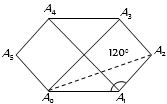
Let $A_0 A_1 A_2 A_3 A_4 A_5$ be a regular hexagon inscribed in a circle of unit radius. Then the product of the lengths of the line segments $A_0 A_1$,$A_0 A_2$,and $A_0 A_4$ is
A
$\frac{3}{4}$
B
$3\sqrt{3}$
C
$3$
D
$\frac{3\sqrt{3}}{2}$
Solution
(C) In a regular hexagon inscribed in a circle of unit radius,the side length is equal to the radius,so $A_0 A_1 = 1$.
Since the interior angle of a regular hexagon is $120^\circ$,in $\triangle A_0 A_1 A_2$,by the Law of Cosines:
$A_0 A_2^2 = A_0 A_1^2 + A_1 A_2^2 - 2(A_0 A_1)(A_1 A_2) \cos(120^\circ)$
$A_0 A_2^2 = 1^2 + 1^2 - 2(1)(1)(-\frac{1}{2}) = 1 + 1 + 1 = 3$
Thus,$A_0 A_2 = \sqrt{3}$.
By symmetry,$A_0 A_4 = A_0 A_2 = \sqrt{3}$.
The product of the lengths is $A_0 A_1 \times A_0 A_2 \times A_0 A_4 = 1 \times \sqrt{3} \times \sqrt{3} = 3$.
Since the interior angle of a regular hexagon is $120^\circ$,in $\triangle A_0 A_1 A_2$,by the Law of Cosines:
$A_0 A_2^2 = A_0 A_1^2 + A_1 A_2^2 - 2(A_0 A_1)(A_1 A_2) \cos(120^\circ)$
$A_0 A_2^2 = 1^2 + 1^2 - 2(1)(1)(-\frac{1}{2}) = 1 + 1 + 1 = 3$
Thus,$A_0 A_2 = \sqrt{3}$.
By symmetry,$A_0 A_4 = A_0 A_2 = \sqrt{3}$.
The product of the lengths is $A_0 A_1 \times A_0 A_2 \times A_0 A_4 = 1 \times \sqrt{3} \times \sqrt{3} = 3$.
0 likesView Solution
18
MathematicsMediumMCQIIT JEE · 1998
The number of values of $c$ such that the straight line $y = 4x + c$ touches the curve $\frac{x^2}{4} + y^2 = 1$ is
A
$0$
B
$1$
C
$2$
D
Infinite
Solution
(C) The line $y = 4x + c$ touches the ellipse $\frac{x^2}{4} + y^2 = 1$.
Substituting $y = 4x + c$ into the equation of the ellipse:
$\frac{x^2}{4} + (4x + c)^2 = 1$
$x^2 + 4(16x^2 + 8cx + c^2) = 4$
$x^2 + 64x^2 + 32cx + 4c^2 - 4 = 0$
$65x^2 + 32cx + (4c^2 - 4) = 0$
For the line to touch the curve,the discriminant $\Delta$ must be $0$:
$\Delta = (32c)^2 - 4(65)(4c^2 - 4) = 0$
$1024c^2 - 16(65)(c^2 - 1) = 0$
Divide by $16$:
$64c^2 - 65(c^2 - 1) = 0$
$64c^2 - 65c^2 + 65 = 0$
$-c^2 + 65 = 0$
$c^2 = 65$
$c = \pm \sqrt{65}$
Thus,there are $2$ possible values for $c$.
Substituting $y = 4x + c$ into the equation of the ellipse:
$\frac{x^2}{4} + (4x + c)^2 = 1$
$x^2 + 4(16x^2 + 8cx + c^2) = 4$
$x^2 + 64x^2 + 32cx + 4c^2 - 4 = 0$
$65x^2 + 32cx + (4c^2 - 4) = 0$
For the line to touch the curve,the discriminant $\Delta$ must be $0$:
$\Delta = (32c)^2 - 4(65)(4c^2 - 4) = 0$
$1024c^2 - 16(65)(c^2 - 1) = 0$
Divide by $16$:
$64c^2 - 65(c^2 - 1) = 0$
$64c^2 - 65c^2 + 65 = 0$
$-c^2 + 65 = 0$
$c^2 = 65$
$c = \pm \sqrt{65}$
Thus,there are $2$ possible values for $c$.
0 likesView Solution
19
MathematicsDifficultMCQIIT JEE · 1998
If the circle $x^2 + y^2 = a^2$ intersects the hyperbola $xy = c^2$ in four points $P(x_1, y_1), Q(x_2, y_2), R(x_3, y_3), S(x_4, y_4)$,then:
A
$x_1 + x_2 + x_3 + x_4 = 0$
B
$y_1 + y_2 + y_3 + y_4 = 0$
C
$x_1 x_2 x_3 x_4 = c^4$
D
All of the above
Solution
(D) Given the equations $x^2 + y^2 = a^2$ and $xy = c^2$.
Substituting $y = \frac{c^2}{x}$ into the circle equation:
$x^2 + \frac{c^4}{x^2} = a^2$
$x^4 - a^2 x^2 + c^4 = 0$
This is a biquadratic equation in $x$. The roots are $x_1, x_2, x_3, x_4$.
From the properties of roots,the sum of roots $x_1 + x_2 + x_3 + x_4 = 0$ (coefficient of $x^3$ is $0$) and the product of roots $x_1 x_2 x_3 x_4 = c^4$.
Since the equations are symmetric with respect to $x$ and $y$,by symmetry,$y_1 + y_2 + y_3 + y_4 = 0$ and $y_1 y_2 y_3 y_4 = c^4$.
Thus,all the given options are correct.
Substituting $y = \frac{c^2}{x}$ into the circle equation:
$x^2 + \frac{c^4}{x^2} = a^2$
$x^4 - a^2 x^2 + c^4 = 0$
This is a biquadratic equation in $x$. The roots are $x_1, x_2, x_3, x_4$.
From the properties of roots,the sum of roots $x_1 + x_2 + x_3 + x_4 = 0$ (coefficient of $x^3$ is $0$) and the product of roots $x_1 x_2 x_3 x_4 = c^4$.
Since the equations are symmetric with respect to $x$ and $y$,by symmetry,$y_1 + y_2 + y_3 + y_4 = 0$ and $y_1 y_2 y_3 y_4 = c^4$.
Thus,all the given options are correct.
0 likesView Solution
20
MathematicsMediumMCQIIT JEE · 1998
$\mathop {\lim }\limits_{x \to 1} \frac{{\sqrt {1 - \cos 2(x - 1)} }}{{x - 1}}$
A
Exists and it equals $\sqrt{2}$
B
Exists and it equals $-\sqrt{2}$
C
Does not exist because $x - 1 \to 0$
D
Does not exist because left hand limit is not equal to right hand limit
Solution
(D) Let $f(x) = \frac{\sqrt{1 - \cos 2(x - 1)}}{x - 1}$.
We know that $1 - \cos 2\theta = 2\sin^2 \theta$,so $1 - \cos 2(x - 1) = 2\sin^2(x - 1)$.
Thus,$f(x) = \frac{\sqrt{2\sin^2(x - 1)}}{x - 1} = \frac{\sqrt{2}|\sin(x - 1)|}{x - 1}$.
Right Hand Limit $(RHL)$: $\mathop {\lim }\limits_{x \to 1^+} f(x) = \mathop {\lim }\limits_{h \to 0^+} \frac{\sqrt{2}|\sin h|}{h} = \mathop {\lim }\limits_{h \to 0^+} \sqrt{2} \frac{\sin h}{h} = \sqrt{2}$.
Left Hand Limit $(LHL)$: $\mathop {\lim }\limits_{x \to 1^-} f(x) = \mathop {\lim }\limits_{h \to 0^+} \frac{\sqrt{2}|\sin(-h)|}{-h} = \mathop {\lim }\limits_{h \to 0^+} \frac{\sqrt{2}\sin h}{-h} = -\sqrt{2}$.
Since $\text{RHL} \neq \text{LHL}$,the limit does not exist.
We know that $1 - \cos 2\theta = 2\sin^2 \theta$,so $1 - \cos 2(x - 1) = 2\sin^2(x - 1)$.
Thus,$f(x) = \frac{\sqrt{2\sin^2(x - 1)}}{x - 1} = \frac{\sqrt{2}|\sin(x - 1)|}{x - 1}$.
Right Hand Limit $(RHL)$: $\mathop {\lim }\limits_{x \to 1^+} f(x) = \mathop {\lim }\limits_{h \to 0^+} \frac{\sqrt{2}|\sin h|}{h} = \mathop {\lim }\limits_{h \to 0^+} \sqrt{2} \frac{\sin h}{h} = \sqrt{2}$.
Left Hand Limit $(LHL)$: $\mathop {\lim }\limits_{x \to 1^-} f(x) = \mathop {\lim }\limits_{h \to 0^+} \frac{\sqrt{2}|\sin(-h)|}{-h} = \mathop {\lim }\limits_{h \to 0^+} \frac{\sqrt{2}\sin h}{-h} = -\sqrt{2}$.
Since $\text{RHL} \neq \text{LHL}$,the limit does not exist.
0 likesView Solution
21
MathematicsDifficultMCQIIT JEE · 1998
If from each of the three boxes containing $3$ white and $1$ black,$2$ white and $2$ black,and $1$ white and $3$ black balls,one ball is drawn at random,then the probability that $2$ white and $1$ black ball will be drawn is
A
$\frac{13}{32}$
B
$\frac{1}{4}$
C
$\frac{1}{32}$
D
$\frac{3}{16}$
Solution
(A) Let $P(W_i)$ and $P(B_i)$ be the probabilities of drawing one white and one black ball from the $i$-th box where $i = 1, 2, 3$ respectively.
$P(W_1) = \frac{3}{4}, P(B_1) = \frac{1}{4}$
$P(W_2) = \frac{2}{4} = \frac{1}{2}, P(B_2) = \frac{2}{4} = \frac{1}{2}$
$P(W_3) = \frac{1}{4}, P(B_3) = \frac{3}{4}$
Two white and one black ball may be drawn from $3$ boxes in the following three ways:
Required probability $= P(W_1)P(W_2)P(B_3) + P(W_1)P(B_2)P(W_3) + P(B_1)P(W_2)P(W_3)$
$= (\frac{3}{4} \times \frac{2}{4} \times \frac{3}{4}) + (\frac{3}{4} \times \frac{2}{4} \times \frac{1}{4}) + (\frac{1}{4} \times \frac{2}{4} \times \frac{1}{4})$
$= \frac{18}{64} + \frac{6}{64} + \frac{2}{64} = \frac{26}{64} = \frac{13}{32}$.
$P(W_1) = \frac{3}{4}, P(B_1) = \frac{1}{4}$
$P(W_2) = \frac{2}{4} = \frac{1}{2}, P(B_2) = \frac{2}{4} = \frac{1}{2}$
$P(W_3) = \frac{1}{4}, P(B_3) = \frac{3}{4}$
Two white and one black ball may be drawn from $3$ boxes in the following three ways:
| $Way 1$ | $W, W, B$ |
| $Way 2$ | $W, B, W$ |
| $Way 3$ | $B, W, W$ |
Required probability $= P(W_1)P(W_2)P(B_3) + P(W_1)P(B_2)P(W_3) + P(B_1)P(W_2)P(W_3)$
$= (\frac{3}{4} \times \frac{2}{4} \times \frac{3}{4}) + (\frac{3}{4} \times \frac{2}{4} \times \frac{1}{4}) + (\frac{1}{4} \times \frac{2}{4} \times \frac{1}{4})$
$= \frac{18}{64} + \frac{6}{64} + \frac{2}{64} = \frac{26}{64} = \frac{13}{32}$.
0 likesView Solution
22
MathematicsMediumMCQIIT JEE · 1998
In a college of $300$ students,every student reads $5$ newspapers and every newspaper is read by $60$ students. The number of newspapers is
A
At least $30$
B
At most $20$
C
Exactly $25$
D
None of the above
Solution
(C) Let the number of newspapers be $n$.
Since every student reads $5$ newspapers,the total number of readings is $300 \times 5 = 1500$.
Since every newspaper is read by $60$ students,the total number of readings is also $60 \times n$.
Equating the two,we get $60n = 1500$.
Therefore,$n = \frac{1500}{60} = 25$.
Since every student reads $5$ newspapers,the total number of readings is $300 \times 5 = 1500$.
Since every newspaper is read by $60$ students,the total number of readings is also $60 \times n$.
Equating the two,we get $60n = 1500$.
Therefore,$n = \frac{1500}{60} = 25$.
0 likesView Solution
23
MathematicsDifficultMCQIIT JEE · 1998
In a college of $300$ students,every student reads $5$ newspapers and every newspaper is read by $60$ students. The number of newspapers is:
A
At least $30$
B
At most $20$
C
$25$
D
None of these
Solution
(C) Let $n$ be the number of newspapers.
Total number of readings by students = $300 \times 5 = 1500$.
Total number of readings provided by newspapers = $n \times 60$.
Since both represent the total number of readings,we have:
$60n = 1500$
$n = \frac{1500}{60}$
$n = 25$.
Thus,the number of newspapers is $25$.
Total number of readings by students = $300 \times 5 = 1500$.
Total number of readings provided by newspapers = $n \times 60$.
Since both represent the total number of readings,we have:
$60n = 1500$
$n = \frac{1500}{60}$
$n = 25$.
Thus,the number of newspapers is $25$.
0 likesView Solution
24
MathematicsMediumMCQIIT JEE · 1998
The number of values of $x$ in the interval $[0, 5\pi]$ satisfying the equation $3 \sin^2 x - 7 \sin x + 2 = 0$ is
A
$0$
B
$5$
C
$4$
D
$6$
Solution
(B) Given the equation $3 \sin^2 x - 7 \sin x + 2 = 0$.
Let $t = \sin x$. Then the equation becomes $3t^2 - 7t + 2 = 0$.
Factoring the quadratic: $3t^2 - 6t - t + 2 = 0 \implies 3t(t - 2) - 1(t - 2) = 0 \implies (3t - 1)(t - 2) = 0$.
So,$t = \frac{1}{3}$ or $t = 2$.
Since $\sin x$ cannot be $2$,we have $\sin x = \frac{1}{3}$.
In the interval $[0, 2\pi]$,there are $2$ solutions for $\sin x = \frac{1}{3}$ (one in the first quadrant and one in the second quadrant).
In the interval $[2\pi, 4\pi]$,there are another $2$ solutions.
In the interval $[4\pi, 5\pi]$,there is $1$ solution (in the first quadrant relative to $4\pi$).
Total number of solutions = $2 + 2 + 1 = 5$.
Let $t = \sin x$. Then the equation becomes $3t^2 - 7t + 2 = 0$.
Factoring the quadratic: $3t^2 - 6t - t + 2 = 0 \implies 3t(t - 2) - 1(t - 2) = 0 \implies (3t - 1)(t - 2) = 0$.
So,$t = \frac{1}{3}$ or $t = 2$.
Since $\sin x$ cannot be $2$,we have $\sin x = \frac{1}{3}$.
In the interval $[0, 2\pi]$,there are $2$ solutions for $\sin x = \frac{1}{3}$ (one in the first quadrant and one in the second quadrant).
In the interval $[2\pi, 4\pi]$,there are another $2$ solutions.
In the interval $[4\pi, 5\pi]$,there is $1$ solution (in the first quadrant relative to $4\pi$).
Total number of solutions = $2 + 2 + 1 = 5$.
0 likesView Solution
25
MathematicsEasyMCQIIT JEE · 1998
Let $\left| {\begin{array}{*{20}{c}}{6i}&{ - 3i}&1\\4&{3i}&{ - 1}\\{20}&3&i\end{array}} \right| = x + iy$,then
A
$x = 3, y = 1$
B
$x = 0, y = 0$
C
$x = 0, y = 3$
D
$x = 1, y = 3$
Solution
(B) Given the determinant: $\Delta = \left| {\begin{array}{*{20}{c}}{6i}&{ - 3i}&1\\4&{3i}&{ - 1}\\{20}&3&i\end{array}} \right| = x + iy$
Expanding along the first row:
$\Delta = 6i((3i)(i) - (3)(-1)) - (-3i)((4)(i) - (20)(-1)) + 1((4)(3) - (20)(3i))$
$\Delta = 6i(3i^2 + 3) + 3i(4i + 20) + (12 - 60i)$
Since $i^2 = -1$,we have $3i^2 + 3 = 3(-1) + 3 = 0$.
$\Delta = 6i(0) + 12i^2 + 60i + 12 - 60i$
$\Delta = 0 + 12(-1) + 60i + 12 - 60i$
$\Delta = -12 + 12 + 60i - 60i = 0$
Thus,$x + iy = 0 + 0i$,which implies $x = 0$ and $y = 0$.
Expanding along the first row:
$\Delta = 6i((3i)(i) - (3)(-1)) - (-3i)((4)(i) - (20)(-1)) + 1((4)(3) - (20)(3i))$
$\Delta = 6i(3i^2 + 3) + 3i(4i + 20) + (12 - 60i)$
Since $i^2 = -1$,we have $3i^2 + 3 = 3(-1) + 3 = 0$.
$\Delta = 6i(0) + 12i^2 + 60i + 12 - 60i$
$\Delta = 0 + 12(-1) + 60i + 12 - 60i$
$\Delta = -12 + 12 + 60i - 60i = 0$
Thus,$x + iy = 0 + 0i$,which implies $x = 0$ and $y = 0$.
0 likesView Solution
26
MathematicsEasyMCQIIT JEE · 1998
For three vectors $u, v, w$,which of the following expressions is not equal to any of the remaining three?
A
$u \cdot (v \times w)$
B
$(v \times w) \cdot u$
C
$v \cdot (u \times w)$
D
$(u \times v) \cdot w$
Solution
(C) The scalar triple product of three vectors $u, v, w$ is denoted by $[u, v, w] = u \cdot (v \times w)$.
By the cyclic property of the scalar triple product,$[u, v, w] = [v, w, u] = [w, u, v]$.
Option $(a)$ is $u \cdot (v \times w) = [u, v, w]$.
Option $(b)$ is $(v \times w) \cdot u = [v, w, u] = [u, v, w]$.
Option $(d)$ is $(u \times v) \cdot w = [u, v, w]$.
Option $(c)$ is $v \cdot (u \times w) = [v, u, w] = -[u, v, w]$.
Since $[u, v, w] \neq -[u, v, w]$ (in general),option $(c)$ is not equal to the others.
By the cyclic property of the scalar triple product,$[u, v, w] = [v, w, u] = [w, u, v]$.
Option $(a)$ is $u \cdot (v \times w) = [u, v, w]$.
Option $(b)$ is $(v \times w) \cdot u = [v, w, u] = [u, v, w]$.
Option $(d)$ is $(u \times v) \cdot w = [u, v, w]$.
Option $(c)$ is $v \cdot (u \times w) = [v, u, w] = -[u, v, w]$.
Since $[u, v, w] \neq -[u, v, w]$ (in general),option $(c)$ is not equal to the others.
0 likesView Solution
27
MathematicsEasyMCQIIT JEE · 1998
Which of the following expressions is meaningful?
A
$u \cdot (v \times w)$
B
$(u \cdot v) \cdot w$
C
$(u \cdot v) \times w$
D
None of these
Solution
(A) Let $u$,$v$,and $w$ be vectors.
$1$. Consider $u \cdot (v \times w)$: The expression $(v \times w)$ results in a vector. The dot product of a vector $u$ with the resulting vector $(v \times w)$ is defined and results in a scalar. Thus,this expression is meaningful.
$2$. Consider $(u \cdot v) \cdot w$: The expression $(u \cdot v)$ results in a scalar. The dot product of a scalar with a vector $w$ is not defined. Thus,this expression is not meaningful.
$3$. Consider $(u \cdot v) \times w$: The expression $(u \cdot v)$ results in a scalar. The cross product of a scalar with a vector $w$ is not defined. Thus,this expression is not meaningful.
Therefore,only the first expression is meaningful.
$1$. Consider $u \cdot (v \times w)$: The expression $(v \times w)$ results in a vector. The dot product of a vector $u$ with the resulting vector $(v \times w)$ is defined and results in a scalar. Thus,this expression is meaningful.
$2$. Consider $(u \cdot v) \cdot w$: The expression $(u \cdot v)$ results in a scalar. The dot product of a scalar with a vector $w$ is not defined. Thus,this expression is not meaningful.
$3$. Consider $(u \cdot v) \times w$: The expression $(u \cdot v)$ results in a scalar. The cross product of a scalar with a vector $w$ is not defined. Thus,this expression is not meaningful.
Therefore,only the first expression is meaningful.
0 likesView Solution
28
MathematicsEasyMCQIIT JEE · 1998
If $f(x) = 3x - 5$,then ${f^{ - 1}}(x)$ is:
A
Given by $\frac{1}{{3x - 5}}$
B
Given by $\frac{{x + 5}}{3}$
C
Does not exist because $f$ is not one-one
D
Does not exist because $f$ is not onto
Solution
(B) Let $f(x) = y$.
Since $f(x) = 3x - 5$,we have $y = 3x - 5$.
To find the inverse,we solve for $x$ in terms of $y$:
$y + 5 = 3x$
$x = \frac{y + 5}{3}$.
By definition,$x = f^{-1}(y)$,so $f^{-1}(y) = \frac{y + 5}{3}$.
Replacing $y$ with $x$,we get $f^{-1}(x) = \frac{x + 5}{3}$.
Since $f(x) = 3x - 5$ is a linear function,it is both one-one (injective) and onto (surjective),therefore $f$ is invertible.
Since $f(x) = 3x - 5$,we have $y = 3x - 5$.
To find the inverse,we solve for $x$ in terms of $y$:
$y + 5 = 3x$
$x = \frac{y + 5}{3}$.
By definition,$x = f^{-1}(y)$,so $f^{-1}(y) = \frac{y + 5}{3}$.
Replacing $y$ with $x$,we get $f^{-1}(x) = \frac{x + 5}{3}$.
Since $f(x) = 3x - 5$ is a linear function,it is both one-one (injective) and onto (surjective),therefore $f$ is invertible.
0 likesView Solution
29
MathematicsMediumMCQIIT JEE · 1998
Let $h(x) = \min \{ x, x^2 \}$ for every real number $x$. Then:
A
$h$ is continuous for all $x$
B
$h$ is not differentiable at two values of $x$
C
$h'(x) = 1$ for all $x > 1$
D
All of the above
Solution
(D) Given $h(x) = \min \{ x, x^2 \}$.
We compare $x$ and $x^2$:
$x \le x^2 \Rightarrow x^2 - x \ge 0 \Rightarrow x(x - 1) \ge 0$.
This inequality holds for $x \le 0$ or $x \ge 1$.
Thus,$h(x) = \begin{cases} x & x \le 0 \\ x^2 & 0 < x < 1 \\ x & x \ge 1 \end{cases}$.
$h(x)$ is continuous for all $x \in \mathbb{R}$ because the pieces match at $x=0$ $(0=0)$ and $x=1$ $(1=1)$.
$h(x)$ is not differentiable at $x=0$ and $x=1$ because the left and right derivatives do not match at these points.
For $x > 1$,$h(x) = x$,so $h'(x) = 1$.
Therefore,all statements $(a)$,$(b)$,and $(c)$ are correct.
We compare $x$ and $x^2$:
$x \le x^2 \Rightarrow x^2 - x \ge 0 \Rightarrow x(x - 1) \ge 0$.
This inequality holds for $x \le 0$ or $x \ge 1$.
Thus,$h(x) = \begin{cases} x & x \le 0 \\ x^2 & 0 < x < 1 \\ x & x \ge 1 \end{cases}$.
$h(x)$ is continuous for all $x \in \mathbb{R}$ because the pieces match at $x=0$ $(0=0)$ and $x=1$ $(1=1)$.
$h(x)$ is not differentiable at $x=0$ and $x=1$ because the left and right derivatives do not match at these points.
For $x > 1$,$h(x) = x$,so $h'(x) = 1$.
Therefore,all statements $(a)$,$(b)$,and $(c)$ are correct.
0 likesView Solution
30
MathematicsMediumMCQIIT JEE · 1998
If $g(f(x)) = |\sin x|$ and $f(g(x)) = (\sin \sqrt{x})^2$,then
A
$f(x) = \sin^2 x, g(x) = \sqrt{x}$
B
$f(x) = \sin x, g(x) = |x|$
C
$f(x) = x^2, g(x) = \sin \sqrt{x}$
D
$f$ and $g$ cannot be determined
Solution
(A) Given: $g(f(x)) = |\sin x|$ and $f(g(x)) = (\sin \sqrt{x})^2$.
Let us test option $A$: $f(x) = \sin^2 x$ and $g(x) = \sqrt{x}$.
Step $1$: Calculate $g(f(x))$.
$g(f(x)) = g(\sin^2 x) = \sqrt{\sin^2 x} = |\sin x|$. This matches the given condition.
Step $2$: Calculate $f(g(x))$.
$f(g(x)) = f(\sqrt{x}) = (\sin \sqrt{x})^2$. This also matches the given condition.
Therefore,the correct option is $A$.
Let us test option $A$: $f(x) = \sin^2 x$ and $g(x) = \sqrt{x}$.
Step $1$: Calculate $g(f(x))$.
$g(f(x)) = g(\sin^2 x) = \sqrt{\sin^2 x} = |\sin x|$. This matches the given condition.
Step $2$: Calculate $f(g(x))$.
$f(g(x)) = f(\sqrt{x}) = (\sin \sqrt{x})^2$. This also matches the given condition.
Therefore,the correct option is $A$.
0 likesView Solution
31
MathematicsMediumMCQIIT JEE · 1998
If $f(x) = \frac{x^2 - 1}{x^2 + 1}$ for every real number $x$,then the minimum value of $f$ is:
A
Does not exist because $f$ is unbounded
B
Is not attained even though $f$ is bounded
C
Is equal to $1$
D
Is equal to $-1$
Solution
(D) Given $f(x) = \frac{x^2 - 1}{x^2 + 1}$.
We can rewrite the function as $f(x) = \frac{x^2 + 1 - 2}{x^2 + 1} = 1 - \frac{2}{x^2 + 1}$.
Since $x^2 \ge 0$ for all real $x$,we have $x^2 + 1 \ge 1$,which implies $0 < \frac{2}{x^2 + 1} \le 2$.
Subtracting this inequality from $1$,we get $1 - 2 \le 1 - \frac{2}{x^2 + 1} < 1 - 0$.
Thus,$-1 \le f(x) < 1$.
The minimum value is attained when $x^2 = 0$,i.e.,$x = 0$.
$f(0) = \frac{0^2 - 1}{0^2 + 1} = -1$.
Therefore,the minimum value of $f$ is $-1$.
We can rewrite the function as $f(x) = \frac{x^2 + 1 - 2}{x^2 + 1} = 1 - \frac{2}{x^2 + 1}$.
Since $x^2 \ge 0$ for all real $x$,we have $x^2 + 1 \ge 1$,which implies $0 < \frac{2}{x^2 + 1} \le 2$.
Subtracting this inequality from $1$,we get $1 - 2 \le 1 - \frac{2}{x^2 + 1} < 1 - 0$.
Thus,$-1 \le f(x) < 1$.
The minimum value is attained when $x^2 = 0$,i.e.,$x = 0$.
$f(0) = \frac{0^2 - 1}{0^2 + 1} = -1$.
Therefore,the minimum value of $f$ is $-1$.
0 likesView Solution
32
MathematicsMediumMCQIIT JEE · 1998
The number of values of $x$ where the function $f(x) = \cos x + \cos (\sqrt{2} x)$ attains its maximum is
A
$0$
B
$1$
C
$2$
D
Infinite
Solution
(B) Given the function $f(x) = \cos x + \cos (\sqrt{2} x)$.
To find the maxima,we calculate the first derivative: $f'(x) = -\sin x - \sqrt{2} \sin (\sqrt{2} x)$.
Setting $f'(x) = 0$,we get $\sin x + \sqrt{2} \sin (\sqrt{2} x) = 0$.
At $x = 0$,$f'(0) = -\sin(0) - \sqrt{2} \sin(0) = 0$.
Now,check the second derivative: $f''(x) = -\cos x - 2 \cos (\sqrt{2} x)$.
At $x = 0$,$f''(0) = -\cos(0) - 2 \cos(0) = -1 - 2 = -3$.
Since $f''(0) < 0$,the function attains a local maximum at $x = 0$.
Because $\sqrt{2}$ is an irrational number,the function $f(x)$ is not periodic. The values of $\cos x$ and $\cos (\sqrt{2} x)$ can only both be $1$ simultaneously at $x = 0$. For any other $x \neq 0$,the sum $\cos x + \cos (\sqrt{2} x)$ will be strictly less than $2$. Thus,$x = 0$ is the unique point where the maximum value of $2$ is attained.
To find the maxima,we calculate the first derivative: $f'(x) = -\sin x - \sqrt{2} \sin (\sqrt{2} x)$.
Setting $f'(x) = 0$,we get $\sin x + \sqrt{2} \sin (\sqrt{2} x) = 0$.
At $x = 0$,$f'(0) = -\sin(0) - \sqrt{2} \sin(0) = 0$.
Now,check the second derivative: $f''(x) = -\cos x - 2 \cos (\sqrt{2} x)$.
At $x = 0$,$f''(0) = -\cos(0) - 2 \cos(0) = -1 - 2 = -3$.
Since $f''(0) < 0$,the function attains a local maximum at $x = 0$.
Because $\sqrt{2}$ is an irrational number,the function $f(x)$ is not periodic. The values of $\cos x$ and $\cos (\sqrt{2} x)$ can only both be $1$ simultaneously at $x = 0$. For any other $x \neq 0$,the sum $\cos x + \cos (\sqrt{2} x)$ will be strictly less than $2$. Thus,$x = 0$ is the unique point where the maximum value of $2$ is attained.
0 likesView Solution
33
MathematicsDifficultMCQIIT JEE · 1998
Let $h(x) = f(x) - (f(x))^2 + (f(x))^3$ for every real number $x$. Then
A
$h$ is increasing whenever $f$ is increasing
B
$h$ is increasing whenever $f$ is decreasing
C
$h$ is decreasing whenever $f$ is increasing
D
Nothing can be said in general
Solution
(A) Given $h(x) = f(x) - (f(x))^2 + (f(x))^3$.
Differentiating with respect to $x$,we get:
$h'(x) = f'(x) - 2f(x)f'(x) + 3(f(x))^2 f'(x)$
Factoring out $f'(x)$:
$h'(x) = f'(x) [1 - 2f(x) + 3(f(x))^2]$
To analyze the quadratic expression $3(f(x))^2 - 2f(x) + 1$,we complete the square:
$3(f(x))^2 - 2f(x) + 1 = 3 \left( (f(x))^2 - \frac{2}{3}f(x) + \frac{1}{3} \right)$
$= 3 \left( (f(x) - \frac{1}{3})^2 - \frac{1}{9} + \frac{1}{3} \right)$
$= 3 \left( (f(x) - \frac{1}{3})^2 + \frac{2}{9} \right)$
Since $(f(x) - \frac{1}{3})^2 \ge 0$,the expression $(f(x) - \frac{1}{3})^2 + \frac{2}{9}$ is always positive.
Therefore,$h'(x) = 3f'(x) \left( (f(x) - \frac{1}{3})^2 + \frac{2}{9} \right)$.
Since the term in the bracket is always positive,the sign of $h'(x)$ is the same as the sign of $f'(x)$.
Thus,$h$ is increasing whenever $f$ is increasing.
Differentiating with respect to $x$,we get:
$h'(x) = f'(x) - 2f(x)f'(x) + 3(f(x))^2 f'(x)$
Factoring out $f'(x)$:
$h'(x) = f'(x) [1 - 2f(x) + 3(f(x))^2]$
To analyze the quadratic expression $3(f(x))^2 - 2f(x) + 1$,we complete the square:
$3(f(x))^2 - 2f(x) + 1 = 3 \left( (f(x))^2 - \frac{2}{3}f(x) + \frac{1}{3} \right)$
$= 3 \left( (f(x) - \frac{1}{3})^2 - \frac{1}{9} + \frac{1}{3} \right)$
$= 3 \left( (f(x) - \frac{1}{3})^2 + \frac{2}{9} \right)$
Since $(f(x) - \frac{1}{3})^2 \ge 0$,the expression $(f(x) - \frac{1}{3})^2 + \frac{2}{9}$ is always positive.
Therefore,$h'(x) = 3f'(x) \left( (f(x) - \frac{1}{3})^2 + \frac{2}{9} \right)$.
Since the term in the bracket is always positive,the sign of $h'(x)$ is the same as the sign of $f'(x)$.
Thus,$h$ is increasing whenever $f$ is increasing.
0 likesView Solution
34
MathematicsEasyMCQIIT JEE · 1998
$\int_0^{2a} \frac{f(x)}{f(x) + f(2a - x)} \, dx = $
A
$a$
B
$\frac{a}{2}$
C
$2a$
D
$0$
Solution
(A) Let $I = \int_0^{2a} \frac{f(x)}{f(x) + f(2a - x)} \, dx$ ..... $(i)$
Using the property $\int_0^a f(x) \, dx = \int_0^a f(a - x) \, dx$,we have:
$I = \int_0^{2a} \frac{f(2a - x)}{f(2a - x) + f(2a - (2a - x))} \, dx$
$I = \int_0^{2a} \frac{f(2a - x)}{f(2a - x) + f(x)} \, dx$ ..... $(ii)$
Adding $(i)$ and $(ii)$:
$2I = \int_0^{2a} \left( \frac{f(x)}{f(x) + f(2a - x)} + \frac{f(2a - x)}{f(2a - x) + f(x)} \right) \, dx$
$2I = \int_0^{2a} \frac{f(x) + f(2a - x)}{f(x) + f(2a - x)} \, dx$
$2I = \int_0^{2a} 1 \, dx$
$2I = [x]_0^{2a} = 2a$
$I = a$
Using the property $\int_0^a f(x) \, dx = \int_0^a f(a - x) \, dx$,we have:
$I = \int_0^{2a} \frac{f(2a - x)}{f(2a - x) + f(2a - (2a - x))} \, dx$
$I = \int_0^{2a} \frac{f(2a - x)}{f(2a - x) + f(x)} \, dx$ ..... $(ii)$
Adding $(i)$ and $(ii)$:
$2I = \int_0^{2a} \left( \frac{f(x)}{f(x) + f(2a - x)} + \frac{f(2a - x)}{f(2a - x) + f(x)} \right) \, dx$
$2I = \int_0^{2a} \frac{f(x) + f(2a - x)}{f(x) + f(2a - x)} \, dx$
$2I = \int_0^{2a} 1 \, dx$
$2I = [x]_0^{2a} = 2a$
$I = a$
0 likesView Solution
35
MathematicsMediumMCQIIT JEE · 1998
If $\int_0^x {f(t)\,dt} = x + \int_x^1 {t\,f(t)\,dt,}$ then the value of $f(1)$ is
A
$1/2$
B
$0$
C
$1$
D
$-1/2$
Solution
(A) Given the equation: $\int_0^x {f(t)\,dt} = x + \int_x^1 {t\,f(t)\,dt}$
Rewrite the integral $\int_x^1 {t\,f(t)\,dt}$ as $-\int_1^x {t\,f(t)\,dt}$:
$\int_0^x {f(t)\,dt} = x - \int_1^x {t\,f(t)\,dt}$
Differentiating both sides with respect to $x$ using the Leibniz integral rule:
$\frac{d}{dx} \left( \int_0^x {f(t)\,dt} \right) = \frac{d}{dx} (x) - \frac{d}{dx} \left( \int_1^x {t\,f(t)\,dt} \right)$
Applying the Fundamental Theorem of Calculus:
$f(x) = 1 - xf(x)$
Rearranging the terms to solve for $f(x)$:
$f(x) + xf(x) = 1$
$f(x)(1 + x) = 1$
$f(x) = \frac{1}{1 + x}$
Now,substitute $x = 1$ to find $f(1)$:
$f(1) = \frac{1}{1 + 1} = \frac{1}{2}$.
Rewrite the integral $\int_x^1 {t\,f(t)\,dt}$ as $-\int_1^x {t\,f(t)\,dt}$:
$\int_0^x {f(t)\,dt} = x - \int_1^x {t\,f(t)\,dt}$
Differentiating both sides with respect to $x$ using the Leibniz integral rule:
$\frac{d}{dx} \left( \int_0^x {f(t)\,dt} \right) = \frac{d}{dx} (x) - \frac{d}{dx} \left( \int_1^x {t\,f(t)\,dt} \right)$
Applying the Fundamental Theorem of Calculus:
$f(x) = 1 - xf(x)$
Rearranging the terms to solve for $f(x)$:
$f(x) + xf(x) = 1$
$f(x)(1 + x) = 1$
$f(x) = \frac{1}{1 + x}$
Now,substitute $x = 1$ to find $f(1)$:
$f(1) = \frac{1}{1 + 1} = \frac{1}{2}$.
0 likesView Solution
36
MathematicsEasyMCQIIT JEE · 1998
If $\overline{E}$ and $\overline{F}$ are the complementary events of events $E$ and $F$ respectively and if $0 < P(F) < 1$,then
A
$P(E/F) + P(\overline{E}/F) = 1$
B
$P(E/F) + P(E/\overline{F}) = 1$
C
$P(E/\overline{F}) + P(\overline{E}/\overline{F}) = 1$
D
Both $(a)$ and $(c)$
Solution
(D) We know that for any event $A$ and a given event $B$ with $P(B) > 0$,the conditional probability satisfies $P(A/B) + P(\overline{A}/B) = 1$.
For option $(a)$:
$P(E/F) + P(\overline{E}/F) = \frac{P(E \cap F)}{P(F)} + \frac{P(\overline{E} \cap F)}{P(F)} = \frac{P(E \cap F) + P(\overline{E} \cap F)}{P(F)} = \frac{P((E \cup \overline{E}) \cap F)}{P(F)} = \frac{P(S \cap F)}{P(F)} = \frac{P(F)}{P(F)} = 1$.
Thus,$(a)$ is true.
For option $(c)$:
Similarly,replacing $F$ with $\overline{F}$ (given $P(\overline{F}) = 1 - P(F) > 0$),we have $P(E/\overline{F}) + P(\overline{E}/\overline{F}) = 1$.
Thus,$(c)$ is true.
Therefore,both $(a)$ and $(c)$ are correct.
For option $(a)$:
$P(E/F) + P(\overline{E}/F) = \frac{P(E \cap F)}{P(F)} + \frac{P(\overline{E} \cap F)}{P(F)} = \frac{P(E \cap F) + P(\overline{E} \cap F)}{P(F)} = \frac{P((E \cup \overline{E}) \cap F)}{P(F)} = \frac{P(S \cap F)}{P(F)} = \frac{P(F)}{P(F)} = 1$.
Thus,$(a)$ is true.
For option $(c)$:
Similarly,replacing $F$ with $\overline{F}$ (given $P(\overline{F}) = 1 - P(F) > 0$),we have $P(E/\overline{F}) + P(\overline{E}/\overline{F}) = 1$.
Thus,$(c)$ is true.
Therefore,both $(a)$ and $(c)$ are correct.
0 likesView Solution
37
MathematicsMediumMCQIIT JEE · 1998
If $E$ and $F$ are events with $P(E) \le P(F)$ and $P(E \cap F) > 0,$ then
A
Occurrence of $E \Rightarrow$ Occurrence of $F$
B
Occurrence of $F \Rightarrow$ Occurrence of $E$
C
Non-occurrence of $E \Rightarrow$ Non-occurrence of $F$
D
None of the above implications holds
Solution
(D) Given $P(E) \le P(F)$ and $P(E \cap F) > 0.$
$P(E) \le P(F)$ does not imply $E \subseteq F.$
$P(E \cap F) > 0$ implies that the intersection of $E$ and $F$ is not empty,but it does not imply that one event is a subset of the other.
For example,let $S = \{1, 2, 3\}$ with equally likely outcomes. Let $E = \{1, 2\}$ and $F = \{2, 3\}$.
Then $P(E) = 2/3$ and $P(F) = 2/3$,so $P(E) \le P(F)$ holds.
Also $P(E \cap F) = P(\{2\}) = 1/3 > 0$.
However,$E \not\subseteq F$ and $F \not\subseteq E$.
Thus,none of the given implications necessarily hold.
$P(E) \le P(F)$ does not imply $E \subseteq F.$
$P(E \cap F) > 0$ implies that the intersection of $E$ and $F$ is not empty,but it does not imply that one event is a subset of the other.
For example,let $S = \{1, 2, 3\}$ with equally likely outcomes. Let $E = \{1, 2\}$ and $F = \{2, 3\}$.
Then $P(E) = 2/3$ and $P(F) = 2/3$,so $P(E) \le P(F)$ holds.
Also $P(E \cap F) = P(\{2\}) = 1/3 > 0$.
However,$E \not\subseteq F$ and $F \not\subseteq E$.
Thus,none of the given implications necessarily hold.
0 likesView Solution
38
MathematicsMediumMCQIIT JEE · 1998
If $A$ and $B$ are two events such that $P(A \cup B) = P(A \cap B)$,then the true relation is
A
$P(A) + P(B) = 0$
B
$P(A) + P(B) = P(A)P\left(\frac{B}{A}\right)$
C
$P(A) + P(B) = 2P(A)P\left(\frac{B}{A}\right)$
D
None of these
Solution
(C) We know that $P(A \cup B) = P(A) + P(B) - P(A \cap B)$.
Given that $P(A \cup B) = P(A \cap B)$,we substitute this into the formula:
$P(A \cap B) = P(A) + P(B) - P(A \cap B)$
$2P(A \cap B) = P(A) + P(B)$
Since $P(A \cap B) = P(A)P\left(\frac{B}{A}\right)$,we have:
$2P(A)P\left(\frac{B}{A}\right) = P(A) + P(B)$.
Given that $P(A \cup B) = P(A \cap B)$,we substitute this into the formula:
$P(A \cap B) = P(A) + P(B) - P(A \cap B)$
$2P(A \cap B) = P(A) + P(B)$
Since $P(A \cap B) = P(A)P\left(\frac{B}{A}\right)$,we have:
$2P(A)P\left(\frac{B}{A}\right) = P(A) + P(B)$.
0 likesView Solution
39
MathematicsDifficultMCQIIT JEE · 1998
If $a = i + j + k$,$b = 4i + 3j + 4k$ and $c = i + \alpha j + \beta k$ are linearly dependent vectors and $|c| = \sqrt{3}$,then
A
$\alpha = 1, \beta = -1$
B
$\alpha = 1, \beta = \pm 1$
C
$\alpha = -1, \beta = \pm 1$
D
$\alpha = \pm 1, \beta = 1$
Solution
(D) Given that the vectors $a, b, c$ are linearly dependent,their scalar triple product must be zero: $[a, b, c] = 0$.
This implies the determinant of the matrix formed by their components is zero:
$\begin{vmatrix} 1 & 1 & 1 \\ 4 & 3 & 4 \\ 1 & \alpha & \beta \end{vmatrix} = 0$
Expanding the determinant along the first row:
$1(3\beta - 4\alpha) - 1(4\beta - 4) + 1(4\alpha - 3) = 0$
$3\beta - 4\alpha - 4\beta + 4 + 4\alpha - 3 = 0$
$-\beta + 1 = 0 \Rightarrow \beta = 1$.
Given $|c| = \sqrt{3}$,we have $|c|^2 = 3$.
$1^2 + \alpha^2 + \beta^2 = 3$
$1 + \alpha^2 + 1^2 = 3$
$\alpha^2 + 2 = 3 \Rightarrow \alpha^2 = 1 \Rightarrow \alpha = \pm 1$.
Thus,$\alpha = \pm 1$ and $\beta = 1$.
This implies the determinant of the matrix formed by their components is zero:
$\begin{vmatrix} 1 & 1 & 1 \\ 4 & 3 & 4 \\ 1 & \alpha & \beta \end{vmatrix} = 0$
Expanding the determinant along the first row:
$1(3\beta - 4\alpha) - 1(4\beta - 4) + 1(4\alpha - 3) = 0$
$3\beta - 4\alpha - 4\beta + 4 + 4\alpha - 3 = 0$
$-\beta + 1 = 0 \Rightarrow \beta = 1$.
Given $|c| = \sqrt{3}$,we have $|c|^2 = 3$.
$1^2 + \alpha^2 + \beta^2 = 3$
$1 + \alpha^2 + 1^2 = 3$
$\alpha^2 + 2 = 3 \Rightarrow \alpha^2 = 1 \Rightarrow \alpha = \pm 1$.
Thus,$\alpha = \pm 1$ and $\beta = 1$.
0 likesView Solution
40
MathematicsMediumMCQIIT JEE · 1998
Let $f(x) = x - [x],$ for every real number $x,$ where $[x]$ is the integral part of $x.$ Then $\int_{-1}^{1} f(x) \, dx =$
A
$1$
B
$2$
C
$0$
D
$1/2$
Solution
(A) The function $f(x) = x - [x]$ is the fractional part function,denoted as $\{x\}$.
For the interval $[-1, 1]$,we split the integral at $x = 0$:
$\int_{-1}^{1} f(x) \, dx = \int_{-1}^{0} f(x) \, dx + \int_{0}^{1} f(x) \, dx$.
For $-1 \le x < 0$,$[x] = -1$,so $f(x) = x - (-1) = x + 1$.
For $0 \le x < 1$,$[x] = 0$,so $f(x) = x - 0 = x$.
Now,calculate the integrals:
$\int_{-1}^{0} (x + 1) \, dx = \left[ \frac{x^2}{2} + x \right]_{-1}^{0} = (0 + 0) - \left( \frac{1}{2} - 1 \right) = -(-1/2) = 1/2$.
$\int_{0}^{1} x \, dx = \left[ \frac{x^2}{2} \right]_{0}^{1} = \frac{1}{2} - 0 = 1/2$.
Adding these results: $1/2 + 1/2 = 1$.
For the interval $[-1, 1]$,we split the integral at $x = 0$:
$\int_{-1}^{1} f(x) \, dx = \int_{-1}^{0} f(x) \, dx + \int_{0}^{1} f(x) \, dx$.
For $-1 \le x < 0$,$[x] = -1$,so $f(x) = x - (-1) = x + 1$.
For $0 \le x < 1$,$[x] = 0$,so $f(x) = x - 0 = x$.
Now,calculate the integrals:
$\int_{-1}^{0} (x + 1) \, dx = \left[ \frac{x^2}{2} + x \right]_{-1}^{0} = (0 + 0) - \left( \frac{1}{2} - 1 \right) = -(-1/2) = 1/2$.
$\int_{0}^{1} x \, dx = \left[ \frac{x^2}{2} \right]_{0}^{1} = \frac{1}{2} - 0 = 1/2$.
Adding these results: $1/2 + 1/2 = 1$.
0 likesView Solution
41
MathematicsEasyMCQIIT JEE · 1998
The order of the differential equation,whose general solution is given by $y = (c_1 + c_2) \cos (x + c_3) - c_4 e^{x + c_5}$,where $c_1, c_2, c_3, c_4$ and $c_5$ are arbitrary constants,is
A
$5$
B
$3$
C
$4$
D
$2$
Solution
(B) Given the general solution: $y = (c_1 + c_2) \cos (x + c_3) - c_4 e^{x + c_5}$.
We can simplify the expression by grouping the constants:
Let $A = c_1 + c_2$ and $B = c_4 e^{c_5}$.
Then the equation becomes $y = A \cos (x + c_3) - B e^x$.
Expanding the cosine term: $y = A (\cos x \cos c_3 - \sin x \sin c_3) - B e^x$.
$y = (A \cos c_3) \cos x - (A \sin c_3) \sin x - B e^x$.
Let $K_1 = A \cos c_3$,$K_2 = -A \sin c_3$,and $K_3 = -B$.
Thus,$y = K_1 \cos x + K_2 \sin x + K_3 e^x$.
There are $3$ independent arbitrary constants $(K_1, K_2, K_3)$.
The order of a differential equation is equal to the number of independent arbitrary constants in its general solution.
Therefore,the order of the differential equation is $3$.
We can simplify the expression by grouping the constants:
Let $A = c_1 + c_2$ and $B = c_4 e^{c_5}$.
Then the equation becomes $y = A \cos (x + c_3) - B e^x$.
Expanding the cosine term: $y = A (\cos x \cos c_3 - \sin x \sin c_3) - B e^x$.
$y = (A \cos c_3) \cos x - (A \sin c_3) \sin x - B e^x$.
Let $K_1 = A \cos c_3$,$K_2 = -A \sin c_3$,and $K_3 = -B$.
Thus,$y = K_1 \cos x + K_2 \sin x + K_3 e^x$.
There are $3$ independent arbitrary constants $(K_1, K_2, K_3)$.
The order of a differential equation is equal to the number of independent arbitrary constants in its general solution.
Therefore,the order of the differential equation is $3$.
0 likesView Solution
Vedclass Products
For Students
Vedclass Test Series
Mock tests in real IIT JEE style covering Mathematics with performance analysis. 5-day free trial.
Start Free TrialFor Teachers
Exam Paper Generator
Generate Set A/B/C/D Mathematics papers from 7.5L+ questions in 2 minutes. 3 chapters free.
Try FreeFor Institutes
Online Exam Module
Run live IIT JEE mock exams with unlimited students, 360° analytics & white-label branding.
See DemoFrequently Asked Questions
How many Mathematics questions are in IIT JEE 1998?
There are 41 Mathematics questions from the IIT JEE 1998 paper on Vedclass, each with a detailed step-by-step solution in English.
Are IIT JEE 1998 Mathematics solutions available in English?
Yes. All solutions on this page are in English. You can also switch to English or Hindi using the language buttons above the questions.
Can I practice IIT JEE 1998 Mathematics as a timed test?
Yes. Use the Vedclass Test Series to attempt a full IIT JEE mock test covering Mathematics with time limits and instant score analysis.
Can teachers create Mathematics papers from IIT JEE previous year questions?
Yes. The Vedclass Exam Paper Generator lets teachers mix IIT JEE Mathematics questions and generate Set A/B/C/D papers in minutes.
For Teachers & Institutes
Build a Custom Mathematics Paper
Pick IIT JEE 1998 Mathematics questions, set difficulty, and generate Set A/B/C/D in 2 minutes.