
ChemistryQ1–44 of 44 questions
Page 1 of 1 · English
1
ChemistryEasyMCQIIT JEE · 1995
$A$ $3p$ orbital has
A
Two spherical nodes
B
Two non-spherical nodes
C
One spherical and one non-spherical node
D
One spherical and two non-spherical nodes
Solution
(C) The total number of nodes is given by $n-1$.
The number of spherical (radial) nodes is given by $n-l-1$.
The number of non-spherical (angular) nodes is given by $l$.
For a $3p$ orbital,the principal quantum number $n = 3$ and the azimuthal quantum number $l = 1$.
Therefore,the number of spherical nodes $= n-l-1 = 3-1-1 = 1$.
The number of non-spherical nodes $= l = 1$.
Thus,a $3p$ orbital has one spherical and one non-spherical node.
The number of spherical (radial) nodes is given by $n-l-1$.
The number of non-spherical (angular) nodes is given by $l$.
For a $3p$ orbital,the principal quantum number $n = 3$ and the azimuthal quantum number $l = 1$.
Therefore,the number of spherical nodes $= n-l-1 = 3-1-1 = 1$.
The number of non-spherical nodes $= l = 1$.
Thus,a $3p$ orbital has one spherical and one non-spherical node.
0 likesView Solution
2
ChemistryMediumMCQIIT JEE · 1995
In $P_4O_{10}$,the number of oxygen atoms attached to each phosphorus atom is
A
$2$
B
$3$
C
$4$
D
$2.5$
Solution
(C) The structure of $P_4O_{10}$ consists of a $P_4$ tetrahedron where each phosphorus atom is bonded to three bridging oxygen atoms (forming $P-O-P$ linkages) and one terminal oxygen atom via a double bond (or coordinate bond).
Thus,each phosphorus atom is attached to a total of $4$ oxygen atoms.
Thus,each phosphorus atom is attached to a total of $4$ oxygen atoms.
0 likesView Solution
3
ChemistryMediumMCQIIT JEE · 1995
The number of electrons that are paired in an oxygen molecule $(O_2)$ is:
A
$7$
B
$8$
C
$14$
D
$16$
Solution
(C) The molecular orbital configuration of the $O_2$ molecule ($16$ electrons) is:
$[\sigma (1s)^2, \sigma^*(1s)^2, \sigma (2s)^2, \sigma^*(2s)^2, \sigma (2p_z)^2, \pi (2p_x)^2, \pi (2p_y)^2, \pi^*(2p_x)^1, \pi^*(2p_y)^1]$
Counting the electrons in the filled orbitals:
- $\sigma (1s)^2$: $2$ electrons ($1$ pair)
- $\sigma^*(1s)^2$: $2$ electrons ($1$ pair)
- $\sigma (2s)^2$: $2$ electrons ($1$ pair)
- $\sigma^*(2s)^2$: $2$ electrons ($1$ pair)
- $\sigma (2p_z)^2$: $2$ electrons ($1$ pair)
- $\pi (2p_x)^2$: $2$ electrons ($1$ pair)
- $\pi (2p_y)^2$: $2$ electrons ($1$ pair)
Total number of pairs = $7$.
Total number of paired electrons = $7 \times 2 = 14$.
$[\sigma (1s)^2, \sigma^*(1s)^2, \sigma (2s)^2, \sigma^*(2s)^2, \sigma (2p_z)^2, \pi (2p_x)^2, \pi (2p_y)^2, \pi^*(2p_x)^1, \pi^*(2p_y)^1]$
Counting the electrons in the filled orbitals:
- $\sigma (1s)^2$: $2$ electrons ($1$ pair)
- $\sigma^*(1s)^2$: $2$ electrons ($1$ pair)
- $\sigma (2s)^2$: $2$ electrons ($1$ pair)
- $\sigma^*(2s)^2$: $2$ electrons ($1$ pair)
- $\sigma (2p_z)^2$: $2$ electrons ($1$ pair)
- $\pi (2p_x)^2$: $2$ electrons ($1$ pair)
- $\pi (2p_y)^2$: $2$ electrons ($1$ pair)
Total number of pairs = $7$.
Total number of paired electrons = $7 \times 2 = 14$.
0 likesView Solution
4
ChemistryMediumMCQIIT JEE · 1995
Which one of the following salts is most acidic in water?
A
$NiCl_2$
B
$BeCl_2$
C
$FeCl_3$
D
$AlCl_3$
Solution
(C) The acidity of a salt solution depends on the extent of hydrolysis,which is determined by the charge density of the cation.
$Fe^{3+}$ and $Al^{3+}$ are highly acidic due to high charge density.
However,$FeCl_3$ undergoes hydrolysis to form $Fe(OH)_3$ and $HCl$.
Comparing the acidity,$FeCl_3$ is generally considered more acidic than $AlCl_3$ because $Fe^{3+}$ has a higher charge-to-size ratio and forms a more acidic solution upon hydrolysis in aqueous media.
Therefore,the correct answer is $C$.
$Fe^{3+}$ and $Al^{3+}$ are highly acidic due to high charge density.
However,$FeCl_3$ undergoes hydrolysis to form $Fe(OH)_3$ and $HCl$.
Comparing the acidity,$FeCl_3$ is generally considered more acidic than $AlCl_3$ because $Fe^{3+}$ has a higher charge-to-size ratio and forms a more acidic solution upon hydrolysis in aqueous media.
Therefore,the correct answer is $C$.
0 likesView Solution
5
ChemistryMediumMCQIIT JEE · 1995
The dissociation of water at $25 \, ^\circ C$ is $1.9 \times 10^{-7} \%$ and the density of water is $1.0 \, g/cm^3$. The ionisation constant of water is
A
$3.42 \times 10^{-6}$
B
$3.42 \times 10^{-8}$
C
$1.00 \times 10^{-14}$
D
$2.00 \times 10^{-16}$
Solution
(D) The degree of dissociation $\alpha = \frac{1.9 \times 10^{-7}}{100} = 1.9 \times 10^{-9}$.
The molar concentration of water $C = \frac{1000 \, g/L}{18 \, g/mol} = 55.55 \, M$.
The ionisation constant $K_i$ is given by $K_i = C \alpha^2$.
$K_i = 55.55 \times (1.9 \times 10^{-9})^2$.
$K_i = 55.55 \times 3.61 \times 10^{-18} \approx 2.0 \times 10^{-16}$.
The molar concentration of water $C = \frac{1000 \, g/L}{18 \, g/mol} = 55.55 \, M$.
The ionisation constant $K_i$ is given by $K_i = C \alpha^2$.
$K_i = 55.55 \times (1.9 \times 10^{-9})^2$.
$K_i = 55.55 \times 3.61 \times 10^{-18} \approx 2.0 \times 10^{-16}$.
0 likesView Solution
6
ChemistryMediumMCQIIT JEE · 1995
For which one of the following reactions,$\Delta H$ is not equal to $\Delta E$?
A
$H_{2(g)} + I_{2(g)} \rightleftharpoons 2HI_{(g)}$
B
$C_{(s)} + O_{2(g)} \rightleftharpoons CO_{2(g)}$
C
$N_{2(g)} + 3H_{2(g)} \rightleftharpoons 2NH_{3(g)}$
D
$HCl_{(aq)} + NaOH_{(aq)} \rightleftharpoons NaCl_{(aq)} + H_2O_{(l)}$
Solution
(C) The relationship between enthalpy change $(\Delta H)$ and internal energy change $(\Delta E)$ is given by the equation: $\Delta H = \Delta E + \Delta n_g RT$,where $\Delta n_g$ is the change in the number of moles of gaseous species.
$\Delta H$ is not equal to $\Delta E$ when $\Delta n_g \neq 0$.
For option $A$: $\Delta n_g = 2 - (1 + 1) = 0$.
For option $B$: $\Delta n_g = 1 - 1 = 0$.
For option $C$: $\Delta n_g = 2 - (1 + 3) = -2 \neq 0$.
For option $D$: $\Delta n_g = 0$ (as there are no gaseous species).
Therefore,for the reaction in option $C$,$\Delta H \neq \Delta E$.
$\Delta H$ is not equal to $\Delta E$ when $\Delta n_g \neq 0$.
For option $A$: $\Delta n_g = 2 - (1 + 1) = 0$.
For option $B$: $\Delta n_g = 1 - 1 = 0$.
For option $C$: $\Delta n_g = 2 - (1 + 3) = -2 \neq 0$.
For option $D$: $\Delta n_g = 0$ (as there are no gaseous species).
Therefore,for the reaction in option $C$,$\Delta H \neq \Delta E$.
0 likesView Solution
7
ChemistryDifficultMCQIIT JEE · 1995
What is the decreasing order of reactivity amongst the following compounds towards aromatic electrophilic substitution?
$I.$ Chlorobenzene
$II.$ Benzene
$III.$ Anilinium chloride
$IV.$ Toluene
$I.$ Chlorobenzene
$II.$ Benzene
$III.$ Anilinium chloride
$IV.$ Toluene
A
$I > II > III > IV$
B
$IV > II > I > III$
C
$II > I > III > IV$
D
$III > I > II > IV$
Solution
(B) The reactivity of a benzene ring towards electrophilic aromatic substitution depends on the electron density of the ring.
$1.$ $Toluene$ $(IV)$ has a methyl group $(-CH_3)$,which is an electron-donating group ($+I$ effect and hyperconjugation),increasing electron density.
$2.$ $Benzene$ $(II)$ is the reference compound.
$3.$ $Chlorobenzene$ $(I)$ has a chlorine atom,which is deactivating due to its strong $-I$ effect,although it is ortho/para directing due to resonance ($+M$ effect).
$4.$ $Anilinium$ $chloride$ $(III)$ contains the $-NH_3^+$ group,which is a strong electron-withdrawing group ($-I$ effect),significantly reducing electron density.
Therefore,the order of reactivity is $IV > II > I > III$.
$1.$ $Toluene$ $(IV)$ has a methyl group $(-CH_3)$,which is an electron-donating group ($+I$ effect and hyperconjugation),increasing electron density.
$2.$ $Benzene$ $(II)$ is the reference compound.
$3.$ $Chlorobenzene$ $(I)$ has a chlorine atom,which is deactivating due to its strong $-I$ effect,although it is ortho/para directing due to resonance ($+M$ effect).
$4.$ $Anilinium$ $chloride$ $(III)$ contains the $-NH_3^+$ group,which is a strong electron-withdrawing group ($-I$ effect),significantly reducing electron density.
Therefore,the order of reactivity is $IV > II > I > III$.
0 likesView Solution
8
ChemistryMediumMCQIIT JEE · 1995
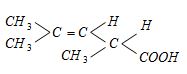
The following compound can exhibit:
A
Tautomerism
B
Optical isomerism
C
Geometrical isomerism
D
Geometrical and optical isomerisms
Solution
(B) The given compound is $(CH_3)_2C=CH-CH(CH_3)-COOH$.
$1$. Geometrical isomerism: The double bond is $(CH_3)_2C=CH-$. Since one of the carbons of the double bond (the left one) is attached to two identical groups (two $CH_3$ groups),it cannot exhibit geometrical isomerism.
$2$. Optical isomerism: The molecule contains a chiral carbon atom at the $CH(CH_3)$ position (the carbon attached to $H$,$CH_3$,$COOH$,and the $-CH=C(CH_3)_2$ group). Since all four groups attached to this carbon are different,it is a chiral center.
Therefore,the compound exhibits optical isomerism.
$1$. Geometrical isomerism: The double bond is $(CH_3)_2C=CH-$. Since one of the carbons of the double bond (the left one) is attached to two identical groups (two $CH_3$ groups),it cannot exhibit geometrical isomerism.
$2$. Optical isomerism: The molecule contains a chiral carbon atom at the $CH(CH_3)$ position (the carbon attached to $H$,$CH_3$,$COOH$,and the $-CH=C(CH_3)_2$ group). Since all four groups attached to this carbon are different,it is a chiral center.
Therefore,the compound exhibits optical isomerism.
0 likesView Solution
9
ChemistryDifficultMCQIIT JEE · 1995
Which one of the following species is most stable?
A
$p-O_2N-C_6H_4-CH_2^+$
B
$p-CH_3O-C_6H_4-CH_2^+$
C
$p-Cl-C_6H_4-CH_2^+$
D
$C_6H_5-CH_2^+$
Solution
(B) The stability of a carbocation is increased by electron-donating groups $(EDG)$ and decreased by electron-withdrawing groups $(EWG)$.
$1$. The $-NO_2$ group is a strong electron-withdrawing group ($-I$ and $-M$ effect),which destabilizes the carbocation.
$2$. The $-OCH_3$ group is an electron-donating group ($+M$ effect),which significantly stabilizes the carbocation by donating electron density through resonance.
$3$. The $-Cl$ group is electron-withdrawing ($-I$ effect) but also has a weak $+M$ effect; overall,it is less destabilizing than $-NO_2$ but less stabilizing than $-OCH_3$.
$4$. The unsubstituted benzyl carbocation $(C_6H_5-CH_2^+)$ serves as the reference.
Therefore,the species with the $-OCH_3$ group is the most stable.
$1$. The $-NO_2$ group is a strong electron-withdrawing group ($-I$ and $-M$ effect),which destabilizes the carbocation.
$2$. The $-OCH_3$ group is an electron-donating group ($+M$ effect),which significantly stabilizes the carbocation by donating electron density through resonance.
$3$. The $-Cl$ group is electron-withdrawing ($-I$ effect) but also has a weak $+M$ effect; overall,it is less destabilizing than $-NO_2$ but less stabilizing than $-OCH_3$.
$4$. The unsubstituted benzyl carbocation $(C_6H_5-CH_2^+)$ serves as the reference.
Therefore,the species with the $-OCH_3$ group is the most stable.
0 likesView Solution
10
ChemistryDifficultMCQIIT JEE · 1995
What is the chief product obtained when $n$-butane is treated with bromine in the presence of light at $130^{\circ}C$?
A
$CH_3-CH_2-CH(Br)-CH_3$
B
$CH_3-CH(CH_3)-CH_2-Br$
C
$CH_3-C(Br)(CH_3)-CH_3$
D
$CH_3-CH_2-CH_2-CH_2-Br$
Solution
(A) Bromination of alkanes is a free radical substitution reaction.
Bromine is highly selective and prefers to substitute the hydrogen on the more stable radical intermediate.
In $n$-butane $(CH_3-CH_2-CH_2-CH_3)$,the secondary $(2^{\circ})$ carbon radical is more stable than the primary $(1^{\circ})$ carbon radical.
Therefore,$2$-bromobutane $(CH_3-CH_2-CH(Br)-CH_3)$ is the chief product.
Bromine is highly selective and prefers to substitute the hydrogen on the more stable radical intermediate.
In $n$-butane $(CH_3-CH_2-CH_2-CH_3)$,the secondary $(2^{\circ})$ carbon radical is more stable than the primary $(1^{\circ})$ carbon radical.
Therefore,$2$-bromobutane $(CH_3-CH_2-CH(Br)-CH_3)$ is the chief product.
0 likesView Solution
11
ChemistryMediumMCQIIT JEE · 1995
The predominant product formed when $3$-methyl-$2$-pentene reacts with $HOCl$ is:
A
$CH_3-CH_2-C(Cl)(CH_3)-CH(OH)-CH_3$
B
$CH_3-CH_2-C(Cl)(CH_3)-CH(Cl)-CH_3$
C
$CH_3-CH_2-C(OH)(CH_3)-CH(Cl)-CH_3$
D
$CH_3-CH_2-C(CH_3)_2-CH(OH)-CH_3$
Solution
(C) The reaction of $3$-methyl-$2$-pentene $(CH_3-CH=C(CH_3)-CH_2-CH_3)$ with $HOCl$ proceeds via the formation of a cyclic chloronium ion intermediate.
$HOCl$ dissociates to provide $Cl^+$ (electrophile) and $OH^-$ (nucleophile).
The $Cl^+$ ion attacks the double bond to form a cyclic chloronium ion.
The nucleophile $(OH^-)$ then attacks the more substituted carbon atom $(C3)$ due to its higher carbocation-like character in the transition state,following Markovnikov's rule.
Therefore,the major product is $3$-chloro-$3$-methylpentan-$2$-ol,which corresponds to the structure $CH_3-CH(Cl)-C(OH)(CH_3)-CH_2-CH_3$.
$HOCl$ dissociates to provide $Cl^+$ (electrophile) and $OH^-$ (nucleophile).
The $Cl^+$ ion attacks the double bond to form a cyclic chloronium ion.
The nucleophile $(OH^-)$ then attacks the more substituted carbon atom $(C3)$ due to its higher carbocation-like character in the transition state,following Markovnikov's rule.
Therefore,the major product is $3$-chloro-$3$-methylpentan-$2$-ol,which corresponds to the structure $CH_3-CH(Cl)-C(OH)(CH_3)-CH_2-CH_3$.
0 likesView Solution
12
ChemistryDifficultMCQIIT JEE · 1995
Allyl isocyanide has:
A
$9$ sigma bonds and $4$ pi bonds
B
$8$ sigma bonds and $5$ pi bonds
C
$8$ sigma bonds,$3$ pi bonds and $4$ non-bonding electrons
D
$9$ sigma bonds,$3$ pi bonds and $2$ non-bonding electrons
Solution
(D) The structure of allyl isocyanide is $CH_2=CH-CH_2-N\rightleftharpoons C$.
Counting the bonds:
- $C-H$ bonds: $5$
- $C-C$ bonds: $2$
- $C-N$ bond: $1$
- $N-C$ bond: $1$
Total sigma bonds = $5 + 2 + 1 + 1 = 9$.
- $C=C$ bond: $1$ pi bond
- $N\rightleftharpoons C$ bond: $2$ pi bonds
Total pi bonds = $1 + 2 = 3$.
- Non-bonding electrons: The nitrogen atom has $1$ lone pair ($2$ electrons) and the terminal carbon atom has $1$ lone pair ($2$ electrons). However,in the coordinate bond representation $N\rightleftharpoons C$,the terminal carbon has $2$ non-bonding electrons.
Thus,it has $9$ sigma bonds,$3$ pi bonds,and $2$ non-bonding electrons.
Counting the bonds:
- $C-H$ bonds: $5$
- $C-C$ bonds: $2$
- $C-N$ bond: $1$
- $N-C$ bond: $1$
Total sigma bonds = $5 + 2 + 1 + 1 = 9$.
- $C=C$ bond: $1$ pi bond
- $N\rightleftharpoons C$ bond: $2$ pi bonds
Total pi bonds = $1 + 2 = 3$.
- Non-bonding electrons: The nitrogen atom has $1$ lone pair ($2$ electrons) and the terminal carbon atom has $1$ lone pair ($2$ electrons). However,in the coordinate bond representation $N\rightleftharpoons C$,the terminal carbon has $2$ non-bonding electrons.
Thus,it has $9$ sigma bonds,$3$ pi bonds,and $2$ non-bonding electrons.
0 likesView Solution
13
ChemistryMCQIIT JEE · 1995
The function $f(x) = |px - q| + r|x|,$ $x \in ( - \infty, \infty )$ where $p > 0, q > 0, r > 0$ assumes its minimum value only at one point if
A
$p \neq q$
B
$q \neq r$
C
$r \neq p$
D
$p = q = r$
Solution
(C) Given the function $f(x) = |px - q| + r|x|$.
We analyze the critical points where the expression inside the absolute value becomes zero: $x = q/p$ and $x = 0$.
Case $1$: If $x < 0$,$f(x) = -(px - q) - rx = -(p+r)x + q$. Since $p, r > 0$,the slope $-(p+r)$ is negative,so $f(x)$ is decreasing.
Case $2$: If $0 \le x \le q/p$,$f(x) = -(px - q) + rx = (r-p)x + q$.
Case $3$: If $x > q/p$,$f(x) = (px - q) + rx = (p+r)x - q$. Since $p, r > 0$,the slope $(p+r)$ is positive,so $f(x)$ is increasing.
For the function to have a unique minimum,the slope in the interval $[0, q/p]$ must be zero,which implies $r - p = 0$,or $r = p$.
However,if $r = p$,the function becomes $f(x) = |px - q| + p|x|$. At $x = q/p$,$f(q/p) = |p(q/p) - q| + p|q/p| = 0 + q = q$. At $x = 0$,$f(0) = |0 - q| + p(0) = q$.
If $p = q = r$,then $f(x) = |px - p| + p|x| = p(|x - 1| + |x|)$. The minimum value is $p$ for all $x \in [0, 1]$.
Re-evaluating the condition for a single point: The function $f(x) = |px - q| + r|x|$ has a unique minimum at $x = q/p$ if the slope changes from negative to positive. This occurs when $r \neq p$ and $r \neq -p$ (which is always true as $r, p > 0$). Specifically,if $r > p$,the minimum is at $x = 0$. If $r < p$,the minimum is at $x = q/p$. If $r = p$,the function is constant on $[0, q/p]$. Thus,the condition for a unique minimum is $r \neq p$.
We analyze the critical points where the expression inside the absolute value becomes zero: $x = q/p$ and $x = 0$.
Case $1$: If $x < 0$,$f(x) = -(px - q) - rx = -(p+r)x + q$. Since $p, r > 0$,the slope $-(p+r)$ is negative,so $f(x)$ is decreasing.
Case $2$: If $0 \le x \le q/p$,$f(x) = -(px - q) + rx = (r-p)x + q$.
Case $3$: If $x > q/p$,$f(x) = (px - q) + rx = (p+r)x - q$. Since $p, r > 0$,the slope $(p+r)$ is positive,so $f(x)$ is increasing.
For the function to have a unique minimum,the slope in the interval $[0, q/p]$ must be zero,which implies $r - p = 0$,or $r = p$.
However,if $r = p$,the function becomes $f(x) = |px - q| + p|x|$. At $x = q/p$,$f(q/p) = |p(q/p) - q| + p|q/p| = 0 + q = q$. At $x = 0$,$f(0) = |0 - q| + p(0) = q$.
If $p = q = r$,then $f(x) = |px - p| + p|x| = p(|x - 1| + |x|)$. The minimum value is $p$ for all $x \in [0, 1]$.
Re-evaluating the condition for a single point: The function $f(x) = |px - q| + r|x|$ has a unique minimum at $x = q/p$ if the slope changes from negative to positive. This occurs when $r \neq p$ and $r \neq -p$ (which is always true as $r, p > 0$). Specifically,if $r > p$,the minimum is at $x = 0$. If $r < p$,the minimum is at $x = q/p$. If $r = p$,the function is constant on $[0, q/p]$. Thus,the condition for a unique minimum is $r \neq p$.
0 likesView Solution
14
ChemistryMCQIIT JEE · 1995
If $a, b, c$ are non-coplanar unit vectors such that $a \times (b \times c) = \frac{b + c}{\sqrt{2}}$,then what is the angle between $a$ and $b$?
A
$\frac{\pi}{4}$
B
$\frac{\pi}{2}$
C
$\frac{3\pi}{4}$
D
$\pi$
Solution
(C) Given the vector triple product formula: $a \times (b \times c) = (a \cdot c)b - (a \cdot b)c$.
Equating this to the given expression: $(a \cdot c)b - (a \cdot b)c = \frac{1}{\sqrt{2}}b + \frac{1}{\sqrt{2}}c$.
Since $b$ and $c$ are non-coplanar,they are linearly independent. We can compare the coefficients of $b$ and $c$:
$a \cdot c = \frac{1}{\sqrt{2}}$
$-(a \cdot b) = \frac{1}{\sqrt{2}} \Rightarrow a \cdot b = -\frac{1}{\sqrt{2}}$.
Since $a$ and $b$ are unit vectors,$a \cdot b = |a||b| \cos \phi$,where $\phi$ is the angle between $a$ and $b$.
$1 \cdot 1 \cdot \cos \phi = -\frac{1}{\sqrt{2}}$.
Therefore,$\cos \phi = -\frac{1}{\sqrt{2}}$,which implies $\phi = \frac{3\pi}{4}$.
Equating this to the given expression: $(a \cdot c)b - (a \cdot b)c = \frac{1}{\sqrt{2}}b + \frac{1}{\sqrt{2}}c$.
Since $b$ and $c$ are non-coplanar,they are linearly independent. We can compare the coefficients of $b$ and $c$:
$a \cdot c = \frac{1}{\sqrt{2}}$
$-(a \cdot b) = \frac{1}{\sqrt{2}} \Rightarrow a \cdot b = -\frac{1}{\sqrt{2}}$.
Since $a$ and $b$ are unit vectors,$a \cdot b = |a||b| \cos \phi$,where $\phi$ is the angle between $a$ and $b$.
$1 \cdot 1 \cdot \cos \phi = -\frac{1}{\sqrt{2}}$.
Therefore,$\cos \phi = -\frac{1}{\sqrt{2}}$,which implies $\phi = \frac{3\pi}{4}$.
0 likesView Solution
15
ChemistryMCQIIT JEE · 1995
If $\frac{1}{x(x^2 + 1)} = \frac{A}{x} + \frac{Bx + C}{x^2 + 1}$,then $(A, B, C) = $
A
$(1, -1, 0)$
B
$(-1, 0, -1)$
C
$(0, 1, 1)$
D
None of these
Solution
(A) Given the partial fraction decomposition: $\frac{1}{x(x^2 + 1)} = \frac{A}{x} + \frac{Bx + C}{x^2 + 1}$
Multiply both sides by $x(x^2 + 1)$: $1 = A(x^2 + 1) + (Bx + C)x$
$1 = Ax^2 + A + Bx^2 + Cx$
$1 = (A + B)x^2 + Cx + A$
Comparing the coefficients of $x^2$,$x$,and the constant term on both sides:
$A + B = 0$
$C = 0$
$A = 1$
Substituting $A = 1$ into $A + B = 0$,we get $1 + B = 0$,which implies $B = -1$.
Thus,$(A, B, C) = (1, -1, 0)$.
Multiply both sides by $x(x^2 + 1)$: $1 = A(x^2 + 1) + (Bx + C)x$
$1 = Ax^2 + A + Bx^2 + Cx$
$1 = (A + B)x^2 + Cx + A$
Comparing the coefficients of $x^2$,$x$,and the constant term on both sides:
$A + B = 0$
$C = 0$
$A = 1$
Substituting $A = 1$ into $A + B = 0$,we get $1 + B = 0$,which implies $B = -1$.
Thus,$(A, B, C) = (1, -1, 0)$.
0 likesView Solution
16
ChemistryMCQIIT JEE · 1995
Consider a circle with its centre lying on the focus of the parabola $y^2 = 2px$ such that it touches the directrix of the parabola. Then a point of intersection of the circle and the parabola is:
A
$\left(\frac{p}{2}, p\right)$
B
$\left(\frac{p}{2}, -p\right)$
C
$\left(-\frac{p}{2}, p\right)$
D
Both $(A)$ and $(B)$
Solution
(D) The focus of the parabola $y^2 = 2px$ is $S = \left(\frac{p}{2}, 0\right)$.
The directrix of the parabola is $x = -\frac{p}{2}$.
Since the circle is centered at the focus and touches the directrix,the radius $r$ is the distance from the focus to the directrix,which is $r = \frac{p}{2} - (-\frac{p}{2}) = p$.
The equation of the circle is $\left(x - \frac{p}{2}\right)^2 + y^2 = p^2$.
Substitute $y^2 = 2px$ into the circle equation:
$\left(x - \frac{p}{2}\right)^2 + 2px = p^2$
Expanding the equation:
$x^2 - px + \frac{p^2}{4} + 2px = p^2$
$x^2 + px - \frac{3p^2}{4} = 0$
$4x^2 + 4px - 3p^2 = 0$
Factoring the quadratic equation:
$(2x + 3p)(2x - p) = 0$
This gives $x = \frac{p}{2}$ or $x = -\frac{3p}{2}$.
For $x = \frac{p}{2}$,$y^2 = 2p\left(\frac{p}{2}\right) = p^2$,so $y = \pm p$.
For $x = -\frac{3p}{2}$,$y^2 = 2p\left(-\frac{3p}{2}\right) = -3p^2$,which gives no real solution for $y$.
Thus,the points of intersection are $\left(\frac{p}{2}, p\right)$ and $\left(\frac{p}{2}, -p\right)$.
The directrix of the parabola is $x = -\frac{p}{2}$.
Since the circle is centered at the focus and touches the directrix,the radius $r$ is the distance from the focus to the directrix,which is $r = \frac{p}{2} - (-\frac{p}{2}) = p$.
The equation of the circle is $\left(x - \frac{p}{2}\right)^2 + y^2 = p^2$.
Substitute $y^2 = 2px$ into the circle equation:
$\left(x - \frac{p}{2}\right)^2 + 2px = p^2$
Expanding the equation:
$x^2 - px + \frac{p^2}{4} + 2px = p^2$
$x^2 + px - \frac{3p^2}{4} = 0$
$4x^2 + 4px - 3p^2 = 0$
Factoring the quadratic equation:
$(2x + 3p)(2x - p) = 0$
This gives $x = \frac{p}{2}$ or $x = -\frac{3p}{2}$.
For $x = \frac{p}{2}$,$y^2 = 2p\left(\frac{p}{2}\right) = p^2$,so $y = \pm p$.
For $x = -\frac{3p}{2}$,$y^2 = 2p\left(-\frac{3p}{2}\right) = -3p^2$,which gives no real solution for $y$.
Thus,the points of intersection are $\left(\frac{p}{2}, p\right)$ and $\left(\frac{p}{2}, -p\right)$.
0 likesView Solution
17
ChemistryMCQIIT JEE · 1995
Let $f(x)$ be defined for all $x > 0$ and be continuous. Let $f(x)$ satisfy $f(\frac{x}{y}) = f(x) - f(y)$ for all $x, y > 0$ and $f(e) = 1$. Then:
A
$f(x)$ is bounded
B
$f(x) \rightarrow 0$ as $x \rightarrow 0$
C
$x \cdot f(x) \rightarrow 1$ as $x \rightarrow 0$
D
$f(x) = \ln(x)$
Solution
(D) Given the functional equation $f(\frac{x}{y}) = f(x) - f(y)$.
Setting $y = 1$,we get $f(x) = f(x) - f(1)$,which implies $f(1) = 0$.
Setting $x = 1$,we get $f(\frac{1}{y}) = f(1) - f(y) = -f(y)$.
For any $x, y > 0$,$f(xy) = f(\frac{x}{1/y}) = f(x) - f(1/y) = f(x) + f(y)$.
This is the Cauchy functional equation for the logarithm function.
Since $f(x)$ is continuous and satisfies $f(xy) = f(x) + f(y)$,the solution is of the form $f(x) = c \ln(x)$.
Given $f(e) = 1$,we have $c \ln(e) = 1$,so $c(1) = 1$,which means $c = 1$.
Thus,$f(x) = \ln(x)$.
Therefore,option $D$ is correct.
Setting $y = 1$,we get $f(x) = f(x) - f(1)$,which implies $f(1) = 0$.
Setting $x = 1$,we get $f(\frac{1}{y}) = f(1) - f(y) = -f(y)$.
For any $x, y > 0$,$f(xy) = f(\frac{x}{1/y}) = f(x) - f(1/y) = f(x) + f(y)$.
This is the Cauchy functional equation for the logarithm function.
Since $f(x)$ is continuous and satisfies $f(xy) = f(x) + f(y)$,the solution is of the form $f(x) = c \ln(x)$.
Given $f(e) = 1$,we have $c \ln(e) = 1$,so $c(1) = 1$,which means $c = 1$.
Thus,$f(x) = \ln(x)$.
Therefore,option $D$ is correct.
0 likesView Solution
18
ChemistryMCQIIT JEE · 1995
$A$ radioactive material decays by simultaneous emission of two particles with respective half-lives $1620 \ years$ and $810 \ years$. The time (in years) after which one-fourth of the material remains is
A
$1080$
B
$2430$
C
$3240$
D
$4860$
Solution
(A) For simultaneous decay,the effective half-life $T_{eq}$ is given by the formula:
$T_{eq} = \frac{T_{1} T_{2}}{T_{1} + T_{2}}$
Substituting the given values $T_{1} = 1620 \ years$ and $T_{2} = 810 \ years$:
$T_{eq} = \frac{1620 \times 810}{1620 + 810} = \frac{1620 \times 810}{2430} = 540 \ years$
We know that the amount of radioactive material remaining after time $t$ is given by $N = N_{0} (1/2)^{n}$,where $n = t / T_{eq}$ is the number of half-lives.
Given that one-fourth of the material remains,$N/N_{0} = 1/4 = (1/2)^{2}$.
Therefore,the number of half-lives $n = 2$.
$t = n \times T_{eq} = 2 \times 540 = 1080 \ years$.
$T_{eq} = \frac{T_{1} T_{2}}{T_{1} + T_{2}}$
Substituting the given values $T_{1} = 1620 \ years$ and $T_{2} = 810 \ years$:
$T_{eq} = \frac{1620 \times 810}{1620 + 810} = \frac{1620 \times 810}{2430} = 540 \ years$
We know that the amount of radioactive material remaining after time $t$ is given by $N = N_{0} (1/2)^{n}$,where $n = t / T_{eq}$ is the number of half-lives.
Given that one-fourth of the material remains,$N/N_{0} = 1/4 = (1/2)^{2}$.
Therefore,the number of half-lives $n = 2$.
$t = n \times T_{eq} = 2 \times 540 = 1080 \ years$.
0 likesView Solution
19
ChemistryMCQIIT JEE · 1995
What is the decreasing order of reactivity amongst the following compounds towards aromatic electrophilic substitution?
$(i)$ Chlorobenzene
$(ii)$ Benzene
$(iii)$ Anilinium chloride
$(iv)$ Toluene
$(i)$ Chlorobenzene
$(ii)$ Benzene
$(iii)$ Anilinium chloride
$(iv)$ Toluene
A
$iv > ii > i > iii$
B
$iv > i > ii > iii$
C
$ii > i > iii > iv$
D
$iii > i > ii > iv$
Solution
(A) The reactivity of aromatic compounds towards electrophilic substitution depends on the electron density of the benzene ring.
$1$. The $-CH_3$ group in Toluene $(iv)$ is an electron-donating group ($+I$ and hyperconjugation),which increases electron density,making it most reactive.
$2$. Benzene $(ii)$ has no substituents.
$3$. The $-Cl$ group in Chlorobenzene $(i)$ is electron-withdrawing due to the $-I$ effect,which decreases electron density,making it less reactive than benzene.
$4$. The $-NH_3^+$ group in Anilinium chloride $(iii)$ is a strong electron-withdrawing group due to the strong $-I$ effect,making it the least reactive.
Thus,the decreasing order of reactivity is $iv > ii > i > iii$.
$1$. The $-CH_3$ group in Toluene $(iv)$ is an electron-donating group ($+I$ and hyperconjugation),which increases electron density,making it most reactive.
$2$. Benzene $(ii)$ has no substituents.
$3$. The $-Cl$ group in Chlorobenzene $(i)$ is electron-withdrawing due to the $-I$ effect,which decreases electron density,making it less reactive than benzene.
$4$. The $-NH_3^+$ group in Anilinium chloride $(iii)$ is a strong electron-withdrawing group due to the strong $-I$ effect,making it the least reactive.
Thus,the decreasing order of reactivity is $iv > ii > i > iii$.
0 likesView Solution
20
ChemistryMCQIIT JEE · 1995
Steam at $100\,^{\circ}C$ is passed into $1.1\,kg$ of water contained in a calorimeter of water equivalent $0.02\,kg$ at $15\,^{\circ}C$ until the temperature of the calorimeter rises to $80\,^{\circ}C$. The mass of steam condensed in kilograms is:
A
$0.13$
B
$0.065$
C
$0.260$
D
$0.135$
Solution
(A) The total mass of the system (water + calorimeter) is $M = 1.1\,kg + 0.02\,kg = 1.12\,kg$.
The temperature rise is $\Delta T = 80\,^{\circ}C - 15\,^{\circ}C = 65\,^{\circ}C$.
Heat gained by the water and calorimeter is $Q_{gain} = M \cdot c_w \cdot \Delta T$,where $c_w$ is the specific heat capacity of water.
Heat lost by the steam consists of two parts: latent heat of condensation at $100\,^{\circ}C$ and heat released by the condensed water cooling from $100\,^{\circ}C$ to $80\,^{\circ}C$.
Let $m$ be the mass of steam condensed. The latent heat of vaporization $L_v \approx 540\,cal/g = 540\,kcal/kg$.
Using the principle of calorimetry: $Q_{gain} = Q_{lost}$.
$M \cdot c_w \cdot \Delta T = m \cdot L_v + m \cdot c_w \cdot (100\,^{\circ}C - 80\,^{\circ}C)$.
Using units in $kcal$ and $kg$: $1.12 \times 1 \times 65 = m \times 540 + m \times 1 \times 20$.
$72.8 = m(560)$.
$m = 72.8 / 560 = 0.13\,kg$.
The temperature rise is $\Delta T = 80\,^{\circ}C - 15\,^{\circ}C = 65\,^{\circ}C$.
Heat gained by the water and calorimeter is $Q_{gain} = M \cdot c_w \cdot \Delta T$,where $c_w$ is the specific heat capacity of water.
Heat lost by the steam consists of two parts: latent heat of condensation at $100\,^{\circ}C$ and heat released by the condensed water cooling from $100\,^{\circ}C$ to $80\,^{\circ}C$.
Let $m$ be the mass of steam condensed. The latent heat of vaporization $L_v \approx 540\,cal/g = 540\,kcal/kg$.
Using the principle of calorimetry: $Q_{gain} = Q_{lost}$.
$M \cdot c_w \cdot \Delta T = m \cdot L_v + m \cdot c_w \cdot (100\,^{\circ}C - 80\,^{\circ}C)$.
Using units in $kcal$ and $kg$: $1.12 \times 1 \times 65 = m \times 540 + m \times 1 \times 20$.
$72.8 = m(560)$.
$m = 72.8 / 560 = 0.13\,kg$.
0 likesView Solution
21
ChemistryMCQIIT JEE · 1995
$A$ parallel plate capacitor of capacitance $C$ is connected to a battery and is charged to a potential difference $V$. Another capacitor of capacitance $2C$ is connected to another battery and is charged to potential difference $2V$. The charging batteries are now disconnected and the capacitors are connected in parallel to each other in such a way that the positive terminal of one is connected to the negative terminal of the other. The final energy of the configuration is
A
zero
B
$\frac{25CV^2}{6}$
C
$\frac{3CV^2}{2}$
D
$\frac{9CV^2}{2}$
Solution
(C) Initial charges on the capacitors are $Q_1 = CV$ and $Q_2 = (2C)(2V) = 4CV$.
Since the capacitors are connected with opposite polarities,the net charge on the system is $Q_{net} = |Q_2 - Q_1| = |4CV - CV| = 3CV$.
The equivalent capacitance of the parallel combination is $C_{eq} = C + 2C = 3C$.
The common potential $V_c$ after connection is given by $V_c = \frac{Q_{net}}{C_{eq}} = \frac{3CV}{3C} = V$.
The final energy stored in the configuration is $U = \frac{1}{2} C_{eq} V_c^2$.
Substituting the values,$U = \frac{1}{2} (3C) (V)^2 = \frac{3CV^2}{2}$.
Since the capacitors are connected with opposite polarities,the net charge on the system is $Q_{net} = |Q_2 - Q_1| = |4CV - CV| = 3CV$.
The equivalent capacitance of the parallel combination is $C_{eq} = C + 2C = 3C$.
The common potential $V_c$ after connection is given by $V_c = \frac{Q_{net}}{C_{eq}} = \frac{3CV}{3C} = V$.
The final energy stored in the configuration is $U = \frac{1}{2} C_{eq} V_c^2$.
Substituting the values,$U = \frac{1}{2} (3C) (V)^2 = \frac{3CV^2}{2}$.
0 likesView Solution
22
ChemistryMCQIIT JEE · 1995
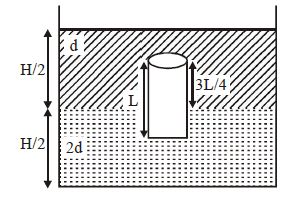
$A$ homogeneous solid cylinder of length $L$ $(L < H/2)$ and cross-sectional area $A'$ is immersed such that it floats with its axis vertical at the liquid-liquid interface with length $L/4$ in the denser liquid (density $2d$) and $3L/4$ in the lighter liquid (density $d$) as shown in the figure. The density $D$ of the solid is given by:
A
$\frac{5}{4} d$
B
$\frac{4}{5} d$
C
$d$
D
$\frac{d}{5}$
Solution
(A) For the cylinder to float in equilibrium, the weight of the cylinder must be equal to the total upthrust (buoyant force) exerted by the two liquids.
Let $A'$ be the cross-sectional area of the cylinder. The volume of the cylinder is $V = A' L$.
Weight of the cylinder $W = V D g = A' L D g$.
The upthrust from the lighter liquid (density $d$) is $F_1 = (\text{Volume in lighter liquid}) \times d \times g = (A' \times \frac{3L}{4}) d g$.
The upthrust from the denser liquid (density $2d$) is $F_2 = (\text{Volume in denser liquid}) \times 2d \times g = (A' \times \frac{L}{4}) \times 2d \times g$.
Equating weight to total upthrust:
$A' L D g = (A' \times \frac{3L}{4}) d g + (A' \times \frac{L}{4}) \times 2d \times g$
Dividing both sides by $A' L g$:
$D = \frac{3}{4} d + \frac{2}{4} d$
$D = \frac{5}{4} d$
Let $A'$ be the cross-sectional area of the cylinder. The volume of the cylinder is $V = A' L$.
Weight of the cylinder $W = V D g = A' L D g$.
The upthrust from the lighter liquid (density $d$) is $F_1 = (\text{Volume in lighter liquid}) \times d \times g = (A' \times \frac{3L}{4}) d g$.
The upthrust from the denser liquid (density $2d$) is $F_2 = (\text{Volume in denser liquid}) \times 2d \times g = (A' \times \frac{L}{4}) \times 2d \times g$.
Equating weight to total upthrust:
$A' L D g = (A' \times \frac{3L}{4}) d g + (A' \times \frac{L}{4}) \times 2d \times g$
Dividing both sides by $A' L g$:
$D = \frac{3}{4} d + \frac{2}{4} d$
$D = \frac{5}{4} d$
0 likesView Solution
23
ChemistryMCQIIT JEE · 1995
The probability of electrons to be found in the conduction band of an intrinsic semiconductor at a finite temperature
A
Decreases exponentially with increasing band gap
B
Increases exponentially with increasing band gap
C
Decreases with increasing temperature
D
Is independent of the temperature and the band gap
Solution
(A) The probability $P(E)$ of an electron being found in the conduction band of an intrinsic semiconductor is given by the Fermi-Dirac distribution function: $P(E) = \frac{1}{1 + e^{(E - E_F) / kT}}$.
Here,$E$ is the energy level in the conduction band,$E_F$ is the Fermi level,$k$ is the Boltzmann constant,and $T$ is the absolute temperature.
For the conduction band,$E - E_F$ is approximately $E_g / 2$,where $E_g$ is the band gap.
Since $E - E_F \gg kT$,the term $e^{(E - E_F) / kT}$ is much greater than $1$.
Therefore,$P(E) \approx e^{-(E - E_F) / kT} = e^{-E_g / 2kT}$.
This shows that the probability decreases exponentially as the band gap $E_g$ increases.
Here,$E$ is the energy level in the conduction band,$E_F$ is the Fermi level,$k$ is the Boltzmann constant,and $T$ is the absolute temperature.
For the conduction band,$E - E_F$ is approximately $E_g / 2$,where $E_g$ is the band gap.
Since $E - E_F \gg kT$,the term $e^{(E - E_F) / kT}$ is much greater than $1$.
Therefore,$P(E) \approx e^{-(E - E_F) / kT} = e^{-E_g / 2kT}$.
This shows that the probability decreases exponentially as the band gap $E_g$ increases.
0 likesView Solution
24
ChemistryMCQIIT JEE · 1995
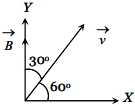
$A$ proton of mass $1.67 \times 10^{-27} \, kg$ and charge $1.6 \times 10^{-19} \, C$ is projected with a speed of $2 \times 10^6 \, m/s$ at an angle of $60^{\circ}$ to the $X$-axis. If a uniform magnetic field of $0.104 \, T$ is applied along the $Y$-axis,the path of the proton is:
A
$A$ circle of radius $\cong 0.1 \, m$ and time period $2\pi \times 10^{-7} \, s$.
B
$A$ circle of radius $\cong 0.2 \, m$ and time period $7\pi \times 10^{-7} \, s$.
C
$A$ helix of radius $\cong 0.1 \, m$ and time period $2\pi \times 10^{-7} \, s$.
D
$A$ helix of radius $\cong 0.2 \, m$ and time period $4\pi \times 10^{-7} \, s$.
Solution
(C) The velocity vector makes an angle of $30^{\circ}$ with the $Y$-axis (the direction of the magnetic field). Since the velocity has a component perpendicular to the magnetic field $(v \sin 30^{\circ})$ and a component parallel to it $(v \cos 30^{\circ})$,the path is a helix.
The radius of the helix is given by $r = \frac{m v \sin \theta}{q B}$,where $\theta = 30^{\circ}$ is the angle with the magnetic field.
$r = \frac{1.67 \times 10^{-27} \times 2 \times 10^6 \times \sin 30^{\circ}}{1.6 \times 10^{-19} \times 0.104} \cong \frac{1.67 \times 10^{-21} \times 0.5}{1.664 \times 10^{-20}} \cong 0.5 \, m$ (Wait,re-calculating: $r = \frac{1.67 \times 10^{-27} \times 2 \times 10^6 \times 0.5}{1.6 \times 10^{-19} \times 0.104} = \frac{1.67 \times 10^{-21}}{1.664 \times 10^{-20}} \approx 0.1 \, m$).
The time period is $T = \frac{2 \pi m}{q B} = \frac{2 \times \pi \times 1.67 \times 10^{-27}}{1.6 \times 10^{-19} \times 0.104} \cong \frac{10.49 \times 10^{-27}}{0.1664 \times 10^{-18}} \cong 6.3 \times 10^{-8} \, s \approx 2\pi \times 10^{-7} \, s$.
The radius of the helix is given by $r = \frac{m v \sin \theta}{q B}$,where $\theta = 30^{\circ}$ is the angle with the magnetic field.
$r = \frac{1.67 \times 10^{-27} \times 2 \times 10^6 \times \sin 30^{\circ}}{1.6 \times 10^{-19} \times 0.104} \cong \frac{1.67 \times 10^{-21} \times 0.5}{1.664 \times 10^{-20}} \cong 0.5 \, m$ (Wait,re-calculating: $r = \frac{1.67 \times 10^{-27} \times 2 \times 10^6 \times 0.5}{1.6 \times 10^{-19} \times 0.104} = \frac{1.67 \times 10^{-21}}{1.664 \times 10^{-20}} \approx 0.1 \, m$).
The time period is $T = \frac{2 \pi m}{q B} = \frac{2 \times \pi \times 1.67 \times 10^{-27}}{1.6 \times 10^{-19} \times 0.104} \cong \frac{10.49 \times 10^{-27}}{0.1664 \times 10^{-18}} \cong 6.3 \times 10^{-8} \, s \approx 2\pi \times 10^{-7} \, s$.
0 likesView Solution
25
ChemistryMCQIIT JEE · 1995
The binding energy per nucleon of ${O^{16}}$ is $7.97 \, MeV$ and that of ${O^{17}}$ is $7.75 \, MeV$. The energy (in $MeV$) required to remove a neutron from ${O^{17}}$ is
A
$3.52$
B
$3.64$
C
$4.23$
D
$7.86$
Solution
(C) The nuclear reaction for removing a neutron from ${O^{17}}$ is: ${O^{17}} \to {O^{16}} + n$.
The total binding energy $(B.E.)$ of a nucleus is given by the product of the number of nucleons $(A)$ and the binding energy per nucleon $(B.E./A)$.
Total $B.E.$ of ${O^{17}} = 17 \times 7.75 \, MeV = 131.75 \, MeV$.
Total $B.E.$ of ${O^{16}} = 16 \times 7.97 \, MeV = 127.52 \, MeV$.
The energy required to remove the neutron is the difference in the total binding energies:
Energy required $= B.E.({O^{17}}) - B.E.({O^{16}})$.
Energy required $= 131.75 \, MeV - 127.52 \, MeV = 4.23 \, MeV$.
The total binding energy $(B.E.)$ of a nucleus is given by the product of the number of nucleons $(A)$ and the binding energy per nucleon $(B.E./A)$.
Total $B.E.$ of ${O^{17}} = 17 \times 7.75 \, MeV = 131.75 \, MeV$.
Total $B.E.$ of ${O^{16}} = 16 \times 7.97 \, MeV = 127.52 \, MeV$.
The energy required to remove the neutron is the difference in the total binding energies:
Energy required $= B.E.({O^{17}}) - B.E.({O^{16}})$.
Energy required $= 131.75 \, MeV - 127.52 \, MeV = 4.23 \, MeV$.
0 likesView Solution
26
ChemistryMCQIIT JEE · 1995
$A$ radioactive material decays by simultaneous emission of two particles with respective half-lives $1620 \, years$ and $810 \, years$. The time (in years) after which one-fourth of the material remains is:
A
$1080$
B
$2430$
C
$3240$
D
$4860$
Solution
(A) The effective decay constant $\lambda$ is the sum of individual decay constants: $\lambda = \lambda_1 + \lambda_2$.
Since $\lambda = \frac{\ln 2}{T}$,we have $\frac{1}{T} = \frac{1}{T_1} + \frac{1}{T_2}$,where $T$ is the effective half-life.
Substituting the given values: $\frac{1}{T} = \frac{1}{1620} + \frac{1}{810} = \frac{1 + 2}{1620} = \frac{3}{1620} = \frac{1}{540}$.
Thus,the effective half-life $T = 540 \, years$.
The amount of radioactive material remaining is given by $N = N_0 \left( \frac{1}{2} \right)^{t/T}$.
We want $N = \frac{1}{4} N_0$,so $\frac{1}{4} = \left( \frac{1}{2} \right)^{t/540}$.
Since $\frac{1}{4} = \left( \frac{1}{2} \right)^2$,we have $\frac{t}{540} = 2$.
Therefore,$t = 2 \times 540 = 1080 \, years$.
Since $\lambda = \frac{\ln 2}{T}$,we have $\frac{1}{T} = \frac{1}{T_1} + \frac{1}{T_2}$,where $T$ is the effective half-life.
Substituting the given values: $\frac{1}{T} = \frac{1}{1620} + \frac{1}{810} = \frac{1 + 2}{1620} = \frac{3}{1620} = \frac{1}{540}$.
Thus,the effective half-life $T = 540 \, years$.
The amount of radioactive material remaining is given by $N = N_0 \left( \frac{1}{2} \right)^{t/T}$.
We want $N = \frac{1}{4} N_0$,so $\frac{1}{4} = \left( \frac{1}{2} \right)^{t/540}$.
Since $\frac{1}{4} = \left( \frac{1}{2} \right)^2$,we have $\frac{t}{540} = 2$.
Therefore,$t = 2 \times 540 = 1080 \, years$.
0 likesView Solution
27
ChemistryMCQIIT JEE · 1995
$A$ radioactive material decays by simultaneous emission of two particles with respective half-lives $1620$ years and $810$ years. The time (in years) after which one-fourth of the material remains is
A
$1080$
B
$2430$
C
$3240$
D
$4860$
Solution
(A) The effective decay constant $\lambda$ is the sum of individual decay constants: $\lambda = \lambda_1 + \lambda_2$.
Since $\lambda = \frac{\ln 2}{T}$,we have $\frac{1}{T} = \frac{1}{T_1} + \frac{1}{T_2}$,where $T$ is the effective half-life.
Substituting the given values: $\frac{1}{T} = \frac{1}{1620} + \frac{1}{810} = \frac{1 + 2}{1620} = \frac{3}{1620} = \frac{1}{540}$.
Thus,the effective half-life $T = 540$ years.
The amount of material remaining is given by $N = N_0 (1/2)^n$,where $n = t/T$ is the number of half-lives.
We want $N = N_0/4$,so $(1/2)^n = 1/4 = (1/2)^2$,which implies $n = 2$.
Therefore,$t/T = 2$,which gives $t = 2 \times 540 = 1080$ years.
Since $\lambda = \frac{\ln 2}{T}$,we have $\frac{1}{T} = \frac{1}{T_1} + \frac{1}{T_2}$,where $T$ is the effective half-life.
Substituting the given values: $\frac{1}{T} = \frac{1}{1620} + \frac{1}{810} = \frac{1 + 2}{1620} = \frac{3}{1620} = \frac{1}{540}$.
Thus,the effective half-life $T = 540$ years.
The amount of material remaining is given by $N = N_0 (1/2)^n$,where $n = t/T$ is the number of half-lives.
We want $N = N_0/4$,so $(1/2)^n = 1/4 = (1/2)^2$,which implies $n = 2$.
Therefore,$t/T = 2$,which gives $t = 2 \times 540 = 1080$ years.
0 likesView Solution
28
ChemistryMCQIIT JEE · 1995
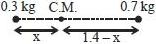
Two point masses of $0.3\, kg$ and $0.7\, kg$ are fixed at the ends of a rod of length $1.4\, m$ and of negligible mass. The rod is set rotating about an axis perpendicular to its length with a uniform angular speed. The point on the rod through which the axis should pass in order that the work required for rotation of the rod is minimum is located at a distance of
A
$0.4\, m$ from mass of $0.3\, kg$
B
$0.98\, m$ from mass of $0.3\, kg$
C
$0.70\, m$ from mass of $0.7\, kg$
D
$0.98\, m$ from mass of $0.7\, kg$
Solution
(B) The work required for rotation is minimum when the axis of rotation passes through the center of mass of the system.
Let the distance of the center of mass from the $0.3\, kg$ mass be $x$.
Then the distance from the $0.7\, kg$ mass is $(1.4 - x)$.
Using the formula for the center of mass: $m_1 x_1 = m_2 x_2$
$0.3 \times x = 0.7 \times (1.4 - x)$
$0.3x = 0.98 - 0.7x$
$1.0x = 0.98$
$x = 0.98\, m$ from the $0.3\, kg$ mass.
Alternatively,the distance from the $0.7\, kg$ mass is $1.4 - 0.98 = 0.42\, m$.
Let the distance of the center of mass from the $0.3\, kg$ mass be $x$.
Then the distance from the $0.7\, kg$ mass is $(1.4 - x)$.
Using the formula for the center of mass: $m_1 x_1 = m_2 x_2$
$0.3 \times x = 0.7 \times (1.4 - x)$
$0.3x = 0.98 - 0.7x$
$1.0x = 0.98$
$x = 0.98\, m$ from the $0.3\, kg$ mass.
Alternatively,the distance from the $0.7\, kg$ mass is $1.4 - 0.98 = 0.42\, m$.
0 likesView Solution
29
ChemistryMCQIIT JEE · 1995
$A$ radioactive material decays by simultaneous emission of two particles with respective half-lives $1620 \, years$ and $810 \, years$. The time (in years) after which one-fourth of the material remains is
A
$1080$
B
$2430$
C
$3240$
D
$4860$
Solution
(A) When a radioactive material decays by two simultaneous processes,the effective decay constant is $\lambda = \lambda_1 + \lambda_2$.
Since $\lambda = \frac{\ln 2}{T}$,the effective half-life $T$ is given by $\frac{1}{T} = \frac{1}{T_1} + \frac{1}{T_2}$.
Substituting the given values $T_1 = 1620 \, years$ and $T_2 = 810 \, years$:
$\frac{1}{T} = \frac{1}{1620} + \frac{1}{810} = \frac{1 + 2}{1620} = \frac{3}{1620} = \frac{1}{540}$.
Thus,the effective half-life $T = 540 \, years$.
The amount of material remaining is given by $N = N_0 (\frac{1}{2})^n$,where $n = \frac{t}{T}$ is the number of half-lives.
We want $N = \frac{1}{4} N_0$,so $(\frac{1}{2})^n = \frac{1}{4} = (\frac{1}{2})^2$,which implies $n = 2$.
Therefore,$t = n \times T = 2 \times 540 = 1080 \, years$.
Since $\lambda = \frac{\ln 2}{T}$,the effective half-life $T$ is given by $\frac{1}{T} = \frac{1}{T_1} + \frac{1}{T_2}$.
Substituting the given values $T_1 = 1620 \, years$ and $T_2 = 810 \, years$:
$\frac{1}{T} = \frac{1}{1620} + \frac{1}{810} = \frac{1 + 2}{1620} = \frac{3}{1620} = \frac{1}{540}$.
Thus,the effective half-life $T = 540 \, years$.
The amount of material remaining is given by $N = N_0 (\frac{1}{2})^n$,where $n = \frac{t}{T}$ is the number of half-lives.
We want $N = \frac{1}{4} N_0$,so $(\frac{1}{2})^n = \frac{1}{4} = (\frac{1}{2})^2$,which implies $n = 2$.
Therefore,$t = n \times T = 2 \times 540 = 1080 \, years$.
0 likesView Solution
30
ChemistryMCQIIT JEE · 1995
$A$ radioactive material decays by simultaneous emission of two particles with respective half-lives $1620 \, years$ and $810 \, years$. The time, in years, after which one-fourth of the material remains is
A
$1080$
B
$2430$
C
$3240$
D
$4860$
Solution
(A) The rate of decay is given by $\frac{-dN}{dt} = \lambda_1 N + \lambda_2 N = (\lambda_1 + \lambda_2)N$.
Integrating this, we get $\ln(\frac{N}{N_0}) = -(\lambda_1 + \lambda_2)t$.
Given half-lives $T_1 = 1620 \, years$ and $T_2 = 810 \, years$, the decay constants are $\lambda_1 = \frac{\ln 2}{1620}$ and $\lambda_2 = \frac{\ln 2}{810}$.
We want to find $t$ when $\frac{N}{N_0} = \frac{1}{4}$, so $\ln(\frac{1}{4}) = -(\lambda_1 + \lambda_2)t$.
$-2 \ln 2 = -(\frac{\ln 2}{1620} + \frac{\ln 2}{810})t$.
Dividing by $-\ln 2$, we get $2 = (\frac{1}{1620} + \frac{1}{810})t$.
$2 = (\frac{1 + 2}{1620})t = \frac{3}{1620}t = \frac{1}{540}t$.
Therefore, $t = 2 \times 540 = 1080 \, years$.
Integrating this, we get $\ln(\frac{N}{N_0}) = -(\lambda_1 + \lambda_2)t$.
Given half-lives $T_1 = 1620 \, years$ and $T_2 = 810 \, years$, the decay constants are $\lambda_1 = \frac{\ln 2}{1620}$ and $\lambda_2 = \frac{\ln 2}{810}$.
We want to find $t$ when $\frac{N}{N_0} = \frac{1}{4}$, so $\ln(\frac{1}{4}) = -(\lambda_1 + \lambda_2)t$.
$-2 \ln 2 = -(\frac{\ln 2}{1620} + \frac{\ln 2}{810})t$.
Dividing by $-\ln 2$, we get $2 = (\frac{1}{1620} + \frac{1}{810})t$.
$2 = (\frac{1 + 2}{1620})t = \frac{3}{1620}t = \frac{1}{540}t$.
Therefore, $t = 2 \times 540 = 1080 \, years$.
0 likesView Solution
31
ChemistryDifficultMCQIIT JEE · 1995
The element exhibiting the most stable $+2$ oxidation state among the following is
A
$Ag$
B
$Fe$
C
$Sn$
D
$Pb$
Solution
(D) $Ag$ has the electronic configuration $[Kr] \, 4d^{10} \, 5s^1$,making $+1$ its stable oxidation state.
$Fe^{3+}$ is more stable than $Fe^{2+}$ due to the half-filled $3d^5$ electronic configuration.
$Sn^{2+}$ is less stable than $Sn^{4+}$ because the $+4$ oxidation state is more stable for tin.
In $p$-block elements,the inert pair effect makes the lower oxidation state more stable as we move down the group. Thus,$Pb^{2+}$ is more stable than $Pb^{4+}$ due to the inert pair effect.
$Fe^{3+}$ is more stable than $Fe^{2+}$ due to the half-filled $3d^5$ electronic configuration.
$Sn^{2+}$ is less stable than $Sn^{4+}$ because the $+4$ oxidation state is more stable for tin.
In $p$-block elements,the inert pair effect makes the lower oxidation state more stable as we move down the group. Thus,$Pb^{2+}$ is more stable than $Pb^{4+}$ due to the inert pair effect.
0 likesView Solution
32
ChemistryDifficultMCQIIT JEE · 1995
Which one of the following pairs of substances when mixed,produces chlorine gas at room temperature?
A
$NaCl$ and $MnO_2$
B
$NaCl$ and $HNO_3$ (conc.)
C
$NaCl$ and $H_2SO_4$ (conc.)
D
$HCl$ (conc.) and $KMnO_4$
Solution
(D) . The reaction between concentrated $HCl$ and potassium permanganate $(KMnO_4)$ is a standard laboratory method for the preparation of chlorine gas at room temperature.
The balanced chemical equation is: $2KMnO_4 + 16HCl \to 2KCl + 2MnCl_2 + 8H_2O + 5Cl_2$.
The balanced chemical equation is: $2KMnO_4 + 16HCl \to 2KCl + 2MnCl_2 + 8H_2O + 5Cl_2$.
0 likesView Solution
33
ChemistryMediumMCQIIT JEE · 1995
Concentrated $H_2SO_4$ cannot be used to prepare $HBr$ from $NaBr$,because it
A
Reduces $HBr$
B
Oxidises $HBr$
C
Disproportionates $HBr$
D
Reacts slowly with $NaBr$
Solution
(B) Concentrated $H_2SO_4$ is a strong oxidizing agent.
When $NaBr$ reacts with concentrated $H_2SO_4$,it first produces $HBr$.
However,the concentrated $H_2SO_4$ then oxidizes the produced $HBr$ to $Br_2$ gas.
The reaction is: $2NaBr + 3H_2SO_4 \rightarrow 2NaHSO_4 + SO_2 + Br_2 + 2H_2O$.
When $NaBr$ reacts with concentrated $H_2SO_4$,it first produces $HBr$.
However,the concentrated $H_2SO_4$ then oxidizes the produced $HBr$ to $Br_2$ gas.
The reaction is: $2NaBr + 3H_2SO_4 \rightarrow 2NaHSO_4 + SO_2 + Br_2 + 2H_2O$.
0 likesView Solution
34
ChemistryMediumMCQIIT JEE · 1995
Sodium nitroprusside,when added to an alkaline solution of sulphide ions,produces a purple colour due to the formation of:
A
$Na_4[Fe(CN)_5NOS]$
B
$Na_2[Fe(H_2O)_5NOS]$
C
$Na_3[Fe(CN)_5NOS]$
D
$Na_4[Fe(CN)_5NOS]$
Solution
(D) The reaction between sodium nitroprusside and sulphide ions in an alkaline medium is a standard test for the detection of sulphide ions.
The chemical reaction is: $Na_2[Fe(CN)_5NO] + S^{2-} \to [Fe(CN)_5NOS]^{4-}$.
The complex formed is the violet/purple coloured ion $[Fe(CN)_5NOS]^{4-}$,which is known as the thio-nitroprusside ion.
Thus,the correct option is $D$.
The chemical reaction is: $Na_2[Fe(CN)_5NO] + S^{2-} \to [Fe(CN)_5NOS]^{4-}$.
The complex formed is the violet/purple coloured ion $[Fe(CN)_5NOS]^{4-}$,which is known as the thio-nitroprusside ion.
Thus,the correct option is $D$.
0 likesView Solution
35
ChemistryDifficultMCQIIT JEE · 1995
Which one of the following anions is not easily removed from aqueous solutions by precipitation?
A
$Cl^{-}$
B
$NO_3^{-}$
C
$CO_3^{2-}$
D
$SO_4^{2-}$
Solution
(B) The correct answer is $(B)$.
Most nitrate salts $(NO_3^{-})$ are highly soluble in water and do not form precipitates with common cations.
In contrast,$Cl^{-}$ forms a precipitate with $Ag^{+}$,$CO_3^{2-}$ forms precipitates with many metal ions like $Ca^{2+}$ or $Ba^{2+}$,and $SO_4^{2-}$ forms a precipitate with $Ba^{2+}$.
Most nitrate salts $(NO_3^{-})$ are highly soluble in water and do not form precipitates with common cations.
In contrast,$Cl^{-}$ forms a precipitate with $Ag^{+}$,$CO_3^{2-}$ forms precipitates with many metal ions like $Ca^{2+}$ or $Ba^{2+}$,and $SO_4^{2-}$ forms a precipitate with $Ba^{2+}$.
0 likesView Solution
36
ChemistryDifficultMCQIIT JEE · 1995
An aqueous solution contains the ions as $Hg_2^{2+}$,$Hg^{2+}$,$Pb^{2+}$,and $Cd^{2+}$. The addition of dilute $HCl$ $(6 \ N)$ precipitates:
A
$Hg_2Cl_2$ only
B
$PbCl_2$ only
C
$PbCl_2$ and $HgCl_2$
D
$Hg_2Cl_2$ and $PbCl_2$
Solution
(D) In qualitative inorganic analysis,the $Group \ I$ basic radicals are $Pb^{2+}$,$Hg_2^{2+}$,and $Ag^+$.
These ions form insoluble chlorides when treated with dilute $HCl$ due to their very low solubility product $(K_{sp})$ values.
$Hg^{2+}$ and $Cd^{2+}$ belong to $Group \ II$ and do not precipitate as chlorides with dilute $HCl$.
Therefore,the addition of dilute $HCl$ precipitates $Hg_2Cl_2$ and $PbCl_2$.
These ions form insoluble chlorides when treated with dilute $HCl$ due to their very low solubility product $(K_{sp})$ values.
$Hg^{2+}$ and $Cd^{2+}$ belong to $Group \ II$ and do not precipitate as chlorides with dilute $HCl$.
Therefore,the addition of dilute $HCl$ precipitates $Hg_2Cl_2$ and $PbCl_2$.
0 likesView Solution
37
ChemistryDifficultMCQIIT JEE · 1995
When isobutyl magnesium bromide in dry ether is treated with absolute ethyl alcohol,the products formed are
A
$CH_3-CH(CH_3)-CH_2OH$ and $CH_3-CH_2-MgBr$
B
$CH_3-CH(CH_3)-CH_2-CH_2-CH_3$ and $Mg(OH)Br$
C
$CH_3-CH(CH_3)-CH_3$ and $CH_3-CH_2-OMgBr$
D
$CH_3-CH(CH_3)-CH_3$,$CH_2=CH_2$ and $Mg(OH)Br$
Solution
(C) Grignard reagents $(R-MgX)$ act as strong bases and react with compounds containing active hydrogen atoms (such as alcohols,$R'-OH$) to form alkanes $(R-H)$.
In this reaction,the isobutyl group $(CH_3-CH(CH_3)-CH_2^-)$ from the Grignard reagent abstracts the acidic proton from the ethyl alcohol to form isobutane $(CH_3-CH(CH_3)-CH_3)$.
The reaction is:
$CH_3-CH(CH_3)-CH_2-MgBr + CH_3-CH_2-OH \rightarrow CH_3-CH(CH_3)-CH_3 + CH_3-CH_2-OMgBr$.
In this reaction,the isobutyl group $(CH_3-CH(CH_3)-CH_2^-)$ from the Grignard reagent abstracts the acidic proton from the ethyl alcohol to form isobutane $(CH_3-CH(CH_3)-CH_3)$.
The reaction is:
$CH_3-CH(CH_3)-CH_2-MgBr + CH_3-CH_2-OH \rightarrow CH_3-CH(CH_3)-CH_3 + CH_3-CH_2-OMgBr$.
0 likesView Solution
38
ChemistryMediumMCQIIT JEE · 1995
$A$ $0.2 \, m$ aqueous solution of a weak acid $(HX)$ is $20 \% $ ionised. The freezing point of this solution is .............. $^o C$ (Given ${K_f} = 1.86 \, ^o C/m$ for water)
A
$ - 0.31 $
B
$ - 0.45 $
C
$ - 0.53 $
D
$ - 0.90 $
Solution
(B) For a weak acid $HX$ undergoing dissociation: $HX \rightleftharpoons H^+ + X^-$.
The van't Hoff factor $i = 1 + \alpha$,where $\alpha$ is the degree of dissociation.
Given $\alpha = 20 \% = 0.2$,so $i = 1 + 0.2 = 1.2$.
The depression in freezing point is given by $\Delta T_f = i \times K_f \times m$.
Substituting the values: $\Delta T_f = 1.2 \times 1.86 \, ^o C/m \times 0.2 \, m = 0.4464 \, ^o C$.
The freezing point of the solution is $T_f = T_f^o - \Delta T_f = 0 \, ^o C - 0.4464 \, ^o C = - 0.4464 \, ^o C \approx - 0.45 \, ^o C$.
The van't Hoff factor $i = 1 + \alpha$,where $\alpha$ is the degree of dissociation.
Given $\alpha = 20 \% = 0.2$,so $i = 1 + 0.2 = 1.2$.
The depression in freezing point is given by $\Delta T_f = i \times K_f \times m$.
Substituting the values: $\Delta T_f = 1.2 \times 1.86 \, ^o C/m \times 0.2 \, m = 0.4464 \, ^o C$.
The freezing point of the solution is $T_f = T_f^o - \Delta T_f = 0 \, ^o C - 0.4464 \, ^o C = - 0.4464 \, ^o C \approx - 0.45 \, ^o C$.
0 likesView Solution
39
ChemistryMediumMCQIIT JEE · 1995
$CsBr$ crystal has $bcc$ structure. It has an edge length of $4.3 \ \mathring{A}$. The shortest interionic distance between $Cs^{+}$ and $Br^{-}$ ions is ................ $\mathring{A}$.
A
$1.86$
B
$3.72$
C
$4.3$
D
$7.44$
Solution
(B) In a $bcc$ structure,the ions are in contact along the body diagonal.
The body diagonal of a cube with edge length $a$ is $\sqrt{3} a$.
The shortest interionic distance $(d)$ between the center ion and the corner ion is half of the body diagonal.
$d = \frac{\sqrt{3}}{2} a$
Given $a = 4.3 \ \mathring{A}$,
$d = \frac{1.732}{2} \times 4.3 = 0.866 \times 4.3 = 3.7238 \ \mathring{A} \approx 3.72 \ \mathring{A}$.
The body diagonal of a cube with edge length $a$ is $\sqrt{3} a$.
The shortest interionic distance $(d)$ between the center ion and the corner ion is half of the body diagonal.
$d = \frac{\sqrt{3}}{2} a$
Given $a = 4.3 \ \mathring{A}$,
$d = \frac{1.732}{2} \times 4.3 = 0.866 \times 4.3 = 3.7238 \ \mathring{A} \approx 3.72 \ \mathring{A}$.
0 likesView Solution
40
ChemistryAdvancedMCQIIT JEE · 1995
$Cu^{+}$ ion is not stable in aqueous solution because of disproportionation reaction. $E^o$ value for disproportionation of $Cu^{+}$ is .............. $V$ (Given $E^o_{Cu^{2+}/Cu^{+}} = 0.15 \ V$,$E^o_{Cu^{2+}/Cu} = 0.34 \ V$)
A
$-0.49$
B
$0.49$
C
$-0.38$
D
$0.38$
Solution
(D) The disproportionation reaction is $2Cu^{+} \to Cu^{2+} + Cu$.
This can be split into two half-reactions:
$1) \ Cu^{+} \to Cu^{2+} + e^{-} \ (E^o_{ox} = -E^o_{Cu^{2+}/Cu^{+}} = -0.15 \ V)$
$2) \ Cu^{+} + e^{-} \to Cu \ (E^o_{red} = E^o_{Cu^{+}/Cu})$
First,we calculate $E^o_{Cu^{+}/Cu}$ using the relation $\Delta G^o_{total} = \Delta G^o_1 + \Delta G^o_2$:
$1 \times F \times E^o_{Cu^{+}/Cu} = 2 \times F \times E^o_{Cu^{2+}/Cu} - 1 \times F \times E^o_{Cu^{2+}/Cu^{+}}$
$E^o_{Cu^{+}/Cu} = 2(0.34) - 0.15 = 0.68 - 0.15 = 0.53 \ V$.
Now,for the disproportionation reaction:
$E^o_{cell} = E^o_{red} + E^o_{ox} = E^o_{Cu^{+}/Cu} - E^o_{Cu^{2+}/Cu^{+}}$
$E^o_{cell} = 0.53 \ V - 0.15 \ V = 0.38 \ V$.
This can be split into two half-reactions:
$1) \ Cu^{+} \to Cu^{2+} + e^{-} \ (E^o_{ox} = -E^o_{Cu^{2+}/Cu^{+}} = -0.15 \ V)$
$2) \ Cu^{+} + e^{-} \to Cu \ (E^o_{red} = E^o_{Cu^{+}/Cu})$
First,we calculate $E^o_{Cu^{+}/Cu}$ using the relation $\Delta G^o_{total} = \Delta G^o_1 + \Delta G^o_2$:
$1 \times F \times E^o_{Cu^{+}/Cu} = 2 \times F \times E^o_{Cu^{2+}/Cu} - 1 \times F \times E^o_{Cu^{2+}/Cu^{+}}$
$E^o_{Cu^{+}/Cu} = 2(0.34) - 0.15 = 0.68 - 0.15 = 0.53 \ V$.
Now,for the disproportionation reaction:
$E^o_{cell} = E^o_{red} + E^o_{ox} = E^o_{Cu^{+}/Cu} - E^o_{Cu^{2+}/Cu^{+}}$
$E^o_{cell} = 0.53 \ V - 0.15 \ V = 0.38 \ V$.
0 likesView Solution
41
ChemistryEasyMCQIIT JEE · 1995
Which one of the following oxides is ionic?
A
$MnO$
B
$Mn_2O_7$
C
$CrO_3$
D
$P_2O_5$
Solution
(A) The ionic character of an oxide depends on the oxidation state of the metal.
Lower oxidation states of metals generally result in ionic oxides,while higher oxidation states lead to covalent character.
In $MnO$,the oxidation state of $Mn$ is $+2$.
In $Mn_2O_7$,the oxidation state of $Mn$ is $+7$.
In $CrO_3$,the oxidation state of $Cr$ is $+6$.
$P_2O_5$ is an oxide of a non-metal and is covalent.
Therefore,$MnO$ is the most ionic oxide among the given options.
Lower oxidation states of metals generally result in ionic oxides,while higher oxidation states lead to covalent character.
In $MnO$,the oxidation state of $Mn$ is $+2$.
In $Mn_2O_7$,the oxidation state of $Mn$ is $+7$.
In $CrO_3$,the oxidation state of $Cr$ is $+6$.
$P_2O_5$ is an oxide of a non-metal and is covalent.
Therefore,$MnO$ is the most ionic oxide among the given options.
0 likesView Solution
42
ChemistryEasyMCQIIT JEE · 1995
Solder is an alloy of
A
$70\% \ Pb, 30\% \ Sn$
B
$33\% \ Pb, 67\% \ Sn$
C
$80\% \ Pb, 20\% \ Sn$
D
$90\% \ Cu, 10\% \ Sn$
Solution
(B) Solder is a fusible metal alloy used to join metal workpieces together.
It typically consists of $Sn$ $(67\%)$ and $Pb$ $(33\%)$.
It typically consists of $Sn$ $(67\%)$ and $Pb$ $(33\%)$.
0 likesView Solution
43
ChemistryMediumMCQIIT JEE · 1995
The products formed in the following reaction are $C_6H_5-OCH_3 + HI \xrightarrow{\text{heat}}$
A
$C_6H_5-I$ and $CH_3-OH$
B
$C_6H_5-OH$ and $CH_3-I$
C
$C_6H_5-CH_3$ and $HOI$
D
$C_6H_6$ and $CH_3OI$
Solution
(B) The reaction of anisole $(C_6H_5OCH_3)$ with $HI$ involves the cleavage of the $C-O$ bond.
In alkyl aryl ethers,the $O-CH_3$ bond is weaker than the $O-C_6H_5$ bond because the $O-C_6H_5$ bond has partial double bond character due to resonance.
Therefore,the $HI$ attacks the methyl group,leading to the formation of phenol $(C_6H_5OH)$ and methyl iodide $(CH_3I)$.
The reaction is: $C_6H_5OCH_3 + HI \xrightarrow{\text{heat}} C_6H_5OH + CH_3I$.
In alkyl aryl ethers,the $O-CH_3$ bond is weaker than the $O-C_6H_5$ bond because the $O-C_6H_5$ bond has partial double bond character due to resonance.
Therefore,the $HI$ attacks the methyl group,leading to the formation of phenol $(C_6H_5OH)$ and methyl iodide $(CH_3I)$.
The reaction is: $C_6H_5OCH_3 + HI \xrightarrow{\text{heat}} C_6H_5OH + CH_3I$.
0 likesView Solution
44
ChemistryMediumMCQIIT JEE · 1995
What are the organic products formed in the following reaction?
$C_6H_5-COOCH_3$ $\xrightarrow{1. LiAlH_4}$ $\xrightarrow{2. H_2O}$
$C_6H_5-COOCH_3$ $\xrightarrow{1. LiAlH_4}$ $\xrightarrow{2. H_2O}$
A
$C_6H_5-COOH$ and $CH_4$
B
$C_6H_5-CH_2-OH$ and $CH_4$
C
$C_6H_5-CH_3$ and $CH_3-OH$
D
$C_6H_5-CH_2-OH$ and $CH_3-OH$
Solution
(D) The reaction of an ester $(C_6H_5-COOCH_3)$ with a strong reducing agent like $LiAlH_4$ followed by hydrolysis leads to the reduction of the ester group to a primary alcohol and the release of the corresponding alcohol from the alkoxy part.
$C_6H_5-COOCH_3 + 4[H] \xrightarrow{LiAlH_4} C_6H_5-CH_2OH + CH_3OH$
Thus,the products are benzyl alcohol $(C_6H_5-CH_2-OH)$ and methanol $(CH_3-OH)$.
$C_6H_5-COOCH_3 + 4[H] \xrightarrow{LiAlH_4} C_6H_5-CH_2OH + CH_3OH$
Thus,the products are benzyl alcohol $(C_6H_5-CH_2-OH)$ and methanol $(CH_3-OH)$.
0 likesView Solution
Vedclass Products
For Students
Vedclass Test Series
Mock tests in real IIT JEE style covering Chemistry with performance analysis. 5-day free trial.
Start Free TrialFor Teachers
Exam Paper Generator
Generate Set A/B/C/D Chemistry papers from 7.5L+ questions in 2 minutes. 3 chapters free.
Try FreeFor Institutes
Online Exam Module
Run live IIT JEE mock exams with unlimited students, 360° analytics & white-label branding.
See DemoFrequently Asked Questions
How many Chemistry questions are in IIT JEE 1995?
There are 44 Chemistry questions from the IIT JEE 1995 paper on Vedclass, each with a detailed step-by-step solution in English.
Are IIT JEE 1995 Chemistry solutions available in English?
Yes. All solutions on this page are in English. You can also switch to English or Hindi using the language buttons above the questions.
Can I practice IIT JEE 1995 Chemistry as a timed test?
Yes. Use the Vedclass Test Series to attempt a full IIT JEE mock test covering Chemistry with time limits and instant score analysis.
Can teachers create Chemistry papers from IIT JEE previous year questions?
Yes. The Vedclass Exam Paper Generator lets teachers mix IIT JEE Chemistry questions and generate Set A/B/C/D papers in minutes.
For Teachers & Institutes
Build a Custom Chemistry Paper
Pick IIT JEE 1995 Chemistry questions, set difficulty, and generate Set A/B/C/D in 2 minutes.