
PhysicsQ1–13 of 13 questions
Page 1 of 1 · English
1
PhysicsDifficultMCQIIT JEE · 1994
$A$ particle of mass $m$ is moving in a circular path of constant radius $r$ such that its centripetal acceleration $a_c$ is varying with time $t$ as $a_c = k^2 r t^2$. The power delivered to the particle by the forces acting on it is:
A
$2\pi m k^2 r^2 t$
B
$m k^2 r^2 t$
C
$\frac{m k^4 r^2 t^5}{3}$
D
Zero
Solution
(B) Given centripetal acceleration $a_c = k^2 r t^2$.
We know that $a_c = \frac{v^2}{r}$,where $v$ is the speed of the particle.
Equating the two expressions: $\frac{v^2}{r} = k^2 r t^2$.
This simplifies to $v^2 = k^2 r^2 t^2$,so $v = krt$.
The tangential acceleration $a_t$ is given by $a_t = \frac{dv}{dt} = \frac{d}{dt}(krt) = kr$.
The tangential force acting on the particle is $F_t = m a_t = mkr$.
The power $P$ delivered to the particle is the product of the tangential force and the velocity: $P = F_t \cdot v = (mkr) \cdot (krt) = m k^2 r^2 t$.
We know that $a_c = \frac{v^2}{r}$,where $v$ is the speed of the particle.
Equating the two expressions: $\frac{v^2}{r} = k^2 r t^2$.
This simplifies to $v^2 = k^2 r^2 t^2$,so $v = krt$.
The tangential acceleration $a_t$ is given by $a_t = \frac{dv}{dt} = \frac{d}{dt}(krt) = kr$.
The tangential force acting on the particle is $F_t = m a_t = mkr$.
The power $P$ delivered to the particle is the product of the tangential force and the velocity: $P = F_t \cdot v = (mkr) \cdot (krt) = m k^2 r^2 t$.
0 likesView Solution
2
PhysicsMediumMCQIIT JEE · 1994
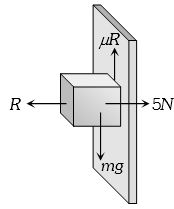
$A$ block of mass $0.1 \, kg$ is held against a wall by applying a horizontal force of $5 \, N$ on the block. If the coefficient of friction between the block and the wall is $0.5$,the magnitude of the frictional force acting on the block is ........ $N$.
A
$2.5$
B
$0.98$
C
$4.9$
D
$0.49$
Solution
(B) The normal force $R$ exerted by the wall on the block is equal to the applied horizontal force,so $R = 5 \, N$.
The limiting friction $F_l$ is given by $F_l = \mu R = 0.5 \times 5 = 2.5 \, N$.
The weight of the block acting downwards is $W = mg = 0.1 \times 9.8 = 0.98 \, N$.
Since the downward force (weight) is less than the limiting friction $(0.98 \, N < 2.5 \, N)$,the block remains at rest.
For a block in equilibrium,the static frictional force $F_s$ must balance the downward weight. Therefore,$F_s = W = 0.98 \, N$.
The limiting friction $F_l$ is given by $F_l = \mu R = 0.5 \times 5 = 2.5 \, N$.
The weight of the block acting downwards is $W = mg = 0.1 \times 9.8 = 0.98 \, N$.
Since the downward force (weight) is less than the limiting friction $(0.98 \, N < 2.5 \, N)$,the block remains at rest.
For a block in equilibrium,the static frictional force $F_s$ must balance the downward weight. Therefore,$F_s = W = 0.98 \, N$.
0 likesView Solution
3
PhysicsDifficultMCQIIT JEE · 1994
The magnitudes of the gravitational force at distances $r_1$ and $r_2$ from the centre of a uniform sphere of radius $R$ and mass $M$ are $F_1$ and $F_2$ respectively. Then
A
$\frac{F_1}{F_2} = \frac{r_1}{r_2}$ if $r_1 < R$ and $r_2 < R$
B
$\frac{F_1}{F_2} = \frac{r_2^2}{r_1^2}$ if $r_1 > R$ and $r_2 > R$
C
$\frac{F_1}{F_2} = \frac{r_1}{r_2}$ if $r_1 > R$ and $r_2 > R$
D
Both $(a)$ and $(b)$
Solution
(D) For a uniform sphere of mass $M$ and radius $R$,the gravitational field $g$ at a distance $r$ from the centre is given by:
$1$. Inside the sphere $(r < R)$: $g = \frac{GMr}{R^3}$,which implies $g \propto r$.
$2$. Outside the sphere $(r > R)$: $g = \frac{GM}{r^2}$,which implies $g \propto \frac{1}{r^2}$.
Since the gravitational force $F = mg$,the ratio of forces $\frac{F_1}{F_2}$ is equal to the ratio of gravitational fields $\frac{g_1}{g_2}$.
If $r_1 < R$ and $r_2 < R$,then $\frac{F_1}{F_2} = \frac{r_1}{r_2}$. This matches option $(a)$.
If $r_1 > R$ and $r_2 > R$,then $\frac{F_1}{F_2} = \frac{r_2^2}{r_1^2}$. This matches option $(b)$.
Therefore,both $(a)$ and $(b)$ are correct.
$1$. Inside the sphere $(r < R)$: $g = \frac{GMr}{R^3}$,which implies $g \propto r$.
$2$. Outside the sphere $(r > R)$: $g = \frac{GM}{r^2}$,which implies $g \propto \frac{1}{r^2}$.
Since the gravitational force $F = mg$,the ratio of forces $\frac{F_1}{F_2}$ is equal to the ratio of gravitational fields $\frac{g_1}{g_2}$.
If $r_1 < R$ and $r_2 < R$,then $\frac{F_1}{F_2} = \frac{r_1}{r_2}$. This matches option $(a)$.
If $r_1 > R$ and $r_2 > R$,then $\frac{F_1}{F_2} = \frac{r_2^2}{r_1^2}$. This matches option $(b)$.
Therefore,both $(a)$ and $(b)$ are correct.
0 likesView Solution
4
PhysicsEasyMCQIIT JEE · 1994
An application of Bernoulli's equation for fluid flow is found in
A
Dynamic lift of an aeroplane
B
Viscosity meter
C
Capillary rise
D
Hydraulic press
Solution
(A) Bernoulli's equation states that for an incompressible,non-viscous,and steady fluid flow,the sum of pressure energy,kinetic energy,and potential energy per unit volume remains constant along a streamline.
The dynamic lift of an aeroplane wing is a classic application of this principle.
As the wing moves through the air,the shape of the wing (airfoil) causes the air velocity above the wing to be higher than the air velocity below the wing.
According to Bernoulli's equation,where the velocity of the fluid is higher,the pressure is lower.
Therefore,the pressure below the wing is greater than the pressure above the wing,creating an upward force known as dynamic lift.
The dynamic lift of an aeroplane wing is a classic application of this principle.
As the wing moves through the air,the shape of the wing (airfoil) causes the air velocity above the wing to be higher than the air velocity below the wing.
According to Bernoulli's equation,where the velocity of the fluid is higher,the pressure is lower.
Therefore,the pressure below the wing is greater than the pressure above the wing,creating an upward force known as dynamic lift.
0 likesView Solution
5
PhysicsMediumMCQIIT JEE · 1994
$A$ block of ice floats on a liquid of density $1.2 \ g/cm^3$ in a beaker. What happens to the level of the liquid when the ice completely melts?
A
Remains same
B
Rises
C
Lowers
D
$(a), (b)$ or $(c)$
Solution
(B) Let $M$ be the mass of the ice block.
According to the principle of floatation,the weight of the ice equals the weight of the liquid displaced.
Thus,$M \cdot g = V_D \cdot \sigma_L \cdot g$,where $V_D$ is the volume of liquid displaced and $\sigma_L$ is the density of the liquid.
Therefore,$V_D = \frac{M}{\sigma_L}$.
When the ice melts,it forms water of mass $M$. The volume of this water is $V_F = \frac{M}{\sigma_W}$,where $\sigma_W$ is the density of water $(1 \ g/cm^3)$.
Given $\sigma_L = 1.2 \ g/cm^3$ and $\sigma_W = 1 \ g/cm^3$,we have $\sigma_L > \sigma_W$.
Comparing the volumes: Since $\sigma_L > \sigma_W$,it follows that $\frac{M}{\sigma_L} < \frac{M}{\sigma_W}$,which means $V_D < V_F$.
Since the volume of the water formed $(V_F)$ is greater than the volume of the liquid displaced by the floating ice $(V_D)$,the level of the liquid in the beaker will rise.
According to the principle of floatation,the weight of the ice equals the weight of the liquid displaced.
Thus,$M \cdot g = V_D \cdot \sigma_L \cdot g$,where $V_D$ is the volume of liquid displaced and $\sigma_L$ is the density of the liquid.
Therefore,$V_D = \frac{M}{\sigma_L}$.
When the ice melts,it forms water of mass $M$. The volume of this water is $V_F = \frac{M}{\sigma_W}$,where $\sigma_W$ is the density of water $(1 \ g/cm^3)$.
Given $\sigma_L = 1.2 \ g/cm^3$ and $\sigma_W = 1 \ g/cm^3$,we have $\sigma_L > \sigma_W$.
Comparing the volumes: Since $\sigma_L > \sigma_W$,it follows that $\frac{M}{\sigma_L} < \frac{M}{\sigma_W}$,which means $V_D < V_F$.
Since the volume of the water formed $(V_F)$ is greater than the volume of the liquid displaced by the floating ice $(V_D)$,the level of the liquid in the beaker will rise.
1 likesView Solution
6
PhysicsDifficultMCQIIT JEE · 1994
Two bodies $A$ and $B$ have thermal emissivities of $0.01$ and $0.81$ respectively. The outer surface areas of the two bodies are the same. The two bodies emit total radiant power at the same rate. The wavelength ${\lambda _B}$ corresponding to maximum spectral radiancy in the radiation from $B$ is shifted from the wavelength corresponding to maximum spectral radiancy in the radiation from $A$ by $1.00\;\mu m$. If the temperature of $A$ is $5802\;K$,then:
A
The temperature of $B$ is $1934\;K$
B
${\lambda _B} = 1.5\;\mu m$
C
The temperature of $B$ is $11604\;K$
D
Both $(a)$ and $(b)$
Solution
(D) According to Stefan-Boltzmann law,the total radiant power $P = e A \sigma T^4$. Since $P_A = P_B$ and $A_A = A_B$,we have $e_A T_A^4 = e_B T_B^4$.
Given $e_A = 0.01$,$e_B = 0.81$,and $T_A = 5802\;K$.
$T_B = T_A \left( \frac{e_A}{e_B} \right)^{1/4} = 5802 \times \left( \frac{0.01}{0.81} \right)^{1/4} = 5802 \times \left( \frac{1}{81} \right)^{1/4} = 5802 \times \frac{1}{3} = 1934\;K$.
From Wien's displacement law,$\lambda_A T_A = \lambda_B T_B = b$ (constant).
$\lambda_A = \frac{b}{T_A}$ and $\lambda_B = \frac{b}{T_B}$.
Given $\lambda_B - \lambda_A = 1.00\;\mu m$.
$\frac{b}{T_B} - \frac{b}{T_A} = 1.00\;\mu m$.
$b \left( \frac{1}{1934} - \frac{1}{5802} \right) = 1.00\;\mu m$.
$b \left( \frac{3 - 1}{5802} \right) = 1.00\;\mu m \Rightarrow b = \frac{5802}{2} = 2901\;\mu m \cdot K$.
Now,$\lambda_B = \frac{b}{T_B} = \frac{2901}{1934} = 1.5\;\mu m$.
Thus,both $(a)$ and $(b)$ are correct.
Given $e_A = 0.01$,$e_B = 0.81$,and $T_A = 5802\;K$.
$T_B = T_A \left( \frac{e_A}{e_B} \right)^{1/4} = 5802 \times \left( \frac{0.01}{0.81} \right)^{1/4} = 5802 \times \left( \frac{1}{81} \right)^{1/4} = 5802 \times \frac{1}{3} = 1934\;K$.
From Wien's displacement law,$\lambda_A T_A = \lambda_B T_B = b$ (constant).
$\lambda_A = \frac{b}{T_A}$ and $\lambda_B = \frac{b}{T_B}$.
Given $\lambda_B - \lambda_A = 1.00\;\mu m$.
$\frac{b}{T_B} - \frac{b}{T_A} = 1.00\;\mu m$.
$b \left( \frac{1}{1934} - \frac{1}{5802} \right) = 1.00\;\mu m$.
$b \left( \frac{3 - 1}{5802} \right) = 1.00\;\mu m \Rightarrow b = \frac{5802}{2} = 2901\;\mu m \cdot K$.
Now,$\lambda_B = \frac{b}{T_B} = \frac{2901}{1934} = 1.5\;\mu m$.
Thus,both $(a)$ and $(b)$ are correct.
0 likesView Solution
7
PhysicsDifficultMCQIIT JEE · 1994
Two different coils have self-inductance $L_1 = 8 \, mH$ and $L_2 = 2 \, mH$. The current in both coils is increased at the same constant rate. At a certain instant of time,the power supplied to the two coils is the same. At that time,the current,induced voltage,and energy stored in the first coil are $i_1, V_1$,and $W_1$ respectively. Corresponding values for the second coil at the same instant are $i_2, V_2$,and $W_2$ respectively. Then:
A
$\frac{i_1}{i_2} = \frac{1}{4}$
B
$\frac{V_2}{V_1} = \frac{1}{4}$
C
$\frac{W_2}{W_1} = 4$
D
All of the above
Solution
(D) Given: $L_1 = 8 \, mH$,$L_2 = 2 \, mH$,and $\frac{di_1}{dt} = \frac{di_2}{dt} = k$ (constant).
$1$. Induced voltage: $V = L \frac{di}{dt}$. Since $\frac{di}{dt}$ is the same for both,$\frac{V_2}{V_1} = \frac{L_2}{L_1} = \frac{2}{8} = \frac{1}{4}$. Thus,option $(b)$ is correct.
$2$. Power supplied: $P = V \cdot i$. Given $P_1 = P_2$,so $V_1 i_1 = V_2 i_2$. Therefore,$\frac{i_1}{i_2} = \frac{V_2}{V_1} = \frac{1}{4}$. Thus,option $(a)$ is correct.
$3$. Energy stored: $W = \frac{1}{2} L i^2$. The ratio is $\frac{W_2}{W_1} = \left( \frac{L_2}{L_1} \right) \left( \frac{i_2}{i_1} \right)^2 = \left( \frac{1}{4} \right) \left( 4 \right)^2 = \frac{1}{4} \times 16 = 4$. Thus,option $(c)$ is correct.
Since $(a)$,$(b)$,and $(c)$ are all correct,the answer is $(d)$.
$1$. Induced voltage: $V = L \frac{di}{dt}$. Since $\frac{di}{dt}$ is the same for both,$\frac{V_2}{V_1} = \frac{L_2}{L_1} = \frac{2}{8} = \frac{1}{4}$. Thus,option $(b)$ is correct.
$2$. Power supplied: $P = V \cdot i$. Given $P_1 = P_2$,so $V_1 i_1 = V_2 i_2$. Therefore,$\frac{i_1}{i_2} = \frac{V_2}{V_1} = \frac{1}{4}$. Thus,option $(a)$ is correct.
$3$. Energy stored: $W = \frac{1}{2} L i^2$. The ratio is $\frac{W_2}{W_1} = \left( \frac{L_2}{L_1} \right) \left( \frac{i_2}{i_1} \right)^2 = \left( \frac{1}{4} \right) \left( 4 \right)^2 = \frac{1}{4} \times 16 = 4$. Thus,option $(c)$ is correct.
Since $(a)$,$(b)$,and $(c)$ are all correct,the answer is $(d)$.
0 likesView Solution
8
PhysicsDifficultMCQIIT JEE · 1994
When a photon of energy $4.25\, eV$ strikes the surface of a metal $A$,the ejected photoelectrons have a maximum kinetic energy $T_A\, eV$ and de-Broglie wavelength ${\lambda _A}$. The maximum kinetic energy of photoelectrons liberated from another metal $B$ by a photon of energy $4.70\, eV$ is ${T_B} = ({T_A} - 1.50)\, eV$. If the de-Broglie wavelength of these photoelectrons is ${\lambda _B} = 2{\lambda _A}$,then:
A
The work function of $A$ is $2.25\, eV$
B
The work function of $B$ is $4.20\, eV$
C
${T_A} = 2.00\, eV$
D
All of the above
Solution
(D) Using Einstein's photoelectric equation: $K_{max} = E - \Phi$,where $\Phi$ is the work function.
For metal $A$: $T_A = 4.25 - \Phi_A$ ... $(i)$
For metal $B$: $T_B = T_A - 1.50 = 4.70 - \Phi_B$ ... (ii)
From $(i)$,$\Phi_A = 4.25 - T_A$. From (ii),$\Phi_B = 4.70 - (T_A - 1.50) = 6.20 - T_A$.
The de-Broglie wavelength is given by $\lambda = \frac{h}{\sqrt{2mK}}$,so $\lambda \propto \frac{1}{\sqrt{K}}$.
Given $\lambda_B = 2\lambda_A$,we have $\frac{\lambda_B}{\lambda_A} = \sqrt{\frac{T_A}{T_B}} = 2$.
Squaring both sides: $\frac{T_A}{T_A - 1.50} = 4$.
$T_A = 4T_A - 6.00 \Rightarrow 3T_A = 6.00 \Rightarrow T_A = 2.00\, eV$.
Substituting $T_A = 2.00\, eV$ into $(i)$: $\Phi_A = 4.25 - 2.00 = 2.25\, eV$.
Substituting $T_A = 2.00\, eV$ into (ii): $T_B = 2.00 - 1.50 = 0.50\, eV$. Then $\Phi_B = 4.70 - 0.50 = 4.20\, eV$.
Thus,all statements are correct.
For metal $A$: $T_A = 4.25 - \Phi_A$ ... $(i)$
For metal $B$: $T_B = T_A - 1.50 = 4.70 - \Phi_B$ ... (ii)
From $(i)$,$\Phi_A = 4.25 - T_A$. From (ii),$\Phi_B = 4.70 - (T_A - 1.50) = 6.20 - T_A$.
The de-Broglie wavelength is given by $\lambda = \frac{h}{\sqrt{2mK}}$,so $\lambda \propto \frac{1}{\sqrt{K}}$.
Given $\lambda_B = 2\lambda_A$,we have $\frac{\lambda_B}{\lambda_A} = \sqrt{\frac{T_A}{T_B}} = 2$.
Squaring both sides: $\frac{T_A}{T_A - 1.50} = 4$.
$T_A = 4T_A - 6.00 \Rightarrow 3T_A = 6.00 \Rightarrow T_A = 2.00\, eV$.
Substituting $T_A = 2.00\, eV$ into $(i)$: $\Phi_A = 4.25 - 2.00 = 2.25\, eV$.
Substituting $T_A = 2.00\, eV$ into (ii): $T_B = 2.00 - 1.50 = 0.50\, eV$. Then $\Phi_B = 4.70 - 0.50 = 4.20\, eV$.
Thus,all statements are correct.
0 likesView Solution
9
PhysicsMediumMCQIIT JEE · 1994
Which of the following statement$(s)$ is/are correct?
A
The rest mass of a stable nucleus is less than the sum of the rest masses of its separated nucleons.
B
In nuclear fission,energy is released by fragmentation of a very heavy nucleus.
C
In nuclear fusion,energy is released by fusing two nuclei of medium mass (approximately $100 \, a.m.u.$).
D
Both $(a)$ and $(b)$.
Solution
(D) The rest mass of a stable nucleus is always less than the sum of the rest masses of its constituent nucleons. This difference is known as the mass defect,$\Delta m$. The energy equivalent to this mass defect,given by $\Delta m c^2$,is the binding energy that keeps the nucleons together.
Nuclear fission is a process in which a very heavy nucleus splits into two or more lighter nuclei,releasing a significant amount of energy.
Nuclear fusion involves the combining of two light nuclei to form a heavier nucleus,not medium-mass nuclei as stated in option $(c)$.
Therefore,both statements $(a)$ and $(b)$ are correct.
Nuclear fission is a process in which a very heavy nucleus splits into two or more lighter nuclei,releasing a significant amount of energy.
Nuclear fusion involves the combining of two light nuclei to form a heavier nucleus,not medium-mass nuclei as stated in option $(c)$.
Therefore,both statements $(a)$ and $(b)$ are correct.
0 likesView Solution
10
PhysicsEasyMCQIIT JEE · 1994
Fast neutrons can easily be slowed down by
A
The use of lead shielding
B
Passing them through water
C
Elastic collisions with heavy nuclei
D
Applying a strong electric field
Solution
(B) Fast neutrons are slowed down by passing them through a moderator.
Materials containing light nuclei,such as water $(H_2O)$,heavy water $(D_2O)$,or graphite,are effective moderators.
When a fast neutron collides elastically with a light nucleus (like hydrogen or deuterium),it transfers a significant portion of its kinetic energy to the nucleus,thereby reducing its speed.
Therefore,passing neutrons through water is an effective method to slow them down.
Materials containing light nuclei,such as water $(H_2O)$,heavy water $(D_2O)$,or graphite,are effective moderators.
When a fast neutron collides elastically with a light nucleus (like hydrogen or deuterium),it transfers a significant portion of its kinetic energy to the nucleus,thereby reducing its speed.
Therefore,passing neutrons through water is an effective method to slow them down.
0 likesView Solution
11
PhysicsEasyMCQIIT JEE · 1994
Which of the following is in the increasing order for penetrating power?
A
$\alpha, \beta, \gamma$
B
$\beta, \alpha, \gamma$
C
$\gamma, \alpha, \beta$
D
$\gamma, \beta, \alpha$
Solution
(A) The penetrating power of radioactive radiations depends on their mass and charge.
Alpha particles $(\alpha)$ are heavy and carry a $+2e$ charge, making them highly ionizing but having the least penetrating power.
Beta particles $(\beta)$ are high-speed electrons with much smaller mass, giving them greater penetrating power than $\alpha$ particles.
Gamma rays $(\gamma)$ are high-energy electromagnetic waves with no mass and no charge, allowing them to have the highest penetrating power.
Specifically, the penetrating power of $\gamma$ is approximately $100$ times that of $\beta$, and the penetrating power of $\beta$ is approximately $100$ times that of $\alpha$.
Therefore, the increasing order of penetrating power is $\alpha$ < $\beta$ < $\gamma$.
Alpha particles $(\alpha)$ are heavy and carry a $+2e$ charge, making them highly ionizing but having the least penetrating power.
Beta particles $(\beta)$ are high-speed electrons with much smaller mass, giving them greater penetrating power than $\alpha$ particles.
Gamma rays $(\gamma)$ are high-energy electromagnetic waves with no mass and no charge, allowing them to have the highest penetrating power.
Specifically, the penetrating power of $\gamma$ is approximately $100$ times that of $\beta$, and the penetrating power of $\beta$ is approximately $100$ times that of $\alpha$.
Therefore, the increasing order of penetrating power is $\alpha$ < $\beta$ < $\gamma$.
0 likesView Solution
12
PhysicsEasyMCQIIT JEE · 1994
To make a $PN$ junction conducting,
A
The value of forward bias should be more than the barrier potential.
B
The value of forward bias should be less than the barrier potential.
C
The value of reverse bias should be more than the barrier potential.
D
The value of reverse bias should be less than the barrier potential.
Solution
(A) $PN$ junction diode acts as a conductor when it is forward-biased.
In forward bias,the positive terminal of the battery is connected to the $P$-region and the negative terminal to the $N$-region.
This reduces the width of the depletion layer and the height of the potential barrier.
For significant current to flow,the applied forward bias voltage must exceed the barrier potential (which is approximately $0.7 \ V$ for Silicon and $0.3 \ V$ for Germanium).
Therefore,the correct condition is that the forward bias should be greater than the barrier potential.
In forward bias,the positive terminal of the battery is connected to the $P$-region and the negative terminal to the $N$-region.
This reduces the width of the depletion layer and the height of the potential barrier.
For significant current to flow,the applied forward bias voltage must exceed the barrier potential (which is approximately $0.7 \ V$ for Silicon and $0.3 \ V$ for Germanium).
Therefore,the correct condition is that the forward bias should be greater than the barrier potential.
0 likesView Solution
13
PhysicsMediumMCQIIT JEE · 1994
$A$ beam of light of $\lambda = 600 \, nm$ from a distant source falls on a single slit $1 \, mm$ wide and the resulting diffraction pattern is observed on a screen $2 \, m$ away. The distance between the first dark fringes on either side of the central bright fringe is:
A
$1.2 \, cm$
B
$1.2 \, mm$
C
$2.4 \, cm$
D
$2.4 \, mm$
Solution
(D) Given: $\lambda = 600 \, nm = 600 \times 10^{-9} \, m$,slit width $a = 1 \, mm = 10^{-3} \, m$,and distance $D = 2 \, m$.
The distance between the first dark fringes on either side of the central bright fringe is equal to the width of the central maximum.
The formula for the width of the central maximum is given by $w = \frac{2 \lambda D}{a}$.
Substituting the values:
$w = \frac{2 \times (600 \times 10^{-9} \, m) \times 2 \, m}{10^{-3} \, m}$
$w = \frac{2400 \times 10^{-9}}{10^{-3}} \, m$
$w = 2400 \times 10^{-6} \, m = 2.4 \times 10^{-3} \, m = 2.4 \, mm$.
The distance between the first dark fringes on either side of the central bright fringe is equal to the width of the central maximum.
The formula for the width of the central maximum is given by $w = \frac{2 \lambda D}{a}$.
Substituting the values:
$w = \frac{2 \times (600 \times 10^{-9} \, m) \times 2 \, m}{10^{-3} \, m}$
$w = \frac{2400 \times 10^{-9}}{10^{-3}} \, m$
$w = 2400 \times 10^{-6} \, m = 2.4 \times 10^{-3} \, m = 2.4 \, mm$.
0 likesView Solution
Vedclass Products
For Students
Vedclass Test Series
Mock tests in real IIT JEE style covering Physics with performance analysis. 5-day free trial.
Start Free TrialFor Teachers
Exam Paper Generator
Generate Set A/B/C/D Physics papers from 7.5L+ questions in 2 minutes. 3 chapters free.
Try FreeFor Institutes
Online Exam Module
Run live IIT JEE mock exams with unlimited students, 360° analytics & white-label branding.
See DemoFrequently Asked Questions
How many Physics questions are in IIT JEE 1994?
There are 13 Physics questions from the IIT JEE 1994 paper on Vedclass, each with a detailed step-by-step solution in English.
Are IIT JEE 1994 Physics solutions available in English?
Yes. All solutions on this page are in English. You can also switch to English or Hindi using the language buttons above the questions.
Can I practice IIT JEE 1994 Physics as a timed test?
Yes. Use the Vedclass Test Series to attempt a full IIT JEE mock test covering Physics with time limits and instant score analysis.
Can teachers create Physics papers from IIT JEE previous year questions?
Yes. The Vedclass Exam Paper Generator lets teachers mix IIT JEE Physics questions and generate Set A/B/C/D papers in minutes.
For Teachers & Institutes
Build a Custom Physics Paper
Pick IIT JEE 1994 Physics questions, set difficulty, and generate Set A/B/C/D in 2 minutes.