
ChemistryQ1–26 of 26 questions
Page 1 of 1 · English
1
ChemistryMediumMCQIIT JEE · 1994
The correct ground state electronic configuration of chromium atom is
A
$[Ar] \, 3d^5 \, 4s^1$
B
$[Ar] \, 3d^4 \, 4s^2$
C
$[Ar] \, 3d^6 \, 4s^0$
D
$[Ar] \, 4d^5 \, 4s^1$
Solution
(A) The atomic number of chromium $(Cr)$ is $24$.
According to the Aufbau principle,the expected configuration is $[Ar] \, 3d^4 \, 4s^2$.
However,a $3d$ subshell that is half-filled $(3d^5)$ is more stable due to exchange energy and symmetry.
Therefore,one electron from the $4s$ orbital jumps into the $3d$ orbital to achieve the stable configuration $[Ar] \, 3d^5 \, 4s^1$.
According to the Aufbau principle,the expected configuration is $[Ar] \, 3d^4 \, 4s^2$.
However,a $3d$ subshell that is half-filled $(3d^5)$ is more stable due to exchange energy and symmetry.
Therefore,one electron from the $4s$ orbital jumps into the $3d$ orbital to achieve the stable configuration $[Ar] \, 3d^5 \, 4s^1$.
0 likesView Solution
2
ChemistryMediumMCQIIT JEE · 1994
Which one has minimum (nearly zero) dipole moment?
A
but-$1$-ene
B
$cis$-but-$2$-ene
C
$trans$-but-$2$-ene
D
$2$-methylprop-$1$-ene
Solution
(C) The dipole moment of a molecule depends on its geometry and the polarity of its bonds.
In $trans$-but-$2$-ene,the two methyl groups are on opposite sides of the double bond.
Due to the symmetry of the molecule,the bond dipoles of the $C-CH_3$ bonds cancel each other out.
Therefore,the net dipole moment of $trans$-but-$2$-ene is zero.
In $trans$-but-$2$-ene,the two methyl groups are on opposite sides of the double bond.
Due to the symmetry of the molecule,the bond dipoles of the $C-CH_3$ bonds cancel each other out.
Therefore,the net dipole moment of $trans$-but-$2$-ene is zero.
0 likesView Solution
3
ChemistryDifficultMCQIIT JEE · 1994
The two types of bonds present in $B_2H_6$ are covalent and
A
Three centre bond
B
Hydrogen bond
C
Two centre bond
D
None of the above
Solution
(A) The diborane $(B_2H_6)$ molecule contains two types of $B-H$ bonds:
$(i)$ $B-H_t$ (terminal): These are normal two-centre two-electron $(2c-2e)$ covalent bonds.
(ii) $B-H_b$ (bridging): These are three-centre two-electron $(3c-2e)$ bonds,often called banana bonds.
Therefore,the two types of bonds present are covalent and three-centre bonds.
$(i)$ $B-H_t$ (terminal): These are normal two-centre two-electron $(2c-2e)$ covalent bonds.
(ii) $B-H_b$ (bridging): These are three-centre two-electron $(3c-2e)$ bonds,often called banana bonds.
Therefore,the two types of bonds present are covalent and three-centre bonds.
0 likesView Solution
4
ChemistryEasyMCQIIT JEE · 1994
The temperature at which real gases obey the ideal gas laws over a wide range of pressure is called:
A
Critical temperature
B
Boyle temperature
C
Inversion temperature
D
Reduced temperature
Solution
(B) The temperature at which a real gas behaves like an ideal gas over an appreciable range of pressure is known as the $Boyle$ temperature or $Boyle$ point.
At this temperature,the compressibility factor $Z$ remains close to $1$ for a wide range of pressure.
At this temperature,the compressibility factor $Z$ remains close to $1$ for a wide range of pressure.
0 likesView Solution
5
ChemistryMediumMCQIIT JEE · 1994
The relation between equilibrium constant $K_p$ and $K_c$ is
A
$K_c = K_p (RT)^{\Delta n}$
B
$K_p = K_c (RT)^{\Delta n}$
C
$K_p = \left( \frac{K_c}{RT} \right)^{\Delta n}$
D
$K_p - K_c = (RT)^{\Delta n}$
Solution
(B) For a general gaseous reaction at equilibrium: $aA_{(g)} + bB_{(g)} \rightleftharpoons cC_{(g)} + dD_{(g)}$
$K_c$ is defined as the ratio of the product of concentrations of products to that of reactants,each raised to the power of their stoichiometric coefficients: $K_c = \frac{[C]^c [D]^d}{[A]^a [B]^b} \ldots (1)$
$K_p$ is defined using partial pressures: $K_p = \frac{p_C^c p_D^d}{p_A^a p_B^b} \ldots (2)$
From the ideal gas equation,$PV = nRT$,we have $P = \frac{n}{V} RT = [Concentration]RT$.
Substituting $p_i = [i]RT$ into equation $(2)$:
$K_p = \frac{([C]RT)^c ([D]RT)^d}{([A]RT)^a ([B]RT)^b} = \frac{[C]^c [D]^d}{[A]^a [B]^b} (RT)^{(c+d)-(a+b)}$
Since $\Delta n = (c+d) - (a+b)$,we get $K_p = K_c (RT)^{\Delta n}$.
$K_c$ is defined as the ratio of the product of concentrations of products to that of reactants,each raised to the power of their stoichiometric coefficients: $K_c = \frac{[C]^c [D]^d}{[A]^a [B]^b} \ldots (1)$
$K_p$ is defined using partial pressures: $K_p = \frac{p_C^c p_D^d}{p_A^a p_B^b} \ldots (2)$
From the ideal gas equation,$PV = nRT$,we have $P = \frac{n}{V} RT = [Concentration]RT$.
Substituting $p_i = [i]RT$ into equation $(2)$:
$K_p = \frac{([C]RT)^c ([D]RT)^d}{([A]RT)^a ([B]RT)^b} = \frac{[C]^c [D]^d}{[A]^a [B]^b} (RT)^{(c+d)-(a+b)}$
Since $\Delta n = (c+d) - (a+b)$,we get $K_p = K_c (RT)^{\Delta n}$.
0 likesView Solution
6
ChemistryMediumMCQIIT JEE · 1994
The bond dissociation energy needed to form the benzyl radical from toluene is $.....$ than the formation of the methyl radical from methane.
A
Less
B
Much
C
Equal
D
None of the above
Solution
(A) The bond dissociation energy required to form the benzyl radical $(C_6H_5CH_2^{\bullet})$ from toluene $(C_6H_5CH_3)$ is less than that required to form the methyl radical $(CH_3^{\bullet})$ from methane $(CH_4)$.
This is because the benzyl radical is stabilized by resonance with the benzene ring,which lowers the energy of the radical intermediate.
In contrast,the methyl radical lacks such resonance stabilization.
This is because the benzyl radical is stabilized by resonance with the benzene ring,which lowers the energy of the radical intermediate.
In contrast,the methyl radical lacks such resonance stabilization.
0 likesView Solution
7
ChemistryEasyMCQIIT JEE · 1994
The compound $YBa_2Cu_3O_7$,which shows superconductivity,has copper in an oxidation state of ........ Assume that the rare earth element Yttrium is in its usual $+3$ oxidation state.
A
$3/7$
B
$7/3$
C
$3$
D
$7$
Solution
(B) Let the oxidation state of $Cu$ be $x$.
Given that $Y$ is in $+3$ state and $Ba$ is in $+2$ state (alkaline earth metal),and $O$ is in $-2$ state.
The sum of oxidation states in a neutral compound is $0$.
$3 + (2 \times 2) + 3x + (7 \times -2) = 0$
$3 + 4 + 3x - 14 = 0$
$7 + 3x - 14 = 0$
$3x - 7 = 0$
$3x = 7$
$x = 7/3$
Given that $Y$ is in $+3$ state and $Ba$ is in $+2$ state (alkaline earth metal),and $O$ is in $-2$ state.
The sum of oxidation states in a neutral compound is $0$.
$3 + (2 \times 2) + 3x + (7 \times -2) = 0$
$3 + 4 + 3x - 14 = 0$
$7 + 3x - 14 = 0$
$3x - 7 = 0$
$3x = 7$
$x = 7/3$
0 likesView Solution
8
ChemistryMediumMCQIIT JEE · 1994
Which of the following pairs will not produce dihydrogen gas?
A
$Cu + HCl$ (dil.)
B
$Fe + H_2SO_4$
C
$Mg + \text{steam}$
D
$Na + \text{alcohol}$
Solution
(A) The reactivity series of metals determines whether a metal can displace hydrogen from an acid or water.
$Cu$ (Copper) is placed below hydrogen in the electrochemical series,meaning it has a lower reduction potential than hydrogen.
Therefore,$Cu$ cannot displace hydrogen from dilute $HCl$.
In contrast,$Fe$,$Mg$,and $Na$ are more reactive than hydrogen and will react to produce $H_2$ gas.
Thus,the pair $Cu + HCl$ (dil.) will not produce dihydrogen gas.
$Cu$ (Copper) is placed below hydrogen in the electrochemical series,meaning it has a lower reduction potential than hydrogen.
Therefore,$Cu$ cannot displace hydrogen from dilute $HCl$.
In contrast,$Fe$,$Mg$,and $Na$ are more reactive than hydrogen and will react to produce $H_2$ gas.
Thus,the pair $Cu + HCl$ (dil.) will not produce dihydrogen gas.
0 likesView Solution
9
ChemistryMediumMCQIIT JEE · 1994
The $IUPAC$ name of succinic acid is
A
$Butane-1, 4-dioic$ acid
B
$Dimethyl-2-acid$
C
$1, 2-dimethyldioic$ acid
D
None of these
Solution
(A) Succinic acid has the chemical formula $HOOC-CH_2-CH_2-COOH$.
It contains a chain of $4$ carbon atoms with two carboxylic acid groups at the terminal positions.
According to $IUPAC$ nomenclature,the parent alkane is butane,and the suffix for two carboxylic acid groups is $dioic$ acid.
Therefore,the $IUPAC$ name is $butane-1, 4-dioic$ acid.
It contains a chain of $4$ carbon atoms with two carboxylic acid groups at the terminal positions.
According to $IUPAC$ nomenclature,the parent alkane is butane,and the suffix for two carboxylic acid groups is $dioic$ acid.
Therefore,the $IUPAC$ name is $butane-1, 4-dioic$ acid.
0 likesView Solution
10
ChemistryMCQIIT JEE · 1994
The point of intersection of tangents at the ends of the latus-rectum of the parabola $y^2 = 4x$ is
A
$(1, 0)$
B
$(-1, 0)$
C
$(0, 1)$
D
$(0, -1)$
Solution
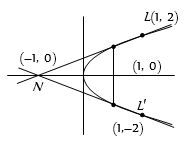
(B) The equation of the tangent at $(x_1, y_1)$ on the parabola $y^2 = 4ax$ is $yy_1 = 2a(x + x_1)$.
For the parabola $y^2 = 4x$,we have $a = 1$.
The coordinates of the ends of the latus rectum are $L(1, 2)$ and $L'(1, -2)$.
For point $L(1, 2)$,the tangent equation is $2y = 2(x + 1)$,which simplifies to $y = x + 1$.
For point $L'(1, -2)$,the tangent equation is $-2y = 2(x + 1)$,which simplifies to $y = -(x + 1)$.
Solving these two equations: $x + 1 = -(x + 1) \implies 2(x + 1) = 0 \implies x = -1$.
Substituting $x = -1$ into $y = x + 1$,we get $y = 0$.
Thus,the point of intersection is $(-1, 0)$.
For the parabola $y^2 = 4x$,we have $a = 1$.
The coordinates of the ends of the latus rectum are $L(1, 2)$ and $L'(1, -2)$.
For point $L(1, 2)$,the tangent equation is $2y = 2(x + 1)$,which simplifies to $y = x + 1$.
For point $L'(1, -2)$,the tangent equation is $-2y = 2(x + 1)$,which simplifies to $y = -(x + 1)$.
Solving these two equations: $x + 1 = -(x + 1) \implies 2(x + 1) = 0 \implies x = -1$.
Substituting $x = -1$ into $y = x + 1$,we get $y = 0$.
Thus,the point of intersection is $(-1, 0)$.
0 likesView Solution
11
ChemistryMCQIIT JEE · 1994
If $y = (\sin x)^{\tan x}$,then $\frac{dy}{dx}$ is equal to
A
$(\sin x)^{\tan x} (1 + \sec^2 x \cdot \log \sin x)$
B
$\tan x \cdot (\sin x)^{\tan x - 1} \cdot \cos x$
C
$(\sin x)^{\tan x} \cdot \sec^2 x \cdot \log \sin x$
D
$\tan x \cdot (\sin x)^{\tan x - 1}$
Solution
(A) Given $y = (\sin x)^{\tan x}$.
Taking logarithm on both sides,we get $\log y = \tan x \cdot \log(\sin x)$.
Differentiating both sides with respect to $x$ using the product rule:
$\frac{1}{y} \frac{dy}{dx} = \frac{d}{dx}(\tan x) \cdot \log(\sin x) + \tan x \cdot \frac{d}{dx}(\log(\sin x))$.
$\frac{1}{y} \frac{dy}{dx} = \sec^2 x \cdot \log(\sin x) + \tan x \cdot \frac{1}{\sin x} \cdot \cos x$.
Since $\frac{\cos x}{\sin x} = \cot x$,we have $\tan x \cdot \cot x = 1$.
Therefore,$\frac{1}{y} \frac{dy}{dx} = \sec^2 x \cdot \log(\sin x) + 1$.
$\frac{dy}{dx} = y [1 + \sec^2 x \cdot \log(\sin x)]$.
Substituting $y = (\sin x)^{\tan x}$,we get $\frac{dy}{dx} = (\sin x)^{\tan x} [1 + \sec^2 x \cdot \log(\sin x)]$.
Taking logarithm on both sides,we get $\log y = \tan x \cdot \log(\sin x)$.
Differentiating both sides with respect to $x$ using the product rule:
$\frac{1}{y} \frac{dy}{dx} = \frac{d}{dx}(\tan x) \cdot \log(\sin x) + \tan x \cdot \frac{d}{dx}(\log(\sin x))$.
$\frac{1}{y} \frac{dy}{dx} = \sec^2 x \cdot \log(\sin x) + \tan x \cdot \frac{1}{\sin x} \cdot \cos x$.
Since $\frac{\cos x}{\sin x} = \cot x$,we have $\tan x \cdot \cot x = 1$.
Therefore,$\frac{1}{y} \frac{dy}{dx} = \sec^2 x \cdot \log(\sin x) + 1$.
$\frac{dy}{dx} = y [1 + \sec^2 x \cdot \log(\sin x)]$.
Substituting $y = (\sin x)^{\tan x}$,we get $\frac{dy}{dx} = (\sin x)^{\tan x} [1 + \sec^2 x \cdot \log(\sin x)]$.
0 likesView Solution
12
ChemistryMCQIIT JEE · 1994
If $y = 4x - 5$ is tangent to the curve $y^2 = px^3 + q$ at $(2, 3)$,then
A
$p = 2, q = -7$
B
$p = -2, q = 7$
C
$p = -2, q = -7$
D
$p = 2, q = 7$
Solution
(A) Given the curve $y^2 = px^3 + q$ $(i)$
Differentiating with respect to $x$,we get $2y \cdot \frac{dy}{dx} = 3px^2$.
Thus,$\frac{dy}{dx} = \frac{3px^2}{2y}$.
The slope of the tangent at $(2, 3)$ is $\left. \frac{dy}{dx} \right|_{(2,3)} = \frac{3p(2)^2}{2(3)} = \frac{12p}{6} = 2p$.
The given tangent line is $y = 4x - 5$,which has a slope of $4$.
Equating the slopes,$2p = 4$,which gives $p = 2$.
Since the point $(2, 3)$ lies on the curve,substitute $x = 2, y = 3$ and $p = 2$ into equation $(i)$:
$3^2 = 2(2)^3 + q$
$9 = 2(8) + q$
$9 = 16 + q$
$q = 9 - 16 = -7$.
Therefore,$p = 2$ and $q = -7$.
Differentiating with respect to $x$,we get $2y \cdot \frac{dy}{dx} = 3px^2$.
Thus,$\frac{dy}{dx} = \frac{3px^2}{2y}$.
The slope of the tangent at $(2, 3)$ is $\left. \frac{dy}{dx} \right|_{(2,3)} = \frac{3p(2)^2}{2(3)} = \frac{12p}{6} = 2p$.
The given tangent line is $y = 4x - 5$,which has a slope of $4$.
Equating the slopes,$2p = 4$,which gives $p = 2$.
Since the point $(2, 3)$ lies on the curve,substitute $x = 2, y = 3$ and $p = 2$ into equation $(i)$:
$3^2 = 2(2)^3 + q$
$9 = 2(8) + q$
$9 = 16 + q$
$q = 9 - 16 = -7$.
Therefore,$p = 2$ and $q = -7$.
0 likesView Solution
13
ChemistryMCQIIT JEE · 1994
Let $E$ be the ellipse $\frac{x^2}{9} + \frac{y^2}{4} = 1$ and $C$ be the circle $x^2 + y^2 = 9$. Let $P$ and $Q$ be the points $(1, 2)$ and $(2, 1)$ respectively. Then:
A
$Q$ lies inside $C$ but outside $E$.
B
$Q$ lies outside both $C$ and $E$.
C
$P$ lies inside both $C$ and $E$.
D
$P$ lies inside $C$ but outside $E$.
Solution
(D) For the ellipse $E: \frac{x^2}{9} + \frac{y^2}{4} - 1 = 0$,let $f(x, y) = \frac{x^2}{9} + \frac{y^2}{4} - 1$.
For the circle $C: x^2 + y^2 - 9 = 0$,let $g(x, y) = x^2 + y^2 - 9$.
For point $P(1, 2)$:
$f(1, 2) = \frac{1}{9} + \frac{4}{4} - 1 = \frac{1}{9} > 0$,so $P$ is outside $E$.
$g(1, 2) = 1^2 + 2^2 - 9 = 1 + 4 - 9 = -4 < 0$,so $P$ is inside $C$.
Thus,$P$ lies inside $C$ but outside $E$.
For point $Q(2, 1)$:
$f(2, 1) = \frac{4}{9} + \frac{1}{4} - 1 = \frac{16 + 9 - 36}{36} = -\frac{11}{36} < 0$,so $Q$ is inside $E$.
$g(2, 1) = 2^2 + 1^2 - 9 = 4 + 1 - 9 = -4 < 0$,so $Q$ is inside $C$.
Thus,$Q$ lies inside both $C$ and $E$.
For the circle $C: x^2 + y^2 - 9 = 0$,let $g(x, y) = x^2 + y^2 - 9$.
For point $P(1, 2)$:
$f(1, 2) = \frac{1}{9} + \frac{4}{4} - 1 = \frac{1}{9} > 0$,so $P$ is outside $E$.
$g(1, 2) = 1^2 + 2^2 - 9 = 1 + 4 - 9 = -4 < 0$,so $P$ is inside $C$.
Thus,$P$ lies inside $C$ but outside $E$.
For point $Q(2, 1)$:
$f(2, 1) = \frac{4}{9} + \frac{1}{4} - 1 = \frac{16 + 9 - 36}{36} = -\frac{11}{36} < 0$,so $Q$ is inside $E$.
$g(2, 1) = 2^2 + 1^2 - 9 = 4 + 1 - 9 = -4 < 0$,so $Q$ is inside $C$.
Thus,$Q$ lies inside both $C$ and $E$.
0 likesView Solution
14
ChemistryMediumMCQIIT JEE · 1994
From the given sets of quantum numbers,the one that is inconsistent with the theory is:
A
$n = 3; l = 2; m = -3; s = +1/2$
B
$n = 4; l = 3; m = 3; s = +1/2$
C
$n = 2; l = 1; m = 0; s = -1/2$
D
$n = 4; l = 3; m = 2; s = +1/2$
Solution
(A) The magnetic quantum number $m$ can take values from $-l$ to $+l$ including zero.
For option $A$,$n = 3$ and $l = 2$.
The possible values for $m$ are $-2, -1, 0, +1, +2$.
Since $m = -3$ is outside this range,this set is inconsistent with quantum mechanical theory.
For option $A$,$n = 3$ and $l = 2$.
The possible values for $m$ are $-2, -1, 0, +1, +2$.
Since $m = -3$ is outside this range,this set is inconsistent with quantum mechanical theory.
0 likesView Solution
15
ChemistryMCQIIT JEE · 1994
Let $E$ be the ellipse $\frac{x^2}{9} + \frac{y^2}{4} = 1$ and $C$ be the circle $x^2 + y^2 = 9$. Let $P$ and $Q$ be the points $(1, 2)$ and $(2, 1)$ respectively. Then:
A
$Q$ lies inside $C$ but outside $E$
B
$Q$ lies outside both $C$ and $E$
C
$P$ lies inside both $C$ and $E$
D
$P$ lies inside $C$ but outside $E$
Solution
(D) The equation of the ellipse is $E: \frac{x^2}{9} + \frac{y^2}{4} = 1$ and the circle is $C: x^2 + y^2 = 9$.
For point $P(1, 2)$:
Check for circle $C$: $1^2 + 2^2 = 1 + 4 = 5 < 9$,so $P$ is inside $C$.
Check for ellipse $E$: $\frac{1^2}{9} + \frac{2^2}{4} = \frac{1}{9} + 1 = \frac{10}{9} > 1$,so $P$ is outside $E$.
For point $Q(2, 1)$:
Check for circle $C$: $2^2 + 1^2 = 4 + 1 = 5 < 9$,so $Q$ is inside $C$.
Check for ellipse $E$: $\frac{2^2}{9} + \frac{1^2}{4} = \frac{4}{9} + \frac{1}{4} = \frac{16+9}{36} = \frac{25}{36} < 1$,so $Q$ is inside $E$.
Thus,$P$ lies inside $C$ but outside $E$.
For point $P(1, 2)$:
Check for circle $C$: $1^2 + 2^2 = 1 + 4 = 5 < 9$,so $P$ is inside $C$.
Check for ellipse $E$: $\frac{1^2}{9} + \frac{2^2}{4} = \frac{1}{9} + 1 = \frac{10}{9} > 1$,so $P$ is outside $E$.
For point $Q(2, 1)$:
Check for circle $C$: $2^2 + 1^2 = 4 + 1 = 5 < 9$,so $Q$ is inside $C$.
Check for ellipse $E$: $\frac{2^2}{9} + \frac{1^2}{4} = \frac{4}{9} + \frac{1}{4} = \frac{16+9}{36} = \frac{25}{36} < 1$,so $Q$ is inside $E$.
Thus,$P$ lies inside $C$ but outside $E$.
0 likesView Solution
16
ChemistryMCQIIT JEE · 1994
The point of intersection of tangents at the ends of the latus rectum of the parabola $y^2 = 4x$ is equal to
A
$(1,0)$
B
$(-1,0)$
C
$(0,1)$
D
$(0,-1)$
Solution
(B) The parabola is given by $y^2 = 4x$. Comparing this with $y^2 = 4ax$,we get $a = 1$.
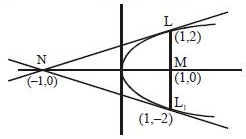
The ends of the latus rectum are $L(a, 2a)$ and $L_1(a, -2a)$,which are $L(1, 2)$ and $L_1(1, -2)$.
The equation of the tangent to the parabola $y^2 = 4ax$ at point $(x_1, y_1)$ is $yy_1 = 2a(x + x_1)$.
For point $L(1, 2)$,the tangent equation is $y(2) = 2(1)(x + 1) \implies y = x + 1$.
For point $L_1(1, -2)$,the tangent equation is $y(-2) = 2(1)(x + 1) \implies -y = x + 1$.
Adding the two equations: $(x + 1) + (x + 1) = 0 \implies 2x + 2 = 0 \implies x = -1$.
Substituting $x = -1$ into $y = x + 1$,we get $y = -1 + 1 = 0$.
Thus,the point of intersection is $(-1, 0)$.
The ends of the latus rectum are $L(a, 2a)$ and $L_1(a, -2a)$,which are $L(1, 2)$ and $L_1(1, -2)$.
The equation of the tangent to the parabola $y^2 = 4ax$ at point $(x_1, y_1)$ is $yy_1 = 2a(x + x_1)$.
For point $L(1, 2)$,the tangent equation is $y(2) = 2(1)(x + 1) \implies y = x + 1$.
For point $L_1(1, -2)$,the tangent equation is $y(-2) = 2(1)(x + 1) \implies -y = x + 1$.
Adding the two equations: $(x + 1) + (x + 1) = 0 \implies 2x + 2 = 0 \implies x = -1$.
Substituting $x = -1$ into $y = x + 1$,we get $y = -1 + 1 = 0$.
Thus,the point of intersection is $(-1, 0)$.
0 likesView Solution
17
ChemistryMCQIIT JEE · 1994
If two events $A$ and $B$ are such that $P(A^c) = 0.3$,$P(B) = 0.4$,and $P(A \cap B^c) = 0.5$,then $P\left[ \frac{B}{A \cup B^c} \right]$ is equal to
A
$1/2$
B
$1/3$
C
$1/4$
D
None of these
Solution
(C) Given: $P(A^c) = 0.3 \implies P(A) = 1 - 0.3 = 0.7$.
$P(B) = 0.4 \implies P(B^c) = 1 - 0.4 = 0.6$.
$P(A \cap B^c) = 0.5$.
We know that $P(A) = P(A \cap B) + P(A \cap B^c)$,so $0.7 = P(A \cap B) + 0.5 \implies P(A \cap B) = 0.2$.
We need to find $P\left[ \frac{B}{A \cup B^c} \right] = \frac{P(B \cap (A \cup B^c))}{P(A \cup B^c)}$.
Numerator: $P(B \cap (A \cup B^c)) = P((B \cap A) \cup (B \cap B^c)) = P(B \cap A) = 0.2$.
Denominator: $P(A \cup B^c) = P(A) + P(B^c) - P(A \cap B^c) = 0.7 + 0.6 - 0.5 = 0.8$.
Therefore,$P\left[ \frac{B}{A \cup B^c} \right] = \frac{0.2}{0.8} = \frac{1}{4}$.
$P(B) = 0.4 \implies P(B^c) = 1 - 0.4 = 0.6$.
$P(A \cap B^c) = 0.5$.
We know that $P(A) = P(A \cap B) + P(A \cap B^c)$,so $0.7 = P(A \cap B) + 0.5 \implies P(A \cap B) = 0.2$.
We need to find $P\left[ \frac{B}{A \cup B^c} \right] = \frac{P(B \cap (A \cup B^c))}{P(A \cup B^c)}$.
Numerator: $P(B \cap (A \cup B^c)) = P((B \cap A) \cup (B \cap B^c)) = P(B \cap A) = 0.2$.
Denominator: $P(A \cup B^c) = P(A) + P(B^c) - P(A \cap B^c) = 0.7 + 0.6 - 0.5 = 0.8$.
Therefore,$P\left[ \frac{B}{A \cup B^c} \right] = \frac{0.2}{0.8} = \frac{1}{4}$.
0 likesView Solution
18
ChemistryMCQIIT JEE · 1994
$A$ particle of mass $m$ is moving in a circular path of constant radius $r$ such that its centripetal acceleration $a_c$ is varying with time $t$ as $a_c = k^2rt^2$. The power delivered to the particle by the forces acting on it is
A
$2mk^2r^2t$
B
$mk^2r^2t$
C
$\frac{mk^4r^2t^5}{3}$
D
Zero
Solution
(B) Given the centripetal acceleration $a_c = k^2rt^2$.
Since $a_c = \frac{v^2}{r}$,we have $\frac{v^2}{r} = k^2rt^2$,which implies $v^2 = k^2r^2t^2$ or $v = krt$.
The tangential acceleration $a_t$ is given by $a_t = \frac{dv}{dt} = \frac{d}{dt}(krt) = kr$.
The tangential force acting on the particle is $F_t = m a_t = m(kr) = mkr$.
The power $P$ delivered to the particle is the product of the tangential force and the velocity: $P = F_t \cdot v = (mkr) \cdot (krt) = mk^2r^2t$.
Since $a_c = \frac{v^2}{r}$,we have $\frac{v^2}{r} = k^2rt^2$,which implies $v^2 = k^2r^2t^2$ or $v = krt$.
The tangential acceleration $a_t$ is given by $a_t = \frac{dv}{dt} = \frac{d}{dt}(krt) = kr$.
The tangential force acting on the particle is $F_t = m a_t = m(kr) = mkr$.
The power $P$ delivered to the particle is the product of the tangential force and the velocity: $P = F_t \cdot v = (mkr) \cdot (krt) = mk^2r^2t$.
0 likesView Solution
19
ChemistryMCQIIT JEE · 1994
$A$ particle of mass $m$ is moving in a circular path of constant radius $r$ such that its centripetal acceleration $a_c$ is varying with time $t$ as $a_c = k^2rt^2$. The power delivered to the particle by the forces acting on it is
A
$2\pi mk^2r^2t$
B
$mk^2r^2t$
C
$\frac{mk^4r^2t^5}{3}$
D
Zero
Solution
(B) The centripetal acceleration is given by $a_c = \frac{v^2}{r} = k^2rt^2$.
From this,we find the speed $v$ of the particle: $v^2 = k^2r^2t^2$,which implies $v = krt$.
The tangential acceleration $a_t$ is the rate of change of speed: $a_t = \frac{dv}{dt} = \frac{d}{dt}(krt) = kr$.
The tangential force acting on the particle is $F_t = m a_t = mkr$.
The power $P$ delivered to the particle is the product of the tangential force and the velocity: $P = F_t \cdot v = (mkr) \cdot (krt) = mk^2r^2t$.
From this,we find the speed $v$ of the particle: $v^2 = k^2r^2t^2$,which implies $v = krt$.
The tangential acceleration $a_t$ is the rate of change of speed: $a_t = \frac{dv}{dt} = \frac{d}{dt}(krt) = kr$.
The tangential force acting on the particle is $F_t = m a_t = mkr$.
The power $P$ delivered to the particle is the product of the tangential force and the velocity: $P = F_t \cdot v = (mkr) \cdot (krt) = mk^2r^2t$.
0 likesView Solution
20
ChemistryMCQIIT JEE · 1994
Which of the following pairs will not produce dihydrogen gas?
A
$Cu + \text{dil. } HCl$
B
$Fe + H_2SO_4$
C
$Mg + \text{steam}$
D
$Na + \text{alcohol}$
Solution
(A) The production of dihydrogen gas $(H_2)$ by the reaction of metals with acids or other reagents depends on the position of the metal in the electrochemical series.
Metals that are more reactive than hydrogen (i.e.,have a negative standard reduction potential) can displace hydrogen from acids.
$Cu$ (Copper) is below hydrogen in the electrochemical series,meaning it has a positive standard reduction potential.
Therefore,$Cu$ cannot displace hydrogen from dilute $HCl$ or other non-oxidizing acids.
In contrast,$Fe$ reacts with $H_2SO_4$ to produce $FeSO_4$ and $H_2$,$Mg$ reacts with steam to produce $MgO$ and $H_2$,and $Na$ reacts with alcohol to produce sodium alkoxide and $H_2$.
Metals that are more reactive than hydrogen (i.e.,have a negative standard reduction potential) can displace hydrogen from acids.
$Cu$ (Copper) is below hydrogen in the electrochemical series,meaning it has a positive standard reduction potential.
Therefore,$Cu$ cannot displace hydrogen from dilute $HCl$ or other non-oxidizing acids.
In contrast,$Fe$ reacts with $H_2SO_4$ to produce $FeSO_4$ and $H_2$,$Mg$ reacts with steam to produce $MgO$ and $H_2$,and $Na$ reacts with alcohol to produce sodium alkoxide and $H_2$.
0 likesView Solution
21
ChemistryMediumMCQIIT JEE · 1994
The high melting point and insolubility in organic solvents of sulphanilic acid are due to its $......$ structure.
A
Simple ionic
B
Bipolar ionic
C
Cubic
D
Hexagonal
Solution
(B) Sulphanilic acid exists as a zwitterion,which is a $Bipolar \ ionic$ structure.
Due to strong electrostatic forces of attraction between these ions,it exhibits a high melting point and is insoluble in organic solvents.
Due to strong electrostatic forces of attraction between these ions,it exhibits a high melting point and is insoluble in organic solvents.
0 likesView Solution
22
ChemistryMediumMCQIIT JEE · 1994
Solubility of iodine in water is greatly increased by the addition of iodide ions because of the formation of ......
A
$I_2$
B
$I_3$
C
$I_3^-$
D
$I^-$
Solution
(C) The solubility of iodine $(I_2)$ in water is low due to its non-polar nature.
When iodide ions $(I^-)$ are added,they react with iodine molecules to form the triiodide ion $(I_3^-)$.
This reaction is represented as: $I_2 + I^- \to I_3^-$.
The formation of the soluble $I_3^-$ complex increases the overall solubility of iodine in the aqueous solution.
When iodide ions $(I^-)$ are added,they react with iodine molecules to form the triiodide ion $(I_3^-)$.
This reaction is represented as: $I_2 + I^- \to I_3^-$.
The formation of the soluble $I_3^-$ complex increases the overall solubility of iodine in the aqueous solution.
0 likesView Solution
23
ChemistryDifficultMCQIIT JEE · 1994
Given that $\Delta T_f$ is the depression in freezing point of the solvent in a solution of a non-volatile solute of molality $m$,the quantity $\lim_{m \to 0} \left( \frac{\Delta T_f}{m} \right)$ is equal to:
A
Zero
B
One
C
Three
D
The cryoscopic constant $(K_f)$
Solution
(D) The depression in freezing point $(\Delta T_f)$ is given by the formula: $\Delta T_f = K_f \times m$,where $K_f$ is the molal freezing point depression constant (cryoscopic constant) and $m$ is the molality of the solution.
Rearranging the equation,we get: $\frac{\Delta T_f}{m} = K_f$.
Since $K_f$ is a constant characteristic of the solvent,the limit as $m \to 0$ of the ratio $\frac{\Delta T_f}{m}$ is simply $K_f$.
Therefore,the quantity $\lim_{m \to 0} \left( \frac{\Delta T_f}{m} \right)$ is equal to $K_f$.
Rearranging the equation,we get: $\frac{\Delta T_f}{m} = K_f$.
Since $K_f$ is a constant characteristic of the solvent,the limit as $m \to 0$ of the ratio $\frac{\Delta T_f}{m}$ is simply $K_f$.
Therefore,the quantity $\lim_{m \to 0} \left( \frac{\Delta T_f}{m} \right)$ is equal to $K_f$.
0 likesView Solution
24
ChemistryMediumMCQIIT JEE · 1994
For the reaction $N_{2(g)} + 3H_{2(g)} \to 2NH_{3(g)}$,under certain conditions of temperature and partial pressure of the reactants,the rate of formation of $NH_3$ is $0.001 \ kg \ h^{-1}$. The rate of conversion of $H_2$ under the same conditions is:
A
$1.82 \times 10^{-4} \ kg \ h^{-1}$
B
$0.0015 \ kg \ h^{-1}$
C
$1.52 \times 10^{4} \ kg \ h^{-1}$
D
$1.82 \times 10^{-14} \ kg \ h^{-1}$
Solution
(B) The rate of reaction is given by the expression: $\text{Rate} = -\frac{d[N_2]}{dt} = -\frac{1}{3} \frac{d[H_2]}{dt} = \frac{1}{2} \frac{d[NH_3]}{dt}$.
Given that the rate of formation of $NH_3$ is $\frac{d[NH_3]}{dt} = 0.001 \ kg \ h^{-1}$.
From the stoichiometric relationship: $-\frac{1}{3} \frac{d[H_2]}{dt} = \frac{1}{2} \frac{d[NH_3]}{dt}$.
Therefore,the rate of disappearance (conversion) of $H_2$ is: $-\frac{d[H_2]}{dt} = \frac{3}{2} \times \frac{d[NH_3]}{dt} = 1.5 \times 0.001 \ kg \ h^{-1} = 0.0015 \ kg \ h^{-1}$.
Given that the rate of formation of $NH_3$ is $\frac{d[NH_3]}{dt} = 0.001 \ kg \ h^{-1}$.
From the stoichiometric relationship: $-\frac{1}{3} \frac{d[H_2]}{dt} = \frac{1}{2} \frac{d[NH_3]}{dt}$.
Therefore,the rate of disappearance (conversion) of $H_2$ is: $-\frac{d[H_2]}{dt} = \frac{3}{2} \times \frac{d[NH_3]}{dt} = 1.5 \times 0.001 \ kg \ h^{-1} = 0.0015 \ kg \ h^{-1}$.
0 likesView Solution
25
ChemistryMediumMCQIIT JEE · 1994
The $IUPAC$ name of $[Co(NH_3)_6]Cl_3$ is
A
Hexaamminecobalt$(III)$ chloride
B
Hexaamminecobalt$(II)$ chloride
C
Triamminecobalt$(III)$ trichloride
D
None of these
Solution
(A) $1$. Identify the ligand: $NH_3$ is named as 'ammine'. Since there are $6$ ligands,it is 'hexaammine'.
$2$. Identify the metal: The central metal is Cobalt $(Co)$.
$3$. Calculate the oxidation state: Let the oxidation state of $Co$ be $x$. The charge on $NH_3$ is $0$ and on $Cl$ is $-1$. So,$x + 6(0) + 3(-1) = 0$,which gives $x = +3$.
$4$. Name the complex: The complex is a cation,so the metal name remains 'cobalt'. The oxidation state is written in Roman numerals in parentheses: 'cobalt$(III)$' .
$5$. Name the anion: The counter ion is $Cl^-$,which is 'chloride'.
$6$. Combine: The full name is 'Hexaamminecobalt$(III)$ chloride'.
$2$. Identify the metal: The central metal is Cobalt $(Co)$.
$3$. Calculate the oxidation state: Let the oxidation state of $Co$ be $x$. The charge on $NH_3$ is $0$ and on $Cl$ is $-1$. So,$x + 6(0) + 3(-1) = 0$,which gives $x = +3$.
$4$. Name the complex: The complex is a cation,so the metal name remains 'cobalt'. The oxidation state is written in Roman numerals in parentheses: 'cobalt$(III)$' .
$5$. Name the anion: The counter ion is $Cl^-$,which is 'chloride'.
$6$. Combine: The full name is 'Hexaamminecobalt$(III)$ chloride'.
0 likesView Solution
26
ChemistryDifficultMCQIIT JEE · 1994
The type of magnetism exhibited by $[Mn(H_2O)_6]^{2+}$ ion is
A
Paramagnetism
B
Diamagnetism
C
Both $(a)$ and $(b)$
D
None of these
Solution
(A) The atomic number of $Mn$ is $25$,so its electronic configuration is $[Ar] 3d^5 4s^2$.
In $[Mn(H_2O)_6]^{2+}$,the oxidation state of $Mn$ is $+2$,so its configuration is $3d^5$.
$H_2O$ is a weak field ligand,so it does not cause pairing of electrons in the $3d$ orbitals.
Therefore,the $3d^5$ configuration has $5$ unpaired electrons.
Since the ion contains unpaired electrons,it exhibits paramagnetism.
In $[Mn(H_2O)_6]^{2+}$,the oxidation state of $Mn$ is $+2$,so its configuration is $3d^5$.
$H_2O$ is a weak field ligand,so it does not cause pairing of electrons in the $3d$ orbitals.
Therefore,the $3d^5$ configuration has $5$ unpaired electrons.
Since the ion contains unpaired electrons,it exhibits paramagnetism.
0 likesView Solution
Vedclass Products
For Students
Vedclass Test Series
Mock tests in real IIT JEE style covering Chemistry with performance analysis. 5-day free trial.
Start Free TrialFor Teachers
Exam Paper Generator
Generate Set A/B/C/D Chemistry papers from 7.5L+ questions in 2 minutes. 3 chapters free.
Try FreeFor Institutes
Online Exam Module
Run live IIT JEE mock exams with unlimited students, 360° analytics & white-label branding.
See DemoFrequently Asked Questions
How many Chemistry questions are in IIT JEE 1994?
There are 26 Chemistry questions from the IIT JEE 1994 paper on Vedclass, each with a detailed step-by-step solution in English.
Are IIT JEE 1994 Chemistry solutions available in English?
Yes. All solutions on this page are in English. You can also switch to English or Hindi using the language buttons above the questions.
Can I practice IIT JEE 1994 Chemistry as a timed test?
Yes. Use the Vedclass Test Series to attempt a full IIT JEE mock test covering Chemistry with time limits and instant score analysis.
Can teachers create Chemistry papers from IIT JEE previous year questions?
Yes. The Vedclass Exam Paper Generator lets teachers mix IIT JEE Chemistry questions and generate Set A/B/C/D papers in minutes.
For Teachers & Institutes
Build a Custom Chemistry Paper
Pick IIT JEE 1994 Chemistry questions, set difficulty, and generate Set A/B/C/D in 2 minutes.