
MathematicsQ1–46 of 46 questions
Page 1 of 1 · English
1
MathematicsMediumMCQIIT JEE · 1994
If $\omega$ is an imaginary cube root of unity,then the value of $\sin \left[ (\omega^{10} + \omega^{23})\pi - \frac{\pi}{4} \right]$ is
A
$-\frac{\sqrt{3}}{2}$
B
$-\frac{1}{\sqrt{2}}$
C
$\frac{1}{\sqrt{2}}$
D
$\frac{\sqrt{3}}{2}$
Solution
(C) Given that $\omega$ is an imaginary cube root of unity,we know that $\omega^3 = 1$ and $1 + \omega + \omega^2 = 0$.
First,simplify the powers of $\omega$:
$\omega^{10} = (\omega^3)^3 \cdot \omega = 1^3 \cdot \omega = \omega$
$\omega^{23} = (\omega^3)^7 \cdot \omega^2 = 1^7 \cdot \omega^2 = \omega^2$
Substitute these into the expression:
$\sin \left[ (\omega + \omega^2)\pi - \frac{\pi}{4} \right]$
Since $1 + \omega + \omega^2 = 0$,we have $\omega + \omega^2 = -1$.
So,the expression becomes $\sin \left[ -1 \cdot \pi - \frac{\pi}{4} \right] = \sin \left( -\pi - \frac{\pi}{4} \right)$.
Using the property $\sin(-\theta) = -\sin(\theta)$:
$-\sin \left( \pi + \frac{\pi}{4} \right) = -(-\sin \frac{\pi}{4}) = \sin \frac{\pi}{4} = \frac{1}{\sqrt{2}}$.
First,simplify the powers of $\omega$:
$\omega^{10} = (\omega^3)^3 \cdot \omega = 1^3 \cdot \omega = \omega$
$\omega^{23} = (\omega^3)^7 \cdot \omega^2 = 1^7 \cdot \omega^2 = \omega^2$
Substitute these into the expression:
$\sin \left[ (\omega + \omega^2)\pi - \frac{\pi}{4} \right]$
Since $1 + \omega + \omega^2 = 0$,we have $\omega + \omega^2 = -1$.
So,the expression becomes $\sin \left[ -1 \cdot \pi - \frac{\pi}{4} \right] = \sin \left( -\pi - \frac{\pi}{4} \right)$.
Using the property $\sin(-\theta) = -\sin(\theta)$:
$-\sin \left( \pi + \frac{\pi}{4} \right) = -(-\sin \frac{\pi}{4}) = \sin \frac{\pi}{4} = \frac{1}{\sqrt{2}}$.
0 likesView Solution
2
MathematicsDifficultMCQIIT JEE · 1994
Suppose $z_1, z_2, z_3$ are the vertices of an equilateral triangle inscribed in the circle $|z| = 2$. If $z_1 = 1 + i\sqrt{3}$,then the values of $z_3$ and $z_2$ are respectively:
A
$ -2, 1 - i\sqrt{3} $
B
$ 2, 1 + i\sqrt{3} $
C
$ 1 + i\sqrt{3}, -2 $
D
None of these
Solution
(A) The vertices of an equilateral triangle inscribed in a circle with center at the origin are given by rotating the first vertex by $120^\circ$ ($2\pi/3$ radians) and $240^\circ$ ($4\pi/3$ radians) about the origin.
Given $z_1 = 1 + i\sqrt{3} = 2e^{i\pi/3}$.
The other vertices are $z_2 = z_1 e^{i2\pi/3} = 2e^{i\pi/3} e^{i2\pi/3} = 2e^{i\pi} = -2$.
And $z_3 = z_1 e^{i4\pi/3} = 2e^{i\pi/3} e^{i4\pi/3} = 2e^{i5\pi/3} = 2(\cos(5\pi/3) + i\sin(5\pi/3)) = 2(1/2 - i\sqrt{3}/2) = 1 - i\sqrt{3}$.
Thus,the values of $z_3$ and $z_2$ are $1 - i\sqrt{3}$ and $-2$ respectively,or vice versa depending on the order of rotation. Comparing with the options,option $A$ provides the correct set of values.
Given $z_1 = 1 + i\sqrt{3} = 2e^{i\pi/3}$.
The other vertices are $z_2 = z_1 e^{i2\pi/3} = 2e^{i\pi/3} e^{i2\pi/3} = 2e^{i\pi} = -2$.
And $z_3 = z_1 e^{i4\pi/3} = 2e^{i\pi/3} e^{i4\pi/3} = 2e^{i5\pi/3} = 2(\cos(5\pi/3) + i\sin(5\pi/3)) = 2(1/2 - i\sqrt{3}/2) = 1 - i\sqrt{3}$.
Thus,the values of $z_3$ and $z_2$ are $1 - i\sqrt{3}$ and $-2$ respectively,or vice versa depending on the order of rotation. Comparing with the options,option $A$ provides the correct set of values.
0 likesView Solution
3
MathematicsMediumMCQIIT JEE · 1994
If $\ln(a + c)$,$\ln(c - a)$,and $\ln(a - 2b + c)$ are in $A.P.$,then
A
$a, b, c$ are in $A.P.$
B
$a^2, b^2, c^2$ are in $A.P.$
C
$a, b, c$ are in $G.P.$
D
$a, b, c$ are in $H.P.$
Solution
(D) Given that $\ln(a + c)$,$\ln(c - a)$,and $\ln(a - 2b + c)$ are in $A.P.$
Therefore,$2\ln(c - a) = \ln(a + c) + \ln(a - 2b + c)$
Using the property $\ln(x) + \ln(y) = \ln(xy)$,we get:
$\ln((c - a)^2) = \ln((a + c)(a - 2b + c))$
Removing the logarithms:
$(c - a)^2 = (a + c)(a - 2b + c)$
$c^2 + a^2 - 2ac = a^2 - 2ab + ac + ac - 2bc + c^2$
$c^2 + a^2 - 2ac = a^2 + c^2 + 2ac - 2ab - 2bc$
$-2ac = 2ac - 2b(a + c)$
$2b(a + c) = 4ac$
$b = \frac{2ac}{a + c}$
This is the condition for $a, b, c$ to be in $H.P.$
Therefore,$2\ln(c - a) = \ln(a + c) + \ln(a - 2b + c)$
Using the property $\ln(x) + \ln(y) = \ln(xy)$,we get:
$\ln((c - a)^2) = \ln((a + c)(a - 2b + c))$
Removing the logarithms:
$(c - a)^2 = (a + c)(a - 2b + c)$
$c^2 + a^2 - 2ac = a^2 - 2ab + ac + ac - 2bc + c^2$
$c^2 + a^2 - 2ac = a^2 + c^2 + 2ac - 2ab - 2bc$
$-2ac = 2ac - 2b(a + c)$
$2b(a + c) = 4ac$
$b = \frac{2ac}{a + c}$
This is the condition for $a, b, c$ to be in $H.P.$
0 likesView Solution
4
MathematicsMediumMCQIIT JEE · 1994
Let $\alpha$ and $\beta$ be the roots of the equation $x^2 + x + 1 = 0$. The equation whose roots are $\alpha^{19}$ and $\beta^7$ is
A
$x^2 - x - 1 = 0$
B
$x^2 - x + 1 = 0$
C
$x^2 + x - 1 = 0$
D
$x^2 + x + 1 = 0$
Solution
(D) The roots of the equation $x^2 + x + 1 = 0$ are the complex cube roots of unity,$\omega$ and $\omega^2$.
Let $\alpha = \omega$ and $\beta = \omega^2$.
We need to find the equation whose roots are $\alpha^{19}$ and $\beta^7$.
$\alpha^{19} = \omega^{19} = (\omega^3)^6 \cdot \omega = 1^6 \cdot \omega = \omega$.
$\beta^7 = (\omega^2)^7 = \omega^{14} = (\omega^3)^4 \cdot \omega^2 = 1^4 \cdot \omega^2 = \omega^2$.
The roots of the new equation are $\omega$ and $\omega^2$,which are the same as the roots of the original equation $x^2 + x + 1 = 0$.
Let $\alpha = \omega$ and $\beta = \omega^2$.
We need to find the equation whose roots are $\alpha^{19}$ and $\beta^7$.
$\alpha^{19} = \omega^{19} = (\omega^3)^6 \cdot \omega = 1^6 \cdot \omega = \omega$.
$\beta^7 = (\omega^2)^7 = \omega^{14} = (\omega^3)^4 \cdot \omega^2 = 1^4 \cdot \omega^2 = \omega^2$.
The roots of the new equation are $\omega$ and $\omega^2$,which are the same as the roots of the original equation $x^2 + x + 1 = 0$.
0 likesView Solution
5
MathematicsEasyMCQIIT JEE · 1994
Let $p, q \in \{1, 2, 3, 4\}$. The number of equations of the form $px^2 + qx + 1 = 0$ having real roots is
A
$15$
B
$9$
C
$7$
D
$8$
Solution
(C) For the quadratic equation $px^2 + qx + 1 = 0$ to have real roots,the discriminant $D$ must be greater than or equal to $0$.
$D = q^2 - 4(p)(1) \ge 0$
$q^2 \ge 4p$
Given $p, q \in \{1, 2, 3, 4\}$,we test the possible values:
If $p = 1$,$q^2 \ge 4 \Rightarrow q \in \{2, 3, 4\}$ ($3$ solutions).
If $p = 2$,$q^2 \ge 8 \Rightarrow q \in \{3, 4\}$ ($2$ solutions).
If $p = 3$,$q^2 \ge 12 \Rightarrow q \in \{4\}$ ($1$ solution).
If $p = 4$,$q^2 \ge 16 \Rightarrow q \in \{4\}$ ($1$ solution).
Total number of solutions = $3 + 2 + 1 + 1 = 7$.
$D = q^2 - 4(p)(1) \ge 0$
$q^2 \ge 4p$
Given $p, q \in \{1, 2, 3, 4\}$,we test the possible values:
If $p = 1$,$q^2 \ge 4 \Rightarrow q \in \{2, 3, 4\}$ ($3$ solutions).
If $p = 2$,$q^2 \ge 8 \Rightarrow q \in \{3, 4\}$ ($2$ solutions).
If $p = 3$,$q^2 \ge 12 \Rightarrow q \in \{4\}$ ($1$ solution).
If $p = 4$,$q^2 \ge 16 \Rightarrow q \in \{4\}$ ($1$ solution).
Total number of solutions = $3 + 2 + 1 + 1 = 7$.
0 likesView Solution
6
MathematicsEasyMCQIIT JEE · 1994
Let $0 < x < \frac{\pi}{4}.$ Then $\sec 2x - \tan 2x = $
A
$\tan \left( x - \frac{\pi}{4} \right)$
B
$\tan \left( \frac{\pi}{4} - x \right)$
C
$\tan \left( x + \frac{\pi}{4} \right)$
D
$\tan^2 \left( x + \frac{\pi}{4} \right)$
Solution
(B) Given expression: $\sec 2x - \tan 2x = \frac{1 - \sin 2x}{\cos 2x}$
Using identities $\sin 2x = 2 \sin x \cos x$,$\cos 2x = \cos^2 x - \sin^2 x$,and $1 = \cos^2 x + \sin^2 x$:
$= \frac{\cos^2 x + \sin^2 x - 2 \sin x \cos x}{\cos^2 x - \sin^2 x} = \frac{(\cos x - \sin x)^2}{(\cos x - \sin x)(\cos x + \sin x)}$
$= \frac{\cos x - \sin x}{\cos x + \sin x}$
Dividing numerator and denominator by $\cos x$:
$= \frac{1 - \tan x}{1 + \tan x} = \frac{\tan \frac{\pi}{4} - \tan x}{1 + \tan \frac{\pi}{4} \tan x}$
Using the formula $\tan(A - B) = \frac{\tan A - \tan B}{1 + \tan A \tan B}$:
$= \tan \left( \frac{\pi}{4} - x \right)$.
Using identities $\sin 2x = 2 \sin x \cos x$,$\cos 2x = \cos^2 x - \sin^2 x$,and $1 = \cos^2 x + \sin^2 x$:
$= \frac{\cos^2 x + \sin^2 x - 2 \sin x \cos x}{\cos^2 x - \sin^2 x} = \frac{(\cos x - \sin x)^2}{(\cos x - \sin x)(\cos x + \sin x)}$
$= \frac{\cos x - \sin x}{\cos x + \sin x}$
Dividing numerator and denominator by $\cos x$:
$= \frac{1 - \tan x}{1 + \tan x} = \frac{\tan \frac{\pi}{4} - \tan x}{1 + \tan \frac{\pi}{4} \tan x}$
Using the formula $\tan(A - B) = \frac{\tan A - \tan B}{1 + \tan A \tan B}$:
$= \tan \left( \frac{\pi}{4} - x \right)$.
0 likesView Solution
7
MathematicsEasyMCQIIT JEE · 1994
If the lengths of the sides of a triangle are $3, 5, 7,$ then the largest angle of the triangle is
A
$\pi / 2$
B
$5\pi / 6$
C
$2\pi / 3$
D
$3\pi / 4$
Solution
(C) Let the sides of the triangle be $a = 3, b = 5,$ and $c = 7.$
Since the largest side is $c = 7,$ the largest angle is $\angle C.$
Using the Law of Cosines: $\cos C = \frac{a^2 + b^2 - c^2}{2ab}$
Substituting the values: $\cos C = \frac{3^2 + 5^2 - 7^2}{2 \times 3 \times 5}$
$\cos C = \frac{9 + 25 - 49}{30} = \frac{-15}{30} = -\frac{1}{2}$
Since $\cos C = -\frac{1}{2},$ we have $\angle C = \arccos(-1/2) = \frac{2\pi}{3}.$
Since the largest side is $c = 7,$ the largest angle is $\angle C.$
Using the Law of Cosines: $\cos C = \frac{a^2 + b^2 - c^2}{2ab}$
Substituting the values: $\cos C = \frac{3^2 + 5^2 - 7^2}{2 \times 3 \times 5}$
$\cos C = \frac{9 + 25 - 49}{30} = \frac{-15}{30} = -\frac{1}{2}$
Since $\cos C = -\frac{1}{2},$ we have $\angle C = \arccos(-1/2) = \frac{2\pi}{3}.$
0 likesView Solution
8
MathematicsDifficultMCQIIT JEE · 1994
In a triangle $ABC$,$AD$ is the altitude from $A$. Given $b > c$,$\angle C = 23^\circ$ and $AD = \frac{abc}{b^2 - c^2}$,then $\angle B = $ .....$^\circ$
A
$67$
B
$44$
C
$113$
D
None of these
Solution
(C) In $\triangle ABC$,$AD = b \sin C = c \sin B$.
Given $AD = \frac{abc}{b^2 - c^2}$,we have $AD(b^2 - c^2) = abc$.
Substituting $AD = b \sin C$ and $AD = c \sin B$:
$b \sin C (b^2 - c^2) = abc \implies \sin C (b^2 - c^2) = ac$.
Using the sine rule $\frac{a}{\sin A} = \frac{b}{\sin B} = \frac{c}{\sin C} = 2R$:
$\sin C (4R^2 \sin^2 B - 4R^2 \sin^2 C) = (2R \sin A)(2R \sin C)$.
$\sin^2 B - \sin^2 C = \sin A = \sin(180^\circ - (B+C)) = \sin(B+C)$.
$(\sin B - \sin C)(\sin B + \sin C) = \sin B \cos C + \cos B \sin C$.
Since $\sin B - \sin C = 2 \sin(\frac{B-C}{2}) \cos(\frac{B+C}{2})$ and $\sin B + \sin C = 2 \sin(\frac{B+C}{2}) \cos(\frac{B-C}{2})$,
$2 \sin(\frac{B-C}{2}) \cos(\frac{B+C}{2}) \cdot 2 \sin(\frac{B+C}{2}) \cos(\frac{B-C}{2}) = \sin(B+C)$.
$2 \sin(B-C) \cdot 2 \sin(B+C) \cdot \frac{1}{2} = \sin(B+C)$.
$2 \sin(B-C) = 1 \implies \sin(B-C) = \frac{1}{2} = \sin 30^\circ$.
$B - C = 30^\circ \implies B = 30^\circ + 23^\circ = 53^\circ$ (Not in options).
Re-evaluating the condition $AD = \frac{abc}{b^2-c^2}$:
$AD = \frac{abc}{b^2-c^2} \implies \frac{1}{AD} = \frac{b^2-c^2}{abc} = \frac{b}{ac} - \frac{c}{ab} = \frac{\sin B}{a \sin C} - \frac{\sin C}{a \sin B} = \frac{\sin^2 B - \sin^2 C}{a \sin B \sin C}$.
Since $AD = c \sin B$,$\frac{1}{c \sin B} = \frac{\sin(B-C)\sin(B+C)}{a \sin B \sin C}$.
Using $a = \frac{c \sin A}{\sin C} = \frac{c \sin(B+C)}{\sin C}$,we get $\sin(B-C) = 1$.
$B - C = 90^\circ \implies B = 90^\circ + 23^\circ = 113^\circ$.
Given $AD = \frac{abc}{b^2 - c^2}$,we have $AD(b^2 - c^2) = abc$.
Substituting $AD = b \sin C$ and $AD = c \sin B$:
$b \sin C (b^2 - c^2) = abc \implies \sin C (b^2 - c^2) = ac$.
Using the sine rule $\frac{a}{\sin A} = \frac{b}{\sin B} = \frac{c}{\sin C} = 2R$:
$\sin C (4R^2 \sin^2 B - 4R^2 \sin^2 C) = (2R \sin A)(2R \sin C)$.
$\sin^2 B - \sin^2 C = \sin A = \sin(180^\circ - (B+C)) = \sin(B+C)$.
$(\sin B - \sin C)(\sin B + \sin C) = \sin B \cos C + \cos B \sin C$.
Since $\sin B - \sin C = 2 \sin(\frac{B-C}{2}) \cos(\frac{B+C}{2})$ and $\sin B + \sin C = 2 \sin(\frac{B+C}{2}) \cos(\frac{B-C}{2})$,
$2 \sin(\frac{B-C}{2}) \cos(\frac{B+C}{2}) \cdot 2 \sin(\frac{B+C}{2}) \cos(\frac{B-C}{2}) = \sin(B+C)$.
$2 \sin(B-C) \cdot 2 \sin(B+C) \cdot \frac{1}{2} = \sin(B+C)$.
$2 \sin(B-C) = 1 \implies \sin(B-C) = \frac{1}{2} = \sin 30^\circ$.
$B - C = 30^\circ \implies B = 30^\circ + 23^\circ = 53^\circ$ (Not in options).
Re-evaluating the condition $AD = \frac{abc}{b^2-c^2}$:
$AD = \frac{abc}{b^2-c^2} \implies \frac{1}{AD} = \frac{b^2-c^2}{abc} = \frac{b}{ac} - \frac{c}{ab} = \frac{\sin B}{a \sin C} - \frac{\sin C}{a \sin B} = \frac{\sin^2 B - \sin^2 C}{a \sin B \sin C}$.
Since $AD = c \sin B$,$\frac{1}{c \sin B} = \frac{\sin(B-C)\sin(B+C)}{a \sin B \sin C}$.
Using $a = \frac{c \sin A}{\sin C} = \frac{c \sin(B+C)}{\sin C}$,we get $\sin(B-C) = 1$.
$B - C = 90^\circ \implies B = 90^\circ + 23^\circ = 113^\circ$.
0 likesView Solution
9
MathematicsDifficultMCQIIT JEE · 1994
The equations to a pair of opposite sides of a parallelogram are $x^2 - 5x + 6 = 0$ and $y^2 - 6y + 5 = 0$. The equations to its diagonals are
A
$x + 4y = 13$ and $y = 4x - 7$
B
$4x + y = 13$ and $4y = x - 7$
C
$4x + y = 13$ and $y = 4x - 7$
D
$y - 4x = 13$ and $y + 4x = 7$
Solution
(C) The given equations are $x^2 - 5x + 6 = 0$ and $y^2 - 6y + 5 = 0$.
Solving these,we get $x = 2, 3$ and $y = 1, 5$.
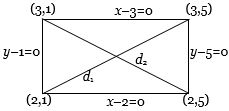
These represent the lines $x=2, x=3, y=1, y=5$,which form a rectangle with vertices $(2,1), (3,1), (3,5),$ and $(2,5)$.
The diagonal $d_1$ passes through $(2,1)$ and $(3,5)$. Its equation is $y - 1 = \frac{5 - 1}{3 - 2}(x - 2)$ $\Rightarrow y - 1 = 4(x - 2)$ $\Rightarrow y = 4x - 7$.
The diagonal $d_2$ passes through $(3,1)$ and $(2,5)$. Its equation is $y - 1 = \frac{5 - 1}{2 - 3}(x - 3)$ $\Rightarrow y - 1 = -4(x - 3)$ $\Rightarrow y - 1 = -4x + 12$ $\Rightarrow 4x + y = 13$.
Thus,the equations of the diagonals are $4x + y = 13$ and $y = 4x - 7$.
Solving these,we get $x = 2, 3$ and $y = 1, 5$.
These represent the lines $x=2, x=3, y=1, y=5$,which form a rectangle with vertices $(2,1), (3,1), (3,5),$ and $(2,5)$.
The diagonal $d_1$ passes through $(2,1)$ and $(3,5)$. Its equation is $y - 1 = \frac{5 - 1}{3 - 2}(x - 2)$ $\Rightarrow y - 1 = 4(x - 2)$ $\Rightarrow y = 4x - 7$.
The diagonal $d_2$ passes through $(3,1)$ and $(2,5)$. Its equation is $y - 1 = \frac{5 - 1}{2 - 3}(x - 3)$ $\Rightarrow y - 1 = -4(x - 3)$ $\Rightarrow y - 1 = -4x + 12$ $\Rightarrow 4x + y = 13$.
Thus,the equations of the diagonals are $4x + y = 13$ and $y = 4x - 7$.
0 likesView Solution
10
MathematicsDifficultMCQIIT JEE · 1994
$A$ circle is inscribed in an equilateral triangle of side $a$. The area of any square inscribed in the circle is
A
$\frac{a^2}{3}$
B
$\frac{2a^2}{3}$
C
$\frac{a^2}{6}$
D
$\frac{a^2}{12}$
Solution
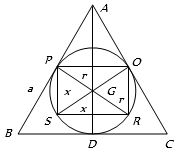
(C) Let $p$ be the altitude of the equilateral triangle. Then $p = a \sin 60^{\circ} = \frac{a\sqrt{3}}{2}$.
Since the triangle is equilateral,the centroid,orthocentre,circumcentre,and incentre all coincide.
Therefore,the radius $r$ of the inscribed circle is $\frac{1}{3}p = \frac{1}{3} \times \frac{a\sqrt{3}}{2} = \frac{a}{2\sqrt{3}}$.
The diameter of the circle is $D = 2r = \frac{a}{\sqrt{3}}$.
Let $x$ be the side length of the square inscribed in the circle. The diagonal of the square is equal to the diameter of the circle.
Thus,$x^2 + x^2 = D^2$,which gives $2x^2 = D^2$.
Substituting $D = \frac{a}{\sqrt{3}}$,we get $2x^2 = (\frac{a}{\sqrt{3}})^2 = \frac{a^2}{3}$.
Therefore,the area of the square is $x^2 = \frac{a^2}{6}$.
Since the triangle is equilateral,the centroid,orthocentre,circumcentre,and incentre all coincide.
Therefore,the radius $r$ of the inscribed circle is $\frac{1}{3}p = \frac{1}{3} \times \frac{a\sqrt{3}}{2} = \frac{a}{2\sqrt{3}}$.
The diameter of the circle is $D = 2r = \frac{a}{\sqrt{3}}$.
Let $x$ be the side length of the square inscribed in the circle. The diagonal of the square is equal to the diameter of the circle.
Thus,$x^2 + x^2 = D^2$,which gives $2x^2 = D^2$.
Substituting $D = \frac{a}{\sqrt{3}}$,we get $2x^2 = (\frac{a}{\sqrt{3}})^2 = \frac{a^2}{3}$.
Therefore,the area of the square is $x^2 = \frac{a^2}{6}$.
0 likesView Solution
11
MathematicsMediumMCQIIT JEE · 1994
The locus of a variable point whose distance from $(-2, 0)$ is $\frac{2}{3}$ times its distance from the line $x = -\frac{9}{2}$ is
A
Ellipse
B
Parabola
C
Hyperbola
D
None of these
Solution
(A) Let the variable point be $P(x, y)$.
According to the definition of a conic section,the distance from a fixed point (focus) is $e$ times the distance from a fixed line (directrix).
Here,the focus is $S(-2, 0)$,the directrix is $x = -\frac{9}{2}$,and the eccentricity $e = \frac{2}{3}$.
Since $e < 1$,the locus is an ellipse.
Mathematically,$\sqrt{(x + 2)^2 + y^2} = \frac{2}{3} |x + \frac{9}{2}|$.
Squaring both sides: $(x + 2)^2 + y^2 = \frac{4}{9} (x + \frac{9}{2})^2$.
$(x^2 + 4x + 4) + y^2 = \frac{4}{9} (x^2 + 9x + \frac{81}{4})$.
$x^2 + 4x + 4 + y^2 = \frac{4}{9}x^2 + 4x + 9$.
$\frac{5}{9}x^2 + y^2 = 5$.
Dividing by $5$: $\frac{x^2}{9} + \frac{y^2}{5} = 1$.
This is the equation of an ellipse.
According to the definition of a conic section,the distance from a fixed point (focus) is $e$ times the distance from a fixed line (directrix).
Here,the focus is $S(-2, 0)$,the directrix is $x = -\frac{9}{2}$,and the eccentricity $e = \frac{2}{3}$.
Since $e < 1$,the locus is an ellipse.
Mathematically,$\sqrt{(x + 2)^2 + y^2} = \frac{2}{3} |x + \frac{9}{2}|$.
Squaring both sides: $(x + 2)^2 + y^2 = \frac{4}{9} (x + \frac{9}{2})^2$.
$(x^2 + 4x + 4) + y^2 = \frac{4}{9} (x^2 + 9x + \frac{81}{4})$.
$x^2 + 4x + 4 + y^2 = \frac{4}{9}x^2 + 4x + 9$.
$\frac{5}{9}x^2 + y^2 = 5$.
Dividing by $5$: $\frac{x^2}{9} + \frac{y^2}{5} = 1$.
This is the equation of an ellipse.
0 likesView Solution
12
MathematicsEasyMCQIIT JEE · 1994
Let $E$ be the ellipse $\frac{x^2}{9} + \frac{y^2}{4} = 1$ and $C$ be the circle $x^2 + y^2 = 9$. Let $P$ and $Q$ be the points $(1, 2)$ and $(2, 1)$ respectively. Then
A
$Q$ lies inside $C$ but outside $E$
B
$Q$ lies outside both $C$ and $E$
C
$P$ lies inside both $C$ and $E$
D
$P$ lies inside $C$ but outside $E$
Solution
(D) The ellipse $E$ is given by $f(x, y) = \frac{x^2}{9} + \frac{y^2}{4} - 1 = 0$.
For point $P(1, 2)$,$f(1, 2) = \frac{1}{9} + \frac{4}{4} - 1 = \frac{1}{9} > 0$,so $P$ lies outside $E$.
For point $Q(2, 1)$,$f(2, 1) = \frac{4}{9} + \frac{1}{4} - 1 = \frac{16+9-36}{36} = -\frac{11}{36} < 0$,so $Q$ lies inside $E$.
The circle $C$ is given by $g(x, y) = x^2 + y^2 - 9 = 0$.
For point $P(1, 2)$,$g(1, 2) = 1^2 + 2^2 - 9 = 1 + 4 - 9 = -4 < 0$,so $P$ lies inside $C$.
For point $Q(2, 1)$,$g(2, 1) = 2^2 + 1^2 - 9 = 4 + 1 - 9 = -4 < 0$,so $Q$ lies inside $C$.
Thus,$P$ lies inside $C$ but outside $E$.
For point $P(1, 2)$,$f(1, 2) = \frac{1}{9} + \frac{4}{4} - 1 = \frac{1}{9} > 0$,so $P$ lies outside $E$.
For point $Q(2, 1)$,$f(2, 1) = \frac{4}{9} + \frac{1}{4} - 1 = \frac{16+9-36}{36} = -\frac{11}{36} < 0$,so $Q$ lies inside $E$.
The circle $C$ is given by $g(x, y) = x^2 + y^2 - 9 = 0$.
For point $P(1, 2)$,$g(1, 2) = 1^2 + 2^2 - 9 = 1 + 4 - 9 = -4 < 0$,so $P$ lies inside $C$.
For point $Q(2, 1)$,$g(2, 1) = 2^2 + 1^2 - 9 = 4 + 1 - 9 = -4 < 0$,so $Q$ lies inside $C$.
Thus,$P$ lies inside $C$ but outside $E$.
0 likesView Solution
13
MathematicsMediumMCQIIT JEE · 1994
The equation $2x^2 + 3y^2 - 8x - 18y + 35 = k$ represents:
A
No locus if $k > 0$
B
An ellipse if $k < 0$
C
$A$ point if $k = 0$
D
$A$ hyperbola if $k > 0$
Solution
(C) Given equation: $2x^2 + 3y^2 - 8x - 18y + 35 - k = 0$.
Completing the square for $x$ and $y$ terms:
$2(x^2 - 4x) + 3(y^2 - 6y) + 35 - k = 0$
$2(x^2 - 4x + 4) + 3(y^2 - 6y + 9) + 35 - k - 8 - 27 = 0$
$2(x - 2)^2 + 3(y - 3)^2 = k$.
Case $1$: If $k = 0$,the equation becomes $2(x - 2)^2 + 3(y - 3)^2 = 0$,which represents the point $(2, 3)$.
Case $2$: If $k > 0$,the equation represents an ellipse.
Case $3$: If $k < 0$,the equation represents no real locus (imaginary ellipse).
Thus,the correct statement is that it represents a point if $k = 0$.
Completing the square for $x$ and $y$ terms:
$2(x^2 - 4x) + 3(y^2 - 6y) + 35 - k = 0$
$2(x^2 - 4x + 4) + 3(y^2 - 6y + 9) + 35 - k - 8 - 27 = 0$
$2(x - 2)^2 + 3(y - 3)^2 = k$.
Case $1$: If $k = 0$,the equation becomes $2(x - 2)^2 + 3(y - 3)^2 = 0$,which represents the point $(2, 3)$.
Case $2$: If $k > 0$,the equation represents an ellipse.
Case $3$: If $k < 0$,the equation represents no real locus (imaginary ellipse).
Thus,the correct statement is that it represents a point if $k = 0$.
0 likesView Solution
14
MathematicsMediumMCQIIT JEE · 1994
The number of points of intersection of the two curves $y = 2\sin x$ and $y = 5x^2 + 2x + 3$ is
A
$0$
B
$1$
C
$2$
D
$\infty$
Solution
(A) Let $f(x) = 5x^2 + 2x + 3 - 2\sin x$.
We analyze the minimum value of $f(x) = 5(x^2 + \frac{2}{5}x) + 3 - 2\sin x = 5(x + \frac{1}{5})^2 + 3 - \frac{1}{5} - 2\sin x = 5(x + \frac{1}{5})^2 + 2.8 - 2\sin x$.
Since $-1 \le \sin x \le 1$,the term $-2\sin x$ has a minimum value of $-2$.
Thus,$f(x) \ge 5(x + \frac{1}{5})^2 + 2.8 - 2 = 5(x + \frac{1}{5})^2 + 0.8$.
Since $5(x + \frac{1}{5})^2 \ge 0$,it follows that $f(x) \ge 0.8 > 0$ for all real $x$.
Therefore,$f(x)$ is never equal to $0$,which means the curves never intersect.
The number of intersection points is $0$.
We analyze the minimum value of $f(x) = 5(x^2 + \frac{2}{5}x) + 3 - 2\sin x = 5(x + \frac{1}{5})^2 + 3 - \frac{1}{5} - 2\sin x = 5(x + \frac{1}{5})^2 + 2.8 - 2\sin x$.
Since $-1 \le \sin x \le 1$,the term $-2\sin x$ has a minimum value of $-2$.
Thus,$f(x) \ge 5(x + \frac{1}{5})^2 + 2.8 - 2 = 5(x + \frac{1}{5})^2 + 0.8$.
Since $5(x + \frac{1}{5})^2 \ge 0$,it follows that $f(x) \ge 0.8 > 0$ for all real $x$.
Therefore,$f(x)$ is never equal to $0$,which means the curves never intersect.
The number of intersection points is $0$.
0 likesView Solution
15
MathematicsDifficultMCQIIT JEE · 1994
Which one of the following curves cuts the parabola $y^2 = 4ax$ at right angles?
A
$x^2 + y^2 = a^2$
B
$y = e^{-x/2a}$
C
$y = ax$
D
$x^2 = 4ay$
Solution
(B) For the parabola $y^2 = 4ax$,differentiating with respect to $x$ gives:
$2y \frac{dy}{dx} = 4a \implies \left(\frac{dy}{dx}\right)_1 = \frac{2a}{y} \dots (i)$
For the curve $y = e^{-x/2a}$,differentiating with respect to $x$ gives:
$\left(\frac{dy}{dx}\right)_2 = e^{-x/2a} \left(-\frac{1}{2a}\right) = -\frac{y}{2a} \dots (ii)$
Two curves intersect orthogonally if the product of their slopes at the point of intersection is $-1$:
$\left(\frac{dy}{dx}\right)_1 \times \left(\frac{dy}{dx}\right)_2 = \left(\frac{2a}{y}\right) \times \left(-\frac{y}{2a}\right) = -1$
Since the product is $-1$,the curve $y = e^{-x/2a}$ cuts the parabola $y^2 = 4ax$ at right angles.
$2y \frac{dy}{dx} = 4a \implies \left(\frac{dy}{dx}\right)_1 = \frac{2a}{y} \dots (i)$
For the curve $y = e^{-x/2a}$,differentiating with respect to $x$ gives:
$\left(\frac{dy}{dx}\right)_2 = e^{-x/2a} \left(-\frac{1}{2a}\right) = -\frac{y}{2a} \dots (ii)$
Two curves intersect orthogonally if the product of their slopes at the point of intersection is $-1$:
$\left(\frac{dy}{dx}\right)_1 \times \left(\frac{dy}{dx}\right)_2 = \left(\frac{2a}{y}\right) \times \left(-\frac{y}{2a}\right) = -1$
Since the product is $-1$,the curve $y = e^{-x/2a}$ cuts the parabola $y^2 = 4ax$ at right angles.
0 likesView Solution
16
MathematicsDifficultMCQIIT JEE · 1994
Let $P$ be a variable point on the ellipse $\frac{x^2}{a^2} + \frac{y^2}{b^2} = 1$ with foci $F_1$ and $F_2$. If $A$ is the area of the triangle $PF_1F_2$,then the maximum value of $A$ is
A
$ab$
B
$abe$
C
$\frac{e}{ab}$
D
$\frac{ab}{e}$
Solution
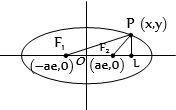
(B) The coordinates of the foci are $F_1(-ae, 0)$ and $F_2(ae, 0)$.
Let the point $P$ be $(x, y)$. The base of the triangle $PF_1F_2$ is the distance between the foci,which is $F_1F_2 = 2ae$.
The height of the triangle is the perpendicular distance from $P$ to the $x$-axis,which is $|y|$.
The area $A$ of the triangle $PF_1F_2$ is given by $A = \frac{1}{2} \times \text{base} \times \text{height} = \frac{1}{2} \times (2ae) \times |y| = ae|y|$.
For the ellipse $\frac{x^2}{a^2} + \frac{y^2}{b^2} = 1$,the maximum value of $|y|$ is $b$ (at $x = 0$).
Therefore,the maximum area $A = ae \times b = abe$.
Let the point $P$ be $(x, y)$. The base of the triangle $PF_1F_2$ is the distance between the foci,which is $F_1F_2 = 2ae$.
The height of the triangle is the perpendicular distance from $P$ to the $x$-axis,which is $|y|$.
The area $A$ of the triangle $PF_1F_2$ is given by $A = \frac{1}{2} \times \text{base} \times \text{height} = \frac{1}{2} \times (2ae) \times |y| = ae|y|$.
For the ellipse $\frac{x^2}{a^2} + \frac{y^2}{b^2} = 1$,the maximum value of $|y|$ is $b$ (at $x = 0$).
Therefore,the maximum area $A = ae \times b = abe$.
0 likesView Solution
17
MathematicsMediumMCQIIT JEE · 1994
For a real number $x$,$[x]$ denotes the greatest integer less than or equal to $x$. The value of $\left[ \frac{1}{2} \right] + \left[ \frac{1}{2} + \frac{1}{100} \right] + \left[ \frac{1}{2} + \frac{2}{100} \right] + \dots + \left[ \frac{1}{2} + \frac{99}{100} \right]$ is
A
$49$
B
$50$
C
$48$
D
$51$
Solution
(B) Let $S = \sum_{k=0}^{99} \left[ \frac{1}{2} + \frac{k}{100} \right]$.
For $0 \le k \le 49$,we have $0 \le \frac{k}{100} \le 0.49$,so $\frac{1}{2} + \frac{k}{100} = 0.5 + \frac{k}{100} < 1$. Thus,$\left[ \frac{1}{2} + \frac{k}{100} \right] = 0$ for $k = 0, 1, \dots, 49$.
For $50 \le k \le 99$,we have $0.50 \le \frac{k}{100} \le 0.99$,so $1 \le \frac{1}{2} + \frac{k}{100} < 1.49$. Thus,$\left[ \frac{1}{2} + \frac{k}{100} \right] = 1$ for $k = 50, 51, \dots, 99$.
The number of terms from $k = 50$ to $k = 99$ is $99 - 50 + 1 = 50$.
Therefore,the sum is $0 \times 50 + 1 \times 50 = 50$.
For $0 \le k \le 49$,we have $0 \le \frac{k}{100} \le 0.49$,so $\frac{1}{2} + \frac{k}{100} = 0.5 + \frac{k}{100} < 1$. Thus,$\left[ \frac{1}{2} + \frac{k}{100} \right] = 0$ for $k = 0, 1, \dots, 49$.
For $50 \le k \le 99$,we have $0.50 \le \frac{k}{100} \le 0.99$,so $1 \le \frac{1}{2} + \frac{k}{100} < 1.49$. Thus,$\left[ \frac{1}{2} + \frac{k}{100} \right] = 1$ for $k = 50, 51, \dots, 99$.
The number of terms from $k = 50$ to $k = 99$ is $99 - 50 + 1 = 50$.
Therefore,the sum is $0 \times 50 + 1 \times 50 = 50$.
0 likesView Solution
18
MathematicsDifficultMCQIIT JEE · 1994
Let $2\sin^2 x + 3\sin x - 2 > 0$ and $x^2 - x - 2 < 0$ ($x$ is measured in radians). Then $x$ lies in the interval
A
$\left( \frac{\pi}{6}, \frac{5\pi}{6} \right)$
B
$\left( -1, \frac{5\pi}{6} \right)$
C
$(-1, 2)$
D
$\left( \frac{\pi}{6}, 2 \right)$
Solution
(D) Given $2\sin^2 x + 3\sin x - 2 > 0$.
Factoring the quadratic: $2\sin^2 x + 4\sin x - \sin x - 2 > 0$.
$2\sin x(\sin x + 2) - 1(\sin x + 2) > 0$.
$(\sin x + 2)(2\sin x - 1) > 0$.
Since $\sin x + 2 > 0$ for all real $x$,we must have $2\sin x - 1 > 0$,which implies $\sin x > 1/2$.
For $x$ in a reasonable range,$\sin x > 1/2$ implies $x > \pi/6$.
Given $x^2 - x - 2 < 0$.
Factoring the quadratic: $(x - 2)(x + 1) < 0$.
This inequality holds for $x \in (-1, 2)$.
Combining the two conditions: $x > \pi/6$ and $-1 < x < 2$.
Since $\pi/6 \approx 0.523$,the intersection is $x \in (\pi/6, 2)$.
Factoring the quadratic: $2\sin^2 x + 4\sin x - \sin x - 2 > 0$.
$2\sin x(\sin x + 2) - 1(\sin x + 2) > 0$.
$(\sin x + 2)(2\sin x - 1) > 0$.
Since $\sin x + 2 > 0$ for all real $x$,we must have $2\sin x - 1 > 0$,which implies $\sin x > 1/2$.
For $x$ in a reasonable range,$\sin x > 1/2$ implies $x > \pi/6$.
Given $x^2 - x - 2 < 0$.
Factoring the quadratic: $(x - 2)(x + 1) < 0$.
This inequality holds for $x \in (-1, 2)$.
Combining the two conditions: $x > \pi/6$ and $-1 < x < 2$.
Since $\pi/6 \approx 0.523$,the intersection is $x \in (\pi/6, 2)$.
0 likesView Solution
19
MathematicsMediumMCQIIT JEE · 1994
$A$ committee of $12$ is to be formed from $9$ women and $8$ men such that at least $5$ women are included. Find the number of committees in which women are in the majority and the number of committees in which men are in the majority,respectively.
A
$4784, 1008$
B
$2702, 3360$
C
$6062, 2702$
D
$2702, 1008$
Solution
(D) Total committee size is $12$. Let $W$ be the number of women and $M$ be the number of men. We require $W + M = 12$ and $W \ge 5$.
$(i)$ Women are in the majority if $W > M$. Since $W + M = 12$,this implies $W > 6$. Possible values for $W$ are $7, 8, 9$.
Number of ways = $^9C_7 \times ^8C_5 + ^9C_8 \times ^8C_4 + ^9C_9 \times ^8C_3$
$= (36 \times 56) + (9 \times 70) + (1 \times 56) = 2016 + 630 + 56 = 2702$.
(ii) Men are in the majority if $M > W$. Since $W + M = 12$,this implies $M > 6$. Possible values for $W$ are $5, 6$ (since $W \ge 5$).
Number of ways = $^9C_5 \times ^8C_7 + ^9C_6 \times ^8C_6$
$= (126 \times 8) + (84 \times 28) = 1008 + 2352 = 3360$.
Wait,re-evaluating: The question asks for committees where $W \ge 5$. If $M > W$,then $W$ can be $5$ or $6$.
For $W=5, M=7$: $^9C_5 \times ^8C_7 = 126 \times 8 = 1008$.
For $W=6, M=6$: This is not a majority. Thus,only $W=5$ gives a male majority.
Correct answer is $2702, 1008$.
$(i)$ Women are in the majority if $W > M$. Since $W + M = 12$,this implies $W > 6$. Possible values for $W$ are $7, 8, 9$.
Number of ways = $^9C_7 \times ^8C_5 + ^9C_8 \times ^8C_4 + ^9C_9 \times ^8C_3$
$= (36 \times 56) + (9 \times 70) + (1 \times 56) = 2016 + 630 + 56 = 2702$.
(ii) Men are in the majority if $M > W$. Since $W + M = 12$,this implies $M > 6$. Possible values for $W$ are $5, 6$ (since $W \ge 5$).
Number of ways = $^9C_5 \times ^8C_7 + ^9C_6 \times ^8C_6$
$= (126 \times 8) + (84 \times 28) = 1008 + 2352 = 3360$.
Wait,re-evaluating: The question asks for committees where $W \ge 5$. If $M > W$,then $W$ can be $5$ or $6$.
For $W=5, M=7$: $^9C_5 \times ^8C_7 = 126 \times 8 = 1008$.
For $W=6, M=6$: This is not a majority. Thus,only $W=5$ gives a male majority.
Correct answer is $2702, 1008$.
0 likesView Solution
20
MathematicsMediumMCQIIT JEE · 1994
If the coefficients of the second,third,and fourth terms in the expansion of $(1 + x)^n$ are in $A.P.$,then $n$ is equal to
A
$7$
B
$2$
C
$6$
D
None of these
Solution
(A) In the expansion of $(1 + x)^n$,the coefficients of the second,third,and fourth terms are $^nC_1, ^nC_2$,and $^nC_3$ respectively.
Given that $^nC_1, ^nC_2, ^nC_3$ are in $A.P.$,we have:
$2(^nC_2) = ^nC_1 + ^nC_3$
$2 \times \frac{n(n - 1)}{2} = n + \frac{n(n - 1)(n - 2)}{6}$
Dividing by $n$ (since $n \neq 0$):
$n - 1 = 1 + \frac{(n - 1)(n - 2)}{6}$
$6(n - 1) = 6 + (n^2 - 3n + 2)$
$6n - 6 = n^2 - 3n + 8$
$n^2 - 9n + 14 = 0$
$(n - 7)(n - 2) = 0$
So,$n = 7$ or $n = 2$.
For $n = 2$,the expansion $(1 + x)^2$ has only three terms,so the fourth term does not exist. Thus,$n = 7$ is the only valid solution.
Given that $^nC_1, ^nC_2, ^nC_3$ are in $A.P.$,we have:
$2(^nC_2) = ^nC_1 + ^nC_3$
$2 \times \frac{n(n - 1)}{2} = n + \frac{n(n - 1)(n - 2)}{6}$
Dividing by $n$ (since $n \neq 0$):
$n - 1 = 1 + \frac{(n - 1)(n - 2)}{6}$
$6(n - 1) = 6 + (n^2 - 3n + 2)$
$6n - 6 = n^2 - 3n + 8$
$n^2 - 9n + 14 = 0$
$(n - 7)(n - 2) = 0$
So,$n = 7$ or $n = 2$.
For $n = 2$,the expansion $(1 + x)^2$ has only three terms,so the fourth term does not exist. Thus,$n = 7$ is the only valid solution.
0 likesView Solution
21
MathematicsMediumMCQIIT JEE · 1994
When $P$ is a natural number,then ${P^{n + 1}} + {(P + 1)^{2n - 1}}$ is divisible by
A
$P$
B
${P^2} + P$
C
${P^2} + P + 1$
D
${P^2} - 1$
Solution
(C) For $n = 1$,we get,
${P^{1 + 1}} + {(P + 1)^{2(1) - 1}} = {P^2} + {(P + 1)^1} = {P^2} + P + 1$.
This expression is clearly divisible by ${P^2} + P + 1$.
Let us assume that the given result is true for $n = m \in N$,i.e.,${P^{m + 1}} + {(P + 1)^{2m - 1}} = k({P^2} + P + 1)$ for some $k \in N$ .....$(i)$
Now,for $n = m + 1$:
${P^{(m + 1) + 1}} + {(P + 1)^{2(m + 1) - 1}} = {P^{m + 2}} + {(P + 1)^{2m + 1}} = {P^{m + 2}} + {(P + 1)^2}{(P + 1)^{2m - 1}}$.
Using equation $(i)$,we substitute ${(P + 1)^{2m - 1}} = k({P^2} + P + 1) - {P^{m + 1}}$:
$= {P^{m + 2}} + {(P + 1)^2}[k({P^2} + P + 1) - {P^{m + 1}}]
= {P^{m + 2}} + {(P + 1)^2} \cdot k({P^2} + P + 1) - {(P + 1)^2}{P^{m + 1}}
= {P^{m + 1}}[P - {(P + 1)^2}] + {(P + 1)^2} \cdot k({P^2} + P + 1)
= {P^{m + 1}}[P - ({P^2} + 2P + 1)] + {(P + 1)^2} \cdot k({P^2} + P + 1)
= {P^{m + 1}}[-{P^2} - P - 1] + {(P + 1)^2} \cdot k({P^2} + P + 1)
= -{P^{m + 1}}({P^2} + P + 1) + {(P + 1)^2} \cdot k({P^2} + P + 1)
= ({P^2} + P + 1)[k{(P + 1)^2} - {P^{m + 1}}]$.
Since this is a multiple of ${P^2} + P + 1$,the result is true for $n = m + 1$.
By the principle of mathematical induction,the result is true for all $n \in N$.
${P^{1 + 1}} + {(P + 1)^{2(1) - 1}} = {P^2} + {(P + 1)^1} = {P^2} + P + 1$.
This expression is clearly divisible by ${P^2} + P + 1$.
Let us assume that the given result is true for $n = m \in N$,i.e.,${P^{m + 1}} + {(P + 1)^{2m - 1}} = k({P^2} + P + 1)$ for some $k \in N$ .....$(i)$
Now,for $n = m + 1$:
${P^{(m + 1) + 1}} + {(P + 1)^{2(m + 1) - 1}} = {P^{m + 2}} + {(P + 1)^{2m + 1}} = {P^{m + 2}} + {(P + 1)^2}{(P + 1)^{2m - 1}}$.
Using equation $(i)$,we substitute ${(P + 1)^{2m - 1}} = k({P^2} + P + 1) - {P^{m + 1}}$:
$= {P^{m + 2}} + {(P + 1)^2}[k({P^2} + P + 1) - {P^{m + 1}}]
= {P^{m + 2}} + {(P + 1)^2} \cdot k({P^2} + P + 1) - {(P + 1)^2}{P^{m + 1}}
= {P^{m + 1}}[P - {(P + 1)^2}] + {(P + 1)^2} \cdot k({P^2} + P + 1)
= {P^{m + 1}}[P - ({P^2} + 2P + 1)] + {(P + 1)^2} \cdot k({P^2} + P + 1)
= {P^{m + 1}}[-{P^2} - P - 1] + {(P + 1)^2} \cdot k({P^2} + P + 1)
= -{P^{m + 1}}({P^2} + P + 1) + {(P + 1)^2} \cdot k({P^2} + P + 1)
= ({P^2} + P + 1)[k{(P + 1)^2} - {P^{m + 1}}]$.
Since this is a multiple of ${P^2} + P + 1$,the result is true for $n = m + 1$.
By the principle of mathematical induction,the result is true for all $n \in N$.
0 likesView Solution
22
MathematicsDifficultMCQIIT JEE · 1994
Let $n$ be a positive integer such that $\sin \frac{\pi }{2^n} + \cos \frac{\pi }{2^n} = \frac{\sqrt{n}}{2}.$ Then
A
$6 \le n \le 8$
B
$4 < n \le 8$
C
$4 \le n < 8$
D
$4 < n < 8$
Solution
(B) Given $\sin \frac{\pi }{2^n} + \cos \frac{\pi }{2^n} = \frac{\sqrt{n}}{2}$.
Multiply both sides by $\frac{1}{\sqrt{2}}$:
$\frac{1}{\sqrt{2}} \sin \frac{\pi }{2^n} + \frac{1}{\sqrt{2}} \cos \frac{\pi }{2^n} = \frac{\sqrt{n}}{2\sqrt{2}}$.
$\sin \left( \frac{\pi }{2^n} + \frac{\pi }{4} \right) = \frac{\sqrt{n}}{2\sqrt{2}}$.
Since the maximum value of $\sin \theta$ is $1$,we have $\frac{\sqrt{n}}{2\sqrt{2}} \le 1$ $\Rightarrow \sqrt{n} \le 2\sqrt{2}$ $\Rightarrow n \le 8$.
Also,for $n=1$,$\sin \frac{\pi}{2} + \cos \frac{\pi}{2} = 1 + 0 = 1$,while $\frac{\sqrt{1}}{2} = 0.5$. $1 \neq 0.5$.
For $n=2$,$\sin \frac{\pi}{4} + \cos \frac{\pi}{4} = \frac{1}{\sqrt{2}} + \frac{1}{\sqrt{2}} = \sqrt{2} \approx 1.414$,while $\frac{\sqrt{2}}{2} \approx 0.707$.
For $n=3$,$\sin \frac{\pi}{8} + \cos \frac{\pi}{8} = \sqrt{1 + \sin \frac{\pi}{4}} = \sqrt{1 + \frac{1}{\sqrt{2}}} \approx 1.306$,while $\frac{\sqrt{3}}{2} \approx 0.866$.
For $n=4$,$\sin \frac{\pi}{16} + \cos \frac{\pi}{16} > 1$,while $\frac{\sqrt{4}}{2} = 1$.
Since the function $f(n) = \sin \frac{\pi}{2^n} + \cos \frac{\pi}{2^n}$ is decreasing for $n \ge 2$ and $g(n) = \frac{\sqrt{n}}{2}$ is increasing,the equality holds for $n > 4$ and $n \le 8$.
Multiply both sides by $\frac{1}{\sqrt{2}}$:
$\frac{1}{\sqrt{2}} \sin \frac{\pi }{2^n} + \frac{1}{\sqrt{2}} \cos \frac{\pi }{2^n} = \frac{\sqrt{n}}{2\sqrt{2}}$.
$\sin \left( \frac{\pi }{2^n} + \frac{\pi }{4} \right) = \frac{\sqrt{n}}{2\sqrt{2}}$.
Since the maximum value of $\sin \theta$ is $1$,we have $\frac{\sqrt{n}}{2\sqrt{2}} \le 1$ $\Rightarrow \sqrt{n} \le 2\sqrt{2}$ $\Rightarrow n \le 8$.
Also,for $n=1$,$\sin \frac{\pi}{2} + \cos \frac{\pi}{2} = 1 + 0 = 1$,while $\frac{\sqrt{1}}{2} = 0.5$. $1 \neq 0.5$.
For $n=2$,$\sin \frac{\pi}{4} + \cos \frac{\pi}{4} = \frac{1}{\sqrt{2}} + \frac{1}{\sqrt{2}} = \sqrt{2} \approx 1.414$,while $\frac{\sqrt{2}}{2} \approx 0.707$.
For $n=3$,$\sin \frac{\pi}{8} + \cos \frac{\pi}{8} = \sqrt{1 + \sin \frac{\pi}{4}} = \sqrt{1 + \frac{1}{\sqrt{2}}} \approx 1.306$,while $\frac{\sqrt{3}}{2} \approx 0.866$.
For $n=4$,$\sin \frac{\pi}{16} + \cos \frac{\pi}{16} > 1$,while $\frac{\sqrt{4}}{2} = 1$.
Since the function $f(n) = \sin \frac{\pi}{2^n} + \cos \frac{\pi}{2^n}$ is decreasing for $n \ge 2$ and $g(n) = \frac{\sqrt{n}}{2}$ is increasing,the equality holds for $n > 4$ and $n \le 8$.
0 likesView Solution
23
MathematicsDifficultMCQIIT JEE · 1994
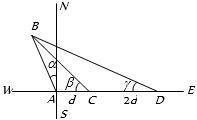
$A$ tower $AB$ leans towards west making an angle $\alpha$ with the vertical. The angular elevation of $B$,the top most point of the tower,is $\beta$ as observed from a point $C$ due east of $A$ at a distance $d$ from $A$. If the angular elevation of $B$ from a point $D$ due east of $C$ at a distance $2d$ from $C$ is $\gamma$,then $2\tan \alpha$ can be given as
A
$3\cot \beta - 2\cot \gamma$
B
$3\cot \gamma - 2\cot \beta$
C
$3\cot \beta - \cot \gamma$
D
$\cot \beta - 3\cot \gamma$
Solution
(C) Let $h$ be the height of the tower $AB$ and $x$ be the horizontal distance of $B$ from $A$. Then $x = h \tan \alpha$ and $h = h \sec \alpha$ (not needed here). Actually,$AB = h$ (slant height). The horizontal projection of $B$ is $B'$,where $AB' = h \sin \alpha$ and the vertical height of $B$ is $H = h \cos \alpha$.
Using the $m-n$ theorem in $\triangle B'AD$ with $C$ on $AD$ such that $AC = d$ and $CD = 2d$:
In $\triangle B'AC$,$\cot \beta = \frac{AC}{H} = \frac{d}{H} \Rightarrow H = d \tan \beta$.
In $\triangle B'AD$,$\cot \gamma = \frac{AD}{H} = \frac{3d}{H} \Rightarrow H = 3d \tan \gamma$.
Also,the horizontal distance of $B'$ from $A$ is $x = h \sin \alpha$. Since $B'$ is to the west,its coordinate is $-x$. $A$ is at $0$,$C$ is at $d$,$D$ is at $3d$.
Using the cotangent rule in $\triangle B'CD$:
$(d + 2d) \cot \beta = d \cot \gamma - 2d \cot(180^o - \alpha) = d \cot \gamma + 2d \cot \alpha$ is incorrect. The correct approach is:
$H \cot \beta = d + x$ and $H \cot \gamma = 3d + x$.
Subtracting: $H(\cot \gamma - \cot \beta) = 2d$.
From $H = d \tan \beta$,we have $d = H \cot \beta$.
So $H(\cot \gamma - \cot \beta) = 2H \cot \beta \Rightarrow \cot \gamma - \cot \beta = 2 \cot \beta$ (This assumes $x=0$).
Given the geometry,$x = H \tan \alpha$.
$H \cot \beta = d + H \tan \alpha \Rightarrow d = H(\cot \beta - \tan \alpha)$.
$H \cot \gamma = 3d + H \tan \alpha \Rightarrow 3d = H(\cot \gamma - \tan \alpha)$.
$3H(\cot \beta - \tan \alpha) = H(\cot \gamma - \tan \alpha)$.
$3 \cot \beta - 3 \tan \alpha = \cot \gamma - \tan \alpha$.
$3 \cot \beta - \cot \gamma = 2 \tan \alpha$.
Using the $m-n$ theorem in $\triangle B'AD$ with $C$ on $AD$ such that $AC = d$ and $CD = 2d$:
In $\triangle B'AC$,$\cot \beta = \frac{AC}{H} = \frac{d}{H} \Rightarrow H = d \tan \beta$.
In $\triangle B'AD$,$\cot \gamma = \frac{AD}{H} = \frac{3d}{H} \Rightarrow H = 3d \tan \gamma$.
Also,the horizontal distance of $B'$ from $A$ is $x = h \sin \alpha$. Since $B'$ is to the west,its coordinate is $-x$. $A$ is at $0$,$C$ is at $d$,$D$ is at $3d$.
Using the cotangent rule in $\triangle B'CD$:
$(d + 2d) \cot \beta = d \cot \gamma - 2d \cot(180^o - \alpha) = d \cot \gamma + 2d \cot \alpha$ is incorrect. The correct approach is:
$H \cot \beta = d + x$ and $H \cot \gamma = 3d + x$.
Subtracting: $H(\cot \gamma - \cot \beta) = 2d$.
From $H = d \tan \beta$,we have $d = H \cot \beta$.
So $H(\cot \gamma - \cot \beta) = 2H \cot \beta \Rightarrow \cot \gamma - \cot \beta = 2 \cot \beta$ (This assumes $x=0$).
Given the geometry,$x = H \tan \alpha$.
$H \cot \beta = d + H \tan \alpha \Rightarrow d = H(\cot \beta - \tan \alpha)$.
$H \cot \gamma = 3d + H \tan \alpha \Rightarrow 3d = H(\cot \gamma - \tan \alpha)$.
$3H(\cot \beta - \tan \alpha) = H(\cot \gamma - \tan \alpha)$.
$3 \cot \beta - 3 \tan \alpha = \cot \gamma - \tan \alpha$.
$3 \cot \beta - \cot \gamma = 2 \tan \alpha$.
0 likesView Solution
24
MathematicsDifficultMCQIIT JEE · 1994
The circles $x^2 + y^2 - 10x + 16 = 0$ and $x^2 + y^2 = r^2$ intersect each other in two distinct points,if
A
$r < 2$
B
$r > 8$
C
$2 < r < 8$
D
$2 \le r \le 8$
Solution
(C) For the first circle $x^2 + y^2 - 10x + 16 = 0$,the center $C_1 = (5, 0)$ and radius $r_1 = \sqrt{5^2 - 16} = \sqrt{25 - 16} = \sqrt{9} = 3$.
For the second circle $x^2 + y^2 = r^2$,the center $C_2 = (0, 0)$ and radius $r_2 = r$.
The distance between the centers $d = \sqrt{(5-0)^2 + (0-0)^2} = 5$.
Two circles intersect at two distinct points if $|r_1 - r_2| < d < r_1 + r_2$.
Substituting the values,we get $|3 - r| < 5 < 3 + r$.
From $5 < 3 + r$,we get $r > 2$.
From $|3 - r| < 5$,we get $-5 < 3 - r < 5$,which implies $-8 < -r < 2$,or $r < 8$ and $r > -2$.
Combining these conditions,we get $2 < r < 8$.
For the second circle $x^2 + y^2 = r^2$,the center $C_2 = (0, 0)$ and radius $r_2 = r$.
The distance between the centers $d = \sqrt{(5-0)^2 + (0-0)^2} = 5$.
Two circles intersect at two distinct points if $|r_1 - r_2| < d < r_1 + r_2$.
Substituting the values,we get $|3 - r| < 5 < 3 + r$.
From $5 < 3 + r$,we get $r > 2$.
From $|3 - r| < 5$,we get $-5 < 3 - r < 5$,which implies $-8 < -r < 2$,or $r < 8$ and $r > -2$.
Combining these conditions,we get $2 < r < 8$.
0 likesView Solution
25
MathematicsDifficultMCQIIT JEE · 1994
The point of intersection of tangents at the ends of the latus rectum of the parabola $y^2 = 4x$ is
A
$(1, 0)$
B
$(-1, 0)$
C
$(0, 1)$
D
$(0, -1)$
Solution
(B) The equation of the tangent at point $(x_1, y_1)$ on the parabola $y^2 = 4ax$ is given by $yy_1 = 2a(x + x_1)$.
For the given parabola $y^2 = 4x$,we have $a = 1$.
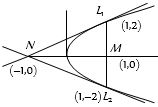
The coordinates of the ends of the latus rectum are $L(1, 2)$ and $L'(1, -2)$.
The equation of the tangent at $L(1, 2)$ is $2y = 2(x + 1)$,which simplifies to $y = x + 1$.
The equation of the tangent at $L'(1, -2)$ is $-2y = 2(x + 1)$,which simplifies to $y = -(x + 1)$.
Solving these two equations simultaneously:
$x + 1 = -(x + 1)$
$2(x + 1) = 0$
$x = -1$
Substituting $x = -1$ into $y = x + 1$,we get $y = 0$.
Thus,the point of intersection is $(-1, 0)$.
For the given parabola $y^2 = 4x$,we have $a = 1$.
The coordinates of the ends of the latus rectum are $L(1, 2)$ and $L'(1, -2)$.
The equation of the tangent at $L(1, 2)$ is $2y = 2(x + 1)$,which simplifies to $y = x + 1$.
The equation of the tangent at $L'(1, -2)$ is $-2y = 2(x + 1)$,which simplifies to $y = -(x + 1)$.
Solving these two equations simultaneously:
$x + 1 = -(x + 1)$
$2(x + 1) = 0$
$x = -1$
Substituting $x = -1$ into $y = x + 1$,we get $y = 0$.
Thus,the point of intersection is $(-1, 0)$.
0 likesView Solution
26
MathematicsEasyMCQIIT JEE · 1994
Let $\alpha, \beta, \gamma$ be distinct real numbers. The points with position vectors $\alpha \hat{i} + \beta \hat{j} + \gamma \hat{k}$,$\beta \hat{i} + \gamma \hat{j} + \alpha \hat{k}$,and $\gamma \hat{i} + \alpha \hat{j} + \beta \hat{k}$:
A
Are collinear
B
Form an equilateral triangle
C
Form a scalene triangle
D
Form a right angled triangle
Solution
(B) Let $P, Q,$ and $R$ be points with position vectors $\vec{p} = \alpha \hat{i} + \beta \hat{j} + \gamma \hat{k}$,$\vec{q} = \beta \hat{i} + \gamma \hat{j} + \alpha \hat{k}$,and $\vec{r} = \gamma \hat{i} + \alpha \hat{j} + \beta \hat{k}$.
The distance between $P$ and $Q$ is $|\vec{q} - \vec{p}| = \sqrt{(\beta - \alpha)^2 + (\gamma - \beta)^2 + (\alpha - \gamma)^2}$.
The distance between $Q$ and $R$ is $|\vec{r} - \vec{q}| = \sqrt{(\gamma - \beta)^2 + (\alpha - \gamma)^2 + (\beta - \alpha)^2}$.
The distance between $R$ and $P$ is $|\vec{p} - \vec{r}| = \sqrt{(\alpha - \gamma)^2 + (\beta - \alpha)^2 + (\gamma - \beta)^2}$.
Since $|\vec{PQ}| = |\vec{QR}| = |\vec{RP}|$,the points form an equilateral triangle.
The distance between $P$ and $Q$ is $|\vec{q} - \vec{p}| = \sqrt{(\beta - \alpha)^2 + (\gamma - \beta)^2 + (\alpha - \gamma)^2}$.
The distance between $Q$ and $R$ is $|\vec{r} - \vec{q}| = \sqrt{(\gamma - \beta)^2 + (\alpha - \gamma)^2 + (\beta - \alpha)^2}$.
The distance between $R$ and $P$ is $|\vec{p} - \vec{r}| = \sqrt{(\alpha - \gamma)^2 + (\beta - \alpha)^2 + (\gamma - \beta)^2}$.
Since $|\vec{PQ}| = |\vec{QR}| = |\vec{RP}|$,the points form an equilateral triangle.
0 likesView Solution
27
MathematicsEasyMCQIIT JEE · 1994
The vector $\frac{1}{3}(2i - 2j + k)$ is
A
$A$ unit vector
B
Perpendicular to the vector $3i + 2j - 2k$
C
Parallel to the vector $-i + j - \frac{1}{2}k$
D
All of these
Solution
(D) Let $\vec{a} = \frac{1}{3}(2i - 2j + k)$.
$1$. Check if it is a unit vector:
$|\vec{a}| = \sqrt{(\frac{2}{3})^2 + (-\frac{2}{3})^2 + (\frac{1}{3})^2} = \sqrt{\frac{4}{9} + \frac{4}{9} + \frac{1}{9}} = \sqrt{\frac{9}{9}} = 1$.
So,it is a unit vector.
$2$. Check if it is perpendicular to $\vec{b} = 3i + 2j - 2k$:
$\vec{a} \cdot \vec{b} = \frac{1}{3}(2i - 2j + k) \cdot (3i + 2j - 2k) = \frac{1}{3}(2 \times 3 + (-2) \times 2 + 1 \times (-2)) = \frac{1}{3}(6 - 4 - 2) = \frac{1}{3}(0) = 0$.
Since the dot product is $0$,they are perpendicular.
$3$. Check if it is parallel to $\vec{c} = -i + j - \frac{1}{2}k$:
$\vec{a} = \frac{1}{3}(2i - 2j + k) = -\frac{2}{3}(-i + j - \frac{1}{2}k) = -\frac{2}{3}\vec{c}$.
Since $\vec{a} = k\vec{c}$ for some scalar $k$,they are parallel.
Since all conditions are satisfied,the correct option is $(d)$.
$1$. Check if it is a unit vector:
$|\vec{a}| = \sqrt{(\frac{2}{3})^2 + (-\frac{2}{3})^2 + (\frac{1}{3})^2} = \sqrt{\frac{4}{9} + \frac{4}{9} + \frac{1}{9}} = \sqrt{\frac{9}{9}} = 1$.
So,it is a unit vector.
$2$. Check if it is perpendicular to $\vec{b} = 3i + 2j - 2k$:
$\vec{a} \cdot \vec{b} = \frac{1}{3}(2i - 2j + k) \cdot (3i + 2j - 2k) = \frac{1}{3}(2 \times 3 + (-2) \times 2 + 1 \times (-2)) = \frac{1}{3}(6 - 4 - 2) = \frac{1}{3}(0) = 0$.
Since the dot product is $0$,they are perpendicular.
$3$. Check if it is parallel to $\vec{c} = -i + j - \frac{1}{2}k$:
$\vec{a} = \frac{1}{3}(2i - 2j + k) = -\frac{2}{3}(-i + j - \frac{1}{2}k) = -\frac{2}{3}\vec{c}$.
Since $\vec{a} = k\vec{c}$ for some scalar $k$,they are parallel.
Since all conditions are satisfied,the correct option is $(d)$.
0 likesView Solution
28
MathematicsEasyMCQIIT JEE · 1994
$A$ unit vector perpendicular to the plane determined by the points $P(1, -1, 2)$,$Q(2, 0, -1)$,and $R(0, 2, 1)$ is:
A
$\frac{2i - j + k}{\sqrt{6}}$
B
$\frac{2i + j + k}{\sqrt{6}}$
C
$\frac{-2i + j + k}{\sqrt{6}}$
D
$\frac{2i + j - k}{\sqrt{6}}$
Solution
(B) Let the points be $P(1, -1, 2)$,$Q(2, 0, -1)$,and $R(0, 2, 1)$.
First,we find two vectors in the plane: $\overrightarrow{PQ} = (2-1)i + (0-(-1))j + (-1-2)k = i + j - 3k$ and $\overrightarrow{PR} = (0-1)i + (2-(-1))j + (1-2)k = -i + 3j - k$.
$A$ vector perpendicular to the plane is given by the cross product $\vec{n} = \overrightarrow{PQ} \times \overrightarrow{PR}$.
$\vec{n} = \begin{vmatrix} i & j & k \\ 1 & 1 & -3 \\ -1 & 3 & -1 \end{vmatrix} = i(-1 - (-9)) - j(-1 - 3) + k(3 - (-1)) = 8i + 4j + 4k$.
To simplify,we can take a parallel vector $\vec{v} = 2i + j + k$.
The magnitude of $\vec{v}$ is $|\vec{v}| = \sqrt{2^2 + 1^2 + 1^2} = \sqrt{4 + 1 + 1} = \sqrt{6}$.
The unit vector perpendicular to the plane is $\pm \frac{\vec{v}}{|\vec{v}|} = \pm \frac{2i + j + k}{\sqrt{6}}$.
Comparing this with the given options,the correct option is $\frac{2i + j + k}{\sqrt{6}}$.
First,we find two vectors in the plane: $\overrightarrow{PQ} = (2-1)i + (0-(-1))j + (-1-2)k = i + j - 3k$ and $\overrightarrow{PR} = (0-1)i + (2-(-1))j + (1-2)k = -i + 3j - k$.
$A$ vector perpendicular to the plane is given by the cross product $\vec{n} = \overrightarrow{PQ} \times \overrightarrow{PR}$.
$\vec{n} = \begin{vmatrix} i & j & k \\ 1 & 1 & -3 \\ -1 & 3 & -1 \end{vmatrix} = i(-1 - (-9)) - j(-1 - 3) + k(3 - (-1)) = 8i + 4j + 4k$.
To simplify,we can take a parallel vector $\vec{v} = 2i + j + k$.
The magnitude of $\vec{v}$ is $|\vec{v}| = \sqrt{2^2 + 1^2 + 1^2} = \sqrt{4 + 1 + 1} = \sqrt{6}$.
The unit vector perpendicular to the plane is $\pm \frac{\vec{v}}{|\vec{v}|} = \pm \frac{2i + j + k}{\sqrt{6}}$.
Comparing this with the given options,the correct option is $\frac{2i + j + k}{\sqrt{6}}$.
0 likesView Solution
29
MathematicsDifficultMCQIIT JEE · 1994
Let $g(x) = x \cdot f(x)$,where $f(x) = \begin{cases} x \sin \frac{1}{x}, & x \ne 0 \\ 0, & x = 0 \end{cases}$. Discuss the differentiability of $g$ at $x = 0$.
A
$g$ is differentiable but $g'$ is not continuous
B
$g$ is differentiable and $g'$ is continuous
C
Both $f$ and $g$ are differentiable
D
None of these
Solution
(A) Given $f(x) = \begin{cases} x \sin \frac{1}{x}, & x \ne 0 \\ 0, & x = 0 \end{cases}$.
Then $g(x) = x \cdot f(x) = \begin{cases} x^2 \sin \frac{1}{x}, & x \ne 0 \\ 0, & x = 0 \end{cases}$.
To check the differentiability of $g(x)$ at $x = 0$:
$g'(0) = \lim_{h \to 0} \frac{g(0+h) - g(0)}{h} = \lim_{h \to 0} \frac{h^2 \sin(1/h) - 0}{h} = \lim_{h \to 0} h \sin(1/h)$.
Since $\lim_{h \to 0} h = 0$ and $\sin(1/h)$ is bounded in $[-1, 1]$,by the squeeze theorem,$g'(0) = 0$.
Thus,$g(x)$ is differentiable at $x = 0$.
Now,for $x \ne 0$,$g'(x) = \frac{d}{dx} (x^2 \sin \frac{1}{x}) = 2x \sin \frac{1}{x} + x^2 \cos \frac{1}{x} \cdot (-\frac{1}{x^2}) = 2x \sin \frac{1}{x} - \cos \frac{1}{x}$.
As $x \to 0$,$2x \sin \frac{1}{x} \to 0$,but $\lim_{x \to 0} \cos \frac{1}{x}$ does not exist.
Therefore,$\lim_{x \to 0} g'(x)$ does not exist,which means $g'(x)$ is not continuous at $x = 0$.
Then $g(x) = x \cdot f(x) = \begin{cases} x^2 \sin \frac{1}{x}, & x \ne 0 \\ 0, & x = 0 \end{cases}$.
To check the differentiability of $g(x)$ at $x = 0$:
$g'(0) = \lim_{h \to 0} \frac{g(0+h) - g(0)}{h} = \lim_{h \to 0} \frac{h^2 \sin(1/h) - 0}{h} = \lim_{h \to 0} h \sin(1/h)$.
Since $\lim_{h \to 0} h = 0$ and $\sin(1/h)$ is bounded in $[-1, 1]$,by the squeeze theorem,$g'(0) = 0$.
Thus,$g(x)$ is differentiable at $x = 0$.
Now,for $x \ne 0$,$g'(x) = \frac{d}{dx} (x^2 \sin \frac{1}{x}) = 2x \sin \frac{1}{x} + x^2 \cos \frac{1}{x} \cdot (-\frac{1}{x^2}) = 2x \sin \frac{1}{x} - \cos \frac{1}{x}$.
As $x \to 0$,$2x \sin \frac{1}{x} \to 0$,but $\lim_{x \to 0} \cos \frac{1}{x}$ does not exist.
Therefore,$\lim_{x \to 0} g'(x)$ does not exist,which means $g'(x)$ is not continuous at $x = 0$.
0 likesView Solution
30
MathematicsEasyMCQIIT JEE · 1994
The function $f$ defined by $f(x) = (x + 2)e^{-x}$ is
A
Decreasing for all $x$
B
Decreasing in $(-\infty, -1)$ and increasing in $(-1, \infty)$
C
Increasing for all $x$
D
Decreasing in $(-1, \infty)$ and increasing in $(-\infty, -1)$
Solution
(D) Given $f(x) = (x + 2)e^{-x}$.
To find the intervals of increase and decrease,we find the derivative $f'(x)$ using the product rule:
$f'(x) = (1)e^{-x} + (x + 2)(-e^{-x})$
$f'(x) = e^{-x}(1 - x - 2)$
$f'(x) = -e^{-x}(x + 1)$.
For the function to be increasing,$f'(x) > 0$:
$-e^{-x}(x + 1) > 0$
Since $e^{-x} > 0$ for all $x$,we must have $-(x + 1) > 0$,which implies $x + 1 < 0$,so $x < -1$.
Thus,the function is increasing in $(-\infty, -1)$.
For the function to be decreasing,$f'(x) < 0$:
$-e^{-x}(x + 1) < 0$
Since $e^{-x} > 0$ for all $x$,we must have $-(x + 1) < 0$,which implies $x + 1 > 0$,so $x > -1$.
Thus,the function is decreasing in $(-1, \infty)$.
Therefore,the function is increasing in $(-\infty, -1)$ and decreasing in $(-1, \infty)$.
To find the intervals of increase and decrease,we find the derivative $f'(x)$ using the product rule:
$f'(x) = (1)e^{-x} + (x + 2)(-e^{-x})$
$f'(x) = e^{-x}(1 - x - 2)$
$f'(x) = -e^{-x}(x + 1)$.
For the function to be increasing,$f'(x) > 0$:
$-e^{-x}(x + 1) > 0$
Since $e^{-x} > 0$ for all $x$,we must have $-(x + 1) > 0$,which implies $x + 1 < 0$,so $x < -1$.
Thus,the function is increasing in $(-\infty, -1)$.
For the function to be decreasing,$f'(x) < 0$:
$-e^{-x}(x + 1) < 0$
Since $e^{-x} > 0$ for all $x$,we must have $-(x + 1) < 0$,which implies $x + 1 > 0$,so $x > -1$.
Thus,the function is decreasing in $(-1, \infty)$.
Therefore,the function is increasing in $(-\infty, -1)$ and decreasing in $(-1, \infty)$.
0 likesView Solution
31
MathematicsDifficultMCQIIT JEE · 1994
$\int \cos 2\theta \log \left( \frac{\cos \theta + \sin \theta }{\cos \theta - \sin \theta } \right) d\theta = $
A
$(\cos \theta - \sin \theta )^2 \log \left( \frac{\cos \theta + \sin \theta }{\cos \theta - \sin \theta } \right)$
B
$(\cos \theta + \sin \theta )^2 \log \left( \frac{\cos \theta + \sin \theta }{\cos \theta - \sin \theta } \right)$
C
$\frac{(\cos \theta - \sin \theta )^2}{2} \log \left( \frac{\cos \theta - \sin \theta }{\cos \theta + \sin \theta } \right)$
D
$\frac{1}{2} \sin 2\theta \log \tan \left( \frac{\pi }{4} + \theta \right) - \frac{1}{2} \log \sec 2\theta $
Solution
(D) Let $I = \int \cos 2\theta \log \left( \frac{\cos \theta + \sin \theta }{\cos \theta - \sin \theta } \right) d\theta$.
First,simplify the logarithmic term: $\log \left( \frac{\cos \theta + \sin \theta }{\cos \theta - \sin \theta } \right) = \log \left( \frac{1 + \tan \theta }{1 - \tan \theta } \right) = \log \tan \left( \frac{\pi }{4} + \theta \right)$.
Let $u = \log \tan \left( \frac{\pi }{4} + \theta \right)$ and $dv = \cos 2\theta d\theta$.
Then $du = \frac{1}{\tan(\frac{\pi}{4} + \theta)} \cdot \sec^2(\frac{\pi}{4} + \theta) d\theta = \frac{\cos(\frac{\pi}{4} + \theta)}{\sin(\frac{\pi}{4} + \theta)} \cdot \frac{1}{\cos^2(\frac{\pi}{4} + \theta)} d\theta = \frac{1}{\sin(\frac{\pi}{4} + \theta)\cos(\frac{\pi}{4} + \theta)} d\theta = \frac{2}{\sin(\frac{\pi}{2} + 2\theta)} d\theta = 2 \sec 2\theta d\theta$.
Also,$v = \int \cos 2\theta d\theta = \frac{1}{2} \sin 2\theta$.
Using integration by parts $\int u dv = uv - \int v du$:
$I = \frac{1}{2} \sin 2\theta \log \tan \left( \frac{\pi }{4} + \theta \right) - \int \left( \frac{1}{2} \sin 2\theta \right) (2 \sec 2\theta) d\theta$.
$I = \frac{1}{2} \sin 2\theta \log \tan \left( \frac{\pi }{4} + \theta \right) - \int \tan 2\theta d\theta$.
$I = \frac{1}{2} \sin 2\theta \log \tan \left( \frac{\pi }{4} + \theta \right) - \frac{1}{2} \log |\sec 2\theta| + C$.
First,simplify the logarithmic term: $\log \left( \frac{\cos \theta + \sin \theta }{\cos \theta - \sin \theta } \right) = \log \left( \frac{1 + \tan \theta }{1 - \tan \theta } \right) = \log \tan \left( \frac{\pi }{4} + \theta \right)$.
Let $u = \log \tan \left( \frac{\pi }{4} + \theta \right)$ and $dv = \cos 2\theta d\theta$.
Then $du = \frac{1}{\tan(\frac{\pi}{4} + \theta)} \cdot \sec^2(\frac{\pi}{4} + \theta) d\theta = \frac{\cos(\frac{\pi}{4} + \theta)}{\sin(\frac{\pi}{4} + \theta)} \cdot \frac{1}{\cos^2(\frac{\pi}{4} + \theta)} d\theta = \frac{1}{\sin(\frac{\pi}{4} + \theta)\cos(\frac{\pi}{4} + \theta)} d\theta = \frac{2}{\sin(\frac{\pi}{2} + 2\theta)} d\theta = 2 \sec 2\theta d\theta$.
Also,$v = \int \cos 2\theta d\theta = \frac{1}{2} \sin 2\theta$.
Using integration by parts $\int u dv = uv - \int v du$:
$I = \frac{1}{2} \sin 2\theta \log \tan \left( \frac{\pi }{4} + \theta \right) - \int \left( \frac{1}{2} \sin 2\theta \right) (2 \sec 2\theta) d\theta$.
$I = \frac{1}{2} \sin 2\theta \log \tan \left( \frac{\pi }{4} + \theta \right) - \int \tan 2\theta d\theta$.
$I = \frac{1}{2} \sin 2\theta \log \tan \left( \frac{\pi }{4} + \theta \right) - \frac{1}{2} \log |\sec 2\theta| + C$.
0 likesView Solution
32
MathematicsEasyMCQIIT JEE · 1994
The value of $\int_2^3 {\frac{{\sqrt x }}{{\sqrt {5 - x} + \sqrt x }}} \,dx$ is
A
$1$
B
$0$
C
$-1$
D
$\frac{1}{2}$
Solution
(D) Let $I = \int_2^3 {\frac{{\sqrt x }}{{\sqrt {5 - x} + \sqrt x }}} \,dx$ .....$(i)$
Using the property $\int_a^b f(x) \,dx = \int_a^b f(a + b - x) \,dx$,we replace $x$ with $(2 + 3 - x) = (5 - x)$.
$\therefore I = \int_2^3 {\frac{{\sqrt {5 - x} }}{{\sqrt {5 - (5 - x)} + \sqrt {5 - x} }}} \,dx$
$I = \int_2^3 {\frac{{\sqrt {5 - x} }}{{\sqrt x + \sqrt {5 - x} }}} \,dx$ .....$(ii)$
Adding $(i)$ and $(ii)$:
$2I = \int_2^3 {\frac{{\sqrt x + \sqrt {5 - x} }}{{\sqrt {5 - x} + \sqrt x }}} \,dx$
$2I = \int_2^3 1 \,dx$
$2I = [x]_2^3 = 3 - 2 = 1$
$I = \frac{1}{2}$.
Using the property $\int_a^b f(x) \,dx = \int_a^b f(a + b - x) \,dx$,we replace $x$ with $(2 + 3 - x) = (5 - x)$.
$\therefore I = \int_2^3 {\frac{{\sqrt {5 - x} }}{{\sqrt {5 - (5 - x)} + \sqrt {5 - x} }}} \,dx$
$I = \int_2^3 {\frac{{\sqrt {5 - x} }}{{\sqrt x + \sqrt {5 - x} }}} \,dx$ .....$(ii)$
Adding $(i)$ and $(ii)$:
$2I = \int_2^3 {\frac{{\sqrt x + \sqrt {5 - x} }}{{\sqrt {5 - x} + \sqrt x }}} \,dx$
$2I = \int_2^3 1 \,dx$
$2I = [x]_2^3 = 3 - 2 = 1$
$I = \frac{1}{2}$.
0 likesView Solution
33
MathematicsDifficultMCQIIT JEE · 1994
The value of $\int_0^{n\pi + v} {|\sin x|\,dx} $ is
A
$2n + 1 + \cos v$
B
$2n + 1 - \cos v$
C
$2n + 1$
D
$2n + \cos v$
Solution
(B) We know that the function $f(x) = |\sin x|$ is periodic with period $\pi$.
Thus,$\int_0^{n\pi} |\sin x| \, dx = n \int_0^{\pi} |\sin x| \, dx = n \int_0^{\pi} \sin x \, dx = n [-\cos x]_0^{\pi} = n(1 - (-1)) = 2n$.
Now,consider the integral $\int_{n\pi}^{n\pi + v} |\sin x| \, dx$. Let $x = n\pi + t$,then $dx = dt$. When $x = n\pi$,$t = 0$. When $x = n\pi + v$,$t = v$.
Since $|sin(n\pi + t)| = |\sin(n\pi) \cos t + \cos(n\pi) \sin t| = |(-1)^n \sin t| = |\sin t|$.
So,$\int_{n\pi}^{n\pi + v} |\sin x| \, dx = \int_0^v |\sin t| \, dt$.
Assuming $0 \le v \le \pi$,we have $\int_0^v \sin t \, dt = [-\cos t]_0^v = 1 - \cos v$.
Therefore,$\int_0^{n\pi + v} |\sin x| \, dx = 2n + 1 - \cos v$.
Thus,$\int_0^{n\pi} |\sin x| \, dx = n \int_0^{\pi} |\sin x| \, dx = n \int_0^{\pi} \sin x \, dx = n [-\cos x]_0^{\pi} = n(1 - (-1)) = 2n$.
Now,consider the integral $\int_{n\pi}^{n\pi + v} |\sin x| \, dx$. Let $x = n\pi + t$,then $dx = dt$. When $x = n\pi$,$t = 0$. When $x = n\pi + v$,$t = v$.
Since $|sin(n\pi + t)| = |\sin(n\pi) \cos t + \cos(n\pi) \sin t| = |(-1)^n \sin t| = |\sin t|$.
So,$\int_{n\pi}^{n\pi + v} |\sin x| \, dx = \int_0^v |\sin t| \, dt$.
Assuming $0 \le v \le \pi$,we have $\int_0^v \sin t \, dt = [-\cos t]_0^v = 1 - \cos v$.
Therefore,$\int_0^{n\pi + v} |\sin x| \, dx = 2n + 1 - \cos v$.
0 likesView Solution
34
MathematicsMediumMCQIIT JEE · 1994
The area of the region bounded by $y = |x - 1|$ and $y = 1$ is
A
$2$
B
$1$
C
$\frac{1}{2}$
D
None of these
Solution
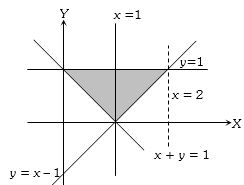
(B) The given curves are $y = |x - 1|$ and $y = 1$.
To find the intersection points,set $|x - 1| = 1$,which gives $x - 1 = 1$ or $x - 1 = -1$. Thus,$x = 2$ or $x = 0$.
The region is bounded between $x = 0$ and $x = 2$.
The area $A$ is given by $\int_{0}^{2} (1 - |x - 1|) dx$.
Since $|x - 1| = 1 - x$ for $x < 1$ and $|x - 1| = x - 1$ for $x \ge 1$,we split the integral:
$A = \int_{0}^{1} (1 - (1 - x)) dx + \int_{1}^{2} (1 - (x - 1)) dx$
$A = \int_{0}^{1} x dx + \int_{1}^{2} (2 - x) dx$
$A = \left[ \frac{x^2}{2} \right]_{0}^{1} + \left[ 2x - \frac{x^2}{2} \right]_{1}^{2}$
$A = \left( \frac{1}{2} - 0 \right) + \left( (4 - 2) - (2 - \frac{1}{2}) \right)$
$A = \frac{1}{2} + (2 - \frac{3}{2}) = \frac{1}{2} + \frac{1}{2} = 1$.
Thus,the area is $1$ square unit.
To find the intersection points,set $|x - 1| = 1$,which gives $x - 1 = 1$ or $x - 1 = -1$. Thus,$x = 2$ or $x = 0$.
The region is bounded between $x = 0$ and $x = 2$.
The area $A$ is given by $\int_{0}^{2} (1 - |x - 1|) dx$.
Since $|x - 1| = 1 - x$ for $x < 1$ and $|x - 1| = x - 1$ for $x \ge 1$,we split the integral:
$A = \int_{0}^{1} (1 - (1 - x)) dx + \int_{1}^{2} (1 - (x - 1)) dx$
$A = \int_{0}^{1} x dx + \int_{1}^{2} (2 - x) dx$
$A = \left[ \frac{x^2}{2} \right]_{0}^{1} + \left[ 2x - \frac{x^2}{2} \right]_{1}^{2}$
$A = \left( \frac{1}{2} - 0 \right) + \left( (4 - 2) - (2 - \frac{1}{2}) \right)$
$A = \frac{1}{2} + (2 - \frac{3}{2}) = \frac{1}{2} + \frac{1}{2} = 1$.
Thus,the area is $1$ square unit.
0 likesView Solution
35
MathematicsEasyMCQIIT JEE · 1994
Let $A, B,$ and $C$ be three mutually independent events. Consider the two statements $S_1$ and $S_2$:
$S_1 : A$ and $B \cup C$ are independent.
$S_2 : A$ and $B \cap C$ are independent.
Then:
$S_1 : A$ and $B \cup C$ are independent.
$S_2 : A$ and $B \cap C$ are independent.
Then:
A
Both $S_1$ and $S_2$ are true.
B
Only $S_1$ is true.
C
Only $S_2$ is true.
D
Neither $S_1$ nor $S_2$ is true.
Solution
(A) If $A, B,$ and $C$ are mutually independent,then $P(A \cap B) = P(A)P(B), P(A \cap C) = P(A)P(C),$ and $P(A \cap B \cap C) = P(A)P(B)P(C)$.
For $S_1$: $P(A \cap (B \cup C)) = P((A \cap B) \cup (A \cap C)) = P(A \cap B) + P(A \cap C) - P(A \cap B \cap C) = P(A)P(B) + P(A)P(C) - P(A)P(B)P(C) = P(A)[P(B) + P(C) - P(B)P(C)] = P(A)P(B \cup C)$. Thus,$S_1$ is true.
For $S_2$: $P(A \cap (B \cap C)) = P(A \cap B \cap C) = P(A)P(B)P(C) = P(A)P(B \cap C)$. Thus,$S_2$ is true.
For $S_1$: $P(A \cap (B \cup C)) = P((A \cap B) \cup (A \cap C)) = P(A \cap B) + P(A \cap C) - P(A \cap B \cap C) = P(A)P(B) + P(A)P(C) - P(A)P(B)P(C) = P(A)[P(B) + P(C) - P(B)P(C)] = P(A)P(B \cup C)$. Thus,$S_1$ is true.
For $S_2$: $P(A \cap (B \cap C)) = P(A \cap B \cap C) = P(A)P(B)P(C) = P(A)P(B \cap C)$. Thus,$S_2$ is true.
0 likesView Solution
36
MathematicsDifficultMCQIIT JEE · 1994
An unbiased die is tossed until a number greater than $4$ appears. The probability that an even number of tosses is needed is
A
$\frac{1}{2}$
B
$\frac{2}{5}$
C
$\frac{1}{5}$
D
$\frac{2}{3}$
Solution
(B) The probability of getting a number greater than $4$ (i.e.,$5$ or $6$) in a single toss is $p = \frac{2}{6} = \frac{1}{3}$.
The probability of failure (getting $1, 2, 3,$ or $4$) is $q = 1 - p = 1 - \frac{1}{3} = \frac{2}{3}$.
We need the probability that the success occurs on an even number of tosses,which corresponds to the sequence of outcomes: (Failure,Success),(Failure,Failure,Failure,Success),(Failure,Failure,Failure,Failure,Failure,Success),and so on.
The required probability is $P = pq + q^3p + q^5p + \dots$
This is an infinite geometric series with the first term $a = pq$ and common ratio $r = q^2$.
The sum of an infinite geometric series is $S = \frac{a}{1 - r}$.
Substituting the values: $P = \frac{pq}{1 - q^2} = \frac{(\frac{1}{3})(\frac{2}{3})}{1 - (\frac{2}{3})^2} = \frac{\frac{2}{9}}{1 - \frac{4}{9}} = \frac{\frac{2}{9}}{\frac{5}{9}} = \frac{2}{5}$.
The probability of failure (getting $1, 2, 3,$ or $4$) is $q = 1 - p = 1 - \frac{1}{3} = \frac{2}{3}$.
We need the probability that the success occurs on an even number of tosses,which corresponds to the sequence of outcomes: (Failure,Success),(Failure,Failure,Failure,Success),(Failure,Failure,Failure,Failure,Failure,Success),and so on.
The required probability is $P = pq + q^3p + q^5p + \dots$
This is an infinite geometric series with the first term $a = pq$ and common ratio $r = q^2$.
The sum of an infinite geometric series is $S = \frac{a}{1 - r}$.
Substituting the values: $P = \frac{pq}{1 - q^2} = \frac{(\frac{1}{3})(\frac{2}{3})}{1 - (\frac{2}{3})^2} = \frac{\frac{2}{9}}{1 - \frac{4}{9}} = \frac{\frac{2}{9}}{\frac{5}{9}} = \frac{2}{5}$.
0 likesView Solution
37
MathematicsMediumMCQIIT JEE · 1994
If two events $A$ and $B$ are such that $P(A^c) = 0.3$,$P(B) = 0.4$ and $P(A \cap B^c) = 0.5$,then $P(B | A \cup B^c)$ is equal to
A
$1/2$
B
$1/3$
C
$1/4$
D
None of these
Solution
(C) Given $P(A^c) = 0.3$,so $P(A) = 1 - 0.3 = 0.7$.
Given $P(B) = 0.4$,so $P(B^c) = 1 - 0.4 = 0.6$.
Given $P(A \cap B^c) = 0.5$.
We know that $P(A) = P(A \cap B) + P(A \cap B^c)$,so $0.7 = P(A \cap B) + 0.5$,which implies $P(A \cap B) = 0.2$.
We need to find $P(B | A \cup B^c) = \frac{P(B \cap (A \cup B^c))}{P(A \cup B^c)}$.
Numerator: $P(B \cap (A \cup B^c)) = P((B \cap A) \cup (B \cap B^c)) = P(A \cap B) \cup \emptyset = P(A \cap B) = 0.2$.
Denominator: $P(A \cup B^c) = P(A) + P(B^c) - P(A \cap B^c) = 0.7 + 0.6 - 0.5 = 0.8$.
Therefore,$P(B | A \cup B^c) = \frac{0.2}{0.8} = \frac{1}{4}$.
Given $P(B) = 0.4$,so $P(B^c) = 1 - 0.4 = 0.6$.
Given $P(A \cap B^c) = 0.5$.
We know that $P(A) = P(A \cap B) + P(A \cap B^c)$,so $0.7 = P(A \cap B) + 0.5$,which implies $P(A \cap B) = 0.2$.
We need to find $P(B | A \cup B^c) = \frac{P(B \cap (A \cup B^c))}{P(A \cup B^c)}$.
Numerator: $P(B \cap (A \cup B^c)) = P((B \cap A) \cup (B \cap B^c)) = P(A \cap B) \cup \emptyset = P(A \cap B) = 0.2$.
Denominator: $P(A \cup B^c) = P(A) + P(B^c) - P(A \cap B^c) = 0.7 + 0.6 - 0.5 = 0.8$.
Therefore,$P(B | A \cup B^c) = \frac{0.2}{0.8} = \frac{1}{4}$.
0 likesView Solution
38
MathematicsDifficultMCQIIT JEE · 1994
An unbiased coin is tossed. If the result is a head,a pair of unbiased dice is rolled and the sum of the numbers on the two faces is noted. If the result is a tail,a card from a well-shuffled pack of eleven cards numbered $2, 3, 4, \dots, 12$ is picked and the number on the card is noted. The probability that the noted number is either $7$ or $8$ is:
A
$0.24$
B
$0.244$
C
$0.024$
D
None of these
Solution
(B) Let $H$ be the event of getting a head and $T$ be the event of getting a tail. $P(H) = P(T) = \frac{1}{2}$.
Case $1$: If $H$ occurs,two dice are rolled. The sum can be $7$ or $8$.
$P(7|H) = \frac{6}{36} = \frac{1}{6}$ and $P(8|H) = \frac{5}{36}$.
Case $2$: If $T$ occurs,a card is picked from $11$ cards numbered $2$ to $12$.
$P(7|T) = \frac{1}{11}$ and $P(8|T) = \frac{1}{11}$.
Total probability of getting $7$ is $P(7) = P(H)P(7|H) + P(T)P(7|T) = \frac{1}{2} \times \frac{1}{6} + \frac{1}{2} \times \frac{1}{11} = \frac{1}{2} \left( \frac{1}{6} + \frac{1}{11} \right) = \frac{1}{2} \left( \frac{17}{66} \right) = \frac{17}{132}$.
Total probability of getting $8$ is $P(8) = P(H)P(8|H) + P(T)P(8|T) = \frac{1}{2} \times \frac{5}{36} + \frac{1}{2} \times \frac{1}{11} = \frac{1}{2} \left( \frac{5}{36} + \frac{1}{11} \right) = \frac{1}{2} \left( \frac{55 + 36}{396} \right) = \frac{91}{792}$.
Required probability $P = P(7) + P(8) = \frac{17}{132} + \frac{91}{792} = \frac{102 + 91}{792} = \frac{193}{792} \approx 0.24368 \approx 0.244$.
Case $1$: If $H$ occurs,two dice are rolled. The sum can be $7$ or $8$.
$P(7|H) = \frac{6}{36} = \frac{1}{6}$ and $P(8|H) = \frac{5}{36}$.
Case $2$: If $T$ occurs,a card is picked from $11$ cards numbered $2$ to $12$.
$P(7|T) = \frac{1}{11}$ and $P(8|T) = \frac{1}{11}$.
Total probability of getting $7$ is $P(7) = P(H)P(7|H) + P(T)P(7|T) = \frac{1}{2} \times \frac{1}{6} + \frac{1}{2} \times \frac{1}{11} = \frac{1}{2} \left( \frac{1}{6} + \frac{1}{11} \right) = \frac{1}{2} \left( \frac{17}{66} \right) = \frac{17}{132}$.
Total probability of getting $8$ is $P(8) = P(H)P(8|H) + P(T)P(8|T) = \frac{1}{2} \times \frac{5}{36} + \frac{1}{2} \times \frac{1}{11} = \frac{1}{2} \left( \frac{5}{36} + \frac{1}{11} \right) = \frac{1}{2} \left( \frac{55 + 36}{396} \right) = \frac{91}{792}$.
Required probability $P = P(7) + P(8) = \frac{17}{132} + \frac{91}{792} = \frac{102 + 91}{792} = \frac{193}{792} \approx 0.24368 \approx 0.244$.
0 likesView Solution
39
MathematicsEasyMCQIIT JEE · 1994
$A$ box contains $24$ identical balls,of which $12$ are white and $12$ are black. The balls are drawn at random from the box one at a time with replacement. The probability that a white ball is drawn for the $4^{th}$ time on the $7^{th}$ draw is
A
$\frac{5}{64}$
B
$\frac{27}{32}$
C
$\frac{5}{32}$
D
$\frac{1}{2}$
Solution
(C) The probability of drawing a white ball in a single draw is $p = \frac{12}{24} = \frac{1}{2}$.
For the $4^{th}$ white ball to be drawn on the $7^{th}$ draw,there must be exactly $3$ white balls in the first $6$ draws,and the $7^{th}$ draw must be a white ball.
This follows a binomial distribution scenario.
The probability is given by: $P = \binom{6}{3} \times p^3 \times (1-p)^3 \times p$.
Substituting $p = \frac{1}{2}$:
$P = 20 \times (\frac{1}{2})^3 \times (\frac{1}{2})^3 \times \frac{1}{2} = 20 \times (\frac{1}{2})^7 = \frac{20}{128} = \frac{5}{32}$.
For the $4^{th}$ white ball to be drawn on the $7^{th}$ draw,there must be exactly $3$ white balls in the first $6$ draws,and the $7^{th}$ draw must be a white ball.
This follows a binomial distribution scenario.
The probability is given by: $P = \binom{6}{3} \times p^3 \times (1-p)^3 \times p$.
Substituting $p = \frac{1}{2}$:
$P = 20 \times (\frac{1}{2})^3 \times (\frac{1}{2})^3 \times \frac{1}{2} = 20 \times (\frac{1}{2})^7 = \frac{20}{128} = \frac{5}{32}$.
0 likesView Solution
40
MathematicsDifficultMCQIIT JEE · 1994
For all values of $A, B, C$ and $P, Q, R$,the value of $\left| \begin{array}{ccc} \cos(A-P) & \cos(A-Q) & \cos(A-R) \\ \cos(B-P) & \cos(B-Q) & \cos(B-R) \\ \cos(C-P) & \cos(C-Q) & \cos(C-R) \end{array} \right|$ is
A
$0$
B
$\cos A \cos B \cos C$
C
$\sin A \sin B \sin C$
D
$\cos P \cos Q \cos R$
Solution
(A) The given determinant is $\Delta = \left| \begin{array}{ccc} \cos(A-P) & \cos(A-Q) & \cos(A-R) \\ \cos(B-P) & \cos(B-Q) & \cos(B-R) \\ \cos(C-P) & \cos(C-Q) & \cos(C-R) \end{array} \right|$.
Using the formula $\cos(x-y) = \cos x \cos y + \sin x \sin y$,we can write each element as a sum of two terms.
This allows us to express the determinant as the product of two matrices:
$\Delta = \left| \begin{array}{ccc} \cos A & \sin A & 0 \\ \cos B & \sin B & 0 \\ \cos C & \sin C & 0 \end{array} \right| \times \left| \begin{array}{ccc} \cos P & \cos Q & \cos R \\ \sin P & \sin Q & \sin R \\ 0 & 0 & 0 \end{array} \right|$.
Since the third column of the first matrix is all zeros and the third row of the second matrix is all zeros,the product of these two matrices is zero.
Alternatively,the determinant can be split into $8$ determinants,each of which has at least two identical columns (or rows),making the value of each determinant $0$.
Thus,the value of the determinant is $0$.
Using the formula $\cos(x-y) = \cos x \cos y + \sin x \sin y$,we can write each element as a sum of two terms.
This allows us to express the determinant as the product of two matrices:
$\Delta = \left| \begin{array}{ccc} \cos A & \sin A & 0 \\ \cos B & \sin B & 0 \\ \cos C & \sin C & 0 \end{array} \right| \times \left| \begin{array}{ccc} \cos P & \cos Q & \cos R \\ \sin P & \sin Q & \sin R \\ 0 & 0 & 0 \end{array} \right|$.
Since the third column of the first matrix is all zeros and the third row of the second matrix is all zeros,the product of these two matrices is zero.
Alternatively,the determinant can be split into $8$ determinants,each of which has at least two identical columns (or rows),making the value of each determinant $0$.
Thus,the value of the determinant is $0$.
0 likesView Solution
41
MathematicsMediumMCQIIT JEE · 1994
If we consider only the principal values of the inverse trigonometric functions,then the value of $\tan \left( \cos^{-1} \frac{1}{5\sqrt{2}} - \sin^{-1} \frac{4}{\sqrt{17}} \right)$ is
A
$\sqrt{29/3}$
B
$29/3$
C
$\sqrt{3/29}$
D
$3/29$
Solution
(D) Let $\alpha = \cos^{-1} \frac{1}{5\sqrt{2}}$. Then $\cos \alpha = \frac{1}{5\sqrt{2}}$.
Since $\tan^2 \alpha = \sec^2 \alpha - 1 = (5\sqrt{2})^2 - 1 = 50 - 1 = 49$,we have $\tan \alpha = 7$.
Thus,$\alpha = \tan^{-1} 7$.
Let $\beta = \sin^{-1} \frac{4}{\sqrt{17}}$. Then $\sin \beta = \frac{4}{\sqrt{17}}$.
Since $\cos^2 \beta = 1 - \sin^2 \beta = 1 - \frac{16}{17} = \frac{1}{17}$,we have $\cos \beta = \frac{1}{\sqrt{17}}$.
Then $\tan \beta = \frac{\sin \beta}{\cos \beta} = \frac{4/\sqrt{17}}{1/\sqrt{17}} = 4$.
Thus,$\beta = \tan^{-1} 4$.
The expression becomes $\tan(\alpha - \beta) = \tan(\tan^{-1} 7 - \tan^{-1} 4)$.
Using the formula $\tan(A - B) = \frac{\tan A - \tan B}{1 + \tan A \tan B}$,we get:
$\tan(\tan^{-1} 7 - \tan^{-1} 4) = \frac{7 - 4}{1 + (7)(4)} = \frac{3}{1 + 28} = \frac{3}{29}$.
Since $\tan^2 \alpha = \sec^2 \alpha - 1 = (5\sqrt{2})^2 - 1 = 50 - 1 = 49$,we have $\tan \alpha = 7$.
Thus,$\alpha = \tan^{-1} 7$.
Let $\beta = \sin^{-1} \frac{4}{\sqrt{17}}$. Then $\sin \beta = \frac{4}{\sqrt{17}}$.
Since $\cos^2 \beta = 1 - \sin^2 \beta = 1 - \frac{16}{17} = \frac{1}{17}$,we have $\cos \beta = \frac{1}{\sqrt{17}}$.
Then $\tan \beta = \frac{\sin \beta}{\cos \beta} = \frac{4/\sqrt{17}}{1/\sqrt{17}} = 4$.
Thus,$\beta = \tan^{-1} 4$.
The expression becomes $\tan(\alpha - \beta) = \tan(\tan^{-1} 7 - \tan^{-1} 4)$.
Using the formula $\tan(A - B) = \frac{\tan A - \tan B}{1 + \tan A \tan B}$,we get:
$\tan(\tan^{-1} 7 - \tan^{-1} 4) = \frac{7 - 4}{1 + (7)(4)} = \frac{3}{1 + 28} = \frac{3}{29}$.
0 likesView Solution
42
MathematicsDifficultMCQIIT JEE · 1994
Let $p$ and $q$ be the position vectors of $P$ and $Q$ respectively with respect to $O$ and $|p| = p, |q| = q.$ The points $R$ and $S$ divide $PQ$ internally and externally in the ratio $2 : 3$ respectively. If $\overrightarrow{OR}$ and $\overrightarrow{OS}$ are perpendicular,then:
A
$9p^2 = 4q^2$
B
$4p^2 = 9q^2$
C
$9p = 4q$
D
$4p = 9q$
Solution
(A) The position vectors of $R$ and $S$ are $\frac{3p + 2q}{5}$ and $3p - 2q$ respectively.
Therefore,$\overrightarrow{OR} = \frac{3p + 2q}{5}$ and $\overrightarrow{OS} = 3p - 2q.$
Since $\overrightarrow{OR} \perp \overrightarrow{OS},$ their dot product is zero,so $\overrightarrow{OR} \cdot \overrightarrow{OS} = 0.$
$\left( \frac{3p + 2q}{5} \right) \cdot (3p - 2q) = 0$
$9|p|^2 - 6(p \cdot q) + 6(q \cdot p) - 4|q|^2 = 0$
$9|p|^2 - 4|q|^2 = 0$
$9|p|^2 = 4|q|^2$
Given $|p| = p$ and $|q| = q,$ we get $9p^2 = 4q^2.$
Therefore,$\overrightarrow{OR} = \frac{3p + 2q}{5}$ and $\overrightarrow{OS} = 3p - 2q.$
Since $\overrightarrow{OR} \perp \overrightarrow{OS},$ their dot product is zero,so $\overrightarrow{OR} \cdot \overrightarrow{OS} = 0.$
$\left( \frac{3p + 2q}{5} \right) \cdot (3p - 2q) = 0$
$9|p|^2 - 6(p \cdot q) + 6(q \cdot p) - 4|q|^2 = 0$
$9|p|^2 - 4|q|^2 = 0$
$9|p|^2 = 4|q|^2$
Given $|p| = p$ and $|q| = q,$ we get $9p^2 = 4q^2.$
0 likesView Solution
43
MathematicsMediumMCQIIT JEE · 1994
Let $f(x) = \sin x$ and $g(x) = \ln |x|$. If the ranges of the composite functions $fog$ and $gof$ are $R_1$ and $R_2$ respectively,then:
A
$R_1 = \{ u: - 1 < u < 1\} , R_2 = \{ v: - \infty < v < 0\}$
B
$R_1 = \{ u: - \infty < u \le 0\} , R_2 = \{ v: - 1 \le v \le 1\}$
C
$R_1 = \{ u: - 1 < u < 1\} , R_2 = \{ v: - \infty < v < 0\}$
D
$R_1 = \{ u: - 1 \le u \le 1\} , R_2 = \{ v: - \infty < v \le 0\}$
Solution
(D) Given $f(x) = \sin x$ and $g(x) = \ln |x|$.
For $fog(x) = f(g(x)) = \sin(\ln |x|)$.
Since the range of $\ln |x|$ is $(-\infty, \infty)$,the range of $\sin(\ln |x|)$ is $[-1, 1]$. Thus,$R_1 = [-1, 1]$.
For $gof(x) = g(f(x)) = \ln |\sin x|$.
Since the range of $|\sin x|$ is $(0, 1]$,the range of $\ln |\sin x|$ is $(-\infty, 0]$. Thus,$R_2 = (-\infty, 0]$.
Therefore,$R_1 = \{u: -1 \le u \le 1\}$ and $R_2 = \{v: -\infty < v \le 0\}$.
For $fog(x) = f(g(x)) = \sin(\ln |x|)$.
Since the range of $\ln |x|$ is $(-\infty, \infty)$,the range of $\sin(\ln |x|)$ is $[-1, 1]$. Thus,$R_1 = [-1, 1]$.
For $gof(x) = g(f(x)) = \ln |\sin x|$.
Since the range of $|\sin x|$ is $(0, 1]$,the range of $\ln |\sin x|$ is $(-\infty, 0]$. Thus,$R_2 = (-\infty, 0]$.
Therefore,$R_1 = \{u: -1 \le u \le 1\}$ and $R_2 = \{v: -\infty < v \le 0\}$.
0 likesView Solution
44
MathematicsDifficultMCQIIT JEE · 1994
Let $f(x) = \begin{cases} (1 + |\sin x|)^{a/|\sin x|}, & -\pi/6 < x < 0 \\ b, & x = 0 \\ e^{\tan 2x/\tan 3x}, & 0 < x < \pi/6 \end{cases}$. If $f$ is continuous at $x = 0$,then the values of $a$ and $b$ are respectively:
A
$2/3, 3/2$
B
$2/3, e^{2/3}$
C
$3/2, e^{3/2}$
D
None of these
Solution
(B) For $f(x)$ to be continuous at $x = 0$,we must have $\lim_{x \to 0^-} f(x) = f(0) = \lim_{x \to 0^+} f(x)$.
First,calculate the left-hand limit $(LHL)$:
$\lim_{x \to 0^-} (1 + |\sin x|)^{a/|\sin x|} = e^{\lim_{x \to 0^-} |\sin x| \cdot \frac{a}{|\sin x|}} = e^a$.
Next,calculate the right-hand limit $(RHL)$:
$\lim_{x \to 0^+} e^{\tan 2x/\tan 3x} = e^{\lim_{x \to 0^+} \frac{\tan 2x}{\tan 3x}} = e^{\lim_{x \to 0^+} \frac{(\tan 2x / 2x) \cdot 2x}{(\tan 3x / 3x) \cdot 3x}} = e^{2/3}$.
Since $f(0) = b$,we equate the limits:
$e^a = b = e^{2/3}$.
Thus,$a = 2/3$ and $b = e^{2/3}$.
First,calculate the left-hand limit $(LHL)$:
$\lim_{x \to 0^-} (1 + |\sin x|)^{a/|\sin x|} = e^{\lim_{x \to 0^-} |\sin x| \cdot \frac{a}{|\sin x|}} = e^a$.
Next,calculate the right-hand limit $(RHL)$:
$\lim_{x \to 0^+} e^{\tan 2x/\tan 3x} = e^{\lim_{x \to 0^+} \frac{\tan 2x}{\tan 3x}} = e^{\lim_{x \to 0^+} \frac{(\tan 2x / 2x) \cdot 2x}{(\tan 3x / 3x) \cdot 3x}} = e^{2/3}$.
Since $f(0) = b$,we equate the limits:
$e^a = b = e^{2/3}$.
Thus,$a = 2/3$ and $b = e^{2/3}$.
0 likesView Solution
45
MathematicsEasyMCQIIT JEE · 1994
If $y=4x-5$ is tangent to the curve $y^2=px^3+q$ at $(2,3)$,then
A
$p=2, q=-7$
B
$p=2, q=7$
C
$p=-2, q=7$
D
$p=-2, q=-7$
Solution
(A) Since the point $(2,3)$ lies on the curve $y^2=px^3+q$,we have:
$3^2 = p(2)^3 + q$
$9 = 8p + q$ ...$(i)$
Now,differentiate the curve equation $y^2=px^3+q$ with respect to $x$:
$2y \frac{dy}{dx} = 3px^2$
$\frac{dy}{dx} = \frac{3px^2}{2y}$
The slope of the tangent $y=4x-5$ is $4$. Therefore,the derivative at $(2,3)$ must be equal to $4$:
$\left. \frac{dy}{dx} \right|_{(2,3)} = \frac{3p(2)^2}{2(3)} = 4$
$\frac{12p}{6} = 4$
$2p = 4 \Rightarrow p = 2$ ...$(ii)$
Substitute $p=2$ into equation $(i)$:
$8(2) + q = 9$
$16 + q = 9$
$q = 9 - 16 = -7$
Thus,$p=2$ and $q=-7$.
$3^2 = p(2)^3 + q$
$9 = 8p + q$ ...$(i)$
Now,differentiate the curve equation $y^2=px^3+q$ with respect to $x$:
$2y \frac{dy}{dx} = 3px^2$
$\frac{dy}{dx} = \frac{3px^2}{2y}$
The slope of the tangent $y=4x-5$ is $4$. Therefore,the derivative at $(2,3)$ must be equal to $4$:
$\left. \frac{dy}{dx} \right|_{(2,3)} = \frac{3p(2)^2}{2(3)} = 4$
$\frac{12p}{6} = 4$
$2p = 4 \Rightarrow p = 2$ ...$(ii)$
Substitute $p=2$ into equation $(i)$:
$8(2) + q = 9$
$16 + q = 9$
$q = 9 - 16 = -7$
Thus,$p=2$ and $q=-7$.
0 likesView Solution
46
MathematicsEasyMCQIIT JEE · 1994
If $y=(\sin x)^{\tan x}$,then $\frac{dy}{dx}$ is equal to
A
$(\sin x)^{\tan x}(1+\sec^2 x \log(\sin x))$
B
$\tan x(\sin x)^{\tan x-1} \cos x$
C
$(\sin x)^{\tan x} \sec^2 x \log(\sin x)$
D
$\tan x(\sin x)^{\tan x-1}$
Solution
(A) Given $y=(\sin x)^{\tan x}$.
Taking the natural logarithm on both sides,we get $\log y = \tan x \cdot \log(\sin x)$.
Differentiating both sides with respect to $x$ using the product rule:
$\frac{1}{y} \frac{dy}{dx} = \frac{d}{dx}(\tan x) \cdot \log(\sin x) + \tan x \cdot \frac{d}{dx}(\log(\sin x))$.
$\frac{1}{y} \frac{dy}{dx} = \sec^2 x \cdot \log(\sin x) + \tan x \cdot \frac{1}{\sin x} \cdot \cos x$.
Since $\frac{\cos x}{\sin x} = \cot x$,we have $\tan x \cdot \cot x = 1$.
Thus,$\frac{1}{y} \frac{dy}{dx} = \sec^2 x \log(\sin x) + 1$.
Multiplying by $y$,we get $\frac{dy}{dx} = y[1 + \sec^2 x \log(\sin x)]$.
Substituting $y = (\sin x)^{\tan x}$,we get $\frac{dy}{dx} = (\sin x)^{\tan x}[1 + \sec^2 x \log(\sin x)]$.
Taking the natural logarithm on both sides,we get $\log y = \tan x \cdot \log(\sin x)$.
Differentiating both sides with respect to $x$ using the product rule:
$\frac{1}{y} \frac{dy}{dx} = \frac{d}{dx}(\tan x) \cdot \log(\sin x) + \tan x \cdot \frac{d}{dx}(\log(\sin x))$.
$\frac{1}{y} \frac{dy}{dx} = \sec^2 x \cdot \log(\sin x) + \tan x \cdot \frac{1}{\sin x} \cdot \cos x$.
Since $\frac{\cos x}{\sin x} = \cot x$,we have $\tan x \cdot \cot x = 1$.
Thus,$\frac{1}{y} \frac{dy}{dx} = \sec^2 x \log(\sin x) + 1$.
Multiplying by $y$,we get $\frac{dy}{dx} = y[1 + \sec^2 x \log(\sin x)]$.
Substituting $y = (\sin x)^{\tan x}$,we get $\frac{dy}{dx} = (\sin x)^{\tan x}[1 + \sec^2 x \log(\sin x)]$.
0 likesView Solution
Vedclass Products
For Students
Vedclass Test Series
Mock tests in real IIT JEE style covering Mathematics with performance analysis. 5-day free trial.
Start Free TrialFor Teachers
Exam Paper Generator
Generate Set A/B/C/D Mathematics papers from 7.5L+ questions in 2 minutes. 3 chapters free.
Try FreeFor Institutes
Online Exam Module
Run live IIT JEE mock exams with unlimited students, 360° analytics & white-label branding.
See DemoFrequently Asked Questions
How many Mathematics questions are in IIT JEE 1994?
There are 46 Mathematics questions from the IIT JEE 1994 paper on Vedclass, each with a detailed step-by-step solution in English.
Are IIT JEE 1994 Mathematics solutions available in English?
Yes. All solutions on this page are in English. You can also switch to English or Hindi using the language buttons above the questions.
Can I practice IIT JEE 1994 Mathematics as a timed test?
Yes. Use the Vedclass Test Series to attempt a full IIT JEE mock test covering Mathematics with time limits and instant score analysis.
Can teachers create Mathematics papers from IIT JEE previous year questions?
Yes. The Vedclass Exam Paper Generator lets teachers mix IIT JEE Mathematics questions and generate Set A/B/C/D papers in minutes.
For Teachers & Institutes
Build a Custom Mathematics Paper
Pick IIT JEE 1994 Mathematics questions, set difficulty, and generate Set A/B/C/D in 2 minutes.