
ChemistryQ1–29 of 29 questions
Page 1 of 1 · English
1
ChemistryMCQIIT JEE · 1990
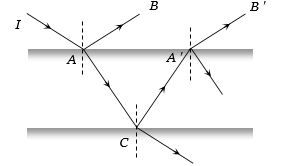
$A$ ray of light of intensity $I$ is incident on a parallel glass-slab at a point $A$ as shown in the figure. It undergoes partial reflection and refraction. At each reflection,$25\%$ of the incident energy is reflected. The rays $AB$ and $A'B'$ undergo interference. The ratio ${I_{\max }}/{I_{\min }}$ is (in $: 1$)
A
$4$
B
$8$
C
$7$
D
$49$
Solution
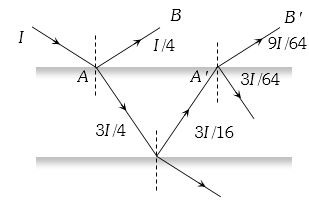
(D) At point $A$,the incident intensity is $I$. Since $25\%$ is reflected,the intensity of ray $AB$ is $I_1 = 0.25I = I/4$. The intensity of the refracted ray is $0.75I = 3I/4$.
At point $C$,the ray is reflected. Again,$25\%$ of the incident energy $(3I/4)$ is reflected. So,the intensity of the ray moving towards $A'$ is $0.25 \times (3I/4) = 3I/16$.
At point $A'$,this ray is refracted. The intensity of the refracted ray $A'B'$ is $0.75 \times (3I/16) = 9I/64$. Thus,$I_2 = 9I/64$.
The ratio of intensities is $I_2/I_1 = (9I/64) / (I/4) = 9/16$.
The ratio of maximum to minimum intensity is given by:
$\frac{I_{\max}}{I_{\min}} = \left( \frac{\sqrt{I_1} + \sqrt{I_2}}{\sqrt{I_1} - \sqrt{I_2}} \right)^2 = \left( \frac{1 + \sqrt{I_2/I_1}}{1 - \sqrt{I_2/I_1}} \right)^2$
Substituting $I_2/I_1 = 9/16$:
$\frac{I_{\max}}{I_{\min}} = \left( \frac{1 + \sqrt{9/16}}{1 - \sqrt{9/16}} \right)^2 = \left( \frac{1 + 3/4}{1 - 3/4} \right)^2 = \left( \frac{7/4}{1/4} \right)^2 = (7)^2 = 49/1$.
At point $C$,the ray is reflected. Again,$25\%$ of the incident energy $(3I/4)$ is reflected. So,the intensity of the ray moving towards $A'$ is $0.25 \times (3I/4) = 3I/16$.
At point $A'$,this ray is refracted. The intensity of the refracted ray $A'B'$ is $0.75 \times (3I/16) = 9I/64$. Thus,$I_2 = 9I/64$.
The ratio of intensities is $I_2/I_1 = (9I/64) / (I/4) = 9/16$.
The ratio of maximum to minimum intensity is given by:
$\frac{I_{\max}}{I_{\min}} = \left( \frac{\sqrt{I_1} + \sqrt{I_2}}{\sqrt{I_1} - \sqrt{I_2}} \right)^2 = \left( \frac{1 + \sqrt{I_2/I_1}}{1 - \sqrt{I_2/I_1}} \right)^2$
Substituting $I_2/I_1 = 9/16$:
$\frac{I_{\max}}{I_{\min}} = \left( \frac{1 + \sqrt{9/16}}{1 - \sqrt{9/16}} \right)^2 = \left( \frac{1 + 3/4}{1 - 3/4} \right)^2 = \left( \frac{7/4}{1/4} \right)^2 = (7)^2 = 49/1$.
0 likesView Solution
2
ChemistryMediumMCQIIT JEE · 1990
The enolic form of acetone contains
A
$9$ sigma bonds,$1$ pi bond and $2$ lone pairs
B
$8$ sigma bonds,$2$ pi bonds and $2$ lone pairs
C
$10$ sigma bonds,$1$ pi bond and $1$ lone pair
D
$9$ sigma bonds,$2$ pi bonds and $1$ lone pair
Solution
(A) The enolic form of acetone is propen$-2-$ol,which has the structure $CH_2=C(OH)-CH_3$.
Counting the bonds: there are $3$ $C-H$ bonds in the methyl group,$2$ $C-H$ bonds in the methylene group,$1$ $O-H$ bond,$1$ $C-O$ bond,$1$ $C-C$ bond,and $1$ $C=C$ bond (which consists of $1$ $\sigma$ and $1$ $\pi$ bond).
Total $\sigma$ bonds = $3 + 2 + 1 + 1 + 1 + 1 = 9$.
Total $\pi$ bonds = $1$.
Oxygen atom in the hydroxyl group has $2$ lone pairs.
Thus,the structure contains $9$ $\sigma$ bonds,$1$ $\pi$ bond,and $2$ lone pairs.
Counting the bonds: there are $3$ $C-H$ bonds in the methyl group,$2$ $C-H$ bonds in the methylene group,$1$ $O-H$ bond,$1$ $C-O$ bond,$1$ $C-C$ bond,and $1$ $C=C$ bond (which consists of $1$ $\sigma$ and $1$ $\pi$ bond).
Total $\sigma$ bonds = $3 + 2 + 1 + 1 + 1 + 1 = 9$.
Total $\pi$ bonds = $1$.
Oxygen atom in the hydroxyl group has $2$ lone pairs.
Thus,the structure contains $9$ $\sigma$ bonds,$1$ $\pi$ bond,and $2$ lone pairs.
0 likesView Solution
3
ChemistryEasyMCQIIT JEE · 1990
In the reaction,$A_{2(g)} + 4B_{2(g)} \rightleftharpoons 2AB_{4(g)}$,$\Delta H < 0$,the formation of $AB_{4}$ is favoured at
A
Low temperature,high pressure
B
High temperature,low pressure
C
Low temperature,low pressure
D
High temperature,high pressure
Solution
(A) According to Le Chatelier's principle,for an exothermic reaction $(\Delta H < 0)$,a decrease in temperature shifts the equilibrium in the forward direction to release heat.
In the given reaction,the number of moles of gaseous reactants is $1 + 4 = 5$,and the number of moles of gaseous products is $2$.
Since the number of moles decreases in the forward direction $(5 \to 2)$,an increase in pressure shifts the equilibrium towards the side with fewer moles,which is the forward direction.
Therefore,the formation of $AB_{4}$ is favoured at low temperature and high pressure.
In the given reaction,the number of moles of gaseous reactants is $1 + 4 = 5$,and the number of moles of gaseous products is $2$.
Since the number of moles decreases in the forward direction $(5 \to 2)$,an increase in pressure shifts the equilibrium towards the side with fewer moles,which is the forward direction.
Therefore,the formation of $AB_{4}$ is favoured at low temperature and high pressure.
0 likesView Solution
4
ChemistryEasyMCQIIT JEE · 1990
Which hydroxide will have the lowest value of solubility product at normal temperature $({25\,^oC})$?
A
$Mg(OH)_2$
B
$Ca(OH)_2$
C
$Ba(OH)_2$
D
$Be(OH)_2$
Solution
(D) The solubility of alkaline earth metal hydroxides increases down the group from $Be$ to $Ba$.
Since $Be(OH)_2$ is the least soluble among the given hydroxides,it has the lowest concentration of ions in a saturated solution.
Therefore,$Be(OH)_2$ has the lowest value of the solubility product $(K_{sp})$ at $25\,^oC$.
Since $Be(OH)_2$ is the least soluble among the given hydroxides,it has the lowest concentration of ions in a saturated solution.
Therefore,$Be(OH)_2$ has the lowest value of the solubility product $(K_{sp})$ at $25\,^oC$.
0 likesView Solution
5
ChemistryDifficultMCQIIT JEE · 1990
Solubility of a salt $M_2X_3$ is $y \ mol \ dm^{-3}$. The solubility product of the salt will be
A
$6y^4$
B
$64y^4$
C
$36y^5$
D
$108y^5$
Solution
(D) The dissociation of the salt $M_2X_3$ is given by:
$M_2X_3(s) \rightleftharpoons 2M^{3+}(aq) + 3X^{2-}(aq)$
If the solubility is $y \ mol \ dm^{-3}$,then the concentration of $M^{3+}$ is $2y \ mol \ dm^{-3}$ and the concentration of $X^{2-}$ is $3y \ mol \ dm^{-3}$.
The solubility product $K_{sp}$ is defined as:
$K_{sp} = [M^{3+}]^2 [X^{2-}]^3$
Substituting the values:
$K_{sp} = (2y)^2 \times (3y)^3$
$K_{sp} = (4y^2) \times (27y^3)$
$K_{sp} = 108y^5 \ mol^5 \ dm^{-15}$
Therefore,the correct option is $(D)$.
$M_2X_3(s) \rightleftharpoons 2M^{3+}(aq) + 3X^{2-}(aq)$
If the solubility is $y \ mol \ dm^{-3}$,then the concentration of $M^{3+}$ is $2y \ mol \ dm^{-3}$ and the concentration of $X^{2-}$ is $3y \ mol \ dm^{-3}$.
The solubility product $K_{sp}$ is defined as:
$K_{sp} = [M^{3+}]^2 [X^{2-}]^3$
Substituting the values:
$K_{sp} = (2y)^2 \times (3y)^3$
$K_{sp} = (4y^2) \times (27y^3)$
$K_{sp} = 108y^5 \ mol^5 \ dm^{-15}$
Therefore,the correct option is $(D)$.
0 likesView Solution
6
ChemistryMediumMCQIIT JEE · 1990
The size of the following species increases in the order:
A
$Mg^{2+} < Na^{+} < F^{-} < Al$
B
$F^{-} < Al < Na^{+} < Mg^{2+}$
C
$Al < Mg < F^{-} < Na^{+}$
D
$Na^{+} < Al < F^{-} < Mg^{2+}$
Solution
(A) The species given are $Mg^{2+}$,$Na^{+}$,$F^{-}$,and $Al$.
$1$. $Al$ is a neutral atom,while $Mg^{2+}$,$Na^{+}$,and $F^{-}$ are ions.
$2$. Comparing the ionic radii of isoelectronic species ($Mg^{2+}$,$Na^{+}$,$F^{-}$): These all have $10$ electrons. The ionic radius decreases as the nuclear charge $(Z)$ increases. The nuclear charges are $F^{-} (Z=9)$,$Na^{+} (Z=11)$,and $Mg^{2+} (Z=12)$. Thus,the order of size is $Mg^{2+} < Na^{+} < F^{-}$.
$3$. The neutral atom $Al$ $(Z=13)$ has a larger atomic radius than these cations. However,comparing $Al$ to the others,the correct order of size is $Mg^{2+} < Na^{+} < F^{-} < Al$.
$1$. $Al$ is a neutral atom,while $Mg^{2+}$,$Na^{+}$,and $F^{-}$ are ions.
$2$. Comparing the ionic radii of isoelectronic species ($Mg^{2+}$,$Na^{+}$,$F^{-}$): These all have $10$ electrons. The ionic radius decreases as the nuclear charge $(Z)$ increases. The nuclear charges are $F^{-} (Z=9)$,$Na^{+} (Z=11)$,and $Mg^{2+} (Z=12)$. Thus,the order of size is $Mg^{2+} < Na^{+} < F^{-}$.
$3$. The neutral atom $Al$ $(Z=13)$ has a larger atomic radius than these cations. However,comparing $Al$ to the others,the correct order of size is $Mg^{2+} < Na^{+} < F^{-} < Al$.
0 likesView Solution
7
ChemistryEasyMCQIIT JEE · 1990
Which one of the following elements has the highest ionisation energy?
A
$[Ne] \, 3s^2 \, 3p^1$
B
$[Ne] \, 3s^2 \, 3p^2$
C
$[Ne] \, 3s^2 \, 3p^3$
D
$[Ar] \, 3d^{10} \, 4s^2 \, 4p^2$
Solution
(C) The electronic configuration of the given elements corresponds to $Al$ $(3p^1)$,$Si$ $(3p^2)$,$P$ $(3p^3)$,and $Ge$ $(4p^2)$.
Ionization energy generally increases across a period.
However,the $p^3$ configuration represents a half-filled stable subshell.
Due to the extra stability of the half-filled $p$-orbital,the energy required to remove an electron from $[Ne] \, 3s^2 \, 3p^3$ is the highest among the given options.
Ionization energy generally increases across a period.
However,the $p^3$ configuration represents a half-filled stable subshell.
Due to the extra stability of the half-filled $p$-orbital,the energy required to remove an electron from $[Ne] \, 3s^2 \, 3p^3$ is the highest among the given options.
0 likesView Solution
8
ChemistryMediumMCQIIT JEE · 1990
When zeolite,which is hydrated sodium aluminium silicate,is treated with hard water,the sodium ions are exchanged with
A
$H^{+}$ ions
B
$Ca^{2+}$ ions
C
$Mg^{2+}$ ions
D
Both $Ca^{2+}$ and $Mg^{2+}$
Solution
(D) Zeolite,which is hydrated sodium aluminium silicate $(Na_2Al_2Si_2O_8 \cdot xH_2O)$,acts as an ion exchanger.
When it is treated with hard water,the $Na^+$ ions present in the zeolite structure are exchanged with the $Ca^{2+}$ and $Mg^{2+}$ ions that cause hardness in water.
When it is treated with hard water,the $Na^+$ ions present in the zeolite structure are exchanged with the $Ca^{2+}$ and $Mg^{2+}$ ions that cause hardness in water.
0 likesView Solution
9
ChemistryEasyMCQIIT JEE · 1990
‘Lead pencil’ contains
A
$PbS$
B
$Graphite$
C
$H_3BO_3$
D
$Pb$
Solution
(B) The term 'lead pencil' is a misnomer. It does not contain lead $(Pb)$.
Instead,it contains a mixture of $Graphite$ and clay,which is used as the core of the pencil.
Instead,it contains a mixture of $Graphite$ and clay,which is used as the core of the pencil.
0 likesView Solution
10
ChemistryDifficultMCQIIT JEE · 1990
Which compound produces $CH_4$ when treated with water?
A
Silicon carbide
B
Calcium carbide
C
Aluminium carbide
D
Iron carbide
Solution
(C) Aluminium carbide $(Al_4C_3)$ reacts with water to produce methane $(CH_4)$ gas.
The chemical reaction is:
$Al_4C_3 + 12H_2O \longrightarrow 3CH_4 + 4Al(OH)_3$
The chemical reaction is:
$Al_4C_3 + 12H_2O \longrightarrow 3CH_4 + 4Al(OH)_3$
0 likesView Solution
11
ChemistryMediumMCQIIT JEE · 1990
$A$ mixture of ethyl iodide and $n-$propyl iodide is subjected to Wurtz reaction. The hydrocarbon that will not be formed is
A
$n-$butane
B
$n-$propane
C
$n-$pentane
D
$n-$hexane
Solution
(B) The Wurtz reaction involves the coupling of alkyl halides in the presence of sodium metal to form higher alkanes.
When a mixture of ethyl iodide $(C_2H_5I)$ and $n-$propyl iodide $(C_3H_7I)$ is used,the following products are formed:
$1$. Self-coupling of ethyl iodide: $C_2H_5-C_2H_5$ ($n-$butane).
$2$. Self-coupling of $n-$propyl iodide: $C_3H_7-C_3H_7$ ($n-$hexane).
$3$. Cross-coupling of ethyl iodide and $n-$propyl iodide: $C_2H_5-C_3H_7$ ($n-$pentane).
Therefore,$n-$propane is not formed in this reaction.
When a mixture of ethyl iodide $(C_2H_5I)$ and $n-$propyl iodide $(C_3H_7I)$ is used,the following products are formed:
$1$. Self-coupling of ethyl iodide: $C_2H_5-C_2H_5$ ($n-$butane).
$2$. Self-coupling of $n-$propyl iodide: $C_3H_7-C_3H_7$ ($n-$hexane).
$3$. Cross-coupling of ethyl iodide and $n-$propyl iodide: $C_2H_5-C_3H_7$ ($n-$pentane).
Therefore,$n-$propane is not formed in this reaction.
0 likesView Solution
12
ChemistryMCQIIT JEE · 1990
If the roots of the given equation $(\cos p - 1){x^2} + (\cos p)x + \sin p = 0$ are real,then
A
$p \in ( - \pi ,0)$
B
$p \in \left( { - \frac{\pi }{2},\frac{\pi }{2}} \right)$
C
$p \in (0,\pi )$
D
$p \in (0,2\pi )$
Solution
(C) Given equation: $(\cos p - 1){x^2} + (\cos p)x + \sin p = 0$.
Since the roots are real,the discriminant $D \ge 0$.
$D = b^2 - 4ac = (\cos p)^2 - 4(\cos p - 1)(\sin p) \ge 0$.
$\cos^2 p - 4\sin p \cos p + 4\sin p \ge 0$.
For the quadratic equation to be valid,the coefficient of $x^2$ must not be zero,so $\cos p - 1 \neq 0$,which implies $p \neq 2n\pi$.
Analyzing the inequality,for $p \in (0, \pi)$,$\sin p > 0$ and $(1 - \sin p) \ge 0$.
Thus,the condition $D \ge 0$ is satisfied for $p \in (0, \pi)$.
Since the roots are real,the discriminant $D \ge 0$.
$D = b^2 - 4ac = (\cos p)^2 - 4(\cos p - 1)(\sin p) \ge 0$.
$\cos^2 p - 4\sin p \cos p + 4\sin p \ge 0$.
For the quadratic equation to be valid,the coefficient of $x^2$ must not be zero,so $\cos p - 1 \neq 0$,which implies $p \neq 2n\pi$.
Analyzing the inequality,for $p \in (0, \pi)$,$\sin p > 0$ and $(1 - \sin p) \ge 0$.
Thus,the condition $D \ge 0$ is satisfied for $p \in (0, \pi)$.
0 likesView Solution
13
ChemistryMCQIIT JEE · 1990
The enolic form of acetone contains:
A
$9$ sigma bonds,$1$ pi bond and $2$ lone pairs.
B
$8$ sigma bonds,$2$ pi bonds and $1$ lone pair.
C
$10$ sigma bonds,$1$ pi bond and $1$ lone pair.
D
$9$ sigma bonds,$2$ pi bonds and $1$ lone pair.
Solution
(A) The keto form of acetone is $CH_3-CO-CH_3$. The enolic form is $CH_2=C(OH)-CH_3$.
Counting the bonds in the enolic form $(CH_2=C(OH)-CH_3)$:
- Sigma $(\sigma)$ bonds: $3$ (in $CH_3$) + $1$ ($C$-$C$) + $1$ ($C$=$C$) + $1$ ($C$-$O$) + $1$ ($O$-$H$) + $2$ (in $CH_2$) = $9$ $\sigma$ bonds.
- Pi $(pi)$ bonds: $1$ (in $C$=$C$).
- Lone pairs: Oxygen atom in the hydroxyl group $(-OH)$ has $2$ lone pairs.
Thus,the enolic form contains $9$ $\sigma$ bonds,$1$ $\pi$ bond,and $2$ lone pairs.
Counting the bonds in the enolic form $(CH_2=C(OH)-CH_3)$:
- Sigma $(\sigma)$ bonds: $3$ (in $CH_3$) + $1$ ($C$-$C$) + $1$ ($C$=$C$) + $1$ ($C$-$O$) + $1$ ($O$-$H$) + $2$ (in $CH_2$) = $9$ $\sigma$ bonds.
- Pi $(pi)$ bonds: $1$ (in $C$=$C$).
- Lone pairs: Oxygen atom in the hydroxyl group $(-OH)$ has $2$ lone pairs.
Thus,the enolic form contains $9$ $\sigma$ bonds,$1$ $\pi$ bond,and $2$ lone pairs.
0 likesView Solution
14
ChemistryMCQIIT JEE · 1990
The number $\log_{2} 7$ is:
A
An integer
B
$A$ rational number
C
An irrational number
D
$A$ prime number
Solution
(C) Assume (if possible) that $\log_{2} 7 = \frac{p}{q}$ is a rational number,where $p$ and $q$ are coprime integers.
Then $\frac{p}{q} = \log_{2} 7 \implies 7 = 2^{p/q} \implies 2^{p} = 7^{q}$.
This is a contradiction because the $L.H.S.$ is even and the $R.H.S.$ is odd.
Clearly,$\log_{2} 7$ is neither an integer nor a prime number. Therefore,it is an irrational number.
Then $\frac{p}{q} = \log_{2} 7 \implies 7 = 2^{p/q} \implies 2^{p} = 7^{q}$.
This is a contradiction because the $L.H.S.$ is even and the $R.H.S.$ is odd.
Clearly,$\log_{2} 7$ is neither an integer nor a prime number. Therefore,it is an irrational number.
0 likesView Solution
15
ChemistryMCQIIT JEE · 1990
When an ideal diatomic gas is heated at constant pressure,the fraction of the heat energy supplied which increases the internal energy of the gas is:
A
$2/5$
B
$3/5$
C
$3/7$
D
$5/7$
Solution
(D) The fraction of supplied heat energy that increases the internal energy of the gas is given by the ratio of the change in internal energy to the heat supplied at constant pressure.
$f = \frac{\Delta U}{(\Delta Q)_{P}}$
Since the change in internal energy $\Delta U$ is always equal to the heat supplied at constant volume $(\Delta Q)_{V} = \mu C_{V} \Delta T$,we have:
$f = \frac{\mu C_{V} \Delta T}{\mu C_{P} \Delta T} = \frac{C_{V}}{C_{P}} = \frac{1}{\gamma}$
For an ideal diatomic gas,the adiabatic index $\gamma = \frac{C_{P}}{C_{V}} = \frac{7}{5}$.
Therefore,the fraction $f = \frac{1}{7/5} = \frac{5}{7}$.
$f = \frac{\Delta U}{(\Delta Q)_{P}}$
Since the change in internal energy $\Delta U$ is always equal to the heat supplied at constant volume $(\Delta Q)_{V} = \mu C_{V} \Delta T$,we have:
$f = \frac{\mu C_{V} \Delta T}{\mu C_{P} \Delta T} = \frac{C_{V}}{C_{P}} = \frac{1}{\gamma}$
For an ideal diatomic gas,the adiabatic index $\gamma = \frac{C_{P}}{C_{V}} = \frac{7}{5}$.
Therefore,the fraction $f = \frac{1}{7/5} = \frac{5}{7}$.
0 likesView Solution
16
ChemistryMCQIIT JEE · 1990
When an ideal diatomic gas is heated at constant pressure,the fraction of the heat energy supplied which increases the internal energy of the gas is:
A
$2/5$
B
$3/5$
C
$3/7$
D
$5/7$
Solution
(D) When a gas is heated at constant pressure,the heat supplied $(\Delta Q)_p$ is used to increase the internal energy $(\Delta U)$ and to perform work $(\Delta W)$ against external pressure.
$(\Delta Q)_p = \Delta U + \Delta W$
Using the molar heat capacities,we have $\mu C_p \Delta T = \mu C_v \Delta T + P \Delta V$.
The fraction of heat energy used to increase the internal energy is given by the ratio $\frac{\Delta U}{(\Delta Q)_p} = \frac{\mu C_v \Delta T}{\mu C_p \Delta T} = \frac{C_v}{C_p} = \frac{1}{\gamma}$.
For a diatomic gas,the adiabatic index is $\gamma = 7/5$.
Therefore,the fraction is $\frac{1}{7/5} = 5/7$.
$(\Delta Q)_p = \Delta U + \Delta W$
Using the molar heat capacities,we have $\mu C_p \Delta T = \mu C_v \Delta T + P \Delta V$.
The fraction of heat energy used to increase the internal energy is given by the ratio $\frac{\Delta U}{(\Delta Q)_p} = \frac{\mu C_v \Delta T}{\mu C_p \Delta T} = \frac{C_v}{C_p} = \frac{1}{\gamma}$.
For a diatomic gas,the adiabatic index is $\gamma = 7/5$.
Therefore,the fraction is $\frac{1}{7/5} = 5/7$.
0 likesView Solution
17
ChemistryMCQIIT JEE · 1990
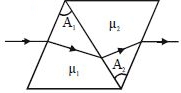
$A$ thin prism $P_1$ with angle $4^o$ and made from a glass of refractive index $1.54$ is combined with another thin prism $P_2$ made from glass of refractive index $1.72$ to produce dispersion without deviation. The angle of the prism $P_2$ is.....$^o$
A
$5.33$
B
$4$
C
$3$
D
$2.6$
Solution
(C) For a combination of two thin prisms to produce dispersion without deviation,the net deviation produced by the system must be zero.
The deviation produced by a thin prism is given by $\delta = (\mu - 1)A$.
For the combination,the net deviation $\delta_{net} = \delta_1 + \delta_2 = 0$.
Since the prisms are combined to produce dispersion without deviation,they must be placed in opposite orientations,so $\delta_1 = -\delta_2$.
Thus,$(\mu_1 - 1)A_1 = (\mu_2 - 1)A_2$.
Given: $\mu_1 = 1.54$,$A_1 = 4^o$,$\mu_2 = 1.72$.
Substituting the values: $(1.54 - 1) \times 4^o = (1.72 - 1) \times A_2$.
$0.54 \times 4^o = 0.72 \times A_2$.
$2.16 = 0.72 \times A_2$.
$A_2 = \frac{2.16}{0.72} = 3^o$.
The deviation produced by a thin prism is given by $\delta = (\mu - 1)A$.
For the combination,the net deviation $\delta_{net} = \delta_1 + \delta_2 = 0$.
Since the prisms are combined to produce dispersion without deviation,they must be placed in opposite orientations,so $\delta_1 = -\delta_2$.
Thus,$(\mu_1 - 1)A_1 = (\mu_2 - 1)A_2$.
Given: $\mu_1 = 1.54$,$A_1 = 4^o$,$\mu_2 = 1.72$.
Substituting the values: $(1.54 - 1) \times 4^o = (1.72 - 1) \times A_2$.
$0.54 \times 4^o = 0.72 \times A_2$.
$2.16 = 0.72 \times A_2$.
$A_2 = \frac{2.16}{0.72} = 3^o$.
0 likesView Solution
18
ChemistryMCQIIT JEE · 1990
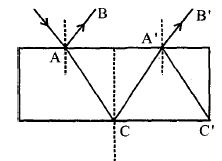
$A$ ray of light of intensity $I$ is incident on a parallel glass slab at point $A$ as shown in the diagram. It undergoes partial reflection and refraction. At each reflection, $25\%$ of incident energy is reflected. The rays $AB$ and $A'B'$ undergo interference. The ratio of $I_{max}$ and $I_{min}$ is (in $: 1$)
A
$49$
B
$7$
C
$4$
D
$8$
Solution
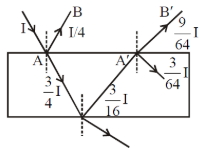
(A) The intensity of the first reflected ray $AB$ is $I_1 = 25\% \text{ of } I = \frac{I}{4}$.
The intensity of the second ray $A'B'$ is determined by the transmission and reflection processes:
$1$. At point $A$, $75\%$ of $I$ is transmitted into the slab: $I_{trans} = \frac{3}{4}I$.
$2$. At point $C$, $25\%$ of $I_{trans}$ is reflected: $I_{refl} = \frac{1}{4} \times \frac{3}{4}I = \frac{3}{16}I$.
$3$. At point $A'$, $75\%$ of $I_{refl}$ is transmitted out of the slab: $I_2 = \frac{3}{4} \times \frac{3}{16}I = \frac{9}{64}I$.
The ratio of maximum to minimum intensity is given by:
$\frac{I_{max}}{I_{min}} = \left( \frac{\sqrt{I_1} + \sqrt{I_2}}{\sqrt{I_1} - \sqrt{I_2}} \right)^2$
Substituting the values:
$\sqrt{I_1} = \sqrt{\frac{I}{4}} = \frac{1}{2}\sqrt{I}$
$\sqrt{I_2} = \sqrt{\frac{9}{64}I} = \frac{3}{8}\sqrt{I}$
$\frac{I_{max}}{I_{min}} = \left( \frac{\frac{1}{2} + \frac{3}{8}}{\frac{1}{2} - \frac{3}{8}} \right)^2 = \left( \frac{\frac{4+3}{8}}{\frac{4-3}{8}} \right)^2 = \left( \frac{7}{1} \right)^2 = \frac{49}{1}$
The intensity of the second ray $A'B'$ is determined by the transmission and reflection processes:
$1$. At point $A$, $75\%$ of $I$ is transmitted into the slab: $I_{trans} = \frac{3}{4}I$.
$2$. At point $C$, $25\%$ of $I_{trans}$ is reflected: $I_{refl} = \frac{1}{4} \times \frac{3}{4}I = \frac{3}{16}I$.
$3$. At point $A'$, $75\%$ of $I_{refl}$ is transmitted out of the slab: $I_2 = \frac{3}{4} \times \frac{3}{16}I = \frac{9}{64}I$.
The ratio of maximum to minimum intensity is given by:
$\frac{I_{max}}{I_{min}} = \left( \frac{\sqrt{I_1} + \sqrt{I_2}}{\sqrt{I_1} - \sqrt{I_2}} \right)^2$
Substituting the values:
$\sqrt{I_1} = \sqrt{\frac{I}{4}} = \frac{1}{2}\sqrt{I}$
$\sqrt{I_2} = \sqrt{\frac{9}{64}I} = \frac{3}{8}\sqrt{I}$
$\frac{I_{max}}{I_{min}} = \left( \frac{\frac{1}{2} + \frac{3}{8}}{\frac{1}{2} - \frac{3}{8}} \right)^2 = \left( \frac{\frac{4+3}{8}}{\frac{4-3}{8}} \right)^2 = \left( \frac{7}{1} \right)^2 = \frac{49}{1}$
0 likesView Solution
19
ChemistryMCQIIT JEE · 1990
$A$ thin prism $P_1$ with angle $4^o$ and made from glass of refractive index $1.54$ is combined with another thin prism $P_2$ made from glass of refractive index $1.72$ to produce dispersion without deviation. The angle of prism $P_2$ is (in $^o$)
A
$2.6$
B
$3$
C
$4$
D
$5.33$
Solution
(B) For dispersion without deviation,the net deviation produced by the combination must be zero.
The condition for dispersion without deviation is given by the formula:
$(\mu - 1)A + (\mu' - 1)A' = 0$
Here,the prisms are combined to produce dispersion without deviation,which implies the deviations are in opposite directions:
$(\mu - 1)A = -(\mu' - 1)A'$
Taking the magnitudes:
$\frac{A}{A'} = \frac{(\mu' - 1)}{(\mu - 1)}$
Given:
$A = 4^o$,$\mu = 1.54$,$\mu' = 1.72$
Substituting the values:
$\frac{4}{A'} = \frac{(1.72 - 1)}{(1.54 - 1)}$
$\frac{4}{A'} = \frac{0.72}{0.54}$
Solving for $A'$:
$A' = \frac{4 \times 0.54}{0.72}$
$A' = \frac{2.16}{0.72} = 3^o$
The condition for dispersion without deviation is given by the formula:
$(\mu - 1)A + (\mu' - 1)A' = 0$
Here,the prisms are combined to produce dispersion without deviation,which implies the deviations are in opposite directions:
$(\mu - 1)A = -(\mu' - 1)A'$
Taking the magnitudes:
$\frac{A}{A'} = \frac{(\mu' - 1)}{(\mu - 1)}$
Given:
$A = 4^o$,$\mu = 1.54$,$\mu' = 1.72$
Substituting the values:
$\frac{4}{A'} = \frac{(1.72 - 1)}{(1.54 - 1)}$
$\frac{4}{A'} = \frac{0.72}{0.54}$
Solving for $A'$:
$A' = \frac{4 \times 0.54}{0.72}$
$A' = \frac{2.16}{0.72} = 3^o$
0 likesView Solution
20
ChemistryMCQIIT JEE · 1990
$A$ thin prism $P_1$ with angle $4^o$ and made from glass of refractive index $1.54$ is combined with another prism $P_2$ made from glass of refractive index $1.72$ to produce dispersion without deviation. The angle of prism $P_2$ is......$^o$
A
$5.33$
B
$4$
C
$3$
D
$2.6$
Solution
(C) The deviation produced by a thin prism of prism angle $A$ is given by $\delta = (\mu - 1) A$.
Since the combined prism produces dispersion without deviation,the total deviation is zero.
$\delta = \delta_1 + \delta_2 = 0$
$(\mu_1 - 1) A_1 + (\mu_2 - 1) A_2 = 0$
$(\mu_1 - 1) A_1 = -(\mu_2 - 1) A_2$
The negative sign indicates that the refracting angles of the two prisms are in opposite directions.
$A_2 = \frac{(\mu_1 - 1) A_1}{(\mu_2 - 1)} = \frac{(1.54 - 1) \times 4^o}{(1.72 - 1)}$
$A_2 = \frac{0.54 \times 4^o}{0.72} = \frac{3}{4} \times 4^o = 3^o$
Since the combined prism produces dispersion without deviation,the total deviation is zero.
$\delta = \delta_1 + \delta_2 = 0$
$(\mu_1 - 1) A_1 + (\mu_2 - 1) A_2 = 0$
$(\mu_1 - 1) A_1 = -(\mu_2 - 1) A_2$
The negative sign indicates that the refracting angles of the two prisms are in opposite directions.
$A_2 = \frac{(\mu_1 - 1) A_1}{(\mu_2 - 1)} = \frac{(1.54 - 1) \times 4^o}{(1.72 - 1)}$
$A_2 = \frac{0.54 \times 4^o}{0.72} = \frac{3}{4} \times 4^o = 3^o$
0 likesView Solution
21
ChemistryMediumMCQIIT JEE · 1990
The aqueous solutions of the following salts will be coloured in the case of:
A
$Zn(NO_3)_2$
B
$LiNO_3$
C
$CrCl_3$
D
Potash alum
Solution
(C) The correct answer is $(C)$.
In $CrCl_3$,the chromium ion is $Cr^{3+}$.
The electronic configuration of $Cr^{3+}$ is $[Ar] 3d^3$.
Since it contains $3$ unpaired electrons in the $d$-orbital,it exhibits $d-d$ transitions,which results in the formation of coloured solutions.
In $CrCl_3$,the chromium ion is $Cr^{3+}$.
The electronic configuration of $Cr^{3+}$ is $[Ar] 3d^3$.
Since it contains $3$ unpaired electrons in the $d$-orbital,it exhibits $d-d$ transitions,which results in the formation of coloured solutions.
0 likesView Solution
22
ChemistryMediumMCQIIT JEE · 1990
Alcoholic solution of $KOH$ is used for
A
Dehydration
B
Dehydrogenation
C
Dehydrohalogenation
D
Dehalogenation
Solution
(C) The correct answer is $(C)$.
Alcoholic $KOH$ contains alkoxide ions $(RO^-)$,which act as strong bases.
These ions abstract a proton from the $\beta$-carbon of an alkyl halide,leading to an elimination reaction known as dehydrohalogenation.
The reaction is: $CH_3-CH_2-Br + KOH_{(alc)} \xrightarrow{\Delta} CH_2=CH_2 + KBr + H_2O$.
Mechanism:
$ROH + KOH \to ROK + H_2O$
$ROK \to RO^- + K^+$
$RO^- + H-CH_2(\beta)-CH_2(\alpha)-Br \to ROH + CH_2=CH_2 + Br^-$
Alcoholic $KOH$ contains alkoxide ions $(RO^-)$,which act as strong bases.
These ions abstract a proton from the $\beta$-carbon of an alkyl halide,leading to an elimination reaction known as dehydrohalogenation.
The reaction is: $CH_3-CH_2-Br + KOH_{(alc)} \xrightarrow{\Delta} CH_2=CH_2 + KBr + H_2O$.
Mechanism:
$ROH + KOH \to ROK + H_2O$
$ROK \to RO^- + K^+$
$RO^- + H-CH_2(\beta)-CH_2(\alpha)-Br \to ROH + CH_2=CH_2 + Br^-$
0 likesView Solution
23
ChemistryMediumMCQIIT JEE · 1990
The dehydrohalogenation of neopentyl bromide with alcoholic $KOH$ mainly gives
A
$2-$methyl$-1-$butene
B
$2-$methyl$-2-$butene
C
$2, 2-$dimethyl$-1-$butene
D
$2-$butene
Solution
(B) Neopentyl bromide $(CH_3-C(CH_3)_2-CH_2-Br)$ is a primary alkyl halide with significant steric hindrance at the $\beta-$carbon.
Upon reaction with alcoholic $KOH$,the formation of a primary carbocation is unfavorable.
Instead,it undergoes a concerted rearrangement via a $1, 2-$methyl shift to form a more stable tertiary carbocation $(CH_3-C^{+}(CH_3)-CH_2-CH_3)$.
Elimination of a proton from this intermediate according to Saytzeff's rule yields $2-$methyl$-2-$butene as the major product.
Upon reaction with alcoholic $KOH$,the formation of a primary carbocation is unfavorable.
Instead,it undergoes a concerted rearrangement via a $1, 2-$methyl shift to form a more stable tertiary carbocation $(CH_3-C^{+}(CH_3)-CH_2-CH_3)$.
Elimination of a proton from this intermediate according to Saytzeff's rule yields $2-$methyl$-2-$butene as the major product.
0 likesView Solution
24
ChemistryDifficultMCQIIT JEE · 1990
Which one of the following metals could not be obtained on electrolysis of aqueous solution of its salts?
A
$Ag$
B
$Mg$
C
$Cu$
D
$Cr$
Solution
(B) The standard reduction potential of $Mg^{2+}/Mg$ is $-2.37 \ V$,which is much lower than the reduction potential of water $(E^o = -0.83 \ V)$.
In an aqueous solution,water molecules are reduced more easily than $Mg^{2+}$ ions.
Therefore,during electrolysis,$H_2$ gas is evolved at the cathode instead of $Mg$ metal.
Thus,$Mg$ cannot be obtained by the electrolysis of its aqueous salt solution.
In an aqueous solution,water molecules are reduced more easily than $Mg^{2+}$ ions.
Therefore,during electrolysis,$H_2$ gas is evolved at the cathode instead of $Mg$ metal.
Thus,$Mg$ cannot be obtained by the electrolysis of its aqueous salt solution.
0 likesView Solution
25
ChemistryMediumMCQIIT JEE · 1990
The standard reduction potential for $Fe^{2+}/Fe$ and $Sn^{2+}/Sn$ electrodes are $-0.44 \ V$ and $-0.14 \ V$ respectively. For the given cell reaction $Fe^{2+} + Sn \to Fe + Sn^{2+}$,the standard $EMF$ is ...............$V$.
A
$+0.30$
B
$-0.58$
C
$+0.58$
D
$-0.30$
Solution
(D) The cell reaction is $Fe^{2+} + Sn \to Fe + Sn^{2+}$.
Here,$Fe^{2+}$ is reduced to $Fe$ (cathode) and $Sn$ is oxidized to $Sn^{2+}$ (anode).
The standard cell potential is calculated as $E^o_{cell} = E^o_{cathode} - E^o_{anode}$.
Given $E^o_{Fe^{2+}/Fe} = -0.44 \ V$ and $E^o_{Sn^{2+}/Sn} = -0.14 \ V$.
$E^o_{cell} = (-0.44 \ V) - (-0.14 \ V) = -0.44 + 0.14 = -0.30 \ V$.
Here,$Fe^{2+}$ is reduced to $Fe$ (cathode) and $Sn$ is oxidized to $Sn^{2+}$ (anode).
The standard cell potential is calculated as $E^o_{cell} = E^o_{cathode} - E^o_{anode}$.
Given $E^o_{Fe^{2+}/Fe} = -0.44 \ V$ and $E^o_{Sn^{2+}/Sn} = -0.14 \ V$.
$E^o_{cell} = (-0.44 \ V) - (-0.14 \ V) = -0.44 + 0.14 = -0.30 \ V$.
0 likesView Solution
26
ChemistryDifficultMCQIIT JEE · 1990
Of the following,which cannot be obtained by electrolysis of the aqueous solution of their salts?
A
$Ag$
B
$Mg$ and $Al$
C
$Cu$
D
$Cr$
Solution
(B) $Mg$ and $Al$ cannot be obtained by the electrolysis of aqueous solutions of their salts.
This is because the reduction potential of $H_2O$ is higher than that of $Mg^{2+}$ and $Al^{3+}$ ions.
Consequently,$H_2$ gas is liberated at the cathode instead of the metal.
This is because the reduction potential of $H_2O$ is higher than that of $Mg^{2+}$ and $Al^{3+}$ ions.
Consequently,$H_2$ gas is liberated at the cathode instead of the metal.
0 likesView Solution
27
ChemistryDifficultMCQIIT JEE · 1990
Chlorination of toluene in the presence of light and heat followed by treatment with aqueous $NaOH$ gives:
A
$o-$cresol
B
$p-$cresol
C
$2, 4-$dihydroxy toluene
D
Benzyl alcohol
Solution
(D) The reaction proceeds in two steps:
$1$. Chlorination of toluene in the presence of light and heat (free radical substitution) yields benzyl chloride $(C_6H_5CH_2Cl)$.
$2$. Treatment of benzyl chloride with aqueous $NaOH$ (nucleophilic substitution) replaces the chlorine atom with a hydroxyl group,resulting in the formation of benzyl alcohol $(C_6H_5CH_2OH)$.
$1$. Chlorination of toluene in the presence of light and heat (free radical substitution) yields benzyl chloride $(C_6H_5CH_2Cl)$.
$2$. Treatment of benzyl chloride with aqueous $NaOH$ (nucleophilic substitution) replaces the chlorine atom with a hydroxyl group,resulting in the formation of benzyl alcohol $(C_6H_5CH_2OH)$.
0 likesView Solution
28
ChemistryMediumMCQIIT JEE · 1990
The given reaction is: $R_2C=O + HCN \rightarrow R_2C(OH)CN$
A
Electrophilic substitution
B
Electrophilic addition
C
Nucleophilic addition
D
Nucleophilic substitution
Solution
(C) The reaction of a carbonyl compound $(R_2C=O)$ with hydrogen cyanide $(HCN)$ involves the attack of the nucleophile $(CN^-)$ on the electrophilic carbonyl carbon atom.
This is a characteristic reaction of aldehydes and ketones known as nucleophilic addition reaction.
This is a characteristic reaction of aldehydes and ketones known as nucleophilic addition reaction.
0 likesView Solution
29
ChemistryDifficultMCQIIT JEE · 1990
The freezing point of an equimolal aqueous solution will be highest for:
A
$C_6H_5NH_3^+Cl^-$ (aniline hydrochloride)
B
$Ca(NO_3)_2$
C
$La(NO_3)_3$
D
$C_6H_{12}O_6$ (glucose)
Solution
(D) The depression in freezing point $(\Delta T_f)$ is a colligative property,which is directly proportional to the van't Hoff factor $(i)$,where $\Delta T_f = i \times K_f \times m$.
For equimolal solutions,the freezing point is highest when the depression in freezing point is minimum.
This occurs when the number of particles produced in the solution is minimum.
$C_6H_{12}O_6$ (glucose) is a non-electrolyte,so $i = 1$.
$C_6H_5NH_3^+Cl^-$ dissociates into $2$ ions $(i = 2)$.
$Ca(NO_3)_2$ dissociates into $3$ ions $(i = 3)$.
$La(NO_3)_3$ dissociates into $4$ ions $(i = 4)$.
Since glucose has the lowest $i$ value,it shows the minimum depression in freezing point,resulting in the highest freezing point.
For equimolal solutions,the freezing point is highest when the depression in freezing point is minimum.
This occurs when the number of particles produced in the solution is minimum.
$C_6H_{12}O_6$ (glucose) is a non-electrolyte,so $i = 1$.
$C_6H_5NH_3^+Cl^-$ dissociates into $2$ ions $(i = 2)$.
$Ca(NO_3)_2$ dissociates into $3$ ions $(i = 3)$.
$La(NO_3)_3$ dissociates into $4$ ions $(i = 4)$.
Since glucose has the lowest $i$ value,it shows the minimum depression in freezing point,resulting in the highest freezing point.
0 likesView Solution
Vedclass Products
For Students
Vedclass Test Series
Mock tests in real IIT JEE style covering Chemistry with performance analysis. 5-day free trial.
Start Free TrialFor Teachers
Exam Paper Generator
Generate Set A/B/C/D Chemistry papers from 7.5L+ questions in 2 minutes. 3 chapters free.
Try FreeFor Institutes
Online Exam Module
Run live IIT JEE mock exams with unlimited students, 360° analytics & white-label branding.
See DemoFrequently Asked Questions
How many Chemistry questions are in IIT JEE 1990?
There are 29 Chemistry questions from the IIT JEE 1990 paper on Vedclass, each with a detailed step-by-step solution in English.
Are IIT JEE 1990 Chemistry solutions available in English?
Yes. All solutions on this page are in English. You can also switch to English or Hindi using the language buttons above the questions.
Can I practice IIT JEE 1990 Chemistry as a timed test?
Yes. Use the Vedclass Test Series to attempt a full IIT JEE mock test covering Chemistry with time limits and instant score analysis.
Can teachers create Chemistry papers from IIT JEE previous year questions?
Yes. The Vedclass Exam Paper Generator lets teachers mix IIT JEE Chemistry questions and generate Set A/B/C/D papers in minutes.
For Teachers & Institutes
Build a Custom Chemistry Paper
Pick IIT JEE 1990 Chemistry questions, set difficulty, and generate Set A/B/C/D in 2 minutes.