
PhysicsQ1–6 of 6 questions
Page 1 of 1 · English
1
PhysicsMediumMCQIIT JEE · 1990
When a bicycle is in motion,the force of friction exerted by the ground on the two wheels is such that it acts
A
In the backward direction on the front wheel and in the forward direction on the rear wheel
B
In the forward direction on the front wheel and in the backward direction on the rear wheel
C
In the backward direction on both front and the rear wheels
D
Both $(a)$ and $(c)$
Solution
(D) The direction of the frictional force depends on the state of motion of the bicycle.
$1$. When pedalling: The rear wheel is driven by the chain,pushing the ground backward,so the ground exerts a forward frictional force on the rear wheel. The front wheel is rolling freely,so it experiences a backward frictional force to oppose its motion.
$2$. When coasting (pedalling stopped): Both wheels are rolling freely. In this case,both wheels experience a backward frictional force from the ground to oppose their forward motion.
Since the question asks about the general motion of a bicycle,it covers both scenarios depending on whether the rider is pedalling or coasting. Therefore,both $(a)$ and $(c)$ are valid descriptions of the frictional force acting on the wheels under different conditions.
$1$. When pedalling: The rear wheel is driven by the chain,pushing the ground backward,so the ground exerts a forward frictional force on the rear wheel. The front wheel is rolling freely,so it experiences a backward frictional force to oppose its motion.
$2$. When coasting (pedalling stopped): Both wheels are rolling freely. In this case,both wheels experience a backward frictional force from the ground to oppose their forward motion.
Since the question asks about the general motion of a bicycle,it covers both scenarios depending on whether the rider is pedalling or coasting. Therefore,both $(a)$ and $(c)$ are valid descriptions of the frictional force acting on the wheels under different conditions.
0 likesView Solution
2
PhysicsMediumMCQIIT JEE · 1990
When an ideal diatomic gas is heated at constant pressure,the fraction of the heat energy supplied which increases the internal energy of the gas is:
A
$2/5$
B
$3/5$
C
$3/7$
D
$5/7$
Solution
(D) The fraction of supplied heat energy that increases the internal energy is given by the ratio of the change in internal energy to the heat supplied at constant pressure.
$f = \frac{\Delta U}{(\Delta Q)_P} = \frac{(\Delta Q)_V}{(\Delta Q)_P} = \frac{\mu C_V \Delta T}{\mu C_P \Delta T} = \frac{C_V}{C_P} = \frac{1}{\gamma}$.
For an ideal diatomic gas,the adiabatic index $\gamma = \frac{C_P}{C_V} = \frac{7}{5}$.
Therefore,the fraction $f = \frac{1}{7/5} = \frac{5}{7}$.
$f = \frac{\Delta U}{(\Delta Q)_P} = \frac{(\Delta Q)_V}{(\Delta Q)_P} = \frac{\mu C_V \Delta T}{\mu C_P \Delta T} = \frac{C_V}{C_P} = \frac{1}{\gamma}$.
For an ideal diatomic gas,the adiabatic index $\gamma = \frac{C_P}{C_V} = \frac{7}{5}$.
Therefore,the fraction $f = \frac{1}{7/5} = \frac{5}{7}$.
0 likesView Solution
3
PhysicsMediumMCQIIT JEE · 1990
$A$ wave represented by the given equation $Y = A\sin(10\pi x + 15\pi t + \frac{\pi}{3})$,where $x$ is in meters and $t$ is in seconds. The expression represents:
A
$A$ wave travelling in the positive $X$ direction with a velocity of $1.5\,m/s$
B
$A$ wave travelling in the negative $X$ direction with a velocity of $1.5\,m/s$
C
$A$ wave travelling in the negative $X$ direction with a wavelength of $0.2\,m$
D
Both $(b)$ and $(c)$
Solution
(D) The standard wave equation for a wave traveling in the negative $x$-direction is $y = A\sin(kx + \omega t + \phi_0)$.
Comparing the given equation $Y = A\sin(10\pi x + 15\pi t + \frac{\pi}{3})$ with the standard form,we identify the angular frequency $\omega = 15\pi\,rad/s$ and the wave number $k = 10\pi\,rad/m$.
The wave velocity $v$ is given by $v = \frac{\omega}{k} = \frac{15\pi}{10\pi} = 1.5\,m/s$. Since the signs of the $x$ and $t$ terms are both positive,the wave travels in the negative $x$-direction.
The wavelength $\lambda$ is given by $\lambda = \frac{2\pi}{k} = \frac{2\pi}{10\pi} = 0.2\,m$.
Thus,both statements $(b)$ and $(c)$ are correct.
Comparing the given equation $Y = A\sin(10\pi x + 15\pi t + \frac{\pi}{3})$ with the standard form,we identify the angular frequency $\omega = 15\pi\,rad/s$ and the wave number $k = 10\pi\,rad/m$.
The wave velocity $v$ is given by $v = \frac{\omega}{k} = \frac{15\pi}{10\pi} = 1.5\,m/s$. Since the signs of the $x$ and $t$ terms are both positive,the wave travels in the negative $x$-direction.
The wavelength $\lambda$ is given by $\lambda = \frac{2\pi}{k} = \frac{2\pi}{10\pi} = 0.2\,m$.
Thus,both statements $(b)$ and $(c)$ are correct.
0 likesView Solution
4
PhysicsMediumMCQIIT JEE · 1990
Seven capacitors,each of capacity $2\,\mu F$,are to be connected to have a total capacity of $\frac{10}{11}\,\mu F$. Which of the following figures shows the correct arrangement?
A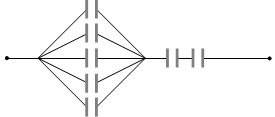
B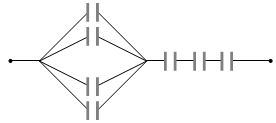
C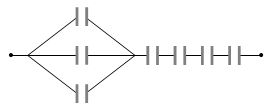
D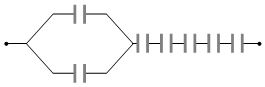
Solution
(A) Let the capacity of each capacitor be $C = 2\,\mu F$. We need a total equivalent capacity $C_{eq} = \frac{10}{11}\,\mu F$.
Let $n$ capacitors be connected in parallel and $m$ capacitors be connected in series with this parallel combination.
The equivalent capacity of $n$ capacitors in parallel is $C_p = nC = n(2)\,\mu F$.
The total equivalent capacity $C_{eq}$ is given by the series combination of $C_p$ and $m$ capacitors in series:
$\frac{1}{C_{eq}} = \frac{1}{C_p} + \frac{m}{C} = \frac{1}{2n} + \frac{m}{2} = \frac{1 + nm}{2n}$.
Given $C_{eq} = \frac{10}{11}\,\mu F$,we have $\frac{2n}{1 + nm} = \frac{10}{11}$.
$22n = 10 + 10nm \implies 11n = 5 + 5nm \implies 5nm = 11n - 5$.
Since the total number of capacitors is $n + m = 7$,we have $m = 7 - n$.
Substituting $m$: $5n(7 - n) = 11n - 5 \implies 35n - 5n^2 = 11n - 5 \implies 5n^2 - 24n - 5 = 0$.
Solving the quadratic equation: $5n^2 - 25n + n - 5 = 0 \implies 5n(n - 5) + 1(n - 5) = 0 \implies (5n + 1)(n - 5) = 0$.
Thus,$n = 5$ and $m = 7 - 5 = 2$.
This means $5$ capacitors are in parallel and $2$ capacitors are in series with this parallel group. This matches the arrangement in figure $(a)$.
Let $n$ capacitors be connected in parallel and $m$ capacitors be connected in series with this parallel combination.
The equivalent capacity of $n$ capacitors in parallel is $C_p = nC = n(2)\,\mu F$.
The total equivalent capacity $C_{eq}$ is given by the series combination of $C_p$ and $m$ capacitors in series:
$\frac{1}{C_{eq}} = \frac{1}{C_p} + \frac{m}{C} = \frac{1}{2n} + \frac{m}{2} = \frac{1 + nm}{2n}$.
Given $C_{eq} = \frac{10}{11}\,\mu F$,we have $\frac{2n}{1 + nm} = \frac{10}{11}$.
$22n = 10 + 10nm \implies 11n = 5 + 5nm \implies 5nm = 11n - 5$.
Since the total number of capacitors is $n + m = 7$,we have $m = 7 - n$.
Substituting $m$: $5n(7 - n) = 11n - 5 \implies 35n - 5n^2 = 11n - 5 \implies 5n^2 - 24n - 5 = 0$.
Solving the quadratic equation: $5n^2 - 25n + n - 5 = 0 \implies 5n(n - 5) + 1(n - 5) = 0 \implies (5n + 1)(n - 5) = 0$.
Thus,$n = 5$ and $m = 7 - 5 = 2$.
This means $5$ capacitors are in parallel and $2$ capacitors are in series with this parallel group. This matches the arrangement in figure $(a)$.
0 likesView Solution
5
PhysicsMediumMCQIIT JEE · 1990
$A$ thin prism $P_1$ with angle $4^o$ and made from glass of refractive index $1.54$ is combined with another thin prism $P_2$ made from glass of refractive index $1.72$ to produce dispersion without deviation. The angle of prism $P_2$ is......$^o$
A
$2.6$
B
$3$
C
$4$
D
$5.33$
Solution
(B) For dispersion without deviation,the net deviation produced by the combination of two thin prisms must be zero.
The condition for dispersion without deviation is given by: $(\mu - 1)A + (\mu' - 1)A' = 0$.
Here,$A = 4^o$,$\mu = 1.54$,and $\mu' = 1.72$.
Since the prisms are combined to produce dispersion without deviation,the deviation produced by the first prism must be balanced by the second prism in the opposite direction.
Thus,$(\mu - 1)A = -(\mu' - 1)A'$.
Taking the magnitude: $(\mu - 1)A = (\mu' - 1)A'$.
Substituting the values: $(1.54 - 1) \times 4^o = (1.72 - 1) \times A'$.
$0.54 \times 4^o = 0.72 \times A'$.
$A' = \frac{0.54 \times 4}{0.72} = \frac{2.16}{0.72} = 3^o$.
Therefore,the angle of prism $P_2$ is $3^o$.
The condition for dispersion without deviation is given by: $(\mu - 1)A + (\mu' - 1)A' = 0$.
Here,$A = 4^o$,$\mu = 1.54$,and $\mu' = 1.72$.
Since the prisms are combined to produce dispersion without deviation,the deviation produced by the first prism must be balanced by the second prism in the opposite direction.
Thus,$(\mu - 1)A = -(\mu' - 1)A'$.
Taking the magnitude: $(\mu - 1)A = (\mu' - 1)A'$.
Substituting the values: $(1.54 - 1) \times 4^o = (1.72 - 1) \times A'$.
$0.54 \times 4^o = 0.72 \times A'$.
$A' = \frac{0.54 \times 4}{0.72} = \frac{2.16}{0.72} = 3^o$.
Therefore,the angle of prism $P_2$ is $3^o$.
0 likesView Solution
6
PhysicsMediumMCQIIT JEE · 1990
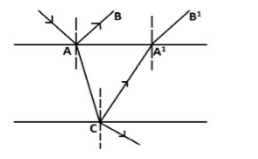
$A$ ray of light of intensity $I$ is incident on a parallel glass slab at a point $A$ as shown in the figure. It undergoes partial reflection and refraction. At each reflection,$25\%$ of the incident energy is reflected. The rays $AB$ and $A^1B^1$ undergo interference. The ratio $I_{\text{max}} / I_{\text{min}}$ is (in $: 1$)
A
$7$
B
$49$
C
$4$
D
$8$
Solution
(B) Let the incident intensity be $I$.
At point $A$,$25\%$ of $I$ is reflected as ray $AB$. So,$I_1 = 0.25I = I/4$.
The intensity of the refracted ray is $0.75I$.
At point $C$,this ray is reflected. $25\%$ of the incident energy $(0.75I)$ is reflected. So,the intensity of the ray reaching $A^1$ is $0.25 \times 0.75I = 0.1875I = (3/16)I$.
At point $A^1$,this ray is refracted out as $A^1B^1$. Since $25\%$ is reflected at $A^1$,$75\%$ of the incident energy is transmitted.
So,$I_2 = 0.75 \times (3/16)I = (3/4) \times (3/16)I = (9/64)I$.
The amplitudes are $a_1 = \sqrt{I_1} = \sqrt{I/4} = (1/2)\sqrt{I}$ and $a_2 = \sqrt{I_2} = \sqrt{9I/64} = (3/8)\sqrt{I}$.
The ratio of amplitudes is $a_1/a_2 = (1/2) / (3/8) = 4/3$.
$I_{\text{max}} / I_{\text{min}} = (a_1 + a_2)^2 / (a_1 - a_2)^2 = ((4+3)/ (4-3))^2 = (7/1)^2 = 49/1$.
At point $A$,$25\%$ of $I$ is reflected as ray $AB$. So,$I_1 = 0.25I = I/4$.
The intensity of the refracted ray is $0.75I$.
At point $C$,this ray is reflected. $25\%$ of the incident energy $(0.75I)$ is reflected. So,the intensity of the ray reaching $A^1$ is $0.25 \times 0.75I = 0.1875I = (3/16)I$.
At point $A^1$,this ray is refracted out as $A^1B^1$. Since $25\%$ is reflected at $A^1$,$75\%$ of the incident energy is transmitted.
So,$I_2 = 0.75 \times (3/16)I = (3/4) \times (3/16)I = (9/64)I$.
The amplitudes are $a_1 = \sqrt{I_1} = \sqrt{I/4} = (1/2)\sqrt{I}$ and $a_2 = \sqrt{I_2} = \sqrt{9I/64} = (3/8)\sqrt{I}$.
The ratio of amplitudes is $a_1/a_2 = (1/2) / (3/8) = 4/3$.
$I_{\text{max}} / I_{\text{min}} = (a_1 + a_2)^2 / (a_1 - a_2)^2 = ((4+3)/ (4-3))^2 = (7/1)^2 = 49/1$.
0 likesView Solution
Vedclass Products
For Students
Vedclass Test Series
Mock tests in real IIT JEE style covering Physics with performance analysis. 5-day free trial.
Start Free TrialFor Teachers
Exam Paper Generator
Generate Set A/B/C/D Physics papers from 7.5L+ questions in 2 minutes. 3 chapters free.
Try FreeFor Institutes
Online Exam Module
Run live IIT JEE mock exams with unlimited students, 360° analytics & white-label branding.
See DemoFrequently Asked Questions
How many Physics questions are in IIT JEE 1990?
There are 6 Physics questions from the IIT JEE 1990 paper on Vedclass, each with a detailed step-by-step solution in English.
Are IIT JEE 1990 Physics solutions available in English?
Yes. All solutions on this page are in English. You can also switch to English or Hindi using the language buttons above the questions.
Can I practice IIT JEE 1990 Physics as a timed test?
Yes. Use the Vedclass Test Series to attempt a full IIT JEE mock test covering Physics with time limits and instant score analysis.
Can teachers create Physics papers from IIT JEE previous year questions?
Yes. The Vedclass Exam Paper Generator lets teachers mix IIT JEE Physics questions and generate Set A/B/C/D papers in minutes.
For Teachers & Institutes
Build a Custom Physics Paper
Pick IIT JEE 1990 Physics questions, set difficulty, and generate Set A/B/C/D in 2 minutes.