
ChemistryQ1–28 of 28 questions
Page 1 of 1 · English
1
ChemistryMCQIIT JEE · 1988
Two capacitors of capacities $2C$ and $C$ are joined in parallel and charged up to potential $V$. The battery is removed,and the capacitor of capacity $C$ is filled completely with a medium of dielectric constant $K$. The potential difference across the capacitors will now be
A
$\frac{3V}{K + 2}$
B
$\frac{3V}{K}$
C
$\frac{V}{K + 2}$
D
$\frac{V}{K}$
Solution
(A) Initially,the capacitors are in parallel,so the total charge $Q$ is given by $Q = (2C + C)V = 3CV$.
When the battery is removed,the total charge $Q = 3CV$ remains conserved.
After filling the capacitor of capacity $C$ with a dielectric of constant $K$,its new capacitance becomes $C' = KC$.
The new equivalent capacitance of the parallel combination is $C_{eq} = 2C + KC = C(K + 2)$.
Since the charge is conserved,the new potential difference $V'$ across the capacitors is given by $V' = \frac{Q}{C_{eq}} = \frac{3CV}{C(K + 2)} = \frac{3V}{K + 2}$.
When the battery is removed,the total charge $Q = 3CV$ remains conserved.
After filling the capacitor of capacity $C$ with a dielectric of constant $K$,its new capacitance becomes $C' = KC$.
The new equivalent capacitance of the parallel combination is $C_{eq} = 2C + KC = C(K + 2)$.
Since the charge is conserved,the new potential difference $V'$ across the capacitors is given by $V' = \frac{Q}{C_{eq}} = \frac{3CV}{C(K + 2)} = \frac{3V}{K + 2}$.
0 likesView Solution
2
ChemistryMediumMCQIIT JEE · 1988
The equivalent weight of $MnSO_4$ is half its molecular weight when it is converted to
A
$Mn_2O_3$
B
$MnO_2$
C
$MnO_4$
D
$MnO_4^{2-}$
Solution
(B) The equivalent weight of a substance is given by the formula: $\text{Equivalent weight} = \frac{\text{Molecular weight}}{\text{n-factor}}$.
For the equivalent weight to be half the molecular weight,the n-factor must be $2$.
The n-factor represents the change in oxidation state of the central metal atom.
In $MnSO_4$,the oxidation state of $Mn$ is $+2$.
In $MnO_2$,the oxidation state of $Mn$ is $+4$.
The change in oxidation state is $|4 - 2| = 2$.
Thus,for the conversion $MnSO_4 \to MnO_2$,the n-factor is $2$,making the equivalent weight $\frac{M}{2}$.
For the equivalent weight to be half the molecular weight,the n-factor must be $2$.
The n-factor represents the change in oxidation state of the central metal atom.
In $MnSO_4$,the oxidation state of $Mn$ is $+2$.
In $MnO_2$,the oxidation state of $Mn$ is $+4$.
The change in oxidation state is $|4 - 2| = 2$.
Thus,for the conversion $MnSO_4 \to MnO_2$,the n-factor is $2$,making the equivalent weight $\frac{M}{2}$.
0 likesView Solution
3
ChemistryMediumMCQIIT JEE · 1988
The wavelength of a spectral line for an electronic transition is inversely related to
A
The number of electrons undergoing the transition
B
The nuclear charge of the atom
C
The difference in the energy of the energy levels involved in the transition
D
The velocity of the electron undergoing the transition
Solution
(C) The wavelength of a spectral line for an electronic transition is inversely proportional to the difference in the energy involved in the transition.
According to the relation $\Delta E = E_2 - E_1 = \frac{hc}{\lambda}$,where $\Delta E$ is the energy difference,$h$ is Planck's constant,$c$ is the speed of light,and $\lambda$ is the wavelength.
Thus,$\lambda = \frac{hc}{\Delta E}$,which implies $\lambda \propto \frac{1}{\Delta E}$.
According to the relation $\Delta E = E_2 - E_1 = \frac{hc}{\lambda}$,where $\Delta E$ is the energy difference,$h$ is Planck's constant,$c$ is the speed of light,and $\lambda$ is the wavelength.
Thus,$\lambda = \frac{hc}{\Delta E}$,which implies $\lambda \propto \frac{1}{\Delta E}$.
0 likesView Solution
4
ChemistryEasyMCQIIT JEE · 1988
Which molecule is linear?
A
$NO_2$
B
$ClO_2$
C
$CO_2$
D
$H_2S$
Solution
(C) $CO_2$ has $sp$ hybridization and a linear geometry with a bond angle of $180^{\circ}$. The central carbon atom is bonded to two oxygen atoms with no lone pairs,resulting in a linear shape.
0 likesView Solution
5
ChemistryMediumMCQIIT JEE · 1988
The species in which the central atom uses $sp^2$ hybrid orbitals in its bonding is
A
$PH_3$
B
$NH_3$
C
$H_3C^{+}$
D
$SbH_3$
Solution
(C) To determine the hybridization,we use the formula: $\text{Steric Number} = \text{Number of sigma bonds} + \text{Number of lone pairs}$.
For $H_3C^{+}$,the carbon atom is bonded to $3$ hydrogen atoms and has $0$ lone pairs. $\text{Steric Number} = 3 + 0 = 3$,which corresponds to $sp^2$ hybridization.
For $NH_3$,$PH_3$,and $SbH_3$,the central atoms are bonded to $3$ atoms and have $1$ lone pair. $\text{Steric Number} = 3 + 1 = 4$,which corresponds to $sp^3$ hybridization (though in $PH_3$ and $SbH_3$,the bond angles are close to $90^{\circ}$ due to the lack of significant hybridization,often described as using pure $p$-orbitals).
For $H_3C^{+}$,the carbon atom is bonded to $3$ hydrogen atoms and has $0$ lone pairs. $\text{Steric Number} = 3 + 0 = 3$,which corresponds to $sp^2$ hybridization.
For $NH_3$,$PH_3$,and $SbH_3$,the central atoms are bonded to $3$ atoms and have $1$ lone pair. $\text{Steric Number} = 3 + 1 = 4$,which corresponds to $sp^3$ hybridization (though in $PH_3$ and $SbH_3$,the bond angles are close to $90^{\circ}$ due to the lack of significant hybridization,often described as using pure $p$-orbitals).
0 likesView Solution
6
ChemistryMediumMCQIIT JEE · 1988
$A$ bottle of ammonia and a bottle of dry hydrogen chloride connected through a long tube are opened simultaneously at both ends. The white ammonium chloride ring first formed will be:
A
At the centre of the tube
B
Near the hydrogen chloride bottle
C
Near the ammonia bottle
D
Throughout the length of the tube
Solution
(B) According to Graham's Law of Diffusion,the rate of diffusion $r$ is inversely proportional to the square root of the molar mass $M$ $(r \propto \frac{1}{\sqrt{M}})$.
For $NH_3$ $(M = 17 \ g/mol)$ and $HCl$ $(M = 36.5 \ g/mol)$,the rate of diffusion of $NH_3$ is higher than that of $HCl$ because $M_{NH_3} < M_{HCl}$.
Since $NH_3$ diffuses faster,it travels a longer distance in the same amount of time.
Therefore,the white $NH_4Cl$ ring will be formed closer to the $HCl$ bottle.
For $NH_3$ $(M = 17 \ g/mol)$ and $HCl$ $(M = 36.5 \ g/mol)$,the rate of diffusion of $NH_3$ is higher than that of $HCl$ because $M_{NH_3} < M_{HCl}$.
Since $NH_3$ diffuses faster,it travels a longer distance in the same amount of time.
Therefore,the white $NH_4Cl$ ring will be formed closer to the $HCl$ bottle.
0 likesView Solution
7
ChemistryEasyMCQIIT JEE · 1988
In Van der Waals equation of state for a non-ideal gas,the term that accounts for intermolecular forces is
A
$(V - b)$
B
$(RT)^{-1}$
C
$\left( P + \frac{a}{V^2} \right)$
D
$RT$
Solution
(C) The Van der Waals equation for a non-ideal gas is given by $\left( P + \frac{a}{V^2} \right)(V - b) = RT$.
In this equation,the term $\left( P + \frac{a}{V^2} \right)$ accounts for the pressure correction due to intermolecular forces of attraction between gas molecules.
The term $\frac{a}{V^2}$ represents the reduction in pressure caused by these attractive forces,where $a$ is the Van der Waals constant representing the magnitude of intermolecular attraction.
In this equation,the term $\left( P + \frac{a}{V^2} \right)$ accounts for the pressure correction due to intermolecular forces of attraction between gas molecules.
The term $\frac{a}{V^2}$ represents the reduction in pressure caused by these attractive forces,where $a$ is the Van der Waals constant representing the magnitude of intermolecular attraction.
0 likesView Solution
8
ChemistryMediumMCQIIT JEE · 1988
The $pK_a$ of acetylsalicylic acid (aspirin) is $3.5$. The $pH$ of gastric juice in the human stomach is about $2-3$ and the $pH$ in the small intestine is about $8$. Aspirin will be
A
Unionized in the small intestine and in the stomach
B
Completely ionized in the small intestine and in the stomach
C
Ionized in the stomach and almost unionized in the small intestine
D
Ionized in the small intestine and almost unionized in the stomach
Solution
(D) Aspirin is a weak acid $(HA \rightleftharpoons H^+ + A^-)$.
According to the Henderson-Hasselbalch equation,$pH = pK_a + \log(\frac{[A^-]}{[HA]})$.
In the stomach $(pH \approx 2-3)$,the $pH < pK_a$ $(3.5)$,so the concentration of the unionized form $(HA)$ is higher,meaning it is almost unionized.
In the small intestine $(pH \approx 8)$,the $pH > pK_a$ $(3.5)$,so the concentration of the ionized form $(A^-)$ is significantly higher,meaning it is ionized.
According to the Henderson-Hasselbalch equation,$pH = pK_a + \log(\frac{[A^-]}{[HA]})$.
In the stomach $(pH \approx 2-3)$,the $pH < pK_a$ $(3.5)$,so the concentration of the unionized form $(HA)$ is higher,meaning it is almost unionized.
In the small intestine $(pH \approx 8)$,the $pH > pK_a$ $(3.5)$,so the concentration of the ionized form $(A^-)$ is significantly higher,meaning it is ionized.
0 likesView Solution
9
ChemistryMediumMCQIIT JEE · 1988
When equal volumes of the following solutions are mixed,precipitation of $AgCl$ $(K_{sp} = 1.8 \times 10^{-10})$ will occur only with:
A
$10^{-4} \ M \ Ag^{+}$ and $10^{-4} \ M \ Cl^{-}$
B
$10^{-5} \ M \ Ag^{+}$ and $10^{-5} \ M \ Cl^{-}$
C
$10^{-6} \ M \ Ag^{+}$ and $10^{-6} \ M \ Cl^{-}$
D
$10^{-4} \ M \ Ag^{+}$ and $10^{-10} \ M \ Cl^{-}$
Solution
(A) When equal volumes are mixed,the concentration of each ion is halved. Let the initial concentrations be $C_1$ and $C_2$. The new concentration of each ion becomes $C/2$.
For precipitation to occur,the ionic product $Q_{sp}$ must be greater than $K_{sp}$ $(Q_{sp} > 1.8 \times 10^{-10})$.
For option $A$: $[Ag^{+}] = 10^{-4}/2 = 5 \times 10^{-5} \ M$ and $[Cl^{-}] = 10^{-4}/2 = 5 \times 10^{-5} \ M$.
$Q_{sp} = [Ag^{+}][Cl^{-}] = (5 \times 10^{-5}) \times (5 \times 10^{-5}) = 25 \times 10^{-10} = 2.5 \times 10^{-9}$.
Since $2.5 \times 10^{-9} > 1.8 \times 10^{-10}$,precipitation will occur.
For precipitation to occur,the ionic product $Q_{sp}$ must be greater than $K_{sp}$ $(Q_{sp} > 1.8 \times 10^{-10})$.
For option $A$: $[Ag^{+}] = 10^{-4}/2 = 5 \times 10^{-5} \ M$ and $[Cl^{-}] = 10^{-4}/2 = 5 \times 10^{-5} \ M$.
$Q_{sp} = [Ag^{+}][Cl^{-}] = (5 \times 10^{-5}) \times (5 \times 10^{-5}) = 25 \times 10^{-10} = 2.5 \times 10^{-9}$.
Since $2.5 \times 10^{-9} > 1.8 \times 10^{-10}$,precipitation will occur.
0 likesView Solution
10
ChemistryMediumMCQIIT JEE · 1988
For the redox reaction $MnO_4^- + C_2O_4^{2-} + H^{+} \to Mn^{2+} + CO_2 + H_2O$,the correct coefficients of the reactants for the balanced reaction are:
$MnO_4^-$ : $C_2O_4^{2-}$ : $H^{+}$
$MnO_4^-$ : $C_2O_4^{2-}$ : $H^{+}$
A
$2, 5, 16$
B
$16, 5, 2$
C
$5, 16, 2$
D
$2, 16, 5$
Solution
(A) The half-reactions are:
Reduction: $(MnO_4^- + 8H^{+} + 5e^- \to Mn^{2+} + 4H_2O) \times 2$
Oxidation: $(C_2O_4^{2-} \to 2CO_2 + 2e^-) \times 5$
Adding the two half-reactions to balance the electrons:
$2MnO_4^- + 16H^{+} + 10e^- + 5C_2O_4^{2-} \to 2Mn^{2+} + 8H_2O + 10CO_2 + 10e^-$
The balanced equation is:
$2MnO_4^- + 5C_2O_4^{2-} + 16H^{+} \to 2Mn^{2+} + 10CO_2 + 8H_2O$
Thus,the coefficients of $MnO_4^-$,$C_2O_4^{2-}$,and $H^{+}$ are $2, 5$,and $16$ respectively.
Reduction: $(MnO_4^- + 8H^{+} + 5e^- \to Mn^{2+} + 4H_2O) \times 2$
Oxidation: $(C_2O_4^{2-} \to 2CO_2 + 2e^-) \times 5$
Adding the two half-reactions to balance the electrons:
$2MnO_4^- + 16H^{+} + 10e^- + 5C_2O_4^{2-} \to 2Mn^{2+} + 8H_2O + 10CO_2 + 10e^-$
The balanced equation is:
$2MnO_4^- + 5C_2O_4^{2-} + 16H^{+} \to 2Mn^{2+} + 10CO_2 + 8H_2O$
Thus,the coefficients of $MnO_4^-$,$C_2O_4^{2-}$,and $H^{+}$ are $2, 5$,and $16$ respectively.
0 likesView Solution
11
ChemistryMediumMCQIIT JEE · 1988
The statement that is true for the long form of the periodic table is
A
It reflects the sequence of filling the electrons in the order of sub-energy levels $s$,$p$,$d$,and $f$
B
It helps to predict the stable valency states of the elements
C
It reflects trends in physical and chemical properties of the elements
D
All of the above
Solution
(D) The long form of the periodic table is based on the electronic configuration of elements.
$(1)$ It reflects the sequence of filling the electrons in the order of sub-energy levels $s, p, d$,and $f$.
$(2)$ It helps to predict the stable valency states of the elements based on their valence shell configuration.
$(3)$ It reflects trends in physical and chemical properties of the elements across periods and down groups.
Therefore,all the given statements are correct.
Hence,the correct option is $(D)$.
$(1)$ It reflects the sequence of filling the electrons in the order of sub-energy levels $s, p, d$,and $f$.
$(2)$ It helps to predict the stable valency states of the elements based on their valence shell configuration.
$(3)$ It reflects trends in physical and chemical properties of the elements across periods and down groups.
Therefore,all the given statements are correct.
Hence,the correct option is $(D)$.
0 likesView Solution
12
ChemistryDifficultMCQIIT JEE · 1988
The first ionization potential of $Na, Mg, Al$ and $Si$ are in the order:
A
$Na < Mg > Al < Si$
B
$Na > Mg > Al > Si$
C
$Na < Mg < Al > Si$
D
$Na > Mg > Al < Si$
Solution
(A) The first ionization potential $(IE_1)$ generally increases across a period from left to right due to an increase in effective nuclear charge.
However,there are exceptions due to stable electronic configurations.
For $Na$ $([Ne] 3s^1)$,$Mg$ $([Ne] 3s^2)$,$Al$ $([Ne] 3s^2 3p^1)$,and $Si$ $([Ne] 3s^2 3p^2)$:
$1$. $Mg$ has a fully filled $3s$ orbital,which is more stable than the $3p^1$ configuration of $Al$,making $IE_1$ of $Mg > Al$.
$2$. The general trend is $Na < Mg > Al < Si$.
Thus,the correct order is $Na < Mg > Al < Si$.
However,there are exceptions due to stable electronic configurations.
For $Na$ $([Ne] 3s^1)$,$Mg$ $([Ne] 3s^2)$,$Al$ $([Ne] 3s^2 3p^1)$,and $Si$ $([Ne] 3s^2 3p^2)$:
$1$. $Mg$ has a fully filled $3s$ orbital,which is more stable than the $3p^1$ configuration of $Al$,making $IE_1$ of $Mg > Al$.
$2$. The general trend is $Na < Mg > Al < Si$.
Thus,the correct order is $Na < Mg > Al < Si$.
0 likesView Solution
13
ChemistryMediumMCQIIT JEE · 1988
The $Cl-C-Cl$ bond angle in $1, 1, 2, 2-$tetrachloroethene and tetrachloromethane respectively are about:
A
$120^{\circ}$ and $109.5^{\circ}$
B
$90^{\circ}$ and $109.5^{\circ}$
C
$109.5^{\circ}$ and $90^{\circ}$
D
$109.5^{\circ}$ and $120^{\circ}$
Solution
(A) In $1, 1, 2, 2-$tetrachloroethene $(Cl_2C=CCl_2)$,each carbon atom is $sp^2$ hybridized,which corresponds to a trigonal planar geometry with a bond angle of approximately $120^{\circ}$.
In tetrachloromethane $(CCl_4)$,the central carbon atom is $sp^3$ hybridized,which corresponds to a tetrahedral geometry with a bond angle of $109.5^{\circ}$.
Therefore,the correct bond angles are $120^{\circ}$ and $109.5^{\circ}$ respectively.
In tetrachloromethane $(CCl_4)$,the central carbon atom is $sp^3$ hybridized,which corresponds to a tetrahedral geometry with a bond angle of $109.5^{\circ}$.
Therefore,the correct bond angles are $120^{\circ}$ and $109.5^{\circ}$ respectively.
0 likesView Solution
14
ChemistryMediumMCQIIT JEE · 1988
Keto-enol tautomerism is found in
A
$C_6H_5-CHO$
B
$C_6H_5-CO-CH_2-CO-CH_3$
C
$C_6H_5-CO-CH_3$
D
$Both \ (b) \ and \ (c)$
Solution
(D) Keto-enol tautomerism requires the presence of at least one $\alpha$-hydrogen atom adjacent to a carbonyl group $(C=O)$.
$1. \ C_6H_5-CO-CH_3$ (Acetophenone) has three $\alpha$-hydrogens on the methyl group,allowing it to form an enol: $C_6H_5-C(OH)=CH_2$.
$2. \ C_6H_5-CO-CH_2-CO-CH_3$ ($1$-phenylbutane$-1,3-$dione) has active methylene hydrogens between two carbonyl groups,which are highly acidic and readily undergo tautomerism to form an enol: $C_6H_5-CO-CH=C(OH)-CH_3$.
$3. \ C_6H_5-CHO$ (Benzaldehyde) has no $\alpha$-hydrogen atom,so it cannot exhibit keto-enol tautomerism.
Therefore,both $(b)$ and $(c)$ exhibit keto-enol tautomerism.
$1. \ C_6H_5-CO-CH_3$ (Acetophenone) has three $\alpha$-hydrogens on the methyl group,allowing it to form an enol: $C_6H_5-C(OH)=CH_2$.
$2. \ C_6H_5-CO-CH_2-CO-CH_3$ ($1$-phenylbutane$-1,3-$dione) has active methylene hydrogens between two carbonyl groups,which are highly acidic and readily undergo tautomerism to form an enol: $C_6H_5-CO-CH=C(OH)-CH_3$.
$3. \ C_6H_5-CHO$ (Benzaldehyde) has no $\alpha$-hydrogen atom,so it cannot exhibit keto-enol tautomerism.
Therefore,both $(b)$ and $(c)$ exhibit keto-enol tautomerism.
0 likesView Solution
15
ChemistryMediumMCQIIT JEE · 1988
The orbital diagram in which the Aufbau principle is violated is:
$2s$ $2p_x$ $2p_y$ $2p_z$
$2s$ $2p_x$ $2p_y$ $2p_z$
A
$2s: \uparrow \downarrow, 2p_x: \uparrow \downarrow, 2p_y: \uparrow, 2p_z: -$
B
$2s: \uparrow, 2p_x: \uparrow \downarrow, 2p_y: \uparrow, 2p_z: \uparrow$
C
$2s: \uparrow \downarrow, 2p_x: \uparrow, 2p_y: \uparrow, 2p_z: \uparrow$
D
$2s: \uparrow \downarrow, 2p_x: \uparrow \downarrow, 2p_y: \uparrow \downarrow, 2p_z: \uparrow$
Solution
(B) According to the Aufbau principle,electrons fill orbitals in order of increasing energy. The $2s$ orbital has lower energy than the $2p$ orbitals.
Therefore,the $2s$ orbital must be completely filled (containing $2$ electrons) before any electrons enter the $2p$ orbitals.
In option $(B)$,the $2s$ orbital contains only $1$ electron while the $2p$ orbitals are already being filled,which violates the Aufbau principle.
Therefore,the $2s$ orbital must be completely filled (containing $2$ electrons) before any electrons enter the $2p$ orbitals.
In option $(B)$,the $2s$ orbital contains only $1$ electron while the $2p$ orbitals are already being filled,which violates the Aufbau principle.
0 likesView Solution
16
ChemistryMediumMCQIIT JEE · 1988
Polarization of electrons in acrolein may be written as
A
$\mathop{C}\limits^{\delta^-}H_2 = CH - \mathop{C}\limits^{\delta^+}H = O$
B
$\mathop{C}\limits^{\delta^-}H_2 = CH - CH = \mathop{O}\limits^{\delta^+}$
C
$\mathop{C}\limits^{\delta^-}H_2 = \mathop{C}\limits^{\delta^+}H - CH = O$
D
$\mathop{C}\limits^{\delta^+}H_2 = CH - CH = \mathop{O}\limits^{\delta^-}$
Solution
(D) Acrolein $(CH_2=CH-CHO)$ is a conjugated system where the $\pi$-electrons are delocalized towards the electronegative oxygen atom.
Due to the resonance effect, the electron density shifts from the terminal carbon towards the oxygen atom.
The resonance structure is $CH_2=CH-CH=O \leftrightarrow ^+CH_2-CH=CH-O^-$.
Consequently, the terminal carbon $(CH_2)$ acquires a partial positive charge $(\delta^+)$ and the oxygen atom acquires a partial negative charge $(\delta^-)$.
Thus, the correct representation is $\mathop{C}\limits^{\delta^+}H_2 = CH - CH = \mathop{O}\limits^{\delta^-}$.
Due to the resonance effect, the electron density shifts from the terminal carbon towards the oxygen atom.
The resonance structure is $CH_2=CH-CH=O \leftrightarrow ^+CH_2-CH=CH-O^-$.
Consequently, the terminal carbon $(CH_2)$ acquires a partial positive charge $(\delta^+)$ and the oxygen atom acquires a partial negative charge $(\delta^-)$.
Thus, the correct representation is $\mathop{C}\limits^{\delta^+}H_2 = CH - CH = \mathop{O}\limits^{\delta^-}$.
0 likesView Solution
17
ChemistryMCQIIT JEE · 1988
One hundred identical coins,each with probability $p$ of showing heads,are tossed once. If $0 < p < 1$ and the probability of heads showing on $50$ coins is equal to that of heads showing on $51$ coins,then the value of $p$ is
A
$\frac{1}{2}$
B
$\frac{49}{101}$
C
$\frac{50}{101}$
D
$\frac{51}{101}$
Solution
(D) Let $X$ be the number of heads in $n = 100$ tosses. $X$ follows a binomial distribution $B(n, p)$.
Given that $P(X = 50) = P(X = 51)$.
The probability mass function is $P(X = k) = {}^{n}C_{k} p^k (1-p)^{n-k}$.
So,${}^{100}C_{50} p^{50} (1-p)^{50} = {}^{100}C_{51} p^{51} (1-p)^{49}$.
Dividing both sides by $p^{50} (1-p)^{49}$,we get:
${}^{100}C_{50} (1-p) = {}^{100}C_{51} p$.
$\frac{1-p}{p} = \frac{{}^{100}C_{51}}{{}^{100}C_{50}} = \frac{100!}{51! 49!} \times \frac{50! 50!}{100!} = \frac{50}{51}$.
$51(1-p) = 50p$.
$51 - 51p = 50p$.
$101p = 51$.
$p = \frac{51}{101}$.
Given that $P(X = 50) = P(X = 51)$.
The probability mass function is $P(X = k) = {}^{n}C_{k} p^k (1-p)^{n-k}$.
So,${}^{100}C_{50} p^{50} (1-p)^{50} = {}^{100}C_{51} p^{51} (1-p)^{49}$.
Dividing both sides by $p^{50} (1-p)^{49}$,we get:
${}^{100}C_{50} (1-p) = {}^{100}C_{51} p$.
$\frac{1-p}{p} = \frac{{}^{100}C_{51}}{{}^{100}C_{50}} = \frac{100!}{51! 49!} \times \frac{50! 50!}{100!} = \frac{50}{51}$.
$51(1-p) = 50p$.
$51 - 51p = 50p$.
$101p = 51$.
$p = \frac{51}{101}$.
0 likesView Solution
18
ChemistryMCQIIT JEE · 1988
In Van der Waals equation of state for a non-ideal gas,the term that accounts for intermolecular forces is
A
$(V - b)$
B
$(RT)^{-1}$
C
$\left( P + \frac{a}{V^2} \right)$
D
$RT$
Solution
(C) The Van der Waals equation for a non-ideal gas is given by $\left( P + \frac{a}{V^2} \right)(V - b) = RT$.
In this equation,the term $\frac{a}{V^2}$ is the correction factor for intermolecular forces of attraction.
Therefore,the term $\left( P + \frac{a}{V^2} \right)$ accounts for the pressure correction due to intermolecular forces.
In this equation,the term $\frac{a}{V^2}$ is the correction factor for intermolecular forces of attraction.
Therefore,the term $\left( P + \frac{a}{V^2} \right)$ accounts for the pressure correction due to intermolecular forces.
0 likesView Solution
19
ChemistryMCQIIT JEE · 1988
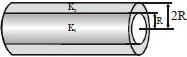
$A$ cylinder of radius $R$ made of a material of thermal conductivity $K_1$ is surrounded by a cylindrical shell of inner radius $R$ and outer radius $2R$ made of material of thermal conductivity $K_2$. The two ends of the combined system are maintained at two different temperatures. There is no loss of heat across the cylindrical surface and the system is in steady state. The effective thermal conductivity of the system is
A
$K_1 + K_2$
B
$\frac{K_1 K_2}{K_1 + K_2}$
C
$\frac{K_1 + 3K_2}{4}$
D
$\frac{3K_1 + K_2}{4}$
Solution
(C) Since the heat flows from one end to the other,the inner cylinder and the outer cylindrical shell act as thermal conductors in parallel.
The equivalent thermal conductivity $K_{eq}$ for parallel combination is given by $K_{eq} = \frac{K_1 A_1 + K_2 A_2}{A_1 + A_2}$.
Here,$A_1$ is the cross-sectional area of the inner cylinder: $A_1 = \pi R^2$.
$A_2$ is the cross-sectional area of the outer cylindrical shell: $A_2 = \pi(2R)^2 - \pi R^2 = 4\pi R^2 - \pi R^2 = 3\pi R^2$.
The total area $A = A_1 + A_2 = \pi R^2 + 3\pi R^2 = 4\pi R^2$.
Substituting these values into the formula:
$K_{eq} = \frac{K_1(\pi R^2) + K_2(3\pi R^2)}{4\pi R^2} = \frac{K_1 + 3K_2}{4}$.
The equivalent thermal conductivity $K_{eq}$ for parallel combination is given by $K_{eq} = \frac{K_1 A_1 + K_2 A_2}{A_1 + A_2}$.
Here,$A_1$ is the cross-sectional area of the inner cylinder: $A_1 = \pi R^2$.
$A_2$ is the cross-sectional area of the outer cylindrical shell: $A_2 = \pi(2R)^2 - \pi R^2 = 4\pi R^2 - \pi R^2 = 3\pi R^2$.
The total area $A = A_1 + A_2 = \pi R^2 + 3\pi R^2 = 4\pi R^2$.
Substituting these values into the formula:
$K_{eq} = \frac{K_1(\pi R^2) + K_2(3\pi R^2)}{4\pi R^2} = \frac{K_1 + 3K_2}{4}$.
0 likesView Solution
20
ChemistryMCQIIT JEE · 1988
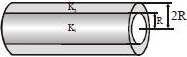
$A$ cylinder of radius $R$ made of a material of thermal conductivity $K_1$ is surrounded by a cylindrical shell of inner radius $R$ and outer radius $2R$ made of material of thermal conductivity $K_2$. The two ends of the combined system are maintained at two different temperatures. There is no loss of heat across the cylindrical surface and the system is in steady state. The effective thermal conductivity of the system is
A
$K_1+K_2$
B
$\frac{K_1K_2}{K_1+K_2}$
C
$\frac{K_1+3K_2}{4}$
D
$\frac{3K_1+K_2}{4}$
Solution
(C) Since the heat flows from one end to the other along the length of the cylinders,the two materials are effectively in parallel.
For parallel heat flow,the equivalent thermal conductivity $K_{eq}$ is given by $K_{eq} = \frac{K_1 A_1 + K_2 A_2}{A_1 + A_2}$.
Here,$A_1$ is the cross-sectional area of the inner cylinder: $A_1 = \pi R^2$.
$A_2$ is the cross-sectional area of the outer cylindrical shell: $A_2 = \pi(2R)^2 - \pi R^2 = 4\pi R^2 - \pi R^2 = 3\pi R^2$.
The total area is $A = A_1 + A_2 = \pi R^2 + 3\pi R^2 = 4\pi R^2$.
Substituting these values into the formula:
$K_{eq} = \frac{K_1(\pi R^2) + K_2(3\pi R^2)}{4\pi R^2} = \frac{K_1 + 3K_2}{4}$.
For parallel heat flow,the equivalent thermal conductivity $K_{eq}$ is given by $K_{eq} = \frac{K_1 A_1 + K_2 A_2}{A_1 + A_2}$.
Here,$A_1$ is the cross-sectional area of the inner cylinder: $A_1 = \pi R^2$.
$A_2$ is the cross-sectional area of the outer cylindrical shell: $A_2 = \pi(2R)^2 - \pi R^2 = 4\pi R^2 - \pi R^2 = 3\pi R^2$.
The total area is $A = A_1 + A_2 = \pi R^2 + 3\pi R^2 = 4\pi R^2$.
Substituting these values into the formula:
$K_{eq} = \frac{K_1(\pi R^2) + K_2(3\pi R^2)}{4\pi R^2} = \frac{K_1 + 3K_2}{4}$.
0 likesView Solution
21
ChemistryDifficultMCQIIT JEE · 1988
In $CH_3CH_2OH$,the bond that undergoes heterolytic cleavage most readily is
A
$C-C$
B
$C-O$
C
$C-H$
D
$O-H$
Solution
(D) The heterolytic cleavage of a bond depends on the difference in electronegativity between the bonded atoms.
In $CH_3CH_2OH$,the $O-H$ bond is the most polar because oxygen is significantly more electronegative than hydrogen.
Therefore,the $O-H$ bond undergoes heterolytic cleavage most readily to form $CH_3CH_2O^-$ and $H^+$,or in some cases $CH_3CH_2^+$ and $OH^-$,depending on the reaction conditions.
Among the given options,the $O-H$ bond is the most susceptible to heterolytic cleavage due to the high electronegativity of the oxygen atom.
In $CH_3CH_2OH$,the $O-H$ bond is the most polar because oxygen is significantly more electronegative than hydrogen.
Therefore,the $O-H$ bond undergoes heterolytic cleavage most readily to form $CH_3CH_2O^-$ and $H^+$,or in some cases $CH_3CH_2^+$ and $OH^-$,depending on the reaction conditions.
Among the given options,the $O-H$ bond is the most susceptible to heterolytic cleavage due to the high electronegativity of the oxygen atom.
0 likesView Solution
22
ChemistryEasyMCQIIT JEE · 1988
Which of the following modes of expressing concentration is independent of temperature?
A
Molarity
B
Molality
C
Formality
D
Normality
Solution
(B) Molality is defined as the number of moles of solute per $1 \ kg$ of solvent.
Since mass does not change with temperature,molality is independent of temperature.
In contrast,molarity,formality,and normality involve volume,which changes with temperature.
Since mass does not change with temperature,molality is independent of temperature.
In contrast,molarity,formality,and normality involve volume,which changes with temperature.
0 likesView Solution
23
ChemistryMediumMCQIIT JEE · 1988
Which of the following nuclear reactions results in the emission of a neutron?
A
$_{96}Am^{240} + _{2}He^{4} \to _{97}Bk^{244} + _{+1}e^{0}$
B
$_{15}P^{30} \to _{14}Si^{30} + _{1}e^{0}$
C
$_{6}C^{12} + _{1}H^{1} \to _{7}N^{13}$
D
$_{13}Al^{27} + _{2}He^{4} \to _{15}P^{30} + _{0}n^{1}$
Solution
(D) In a nuclear reaction,the sum of mass numbers and the sum of atomic numbers must be conserved on both sides of the equation.
For option $(D)$: $_{13}Al^{27} + _{2}He^{4} \to _{15}P^{30} + _{0}n^{1}$.
Mass balance: $27 + 4 = 31$ (reactants) and $30 + 1 = 31$ (products).
Atomic number balance: $13 + 2 = 15$ (reactants) and $15 + 0 = 15$ (products).
Since the product side includes $_{0}n^{1}$,this reaction results in the emission of a neutron.
For option $(D)$: $_{13}Al^{27} + _{2}He^{4} \to _{15}P^{30} + _{0}n^{1}$.
Mass balance: $27 + 4 = 31$ (reactants) and $30 + 1 = 31$ (products).
Atomic number balance: $13 + 2 = 15$ (reactants) and $15 + 0 = 15$ (products).
Since the product side includes $_{0}n^{1}$,this reaction results in the emission of a neutron.
0 likesView Solution
24
ChemistryMediumMCQIIT JEE · 1988
$A$ freshly prepared radioactive source of half-life $2 \ hours$ emits radiations of intensity which is $64$ times the permissible safe level. The minimum time after which it would be possible to work safely with this source is ......... $hours$.
A
$6$
B
$12$
C
$24$
D
$128$
Solution
(B) The intensity of radiation is proportional to the amount of radioactive substance present.
Let the initial intensity be $I_0$ and the safe level be $I_s$.
Given $I_0 = 64 \times I_s$.
Using the radioactive decay formula $I = I_0 \times (\frac{1}{2})^n$,where $n$ is the number of half-lives.
We need $I = I_s$,so $I_s = 64 \times I_s \times (\frac{1}{2})^n$.
$\frac{1}{64} = (\frac{1}{2})^n$.
Since $64 = 2^6$,we have $(\frac{1}{2})^6 = (\frac{1}{2})^n$,which gives $n = 6$.
Total time $t = n \times T_{1/2} = 6 \times 2 \ hr = 12 \ hr$.
Let the initial intensity be $I_0$ and the safe level be $I_s$.
Given $I_0 = 64 \times I_s$.
Using the radioactive decay formula $I = I_0 \times (\frac{1}{2})^n$,where $n$ is the number of half-lives.
We need $I = I_s$,so $I_s = 64 \times I_s \times (\frac{1}{2})^n$.
$\frac{1}{64} = (\frac{1}{2})^n$.
Since $64 = 2^6$,we have $(\frac{1}{2})^6 = (\frac{1}{2})^n$,which gives $n = 6$.
Total time $t = n \times T_{1/2} = 6 \times 2 \ hr = 12 \ hr$.
0 likesView Solution
25
ChemistryMediumMCQIIT JEE · 1988
The triad of nuclei that is isotonic is
A
$^{14}_{6}C, ^{15}_{7}N, ^{17}_{9}F$
B
$^{12}_{6}C, ^{14}_{7}N, ^{19}_{9}F$
C
$^{14}_{6}C, ^{14}_{7}N, ^{17}_{9}F$
D
$^{14}_{6}C, ^{14}_{7}N, ^{19}_{9}F$
Solution
(A) Isotones are nuclei that have the same number of neutrons $(n = A - Z)$.
For $^{14}_{6}C$: $n = 14 - 6 = 8$.
For $^{15}_{7}N$: $n = 15 - 7 = 8$.
For $^{17}_{9}F$: $n = 17 - 9 = 8$.
Since all three nuclei have $8$ neutrons,they are isotonic.
For $^{14}_{6}C$: $n = 14 - 6 = 8$.
For $^{15}_{7}N$: $n = 15 - 7 = 8$.
For $^{17}_{9}F$: $n = 17 - 9 = 8$.
Since all three nuclei have $8$ neutrons,they are isotonic.
0 likesView Solution
26
ChemistryDifficultMCQIIT JEE · 1988
The rate law for the reaction $RCl + NaOH_{(aq)} \to ROH + NaCl$ is given by $\text{Rate} = K_1[RCl]$. The rate of the reaction will be
A
Doubled on doubling the concentration of sodium hydroxide
B
Halved on reducing the concentration of alkyl halide to one half
C
Decreased on increasing the temperature of the reaction
D
Unaffected by increasing the temperature of the reaction
Solution
(B) The given rate law is $\text{Rate} = K_1[RCl]$.
This indicates that the reaction is of first order with respect to the alkyl halide $(RCl)$ and zero order with respect to sodium hydroxide $(NaOH)$.
If the concentration of the alkyl halide is reduced to one half,the new rate will be $\text{Rate}' = K_1 \times \frac{1}{2}[RCl] = \frac{1}{2} \times \text{Rate}$.
Therefore,the rate is halved on reducing the concentration of the alkyl halide to one half.
This indicates that the reaction is of first order with respect to the alkyl halide $(RCl)$ and zero order with respect to sodium hydroxide $(NaOH)$.
If the concentration of the alkyl halide is reduced to one half,the new rate will be $\text{Rate}' = K_1 \times \frac{1}{2}[RCl] = \frac{1}{2} \times \text{Rate}$.
Therefore,the rate is halved on reducing the concentration of the alkyl halide to one half.
0 likesView Solution
27
ChemistryMediumMCQIIT JEE · 1988
The standard oxidation potentials for the half-reactions are given as $Zn \to Zn^{2+} + 2e^{-}; E^o = +0.76 \ V$ and $Fe \to Fe^{2+} + 2e^{-}; E^o = +0.41 \ V$. The $EMF$ for the cell reaction $Fe^{2+} + Zn \to Zn^{2+} + Fe$ is ............ $V$.
A
$-0.35$
B
$+0.35$
C
$+1.17$
D
$-1.17$
Solution
(B) The given reactions are oxidation half-reactions. The standard reduction potentials $(E^o_{red})$ are the negative of the standard oxidation potentials $(E^o_{ox})$.
$E^o_{red}(Zn^{2+}/Zn) = -0.76 \ V$
$E^o_{red}(Fe^{2+}/Fe) = -0.41 \ V$
In the cell reaction $Fe^{2+} + Zn \to Zn^{2+} + Fe$,$Zn$ is oxidized (anode) and $Fe^{2+}$ is reduced (cathode).
$E^o_{cell} = E^o_{cathode} - E^o_{anode}$
$E^o_{cell} = E^o_{red}(Fe^{2+}/Fe) - E^o_{red}(Zn^{2+}/Zn)$
$E^o_{cell} = -0.41 \ V - (-0.76 \ V)$
$E^o_{cell} = -0.41 \ V + 0.76 \ V = +0.35 \ V$.
$E^o_{red}(Zn^{2+}/Zn) = -0.76 \ V$
$E^o_{red}(Fe^{2+}/Fe) = -0.41 \ V$
In the cell reaction $Fe^{2+} + Zn \to Zn^{2+} + Fe$,$Zn$ is oxidized (anode) and $Fe^{2+}$ is reduced (cathode).
$E^o_{cell} = E^o_{cathode} - E^o_{anode}$
$E^o_{cell} = E^o_{red}(Fe^{2+}/Fe) - E^o_{red}(Zn^{2+}/Zn)$
$E^o_{cell} = -0.41 \ V - (-0.76 \ V)$
$E^o_{cell} = -0.41 \ V + 0.76 \ V = +0.35 \ V$.
0 likesView Solution
28
ChemistryEasyMCQIIT JEE · 1988
In $CH_3CH_2OH$,which bond dissociates heterolytically?
A
$C-C$
B
$C-O$
C
$C-H$
D
$O-H$
Solution
(D) . In ethanol $(CH_3CH_2OH)$,the $O-H$ bond is the most polar due to the high electronegativity of the oxygen atom.
Therefore,it undergoes heterolytic fission to release a proton $(H^+)$ and an ethoxide ion $(CH_3CH_2O^-)$.
$CH_3CH_2OH \rightarrow CH_3CH_2O^- + H^+$
Therefore,it undergoes heterolytic fission to release a proton $(H^+)$ and an ethoxide ion $(CH_3CH_2O^-)$.
$CH_3CH_2OH \rightarrow CH_3CH_2O^- + H^+$
0 likesView Solution
Vedclass Products
For Students
Vedclass Test Series
Mock tests in real IIT JEE style covering Chemistry with performance analysis. 5-day free trial.
Start Free TrialFor Teachers
Exam Paper Generator
Generate Set A/B/C/D Chemistry papers from 7.5L+ questions in 2 minutes. 3 chapters free.
Try FreeFor Institutes
Online Exam Module
Run live IIT JEE mock exams with unlimited students, 360° analytics & white-label branding.
See DemoFrequently Asked Questions
How many Chemistry questions are in IIT JEE 1988?
There are 28 Chemistry questions from the IIT JEE 1988 paper on Vedclass, each with a detailed step-by-step solution in English.
Are IIT JEE 1988 Chemistry solutions available in English?
Yes. All solutions on this page are in English. You can also switch to English or Hindi using the language buttons above the questions.
Can I practice IIT JEE 1988 Chemistry as a timed test?
Yes. Use the Vedclass Test Series to attempt a full IIT JEE mock test covering Chemistry with time limits and instant score analysis.
Can teachers create Chemistry papers from IIT JEE previous year questions?
Yes. The Vedclass Exam Paper Generator lets teachers mix IIT JEE Chemistry questions and generate Set A/B/C/D papers in minutes.
For Teachers & Institutes
Build a Custom Chemistry Paper
Pick IIT JEE 1988 Chemistry questions, set difficulty, and generate Set A/B/C/D in 2 minutes.