
PhysicsQ1–12 of 12 questions
Page 1 of 1 · English
1
PhysicsMediumMCQIIT JEE · 1988
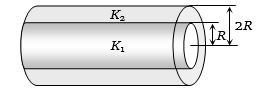
$A$ cylinder of radius $R$ made of a material of thermal conductivity $K_1$ is surrounded by a cylindrical shell of inner radius $R$ and outer radius $2R$ made of material of thermal conductivity $K_2$. The two ends of the combined system are maintained at two different temperatures. There is no loss of heat across the cylindrical surface and the system is in steady state. The effective thermal conductivity of the system is
A
$K_1 + K_2$
B
$\frac{K_1 K_2}{K_1 + K_2}$
C
$\frac{K_1 + 3K_2}{4}$
D
$\frac{3K_1 + K_2}{4}$
Solution
(C) Since the heat flows along the length of the cylinders,the two cylinders are in parallel configuration.
The equivalent thermal conductivity $K_{eq}$ for parallel combination is given by $K_{eq} = \frac{K_1 A_1 + K_2 A_2}{A_1 + A_2}$.
Here,$A_1$ is the cross-sectional area of the inner cylinder: $A_1 = \pi R^2$.
$A_2$ is the cross-sectional area of the outer cylindrical shell: $A_2 = \pi (2R)^2 - \pi R^2 = 4\pi R^2 - \pi R^2 = 3\pi R^2$.
The total area $A = A_1 + A_2 = \pi R^2 + 3\pi R^2 = 4\pi R^2$.
Substituting these values into the formula:
$K_{eq} = \frac{K_1(\pi R^2) + K_2(3\pi R^2)}{4\pi R^2} = \frac{K_1 + 3K_2}{4}$.
The equivalent thermal conductivity $K_{eq}$ for parallel combination is given by $K_{eq} = \frac{K_1 A_1 + K_2 A_2}{A_1 + A_2}$.
Here,$A_1$ is the cross-sectional area of the inner cylinder: $A_1 = \pi R^2$.
$A_2$ is the cross-sectional area of the outer cylindrical shell: $A_2 = \pi (2R)^2 - \pi R^2 = 4\pi R^2 - \pi R^2 = 3\pi R^2$.
The total area $A = A_1 + A_2 = \pi R^2 + 3\pi R^2 = 4\pi R^2$.
Substituting these values into the formula:
$K_{eq} = \frac{K_1(\pi R^2) + K_2(3\pi R^2)}{4\pi R^2} = \frac{K_1 + 3K_2}{4}$.
0 likesView Solution
2
PhysicsMediumMCQIIT JEE · 1988
Two bodies $M$ and $N$ of equal masses are suspended from two separate massless springs of force constants $k_1$ and $k_2$ respectively. If the two bodies oscillate vertically such that their maximum velocities are equal,the ratio of the amplitude of $M$ to that of $N$ is
A
$\frac{k_1}{k_2}$
B
$\sqrt{\frac{k_1}{k_2}}$
C
$\frac{k_2}{k_1}$
D
$\sqrt{\frac{k_2}{k_1}}$
Solution
(D) The maximum velocity of a body performing simple harmonic motion is given by $v_{max} = A\omega$,where $A$ is the amplitude and $\omega$ is the angular frequency.
For a spring-mass system,the angular frequency is $\omega = \sqrt{\frac{k}{m}}$.
Thus,$v_{max} = A\sqrt{\frac{k}{m}}$.
Given that the masses are equal $(m_M = m_N = m)$ and their maximum velocities are equal $(v_M = v_N)$:
$A_M \sqrt{\frac{k_1}{m}} = A_N \sqrt{\frac{k_2}{m}}$.
Simplifying this,we get $A_M \sqrt{k_1} = A_N \sqrt{k_2}$.
Therefore,the ratio of the amplitude of $M$ to that of $N$ is $\frac{A_M}{A_N} = \sqrt{\frac{k_2}{k_1}}$.
For a spring-mass system,the angular frequency is $\omega = \sqrt{\frac{k}{m}}$.
Thus,$v_{max} = A\sqrt{\frac{k}{m}}$.
Given that the masses are equal $(m_M = m_N = m)$ and their maximum velocities are equal $(v_M = v_N)$:
$A_M \sqrt{\frac{k_1}{m}} = A_N \sqrt{\frac{k_2}{m}}$.
Simplifying this,we get $A_M \sqrt{k_1} = A_N \sqrt{k_2}$.
Therefore,the ratio of the amplitude of $M$ to that of $N$ is $\frac{A_M}{A_N} = \sqrt{\frac{k_2}{k_1}}$.
0 likesView Solution
3
PhysicsMediumMCQIIT JEE · 1988
$A$ wave represented by the equation $y = a \cos (kx - \omega t)$ is superposed with another wave to form a stationary wave such that the point $x = 0$ is a node. The equation for the other wave is:
A
$y = a \sin (kx + \omega t)$
B
$y = -a \cos (kx + \omega t)$
C
$y = -a \cos (kx - \omega t)$
D
$y = -a \sin (kx - \omega t)$
Solution
(B) stationary wave is formed by the superposition of two waves of the same frequency and amplitude traveling in opposite directions.
Given the incident wave is $y_1 = a \cos (kx - \omega t)$.
For a point $x = 0$ to be a node,the resultant displacement at $x = 0$ must be zero for all time $t$.
Let the second wave be $y_2 = a \cos (kx + \omega t + \phi)$.
The resultant wave is $y = y_1 + y_2 = a [\cos (kx - \omega t) + \cos (kx + \omega t + \phi)]$.
Using the identity $\cos A + \cos B = 2 \cos \frac{A+B}{2} \cos \frac{A-B}{2}$,we get:
$y = 2a \cos (kx + \phi/2) \cos (\omega t + \phi/2)$.
At $x = 0$,$y = 2a \cos (\phi/2) \cos (\omega t + \phi/2)$.
For this to be a node (zero displacement) for all $t$,we must have $\cos (\phi/2) = 0$,which implies $\phi/2 = \pi/2$,or $\phi = \pi$.
Substituting $\phi = \pi$ into the equation for the second wave:
$y_2 = a \cos (kx + \omega t + \pi) = -a \cos (kx + \omega t)$.
Given the incident wave is $y_1 = a \cos (kx - \omega t)$.
For a point $x = 0$ to be a node,the resultant displacement at $x = 0$ must be zero for all time $t$.
Let the second wave be $y_2 = a \cos (kx + \omega t + \phi)$.
The resultant wave is $y = y_1 + y_2 = a [\cos (kx - \omega t) + \cos (kx + \omega t + \phi)]$.
Using the identity $\cos A + \cos B = 2 \cos \frac{A+B}{2} \cos \frac{A-B}{2}$,we get:
$y = 2a \cos (kx + \phi/2) \cos (\omega t + \phi/2)$.
At $x = 0$,$y = 2a \cos (\phi/2) \cos (\omega t + \phi/2)$.
For this to be a node (zero displacement) for all $t$,we must have $\cos (\phi/2) = 0$,which implies $\phi/2 = \pi/2$,or $\phi = \pi$.
Substituting $\phi = \pi$ into the equation for the second wave:
$y_2 = a \cos (kx + \omega t + \pi) = -a \cos (kx + \omega t)$.
1 likesView Solution
4
PhysicsMediumMCQIIT JEE · 1988
The equation of an electric field line in the $xy$-plane is given by ${x^2} + {y^2} = 1$. What is true for a particle with unit positive charge initially at rest at the point $(1, 0)$ in the $xy$-plane?
A
It will not move at all
B
It will move along a straight line
C
It will move along the circular field line
D
Information is insufficient to draw any conclusion
Solution
(C) Electric field lines are the paths along which a free positive charge moves.
Since the particle is located at $(1, 0)$,which satisfies the equation ${x^2} + {y^2} = 1$,it lies on the field line.
Therefore,the particle will move along the field line,which is a circle.
The correct option is $C$.
Since the particle is located at $(1, 0)$,which satisfies the equation ${x^2} + {y^2} = 1$,it lies on the field line.
Therefore,the particle will move along the field line,which is a circle.
The correct option is $C$.
0 likesView Solution
5
PhysicsDifficultMCQIIT JEE · 1988
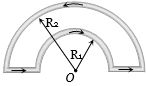
The magnetic induction at the centre $O$ in the figure shown is
A
$\frac{{\mu _0}i}{4}\left( {\frac{1}{{{R_1}}} - \frac{1}{{{R_2}}}} \right)$
B
$\frac{{\mu _0}i}{4}\left( {\frac{1}{{{R_1}}} + \frac{1}{{{R_2}}}} \right)$
C
$\frac{{\mu _0}i}{4}({R_1} - {R_2})$
D
$\frac{{\mu _0}i}{4}({R_1} + {R_2})$
Solution
(A) The magnetic field at the centre $O$ due to a semi-circular arc of radius $R$ carrying current $i$ is given by $B = \frac{{\mu _0}i}{{4R}}$.
In the given figure,the current flows through two semi-circular arcs of radii $R_1$ and $R_2$ and two straight radial segments.
The magnetic field due to the straight radial segments at the centre $O$ is zero because the position vector of the point $O$ is parallel to the current element $idl$ for these segments.
For the inner semi-circular arc of radius $R_1$,the magnetic field $B_1$ at $O$ is directed into the plane of the paper $(\otimes)$ and its magnitude is $B_1 = \frac{{\mu _0}i}{{4R_1}}$.
For the outer semi-circular arc of radius $R_2$,the magnetic field $B_2$ at $O$ is directed out of the plane of the paper $(\odot)$ and its magnitude is $B_2 = \frac{{\mu _0}i}{{4R_2}}$.
Since $R_1$ < $R_2$,the magnitude $B_1$ > $B_2$.
The net magnetic field $B_{net}$ is $B_1 - B_2$ directed into the plane of the paper.
$B_{net} = \frac{{\mu _0}i}{{4R_1}} - \frac{{\mu _0}i}{{4R_2}} = \frac{{\mu _0}i}{4}\left( {\frac{1}{{{R_1}}} - \frac{1}{{{R_2}}}} \right)$.
In the given figure,the current flows through two semi-circular arcs of radii $R_1$ and $R_2$ and two straight radial segments.
The magnetic field due to the straight radial segments at the centre $O$ is zero because the position vector of the point $O$ is parallel to the current element $idl$ for these segments.
For the inner semi-circular arc of radius $R_1$,the magnetic field $B_1$ at $O$ is directed into the plane of the paper $(\otimes)$ and its magnitude is $B_1 = \frac{{\mu _0}i}{{4R_1}}$.
For the outer semi-circular arc of radius $R_2$,the magnetic field $B_2$ at $O$ is directed out of the plane of the paper $(\odot)$ and its magnitude is $B_2 = \frac{{\mu _0}i}{{4R_2}}$.
Since $R_1$ < $R_2$,the magnitude $B_1$ > $B_2$.
The net magnetic field $B_{net}$ is $B_1 - B_2$ directed into the plane of the paper.
$B_{net} = \frac{{\mu _0}i}{{4R_1}} - \frac{{\mu _0}i}{{4R_2}} = \frac{{\mu _0}i}{4}\left( {\frac{1}{{{R_1}}} - \frac{1}{{{R_2}}}} \right)$.
0 likesView Solution
6
PhysicsEasyMCQIIT JEE · 1988
The potential difference applied to an $X$-ray tube is increased. As a result,in the emitted radiation
A
The intensity increases
B
The minimum wavelength increases
C
The intensity decreases
D
The minimum wavelength decreases
Solution
(D) The minimum wavelength (cutoff wavelength) of $X$-rays produced in an $X$-ray tube is given by the formula:
${\lambda _{\min }} = \frac{{hc}}{{eV}}$
where $h$ is Planck's constant,$c$ is the speed of light,$e$ is the charge of an electron,and $V$ is the accelerating potential difference.
From the relation ${\lambda _{\min }} \propto \frac{1}{V}$,it is clear that the minimum wavelength is inversely proportional to the applied potential difference.
Therefore,when the potential difference $V$ is increased,the minimum wavelength ${\lambda _{\min }}$ decreases.
Thus,the correct option is $(d)$.
${\lambda _{\min }} = \frac{{hc}}{{eV}}$
where $h$ is Planck's constant,$c$ is the speed of light,$e$ is the charge of an electron,and $V$ is the accelerating potential difference.
From the relation ${\lambda _{\min }} \propto \frac{1}{V}$,it is clear that the minimum wavelength is inversely proportional to the applied potential difference.
Therefore,when the potential difference $V$ is increased,the minimum wavelength ${\lambda _{\min }}$ decreases.
Thus,the correct option is $(d)$.
0 likesView Solution
7
PhysicsEasyMCQIIT JEE · 1988
$A$ piece of copper and another of germanium are cooled from room temperature to $80\, K$. Which of the following is a correct statement?
A
Resistance of each increases
B
Resistance of each decreases
C
Resistance of copper increases while that of germanium decreases
D
Resistance of copper decreases while that of germanium increases
Solution
(D) Copper $(Cu)$ is a conductor,and its resistance decreases as the temperature decreases because the scattering of electrons by lattice vibrations reduces.
Germanium $(Ge)$ is a semiconductor,and its resistance increases as the temperature decreases because the number of free charge carriers (electrons and holes) decreases exponentially with a decrease in temperature.
Therefore,the resistance of copper decreases while that of germanium increases.
Germanium $(Ge)$ is a semiconductor,and its resistance increases as the temperature decreases because the number of free charge carriers (electrons and holes) decreases exponentially with a decrease in temperature.
Therefore,the resistance of copper decreases while that of germanium increases.
0 likesView Solution
8
PhysicsEasyMCQIIT JEE · 1988
To obtain $P$-type $Si$ semiconductor,we need to dope pure $Si$ with
A
Aluminium
B
Phosphorous
C
Oxygen
D
Germanium
Solution
(A) To obtain a $P$-type semiconductor,we must dope the intrinsic semiconductor $(Si)$ with a trivalent impurity atom.
$Si$ belongs to group $14$ of the periodic table and has $4$ valence electrons.
Aluminium $(Al)$ belongs to group $13$ and has $3$ valence electrons.
When $Al$ is added to $Si$,it creates a hole (vacancy) in the crystal lattice,which acts as a charge carrier,resulting in a $P$-type semiconductor.
Phosphorous is a pentavalent impurity used for $N$-type semiconductors.
$Si$ belongs to group $14$ of the periodic table and has $4$ valence electrons.
Aluminium $(Al)$ belongs to group $13$ and has $3$ valence electrons.
When $Al$ is added to $Si$,it creates a hole (vacancy) in the crystal lattice,which acts as a charge carrier,resulting in a $P$-type semiconductor.
Phosphorous is a pentavalent impurity used for $N$-type semiconductors.
0 likesView Solution
9
PhysicsDifficultMCQIIT JEE · 1988
$A$ short linear object of length $l$ lies along the axis of a concave mirror of focal length $f$ at a distance $u$ from the pole of the mirror. The size of the image is approximately equal to
A
$l{\left( {\frac{{u - f}}{f}} \right)^{1/2}}$
B
$l{\left( {\frac{{u - f}}{f}} \right)^2}$
C
$l{\left( {\frac{f}{{u - f}}} \right)^{1/2}}$
D
$l{\left( {\frac{f}{{u - f}}} \right)^2}$
Solution
(D) From the mirror formula,$\frac{1}{f} = \frac{1}{v} + \frac{1}{u}$ .....$(i)$
Differentiating equation $(i)$ with respect to $u$,we get:
$0 = - \frac{1}{v^2} \frac{dv}{du} - \frac{1}{u^2}$
$\frac{dv}{du} = - \left( \frac{v}{u} \right)^2$
Since the object length $l = du$ is small,the image length $dv$ is given by $dv = - \left( \frac{v}{u} \right)^2 du$ .....$(ii)$
From the mirror formula,we can express the magnification $m = \frac{v}{u}$ as:
$\frac{1}{v} = \frac{1}{f} - \frac{1}{u} = \frac{u - f}{fu}$
$\frac{v}{u} = \frac{f}{u - f}$ .....$(iii)$
Substituting equation $(iii)$ into equation $(ii)$,we get:
$dv = - \left( \frac{f}{u - f} \right)^2 l$
The magnitude of the size of the image is $l' = |dv| = l \left( \frac{f}{u - f} \right)^2$.
Differentiating equation $(i)$ with respect to $u$,we get:
$0 = - \frac{1}{v^2} \frac{dv}{du} - \frac{1}{u^2}$
$\frac{dv}{du} = - \left( \frac{v}{u} \right)^2$
Since the object length $l = du$ is small,the image length $dv$ is given by $dv = - \left( \frac{v}{u} \right)^2 du$ .....$(ii)$
From the mirror formula,we can express the magnification $m = \frac{v}{u}$ as:
$\frac{1}{v} = \frac{1}{f} - \frac{1}{u} = \frac{u - f}{fu}$
$\frac{v}{u} = \frac{f}{u - f}$ .....$(iii)$
Substituting equation $(iii)$ into equation $(ii)$,we get:
$dv = - \left( \frac{f}{u - f} \right)^2 l$
The magnitude of the size of the image is $l' = |dv| = l \left( \frac{f}{u - f} \right)^2$.
0 likesView Solution
10
PhysicsMediumMCQIIT JEE · 1988
Two coherent monochromatic light beams of intensities $I$ and $4I$ are superposed. The maximum and minimum possible intensities in the resulting beam are
A
$5I$ and $I$
B
$5I$ and $3I$
C
$9I$ and $I$
D
$9I$ and $3I$
Solution
(C) The intensity of the resultant wave in interference is given by $I_{res} = I_1 + I_2 + 2\sqrt{I_1 I_2} \cos \phi$.
For maximum intensity, $\cos \phi = 1$, so $I_{max} = (\sqrt{I_1} + \sqrt{I_2})^2$.
Given $I_1 = I$ and $I_2 = 4I$, we have $I_{max} = (\sqrt{I} + \sqrt{4I})^2 = (\sqrt{I} + 2\sqrt{I})^2 = (3\sqrt{I})^2 = 9I$.
For minimum intensity, $\cos \phi = -1$, so $I_{min} = (\sqrt{I_1} - \sqrt{I_2})^2$.
Thus, $I_{min} = (\sqrt{I} - \sqrt{4I})^2 = (\sqrt{I} - 2\sqrt{I})^2 = (-\sqrt{I})^2 = I$.
Therefore, the maximum and minimum intensities are $9I$ and $I$ respectively.
For maximum intensity, $\cos \phi = 1$, so $I_{max} = (\sqrt{I_1} + \sqrt{I_2})^2$.
Given $I_1 = I$ and $I_2 = 4I$, we have $I_{max} = (\sqrt{I} + \sqrt{4I})^2 = (\sqrt{I} + 2\sqrt{I})^2 = (3\sqrt{I})^2 = 9I$.
For minimum intensity, $\cos \phi = -1$, so $I_{min} = (\sqrt{I_1} - \sqrt{I_2})^2$.
Thus, $I_{min} = (\sqrt{I} - \sqrt{4I})^2 = (\sqrt{I} - 2\sqrt{I})^2 = (-\sqrt{I})^2 = I$.
Therefore, the maximum and minimum intensities are $9I$ and $I$ respectively.
0 likesView Solution
11
PhysicsMediumMCQIIT JEE · 1988
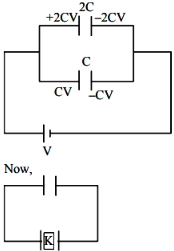
Two capacitors of capacities $2C$ and $C$ are joined in parallel and charged up to potential $V$. The battery is removed and the capacitor of capacity $C$ is filled completely with a medium of dielectric constant $K$. The potential difference across the capacitors will now be
A
$\frac{3 V}{K}$
B
$\frac{V}{K}$
C
$\frac{3 V}{K+2}$
D
$\frac{V}{K+2}$
Solution
(C) Initially,the capacitors are connected in parallel to a battery of potential $V$. The total charge stored is $Q_{total} = Q_1 + Q_2 = (2C)V + (C)V = 3CV$.
When the battery is removed and a dielectric of constant $K$ is inserted into the capacitor of capacity $C$,its new capacity becomes $C' = KC$.
The capacitor of capacity $2C$ remains unchanged.
Since the capacitors are connected in parallel,they share the same potential difference $V'$ across them. The total charge remains conserved as $Q_{total} = 3CV$.
The new equivalent capacitance is $C_{eq} = 2C + KC = C(K+2)$.
Using the relation $Q = C_{eq} V'$,we get:
$3CV = C(K+2) V'$
$V' = \frac{3CV}{C(K+2)} = \frac{3V}{K+2}$
When the battery is removed and a dielectric of constant $K$ is inserted into the capacitor of capacity $C$,its new capacity becomes $C' = KC$.
The capacitor of capacity $2C$ remains unchanged.
Since the capacitors are connected in parallel,they share the same potential difference $V'$ across them. The total charge remains conserved as $Q_{total} = 3CV$.
The new equivalent capacitance is $C_{eq} = 2C + KC = C(K+2)$.
Using the relation $Q = C_{eq} V'$,we get:
$3CV = C(K+2) V'$
$V' = \frac{3CV}{C(K+2)} = \frac{3V}{K+2}$
0 likesView Solution
12
PhysicsMediumMCQIIT JEE · 1988
Two particles $X$ and $Y$ having equal charges are being accelerated through the same potential difference. Thereafter,they enter normally into a region of uniform magnetic field and describe circular paths of radii $R_1$ and $R_2$ respectively. The mass ratio of $X$ and $Y$ is:
A
$\left(\frac{R_2}{R_1}\right)^2$
B
$\left(\frac{R_1}{R_2}\right)^2$
C
$\frac{R_1}{R_2}$
D
$\frac{R_2}{R_1}$
Solution
(B) The radius of a circular path for a charged particle in a magnetic field is given by $R = \frac{mv}{qB}$.
Since the particle is accelerated through a potential difference $V$,its kinetic energy is $KE = qV = \frac{1}{2}mv^2$,which implies $v = \sqrt{\frac{2qV}{m}}$.
Substituting $v$ into the radius formula: $R = \frac{m}{qB} \sqrt{\frac{2qV}{m}} = \frac{\sqrt{2mqV}}{qB} = \frac{1}{B} \sqrt{\frac{2mV}{q}}$.
Since $q$,$V$,and $B$ are constant for both particles,we have $R \propto \sqrt{m}$,which implies $m \propto R^2$.
Therefore,the ratio of the masses is $\frac{m_X}{m_Y} = \left(\frac{R_1}{R_2}\right)^2$.
Since the particle is accelerated through a potential difference $V$,its kinetic energy is $KE = qV = \frac{1}{2}mv^2$,which implies $v = \sqrt{\frac{2qV}{m}}$.
Substituting $v$ into the radius formula: $R = \frac{m}{qB} \sqrt{\frac{2qV}{m}} = \frac{\sqrt{2mqV}}{qB} = \frac{1}{B} \sqrt{\frac{2mV}{q}}$.
Since $q$,$V$,and $B$ are constant for both particles,we have $R \propto \sqrt{m}$,which implies $m \propto R^2$.
Therefore,the ratio of the masses is $\frac{m_X}{m_Y} = \left(\frac{R_1}{R_2}\right)^2$.
0 likesView Solution
Vedclass Products
For Students
Vedclass Test Series
Mock tests in real IIT JEE style covering Physics with performance analysis. 5-day free trial.
Start Free TrialFor Teachers
Exam Paper Generator
Generate Set A/B/C/D Physics papers from 7.5L+ questions in 2 minutes. 3 chapters free.
Try FreeFor Institutes
Online Exam Module
Run live IIT JEE mock exams with unlimited students, 360° analytics & white-label branding.
See DemoFrequently Asked Questions
How many Physics questions are in IIT JEE 1988?
There are 12 Physics questions from the IIT JEE 1988 paper on Vedclass, each with a detailed step-by-step solution in English.
Are IIT JEE 1988 Physics solutions available in English?
Yes. All solutions on this page are in English. You can also switch to English or Hindi using the language buttons above the questions.
Can I practice IIT JEE 1988 Physics as a timed test?
Yes. Use the Vedclass Test Series to attempt a full IIT JEE mock test covering Physics with time limits and instant score analysis.
Can teachers create Physics papers from IIT JEE previous year questions?
Yes. The Vedclass Exam Paper Generator lets teachers mix IIT JEE Physics questions and generate Set A/B/C/D papers in minutes.
For Teachers & Institutes
Build a Custom Physics Paper
Pick IIT JEE 1988 Physics questions, set difficulty, and generate Set A/B/C/D in 2 minutes.