
PhysicsQ1–24 of 24 questions
Page 1 of 1 · English
1
PhysicsEasyMCQGUJCET · 2017
The dimensional formula of capacitance is . . . . . . . Take $Q$ as the dimensional formula of charge.
A
$M^1 L^{-2} T^{-2} Q^{-2}$
B
$M^1 L^2 T^{-2} Q^{-2}$
C
$M^1 L^{-2} T^2 Q^2$
D
$M^{-1} L^{-2} T^2 Q^2$
Solution
(D) The formula for capacitance is $C = \frac{Q}{V}$.
Since potential $V = \frac{W}{Q}$,where $W$ is work and $Q$ is charge,we substitute this into the capacitance formula:
$C = \frac{Q^2}{W}$.
The dimensional formula for work $W$ is $[M^1 L^2 T^{-2}]$.
Substituting the dimensions:
$C = \frac{Q^2}{[M^1 L^2 T^{-2}]}$.
$C = M^{-1} L^{-2} T^2 Q^2$.
Since potential $V = \frac{W}{Q}$,where $W$ is work and $Q$ is charge,we substitute this into the capacitance formula:
$C = \frac{Q^2}{W}$.
The dimensional formula for work $W$ is $[M^1 L^2 T^{-2}]$.
Substituting the dimensions:
$C = \frac{Q^2}{[M^1 L^2 T^{-2}]}$.
$C = M^{-1} L^{-2} T^2 Q^2$.
0 likesView Solution
2
PhysicsEasyMCQGUJCET · 2017
An $AC$ voltage $V = 5 \cos(1000t) \text{ V}$ is applied to an $L-R$ circuit of inductance $3 \text{ mH}$ and resistance $4 \text{ } \Omega$. The value of maximum current in the circuit is . . . . . . $A$.
A
$0.8$
B
$1$
C
$\frac{5}{7}$
D
$\frac{5}{\sqrt{7}}$
Solution
(B) The given $AC$ voltage is $V = V_m \cos(\omega t)$, where $V_m = 5 \text{ V}$ and $\omega = 1000 \text{ rad/s}$.
For an $L-R$ circuit, the impedance $Z$ is given by $Z = \sqrt{R^2 + X_L^2}$, where $X_L = \omega L$.
Given $L = 3 \text{ mH} = 3 \times 10^{-3} \text{ H}$ and $R = 4 \text{ } \Omega$.
Calculating inductive reactance: $X_L = 1000 \times 3 \times 10^{-3} = 3 \text{ } \Omega$.
Calculating impedance: $Z = \sqrt{4^2 + 3^2} = \sqrt{16 + 9} = \sqrt{25} = 5 \text{ } \Omega$.
The maximum current $I_m$ is given by $I_m = \frac{V_m}{Z}$.
Substituting the values: $I_m = \frac{5}{5} = 1 \text{ A}$.
For an $L-R$ circuit, the impedance $Z$ is given by $Z = \sqrt{R^2 + X_L^2}$, where $X_L = \omega L$.
Given $L = 3 \text{ mH} = 3 \times 10^{-3} \text{ H}$ and $R = 4 \text{ } \Omega$.
Calculating inductive reactance: $X_L = 1000 \times 3 \times 10^{-3} = 3 \text{ } \Omega$.
Calculating impedance: $Z = \sqrt{4^2 + 3^2} = \sqrt{16 + 9} = \sqrt{25} = 5 \text{ } \Omega$.
The maximum current $I_m$ is given by $I_m = \frac{V_m}{Z}$.
Substituting the values: $I_m = \frac{5}{5} = 1 \text{ A}$.
0 likesView Solution
3
PhysicsEasyMCQGUJCET · 2017
For an $AC$ current $I = 50 \cos(100t + 45^{\circ}) \ A$. The value of $I_{rms} =$ . . . . . . $A$.
A
Zero
B
$50 \sqrt{2}$
C
$25$
D
$25 \sqrt{2}$
Solution
(D) The given equation for the alternating current is $I = I_m \cos(\omega t + \phi)$,where $I_m$ is the peak current.
Comparing this with the given equation $I = 50 \cos(100t + 45^{\circ}) \ A$,we find the peak current $I_m = 50 \ A$.
The root mean square current $I_{rms}$ is related to the peak current $I_m$ by the formula $I_{rms} = \frac{I_m}{\sqrt{2}}$.
Substituting the value of $I_m$,we get $I_{rms} = \frac{50}{\sqrt{2}}$.
To simplify,multiply the numerator and denominator by $\sqrt{2}$: $I_{rms} = \frac{50 \sqrt{2}}{2} = 25 \sqrt{2} \ A$.
Therefore,the correct option is $D$.
Comparing this with the given equation $I = 50 \cos(100t + 45^{\circ}) \ A$,we find the peak current $I_m = 50 \ A$.
The root mean square current $I_{rms}$ is related to the peak current $I_m$ by the formula $I_{rms} = \frac{I_m}{\sqrt{2}}$.
Substituting the value of $I_m$,we get $I_{rms} = \frac{50}{\sqrt{2}}$.
To simplify,multiply the numerator and denominator by $\sqrt{2}$: $I_{rms} = \frac{50 \sqrt{2}}{2} = 25 \sqrt{2} \ A$.
Therefore,the correct option is $D$.
0 likesView Solution
4
PhysicsEasyMCQGUJCET · 2017
In an $AC$ circuit,current is $3 \ A$,voltage is $210 \ V$,and power is $63 \ W$. The power factor is . . . . . . .
A
$0.11$
B
$0.09$
C
$0.08$
D
$0.1$
Solution
(D) The power in an $AC$ circuit is given by the formula: $P = VI \cos \phi$,where $\cos \phi$ is the power factor.
Given values are: $P = 63 \ W$,$V = 210 \ V$,and $I = 3 \ A$.
Rearranging the formula to solve for the power factor: $\cos \phi = \frac{P}{VI}$.
Substituting the values: $\cos \phi = \frac{63}{3 \times 210}$.
$\cos \phi = \frac{63}{630} = 0.1$.
Therefore,the power factor is $0.1$.
Given values are: $P = 63 \ W$,$V = 210 \ V$,and $I = 3 \ A$.
Rearranging the formula to solve for the power factor: $\cos \phi = \frac{P}{VI}$.
Substituting the values: $\cos \phi = \frac{63}{3 \times 210}$.
$\cos \phi = \frac{63}{630} = 0.1$.
Therefore,the power factor is $0.1$.
0 likesView Solution
5
PhysicsEasyMCQGUJCET · 2017
The total energy of an electron in the first excited state of the hydrogen atom is $-3.4 \ eV$. Find out its potential energy in this state.
A
-$6.8$
B
$3.4$
C
-$3.4$
D
$6.8$
Solution
(A) For an electron in a hydrogen atom,the relationship between total energy $(E)$,kinetic energy $(K)$,and potential energy $(U)$ is given by:
$E = -K = \frac{U}{2}$
Therefore,the potential energy is $U = 2 \times E$.
Given that the total energy $E = -3.4 \ eV$,we have:
$U = 2 \times (-3.4 \ eV) = -6.8 \ eV$.
Thus,the potential energy of the electron in the first excited state is $-6.8 \ eV$.
$E = -K = \frac{U}{2}$
Therefore,the potential energy is $U = 2 \times E$.
Given that the total energy $E = -3.4 \ eV$,we have:
$U = 2 \times (-3.4 \ eV) = -6.8 \ eV$.
Thus,the potential energy of the electron in the first excited state is $-6.8 \ eV$.
0 likesView Solution
6
PhysicsEasyMCQGUJCET · 2017
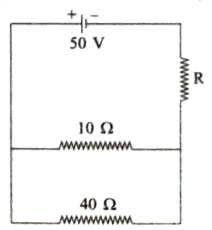
In the given circuit,if the current through the $10 \Omega$ resistor is $2.5 \text{ A}$,the value of $R$ is . . . . . . . (in $Omega$)
A
$50$
B
$40$
C
$8$
D
$10$
Solution
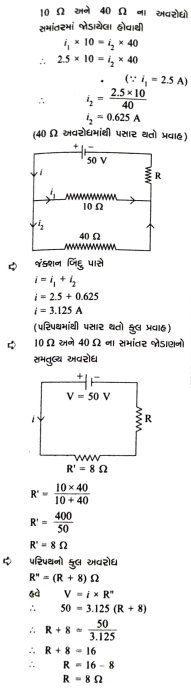
(C) The $10 \Omega$ and $40 \Omega$ resistors are connected in parallel. Let $i_1$ be the current through the $10 \Omega$ resistor and $i_2$ be the current through the $40 \Omega$ resistor.
Since they are in parallel,the potential difference across them is the same:
$i_1 \times 10 = i_2 \times 40$
Given $i_1 = 2.5 \text{ A}$,we have:
$2.5 \times 10 = i_2 \times 40$
$i_2 = \frac{25}{40} = 0.625 \text{ A}$
At the junction point,the total current $i$ flowing through the circuit is:
$i = i_1 + i_2 = 2.5 + 0.625 = 3.125 \text{ A}$
The equivalent resistance $R'$ of the parallel combination of $10 \Omega$ and $40 \Omega$ is:
$R' = \frac{10 \times 40}{10 + 40} = \frac{400}{50} = 8 \Omega$
The total resistance of the circuit is $R'' = (R + 8) \Omega$.
Using Ohm's law,$V = i \times R''$:
$50 = 3.125 \times (R + 8)$
$R + 8 = \frac{50}{3.125} = 16$
$R = 16 - 8 = 8 \Omega$
Thus,the value of $R$ is $8 \Omega$.
Since they are in parallel,the potential difference across them is the same:
$i_1 \times 10 = i_2 \times 40$
Given $i_1 = 2.5 \text{ A}$,we have:
$2.5 \times 10 = i_2 \times 40$
$i_2 = \frac{25}{40} = 0.625 \text{ A}$
At the junction point,the total current $i$ flowing through the circuit is:
$i = i_1 + i_2 = 2.5 + 0.625 = 3.125 \text{ A}$
The equivalent resistance $R'$ of the parallel combination of $10 \Omega$ and $40 \Omega$ is:
$R' = \frac{10 \times 40}{10 + 40} = \frac{400}{50} = 8 \Omega$
The total resistance of the circuit is $R'' = (R + 8) \Omega$.
Using Ohm's law,$V = i \times R''$:
$50 = 3.125 \times (R + 8)$
$R + 8 = \frac{50}{3.125} = 16$
$R = 16 - 8 = 8 \Omega$
Thus,the value of $R$ is $8 \Omega$.
0 likesView Solution
7
PhysicsEasyMCQGUJCET · 2017
Brown,Red and Orange coloured bands on a carbon resistor are followed by a Silver band. The value of the resistor is . . . . . .
A
$320 \Omega \pm 5 \%$
B
$12 \ k\Omega \pm 5 \%$
C
$320 \Omega \pm 10 \%$
D
$12 \ k\Omega \pm 10 \%$
Solution
(D) According to the carbon resistor colour code:
$1$. The first band is Brown,which corresponds to the digit $1$.
$2$. The second band is Red,which corresponds to the digit $2$.
$3$. The third band is Orange,which acts as the multiplier $10^3$.
$4$. The fourth band is Silver,which represents the tolerance of $\pm 10 \%$.
Combining these,the resistance $R$ is given by:
$R = (12 \times 10^3 \pm 10 \%) \ \Omega$
$R = (12 \ k\Omega \pm 10 \%)$
Therefore,the correct option is $(D)$.
$1$. The first band is Brown,which corresponds to the digit $1$.
$2$. The second band is Red,which corresponds to the digit $2$.
$3$. The third band is Orange,which acts as the multiplier $10^3$.
$4$. The fourth band is Silver,which represents the tolerance of $\pm 10 \%$.
Combining these,the resistance $R$ is given by:
$R = (12 \times 10^3 \pm 10 \%) \ \Omega$
$R = (12 \ k\Omega \pm 10 \%)$
Therefore,the correct option is $(D)$.
0 likesView Solution
8
PhysicsEasyMCQGUJCET · 2017
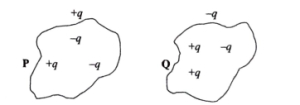
Arrangements of charges are shown in the figure. Flux linked with the closed surfaces $P$ and $Q$ respectively are . . . . . . and . . . . . . .
A
zero,zero
B
$\frac{q}{\varepsilon_0}, \frac{-q}{\varepsilon_0}$
C
$\frac{-q}{\varepsilon_0}, \frac{q}{\varepsilon_0}$
D
$\frac{q}{\varepsilon_0}$,zero
Solution
(C) According to Gauss's Law,the electric flux $\phi$ linked with a closed surface is given by $\phi = \frac{q_{enclosed}}{\varepsilon_0}$,where $q_{enclosed}$ is the net charge enclosed by the surface.
For surface $P$:
The charges enclosed are $+q, -q, -q$.
Net charge $q_{P} = (+q) + (-q) + (-q) = -q$.
Therefore,flux $\phi_{P} = \frac{-q}{\varepsilon_0}$.
For surface $Q$:
The charges enclosed are $+q, -q, +q$.
Net charge $q_{Q} = (+q) + (-q) + (+q) = +q$.
Therefore,flux $\phi_{Q} = \frac{q}{\varepsilon_0}$.
Thus,the flux linked with $P$ and $Q$ are $\frac{-q}{\varepsilon_0}$ and $\frac{q}{\varepsilon_0}$ respectively.
For surface $P$:
The charges enclosed are $+q, -q, -q$.
Net charge $q_{P} = (+q) + (-q) + (-q) = -q$.
Therefore,flux $\phi_{P} = \frac{-q}{\varepsilon_0}$.
For surface $Q$:
The charges enclosed are $+q, -q, +q$.
Net charge $q_{Q} = (+q) + (-q) + (+q) = +q$.
Therefore,flux $\phi_{Q} = \frac{q}{\varepsilon_0}$.
Thus,the flux linked with $P$ and $Q$ are $\frac{-q}{\varepsilon_0}$ and $\frac{q}{\varepsilon_0}$ respectively.
0 likesView Solution
9
PhysicsEasyMCQGUJCET · 2017
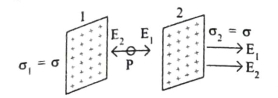
Electric field intensity at points in between and outside two thin separated parallel sheets of infinite dimension with like charges of same surface charge density $(\sigma)$ are . . . . . . and . . . . . . respectively.
A
$\frac{\sigma}{\varepsilon_0}, \frac{\sigma}{\varepsilon_0}$
B
$0, \frac{\sigma}{\varepsilon_0}$
C
$0, 0$
D
$\frac{\sigma}{\varepsilon_0}, 0$
Solution
(B) The electric field intensity due to a single thin infinite sheet with surface charge density $\sigma$ is given by $E = \frac{\sigma}{2\varepsilon_0}$.
For two parallel sheets with the same surface charge density $\sigma$:
$1$. Between the sheets: The electric fields due to the two sheets are equal in magnitude but opposite in direction. Thus,the net electric field is $E_{net} = E_1 - E_2 = \frac{\sigma}{2\varepsilon_0} - \frac{\sigma}{2\varepsilon_0} = 0$.
$2$. Outside the sheets: The electric fields due to both sheets point in the same direction. Thus,the net electric field is $E_{net} = E_1 + E_2 = \frac{\sigma}{2\varepsilon_0} + \frac{\sigma}{2\varepsilon_0} = \frac{\sigma}{\varepsilon_0}$.
Therefore,the electric field intensity between the sheets is $0$ and outside the sheets is $\frac{\sigma}{\varepsilon_0}$.
The correct option is $B$.
For two parallel sheets with the same surface charge density $\sigma$:
$1$. Between the sheets: The electric fields due to the two sheets are equal in magnitude but opposite in direction. Thus,the net electric field is $E_{net} = E_1 - E_2 = \frac{\sigma}{2\varepsilon_0} - \frac{\sigma}{2\varepsilon_0} = 0$.
$2$. Outside the sheets: The electric fields due to both sheets point in the same direction. Thus,the net electric field is $E_{net} = E_1 + E_2 = \frac{\sigma}{2\varepsilon_0} + \frac{\sigma}{2\varepsilon_0} = \frac{\sigma}{\varepsilon_0}$.
Therefore,the electric field intensity between the sheets is $0$ and outside the sheets is $\frac{\sigma}{\varepsilon_0}$.
The correct option is $B$.
0 likesView Solution
10
PhysicsEasyMCQGUJCET · 2017
If $R$ and $L$ denote resistance and inductance respectively,which of the following has the dimension of time?
A
$\sqrt{\frac{L}{R}}$
B
$\frac{L}{R}$
C
$\sqrt{\frac{R}{L}}$
D
$\frac{R}{L}$
Solution
(B) The dimension of inductance $L$ is given by $V = L \frac{di}{dt}$,so $[L] = [V][T][I]^{-1}$.
The dimension of resistance $R$ is given by $V = IR$,so $[R] = [V][I]^{-1}$.
Therefore,the dimension of the ratio $\frac{L}{R}$ is:
$\left[ \frac{L}{R} \right] = \frac{[V][T][I]^{-1}}{[V][I]^{-1}} = [T]$.
Thus,$\frac{L}{R}$ has the dimension of time.
Correct option is $B$.
The dimension of resistance $R$ is given by $V = IR$,so $[R] = [V][I]^{-1}$.
Therefore,the dimension of the ratio $\frac{L}{R}$ is:
$\left[ \frac{L}{R} \right] = \frac{[V][T][I]^{-1}}{[V][I]^{-1}} = [T]$.
Thus,$\frac{L}{R}$ has the dimension of time.
Correct option is $B$.
0 likesView Solution
11
PhysicsEasyMCQGUJCET · 2017
The number of turns in the coil of an $AC$ generator is $100$ and its cross-sectional area is $2.5 \ m^2$. The coil is revolving in a uniform magnetic field of strength $0.3 \ T$ with a uniform angular velocity of $60 \ rad \ s^{-1}$. The value of maximum induced emf is . . . . . . $kV$.
A
$1.25$
B
$4.5$
C
$6.75$
D
$2.25$
Solution
(B) The induced electromotive force $(\varepsilon)$ in a rotating coil is given by the formula: $\varepsilon = N B A \omega \sin(\omega t)$.
For the maximum induced emf $(\varepsilon_{\max})$, we set $\sin(\omega t) = 1$.
Thus, the formula becomes: $\varepsilon_{\max} = N B A \omega$.
Given values:
Number of turns $(N)$ = $100$
Magnetic field strength $(B)$ = $0.3 \ T$
Area $(A)$ = $2.5 \ m^2$
Angular velocity $(\omega)$ = $60 \ rad \ s^{-1}$
Substituting these values into the formula:
$\varepsilon_{\max} = 100 \times 0.3 \times 2.5 \times 60$
$\varepsilon_{\max} = 30 \times 2.5 \times 60$
$\varepsilon_{\max} = 75 \times 60 = 4500 \ V$.
Converting to $kV$:
$\varepsilon_{\max} = 4.5 \ kV$.
For the maximum induced emf $(\varepsilon_{\max})$, we set $\sin(\omega t) = 1$.
Thus, the formula becomes: $\varepsilon_{\max} = N B A \omega$.
Given values:
Number of turns $(N)$ = $100$
Magnetic field strength $(B)$ = $0.3 \ T$
Area $(A)$ = $2.5 \ m^2$
Angular velocity $(\omega)$ = $60 \ rad \ s^{-1}$
Substituting these values into the formula:
$\varepsilon_{\max} = 100 \times 0.3 \times 2.5 \times 60$
$\varepsilon_{\max} = 30 \times 2.5 \times 60$
$\varepsilon_{\max} = 75 \times 60 = 4500 \ V$.
Converting to $kV$:
$\varepsilon_{\max} = 4.5 \ kV$.
0 likesView Solution
12
PhysicsEasyMCQGUJCET · 2017
For a radiation of $9 \text{ GHz}$ passing through air,the number of waves passing through $1 \text{ m}$ length is . . . . . . .
A
$30$
B
$5$
C
$20$
D
$3$
Solution
(A) The number of waves in a given length $L$ is given by the formula: $\text{Number of waves} = \frac{L}{\lambda}$.
Since the radiation is passing through air,its velocity $v$ is approximately equal to the speed of light $c = 3 \times 10^8 \text{ m/s}$.
Given frequency $\nu = 9 \text{ GHz} = 9 \times 10^9 \text{ Hz}$ and length $L = 1 \text{ m}$.
Using the relation $\lambda = \frac{c}{\nu}$,we substitute this into the formula:
$\text{Number of waves} = \frac{L \times \nu}{c}$.
Substituting the values:
$\text{Number of waves} = \frac{1 \times 9 \times 10^9}{3 \times 10^8} = 3 \times 10^1 = 30$.
Thus,the number of waves is $30$.
Since the radiation is passing through air,its velocity $v$ is approximately equal to the speed of light $c = 3 \times 10^8 \text{ m/s}$.
Given frequency $\nu = 9 \text{ GHz} = 9 \times 10^9 \text{ Hz}$ and length $L = 1 \text{ m}$.
Using the relation $\lambda = \frac{c}{\nu}$,we substitute this into the formula:
$\text{Number of waves} = \frac{L \times \nu}{c}$.
Substituting the values:
$\text{Number of waves} = \frac{1 \times 9 \times 10^9}{3 \times 10^8} = 3 \times 10^1 = 30$.
Thus,the number of waves is $30$.
0 likesView Solution
13
PhysicsEasyMCQGUJCET · 2017
In medicine,to destroy cancer cells . . . . . . rays are used.
A
Gamma
B
Visible
C
Ultraviolet
D
Infrared
Solution
(A) The correct answer is $A$. Gamma rays have very high energy and high penetrating power. Due to this property,they are used in medical treatments,specifically in radiotherapy,to kill or destroy cancer cells by damaging their $DNA$.
0 likesView Solution
14
PhysicsEasyMCQGUJCET · 2017
An electric dipole of dipole moment $\vec{P}$ is placed parallel to a uniform electric field of intensity $\vec{E}$. On rotating it through $180^{\circ}$,the amount of work done is . . . . . . .
A
$2 p E$
B
zero
C
$p E$
D
$-2 p E$
Solution
(A) The work done $W$ in rotating an electric dipole in a uniform electric field from an initial angle $\theta_1$ to a final angle $\theta_2$ is given by the formula:
$W = p E (\cos \theta_1 - \cos \theta_2)$
Given that the dipole is initially parallel to the electric field,the initial angle $\theta_1 = 0^{\circ}$.
The dipole is rotated through $180^{\circ}$,so the final angle $\theta_2 = 180^{\circ}$.
Substituting these values into the formula:
$W = p E (\cos 0^{\circ} - \cos 180^{\circ})$
Since $\cos 0^{\circ} = 1$ and $\cos 180^{\circ} = -1$:
$W = p E (1 - (-1))$
$W = p E (1 + 1)$
$W = 2 p E$
Therefore,the work done is $2 p E$.
$W = p E (\cos \theta_1 - \cos \theta_2)$
Given that the dipole is initially parallel to the electric field,the initial angle $\theta_1 = 0^{\circ}$.
The dipole is rotated through $180^{\circ}$,so the final angle $\theta_2 = 180^{\circ}$.
Substituting these values into the formula:
$W = p E (\cos 0^{\circ} - \cos 180^{\circ})$
Since $\cos 0^{\circ} = 1$ and $\cos 180^{\circ} = -1$:
$W = p E (1 - (-1))$
$W = p E (1 + 1)$
$W = 2 p E$
Therefore,the work done is $2 p E$.
0 likesView Solution
15
PhysicsEasyMCQGUJCET · 2017
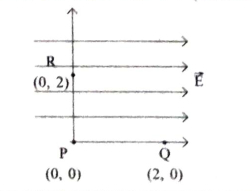
$A$ uniform electric field is prevailing in the $X$-direction in a certain region. The coordinates of points $P$,$Q$,and $R$ are $(0,0)$,$(2,0)$,and $(0,2)$ respectively. Which of the following alternatives is true for the potentials at these points?
A
$V_P = V_Q, V_Q > V_R$
B
$V_P = V_R, V_P > V_Q$
C
$V_P = V_R, V_Q > V_R$
D
$V_P = V_Q, V_P > V_R$
Solution
(B) The electric field $\vec{E}$ is uniform and directed along the $+X$-direction.
Points $P(0,0)$ and $R(0,2)$ lie on the same plane perpendicular to the electric field lines (the $YZ$-plane). Therefore,$P$ and $R$ lie on the same equipotential surface,which implies $V_P = V_R$.
Electric potential decreases in the direction of the electric field. Since point $Q(2,0)$ is further along the $+X$-direction than point $P(0,0)$,the potential at $P$ must be greater than the potential at $Q$,i.e.,$V_P > V_Q$.
Combining these,we get $V_P = V_R$ and $V_P > V_Q$.
Points $P(0,0)$ and $R(0,2)$ lie on the same plane perpendicular to the electric field lines (the $YZ$-plane). Therefore,$P$ and $R$ lie on the same equipotential surface,which implies $V_P = V_R$.
Electric potential decreases in the direction of the electric field. Since point $Q(2,0)$ is further along the $+X$-direction than point $P(0,0)$,the potential at $P$ must be greater than the potential at $Q$,i.e.,$V_P > V_Q$.
Combining these,we get $V_P = V_R$ and $V_P > V_Q$.
0 likesView Solution
16
PhysicsEasyMCQGUJCET · 2017
If $\mu_0$ is the permeability of vacuum and $\chi_m$ is the magnetic susceptibility,then the permeability of the material $\mu$ is . . . . . . .
A
$\mu=\mu_0(1+\chi_m)$
B
$\mu=\mu_0(\chi_m-1)$
C
$\mu=\mu_0(1-\chi_m)$
D
$\mu=\mu_0(1+\chi_m)$
Solution
(D) The relative permeability $\mu_r$ of a magnetic material is defined as the ratio of the permeability of the material $\mu$ to the permeability of free space $\mu_0$,given by $\mu_r = \frac{\mu}{\mu_0}$.
Also,the relationship between relative permeability and magnetic susceptibility $\chi_m$ is given by $\mu_r = 1 + \chi_m$.
Equating these two expressions,we get $\frac{\mu}{\mu_0} = 1 + \chi_m$.
Therefore,the permeability of the material is $\mu = \mu_0(1 + \chi_m)$.
Also,the relationship between relative permeability and magnetic susceptibility $\chi_m$ is given by $\mu_r = 1 + \chi_m$.
Equating these two expressions,we get $\frac{\mu}{\mu_0} = 1 + \chi_m$.
Therefore,the permeability of the material is $\mu = \mu_0(1 + \chi_m)$.
0 likesView Solution
17
PhysicsMediumMCQGUJCET · 2017
Select the dimensional formula of $\frac{B^2}{2\mu_0}$.
A
$M^1 L^1 T^{-2}$
B
$M^{-1} L^1 T^2$
C
$M^{-1} L^{-1} T^{-2}$
D
$M^1 L^{-1} T^{-2}$
Solution
(D) The expression $\frac{B^2}{2\mu_0}$ represents the magnetic energy density $(u_B)$ stored in a magnetic field.
Energy density is defined as energy per unit volume.
$u_B = \frac{B^2}{2\mu_0} = \frac{\text{Energy}}{\text{Volume}}$
The dimensional formula for energy is $[M^1 L^2 T^{-2}]$ and for volume is $[L^3]$.
Therefore,the dimensional formula for magnetic energy density is:
$\frac{[M^1 L^2 T^{-2}]}{[L^3]} = [M^1 L^{-1} T^{-2}]$
Thus,the correct option is $D$.
Energy density is defined as energy per unit volume.
$u_B = \frac{B^2}{2\mu_0} = \frac{\text{Energy}}{\text{Volume}}$
The dimensional formula for energy is $[M^1 L^2 T^{-2}]$ and for volume is $[L^3]$.
Therefore,the dimensional formula for magnetic energy density is:
$\frac{[M^1 L^2 T^{-2}]}{[L^3]} = [M^1 L^{-1} T^{-2}]$
Thus,the correct option is $D$.
0 likesView Solution
18
PhysicsEasyMCQGUJCET · 2017
$A$ particle of mass $m$ and charge $q$ is incident on the $XZ$ plane with velocity $v$ in a direction making an angle $\theta$ with a uniform magnetic field applied along the $X$-axis. The nature of motion performed by the particle is . . . . . . .
A
circular
B
helical
C
parabola
D
straight line
Solution
(B) The velocity $v$ of the particle can be resolved into two components: one parallel to the magnetic field $(v_{\parallel} = v \cos \theta)$ and one perpendicular to the magnetic field $(v_{\perp} = v \sin \theta)$.
Due to the parallel component $v_{\parallel}$,the particle moves linearly along the direction of the magnetic field.
Due to the perpendicular component $v_{\perp}$,the magnetic force $F = q(v \times B)$ acts as a centripetal force,causing the particle to move in a circular path in the plane perpendicular to the field.
The combination of linear motion along the field and circular motion perpendicular to the field results in a helical path.
Due to the parallel component $v_{\parallel}$,the particle moves linearly along the direction of the magnetic field.
Due to the perpendicular component $v_{\perp}$,the magnetic force $F = q(v \times B)$ acts as a centripetal force,causing the particle to move in a circular path in the plane perpendicular to the field.
The combination of linear motion along the field and circular motion perpendicular to the field results in a helical path.
0 likesView Solution
19
PhysicsEasyMCQGUJCET · 2017
$A$ proton is moving perpendicular to a uniform magnetic field of $2.5 \ T$ with $2 \ MeV$ kinetic energy. The force on the proton is . . . . . . $N$. (Mass of proton $= 1.6 \times 10^{-27} \ kg$,charge of proton $= 1.6 \times 10^{-19} \ C$)
A
$8 \times 10^{-12}$
B
$8 \times 10^{-11}$
C
$3 \times 10^{-11}$
D
$3 \times 10^{-10}$
Solution
(A) The force $F$ on a charge $q$ moving with velocity $v$ in a magnetic field $B$ is given by $F = qvB \sin \theta$. Since the proton moves perpendicular to the field,$\theta = 90^{\circ}$,so $F = qvB$.
Given kinetic energy $K = 2 \ MeV = 2 \times 10^6 \times 1.6 \times 10^{-19} \ J = 3.2 \times 10^{-13} \ J$.
Using $K = \frac{1}{2}mv^2$,the velocity $v = \sqrt{\frac{2K}{m}} = \sqrt{\frac{2 \times 3.2 \times 10^{-13}}{1.6 \times 10^{-27}}} = \sqrt{4 \times 10^{14}} = 2 \times 10^7 \ m/s$.
Now,$F = (1.6 \times 10^{-19} \ C) \times (2 \times 10^7 \ m/s) \times (2.5 \ T)$.
$F = 1.6 \times 10^{-19} \times 5 \times 10^7 = 8 \times 10^{-12} \ N$.
Given kinetic energy $K = 2 \ MeV = 2 \times 10^6 \times 1.6 \times 10^{-19} \ J = 3.2 \times 10^{-13} \ J$.
Using $K = \frac{1}{2}mv^2$,the velocity $v = \sqrt{\frac{2K}{m}} = \sqrt{\frac{2 \times 3.2 \times 10^{-13}}{1.6 \times 10^{-27}}} = \sqrt{4 \times 10^{14}} = 2 \times 10^7 \ m/s$.
Now,$F = (1.6 \times 10^{-19} \ C) \times (2 \times 10^7 \ m/s) \times (2.5 \ T)$.
$F = 1.6 \times 10^{-19} \times 5 \times 10^7 = 8 \times 10^{-12} \ N$.
0 likesView Solution
20
PhysicsEasyMCQGUJCET · 2017
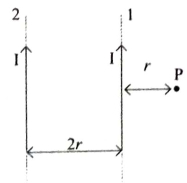
Two very long straight wires are set parallel to each other. Each carries a current $I$ in the same direction and the separation between them is $2r$. The intensity of the magnetic field at point $P$ as shown in the figure is . . . . . . .
A
$\frac{3}{8} \frac{\mu_0 I}{\pi r}$
B
$\frac{2 \mu_0 I}{\pi r}$
C
$\frac{2}{3} \frac{\mu_0 I}{\pi r}$
D
$\frac{2}{3} \frac{\mu_0 I}{2 \pi r} = \frac{\mu_0 I}{3 \pi r}$
Solution
(C) The magnetic field due to a long straight wire carrying current $I$ at a distance $d$ is given by $B = \frac{\mu_0 I}{2 \pi d}$.
For point $P$,the distance from wire $1$ is $r$. Thus,the magnetic field due to wire $1$ is $B_1 = \frac{\mu_0 I}{2 \pi r}$ (directed into the page).
The distance from wire $2$ is $2r + r = 3r$. Thus,the magnetic field due to wire $2$ is $B_2 = \frac{\mu_0 I}{2 \pi (3r)} = \frac{\mu_0 I}{6 \pi r}$ (directed into the page).
Since both fields are in the same direction (into the page),the net magnetic field $B_{net}$ is:
$B_{net} = B_1 + B_2$
$B_{net} = \frac{\mu_0 I}{2 \pi r} + \frac{\mu_0 I}{6 \pi r}$
$B_{net} = \frac{\mu_0 I}{2 \pi r} (1 + \frac{1}{3}) = \frac{\mu_0 I}{2 \pi r} (\frac{4}{3}) = \frac{2 \mu_0 I}{3 \pi r}$.
For point $P$,the distance from wire $1$ is $r$. Thus,the magnetic field due to wire $1$ is $B_1 = \frac{\mu_0 I}{2 \pi r}$ (directed into the page).
The distance from wire $2$ is $2r + r = 3r$. Thus,the magnetic field due to wire $2$ is $B_2 = \frac{\mu_0 I}{2 \pi (3r)} = \frac{\mu_0 I}{6 \pi r}$ (directed into the page).
Since both fields are in the same direction (into the page),the net magnetic field $B_{net}$ is:
$B_{net} = B_1 + B_2$
$B_{net} = \frac{\mu_0 I}{2 \pi r} + \frac{\mu_0 I}{6 \pi r}$
$B_{net} = \frac{\mu_0 I}{2 \pi r} (1 + \frac{1}{3}) = \frac{\mu_0 I}{2 \pi r} (\frac{4}{3}) = \frac{2 \mu_0 I}{3 \pi r}$.
0 likesView Solution
21
PhysicsEasyMCQGUJCET · 2017
$A$ convex lens of focal length $12.5 \ cm$ is used as a simple microscope. When the image is formed at infinity,the magnification is . . . . . . . (Near point for normal vision is $25 \ cm$)
A
$25$
B
$2.5$
C
$2$
D
$1$
Solution
(C) The magnifying power $m$ of a simple microscope when the image is formed at infinity (normal adjustment) is given by the formula: $m = \frac{D}{f}$.
Here,$D$ is the near point distance of the normal eye,which is $25 \ cm$.
The focal length of the convex lens is $f = 12.5 \ cm$.
Substituting these values into the formula:
$m = \frac{25}{12.5} = 2$.
Therefore,the magnification is $2$.
Here,$D$ is the near point distance of the normal eye,which is $25 \ cm$.
The focal length of the convex lens is $f = 12.5 \ cm$.
Substituting these values into the formula:
$m = \frac{25}{12.5} = 2$.
Therefore,the magnification is $2$.
0 likesView Solution
22
PhysicsEasyMCQGUJCET · 2017
For an astronomical telescope,the focal length of the objective lens is $f_{0}$ and the eyepiece lens is $f_{e}$. Then the tube length of the telescope is . . . . . . .
A
$L \geq f_{0}-f_{e}$
B
$L \geq f_{0}+f_{e}$
C
$L \leq f_{0}+f_{e}$
D
$L \leq f_{0}-f_{e}$
Solution
(B) In an astronomical telescope,the objective lens forms an image of a distant object at its focal plane.
For normal adjustment,the final image is formed at infinity,and the distance between the objective lens and the eyepiece is $L = f_{0} + f_{e}$.
When the final image is formed at the near point (least distance of distinct vision),the eyepiece is moved closer to the objective lens,but the total length $L$ must be at least $f_{0} + f_{e}$ to accommodate the focal lengths of both lenses in the optical path.
Therefore,the tube length $L$ is generally given by $L \geq f_{0} + f_{e}$.
For normal adjustment,the final image is formed at infinity,and the distance between the objective lens and the eyepiece is $L = f_{0} + f_{e}$.
When the final image is formed at the near point (least distance of distinct vision),the eyepiece is moved closer to the objective lens,but the total length $L$ must be at least $f_{0} + f_{e}$ to accommodate the focal lengths of both lenses in the optical path.
Therefore,the tube length $L$ is generally given by $L \geq f_{0} + f_{e}$.
0 likesView Solution
23
PhysicsEasyMCQGUJCET · 2017
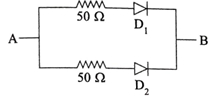
For the circuit shown in the figure,the equivalent resistance between points $A$ and $B$ for two cases $(i)$ $V_A > V_B$ and (ii) $V_B > V_A$ is $\qquad \Omega$ and $\qquad \Omega$ respectively. ($D_1$ and $D_2$ are ideal diodes)
A
$25, \infty$
B
$50, \infty$
C
$\infty, 25$
D
$25, 25$
Solution
(A) For an ideal diode,the forward bias resistance is $0 \ \Omega$ and the reverse bias resistance is $\infty \ \Omega$.
$(i)$ Case $V_A > V_B$:
In this case,both diodes $D_1$ and $D_2$ are forward biased.
Therefore,the resistance of each branch is $50 \ \Omega + 0 \ \Omega = 50 \ \Omega$.
Since the two branches are in parallel,the equivalent resistance $R_{AB}$ is given by:
$\frac{1}{R_{AB}} = \frac{1}{50} + \frac{1}{50} = \frac{2}{50} = \frac{1}{25}$
$R_{AB} = 25 \ \Omega$.
(ii) Case $V_B > V_A$:
In this case,both diodes $D_1$ and $D_2$ are reverse biased.
Therefore,the resistance of each branch is $50 \ \Omega + \infty \ \Omega = \infty \ \Omega$.
Since the two branches are in parallel,the equivalent resistance $R_{AB}$ is given by:
$\frac{1}{R_{AB}} = \frac{1}{\infty} + \frac{1}{\infty} = 0 + 0 = 0$
$R_{AB} = \infty \ \Omega$.
Thus,the equivalent resistances are $25 \ \Omega$ and $\infty \ \Omega$ respectively.
$(i)$ Case $V_A > V_B$:
In this case,both diodes $D_1$ and $D_2$ are forward biased.
Therefore,the resistance of each branch is $50 \ \Omega + 0 \ \Omega = 50 \ \Omega$.
Since the two branches are in parallel,the equivalent resistance $R_{AB}$ is given by:
$\frac{1}{R_{AB}} = \frac{1}{50} + \frac{1}{50} = \frac{2}{50} = \frac{1}{25}$
$R_{AB} = 25 \ \Omega$.
(ii) Case $V_B > V_A$:
In this case,both diodes $D_1$ and $D_2$ are reverse biased.
Therefore,the resistance of each branch is $50 \ \Omega + \infty \ \Omega = \infty \ \Omega$.
Since the two branches are in parallel,the equivalent resistance $R_{AB}$ is given by:
$\frac{1}{R_{AB}} = \frac{1}{\infty} + \frac{1}{\infty} = 0 + 0 = 0$
$R_{AB} = \infty \ \Omega$.
Thus,the equivalent resistances are $25 \ \Omega$ and $\infty \ \Omega$ respectively.
0 likesView Solution
24
PhysicsEasyMCQGUJCET · 2017
In Young's double slit experiment,if the distance between two slits is equal to the wavelength of the light used,then the maximum number of bright fringes obtained on the screen will be . . . . . . .
A
infinite
B
$3$
C
$7$
D
$5$
Solution
(B) For bright fringes in Young's double slit experiment,the condition is given by $d \sin \theta = n \lambda$,where $d$ is the slit separation,$\theta$ is the angle,$n$ is the order of the fringe,and $\lambda$ is the wavelength.
Given that $d = \lambda$,the equation becomes $\lambda \sin \theta = n \lambda$,which simplifies to $\sin \theta = n$.
Since the maximum value of $\sin \theta$ is $1$,we have $n \leq 1$.
The possible integer values for $n$ are $-1, 0, 1$.
Thus,there are $3$ bright fringes in total.
Given that $d = \lambda$,the equation becomes $\lambda \sin \theta = n \lambda$,which simplifies to $\sin \theta = n$.
Since the maximum value of $\sin \theta$ is $1$,we have $n \leq 1$.
The possible integer values for $n$ are $-1, 0, 1$.
Thus,there are $3$ bright fringes in total.
0 likesView Solution
Vedclass Products
For Students
Vedclass Test Series
Mock tests in real GUJCET style covering Physics with performance analysis. 5-day free trial.
Start Free TrialFor Teachers
Exam Paper Generator
Generate Set A/B/C/D Physics papers from 7.5L+ questions in 2 minutes. 3 chapters free.
Try FreeFor Institutes
Online Exam Module
Run live GUJCET mock exams with unlimited students, 360° analytics & white-label branding.
See DemoFrequently Asked Questions
How many Physics questions are in GUJCET 2017?
There are 24 Physics questions from the GUJCET 2017 paper on Vedclass, each with a detailed step-by-step solution in English.
Are GUJCET 2017 Physics solutions available in English?
Yes. All solutions on this page are in English. You can also switch to English or Hindi using the language buttons above the questions.
Can I practice GUJCET 2017 Physics as a timed test?
Yes. Use the Vedclass Test Series to attempt a full GUJCET mock test covering Physics with time limits and instant score analysis.
Can teachers create Physics papers from GUJCET previous year questions?
Yes. The Vedclass Exam Paper Generator lets teachers mix GUJCET Physics questions and generate Set A/B/C/D papers in minutes.
For Teachers & Institutes
Build a Custom Physics Paper
Pick GUJCET 2017 Physics questions, set difficulty, and generate Set A/B/C/D in 2 minutes.