
PhysicsQ1–22 of 22 questions
Page 1 of 1 · English
1
PhysicsEasyMCQGUJCET · 2016
For an $L-C-R$ $AC$ circuit,the resonance frequency is $5000 \ Hz$ and the frequencies at half-power points are $4950 \ Hz$ and $5050 \ Hz$. What will be the $Q$-factor?
A
$100$
B
$0.02$
C
$50$
D
$0.01$
Solution
(C) The $Q$-factor (Quality factor) of an $L-C-R$ circuit is defined as the ratio of the resonant frequency to the bandwidth.
$Q = \frac{f_0}{f_2 - f_1}$
Given:
Resonant frequency $f_0 = 5000 \ Hz$
Half-power frequencies $f_1 = 4950 \ Hz$ and $f_2 = 5050 \ Hz$
Bandwidth $\Delta f = f_2 - f_1 = 5050 \ Hz - 4950 \ Hz = 100 \ Hz$
Substituting the values:
$Q = \frac{5000}{100} = 50$
Therefore,the $Q$-factor is $50$.
$Q = \frac{f_0}{f_2 - f_1}$
Given:
Resonant frequency $f_0 = 5000 \ Hz$
Half-power frequencies $f_1 = 4950 \ Hz$ and $f_2 = 5050 \ Hz$
Bandwidth $\Delta f = f_2 - f_1 = 5050 \ Hz - 4950 \ Hz = 100 \ Hz$
Substituting the values:
$Q = \frac{5000}{100} = 50$
Therefore,the $Q$-factor is $50$.
0 likesView Solution
2
PhysicsEasyMCQGUJCET · 2016
Which of the following statements is correct regarding a step-down transformer?
A
Output voltage > Input voltage
B
Output power < Input power
C
Number of turns in primary coil = Number of turns in secondary coil
D
None of these
Solution
(B) step-down transformer is designed to decrease the voltage, meaning the output voltage is less than the input voltage $(V_s < V_p)$.
In an ideal transformer, the output power equals the input power $(P_{out} = P_{in})$.
However, in a real-world transformer, there are energy losses due to factors like resistance of windings (copper loss), eddy currents, and hysteresis.
Therefore, the output power is always slightly less than the input power $(P_{out} < P_{in})$.
In an ideal transformer, the output power equals the input power $(P_{out} = P_{in})$.
However, in a real-world transformer, there are energy losses due to factors like resistance of windings (copper loss), eddy currents, and hysteresis.
Therefore, the output power is always slightly less than the input power $(P_{out} < P_{in})$.
0 likesView Solution
3
PhysicsEasyMCQGUJCET · 2016
An $\alpha$-particle of energy $5 \text{ MeV}$ is moving forward for a head-on collision. The distance of closest approach from the nucleus of atomic number $Z=50$ is . . . . . . $\times 10^{-14} \text{ m}$.
$(k=9 \times 10^{9} \text{ SI}, e=1.6 \times 10^{-19} \text{ C}, 1 \text{ eV}=1.6 \times 10^{-19} \text{ J})$
$(k=9 \times 10^{9} \text{ SI}, e=1.6 \times 10^{-19} \text{ C}, 1 \text{ eV}=1.6 \times 10^{-19} \text{ J})$
A
$0.72$
B
$2.88$
C
$1.44$
D
$5.76$
Solution
(B) The distance of closest approach $r_0$ is the point where the initial kinetic energy of the $\alpha$-particle is completely converted into electrostatic potential energy.
$r_0 = \frac{k q_1 q_2}{K}$
Here,$q_1 = 2e$ (charge of $\alpha$-particle),$q_2 = Ze$ (charge of nucleus),and $K = 5 \text{ MeV} = 5 \times 10^6 \times 1.6 \times 10^{-19} \text{ J}$.
$r_0 = \frac{9 \times 10^9 \times (2e) \times (Ze)}{K} = \frac{9 \times 10^9 \times 2 \times 50 \times e^2}{5 \times 10^6 \times 1.6 \times 10^{-19}}$
$r_0 = \frac{9 \times 10^9 \times 100 \times (1.6 \times 10^{-19})^2}{5 \times 10^6 \times 1.6 \times 10^{-19}}$
$r_0 = \frac{9 \times 10^9 \times 100 \times 1.6 \times 10^{-19}}{5 \times 10^6} = \frac{1440 \times 10^{-10}}{5 \times 10^6} = 288 \times 10^{-16} \text{ m} = 2.88 \times 10^{-14} \text{ m}$.
Thus,the distance is $2.88 \times 10^{-14} \text{ m}$.
$r_0 = \frac{k q_1 q_2}{K}$
Here,$q_1 = 2e$ (charge of $\alpha$-particle),$q_2 = Ze$ (charge of nucleus),and $K = 5 \text{ MeV} = 5 \times 10^6 \times 1.6 \times 10^{-19} \text{ J}$.
$r_0 = \frac{9 \times 10^9 \times (2e) \times (Ze)}{K} = \frac{9 \times 10^9 \times 2 \times 50 \times e^2}{5 \times 10^6 \times 1.6 \times 10^{-19}}$
$r_0 = \frac{9 \times 10^9 \times 100 \times (1.6 \times 10^{-19})^2}{5 \times 10^6 \times 1.6 \times 10^{-19}}$
$r_0 = \frac{9 \times 10^9 \times 100 \times 1.6 \times 10^{-19}}{5 \times 10^6} = \frac{1440 \times 10^{-10}}{5 \times 10^6} = 288 \times 10^{-16} \text{ m} = 2.88 \times 10^{-14} \text{ m}$.
Thus,the distance is $2.88 \times 10^{-14} \text{ m}$.
0 likesView Solution
4
PhysicsEasyMCQGUJCET · 2016
Hydrogen atoms are excited from ground state to the state of principal quantum number $4$. Then,the number of spectral lines observed will be . . . . . . .
A
$5$
B
$6$
C
$3$
D
$2$
Solution
(B) The number of spectral lines emitted when an electron transitions from an excited state $n_2$ to a lower state $n_1$ is given by the formula:
$N = \frac{(n_2 - n_1 + 1)(n_2 - n_1)}{2}$
Here,the ground state is $n_1 = 1$ and the excited state is $n_2 = 4$.
Substituting these values into the formula:
$N = \frac{(4 - 1 + 1)(4 - 1)}{2}$
$N = \frac{(4)(3)}{2}$
$N = \frac{12}{2} = 6$
Thus,the total number of spectral lines observed is $6$.
$N = \frac{(n_2 - n_1 + 1)(n_2 - n_1)}{2}$
Here,the ground state is $n_1 = 1$ and the excited state is $n_2 = 4$.
Substituting these values into the formula:
$N = \frac{(4 - 1 + 1)(4 - 1)}{2}$
$N = \frac{(4)(3)}{2}$
$N = \frac{12}{2} = 6$
Thus,the total number of spectral lines observed is $6$.
0 likesView Solution
5
PhysicsEasyMCQGUJCET · 2016
$A$ given quantity of water is boiled by an electric heater in $5 \text{ min}$. If the supply voltage of the heater is reduced to half,then the time taken to boil the same quantity of water will be . . . . . . $\text{min}$. (Assume the resistance of the heater remains constant.)
A
$40$
B
$20$
C
$10$
D
$2.5$
Solution
(B) The heat energy $H$ required to boil a given quantity of water is constant.
Using the formula for heat energy $H = \frac{V^2}{R} t$,where $V$ is the voltage,$R$ is the resistance,and $t$ is the time.
Since $H$ and $R$ are constant,we have $H_1 = H_2$.
$\frac{V_1^2}{R} t_1 = \frac{V_2^2}{R} t_2$
Given $V_1 = V$,$t_1 = 5 \text{ min}$,and $V_2 = \frac{V}{2}$.
Substituting these values: $\frac{V^2}{R} (5) = \frac{(\frac{V}{2})^2}{R} t_2$
$5 = \frac{V^2}{4R} \cdot \frac{R}{V^2} \cdot t_2$
$5 = \frac{t_2}{4}$
$t_2 = 20 \text{ min}$.
Using the formula for heat energy $H = \frac{V^2}{R} t$,where $V$ is the voltage,$R$ is the resistance,and $t$ is the time.
Since $H$ and $R$ are constant,we have $H_1 = H_2$.
$\frac{V_1^2}{R} t_1 = \frac{V_2^2}{R} t_2$
Given $V_1 = V$,$t_1 = 5 \text{ min}$,and $V_2 = \frac{V}{2}$.
Substituting these values: $\frac{V^2}{R} (5) = \frac{(\frac{V}{2})^2}{R} t_2$
$5 = \frac{V^2}{4R} \cdot \frac{R}{V^2} \cdot t_2$
$5 = \frac{t_2}{4}$
$t_2 = 20 \text{ min}$.
0 likesView Solution
6
PhysicsEasyMCQGUJCET · 2016
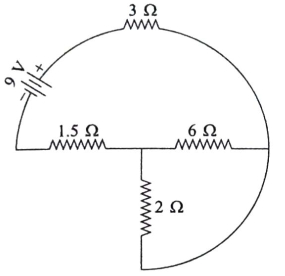
The total current supplied to the circuit by the battery is . . . . . . . (in $A$)
A
$6$
B
$4$
C
$2$
D
$1.5$
Solution
(D) The correct option is $D$.
From the circuit diagram,the $6 \Omega$ and $2 \Omega$ resistors are connected in parallel. Their equivalent resistance $R_p$ is given by:
$R_p = \frac{6 \times 2}{6 + 2} = \frac{12}{8} = 1.5 \Omega$
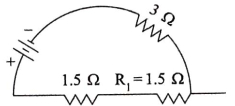
Now,this equivalent resistance $R_p = 1.5 \Omega$ is in series with the $1.5 \Omega$ resistor and the $3 \Omega$ resistor.
Therefore,the total equivalent resistance $R_{eq}$ of the circuit is:
$R_{eq} = 1.5 \Omega + 1.5 \Omega + 3 \Omega = 6 \Omega$
Using Ohm's law,the total current $I$ supplied by the battery is:
$I = \frac{V}{R_{eq}} = \frac{9 \text{ V}}{6 \Omega} = 1.5 \text{ A}$
From the circuit diagram,the $6 \Omega$ and $2 \Omega$ resistors are connected in parallel. Their equivalent resistance $R_p$ is given by:
$R_p = \frac{6 \times 2}{6 + 2} = \frac{12}{8} = 1.5 \Omega$
Now,this equivalent resistance $R_p = 1.5 \Omega$ is in series with the $1.5 \Omega$ resistor and the $3 \Omega$ resistor.
Therefore,the total equivalent resistance $R_{eq}$ of the circuit is:
$R_{eq} = 1.5 \Omega + 1.5 \Omega + 3 \Omega = 6 \Omega$
Using Ohm's law,the total current $I$ supplied by the battery is:
$I = \frac{V}{R_{eq}} = \frac{9 \text{ V}}{6 \Omega} = 1.5 \text{ A}$
0 likesView Solution
7
PhysicsEasyMCQGUJCET · 2016
$A$ student is given $4$ identical batteries having $EMF$ $1.5 \ V$ each and internal resistance of $0.1 \ \Omega$ each. The student is asked to connect them in an assisting manner. By mistake,he connects $1$ battery in reverse way. The resultant $EMF$ and resultant internal resistance offered by the combination is . . . . . . .
A
$3 \ V, 0.4 \ \Omega$
B
$4.5 \ V, 0.3 \ \Omega$
C
$3 \ V, 0.2 \ \Omega$
D
$6.0 \ V, 0.4 \ \Omega$
Solution
(A) The total number of batteries is $n = 4$. Each battery has an $EMF$ $\varepsilon = 1.5 \ V$ and internal resistance $r = 0.1 \ \Omega$.
When batteries are connected in series,if one battery is connected in reverse,its $EMF$ opposes the others.
Resultant $EMF$ $\varepsilon' = (\varepsilon + \varepsilon + \varepsilon) - \varepsilon = 2\varepsilon$.
$\varepsilon' = 2 \times 1.5 \ V = 3 \ V$.
Since internal resistances are always in series regardless of the polarity of the $EMF$,the resultant internal resistance $r'$ is the sum of all individual internal resistances.
$r' = r + r + r + r = 4r$.
$r' = 4 \times 0.1 \ \Omega = 0.4 \ \Omega$.
Therefore,the resultant $EMF$ is $3 \ V$ and the resultant internal resistance is $0.4 \ \Omega$.
When batteries are connected in series,if one battery is connected in reverse,its $EMF$ opposes the others.
Resultant $EMF$ $\varepsilon' = (\varepsilon + \varepsilon + \varepsilon) - \varepsilon = 2\varepsilon$.
$\varepsilon' = 2 \times 1.5 \ V = 3 \ V$.
Since internal resistances are always in series regardless of the polarity of the $EMF$,the resultant internal resistance $r'$ is the sum of all individual internal resistances.
$r' = r + r + r + r = 4r$.
$r' = 4 \times 0.1 \ \Omega = 0.4 \ \Omega$.
Therefore,the resultant $EMF$ is $3 \ V$ and the resultant internal resistance is $0.4 \ \Omega$.
0 likesView Solution
8
PhysicsEasyMCQGUJCET · 2016
The dimensional formula of $k$ (Coulomb's constant) is . . . . . . .
(Take $I$ as the dimension of current.)
(Take $I$ as the dimension of current.)
A
$M^1 L^3 T^{-4} I^{-2}$
B
$M^1 L^3 T^4 I^2$
C
$M^{-1} L^2 T^0 I^{-2}$
D
$M^1 L^{-3} T^4 I^2$
Solution
(A) From Coulomb's law,the force $F$ between two charges $q_1$ and $q_2$ separated by distance $r$ is given by $F = k \frac{q_1 q_2}{r^2}$.
Rearranging for $k$,we get $k = \frac{F r^2}{q_1 q_2}$.
The $SI$ unit of $k$ is $\frac{N \cdot m^2}{C^2}$.
Since $1 \ C = 1 \ A \cdot s$,the unit can be written as $\frac{N \cdot m^2}{A^2 \cdot s^2}$.
The dimensions are: Force $[F] = M^1 L^1 T^{-2}$,distance $[r] = L^1$,current $[I] = I^1$,and time $[t] = T^1$.
Substituting these into the formula for $k$:
$[k] = \frac{[M^1 L^1 T^{-2}] [L^2]}{[I^2] [T^2]} = \frac{M^1 L^3 T^{-2}}{I^2 T^2} = M^1 L^3 T^{-4} I^{-2}$.
Rearranging for $k$,we get $k = \frac{F r^2}{q_1 q_2}$.
The $SI$ unit of $k$ is $\frac{N \cdot m^2}{C^2}$.
Since $1 \ C = 1 \ A \cdot s$,the unit can be written as $\frac{N \cdot m^2}{A^2 \cdot s^2}$.
The dimensions are: Force $[F] = M^1 L^1 T^{-2}$,distance $[r] = L^1$,current $[I] = I^1$,and time $[t] = T^1$.
Substituting these into the formula for $k$:
$[k] = \frac{[M^1 L^1 T^{-2}] [L^2]}{[I^2] [T^2]} = \frac{M^1 L^3 T^{-2}}{I^2 T^2} = M^1 L^3 T^{-4} I^{-2}$.
0 likesView Solution
9
PhysicsEasyMCQGUJCET · 2016
The repulsive force between two particles of same mass and charge,separated by a certain distance,is equal to the weight of one of them. The distance between them is . . . . . . $\times 10^{-1} \ m$.
Mass of particle $= 1.66 \times 10^{-27} \ kg$
Charge of particle $= 1.6 \times 10^{-19} \ C$
$k = 9 \times 10^9 \ MKS, \ g = 10 \ ms^{-2}$
Mass of particle $= 1.66 \times 10^{-27} \ kg$
Charge of particle $= 1.6 \times 10^{-19} \ C$
$k = 9 \times 10^9 \ MKS, \ g = 10 \ ms^{-2}$
A
$1.16$
B
$1.15$
C
$1.17$
D
$1.18$
Solution
(D) Given that the electrostatic repulsive force is equal to the weight of the particle:
$F_e = F_g$
$\frac{k q^2}{r^2} = mg$
Rearranging for $r^2$:
$r^2 = \frac{k q^2}{mg}$
Substituting the given values:
$r^2 = \frac{9 \times 10^9 \times (1.6 \times 10^{-19})^2}{1.66 \times 10^{-27} \times 10}$
$r^2 = \frac{9 \times 2.56 \times 10^{9} \times 10^{-38}}{1.66 \times 10^{-26}}$
$r^2 = \frac{23.04 \times 10^{-29}}{1.66 \times 10^{-26}}$
$r^2 = 13.8795 \times 10^{-3} = 1.38795 \times 10^{-2}$
Taking the square root:
$r = \sqrt{1.38795} \times 10^{-1} \ m$
$r \approx 1.178 \times 10^{-1} \ m$
Rounding to two decimal places,we get $r \approx 1.18 \times 10^{-1} \ m$.
$F_e = F_g$
$\frac{k q^2}{r^2} = mg$
Rearranging for $r^2$:
$r^2 = \frac{k q^2}{mg}$
Substituting the given values:
$r^2 = \frac{9 \times 10^9 \times (1.6 \times 10^{-19})^2}{1.66 \times 10^{-27} \times 10}$
$r^2 = \frac{9 \times 2.56 \times 10^{9} \times 10^{-38}}{1.66 \times 10^{-26}}$
$r^2 = \frac{23.04 \times 10^{-29}}{1.66 \times 10^{-26}}$
$r^2 = 13.8795 \times 10^{-3} = 1.38795 \times 10^{-2}$
Taking the square root:
$r = \sqrt{1.38795} \times 10^{-1} \ m$
$r \approx 1.178 \times 10^{-1} \ m$
Rounding to two decimal places,we get $r \approx 1.18 \times 10^{-1} \ m$.
0 likesView Solution
10
PhysicsEasyMCQGUJCET · 2016
Select the incorrect unit of self inductance.
A
mho-second
B
$\frac{\text{weber}}{\text{ampere}}$
C
$\frac{\text{volt} \cdot \text{second}}{\text{ampere}}$
D
ohm-second
Solution
(A) The self-inductance $L$ is defined by the relation $\phi = LI$,where $\phi$ is magnetic flux and $I$ is current. Thus,$L = \frac{\phi}{I}$.
Units of $L$ are $\frac{\text{weber}}{\text{ampere}}$ (Henry).
Since $\text{weber} = \text{volt} \cdot \text{second}$,the unit is also $\frac{\text{volt} \cdot \text{second}}{\text{ampere}}$.
Since $\text{volt} = \text{ampere} \cdot \text{ohm}$,the unit is $\frac{(\text{ampere} \cdot \text{ohm}) \cdot \text{second}}{\text{ampere}} = \text{ohm} \cdot \text{second}$.
'mho-second' is not a unit of self-inductance,as 'mho' is the unit of conductance $(1/\text{ohm})$.
Units of $L$ are $\frac{\text{weber}}{\text{ampere}}$ (Henry).
Since $\text{weber} = \text{volt} \cdot \text{second}$,the unit is also $\frac{\text{volt} \cdot \text{second}}{\text{ampere}}$.
Since $\text{volt} = \text{ampere} \cdot \text{ohm}$,the unit is $\frac{(\text{ampere} \cdot \text{ohm}) \cdot \text{second}}{\text{ampere}} = \text{ohm} \cdot \text{second}$.
'mho-second' is not a unit of self-inductance,as 'mho' is the unit of conductance $(1/\text{ohm})$.
0 likesView Solution
11
PhysicsEasyMCQGUJCET · 2016
The wavelengths of Gamma rays,$X$-rays,and microwaves are respectively $\lambda_r, \lambda_x$,and $\lambda_m$. Then which of the following relations is correct?
A
$\lambda_r < \lambda_x > \lambda_m$
B
$\lambda_r < \lambda_x < \lambda_m$
C
$\lambda_r > \lambda_x < \lambda_m$
D
$\lambda_r > \lambda_x > \lambda_m$
Solution
(B) The electromagnetic spectrum is ordered by wavelength as follows: Gamma rays < $X$-rays < Ultraviolet < Visible < Infrared < Microwaves < Radio waves.
Given that $\lambda_r$ is the wavelength of Gamma rays,$\lambda_x$ is the wavelength of $X$-rays,and $\lambda_m$ is the wavelength of microwaves.
According to the electromagnetic spectrum,the wavelength of Gamma rays is the shortest and the wavelength of microwaves is much longer than that of $X$-rays.
Therefore,the correct order is $\lambda_r < \lambda_x < \lambda_m$.
Given that $\lambda_r$ is the wavelength of Gamma rays,$\lambda_x$ is the wavelength of $X$-rays,and $\lambda_m$ is the wavelength of microwaves.
According to the electromagnetic spectrum,the wavelength of Gamma rays is the shortest and the wavelength of microwaves is much longer than that of $X$-rays.
Therefore,the correct order is $\lambda_r < \lambda_x < \lambda_m$.
0 likesView Solution
12
PhysicsEasyMCQGUJCET · 2016
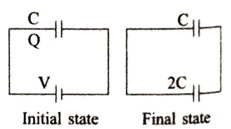
The energy of a charged capacitor is $U$. It is removed from the battery and then connected in parallel to another uncharged capacitor having capacitance twice that of the first one. The energy of the first and second capacitors respectively is . . . . . . .
A
$\frac{1}{9} U , \frac{1}{9} U$
B
$\frac{2}{9} U , \frac{1}{9} U$
C
$\frac{1}{9} U , \frac{2}{9} U$
D
$\frac{2}{9} U , \frac{2}{9} U$
Solution
(C) Initial energy of the capacitor is $U = \frac{Q^2}{2C}$.
When the capacitor is disconnected from the battery and connected in parallel to an uncharged capacitor of capacitance $2C$,the total charge $Q$ is redistributed such that both capacitors have the same potential difference $V'$.
Since they are in parallel,$V' = \frac{Q_1}{C} = \frac{Q_2}{2C}$.
This implies $Q_2 = 2Q_1$.
Since the total charge is conserved,$Q = Q_1 + Q_2 = Q_1 + 2Q_1 = 3Q_1$.
Therefore,$Q_1 = \frac{Q}{3}$ and $Q_2 = \frac{2Q}{3}$.
The new energy of the first capacitor is $U_1 = \frac{Q_1^2}{2C} = \frac{(Q/3)^2}{2C} = \frac{1}{9} \left(\frac{Q^2}{2C}\right) = \frac{1}{9} U$.
The new energy of the second capacitor is $U_2 = \frac{Q_2^2}{2(2C)} = \frac{(2Q/3)^2}{4C} = \frac{4Q^2/9}{4C} = \frac{1}{9} \left(\frac{Q^2}{C}\right) = \frac{2}{9} \left(\frac{Q^2}{2C}\right) = \frac{2}{9} U$.
Thus,the energies are $\frac{1}{9} U$ and $\frac{2}{9} U$ respectively.
When the capacitor is disconnected from the battery and connected in parallel to an uncharged capacitor of capacitance $2C$,the total charge $Q$ is redistributed such that both capacitors have the same potential difference $V'$.
Since they are in parallel,$V' = \frac{Q_1}{C} = \frac{Q_2}{2C}$.
This implies $Q_2 = 2Q_1$.
Since the total charge is conserved,$Q = Q_1 + Q_2 = Q_1 + 2Q_1 = 3Q_1$.
Therefore,$Q_1 = \frac{Q}{3}$ and $Q_2 = \frac{2Q}{3}$.
The new energy of the first capacitor is $U_1 = \frac{Q_1^2}{2C} = \frac{(Q/3)^2}{2C} = \frac{1}{9} \left(\frac{Q^2}{2C}\right) = \frac{1}{9} U$.
The new energy of the second capacitor is $U_2 = \frac{Q_2^2}{2(2C)} = \frac{(2Q/3)^2}{4C} = \frac{4Q^2/9}{4C} = \frac{1}{9} \left(\frac{Q^2}{C}\right) = \frac{2}{9} \left(\frac{Q^2}{2C}\right) = \frac{2}{9} U$.
Thus,the energies are $\frac{1}{9} U$ and $\frac{2}{9} U$ respectively.
0 likesView Solution
13
PhysicsEasyMCQGUJCET · 2016
$A$ proton is moving away from an electron. Find the change in the potential energy of the system.
A
will decrease
B
will increase
C
will remain constant
D
May increase or decrease
Solution
(B) The electrostatic potential energy $U$ of a system of two point charges $q_1$ and $q_2$ separated by a distance $r$ is given by $U = \frac{k q_1 q_2}{r}$,where $k$ is Coulomb's constant.
For a proton $(+e)$ and an electron $(-e)$,the potential energy is $U = \frac{k(e)(-e)}{r} = -\frac{k e^2}{r}$.
As the proton moves away from the electron,the separation distance $r$ increases.
Since $r$ is in the denominator and the potential energy is negative,as $r$ increases,the value of $-\frac{k e^2}{r}$ becomes less negative (i.e.,it approaches zero from the negative side).
Therefore,the potential energy of the system increases.
For a proton $(+e)$ and an electron $(-e)$,the potential energy is $U = \frac{k(e)(-e)}{r} = -\frac{k e^2}{r}$.
As the proton moves away from the electron,the separation distance $r$ increases.
Since $r$ is in the denominator and the potential energy is negative,as $r$ increases,the value of $-\frac{k e^2}{r}$ becomes less negative (i.e.,it approaches zero from the negative side).
Therefore,the potential energy of the system increases.
0 likesView Solution
14
PhysicsEasyMCQGUJCET · 2016
Which of the following is represented by the area enclosed by a hysteresis loop?
A
Retentivity
B
Susceptibility
C
Permeability
D
Heat energy lost per unit volume in the sample.
Solution
(D) The area enclosed by a hysteresis loop ($B-H$ curve) represents the energy dissipated as heat per unit volume during one complete cycle of magnetization and demagnetization of a ferromagnetic material.
Therefore,the correct option is $D$.
Therefore,the correct option is $D$.
0 likesView Solution
15
PhysicsMediumMCQGUJCET · 2016
An $\alpha$-particle of mass $m$ moves on a circular path of radius $r$ in a plane inside and normal to a uniform magnetic field $B$. The time taken by this particle to complete one revolution is . . . . . . .
A
$\frac{4 \pi m}{e B}$
B
$\frac{8 \pi e^2 B}{m}$
C
$\frac{4 \pi e B}{m}$
D
$\frac{\pi m}{e B}$
Solution
(D) The centripetal force required for circular motion is provided by the magnetic Lorentz force.
$F_c = F_m$
$\frac{m v^2}{r} = q_{\alpha} v B$
Since the charge of an $\alpha$-particle is $q_{\alpha} = 2e$,we have:
$\frac{m v}{r} = (2e) B$
We know that the velocity $v$ is related to the time period $T$ by $v = \frac{2 \pi r}{T}$. Substituting this into the equation:
$\frac{m}{r} \left( \frac{2 \pi r}{T} \right) = 2e B$
$\frac{2 \pi m}{T} = 2e B$
Solving for $T$:
$T = \frac{\pi m}{e B}$
Thus,the correct answer is $\frac{\pi m}{e B}$.
$F_c = F_m$
$\frac{m v^2}{r} = q_{\alpha} v B$
Since the charge of an $\alpha$-particle is $q_{\alpha} = 2e$,we have:
$\frac{m v}{r} = (2e) B$
We know that the velocity $v$ is related to the time period $T$ by $v = \frac{2 \pi r}{T}$. Substituting this into the equation:
$\frac{m}{r} \left( \frac{2 \pi r}{T} \right) = 2e B$
$\frac{2 \pi m}{T} = 2e B$
Solving for $T$:
$T = \frac{\pi m}{e B}$
Thus,the correct answer is $\frac{\pi m}{e B}$.
0 likesView Solution
16
PhysicsEasyMCQGUJCET · 2016
When a charged particle moves perpendicular to a uniform magnetic field,then . . . . . . .
A
Both momentum and kinetic energy remain the same.
B
Both momentum and kinetic energy will change.
C
Its momentum changes,but kinetic energy remains the same.
D
Kinetic energy changes,but momentum remains the same.
Solution
(C) The correct option is $C$.
The magnetic force acting on a charged particle is given by $\overrightarrow{F} = q(\vec{v} \times \overrightarrow{B})$.
Since the magnetic force $\overrightarrow{F}$ is always perpendicular to the velocity vector $\vec{v}$,the work done by the magnetic force is zero $(W = \overrightarrow{F} \cdot \vec{d} = 0)$.
According to the work-energy theorem,the change in kinetic energy is equal to the work done. Since the work done is zero,the kinetic energy remains constant.
However,because the force acts perpendicular to the velocity,it changes the direction of the velocity vector. Since momentum $\vec{p} = m\vec{v}$,a change in the direction of velocity implies a change in momentum.
Therefore,the momentum changes,but the kinetic energy remains the same.
The magnetic force acting on a charged particle is given by $\overrightarrow{F} = q(\vec{v} \times \overrightarrow{B})$.
Since the magnetic force $\overrightarrow{F}$ is always perpendicular to the velocity vector $\vec{v}$,the work done by the magnetic force is zero $(W = \overrightarrow{F} \cdot \vec{d} = 0)$.
According to the work-energy theorem,the change in kinetic energy is equal to the work done. Since the work done is zero,the kinetic energy remains constant.
However,because the force acts perpendicular to the velocity,it changes the direction of the velocity vector. Since momentum $\vec{p} = m\vec{v}$,a change in the direction of velocity implies a change in momentum.
Therefore,the momentum changes,but the kinetic energy remains the same.
0 likesView Solution
17
PhysicsEasyMCQGUJCET · 2016
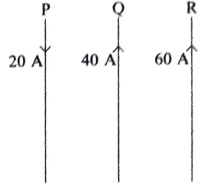
$P, Q$ and $R$ are long parallel straight wires in air,carrying currents $20 \ A, 40 \ A$ and $60 \ A$ as shown in the figure. What is the direction of the resultant force on $Q$?
A
Perpendicular to this page
B
To the right
C
To the left
D
Opposite to that of the current in $Q$
Solution
(B) $1$. Two parallel wires carrying currents in the same direction attract each other,while those carrying currents in opposite directions repel each other.
$2$. In the figure,the current in wire $P$ is downward $(20 \ A)$,while the current in wire $Q$ is upward $(40 \ A)$. Since these currents are anti-parallel,wire $P$ exerts a repulsive force on wire $Q$,pushing it to the right.
$3$. The current in wire $Q$ is upward $(40 \ A)$,and the current in wire $R$ is also upward $(60 \ A)$. Since these currents are parallel,wire $R$ exerts an attractive force on wire $Q$,pulling it to the right.
$4$. Since both forces (repulsion from $P$ and attraction from $R$) act towards the right,the resultant force on wire $Q$ is directed to the right.
$2$. In the figure,the current in wire $P$ is downward $(20 \ A)$,while the current in wire $Q$ is upward $(40 \ A)$. Since these currents are anti-parallel,wire $P$ exerts a repulsive force on wire $Q$,pushing it to the right.
$3$. The current in wire $Q$ is upward $(40 \ A)$,and the current in wire $R$ is also upward $(60 \ A)$. Since these currents are parallel,wire $R$ exerts an attractive force on wire $Q$,pulling it to the right.
$4$. Since both forces (repulsion from $P$ and attraction from $R$) act towards the right,the resultant force on wire $Q$ is directed to the right.
0 likesView Solution
18
PhysicsEasyMCQGUJCET · 2016
The atomic mass number of an element is $\qquad$ .
A
always smaller than its atomic number
B
always greater than its atomic number
C
equal to or greater than its atomic number
D
greater than its atomic number in some cases
Solution
(C) The atomic mass number $(A)$ is defined as the sum of the number of protons $(Z)$ and the number of neutrons $(N)$ in the nucleus,so $A = Z + N$.
Since the number of neutrons $(N)$ is always greater than or equal to zero,the atomic mass number $(A)$ must be greater than or equal to the atomic number $(Z)$.
For the simplest element,Hydrogen $(_{1}^{1}H)$,the number of neutrons is $0$,so $A = Z = 1$.
For all other elements,the number of neutrons is greater than zero,making $A > Z$.
Therefore,the atomic mass number is always equal to or greater than the atomic number.
Since the number of neutrons $(N)$ is always greater than or equal to zero,the atomic mass number $(A)$ must be greater than or equal to the atomic number $(Z)$.
For the simplest element,Hydrogen $(_{1}^{1}H)$,the number of neutrons is $0$,so $A = Z = 1$.
For all other elements,the number of neutrons is greater than zero,making $A > Z$.
Therefore,the atomic mass number is always equal to or greater than the atomic number.
0 likesView Solution
19
PhysicsEasyMCQGUJCET · 2016
If the focal lengths of a lens for red and violet light rays are $f_{R}$ and $f_{V}$ respectively,then which of the following is the true relationship?
A
$f_{R} \leq f_{V}$
B
$f_{R} > f_{V}$
C
$f_{R} = f_{V}$
D
$f_{R} < f_{V}$
Solution
(B) According to the Lens Maker's Formula,the focal length $f$ of a lens is given by $\frac{1}{f} = (n - 1) \left( \frac{1}{R_1} - \frac{1}{R_2} \right)$.
This implies that $f \propto \frac{1}{n - 1}$,where $n$ is the refractive index of the material of the lens.
According to Cauchy's dispersion formula,the refractive index of a material is higher for light of shorter wavelengths (violet) and lower for light of longer wavelengths (red).
Therefore,$n_{V} > n_{R}$.
Since $f$ is inversely proportional to $(n - 1)$,a higher refractive index results in a shorter focal length.
Thus,$f_{V} < f_{R}$ or $f_{R} > f_{V}$.
This implies that $f \propto \frac{1}{n - 1}$,where $n$ is the refractive index of the material of the lens.
According to Cauchy's dispersion formula,the refractive index of a material is higher for light of shorter wavelengths (violet) and lower for light of longer wavelengths (red).
Therefore,$n_{V} > n_{R}$.
Since $f$ is inversely proportional to $(n - 1)$,a higher refractive index results in a shorter focal length.
Thus,$f_{V} < f_{R}$ or $f_{R} > f_{V}$.
0 likesView Solution
20
PhysicsEasyMCQGUJCET · 2016
Which type of semiconductor device does not need any bias voltage?
A
Varactor diode
B
Solar cell
C
Photodiode
D
Transistor
Solution
(B) The correct answer is $B$.
$A$ solar cell is a photovoltaic device that converts light energy directly into electrical energy.
Unlike a photodiode or a varactor diode,which require an external bias voltage to function in their specific modes (reverse bias),a solar cell operates in the fourth quadrant of the $I-V$ characteristic curve without any external bias voltage.
It generates its own electromotive force when exposed to light.
$A$ solar cell is a photovoltaic device that converts light energy directly into electrical energy.
Unlike a photodiode or a varactor diode,which require an external bias voltage to function in their specific modes (reverse bias),a solar cell operates in the fourth quadrant of the $I-V$ characteristic curve without any external bias voltage.
It generates its own electromotive force when exposed to light.
0 likesView Solution
21
PhysicsEasyMCQGUJCET · 2016
In Fraunhofer diffraction by a single slit,the width of the slit is $0.01 \ cm$. If the wavelength of the light incident normally on the slit is $5000 \ \mathring{A}$,the angular distance of the second maxima from the midline of the central maxima is . . . . . . $\text{rad}$.
A
$0.125$
B
$0.15$
C
$0.015$
D
$0.0125$
Solution
(D) For the $n$-th order secondary maxima in single-slit diffraction,the condition is given by:
$a \sin \theta = (n + \frac{1}{2}) \lambda$
Given:
Slit width $a = 0.01 \ cm = 10^{-4} \ m$
Wavelength $\lambda = 5000 \ \mathring{A} = 5 \times 10^{-7} \ m$
Order of maxima $n = 2$
Substituting the values:
$\sin \theta = (2 + \frac{1}{2}) \frac{\lambda}{a}$
$\sin \theta = \frac{2.5 \times 5 \times 10^{-7}}{10^{-4}}$
$\sin \theta = 12.5 \times 10^{-3} = 0.0125$
Since $\theta$ is very small,$\sin \theta \approx \theta$.
Therefore,$\theta = 0.0125 \ \text{rad}$.
$a \sin \theta = (n + \frac{1}{2}) \lambda$
Given:
Slit width $a = 0.01 \ cm = 10^{-4} \ m$
Wavelength $\lambda = 5000 \ \mathring{A} = 5 \times 10^{-7} \ m$
Order of maxima $n = 2$
Substituting the values:
$\sin \theta = (2 + \frac{1}{2}) \frac{\lambda}{a}$
$\sin \theta = \frac{2.5 \times 5 \times 10^{-7}}{10^{-4}}$
$\sin \theta = 12.5 \times 10^{-3} = 0.0125$
Since $\theta$ is very small,$\sin \theta \approx \theta$.
Therefore,$\theta = 0.0125 \ \text{rad}$.
0 likesView Solution
22
PhysicsEasyMCQGUJCET · 2016
$A$ diffraction pattern is formed by blue light. If the blue light is replaced by yellow light, then . . . . . . .
A
the maxima and minima are broadened and become distant.
B
the maxima and minima are narrow and more crowded.
C
the pattern does not change.
D
the diffraction pattern disappears.
Solution
(A) The correct answer is $A$.
In a single-slit diffraction pattern, the angular width of the central maximum is given by $\theta = \frac{2\lambda}{a}$, where $\lambda$ is the wavelength of light and $a$ is the slit width.
This shows that the diffraction effect is directly proportional to the wavelength $(\text{diffraction} \propto \lambda)$.
Since the wavelength of yellow light $(\lambda_{Y})$ is greater than the wavelength of blue light $(\lambda_{B})$, i.e., $\lambda_{Y} > \lambda_{B}$, the diffraction pattern produced by yellow light will be more spread out.
Therefore, the maxima and minima are broadened and become more distant from each other.
In a single-slit diffraction pattern, the angular width of the central maximum is given by $\theta = \frac{2\lambda}{a}$, where $\lambda$ is the wavelength of light and $a$ is the slit width.
This shows that the diffraction effect is directly proportional to the wavelength $(\text{diffraction} \propto \lambda)$.
Since the wavelength of yellow light $(\lambda_{Y})$ is greater than the wavelength of blue light $(\lambda_{B})$, i.e., $\lambda_{Y} > \lambda_{B}$, the diffraction pattern produced by yellow light will be more spread out.
Therefore, the maxima and minima are broadened and become more distant from each other.
0 likesView Solution
Vedclass Products
For Students
Vedclass Test Series
Mock tests in real GUJCET style covering Physics with performance analysis. 5-day free trial.
Start Free TrialFor Teachers
Exam Paper Generator
Generate Set A/B/C/D Physics papers from 7.5L+ questions in 2 minutes. 3 chapters free.
Try FreeFor Institutes
Online Exam Module
Run live GUJCET mock exams with unlimited students, 360° analytics & white-label branding.
See DemoFrequently Asked Questions
How many Physics questions are in GUJCET 2016?
There are 22 Physics questions from the GUJCET 2016 paper on Vedclass, each with a detailed step-by-step solution in English.
Are GUJCET 2016 Physics solutions available in English?
Yes. All solutions on this page are in English. You can also switch to English or Hindi using the language buttons above the questions.
Can I practice GUJCET 2016 Physics as a timed test?
Yes. Use the Vedclass Test Series to attempt a full GUJCET mock test covering Physics with time limits and instant score analysis.
Can teachers create Physics papers from GUJCET previous year questions?
Yes. The Vedclass Exam Paper Generator lets teachers mix GUJCET Physics questions and generate Set A/B/C/D papers in minutes.
For Teachers & Institutes
Build a Custom Physics Paper
Pick GUJCET 2016 Physics questions, set difficulty, and generate Set A/B/C/D in 2 minutes.