
PhysicsQ151–205 of 372 questions
Page 4 of 5 · English
151
PhysicsMediumMCQAP EAMCET · 2021
$A$ wall has two layers $A$ and $B$,each made of different materials. Both layers are of the same thickness. The thermal conductivity of material $A$ is twice that of $B$. If in the steady state,the temperature difference across the wall is $24^{\circ} C$,then the temperature difference across the layer $B$ is (in $^{\circ} C$)
A
$8$
B
$12$
C
$16$
D
$20$
Solution
(C) In the steady state,the rate of heat flow $(H)$ through both layers connected in series is the same.
Let $l$ be the thickness of each layer and $A$ be the cross-sectional area.
Let $K_A$ and $K_B$ be the thermal conductivities of layers $A$ and $B$ respectively.
Given: $K_A = 2K_B$.
The rate of heat flow is given by $H = \frac{K A \Delta T}{l}$.
Since $H$ is constant for both layers:
$H = \frac{K_A A \Delta T_A}{l} = \frac{K_B A \Delta T_B}{l}$
where $\Delta T_A$ and $\Delta T_B$ are the temperature differences across layers $A$ and $B$ respectively.
Canceling $A$ and $l$ from both sides:
$K_A \Delta T_A = K_B \Delta T_B$
Substituting $K_A = 2K_B$:
$2K_B \Delta T_A = K_B \Delta T_B \Rightarrow \Delta T_B = 2 \Delta T_A$
The total temperature difference across the wall is $\Delta T_A + \Delta T_B = 24^{\circ} C$.
Substituting $\Delta T_B = 2 \Delta T_A$ into the equation:
$\Delta T_A + 2 \Delta T_A = 24^{\circ} C$
$3 \Delta T_A = 24^{\circ} C \Rightarrow \Delta T_A = 8^{\circ} C$.
Therefore,the temperature difference across layer $B$ is:
$\Delta T_B = 2 \times 8^{\circ} C = 16^{\circ} C$.
Let $l$ be the thickness of each layer and $A$ be the cross-sectional area.
Let $K_A$ and $K_B$ be the thermal conductivities of layers $A$ and $B$ respectively.
Given: $K_A = 2K_B$.
The rate of heat flow is given by $H = \frac{K A \Delta T}{l}$.
Since $H$ is constant for both layers:
$H = \frac{K_A A \Delta T_A}{l} = \frac{K_B A \Delta T_B}{l}$
where $\Delta T_A$ and $\Delta T_B$ are the temperature differences across layers $A$ and $B$ respectively.
Canceling $A$ and $l$ from both sides:
$K_A \Delta T_A = K_B \Delta T_B$
Substituting $K_A = 2K_B$:
$2K_B \Delta T_A = K_B \Delta T_B \Rightarrow \Delta T_B = 2 \Delta T_A$
The total temperature difference across the wall is $\Delta T_A + \Delta T_B = 24^{\circ} C$.
Substituting $\Delta T_B = 2 \Delta T_A$ into the equation:
$\Delta T_A + 2 \Delta T_A = 24^{\circ} C$
$3 \Delta T_A = 24^{\circ} C \Rightarrow \Delta T_A = 8^{\circ} C$.
Therefore,the temperature difference across layer $B$ is:
$\Delta T_B = 2 \times 8^{\circ} C = 16^{\circ} C$.
0 likesView Solution
152
PhysicsMediumMCQAP EAMCET · 2021
In a steady state,the temperature at the end $A$ and end $B$ of a $20 \ cm$ long rod $AB$ are $100^{\circ} C$ and $0^{\circ} C$. The temperature of a point,$9 \ cm$ from $A$ is (in $^{\circ} C$)
A
$55$
B
$45$
C
$65$
D
$50$
Solution
(A) At steady state,the temperature at different parts of the rod remains constant and is independent of time. The temperature gradient,which is the ratio of the temperature difference to the distance between two points,is constant throughout the rod.
Let $T_C$ be the temperature at a point $C$ located $9 \ cm$ from end $A$.
The temperature gradient is given by:
$\frac{T_A - T_C}{x_C - x_A} = \frac{T_A - T_B}{L}$
Substituting the given values:
$\frac{100 - T_C}{9} = \frac{100 - 0}{20}$
$\frac{100 - T_C}{9} = \frac{100}{20}$
$100 - T_C = 5 \times 9$
$100 - T_C = 45$
$T_C = 100 - 45 = 55^{\circ} C$
Therefore,the temperature at the point is $55^{\circ} C$.
Let $T_C$ be the temperature at a point $C$ located $9 \ cm$ from end $A$.
The temperature gradient is given by:
$\frac{T_A - T_C}{x_C - x_A} = \frac{T_A - T_B}{L}$
Substituting the given values:
$\frac{100 - T_C}{9} = \frac{100 - 0}{20}$
$\frac{100 - T_C}{9} = \frac{100}{20}$
$100 - T_C = 5 \times 9$
$100 - T_C = 45$
$T_C = 100 - 45 = 55^{\circ} C$
Therefore,the temperature at the point is $55^{\circ} C$.
0 likesView Solution
153
PhysicsMediumMCQAP EAMCET · 2021
$A$ body cools down from $52.5^{\circ} C$ to $47.5^{\circ} C$ in $5 \ min$ and from $47.5^{\circ} C$ to $42.5^{\circ} C$ in $7.5 \ min$. Then,the temperature of the surroundings is (in $^{\circ} C$)
A
$39$
B
$25$
C
$35$
D
$15$
Solution
(C) According to Newton's Law of Cooling,the rate of cooling is proportional to the difference between the average temperature of the body and the surrounding temperature: $\frac{dT}{dt} = -K(T_{av} - T_0)$.
For the first interval: $\Delta T_1 = 52.5^{\circ} C - 47.5^{\circ} C = 5^{\circ} C$,$t_1 = 5 \ min$,$T_{av1} = \frac{52.5 + 47.5}{2} = 50^{\circ} C$. Thus,$\frac{5}{5} = K(50 - T_0) \Rightarrow 1 = K(50 - T_0) \dots (i)$.
For the second interval: $\Delta T_2 = 47.5^{\circ} C - 42.5^{\circ} C = 5^{\circ} C$,$t_2 = 7.5 \ min$,$T_{av2} = \frac{47.5 + 42.5}{2} = 45^{\circ} C$. Thus,$\frac{5}{7.5} = K(45 - T_0) \Rightarrow \frac{2}{3} = K(45 - T_0) \dots (ii)$.
Dividing $(i)$ by $(ii)$: $\frac{1}{2/3} = \frac{K(50 - T_0)}{K(45 - T_0)} \Rightarrow \frac{3}{2} = \frac{50 - T_0}{45 - T_0}$.
Cross-multiplying: $3(45 - T_0) = 2(50 - T_0) \Rightarrow 135 - 3T_0 = 100 - 2T_0$.
Solving for $T_0$: $T_0 = 135 - 100 = 35^{\circ} C$.
For the first interval: $\Delta T_1 = 52.5^{\circ} C - 47.5^{\circ} C = 5^{\circ} C$,$t_1 = 5 \ min$,$T_{av1} = \frac{52.5 + 47.5}{2} = 50^{\circ} C$. Thus,$\frac{5}{5} = K(50 - T_0) \Rightarrow 1 = K(50 - T_0) \dots (i)$.
For the second interval: $\Delta T_2 = 47.5^{\circ} C - 42.5^{\circ} C = 5^{\circ} C$,$t_2 = 7.5 \ min$,$T_{av2} = \frac{47.5 + 42.5}{2} = 45^{\circ} C$. Thus,$\frac{5}{7.5} = K(45 - T_0) \Rightarrow \frac{2}{3} = K(45 - T_0) \dots (ii)$.
Dividing $(i)$ by $(ii)$: $\frac{1}{2/3} = \frac{K(50 - T_0)}{K(45 - T_0)} \Rightarrow \frac{3}{2} = \frac{50 - T_0}{45 - T_0}$.
Cross-multiplying: $3(45 - T_0) = 2(50 - T_0) \Rightarrow 135 - 3T_0 = 100 - 2T_0$.
Solving for $T_0$: $T_0 = 135 - 100 = 35^{\circ} C$.
0 likesView Solution
154
PhysicsEasyMCQAP EAMCET · 2021
Newton's law of cooling holds good provided the temperature difference between the body and the surrounding is
A
very large
B
large
C
small
D
very small
Solution
(C) Newton's law of cooling is an empirical law that states that the rate of loss of heat of a body is directly proportional to the difference in temperature between the body and its surroundings.
This law is derived from the Stefan-Boltzmann law under the approximation that the temperature difference $\Delta T = T - T_s$ is small compared to the absolute temperature $T_s$ of the surroundings.
Therefore,Newton's law of cooling holds good only when the temperature difference between the body and the surrounding is small.
This law is derived from the Stefan-Boltzmann law under the approximation that the temperature difference $\Delta T = T - T_s$ is small compared to the absolute temperature $T_s$ of the surroundings.
Therefore,Newton's law of cooling holds good only when the temperature difference between the body and the surrounding is small.
0 likesView Solution
155
PhysicsDifficultMCQAP EAMCET · 2021
$A$ cylinder has a piston at a temperature of $30^{\circ} C$. There is an all-round clearance of $0.08 \ mm$ between the piston and the cylinder wall. If the internal diameter of the cylinder is $15 \ cm$,what is the temperature at which the piston will fit into the cylinder exactly (in $^{\circ} C$)? $(\alpha_p = 1.6 \times 10^{-5} /^{\circ} C$ and $\alpha_c = 1.2 \times 10^{-5} /^{\circ} C)$
A
$298$
B
$273$
C
$305$
D
$268$
Solution
(A) For the piston to fit exactly into the cylinder,the difference in thermal expansion between the piston and the cylinder must compensate for the total clearance along the diameter.
Given the clearance is $0.08 \ mm$ all around,the total clearance along the diameter is $\delta = 2 \times 0.08 \ mm = 0.16 \ mm$.
The formula for linear expansion is $\Delta L = \alpha L \Delta T$.
The difference in expansion between the piston and the cylinder is $\delta = (\alpha_p - \alpha_c) L \Delta T$.
Here,$L = 15 \ cm = 150 \ mm$,$\alpha_p = 1.6 \times 10^{-5} /^{\circ} C$,and $\alpha_c = 1.2 \times 10^{-5} /^{\circ} C$.
Substituting the values: $0.16 \ mm = (1.6 \times 10^{-5} - 1.2 \times 10^{-5}) \times 150 \ mm \times \Delta T$.
$0.16 = (0.4 \times 10^{-5}) \times 150 \times \Delta T$.
$\Delta T = \frac{0.16}{60 \times 10^{-5}} = \frac{0.16}{0.0006} = 266.67^{\circ} C \approx 268^{\circ} C$ (using provided options).
Final temperature $T = T_0 + \Delta T = 30^{\circ} C + 268^{\circ} C = 298^{\circ} C$.
Given the clearance is $0.08 \ mm$ all around,the total clearance along the diameter is $\delta = 2 \times 0.08 \ mm = 0.16 \ mm$.
The formula for linear expansion is $\Delta L = \alpha L \Delta T$.
The difference in expansion between the piston and the cylinder is $\delta = (\alpha_p - \alpha_c) L \Delta T$.
Here,$L = 15 \ cm = 150 \ mm$,$\alpha_p = 1.6 \times 10^{-5} /^{\circ} C$,and $\alpha_c = 1.2 \times 10^{-5} /^{\circ} C$.
Substituting the values: $0.16 \ mm = (1.6 \times 10^{-5} - 1.2 \times 10^{-5}) \times 150 \ mm \times \Delta T$.
$0.16 = (0.4 \times 10^{-5}) \times 150 \times \Delta T$.
$\Delta T = \frac{0.16}{60 \times 10^{-5}} = \frac{0.16}{0.0006} = 266.67^{\circ} C \approx 268^{\circ} C$ (using provided options).
Final temperature $T = T_0 + \Delta T = 30^{\circ} C + 268^{\circ} C = 298^{\circ} C$.
0 likesView Solution
156
PhysicsEasyMCQAP EAMCET · 2021
If two rods of lengths $L$ and $2L$,having coefficients of linear expansion $\alpha$ and $2\alpha$ respectively are connected end-to-end,then find the average coefficient of linear expansion of the composite rod.
A
$\frac{3\alpha}{2}$
B
$\frac{5\alpha}{2}$
C
$\frac{5\alpha}{4}$
D
$\frac{5\alpha}{3}$
Solution
(D) The change in length for the first rod is $\Delta L_1 = \alpha \Delta T L$.
The change in length for the second rod is $\Delta L_2 = (2\alpha) \Delta T (2L) = 4\alpha \Delta T L$.
Since the rods are connected end-to-end,the total change in length is $\Delta L_{net} = \Delta L_1 + \Delta L_2 = \alpha \Delta T L + 4\alpha \Delta T L = 5\alpha \Delta T L$.
The total length of the composite rod is $L_{total} = L + 2L = 3L$.
For the composite rod,$\Delta L_{net} = \alpha_{eff} \Delta T L_{total}$.
Substituting the values,$5\alpha \Delta T L = \alpha_{eff} \Delta T (3L)$.
Solving for $\alpha_{eff}$,we get $\alpha_{eff} = \frac{5\alpha}{3}$.
The change in length for the second rod is $\Delta L_2 = (2\alpha) \Delta T (2L) = 4\alpha \Delta T L$.
Since the rods are connected end-to-end,the total change in length is $\Delta L_{net} = \Delta L_1 + \Delta L_2 = \alpha \Delta T L + 4\alpha \Delta T L = 5\alpha \Delta T L$.
The total length of the composite rod is $L_{total} = L + 2L = 3L$.
For the composite rod,$\Delta L_{net} = \alpha_{eff} \Delta T L_{total}$.
Substituting the values,$5\alpha \Delta T L = \alpha_{eff} \Delta T (3L)$.
Solving for $\alpha_{eff}$,we get $\alpha_{eff} = \frac{5\alpha}{3}$.
0 likesView Solution
157
PhysicsMediumMCQAP EAMCET · 2021
Match the following?
| Column-$I$ | Column-$II$ |
|---|---|
| $(a)$ Ratio of change in time period of a simple pendulum with temperature to its original time period | $(i) \, \alpha \Delta T$ |
| $(b)$ Ratio of the value of a length to its scale reading | $(ii) \, T$ |
| $(c)$ Reciprocal of coefficient of volume expansion for an ideal gas of constant pressure | $(iii) \, (1 + \alpha \Delta T)$ |
| $(d) \, \frac{F}{YA} =$ | $(iv) \, \frac{1}{2} \alpha \Delta T$ |
A
$(a-iv), (b-ii), (c-i), (d-ii)$
B
$(a-iii), (b-iv), (c-ii), (d-i)$
C
$(a-iv), (b-i), (c-ii), (d-iii)$
D
$(a-iv), (b-iii), (c-ii), (d-i)$
Solution
(D) The time period of a simple pendulum is $T = 2\pi \sqrt{\frac{L}{g}}$. The fractional change in time period due to temperature change $\Delta T$ is $\frac{\Delta T}{T} = \frac{1}{2} \alpha \Delta T$. Thus, $(a) - (iv)$.
$(b)$ The ratio of the actual length to the scale reading is given by the factor $(1 + \alpha \Delta T)$ due to thermal expansion of the scale. Thus, $(b) - (iii)$.
$(c)$ For an ideal gas at constant pressure, the coefficient of volume expansion $\gamma = \frac{1}{T}$. Therefore, the reciprocal is $T$. Thus, $(c) - (ii)$.
$(d)$ From Hooke's Law, $\frac{F}{A} = Y \frac{\Delta L}{L}$, so $\frac{F}{YA} = \frac{\Delta L}{L} = \alpha \Delta T$. Thus, $(d) - (i)$.
Combining these, the correct match is $(a-iv), (b-iii), (c-ii), (d-i)$.
$(b)$ The ratio of the actual length to the scale reading is given by the factor $(1 + \alpha \Delta T)$ due to thermal expansion of the scale. Thus, $(b) - (iii)$.
$(c)$ For an ideal gas at constant pressure, the coefficient of volume expansion $\gamma = \frac{1}{T}$. Therefore, the reciprocal is $T$. Thus, $(c) - (ii)$.
$(d)$ From Hooke's Law, $\frac{F}{A} = Y \frac{\Delta L}{L}$, so $\frac{F}{YA} = \frac{\Delta L}{L} = \alpha \Delta T$. Thus, $(d) - (i)$.
Combining these, the correct match is $(a-iv), (b-iii), (c-ii), (d-i)$.
0 likesView Solution
158
PhysicsEasyMCQAP EAMCET · 2021
Expansion during heating:
A
increases the weight of a material
B
decreases density of material
C
occurs only in solids
D
occurs at the same rate for all liquids and solids
Solution
(B) Thermal expansion is the process where the volume of matter changes in response to a change in temperature.
When a substance is heated,its particles gain kinetic energy and move further apart,leading to an increase in volume.
Since density is defined as $\rho = \frac{m}{V}$,where $m$ is mass and $V$ is volume,an increase in volume $V$ for a constant mass $m$ results in a decrease in density $\rho$.
Therefore,expansion during heating decreases the density of the material.
When a substance is heated,its particles gain kinetic energy and move further apart,leading to an increase in volume.
Since density is defined as $\rho = \frac{m}{V}$,where $m$ is mass and $V$ is volume,an increase in volume $V$ for a constant mass $m$ results in a decrease in density $\rho$.
Therefore,expansion during heating decreases the density of the material.
0 likesView Solution
159
PhysicsMediumMCQAP EAMCET · 2021
If the volume of a block of metal changes by $0.12 \%$ when heated through $20^{\circ} C$,then find its coefficient of linear expansion.
A
$4 \times 10^{-5} {}^{\circ} C^{-1}$
B
$4 \times 10^{-4} {}^{\circ} C^{-1}$
C
$2 \times 10^{-5} {}^{\circ} C^{-1}$
D
$2 \times 10^{-4} {}^{\circ} C^{-1}$
Solution
(C) The fractional change in volume is given by $\frac{\Delta V}{V} = 0.12 \% = \frac{0.12}{100} = 1.2 \times 10^{-3}$.
Given the temperature change $\Delta T = 20^{\circ} C$.
The formula for volumetric expansion is $\frac{\Delta V}{V} = \gamma \Delta T$,where $\gamma$ is the coefficient of volumetric expansion.
Substituting the values: $1.2 \times 10^{-3} = \gamma \times 20$.
$\gamma = \frac{1.2 \times 10^{-3}}{20} = 0.06 \times 10^{-3} = 6 \times 10^{-5} {}^{\circ} C^{-1}$.
The relationship between the coefficient of volumetric expansion $\gamma$ and the coefficient of linear expansion $\alpha$ is $\gamma = 3\alpha$.
Therefore,$\alpha = \frac{\gamma}{3} = \frac{6 \times 10^{-5}}{3} = 2 \times 10^{-5} {}^{\circ} C^{-1}$.
Given the temperature change $\Delta T = 20^{\circ} C$.
The formula for volumetric expansion is $\frac{\Delta V}{V} = \gamma \Delta T$,where $\gamma$ is the coefficient of volumetric expansion.
Substituting the values: $1.2 \times 10^{-3} = \gamma \times 20$.
$\gamma = \frac{1.2 \times 10^{-3}}{20} = 0.06 \times 10^{-3} = 6 \times 10^{-5} {}^{\circ} C^{-1}$.
The relationship between the coefficient of volumetric expansion $\gamma$ and the coefficient of linear expansion $\alpha$ is $\gamma = 3\alpha$.
Therefore,$\alpha = \frac{\gamma}{3} = \frac{6 \times 10^{-5}}{3} = 2 \times 10^{-5} {}^{\circ} C^{-1}$.
0 likesView Solution
160
PhysicsMediumMCQAP EAMCET · 2021
$A$ glass vessel of volume $V_0$ is completely filled with a liquid and its temperature is raised by $\Delta T$. What volume of the liquid will flow over,if the coefficient of linear expansion of glass is $\alpha_g$ and the coefficient of volume expansion of the liquid is $\gamma_L$?
A
$V_0 \Delta T(\gamma_L - 3\alpha_g)$
B
$V_0 \Delta T(3\alpha_g - \gamma_L)$
C
$(\gamma_L - 3\alpha_g) \Delta T$
D
$(3\alpha_g - \gamma_L) \Delta T$
Solution
(A) The volume of the liquid that overflows is equal to the difference between the expansion of the liquid and the expansion of the glass vessel.
Increase in volume of liquid,$\Delta V_L = V_0 \gamma_L \Delta T$.
Increase in volume of the glass vessel,$\Delta V_g = V_0 \gamma_g \Delta T$.
Since the coefficient of volume expansion $\gamma_g = 3\alpha_g$,we have $\Delta V_g = V_0 (3\alpha_g) \Delta T$.
The volume of liquid that overflows is $\Delta V_{overflow} = \Delta V_L - \Delta V_g$.
$\Delta V_{overflow} = V_0 \gamma_L \Delta T - V_0 (3\alpha_g) \Delta T$.
$\Delta V_{overflow} = V_0 \Delta T (\gamma_L - 3\alpha_g)$.
Increase in volume of liquid,$\Delta V_L = V_0 \gamma_L \Delta T$.
Increase in volume of the glass vessel,$\Delta V_g = V_0 \gamma_g \Delta T$.
Since the coefficient of volume expansion $\gamma_g = 3\alpha_g$,we have $\Delta V_g = V_0 (3\alpha_g) \Delta T$.
The volume of liquid that overflows is $\Delta V_{overflow} = \Delta V_L - \Delta V_g$.
$\Delta V_{overflow} = V_0 \gamma_L \Delta T - V_0 (3\alpha_g) \Delta T$.
$\Delta V_{overflow} = V_0 \Delta T (\gamma_L - 3\alpha_g)$.
0 likesView Solution
161
PhysicsEasyMCQAP EAMCET · 2021
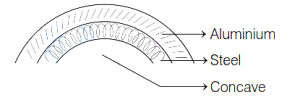
$A$ bimetallic strip is made of aluminium and steel $(\alpha_{Al} > \alpha_{\text{steel}})$. On heating,the strip will
A
remain straight
B
get twisted
C
bend with aluminium on concave side
D
bend with steel on concave side
Solution
(D) The change in length of a material due to thermal expansion is given by $\Delta l = l_0 \alpha \Delta T$,where $l_0$ is the initial length,$\alpha$ is the coefficient of linear expansion,and $\Delta T$ is the change in temperature.
Since $\alpha_{Al} > \alpha_{\text{steel}}$,for the same change in temperature $\Delta T$,the aluminium part will expand more than the steel part $(\Delta l_{Al} > \Delta l_{\text{steel}})$.
Because the aluminium expands more,it will form the outer (convex) side of the curve,while the steel,which expands less,will form the inner (concave) side of the curve.
Therefore,the strip will bend with steel on the concave side.
Since $\alpha_{Al} > \alpha_{\text{steel}}$,for the same change in temperature $\Delta T$,the aluminium part will expand more than the steel part $(\Delta l_{Al} > \Delta l_{\text{steel}})$.
Because the aluminium expands more,it will form the outer (convex) side of the curve,while the steel,which expands less,will form the inner (concave) side of the curve.
Therefore,the strip will bend with steel on the concave side.
0 likesView Solution
162
PhysicsMediumMCQAP EAMCET · 2021
When a meter rod made of silver at $0^{\circ} C$ is heated to $100^{\circ} C$,its length increases by $0.19 \ cm$. Find the coefficient of volume expansion of the silver.
A
$0.63 \times 10^{-5} \ ^{\circ}C^{-1}$
B
$1.9 \times 10^{-5} \ ^{\circ}C^{-1}$
C
$5.7 \times 10^{-5} \ ^{\circ}C^{-1}$
D
$16.1 \times 10^{-5} \ ^{\circ}C^{-1}$
Solution
(C) Given: Length of silver rod,$L = 1 \ m = 100 \ cm$.
Initial temperature,$T_1 = 0^{\circ}C$.
Final temperature,$T_2 = 100^{\circ}C$.
Change in temperature,$\Delta T = T_2 - T_1 = 100^{\circ}C$.
Increase in length,$\Delta L = 0.19 \ cm$.
The formula for linear expansion is $\Delta L = L \alpha \Delta T$,where $\alpha$ is the coefficient of linear expansion.
Substituting the values: $0.19 = 100 \times \alpha \times 100$.
$\alpha = \frac{0.19}{10000} = 0.19 \times 10^{-4} \ ^{\circ}C^{-1} = 1.9 \times 10^{-5} \ ^{\circ}C^{-1}$.
The coefficient of volume expansion $\gamma$ is related to $\alpha$ by $\gamma = 3\alpha$.
$\gamma = 3 \times 1.9 \times 10^{-5} \ ^{\circ}C^{-1} = 5.7 \times 10^{-5} \ ^{\circ}C^{-1}$.
Initial temperature,$T_1 = 0^{\circ}C$.
Final temperature,$T_2 = 100^{\circ}C$.
Change in temperature,$\Delta T = T_2 - T_1 = 100^{\circ}C$.
Increase in length,$\Delta L = 0.19 \ cm$.
The formula for linear expansion is $\Delta L = L \alpha \Delta T$,where $\alpha$ is the coefficient of linear expansion.
Substituting the values: $0.19 = 100 \times \alpha \times 100$.
$\alpha = \frac{0.19}{10000} = 0.19 \times 10^{-4} \ ^{\circ}C^{-1} = 1.9 \times 10^{-5} \ ^{\circ}C^{-1}$.
The coefficient of volume expansion $\gamma$ is related to $\alpha$ by $\gamma = 3\alpha$.
$\gamma = 3 \times 1.9 \times 10^{-5} \ ^{\circ}C^{-1} = 5.7 \times 10^{-5} \ ^{\circ}C^{-1}$.
0 likesView Solution
163
PhysicsMediumMCQAP EAMCET · 2021
The water on the surface of a lake is just about to freeze. The most likely temperature at the bottom of the lake is (in $^{\circ} C$)
A
$4$
B
$0$
C
$-4$
D
$-273$
Solution
(A) Water exhibits anomalous expansion. Its density is maximum at $4^{\circ} C$.
When the surface water cools to $0^{\circ} C$ and begins to freeze,the denser water at $4^{\circ} C$ settles at the bottom of the lake.
Therefore,the temperature at the bottom of the lake remains $4^{\circ} C$.
When the surface water cools to $0^{\circ} C$ and begins to freeze,the denser water at $4^{\circ} C$ settles at the bottom of the lake.
Therefore,the temperature at the bottom of the lake remains $4^{\circ} C$.
0 likesView Solution
164
PhysicsEasyMCQAP EAMCET · 2021
Oxygen boils at $-183^{\circ} C$. This temperature is approximately (in $^{\circ} F$)
A
$215$
B
$-297$
C
$329$
D
$361$
Solution
(B) The relationship between temperature in Celsius $(C)$ and Fahrenheit $(F)$ is given by the formula: $\frac{C}{5} = \frac{F - 32}{9}$.
Rearranging the formula to solve for $F$,we get: $F = C \times \frac{9}{5} + 32$.
Substituting the value $C = -183^{\circ} C$ into the equation:
$F = -183 \times \frac{9}{5} + 32$
$F = -36.6 \times 9 + 32$
$F = -329.4 + 32$
$F = -297.4^{\circ} F$.
Rounding to the nearest integer,we get $-297^{\circ} F$.
Rearranging the formula to solve for $F$,we get: $F = C \times \frac{9}{5} + 32$.
Substituting the value $C = -183^{\circ} C$ into the equation:
$F = -183 \times \frac{9}{5} + 32$
$F = -36.6 \times 9 + 32$
$F = -329.4 + 32$
$F = -297.4^{\circ} F$.
Rounding to the nearest integer,we get $-297^{\circ} F$.
0 likesView Solution
165
PhysicsMediumMCQAP EAMCET · 2021
$A$ system is taken from state $A$ to state $B$ along two different paths. The heat absorbed and work done by the system along these two paths are $Q_1, Q_2$ and $W_1, W_2$ respectively,then
A
$Q_1=Q_2$
B
$W_1=W_2$
C
$Q_1-W_1=Q_2-W_2$
D
$Q_1+W_1=Q_2+W_2$
Solution
(C) Internal energy for a thermodynamic process is a state function,meaning it does not depend upon the path taken; it only depends upon the initial and final states of the system.
Therefore,if two different processes have the same initial and final states,the change in internal energy $\Delta U$ will be the same for both processes.
According to the first law of thermodynamics: $Q = W + \Delta U$,which can be rearranged as $\Delta U = Q - W$.
For path $1$: $\Delta U = Q_1 - W_1$.
For path $2$: $\Delta U = Q_2 - W_2$.
Since $\Delta U$ is the same for both paths,we have: $Q_1 - W_1 = Q_2 - W_2$.
Therefore,if two different processes have the same initial and final states,the change in internal energy $\Delta U$ will be the same for both processes.
According to the first law of thermodynamics: $Q = W + \Delta U$,which can be rearranged as $\Delta U = Q - W$.
For path $1$: $\Delta U = Q_1 - W_1$.
For path $2$: $\Delta U = Q_2 - W_2$.
Since $\Delta U$ is the same for both paths,we have: $Q_1 - W_1 = Q_2 - W_2$.
0 likesView Solution
166
PhysicsMediumMCQAP EAMCET · 2021
Which one of the graphs below best illustrates the relationship between internal energy $U$ of an ideal gas and temperature $T$ of the gas in $K$?
A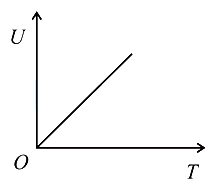
B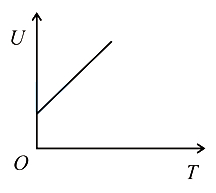
C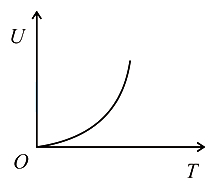
D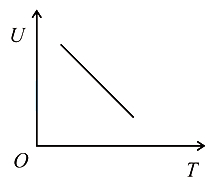
Solution
(A) For an ideal gas,the intermolecular forces are assumed to be negligible,and collisions are perfectly elastic.
Consequently,the internal energy $U$ of an ideal gas is solely a function of its absolute temperature $T$.
According to the kinetic theory of gases,the internal energy of an ideal gas is given by $U = \frac{f}{2} nRT$,where $f$ is the degrees of freedom,$n$ is the number of moles,$R$ is the universal gas constant,and $T$ is the temperature in Kelvin.
Since $U \propto T$,the relationship between internal energy $U$ and temperature $T$ is linear,passing through the origin $(0, 0)$.
Therefore,the graph that best illustrates this relationship is a straight line passing through the origin,which corresponds to Graph $A$.
Consequently,the internal energy $U$ of an ideal gas is solely a function of its absolute temperature $T$.
According to the kinetic theory of gases,the internal energy of an ideal gas is given by $U = \frac{f}{2} nRT$,where $f$ is the degrees of freedom,$n$ is the number of moles,$R$ is the universal gas constant,and $T$ is the temperature in Kelvin.
Since $U \propto T$,the relationship between internal energy $U$ and temperature $T$ is linear,passing through the origin $(0, 0)$.
Therefore,the graph that best illustrates this relationship is a straight line passing through the origin,which corresponds to Graph $A$.
0 likesView Solution
167
PhysicsDifficultMCQAP EAMCET · 2021
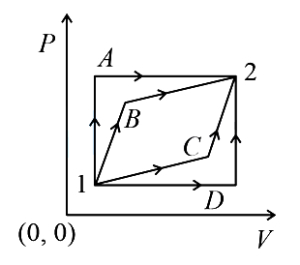
An ideal gas is taken from state-$1$ to state-$2$ through paths $A, B, C$ and $D$ as shown in the $P-V$ diagram. Let $Q, W$ and $\Delta U$ represent the heat supplied,work done,and change in internal energy respectively. Then:
A
$Q_A - W_A = Q_D - W_D$
B
$Q_B - W_B > Q_C - W_C$
C
$W_A < W_B < W_C < W_D$
D
$Q_A < Q_B < Q_C < Q_D$
Solution
(A) According to the first law of thermodynamics,$\Delta U = Q - W$,which implies $Q - W = \Delta U$.
Since internal energy $(U)$ is a state function,the change in internal energy $(\Delta U)$ depends only on the initial and final states.
For all paths $(A, B, C, D)$,the initial state is $1$ and the final state is $2$.
Therefore,the change in internal energy is the same for all paths: $\Delta U_A = \Delta U_B = \Delta U_C = \Delta U_D$.
Since $Q - W = \Delta U$,it follows that $Q_A - W_A = Q_B - W_B = Q_C - W_C = Q_D - W_D$.
Thus,the expression $Q - W$ is constant for all paths connecting the same two states.
Comparing this with the given options,option $A$ is correct because $Q_A - W_A = \Delta U$ and $Q_D - W_D = \Delta U$,so $Q_A - W_A = Q_D - W_D$.
Since internal energy $(U)$ is a state function,the change in internal energy $(\Delta U)$ depends only on the initial and final states.
For all paths $(A, B, C, D)$,the initial state is $1$ and the final state is $2$.
Therefore,the change in internal energy is the same for all paths: $\Delta U_A = \Delta U_B = \Delta U_C = \Delta U_D$.
Since $Q - W = \Delta U$,it follows that $Q_A - W_A = Q_B - W_B = Q_C - W_C = Q_D - W_D$.
Thus,the expression $Q - W$ is constant for all paths connecting the same two states.
Comparing this with the given options,option $A$ is correct because $Q_A - W_A = \Delta U$ and $Q_D - W_D = \Delta U$,so $Q_A - W_A = Q_D - W_D$.
0 likesView Solution
168
PhysicsEasyMCQAP EAMCET · 2021
In a given process,for an ideal gas,$\Delta W = 0$ and $\Delta Q < 0$. Then,for the gas,
A
the temperature will decrease
B
the volume will increase
C
the pressure will remain constant
D
the temperature will increase
Solution
(A) In the given process,for an ideal gas,$\Delta W = 0$ and $\Delta Q < 0$.
According to the first law of thermodynamics,$\Delta Q = \Delta W + \Delta U$,where $\Delta U$ is the change in internal energy of the gas.
Since $\Delta W = 0$,we have $\Delta Q = \Delta U$.
Given that $\Delta Q < 0$,it follows that $\Delta U < 0$.
For an ideal gas,the internal energy $U$ is a function of temperature $T$ only $(U = nC_vT)$.
Therefore,a decrease in internal energy $(\Delta U < 0)$ implies a decrease in the temperature of the gas.
According to the first law of thermodynamics,$\Delta Q = \Delta W + \Delta U$,where $\Delta U$ is the change in internal energy of the gas.
Since $\Delta W = 0$,we have $\Delta Q = \Delta U$.
Given that $\Delta Q < 0$,it follows that $\Delta U < 0$.
For an ideal gas,the internal energy $U$ is a function of temperature $T$ only $(U = nC_vT)$.
Therefore,a decrease in internal energy $(\Delta U < 0)$ implies a decrease in the temperature of the gas.
0 likesView Solution
169
PhysicsMediumMCQAP EAMCET · 2021
Match the following:
Codes:
$A \quad B \quad C \quad D$
| Column $I$ | Column $II$ |
| $A$. Ratio of $\frac{\Delta Q}{\Delta U}$ in an isobaric process | $1$. $\frac{T_1}{T_1-T_2}$ |
| $B$. Ratio of $\frac{\Delta Q}{\Delta W}$ in an isobaric process | $2$. $\frac{T_2}{T_1-T_2}$ |
| $C$. Coefficient of performance of a refrigerator | $3$. $\frac{\gamma}{\gamma-1}$ |
| $D$. Coefficient of performance of a heat pump | $4$. $\gamma$ |
Codes:
$A \quad B \quad C \quad D$
A
$4 \quad 3 \quad 2 \quad 1$
B
$2 \quad 1 \quad 4 \quad 3$
C
$3 \quad 1 \quad 2 \quad 4$
D
$4 \quad 2 \quad 3 \quad 1$
Solution
(A) For an isobaric process,the heat supplied is $\Delta Q = C_p \Delta T$ and the change in internal energy is $\Delta U = C_V \Delta T$.
Thus,$\frac{\Delta Q}{\Delta U} = \frac{C_p \Delta T}{C_V \Delta T} = \frac{C_p}{C_V} = \gamma$. So,$A \rightarrow 4$.
For an isobaric process,$\Delta Q = \Delta U + \Delta W$,so $\Delta W = \Delta Q - \Delta U = (C_p - C_V) \Delta T$.
Thus,$\frac{\Delta Q}{\Delta W} = \frac{C_p \Delta T}{(C_p - C_V) \Delta T} = \frac{C_p}{C_p - C_V} = \frac{C_p/C_V}{(C_p/C_V) - 1} = \frac{\gamma}{\gamma - 1}$. So,$B \rightarrow 3$.
For a refrigerator,the coefficient of performance $\beta = \frac{Q_2}{W} = \frac{Q_2}{Q_1 - Q_2} = \frac{T_2}{T_1 - T_2}$. So,$C \rightarrow 2$.
For a heat pump,the coefficient of performance $\alpha = \frac{Q_1}{W} = \frac{Q_1}{Q_1 - Q_2} = \frac{T_1}{T_1 - T_2}$. So,$D \rightarrow 1$.
Therefore,the correct match is $A \rightarrow 4, B \rightarrow 3, C \rightarrow 2, D \rightarrow 1$.
Thus,$\frac{\Delta Q}{\Delta U} = \frac{C_p \Delta T}{C_V \Delta T} = \frac{C_p}{C_V} = \gamma$. So,$A \rightarrow 4$.
For an isobaric process,$\Delta Q = \Delta U + \Delta W$,so $\Delta W = \Delta Q - \Delta U = (C_p - C_V) \Delta T$.
Thus,$\frac{\Delta Q}{\Delta W} = \frac{C_p \Delta T}{(C_p - C_V) \Delta T} = \frac{C_p}{C_p - C_V} = \frac{C_p/C_V}{(C_p/C_V) - 1} = \frac{\gamma}{\gamma - 1}$. So,$B \rightarrow 3$.
For a refrigerator,the coefficient of performance $\beta = \frac{Q_2}{W} = \frac{Q_2}{Q_1 - Q_2} = \frac{T_2}{T_1 - T_2}$. So,$C \rightarrow 2$.
For a heat pump,the coefficient of performance $\alpha = \frac{Q_1}{W} = \frac{Q_1}{Q_1 - Q_2} = \frac{T_1}{T_1 - T_2}$. So,$D \rightarrow 1$.
Therefore,the correct match is $A \rightarrow 4, B \rightarrow 3, C \rightarrow 2, D \rightarrow 1$.
0 likesView Solution
170
PhysicsEasyMCQAP EAMCET · 2021
$A$ refrigerator with a coefficient of performance $0.25$ releases $250 \, J$ of heat to a hot reservoir. The work done on the working substance is
A
$100/3 \, J$
B
$150 \, J$
C
$200 \, J$
D
$50 \, J$
Solution
(C) The coefficient of performance $(\beta)$ of a refrigerator is defined as $\beta = \frac{Q_2}{W}$, where $Q_2$ is the heat extracted from the cold reservoir and $W$ is the work done on the system.
Given $\beta = 0.25 = \frac{1}{4}$, so $Q_2 = \frac{W}{4}$.
The heat released to the hot reservoir is $Q_1 = Q_2 + W$.
Substituting $Q_2 = \frac{W}{4}$, we get $Q_1 = \frac{W}{4} + W = \frac{5W}{4}$.
Given $Q_1 = 250 \, J$, we have $250 = \frac{5W}{4}$.
Solving for $W$, $W = 250 \times \frac{4}{5} = 200 \, J$.
Given $\beta = 0.25 = \frac{1}{4}$, so $Q_2 = \frac{W}{4}$.
The heat released to the hot reservoir is $Q_1 = Q_2 + W$.
Substituting $Q_2 = \frac{W}{4}$, we get $Q_1 = \frac{W}{4} + W = \frac{5W}{4}$.
Given $Q_1 = 250 \, J$, we have $250 = \frac{5W}{4}$.
Solving for $W$, $W = 250 \times \frac{4}{5} = 200 \, J$.
0 likesView Solution
171
PhysicsMediumMCQAP EAMCET · 2021
$A$ Carnot engine whose heat sink is at $27^{\circ} C$ has an efficiency of $40 \%$. By how much should its source temperature be changed so as to increase its efficiency to $60 \% (in $K$)?$
A
$250$
B
$100$
C
$500$
D
$350$
Solution
(A) The efficiency of a Carnot engine is given by $\eta = 1 - \frac{T_{\text{sink}}}{T_{\text{source}}}$.
Given, sink temperature $T_{\text{sink}} = 27^{\circ} C = 27 + 273 = 300 K$.
For initial efficiency $\eta_1 = 40 \% = 0.4$:
$0.4 = 1 - \frac{300}{T_{\text{source},1}}$
$\frac{300}{T_{\text{source},1}} = 0.6 \Rightarrow T_{\text{source},1} = \frac{300}{0.6} = 500 K$.
For final efficiency $\eta_2 = 60 \% = 0.6$:
$0.6 = 1 - \frac{300}{T_{\text{source},2}}$
$\frac{300}{T_{\text{source},2}} = 0.4 \Rightarrow T_{\text{source},2} = \frac{300}{0.4} = 750 K$.
The change in source temperature is $\Delta T = T_{\text{source},2} - T_{\text{source},1} = 750 K - 500 K = 250 K$.
Given, sink temperature $T_{\text{sink}} = 27^{\circ} C = 27 + 273 = 300 K$.
For initial efficiency $\eta_1 = 40 \% = 0.4$:
$0.4 = 1 - \frac{300}{T_{\text{source},1}}$
$\frac{300}{T_{\text{source},1}} = 0.6 \Rightarrow T_{\text{source},1} = \frac{300}{0.6} = 500 K$.
For final efficiency $\eta_2 = 60 \% = 0.6$:
$0.6 = 1 - \frac{300}{T_{\text{source},2}}$
$\frac{300}{T_{\text{source},2}} = 0.4 \Rightarrow T_{\text{source},2} = \frac{300}{0.4} = 750 K$.
The change in source temperature is $\Delta T = T_{\text{source},2} - T_{\text{source},1} = 750 K - 500 K = 250 K$.
0 likesView Solution
172
PhysicsDifficultMCQAP EAMCET · 2021
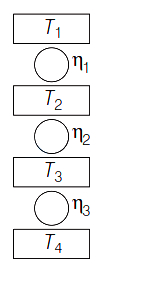
Three Carnot engines operate in series between a heat source at temperature $T_1$ and a heat sink at a temperature $T_4$. There are two other reservoirs at temperatures $T_2$ and $T_3$. If the three engines are equally efficient,find the values of $T_2$ and $T_3$ in terms of $T_1$ and $T_4$,given that $T_1 > T_2 > T_3 > T_4$.
A
$T_2 = (T_1 \cdot T_4)^{1/2}$ and $T_3 = (T_1^2 \cdot T_4)^{1/3}$
B
$T_2 = (T_1^3 \cdot T_4)^{1/4}$ and $T_3 = (T_1 \cdot T_4^3)^{1/4}$
C
$T_2 = (T_1^2 \cdot T_4)^{1/3}$ and $T_3 = (T_1 \cdot T_4^2)^{1/3}$
D
$T_2 = (T_1 \cdot T_4^2)^{1/3}$ and $T_3 = (T_1^2 \cdot T_4)^{1/3}$
Solution
(C) For a Carnot engine,efficiency $\eta = 1 - \frac{T_{\text{sink}}}{T_{\text{source}}}$.
Given that the three engines are equally efficient,let $\eta_1 = \eta_2 = \eta_3 = \eta$.
For the first engine: $\eta = 1 - \frac{T_2}{T_1} \Rightarrow \frac{T_2}{T_1} = 1 - \eta$.
For the second engine: $\eta = 1 - \frac{T_3}{T_2} \Rightarrow \frac{T_3}{T_2} = 1 - \eta$.
For the third engine: $\eta = 1 - \frac{T_4}{T_3} \Rightarrow \frac{T_4}{T_3} = 1 - \eta$.
Since $1 - \eta$ is constant,we have $\frac{T_2}{T_1} = \frac{T_3}{T_2} = \frac{T_4}{T_3} = k$,where $k = 1 - \eta$.
From this,$T_2 = T_1 k$,$T_3 = T_2 k = T_1 k^2$,and $T_4 = T_3 k = T_1 k^3$.
Thus,$k^3 = \frac{T_4}{T_1} \Rightarrow k = \left(\frac{T_4}{T_1}\right)^{1/3}$.
Substituting $k$ back:
$T_2 = T_1 \left(\frac{T_4}{T_1}\right)^{1/3} = T_1^{2/3} T_4^{1/3} = (T_1^2 T_4)^{1/3}$.
$T_3 = T_1 \left(\frac{T_4}{T_1}\right)^{2/3} = T_1^{1/3} T_4^{2/3} = (T_1 T_4^2)^{1/3}$.
Therefore,the correct option is $C$.
Given that the three engines are equally efficient,let $\eta_1 = \eta_2 = \eta_3 = \eta$.
For the first engine: $\eta = 1 - \frac{T_2}{T_1} \Rightarrow \frac{T_2}{T_1} = 1 - \eta$.
For the second engine: $\eta = 1 - \frac{T_3}{T_2} \Rightarrow \frac{T_3}{T_2} = 1 - \eta$.
For the third engine: $\eta = 1 - \frac{T_4}{T_3} \Rightarrow \frac{T_4}{T_3} = 1 - \eta$.
Since $1 - \eta$ is constant,we have $\frac{T_2}{T_1} = \frac{T_3}{T_2} = \frac{T_4}{T_3} = k$,where $k = 1 - \eta$.
From this,$T_2 = T_1 k$,$T_3 = T_2 k = T_1 k^2$,and $T_4 = T_3 k = T_1 k^3$.
Thus,$k^3 = \frac{T_4}{T_1} \Rightarrow k = \left(\frac{T_4}{T_1}\right)^{1/3}$.
Substituting $k$ back:
$T_2 = T_1 \left(\frac{T_4}{T_1}\right)^{1/3} = T_1^{2/3} T_4^{1/3} = (T_1^2 T_4)^{1/3}$.
$T_3 = T_1 \left(\frac{T_4}{T_1}\right)^{2/3} = T_1^{1/3} T_4^{2/3} = (T_1 T_4^2)^{1/3}$.
Therefore,the correct option is $C$.
0 likesView Solution
173
PhysicsEasyMCQAP EAMCET · 2021
The efficiency of a Carnot heat engine:
A
is independent of the temperature of the source and the sink
B
is independent of the working substance
C
can be $100 \%$
D
is not affected by the thermal capacity of the source or the sink
Solution
(B) The efficiency of a Carnot heat engine is given by the formula: $\eta = 1 - \frac{T_2}{T_1}$.
Here,$T_1$ is the temperature of the source (hot reservoir) and $T_2$ is the temperature of the sink (cold reservoir).
From this expression,it is clear that the efficiency depends solely on the temperatures of the source and the sink.
It is independent of the nature of the working substance used in the engine.
Therefore,option $B$ is the correct statement.
Here,$T_1$ is the temperature of the source (hot reservoir) and $T_2$ is the temperature of the sink (cold reservoir).
From this expression,it is clear that the efficiency depends solely on the temperatures of the source and the sink.
It is independent of the nature of the working substance used in the engine.
Therefore,option $B$ is the correct statement.
0 likesView Solution
174
PhysicsMediumMCQAP EAMCET · 2021
$A$ Carnot engine whose efficiency is $40\%$ takes in heat from a source maintained at a temperature of $500 \ K$. It is desired to have an engine of efficiency $60\%$. Then,the intake temperature for the same exhaust (sink) temperature must be (in $K$)
A
$1200$
B
$750$
C
$600$
D
$800$
Solution
(B) The efficiency of a Carnot engine is given by $\eta = 1 - \frac{T_2}{T_1}$,where $T_1$ is the source temperature and $T_2$ is the sink temperature.
For the first case: $\eta_1 = 0.4$,$T_1 = 500 \ K$.
$0.4 = 1 - \frac{T_2}{500} \implies \frac{T_2}{500} = 0.6 \implies T_2 = 300 \ K$.
For the second case: $\eta_2 = 0.6$,$T_2 = 300 \ K$,and we need to find the new source temperature $T_1'$.
$0.6 = 1 - \frac{300}{T_1'} \implies \frac{300}{T_1'} = 0.4$.
$T_1' = \frac{300}{0.4} = 750 \ K$.
For the first case: $\eta_1 = 0.4$,$T_1 = 500 \ K$.
$0.4 = 1 - \frac{T_2}{500} \implies \frac{T_2}{500} = 0.6 \implies T_2 = 300 \ K$.
For the second case: $\eta_2 = 0.6$,$T_2 = 300 \ K$,and we need to find the new source temperature $T_1'$.
$0.6 = 1 - \frac{300}{T_1'} \implies \frac{300}{T_1'} = 0.4$.
$T_1' = \frac{300}{0.4} = 750 \ K$.
0 likesView Solution
175
PhysicsMediumMCQAP EAMCET · 2021
$A$ Carnot engine having an efficiency of $1/5$ as a heat engine is used as a refrigerator. If the work done on the system is $50 \ J$,then the amount of energy absorbed from the reservoir at the lower temperature is (in $J$)
A
$90$
B
$99$
C
$200$
D
$1$
Solution
(C) The efficiency of a Carnot engine is given by $\eta = 1/5$.
When this engine is used as a refrigerator,its coefficient of performance $\beta$ is related to the efficiency $\eta$ by the formula: $\beta = \frac{1 - \eta}{\eta}$.
Substituting the value of $\eta$: $\beta = \frac{1 - 1/5}{1/5} = \frac{4/5}{1/5} = 4$.
The coefficient of performance is also defined as the ratio of heat absorbed from the cold reservoir $(Q)$ to the work done on the system $(W)$: $\beta = \frac{Q}{W}$.
Given $W = 50 \ J$,we have $4 = \frac{Q}{50}$.
Therefore,$Q = 4 \times 50 = 200 \ J$.
When this engine is used as a refrigerator,its coefficient of performance $\beta$ is related to the efficiency $\eta$ by the formula: $\beta = \frac{1 - \eta}{\eta}$.
Substituting the value of $\eta$: $\beta = \frac{1 - 1/5}{1/5} = \frac{4/5}{1/5} = 4$.
The coefficient of performance is also defined as the ratio of heat absorbed from the cold reservoir $(Q)$ to the work done on the system $(W)$: $\beta = \frac{Q}{W}$.
Given $W = 50 \ J$,we have $4 = \frac{Q}{50}$.
Therefore,$Q = 4 \times 50 = 200 \ J$.
0 likesView Solution
176
PhysicsDifficultMCQAP EAMCET · 2021
Three designs are proposed for an engine which is to operate between $500 \ K$ and $300 \ K$. Design $A$ claims to produce $150 \ J$ of work per $1000 \ J$ of heat input, design $B$ $450 \ J$ of work per $1000 \ J$, and design $C$ $300 \ J$ of work per $1000 \ J$. Which of the designs would you choose?
A
$A$
B
$B$
C
$C$
D
None is suitable
Solution
(C) Given, temperatures are $T_1 = 500 \ K$ and $T_2 = 300 \ K$.
The maximum theoretical efficiency (Carnot efficiency) of an engine operating between these temperatures is given by $\eta_{max} = 1 - \frac{T_2}{T_1}$.
$\eta_{max} = 1 - \frac{300}{500} = 1 - 0.6 = 0.4$ or $40\%$.
Now, calculate the efficiency $(\eta = \frac{W}{Q_{in}})$ for each design:
For design $A$: $\eta_A = \frac{150}{1000} = 0.15$ $(15\%)$.
For design $B$: $\eta_B = \frac{450}{1000} = 0.45$ $(45\%)$.
For design $C$: $\eta_C = \frac{300}{1000} = 0.30$ $(30\%)$.
According to the Second Law of Thermodynamics, no engine can have an efficiency greater than the Carnot efficiency. Since $\eta_B = 0.45 > 0.4$, design $B$ violates the Second Law of Thermodynamics and is impossible. Design $C$ has an efficiency of $0.3$, which is less than $0.4$, making it physically possible. Therefore, design $C$ is the most suitable choice.
The maximum theoretical efficiency (Carnot efficiency) of an engine operating between these temperatures is given by $\eta_{max} = 1 - \frac{T_2}{T_1}$.
$\eta_{max} = 1 - \frac{300}{500} = 1 - 0.6 = 0.4$ or $40\%$.
Now, calculate the efficiency $(\eta = \frac{W}{Q_{in}})$ for each design:
For design $A$: $\eta_A = \frac{150}{1000} = 0.15$ $(15\%)$.
For design $B$: $\eta_B = \frac{450}{1000} = 0.45$ $(45\%)$.
For design $C$: $\eta_C = \frac{300}{1000} = 0.30$ $(30\%)$.
According to the Second Law of Thermodynamics, no engine can have an efficiency greater than the Carnot efficiency. Since $\eta_B = 0.45 > 0.4$, design $B$ violates the Second Law of Thermodynamics and is impossible. Design $C$ has an efficiency of $0.3$, which is less than $0.4$, making it physically possible. Therefore, design $C$ is the most suitable choice.
0 likesView Solution
177
PhysicsMediumMCQAP EAMCET · 2021
$A$ gas $(\gamma = 1.5)$ is suddenly compressed to $(1/4)^{th}$ of its initial volume. Find the ratio of its final pressure to its initial pressure.
A
$1:16$
B
$1:8$
C
$1:4$
D
$8:1$
Solution
(D) When a compression process is performed suddenly or instantly,there is not enough time for heat transfer; therefore,the process is an adiabatic compression process.
For an adiabatic process,the relation between pressure and volume is given by $P V^\gamma = \text{constant}$.
Thus,$P_i V_i^\gamma = P_f V_f^\gamma$.
Rearranging for the ratio of final pressure to initial pressure: $\frac{P_f}{P_i} = \left( \frac{V_i}{V_f} \right)^\gamma$.
Given $V_f = \frac{V_i}{4}$ and $\gamma = 1.5 = \frac{3}{2}$,we substitute these values:
$\frac{P_f}{P_i} = \left( \frac{V_i}{V_i / 4} \right)^{1.5} = (4)^{1.5} = (4)^{3/2} = (2^2)^{3/2} = 2^3 = 8$.
Therefore,the ratio of final pressure to initial pressure is $8:1$.
For an adiabatic process,the relation between pressure and volume is given by $P V^\gamma = \text{constant}$.
Thus,$P_i V_i^\gamma = P_f V_f^\gamma$.
Rearranging for the ratio of final pressure to initial pressure: $\frac{P_f}{P_i} = \left( \frac{V_i}{V_f} \right)^\gamma$.
Given $V_f = \frac{V_i}{4}$ and $\gamma = 1.5 = \frac{3}{2}$,we substitute these values:
$\frac{P_f}{P_i} = \left( \frac{V_i}{V_i / 4} \right)^{1.5} = (4)^{1.5} = (4)^{3/2} = (2^2)^{3/2} = 2^3 = 8$.
Therefore,the ratio of final pressure to initial pressure is $8:1$.
0 likesView Solution
178
PhysicsMediumMCQAP EAMCET · 2021
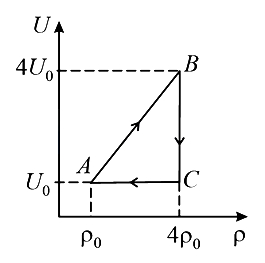
For a monoatomic ideal gas following the cyclic process $ABCA$ shown in the $U$ vs $\rho$ plot,identify the incorrect option:
A
Molar heat capacity of the process $AB$ is $\frac{R}{2}$
B
Heat is rejected by the system in path $BC$
C
Molar heat capacity for the process $BC$ is $\frac{2 R}{3}$
D
Work done by the system in the process $CA$ is $\frac{2 U_0}{3} \ln 4$
Solution
(C) The internal energy of a monoatomic ideal gas is $U = \frac{3}{2} n R T$,so $U \propto T$.
Density $\rho = \frac{m}{V}$,so $\rho \propto \frac{1}{V}$.
For process $AB$,the line passes through origin in $U$-$\rho$ plot,so $U = k \rho$. Substituting $U \propto T$ and $\rho \propto 1/V$,we get $T \propto 1/V$,or $TV = \text{constant}$.
Using $PV = nRT$,we have $(PV/nR)V = \text{constant}$,so $PV^2 = \text{constant}$. This is a polytropic process with index $m = 2$.
The molar heat capacity is $C = C_V + \frac{R}{1-m} = \frac{3R}{2} + \frac{R}{1-2} = \frac{3R}{2} - R = \frac{R}{2}$. Thus,option $A$ is correct.
In process $BC$,$\rho$ is constant,so it is an isochoric process. Since $U$ decreases,temperature decreases,so heat is rejected. Thus,option $B$ is correct.
For an isochoric process,the molar heat capacity is $C_V = \frac{3}{2} R$. Option $C$ states it is $\frac{2R}{3}$,which is incorrect.
In process $CA$,$U$ is constant,so $T$ is constant (isothermal). $W_{CA} = nRT \ln(V_A/V_C) = nRT \ln(\rho_C/\rho_A) = (\frac{2}{3} U_0) \ln(4\rho_0/\rho_0) = \frac{2}{3} U_0 \ln 4$. Option $D$ is correct.
Density $\rho = \frac{m}{V}$,so $\rho \propto \frac{1}{V}$.
For process $AB$,the line passes through origin in $U$-$\rho$ plot,so $U = k \rho$. Substituting $U \propto T$ and $\rho \propto 1/V$,we get $T \propto 1/V$,or $TV = \text{constant}$.
Using $PV = nRT$,we have $(PV/nR)V = \text{constant}$,so $PV^2 = \text{constant}$. This is a polytropic process with index $m = 2$.
The molar heat capacity is $C = C_V + \frac{R}{1-m} = \frac{3R}{2} + \frac{R}{1-2} = \frac{3R}{2} - R = \frac{R}{2}$. Thus,option $A$ is correct.
In process $BC$,$\rho$ is constant,so it is an isochoric process. Since $U$ decreases,temperature decreases,so heat is rejected. Thus,option $B$ is correct.
For an isochoric process,the molar heat capacity is $C_V = \frac{3}{2} R$. Option $C$ states it is $\frac{2R}{3}$,which is incorrect.
In process $CA$,$U$ is constant,so $T$ is constant (isothermal). $W_{CA} = nRT \ln(V_A/V_C) = nRT \ln(\rho_C/\rho_A) = (\frac{2}{3} U_0) \ln(4\rho_0/\rho_0) = \frac{2}{3} U_0 \ln 4$. Option $D$ is correct.
0 likesView Solution
179
PhysicsEasyMCQAP EAMCET · 2021
An isothermal process has a non-linear graph between:
A
Pressure and Temperature
B
Pressure and Volume
C
Volume and Temperature
D
$PV$ and Temperature
Solution
(B) In an isothermal process, the temperature $T$ remains constant throughout the process.
According to the ideal gas equation, $PV = nRT$.
Since $T$ is constant, $PV = \text{constant}$.
This implies that $P = \frac{\text{constant}}{V}$, which represents a rectangular hyperbola in a $P-V$ graph.
Therefore, the relationship between pressure $(P)$ and volume $(V)$ is non-linear.
In contrast, the relationship between $P$ and $T$, $V$ and $T$, or $PV$ and $T$ would be linear (or constant) in an isothermal process.
According to the ideal gas equation, $PV = nRT$.
Since $T$ is constant, $PV = \text{constant}$.
This implies that $P = \frac{\text{constant}}{V}$, which represents a rectangular hyperbola in a $P-V$ graph.
Therefore, the relationship between pressure $(P)$ and volume $(V)$ is non-linear.
In contrast, the relationship between $P$ and $T$, $V$ and $T$, or $PV$ and $T$ would be linear (or constant) in an isothermal process.
0 likesView Solution
180
PhysicsMediumMCQAP EAMCET · 2021
Two containers $A$ and $B$ contain equal volumes of an identical gas at the same pressure and temperature. The gas in container $A$ is compressed to half its original volume isothermally,while the gas in container $B$ is compressed to half its original volume adiabatically. The ratio of the final pressure of gas in container $B$ to that of gas in container $A$ is
A
$(2)^{\gamma-1}$
B
$\left(\frac{1}{2}\right)^{\gamma-1}$
C
$\left(\frac{1}{1-\gamma}\right)^2$
D
$\left(\frac{1}{\gamma-1}\right)^2$
Solution
(A) Initial state: $V_A = V_B = V$,$p_A = p_B = p$.
For container $A$ (isothermal process): $p_A V_A = p_A^{\prime} V_A^{\prime}$.
Given $V_A^{\prime} = V/2$,so $p V = p_A^{\prime} (V/2) \Rightarrow p_A^{\prime} = 2p$.
For container $B$ (adiabatic process): $p_B V_B^{\gamma} = p_B^{\prime} (V_B^{\prime})^{\gamma}$.
Given $V_B^{\prime} = V/2$,so $p V^{\gamma} = p_B^{\prime} (V/2)^{\gamma} \Rightarrow p_B^{\prime} = p \cdot 2^{\gamma}$.
The ratio of final pressures is $\frac{p_B^{\prime}}{p_A^{\prime}} = \frac{p \cdot 2^{\gamma}}{2p} = 2^{\gamma-1}$.
For container $A$ (isothermal process): $p_A V_A = p_A^{\prime} V_A^{\prime}$.
Given $V_A^{\prime} = V/2$,so $p V = p_A^{\prime} (V/2) \Rightarrow p_A^{\prime} = 2p$.
For container $B$ (adiabatic process): $p_B V_B^{\gamma} = p_B^{\prime} (V_B^{\prime})^{\gamma}$.
Given $V_B^{\prime} = V/2$,so $p V^{\gamma} = p_B^{\prime} (V/2)^{\gamma} \Rightarrow p_B^{\prime} = p \cdot 2^{\gamma}$.
The ratio of final pressures is $\frac{p_B^{\prime}}{p_A^{\prime}} = \frac{p \cdot 2^{\gamma}}{2p} = 2^{\gamma-1}$.
0 likesView Solution
181
PhysicsMediumMCQAP EAMCET · 2021
In a thermodynamic process,the pressure of a fixed mass of a gas is changed in such a manner that the gas releases $30 \,J$ of heat and $18 \,J$ of work is done on the gas. If the initial internal energy of the gas was $60 \,J$,what will be the final internal energy (in $\,J$)?
A
$32$
B
$48$
C
$72$
D
$96$
Solution
(B) According to the first law of thermodynamics,$\Delta Q = \Delta U + \Delta W$.
Given that the gas releases heat,$\Delta Q = -30 \,J$.
Work is done on the gas,so $\Delta W = -18 \,J$.
Initial internal energy $U_i = 60 \,J$.
Let the final internal energy be $U_f$.
The change in internal energy is $\Delta U = U_f - U_i$.
Substituting these values into the first law equation:
$-30 = (U_f - 60) + (-18)$
$-30 = U_f - 78$
$U_f = 78 - 30 = 48 \,J$.
Therefore,the final internal energy of the gas is $48 \,J$.
Given that the gas releases heat,$\Delta Q = -30 \,J$.
Work is done on the gas,so $\Delta W = -18 \,J$.
Initial internal energy $U_i = 60 \,J$.
Let the final internal energy be $U_f$.
The change in internal energy is $\Delta U = U_f - U_i$.
Substituting these values into the first law equation:
$-30 = (U_f - 60) + (-18)$
$-30 = U_f - 78$
$U_f = 78 - 30 = 48 \,J$.
Therefore,the final internal energy of the gas is $48 \,J$.
0 likesView Solution
182
PhysicsEasyMCQAP EAMCET · 2021
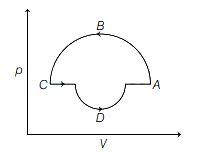
Work done by a gas in the process shown in the figure will be
A
positive
B
negative
C
zero
D
cannot be determined
Solution
(B) The work done in a thermodynamic process is equal to the area under the $p-V$ curve.
For a cyclic process,the net work done is equal to the area enclosed by the cycle.
If the cycle is traversed in a clockwise direction,the net work done is positive.
If the cycle is traversed in a counter-clockwise (anticlockwise) direction,the net work done is negative.
In the given figure,the path is $C \rightarrow B \rightarrow A \rightarrow D \rightarrow C$,which is counter-clockwise.
Therefore,the net work done by the gas is negative.
For a cyclic process,the net work done is equal to the area enclosed by the cycle.
If the cycle is traversed in a clockwise direction,the net work done is positive.
If the cycle is traversed in a counter-clockwise (anticlockwise) direction,the net work done is negative.
In the given figure,the path is $C \rightarrow B \rightarrow A \rightarrow D \rightarrow C$,which is counter-clockwise.
Therefore,the net work done by the gas is negative.
0 likesView Solution
183
PhysicsEasyMCQAP EAMCET · 2021
Which of the following is the best container for a gas during an adiabatic process?
A
Glass vessel
B
Copper vessel
C
Wood vessel
D
Thermos flask
Solution
(D) In an adiabatic process,the system is thermally isolated from its surroundings,meaning no heat exchange $(dQ = 0)$ occurs between the system and the environment.
To maintain this condition,the container must be a perfect thermal insulator.
$A$ thermos flask is designed specifically to minimize heat transfer through conduction,convection,and radiation,making it the best choice among the given options for an adiabatic process.
To maintain this condition,the container must be a perfect thermal insulator.
$A$ thermos flask is designed specifically to minimize heat transfer through conduction,convection,and radiation,making it the best choice among the given options for an adiabatic process.
0 likesView Solution
184
PhysicsEasyMCQAP EAMCET · 2021
When an ideal gas is compressed isothermally,its pressure:
A
increases
B
decreases
C
remains the same
D
first increases and then decreases
Solution
(A) According to the isothermal process,the temperature $T$ remains constant.
For an ideal gas,the equation of state is $pV = nRT$.
Since $T$ is constant,$n$ and $R$ are also constant,the product $pV$ must be constant,i.e.,$pV = K$.
This implies $p \propto \frac{1}{V}$.
In an isothermal compression,the volume $V$ of the gas decreases.
Since pressure $p$ is inversely proportional to volume $V$,as the volume $V$ decreases,the pressure $p$ must increase.
For an ideal gas,the equation of state is $pV = nRT$.
Since $T$ is constant,$n$ and $R$ are also constant,the product $pV$ must be constant,i.e.,$pV = K$.
This implies $p \propto \frac{1}{V}$.
In an isothermal compression,the volume $V$ of the gas decreases.
Since pressure $p$ is inversely proportional to volume $V$,as the volume $V$ decreases,the pressure $p$ must increase.
0 likesView Solution
185
PhysicsEasyMCQAP EAMCET · 2021
$A$ given system undergoes a change in which the work done by the system equals the decrease in its internal energy. The system must have undergone an
A
isothermal change
B
adiabatic change
C
isobaric change
D
isochoric change
Solution
(B) According to the first law of thermodynamics,$\Delta Q = \Delta U + \Delta W$,where $\Delta Q$ is the heat supplied to the system,$\Delta U$ is the change in internal energy,and $\Delta W$ is the work done by the system.
Given that the work done by the system equals the decrease in its internal energy,we have $\Delta W = -\Delta U$,which implies $\Delta U + \Delta W = 0$.
Substituting this into the first law equation,we get $\Delta Q = 0$.
$A$ process in which there is no exchange of heat $(\Delta Q = 0)$ with the surroundings is defined as an adiabatic process.
Therefore,the system must have undergone an adiabatic change.
Given that the work done by the system equals the decrease in its internal energy,we have $\Delta W = -\Delta U$,which implies $\Delta U + \Delta W = 0$.
Substituting this into the first law equation,we get $\Delta Q = 0$.
$A$ process in which there is no exchange of heat $(\Delta Q = 0)$ with the surroundings is defined as an adiabatic process.
Therefore,the system must have undergone an adiabatic change.
0 likesView Solution
186
PhysicsEasyMCQAP EAMCET · 2021
$\Delta W = 0$,for the process
A
isobaric
B
isochoric
C
isothermal
D
adiabatic
Solution
(B) For an isochoric process,the volume remains constant,so $\Delta V = 0$.
Since the work done in a thermodynamic process is given by $W = p \cdot \Delta V$,substituting $\Delta V = 0$ gives $W = 0$.
Since the work done in a thermodynamic process is given by $W = p \cdot \Delta V$,substituting $\Delta V = 0$ gives $W = 0$.
0 likesView Solution
187
PhysicsEasyMCQAP EAMCET · 2021
Which of the following,in general,is a slow process?
A
Isothermal
B
Adiabatic
C
Isobaric
D
Isochoric
Solution
(A) An isothermal process occurs at a constant temperature.
For the temperature to remain constant during heat exchange,the process must occur very slowly to allow sufficient time for thermal equilibrium to be maintained with the surroundings.
Therefore,an isothermal process is generally considered a slow process.
For the temperature to remain constant during heat exchange,the process must occur very slowly to allow sufficient time for thermal equilibrium to be maintained with the surroundings.
Therefore,an isothermal process is generally considered a slow process.
0 likesView Solution
188
PhysicsMediumMCQAP EAMCET · 2021
The speed of ripples $(v)$ on a water surface depends on surface tension $(\sigma)$,density $(\rho)$,and wavelength $(\lambda)$. Then the square of speed $(v^2)$ is proportional to
A
$\frac{\sigma}{\rho \lambda}$
B
$\frac{\rho}{\sigma \lambda}$
C
$\frac{\lambda}{\sigma \rho}$
D
$\sqrt{\frac{\rho \lambda}{\sigma}}$
Solution
(A) The speed of ripples $v$ depends on surface tension $\sigma$,density $\rho$,and wavelength $\lambda$.
We can write the relation as $v = k \sigma^a \rho^b \lambda^c$,where $k$ is a dimensionless constant.
The dimensional formula for speed $v$ is $[M^0 L T^{-1}]$.
The dimensional formula for surface tension $\sigma$ is $[M L^0 T^{-2}]$.
The dimensional formula for density $\rho$ is $[M L^{-3} T^0]$.
The dimensional formula for wavelength $\lambda$ is $[M^0 L T^0]$.
Substituting these into the equation:
$[M^0 L T^{-1}] = [M L^0 T^{-2}]^a [M L^{-3} T^0]^b [L]^c$
$[M^0 L T^{-1}] = [M]^{a+b} [L]^{-3b+c} [T]^{-2a}$
Equating the powers of $M, L,$ and $T$ on both sides:
$a + b = 0$
$-3b + c = 1$
$-2a = -1$
From $-2a = -1$,we get $a = 1/2$.
Substituting $a = 1/2$ into $a + b = 0$,we get $b = -1/2$.
Substituting $b = -1/2$ into $-3b + c = 1$,we get $-3(-1/2) + c = 1 \Rightarrow 1.5 + c = 1 \Rightarrow c = -0.5 = -1/2$.
Thus,$v \propto \sigma^{1/2} \rho^{-1/2} \lambda^{-1/2}$.
Therefore,$v \propto \sqrt{\frac{\sigma}{\rho \lambda}}$.
Squaring both sides,$v^2 \propto \frac{\sigma}{\rho \lambda}$.
We can write the relation as $v = k \sigma^a \rho^b \lambda^c$,where $k$ is a dimensionless constant.
The dimensional formula for speed $v$ is $[M^0 L T^{-1}]$.
The dimensional formula for surface tension $\sigma$ is $[M L^0 T^{-2}]$.
The dimensional formula for density $\rho$ is $[M L^{-3} T^0]$.
The dimensional formula for wavelength $\lambda$ is $[M^0 L T^0]$.
Substituting these into the equation:
$[M^0 L T^{-1}] = [M L^0 T^{-2}]^a [M L^{-3} T^0]^b [L]^c$
$[M^0 L T^{-1}] = [M]^{a+b} [L]^{-3b+c} [T]^{-2a}$
Equating the powers of $M, L,$ and $T$ on both sides:
$a + b = 0$
$-3b + c = 1$
$-2a = -1$
From $-2a = -1$,we get $a = 1/2$.
Substituting $a = 1/2$ into $a + b = 0$,we get $b = -1/2$.
Substituting $b = -1/2$ into $-3b + c = 1$,we get $-3(-1/2) + c = 1 \Rightarrow 1.5 + c = 1 \Rightarrow c = -0.5 = -1/2$.
Thus,$v \propto \sigma^{1/2} \rho^{-1/2} \lambda^{-1/2}$.
Therefore,$v \propto \sqrt{\frac{\sigma}{\rho \lambda}}$.
Squaring both sides,$v^2 \propto \frac{\sigma}{\rho \lambda}$.
0 likesView Solution
189
PhysicsEasyMCQAP EAMCET · 2021
The dimensions of stress are
A
$[M L^{-1} T^{-2}]$
B
$[M L^{-3} T^{-1}]$
C
$[M L^2 T^{-2}]$
D
$[M L^{-3} T^{-2}]$
Solution
(A) Stress is defined as the restoring force per unit area of the material. It is denoted by the Greek letter $\sigma$.
$\text{Stress} = \frac{\text{Force}}{\text{Area}}$
Substituting the dimensional formulas for force and area:
$\text{Force} = [M L T^{-2}]$
$\text{Area} = [L^2]$
$\text{Stress} = \frac{[M L T^{-2}]}{[L^2]} = [M L^{1-2} T^{-2}] = [M L^{-1} T^{-2}]$
$\text{Stress} = \frac{\text{Force}}{\text{Area}}$
Substituting the dimensional formulas for force and area:
$\text{Force} = [M L T^{-2}]$
$\text{Area} = [L^2]$
$\text{Stress} = \frac{[M L T^{-2}]}{[L^2]} = [M L^{1-2} T^{-2}] = [M L^{-1} T^{-2}]$
0 likesView Solution
190
PhysicsEasyMCQAP EAMCET · 2021
The volume of a liquid is proportional to......,given its density $\rho$,viscosity $\eta$ and $t$ the time of flow through a capillary tube of length $L$ and radius $R$,with a pressure difference $p$ across its ends.
A
$\frac{p^2 R^2 t}{\eta L}$
B
$\frac{p R^4}{\eta L t}$
C
$\frac{p R^4 t}{\eta L}$
D
$\frac{p^2 R^2 t}{\eta L^2}$
Solution
(C) According to Poiseuille's law,the rate of flow of a liquid $(Q)$ through a capillary tube is given by the formula:
$Q = \frac{V}{t} = \frac{\pi p R^4}{8 \eta L}$
Where:
$V$ is the volume of the liquid,
$t$ is the time of flow,
$p$ is the pressure difference,
$R$ is the radius of the tube,
$\eta$ is the coefficient of viscosity,
$L$ is the length of the tube.
Rearranging the formula to solve for the volume $V$:
$V = \frac{\pi p R^4 t}{8 \eta L}$
Since $\frac{\pi}{8}$ is a dimensionless constant,the volume $V$ is proportional to the remaining terms:
$V \propto \frac{p R^4 t}{\eta L}$
Therefore,the correct option is $C$.
$Q = \frac{V}{t} = \frac{\pi p R^4}{8 \eta L}$
Where:
$V$ is the volume of the liquid,
$t$ is the time of flow,
$p$ is the pressure difference,
$R$ is the radius of the tube,
$\eta$ is the coefficient of viscosity,
$L$ is the length of the tube.
Rearranging the formula to solve for the volume $V$:
$V = \frac{\pi p R^4 t}{8 \eta L}$
Since $\frac{\pi}{8}$ is a dimensionless constant,the volume $V$ is proportional to the remaining terms:
$V \propto \frac{p R^4 t}{\eta L}$
Therefore,the correct option is $C$.
0 likesView Solution
191
PhysicsEasyMCQAP EAMCET · 2021
Which of the following pairs of physical quantities possess the same dimension?
A
Force and surface tension
B
Frequency and velocity gradient
C
Angular speed and solid angle
D
Stefan's constant and Planck's constant
Solution
(B) The dimensional formulas for the given physical quantities are as follows:
$[$Force$] = [MLT^{-2}]$
$[$Surface tension$] = [MT^{-2}]$
$[$Frequency$] = [T^{-1}]$
$[$Velocity gradient$] = [T^{-1}]$
$[$Angular speed$] = [T^{-1}]$
$[$Solid angle$] = [M^0L^0T^0]$ (Dimensionless)
$[$Stefan's constant$] = [MT^{-3}K^{-4}]$
$[$Planck's constant$] = [ML^2T^{-1}]$
Comparing these,we observe that frequency and velocity gradient both have the dimension $[T^{-1}]$.
Therefore,the correct pair is frequency and velocity gradient.
$[$Force$] = [MLT^{-2}]$
$[$Surface tension$] = [MT^{-2}]$
$[$Frequency$] = [T^{-1}]$
$[$Velocity gradient$] = [T^{-1}]$
$[$Angular speed$] = [T^{-1}]$
$[$Solid angle$] = [M^0L^0T^0]$ (Dimensionless)
$[$Stefan's constant$] = [MT^{-3}K^{-4}]$
$[$Planck's constant$] = [ML^2T^{-1}]$
Comparing these,we observe that frequency and velocity gradient both have the dimension $[T^{-1}]$.
Therefore,the correct pair is frequency and velocity gradient.
0 likesView Solution
192
PhysicsEasyMCQAP EAMCET · 2021
Which quantity among the following has neither units nor dimensions?
A
Relative velocity
B
Relative density
C
Angle
D
Energy
Solution
(B) Relative velocity $(v_A \pm v_B)$ for two bodies $A$ and $B$ has both units $(ms^{-1})$ and dimensions $[LT^{-1}]$.
Relative density of two substances $(\rho = \frac{\rho_A}{\rho_B})$ has no units and no dimensions because it is a ratio of two similar physical quantities.
Angle is measured in radian. Thus,it has units but no dimensions.
Energy is measured in joule and has dimensions $[ML^2 T^{-2}]$.
Hence,only relative density has neither units nor dimensions.
Relative density of two substances $(\rho = \frac{\rho_A}{\rho_B})$ has no units and no dimensions because it is a ratio of two similar physical quantities.
Angle is measured in radian. Thus,it has units but no dimensions.
Energy is measured in joule and has dimensions $[ML^2 T^{-2}]$.
Hence,only relative density has neither units nor dimensions.
0 likesView Solution
193
PhysicsEasyMCQAP EAMCET · 2021
One $\mathring{A}$ is equal to:
A
$10^{-6} \text{ mm}$
B
$10^{-7} \text{ mm}$
C
$10^{-8} \text{ mm}$
D
$10^{-9} \text{ mm}$
Solution
(B) By definition, $1 \text{ } \mathring{A} = 10^{-10} \text{ m}$. To convert this into millimeters $(\text{mm})$, we know that $1 \text{ m} = 10^3 \text{ mm}$. Therefore, $1 \text{ } \mathring{A} = 10^{-10} \times 10^3 \text{ mm}$. $1 \text{ } \mathring{A} = 10^{-7} \text{ mm}$. Thus, the correct option is $B$.
0 likesView Solution
194
PhysicsMediumMCQAP EAMCET · 2021
The sources of sound $A$ and $B$ produce a wave of $350 Hz$ in the same phase. $A$ particle $P$ is vibrating under the influence of these two waves. If the amplitudes at $P$ produced by the two waves are $0.3 mm$ and $0.4 mm$,the resultant amplitude of the point $P$ will be,when $AP-BP=25 cm$ and the velocity of sound is $350 m s^{-1}$. (in $mm$)
A
$0.7$
B
$0.1$
C
$0.2$
D
$0.5$
Solution
(D) The resultant amplitude of waves at the point $P$ is given by the formula: $A = \sqrt{A_1^2 + A_2^2 + 2 A_1 A_2 \cos \phi}$,where $\phi$ is the phase difference,and $A_1$ and $A_2$ are the amplitudes of the sound waves.
First,we calculate the wavelength $\lambda$ of the sound wave: $\lambda = \frac{v}{f} = \frac{350 m s^{-1}}{350 Hz} = 1 m = 100 cm$.
The path difference is given as $\Delta x = AP - BP = 25 cm$.
The phase difference $\phi$ is calculated as: $\phi = \frac{2 \pi}{\lambda} \Delta x = \frac{2 \pi}{100 cm} \times 25 cm = \frac{\pi}{2}$.
Now,substitute the values into the resultant amplitude formula:
$A = \sqrt{0.3^2 + 0.4^2 + 2 \times 0.3 \times 0.4 \cos(\frac{\pi}{2})}$
Since $\cos(\frac{\pi}{2}) = 0$,the expression simplifies to:
$A = \sqrt{0.3^2 + 0.4^2} = \sqrt{0.09 + 0.16} = \sqrt{0.25} = 0.5 mm$.
First,we calculate the wavelength $\lambda$ of the sound wave: $\lambda = \frac{v}{f} = \frac{350 m s^{-1}}{350 Hz} = 1 m = 100 cm$.
The path difference is given as $\Delta x = AP - BP = 25 cm$.
The phase difference $\phi$ is calculated as: $\phi = \frac{2 \pi}{\lambda} \Delta x = \frac{2 \pi}{100 cm} \times 25 cm = \frac{\pi}{2}$.
Now,substitute the values into the resultant amplitude formula:
$A = \sqrt{0.3^2 + 0.4^2 + 2 \times 0.3 \times 0.4 \cos(\frac{\pi}{2})}$
Since $\cos(\frac{\pi}{2}) = 0$,the expression simplifies to:
$A = \sqrt{0.3^2 + 0.4^2} = \sqrt{0.09 + 0.16} = \sqrt{0.25} = 0.5 mm$.
0 likesView Solution
195
PhysicsDifficultMCQAP EAMCET · 2021
Match the following:
| Column-$I$ | Column-$II$ |
|---|---|
| $(a)$ Transverse wave through a steel rod | $(i)$ $\sqrt{B + \frac{4}{3} \frac{\eta}{\rho}}$ |
| $(b)$ Longitudinal waves in earth's crust | $(ii)$ $\sqrt{\frac{\eta}{\rho}}$ |
| $(c)$ Longitudinal waves through a steel rod | $(iii)$ $\sqrt{\frac{2 \pi T}{g \lambda}}$ |
| $(d)$ Ripples | $(iv)$ $\sqrt{\frac{Y}{\rho}}$ |
A
$(a) - (ii), (b) - (i), (c) - (iv), (d) - (iii)$
B
$(a) - (i), (b) - (iii), (c) - (iv), (d) - (ii)$
C
$(a) - (iii), (b) - (iv), (c) - (i), (d) - (ii)$
D
$(a) - (ii), (b) - (iv), (c) - (i), (d) - (iii)$
Solution
(A) The speed of waves in different media is determined by the elastic properties and density of the medium.
$(a)$ For a transverse wave in a solid (like a steel rod), the speed is given by $v = \sqrt{\frac{\eta}{\rho}}$, where $\eta$ is the shear modulus and $\rho$ is the density. Thus, $(a) - (ii)$.
$(b)$ For longitudinal waves in a bulk solid (like the earth's crust), the speed depends on both bulk modulus $B$ and shear modulus $\eta$: $v = \sqrt{\frac{B + \frac{4}{3}\eta}{\rho}}$. Thus, $(b) - (i)$.
$(c)$ For longitudinal waves in a thin rod, the speed is given by $v = \sqrt{\frac{Y}{\rho}}$, where $Y$ is Young's modulus. Thus, $(c) - (iv)$.
$(d)$ Ripples are surface waves on liquids where surface tension $T$ is the restoring force. The speed is given by $v = \sqrt{\frac{2 \pi T}{g \lambda}}$. Thus, $(d) - (iii)$.
Therefore, the correct matching is $(a) - (ii), (b) - (i), (c) - (iv), (d) - (iii)$.
$(a)$ For a transverse wave in a solid (like a steel rod), the speed is given by $v = \sqrt{\frac{\eta}{\rho}}$, where $\eta$ is the shear modulus and $\rho$ is the density. Thus, $(a) - (ii)$.
$(b)$ For longitudinal waves in a bulk solid (like the earth's crust), the speed depends on both bulk modulus $B$ and shear modulus $\eta$: $v = \sqrt{\frac{B + \frac{4}{3}\eta}{\rho}}$. Thus, $(b) - (i)$.
$(c)$ For longitudinal waves in a thin rod, the speed is given by $v = \sqrt{\frac{Y}{\rho}}$, where $Y$ is Young's modulus. Thus, $(c) - (iv)$.
$(d)$ Ripples are surface waves on liquids where surface tension $T$ is the restoring force. The speed is given by $v = \sqrt{\frac{2 \pi T}{g \lambda}}$. Thus, $(d) - (iii)$.
Therefore, the correct matching is $(a) - (ii), (b) - (i), (c) - (iv), (d) - (iii)$.
0 likesView Solution
196
PhysicsEasyMCQAP EAMCET · 2021
Two waves are represented by: $x_1 = A \sin \left(\omega t + \frac{\pi}{6}\right)$ and $x_2 = A \cos \omega t$. Then the phase difference between them is
A
$\frac{\pi}{6}$
B
$\frac{\pi}{3}$
C
$\frac{\pi}{2}$
D
$\pi$
Solution
(B) Given the equations for the two waves are $x_1 = A \sin \left(\omega t + \frac{\pi}{6}\right)$ and $x_2 = A \cos \omega t$.
To find the phase difference,we express both waves in terms of the same trigonometric function (sine or cosine).
We know that $\cos \theta = \sin \left(\theta + \frac{\pi}{2}\right)$.
Therefore,$x_2 = A \sin \left(\omega t + \frac{\pi}{2}\right)$.
Now,the phase of $x_1$ is $\phi_1 = \omega t + \frac{\pi}{6}$ and the phase of $x_2$ is $\phi_2 = \omega t + \frac{\pi}{2}$.
The phase difference $\Delta \phi = \phi_2 - \phi_1 = \left(\omega t + \frac{\pi}{2}\right) - \left(\omega t + \frac{\pi}{6}\right)$.
$\Delta \phi = \frac{\pi}{2} - \frac{\pi}{6} = \frac{3\pi - \pi}{6} = \frac{2\pi}{6} = \frac{\pi}{3}$.
To find the phase difference,we express both waves in terms of the same trigonometric function (sine or cosine).
We know that $\cos \theta = \sin \left(\theta + \frac{\pi}{2}\right)$.
Therefore,$x_2 = A \sin \left(\omega t + \frac{\pi}{2}\right)$.
Now,the phase of $x_1$ is $\phi_1 = \omega t + \frac{\pi}{6}$ and the phase of $x_2$ is $\phi_2 = \omega t + \frac{\pi}{2}$.
The phase difference $\Delta \phi = \phi_2 - \phi_1 = \left(\omega t + \frac{\pi}{2}\right) - \left(\omega t + \frac{\pi}{6}\right)$.
$\Delta \phi = \frac{\pi}{2} - \frac{\pi}{6} = \frac{3\pi - \pi}{6} = \frac{2\pi}{6} = \frac{\pi}{3}$.
0 likesView Solution
197
PhysicsMediumMCQAP EAMCET · 2021
Two identical sinusoidal waves each of amplitude $10 \,mm$, with a phase difference of $90^{\circ}$ are travelling in the same direction in a string. The amplitude of the resultant wave is
A
$5 \,mm$
B
$10 \sqrt{2} \,mm$
C
$5 \sqrt{2} \,mm$
D
$20 \,mm$
Solution
(B) Given that, the amplitudes of the two waves are $a_1 = a_2 = 10 \,mm$.
The phase difference between the waves is $\phi = 90^{\circ}$.
The resultant amplitude $A$ of two interfering waves is given by the formula:
$A = \sqrt{a_1^2 + a_2^2 + 2 a_1 a_2 \cos \phi}$
Substituting the given values into the formula:
$A = \sqrt{(10)^2 + (10)^2 + 2(10)(10) \cos 90^{\circ}}$
Since $\cos 90^{\circ} = 0$, the expression simplifies to:
$A = \sqrt{100 + 100 + 0}$
$A = \sqrt{200}$
$A = 10 \sqrt{2} \,mm$
The phase difference between the waves is $\phi = 90^{\circ}$.
The resultant amplitude $A$ of two interfering waves is given by the formula:
$A = \sqrt{a_1^2 + a_2^2 + 2 a_1 a_2 \cos \phi}$
Substituting the given values into the formula:
$A = \sqrt{(10)^2 + (10)^2 + 2(10)(10) \cos 90^{\circ}}$
Since $\cos 90^{\circ} = 0$, the expression simplifies to:
$A = \sqrt{100 + 100 + 0}$
$A = \sqrt{200}$
$A = 10 \sqrt{2} \,mm$
0 likesView Solution
198
PhysicsEasyMCQAP EAMCET · 2021
What causes the formation of beats in sounds?
A
Dispersion
B
Reflection
C
Refraction
D
Interference
Solution
(D) Beats are a phenomenon that occurs due to the superposition of two sound waves.
When two sound waves of equal amplitude and slightly different frequencies travel in the same direction,they interfere with each other.
This interference results in a periodic variation in the intensity of the resultant sound,which is perceived as beats.
Therefore,the formation of beats is a direct consequence of the interference of sound waves.
When two sound waves of equal amplitude and slightly different frequencies travel in the same direction,they interfere with each other.
This interference results in a periodic variation in the intensity of the resultant sound,which is perceived as beats.
Therefore,the formation of beats is a direct consequence of the interference of sound waves.
0 likesView Solution
199
PhysicsMediumMCQAP EAMCET · 2021
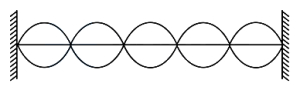
$A$ string fixed at both ends vibrates in $5$ loops as shown in the figure. The total number of nodes and antinodes respectively are
A
$6 \& 5$
B
$6 \& 10$
C
$2 \& 5$
D
$10 \& 6$
Solution
(A) In a stationary wave formed on a string fixed at both ends,the points where the displacement is always zero are called nodes. The points where the amplitude of vibration is maximum are called antinodes.
For a string vibrating in $n$ loops,the number of nodes is $n + 1$ and the number of antinodes is $n$.
Given that the string vibrates in $5$ loops,we have $n = 5$.
Therefore,the number of nodes = $5 + 1 = 6$.
The number of antinodes = $5$.
Thus,the total number of nodes and antinodes are $6$ and $5$ respectively.
For a string vibrating in $n$ loops,the number of nodes is $n + 1$ and the number of antinodes is $n$.
Given that the string vibrates in $5$ loops,we have $n = 5$.
Therefore,the number of nodes = $5 + 1 = 6$.
The number of antinodes = $5$.
Thus,the total number of nodes and antinodes are $6$ and $5$ respectively.
0 likesView Solution
200
PhysicsMediumMCQAP EAMCET · 2021
The speed of sound in oxygen $(O_2)$ at a certain temperature is $460 \,ms^{-1}$. The speed of sound in helium $(He)$ at the same temperature will be (assume both gases to be ideal): (in $\,ms^{-1}$)
A
$330$
B
$1420$
C
$500$
D
$650$
Solution
(B) For oxygen $(O_2)$:
Molar mass,$M_1 = 32 \,g/mol$.
Heat capacity ratio,$\gamma_1 = C_p / C_V = 7/5$ (for diatomic gas).
Speed of sound,$v_1 = 460 \,ms^{-1}$.
For helium $(He)$:
Molar mass,$M_2 = 4 \,g/mol$.
Heat capacity ratio,$\gamma_2 = C_p / C_V = 5/3$ (for monoatomic gas).
The speed of sound in an ideal gas is given by $v = \sqrt{\frac{\gamma RT}{M}}$.
Taking the ratio of speeds: $\frac{v_1}{v_2} = \sqrt{\frac{\gamma_1 / M_1}{\gamma_2 / M_2}} = \sqrt{\frac{\gamma_1}{\gamma_2} \cdot \frac{M_2}{M_1}}$.
Substituting the values: $\frac{460}{v_2} = \sqrt{\frac{7/5}{5/3} \cdot \frac{4}{32}} = \sqrt{\frac{21}{25} \cdot \frac{1}{8}} = \sqrt{\frac{21}{200}} \approx 0.324$.
Wait,re-calculating: $\frac{460}{v_2} = \sqrt{\frac{7}{5} \cdot \frac{3}{5} \cdot \frac{4}{32}} = \sqrt{\frac{21}{25} \cdot \frac{1}{8}} = \sqrt{\frac{21}{200}} \approx 0.324$.
Actually,$\frac{v_2}{v_1} = \sqrt{\frac{\gamma_2}{\gamma_1} \cdot \frac{M_1}{M_2}} = \sqrt{\frac{5/3}{7/5} \cdot \frac{32}{4}} = \sqrt{\frac{25}{21} \cdot 8} = \sqrt{\frac{200}{21}} \approx \sqrt{9.52} \approx 3.085$.
$v_2 = 460 \times 3.085 \approx 1419.1 \,ms^{-1} \approx 1420 \,ms^{-1}$.
Molar mass,$M_1 = 32 \,g/mol$.
Heat capacity ratio,$\gamma_1 = C_p / C_V = 7/5$ (for diatomic gas).
Speed of sound,$v_1 = 460 \,ms^{-1}$.
For helium $(He)$:
Molar mass,$M_2 = 4 \,g/mol$.
Heat capacity ratio,$\gamma_2 = C_p / C_V = 5/3$ (for monoatomic gas).
The speed of sound in an ideal gas is given by $v = \sqrt{\frac{\gamma RT}{M}}$.
Taking the ratio of speeds: $\frac{v_1}{v_2} = \sqrt{\frac{\gamma_1 / M_1}{\gamma_2 / M_2}} = \sqrt{\frac{\gamma_1}{\gamma_2} \cdot \frac{M_2}{M_1}}$.
Substituting the values: $\frac{460}{v_2} = \sqrt{\frac{7/5}{5/3} \cdot \frac{4}{32}} = \sqrt{\frac{21}{25} \cdot \frac{1}{8}} = \sqrt{\frac{21}{200}} \approx 0.324$.
Wait,re-calculating: $\frac{460}{v_2} = \sqrt{\frac{7}{5} \cdot \frac{3}{5} \cdot \frac{4}{32}} = \sqrt{\frac{21}{25} \cdot \frac{1}{8}} = \sqrt{\frac{21}{200}} \approx 0.324$.
Actually,$\frac{v_2}{v_1} = \sqrt{\frac{\gamma_2}{\gamma_1} \cdot \frac{M_1}{M_2}} = \sqrt{\frac{5/3}{7/5} \cdot \frac{32}{4}} = \sqrt{\frac{25}{21} \cdot 8} = \sqrt{\frac{200}{21}} \approx \sqrt{9.52} \approx 3.085$.
$v_2 = 460 \times 3.085 \approx 1419.1 \,ms^{-1} \approx 1420 \,ms^{-1}$.
0 likesView Solution
201
PhysicsEasyMCQAP EAMCET · 2021
The wave front is a surface in which
A
all points are in the same phase
B
there are pairs of points in opposite phase
C
there are pairs of points with phase difference $(\pi / 2)$
D
there is no relation between the phases
Solution
(A) wave front is defined as the locus of all points in a medium that are vibrating in the same phase at a given instant of time.
Since all points on the wave front are in the same state of vibration,the phase difference between any two points on the wave front is zero.
Therefore,all points on a wave front are in the same phase.
Since all points on the wave front are in the same state of vibration,the phase difference between any two points on the wave front is zero.
Therefore,all points on a wave front are in the same phase.
0 likesView Solution
202
PhysicsEasyMCQAP EAMCET · 2021
In Young's double slit experiment,the separation between the slits is halved and the distance between the screen is doubled. The fringe width is
A
Unchanged
B
Halved
C
Doubled
D
Quadrupled
Solution
(D) The formula for fringe width in Young's double slit experiment is $\beta = \frac{D \lambda}{d}$,where $D$ is the distance between the screen and the slits,$\lambda$ is the wavelength of light,and $d$ is the separation between the slits.
Given that the new distance $D_2 = 2D_1$ and the new slit separation $d_2 = \frac{d_1}{2}$.
The new fringe width $\beta_2$ is given by $\beta_2 = \frac{D_2 \lambda}{d_2}$.
Substituting the values,we get $\beta_2 = \frac{(2D_1) \lambda}{(d_1 / 2)} = 4 \times \frac{D_1 \lambda}{d_1} = 4 \beta_1$.
Therefore,the fringe width is quadrupled.
Given that the new distance $D_2 = 2D_1$ and the new slit separation $d_2 = \frac{d_1}{2}$.
The new fringe width $\beta_2$ is given by $\beta_2 = \frac{D_2 \lambda}{d_2}$.
Substituting the values,we get $\beta_2 = \frac{(2D_1) \lambda}{(d_1 / 2)} = 4 \times \frac{D_1 \lambda}{d_1} = 4 \beta_1$.
Therefore,the fringe width is quadrupled.
0 likesView Solution
203
PhysicsMediumMCQAP EAMCET · 2021
If the ratio of amplitudes of two interfering waves is $4: 3$,then the ratio of maximum and minimum intensity is
A
$16: 18$
B
$18: 16$
C
$49: 1$
D
$94: 1$
Solution
(C) Given,the ratio of amplitudes of two interfering waves is $4: 3$.
Let $A_1$ and $A_2$ be the amplitudes of the two waves,so $\frac{A_1}{A_2} = \frac{4}{3}$.
We know that the intensity $I$ of a wave is proportional to the square of its amplitude,$I \propto A^2$.
The ratio of maximum intensity to minimum intensity is given by $\frac{I_{\max}}{I_{\min}} = \left( \frac{A_1 + A_2}{A_1 - A_2} \right)^2$.
Dividing the numerator and denominator inside the bracket by $A_2$,we get $\frac{I_{\max}}{I_{\min}} = \left( \frac{\frac{A_1}{A_2} + 1}{\frac{A_1}{A_2} - 1} \right)^2$.
Substituting the value $\frac{A_1}{A_2} = \frac{4}{3}$,we get $\frac{I_{\max}}{I_{\min}} = \left( \frac{\frac{4}{3} + 1}{\frac{4}{3} - 1} \right)^2 = \left( \frac{\frac{7}{3}}{\frac{1}{3}} \right)^2 = (7)^2 = \frac{49}{1}$.
Thus,the ratio of maximum and minimum intensity is $49: 1$.
Let $A_1$ and $A_2$ be the amplitudes of the two waves,so $\frac{A_1}{A_2} = \frac{4}{3}$.
We know that the intensity $I$ of a wave is proportional to the square of its amplitude,$I \propto A^2$.
The ratio of maximum intensity to minimum intensity is given by $\frac{I_{\max}}{I_{\min}} = \left( \frac{A_1 + A_2}{A_1 - A_2} \right)^2$.
Dividing the numerator and denominator inside the bracket by $A_2$,we get $\frac{I_{\max}}{I_{\min}} = \left( \frac{\frac{A_1}{A_2} + 1}{\frac{A_1}{A_2} - 1} \right)^2$.
Substituting the value $\frac{A_1}{A_2} = \frac{4}{3}$,we get $\frac{I_{\max}}{I_{\min}} = \left( \frac{\frac{4}{3} + 1}{\frac{4}{3} - 1} \right)^2 = \left( \frac{\frac{7}{3}}{\frac{1}{3}} \right)^2 = (7)^2 = \frac{49}{1}$.
Thus,the ratio of maximum and minimum intensity is $49: 1$.
0 likesView Solution
204
PhysicsMediumMCQAP EAMCET · 2021
The ratio of maximum and minimum intensities in an interference pattern is $36: 1$. The ratio of the amplitude of the two interfering waves will be
A
$5: 7$
B
$7: 4$
C
$4: 7$
D
$7: 5$
Solution
(D) Given the ratio of maximum intensity to minimum intensity is $\frac{I_{\max}}{I_{\min}} = \frac{36}{1}$.
We know that $I_{\max} = (a_1 + a_2)^2$ and $I_{\min} = (a_1 - a_2)^2$,where $a_1$ and $a_2$ are the amplitudes of the two waves.
Therefore,$\frac{(a_1 + a_2)^2}{(a_1 - a_2)^2} = \frac{36}{1}$.
Taking the square root on both sides,we get $\frac{a_1 + a_2}{a_1 - a_2} = \frac{6}{1}$.
By cross-multiplying,$a_1 + a_2 = 6(a_1 - a_2) = 6a_1 - 6a_2$.
Rearranging the terms,$5a_1 = 7a_2$.
Thus,the ratio of the amplitudes is $\frac{a_1}{a_2} = \frac{7}{5}$.
We know that $I_{\max} = (a_1 + a_2)^2$ and $I_{\min} = (a_1 - a_2)^2$,where $a_1$ and $a_2$ are the amplitudes of the two waves.
Therefore,$\frac{(a_1 + a_2)^2}{(a_1 - a_2)^2} = \frac{36}{1}$.
Taking the square root on both sides,we get $\frac{a_1 + a_2}{a_1 - a_2} = \frac{6}{1}$.
By cross-multiplying,$a_1 + a_2 = 6(a_1 - a_2) = 6a_1 - 6a_2$.
Rearranging the terms,$5a_1 = 7a_2$.
Thus,the ratio of the amplitudes is $\frac{a_1}{a_2} = \frac{7}{5}$.
0 likesView Solution
205
PhysicsDifficultMCQAP EAMCET · 2021
In a double slit experiment,when the distance between slits is increased $10$ times,while their distance from the screen is halved,then the fringe width
A
becomes $\left(\frac{1}{20}\right)$ times the original
B
becomes $\left(\frac{1}{90}\right)$ times the original
C
remains the same
D
becomes $\left(\frac{1}{10}\right)$ times the original
Solution
(A) The formula for fringe width in a Young's double slit experiment is $\beta = \frac{\lambda D}{d}$,where $\lambda$ is the wavelength,$D$ is the distance from the slits to the screen,and $d$ is the distance between the slits.
Let the initial fringe width be $\beta_1 = \frac{\lambda D_1}{d_1}$.
According to the problem,the new distance between slits is $d_2 = 10 d_1$ and the new distance from the screen is $D_2 = \frac{D_1}{2}$.
The new fringe width is $\beta_2 = \frac{\lambda D_2}{d_2} = \frac{\lambda (D_1 / 2)}{10 d_1} = \frac{1}{20} \left( \frac{\lambda D_1}{d_1} \right)$.
Therefore,$\beta_2 = \frac{1}{20} \beta_1$.
Let the initial fringe width be $\beta_1 = \frac{\lambda D_1}{d_1}$.
According to the problem,the new distance between slits is $d_2 = 10 d_1$ and the new distance from the screen is $D_2 = \frac{D_1}{2}$.
The new fringe width is $\beta_2 = \frac{\lambda D_2}{d_2} = \frac{\lambda (D_1 / 2)}{10 d_1} = \frac{1}{20} \left( \frac{\lambda D_1}{d_1} \right)$.
Therefore,$\beta_2 = \frac{1}{20} \beta_1$.
0 likesView Solution
Vedclass Products
For Students
Vedclass Test Series
Mock tests in real AP EAMCET style covering Physics with performance analysis. 5-day free trial.
Start Free TrialFor Teachers
Exam Paper Generator
Generate Set A/B/C/D Physics papers from 7.5L+ questions in 2 minutes. 3 chapters free.
Try FreeFor Institutes
Online Exam Module
Run live AP EAMCET mock exams with unlimited students, 360° analytics & white-label branding.
See DemoFrequently Asked Questions
How many Physics questions are in AP EAMCET 2021?
There are 372 Physics questions from the AP EAMCET 2021 paper on Vedclass, each with a detailed step-by-step solution in English.
Are AP EAMCET 2021 Physics solutions available in English?
Yes. All solutions on this page are in English. You can also switch to English or Hindi using the language buttons above the questions.
Can I practice AP EAMCET 2021 Physics as a timed test?
Yes. Use the Vedclass Test Series to attempt a full AP EAMCET mock test covering Physics with time limits and instant score analysis.
Can teachers create Physics papers from AP EAMCET previous year questions?
Yes. The Vedclass Exam Paper Generator lets teachers mix AP EAMCET Physics questions and generate Set A/B/C/D papers in minutes.
For Teachers & Institutes
Build a Custom Physics Paper
Pick AP EAMCET 2021 Physics questions, set difficulty, and generate Set A/B/C/D in 2 minutes.