
PhysicsQ101–200 of 372 questions
Page 3 of 5 · English
101
PhysicsMediumMCQAP EAMCET · 2021
An object is moving with a uniform acceleration which is parallel to its instantaneous direction of motion. The displacement $(s)-$ velocity $(v)$ graph of this object is
A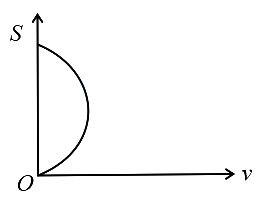
B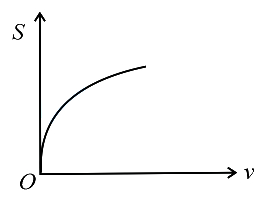
C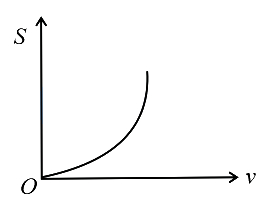
D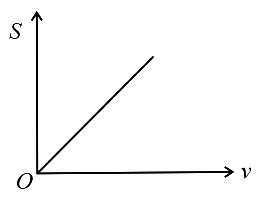
Solution
(C) From the third equation of kinematics,we have $v^2 - u^2 = 2as$.
Assuming the object starts from rest,the initial velocity $u = 0$.
Substituting this into the equation,we get $v^2 = 2as$,which can be rearranged as $s = \frac{v^2}{2a}$.
Since $a$ is a uniform (constant) acceleration,the relationship between displacement $s$ and velocity $v$ is $s \propto v^2$.
This represents a parabola opening along the $s$-axis.
Graph $C$ shows a parabolic curve where $s$ increases with the square of $v$,starting from the origin $(0, 0)$,which matches the derived relationship $s = \frac{1}{2a} v^2$.
Assuming the object starts from rest,the initial velocity $u = 0$.
Substituting this into the equation,we get $v^2 = 2as$,which can be rearranged as $s = \frac{v^2}{2a}$.
Since $a$ is a uniform (constant) acceleration,the relationship between displacement $s$ and velocity $v$ is $s \propto v^2$.
This represents a parabola opening along the $s$-axis.
Graph $C$ shows a parabolic curve where $s$ increases with the square of $v$,starting from the origin $(0, 0)$,which matches the derived relationship $s = \frac{1}{2a} v^2$.
0 likesView Solution
102
PhysicsEasyMCQAP EAMCET · 2021
The slope of the velocity-time graph for motion with uniform velocity is equal to:
A
initial velocity
B
final velocity
C
zero
D
constant velocity
Solution
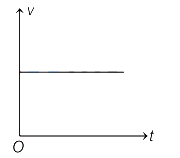
(C) We know that uniform velocity is independent of time. Therefore,in a velocity-time graph,the graph is represented as a straight line parallel to the time axis.
Since the slope of a line is given by $\text{slope} = \tan \theta$,where $\theta$ is the angle the line makes with the horizontal time axis.
From the graph,the line is parallel to the time axis,so $\theta = 0^{\circ}$.
Therefore,$\text{slope} = \tan 0^{\circ} = 0$.
Since the slope of a line is given by $\text{slope} = \tan \theta$,where $\theta$ is the angle the line makes with the horizontal time axis.
From the graph,the line is parallel to the time axis,so $\theta = 0^{\circ}$.
Therefore,$\text{slope} = \tan 0^{\circ} = 0$.
0 likesView Solution
103
PhysicsMediumMCQAP EAMCET · 2021
An object dropped in a stationary lift takes time $t_1$ to reach the floor. It takes time $t_2$ when the lift is moving up with constant acceleration. Then
A
$t_2 > t_1$
B
$t_1 > t_2$
C
$t_1 \approx t_2$
D
$t_1 = t_2$
Solution
(B) When the object is dropped in a stationary lift from height $h$,the equation of motion is $s = ut + \frac{1}{2}at^2$.
Since $u = 0$ and $a = -g$,we have $-h = -\frac{1}{2}gt_1^2$,which gives $t_1 = \sqrt{\frac{2h}{g}}$.
When the object is dropped from a lift moving upward with constant acceleration $a$,the object experiences a pseudo force in the downward direction relative to the lift frame.
The effective acceleration becomes $g_{eff} = g + a$.
Using the same kinematic equation,$-h = -\frac{1}{2}(g + a)t_2^2$,which gives $t_2 = \sqrt{\frac{2h}{g + a}}$.
Since $(g + a) > g$,it follows that $\frac{2h}{g + a} < \frac{2h}{g}$.
Therefore,$t_2 < t_1$ or $t_1 > t_2$.
Since $u = 0$ and $a = -g$,we have $-h = -\frac{1}{2}gt_1^2$,which gives $t_1 = \sqrt{\frac{2h}{g}}$.
When the object is dropped from a lift moving upward with constant acceleration $a$,the object experiences a pseudo force in the downward direction relative to the lift frame.
The effective acceleration becomes $g_{eff} = g + a$.
Using the same kinematic equation,$-h = -\frac{1}{2}(g + a)t_2^2$,which gives $t_2 = \sqrt{\frac{2h}{g + a}}$.
Since $(g + a) > g$,it follows that $\frac{2h}{g + a} < \frac{2h}{g}$.
Therefore,$t_2 < t_1$ or $t_1 > t_2$.
0 likesView Solution
104
PhysicsEasyMCQAP EAMCET · 2021
Two bodies having masses in the ratio $2:3$ fall freely under gravity from heights which are in the ratio $9:16$. The ratio of their linear momenta on touching the ground is
A
$2:9$
B
$3:16$
C
$1:2$
D
$3:2$
Solution
(C) The velocity $v$ acquired by a mass $m$ falling freely under gravity from a height $h$ is given by $v = \sqrt{2gh}$.
The linear momentum $p$ is defined as $p = mv$.
For the first body:
$p_1 = m_1 v_1 = m_1 \sqrt{2gh_1}$
For the second body:
$p_2 = m_2 v_2 = m_2 \sqrt{2gh_2}$
The ratio of their linear momenta is:
$\frac{p_1}{p_2} = \frac{m_1 \sqrt{2gh_1}}{m_2 \sqrt{2gh_2}} = \frac{m_1}{m_2} \sqrt{\frac{h_1}{h_2}}$
Given $\frac{m_1}{m_2} = \frac{2}{3}$ and $\frac{h_1}{h_2} = \frac{9}{16}$,we substitute these values:
$\frac{p_1}{p_2} = \frac{2}{3} \times \sqrt{\frac{9}{16}} = \frac{2}{3} \times \frac{3}{4} = \frac{6}{12} = \frac{1}{2}$
Thus,the ratio is $1:2$.
The linear momentum $p$ is defined as $p = mv$.
For the first body:
$p_1 = m_1 v_1 = m_1 \sqrt{2gh_1}$
For the second body:
$p_2 = m_2 v_2 = m_2 \sqrt{2gh_2}$
The ratio of their linear momenta is:
$\frac{p_1}{p_2} = \frac{m_1 \sqrt{2gh_1}}{m_2 \sqrt{2gh_2}} = \frac{m_1}{m_2} \sqrt{\frac{h_1}{h_2}}$
Given $\frac{m_1}{m_2} = \frac{2}{3}$ and $\frac{h_1}{h_2} = \frac{9}{16}$,we substitute these values:
$\frac{p_1}{p_2} = \frac{2}{3} \times \sqrt{\frac{9}{16}} = \frac{2}{3} \times \frac{3}{4} = \frac{6}{12} = \frac{1}{2}$
Thus,the ratio is $1:2$.
0 likesView Solution
105
PhysicsEasyMCQAP EAMCET · 2021
The velocity of a particle is given by $v = 2t^2 - 8t + 15 \,ms^{-1}$. Find its instantaneous acceleration at $t = 5 \,s$. (in $\,ms^{-2}$)
A
$18$
B
$20$
C
$5$
D
$12$
Solution
(D) Given, velocity $v = 2t^2 - 8t + 15$.
We know that instantaneous acceleration $a$ is the derivative of velocity with respect to time $t$, i.e., $a = \frac{dv}{dt}$.
Differentiating the given expression for velocity with respect to $t$:
$a = \frac{d}{dt}(2t^2 - 8t + 15) = 4t - 8$.
Now, substitute the value $t = 5 \,s$ into the expression for acceleration:
$a = 4(5) - 8 = 20 - 8 = 12 \,ms^{-2}$.
Therefore, the instantaneous acceleration at $t = 5 \,s$ is $12 \,ms^{-2}$.
We know that instantaneous acceleration $a$ is the derivative of velocity with respect to time $t$, i.e., $a = \frac{dv}{dt}$.
Differentiating the given expression for velocity with respect to $t$:
$a = \frac{d}{dt}(2t^2 - 8t + 15) = 4t - 8$.
Now, substitute the value $t = 5 \,s$ into the expression for acceleration:
$a = 4(5) - 8 = 20 - 8 = 12 \,ms^{-2}$.
Therefore, the instantaneous acceleration at $t = 5 \,s$ is $12 \,ms^{-2}$.
0 likesView Solution
106
PhysicsEasyMCQAP EAMCET · 2021
Acceleration of a body whose displacement follows the equation $3 s = 9 t + 5 t^2$ is in $m s^{-2}$. (in $/3$)
A
$5$
B
$14$
C
$10$
D
$19$
Solution
(C) Given,the displacement equation is $3 s = 9 t + 5 t^2$.
Dividing the entire equation by $3$,we get $s = 3 t + (5/3) t^2$.
The standard equation of motion for a body with constant acceleration is $s = u t + (1/2) a t^2$,where $u$ is the initial velocity and $a$ is the acceleration.
Comparing the given equation $s = 3 t + (5/3) t^2$ with the standard equation $s = u t + (1/2) a t^2$,we find that $(1/2) a = 5/3$.
Solving for $a$,we get $a = 2 \times (5/3) = 10/3 \ m s^{-2}$.
Dividing the entire equation by $3$,we get $s = 3 t + (5/3) t^2$.
The standard equation of motion for a body with constant acceleration is $s = u t + (1/2) a t^2$,where $u$ is the initial velocity and $a$ is the acceleration.
Comparing the given equation $s = 3 t + (5/3) t^2$ with the standard equation $s = u t + (1/2) a t^2$,we find that $(1/2) a = 5/3$.
Solving for $a$,we get $a = 2 \times (5/3) = 10/3 \ m s^{-2}$.
0 likesView Solution
107
PhysicsMediumMCQAP EAMCET · 2021
If a $100 \,m$ long train needs $7.2 \,s$ to cross an object moving in a direction opposite to the train's direction with a speed of $5 \,km/h$, then find the velocity of the train. (in $\,km/h$)
A
$40$
B
$25$
C
$45$
D
$20$
Solution
(C) Given: Length of the train, $l = 100 \,m$.
Time taken to cross the object, $t = 7.2 \,s$.
Velocity of the object moving in the opposite direction, $v_o = 5 \,km/h = 5 \times \frac{5}{18} \,m/s = \frac{25}{18} \,m/s \approx 1.39 \,m/s$.
Let the velocity of the train be $v_t = v$.
Since the objects are moving in opposite directions, the relative velocity is $v_{\text{rel}} = v_t + v_o$.
The distance covered to cross the object is equal to the length of the train, $l = v_{\text{rel}} \times t$.
$100 = (v + \frac{25}{18}) \times 7.2$.
Dividing by $7.2$: $\frac{100}{7.2} = v + \frac{25}{18}$.
$\frac{1000}{72} = v + \frac{25}{18} \Rightarrow \frac{125}{9} = v + \frac{25}{18}$.
$v = \frac{250}{18} - \frac{25}{18} = \frac{225}{18} = 12.5 \,m/s$.
Converting to $km/h$: $v = 12.5 \times \frac{18}{5} = 45 \,km/h$.
Time taken to cross the object, $t = 7.2 \,s$.
Velocity of the object moving in the opposite direction, $v_o = 5 \,km/h = 5 \times \frac{5}{18} \,m/s = \frac{25}{18} \,m/s \approx 1.39 \,m/s$.
Let the velocity of the train be $v_t = v$.
Since the objects are moving in opposite directions, the relative velocity is $v_{\text{rel}} = v_t + v_o$.
The distance covered to cross the object is equal to the length of the train, $l = v_{\text{rel}} \times t$.
$100 = (v + \frac{25}{18}) \times 7.2$.
Dividing by $7.2$: $\frac{100}{7.2} = v + \frac{25}{18}$.
$\frac{1000}{72} = v + \frac{25}{18} \Rightarrow \frac{125}{9} = v + \frac{25}{18}$.
$v = \frac{250}{18} - \frac{25}{18} = \frac{225}{18} = 12.5 \,m/s$.
Converting to $km/h$: $v = 12.5 \times \frac{18}{5} = 45 \,km/h$.
0 likesView Solution
108
PhysicsMediumMCQAP EAMCET · 2021
Two towns $A$ and $B$ are connected by a regular bus service with a bus leaving in either direction every $T$ min. $A$ man cycling with a speed of $20 \,km/h$ from $A$ to $B$ notices that a bus travelling in the direction of his motion goes past him every $18 \,min$ and every $6 \,min$ he notices a bus travelling in the opposite direction go past him. Assuming that the buses travel with a constant speed,find $T$ and the constant speed of the buses.
A
$\frac{2}{27} \,h$ and $38 \,km/h$
B
$\frac{5}{8} \,h$ and $40 \,km/h$
C
$\frac{3}{20} \,h$ and $40 \,km/h$
D
$\frac{2}{3} \,h$ and $28 \,km/h$
Solution
(C) Let the speed of the bus be $v_B$ and the speed of the cyclist be $v_C = 20 \,km/h$.
Let $d$ be the distance between two consecutive buses,where $d = v_B \times T$.
Case $1$: Bus moving from $A$ to $B$ (same direction as cyclist).
The relative speed of the bus with respect to the cyclist is $(v_B - v_C)$.
The time interval between buses passing the cyclist is $t_1 = 18 \,min = \frac{18}{60} \,h = 0.3 \,h$.
Thus,$d = (v_B - 20) \times 0.3 \dots (i)$.
Case $2$: Bus moving from $B$ to $A$ (opposite direction to cyclist).
The relative speed of the bus with respect to the cyclist is $(v_B + v_C)$.
The time interval between buses passing the cyclist is $t_2 = 6 \,min = \frac{6}{60} \,h = 0.1 \,h$.
Thus,$d = (v_B + 20) \times 0.1 \dots (ii)$.
Equating $(i)$ and $(ii)$:
$(v_B - 20) \times 0.3 = (v_B + 20) \times 0.1$
$3(v_B - 20) = v_B + 20$
$3v_B - 60 = v_B + 20$
$2v_B = 80 \Rightarrow v_B = 40 \,km/h$.
Now,substitute $v_B$ into $d = v_B \times T$ using equation $(ii)$:
$v_B \times T = (v_B + 20) \times 0.1$
$40 \times T = (40 + 20) \times 0.1$
$40T = 60 \times 0.1 = 6$
$T = \frac{6}{40} \,h = \frac{3}{20} \,h$.
Let $d$ be the distance between two consecutive buses,where $d = v_B \times T$.
Case $1$: Bus moving from $A$ to $B$ (same direction as cyclist).
The relative speed of the bus with respect to the cyclist is $(v_B - v_C)$.
The time interval between buses passing the cyclist is $t_1 = 18 \,min = \frac{18}{60} \,h = 0.3 \,h$.
Thus,$d = (v_B - 20) \times 0.3 \dots (i)$.
Case $2$: Bus moving from $B$ to $A$ (opposite direction to cyclist).
The relative speed of the bus with respect to the cyclist is $(v_B + v_C)$.
The time interval between buses passing the cyclist is $t_2 = 6 \,min = \frac{6}{60} \,h = 0.1 \,h$.
Thus,$d = (v_B + 20) \times 0.1 \dots (ii)$.
Equating $(i)$ and $(ii)$:
$(v_B - 20) \times 0.3 = (v_B + 20) \times 0.1$
$3(v_B - 20) = v_B + 20$
$3v_B - 60 = v_B + 20$
$2v_B = 80 \Rightarrow v_B = 40 \,km/h$.
Now,substitute $v_B$ into $d = v_B \times T$ using equation $(ii)$:
$v_B \times T = (v_B + 20) \times 0.1$
$40 \times T = (40 + 20) \times 0.1$
$40T = 60 \times 0.1 = 6$
$T = \frac{6}{40} \,h = \frac{3}{20} \,h$.
0 likesView Solution
109
PhysicsEasyMCQAP EAMCET · 2021
Which of the following decreases,in motion on a straight line,with constant retardation?
A
Speed
B
Acceleration
C
Displacement
D
Distance
Solution
(A) Using the equation of motion $v = u + at$.
Here,$v$ is the final speed,$u$ is the initial speed,and $a$ is the acceleration for time $t$.
Since there is constant retardation,the acceleration is negative,i.e.,$a_{eff} = -a$.
Substituting this into the equation:
$v = u + (-a)t = u - at$.
Since $at > 0$ for $t > 0$,it follows that $v < u$.
Therefore,the speed of the body decreases under constant retardation.
Here,$v$ is the final speed,$u$ is the initial speed,and $a$ is the acceleration for time $t$.
Since there is constant retardation,the acceleration is negative,i.e.,$a_{eff} = -a$.
Substituting this into the equation:
$v = u + (-a)t = u - at$.
Since $at > 0$ for $t > 0$,it follows that $v < u$.
Therefore,the speed of the body decreases under constant retardation.
0 likesView Solution
110
PhysicsEasyMCQAP EAMCET · 2021
The displacement of a particle starting from rest at $t=0$ is given by $s=9 t^2-2 t^3$. The time in seconds at which the particle will attain zero velocity is (in $s$)
A
$8$
B
$6$
C
$4$
D
$3$
Solution
(D) The velocity of the particle is given by the derivative of displacement with respect to time: $v = \frac{ds}{dt}$.
Given $s = 9t^2 - 2t^3$,we differentiate with respect to $t$:
$v = \frac{d}{dt}(9t^2 - 2t^3) = 18t - 6t^2$.
To find the time when the particle attains zero velocity,we set $v = 0$:
$18t - 6t^2 = 0$.
Factoring out $6t$,we get:
$6t(3 - t) = 0$.
This gives two solutions: $t = 0$ and $t = 3$.
Since the particle starts from rest at $t = 0$,the time at which it will attain zero velocity again is $t = 3 \ s$.
Given $s = 9t^2 - 2t^3$,we differentiate with respect to $t$:
$v = \frac{d}{dt}(9t^2 - 2t^3) = 18t - 6t^2$.
To find the time when the particle attains zero velocity,we set $v = 0$:
$18t - 6t^2 = 0$.
Factoring out $6t$,we get:
$6t(3 - t) = 0$.
This gives two solutions: $t = 0$ and $t = 3$.
Since the particle starts from rest at $t = 0$,the time at which it will attain zero velocity again is $t = 3 \ s$.
0 likesView Solution
111
PhysicsEasyMCQAP EAMCET · 2021
When a particle moves from point $A(2,2,3)$ to point $B(6,6,9)$,its displacement vector is
A
$4 \hat{i}+4 \hat{j}+6 \hat{k}$
B
$8 \hat{i}+8 \hat{j}+12 \hat{k}$
C
$4 \hat{i}+8 \hat{j}+6 \hat{k}$
D
$8 \hat{i}+4 \hat{j}+6 \hat{k}$
Solution
(A) The position vector of point $A$ is $\vec{r}_A = 2 \hat{i} + 2 \hat{j} + 3 \hat{k}$.
The position vector of point $B$ is $\vec{r}_B = 6 \hat{i} + 6 \hat{j} + 9 \hat{k}$.
The displacement vector $\vec{d}$ is given by the change in position: $\vec{d} = \vec{r}_B - \vec{r}_A$.
$\vec{d} = (6 - 2) \hat{i} + (6 - 2) \hat{j} + (9 - 3) \hat{k}$.
$\vec{d} = 4 \hat{i} + 4 \hat{j} + 6 \hat{k}$.
The position vector of point $B$ is $\vec{r}_B = 6 \hat{i} + 6 \hat{j} + 9 \hat{k}$.
The displacement vector $\vec{d}$ is given by the change in position: $\vec{d} = \vec{r}_B - \vec{r}_A$.
$\vec{d} = (6 - 2) \hat{i} + (6 - 2) \hat{j} + (9 - 3) \hat{k}$.
$\vec{d} = 4 \hat{i} + 4 \hat{j} + 6 \hat{k}$.
0 likesView Solution
112
PhysicsEasyMCQAP EAMCET · 2021
$A$ train travels from city-$A$ to city-$B$ with a constant speed of $18 \,ms^{-1}$ and returns back to city-$A$ with a constant speed of $36 \,ms^{-1}$. Find its average speed during the journey. (in $\,ms^{-1}$)
A
$24$
B
$12$
C
$27$
D
$24$
Solution
(A) Given that, speed of train from city-$A$ to city-$B$ is $v_1 = 18 \,ms^{-1}$.
Speed of train from city-$B$ to city-$A$ is $v_2 = 36 \,ms^{-1}$.
Since the distance travelled from $A$ to $B$ and $B$ to $A$ is the same, we use the formula for average speed over equal distances:
$v_{av} = \frac{2 v_1 v_2}{v_1 + v_2}$
Substituting the values:
$v_{av} = \frac{2 \times 18 \times 36}{18 + 36}$
$v_{av} = \frac{2 \times 18 \times 36}{54}$
$v_{av} = \frac{1296}{54} = 24 \,ms^{-1}$.
Speed of train from city-$B$ to city-$A$ is $v_2 = 36 \,ms^{-1}$.
Since the distance travelled from $A$ to $B$ and $B$ to $A$ is the same, we use the formula for average speed over equal distances:
$v_{av} = \frac{2 v_1 v_2}{v_1 + v_2}$
Substituting the values:
$v_{av} = \frac{2 \times 18 \times 36}{18 + 36}$
$v_{av} = \frac{2 \times 18 \times 36}{54}$
$v_{av} = \frac{1296}{54} = 24 \,ms^{-1}$.
0 likesView Solution
113
PhysicsMediumMCQAP EAMCET · 2021
An object travelling at a speed of $36 \ km/h$ comes to rest in a distance of $200 \ m$ after the brakes are applied. The retardation produced by the brakes is (in $m/s^2$)
A
$0.25$
B
$0.20$
C
$0.15$
D
$0.10$
Solution
(A) Given initial velocity $u = 36 \ km/h = 36 \times \frac{5}{18} \ m/s = 10 \ m/s$.
Since the object comes to rest,the final velocity $v = 0 \ m/s$.
The distance covered $s = 200 \ m$.
Using the third equation of motion,$v^2 - u^2 = 2as$.
Substituting the values: $0^2 - (10)^2 = 2 \times a \times 200$.
$-100 = 400a$.
$a = -\frac{100}{400} = -0.25 \ m/s^2$.
The negative sign indicates retardation.
Therefore,the retardation produced by the brakes is $0.25 \ m/s^2$.
Since the object comes to rest,the final velocity $v = 0 \ m/s$.
The distance covered $s = 200 \ m$.
Using the third equation of motion,$v^2 - u^2 = 2as$.
Substituting the values: $0^2 - (10)^2 = 2 \times a \times 200$.
$-100 = 400a$.
$a = -\frac{100}{400} = -0.25 \ m/s^2$.
The negative sign indicates retardation.
Therefore,the retardation produced by the brakes is $0.25 \ m/s^2$.
0 likesView Solution
114
PhysicsMediumMCQAP EAMCET · 2021
Two paper screens $A$ and $B$ are separated by $150 \ m$. $A$ bullet pierces $A$ and then $B$. The hole in $B$ is $15 \ cm$ below the hole in $A$. If the bullet is traveling horizontally at the time of hitting $A$,then the velocity of the bullet at $A$ is: $(g=10 \ m \ s^{-2})$
A
$100 \sqrt{3} \ m \ s^{-1}$
B
$200 \sqrt{3} \ m \ s^{-1}$
C
$300 \sqrt{3} \ m \ s^{-1}$
D
$500 \sqrt{3} \ m \ s^{-1}$
Solution
(D) The bullet exhibits horizontal projectile motion.
Vertical displacement of the bullet,$y = 15 \ cm = 0.15 \ m$.
Horizontal displacement of the bullet,$x = 150 \ m$.
Using the equation of trajectory for horizontal projection,$y = \frac{g x^2}{2 u^2}$.
Substituting the values: $0.15 = \frac{10 \times 150^2}{2 u^2}$.
Rearranging for $u^2$: $u^2 = \frac{10 \times 22500}{2 \times 0.15} = \frac{225000}{0.3} = 750000$.
Taking the square root: $u = \sqrt{750000} = \sqrt{250000 \times 3} = 500 \sqrt{3} \ m \ s^{-1}$.
Vertical displacement of the bullet,$y = 15 \ cm = 0.15 \ m$.
Horizontal displacement of the bullet,$x = 150 \ m$.
Using the equation of trajectory for horizontal projection,$y = \frac{g x^2}{2 u^2}$.
Substituting the values: $0.15 = \frac{10 \times 150^2}{2 u^2}$.
Rearranging for $u^2$: $u^2 = \frac{10 \times 22500}{2 \times 0.15} = \frac{225000}{0.3} = 750000$.
Taking the square root: $u = \sqrt{750000} = \sqrt{250000 \times 3} = 500 \sqrt{3} \ m \ s^{-1}$.
0 likesView Solution
115
PhysicsEasyMCQAP EAMCET · 2021
$A$ car is moving with a speed of $30 \,ms^{-1}$ on a circular path of radius $500 \,m$. If its speed is increasing at the rate of $2 \,ms^{-2}$, then find its acceleration. (in $\,ms^{-2}$)
A
$2.0$
B
$1.8$
C
$9.8$
D
$2.7$
Solution
(D) Given: Speed $v = 30 \,ms^{-1}$, Radius $r = 500 \,m$, Tangential acceleration $a_T = 2 \,ms^{-2}$.
The total acceleration $a$ of a particle in circular motion is the vector sum of tangential acceleration $a_T$ and centripetal (radial) acceleration $a_r$.
First, calculate the centripetal acceleration $a_r = \frac{v^2}{r} = \frac{30^2}{500} = \frac{900}{500} = 1.8 \,ms^{-2}$.
The total acceleration is given by $a = \sqrt{a_T^2 + a_r^2}$.
Substituting the values: $a = \sqrt{2^2 + 1.8^2} = \sqrt{4 + 3.24} = \sqrt{7.24}$.
Calculating the square root: $a \approx 2.69 \,ms^{-2}$, which is approximately $2.7 \,ms^{-2}$.
The total acceleration $a$ of a particle in circular motion is the vector sum of tangential acceleration $a_T$ and centripetal (radial) acceleration $a_r$.
First, calculate the centripetal acceleration $a_r = \frac{v^2}{r} = \frac{30^2}{500} = \frac{900}{500} = 1.8 \,ms^{-2}$.
The total acceleration is given by $a = \sqrt{a_T^2 + a_r^2}$.
Substituting the values: $a = \sqrt{2^2 + 1.8^2} = \sqrt{4 + 3.24} = \sqrt{7.24}$.
Calculating the square root: $a \approx 2.69 \,ms^{-2}$, which is approximately $2.7 \,ms^{-2}$.
0 likesView Solution
116
PhysicsEasyMCQAP EAMCET · 2021
When a ball is thrown with a velocity of $50 \ m s^{-1}$ at an angle $30^{\circ}$ with the horizontal,it remains in the air for how many seconds? (Take $g = 10 \ m s^{-2}$)
A
$5$
B
$2.5$
C
$1.25$
D
$0.625$
Solution
(A) The time of flight $T$ for a projectile is given by the formula $T = \frac{2u \sin \theta}{g}$.
Given:
Initial velocity $u = 50 \ m s^{-1}$
Angle of projection $\theta = 30^{\circ}$
Acceleration due to gravity $g = 10 \ m s^{-2}$
Substituting the values into the formula:
$T = \frac{2 \times 50 \times \sin 30^{\circ}}{10}$
Since $\sin 30^{\circ} = 0.5$,
$T = \frac{100 \times 0.5}{10} = \frac{50}{10} = 5 \ s$.
Thus,the ball remains in the air for $5 \ s$.
Given:
Initial velocity $u = 50 \ m s^{-1}$
Angle of projection $\theta = 30^{\circ}$
Acceleration due to gravity $g = 10 \ m s^{-2}$
Substituting the values into the formula:
$T = \frac{2 \times 50 \times \sin 30^{\circ}}{10}$
Since $\sin 30^{\circ} = 0.5$,
$T = \frac{100 \times 0.5}{10} = \frac{50}{10} = 5 \ s$.
Thus,the ball remains in the air for $5 \ s$.
0 likesView Solution
117
PhysicsEasyMCQAP EAMCET · 2021
$A$ ball is projected upwards. Its acceleration at the highest point is
A
Zero
B
directed upwards
C
directed downwards
D
such as cannot be predicted
Solution
(C) When a ball is projected upwards,the only force acting on it throughout its flight is the gravitational force,which acts vertically downwards. According to Newton's second law of motion,$F = ma$,the acceleration $a$ is in the direction of the net force. At the highest point,the velocity of the ball is momentarily zero,but the gravitational force continues to act on it. Therefore,the acceleration remains $g$ (acceleration due to gravity) and is directed downwards.
0 likesView Solution
118
PhysicsMediumMCQAP EAMCET · 2021
The range of a projectile is $100 \ m$. Its kinetic energy will be maximum after covering a horizontal distance of: (in $m$)
A
$25$
B
$50$
C
$75$
D
$100$
Solution
(D) The kinetic energy of a projectile is given by $KE = \frac{1}{2}mv^2$,where $v$ is the instantaneous velocity of the particle.
Since the horizontal component of velocity $(v_x = u \cos \theta)$ remains constant throughout the flight,the net velocity $v = \sqrt{v_x^2 + v_y^2}$ depends on the vertical component $v_y$.
The vertical component $v_y = u \sin \theta - gt$ is maximum in magnitude at the point of projection $(t=0)$ and at the point of landing ($t=T$,where $T$ is the total time of flight).
At the point of projection,the horizontal distance covered is $0 \ m$. At the point of landing,the horizontal distance covered is equal to the range $R = 100 \ m$.
Comparing the options,the kinetic energy is maximum at the start and at the end of the trajectory. Since $0 \ m$ is not an option,the correct answer is $100 \ m$.
Since the horizontal component of velocity $(v_x = u \cos \theta)$ remains constant throughout the flight,the net velocity $v = \sqrt{v_x^2 + v_y^2}$ depends on the vertical component $v_y$.
The vertical component $v_y = u \sin \theta - gt$ is maximum in magnitude at the point of projection $(t=0)$ and at the point of landing ($t=T$,where $T$ is the total time of flight).
At the point of projection,the horizontal distance covered is $0 \ m$. At the point of landing,the horizontal distance covered is equal to the range $R = 100 \ m$.
Comparing the options,the kinetic energy is maximum at the start and at the end of the trajectory. Since $0 \ m$ is not an option,the correct answer is $100 \ m$.
0 likesView Solution
119
PhysicsMediumMCQAP EAMCET · 2021
$A$ hiker stands on the edge of a cliff $490 \ m$ above the ground and throws a stone horizontally with an initial speed of $15 \ m \ s^{-1}$. The speed with which it hits the ground is (in $m \ s^{-1}$)
A
$99$
B
$101$
C
$103$
D
$105$
Solution
(A) The horizontal component of velocity remains constant because there is no acceleration in the horizontal direction: $v_x = u_x = 15 \ m \ s^{-1}$.
In the vertical direction,the stone undergoes free fall with initial vertical velocity $u_y = 0$. Using the equation $v_y^2 = u_y^2 + 2gh$:
$v_y^2 = 0 + 2 \times 9.8 \times 490 = 9604$.
$v_y = \sqrt{9604} = 98 \ m \ s^{-1}$.
The final speed $v$ is the magnitude of the resultant velocity vector: $v = \sqrt{v_x^2 + v_y^2}$.
$v = \sqrt{15^2 + 98^2} = \sqrt{225 + 9604} = \sqrt{9829} \approx 99.14 \ m \ s^{-1}$.
Rounding to the nearest integer,the speed is $99 \ m \ s^{-1}$.
In the vertical direction,the stone undergoes free fall with initial vertical velocity $u_y = 0$. Using the equation $v_y^2 = u_y^2 + 2gh$:
$v_y^2 = 0 + 2 \times 9.8 \times 490 = 9604$.
$v_y = \sqrt{9604} = 98 \ m \ s^{-1}$.
The final speed $v$ is the magnitude of the resultant velocity vector: $v = \sqrt{v_x^2 + v_y^2}$.
$v = \sqrt{15^2 + 98^2} = \sqrt{225 + 9604} = \sqrt{9829} \approx 99.14 \ m \ s^{-1}$.
Rounding to the nearest integer,the speed is $99 \ m \ s^{-1}$.
0 likesView Solution
120
PhysicsMediumMCQAP EAMCET · 2021
From the top of a tower $19.6 \,m$ high, a ball is thrown horizontally. If the line joining the point of projection to the point where it hits the ground makes an angle of $45^{\circ}$ with the horizontal, then the initial velocity of the ball is (in $\,m/s$)
A
$9.8$
B
$4.9$
C
$14.7$
D
$2.8$
Solution
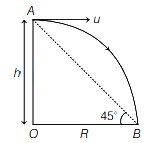
(A) Given that, the height of the tower is $h = 19.6 \,m$.
The angle of the line joining the point of projection to the point on the ground with the horizontal is $\theta = 45^{\circ}$.
In the right-angled triangle formed by the height $h$ and horizontal range $R$, we have:
$\tan \theta = \frac{h}{R}$
$\tan 45^{\circ} = \frac{19.6}{R}$
$1 = \frac{19.6}{R} \Rightarrow R = 19.6 \,m$.
The time taken $t$ to reach the ground is given by:
$t = \sqrt{\frac{2h}{g}} = \sqrt{\frac{2 \times 19.6}{9.8}} = \sqrt{4} = 2 \,s$.
The horizontal distance $R$ is given by:
$R = u \times t$
$19.6 = u \times 2$
$u = \frac{19.6}{2} = 9.8 \,m/s$.
Thus, the initial velocity of the ball is $9.8 \,m/s$.
The angle of the line joining the point of projection to the point on the ground with the horizontal is $\theta = 45^{\circ}$.
In the right-angled triangle formed by the height $h$ and horizontal range $R$, we have:
$\tan \theta = \frac{h}{R}$
$\tan 45^{\circ} = \frac{19.6}{R}$
$1 = \frac{19.6}{R} \Rightarrow R = 19.6 \,m$.
The time taken $t$ to reach the ground is given by:
$t = \sqrt{\frac{2h}{g}} = \sqrt{\frac{2 \times 19.6}{9.8}} = \sqrt{4} = 2 \,s$.
The horizontal distance $R$ is given by:
$R = u \times t$
$19.6 = u \times 2$
$u = \frac{19.6}{2} = 9.8 \,m/s$.
Thus, the initial velocity of the ball is $9.8 \,m/s$.
0 likesView Solution
121
PhysicsEasyMCQAP EAMCET · 2021
If the equation of motion of a projectile is given by $y = 12x - \frac{3}{4}x^2$ and its horizontal component of velocity is $3 \ m/s$,then find its range. $(g = 10 \ m/s^2)$ (in $m$)
A
$12.4$
B
$21.6$
C
$30.6$
D
$36.0$
Solution
(B) Let $u$ and $\theta$ be the velocity of projection and angle of projection,respectively.
Given that,the horizontal component of velocity is $u_x = u \cos \theta = 3 \ m/s$.
The equation of projectile motion is given by $y = 12x - \frac{3}{4}x^2$ ... $(i)$.
We know the general equation of projectile motion is $y = x \tan \theta - \frac{gx^2}{2u^2 \cos^2 \theta}$ ... (ii).
Comparing equations $(i)$ and (ii),we get $\tan \theta = 12$.
Since $\tan \theta = \frac{\sin \theta}{\cos \theta} = 12$,we have $\sin \theta = 12 \cos \theta$.
Multiplying both sides by $u$,we get $u \sin \theta = 12(u \cos \theta) = 12 \times 3 = 36 \ m/s$.
The range $R$ is given by $R = \frac{2u^2 \sin \theta \cos \theta}{g} = \frac{2(u \sin \theta)(u \cos \theta)}{g}$.
Substituting the values,$R = \frac{2 \times 36 \times 3}{10} = \frac{216}{10} = 21.6 \ m$.
Given that,the horizontal component of velocity is $u_x = u \cos \theta = 3 \ m/s$.
The equation of projectile motion is given by $y = 12x - \frac{3}{4}x^2$ ... $(i)$.
We know the general equation of projectile motion is $y = x \tan \theta - \frac{gx^2}{2u^2 \cos^2 \theta}$ ... (ii).
Comparing equations $(i)$ and (ii),we get $\tan \theta = 12$.
Since $\tan \theta = \frac{\sin \theta}{\cos \theta} = 12$,we have $\sin \theta = 12 \cos \theta$.
Multiplying both sides by $u$,we get $u \sin \theta = 12(u \cos \theta) = 12 \times 3 = 36 \ m/s$.
The range $R$ is given by $R = \frac{2u^2 \sin \theta \cos \theta}{g} = \frac{2(u \sin \theta)(u \cos \theta)}{g}$.
Substituting the values,$R = \frac{2 \times 36 \times 3}{10} = \frac{216}{10} = 21.6 \ m$.
0 likesView Solution
122
PhysicsMediumMCQAP EAMCET · 2021
$A$ ball is thrown at $30^{\circ}$ with the horizontal from the top of a roof $20 \,m$ high with a speed of $13 \,ms^{-1}$. At what distance from the throwing point will the ball, once again, be at a height of $20 \,m$ from the ground (in $\,m$)? $(g = 10 \,ms^{-2})$
A
$10.2$
B
$14.6$
C
$18.6$
D
$9.8$
Solution
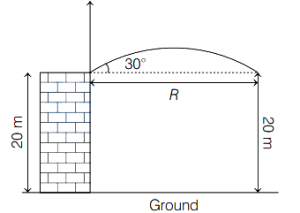
(B) The ball is projected from a height of $20 \,m$ and we need to find the horizontal distance where it returns to the same vertical level ($20 \,m$ from the ground).
This is equivalent to finding the horizontal range of a projectile launched at an angle $\theta$ on a level plane.
The formula for the horizontal range $R$ is given by:
$R = \frac{u^2 \sin(2\theta)}{g}$
Given:
Initial speed $u = 13 \,ms^{-1}$
Angle of projection $\theta = 30^{\circ}$
Acceleration due to gravity $g = 10 \,ms^{-2}$
Substituting the values:
$R = \frac{(13)^2 \times \sin(2 \times 30^{\circ})}{10}$
$R = \frac{169 \times \sin(60^{\circ})}{10}$
$R = \frac{169 \times \frac{\sqrt{3}}{2}}{10}$
$R = \frac{169 \times 1.732}{20}$
$R = \frac{292.708}{20} \approx 14.635 \,m$
Rounding to one decimal place, we get $R = 14.6 \,m$.
This is equivalent to finding the horizontal range of a projectile launched at an angle $\theta$ on a level plane.
The formula for the horizontal range $R$ is given by:
$R = \frac{u^2 \sin(2\theta)}{g}$
Given:
Initial speed $u = 13 \,ms^{-1}$
Angle of projection $\theta = 30^{\circ}$
Acceleration due to gravity $g = 10 \,ms^{-2}$
Substituting the values:
$R = \frac{(13)^2 \times \sin(2 \times 30^{\circ})}{10}$
$R = \frac{169 \times \sin(60^{\circ})}{10}$
$R = \frac{169 \times \frac{\sqrt{3}}{2}}{10}$
$R = \frac{169 \times 1.732}{20}$
$R = \frac{292.708}{20} \approx 14.635 \,m$
Rounding to one decimal place, we get $R = 14.6 \,m$.
0 likesView Solution
123
PhysicsMediumMCQAP EAMCET · 2021
Two cars $A$ and $B$ are moving with a velocity of $30 \ km/h$ in the same direction. They are separated by $10 \ km$. The speed of another car $C$ moving in the opposite direction,if it meets these two cars at an interval of $8 \ minutes$,is: (in $km/h$)
A
$45$
B
$40$
C
$15$
D
$30$
Solution
(A) Let the velocity of cars $A$ and $B$ be $v_A = v_B = 30 \ km/h$ in the positive direction.
Let the velocity of car $C$ be $v_C$ in the opposite direction,so $v_C = -v$ (where $v$ is the speed of car $C$).
The relative velocity of car $C$ with respect to cars $A$ and $B$ is $v_{rel} = v_A - v_C = 30 - (-v) = 30 + v$.
The distance between car $A$ and $B$ is $d = 10 \ km$.
Car $C$ meets car $B$ and then car $A$ after an interval of $t = 8 \ minutes = \frac{8}{60} \ h = \frac{2}{15} \ h$.
Using the formula $d = v_{rel} \times t$:
$10 = (30 + v) \times \frac{2}{15}$
$10 \times \frac{15}{2} = 30 + v$
$75 = 30 + v$
$v = 75 - 30 = 45 \ km/h$.
Let the velocity of car $C$ be $v_C$ in the opposite direction,so $v_C = -v$ (where $v$ is the speed of car $C$).
The relative velocity of car $C$ with respect to cars $A$ and $B$ is $v_{rel} = v_A - v_C = 30 - (-v) = 30 + v$.
The distance between car $A$ and $B$ is $d = 10 \ km$.
Car $C$ meets car $B$ and then car $A$ after an interval of $t = 8 \ minutes = \frac{8}{60} \ h = \frac{2}{15} \ h$.
Using the formula $d = v_{rel} \times t$:
$10 = (30 + v) \times \frac{2}{15}$
$10 \times \frac{15}{2} = 30 + v$
$75 = 30 + v$
$v = 75 - 30 = 45 \ km/h$.
0 likesView Solution
124
PhysicsEasyMCQAP EAMCET · 2021
$A$ particle of mass $5 \ kg$ is moving on a circle of radius $1 \ m$ with an angular velocity of $2 \ rad \ s^{-1}$. The centripetal force is (in $N$)
A
$10$
B
$40$
C
$30$
D
$20$
Solution
(D) Given: Mass $m = 5 \ kg$,Radius $r = 1 \ m$,Angular velocity $\omega = 2 \ rad \ s^{-1}$.
Centripetal force $F_c$ is given by the formula $F_c = m \omega^2 r$.
Substituting the given values:
$F_c = 5 \times (2)^2 \times 1$
$F_c = 5 \times 4 \times 1$
$F_c = 20 \ N$.
Therefore,the centripetal force is $20 \ N$.
Centripetal force $F_c$ is given by the formula $F_c = m \omega^2 r$.
Substituting the given values:
$F_c = 5 \times (2)^2 \times 1$
$F_c = 5 \times 4 \times 1$
$F_c = 20 \ N$.
Therefore,the centripetal force is $20 \ N$.
0 likesView Solution
125
PhysicsMediumMCQAP EAMCET · 2021
The amplitude of a damped oscillator is known to decrease to $0.9$ times its original amplitude in $5 \,s$. Approximately, by how many times its original amplitude will it decrease after another $20 \,s$?
A
$0.73$
B
$0.9$
C
$0.59$
D
$0.26$
Solution
(C) The amplitude of a damped oscillator at time $t$ is given by $A(t) = A_0 e^{-\alpha t}$.
Given that at $t_1 = 5 \,s$, $A(5) = 0.9 A_0$.
Substituting this into the equation: $0.9 A_0 = A_0 e^{-5\alpha}$, which implies $e^{-5\alpha} = 0.9$.
We need to find the amplitude after another $20 \,s$, which means at total time $t_2 = 5 \,s + 20 \,s = 25 \,s$.
Let $A'$ be the amplitude at $t_2 = 25 \,s$.
$A' = A_0 e^{-25\alpha} = A_0 (e^{-5\alpha})^5$.
Substituting $e^{-5\alpha} = 0.9$:
$A' = A_0 (0.9)^5 = A_0 \times 0.59049$.
Thus, the amplitude decreases to approximately $0.59$ times its original amplitude.
Given that at $t_1 = 5 \,s$, $A(5) = 0.9 A_0$.
Substituting this into the equation: $0.9 A_0 = A_0 e^{-5\alpha}$, which implies $e^{-5\alpha} = 0.9$.
We need to find the amplitude after another $20 \,s$, which means at total time $t_2 = 5 \,s + 20 \,s = 25 \,s$.
Let $A'$ be the amplitude at $t_2 = 25 \,s$.
$A' = A_0 e^{-25\alpha} = A_0 (e^{-5\alpha})^5$.
Substituting $e^{-5\alpha} = 0.9$:
$A' = A_0 (0.9)^5 = A_0 \times 0.59049$.
Thus, the amplitude decreases to approximately $0.59$ times its original amplitude.
0 likesView Solution
126
PhysicsMediumMCQAP EAMCET · 2021
$A$ spring is stretched by $0.40 \ m$ when a mass of $0.6 \ kg$ is suspended from it. The period of oscillations of the spring loaded by $255 \ g$ and put to oscillations is close to $(g = 10 \ m \ s^{-2})$. (in $s$)
A
$1.1$
B
$48.6$
C
$0.82$
D
$4.86$
Solution
(C) Using Hooke's law for the spring,$F = kx$.
When a mass of $0.6 \ kg$ is suspended,the spring force balances the weight of the mass,so $F = mg$.
Thus,$k = \frac{mg}{x} = \frac{0.6 \times 10}{0.40} = 15 \ N \ m^{-1}$.
The time period $T$ for a mass $m' = 255 \ g = 0.255 \ kg$ is given by $T = 2\pi \sqrt{\frac{m'}{k}}$.
Substituting the values: $T = 2 \times 3.14 \times \sqrt{\frac{0.255}{15}} = 2 \times 3.14 \times \sqrt{0.017} \approx 6.28 \times 0.13038 \approx 0.8188 \ s$.
Rounding to two decimal places,$T \approx 0.82 \ s$.
When a mass of $0.6 \ kg$ is suspended,the spring force balances the weight of the mass,so $F = mg$.
Thus,$k = \frac{mg}{x} = \frac{0.6 \times 10}{0.40} = 15 \ N \ m^{-1}$.
The time period $T$ for a mass $m' = 255 \ g = 0.255 \ kg$ is given by $T = 2\pi \sqrt{\frac{m'}{k}}$.
Substituting the values: $T = 2 \times 3.14 \times \sqrt{\frac{0.255}{15}} = 2 \times 3.14 \times \sqrt{0.017} \approx 6.28 \times 0.13038 \approx 0.8188 \ s$.
Rounding to two decimal places,$T \approx 0.82 \ s$.
0 likesView Solution
127
PhysicsMediumMCQAP EAMCET · 2021
The scale of a spring balance which can measure from $0$ to $15 \ kg$ is $0.25 \ m$ long. If a body suspended from this balance oscillates with a time period $\frac{2 \pi}{5} \ s$,neglecting the mass of the spring,find the mass of the body suspended. (in $kg$)
A
$24$
B
$1$
C
$20$
D
$7$
Solution
(A) The spring constant $k$ of the spring is calculated using Hooke's Law,$F = kx$. Given $F = 15 \ kg \times 10 \ m/s^2 = 150 \ N$ and $x = 0.25 \ m$,we have $k = \frac{150}{0.25} = 600 \ N/m$.
The time period $T$ of a spring-mass system is given by $T = 2 \pi \sqrt{\frac{m}{k}}$.
Substituting the given values,$\frac{2 \pi}{5} = 2 \pi \sqrt{\frac{m}{600}}$.
Dividing both sides by $2 \pi$,we get $\frac{1}{5} = \sqrt{\frac{m}{600}}$.
Squaring both sides,$\frac{1}{25} = \frac{m}{600}$.
Solving for $m$,$m = \frac{600}{25} = 24 \ kg$.
The time period $T$ of a spring-mass system is given by $T = 2 \pi \sqrt{\frac{m}{k}}$.
Substituting the given values,$\frac{2 \pi}{5} = 2 \pi \sqrt{\frac{m}{600}}$.
Dividing both sides by $2 \pi$,we get $\frac{1}{5} = \sqrt{\frac{m}{600}}$.
Squaring both sides,$\frac{1}{25} = \frac{m}{600}$.
Solving for $m$,$m = \frac{600}{25} = 24 \ kg$.
0 likesView Solution
128
PhysicsMediumMCQAP EAMCET · 2021
$A$ block of mass $1 \ kg$ is fastened to a spring of spring constant $100 \ N \ m^{-1}$. The block is pulled to a distance $x = 10 \ cm$ from its equilibrium position $(x = 0 \ cm)$ on a frictionless surface,from rest at $t = 0$. The kinetic energy and the potential energy of the block when it is $5 \ cm$ away from the mean position are:
A
$0.375 \ J, 0.125 \ J$
B
$0.125 \ J, 0.375 \ J$
C
$0.125 \ J, 0.125 \ J$
D
$0.375 \ J, 0.375 \ J$
Solution
(A) Given: Mass $m = 1 \ kg$,spring constant $k = 100 \ N \ m^{-1}$,amplitude $A = 10 \ cm = 0.1 \ m$,displacement $x = 5 \ cm = 0.05 \ m$.
Angular frequency $\omega = \sqrt{\frac{k}{m}} = \sqrt{\frac{100}{1}} = 10 \ rad \ s^{-1}$.
Velocity at displacement $x$ is given by $v = \omega \sqrt{A^2 - x^2} = 10 \sqrt{0.1^2 - 0.05^2} = 10 \sqrt{0.01 - 0.0025} = 10 \sqrt{0.0075} = 10 \times 0.0866 = 0.866 \ m \ s^{-1}$.
Kinetic energy $K.E. = \frac{1}{2} m v^2 = \frac{1}{2} \times 1 \times (0.866)^2 = 0.5 \times 0.75 = 0.375 \ J$.
Potential energy $P.E. = \frac{1}{2} k x^2 = \frac{1}{2} \times 100 \times (0.05)^2 = 50 \times 0.0025 = 0.125 \ J$.
Angular frequency $\omega = \sqrt{\frac{k}{m}} = \sqrt{\frac{100}{1}} = 10 \ rad \ s^{-1}$.
Velocity at displacement $x$ is given by $v = \omega \sqrt{A^2 - x^2} = 10 \sqrt{0.1^2 - 0.05^2} = 10 \sqrt{0.01 - 0.0025} = 10 \sqrt{0.0075} = 10 \times 0.0866 = 0.866 \ m \ s^{-1}$.
Kinetic energy $K.E. = \frac{1}{2} m v^2 = \frac{1}{2} \times 1 \times (0.866)^2 = 0.5 \times 0.75 = 0.375 \ J$.
Potential energy $P.E. = \frac{1}{2} k x^2 = \frac{1}{2} \times 100 \times (0.05)^2 = 50 \times 0.0025 = 0.125 \ J$.
0 likesView Solution
129
PhysicsEasyMCQAP EAMCET · 2021
What is the number of degrees of freedom for an oscillating simple pendulum?
A
One
B
Two
C
Three
D
More than three
Solution
(A) simple pendulum consists of a point mass (bob) suspended by a massless,inextensible string.
For a simple pendulum oscillating in a plane,the position of the bob is uniquely determined by a single coordinate,which is the angle $\theta$ that the string makes with the vertical.
Therefore,the number of degrees of freedom for an oscillating simple pendulum is $1$.
For a simple pendulum oscillating in a plane,the position of the bob is uniquely determined by a single coordinate,which is the angle $\theta$ that the string makes with the vertical.
Therefore,the number of degrees of freedom for an oscillating simple pendulum is $1$.
0 likesView Solution
130
PhysicsMediumMCQAP EAMCET · 2021
$A$ bob of a pendulum of length $0.5 \ m$ has a speed of $6 \ ms^{-1}$ at its lowest point. Find the speed of the bob when the string of the pendulum makes $60^{\circ}$ with the vertical. (Take $g=10 \ ms^{-2}$)
A
$26 \ ms^{-1}$
B
$\sqrt{31} \ ms^{-1}$
C
$13 \ ms^{-1}$
D
$1.3 \ ms^{-1}$
Solution
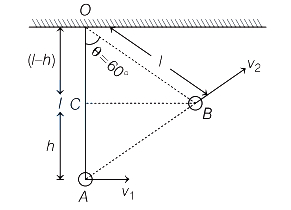
(B) Given: Length of pendulum,$l = 0.5 \ m$. Speed at lowest point,$v_1 = 6 \ ms^{-1}$. Angle made by string with vertical,$\theta = 60^{\circ}$.
In $\triangle OBC$,$\cos \theta = \frac{OC}{OB} = \frac{l-h}{l} = \cos 60^{\circ}$.
$\Rightarrow 1 - \frac{h}{l} = 0.5 \Rightarrow \frac{h}{l} = 0.5 \Rightarrow h = 0.5 \times 0.5 = 0.25 \ m$.
Using the law of conservation of mechanical energy:
$K_i + U_i = K_f + U_f$
$\frac{1}{2}mv_1^2 + 0 = \frac{1}{2}mv_2^2 + mgh$
$v_2^2 = v_1^2 - 2gh$
$v_2^2 = (6)^2 - 2 \times 10 \times 0.25 = 36 - 5 = 31$
$v_2 = \sqrt{31} \ ms^{-1}$.
Hence,the final velocity at an angle $60^{\circ}$ is $\sqrt{31} \ ms^{-1}$.
In $\triangle OBC$,$\cos \theta = \frac{OC}{OB} = \frac{l-h}{l} = \cos 60^{\circ}$.
$\Rightarrow 1 - \frac{h}{l} = 0.5 \Rightarrow \frac{h}{l} = 0.5 \Rightarrow h = 0.5 \times 0.5 = 0.25 \ m$.
Using the law of conservation of mechanical energy:
$K_i + U_i = K_f + U_f$
$\frac{1}{2}mv_1^2 + 0 = \frac{1}{2}mv_2^2 + mgh$
$v_2^2 = v_1^2 - 2gh$
$v_2^2 = (6)^2 - 2 \times 10 \times 0.25 = 36 - 5 = 31$
$v_2 = \sqrt{31} \ ms^{-1}$.
Hence,the final velocity at an angle $60^{\circ}$ is $\sqrt{31} \ ms^{-1}$.
0 likesView Solution
131
PhysicsEasyMCQAP EAMCET · 2021
$A$ simple pendulum is vibrating in an evacuated chamber. It will oscillate with
A
constant amplitude
B
decreasing amplitude
C
increasing amplitude
D
amplitude,the variation of which cannot be predicted
Solution
(A) In an evacuated chamber,there is no air resistance or drag force acting on the bob of the simple pendulum.
Since the only force acting on the bob is gravity (which is a conservative force),there is no mechanism to dissipate the mechanical energy of the system.
According to the law of conservation of energy,the total mechanical energy remains constant.
Therefore,the amplitude of the oscillation remains constant over time.
Since the only force acting on the bob is gravity (which is a conservative force),there is no mechanism to dissipate the mechanical energy of the system.
According to the law of conservation of energy,the total mechanical energy remains constant.
Therefore,the amplitude of the oscillation remains constant over time.
0 likesView Solution
132
PhysicsMediumMCQAP EAMCET · 2021
$A$ body of mass $4.9 \, kg$ hangs from a spring and oscillates with a period $0.5 \, s$. On the removal of the body, the spring is shortened by (take $g=10 \, m/s^2, \pi^2=10$)
A
$6.3 \, m$
B
$0.63 \, m$
C
$6.25 \, cm$
D
$63 \, cm$
Solution
(C) Given that, mass of body $m = 4.9 \, kg$.
Time period of oscillation of the spring $T = 0.5 \, s$.
Acceleration due to gravity $g = 10 \, m/s^2$ and $\pi^2 = 10$.
The time period of a spring-mass system is given by $T = 2\pi \sqrt{\frac{m}{k}}$.
Squaring both sides, we get $T^2 = 4\pi^2 \frac{m}{k}$.
Rearranging for the ratio $\frac{m}{k}$, we have $\frac{m}{k} = \frac{T^2}{4\pi^2}$.
Substituting the values, $\frac{m}{k} = \frac{(0.5)^2}{4 \times 10} = \frac{0.25}{40} = 0.00625 \, kg/N$.
When the mass is removed, the spring shortens by an amount $x$ equal to the extension produced by the mass in equilibrium.
From Hooke's Law at equilibrium, $kx = mg$, which implies $x = \frac{m}{k} g$.
Substituting the values, $x = 0.00625 \times 10 = 0.0625 \, m$.
Converting to centimeters, $x = 0.0625 \times 100 = 6.25 \, cm$.
Thus, the spring is shortened by $6.25 \, cm$.
Time period of oscillation of the spring $T = 0.5 \, s$.
Acceleration due to gravity $g = 10 \, m/s^2$ and $\pi^2 = 10$.
The time period of a spring-mass system is given by $T = 2\pi \sqrt{\frac{m}{k}}$.
Squaring both sides, we get $T^2 = 4\pi^2 \frac{m}{k}$.
Rearranging for the ratio $\frac{m}{k}$, we have $\frac{m}{k} = \frac{T^2}{4\pi^2}$.
Substituting the values, $\frac{m}{k} = \frac{(0.5)^2}{4 \times 10} = \frac{0.25}{40} = 0.00625 \, kg/N$.
When the mass is removed, the spring shortens by an amount $x$ equal to the extension produced by the mass in equilibrium.
From Hooke's Law at equilibrium, $kx = mg$, which implies $x = \frac{m}{k} g$.
Substituting the values, $x = 0.00625 \times 10 = 0.0625 \, m$.
Converting to centimeters, $x = 0.0625 \times 100 = 6.25 \, cm$.
Thus, the spring is shortened by $6.25 \, cm$.
0 likesView Solution
133
PhysicsMediumMCQAP EAMCET · 2021
$A$ simple pendulum,suspended from the ceiling of a lift,has a period of oscillation $T$,when the lift is at rest. If the lift starts moving upwards with an acceleration $a = 3g$,then the new period will be
A
$2 T$
B
$4 T$
C
$\frac{T}{3}$
D
$\frac{T}{2}$
Solution
(D) The time period of a simple pendulum is given by $T = 2 \pi \sqrt{\frac{l}{g_{eff}}}$.
When the lift is at rest,the effective acceleration due to gravity is $g_{eff} = g$.
So,$T = 2 \pi \sqrt{\frac{l}{g}}$ ...$(i)$
When the lift moves upwards with an acceleration $a = 3g$,the effective acceleration due to gravity becomes $g_{eff} = g + a = g + 3g = 4g$.
The new time period $T^{\prime}$ is given by $T^{\prime} = 2 \pi \sqrt{\frac{l}{4g}}$.
$T^{\prime} = \frac{1}{2} \times 2 \pi \sqrt{\frac{l}{g}}$.
Substituting the value from Eq. $(i)$,we get $T^{\prime} = \frac{T}{2}$.
When the lift is at rest,the effective acceleration due to gravity is $g_{eff} = g$.
So,$T = 2 \pi \sqrt{\frac{l}{g}}$ ...$(i)$
When the lift moves upwards with an acceleration $a = 3g$,the effective acceleration due to gravity becomes $g_{eff} = g + a = g + 3g = 4g$.
The new time period $T^{\prime}$ is given by $T^{\prime} = 2 \pi \sqrt{\frac{l}{4g}}$.
$T^{\prime} = \frac{1}{2} \times 2 \pi \sqrt{\frac{l}{g}}$.
Substituting the value from Eq. $(i)$,we get $T^{\prime} = \frac{T}{2}$.
0 likesView Solution
134
PhysicsEasyMCQAP EAMCET · 2021
$A$ particle executing simple harmonic motion along a straight line with an amplitude $A$,attains maximum potential energy when its displacement from the mean position equals
A
$0$
B
$\pm \frac{A}{\sqrt{2}}$
C
$\pm A$
D
$\pm \frac{A}{2}$
Solution
(C) The potential energy $U$ of a particle executing simple harmonic motion is given by $U = \frac{1}{2} k x^2$,where $k$ is the force constant and $x$ is the displacement from the mean position.
For the potential energy to be maximum,the displacement $x$ must be at its maximum value.
In simple harmonic motion,the maximum displacement from the mean position is equal to the amplitude $A$.
Therefore,the potential energy is maximum at the extreme positions,which are $x = \pm A$.
For the potential energy to be maximum,the displacement $x$ must be at its maximum value.
In simple harmonic motion,the maximum displacement from the mean position is equal to the amplitude $A$.
Therefore,the potential energy is maximum at the extreme positions,which are $x = \pm A$.
0 likesView Solution
135
PhysicsEasyMCQAP EAMCET · 2021
The displacement of a simple harmonic motion of amplitude $6 \text{ cm}$ when its kinetic energy is equal to its potential energy is:
A
$2 \sqrt{2} \text{ cm}$
B
$2 \text{ cm}$
C
$3 \sqrt{2} \text{ cm}$
D
$\frac{3}{\sqrt{2}} \text{ cm}$
Solution
(C) Given,amplitude of oscillation,$a = 6 \text{ cm}$.
Let the displacement be $x \text{ cm}$.
When the kinetic energy $(K)$ is equal to the potential energy $(U)$,we have $K = U$.
The kinetic energy of a simple harmonic oscillator is given by $K = \frac{1}{2} m \omega^2 (a^2 - x^2)$.
The potential energy is given by $U = \frac{1}{2} m \omega^2 x^2$.
Equating the two:
$\frac{1}{2} m \omega^2 (a^2 - x^2) = \frac{1}{2} m \omega^2 x^2$
$a^2 - x^2 = x^2$
$2x^2 = a^2$
$x^2 = \frac{a^2}{2}$
$x = \frac{a}{\sqrt{2}}$
Substituting $a = 6 \text{ cm}$:
$x = \frac{6}{\sqrt{2}} = 3 \sqrt{2} \text{ cm}$.
Let the displacement be $x \text{ cm}$.
When the kinetic energy $(K)$ is equal to the potential energy $(U)$,we have $K = U$.
The kinetic energy of a simple harmonic oscillator is given by $K = \frac{1}{2} m \omega^2 (a^2 - x^2)$.
The potential energy is given by $U = \frac{1}{2} m \omega^2 x^2$.
Equating the two:
$\frac{1}{2} m \omega^2 (a^2 - x^2) = \frac{1}{2} m \omega^2 x^2$
$a^2 - x^2 = x^2$
$2x^2 = a^2$
$x^2 = \frac{a^2}{2}$
$x = \frac{a}{\sqrt{2}}$
Substituting $a = 6 \text{ cm}$:
$x = \frac{6}{\sqrt{2}} = 3 \sqrt{2} \text{ cm}$.
0 likesView Solution
136
PhysicsMediumMCQAP EAMCET · 2021
$A$ particle of mass $m$ is under the influence of a force $F = (-kx + F_0) \text{ N}$. The particle,when disturbed,will oscillate
A
about $x = 0$ with $\omega = \sqrt{\frac{k}{m}}$
B
about $x = 0$ with $\omega = \sqrt{\frac{m}{k}}$
C
about $x = \frac{F_0}{k}$ with $\omega = \sqrt{\frac{k}{m}}$
D
about $x = \frac{F_0}{k}$ with $\omega \neq \sqrt{\frac{k}{m}}$
Solution
(C) Given that,the force acting on the particle is $F = -kx + F_0$.
We can rewrite this as $F = -k(x - \frac{F_0}{k})$.
Let $y = x - \frac{F_0}{k}$,then the force becomes $F = -ky$.
This is the standard form of the restoring force for Simple Harmonic Motion $(SHM)$,where the mean position is defined by $F = 0$.
Setting $F = 0$,we get $-k(x - \frac{F_0}{k}) = 0$,which implies $x = \frac{F_0}{k}$.
Thus,the particle oscillates about the mean position $x = \frac{F_0}{k}$.
Comparing $F = -ky$ with the standard $SHM$ equation $F = -m\omega^2 y$,we get $m\omega^2 = k$.
Therefore,the angular frequency is $\omega = \sqrt{\frac{k}{m}}$.
We can rewrite this as $F = -k(x - \frac{F_0}{k})$.
Let $y = x - \frac{F_0}{k}$,then the force becomes $F = -ky$.
This is the standard form of the restoring force for Simple Harmonic Motion $(SHM)$,where the mean position is defined by $F = 0$.
Setting $F = 0$,we get $-k(x - \frac{F_0}{k}) = 0$,which implies $x = \frac{F_0}{k}$.
Thus,the particle oscillates about the mean position $x = \frac{F_0}{k}$.
Comparing $F = -ky$ with the standard $SHM$ equation $F = -m\omega^2 y$,we get $m\omega^2 = k$.
Therefore,the angular frequency is $\omega = \sqrt{\frac{k}{m}}$.
0 likesView Solution
137
PhysicsMediumMCQAP EAMCET · 2021
The ratio of the maximum acceleration to the maximum velocity of a simple harmonic oscillator is
A
$\omega$
B
$\frac{\omega}{2}$
C
$\omega^2$
D
$2 \omega$
Solution
(A) For a simple harmonic oscillator $(SHM)$,we know that:
The maximum acceleration is given by $|a_{\max}| = \omega^2 A$.
The maximum velocity is given by $|v_{\max}| = \omega A$.
Here,$\omega$ is the angular frequency and $A$ is the amplitude of oscillation.
Therefore,the ratio of maximum acceleration to maximum velocity is:
$\frac{|a_{\max}|}{|v_{\max}|} = \frac{\omega^2 A}{\omega A} = \omega$.
The maximum acceleration is given by $|a_{\max}| = \omega^2 A$.
The maximum velocity is given by $|v_{\max}| = \omega A$.
Here,$\omega$ is the angular frequency and $A$ is the amplitude of oscillation.
Therefore,the ratio of maximum acceleration to maximum velocity is:
$\frac{|a_{\max}|}{|v_{\max}|} = \frac{\omega^2 A}{\omega A} = \omega$.
0 likesView Solution
138
PhysicsEasyMCQAP EAMCET · 2021
$A$ simple harmonic oscillation is represented by $x = A \cos \left(\omega t + \frac{\pi}{4}\right)$. Its speed is maximum when $t$ equals
A
$\frac{\pi}{2 \omega}$
B
$\frac{\pi}{4 \omega}$
C
$\frac{\pi}{\omega}$
D
$\frac{2 \pi}{\omega}$
Solution
(B) The equation of a particle executing simple harmonic motion is given by $x = A \cos \left(\omega t + \frac{\pi}{4}\right)$.
The velocity $v$ of the particle is the derivative of displacement with respect to time:
$v = \frac{dx}{dt} = \frac{d}{dt} \left[ A \cos \left(\omega t + \frac{\pi}{4}\right) \right] = -A \omega \sin \left(\omega t + \frac{\pi}{4}\right)$.
The speed $|v|$ is maximum when the magnitude of the sine function is $1$,i.e.,$\sin \left(\omega t + \frac{\pi}{4}\right) = -1$ or $1$.
For the first positive time $t$,we consider $\sin \left(\omega t + \frac{\pi}{4}\right) = -1 = \sin \left(\frac{3\pi}{2}\right)$.
Thus,$\omega t + \frac{\pi}{4} = \frac{3\pi}{2} \Rightarrow \omega t = \frac{3\pi}{2} - \frac{\pi}{4} = \frac{5\pi}{4} \Rightarrow t = \frac{5\pi}{4\omega}$.
However,checking the options provided,if we consider the condition for maximum speed magnitude $|v| = A\omega$,we require $\sin^2(\omega t + \pi/4) = 1$.
If we set $\omega t + \pi/4 = \pi/2$,we get $t = \pi/(4\omega)$,which corresponds to the particle passing through the equilibrium position with maximum speed in the negative direction.
The velocity $v$ of the particle is the derivative of displacement with respect to time:
$v = \frac{dx}{dt} = \frac{d}{dt} \left[ A \cos \left(\omega t + \frac{\pi}{4}\right) \right] = -A \omega \sin \left(\omega t + \frac{\pi}{4}\right)$.
The speed $|v|$ is maximum when the magnitude of the sine function is $1$,i.e.,$\sin \left(\omega t + \frac{\pi}{4}\right) = -1$ or $1$.
For the first positive time $t$,we consider $\sin \left(\omega t + \frac{\pi}{4}\right) = -1 = \sin \left(\frac{3\pi}{2}\right)$.
Thus,$\omega t + \frac{\pi}{4} = \frac{3\pi}{2} \Rightarrow \omega t = \frac{3\pi}{2} - \frac{\pi}{4} = \frac{5\pi}{4} \Rightarrow t = \frac{5\pi}{4\omega}$.
However,checking the options provided,if we consider the condition for maximum speed magnitude $|v| = A\omega$,we require $\sin^2(\omega t + \pi/4) = 1$.
If we set $\omega t + \pi/4 = \pi/2$,we get $t = \pi/(4\omega)$,which corresponds to the particle passing through the equilibrium position with maximum speed in the negative direction.
0 likesView Solution
139
PhysicsMediumMCQAP EAMCET · 2021
Two particles $P$ and $Q$ describe $SHM$ of same amplitude $a$ and same frequency $f$ along the same straight line. The maximum distance between the two particles is $a \sqrt{2}$. The phase difference between the particles is
A
zero
B
$\frac{\pi}{2}$
C
$\frac{\pi}{6}$
D
$\frac{\pi}{3}$
Solution
(B) Let the equations of motion for particles $P$ and $Q$ be $x_1 = a \sin(\omega t)$ and $x_2 = a \sin(\omega t + \phi)$,where $\phi$ is the phase difference.
The distance between the particles is given by $d = |x_2 - x_1| = |a \sin(\omega t + \phi) - a \sin(\omega t)|$.
Using the trigonometric identity $\sin A - \sin B = 2 \sin(\frac{A-B}{2}) \cos(\frac{A+B}{2})$,we get:
$d = |2a \sin(\frac{\phi}{2}) \cos(\omega t + \frac{\phi}{2})|$.
The maximum value of this distance occurs when the magnitude of the cosine term is $1$.
Thus,$d_{max} = 2a \sin(\frac{\phi}{2})$.
Given $d_{max} = a \sqrt{2}$,we have $2a \sin(\frac{\phi}{2}) = a \sqrt{2}$.
$\sin(\frac{\phi}{2}) = \frac{\sqrt{2}}{2} = \frac{1}{\sqrt{2}}$.
$\frac{\phi}{2} = \frac{\pi}{4}$,which implies $\phi = \frac{\pi}{2}$.
The distance between the particles is given by $d = |x_2 - x_1| = |a \sin(\omega t + \phi) - a \sin(\omega t)|$.
Using the trigonometric identity $\sin A - \sin B = 2 \sin(\frac{A-B}{2}) \cos(\frac{A+B}{2})$,we get:
$d = |2a \sin(\frac{\phi}{2}) \cos(\omega t + \frac{\phi}{2})|$.
The maximum value of this distance occurs when the magnitude of the cosine term is $1$.
Thus,$d_{max} = 2a \sin(\frac{\phi}{2})$.
Given $d_{max} = a \sqrt{2}$,we have $2a \sin(\frac{\phi}{2}) = a \sqrt{2}$.
$\sin(\frac{\phi}{2}) = \frac{\sqrt{2}}{2} = \frac{1}{\sqrt{2}}$.
$\frac{\phi}{2} = \frac{\pi}{4}$,which implies $\phi = \frac{\pi}{2}$.
0 likesView Solution
140
PhysicsMediumMCQAP EAMCET · 2021
$A$ particle of mass $0.4 \text{ kg}$ executes simple harmonic motion of amplitude $0.4 \text{ m}$. When it passes through the mean position,its kinetic energy is $256 \times 10^{-3} \text{ J}$. If the initial phase of the oscillation is $\pi / 4$,then the equation of its motion is
A
$x=0.4 \sin \left((0.4) t+\frac{\pi}{4}\right)$
B
$x=0.2 \sin \left(2 \sqrt{2} t+\frac{\pi}{4}\right)$
C
$x=0.8 \sin \left((2 \sqrt{2}) t+\frac{\pi}{2}\right)$
D
$x=0.4 \sin \left((2 \sqrt{2}) t+\frac{\pi}{4}\right)$
Solution
(D) Given: Mass of the particle $m = 0.4 \text{ kg}$,Amplitude $A = 0.4 \text{ m}$,Initial phase $\phi = \pi / 4$.
The kinetic energy at the mean position is equal to the total energy of the oscillator,given by $KE = \frac{1}{2} m \omega^2 A^2$.
Substituting the given values: $256 \times 10^{-3} = \frac{1}{2} \times 0.4 \times \omega^2 \times (0.4)^2$.
$0.256 = 0.2 \times \omega^2 \times 0.16$.
$0.256 = 0.032 \times \omega^2$.
$\omega^2 = \frac{0.256}{0.032} = 8$.
$\omega = \sqrt{8} = 2 \sqrt{2} \text{ rad/s}$.
The general equation for simple harmonic motion is $x = A \sin(\omega t + \phi)$.
Substituting the values,we get $x = 0.4 \sin \left((2 \sqrt{2}) t + \frac{\pi}{4}\right)$.
The kinetic energy at the mean position is equal to the total energy of the oscillator,given by $KE = \frac{1}{2} m \omega^2 A^2$.
Substituting the given values: $256 \times 10^{-3} = \frac{1}{2} \times 0.4 \times \omega^2 \times (0.4)^2$.
$0.256 = 0.2 \times \omega^2 \times 0.16$.
$0.256 = 0.032 \times \omega^2$.
$\omega^2 = \frac{0.256}{0.032} = 8$.
$\omega = \sqrt{8} = 2 \sqrt{2} \text{ rad/s}$.
The general equation for simple harmonic motion is $x = A \sin(\omega t + \phi)$.
Substituting the values,we get $x = 0.4 \sin \left((2 \sqrt{2}) t + \frac{\pi}{4}\right)$.
0 likesView Solution
141
PhysicsEasyMCQAP EAMCET · 2021
In case of a forced vibration,the resonance wave becomes very sharp when the:
A
quality factor is small
B
dampening force is small
C
restoring force is small
D
applied periodic force is small
Solution
(B) Resonance is a phenomenon where the amplitude of oscillations increases significantly when the frequency of an externally applied periodic force matches the natural frequency of the system.
In a forced oscillation system,the sharpness of the resonance curve is determined by the damping present in the system.
The sharpness of the resonance is inversely proportional to the damping coefficient.
Therefore,when the dampening force is small,the energy loss per cycle is minimal,leading to a very sharp and high-amplitude resonance peak.
Thus,the correct option is $B$.
In a forced oscillation system,the sharpness of the resonance curve is determined by the damping present in the system.
The sharpness of the resonance is inversely proportional to the damping coefficient.
Therefore,when the dampening force is small,the energy loss per cycle is minimal,leading to a very sharp and high-amplitude resonance peak.
Thus,the correct option is $B$.
0 likesView Solution
142
PhysicsMediumMCQAP EAMCET · 2021
The bob of a simple pendulum is a spherical hollow ball filled with water. $A$ plugged hole near the bottom of the oscillating bob gets suddenly unplugged. During observation,till water is coming out,the time period of oscillation would:
A
remain unchanged
B
increase towards a saturation value
C
first increase and then decrease to the original value.
D
first decrease and then increase to the original value.
Solution
(C) The time period of a simple pendulum is given by $T = 2 \pi \sqrt{\frac{l}{g}}$,where $l$ is the effective length of the pendulum measured from the point of suspension to the center of mass of the bob.
Initially,the center of mass of the water-filled sphere is at its geometric center.
As water drains out from the hole at the bottom,the center of mass of the system shifts downwards. This increases the effective length $l$,causing the time period $T$ to increase.
As the water level continues to drop,the center of mass reaches its lowest point and then begins to rise back towards the geometric center of the sphere as the bob becomes empty.
Once the water is completely drained,the center of mass returns to the geometric center of the hollow sphere,restoring the original effective length $l$ and thus the original time period $T$.
Initially,the center of mass of the water-filled sphere is at its geometric center.
As water drains out from the hole at the bottom,the center of mass of the system shifts downwards. This increases the effective length $l$,causing the time period $T$ to increase.
As the water level continues to drop,the center of mass reaches its lowest point and then begins to rise back towards the geometric center of the sphere as the bob becomes empty.
Once the water is completely drained,the center of mass returns to the geometric center of the hollow sphere,restoring the original effective length $l$ and thus the original time period $T$.
0 likesView Solution
143
PhysicsMediumMCQAP EAMCET · 2021
$A$ particle executing simple harmonic motion has a maximum speed of $40 \,ms^{-1}$ and maximum acceleration of $60 \,ms^{-2}$. The period of oscillation is
A
$\frac{4 \pi}{3} \,s$
B
$\frac{\pi}{2} \,s$
C
$2 \pi \,s$
D
$\frac{1}{\pi} \,s$
Solution
(A) Given,maximum speed of $SHM$ is $v_{\max} = A\omega = 40 \,ms^{-1}$ ... $(i)$
Maximum acceleration of $SHM$ is $a_{\max} = A\omega^2 = 60 \,ms^{-2}$ ... (ii)
Dividing Eq. (ii) by Eq. $(i)$,we get:
$\frac{A\omega^2}{A\omega} = \frac{60}{40}$
$\omega = 1.5 \,rad/s = \frac{3}{2} \,rad/s$
We know that the time period $T$ is related to angular frequency $\omega$ by the formula:
$T = \frac{2\pi}{\omega}$
Substituting the value of $\omega$:
$T = \frac{2\pi}{3/2} = \frac{4\pi}{3} \,s$
Hence,the time period of the oscillation is $\frac{4\pi}{3} \,s$.
Maximum acceleration of $SHM$ is $a_{\max} = A\omega^2 = 60 \,ms^{-2}$ ... (ii)
Dividing Eq. (ii) by Eq. $(i)$,we get:
$\frac{A\omega^2}{A\omega} = \frac{60}{40}$
$\omega = 1.5 \,rad/s = \frac{3}{2} \,rad/s$
We know that the time period $T$ is related to angular frequency $\omega$ by the formula:
$T = \frac{2\pi}{\omega}$
Substituting the value of $\omega$:
$T = \frac{2\pi}{3/2} = \frac{4\pi}{3} \,s$
Hence,the time period of the oscillation is $\frac{4\pi}{3} \,s$.
0 likesView Solution
144
PhysicsEasyMCQAP EAMCET · 2021
Boiling water is changing into steam. The specific heat of boiling water is
A
zero
B
One
C
Infinity
D
less than one
Solution
(C) Specific heat $s$ of a substance is defined as the amount of heat $Q$ required to raise the temperature of a unit mass $m$ of the substance by a unit degree $\Delta T$.
The formula is given by $s = \frac{Q}{m \Delta T}$.
During the process of boiling water changing into steam,the substance undergoes a phase change.
In a phase change process,the temperature of the substance remains constant,meaning $\Delta T = 0$.
Substituting this into the formula,we get $s = \frac{Q}{m \times 0} = \infty$.
Therefore,the specific heat of boiling water during this phase change is infinite.
The formula is given by $s = \frac{Q}{m \Delta T}$.
During the process of boiling water changing into steam,the substance undergoes a phase change.
In a phase change process,the temperature of the substance remains constant,meaning $\Delta T = 0$.
Substituting this into the formula,we get $s = \frac{Q}{m \times 0} = \infty$.
Therefore,the specific heat of boiling water during this phase change is infinite.
0 likesView Solution
145
PhysicsEasyMCQAP EAMCET · 2021
Specific heat of a gas undergoing adiabatic change is
A
zero
B
infinite
C
positive
D
negative
Solution
(A) The molar specific heat capacity $C$ is defined as the amount of heat required to raise the temperature of $1 \text{ mole}$ of a gas by $1 \text{ K}$.
Mathematically,$C = \frac{\Delta Q}{n \Delta T}$.
In an adiabatic process,the system is thermally insulated from its surroundings,meaning no heat is exchanged with the environment.
Therefore,the heat change $\Delta Q = 0$.
Substituting this into the formula,we get $C = \frac{0}{n \Delta T} = 0$.
Thus,the specific heat of a gas undergoing an adiabatic change is $0$.
Mathematically,$C = \frac{\Delta Q}{n \Delta T}$.
In an adiabatic process,the system is thermally insulated from its surroundings,meaning no heat is exchanged with the environment.
Therefore,the heat change $\Delta Q = 0$.
Substituting this into the formula,we get $C = \frac{0}{n \Delta T} = 0$.
Thus,the specific heat of a gas undergoing an adiabatic change is $0$.
0 likesView Solution
146
PhysicsMediumMCQAP EAMCET · 2021
$5 \text{ g}$ of steam at $100^{\circ} \text{C}$ is mixed with $5 \text{ g}$ of ice at $0^{\circ} \text{C}$. What is the final temperature of the mixture (in $^{\circ} \text{C}$)?
A
$100$
B
$95$
C
$90$
D
$80$
Solution
(A) Given: Mass of steam,$m_s = 5 \text{ g}$,Temperature of steam,$T_s = 100^{\circ} \text{C}$.
Mass of ice,$m_i = 5 \text{ g}$,Temperature of ice,$T_i = 0^{\circ} \text{C}$.
Latent heat of vaporization,$L_v = 540 \text{ cal/g}$.
Latent heat of fusion,$L_f = 80 \text{ cal/g}$.
Specific heat of water,$s = 1 \text{ cal/g}^{\circ} \text{C}$.
Step $1$: Calculate heat released by steam to condense into water at $100^{\circ} \text{C}$:
$Q_1 = m_s \times L_v = 5 \times 540 = 2700 \text{ cal}$.
Step $2$: Calculate heat required by ice to melt and reach $100^{\circ} \text{C}$:
Heat to melt ice: $Q_{melt} = m_i \times L_f = 5 \times 80 = 400 \text{ cal}$.
Heat to raise water temperature from $0^{\circ} \text{C}$ to $100^{\circ} \text{C}$: $Q_{rise} = m_i \times s \times \Delta T = 5 \times 1 \times 100 = 500 \text{ cal}$.
Total heat required by ice: $Q_2 = 400 + 500 = 900 \text{ cal}$.
Step $3$: Compare $Q_1$ and $Q_2$:
Since $Q_1 > Q_2$,the steam has more than enough energy to melt the ice and heat the resulting water to $100^{\circ} \text{C}$.
Therefore,the final mixture will be at $100^{\circ} \text{C}$ with some steam remaining.
Mass of ice,$m_i = 5 \text{ g}$,Temperature of ice,$T_i = 0^{\circ} \text{C}$.
Latent heat of vaporization,$L_v = 540 \text{ cal/g}$.
Latent heat of fusion,$L_f = 80 \text{ cal/g}$.
Specific heat of water,$s = 1 \text{ cal/g}^{\circ} \text{C}$.
Step $1$: Calculate heat released by steam to condense into water at $100^{\circ} \text{C}$:
$Q_1 = m_s \times L_v = 5 \times 540 = 2700 \text{ cal}$.
Step $2$: Calculate heat required by ice to melt and reach $100^{\circ} \text{C}$:
Heat to melt ice: $Q_{melt} = m_i \times L_f = 5 \times 80 = 400 \text{ cal}$.
Heat to raise water temperature from $0^{\circ} \text{C}$ to $100^{\circ} \text{C}$: $Q_{rise} = m_i \times s \times \Delta T = 5 \times 1 \times 100 = 500 \text{ cal}$.
Total heat required by ice: $Q_2 = 400 + 500 = 900 \text{ cal}$.
Step $3$: Compare $Q_1$ and $Q_2$:
Since $Q_1 > Q_2$,the steam has more than enough energy to melt the ice and heat the resulting water to $100^{\circ} \text{C}$.
Therefore,the final mixture will be at $100^{\circ} \text{C}$ with some steam remaining.
0 likesView Solution
147
PhysicsMediumMCQAP EAMCET · 2021
Match the following items in Column-$I$ with their corresponding definitions in Column-$II$.
| Column-$I$ | Column-$II$ |
| $A$. Conversion of liquid into solid is | $1$. Regelation |
| $B$. Conversion of liquid into vapour is | $2$. Sublimation |
| $C$. Conversion of solid into vapour directly is | $3$. Fusion |
| $D$. Melting of ice caused by pressure is | $4$. Vaporisation |
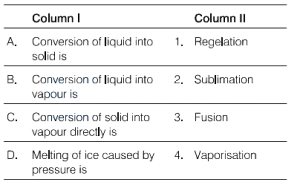
A
$3, 4, 2, 1$
B
$1, 3, 4, 2$
C
$3, 4, 1, 2$
D
$4, 2, 1, 3$
Solution
(A) The correct matches are as follows:
$(A)$ The process of converting a liquid into a solid is called freezing or fusion (in some contexts,fusion refers to melting,but here it corresponds to the phase change process).
$(B)$ The process of converting a liquid into vapour is known as vaporisation.
$(C)$ The process of converting a solid directly into vapour without passing through the liquid state is known as sublimation.
$(D)$ The phenomenon of melting of ice due to the application of pressure is known as regelation.
Therefore,the correct matching is $A-3, B-4, C-2, D-1$.
$(A)$ The process of converting a liquid into a solid is called freezing or fusion (in some contexts,fusion refers to melting,but here it corresponds to the phase change process).
$(B)$ The process of converting a liquid into vapour is known as vaporisation.
$(C)$ The process of converting a solid directly into vapour without passing through the liquid state is known as sublimation.
$(D)$ The phenomenon of melting of ice due to the application of pressure is known as regelation.
Therefore,the correct matching is $A-3, B-4, C-2, D-1$.
0 likesView Solution
148
PhysicsMediumMCQAP EAMCET · 2021
$A$ beaker is filled completely with water at $4^{\circ} C$. Identify the incorrect statement.
A
Water overflows when heated above $4^{\circ} C$.
B
Water overflows when cooled below $4^{\circ} C$.
C
Water overflows either when heated above $4^{\circ} C$ or cooled below $4^{\circ} C$.
D
Water will not overflow when cooled below $4^{\circ} C$.
Solution
(D) The density of water is maximum at $4^{\circ} C$.
As the temperature increases above $4^{\circ} C$,the density of water decreases,causing the volume to increase.
Similarly,as the temperature decreases below $4^{\circ} C$,the density of water also decreases due to anomalous expansion,which again causes the volume to increase.
Since the beaker is already full,any increase in volume leads to overflow.
Therefore,water overflows when heated above $4^{\circ} C$ or cooled below $4^{\circ} C$.
Statement $D$ is incorrect because water does overflow when cooled below $4^{\circ} C$.
As the temperature increases above $4^{\circ} C$,the density of water decreases,causing the volume to increase.
Similarly,as the temperature decreases below $4^{\circ} C$,the density of water also decreases due to anomalous expansion,which again causes the volume to increase.
Since the beaker is already full,any increase in volume leads to overflow.
Therefore,water overflows when heated above $4^{\circ} C$ or cooled below $4^{\circ} C$.
Statement $D$ is incorrect because water does overflow when cooled below $4^{\circ} C$.
0 likesView Solution
149
PhysicsEasyMCQAP EAMCET · 2021
Which of the following is $NOT$ a reversible process?
A
Melting of ice
B
Conduction of heat
C
Isothermal expansion of gas
D
Adiabatic expansion of gas
Solution
(B) reversible process is one that can be reversed without leaving any trace on the surroundings.
Melting of ice,isothermal expansion,and adiabatic expansion (if performed quasi-statically) can be considered reversible processes.
Conduction of heat is an irreversible process because it occurs due to a finite temperature difference between two bodies.
Heat always flows spontaneously from a higher temperature to a lower temperature,and this process cannot be reversed without external work,thus increasing the entropy of the universe.
Melting of ice,isothermal expansion,and adiabatic expansion (if performed quasi-statically) can be considered reversible processes.
Conduction of heat is an irreversible process because it occurs due to a finite temperature difference between two bodies.
Heat always flows spontaneously from a higher temperature to a lower temperature,and this process cannot be reversed without external work,thus increasing the entropy of the universe.
0 likesView Solution
150
PhysicsMediumMCQAP EAMCET · 2021
Two plates of the same area are placed in contact. Their thicknesses as well as their thermal conductivities are in the ratio $2:3$. The outer surface of one plate is maintained at $10^{\circ} C$ and that of the other at $0^{\circ} C$. The temperature at the common surface is (in $^{\circ} C$)
A
$0$
B
$25$
C
$5$
D
$6.5$
Solution
(C) Given that two plates have the same surface area $A$.
Let $K_1, K_2$ be their thermal conductivities and $t_1, t_2$ be their thicknesses respectively.
According to the problem,the ratios are:
$\frac{K_1}{K_2} = \frac{2}{3}$ and $\frac{t_1}{t_2} = \frac{2}{3}$.
Since the plates are in series,the rate of heat flow through both plates must be the same in steady state:
$\frac{dQ}{dt} = \frac{K_1 A (T_1 - T)}{t_1} = \frac{K_2 A (T - T_2)}{t_2}$
Where $T$ is the temperature of the common surface.
Substituting the given values $T_1 = 10^{\circ} C$ and $T_2 = 0^{\circ} C$:
$\frac{K_1}{t_1} (10 - T) = \frac{K_2}{t_2} (T - 0)$
$\frac{K_1}{K_2} \cdot \frac{t_2}{t_1} (10 - T) = T$
Substituting the ratios $\frac{K_1}{K_2} = \frac{2}{3}$ and $\frac{t_2}{t_1} = \frac{3}{2}$:
$\left( \frac{2}{3} \right) \cdot \left( \frac{3}{2} \right) (10 - T) = T$
$1 \cdot (10 - T) = T$
$10 - T = T$
$2T = 10$
$T = 5^{\circ} C$
Let $K_1, K_2$ be their thermal conductivities and $t_1, t_2$ be their thicknesses respectively.
According to the problem,the ratios are:
$\frac{K_1}{K_2} = \frac{2}{3}$ and $\frac{t_1}{t_2} = \frac{2}{3}$.
Since the plates are in series,the rate of heat flow through both plates must be the same in steady state:
$\frac{dQ}{dt} = \frac{K_1 A (T_1 - T)}{t_1} = \frac{K_2 A (T - T_2)}{t_2}$
Where $T$ is the temperature of the common surface.
Substituting the given values $T_1 = 10^{\circ} C$ and $T_2 = 0^{\circ} C$:
$\frac{K_1}{t_1} (10 - T) = \frac{K_2}{t_2} (T - 0)$
$\frac{K_1}{K_2} \cdot \frac{t_2}{t_1} (10 - T) = T$
Substituting the ratios $\frac{K_1}{K_2} = \frac{2}{3}$ and $\frac{t_2}{t_1} = \frac{3}{2}$:
$\left( \frac{2}{3} \right) \cdot \left( \frac{3}{2} \right) (10 - T) = T$
$1 \cdot (10 - T) = T$
$10 - T = T$
$2T = 10$
$T = 5^{\circ} C$
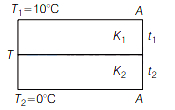
0 likesView Solution
151
PhysicsMediumMCQAP EAMCET · 2021
$A$ unit positive charge has to be brought from infinity to a midpoint between two charges $20 \mu C$ and $10 \mu C$ separated by a distance of $50 \ m$. How much work will be required?
A
$10.8 \times 10^4 \ J$
B
$10.8 \times 10^3 \ J$
C
$1.08 \times 10^6 \ J$
D
$0.54 \times 10^5 \ J$
Solution
(B) Given that,two charges $q_1 = 20 \mu C$ and $q_2 = 10 \mu C$ are separated by a distance $d = 50 \ m$.
Work done $W$ in bringing a unit positive charge $q = 1 \ C$ from infinity to the midpoint $M$ is given by $W = qV$,where $V$ is the electric potential at point $M$.
The potential at $M$ due to charges $q_1$ and $q_2$ is $V = \frac{K q_1}{(d/2)} + \frac{K q_2}{(d/2)} = \frac{2K}{d} (q_1 + q_2)$.
Substituting the values:
$W = 1 \times \frac{2 \times (9 \times 10^9)}{50} \times (20 + 10) \times 10^{-6} \ J$
$W = \frac{18 \times 10^9}{50} \times 30 \times 10^{-6} \ J$
$W = \frac{540 \times 10^3}{50} \ J = 10.8 \times 10^3 \ J$.
Work done $W$ in bringing a unit positive charge $q = 1 \ C$ from infinity to the midpoint $M$ is given by $W = qV$,where $V$ is the electric potential at point $M$.
The potential at $M$ due to charges $q_1$ and $q_2$ is $V = \frac{K q_1}{(d/2)} + \frac{K q_2}{(d/2)} = \frac{2K}{d} (q_1 + q_2)$.
Substituting the values:
$W = 1 \times \frac{2 \times (9 \times 10^9)}{50} \times (20 + 10) \times 10^{-6} \ J$
$W = \frac{18 \times 10^9}{50} \times 30 \times 10^{-6} \ J$
$W = \frac{540 \times 10^3}{50} \ J = 10.8 \times 10^3 \ J$.
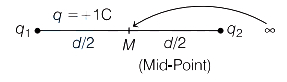
0 likesView Solution
152
PhysicsEasyMCQAP EAMCET · 2021
What is the direction of the lines of force at any point on the equipotential surface?
A
Parallel to it
B
Normal to it
C
Be inclined
D
Random direction
Solution
(B) By definition,an equipotential surface is a surface where the electric potential is constant at all points.
Since the work done in moving a charge $q$ along the surface is $W = 0$,and $W = \int \vec{F} \cdot d\vec{l} = q \int \vec{E} \cdot d\vec{l} = 0$,it implies that the electric field $\vec{E}$ must be perpendicular to the displacement vector $d\vec{l}$ at every point on the surface.
Therefore,the electric lines of force are always normal (perpendicular) to the equipotential surface.
Since the work done in moving a charge $q$ along the surface is $W = 0$,and $W = \int \vec{F} \cdot d\vec{l} = q \int \vec{E} \cdot d\vec{l} = 0$,it implies that the electric field $\vec{E}$ must be perpendicular to the displacement vector $d\vec{l}$ at every point on the surface.
Therefore,the electric lines of force are always normal (perpendicular) to the equipotential surface.
0 likesView Solution
153
PhysicsDifficultMCQAP EAMCET · 2021
What is the net force on the rectangular coil?
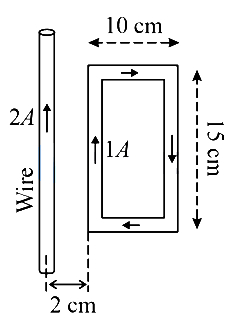
A
$25 \times 10^{-7} \text{ N}$ moving towards wire
B
$25 \times 10^{-7} \text{ N}$ moving away from wire
C
$35 \times 10^{-7} \text{ N}$ moving towards wire
D
$35 \times 10^{-7} \text{ N}$ moving away from wire
Solution
(A) The force on a current-carrying conductor due to a long straight wire is given by $F = \frac{\mu_0 I_1 I_2 L}{2 \pi r}$.
For the rectangular coil $ABCD$,the forces on the horizontal segments $BC$ and $AD$ are equal and opposite,so they cancel each other out.
The force on segment $AB$ (at distance $r_1 = 2 \text{ cm} = 0.02 \text{ m}$) is attractive (towards the wire) because the currents are parallel:
$F_{AB} = \frac{\mu_0 (2 \text{ A})(1 \text{ A})(0.15 \text{ m})}{2 \pi (0.02 \text{ m})} = \frac{2 \times 10^{-7} \times 2 \times 1 \times 0.15}{0.02} = 30 \times 10^{-7} \text{ N}$.
The force on segment $CD$ (at distance $r_2 = 2 \text{ cm} + 10 \text{ cm} = 12 \text{ cm} = 0.12 \text{ m}$) is repulsive (away from the wire) because the currents are anti-parallel:
$F_{CD} = \frac{\mu_0 (2 \text{ A})(1 \text{ A})(0.15 \text{ m})}{2 \pi (0.12 \text{ m})} = \frac{2 \times 10^{-7} \times 2 \times 1 \times 0.15}{0.12} = 5 \times 10^{-7} \text{ N}$.
The net force is $F_{net} = F_{AB} - F_{CD} = 30 \times 10^{-7} - 5 \times 10^{-7} = 25 \times 10^{-7} \text{ N}$.
Since $F_{AB} > F_{CD}$,the net force is directed towards the wire.
For the rectangular coil $ABCD$,the forces on the horizontal segments $BC$ and $AD$ are equal and opposite,so they cancel each other out.
The force on segment $AB$ (at distance $r_1 = 2 \text{ cm} = 0.02 \text{ m}$) is attractive (towards the wire) because the currents are parallel:
$F_{AB} = \frac{\mu_0 (2 \text{ A})(1 \text{ A})(0.15 \text{ m})}{2 \pi (0.02 \text{ m})} = \frac{2 \times 10^{-7} \times 2 \times 1 \times 0.15}{0.02} = 30 \times 10^{-7} \text{ N}$.
The force on segment $CD$ (at distance $r_2 = 2 \text{ cm} + 10 \text{ cm} = 12 \text{ cm} = 0.12 \text{ m}$) is repulsive (away from the wire) because the currents are anti-parallel:
$F_{CD} = \frac{\mu_0 (2 \text{ A})(1 \text{ A})(0.15 \text{ m})}{2 \pi (0.12 \text{ m})} = \frac{2 \times 10^{-7} \times 2 \times 1 \times 0.15}{0.12} = 5 \times 10^{-7} \text{ N}$.
The net force is $F_{net} = F_{AB} - F_{CD} = 30 \times 10^{-7} - 5 \times 10^{-7} = 25 \times 10^{-7} \text{ N}$.
Since $F_{AB} > F_{CD}$,the net force is directed towards the wire.
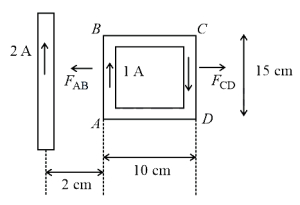
0 likesView Solution
154
PhysicsMediumMCQAP EAMCET · 2021
The torque required to hold a small circular coil of $10$ turns,$2 \times 10^{-4} \ m^2$ area,and carrying $0.5 \ A$ current in the middle of a long solenoid of $10^3$ turns per meter carrying $3 \ A$ current,with its axis perpendicular to the axis of the solenoid,is:
A
$12 \pi \times 10^{-7} \ N \ m$
B
$6 \pi \times 10^{-7} \ N \ m$
C
$4 \pi \times 10^{-7} \ N \ m$
D
$2 \pi \times 10^{-7} \ N \ m$
Solution
(A) The magnetic dipole moment of the coil is given by $M = N A I$. Substituting the given values: $M = 10 \times (2 \times 10^{-4} \ m^2) \times 0.5 \ A = 10^{-3} \ A \ m^2$.
The magnetic field inside a long solenoid is given by $B = \mu_0 n I_s$. Substituting the values: $B = (4 \pi \times 10^{-7} \ T \ m/A) \times (10^3 \ m^{-1}) \times (3 \ A) = 12 \pi \times 10^{-4} \ T$.
The torque on a magnetic dipole in a magnetic field is $\tau = M B \sin(\theta)$. Since the axis of the coil is perpendicular to the axis of the solenoid,the angle between the magnetic moment vector and the magnetic field is $\theta = 90^\circ$,so $\sin(90^\circ) = 1$.
Therefore,$\tau = (10^{-3} \ A \ m^2) \times (12 \pi \times 10^{-4} \ T) \times 1 = 12 \pi \times 10^{-7} \ N \ m$.
The magnetic field inside a long solenoid is given by $B = \mu_0 n I_s$. Substituting the values: $B = (4 \pi \times 10^{-7} \ T \ m/A) \times (10^3 \ m^{-1}) \times (3 \ A) = 12 \pi \times 10^{-4} \ T$.
The torque on a magnetic dipole in a magnetic field is $\tau = M B \sin(\theta)$. Since the axis of the coil is perpendicular to the axis of the solenoid,the angle between the magnetic moment vector and the magnetic field is $\theta = 90^\circ$,so $\sin(90^\circ) = 1$.
Therefore,$\tau = (10^{-3} \ A \ m^2) \times (12 \pi \times 10^{-4} \ T) \times 1 = 12 \pi \times 10^{-7} \ N \ m$.
0 likesView Solution
155
PhysicsMediumMCQAP EAMCET · 2021
The coil of a moving coil galvanometer has an effective area of $4 \times 10^{-2} \, m^2$. It is suspended in a magnetic field of $5 \times 10^{-2} \, Wb \, m^{-2}$. If the deflection in the galvanometer coil is $0.2 \, rad$, when a current of $5 \, mA$ is passed through it, then
A
torsional constant is $8 \times 10^{-5} \, N \, m \, rad^{-1}$
B
current sensitivity is $40 \, rad \, A^{-1}$
C
torsional constant is $3 \times 10^{-3} \, N \, m \, rad^{-1}$
D
current sensitivity is $40 \, \text{deg} \, A^{-1}$
Solution
(B) Given that, for a moving coil galvanometer:
Effective area, $A = 4 \times 10^{-2} \, m^2$
Magnetic field, $B = 5 \times 10^{-2} \, Wb \, m^{-2}$
Angle of deflection, $\phi = 0.2 \, rad$
Electric current, $I = 5 \, mA = 5 \times 10^{-3} \, A$
Assuming the number of turns $N = 1$ (as not specified, we calculate the product $NAB$):
The torque balance equation is $NAB I = k \phi$, where $k$ is the torsional constant.
$k = \frac{NAB I}{\phi} = \frac{(1) \times (4 \times 10^{-2}) \times (5 \times 10^{-2}) \times (5 \times 10^{-3})}{0.2}$
$k = \frac{100 \times 10^{-7}}{0.2} = 500 \times 10^{-7} = 5 \times 10^{-5} \, N \, m \, rad^{-1}$.
Current sensitivity $S_I = \frac{\phi}{I} = \frac{0.2}{5 \times 10^{-3}} = 40 \, rad \, A^{-1}$.
Thus, the current sensitivity is $40 \, rad \, A^{-1}$.
Effective area, $A = 4 \times 10^{-2} \, m^2$
Magnetic field, $B = 5 \times 10^{-2} \, Wb \, m^{-2}$
Angle of deflection, $\phi = 0.2 \, rad$
Electric current, $I = 5 \, mA = 5 \times 10^{-3} \, A$
Assuming the number of turns $N = 1$ (as not specified, we calculate the product $NAB$):
The torque balance equation is $NAB I = k \phi$, where $k$ is the torsional constant.
$k = \frac{NAB I}{\phi} = \frac{(1) \times (4 \times 10^{-2}) \times (5 \times 10^{-2}) \times (5 \times 10^{-3})}{0.2}$
$k = \frac{100 \times 10^{-7}}{0.2} = 500 \times 10^{-7} = 5 \times 10^{-5} \, N \, m \, rad^{-1}$.
Current sensitivity $S_I = \frac{\phi}{I} = \frac{0.2}{5 \times 10^{-3}} = 40 \, rad \, A^{-1}$.
Thus, the current sensitivity is $40 \, rad \, A^{-1}$.
0 likesView Solution
156
PhysicsDifficultMCQAP EAMCET · 2021
Torques $\tau_1$ and $\tau_2$ are required for a magnetic needle to remain perpendicular to the magnetic fields of $B_1$ and $B_2$ at two different places. The ratio of $B_1: B_2$ is equal to
A
$\tau_2: \tau_1$
B
$\tau_1: \tau_2$
C
$\frac{\tau_1+\tau_2}{\tau_1-\tau_2}$
D
$\frac{\tau_1-\tau_2}{\tau_1+\tau_2}$
Solution
(B) The torque $\tau$ acting on a magnetic needle of magnetic moment $M$ in a uniform magnetic field $B$ is given by the formula: $\tau = M B \sin \theta$.
Here,$\theta$ is the angle between the magnetic moment and the magnetic field.
It is given that the needle remains perpendicular to the magnetic field,so $\theta = 90^{\circ}$.
Since $\sin 90^{\circ} = 1$,the torque becomes $\tau = M B$.
For the two different places with magnetic fields $B_1$ and $B_2$,the torques are $\tau_1 = M B_1$ and $\tau_2 = M B_2$.
Taking the ratio of the two torques: $\frac{\tau_1}{\tau_2} = \frac{M B_1}{M B_2} = \frac{B_1}{B_2}$.
Therefore,the ratio $B_1 : B_2$ is equal to $\tau_1 : \tau_2$.
Here,$\theta$ is the angle between the magnetic moment and the magnetic field.
It is given that the needle remains perpendicular to the magnetic field,so $\theta = 90^{\circ}$.
Since $\sin 90^{\circ} = 1$,the torque becomes $\tau = M B$.
For the two different places with magnetic fields $B_1$ and $B_2$,the torques are $\tau_1 = M B_1$ and $\tau_2 = M B_2$.
Taking the ratio of the two torques: $\frac{\tau_1}{\tau_2} = \frac{M B_1}{M B_2} = \frac{B_1}{B_2}$.
Therefore,the ratio $B_1 : B_2$ is equal to $\tau_1 : \tau_2$.
0 likesView Solution
157
PhysicsMediumMCQAP EAMCET · 2021
$A$ long thin hollow metallic cylinder of radius $R$ carries a current $i$ ampere. The magnetic induction $B$ at a distance $r$ from the axis varies as shown in:
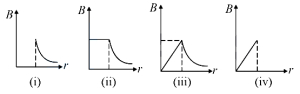
A
$(i)$
B
$(ii)$
C
$(iii)$
D
$(iv)$
Solution
(A) According to Ampere's circuital law,$\oint \vec{B} \cdot d\vec{l} = \mu_0 I_{\text{enclosed}}$.
For a point inside the hollow cylinder $(r < R)$,the enclosed current $I_{\text{enclosed}} = 0$. Therefore,$B(2\pi r) = 0$,which implies $B = 0$ for $r < R$.
For a point outside the hollow cylinder $(r \geq R)$,the enclosed current $I_{\text{enclosed}} = i$. Therefore,$B(2\pi r) = \mu_0 i$,which implies $B = \frac{\mu_0 i}{2\pi r}$.
This shows that the magnetic field is zero inside the cylinder and decreases as $1/r$ outside the cylinder. Graph $(i)$ correctly represents this behavior.
For a point inside the hollow cylinder $(r < R)$,the enclosed current $I_{\text{enclosed}} = 0$. Therefore,$B(2\pi r) = 0$,which implies $B = 0$ for $r < R$.
For a point outside the hollow cylinder $(r \geq R)$,the enclosed current $I_{\text{enclosed}} = i$. Therefore,$B(2\pi r) = \mu_0 i$,which implies $B = \frac{\mu_0 i}{2\pi r}$.
This shows that the magnetic field is zero inside the cylinder and decreases as $1/r$ outside the cylinder. Graph $(i)$ correctly represents this behavior.
0 likesView Solution
158
PhysicsEasyMCQAP EAMCET · 2021
The magnetic field at the center of a single-turn coil made from a given length of wire is '$B$'. What will be the magnetic field at the center if the same wire is used to form a two-turn coil?
A
$\frac{B}{4}$
B
$\frac{B}{2}$
C
$4B$
D
$2B$
Solution
(C) The magnetic field at the center of a circular coil with $n$ turns, radius $a$, and current $i$ is given by $B = \frac{\mu_0 n i}{2a}$.
Since the total length of the wire $L$ is constant, $L = n(2\pi a)$.
For a single turn $(n=1)$, $L = 2\pi a$, so $a = \frac{L}{2\pi}$.
For two turns $(n'=2)$, $L = 2(2\pi a')$, so $a' = \frac{L}{4\pi} = \frac{a}{2}$.
Since $B \propto \frac{n}{a}$, we have $\frac{B'}{B} = \frac{n'}{n} \times \frac{a}{a'}$.
Substituting the values, $\frac{B'}{B} = \frac{2}{1} \times \frac{a}{a/2} = 2 \times 2 = 4$.
Therefore, $B' = 4B$.
Since the total length of the wire $L$ is constant, $L = n(2\pi a)$.
For a single turn $(n=1)$, $L = 2\pi a$, so $a = \frac{L}{2\pi}$.
For two turns $(n'=2)$, $L = 2(2\pi a')$, so $a' = \frac{L}{4\pi} = \frac{a}{2}$.
Since $B \propto \frac{n}{a}$, we have $\frac{B'}{B} = \frac{n'}{n} \times \frac{a}{a'}$.
Substituting the values, $\frac{B'}{B} = \frac{2}{1} \times \frac{a}{a/2} = 2 \times 2 = 4$.
Therefore, $B' = 4B$.
0 likesView Solution
159
PhysicsMediumMCQAP EAMCET · 2021
Two concentric coils each of radius equal to $4 \pi \text{ cm}$ are placed at right angles to each other. If $10 \text{ A}$ and $24 \text{ A}$ are the currents flowing through the coils,respectively,the magnetic induction at the center of the coils will be
A
$13 \times 10^{-5} \text{ Wb m}^{-2}$
B
$12 \times 10^{-5} \text{ Wb m}^{-2}$
C
$7 \times 10^{-5} \text{ Wb m}^{-2}$
D
$5 \times 10^{-5} \text{ Wb m}^{-2}$
Solution
(A) The magnetic field at the center of a circular coil of radius $r$ carrying current $i$ is given by $B = \frac{\mu_0 i}{2r}$.
Given $r = 4 \pi \text{ cm} = 4 \pi \times 10^{-2} \text{ m}$.
For the first coil with current $i_1 = 10 \text{ A}$:
$B_1 = \frac{\mu_0 \times 10}{2 \times 4 \pi \times 10^{-2}} = \frac{4 \pi \times 10^{-7} \times 10}{8 \pi \times 10^{-2}} = 0.5 \times 10^{-4} \text{ T} = 5 \times 10^{-5} \text{ T}$.
For the second coil with current $i_2 = 24 \text{ A}$:
$B_2 = \frac{\mu_0 \times 24}{2 \times 4 \pi \times 10^{-2}} = \frac{4 \pi \times 10^{-7} \times 24}{8 \pi \times 10^{-2}} = 1.2 \times 10^{-4} \text{ T} = 12 \times 10^{-5} \text{ T}$.
Since the coils are at right angles,the resultant magnetic field $B$ is given by $B = \sqrt{B_1^2 + B_2^2}$.
$B = \sqrt{(5 \times 10^{-5})^2 + (12 \times 10^{-5})^2} = \sqrt{25 + 144} \times 10^{-5} \text{ T} = \sqrt{169} \times 10^{-5} \text{ T} = 13 \times 10^{-5} \text{ Wb m}^{-2}$.
Given $r = 4 \pi \text{ cm} = 4 \pi \times 10^{-2} \text{ m}$.
For the first coil with current $i_1 = 10 \text{ A}$:
$B_1 = \frac{\mu_0 \times 10}{2 \times 4 \pi \times 10^{-2}} = \frac{4 \pi \times 10^{-7} \times 10}{8 \pi \times 10^{-2}} = 0.5 \times 10^{-4} \text{ T} = 5 \times 10^{-5} \text{ T}$.
For the second coil with current $i_2 = 24 \text{ A}$:
$B_2 = \frac{\mu_0 \times 24}{2 \times 4 \pi \times 10^{-2}} = \frac{4 \pi \times 10^{-7} \times 24}{8 \pi \times 10^{-2}} = 1.2 \times 10^{-4} \text{ T} = 12 \times 10^{-5} \text{ T}$.
Since the coils are at right angles,the resultant magnetic field $B$ is given by $B = \sqrt{B_1^2 + B_2^2}$.
$B = \sqrt{(5 \times 10^{-5})^2 + (12 \times 10^{-5})^2} = \sqrt{25 + 144} \times 10^{-5} \text{ T} = \sqrt{169} \times 10^{-5} \text{ T} = 13 \times 10^{-5} \text{ Wb m}^{-2}$.
0 likesView Solution
160
PhysicsMediumMCQAP EAMCET · 2021
The magnetic field due to a current-carrying circular loop of radius $5 \ cm$ at a point on the axis at a distance of $12 \ cm$ from the centre is $250 \ \mu T$. The magnetic field at the centre of the loop is (in $\mu T$)
A
$2529$
B
$4394$
C
$1759$
D
$2908$
Solution
(B) Given: $R = 5 \ cm = 0.05 \ m$,$r = 12 \ cm = 0.12 \ m$,$B_{axis} = 250 \ \mu T$.
The magnetic field due to a current-carrying circular loop at a point on its axis is given by:
$B_{axis} = \frac{\mu_0 I R^2}{2(R^2 + r^2)^{3/2}}$
The magnetic field at the centre of the loop is:
$B_{centre} = \frac{\mu_0 I}{2R}$
Dividing $B_{centre}$ by $B_{axis}$:
$\frac{B_{centre}}{B_{axis}} = \frac{\mu_0 I}{2R} \times \frac{2(R^2 + r^2)^{3/2}}{\mu_0 I R^2} = \frac{(R^2 + r^2)^{3/2}}{R^3}$
Substituting the values:
$B_{centre} = B_{axis} \times \frac{(R^2 + r^2)^{3/2}}{R^3}$
$B_{centre} = 250 \ \mu T \times \frac{(0.05^2 + 0.12^2)^{3/2}}{0.05^3}$
$B_{centre} = 250 \ \mu T \times \frac{(0.0025 + 0.0144)^{3/2}}{0.000125}$
$B_{centre} = 250 \ \mu T \times \frac{(0.0169)^{3/2}}{0.000125}$
$B_{centre} = 250 \ \mu T \times \frac{(0.13)^3}{0.000125}$
$B_{centre} = 250 \ \mu T \times \frac{0.002197}{0.000125} = 250 \ \mu T \times 17.576 = 4394 \ \mu T$.
The magnetic field due to a current-carrying circular loop at a point on its axis is given by:
$B_{axis} = \frac{\mu_0 I R^2}{2(R^2 + r^2)^{3/2}}$
The magnetic field at the centre of the loop is:
$B_{centre} = \frac{\mu_0 I}{2R}$
Dividing $B_{centre}$ by $B_{axis}$:
$\frac{B_{centre}}{B_{axis}} = \frac{\mu_0 I}{2R} \times \frac{2(R^2 + r^2)^{3/2}}{\mu_0 I R^2} = \frac{(R^2 + r^2)^{3/2}}{R^3}$
Substituting the values:
$B_{centre} = B_{axis} \times \frac{(R^2 + r^2)^{3/2}}{R^3}$
$B_{centre} = 250 \ \mu T \times \frac{(0.05^2 + 0.12^2)^{3/2}}{0.05^3}$
$B_{centre} = 250 \ \mu T \times \frac{(0.0025 + 0.0144)^{3/2}}{0.000125}$
$B_{centre} = 250 \ \mu T \times \frac{(0.0169)^{3/2}}{0.000125}$
$B_{centre} = 250 \ \mu T \times \frac{(0.13)^3}{0.000125}$
$B_{centre} = 250 \ \mu T \times \frac{0.002197}{0.000125} = 250 \ \mu T \times 17.576 = 4394 \ \mu T$.
0 likesView Solution
161
PhysicsDifficultMCQAP EAMCET · 2021
$A$ square frame of side $1 \ m$ carrying a current $I$ produces a magnetic field $B$ at its centre. The same current is passed through a circular coil having the same perimeter as the square. The magnetic field at the centre of the circular coil is $B^{\prime}$. The ratio of $\frac{B}{B^{\prime}}$ is
A
$\frac{8}{\pi^2}$
B
$\frac{16 \sqrt{2}}{\pi^2}$
C
$\frac{16}{\pi^2}$
D
$\frac{16}{\sqrt{3} \pi^2}$
Solution
(B) For the square frame of side $a$,the magnetic field at the centre $O$ is the sum of the fields produced by its four sides.
Each side acts as a finite wire of length $a$ at a perpendicular distance $r = a/2$ from the centre.
The magnetic field due to one side is $B_1 = \frac{\mu_0 I}{4 \pi r} (\sin 45^{\circ} + \sin 45^{\circ}) = \frac{\mu_0 I}{4 \pi (a/2)} (\frac{1}{\sqrt{2}} + \frac{1}{\sqrt{2}}) = \frac{\mu_0 I}{2 \pi a} (\frac{2}{\sqrt{2}}) = \frac{\sqrt{2} \mu_0 I}{\pi a}$.
Since there are $4$ sides,the total magnetic field is $B = 4 \times B_1 = \frac{4 \sqrt{2} \mu_0 I}{\pi a}$.
For the circular coil,the perimeter is equal to the perimeter of the square,so $2 \pi R = 4 a$,which gives $R = \frac{2 a}{\pi}$.
The magnetic field at the centre of the circular coil is $B^{\prime} = \frac{\mu_0 I}{2 R} = \frac{\mu_0 I}{2 (2 a / \pi)} = \frac{\mu_0 \pi I}{4 a}$.
Taking the ratio,$\frac{B}{B^{\prime}} = \frac{4 \sqrt{2} \mu_0 I / \pi a}{\mu_0 \pi I / 4 a} = \frac{16 \sqrt{2}}{\pi^2}$.
Each side acts as a finite wire of length $a$ at a perpendicular distance $r = a/2$ from the centre.
The magnetic field due to one side is $B_1 = \frac{\mu_0 I}{4 \pi r} (\sin 45^{\circ} + \sin 45^{\circ}) = \frac{\mu_0 I}{4 \pi (a/2)} (\frac{1}{\sqrt{2}} + \frac{1}{\sqrt{2}}) = \frac{\mu_0 I}{2 \pi a} (\frac{2}{\sqrt{2}}) = \frac{\sqrt{2} \mu_0 I}{\pi a}$.
Since there are $4$ sides,the total magnetic field is $B = 4 \times B_1 = \frac{4 \sqrt{2} \mu_0 I}{\pi a}$.
For the circular coil,the perimeter is equal to the perimeter of the square,so $2 \pi R = 4 a$,which gives $R = \frac{2 a}{\pi}$.
The magnetic field at the centre of the circular coil is $B^{\prime} = \frac{\mu_0 I}{2 R} = \frac{\mu_0 I}{2 (2 a / \pi)} = \frac{\mu_0 \pi I}{4 a}$.
Taking the ratio,$\frac{B}{B^{\prime}} = \frac{4 \sqrt{2} \mu_0 I / \pi a}{\mu_0 \pi I / 4 a} = \frac{16 \sqrt{2}}{\pi^2}$.
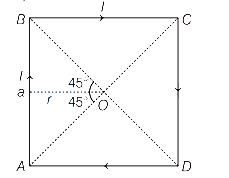
0 likesView Solution
162
PhysicsMediumMCQAP EAMCET · 2021
Two circular coils $1$ and $2$ are made from the same wire. The radius of the first coil is twice that of the second coil. What is the ratio of potential difference applied across them $V_1 / V_2$,so that the magnetic field at their centre is the same?
A
$3$
B
$4$
C
$6$
D
$2$
Solution
(B) The magnetic field at the centre of a circular coil is given by $B = \frac{\mu_0 I}{2r}$.
Given that the magnetic field at the centre is the same for both coils,we have:
$\frac{\mu_0 I_1}{2(2r)} = \frac{\mu_0 I_2}{2(r)} \Rightarrow \frac{I_1}{I_2} = 2 \quad ...(i)$
Since the coils are made from the same wire,their resistance $R$ is proportional to their length $l$ $(R = \rho \frac{l}{A})$.
The lengths are $l_1 = 2\pi(2r) = 4\pi r$ and $l_2 = 2\pi(r) = 2\pi r$.
Thus,the ratio of resistances is $\frac{R_1}{R_2} = \frac{l_1}{l_2} = \frac{4\pi r}{2\pi r} = 2 \quad ...(ii)$
Using Ohm's law,$V = IR$,we have $I = V/R$.
Substituting this into equation $(i)$:
$\frac{V_1/R_1}{V_2/R_2} = 2 \Rightarrow \frac{V_1}{V_2} = 2 \times \frac{R_1}{R_2}$
Substituting the ratio from equation $(ii)$:
$\frac{V_1}{V_2} = 2 \times 2 = 4$.
Given that the magnetic field at the centre is the same for both coils,we have:
$\frac{\mu_0 I_1}{2(2r)} = \frac{\mu_0 I_2}{2(r)} \Rightarrow \frac{I_1}{I_2} = 2 \quad ...(i)$
Since the coils are made from the same wire,their resistance $R$ is proportional to their length $l$ $(R = \rho \frac{l}{A})$.
The lengths are $l_1 = 2\pi(2r) = 4\pi r$ and $l_2 = 2\pi(r) = 2\pi r$.
Thus,the ratio of resistances is $\frac{R_1}{R_2} = \frac{l_1}{l_2} = \frac{4\pi r}{2\pi r} = 2 \quad ...(ii)$
Using Ohm's law,$V = IR$,we have $I = V/R$.
Substituting this into equation $(i)$:
$\frac{V_1/R_1}{V_2/R_2} = 2 \Rightarrow \frac{V_1}{V_2} = 2 \times \frac{R_1}{R_2}$
Substituting the ratio from equation $(ii)$:
$\frac{V_1}{V_2} = 2 \times 2 = 4$.
0 likesView Solution
163
PhysicsMediumMCQAP EAMCET · 2021
$A$ coil wrapped around a toroid has an inner radius of $20 \,cm$ and an outer radius of $25 \,cm$. If the wire wrapping makes $800$ turns and carries a current of $12 \,A$, the maximum and minimum values of the magnetic field within the toroid are:
A
$9.6 \,mT, 7.68 \,mT$
B
$4 \,mT, 2.5 \,mT$
C
$7 \,mT, 5.6 \,mT$
D
$6.6 \,mT, 3.3 \,mT$
Solution
(A) Given: Inner radius $r_1 = 20 \,cm = 0.2 \,m$, Outer radius $r_2 = 25 \,cm = 0.25 \,m$, Number of turns $N = 800$, Current $I = 12 \,A$.
The magnetic field $B$ inside a toroid at a distance $r$ from the center is given by $B = \frac{\mu_0 N I}{2 \pi r}$.
Since $B \propto \frac{1}{r}$, the magnetic field is maximum at the minimum radius $(r_1)$ and minimum at the maximum radius $(r_2)$.
Maximum magnetic field: $B_{\max} = \frac{4 \pi \times 10^{-7} \times 800 \times 12}{2 \pi \times 0.2} = \frac{2 \times 10^{-7} \times 9600}{0.2} = 9.6 \times 10^{-3} \,T = 9.6 \,mT$.
Minimum magnetic field: $B_{\min} = \frac{4 \pi \times 10^{-7} \times 800 \times 12}{2 \pi \times 0.25} = \frac{2 \times 10^{-7} \times 9600}{0.25} = 7.68 \times 10^{-3} \,T = 7.68 \,mT$.
The magnetic field $B$ inside a toroid at a distance $r$ from the center is given by $B = \frac{\mu_0 N I}{2 \pi r}$.
Since $B \propto \frac{1}{r}$, the magnetic field is maximum at the minimum radius $(r_1)$ and minimum at the maximum radius $(r_2)$.
Maximum magnetic field: $B_{\max} = \frac{4 \pi \times 10^{-7} \times 800 \times 12}{2 \pi \times 0.2} = \frac{2 \times 10^{-7} \times 9600}{0.2} = 9.6 \times 10^{-3} \,T = 9.6 \,mT$.
Minimum magnetic field: $B_{\min} = \frac{4 \pi \times 10^{-7} \times 800 \times 12}{2 \pi \times 0.25} = \frac{2 \times 10^{-7} \times 9600}{0.25} = 7.68 \times 10^{-3} \,T = 7.68 \,mT$.
0 likesView Solution
164
PhysicsEasyMCQAP EAMCET · 2021
$A$ wire of length $L \ m$ carrying a current $I \ A$ is bent in the form of a circle. The magnitude of its magnetic moment is
A
$\frac{L^2 I^2}{4 \pi}$
B
$\frac{L^2 I}{4 \pi}$
C
$\frac{L I}{4 \pi}$
D
$\frac{L I^2}{4 \pi}$
Solution
(B) The magnetic moment $M$ of a current loop is given by the product of the current $I$ and the area $A$ of the loop,$M = I A$.
When a wire of length $L$ is bent into a circle,its circumference is $2 \pi r = L$,which implies the radius $r = \frac{L}{2 \pi}$.
The area of this circular loop is $A = \pi r^2 = \pi \left( \frac{L}{2 \pi} \right)^2 = \frac{L^2}{4 \pi}$.
Substituting the area into the magnetic moment formula,we get $M = I \times \frac{L^2}{4 \pi} = \frac{L^2 I}{4 \pi}$.
When a wire of length $L$ is bent into a circle,its circumference is $2 \pi r = L$,which implies the radius $r = \frac{L}{2 \pi}$.
The area of this circular loop is $A = \pi r^2 = \pi \left( \frac{L}{2 \pi} \right)^2 = \frac{L^2}{4 \pi}$.
Substituting the area into the magnetic moment formula,we get $M = I \times \frac{L^2}{4 \pi} = \frac{L^2 I}{4 \pi}$.
0 likesView Solution
165
PhysicsMediumMCQAP EAMCET · 2021
$A$ magnet of magnetic moment $2 \,J \,T^{-1}$ is aligned in the direction of a magnetic field of $0.1 \,T$. What is the net work done to bring the magnet normal to the magnetic field (in $\,J$)?
A
$0.1$
B
$0.2$
C
$1.0$
D
$2.0$
Solution
(B) Given that, magnetic moment, $M = 2 \,J \,T^{-1}$.
Magnetic field, $B = 0.1 \,T$.
Since the magnetic moment is aligned in the direction of the magnetic field, the initial angle is $\theta_1 = 0^{\circ}$.
When the magnet is normal to the field, the final angle is $\theta_2 = 90^{\circ}$.
The work done $W$ in rotating a magnet in a magnetic field is given by the formula:
$W = MB(\cos \theta_1 - \cos \theta_2)$
Substituting the values:
$W = 2 \times 0.1 \times (\cos 0^{\circ} - \cos 90^{\circ})$
$W = 0.2 \times (1 - 0)$
$W = 0.2 \,J$.
Hence, the net work done is $0.2 \,J$.
Magnetic field, $B = 0.1 \,T$.
Since the magnetic moment is aligned in the direction of the magnetic field, the initial angle is $\theta_1 = 0^{\circ}$.
When the magnet is normal to the field, the final angle is $\theta_2 = 90^{\circ}$.
The work done $W$ in rotating a magnet in a magnetic field is given by the formula:
$W = MB(\cos \theta_1 - \cos \theta_2)$
Substituting the values:
$W = 2 \times 0.1 \times (\cos 0^{\circ} - \cos 90^{\circ})$
$W = 0.2 \times (1 - 0)$
$W = 0.2 \,J$.
Hence, the net work done is $0.2 \,J$.
0 likesView Solution
166
PhysicsEasyMCQAP EAMCET · 2021
$A$ toroid of $n$ turns,mean radius $R$ and cross-sectional radius $a$ carries current $I$. It is placed on a horizontal table taken as $xy$-plane. Its magnetic moment $m$ is:
A
is non-zero and points in the $z$-direction by symmetry
B
points along the axis of the toroid $(m=m\phi)$
C
is zero,otherwise there would be a field falling as $\frac{1}{r^3}$ at large distances outside the toroid
D
is pointing radially outwards
Solution
(C) toroid is essentially a solenoid bent into a circular shape. The magnetic field lines produced by a toroid are confined entirely within its core,forming concentric circles.
Because the magnetic field is confined within the toroid,the net magnetic field outside the toroid is zero.
If the magnetic moment $m$ were non-zero,the toroid would act like a magnetic dipole at large distances,producing a magnetic field that falls off as $\frac{1}{r^3}$.
Since the magnetic field outside an ideal toroid is zero,its magnetic moment $m$ must be zero.
Because the magnetic field is confined within the toroid,the net magnetic field outside the toroid is zero.
If the magnetic moment $m$ were non-zero,the toroid would act like a magnetic dipole at large distances,producing a magnetic field that falls off as $\frac{1}{r^3}$.
Since the magnetic field outside an ideal toroid is zero,its magnetic moment $m$ must be zero.
0 likesView Solution
167
PhysicsEasyMCQAP EAMCET · 2021
In which of the following cases is no force exerted by a magnetic field on a charge?
A
Moving with constant velocity
B
Moving in a circle
C
At rest
D
Moving along a curved path
Solution
(C) The magnetic force (Lorentz force) on a moving charge is given by the expression $\vec{F} = q(\vec{v} \times \vec{B})$.
From this formula,it is evident that the force depends on the velocity $\vec{v}$ of the charge.
If the charge is at rest,its velocity $\vec{v} = 0$.
Substituting this into the equation,we get $\vec{F} = q(0 \times \vec{B}) = 0$.
Therefore,a magnetic field exerts no force on a charge that is at rest.
From this formula,it is evident that the force depends on the velocity $\vec{v}$ of the charge.
If the charge is at rest,its velocity $\vec{v} = 0$.
Substituting this into the equation,we get $\vec{F} = q(0 \times \vec{B}) = 0$.
Therefore,a magnetic field exerts no force on a charge that is at rest.
0 likesView Solution
168
PhysicsMediumMCQAP EAMCET · 2021
The plane of a dip circle is set in the geographic meridian and the apparent dip is $\delta_1$. It is then set in a vertical plane perpendicular to the geographic meridian. The apparent dip angle is $\delta_2$. The declination $\theta$ at the place is
A
$\tan ^{-1}(\tan \delta_1 \tan \delta_2)$
B
$\tan ^{-1}(\tan \delta_1 + \tan \delta_2)$
C
$\tan ^{-1}(\frac{\tan \delta_1}{\tan \delta_2})$
D
$\tan ^{-1}(\tan \delta_1 - \tan \delta_2)$
Solution
(C) Let $\phi$ be the true dip angle and $\theta$ be the magnetic declination. When the dip circle is in the geographic meridian,the angle between the plane and the magnetic meridian is $\theta$. The apparent dip $\delta_1$ is given by $\tan \delta_1 = \frac{\tan \phi}{\cos \theta}$.
When the plane is perpendicular to the geographic meridian,the angle between the plane and the magnetic meridian is $(90^\circ - \theta)$. The apparent dip $\delta_2$ is given by $\tan \delta_2 = \frac{\tan \phi}{\cos(90^\circ - \theta)} = \frac{\tan \phi}{\sin \theta}$.
From these two equations,we have $\tan \phi = \tan \delta_1 \cos \theta$ and $\tan \phi = \tan \delta_2 \sin \theta$.
Equating the two expressions for $\tan \phi$: $\tan \delta_1 \cos \theta = \tan \delta_2 \sin \theta$.
Rearranging gives $\frac{\sin \theta}{\cos \theta} = \frac{\tan \delta_1}{\tan \delta_2}$,which implies $\tan \theta = \frac{\tan \delta_1}{\tan \delta_2}$.
Therefore,$\theta = \tan ^{-1}\left(\frac{\tan \delta_1}{\tan \delta_2}\right)$.
When the plane is perpendicular to the geographic meridian,the angle between the plane and the magnetic meridian is $(90^\circ - \theta)$. The apparent dip $\delta_2$ is given by $\tan \delta_2 = \frac{\tan \phi}{\cos(90^\circ - \theta)} = \frac{\tan \phi}{\sin \theta}$.
From these two equations,we have $\tan \phi = \tan \delta_1 \cos \theta$ and $\tan \phi = \tan \delta_2 \sin \theta$.
Equating the two expressions for $\tan \phi$: $\tan \delta_1 \cos \theta = \tan \delta_2 \sin \theta$.
Rearranging gives $\frac{\sin \theta}{\cos \theta} = \frac{\tan \delta_1}{\tan \delta_2}$,which implies $\tan \theta = \frac{\tan \delta_1}{\tan \delta_2}$.
Therefore,$\theta = \tan ^{-1}\left(\frac{\tan \delta_1}{\tan \delta_2}\right)$.
0 likesView Solution
169
PhysicsMediumMCQAP EAMCET · 2021
$A$ paramagnetic sample shows a net magnetization of $0.8 \text{ A m}^{-1}$ when placed in an external magnetic field of strength $0.8 \text{ T}$ at a temperature of $5 \text{ K}$. If the temperature is raised to $20 \text{ K}$, then the magnetization becomes: (in $\text{ A m}^{-1}$)
A
$0.8$
B
$0.2$
C
$0.1$
D
$0.4$
Solution
(B) According to Curie's law, the magnetization $M$ of a paramagnetic material is given by $M = C \frac{B}{T}$, where $B$ is the external magnetic field, $T$ is the absolute temperature, and $C$ is Curie's constant.
Given $M_1 = 0.8 \text{ A m}^{-1}$, $B_1 = 0.8 \text{ T}$, and $T_1 = 5 \text{ K}$.
Substituting these values into the formula: $0.8 = C \frac{0.8}{5} \Rightarrow C = 5 \text{ K}$.
Now, for the new temperature $T_2 = 20 \text{ K}$ with the same magnetic field $B_2 = 0.8 \text{ T}$, the new magnetization $M_2$ is:
$M_2 = C \frac{B_2}{T_2} = 5 \times \frac{0.8}{20} = \frac{4}{20} = 0.2 \text{ A m}^{-1}$.
Given $M_1 = 0.8 \text{ A m}^{-1}$, $B_1 = 0.8 \text{ T}$, and $T_1 = 5 \text{ K}$.
Substituting these values into the formula: $0.8 = C \frac{0.8}{5} \Rightarrow C = 5 \text{ K}$.
Now, for the new temperature $T_2 = 20 \text{ K}$ with the same magnetic field $B_2 = 0.8 \text{ T}$, the new magnetization $M_2$ is:
$M_2 = C \frac{B_2}{T_2} = 5 \times \frac{0.8}{20} = \frac{4}{20} = 0.2 \text{ A m}^{-1}$.
0 likesView Solution
170
PhysicsMediumMCQAP EAMCET · 2021
When a piece of a magnetic substance is placed in a uniform magnetic field,the flux density inside it is four times the flux density away from the piece. The magnetic permeability of the material is
A
$1$
B
$2$
C
$3$
D
$4$
Solution
(D) Let the magnetic flux density outside the material be $B_0$.
Given that the magnetic flux density inside the material is $B = 4 B_0$.
The relationship between the magnetic flux density inside a material and the external magnetic field is given by $B = \mu_r B_0$,where $\mu_r$ is the relative magnetic permeability of the material.
Substituting the given values,we get $4 B_0 = \mu_r B_0$.
Therefore,$\mu_r = 4$.
Given that the magnetic flux density inside the material is $B = 4 B_0$.
The relationship between the magnetic flux density inside a material and the external magnetic field is given by $B = \mu_r B_0$,where $\mu_r$ is the relative magnetic permeability of the material.
Substituting the given values,we get $4 B_0 = \mu_r B_0$.
Therefore,$\mu_r = 4$.
0 likesView Solution
171
PhysicsEasyMCQAP EAMCET · 2021
Which of the following statements is correct?
A
The rest mass of a stable nucleus is less than the sum of the rest masses of its separated nucleons.
B
The rest mass of a stable nucleus is greater than the sum of the rest masses of its separated nucleons.
C
In nuclear fission, energy is released by the fusion of two nuclei of medium mass (approximately $100 \text{ amu}$).
D
None of these.
Solution
(A) The mass of a stable nucleus is always less than the sum of the masses of its constituent protons and neutrons. This difference in mass is known as the mass defect $(\Delta m)$.
According to Einstein's mass-energy equivalence principle $(E = \Delta m c^2)$, this mass defect is converted into binding energy, which holds the nucleus together.
Since energy is released when a nucleus is formed, the system reaches a lower energy state, meaning the mass of the bound nucleus must be less than the sum of the masses of its individual nucleons.
Therefore, option $A$ is the correct statement.
According to Einstein's mass-energy equivalence principle $(E = \Delta m c^2)$, this mass defect is converted into binding energy, which holds the nucleus together.
Since energy is released when a nucleus is formed, the system reaches a lower energy state, meaning the mass of the bound nucleus must be less than the sum of the masses of its individual nucleons.
Therefore, option $A$ is the correct statement.
0 likesView Solution
172
PhysicsMediumMCQAP EAMCET · 2021
Which of the following nuclear reactions is possible?
A
${ }_{5} B^{10}+{ }_{2} He^{4} \longrightarrow{ }_{7} N^{13}+{ }_{1} H^{1}$
B
${ }_{11} Na^{24}+{ }_{1} H^{1} \longrightarrow{ }_{10} Ne^{20}+{ }_{2} He^{4}$
C
${ }_{93} Np^{239} \longrightarrow{ }_{94} Pu^{239}+\beta^{-}+\bar{\nu}$
D
${ }_{7} N^{11}+{ }_{1} H^{1} \longrightarrow{ }_{6} C^{12}+\beta^{-}+\bar{\nu}$
Solution
(C) nuclear reaction is possible if it satisfies the laws of conservation of charge (atomic number) and mass number.
For option $C$: ${ }_{93} Np^{239} \longrightarrow{ }_{94} Pu^{239}+\beta^{-}+\bar{\nu}$.
Charge conservation: $93 = 94 + (-1) + 0 = 93$. This is satisfied.
Mass number conservation: $239 = 239 + 0 + 0 = 239$. This is satisfied.
This reaction represents the $\beta^{-}$-decay of Neptunium-$239$ into Plutonium-$239$,which is a physically possible process.
For option $C$: ${ }_{93} Np^{239} \longrightarrow{ }_{94} Pu^{239}+\beta^{-}+\bar{\nu}$.
Charge conservation: $93 = 94 + (-1) + 0 = 93$. This is satisfied.
Mass number conservation: $239 = 239 + 0 + 0 = 239$. This is satisfied.
This reaction represents the $\beta^{-}$-decay of Neptunium-$239$ into Plutonium-$239$,which is a physically possible process.
0 likesView Solution
173
PhysicsEasyMCQAP EAMCET · 2021
Fusion reaction is initiated with the help of
A
low temperature
B
high temperature
C
neutron
D
any particle
Solution
(B) Nuclear fusion is a process in which two light nuclei combine to form a heavier nucleus. This process requires overcoming the strong electrostatic repulsion between the positively charged nuclei. To achieve this,the nuclei must have extremely high kinetic energy,which is provided by maintaining a very high temperature (on the order of $10^7$ to $10^8 \ K$). Therefore,fusion reactions are initiated with the help of high temperature.
0 likesView Solution
174
PhysicsEasyMCQAP EAMCET · 2021
Which of the following values is the correct order of nuclear density?
A
$5 \times 10^5 \text{ kg m}^{-3}$
B
$9 \times 10^{10} \text{ kg m}^{-3}$
C
$3 \times 10^{21} \text{ kg m}^{-3}$
D
$2 \times 10^{17} \text{ kg m}^{-3}$
Solution
(D) Nuclear density is defined as the ratio of the mass of the nucleus to its volume.
The mass of a nucleus with mass number $A$ is approximately $M = A \cdot m$,where $m$ is the average mass of a nucleon $(m \approx 1.67 \times 10^{-27} \text{ kg})$.
The radius of a nucleus is given by $R = R_0 A^{1/3}$,where $R_0 \approx 1.2 \times 10^{-15} \text{ m}$.
The volume of the nucleus is $V = \frac{4}{3} \pi R^3 = \frac{4}{3} \pi (R_0 A^{1/3})^3 = \frac{4}{3} \pi R_0^3 A$.
Nuclear density $\rho = \frac{M}{V} = \frac{A \cdot m}{\frac{4}{3} \pi R_0^3 A} = \frac{3m}{4 \pi R_0^3}$.
Since $\rho$ is independent of the mass number $A$,it is constant for all nuclei.
Substituting the values,$\rho \approx 2.3 \times 10^{17} \text{ kg m}^{-3}$ to $3.0 \times 10^{17} \text{ kg m}^{-3}$.
Thus,the correct order of magnitude is $10^{17} \text{ kg m}^{-3}$.
The mass of a nucleus with mass number $A$ is approximately $M = A \cdot m$,where $m$ is the average mass of a nucleon $(m \approx 1.67 \times 10^{-27} \text{ kg})$.
The radius of a nucleus is given by $R = R_0 A^{1/3}$,where $R_0 \approx 1.2 \times 10^{-15} \text{ m}$.
The volume of the nucleus is $V = \frac{4}{3} \pi R^3 = \frac{4}{3} \pi (R_0 A^{1/3})^3 = \frac{4}{3} \pi R_0^3 A$.
Nuclear density $\rho = \frac{M}{V} = \frac{A \cdot m}{\frac{4}{3} \pi R_0^3 A} = \frac{3m}{4 \pi R_0^3}$.
Since $\rho$ is independent of the mass number $A$,it is constant for all nuclei.
Substituting the values,$\rho \approx 2.3 \times 10^{17} \text{ kg m}^{-3}$ to $3.0 \times 10^{17} \text{ kg m}^{-3}$.
Thus,the correct order of magnitude is $10^{17} \text{ kg m}^{-3}$.
0 likesView Solution
175
PhysicsEasyMCQAP EAMCET · 2021
$A$ well-cut diamond appears bright because
A
it emits light
B
it is radioactive
C
of its total internal reflection
D
it has high density
Solution
(C) The refractive index $\mu$ of a diamond is very high (approximately $2.42$).
Since the critical angle $\theta_c$ is given by the relation $\sin \theta_c = \frac{1}{\mu}$,a high refractive index results in a very small critical angle.
When light enters a well-cut diamond,it strikes the internal surfaces at angles greater than the critical angle.
This leads to multiple total internal reflections within the diamond.
Consequently,the light is trapped and reflected multiple times,making the diamond appear bright.
Since the critical angle $\theta_c$ is given by the relation $\sin \theta_c = \frac{1}{\mu}$,a high refractive index results in a very small critical angle.
When light enters a well-cut diamond,it strikes the internal surfaces at angles greater than the critical angle.
This leads to multiple total internal reflections within the diamond.
Consequently,the light is trapped and reflected multiple times,making the diamond appear bright.
0 likesView Solution
176
PhysicsMediumMCQAP EAMCET · 2021
If the refractive index of water is $\frac{4}{3}$ and that of a given glass slab immersed in it is $\frac{5}{3}$,the value of the critical angle for a ray of light tending to go from glass to water is:
A
$\sin ^{-1}\left(\frac{4}{5}\right)$
B
$\sin ^{-1}\left(\frac{3}{4}\right)$
C
$\sin ^{-1}\left(\frac{5}{3}\right)$
D
$\sin ^{-1}\left(\frac{4}{3}\right)$
Solution
(A) The refractive index of glass with respect to water is given by the ratio of their absolute refractive indices (or refractive indices with respect to air).
Given: Refractive index of water,$\mu_w = \frac{4}{3}$.
Refractive index of glass,$\mu_g = \frac{5}{3}$.
The relative refractive index of glass with respect to water is $\mu = \frac{\mu_g}{\mu_w} = \frac{5/3}{4/3} = \frac{5}{4}$.
The critical angle $C$ is defined by the relation $\sin C = \frac{1}{\mu}$.
Substituting the value of $\mu$,we get $\sin C = \frac{1}{5/4} = \frac{4}{5}$.
Therefore,the critical angle $C = \sin ^{-1}\left(\frac{4}{5}\right)$.
Given: Refractive index of water,$\mu_w = \frac{4}{3}$.
Refractive index of glass,$\mu_g = \frac{5}{3}$.
The relative refractive index of glass with respect to water is $\mu = \frac{\mu_g}{\mu_w} = \frac{5/3}{4/3} = \frac{5}{4}$.
The critical angle $C$ is defined by the relation $\sin C = \frac{1}{\mu}$.
Substituting the value of $\mu$,we get $\sin C = \frac{1}{5/4} = \frac{4}{5}$.
Therefore,the critical angle $C = \sin ^{-1}\left(\frac{4}{5}\right)$.
0 likesView Solution
177
PhysicsMediumMCQAP EAMCET · 2021
$Assertion (A)$: The focal length of a lens does not change when red light is replaced by blue light.
$Reason (R)$: The focal length of a lens does not depend on the colour of the light used.
$Reason (R)$: The focal length of a lens does not depend on the colour of the light used.
A
Both $A$ and $R$ are true and $R$ is a correct explanation for $A$
B
Both $A$ and $R$ are true but $R$ is not a correct explanation for $A$
C
$A$ is true,$R$ is false
D
Both $A$ and $R$ are false
Solution
(D) The focal length $f$ of a lens is given by the Lens Maker's Formula: $\frac{1}{f} = (\mu - 1) \left( \frac{1}{R_1} - \frac{1}{R_2} \right)$.
According to Cauchy's equation,the refractive index $\mu$ of a material depends on the wavelength $\lambda$ of light,where $\mu$ increases as $\lambda$ decreases.
Since the wavelength of blue light is shorter than that of red light,the refractive index for blue light is greater than that for red light $(\mu_{blue} > \mu_{red})$.
Consequently,the focal length $f$ decreases when red light is replaced by blue light.
Therefore,the assertion $(A)$ is false and the reason $(R)$ is also false.
According to Cauchy's equation,the refractive index $\mu$ of a material depends on the wavelength $\lambda$ of light,where $\mu$ increases as $\lambda$ decreases.
Since the wavelength of blue light is shorter than that of red light,the refractive index for blue light is greater than that for red light $(\mu_{blue} > \mu_{red})$.
Consequently,the focal length $f$ decreases when red light is replaced by blue light.
Therefore,the assertion $(A)$ is false and the reason $(R)$ is also false.
0 likesView Solution
178
PhysicsMediumMCQAP EAMCET · 2021
The radius of curvature of the curved face of a plano-convex lens is $12 \,cm$ and its refractive index is $1.5$. Then,the focal length of the lens is (in $\,cm$)
A
$26$
B
$22$
C
$24$
D
$20$
Solution
(C) Given,refractive index of the lens,$\mu = 1.5$.
Radius of the curved face,$R_1 = 12 \,cm$.
Radius of the plane face,$R_2 = \infty$.
Using the lens maker's formula:
$\frac{1}{f} = (\mu - 1) \left[ \frac{1}{R_1} - \frac{1}{R_2} \right]$
Substituting the values:
$\frac{1}{f} = (1.5 - 1) \left[ \frac{1}{12} - \frac{1}{\infty} \right]$
Since $\frac{1}{\infty} = 0$,we have:
$\frac{1}{f} = 0.5 \times \frac{1}{12}$
$\frac{1}{f} = \frac{0.5}{12} = \frac{1}{24}$
Therefore,$f = 24 \,cm$.
Thus,the focal length of the given plano-convex lens is $24 \,cm$.
Radius of the curved face,$R_1 = 12 \,cm$.
Radius of the plane face,$R_2 = \infty$.
Using the lens maker's formula:
$\frac{1}{f} = (\mu - 1) \left[ \frac{1}{R_1} - \frac{1}{R_2} \right]$
Substituting the values:
$\frac{1}{f} = (1.5 - 1) \left[ \frac{1}{12} - \frac{1}{\infty} \right]$
Since $\frac{1}{\infty} = 0$,we have:
$\frac{1}{f} = 0.5 \times \frac{1}{12}$
$\frac{1}{f} = \frac{0.5}{12} = \frac{1}{24}$
Therefore,$f = 24 \,cm$.
Thus,the focal length of the given plano-convex lens is $24 \,cm$.
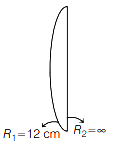
0 likesView Solution
179
PhysicsMediumMCQAP EAMCET · 2021
The focal length of a convex lens is $f$. An object is placed at a distance $x$ from its first focal point. The ratio of the size of the real image to that of the object is
A
$\frac{f}{x^2}$
B
$\frac{x^2}{f}$
C
$\frac{f}{x}$
D
$\frac{x}{f}$
Solution
(C) The focal length of the convex lens is given as $f$.
The object is placed at a distance $x$ from the first focal point.
Since the first focal point is at a distance $f$ from the optical center,the total object distance $u$ from the optical center is $u = -(f + x)$.
Using the lens formula,$\frac{1}{v} - \frac{1}{u} = \frac{1}{f}$.
Substituting $u = -(f + x)$,we get $\frac{1}{v} - \frac{1}{-(f + x)} = \frac{1}{f}$.
$\frac{1}{v} = \frac{1}{f} - \frac{1}{f + x} = \frac{f + x - f}{f(f + x)} = \frac{x}{f(f + x)}$.
Thus,$v = \frac{f(f + x)}{x}$.
The magnification $m$ is given by $m = \frac{v}{u}$.
$m = \frac{\frac{f(f + x)}{x}}{-(f + x)} = -\frac{f}{x}$.
The ratio of the size of the real image to the object is the magnitude of magnification,which is $|m| = \frac{f}{x}$.
The object is placed at a distance $x$ from the first focal point.
Since the first focal point is at a distance $f$ from the optical center,the total object distance $u$ from the optical center is $u = -(f + x)$.
Using the lens formula,$\frac{1}{v} - \frac{1}{u} = \frac{1}{f}$.
Substituting $u = -(f + x)$,we get $\frac{1}{v} - \frac{1}{-(f + x)} = \frac{1}{f}$.
$\frac{1}{v} = \frac{1}{f} - \frac{1}{f + x} = \frac{f + x - f}{f(f + x)} = \frac{x}{f(f + x)}$.
Thus,$v = \frac{f(f + x)}{x}$.
The magnification $m$ is given by $m = \frac{v}{u}$.
$m = \frac{\frac{f(f + x)}{x}}{-(f + x)} = -\frac{f}{x}$.
The ratio of the size of the real image to the object is the magnitude of magnification,which is $|m| = \frac{f}{x}$.
0 likesView Solution
180
PhysicsMediumMCQAP EAMCET · 2021
$A$ thin lens of refractive index $1.5$ has an optical power of $-5 \ D$ in air. Its optical power in a liquid medium with a refractive index of $1.6$ is $D$.
A
$0.625$
B
$1.25$
C
$2.5$
D
$0.5$
Solution
(A) Given: Refractive index of the lens,$\mu_g = 1.5$.
Refractive index of the medium,$\mu_m = 1.6$.
Power of the lens in air,$P = -5 \ D$.
Refractive index of air,$\mu_a = 1$.
Using the Lens Maker's Formula:
$P = \frac{1}{f} = (\mu_g - 1) \left( \frac{1}{R_1} - \frac{1}{R_2} \right)$ (in air).
For the medium,the power $P'$ is given by:
$P' = \frac{1}{f'} = \left( \frac{\mu_g}{\mu_m} - 1 \right) \left( \frac{1}{R_1} - \frac{1}{R_2} \right)$.
Dividing $P'$ by $P$:
$\frac{P'}{P} = \frac{(\frac{\mu_g}{\mu_m} - 1)}{(\mu_g - 1)} = \frac{(\frac{1.5}{1.6} - 1)}{(1.5 - 1)} = \frac{(\frac{1.5 - 1.6}{1.6})}{0.5} = \frac{-0.1}{1.6 \times 0.5} = \frac{-0.1}{0.8} = -\frac{1}{8}$.
Therefore,$P' = P \times (-\frac{1}{8}) = -5 \times (-0.125) = 0.625 \ D$.
Refractive index of the medium,$\mu_m = 1.6$.
Power of the lens in air,$P = -5 \ D$.
Refractive index of air,$\mu_a = 1$.
Using the Lens Maker's Formula:
$P = \frac{1}{f} = (\mu_g - 1) \left( \frac{1}{R_1} - \frac{1}{R_2} \right)$ (in air).
For the medium,the power $P'$ is given by:
$P' = \frac{1}{f'} = \left( \frac{\mu_g}{\mu_m} - 1 \right) \left( \frac{1}{R_1} - \frac{1}{R_2} \right)$.
Dividing $P'$ by $P$:
$\frac{P'}{P} = \frac{(\frac{\mu_g}{\mu_m} - 1)}{(\mu_g - 1)} = \frac{(\frac{1.5}{1.6} - 1)}{(1.5 - 1)} = \frac{(\frac{1.5 - 1.6}{1.6})}{0.5} = \frac{-0.1}{1.6 \times 0.5} = \frac{-0.1}{0.8} = -\frac{1}{8}$.
Therefore,$P' = P \times (-\frac{1}{8}) = -5 \times (-0.125) = 0.625 \ D$.
0 likesView Solution
181
PhysicsMediumMCQAP EAMCET · 2021
The voltage applied to an electron microscope to produce electrons of wavelength $0.50 \text{ Å}$ is (in $\text{ V}$)
A
$602$
B
$50$
C
$138$
D
$812$
Solution
(A) The de-Broglie wavelength $\lambda$ of an electron accelerated through a potential difference $V$ is given by the formula: $\lambda = \frac{h}{\sqrt{2meV}}$.
Alternatively, using the simplified relation: $\lambda \approx \frac{12.27}{\sqrt{V}} \text{ Å}$.
Given $\lambda = 0.50 \text{ Å}$, we substitute this into the equation:
$0.50 = \frac{12.27}{\sqrt{V}}$
$\sqrt{V} = \frac{12.27}{0.50} = 24.54$
$V = (24.54)^2 \approx 602.2 \text{ V}$.
Thus, the required voltage is approximately $602 \text{ V}$.
Alternatively, using the simplified relation: $\lambda \approx \frac{12.27}{\sqrt{V}} \text{ Å}$.
Given $\lambda = 0.50 \text{ Å}$, we substitute this into the equation:
$0.50 = \frac{12.27}{\sqrt{V}}$
$\sqrt{V} = \frac{12.27}{0.50} = 24.54$
$V = (24.54)^2 \approx 602.2 \text{ V}$.
Thus, the required voltage is approximately $602 \text{ V}$.
0 likesView Solution
182
PhysicsMediumMCQAP EAMCET · 2021
Light of wavelength $300 \ nm$ in medium $A$ enters into medium $B$ through a plane surface. If the frequency of light is $5 \times 10^{14} \ Hz$ and the ratio of speed in medium $A$ to that in medium $B$ is $\frac{4}{5}$,the absolute refractive index of medium $B$ is:
A
$1.6$
B
$1.5$
C
$1.3$
D
$1.45$
Solution
(A) The speed of light in medium $A$ is given by $v_A = f \lambda_A = (5 \times 10^{14} \ Hz) \times (300 \times 10^{-9} \ m) = 1.5 \times 10^8 \ m/s$.
The absolute refractive index of medium $A$ is $\mu_A = \frac{c}{v_A} = \frac{3 \times 10^8 \ m/s}{1.5 \times 10^8 \ m/s} = 2$.
We are given the ratio of speeds $\frac{v_A}{v_B} = \frac{4}{5}$.
Since the refractive index $\mu$ is inversely proportional to the speed of light $v$ $(\mu = \frac{c}{v})$,we have $\frac{\mu_B}{\mu_A} = \frac{v_A}{v_B}$.
Substituting the values: $\frac{\mu_B}{2} = \frac{4}{5}$.
Therefore,$\mu_B = 2 \times \frac{4}{5} = \frac{8}{5} = 1.6$.
The absolute refractive index of medium $A$ is $\mu_A = \frac{c}{v_A} = \frac{3 \times 10^8 \ m/s}{1.5 \times 10^8 \ m/s} = 2$.
We are given the ratio of speeds $\frac{v_A}{v_B} = \frac{4}{5}$.
Since the refractive index $\mu$ is inversely proportional to the speed of light $v$ $(\mu = \frac{c}{v})$,we have $\frac{\mu_B}{\mu_A} = \frac{v_A}{v_B}$.
Substituting the values: $\frac{\mu_B}{2} = \frac{4}{5}$.
Therefore,$\mu_B = 2 \times \frac{4}{5} = \frac{8}{5} = 1.6$.
0 likesView Solution
183
PhysicsDifficultMCQAP EAMCET · 2021
The curve between charge density $\rho$ and distance $r$ near a $p$ - $n$ junction is best represented by
A
B
C
D
Solution
(A) In a $p-n$ junction,the depletion region is formed due to the diffusion of charge carriers.
On the $p$-side of the junction,there are negatively charged acceptor ions,which create a negative charge density.
On the $n$-side of the junction,there are positively charged donor ions,which create a positive charge density.
The charge density $\rho$ is negative on the $p$-side and positive on the $n$-side.
At the junction interface $(r = 0)$,the charge density transitions from negative to positive.
Therefore,the graph that shows a negative charge density on the $p$-side and a positive charge density on the $n$-side,passing through the origin,is the correct representation.
This corresponds to the graph where the curve is below the $r$-axis for the $p$-region and above the $r$-axis for the $n$-region.
On the $p$-side of the junction,there are negatively charged acceptor ions,which create a negative charge density.
On the $n$-side of the junction,there are positively charged donor ions,which create a positive charge density.
The charge density $\rho$ is negative on the $p$-side and positive on the $n$-side.
At the junction interface $(r = 0)$,the charge density transitions from negative to positive.
Therefore,the graph that shows a negative charge density on the $p$-side and a positive charge density on the $n$-side,passing through the origin,is the correct representation.
This corresponds to the graph where the curve is below the $r$-axis for the $p$-region and above the $r$-axis for the $n$-region.
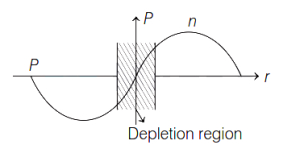
0 likesView Solution
184
PhysicsMediumMCQAP EAMCET · 2021
In the circuit shown for the given input voltage $V_i$, the maximum output voltage $V_0$ is
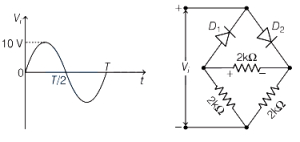
A
$0$
B
$5 \, V$
C
$10 \, V$
D
$\frac{5}{\sqrt{2}} \, V$
Solution
(B) The input voltage $V_i$ is an alternating voltage with a peak value of $10 \, V$.
For the positive half-cycle of $V_i$, the top terminal is at a higher potential than the bottom terminal. In this case, diode $D_2$ is forward-biased and conducts, while diode $D_1$ is reverse-biased and acts as an open circuit.
The circuit simplifies to a voltage divider consisting of the $2 \, k\Omega$ resistor (where $V_0$ is measured) in series with another $2 \, k\Omega$ resistor connected to the negative terminal.
The total resistance in the path is $2 \, k\Omega + 2 \, k\Omega = 4 \, k\Omega$.
Using the voltage divider rule, the output voltage $V_0$ across the $2 \, k\Omega$ resistor is:
$V_0 = V_i \times \frac{2 \, k\Omega}{2 \, k\Omega + 2 \, k\Omega} = V_i \times \frac{2}{4} = \frac{V_i}{2}$.
Since the maximum input voltage is $10 \, V$, the maximum output voltage is:
$V_{0, \text{max}} = \frac{10 \, V}{2} = 5 \, V$.
For the positive half-cycle of $V_i$, the top terminal is at a higher potential than the bottom terminal. In this case, diode $D_2$ is forward-biased and conducts, while diode $D_1$ is reverse-biased and acts as an open circuit.
The circuit simplifies to a voltage divider consisting of the $2 \, k\Omega$ resistor (where $V_0$ is measured) in series with another $2 \, k\Omega$ resistor connected to the negative terminal.
The total resistance in the path is $2 \, k\Omega + 2 \, k\Omega = 4 \, k\Omega$.
Using the voltage divider rule, the output voltage $V_0$ across the $2 \, k\Omega$ resistor is:
$V_0 = V_i \times \frac{2 \, k\Omega}{2 \, k\Omega + 2 \, k\Omega} = V_i \times \frac{2}{4} = \frac{V_i}{2}$.
Since the maximum input voltage is $10 \, V$, the maximum output voltage is:
$V_{0, \text{max}} = \frac{10 \, V}{2} = 5 \, V$.
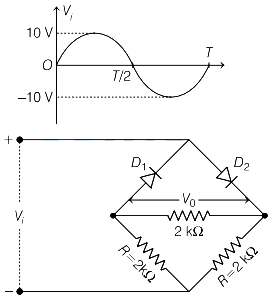
0 likesView Solution
185
PhysicsEasyMCQAP EAMCET · 2021
If the current in the Zener diode is five times the current in $R_1$ and the breakdown voltage of the diode is $6 \text{ V}$,find the value of $R$.
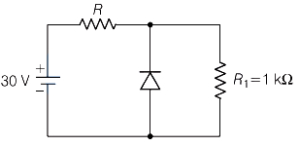
A
$2000 \text{ } \Omega$
B
$\frac{2000}{3} \text{ } \Omega$
C
$1000 \text{ } \Omega$
D
$\frac{1000}{3} \text{ } \Omega$
Solution
(B) Given that,$R_1 = 1 \text{ k}\Omega = 1000 \text{ } \Omega$,and Zener breakdown voltage $V_z = 6 \text{ V}$.
Let $I_1$ be the current through $R_1$ and $I_z$ be the current through the Zener diode.
Since $R_1$ is in parallel with the Zener diode,the voltage across $R_1$ is $V_z = 6 \text{ V}$.
Therefore,$I_1 = \frac{V_z}{R_1} = \frac{6 \text{ V}}{1000 \text{ } \Omega} = 6 \times 10^{-3} \text{ A}$.
According to the given condition,the Zener current is $I_z = 5 I_1 = 5 \times (6 \times 10^{-3} \text{ A}) = 30 \times 10^{-3} \text{ A}$.
The total current $I$ drawn from the source $V_s = 30 \text{ V}$ is $I = I_1 + I_z = 6 \times 10^{-3} + 30 \times 10^{-3} = 36 \times 10^{-3} \text{ A}$.
Also,the voltage drop across $R$ is $V_s - V_z = 30 \text{ V} - 6 \text{ V} = 24 \text{ V}$.
Using Ohm's law,$R = \frac{V_s - V_z}{I} = \frac{24}{36 \times 10^{-3}} = \frac{24000}{36} \text{ } \Omega = \frac{2000}{3} \text{ } \Omega$.
Let $I_1$ be the current through $R_1$ and $I_z$ be the current through the Zener diode.
Since $R_1$ is in parallel with the Zener diode,the voltage across $R_1$ is $V_z = 6 \text{ V}$.
Therefore,$I_1 = \frac{V_z}{R_1} = \frac{6 \text{ V}}{1000 \text{ } \Omega} = 6 \times 10^{-3} \text{ A}$.
According to the given condition,the Zener current is $I_z = 5 I_1 = 5 \times (6 \times 10^{-3} \text{ A}) = 30 \times 10^{-3} \text{ A}$.
The total current $I$ drawn from the source $V_s = 30 \text{ V}$ is $I = I_1 + I_z = 6 \times 10^{-3} + 30 \times 10^{-3} = 36 \times 10^{-3} \text{ A}$.
Also,the voltage drop across $R$ is $V_s - V_z = 30 \text{ V} - 6 \text{ V} = 24 \text{ V}$.
Using Ohm's law,$R = \frac{V_s - V_z}{I} = \frac{24}{36 \times 10^{-3}} = \frac{24000}{36} \text{ } \Omega = \frac{2000}{3} \text{ } \Omega$.
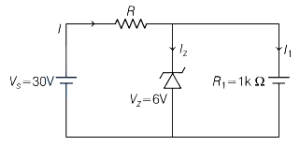
0 likesView Solution
186
PhysicsMediumMCQAP EAMCET · 2021
$A$ transistor is connected in common emitter configuration. The collector supply is $8 V$ and the voltage drop across a resistor of $800 \Omega$ in the collector circuit is $0.5 V$. If the current gain factor $\alpha$ is $0.96$,the base current is
A
$2.6 \times 10^{-5} A$
B
$3.6 \times 10^{-5} A$
C
$5.6 \times 10^{-5} A$
D
$6.6 \times 10^{-5} A$
Solution
(A) Given,collector resistance $R_C = 800 \Omega$ and voltage drop across it $V_R = 0.5 V$.
Collector current $I_C = \frac{V_R}{R_C} = \frac{0.5}{800} = 6.25 \times 10^{-4} A = 0.625 \times 10^{-3} A$.
We know that the current gain $\alpha = \frac{I_C}{I_E}$,so emitter current $I_E = \frac{I_C}{\alpha} = \frac{0.625 \times 10^{-3}}{0.96} \approx 6.51 \times 10^{-4} A$.
The base current $I_B = I_E - I_C = I_C \left( \frac{1}{\alpha} - 1 \right) = I_C \left( \frac{1 - \alpha}{\alpha} \right)$.
Substituting the values: $I_B = 0.625 \times 10^{-3} \times \left( \frac{1 - 0.96}{0.96} \right) = 0.625 \times 10^{-3} \times \left( \frac{0.04}{0.96} \right) = 0.625 \times 10^{-3} \times \frac{1}{24} \approx 0.02604 \times 10^{-3} A = 2.6 \times 10^{-5} A$.
Collector current $I_C = \frac{V_R}{R_C} = \frac{0.5}{800} = 6.25 \times 10^{-4} A = 0.625 \times 10^{-3} A$.
We know that the current gain $\alpha = \frac{I_C}{I_E}$,so emitter current $I_E = \frac{I_C}{\alpha} = \frac{0.625 \times 10^{-3}}{0.96} \approx 6.51 \times 10^{-4} A$.
The base current $I_B = I_E - I_C = I_C \left( \frac{1}{\alpha} - 1 \right) = I_C \left( \frac{1 - \alpha}{\alpha} \right)$.
Substituting the values: $I_B = 0.625 \times 10^{-3} \times \left( \frac{1 - 0.96}{0.96} \right) = 0.625 \times 10^{-3} \times \left( \frac{0.04}{0.96} \right) = 0.625 \times 10^{-3} \times \frac{1}{24} \approx 0.02604 \times 10^{-3} A = 2.6 \times 10^{-5} A$.
0 likesView Solution
187
PhysicsDifficultMCQAP EAMCET · 2021
$A$ change of $0.04 \ V$ takes place between the base and the emitter when an input signal is connected to the common emitter transistor amplifier. As a result,a $20 \ \mu A$ change takes place in the base current and a change of $2 \ mA$ takes place in the collector current. The input resistance and $AC$ current gain are:
A
$1 \ k\Omega \ \& \ 100$
B
$2 \ k\Omega \ \& \ 100$
C
$2 \ k\Omega \ \& \ 1000$
D
$1 \ k\Omega \ \& \ 200$
Solution
(B) Given: $\Delta I_b = 20 \ \mu A = 20 \times 10^{-6} \ A$,$\Delta I_c = 2 \ mA = 2 \times 10^{-3} \ A$,and $\Delta V_{BE} = 0.04 \ V$.
The input resistance $R_{\text{input}}$ is defined as the ratio of the change in base-emitter voltage to the change in base current:
$R_{\text{input}} = \frac{\Delta V_{BE}}{\Delta I_b} = \frac{0.04}{20 \times 10^{-6}} = \frac{0.04 \times 10^6}{20} = 2 \times 10^3 \ \Omega = 2 \ k\Omega$.
The $AC$ current gain $\beta$ is defined as the ratio of the change in collector current to the change in base current:
$\beta = \frac{\Delta I_c}{\Delta I_b} = \frac{2 \times 10^{-3}}{20 \times 10^{-6}} = \frac{2000}{20} = 100$.
Thus,the input resistance is $2 \ k\Omega$ and the $AC$ current gain is $100$.
The input resistance $R_{\text{input}}$ is defined as the ratio of the change in base-emitter voltage to the change in base current:
$R_{\text{input}} = \frac{\Delta V_{BE}}{\Delta I_b} = \frac{0.04}{20 \times 10^{-6}} = \frac{0.04 \times 10^6}{20} = 2 \times 10^3 \ \Omega = 2 \ k\Omega$.
The $AC$ current gain $\beta$ is defined as the ratio of the change in collector current to the change in base current:
$\beta = \frac{\Delta I_c}{\Delta I_b} = \frac{2 \times 10^{-3}}{20 \times 10^{-6}} = \frac{2000}{20} = 100$.
Thus,the input resistance is $2 \ k\Omega$ and the $AC$ current gain is $100$.
0 likesView Solution
188
PhysicsMediumMCQAP EAMCET · 2021
In the following common emitter circuit, if $\beta=100$, $V_{CE}=7 \, V$, $V_{BE}$ is negligible, and $R_C=2 \, k\Omega$, then $I_B=$ (in $\, mA$)?
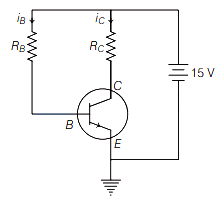
A
$0.01$
B
$0.04$
C
$0.02$
D
$0.03$
Solution
(B) Given that, $V_{CE}=7 \, V$, $\beta=100$, $R_C=2 \, k\Omega = 2000 \, \Omega$, and $V_{CC}=15 \, V$.
We know that the current gain in a common emitter circuit is given by:
$\beta = \frac{I_C}{I_B} \dots (i)$
Applying Kirchhoff's Voltage Law $(KVL)$ in the output loop (collector-emitter loop):
$V_{CC} - I_C R_C - V_{CE} = 0$
Substituting the given values:
$15 - I_C(2000) - 7 = 0$
$8 = I_C(2000)$
$I_C = \frac{8}{2000} \, A = 4 \times 10^{-3} \, A = 4 \, mA \dots (ii)$
Now, substituting the value of $I_C$ from equation $(ii)$ into equation $(i)$:
$100 = \frac{4 \, mA}{I_B}$
$I_B = \frac{4}{100} \, mA = 0.04 \, mA$.
We know that the current gain in a common emitter circuit is given by:
$\beta = \frac{I_C}{I_B} \dots (i)$
Applying Kirchhoff's Voltage Law $(KVL)$ in the output loop (collector-emitter loop):
$V_{CC} - I_C R_C - V_{CE} = 0$
Substituting the given values:
$15 - I_C(2000) - 7 = 0$
$8 = I_C(2000)$
$I_C = \frac{8}{2000} \, A = 4 \times 10^{-3} \, A = 4 \, mA \dots (ii)$
Now, substituting the value of $I_C$ from equation $(ii)$ into equation $(i)$:
$100 = \frac{4 \, mA}{I_B}$
$I_B = \frac{4}{100} \, mA = 0.04 \, mA$.
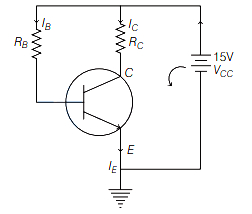
0 likesView Solution
189
PhysicsMediumMCQAP EAMCET · 2021
The current gain for a transistor working as a common base amplifier is $0.96$. If the emitter current is $7.2 \,mA$, then the base current is (in $\,mA$)
A
$0.29$
B
$0.35$
C
$0.39$
D
$10$
Solution
(A) Given, current gain, $\alpha = 0.96$.
Emitter current, $I_E = 7.2 \,mA = 7.2 \times 10^{-3} \,A$.
We know that, $\alpha = I_C / I_E$.
Therefore, $I_C = \alpha \times I_E = 0.96 \times 7.2 \,mA = 6.912 \,mA$.
Also, the relation between emitter, collector, and base current is $I_E = I_C + I_B$.
Thus, $I_B = I_E - I_C = 7.2 \,mA - 6.912 \,mA = 0.288 \,mA \approx 0.29 \,mA$.
Emitter current, $I_E = 7.2 \,mA = 7.2 \times 10^{-3} \,A$.
We know that, $\alpha = I_C / I_E$.
Therefore, $I_C = \alpha \times I_E = 0.96 \times 7.2 \,mA = 6.912 \,mA$.
Also, the relation between emitter, collector, and base current is $I_E = I_C + I_B$.
Thus, $I_B = I_E - I_C = 7.2 \,mA - 6.912 \,mA = 0.288 \,mA \approx 0.29 \,mA$.
0 likesView Solution
190
PhysicsMediumMCQAP EAMCET · 2021
The truth table given below corresponds to which logic gate?
| $A$ | $B$ | $X$ |
|---|---|---|
| $0$ | $0$ | $0$ |
| $0$ | $1$ | $1$ |
| $1$ | $0$ | $1$ |
| $1$ | $1$ | $1$ |
A
$NAND$
B
$OR$
C
$AND$
D
$XOR$
Solution
(B) The truth table shows that the output $X$ is $1$ if either input $A$ or input $B$ (or both) is $1$.
This behavior is represented by the Boolean expression $X = A + B$.
The logic gate that performs this operation is the $OR$ gate.
Therefore,the correct option is $B$.
This behavior is represented by the Boolean expression $X = A + B$.
The logic gate that performs this operation is the $OR$ gate.
Therefore,the correct option is $B$.
0 likesView Solution
191
PhysicsMediumMCQAP EAMCET · 2021
The following figure shows a logic gate circuit with inputs $A$ and $B$ and output $Y$. If the voltage waveforms of $A, B$ and $Y$ are as given,then the logic gate is
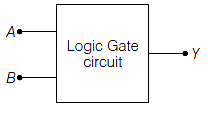
A
$NOR$ gate
B
$OR$ gate
C
$AND$ gate
D
$NAND$ gate
Solution
(D) The truth table for the waveform is given by:
From the truth table,we observe that the output $Y$ is $0$ only when both inputs $A$ and $B$ are $1$. In all other cases,the output is $1$.
This behavior corresponds to the Boolean expression $Y = \overline{A \cdot B}$.
This is the characteristic truth table of a $NAND$ gate.
| Time Interval | $A$ | $B$ | $Y$ |
|---|---|---|---|
| $t_1-t_2$ | $0$ | $0$ | $1$ |
| $t_2-t_3$ | $0$ | $1$ | $1$ |
| $t_3-t_4$ | $1$ | $0$ | $1$ |
| $t_4-t_5$ | $1$ | $1$ | $0$ |
From the truth table,we observe that the output $Y$ is $0$ only when both inputs $A$ and $B$ are $1$. In all other cases,the output is $1$.
This behavior corresponds to the Boolean expression $Y = \overline{A \cdot B}$.
This is the characteristic truth table of a $NAND$ gate.
0 likesView Solution
192
PhysicsMediumMCQAP EAMCET · 2021
The output current versus time curve of a rectifier is shown in the figure. The average value of output current in this case is
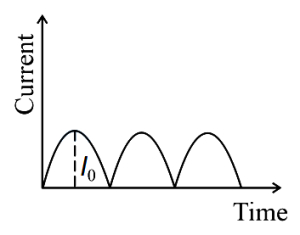
A
$0$
B
$\frac{I_0}{2}$
C
$\frac{2 I_0}{\pi}$
D
$I_0$
Solution
(C) From the given figure,it is evident that the rectifier is a full-wave rectifier.
For a full-wave rectifier,the output current is given by $I = I_0 \sin(\omega t)$ for the first half-cycle and $I = I_0 \sin(\omega t)$ for the second half-cycle (due to rectification).
The average value of the current over one complete cycle $T$ is given by:
$I_{\text{avg}} = \frac{1}{T} \int_{0}^{T} I(t) dt$
For a full-wave rectifier,the period is $T/2$. The average value is calculated as:
$I_{\text{avg}} = \frac{1}{T/2} \int_{0}^{T/2} I_0 \sin(\omega t) dt$
$I_{\text{avg}} = \frac{2}{T} \cdot I_0 \left[ -\frac{\cos(\omega t)}{\omega} \right]_{0}^{T/2}$
Since $\omega = \frac{2\pi}{T}$,we have:
$I_{\text{avg}} = \frac{2 I_0}{T} \cdot \frac{T}{2\pi} [-\cos(\pi) + \cos(0)]$
$I_{\text{avg}} = \frac{I_0}{\pi} [1 + 1] = \frac{2 I_0}{\pi}$
For a full-wave rectifier,the output current is given by $I = I_0 \sin(\omega t)$ for the first half-cycle and $I = I_0 \sin(\omega t)$ for the second half-cycle (due to rectification).
The average value of the current over one complete cycle $T$ is given by:
$I_{\text{avg}} = \frac{1}{T} \int_{0}^{T} I(t) dt$
For a full-wave rectifier,the period is $T/2$. The average value is calculated as:
$I_{\text{avg}} = \frac{1}{T/2} \int_{0}^{T/2} I_0 \sin(\omega t) dt$
$I_{\text{avg}} = \frac{2}{T} \cdot I_0 \left[ -\frac{\cos(\omega t)}{\omega} \right]_{0}^{T/2}$
Since $\omega = \frac{2\pi}{T}$,we have:
$I_{\text{avg}} = \frac{2 I_0}{T} \cdot \frac{T}{2\pi} [-\cos(\pi) + \cos(0)]$
$I_{\text{avg}} = \frac{I_0}{\pi} [1 + 1] = \frac{2 I_0}{\pi}$
0 likesView Solution
193
PhysicsDifficultMCQAP EAMCET · 2021
The length of a germanium rod is $0.925 \ cm$ and its area of cross-section is $1 \ mm^2$. If for germanium $n_i = 2.5 \times 10^{19} \ m^{-3}$,$\mu_h = 0.19 \ m^2/V\cdot s$,and $\mu_e = 0.39 \ m^2/V\cdot s$,then the resistance of the rod is:
A
$2.5 \ k\Omega$
B
$4.0 \ k\Omega$
C
$5.0 \ k\Omega$
D
$10.0 \ k\Omega$
Solution
(B) The conductivity of an intrinsic semiconductor is given by $\sigma = n_i e (\mu_e + \mu_h)$.
Given $n_i = 2.5 \times 10^{19} \ m^{-3}$,$e = 1.6 \times 10^{-19} \ C$,$\mu_e = 0.39 \ m^2/V\cdot s$,and $\mu_h = 0.19 \ m^2/V\cdot s$.
$\sigma = (2.5 \times 10^{19}) \times (1.6 \times 10^{-19}) \times (0.39 + 0.19) = 4 \times 0.58 = 2.32 \ \Omega^{-1}m^{-1}$.
The resistivity $\rho = \frac{1}{\sigma} = \frac{1}{2.32} \ \Omega\cdot m$.
The resistance $R = \rho \frac{L}{A}$.
Given $L = 0.925 \ cm = 9.25 \times 10^{-3} \ m$ and $A = 1 \ mm^2 = 10^{-6} \ m^2$.
$R = \frac{1}{2.32} \times \frac{9.25 \times 10^{-3}}{10^{-6}} = \frac{9250}{2.32} \approx 3987 \ \Omega \approx 4.0 \ k\Omega$.
Given $n_i = 2.5 \times 10^{19} \ m^{-3}$,$e = 1.6 \times 10^{-19} \ C$,$\mu_e = 0.39 \ m^2/V\cdot s$,and $\mu_h = 0.19 \ m^2/V\cdot s$.
$\sigma = (2.5 \times 10^{19}) \times (1.6 \times 10^{-19}) \times (0.39 + 0.19) = 4 \times 0.58 = 2.32 \ \Omega^{-1}m^{-1}$.
The resistivity $\rho = \frac{1}{\sigma} = \frac{1}{2.32} \ \Omega\cdot m$.
The resistance $R = \rho \frac{L}{A}$.
Given $L = 0.925 \ cm = 9.25 \times 10^{-3} \ m$ and $A = 1 \ mm^2 = 10^{-6} \ m^2$.
$R = \frac{1}{2.32} \times \frac{9.25 \times 10^{-3}}{10^{-6}} = \frac{9250}{2.32} \approx 3987 \ \Omega \approx 4.0 \ k\Omega$.
0 likesView Solution
194
PhysicsEasyMCQAP EAMCET · 2021
Unification of weak and electromagnetic interactions was done by
A
Einstein
B
Raman
C
Salam
D
Hubble
Solution
(C) The electromagnetic force and the weak nuclear force are two of the four fundamental forces in nature.
It was proposed that these two forces can be unified into a single interaction known as the electroweak interaction.
This theoretical unification was successfully achieved by three physicists: Sheldon Glashow,Steven Weinberg,and Abdus Salam.
Therefore,among the given options,Salam is the correct answer.
It was proposed that these two forces can be unified into a single interaction known as the electroweak interaction.
This theoretical unification was successfully achieved by three physicists: Sheldon Glashow,Steven Weinberg,and Abdus Salam.
Therefore,among the given options,Salam is the correct answer.
0 likesView Solution
195
PhysicsEasyMCQAP EAMCET · 2021
Sir $C$.$V$. Raman was awarded the Nobel Prize in Physics for his work on:
A
reflection of light
B
refraction of light
C
scattering of light
D
dispersion of light
Solution
(C) Sir $C$.$V$. Raman was awarded the Nobel Prize in Physics in $1930$ for his pioneering work on the scattering of light,a phenomenon now known as the Raman Effect.
He discovered that when a beam of light traverses a transparent medium,a small fraction of the light is scattered in directions other than the incident direction,and this scattered light undergoes a change in wavelength and frequency.
He discovered that when a beam of light traverses a transparent medium,a small fraction of the light is scattered in directions other than the incident direction,and this scattered light undergoes a change in wavelength and frequency.
0 likesView Solution
196
PhysicsEasyMCQAP EAMCET · 2021
$1 \text{ amu}$ is equal to
A
$931 \text{ keV}$
B
$931 \text{ eV}$
C
$931 \text{ MeV}$
D
$9.31 \text{ MeV}$
Solution
(C) Given that atomic mass $= 1 \text{ amu} = 1.66 \times 10^{-27} \text{ kg}$.
By using Einstein's mass-energy equivalence relation,$E = mc^2$,where $c = 3 \times 10^8 \text{ m/s}$ is the speed of light.
$E = (1.66 \times 10^{-27} \text{ kg}) \times (3 \times 10^8 \text{ m/s})^2 = 1.494 \times 10^{-11} \text{ J}$.
We know that $1 \text{ MeV} = 1.602 \times 10^{-13} \text{ J}$.
Therefore,$E = \frac{1.494 \times 10^{-11} \text{ J}}{1.602 \times 10^{-13} \text{ J/MeV}} \approx 931 \text{ MeV}$.
Thus,$1 \text{ amu}$ is equivalent to $931 \text{ MeV}$ of energy.
By using Einstein's mass-energy equivalence relation,$E = mc^2$,where $c = 3 \times 10^8 \text{ m/s}$ is the speed of light.
$E = (1.66 \times 10^{-27} \text{ kg}) \times (3 \times 10^8 \text{ m/s})^2 = 1.494 \times 10^{-11} \text{ J}$.
We know that $1 \text{ MeV} = 1.602 \times 10^{-13} \text{ J}$.
Therefore,$E = \frac{1.494 \times 10^{-11} \text{ J}}{1.602 \times 10^{-13} \text{ J/MeV}} \approx 931 \text{ MeV}$.
Thus,$1 \text{ amu}$ is equivalent to $931 \text{ MeV}$ of energy.
0 likesView Solution
197
PhysicsEasyMCQAP EAMCET · 2021
Generation,propagation,and detection of electromagnetic waves is the basis of:
A
$LASER$
B
reactors
C
radio and television
D
computer
Solution
(C) The generation,propagation,and detection of electromagnetic waves are the fundamental principles behind wireless communication systems. Radio and television broadcasting rely entirely on the transmission of electromagnetic waves through space,which are then detected by receivers to convert them back into audio and visual signals. Therefore,radio and television are based on these principles.
0 likesView Solution
198
PhysicsEasyMCQAP EAMCET · 2021
The book “Physics of Physics” was written by
A
Newton
B
Einstein
C
Archimedes
D
Galileo
Solution
(B) The book “The Evolution of Physics” (often referred to in the context of physics literature) was co-authored by Albert Einstein and Leopold Infeld. Given the options provided,Albert Einstein is the correct author.
0 likesView Solution
199
PhysicsMediumMCQAP EAMCET · 2021
In a diffraction pattern due to a single slit of width '$a$',the first minimum is observed at an angle $30^{\circ}$ when light of wavelength $500 \ nm$ is incident on the slit. The first secondary maximum is observed at an angle of
A
$\sin^{-1} \frac{1}{2}$
B
$\sin^{-1} \frac{3}{4}$
C
$\sin^{-1} \frac{1}{4}$
D
$\sin^{-1} \frac{2}{3}$
Solution
(B) For a single slit of width $a$,the condition for the $n^{th}$ minimum is given by $a \sin \theta = n \lambda$.
For the first minimum $(n=1)$,the angle is $\theta = 30^{\circ}$.
Thus,$a \sin 30^{\circ} = 1 \cdot \lambda \Rightarrow a(0.5) = \lambda \Rightarrow a = 2 \lambda$.
The condition for the $n^{th}$ secondary maximum is given by $a \sin \theta' = (n + \frac{1}{2}) \lambda$.
For the first secondary maximum,we take $n=1$.
Substituting $a = 2 \lambda$ and $n=1$ into the equation:
$(2 \lambda) \sin \theta' = (1 + \frac{1}{2}) \lambda$
$2 \sin \theta' = \frac{3}{2}$
$\sin \theta' = \frac{3}{4}$
$\theta' = \sin^{-1} \left( \frac{3}{4} \right)$.
For the first minimum $(n=1)$,the angle is $\theta = 30^{\circ}$.
Thus,$a \sin 30^{\circ} = 1 \cdot \lambda \Rightarrow a(0.5) = \lambda \Rightarrow a = 2 \lambda$.
The condition for the $n^{th}$ secondary maximum is given by $a \sin \theta' = (n + \frac{1}{2}) \lambda$.
For the first secondary maximum,we take $n=1$.
Substituting $a = 2 \lambda$ and $n=1$ into the equation:
$(2 \lambda) \sin \theta' = (1 + \frac{1}{2}) \lambda$
$2 \sin \theta' = \frac{3}{2}$
$\sin \theta' = \frac{3}{4}$
$\theta' = \sin^{-1} \left( \frac{3}{4} \right)$.
0 likesView Solution
200
PhysicsDifficultMCQAP EAMCET · 2021
The position of the direct image obtained at $O$,when a monochromatic beam of light is passed through a plane transmission grating at normal incidence,is shown in the figure. The diffracted images $A, B$,and $C$ correspond to the first,second,and third-order diffraction. When the source is replaced by another source of shorter wavelength,then:
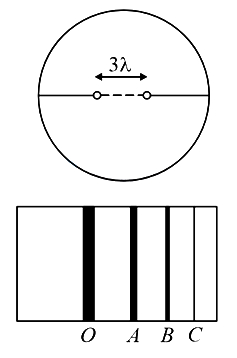
A
all the four will shift in the direction $C$ to $O$
B
all the four will shift in the direction $O$ to $C$
C
the images $C, B$ and $A$ will shift towards $O$
D
the images $C, B$ and $A$ will shift away from $O$
Solution
(C) For a plane transmission grating,the condition for the $n$th order diffraction maxima is given by $d \sin \theta = n \lambda$,where $d$ is the grating element,$\theta$ is the angle of diffraction,and $\lambda$ is the wavelength of light.
From the relation $\sin \theta = \frac{n \lambda}{d}$,it is clear that for a fixed order $n$ and grating constant $d$,the angle of diffraction $\theta$ is directly proportional to the wavelength $\lambda$ (i.e.,$\theta \propto \lambda$ for small angles).
When the source is replaced by another source of shorter wavelength,the value of $\lambda$ decreases. Consequently,$\sin \theta$ decreases,which means the angle of diffraction $\theta$ for all orders $(n=1, 2, 3)$ decreases.
The direct image at $O$ (the $0$th order) remains stationary because $\sin \theta = 0$ for $n=0$,regardless of the wavelength. However,the diffracted images $A, B$,and $C$ will move closer to the central maximum $O$ as their respective diffraction angles decrease.
Therefore,the images $C, B$,and $A$ will shift towards $O$.
From the relation $\sin \theta = \frac{n \lambda}{d}$,it is clear that for a fixed order $n$ and grating constant $d$,the angle of diffraction $\theta$ is directly proportional to the wavelength $\lambda$ (i.e.,$\theta \propto \lambda$ for small angles).
When the source is replaced by another source of shorter wavelength,the value of $\lambda$ decreases. Consequently,$\sin \theta$ decreases,which means the angle of diffraction $\theta$ for all orders $(n=1, 2, 3)$ decreases.
The direct image at $O$ (the $0$th order) remains stationary because $\sin \theta = 0$ for $n=0$,regardless of the wavelength. However,the diffracted images $A, B$,and $C$ will move closer to the central maximum $O$ as their respective diffraction angles decrease.
Therefore,the images $C, B$,and $A$ will shift towards $O$.
0 likesView Solution
Vedclass Products
For Students
Vedclass Test Series
Mock tests in real AP EAMCET style covering Physics with performance analysis. 5-day free trial.
Start Free TrialFor Teachers
Exam Paper Generator
Generate Set A/B/C/D Physics papers from 7.5L+ questions in 2 minutes. 3 chapters free.
Try FreeFor Institutes
Online Exam Module
Run live AP EAMCET mock exams with unlimited students, 360° analytics & white-label branding.
See DemoFrequently Asked Questions
How many Physics questions are in AP EAMCET 2021?
There are 372 Physics questions from the AP EAMCET 2021 paper on Vedclass, each with a detailed step-by-step solution in English.
Are AP EAMCET 2021 Physics solutions available in English?
Yes. All solutions on this page are in English. You can also switch to English or Hindi using the language buttons above the questions.
Can I practice AP EAMCET 2021 Physics as a timed test?
Yes. Use the Vedclass Test Series to attempt a full AP EAMCET mock test covering Physics with time limits and instant score analysis.
Can teachers create Physics papers from AP EAMCET previous year questions?
Yes. The Vedclass Exam Paper Generator lets teachers mix AP EAMCET Physics questions and generate Set A/B/C/D papers in minutes.
For Teachers & Institutes
Build a Custom Physics Paper
Pick AP EAMCET 2021 Physics questions, set difficulty, and generate Set A/B/C/D in 2 minutes.