
PhysicsQ201–217 of 372 questions
Page 5 of 5 · English
201
PhysicsEasyMCQAP EAMCET · 2021
The speed of sound in air:
A
is independent of temperature
B
increases with pressure
C
increases with increase in humidity
D
decreases with increase in humidity
Solution
(C) The speed of sound in air is given by the formula $v = \sqrt{\frac{\gamma P}{\rho}}$,where $\gamma$ is the adiabatic index,$P$ is the pressure,and $\rho$ is the density of the air.
Since the density of water vapour is less than the density of dry air at the same temperature and pressure,the presence of moisture (humidity) decreases the effective density $\rho$ of the air.
As the speed of sound $v$ is inversely proportional to the square root of the density $(v \propto \frac{1}{\sqrt{\rho}})$,a decrease in density leads to an increase in the speed of sound.
Therefore,the speed of sound in air increases with an increase in humidity.
Since the density of water vapour is less than the density of dry air at the same temperature and pressure,the presence of moisture (humidity) decreases the effective density $\rho$ of the air.
As the speed of sound $v$ is inversely proportional to the square root of the density $(v \propto \frac{1}{\sqrt{\rho}})$,a decrease in density leads to an increase in the speed of sound.
Therefore,the speed of sound in air increases with an increase in humidity.
0 likesView Solution
202
PhysicsMediumMCQAP EAMCET · 2021
At what temperature does the velocity of sound in air increase by $10\%$ compared to its velocity at $0^{\circ}C$ (in $^{\circ}C$)?
A
$45$
B
$57$
C
$27$
D
$18$
Solution
(B) The speed of sound in air is directly proportional to the square root of the absolute temperature ($T$ in Kelvin).
Mathematically,$v \propto \sqrt{T}$.
Let $v_1$ be the velocity at $T_1 = 0^{\circ}C = 273 \ K$.
Let $v_2$ be the velocity at temperature $T_2$.
Given that the velocity increases by $10\%$,we have $v_2 = v_1 + 0.10v_1 = 1.1v_1 = \frac{11}{10}v_1$.
Using the ratio formula: $\frac{v_1}{v_2} = \sqrt{\frac{T_1}{T_2}}$.
Substituting the values: $\frac{v_1}{1.1v_1} = \sqrt{\frac{273}{T_2}}$.
$\frac{1}{1.1} = \sqrt{\frac{273}{T_2}} \Rightarrow \frac{1}{1.21} = \frac{273}{T_2}$.
$T_2 = 273 \times 1.21 = 330.33 \ K$.
Converting back to Celsius: $T_2(^{\circ}C) = 330.33 - 273 = 57.33^{\circ}C \approx 57^{\circ}C$.
Mathematically,$v \propto \sqrt{T}$.
Let $v_1$ be the velocity at $T_1 = 0^{\circ}C = 273 \ K$.
Let $v_2$ be the velocity at temperature $T_2$.
Given that the velocity increases by $10\%$,we have $v_2 = v_1 + 0.10v_1 = 1.1v_1 = \frac{11}{10}v_1$.
Using the ratio formula: $\frac{v_1}{v_2} = \sqrt{\frac{T_1}{T_2}}$.
Substituting the values: $\frac{v_1}{1.1v_1} = \sqrt{\frac{273}{T_2}}$.
$\frac{1}{1.1} = \sqrt{\frac{273}{T_2}} \Rightarrow \frac{1}{1.21} = \frac{273}{T_2}$.
$T_2 = 273 \times 1.21 = 330.33 \ K$.
Converting back to Celsius: $T_2(^{\circ}C) = 330.33 - 273 = 57.33^{\circ}C \approx 57^{\circ}C$.
0 likesView Solution
203
PhysicsMediumMCQAP EAMCET · 2021
$A$ string is divided into three segments such that the segments possess fundamental frequencies in the ratio $1: 2: 3$. Then,the lengths of the segments are in the ratio:
A
$6: 3: 2$
B
$4: 3: 2$
C
$4: 2: 1$
D
$3: 2: 1$
Solution
(A) The fundamental frequency $f$ of a vibrating string is given by the formula $f = \frac{1}{2l} \sqrt{\frac{T}{\mu}}$,where $l$ is the length,$T$ is the tension,and $\mu$ is the linear mass density.
Since the string is the same,the tension $T$ and mass per unit length $\mu$ are constant for all segments.
Therefore,the fundamental frequency is inversely proportional to the length of the segment: $f \propto \frac{1}{l}$ or $l \propto \frac{1}{f}$.
Given the ratio of fundamental frequencies is $f_1 : f_2 : f_3 = 1 : 2 : 3$.
The ratio of the lengths of the segments is $l_1 : l_2 : l_3 = \frac{1}{f_1} : \frac{1}{f_2} : \frac{1}{f_3}$.
Substituting the given values,we get $l_1 : l_2 : l_3 = \frac{1}{1} : \frac{1}{2} : \frac{1}{3}$.
To simplify this ratio,multiply each term by the least common multiple of the denominators $(6)$: $l_1 : l_2 : l_3 = (1 \times 6) : (\frac{1}{2} \times 6) : (\frac{1}{3} \times 6) = 6 : 3 : 2$.
Since the string is the same,the tension $T$ and mass per unit length $\mu$ are constant for all segments.
Therefore,the fundamental frequency is inversely proportional to the length of the segment: $f \propto \frac{1}{l}$ or $l \propto \frac{1}{f}$.
Given the ratio of fundamental frequencies is $f_1 : f_2 : f_3 = 1 : 2 : 3$.
The ratio of the lengths of the segments is $l_1 : l_2 : l_3 = \frac{1}{f_1} : \frac{1}{f_2} : \frac{1}{f_3}$.
Substituting the given values,we get $l_1 : l_2 : l_3 = \frac{1}{1} : \frac{1}{2} : \frac{1}{3}$.
To simplify this ratio,multiply each term by the least common multiple of the denominators $(6)$: $l_1 : l_2 : l_3 = (1 \times 6) : (\frac{1}{2} \times 6) : (\frac{1}{3} \times 6) = 6 : 3 : 2$.
0 likesView Solution
204
PhysicsMediumMCQAP EAMCET · 2021
Assertion $(A):$ Two identical trains move in opposite senses in the equatorial plane with the same speeds relative to the Earth's surface. They have equal magnitude of normal reaction.
Reason $(R):$ The trains have different centripetal accelerations due to different speeds.
Reason $(R):$ The trains have different centripetal accelerations due to different speeds.
A
Both $A$ and $R$ are true and $R$ is a correct explanation for $A$
B
Both $A$ and $R$ are true but $R$ is not a correct explanation for $A$
C
$A$ is true,$R$ is false
D
$A$ is false,$R$ is false
Solution
(D) Let the Earth rotate with angular velocity $\omega$. Let the train move with speed $v$ relative to the Earth's surface.
For a train moving in the direction of the Earth's rotation (West to East),the total angular velocity is $\omega' = \omega + v/R$. The centripetal force required is $F_1 = m(\omega + v/R)^2 R$.
For a train moving opposite to the Earth's rotation (East to West),the total angular velocity is $\omega'' = \omega - v/R$. The centripetal force required is $F_2 = m(\omega - v/R)^2 R$.
Since $F_1 \neq F_2$,the normal reactions $N_1 = mg - F_1$ and $N_2 = mg - F_2$ are not equal. Thus,Assertion $(A)$ is false.
The centripetal acceleration depends on the net angular velocity relative to the inertial frame,not just the speed $v$ relative to the Earth. Thus,Reason $(R)$ is also false.
For a train moving in the direction of the Earth's rotation (West to East),the total angular velocity is $\omega' = \omega + v/R$. The centripetal force required is $F_1 = m(\omega + v/R)^2 R$.
For a train moving opposite to the Earth's rotation (East to West),the total angular velocity is $\omega'' = \omega - v/R$. The centripetal force required is $F_2 = m(\omega - v/R)^2 R$.
Since $F_1 \neq F_2$,the normal reactions $N_1 = mg - F_1$ and $N_2 = mg - F_2$ are not equal. Thus,Assertion $(A)$ is false.
The centripetal acceleration depends on the net angular velocity relative to the inertial frame,not just the speed $v$ relative to the Earth. Thus,Reason $(R)$ is also false.
0 likesView Solution
205
PhysicsEasyMCQAP EAMCET · 2021
What is the shape of the graph between speed and kinetic energy of a body?
A
$A$ straight line
B
$A$ hyperbola
C
$A$ parabola
D
Exponential
Solution
(C) The kinetic energy $(K.E.)$ of an object is defined by the formula $K.E. = \frac{1}{2}mv^2$,where $m$ is the mass and $v$ is the speed of the body.
Since the mass $m$ is constant,the relationship between kinetic energy and speed is $K.E. \propto v^2$.
This equation is of the form $y = kx^2$,which represents a parabola.
Therefore,the graph plotted between speed $(v)$ on the $x$-axis and kinetic energy $(K.E.)$ on the $y$-axis is a parabola.
Since the mass $m$ is constant,the relationship between kinetic energy and speed is $K.E. \propto v^2$.
This equation is of the form $y = kx^2$,which represents a parabola.
Therefore,the graph plotted between speed $(v)$ on the $x$-axis and kinetic energy $(K.E.)$ on the $y$-axis is a parabola.
0 likesView Solution
206
PhysicsMediumMCQAP EAMCET · 2021
$A$ uniform chain has a mass $m$ and length $l$. It is held on a frictionless table with one-sixth of its length hanging over the edge. The work done in just pulling the hanging part back on the table is:
A
$\frac{m g l}{72}$
B
$\frac{m g l}{36}$
C
$\frac{m g l}{12}$
D
$\frac{m g l}{6}$
Solution
(A) The work done in pulling the hanging part of the chain onto the table is equal to the increase in the gravitational potential energy of that part.
Let the mass of the hanging part be $m' = \frac{m}{6}$ and its length be $l' = \frac{l}{6}$.
The center of mass of the hanging part is at a distance $h = \frac{l'}{2} = \frac{l/6}{2} = \frac{l}{12}$ below the edge of the table.
The work done $W$ is equal to the potential energy required to raise this center of mass to the level of the table:
$W = m' g h$
$W = \left(\frac{m}{6}\right) g \left(\frac{l}{12}\right)$
$W = \frac{m g l}{72}$
Let the mass of the hanging part be $m' = \frac{m}{6}$ and its length be $l' = \frac{l}{6}$.
The center of mass of the hanging part is at a distance $h = \frac{l'}{2} = \frac{l/6}{2} = \frac{l}{12}$ below the edge of the table.
The work done $W$ is equal to the potential energy required to raise this center of mass to the level of the table:
$W = m' g h$
$W = \left(\frac{m}{6}\right) g \left(\frac{l}{12}\right)$
$W = \frac{m g l}{72}$
0 likesView Solution
207
PhysicsEasyMCQAP EAMCET · 2021
$A$ rifle bullet loses $\left(\frac{1}{25}\right)^{th}$ of its velocity in passing through a plank. The least number of such planks required just to stop the bullet is
A
$5$
B
$10$
C
$11$
D
$13$
Solution
(D) Let $u$ be the initial velocity of the bullet. After passing through one plank,the velocity becomes $v = u - \frac{u}{25} = \frac{24u}{25}$.
Using the kinematic equation $v^2 - u^2 = 2as$,where $s$ is the thickness of one plank and $a$ is the constant retardation:
$\left(\frac{24u}{25}\right)^2 - u^2 = 2as$
$\frac{576u^2}{625} - u^2 = 2as$
$2as = -\frac{49u^2}{625}$.
If $n$ planks are required to stop the bullet,the final velocity becomes $0$ after a total distance $ns$:
$0^2 - u^2 = 2a(ns)$
$-u^2 = n(2as)$
$-u^2 = n \left(-\frac{49u^2}{625}\right)$
$n = \frac{625}{49} \approx 12.75$.
Since the number of planks must be an integer,we need at least $13$ planks to stop the bullet.
Using the kinematic equation $v^2 - u^2 = 2as$,where $s$ is the thickness of one plank and $a$ is the constant retardation:
$\left(\frac{24u}{25}\right)^2 - u^2 = 2as$
$\frac{576u^2}{625} - u^2 = 2as$
$2as = -\frac{49u^2}{625}$.
If $n$ planks are required to stop the bullet,the final velocity becomes $0$ after a total distance $ns$:
$0^2 - u^2 = 2a(ns)$
$-u^2 = n(2as)$
$-u^2 = n \left(-\frac{49u^2}{625}\right)$
$n = \frac{625}{49} \approx 12.75$.
Since the number of planks must be an integer,we need at least $13$ planks to stop the bullet.
0 likesView Solution
208
PhysicsEasyMCQAP EAMCET · 2021
Two bodies having kinetic energy in the ratio $4: 1$ are moving with the same linear velocity. The ratio of their masses is
A
$1: 2$
B
$1: 1$
C
$4: 1$
D
$1: 4$
Solution
(C) The kinetic energy $(K.E.)$ of a body is given by the formula $K.E. = \frac{1}{2}mv^2$.
Since the bodies are moving with the same linear velocity $(v_1 = v_2 = v)$,the kinetic energy is directly proportional to the mass $(K.E. \propto m)$.
Therefore,the ratio of their kinetic energies is equal to the ratio of their masses:
$\frac{K.E._1}{K.E._2} = \frac{m_1}{m_2}$.
Given that $\frac{K.E._1}{K.E._2} = \frac{4}{1}$,it follows that $\frac{m_1}{m_2} = \frac{4}{1}$.
Thus,the ratio of their masses is $4: 1$.
Since the bodies are moving with the same linear velocity $(v_1 = v_2 = v)$,the kinetic energy is directly proportional to the mass $(K.E. \propto m)$.
Therefore,the ratio of their kinetic energies is equal to the ratio of their masses:
$\frac{K.E._1}{K.E._2} = \frac{m_1}{m_2}$.
Given that $\frac{K.E._1}{K.E._2} = \frac{4}{1}$,it follows that $\frac{m_1}{m_2} = \frac{4}{1}$.
Thus,the ratio of their masses is $4: 1$.
0 likesView Solution
209
PhysicsDifficultMCQAP EAMCET · 2021
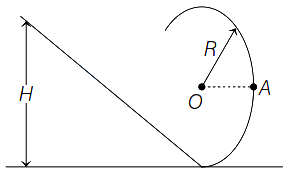
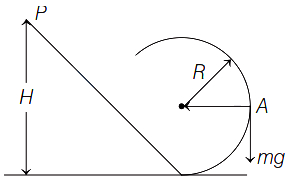
$A$ small body slides down a smooth uneven surface from a height $H$,which eventually emerges into a circular loop of radius $R (< H)$. What should be the value of $H$,so that the force on the body at $A$ is $\sqrt{2}$ times its weight?
A
$H=\frac{3 R}{2}$
B
$H=5 R$
C
$H=\frac{5 R}{2}$
D
$H=3 R$
Solution
(A) Let the mass of the body be $m$. At point $A$,the normal force $N$ provides the centripetal force required for circular motion. Since the weight $mg$ acts vertically downwards and the normal force acts horizontally towards the center $O$,the net force on the body at $A$ is the vector sum of $N$ and $mg$.
The magnitude of the net force is $F_A = \sqrt{N^2 + (mg)^2}$.
Given $F_A = \sqrt{2} mg$,we have $\sqrt{N^2 + (mg)^2} = \sqrt{2} mg$.
Squaring both sides,$N^2 + m^2g^2 = 2m^2g^2$,which gives $N^2 = m^2g^2$,so $N = mg$.
The centripetal force equation at $A$ is $N = \frac{mv_A^2}{R}$,so $mg = \frac{mv_A^2}{R}$,which implies $v_A^2 = Rg$.
By the law of conservation of energy,the total energy at the starting point $P$ (height $H$) equals the total energy at point $A$ (height $R$):
$mgH = \frac{1}{2}mv_A^2 + mgR$.
Substituting $v_A^2 = Rg$:
$mgH = \frac{1}{2}m(Rg) + mgR = \frac{3}{2}mgR$.
Therefore,$H = \frac{3}{2}R$.
The magnitude of the net force is $F_A = \sqrt{N^2 + (mg)^2}$.
Given $F_A = \sqrt{2} mg$,we have $\sqrt{N^2 + (mg)^2} = \sqrt{2} mg$.
Squaring both sides,$N^2 + m^2g^2 = 2m^2g^2$,which gives $N^2 = m^2g^2$,so $N = mg$.
The centripetal force equation at $A$ is $N = \frac{mv_A^2}{R}$,so $mg = \frac{mv_A^2}{R}$,which implies $v_A^2 = Rg$.
By the law of conservation of energy,the total energy at the starting point $P$ (height $H$) equals the total energy at point $A$ (height $R$):
$mgH = \frac{1}{2}mv_A^2 + mgR$.
Substituting $v_A^2 = Rg$:
$mgH = \frac{1}{2}m(Rg) + mgR = \frac{3}{2}mgR$.
Therefore,$H = \frac{3}{2}R$.
0 likesView Solution
210
PhysicsMediumMCQAP EAMCET · 2021
$A$ body of mass $M$ is dropped from a height $h$ on a sand floor. If the body penetrates $x$ cm into the sand,then the average resistance offered by the sand to the body is
A
$M g\left(\frac{h}{x}\right)$
B
$M g\left(\frac{x+h}{x}\right)$
C
$M g(h+x)$
D
$M g\left(\frac{x-h}{x}\right)$
Solution
(B) Given,mass of body $= M$.
Height above the sand floor $= h$.
Distance penetrated into sand $= x$.
Let $v$ be the velocity with which the body strikes the surface.
By the equation of motion,$v^2 = u^2 + 2gh$. Since initial velocity $u = 0$,we get $v^2 = 2gh$ ... $(i)$.
When the body passes through the sand,it comes to rest after traveling a distance $x$. Let $F$ be the average resisting force.
The work done by the net force is equal to the change in kinetic energy (Work-Energy Theorem).
The forces acting on the body inside the sand are gravity ($Mg$ downwards) and resistance ($F$ upwards).
Net force $= Mg - F$.
Work done $= (Mg - F)x$.
Change in kinetic energy $= K_f - K_i = 0 - \frac{1}{2}Mv^2$.
Equating them: $(Mg - F)x = -\frac{1}{2}Mv^2$.
Substituting $v^2 = 2gh$: $(Mg - F)x = -\frac{1}{2}M(2gh) = -Mgh$.
$Mgx - Fx = -Mgh$.
$Fx = Mgx + Mgh$.
$F = Mg\left(\frac{x+h}{x}\right)$.
Height above the sand floor $= h$.
Distance penetrated into sand $= x$.
Let $v$ be the velocity with which the body strikes the surface.
By the equation of motion,$v^2 = u^2 + 2gh$. Since initial velocity $u = 0$,we get $v^2 = 2gh$ ... $(i)$.
When the body passes through the sand,it comes to rest after traveling a distance $x$. Let $F$ be the average resisting force.
The work done by the net force is equal to the change in kinetic energy (Work-Energy Theorem).
The forces acting on the body inside the sand are gravity ($Mg$ downwards) and resistance ($F$ upwards).
Net force $= Mg - F$.
Work done $= (Mg - F)x$.
Change in kinetic energy $= K_f - K_i = 0 - \frac{1}{2}Mv^2$.
Equating them: $(Mg - F)x = -\frac{1}{2}Mv^2$.
Substituting $v^2 = 2gh$: $(Mg - F)x = -\frac{1}{2}M(2gh) = -Mgh$.
$Mgx - Fx = -Mgh$.
$Fx = Mgx + Mgh$.
$F = Mg\left(\frac{x+h}{x}\right)$.
0 likesView Solution
211
PhysicsEasyMCQAP EAMCET · 2021
When the mass and speed of the body are doubled,the kinetic energy of the body
A
becomes double
B
becomes four times
C
becomes eight times
D
remains unchanged
Solution
(C) The kinetic energy $(KE)$ of a body is given by the formula: $KE = \frac{1}{2} m v^2$,where $m$ is the mass and $v$ is the speed.
Let the initial mass be $m$ and the initial speed be $v$. Then the initial kinetic energy is $KE_i = \frac{1}{2} m v^2$.
According to the problem,the mass is doubled $(m' = 2m)$ and the speed is doubled $(v' = 2v)$.
The final kinetic energy $KE_f$ is given by:
$KE_f = \frac{1}{2} (2m) (2v)^2$
$KE_f = \frac{1}{2} (2m) (4v^2)$
$KE_f = 8 \times (\frac{1}{2} m v^2)$
$KE_f = 8 KE_i$
Therefore,the kinetic energy becomes eight times the initial kinetic energy.
Let the initial mass be $m$ and the initial speed be $v$. Then the initial kinetic energy is $KE_i = \frac{1}{2} m v^2$.
According to the problem,the mass is doubled $(m' = 2m)$ and the speed is doubled $(v' = 2v)$.
The final kinetic energy $KE_f$ is given by:
$KE_f = \frac{1}{2} (2m) (2v)^2$
$KE_f = \frac{1}{2} (2m) (4v^2)$
$KE_f = 8 \times (\frac{1}{2} m v^2)$
$KE_f = 8 KE_i$
Therefore,the kinetic energy becomes eight times the initial kinetic energy.
0 likesView Solution
212
PhysicsMediumMCQAP EAMCET · 2021
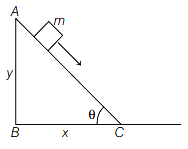
$A$ particle of mass $m$ slides down along a frictionless inclined plane $AC$ as shown in the figure. The kinetic energy of the particle at point $C$ is:
A
$mgy$
B
$mgx$
C
$mg\left(\frac{y}{\sin \theta}\right)$
D
$mg\left(\frac{y}{\cos \theta}\right)$
Solution
(A) According to the law of conservation of mechanical energy,the total mechanical energy of the system remains constant in the absence of non-conservative forces like friction.
At point $A$,the particle is at rest,so its kinetic energy is $0$ and its potential energy is $mgy$ (taking the reference level at $BC$).
At point $C$,the particle is at height $0$,so its potential energy is $0$ and its kinetic energy is $KE_C$.
Applying the conservation of energy principle:
$PE_A + KE_A = PE_C + KE_C$
$mgy + 0 = 0 + KE_C$
Therefore,the kinetic energy at point $C$ is $KE_C = mgy$.
At point $A$,the particle is at rest,so its kinetic energy is $0$ and its potential energy is $mgy$ (taking the reference level at $BC$).
At point $C$,the particle is at height $0$,so its potential energy is $0$ and its kinetic energy is $KE_C$.
Applying the conservation of energy principle:
$PE_A + KE_A = PE_C + KE_C$
$mgy + 0 = 0 + KE_C$
Therefore,the kinetic energy at point $C$ is $KE_C = mgy$.
0 likesView Solution
213
PhysicsMediumMCQAP EAMCET · 2021
$A$ quarter horsepower motor runs at a speed of $600 \ rpm$. Assuming $60 \%$ efficiency,the work done by the motor in one rotation is (in $J$)
A
$7.46$
B
$74.6$
C
$111.9$
D
$11.19$
Solution
(D) Given,power $P = \frac{1}{4} \ hp = \frac{746}{4} = 186.5 \ W$.
Effective power $P^{\prime} = 186.5 \times \frac{60}{100} = 111.9 \ W$.
Angular velocity $\omega = \frac{2 \pi \times 600}{60} = 20 \pi \ rad/s$.
Time taken for one rotation $t = \frac{2 \pi}{\omega} = \frac{2 \pi}{20 \pi} = 0.1 \ s$.
Work done in one rotation $W = P^{\prime} \times t = 111.9 \times 0.1 = 11.19 \ J$.
Effective power $P^{\prime} = 186.5 \times \frac{60}{100} = 111.9 \ W$.
Angular velocity $\omega = \frac{2 \pi \times 600}{60} = 20 \pi \ rad/s$.
Time taken for one rotation $t = \frac{2 \pi}{\omega} = \frac{2 \pi}{20 \pi} = 0.1 \ s$.
Work done in one rotation $W = P^{\prime} \times t = 111.9 \times 0.1 = 11.19 \ J$.
0 likesView Solution
214
PhysicsMediumMCQAP EAMCET · 2021
Water is falling on the blades of a turbine from a height of $25 \ m$. $3 \times 10^3 \ kg$ of water pours on the blade per minute. If the whole of energy is transferred to the turbine,the power delivered is: (in $W$)
A
$12250$
B
$16250$
C
$8250$
D
$20250$
Solution
(A) Power is defined as the rate of doing work or the rate of energy transfer.
Given:
Height,$h = 25 \ m$
Mass of water,$m = 3 \times 10^3 \ kg$
Time,$t = 1 \ minute = 60 \ s$
Acceleration due to gravity,$g = 10 \ m/s^2$
The potential energy of the water falling is converted into power for the turbine.
$P = \frac{mgh}{t}$
Substituting the values:
$P = \frac{3 \times 10^3 \times 10 \times 25}{60}$
$P = \frac{750000}{60}$
$P = 12500 \ W$
Wait,recalculating: $P = \frac{3000 \times 10 \times 25}{60} = \frac{750000}{60} = 12500 \ W$.
Re-evaluating the provided options: The calculation yields $12500 \ W$. Given the options,$12250 \ W$ is the closest approximation if $g = 9.8 \ m/s^2$ is used.
Using $g = 9.8 \ m/s^2$:
$P = \frac{3000 \times 9.8 \times 25}{60} = 50 \times 9.8 \times 25 = 12250 \ W$.
Given:
Height,$h = 25 \ m$
Mass of water,$m = 3 \times 10^3 \ kg$
Time,$t = 1 \ minute = 60 \ s$
Acceleration due to gravity,$g = 10 \ m/s^2$
The potential energy of the water falling is converted into power for the turbine.
$P = \frac{mgh}{t}$
Substituting the values:
$P = \frac{3 \times 10^3 \times 10 \times 25}{60}$
$P = \frac{750000}{60}$
$P = 12500 \ W$
Wait,recalculating: $P = \frac{3000 \times 10 \times 25}{60} = \frac{750000}{60} = 12500 \ W$.
Re-evaluating the provided options: The calculation yields $12500 \ W$. Given the options,$12250 \ W$ is the closest approximation if $g = 9.8 \ m/s^2$ is used.
Using $g = 9.8 \ m/s^2$:
$P = \frac{3000 \times 9.8 \times 25}{60} = 50 \times 9.8 \times 25 = 12250 \ W$.
0 likesView Solution
215
PhysicsEasyMCQAP EAMCET · 2021
An engine develops $20 kW$ of power. How much time will it take to lift a mass of $200 kg$ to a height of $40 m$ (in $s$)? $(g=10 m s^{-2})$
A
$4$
B
$5$
C
$8$
D
$10$
Solution
(A) Power is defined as the rate of doing work or the rate of energy transfer.
$P = \frac{W}{t} = \frac{mgh}{t}$
Given:
Power,$P = 20 kW = 20,000 W$
Mass,$m = 200 kg$
Height,$h = 40 m$
Acceleration due to gravity,$g = 10 m s^{-2}$
Rearranging the formula for time $t$:
$t = \frac{mgh}{P}$
Substituting the values:
$t = \frac{200 \times 10 \times 40}{20,000}$
$t = \frac{80,000}{20,000}$
$t = 4 s$
$P = \frac{W}{t} = \frac{mgh}{t}$
Given:
Power,$P = 20 kW = 20,000 W$
Mass,$m = 200 kg$
Height,$h = 40 m$
Acceleration due to gravity,$g = 10 m s^{-2}$
Rearranging the formula for time $t$:
$t = \frac{mgh}{P}$
Substituting the values:
$t = \frac{200 \times 10 \times 40}{20,000}$
$t = \frac{80,000}{20,000}$
$t = 4 s$
0 likesView Solution
216
PhysicsEasyMCQAP EAMCET · 2021
$A$ body of mass $8 \ kg$,under the action of a force,is displaced according to the equation $s = \frac{t^2}{4} \ m$,where '$t$' is the time. Find the work done by the force in the first $4 \ s$. (in $J$)
A
$9$
B
$16$
C
$6$
D
$3$
Solution
(B) Given the displacement equation: $s = \frac{t^2}{4}$.
Velocity of the body: $v = \frac{ds}{dt} = \frac{d}{dt}(\frac{t^2}{4}) = \frac{2t}{4} = \frac{t}{2} \ m/s$.
Acceleration of the body: $a = \frac{dv}{dt} = \frac{d}{dt}(\frac{t}{2}) = \frac{1}{2} \ m/s^2$.
Force acting on the body: $F = m \times a = 8 \ kg \times 0.5 \ m/s^2 = 4 \ N$.
At $t = 0 \ s$,displacement $s(0) = 0 \ m$.
At $t = 4 \ s$,displacement $s(4) = \frac{4^2}{4} = 4 \ m$.
Work done by the force: $W = F \times \Delta s = 4 \ N \times (4 \ m - 0 \ m) = 16 \ J$.
Velocity of the body: $v = \frac{ds}{dt} = \frac{d}{dt}(\frac{t^2}{4}) = \frac{2t}{4} = \frac{t}{2} \ m/s$.
Acceleration of the body: $a = \frac{dv}{dt} = \frac{d}{dt}(\frac{t}{2}) = \frac{1}{2} \ m/s^2$.
Force acting on the body: $F = m \times a = 8 \ kg \times 0.5 \ m/s^2 = 4 \ N$.
At $t = 0 \ s$,displacement $s(0) = 0 \ m$.
At $t = 4 \ s$,displacement $s(4) = \frac{4^2}{4} = 4 \ m$.
Work done by the force: $W = F \times \Delta s = 4 \ N \times (4 \ m - 0 \ m) = 16 \ J$.
0 likesView Solution
217
PhysicsEasyMCQAP EAMCET · 2021
When a force $\vec{F} = (17 - 2x + 6x^2) \text{ N}$ acts on a body of mass $2 \text{ kg}$ and displaces it from $x = 0 \text{ m}$ to $x = 8 \text{ m}$,the work done is: (in $\text{ J}$)
A
$1096$
B
$270$
C
$35$
D
$135$
Solution
(A) The work done by a variable force is given by the integral of the force with respect to displacement:
$W = \int_{x_i}^{x_f} F(x) \, dx$
Given $F(x) = 17 - 2x + 6x^2$,$x_i = 0 \text{ m}$,and $x_f = 8 \text{ m}$.
$W = \int_{0}^{8} (17 - 2x + 6x^2) \, dx$
Integrating term by term:
$W = [17x - x^2 + 2x^3]_{0}^{8}$
Substituting the limits:
$W = [17(8) - (8)^2 + 2(8)^3] - [0]$
$W = [136 - 64 + 2(512)]$
$W = [72 + 1024]$
$W = 1096 \text{ J}$
$W = \int_{x_i}^{x_f} F(x) \, dx$
Given $F(x) = 17 - 2x + 6x^2$,$x_i = 0 \text{ m}$,and $x_f = 8 \text{ m}$.
$W = \int_{0}^{8} (17 - 2x + 6x^2) \, dx$
Integrating term by term:
$W = [17x - x^2 + 2x^3]_{0}^{8}$
Substituting the limits:
$W = [17(8) - (8)^2 + 2(8)^3] - [0]$
$W = [136 - 64 + 2(512)]$
$W = [72 + 1024]$
$W = 1096 \text{ J}$
0 likesView Solution
Vedclass Products
For Students
Vedclass Test Series
Mock tests in real AP EAMCET style covering Physics with performance analysis. 5-day free trial.
Start Free TrialFor Teachers
Exam Paper Generator
Generate Set A/B/C/D Physics papers from 7.5L+ questions in 2 minutes. 3 chapters free.
Try FreeFor Institutes
Online Exam Module
Run live AP EAMCET mock exams with unlimited students, 360° analytics & white-label branding.
See DemoFrequently Asked Questions
How many Physics questions are in AP EAMCET 2021?
There are 372 Physics questions from the AP EAMCET 2021 paper on Vedclass, each with a detailed step-by-step solution in English.
Are AP EAMCET 2021 Physics solutions available in English?
Yes. All solutions on this page are in English. You can also switch to English or Hindi using the language buttons above the questions.
Can I practice AP EAMCET 2021 Physics as a timed test?
Yes. Use the Vedclass Test Series to attempt a full AP EAMCET mock test covering Physics with time limits and instant score analysis.
Can teachers create Physics papers from AP EAMCET previous year questions?
Yes. The Vedclass Exam Paper Generator lets teachers mix AP EAMCET Physics questions and generate Set A/B/C/D papers in minutes.
For Teachers & Institutes
Build a Custom Physics Paper
Pick AP EAMCET 2021 Physics questions, set difficulty, and generate Set A/B/C/D in 2 minutes.