
MathematicsQ401–450 of 800 questions
Page 9 of 10 · English
401
MathematicsEasyMCQAP EAMCET · 2020
$A$ triangle can be uniquely determined by its
A
Three angles
B
Three sides
C
One of the angles and one of the sides
D
Only one side
Solution
(B) triangle is uniquely determined by its three sides according to the $SSS$ (Side-Side-Side) congruence criterion.
If three sides are given,the triangle's shape and size are fixed.
Therefore,option $(B)$ is correct.
If three sides are given,the triangle's shape and size are fixed.
Therefore,option $(B)$ is correct.
0 likesView Solution
402
MathematicsMediumMCQAP EAMCET · 2020
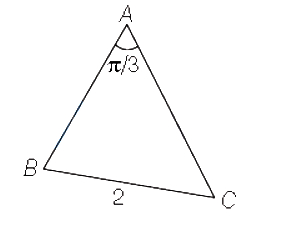
If $2$ is the length of a side of a triangle with its opposite angle $\frac{\pi}{3}$,then the circumradius of the triangle is ......
A
$\frac{2}{\sqrt{3}}$
B
$\frac{4}{\sqrt{3}}$
C
$2$
D
$4$
Solution
(A) Given that the side length $a = 2$ and its opposite angle $A = \frac{\pi}{3}$.
By the sine law,we have $\frac{a}{\sin A} = 2R$,where $R$ is the circumradius.
Substituting the given values:
$\frac{2}{\sin(\frac{\pi}{3})} = 2R$
$\frac{2}{\frac{\sqrt{3}}{2}} = 2R$
$\frac{4}{\sqrt{3}} = 2R$
$R = \frac{2}{\sqrt{3}}$
Thus,the circumradius of the triangle is $\frac{2}{\sqrt{3}}$.
By the sine law,we have $\frac{a}{\sin A} = 2R$,where $R$ is the circumradius.
Substituting the given values:
$\frac{2}{\sin(\frac{\pi}{3})} = 2R$
$\frac{2}{\frac{\sqrt{3}}{2}} = 2R$
$\frac{4}{\sqrt{3}} = 2R$
$R = \frac{2}{\sqrt{3}}$
Thus,the circumradius of the triangle is $\frac{2}{\sqrt{3}}$.
0 likesView Solution
403
MathematicsMediumMCQAP EAMCET · 2020
If the lengths of the sides of a triangle are $15, 20, 25$ units,find the circumradius of the triangle. (in $units$)
A
$30$
B
$7.5$
C
$12.5$
D
$20$
Solution
(C) Given: The lengths of the sides of a triangle are $a = 15$,$b = 20$,and $c = 25$ units.
First,observe that $15^2 + 20^2 = 225 + 400 = 625 = 25^2$.
Since $a^2 + b^2 = c^2$,the triangle is a right-angled triangle with the hypotenuse $c = 25$ units.
For a right-angled triangle,the circumradius $R$ is half of the hypotenuse.
$R = \frac{c}{2} = \frac{25}{2} = 12.5$ units.
Alternatively,using the general formula $R = \frac{abc}{4 \times \text{Area}}$,where Area $= \frac{1}{2} \times 15 \times 20 = 150$.
$R = \frac{15 \times 20 \times 25}{4 \times 150} = \frac{7500}{600} = 12.5$ units.
First,observe that $15^2 + 20^2 = 225 + 400 = 625 = 25^2$.
Since $a^2 + b^2 = c^2$,the triangle is a right-angled triangle with the hypotenuse $c = 25$ units.
For a right-angled triangle,the circumradius $R$ is half of the hypotenuse.
$R = \frac{c}{2} = \frac{25}{2} = 12.5$ units.
Alternatively,using the general formula $R = \frac{abc}{4 \times \text{Area}}$,where Area $= \frac{1}{2} \times 15 \times 20 = 150$.
$R = \frac{15 \times 20 \times 25}{4 \times 150} = \frac{7500}{600} = 12.5$ units.
0 likesView Solution
404
MathematicsEasyMCQAP EAMCET · 2020
In $\triangle ABC$,if $a=13 \text{ cm}, b=14 \text{ cm}$ and $c=15 \text{ cm}$,then its circumradius $R$ is:
A
$\frac{8}{65} \text{ cm}$
B
$\frac{7}{65} \text{ cm}$
C
$\frac{65}{7} \text{ cm}$
D
$\frac{65}{8} \text{ cm}$
Solution
(D) The semi-perimeter $s$ is given by $s = \frac{a+b+c}{2} = \frac{13+14+15}{2} = \frac{42}{2} = 21 \text{ cm}$.
Using Heron's formula,the area of the triangle $\Delta$ is $\sqrt{s(s-a)(s-b)(s-c)}$.
$\Delta = \sqrt{21(21-13)(21-14)(21-15)} = \sqrt{21 \times 8 \times 7 \times 6}$.
$\Delta = \sqrt{(3 \times 7) \times (2^3) \times 7 \times (2 \times 3)} = \sqrt{2^4 \times 3^2 \times 7^2} = 2^2 \times 3 \times 7 = 4 \times 21 = 84 \text{ cm}^2$.
The circumradius $R$ is given by the formula $R = \frac{abc}{4\Delta}$.
$R = \frac{13 \times 14 \times 15}{4 \times 84} = \frac{2730}{336}$.
Simplifying the fraction: $R = \frac{2730 \div 42}{336 \div 42} = \frac{65}{8} \text{ cm}$.
Using Heron's formula,the area of the triangle $\Delta$ is $\sqrt{s(s-a)(s-b)(s-c)}$.
$\Delta = \sqrt{21(21-13)(21-14)(21-15)} = \sqrt{21 \times 8 \times 7 \times 6}$.
$\Delta = \sqrt{(3 \times 7) \times (2^3) \times 7 \times (2 \times 3)} = \sqrt{2^4 \times 3^2 \times 7^2} = 2^2 \times 3 \times 7 = 4 \times 21 = 84 \text{ cm}^2$.
The circumradius $R$ is given by the formula $R = \frac{abc}{4\Delta}$.
$R = \frac{13 \times 14 \times 15}{4 \times 84} = \frac{2730}{336}$.
Simplifying the fraction: $R = \frac{2730 \div 42}{336 \div 42} = \frac{65}{8} \text{ cm}$.
0 likesView Solution
405
MathematicsEasyMCQAP EAMCET · 2020
Let $a, b$ and $c$ be the lengths of the sides of a triangle with its opposite angles $A, B$ and $C$ respectively. If $\angle C=60^{\circ}$,then the value of $\frac{c(a+b)+(a^2+b^2)}{(b+c)(c+a)}$ is
A
$\frac{1}{2}$
B
$\frac{\sqrt{3}}{2}$
C
$1$
D
$\sqrt{3}$
Solution
(C) Using the Law of Cosines,$\cos C = \frac{a^2+b^2-c^2}{2ab}$.
Given $\angle C = 60^{\circ}$,we have $\cos 60^{\circ} = \frac{1}{2} = \frac{a^2+b^2-c^2}{2ab}$.
This implies $ab = a^2+b^2-c^2$,or $a^2+b^2 = ab+c^2$.
Now,substitute $a^2+b^2$ in the given expression:
$\frac{c(a+b)+(a^2+b^2)}{(b+c)(c+a)} = \frac{ca+cb+ab+c^2}{bc+ab+c^2+ac}$.
Since the numerator and denominator are identical,the value is $1$.
Given $\angle C = 60^{\circ}$,we have $\cos 60^{\circ} = \frac{1}{2} = \frac{a^2+b^2-c^2}{2ab}$.
This implies $ab = a^2+b^2-c^2$,or $a^2+b^2 = ab+c^2$.
Now,substitute $a^2+b^2$ in the given expression:
$\frac{c(a+b)+(a^2+b^2)}{(b+c)(c+a)} = \frac{ca+cb+ab+c^2}{bc+ab+c^2+ac}$.
Since the numerator and denominator are identical,the value is $1$.
0 likesView Solution
406
MathematicsMediumMCQAP EAMCET · 2020
In $\triangle PQR$,find $\Sigma(q+r) \cos P$,if $p, q, r$ denote its sides and $s = \frac{p+q+r}{2}$.
A
$s$
B
$s / 2$
C
$2s$
D
$4s$
Solution
(C) We are given $\Sigma(q+r) \cos P = (q+r) \cos P + (r+p) \cos Q + (p+q) \cos R$.
Expanding this,we get:
$(q \cos P + r \cos P) + (r \cos Q + p \cos Q) + (p \cos R + q \cos R)$
Rearranging the terms:
$(q \cos P + p \cos Q) + (r \cos P + p \cos R) + (r \cos Q + q \cos R)$
Using the projection law,we know that $r = q \cos P + p \cos Q$,$q = r \cos P + p \cos R$,and $p = r \cos Q + q \cos R$.
Substituting these into the expression:
$r + q + p = p + q + r$
Since the semi-perimeter $s = \frac{p+q+r}{2}$,we have $p+q+r = 2s$.
Therefore,$\Sigma(q+r) \cos P = 2s$.
Expanding this,we get:
$(q \cos P + r \cos P) + (r \cos Q + p \cos Q) + (p \cos R + q \cos R)$
Rearranging the terms:
$(q \cos P + p \cos Q) + (r \cos P + p \cos R) + (r \cos Q + q \cos R)$
Using the projection law,we know that $r = q \cos P + p \cos Q$,$q = r \cos P + p \cos R$,and $p = r \cos Q + q \cos R$.
Substituting these into the expression:
$r + q + p = p + q + r$
Since the semi-perimeter $s = \frac{p+q+r}{2}$,we have $p+q+r = 2s$.
Therefore,$\Sigma(q+r) \cos P = 2s$.
0 likesView Solution
407
MathematicsMediumMCQAP EAMCET · 2020
In $\triangle ABC$,if $a, b, c$ are its sides and $\angle C = 60^{\circ}$,find the value of $\frac{a}{b+c} + \frac{b}{c+a}$.
A
$1$
B
$0$
C
$\frac{\sqrt{3}}{2}$
D
$\frac{1}{2}$
Solution
(A) In $\triangle ABC$,by the Law of Cosines,$\cos C = \frac{a^2+b^2-c^2}{2ab}$.
Given $\angle C = 60^{\circ}$,so $\cos 60^{\circ} = \frac{1}{2} = \frac{a^2+b^2-c^2}{2ab}$.
This implies $ab = a^2+b^2-c^2$,or $c^2 = a^2+b^2-ab$.
Now,consider the expression $E = \frac{a}{b+c} + \frac{b}{c+a} = \frac{a(c+a) + b(b+c)}{(b+c)(c+a)} = \frac{ac+a^2+b^2+bc}{bc+ab+c^2+ac}$.
Substituting $a^2+b^2 = c^2+ab$ into the numerator:
$E = \frac{ac + (c^2+ab) + bc}{bc+ab+c^2+ac} = \frac{ac+c^2+ab+bc}{ac+ab+c^2+bc} = 1$.
Given $\angle C = 60^{\circ}$,so $\cos 60^{\circ} = \frac{1}{2} = \frac{a^2+b^2-c^2}{2ab}$.
This implies $ab = a^2+b^2-c^2$,or $c^2 = a^2+b^2-ab$.
Now,consider the expression $E = \frac{a}{b+c} + \frac{b}{c+a} = \frac{a(c+a) + b(b+c)}{(b+c)(c+a)} = \frac{ac+a^2+b^2+bc}{bc+ab+c^2+ac}$.
Substituting $a^2+b^2 = c^2+ab$ into the numerator:
$E = \frac{ac + (c^2+ab) + bc}{bc+ab+c^2+ac} = \frac{ac+c^2+ab+bc}{ac+ab+c^2+bc} = 1$.
0 likesView Solution
408
MathematicsEasyMCQAP EAMCET · 2020
The perimeter of $\triangle ABC$ is $36 \text{ cm}$ and its inradius is $8 \text{ cm}$. Then,the area of the triangle is (in $\text{ cm}^2$)
A
$144$
B
$124$
C
$164$
D
$104$
Solution
(A) The formula for the inradius $(r)$ of a triangle is given by $r = \frac{\Delta}{s}$,where $\Delta$ is the area of the triangle and $s$ is the semi-perimeter.
Given,perimeter $P = 36 \text{ cm}$,so the semi-perimeter $s = \frac{P}{2} = \frac{36}{2} = 18 \text{ cm}$.
Given,inradius $r = 8 \text{ cm}$.
Therefore,the area $\Delta = r \times s = 8 \times 18 = 144 \text{ cm}^2$.
Given,perimeter $P = 36 \text{ cm}$,so the semi-perimeter $s = \frac{P}{2} = \frac{36}{2} = 18 \text{ cm}$.
Given,inradius $r = 8 \text{ cm}$.
Therefore,the area $\Delta = r \times s = 8 \times 18 = 144 \text{ cm}^2$.
0 likesView Solution
409
MathematicsEasyMCQAP EAMCET · 2020
For a triangle with side lengths $6$,$5$,and $9$,find the inradius of the triangle.
A
$\sqrt{3}$
B
$\sqrt{2}$
C
$\sqrt{5}$
D
$\frac{\sqrt{3}}{\sqrt{2}}$
Solution
(B) Let the sides of the triangle be $a = 6$,$b = 5$,and $c = 9$.
The semi-perimeter $s$ is given by $s = \frac{a+b+c}{2} = \frac{6+5+9}{2} = \frac{20}{2} = 10$.
The area of the triangle $\Delta$ is calculated using Heron's formula: $\Delta = \sqrt{s(s-a)(s-b)(s-c)}$.
$\Delta = \sqrt{10(10-6)(10-5)(10-9)} = \sqrt{10 \times 4 \times 5 \times 1} = \sqrt{200} = 10\sqrt{2}$.
The inradius $r$ is given by $r = \frac{\Delta}{s}$.
$r = \frac{10\sqrt{2}}{10} = \sqrt{2}$.
The semi-perimeter $s$ is given by $s = \frac{a+b+c}{2} = \frac{6+5+9}{2} = \frac{20}{2} = 10$.
The area of the triangle $\Delta$ is calculated using Heron's formula: $\Delta = \sqrt{s(s-a)(s-b)(s-c)}$.
$\Delta = \sqrt{10(10-6)(10-5)(10-9)} = \sqrt{10 \times 4 \times 5 \times 1} = \sqrt{200} = 10\sqrt{2}$.
The inradius $r$ is given by $r = \frac{\Delta}{s}$.
$r = \frac{10\sqrt{2}}{10} = \sqrt{2}$.
0 likesView Solution
410
MathematicsEasyMCQAP EAMCET · 2020
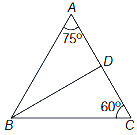
In a $\triangle ABC$,$\angle C = 60^{\circ}$ and $\angle A = 75^{\circ}$. If $D$ is a point on $AC$ such that the area of $\triangle BAD$ is $\sqrt{3}$ times the area of $\triangle BCD$,then the measure of $\angle ABD$ is (in $^{\circ}$)
A
$30$
B
$45$
C
$60$
D
$90$
Solution
(A) In $\triangle ABC$,the sum of angles is $180^{\circ}$. Thus,$\angle B = 180^{\circ} - (75^{\circ} + 60^{\circ}) = 45^{\circ}$.
Since $\triangle BAD$ and $\triangle BCD$ share the same altitude from vertex $B$ to the base $AC$,the ratio of their areas is equal to the ratio of their bases: $\frac{\text{Area}(\triangle BAD)}{\text{Area}(\triangle BCD)} = \frac{AD}{CD} = \sqrt{3}$.
Let $\angle ABD = \alpha$,then $\angle DBC = 45^{\circ} - \alpha$.
Using the sine rule in $\triangle BAD$ and $\triangle BCD$:
$\frac{AD}{\sin \alpha} = \frac{BD}{\sin 75^{\circ}}$ and $\frac{CD}{\sin(45^{\circ} - \alpha)} = \frac{BD}{\sin 60^{\circ}}$.
Dividing these equations gives $\frac{AD}{CD} = \frac{\sin \alpha}{\sin(45^{\circ} - \alpha)} \cdot \frac{\sin 60^{\circ}}{\sin 75^{\circ}} = \sqrt{3}$.
$\frac{\sin \alpha}{\sin(45^{\circ} - \alpha)} = \sqrt{3} \cdot \frac{\sin 75^{\circ}}{\sin 60^{\circ}} = \sqrt{3} \cdot \frac{(\sqrt{6} + \sqrt{2})/4}{\sqrt{3}/2} = \frac{\sqrt{6} + \sqrt{2}}{2} = \frac{\sqrt{2}(\sqrt{3} + 1)}{2} = \frac{\sqrt{3} + 1}{\sqrt{2}}$.
Solving $\frac{\sin \alpha}{\sin 45^{\circ} \cos \alpha - \cos 45^{\circ} \sin \alpha} = \frac{\sqrt{3} + 1}{\sqrt{2}}$ leads to $\cot \alpha = \sqrt{3}$,hence $\alpha = 30^{\circ}$.
Since $\triangle BAD$ and $\triangle BCD$ share the same altitude from vertex $B$ to the base $AC$,the ratio of their areas is equal to the ratio of their bases: $\frac{\text{Area}(\triangle BAD)}{\text{Area}(\triangle BCD)} = \frac{AD}{CD} = \sqrt{3}$.
Let $\angle ABD = \alpha$,then $\angle DBC = 45^{\circ} - \alpha$.
Using the sine rule in $\triangle BAD$ and $\triangle BCD$:
$\frac{AD}{\sin \alpha} = \frac{BD}{\sin 75^{\circ}}$ and $\frac{CD}{\sin(45^{\circ} - \alpha)} = \frac{BD}{\sin 60^{\circ}}$.
Dividing these equations gives $\frac{AD}{CD} = \frac{\sin \alpha}{\sin(45^{\circ} - \alpha)} \cdot \frac{\sin 60^{\circ}}{\sin 75^{\circ}} = \sqrt{3}$.
$\frac{\sin \alpha}{\sin(45^{\circ} - \alpha)} = \sqrt{3} \cdot \frac{\sin 75^{\circ}}{\sin 60^{\circ}} = \sqrt{3} \cdot \frac{(\sqrt{6} + \sqrt{2})/4}{\sqrt{3}/2} = \frac{\sqrt{6} + \sqrt{2}}{2} = \frac{\sqrt{2}(\sqrt{3} + 1)}{2} = \frac{\sqrt{3} + 1}{\sqrt{2}}$.
Solving $\frac{\sin \alpha}{\sin 45^{\circ} \cos \alpha - \cos 45^{\circ} \sin \alpha} = \frac{\sqrt{3} + 1}{\sqrt{2}}$ leads to $\cot \alpha = \sqrt{3}$,hence $\alpha = 30^{\circ}$.
0 likesView Solution
411
MathematicsMediumMCQAP EAMCET · 2020
In $\triangle ABC$,$\angle A = 90^{\circ}$ and the coordinates of points $B$ and $C$ are $(2, -4)$ and $(1, 5)$. Then the equation of the circumcircle of $\triangle ABC$ is
A
$x^2+y^2+3x+y+18=0$
B
$x^2+y^2-3x+y-18=0$
C
$x^2+y^2-3x-y-18=0$
D
$x^2+y^2+3x-y+18=0$
Solution
(C) In $\triangle ABC$,since $\angle A = 90^{\circ}$,the side $BC$ acts as the diameter of the circumcircle.
Given the endpoints of the diameter are $B(2, -4)$ and $C(1, 5)$,the equation of the circle is given by $(x - x_1)(x - x_2) + (y - y_1)(y - y_2) = 0$.
Substituting the coordinates:
$(x - 2)(x - 1) + (y - (-4))(y - 5) = 0$
$(x^2 - x - 2x + 2) + (y^2 - 5y + 4y - 20) = 0$
$x^2 + y^2 - 3x - y - 18 = 0$.
Thus,option $C$ is correct.
Given the endpoints of the diameter are $B(2, -4)$ and $C(1, 5)$,the equation of the circle is given by $(x - x_1)(x - x_2) + (y - y_1)(y - y_2) = 0$.
Substituting the coordinates:
$(x - 2)(x - 1) + (y - (-4))(y - 5) = 0$
$(x^2 - x - 2x + 2) + (y^2 - 5y + 4y - 20) = 0$
$x^2 + y^2 - 3x - y - 18 = 0$.
Thus,option $C$ is correct.
0 likesView Solution
412
MathematicsMediumMCQAP EAMCET · 2020
In a $\triangle ABC$,$A = 30^{\circ} + C$ and $R = (\sqrt{3} + 1)r$,where $r$ is the inradius and $R$ is the circumradius. Then:
A
$ABC$ is a right-angled triangle
B
$ABC$ is an equilateral triangle
C
$ABC$ is acute-angled
D
$\angle A = 75^{\circ}, \angle B = 60^{\circ}, \angle C = 45^{\circ}$
Solution
(C) Given $A = 30^{\circ} + C$ and $R = (\sqrt{3} + 1)r$.
We know that $r = 4R \sin(\frac{A}{2}) \sin(\frac{B}{2}) \sin(\frac{C}{2})$.
Substituting $r = \frac{R}{\sqrt{3} + 1}$,we get $\frac{1}{\sqrt{3} + 1} = 4 \sin(\frac{A}{2}) \sin(\frac{B}{2}) \sin(\frac{C}{2})$.
Rationalizing the denominator,$\frac{\sqrt{3} - 1}{2} = 4 \sin(\frac{A}{2}) \sin(\frac{B}{2}) \sin(\frac{C}{2})$,so $\sin(\frac{A}{2}) \sin(\frac{B}{2}) \sin(\frac{C}{2}) = \frac{\sqrt{3} - 1}{8}$.
Using $A + B + C = 180^{\circ}$,we have $B = 180^{\circ} - (A + C) = 180^{\circ} - (30^{\circ} + 2C) = 150^{\circ} - 2C$.
Substituting these values into the identity and solving for the angles,we find $\angle A = 75^{\circ}, \angle B = 60^{\circ}, \angle C = 45^{\circ}$.
Since $\angle B = 60^{\circ}$ and $\angle A + \angle C = 120^{\circ}$,the triangle satisfies the given conditions.
Thus,the triangle is not right-angled,equilateral,or acute-angled (since $75^{\circ} > 90^{\circ}$ is false,but $75^{\circ}$ is acute,$60^{\circ}$ is acute,$45^{\circ}$ is acute).
Wait,$75^{\circ}, 60^{\circ}, 45^{\circ}$ are all acute,so $ABC$ is acute-angled.
We know that $r = 4R \sin(\frac{A}{2}) \sin(\frac{B}{2}) \sin(\frac{C}{2})$.
Substituting $r = \frac{R}{\sqrt{3} + 1}$,we get $\frac{1}{\sqrt{3} + 1} = 4 \sin(\frac{A}{2}) \sin(\frac{B}{2}) \sin(\frac{C}{2})$.
Rationalizing the denominator,$\frac{\sqrt{3} - 1}{2} = 4 \sin(\frac{A}{2}) \sin(\frac{B}{2}) \sin(\frac{C}{2})$,so $\sin(\frac{A}{2}) \sin(\frac{B}{2}) \sin(\frac{C}{2}) = \frac{\sqrt{3} - 1}{8}$.
Using $A + B + C = 180^{\circ}$,we have $B = 180^{\circ} - (A + C) = 180^{\circ} - (30^{\circ} + 2C) = 150^{\circ} - 2C$.
Substituting these values into the identity and solving for the angles,we find $\angle A = 75^{\circ}, \angle B = 60^{\circ}, \angle C = 45^{\circ}$.
Since $\angle B = 60^{\circ}$ and $\angle A + \angle C = 120^{\circ}$,the triangle satisfies the given conditions.
Thus,the triangle is not right-angled,equilateral,or acute-angled (since $75^{\circ} > 90^{\circ}$ is false,but $75^{\circ}$ is acute,$60^{\circ}$ is acute,$45^{\circ}$ is acute).
Wait,$75^{\circ}, 60^{\circ}, 45^{\circ}$ are all acute,so $ABC$ is acute-angled.
0 likesView Solution
413
MathematicsMediumMCQAP EAMCET · 2020
In a $\triangle ABC$,the sides $a, b, c$ are in $A$.$P$. if and only if $r_1, r_2, r_3$ are in
A
$A$.$P$.
B
$G$.$P$.
C
$H$.$P$.
D
$A$.$G$.$P$.
Solution
(C) Let the sides $a, b, c$ be in $A$.$P$.,so $2b = a + c$.
We know that the exradii are given by $r_1 = \frac{\Delta}{s-a}$,$r_2 = \frac{\Delta}{s-b}$,and $r_3 = \frac{\Delta}{s-c}$.
To check if $r_1, r_2, r_3$ are in $H$.$P$.,we check if $\frac{1}{r_1}, \frac{1}{r_2}, \frac{1}{r_3}$ are in $A$.$P$.
$\frac{1}{r_1} = \frac{s-a}{\Delta}$,$\frac{1}{r_2} = \frac{s-b}{\Delta}$,$\frac{1}{r_3} = \frac{s-c}{\Delta}$.
Since $a, b, c$ are in $A$.$P$.,$s-a, s-b, s-c$ are also in $A$.$P$. because $s-a + s-c = 2s - (a+c) = 2s - 2b = 2(s-b)$.
Thus,$\frac{1}{r_1}, \frac{1}{r_2}, \frac{1}{r_3}$ are in $A$.$P$.,which implies $r_1, r_2, r_3$ are in $H$.$P$.
We know that the exradii are given by $r_1 = \frac{\Delta}{s-a}$,$r_2 = \frac{\Delta}{s-b}$,and $r_3 = \frac{\Delta}{s-c}$.
To check if $r_1, r_2, r_3$ are in $H$.$P$.,we check if $\frac{1}{r_1}, \frac{1}{r_2}, \frac{1}{r_3}$ are in $A$.$P$.
$\frac{1}{r_1} = \frac{s-a}{\Delta}$,$\frac{1}{r_2} = \frac{s-b}{\Delta}$,$\frac{1}{r_3} = \frac{s-c}{\Delta}$.
Since $a, b, c$ are in $A$.$P$.,$s-a, s-b, s-c$ are also in $A$.$P$. because $s-a + s-c = 2s - (a+c) = 2s - 2b = 2(s-b)$.
Thus,$\frac{1}{r_1}, \frac{1}{r_2}, \frac{1}{r_3}$ are in $A$.$P$.,which implies $r_1, r_2, r_3$ are in $H$.$P$.
0 likesView Solution
414
MathematicsEasyMCQAP EAMCET · 2020
Let $a, b, c$ be real numbers. $A$ set formed with $a, b, c$ whose order of occurrence is preassigned is called:
A
An ordered triad
B
An ordered pair
C
Both ordered triad and ordered pair
D
None of these options are correct
Solution
(A) set formed with three real numbers $a, b, c$ where the order of elements is fixed or preassigned is defined as an ordered triad,denoted as $(a, b, c)$.
0 likesView Solution
415
MathematicsEasyMCQAP EAMCET · 2020
The system of equations $2x + y - 5 = 0$,$x - 2y + 1 = 0$,and $2x - 14y - a = 0$ is consistent. Then,$a$ is equal to
A
$11$
B
$12$
C
$16$
D
$-16$
Solution
(D) For the system of equations to be consistent,all three lines must intersect at a single point or be concurrent.
First,solve the first two equations:
$2x + y = 5$ $(1)$
$x - 2y = -1$ $(2)$
Multiply equation $(1)$ by $2$:
$4x + 2y = 10$ $(3)$
Adding $(2)$ and $(3)$:
$5x = 9 \implies x = \frac{9}{5}$
Substitute $x$ into $(1)$:
$2(\frac{9}{5}) + y = 5 \implies y = 5 - \frac{18}{5} = \frac{7}{5}$
Since the system is consistent,the point $(\frac{9}{5}, \frac{7}{5})$ must satisfy the third equation $2x - 14y - a = 0$:
$2(\frac{9}{5}) - 14(\frac{7}{5}) - a = 0$
$\frac{18}{5} - \frac{98}{5} = a$
$a = -\frac{80}{5} = -16$
First,solve the first two equations:
$2x + y = 5$ $(1)$
$x - 2y = -1$ $(2)$
Multiply equation $(1)$ by $2$:
$4x + 2y = 10$ $(3)$
Adding $(2)$ and $(3)$:
$5x = 9 \implies x = \frac{9}{5}$
Substitute $x$ into $(1)$:
$2(\frac{9}{5}) + y = 5 \implies y = 5 - \frac{18}{5} = \frac{7}{5}$
Since the system is consistent,the point $(\frac{9}{5}, \frac{7}{5})$ must satisfy the third equation $2x - 14y - a = 0$:
$2(\frac{9}{5}) - 14(\frac{7}{5}) - a = 0$
$\frac{18}{5} - \frac{98}{5} = a$
$a = -\frac{80}{5} = -16$
0 likesView Solution
416
MathematicsDifficultMCQAP EAMCET · 2020
If $\tanh^{-1}(x+iy) = \frac{1}{2} \tanh^{-1}\left(\frac{2x}{1+x^2+y^2}\right) + \frac{i}{2} \tan^{-1}\left(\frac{2y}{1-x^2-y^2}\right)$,where $x, y \in \mathbb{R}$,then $\tanh^{-1}(iy) =$
A
$i \tanh^{-1}(y)$
B
$-i \tanh^{-1}(y)$
C
$i \tan^{-1}(y)$
D
$-i \tan^{-1}(y)$
Solution
(C) We know the relationship between the inverse hyperbolic tangent and the inverse trigonometric tangent function: $\tanh^{-1}(z) = \frac{1}{i} \tan^{-1}(iz)$.
To find $\tanh^{-1}(iy)$,we substitute $z = iy$ into the formula:
$\tanh^{-1}(iy) = \frac{1}{i} \tan^{-1}(i(iy))$
Since $i^2 = -1$,this simplifies to:
$\tanh^{-1}(iy) = \frac{1}{i} \tan^{-1}(-y)$
Using the property $\tan^{-1}(-y) = -\tan^{-1}(y)$,we get:
$\tanh^{-1}(iy) = \frac{1}{i} (-\tan^{-1}(y)) = -\frac{1}{i} \tan^{-1}(y)$
Since $\frac{1}{i} = -i$,we have $-\frac{1}{i} = i$.
Therefore,$\tanh^{-1}(iy) = i \tan^{-1}(y)$.
Thus,option $C$ is correct.
To find $\tanh^{-1}(iy)$,we substitute $z = iy$ into the formula:
$\tanh^{-1}(iy) = \frac{1}{i} \tan^{-1}(i(iy))$
Since $i^2 = -1$,this simplifies to:
$\tanh^{-1}(iy) = \frac{1}{i} \tan^{-1}(-y)$
Using the property $\tan^{-1}(-y) = -\tan^{-1}(y)$,we get:
$\tanh^{-1}(iy) = \frac{1}{i} (-\tan^{-1}(y)) = -\frac{1}{i} \tan^{-1}(y)$
Since $\frac{1}{i} = -i$,we have $-\frac{1}{i} = i$.
Therefore,$\tanh^{-1}(iy) = i \tan^{-1}(y)$.
Thus,option $C$ is correct.
0 likesView Solution
417
MathematicsEasyMCQAP EAMCET · 2020
The function $f(x) = \sin x - \cos x$ is ........
A
Odd function
B
Even function
C
Neither even nor odd function
D
$f(x)$ is not a function
Solution
(C) To determine if the function $f(x) = \sin x - \cos x$ is even or odd,we evaluate $f(-x)$:
$f(-x) = \sin(-x) - \cos(-x)$
Using the trigonometric identities $\sin(-x) = -\sin x$ and $\cos(-x) = \cos x$,we get:
$f(-x) = -\sin x - \cos x$
$f(-x) = -(\sin x + \cos x)$
Since $f(-x) \neq f(x)$ and $f(-x) \neq -f(x)$,the function is neither even nor odd.
Therefore,option $C$ is correct.
$f(-x) = \sin(-x) - \cos(-x)$
Using the trigonometric identities $\sin(-x) = -\sin x$ and $\cos(-x) = \cos x$,we get:
$f(-x) = -\sin x - \cos x$
$f(-x) = -(\sin x + \cos x)$
Since $f(-x) \neq f(x)$ and $f(-x) \neq -f(x)$,the function is neither even nor odd.
Therefore,option $C$ is correct.
0 likesView Solution
418
MathematicsEasyMCQAP EAMCET · 2020
Let $f(x) = \cos(ax) + \sin(x)$ be a periodic function. Then $a$ must be
A
Irrational
B
Rational
C
Positive real number
D
Negative real number
Solution
(B) function $f(x) = f_1(x) + f_2(x)$ is periodic if both $f_1(x)$ and $f_2(x)$ are periodic and the ratio of their periods is a rational number.
Here,$f_1(x) = \cos(ax)$ has a period $T_1 = \frac{2\pi}{|a|}$ and $f_2(x) = \sin(x)$ has a period $T_2 = 2\pi$.
For $f(x)$ to be periodic,the ratio $\frac{T_1}{T_2} = \frac{2\pi/|a|}{2\pi} = \frac{1}{|a|}$ must be a rational number.
If $\frac{1}{|a|}$ is a rational number,then $|a|$ must be a rational number,which implies $a$ is a rational number.
Therefore,$a$ must be a rational number. Hence,option $B$ is correct.
Here,$f_1(x) = \cos(ax)$ has a period $T_1 = \frac{2\pi}{|a|}$ and $f_2(x) = \sin(x)$ has a period $T_2 = 2\pi$.
For $f(x)$ to be periodic,the ratio $\frac{T_1}{T_2} = \frac{2\pi/|a|}{2\pi} = \frac{1}{|a|}$ must be a rational number.
If $\frac{1}{|a|}$ is a rational number,then $|a|$ must be a rational number,which implies $a$ is a rational number.
Therefore,$a$ must be a rational number. Hence,option $B$ is correct.
0 likesView Solution
419
MathematicsEasyMCQAP EAMCET · 2020
Reduction of a proper fraction $\frac{f(x)}{g(x)}$ into a sum of partial fractions depends upon the factorization of . . . . . . .
A
$f(x)$ alone
B
$g(x)$ alone
C
both $f(x)$ and $g(x)$
D
factors of $f(x)$ and $g(x)$
Solution
(B) proper fraction is defined as a rational expression $\frac{f(x)}{g(x)}$ where the degree of the numerator $f(x)$ is strictly less than the degree of the denominator $g(x)$.
To decompose this fraction into partial fractions,we must factorize the denominator $g(x)$ into linear or irreducible quadratic factors.
The form of the partial fraction decomposition is determined entirely by the nature of the factors of $g(x)$.
Therefore,the reduction depends solely on the factorization of $g(x)$.
To decompose this fraction into partial fractions,we must factorize the denominator $g(x)$ into linear or irreducible quadratic factors.
The form of the partial fraction decomposition is determined entirely by the nature of the factors of $g(x)$.
Therefore,the reduction depends solely on the factorization of $g(x)$.
0 likesView Solution
420
MathematicsMediumMCQAP EAMCET · 2020
Let $R=(5 \sqrt{5}+11)^{2 n+1}$ and $f=R-[R]$,where $[x]$ denotes the greatest integer less than or equal to $x$,then $R f=$
A
$2^{n+1}$
B
$2^{2 n+1}$
C
$4^{n+1}$
D
$4^{2 n+1}$
Solution
(D) Given,$R=(5 \sqrt{5}+11)^{2 n+1}$ and $f=R-[R]=\{R\}$.
If $I$ is the integral part of $R$,then $R=I+f=(5 \sqrt{5}+11)^{2 n+1} \dots (i)$,where $0 < f < 1$.
Consider $f_1=(5 \sqrt{5}-11)^{2 n+1}$. Since $5 \sqrt{5} = \sqrt{125} \approx 11.18$,we have $0 < 5 \sqrt{5}-11 < 1$,so $0 < f_1 < 1$.
Expanding $R$ and $f_1$ using the binomial theorem:
$R = \sum_{k=0}^{2n+1} \binom{2n+1}{k} (5 \sqrt{5})^{2n+1-k} (11)^k$
$f_1 = \sum_{k=0}^{2n+1} \binom{2n+1}{k} (5 \sqrt{5})^{2n+1-k} (-11)^k$
Adding $R$ and $f_1$:
$R+f_1 = 2 \sum_{k \text{ even}} \binom{2n+1}{k} (5 \sqrt{5})^{2n+1-k} (11)^k = \text{Even integer } (2K)$.
Since $R = I+f$,we have $I+f+f_1 = 2K$,which implies $f+f_1 = 2K-I = \text{integer}$.
Since $0 < f < 1$ and $0 < f_1 < 1$,$0 < f+f_1 < 2$,so $f+f_1=1$,meaning $f_1 = 1-f$.
However,the standard property for $R = (a+\sqrt{b})^n$ where $a^2-b=1$ is $f_1 = 1-f$. Here $(5 \sqrt{5})^2 - 11^2 = 125 - 121 = 4$.
Thus $R \cdot f_1 = (125-121)^{2n+1} = 4^{2n+1}$.
Since $f_1 = 1-f$,$R(1-f) = 4^{2n+1} \implies R-Rf = 4^{2n+1} \implies Rf = R-4^{2n+1}$.
Given the options,the intended result is $Rf = 4^{2n+1}$ based on the product $R \cdot f_1$.
If $I$ is the integral part of $R$,then $R=I+f=(5 \sqrt{5}+11)^{2 n+1} \dots (i)$,where $0 < f < 1$.
Consider $f_1=(5 \sqrt{5}-11)^{2 n+1}$. Since $5 \sqrt{5} = \sqrt{125} \approx 11.18$,we have $0 < 5 \sqrt{5}-11 < 1$,so $0 < f_1 < 1$.
Expanding $R$ and $f_1$ using the binomial theorem:
$R = \sum_{k=0}^{2n+1} \binom{2n+1}{k} (5 \sqrt{5})^{2n+1-k} (11)^k$
$f_1 = \sum_{k=0}^{2n+1} \binom{2n+1}{k} (5 \sqrt{5})^{2n+1-k} (-11)^k$
Adding $R$ and $f_1$:
$R+f_1 = 2 \sum_{k \text{ even}} \binom{2n+1}{k} (5 \sqrt{5})^{2n+1-k} (11)^k = \text{Even integer } (2K)$.
Since $R = I+f$,we have $I+f+f_1 = 2K$,which implies $f+f_1 = 2K-I = \text{integer}$.
Since $0 < f < 1$ and $0 < f_1 < 1$,$0 < f+f_1 < 2$,so $f+f_1=1$,meaning $f_1 = 1-f$.
However,the standard property for $R = (a+\sqrt{b})^n$ where $a^2-b=1$ is $f_1 = 1-f$. Here $(5 \sqrt{5})^2 - 11^2 = 125 - 121 = 4$.
Thus $R \cdot f_1 = (125-121)^{2n+1} = 4^{2n+1}$.
Since $f_1 = 1-f$,$R(1-f) = 4^{2n+1} \implies R-Rf = 4^{2n+1} \implies Rf = R-4^{2n+1}$.
Given the options,the intended result is $Rf = 4^{2n+1}$ based on the product $R \cdot f_1$.
0 likesView Solution
421
MathematicsEasyMCQAP EAMCET · 2020
If $[x]$ denotes the greatest integer function of $x$,then the number of positive integral divisors of $\left[(2+\sqrt{3})^5\right]$ is
A
$6$
B
$4$
C
$2$
D
$8$
Solution
(D) Let $x = (2+\sqrt{3})^5$ and $y = (2-\sqrt{3})^5$. Since $0 < 2-\sqrt{3} < 1$,we have $0 < y < 1$.
Consider the expression $S = (2+\sqrt{3})^5 + (2-\sqrt{3})^5$.
Using the binomial expansion,the irrational terms cancel out,leaving $S$ as an even integer.
$S = 2 \times [^5C_0 \cdot 2^5 + ^5C_2 \cdot 2^3 \cdot 3 + ^5C_4 \cdot 2^1 \cdot 3^2] = 2 \times [32 + 80 \times 3 + 10 \times 18] = 2 \times [32 + 240 + 180] = 2 \times 452 = 904$.
Since $S = x + y = 904$ and $0 < y < 1$,it follows that $x = 904 - y$.
Thus,$[x] = 904 - 1 = 903$.
Now,find the prime factorization of $903$:
$903 = 3 \times 301 = 3 \times 7 \times 43$.
The number of positive integral divisors of $903 = 3^1 \times 7^1 \times 43^1$ is $(1+1)(1+1)(1+1) = 2 \times 2 \times 2 = 8$.
Consider the expression $S = (2+\sqrt{3})^5 + (2-\sqrt{3})^5$.
Using the binomial expansion,the irrational terms cancel out,leaving $S$ as an even integer.
$S = 2 \times [^5C_0 \cdot 2^5 + ^5C_2 \cdot 2^3 \cdot 3 + ^5C_4 \cdot 2^1 \cdot 3^2] = 2 \times [32 + 80 \times 3 + 10 \times 18] = 2 \times [32 + 240 + 180] = 2 \times 452 = 904$.
Since $S = x + y = 904$ and $0 < y < 1$,it follows that $x = 904 - y$.
Thus,$[x] = 904 - 1 = 903$.
Now,find the prime factorization of $903$:
$903 = 3 \times 301 = 3 \times 7 \times 43$.
The number of positive integral divisors of $903 = 3^1 \times 7^1 \times 43^1$ is $(1+1)(1+1)(1+1) = 2 \times 2 \times 2 = 8$.
0 likesView Solution
422
MathematicsEasyMCQAP EAMCET · 2020
Solve the equation,$3^{x^2-x}=25-4^{x^2-x}$
A
$-1$ only
B
$2$ only
C
Both $-1$ and $2$
D
No solution
Solution
(C) Given equation is $3^{x^2-x} = 25 - 4^{x^2-x}$.
Rearranging the terms,we get $4^{x^2-x} + 3^{x^2-x} = 25$.
We know that $25 = 16 + 9 = 4^2 + 3^2$.
So,the equation becomes $4^{x^2-x} + 3^{x^2-x} = 4^2 + 3^2$.
Comparing the powers,we get $x^2 - x = 2$.
This simplifies to the quadratic equation $x^2 - x - 2 = 0$.
Factoring the quadratic,we get $(x - 2)(x + 1) = 0$.
Thus,the solutions are $x = 2$ and $x = -1$.
Therefore,option $C$ is correct.
Rearranging the terms,we get $4^{x^2-x} + 3^{x^2-x} = 25$.
We know that $25 = 16 + 9 = 4^2 + 3^2$.
So,the equation becomes $4^{x^2-x} + 3^{x^2-x} = 4^2 + 3^2$.
Comparing the powers,we get $x^2 - x = 2$.
This simplifies to the quadratic equation $x^2 - x - 2 = 0$.
Factoring the quadratic,we get $(x - 2)(x + 1) = 0$.
Thus,the solutions are $x = 2$ and $x = -1$.
Therefore,option $C$ is correct.
0 likesView Solution
423
MathematicsMediumMCQAP EAMCET · 2020
The polynomial $x^2-6x+12 \in \mathbb{Q}[x]$ is
A
irreducible over $\mathbb{Q}$
B
reducible over $\mathbb{Q}$
C
irreducible over $\mathbb{C}$
D
zero polynomial
Solution
(A) To determine if the polynomial $f(x) = x^2-6x+12$ is reducible over $\mathbb{Q}$,we check for its roots using the quadratic formula $x = \frac{-b \pm \sqrt{b^2-4ac}}{2a}$.
Here,$a=1, b=-6, c=12$.
The discriminant is $D = b^2-4ac = (-6)^2 - 4(1)(12) = 36 - 48 = -12$.
Since the discriminant $D < 0$,the roots are complex numbers: $x = \frac{6 \pm \sqrt{-12}}{2} = 3 \pm i\sqrt{3}$.
Because the roots are not in $\mathbb{Q}$,the polynomial cannot be factored into linear factors over $\mathbb{Q}$.
Since it is a quadratic polynomial with no roots in $\mathbb{Q}$,it is irreducible over $\mathbb{Q}$.
Here,$a=1, b=-6, c=12$.
The discriminant is $D = b^2-4ac = (-6)^2 - 4(1)(12) = 36 - 48 = -12$.
Since the discriminant $D < 0$,the roots are complex numbers: $x = \frac{6 \pm \sqrt{-12}}{2} = 3 \pm i\sqrt{3}$.
Because the roots are not in $\mathbb{Q}$,the polynomial cannot be factored into linear factors over $\mathbb{Q}$.
Since it is a quadratic polynomial with no roots in $\mathbb{Q}$,it is irreducible over $\mathbb{Q}$.
0 likesView Solution
424
MathematicsEasyMCQAP EAMCET · 2020
If the slope of the line $ax + (3 - a)y + 7 = 0$ is $7$,then the value of the integral part of '$a$' is
A
$3$
B
$7$
C
$0.5$
D
$3.5$
Solution
(A) The equation of the line is given by $ax + (3 - a)y + 7 = 0$.
We know that the slope of a line $Ax + By + C = 0$ is given by $m = -\frac{A}{B}$.
Here,$A = a$ and $B = (3 - a)$.
Given that the slope $m = 7$,we have:
$-\frac{a}{3 - a} = 7$
$\frac{a}{a - 3} = 7$
$a = 7(a - 3)$
$a = 7a - 21$
$6a = 21$
$a = \frac{21}{6} = 3.5$.
The integral part of $a$,denoted as $[a]$,is the greatest integer less than or equal to $a$.
$[3.5] = 3$.
Therefore,the correct option is $A$.
We know that the slope of a line $Ax + By + C = 0$ is given by $m = -\frac{A}{B}$.
Here,$A = a$ and $B = (3 - a)$.
Given that the slope $m = 7$,we have:
$-\frac{a}{3 - a} = 7$
$\frac{a}{a - 3} = 7$
$a = 7(a - 3)$
$a = 7a - 21$
$6a = 21$
$a = \frac{21}{6} = 3.5$.
The integral part of $a$,denoted as $[a]$,is the greatest integer less than or equal to $a$.
$[3.5] = 3$.
Therefore,the correct option is $A$.
0 likesView Solution
425
MathematicsEasyMCQAP EAMCET · 2020
$A$ point on the curve $x=3 \cos \theta, y=2 \sin \theta$ at which the tangent is perpendicular to the $X$-axis is
A
$(3,0)$
B
$(0,3)$
C
$(0,-3)$
D
$(-3,0)$
Solution
(A) The given curve is $x=3 \cos \theta$ and $y=2 \sin \theta$.
This represents an ellipse $\frac{x^2}{9} + \frac{y^2}{4} = 1$.
$A$ tangent is perpendicular to the $X$-axis when the slope of the tangent is undefined,which occurs when $\frac{dx}{d\theta} = 0$ and $\frac{dy}{d\theta} \neq 0$.
Calculating the derivatives: $\frac{dx}{d\theta} = -3 \sin \theta$ and $\frac{dy}{d\theta} = 2 \cos \theta$.
Setting $\frac{dx}{d\theta} = 0$ gives $-3 \sin \theta = 0$,so $\sin \theta = 0$,which means $\theta = 0$ or $\theta = \pi$.
For $\theta = 0$,$x = 3 \cos(0) = 3$ and $y = 2 \sin(0) = 0$.
For $\theta = \pi$,$x = 3 \cos(\pi) = -3$ and $y = 2 \sin(\pi) = 0$.
Thus,the points are $(3, 0)$ and $(-3, 0)$.
Comparing with the given options,$(3, 0)$ is the correct point.
This represents an ellipse $\frac{x^2}{9} + \frac{y^2}{4} = 1$.
$A$ tangent is perpendicular to the $X$-axis when the slope of the tangent is undefined,which occurs when $\frac{dx}{d\theta} = 0$ and $\frac{dy}{d\theta} \neq 0$.
Calculating the derivatives: $\frac{dx}{d\theta} = -3 \sin \theta$ and $\frac{dy}{d\theta} = 2 \cos \theta$.
Setting $\frac{dx}{d\theta} = 0$ gives $-3 \sin \theta = 0$,so $\sin \theta = 0$,which means $\theta = 0$ or $\theta = \pi$.
For $\theta = 0$,$x = 3 \cos(0) = 3$ and $y = 2 \sin(0) = 0$.
For $\theta = \pi$,$x = 3 \cos(\pi) = -3$ and $y = 2 \sin(\pi) = 0$.
Thus,the points are $(3, 0)$ and $(-3, 0)$.
Comparing with the given options,$(3, 0)$ is the correct point.
0 likesView Solution
426
MathematicsDifficultMCQAP EAMCET · 2020
Tangent at any point $\theta$ on the curve $x=35 \sec \theta, y=35 \tan \theta$ is
A
$y \sin \theta=x+35 \cos \theta$
B
$y \sin \theta=x-35 \cos \theta$
C
$y \cos \theta=x-35 \sin \theta$
D
$y \cos \theta=x+35 \sin \theta$
Solution
(B) Given,$x=35 \sec \theta$ and $y=35 \tan \theta$.
Point $P = (35 \sec \theta, 35 \tan \theta)$.
Differentiating $x$ and $y$ with respect to $\theta$:
$\frac{dx}{d\theta} = 35 \sec \theta \tan \theta$
$\frac{dy}{d\theta} = 35 \sec^2 \theta$
Slope of the tangent $m = \frac{dy}{dx} = \frac{dy/d\theta}{dx/d\theta} = \frac{35 \sec^2 \theta}{35 \sec \theta \tan \theta} = \frac{\sec \theta}{\tan \theta} = \frac{1}{\sin \theta}$.
Equation of the tangent at $P$ is $y - y_1 = m(x - x_1)$:
$y - 35 \tan \theta = \frac{1}{\sin \theta} (x - 35 \sec \theta)$
$y \sin \theta - 35 \tan \theta \sin \theta = x - 35 \sec \theta$
$y \sin \theta - 35 \frac{\sin^2 \theta}{\cos \theta} = x - \frac{35}{\cos \theta}$
$y \sin \theta = x + 35 \frac{\sin^2 \theta}{\cos \theta} - \frac{35}{\cos \theta}$
$y \sin \theta = x + \frac{35(\sin^2 \theta - 1)}{\cos \theta}$
$y \sin \theta = x + \frac{35(-\cos^2 \theta)}{\cos \theta}$
$y \sin \theta = x - 35 \cos \theta$.
Thus,the correct option is $B$.
Point $P = (35 \sec \theta, 35 \tan \theta)$.
Differentiating $x$ and $y$ with respect to $\theta$:
$\frac{dx}{d\theta} = 35 \sec \theta \tan \theta$
$\frac{dy}{d\theta} = 35 \sec^2 \theta$
Slope of the tangent $m = \frac{dy}{dx} = \frac{dy/d\theta}{dx/d\theta} = \frac{35 \sec^2 \theta}{35 \sec \theta \tan \theta} = \frac{\sec \theta}{\tan \theta} = \frac{1}{\sin \theta}$.
Equation of the tangent at $P$ is $y - y_1 = m(x - x_1)$:
$y - 35 \tan \theta = \frac{1}{\sin \theta} (x - 35 \sec \theta)$
$y \sin \theta - 35 \tan \theta \sin \theta = x - 35 \sec \theta$
$y \sin \theta - 35 \frac{\sin^2 \theta}{\cos \theta} = x - \frac{35}{\cos \theta}$
$y \sin \theta = x + 35 \frac{\sin^2 \theta}{\cos \theta} - \frac{35}{\cos \theta}$
$y \sin \theta = x + \frac{35(\sin^2 \theta - 1)}{\cos \theta}$
$y \sin \theta = x + \frac{35(-\cos^2 \theta)}{\cos \theta}$
$y \sin \theta = x - 35 \cos \theta$.
Thus,the correct option is $B$.
0 likesView Solution
427
MathematicsMediumMCQAP EAMCET · 2020
The equation of a normal to the circle $x^2+y^2-2x=0$ that is parallel to the line $x+2y-3=0$ is
A
$x+2y-1=0$
B
$x+2y+1=0$
C
$2x-y-2=0$
D
$2x-y+2=0$
Solution
(A) The given circle is $x^2+y^2-2x=0$.
Comparing this with the general equation $x^2+y^2+2gx+2fy+c=0$,we get $g=-1$,$f=0$,and $c=0$.
The center of the circle is $(-g, -f) = (1, 0)$.
Any normal to a circle always passes through its center.
The normal is parallel to the line $x+2y-3=0$.
The slope of the line $x+2y-3=0$ is $m = -\frac{1}{2}$.
Since the normal is parallel to this line,the slope of the normal is also $m = -\frac{1}{2}$.
The equation of the line passing through $(1, 0)$ with slope $m = -\frac{1}{2}$ is given by $y - y_1 = m(x - x_1)$.
Substituting the values: $y - 0 = -\frac{1}{2}(x - 1)$.
$2y = -x + 1$,which simplifies to $x + 2y - 1 = 0$.
Comparing this with the general equation $x^2+y^2+2gx+2fy+c=0$,we get $g=-1$,$f=0$,and $c=0$.
The center of the circle is $(-g, -f) = (1, 0)$.
Any normal to a circle always passes through its center.
The normal is parallel to the line $x+2y-3=0$.
The slope of the line $x+2y-3=0$ is $m = -\frac{1}{2}$.
Since the normal is parallel to this line,the slope of the normal is also $m = -\frac{1}{2}$.
The equation of the line passing through $(1, 0)$ with slope $m = -\frac{1}{2}$ is given by $y - y_1 = m(x - x_1)$.
Substituting the values: $y - 0 = -\frac{1}{2}(x - 1)$.
$2y = -x + 1$,which simplifies to $x + 2y - 1 = 0$.
0 likesView Solution
428
MathematicsMediumMCQAP EAMCET · 2020
By neglecting $x^4$ and higher powers of $x$, find the approximate value of $\sqrt[3]{x^2+64}-\sqrt[3]{x^2+27}$.
A
$1-\frac{7}{234} x^2$
B
$1-\frac{7}{432} x^2$
C
$1-\frac{7}{32} x^2$
D
$1-\frac{7}{42} x^2$
Solution
(B) Given expression: $\sqrt[3]{x^2+64}-\sqrt[3]{x^2+27}$
We can rewrite this as: $4(1+\frac{x^2}{64})^{1/3} - 3(1+\frac{x^2}{27})^{1/3}$
Using the binomial expansion $(1+u)^n \approx 1+nu$ for small $u$:
$= 4[1 + \frac{1}{3}(\frac{x^2}{64})] - 3[1 + \frac{1}{3}(\frac{x^2}{27})] + \dots$
$= 4[1 + \frac{x^2}{192}] - 3[1 + \frac{x^2}{81}] + \dots$
$= 4 + \frac{4x^2}{192} - 3 - \frac{3x^2}{81} + \dots$
$= 1 + \frac{x^2}{48} - \frac{x^2}{27} + \dots$
$= 1 + x^2(\frac{9-16}{432}) = 1 - \frac{7}{432}x^2$
Thus, the correct option is $B$.
We can rewrite this as: $4(1+\frac{x^2}{64})^{1/3} - 3(1+\frac{x^2}{27})^{1/3}$
Using the binomial expansion $(1+u)^n \approx 1+nu$ for small $u$:
$= 4[1 + \frac{1}{3}(\frac{x^2}{64})] - 3[1 + \frac{1}{3}(\frac{x^2}{27})] + \dots$
$= 4[1 + \frac{x^2}{192}] - 3[1 + \frac{x^2}{81}] + \dots$
$= 4 + \frac{4x^2}{192} - 3 - \frac{3x^2}{81} + \dots$
$= 1 + \frac{x^2}{48} - \frac{x^2}{27} + \dots$
$= 1 + x^2(\frac{9-16}{432}) = 1 - \frac{7}{432}x^2$
Thus, the correct option is $B$.
0 likesView Solution
429
MathematicsMediumMCQAP EAMCET · 2020
If $\alpha, \beta, \gamma$ are the roots of $x^3+ax^2+bx+c=0$,then find the value of $\sum \frac{1}{\alpha}$,given that $\alpha, \beta, \gamma$ are non-zero.
A
$\frac{-b}{a}$
B
$\frac{b}{c}$
C
$\frac{-b}{c}$
D
$\frac{b}{a}$
Solution
(C) Given the cubic equation $x^3+ax^2+bx+c=0$.
Let the roots be $\alpha, \beta, \gamma$.
From Vieta's formulas,we have:
$\alpha + \beta + \gamma = -a$
$\alpha\beta + \beta\gamma + \gamma\alpha = b$
$\alpha\beta\gamma = -c$
We need to find $\sum \frac{1}{\alpha} = \frac{1}{\alpha} + \frac{1}{\beta} + \frac{1}{\gamma}$.
Taking the common denominator,we get:
$\frac{\beta\gamma + \alpha\gamma + \alpha\beta}{\alpha\beta\gamma}$.
Substituting the values from Vieta's formulas:
$\frac{b}{-c} = -\frac{b}{c}$.
Thus,the correct option is $C$.
Let the roots be $\alpha, \beta, \gamma$.
From Vieta's formulas,we have:
$\alpha + \beta + \gamma = -a$
$\alpha\beta + \beta\gamma + \gamma\alpha = b$
$\alpha\beta\gamma = -c$
We need to find $\sum \frac{1}{\alpha} = \frac{1}{\alpha} + \frac{1}{\beta} + \frac{1}{\gamma}$.
Taking the common denominator,we get:
$\frac{\beta\gamma + \alpha\gamma + \alpha\beta}{\alpha\beta\gamma}$.
Substituting the values from Vieta's formulas:
$\frac{b}{-c} = -\frac{b}{c}$.
Thus,the correct option is $C$.
0 likesView Solution
430
MathematicsEasyMCQAP EAMCET · 2020
The area of the triangle formed by the lines joining the vertex of the parabola $x^2=12y$ to the ends of its latus rectum is equal to $...$ sq. units.
A
$8$
B
$12$
C
$16$
D
$18$
Solution
(D) The equation of the parabola is $x^2 = 12y$. Comparing this with $x^2 = 4ay$,we get $4a = 12$,so $a = 3$.
The vertex of the parabola is at $(0, 0)$.
The ends of the latus rectum are at $(2a, a)$ and $(-2a, a)$,which are $(6, 3)$ and $(-6, 3)$.
The triangle is formed by the vertices $(0, 0)$,$(6, 3)$,and $(-6, 3)$.
The base of the triangle is the length of the latus rectum,which is $4a = 12$.
The height of the triangle is the distance from the vertex to the latus rectum,which is $a = 3$.
The area of the triangle is $\frac{1}{2} \times \text{base} \times \text{height} = \frac{1}{2} \times 12 \times 3 = 18$ sq. units.
The vertex of the parabola is at $(0, 0)$.
The ends of the latus rectum are at $(2a, a)$ and $(-2a, a)$,which are $(6, 3)$ and $(-6, 3)$.
The triangle is formed by the vertices $(0, 0)$,$(6, 3)$,and $(-6, 3)$.
The base of the triangle is the length of the latus rectum,which is $4a = 12$.
The height of the triangle is the distance from the vertex to the latus rectum,which is $a = 3$.
The area of the triangle is $\frac{1}{2} \times \text{base} \times \text{height} = \frac{1}{2} \times 12 \times 3 = 18$ sq. units.
0 likesView Solution
431
MathematicsEasyMCQAP EAMCET · 2020
For a right-angled triangle having the lengths of two sides as $2 \sqrt{2}$ and $5$,find the possible lengths of the third side.
A
$4 \sqrt{2}$
B
$\sqrt{15}$
C
$\sqrt{17}$
D
$\sqrt{13}$
Solution
(C) In a right-angled triangle,let the sides be $a = 2 \sqrt{2}$,$b = 5$,and the third side be $p$.
Case $1$: If $p$ is the hypotenuse,then by the Pythagorean theorem,$p^2 = a^2 + b^2$.
$p^2 = (2 \sqrt{2})^2 + 5^2 = 8 + 25 = 33$.
So,$p = \sqrt{33}$.
Case $2$: If $5$ is the hypotenuse,then $p^2 + a^2 = 5^2$.
$p^2 + 8 = 25 \Rightarrow p^2 = 17$.
So,$p = \sqrt{17}$.
Since $\sqrt{17}$ is one of the given options,option $(c)$ is correct.
Case $1$: If $p$ is the hypotenuse,then by the Pythagorean theorem,$p^2 = a^2 + b^2$.
$p^2 = (2 \sqrt{2})^2 + 5^2 = 8 + 25 = 33$.
So,$p = \sqrt{33}$.
Case $2$: If $5$ is the hypotenuse,then $p^2 + a^2 = 5^2$.
$p^2 + 8 = 25 \Rightarrow p^2 = 17$.
So,$p = \sqrt{17}$.
Since $\sqrt{17}$ is one of the given options,option $(c)$ is correct.
0 likesView Solution
432
MathematicsEasyMCQAP EAMCET · 2020
Let $u = \hat{i} - 2\hat{j}$ and $v = -3\hat{i} + 5\hat{j}$. Consider three points $P, Q,$ and $R$ having position vectors $-\frac{1}{7}\hat{i}$,$-\frac{1}{4}\hat{j}$,and $-2\hat{i} + 3\hat{j}$ respectively. Among these,the points on the line segment passing through $u$ and $v$ are
A
Only $P$ and $Q$
B
Only $P$ and $R$
C
Only $Q$ and $R$
D
All $P, Q,$ and $R$
Solution
(A) The line passing through points $u(1, -2)$ and $v(-3, 5)$ has the equation: $\frac{x - 1}{-3 - 1} = \frac{y - (-2)}{5 - (-2)} \Rightarrow \frac{x - 1}{-4} = \frac{y + 2}{7} \Rightarrow 7x - 7 = -4y - 8 \Rightarrow 7x + 4y + 1 = 0$.
For point $P(-\frac{1}{7}, 0)$: $7(-\frac{1}{7}) + 4(0) + 1 = -1 + 0 + 1 = 0$. Thus,$P$ lies on the line.
For point $Q(0, -\frac{1}{4})$: $7(0) + 4(-\frac{1}{4}) + 1 = 0 - 1 + 1 = 0$. Thus,$Q$ lies on the line.
For point $R(-2, 3)$: $7(-2) + 4(3) + 1 = -14 + 12 + 1 = -1 \neq 0$. Thus,$R$ does not lie on the line.
Therefore,only points $P$ and $Q$ lie on the line segment.
For point $P(-\frac{1}{7}, 0)$: $7(-\frac{1}{7}) + 4(0) + 1 = -1 + 0 + 1 = 0$. Thus,$P$ lies on the line.
For point $Q(0, -\frac{1}{4})$: $7(0) + 4(-\frac{1}{4}) + 1 = 0 - 1 + 1 = 0$. Thus,$Q$ lies on the line.
For point $R(-2, 3)$: $7(-2) + 4(3) + 1 = -14 + 12 + 1 = -1 \neq 0$. Thus,$R$ does not lie on the line.
Therefore,only points $P$ and $Q$ lie on the line segment.
0 likesView Solution
433
MathematicsEasyMCQAP EAMCET · 2020
Given $\triangle ABC$ such that $A = 2\hat{i} - \hat{j} + \hat{k}$,$B = \hat{i} - 3\hat{j} - 5\hat{k}$,and $C = 3\hat{i} - 4\hat{j} - 4\hat{k}$,then $\triangle ABC$ is:
A
An equilateral triangle
B
$A$ right-angled triangle
C
An isosceles triangle
D
$A$ scalene triangle
Solution
(B) The vertices of $\triangle ABC$ are $A(2, -1, 1)$,$B(1, -3, -5)$,and $C(3, -4, -4)$.
First,we calculate the lengths of the sides using the distance formula:
$AB = \sqrt{(1-2)^2 + (-3 - (-1))^2 + (-5-1)^2} = \sqrt{(-1)^2 + (-2)^2 + (-6)^2} = \sqrt{1 + 4 + 36} = \sqrt{41}$.
$BC = \sqrt{(3-1)^2 + (-4 - (-3))^2 + (-4 - (-5))^2} = \sqrt{2^2 + (-1)^2 + 1^2} = \sqrt{4 + 1 + 1} = \sqrt{6}$.
$CA = \sqrt{(2-3)^2 + (-1 - (-4))^2 + (1 - (-4))^2} = \sqrt{(-1)^2 + 3^2 + 5^2} = \sqrt{1 + 9 + 25} = \sqrt{35}$.
Now,check for the Pythagorean theorem:
$BC^2 + CA^2 = 6 + 35 = 41 = AB^2$.
Since $AB^2 = BC^2 + CA^2$,the triangle satisfies the condition for a right-angled triangle.
Thus,$\triangle ABC$ is a right-angled triangle.
First,we calculate the lengths of the sides using the distance formula:
$AB = \sqrt{(1-2)^2 + (-3 - (-1))^2 + (-5-1)^2} = \sqrt{(-1)^2 + (-2)^2 + (-6)^2} = \sqrt{1 + 4 + 36} = \sqrt{41}$.
$BC = \sqrt{(3-1)^2 + (-4 - (-3))^2 + (-4 - (-5))^2} = \sqrt{2^2 + (-1)^2 + 1^2} = \sqrt{4 + 1 + 1} = \sqrt{6}$.
$CA = \sqrt{(2-3)^2 + (-1 - (-4))^2 + (1 - (-4))^2} = \sqrt{(-1)^2 + 3^2 + 5^2} = \sqrt{1 + 9 + 25} = \sqrt{35}$.
Now,check for the Pythagorean theorem:
$BC^2 + CA^2 = 6 + 35 = 41 = AB^2$.
Since $AB^2 = BC^2 + CA^2$,the triangle satisfies the condition for a right-angled triangle.
Thus,$\triangle ABC$ is a right-angled triangle.
0 likesView Solution
434
MathematicsEasyMCQAP EAMCET · 2020
If the origin is the centroid of the triangle $PQR$ with vertices $P(2a, 2, 6)$,$Q(-4, 3b, -10)$,and $R(8, 14, 2c)$,then the values of $a, b, c$ respectively are:
A
$2, \frac{16}{3}, -2$
B
$-2, -\frac{16}{3}, -2$
C
$-2, -\frac{16}{3}, 2$
D
$-2, \frac{16}{3}, -2$
Solution
(C) The centroid $(x, y, z)$ of a triangle with vertices $(x_1, y_1, z_1)$,$(x_2, y_2, z_2)$,and $(x_3, y_3, z_3)$ is given by:
$x = \frac{x_1+x_2+x_3}{3}$,$y = \frac{y_1+y_2+y_3}{3}$,$z = \frac{z_1+z_2+z_3}{3}$
Since the origin $(0, 0, 0)$ is the centroid,we have:
$0 = \frac{2a - 4 + 8}{3} \Rightarrow 2a + 4 = 0 \Rightarrow a = -2$
$0 = \frac{2 + 3b + 14}{3} \Rightarrow 3b + 16 = 0 \Rightarrow b = -\frac{16}{3}$
$0 = \frac{6 - 10 + 2c}{3} \Rightarrow 2c - 4 = 0 \Rightarrow c = 2$
Thus,the values are $a = -2, b = -\frac{16}{3}, c = 2$.
$x = \frac{x_1+x_2+x_3}{3}$,$y = \frac{y_1+y_2+y_3}{3}$,$z = \frac{z_1+z_2+z_3}{3}$
Since the origin $(0, 0, 0)$ is the centroid,we have:
$0 = \frac{2a - 4 + 8}{3} \Rightarrow 2a + 4 = 0 \Rightarrow a = -2$
$0 = \frac{2 + 3b + 14}{3} \Rightarrow 3b + 16 = 0 \Rightarrow b = -\frac{16}{3}$
$0 = \frac{6 - 10 + 2c}{3} \Rightarrow 2c - 4 = 0 \Rightarrow c = 2$
Thus,the values are $a = -2, b = -\frac{16}{3}, c = 2$.
0 likesView Solution
435
MathematicsEasyMCQAP EAMCET · 2020
The points $(5,-4,5), (-3,-3,2)$ and $(-1,-6,8)$ form ......
A
an isosceles triangle
B
an equilateral triangle
C
a right-angled isosceles triangle
D
a right-angled triangle
Solution
(A) Let the points be $A(5, -4, 5)$,$B(-3, -3, 2)$,and $C(-1, -6, 8)$.
We calculate the lengths of the sides using the distance formula $d = \sqrt{(x_2-x_1)^2 + (y_2-y_1)^2 + (z_2-z_1)^2}$.
$AB = \sqrt{(-3-5)^2 + (-3-(-4))^2 + (2-5)^2} = \sqrt{(-8)^2 + (1)^2 + (-3)^2} = \sqrt{64 + 1 + 9} = \sqrt{74}$.
$BC = \sqrt{(-1-(-3))^2 + (-6-(-3))^2 + (8-2)^2} = \sqrt{(2)^2 + (-3)^2 + (6)^2} = \sqrt{4 + 9 + 36} = \sqrt{49} = 7$.
$CA = \sqrt{(5-(-1))^2 + (-4-(-6))^2 + (5-8)^2} = \sqrt{(6)^2 + (2)^2 + (-3)^2} = \sqrt{36 + 4 + 9} = \sqrt{49} = 7$.
Since $BC = CA = 7$,two sides of the triangle are equal.
Therefore,the points form an isosceles triangle.
We calculate the lengths of the sides using the distance formula $d = \sqrt{(x_2-x_1)^2 + (y_2-y_1)^2 + (z_2-z_1)^2}$.
$AB = \sqrt{(-3-5)^2 + (-3-(-4))^2 + (2-5)^2} = \sqrt{(-8)^2 + (1)^2 + (-3)^2} = \sqrt{64 + 1 + 9} = \sqrt{74}$.
$BC = \sqrt{(-1-(-3))^2 + (-6-(-3))^2 + (8-2)^2} = \sqrt{(2)^2 + (-3)^2 + (6)^2} = \sqrt{4 + 9 + 36} = \sqrt{49} = 7$.
$CA = \sqrt{(5-(-1))^2 + (-4-(-6))^2 + (5-8)^2} = \sqrt{(6)^2 + (2)^2 + (-3)^2} = \sqrt{36 + 4 + 9} = \sqrt{49} = 7$.
Since $BC = CA = 7$,two sides of the triangle are equal.
Therefore,the points form an isosceles triangle.
0 likesView Solution
436
MathematicsDifficultMCQAP EAMCET · 2020
The harmonic conjugate of $(2,3,4)$ with respect to the points $(3,-2,2)$ and $(6,-17,-4)$ is
A
$(11,-16,2)$
B
$\left(\frac{1}{2}, \frac{1}{3}, \frac{1}{4}\right)$
C
$(0,0,0)$
D
$\left(\frac{18}{5}, -5, \frac{4}{5}\right)$
Solution
(D) Let $A = (3, -2, 2)$ and $B = (6, -17, -4)$. Let $P = (2, 3, 4)$ divide the line segment $AB$ in the ratio $m:n$.
Using the section formula,we have:
$P = \left(\frac{6m + 3n}{m+n}, \frac{-17m - 2n}{m+n}, \frac{-4m + 2n}{m+n}\right) = (2, 3, 4)$.
Equating the $x$-coordinates: $\frac{6m + 3n}{m+n} = 2 \implies 6m + 3n = 2m + 2n \implies 4m = -n \implies \frac{m}{n} = -\frac{1}{4}$.
Thus,$P$ divides $AB$ externally in the ratio $1:4$.
The harmonic conjugate of $P$ with respect to $A$ and $B$ divides the segment $AB$ internally in the ratio $m:n = 1:4$.
Using the section formula for internal division:
$Q = \left(\frac{1(6) + 4(3)}{1+4}, \frac{1(-17) + 4(-2)}{1+4}, \frac{1(-4) + 4(2)}{1+4}\right) = \left(\frac{6+12}{5}, \frac{-17-8}{5}, \frac{-4+8}{5}\right) = \left(\frac{18}{5}, -5, \frac{4}{5}\right)$.
Therefore,the correct option is $D$.
Using the section formula,we have:
$P = \left(\frac{6m + 3n}{m+n}, \frac{-17m - 2n}{m+n}, \frac{-4m + 2n}{m+n}\right) = (2, 3, 4)$.
Equating the $x$-coordinates: $\frac{6m + 3n}{m+n} = 2 \implies 6m + 3n = 2m + 2n \implies 4m = -n \implies \frac{m}{n} = -\frac{1}{4}$.
Thus,$P$ divides $AB$ externally in the ratio $1:4$.
The harmonic conjugate of $P$ with respect to $A$ and $B$ divides the segment $AB$ internally in the ratio $m:n = 1:4$.
Using the section formula for internal division:
$Q = \left(\frac{1(6) + 4(3)}{1+4}, \frac{1(-17) + 4(-2)}{1+4}, \frac{1(-4) + 4(2)}{1+4}\right) = \left(\frac{6+12}{5}, \frac{-17-8}{5}, \frac{-4+8}{5}\right) = \left(\frac{18}{5}, -5, \frac{4}{5}\right)$.
Therefore,the correct option is $D$.
0 likesView Solution
437
MathematicsEasyMCQAP EAMCET · 2020
If $P(-3, -2, 4)$,$Q(-9, -8, 10)$,and $R(-5, -4, 6)$ are collinear,then the ratio in which $R$ divides $PQ$ is
A
$1 : 2$
B
$2 : 1$
C
$3 : 1$
D
$1 : 3$
Solution
(A) Let the point $R$ divide the line segment $PQ$ in the ratio $\lambda : 1$.
Using the section formula for the $x$-coordinate:
$x = \frac{m x_2 + n x_1}{m + n}$
$-5 = \frac{\lambda(-9) + 1(-3)}{\lambda + 1}$
$-5(\lambda + 1) = -9\lambda - 3$
$-5\lambda - 5 = -9\lambda - 3$
$-5\lambda + 9\lambda = 5 - 3$
$4\lambda = 2$
$\lambda = \frac{2}{4} = \frac{1}{2}$
Thus,the ratio $\lambda : 1$ is $\frac{1}{2} : 1$,which simplifies to $1 : 2$.
Using the section formula for the $x$-coordinate:
$x = \frac{m x_2 + n x_1}{m + n}$
$-5 = \frac{\lambda(-9) + 1(-3)}{\lambda + 1}$
$-5(\lambda + 1) = -9\lambda - 3$
$-5\lambda - 5 = -9\lambda - 3$
$-5\lambda + 9\lambda = 5 - 3$
$4\lambda = 2$
$\lambda = \frac{2}{4} = \frac{1}{2}$
Thus,the ratio $\lambda : 1$ is $\frac{1}{2} : 1$,which simplifies to $1 : 2$.
0 likesView Solution
438
MathematicsEasyMCQAP EAMCET · 2020
$A$ bag consists of $3$ red balls,$5$ blue balls and $8$ green balls. $A$ ball is selected at random. What is the probability of not getting a blue ball?
A
$\frac{11}{16}$
B
$\frac{3}{16}$
C
$\frac{1}{2}$
D
$\frac{5}{16}$
Solution
(A) Total number of balls = $3 + 5 + 8 = 16$.
Number of blue balls = $5$.
Probability of getting a blue ball,$P(B) = \frac{5}{16}$.
Probability of not getting a blue ball,$P(\bar{B}) = 1 - P(B) = 1 - \frac{5}{16} = \frac{11}{16}$.
Number of blue balls = $5$.
Probability of getting a blue ball,$P(B) = \frac{5}{16}$.
Probability of not getting a blue ball,$P(\bar{B}) = 1 - P(B) = 1 - \frac{5}{16} = \frac{11}{16}$.
0 likesView Solution
439
MathematicsEasyMCQAP EAMCET · 2020
Suppose $A$ and $B$ are two events such that $P(A) = 0.9$,$P(B) = 0.8$,and $P(A \cap B) \geq 0.7$. Then,we can conclude that such a case is . . . . . .
A
Always true
B
Always false
C
Not true in some examples
D
True only in some cases
Solution
(A) We know that for any two events $A$ and $B$,the probability of their union is given by $P(A \cup B) = P(A) + P(B) - P(A \cap B)$.
Given $P(A) = 0.9$ and $P(B) = 0.8$,we have $P(A \cup B) = 1.7 - P(A \cap B)$.
Since $P(A \cap B) \geq 0.7$,the maximum value of $P(A \cap B)$ is $0.9$ (because $P(A \cap B) \leq P(A)$ and $P(A \cap B) \leq P(B)$).
Also,$P(A \cup B) \leq 1$ must hold for any probability space.
Substituting the minimum value of $P(A \cap B) = 0.7$,we get $P(A \cup B) = 1.7 - 0.7 = 1.0$.
Since $P(A \cup B)$ can be at most $1$,and the condition $P(A \cap B) \geq 0.7$ allows for valid probability values,this case is always true.
Given $P(A) = 0.9$ and $P(B) = 0.8$,we have $P(A \cup B) = 1.7 - P(A \cap B)$.
Since $P(A \cap B) \geq 0.7$,the maximum value of $P(A \cap B)$ is $0.9$ (because $P(A \cap B) \leq P(A)$ and $P(A \cap B) \leq P(B)$).
Also,$P(A \cup B) \leq 1$ must hold for any probability space.
Substituting the minimum value of $P(A \cap B) = 0.7$,we get $P(A \cup B) = 1.7 - 0.7 = 1.0$.
Since $P(A \cup B)$ can be at most $1$,and the condition $P(A \cap B) \geq 0.7$ allows for valid probability values,this case is always true.
0 likesView Solution
440
MathematicsEasyMCQAP EAMCET · 2020
$A$ box contains $4$ defective and $6$ good machines. Two machines are selected at random without replacement. Find the probability that both the machines are good.
A
$\frac{1}{2}$
B
$\frac{1}{3}$
C
$\frac{1}{4}$
D
$\frac{1}{5}$
Solution
(B) Total number of machines $= 4 + 6 = 10$.
Probability that the first machine selected is good $= \frac{6}{10}$.
Since the selection is without replacement,the number of remaining good machines is $5$ and the total number of remaining machines is $9$.
Probability that the second machine selected is good $= \frac{5}{9}$.
Probability that both machines are good $= \frac{6}{10} \times \frac{5}{9} = \frac{30}{90} = \frac{1}{3}$.
Probability that the first machine selected is good $= \frac{6}{10}$.
Since the selection is without replacement,the number of remaining good machines is $5$ and the total number of remaining machines is $9$.
Probability that the second machine selected is good $= \frac{5}{9}$.
Probability that both machines are good $= \frac{6}{10} \times \frac{5}{9} = \frac{30}{90} = \frac{1}{3}$.
0 likesView Solution
441
MathematicsEasyMCQAP EAMCET · 2020
$A$ number is selected at random from the set $\{1, 2, 3, 4, \ldots, 1000\}$. What is the probability of getting a number which is a perfect cube or a natural number having an odd number of divisors?
A
$\frac{481}{500}$
B
$\frac{483}{500}$
C
$\frac{19}{500}$
D
$\frac{477}{500}$
Solution
(C) Let $S = \{1, 2, 3, \ldots, 1000\}$. The total number of outcomes is $n(S) = 1000$.
Let $A$ be the set of perfect cubes in $S$. Since $10^3 = 1000$,$A = \{1^3, 2^3, \ldots, 10^3\}$,so $n(A) = 10$.
Let $B$ be the set of natural numbers having an odd number of divisors. $A$ number has an odd number of divisors if and only if it is a perfect square. The largest perfect square $\le 1000$ is $31^2 = 961$. Thus,$B = \{1^2, 2^2, \ldots, 31^2\}$,so $n(B) = 31$.
The intersection $A \cap B$ consists of numbers that are both perfect cubes and perfect squares,i.e.,perfect sixth powers. These are $1^6 = 1$,$2^6 = 64$,and $3^6 = 729$. Thus,$n(A \cap B) = 3$.
Using the inclusion-exclusion principle,$n(A \cup B) = n(A) + n(B) - n(A \cap B) = 10 + 31 - 3 = 38$.
The probability is $P(A \cup B) = \frac{n(A \cup B)}{n(S)} = \frac{38}{1000} = \frac{19}{500}$.
Let $A$ be the set of perfect cubes in $S$. Since $10^3 = 1000$,$A = \{1^3, 2^3, \ldots, 10^3\}$,so $n(A) = 10$.
Let $B$ be the set of natural numbers having an odd number of divisors. $A$ number has an odd number of divisors if and only if it is a perfect square. The largest perfect square $\le 1000$ is $31^2 = 961$. Thus,$B = \{1^2, 2^2, \ldots, 31^2\}$,so $n(B) = 31$.
The intersection $A \cap B$ consists of numbers that are both perfect cubes and perfect squares,i.e.,perfect sixth powers. These are $1^6 = 1$,$2^6 = 64$,and $3^6 = 729$. Thus,$n(A \cap B) = 3$.
Using the inclusion-exclusion principle,$n(A \cup B) = n(A) + n(B) - n(A \cap B) = 10 + 31 - 3 = 38$.
The probability is $P(A \cup B) = \frac{n(A \cup B)}{n(S)} = \frac{38}{1000} = \frac{19}{500}$.
0 likesView Solution
442
MathematicsEasyMCQAP EAMCET · 2020
Three squares of a chessboard are selected at random. The probability of selecting two squares of one colour and the other of a different colour is equal to
A
$\frac{10}{17}$
B
$\frac{15}{19}$
C
$\frac{17}{23}$
D
$\frac{16}{21}$
Solution
(D) Total number of ways of selecting $3$ squares from $64$ is $^{64}C_3$.
Total number of ways of selecting $2$ squares of one colour and $1$ square of a different colour is $(2 \text{ white, } 1 \text{ black})$ or $(1 \text{ white, } 2 \text{ black})$.
This is equal to $^{32}C_2 \cdot ^{32}C_1 + ^{32}C_1 \cdot ^{32}C_2 = 2 \cdot ^{32}C_2 \cdot ^{32}C_1$.
Required Probability $= \frac{2 \cdot ^{32}C_2 \cdot ^{32}C_1}{^{64}C_3} = \frac{2 \cdot \frac{32 \times 31}{2} \times 32}{\frac{64 \times 63 \times 62}{6}} = \frac{32 \times 31 \times 32 \times 6}{64 \times 63 \times 62} = \frac{16}{21}$.
Hence,option $D$ is correct.
Total number of ways of selecting $2$ squares of one colour and $1$ square of a different colour is $(2 \text{ white, } 1 \text{ black})$ or $(1 \text{ white, } 2 \text{ black})$.
This is equal to $^{32}C_2 \cdot ^{32}C_1 + ^{32}C_1 \cdot ^{32}C_2 = 2 \cdot ^{32}C_2 \cdot ^{32}C_1$.
Required Probability $= \frac{2 \cdot ^{32}C_2 \cdot ^{32}C_1}{^{64}C_3} = \frac{2 \cdot \frac{32 \times 31}{2} \times 32}{\frac{64 \times 63 \times 62}{6}} = \frac{32 \times 31 \times 32 \times 6}{64 \times 63 \times 62} = \frac{16}{21}$.
Hence,option $D$ is correct.
0 likesView Solution
443
MathematicsEasyMCQAP EAMCET · 2020
Given that a throw of three unbiased dice shows different faces,what is the probability that their total is eight?
A
$\frac{1}{10}$
B
$\frac{23}{256}$
C
$\frac{13}{36}$
D
$\frac{17}{20}$
Solution
(A) The total number of outcomes when three unbiased dice are thrown such that they show different faces is given by the number of ways to choose $3$ distinct numbers from $6$ and arrange them,which is $P(6, 3) = 6 \times 5 \times 4 = 120$.
Alternatively,if we consider the set of faces as an unordered combination,there are $^6C_3 = 20$ sets of three distinct faces.
To find the number of sets of three distinct faces that sum to $8$,we list the combinations:
$(1, 2, 5)$ and $(1, 3, 4)$.
There are $2$ such sets.
Since each set of $3$ distinct faces can be arranged in $3! = 6$ ways,the total number of favorable outcomes is $2 \times 6 = 12$.
The total number of outcomes with distinct faces is $120$.
Therefore,the required probability is $\frac{12}{120} = \frac{1}{10}$.
Hence,option $A$ is correct.
Alternatively,if we consider the set of faces as an unordered combination,there are $^6C_3 = 20$ sets of three distinct faces.
To find the number of sets of three distinct faces that sum to $8$,we list the combinations:
$(1, 2, 5)$ and $(1, 3, 4)$.
There are $2$ such sets.
Since each set of $3$ distinct faces can be arranged in $3! = 6$ ways,the total number of favorable outcomes is $2 \times 6 = 12$.
The total number of outcomes with distinct faces is $120$.
Therefore,the required probability is $\frac{12}{120} = \frac{1}{10}$.
Hence,option $A$ is correct.
0 likesView Solution
444
MathematicsEasyMCQAP EAMCET · 2020
The probability of a non-leap year having $53$ Mondays is .........
A
$\frac{2}{7}$
B
$\frac{1}{7}$
C
$\frac{5}{7}$
D
$\frac{6}{7}$
Solution
(B) non-leap year has $365$ days.
$365 = 52 \times 7 + 1$.
This means a non-leap year consists of $52$ full weeks and $1$ extra day.
The sample space for this extra day is $S = \{\text{Monday, Tuesday, Wednesday, Thursday, Friday, Saturday, Sunday}\}$.
Total number of outcomes $n(S) = 7$.
For the year to have $53$ Mondays,the extra day must be a Monday.
Number of favorable outcomes $n(A) = 1$.
Therefore,the probability $P = \frac{n(A)}{n(S)} = \frac{1}{7}$.
Hence,option $B$ is correct.
$365 = 52 \times 7 + 1$.
This means a non-leap year consists of $52$ full weeks and $1$ extra day.
The sample space for this extra day is $S = \{\text{Monday, Tuesday, Wednesday, Thursday, Friday, Saturday, Sunday}\}$.
Total number of outcomes $n(S) = 7$.
For the year to have $53$ Mondays,the extra day must be a Monday.
Number of favorable outcomes $n(A) = 1$.
Therefore,the probability $P = \frac{n(A)}{n(S)} = \frac{1}{7}$.
Hence,option $B$ is correct.
0 likesView Solution
445
MathematicsEasyMCQAP EAMCET · 2020
$A$ bag contains $10$ identical pens,of which $4$ are red and $6$ are blue. $3$ pens are taken out at random one after another. Find the probability that all $3$ are blue.
A
$\frac{6}{10}$
B
$\frac{3}{10}$
C
$\frac{1}{6}$
D
$\frac{3}{6}$
Solution
(C) Total number of pens $= 10$.
Number of red pens $= 4$.
Number of blue pens $= 6$.
We need to select $3$ pens out of $10$. The total number of ways to choose $3$ pens is given by ${}^{10}C_3 = \frac{10 \times 9 \times 8}{3 \times 2 \times 1} = 120$.
The number of ways to choose $3$ blue pens out of $6$ is given by ${}^{6}C_3 = \frac{6 \times 5 \times 4}{3 \times 2 \times 1} = 20$.
Therefore,the required probability $P = \frac{{}^{6}C_3}{{}^{10}C_3} = \frac{20}{120} = \frac{1}{6}$.
Hence,option $C$ is correct.
Number of red pens $= 4$.
Number of blue pens $= 6$.
We need to select $3$ pens out of $10$. The total number of ways to choose $3$ pens is given by ${}^{10}C_3 = \frac{10 \times 9 \times 8}{3 \times 2 \times 1} = 120$.
The number of ways to choose $3$ blue pens out of $6$ is given by ${}^{6}C_3 = \frac{6 \times 5 \times 4}{3 \times 2 \times 1} = 20$.
Therefore,the required probability $P = \frac{{}^{6}C_3}{{}^{10}C_3} = \frac{20}{120} = \frac{1}{6}$.
Hence,option $C$ is correct.
0 likesView Solution
446
MathematicsMediumMCQAP EAMCET · 2020
$A$ bag contains $5$ blue and an unknown number $x$ of red balls. Two balls are drawn at random. If the probability of both of them being blue is $\frac{5}{14}$,then the value of $x$ is equal to
A
$8$
B
$5$
C
$3$
D
$6$
Solution
(C) Total number of balls = $5 + x$.
Number of ways to choose $2$ balls from $(5 + x)$ balls is $^{5+x}C_2 = \frac{(5+x)(4+x)}{2}$.
Number of ways to choose $2$ blue balls from $5$ blue balls is $^5C_2 = \frac{5 \times 4}{2} = 10$.
The probability of drawing $2$ blue balls is given by $P = \frac{^5C_2}{^{5+x}C_2} = \frac{10}{\frac{(5+x)(4+x)}{2}} = \frac{20}{(5+x)(4+x)}$.
Given $P = \frac{5}{14}$,we have $\frac{20}{(5+x)(4+x)} = \frac{5}{14}$.
$\Rightarrow (5+x)(4+x) = \frac{20 \times 14}{5} = 56$.
$\Rightarrow x^2 + 9x + 20 = 56$.
$\Rightarrow x^2 + 9x - 36 = 0$.
$\Rightarrow (x+12)(x-3) = 0$.
Since $x$ must be positive,$x = 3$.
Number of ways to choose $2$ balls from $(5 + x)$ balls is $^{5+x}C_2 = \frac{(5+x)(4+x)}{2}$.
Number of ways to choose $2$ blue balls from $5$ blue balls is $^5C_2 = \frac{5 \times 4}{2} = 10$.
The probability of drawing $2$ blue balls is given by $P = \frac{^5C_2}{^{5+x}C_2} = \frac{10}{\frac{(5+x)(4+x)}{2}} = \frac{20}{(5+x)(4+x)}$.
Given $P = \frac{5}{14}$,we have $\frac{20}{(5+x)(4+x)} = \frac{5}{14}$.
$\Rightarrow (5+x)(4+x) = \frac{20 \times 14}{5} = 56$.
$\Rightarrow x^2 + 9x + 20 = 56$.
$\Rightarrow x^2 + 9x - 36 = 0$.
$\Rightarrow (x+12)(x-3) = 0$.
Since $x$ must be positive,$x = 3$.
0 likesView Solution
447
MathematicsEasyMCQAP EAMCET · 2020
When two dice are rolled,what is the probability that at least one face shows a six?
A
$\frac{25}{36}$
B
$\frac{1}{6}$
C
$\frac{1}{3}$
D
$\frac{11}{36}$
Solution
(D) When two dice are rolled,the total number of possible outcomes is $6 \times 6 = 36$.
Let $E$ be the event that at least one die shows a $6$.
It is easier to calculate the probability of the complement event $E'$,which is the event that no die shows a $6$.
If no die shows a $6$,each die can show any of the numbers from $1$ to $5$.
Thus,the number of outcomes for $E'$ is $5 \times 5 = 25$.
The probability of $E'$ is $P(E') = \frac{25}{36}$.
The probability of event $E$ is $P(E) = 1 - P(E') = 1 - \frac{25}{36} = \frac{11}{36}$.
Let $E$ be the event that at least one die shows a $6$.
It is easier to calculate the probability of the complement event $E'$,which is the event that no die shows a $6$.
If no die shows a $6$,each die can show any of the numbers from $1$ to $5$.
Thus,the number of outcomes for $E'$ is $5 \times 5 = 25$.
The probability of $E'$ is $P(E') = \frac{25}{36}$.
The probability of event $E$ is $P(E) = 1 - P(E') = 1 - \frac{25}{36} = \frac{11}{36}$.
0 likesView Solution
448
MathematicsEasyMCQAP EAMCET · 2020
For any two events $A$ and $B$,if $P(A \cup B) = a P(A \cap B) + b P(A) + c P(B)$,then $3a + 2b + 5c = ?$
A
$2$
B
$4$
C
$3$
D
$1$
Solution
(B) We know that for any two events $A$ and $B$,the addition theorem of probability is given by:
$P(A \cup B) = P(A) + P(B) - P(A \cap B)$
Comparing this with the given equation:
$P(A \cup B) = a P(A \cap B) + b P(A) + c P(B)$
We get the coefficients as:
$a = -1, b = 1, c = 1$
Now,substituting these values into the expression $3a + 2b + 5c$:
$3(-1) + 2(1) + 5(1) = -3 + 2 + 5 = 4$
Thus,the value is $4$.
$P(A \cup B) = P(A) + P(B) - P(A \cap B)$
Comparing this with the given equation:
$P(A \cup B) = a P(A \cap B) + b P(A) + c P(B)$
We get the coefficients as:
$a = -1, b = 1, c = 1$
Now,substituting these values into the expression $3a + 2b + 5c$:
$3(-1) + 2(1) + 5(1) = -3 + 2 + 5 = 4$
Thus,the value is $4$.
0 likesView Solution
449
MathematicsEasyMCQAP EAMCET · 2020
If the probability for $A$ to fail in an exam is $0.2$ and that for $B$ is $0.3$,then the probability that either $A$ or $B$ fails is $\leq \ldots \ldots$.
A
$0.2$
B
$0.4$
C
$0.5$
D
$0.3$
Solution
(C) Let $P(A)$ be the probability that $A$ fails in an exam and $P(B)$ be the probability that $B$ fails in an exam.
We are given $P(A) = 0.2$ and $P(B) = 0.3$.
The probability that either $A$ or $B$ fails is given by the union of the two events,$P(A \cup B)$.
By the addition theorem of probability,we have:
$P(A \cup B) = P(A) + P(B) - P(A \cap B)$.
Since $P(A \cap B) \geq 0$,it follows that $P(A \cup B) \leq P(A) + P(B)$.
Substituting the given values:
$P(A \cup B) \leq 0.2 + 0.3$.
$P(A \cup B) \leq 0.5$.
Therefore,the probability that either $A$ or $B$ fails is $\leq 0.5$.
Hence,option $(C)$ is correct.
We are given $P(A) = 0.2$ and $P(B) = 0.3$.
The probability that either $A$ or $B$ fails is given by the union of the two events,$P(A \cup B)$.
By the addition theorem of probability,we have:
$P(A \cup B) = P(A) + P(B) - P(A \cap B)$.
Since $P(A \cap B) \geq 0$,it follows that $P(A \cup B) \leq P(A) + P(B)$.
Substituting the given values:
$P(A \cup B) \leq 0.2 + 0.3$.
$P(A \cup B) \leq 0.5$.
Therefore,the probability that either $A$ or $B$ fails is $\leq 0.5$.
Hence,option $(C)$ is correct.
0 likesView Solution
450
MathematicsEasyMCQAP EAMCET · 2020
An electronic assembly consists of two subsystems $A$ and $B$. Past testing procedures data show that probabilities of failure are $P(A \text{ fails}) = 0.2$, $P(B \text{ fails alone}) = 0.15$, and $P(A \cap B \text{ fail}) = 0.15$. Then the probability that $A$ fails alone is equal to
A
$0.02$
B
$0.03$
C
$0.04$
D
$0.05$
Solution
(D) Given data:
$P(A \text{ fails}) = 0.2$
$P(A \cap B \text{ fail}) = 0.15$
To find the probability that $A$ fails alone, we subtract the probability that both $A$ and $B$ fail from the total probability that $A$ fails.
$P(A \text{ fails alone}) = P(A \text{ fails}) - P(A \cap B \text{ fail})$
$P(A \text{ fails alone}) = 0.2 - 0.15 = 0.05$
Thus, the correct option is $D$.
$P(A \text{ fails}) = 0.2$
$P(A \cap B \text{ fail}) = 0.15$
To find the probability that $A$ fails alone, we subtract the probability that both $A$ and $B$ fail from the total probability that $A$ fails.
$P(A \text{ fails alone}) = P(A \text{ fails}) - P(A \cap B \text{ fail})$
$P(A \text{ fails alone}) = 0.2 - 0.15 = 0.05$
Thus, the correct option is $D$.
0 likesView Solution
Vedclass Products
For Students
Vedclass Test Series
Mock tests in real AP EAMCET style covering Mathematics with performance analysis. 5-day free trial.
Start Free TrialFor Teachers
Exam Paper Generator
Generate Set A/B/C/D Mathematics papers from 7.5L+ questions in 2 minutes. 3 chapters free.
Try FreeFor Institutes
Online Exam Module
Run live AP EAMCET mock exams with unlimited students, 360° analytics & white-label branding.
See DemoFrequently Asked Questions
How many Mathematics questions are in AP EAMCET 2020?
There are 800 Mathematics questions from the AP EAMCET 2020 paper on Vedclass, each with a detailed step-by-step solution in English.
Are AP EAMCET 2020 Mathematics solutions available in English?
Yes. All solutions on this page are in English. You can also switch to English or Hindi using the language buttons above the questions.
Can I practice AP EAMCET 2020 Mathematics as a timed test?
Yes. Use the Vedclass Test Series to attempt a full AP EAMCET mock test covering Mathematics with time limits and instant score analysis.
Can teachers create Mathematics papers from AP EAMCET previous year questions?
Yes. The Vedclass Exam Paper Generator lets teachers mix AP EAMCET Mathematics questions and generate Set A/B/C/D papers in minutes.
For Teachers & Institutes
Build a Custom Mathematics Paper
Pick AP EAMCET 2020 Mathematics questions, set difficulty, and generate Set A/B/C/D in 2 minutes.