
MathematicsQ301–398 of 800 questions
Page 7 of 10 · English
301
MathematicsEasyMCQAP EAMCET · 2020
The coordinates of the focus of the parabola $5x^2 = -12y$ are
A
$\left(\frac{3}{5}, 0\right)$
B
$\left(-\frac{3}{5}, 0\right)$
C
$\left(0, \frac{3}{5}\right)$
D
$\left(0, -\frac{3}{5}\right)$
Solution
(D) Given the equation of the parabola: $5x^2 = -12y$.
Dividing by $5$,we get $x^2 = -\frac{12}{5}y$.
Comparing this with the standard form $x^2 = 4ay$,we have $4a = -\frac{12}{5}$.
Solving for $a$,we get $a = -\frac{12}{5 \times 4} = -\frac{3}{5}$.
The focus of a parabola of the form $x^2 = 4ay$ is given by $(0, a)$.
Substituting the value of $a$,the focus is $\left(0, -\frac{3}{5}\right)$.
Therefore,option $D$ is correct.
Dividing by $5$,we get $x^2 = -\frac{12}{5}y$.
Comparing this with the standard form $x^2 = 4ay$,we have $4a = -\frac{12}{5}$.
Solving for $a$,we get $a = -\frac{12}{5 \times 4} = -\frac{3}{5}$.
The focus of a parabola of the form $x^2 = 4ay$ is given by $(0, a)$.
Substituting the value of $a$,the focus is $\left(0, -\frac{3}{5}\right)$.
Therefore,option $D$ is correct.
0 likesView Solution
302
MathematicsEasyMCQAP EAMCET · 2020
The coordinates of the focus of the parabola $(x+3)^2 = 2(y-5)$ are
A
$(-5/2, 5)$
B
$(-3, 11/2)$
C
$(3, -11/2)$
D
$(0, 1/2)$
Solution
(B) The given equation of the parabola is $(x+3)^2 = 2(y-5)$.
Comparing this with the standard form $(x-h)^2 = 4a(y-k)$,we get the vertex $(h, k) = (-3, 5)$.
Here,$4a = 2$,which implies $a = 1/2$.
The focus of a parabola of the form $(x-h)^2 = 4a(y-k)$ is given by $(h, k+a)$.
Substituting the values,the focus is $(-3, 5 + 1/2) = (-3, 11/2)$.
Thus,option $B$ is correct.
Comparing this with the standard form $(x-h)^2 = 4a(y-k)$,we get the vertex $(h, k) = (-3, 5)$.
Here,$4a = 2$,which implies $a = 1/2$.
The focus of a parabola of the form $(x-h)^2 = 4a(y-k)$ is given by $(h, k+a)$.
Substituting the values,the focus is $(-3, 5 + 1/2) = (-3, 11/2)$.
Thus,option $B$ is correct.
0 likesView Solution
303
MathematicsEasyMCQAP EAMCET · 2020
The length of the latus rectum of a parabola whose focal chord $PSQ$ is such that $PS = 3$ and $QS = 2$ is
A
$\frac{24}{5}$
B
$\frac{12}{5}$
C
$\frac{6}{5}$
D
$\frac{12}{10}$
Solution
(A) For a parabola,the length of the semi-latus rectum is the harmonic mean of the segments of any focal chord $PSQ$.
Let $l$ be the semi-latus rectum. Then,$\frac{1}{PS} + \frac{1}{QS} = \frac{2}{l}$.
Given $PS = 3$ and $QS = 2$,we have $\frac{1}{3} + \frac{1}{2} = \frac{2}{l}$.
$\frac{2+3}{6} = \frac{2}{l} \implies \frac{5}{6} = \frac{2}{l}$.
$l = \frac{12}{5}$.
The length of the latus rectum is $2l = 2 \times \frac{12}{5} = \frac{24}{5}$.
Let $l$ be the semi-latus rectum. Then,$\frac{1}{PS} + \frac{1}{QS} = \frac{2}{l}$.
Given $PS = 3$ and $QS = 2$,we have $\frac{1}{3} + \frac{1}{2} = \frac{2}{l}$.
$\frac{2+3}{6} = \frac{2}{l} \implies \frac{5}{6} = \frac{2}{l}$.
$l = \frac{12}{5}$.
The length of the latus rectum is $2l = 2 \times \frac{12}{5} = \frac{24}{5}$.
0 likesView Solution
304
MathematicsMediumMCQAP EAMCET · 2020
The directrix of the parabola $2 y^2+25 x=0$ is $........$
A
$8 x-25=0$
B
$8 y-25=0$
C
$25 x-28=0$
D
$25 y-8=0$
Solution
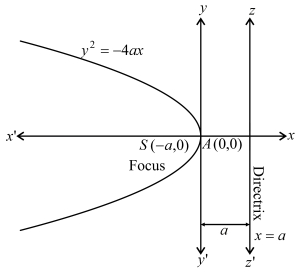
(A) Given equation of the parabola is $2 y^2+25 x=0$.
Rearranging the equation,we get $2 y^2 = -25 x$.
Dividing by $2$,we get $y^2 = -\frac{25}{2} x$.
Comparing this with the standard form of the parabola $y^2 = -4 a x$,we have:
$4 a = \frac{25}{2}$
$a = \frac{25}{8}$
The equation of the directrix for the parabola $y^2 = -4 a x$ is $x = a$.
Substituting the value of $a$,we get $x = \frac{25}{8}$.
This can be written as $8 x = 25$,or $8 x - 25 = 0$.
Rearranging the equation,we get $2 y^2 = -25 x$.
Dividing by $2$,we get $y^2 = -\frac{25}{2} x$.
Comparing this with the standard form of the parabola $y^2 = -4 a x$,we have:
$4 a = \frac{25}{2}$
$a = \frac{25}{8}$
The equation of the directrix for the parabola $y^2 = -4 a x$ is $x = a$.
Substituting the value of $a$,we get $x = \frac{25}{8}$.
This can be written as $8 x = 25$,or $8 x - 25 = 0$.
0 likesView Solution
305
MathematicsMediumMCQAP EAMCET · 2020
Tangents are drawn to the hyperbola $x^2 - 9y^2 = 9$ from the point $(3, 2)$. The area of the triangle formed by the tangents and the chord of contact is . . . . . . sq units.
A
$10$
B
$6$
C
$12$
D
$8$
Solution
(D) The equation of the hyperbola is $\frac{x^2}{9} - \frac{y^2}{1} = 1$,where $a^2 = 9$ and $b^2 = 1$.
The equation of a tangent with slope $m$ is $y = mx \pm \sqrt{9m^2 - 1}$. Since it passes through $(3, 2)$,we have $2 = 3m \pm \sqrt{9m^2 - 1}$.
$(2 - 3m)^2 = 9m^2 - 1$ $\Rightarrow 4 - 12m + 9m^2 = 9m^2 - 1$ $\Rightarrow 12m = 5$ $\Rightarrow m = \frac{5}{12}$.
The other tangent is the vertical line $x = 3$ (since the point $(3, 2)$ lies on the line $x = 3$).
The equation of the first tangent is $y - 2 = \frac{5}{12}(x - 3)$ $\Rightarrow 12y - 24 = 5x - 15$ $\Rightarrow 5x - 12y + 9 = 0$.
The chord of contact for the point $(x_1, y_1) = (3, 2)$ is $\frac{xx_1}{a^2} - \frac{yy_1}{b^2} = 1$ $\Rightarrow \frac{3x}{9} - \frac{2y}{1} = 1$ $\Rightarrow x - 6y = 3$.
The vertices of the triangle are the intersection of the two tangents $(3, 2)$,the intersection of the first tangent and the chord of contact $(3, 1)$,and the intersection of the second tangent $(x=3)$ and the chord of contact $(3, 0)$. Wait,let us re-evaluate the intersection points.
Intersection of $x=3$ and $x-6y=3$ is $(3, 0)$.
Intersection of $5x-12y+9=0$ and $x-6y=3$ (i.e.,$x=6y+3$): $5(6y+3) - 12y + 9 = 0$ $\Rightarrow 30y + 15 - 12y + 9 = 0$ $\Rightarrow 18y = -24$ $\Rightarrow y = -4/3$. Then $x = 6(-4/3) + 3 = -8 + 3 = -5$.
The vertices are $(3, 2)$,$(3, 0)$,and $(-5, -4/3)$.
Area $= \frac{1}{2} |x_1(y_2 - y_3) + x_2(y_3 - y_1) + x_3(y_1 - y_2)| = \frac{1}{2} |3(0 - (-4/3)) + 3(-4/3 - 2) + (-5)(2 - 0)| = \frac{1}{2} |3(4/3) + 3(-10/3) - 10| = \frac{1}{2} |4 - 10 - 10| = \frac{1}{2} |-16| = 8$ sq units.
The equation of a tangent with slope $m$ is $y = mx \pm \sqrt{9m^2 - 1}$. Since it passes through $(3, 2)$,we have $2 = 3m \pm \sqrt{9m^2 - 1}$.
$(2 - 3m)^2 = 9m^2 - 1$ $\Rightarrow 4 - 12m + 9m^2 = 9m^2 - 1$ $\Rightarrow 12m = 5$ $\Rightarrow m = \frac{5}{12}$.
The other tangent is the vertical line $x = 3$ (since the point $(3, 2)$ lies on the line $x = 3$).
The equation of the first tangent is $y - 2 = \frac{5}{12}(x - 3)$ $\Rightarrow 12y - 24 = 5x - 15$ $\Rightarrow 5x - 12y + 9 = 0$.
The chord of contact for the point $(x_1, y_1) = (3, 2)$ is $\frac{xx_1}{a^2} - \frac{yy_1}{b^2} = 1$ $\Rightarrow \frac{3x}{9} - \frac{2y}{1} = 1$ $\Rightarrow x - 6y = 3$.
The vertices of the triangle are the intersection of the two tangents $(3, 2)$,the intersection of the first tangent and the chord of contact $(3, 1)$,and the intersection of the second tangent $(x=3)$ and the chord of contact $(3, 0)$. Wait,let us re-evaluate the intersection points.
Intersection of $x=3$ and $x-6y=3$ is $(3, 0)$.
Intersection of $5x-12y+9=0$ and $x-6y=3$ (i.e.,$x=6y+3$): $5(6y+3) - 12y + 9 = 0$ $\Rightarrow 30y + 15 - 12y + 9 = 0$ $\Rightarrow 18y = -24$ $\Rightarrow y = -4/3$. Then $x = 6(-4/3) + 3 = -8 + 3 = -5$.
The vertices are $(3, 2)$,$(3, 0)$,and $(-5, -4/3)$.
Area $= \frac{1}{2} |x_1(y_2 - y_3) + x_2(y_3 - y_1) + x_3(y_1 - y_2)| = \frac{1}{2} |3(0 - (-4/3)) + 3(-4/3 - 2) + (-5)(2 - 0)| = \frac{1}{2} |3(4/3) + 3(-10/3) - 10| = \frac{1}{2} |4 - 10 - 10| = \frac{1}{2} |-16| = 8$ sq units.
0 likesView Solution
306
MathematicsEasyMCQAP EAMCET · 2020
The equation of the tangent to the parabola $y^2=12x$,which makes an angle $30^{\circ}$ with the positive direction of the $X$-axis is given by $x-\sqrt{3}y+9=0$. The point of contact is:
A
$(-9, -6\sqrt{3})$
B
$(9, -6\sqrt{3})$
C
$(-9, 6\sqrt{3})$
D
$(9, 6\sqrt{3})$
Solution
(D) The equation of the parabola is $y^2 = 12x$,which is of the form $y^2 = 4ax$,where $4a = 12$,so $a = 3$.
Let the point of contact be $(x_1, y_1)$.
The equation of the tangent to the parabola $y^2 = 4ax$ at $(x_1, y_1)$ is $yy_1 = 2a(x + x_1)$.
Substituting $a = 3$,we get $yy_1 = 6(x + x_1)$,which simplifies to $6x - y_1y + 6x_1 = 0$.
We are given the tangent equation as $x - \sqrt{3}y + 9 = 0$.
Comparing the two equations: $\frac{6}{1} = \frac{-y_1}{-\sqrt{3}} = \frac{6x_1}{9}$.
From $\frac{6}{1} = \frac{y_1}{\sqrt{3}}$,we get $y_1 = 6\sqrt{3}$.
From $\frac{6}{1} = \frac{6x_1}{9}$,we get $x_1 = 9$.
Thus,the point of contact is $(9, 6\sqrt{3})$.
Let the point of contact be $(x_1, y_1)$.
The equation of the tangent to the parabola $y^2 = 4ax$ at $(x_1, y_1)$ is $yy_1 = 2a(x + x_1)$.
Substituting $a = 3$,we get $yy_1 = 6(x + x_1)$,which simplifies to $6x - y_1y + 6x_1 = 0$.
We are given the tangent equation as $x - \sqrt{3}y + 9 = 0$.
Comparing the two equations: $\frac{6}{1} = \frac{-y_1}{-\sqrt{3}} = \frac{6x_1}{9}$.
From $\frac{6}{1} = \frac{y_1}{\sqrt{3}}$,we get $y_1 = 6\sqrt{3}$.
From $\frac{6}{1} = \frac{6x_1}{9}$,we get $x_1 = 9$.
Thus,the point of contact is $(9, 6\sqrt{3})$.
0 likesView Solution
307
MathematicsEasyMCQAP EAMCET · 2020
The equation of the tangent to the parabola $y^2=16x$,which is perpendicular to the line $3x-4y+5=0$,is given by
A
$4x-3y+9=0$
B
$4x+3y-9=0$
C
$4x+3y+9=0$
D
$4x-3y-9=0$
Solution
(C) The equation of the parabola is $y^2=16x$,so $4a=16$,which gives $a=4$.
The given line is $3x-4y+5=0$,which can be written as $y=\frac{3}{4}x+\frac{5}{4}$.
The slope of this line is $m_1=\frac{3}{4}$.
Since the tangent is perpendicular to this line,its slope $m$ must satisfy $m \times m_1 = -1$.
Thus,$m = -\frac{4}{3}$.
The equation of a tangent to the parabola $y^2=4ax$ with slope $m$ is $y=mx+\frac{a}{m}$.
Substituting $a=4$ and $m=-\frac{4}{3}$,we get $y=-\frac{4}{3}x+\frac{4}{-4/3}$.
$y=-\frac{4}{3}x-3$.
Multiplying by $3$,we get $3y=-4x-9$,which simplifies to $4x+3y+9=0$.
The given line is $3x-4y+5=0$,which can be written as $y=\frac{3}{4}x+\frac{5}{4}$.
The slope of this line is $m_1=\frac{3}{4}$.
Since the tangent is perpendicular to this line,its slope $m$ must satisfy $m \times m_1 = -1$.
Thus,$m = -\frac{4}{3}$.
The equation of a tangent to the parabola $y^2=4ax$ with slope $m$ is $y=mx+\frac{a}{m}$.
Substituting $a=4$ and $m=-\frac{4}{3}$,we get $y=-\frac{4}{3}x+\frac{4}{-4/3}$.
$y=-\frac{4}{3}x-3$.
Multiplying by $3$,we get $3y=-4x-9$,which simplifies to $4x+3y+9=0$.
0 likesView Solution
308
MathematicsEasyMCQAP EAMCET · 2020
The tangent at the point $(1, 2)$ to the curve $y^2 = 4x$ makes an angle $\theta$ with the positive direction of the $X$-axis. Then $\theta =$ (in $^{\circ}$)
A
$60$
B
$30$
C
$90$
D
$45$
Solution
(D) Given the curve $y^2 = 4x$ and the point $P(1, 2)$.
Differentiating both sides with respect to $x$:
$2y \cdot \frac{dy}{dx} = 4$
$\frac{dy}{dx} = \frac{4}{2y} = \frac{2}{y}$
At the point $P(1, 2)$,the slope of the tangent $m$ is:
$m = \left. \frac{dy}{dx} \right|_{(1, 2)} = \frac{2}{2} = 1$
Since the slope $m = \tan \theta$,we have:
$\tan \theta = 1$
$\theta = 45^{\circ}$
Thus,the correct option is $D$.
Differentiating both sides with respect to $x$:
$2y \cdot \frac{dy}{dx} = 4$
$\frac{dy}{dx} = \frac{4}{2y} = \frac{2}{y}$
At the point $P(1, 2)$,the slope of the tangent $m$ is:
$m = \left. \frac{dy}{dx} \right|_{(1, 2)} = \frac{2}{2} = 1$
Since the slope $m = \tan \theta$,we have:
$\tan \theta = 1$
$\theta = 45^{\circ}$
Thus,the correct option is $D$.
0 likesView Solution
309
MathematicsEasyMCQAP EAMCET · 2020
The equation of the tangent to the parabola $y^2=12x$ at the point $(3,-6)$ is:
A
$x-y+9=0$
B
$x+y+3=0$
C
$x+y-3=0$
D
$x=3$
Solution
(B) The equation of the tangent to the parabola $y^2=4ax$ at point $(x_1, y_1)$ is given by $yy_1 = 2a(x+x_1)$.
Here,$4a = 12$,so $a = 3$.
The point is $(x_1, y_1) = (3, -6)$.
Substituting these values into the formula:
$y(-6) = 2(3)(x+3)$
$-6y = 6(x+3)$
$-y = x+3$
$x+y+3 = 0$
Hence,option $B$ is correct.
Here,$4a = 12$,so $a = 3$.
The point is $(x_1, y_1) = (3, -6)$.
Substituting these values into the formula:
$y(-6) = 2(3)(x+3)$
$-6y = 6(x+3)$
$-y = x+3$
$x+y+3 = 0$
Hence,option $B$ is correct.
0 likesView Solution
310
MathematicsEasyMCQAP EAMCET · 2020
The equation of the tangent to the parabola $y^2=8x$ inclined at $30^{\circ}$ to the $X$-axis is
A
$3x-\sqrt{3}y+14=0$
B
$2x-3y+14=0$
C
$2x-\sqrt{3}y+7=0$
D
$x-\sqrt{3}y+6=0$
Solution
(D) The equation of the tangent to the parabola $y^2=4ax$ with slope $m$ is given by $y=mx+\frac{a}{m}$.
Here,the parabola is $y^2=8x$,so $4a=8$,which implies $a=2$.
The inclination is $30^{\circ}$,so the slope $m=\tan(30^{\circ})=\frac{1}{\sqrt{3}}$.
Substituting these values into the tangent equation:
$y=\frac{1}{\sqrt{3}}x+\frac{2}{1/\sqrt{3}}$
$y=\frac{x}{\sqrt{3}}+2\sqrt{3}$
Multiplying by $\sqrt{3}$ on both sides:
$\sqrt{3}y=x+6$
$x-\sqrt{3}y+6=0$.
Thus,the correct option is $D$.
Here,the parabola is $y^2=8x$,so $4a=8$,which implies $a=2$.
The inclination is $30^{\circ}$,so the slope $m=\tan(30^{\circ})=\frac{1}{\sqrt{3}}$.
Substituting these values into the tangent equation:
$y=\frac{1}{\sqrt{3}}x+\frac{2}{1/\sqrt{3}}$
$y=\frac{x}{\sqrt{3}}+2\sqrt{3}$
Multiplying by $\sqrt{3}$ on both sides:
$\sqrt{3}y=x+6$
$x-\sqrt{3}y+6=0$.
Thus,the correct option is $D$.
0 likesView Solution
311
MathematicsEasyMCQAP EAMCET · 2020
The common tangent to the parabolas $y^2=32x$ and $x^2=256y$ is:
A
$2x+4y+64=0$
B
$x+2y-32=0$
C
$2x+4y+32=0$
D
$4x+2y+64=0$
Solution
(A) The given parabolas are $y^2=32x$ and $x^2=256y$.
The equation of a common tangent to the parabolas $y^2=4ax$ and $x^2=4by$ is given by $b^{1/3}y + a^{1/3}x + (a^2b^2)^{1/3} = 0$.
Comparing $y^2=32x$ with $y^2=4ax$,we get $4a=32 \Rightarrow a=8$.
Comparing $x^2=256y$ with $x^2=4by$,we get $4b=256 \Rightarrow b=64$.
Substituting these values into the formula:
$(64)^{1/3}y + (8)^{1/3}x + (8^2 \times 64^2)^{1/3} = 0$
$4y + 2x + (64 \times 4096)^{1/3} = 0$
$4y + 2x + (262144)^{1/3} = 0$
$4y + 2x + 64 = 0$
Dividing by $2$,we get $x + 2y + 32 = 0$. However,checking the options,the equation $2x+4y+64=0$ is equivalent to $x+2y+32=0$.
The equation of a common tangent to the parabolas $y^2=4ax$ and $x^2=4by$ is given by $b^{1/3}y + a^{1/3}x + (a^2b^2)^{1/3} = 0$.
Comparing $y^2=32x$ with $y^2=4ax$,we get $4a=32 \Rightarrow a=8$.
Comparing $x^2=256y$ with $x^2=4by$,we get $4b=256 \Rightarrow b=64$.
Substituting these values into the formula:
$(64)^{1/3}y + (8)^{1/3}x + (8^2 \times 64^2)^{1/3} = 0$
$4y + 2x + (64 \times 4096)^{1/3} = 0$
$4y + 2x + (262144)^{1/3} = 0$
$4y + 2x + 64 = 0$
Dividing by $2$,we get $x + 2y + 32 = 0$. However,checking the options,the equation $2x+4y+64=0$ is equivalent to $x+2y+32=0$.
0 likesView Solution
312
MathematicsMediumMCQAP EAMCET · 2020
If the line $y=2x+k$ is a normal to the parabola $y^2=4x$,then $k=$
A
-$10$
B
$10$
C
$12$
D
-$12$
Solution
(D) The equation of a normal to the parabola $y^2=4ax$ with slope $m$ is given by $y=mx-2am-am^3$.
Comparing the given parabola $y^2=4x$ with $y^2=4ax$,we get $a=1$.
The given line is $y=2x+k$,so the slope $m=2$.
Substituting $a=1$ and $m=2$ into the normal equation:
$k = -2(1)(2) - (1)(2)^3$
$k = -4 - 8$
$k = -12$.
Thus,the correct option is $D$.
Comparing the given parabola $y^2=4x$ with $y^2=4ax$,we get $a=1$.
The given line is $y=2x+k$,so the slope $m=2$.
Substituting $a=1$ and $m=2$ into the normal equation:
$k = -2(1)(2) - (1)(2)^3$
$k = -4 - 8$
$k = -12$.
Thus,the correct option is $D$.
0 likesView Solution
313
MathematicsMediumMCQAP EAMCET · 2020
The largest value of $k$ for which the circle $x^2+y^2=k^2$ lies completely in the interior of the parabola $y^2=4x+16$ is
A
$4\sqrt{3}$
B
$2\sqrt{3}$
C
$2\sqrt{6}$
D
$4\sqrt{6}$
Solution
(B) The equation of the parabola is $y^2 = 4(x+4)$.
Let a point on the parabola be $P(x, y) = (t^2-4, 2t)$.
The distance squared from the origin $(0,0)$ to any point on the parabola is $d^2 = x^2 + y^2 = (t^2-4)^2 + (2t)^2$.
$d^2 = t^4 - 8t^2 + 16 + 4t^2 = t^4 - 4t^2 + 16$.
For the circle $x^2+y^2=k^2$ to lie inside the parabola,we must have $k^2 \leq d^2$ for all $t$.
Let $u = t^2$,where $u \geq 0$. Then $f(u) = u^2 - 4u + 16$.
The minimum value of $f(u)$ occurs at $u = -(-4)/(2 \times 1) = 2$.
Since $u=2 \geq 0$,the minimum value is $f(2) = 2^2 - 4(2) + 16 = 4 - 8 + 16 = 12$.
Thus,$k^2 \leq 12$,which implies $k \leq \sqrt{12} = 2\sqrt{3}$.
The largest value of $k$ is $2\sqrt{3}$.
Let a point on the parabola be $P(x, y) = (t^2-4, 2t)$.
The distance squared from the origin $(0,0)$ to any point on the parabola is $d^2 = x^2 + y^2 = (t^2-4)^2 + (2t)^2$.
$d^2 = t^4 - 8t^2 + 16 + 4t^2 = t^4 - 4t^2 + 16$.
For the circle $x^2+y^2=k^2$ to lie inside the parabola,we must have $k^2 \leq d^2$ for all $t$.
Let $u = t^2$,where $u \geq 0$. Then $f(u) = u^2 - 4u + 16$.
The minimum value of $f(u)$ occurs at $u = -(-4)/(2 \times 1) = 2$.
Since $u=2 \geq 0$,the minimum value is $f(2) = 2^2 - 4(2) + 16 = 4 - 8 + 16 = 12$.
Thus,$k^2 \leq 12$,which implies $k \leq \sqrt{12} = 2\sqrt{3}$.
The largest value of $k$ is $2\sqrt{3}$.
0 likesView Solution
314
MathematicsEasyMCQAP EAMCET · 2020
The constant term in the expansion of $\left(\frac{x}{2}+\frac{1}{x}+\sqrt{2}\right)^5$ is $\frac{a \sqrt{2}}{2}$,then $a=$
A
$7$
B
$69$
C
$63$
D
$65$
Solution
(C) Let the expression be $E = \left(\frac{x}{2} + \frac{1}{x} + \sqrt{2}\right)^5$.
We can rewrite the expression as:
$E = \left(\frac{x^2 + 2 + 2\sqrt{2}x}{2x}\right)^5 = \frac{(x + \sqrt{2})^{10}}{32x^5}$.
The constant term in the expansion of $E$ is the coefficient of $x^5$ in the expansion of $(x + \sqrt{2})^{10}$ divided by $32$.
Using the Binomial Theorem,the general term in $(x + \sqrt{2})^{10}$ is $T_{r+1} = {}^{10}C_r \cdot x^{10-r} \cdot (\sqrt{2})^r$.
For the coefficient of $x^5$,we set $10-r = 5$,which gives $r = 5$.
The term is ${}^{10}C_5 \cdot (\sqrt{2})^5 = 252 \cdot 4\sqrt{2} = 1008\sqrt{2}$.
Thus,the constant term is $\frac{1008\sqrt{2}}{32} = \frac{63\sqrt{2}}{2}$.
Comparing this with $\frac{a\sqrt{2}}{2}$,we get $a = 63$.
We can rewrite the expression as:
$E = \left(\frac{x^2 + 2 + 2\sqrt{2}x}{2x}\right)^5 = \frac{(x + \sqrt{2})^{10}}{32x^5}$.
The constant term in the expansion of $E$ is the coefficient of $x^5$ in the expansion of $(x + \sqrt{2})^{10}$ divided by $32$.
Using the Binomial Theorem,the general term in $(x + \sqrt{2})^{10}$ is $T_{r+1} = {}^{10}C_r \cdot x^{10-r} \cdot (\sqrt{2})^r$.
For the coefficient of $x^5$,we set $10-r = 5$,which gives $r = 5$.
The term is ${}^{10}C_5 \cdot (\sqrt{2})^5 = 252 \cdot 4\sqrt{2} = 1008\sqrt{2}$.
Thus,the constant term is $\frac{1008\sqrt{2}}{32} = \frac{63\sqrt{2}}{2}$.
Comparing this with $\frac{a\sqrt{2}}{2}$,we get $a = 63$.
0 likesView Solution
315
MathematicsMediumMCQAP EAMCET · 2020
Assuming $|x|$ to be so small that $x^2$ and higher powers of $x$ can be neglected,then $\frac{\sqrt{1+x}+(1-x)^{3/2}}{(1+x)+\sqrt{1+x}} = $
A
$1+\frac{5x}{4}$
B
$1-\frac{5x}{4}$
C
$1+\frac{4x}{5}$
D
$1-\frac{4x}{5}$
Solution
(B) Using the binomial expansion $(1+x)^n \approx 1+nx$ for small $|x|$:
$\sqrt{1+x} = (1+x)^{1/2} \approx 1+\frac{1}{2}x$
$(1-x)^{3/2} \approx 1-\frac{3}{2}x$
Substituting these into the expression:
$\frac{(1+\frac{1}{2}x) + (1-\frac{3}{2}x)}{(1+x) + (1+\frac{1}{2}x)} = \frac{2-x}{2+\frac{3}{2}x} = \frac{2-x}{\frac{4+3x}{2}} = \frac{2(2-x)}{4+3x}$
$= \frac{4-2x}{4+3x} = (4-2x)(4+3x)^{-1} = (4-2x) \cdot \frac{1}{4}(1+\frac{3}{4}x)^{-1}$
$\approx \frac{1}{4}(4-2x)(1-\frac{3}{4}x) = \frac{1}{4}(4 - 3x - 2x + \frac{6}{4}x^2)$
Neglecting $x^2$ terms:
$\approx \frac{1}{4}(4-5x) = 1-\frac{5x}{4}$
$\sqrt{1+x} = (1+x)^{1/2} \approx 1+\frac{1}{2}x$
$(1-x)^{3/2} \approx 1-\frac{3}{2}x$
Substituting these into the expression:
$\frac{(1+\frac{1}{2}x) + (1-\frac{3}{2}x)}{(1+x) + (1+\frac{1}{2}x)} = \frac{2-x}{2+\frac{3}{2}x} = \frac{2-x}{\frac{4+3x}{2}} = \frac{2(2-x)}{4+3x}$
$= \frac{4-2x}{4+3x} = (4-2x)(4+3x)^{-1} = (4-2x) \cdot \frac{1}{4}(1+\frac{3}{4}x)^{-1}$
$\approx \frac{1}{4}(4-2x)(1-\frac{3}{4}x) = \frac{1}{4}(4 - 3x - 2x + \frac{6}{4}x^2)$
Neglecting $x^2$ terms:
$\approx \frac{1}{4}(4-5x) = 1-\frac{5x}{4}$
0 likesView Solution
316
MathematicsEasyMCQAP EAMCET · 2020
If $(1-x+x^2)^{10}=a_0+a_1 x+a_2 x^2+\ldots+a_{20} x^{20}$,then $2 a_2+3 a_3+4 a_4+\ldots+20 a_{20}=$
A
$0$
B
$10$
C
$20$
D
-$20$
Solution
(C) Given the expansion: $(1-x+x^2)^{10}=a_0+a_1 x+a_2 x^2+\ldots+a_{20} x^{20}$.
Differentiating both sides with respect to $x$:
$10(1-x+x^2)^9 \cdot (-1+2x) = a_1 + 2a_2 x + 3a_3 x^2 + \ldots + 20a_{20} x^{19}$.
Setting $x=1$:
$10(1-1+1)^9 \cdot (-1+2) = a_1 + 2a_2 + 3a_3 + \ldots + 20a_{20}$.
$10(1)^9 \cdot (1) = a_1 + 2a_2 + 3a_3 + \ldots + 20a_{20} = 10$.
To find $a_1$,differentiate the original expression and set $x=0$ or observe the coefficient of $x$ in $(1-x+x^2)^{10}$:
$(1-x+x^2)^{10} = 1 + 10(-x+x^2) + \ldots = 1 - 10x + \ldots$.
Thus,$a_1 = -10$.
Substituting $a_1 = -10$ into the equation $a_1 + 2a_2 + 3a_3 + \ldots + 20a_{20} = 10$:
$-10 + (2a_2 + 3a_3 + \ldots + 20a_{20}) = 10$.
Therefore,$2a_2 + 3a_3 + \ldots + 20a_{20} = 20$.
Differentiating both sides with respect to $x$:
$10(1-x+x^2)^9 \cdot (-1+2x) = a_1 + 2a_2 x + 3a_3 x^2 + \ldots + 20a_{20} x^{19}$.
Setting $x=1$:
$10(1-1+1)^9 \cdot (-1+2) = a_1 + 2a_2 + 3a_3 + \ldots + 20a_{20}$.
$10(1)^9 \cdot (1) = a_1 + 2a_2 + 3a_3 + \ldots + 20a_{20} = 10$.
To find $a_1$,differentiate the original expression and set $x=0$ or observe the coefficient of $x$ in $(1-x+x^2)^{10}$:
$(1-x+x^2)^{10} = 1 + 10(-x+x^2) + \ldots = 1 - 10x + \ldots$.
Thus,$a_1 = -10$.
Substituting $a_1 = -10$ into the equation $a_1 + 2a_2 + 3a_3 + \ldots + 20a_{20} = 10$:
$-10 + (2a_2 + 3a_3 + \ldots + 20a_{20}) = 10$.
Therefore,$2a_2 + 3a_3 + \ldots + 20a_{20} = 20$.
0 likesView Solution
317
MathematicsMediumMCQAP EAMCET · 2020
If the $m$-th term is the middle term in the expansion of $\left(x^2-\frac{1}{2x}\right)^{20}$,find the coefficient of $T_{m+3}$.
A
${}^{20}C_{13} 2^{-13}$
B
-${}^{20}C_{13} 2^{13}$
C
-${}^{20}C_{13} 2^{-13}$
D
${}^{20}C_{13} 2^{13}$
Solution
(C) The expansion of $\left(x^2-\frac{1}{2x}\right)^{20}$ contains $20+1 = 21$ terms.
Since the number of terms is odd,the middle term is the $\left(\frac{20}{2}+1\right)$-th term,which is the $11$-th term.
Thus,$m = 11$.
We need to find the coefficient of $T_{m+3} = T_{11+3} = T_{14} = T_{13+1}$.
The general term $T_{r+1}$ in the expansion of $(a+b)^n$ is given by ${}^nC_r a^{n-r} b^r$.
For $T_{13+1}$,we have $n=20$,$r=13$,$a=x^2$,and $b=-\frac{1}{2x}$.
$T_{14} = {}^{20}C_{13} (x^2)^{20-13} \left(-\frac{1}{2x}\right)^{13}$
$T_{14} = {}^{20}C_{13} (x^2)^7 \left(-\frac{1}{2^{13} x^{13}}\right)$
$T_{14} = -{}^{20}C_{13} \cdot \frac{x^{14}}{2^{13} x^{13}} = -{}^{20}C_{13} \cdot 2^{-13} x$.
Therefore,the coefficient of $T_{m+3}$ is $-{}^{20}C_{13} 2^{-13}$.
Since the number of terms is odd,the middle term is the $\left(\frac{20}{2}+1\right)$-th term,which is the $11$-th term.
Thus,$m = 11$.
We need to find the coefficient of $T_{m+3} = T_{11+3} = T_{14} = T_{13+1}$.
The general term $T_{r+1}$ in the expansion of $(a+b)^n$ is given by ${}^nC_r a^{n-r} b^r$.
For $T_{13+1}$,we have $n=20$,$r=13$,$a=x^2$,and $b=-\frac{1}{2x}$.
$T_{14} = {}^{20}C_{13} (x^2)^{20-13} \left(-\frac{1}{2x}\right)^{13}$
$T_{14} = {}^{20}C_{13} (x^2)^7 \left(-\frac{1}{2^{13} x^{13}}\right)$
$T_{14} = -{}^{20}C_{13} \cdot \frac{x^{14}}{2^{13} x^{13}} = -{}^{20}C_{13} \cdot 2^{-13} x$.
Therefore,the coefficient of $T_{m+3}$ is $-{}^{20}C_{13} 2^{-13}$.
0 likesView Solution
318
MathematicsMediumMCQAP EAMCET · 2020
The coefficient of $x^{50}$ in the expansion of $(1+x)^{1000} + x(1+x)^{999} + x^2(1+x)^{998} + \ldots + x^{1000}$ is
A
${}^{1000}C_{50}$
B
${}^{999}C_{50}$
C
${}^{1000}C_{51}$
D
${}^{1001}C_{50}$
Solution
(D) The given expression is a geometric series with first term $a = (1+x)^{1000}$,common ratio $r = \frac{x}{1+x}$,and number of terms $n = 1001$.
Using the sum formula $S_n = \frac{a(1-r^n)}{1-r}$:
$f(x) = \frac{(1+x)^{1000} \left(1 - (\frac{x}{1+x})^{1001}\right)}{1 - \frac{x}{1+x}}$
$f(x) = \frac{(1+x)^{1000} - \frac{x^{1001}}{1+x}}{\frac{1+x-x}{1+x}} = \frac{(1+x)^{1001} - x^{1001}}{1} = (1+x)^{1001} - x^{1001}$.
The coefficient of $x^{50}$ in $(1+x)^{1001} - x^{1001}$ is the coefficient of $x^{50}$ in $(1+x)^{1001}$,which is ${}^{1001}C_{50}$.
Using the sum formula $S_n = \frac{a(1-r^n)}{1-r}$:
$f(x) = \frac{(1+x)^{1000} \left(1 - (\frac{x}{1+x})^{1001}\right)}{1 - \frac{x}{1+x}}$
$f(x) = \frac{(1+x)^{1000} - \frac{x^{1001}}{1+x}}{\frac{1+x-x}{1+x}} = \frac{(1+x)^{1001} - x^{1001}}{1} = (1+x)^{1001} - x^{1001}$.
The coefficient of $x^{50}$ in $(1+x)^{1001} - x^{1001}$ is the coefficient of $x^{50}$ in $(1+x)^{1001}$,which is ${}^{1001}C_{50}$.
0 likesView Solution
319
MathematicsEasyMCQAP EAMCET · 2020
In the expansion of $(\sqrt[5]{3}+\sqrt[3]{2})^{15}$
A
Number of rational terms is $3$
B
Sum of all rational terms is $58$
C
Sum of all rational terms is greater than the sum of all irrational terms
D
Sum of all irrational terms is greater than the sum of all rational terms
Solution
(D) The general term of the expansion $(\sqrt[5]{3}+\sqrt[3]{2})^{15}$ is given by $T_{r+1} = {}^{15}C_r (3^{1/5})^{15-r} (2^{1/3})^r = {}^{15}C_r 3^{(15-r)/5} 2^{r/3}$.
For the term to be rational,the exponents of $3$ and $2$ must be integers.
Thus,$(15-r)/5 = 3 - r/5$ must be an integer,implying $r$ is a multiple of $5$.
Also,$r/3$ must be an integer,implying $r$ is a multiple of $3$.
Therefore,$r$ must be a multiple of $\text{lcm}(5, 3) = 15$.
Given $0 \leq r \leq 15$,the possible values for $r$ are $0$ and $15$.
For $r=0$,$T_1 = {}^{15}C_0 3^3 2^0 = 1 \times 27 \times 1 = 27$.
For $r=15$,$T_{16} = {}^{15}C_{15} 3^0 2^5 = 1 \times 1 \times 32 = 32$.
Number of rational terms is $2$.
Sum of rational terms $= 27 + 32 = 59$.
Since the total sum of all terms is $(\sqrt[5]{3}+\sqrt[3]{2})^{15}$,which is a very large number,the sum of irrational terms is significantly larger than the sum of rational terms $(59)$.
For the term to be rational,the exponents of $3$ and $2$ must be integers.
Thus,$(15-r)/5 = 3 - r/5$ must be an integer,implying $r$ is a multiple of $5$.
Also,$r/3$ must be an integer,implying $r$ is a multiple of $3$.
Therefore,$r$ must be a multiple of $\text{lcm}(5, 3) = 15$.
Given $0 \leq r \leq 15$,the possible values for $r$ are $0$ and $15$.
For $r=0$,$T_1 = {}^{15}C_0 3^3 2^0 = 1 \times 27 \times 1 = 27$.
For $r=15$,$T_{16} = {}^{15}C_{15} 3^0 2^5 = 1 \times 1 \times 32 = 32$.
Number of rational terms is $2$.
Sum of rational terms $= 27 + 32 = 59$.
Since the total sum of all terms is $(\sqrt[5]{3}+\sqrt[3]{2})^{15}$,which is a very large number,the sum of irrational terms is significantly larger than the sum of rational terms $(59)$.
0 likesView Solution
320
MathematicsEasyMCQAP EAMCET · 2020
In the expansion of $(a+1+\frac{1}{a})^n$,where $n \in N$,there are $2029$ terms. Then $n=$
A
$1015$
B
$1013$
C
$1014$
D
$1012$
Solution
(C) The expression is $(a+1+\frac{1}{a})^n = \frac{(a^2+a+1)^n}{a^n}$.
For a trinomial expansion $(x+y+z)^n$,the number of terms is given by $\frac{(n+1)(n+2)}{2}$.
However,in this specific case,the expression is $(a^2+a+1)^n$ divided by $a^n$. The expansion of $(a^2+a+1)^n$ has $2n+1$ terms because the powers of $a$ range from $a^0$ to $a^{2n}$.
Given the number of terms is $2029$,we set $2n+1 = 2029$.
$2n = 2028$.
$n = 1014$.
Hence,option $C$ is correct.
For a trinomial expansion $(x+y+z)^n$,the number of terms is given by $\frac{(n+1)(n+2)}{2}$.
However,in this specific case,the expression is $(a^2+a+1)^n$ divided by $a^n$. The expansion of $(a^2+a+1)^n$ has $2n+1$ terms because the powers of $a$ range from $a^0$ to $a^{2n}$.
Given the number of terms is $2029$,we set $2n+1 = 2029$.
$2n = 2028$.
$n = 1014$.
Hence,option $C$ is correct.
0 likesView Solution
321
MathematicsEasyMCQAP EAMCET · 2020
If the coefficients of $x^9$ and $x^{10}$ in the binomial expansion of $(3+\frac{x}{2})^n$ are equal,then $n=$
A
$69$
B
$96$
C
$66$
D
$99$
Solution
(A) The general term in the expansion of $(3+\frac{x}{2})^n$ is given by $T_{r+1} = {}^nC_r (3)^{n-r} (\frac{x}{2})^r = {}^nC_r \frac{3^{n-r}}{2^r} x^r$.
The coefficient of $x^r$ is ${}^nC_r \frac{3^{n-r}}{2^r}$.
For $r=9$,the coefficient is ${}^nC_9 \frac{3^{n-9}}{2^9}$.
For $r=10$,the coefficient is ${}^nC_{10} \frac{3^{n-10}}{2^{10}}$.
Given that these coefficients are equal:
${}^nC_9 \frac{3^{n-9}}{2^9} = {}^nC_{10} \frac{3^{n-10}}{2^{10}}$.
Dividing both sides by ${}^nC_9 \frac{3^{n-10}}{2^{10}}$,we get:
$\frac{3^{n-9}}{3^{n-10}} \times \frac{2^{10}}{2^9} = \frac{{}^nC_{10}}{{}^nC_9}$.
$3^1 \times 2^1 = \frac{n-10+1}{10} = \frac{n-9}{10}$.
$6 = \frac{n-9}{10}$ $\Rightarrow n-9 = 60$ $\Rightarrow n = 69$.
Thus,the correct option is $A$.
The coefficient of $x^r$ is ${}^nC_r \frac{3^{n-r}}{2^r}$.
For $r=9$,the coefficient is ${}^nC_9 \frac{3^{n-9}}{2^9}$.
For $r=10$,the coefficient is ${}^nC_{10} \frac{3^{n-10}}{2^{10}}$.
Given that these coefficients are equal:
${}^nC_9 \frac{3^{n-9}}{2^9} = {}^nC_{10} \frac{3^{n-10}}{2^{10}}$.
Dividing both sides by ${}^nC_9 \frac{3^{n-10}}{2^{10}}$,we get:
$\frac{3^{n-9}}{3^{n-10}} \times \frac{2^{10}}{2^9} = \frac{{}^nC_{10}}{{}^nC_9}$.
$3^1 \times 2^1 = \frac{n-10+1}{10} = \frac{n-9}{10}$.
$6 = \frac{n-9}{10}$ $\Rightarrow n-9 = 60$ $\Rightarrow n = 69$.
Thus,the correct option is $A$.
0 likesView Solution
322
MathematicsEasyMCQAP EAMCET · 2020
If the $6^{th}$ term in $\left(\frac{2p}{3} + \frac{3q}{2}\right)^9$ is $ap^bq^c$,then $a, b$ and $c$ respectively are
A
$189, 5, 4$
B
$189, 4, 5$
C
$212, 4, 5$
D
$212, 5, 4$
Solution
(B) The general term in the expansion of $(x+y)^n$ is given by $T_{r+1} = {}^nC_r x^{n-r} y^r$.
For the expansion $\left(\frac{2p}{3} + \frac{3q}{2}\right)^9$,the $6^{th}$ term $(T_6)$ is $T_{5+1}$.
Here,$n=9$,$r=5$,$x=\frac{2p}{3}$,and $y=\frac{3q}{2}$.
$T_6 = {}^9C_5 \left(\frac{2p}{3}\right)^{9-5} \left(\frac{3q}{2}\right)^5$
$T_6 = {}^9C_5 \left(\frac{2p}{3}\right)^4 \left(\frac{3q}{2}\right)^5$
$T_6 = \frac{9 \times 8 \times 7 \times 6}{4 \times 3 \times 2 \times 1} \times \left(\frac{2^4 p^4}{3^4}\right) \times \left(\frac{3^5 q^5}{2^5}\right)$
$T_6 = 126 \times \frac{16 p^4}{81} \times \frac{243 q^5}{32}$
$T_6 = 126 \times \frac{1}{81} \times 243 \times \frac{16}{32} p^4 q^5$
$T_6 = 126 \times 3 \times \frac{1}{2} p^4 q^5 = 189 p^4 q^5$.
Comparing $189 p^4 q^5$ with $ap^bq^c$,we get $a=189, b=4, c=5$.
For the expansion $\left(\frac{2p}{3} + \frac{3q}{2}\right)^9$,the $6^{th}$ term $(T_6)$ is $T_{5+1}$.
Here,$n=9$,$r=5$,$x=\frac{2p}{3}$,and $y=\frac{3q}{2}$.
$T_6 = {}^9C_5 \left(\frac{2p}{3}\right)^{9-5} \left(\frac{3q}{2}\right)^5$
$T_6 = {}^9C_5 \left(\frac{2p}{3}\right)^4 \left(\frac{3q}{2}\right)^5$
$T_6 = \frac{9 \times 8 \times 7 \times 6}{4 \times 3 \times 2 \times 1} \times \left(\frac{2^4 p^4}{3^4}\right) \times \left(\frac{3^5 q^5}{2^5}\right)$
$T_6 = 126 \times \frac{16 p^4}{81} \times \frac{243 q^5}{32}$
$T_6 = 126 \times \frac{1}{81} \times 243 \times \frac{16}{32} p^4 q^5$
$T_6 = 126 \times 3 \times \frac{1}{2} p^4 q^5 = 189 p^4 q^5$.
Comparing $189 p^4 q^5$ with $ap^bq^c$,we get $a=189, b=4, c=5$.
0 likesView Solution
323
MathematicsMediumMCQAP EAMCET · 2020
What is the constant term in the binomial expansion of $(1+3x)^n \left(1+\frac{1}{3x}\right)^n$?
A
$\binom{2n}{n}$
B
$\binom{2n}{n-1}$
C
$\binom{2n}{n+1}$
D
No such term exists
Solution
(A) Given expression: $(1+3x)^n \left(1+\frac{1}{3x}\right)^n$
$= (1+3x)^n \left(\frac{3x+1}{3x}\right)^n$
$= \frac{(1+3x)^n (1+3x)^n}{(3x)^n}$
$= \frac{(1+3x)^{2n}}{(3x)^n}$
The general term in the expansion of $(1+3x)^{2n}$ is $T_{r+1} = \binom{2n}{r} (3x)^r$.
To find the constant term,we need the term where the power of $x$ is $0$.
The expression is $\frac{1}{(3x)^n} \times \sum_{r=0}^{2n} \binom{2n}{r} (3x)^r = \sum_{r=0}^{2n} \binom{2n}{r} \frac{(3x)^r}{(3x)^n} = \sum_{r=0}^{2n} \binom{2n}{r} (3x)^{r-n}$.
The constant term occurs when $r-n = 0$,i.e.,$r = n$.
Substituting $r=n$,the constant term is $\binom{2n}{n} (3x)^{n-n} = \binom{2n}{n}$.
Thus,the constant term is $\binom{2n}{n}$.
$= (1+3x)^n \left(\frac{3x+1}{3x}\right)^n$
$= \frac{(1+3x)^n (1+3x)^n}{(3x)^n}$
$= \frac{(1+3x)^{2n}}{(3x)^n}$
The general term in the expansion of $(1+3x)^{2n}$ is $T_{r+1} = \binom{2n}{r} (3x)^r$.
To find the constant term,we need the term where the power of $x$ is $0$.
The expression is $\frac{1}{(3x)^n} \times \sum_{r=0}^{2n} \binom{2n}{r} (3x)^r = \sum_{r=0}^{2n} \binom{2n}{r} \frac{(3x)^r}{(3x)^n} = \sum_{r=0}^{2n} \binom{2n}{r} (3x)^{r-n}$.
The constant term occurs when $r-n = 0$,i.e.,$r = n$.
Substituting $r=n$,the constant term is $\binom{2n}{n} (3x)^{n-n} = \binom{2n}{n}$.
Thus,the constant term is $\binom{2n}{n}$.
0 likesView Solution
324
MathematicsEasyMCQAP EAMCET · 2020
If the term independent of $x$ in the expansion of $\left(\sqrt{x}-\frac{k}{x^2}\right)^{10}$ is $405$,then $k=$
A
$3$ only
B
$-3$ only
C
$\pm 3$
D
$0$
Solution
(C) The general term $T_{r+1}$ in the expansion of $\left(\sqrt{x}-\frac{k}{x^2}\right)^{10}$ is given by:
$T_{r+1} = \binom{10}{r} (x^{1/2})^{10-r} (-k x^{-2})^r$
$T_{r+1} = \binom{10}{r} (-k)^r x^{\frac{10-r}{2} - 2r}$
For the term to be independent of $x$,the exponent of $x$ must be $0$:
$\frac{10-r}{2} - 2r = 0$
$10 - r = 4r$
$5r = 10 \Rightarrow r = 2$
Now,substitute $r=2$ into the expression for the term:
$T_3 = \binom{10}{2} (-k)^2 = 405$
$45 k^2 = 405$
$k^2 = 9$
$k = \pm 3$
$T_{r+1} = \binom{10}{r} (x^{1/2})^{10-r} (-k x^{-2})^r$
$T_{r+1} = \binom{10}{r} (-k)^r x^{\frac{10-r}{2} - 2r}$
For the term to be independent of $x$,the exponent of $x$ must be $0$:
$\frac{10-r}{2} - 2r = 0$
$10 - r = 4r$
$5r = 10 \Rightarrow r = 2$
Now,substitute $r=2$ into the expression for the term:
$T_3 = \binom{10}{2} (-k)^2 = 405$
$45 k^2 = 405$
$k^2 = 9$
$k = \pm 3$
0 likesView Solution
325
MathematicsEasyMCQAP EAMCET · 2020
The index of the power of $x$ occurring in the $5^{\text{th}}$ term from the end in the expansion of $\left(\frac{x^3}{2} - \frac{2}{x^2}\right)^{12}$ is
A
$3$
B
$-3$
C
$4$
D
$-4$
Solution
(D) The $r^{\text{th}}$ term from the end in the expansion of $(a + b)^n$ is the $(n - r + 2)^{\text{th}}$ term from the beginning.
Here,$n = 12$ and $r = 5$,so we need the $(12 - 5 + 2) = 9^{\text{th}}$ term from the beginning.
The general term $T_{k+1}$ is given by ${}^{12}C_k (\frac{x^3}{2})^{12-k} (-\frac{2}{x^2})^k$.
For the $9^{\text{th}}$ term,$k = 8$.
$T_9 = {}^{12}C_8 (\frac{x^3}{2})^4 (-\frac{2}{x^2})^8$
$T_9 = {}^{12}C_8 \cdot \frac{x^{12}}{2^4} \cdot \frac{2^8}{x^{16}}$
$T_9 = {}^{12}C_8 \cdot 2^4 \cdot x^{12-16}$
$T_9 = {}^{12}C_8 \cdot 16 \cdot x^{-4}$
Thus,the index of the power of $x$ is $-4$.
Here,$n = 12$ and $r = 5$,so we need the $(12 - 5 + 2) = 9^{\text{th}}$ term from the beginning.
The general term $T_{k+1}$ is given by ${}^{12}C_k (\frac{x^3}{2})^{12-k} (-\frac{2}{x^2})^k$.
For the $9^{\text{th}}$ term,$k = 8$.
$T_9 = {}^{12}C_8 (\frac{x^3}{2})^4 (-\frac{2}{x^2})^8$
$T_9 = {}^{12}C_8 \cdot \frac{x^{12}}{2^4} \cdot \frac{2^8}{x^{16}}$
$T_9 = {}^{12}C_8 \cdot 2^4 \cdot x^{12-16}$
$T_9 = {}^{12}C_8 \cdot 16 \cdot x^{-4}$
Thus,the index of the power of $x$ is $-4$.
0 likesView Solution
326
MathematicsEasyMCQAP EAMCET · 2020
If $[x]$ represents the greatest integer not greater than $x$,then $\left[\left(1+\frac{1}{100000}\right)^{100000}\right]=$
A
$1$
B
$3$
C
$2$
D
$4$
Solution
(C) We know that the sequence $a_n = \left(1 + \frac{1}{n}\right)^n$ is strictly increasing and converges to $e$ as $n \to \infty$.
Given $n = 100000$,we have $\left(1 + \frac{1}{100000}\right)^{100000} < e$.
Since $e \approx 2.71828$,the value of $\left(1 + \frac{1}{100000}\right)^{100000}$ is slightly less than $2.71828$.
Also,for $n=1$,$\left(1 + \frac{1}{1}\right)^1 = 2$.
Since the sequence is increasing,$\left(1 + \frac{1}{100000}\right)^{100000} > 2$.
Thus,$2 < \left(1 + \frac{1}{100000}\right)^{100000} < 2.71828$.
Therefore,the greatest integer not greater than this value is $[2.something] = 2$.
Given $n = 100000$,we have $\left(1 + \frac{1}{100000}\right)^{100000} < e$.
Since $e \approx 2.71828$,the value of $\left(1 + \frac{1}{100000}\right)^{100000}$ is slightly less than $2.71828$.
Also,for $n=1$,$\left(1 + \frac{1}{1}\right)^1 = 2$.
Since the sequence is increasing,$\left(1 + \frac{1}{100000}\right)^{100000} > 2$.
Thus,$2 < \left(1 + \frac{1}{100000}\right)^{100000} < 2.71828$.
Therefore,the greatest integer not greater than this value is $[2.something] = 2$.
0 likesView Solution
327
MathematicsMediumMCQAP EAMCET · 2020
If $n \geq 100$ and the coefficient of $x^{100}$ in $1+(1+x)+(1+x)^2+\cdots+(1+x)^n$ is ${ }^{201} C_{101}$,then $n=$
A
$100$
B
$200$
C
$101$
D
$190$
Solution
(B) The given expression is a geometric series: $S = 1 + (1+x) + (1+x)^2 + \cdots + (1+x)^n$.
Using the formula for the sum of a geometric series $S = \frac{a(r^n - 1)}{r - 1}$,where $a = 1$,$r = (1+x)$,and the number of terms is $n+1$:
$S = \frac{1((1+x)^{n+1} - 1)}{(1+x) - 1} = \frac{(1+x)^{n+1} - 1}{x}$.
We need the coefficient of $x^{100}$ in $S$,which is the coefficient of $x^{100}$ in $\frac{(1+x)^{n+1} - 1}{x}$.
This is equivalent to finding the coefficient of $x^{101}$ in $(1+x)^{n+1} - 1$.
The coefficient of $x^{101}$ in $(1+x)^{n+1}$ is given by ${ }^{n+1} C_{101}$.
Given that this coefficient is ${ }^{201} C_{101}$,we have ${ }^{n+1} C_{101} = { }^{201} C_{101}$.
Therefore,$n+1 = 201$,which implies $n = 200$.
Using the formula for the sum of a geometric series $S = \frac{a(r^n - 1)}{r - 1}$,where $a = 1$,$r = (1+x)$,and the number of terms is $n+1$:
$S = \frac{1((1+x)^{n+1} - 1)}{(1+x) - 1} = \frac{(1+x)^{n+1} - 1}{x}$.
We need the coefficient of $x^{100}$ in $S$,which is the coefficient of $x^{100}$ in $\frac{(1+x)^{n+1} - 1}{x}$.
This is equivalent to finding the coefficient of $x^{101}$ in $(1+x)^{n+1} - 1$.
The coefficient of $x^{101}$ in $(1+x)^{n+1}$ is given by ${ }^{n+1} C_{101}$.
Given that this coefficient is ${ }^{201} C_{101}$,we have ${ }^{n+1} C_{101} = { }^{201} C_{101}$.
Therefore,$n+1 = 201$,which implies $n = 200$.
0 likesView Solution
328
MathematicsEasyMCQAP EAMCET · 2020
In the binomial expansion of $(a-b)^n, n \geq 5$,the sum of the $5^{\text{th}}$ and $6^{\text{th}}$ terms is zero. Then the value of $\frac{a}{b}$ is
A
$\frac{n-4}{5}$
B
$\frac{n-5}{6}$
C
$\frac{n-4}{6}$
D
$\frac{n-5}{5}$
Solution
(A) The general term in the expansion of $(a-b)^n$ is given by $T_{r+1} = \binom{n}{r} a^{n-r} (-b)^r$.
For the $5^{\text{th}}$ term,$r=4$: $T_5 = \binom{n}{4} a^{n-4} (-b)^4 = \binom{n}{4} a^{n-4} b^4$.
For the $6^{\text{th}}$ term,$r=5$: $T_6 = \binom{n}{5} a^{n-5} (-b)^5 = -\binom{n}{5} a^{n-5} b^5$.
Given $T_5 + T_6 = 0$,we have $\binom{n}{4} a^{n-4} b^4 - \binom{n}{5} a^{n-5} b^5 = 0$.
This implies $\binom{n}{4} a^{n-4} b^4 = \binom{n}{5} a^{n-5} b^5$.
Dividing both sides by $\binom{n}{4} a^{n-5} b^4$,we get $\frac{a}{b} = \frac{\binom{n}{5}}{\binom{n}{4}}$.
Using the formula $\binom{n}{r} = \frac{n!}{r!(n-r)!}$,we have $\frac{\binom{n}{5}}{\binom{n}{4}} = \frac{n!}{5!(n-5)!} \times \frac{4!(n-4)!}{n!} = \frac{n-4}{5}$.
Thus,$\frac{a}{b} = \frac{n-4}{5}$.
For the $5^{\text{th}}$ term,$r=4$: $T_5 = \binom{n}{4} a^{n-4} (-b)^4 = \binom{n}{4} a^{n-4} b^4$.
For the $6^{\text{th}}$ term,$r=5$: $T_6 = \binom{n}{5} a^{n-5} (-b)^5 = -\binom{n}{5} a^{n-5} b^5$.
Given $T_5 + T_6 = 0$,we have $\binom{n}{4} a^{n-4} b^4 - \binom{n}{5} a^{n-5} b^5 = 0$.
This implies $\binom{n}{4} a^{n-4} b^4 = \binom{n}{5} a^{n-5} b^5$.
Dividing both sides by $\binom{n}{4} a^{n-5} b^4$,we get $\frac{a}{b} = \frac{\binom{n}{5}}{\binom{n}{4}}$.
Using the formula $\binom{n}{r} = \frac{n!}{r!(n-r)!}$,we have $\frac{\binom{n}{5}}{\binom{n}{4}} = \frac{n!}{5!(n-5)!} \times \frac{4!(n-4)!}{n!} = \frac{n-4}{5}$.
Thus,$\frac{a}{b} = \frac{n-4}{5}$.
0 likesView Solution
329
MathematicsEasyMCQAP EAMCET · 2020
What is the remainder of $2x^3 - 5x^2 + 7$ when divided by $(x - 2)$?
A
-$3$
B
-$2$
C
$3$
D
$2$
Solution
(C) Using the remainder theorem,the remainder is $P(2)$.
Given $P(x) = 2x^3 - 5x^2 + 7$.
Substituting $x = 2$ into the polynomial:
$P(2) = 2(2)^3 - 5(2)^2 + 7$
$P(2) = 2(8) - 5(4) + 7$
$P(2) = 16 - 20 + 7$
$P(2) = 3$
Therefore,the remainder is $3$.
Given $P(x) = 2x^3 - 5x^2 + 7$.
Substituting $x = 2$ into the polynomial:
$P(2) = 2(2)^3 - 5(2)^2 + 7$
$P(2) = 2(8) - 5(4) + 7$
$P(2) = 16 - 20 + 7$
$P(2) = 3$
Therefore,the remainder is $3$.
0 likesView Solution
330
MathematicsEasyMCQAP EAMCET · 2020
$a^n + b^n$ is divisible by which of the following if $n$ is any odd positive integer?
A
$a - b$
B
$a^2 - b^2$
C
$a^2 + b^2$
D
$a + b$
Solution
(D) For any odd positive integer $n$,the expression $a^n + b^n$ can be expanded using the binomial theorem or algebraic factorization.
Specifically,$a^n + b^n = (a + b)(a^{n-1} - a^{n-2}b + a^{n-3}b^2 - \dots + b^{n-1})$.
Therefore,$a^n + b^n$ is always divisible by $(a + b)$ when $n$ is an odd positive integer.
Specifically,$a^n + b^n = (a + b)(a^{n-1} - a^{n-2}b + a^{n-3}b^2 - \dots + b^{n-1})$.
Therefore,$a^n + b^n$ is always divisible by $(a + b)$ when $n$ is an odd positive integer.
0 likesView Solution
331
MathematicsMediumMCQAP EAMCET · 2020
If a polynomial $x^4+x^2+1$ is divisible by $x^2+mx+1$ and $x^2+nx+1$,then $m+n$ is equal to:
$(1)$ $2$
$(2)$ $0$
$(3)$ $3$
$(4)$ $4$
$(1)$ $2$
$(2)$ $0$
$(3)$ $3$
$(4)$ $4$
A
$2$
B
$0$
C
$3$
D
$4$
Solution
(B) Given that $x^4+x^2+1$ is divisible by both $x^2+mx+1$ and $x^2+nx+1$.
Since the polynomial is of degree $4$ and the divisors are of degree $2$,we can write:
$x^4+x^2+1 = (x^2+mx+1)(x^2+nx+1)$
Expanding the right side:
$x^4 + nx^3 + x^2 + mx^3 + mnx^2 + mx + x^2 + nx + 1$
$= x^4 + (m+n)x^3 + (mn+2)x^2 + (m+n)x + 1$
Comparing the coefficients of $x^3$ on both sides,we get:
$m+n = 0$
Since the polynomial is of degree $4$ and the divisors are of degree $2$,we can write:
$x^4+x^2+1 = (x^2+mx+1)(x^2+nx+1)$
Expanding the right side:
$x^4 + nx^3 + x^2 + mx^3 + mnx^2 + mx + x^2 + nx + 1$
$= x^4 + (m+n)x^3 + (mn+2)x^2 + (m+n)x + 1$
Comparing the coefficients of $x^3$ on both sides,we get:
$m+n = 0$
0 likesView Solution
332
MathematicsMediumMCQAP EAMCET · 2020
If $k \in N$,then $3^{3k} - 26k - 1$ is divisible by
A
$676$
B
$8$
C
$64$
D
$26$
Solution
(A) Let $f(k) = 3^{3k} - 26k - 1 = 27^k - 26k - 1$.
Using the Binomial Theorem,we can write $27^k$ as $(1 + 26)^k$.
$27^k = (1 + 26)^k = \binom{k}{0} + \binom{k}{1}(26) + \binom{k}{2}(26)^2 + \dots + \binom{k}{k}(26)^k$.
$27^k = 1 + 26k + \binom{k}{2}(26)^2 + \dots + (26)^k$.
Substituting this into the expression for $f(k)$:
$f(k) = (1 + 26k + \binom{k}{2}(26)^2 + \dots + (26)^k) - 26k - 1$.
$f(k) = \binom{k}{2}(26)^2 + \binom{k}{3}(26)^3 + \dots + (26)^k$.
All terms in this expansion are divisible by $(26)^2 = 676$.
Therefore,$3^{3k} - 26k - 1$ is divisible by $676$.
Using the Binomial Theorem,we can write $27^k$ as $(1 + 26)^k$.
$27^k = (1 + 26)^k = \binom{k}{0} + \binom{k}{1}(26) + \binom{k}{2}(26)^2 + \dots + \binom{k}{k}(26)^k$.
$27^k = 1 + 26k + \binom{k}{2}(26)^2 + \dots + (26)^k$.
Substituting this into the expression for $f(k)$:
$f(k) = (1 + 26k + \binom{k}{2}(26)^2 + \dots + (26)^k) - 26k - 1$.
$f(k) = \binom{k}{2}(26)^2 + \binom{k}{3}(26)^3 + \dots + (26)^k$.
All terms in this expansion are divisible by $(26)^2 = 676$.
Therefore,$3^{3k} - 26k - 1$ is divisible by $676$.
0 likesView Solution
333
MathematicsEasyMCQAP EAMCET · 2020
Find the coefficient of $x^5$ in $(1+x+x^2)^8$.
A
$405$
B
$508$
C
$404$
D
$504$
Solution
(D) The general term in the expansion of $(1+x+x^2)^8$ is given by $\frac{8!}{n_1! n_2! n_3!} (1)^{n_1} (x)^{n_2} (x^2)^{n_3}$,where $n_1 + n_2 + n_3 = 8$ and $n_2 + 2n_3 = 5$.
We find the non-negative integer solutions for $(n_1, n_2, n_3)$:
$1$. If $n_3 = 0$,then $n_2 = 5$,so $n_1 = 8 - 5 - 0 = 3$. Coefficient: $\frac{8!}{3! 5! 0!} = 56$.
$2$. If $n_3 = 1$,then $n_2 = 3$,so $n_1 = 8 - 3 - 1 = 4$. Coefficient: $\frac{8!}{4! 3! 1!} = 280$.
$3$. If $n_3 = 2$,then $n_2 = 1$,so $n_1 = 8 - 1 - 2 = 5$. Coefficient: $\frac{8!}{5! 1! 2!} = 168$.
Summing these coefficients: $56 + 280 + 168 = 504$.
Thus,the coefficient of $x^5$ is $504$.
We find the non-negative integer solutions for $(n_1, n_2, n_3)$:
$1$. If $n_3 = 0$,then $n_2 = 5$,so $n_1 = 8 - 5 - 0 = 3$. Coefficient: $\frac{8!}{3! 5! 0!} = 56$.
$2$. If $n_3 = 1$,then $n_2 = 3$,so $n_1 = 8 - 3 - 1 = 4$. Coefficient: $\frac{8!}{4! 3! 1!} = 280$.
$3$. If $n_3 = 2$,then $n_2 = 1$,so $n_1 = 8 - 1 - 2 = 5$. Coefficient: $\frac{8!}{5! 1! 2!} = 168$.
Summing these coefficients: $56 + 280 + 168 = 504$.
Thus,the coefficient of $x^5$ is $504$.
0 likesView Solution
334
MathematicsMediumMCQAP EAMCET · 2020
The coefficient of $x^{50}$ in $(1+x)^{101} (1-x+x^2)^{100}$ is......
A
$1$
B
$-1$
C
$0$
D
$2$
Solution
(C) The given expression is $(1+x)^{101} (1-x+x^2)^{100}$.
We can rewrite this as $(1+x) [(1+x)(1-x+x^2)]^{100}$.
Using the identity $(1+x)(1-x+x^2) = 1+x^3$,the expression becomes $(1+x)(1+x^3)^{100}$.
Expanding this,we get $(1+x^3)^{100} + x(1+x^3)^{100}$.
In the expansion of $(1+x^3)^{100}$,the powers of $x$ are of the form $3k$,where $k$ is an integer.
For the first part $(1+x^3)^{100}$,we need the coefficient of $x^{50}$. Since $50$ is not a multiple of $3$,the coefficient is $0$.
For the second part $x(1+x^3)^{100}$,we need the coefficient of $x^{49}$ in $(1+x^3)^{100}$. Since $49$ is not a multiple of $3$,the coefficient is $0$.
Therefore,the total coefficient of $x^{50}$ is $0 + 0 = 0$.
Hence,option $(C)$ is correct.
We can rewrite this as $(1+x) [(1+x)(1-x+x^2)]^{100}$.
Using the identity $(1+x)(1-x+x^2) = 1+x^3$,the expression becomes $(1+x)(1+x^3)^{100}$.
Expanding this,we get $(1+x^3)^{100} + x(1+x^3)^{100}$.
In the expansion of $(1+x^3)^{100}$,the powers of $x$ are of the form $3k$,where $k$ is an integer.
For the first part $(1+x^3)^{100}$,we need the coefficient of $x^{50}$. Since $50$ is not a multiple of $3$,the coefficient is $0$.
For the second part $x(1+x^3)^{100}$,we need the coefficient of $x^{49}$ in $(1+x^3)^{100}$. Since $49$ is not a multiple of $3$,the coefficient is $0$.
Therefore,the total coefficient of $x^{50}$ is $0 + 0 = 0$.
Hence,option $(C)$ is correct.
0 likesView Solution
335
MathematicsEasyMCQAP EAMCET · 2020
What is the coefficient of $\frac{y^3}{x^8}$ in $(x+y)^{-5}$,when $\left|\frac{y}{x}\right| < 1$ ?
A
-$35$
B
-$30$
C
-$25$
D
$10$
Solution
(A) Given the expression $(x+y)^{-5} = \frac{1}{x^5} \left(1 + \frac{y}{x}\right)^{-5}$ for $\left|\frac{y}{x}\right| < 1$.
Using the binomial expansion $(1+z)^{-n} = 1 - nz + \frac{n(n+1)}{2!}z^2 - \frac{n(n+1)(n+2)}{3!}z^3 + \dots$,where $z = \frac{y}{x}$ and $n = 5$.
The general term is given by $\binom{-5}{r} \left(\frac{y}{x}\right)^r$.
We want the coefficient of $\frac{y^3}{x^8} = \frac{1}{x^5} \cdot \left(\frac{y}{x}\right)^3$.
This corresponds to the term where $r = 3$ in the expansion of $\left(1 + \frac{y}{x}\right)^{-5}$.
The coefficient is $\binom{-5}{3} = \frac{(-5)(-6)(-7)}{3 \times 2 \times 1} = \frac{-210}{6} = -35$.
Thus,the coefficient is $-35$.
Hence,option $A$ is correct.
Using the binomial expansion $(1+z)^{-n} = 1 - nz + \frac{n(n+1)}{2!}z^2 - \frac{n(n+1)(n+2)}{3!}z^3 + \dots$,where $z = \frac{y}{x}$ and $n = 5$.
The general term is given by $\binom{-5}{r} \left(\frac{y}{x}\right)^r$.
We want the coefficient of $\frac{y^3}{x^8} = \frac{1}{x^5} \cdot \left(\frac{y}{x}\right)^3$.
This corresponds to the term where $r = 3$ in the expansion of $\left(1 + \frac{y}{x}\right)^{-5}$.
The coefficient is $\binom{-5}{3} = \frac{(-5)(-6)(-7)}{3 \times 2 \times 1} = \frac{-210}{6} = -35$.
Thus,the coefficient is $-35$.
Hence,option $A$ is correct.
0 likesView Solution
336
MathematicsEasyMCQAP EAMCET · 2020
If ${}^n C_7 = {}^n C_6$,then ${}^n C_2 = $
A
$858$
B
$13$
C
$1$
D
$78$
Solution
(D) Given,${}^n C_7 = {}^n C_6$.
Using the property: If ${}^n C_x = {}^n C_y$,then either $x = y$ or $x + y = n$.
Since $7 \neq 6$,we must have $n = 7 + 6 = 13$.
Therefore,${}^n C_2 = {}^{13} C_2 = \frac{13 \times 12}{2 \times 1} = 13 \times 6 = 78$.
Hence,option $D$ is correct.
Using the property: If ${}^n C_x = {}^n C_y$,then either $x = y$ or $x + y = n$.
Since $7 \neq 6$,we must have $n = 7 + 6 = 13$.
Therefore,${}^n C_2 = {}^{13} C_2 = \frac{13 \times 12}{2 \times 1} = 13 \times 6 = 78$.
Hence,option $D$ is correct.
0 likesView Solution
337
MathematicsEasyMCQAP EAMCET · 2020
If ${ }^{12} C_{2 k-1}={ }^{12} C_{k+1}$,then find $k$.
A
$3$
B
$6$
C
$9$
D
$4$
Solution
(D) Given that,${ }^{12} C_{2 k-1}={ }^{12} C_{k+1}$.
We know that if ${ }^n C_x={ }^n C_y$,then either $x=y$ or $x+y=n$.
Case $1$: $2k-1 = k+1$
$k = 2$.
Case $2$: $(2k-1) + (k+1) = 12$
$3k = 12$
$k = 4$.
Since $k=4$ is one of the given options,the correct value is $4$.
We know that if ${ }^n C_x={ }^n C_y$,then either $x=y$ or $x+y=n$.
Case $1$: $2k-1 = k+1$
$k = 2$.
Case $2$: $(2k-1) + (k+1) = 12$
$3k = 12$
$k = 4$.
Since $k=4$ is one of the given options,the correct value is $4$.
0 likesView Solution
338
MathematicsMediumMCQAP EAMCET · 2020
If $n$ is a positive integer,then $\sum_{r=1}^n r^2 \cdot C_r = (\ldots \ldots \ldots) 2^{n-2}$
A
$n(n-1)$
B
$n$
C
$n(n+1)$
D
$n+1$
Solution
(C) We know that $(1+x)^n = \sum_{r=0}^n C_r x^r = C_0 + C_1 x + C_2 x^2 + \ldots + C_n x^n$.
Differentiating both sides with respect to $x$:
$n(1+x)^{n-1} = C_1 + 2C_2 x + 3C_3 x^2 + \ldots + nC_n x^{n-1}$.
Multiplying both sides by $x$:
$nx(1+x)^{n-1} = C_1 x + 2C_2 x^2 + 3C_3 x^3 + \ldots + nC_n x^n$.
Differentiating again with respect to $x$:
$n[(1+x)^{n-1} + x(n-1)(1+x)^{n-2}] = C_1 + 2^2 C_2 x + 3^2 C_3 x^2 + \ldots + n^2 C_n x^{n-1}$.
Putting $x=1$:
$\sum_{r=1}^n r^2 C_r = n[2^{n-1} + (n-1)2^{n-2}] = n[2 \cdot 2^{n-2} + (n-1)2^{n-2}] = n(n+1)2^{n-2}$.
Thus,the missing term is $n(n+1)$.
Differentiating both sides with respect to $x$:
$n(1+x)^{n-1} = C_1 + 2C_2 x + 3C_3 x^2 + \ldots + nC_n x^{n-1}$.
Multiplying both sides by $x$:
$nx(1+x)^{n-1} = C_1 x + 2C_2 x^2 + 3C_3 x^3 + \ldots + nC_n x^n$.
Differentiating again with respect to $x$:
$n[(1+x)^{n-1} + x(n-1)(1+x)^{n-2}] = C_1 + 2^2 C_2 x + 3^2 C_3 x^2 + \ldots + n^2 C_n x^{n-1}$.
Putting $x=1$:
$\sum_{r=1}^n r^2 C_r = n[2^{n-1} + (n-1)2^{n-2}] = n[2 \cdot 2^{n-2} + (n-1)2^{n-2}] = n(n+1)2^{n-2}$.
Thus,the missing term is $n(n+1)$.
0 likesView Solution
339
MathematicsEasyMCQAP EAMCET · 2020
If the sum of all the coefficients of $(\alpha x^2 - 2x + 1)^{2019}$ is equal to the sum of all the coefficients of $(x - \alpha y)^{2019}$,then $\alpha = $
A
-$1$
B
$0$
C
$1$
D
$2$
Solution
(C) The sum of the coefficients of a polynomial $P(x)$ is obtained by setting all variables equal to $1$.
For the expression $(\alpha x^2 - 2x + 1)^{2019}$,the sum of coefficients is $(\alpha(1)^2 - 2(1) + 1)^{2019} = (\alpha - 1)^{2019}$.
For the expression $(x - \alpha y)^{2019}$,the sum of coefficients is $(1 - \alpha(1))^{2019} = (1 - \alpha)^{2019}$.
According to the problem,these sums are equal:
$(\alpha - 1)^{2019} = (1 - \alpha)^{2019}$.
Since the exponent $2019$ is an odd integer,we have:
$\alpha - 1 = 1 - \alpha$.
$2\alpha = 2$.
$\alpha = 1$.
For the expression $(\alpha x^2 - 2x + 1)^{2019}$,the sum of coefficients is $(\alpha(1)^2 - 2(1) + 1)^{2019} = (\alpha - 1)^{2019}$.
For the expression $(x - \alpha y)^{2019}$,the sum of coefficients is $(1 - \alpha(1))^{2019} = (1 - \alpha)^{2019}$.
According to the problem,these sums are equal:
$(\alpha - 1)^{2019} = (1 - \alpha)^{2019}$.
Since the exponent $2019$ is an odd integer,we have:
$\alpha - 1 = 1 - \alpha$.
$2\alpha = 2$.
$\alpha = 1$.
0 likesView Solution
340
MathematicsMediumMCQAP EAMCET · 2020
$(102)^4 = ?$
A
$108242316$
B
$108423216$
C
$102843216$
D
$108243216$
Solution
(D) Using the Binomial Theorem,$(a+b)^n = \sum_{k=0}^{n} {^nC_k} a^{n-k} b^k$.
$(102)^4 = (100+2)^4$
$= {^4C_0}(100)^4(2)^0 + {^4C_1}(100)^3(2)^1 + {^4C_2}(100)^2(2)^2 + {^4C_3}(100)^1(2)^3 + {^4C_4}(100)^0(2)^4$
$= 1 \cdot 100000000 + 4 \cdot 1000000 \cdot 2 + 6 \cdot 10000 \cdot 4 + 4 \cdot 100 \cdot 8 + 1 \cdot 1 \cdot 16$
$= 100000000 + 8000000 + 240000 + 3200 + 16$
$= 108243216$
Thus,the correct option is $D$.
$(102)^4 = (100+2)^4$
$= {^4C_0}(100)^4(2)^0 + {^4C_1}(100)^3(2)^1 + {^4C_2}(100)^2(2)^2 + {^4C_3}(100)^1(2)^3 + {^4C_4}(100)^0(2)^4$
$= 1 \cdot 100000000 + 4 \cdot 1000000 \cdot 2 + 6 \cdot 10000 \cdot 4 + 4 \cdot 100 \cdot 8 + 1 \cdot 1 \cdot 16$
$= 100000000 + 8000000 + 240000 + 3200 + 16$
$= 108243216$
Thus,the correct option is $D$.
0 likesView Solution
341
MathematicsMediumMCQAP EAMCET · 2020
Assuming $x$ to be so small that $x^2$ and higher powers of $x$ can be neglected,the coefficient of $x$ in $\frac{(1-x)^{1/3}+(1-5x)^2}{(16-x)^{1/4}}$ is equal to
A
$\frac{989}{96}$
B
$\frac{989}{192}$
C
$-\frac{989}{96}$
D
$-\frac{989}{192}$
Solution
(D) Given expression: $\frac{(1-x)^{1/3}+(1-5x)^2}{(16-x)^{1/4}}$
$= \frac{1}{2} (1-x)^{1/3} (1-\frac{x}{16})^{-1/4} + \frac{1}{2} (1-5x)^2 (1-\frac{x}{16})^{-1/4}$
Using binomial expansion $(1+z)^n \approx 1+nz$ for small $z$:
$= \frac{1}{2} (1-\frac{1}{3}x)(1+\frac{x}{64}) + \frac{1}{2} (1-10x)(1+\frac{x}{64})$
$= \frac{1}{2} [ (1 - \frac{1}{3}x + \frac{x}{64}) + (1 - 10x + \frac{x}{64}) ]$
$= \frac{1}{2} [ 2 - x(\frac{1}{3} + 10 - \frac{2}{64}) ]$
$= 1 - \frac{x}{2} (\frac{1}{3} + 10 - \frac{1}{32})$
$= 1 - \frac{x}{2} (\frac{32 + 960 - 3}{96}) = 1 - \frac{989}{192}x$
Therefore,the coefficient of $x$ is $-\frac{989}{192}$.
$= \frac{1}{2} (1-x)^{1/3} (1-\frac{x}{16})^{-1/4} + \frac{1}{2} (1-5x)^2 (1-\frac{x}{16})^{-1/4}$
Using binomial expansion $(1+z)^n \approx 1+nz$ for small $z$:
$= \frac{1}{2} (1-\frac{1}{3}x)(1+\frac{x}{64}) + \frac{1}{2} (1-10x)(1+\frac{x}{64})$
$= \frac{1}{2} [ (1 - \frac{1}{3}x + \frac{x}{64}) + (1 - 10x + \frac{x}{64}) ]$
$= \frac{1}{2} [ 2 - x(\frac{1}{3} + 10 - \frac{2}{64}) ]$
$= 1 - \frac{x}{2} (\frac{1}{3} + 10 - \frac{1}{32})$
$= 1 - \frac{x}{2} (\frac{32 + 960 - 3}{96}) = 1 - \frac{989}{192}x$
Therefore,the coefficient of $x$ is $-\frac{989}{192}$.
0 likesView Solution
342
MathematicsEasyMCQAP EAMCET · 2020
The foci of the ellipse $2x^2 + 3y^2 - 4x - 12y + 13 = 0$ are
A
$\left(1 + \frac{1}{\sqrt{6}}, 2\right)$ and $\left(1 - \frac{1}{\sqrt{6}}, 2\right)$
B
$\left(\frac{1}{\sqrt{6}} + 1, 2\right)$ and $\left(\frac{1}{\sqrt{6}} - 1, 2\right)$
C
$\left(2, 1 + \frac{1}{\sqrt{6}}\right)$ and $\left(2, 1 - \frac{1}{\sqrt{6}}\right)$
D
$\left(2, \frac{1}{\sqrt{6}} + 1\right)$ and $\left(2, \frac{1}{\sqrt{6}} - 1\right)$
Solution
(A) Given the equation of the ellipse: $2x^2 + 3y^2 - 4x - 12y + 13 = 0$.
Rearranging the terms to complete the square:
$2(x^2 - 2x) + 3(y^2 - 4y) = -13$
$2(x^2 - 2x + 1) + 3(y^2 - 4y + 4) = -13 + 2(1) + 3(4)$
$2(x - 1)^2 + 3(y - 2)^2 = 1$
Dividing by $1$,we get the standard form:
$\frac{(x - 1)^2}{1/2} + \frac{(y - 2)^2}{1/3} = 1$
Here,$a^2 = 1/2$ and $b^2 = 1/3$. Since $a^2 > b^2$,the major axis is horizontal.
The eccentricity $e = \sqrt{1 - \frac{b^2}{a^2}} = \sqrt{1 - \frac{1/3}{1/2}} = \sqrt{1 - \frac{2}{3}} = \sqrt{\frac{1}{3}} = \frac{1}{\sqrt{3}}$.
The distance from the center to the foci is $ae = \sqrt{1/2} \times \frac{1}{\sqrt{3}} = \frac{1}{\sqrt{6}}$.
The center is $(h, k) = (1, 2)$.
The foci are $(h \pm ae, k) = \left(1 \pm \frac{1}{\sqrt{6}}, 2\right)$.
Rearranging the terms to complete the square:
$2(x^2 - 2x) + 3(y^2 - 4y) = -13$
$2(x^2 - 2x + 1) + 3(y^2 - 4y + 4) = -13 + 2(1) + 3(4)$
$2(x - 1)^2 + 3(y - 2)^2 = 1$
Dividing by $1$,we get the standard form:
$\frac{(x - 1)^2}{1/2} + \frac{(y - 2)^2}{1/3} = 1$
Here,$a^2 = 1/2$ and $b^2 = 1/3$. Since $a^2 > b^2$,the major axis is horizontal.
The eccentricity $e = \sqrt{1 - \frac{b^2}{a^2}} = \sqrt{1 - \frac{1/3}{1/2}} = \sqrt{1 - \frac{2}{3}} = \sqrt{\frac{1}{3}} = \frac{1}{\sqrt{3}}$.
The distance from the center to the foci is $ae = \sqrt{1/2} \times \frac{1}{\sqrt{3}} = \frac{1}{\sqrt{6}}$.
The center is $(h, k) = (1, 2)$.
The foci are $(h \pm ae, k) = \left(1 \pm \frac{1}{\sqrt{6}}, 2\right)$.
0 likesView Solution
343
MathematicsEasyMCQAP EAMCET · 2020
In an ellipse,two vertices are $(5,0)$ and $(0,-4)$. Then the equation of the ellipse is
A
$\frac{x^2}{16}+\frac{y^2}{25}=1$
B
$\frac{x^2}{25}+\frac{y^2}{16}=1$
C
$\frac{x^2}{5}+\frac{y^2}{4}=1$
D
$x^2+y^2=41$
Solution
(B) The standard form of the equation of an ellipse centered at the origin is $\frac{x^2}{a^2} + \frac{y^2}{b^2} = 1$.
Given the vertices are $(5,0)$ and $(0,-4)$,these points represent the intercepts on the axes.
The $x$-intercepts are $\pm a = \pm 5$,so $a^2 = 25$.
The $y$-intercepts are $\pm b = \pm 4$,so $b^2 = 16$.
Substituting these values into the standard equation,we get $\frac{x^2}{25} + \frac{y^2}{16} = 1$.
Given the vertices are $(5,0)$ and $(0,-4)$,these points represent the intercepts on the axes.
The $x$-intercepts are $\pm a = \pm 5$,so $a^2 = 25$.
The $y$-intercepts are $\pm b = \pm 4$,so $b^2 = 16$.
Substituting these values into the standard equation,we get $\frac{x^2}{25} + \frac{y^2}{16} = 1$.
0 likesView Solution
344
MathematicsMediumMCQAP EAMCET · 2020
The equation of the ellipse with its focus at $(6,2)$,centre at $(1,2)$,and which passes through the point $(4,6)$ is
A
$\frac{(x-1)^2}{25}+\frac{(y-2)^2}{16}=1$
B
$\frac{(x-1)^2}{25}+\frac{(y-2)^2}{20}=1$
C
$\frac{(x-1)^2}{45}+\frac{(y-1)^2}{16}=1$
D
$\frac{(x-1)^2}{45}+\frac{(y-2)^2}{20}=1$
Solution
(D) Given,focus $S = (6, 2)$,centre $C = (1, 2) = (h, k)$,and the ellipse passes through $P = (4, 6)$.
The standard equation of the ellipse is $\frac{(x-h)^2}{a^2} + \frac{(y-k)^2}{b^2} = 1$.
Substituting the centre $(1, 2)$,we get $\frac{(x-1)^2}{a^2} + \frac{(y-2)^2}{b^2} = 1$ ... $(i)$.
Since the ellipse passes through $P(4, 6)$,we have $\frac{(4-1)^2}{a^2} + \frac{(6-2)^2}{b^2} = 1$,which simplifies to $\frac{9}{a^2} + \frac{16}{b^2} = 1$ ... (ii).
The distance from the centre to the focus is $ae = 6 - 1 = 5$,so $a^2e^2 = 25$.
Using the relation $b^2 = a^2(1 - e^2) = a^2 - a^2e^2$,we get $b^2 = a^2 - 25$,or $a^2 = b^2 + 25$ ... (iii).
Substituting $a^2$ into (ii): $\frac{9}{b^2+25} + \frac{16}{b^2} = 1$.
$9b^2 + 16(b^2 + 25) = b^2(b^2 + 25) \implies 25b^2 + 400 = b^4 + 25b^2 \implies b^4 = 400 \implies b^2 = 20$.
From (iii),$a^2 = 20 + 25 = 45$.
Thus,the equation is $\frac{(x-1)^2}{45} + \frac{(y-2)^2}{20} = 1$.
The standard equation of the ellipse is $\frac{(x-h)^2}{a^2} + \frac{(y-k)^2}{b^2} = 1$.
Substituting the centre $(1, 2)$,we get $\frac{(x-1)^2}{a^2} + \frac{(y-2)^2}{b^2} = 1$ ... $(i)$.
Since the ellipse passes through $P(4, 6)$,we have $\frac{(4-1)^2}{a^2} + \frac{(6-2)^2}{b^2} = 1$,which simplifies to $\frac{9}{a^2} + \frac{16}{b^2} = 1$ ... (ii).
The distance from the centre to the focus is $ae = 6 - 1 = 5$,so $a^2e^2 = 25$.
Using the relation $b^2 = a^2(1 - e^2) = a^2 - a^2e^2$,we get $b^2 = a^2 - 25$,or $a^2 = b^2 + 25$ ... (iii).
Substituting $a^2$ into (ii): $\frac{9}{b^2+25} + \frac{16}{b^2} = 1$.
$9b^2 + 16(b^2 + 25) = b^2(b^2 + 25) \implies 25b^2 + 400 = b^4 + 25b^2 \implies b^4 = 400 \implies b^2 = 20$.
From (iii),$a^2 = 20 + 25 = 45$.
Thus,the equation is $\frac{(x-1)^2}{45} + \frac{(y-2)^2}{20} = 1$.
0 likesView Solution
345
MathematicsEasyMCQAP EAMCET · 2020
The eccentricity of an ellipse,with its centre as origin,is $1/2$. If one of the directrices is $x=4$,then the equation of the ellipse is given by
A
$4x^2+y^2=12$
B
$x^2+3y^2=12$
C
$4x^2+3y^2=12$
D
$3x^2+4y^2=12$
Solution
(D) Given: Centre is $(0,0)$,eccentricity $e = 1/2$,and directrix $x = 4$.
For an ellipse with centre at origin and directrix $x = a/e$,we have $a/e = 4$.
Substituting $e = 1/2$,we get $a = 4 \times (1/2) = 2$.
Now,$b^2 = a^2(1 - e^2) = 4(1 - 1/4) = 4(3/4) = 3$.
The standard equation of the ellipse is $\frac{x^2}{a^2} + \frac{y^2}{b^2} = 1$.
Substituting the values,we get $\frac{x^2}{4} + \frac{y^2}{3} = 1$.
Multiplying by $12$,we get $3x^2 + 4y^2 = 12$.
Thus,option $D$ is correct.
For an ellipse with centre at origin and directrix $x = a/e$,we have $a/e = 4$.
Substituting $e = 1/2$,we get $a = 4 \times (1/2) = 2$.
Now,$b^2 = a^2(1 - e^2) = 4(1 - 1/4) = 4(3/4) = 3$.
The standard equation of the ellipse is $\frac{x^2}{a^2} + \frac{y^2}{b^2} = 1$.
Substituting the values,we get $\frac{x^2}{4} + \frac{y^2}{3} = 1$.
Multiplying by $12$,we get $3x^2 + 4y^2 = 12$.
Thus,option $D$ is correct.
0 likesView Solution
346
MathematicsEasyMCQAP EAMCET · 2020
Find the eccentricity of an ellipse,if the length of its latus rectum is $4$ units and the distance between its vertex and the nearest focus is $3/2$ units.
A
$1/3$
B
$2/3$
C
$1/9$
D
$3/4$
Solution
(A) Let the equation of the ellipse be $\frac{x^2}{a^2} + \frac{y^2}{b^2} = 1$ where $a > b$.
According to the problem,the length of the latus rectum is $\frac{2b^2}{a} = 4$,which implies $b^2 = 2a$ ... $(i)$.
The distance between the vertex $(a, 0)$ and the nearest focus $(ae, 0)$ is $a - ae = 3/2$,which implies $a(1 - e) = 3/2$ ... $(ii)$.
We know that for an ellipse,$b^2 = a^2(1 - e^2)$. Substituting this into equation $(i)$:
$\frac{2a^2(1 - e^2)}{a} = 4$ $\Rightarrow 2a(1 - e^2) = 4$ $\Rightarrow a(1 - e^2) = 2$.
Since $a(1 - e) = 3/2$,we can write $a(1 - e)(1 + e) = 2$.
Substituting $a(1 - e) = 3/2$ into this equation:
$\frac{3}{2}(1 + e) = 2$ $\Rightarrow 1 + e = \frac{4}{3}$ $\Rightarrow e = \frac{4}{3} - 1 = \frac{1}{3}$.
Thus,the eccentricity is $1/3$.
According to the problem,the length of the latus rectum is $\frac{2b^2}{a} = 4$,which implies $b^2 = 2a$ ... $(i)$.
The distance between the vertex $(a, 0)$ and the nearest focus $(ae, 0)$ is $a - ae = 3/2$,which implies $a(1 - e) = 3/2$ ... $(ii)$.
We know that for an ellipse,$b^2 = a^2(1 - e^2)$. Substituting this into equation $(i)$:
$\frac{2a^2(1 - e^2)}{a} = 4$ $\Rightarrow 2a(1 - e^2) = 4$ $\Rightarrow a(1 - e^2) = 2$.
Since $a(1 - e) = 3/2$,we can write $a(1 - e)(1 + e) = 2$.
Substituting $a(1 - e) = 3/2$ into this equation:
$\frac{3}{2}(1 + e) = 2$ $\Rightarrow 1 + e = \frac{4}{3}$ $\Rightarrow e = \frac{4}{3} - 1 = \frac{1}{3}$.
Thus,the eccentricity is $1/3$.
0 likesView Solution
347
MathematicsEasyMCQAP EAMCET · 2020
The eccentricity of the ellipse $4x^2 + 25y^2 = 100$ is
A
$\frac{\sqrt{21}}{5}$
B
$\frac{\sqrt{21}}{2}$
C
$\frac{\sqrt{21}}{4}$
D
$\frac{\sqrt{21}}{25}$
Solution
(A) Given equation of the ellipse is $4x^2 + 25y^2 = 100$.
Dividing both sides by $100$,we get $\frac{4x^2}{100} + \frac{25y^2}{100} = \frac{100}{100}$,which simplifies to $\frac{x^2}{25} + \frac{y^2}{4} = 1$.
Comparing this with the standard form $\frac{x^2}{a^2} + \frac{y^2}{b^2} = 1$,we have $a^2 = 25$ and $b^2 = 4$.
The eccentricity $e$ is given by the formula $e = \sqrt{1 - \frac{b^2}{a^2}}$.
Substituting the values,$e = \sqrt{1 - \frac{4}{25}} = \sqrt{\frac{25 - 4}{25}} = \sqrt{\frac{21}{25}} = \frac{\sqrt{21}}{5}$.
Thus,the correct option is $A$.
Dividing both sides by $100$,we get $\frac{4x^2}{100} + \frac{25y^2}{100} = \frac{100}{100}$,which simplifies to $\frac{x^2}{25} + \frac{y^2}{4} = 1$.
Comparing this with the standard form $\frac{x^2}{a^2} + \frac{y^2}{b^2} = 1$,we have $a^2 = 25$ and $b^2 = 4$.
The eccentricity $e$ is given by the formula $e = \sqrt{1 - \frac{b^2}{a^2}}$.
Substituting the values,$e = \sqrt{1 - \frac{4}{25}} = \sqrt{\frac{25 - 4}{25}} = \sqrt{\frac{21}{25}} = \frac{\sqrt{21}}{5}$.
Thus,the correct option is $A$.
0 likesView Solution
348
MathematicsEasyMCQAP EAMCET · 2020
Let $P$ and $Q$ be the foci of an ellipse and let $R$ be one end of its minor axis. If $\triangle PQR$ is an equilateral triangle,then the eccentricity of the ellipse is equal to
A
$\frac{1}{2}$
B
$\frac{1}{4}$
C
$\frac{1}{\sqrt{2}}$
D
$\frac{1}{3}$
Solution
(A) Let the equation of the ellipse be $\frac{x^2}{a^2} + \frac{y^2}{b^2} = 1$ where $a > b$.
The foci are $P = (-ae, 0)$ and $Q = (ae, 0)$.
The end of the minor axis is $R = (0, b)$.
Since $\triangle PQR$ is an equilateral triangle,the distance $PQ = PR = QR$.
The distance $PQ = 2ae$.
The distance $PR = \sqrt{(ae - 0)^2 + (0 - b)^2} = \sqrt{a^2e^2 + b^2}$.
Equating $PQ^2 = PR^2$,we get $(2ae)^2 = a^2e^2 + b^2$.
$4a^2e^2 = a^2e^2 + b^2 \implies 3a^2e^2 = b^2$.
Using the relation $b^2 = a^2(1 - e^2)$,we have $3a^2e^2 = a^2(1 - e^2)$.
$3e^2 = 1 - e^2 \implies 4e^2 = 1 \implies e^2 = \frac{1}{4}$.
Thus,$e = \frac{1}{2}$.
The foci are $P = (-ae, 0)$ and $Q = (ae, 0)$.
The end of the minor axis is $R = (0, b)$.
Since $\triangle PQR$ is an equilateral triangle,the distance $PQ = PR = QR$.
The distance $PQ = 2ae$.
The distance $PR = \sqrt{(ae - 0)^2 + (0 - b)^2} = \sqrt{a^2e^2 + b^2}$.
Equating $PQ^2 = PR^2$,we get $(2ae)^2 = a^2e^2 + b^2$.
$4a^2e^2 = a^2e^2 + b^2 \implies 3a^2e^2 = b^2$.
Using the relation $b^2 = a^2(1 - e^2)$,we have $3a^2e^2 = a^2(1 - e^2)$.
$3e^2 = 1 - e^2 \implies 4e^2 = 1 \implies e^2 = \frac{1}{4}$.
Thus,$e = \frac{1}{2}$.
0 likesView Solution
349
MathematicsMediumMCQAP EAMCET · 2020
The eccentricity of the ellipse with minor axis $2b$,if the line segment joining the foci subtends an angle $2\alpha$ at the upper vertex,is equal to
A
$\cos \alpha$
B
$\sin \alpha$
C
$\tan \alpha$
D
$\sec \alpha$
Solution
(B) Let the equation of the ellipse be $\frac{x^2}{a^2} + \frac{y^2}{b^2} = 1$ where $a > b$.
The foci are $S(ae, 0)$ and $S'(-ae, 0)$.
The upper vertex is $V(0, b)$.
The line segment joining the foci is $SS'$,which subtends an angle $2\alpha$ at $V(0, b)$.
This means $\angle SVS' = 2\alpha$,so $\angle SVO = \alpha$,where $O$ is the origin $(0, 0)$.
In the right-angled triangle $\triangle SVO$,we have $\tan \alpha = \frac{SO}{VO} = \frac{ae}{b}$.
Thus,$ae = b \tan \alpha$.
We know the relation $b^2 = a^2(1 - e^2)$,which implies $b^2 = a^2 - a^2e^2$.
Substituting $ae = b \tan \alpha$,we get $b^2 = a^2 - (b \tan \alpha)^2$,so $a^2 = b^2 + b^2 \tan^2 \alpha = b^2(1 + \tan^2 \alpha) = b^2 \sec^2 \alpha$.
Therefore,$a = b \sec \alpha$.
Now,the eccentricity $e = \frac{ae}{a} = \frac{b \tan \alpha}{b \sec \alpha} = \frac{\sin \alpha / \cos \alpha}{1 / \cos \alpha} = \sin \alpha$.
The foci are $S(ae, 0)$ and $S'(-ae, 0)$.
The upper vertex is $V(0, b)$.
The line segment joining the foci is $SS'$,which subtends an angle $2\alpha$ at $V(0, b)$.
This means $\angle SVS' = 2\alpha$,so $\angle SVO = \alpha$,where $O$ is the origin $(0, 0)$.
In the right-angled triangle $\triangle SVO$,we have $\tan \alpha = \frac{SO}{VO} = \frac{ae}{b}$.
Thus,$ae = b \tan \alpha$.
We know the relation $b^2 = a^2(1 - e^2)$,which implies $b^2 = a^2 - a^2e^2$.
Substituting $ae = b \tan \alpha$,we get $b^2 = a^2 - (b \tan \alpha)^2$,so $a^2 = b^2 + b^2 \tan^2 \alpha = b^2(1 + \tan^2 \alpha) = b^2 \sec^2 \alpha$.
Therefore,$a = b \sec \alpha$.
Now,the eccentricity $e = \frac{ae}{a} = \frac{b \tan \alpha}{b \sec \alpha} = \frac{\sin \alpha / \cos \alpha}{1 / \cos \alpha} = \sin \alpha$.
0 likesView Solution
350
MathematicsEasyMCQAP EAMCET · 2020
The value of $k$ such that the line $y=2x+k$ touches the ellipse $3x^2+5y^2=15$ is
A
$\pm \sqrt{23}$
B
$\pm \sqrt{13}$
C
$\pm \sqrt{33}$
D
$\pm \sqrt{32}$
Solution
(A) The condition for the line $y=mx+c$ to be a tangent to the ellipse $\frac{x^2}{a^2}+\frac{y^2}{b^2}=1$ is $c^2=a^2m^2+b^2$.
Given the ellipse equation $3x^2+5y^2=15$,we divide by $15$ to get the standard form: $\frac{x^2}{5}+\frac{y^2}{3}=1$.
Here,$a^2=5$,$b^2=3$,$m=2$,and $c=k$.
Substituting these values into the condition $c^2=a^2m^2+b^2$:
$k^2 = (5)(2^2) + 3$
$k^2 = 5 \times 4 + 3$
$k^2 = 20 + 3 = 23$
$k = \pm \sqrt{23}$.
Given the ellipse equation $3x^2+5y^2=15$,we divide by $15$ to get the standard form: $\frac{x^2}{5}+\frac{y^2}{3}=1$.
Here,$a^2=5$,$b^2=3$,$m=2$,and $c=k$.
Substituting these values into the condition $c^2=a^2m^2+b^2$:
$k^2 = (5)(2^2) + 3$
$k^2 = 5 \times 4 + 3$
$k^2 = 20 + 3 = 23$
$k = \pm \sqrt{23}$.
0 likesView Solution
351
MathematicsMediumMCQAP EAMCET · 2020
If a line makes angles $\frac{\pi}{3}$ and $\frac{\pi}{4}$ with the $X$-axis and $Y$-axis respectively,then the angle made by the line with the $Z$-axis is
A
$\frac{\pi}{2}$
B
$\frac{\pi}{4}$
C
$\frac{5 \pi}{12}$
D
$\frac{\pi}{3}$
Solution
(D) We know that the direction cosines of a line satisfy the relation $\cos^2 \alpha + \cos^2 \beta + \cos^2 \gamma = 1$,where $\alpha, \beta, \gamma$ are the angles made by the line with the $X, Y,$ and $Z$-axes respectively.
Given $\alpha = \frac{\pi}{3}$ and $\beta = \frac{\pi}{4}$.
Substituting these values into the relation:
$\cos^2 \left(\frac{\pi}{3}\right) + \cos^2 \left(\frac{\pi}{4}\right) + \cos^2 \gamma = 1$
$\left(\frac{1}{2}\right)^2 + \left(\frac{1}{\sqrt{2}}\right)^2 + \cos^2 \gamma = 1$
$\frac{1}{4} + \frac{1}{2} + \cos^2 \gamma = 1$
$\frac{3}{4} + \cos^2 \gamma = 1$
$\cos^2 \gamma = 1 - \frac{3}{4} = \frac{1}{4}$
$\cos \gamma = \pm \frac{1}{2}$
Since $\gamma$ is the angle between $0$ and $\pi$,$\cos \gamma = \frac{1}{2}$ implies $\gamma = \frac{\pi}{3}$ (or $\cos \gamma = -\frac{1}{2}$ implies $\gamma = \frac{2\pi}{3}$).
Comparing with the options,the correct angle is $\frac{\pi}{3}$.
Given $\alpha = \frac{\pi}{3}$ and $\beta = \frac{\pi}{4}$.
Substituting these values into the relation:
$\cos^2 \left(\frac{\pi}{3}\right) + \cos^2 \left(\frac{\pi}{4}\right) + \cos^2 \gamma = 1$
$\left(\frac{1}{2}\right)^2 + \left(\frac{1}{\sqrt{2}}\right)^2 + \cos^2 \gamma = 1$
$\frac{1}{4} + \frac{1}{2} + \cos^2 \gamma = 1$
$\frac{3}{4} + \cos^2 \gamma = 1$
$\cos^2 \gamma = 1 - \frac{3}{4} = \frac{1}{4}$
$\cos \gamma = \pm \frac{1}{2}$
Since $\gamma$ is the angle between $0$ and $\pi$,$\cos \gamma = \frac{1}{2}$ implies $\gamma = \frac{\pi}{3}$ (or $\cos \gamma = -\frac{1}{2}$ implies $\gamma = \frac{2\pi}{3}$).
Comparing with the options,the correct angle is $\frac{\pi}{3}$.
0 likesView Solution
352
MathematicsMediumMCQAP EAMCET · 2020
If a line makes angles $\alpha, \beta, \gamma$ with the positive directions of $X, Y$ and $Z$-axes respectively,then the value of $\sin ^2 \alpha+\sin ^2 \beta+\sin ^2 \gamma=$
A
$1$
B
$2$
C
$3$
D
-$1$
Solution
(B) The direction cosines of a line are given by $l = \cos \alpha$,$m = \cos \beta$,and $n = \cos \gamma$.
We know that the sum of the squares of the direction cosines is always $1$,i.e.,$\cos ^2 \alpha + \cos ^2 \beta + \cos ^2 \gamma = 1$.
Using the trigonometric identity $\sin ^2 \theta = 1 - \cos ^2 \theta$,we can rewrite the expression as:
$\sin ^2 \alpha + \sin ^2 \beta + \sin ^2 \gamma = (1 - \cos ^2 \alpha) + (1 - \cos ^2 \beta) + (1 - \cos ^2 \gamma)$
$= 3 - (\cos ^2 \alpha + \cos ^2 \beta + \cos ^2 \gamma)$
$= 3 - 1 = 2$.
Thus,the value is $2$.
We know that the sum of the squares of the direction cosines is always $1$,i.e.,$\cos ^2 \alpha + \cos ^2 \beta + \cos ^2 \gamma = 1$.
Using the trigonometric identity $\sin ^2 \theta = 1 - \cos ^2 \theta$,we can rewrite the expression as:
$\sin ^2 \alpha + \sin ^2 \beta + \sin ^2 \gamma = (1 - \cos ^2 \alpha) + (1 - \cos ^2 \beta) + (1 - \cos ^2 \gamma)$
$= 3 - (\cos ^2 \alpha + \cos ^2 \beta + \cos ^2 \gamma)$
$= 3 - 1 = 2$.
Thus,the value is $2$.
0 likesView Solution
353
MathematicsDifficultMCQAP EAMCET · 2020
Two lines whose direction cosines are given by $al + bm + cn = 0$ and $fmn + gnl + hlm = 0$ are perpendicular to each other if .........
A
$\frac{f}{a} + \frac{g}{b} + \frac{h}{c} = 0$
B
$\frac{f}{a} - \frac{g}{b} - \frac{h}{c} = 0$
C
$\frac{f}{a} + \frac{g}{b} - \frac{h}{c} = 0$
D
$\frac{f}{a} - \frac{g}{b} + \frac{h}{c} = 0$
Solution
(A) Let the direction cosines of the lines be $(l_1, m_1, n_1)$ and $(l_2, m_2, n_2)$.
Given equations are $al + bm + cn = 0$ and $fmn + gnl + hlm = 0$.
From the first equation,$l = -\frac{bm + cn}{a}$. Substituting this into the second equation:
$fmn + gn(-\frac{bm + cn}{a}) + hm(-\frac{bm + cn}{a}) = 0$
$afmn - bgnm - cgn^2 - bhm^2 - chmn = 0$
$bhm^2 + (ch + bg - af)mn + cgn^2 = 0$
Dividing by $n^2$,we get $bh(\frac{m}{n})^2 + (ch + bg - af)(\frac{m}{n}) + cg = 0$.
The product of the roots is $\frac{m_1 m_2}{n_1 n_2} = \frac{cg}{bh}$.
Similarly,by eliminating $m$,we get $ah(\frac{l}{n})^2 + (ch + af - bg)(\frac{l}{n}) + cf = 0$,so $\frac{l_1 l_2}{n_1 n_2} = \frac{cf}{ah}$.
Since the lines are perpendicular,$l_1 l_2 + m_1 m_2 + n_1 n_2 = 0$.
Dividing by $n_1 n_2$,we get $\frac{l_1 l_2}{n_1 n_2} + \frac{m_1 m_2}{n_1 n_2} + 1 = 0$.
Substituting the products: $\frac{cf}{ah} + \frac{cg}{bh} + 1 = 0$.
Dividing by $c$,we get $\frac{f}{a} + \frac{g}{b} + \frac{h}{c} = 0$.
Given equations are $al + bm + cn = 0$ and $fmn + gnl + hlm = 0$.
From the first equation,$l = -\frac{bm + cn}{a}$. Substituting this into the second equation:
$fmn + gn(-\frac{bm + cn}{a}) + hm(-\frac{bm + cn}{a}) = 0$
$afmn - bgnm - cgn^2 - bhm^2 - chmn = 0$
$bhm^2 + (ch + bg - af)mn + cgn^2 = 0$
Dividing by $n^2$,we get $bh(\frac{m}{n})^2 + (ch + bg - af)(\frac{m}{n}) + cg = 0$.
The product of the roots is $\frac{m_1 m_2}{n_1 n_2} = \frac{cg}{bh}$.
Similarly,by eliminating $m$,we get $ah(\frac{l}{n})^2 + (ch + af - bg)(\frac{l}{n}) + cf = 0$,so $\frac{l_1 l_2}{n_1 n_2} = \frac{cf}{ah}$.
Since the lines are perpendicular,$l_1 l_2 + m_1 m_2 + n_1 n_2 = 0$.
Dividing by $n_1 n_2$,we get $\frac{l_1 l_2}{n_1 n_2} + \frac{m_1 m_2}{n_1 n_2} + 1 = 0$.
Substituting the products: $\frac{cf}{ah} + \frac{cg}{bh} + 1 = 0$.
Dividing by $c$,we get $\frac{f}{a} + \frac{g}{b} + \frac{h}{c} = 0$.
0 likesView Solution
354
MathematicsEasyMCQAP EAMCET · 2020
The Cartesian equation of a line is $2x - 3 = 3y + 1 = 5 - 6z$. The vector equation of the line passing through the point $(7, -5, 0)$ and parallel to the given line is
A
$r = (5 \hat{i} - 7 \hat{j}) + \lambda(3 \hat{i} + 2 \hat{j} - \hat{k})$
B
$r = (7 \hat{i} + 5 \hat{j}) + \lambda(3 \hat{i} - 2 \hat{j} + \hat{k})$
C
$r = (7 \hat{i} - 5 \hat{j}) + \lambda(3 \hat{i} + 2 \hat{j} - \hat{k})$
D
$r = (-5 \hat{i} + 7 \hat{j}) + \lambda(-3 \hat{i} - 2 \hat{j} - \hat{k})$
Solution
(C) The given Cartesian equation is $2x - 3 = 3y + 1 = 5 - 6z$.
To write this in standard form $\frac{x - x_1}{a} = \frac{y - y_1}{b} = \frac{z - z_1}{c}$,we divide by the coefficients of $x, y, z$:
$2(x - \frac{3}{2}) = 3(y + \frac{1}{3}) = -6(z - \frac{5}{6})$.
Dividing by $6$,we get $\frac{x - 3/2}{3} = \frac{y + 1/3}{2} = \frac{z - 5/6}{-1}$.
The direction vector of this line is $\vec{v} = 3 \hat{i} + 2 \hat{j} - \hat{k}$.
The vector equation of a line passing through point $\vec{a} = 7 \hat{i} - 5 \hat{j} + 0 \hat{k}$ and parallel to $\vec{v}$ is given by $\vec{r} = \vec{a} + \lambda \vec{v}$.
Thus,$\vec{r} = (7 \hat{i} - 5 \hat{j}) + \lambda(3 \hat{i} + 2 \hat{j} - \hat{k})$.
To write this in standard form $\frac{x - x_1}{a} = \frac{y - y_1}{b} = \frac{z - z_1}{c}$,we divide by the coefficients of $x, y, z$:
$2(x - \frac{3}{2}) = 3(y + \frac{1}{3}) = -6(z - \frac{5}{6})$.
Dividing by $6$,we get $\frac{x - 3/2}{3} = \frac{y + 1/3}{2} = \frac{z - 5/6}{-1}$.
The direction vector of this line is $\vec{v} = 3 \hat{i} + 2 \hat{j} - \hat{k}$.
The vector equation of a line passing through point $\vec{a} = 7 \hat{i} - 5 \hat{j} + 0 \hat{k}$ and parallel to $\vec{v}$ is given by $\vec{r} = \vec{a} + \lambda \vec{v}$.
Thus,$\vec{r} = (7 \hat{i} - 5 \hat{j}) + \lambda(3 \hat{i} + 2 \hat{j} - \hat{k})$.
0 likesView Solution
355
MathematicsMediumMCQAP EAMCET · 2020
Find the angle between the diagonals of parallelogram $PQRS$,if $\vec{PQ} = 3\hat{i} - 2\hat{j} + 2\hat{k}$ and $\vec{PS} = \hat{i} - 2\hat{k}$.
A
$\cos \theta = -\sqrt{\frac{3}{10}}$
B
$\cos \theta = \pm \sqrt{\frac{3}{10}}$
C
$\tan \theta = -\sqrt{\frac{3}{10}}$
D
$\tan \theta = -\sqrt{\frac{11}{10}}$
Solution
(A) Given the sides of the parallelogram are $\vec{PQ} = 3\hat{i} - 2\hat{j} + 2\hat{k}$ and $\vec{PS} = \hat{i} - 2\hat{k}$.
The diagonals of the parallelogram are given by $\vec{d_1} = \vec{PR} = \vec{PQ} + \vec{PS}$ and $\vec{d_2} = \vec{QS} = \vec{PS} - \vec{PQ}$.
Calculating $\vec{PR}$:
$\vec{PR} = (3\hat{i} - 2\hat{j} + 2\hat{k}) + (\hat{i} - 2\hat{k}) = 4\hat{i} - 2\hat{j} + 0\hat{k} = 4\hat{i} - 2\hat{j}$.
Calculating $\vec{QS}$:
$\vec{QS} = (\hat{i} - 2\hat{k}) - (3\hat{i} - 2\hat{j} + 2\hat{k}) = -2\hat{i} + 2\hat{j} - 4\hat{k}$.
Let $\theta$ be the angle between the diagonals $\vec{PR}$ and $\vec{QS}$.
$\cos \theta = \frac{\vec{PR} \cdot \vec{QS}}{|\vec{PR}| |\vec{QS}|}$.
$\vec{PR} \cdot \vec{QS} = (4\hat{i} - 2\hat{j} + 0\hat{k}) \cdot (-2\hat{i} + 2\hat{j} - 4\hat{k}) = (4)(-2) + (-2)(2) + (0)(-4) = -8 - 4 + 0 = -12$.
$|\vec{PR}| = \sqrt{4^2 + (-2)^2 + 0^2} = \sqrt{16 + 4} = \sqrt{20} = 2\sqrt{5}$.
$|\vec{QS}| = \sqrt{(-2)^2 + 2^2 + (-4)^2} = \sqrt{4 + 4 + 16} = \sqrt{24} = 2\sqrt{6}$.
$\cos \theta = \frac{-12}{(2\sqrt{5})(2\sqrt{6})} = \frac{-12}{4\sqrt{30}} = \frac{-3}{\sqrt{30}} = -\sqrt{\frac{9}{30}} = -\sqrt{\frac{3}{10}}$.
Thus,$\cos \theta = -\sqrt{\frac{3}{10}}$.
The diagonals of the parallelogram are given by $\vec{d_1} = \vec{PR} = \vec{PQ} + \vec{PS}$ and $\vec{d_2} = \vec{QS} = \vec{PS} - \vec{PQ}$.
Calculating $\vec{PR}$:
$\vec{PR} = (3\hat{i} - 2\hat{j} + 2\hat{k}) + (\hat{i} - 2\hat{k}) = 4\hat{i} - 2\hat{j} + 0\hat{k} = 4\hat{i} - 2\hat{j}$.
Calculating $\vec{QS}$:
$\vec{QS} = (\hat{i} - 2\hat{k}) - (3\hat{i} - 2\hat{j} + 2\hat{k}) = -2\hat{i} + 2\hat{j} - 4\hat{k}$.
Let $\theta$ be the angle between the diagonals $\vec{PR}$ and $\vec{QS}$.
$\cos \theta = \frac{\vec{PR} \cdot \vec{QS}}{|\vec{PR}| |\vec{QS}|}$.
$\vec{PR} \cdot \vec{QS} = (4\hat{i} - 2\hat{j} + 0\hat{k}) \cdot (-2\hat{i} + 2\hat{j} - 4\hat{k}) = (4)(-2) + (-2)(2) + (0)(-4) = -8 - 4 + 0 = -12$.
$|\vec{PR}| = \sqrt{4^2 + (-2)^2 + 0^2} = \sqrt{16 + 4} = \sqrt{20} = 2\sqrt{5}$.
$|\vec{QS}| = \sqrt{(-2)^2 + 2^2 + (-4)^2} = \sqrt{4 + 4 + 16} = \sqrt{24} = 2\sqrt{6}$.
$\cos \theta = \frac{-12}{(2\sqrt{5})(2\sqrt{6})} = \frac{-12}{4\sqrt{30}} = \frac{-3}{\sqrt{30}} = -\sqrt{\frac{9}{30}} = -\sqrt{\frac{3}{10}}$.
Thus,$\cos \theta = -\sqrt{\frac{3}{10}}$.
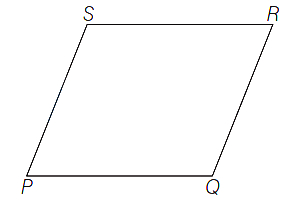
0 likesView Solution
356
MathematicsEasyMCQAP EAMCET · 2020
The foot of the perpendicular from $P(5, 7, 3)$ to the line joining $A(9, 13, 15)$ and $B(12, 21, 10)$ is:
A
$(-2, -19, 7)$
B
$(2, 19, 7)$
C
$(2, 2, 3)$
D
$(9, 13, 15)$
Solution
(D) Let $A = (9, 13, 15)$,$B = (12, 21, 10)$,and $P = (5, 7, 3)$. Let $Q(x, y, z)$ be the foot of the perpendicular from $P$ to the line $AB$.
The direction ratios of line $AB$ are $(12 - 9, 21 - 13, 10 - 15) = (3, 8, -5)$.
The equation of line $AB$ is $\frac{x - 9}{3} = \frac{y - 13}{8} = \frac{z - 15}{-5} = \lambda$.
Any point $Q$ on the line $AB$ is given by $Q = (3\lambda + 9, 8\lambda + 13, -5\lambda + 15)$.
The direction ratios of $PQ$ are $(3\lambda + 9 - 5, 8\lambda + 13 - 7, -5\lambda + 15 - 3) = (3\lambda + 4, 8\lambda + 6, -5\lambda + 12)$.
Since $PQ \perp AB$,the dot product of their direction ratios is zero:
$3(3\lambda + 4) + 8(8\lambda + 6) - 5(-5\lambda + 12) = 0$
$9\lambda + 12 + 64\lambda + 48 + 25\lambda - 60 = 0$
$98\lambda = 0 \implies \lambda = 0$.
Substituting $\lambda = 0$ into the coordinates of $Q$,we get $Q = (9, 13, 15)$.
Thus,the foot of the perpendicular is $(9, 13, 15)$,which corresponds to option $D$.
The direction ratios of line $AB$ are $(12 - 9, 21 - 13, 10 - 15) = (3, 8, -5)$.
The equation of line $AB$ is $\frac{x - 9}{3} = \frac{y - 13}{8} = \frac{z - 15}{-5} = \lambda$.
Any point $Q$ on the line $AB$ is given by $Q = (3\lambda + 9, 8\lambda + 13, -5\lambda + 15)$.
The direction ratios of $PQ$ are $(3\lambda + 9 - 5, 8\lambda + 13 - 7, -5\lambda + 15 - 3) = (3\lambda + 4, 8\lambda + 6, -5\lambda + 12)$.
Since $PQ \perp AB$,the dot product of their direction ratios is zero:
$3(3\lambda + 4) + 8(8\lambda + 6) - 5(-5\lambda + 12) = 0$
$9\lambda + 12 + 64\lambda + 48 + 25\lambda - 60 = 0$
$98\lambda = 0 \implies \lambda = 0$.
Substituting $\lambda = 0$ into the coordinates of $Q$,we get $Q = (9, 13, 15)$.
Thus,the foot of the perpendicular is $(9, 13, 15)$,which corresponds to option $D$.
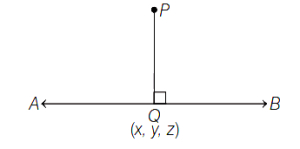
0 likesView Solution
357
MathematicsEasyMCQAP EAMCET · 2020
The Cartesian equation of the line passing through the point $(-1, 3, -2)$ and perpendicular to the lines $\frac{x}{1} = \frac{y}{2} = \frac{z}{3}$ and $\frac{x+2}{-3} = \frac{y-1}{2} = \frac{z+1}{5}$ is
A
$\frac{x-1}{2} = \frac{y+3}{7} = \frac{z-2}{4}$
B
$\frac{x-1}{-2} = \frac{y+3}{-7} = \frac{z-2}{-4}$
C
$\frac{x+1}{2} = \frac{y+3}{7} = \frac{z+2}{4}$
D
$\frac{x+1}{2} = \frac{y-3}{-7} = \frac{z+2}{4}$
Solution
(D) Let the direction ratios of the required line be $(a, b, c)$.
The line passes through the point $P(-1, 3, -2)$.
The direction ratios of the given lines are $\vec{v_1} = (1, 2, 3)$ and $\vec{v_2} = (-3, 2, 5)$.
Since the required line is perpendicular to both given lines,its direction vector $\vec{v} = (a, b, c)$ must be parallel to the cross product $\vec{v_1} \times \vec{v_2}$.
$\vec{v} = \vec{v_1} \times \vec{v_2} = \begin{vmatrix} \hat{i} & \hat{j} & \hat{k} \\ 1 & 2 & 3 \\ -3 & 2 & 5 \end{vmatrix} = \hat{i}(10 - 6) - \hat{j}(5 - (-9)) + \hat{k}(2 - (-6)) = 4\hat{i} - 14\hat{j} + 8\hat{k}$.
Dividing by $2$,we get the direction ratios as $(2, -7, 4)$.
The equation of the line passing through $(-1, 3, -2)$ with direction ratios $(2, -7, 4)$ is $\frac{x - (-1)}{2} = \frac{y - 3}{-7} = \frac{z - (-2)}{4}$,which simplifies to $\frac{x+1}{2} = \frac{y-3}{-7} = \frac{z+2}{4}$.
The line passes through the point $P(-1, 3, -2)$.
The direction ratios of the given lines are $\vec{v_1} = (1, 2, 3)$ and $\vec{v_2} = (-3, 2, 5)$.
Since the required line is perpendicular to both given lines,its direction vector $\vec{v} = (a, b, c)$ must be parallel to the cross product $\vec{v_1} \times \vec{v_2}$.
$\vec{v} = \vec{v_1} \times \vec{v_2} = \begin{vmatrix} \hat{i} & \hat{j} & \hat{k} \\ 1 & 2 & 3 \\ -3 & 2 & 5 \end{vmatrix} = \hat{i}(10 - 6) - \hat{j}(5 - (-9)) + \hat{k}(2 - (-6)) = 4\hat{i} - 14\hat{j} + 8\hat{k}$.
Dividing by $2$,we get the direction ratios as $(2, -7, 4)$.
The equation of the line passing through $(-1, 3, -2)$ with direction ratios $(2, -7, 4)$ is $\frac{x - (-1)}{2} = \frac{y - 3}{-7} = \frac{z - (-2)}{4}$,which simplifies to $\frac{x+1}{2} = \frac{y-3}{-7} = \frac{z+2}{4}$.
0 likesView Solution
358
MathematicsEasyMCQAP EAMCET · 2020
The angle between the lines with direction ratios $(2, -2, 1)$ and $(1, -2, 2)$ is
A
$\cos^{-1}\left(\frac{4}{9}\right)$
B
$\cos^{-1}\left(\frac{8}{9}\right)$
C
$\frac{\pi}{6}$
D
$\frac{\pi}{2}$
Solution
(B) Let the direction ratios of the two lines be $\vec{a} = (2, -2, 1)$ and $\vec{b} = (1, -2, 2)$.
The formula for the cosine of the angle $\theta$ between two lines with direction ratios $(a_1, b_1, c_1)$ and $(a_2, b_2, c_2)$ is given by:
$\cos \theta = \frac{|a_1 a_2 + b_1 b_2 + c_1 c_2|}{\sqrt{a_1^2 + b_1^2 + c_1^2} \sqrt{a_2^2 + b_2^2 + c_2^2}}$
Substituting the given values:
$\cos \theta = \frac{|(2)(1) + (-2)(-2) + (1)(2)|}{\sqrt{2^2 + (-2)^2 + 1^2} \sqrt{1^2 + (-2)^2 + 2^2}}$
Calculating the numerator:
$|2 + 4 + 2| = 8$
Calculating the denominators:
$\sqrt{4 + 4 + 1} = \sqrt{9} = 3$
$\sqrt{1 + 4 + 4} = \sqrt{9} = 3$
Thus,$\cos \theta = \frac{8}{3 \times 3} = \frac{8}{9}$.
Therefore,$\theta = \cos^{-1}\left(\frac{8}{9}\right)$.
The formula for the cosine of the angle $\theta$ between two lines with direction ratios $(a_1, b_1, c_1)$ and $(a_2, b_2, c_2)$ is given by:
$\cos \theta = \frac{|a_1 a_2 + b_1 b_2 + c_1 c_2|}{\sqrt{a_1^2 + b_1^2 + c_1^2} \sqrt{a_2^2 + b_2^2 + c_2^2}}$
Substituting the given values:
$\cos \theta = \frac{|(2)(1) + (-2)(-2) + (1)(2)|}{\sqrt{2^2 + (-2)^2 + 1^2} \sqrt{1^2 + (-2)^2 + 2^2}}$
Calculating the numerator:
$|2 + 4 + 2| = 8$
Calculating the denominators:
$\sqrt{4 + 4 + 1} = \sqrt{9} = 3$
$\sqrt{1 + 4 + 4} = \sqrt{9} = 3$
Thus,$\cos \theta = \frac{8}{3 \times 3} = \frac{8}{9}$.
Therefore,$\theta = \cos^{-1}\left(\frac{8}{9}\right)$.
0 likesView Solution
359
MathematicsEasyMCQAP EAMCET · 2020
The distance of the plane $2x - y - 2z - 9 = 0$ from the origin is $d$ units.
A
$3$
B
$\sqrt{3}$
C
$1$
D
$9$
Solution
(A) The distance of a plane $Ax + By + Cz + D = 0$ from a point $(x_1, y_1, z_1)$ is given by the formula:
$d = \left| \frac{Ax_1 + By_1 + Cz_1 + D}{\sqrt{A^2 + B^2 + C^2}} \right|$
Here,the plane is $2x - y - 2z - 9 = 0$ and the origin is $(0, 0, 0)$.
Substituting the values $A = 2, B = -1, C = -2, D = -9$ and $(x_1, y_1, z_1) = (0, 0, 0)$:
$d = \left| \frac{2(0) + (-1)(0) + (-2)(0) - 9}{\sqrt{2^2 + (-1)^2 + (-2)^2}} \right|$
$d = \left| \frac{-9}{\sqrt{4 + 1 + 4}} \right| = \left| \frac{-9}{\sqrt{9}} \right| = \left| \frac{-9}{3} \right| = 3 \text{ units.}$
$d = \left| \frac{Ax_1 + By_1 + Cz_1 + D}{\sqrt{A^2 + B^2 + C^2}} \right|$
Here,the plane is $2x - y - 2z - 9 = 0$ and the origin is $(0, 0, 0)$.
Substituting the values $A = 2, B = -1, C = -2, D = -9$ and $(x_1, y_1, z_1) = (0, 0, 0)$:
$d = \left| \frac{2(0) + (-1)(0) + (-2)(0) - 9}{\sqrt{2^2 + (-1)^2 + (-2)^2}} \right|$
$d = \left| \frac{-9}{\sqrt{4 + 1 + 4}} \right| = \left| \frac{-9}{\sqrt{9}} \right| = \left| \frac{-9}{3} \right| = 3 \text{ units.}$
0 likesView Solution
360
MathematicsMediumMCQAP EAMCET · 2020
The equation of the plane through the intersection of the planes $x+2y+3z-4=0$ and $4x+3y+2z+1=0$ and passing through the origin is
A
$17x+14y+11z=0$
B
$7x+4y+z=0$
C
$x+14y+11z=0$
D
$17x+y+z=0$
Solution
(A) The equation of any plane passing through the intersection of two planes $P_1: x+2y+3z-4=0$ and $P_2: 4x+3y+2z+1=0$ is given by $P_1 + \lambda P_2 = 0$.
$(x+2y+3z-4) + \lambda(4x+3y+2z+1) = 0$ ...$(i)$
Since the plane passes through the origin $(0,0,0)$,we substitute $x=0, y=0, z=0$ into equation $(i)$:
$(0+0+0-4) + \lambda(0+0+0+1) = 0$
$-4 + \lambda = 0 \Rightarrow \lambda = 4$
Substituting $\lambda = 4$ back into equation $(i)$:
$(x+2y+3z-4) + 4(4x+3y+2z+1) = 0$
$x+2y+3z-4 + 16x+12y+8z+4 = 0$
$17x+14y+11z = 0$
Thus,the correct option is $A$.
$(x+2y+3z-4) + \lambda(4x+3y+2z+1) = 0$ ...$(i)$
Since the plane passes through the origin $(0,0,0)$,we substitute $x=0, y=0, z=0$ into equation $(i)$:
$(0+0+0-4) + \lambda(0+0+0+1) = 0$
$-4 + \lambda = 0 \Rightarrow \lambda = 4$
Substituting $\lambda = 4$ back into equation $(i)$:
$(x+2y+3z-4) + 4(4x+3y+2z+1) = 0$
$x+2y+3z-4 + 16x+12y+8z+4 = 0$
$17x+14y+11z = 0$
Thus,the correct option is $A$.
0 likesView Solution
361
MathematicsMediumMCQAP EAMCET · 2020
Angle between the lines of intersection of the planes $x-y=0, 2x+y+z=0$ and $2x-z=0, x+y-3z=0$ is (in $^{\circ}$)
A
$60$
B
$45$
C
$30$
D
$90$
Solution
(D) Let the direction ratios of the line of intersection of the planes $x-y=0$ and $2x+y+z=0$ be $a_1, b_1, c_1$. Since the line lies in both planes,it is perpendicular to the normals of both planes. The normals are $\vec{n_1} = (1, -1, 0)$ and $\vec{n_2} = (2, 1, 1)$.
The direction vector $\vec{v_1} = \vec{n_1} \times \vec{n_2} = \begin{vmatrix} \hat{i} & \hat{j} & \hat{k} \\ 1 & -1 & 0 \\ 2 & 1 & 1 \end{vmatrix} = \hat{i}(-1-0) - \hat{j}(1-0) + \hat{k}(1+2) = -\hat{i} - \hat{j} + 3\hat{k}$.
Thus,the direction ratios are $(a_1, b_1, c_1) = (-1, -1, 3)$,which is equivalent to $(1, 1, -3)$.
Similarly,for the planes $2x-z=0$ and $x+y-3z=0$,the normals are $\vec{n_3} = (2, 0, -1)$ and $\vec{n_4} = (1, 1, -3)$.
The direction vector $\vec{v_2} = \vec{n_3} \times \vec{n_4} = \begin{vmatrix} \hat{i} & \hat{j} & \hat{k} \\ 2 & 0 & -1 \\ 1 & 1 & -3 \end{vmatrix} = \hat{i}(0+1) - \hat{j}(-6+1) + \hat{k}(2-0) = \hat{i} + 5\hat{j} + 2\hat{k}$.
Wait,re-calculating $\vec{v_2}$: $\hat{i}(0 - (-1)) - \hat{j}(-6 - (-1)) + \hat{k}(2 - 0) = \hat{i} + 5\hat{j} + 2\hat{k}$.
Let us re-calculate the cross product for the second set: $\vec{n_3} = (2, 0, -1)$,$\vec{n_4} = (1, 1, -3)$. $\vec{v_2} = (0(-3) - (-1)(1), -((-1)(1) - 2(-3)), 2(1) - 0(1)) = (1, -5, 2)$.
Now,the angle $\theta$ between $\vec{v_1} = (1, 1, -3)$ and $\vec{v_2} = (1, -5, 2)$ is given by $\cos \theta = \frac{|\vec{v_1} \cdot \vec{v_2}|}{|\vec{v_1}| |\vec{v_2}|}$.
$\vec{v_1} \cdot \vec{v_2} = (1)(1) + (1)(-5) + (-3)(2) = 1 - 5 - 6 = -10$.
$\cos \theta = \frac{|-10|}{\sqrt{1^2+1^2+(-3)^2} \sqrt{1^2+(-5)^2+2^2}} = \frac{10}{\sqrt{11} \sqrt{30}}$.
Re-checking the original problem values: $x-y=0, 2x+y+z=0 \Rightarrow \vec{v_1} = (1, 1, -3)$. $2x-z=0, x+y-3z=0 \Rightarrow \vec{v_2} = (1, 5, 2)$.
$\vec{v_1} \cdot \vec{v_2} = 1 + 5 - 6 = 0$. Since the dot product is $0$,the angle is $90^{\circ}$.
Hence,option $(d)$ is correct.
The direction vector $\vec{v_1} = \vec{n_1} \times \vec{n_2} = \begin{vmatrix} \hat{i} & \hat{j} & \hat{k} \\ 1 & -1 & 0 \\ 2 & 1 & 1 \end{vmatrix} = \hat{i}(-1-0) - \hat{j}(1-0) + \hat{k}(1+2) = -\hat{i} - \hat{j} + 3\hat{k}$.
Thus,the direction ratios are $(a_1, b_1, c_1) = (-1, -1, 3)$,which is equivalent to $(1, 1, -3)$.
Similarly,for the planes $2x-z=0$ and $x+y-3z=0$,the normals are $\vec{n_3} = (2, 0, -1)$ and $\vec{n_4} = (1, 1, -3)$.
The direction vector $\vec{v_2} = \vec{n_3} \times \vec{n_4} = \begin{vmatrix} \hat{i} & \hat{j} & \hat{k} \\ 2 & 0 & -1 \\ 1 & 1 & -3 \end{vmatrix} = \hat{i}(0+1) - \hat{j}(-6+1) + \hat{k}(2-0) = \hat{i} + 5\hat{j} + 2\hat{k}$.
Wait,re-calculating $\vec{v_2}$: $\hat{i}(0 - (-1)) - \hat{j}(-6 - (-1)) + \hat{k}(2 - 0) = \hat{i} + 5\hat{j} + 2\hat{k}$.
Let us re-calculate the cross product for the second set: $\vec{n_3} = (2, 0, -1)$,$\vec{n_4} = (1, 1, -3)$. $\vec{v_2} = (0(-3) - (-1)(1), -((-1)(1) - 2(-3)), 2(1) - 0(1)) = (1, -5, 2)$.
Now,the angle $\theta$ between $\vec{v_1} = (1, 1, -3)$ and $\vec{v_2} = (1, -5, 2)$ is given by $\cos \theta = \frac{|\vec{v_1} \cdot \vec{v_2}|}{|\vec{v_1}| |\vec{v_2}|}$.
$\vec{v_1} \cdot \vec{v_2} = (1)(1) + (1)(-5) + (-3)(2) = 1 - 5 - 6 = -10$.
$\cos \theta = \frac{|-10|}{\sqrt{1^2+1^2+(-3)^2} \sqrt{1^2+(-5)^2+2^2}} = \frac{10}{\sqrt{11} \sqrt{30}}$.
Re-checking the original problem values: $x-y=0, 2x+y+z=0 \Rightarrow \vec{v_1} = (1, 1, -3)$. $2x-z=0, x+y-3z=0 \Rightarrow \vec{v_2} = (1, 5, 2)$.
$\vec{v_1} \cdot \vec{v_2} = 1 + 5 - 6 = 0$. Since the dot product is $0$,the angle is $90^{\circ}$.
Hence,option $(d)$ is correct.
0 likesView Solution
362
MathematicsEasyMCQAP EAMCET · 2020
The image of the point with position vector $(\hat{i}+3 \hat{j}+4 \hat{k})$ in the plane $r \cdot(2 \hat{i}-\hat{j}+\hat{k})+3=0$ is
A
$(-3, 5, 2)$
B
$(3, 5, -2)$
C
$(-3, -5, 2)$
D
$(3, 5, 2)$
Solution
(A) Let the point be $P(1, 3, 4)$ and the plane be $2x - y + z + 3 = 0$.
The formula for the image $(x', y', z')$ of a point $(x_1, y_1, z_1)$ in the plane $ax + by + cz + d = 0$ is given by $\frac{x' - x_1}{a} = \frac{y' - y_1}{b} = \frac{z' - z_1}{c} = -2 \frac{ax_1 + by_1 + cz_1 + d}{a^2 + b^2 + c^2}$.
Substituting the values: $\frac{x' - 1}{2} = \frac{y' - 3}{-1} = \frac{z' - 4}{1} = -2 \frac{2(1) - 1(3) + 1(4) + 3}{2^2 + (-1)^2 + 1^2}$.
$\frac{x' - 1}{2} = \frac{y' - 3}{-1} = \frac{z' - 4}{1} = -2 \frac{2 - 3 + 4 + 3}{4 + 1 + 1} = -2 \frac{6}{6} = -2$.
Solving for coordinates:
$x' - 1 = 2(-2) \Rightarrow x' = -3$.
$y' - 3 = -1(-2) \Rightarrow y' = 5$.
$z' - 4 = 1(-2) \Rightarrow z' = 2$.
Thus,the image is $(-3, 5, 2)$.
Therefore,option $A$ is correct.
The formula for the image $(x', y', z')$ of a point $(x_1, y_1, z_1)$ in the plane $ax + by + cz + d = 0$ is given by $\frac{x' - x_1}{a} = \frac{y' - y_1}{b} = \frac{z' - z_1}{c} = -2 \frac{ax_1 + by_1 + cz_1 + d}{a^2 + b^2 + c^2}$.
Substituting the values: $\frac{x' - 1}{2} = \frac{y' - 3}{-1} = \frac{z' - 4}{1} = -2 \frac{2(1) - 1(3) + 1(4) + 3}{2^2 + (-1)^2 + 1^2}$.
$\frac{x' - 1}{2} = \frac{y' - 3}{-1} = \frac{z' - 4}{1} = -2 \frac{2 - 3 + 4 + 3}{4 + 1 + 1} = -2 \frac{6}{6} = -2$.
Solving for coordinates:
$x' - 1 = 2(-2) \Rightarrow x' = -3$.
$y' - 3 = -1(-2) \Rightarrow y' = 5$.
$z' - 4 = 1(-2) \Rightarrow z' = 2$.
Thus,the image is $(-3, 5, 2)$.
Therefore,option $A$ is correct.
0 likesView Solution
363
MathematicsEasyMCQAP EAMCET · 2020
The equation of the plane whose intercepts on $x, y, z$ axes are $1, 2, 4$ respectively is
A
$4x + 2y + z = 4$
B
$4x + 2y + z = 2$
C
$4x + 2y + z = 1$
D
$x + 2y + 4z = 0$
Solution
(A) The intercept form of the equation of a plane is given by $\frac{x}{a} + \frac{y}{b} + \frac{z}{c} = 1$,where $a, b, c$ are the intercepts on the $x, y, z$ axes respectively.
Given that the intercepts are $a = 1, b = 2, c = 4$.
Substituting these values into the formula,we get $\frac{x}{1} + \frac{y}{2} + \frac{z}{4} = 1$.
To simplify,multiply the entire equation by the least common multiple of the denominators,which is $4$.
$4 \times (\frac{x}{1}) + 4 \times (\frac{y}{2}) + 4 \times (\frac{z}{4}) = 4 \times 1$.
This simplifies to $4x + 2y + z = 4$.
Thus,the correct option is $A$.
Given that the intercepts are $a = 1, b = 2, c = 4$.
Substituting these values into the formula,we get $\frac{x}{1} + \frac{y}{2} + \frac{z}{4} = 1$.
To simplify,multiply the entire equation by the least common multiple of the denominators,which is $4$.
$4 \times (\frac{x}{1}) + 4 \times (\frac{y}{2}) + 4 \times (\frac{z}{4}) = 4 \times 1$.
This simplifies to $4x + 2y + z = 4$.
Thus,the correct option is $A$.
0 likesView Solution
364
MathematicsMediumMCQAP EAMCET · 2020
The equation of the locus of a point $P(x, y, z)$ such that its distance from the $X$-axis is equal to its distance from the plane $x+z=1$ is
A
$x^2-2 y^2-z^2+2 x z-2 x-2 z+1=0$
B
$x^2-2 y^2-z^2+2 x z-2 x-2 z-1=0$
C
$x^2+2 y^2+z^2+2 x z-2 x-2 z+1=0$
D
$x^2-2 y^2-z^2+2 x z-2 x+2 z+1=0$
Solution
(A) The distance of a point $P(x, y, z)$ from the $X$-axis is given by $\sqrt{y^2+z^2}$.
The distance of the point $P(x, y, z)$ from the plane $x+z-1=0$ is given by $\frac{|x+z-1|}{\sqrt{1^2+0^2+1^2}} = \frac{|x+z-1|}{\sqrt{2}}$.
According to the problem,these distances are equal:
$\sqrt{y^2+z^2} = \frac{|x+z-1|}{\sqrt{2}}$
Squaring both sides,we get:
$y^2+z^2 = \frac{(x+z-1)^2}{2}$
$2(y^2+z^2) = x^2+z^2+1+2xz-2x-2z$
$2y^2+2z^2 = x^2+z^2+1+2xz-2x-2z$
Rearranging the terms,we get:
$x^2-2y^2-z^2+2xz-2x-2z+1=0$
Thus,the correct option is $A$.
The distance of the point $P(x, y, z)$ from the plane $x+z-1=0$ is given by $\frac{|x+z-1|}{\sqrt{1^2+0^2+1^2}} = \frac{|x+z-1|}{\sqrt{2}}$.
According to the problem,these distances are equal:
$\sqrt{y^2+z^2} = \frac{|x+z-1|}{\sqrt{2}}$
Squaring both sides,we get:
$y^2+z^2 = \frac{(x+z-1)^2}{2}$
$2(y^2+z^2) = x^2+z^2+1+2xz-2x-2z$
$2y^2+2z^2 = x^2+z^2+1+2xz-2x-2z$
Rearranging the terms,we get:
$x^2-2y^2-z^2+2xz-2x-2z+1=0$
Thus,the correct option is $A$.
0 likesView Solution
365
MathematicsEasyMCQAP EAMCET · 2020
Find the angle between the planes $x+2y+2z-5=0$ and $3x+3y+2z-8=0$.
A
$\cos^{-1}\left(\frac{3}{\sqrt{22}}\right)$
B
$\cos^{-1}\left(\frac{13}{3\sqrt{22}}\right)$
C
$\cos^{-1}\left(\frac{1}{3\sqrt{22}}\right)$
D
$\cos^{-1}\left(\frac{13}{31}\right)$
Solution
(B) The equations of the given planes are $x+2y+2z-5=0$ and $3x+3y+2z-8=0$.
The normal vectors to these planes are $\vec{n_1} = \hat{i} + 2\hat{j} + 2\hat{k}$ and $\vec{n_2} = 3\hat{i} + 3\hat{j} + 2\hat{k}$.
The angle $\theta$ between two planes is given by $\cos \theta = \frac{|\vec{n_1} \cdot \vec{n_2}|}{|\vec{n_1}| |\vec{n_2}|}$.
Calculating the dot product: $\vec{n_1} \cdot \vec{n_2} = (1)(3) + (2)(3) + (2)(2) = 3 + 6 + 4 = 13$.
Calculating the magnitudes: $|\vec{n_1}| = \sqrt{1^2 + 2^2 + 2^2} = \sqrt{1+4+4} = \sqrt{9} = 3$ and $|\vec{n_2}| = \sqrt{3^2 + 3^2 + 2^2} = \sqrt{9+9+4} = \sqrt{22}$.
Thus,$\cos \theta = \frac{13}{3\sqrt{22}}$.
Therefore,$\theta = \cos^{-1}\left(\frac{13}{3\sqrt{22}}\right)$.
The normal vectors to these planes are $\vec{n_1} = \hat{i} + 2\hat{j} + 2\hat{k}$ and $\vec{n_2} = 3\hat{i} + 3\hat{j} + 2\hat{k}$.
The angle $\theta$ between two planes is given by $\cos \theta = \frac{|\vec{n_1} \cdot \vec{n_2}|}{|\vec{n_1}| |\vec{n_2}|}$.
Calculating the dot product: $\vec{n_1} \cdot \vec{n_2} = (1)(3) + (2)(3) + (2)(2) = 3 + 6 + 4 = 13$.
Calculating the magnitudes: $|\vec{n_1}| = \sqrt{1^2 + 2^2 + 2^2} = \sqrt{1+4+4} = \sqrt{9} = 3$ and $|\vec{n_2}| = \sqrt{3^2 + 3^2 + 2^2} = \sqrt{9+9+4} = \sqrt{22}$.
Thus,$\cos \theta = \frac{13}{3\sqrt{22}}$.
Therefore,$\theta = \cos^{-1}\left(\frac{13}{3\sqrt{22}}\right)$.
0 likesView Solution
366
MathematicsEasyMCQAP EAMCET · 2020
The equation of the plane mid-parallel to the planes $2x - 3y + 6z + 21 = 0$ and $2x - 3y + 6z - 14 = 0$ is given by
A
$4x - 6y + 12z + 7 = 0$
B
$4x - 6y + 12z - 7 = 0$
C
$2x - 3y + 6z + 7 = 0$
D
$2x - 3y + 6z + 3.5 = 0$
Solution
(A) The given planes are $P_1: 2x - 3y + 6z + 21 = 0$ and $P_2: 2x - 3y + 6z - 14 = 0$.
Since the planes are parallel,the mid-parallel plane will have the same normal vector $(2, -3, 6)$.
Let the equation of the mid-parallel plane be $2x - 3y + 6z + d = 0$.
The constant term $d$ of the mid-parallel plane is the average of the constant terms of the two given planes,provided the coefficients of $x, y, z$ are identical.
First,ensure the coefficients are the same. Here they are already the same.
The constant $d$ is given by $d = \frac{d_1 + d_2}{2} = \frac{21 + (-14)}{2} = \frac{7}{2} = 3.5$.
Thus,the equation is $2x - 3y + 6z + 3.5 = 0$.
Multiplying by $2$ to clear the fraction,we get $4x - 6y + 12z + 7 = 0$.
Since the planes are parallel,the mid-parallel plane will have the same normal vector $(2, -3, 6)$.
Let the equation of the mid-parallel plane be $2x - 3y + 6z + d = 0$.
The constant term $d$ of the mid-parallel plane is the average of the constant terms of the two given planes,provided the coefficients of $x, y, z$ are identical.
First,ensure the coefficients are the same. Here they are already the same.
The constant $d$ is given by $d = \frac{d_1 + d_2}{2} = \frac{21 + (-14)}{2} = \frac{7}{2} = 3.5$.
Thus,the equation is $2x - 3y + 6z + 3.5 = 0$.
Multiplying by $2$ to clear the fraction,we get $4x - 6y + 12z + 7 = 0$.
0 likesView Solution
367
MathematicsMediumMCQAP EAMCET · 2020
The equation of the line passing through the intersection of the plane $x+2y+3z=4$ and the line $\frac{x-1}{2}=\frac{y+1}{1}=\frac{z-1}{-1}$ and parallel to the vector $(2\hat{i}-3\hat{j}) \times (\hat{i}+2\hat{j}-\hat{k})$ is
A
$\frac{x-5}{3}=\frac{y-1}{2}=\frac{z+1}{-7}$
B
$\frac{x-5}{-3}=\frac{y-1}{-2}=\frac{z-1}{7}$
C
$\frac{x-5}{-3}=\frac{y-1}{-2}=\frac{z+1}{-7}$
D
$\frac{x-5}{-3}=\frac{y-1}{2}=\frac{z+1}{7}$
Solution
(C) Let the general point $P$ on the line $\frac{x-1}{2}=\frac{y+1}{1}=\frac{z-1}{-1}=r$ be $P(2r+1, r-1, 1-r)$.
Since $P$ lies on the plane $x+2y+3z=4$,we substitute the coordinates of $P$ into the plane equation:
$(2r+1) + 2(r-1) + 3(1-r) = 4$
$2r + 1 + 2r - 2 + 3 - 3r = 4$
$r + 2 = 4 \Rightarrow r = 2$.
Substituting $r=2$ into the coordinates of $P$,we get the point of intersection as $P(5, 1, -1)$.
The direction vector of the required line is given by the cross product:
$\vec{v} = (2\hat{i}-3\hat{j}) \times (\hat{i}+2\hat{j}-\hat{k}) = \begin{vmatrix} \hat{i} & \hat{j} & \hat{k} \\ 2 & -3 & 0 \\ 1 & 2 & -1 \end{vmatrix}$
$= \hat{i}(3-0) - \hat{j}(-2-0) + \hat{k}(4+3) = 3\hat{i} + 2\hat{j} + 7\hat{k}$.
The equation of the line passing through $(5, 1, -1)$ with direction vector $(3, 2, 7)$ is $\frac{x-5}{3} = \frac{y-1}{2} = \frac{z+1}{7}$.
Multiplying the denominators by $-1$,we get $\frac{x-5}{-3} = \frac{y-1}{-2} = \frac{z+1}{-7}$,which matches option $C$.
Since $P$ lies on the plane $x+2y+3z=4$,we substitute the coordinates of $P$ into the plane equation:
$(2r+1) + 2(r-1) + 3(1-r) = 4$
$2r + 1 + 2r - 2 + 3 - 3r = 4$
$r + 2 = 4 \Rightarrow r = 2$.
Substituting $r=2$ into the coordinates of $P$,we get the point of intersection as $P(5, 1, -1)$.
The direction vector of the required line is given by the cross product:
$\vec{v} = (2\hat{i}-3\hat{j}) \times (\hat{i}+2\hat{j}-\hat{k}) = \begin{vmatrix} \hat{i} & \hat{j} & \hat{k} \\ 2 & -3 & 0 \\ 1 & 2 & -1 \end{vmatrix}$
$= \hat{i}(3-0) - \hat{j}(-2-0) + \hat{k}(4+3) = 3\hat{i} + 2\hat{j} + 7\hat{k}$.
The equation of the line passing through $(5, 1, -1)$ with direction vector $(3, 2, 7)$ is $\frac{x-5}{3} = \frac{y-1}{2} = \frac{z+1}{7}$.
Multiplying the denominators by $-1$,we get $\frac{x-5}{-3} = \frac{y-1}{-2} = \frac{z+1}{-7}$,which matches option $C$.
0 likesView Solution
368
MathematicsMediumMCQAP EAMCET · 2020
The unit vectors orthogonal to $3 \hat{i}+2 \hat{j}+6 \hat{k}$ and coplanar with $2 \hat{i}+\hat{j}+\hat{k}$ and $\hat{i}-\hat{j}+\hat{k}$ are
A
$\pm \frac{1}{\sqrt{5}}(2 \hat{i}-\hat{k})$
B
$\pm \frac{1}{\sqrt{10}}(3 \hat{j}-\hat{k})$
C
$\pm \frac{1}{\sqrt{13}}(2 \hat{i}-3 \hat{j})$
D
$\pm \frac{1}{\sqrt{17}}(2 \hat{i}+3 \hat{j}-2 \hat{k})$
Solution
(B) Let the required vector be $\vec{v} = a(2 \hat{i}+\hat{j}+\hat{k}) + b(\hat{i}-\hat{j}+\hat{k})$.
This simplifies to $\vec{v} = (2a+b)\hat{i} + (a-b)\hat{j} + (a+b)\hat{k}$.
Since $\vec{v}$ is orthogonal to $3 \hat{i}+2 \hat{j}+6 \hat{k}$,their dot product is zero:
$3(2a+b) + 2(a-b) + 6(a+b) = 0$.
$6a + 3b + 2a - 2b + 6a + 6b = 0$.
$14a + 7b = 0 \implies b = -2a$.
Substituting $b = -2a$ into the expression for $\vec{v}$:
$\vec{v} = (2a - 2a)\hat{i} + (a - (-2a))\hat{j} + (a + (-2a))\hat{k} = 0\hat{i} + 3a\hat{j} - a\hat{k} = a(3\hat{j} - \hat{k})$.
The unit vector is $\pm \frac{\vec{v}}{|\vec{v}|} = \pm \frac{a(3\hat{j} - \hat{k})}{|a|\sqrt{3^2 + (-1)^2}} = \pm \frac{3\hat{j} - \hat{k}}{\sqrt{10}}$.
This simplifies to $\vec{v} = (2a+b)\hat{i} + (a-b)\hat{j} + (a+b)\hat{k}$.
Since $\vec{v}$ is orthogonal to $3 \hat{i}+2 \hat{j}+6 \hat{k}$,their dot product is zero:
$3(2a+b) + 2(a-b) + 6(a+b) = 0$.
$6a + 3b + 2a - 2b + 6a + 6b = 0$.
$14a + 7b = 0 \implies b = -2a$.
Substituting $b = -2a$ into the expression for $\vec{v}$:
$\vec{v} = (2a - 2a)\hat{i} + (a - (-2a))\hat{j} + (a + (-2a))\hat{k} = 0\hat{i} + 3a\hat{j} - a\hat{k} = a(3\hat{j} - \hat{k})$.
The unit vector is $\pm \frac{\vec{v}}{|\vec{v}|} = \pm \frac{a(3\hat{j} - \hat{k})}{|a|\sqrt{3^2 + (-1)^2}} = \pm \frac{3\hat{j} - \hat{k}}{\sqrt{10}}$.
0 likesView Solution
369
MathematicsMediumMCQAP EAMCET · 2020
Let $u$ and $v$ be two vectors in a plane. Then any vector $w$ in the plane can be written as $w = au + bv$ for some scalars $a$ and $b$ if and only if
A
None of $u$ and $v$ is a scalar multiple of the other
B
None of $|u|$ and $|v|$ is a scalar multiple of the other
C
$u$ and $v$ have different directions
D
$u$ and $v$ are perpendicular to each other
Solution
(A) For any vector $w$ in a plane to be represented as a linear combination $w = au + bv$ of two vectors $u$ and $v$ in that same plane,the vectors $u$ and $v$ must be linearly independent.
Two vectors are linearly independent if and only if they are not parallel to each other.
This means that neither $u$ can be written as $k \cdot v$ nor $v$ can be written as $k \cdot u$ for any scalar $k$.
Therefore,the condition is that none of $u$ and $v$ is a scalar multiple of the other.
Thus,option $A$ is the correct answer.
Two vectors are linearly independent if and only if they are not parallel to each other.
This means that neither $u$ can be written as $k \cdot v$ nor $v$ can be written as $k \cdot u$ for any scalar $k$.
Therefore,the condition is that none of $u$ and $v$ is a scalar multiple of the other.
Thus,option $A$ is the correct answer.
0 likesView Solution
370
MathematicsMediumMCQAP EAMCET · 2020
The line segment joining the points $A(2, 3, 4)$ and $B(-3, 5, -4)$ intersects the $yz$-plane at the point:
A
$\left(0, \frac{19}{5}, \frac{4}{5}\right)$
B
$(0, 4, 5)$
C
$\left(9, \frac{14}{5}, 4\right)$
D
$(0, 0, 0)$
Solution
(A) Let the $yz$-plane intersect the line segment joining points $A(2, 3, 4)$ and $B(-3, 5, -4)$ in the ratio $\lambda : 1$ at point $M$.
Using the section formula,the coordinates of point $M$ are given by:
$M = \left( \frac{-3\lambda + 2}{\lambda + 1}, \frac{5\lambda + 3}{\lambda + 1}, \frac{-4\lambda + 4}{\lambda + 1} \right)$.
Since the point $M$ lies on the $yz$-plane,its $x$-coordinate must be $0$.
Therefore,$\frac{-3\lambda + 2}{\lambda + 1} = 0$,which implies $-3\lambda + 2 = 0$,so $\lambda = \frac{2}{3}$.
Substituting $\lambda = \frac{2}{3}$ into the coordinates of $M$:
$y = \frac{5(2/3) + 3}{(2/3) + 1} = \frac{10/3 + 9/3}{5/3} = \frac{19}{5}$.
$z = \frac{-4(2/3) + 4}{(2/3) + 1} = \frac{-8/3 + 12/3}{5/3} = \frac{4}{5}$.
Thus,the point of intersection is $\left(0, \frac{19}{5}, \frac{4}{5}\right)$.
Hence,option $A$ is correct.
Using the section formula,the coordinates of point $M$ are given by:
$M = \left( \frac{-3\lambda + 2}{\lambda + 1}, \frac{5\lambda + 3}{\lambda + 1}, \frac{-4\lambda + 4}{\lambda + 1} \right)$.
Since the point $M$ lies on the $yz$-plane,its $x$-coordinate must be $0$.
Therefore,$\frac{-3\lambda + 2}{\lambda + 1} = 0$,which implies $-3\lambda + 2 = 0$,so $\lambda = \frac{2}{3}$.
Substituting $\lambda = \frac{2}{3}$ into the coordinates of $M$:
$y = \frac{5(2/3) + 3}{(2/3) + 1} = \frac{10/3 + 9/3}{5/3} = \frac{19}{5}$.
$z = \frac{-4(2/3) + 4}{(2/3) + 1} = \frac{-8/3 + 12/3}{5/3} = \frac{4}{5}$.
Thus,the point of intersection is $\left(0, \frac{19}{5}, \frac{4}{5}\right)$.
Hence,option $A$ is correct.
0 likesView Solution
371
MathematicsEasyMCQAP EAMCET · 2020
The equation of the plane passing through the intersection of the lines $\frac{x-1}{1}=\frac{y-2}{2}=\frac{z-5}{-3}$ and $\frac{x+5}{3}=\frac{y-4}{-1}=\frac{z+3}{4}$ and parallel to the $xy$-plane is
A
$z=4$
B
$z=2$
C
$z=5$
D
$z=-5$
Solution
(C) Let the equations of the given lines be:
$\frac{x-1}{1}=\frac{y-2}{2}=\frac{z-5}{-3}=r_1$
and
$\frac{x+5}{3}=\frac{y-4}{-1}=\frac{z+3}{4}=r_2$.
For the intersection point,we equate the coordinates:
$x = r_1 + 1 = 3r_2 - 5$
$y = 2r_1 + 2 = -r_2 + 4$
$z = -3r_1 + 5 = 4r_2 - 3$
Solving the first two equations:
$r_1 - 3r_2 = -6$
$2r_1 + r_2 = 2$
Multiplying the second by $3$: $6r_1 + 3r_2 = 6$.
Adding to the first: $7r_1 = 0 \implies r_1 = 0$.
Then $r_2 = 2$.
Checking in the third equation: $-3(0) + 5 = 5$ and $4(2) - 3 = 5$.
Since $5 = 5$,the lines intersect at point $A(1, 2, 5)$.
$A$ plane parallel to the $xy$-plane has the equation $z = k$.
Since it passes through $(1, 2, 5)$,we have $z = 5$.
Thus,the correct option is $C$.
$\frac{x-1}{1}=\frac{y-2}{2}=\frac{z-5}{-3}=r_1$
and
$\frac{x+5}{3}=\frac{y-4}{-1}=\frac{z+3}{4}=r_2$.
For the intersection point,we equate the coordinates:
$x = r_1 + 1 = 3r_2 - 5$
$y = 2r_1 + 2 = -r_2 + 4$
$z = -3r_1 + 5 = 4r_2 - 3$
Solving the first two equations:
$r_1 - 3r_2 = -6$
$2r_1 + r_2 = 2$
Multiplying the second by $3$: $6r_1 + 3r_2 = 6$.
Adding to the first: $7r_1 = 0 \implies r_1 = 0$.
Then $r_2 = 2$.
Checking in the third equation: $-3(0) + 5 = 5$ and $4(2) - 3 = 5$.
Since $5 = 5$,the lines intersect at point $A(1, 2, 5)$.
$A$ plane parallel to the $xy$-plane has the equation $z = k$.
Since it passes through $(1, 2, 5)$,we have $z = 5$.
Thus,the correct option is $C$.
0 likesView Solution
372
MathematicsEasyMCQAP EAMCET · 2020
The line passing through the points $(1, 1, -1)$ and $(3, -1, 0)$ makes an angle of $\operatorname{Tan}^{-1}\left(\frac{1}{\sqrt{8}}\right)$ with the plane $\sqrt{\lambda} x + 3y + 6z = 17$. Then $\lambda =$
A
$5$
B
$25$
C
$15$
D
$12$
Solution
(C) The direction vector of the line passing through $P(1, 1, -1)$ and $Q(3, -1, 0)$ is $\vec{v} = (3-1)\hat{i} + (-1-1)\hat{j} + (0-(-1))\hat{k} = 2\hat{i} - 2\hat{j} + \hat{k}$.
The normal vector to the plane $\sqrt{\lambda} x + 3y + 6z = 17$ is $\vec{n} = \sqrt{\lambda}\hat{i} + 3\hat{j} + 6\hat{k}$.
The angle $\theta$ between a line with direction $\vec{v}$ and a plane with normal $\vec{n}$ is given by $\sin \theta = \frac{|\vec{v} \cdot \vec{n}|}{|\vec{v}| |\vec{n}|}$.
Given $\theta = \operatorname{Tan}^{-1}\left(\frac{1}{\sqrt{8}}\right)$,we have $\tan \theta = \frac{1}{\sqrt{8}}$,which implies $\sin \theta = \frac{1}{\sqrt{1^2 + (\sqrt{8})^2}} = \frac{1}{3}$.
Calculating the dot product: $\vec{v} \cdot \vec{n} = (2)(\sqrt{\lambda}) + (-2)(3) + (1)(6) = 2\sqrt{\lambda} - 6 + 6 = 2\sqrt{\lambda}$.
Calculating magnitudes: $|\vec{v}| = \sqrt{2^2 + (-2)^2 + 1^2} = \sqrt{4+4+1} = 3$ and $|\vec{n}| = \sqrt{(\sqrt{\lambda})^2 + 3^2 + 6^2} = \sqrt{\lambda + 9 + 36} = \sqrt{\lambda + 45}$.
Substituting into the formula: $\frac{1}{3} = \frac{|2\sqrt{\lambda}|}{3 \sqrt{\lambda + 45}}$.
$1 = \frac{2\sqrt{\lambda}}{\sqrt{\lambda + 45}} \implies \sqrt{\lambda + 45} = 2\sqrt{\lambda}$.
Squaring both sides: $\lambda + 45 = 4\lambda \implies 3\lambda = 45 \implies \lambda = 15$.
The normal vector to the plane $\sqrt{\lambda} x + 3y + 6z = 17$ is $\vec{n} = \sqrt{\lambda}\hat{i} + 3\hat{j} + 6\hat{k}$.
The angle $\theta$ between a line with direction $\vec{v}$ and a plane with normal $\vec{n}$ is given by $\sin \theta = \frac{|\vec{v} \cdot \vec{n}|}{|\vec{v}| |\vec{n}|}$.
Given $\theta = \operatorname{Tan}^{-1}\left(\frac{1}{\sqrt{8}}\right)$,we have $\tan \theta = \frac{1}{\sqrt{8}}$,which implies $\sin \theta = \frac{1}{\sqrt{1^2 + (\sqrt{8})^2}} = \frac{1}{3}$.
Calculating the dot product: $\vec{v} \cdot \vec{n} = (2)(\sqrt{\lambda}) + (-2)(3) + (1)(6) = 2\sqrt{\lambda} - 6 + 6 = 2\sqrt{\lambda}$.
Calculating magnitudes: $|\vec{v}| = \sqrt{2^2 + (-2)^2 + 1^2} = \sqrt{4+4+1} = 3$ and $|\vec{n}| = \sqrt{(\sqrt{\lambda})^2 + 3^2 + 6^2} = \sqrt{\lambda + 9 + 36} = \sqrt{\lambda + 45}$.
Substituting into the formula: $\frac{1}{3} = \frac{|2\sqrt{\lambda}|}{3 \sqrt{\lambda + 45}}$.
$1 = \frac{2\sqrt{\lambda}}{\sqrt{\lambda + 45}} \implies \sqrt{\lambda + 45} = 2\sqrt{\lambda}$.
Squaring both sides: $\lambda + 45 = 4\lambda \implies 3\lambda = 45 \implies \lambda = 15$.
0 likesView Solution
373
MathematicsEasyMCQAP EAMCET · 2020
$A$ die is rolled three times. The probability of getting their sum equal to a prime number of the form $4n+1$ is
A
$\frac{1}{6}$
B
$\frac{7}{36}$
C
$\frac{5}{36}$
D
$\frac{11}{36}$
Solution
(C) When a die is rolled three times,the total number of outcomes is $6 \times 6 \times 6 = 216$.
We are looking for the sum $S$ such that $S$ is a prime number of the form $4n+1$.
The possible sums range from $3$ to $18$.
The prime numbers in this range are $3, 5, 7, 11, 13, 17$.
Among these,the primes of the form $4n+1$ are $5, 13, 17$.
Number of ways to get sum $5$: $(1,1,3)$ in $3$ permutations,$(1,2,2)$ in $3$ permutations. Total = $6$ ways.
Number of ways to get sum $13$: $(1,6,6)$ in $3$ permutations,$(2,5,6)$ in $6$ permutations,$(3,4,6)$ in $6$ permutations,$(3,5,5)$ in $3$ permutations,$(4,4,5)$ in $3$ permutations. Total = $21$ ways.
Number of ways to get sum $17$: $(5,6,6)$ in $3$ permutations. Total = $3$ ways.
Total favorable outcomes = $6 + 21 + 3 = 30$.
Required probability = $\frac{30}{216} = \frac{5}{36}$.
We are looking for the sum $S$ such that $S$ is a prime number of the form $4n+1$.
The possible sums range from $3$ to $18$.
The prime numbers in this range are $3, 5, 7, 11, 13, 17$.
Among these,the primes of the form $4n+1$ are $5, 13, 17$.
Number of ways to get sum $5$: $(1,1,3)$ in $3$ permutations,$(1,2,2)$ in $3$ permutations. Total = $6$ ways.
Number of ways to get sum $13$: $(1,6,6)$ in $3$ permutations,$(2,5,6)$ in $6$ permutations,$(3,4,6)$ in $6$ permutations,$(3,5,5)$ in $3$ permutations,$(4,4,5)$ in $3$ permutations. Total = $21$ ways.
Number of ways to get sum $17$: $(5,6,6)$ in $3$ permutations. Total = $3$ ways.
Total favorable outcomes = $6 + 21 + 3 = 30$.
Required probability = $\frac{30}{216} = \frac{5}{36}$.
0 likesView Solution
374
MathematicsEasyMCQAP EAMCET · 2020
The contents of $3$ boxes are as follows. If one box is chosen at random and three balls are drawn from it and they are all of different colours,find the probability that they come from Box $2$.
Box $1$ contains $1$ black,$2$ white,$3$ red balls.
Box $2$ contains $1$ black,$1$ white,$2$ red balls.
Box $3$ contains $5$ black,$4$ white,$1$ red balls.
Box $1$ contains $1$ black,$2$ white,$3$ red balls.
Box $2$ contains $1$ black,$1$ white,$2$ red balls.
Box $3$ contains $5$ black,$4$ white,$1$ red balls.
A
$\frac{9}{29}$
B
$\frac{15}{29}$
C
$\frac{5}{29}$
D
$\frac{6}{29}$
Solution
(B) This is a problem of Bayes' theorem.
Let $A$ be the event that all $3$ balls are of different colours.
Let $E_1, E_2, E_3$ be the events that Box $1$,Box $2$,and Box $3$ are chosen respectively.
Since one box is chosen at random,$P(E_1) = P(E_2) = P(E_3) = \frac{1}{3}$.
The probability of drawing $3$ balls of different colours from each box is:
$P(A|E_1) = \frac{{}^1C_1 \times {}^2C_1 \times {}^3C_1}{{}^6C_3} = \frac{1 \times 2 \times 3}{20} = \frac{6}{20} = \frac{3}{10}$
$P(A|E_2) = \frac{{}^1C_1 \times {}^1C_1 \times {}^2C_1}{{}^4C_3} = \frac{1 \times 1 \times 2}{4} = \frac{2}{4} = \frac{1}{2}$
$P(A|E_3) = \frac{{}^5C_1 \times {}^4C_1 \times {}^1C_1}{{}^{10}C_3} = \frac{5 \times 4 \times 1}{120} = \frac{20}{120} = \frac{1}{6}$
By Bayes' theorem,the probability that the balls came from Box $2$ is:
$P(E_2|A) = \frac{P(E_2) \cdot P(A|E_2)}{P(E_1) \cdot P(A|E_1) + P(E_2) \cdot P(A|E_2) + P(E_3) \cdot P(A|E_3)}$
$P(E_2|A) = \frac{\frac{1}{3} \times \frac{1}{2}}{\frac{1}{3} \times \frac{3}{10} + \frac{1}{3} \times \frac{1}{2} + \frac{1}{3} \times \frac{1}{6}}$
$P(E_2|A) = \frac{\frac{1}{6}}{\frac{1}{10} + \frac{1}{6} + \frac{1}{18}} = \frac{\frac{1}{6}}{\frac{9+15+5}{90}} = \frac{\frac{1}{6}}{\frac{29}{90}} = \frac{1}{6} \times \frac{90}{29} = \frac{15}{29}$
Let $A$ be the event that all $3$ balls are of different colours.
Let $E_1, E_2, E_3$ be the events that Box $1$,Box $2$,and Box $3$ are chosen respectively.
Since one box is chosen at random,$P(E_1) = P(E_2) = P(E_3) = \frac{1}{3}$.
The probability of drawing $3$ balls of different colours from each box is:
$P(A|E_1) = \frac{{}^1C_1 \times {}^2C_1 \times {}^3C_1}{{}^6C_3} = \frac{1 \times 2 \times 3}{20} = \frac{6}{20} = \frac{3}{10}$
$P(A|E_2) = \frac{{}^1C_1 \times {}^1C_1 \times {}^2C_1}{{}^4C_3} = \frac{1 \times 1 \times 2}{4} = \frac{2}{4} = \frac{1}{2}$
$P(A|E_3) = \frac{{}^5C_1 \times {}^4C_1 \times {}^1C_1}{{}^{10}C_3} = \frac{5 \times 4 \times 1}{120} = \frac{20}{120} = \frac{1}{6}$
By Bayes' theorem,the probability that the balls came from Box $2$ is:
$P(E_2|A) = \frac{P(E_2) \cdot P(A|E_2)}{P(E_1) \cdot P(A|E_1) + P(E_2) \cdot P(A|E_2) + P(E_3) \cdot P(A|E_3)}$
$P(E_2|A) = \frac{\frac{1}{3} \times \frac{1}{2}}{\frac{1}{3} \times \frac{3}{10} + \frac{1}{3} \times \frac{1}{2} + \frac{1}{3} \times \frac{1}{6}}$
$P(E_2|A) = \frac{\frac{1}{6}}{\frac{1}{10} + \frac{1}{6} + \frac{1}{18}} = \frac{\frac{1}{6}}{\frac{9+15+5}{90}} = \frac{\frac{1}{6}}{\frac{29}{90}} = \frac{1}{6} \times \frac{90}{29} = \frac{15}{29}$
0 likesView Solution
375
MathematicsMediumMCQAP EAMCET · 2020
When a coin is tossed $6$ times,the probability of getting more heads than tails is
A
$\frac{13}{32}$
B
$\frac{15}{32}$
C
$\frac{9}{32}$
D
$\frac{11}{32}$
Solution
(D) Total number of outcomes when a coin is tossed $6$ times is $2^6 = 64$.
Let $X$ be the number of heads. We want the probability $P(X > 3)$,which means $X$ can be $4, 5,$ or $6$.
The number of ways to get $r$ heads in $n$ tosses is given by $\binom{n}{r}$.
Number of ways to get $4$ heads $= \binom{6}{4} = \frac{6!}{4!2!} = 15$.
Number of ways to get $5$ heads $= \binom{6}{5} = \frac{6!}{5!1!} = 6$.
Number of ways to get $6$ heads $= \binom{6}{6} = \frac{6!}{6!0!} = 1$.
Total favorable outcomes $= 15 + 6 + 1 = 22$.
Required Probability $= \frac{22}{64} = \frac{11}{32}$.
Hence,option $D$ is correct.
Let $X$ be the number of heads. We want the probability $P(X > 3)$,which means $X$ can be $4, 5,$ or $6$.
The number of ways to get $r$ heads in $n$ tosses is given by $\binom{n}{r}$.
Number of ways to get $4$ heads $= \binom{6}{4} = \frac{6!}{4!2!} = 15$.
Number of ways to get $5$ heads $= \binom{6}{5} = \frac{6!}{5!1!} = 6$.
Number of ways to get $6$ heads $= \binom{6}{6} = \frac{6!}{6!0!} = 1$.
Total favorable outcomes $= 15 + 6 + 1 = 22$.
Required Probability $= \frac{22}{64} = \frac{11}{32}$.
Hence,option $D$ is correct.
0 likesView Solution
376
MathematicsEasyMCQAP EAMCET · 2020
If $P$ and $Q$ each toss three coins,the probability that both get the same number of heads is
A
$\frac{3}{8}$
B
$\frac{1}{9}$
C
$\frac{3}{16}$
D
$\frac{5}{16}$
Solution
(D) Let $X$ be the number of heads obtained by $P$ and $Y$ be the number of heads obtained by $Q$. Both $X$ and $Y$ follow a binomial distribution $B(n=3, p=0.5)$.
The probability of getting $r$ heads in $3$ tosses is given by $P(X=r) = ^{3}C_{r} (0.5)^3$.
We want to find $P(X=Y) = \sum_{r=0}^{3} P(X=r) \times P(Y=r)$.
Since $P(X=r) = P(Y=r)$,this becomes $\sum_{r=0}^{3} [P(X=r)]^2$.
$P(X=0) = ^{3}C_{0} (0.5)^3 = \frac{1}{8}$,$P(X=1) = ^{3}C_{1} (0.5)^3 = \frac{3}{8}$,$P(X=2) = ^{3}C_{2} (0.5)^3 = \frac{3}{8}$,$P(X=3) = ^{3}C_{3} (0.5)^3 = \frac{1}{8}$.
$P(X=Y) = (\frac{1}{8})^2 + (\frac{3}{8})^2 + (\frac{3}{8})^2 + (\frac{1}{8})^2 = \frac{1+9+9+1}{64} = \frac{20}{64} = \frac{5}{16}$.
Thus,option $D$ is correct.
The probability of getting $r$ heads in $3$ tosses is given by $P(X=r) = ^{3}C_{r} (0.5)^3$.
We want to find $P(X=Y) = \sum_{r=0}^{3} P(X=r) \times P(Y=r)$.
Since $P(X=r) = P(Y=r)$,this becomes $\sum_{r=0}^{3} [P(X=r)]^2$.
$P(X=0) = ^{3}C_{0} (0.5)^3 = \frac{1}{8}$,$P(X=1) = ^{3}C_{1} (0.5)^3 = \frac{3}{8}$,$P(X=2) = ^{3}C_{2} (0.5)^3 = \frac{3}{8}$,$P(X=3) = ^{3}C_{3} (0.5)^3 = \frac{1}{8}$.
$P(X=Y) = (\frac{1}{8})^2 + (\frac{3}{8})^2 + (\frac{3}{8})^2 + (\frac{1}{8})^2 = \frac{1+9+9+1}{64} = \frac{20}{64} = \frac{5}{16}$.
Thus,option $D$ is correct.
0 likesView Solution
377
MathematicsMediumMCQAP EAMCET · 2020
Five different books are to be distributed among four students randomly. The probability that each child gets at least one book is
A
$\frac{21}{64}$
B
$\frac{15}{64}$
C
$\frac{31}{64}$
D
$\frac{51}{64}$
Solution
(B) The total number of ways to distribute $5$ different books among $4$ students is $4^5 = 1024$.
To ensure each student gets at least one book,we must distribute the books such that one student gets $2$ books and the other three students get $1$ book each.
The number of ways to choose which student gets $2$ books is $\binom{4}{1} = 4$.
The number of ways to choose $2$ books out of $5$ is $\binom{5}{2} = 10$.
The number of ways to distribute the remaining $3$ books to the remaining $3$ students is $3! = 6$.
Total favorable ways = $4 \times 10 \times 6 = 240$.
The required probability is $\frac{240}{1024} = \frac{15}{64}$.
Thus,option $B$ is correct.
To ensure each student gets at least one book,we must distribute the books such that one student gets $2$ books and the other three students get $1$ book each.
The number of ways to choose which student gets $2$ books is $\binom{4}{1} = 4$.
The number of ways to choose $2$ books out of $5$ is $\binom{5}{2} = 10$.
The number of ways to distribute the remaining $3$ books to the remaining $3$ students is $3! = 6$.
Total favorable ways = $4 \times 10 \times 6 = 240$.
The required probability is $\frac{240}{1024} = \frac{15}{64}$.
Thus,option $B$ is correct.
0 likesView Solution
378
MathematicsEasyMCQAP EAMCET · 2020
$A$ determinant is chosen at random from the set of all determinants of order $2 \times 2$ with elements $0$ or $1$ only. The probability that the determinant chosen is non-zero is .........
A
$\frac{4}{8}$
B
$\frac{3}{8}$
C
$\frac{2}{8}$
D
$\frac{5}{8}$
Solution
(B) $2 \times 2$ determinant has $4$ positions,each can be filled by $0$ or $1$. Thus,the total number of possible determinants is $2^4 = 16$.
Let the determinant be $\begin{vmatrix} a & b \\ c & d \end{vmatrix} = ad - bc$.
The determinant is non-zero if $ad - bc \neq 0$,which means $ad \neq bc$.
Since $a, b, c, d \in \{0, 1\}$,the possible values for $ad$ and $bc$ are $0$ or $1$.
The condition $ad \neq bc$ holds in the following cases:
$1$. $ad = 1$ and $bc = 0$: This implies $a=1, d=1$ and $(b=0$ or $c=0)$. The pairs $(b, c)$ can be $(0, 0), (0, 1), (1, 0)$. There are $3$ such matrices.
$2$. $ad = 0$ and $bc = 1$: This implies $b=1, c=1$ and $(a=0$ or $d=0)$. The pairs $(a, d)$ can be $(0, 0), (0, 1), (1, 0)$. There are $3$ such matrices.
Total number of matrices with non-zero determinant $= 3 + 3 = 6$.
Therefore,the required probability $= \frac{6}{16} = \frac{3}{8}$.
Let the determinant be $\begin{vmatrix} a & b \\ c & d \end{vmatrix} = ad - bc$.
The determinant is non-zero if $ad - bc \neq 0$,which means $ad \neq bc$.
Since $a, b, c, d \in \{0, 1\}$,the possible values for $ad$ and $bc$ are $0$ or $1$.
The condition $ad \neq bc$ holds in the following cases:
$1$. $ad = 1$ and $bc = 0$: This implies $a=1, d=1$ and $(b=0$ or $c=0)$. The pairs $(b, c)$ can be $(0, 0), (0, 1), (1, 0)$. There are $3$ such matrices.
$2$. $ad = 0$ and $bc = 1$: This implies $b=1, c=1$ and $(a=0$ or $d=0)$. The pairs $(a, d)$ can be $(0, 0), (0, 1), (1, 0)$. There are $3$ such matrices.
Total number of matrices with non-zero determinant $= 3 + 3 = 6$.
Therefore,the required probability $= \frac{6}{16} = \frac{3}{8}$.
0 likesView Solution
379
MathematicsEasyMCQAP EAMCET · 2020
$A$ bag contains books numbered $1$ to $20$. Three books are drawn from the bag with replacement. The probability that the largest number on the books is $7$ is:
A
$\frac{2}{17}$
B
$\frac{1}{20}$
C
$1-\left(\frac{7}{20}\right)^3$
D
$\left(\frac{7}{20}\right)^3-\left(\frac{6}{20}\right)^3$
Solution
(D) Let $X_1, X_2, X_3$ be the numbers on the three books drawn with replacement. Each $X_i \in \{1, 2, \dots, 20\}$.
Total number of outcomes $= 20^3$.
We want the largest number to be $7$. This means all three numbers must be $\le 7$,and at least one number must be $7$.
Let $E$ be the event that the largest number is $\le 7$. Then $P(E) = \left(\frac{7}{20}\right)^3$.
Let $F$ be the event that the largest number is $\le 6$. Then $P(F) = \left(\frac{6}{20}\right)^3$.
The probability that the largest number is exactly $7$ is $P(E) - P(F) = \left(\frac{7}{20}\right)^3 - \left(\frac{6}{20}\right)^3$.
Therefore,option $D$ is correct.
Total number of outcomes $= 20^3$.
We want the largest number to be $7$. This means all three numbers must be $\le 7$,and at least one number must be $7$.
Let $E$ be the event that the largest number is $\le 7$. Then $P(E) = \left(\frac{7}{20}\right)^3$.
Let $F$ be the event that the largest number is $\le 6$. Then $P(F) = \left(\frac{6}{20}\right)^3$.
The probability that the largest number is exactly $7$ is $P(E) - P(F) = \left(\frac{7}{20}\right)^3 - \left(\frac{6}{20}\right)^3$.
Therefore,option $D$ is correct.
0 likesView Solution
380
MathematicsEasyMCQAP EAMCET · 2020
When six coins are tossed simultaneously,the probability of getting at least $4$ heads is
A
$\frac{11}{64}$
B
$\frac{15}{64}$
C
$\frac{11}{32}$
D
$\frac{15}{32}$
Solution
(C) The total number of possible outcomes when tossing $6$ coins is $2^6 = 64$.
We need to find the probability of getting at least $4$ heads,which is $P(X \ge 4) = P(X=4) + P(X=5) + P(X=6)$.
Using the binomial distribution formula $P(X=r) = \binom{n}{r} p^r q^{n-r}$,where $n=6$ and $p=q=1/2$:
$P(X=4) = \binom{6}{4} (1/2)^6 = \frac{15}{64}$
$P(X=5) = \binom{6}{5} (1/2)^6 = \frac{6}{64}$
$P(X=6) = \binom{6}{6} (1/2)^6 = \frac{1}{64}$
Summing these probabilities: $P(X \ge 4) = \frac{15+6+1}{64} = \frac{22}{64} = \frac{11}{32}$.
Thus,the correct option is $C$.
We need to find the probability of getting at least $4$ heads,which is $P(X \ge 4) = P(X=4) + P(X=5) + P(X=6)$.
Using the binomial distribution formula $P(X=r) = \binom{n}{r} p^r q^{n-r}$,where $n=6$ and $p=q=1/2$:
$P(X=4) = \binom{6}{4} (1/2)^6 = \frac{15}{64}$
$P(X=5) = \binom{6}{5} (1/2)^6 = \frac{6}{64}$
$P(X=6) = \binom{6}{6} (1/2)^6 = \frac{1}{64}$
Summing these probabilities: $P(X \ge 4) = \frac{15+6+1}{64} = \frac{22}{64} = \frac{11}{32}$.
Thus,the correct option is $C$.
0 likesView Solution
381
MathematicsMediumMCQAP EAMCET · 2020
If on an average $9$ mountain climbers out of $10$ return safely,what is the probability that with $5$ climbers out,at least $4$ will return safely?
A
$\frac{9^5 \times 7}{50000}$
B
$\frac{9^4 \times 7}{50000}$
C
$\frac{9^5}{100000}$
D
$\frac{9^4 \times 3}{50000}$
Solution
(B) Let $p$ be the probability of a climber returning safely,so $p = \frac{9}{10}$.
Let $q$ be the probability of a climber not returning safely,so $q = 1 - p = \frac{1}{10}$.
We use the binomial distribution formula $P(X = k) = {}^nC_k \cdot p^k \cdot q^{n-k}$,where $n = 5$.
We need to find the probability that at least $4$ climbers return safely,which is $P(X \ge 4) = P(X = 4) + P(X = 5)$.
$P(X = 4) = {}^5C_4 \cdot (\frac{9}{10})^4 \cdot (\frac{1}{10})^1 = 5 \cdot \frac{9^4}{10^5}$.
$P(X = 5) = {}^5C_5 \cdot (\frac{9}{10})^5 = 1 \cdot \frac{9^5}{10^5}$.
$P(X \ge 4) = \frac{5 \cdot 9^4}{10^5} + \frac{9^5}{10^5} = \frac{9^4(5 + 9)}{10^5} = \frac{9^4 \cdot 14}{100000} = \frac{9^4 \cdot 7}{50000}$.
Let $q$ be the probability of a climber not returning safely,so $q = 1 - p = \frac{1}{10}$.
We use the binomial distribution formula $P(X = k) = {}^nC_k \cdot p^k \cdot q^{n-k}$,where $n = 5$.
We need to find the probability that at least $4$ climbers return safely,which is $P(X \ge 4) = P(X = 4) + P(X = 5)$.
$P(X = 4) = {}^5C_4 \cdot (\frac{9}{10})^4 \cdot (\frac{1}{10})^1 = 5 \cdot \frac{9^4}{10^5}$.
$P(X = 5) = {}^5C_5 \cdot (\frac{9}{10})^5 = 1 \cdot \frac{9^5}{10^5}$.
$P(X \ge 4) = \frac{5 \cdot 9^4}{10^5} + \frac{9^5}{10^5} = \frac{9^4(5 + 9)}{10^5} = \frac{9^4 \cdot 14}{100000} = \frac{9^4 \cdot 7}{50000}$.
0 likesView Solution
382
MathematicsEasyMCQAP EAMCET · 2020
Three dice are thrown. Given that the sum of the numbers on them is $8$,what is the probability that at least one of them shows a $4$?
A
$\frac{9}{11}$
B
$\frac{3}{7}$
C
$\frac{4}{9}$
D
$\frac{3}{8}$
Solution
(B) Let $S$ be the set of outcomes where the sum of three dice is $8$. The possible combinations (unordered) are:
$(1, 1, 6) \rightarrow \frac{3!}{2!} = 3$ permutations
$(1, 2, 5) \rightarrow 3! = 6$ permutations
$(1, 3, 4) \rightarrow 3! = 6$ permutations
$(2, 2, 4) \rightarrow \frac{3!}{2!} = 3$ permutations
$(2, 3, 3) \rightarrow \frac{3!}{2!} = 3$ permutations
Total number of outcomes $n(S) = 3 + 6 + 6 + 3 + 3 = 21$.
Let $E$ be the event that at least one die shows a $4$. The favorable outcomes are from $(1, 3, 4)$ and $(2, 2, 4)$.
Number of favorable outcomes $n(E) = 6 + 3 = 9$.
The probability $P(E) = \frac{n(E)}{n(S)} = \frac{9}{21} = \frac{3}{7}$.
$(1, 1, 6) \rightarrow \frac{3!}{2!} = 3$ permutations
$(1, 2, 5) \rightarrow 3! = 6$ permutations
$(1, 3, 4) \rightarrow 3! = 6$ permutations
$(2, 2, 4) \rightarrow \frac{3!}{2!} = 3$ permutations
$(2, 3, 3) \rightarrow \frac{3!}{2!} = 3$ permutations
Total number of outcomes $n(S) = 3 + 6 + 6 + 3 + 3 = 21$.
Let $E$ be the event that at least one die shows a $4$. The favorable outcomes are from $(1, 3, 4)$ and $(2, 2, 4)$.
Number of favorable outcomes $n(E) = 6 + 3 = 9$.
The probability $P(E) = \frac{n(E)}{n(S)} = \frac{9}{21} = \frac{3}{7}$.
0 likesView Solution
383
MathematicsEasyMCQAP EAMCET · 2020
$A$ and $B$ are two candidates seeking admission in a college. The probability that $A$ is selected is $0.7$ and the probability that exactly one of them is selected is $0.6$. Find the probability that $B$ is selected.
A
$0.15$
B
$0.2$
C
$0.25$
D
$0.3$
Solution
(C) Given,$P(A) = 0.7$.
Probability that exactly one of them is selected is $P(A \cap \overline{B}) + P(\overline{A} \cap B) = 0.6$.
Since $A$ and $B$ are independent events,$P(A \cap B) = P(A) \cdot P(B)$.
The probability that exactly one is selected is given by $P(A) + P(B) - 2P(A \cap B) = 0.6$.
Substituting the values: $0.7 + P(B) - 2(0.7)P(B) = 0.6$.
$0.7 + P(B) - 1.4P(B) = 0.6$.
$-0.4P(B) = 0.6 - 0.7$.
$-0.4P(B) = -0.1$.
$P(B) = \frac{0.1}{0.4} = 0.25$.
Thus,the probability that $B$ is selected is $0.25$.
Probability that exactly one of them is selected is $P(A \cap \overline{B}) + P(\overline{A} \cap B) = 0.6$.
Since $A$ and $B$ are independent events,$P(A \cap B) = P(A) \cdot P(B)$.
The probability that exactly one is selected is given by $P(A) + P(B) - 2P(A \cap B) = 0.6$.
Substituting the values: $0.7 + P(B) - 2(0.7)P(B) = 0.6$.
$0.7 + P(B) - 1.4P(B) = 0.6$.
$-0.4P(B) = 0.6 - 0.7$.
$-0.4P(B) = -0.1$.
$P(B) = \frac{0.1}{0.4} = 0.25$.
Thus,the probability that $B$ is selected is $0.25$.
0 likesView Solution
384
MathematicsEasyMCQAP EAMCET · 2020
Bill and George go target shooting together. Both shoot at a target at the same time. Suppose Bill hits the target with probability $0.7$ whereas George,independently,hits the target with probability $0.4$. Given that exactly one shot hit the target,what is the probability that it was George's shot?
A
$\frac{2}{3}$
B
$\frac{2}{9}$
C
$\frac{1}{9}$
D
$\frac{8}{9}$
Solution
(B) Let $B$ be the event that Bill hits the target and $G$ be the event that George hits the target.
Given $P(B) = 0.7$ and $P(G) = 0.4$.
The probability that Bill misses is $P(B') = 1 - 0.7 = 0.3$.
The probability that George misses is $P(G') = 1 - 0.4 = 0.6$.
Since the events are independent,the probability that exactly one shot hits the target is the sum of the probabilities of two mutually exclusive cases: (Bill hits and George misses) or (Bill misses and George hits).
$P(\text{Exactly one hit}) = P(B \cap G') + P(B' \cap G) = P(B)P(G') + P(B')P(G)$
$= (0.7 \times 0.6) + (0.3 \times 0.4) = 0.42 + 0.12 = 0.54$.
We want to find the conditional probability that it was George's shot,given that exactly one hit occurred.
$P(G \text{ hit} | \text{Exactly one hit}) = \frac{P(B' \cap G)}{P(\text{Exactly one hit})} = \frac{0.12}{0.54} = \frac{12}{54} = \frac{2}{9}$.
Thus,the correct option is $B$.
Given $P(B) = 0.7$ and $P(G) = 0.4$.
The probability that Bill misses is $P(B') = 1 - 0.7 = 0.3$.
The probability that George misses is $P(G') = 1 - 0.4 = 0.6$.
Since the events are independent,the probability that exactly one shot hits the target is the sum of the probabilities of two mutually exclusive cases: (Bill hits and George misses) or (Bill misses and George hits).
$P(\text{Exactly one hit}) = P(B \cap G') + P(B' \cap G) = P(B)P(G') + P(B')P(G)$
$= (0.7 \times 0.6) + (0.3 \times 0.4) = 0.42 + 0.12 = 0.54$.
We want to find the conditional probability that it was George's shot,given that exactly one hit occurred.
$P(G \text{ hit} | \text{Exactly one hit}) = \frac{P(B' \cap G)}{P(\text{Exactly one hit})} = \frac{0.12}{0.54} = \frac{12}{54} = \frac{2}{9}$.
Thus,the correct option is $B$.
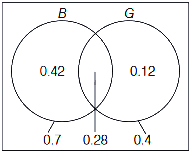
0 likesView Solution
385
MathematicsMediumMCQAP EAMCET · 2020
In $3$ trials of a binomial distribution,the probability of $2$ successes is $9$ times the probability of $3$ successes. Then the probability of success in each trial is
A
$\frac{1}{2}$
B
$\frac{1}{3}$
C
$\frac{1}{4}$
D
$\frac{1}{5}$
Solution
(C) Given that in $3$ trials of a binomial distribution,the probability of $2$ successes is $9$ times the probability of $3$ successes.
Let $p$ be the probability of success and $q$ be the probability of failure,where $p + q = 1$.
The probability of $r$ successes in $n$ trials is given by $P(X = r) = {}^nC_r p^r q^{n-r}$.
For $n = 3$:
$P(X = 2) = 9 \times P(X = 3)$
${}^3C_2 p^2 q^1 = 9 \times {}^3C_3 p^3 q^0$
$3 p^2 q = 9 p^3$
Since $p \neq 0$,we can divide by $3p^2$:
$q = 3p$
Substitute $q = 1 - p$:
$1 - p = 3p$
$1 = 4p$
$p = \frac{1}{4}$
Thus,the probability of success in each trial is $\frac{1}{4}$.
Hence,option $C$ is correct.
Let $p$ be the probability of success and $q$ be the probability of failure,where $p + q = 1$.
The probability of $r$ successes in $n$ trials is given by $P(X = r) = {}^nC_r p^r q^{n-r}$.
For $n = 3$:
$P(X = 2) = 9 \times P(X = 3)$
${}^3C_2 p^2 q^1 = 9 \times {}^3C_3 p^3 q^0$
$3 p^2 q = 9 p^3$
Since $p \neq 0$,we can divide by $3p^2$:
$q = 3p$
Substitute $q = 1 - p$:
$1 - p = 3p$
$1 = 4p$
$p = \frac{1}{4}$
Thus,the probability of success in each trial is $\frac{1}{4}$.
Hence,option $C$ is correct.
0 likesView Solution
386
MathematicsMediumMCQAP EAMCET · 2020
There are two dice $A$ and $B$. Die $A$ has $4$ red and $2$ white faces,and die $B$ has $2$ red and $4$ white faces. $A$ coin is tossed once. If it shows head,die $A$ is rolled; if it shows tail,die $B$ is rolled. If the probability that die $A$ is used is $\left(\frac{32}{33}\right)$ given that red turns up every time in the first $n$ throws,then $n=$
A
$5$
B
$6$
C
$4$
D
$3$
Solution
(A) Let $E_1$ be the event that die $A$ is chosen (coin shows head) and $E_2$ be the event that die $B$ is chosen (coin shows tail).
Let $R$ be the event that a red face appears in all $n$ throws.
Given $P(E_1) = \frac{1}{2}$ and $P(E_2) = \frac{1}{2}$.
For die $A$,the probability of getting a red face in one throw is $\frac{4}{6} = \frac{2}{3}$. Thus,$P(R \mid E_1) = \left(\frac{2}{3}\right)^n$.
For die $B$,the probability of getting a red face in one throw is $\frac{2}{6} = \frac{1}{3}$. Thus,$P(R \mid E_2) = \left(\frac{1}{3}\right)^n$.
By Bayes' theorem,the probability that die $A$ was used given that red appeared $n$ times is:
$P(E_1 \mid R) = \frac{P(E_1)P(R \mid E_1)}{P(E_1)P(R \mid E_1) + P(E_2)P(R \mid E_2)}$
Substituting the values:
$\frac{32}{33} = \frac{\frac{1}{2} \times (\frac{2}{3})^n}{\frac{1}{2} \times (\frac{2}{3})^n + \frac{1}{2} \times (\frac{1}{3})^n} = \frac{2^n}{2^n + 1^n} = \frac{2^n}{2^n + 1}$.
Solving for $n$:
$32(2^n + 1) = 33(2^n) \implies 32 \cdot 2^n + 32 = 33 \cdot 2^n \implies 2^n = 32$.
Since $32 = 2^5$,we get $n = 5$.
Let $R$ be the event that a red face appears in all $n$ throws.
Given $P(E_1) = \frac{1}{2}$ and $P(E_2) = \frac{1}{2}$.
For die $A$,the probability of getting a red face in one throw is $\frac{4}{6} = \frac{2}{3}$. Thus,$P(R \mid E_1) = \left(\frac{2}{3}\right)^n$.
For die $B$,the probability of getting a red face in one throw is $\frac{2}{6} = \frac{1}{3}$. Thus,$P(R \mid E_2) = \left(\frac{1}{3}\right)^n$.
By Bayes' theorem,the probability that die $A$ was used given that red appeared $n$ times is:
$P(E_1 \mid R) = \frac{P(E_1)P(R \mid E_1)}{P(E_1)P(R \mid E_1) + P(E_2)P(R \mid E_2)}$
Substituting the values:
$\frac{32}{33} = \frac{\frac{1}{2} \times (\frac{2}{3})^n}{\frac{1}{2} \times (\frac{2}{3})^n + \frac{1}{2} \times (\frac{1}{3})^n} = \frac{2^n}{2^n + 1^n} = \frac{2^n}{2^n + 1}$.
Solving for $n$:
$32(2^n + 1) = 33(2^n) \implies 32 \cdot 2^n + 32 = 33 \cdot 2^n \implies 2^n = 32$.
Since $32 = 2^5$,we get $n = 5$.
0 likesView Solution
387
MathematicsEasyMCQAP EAMCET · 2020
If the mean and standard deviation of a binomial distribution are $20$ and $4$,respectively,then the number of trials is $.......$
A
$25$
B
$50$
C
$200$
D
$100$
Solution
(D) Given,mean of a binomial distribution $= 20$.
$\Rightarrow np = 20$ $(i)$.
Standard deviation of a binomial distribution $= 4$.
$\Rightarrow \sqrt{np(1-p)} = 4$.
Squaring both sides,we get $np(1-p) = 16$ $(ii)$.
Substitute $np = 20$ from equation $(i)$ into equation $(ii)$:
$20(1-p) = 16$.
$1-p = \frac{16}{20} = \frac{4}{5}$.
$p = 1 - \frac{4}{5} = \frac{1}{5}$.
Substitute the value of $p$ into equation $(i)$:
$n \times \frac{1}{5} = 20$.
$n = 20 \times 5 = 100$.
Therefore,the number of trials is $100$.
$\Rightarrow np = 20$ $(i)$.
Standard deviation of a binomial distribution $= 4$.
$\Rightarrow \sqrt{np(1-p)} = 4$.
Squaring both sides,we get $np(1-p) = 16$ $(ii)$.
Substitute $np = 20$ from equation $(i)$ into equation $(ii)$:
$20(1-p) = 16$.
$1-p = \frac{16}{20} = \frac{4}{5}$.
$p = 1 - \frac{4}{5} = \frac{1}{5}$.
Substitute the value of $p$ into equation $(i)$:
$n \times \frac{1}{5} = 20$.
$n = 20 \times 5 = 100$.
Therefore,the number of trials is $100$.
0 likesView Solution
388
MathematicsEasyMCQAP EAMCET · 2020
Let $X$ be a random variable representing the number of heads obtained when three fair coins are tossed simultaneously. Find the value of $P(X = 2)$.
A
$\frac{3}{8}$
B
$\frac{5}{8}$
C
$\frac{1}{8}$
D
$\frac{3}{4}$
Solution
(A) The sample space $S$ for tossing three fair coins is given by:
$S = \{HHH, HHT, HTH, THH, HTT, THT, TTH, TTT\}$.
The total number of outcomes is $n(S) = 8$.
$X$ is a random variable representing the number of heads.
We need to find $P(X = 2)$,which is the probability of getting exactly two heads.
The outcomes with exactly two heads are $\{HHT, HTH, THH\}$.
Thus,the number of favorable outcomes is $n(X = 2) = 3$.
Therefore,$P(X = 2) = \frac{n(X = 2)}{n(S)} = \frac{3}{8}$.
$S = \{HHH, HHT, HTH, THH, HTT, THT, TTH, TTT\}$.
The total number of outcomes is $n(S) = 8$.
$X$ is a random variable representing the number of heads.
We need to find $P(X = 2)$,which is the probability of getting exactly two heads.
The outcomes with exactly two heads are $\{HHT, HTH, THH\}$.
Thus,the number of favorable outcomes is $n(X = 2) = 3$.
Therefore,$P(X = 2) = \frac{n(X = 2)}{n(S)} = \frac{3}{8}$.
0 likesView Solution
389
MathematicsMediumMCQAP EAMCET · 2020
Suppose $X$ has the following probability mass function $P(X=0)=0.2, P(X=1)=0.5, P(X=2)=0.3$. What is $E[X^2]$?
A
$2.89$
B
$1.7$
C
$1.1$
D
$1.21$
Solution
(B) The expected value $E[X^2]$ is calculated using the formula $E[X^2] = \sum x_i^2 P(X=x_i)$.
Given the probability distribution:
$E[X^2] = (0^2 \times 0.2) + (1^2 \times 0.5) + (2^2 \times 0.3)$
$E[X^2] = (0 \times 0.2) + (1 \times 0.5) + (4 \times 0.3)$
$E[X^2] = 0 + 0.5 + 1.2$
$E[X^2] = 1.7$
Given the probability distribution:
| $X$ | $0$ | $1$ | $2$ |
| $P(X)$ | $0.2$ | $0.5$ | $0.3$ |
$E[X^2] = (0^2 \times 0.2) + (1^2 \times 0.5) + (2^2 \times 0.3)$
$E[X^2] = (0 \times 0.2) + (1 \times 0.5) + (4 \times 0.3)$
$E[X^2] = 0 + 0.5 + 1.2$
$E[X^2] = 1.7$
0 likesView Solution
390
MathematicsMediumMCQAP EAMCET · 2020
In a game,a person wins $5$ rupees for getting a number greater than $4$ and loses $1$ rupee otherwise,when a fair die is thrown. $A$ man participates in the game and decides to quit as soon as he gets a number greater than $4$. If he plays for a maximum of $3$ throws,what is the expected value (mean value) of the amount he wins or loses?
A
$\frac{9}{19}$
B
$\frac{8}{19}$
C
$\frac{19}{9}$
D
$\frac{19}{8}$
Solution
(C) Let $W$ denote winning (getting a number $> 4$,probability $p = \frac{2}{6} = \frac{1}{3}$) and $L$ denote losing (getting a number $\le 4$,probability $q = \frac{4}{6} = \frac{2}{3}$). The player quits when $W$ occurs or after $3$ throws. The possible outcomes are:
$(i)$ $W$: Win $5$ rupees. Probability $P_1 = \frac{1}{3}$.
(ii) $LW$: Lose $1$ rupee,then win $5$ rupees. Net gain $= 4$ rupees. Probability $P_2 = \frac{2}{3} \times \frac{1}{3} = \frac{2}{9}$.
(iii) $LLW$: Lose $1$ rupee,lose $1$ rupee,then win $5$ rupees. Net gain $= 3$ rupees. Probability $P_3 = \frac{2}{3} \times \frac{2}{3} \times \frac{1}{3} = \frac{4}{27}$.
(iv) $LLL$: Lose $1$ rupee,lose $1$ rupee,lose $1$ rupee. Net gain $= -3$ rupees. Probability $P_4 = \frac{2}{3} \times \frac{2}{3} \times \frac{2}{3} = \frac{8}{27}$.
The expected value $E = \sum x_i P_i = 5(\frac{1}{3}) + 4(\frac{2}{9}) + 3(\frac{4}{27}) + (-3)(\frac{8}{27})$.
$E = \frac{5}{3} + \frac{8}{9} + \frac{12}{27} - \frac{24}{27} = \frac{45 + 24 + 12 - 24}{27} = \frac{57}{27} = \frac{19}{9}$.
$(i)$ $W$: Win $5$ rupees. Probability $P_1 = \frac{1}{3}$.
(ii) $LW$: Lose $1$ rupee,then win $5$ rupees. Net gain $= 4$ rupees. Probability $P_2 = \frac{2}{3} \times \frac{1}{3} = \frac{2}{9}$.
(iii) $LLW$: Lose $1$ rupee,lose $1$ rupee,then win $5$ rupees. Net gain $= 3$ rupees. Probability $P_3 = \frac{2}{3} \times \frac{2}{3} \times \frac{1}{3} = \frac{4}{27}$.
(iv) $LLL$: Lose $1$ rupee,lose $1$ rupee,lose $1$ rupee. Net gain $= -3$ rupees. Probability $P_4 = \frac{2}{3} \times \frac{2}{3} \times \frac{2}{3} = \frac{8}{27}$.
The expected value $E = \sum x_i P_i = 5(\frac{1}{3}) + 4(\frac{2}{9}) + 3(\frac{4}{27}) + (-3)(\frac{8}{27})$.
$E = \frac{5}{3} + \frac{8}{9} + \frac{12}{27} - \frac{24}{27} = \frac{45 + 24 + 12 - 24}{27} = \frac{57}{27} = \frac{19}{9}$.
0 likesView Solution
391
MathematicsMediumMCQAP EAMCET · 2020
If a random variable $X$ takes the values $x_1, x_2, x_3, \ldots, x_{100}$ with probability $P(X=x_i) = K i(i+1)$,then $200 K=$
A
$\frac{1}{1707}$
B
$\frac{1}{1717}$
C
$\frac{1}{1727}$
D
$\frac{1}{1777}$
Solution
(B) We know that the sum of all probabilities in a probability distribution is $1$.
Thus,$\sum_{i=1}^{100} P(X=x_i) = 1$.
Substituting the given probability $P(X=x_i) = K i(i+1)$,we get:
$K \sum_{i=1}^{100} (i^2 + i) = 1$.
Using the summation formulas $\sum_{i=1}^{n} i^2 = \frac{n(n+1)(2n+1)}{6}$ and $\sum_{i=1}^{n} i = \frac{n(n+1)}{2}$ for $n=100$:
$K \left[ \frac{100(101)(201)}{6} + \frac{100(101)}{2} \right] = 1$.
$K \left[ \frac{100 \times 101}{2} \left( \frac{201}{3} + 1 \right) \right] = 1$.
$K \left[ 5050 \times (67 + 1) \right] = 1$.
$K \times 5050 \times 68 = 1$.
$K = \frac{1}{5050 \times 68} = \frac{1}{343400}$.
Therefore,$200 K = \frac{200}{343400} = \frac{2}{3434} = \frac{1}{1717}$.
Hence,option $(B)$ is correct.
Thus,$\sum_{i=1}^{100} P(X=x_i) = 1$.
Substituting the given probability $P(X=x_i) = K i(i+1)$,we get:
$K \sum_{i=1}^{100} (i^2 + i) = 1$.
Using the summation formulas $\sum_{i=1}^{n} i^2 = \frac{n(n+1)(2n+1)}{6}$ and $\sum_{i=1}^{n} i = \frac{n(n+1)}{2}$ for $n=100$:
$K \left[ \frac{100(101)(201)}{6} + \frac{100(101)}{2} \right] = 1$.
$K \left[ \frac{100 \times 101}{2} \left( \frac{201}{3} + 1 \right) \right] = 1$.
$K \left[ 5050 \times (67 + 1) \right] = 1$.
$K \times 5050 \times 68 = 1$.
$K = \frac{1}{5050 \times 68} = \frac{1}{343400}$.
Therefore,$200 K = \frac{200}{343400} = \frac{2}{3434} = \frac{1}{1717}$.
Hence,option $(B)$ is correct.
0 likesView Solution
392
MathematicsMediumMCQAP EAMCET · 2020
$A$ random variable $X$ has the probability distribution as given below. Let $E = \{X \mid X \text{ is a prime number}\}$ and $F = \{X \mid X < 4\}$,then $P(E \cup F) = $
$\begin{array}{|c|c|c|c|c|c|c|c|c|} \hline X & 1 & 2 & 3 & 4 & 5 & 6 & 7 & 8 \\ \hline P(X) & K & 2K & K^2 & 2K^2 & 5K^2 & K & K & 2K \\ \hline \end{array}$
$\begin{array}{|c|c|c|c|c|c|c|c|c|} \hline X & 1 & 2 & 3 & 4 & 5 & 6 & 7 & 8 \\ \hline P(X) & K & 2K & K^2 & 2K^2 & 5K^2 & K & K & 2K \\ \hline \end{array}$
A
$\frac{38}{64}$
B
$\frac{39}{64}$
C
$\frac{42}{64}$
D
$\frac{17}{64}$
Solution
(A) Given the probability distribution:
$\sum P(X) = 1$
$K + 2K + K^2 + 2K^2 + 5K^2 + K + K + 2K = 1$
$8K^2 + 7K - 1 = 0$
$(8K - 1)(K + 1) = 0$
Since $K > 0$,we have $K = \frac{1}{8}$.
The events are $E = \{2, 3, 5, 7\}$ and $F = \{1, 2, 3\}$.
$E \cup F = \{1, 2, 3, 5, 7\}$.
$P(E \cup F) = P(1) + P(2) + P(3) + P(5) + P(7)$
$P(E \cup F) = K + 2K + K^2 + 5K^2 + K = 6K^2 + 4K$
Substituting $K = \frac{1}{8}$:
$P(E \cup F) = 6(\frac{1}{64}) + 4(\frac{1}{8}) = \frac{6}{64} + \frac{32}{64} = \frac{38}{64}$.
$\sum P(X) = 1$
$K + 2K + K^2 + 2K^2 + 5K^2 + K + K + 2K = 1$
$8K^2 + 7K - 1 = 0$
$(8K - 1)(K + 1) = 0$
Since $K > 0$,we have $K = \frac{1}{8}$.
The events are $E = \{2, 3, 5, 7\}$ and $F = \{1, 2, 3\}$.
$E \cup F = \{1, 2, 3, 5, 7\}$.
$P(E \cup F) = P(1) + P(2) + P(3) + P(5) + P(7)$
$P(E \cup F) = K + 2K + K^2 + 5K^2 + K = 6K^2 + 4K$
Substituting $K = \frac{1}{8}$:
$P(E \cup F) = 6(\frac{1}{64}) + 4(\frac{1}{8}) = \frac{6}{64} + \frac{32}{64} = \frac{38}{64}$.
0 likesView Solution
393
MathematicsDifficultMCQAP EAMCET · 2020
Suppose the number of accidents occurring on a highway in each day follows a Poisson random variable with parameter $3$. Then,what is the probability that no accidents occur today?
A
$\frac{1}{e^3}$
B
$\frac{-1}{e^3}$
C
$\frac{1}{e^9}$
D
$\frac{-1}{e^9}$
Solution
(A) The number of accidents follows a Poisson distribution with parameter $\lambda = 3$.
The probability mass function of a Poisson random variable $X$ is given by $P(X = x) = \frac{\lambda^x e^{-\lambda}}{x!}$,where $x = 0, 1, 2, \dots$.
We want to find the probability that no accidents occur today,which corresponds to $P(X = 0)$.
Substituting $\lambda = 3$ and $x = 0$ into the formula:
$P(X = 0) = \frac{3^0 e^{-3}}{0!}$.
Since $3^0 = 1$ and $0! = 1$,we get:
$P(X = 0) = \frac{1 \times e^{-3}}{1} = e^{-3} = \frac{1}{e^3}$.
Thus,the probability that no accidents occur today is $\frac{1}{e^3}$.
The probability mass function of a Poisson random variable $X$ is given by $P(X = x) = \frac{\lambda^x e^{-\lambda}}{x!}$,where $x = 0, 1, 2, \dots$.
We want to find the probability that no accidents occur today,which corresponds to $P(X = 0)$.
Substituting $\lambda = 3$ and $x = 0$ into the formula:
$P(X = 0) = \frac{3^0 e^{-3}}{0!}$.
Since $3^0 = 1$ and $0! = 1$,we get:
$P(X = 0) = \frac{1 \times e^{-3}}{1} = e^{-3} = \frac{1}{e^3}$.
Thus,the probability that no accidents occur today is $\frac{1}{e^3}$.
0 likesView Solution
394
MathematicsEasyMCQAP EAMCET · 2020
The following table represents the probability distribution of a random variable $X$ for some $k \in Q$. Find the mean of $X$.
$\begin{array}{|c|c|c|c|c|c|c|} \hline X=x & -2 & -1 & 0 & 1 & 2 & 3 \\ \hline P(X=x) & 0.1 & k & 0.2 & 2k & 0.3 & k \\ \hline \end{array}$
$\begin{array}{|c|c|c|c|c|c|c|} \hline X=x & -2 & -1 & 0 & 1 & 2 & 3 \\ \hline P(X=x) & 0.1 & k & 0.2 & 2k & 0.3 & k \\ \hline \end{array}$
A
$1.7$
B
$1.8$
C
$0.8$
D
$0.7$
Solution
(C) For a probability distribution,the sum of all probabilities must be equal to $1$.
Therefore,$0.1 + k + 0.2 + 2k + 0.3 + k = 1$.
Combining the terms,we get $0.6 + 4k = 1$.
$4k = 0.4$,which implies $k = 0.1$.
The mean of $X$,denoted by $E(X)$,is given by $\sum x_i P(x_i)$.
$E(X) = (-2 \times 0.1) + (-1 \times 0.1) + (0 \times 0.2) + (1 \times 0.2) + (2 \times 0.3) + (3 \times 0.1)$.
$E(X) = -0.2 - 0.1 + 0 + 0.2 + 0.6 + 0.3$.
$E(X) = 0.8$.
Therefore,$0.1 + k + 0.2 + 2k + 0.3 + k = 1$.
Combining the terms,we get $0.6 + 4k = 1$.
$4k = 0.4$,which implies $k = 0.1$.
The mean of $X$,denoted by $E(X)$,is given by $\sum x_i P(x_i)$.
$E(X) = (-2 \times 0.1) + (-1 \times 0.1) + (0 \times 0.2) + (1 \times 0.2) + (2 \times 0.3) + (3 \times 0.1)$.
$E(X) = -0.2 - 0.1 + 0 + 0.2 + 0.6 + 0.3$.
$E(X) = 0.8$.
0 likesView Solution
395
MathematicsMediumMCQAP EAMCET · 2020
The following table represents the probability distribution of a random variable $X$ for some $k \in Q$. Find the value of $k$.
| $X=x$ | $-2$ | $-1$ | $0$ | $1$ | $2$ | $3$ |
| $P(X=x)$ | $0.1$ | $k$ | $0.2$ | $2k$ | $0.3$ | $k$ |
A
$0.25$
B
$0.2$
C
$0.15$
D
$0.1$
Solution
(D) For a probability distribution,the sum of all probabilities must be equal to $1$.
Therefore,$\sum P(X=x) = 1$.
$0.1 + k + 0.2 + 2k + 0.3 + k = 1$
Combine the terms involving $k$ and the constant terms:
$(0.1 + 0.2 + 0.3) + (k + 2k + k) = 1$
$0.6 + 4k = 1$
$4k = 1 - 0.6$
$4k = 0.4$
$k = \frac{0.4}{4}$
$k = 0.1$
Therefore,$\sum P(X=x) = 1$.
$0.1 + k + 0.2 + 2k + 0.3 + k = 1$
Combine the terms involving $k$ and the constant terms:
$(0.1 + 0.2 + 0.3) + (k + 2k + k) = 1$
$0.6 + 4k = 1$
$4k = 1 - 0.6$
$4k = 0.4$
$k = \frac{0.4}{4}$
$k = 0.1$
0 likesView Solution
396
MathematicsMediumMCQAP EAMCET · 2020
If $\left[\begin{array}{rrr}1 & -1 & x \\ 1 & x & 1 \\ x & -1 & 1\end{array}\right]$ has no inverse,then the real value of $x$ is
A
$2$
B
$3$
C
$0$
D
$1$
Solution
(D) square matrix $A$ has no inverse if and only if its determinant is zero,i.e.,$|A| = 0$.
Given the matrix $A = \begin{bmatrix} 1 & -1 & x \\ 1 & x & 1 \\ x & -1 & 1 \end{bmatrix}$.
We calculate the determinant:
$|A| = 1(x - (-1)) - (-1)(1 - x) + x(-1 - x^2) = 0$
$|A| = 1(x + 1) + 1(1 - x) + x(-1 - x^2) = 0$
$|A| = x + 1 + 1 - x - x - x^3 = 0$
$|A| = -x^3 - x + 2 = 0$
$x^3 + x - 2 = 0$
By inspection,if $x = 1$,then $1^3 + 1 - 2 = 0$,which satisfies the equation.
Alternatively,if $x = 1$,the matrix becomes $\begin{bmatrix} 1 & -1 & 1 \\ 1 & 1 & 1 \\ 1 & -1 & 1 \end{bmatrix}$.
Since the first and third rows (or columns) are identical,the determinant is $0$.
Thus,the real value of $x$ is $1$.
Given the matrix $A = \begin{bmatrix} 1 & -1 & x \\ 1 & x & 1 \\ x & -1 & 1 \end{bmatrix}$.
We calculate the determinant:
$|A| = 1(x - (-1)) - (-1)(1 - x) + x(-1 - x^2) = 0$
$|A| = 1(x + 1) + 1(1 - x) + x(-1 - x^2) = 0$
$|A| = x + 1 + 1 - x - x - x^3 = 0$
$|A| = -x^3 - x + 2 = 0$
$x^3 + x - 2 = 0$
By inspection,if $x = 1$,then $1^3 + 1 - 2 = 0$,which satisfies the equation.
Alternatively,if $x = 1$,the matrix becomes $\begin{bmatrix} 1 & -1 & 1 \\ 1 & 1 & 1 \\ 1 & -1 & 1 \end{bmatrix}$.
Since the first and third rows (or columns) are identical,the determinant is $0$.
Thus,the real value of $x$ is $1$.
0 likesView Solution
397
MathematicsEasyMCQAP EAMCET · 2020
The function $f: R \rightarrow R$ defined by $f(x)=\frac{x}{\sqrt{1+x^2}}$ is
A
surjective but not injective
B
bijective
C
injective but not surjective
D
neither injective nor surjective
Solution
(C) To check for injectivity,let $f(x_1) = f(x_2)$ for $x_1, x_2 \in R$.
$\frac{x_1}{\sqrt{1+x_1^2}} = \frac{x_2}{\sqrt{1+x_2^2}}$
Squaring both sides:
$\frac{x_1^2}{1+x_1^2} = \frac{x_2^2}{1+x_2^2}$
$x_1^2(1+x_2^2) = x_2^2(1+x_1^2)$
$x_1^2 + x_1^2x_2^2 = x_2^2 + x_1^2x_2^2$
$x_1^2 = x_2^2$
Since $f'(x) = \frac{1}{(1+x^2)^{3/2}} > 0$ for all $x \in R$,the function is strictly increasing.
Therefore,$f(x_1) = f(x_2) \implies x_1 = x_2$. Thus,$f$ is injective.
To check for surjectivity,let $y = \frac{x}{\sqrt{1+x^2}}$.
Since $x^2 < 1+x^2$,we have $\frac{|x|}{\sqrt{1+x^2}} < 1$.
Thus,the range of $f$ is $(-1, 1)$,which is not equal to the codomain $R$.
Therefore,$f$ is not surjective.
Hence,the function is injective but not surjective.
$\frac{x_1}{\sqrt{1+x_1^2}} = \frac{x_2}{\sqrt{1+x_2^2}}$
Squaring both sides:
$\frac{x_1^2}{1+x_1^2} = \frac{x_2^2}{1+x_2^2}$
$x_1^2(1+x_2^2) = x_2^2(1+x_1^2)$
$x_1^2 + x_1^2x_2^2 = x_2^2 + x_1^2x_2^2$
$x_1^2 = x_2^2$
Since $f'(x) = \frac{1}{(1+x^2)^{3/2}} > 0$ for all $x \in R$,the function is strictly increasing.
Therefore,$f(x_1) = f(x_2) \implies x_1 = x_2$. Thus,$f$ is injective.
To check for surjectivity,let $y = \frac{x}{\sqrt{1+x^2}}$.
Since $x^2 < 1+x^2$,we have $\frac{|x|}{\sqrt{1+x^2}} < 1$.
Thus,the range of $f$ is $(-1, 1)$,which is not equal to the codomain $R$.
Therefore,$f$ is not surjective.
Hence,the function is injective but not surjective.
0 likesView Solution
398
MathematicsDifficultMCQAP EAMCET · 2020
If $a, b, c$ are unit vectors satisfying the relation $a+b+\sqrt{3} c=0$,then the angle between $a$ and $b$ is
A
$\frac{\pi}{6}$
B
$\frac{\pi}{4}$
C
$\frac{\pi}{3}$
D
$\frac{\pi}{2}$
Solution
(C) Given,$a+b+\sqrt{3} c=0$.
Rearranging the terms,we get $a+b = -\sqrt{3} c$.
Taking the dot product of both sides with themselves:
$(a+b) \cdot (a+b) = (-\sqrt{3} c) \cdot (-\sqrt{3} c)$.
Expanding the left side and simplifying the right side:
$|a|^2 + 2(a \cdot b) + |b|^2 = 3|c|^2$.
Since $a, b, c$ are unit vectors,$|a| = |b| = |c| = 1$.
Substituting these values:
$1^2 + 2(1)(1) \cos \theta + 1^2 = 3(1)^2$,where $\theta$ is the angle between $a$ and $b$.
$1 + 2 \cos \theta + 1 = 3$.
$2 + 2 \cos \theta = 3$.
$2 \cos \theta = 1$.
$\cos \theta = \frac{1}{2}$.
Since $\cos \frac{\pi}{3} = \frac{1}{2}$,the angle $\theta = \frac{\pi}{3}$.
Rearranging the terms,we get $a+b = -\sqrt{3} c$.
Taking the dot product of both sides with themselves:
$(a+b) \cdot (a+b) = (-\sqrt{3} c) \cdot (-\sqrt{3} c)$.
Expanding the left side and simplifying the right side:
$|a|^2 + 2(a \cdot b) + |b|^2 = 3|c|^2$.
Since $a, b, c$ are unit vectors,$|a| = |b| = |c| = 1$.
Substituting these values:
$1^2 + 2(1)(1) \cos \theta + 1^2 = 3(1)^2$,where $\theta$ is the angle between $a$ and $b$.
$1 + 2 \cos \theta + 1 = 3$.
$2 + 2 \cos \theta = 3$.
$2 \cos \theta = 1$.
$\cos \theta = \frac{1}{2}$.
Since $\cos \frac{\pi}{3} = \frac{1}{2}$,the angle $\theta = \frac{\pi}{3}$.
0 likesView Solution
Vedclass Products
For Students
Vedclass Test Series
Mock tests in real AP EAMCET style covering Mathematics with performance analysis. 5-day free trial.
Start Free TrialFor Teachers
Exam Paper Generator
Generate Set A/B/C/D Mathematics papers from 7.5L+ questions in 2 minutes. 3 chapters free.
Try FreeFor Institutes
Online Exam Module
Run live AP EAMCET mock exams with unlimited students, 360° analytics & white-label branding.
See DemoFrequently Asked Questions
How many Mathematics questions are in AP EAMCET 2020?
There are 800 Mathematics questions from the AP EAMCET 2020 paper on Vedclass, each with a detailed step-by-step solution in English.
Are AP EAMCET 2020 Mathematics solutions available in English?
Yes. All solutions on this page are in English. You can also switch to English or Hindi using the language buttons above the questions.
Can I practice AP EAMCET 2020 Mathematics as a timed test?
Yes. Use the Vedclass Test Series to attempt a full AP EAMCET mock test covering Mathematics with time limits and instant score analysis.
Can teachers create Mathematics papers from AP EAMCET previous year questions?
Yes. The Vedclass Exam Paper Generator lets teachers mix AP EAMCET Mathematics questions and generate Set A/B/C/D papers in minutes.
For Teachers & Institutes
Build a Custom Mathematics Paper
Pick AP EAMCET 2020 Mathematics questions, set difficulty, and generate Set A/B/C/D in 2 minutes.