
MathematicsQ351–400 of 800 questions
Page 8 of 10 · English
351
MathematicsEasyMCQAP EAMCET · 2020
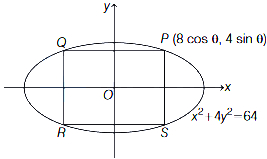
The lengths of the sides of the rectangle of greatest area that can be inscribed in the ellipse $x^2+4y^2=64$ are
A
$6\sqrt{2}, 4\sqrt{2}$
B
$8\sqrt{2}, 4\sqrt{2}$
C
$8\sqrt{2}, 8\sqrt{2}$
D
$16\sqrt{2}, 4\sqrt{2}$
Solution
(B) The equation of the given ellipse is $x^2+4y^2=64$,which can be written as $\frac{x^2}{64}+\frac{y^2}{16}=1$.
Let the vertex $P$ of the rectangle in the first quadrant be $(8\cos\theta, 4\sin\theta)$.
The coordinates of the four vertices of the rectangle are $(8\cos\theta, 4\sin\theta)$,$(-8\cos\theta, 4\sin\theta)$,$(-8\cos\theta, -4\sin\theta)$,and $(8\cos\theta, -4\sin\theta)$.
The length of the sides of the rectangle are $L = 2(8\cos\theta) = 16\cos\theta$ and $W = 2(4\sin\theta) = 8\sin\theta$.
The area $A$ of the rectangle is $A = L \times W = (16\cos\theta)(8\sin\theta) = 128\sin\theta\cos\theta = 64\sin(2\theta)$.
For the area to be maximum,$\sin(2\theta)$ must be $1$,which implies $2\theta = \frac{\pi}{2}$ or $\theta = \frac{\pi}{4}$.
Substituting $\theta = \frac{\pi}{4}$ into the expressions for the sides:
$L = 16\cos(\frac{\pi}{4}) = 16(\frac{1}{\sqrt{2}}) = 8\sqrt{2}$.
$W = 8\sin(\frac{\pi}{4}) = 8(\frac{1}{\sqrt{2}}) = 4\sqrt{2}$.
Thus,the lengths of the sides are $8\sqrt{2}$ and $4\sqrt{2}$.
Let the vertex $P$ of the rectangle in the first quadrant be $(8\cos\theta, 4\sin\theta)$.
The coordinates of the four vertices of the rectangle are $(8\cos\theta, 4\sin\theta)$,$(-8\cos\theta, 4\sin\theta)$,$(-8\cos\theta, -4\sin\theta)$,and $(8\cos\theta, -4\sin\theta)$.
The length of the sides of the rectangle are $L = 2(8\cos\theta) = 16\cos\theta$ and $W = 2(4\sin\theta) = 8\sin\theta$.
The area $A$ of the rectangle is $A = L \times W = (16\cos\theta)(8\sin\theta) = 128\sin\theta\cos\theta = 64\sin(2\theta)$.
For the area to be maximum,$\sin(2\theta)$ must be $1$,which implies $2\theta = \frac{\pi}{2}$ or $\theta = \frac{\pi}{4}$.
Substituting $\theta = \frac{\pi}{4}$ into the expressions for the sides:
$L = 16\cos(\frac{\pi}{4}) = 16(\frac{1}{\sqrt{2}}) = 8\sqrt{2}$.
$W = 8\sin(\frac{\pi}{4}) = 8(\frac{1}{\sqrt{2}}) = 4\sqrt{2}$.
Thus,the lengths of the sides are $8\sqrt{2}$ and $4\sqrt{2}$.
0 likesView Solution
352
MathematicsEasyMCQAP EAMCET · 2020
The line $x=m^2$ meets the ellipse $9x^2+y^2=9$ at real and distinct points if and only if
A
$|m| > 1$
B
$|m| < 1$
C
$|m| > 2$
D
$|m| < 2$
Solution
(B) The equation of the ellipse is $9x^2 + y^2 = 9$.
Substituting $x = m^2$ into the equation of the ellipse,we get $9(m^2)^2 + y^2 = 9$.
This simplifies to $9m^4 + y^2 = 9$,which gives $y^2 = 9 - 9m^4 = 9(1 - m^4)$.
For the points to be real and distinct,we must have $y^2 > 0$.
Therefore,$9(1 - m^4) > 0$,which implies $1 - m^4 > 0$ or $m^4 < 1$.
Taking the fourth root on both sides,we get $|m| < 1$.
Thus,the correct option is $B$.
Substituting $x = m^2$ into the equation of the ellipse,we get $9(m^2)^2 + y^2 = 9$.
This simplifies to $9m^4 + y^2 = 9$,which gives $y^2 = 9 - 9m^4 = 9(1 - m^4)$.
For the points to be real and distinct,we must have $y^2 > 0$.
Therefore,$9(1 - m^4) > 0$,which implies $1 - m^4 > 0$ or $m^4 < 1$.
Taking the fourth root on both sides,we get $|m| < 1$.
Thus,the correct option is $B$.
0 likesView Solution
353
MathematicsMediumMCQAP EAMCET · 2020
For the ellipse $\frac{x^2}{18}+\frac{y^2}{32}=1$,if a tangent with slope $-\frac{4}{3}$ intersects the major and minor axes at $P$ and $Q$ respectively. Find $P$ and $Q$.
A
$P(0,8), Q(6,0)$
B
$P(0,6), Q(8,0)$
C
$P(3\sqrt{2}, 0), Q(0,4\sqrt{2})$
D
$P(0,3\sqrt{2}), Q(4\sqrt{2}, 0)$
Solution
(A) The equation of the ellipse is $\frac{x^2}{18} + \frac{y^2}{32} = 1$,where $a^2 = 18$ and $b^2 = 32$. Since $b^2 > a^2$,the major axis is along the $y$-axis.
The equation of a tangent with slope $m = -\frac{4}{3}$ is given by $y = mx \pm \sqrt{a^2m^2 + b^2}$.
Substituting the values: $y = -\frac{4}{3}x \pm \sqrt{18(-\frac{4}{3})^2 + 32} = -\frac{4}{3}x \pm \sqrt{18(\frac{16}{9}) + 32} = -\frac{4}{3}x \pm \sqrt{32 + 32} = -\frac{4}{3}x \pm 8$.
This simplifies to $4x + 3y = \pm 24$.
For the tangent $4x + 3y = 24$:
The $x$-intercept (where $y=0$) is $Q(6,0)$.
The $y$-intercept (where $x=0$) is $P(0,8)$.
Thus,the points are $P(0,8)$ and $Q(6,0)$.
The equation of a tangent with slope $m = -\frac{4}{3}$ is given by $y = mx \pm \sqrt{a^2m^2 + b^2}$.
Substituting the values: $y = -\frac{4}{3}x \pm \sqrt{18(-\frac{4}{3})^2 + 32} = -\frac{4}{3}x \pm \sqrt{18(\frac{16}{9}) + 32} = -\frac{4}{3}x \pm \sqrt{32 + 32} = -\frac{4}{3}x \pm 8$.
This simplifies to $4x + 3y = \pm 24$.
For the tangent $4x + 3y = 24$:
The $x$-intercept (where $y=0$) is $Q(6,0)$.
The $y$-intercept (where $x=0$) is $P(0,8)$.
Thus,the points are $P(0,8)$ and $Q(6,0)$.
0 likesView Solution
354
MathematicsEasyMCQAP EAMCET · 2020
The number of values of '$c$' for which the line $y=4x+c$ touches the ellipse $\frac{x^2}{4}+\frac{y^2}{1}=1$ is
A
$0$
B
$1$
C
$2$
D
Infinite
Solution
(C) The condition for the line $y=mx+c$ to touch the ellipse $\frac{x^2}{a^2}+\frac{y^2}{b^2}=1$ is $c^2=a^2m^2+b^2$.
Here,$a^2=4$,$b^2=1$,and $m=4$.
Substituting these values,we get $c^2 = 4(4)^2 + 1 = 4(16) + 1 = 64 + 1 = 65$.
Thus,$c = \pm \sqrt{65}$.
There are $2$ possible values for '$c$'.
Therefore,the correct option is $C$.
Here,$a^2=4$,$b^2=1$,and $m=4$.
Substituting these values,we get $c^2 = 4(4)^2 + 1 = 4(16) + 1 = 64 + 1 = 65$.
Thus,$c = \pm \sqrt{65}$.
There are $2$ possible values for '$c$'.
Therefore,the correct option is $C$.
0 likesView Solution
355
MathematicsEasyMCQAP EAMCET · 2020
The equation of the tangent to the ellipse $x^2+16y^2=16$ which makes an angle $60^{\circ}$ with the $X$-axis is
A
$\sqrt{3}x-y+7=0$
B
$\sqrt{3}x+y+7=0$
C
$\sqrt{3}x+y-7=0$
D
$\sqrt{3}x-y=0$
Solution
(A) The given ellipse is $x^2+16y^2=16$,which can be written as $\frac{x^2}{16}+\frac{y^2}{1}=1$.
Here,$a^2=16$ and $b^2=1$.
The slope of the tangent is $m = \tan 60^{\circ} = \sqrt{3}$.
The equation of the tangent to the ellipse $\frac{x^2}{a^2}+\frac{y^2}{b^2}=1$ with slope $m$ is given by $y = mx \pm \sqrt{a^2m^2+b^2}$.
Substituting the values,we get $y = \sqrt{3}x \pm \sqrt{16(\sqrt{3})^2+1}$.
$y = \sqrt{3}x \pm \sqrt{16(3)+1} = \sqrt{3}x \pm \sqrt{48+1} = \sqrt{3}x \pm \sqrt{49}$.
$y = \sqrt{3}x \pm 7$.
Thus,the equations are $\sqrt{3}x-y+7=0$ or $\sqrt{3}x-y-7=0$.
Comparing with the given options,$\sqrt{3}x-y+7=0$ is the correct choice.
Here,$a^2=16$ and $b^2=1$.
The slope of the tangent is $m = \tan 60^{\circ} = \sqrt{3}$.
The equation of the tangent to the ellipse $\frac{x^2}{a^2}+\frac{y^2}{b^2}=1$ with slope $m$ is given by $y = mx \pm \sqrt{a^2m^2+b^2}$.
Substituting the values,we get $y = \sqrt{3}x \pm \sqrt{16(\sqrt{3})^2+1}$.
$y = \sqrt{3}x \pm \sqrt{16(3)+1} = \sqrt{3}x \pm \sqrt{48+1} = \sqrt{3}x \pm \sqrt{49}$.
$y = \sqrt{3}x \pm 7$.
Thus,the equations are $\sqrt{3}x-y+7=0$ or $\sqrt{3}x-y-7=0$.
Comparing with the given options,$\sqrt{3}x-y+7=0$ is the correct choice.
0 likesView Solution
356
MathematicsEasyMCQAP EAMCET · 2020
If the line $y=2x+c$ touches the curve $x^2+4y^2=4$,then $c^2=$
A
$65$
B
$17$
C
$63$
D
$8$
Solution
(B) The given equation of the curve is $x^2+4y^2=4$. Dividing by $4$,we get the standard form of the ellipse: $\frac{x^2}{4}+\frac{y^2}{1}=1$.
Here,$a^2=4$ and $b^2=1$.
The condition for the line $y=mx+c$ to be a tangent to the ellipse $\frac{x^2}{a^2}+\frac{y^2}{b^2}=1$ is $c^2=a^2m^2+b^2$.
Comparing $y=2x+c$ with $y=mx+c$,we have $m=2$.
Substituting the values $a^2=4$,$b^2=1$,and $m=2$ into the condition:
$c^2 = (4)(2)^2 + 1$
$c^2 = 4(4) + 1$
$c^2 = 16 + 1 = 17$.
Here,$a^2=4$ and $b^2=1$.
The condition for the line $y=mx+c$ to be a tangent to the ellipse $\frac{x^2}{a^2}+\frac{y^2}{b^2}=1$ is $c^2=a^2m^2+b^2$.
Comparing $y=2x+c$ with $y=mx+c$,we have $m=2$.
Substituting the values $a^2=4$,$b^2=1$,and $m=2$ into the condition:
$c^2 = (4)(2)^2 + 1$
$c^2 = 4(4) + 1$
$c^2 = 16 + 1 = 17$.
0 likesView Solution
357
MathematicsEasyMCQAP EAMCET · 2020
Find the condition for the line $ax + by + c = 0$ to be a normal to an ellipse $\frac{x^2}{4} + \frac{y^2}{36} = 1$.
A
$\frac{1}{a^2} + \frac{1}{b^2} = \frac{144}{c^2}$
B
$\frac{1}{a^2} + \frac{1}{b^2} = \frac{128}{c^2}$
C
$\frac{1}{a^2} + \frac{9}{b^2} = \frac{256}{c^2}$
D
$\frac{1}{a^2} + \frac{9}{b^2} = \frac{32}{c^2}$
Solution
(C) Let a point $P(2 \cos \theta, 6 \sin \theta)$ be on the ellipse $\frac{x^2}{4} + \frac{y^2}{36} = 1$. The equation of the normal to the ellipse at point $P$ is given by $\frac{a^2 x}{x_1} - \frac{b^2 y}{y_1} = a^2 - b^2$. Here $a^2 = 4$ and $b^2 = 36$. Substituting the coordinates $(2 \cos \theta, 6 \sin \theta)$,we get: $\frac{4x}{2 \cos \theta} - \frac{36y}{6 \sin \theta} = 4 - 36$. Simplifying,we have $2x \sec \theta - 6y \operatorname{cosec} \theta = -32$,or $2x \sec \theta - 6y \operatorname{cosec} \theta + 32 = 0$. Comparing this with $ax + by + c = 0$,we have $\frac{a}{2 \sec \theta} = \frac{b}{-6 \operatorname{cosec} \theta} = \frac{c}{32}$. This gives $\cos \theta = \frac{2c}{32a} = \frac{c}{16a}$ and $\sin \theta = -\frac{6c}{32b} = -\frac{3c}{16b}$. Using $\cos^2 \theta + \sin^2 \theta = 1$,we get $\frac{c^2}{256a^2} + \frac{9c^2}{256b^2} = 1$,which simplifies to $\frac{1}{a^2} + \frac{9}{b^2} = \frac{256}{c^2}$.
0 likesView Solution
358
MathematicsMediumMCQAP EAMCET · 2020
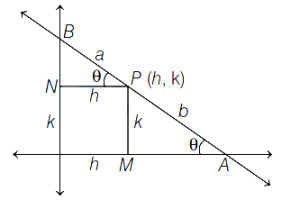
$AB$ is a line segment moving between the axes such that '$A$' lies on $X$-axis and '$B$' lies on $Y$-axis. If $P$ is a point on $AB$ such that $PA=b$ and $PB=a$,then the equation of the locus of $P$ is
A
$\frac{x^2}{b^2}+\frac{y^2}{a^2}=1$
B
$\frac{x^2}{a^2}+\frac{y^2}{b^2}=1$
C
$\frac{x^2}{2a^2}+\frac{y^2}{2b^2}=1$
D
$\frac{x^2}{2b^2}+\frac{y^2}{a^2}=1$
Solution
(B) Let $P(h, k)$ be any point on the locus.
Let $A$ be on the $X$-axis and $B$ be on the $Y$-axis.
Let $\theta$ be the angle that the line segment $AB$ makes with the $X$-axis.
From the geometry of the figure,in $\triangle PMA$,we have $\sin \theta = \frac{k}{b}$,which implies $k = b \sin \theta$.
In $\triangle BNP$,we have $\cos \theta = \frac{h}{a}$,which implies $h = a \cos \theta$.
Using the identity $\sin^2 \theta + \cos^2 \theta = 1$,we substitute the values:
$(\frac{k}{b})^2 + (\frac{h}{a})^2 = 1$.
Replacing $(h, k)$ with $(x, y)$,the equation of the locus is $\frac{x^2}{a^2} + \frac{y^2}{b^2} = 1$.
Let $A$ be on the $X$-axis and $B$ be on the $Y$-axis.
Let $\theta$ be the angle that the line segment $AB$ makes with the $X$-axis.
From the geometry of the figure,in $\triangle PMA$,we have $\sin \theta = \frac{k}{b}$,which implies $k = b \sin \theta$.
In $\triangle BNP$,we have $\cos \theta = \frac{h}{a}$,which implies $h = a \cos \theta$.
Using the identity $\sin^2 \theta + \cos^2 \theta = 1$,we substitute the values:
$(\frac{k}{b})^2 + (\frac{h}{a})^2 = 1$.
Replacing $(h, k)$ with $(x, y)$,the equation of the locus is $\frac{x^2}{a^2} + \frac{y^2}{b^2} = 1$.
0 likesView Solution
359
MathematicsMediumMCQAP EAMCET · 2020
If the latus rectum of a hyperbola through one focus subtends an angle of $60^{\circ}$ at the other focus,then its eccentricity is
A
$\sqrt{2}$
B
$\sqrt{6}$
C
$\sqrt{3}$
D
$\sqrt{5}$
Solution
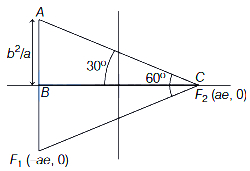
(C) Let the hyperbola be $\frac{x^2}{a^2} - \frac{y^2}{b^2} = 1$. The foci are $F_1(-ae, 0)$ and $F_2(ae, 0)$. The latus rectum through $F_1$ has endpoints $A(-ae, b^2/a)$ and $A'(-ae, -b^2/a)$.
The angle subtended by the latus rectum at the other focus $F_2$ is $60^{\circ}$.
Considering the right-angled triangle formed by the focus $F_2$,the midpoint of the latus rectum $B(-ae, 0)$,and one endpoint $A(-ae, b^2/a)$,the angle at $F_2$ is $30^{\circ}$.
In $\triangle ABF_2$,we have $AB = \frac{b^2}{a}$ and $BF_2 = ae - (-ae) = 2ae$.
Thus,$\tan 30^{\circ} = \frac{AB}{BF_2} = \frac{b^2/a}{2ae} = \frac{b^2}{2a^2e}$.
Since $\frac{1}{\sqrt{3}} = \frac{b^2}{2a^2e}$ and $b^2 = a^2(e^2 - 1)$,we substitute $b^2$:
$\frac{1}{\sqrt{3}} = \frac{a^2(e^2 - 1)}{2a^2e} = \frac{e^2 - 1}{2e}$.
This gives $2e = \sqrt{3}(e^2 - 1)$,or $\sqrt{3}e^2 - 2e - \sqrt{3} = 0$.
Solving the quadratic equation: $e = \frac{2 \pm \sqrt{4 - 4(\sqrt{3})(-\sqrt{3})}}{2\sqrt{3}} = \frac{2 \pm \sqrt{4 + 12}}{2\sqrt{3}} = \frac{2 \pm 4}{2\sqrt{3}}$.
Since $e > 1$,we take $e = \frac{6}{2\sqrt{3}} = \frac{3}{\sqrt{3}} = \sqrt{3}$.
The angle subtended by the latus rectum at the other focus $F_2$ is $60^{\circ}$.
Considering the right-angled triangle formed by the focus $F_2$,the midpoint of the latus rectum $B(-ae, 0)$,and one endpoint $A(-ae, b^2/a)$,the angle at $F_2$ is $30^{\circ}$.
In $\triangle ABF_2$,we have $AB = \frac{b^2}{a}$ and $BF_2 = ae - (-ae) = 2ae$.
Thus,$\tan 30^{\circ} = \frac{AB}{BF_2} = \frac{b^2/a}{2ae} = \frac{b^2}{2a^2e}$.
Since $\frac{1}{\sqrt{3}} = \frac{b^2}{2a^2e}$ and $b^2 = a^2(e^2 - 1)$,we substitute $b^2$:
$\frac{1}{\sqrt{3}} = \frac{a^2(e^2 - 1)}{2a^2e} = \frac{e^2 - 1}{2e}$.
This gives $2e = \sqrt{3}(e^2 - 1)$,or $\sqrt{3}e^2 - 2e - \sqrt{3} = 0$.
Solving the quadratic equation: $e = \frac{2 \pm \sqrt{4 - 4(\sqrt{3})(-\sqrt{3})}}{2\sqrt{3}} = \frac{2 \pm \sqrt{4 + 12}}{2\sqrt{3}} = \frac{2 \pm 4}{2\sqrt{3}}$.
Since $e > 1$,we take $e = \frac{6}{2\sqrt{3}} = \frac{3}{\sqrt{3}} = \sqrt{3}$.
0 likesView Solution
360
MathematicsMediumMCQAP EAMCET · 2020
The equation of the transverse axis of the hyperbola $(x-3)^2+(y+1)^2=(4x+3y)^2$ is
A
$3x+4y=13$
B
$3x-4y=13$
C
$4x-3y=13$
D
$3x-4y=9$
Solution
(B) The given equation is $(x-3)^2+(y+1)^2=(4x+3y)^2$.
We can rewrite this as $\sqrt{(x-3)^2+(y+1)^2} = 5 \left| \frac{4x+3y}{5} \right|$.
This is of the form $SP = ePM$,where $S(3, -1)$ is the focus,$e = 5$ is the eccentricity,and $4x+3y=0$ is the directrix.
The transverse axis is a line passing through the focus $(3, -1)$ and is perpendicular to the directrix $4x+3y=0$.
The slope of the directrix is $m_1 = -4/3$.
Since the transverse axis is perpendicular to the directrix,its slope is $m_2 = 3/4$.
The equation of the transverse axis is $y - (-1) = \frac{3}{4}(x - 3)$.
$4(y+1) = 3(x-3) \implies 4y+4 = 3x-9 \implies 3x-4y = 13$.
Thus,option $B$ is correct.
We can rewrite this as $\sqrt{(x-3)^2+(y+1)^2} = 5 \left| \frac{4x+3y}{5} \right|$.
This is of the form $SP = ePM$,where $S(3, -1)$ is the focus,$e = 5$ is the eccentricity,and $4x+3y=0$ is the directrix.
The transverse axis is a line passing through the focus $(3, -1)$ and is perpendicular to the directrix $4x+3y=0$.
The slope of the directrix is $m_1 = -4/3$.
Since the transverse axis is perpendicular to the directrix,its slope is $m_2 = 3/4$.
The equation of the transverse axis is $y - (-1) = \frac{3}{4}(x - 3)$.
$4(y+1) = 3(x-3) \implies 4y+4 = 3x-9 \implies 3x-4y = 13$.
Thus,option $B$ is correct.
0 likesView Solution
361
MathematicsEasyMCQAP EAMCET · 2020
The vertices of the hyperbola $7x^2 - 49y^2 = 343$ are
A
$(0, 0)$
B
$(\pm 3, 0)$
C
$(0, \pm 5)$
D
$(\pm 7, 0)$
Solution
(D) The given equation of the hyperbola is $7x^2 - 49y^2 = 343$.
Dividing both sides by $343$,we get:
$\frac{7x^2}{343} - \frac{49y^2}{343} = \frac{343}{343}$
$\frac{x^2}{49} - \frac{y^2}{7} = 1$.
Comparing this with the standard equation of a hyperbola $\frac{x^2}{a^2} - \frac{y^2}{b^2} = 1$,we have $a^2 = 49$,which implies $a = 7$.
The vertices of the hyperbola are given by $(\pm a, 0)$.
Therefore,the vertices are $(\pm 7, 0)$.
Thus,option $D$ is correct.
Dividing both sides by $343$,we get:
$\frac{7x^2}{343} - \frac{49y^2}{343} = \frac{343}{343}$
$\frac{x^2}{49} - \frac{y^2}{7} = 1$.
Comparing this with the standard equation of a hyperbola $\frac{x^2}{a^2} - \frac{y^2}{b^2} = 1$,we have $a^2 = 49$,which implies $a = 7$.
The vertices of the hyperbola are given by $(\pm a, 0)$.
Therefore,the vertices are $(\pm 7, 0)$.
Thus,option $D$ is correct.
0 likesView Solution
362
MathematicsDifficultMCQAP EAMCET · 2020
The equation of the hyperbola with focus $(1, 2)$,eccentricity $e = \sqrt{3}$,and directrix $2x + y = 1$ is given by:
A
$2y^2 - 12xy - 7x^2 + 2x - 14y + 22 = 0$
B
$2y^2 + 12xy + 7x^2 - 2x + 14y - 22 = 0$
C
$2y^2 - 12xy - 7x^2 - 2x - 14y - 22 = 0$
D
$2y^2 + 12xy + 7x^2 + 2x + 14y + 22 = 0$
Solution
(A) Given,Focus $(S) = (1, 2)$,Eccentricity $(e) = \sqrt{3}$,and Directrix $2x + y - 1 = 0$.
By the definition of a conic,$SP = e \cdot PM$,where $P(x, y)$ is a point on the hyperbola.
$SP^2 = e^2 \cdot PM^2$
$(x - 1)^2 + (y - 2)^2 = 3 \cdot \frac{(2x + y - 1)^2}{2^2 + 1^2}$
$x^2 - 2x + 1 + y^2 - 4y + 4 = \frac{3}{5}(4x^2 + y^2 + 1 + 4xy - 4x - 2y)$
$5(x^2 + y^2 - 2x - 4y + 5) = 3(4x^2 + y^2 + 4xy - 4x - 2y + 1)$
$5x^2 + 5y^2 - 10x - 20y + 25 = 12x^2 + 3y^2 + 12xy - 12x - 6y + 3$
Rearranging the terms:
$12x^2 - 5x^2 + 3y^2 - 5y^2 + 12xy - 12x + 10x - 6y + 20y + 3 - 25 = 0$
$7x^2 - 2y^2 + 12xy - 2x + 14y - 22 = 0$
Multiplying by $-1$:
$-7x^2 + 2y^2 - 12xy + 2x - 14y + 22 = 0$
Thus,the equation is $2y^2 - 12xy - 7x^2 + 2x - 14y + 22 = 0$.
By the definition of a conic,$SP = e \cdot PM$,where $P(x, y)$ is a point on the hyperbola.
$SP^2 = e^2 \cdot PM^2$
$(x - 1)^2 + (y - 2)^2 = 3 \cdot \frac{(2x + y - 1)^2}{2^2 + 1^2}$
$x^2 - 2x + 1 + y^2 - 4y + 4 = \frac{3}{5}(4x^2 + y^2 + 1 + 4xy - 4x - 2y)$
$5(x^2 + y^2 - 2x - 4y + 5) = 3(4x^2 + y^2 + 4xy - 4x - 2y + 1)$
$5x^2 + 5y^2 - 10x - 20y + 25 = 12x^2 + 3y^2 + 12xy - 12x - 6y + 3$
Rearranging the terms:
$12x^2 - 5x^2 + 3y^2 - 5y^2 + 12xy - 12x + 10x - 6y + 20y + 3 - 25 = 0$
$7x^2 - 2y^2 + 12xy - 2x + 14y - 22 = 0$
Multiplying by $-1$:
$-7x^2 + 2y^2 - 12xy + 2x - 14y + 22 = 0$
Thus,the equation is $2y^2 - 12xy - 7x^2 + 2x - 14y + 22 = 0$.
0 likesView Solution
363
MathematicsMediumMCQAP EAMCET · 2020
Let $LL^{\prime}$ be the latus rectum through the focus $S$ of a hyperbola and $A^{\prime}$ be the opposite vertex of the hyperbola. If triangle $A^{\prime}LL^{\prime}$ is equilateral,then the eccentricity of the hyperbola is
A
$\frac{\sqrt{3}+1}{\sqrt{3}}$
B
$\frac{\sqrt{3}+1}{\sqrt{2}}$
C
$\frac{\sqrt{3}+1}{\sqrt{5}}$
D
$\sqrt{3}+1$
Solution
(A) Let the equation of the hyperbola be $\frac{x^2}{a^2} - \frac{y^2}{b^2} = 1$.
The coordinates of the vertex $A^{\prime}$ are $(-a, 0)$.
The focus $S$ is $(ae, 0)$ and the endpoints of the latus rectum $L$ and $L^{\prime}$ are $(ae, \frac{b^2}{a})$ and $(ae, -\frac{b^2}{a})$.
The length of the side $LL^{\prime} = \frac{2b^2}{a}$.
Since $\triangle A^{\prime}LL^{\prime}$ is equilateral,the height from $A^{\prime}$ to $LL^{\prime}$ is $\frac{\sqrt{3}}{2} \times \text{side length} = \frac{\sqrt{3}}{2} \times \frac{2b^2}{a} = \frac{\sqrt{3}b^2}{a}$.
The distance from $A^{\prime}(-a, 0)$ to the line $x = ae$ is $ae - (-a) = a(e+1)$.
Thus,$a(e+1) = \frac{\sqrt{3}b^2}{a}$.
Using $b^2 = a^2(e^2-1)$,we get $a(e+1) = \frac{\sqrt{3}a^2(e^2-1)}{a} = \sqrt{3}a(e-1)(e+1)$.
Dividing by $a(e+1)$,we get $1 = \sqrt{3}(e-1)$,which implies $e-1 = \frac{1}{\sqrt{3}}$,so $e = 1 + \frac{1}{\sqrt{3}} = \frac{\sqrt{3}+1}{\sqrt{3}}$.
The coordinates of the vertex $A^{\prime}$ are $(-a, 0)$.
The focus $S$ is $(ae, 0)$ and the endpoints of the latus rectum $L$ and $L^{\prime}$ are $(ae, \frac{b^2}{a})$ and $(ae, -\frac{b^2}{a})$.
The length of the side $LL^{\prime} = \frac{2b^2}{a}$.
Since $\triangle A^{\prime}LL^{\prime}$ is equilateral,the height from $A^{\prime}$ to $LL^{\prime}$ is $\frac{\sqrt{3}}{2} \times \text{side length} = \frac{\sqrt{3}}{2} \times \frac{2b^2}{a} = \frac{\sqrt{3}b^2}{a}$.
The distance from $A^{\prime}(-a, 0)$ to the line $x = ae$ is $ae - (-a) = a(e+1)$.
Thus,$a(e+1) = \frac{\sqrt{3}b^2}{a}$.
Using $b^2 = a^2(e^2-1)$,we get $a(e+1) = \frac{\sqrt{3}a^2(e^2-1)}{a} = \sqrt{3}a(e-1)(e+1)$.
Dividing by $a(e+1)$,we get $1 = \sqrt{3}(e-1)$,which implies $e-1 = \frac{1}{\sqrt{3}}$,so $e = 1 + \frac{1}{\sqrt{3}} = \frac{\sqrt{3}+1}{\sqrt{3}}$.
0 likesView Solution
364
MathematicsMediumMCQAP EAMCET · 2020
The equation of the normal to the curve $x=a \cosh(t), y=b \sinh(t)$ at any point $t$ is
A
$ax+by=a^2+b^2$
B
$ax \operatorname{sech}(t)+by \operatorname{cosech}(t)=a^2+b^2$
C
$ax \operatorname{sech}(t)-by \operatorname{cosech}(t)=a^2-b^2$
D
$\frac{ax}{\sinh(t)}+\frac{by}{\cosh(t)}=a^2+b^2$
Solution
(B) The given curve is $x=a \cosh(t)$ and $y=b \sinh(t)$,which represents the hyperbola $\frac{x^2}{a^2}-\frac{y^2}{b^2}=1$.
The slope of the tangent at point $t$ is $\frac{dy}{dx} = \frac{dy/dt}{dx/dt} = \frac{b \cosh(t)}{a \sinh(t)}$.
The slope of the normal is $-\frac{dx}{dy} = -\frac{a \sinh(t)}{b \cosh(t)}$.
The equation of the normal at point $(a \cosh(t), b \sinh(t))$ is given by:
$y - b \sinh(t) = -\frac{a \sinh(t)}{b \cosh(t)} (x - a \cosh(t))$.
Multiplying by $b \cosh(t)$:
$by \cosh(t) - b^2 \sinh(t) \cosh(t) = -ax \sinh(t) + a^2 \sinh(t) \cosh(t)$.
Rearranging the terms:
$ax \sinh(t) + by \cosh(t) = (a^2+b^2) \sinh(t) \cosh(t)$.
Dividing both sides by $\sinh(t) \cosh(t)$:
$\frac{ax}{\cosh(t)} + \frac{by}{\sinh(t)} = a^2+b^2$.
This can be written as $ax \operatorname{sech}(t) + by \operatorname{cosech}(t) = a^2+b^2$.
The slope of the tangent at point $t$ is $\frac{dy}{dx} = \frac{dy/dt}{dx/dt} = \frac{b \cosh(t)}{a \sinh(t)}$.
The slope of the normal is $-\frac{dx}{dy} = -\frac{a \sinh(t)}{b \cosh(t)}$.
The equation of the normal at point $(a \cosh(t), b \sinh(t))$ is given by:
$y - b \sinh(t) = -\frac{a \sinh(t)}{b \cosh(t)} (x - a \cosh(t))$.
Multiplying by $b \cosh(t)$:
$by \cosh(t) - b^2 \sinh(t) \cosh(t) = -ax \sinh(t) + a^2 \sinh(t) \cosh(t)$.
Rearranging the terms:
$ax \sinh(t) + by \cosh(t) = (a^2+b^2) \sinh(t) \cosh(t)$.
Dividing both sides by $\sinh(t) \cosh(t)$:
$\frac{ax}{\cosh(t)} + \frac{by}{\sinh(t)} = a^2+b^2$.
This can be written as $ax \operatorname{sech}(t) + by \operatorname{cosech}(t) = a^2+b^2$.
0 likesView Solution
365
MathematicsMediumMCQAP EAMCET · 2020
The intersection of two perpendicular tangents to the hyperbola $\frac{x^2}{4} - \frac{y^2}{2} = 1$ lies on the circle $x^2 + y^2 = \dots \dots \dots$
A
$2$
B
$12$
C
$\sqrt{2}$
D
$2\sqrt{3}$
Solution
(A) The locus of the point of intersection of perpendicular tangents to a hyperbola $\frac{x^2}{a^2} - \frac{y^2}{b^2} = 1$ is known as the director circle,given by the equation $x^2 + y^2 = a^2 - b^2$.
For the given hyperbola $\frac{x^2}{4} - \frac{y^2}{2} = 1$,we have $a^2 = 4$ and $b^2 = 2$.
Substituting these values into the director circle equation,we get $x^2 + y^2 = 4 - 2 = 2$.
Thus,the intersection point lies on the circle $x^2 + y^2 = 2$.
Hence,option $A$ is correct.
For the given hyperbola $\frac{x^2}{4} - \frac{y^2}{2} = 1$,we have $a^2 = 4$ and $b^2 = 2$.
Substituting these values into the director circle equation,we get $x^2 + y^2 = 4 - 2 = 2$.
Thus,the intersection point lies on the circle $x^2 + y^2 = 2$.
Hence,option $A$ is correct.
0 likesView Solution
366
MathematicsMediumMCQAP EAMCET · 2020
The equation of the asymptotes of the hyperbola $2 x^2+5 x y+2 y^2-11 x-7 y-4=0$ is
A
$2 x^2+5 x y+2 y^2-11 x-7 y-9=0$
B
$2 x^2+5 x y+2 y^2-11 x-7 y+5=0$
C
$2 x^2+5 x y+2 y^2-11 x-7 y+4=0$
D
$2 x^2+5 x y+2 y^2-11 x-7 y+9=0$
Solution
(B) The equation of the asymptotes of the hyperbola $2 x^2+5 x y+2 y^2-11 x-7 y-4=0$ is of the form $2 x^2+5 x y+2 y^2-11 x-7 y+\lambda=0$.
Since this represents a pair of straight lines,the determinant of the general second-degree equation must be zero:
$abc + 2fgh - af^2 - bg^2 - ch^2 = 0$.
Here,$a=2, b=2, c=\lambda, h=\frac{5}{2}, g=-\frac{11}{2}, f=-\frac{7}{2}$.
Substituting these values:
$2(2)(\lambda) + 2(-\frac{7}{2})(-\frac{11}{2})(\frac{5}{2}) - 2(-\frac{7}{2})^2 - 2(-\frac{11}{2})^2 - \lambda(\frac{5}{2})^2 = 0$.
$4\lambda + \frac{385}{4} - \frac{49}{2} - \frac{121}{2} - \frac{25\lambda}{4} = 0$.
Multiplying by $4$:
$16\lambda + 385 - 98 - 242 - 25\lambda = 0$.
$-9\lambda + 45 = 0 \Rightarrow \lambda = 5$.
Thus,the equation is $2 x^2+5 x y+2 y^2-11 x-7 y+5=0$.
Since this represents a pair of straight lines,the determinant of the general second-degree equation must be zero:
$abc + 2fgh - af^2 - bg^2 - ch^2 = 0$.
Here,$a=2, b=2, c=\lambda, h=\frac{5}{2}, g=-\frac{11}{2}, f=-\frac{7}{2}$.
Substituting these values:
$2(2)(\lambda) + 2(-\frac{7}{2})(-\frac{11}{2})(\frac{5}{2}) - 2(-\frac{7}{2})^2 - 2(-\frac{11}{2})^2 - \lambda(\frac{5}{2})^2 = 0$.
$4\lambda + \frac{385}{4} - \frac{49}{2} - \frac{121}{2} - \frac{25\lambda}{4} = 0$.
Multiplying by $4$:
$16\lambda + 385 - 98 - 242 - 25\lambda = 0$.
$-9\lambda + 45 = 0 \Rightarrow \lambda = 5$.
Thus,the equation is $2 x^2+5 x y+2 y^2-11 x-7 y+5=0$.
0 likesView Solution
367
MathematicsEasyMCQAP EAMCET · 2020
If $a > 0$ and $n \in R$,then $\lim_{x \rightarrow a} x^n = \dots$
A
$n a^n$
B
$(n-1) a^n$
C
$n a^{n-1}$
D
$a^n$
Solution
(D) The limit of a continuous function $f(x) = x^n$ as $x$ approaches $a$ is simply the value of the function at $x = a$.
Since $f(x) = x^n$ is continuous for $x > 0$,we have:
$\lim_{x \rightarrow a} x^n = a^n$
Since $f(x) = x^n$ is continuous for $x > 0$,we have:
$\lim_{x \rightarrow a} x^n = a^n$
0 likesView Solution
368
MathematicsEasyMCQAP EAMCET · 2020
$\lim _{n \rightarrow \infty} \frac{n !}{(n+1) !-n !} = $
A
$1$
B
$-1$
C
$2$
D
$0$
Solution
(D) We are given the limit: $\lim _{n \rightarrow \infty} \frac{n !}{(n+1) !-n !}$
First,simplify the denominator by factoring out $n!$:
$(n+1)! - n! = n!(n+1) - n!(1) = n!(n+1-1) = n!(n)$
Now,substitute this back into the expression:
$\lim _{n \rightarrow \infty} \frac{n!}{n!(n)} = \lim _{n \rightarrow \infty} \frac{1}{n}$
As $n \rightarrow \infty$,the value of $\frac{1}{n}$ approaches $0$.
Therefore,the limit is $0$.
First,simplify the denominator by factoring out $n!$:
$(n+1)! - n! = n!(n+1) - n!(1) = n!(n+1-1) = n!(n)$
Now,substitute this back into the expression:
$\lim _{n \rightarrow \infty} \frac{n!}{n!(n)} = \lim _{n \rightarrow \infty} \frac{1}{n}$
As $n \rightarrow \infty$,the value of $\frac{1}{n}$ approaches $0$.
Therefore,the limit is $0$.
0 likesView Solution
369
MathematicsEasyMCQAP EAMCET · 2020
If $\lim _{x \rightarrow 3} \left( \frac{x^n - 3^n}{x - 3} \right) = 108$ and $n \in N$,then the value of $n$ is
A
$3$
B
$6$
C
$5$
D
$4$
Solution
(D) Given,$\lim _{x \rightarrow 3} \frac{x^n - 3^n}{x - 3} = 108$.
Using the standard limit formula $\lim _{x \rightarrow a} \frac{x^n - a^n}{x - a} = n \cdot a^{n-1}$:
Here,$a = 3$,so $n \cdot 3^{n-1} = 108$.
$n \cdot 3^{n-1} = 108$.
Multiply both sides by $3$:
$n \cdot 3^n = 108 \times 3 = 324$.
We can write $324$ as $4 \times 81 = 4 \times 3^4$.
Comparing $n \cdot 3^n = 4 \times 3^4$,we get $n = 4$.
Thus,the value of $n$ is $4$.
Using the standard limit formula $\lim _{x \rightarrow a} \frac{x^n - a^n}{x - a} = n \cdot a^{n-1}$:
Here,$a = 3$,so $n \cdot 3^{n-1} = 108$.
$n \cdot 3^{n-1} = 108$.
Multiply both sides by $3$:
$n \cdot 3^n = 108 \times 3 = 324$.
We can write $324$ as $4 \times 81 = 4 \times 3^4$.
Comparing $n \cdot 3^n = 4 \times 3^4$,we get $n = 4$.
Thus,the value of $n$ is $4$.
0 likesView Solution
370
MathematicsEasyMCQAP EAMCET · 2020
$\lim _{x \rightarrow 0} \frac{\left(1+\frac{x}{2}\right)^{5 / 7}-1}{x} = $
A
$\frac{5}{7}$
B
$\frac{10}{7}$
C
$\frac{5}{14}$
D
$\frac{5}{17}$
Solution
(C) To evaluate the limit $\lim _{x \rightarrow 0} \frac{\left(1+\frac{x}{2}\right)^{5 / 7}-1}{x}$,we observe that it is in the indeterminate form $\frac{0}{0}$.
We can apply $L$'$H$ôpital's rule by differentiating the numerator and the denominator with respect to $x$:
$\lim _{x \rightarrow 0} \frac{\frac{d}{dx}\left(\left(1+\frac{x}{2}\right)^{5 / 7}-1\right)}{\frac{d}{dx}(x)}$
$= \lim _{x}$ ${\rightarrow 0} \frac{\frac{5}{7}\left(1+\frac{x}{2}\right)^{5 / 7 - 1} \cdot \frac{d}{dx}\left(1+\frac{x}{2}\right)}{1}$
$= \lim _{x \rightarrow 0} \frac{5}{7}\left(1+\frac{x}{2}\right)^{-2 / 7} \cdot \frac{1}{2}$
$= \frac{5}{7} \cdot (1+0)^{-2 / 7} \cdot \frac{1}{2}$
$= \frac{5}{14}$
Thus,the correct option is $C$.
We can apply $L$'$H$ôpital's rule by differentiating the numerator and the denominator with respect to $x$:
$\lim _{x \rightarrow 0} \frac{\frac{d}{dx}\left(\left(1+\frac{x}{2}\right)^{5 / 7}-1\right)}{\frac{d}{dx}(x)}$
$= \lim _{x}$ ${\rightarrow 0} \frac{\frac{5}{7}\left(1+\frac{x}{2}\right)^{5 / 7 - 1} \cdot \frac{d}{dx}\left(1+\frac{x}{2}\right)}{1}$
$= \lim _{x \rightarrow 0} \frac{5}{7}\left(1+\frac{x}{2}\right)^{-2 / 7} \cdot \frac{1}{2}$
$= \frac{5}{7} \cdot (1+0)^{-2 / 7} \cdot \frac{1}{2}$
$= \frac{5}{14}$
Thus,the correct option is $C$.
0 likesView Solution
371
MathematicsEasyMCQAP EAMCET · 2020
If $f(x) = \begin{cases} 4x-5, & x \leq 2 \\ x-k, & x > 2 \end{cases}$ then the value of $k$ for which $\lim_{x \rightarrow 2} f(x)$ exists is equal to:
A
$-1$
B
$-2$
C
$1$
D
$2$
Solution
(A) For the limit $\lim_{x \rightarrow 2} f(x)$ to exist,the Left Hand Limit $(LHL)$ must be equal to the Right Hand Limit $(RHL)$ at $x = 2$.
$LHL = \lim_{x \rightarrow 2^{-}} f(x) = \lim_{x \rightarrow 2} (4x - 5) = 4(2) - 5 = 3$.
$RHL = \lim_{x \rightarrow 2^{+}} f(x) = \lim_{x \rightarrow 2} (x - k) = 2 - k$.
Equating $LHL$ and $RHL$:
$3 = 2 - k$
$k = 2 - 3$
$k = -1$.
Thus,the correct option is $A$.
$LHL = \lim_{x \rightarrow 2^{-}} f(x) = \lim_{x \rightarrow 2} (4x - 5) = 4(2) - 5 = 3$.
$RHL = \lim_{x \rightarrow 2^{+}} f(x) = \lim_{x \rightarrow 2} (x - k) = 2 - k$.
Equating $LHL$ and $RHL$:
$3 = 2 - k$
$k = 2 - 3$
$k = -1$.
Thus,the correct option is $A$.
0 likesView Solution
372
MathematicsEasyMCQAP EAMCET · 2020
$\lim _{x \rightarrow 0} \frac{a^x-1}{\sin (x)} = $
A
$\log _e (a)$
B
$\frac{1}{2} \log _e (a)$
C
$0$
D
$1$
Solution
(A) We are given the limit $\lim _{x \rightarrow 0} \frac{a^x-1}{\sin x}$.
Dividing both the numerator and the denominator by $x$,we get:
$\lim _{x \rightarrow 0} \frac{\frac{a^x-1}{x}}{\frac{\sin x}{x}}$.
Using the standard limits $\lim _{x \rightarrow 0} \frac{a^x-1}{x} = \log _e a$ and $\lim _{x \rightarrow 0} \frac{\sin x}{x} = 1$,we have:
$\frac{\log _e a}{1} = \log _e a$.
Thus,the correct option is $A$.
Dividing both the numerator and the denominator by $x$,we get:
$\lim _{x \rightarrow 0} \frac{\frac{a^x-1}{x}}{\frac{\sin x}{x}}$.
Using the standard limits $\lim _{x \rightarrow 0} \frac{a^x-1}{x} = \log _e a$ and $\lim _{x \rightarrow 0} \frac{\sin x}{x} = 1$,we have:
$\frac{\log _e a}{1} = \log _e a$.
Thus,the correct option is $A$.
0 likesView Solution
373
MathematicsEasyMCQAP EAMCET · 2020
$\lim _{x \rightarrow 1}\left((1-x) \tan \left(\frac{\pi x}{2}\right)\right)=$
A
$\frac{1}{\pi}$
B
$\frac{3}{\pi}$
C
$\frac{4}{\pi}$
D
$\frac{2}{\pi}$
Solution
(D) Let $L = \lim _{x \rightarrow 1}(1-x) \tan \left(\frac{\pi x}{2}\right)$.
This is an indeterminate form of type $0 \times \infty$.
We can rewrite the limit as:
$L = \lim _{x \rightarrow 1} \frac{1-x}{\cot \left(\frac{\pi x}{2}\right)}$.
Applying $L$'Hospital's rule by differentiating the numerator and denominator with respect to $x$:
$L = \lim _{x \rightarrow 1} \frac{\frac{d}{dx}(1-x)}{\frac{d}{dx}(\cot \left(\frac{\pi x}{2}\right))}$
$L = \lim _{x \rightarrow 1} \frac{-1}{-\csc^2 \left(\frac{\pi x}{2}\right) \cdot \frac{\pi}{2}}$
$L = \frac{1}{\frac{\pi}{2} \csc^2 \left(\frac{\pi}{2}\right)}$
Since $\csc \left(\frac{\pi}{2}\right) = 1$,we get:
$L = \frac{1}{\frac{\pi}{2} \cdot 1^2} = \frac{2}{\pi}$.
Thus,the correct option is $D$.
This is an indeterminate form of type $0 \times \infty$.
We can rewrite the limit as:
$L = \lim _{x \rightarrow 1} \frac{1-x}{\cot \left(\frac{\pi x}{2}\right)}$.
Applying $L$'Hospital's rule by differentiating the numerator and denominator with respect to $x$:
$L = \lim _{x \rightarrow 1} \frac{\frac{d}{dx}(1-x)}{\frac{d}{dx}(\cot \left(\frac{\pi x}{2}\right))}$
$L = \lim _{x \rightarrow 1} \frac{-1}{-\csc^2 \left(\frac{\pi x}{2}\right) \cdot \frac{\pi}{2}}$
$L = \frac{1}{\frac{\pi}{2} \csc^2 \left(\frac{\pi}{2}\right)}$
Since $\csc \left(\frac{\pi}{2}\right) = 1$,we get:
$L = \frac{1}{\frac{\pi}{2} \cdot 1^2} = \frac{2}{\pi}$.
Thus,the correct option is $D$.
0 likesView Solution
374
MathematicsEasyMCQAP EAMCET · 2020
$\lim _{n \rightarrow \infty}\left\{n-\sqrt{n^2-4 n}\right\}=$
A
$0$
B
$2$
C
$4$
D
$1$
Solution
(B) To evaluate the limit $\lim _{n \rightarrow \infty}\left\{n-\sqrt{n^2-4 n}\right\}$,we multiply and divide by the conjugate expression:
$= \lim _{n \rightarrow \infty} \frac{(n-\sqrt{n^2-4 n})(n+\sqrt{n^2-4 n})}{n+\sqrt{n^2-4 n}}$
$= \lim _{n \rightarrow \infty} \frac{n^2-(n^2-4 n)}{n+\sqrt{n^2-4 n}}$
$= \lim _{n \rightarrow \infty} \frac{4 n}{n+\sqrt{n^2-4 n}}$
Divide the numerator and denominator by $n$:
$= \lim _{n \rightarrow \infty} \frac{4}{1+\sqrt{1-\frac{4}{n}}}$
As $n \rightarrow \infty$,$\frac{4}{n} \rightarrow 0$,so the expression becomes:
$= \frac{4}{1+\sqrt{1-0}} = \frac{4}{1+1} = \frac{4}{2} = 2$.
$= \lim _{n \rightarrow \infty} \frac{(n-\sqrt{n^2-4 n})(n+\sqrt{n^2-4 n})}{n+\sqrt{n^2-4 n}}$
$= \lim _{n \rightarrow \infty} \frac{n^2-(n^2-4 n)}{n+\sqrt{n^2-4 n}}$
$= \lim _{n \rightarrow \infty} \frac{4 n}{n+\sqrt{n^2-4 n}}$
Divide the numerator and denominator by $n$:
$= \lim _{n \rightarrow \infty} \frac{4}{1+\sqrt{1-\frac{4}{n}}}$
As $n \rightarrow \infty$,$\frac{4}{n} \rightarrow 0$,so the expression becomes:
$= \frac{4}{1+\sqrt{1-0}} = \frac{4}{1+1} = \frac{4}{2} = 2$.
0 likesView Solution
375
MathematicsMediumMCQAP EAMCET · 2020
$\lim _{x \rightarrow \pi} \frac{1-\sin (x/2)}{\left(\cos \frac{x}{2}\right)\left(\cos \frac{x}{4}-\sin \frac{x}{4}\right)} =$
A
$\frac{3}{\sqrt{2}}$
B
$\frac{-1}{\sqrt{2}}$
C
$\frac{1}{\sqrt{2}}$
D
$\frac{5}{\sqrt{2}}$
Solution
(C) Let $x = \pi + h$. As $x \rightarrow \pi$,$h \rightarrow 0$.
The expression becomes $\lim _{h \rightarrow 0} \frac{1-\sin (\frac{\pi+h}{2})}{\cos (\frac{\pi+h}{2}) (\cos (\frac{\pi+h}{4})-\sin (\frac{\pi+h}{4}))}$.
Using trigonometric identities,$\sin (\frac{\pi}{2} + \frac{h}{2}) = \cos (\frac{h}{2})$ and $\cos (\frac{\pi}{2} + \frac{h}{2}) = -\sin (\frac{h}{2})$.
The expression simplifies to $\lim _{h \rightarrow 0} \frac{1-\cos (h/2)}{-\sin (h/2) (\cos (\frac{\pi}{4} + \frac{h}{4}) - \sin (\frac{\pi}{4} + \frac{h}{4}))}$.
Since $\cos (\frac{\pi}{4} + \frac{h}{4}) - \sin (\frac{\pi}{4} + \frac{h}{4}) = \sqrt{2} \sin (\frac{\pi}{4} - (\frac{\pi}{4} + \frac{h}{4})) = \sqrt{2} \sin (-h/4) = -\sqrt{2} \sin (h/4)$.
Substituting this back: $\lim _{h \rightarrow 0} \frac{2 \sin^2 (h/4)}{-\sin (h/2) \cdot (-\sqrt{2} \sin (h/4))} = \lim _{h \rightarrow 0} \frac{2 \sin (h/4)}{\sqrt{2} \sin (h/2)}$.
Using $\sin (h/2) = 2 \sin (h/4) \cos (h/4)$,we get $\lim _{h \rightarrow 0} \frac{2 \sin (h/4)}{\sqrt{2} \cdot 2 \sin (h/4) \cos (h/4)} = \lim _{h \rightarrow 0} \frac{1}{\sqrt{2} \cos (h/4)} = \frac{1}{\sqrt{2} \cdot 1} = \frac{1}{\sqrt{2}}$.
The expression becomes $\lim _{h \rightarrow 0} \frac{1-\sin (\frac{\pi+h}{2})}{\cos (\frac{\pi+h}{2}) (\cos (\frac{\pi+h}{4})-\sin (\frac{\pi+h}{4}))}$.
Using trigonometric identities,$\sin (\frac{\pi}{2} + \frac{h}{2}) = \cos (\frac{h}{2})$ and $\cos (\frac{\pi}{2} + \frac{h}{2}) = -\sin (\frac{h}{2})$.
The expression simplifies to $\lim _{h \rightarrow 0} \frac{1-\cos (h/2)}{-\sin (h/2) (\cos (\frac{\pi}{4} + \frac{h}{4}) - \sin (\frac{\pi}{4} + \frac{h}{4}))}$.
Since $\cos (\frac{\pi}{4} + \frac{h}{4}) - \sin (\frac{\pi}{4} + \frac{h}{4}) = \sqrt{2} \sin (\frac{\pi}{4} - (\frac{\pi}{4} + \frac{h}{4})) = \sqrt{2} \sin (-h/4) = -\sqrt{2} \sin (h/4)$.
Substituting this back: $\lim _{h \rightarrow 0} \frac{2 \sin^2 (h/4)}{-\sin (h/2) \cdot (-\sqrt{2} \sin (h/4))} = \lim _{h \rightarrow 0} \frac{2 \sin (h/4)}{\sqrt{2} \sin (h/2)}$.
Using $\sin (h/2) = 2 \sin (h/4) \cos (h/4)$,we get $\lim _{h \rightarrow 0} \frac{2 \sin (h/4)}{\sqrt{2} \cdot 2 \sin (h/4) \cos (h/4)} = \lim _{h \rightarrow 0} \frac{1}{\sqrt{2} \cos (h/4)} = \frac{1}{\sqrt{2} \cdot 1} = \frac{1}{\sqrt{2}}$.
0 likesView Solution
376
MathematicsMediumMCQAP EAMCET · 2020
Find the value of $\lim _{x \rightarrow 0} \frac{\sin (x^m)}{(\sin x)^n}$,given that $n < m$.
A
$2$
B
$1$
C
$0$
D
$\infty$
Solution
(C) We are given the limit $L = \lim _{x \rightarrow 0} \frac{\sin (x^m)}{(\sin x)^n}$ where $n < m$.
By multiplying and dividing by $x^m$ in the numerator and $x^n$ in the denominator,we get:
$L = \lim _{x \rightarrow 0} \left( \frac{\sin (x^m)}{x^m} \cdot x^m \right) / \left( \frac{\sin x}{x} \cdot x \right)^n$
$L = \lim _{x \rightarrow 0} \left( \frac{\sin (x^m)}{x^m} \right) \cdot \left( \frac{x}{\sin x} \right)^n \cdot x^{m-n}$
Since $\lim _{x \rightarrow 0} \frac{\sin (x^m)}{x^m} = 1$ and $\lim _{x \rightarrow 0} \frac{\sin x}{x} = 1$,the expression becomes:
$L = 1 \cdot (1)^n \cdot \lim _{x \rightarrow 0} x^{m-n}$
Given $n < m$,we have $m - n > 0$.
Therefore,$L = 0^{m-n} = 0$.
Hence,option $C$ is correct.
By multiplying and dividing by $x^m$ in the numerator and $x^n$ in the denominator,we get:
$L = \lim _{x \rightarrow 0} \left( \frac{\sin (x^m)}{x^m} \cdot x^m \right) / \left( \frac{\sin x}{x} \cdot x \right)^n$
$L = \lim _{x \rightarrow 0} \left( \frac{\sin (x^m)}{x^m} \right) \cdot \left( \frac{x}{\sin x} \right)^n \cdot x^{m-n}$
Since $\lim _{x \rightarrow 0} \frac{\sin (x^m)}{x^m} = 1$ and $\lim _{x \rightarrow 0} \frac{\sin x}{x} = 1$,the expression becomes:
$L = 1 \cdot (1)^n \cdot \lim _{x \rightarrow 0} x^{m-n}$
Given $n < m$,we have $m - n > 0$.
Therefore,$L = 0^{m-n} = 0$.
Hence,option $C$ is correct.
0 likesView Solution
377
MathematicsEasyMCQAP EAMCET · 2020
$\lim _{x \rightarrow 0} \frac{1-\cos x}{x^2} = $
A
$0$
B
$-1$
C
$\frac{1}{2}$
D
$1$
Solution
(C) We know that the limit is of the form $\frac{0}{0}$ as $x \rightarrow 0$.
Using the trigonometric identity $1 - \cos x = 2 \sin^2(\frac{x}{2})$,the expression becomes:
$\lim _{x \rightarrow 0} \frac{2 \sin^2(\frac{x}{2})}{x^2}$
$= 2 \lim _{x \rightarrow 0} \left( \frac{\sin(\frac{x}{2})}{x} \right)^2$
$= 2 \lim _{x \rightarrow 0} \left( \frac{\sin(\frac{x}{2})}{2 \cdot \frac{x}{2}} \right)^2$
$= 2 \cdot \frac{1}{4} \lim _{x \rightarrow 0} \left( \frac{\sin(\frac{x}{2})}{\frac{x}{2}} \right)^2$
Since $\lim _{\theta \rightarrow 0} \frac{\sin \theta}{\theta} = 1$,we get:
$= 2 \cdot \frac{1}{4} \cdot (1)^2 = \frac{1}{2}$.
Using the trigonometric identity $1 - \cos x = 2 \sin^2(\frac{x}{2})$,the expression becomes:
$\lim _{x \rightarrow 0} \frac{2 \sin^2(\frac{x}{2})}{x^2}$
$= 2 \lim _{x \rightarrow 0} \left( \frac{\sin(\frac{x}{2})}{x} \right)^2$
$= 2 \lim _{x \rightarrow 0} \left( \frac{\sin(\frac{x}{2})}{2 \cdot \frac{x}{2}} \right)^2$
$= 2 \cdot \frac{1}{4} \lim _{x \rightarrow 0} \left( \frac{\sin(\frac{x}{2})}{\frac{x}{2}} \right)^2$
Since $\lim _{\theta \rightarrow 0} \frac{\sin \theta}{\theta} = 1$,we get:
$= 2 \cdot \frac{1}{4} \cdot (1)^2 = \frac{1}{2}$.
0 likesView Solution
378
MathematicsMediumMCQAP EAMCET · 2020
If $\lim _{x \rightarrow \infty}\left(1+\frac{p}{x}\right)^{q x}=e^9$ where $p, q \in \mathbb{N}$,then $p+q=$
A
$6$
B
$9$
C
$81$
D
$18$
Solution
(A) Given,$\lim _{x \rightarrow \infty}\left(1+\frac{p}{x}\right)^{q x}=e^9$.
Using the standard limit formula $\lim _{x \rightarrow \infty}(1+\frac{a}{x})^x = e^a$,we have:
$\lim _{x \rightarrow \infty}\left(1+\frac{p}{x}\right)^{q x} = \left[ \lim _{x \rightarrow \infty} \left(1+\frac{p}{x}\right)^{x} \right]^{q} = (e^p)^q = e^{pq}$.
Comparing this with the given expression $e^9$,we get $pq = 9$.
Since $p, q \in \mathbb{N}$ (natural numbers),the possible pairs $(p, q)$ are $(1, 9), (3, 3), (9, 1)$.
In these cases,$p+q$ can be $1+9=10$ or $3+3=6$.
Given the options,the correct value is $6$.
Using the standard limit formula $\lim _{x \rightarrow \infty}(1+\frac{a}{x})^x = e^a$,we have:
$\lim _{x \rightarrow \infty}\left(1+\frac{p}{x}\right)^{q x} = \left[ \lim _{x \rightarrow \infty} \left(1+\frac{p}{x}\right)^{x} \right]^{q} = (e^p)^q = e^{pq}$.
Comparing this with the given expression $e^9$,we get $pq = 9$.
Since $p, q \in \mathbb{N}$ (natural numbers),the possible pairs $(p, q)$ are $(1, 9), (3, 3), (9, 1)$.
In these cases,$p+q$ can be $1+9=10$ or $3+3=6$.
Given the options,the correct value is $6$.
0 likesView Solution
379
MathematicsMediumMCQAP EAMCET · 2020
$\lim _{x \rightarrow 0}(1+3x)^{\frac{2}{x}} = $
A
$6$
B
$e^6$
C
$e^{-6}$
D
$e^{\frac{1}{6}}$
Solution
(B) We know that the standard limit formula is $\lim _{x \rightarrow 0}(1+ax)^{\frac{1}{ax}} = e$ for $a \neq 0$.
Given expression is $\lim _{x \rightarrow 0}(1+3x)^{\frac{2}{x}}$.
We can rewrite the exponent as $\frac{2}{x} = 6 \times \frac{1}{3x}$.
Substituting this into the limit,we get $\lim _{x \rightarrow 0}(1+3x)^{\frac{2}{x}} = \lim _{x \rightarrow 0} \left((1+3x)^{\frac{1}{3x}}\right)^6$.
Using the standard limit property,this expression evaluates to $e^6$.
Given expression is $\lim _{x \rightarrow 0}(1+3x)^{\frac{2}{x}}$.
We can rewrite the exponent as $\frac{2}{x} = 6 \times \frac{1}{3x}$.
Substituting this into the limit,we get $\lim _{x \rightarrow 0}(1+3x)^{\frac{2}{x}} = \lim _{x \rightarrow 0} \left((1+3x)^{\frac{1}{3x}}\right)^6$.
Using the standard limit property,this expression evaluates to $e^6$.
0 likesView Solution
380
MathematicsEasyMCQAP EAMCET · 2020
$\lim _{x \rightarrow \infty}\left(1+\frac{2}{x}\right)^{3 x}=$
A
$e^6$
B
$e^3$
C
$e^2$
D
$e$
Solution
(A) We use the standard limit formula: $\lim _{x \rightarrow \infty} (1 + \frac{a}{x})^{bx} = e^{ab}$.
Given expression: $\lim _{x \rightarrow \infty} (1 + \frac{2}{x})^{3x}$.
Here,$a = 2$ and $b = 3$.
Applying the formula: $e^{2 \times 3} = e^6$.
Given expression: $\lim _{x \rightarrow \infty} (1 + \frac{2}{x})^{3x}$.
Here,$a = 2$ and $b = 3$.
Applying the formula: $e^{2 \times 3} = e^6$.
0 likesView Solution
381
MathematicsMediumMCQAP EAMCET · 2020
$\lim _{x \rightarrow 0} \frac{8}{\sin ^8 x} \left\{1-\cos \left(\frac{x^2}{2}\right)-\cos \left(\frac{x^2}{4}\right)+\cos \left(\frac{x^2}{2}\right) \cos \left(\frac{x^2}{4}\right)\right\} =$
A
$\frac{1}{16}$
B
$\frac{1}{32}$
C
$\frac{1}{64}$
D
$\frac{1}{8}$
Solution
(B) Let the expression be $L = \lim _{x \rightarrow 0} \frac{8}{\sin ^8 x} \left\{1-\cos \left(\frac{x^2}{2}\right)-\cos \left(\frac{x^2}{4}\right)+\cos \left(\frac{x^2}{2}\right) \cos \left(\frac{x^2}{4}\right)\right\}$.
Factoring the expression inside the curly brackets:
$1-\cos \left(\frac{x^2}{2}\right)-\cos \left(\frac{x^2}{4}\right)+\cos \left(\frac{x^2}{2}\right) \cos \left(\frac{x^2}{4}\right) = \left(1-\cos \left(\frac{x^2}{2}\right)\right) - \cos \left(\frac{x^2}{4}\right) \left(1-\cos \left(\frac{x^2}{2}\right)\right) = \left(1-\cos \left(\frac{x^2}{2}\right)\right) \left(1-\cos \left(\frac{x^2}{4}\right)\right)$.
Using the identity $1-\cos \theta = 2 \sin ^2 \left(\frac{\theta}{2}\right)$:
$L = \lim _{x \rightarrow 0} \frac{8}{\sin ^8 x} \left(2 \sin ^2 \left(\frac{x^2}{4}\right)\right) \left(2 \sin ^2 \left(\frac{x^2}{8}\right)\right) = \lim _{x \rightarrow 0} \frac{32 \sin ^2 \left(\frac{x^2}{4}\right) \sin ^2 \left(\frac{x^2}{8}\right)}{\sin ^8 x}$.
Using the limit $\lim _{x \rightarrow 0} \frac{\sin x}{x} = 1$:
$L = 32 \lim _{x \rightarrow 0} \left[ \frac{\sin ^2 \left(\frac{x^2}{4}\right)}{\left(\frac{x^2}{4}\right)^2} \cdot \left(\frac{x^2}{4}\right)^2 \cdot \frac{\sin ^2 \left(\frac{x^2}{8}\right)}{\left(\frac{x^2}{8}\right)^2} \cdot \left(\frac{x^2}{8}\right)^2 \cdot \frac{1}{\left(\frac{\sin x}{x}\right)^8 \cdot x^8} \right]$.
$L = 32 \cdot 1 \cdot \frac{x^4}{16} \cdot 1 \cdot \frac{x^4}{64} \cdot \frac{1}{x^8} = 32 \cdot \frac{1}{16 \cdot 64} = \frac{32}{1024} = \frac{1}{32}$.
Factoring the expression inside the curly brackets:
$1-\cos \left(\frac{x^2}{2}\right)-\cos \left(\frac{x^2}{4}\right)+\cos \left(\frac{x^2}{2}\right) \cos \left(\frac{x^2}{4}\right) = \left(1-\cos \left(\frac{x^2}{2}\right)\right) - \cos \left(\frac{x^2}{4}\right) \left(1-\cos \left(\frac{x^2}{2}\right)\right) = \left(1-\cos \left(\frac{x^2}{2}\right)\right) \left(1-\cos \left(\frac{x^2}{4}\right)\right)$.
Using the identity $1-\cos \theta = 2 \sin ^2 \left(\frac{\theta}{2}\right)$:
$L = \lim _{x \rightarrow 0} \frac{8}{\sin ^8 x} \left(2 \sin ^2 \left(\frac{x^2}{4}\right)\right) \left(2 \sin ^2 \left(\frac{x^2}{8}\right)\right) = \lim _{x \rightarrow 0} \frac{32 \sin ^2 \left(\frac{x^2}{4}\right) \sin ^2 \left(\frac{x^2}{8}\right)}{\sin ^8 x}$.
Using the limit $\lim _{x \rightarrow 0} \frac{\sin x}{x} = 1$:
$L = 32 \lim _{x \rightarrow 0} \left[ \frac{\sin ^2 \left(\frac{x^2}{4}\right)}{\left(\frac{x^2}{4}\right)^2} \cdot \left(\frac{x^2}{4}\right)^2 \cdot \frac{\sin ^2 \left(\frac{x^2}{8}\right)}{\left(\frac{x^2}{8}\right)^2} \cdot \left(\frac{x^2}{8}\right)^2 \cdot \frac{1}{\left(\frac{\sin x}{x}\right)^8 \cdot x^8} \right]$.
$L = 32 \cdot 1 \cdot \frac{x^4}{16} \cdot 1 \cdot \frac{x^4}{64} \cdot \frac{1}{x^8} = 32 \cdot \frac{1}{16 \cdot 64} = \frac{32}{1024} = \frac{1}{32}$.
0 likesView Solution
382
MathematicsEasyMCQAP EAMCET · 2020
If the arithmetic mean of the following frequency distribution is $50$,find the values of $f_1$ and $f_2$.
| Class | Frequency |
| $0 - 20$ | $17$ |
| $20 - 40$ | $f_1$ |
| $40 - 60$ | $32$ |
| $60 - 80$ | $f_2$ |
| $80 - 100$ | $19$ |
| Total | $120$ |
A
$f_1 = 27, f_2 = 35$
B
$f_1 = 30, f_2 = 22$
C
$f_1 = 28, f_2 = 24$
D
$f_1 = 32, f_2 = 20$
Solution
(C) The total frequency is given as $120$. So,$17 + f_1 + 32 + f_2 + 19 = 120$.
$f_1 + f_2 + 68 = 120 \implies f_1 + f_2 = 52$ (Equation $1$).
The class marks $(x_i)$ are $10, 30, 50, 70, 90$.
The mean is $\frac{\sum f_i x_i}{\sum f_i} = 50$.
$\frac{17(10) + f_1(30) + 32(50) + f_2(70) + 19(90)}{120} = 50$.
$170 + 30f_1 + 1600 + 70f_2 + 1710 = 6000$.
$30f_1 + 70f_2 + 3480 = 6000$.
$30f_1 + 70f_2 = 2520 \implies 3f_1 + 7f_2 = 252$ (Equation $2$).
From Equation $1$,$f_1 = 52 - f_2$. Substituting into Equation $2$:
$3(52 - f_2) + 7f_2 = 252$.
$156 - 3f_2 + 7f_2 = 252$.
$4f_2 = 96 \implies f_2 = 24$.
Then $f_1 = 52 - 24 = 28$.
$f_1 + f_2 + 68 = 120 \implies f_1 + f_2 = 52$ (Equation $1$).
The class marks $(x_i)$ are $10, 30, 50, 70, 90$.
The mean is $\frac{\sum f_i x_i}{\sum f_i} = 50$.
$\frac{17(10) + f_1(30) + 32(50) + f_2(70) + 19(90)}{120} = 50$.
$170 + 30f_1 + 1600 + 70f_2 + 1710 = 6000$.
$30f_1 + 70f_2 + 3480 = 6000$.
$30f_1 + 70f_2 = 2520 \implies 3f_1 + 7f_2 = 252$ (Equation $2$).
From Equation $1$,$f_1 = 52 - f_2$. Substituting into Equation $2$:
$3(52 - f_2) + 7f_2 = 252$.
$156 - 3f_2 + 7f_2 = 252$.
$4f_2 = 96 \implies f_2 = 24$.
Then $f_1 = 52 - 24 = 28$.
0 likesView Solution
383
MathematicsEasyMCQAP EAMCET · 2020
What is the value of $x$ if the mean of $8, 6, 7, 5, x,$ and $4$ is $7$?
A
$10$
B
$12$
C
$8$
D
$6$
Solution
(B) The formula for the mean of $n$ observations is given by $\text{Mean} = \frac{\sum x_i}{n}$.
Given the observations are $8, 6, 7, 5, x, 4$ and the mean is $7$.
Number of observations $n = 6$.
$\frac{8 + 6 + 7 + 5 + x + 4}{6} = 7$
$\frac{30 + x}{6} = 7$
$30 + x = 42$
$x = 42 - 30$
$x = 12$
Hence,option $B$ is correct.
Given the observations are $8, 6, 7, 5, x, 4$ and the mean is $7$.
Number of observations $n = 6$.
$\frac{8 + 6 + 7 + 5 + x + 4}{6} = 7$
$\frac{30 + x}{6} = 7$
$30 + x = 42$
$x = 42 - 30$
$x = 12$
Hence,option $B$ is correct.
0 likesView Solution
384
MathematicsEasyMCQAP EAMCET · 2020
The average marks of boys in a class is $40$ and that of girls is $45$. The average marks of both boys and girls combined is $42$. Then the percentage of boys in the class is (in $\%$)
A
$60$
B
$30$
C
$40$
D
$50$
Solution
(A) Let the number of boys and girls in the class be $m$ and $n$ respectively. According to the given information:
Total marks of boys $= 40m$
Total marks of girls $= 45n$
Total marks of boys and girls combined $= 42(m + n)$
Equating the total marks:
$40m + 45n = 42(m + n)$
$40m + 45n = 42m + 42n$
$3n = 2m$
$\frac{m}{n} = \frac{3}{2}$
The percentage of boys in the class is given by:
$\frac{m}{m + n} \times 100 = \frac{3}{3 + 2} \times 100$
$= \frac{3}{5} \times 100 = 60 \%$
Therefore,the percentage of boys is $60 \%$.
Hence,option $A$ is correct.
Total marks of boys $= 40m$
Total marks of girls $= 45n$
Total marks of boys and girls combined $= 42(m + n)$
Equating the total marks:
$40m + 45n = 42(m + n)$
$40m + 45n = 42m + 42n$
$3n = 2m$
$\frac{m}{n} = \frac{3}{2}$
The percentage of boys in the class is given by:
$\frac{m}{m + n} \times 100 = \frac{3}{3 + 2} \times 100$
$= \frac{3}{5} \times 100 = 60 \%$
Therefore,the percentage of boys is $60 \%$.
Hence,option $A$ is correct.
0 likesView Solution
385
MathematicsEasyMCQAP EAMCET · 2020
What is the relation between the mean and the median of a discrete data set?
A
They are always equal
B
They are always not equal
C
Sometimes they are equal
D
No relation exists between them
Solution
(C) The mean and the median of a data set are measures of central tendency.
They are not necessarily equal for all data sets.
However,they can be equal for certain symmetric distributions or specific data sets.
Therefore,they are sometimes equal.
Hence,option $C$ is correct.
They are not necessarily equal for all data sets.
However,they can be equal for certain symmetric distributions or specific data sets.
Therefore,they are sometimes equal.
Hence,option $C$ is correct.
0 likesView Solution
386
MathematicsEasyMCQAP EAMCET · 2020
If the standard deviation of the numbers $2, 3, 2x$,and $11$ is $3.5$,find the possible values of $x$.
A
$7/3$
B
$3$
C
$5/2$
D
$7/2$
Solution
(A, B) Given the numbers are $2, 3, 2x, 11$. The mean $\bar{x} = \frac{2+3+2x+11}{4} = \frac{16+2x}{4} = 4 + \frac{x}{2}$.
Given standard deviation $\sigma = 3.5 = \frac{7}{2}$,so $\sigma^2 = \frac{49}{4}$.
The variance formula is $\sigma^2 = \frac{1}{n} \sum x_i^2 - (\bar{x})^2$.
$\frac{49}{4} = \frac{2^2 + 3^2 + (2x)^2 + 11^2}{4} - (4 + \frac{x}{2})^2$.
$\frac{49}{4} = \frac{4 + 9 + 4x^2 + 121}{4} - (16 + 4x + \frac{x^2}{4})$.
$\frac{49}{4} = \frac{134 + 4x^2}{4} - \frac{64 + 16x + x^2}{4}$.
$49 = 134 + 4x^2 - 64 - 16x - x^2$.
$49 = 3x^2 - 16x + 70$.
$3x^2 - 16x + 21 = 0$.
$(3x - 7)(x - 3) = 0$.
Thus,$x = \frac{7}{3}$ or $x = 3$.
Given standard deviation $\sigma = 3.5 = \frac{7}{2}$,so $\sigma^2 = \frac{49}{4}$.
The variance formula is $\sigma^2 = \frac{1}{n} \sum x_i^2 - (\bar{x})^2$.
$\frac{49}{4} = \frac{2^2 + 3^2 + (2x)^2 + 11^2}{4} - (4 + \frac{x}{2})^2$.
$\frac{49}{4} = \frac{4 + 9 + 4x^2 + 121}{4} - (16 + 4x + \frac{x^2}{4})$.
$\frac{49}{4} = \frac{134 + 4x^2}{4} - \frac{64 + 16x + x^2}{4}$.
$49 = 134 + 4x^2 - 64 - 16x - x^2$.
$49 = 3x^2 - 16x + 70$.
$3x^2 - 16x + 21 = 0$.
$(3x - 7)(x - 3) = 0$.
Thus,$x = \frac{7}{3}$ or $x = 3$.
0 likesView Solution
387
MathematicsEasyMCQAP EAMCET · 2020
The mean deviation about the mean of the set of first $n$ natural numbers,when $n$ is an even number,is equal to:
A
$n$
B
$\frac{n}{2}$
C
$\frac{n}{3}$
D
$\frac{n^2-1}{4n}$
Solution
(D) The mean $\bar{x}$ of the first $n$ natural numbers is given by $\bar{x} = \frac{1+2+\ldots+n}{n} = \frac{n(n+1)}{2n} = \frac{n+1}{2}$.
Given that $n$ is an even number,the mean deviation about the mean is calculated as:
$M.D.(\bar{x}) = \frac{1}{n} \sum_{i=1}^{n} |x_i - \bar{x}| = \frac{1}{n} \sum_{i=1}^{n} |i - \frac{n+1}{2}|$.
Since $n$ is even,the sum splits into two equal parts of absolute differences:
$M.D.(\bar{x}) = \frac{1}{n} \left[ \sum_{i=1}^{n/2} (\frac{n+1}{2} - i) + \sum_{i=n/2+1}^{n} (i - \frac{n+1}{2}) \right]$.
Evaluating this sum,we get $M.D.(\bar{x}) = \frac{n^2-1}{4n}$.
Given that $n$ is an even number,the mean deviation about the mean is calculated as:
$M.D.(\bar{x}) = \frac{1}{n} \sum_{i=1}^{n} |x_i - \bar{x}| = \frac{1}{n} \sum_{i=1}^{n} |i - \frac{n+1}{2}|$.
Since $n$ is even,the sum splits into two equal parts of absolute differences:
$M.D.(\bar{x}) = \frac{1}{n} \left[ \sum_{i=1}^{n/2} (\frac{n+1}{2} - i) + \sum_{i=n/2+1}^{n} (i - \frac{n+1}{2}) \right]$.
Evaluating this sum,we get $M.D.(\bar{x}) = \frac{n^2-1}{4n}$.
0 likesView Solution
388
MathematicsEasyMCQAP EAMCET · 2020
If the mean of $100$ observations is $50$ and their standard deviation is $5$,then the sum of squares of all observations is
A
$50000$
B
$250000$
C
$252500$
D
$255000$
Solution
(C) Given: $\bar{x} = 50$,$n = 100$,and $\sigma = 5$.
We know that $\bar{x} = \frac{\Sigma x_i}{n}$,so $\Sigma x_i = n \cdot \bar{x} = 100 \cdot 50 = 5000$.
The formula for standard deviation is $\sigma = \sqrt{\frac{\Sigma x_i^2}{n} - (\bar{x})^2}$.
Squaring both sides,we get $\sigma^2 = \frac{\Sigma x_i^2}{n} - (\bar{x})^2$.
Substituting the given values: $5^2 = \frac{\Sigma x_i^2}{100} - (50)^2$.
$25 = \frac{\Sigma x_i^2}{100} - 2500$.
$\frac{\Sigma x_i^2}{100} = 2525$.
$\Sigma x_i^2 = 252500$.
We know that $\bar{x} = \frac{\Sigma x_i}{n}$,so $\Sigma x_i = n \cdot \bar{x} = 100 \cdot 50 = 5000$.
The formula for standard deviation is $\sigma = \sqrt{\frac{\Sigma x_i^2}{n} - (\bar{x})^2}$.
Squaring both sides,we get $\sigma^2 = \frac{\Sigma x_i^2}{n} - (\bar{x})^2$.
Substituting the given values: $5^2 = \frac{\Sigma x_i^2}{100} - (50)^2$.
$25 = \frac{\Sigma x_i^2}{100} - 2500$.
$\frac{\Sigma x_i^2}{100} = 2525$.
$\Sigma x_i^2 = 252500$.
0 likesView Solution
389
MathematicsMediumMCQAP EAMCET · 2020
Find the least positive value of $k$,if the range of $15, 14, k, 25, 30, 35$ is $23$.
A
$11$
B
$13$
C
$12$
D
$14$
Solution
(C) The range of a data set is defined as the difference between the maximum value and the minimum value.
Given data: $15, 14, k, 25, 30, 35$.
Range $= 23$.
Case $1$: If $35$ is the maximum value,then the minimum value must be $35 - 23 = 12$.
If $k = 12$,the data set becomes $12, 14, 15, 25, 30, 35$. The range is $35 - 12 = 23$. This is a valid case.
Case $2$: If $k$ is the maximum value,then $k - 14 = 23$,which gives $k = 37$.
Since we are looking for the least positive value of $k$,we compare $12$ and $37$.
The least positive value is $12$.
Given data: $15, 14, k, 25, 30, 35$.
Range $= 23$.
Case $1$: If $35$ is the maximum value,then the minimum value must be $35 - 23 = 12$.
If $k = 12$,the data set becomes $12, 14, 15, 25, 30, 35$. The range is $35 - 12 = 23$. This is a valid case.
Case $2$: If $k$ is the maximum value,then $k - 14 = 23$,which gives $k = 37$.
Since we are looking for the least positive value of $k$,we compare $12$ and $37$.
The least positive value is $12$.
0 likesView Solution
390
MathematicsMediumMCQAP EAMCET · 2020
The range of the observations $20, 28, 40, 12, 30, 15, 50$ is $ . . . . . . $.
A
$18$
B
$38$
C
$28$
D
$16$
Solution
(B) The given observations are $20, 28, 40, 12, 30, 15, 50$.
To find the range,we identify the maximum and minimum values in the data set.
Maximum value $= 50$.
Minimum value $= 12$.
Range $= \text{Maximum value} - \text{Minimum value}$.
Range $= 50 - 12 = 38$.
To find the range,we identify the maximum and minimum values in the data set.
Maximum value $= 50$.
Minimum value $= 12$.
Range $= \text{Maximum value} - \text{Minimum value}$.
Range $= 50 - 12 = 38$.
0 likesView Solution
391
MathematicsEasyMCQAP EAMCET · 2020
What is the formula for finding the coefficient of variation,given $\sigma = \text{standard deviation}$ and $\bar{x} = \text{mean} \neq 0$?
A
$\frac{\bar{x}}{\sigma} \times 100$
B
$\frac{\bar{x}}{\sigma}$
C
$\frac{\sigma}{\bar{x}}$
D
$\frac{\sigma}{\bar{x}} \times 100$
Solution
(D) The coefficient of variation $(CV)$ is a statistical measure of the dispersion of data points in a data series around the mean.
It is defined as the ratio of the standard deviation $\sigma$ to the mean $\bar{x}$,expressed as a percentage.
The formula is given by:
$CV = \frac{\sigma}{\bar{x}} \times 100$
where $\bar{x} \neq 0$.
Thus,option $D$ is correct.
It is defined as the ratio of the standard deviation $\sigma$ to the mean $\bar{x}$,expressed as a percentage.
The formula is given by:
$CV = \frac{\sigma}{\bar{x}} \times 100$
where $\bar{x} \neq 0$.
Thus,option $D$ is correct.
0 likesView Solution
392
MathematicsEasyMCQAP EAMCET · 2020
The mean of $5$ observations is $15$ and variance is $9$. If two observations having values $-5$ and $13$ are combined with these observations,then what will be the new variance?
A
$\frac{6259}{7}$
B
$\frac{6259}{49}$
C
$\frac{2659}{7}$
D
$\frac{2659}{49}$
Solution
(D) Let the observations be $x_1, x_2, x_3, x_4, x_5$. The mean $\bar{x} = \frac{\sum_{i=1}^{5} x_i}{5} = 15$,so $\sum x_i = 75$.
Given variance $\sigma^2 = \frac{\sum x_i^2}{5} - (\bar{x})^2 = 9$.
$\Rightarrow \frac{\sum x_i^2}{5} - 225 = 9$ $\Rightarrow \sum x_i^2 = 5(234) = 1170$.
Now,two new observations $-5$ and $13$ are added. The new sum of observations is $75 - 5 + 13 = 83$.
The new sum of squares is $1170 + (-5)^2 + (13)^2 = 1170 + 25 + 169 = 1364$.
The new mean is $\bar{x}' = \frac{83}{7}$.
The new variance is $\sigma'^2 = \frac{\sum x_i^2 + 25 + 169}{7} - (\bar{x}')^2 = \frac{1364}{7} - (\frac{83}{7})^2$.
$\sigma'^2 = \frac{1364 \times 7 - 6889}{49} = \frac{9548 - 6889}{49} = \frac{2659}{49}$.
Thus,the correct option is $D$.
Given variance $\sigma^2 = \frac{\sum x_i^2}{5} - (\bar{x})^2 = 9$.
$\Rightarrow \frac{\sum x_i^2}{5} - 225 = 9$ $\Rightarrow \sum x_i^2 = 5(234) = 1170$.
Now,two new observations $-5$ and $13$ are added. The new sum of observations is $75 - 5 + 13 = 83$.
The new sum of squares is $1170 + (-5)^2 + (13)^2 = 1170 + 25 + 169 = 1364$.
The new mean is $\bar{x}' = \frac{83}{7}$.
The new variance is $\sigma'^2 = \frac{\sum x_i^2 + 25 + 169}{7} - (\bar{x}')^2 = \frac{1364}{7} - (\frac{83}{7})^2$.
$\sigma'^2 = \frac{1364 \times 7 - 6889}{49} = \frac{9548 - 6889}{49} = \frac{2659}{49}$.
Thus,the correct option is $D$.
0 likesView Solution
393
MathematicsEasyMCQAP EAMCET · 2020
The mean deviation from the mean of the series $(a), (a+d), (a+2d), \ldots, (a+2nd)$ is
A
$\frac{n(n-1)d}{2n+1}$
B
$\frac{n(n+1)d}{2n+1}$
C
$n(n+1)d$
D
$\frac{n(n+1)d}{2n}$
Solution
(B) The given series is an arithmetic progression with $2n+1$ terms: $a, a+d, a+2d, \ldots, a+2nd$.
The mean $m$ of the series is the middle term: $m = a + nd$.
The mean deviation from the mean is given by $\frac{1}{2n+1} \sum_{i=0}^{2n} |x_i - m|$.
Substituting the terms:
$\text{Mean Deviation} = \frac{1}{2n+1} \sum_{k=0}^{2n} |(a+kd) - (a+nd)| = \frac{1}{2n+1} \sum_{k=0}^{2n} |(k-n)d|$.
This sum is $\frac{d}{2n+1} [| -n | + | -(n-1) | + \ldots + | 0 | + \ldots + | n |]$.
The sum inside the bracket is $2 \times (1 + 2 + \ldots + n) = 2 \times \frac{n(n+1)}{2} = n(n+1)$.
Thus,the mean deviation is $\frac{n(n+1)d}{2n+1}$.
Therefore,option $B$ is correct.
The mean $m$ of the series is the middle term: $m = a + nd$.
The mean deviation from the mean is given by $\frac{1}{2n+1} \sum_{i=0}^{2n} |x_i - m|$.
Substituting the terms:
$\text{Mean Deviation} = \frac{1}{2n+1} \sum_{k=0}^{2n} |(a+kd) - (a+nd)| = \frac{1}{2n+1} \sum_{k=0}^{2n} |(k-n)d|$.
This sum is $\frac{d}{2n+1} [| -n | + | -(n-1) | + \ldots + | 0 | + \ldots + | n |]$.
The sum inside the bracket is $2 \times (1 + 2 + \ldots + n) = 2 \times \frac{n(n+1)}{2} = n(n+1)$.
Thus,the mean deviation is $\frac{n(n+1)d}{2n+1}$.
Therefore,option $B$ is correct.
0 likesView Solution
394
MathematicsMediumMCQAP EAMCET · 2020
The standard deviation and mean of five observations are $0$ and $9$ respectively. If one of the observations is changed such that the mean of the new set of five observations becomes $10$,then their standard deviation is
A
$1$
B
$2$
C
$3$
D
$0$
Solution
(B) Let the five observations be $x_1, x_2, x_3, x_4, x_5$.
Given that the mean is $9$,we have $\frac{x_1+x_2+x_3+x_4+x_5}{5} = 9$,which implies $x_1+x_2+x_3+x_4+x_5 = 45$.
Since the standard deviation is $0$,all observations must be equal to the mean. Thus,$x_1 = x_2 = x_3 = x_4 = x_5 = 9$.
Now,one observation $x_5$ is changed to $y$ such that the new mean is $10$.
So,$\frac{x_1+x_2+x_3+x_4+y}{5} = 10$,which implies $x_1+x_2+x_3+x_4+y = 50$.
Substituting $x_1+x_2+x_3+x_4 = 36$ (since $x_1=x_2=x_3=x_4=9$),we get $36+y = 50$,so $y = 14$.
The new set of observations is ${9, 9, 9, 9, 14}$.
The new mean is $10$.
The new standard deviation is $\sqrt{\frac{\sum (x_i - \bar{x})^2}{n}} = \sqrt{\frac{(9-10)^2 + (9-10)^2 + (9-10)^2 + (9-10)^2 + (14-10)^2}{5}}$.
$= \sqrt{\frac{(-1)^2 + (-1)^2 + (-1)^2 + (-1)^2 + (4)^2}{5}} = \sqrt{\frac{1+1+1+1+16}{5}} = \sqrt{\frac{20}{5}} = \sqrt{4} = 2$.
Given that the mean is $9$,we have $\frac{x_1+x_2+x_3+x_4+x_5}{5} = 9$,which implies $x_1+x_2+x_3+x_4+x_5 = 45$.
Since the standard deviation is $0$,all observations must be equal to the mean. Thus,$x_1 = x_2 = x_3 = x_4 = x_5 = 9$.
Now,one observation $x_5$ is changed to $y$ such that the new mean is $10$.
So,$\frac{x_1+x_2+x_3+x_4+y}{5} = 10$,which implies $x_1+x_2+x_3+x_4+y = 50$.
Substituting $x_1+x_2+x_3+x_4 = 36$ (since $x_1=x_2=x_3=x_4=9$),we get $36+y = 50$,so $y = 14$.
The new set of observations is ${9, 9, 9, 9, 14}$.
The new mean is $10$.
The new standard deviation is $\sqrt{\frac{\sum (x_i - \bar{x})^2}{n}} = \sqrt{\frac{(9-10)^2 + (9-10)^2 + (9-10)^2 + (9-10)^2 + (14-10)^2}{5}}$.
$= \sqrt{\frac{(-1)^2 + (-1)^2 + (-1)^2 + (-1)^2 + (4)^2}{5}} = \sqrt{\frac{1+1+1+1+16}{5}} = \sqrt{\frac{20}{5}} = \sqrt{4} = 2$.
0 likesView Solution
395
MathematicsEasyMCQAP EAMCET · 2020
Calculate the variance if $\Sigma x_i^2 = 18000$ and $\Sigma x_i = 960$,for $60$ observations.
A
$44$
B
$22$
C
$32$
D
$6.63$
Solution
(A) Given that the number of observations $n = 60$,$\Sigma x_i = 960$,and $\Sigma x_i^2 = 18000$.
The formula for variance $\sigma^2$ is given by $\sigma^2 = \frac{\Sigma x_i^2}{n} - \left(\frac{\Sigma x_i}{n}\right)^2$.
Substituting the given values:
$\sigma^2 = \frac{18000}{60} - \left(\frac{960}{60}\right)^2$.
$\sigma^2 = 300 - (16)^2$.
$\sigma^2 = 300 - 256$.
$\sigma^2 = 44$.
The formula for variance $\sigma^2$ is given by $\sigma^2 = \frac{\Sigma x_i^2}{n} - \left(\frac{\Sigma x_i}{n}\right)^2$.
Substituting the given values:
$\sigma^2 = \frac{18000}{60} - \left(\frac{960}{60}\right)^2$.
$\sigma^2 = 300 - (16)^2$.
$\sigma^2 = 300 - 256$.
$\sigma^2 = 44$.
0 likesView Solution
396
MathematicsMediumMCQAP EAMCET · 2020
If the mean of two samples of sizes $20$ and $30$ are $25$ and $10$ respectively,and their variances are $9$ and $16$ respectively,then their combined variance is:
A
$67.9$
B
$68.2$
C
$68.1$
D
$67.2$
Solution
(D) Given: $n_1 = 20, \bar{x}_1 = 25, \sigma_1^2 = 9$ and $n_2 = 30, \bar{x}_2 = 10, \sigma_2^2 = 16$.
Combined mean $\bar{x} = \frac{n_1\bar{x}_1 + n_2\bar{x}_2}{n_1 + n_2} = \frac{20 \times 25 + 30 \times 10}{20 + 30} = \frac{500 + 300}{50} = \frac{800}{50} = 16$.
Let $d_1 = \bar{x}_1 - \bar{x} = 25 - 16 = 9$ and $d_2 = \bar{x}_2 - \bar{x} = 10 - 16 = -6$.
Combined variance $\sigma^2 = \frac{n_1(\sigma_1^2 + d_1^2) + n_2(\sigma_2^2 + d_2^2)}{n_1 + n_2}$.
$\sigma^2 = \frac{20(9 + 9^2) + 30(16 + (-6)^2)}{20 + 30} = \frac{20(9 + 81) + 30(16 + 36)}{50} = \frac{20(90) + 30(52)}{50} = \frac{1800 + 1560}{50} = \frac{3360}{50} = 67.2$.
Combined mean $\bar{x} = \frac{n_1\bar{x}_1 + n_2\bar{x}_2}{n_1 + n_2} = \frac{20 \times 25 + 30 \times 10}{20 + 30} = \frac{500 + 300}{50} = \frac{800}{50} = 16$.
Let $d_1 = \bar{x}_1 - \bar{x} = 25 - 16 = 9$ and $d_2 = \bar{x}_2 - \bar{x} = 10 - 16 = -6$.
Combined variance $\sigma^2 = \frac{n_1(\sigma_1^2 + d_1^2) + n_2(\sigma_2^2 + d_2^2)}{n_1 + n_2}$.
$\sigma^2 = \frac{20(9 + 9^2) + 30(16 + (-6)^2)}{20 + 30} = \frac{20(9 + 81) + 30(16 + 36)}{50} = \frac{20(90) + 30(52)}{50} = \frac{1800 + 1560}{50} = \frac{3360}{50} = 67.2$.
0 likesView Solution
397
MathematicsMediumMCQAP EAMCET · 2020
In triangle $ABC$,$\frac{\tan A}{2} = \frac{\tan B}{3} = \frac{\tan C}{4}$,then the value of $\sec^2 A + \sec^2 B + \sec^2 C$ is:
A
$\frac{101}{8}$
B
$\frac{111}{8}$
C
$\frac{121}{8}$
D
$\frac{91}{8}$
Solution
(B) In a $\triangle ABC$,we are given that $\frac{\tan A}{2} = \frac{\tan B}{3} = \frac{\tan C}{4} = k$.
Thus,$\tan A = 2k$,$\tan B = 3k$,and $\tan C = 4k$.
In any $\triangle ABC$,the sum of angles is $180^\circ$,which implies $\tan A + \tan B + \tan C = \tan A \tan B \tan C$.
Substituting the values,we get $2k + 3k + 4k = (2k)(3k)(4k)$,which simplifies to $9k = 24k^3$.
Since $k \neq 0$,we have $k^2 = \frac{9}{24} = \frac{3}{8}$.
We need to find $\sec^2 A + \sec^2 B + \sec^2 C = (1 + \tan^2 A) + (1 + \tan^2 B) + (1 + \tan^2 C) = 3 + \tan^2 A + \tan^2 B + \tan^2 C$.
Substituting the values,we get $3 + (2k)^2 + (3k)^2 + (4k)^2 = 3 + k^2(4 + 9 + 16) = 3 + 29k^2$.
Substituting $k^2 = \frac{3}{8}$,we get $3 + 29 \times \frac{3}{8} = 3 + \frac{87}{8} = \frac{24 + 87}{8} = \frac{111}{8}$.
Thus,$\tan A = 2k$,$\tan B = 3k$,and $\tan C = 4k$.
In any $\triangle ABC$,the sum of angles is $180^\circ$,which implies $\tan A + \tan B + \tan C = \tan A \tan B \tan C$.
Substituting the values,we get $2k + 3k + 4k = (2k)(3k)(4k)$,which simplifies to $9k = 24k^3$.
Since $k \neq 0$,we have $k^2 = \frac{9}{24} = \frac{3}{8}$.
We need to find $\sec^2 A + \sec^2 B + \sec^2 C = (1 + \tan^2 A) + (1 + \tan^2 B) + (1 + \tan^2 C) = 3 + \tan^2 A + \tan^2 B + \tan^2 C$.
Substituting the values,we get $3 + (2k)^2 + (3k)^2 + (4k)^2 = 3 + k^2(4 + 9 + 16) = 3 + 29k^2$.
Substituting $k^2 = \frac{3}{8}$,we get $3 + 29 \times \frac{3}{8} = 3 + \frac{87}{8} = \frac{24 + 87}{8} = \frac{111}{8}$.
0 likesView Solution
398
MathematicsEasyMCQAP EAMCET · 2020
In a $\triangle ABC$,$b:c = \sqrt{3}:\sqrt{2}$ and the angles $A, B, C$ are in $AP$,then $\angle A = $ (in $^{\circ}$)
A
$45$
B
$65$
C
$55$
D
$75$
Solution
(D) Given that in a $\triangle ABC$,angles $A, B, C$ are in $AP$,so $2B = A + C$.
Since $A + B + C = 180^{\circ}$,we have $3B = 180^{\circ}$,which implies $B = 60^{\circ}$.
Using the sine rule,$\frac{b}{\sin B} = \frac{c}{\sin C}$,we get $\frac{b}{c} = \frac{\sin B}{\sin C}$.
Substituting the given values,$\frac{\sqrt{3}}{\sqrt{2}} = \frac{\sin 60^{\circ}}{\sin C} = \frac{\sqrt{3}/2}{\sin C}$.
This simplifies to $\sin C = \frac{\sqrt{2}}{2} = \frac{1}{\sqrt{2}}$,so $C = 45^{\circ}$.
Finally,$\angle A = 180^{\circ} - (B + C) = 180^{\circ} - (60^{\circ} + 45^{\circ}) = 75^{\circ}$.
Since $A + B + C = 180^{\circ}$,we have $3B = 180^{\circ}$,which implies $B = 60^{\circ}$.
Using the sine rule,$\frac{b}{\sin B} = \frac{c}{\sin C}$,we get $\frac{b}{c} = \frac{\sin B}{\sin C}$.
Substituting the given values,$\frac{\sqrt{3}}{\sqrt{2}} = \frac{\sin 60^{\circ}}{\sin C} = \frac{\sqrt{3}/2}{\sin C}$.
This simplifies to $\sin C = \frac{\sqrt{2}}{2} = \frac{1}{\sqrt{2}}$,so $C = 45^{\circ}$.
Finally,$\angle A = 180^{\circ} - (B + C) = 180^{\circ} - (60^{\circ} + 45^{\circ}) = 75^{\circ}$.
0 likesView Solution
399
MathematicsEasyMCQAP EAMCET · 2020
For $A, B$ and $C$,if $A+B+C=0$,then $\sin(2A) + \sin(2B) + \sin(2C)$ is equal to
A
$4 \sin(A) \sin(B) \sin(C)$
B
$2 \sin(A) \sin(B) \sin(C)$
C
$-4 \sin(A) \sin(B) \sin(C)$
D
$-2 \sin(A) \sin(B) \sin(C)$
Solution
(C) Given $A+B+C=0$,we have $A+B = -C$.
Taking the sine of both sides,$\sin(A+B) = \sin(-C) = -\sin(C)$.
Now,consider the expression $\sin(2A) + \sin(2B) + \sin(2C)$:
$\sin(2A) + \sin(2B) + \sin(2C) = 2 \sin(A+B) \cos(A-B) + 2 \sin(C) \cos(C)$
Since $A+B = -C$,then $\cos(A+B) = \cos(-C) = \cos(C)$.
Substituting $\sin(A+B) = -\sin(C)$ and $\cos(C) = \cos(A+B)$:
$= 2(-\sin(C)) \cos(A-B) + 2 \sin(C) \cos(A+B)$
$= -2 \sin(C) [\cos(A-B) - \cos(A+B)]$
Using the identity $\cos(x-y) - \cos(x+y) = 2 \sin(x) \sin(y)$:
$= -2 \sin(C) [2 \sin(A) \sin(B)]$
$= -4 \sin(A) \sin(B) \sin(C)$.
Taking the sine of both sides,$\sin(A+B) = \sin(-C) = -\sin(C)$.
Now,consider the expression $\sin(2A) + \sin(2B) + \sin(2C)$:
$\sin(2A) + \sin(2B) + \sin(2C) = 2 \sin(A+B) \cos(A-B) + 2 \sin(C) \cos(C)$
Since $A+B = -C$,then $\cos(A+B) = \cos(-C) = \cos(C)$.
Substituting $\sin(A+B) = -\sin(C)$ and $\cos(C) = \cos(A+B)$:
$= 2(-\sin(C)) \cos(A-B) + 2 \sin(C) \cos(A+B)$
$= -2 \sin(C) [\cos(A-B) - \cos(A+B)]$
Using the identity $\cos(x-y) - \cos(x+y) = 2 \sin(x) \sin(y)$:
$= -2 \sin(C) [2 \sin(A) \sin(B)]$
$= -4 \sin(A) \sin(B) \sin(C)$.
0 likesView Solution
400
MathematicsEasyMCQAP EAMCET · 2020
In a $\triangle ABC$,$a=1$,$b=\sqrt{3}$ and $\angle C=\pi/6$. Then the measure of the third side $c=$
A
$4$
B
$3$
C
$1$
D
$2$
Solution
(C) In a $\triangle ABC$,it is given that $a=1$,$b=\sqrt{3}$ and $\angle C=\frac{\pi}{6}$.
Using the Law of Cosines:
$\cos C = \frac{a^2 + b^2 - c^2}{2ab}$
$\cos \frac{\pi}{6} = \frac{1^2 + (\sqrt{3})^2 - c^2}{2(1)(\sqrt{3})}$
$\frac{\sqrt{3}}{2} = \frac{1 + 3 - c^2}{2\sqrt{3}}$
$\frac{\sqrt{3}}{2} = \frac{4 - c^2}{2\sqrt{3}}$
Multiply both sides by $2\sqrt{3}$:
$3 = 4 - c^2$
$c^2 = 4 - 3 = 1$
Since $c$ represents the length of a side,$c = 1$.
Therefore,option $C$ is correct.
Using the Law of Cosines:
$\cos C = \frac{a^2 + b^2 - c^2}{2ab}$
$\cos \frac{\pi}{6} = \frac{1^2 + (\sqrt{3})^2 - c^2}{2(1)(\sqrt{3})}$
$\frac{\sqrt{3}}{2} = \frac{1 + 3 - c^2}{2\sqrt{3}}$
$\frac{\sqrt{3}}{2} = \frac{4 - c^2}{2\sqrt{3}}$
Multiply both sides by $2\sqrt{3}$:
$3 = 4 - c^2$
$c^2 = 4 - 3 = 1$
Since $c$ represents the length of a side,$c = 1$.
Therefore,option $C$ is correct.
0 likesView Solution
Vedclass Products
For Students
Vedclass Test Series
Mock tests in real AP EAMCET style covering Mathematics with performance analysis. 5-day free trial.
Start Free TrialFor Teachers
Exam Paper Generator
Generate Set A/B/C/D Mathematics papers from 7.5L+ questions in 2 minutes. 3 chapters free.
Try FreeFor Institutes
Online Exam Module
Run live AP EAMCET mock exams with unlimited students, 360° analytics & white-label branding.
See DemoFrequently Asked Questions
How many Mathematics questions are in AP EAMCET 2020?
There are 800 Mathematics questions from the AP EAMCET 2020 paper on Vedclass, each with a detailed step-by-step solution in English.
Are AP EAMCET 2020 Mathematics solutions available in English?
Yes. All solutions on this page are in English. You can also switch to English or Hindi using the language buttons above the questions.
Can I practice AP EAMCET 2020 Mathematics as a timed test?
Yes. Use the Vedclass Test Series to attempt a full AP EAMCET mock test covering Mathematics with time limits and instant score analysis.
Can teachers create Mathematics papers from AP EAMCET previous year questions?
Yes. The Vedclass Exam Paper Generator lets teachers mix AP EAMCET Mathematics questions and generate Set A/B/C/D papers in minutes.
For Teachers & Institutes
Build a Custom Mathematics Paper
Pick AP EAMCET 2020 Mathematics questions, set difficulty, and generate Set A/B/C/D in 2 minutes.