
MathematicsQ201–300 of 800 questions
Page 5 of 10 · English
201
MathematicsMediumMCQAP EAMCET · 2020
The point of intersection of the lines represented by the equation $3x^2 - 11xy + 10y^2 - 7x + 13y + 4 = 0$ is
A
$(3, 1)$
B
$(1, 3)$
C
$(0, 0)$
D
$(-3, -1)$
Solution
(A) Given the equation of the pair of lines: $f(x, y) = 3x^2 - 11xy + 10y^2 - 7x + 13y + 4 = 0$.
To find the point of intersection,we solve the partial derivatives $\frac{\partial f}{\partial x} = 0$ and $\frac{\partial f}{\partial y} = 0$.
$\frac{\partial f}{\partial x} = 6x - 11y - 7 = 0$
$\frac{\partial f}{\partial y} = -11x + 20y + 13 = 0$
Solving these simultaneous equations using the cross-multiplication method:
$\frac{x}{(-11)(13) - (20)(-7)} = \frac{-y}{(6)(13) - (-11)(-7)} = \frac{1}{(6)(20) - (-11)(-11)}$
$\frac{x}{-143 + 140} = \frac{-y}{78 - 77} = \frac{1}{120 - 121}$
$\frac{x}{-3} = \frac{-y}{1} = \frac{1}{-1}$
$x = 3$ and $y = 1$.
Thus,the point of intersection is $(3, 1)$.
To find the point of intersection,we solve the partial derivatives $\frac{\partial f}{\partial x} = 0$ and $\frac{\partial f}{\partial y} = 0$.
$\frac{\partial f}{\partial x} = 6x - 11y - 7 = 0$
$\frac{\partial f}{\partial y} = -11x + 20y + 13 = 0$
Solving these simultaneous equations using the cross-multiplication method:
$\frac{x}{(-11)(13) - (20)(-7)} = \frac{-y}{(6)(13) - (-11)(-7)} = \frac{1}{(6)(20) - (-11)(-11)}$
$\frac{x}{-143 + 140} = \frac{-y}{78 - 77} = \frac{1}{120 - 121}$
$\frac{x}{-3} = \frac{-y}{1} = \frac{1}{-1}$
$x = 3$ and $y = 1$.
Thus,the point of intersection is $(3, 1)$.
0 likesView Solution
202
MathematicsMediumMCQAP EAMCET · 2020
Find the equation of the perpendicular bisector of the line segment joining the points $(3,4)$ and $(-1,2)$.
A
$2x + y - 5 = 0$
B
$2x - y + 5 = 0$
C
$2x + y + 5 = 0$
D
$2x - y - 5 = 0$
Solution
(A) The perpendicular bisector of the line segment joining points $A(3,4)$ and $B(-1,2)$ passes through the midpoint of $AB$ and is perpendicular to the line segment $AB$.
First,find the midpoint $M$ of $AB$:
$M = \left(\frac{3 + (-1)}{2}, \frac{4 + 2}{2}\right) = \left(\frac{2}{2}, \frac{6}{2}\right) = (1, 3)$.
Next,find the slope of line segment $AB$:
$m_{AB} = \frac{2 - 4}{-1 - 3} = \frac{-2}{-4} = \frac{1}{2}$.
The slope of the perpendicular bisector $(m_{\perp})$ is the negative reciprocal of $m_{AB}$:
$m_{\perp} = -\frac{1}{m_{AB}} = -\frac{1}{1/2} = -2$.
Using the point-slope form $y - y_1 = m(x - x_1)$ with point $(1, 3)$ and slope $-2$:
$y - 3 = -2(x - 1)$
$y - 3 = -2x + 2$
$2x + y - 5 = 0$.
Thus,the correct option is $A$.
First,find the midpoint $M$ of $AB$:
$M = \left(\frac{3 + (-1)}{2}, \frac{4 + 2}{2}\right) = \left(\frac{2}{2}, \frac{6}{2}\right) = (1, 3)$.
Next,find the slope of line segment $AB$:
$m_{AB} = \frac{2 - 4}{-1 - 3} = \frac{-2}{-4} = \frac{1}{2}$.
The slope of the perpendicular bisector $(m_{\perp})$ is the negative reciprocal of $m_{AB}$:
$m_{\perp} = -\frac{1}{m_{AB}} = -\frac{1}{1/2} = -2$.
Using the point-slope form $y - y_1 = m(x - x_1)$ with point $(1, 3)$ and slope $-2$:
$y - 3 = -2(x - 1)$
$y - 3 = -2x + 2$
$2x + y - 5 = 0$.
Thus,the correct option is $A$.
0 likesView Solution
203
MathematicsMediumMCQAP EAMCET · 2020
If $A(2, -3)$ and $B(-2, 1)$ are two vertices of a $\triangle ABC$ and if the centroid of $\triangle ABC$ lies on the line $2x + 3y = 1$,then the locus of vertex $C$ of $\triangle ABC$ is equal to
A
$2x + 3y = 5$
B
$2x + 3y = 9$
C
$3x + 2y = 5$
D
$3x + 2y = 9$
Solution
(B) Let the third vertex be $C = (h, k)$.
Given vertices are $A = (2, -3)$ and $B = (-2, 1)$.
The centroid $G$ of $\triangle ABC$ is given by the formula $G = \left(\frac{x_1 + x_2 + x_3}{3}, \frac{y_1 + y_2 + y_3}{3}\right)$.
Substituting the values,$G = \left(\frac{2 - 2 + h}{3}, \frac{-3 + 1 + k}{3}\right) = \left(\frac{h}{3}, \frac{k - 2}{3}\right)$.
Since the centroid $G$ lies on the line $2x + 3y = 1$,we substitute the coordinates of $G$ into the line equation:
$2\left(\frac{h}{3}\right) + 3\left(\frac{k - 2}{3}\right) = 1$.
Multiplying the entire equation by $3$,we get $2h + 3(k - 2) = 3$.
$2h + 3k - 6 = 3$.
$2h + 3k = 9$.
Replacing $(h, k)$ with $(x, y)$,the locus of vertex $C$ is $2x + 3y = 9$.
Thus,option $B$ is correct.
Given vertices are $A = (2, -3)$ and $B = (-2, 1)$.
The centroid $G$ of $\triangle ABC$ is given by the formula $G = \left(\frac{x_1 + x_2 + x_3}{3}, \frac{y_1 + y_2 + y_3}{3}\right)$.
Substituting the values,$G = \left(\frac{2 - 2 + h}{3}, \frac{-3 + 1 + k}{3}\right) = \left(\frac{h}{3}, \frac{k - 2}{3}\right)$.
Since the centroid $G$ lies on the line $2x + 3y = 1$,we substitute the coordinates of $G$ into the line equation:
$2\left(\frac{h}{3}\right) + 3\left(\frac{k - 2}{3}\right) = 1$.
Multiplying the entire equation by $3$,we get $2h + 3(k - 2) = 3$.
$2h + 3k - 6 = 3$.
$2h + 3k = 9$.
Replacing $(h, k)$ with $(x, y)$,the locus of vertex $C$ is $2x + 3y = 9$.
Thus,option $B$ is correct.
0 likesView Solution
204
MathematicsEasyMCQAP EAMCET · 2020
The locus of the point whose ratio of distance from the origin to its distance from $(-2, -3)$ is $5: 7$,is given by:
A
$24(x^2+y^2)-100x-150y-325=0$
B
$24(x^2+y^2)+100x+150y-325=0$
C
$24(x^2+y^2)-100x+150y+325=0$
D
$2x^2+2y^2=325$
Solution
(A) Let the point be $P(x, y)$. The distance from the origin $O(0, 0)$ is $\sqrt{x^2+y^2}$.
The distance from $A(-2, -3)$ is $\sqrt{(x+2)^2+(y+3)^2}$.
Given the ratio $\frac{OP}{AP} = \frac{5}{7}$,we have $\frac{\sqrt{x^2+y^2}}{\sqrt{(x+2)^2+(y+3)^2}} = \frac{5}{7}$.
Squaring both sides,we get $\frac{x^2+y^2}{(x+2)^2+(y+3)^2} = \frac{25}{49}$.
$49(x^2+y^2) = 25(x^2+4x+4+y^2+6y+9)$.
$49(x^2+y^2) = 25(x^2+y^2+4x+6y+13)$.
$49(x^2+y^2) - 25(x^2+y^2) - 100x - 150y - 325 = 0$.
$24(x^2+y^2) - 100x - 150y - 325 = 0$.
Thus,option $A$ is correct.
The distance from $A(-2, -3)$ is $\sqrt{(x+2)^2+(y+3)^2}$.
Given the ratio $\frac{OP}{AP} = \frac{5}{7}$,we have $\frac{\sqrt{x^2+y^2}}{\sqrt{(x+2)^2+(y+3)^2}} = \frac{5}{7}$.
Squaring both sides,we get $\frac{x^2+y^2}{(x+2)^2+(y+3)^2} = \frac{25}{49}$.
$49(x^2+y^2) = 25(x^2+4x+4+y^2+6y+9)$.
$49(x^2+y^2) = 25(x^2+y^2+4x+6y+13)$.
$49(x^2+y^2) - 25(x^2+y^2) - 100x - 150y - 325 = 0$.
$24(x^2+y^2) - 100x - 150y - 325 = 0$.
Thus,option $A$ is correct.
0 likesView Solution
205
MathematicsMediumMCQAP EAMCET · 2020
$A$ point $P(x, y)$ is such that the sum of squares of its distances from the coordinate axes is equal to the square of its distance from the line $x-y=1$. Then the equation of the locus of $P$ is
A
$x^2+y^2-2xy-2x-2y-1=0$
B
$x^2+y^2+2xy+2x+2y+1=0$
C
$x^2+y^2+2xy+2x-2y-1=0$
D
$x^2+y^2-2xy+2x-2y+1=0$
Solution
(C) The distance of point $P(x, y)$ from the $x$-axis is $|y|$ and from the $y$-axis is $|x|$.
The sum of squares of these distances is $x^2 + y^2$.
The distance of point $P(x, y)$ from the line $x-y-1=0$ is given by $d = \frac{|x-y-1|}{\sqrt{1^2+(-1)^2}} = \frac{|x-y-1|}{\sqrt{2}}$.
According to the problem,the sum of squares of distances from the axes is equal to the square of the distance from the line:
$x^2 + y^2 = \left( \frac{|x-y-1|}{\sqrt{2}} \right)^2$
$x^2 + y^2 = \frac{(x-y-1)^2}{2}$
$2(x^2 + y^2) = x^2 + y^2 + 1 - 2xy - 2x + 2y$
$2x^2 + 2y^2 = x^2 + y^2 + 1 - 2xy - 2x + 2y$
$x^2 + y^2 + 2xy + 2x - 2y - 1 = 0$.
The sum of squares of these distances is $x^2 + y^2$.
The distance of point $P(x, y)$ from the line $x-y-1=0$ is given by $d = \frac{|x-y-1|}{\sqrt{1^2+(-1)^2}} = \frac{|x-y-1|}{\sqrt{2}}$.
According to the problem,the sum of squares of distances from the axes is equal to the square of the distance from the line:
$x^2 + y^2 = \left( \frac{|x-y-1|}{\sqrt{2}} \right)^2$
$x^2 + y^2 = \frac{(x-y-1)^2}{2}$
$2(x^2 + y^2) = x^2 + y^2 + 1 - 2xy - 2x + 2y$
$2x^2 + 2y^2 = x^2 + y^2 + 1 - 2xy - 2x + 2y$
$x^2 + y^2 + 2xy + 2x - 2y - 1 = 0$.
0 likesView Solution
206
MathematicsMediumMCQAP EAMCET · 2020
The equation $\sqrt{(x-2)^2+y^2}+\sqrt{(x+2)^2+y^2}=4$,where $-2 < x < 2$,represents a
A
Circle
B
Pair of lines
C
Parabola
D
Line segment
Solution
(D) Given the equation: $\sqrt{(x-2)^2+y^2}+\sqrt{(x+2)^2+y^2}=4$.
Let $P = (x, y)$,$A = (2, 0)$,and $B = (-2, 0)$.
The equation represents the sum of distances from point $P$ to points $A$ and $B$,which is $PA + PB = 4$.
The distance between $A(2, 0)$ and $B(-2, 0)$ is $AB = \sqrt{(2 - (-2))^2 + (0 - 0)^2} = \sqrt{4^2} = 4$.
Since $PA + PB = AB$,the point $P$ must lie on the line segment connecting $A$ and $B$.
Given the condition $-2 < x < 2$ and $y=0$,this represents the line segment on the $x$-axis between $x = -2$ and $x = 2$.
Thus,the equation represents a line segment.
Hence,option $D$ is correct.
Let $P = (x, y)$,$A = (2, 0)$,and $B = (-2, 0)$.
The equation represents the sum of distances from point $P$ to points $A$ and $B$,which is $PA + PB = 4$.
The distance between $A(2, 0)$ and $B(-2, 0)$ is $AB = \sqrt{(2 - (-2))^2 + (0 - 0)^2} = \sqrt{4^2} = 4$.
Since $PA + PB = AB$,the point $P$ must lie on the line segment connecting $A$ and $B$.
Given the condition $-2 < x < 2$ and $y=0$,this represents the line segment on the $x$-axis between $x = -2$ and $x = 2$.
Thus,the equation represents a line segment.
Hence,option $D$ is correct.
0 likesView Solution
207
MathematicsEasyMCQAP EAMCET · 2020
If the sum of the distances of a point from two perpendicular lines in a plane is $1$,then its locus is:
A
Two intersecting lines
B
Square
C
$A$ straight line
D
Circle
Solution
(B) Let the two perpendicular lines be the $X$-axis and $Y$-axis. Let $P(x, y)$ be any point on the locus.
The distance of point $P(x, y)$ from the $X$-axis is $|y|$ and from the $Y$-axis is $|x|$.
According to the problem,the sum of these distances is $1$.
Therefore,$|x| + |y| = 1$.
This equation represents a square with vertices at $(1, 0), (0, 1), (-1, 0),$ and $(0, -1)$.
Hence,the correct option is $B$.
The distance of point $P(x, y)$ from the $X$-axis is $|y|$ and from the $Y$-axis is $|x|$.
According to the problem,the sum of these distances is $1$.
Therefore,$|x| + |y| = 1$.
This equation represents a square with vertices at $(1, 0), (0, 1), (-1, 0),$ and $(0, -1)$.
Hence,the correct option is $B$.
0 likesView Solution
208
MathematicsMediumMCQAP EAMCET · 2020
Two points $A$ and $B$ with coordinates $(1, 1)$ and $(-2, 3)$ are given respectively. Then,the locus of a point $P$ such that the area of $\triangle PAB$ is $9 \text{ sq. units}$ is given by $......$
A
$2x + 3y + 13 = 0 \text{ and } 2x + 3y - 23 = 0$
B
$2x + 3y + 23 = 0 \text{ and } 2x + 3y - 13 = 0$
C
$2x + 3y - 13 = 0 \text{ and } 2x - 3y + 23 = 0$
D
$2x - 3y + 23 = 0 \text{ and } 2x + 3y + 13 = 0$
Solution
(A) Let the point $P$ be $(x, y)$. The coordinates of $A$ are $(1, 1)$ and $B$ are $(-2, 3)$.
Given that the area of $\triangle PAB = 9 \text{ sq. units}$.
The area of a triangle with vertices $(x_1, y_1), (x_2, y_2), (x_3, y_3)$ is given by $\frac{1}{2} |x_1(y_2 - y_3) + x_2(y_3 - y_1) + x_3(y_1 - y_2)|$.
Substituting the coordinates: $\frac{1}{2} |x(1 - 3) + 1(3 - y) + (-2)(y - 1)| = 9$.
$\frac{1}{2} |-2x + 3 - y - 2y + 2| = 9$.
$|-2x - 3y + 5| = 18$.
This implies $-2x - 3y + 5 = 18$ or $-2x - 3y + 5 = -18$.
Case $1$: $-2x - 3y = 13 \Rightarrow 2x + 3y + 13 = 0$.
Case $2$: $-2x - 3y = -23 \Rightarrow 2x + 3y - 23 = 0$.
Thus,the locus is $2x + 3y + 13 = 0$ and $2x + 3y - 23 = 0$.
Given that the area of $\triangle PAB = 9 \text{ sq. units}$.
The area of a triangle with vertices $(x_1, y_1), (x_2, y_2), (x_3, y_3)$ is given by $\frac{1}{2} |x_1(y_2 - y_3) + x_2(y_3 - y_1) + x_3(y_1 - y_2)|$.
Substituting the coordinates: $\frac{1}{2} |x(1 - 3) + 1(3 - y) + (-2)(y - 1)| = 9$.
$\frac{1}{2} |-2x + 3 - y - 2y + 2| = 9$.
$|-2x - 3y + 5| = 18$.
This implies $-2x - 3y + 5 = 18$ or $-2x - 3y + 5 = -18$.
Case $1$: $-2x - 3y = 13 \Rightarrow 2x + 3y + 13 = 0$.
Case $2$: $-2x - 3y = -23 \Rightarrow 2x + 3y - 23 = 0$.
Thus,the locus is $2x + 3y + 13 = 0$ and $2x + 3y - 23 = 0$.
0 likesView Solution
209
MathematicsMediumMCQAP EAMCET · 2020
If $p = a_1 x + b_1 y + k_1 = 0$,$q = a_2 x + b_2 y + k_2 = 0$ and $\frac{a_1}{a_2} = \frac{b_1}{b_2} = \frac{k_1}{k_2}$,then the curve $p + c q = 0$ is
A
Not a straight line
B
$A$ different straight line
C
Same as the straight line $p = 0$
D
$A$ pair of straight lines
Solution
(C) Given that $\frac{a_1}{a_2} = \frac{b_1}{b_2} = \frac{k_1}{k_2} = \lambda$ (say).
This implies that $a_1 = \lambda a_2$,$b_1 = \lambda b_2$,and $k_1 = \lambda k_2$.
Thus,the equation $p = 0$ can be written as $\lambda a_2 x + \lambda b_2 y + \lambda k_2 = 0$,which simplifies to $\lambda(a_2 x + b_2 y + k_2) = 0$,or $\lambda q = 0$.
Since $\lambda \neq 0$,this means $p = 0$ and $q = 0$ represent the same straight line.
The equation of the curve is $p + c q = 0$.
Substituting $p = \lambda q$,we get $\lambda q + c q = 0$,which is $(\lambda + c) q = 0$.
This represents the same straight line as $q = 0$ (or $p = 0$) for any constant $c$ such that $\lambda + c \neq 0$.
This implies that $a_1 = \lambda a_2$,$b_1 = \lambda b_2$,and $k_1 = \lambda k_2$.
Thus,the equation $p = 0$ can be written as $\lambda a_2 x + \lambda b_2 y + \lambda k_2 = 0$,which simplifies to $\lambda(a_2 x + b_2 y + k_2) = 0$,or $\lambda q = 0$.
Since $\lambda \neq 0$,this means $p = 0$ and $q = 0$ represent the same straight line.
The equation of the curve is $p + c q = 0$.
Substituting $p = \lambda q$,we get $\lambda q + c q = 0$,which is $(\lambda + c) q = 0$.
This represents the same straight line as $q = 0$ (or $p = 0$) for any constant $c$ such that $\lambda + c \neq 0$.
0 likesView Solution
210
MathematicsEasyMCQAP EAMCET · 2020
The locus of a point which moves such that the area of the triangle formed by it with the vertices $(1, 2)$ and $(-2, 5)$ is $8$ sq. units is/are
A
$3x + 3y + 7 = 0 \quad \& \quad x + y + 3 = 0$
B
$3x + 3y - 25 = 0 \quad \& \quad x + y + 3 = 0$
C
$3x + 3y - 2 = 0 \quad \& \quad 3x + 3y - 25 = 0$
D
$3x + 3y + 7 = 0 \quad \& \quad 3x + 3y - 25 = 0$
Solution
(D) Let the point be $P(x, y)$. The vertices of the triangle are $A(1, 2)$,$B(-2, 5)$,and $P(x, y)$.
The area of the triangle is given by the formula: $\text{Area} = \frac{1}{2} |x_1(y_2 - y_3) + x_2(y_3 - y_1) + x_3(y_1 - y_2)|$.
Substituting the values: $8 = \frac{1}{2} |1(5 - y) + (-2)(y - 2) + x(2 - 5)|$.
$16 = |5 - y - 2y + 4 - 3x| = |9 - 3y - 3x|$.
$16 = |9 - 3(x + y)|$.
This gives two cases:
Case $1$: $9 - 3(x + y) = 16 \implies -3(x + y) = 7 \implies 3x + 3y + 7 = 0$.
Case $2$: $9 - 3(x + y) = -16 \implies -3(x + y) = -25 \implies 3x + 3y - 25 = 0$.
Thus,the locus is $3x + 3y + 7 = 0$ and $3x + 3y - 25 = 0$.
The area of the triangle is given by the formula: $\text{Area} = \frac{1}{2} |x_1(y_2 - y_3) + x_2(y_3 - y_1) + x_3(y_1 - y_2)|$.
Substituting the values: $8 = \frac{1}{2} |1(5 - y) + (-2)(y - 2) + x(2 - 5)|$.
$16 = |5 - y - 2y + 4 - 3x| = |9 - 3y - 3x|$.
$16 = |9 - 3(x + y)|$.
This gives two cases:
Case $1$: $9 - 3(x + y) = 16 \implies -3(x + y) = 7 \implies 3x + 3y + 7 = 0$.
Case $2$: $9 - 3(x + y) = -16 \implies -3(x + y) = -25 \implies 3x + 3y - 25 = 0$.
Thus,the locus is $3x + 3y + 7 = 0$ and $3x + 3y - 25 = 0$.
0 likesView Solution
211
MathematicsEasyMCQAP EAMCET · 2020
$A$ homogeneous equation of second degree in $x$ and $y$ represents which of the following?
A
Two lines
B
$A$ pair of straight lines through the origin
C
Only one line through origin
D
$A$ circle whose centre isn't the origin
Solution
(B) homogeneous equation of second degree in $x$ and $y$ is given by $ax^2 + 2hxy + by^2 = 0$.
This equation represents a pair of straight lines passing through the origin,provided that $h^2 \geq ab$.
This equation represents a pair of straight lines passing through the origin,provided that $h^2 \geq ab$.
0 likesView Solution
212
MathematicsDifficultMCQAP EAMCET · 2020
If the pair of straight lines given by $A x^2+2 H x y+B y^2=0$,where $(H^2>A B)$,forms an equilateral triangle with the line $a x+b y+c=0$,then $(A+3 B)(3 A+B)=$ (in $H^2$)
A
$4$
B
$2$
C
$-2$
D
$-4$
Solution
(A) The pair of lines $A x^2+2 H x y+B y^2=0$ passes through the origin. For these lines to form an equilateral triangle with the line $a x+b y+c=0$,the angle between the pair of lines must be $60^\circ$ or $\frac{\pi}{3}$ radians.
The angle $\theta$ between the lines $A x^2+2 H x y+B y^2=0$ is given by $\tan \theta = \frac{2 \sqrt{H^2-A B}}{|A+B|}$.
Setting $\theta = \frac{\pi}{3}$,we have $\tan \frac{\pi}{3} = \sqrt{3}$.
So,$\sqrt{3} = \frac{2 \sqrt{H^2-A B}}{|A+B|}$.
Squaring both sides,we get $3 = \frac{4(H^2-A B)}{(A+B)^2}$.
$3(A+B)^2 = 4(H^2-A B)$.
$3(A^2+2 A B+B^2) = 4 H^2-4 A B$.
$3 A^2+6 A B+3 B^2 = 4 H^2-4 A B$.
$3 A^2+10 A B+3 B^2 = 4 H^2$.
Factoring the left side: $3 A^2+9 A B+A B+3 B^2 = 4 H^2$.
$3 A(A+3 B)+B(A+3 B) = 4 H^2$.
$(A+3 B)(3 A+B) = 4 H^2$.
Thus,the correct option is $A$.
The angle $\theta$ between the lines $A x^2+2 H x y+B y^2=0$ is given by $\tan \theta = \frac{2 \sqrt{H^2-A B}}{|A+B|}$.
Setting $\theta = \frac{\pi}{3}$,we have $\tan \frac{\pi}{3} = \sqrt{3}$.
So,$\sqrt{3} = \frac{2 \sqrt{H^2-A B}}{|A+B|}$.
Squaring both sides,we get $3 = \frac{4(H^2-A B)}{(A+B)^2}$.
$3(A+B)^2 = 4(H^2-A B)$.
$3(A^2+2 A B+B^2) = 4 H^2-4 A B$.
$3 A^2+6 A B+3 B^2 = 4 H^2-4 A B$.
$3 A^2+10 A B+3 B^2 = 4 H^2$.
Factoring the left side: $3 A^2+9 A B+A B+3 B^2 = 4 H^2$.
$3 A(A+3 B)+B(A+3 B) = 4 H^2$.
$(A+3 B)(3 A+B) = 4 H^2$.
Thus,the correct option is $A$.
0 likesView Solution
213
MathematicsEasyMCQAP EAMCET · 2020
If one of the lines $2x^2 - xy + by^2 = 0$ passes through the point $(-4, -2)$,then $b^2 =$
A
-$6$
B
$36$
C
$4$
D
$16$
Solution
(B) It is given that one of the lines $2x^2 - xy + by^2 = 0$ passes through the point $(-4, -2)$.
Substituting the point $(-4, -2)$ into the equation:
$2(-4)^2 - (-4)(-2) + b(-2)^2 = 0$
$2(16) - (8) + b(4) = 0$
$32 - 8 + 4b = 0$
$24 + 4b = 0$
$4b = -24$
$b = -6$
Therefore,$b^2 = (-6)^2 = 36$.
Hence,option $B$ is correct.
Substituting the point $(-4, -2)$ into the equation:
$2(-4)^2 - (-4)(-2) + b(-2)^2 = 0$
$2(16) - (8) + b(4) = 0$
$32 - 8 + 4b = 0$
$24 + 4b = 0$
$4b = -24$
$b = -6$
Therefore,$b^2 = (-6)^2 = 36$.
Hence,option $B$ is correct.
0 likesView Solution
214
MathematicsEasyMCQAP EAMCET · 2020
The sine of the angle between the pair of lines represented by the equation $x^2-7xy+12y^2=0$ is
A
$\frac{1}{12}$
B
$\frac{1}{13}$
C
$\frac{1}{\sqrt{170}}$
D
$\frac{1}{11}$
Solution
(C) The given equation is $x^2-7xy+12y^2=0$. Comparing this with the general form $ax^2+2hxy+by^2=0$,we have $a=1$,$2h=-7$,and $b=12$.
The angle $\theta$ between the pair of lines is given by $\tan \theta = \left| \frac{2\sqrt{h^2-ab}}{a+b} \right|$.
Substituting the values,we get $\tan \theta = \left| \frac{2\sqrt{(-7/2)^2 - 1 \cdot 12}}{1+12} \right| = \left| \frac{2\sqrt{49/4 - 12}}{13} \right| = \left| \frac{2\sqrt{1/4}}{13} \right| = \frac{2 \cdot (1/2)}{13} = \frac{1}{13}$.
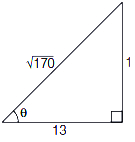
Since $\tan \theta = \frac{1}{13}$,we can construct a right-angled triangle with opposite side $1$ and adjacent side $13$. The hypotenuse is $\sqrt{1^2+13^2} = \sqrt{1+169} = \sqrt{170}$.
Therefore,$\sin \theta = \frac{\text{opposite}}{\text{hypotenuse}} = \frac{1}{\sqrt{170}}$.
Hence,option $(C)$ is correct.
The angle $\theta$ between the pair of lines is given by $\tan \theta = \left| \frac{2\sqrt{h^2-ab}}{a+b} \right|$.
Substituting the values,we get $\tan \theta = \left| \frac{2\sqrt{(-7/2)^2 - 1 \cdot 12}}{1+12} \right| = \left| \frac{2\sqrt{49/4 - 12}}{13} \right| = \left| \frac{2\sqrt{1/4}}{13} \right| = \frac{2 \cdot (1/2)}{13} = \frac{1}{13}$.
Since $\tan \theta = \frac{1}{13}$,we can construct a right-angled triangle with opposite side $1$ and adjacent side $13$. The hypotenuse is $\sqrt{1^2+13^2} = \sqrt{1+169} = \sqrt{170}$.
Therefore,$\sin \theta = \frac{\text{opposite}}{\text{hypotenuse}} = \frac{1}{\sqrt{170}}$.
Hence,option $(C)$ is correct.
0 likesView Solution
215
MathematicsEasyMCQAP EAMCET · 2020
Find the value of $k$,if the angle between the straight lines represented by $2x^2 + 5xy + 3y^2 + 6x + 7y + 4 = 0$ is $\tan^{-1}(k)$.
A
$\frac{1}{5}$ only
B
$-\frac{1}{5}$ only
C
$\pm \frac{1}{5}$
D
$0$
Solution
(C) The given equation is $2x^2 + 5xy + 3y^2 + 6x + 7y + 4 = 0$.
Comparing this with the general equation $ax^2 + 2hxy + by^2 + 2gx + 2fy + c = 0$,we get $a = 2$,$2h = 5 \Rightarrow h = \frac{5}{2}$,and $b = 3$.
The angle $\theta$ between the pair of straight lines is given by $\tan \theta = \left| \frac{2\sqrt{h^2 - ab}}{a + b} \right|$.
Substituting the values: $\tan \theta = \left| \frac{2\sqrt{(\frac{5}{2})^2 - (2)(3)}}{2 + 3} \right| = \left| \frac{2\sqrt{\frac{25}{4} - 6}}{5} \right| = \left| \frac{2\sqrt{\frac{1}{4}}}{5} \right| = \left| \frac{2 \times \frac{1}{2}}{5} \right| = \frac{1}{5}$.
Since the angle is $\tan^{-1}(k)$,we have $\tan \theta = k$.
Thus,$k = \pm \frac{1}{5}$.
Comparing this with the general equation $ax^2 + 2hxy + by^2 + 2gx + 2fy + c = 0$,we get $a = 2$,$2h = 5 \Rightarrow h = \frac{5}{2}$,and $b = 3$.
The angle $\theta$ between the pair of straight lines is given by $\tan \theta = \left| \frac{2\sqrt{h^2 - ab}}{a + b} \right|$.
Substituting the values: $\tan \theta = \left| \frac{2\sqrt{(\frac{5}{2})^2 - (2)(3)}}{2 + 3} \right| = \left| \frac{2\sqrt{\frac{25}{4} - 6}}{5} \right| = \left| \frac{2\sqrt{\frac{1}{4}}}{5} \right| = \left| \frac{2 \times \frac{1}{2}}{5} \right| = \frac{1}{5}$.
Since the angle is $\tan^{-1}(k)$,we have $\tan \theta = k$.
Thus,$k = \pm \frac{1}{5}$.
0 likesView Solution
216
MathematicsMediumMCQAP EAMCET · 2020
If pairs of straight lines $x^2-2 p x y-y^2=0$ and $x^2-2 q x y-y^2=0$ are such that each pair bisects the angle between the other pair,then:
A
$p q=1$
B
$p q=2$
C
$p q=-2$
D
$p q=-1$
Solution
(D) The equation of the angle bisectors for the pair of lines $a x^2+2 h x y+b y^2=0$ is given by $\frac{x^2-y^2}{a-b}=\frac{x y}{h}$.
For the first pair $x^2-2 p x y-y^2=0$,we have $a=1, b=-1, h=-p$.
The angle bisectors are $\frac{x^2-y^2}{1-(-1)}=\frac{x y}{-p}$,which simplifies to $\frac{x^2-y^2}{2}=\frac{x y}{-p}$,or $x^2-y^2+\frac{2 x y}{p}=0$.
Given that this pair of bisectors is the same as the second pair $x^2-2 q x y-y^2=0$,we compare the coefficients.
Comparing $x^2-y^2+\frac{2}{p} x y=0$ with $x^2-2 q x y-y^2=0$,we identify that the coefficient of $x y$ must match:
$\frac{2}{p} = -2 q$.
Therefore,$p q = -1$.
For the first pair $x^2-2 p x y-y^2=0$,we have $a=1, b=-1, h=-p$.
The angle bisectors are $\frac{x^2-y^2}{1-(-1)}=\frac{x y}{-p}$,which simplifies to $\frac{x^2-y^2}{2}=\frac{x y}{-p}$,or $x^2-y^2+\frac{2 x y}{p}=0$.
Given that this pair of bisectors is the same as the second pair $x^2-2 q x y-y^2=0$,we compare the coefficients.
Comparing $x^2-y^2+\frac{2}{p} x y=0$ with $x^2-2 q x y-y^2=0$,we identify that the coefficient of $x y$ must match:
$\frac{2}{p} = -2 q$.
Therefore,$p q = -1$.
0 likesView Solution
217
MathematicsMediumMCQAP EAMCET · 2020
If the pair of straight lines $6x^2 - 5xy + y^2 = 0$ makes angles $\alpha$ and $\beta$ with the $X$-axis,then $\tan(\alpha - \beta) = $
A
$2$
B
$\frac{1}{7}$
C
$3$
D
$7$
Solution
(B) Given the equation of the pair of straight lines is $6x^2 - 5xy + y^2 = 0$.
Dividing by $x^2$ (assuming $x \neq 0$),we get:
$\left(\frac{y}{x}\right)^2 - 5\left(\frac{y}{x}\right) + 6 = 0$.
Let $m = \frac{y}{x}$,then $m^2 - 5m + 6 = 0$.
Factoring the quadratic equation:
$(m - 3)(m - 2) = 0$.
Thus,the slopes of the lines are $m_1 = \tan \alpha = 3$ and $m_2 = \tan \beta = 2$.
Using the formula for the tangent of the difference of two angles:
$\tan(\alpha - \beta) = \frac{\tan \alpha - \tan \beta}{1 + \tan \alpha \tan \beta}$.
Substituting the values:
$\tan(\alpha - \beta) = \frac{3 - 2}{1 + (3)(2)} = \frac{1}{1 + 6} = \frac{1}{7}$.
Dividing by $x^2$ (assuming $x \neq 0$),we get:
$\left(\frac{y}{x}\right)^2 - 5\left(\frac{y}{x}\right) + 6 = 0$.
Let $m = \frac{y}{x}$,then $m^2 - 5m + 6 = 0$.
Factoring the quadratic equation:
$(m - 3)(m - 2) = 0$.
Thus,the slopes of the lines are $m_1 = \tan \alpha = 3$ and $m_2 = \tan \beta = 2$.
Using the formula for the tangent of the difference of two angles:
$\tan(\alpha - \beta) = \frac{\tan \alpha - \tan \beta}{1 + \tan \alpha \tan \beta}$.
Substituting the values:
$\tan(\alpha - \beta) = \frac{3 - 2}{1 + (3)(2)} = \frac{1}{1 + 6} = \frac{1}{7}$.
0 likesView Solution
218
MathematicsEasyMCQAP EAMCET · 2020
Which of the following pairs of straight lines intersect at right angles?
A
$2 x^2 = y(x + 2 y)$
B
$(x + y)^2 = x(y + 3 x)$
C
$2 y(x + y) = x y$
D
$y = \pm 2 x$
Solution
(A) The condition for a pair of straight lines represented by the general equation $ax^2 + 2hxy + by^2 = 0$ to be perpendicular is that the sum of the coefficients of $x^2$ and $y^2$ must be zero,i.e.,$a + b = 0$.
For option $A$: $2 x^2 = y(x + 2 y)$
$\Rightarrow 2 x^2 - xy - 2 y^2 = 0$
Here,$a = 2$ and $b = -2$.
Sum of coefficients: $a + b = 2 + (-2) = 0$.
Since the condition $a + b = 0$ is satisfied,the lines represented by this equation are perpendicular.
For option $A$: $2 x^2 = y(x + 2 y)$
$\Rightarrow 2 x^2 - xy - 2 y^2 = 0$
Here,$a = 2$ and $b = -2$.
Sum of coefficients: $a + b = 2 + (-2) = 0$.
Since the condition $a + b = 0$ is satisfied,the lines represented by this equation are perpendicular.
0 likesView Solution
219
MathematicsEasyMCQAP EAMCET · 2020
The lines represented by $ax^2 + 2hxy + by^2 = 0$ are perpendicular to each other,if ........
A
$h^2 = a + b$
B
$a + b = 0$
C
$h^2 = ab$
D
$h = 0$
Solution
(B) The pair of straight lines passing through the origin is given by the equation $ax^2 + 2hxy + by^2 = 0$.
The angle $\theta$ between these lines is given by the formula $\tan \theta = \left| \frac{2\sqrt{h^2 - ab}}{a + b} \right|$.
When the lines are perpendicular,the angle $\theta = 90^{\circ}$.
Since $\tan 90^{\circ}$ is undefined (approaches $\infty$),the denominator must be zero.
Therefore,$a + b = 0$.
The angle $\theta$ between these lines is given by the formula $\tan \theta = \left| \frac{2\sqrt{h^2 - ab}}{a + b} \right|$.
When the lines are perpendicular,the angle $\theta = 90^{\circ}$.
Since $\tan 90^{\circ}$ is undefined (approaches $\infty$),the denominator must be zero.
Therefore,$a + b = 0$.
0 likesView Solution
220
MathematicsMediumMCQAP EAMCET · 2020
The lines $ax^2+2hxy+by^2=0$ are at right angles if
A
$a+b=0$
B
$a+b=1$
C
$h^2-ab=0$
D
$a=b$
Solution
(A) The acute angle $(\theta)$ between the pair of lines represented by the homogeneous equation $ax^2+2hxy+by^2=0$ is given by the formula:
$\tan \theta = \left| \frac{2\sqrt{h^2-ab}}{a+b} \right|$
If the lines are at right angles (perpendicular),then $\theta = 90^\circ$.
Since $\tan 90^\circ$ is undefined,the denominator must be zero.
Therefore,$a+b=0$.
$\tan \theta = \left| \frac{2\sqrt{h^2-ab}}{a+b} \right|$
If the lines are at right angles (perpendicular),then $\theta = 90^\circ$.
Since $\tan 90^\circ$ is undefined,the denominator must be zero.
Therefore,$a+b=0$.
0 likesView Solution
221
MathematicsEasyMCQAP EAMCET · 2020
The angle between the straight lines $x^2+4xy+y^2=0$ is....... (in $^{\circ}$)
A
$30$
B
$45$
C
$60$
D
$90$
Solution
(C) The given equation of the pair of straight lines is $x^2+4xy+y^2=0$.
Comparing this with the general equation $ax^2+2hxy+by^2=0$,we get $a=1$,$2h=4 \Rightarrow h=2$,and $b=1$.
The formula for the angle $\theta$ between the pair of lines is $\tan \theta = \left| \frac{2\sqrt{h^2-ab}}{a+b} \right|$.
Substituting the values,we get $\tan \theta = \left| \frac{2\sqrt{2^2-(1)(1)}}{1+1} \right|$.
$\tan \theta = \frac{2\sqrt{4-1}}{2} = \sqrt{3}$.
Since $\tan \theta = \sqrt{3}$,we have $\theta = 60^{\circ}$.
Comparing this with the general equation $ax^2+2hxy+by^2=0$,we get $a=1$,$2h=4 \Rightarrow h=2$,and $b=1$.
The formula for the angle $\theta$ between the pair of lines is $\tan \theta = \left| \frac{2\sqrt{h^2-ab}}{a+b} \right|$.
Substituting the values,we get $\tan \theta = \left| \frac{2\sqrt{2^2-(1)(1)}}{1+1} \right|$.
$\tan \theta = \frac{2\sqrt{4-1}}{2} = \sqrt{3}$.
Since $\tan \theta = \sqrt{3}$,we have $\theta = 60^{\circ}$.
0 likesView Solution
222
MathematicsEasyMCQAP EAMCET · 2020
The pair of straight lines is represented by the equation $3dx^2 - 5xy + (d^2 - 2)y^2 = 0$. If the lines are perpendicular to each other,for how many values of $d$ will this condition be satisfied?
A
$0$
B
$2$
C
$1$
D
$3$
Solution
(B) The given equation of the pair of straight lines is $3dx^2 - 5xy + (d^2 - 2)y^2 = 0$.
For a general equation of a pair of lines $Ax^2 + 2Hxy + By^2 = 0$,the lines are perpendicular if $A + B = 0$.
Here,$A = 3d$ and $B = d^2 - 2$.
Setting $A + B = 0$,we get $3d + d^2 - 2 = 0$,which is $d^2 + 3d - 2 = 0$.
Using the quadratic formula $d = \frac{-b \pm \sqrt{b^2 - 4ac}}{2a}$,we find $d = \frac{-3 \pm \sqrt{3^2 - 4(1)(-2)}}{2(1)} = \frac{-3 \pm \sqrt{9 + 8}}{2} = \frac{-3 \pm \sqrt{17}}{2}$.
Since there are two distinct real values for $d$,the condition is satisfied for $2$ values of $d$.
Thus,option $B$ is correct.
For a general equation of a pair of lines $Ax^2 + 2Hxy + By^2 = 0$,the lines are perpendicular if $A + B = 0$.
Here,$A = 3d$ and $B = d^2 - 2$.
Setting $A + B = 0$,we get $3d + d^2 - 2 = 0$,which is $d^2 + 3d - 2 = 0$.
Using the quadratic formula $d = \frac{-b \pm \sqrt{b^2 - 4ac}}{2a}$,we find $d = \frac{-3 \pm \sqrt{3^2 - 4(1)(-2)}}{2(1)} = \frac{-3 \pm \sqrt{9 + 8}}{2} = \frac{-3 \pm \sqrt{17}}{2}$.
Since there are two distinct real values for $d$,the condition is satisfied for $2$ values of $d$.
Thus,option $B$ is correct.
0 likesView Solution
223
MathematicsEasyMCQAP EAMCET · 2020
If the pairs of straight lines $x^2-2 q x y-y^2=0$ and $x^2-2 p x y-y^2=0$ bisect the angles between each other,then which of the following is correct?
A
$1-p q=0$
B
$p q-1=0$
C
$p q+1=0$
D
$p q=0$
Solution
(C) The equation of the pair of angle bisectors of the pair of lines $ax^2+2hxy+by^2=0$ is given by $\frac{x^2-y^2}{a-b} = \frac{xy}{h}$.
For the pair of lines $x^2-2pxy-y^2=0$,we have $a=1, h=-p, b=-1$.
The equation of the angle bisectors is $\frac{x^2-y^2}{1-(-1)} = \frac{xy}{-p}$,which simplifies to $\frac{x^2-y^2}{2} = \frac{xy}{-p}$,or $x^2-y^2 = -\frac{2}{p}xy$,which is $x^2 + \frac{2}{p}xy - y^2 = 0$.
It is given that this pair of bisectors is the same as the pair of lines $x^2-2qxy-y^2=0$.
Comparing the coefficients of $xy$,we get $\frac{2}{p} = -2q$.
This implies $pq = -1$,or $pq+1=0$.
Thus,option $(C)$ is correct.
For the pair of lines $x^2-2pxy-y^2=0$,we have $a=1, h=-p, b=-1$.
The equation of the angle bisectors is $\frac{x^2-y^2}{1-(-1)} = \frac{xy}{-p}$,which simplifies to $\frac{x^2-y^2}{2} = \frac{xy}{-p}$,or $x^2-y^2 = -\frac{2}{p}xy$,which is $x^2 + \frac{2}{p}xy - y^2 = 0$.
It is given that this pair of bisectors is the same as the pair of lines $x^2-2qxy-y^2=0$.
Comparing the coefficients of $xy$,we get $\frac{2}{p} = -2q$.
This implies $pq = -1$,or $pq+1=0$.
Thus,option $(C)$ is correct.
0 likesView Solution
224
MathematicsEasyMCQAP EAMCET · 2020
Statement $-I$: Two lines which pass through a given fixed point and are equally inclined to two other lines passing through the same point,are always perpendicular to each other.
Statement $-II$: Angle bisectors of two intersecting lines are always perpendicular to each other.
Statement $-II$: Angle bisectors of two intersecting lines are always perpendicular to each other.
A
Both the Statements are true and Statement $-II$ is the correct explanation of the Statement $-I$.
B
Both the Statements are true but Statement $-II$ is not the correct explanation of the Statement $-I$.
C
Statement $-I$ is true and Statement $-II$ is false.
D
Statement $-I$ is false and Statement $-II$ is true.
Solution
(A) Let the two fixed lines be $L_1$ and $L_2$ intersecting at a point $P$.
Any line $L$ passing through $P$ that is equally inclined to $L_1$ and $L_2$ must be an angle bisector of the angle formed by $L_1$ and $L_2$.
There are two such angle bisectors (internal and external),which are always perpendicular to each other.
Since the two lines described in Statement $-I$ are these two angle bisectors,they must be perpendicular.
Thus,Statement $-I$ is true,Statement $-II$ is true,and Statement $-II$ correctly explains Statement $-I$.
Any line $L$ passing through $P$ that is equally inclined to $L_1$ and $L_2$ must be an angle bisector of the angle formed by $L_1$ and $L_2$.
There are two such angle bisectors (internal and external),which are always perpendicular to each other.
Since the two lines described in Statement $-I$ are these two angle bisectors,they must be perpendicular.
Thus,Statement $-I$ is true,Statement $-II$ is true,and Statement $-II$ correctly explains Statement $-I$.
0 likesView Solution
225
MathematicsMediumMCQAP EAMCET · 2020
If $lx^2+3xy-2y^2-5x+5y+k=0$ represents a pair of perpendicular lines,then
A
$k=\pm 3, l=\pm 2$
B
$k=-22, l=-12$
C
$k=-3, l=2$
D
$k=-16, l=9$
Solution
(C) The general equation of a pair of lines is $ax^2+2hxy+by^2+2gx+2fy+c=0$.
For the lines to be perpendicular,the sum of the coefficients of $x^2$ and $y^2$ must be zero,i.e.,$a+b=0$.
Given $l+ (-2) = 0$,we get $l=2$.
Now the equation becomes $2x^2+3xy-2y^2-5x+5y+k=0$.
For this to represent a pair of lines,the condition $abc+2fgh-af^2-bg^2-ch^2=0$ must be satisfied.
Here $a=2, b=-2, c=k, h=\frac{3}{2}, g=-\frac{5}{2}, f=\frac{5}{2}$.
Substituting these values: $(2)(-2)(k) + 2(\frac{5}{2})(-\frac{5}{2})(\frac{3}{2}) - 2(\frac{5}{2})^2 - (-2)(-\frac{5}{2})^2 - k(\frac{3}{2})^2 = 0$.
$-4k - \frac{75}{4} - \frac{50}{4} + \frac{50}{4} - \frac{9k}{4} = 0$.
$-4k - \frac{9k}{4} - \frac{75}{4} = 0$.
$-\frac{25k}{4} = \frac{75}{4}$.
$k = -3$.
For the lines to be perpendicular,the sum of the coefficients of $x^2$ and $y^2$ must be zero,i.e.,$a+b=0$.
Given $l+ (-2) = 0$,we get $l=2$.
Now the equation becomes $2x^2+3xy-2y^2-5x+5y+k=0$.
For this to represent a pair of lines,the condition $abc+2fgh-af^2-bg^2-ch^2=0$ must be satisfied.
Here $a=2, b=-2, c=k, h=\frac{3}{2}, g=-\frac{5}{2}, f=\frac{5}{2}$.
Substituting these values: $(2)(-2)(k) + 2(\frac{5}{2})(-\frac{5}{2})(\frac{3}{2}) - 2(\frac{5}{2})^2 - (-2)(-\frac{5}{2})^2 - k(\frac{3}{2})^2 = 0$.
$-4k - \frac{75}{4} - \frac{50}{4} + \frac{50}{4} - \frac{9k}{4} = 0$.
$-4k - \frac{9k}{4} - \frac{75}{4} = 0$.
$-\frac{25k}{4} = \frac{75}{4}$.
$k = -3$.
0 likesView Solution
226
MathematicsDifficultMCQAP EAMCET · 2020
If the pairs of straight lines $x^2-2 p x y-y^2=0$ and $x^2-2 q x y-y^2=0$ are such that each pair bisects the angle between the other pair,then
A
$p q=1$
B
$p q=-1$
C
$p q=2$
D
$p q=-2$
Solution
(B) The equation of the pair of bisectors of the angle between the pair of straight lines $a x^2+2 h x y+b y^2=0$ is given by $\frac{x^2-y^2}{a-b}=\frac{x y}{h}$.
For the pair $x^2-2 p x y-y^2=0$,we have $a=1, b=-1, h=-p$.
The equation of the bisectors is $\frac{x^2-y^2}{1-(-1)}=\frac{x y}{-p}$.
This simplifies to $\frac{x^2-y^2}{2}=\frac{x y}{-p}$,which implies $-p(x^2-y^2)=2xy$,or $p x^2+2 x y-p y^2=0$.
Dividing by $p$,we get $x^2+\frac{2}{p} x y-y^2=0$.
We are given that this pair is $x^2-2 q x y-y^2=0$.
Comparing the coefficients of $xy$,we have $-2 q = \frac{2}{p}$.
Therefore,$-p q = 1$,which gives $p q = -1$.
For the pair $x^2-2 p x y-y^2=0$,we have $a=1, b=-1, h=-p$.
The equation of the bisectors is $\frac{x^2-y^2}{1-(-1)}=\frac{x y}{-p}$.
This simplifies to $\frac{x^2-y^2}{2}=\frac{x y}{-p}$,which implies $-p(x^2-y^2)=2xy$,or $p x^2+2 x y-p y^2=0$.
Dividing by $p$,we get $x^2+\frac{2}{p} x y-y^2=0$.
We are given that this pair is $x^2-2 q x y-y^2=0$.
Comparing the coefficients of $xy$,we have $-2 q = \frac{2}{p}$.
Therefore,$-p q = 1$,which gives $p q = -1$.
0 likesView Solution
227
MathematicsMediumMCQAP EAMCET · 2020
Find the equation of the pair of straight lines that bisect the angles between the lines represented by $ax^2 + 2hxy + by^2 = 0$.
A
$\frac{x^2+y^2}{a+b} = \frac{xy}{h}$
B
$\frac{x^2+y^2}{a-b} = \frac{xy}{h}$
C
$\frac{x^2+y^2}{a-b} = \frac{h}{xy}$
D
$\frac{x^2-y^2}{a-b} = \frac{xy}{h}$
Solution
(D) The general equation of a pair of straight lines passing through the origin is given by $ax^2 + 2hxy + by^2 = 0$.
The equation of the pair of angle bisectors for these lines is given by the formula:
$\frac{x^2 - y^2}{a - b} = \frac{xy}{h}$.
This formula is derived by considering the lines $y = m_1x$ and $y = m_2x$ and finding the bisectors of the angles between them.
Thus,the correct option is $D$.
The equation of the pair of angle bisectors for these lines is given by the formula:
$\frac{x^2 - y^2}{a - b} = \frac{xy}{h}$.
This formula is derived by considering the lines $y = m_1x$ and $y = m_2x$ and finding the bisectors of the angles between them.
Thus,the correct option is $D$.
0 likesView Solution
228
MathematicsMediumMCQAP EAMCET · 2020
If the line $y=mx$ is one of the bisectors of $x^2+4xy-y^2=0$,then the value of $2m$ is:
A
$-1+\sqrt{5}$
B
$1+\sqrt{5}$
C
$-1-\sqrt{5}$
D
$1-\sqrt{5}$
Solution
(A) Given the equation of the pair of straight lines: $x^2+4xy-y^2=0$.
Comparing this with the general form $ax^2+2hxy+by^2=0$,we get $a=1$,$b=-1$,and $2h=4$,which implies $h=2$.
The equation of the bisectors of the angle between the lines is given by $\frac{x^2-y^2}{a-b} = \frac{xy}{h}$.
Substituting the values: $\frac{x^2-y^2}{1-(-1)} = \frac{xy}{2} \Rightarrow \frac{x^2-y^2}{2} = \frac{xy}{2}$.
This simplifies to $x^2-xy-y^2=0$.
Since $y=mx$ is one of the bisectors,we substitute $y=mx$ into the equation: $x^2-x(mx)-(mx)^2=0$.
Dividing by $x^2$ (assuming $x \neq 0$),we get $1-m-m^2=0$,or $m^2+m-1=0$.
Using the quadratic formula $m = \frac{-b \pm \sqrt{b^2-4ac}}{2a}$,we get $m = \frac{-1 \pm \sqrt{1^2-4(1)(-1)}}{2(1)} = \frac{-1 \pm \sqrt{5}}{2}$.
Therefore,$2m = -1 \pm \sqrt{5}$.
Comparing this with the general form $ax^2+2hxy+by^2=0$,we get $a=1$,$b=-1$,and $2h=4$,which implies $h=2$.
The equation of the bisectors of the angle between the lines is given by $\frac{x^2-y^2}{a-b} = \frac{xy}{h}$.
Substituting the values: $\frac{x^2-y^2}{1-(-1)} = \frac{xy}{2} \Rightarrow \frac{x^2-y^2}{2} = \frac{xy}{2}$.
This simplifies to $x^2-xy-y^2=0$.
Since $y=mx$ is one of the bisectors,we substitute $y=mx$ into the equation: $x^2-x(mx)-(mx)^2=0$.
Dividing by $x^2$ (assuming $x \neq 0$),we get $1-m-m^2=0$,or $m^2+m-1=0$.
Using the quadratic formula $m = \frac{-b \pm \sqrt{b^2-4ac}}{2a}$,we get $m = \frac{-1 \pm \sqrt{1^2-4(1)(-1)}}{2(1)} = \frac{-1 \pm \sqrt{5}}{2}$.
Therefore,$2m = -1 \pm \sqrt{5}$.
0 likesView Solution
229
MathematicsDifficultMCQAP EAMCET · 2020
The distance between the parallel lines $9x^2 - 6xy + y^2 + 18x - 6y + 8 = 0$ is
A
$\sqrt{10}$
B
$2$
C
$\frac{2\sqrt{153}}{\sqrt{10}}$
D
$\frac{2}{\sqrt{10}}$
Solution
(D) The given equation is $9x^2 - 6xy + y^2 + 18x - 6y + 8 = 0$.
We can rewrite the quadratic part as $(3x - y)^2 + 6(3x - y) + 8 = 0$.
Let $t = 3x - y$. Then the equation becomes $t^2 + 6t + 8 = 0$.
Factoring the quadratic,we get $(t + 4)(t + 2) = 0$.
Thus,the two parallel lines are $3x - y + 4 = 0$ and $3x - y + 2 = 0$.
The distance $d$ between two parallel lines $ax + by + c_1 = 0$ and $ax + by + c_2 = 0$ is given by $d = \frac{|c_1 - c_2|}{\sqrt{a^2 + b^2}}$.
Here,$a = 3$,$b = -1$,$c_1 = 4$,and $c_2 = 2$.
$d = \frac{|4 - 2|}{\sqrt{3^2 + (-1)^2}} = \frac{2}{\sqrt{9 + 1}} = \frac{2}{\sqrt{10}}$.
We can rewrite the quadratic part as $(3x - y)^2 + 6(3x - y) + 8 = 0$.
Let $t = 3x - y$. Then the equation becomes $t^2 + 6t + 8 = 0$.
Factoring the quadratic,we get $(t + 4)(t + 2) = 0$.
Thus,the two parallel lines are $3x - y + 4 = 0$ and $3x - y + 2 = 0$.
The distance $d$ between two parallel lines $ax + by + c_1 = 0$ and $ax + by + c_2 = 0$ is given by $d = \frac{|c_1 - c_2|}{\sqrt{a^2 + b^2}}$.
Here,$a = 3$,$b = -1$,$c_1 = 4$,and $c_2 = 2$.
$d = \frac{|4 - 2|}{\sqrt{3^2 + (-1)^2}} = \frac{2}{\sqrt{9 + 1}} = \frac{2}{\sqrt{10}}$.
0 likesView Solution
230
MathematicsMediumMCQAP EAMCET · 2020
If the equation $x^2+2 \sqrt{2} xy + 2y^2 + 4x + 4 \sqrt{2}y + 1 = 0$ represents a pair of parallel straight lines,find the distance between them.
A
$4$ units
B
$2$ units
C
$2 \sqrt{3}$ units
D
$4 \sqrt{3}$ units
Solution
(B) The given equation is $x^2 + 2 \sqrt{2} xy + 2y^2 + 4x + 4 \sqrt{2}y + 1 = 0$.
This can be rewritten as $(x + \sqrt{2}y)^2 + 4(x + \sqrt{2}y) + 1 = 0$.
Let $t = x + \sqrt{2}y$. Then the equation becomes $t^2 + 4t + 1 = 0$.
Solving for $t$ using the quadratic formula,$t = \frac{-4 \pm \sqrt{16 - 4}}{2} = -2 \pm \sqrt{3}$.
Thus,the two parallel lines are $x + \sqrt{2}y + 2 - \sqrt{3} = 0$ and $x + \sqrt{2}y + 2 + \sqrt{3} = 0$.
The distance $d$ between two parallel lines $Ax + By + C_1 = 0$ and $Ax + By + C_2 = 0$ is given by $d = \frac{|C_1 - C_2|}{\sqrt{A^2 + B^2}}$.
Here,$A = 1$,$B = \sqrt{2}$,$C_1 = 2 - \sqrt{3}$,and $C_2 = 2 + \sqrt{3}$.
$d = \frac{|(2 - \sqrt{3}) - (2 + \sqrt{3})|}{\sqrt{1^2 + (\sqrt{2})^2}} = \frac{|-2 \sqrt{3}|}{\sqrt{3}} = \frac{2 \sqrt{3}}{\sqrt{3}} = 2$ units.
Therefore,the correct option is $B$.
This can be rewritten as $(x + \sqrt{2}y)^2 + 4(x + \sqrt{2}y) + 1 = 0$.
Let $t = x + \sqrt{2}y$. Then the equation becomes $t^2 + 4t + 1 = 0$.
Solving for $t$ using the quadratic formula,$t = \frac{-4 \pm \sqrt{16 - 4}}{2} = -2 \pm \sqrt{3}$.
Thus,the two parallel lines are $x + \sqrt{2}y + 2 - \sqrt{3} = 0$ and $x + \sqrt{2}y + 2 + \sqrt{3} = 0$.
The distance $d$ between two parallel lines $Ax + By + C_1 = 0$ and $Ax + By + C_2 = 0$ is given by $d = \frac{|C_1 - C_2|}{\sqrt{A^2 + B^2}}$.
Here,$A = 1$,$B = \sqrt{2}$,$C_1 = 2 - \sqrt{3}$,and $C_2 = 2 + \sqrt{3}$.
$d = \frac{|(2 - \sqrt{3}) - (2 + \sqrt{3})|}{\sqrt{1^2 + (\sqrt{2})^2}} = \frac{|-2 \sqrt{3}|}{\sqrt{3}} = \frac{2 \sqrt{3}}{\sqrt{3}} = 2$ units.
Therefore,the correct option is $B$.
0 likesView Solution
231
MathematicsMediumMCQAP EAMCET · 2020
The distance between the parallel lines represented by the equation $9x^2 - 6xy + y^2 + 18x - 6y + 8 = 0$ is
A
$\sqrt{10}$
B
$2$
C
$\frac{2\sqrt{10}}{10}$
D
$\frac{2}{\sqrt{10}}$
Solution
(D) The given equation is $9x^2 - 6xy + y^2 + 18x - 6y + 8 = 0$.
This can be written as $(3x - y)^2 + 6(3x - y) + 8 = 0$.
Let $t = 3x - y$. Then the equation becomes $t^2 + 6t + 8 = 0$.
Factoring the quadratic,we get $(t + 4)(t + 2) = 0$.
So,$t = -4$ or $t = -2$.
This gives two parallel lines: $3x - y + 4 = 0$ and $3x - y + 2 = 0$.
The distance $d$ between two parallel lines $ax + by + c_1 = 0$ and $ax + by + c_2 = 0$ is given by $d = \frac{|c_1 - c_2|}{\sqrt{a^2 + b^2}}$.
Here,$a = 3$,$b = -1$,$c_1 = 4$,and $c_2 = 2$.
$d = \frac{|4 - 2|}{\sqrt{3^2 + (-1)^2}} = \frac{2}{\sqrt{9 + 1}} = \frac{2}{\sqrt{10}}$.
This can be written as $(3x - y)^2 + 6(3x - y) + 8 = 0$.
Let $t = 3x - y$. Then the equation becomes $t^2 + 6t + 8 = 0$.
Factoring the quadratic,we get $(t + 4)(t + 2) = 0$.
So,$t = -4$ or $t = -2$.
This gives two parallel lines: $3x - y + 4 = 0$ and $3x - y + 2 = 0$.
The distance $d$ between two parallel lines $ax + by + c_1 = 0$ and $ax + by + c_2 = 0$ is given by $d = \frac{|c_1 - c_2|}{\sqrt{a^2 + b^2}}$.
Here,$a = 3$,$b = -1$,$c_1 = 4$,and $c_2 = 2$.
$d = \frac{|4 - 2|}{\sqrt{3^2 + (-1)^2}} = \frac{2}{\sqrt{9 + 1}} = \frac{2}{\sqrt{10}}$.
0 likesView Solution
232
MathematicsMediumMCQAP EAMCET · 2020
The square of the difference of the slopes of the lines represented by the equation $x^2(\sec^2 \theta - \sin^2 \theta) - 2xy \tan \theta + y^2 \sin^2 \theta = 0$ is:
A
$1$
B
$2$
C
$4$
D
$8$
Solution
(C) The given equation is $x^2(\sec^2 \theta - \sin^2 \theta) - 2xy \tan \theta + y^2 \sin^2 \theta = 0$.
Comparing this with the general equation $ax^2 + 2hxy + by^2 = 0$,we have:
$a = \sec^2 \theta - \sin^2 \theta$,$h = -\tan \theta$,and $b = \sin^2 \theta$.
Let $m_1$ and $m_2$ be the slopes of the lines. Then $m_1 + m_2 = -\frac{2h}{b} = \frac{2 \tan \theta}{\sin^2 \theta}$ and $m_1 m_2 = \frac{a}{b} = \frac{\sec^2 \theta - \sin^2 \theta}{\sin^2 \theta} = \sec^2 \theta \csc^2 \theta - 1$.
The square of the difference of the slopes is $(m_1 - m_2)^2 = (m_1 + m_2)^2 - 4m_1 m_2$.
$(m_1 - m_2)^2 = \left(\frac{2 \tan \theta}{\sin^2 \theta}\right)^2 - 4\left(\frac{\sec^2 \theta - \sin^2 \theta}{\sin^2 \theta}\right)$.
$(m_1 - m_2)^2 = \frac{4 \sin^2 \theta}{\cos^2 \theta \sin^4 \theta} - \frac{4(\sec^2 \theta - \sin^2 \theta)}{\sin^2 \theta} = \frac{4}{\cos^2 \theta \sin^2 \theta} - \frac{4}{\cos^2 \theta \sin^2 \theta} + 4 = 4$.
Thus,the square of the difference of the slopes is $4$.
Comparing this with the general equation $ax^2 + 2hxy + by^2 = 0$,we have:
$a = \sec^2 \theta - \sin^2 \theta$,$h = -\tan \theta$,and $b = \sin^2 \theta$.
Let $m_1$ and $m_2$ be the slopes of the lines. Then $m_1 + m_2 = -\frac{2h}{b} = \frac{2 \tan \theta}{\sin^2 \theta}$ and $m_1 m_2 = \frac{a}{b} = \frac{\sec^2 \theta - \sin^2 \theta}{\sin^2 \theta} = \sec^2 \theta \csc^2 \theta - 1$.
The square of the difference of the slopes is $(m_1 - m_2)^2 = (m_1 + m_2)^2 - 4m_1 m_2$.
$(m_1 - m_2)^2 = \left(\frac{2 \tan \theta}{\sin^2 \theta}\right)^2 - 4\left(\frac{\sec^2 \theta - \sin^2 \theta}{\sin^2 \theta}\right)$.
$(m_1 - m_2)^2 = \frac{4 \sin^2 \theta}{\cos^2 \theta \sin^4 \theta} - \frac{4(\sec^2 \theta - \sin^2 \theta)}{\sin^2 \theta} = \frac{4}{\cos^2 \theta \sin^2 \theta} - \frac{4}{\cos^2 \theta \sin^2 \theta} + 4 = 4$.
Thus,the square of the difference of the slopes is $4$.
0 likesView Solution
233
MathematicsMediumMCQAP EAMCET · 2020
The value of $k$ for which the equation $x^2-4xy-y^2+6x+2y+k=0$ represents a pair of straight lines is equal to ........
A
$\frac{4}{5}$
B
$\frac{-3}{5}$
C
$\frac{-4}{5}$
D
$\frac{3}{5}$
Solution
(C) The general equation of a second-degree curve is $ax^2+2hxy+by^2+2gx+2fy+c=0$.
Comparing this with the given equation $x^2-4xy-y^2+6x+2y+k=0$,we have:
$a=1, h=-2, b=-1, g=3, f=1, c=k$.
The condition for the equation to represent a pair of straight lines is $\Delta = abc+2fgh-af^2-bg^2-ch^2=0$.
Substituting the values:
$(1)(-1)(k) + 2(1)(3)(-2) - 1(1)^2 - (-1)(3)^2 - k(-2)^2 = 0$
$-k - 12 - 1 + 9 - 4k = 0$
$-5k - 4 = 0$
$5k = -4$
$k = -\frac{4}{5}$.
Thus,the correct option is $C$.
Comparing this with the given equation $x^2-4xy-y^2+6x+2y+k=0$,we have:
$a=1, h=-2, b=-1, g=3, f=1, c=k$.
The condition for the equation to represent a pair of straight lines is $\Delta = abc+2fgh-af^2-bg^2-ch^2=0$.
Substituting the values:
$(1)(-1)(k) + 2(1)(3)(-2) - 1(1)^2 - (-1)(3)^2 - k(-2)^2 = 0$
$-k - 12 - 1 + 9 - 4k = 0$
$-5k - 4 = 0$
$5k = -4$
$k = -\frac{4}{5}$.
Thus,the correct option is $C$.
0 likesView Solution
234
MathematicsMediumMCQAP EAMCET · 2020
The quadrilateral formed by the pairs of lines $xy+x+y+1=0$ and $xy+3x+3y+9=0$ is
A
Parallelogram
B
Rhombus
C
Rectangle
D
Square
Solution
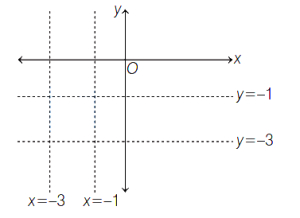
(D) The first pair of lines is given by $xy+x+y+1=0$. Factoring this,we get $x(y+1)+1(y+1)=0$,which implies $(x+1)(y+1)=0$. Thus,the lines are $x=-1$ and $y=-1$.
The second pair of lines is given by $xy+3x+3y+9=0$. Factoring this,we get $x(y+3)+3(y+3)=0$,which implies $(x+3)(y+3)=0$. Thus,the lines are $x=-3$ and $y=-3$.
The four lines forming the quadrilateral are $x=-1, x=-3, y=-1,$ and $y=-3$.
The distance between the vertical lines $x=-1$ and $x=-3$ is $|-1 - (-3)| = 2$.
The distance between the horizontal lines $y=-1$ and $y=-3$ is $|-1 - (-3)| = 2$.
Since the opposite sides are parallel and the distance between the vertical lines is equal to the distance between the horizontal lines,the quadrilateral is a square. Therefore,the correct option is $D$.
The second pair of lines is given by $xy+3x+3y+9=0$. Factoring this,we get $x(y+3)+3(y+3)=0$,which implies $(x+3)(y+3)=0$. Thus,the lines are $x=-3$ and $y=-3$.
The four lines forming the quadrilateral are $x=-1, x=-3, y=-1,$ and $y=-3$.
The distance between the vertical lines $x=-1$ and $x=-3$ is $|-1 - (-3)| = 2$.
The distance between the horizontal lines $y=-1$ and $y=-3$ is $|-1 - (-3)| = 2$.
Since the opposite sides are parallel and the distance between the vertical lines is equal to the distance between the horizontal lines,the quadrilateral is a square. Therefore,the correct option is $D$.
0 likesView Solution
235
MathematicsEasyMCQAP EAMCET · 2020
The combined equation of the lines passing through the origin and having slopes $\frac{2}{3}$ and $-\frac{2}{3}$ is
A
$2 x^2-9 y^2=0$
B
$4 x^2-x y-9 y^2=0$
C
$4 x^2-9 y^2=0$
D
$4 x^2+x y-9 y^2=0$
Solution
(C) The equations of the lines passing through the origin with slopes $m_1 = \frac{2}{3}$ and $m_2 = -\frac{2}{3}$ are given by $y = m_1 x$ and $y = m_2 x$.
Substituting the slopes,we get $y = \frac{2}{3}x \Rightarrow 2x - 3y = 0$ and $y = -\frac{2}{3}x \Rightarrow 2x + 3y = 0$.
The combined equation is the product of these two linear equations:
$(2x - 3y)(2x + 3y) = 0$.
Using the identity $(a-b)(a+b) = a^2 - b^2$,we get:
$(2x)^2 - (3y)^2 = 0$.
Therefore,$4x^2 - 9y^2 = 0$.
Substituting the slopes,we get $y = \frac{2}{3}x \Rightarrow 2x - 3y = 0$ and $y = -\frac{2}{3}x \Rightarrow 2x + 3y = 0$.
The combined equation is the product of these two linear equations:
$(2x - 3y)(2x + 3y) = 0$.
Using the identity $(a-b)(a+b) = a^2 - b^2$,we get:
$(2x)^2 - (3y)^2 = 0$.
Therefore,$4x^2 - 9y^2 = 0$.
0 likesView Solution
236
MathematicsEasyMCQAP EAMCET · 2020
The point of intersection of the pair of lines $x^2+xy+2y^2-3x+2y+4=0$ is
A
$(1,2)$
B
$(-1,2)$
C
$(-2,1)$
D
$(2,-1)$
Solution
(D) The point of intersection of the pair of lines $f(x, y) = x^2+xy+2y^2-3x+2y+4=0$ can be found by solving the partial derivatives of $f(x, y)$ with respect to $x$ and $y$ equal to zero.
Taking partial derivative with respect to $x$:
$\frac{\partial f}{\partial x} = 2x + y - 3 = 0 \quad \dots (i)$
Taking partial derivative with respect to $y$:
$\frac{\partial f}{\partial y} = x + 4y + 2 = 0 \quad \dots (ii)$
Solving the system of linear equations $(i)$ and $(ii)$:
From $(i)$,$y = 3 - 2x$.
Substituting into $(ii)$: $x + 4(3 - 2x) + 2 = 0$
$x + 12 - 8x + 2 = 0$
$-7x + 14 = 0 \implies x = 2$
Substituting $x = 2$ into $y = 3 - 2x$:
$y = 3 - 2(2) = 3 - 4 = -1$
Thus,the point of intersection is $(2, -1)$.
Hence,option $(D)$ is correct.
Taking partial derivative with respect to $x$:
$\frac{\partial f}{\partial x} = 2x + y - 3 = 0 \quad \dots (i)$
Taking partial derivative with respect to $y$:
$\frac{\partial f}{\partial y} = x + 4y + 2 = 0 \quad \dots (ii)$
Solving the system of linear equations $(i)$ and $(ii)$:
From $(i)$,$y = 3 - 2x$.
Substituting into $(ii)$: $x + 4(3 - 2x) + 2 = 0$
$x + 12 - 8x + 2 = 0$
$-7x + 14 = 0 \implies x = 2$
Substituting $x = 2$ into $y = 3 - 2x$:
$y = 3 - 2(2) = 3 - 4 = -1$
Thus,the point of intersection is $(2, -1)$.
Hence,option $(D)$ is correct.
0 likesView Solution
237
MathematicsDifficultMCQAP EAMCET · 2020
The equations $x-y=4$ and $x^2+4xy+y^2=0$ represent the sides of a/an
A
Isosceles Triangle
B
Right Angled Triangle
C
Equilateral Triangle
D
Scalene Triangle
Solution
(C) The equation $x^2+4xy+y^2=0$ represents a pair of straight lines passing through the origin. Let these lines be $L_1$ and $L_2$.
The equation $x-y=4$ represents a third line $L_3$.
The lines $L_1$ and $L_2$ are given by $y = m_1x$ and $y = m_2x$,where $m_1, m_2$ are roots of $m^2+4m+1=0$.
Thus,$m_1+m_2 = -4$ and $m_1m_2 = 1$.
The slopes are $m = \frac{-4 \pm \sqrt{16-4}}{2} = -2 \pm \sqrt{3}$.
The angle between $L_1$ and $L_2$ is $\tan \theta = |\frac{2\sqrt{h^2-ab}}{a+b}| = |\frac{2\sqrt{4-1}}{1+1}| = \sqrt{3}$,so $\theta = 60^\circ$.
Since the lines $L_1$ and $L_2$ pass through the origin and the angle between them is $60^\circ$,and the third line $L_3$ intersects them,we check the slopes of the lines formed by the intersection.
By calculating the slopes of the sides of the triangle formed by these three lines,it is found that all sides are equal in length or the angles are $60^\circ$,confirming it is an Equilateral Triangle.
The equation $x-y=4$ represents a third line $L_3$.
The lines $L_1$ and $L_2$ are given by $y = m_1x$ and $y = m_2x$,where $m_1, m_2$ are roots of $m^2+4m+1=0$.
Thus,$m_1+m_2 = -4$ and $m_1m_2 = 1$.
The slopes are $m = \frac{-4 \pm \sqrt{16-4}}{2} = -2 \pm \sqrt{3}$.
The angle between $L_1$ and $L_2$ is $\tan \theta = |\frac{2\sqrt{h^2-ab}}{a+b}| = |\frac{2\sqrt{4-1}}{1+1}| = \sqrt{3}$,so $\theta = 60^\circ$.
Since the lines $L_1$ and $L_2$ pass through the origin and the angle between them is $60^\circ$,and the third line $L_3$ intersects them,we check the slopes of the lines formed by the intersection.
By calculating the slopes of the sides of the triangle formed by these three lines,it is found that all sides are equal in length or the angles are $60^\circ$,confirming it is an Equilateral Triangle.
0 likesView Solution
238
MathematicsEasyMCQAP EAMCET · 2020
If the slope of one line of $ax^2+4xy+y^2=0$ is $3$ times the other,then the value of '$a$' is
A
-$3$
B
-$1$
C
$3$
D
$1$
Solution
(C) Let the slopes of the lines be $m$ and $3m$ respectively,which are represented by the equation $ax^2+4xy+y^2=0$.
Comparing with $Ax^2+2Hxy+By^2=0$,we have $A=a$,$2H=4 \Rightarrow H=2$,and $B=1$.
The sum of the slopes is $m+3m = -\frac{2H}{B} = -\frac{4}{1} = -4$.
$4m = -4 \Rightarrow m = -1$.
The product of the slopes is $m(3m) = \frac{A}{B} = \frac{a}{1} = a$.
$3m^2 = a$.
Substituting $m = -1$,we get $3(-1)^2 = a \Rightarrow a = 3$.
Hence,option $C$ is correct.
Comparing with $Ax^2+2Hxy+By^2=0$,we have $A=a$,$2H=4 \Rightarrow H=2$,and $B=1$.
The sum of the slopes is $m+3m = -\frac{2H}{B} = -\frac{4}{1} = -4$.
$4m = -4 \Rightarrow m = -1$.
The product of the slopes is $m(3m) = \frac{A}{B} = \frac{a}{1} = a$.
$3m^2 = a$.
Substituting $m = -1$,we get $3(-1)^2 = a \Rightarrow a = 3$.
Hence,option $C$ is correct.
0 likesView Solution
239
MathematicsEasyMCQAP EAMCET · 2020
If the sum of the slopes of the lines given by $4x^2 + 2\lambda xy - 7y^2 = 0$ is equal to the product of the slopes,then $\lambda$ is equal to
A
-$4$
B
$4$
C
-$2$
D
$2$
Solution
(C) The given equation of the pair of lines is $4x^2 + 2\lambda xy - 7y^2 = 0$.
Comparing this with the general form $ax^2 + 2hxy + by^2 = 0$,we get $a = 4$,$2h = 2\lambda$,and $b = -7$.
Let $m_1$ and $m_2$ be the slopes of the lines.
The sum of the slopes is $m_1 + m_2 = \frac{-2h}{b} = \frac{-2\lambda}{-7} = \frac{2\lambda}{7}$.
The product of the slopes is $m_1m_2 = \frac{a}{b} = \frac{4}{-7} = -\frac{4}{7}$.
Given that the sum of the slopes is equal to the product of the slopes:
$\frac{2\lambda}{7} = -\frac{4}{7}$.
Multiplying both sides by $7$,we get $2\lambda = -4$.
Therefore,$\lambda = -2$.
Hence,option $C$ is correct.
Comparing this with the general form $ax^2 + 2hxy + by^2 = 0$,we get $a = 4$,$2h = 2\lambda$,and $b = -7$.
Let $m_1$ and $m_2$ be the slopes of the lines.
The sum of the slopes is $m_1 + m_2 = \frac{-2h}{b} = \frac{-2\lambda}{-7} = \frac{2\lambda}{7}$.
The product of the slopes is $m_1m_2 = \frac{a}{b} = \frac{4}{-7} = -\frac{4}{7}$.
Given that the sum of the slopes is equal to the product of the slopes:
$\frac{2\lambda}{7} = -\frac{4}{7}$.
Multiplying both sides by $7$,we get $2\lambda = -4$.
Therefore,$\lambda = -2$.
Hence,option $C$ is correct.
0 likesView Solution
240
MathematicsMediumMCQAP EAMCET · 2020
The equation $4x^2 - 24xy + 11y^2 = 0$ represents
A
two parallel lines
B
two perpendicular lines
C
two lines through the origin
D
a circle
Solution
(C) The given equation is a homogeneous equation of the second degree in $x$ and $y$ of the form $ax^2 + 2hxy + by^2 = 0$.
Comparing $4x^2 - 24xy + 11y^2 = 0$ with $ax^2 + 2hxy + by^2 = 0$,we get $a = 4$,$2h = -24$ (so $h = -12$),and $b = 11$.
For a homogeneous equation of the second degree,the discriminant is $h^2 - ab = (-12)^2 - (4)(11) = 144 - 44 = 100$.
Since $h^2 - ab > 0$,the equation represents two distinct real lines passing through the origin.
Therefore,the correct option is $C$.
Comparing $4x^2 - 24xy + 11y^2 = 0$ with $ax^2 + 2hxy + by^2 = 0$,we get $a = 4$,$2h = -24$ (so $h = -12$),and $b = 11$.
For a homogeneous equation of the second degree,the discriminant is $h^2 - ab = (-12)^2 - (4)(11) = 144 - 44 = 100$.
Since $h^2 - ab > 0$,the equation represents two distinct real lines passing through the origin.
Therefore,the correct option is $C$.
0 likesView Solution
241
MathematicsEasyMCQAP EAMCET · 2020
The centre of a circle is $(2, -3)$ and the circumference is $10 \pi$. Then its equation is
A
$x^2 + y^2 + 4x + 6y + 12 = 0$
B
$x^2 + y^2 - 4x + 6y + 12 = 0$
C
$x^2 + y^2 - 4x + 6y - 12 = 0$
D
$x^2 + y^2 - 4x - 6y - 12 = 0$
Solution
(C) Let the radius of the required circle be $r$. Given that the circumference is $10 \pi$.
$2 \pi r = 10 \pi$
$\Rightarrow r = 5$
The centre of the circle is $(h, k) = (2, -3)$.
The equation of a circle with centre $(h, k)$ and radius $r$ is $(x - h)^2 + (y - k)^2 = r^2$.
Substituting the values:
$(x - 2)^2 + (y - (-3))^2 = 5^2$
$(x - 2)^2 + (y + 3)^2 = 25$
$x^2 - 4x + 4 + y^2 + 6y + 9 = 25$
$x^2 + y^2 - 4x + 6y + 13 - 25 = 0$
$x^2 + y^2 - 4x + 6y - 12 = 0$
Thus,option $C$ is correct.
$2 \pi r = 10 \pi$
$\Rightarrow r = 5$
The centre of the circle is $(h, k) = (2, -3)$.
The equation of a circle with centre $(h, k)$ and radius $r$ is $(x - h)^2 + (y - k)^2 = r^2$.
Substituting the values:
$(x - 2)^2 + (y - (-3))^2 = 5^2$
$(x - 2)^2 + (y + 3)^2 = 25$
$x^2 - 4x + 4 + y^2 + 6y + 9 = 25$
$x^2 + y^2 - 4x + 6y + 13 - 25 = 0$
$x^2 + y^2 - 4x + 6y - 12 = 0$
Thus,option $C$ is correct.
0 likesView Solution
242
MathematicsEasyMCQAP EAMCET · 2020
If one end of the diameter of the circle $x^2+y^2-4x-6y+11=0$ is $(3,4)$,then the other end of the diameter is
A
$(0,1)$
B
$(1,1)$
C
$(1,2)$
D
$(1,0)$
Solution
(C) The given equation of the circle is $x^2+y^2-4x-6y+11=0$.
Comparing this with the general form $x^2+y^2+2gx+2fy+c=0$,we get $2g=-4 \Rightarrow g=-2$ and $2f=-6 \Rightarrow f=-3$.
The center of the circle is $(-g, -f) = (2, 3)$.
Let the other end of the diameter be $(h, k)$.
Since the center of the circle is the midpoint of the diameter,we have:
$\frac{h+3}{2} = 2$ $\Rightarrow h+3 = 4$ $\Rightarrow h = 1$
$\frac{k+4}{2} = 3$ $\Rightarrow k+4 = 6$ $\Rightarrow k = 2$
Thus,the other end of the diameter is $(1, 2)$.
Comparing this with the general form $x^2+y^2+2gx+2fy+c=0$,we get $2g=-4 \Rightarrow g=-2$ and $2f=-6 \Rightarrow f=-3$.
The center of the circle is $(-g, -f) = (2, 3)$.
Let the other end of the diameter be $(h, k)$.
Since the center of the circle is the midpoint of the diameter,we have:
$\frac{h+3}{2} = 2$ $\Rightarrow h+3 = 4$ $\Rightarrow h = 1$
$\frac{k+4}{2} = 3$ $\Rightarrow k+4 = 6$ $\Rightarrow k = 2$
Thus,the other end of the diameter is $(1, 2)$.
0 likesView Solution
243
MathematicsMediumMCQAP EAMCET · 2020
The equation of a circle with centre $(5,4)$ and touching the $Y$-axis is
A
$x^2+y^2-10x-8y-16=0$
B
$x^2+y^2-10x-8y-61=0$
C
$x^2+y^2+10x+8y+16=0$
D
$x^2+y^2-10x-8y+16=0$
Solution
(D) The centre of the circle is $(h, k) = (5, 4)$.
Since the circle touches the $Y$-axis,the radius $r$ is equal to the absolute value of the $x$-coordinate of the centre.
Thus,$r = |5| = 5$.
The standard equation of a circle is $(x-h)^2 + (y-k)^2 = r^2$.
Substituting the values,we get $(x-5)^2 + (y-4)^2 = 5^2$.
Expanding this,we have $(x^2 - 10x + 25) + (y^2 - 8y + 16) = 25$.
Simplifying,$x^2 + y^2 - 10x - 8y + 41 = 25$.
Therefore,$x^2 + y^2 - 10x - 8y + 16 = 0$.
Since the circle touches the $Y$-axis,the radius $r$ is equal to the absolute value of the $x$-coordinate of the centre.
Thus,$r = |5| = 5$.
The standard equation of a circle is $(x-h)^2 + (y-k)^2 = r^2$.
Substituting the values,we get $(x-5)^2 + (y-4)^2 = 5^2$.
Expanding this,we have $(x^2 - 10x + 25) + (y^2 - 8y + 16) = 25$.
Simplifying,$x^2 + y^2 - 10x - 8y + 41 = 25$.
Therefore,$x^2 + y^2 - 10x - 8y + 16 = 0$.
0 likesView Solution
244
MathematicsEasyMCQAP EAMCET · 2020
If $x^2+y^2+6x+2ky+25=0$ touches the $Y$-axis,then $k=$
A
$\pm 20$
B
$-1, -5$
C
$\pm 5$
D
$4$
Solution
(C) The given equation of the circle is $x^2+y^2+6x+2ky+25=0$.
Comparing this with the general form $x^2+y^2+2gx+2fy+c=0$,we get $g=3$,$f=k$,and $c=25$.
The center of the circle is $(-g, -f) = (-3, -k)$ and the radius $r$ is given by $\sqrt{g^2+f^2-c} = \sqrt{3^2+k^2-25} = \sqrt{k^2-16}$.
Since the circle touches the $Y$-axis,the radius must be equal to the absolute value of the $x$-coordinate of the center,i.e.,$r = |-g| = |-3| = 3$.
Equating the two expressions for the radius: $\sqrt{k^2-16} = 3$.
Squaring both sides: $k^2-16 = 9$.
$k^2 = 25$,which gives $k = \pm 5$.
Comparing this with the general form $x^2+y^2+2gx+2fy+c=0$,we get $g=3$,$f=k$,and $c=25$.
The center of the circle is $(-g, -f) = (-3, -k)$ and the radius $r$ is given by $\sqrt{g^2+f^2-c} = \sqrt{3^2+k^2-25} = \sqrt{k^2-16}$.
Since the circle touches the $Y$-axis,the radius must be equal to the absolute value of the $x$-coordinate of the center,i.e.,$r = |-g| = |-3| = 3$.
Equating the two expressions for the radius: $\sqrt{k^2-16} = 3$.
Squaring both sides: $k^2-16 = 9$.
$k^2 = 25$,which gives $k = \pm 5$.
0 likesView Solution
245
MathematicsEasyMCQAP EAMCET · 2020
The equation of the circle passing through $(0,0)$ and which makes intercepts $a$ and $b$ on the coordinate axes is
A
$x^2+y^2+ax+by=0$
B
$x^2+y^2+ax-by=0$
C
$x^2+y^2-ax+by=0$
D
$x^2+y^2-ax-by=0$
Solution
(D) The circle passes through the origin $(0,0)$ and makes intercepts $a$ and $b$ on the $x$ and $y$ axes respectively.
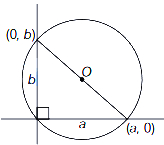
Therefore,the circle passes through the points $(a,0)$ and $(0,b)$.
Since the angle between the coordinate axes is $90^{\circ}$,the line segment joining $(a,0)$ and $(0,b)$ is a diameter of the circle.
The equation of a circle with diameter endpoints $(x_1, y_1)$ and $(x_2, y_2)$ is given by $(x-x_1)(x-x_2) + (y-y_1)(y-y_2) = 0$.
Substituting $(x_1, y_1) = (a,0)$ and $(x_2, y_2) = (0,b)$:
$(x-a)(x-0) + (y-0)(y-b) = 0$
$x(x-a) + y(y-b) = 0$
$x^2 - ax + y^2 - by = 0$
$x^2 + y^2 - ax - by = 0$
Therefore,the circle passes through the points $(a,0)$ and $(0,b)$.
Since the angle between the coordinate axes is $90^{\circ}$,the line segment joining $(a,0)$ and $(0,b)$ is a diameter of the circle.
The equation of a circle with diameter endpoints $(x_1, y_1)$ and $(x_2, y_2)$ is given by $(x-x_1)(x-x_2) + (y-y_1)(y-y_2) = 0$.
Substituting $(x_1, y_1) = (a,0)$ and $(x_2, y_2) = (0,b)$:
$(x-a)(x-0) + (y-0)(y-b) = 0$
$x(x-a) + y(y-b) = 0$
$x^2 - ax + y^2 - by = 0$
$x^2 + y^2 - ax - by = 0$
0 likesView Solution
246
MathematicsEasyMCQAP EAMCET · 2020
The length of the diameter of the circle $x^2+y^2-6x-8y=0$ is $...$ units.
A
$5$
B
$10$
C
$15$
D
$20$
Solution
(B) The given equation of the circle is $x^2+y^2-6x-8y=0$.
Comparing this with the general form $x^2+y^2+2gx+2fy+c=0$,we get $g=-3$,$f=-4$,and $c=0$.
The radius $r$ of the circle is given by the formula $r = \sqrt{g^2+f^2-c}$.
Substituting the values,$r = \sqrt{(-3)^2+(-4)^2-0} = \sqrt{9+16} = \sqrt{25} = 5 \text{ units}$.
The diameter of the circle is $d = 2r = 2 \times 5 = 10 \text{ units}$.
Comparing this with the general form $x^2+y^2+2gx+2fy+c=0$,we get $g=-3$,$f=-4$,and $c=0$.
The radius $r$ of the circle is given by the formula $r = \sqrt{g^2+f^2-c}$.
Substituting the values,$r = \sqrt{(-3)^2+(-4)^2-0} = \sqrt{9+16} = \sqrt{25} = 5 \text{ units}$.
The diameter of the circle is $d = 2r = 2 \times 5 = 10 \text{ units}$.
0 likesView Solution
247
MathematicsMediumMCQAP EAMCET · 2020
The equation of the smallest circle passing through the intersection of the line $x+y=1$ and the circle $x^2+y^2=9$ is
A
$x^2+y^2-9-(x+y+1)=0$
B
$x^2+y^2-9-(x+y-1)=0$
C
$x^2+y^2-9-x+y-1=0$
D
$x^2+y^2-9+x+y-1=0$
Solution
(B) The family of circles passing through the intersection of the circle $x^2+y^2=9$ and the line $x+y=1$ is given by $(x^2+y^2-9) + \lambda(x+y-1) = 0$.
This simplifies to $x^2+y^2+\lambda x+\lambda y - (\lambda+9) = 0$.
The center of this circle is $(-\frac{\lambda}{2}, -\frac{\lambda}{2})$.
For the smallest circle,the line $x+y=1$ must be the diameter of the circle.
Substituting the center into the line equation: $-\frac{\lambda}{2} - \frac{\lambda}{2} = 1$,which gives $-\lambda = 1$,so $\lambda = -1$.
Substituting $\lambda = -1$ into the family equation,we get $(x^2+y^2-9) - (x+y-1) = 0$.
This simplifies to $x^2+y^2+\lambda x+\lambda y - (\lambda+9) = 0$.
The center of this circle is $(-\frac{\lambda}{2}, -\frac{\lambda}{2})$.
For the smallest circle,the line $x+y=1$ must be the diameter of the circle.
Substituting the center into the line equation: $-\frac{\lambda}{2} - \frac{\lambda}{2} = 1$,which gives $-\lambda = 1$,so $\lambda = -1$.
Substituting $\lambda = -1$ into the family equation,we get $(x^2+y^2-9) - (x+y-1) = 0$.
0 likesView Solution
248
MathematicsMediumMCQAP EAMCET · 2020
$A$ circle is drawn touching the $X$-axis,with its centre at the point of reflection of $(m, n)$ on the line $y-x=0$. Then the equation of the circle is
A
$x^2+y^2-2mx-2ny+m^2=0$
B
$x^2+y^2-2mx+2ny+m^2=0$
C
$x^2+y^2+2nx-2my-n^2=0$
D
$x^2+y^2-2nx-2my+n^2=0$
Solution
(D) The point of reflection of $(m, n)$ on the line $y-x=0$ is $(n, m)$.
Let the centre of the circle be $(n, m)$ and the radius be $r$.
The equation of the circle is $(x-n)^2 + (y-m)^2 = r^2$ ... $(i)$.
Since the circle touches the $X$-axis,the radius $r$ is equal to the absolute value of the $y$-coordinate of the centre,so $r = |m|$.
Thus,$r^2 = m^2$.
Substituting $r^2$ into equation $(i)$:
$(x-n)^2 + (y-m)^2 = m^2$
$x^2 - 2nx + n^2 + y^2 - 2my + m^2 = m^2$
$x^2 + y^2 - 2nx - 2my + n^2 = 0$.
Let the centre of the circle be $(n, m)$ and the radius be $r$.
The equation of the circle is $(x-n)^2 + (y-m)^2 = r^2$ ... $(i)$.
Since the circle touches the $X$-axis,the radius $r$ is equal to the absolute value of the $y$-coordinate of the centre,so $r = |m|$.
Thus,$r^2 = m^2$.
Substituting $r^2$ into equation $(i)$:
$(x-n)^2 + (y-m)^2 = m^2$
$x^2 - 2nx + n^2 + y^2 - 2my + m^2 = m^2$
$x^2 + y^2 - 2nx - 2my + n^2 = 0$.
0 likesView Solution
249
MathematicsMediumMCQAP EAMCET · 2020
The equation of the circle with centre $(2,3)$ and touching the line $3x-4y+1=0$ is
A
$x^2+y^2+4x+4y+12=0$
B
$x^2+y^2-4x-6y-14=0$
C
$x^2+y^2-4x-6y+14=0$
D
$x^2+y^2-4x-6y+12=0$
Solution
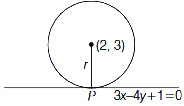
(D) Centre $C = (2,3)$.
Radius $r$ is the perpendicular distance from the centre $(2,3)$ to the line $3x-4y+1=0$.
$r = \frac{|3(2)-4(3)+1|}{\sqrt{3^2+(-4)^2}} = \frac{|6-12+1|}{\sqrt{9+16}} = \frac{|-5|}{5} = 1$.
The equation of the circle is $(x-h)^2+(y-k)^2 = r^2$.
$(x-2)^2+(y-3)^2 = 1^2$.
$x^2-4x+4+y^2-6y+9 = 1$.
$x^2+y^2-4x-6y+12 = 0$.
Thus,option $D$ is correct.
Radius $r$ is the perpendicular distance from the centre $(2,3)$ to the line $3x-4y+1=0$.
$r = \frac{|3(2)-4(3)+1|}{\sqrt{3^2+(-4)^2}} = \frac{|6-12+1|}{\sqrt{9+16}} = \frac{|-5|}{5} = 1$.
The equation of the circle is $(x-h)^2+(y-k)^2 = r^2$.
$(x-2)^2+(y-3)^2 = 1^2$.
$x^2-4x+4+y^2-6y+9 = 1$.
$x^2+y^2-4x-6y+12 = 0$.
Thus,option $D$ is correct.
0 likesView Solution
250
MathematicsMediumMCQAP EAMCET · 2020
Find the equation of the circle having normals $(x-1)(y-2)=0$ and a tangent $3x+4y=6$.
A
$(x-1)^2+(y-2)^2=1$
B
$(x-2)^2+(y-1)^2=1$
C
$(x+1)^2+(y+2)^2=1$
D
$(x+2)^2+(y+1)^2=1$
Solution
(A) The normals to a circle always intersect at its center. Given the normals $(x-1)(y-2)=0$,the center of the circle is $(1, 2)$.
Since $3x+4y=6$ is a tangent to the circle,the radius $r$ is the perpendicular distance from the center $(1, 2)$ to the line $3x+4y-6=0$.
$r = \frac{|3(1) + 4(2) - 6|}{\sqrt{3^2 + 4^2}} = \frac{|3 + 8 - 6|}{\sqrt{9 + 16}} = \frac{5}{5} = 1$.
The equation of the circle with center $(h, k) = (1, 2)$ and radius $r = 1$ is $(x-h)^2 + (y-k)^2 = r^2$.
$(x-1)^2 + (y-2)^2 = 1^2$,which simplifies to $(x-1)^2 + (y-2)^2 = 1$.
Thus,option $A$ is correct.
Since $3x+4y=6$ is a tangent to the circle,the radius $r$ is the perpendicular distance from the center $(1, 2)$ to the line $3x+4y-6=0$.
$r = \frac{|3(1) + 4(2) - 6|}{\sqrt{3^2 + 4^2}} = \frac{|3 + 8 - 6|}{\sqrt{9 + 16}} = \frac{5}{5} = 1$.
The equation of the circle with center $(h, k) = (1, 2)$ and radius $r = 1$ is $(x-h)^2 + (y-k)^2 = r^2$.
$(x-1)^2 + (y-2)^2 = 1^2$,which simplifies to $(x-1)^2 + (y-2)^2 = 1$.
Thus,option $A$ is correct.
0 likesView Solution
251
MathematicsMediumMCQAP EAMCET · 2020
$\int_0^1 \frac{8 \log (1+x)}{1+x^2} dx =$
A
$\pi \log 2$
B
$\frac{\pi}{2} \log 2$
C
$\frac{\pi}{4} \log 2$
D
$\log 2$
Solution
(A) Let $I = \int_0^1 \frac{8 \log (1+x)}{1+x^2} dx$.
Substitute $x = \tan \theta$,so $dx = \sec^2 \theta d\theta$.
When $x = 0$,$\theta = 0$,and when $x = 1$,$\theta = \frac{\pi}{4}$.
Then $I = 8 \int_0^{\pi/4} \frac{\log(1+\tan \theta)}{1+\tan^2 \theta} \sec^2 \theta d\theta = 8 \int_0^{\pi/4} \log(1+\tan \theta) d\theta$.
Using the property $\int_0^a f(\theta) d\theta = \int_0^a f(a-\theta) d\theta$:
$I = 8 \int_0^{\pi/4} \log(1+\tan(\frac{\pi}{4}-\theta)) d\theta$.
Since $\tan(\frac{\pi}{4}-\theta) = \frac{1-\tan \theta}{1+\tan \theta}$,we have:
$I = 8 \int_0^{\pi/4} \log(1 + \frac{1-\tan \theta}{1+\tan \theta}) d\theta = 8 \int_0^{\pi/4} \log(\frac{2}{1+\tan \theta}) d\theta$.
$I = 8 \int_0^{\pi/4} (\log 2 - \log(1+\tan \theta)) d\theta = 8 \int_0^{\pi/4} \log 2 d\theta - I$.
$2I = 8 \log 2 [\theta]_0^{\pi/4} = 8 \log 2 (\frac{\pi}{4}) = 2\pi \log 2$.
Therefore,$I = \pi \log 2$.
Substitute $x = \tan \theta$,so $dx = \sec^2 \theta d\theta$.
When $x = 0$,$\theta = 0$,and when $x = 1$,$\theta = \frac{\pi}{4}$.
Then $I = 8 \int_0^{\pi/4} \frac{\log(1+\tan \theta)}{1+\tan^2 \theta} \sec^2 \theta d\theta = 8 \int_0^{\pi/4} \log(1+\tan \theta) d\theta$.
Using the property $\int_0^a f(\theta) d\theta = \int_0^a f(a-\theta) d\theta$:
$I = 8 \int_0^{\pi/4} \log(1+\tan(\frac{\pi}{4}-\theta)) d\theta$.
Since $\tan(\frac{\pi}{4}-\theta) = \frac{1-\tan \theta}{1+\tan \theta}$,we have:
$I = 8 \int_0^{\pi/4} \log(1 + \frac{1-\tan \theta}{1+\tan \theta}) d\theta = 8 \int_0^{\pi/4} \log(\frac{2}{1+\tan \theta}) d\theta$.
$I = 8 \int_0^{\pi/4} (\log 2 - \log(1+\tan \theta)) d\theta = 8 \int_0^{\pi/4} \log 2 d\theta - I$.
$2I = 8 \log 2 [\theta]_0^{\pi/4} = 8 \log 2 (\frac{\pi}{4}) = 2\pi \log 2$.
Therefore,$I = \pi \log 2$.
0 likesView Solution
252
MathematicsMediumMCQAP EAMCET · 2020
$\int_0^{\pi / 2} e^{\sin x} \cdot \cos x \, dx =$
A
$1-e$
B
$1+e$
C
$e-1$
D
$e$
Solution
(C) Let $I = \int_0^{\pi / 2} e^{\sin x} \cos x \, dx$.
Substitute $\sin x = t$. Then,differentiating both sides with respect to $x$,we get $\cos x \, dx = dt$.
Now,change the limits of integration:
When $x = 0$,$t = \sin(0) = 0$.
When $x = \frac{\pi}{2}$,$t = \sin(\frac{\pi}{2}) = 1$.
Substituting these into the integral,we get:
$I = \int_0^1 e^t \, dt$.
The integral of $e^t$ is $e^t$.
$I = [e^t]_0^1 = e^1 - e^0 = e - 1$.
Substitute $\sin x = t$. Then,differentiating both sides with respect to $x$,we get $\cos x \, dx = dt$.
Now,change the limits of integration:
When $x = 0$,$t = \sin(0) = 0$.
When $x = \frac{\pi}{2}$,$t = \sin(\frac{\pi}{2}) = 1$.
Substituting these into the integral,we get:
$I = \int_0^1 e^t \, dt$.
The integral of $e^t$ is $e^t$.
$I = [e^t]_0^1 = e^1 - e^0 = e - 1$.
0 likesView Solution
253
MathematicsDifficultMCQAP EAMCET · 2020
$\int_0^{\pi / 4} (\tan^2 x - \tan^4 x) dx = $
A
$3$
B
$2$
C
$\frac{1}{3}$
D
$\frac{5}{3} - \frac{\pi}{2}$
Solution
(D) Let $I = \int_0^{\pi/4} (\tan^2 x - \tan^4 x) dx$.
We can factor the integrand as:
$\tan^2 x - \tan^4 x = \tan^2 x (1 - \tan^2 x)$.
Using the identity $\tan^2 x = \sec^2 x - 1$,we have:
$I = \int_0^{\pi/4} (\sec^2 x - 1)(1 - (\sec^2 x - 1)) dx = \int_0^{\pi/4} (\sec^2 x - 1)(2 - \sec^2 x) dx$.
Expanding the product:
$I = \int_0^{\pi/4} (2\sec^2 x - \sec^4 x - 2 + \sec^2 x) dx = \int_0^{\pi/4} (3\sec^2 x - \sec^4 x - 2) dx$.
Using $\sec^4 x = \sec^2 x (1 + \tan^2 x)$:
$I = \int_0^{\pi/4} (3\sec^2 x - \sec^2 x(1 + \tan^2 x) - 2) dx = \int_0^{\pi/4} (2\sec^2 x - \sec^2 x \tan^2 x - 2) dx$.
Integrating term by term:
$I = [2\tan x - \frac{\tan^3 x}{3} - 2x]_0^{\pi/4}$.
Evaluating at the limits:
$I = (2(1) - \frac{1^3}{3} - 2(\frac{\pi}{4})) - (0) = 2 - \frac{1}{3} - \frac{\pi}{2} = \frac{5}{3} - \frac{\pi}{2}$.
We can factor the integrand as:
$\tan^2 x - \tan^4 x = \tan^2 x (1 - \tan^2 x)$.
Using the identity $\tan^2 x = \sec^2 x - 1$,we have:
$I = \int_0^{\pi/4} (\sec^2 x - 1)(1 - (\sec^2 x - 1)) dx = \int_0^{\pi/4} (\sec^2 x - 1)(2 - \sec^2 x) dx$.
Expanding the product:
$I = \int_0^{\pi/4} (2\sec^2 x - \sec^4 x - 2 + \sec^2 x) dx = \int_0^{\pi/4} (3\sec^2 x - \sec^4 x - 2) dx$.
Using $\sec^4 x = \sec^2 x (1 + \tan^2 x)$:
$I = \int_0^{\pi/4} (3\sec^2 x - \sec^2 x(1 + \tan^2 x) - 2) dx = \int_0^{\pi/4} (2\sec^2 x - \sec^2 x \tan^2 x - 2) dx$.
Integrating term by term:
$I = [2\tan x - \frac{\tan^3 x}{3} - 2x]_0^{\pi/4}$.
Evaluating at the limits:
$I = (2(1) - \frac{1^3}{3} - 2(\frac{\pi}{4})) - (0) = 2 - \frac{1}{3} - \frac{\pi}{2} = \frac{5}{3} - \frac{\pi}{2}$.
0 likesView Solution
254
MathematicsMediumMCQAP EAMCET · 2020
Choose the correct option regarding the following definite integrals:
$(i)$ $\int_0^{\pi / 2} \sin ^m(x) \cos (x) d x = \frac{1}{m+1}$
(ii) $\int_0^{\pi / 2} \sin (x) \cos ^n(x) d x = \frac{1}{n+1}$
$(i)$ $\int_0^{\pi / 2} \sin ^m(x) \cos (x) d x = \frac{1}{m+1}$
(ii) $\int_0^{\pi / 2} \sin (x) \cos ^n(x) d x = \frac{1}{n+1}$
A
$(i)$ is true,(ii) is false
B
$(i)$ is false,(ii) is true
C
Both $(i)$ and (ii) are false
D
Both $(i)$ and (ii) are true
Solution
(D) $(i)$ Let $I_1 = \int_0^{\pi / 2} \sin ^m x \cos x d x$.
Substitute $\sin x = t$,then $\cos x d x = d t$.
When $x = 0, t = 0$ and when $x = \pi / 2, t = 1$.
$I_1 = \int_0^1 t^m d t = \left[ \frac{t^{m+1}}{m+1} \right]_0^1 = \frac{1}{m+1} (1^{m+1} - 0^{m+1}) = \frac{1}{m+1}$.
Thus,statement $(i)$ is true.
(ii) Let $I_2 = \int_0^{\pi / 2} \sin x \cos ^n x d x$.
Substitute $\cos x = t$,then $-\sin x d x = d t$,or $\sin x d x = -d t$.
When $x = 0, t = 1$ and when $x = \pi / 2, t = 0$.
$I_2 = \int_1^0 t^n (-d t) = \int_0^1 t^n d t = \left[ \frac{t^{n+1}}{n+1} \right]_0^1 = \frac{1}{n+1} (1^{n+1} - 0^{n+1}) = \frac{1}{n+1}$.
Thus,statement (ii) is true.
Therefore,both $(i)$ and (ii) are true.
Substitute $\sin x = t$,then $\cos x d x = d t$.
When $x = 0, t = 0$ and when $x = \pi / 2, t = 1$.
$I_1 = \int_0^1 t^m d t = \left[ \frac{t^{m+1}}{m+1} \right]_0^1 = \frac{1}{m+1} (1^{m+1} - 0^{m+1}) = \frac{1}{m+1}$.
Thus,statement $(i)$ is true.
(ii) Let $I_2 = \int_0^{\pi / 2} \sin x \cos ^n x d x$.
Substitute $\cos x = t$,then $-\sin x d x = d t$,or $\sin x d x = -d t$.
When $x = 0, t = 1$ and when $x = \pi / 2, t = 0$.
$I_2 = \int_1^0 t^n (-d t) = \int_0^1 t^n d t = \left[ \frac{t^{n+1}}{n+1} \right]_0^1 = \frac{1}{n+1} (1^{n+1} - 0^{n+1}) = \frac{1}{n+1}$.
Thus,statement (ii) is true.
Therefore,both $(i)$ and (ii) are true.
0 likesView Solution
255
MathematicsMediumMCQAP EAMCET · 2020
If $I_1 = \int_0^{\pi / 2} \frac{x}{\sin x} dx$ and $I_2 = \int_0^1 \frac{\tan^{-1} x}{x} dx$,then $I_1 : I_2$ is
A
$1 : 1$
B
$1 : 2$
C
$2 : 1$
D
$4 : 1$
Solution
(C) Given,$I_1 = \int_0^{\pi / 2} \frac{x}{\sin x} dx$ and $I_2 = \int_0^1 \frac{\tan^{-1} x}{x} dx$.
For $I_2$,let $\tan^{-1} x = t$,then $x = \tan t$ and $dx = \sec^2 t dt$.
When $x = 0, t = 0$ and when $x = 1, t = \pi / 4$.
Substituting these into $I_2$:
$I_2 = \int_0^{\pi / 4} \frac{t}{\tan t} \sec^2 t dt = \int_0^{\pi / 4} \frac{t \cos t}{\sin t} \cdot \frac{1}{\cos^2 t} dt = \int_0^{\pi / 4} \frac{t}{\sin t \cos t} dt$.
Multiplying numerator and denominator by $2$:
$I_2 = \int_0^{\pi / 4} \frac{2t}{\sin 2t} dt$.
Let $2t = u$,then $2dt = du$ or $dt = du / 2$.
When $t = 0, u = 0$ and when $t = \pi / 4, u = \pi / 2$.
$I_2 = \int_0^{\pi / 2} \frac{u}{\sin u} \cdot \frac{du}{2} = \frac{1}{2} \int_0^{\pi / 2} \frac{u}{\sin u} du = \frac{1}{2} I_1$.
Therefore,$I_1 / I_2 = 2 / 1$,so $I_1 : I_2 = 2 : 1$.
For $I_2$,let $\tan^{-1} x = t$,then $x = \tan t$ and $dx = \sec^2 t dt$.
When $x = 0, t = 0$ and when $x = 1, t = \pi / 4$.
Substituting these into $I_2$:
$I_2 = \int_0^{\pi / 4} \frac{t}{\tan t} \sec^2 t dt = \int_0^{\pi / 4} \frac{t \cos t}{\sin t} \cdot \frac{1}{\cos^2 t} dt = \int_0^{\pi / 4} \frac{t}{\sin t \cos t} dt$.
Multiplying numerator and denominator by $2$:
$I_2 = \int_0^{\pi / 4} \frac{2t}{\sin 2t} dt$.
Let $2t = u$,then $2dt = du$ or $dt = du / 2$.
When $t = 0, u = 0$ and when $t = \pi / 4, u = \pi / 2$.
$I_2 = \int_0^{\pi / 2} \frac{u}{\sin u} \cdot \frac{du}{2} = \frac{1}{2} \int_0^{\pi / 2} \frac{u}{\sin u} du = \frac{1}{2} I_1$.
Therefore,$I_1 / I_2 = 2 / 1$,so $I_1 : I_2 = 2 : 1$.
0 likesView Solution
256
MathematicsMediumMCQAP EAMCET · 2020
$\int \frac{(1+x) e^x}{\cot \left(x e^x\right)} d x=$
A
$\log \left(\cos \left(x e^x\right)\right)+c$
B
$\log \left(\cot \left(x e^x\right)\right)+c$
C
$\log \left(\sec \left(x e^x\right)\right)+c$
D
$\log \left(\operatorname{cosec}\left(x e^x\right)\right)+c$
Solution
(C) Let $I = \int \frac{(1+x) e^x}{\cot \left(x e^x\right)} d x$.
Substitute $t = x e^x$.
Differentiating with respect to $x$,we get $dt = (e^x + x e^x) dx = e^x(1+x) dx$.
Substituting these into the integral,we get $I = \int \frac{dt}{\cot t} = \int \tan t dt$.
The integral of $\tan t$ is $\log |\sec t| + c$.
Thus,$I = \log |\sec(x e^x)| + c$.
Therefore,the correct option is $C$.
Substitute $t = x e^x$.
Differentiating with respect to $x$,we get $dt = (e^x + x e^x) dx = e^x(1+x) dx$.
Substituting these into the integral,we get $I = \int \frac{dt}{\cot t} = \int \tan t dt$.
The integral of $\tan t$ is $\log |\sec t| + c$.
Thus,$I = \log |\sec(x e^x)| + c$.
Therefore,the correct option is $C$.
0 likesView Solution
257
MathematicsDifficultMCQAP EAMCET · 2020
If $A = \int_{1}^{\sin \theta} \frac{t}{1+t^2} dt$ and $B = \int_{1}^{\operatorname{cosec} \theta} \frac{1}{t(1+t^2)} dt$,then the value of $\left| \begin{array}{ccc} A & A^2 & B \\ e^{A+B} & B^2 & -1 \\ 1 & A^2+B^2 & -1 \end{array} \right| = $
A
$0$
B
$1$
C
$e$
D
$-1$
Solution
(A) First,evaluate $A$: $A = \int_{1}^{\sin \theta} \frac{t}{1+t^2} dt = \frac{1}{2} [\ln(1+t^2)]_{1}^{\sin \theta} = \frac{1}{2} \ln(1+\sin^2 \theta) - \frac{1}{2} \ln(2) = \frac{1}{2} \ln(\frac{1+\sin^2 \theta}{2})$.
Next,evaluate $B$: $B = \int_{1}^{\operatorname{cosec} \theta} \frac{1}{t(1+t^2)} dt$. Using partial fractions,$\frac{1}{t(1+t^2)} = \frac{1}{t} - \frac{t}{1+t^2}$.
So,$B = [\ln|t| - \frac{1}{2} \ln(1+t^2)]_{1}^{\operatorname{cosec} \theta} = [\ln(\frac{t}{\sqrt{1+t^2}})]_{1}^{\operatorname{cosec} \theta}$.
Since $\frac{t}{\sqrt{1+t^2}} = \frac{\operatorname{cosec} \theta}{\sqrt{1+\operatorname{cosec}^2 \theta}} = \frac{1}{\sqrt{\sin^2 \theta + 1}}$,we have $B = \ln(\frac{1}{\sqrt{1+\sin^2 \theta}}) - \ln(\frac{1}{\sqrt{2}}) = \ln(\sqrt{\frac{2}{1+\sin^2 \theta}}) = -\frac{1}{2} \ln(\frac{1+\sin^2 \theta}{2}) = -A$.
Thus,$A+B = 0$,which implies $e^{A+B} = e^0 = 1$.
The determinant becomes $\left| \begin{array}{ccc} A & A^2 & -A \\ 1 & (-A)^2 & -1 \\ 1 & A^2+(-A)^2 & -1 \end{array} \right| = \left| \begin{array}{ccc} A & A^2 & -A \\ 1 & A^2 & -1 \\ 1 & 2A^2 & -1 \end{array} \right|$.
Since the first and third columns are proportional (column $3$ is $-1$ times column $1$),the determinant is $0$.
Next,evaluate $B$: $B = \int_{1}^{\operatorname{cosec} \theta} \frac{1}{t(1+t^2)} dt$. Using partial fractions,$\frac{1}{t(1+t^2)} = \frac{1}{t} - \frac{t}{1+t^2}$.
So,$B = [\ln|t| - \frac{1}{2} \ln(1+t^2)]_{1}^{\operatorname{cosec} \theta} = [\ln(\frac{t}{\sqrt{1+t^2}})]_{1}^{\operatorname{cosec} \theta}$.
Since $\frac{t}{\sqrt{1+t^2}} = \frac{\operatorname{cosec} \theta}{\sqrt{1+\operatorname{cosec}^2 \theta}} = \frac{1}{\sqrt{\sin^2 \theta + 1}}$,we have $B = \ln(\frac{1}{\sqrt{1+\sin^2 \theta}}) - \ln(\frac{1}{\sqrt{2}}) = \ln(\sqrt{\frac{2}{1+\sin^2 \theta}}) = -\frac{1}{2} \ln(\frac{1+\sin^2 \theta}{2}) = -A$.
Thus,$A+B = 0$,which implies $e^{A+B} = e^0 = 1$.
The determinant becomes $\left| \begin{array}{ccc} A & A^2 & -A \\ 1 & (-A)^2 & -1 \\ 1 & A^2+(-A)^2 & -1 \end{array} \right| = \left| \begin{array}{ccc} A & A^2 & -A \\ 1 & A^2 & -1 \\ 1 & 2A^2 & -1 \end{array} \right|$.
Since the first and third columns are proportional (column $3$ is $-1$ times column $1$),the determinant is $0$.
0 likesView Solution
258
MathematicsEasyMCQAP EAMCET · 2020
$\int_{-\pi}^{\pi} x^2 \sin x \, dx =$
A
$\pi^2$
B
$\frac{\pi^2}{2}$
C
$0$
D
$2 \pi^2$
Solution
(C) Let $f(x) = x^2 \sin x$.
Check if the function is even or odd by evaluating $f(-x)$:
$f(-x) = (-x)^2 \sin(-x) = x^2 (-\sin x) = -x^2 \sin x = -f(x)$.
Since $f(-x) = -f(x)$,the function $f(x) = x^2 \sin x$ is an odd function.
According to the property of definite integrals,if $f(x)$ is an odd function,then $\int_{-a}^{a} f(x) \, dx = 0$.
Therefore,$\int_{-\pi}^{\pi} x^2 \sin x \, dx = 0$.
Check if the function is even or odd by evaluating $f(-x)$:
$f(-x) = (-x)^2 \sin(-x) = x^2 (-\sin x) = -x^2 \sin x = -f(x)$.
Since $f(-x) = -f(x)$,the function $f(x) = x^2 \sin x$ is an odd function.
According to the property of definite integrals,if $f(x)$ is an odd function,then $\int_{-a}^{a} f(x) \, dx = 0$.
Therefore,$\int_{-\pi}^{\pi} x^2 \sin x \, dx = 0$.
0 likesView Solution
259
MathematicsMediumMCQAP EAMCET · 2020
$\int_{-\pi / 4}^{\pi / 4} x^3 \sin ^4(x) d x=$
A
$0$
B
$\pi$
C
$1$
D
$2 \pi$
Solution
(A) Let $I = \int_{-\pi / 4}^{\pi / 4} x^3 \sin^4(x) dx$.
We know that for a definite integral,$\int_{-a}^{a} f(x) dx = 0$ if $f(x)$ is an odd function,i.e.,$f(-x) = -f(x)$.
Here,$f(x) = x^3 \sin^4(x)$.
Calculating $f(-x)$:
$f(-x) = (-x)^3 \sin^4(-x) = -x^3 (\sin(x))^4 = -x^3 \sin^4(x) = -f(x)$.
Since $f(x)$ is an odd function,the integral over the symmetric interval $[-\pi/4, \pi/4]$ is $0$.
Therefore,$I = 0$.
We know that for a definite integral,$\int_{-a}^{a} f(x) dx = 0$ if $f(x)$ is an odd function,i.e.,$f(-x) = -f(x)$.
Here,$f(x) = x^3 \sin^4(x)$.
Calculating $f(-x)$:
$f(-x) = (-x)^3 \sin^4(-x) = -x^3 (\sin(x))^4 = -x^3 \sin^4(x) = -f(x)$.
Since $f(x)$ is an odd function,the integral over the symmetric interval $[-\pi/4, \pi/4]$ is $0$.
Therefore,$I = 0$.
0 likesView Solution
260
MathematicsMediumMCQAP EAMCET · 2020
$\int_0^{\pi / 4} \frac{d x}{\cos ^3(x) \cdot \sqrt{2 \sin (2 x)}}=$
A
$\frac{6}{5}$
B
$\frac{3}{5}$
C
$\frac{4}{5}$
D
$\frac{8}{5}$
Solution
(A) Let $I = \int_0^{\pi / 4} \frac{d x}{\cos ^3 x \sqrt{2 \sin 2 x}}$.
Using the identity $\sin 2x = 2 \sin x \cos x$,we get:
$I = \int_0^{\pi / 4} \frac{d x}{\cos ^3 x \sqrt{4 \sin x \cos x}} = \int_0^{\pi / 4} \frac{d x}{2 \cos ^4 x \sqrt{\tan x}}$.
$I = \frac{1}{2} \int_0^{\pi / 4} \frac{\sec^2 x (1 + \tan^2 x)}{\sqrt{\tan x}} d x$.
Let $\tan x = t^2$,then $\sec^2 x d x = 2t dt$.
When $x = 0, t = 0$ and when $x = \frac{\pi}{4}, t = 1$.
Substituting these into the integral:
$I = \frac{1}{2} \int_0^1 \frac{(1 + t^4) \cdot 2t dt}{t} = \int_0^1 (1 + t^4) dt$.
$I = [t + \frac{t^5}{5}]_0^1 = 1 + \frac{1}{5} = \frac{6}{5}$.
Using the identity $\sin 2x = 2 \sin x \cos x$,we get:
$I = \int_0^{\pi / 4} \frac{d x}{\cos ^3 x \sqrt{4 \sin x \cos x}} = \int_0^{\pi / 4} \frac{d x}{2 \cos ^4 x \sqrt{\tan x}}$.
$I = \frac{1}{2} \int_0^{\pi / 4} \frac{\sec^2 x (1 + \tan^2 x)}{\sqrt{\tan x}} d x$.
Let $\tan x = t^2$,then $\sec^2 x d x = 2t dt$.
When $x = 0, t = 0$ and when $x = \frac{\pi}{4}, t = 1$.
Substituting these into the integral:
$I = \frac{1}{2} \int_0^1 \frac{(1 + t^4) \cdot 2t dt}{t} = \int_0^1 (1 + t^4) dt$.
$I = [t + \frac{t^5}{5}]_0^1 = 1 + \frac{1}{5} = \frac{6}{5}$.
0 likesView Solution
261
MathematicsEasyMCQAP EAMCET · 2020
$\int_{-1}^2 |x| \, dx =$
A
$1$
B
$2$
C
$\frac{5}{2}$
D
$\frac{3}{2}$
Solution
(C) We know that the absolute value function $|x|$ is defined as:
$|x| = \begin{cases} -x, & x < 0 \\ x, & x \ge 0 \end{cases}$
Therefore,the integral can be split at $x = 0$:
$I = \int_{-1}^2 |x| \, dx = \int_{-1}^0 (-x) \, dx + \int_0^2 (x) \, dx$
Evaluating the first part:
$\int_{-1}^0 (-x) \, dx = \left[ -\frac{x^2}{2} \right]_{-1}^0 = 0 - \left( -\frac{(-1)^2}{2} \right) = 0 - (-\frac{1}{2}) = \frac{1}{2}$
Evaluating the second part:
$\int_0^2 (x) \, dx = \left[ \frac{x^2}{2} \right]_0^2 = \frac{2^2}{2} - 0 = \frac{4}{2} = 2$
Adding both parts:
$I = \frac{1}{2} + 2 = \frac{1+4}{2} = \frac{5}{2}$
$|x| = \begin{cases} -x, & x < 0 \\ x, & x \ge 0 \end{cases}$
Therefore,the integral can be split at $x = 0$:
$I = \int_{-1}^2 |x| \, dx = \int_{-1}^0 (-x) \, dx + \int_0^2 (x) \, dx$
Evaluating the first part:
$\int_{-1}^0 (-x) \, dx = \left[ -\frac{x^2}{2} \right]_{-1}^0 = 0 - \left( -\frac{(-1)^2}{2} \right) = 0 - (-\frac{1}{2}) = \frac{1}{2}$
Evaluating the second part:
$\int_0^2 (x) \, dx = \left[ \frac{x^2}{2} \right]_0^2 = \frac{2^2}{2} - 0 = \frac{4}{2} = 2$
Adding both parts:
$I = \frac{1}{2} + 2 = \frac{1+4}{2} = \frac{5}{2}$
0 likesView Solution
262
MathematicsEasyMCQAP EAMCET · 2020
Find the value of '$k$',if it is given that $\int_0^{b-c} f(x+c) dx = k \int_c^b f(x) dx$.
A
$1$
B
$2$
C
$0$
D
$-2$
Solution
(A) Let $I = \int_0^{b-c} f(x+c) dx$.
Substitute $x+c = t$,then $dx = dt$.
When $x = 0$,$t = c$.
When $x = b-c$,$t = b$.
Substituting these into the integral,we get:
$I = \int_c^b f(t) dt$.
Since the variable of integration is a dummy variable,we can write $\int_c^b f(t) dt = \int_c^b f(x) dx$.
Thus,$\int_0^{b-c} f(x+c) dx = 1 \cdot \int_c^b f(x) dx$.
Comparing this with the given expression $\int_0^{b-c} f(x+c) dx = k \int_c^b f(x) dx$,we find that $k = 1$.
Substitute $x+c = t$,then $dx = dt$.
When $x = 0$,$t = c$.
When $x = b-c$,$t = b$.
Substituting these into the integral,we get:
$I = \int_c^b f(t) dt$.
Since the variable of integration is a dummy variable,we can write $\int_c^b f(t) dt = \int_c^b f(x) dx$.
Thus,$\int_0^{b-c} f(x+c) dx = 1 \cdot \int_c^b f(x) dx$.
Comparing this with the given expression $\int_0^{b-c} f(x+c) dx = k \int_c^b f(x) dx$,we find that $k = 1$.
0 likesView Solution
263
MathematicsMediumMCQAP EAMCET · 2020
$\int_0^{\pi / 2} \frac{1}{1+\tan ^{2020}(x)} d x=$
A
$\pi$
B
$\frac{\pi}{2}$
C
$\frac{\pi}{4}$
D
$0$
Solution
(C) Let $I = \int_0^{\pi / 2} \frac{1}{1+\tan ^{2020} x} d x$.
Since $\tan x = \frac{\sin x}{\cos x}$,we can write $I = \int_0^{\pi / 2} \frac{\cos ^{2020} x}{\cos ^{2020} x+\sin ^{2020} x} d x$ $(i)$.
Using the property $\int_0^a f(x) d x = \int_0^a f(a-x) d x$,we get $I = \int_0^{\pi / 2} \frac{\sin ^{2020} x}{\sin ^{2020} x+\cos ^{2020} x} d x$ (ii).
Adding equations $(i)$ and (ii),we get $2I = \int_0^{\pi / 2} \frac{\cos ^{2020} x + \sin ^{2020} x}{\cos ^{2020} x + \sin ^{2020} x} d x = \int_0^{\pi / 2} 1 d x$.
Thus,$2I = [x]_0^{\pi / 2} = \frac{\pi}{2}$,which implies $I = \frac{\pi}{4}$.
Therefore,option $C$ is correct.
Since $\tan x = \frac{\sin x}{\cos x}$,we can write $I = \int_0^{\pi / 2} \frac{\cos ^{2020} x}{\cos ^{2020} x+\sin ^{2020} x} d x$ $(i)$.
Using the property $\int_0^a f(x) d x = \int_0^a f(a-x) d x$,we get $I = \int_0^{\pi / 2} \frac{\sin ^{2020} x}{\sin ^{2020} x+\cos ^{2020} x} d x$ (ii).
Adding equations $(i)$ and (ii),we get $2I = \int_0^{\pi / 2} \frac{\cos ^{2020} x + \sin ^{2020} x}{\cos ^{2020} x + \sin ^{2020} x} d x = \int_0^{\pi / 2} 1 d x$.
Thus,$2I = [x]_0^{\pi / 2} = \frac{\pi}{2}$,which implies $I = \frac{\pi}{4}$.
Therefore,option $C$ is correct.
0 likesView Solution
264
MathematicsMediumMCQAP EAMCET · 2020
$\int_{-\pi / 2}^{\pi / 2}(2 \sin |x|+\cos |x|) d x=$
A
$3$
B
$6$
C
$8$
D
$2$
Solution
(B) Let $I = \int_{-\pi / 2}^{\pi / 2} (2 \sin |x| + \cos |x|) dx$.
Since $f(x) = 2 \sin |x| + \cos |x|$ is an even function because $f(-x) = 2 \sin |-x| + \cos |-x| = 2 \sin |x| + \cos |x| = f(x)$,we can use the property $\int_{-a}^{a} f(x) dx = 2 \int_{0}^{a} f(x) dx$.
$I = 2 \int_{0}^{\pi / 2} (2 \sin x + \cos x) dx$.
Integrating the terms,we get $I = 2 [-2 \cos x + \sin x]_{0}^{\pi / 2}$.
Evaluating at the limits,$I = 2 [(-2 \cos(\pi / 2) + \sin(\pi / 2)) - (-2 \cos(0) + \sin(0))]$.
$I = 2 [(-2 \times 0 + 1) - (-2 \times 1 + 0)]$.
$I = 2 [1 - (-2)] = 2 [1 + 2] = 2 \times 3 = 6$.
Since $f(x) = 2 \sin |x| + \cos |x|$ is an even function because $f(-x) = 2 \sin |-x| + \cos |-x| = 2 \sin |x| + \cos |x| = f(x)$,we can use the property $\int_{-a}^{a} f(x) dx = 2 \int_{0}^{a} f(x) dx$.
$I = 2 \int_{0}^{\pi / 2} (2 \sin x + \cos x) dx$.
Integrating the terms,we get $I = 2 [-2 \cos x + \sin x]_{0}^{\pi / 2}$.
Evaluating at the limits,$I = 2 [(-2 \cos(\pi / 2) + \sin(\pi / 2)) - (-2 \cos(0) + \sin(0))]$.
$I = 2 [(-2 \times 0 + 1) - (-2 \times 1 + 0)]$.
$I = 2 [1 - (-2)] = 2 [1 + 2] = 2 \times 3 = 6$.
0 likesView Solution
265
MathematicsMediumMCQAP EAMCET · 2020
$\int_0^{2 \pi} \frac{x \cos x}{1+\cos x} d x=$
A
$\frac{\pi}{6}$
B
$\pi^2$
C
$\frac{\pi}{4}$
D
None of the above.
Solution
(D) Let $I = \int_0^{2 \pi} \frac{x \cos x}{1+\cos x} d x$ ... $(i)$
Using the property $\int_0^a f(x) d x = \int_0^a f(a-x) d x$,we get:
$I = \int_0^{2 \pi} \frac{(2 \pi - x) \cos(2 \pi - x)}{1 + \cos(2 \pi - x)} d x$
Since $\cos(2 \pi - x) = \cos x$,we have:
$I = \int_0^{2 \pi} \frac{(2 \pi - x) \cos x}{1 + \cos x} d x$ ... (ii)
Adding $(i)$ and (ii):
$2I = \int_0^{2 \pi} \frac{2 \pi \cos x}{1 + \cos x} d x = 2 \pi \int_0^{2 \pi} \frac{\cos x}{1 + \cos x} d x$
$I = \pi \int_0^{2 \pi} \frac{\cos x}{1 + \cos x} d x = 2 \pi \int_0^{\pi} \frac{\cos x}{1 + \cos x} d x$
$I = 2 \pi \int_0^{\pi} (1 - \frac{1}{1 + \cos x}) d x = 2 \pi \int_0^{\pi} (1 - \frac{1}{2 \cos^2(x/2)}) d x$
$I = 2 \pi \int_0^{\pi} (1 - \frac{1}{2} \sec^2(x/2)) d x$
$I = 2 \pi [x - \tan(x/2)]_0^{\pi}$
Evaluating at limits: $I = 2 \pi [(\pi - \tan(\pi/2)) - (0 - \tan(0))]$. Since $\tan(\pi/2)$ is undefined,the integral diverges. Thus,the correct option is $D$.
Using the property $\int_0^a f(x) d x = \int_0^a f(a-x) d x$,we get:
$I = \int_0^{2 \pi} \frac{(2 \pi - x) \cos(2 \pi - x)}{1 + \cos(2 \pi - x)} d x$
Since $\cos(2 \pi - x) = \cos x$,we have:
$I = \int_0^{2 \pi} \frac{(2 \pi - x) \cos x}{1 + \cos x} d x$ ... (ii)
Adding $(i)$ and (ii):
$2I = \int_0^{2 \pi} \frac{2 \pi \cos x}{1 + \cos x} d x = 2 \pi \int_0^{2 \pi} \frac{\cos x}{1 + \cos x} d x$
$I = \pi \int_0^{2 \pi} \frac{\cos x}{1 + \cos x} d x = 2 \pi \int_0^{\pi} \frac{\cos x}{1 + \cos x} d x$
$I = 2 \pi \int_0^{\pi} (1 - \frac{1}{1 + \cos x}) d x = 2 \pi \int_0^{\pi} (1 - \frac{1}{2 \cos^2(x/2)}) d x$
$I = 2 \pi \int_0^{\pi} (1 - \frac{1}{2} \sec^2(x/2)) d x$
$I = 2 \pi [x - \tan(x/2)]_0^{\pi}$
Evaluating at limits: $I = 2 \pi [(\pi - \tan(\pi/2)) - (0 - \tan(0))]$. Since $\tan(\pi/2)$ is undefined,the integral diverges. Thus,the correct option is $D$.
0 likesView Solution
266
MathematicsMediumMCQAP EAMCET · 2020
$\int_{\pi / 6}^{\pi / 3} \frac{1}{1+\sqrt{\cot x}} d x=$
A
$\frac{\pi}{12}$
B
$\frac{\pi}{6}$
C
$\frac{\pi}{4}$
D
$\frac{\pi}{13}$
Solution
(A) Let $I = \int_{\pi / 6}^{\pi / 3} \frac{1}{1+\sqrt{\cot x}} d x$.
We can rewrite the integrand as $I = \int_{\pi / 6}^{\pi / 3} \frac{\sqrt{\sin x}}{\sqrt{\sin x}+\sqrt{\cos x}} d x$ $(i)$.
Using the property $\int_a^b f(x) d x = \int_a^b f(a+b-x) d x$,where $a+b = \frac{\pi}{6} + \frac{\pi}{3} = \frac{\pi}{2}$,we get:
$I = \int_{\pi / 6}^{\pi / 3} \frac{\sqrt{\sin(\frac{\pi}{2}-x)}}{\sqrt{\sin(\frac{\pi}{2}-x)}+\sqrt{\cos(\frac{\pi}{2}-x)}} d x = \int_{\pi / 6}^{\pi / 3} \frac{\sqrt{\cos x}}{\sqrt{\cos x}+\sqrt{\sin x}} d x$ (ii).
Adding $(i)$ and (ii):
$2I = \int_{\pi / 6}^{\pi / 3} \left( \frac{\sqrt{\sin x} + \sqrt{\cos x}}{\sqrt{\sin x} + \sqrt{\cos x}} \right) d x = \int_{\pi / 6}^{\pi / 3} 1 d x$.
$2I = [x]_{\pi / 6}^{\pi / 3} = \frac{\pi}{3} - \frac{\pi}{6} = \frac{\pi}{6}$.
Therefore,$I = \frac{\pi}{12}$.
We can rewrite the integrand as $I = \int_{\pi / 6}^{\pi / 3} \frac{\sqrt{\sin x}}{\sqrt{\sin x}+\sqrt{\cos x}} d x$ $(i)$.
Using the property $\int_a^b f(x) d x = \int_a^b f(a+b-x) d x$,where $a+b = \frac{\pi}{6} + \frac{\pi}{3} = \frac{\pi}{2}$,we get:
$I = \int_{\pi / 6}^{\pi / 3} \frac{\sqrt{\sin(\frac{\pi}{2}-x)}}{\sqrt{\sin(\frac{\pi}{2}-x)}+\sqrt{\cos(\frac{\pi}{2}-x)}} d x = \int_{\pi / 6}^{\pi / 3} \frac{\sqrt{\cos x}}{\sqrt{\cos x}+\sqrt{\sin x}} d x$ (ii).
Adding $(i)$ and (ii):
$2I = \int_{\pi / 6}^{\pi / 3} \left( \frac{\sqrt{\sin x} + \sqrt{\cos x}}{\sqrt{\sin x} + \sqrt{\cos x}} \right) d x = \int_{\pi / 6}^{\pi / 3} 1 d x$.
$2I = [x]_{\pi / 6}^{\pi / 3} = \frac{\pi}{3} - \frac{\pi}{6} = \frac{\pi}{6}$.
Therefore,$I = \frac{\pi}{12}$.
0 likesView Solution
267
MathematicsMediumMCQAP EAMCET · 2020
If the value of $\int_{0}^{\pi/2} \sin^{4}(x) \cdot \cos^{2}(x) dx = \frac{\pi}{32}$,then the value of $\int_{0}^{\pi/2} \cos^{4}(x) \cdot \sin^{2}(x) dx$ is:
A
$\frac{\pi}{32}$
B
$\frac{\pi}{64}$
C
$\frac{\pi}{4}$
D
$\frac{\pi}{8}$
Solution
(A) We are given the property of definite integrals: $\int_{0}^{a} f(x) dx = \int_{0}^{a} f(a - x) dx$.
Applying this property to the integral $I = \int_{0}^{\pi/2} \cos^{4}(x) \cdot \sin^{2}(x) dx$,we replace $x$ with $(\frac{\pi}{2} - x)$.
Since $\cos(\frac{\pi}{2} - x) = \sin(x)$ and $\sin(\frac{\pi}{2} - x) = \cos(x)$,the integral becomes:
$I = \int_{0}^{\pi/2} \sin^{4}(x) \cdot \cos^{2}(x) dx$.
Given that $\int_{0}^{\pi/2} \sin^{4}(x) \cdot \cos^{2}(x) dx = \frac{\pi}{32}$,it follows that $I = \frac{\pi}{32}$.
Applying this property to the integral $I = \int_{0}^{\pi/2} \cos^{4}(x) \cdot \sin^{2}(x) dx$,we replace $x$ with $(\frac{\pi}{2} - x)$.
Since $\cos(\frac{\pi}{2} - x) = \sin(x)$ and $\sin(\frac{\pi}{2} - x) = \cos(x)$,the integral becomes:
$I = \int_{0}^{\pi/2} \sin^{4}(x) \cdot \cos^{2}(x) dx$.
Given that $\int_{0}^{\pi/2} \sin^{4}(x) \cdot \cos^{2}(x) dx = \frac{\pi}{32}$,it follows that $I = \frac{\pi}{32}$.
0 likesView Solution
268
MathematicsEasyMCQAP EAMCET · 2020
$\int_{-a}^{a} \sqrt{\frac{a - x}{a + x}} dx =$
A
$\frac{a \pi}{2}$
B
$1$
C
$2 a \pi$
D
$a \pi$
Solution
(D) Let $I = \int_{-a}^{a} \sqrt{\frac{a - x}{a + x}} dx$.
Using the property $\int_{a}^{b} f(x) dx = \int_{a}^{b} f(a + b - x) dx$,where $a = -a$ and $b = a$,we have $f(x) \rightarrow f(-a + a - x) = f(-x)$.
$I = \int_{-a}^{a} \sqrt{\frac{a - (-x)}{a + (-x)}} dx = \int_{-a}^{a} \sqrt{\frac{a + x}{a - x}} dx$.
Adding the two expressions for $I$:
$2I = \int_{-a}^{a} \left( \sqrt{\frac{a - x}{a + x}} + \sqrt{\frac{a + x}{a - x}} \right) dx$.
$2I = \int_{-a}^{a} \frac{(a - x) + (a + x)}{\sqrt{(a + x)(a - x)}} dx = \int_{-a}^{a} \frac{2a}{\sqrt{a^2 - x^2}} dx$.
Since the integrand is an even function,$2I = 2 \int_{0}^{a} \frac{2a}{\sqrt{a^2 - x^2}} dx$.
$I = 2a \int_{0}^{a} \frac{1}{\sqrt{a^2 - x^2}} dx$.
$I = 2a [\sin^{-1}(\frac{x}{a})]_{0}^{a}$.
$I = 2a (\sin^{-1}(1) - \sin^{-1}(0)) = 2a (\frac{\pi}{2} - 0) = a \pi$.
Using the property $\int_{a}^{b} f(x) dx = \int_{a}^{b} f(a + b - x) dx$,where $a = -a$ and $b = a$,we have $f(x) \rightarrow f(-a + a - x) = f(-x)$.
$I = \int_{-a}^{a} \sqrt{\frac{a - (-x)}{a + (-x)}} dx = \int_{-a}^{a} \sqrt{\frac{a + x}{a - x}} dx$.
Adding the two expressions for $I$:
$2I = \int_{-a}^{a} \left( \sqrt{\frac{a - x}{a + x}} + \sqrt{\frac{a + x}{a - x}} \right) dx$.
$2I = \int_{-a}^{a} \frac{(a - x) + (a + x)}{\sqrt{(a + x)(a - x)}} dx = \int_{-a}^{a} \frac{2a}{\sqrt{a^2 - x^2}} dx$.
Since the integrand is an even function,$2I = 2 \int_{0}^{a} \frac{2a}{\sqrt{a^2 - x^2}} dx$.
$I = 2a \int_{0}^{a} \frac{1}{\sqrt{a^2 - x^2}} dx$.
$I = 2a [\sin^{-1}(\frac{x}{a})]_{0}^{a}$.
$I = 2a (\sin^{-1}(1) - \sin^{-1}(0)) = 2a (\frac{\pi}{2} - 0) = a \pi$.
0 likesView Solution
269
MathematicsEasyMCQAP EAMCET · 2020
$\int_0^{\pi / 2} \frac{2 \sin (x)+3 \cos (x)}{\sin (x)+\cos (x)} d x=$
A
$\frac{\pi}{4}$
B
$\frac{3 \pi}{4}$
C
$\frac{5 \pi}{4}$
D
$0$
Solution
(C) Let $I = \int_0^{\pi / 2} \frac{2 \sin (x)+3 \cos (x)}{\sin (x)+\cos (x)} d x$.
Using the property $\int_0^a f(x) d x = \int_0^a f(a-x) d x$,we get:
$I = \int_0^{\pi / 2} \frac{2 \sin (\pi/2-x)+3 \cos (\pi/2-x)}{\sin (\pi/2-x)+\cos (\pi/2-x)} d x = \int_0^{\pi / 2} \frac{2 \cos (x)+3 \sin (x)}{\cos (x)+\sin (x)} d x$.
Adding the two expressions for $I$:
$2I = \int_0^{\pi / 2} \frac{(2 \sin x + 3 \cos x) + (2 \cos x + 3 \sin x)}{\sin x + \cos x} d x$.
$2I = \int_0^{\pi / 2} \frac{5 \sin x + 5 \cos x}{\sin x + \cos x} d x = \int_0^{\pi / 2} 5 d x$.
$2I = [5x]_0^{\pi / 2} = 5(\frac{\pi}{2} - 0) = \frac{5\pi}{2}$.
Therefore,$I = \frac{5\pi}{4}$.
Using the property $\int_0^a f(x) d x = \int_0^a f(a-x) d x$,we get:
$I = \int_0^{\pi / 2} \frac{2 \sin (\pi/2-x)+3 \cos (\pi/2-x)}{\sin (\pi/2-x)+\cos (\pi/2-x)} d x = \int_0^{\pi / 2} \frac{2 \cos (x)+3 \sin (x)}{\cos (x)+\sin (x)} d x$.
Adding the two expressions for $I$:
$2I = \int_0^{\pi / 2} \frac{(2 \sin x + 3 \cos x) + (2 \cos x + 3 \sin x)}{\sin x + \cos x} d x$.
$2I = \int_0^{\pi / 2} \frac{5 \sin x + 5 \cos x}{\sin x + \cos x} d x = \int_0^{\pi / 2} 5 d x$.
$2I = [5x]_0^{\pi / 2} = 5(\frac{\pi}{2} - 0) = \frac{5\pi}{2}$.
Therefore,$I = \frac{5\pi}{4}$.
0 likesView Solution
270
MathematicsEasyMCQAP EAMCET · 2020
$\int_0^{2a} f(x) dx - \int_a^{2a} f(x) dx =$
A
$\int_0^a f(x) dx$
B
$-\int_0^a f(x) dx$
C
$-\int_0^{2a} f(x) dx$
D
$\int_0^{a/2} f(x) dx$
Solution
(A) We are given the expression: $I = \int_0^{2a} f(x) dx - \int_a^{2a} f(x) dx$.
Using the property of definite integrals,$\int_0^{2a} f(x) dx = \int_0^a f(x) dx + \int_a^{2a} f(x) dx$.
Substituting this into the expression,we get: $I = (\int_0^a f(x) dx + \int_a^{2a} f(x) dx) - \int_a^{2a} f(x) dx$.
Simplifying the expression,the term $\int_a^{2a} f(x) dx$ cancels out.
Therefore,$I = \int_0^a f(x) dx$.
Using the property of definite integrals,$\int_0^{2a} f(x) dx = \int_0^a f(x) dx + \int_a^{2a} f(x) dx$.
Substituting this into the expression,we get: $I = (\int_0^a f(x) dx + \int_a^{2a} f(x) dx) - \int_a^{2a} f(x) dx$.
Simplifying the expression,the term $\int_a^{2a} f(x) dx$ cancels out.
Therefore,$I = \int_0^a f(x) dx$.
0 likesView Solution
271
MathematicsMediumMCQAP EAMCET · 2020
The value of $x$ that satisfies the equation $\int_{\sqrt{2}}^x \frac{dt}{|t| \sqrt{t^2-1}} = \frac{\pi}{12}$ is
A
$1$
B
$0$
C
$-\sqrt{2}$
D
$2$
Solution
(D) We are given the integral equation $\int_{\sqrt{2}}^x \frac{dt}{|t| \sqrt{t^2-1}} = \frac{\pi}{12}$.
Recall the standard integral formula $\int \frac{dt}{|t| \sqrt{t^2-1}} = \sec^{-1}(t) + C$.
Applying the limits of integration,we get:
$\left[ \sec^{-1}(t) \right]_{\sqrt{2}}^x = \frac{\pi}{12}$.
Substituting the limits,we have $\sec^{-1}(x) - \sec^{-1}(\sqrt{2}) = \frac{\pi}{12}$.
Since $\sec^{-1}(\sqrt{2}) = \frac{\pi}{4}$,the equation becomes $\sec^{-1}(x) - \frac{\pi}{4} = \frac{\pi}{12}$.
Adding $\frac{\pi}{4}$ to both sides,we get $\sec^{-1}(x) = \frac{\pi}{12} + \frac{\pi}{4} = \frac{\pi + 3\pi}{12} = \frac{4\pi}{12} = \frac{\pi}{3}$.
Therefore,$x = \sec\left(\frac{\pi}{3}\right) = 2$.
Recall the standard integral formula $\int \frac{dt}{|t| \sqrt{t^2-1}} = \sec^{-1}(t) + C$.
Applying the limits of integration,we get:
$\left[ \sec^{-1}(t) \right]_{\sqrt{2}}^x = \frac{\pi}{12}$.
Substituting the limits,we have $\sec^{-1}(x) - \sec^{-1}(\sqrt{2}) = \frac{\pi}{12}$.
Since $\sec^{-1}(\sqrt{2}) = \frac{\pi}{4}$,the equation becomes $\sec^{-1}(x) - \frac{\pi}{4} = \frac{\pi}{12}$.
Adding $\frac{\pi}{4}$ to both sides,we get $\sec^{-1}(x) = \frac{\pi}{12} + \frac{\pi}{4} = \frac{\pi + 3\pi}{12} = \frac{4\pi}{12} = \frac{\pi}{3}$.
Therefore,$x = \sec\left(\frac{\pi}{3}\right) = 2$.
0 likesView Solution
272
MathematicsEasyMCQAP EAMCET · 2020
The value of $f(1)$,given the equation $\int_0^{x^2} x f(t) dt = x^5 - x^3$ is
A
$4$
B
$3$
C
$2$
D
$1$
Solution
(D) Given the equation: $\int_0^{x^2} x f(t) dt = x^5 - x^3$.
Since $x$ is independent of $t$,we can write it as $x \int_0^{x^2} f(t) dt = x^5 - x^3$.
Dividing by $x$ (assuming $x \neq 0$),we get $\int_0^{x^2} f(t) dt = x^4 - x^2$.
Differentiating both sides with respect to $x$ using the Leibniz integral rule:
$f(x^2) \cdot \frac{d}{dx}(x^2) = \frac{d}{dx}(x^4 - x^2)$.
$f(x^2) \cdot (2x) = 4x^3 - 2x$.
$f(x^2) = \frac{4x^3 - 2x}{2x} = 2x^2 - 1$.
To find $f(1)$,we set $x^2 = 1$,which implies $x = 1$.
Substituting $x = 1$ into the expression for $f(x^2)$:
$f(1) = 2(1)^2 - 1 = 2 - 1 = 1$.
Thus,the value of $f(1)$ is $1$.
Since $x$ is independent of $t$,we can write it as $x \int_0^{x^2} f(t) dt = x^5 - x^3$.
Dividing by $x$ (assuming $x \neq 0$),we get $\int_0^{x^2} f(t) dt = x^4 - x^2$.
Differentiating both sides with respect to $x$ using the Leibniz integral rule:
$f(x^2) \cdot \frac{d}{dx}(x^2) = \frac{d}{dx}(x^4 - x^2)$.
$f(x^2) \cdot (2x) = 4x^3 - 2x$.
$f(x^2) = \frac{4x^3 - 2x}{2x} = 2x^2 - 1$.
To find $f(1)$,we set $x^2 = 1$,which implies $x = 1$.
Substituting $x = 1$ into the expression for $f(x^2)$:
$f(1) = 2(1)^2 - 1 = 2 - 1 = 1$.
Thus,the value of $f(1)$ is $1$.
0 likesView Solution
273
MathematicsDifficultMCQAP EAMCET · 2020
If $I_n = \int_0^{\pi / 2} \sin^n(x) dx$ and $I_n = (k) I_{n-2}$,then what will be the value of $k$?
A
$\frac{n}{n-1}$
B
$\frac{n-1}{n}$
C
$\frac{n+1}{n}$
D
$\frac{n}{n+1}$
Solution
(B) We are given $I_n = \int_0^{\pi / 2} \sin^n(x) dx$.
Using integration by parts,let $u = \sin^{n-1}(x)$ and $dv = \sin(x) dx$.
Then $du = (n-1) \sin^{n-2}(x) \cos(x) dx$ and $v = -\cos(x)$.
$I_n = [-\sin^{n-1}(x) \cos(x)]_0^{\pi / 2} + \int_0^{\pi / 2} (n-1) \sin^{n-2}(x) \cos^2(x) dx$.
Since $\cos(\pi/2) = 0$ and $\sin(0) = 0$,the boundary term is $0$.
$I_n = (n-1) \int_0^{\pi / 2} \sin^{n-2}(x) (1 - \sin^2(x)) dx$.
$I_n = (n-1) \int_0^{\pi / 2} \sin^{n-2}(x) dx - (n-1) \int_0^{\pi / 2} \sin^n(x) dx$.
$I_n = (n-1) I_{n-2} - (n-1) I_n$.
$I_n + (n-1) I_n = (n-1) I_{n-2}$.
$n I_n = (n-1) I_{n-2}$.
$I_n = \frac{n-1}{n} I_{n-2}$.
Comparing this with $I_n = k I_{n-2}$,we get $k = \frac{n-1}{n}$.
Hence,option $B$ is correct.
Using integration by parts,let $u = \sin^{n-1}(x)$ and $dv = \sin(x) dx$.
Then $du = (n-1) \sin^{n-2}(x) \cos(x) dx$ and $v = -\cos(x)$.
$I_n = [-\sin^{n-1}(x) \cos(x)]_0^{\pi / 2} + \int_0^{\pi / 2} (n-1) \sin^{n-2}(x) \cos^2(x) dx$.
Since $\cos(\pi/2) = 0$ and $\sin(0) = 0$,the boundary term is $0$.
$I_n = (n-1) \int_0^{\pi / 2} \sin^{n-2}(x) (1 - \sin^2(x)) dx$.
$I_n = (n-1) \int_0^{\pi / 2} \sin^{n-2}(x) dx - (n-1) \int_0^{\pi / 2} \sin^n(x) dx$.
$I_n = (n-1) I_{n-2} - (n-1) I_n$.
$I_n + (n-1) I_n = (n-1) I_{n-2}$.
$n I_n = (n-1) I_{n-2}$.
$I_n = \frac{n-1}{n} I_{n-2}$.
Comparing this with $I_n = k I_{n-2}$,we get $k = \frac{n-1}{n}$.
Hence,option $B$ is correct.
0 likesView Solution
274
MathematicsMediumMCQAP EAMCET · 2020
$\int_0^{\pi / 2} |\sin t - \cos t| \, dt =$
A
$2(\sqrt{2} + 1)$
B
$2(\sqrt{2} - 1)$
C
$\sqrt{2} + 1$
D
$\sqrt{2} - 1$
Solution
(B) Let $I = \int_0^{\pi / 2} |\sin t - \cos t| \, dt$.
Since $\sin t - \cos t \le 0$ for $t \in [0, \pi / 4]$ and $\sin t - \cos t \ge 0$ for $t \in [\pi / 4, \pi / 2]$,we split the integral:
$I = \int_0^{\pi / 4} (\cos t - \sin t) \, dt + \int_{\pi / 4}^{\pi / 2} (\sin t - \cos t) \, dt$.
Evaluating the first part: $[\sin t + \cos t]_0^{\pi / 4} = (\frac{1}{\sqrt{2}} + \frac{1}{\sqrt{2}}) - (0 + 1) = \sqrt{2} - 1$.
Evaluating the second part: $[-\cos t - \sin t]_{\pi / 4}^{\pi / 2} = (0 - 1) - (-\frac{1}{\sqrt{2}} - \frac{1}{\sqrt{2}}) = -1 + \sqrt{2} = \sqrt{2} - 1$.
Adding both parts: $I = (\sqrt{2} - 1) + (\sqrt{2} - 1) = 2(\sqrt{2} - 1)$.
Thus,option $B$ is correct.
Since $\sin t - \cos t \le 0$ for $t \in [0, \pi / 4]$ and $\sin t - \cos t \ge 0$ for $t \in [\pi / 4, \pi / 2]$,we split the integral:
$I = \int_0^{\pi / 4} (\cos t - \sin t) \, dt + \int_{\pi / 4}^{\pi / 2} (\sin t - \cos t) \, dt$.
Evaluating the first part: $[\sin t + \cos t]_0^{\pi / 4} = (\frac{1}{\sqrt{2}} + \frac{1}{\sqrt{2}}) - (0 + 1) = \sqrt{2} - 1$.
Evaluating the second part: $[-\cos t - \sin t]_{\pi / 4}^{\pi / 2} = (0 - 1) - (-\frac{1}{\sqrt{2}} - \frac{1}{\sqrt{2}}) = -1 + \sqrt{2} = \sqrt{2} - 1$.
Adding both parts: $I = (\sqrt{2} - 1) + (\sqrt{2} - 1) = 2(\sqrt{2} - 1)$.
Thus,option $B$ is correct.
0 likesView Solution
275
MathematicsEasyMCQAP EAMCET · 2020
Calculate the area enclosed by the curves $x^2 = 2 - y$ and $x^2 = y$.
A
$\frac{2}{3}$ square units
B
$\frac{4}{3}$ square units
C
$\frac{8}{3}$ square units
D
$\frac{11}{3}$ square units
Solution
(C) The given curves are $x^2 = 2 - y$ (which is $y = 2 - x^2$) and $x^2 = y$.
To find the intersection points,set $2 - x^2 = x^2$.
$2x^2 = 2 \Rightarrow x^2 = 1 \Rightarrow x = \pm 1$.
The area $A$ is given by the integral of the upper curve minus the lower curve from $x = -1$ to $x = 1$.
$A = \int_{-1}^{1} ((2 - x^2) - x^2) dx = \int_{-1}^{1} (2 - 2x^2) dx$.
Since the function is even,$A = 2 \int_{0}^{1} (2 - 2x^2) dx$.
$A = 4 \int_{0}^{1} (1 - x^2) dx = 4 [x - \frac{x^3}{3}]_{0}^{1}$.
$A = 4 (1 - \frac{1}{3}) = 4 (\frac{2}{3}) = \frac{8}{3}$ square units.
To find the intersection points,set $2 - x^2 = x^2$.
$2x^2 = 2 \Rightarrow x^2 = 1 \Rightarrow x = \pm 1$.
The area $A$ is given by the integral of the upper curve minus the lower curve from $x = -1$ to $x = 1$.
$A = \int_{-1}^{1} ((2 - x^2) - x^2) dx = \int_{-1}^{1} (2 - 2x^2) dx$.
Since the function is even,$A = 2 \int_{0}^{1} (2 - 2x^2) dx$.
$A = 4 \int_{0}^{1} (1 - x^2) dx = 4 [x - \frac{x^3}{3}]_{0}^{1}$.
$A = 4 (1 - \frac{1}{3}) = 4 (\frac{2}{3}) = \frac{8}{3}$ square units.
0 likesView Solution
276
MathematicsEasyMCQAP EAMCET · 2020
If $c_1, c_2, c_3, c_4, c_5$ are arbitrary constants,then the order of the differential equation whose general solution is $y=(c_1+c_2) \sin (x+c_3)+c_4 e^{x+c_5}$ is
A
$3$
B
$5$
C
$4$
D
Not defined
Solution
(A) The given general solution is $y=(c_1+c_2) \sin (x+c_3)+c_4 e^{x+c_5}$.
We can simplify the expression by substituting constants:
Let $A = c_1+c_2$ and $B = c_4 e^{c_5}$.
Then the equation becomes $y = A \sin (x+c_3) + B e^x$.
Using the trigonometric identity $\sin (x+c_3) = \sin x \cos c_3 + \cos x \sin c_3$,we get:
$y = A (\sin x \cos c_3 + \cos x \sin c_3) + B e^x$
$y = (A \cos c_3) \sin x + (A \sin c_3) \cos x + B e^x$.
Let $K_1 = A \cos c_3$,$K_2 = A \sin c_3$,and $K_3 = B$.
Thus,$y = K_1 \sin x + K_2 \cos x + K_3 e^x$.
There are $3$ essential arbitrary constants $(K_1, K_2, K_3)$.
The order of a differential equation is equal to the number of essential arbitrary constants in its general solution.
Therefore,the order of the differential equation is $3$.
We can simplify the expression by substituting constants:
Let $A = c_1+c_2$ and $B = c_4 e^{c_5}$.
Then the equation becomes $y = A \sin (x+c_3) + B e^x$.
Using the trigonometric identity $\sin (x+c_3) = \sin x \cos c_3 + \cos x \sin c_3$,we get:
$y = A (\sin x \cos c_3 + \cos x \sin c_3) + B e^x$
$y = (A \cos c_3) \sin x + (A \sin c_3) \cos x + B e^x$.
Let $K_1 = A \cos c_3$,$K_2 = A \sin c_3$,and $K_3 = B$.
Thus,$y = K_1 \sin x + K_2 \cos x + K_3 e^x$.
There are $3$ essential arbitrary constants $(K_1, K_2, K_3)$.
The order of a differential equation is equal to the number of essential arbitrary constants in its general solution.
Therefore,the order of the differential equation is $3$.
0 likesView Solution
277
MathematicsEasyMCQAP EAMCET · 2020
The product of the degree and order of the differential equation $\left(\frac{d^2 y}{d x^2}\right)^2-\left(\frac{d y}{d x}\right)^3=y^3$ is
A
$3$
B
$4$
C
$6$
D
$5$
Solution
(B) The given differential equation is $\left(\frac{d^2 y}{d x^2}\right)^2-\left(\frac{d y}{d x}\right)^3=y^3$.
The order of a differential equation is the order of the highest derivative present in the equation. Here,the highest derivative is $\frac{d^2 y}{d x^2}$,so the order is $2$.
The degree of a differential equation is the power of the highest derivative when the equation is expressed as a polynomial in derivatives. Here,the power of $\frac{d^2 y}{d x^2}$ is $2$,so the degree is $2$.
The product of the degree and the order is $2 \times 2 = 4$.
The order of a differential equation is the order of the highest derivative present in the equation. Here,the highest derivative is $\frac{d^2 y}{d x^2}$,so the order is $2$.
The degree of a differential equation is the power of the highest derivative when the equation is expressed as a polynomial in derivatives. Here,the power of $\frac{d^2 y}{d x^2}$ is $2$,so the degree is $2$.
The product of the degree and the order is $2 \times 2 = 4$.
0 likesView Solution
278
MathematicsEasyMCQAP EAMCET · 2020
Find the sum of the order and degree of the differential equation $y = x(\frac{dy}{dx})^3 + \frac{d^2y}{dx^2}$.
A
$2$
B
$3$
C
$4$
D
$5$
Solution
(B) The given differential equation is $y = x(\frac{dy}{dx})^3 + \frac{d^2y}{dx^2}$.
The order of a differential equation is the order of the highest derivative present in the equation. Here,the highest derivative is $\frac{d^2y}{dx^2}$,so the order is $2$.
The degree of a differential equation is the power of the highest derivative when the equation is expressed as a polynomial in derivatives. Here,the power of the highest derivative $\frac{d^2y}{dx^2}$ is $1$.
Thus,the order is $2$ and the degree is $1$.
The sum of the order and degree is $2 + 1 = 3$.
Therefore,option $(B)$ is correct.
The order of a differential equation is the order of the highest derivative present in the equation. Here,the highest derivative is $\frac{d^2y}{dx^2}$,so the order is $2$.
The degree of a differential equation is the power of the highest derivative when the equation is expressed as a polynomial in derivatives. Here,the power of the highest derivative $\frac{d^2y}{dx^2}$ is $1$.
Thus,the order is $2$ and the degree is $1$.
The sum of the order and degree is $2 + 1 = 3$.
Therefore,option $(B)$ is correct.
0 likesView Solution
279
MathematicsEasyMCQAP EAMCET · 2020
Find the degree of the differential equation $y_3^{2/3} + 2 + 3y_2 + y_1 = 0$.
A
$4$
B
$2$
C
$3$
D
$1$
Solution
(B) The given differential equation is $y_3^{2/3} + 2 + 3y_2 + y_1 = 0$.
To find the degree,we must first eliminate the fractional exponent of the highest order derivative.
Rearranging the equation,we get $y_3^{2/3} = -(2 + 3y_2 + y_1)$.
Cubing both sides to remove the fractional power,we obtain $(y_3^{2/3})^3 = (-(2 + 3y_2 + y_1))^3$,which simplifies to $y_3^2 = -(2 + 3y_2 + y_1)^3$.
The highest order derivative present is $y_3$ (the third derivative),and its exponent after rationalizing the equation is $2$.
Therefore,the degree of the differential equation is $2$.
Hence,option $B$ is correct.
To find the degree,we must first eliminate the fractional exponent of the highest order derivative.
Rearranging the equation,we get $y_3^{2/3} = -(2 + 3y_2 + y_1)$.
Cubing both sides to remove the fractional power,we obtain $(y_3^{2/3})^3 = (-(2 + 3y_2 + y_1))^3$,which simplifies to $y_3^2 = -(2 + 3y_2 + y_1)^3$.
The highest order derivative present is $y_3$ (the third derivative),and its exponent after rationalizing the equation is $2$.
Therefore,the degree of the differential equation is $2$.
Hence,option $B$ is correct.
0 likesView Solution
280
MathematicsEasyMCQAP EAMCET · 2020
The differential equation of the family of all straight lines passing through the origin is
A
$x = y \frac{dy}{dx}$
B
$\frac{dy}{dx} = 0$
C
$y = x \frac{dy}{dx}$
D
$\frac{d^2y}{dx^2} = \frac{y}{x}$
Solution
(C) The equation of the family of lines passing through the origin is given by $y = mx$,where $m$ is an arbitrary constant.
To find the differential equation,differentiate both sides with respect to $x$:
$\frac{dy}{dx} = m$
Substitute the value of $m = \frac{y}{x}$ into the differentiated equation:
$\frac{dy}{dx} = \frac{y}{x}$
Multiplying both sides by $x$,we get:
$y = x \frac{dy}{dx}$
To find the differential equation,differentiate both sides with respect to $x$:
$\frac{dy}{dx} = m$
Substitute the value of $m = \frac{y}{x}$ into the differentiated equation:
$\frac{dy}{dx} = \frac{y}{x}$
Multiplying both sides by $x$,we get:
$y = x \frac{dy}{dx}$
0 likesView Solution
281
MathematicsEasyMCQAP EAMCET · 2020
Eliminating $a$ and $b$ from the relation $y = a \log x + b$,we get $......$
A
$x y_2 + y_1 = 0$
B
$x y - y^2 = 0$
C
$x y_1 + y^2 = 0$
D
$y^2 y_2 + x = 0$
Solution
(A) Given the relation: $y = a \log x + b$
Differentiating both sides with respect to $x$:
$y_1 = \frac{d}{dx}(a \log x + b) = \frac{a}{x}$
Multiplying both sides by $x$:
$x y_1 = a$
Differentiating again with respect to $x$:
$\frac{d}{dx}(x y_1) = \frac{d}{dx}(a)$
$x y_2 + y_1(1) = 0$
$x y_2 + y_1 = 0$
Differentiating both sides with respect to $x$:
$y_1 = \frac{d}{dx}(a \log x + b) = \frac{a}{x}$
Multiplying both sides by $x$:
$x y_1 = a$
Differentiating again with respect to $x$:
$\frac{d}{dx}(x y_1) = \frac{d}{dx}(a)$
$x y_2 + y_1(1) = 0$
$x y_2 + y_1 = 0$
0 likesView Solution
282
MathematicsEasyMCQAP EAMCET · 2020
The solution of $\frac{d^2 y}{d x^2}=0$ represents
A
straight lines
B
a circle
C
a parabola
D
a point
Solution
(A) Given the differential equation $\frac{d^2 y}{d x^2} = 0$.
Integrating both sides with respect to $x$,we get $\frac{d y}{d x} = a$,where $a$ is an arbitrary constant.
Integrating again with respect to $x$,we get $y = ax + b$,where $b$ is another arbitrary constant.
This equation $y = ax + b$ is the general form of the equation of a straight line.
Integrating both sides with respect to $x$,we get $\frac{d y}{d x} = a$,where $a$ is an arbitrary constant.
Integrating again with respect to $x$,we get $y = ax + b$,where $b$ is another arbitrary constant.
This equation $y = ax + b$ is the general form of the equation of a straight line.
0 likesView Solution
283
MathematicsEasyMCQAP EAMCET · 2020
The particular solution of the differential equation $\frac{dy}{dx} = \sec y$ with the initial condition $y(0) = 0$ is:
A
$x = \cos y$
B
$x = \sin y + c$
C
$y = \sin x$
D
$x = \sin y$
Solution
(D) Given the differential equation: $\frac{dy}{dx} = \sec y$.
Separating the variables,we get: $\cos y \, dy = dx$.
Integrating both sides: $\int \cos y \, dy = \int dx$.
This gives: $\sin y = x + c$.
Using the initial condition $y(0) = 0$,we substitute $x = 0$ and $y = 0$: $\sin(0) = 0 + c$,which implies $c = 0$.
Substituting $c = 0$ back into the general solution,we get: $\sin y = x$,or $x = \sin y$.
Thus,the correct option is $D$.
Separating the variables,we get: $\cos y \, dy = dx$.
Integrating both sides: $\int \cos y \, dy = \int dx$.
This gives: $\sin y = x + c$.
Using the initial condition $y(0) = 0$,we substitute $x = 0$ and $y = 0$: $\sin(0) = 0 + c$,which implies $c = 0$.
Substituting $c = 0$ back into the general solution,we get: $\sin y = x$,or $x = \sin y$.
Thus,the correct option is $D$.
0 likesView Solution
284
MathematicsEasyMCQAP EAMCET · 2020
Solve the differential equation $\frac{dy}{dx} = \frac{y(1+x)}{-x(1+y)}$.
A
$y-x+\log(xy)=c$
B
$x-y+\log(xy)=c$
C
$x+y+\log(xy)=c$
D
$x+y-\log(xy)=c$
Solution
(C) Given the differential equation: $\frac{dy}{dx} = \frac{y(1+x)}{-x(1+y)}$.
Separate the variables $x$ and $y$:
$\frac{1+y}{y} dy = -\frac{1+x}{x} dx$.
This can be written as:
$(\frac{1}{y} + 1) dy = -(\frac{1}{x} + 1) dx$.
Integrate both sides:
$\int (\frac{1}{y} + 1) dy = -\int (\frac{1}{x} + 1) dx$.
$\log|y| + y = -(\log|x| + x) + C$.
$\log|y| + y = -\log|x| - x + C$.
Rearranging the terms:
$x + y + \log|x| + \log|y| = C$.
Using the property $\log a + \log b = \log(ab)$:
$x + y + \log|xy| = C$.
Thus,the correct option is $C$.
Separate the variables $x$ and $y$:
$\frac{1+y}{y} dy = -\frac{1+x}{x} dx$.
This can be written as:
$(\frac{1}{y} + 1) dy = -(\frac{1}{x} + 1) dx$.
Integrate both sides:
$\int (\frac{1}{y} + 1) dy = -\int (\frac{1}{x} + 1) dx$.
$\log|y| + y = -(\log|x| + x) + C$.
$\log|y| + y = -\log|x| - x + C$.
Rearranging the terms:
$x + y + \log|x| + \log|y| = C$.
Using the property $\log a + \log b = \log(ab)$:
$x + y + \log|xy| = C$.
Thus,the correct option is $C$.
0 likesView Solution
285
MathematicsDifficultMCQAP EAMCET · 2020
Find the solution of the following differential equation: $\{x \cos (y/x) + y \sin (y/x)\} y dx = \{y \sin (y/x) - x \cos (y/x)\} x dy$.
A
$y \cos (x/y) = \pm e^{-c}$
B
$x \cos (y/x) = \pm e^{-c}$
C
$xy \cos (y/x) = \pm e^{-c}$
D
$xy \sin (y/x) = \pm e^{-c}$
Solution
(C) Given the differential equation: $\{x \cos (y/x) + y \sin (y/x)\} y dx = \{y \sin (y/x) - x \cos (y/x)\} x dy$.
Rearranging the terms,we get: $\frac{dy}{dx} = \frac{y \{x \cos (y/x) + y \sin (y/x)\}}{x \{y \sin (y/x) - x \cos (y/x)\}} = \frac{(y/x) \cos (y/x) + (y/x)^2 \sin (y/x)}{(y/x) \sin (y/x) - \cos (y/x)}$.
Let $v = y/x$,so $y = vx$ and $\frac{dy}{dx} = v + x \frac{dv}{dx}$.
Substituting these into the equation: $v + x \frac{dv}{dx} = \frac{v \cos v + v^2 \sin v}{v \sin v - \cos v}$.
$x \frac{dv}{dx} = \frac{v \cos v + v^2 \sin v - v(v \sin v - \cos v)}{v \sin v - \cos v} = \frac{v \cos v + v^2 \sin v - v^2 \sin v + v \cos v}{v \sin v - \cos v} = \frac{2v \cos v}{v \sin v - \cos v}$.
Separating the variables: $\frac{v \sin v - \cos v}{v \cos v} dv = 2 \frac{dx}{x}$.
Integrating both sides: $\int (\tan v - \frac{1}{v}) dv = 2 \int \frac{1}{x} dx$.
$-\ln |\cos v| - \ln |v| = 2 \ln |x| + C$.
$-\ln |v \cos v| = \ln |x^2| + C$.
$-\ln |(y/x) \cos (y/x)| = \ln |x^2| + C$.
$\ln |(y/x) \cos (y/x)| + \ln |x^2| = -C$.
$\ln |xy \cos (y/x)| = -C$.
$xy \cos (y/x) = \pm e^{-C}$.
Rearranging the terms,we get: $\frac{dy}{dx} = \frac{y \{x \cos (y/x) + y \sin (y/x)\}}{x \{y \sin (y/x) - x \cos (y/x)\}} = \frac{(y/x) \cos (y/x) + (y/x)^2 \sin (y/x)}{(y/x) \sin (y/x) - \cos (y/x)}$.
Let $v = y/x$,so $y = vx$ and $\frac{dy}{dx} = v + x \frac{dv}{dx}$.
Substituting these into the equation: $v + x \frac{dv}{dx} = \frac{v \cos v + v^2 \sin v}{v \sin v - \cos v}$.
$x \frac{dv}{dx} = \frac{v \cos v + v^2 \sin v - v(v \sin v - \cos v)}{v \sin v - \cos v} = \frac{v \cos v + v^2 \sin v - v^2 \sin v + v \cos v}{v \sin v - \cos v} = \frac{2v \cos v}{v \sin v - \cos v}$.
Separating the variables: $\frac{v \sin v - \cos v}{v \cos v} dv = 2 \frac{dx}{x}$.
Integrating both sides: $\int (\tan v - \frac{1}{v}) dv = 2 \int \frac{1}{x} dx$.
$-\ln |\cos v| - \ln |v| = 2 \ln |x| + C$.
$-\ln |v \cos v| = \ln |x^2| + C$.
$-\ln |(y/x) \cos (y/x)| = \ln |x^2| + C$.
$\ln |(y/x) \cos (y/x)| + \ln |x^2| = -C$.
$\ln |xy \cos (y/x)| = -C$.
$xy \cos (y/x) = \pm e^{-C}$.
0 likesView Solution
286
MathematicsEasyMCQAP EAMCET · 2020
The solution of the differential equation $\cos(x+y) dy = dx$ given that $y(0) = 0$ is
A
$y = \tan \left(\frac{x+y}{2}\right)$
B
$y = \sin \left(\frac{x+y}{2}\right)$
C
$y = \tan \left(\frac{y}{2}\right)$
D
$y = \tan \left(\frac{x}{2}\right)$
Solution
(A) Given differential equation is $\cos(x+y) dy = dx$,which can be written as $\frac{dy}{dx} = \sec(x+y)$.
Let $x+y = t$. Then $1 + \frac{dy}{dx} = \frac{dt}{dx}$,so $\frac{dy}{dx} = \frac{dt}{dx} - 1$.
Substituting this into the equation: $\frac{dt}{dx} - 1 = \sec(t) \Rightarrow \frac{dt}{dx} = 1 + \sec(t) = \frac{1+\cos(t)}{\cos(t)}$.
Separating the variables: $\int \frac{\cos(t)}{1+\cos(t)} dt = \int dx$.
Using the identity $1+\cos(t) = 2\cos^2(t/2)$,we get $\int \frac{\cos(t)}{2\cos^2(t/2)} dt = \int dx$.
Since $\cos(t) = 2\cos^2(t/2) - 1$,the integral becomes $\int \frac{2\cos^2(t/2)-1}{2\cos^2(t/2)} dt = \int dx$.
This simplifies to $\int (1 - \frac{1}{2}\sec^2(t/2)) dt = \int dx$.
Integrating both sides: $t - \tan(t/2) = x + C$.
Substituting $t = x+y$: $(x+y) - \tan((x+y)/2) = x + C \Rightarrow y - \tan((x+y)/2) = C$.
Given $y(0) = 0$,we have $0 - \tan(0/2) = C \Rightarrow C = 0$.
Thus,the solution is $y = \tan \left(\frac{x+y}{2}\right)$.
Let $x+y = t$. Then $1 + \frac{dy}{dx} = \frac{dt}{dx}$,so $\frac{dy}{dx} = \frac{dt}{dx} - 1$.
Substituting this into the equation: $\frac{dt}{dx} - 1 = \sec(t) \Rightarrow \frac{dt}{dx} = 1 + \sec(t) = \frac{1+\cos(t)}{\cos(t)}$.
Separating the variables: $\int \frac{\cos(t)}{1+\cos(t)} dt = \int dx$.
Using the identity $1+\cos(t) = 2\cos^2(t/2)$,we get $\int \frac{\cos(t)}{2\cos^2(t/2)} dt = \int dx$.
Since $\cos(t) = 2\cos^2(t/2) - 1$,the integral becomes $\int \frac{2\cos^2(t/2)-1}{2\cos^2(t/2)} dt = \int dx$.
This simplifies to $\int (1 - \frac{1}{2}\sec^2(t/2)) dt = \int dx$.
Integrating both sides: $t - \tan(t/2) = x + C$.
Substituting $t = x+y$: $(x+y) - \tan((x+y)/2) = x + C \Rightarrow y - \tan((x+y)/2) = C$.
Given $y(0) = 0$,we have $0 - \tan(0/2) = C \Rightarrow C = 0$.
Thus,the solution is $y = \tan \left(\frac{x+y}{2}\right)$.
0 likesView Solution
287
MathematicsEasyMCQAP EAMCET · 2020
The solution of $x \frac{d y}{d x} = y(\log y - \log x + 1)$ is
A
$y = x e^{c x}$
B
$y^2 = c x^2$
C
$y^2 = c x \log(x)$
D
$\log(y) = c x$
Solution
(A) Given differential equation is $x \frac{d y}{d x} = y(\log(\frac{y}{x}) + 1)$.
Dividing by $x$,we get $\frac{d y}{d x} = \frac{y}{x}(\log(\frac{y}{x}) + 1)$.
This is a homogeneous differential equation. Let $y = v x$,then $\frac{d y}{d x} = v + x \frac{d v}{d x}$.
Substituting these into the equation:
$v + x \frac{d v}{d x} = v(\log v + 1)$
$v + x \frac{d v}{d x} = v \log v + v$
$x \frac{d v}{d x} = v \log v$
Separating variables: $\frac{d v}{v \log v} = \frac{d x}{x}$.
Integrating both sides: $\int \frac{1}{v \log v} d v = \int \frac{1}{x} d x$.
Let $\log v = t$,then $\frac{1}{v} d v = d t$.
$\int \frac{1}{t} d t = \int \frac{1}{x} d x \implies \log t = \log x + \log c$.
$\log(\log v) = \log(c x) \implies \log v = c x$.
Since $v = \frac{y}{x}$,we have $\log(\frac{y}{x}) = c x \implies \frac{y}{x} = e^{c x} \implies y = x e^{c x}$.
Dividing by $x$,we get $\frac{d y}{d x} = \frac{y}{x}(\log(\frac{y}{x}) + 1)$.
This is a homogeneous differential equation. Let $y = v x$,then $\frac{d y}{d x} = v + x \frac{d v}{d x}$.
Substituting these into the equation:
$v + x \frac{d v}{d x} = v(\log v + 1)$
$v + x \frac{d v}{d x} = v \log v + v$
$x \frac{d v}{d x} = v \log v$
Separating variables: $\frac{d v}{v \log v} = \frac{d x}{x}$.
Integrating both sides: $\int \frac{1}{v \log v} d v = \int \frac{1}{x} d x$.
Let $\log v = t$,then $\frac{1}{v} d v = d t$.
$\int \frac{1}{t} d t = \int \frac{1}{x} d x \implies \log t = \log x + \log c$.
$\log(\log v) = \log(c x) \implies \log v = c x$.
Since $v = \frac{y}{x}$,we have $\log(\frac{y}{x}) = c x \implies \frac{y}{x} = e^{c x} \implies y = x e^{c x}$.
0 likesView Solution
288
MathematicsMediumMCQAP EAMCET · 2020
Solve the differential equation given below:
$\frac{x dy}{dx} = y + \sqrt{x^2 + y^2}$
$\frac{x dy}{dx} = y + \sqrt{x^2 + y^2}$
A
$x^2 = c[y + \sqrt{y^2 + x^2}]$
B
$y^2 = c[x + \sqrt{y^2 - x^2}]$
C
$y^2 = c[x + \tan^{-1}(\sqrt{1 + y^2})]$
D
$y^2 = c[x - \sqrt{y^2 + x^2}]$
Solution
(A) Given differential equation:
$\frac{x dy}{dx} = y + \sqrt{x^2 + y^2}$
$\Rightarrow \frac{dy}{dx} = \frac{y + \sqrt{x^2 + y^2}}{x}$
This is a homogeneous differential equation. Let $y = vx$,then $\frac{dy}{dx} = v + x \frac{dv}{dx}$.
Substituting these into the equation:
$v + x \frac{dv}{dx} = \frac{vx + \sqrt{x^2 + v^2x^2}}{x} = v + \sqrt{1 + v^2}$
$x \frac{dv}{dx} = \sqrt{1 + v^2}$
Separating the variables:
$\int \frac{dv}{\sqrt{1 + v^2}} = \int \frac{dx}{x}$
Integrating both sides:
$\ln|v + \sqrt{1 + v^2}| = \ln|x| + \ln|c|$
$\ln|v + \sqrt{1 + v^2}| = \ln|cx|$
$v + \sqrt{1 + v^2} = cx$
Substituting $v = \frac{y}{x}$ back:
$\frac{y}{x} + \sqrt{1 + \frac{y^2}{x^2}} = cx$
$\frac{y + \sqrt{x^2 + y^2}}{x} = cx$
$y + \sqrt{x^2 + y^2} = cx^2$
Or $x^2 = \frac{1}{c} [y + \sqrt{x^2 + y^2}]$,which can be written as $x^2 = C[y + \sqrt{x^2 + y^2}]$.
Thus,option $A$ is correct.
$\frac{x dy}{dx} = y + \sqrt{x^2 + y^2}$
$\Rightarrow \frac{dy}{dx} = \frac{y + \sqrt{x^2 + y^2}}{x}$
This is a homogeneous differential equation. Let $y = vx$,then $\frac{dy}{dx} = v + x \frac{dv}{dx}$.
Substituting these into the equation:
$v + x \frac{dv}{dx} = \frac{vx + \sqrt{x^2 + v^2x^2}}{x} = v + \sqrt{1 + v^2}$
$x \frac{dv}{dx} = \sqrt{1 + v^2}$
Separating the variables:
$\int \frac{dv}{\sqrt{1 + v^2}} = \int \frac{dx}{x}$
Integrating both sides:
$\ln|v + \sqrt{1 + v^2}| = \ln|x| + \ln|c|$
$\ln|v + \sqrt{1 + v^2}| = \ln|cx|$
$v + \sqrt{1 + v^2} = cx$
Substituting $v = \frac{y}{x}$ back:
$\frac{y}{x} + \sqrt{1 + \frac{y^2}{x^2}} = cx$
$\frac{y + \sqrt{x^2 + y^2}}{x} = cx$
$y + \sqrt{x^2 + y^2} = cx^2$
Or $x^2 = \frac{1}{c} [y + \sqrt{x^2 + y^2}]$,which can be written as $x^2 = C[y + \sqrt{x^2 + y^2}]$.
Thus,option $A$ is correct.
0 likesView Solution
289
MathematicsMediumMCQAP EAMCET · 2020
Find the solution of the differential equation $(e^{y-x}) dy = (e^x - e^y) dx$.
A
$e^y e^x = e^{2x} - e^{x^2} + c$
B
$e^y e^x = e^x e^{e^x} - e^{e^x} + c$
C
$e^y e^{e^x} = e^x e^{e^x} - e^{e^x} + c$
D
$e^{e^y} e^x = e^x e^{e^x} - e^{e^x} + c$
Solution
(C) Given differential equation: $(e^{y-x}) dy = (e^x - e^y) dx$
Multiply both sides by $e^x$: $e^y dy = (e^{2x} - e^x e^y) dx$
Rearrange the terms: $e^y \frac{dy}{dx} + e^x e^y = e^{2x}$
Let $z = e^y$,then $\frac{dz}{dx} = e^y \frac{dy}{dx}$.
The equation becomes: $\frac{dz}{dx} + e^x z = e^{2x}$.
This is a linear differential equation of the form $\frac{dz}{dx} + P(x)z = Q(x)$,where $P(x) = e^x$ and $Q(x) = e^{2x}$.
Integrating factor $IF = e^{\int P(x) dx} = e^{\int e^x dx} = e^{e^x}$.
The solution is $z \cdot IF = \int Q(x) \cdot IF dx + c$.
$z \cdot e^{e^x} = \int e^{2x} \cdot e^{e^x} dx + c$.
Let $u = e^x$,then $du = e^x dx$.
$z \cdot e^{e^x} = \int u \cdot e^u du + c$.
Using integration by parts: $\int u e^u du = u e^u - e^u + c$.
Substituting back $z = e^y$ and $u = e^x$: $e^y e^{e^x} = e^x e^{e^x} - e^{e^x} + c$.
Multiply both sides by $e^x$: $e^y dy = (e^{2x} - e^x e^y) dx$
Rearrange the terms: $e^y \frac{dy}{dx} + e^x e^y = e^{2x}$
Let $z = e^y$,then $\frac{dz}{dx} = e^y \frac{dy}{dx}$.
The equation becomes: $\frac{dz}{dx} + e^x z = e^{2x}$.
This is a linear differential equation of the form $\frac{dz}{dx} + P(x)z = Q(x)$,where $P(x) = e^x$ and $Q(x) = e^{2x}$.
Integrating factor $IF = e^{\int P(x) dx} = e^{\int e^x dx} = e^{e^x}$.
The solution is $z \cdot IF = \int Q(x) \cdot IF dx + c$.
$z \cdot e^{e^x} = \int e^{2x} \cdot e^{e^x} dx + c$.
Let $u = e^x$,then $du = e^x dx$.
$z \cdot e^{e^x} = \int u \cdot e^u du + c$.
Using integration by parts: $\int u e^u du = u e^u - e^u + c$.
Substituting back $z = e^y$ and $u = e^x$: $e^y e^{e^x} = e^x e^{e^x} - e^{e^x} + c$.
0 likesView Solution
290
MathematicsEasyMCQAP EAMCET · 2020
The integrating factor of $x \frac{dy}{dx} + 3y = x^2$ is
A
$x^3$
B
$x^2$
C
$x$
D
$\frac{3}{x}$
Solution
(A) The given linear differential equation is $x \frac{dy}{dx} + 3y = x^2$.
Dividing both sides by $x$,we get:
$\frac{dy}{dx} + \frac{3}{x} y = x$.
Comparing this with the standard form $\frac{dy}{dx} + Py = Q$,we identify $P = \frac{3}{x}$.
The integrating factor $(IF)$ is given by $IF = e^{\int P dx}$.
$IF = e^{\int \frac{3}{x} dx} = e^{3 \ln x} = e^{\ln x^3} = x^3$.
Thus,the integrating factor is $x^3$.
Dividing both sides by $x$,we get:
$\frac{dy}{dx} + \frac{3}{x} y = x$.
Comparing this with the standard form $\frac{dy}{dx} + Py = Q$,we identify $P = \frac{3}{x}$.
The integrating factor $(IF)$ is given by $IF = e^{\int P dx}$.
$IF = e^{\int \frac{3}{x} dx} = e^{3 \ln x} = e^{\ln x^3} = x^3$.
Thus,the integrating factor is $x^3$.
0 likesView Solution
291
MathematicsMediumMCQAP EAMCET · 2020
The general solution of the differential equation $\frac{dy}{dx} + y g'(x) = g(x) g'(x)$ is
A
$g(x) + \log(1 + y + g(x)) = c$
B
$g(x) + \log|y - g(x) + 1| = c$
C
$g(x) - \log(1 + y + g(x)) = c$
D
$g(x) - \log|y - g(x) + 1| = c$
Solution
(B) The given differential equation is $\frac{dy}{dx} + g'(x)y = g(x)g'(x)$.
This is a linear differential equation of the form $\frac{dy}{dx} + P(x)y = Q(x)$,where $P(x) = g'(x)$ and $Q(x) = g(x)g'(x)$.
The integrating factor $(IF)$ is given by $IF = e^{\int P(x) dx} = e^{\int g'(x) dx} = e^{g(x)}$.
The general solution is $y(IF) = \int Q(IF) dx + C$.
Substituting the values,we get $y e^{g(x)} = \int g(x)g'(x) e^{g(x)} dx + C$.
Let $g(x) = t$,then $g'(x) dx = dt$.
So,$y e^{g(x)} = \int t e^t dt + C$.
Using integration by parts,$\int t e^t dt = t e^t - e^t + C = e^t(t - 1) + C$.
Thus,$y e^{g(x)} = e^{g(x)}(g(x) - 1) + C$.
Rearranging the terms,$y e^{g(x)} - e^{g(x)}(g(x) - 1) = C$.
$e^{g(x)}(y - g(x) + 1) = C$.
Taking the natural logarithm on both sides,$\log(e^{g(x)}) + \log|y - g(x) + 1| = \log(C)$.
$g(x) + \log|y - g(x) + 1| = C'$.
Thus,option $(b)$ is correct.
This is a linear differential equation of the form $\frac{dy}{dx} + P(x)y = Q(x)$,where $P(x) = g'(x)$ and $Q(x) = g(x)g'(x)$.
The integrating factor $(IF)$ is given by $IF = e^{\int P(x) dx} = e^{\int g'(x) dx} = e^{g(x)}$.
The general solution is $y(IF) = \int Q(IF) dx + C$.
Substituting the values,we get $y e^{g(x)} = \int g(x)g'(x) e^{g(x)} dx + C$.
Let $g(x) = t$,then $g'(x) dx = dt$.
So,$y e^{g(x)} = \int t e^t dt + C$.
Using integration by parts,$\int t e^t dt = t e^t - e^t + C = e^t(t - 1) + C$.
Thus,$y e^{g(x)} = e^{g(x)}(g(x) - 1) + C$.
Rearranging the terms,$y e^{g(x)} - e^{g(x)}(g(x) - 1) = C$.
$e^{g(x)}(y - g(x) + 1) = C$.
Taking the natural logarithm on both sides,$\log(e^{g(x)}) + \log|y - g(x) + 1| = \log(C)$.
$g(x) + \log|y - g(x) + 1| = C'$.
Thus,option $(b)$ is correct.
0 likesView Solution
292
MathematicsMediumMCQAP EAMCET · 2020
The general solution of the differential equation $\tan(y) dx + \sec^2(y) \tan(x) dy = 0$ is
A
$\sin(y) \tan(x) = c$
B
$\sin(x) \tan(y) = c$
C
$\sin(x) + \tan(y) = c$
D
$\sin(x) - \sin(y) = c$
Solution
(B) Given differential equation is $\tan(y) dx + \sec^2(y) \tan(x) dy = 0$.
Rearranging the terms to separate variables,we get:
$\sec^2(y) \tan(x) dy = -\tan(y) dx$
$\frac{\sec^2(y)}{\tan(y)} dy = -\frac{1}{\tan(x)} dx$
$\frac{\sec^2(y)}{\tan(y)} dy = -\cot(x) dx$
Integrating both sides:
$\int \frac{\sec^2(y)}{\tan(y)} dy = -\int \cot(x) dx$
Let $u = \tan(y)$,then $du = \sec^2(y) dy$.
$\int \frac{1}{u} du = -\ln|\sin(x)| + C$
$\ln|\tan(y)| = -\ln|\sin(x)| + C$
$\ln|\tan(y)| + \ln|\sin(x)| = C$
$\ln|\sin(x) \tan(y)| = C$
Taking exponential on both sides,we get $\sin(x) \tan(y) = e^C = c$.
Rearranging the terms to separate variables,we get:
$\sec^2(y) \tan(x) dy = -\tan(y) dx$
$\frac{\sec^2(y)}{\tan(y)} dy = -\frac{1}{\tan(x)} dx$
$\frac{\sec^2(y)}{\tan(y)} dy = -\cot(x) dx$
Integrating both sides:
$\int \frac{\sec^2(y)}{\tan(y)} dy = -\int \cot(x) dx$
Let $u = \tan(y)$,then $du = \sec^2(y) dy$.
$\int \frac{1}{u} du = -\ln|\sin(x)| + C$
$\ln|\tan(y)| = -\ln|\sin(x)| + C$
$\ln|\tan(y)| + \ln|\sin(x)| = C$
$\ln|\sin(x) \tan(y)| = C$
Taking exponential on both sides,we get $\sin(x) \tan(y) = e^C = c$.
0 likesView Solution
293
MathematicsDifficultMCQAP EAMCET · 2020
Find the solution of the differential equation given below:
$\frac{dy}{dx} + y \cdot \csc^2 (x) = \csc^2 (x) \cdot \cot (x)$
$\frac{dy}{dx} + y \cdot \csc^2 (x) = \csc^2 (x) \cdot \cot (x)$
A
$y e^{\cot x} = (1 + \cot x) e^{- \cot x} + c$
B
$y e^{- \cot x} = (1 - \cot x) e^{- \cot x} + c$
C
$y e^{\cot x} = (1 + \cot x) e^{\cot x} + c$
D
$y e^{- \cot x} = (1 + \cot x) e^{- \cot x} + c$
Solution
(D) The given differential equation is:
$\frac{dy}{dx} + \csc^2 (x) \cdot y = \csc^2 (x) \cdot \cot x . . . . . . . . . . (1)$
Comparing this with the linear differential equation form $\frac{dy}{dx} + Py = Q$,we get:
$P = \csc^2 x$
$Q = \csc^2 x \cdot \cot x$
Now,find the Integrating Factor $(IF)$:
$IF = e^{\int P \ dx} = e^{\int \csc^2 x \ dx} = e^{- \cot x}$
The general solution is given by:
$y \cdot IF = \int Q \cdot IF \ dx + C$
$y \cdot e^{- \cot x} = \int \csc^2 x \cdot \cot x \cdot e^{- \cot x} \ dx + C$
Let $t = \cot x$,then $dt = - \csc^2 x \ dx$,which implies $\csc^2 x \ dx = - dt$.
Substituting these into the integral:
$y \cdot e^{- \cot x} = \int t \cdot e^{- t} (- dt) = - \int t e^{- t} \ dt$
Using integration by parts $\int u \ dv = uv - \int v \ du$ where $u = t$ and $dv = e^{- t} \ dt$:
$- \int t e^{- t} \ dt = - [t (- e^{- t}) - \int (- e^{- t}) \ dt] = - [- t e^{- t} - e^{- t}] + C = t e^{- t} + e^{- t} + C$
Substituting $t = \cot x$ back:
$y \cdot e^{- \cot x} = e^{- \cot x} (\cot x + 1) + C$.
$\frac{dy}{dx} + \csc^2 (x) \cdot y = \csc^2 (x) \cdot \cot x . . . . . . . . . . (1)$
Comparing this with the linear differential equation form $\frac{dy}{dx} + Py = Q$,we get:
$P = \csc^2 x$
$Q = \csc^2 x \cdot \cot x$
Now,find the Integrating Factor $(IF)$:
$IF = e^{\int P \ dx} = e^{\int \csc^2 x \ dx} = e^{- \cot x}$
The general solution is given by:
$y \cdot IF = \int Q \cdot IF \ dx + C$
$y \cdot e^{- \cot x} = \int \csc^2 x \cdot \cot x \cdot e^{- \cot x} \ dx + C$
Let $t = \cot x$,then $dt = - \csc^2 x \ dx$,which implies $\csc^2 x \ dx = - dt$.
Substituting these into the integral:
$y \cdot e^{- \cot x} = \int t \cdot e^{- t} (- dt) = - \int t e^{- t} \ dt$
Using integration by parts $\int u \ dv = uv - \int v \ du$ where $u = t$ and $dv = e^{- t} \ dt$:
$- \int t e^{- t} \ dt = - [t (- e^{- t}) - \int (- e^{- t}) \ dt] = - [- t e^{- t} - e^{- t}] + C = t e^{- t} + e^{- t} + C$
Substituting $t = \cot x$ back:
$y \cdot e^{- \cot x} = e^{- \cot x} (\cot x + 1) + C$.
0 likesView Solution
294
MathematicsMediumMCQAP EAMCET · 2020
On solving $\frac{dy}{dx} = \frac{x-y+3}{2x-2y+5}$,the solution obtained is $x = 2(x-y) + \log(t) + c$,find $t$.
A
$x-y+2$
B
$x+y-2$
C
$x+y+2$
D
$x-y-2$
Solution
(A) Given the differential equation: $\frac{dy}{dx} = \frac{x-y+3}{2(x-y)+5}$.
Let $x-y = u$. Then $1 - \frac{dy}{dx} = \frac{du}{dx}$,which implies $\frac{dy}{dx} = 1 - \frac{du}{dx}$.
Substituting this into the equation: $1 - \frac{du}{dx} = \frac{u+3}{2u+5}$.
Rearranging the terms: $\frac{du}{dx} = 1 - \frac{u+3}{2u+5} = \frac{2u+5-u-3}{2u+5} = \frac{u+2}{2u+5}$.
Separating the variables: $\int \frac{2u+5}{u+2} du = \int dx$.
Performing the division: $\int (2 + \frac{1}{u+2}) du = x + C$.
Integrating: $2u + \log|u+2| = x + C$.
Substituting $u = x-y$ back: $2(x-y) + \log|x-y+2| + C = x$.
Comparing this with the given form $x = 2(x-y) + \log(t) + c$,we identify $t = x-y+2$.
Let $x-y = u$. Then $1 - \frac{dy}{dx} = \frac{du}{dx}$,which implies $\frac{dy}{dx} = 1 - \frac{du}{dx}$.
Substituting this into the equation: $1 - \frac{du}{dx} = \frac{u+3}{2u+5}$.
Rearranging the terms: $\frac{du}{dx} = 1 - \frac{u+3}{2u+5} = \frac{2u+5-u-3}{2u+5} = \frac{u+2}{2u+5}$.
Separating the variables: $\int \frac{2u+5}{u+2} du = \int dx$.
Performing the division: $\int (2 + \frac{1}{u+2}) du = x + C$.
Integrating: $2u + \log|u+2| = x + C$.
Substituting $u = x-y$ back: $2(x-y) + \log|x-y+2| + C = x$.
Comparing this with the given form $x = 2(x-y) + \log(t) + c$,we identify $t = x-y+2$.
0 likesView Solution
295
MathematicsMediumMCQAP EAMCET · 2020
The general solution of the differential equation $\log \left(\frac{dy}{dx}\right) = ax + by$ is
A
$a e^{-by} + b e^{ax} = c$
B
$a e^{ax} + b e^{-by} = c$
C
$a e^{-by} - b e^{ax} = c$
D
$a e^{by} + b e^{-ax} = c$
Solution
(A) Given differential equation is $\log \left(\frac{dy}{dx}\right) = ax + by$.
Taking exponential on both sides,we get $\frac{dy}{dx} = e^{ax + by} = e^{ax} \cdot e^{by}$.
Separating the variables,we have $e^{-by} dy = e^{ax} dx$.
Integrating both sides,we get $\int e^{-by} dy = \int e^{ax} dx$.
This results in $-\frac{1}{b} e^{-by} = \frac{1}{a} e^{ax} + C_1$.
Multiplying by $ab$,we get $-a e^{-by} = b e^{ax} + ab C_1$.
Rearranging the terms,we get $b e^{ax} + a e^{-by} = c$,where $c = -ab C_1$.
Therefore,option $A$ is correct.
Taking exponential on both sides,we get $\frac{dy}{dx} = e^{ax + by} = e^{ax} \cdot e^{by}$.
Separating the variables,we have $e^{-by} dy = e^{ax} dx$.
Integrating both sides,we get $\int e^{-by} dy = \int e^{ax} dx$.
This results in $-\frac{1}{b} e^{-by} = \frac{1}{a} e^{ax} + C_1$.
Multiplying by $ab$,we get $-a e^{-by} = b e^{ax} + ab C_1$.
Rearranging the terms,we get $b e^{ax} + a e^{-by} = c$,where $c = -ab C_1$.
Therefore,option $A$ is correct.
0 likesView Solution
296
MathematicsDifficultMCQAP EAMCET · 2020
Solve the differential equation $\frac{dy}{dx} = \frac{1+y^2}{(\tan^{-1} y) - x}$.
A
$x e^{\tan^{-1} y} = e^{-\tan^{-1} y} ((\tan^{-1} y) - 1) + c$
B
$x e^{\tan^{-1} y} = e^{\tan^{-1} y} ((\tan^{-1} y) - 1) + c$
C
$x e^{\tan^{-1} y} = e^{\tan^{-1} y} ((\tan^{-1} y) + 1) + c$
D
$x e^{\tan^{-1} y} = e^{-\tan^{-1} y} ((\tan^{-1} y) + 1) + c$
Solution
(B) Given the differential equation $\frac{dy}{dx} = \frac{1+y^2}{\tan^{-1} y - x}$.
Taking the reciprocal,we get $\frac{dx}{dy} = \frac{\tan^{-1} y - x}{1+y^2}$.
Rearranging the terms,we have $\frac{dx}{dy} + \frac{x}{1+y^2} = \frac{\tan^{-1} y}{1+y^2}$,which is a linear differential equation of the form $\frac{dx}{dy} + P(y)x = Q(y)$.
Here,$P(y) = \frac{1}{1+y^2}$ and $Q(y) = \frac{\tan^{-1} y}{1+y^2}$.
The integrating factor $IF = e^{\int P(y) dy} = e^{\int \frac{1}{1+y^2} dy} = e^{\tan^{-1} y}$.
The solution is given by $x \cdot IF = \int Q(y) \cdot IF dy + c$.
Substituting the values: $x e^{\tan^{-1} y} = \int \frac{\tan^{-1} y}{1+y^2} e^{\tan^{-1} y} dy + c$.
Let $t = \tan^{-1} y$,then $dt = \frac{1}{1+y^2} dy$.
The integral becomes $\int t e^t dt + c$.
Using integration by parts: $\int t e^t dt = t e^t - \int e^t dt = t e^t - e^t + c = e^t(t - 1) + c$.
Substituting $t = \tan^{-1} y$ back,we get $x e^{\tan^{-1} y} = e^{\tan^{-1} y}(\tan^{-1} y - 1) + c$.
Thus,option $B$ is correct.
Taking the reciprocal,we get $\frac{dx}{dy} = \frac{\tan^{-1} y - x}{1+y^2}$.
Rearranging the terms,we have $\frac{dx}{dy} + \frac{x}{1+y^2} = \frac{\tan^{-1} y}{1+y^2}$,which is a linear differential equation of the form $\frac{dx}{dy} + P(y)x = Q(y)$.
Here,$P(y) = \frac{1}{1+y^2}$ and $Q(y) = \frac{\tan^{-1} y}{1+y^2}$.
The integrating factor $IF = e^{\int P(y) dy} = e^{\int \frac{1}{1+y^2} dy} = e^{\tan^{-1} y}$.
The solution is given by $x \cdot IF = \int Q(y) \cdot IF dy + c$.
Substituting the values: $x e^{\tan^{-1} y} = \int \frac{\tan^{-1} y}{1+y^2} e^{\tan^{-1} y} dy + c$.
Let $t = \tan^{-1} y$,then $dt = \frac{1}{1+y^2} dy$.
The integral becomes $\int t e^t dt + c$.
Using integration by parts: $\int t e^t dt = t e^t - \int e^t dt = t e^t - e^t + c = e^t(t - 1) + c$.
Substituting $t = \tan^{-1} y$ back,we get $x e^{\tan^{-1} y} = e^{\tan^{-1} y}(\tan^{-1} y - 1) + c$.
Thus,option $B$ is correct.
0 likesView Solution
297
MathematicsEasyMCQAP EAMCET · 2020
The radius of a circle is increasing at a rate of $0.1 \text{ cm s}^{-1}$. Then the rate of change of area,when its radius is $5 \text{ cm}$,is .........
A
$\pi^2 \text{ cm}^2 \text{ s}^{-1}$
B
$\pi \text{ cm}^2 \text{ s}^{-1}$
C
$2 \pi \text{ cm}^2 \text{ s}^{-1}$
D
$\frac{\pi}{2} \text{ cm}^2 \text{ s}^{-1}$
Solution
(B) Let the radius of the circle be $r \text{ cm}$ and its area be $A \text{ cm}^2$.
Given that the rate of change of the radius is $\frac{dr}{dt} = 0.1 \text{ cm s}^{-1}$.
The area of a circle is given by $A = \pi r^2$.
Differentiating both sides with respect to time $t$,we get $\frac{dA}{dt} = 2 \pi r \frac{dr}{dt}$.
Substituting the given values $r = 5 \text{ cm}$ and $\frac{dr}{dt} = 0.1 \text{ cm s}^{-1}$,we have:
$\frac{dA}{dt} = 2 \pi (5) (0.1) = 10 \pi (0.1) = \pi \text{ cm}^2 \text{ s}^{-1}$.
Thus,the rate of change of the area is $\pi \text{ cm}^2 \text{ s}^{-1}$.
Given that the rate of change of the radius is $\frac{dr}{dt} = 0.1 \text{ cm s}^{-1}$.
The area of a circle is given by $A = \pi r^2$.
Differentiating both sides with respect to time $t$,we get $\frac{dA}{dt} = 2 \pi r \frac{dr}{dt}$.
Substituting the given values $r = 5 \text{ cm}$ and $\frac{dr}{dt} = 0.1 \text{ cm s}^{-1}$,we have:
$\frac{dA}{dt} = 2 \pi (5) (0.1) = 10 \pi (0.1) = \pi \text{ cm}^2 \text{ s}^{-1}$.
Thus,the rate of change of the area is $\pi \text{ cm}^2 \text{ s}^{-1}$.
0 likesView Solution
298
MathematicsMediumMCQAP EAMCET · 2020
If it is mentioned that for a curve passing through $(3,4)$,the slope of the curve at any point is the reciprocal of twice the ordinate of that point,then that curve is a
A
Ellipse
B
Parabola
C
Hyperbola
D
Circle
Solution
(B) According to the given information,the slope of the curve at any point $(x, y)$ is given by $\frac{dy}{dx} = \frac{1}{2y}$.
By separating the variables,we get $2y \, dy = dx$.
Integrating both sides,we have $\int 2y \, dy = \int dx$,which gives $y^2 = x + c$.
Since the curve passes through the point $(3, 4)$,we substitute $x = 3$ and $y = 4$ into the equation: $4^2 = 3 + c$,which implies $16 = 3 + c$,so $c = 13$.
Thus,the equation of the curve is $y^2 = x + 13$.
This equation is of the form $y^2 = 4a(x - h)$,which represents a parabola.
By separating the variables,we get $2y \, dy = dx$.
Integrating both sides,we have $\int 2y \, dy = \int dx$,which gives $y^2 = x + c$.
Since the curve passes through the point $(3, 4)$,we substitute $x = 3$ and $y = 4$ into the equation: $4^2 = 3 + c$,which implies $16 = 3 + c$,so $c = 13$.
Thus,the equation of the curve is $y^2 = x + 13$.
This equation is of the form $y^2 = 4a(x - h)$,which represents a parabola.
0 likesView Solution
299
MathematicsEasyMCQAP EAMCET · 2020
If the increase in the side of a square is $6 \%$,then the approximate percentage increase in its area is: (in $\%$)
A
$36$
B
$12$
C
$3$
D
$4$
Solution
(B) Let the side of the square be $x$.
Given that the percentage change in the side is $6 \%$,so $\frac{dx}{x} \times 100 = 6 \%$.
The area of the square is $A = x^2$.
Differentiating with respect to $x$,we get $\frac{dA}{dx} = 2x$,which implies $dA = 2x \, dx$.
Dividing both sides by $A = x^2$,we get $\frac{dA}{A} = \frac{2x \, dx}{x^2} = 2 \frac{dx}{x}$.
To find the percentage change in area,multiply by $100$:
$\frac{dA}{A} \times 100 = 2 \times \left( \frac{dx}{x} \times 100 \right)$.
Substituting the given value,we get $\text{Percentage change in Area} = 2 \times 6 \% = 12 \%$.
Thus,the approximate percentage increase in the area is $12 \%$.
Therefore,option $B$ is correct.
Given that the percentage change in the side is $6 \%$,so $\frac{dx}{x} \times 100 = 6 \%$.
The area of the square is $A = x^2$.
Differentiating with respect to $x$,we get $\frac{dA}{dx} = 2x$,which implies $dA = 2x \, dx$.
Dividing both sides by $A = x^2$,we get $\frac{dA}{A} = \frac{2x \, dx}{x^2} = 2 \frac{dx}{x}$.
To find the percentage change in area,multiply by $100$:
$\frac{dA}{A} \times 100 = 2 \times \left( \frac{dx}{x} \times 100 \right)$.
Substituting the given value,we get $\text{Percentage change in Area} = 2 \times 6 \% = 12 \%$.
Thus,the approximate percentage increase in the area is $12 \%$.
Therefore,option $B$ is correct.
0 likesView Solution
300
MathematicsEasyMCQAP EAMCET · 2020
Let $u$ and $v$ be two vectors. Then $|u-v|=||u|-|v||$ if and only if
A
$|u|=|v|$
B
$u$ and $v$ have the same direction
C
$u$ and $v$ have the opposite direction
D
$u=v$
Solution
(B) We know that $|u-v|^2 = |u|^2 + |v|^2 - 2(\vec{u} \cdot \vec{v})$.
Also,$(||u|-|v||)^2 = |u|^2 + |v|^2 - 2|u||v|$.
For the equality $|u-v| = ||u|-|v||$ to hold,their squares must be equal:
$|u|^2 + |v|^2 - 2(\vec{u} \cdot \vec{v}) = |u|^2 + |v|^2 - 2|u||v|$.
This simplifies to $\vec{u} \cdot \vec{v} = |u||v|$.
Since $\vec{u} \cdot \vec{v} = |u||v| \cos \theta$,we have $|u||v| \cos \theta = |u||v|$.
This implies $\cos \theta = 1$,which means $\theta = 0$.
Therefore,$u$ and $v$ must have the same direction.
Also,$(||u|-|v||)^2 = |u|^2 + |v|^2 - 2|u||v|$.
For the equality $|u-v| = ||u|-|v||$ to hold,their squares must be equal:
$|u|^2 + |v|^2 - 2(\vec{u} \cdot \vec{v}) = |u|^2 + |v|^2 - 2|u||v|$.
This simplifies to $\vec{u} \cdot \vec{v} = |u||v|$.
Since $\vec{u} \cdot \vec{v} = |u||v| \cos \theta$,we have $|u||v| \cos \theta = |u||v|$.
This implies $\cos \theta = 1$,which means $\theta = 0$.
Therefore,$u$ and $v$ must have the same direction.
0 likesView Solution
Vedclass Products
For Students
Vedclass Test Series
Mock tests in real AP EAMCET style covering Mathematics with performance analysis. 5-day free trial.
Start Free TrialFor Teachers
Exam Paper Generator
Generate Set A/B/C/D Mathematics papers from 7.5L+ questions in 2 minutes. 3 chapters free.
Try FreeFor Institutes
Online Exam Module
Run live AP EAMCET mock exams with unlimited students, 360° analytics & white-label branding.
See DemoFrequently Asked Questions
How many Mathematics questions are in AP EAMCET 2020?
There are 800 Mathematics questions from the AP EAMCET 2020 paper on Vedclass, each with a detailed step-by-step solution in English.
Are AP EAMCET 2020 Mathematics solutions available in English?
Yes. All solutions on this page are in English. You can also switch to English or Hindi using the language buttons above the questions.
Can I practice AP EAMCET 2020 Mathematics as a timed test?
Yes. Use the Vedclass Test Series to attempt a full AP EAMCET mock test covering Mathematics with time limits and instant score analysis.
Can teachers create Mathematics papers from AP EAMCET previous year questions?
Yes. The Vedclass Exam Paper Generator lets teachers mix AP EAMCET Mathematics questions and generate Set A/B/C/D papers in minutes.
For Teachers & Institutes
Build a Custom Mathematics Paper
Pick AP EAMCET 2020 Mathematics questions, set difficulty, and generate Set A/B/C/D in 2 minutes.