
ChemistryQ1–46 of 46 questions
Page 1 of 1 · English
1
ChemistryMCQAP EAMCET · 2016
An infinitely long rod lies along the axis of a concave mirror of focal length $f$. The near end of the rod is at a distance $u > f$ from the mirror. Its image will have a length:
A
$\frac{f^2}{u - f}$
B
$\frac{uf}{u - f}$
C
$\frac{f^2}{u + f}$
D
$\frac{uf}{u + f}$
Solution
(A) For a concave mirror,the mirror formula is $\frac{1}{v} + \frac{1}{u} = \frac{1}{f}$.
Using sign convention,$u$ is replaced by $-u$ and $f$ is replaced by $-f$.
Thus,$\frac{1}{v} - \frac{1}{u} = -\frac{1}{f}$,which gives $\frac{1}{v} = \frac{1}{u} - \frac{1}{f} = \frac{f - u}{uf}$.
So,$v = \frac{uf}{f - u} = -\frac{uf}{u - f}$.
The far end of the rod is at infinity $(u = \infty)$,so its image is formed at the focus $(v = f)$.
The near end of the rod is at distance $u$,so its image is at distance $v = \frac{uf}{u - f}$ from the pole.
The length of the image is the difference between the positions of the two images: $L = |v - f|$.
$L = |\frac{uf}{u - f} - f| = |\frac{uf - f(u - f)}{u - f}| = |\frac{uf - uf + f^2}{u - f}| = \frac{f^2}{u - f}$.
Using sign convention,$u$ is replaced by $-u$ and $f$ is replaced by $-f$.
Thus,$\frac{1}{v} - \frac{1}{u} = -\frac{1}{f}$,which gives $\frac{1}{v} = \frac{1}{u} - \frac{1}{f} = \frac{f - u}{uf}$.
So,$v = \frac{uf}{f - u} = -\frac{uf}{u - f}$.
The far end of the rod is at infinity $(u = \infty)$,so its image is formed at the focus $(v = f)$.
The near end of the rod is at distance $u$,so its image is at distance $v = \frac{uf}{u - f}$ from the pole.
The length of the image is the difference between the positions of the two images: $L = |v - f|$.
$L = |\frac{uf}{u - f} - f| = |\frac{uf - f(u - f)}{u - f}| = |\frac{uf - uf + f^2}{u - f}| = \frac{f^2}{u - f}$.
0 likesView Solution
2
ChemistryMCQAP EAMCET · 2016
An infinitely long rod lies along the axis of a concave mirror of focal length $f$. The near end of the rod is at a distance $u > f$ from the mirror. Its image will have a length
A
$\frac{uf}{u - f}$
B
$\frac{uf}{u + f}$
C
$\frac{f^2}{u + f}$
D
$\frac{f^2}{u - f}$
Solution
(D) For the near end of the rod,the mirror formula is $\frac{1}{f} = \frac{1}{u} + \frac{1}{v}$.
Using the sign convention for a concave mirror,$u$ and $f$ are negative.
Thus,$\frac{1}{-f} = \frac{1}{-u} + \frac{1}{v}$,which gives $\frac{1}{v} = \frac{1}{u} - \frac{1}{f} = \frac{f - u}{uf}$.
So,$v = \frac{uf}{f - u} = -\frac{uf}{u - f}$. The distance of the image from the mirror is $|v| = \frac{uf}{u - f}$.
The far end of the rod is at infinity $(u = \infty)$. According to the mirror formula,the image of the far end is formed at the focus $(v = f)$.
The length of the image is the difference between the image positions of the two ends: $L = |v| - f$.
$L = \frac{uf}{u - f} - f = \frac{uf - f(u - f)}{u - f} = \frac{uf - uf + f^2}{u - f} = \frac{f^2}{u - f}$.
Using the sign convention for a concave mirror,$u$ and $f$ are negative.
Thus,$\frac{1}{-f} = \frac{1}{-u} + \frac{1}{v}$,which gives $\frac{1}{v} = \frac{1}{u} - \frac{1}{f} = \frac{f - u}{uf}$.
So,$v = \frac{uf}{f - u} = -\frac{uf}{u - f}$. The distance of the image from the mirror is $|v| = \frac{uf}{u - f}$.
The far end of the rod is at infinity $(u = \infty)$. According to the mirror formula,the image of the far end is formed at the focus $(v = f)$.
The length of the image is the difference between the image positions of the two ends: $L = |v| - f$.
$L = \frac{uf}{u - f} - f = \frac{uf - f(u - f)}{u - f} = \frac{uf - uf + f^2}{u - f} = \frac{f^2}{u - f}$.
0 likesView Solution
3
ChemistryEasyMCQAP EAMCET · 2016
In which of the following molecules,the maximum number of lone pairs is present on the central atom?
A
$NH_3$
B
$H_2O$
C
$ClF_3$
D
$XeF_2$
Solution
(D) To determine the number of lone pairs on the central atom,we use the formula: $\text{Lone pairs} = \frac{1}{2} \times (V - N)$,where $V$ is the number of valence electrons of the central atom and $N$ is the number of electrons involved in bonding (monovalent atoms).
$1$. For $NH_3$: Central atom $N$ has $5$ valence electrons. It forms $3$ bonds. $\text{Lone pairs} = \frac{1}{2} \times (5 - 3) = 1$.
$2$. For $H_2O$: Central atom $O$ has $6$ valence electrons. It forms $2$ bonds. $\text{Lone pairs} = \frac{1}{2} \times (6 - 2) = 2$.
$3$. For $ClF_3$: Central atom $Cl$ has $7$ valence electrons. It forms $3$ bonds. $\text{Lone pairs} = \frac{1}{2} \times (7 - 3) = 2$.
$4$. For $XeF_2$: Central atom $Xe$ has $8$ valence electrons. It forms $2$ bonds. $\text{Lone pairs} = \frac{1}{2} \times (8 - 2) = 3$.
Thus,$XeF_2$ has the maximum number of lone pairs $(3)$ on the central atom.
$1$. For $NH_3$: Central atom $N$ has $5$ valence electrons. It forms $3$ bonds. $\text{Lone pairs} = \frac{1}{2} \times (5 - 3) = 1$.
$2$. For $H_2O$: Central atom $O$ has $6$ valence electrons. It forms $2$ bonds. $\text{Lone pairs} = \frac{1}{2} \times (6 - 2) = 2$.
$3$. For $ClF_3$: Central atom $Cl$ has $7$ valence electrons. It forms $3$ bonds. $\text{Lone pairs} = \frac{1}{2} \times (7 - 3) = 2$.
$4$. For $XeF_2$: Central atom $Xe$ has $8$ valence electrons. It forms $2$ bonds. $\text{Lone pairs} = \frac{1}{2} \times (8 - 2) = 3$.
Thus,$XeF_2$ has the maximum number of lone pairs $(3)$ on the central atom.
0 likesView Solution
4
ChemistryMediumMCQAP EAMCET · 2016
In which of the following molecules,all bond lengths are not equal?
A
$SF_6$
B
$PCl_5$
C
$BCl_3$
D
$CCl_4$
Solution
(B) In $PCl_5$ (phosphorus pentachloride),the geometry is trigonal bipyramidal.
Due to the presence of three equatorial bonds and two axial bonds,the axial $P-Cl$ bonds are longer than the equatorial $P-Cl$ bonds because of greater repulsion from the equatorial bond pairs.
In $SF_6$,$BCl_3$,and $CCl_4$,all bond lengths are equivalent due to the high symmetry of the molecules.
Due to the presence of three equatorial bonds and two axial bonds,the axial $P-Cl$ bonds are longer than the equatorial $P-Cl$ bonds because of greater repulsion from the equatorial bond pairs.
In $SF_6$,$BCl_3$,and $CCl_4$,all bond lengths are equivalent due to the high symmetry of the molecules.
0 likesView Solution
5
ChemistryDifficultMCQAP EAMCET · 2016
At $400 \ K$,in a $1.0 \ L$ vessel,$N_2O_4$ is allowed to attain equilibrium,$N_2O_{4(g)} \rightleftharpoons 2NO_{2(g)}$. At equilibrium,the total pressure is $600 \ mm \ Hg$,when $20 \%$ of $N_2O_4$ is dissociated. The value of $K_p$ for the reaction is
A
$50$
B
$100$
C
$150$
D
$200$
Solution
(B) The reaction is $N_2O_{4(g)} \rightleftharpoons 2NO_{2(g)}$.
Let the initial moles of $N_2O_4$ be $1$.
At equilibrium,$20 \%$ of $N_2O_4$ is dissociated,so the moles of $N_2O_4$ remaining $= 1 - 0.2 = 0.8$.
The moles of $NO_2$ formed $= 2 \times 0.2 = 0.4$.
Total moles at equilibrium $= 0.8 + 0.4 = 1.2$.
Partial pressure of $N_2O_4$ $(P_{N_2O_4})$ $= \frac{0.8}{1.2} \times 600 \ mm \ Hg = 400 \ mm \ Hg$.
Partial pressure of $NO_2$ $(P_{NO_2})$ $= \frac{0.4}{1.2} \times 600 \ mm \ Hg = 200 \ mm \ Hg$.
$K_p = \frac{(P_{NO_2})^2}{P_{N_2O_4}} = \frac{(200)^2}{400} = \frac{40000}{400} = 100$.
Let the initial moles of $N_2O_4$ be $1$.
At equilibrium,$20 \%$ of $N_2O_4$ is dissociated,so the moles of $N_2O_4$ remaining $= 1 - 0.2 = 0.8$.
The moles of $NO_2$ formed $= 2 \times 0.2 = 0.4$.
Total moles at equilibrium $= 0.8 + 0.4 = 1.2$.
Partial pressure of $N_2O_4$ $(P_{N_2O_4})$ $= \frac{0.8}{1.2} \times 600 \ mm \ Hg = 400 \ mm \ Hg$.
Partial pressure of $NO_2$ $(P_{NO_2})$ $= \frac{0.4}{1.2} \times 600 \ mm \ Hg = 200 \ mm \ Hg$.
$K_p = \frac{(P_{NO_2})^2}{P_{N_2O_4}} = \frac{(200)^2}{400} = \frac{40000}{400} = 100$.
0 likesView Solution
6
ChemistryMCQAP EAMCET · 2016
If the rate of disappearance of $N_2O_5$ in the following reaction is $1.2 \times 10^{-5} \ mol \ L^{-1} \ s^{-1}$,the rate of production of $NO_2$ in $mol \ L^{-1} \ s^{-1}$ is:
$2 \ N_2O_{5(g)} \longrightarrow 4 \ NO_{2(g)} + O_{2(g)}$
$2 \ N_2O_{5(g)} \longrightarrow 4 \ NO_{2(g)} + O_{2(g)}$
A
$1.2 \times 10^{-5}$
B
$3.6 \times 10^{-5}$
C
$2.4 \times 10^{-5}$
D
$4.8 \times 10^{-5}$
Solution
(C) For the reaction $2 \ N_2O_{5(g)} \longrightarrow 4 \ NO_{2(g)} + O_{2(g)}$,the rate expression is given by:
$-\frac{1}{2} \frac{d[N_2O_5]}{dt} = \frac{1}{4} \frac{d[NO_2]}{dt} = \frac{d[O_2]}{dt}$
Given that the rate of disappearance of $N_2O_5$ is $-\frac{d[N_2O_5]}{dt} = 1.2 \times 10^{-5} \ mol \ L^{-1} \ s^{-1}$.
From the rate expression,we have:
$\frac{d[NO_2]}{dt} = 2 \times \left(-\frac{d[N_2O_5]}{dt}\right)$
$\frac{d[NO_2]}{dt} = 2 \times (1.2 \times 10^{-5}) = 2.4 \times 10^{-5} \ mol \ L^{-1} \ s^{-1}$.
$-\frac{1}{2} \frac{d[N_2O_5]}{dt} = \frac{1}{4} \frac{d[NO_2]}{dt} = \frac{d[O_2]}{dt}$
Given that the rate of disappearance of $N_2O_5$ is $-\frac{d[N_2O_5]}{dt} = 1.2 \times 10^{-5} \ mol \ L^{-1} \ s^{-1}$.
From the rate expression,we have:
$\frac{d[NO_2]}{dt} = 2 \times \left(-\frac{d[N_2O_5]}{dt}\right)$
$\frac{d[NO_2]}{dt} = 2 \times (1.2 \times 10^{-5}) = 2.4 \times 10^{-5} \ mol \ L^{-1} \ s^{-1}$.
0 likesView Solution
7
ChemistryMediumMCQAP EAMCET · 2016
An element has $[Ar] 3d^1$ configuration in its $+2$ oxidation state. Its position in the periodic table is
A
period-$4$,group-$3$
B
period-$3$,group-$7$
C
period-$4$,group-$2$
D
period-$3$,group-$9$
Solution
(A) The electronic configuration of the element in its $+2$ oxidation state is $[Ar] 3d^1$.
To find the neutral state configuration,we add the two electrons back to the $4s$ orbital,which is filled before the $3d$ orbital.
Thus,the neutral state configuration is $[Ar] 3d^1 4s^2$.
The principal quantum number of the outermost shell is $n=4$,which indicates the element belongs to period-$4$.
The total number of valence electrons is $1 (d) + 2 (s) = 3$,which indicates the element belongs to group-$3$ (Scandium).
Therefore,the correct position is period-$4$,group-$3$.
To find the neutral state configuration,we add the two electrons back to the $4s$ orbital,which is filled before the $3d$ orbital.
Thus,the neutral state configuration is $[Ar] 3d^1 4s^2$.
The principal quantum number of the outermost shell is $n=4$,which indicates the element belongs to period-$4$.
The total number of valence electrons is $1 (d) + 2 (s) = 3$,which indicates the element belongs to group-$3$ (Scandium).
Therefore,the correct position is period-$4$,group-$3$.
0 likesView Solution
8
ChemistryMediumMCQAP EAMCET · 2016
Which of the following causes "blue baby syndrome"?
A
High concentration of lead in drinking water
B
High concentration of sulphates in drinking water
C
High concentration of nitrates in drinking water
D
High concentration of copper in drinking water
Solution
(C) The "blue baby syndrome" (also known as methemoglobinemia) is caused by the presence of high concentrations of nitrates in drinking water.
When nitrates are ingested,they are converted into nitrites in the body,which then react with hemoglobin to form methemoglobin.
Methemoglobin is unable to transport oxygen effectively,leading to a bluish discoloration of the skin and potential health risks.
When nitrates are ingested,they are converted into nitrites in the body,which then react with hemoglobin to form methemoglobin.
Methemoglobin is unable to transport oxygen effectively,leading to a bluish discoloration of the skin and potential health risks.
0 likesView Solution
9
ChemistryEasyMCQAP EAMCET · 2016
The $IUPAC$ name of $(CH_3)_2CH-CH=CH-CH=CH-CH(C_2H_5)-CH_3$ is
A
$2, 7$-dimethyl-$3, 5$-nonadiene
B
$2, 7$-dimethyl-$2$-ethylheptadiene
C
$2$-methyl-$7$-ethyl-$3, 5$-octadiene
D
$1, 1$-dimethyl-$6$-ethyl-$2, 4$-heptadiene
Solution
(A) $1$. Identify the longest carbon chain containing the double bonds. The structure is $(CH_3)_2CH-CH=CH-CH=CH-CH(C_2H_5)-CH_3$.
$2$. The longest chain has $9$ carbon atoms,so the parent alkane is nonane.
$3$. Numbering the chain from the left gives the double bonds at positions $3$ and $5$.
$4$. There are methyl groups at positions $2$ and $7$.
$5$. The $IUPAC$ name is $2, 7$-dimethyl-$3, 5$-nonadiene.
$2$. The longest chain has $9$ carbon atoms,so the parent alkane is nonane.
$3$. Numbering the chain from the left gives the double bonds at positions $3$ and $5$.
$4$. There are methyl groups at positions $2$ and $7$.
$5$. The $IUPAC$ name is $2, 7$-dimethyl-$3, 5$-nonadiene.
0 likesView Solution
10
ChemistryEasyMCQAP EAMCET · 2016
Which of the following belongs to the homologous series of $C_5H_8O_2N$?
A
$C_6H_{10}O_3N$
B
$C_6H_8O_2N_2$
C
$C_6H_{10}O_2N_2$
D
$C_6H_{10}O_2N$
Solution
(D) homologous series is a group of organic compounds having the same functional group and similar chemical properties,where each successive member differs by a $CH_2$ unit.
For the given formula $C_5H_8O_2N$,the next member in the series is obtained by adding a $CH_2$ group.
$C_5H_8O_2N + CH_2 = C_6H_{10}O_2N$.
Therefore,$C_6H_{10}O_2N$ belongs to the same homologous series.
For the given formula $C_5H_8O_2N$,the next member in the series is obtained by adding a $CH_2$ group.
$C_5H_8O_2N + CH_2 = C_6H_{10}O_2N$.
Therefore,$C_6H_{10}O_2N$ belongs to the same homologous series.
0 likesView Solution
11
ChemistryMediumMCQAP EAMCET · 2016
In Dumas method,$0.3 \ g$ of an organic compound gave $45 \ mL$ of nitrogen at $STP$. The percentage of nitrogen is
A
$16.9$
B
$18.7$
C
$23.2$
D
$29.6$
Solution
(B) In the Dumas method,the percentage of nitrogen is calculated using the formula:
$\% \text{ of nitrogen} = \frac{28 \times V \times 100}{22400 \times W}$
Where $V$ is the volume of $N_2$ at $STP$ in $mL$ and $W$ is the mass of the organic compound in $g$.
Substituting the given values:
$\% \text{ of nitrogen} = \frac{28 \times 45 \times 100}{22400 \times 0.3} = \frac{126000}{6720} = 18.75 \%$
Thus,the percentage of nitrogen is approximately $18.7 \%$.
$\% \text{ of nitrogen} = \frac{28 \times V \times 100}{22400 \times W}$
Where $V$ is the volume of $N_2$ at $STP$ in $mL$ and $W$ is the mass of the organic compound in $g$.
Substituting the given values:
$\% \text{ of nitrogen} = \frac{28 \times 45 \times 100}{22400 \times 0.3} = \frac{126000}{6720} = 18.75 \%$
Thus,the percentage of nitrogen is approximately $18.7 \%$.
0 likesView Solution
12
ChemistryEasyMCQAP EAMCET · 2016
What is $Z$ in the following sequence of reaction? $2-$methyl$-2-$bromopropane $\underset{\text{Dry ether}}{}$ ${\xrightarrow{Mg}} X$ $\xrightarrow{H_2O} Z$
A
Propane
B
$2-$methyl propene
C
$2-$methyl propane
D
$2-$methyl butane
Solution
(C) The reaction sequence is as follows:
$1$. $2-$methyl$-2-$bromopropane reacts with $Mg$ in the presence of dry ether to form a Grignard reagent,$X$,which is $2-$methyl$-2-$propylmagnesium bromide: $(CH_3)_3CBr + Mg \xrightarrow{\text{Dry ether}} (CH_3)_3CMgBr (X)$.
$2$. The Grignard reagent $X$ then reacts with water $(H_2O)$ to undergo hydrolysis,yielding $2-$methyl propane $(Z)$ and magnesium hydroxybromide: $(CH_3)_3CMgBr + H_2O \rightarrow (CH_3)_3CH (Z) + Mg(OH)Br$.
$3$. Therefore,$Z$ is $2-$methyl propane.
$1$. $2-$methyl$-2-$bromopropane reacts with $Mg$ in the presence of dry ether to form a Grignard reagent,$X$,which is $2-$methyl$-2-$propylmagnesium bromide: $(CH_3)_3CBr + Mg \xrightarrow{\text{Dry ether}} (CH_3)_3CMgBr (X)$.
$2$. The Grignard reagent $X$ then reacts with water $(H_2O)$ to undergo hydrolysis,yielding $2-$methyl propane $(Z)$ and magnesium hydroxybromide: $(CH_3)_3CMgBr + H_2O \rightarrow (CH_3)_3CH (Z) + Mg(OH)Br$.
$3$. Therefore,$Z$ is $2-$methyl propane.
0 likesView Solution
13
ChemistryEasyMCQAP EAMCET · 2016
Calgon is
A
$Na_2HPO_4$
B
$Na_3PO_4$
C
$Na_6P_6O_{18}$
D
$NaH_2PO_4$
Solution
(C) Calgon is a commercial name for sodium hexametaphosphate,which has the chemical formula $Na_6P_6O_{18}$.
It is used in water softening to sequester calcium and magnesium ions.
It is used in water softening to sequester calcium and magnesium ions.
0 likesView Solution
14
ChemistryEasyMCQAP EAMCET · 2016
In which of the following salts,only cationic hydrolysis is involved?
A
$CH_3COONH_4$
B
$CH_3COONa$
C
$NH_4Cl$
D
$Na_2SO_4$
Solution
(C) Cationic hydrolysis occurs in salts of a weak base and a strong acid.
In $NH_4Cl$,the salt dissociates as: $NH_4Cl \rightarrow NH_4^{+} + Cl^{-}$.
$Cl^{-}$ is the conjugate base of a strong acid $(HCl)$ and does not undergo hydrolysis.
$NH_4^{+}$ is the conjugate acid of a weak base $(NH_3)$ and undergoes hydrolysis: $NH_4^{+} + H_2O \rightleftharpoons NH_3 + H_3O^{+}$.
Thus,only cationic hydrolysis is involved.
In $NH_4Cl$,the salt dissociates as: $NH_4Cl \rightarrow NH_4^{+} + Cl^{-}$.
$Cl^{-}$ is the conjugate base of a strong acid $(HCl)$ and does not undergo hydrolysis.
$NH_4^{+}$ is the conjugate acid of a weak base $(NH_3)$ and undergoes hydrolysis: $NH_4^{+} + H_2O \rightleftharpoons NH_3 + H_3O^{+}$.
Thus,only cationic hydrolysis is involved.
0 likesView Solution
15
ChemistryMCQAP EAMCET · 2016
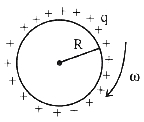
$A$ charge '$q$' is spread uniformly over an isolated ring of radius '$R$'. The ring is rotated about its natural axis with angular speed $\omega$. The magnetic dipole moment of the ring is
A
$\frac{q \omega R}{2}$
B
$q \omega R^2$
C
$\frac{q \omega R^2}{2}$
D
$\frac{q \omega}{2 R}$
Solution
(C) The equivalent current '$I$' produced by the rotating ring is given by the charge per unit time:
$I = \frac{q}{T} = \frac{q \omega}{2 \pi}$
where '$T = \frac{2 \pi}{\omega}$' is the time period of rotation.
The magnetic dipole moment '$M$' of a current loop is given by the product of current '$I$' and the area '$A$' of the loop:
$M = I \times A$
Since the area of the ring is '$A = \pi R^2$',we have:
$M = \left( \frac{q \omega}{2 \pi} \right) \times (\pi R^2)$
$M = \frac{q \omega R^2}{2}$
$I = \frac{q}{T} = \frac{q \omega}{2 \pi}$
where '$T = \frac{2 \pi}{\omega}$' is the time period of rotation.
The magnetic dipole moment '$M$' of a current loop is given by the product of current '$I$' and the area '$A$' of the loop:
$M = I \times A$
Since the area of the ring is '$A = \pi R^2$',we have:
$M = \left( \frac{q \omega}{2 \pi} \right) \times (\pi R^2)$
$M = \frac{q \omega R^2}{2}$
0 likesView Solution
16
ChemistryEasyMCQAP EAMCET · 2016
Assertion $(A)$: $AlCl_3$ exists as a dimer through halogen bridged bonds.
Reason $(R)$: $AlCl_3$ gets stability by accepting electrons from the bridged halogen.
Reason $(R)$: $AlCl_3$ gets stability by accepting electrons from the bridged halogen.
A
Both $(A)$ and $(R)$ are true and $(R)$ is the correct explanation of $(A)$
B
Both $(A)$ and $(R)$ are true but $(R)$ is not the correct explanation of $(A)$
C
$(A)$ is true,but $(R)$ is false
D
$(A)$ is false,but $(R)$ is true
Solution
(A) $AlCl_3$ is an electron-deficient compound with only $6$ electrons in the valence shell of $Al$.
To complete its octet,it forms a dimer $Al_2Cl_6$ where two chlorine atoms act as bridges.
Each bridging chlorine atom donates a lone pair of electrons to the vacant $p$-orbital of the $Al$ atom of the other $AlCl_3$ unit,forming a coordinate bond.
Thus,both the assertion and the reason are true,and the reason correctly explains the stability of the dimer.
To complete its octet,it forms a dimer $Al_2Cl_6$ where two chlorine atoms act as bridges.
Each bridging chlorine atom donates a lone pair of electrons to the vacant $p$-orbital of the $Al$ atom of the other $AlCl_3$ unit,forming a coordinate bond.
Thus,both the assertion and the reason are true,and the reason correctly explains the stability of the dimer.
0 likesView Solution
17
ChemistryMCQAP EAMCET · 2016
The equation of the pair of lines joining the origin to the points of intersection of $x^2+y^2=9$ and $x+y=3$ is:
A
$x^2+(3-y)^2=9$
B
$(3+y)^2+y^2=9$
C
$x^2 - y^2 = 9$
D
$xy = 0$
Solution
(D) Given the circle $x^2+y^2=9$ and the line $x+y=3$.
To find the equation of the pair of lines joining the origin to the points of intersection,we homogenize the equation of the circle using the equation of the line.
Since $x+y=3$,we have $\frac{x+y}{3}=1$.
Substituting this into the circle equation:
$x^2+y^2=9(1)^2$
$x^2+y^2=9\left(\frac{x+y}{3}\right)^2$
$x^2+y^2=9\left(\frac{x^2+y^2+2xy}{9}\right)$
$x^2+y^2=x^2+y^2+2xy$
$2xy=0$
$xy=0$
Thus,the equation of the pair of lines is $xy=0$.
To find the equation of the pair of lines joining the origin to the points of intersection,we homogenize the equation of the circle using the equation of the line.
Since $x+y=3$,we have $\frac{x+y}{3}=1$.
Substituting this into the circle equation:
$x^2+y^2=9(1)^2$
$x^2+y^2=9\left(\frac{x+y}{3}\right)^2$
$x^2+y^2=9\left(\frac{x^2+y^2+2xy}{9}\right)$
$x^2+y^2=x^2+y^2+2xy$
$2xy=0$
$xy=0$
Thus,the equation of the pair of lines is $xy=0$.
0 likesView Solution
18
ChemistryMCQAP EAMCET · 2016
If the angle between the circles $x^2+y^2-2x-4y+c=0$ and $x^2+y^2-4x-2y+4=0$ is $60^{\circ}$,then $c$ is equal to
A
$\frac{3 \pm \sqrt{5}}{2}$
B
$\frac{6 \pm \sqrt{5}}{2}$
C
$\frac{9 \pm \sqrt{5}}{2}$
D
$\frac{7 \pm \sqrt{5}}{2}$
Solution
(D) The given circles are $C_1: x^2+y^2-2x-4y+c=0$ and $C_2: x^2+y^2-4x-2y+4=0$.
For $C_1$,the center is $O_1(1, 2)$ and radius $r_1 = \sqrt{1^2+2^2-c} = \sqrt{5-c}$.
For $C_2$,the center is $O_2(2, 1)$ and radius $r_2 = \sqrt{2^2+1^2-4} = 1$.
The distance between centers $d^2 = (2-1)^2 + (1-2)^2 = 1+1 = 2$.
The angle $\theta$ between two circles is given by $\cos \theta = \frac{r_1^2+r_2^2-d^2}{2r_1r_2}$.
Given $\theta = 60^{\circ}$,so $\cos 60^{\circ} = \frac{1}{2}$.
Substituting the values: $\frac{1}{2} = \frac{(5-c) + 1 - 2}{2 \sqrt{5-c} \cdot 1} = \frac{4-c}{2 \sqrt{5-c}}$.
Thus,$\sqrt{5-c} = 4-c$.
Squaring both sides: $5-c = (4-c)^2 = 16 - 8c + c^2$.
Rearranging gives $c^2 - 7c + 11 = 0$.
Using the quadratic formula $c = \frac{-b \pm \sqrt{b^2-4ac}}{2a}$,we get $c = \frac{7 \pm \sqrt{49-44}}{2} = \frac{7 \pm \sqrt{5}}{2}$.
For $C_1$,the center is $O_1(1, 2)$ and radius $r_1 = \sqrt{1^2+2^2-c} = \sqrt{5-c}$.
For $C_2$,the center is $O_2(2, 1)$ and radius $r_2 = \sqrt{2^2+1^2-4} = 1$.
The distance between centers $d^2 = (2-1)^2 + (1-2)^2 = 1+1 = 2$.
The angle $\theta$ between two circles is given by $\cos \theta = \frac{r_1^2+r_2^2-d^2}{2r_1r_2}$.
Given $\theta = 60^{\circ}$,so $\cos 60^{\circ} = \frac{1}{2}$.
Substituting the values: $\frac{1}{2} = \frac{(5-c) + 1 - 2}{2 \sqrt{5-c} \cdot 1} = \frac{4-c}{2 \sqrt{5-c}}$.
Thus,$\sqrt{5-c} = 4-c$.
Squaring both sides: $5-c = (4-c)^2 = 16 - 8c + c^2$.
Rearranging gives $c^2 - 7c + 11 = 0$.
Using the quadratic formula $c = \frac{-b \pm \sqrt{b^2-4ac}}{2a}$,we get $c = \frac{7 \pm \sqrt{49-44}}{2} = \frac{7 \pm \sqrt{5}}{2}$.
0 likesView Solution
19
ChemistryMediumMCQAP EAMCET · 2016
$40 \text{ mL}$ of $x \text{ M } KMnO_4$ solution is required to react completely with $200 \text{ mL}$ of $0.02 \text{ M}$ oxalic acid solution in acidic medium. The value of $x$ is:
A
$0.04$
B
$0.01$
C
$0.03$
D
$0.02$
Solution
(A) In acidic medium,the balanced redox reaction is:
$2MnO_4^- + 5C_2O_4^{2-} + 16H^+ \rightarrow 2Mn^{2+} + 10CO_2 + 8H_2O$
Using the equivalence principle,the number of equivalents of $KMnO_4$ equals the number of equivalents of oxalic acid:
$n_1 \times M_1 \times V_1 = n_2 \times M_2 \times V_2$
For $KMnO_4$,the change in oxidation state of $Mn$ is from $+7$ to $+2$,so $n_1 = 5$.
For oxalic acid $(H_2C_2O_4)$,the change in oxidation state of $C$ is from $+3$ to $+4$ for two carbon atoms,so $n_2 = 2$.
Substituting the given values:
$5 \times x \times 40 = 2 \times 0.02 \times 200$
$200x = 8$
$x = \frac{8}{200} = 0.04 \text{ M}$
$2MnO_4^- + 5C_2O_4^{2-} + 16H^+ \rightarrow 2Mn^{2+} + 10CO_2 + 8H_2O$
Using the equivalence principle,the number of equivalents of $KMnO_4$ equals the number of equivalents of oxalic acid:
$n_1 \times M_1 \times V_1 = n_2 \times M_2 \times V_2$
For $KMnO_4$,the change in oxidation state of $Mn$ is from $+7$ to $+2$,so $n_1 = 5$.
For oxalic acid $(H_2C_2O_4)$,the change in oxidation state of $C$ is from $+3$ to $+4$ for two carbon atoms,so $n_2 = 2$.
Substituting the given values:
$5 \times x \times 40 = 2 \times 0.02 \times 200$
$200x = 8$
$x = \frac{8}{200} = 0.04 \text{ M}$
0 likesView Solution
20
ChemistryEasyMCQAP EAMCET · 2016
Consider the following statements.
$I$. $Cs^{+}$ ion is more highly hydrated than other alkali metal ions.
$II$. Among the alkali metals,only lithium forms a stable nitride by direct combination with nitrogen.
$III$. Among the alkali metals $Li, Na, K, Rb$,the metal $Rb$ has the highest melting point.
$IV$. Among the alkali metals $Li, Na, K, Rb$,only $Li$ forms peroxide when heated with oxygen.
Select the correct statement.
$I$. $Cs^{+}$ ion is more highly hydrated than other alkali metal ions.
$II$. Among the alkali metals,only lithium forms a stable nitride by direct combination with nitrogen.
$III$. Among the alkali metals $Li, Na, K, Rb$,the metal $Rb$ has the highest melting point.
$IV$. Among the alkali metals $Li, Na, K, Rb$,only $Li$ forms peroxide when heated with oxygen.
Select the correct statement.
A
$I$
B
$II$
C
$III$
D
$IV$
Solution
(B) $I$. Incorrect: $Li^{+}$ has the highest charge density and is most highly hydrated,not $Cs^{+}$.
$II$. Correct: $Li$ is the only alkali metal that reacts directly with $N_2$ to form $Li_3N$.
$III$. Incorrect: $Li$ has the highest melting point among these alkali metals due to its small size and strong metallic bonding.
$IV$. Incorrect: $Li$ forms an oxide $(Li_2O)$,$Na$ forms a peroxide $(Na_2O_2)$,and $K, Rb, Cs$ form superoxides $(MO_2)$.
$II$. Correct: $Li$ is the only alkali metal that reacts directly with $N_2$ to form $Li_3N$.
$III$. Incorrect: $Li$ has the highest melting point among these alkali metals due to its small size and strong metallic bonding.
$IV$. Incorrect: $Li$ forms an oxide $(Li_2O)$,$Na$ forms a peroxide $(Na_2O_2)$,and $K, Rb, Cs$ form superoxides $(MO_2)$.
0 likesView Solution
21
ChemistryMediumMCQAP EAMCET · 2016
Which one of the following is the kinetic energy of a gaseous mixture containing $3 \ g$ of hydrogen and $80 \ g$ of oxygen at temperature $T(K)$ (in $RT$)?
A
$3$
B
$6$
C
$4$
D
$8$
Solution
(B) The number of moles of hydrogen is calculated as $n_{H_2} = \frac{3 \ g}{2 \ g \ mol^{-1}} = 1.5 \ mol$.
The number of moles of oxygen is calculated as $n_{O_2} = \frac{80 \ g}{32 \ g \ mol^{-1}} = 2.5 \ mol$.
The total number of moles in the gaseous mixture is $n = 1.5 + 2.5 = 4 \ mol$.
The total kinetic energy of an ideal gas mixture is given by the formula $KE = \frac{3}{2} n R T$.
Substituting the values,we get $KE = \frac{3}{2} \times 4 \times R T = 6RT$.
The number of moles of oxygen is calculated as $n_{O_2} = \frac{80 \ g}{32 \ g \ mol^{-1}} = 2.5 \ mol$.
The total number of moles in the gaseous mixture is $n = 1.5 + 2.5 = 4 \ mol$.
The total kinetic energy of an ideal gas mixture is given by the formula $KE = \frac{3}{2} n R T$.
Substituting the values,we get $KE = \frac{3}{2} \times 4 \times R T = 6RT$.
0 likesView Solution
22
ChemistryEasyMCQAP EAMCET · 2016
$A, B, C$ and $D$ are four different gases with critical temperatures $304.1, 154.3, 405.5$ and $126.0 \ K$ respectively. While cooling the gas,which gets liquefied first?
A
$B$
B
$A$
C
$D$
D
$C$
Solution
(D) The ease of liquefaction of a gas is directly proportional to its critical temperature $(T_c)$.
$C$ has the highest critical temperature,which is $405.5 \ K$.
Therefore,gas $C$ will be the easiest to liquefy and will get liquefied first upon cooling.
$C$ has the highest critical temperature,which is $405.5 \ K$.
Therefore,gas $C$ will be the easiest to liquefy and will get liquefied first upon cooling.
0 likesView Solution
23
ChemistryEasyMCQAP EAMCET · 2016
The product of uncertainty in velocity and uncertainty in position of a micro particle of mass '$m$' is not less than which of the following?
A
$h \times \frac{3 \pi}{m}$
B
$\frac{h}{3 \pi} \times m$
C
$\frac{h}{4 \pi} \times \frac{1}{m}$
D
$\frac{h}{4 \pi} \times m$
Solution
(C) According to Heisenberg's uncertainty principle,the product of uncertainty in position $(\Delta x)$ and uncertainty in momentum $(\Delta p)$ is given by:
$\Delta x \cdot \Delta p \geq \frac{h}{4 \pi}$
Since momentum $\Delta p = m \cdot \Delta v$,where $m$ is the mass and $\Delta v$ is the uncertainty in velocity,we substitute this into the equation:
$\Delta x \cdot (m \cdot \Delta v) \geq \frac{h}{4 \pi}$
Rearranging to find the product of uncertainty in position and velocity:
$\Delta x \cdot \Delta v \geq \frac{h}{4 \pi \cdot m}$
Thus,the product is not less than $\frac{h}{4 \pi \cdot m}$.
$\Delta x \cdot \Delta p \geq \frac{h}{4 \pi}$
Since momentum $\Delta p = m \cdot \Delta v$,where $m$ is the mass and $\Delta v$ is the uncertainty in velocity,we substitute this into the equation:
$\Delta x \cdot (m \cdot \Delta v) \geq \frac{h}{4 \pi}$
Rearranging to find the product of uncertainty in position and velocity:
$\Delta x \cdot \Delta v \geq \frac{h}{4 \pi \cdot m}$
Thus,the product is not less than $\frac{h}{4 \pi \cdot m}$.
0 likesView Solution
24
ChemistryDifficultMCQAP EAMCET · 2016
Given that,$C_{(s)} + O_{2(g)} \longrightarrow CO_{2(g)} ; \Delta H^{\circ} = -x \ kJ \ mol^{-1}$ and $2CO_{(g)} + O_{2(g)} \longrightarrow 2CO_{2(g)} ; \Delta H^{\circ} = -y \ kJ \ mol^{-1}$. The enthalpy of formation of $CO$ will be:
A
$\frac{y-2x}{3}$
B
$\frac{y-2x}{2}$
C
$\frac{2x-y}{2}$
D
$\frac{x-y}{2}$
Solution
(B) The enthalpy of formation of $CO$ corresponds to the reaction: $C_{(s)} + \frac{1}{2}O_{2(g)} \longrightarrow CO_{(g)}$.
Given equations:
$(i) \ C_{(s)} + O_{2(g)} \longrightarrow CO_{2(g)} ; \Delta H^{\circ} = -x \ kJ \ mol^{-1}$
$(ii) \ 2CO_{(g)} + O_{2(g)} \longrightarrow 2CO_{2(g)} ; \Delta H^{\circ} = -y \ kJ \ mol^{-1}$
Divide equation $(ii)$ by $2$:
$CO_{(g)} + \frac{1}{2}O_{2(g)} \longrightarrow CO_{2(g)} ; \Delta H^{\circ} = -\frac{y}{2} \ kJ \ mol^{-1} \ (iii)$
Subtract equation $(iii)$ from equation $(i)$:
$(C_{(s)} + O_{2(g)}) - (CO_{(g)} + \frac{1}{2}O_{2(g)}) \longrightarrow CO_{2(g)} - CO_{2(g)}$
$C_{(s)} + \frac{1}{2}O_{2(g)} \longrightarrow CO_{(g)}$
$\Delta H^{\circ}_{f} = -x - (-\frac{y}{2}) = \frac{y}{2} - x = \frac{y-2x}{2} \ kJ \ mol^{-1}$.
Given equations:
$(i) \ C_{(s)} + O_{2(g)} \longrightarrow CO_{2(g)} ; \Delta H^{\circ} = -x \ kJ \ mol^{-1}$
$(ii) \ 2CO_{(g)} + O_{2(g)} \longrightarrow 2CO_{2(g)} ; \Delta H^{\circ} = -y \ kJ \ mol^{-1}$
Divide equation $(ii)$ by $2$:
$CO_{(g)} + \frac{1}{2}O_{2(g)} \longrightarrow CO_{2(g)} ; \Delta H^{\circ} = -\frac{y}{2} \ kJ \ mol^{-1} \ (iii)$
Subtract equation $(iii)$ from equation $(i)$:
$(C_{(s)} + O_{2(g)}) - (CO_{(g)} + \frac{1}{2}O_{2(g)}) \longrightarrow CO_{2(g)} - CO_{2(g)}$
$C_{(s)} + \frac{1}{2}O_{2(g)} \longrightarrow CO_{(g)}$
$\Delta H^{\circ}_{f} = -x - (-\frac{y}{2}) = \frac{y}{2} - x = \frac{y-2x}{2} \ kJ \ mol^{-1}$.
0 likesView Solution
25
ChemistryDifficultMCQAP EAMCET · 2016
Yellow dye can be prepared by a coupling reaction of benzene diazonium chloride in acidic medium with $X$. Identify $X$ from the following.
A
$Aniline$
B
$Phenol$
C
$Cumene$
D
$Benzene$
Solution
(A) The coupling reaction of benzene diazonium chloride with aniline in a mildly acidic medium $(pH \approx 4-5)$ yields $p$-aminoazobenzene,which is a yellow dye.
The reaction is as follows:
$C_6H_5N_2^+Cl^- + C_6H_5NH_2 \xrightarrow{H^+} C_6H_5-N=N-C_6H_4-NH_2 + HCl$
Thus,$X$ is $Aniline$.
The reaction is as follows:
$C_6H_5N_2^+Cl^- + C_6H_5NH_2 \xrightarrow{H^+} C_6H_5-N=N-C_6H_4-NH_2 + HCl$
Thus,$X$ is $Aniline$.
0 likesView Solution
26
ChemistryEasyMCQAP EAMCET · 2016
Identify the name of the following reaction: $C_6H_5CH_3$ $\xrightarrow[CS_2]{CrO_2Cl_2} A$ $\xrightarrow{H_3O^+} C_6H_5CHO$
A
Gattermann Koch reaction
B
Gattermann reaction
C
Stephen reaction
D
Etard reaction
Solution
(D) The given reaction involves the oxidation of toluene $(C_6H_5CH_3)$ to benzaldehyde $(C_6H_5CHO)$ using chromyl chloride $(CrO_2Cl_2)$ in the presence of carbon disulfide $(CS_2)$ as a solvent,followed by hydrolysis.
This specific chemical transformation is known as the Etard reaction.
This specific chemical transformation is known as the Etard reaction.
0 likesView Solution
27
ChemistryEasyMCQAP EAMCET · 2016
The order of basic strength of the following in aqueous solution is
$I$. $C_6H_5NH_2$
$II$. $(CH_3)_3N$
$III$. $NH_3$
$IV$. $CH_3NH_2$
$V$. $(CH_3)_2NH$
$I$. $C_6H_5NH_2$
$II$. $(CH_3)_3N$
$III$. $NH_3$
$IV$. $CH_3NH_2$
$V$. $(CH_3)_2NH$
A
$IV > I > V > III > II$
B
$II > V > IV > III > I$
C
$V > IV > II > III > I$
D
$IV > III > V > II > I$
Solution
(C) In aqueous solution,the basic strength of aliphatic amines depends on the combined effect of inductive effect,solvation effect,and steric hindrance.
The order for methyl-substituted amines is $(CH_3)_2NH > CH_3NH_2 > (CH_3)_3N$.
Comparing this with $NH_3$ and aniline $(C_6H_5NH_2)$:
$1$. $(CH_3)_2NH$ $(V)$ is the most basic due to the $+I$ effect and favorable solvation.
$2$. $CH_3NH_2$ $(IV)$ is next.
$3$. $(CH_3)_3N$ $(II)$ is less basic than $CH_3NH_2$ and $(CH_3)_2NH$ due to steric hindrance in the aqueous phase.
$4$. $NH_3$ $(III)$ is less basic than the aliphatic amines.
$5$. $C_6H_5NH_2$ $(I)$ is the least basic because the lone pair on nitrogen is delocalized into the benzene ring.
Thus,the correct order is $V > IV > II > III > I$.
The order for methyl-substituted amines is $(CH_3)_2NH > CH_3NH_2 > (CH_3)_3N$.
Comparing this with $NH_3$ and aniline $(C_6H_5NH_2)$:
$1$. $(CH_3)_2NH$ $(V)$ is the most basic due to the $+I$ effect and favorable solvation.
$2$. $CH_3NH_2$ $(IV)$ is next.
$3$. $(CH_3)_3N$ $(II)$ is less basic than $CH_3NH_2$ and $(CH_3)_2NH$ due to steric hindrance in the aqueous phase.
$4$. $NH_3$ $(III)$ is less basic than the aliphatic amines.
$5$. $C_6H_5NH_2$ $(I)$ is the least basic because the lone pair on nitrogen is delocalized into the benzene ring.
Thus,the correct order is $V > IV > II > III > I$.
0 likesView Solution
28
ChemistryEasyMCQAP EAMCET · 2016
Observe the following statements.
$I$. Sucrose has glycosidic linkage.
$II$. Cellulose is present in both plants and animals.
$III$. Lactose contains $D$-galactose and $D$-glucose units.
Which of the following statements are correct?
$I$. Sucrose has glycosidic linkage.
$II$. Cellulose is present in both plants and animals.
$III$. Lactose contains $D$-galactose and $D$-glucose units.
Which of the following statements are correct?
A
$(I), (II) \text{ and } (III)$
B
$(I) \text{ and } (II)$
C
$(II) \text{ and } (III)$
D
$(I) \text{ and } (III)$
Solution
(D) $I$. Sucrose is a disaccharide formed by the condensation of $D$-glucose and $D$-fructose,joined by a glycosidic linkage. This statement is correct.
$II$. Cellulose is a structural polysaccharide found exclusively in the cell walls of plants. It is not present in animals. This statement is incorrect.
$III$. Lactose is a disaccharide composed of $D$-galactose and $D$-glucose units linked by a $\beta$-glycosidic bond. This statement is correct.
Therefore,statements $I$ and $III$ are correct.
$II$. Cellulose is a structural polysaccharide found exclusively in the cell walls of plants. It is not present in animals. This statement is incorrect.
$III$. Lactose is a disaccharide composed of $D$-galactose and $D$-glucose units linked by a $\beta$-glycosidic bond. This statement is correct.
Therefore,statements $I$ and $III$ are correct.
0 likesView Solution
29
ChemistryEasyMCQAP EAMCET · 2016
If the rate of disappearance of $N_2O_5$ in the following reaction is $1.2 \times 10^{-5} \ mol \ L^{-1} \ s^{-1}$,the rate of production of $NO_2$ in $mol \ L^{-1} \ s^{-1}$ is:
$2N_2O_{5(g)} \longrightarrow 4NO_{2(g)} + O_{2(g)}$
$2N_2O_{5(g)} \longrightarrow 4NO_{2(g)} + O_{2(g)}$
A
$1.2 \times 10^{-5}$
B
$3.6 \times 10^{-5}$
C
$2.4 \times 10^{-5}$
D
$4.8 \times 10^{-5}$
Solution
(C) For the reaction $2N_2O_{5(g)} \longrightarrow 4NO_{2(g)} + O_{2(g)}$,the rate expression is given by:
$-\frac{1}{2} \frac{d[N_2O_5]}{dt} = \frac{1}{4} \frac{d[NO_2]}{dt} = \frac{d[O_2]}{dt}$
Given that the rate of disappearance of $N_2O_5$ is $-\frac{d[N_2O_5]}{dt} = 1.2 \times 10^{-5} \ mol \ L^{-1} \ s^{-1}$.
From the rate expression,we have:
$\frac{1}{4} \frac{d[NO_2]}{dt} = \frac{1}{2} \left( -\frac{d[N_2O_5]}{dt} \right)$
$\frac{d[NO_2]}{dt} = 2 \times \left( -\frac{d[N_2O_5]}{dt} \right)$
$\frac{d[NO_2]}{dt} = 2 \times (1.2 \times 10^{-5} \ mol \ L^{-1} \ s^{-1}) = 2.4 \times 10^{-5} \ mol \ L^{-1} \ s^{-1}$.
$-\frac{1}{2} \frac{d[N_2O_5]}{dt} = \frac{1}{4} \frac{d[NO_2]}{dt} = \frac{d[O_2]}{dt}$
Given that the rate of disappearance of $N_2O_5$ is $-\frac{d[N_2O_5]}{dt} = 1.2 \times 10^{-5} \ mol \ L^{-1} \ s^{-1}$.
From the rate expression,we have:
$\frac{1}{4} \frac{d[NO_2]}{dt} = \frac{1}{2} \left( -\frac{d[N_2O_5]}{dt} \right)$
$\frac{d[NO_2]}{dt} = 2 \times \left( -\frac{d[N_2O_5]}{dt} \right)$
$\frac{d[NO_2]}{dt} = 2 \times (1.2 \times 10^{-5} \ mol \ L^{-1} \ s^{-1}) = 2.4 \times 10^{-5} \ mol \ L^{-1} \ s^{-1}$.
0 likesView Solution
30
ChemistryEasyMCQAP EAMCET · 2016
Identify the antioxidant used in foods.
A
Aspartame
B
Sodium benzoate
C
ortho-sulphobenzimide
D
Butylated hydroxy toluene
Solution
(D) Antioxidants are food additives that prevent the oxidation of food components,thereby preserving their quality and shelf life.
$BHT$ (Butylated hydroxy toluene) is a widely used synthetic antioxidant in food products to prevent rancidity in fats and oils.
$Aspartame$ is an artificial sweetener.
$Sodium \ benzoate$ is a food preservative.
$Ortho-sulphobenzimide$ (Saccharin) is an artificial sweetener.
Therefore,the correct option is $D$.
$BHT$ (Butylated hydroxy toluene) is a widely used synthetic antioxidant in food products to prevent rancidity in fats and oils.
$Aspartame$ is an artificial sweetener.
$Sodium \ benzoate$ is a food preservative.
$Ortho-sulphobenzimide$ (Saccharin) is an artificial sweetener.
Therefore,the correct option is $D$.
0 likesView Solution
31
ChemistryEasyMCQAP EAMCET · 2016
Select the correct $IUPAC$ name of $[Co(NH_3)_5(CO_3)]Cl$.
A
Pentaamminocarbonatocobalt$(III)$ chloride
B
Pentaamminocarbonatocobalt$(II)$ chloride
C
Carbonatopentaamminocobalt$(III)$ chloride
D
Pentaamminocarbonatocobalt$(IV)$ chloride
Solution
(A) $1$. Identify the ligands: $NH_3$ is ammine and $CO_3^{2-}$ is carbonato. Since there are $5$ ammine ligands,we use the prefix 'penta'.
$2$. Determine the oxidation state of the central metal atom $(Co)$: Let the oxidation state be $x$. The charge on $NH_3$ is $0$,$CO_3$ is $-2$,and $Cl$ is $-1$. Thus,$x + 5(0) + (-2) + (-1) = 0$,which gives $x = +3$.
$3$. Assemble the name: The ligands are listed alphabetically (ammine before carbonato). The name is Pentaamminocarbonatocobalt$(III)$ chloride.
$2$. Determine the oxidation state of the central metal atom $(Co)$: Let the oxidation state be $x$. The charge on $NH_3$ is $0$,$CO_3$ is $-2$,and $Cl$ is $-1$. Thus,$x + 5(0) + (-2) + (-1) = 0$,which gives $x = +3$.
$3$. Assemble the name: The ligands are listed alphabetically (ammine before carbonato). The name is Pentaamminocarbonatocobalt$(III)$ chloride.
0 likesView Solution
32
ChemistryEasyMCQAP EAMCET · 2016
Which of the following characteristics of the transition metals is associated with their catalytic activity?
A
Colour of hydrated ions
B
Diamagnetic behaviour
C
Paramagnetic behaviour
D
Variable oxidation states
Solution
(D) The catalytic activity of transition elements is primarily attributed to their ability to exhibit $Variable \ oxidation \ states$ and their capacity to form $complexes$. These properties allow them to provide a large surface area and form intermediate compounds with reactants,thereby lowering the activation energy of the reaction.
0 likesView Solution
33
ChemistryMediumMCQAP EAMCET · 2016
Match the items in List-$I$ with their corresponding items in List-$II$.
| List-$I$ (Magnetic property) | List-$II$ (Substance) |
|---|---|
| $(A)$ Ferromagnetic | $(1)$ $O_2$ |
| $(B)$ Antiferromagnetic | $(2)$ $CrO_2$ |
| $(C)$ Ferrimagnetic | $(3)$ $MnO$ |
| $(D)$ Paramagnetic | $(4)$ $Fe_3O_4$ |
| $(5)$ $C_6H_6$ |
A
$A-2, B-3, C-4, D-1$
B
$A-3, B-2, C-4, D-1$
C
$A-2, B-4, C-3, D-1$
D
$A-4, B-3, C-2, D-1$
Solution
(A) The correct matching is based on the magnetic properties of the given substances:
$(A)$ Ferromagnetic: $CrO_2$ is a well-known ferromagnetic substance.
$(B)$ Antiferromagnetic: $MnO$ exhibits antiferromagnetism due to the alignment of magnetic moments in opposite directions.
$(C)$ Ferrimagnetic: $Fe_3O_4$ (magnetite) is a classic example of a ferrimagnetic substance.
$(D)$ Paramagnetic: $O_2$ is paramagnetic due to the presence of unpaired electrons in its molecular orbitals.
Therefore,the correct sequence is $A-2, B-3, C-4, D-1$.
$(A)$ Ferromagnetic: $CrO_2$ is a well-known ferromagnetic substance.
$(B)$ Antiferromagnetic: $MnO$ exhibits antiferromagnetism due to the alignment of magnetic moments in opposite directions.
$(C)$ Ferrimagnetic: $Fe_3O_4$ (magnetite) is a classic example of a ferrimagnetic substance.
$(D)$ Paramagnetic: $O_2$ is paramagnetic due to the presence of unpaired electrons in its molecular orbitals.
Therefore,the correct sequence is $A-2, B-3, C-4, D-1$.
0 likesView Solution
34
ChemistryEasyMCQAP EAMCET · 2016
The products obtained at the cathode and anode respectively during the electrolysis of aqueous $K_2SO_4$ solution using platinum electrodes are
A
$O_2, H_2$
B
$H_2, O_2$
C
$H_2, SO_2$
D
$K, SO_2$
Solution
(B) The aqueous solution of $K_2SO_4$ dissociates as: $K_2SO_4(aq) \rightarrow 2K^+(aq) + SO_4^{2-}(aq)$.
Water also undergoes self-ionization: $H_2O(l) \rightleftharpoons H^+(aq) + OH^-(aq)$.
At the cathode,the reduction potential of $H^+$ is higher than that of $K^+$,so $H^+$ ions are reduced: $2H^+(aq) + 2e^- \rightarrow H_2(g)$.
At the anode,the oxidation potential of $OH^-$ (or $H_2O$) is higher than that of $SO_4^{2-}$,so $H_2O$ is oxidized: $2H_2O(l) \rightarrow O_2(g) + 4H^+(aq) + 4e^-$.
Therefore,$H_2$ gas is produced at the cathode and $O_2$ gas is produced at the anode.
Water also undergoes self-ionization: $H_2O(l) \rightleftharpoons H^+(aq) + OH^-(aq)$.
At the cathode,the reduction potential of $H^+$ is higher than that of $K^+$,so $H^+$ ions are reduced: $2H^+(aq) + 2e^- \rightarrow H_2(g)$.
At the anode,the oxidation potential of $OH^-$ (or $H_2O$) is higher than that of $SO_4^{2-}$,so $H_2O$ is oxidized: $2H_2O(l) \rightarrow O_2(g) + 4H^+(aq) + 4e^-$.
Therefore,$H_2$ gas is produced at the cathode and $O_2$ gas is produced at the anode.
0 likesView Solution
35
ChemistryEasyMCQAP EAMCET · 2016
Which of the following is a carbonate ore?
A
Cuprite
B
Siderite
C
Zincite
D
Bauxite
Solution
(B) The chemical formula for Siderite is $FeCO_3$,which is an iron carbonate ore.
Cuprite is $Cu_2O$ (oxide ore).
Zincite is $ZnO$ (oxide ore).
Bauxite is $AlO_x(OH)_{3-2x}$ (oxide/hydroxide ore).
Therefore,the correct option is $B$.
Cuprite is $Cu_2O$ (oxide ore).
Zincite is $ZnO$ (oxide ore).
Bauxite is $AlO_x(OH)_{3-2x}$ (oxide/hydroxide ore).
Therefore,the correct option is $B$.
0 likesView Solution
36
ChemistryMediumMCQAP EAMCET · 2016
What is $C$ in the following sequence of reaction?
$CH_3OH$ $\xrightarrow{PCl_3} A$ $\xrightarrow{KCN} B$ $\xrightarrow{\text{Hydrolysis}} C$
$CH_3OH$ $\xrightarrow{PCl_3} A$ $\xrightarrow{KCN} B$ $\xrightarrow{\text{Hydrolysis}} C$
A
$CH_3CH_2OH$
B
$CH_3CHO$
C
$CH_3COOH$
D
$HOCH_2-CH_2OH$
Solution
(C) The reaction sequence is as follows:
$1$. $CH_3OH + PCl_3 \rightarrow CH_3Cl (A) + H_3PO_3$
$2$. $CH_3Cl + KCN \rightarrow CH_3CN (B) + KCl$
$3$. $CH_3CN + 2H_2O \xrightarrow{H_3O^+} CH_3COOH (C) + NH_3$
Therefore,$C$ is $CH_3COOH$.
$1$. $CH_3OH + PCl_3 \rightarrow CH_3Cl (A) + H_3PO_3$
$2$. $CH_3Cl + KCN \rightarrow CH_3CN (B) + KCl$
$3$. $CH_3CN + 2H_2O \xrightarrow{H_3O^+} CH_3COOH (C) + NH_3$
Therefore,$C$ is $CH_3COOH$.
0 likesView Solution
37
ChemistryMediumMCQAP EAMCET · 2016
The reaction involving the coupling of an aryl halide and an alkyl halide in the presence of sodium metal and dry ether is known as:

A
Wurtz-Fittig reaction
B
Wurtz reaction
C
Fittig reaction
D
Friedel-Crafts reaction
Solution
(A) The reaction involves the coupling of an aryl halide $(C_6H_5Cl)$ and an alkyl halide $(CH_3Cl)$ in the presence of sodium metal $(Na)$ and dry ether to form an alkylbenzene (toluene).
This specific type of coupling reaction between an aryl halide and an alkyl halide is known as the $Wurtz-Fittig$ reaction.
This specific type of coupling reaction between an aryl halide and an alkyl halide is known as the $Wurtz-Fittig$ reaction.
0 likesView Solution
38
ChemistryMediumMCQAP EAMCET · 2016
In which of the following reactions is the product $NOT$ correct?
A
$CH_3CHO \stackrel{LiAlH_4}{\longrightarrow} CH_3CH_2OH$
B
$CH_3COCH_3 \stackrel{Zn(Hg)/HCl}{\longrightarrow} CH_3CH(OH)CH_2OH$
C
$CH_3CHO \stackrel{I_2/NaOH}{\longrightarrow} CHI_3 + HCOONa$
D
$CH_3CH_2CHO \stackrel{KMnO_4}{\longrightarrow} CH_3CH_2COOH$
Solution
(B) Let us analyze each reaction:
$(A)$ $CH_3CHO$ is reduced by $LiAlH_4$ to ethanol $(CH_3CH_2OH)$. This is correct.
$(B)$ $CH_3COCH_3$ undergoes Clemmensen reduction with $Zn(Hg)/HCl$ to form propane $(CH_3CH_2CH_3)$. The product given in the option is incorrect as it shows a diol.
$(C)$ $CH_3CHO$ undergoes the iodoform reaction with $I_2/NaOH$ to form iodoform $(CHI_3)$ and sodium formate $(HCOONa)$. This is correct.
$(D)$ $CH_3CH_2CHO$ is oxidized by $KMnO_4$ to propanoic acid $(CH_3CH_2COOH)$. This is correct.
Therefore,the incorrect product is in option $(B)$.
$(A)$ $CH_3CHO$ is reduced by $LiAlH_4$ to ethanol $(CH_3CH_2OH)$. This is correct.
$(B)$ $CH_3COCH_3$ undergoes Clemmensen reduction with $Zn(Hg)/HCl$ to form propane $(CH_3CH_2CH_3)$. The product given in the option is incorrect as it shows a diol.
$(C)$ $CH_3CHO$ undergoes the iodoform reaction with $I_2/NaOH$ to form iodoform $(CHI_3)$ and sodium formate $(HCOONa)$. This is correct.
$(D)$ $CH_3CH_2CHO$ is oxidized by $KMnO_4$ to propanoic acid $(CH_3CH_2COOH)$. This is correct.
Therefore,the incorrect product is in option $(B)$.
0 likesView Solution
39
ChemistryEasyMCQAP EAMCET · 2016
Which one of the following statements is not correct?
A
$O_3$ is used as a germicide
B
In $O_3$, $O-O$ bond length is identical with that of molecular oxygen
C
$O_3$ is an oxidising agent
D
The shape of $O_3$ molecule is angular
Solution
(B) In molecular oxygen $(O_2)$, the bond order is $2$, resulting in a shorter bond length $(121 \text{ pm})$.
In ozone $(O_3)$, due to resonance, the $O-O$ bonds have partial double bond character with a bond order of $1.5$, resulting in a longer bond length $(128 \text{ pm})$.
Therefore, the statement that the $O-O$ bond length in $O_3$ is identical to that of molecular oxygen is incorrect.
In ozone $(O_3)$, due to resonance, the $O-O$ bonds have partial double bond character with a bond order of $1.5$, resulting in a longer bond length $(128 \text{ pm})$.
Therefore, the statement that the $O-O$ bond length in $O_3$ is identical to that of molecular oxygen is incorrect.
0 likesView Solution
40
ChemistryEasyMCQAP EAMCET · 2016
Which of the following statements regarding sulphur is not correct?
A
At about $1000 \ K$,it mainly consists of $S_2$ molecules
B
The oxidation state of sulphur is never less than $+4$ in its compounds
C
$S_2$ molecule is paramagnetic
D
Rhombic sulphur is readily soluble in $CS_2$
Solution
(B) The statement that the oxidation state of sulphur is never less than $+4$ is incorrect. Sulphur exhibits a wide range of oxidation states in its compounds,ranging from $-2$ (as in $H_2S$) to $+6$ (as in $H_2SO_4$).
At high temperatures (around $1000 \ K$),$S_2$ is the dominant species and it is paramagnetic,similar to $O_2$.
Rhombic sulphur is the most stable allotrope at room temperature and is readily soluble in $CS_2$.
At high temperatures (around $1000 \ K$),$S_2$ is the dominant species and it is paramagnetic,similar to $O_2$.
Rhombic sulphur is the most stable allotrope at room temperature and is readily soluble in $CS_2$.
0 likesView Solution
41
ChemistryEasyMCQAP EAMCET · 2016
Which of the following reactions does not involve the liberation of oxygen?
A
$XeF_4 + H_2O \longrightarrow$
B
$XeF_4 + O_2F_2 \longrightarrow$
C
$XeF_2 + H_2O \longrightarrow$
D
$XeF_6 + H_2O \longrightarrow$
Solution
(D) The hydrolysis reactions of xenon fluorides are as follows:
$1$. $2XeF_2 + 2H_2O \rightarrow 2Xe + 4HF + O_2$ (Liberates $O_2$)
$2$. $6XeF_4 + 12H_2O \rightarrow 4Xe + 2XeO_3 + 24HF + 3O_2$ (Liberates $O_2$)
$3$. $XeF_6 + 3H_2O \rightarrow XeO_3 + 6HF$ (Does not liberate $O_2$)
$4$. $XeF_4 + O_2F_2 \rightarrow XeF_6 + O_2$ (Liberates $O_2$)
Therefore,the reaction $XeF_6 + 3H_2O \rightarrow XeO_3 + 6HF$ does not involve the liberation of oxygen.
$1$. $2XeF_2 + 2H_2O \rightarrow 2Xe + 4HF + O_2$ (Liberates $O_2$)
$2$. $6XeF_4 + 12H_2O \rightarrow 4Xe + 2XeO_3 + 24HF + 3O_2$ (Liberates $O_2$)
$3$. $XeF_6 + 3H_2O \rightarrow XeO_3 + 6HF$ (Does not liberate $O_2$)
$4$. $XeF_4 + O_2F_2 \rightarrow XeF_6 + O_2$ (Liberates $O_2$)
Therefore,the reaction $XeF_6 + 3H_2O \rightarrow XeO_3 + 6HF$ does not involve the liberation of oxygen.
0 likesView Solution
42
ChemistryEasyMCQAP EAMCET · 2016
Observe the following polymers.
$I$. $PHBV$
$II$. Nylon-$2$-nylon-$6$
$III$. Glyptal
$IV$. Bakelite
Which of the above is/are biodegradable polymer$(s)$?
$I$. $PHBV$
$II$. Nylon-$2$-nylon-$6$
$III$. Glyptal
$IV$. Bakelite
Which of the above is/are biodegradable polymer$(s)$?
A
$III$
B
$I$ and $II$
C
$IV$
D
$III$ and $IV$
Solution
(B) Biodegradable polymers are those that can be decomposed by microorganisms.
Among the given polymers:
$I$. $PHBV$ (Poly-$\beta$-hydroxybutyrate-co-$\beta$-hydroxyvalerate) is a well-known biodegradable polymer.
$II$. Nylon-$2$-nylon-$6$ is a polyamide copolymer of glycine and amino caproic acid,which is also biodegradable.
$III$. Glyptal is a condensation polymer of ethylene glycol and phthalic acid,which is non-biodegradable.
$IV$. Bakelite is a thermosetting phenol-formaldehyde resin,which is non-biodegradable.
Therefore,$I$ and $II$ are biodegradable polymers.
Among the given polymers:
$I$. $PHBV$ (Poly-$\beta$-hydroxybutyrate-co-$\beta$-hydroxyvalerate) is a well-known biodegradable polymer.
$II$. Nylon-$2$-nylon-$6$ is a polyamide copolymer of glycine and amino caproic acid,which is also biodegradable.
$III$. Glyptal is a condensation polymer of ethylene glycol and phthalic acid,which is non-biodegradable.
$IV$. Bakelite is a thermosetting phenol-formaldehyde resin,which is non-biodegradable.
Therefore,$I$ and $II$ are biodegradable polymers.
0 likesView Solution
43
ChemistryMediumMCQAP EAMCET · 2016
Which of the following reactions does not take place?
A
$F_2 + 2Cl^{-} \longrightarrow 2F^{-} + Cl_2$
B
$Br_2 + 2I^{-} \longrightarrow 2Br^{-} + I_2$
C
$Cl_2 + 2Br^{-} \longrightarrow 2Cl^{-} + Br_2$
D
$Cl_2 + 2F^{-} \longrightarrow 2Cl^{-} + F_2$
Solution
(D) The ability of a halogen to act as an oxidizing agent decreases down the group $(F_2 > Cl_2 > Br_2 > I_2)$.
$F_2$ is the strongest oxidizing agent and can oxidize $Cl^{-}$,$Br^{-}$,and $I^{-}$ to their respective halogens.
However,$Cl_2$ is a weaker oxidizing agent than $F_2$ and cannot oxidize the fluoride ion $(F^{-})$ to fluorine gas $(F_2)$.
Therefore,the reaction $Cl_2 + 2F^{-} \longrightarrow 2Cl^{-} + F_2$ does not occur.
$F_2$ is the strongest oxidizing agent and can oxidize $Cl^{-}$,$Br^{-}$,and $I^{-}$ to their respective halogens.
However,$Cl_2$ is a weaker oxidizing agent than $F_2$ and cannot oxidize the fluoride ion $(F^{-})$ to fluorine gas $(F_2)$.
Therefore,the reaction $Cl_2 + 2F^{-} \longrightarrow 2Cl^{-} + F_2$ does not occur.
0 likesView Solution
44
ChemistryDifficultMCQAP EAMCET · 2016
The vapour pressure of pure benzene and toluene are $160$ $mm \ Hg$ and $60$ $mm \ Hg$ respectively. The mole fraction of benzene in the vapour phase in contact with an equimolar solution of benzene and toluene is:
A
$0.073$
B
$0.027$
C
$0.27$
D
$0.73$
Solution
(D) For an equimolar solution,the mole fractions in the liquid phase are $\chi_b = \chi_t = 0.5$.
The partial vapour pressure of benzene is $p_b = \chi_b \times p_b^0 = 0.5 \times 160 = 80 \ mm \ Hg$.
The partial vapour pressure of toluene is $p_t = \chi_t \times p_t^0 = 0.5 \times 60 = 30 \ mm \ Hg$.
The total vapour pressure is $p_{\text{total}} = p_b + p_t = 80 + 30 = 110 \ mm \ Hg$.
The mole fraction of benzene in the vapour phase $(y_b)$ is given by $y_b = \frac{p_b}{p_{\text{total}}} = \frac{80}{110} \approx 0.727 \approx 0.73$.
The partial vapour pressure of benzene is $p_b = \chi_b \times p_b^0 = 0.5 \times 160 = 80 \ mm \ Hg$.
The partial vapour pressure of toluene is $p_t = \chi_t \times p_t^0 = 0.5 \times 60 = 30 \ mm \ Hg$.
The total vapour pressure is $p_{\text{total}} = p_b + p_t = 80 + 30 = 110 \ mm \ Hg$.
The mole fraction of benzene in the vapour phase $(y_b)$ is given by $y_b = \frac{p_b}{p_{\text{total}}} = \frac{80}{110} \approx 0.727 \approx 0.73$.
0 likesView Solution
45
ChemistryMediumMCQAP EAMCET · 2016
$6 \ g$ of a non-volatile,non-electrolyte $X$ dissolved in $100 \ g$ of water freezes at $-0.93^{\circ} C$. The molar mass of $X$ in $g \ mol^{-1}$ is ($K_f$ of $H_2O = 1.86 \ K \ kg \ mol^{-1}$)
A
$60$
B
$140$
C
$180$
D
$120$
Solution
(D) The depression in freezing point is given by the formula: $\Delta T_f = K_f \times m$
Where $\Delta T_f = T_f^{\circ} - T_f = 0 - (-0.93) = 0.93 \ K$.
Molality $m = \frac{w_2 \times 1000}{M_2 \times w_1}$,where $w_2 = 6 \ g$,$w_1 = 100 \ g$,and $M_2$ is the molar mass of $X$.
Substituting the values: $0.93 = 1.86 \times \frac{6 \times 1000}{M_2 \times 100}$.
$0.93 = \frac{1.86 \times 60}{M_2}$.
$M_2 = \frac{1.86 \times 60}{0.93} = 2 \times 60 = 120 \ g \ mol^{-1}$.
Where $\Delta T_f = T_f^{\circ} - T_f = 0 - (-0.93) = 0.93 \ K$.
Molality $m = \frac{w_2 \times 1000}{M_2 \times w_1}$,where $w_2 = 6 \ g$,$w_1 = 100 \ g$,and $M_2$ is the molar mass of $X$.
Substituting the values: $0.93 = 1.86 \times \frac{6 \times 1000}{M_2 \times 100}$.
$0.93 = \frac{1.86 \times 60}{M_2}$.
$M_2 = \frac{1.86 \times 60}{0.93} = 2 \times 60 = 120 \ g \ mol^{-1}$.
0 likesView Solution
46
ChemistryEasyMCQAP EAMCET · 2016
Which of the following statements is not correct in respect of chemisorption?
A
Highly specific adsorption
B
Irreversible adsorption
C
Multilayered adsorption
D
High enthalpy of adsorption
Solution
(C) Chemisorption is characterized by the formation of chemical bonds between the adsorbate and the adsorbent.
It is highly specific in nature and is generally irreversible.
Due to the formation of chemical bonds,it involves a high enthalpy of adsorption (typically $80-240 \ kJ \ mol^{-1}$).
However,chemisorption is a unimolecular process,meaning it forms a monolayer,not a multilayer.
Therefore,the statement that chemisorption is a multilayered adsorption is incorrect.
It is highly specific in nature and is generally irreversible.
Due to the formation of chemical bonds,it involves a high enthalpy of adsorption (typically $80-240 \ kJ \ mol^{-1}$).
However,chemisorption is a unimolecular process,meaning it forms a monolayer,not a multilayer.
Therefore,the statement that chemisorption is a multilayered adsorption is incorrect.
0 likesView Solution
Vedclass Products
For Students
Vedclass Test Series
Mock tests in real AP EAMCET style covering Chemistry with performance analysis. 5-day free trial.
Start Free TrialFor Teachers
Exam Paper Generator
Generate Set A/B/C/D Chemistry papers from 7.5L+ questions in 2 minutes. 3 chapters free.
Try FreeFor Institutes
Online Exam Module
Run live AP EAMCET mock exams with unlimited students, 360° analytics & white-label branding.
See DemoFrequently Asked Questions
How many Chemistry questions are in AP EAMCET 2016?
There are 46 Chemistry questions from the AP EAMCET 2016 paper on Vedclass, each with a detailed step-by-step solution in English.
Are AP EAMCET 2016 Chemistry solutions available in English?
Yes. All solutions on this page are in English. You can also switch to English or Hindi using the language buttons above the questions.
Can I practice AP EAMCET 2016 Chemistry as a timed test?
Yes. Use the Vedclass Test Series to attempt a full AP EAMCET mock test covering Chemistry with time limits and instant score analysis.
Can teachers create Chemistry papers from AP EAMCET previous year questions?
Yes. The Vedclass Exam Paper Generator lets teachers mix AP EAMCET Chemistry questions and generate Set A/B/C/D papers in minutes.
For Teachers & Institutes
Build a Custom Chemistry Paper
Pick AP EAMCET 2016 Chemistry questions, set difficulty, and generate Set A/B/C/D in 2 minutes.