
BiologyQ51–122 of 172 questions
Page 2 of 2 · English
51
BiologyEasyMCQAIPMT · 2011
Which one of the following is essential for the photolysis of water?
A
Manganese
B
Zinc
C
Copper
D
Boron
Solution
(A) The correct answer is $A$.
Photolysis of water is the process of splitting water molecules into hydrogen ions,electrons,and oxygen in the presence of light during the light-dependent reactions of photosynthesis.
Manganese $(Mn^{2+})$ acts as an essential cofactor for the oxygen-evolving complex $(OEC)$ in Photosystem $II$,which catalyzes this reaction.
Without manganese,the water-splitting mechanism cannot function,thereby halting the supply of electrons to the electron transport chain.
Photolysis of water is the process of splitting water molecules into hydrogen ions,electrons,and oxygen in the presence of light during the light-dependent reactions of photosynthesis.
Manganese $(Mn^{2+})$ acts as an essential cofactor for the oxygen-evolving complex $(OEC)$ in Photosystem $II$,which catalyzes this reaction.
Without manganese,the water-splitting mechanism cannot function,thereby halting the supply of electrons to the electron transport chain.
0 likesView Solution
52
BiologyMediumMCQAIPMT · 2011
In mitochondria,protons accumulate in the
A
outer membrane
B
inner membrane
C
intermembrane space
D
matrix
Solution
(C) During the process of cellular respiration,the electron transport system $(ETS)$ is located in the inner mitochondrial membrane. As electrons pass through the various complexes of the $ETS$,energy is released and used to pump protons ($H^+$ ions) from the mitochondrial matrix into the intermembrane space. This creates a proton gradient across the inner membrane,which is essential for the synthesis of $ATP$ by $ATP$ synthase.
0 likesView Solution
53
BiologyMediumMCQAIPMT · 2011
Two friends are eating together on a dining table. One of them suddenly starts coughing while swallowing some food. This coughing would have been due to improper movement of
A
epiglottis
B
diaphragm
C
neck
D
tongue
Solution
(A) : This coughing occurs due to the improper movement of the epiglottis.
The epiglottis is a thin,cartilaginous flap located in the laryngopharynx,which is the lower part of the pharynx.
During the act of swallowing,the epiglottis acts as a lid to cover the glottis (the opening of the trachea or windpipe) to prevent food particles from entering the respiratory tract.
If the epiglottis does not close properly while swallowing,some food particles may enter the trachea,triggering a sudden coughing reflex to expel the foreign material.
The epiglottis is a thin,cartilaginous flap located in the laryngopharynx,which is the lower part of the pharynx.
During the act of swallowing,the epiglottis acts as a lid to cover the glottis (the opening of the trachea or windpipe) to prevent food particles from entering the respiratory tract.
If the epiglottis does not close properly while swallowing,some food particles may enter the trachea,triggering a sudden coughing reflex to expel the foreign material.
0 likesView Solution
54
BiologyEasyMCQAIPMT · 2011
The purplish-red pigment rhodopsin contained in the rod-type photoreceptor cells of the human eye is a derivative of
A
vitamin $B_1$
B
vitamin $C$
C
vitamin $D$
D
vitamin $A$
Solution
(D) : Vitamin $A$ (retinol) is a fat-soluble vitamin that cannot be synthesized by mammals and other vertebrates and must be provided in the diet.
It is a crucial constituent of the visual pigment rhodopsin,which is found in the rod cells of the retina.
Deficiency of vitamin $A$ affects the eyes,leading to conditions such as night blindness (nyctalopia).
It is a crucial constituent of the visual pigment rhodopsin,which is found in the rod cells of the retina.
Deficiency of vitamin $A$ affects the eyes,leading to conditions such as night blindness (nyctalopia).
0 likesView Solution
55
BiologyMediumMCQAIPMT · 2011
One of the constituents of the pancreatic juice which is poured into the duodenum in humans is
A
trypsinogen
B
chymotrypsin
C
trypsin
D
enterokinase
Solution
(A) The correct answer is $A$.
Pancreatic juice contains inactive proenzymes,including trypsinogen,chymotrypsinogen,and procarboxypeptidase.
These enzymes are secreted into the duodenum via the pancreatic duct.
Trypsinogen is an inactive precursor that is converted into active trypsin by the enzyme enterokinase,which is secreted by the intestinal mucosa.
Chymotrypsin and trypsin are the active forms,not the constituents of the pancreatic juice itself,as they are secreted in their inactive proenzyme forms.
Enterokinase is a component of the intestinal juice (succus entericus),not the pancreatic juice.
Pancreatic juice contains inactive proenzymes,including trypsinogen,chymotrypsinogen,and procarboxypeptidase.
These enzymes are secreted into the duodenum via the pancreatic duct.
Trypsinogen is an inactive precursor that is converted into active trypsin by the enzyme enterokinase,which is secreted by the intestinal mucosa.
Chymotrypsin and trypsin are the active forms,not the constituents of the pancreatic juice itself,as they are secreted in their inactive proenzyme forms.
Enterokinase is a component of the intestinal juice (succus entericus),not the pancreatic juice.
0 likesView Solution
56
BiologyEasyMCQAIPMT · 2011
Which one of the following correctly represents the normal adult human dental formula?
A
$\frac{3}{3}, \frac{1}{1}, \frac{3}{2}, \frac{1}{1}$
B
$\frac{2}{2}, \frac{1}{1}, \frac{3}{2}, \frac{3}{3}$
C
$\frac{2}{2}, \frac{1}{1}, \frac{2}{2}, \frac{3}{3}$
D
$\frac{3}{3}, \frac{1}{1}, \frac{3}{3}, \frac{3}{3}$
Solution
(C) The correct answer is $C$. An adult human has $32$ permanent teeth which are of four different types (heterodont dentition),namely,incisors $(I)$,canines $(C)$,premolars $(PM)$,and molars $(M)$.
The arrangement of teeth in each half of the upper and lower jaw in the order $I, C, PM, M$ is represented by a dental formula.
For an adult human,the dental formula is $\frac{2123}{2123}$,which means $2$ incisors,$1$ canine,$2$ premolars,and $3$ molars in each half of the jaw.
This corresponds to the representation $\frac{2}{2}, \frac{1}{1}, \frac{2}{2}, \frac{3}{3}$.
The arrangement of teeth in each half of the upper and lower jaw in the order $I, C, PM, M$ is represented by a dental formula.
For an adult human,the dental formula is $\frac{2123}{2123}$,which means $2$ incisors,$1$ canine,$2$ premolars,and $3$ molars in each half of the jaw.
This corresponds to the representation $\frac{2}{2}, \frac{1}{1}, \frac{2}{2}, \frac{3}{3}$.
0 likesView Solution
57
BiologyMediumMCQAIPMT · 2011
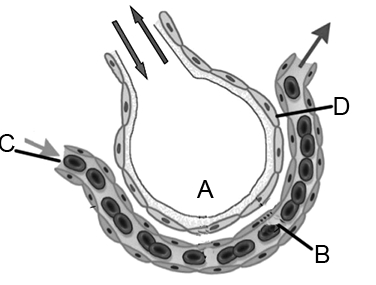
The figure given below shows a small part of human lung where exchange of gases takes place. Select the option which represents labelled part ($A, B, C$ or $D$) correctly identified along with its function.
A
$C$: Arterial capillary - passes oxygen to tissues
B
$A$: Alveolar cavity - main site of exchange of respiratory gases
C
$D$: Capillary wall - exchange of $O_2$ and $CO_2$ takes place here
D
$B$: Red blood cells - transport of $CO_2$ mainly
Solution
(B) In the given figure,$A$ represents the alveolar cavity,which is the primary site for the exchange of respiratory gases ($O_2$ and $CO_2$) between the air in the alveoli and the blood in the pulmonary capillaries.
$B$ represents red blood cells (erythrocytes),which are primarily involved in the transport of $O_2$ and $CO_2$.
$C$ represents the arterial end of the capillary.
$D$ represents the wall of the capillary.
Therefore,the correct identification is $A$: Alveolar cavity - main site of exchange of respiratory gases.
$B$ represents red blood cells (erythrocytes),which are primarily involved in the transport of $O_2$ and $CO_2$.
$C$ represents the arterial end of the capillary.
$D$ represents the wall of the capillary.
Therefore,the correct identification is $A$: Alveolar cavity - main site of exchange of respiratory gases.
0 likesView Solution
58
BiologyMediumMCQAIPMT · 2011
$A$ large proportion of oxygen remains unused in the human blood even after its uptake by the body tissues. This $O_2$
A
acts as a reserve during muscular exercise
B
raises the $pCO_2$ of blood to $75 \ mm \ Hg$
C
is enough to keep oxyhaemoglobin saturation at $96\%$
D
helps in releasing more $O_2$ to the epithelial tissues
Solution
(A) Under normal physiological conditions,only about $25\%$ of the oxygen carried by arterial blood is delivered to the tissues.
This means that a large proportion of oxygen remains bound to hemoglobin in the venous blood.
This residual oxygen acts as a significant reserve,which can be utilized by the body during periods of increased metabolic demand,such as intense muscular exercise.
This means that a large proportion of oxygen remains bound to hemoglobin in the venous blood.
This residual oxygen acts as a significant reserve,which can be utilized by the body during periods of increased metabolic demand,such as intense muscular exercise.
0 likesView Solution
59
BiologyMediumMCQAIPMT · 2011
Which one of the following is a possibility for most of us in regard to breathing,by making a conscious effort?
A
One can breathe out air totally without oxygen.
B
One can breathe out air through Eustachian tube by closing both nose and mouth.
C
One can consciously breathe in and breathe out by moving the diaphragm alone,without moving the ribs at all.
D
The lungs can be made fully empty by forcefully breathing out all air from them.
Solution
(C) The correct answer is $C$.
Breathing is primarily an involuntary process controlled by the respiratory rhythm center in the medulla oblongata. However,we can exert conscious control over our breathing to a limited extent.
It is possible to consciously breathe by using the diaphragm as the primary muscle of respiration while keeping the rib cage relatively still.
Option $A$ is incorrect because we cannot remove all oxygen from the lungs.
Option $B$ is incorrect as the Eustachian tube connects the middle ear to the pharynx and is not involved in breathing.
Option $D$ is incorrect because even after forceful expiration,some air remains in the lungs,known as residual volume $(RV)$.
Breathing is primarily an involuntary process controlled by the respiratory rhythm center in the medulla oblongata. However,we can exert conscious control over our breathing to a limited extent.
It is possible to consciously breathe by using the diaphragm as the primary muscle of respiration while keeping the rib cage relatively still.
Option $A$ is incorrect because we cannot remove all oxygen from the lungs.
Option $B$ is incorrect as the Eustachian tube connects the middle ear to the pharynx and is not involved in breathing.
Option $D$ is incorrect because even after forceful expiration,some air remains in the lungs,known as residual volume $(RV)$.
0 likesView Solution
60
BiologyMediumMCQAIPMT · 2011
'Bundle of His' is a part of which one of the following organs in humans?
A
Brain
B
Heart
C
Kidney
D
Pancreas
Solution
(B) The correct answer is $B$.
'Bundle of His' is a specialized part of the cardiac conduction system in the human heart.
It consists of a bundle of nodal fibres,also known as the atrioventricular bundle ($AV$ bundle).
This bundle continues from the atrioventricular node $(AVN)$ and passes through the atrioventricular septa.
It emerges on the top of the interventricular septum and immediately divides into a right and left bundle.
These branches give rise to minute fibres throughout the ventricular musculature of the respective sides,which are called Purkinje fibres.
Together,these structures form the 'Bundle of His',which is essential for the rhythmic contraction of the heart.
'Bundle of His' is a specialized part of the cardiac conduction system in the human heart.
It consists of a bundle of nodal fibres,also known as the atrioventricular bundle ($AV$ bundle).
This bundle continues from the atrioventricular node $(AVN)$ and passes through the atrioventricular septa.
It emerges on the top of the interventricular septum and immediately divides into a right and left bundle.
These branches give rise to minute fibres throughout the ventricular musculature of the respective sides,which are called Purkinje fibres.
Together,these structures form the 'Bundle of His',which is essential for the rhythmic contraction of the heart.
0 likesView Solution
61
BiologyMediumMCQAIPMT · 2011
Which one of the following plasma proteins is involved in the coagulation of blood?
A
Albumin
B
Serum amylase
C
Globulin
D
Fibrinogen
Solution
(D) $Fibrinogen$ is a plasma protein that plays a crucial role in the coagulation of blood.
When an injury occurs, $Fibrinogen$ is converted into insoluble $Fibrin$ threads by the enzyme $Thrombin$.
These $Fibrin$ threads form a network that traps blood cells to form a clot, thereby preventing excessive blood loss.
$Albumin$ is primarily involved in maintaining osmotic pressure, while $Globulins$ are mainly involved in defense mechanisms of the body.
When an injury occurs, $Fibrinogen$ is converted into insoluble $Fibrin$ threads by the enzyme $Thrombin$.
These $Fibrin$ threads form a network that traps blood cells to form a clot, thereby preventing excessive blood loss.
$Albumin$ is primarily involved in maintaining osmotic pressure, while $Globulins$ are mainly involved in defense mechanisms of the body.
0 likesView Solution
62
BiologyMediumMCQAIPMT · 2011
Arteries are best defined as the vessels which
A
supply oxygenated blood to the different organs
B
carry blood away from the heart to different organs
C
break up into capillaries which reunite to form a vein
D
carry blood from one visceral organ to another visceral organ.
Solution
(B) The correct answer is $B$.
Arteries are defined as the blood vessels that carry blood away from the heart to various organs of the body.
While most arteries carry oxygenated blood,the pulmonary artery is an exception as it carries deoxygenated blood from the heart to the lungs.
Therefore,the primary functional definition of an artery is based on the direction of blood flow (away from the heart) rather than the oxygen content of the blood.
Arteries are defined as the blood vessels that carry blood away from the heart to various organs of the body.
While most arteries carry oxygenated blood,the pulmonary artery is an exception as it carries deoxygenated blood from the heart to the lungs.
Therefore,the primary functional definition of an artery is based on the direction of blood flow (away from the heart) rather than the oxygen content of the blood.
0 likesView Solution
63
BiologyMediumMCQAIPMT · 2011
Which one of the following statements is correct regarding blood pressure?
A
$130/90 \ mm \ Hg$ is considered high and requires treatment.
B
$100/55 \ mm \ Hg$ is considered an ideal blood pressure.
C
$105/50 \ mm \ Hg$ makes one very active.
D
$190/110 \ mm \ Hg$ may harm vital organs like brain and kidney.
Solution
(D) The correct statement is $(d)$.
Blood pressure is the pressure exerted by blood against the walls of the blood vessels.
Normal blood pressure is considered to be $120/80 \ mm \ Hg$.
If repeated checks of blood pressure of an individual show $140/90 \ mm \ Hg$ or higher,it indicates hypertension or high blood pressure.
Hypertension leads to heart diseases and also causes damage to vital organs like the brain and kidneys.
Blood pressure is the pressure exerted by blood against the walls of the blood vessels.
Normal blood pressure is considered to be $120/80 \ mm \ Hg$.
If repeated checks of blood pressure of an individual show $140/90 \ mm \ Hg$ or higher,it indicates hypertension or high blood pressure.
Hypertension leads to heart diseases and also causes damage to vital organs like the brain and kidneys.
0 likesView Solution
64
BiologyMediumMCQAIPMT · 2011
$A$ person with an unknown blood group under the $ABO$ system has suffered significant blood loss in an accident and requires an immediate blood transfusion. His friend,who has a valid certificate of his own blood type,offers to donate blood without delay. What would be the blood group of the donor friend?
A
Type $B$
B
Type $AB$
C
Type $O$
D
Type $A$
Solution
(C) The correct answer is $C$. The blood group of the donor is $O$.
Individuals with blood group $O$ are known as universal donors.
This is because their red blood cells lack both $A$ and $B$ antigens on their surface.
Consequently,when $O$ type blood is transfused into a recipient of any other blood group ($A, B, AB,$ or $O$),it does not trigger an immune reaction or agglutination (clumping) of the recipient's blood cells.
Individuals with blood group $O$ are known as universal donors.
This is because their red blood cells lack both $A$ and $B$ antigens on their surface.
Consequently,when $O$ type blood is transfused into a recipient of any other blood group ($A, B, AB,$ or $O$),it does not trigger an immune reaction or agglutination (clumping) of the recipient's blood cells.
0 likesView Solution
65
BiologyMediumMCQAIPMT · 2011
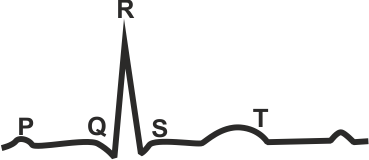
Given below is the $ECG$ of a normal human. Which one of its components is correctly interpreted below?
A
$QRS$ complex - one complete pulse
B
Peak $T$ - initiation of total cardiac contraction
C
Peak $P$ and peak $R$ together - systolic and diastolic blood pressures
D
Peak $P$ - initiation of left atrial contraction only
Solution
(A) The correct answer is $(A)$.
By counting the number of $QRS$ complexes that occur in a given time period,one can determine the heart beat rate (pulse) of an individual.
The $P$-wave represents the electrical excitation (depolarisation) of the atria,which leads to the contraction of both the atria.
The $QRS$ complex represents the depolarisation of the ventricles,which initiates the ventricular contraction.
The $T$-wave represents the return of the ventricles from an excited to a normal state (repolarisation). The end of the $T$-wave marks the end of systole.
By counting the number of $QRS$ complexes that occur in a given time period,one can determine the heart beat rate (pulse) of an individual.
The $P$-wave represents the electrical excitation (depolarisation) of the atria,which leads to the contraction of both the atria.
The $QRS$ complex represents the depolarisation of the ventricles,which initiates the ventricular contraction.
The $T$-wave represents the return of the ventricles from an excited to a normal state (repolarisation). The end of the $T$-wave marks the end of systole.
0 likesView Solution
66
BiologyMediumMCQAIPMT · 2011
Which one of the following characteristics is common both in humans and adult frogs?
A
Four chambered heart
B
Internal fertilization
C
Nucleated $RBCs$
D
Ureotelic mode of excretion
Solution
(D) The correct answer is $D$.
Excretion of urea is known as ureotelism,and the animals that excrete urea are called ureotelic.
Ureotelic animals include cartilaginous fishes (like sharks),semi-aquatic amphibians (such as adult frogs and toads),semi-aquatic reptiles (like turtles and alligators),and all mammals,including humans.
Urea is less toxic and less soluble in water compared to ammonia,allowing it to be stored in the body for a longer duration.
While amphibian tadpoles (e.g.,frog tadpoles) are ammonotelic,they undergo metamorphosis to become ureotelic as adults.
Excretion of urea is known as ureotelism,and the animals that excrete urea are called ureotelic.
Ureotelic animals include cartilaginous fishes (like sharks),semi-aquatic amphibians (such as adult frogs and toads),semi-aquatic reptiles (like turtles and alligators),and all mammals,including humans.
Urea is less toxic and less soluble in water compared to ammonia,allowing it to be stored in the body for a longer duration.
While amphibian tadpoles (e.g.,frog tadpoles) are ammonotelic,they undergo metamorphosis to become ureotelic as adults.
0 likesView Solution
67
BiologyMediumMCQAIPMT · 2011
Which one of the following is not a part of a renal pyramid?
A
Peritubular capillaries
B
Convoluted tubules
C
Collecting ducts
D
Loop of Henle
Solution
(B) The kidney medulla is divided into several conical regions known as renal pyramids.
Peritubular capillaries,the loop of Henle,and collecting ducts are located within the medulla (renal pyramids).
In contrast,the convoluted tubules (both proximal and distal) are located in the renal cortex of the kidney.
Therefore,convoluted tubules are not a part of the renal pyramid.
Peritubular capillaries,the loop of Henle,and collecting ducts are located within the medulla (renal pyramids).
In contrast,the convoluted tubules (both proximal and distal) are located in the renal cortex of the kidney.
Therefore,convoluted tubules are not a part of the renal pyramid.
0 likesView Solution
68
BiologyMediumMCQAIPMT · 2011
Which one of the following correctly explains the function of a specific part of the human nephron?
A
Podocytes : create minute spaces (slit pores) for the filtration of blood into the Bowman's capsule
B
Henle's loop : most reabsorption of the major substances from the glomerular filtrate
C
Distal convoluted tubule : reabsorption of $K^+$ ions into the surrounding blood capillaries
D
Afferent arteriole : carries the blood away from the glomerulus towards renal vein.
Solution
(A) : The visceral layer of Bowman's capsule surrounds the glomerulus and is composed of special type of cells,the podocytes.
The podocytes are so called because they possess foot-like processes (projections),the pedicels.
The space between pedicels are called slit pores (= filtration slits) through which the glomerular filtrate filters.
The podocytes are so called because they possess foot-like processes (projections),the pedicels.
The space between pedicels are called slit pores (= filtration slits) through which the glomerular filtrate filters.
0 likesView Solution
69
BiologyMediumMCQAIPMT · 2011
Which one of the following statements is correct with respect to kidney function regulation?
A
When someone drinks lot of water,$ADH$ release is suppressed.
B
Exposure to cold temperature stimulates $ADH$ release.
C
An increase in glomerular blood flow stimulates formation of angiotensin $II$.
D
During summer when body loses lot of water by evaporation,the release of $ADH$ is suppressed.
Solution
(A) : Antidiuretic hormone $(ADH)$ or vasopressin increases the reabsorption of water in the distal convoluted tubule,collecting tubules,and collecting ducts of the nephrons of the kidneys.
As a result,the reabsorption of water from the glomerular filtrate is increased.
When someone drinks a lot of water,the body's requirement for water reabsorption decreases,and the blood osmolarity drops.
Consequently,the hypothalamus signals the posterior pituitary to suppress the release of $ADH$ to allow for the excretion of excess water as dilute urine.
As a result,the reabsorption of water from the glomerular filtrate is increased.
When someone drinks a lot of water,the body's requirement for water reabsorption decreases,and the blood osmolarity drops.
Consequently,the hypothalamus signals the posterior pituitary to suppress the release of $ADH$ to allow for the excretion of excess water as dilute urine.
0 likesView Solution
70
BiologyEasyMCQAIPMT · 2011
Uricotelic mode of excreting nitrogenous wastes is found in
A
reptiles and birds
B
birds and annelids
C
amphibians and reptiles
D
insects and amphibians
Solution
(A) The uricotelic mode of excretion involves the elimination of nitrogenous wastes in the form of uric acid.
This method is an adaptation to conserve water,as uric acid is excreted as a pellet or paste with minimal water loss.
Organisms that exhibit this mode include reptiles,birds,land snails,and insects.
Therefore,the correct option is $A$.
This method is an adaptation to conserve water,as uric acid is excreted as a pellet or paste with minimal water loss.
Organisms that exhibit this mode include reptiles,birds,land snails,and insects.
Therefore,the correct option is $A$.
0 likesView Solution
71
BiologyMediumMCQAIPMT · 2011
Which of the following statements correctly describes the type of muscle present in the specified body part?
A
Heart is involuntary and unstriated smooth muscle.
B
Intestine is striated and involuntary.
C
Thigh is striated and voluntary.
D
Upper arm is smooth muscle and fusiform in shape.
Solution
(C) is the correct answer.
$1$. Cardiac muscles are found in the wall of the heart; they are involuntary and striated.
$2$. Smooth muscles are found in the gastrointestinal tract (like the intestine); they are non-striated and involuntary.
$3$. Striated (or skeletal) muscles are found in the limbs (like the thigh and upper arm) and body walls. These muscles are voluntary (under the control of the animal's will) and show dark and light bands,thus they are striated.
$1$. Cardiac muscles are found in the wall of the heart; they are involuntary and striated.
$2$. Smooth muscles are found in the gastrointestinal tract (like the intestine); they are non-striated and involuntary.
$3$. Striated (or skeletal) muscles are found in the limbs (like the thigh and upper arm) and body walls. These muscles are voluntary (under the control of the animal's will) and show dark and light bands,thus they are striated.
0 likesView Solution
72
BiologyMediumMCQAIPMT · 2011
Three of the following pairs of human skeletal parts are correctly matched with their respective inclusive skeletal category,and one pair is not matched. Identify the non-matching pair.
A
Sternum and ribs $\Rightarrow$ Axial skeleton
B
Clavicle and glenoid cavity $\Rightarrow$ Pelvic girdle
C
Humerus and ulna $\Rightarrow$ Appendicular skeleton
D
Malleus and stapes $\Rightarrow$ Ear ossicles
Solution
(B) : Each pectoral girdle consists of two bones,the clavicle and the scapula.
The scapula (shoulder blade) is a large triangular bone that features a shallow articular surface called the glenoid cavity,which articulates with the head of the humerus.
The clavicle and the glenoid cavity are parts of the pectoral girdle,not the pelvic girdle.
The pelvic girdle consists of two coxal bones,each formed by the fusion of three bones: the ilium,ischium,and pubis.
The scapula (shoulder blade) is a large triangular bone that features a shallow articular surface called the glenoid cavity,which articulates with the head of the humerus.
The clavicle and the glenoid cavity are parts of the pectoral girdle,not the pelvic girdle.
The pelvic girdle consists of two coxal bones,each formed by the fusion of three bones: the ilium,ischium,and pubis.
0 likesView Solution
73
BiologyMediumMCQAIPMT · 2011
When a neuron is in resting state,$i.e.$,not conducting any impulse,the axonal membrane is
A
comparatively more permeable to $Na^+$ ions and nearly impermeable to $K^+$ ions
B
equally permeable to both $Na^+$ and $K^+$ ions
C
impermeable to both $Na^+$ and $K^+$ ions
D
comparatively more permeable to $K^+$ ions and nearly impermeable to $Na^+$ ions.
Solution
(D) In the resting state,the axonal membrane of a neuron is significantly more permeable to potassium ions $(K^+)$ due to the presence of leak channels,while it remains nearly impermeable to sodium ions $(Na^+)$.
This differential permeability,combined with the action of the $Na^+-K^+$ pump,helps maintain the resting membrane potential.
This differential permeability,combined with the action of the $Na^+-K^+$ pump,helps maintain the resting membrane potential.
0 likesView Solution
74
BiologyMediumMCQAIPMT · 2011
Match the source gland with its respective hormone and function and select the correct option.
A
$A$. Anterior pituitary $\to$ Oxytocin $\to$ Contraction of uterus muscles during child birth
B
$B$. Posterior pituitary $\to$ Vasopressin $\to$ Stimulates reabsorption of water in the distal tubules in the nephron
C
$C$. Corpus luteum $\to$ Estrogen $\to$ Supports pregnancy
D
$D$. Thyroid $\to$ Thyroxine $\to$ Regulates blood calcium level
Solution
(B) is the correct option.
The posterior lobe of the pituitary gland (neurohypophysis) stores and releases two hormones: oxytocin and vasopressin.
These hormones are synthesized by the neurosecretory cells in the hypothalamus and are transported to the posterior pituitary via axons.
Vasopressin,also known as antidiuretic hormone $(ADH)$,acts primarily on the kidney.
It stimulates the reabsorption of water and electrolytes in the distal convoluted tubules $(DCT)$ and collecting ducts,thereby reducing water loss through urine.
The posterior lobe of the pituitary gland (neurohypophysis) stores and releases two hormones: oxytocin and vasopressin.
These hormones are synthesized by the neurosecretory cells in the hypothalamus and are transported to the posterior pituitary via axons.
Vasopressin,also known as antidiuretic hormone $(ADH)$,acts primarily on the kidney.
It stimulates the reabsorption of water and electrolytes in the distal convoluted tubules $(DCT)$ and collecting ducts,thereby reducing water loss through urine.
0 likesView Solution
75
BiologyMediumMCQAIPMT · 2011
Given below is an incomplete table on hormones,their source glands,and one major effect on the human body. Identify the option representing the correct grouping of hormone,its gland,and effect.
| Gland | Secretion | Effect on body |
| $A$ | Estrogen | Maintenance of secondary sexual characters |
| Alpha cells of Islets of Langerhans | $B$ | Raises blood sugar level |
| Anterior pituitary | $C$ | Over secretion leads to gigantism |
A
Ovary $\Rightarrow$ Glucagon $\Rightarrow$ Growth hormone
B
Placenta $\Rightarrow$ Insulin $\Rightarrow$ Vasopressin
C
Ovary $\Rightarrow$ Insulin $\Rightarrow$ Calcitonin
D
Placenta $\Rightarrow$ Glucagon $\Rightarrow$ Calcitonin
Solution
$(A)$ The correct identification for the blanks is as follows:
$1$. $A$ represents the Ovary,which secretes Estrogen,responsible for the maintenance of secondary sexual characters in females.
$2$. $B$ represents Glucagon,which is secreted by the Alpha cells of the Islets of Langerhans in the pancreas and acts to raise blood sugar levels (hyperglycemic hormone).
$3$. $C$ represents Growth Hormone $(GH)$,secreted by the anterior pituitary gland; its over-secretion leads to gigantism.
Therefore,the correct sequence is Ovary $\Rightarrow$ Glucagon $\Rightarrow$ Growth hormone.
$1$. $A$ represents the Ovary,which secretes Estrogen,responsible for the maintenance of secondary sexual characters in females.
$2$. $B$ represents Glucagon,which is secreted by the Alpha cells of the Islets of Langerhans in the pancreas and acts to raise blood sugar levels (hyperglycemic hormone).
$3$. $C$ represents Growth Hormone $(GH)$,secreted by the anterior pituitary gland; its over-secretion leads to gigantism.
Therefore,the correct sequence is Ovary $\Rightarrow$ Glucagon $\Rightarrow$ Growth hormone.
0 likesView Solution
76
BiologyMediumMCQAIPMT · 2011
The $24$ hour (diurnal) rhythm of our body,such as the sleep-wake cycle,is regulated by the hormone:
A
calcitonin
B
prolactin
C
adrenaline
D
melatonin
Solution
(D) : Melatonin is a hormone secreted by the pineal gland in vertebrates.
Melatonin secretion is linked to the light-dark cycle of the environment,being highest at night and lowest during the day.
This hormone plays a crucial role in regulating the $24$ hour (diurnal) rhythm of our body,including the sleep-wake cycle and body temperature.
It also influences metabolism,pigmentation,the menstrual cycle,and our defense capability.
Melatonin secretion is linked to the light-dark cycle of the environment,being highest at night and lowest during the day.
This hormone plays a crucial role in regulating the $24$ hour (diurnal) rhythm of our body,including the sleep-wake cycle and body temperature.
It also influences metabolism,pigmentation,the menstrual cycle,and our defense capability.
0 likesView Solution
77
BiologyMediumMCQAIPMT · 2011
Organisms called methanogens are most abundant in a
A
sulphur rock
B
cattle yard
C
polluted stream
D
hot spring
Solution
(B) $Methanogens$ are a group of $Archaebacteria$ that produce methane gas as a metabolic byproduct in anoxic conditions.
They are obligate anaerobes,meaning they cannot survive in the presence of oxygen.
They are commonly found in oxygen-deficient environments such as marshes,swamps,waterlogged paddy fields,and the rumen (a part of the stomach) of ruminant animals like cattle.
In the rumen,they help in the breakdown of cellulose.
Because they are present in the gut of cattle,their excreta (dung) is rich in these bacteria,making a cattle yard a highly abundant source of $Methanogens$.
They are also used in biogas (gobar gas) plants to produce methane from animal waste.
They are obligate anaerobes,meaning they cannot survive in the presence of oxygen.
They are commonly found in oxygen-deficient environments such as marshes,swamps,waterlogged paddy fields,and the rumen (a part of the stomach) of ruminant animals like cattle.
In the rumen,they help in the breakdown of cellulose.
Because they are present in the gut of cattle,their excreta (dung) is rich in these bacteria,making a cattle yard a highly abundant source of $Methanogens$.
They are also used in biogas (gobar gas) plants to produce methane from animal waste.
0 likesView Solution
78
BiologyMediumMCQAIPMT · 2011
Which one of the following correctly explains the function of a specific part of the human nephron?
A
Podocytes: Create minute spaces (slit pores) for the filtration of blood into the Bowman's capsule.
B
Henle's loop: Most reabsorption of the major substances from the glomerular filtrate.
C
Distal convoluted tubule: Reabsorption of $K^+$ ions from the surrounding blood capillaries.
D
Afferent arteriole: Carries the blood away from the glomerulus towards the renal vein.
Solution
(A) The correct option is $A$.
$1$. Podocytes are specialized cells in the inner layer of the Bowman's capsule that form slit pores,which allow for the filtration of blood.
$2$. Henle's loop is primarily responsible for the concentration of urine,not the reabsorption of most substances (which occurs in the Proximal Convoluted Tubule).
$3$. The Distal Convoluted Tubule $(DCT)$ is involved in the conditional reabsorption of $Na^+$ and water,and the secretion of $H^+$,$K^+$,and ammonia,rather than the reabsorption of $K^+$.
$4$. The Afferent arteriole brings blood into the glomerulus,while the Efferent arteriole carries blood away from it.
$1$. Podocytes are specialized cells in the inner layer of the Bowman's capsule that form slit pores,which allow for the filtration of blood.
$2$. Henle's loop is primarily responsible for the concentration of urine,not the reabsorption of most substances (which occurs in the Proximal Convoluted Tubule).
$3$. The Distal Convoluted Tubule $(DCT)$ is involved in the conditional reabsorption of $Na^+$ and water,and the secretion of $H^+$,$K^+$,and ammonia,rather than the reabsorption of $K^+$.
$4$. The Afferent arteriole brings blood into the glomerulus,while the Efferent arteriole carries blood away from it.
0 likesView Solution
79
BiologyEasyMCQAIPMT · 2011
The 'eyes' of the potato tuber are ..... .
A
Floral buds
B
Shoot buds
C
Axillary buds
D
Root buds
Solution
(C) The potato tuber is a modified underground stem.
On the surface of the potato tuber,there are several small depressions known as 'eyes'.
These 'eyes' represent the nodes of the stem.
Each 'eye' consists of an axillary bud,which is capable of growing into a new shoot under favorable conditions.
On the surface of the potato tuber,there are several small depressions known as 'eyes'.
These 'eyes' represent the nodes of the stem.
Each 'eye' consists of an axillary bud,which is capable of growing into a new shoot under favorable conditions.
0 likesView Solution
80
BiologyDifficultMCQAIPMT · 2011
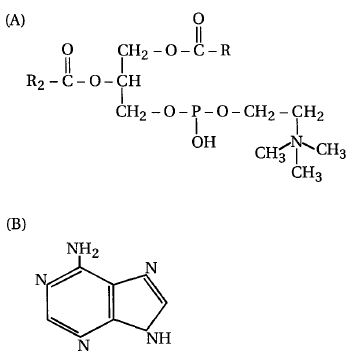
Identify the two organic compounds shown in the molecular structures below and state their respective functions.
A
$b:$ Adenine - Forms nucleic acids from nucleotides.
B
$a:$ Triglyceride - Important source of energy.
C
$b:$ Uracil - Component of $DNA$.
D
$a:$ Lecithin - Component of cell membrane.
Solution
(D) Structure $A$ represents Lecithin,which is a phospholipid. Phospholipids are essential components of the cell membrane,providing structural integrity and regulating permeability.
Structure $B$ represents Adenine,which is a nitrogenous base (purine). Adenine is a fundamental component of nucleotides,which are the building blocks of nucleic acids like $DNA$ and $RNA$.
Structure $B$ represents Adenine,which is a nitrogenous base (purine). Adenine is a fundamental component of nucleotides,which are the building blocks of nucleic acids like $DNA$ and $RNA$.
0 likesView Solution
81
BiologyMediumMCQAIPMT · 2011
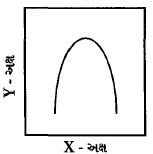
The given graphical representation relates to enzyme activity under three conditions ($pH$,temperature,and substrate concentration). What do the given axes $X$ and $Y$ represent?
$X$-axis $-$ $Y$-axis
$X$-axis $-$ $Y$-axis
A
Enzyme activity $-$ $pH$
B
Temperature $-$ Enzyme activity
C
Substrate concentration $-$ Enzyme activity
D
Enzyme activity $-$ Temperature
Solution
(A) The graph shows a bell-shaped curve,which is characteristic of the effect of $pH$ or temperature on enzyme activity.
Enzyme activity increases with an increase in $pH$ or temperature up to an optimum point and then decreases as the enzyme gets denatured.
In contrast,the effect of substrate concentration on enzyme activity typically shows a hyperbolic curve,where activity increases and then plateaus (reaches $V_{max}$).
Looking at the options,both $A$ and $D$ represent bell-shaped curves (Enzyme activity vs $pH$ or Temperature).
However,in standard textbook representations,$pH$ is often plotted on the $X$-axis and enzyme activity on the $Y$-axis for this specific bell-shaped curve pattern.
Therefore,$X$-axis represents $pH$ and $Y$-axis represents enzyme activity.
Enzyme activity increases with an increase in $pH$ or temperature up to an optimum point and then decreases as the enzyme gets denatured.
In contrast,the effect of substrate concentration on enzyme activity typically shows a hyperbolic curve,where activity increases and then plateaus (reaches $V_{max}$).
Looking at the options,both $A$ and $D$ represent bell-shaped curves (Enzyme activity vs $pH$ or Temperature).
However,in standard textbook representations,$pH$ is often plotted on the $X$-axis and enzyme activity on the $Y$-axis for this specific bell-shaped curve pattern.
Therefore,$X$-axis represents $pH$ and $Y$-axis represents enzyme activity.
0 likesView Solution
82
BiologyEasyMCQAIPMT · 2011
What is the function of nitrifying bacteria?
A
Oxidize ammonia to form nitrates
B
Convert free nitrogen into nitrogenous compounds
C
Convert proteins into ammonia
D
Decompose nitrates to release free nitrogen
Solution
(A) Nitrifying bacteria,such as $Nitrosomonas$ and $Nitrobacter$,play a crucial role in the nitrogen cycle.
They oxidize ammonia $(NH_3)$ into nitrites $(NO_2^-)$ and subsequently into nitrates $(NO_3^-)$.
This process is essential for plants as they absorb nitrogen primarily in the form of nitrates from the soil.
Therefore,the correct function is the oxidation of ammonia to form nitrates.
They oxidize ammonia $(NH_3)$ into nitrites $(NO_2^-)$ and subsequently into nitrates $(NO_3^-)$.
This process is essential for plants as they absorb nitrogen primarily in the form of nitrates from the soil.
Therefore,the correct function is the oxidation of ammonia to form nitrates.
0 likesView Solution
83
BiologyEasyMCQAIPMT · 2011
Which enzyme initiates the digestion of milk in humans?
A
Lipase
B
Trypsin
C
Rennin
D
Pepsin
Solution
(C) In humans,specifically in infants,the stomach secretes an enzyme called $Rennin$ (also known as $Chymosin$).
This enzyme is responsible for the digestion of milk proteins,specifically $Casein$.
$Rennin$ converts soluble milk protein $Casein$ into insoluble $Paracasein$ (calcium paracaseinate),which is then further digested by $Pepsin$.
This enzyme is responsible for the digestion of milk proteins,specifically $Casein$.
$Rennin$ converts soluble milk protein $Casein$ into insoluble $Paracasein$ (calcium paracaseinate),which is then further digested by $Pepsin$.
0 likesView Solution
84
BiologyEasyMCQAIPMT · 2011
Parachute type dispersal occurs in
A
tomato
B
mustard
C
pea
D
cotton
Solution
(D) Dispersal is a universal biological need. For non-aquatic,terrestrial plants,the wind is an obvious supplier of energy for movement,and many plant adaptations exist that clearly take advantage of this fact. This type of seed dispersal is not efficient,but very effective. Appendages of some fruits and seeds act as parachutes; for example,seeds of cotton possess hair that help in the dispersal of these seeds by wind. Another well-known example is the dandelion.
0 likesView Solution
85
BiologyEasyMCQAIPMT · 2011
Bulk of carbon dioxide $(CO_2)$ released from body tissues into the blood is present as
A
$70\%$ carbamino-haemoglobin and $30\%$ as bicarbonate
B
carbamino-haemoglobin in $RBCs$
C
bicarbonate in blood plasma and $RBCs$
D
free $CO_2$ in blood plasma
Solution
(C) Carbon dioxide $(CO_2)$ is transported in the blood in three forms:
$1$. As dissolved gas in plasma $(7\%)$.
$2$. As carbamino-haemoglobin bound to haemoglobin $(20-25\%)$.
$3$. As bicarbonate ions $(HCO_3^-)$ in blood plasma and $RBCs$ $(70\%)$.
Since the majority of $CO_2$ is transported as bicarbonate,the correct answer is $C$.
$1$. As dissolved gas in plasma $(7\%)$.
$2$. As carbamino-haemoglobin bound to haemoglobin $(20-25\%)$.
$3$. As bicarbonate ions $(HCO_3^-)$ in blood plasma and $RBCs$ $(70\%)$.
Since the majority of $CO_2$ is transported as bicarbonate,the correct answer is $C$.
0 likesView Solution
86
BiologyMediumMCQAIPMT · 2011
The logistic population growth is expressed by the equation:
A
$dt / dN = Nr (\frac{K-N}{K})$
B
$dN / dt = rN (\frac{K-N}{K})$
C
$dN / dt = rN$
D
$dN / dt = rN (\frac{N-K}{N})$
Solution
(B) The correct option is $B$.
Logistic population growth is expressed by the following equation:
$dN / dt = rN (\frac{K-N}{K})$
Where:
$N$ = Population density at time $t$
$r$ = Intrinsic rate of natural increase
$K$ = Carrying capacity
This model represents growth in an environment with limited resources,where the growth rate slows down as the population size approaches the carrying capacity $K$.
Logistic population growth is expressed by the following equation:
$dN / dt = rN (\frac{K-N}{K})$
Where:
$N$ = Population density at time $t$
$r$ = Intrinsic rate of natural increase
$K$ = Carrying capacity
This model represents growth in an environment with limited resources,where the growth rate slows down as the population size approaches the carrying capacity $K$.
0 likesView Solution
87
BiologyEasyMCQAIPMT · 2011
Mass of living matter at a trophic level in an area at any time is called
A
standing crop
B
detritus
C
humus
D
standing state
Solution
(A) The correct answer is $A$.
Standing crop is defined as the total amount of living material (biomass) present at a specific trophic level in a given area at a particular time.
It is usually expressed as biomass or its equivalent in terms of energy.
Standing crop can fluctuate throughout the year due to seasonal changes,such as the growth and shedding of leaves in deciduous trees.
Standing crop is defined as the total amount of living material (biomass) present at a specific trophic level in a given area at a particular time.
It is usually expressed as biomass or its equivalent in terms of energy.
Standing crop can fluctuate throughout the year due to seasonal changes,such as the growth and shedding of leaves in deciduous trees.
0 likesView Solution
88
BiologyEasyMCQAIPMT · 2011
Of the total incident solar radiation,the proportion of $PAR$ is:
A
about $70\%$
B
about $60\%$
C
less than $50\%$
D
more than $80\%$
Solution
(C) The primary source of energy in all ecosystems is solar energy.
Approximately $50\%$ of the total solar radiation incident on the Earth's surface falls within the $PAR$ (Photosynthetically Active Radiation) spectrum.
Therefore,the proportion of $PAR$ is less than $50\%$ of the total incident solar radiation.
Only about $1-5\%$ of the total incident solar radiation is captured by photosynthetic organisms to synthesize organic matter (Gross Primary Productivity).
Approximately $50\%$ of the total solar radiation incident on the Earth's surface falls within the $PAR$ (Photosynthetically Active Radiation) spectrum.
Therefore,the proportion of $PAR$ is less than $50\%$ of the total incident solar radiation.
Only about $1-5\%$ of the total incident solar radiation is captured by photosynthetic organisms to synthesize organic matter (Gross Primary Productivity).
0 likesView Solution
89
BiologyMediumMCQAIPMT · 2011
Which one of the following statements is correct for secondary succession?
A
It begins on a bare rock.
B
It occurs on a deforested site.
C
It follows primary succession.
D
It is similar to primary succession except that it has a relatively fast pace.
Solution
(B) : Secondary succession begins in areas where natural biotic communities have been destroyed,such as in abandoned farm lands,burned or cut forests (deforested site),or lands that have been flooded. Unlike primary succession,which starts on bare areas like rocks where no soil exists,secondary succession occurs in areas where soil is already present,making the process significantly faster.
0 likesView Solution
90
BiologyMediumMCQAIPMT · 2011
Which one of the following statements for the pyramid of energy is incorrect?
A
Its base is broad.
B
It shows energy content of different trophic level organisms.
C
It is inverted in shape.
D
It is upright in shape.
Solution
(C) : The pyramid of energy is always upright and can never be inverted. This is because when energy flows from one trophic level to the next, a significant amount of energy is lost as heat at each step, according to the $10\%$ law of energy transfer.
0 likesView Solution
91
BiologyMediumMCQAIPMT · 2011
Which one of the following animals may occupy more than one trophic levels in the same ecosystem at the same time?
A
Sparrow
B
Lion
C
Goat
D
Frog
Solution
(A) The correct answer is $A$.
In an ecosystem,an organism is assigned a trophic level based on its position in the food chain.
$A$ sparrow can act as a primary consumer (herbivore) when it feeds on seeds,fruits,or grains.
Simultaneously,it can act as a secondary consumer (carnivore) when it feeds on insects or small worms.
Therefore,a sparrow occupies more than one trophic level in the same ecosystem at the same time.
In an ecosystem,an organism is assigned a trophic level based on its position in the food chain.
$A$ sparrow can act as a primary consumer (herbivore) when it feeds on seeds,fruits,or grains.
Simultaneously,it can act as a secondary consumer (carnivore) when it feeds on insects or small worms.
Therefore,a sparrow occupies more than one trophic level in the same ecosystem at the same time.
0 likesView Solution
92
BiologyMediumMCQAIPMT · 2011
Both hydrarch and xerarch successions lead to
A
medium water conditions
B
xeric conditions
C
highly dry conditions
D
excessive wet conditions
Solution
(A) Hydrarch succession takes place in wetter areas,and the successional series progresses from hydric to the mesic condition.
Xerarch succession takes place in dry areas,and the series progresses from xeric to mesic condition.
Therefore,both hydrarch and xerarch successions lead to medium water conditions,which are known as mesic conditions.
Xerarch succession takes place in dry areas,and the series progresses from xeric to mesic condition.
Therefore,both hydrarch and xerarch successions lead to medium water conditions,which are known as mesic conditions.
0 likesView Solution
93
BiologyMediumMCQAIPMT · 2011
The breakdown of detritus into smaller particles by earthworm is a process called
A
humification
B
fragmentation
C
mineralisation
D
catabolism
Solution
(B) : Decomposition is the process in which decomposers break down complex organic matter into inorganic substances like carbon dioxide,water,and nutrients. The important steps in the process of decomposition are fragmentation,leaching,catabolism,humification,and mineralisation.
Detritivores (e.g.,earthworm) break down detritus into smaller particles. This process is called fragmentation.
By the process of leaching,water-soluble inorganic nutrients go down into the soil horizon and get precipitated as unavailable salts.
Bacterial and fungal enzymes degrade detritus into simpler inorganic substances. This process is called catabolism.
Humification leads to the accumulation of a dark-colored amorphous substance called humus,which is highly resistant to microbial action and undergoes decomposition at an extremely slow rate.
The humus is further degraded by some microbes,and the release of inorganic nutrients occurs by the process known as mineralisation.
Detritivores (e.g.,earthworm) break down detritus into smaller particles. This process is called fragmentation.
By the process of leaching,water-soluble inorganic nutrients go down into the soil horizon and get precipitated as unavailable salts.
Bacterial and fungal enzymes degrade detritus into simpler inorganic substances. This process is called catabolism.
Humification leads to the accumulation of a dark-colored amorphous substance called humus,which is highly resistant to microbial action and undergoes decomposition at an extremely slow rate.
The humus is further degraded by some microbes,and the release of inorganic nutrients occurs by the process known as mineralisation.
0 likesView Solution
94
BiologyEasyMCQAIPMT · 2011
Which of the following has maximum genetic diversity in India?
A
Mango
B
Wheat
C
Groundnut
D
Rice
Solution
(D) The correct answer is $D$.
Genetic diversity refers to the variation in the number and types of genes, as well as chromosomes, present in different species and the variations in genes and their alleles within the same species.
In India, $Oryza \text{ } sativa$ (rice) exhibits the highest genetic diversity.
There are more than $50,000$ genetically different strains of rice in India alone, which is a prime example of high genetic diversity within a single species.
Genetic diversity refers to the variation in the number and types of genes, as well as chromosomes, present in different species and the variations in genes and their alleles within the same species.
In India, $Oryza \text{ } sativa$ (rice) exhibits the highest genetic diversity.
There are more than $50,000$ genetically different strains of rice in India alone, which is a prime example of high genetic diversity within a single species.
0 likesView Solution
95
BiologyMediumMCQAIPMT · 2011
Which one of the following has the highest number of species in nature?
A
Fungi
B
Insects
C
Birds
D
Angiosperms
Solution
(B) : Insects have the highest number of species found in nature.
$Insecta$ is the largest class of animals.
It has over $7,00,000$ species.
Insects are the most successful land invertebrates and the only major competitors with humans for dominance in the world.
$Insecta$ is the largest class of animals.
It has over $7,00,000$ species.
Insects are the most successful land invertebrates and the only major competitors with humans for dominance in the world.
0 likesView Solution
96
BiologyMediumMCQAIPMT · 2011
Consider the following statements $(A-D)$ each with one or two blanks.
$(A)$ Bears go into $ . . . . . . (1) . . . . . . $ during winter to $ . . . . . . (2) . . . . . . $ cold weather.
$(B)$ $A$ conical age pyramid with a broad base represents $ . . . . . . (3) . . . . . . $ human population.
$(C)$ $A$ wasp pollinating a fig flower is an example of $ . . . . . . (4) . . . . . . $.
$(D)$ An area with high levels of species richness is known as $ . . . . . . (5) . . . . . . $.
Which one of the following options gives the correct fill-ups for the respective blank numbers from $(1)$ to $(5)$ in the statements?
$(A)$ Bears go into $ . . . . . . (1) . . . . . . $ during winter to $ . . . . . . (2) . . . . . . $ cold weather.
$(B)$ $A$ conical age pyramid with a broad base represents $ . . . . . . (3) . . . . . . $ human population.
$(C)$ $A$ wasp pollinating a fig flower is an example of $ . . . . . . (4) . . . . . . $.
$(D)$ An area with high levels of species richness is known as $ . . . . . . (5) . . . . . . $.
Which one of the following options gives the correct fill-ups for the respective blank numbers from $(1)$ to $(5)$ in the statements?
A
$(3) - \text{stable}, (4) - \text{commensalism}, (5) - \text{marsh}$
B
$(1) - \text{aestivation}, (2) - \text{escape}, (3) - \text{stable}, (4) - \text{mutualism}$
C
$(3) - \text{expanding}, (4) - \text{commensalism}, (5) - \text{biodiversity park}$
D
$(1) - \text{hibernation}, (2) - \text{escape}, (3) - \text{expanding}, (5) - \text{hotspot}$
Solution
(D) The correct sequence is:
$(1)$ Bears undergo $hibernation$ (winter sleep) to escape the harsh cold weather.
$(2)$ The term used is $escape$.
$(3)$ $A$ conical age pyramid with a broad base indicates a large number of young individuals, which represents an $expanding$ population.
$(4)$ $A$ wasp pollinating a fig flower is a classic example of $mutualism$ (obligate relationship).
$(5)$ An area with high levels of species richness and high degree of endemism is known as a $biodiversity hotspot$.
Therefore, option $(D)$ is the correct choice.
$(1)$ Bears undergo $hibernation$ (winter sleep) to escape the harsh cold weather.
$(2)$ The term used is $escape$.
$(3)$ $A$ conical age pyramid with a broad base indicates a large number of young individuals, which represents an $expanding$ population.
$(4)$ $A$ wasp pollinating a fig flower is a classic example of $mutualism$ (obligate relationship).
$(5)$ An area with high levels of species richness and high degree of endemism is known as a $biodiversity hotspot$.
Therefore, option $(D)$ is the correct choice.
0 likesView Solution
97
BiologyEasyMCQAIPMT · 2011
Biodiversity of a geographical region represents
A
endangered species found in the region
B
the diversity in the organisms living in the region
C
genetic diversity in the dominant species of the region
D
species endemic to the region.
Solution
(B) : Biodiversity (biological diversity) is the existence of a wide variety of species (species diversity) or other taxa of plants,animals,and microorganisms in a natural community or habitat,or of communities within a particular environment (ecological diversity),or of genetic variation within a species (genetic diversity).
The maintenance of a high level of biodiversity is important for the stability of ecosystems.
The maintenance of a high level of biodiversity is important for the stability of ecosystems.
0 likesView Solution
98
BiologyMediumMCQAIPMT · 2011
Eutrophication is often seen in
A
deserts
B
fresh water lakes
C
ocean
D
mountains
Solution
(B) : Eutrophication is the excessive growth of algae,plants,and animals in water bodies due to nutrient enrichment,particularly with nitrogen and phosphate.
Nutrients present in sewage,agricultural wastes,and fertilizers cause dense growth of plants and planktonic algae.
The excessive growth of planktonic algae that causes coloration of water is called algal bloom,which is toxic to animals and humans.
Eutrophic water bodies also support excessive growth of floating plants.
Algal blooms and floating plants cut off light from submerged plants,resulting in their death.
There is a drastic decrease in oxygen replenishment inside the water.
Non-availability of oxygen results in the death of aquatic animals such as fish,which further adds to the organic loading of water.
Decomposition is replaced by putrefaction,which is anaerobic,leading to the absence of oxygen in water and the death of aquatic animals.
Nutrients present in sewage,agricultural wastes,and fertilizers cause dense growth of plants and planktonic algae.
The excessive growth of planktonic algae that causes coloration of water is called algal bloom,which is toxic to animals and humans.
Eutrophic water bodies also support excessive growth of floating plants.
Algal blooms and floating plants cut off light from submerged plants,resulting in their death.
There is a drastic decrease in oxygen replenishment inside the water.
Non-availability of oxygen results in the death of aquatic animals such as fish,which further adds to the organic loading of water.
Decomposition is replaced by putrefaction,which is anaerobic,leading to the absence of oxygen in water and the death of aquatic animals.
0 likesView Solution
99
BiologyMediumMCQAIPMT · 2011
Which one of the following pairs of gases are the major cause of "greenhouse effect"?
A
$CO_2$ and $O_3$
B
$CO_2$ and $CO$
C
$CFCs$ and $SO_2$
D
$CO_2$ and $N_2O$
Solution
(D) The correct answer is $D$.
Greenhouse gases are gases that trap heat in the atmosphere, contributing to the greenhouse effect and global warming.
$CO_2$ (Carbon dioxide) is the primary greenhouse gas, primarily released from the burning of fossil fuels in power plants and vehicles.
$N_2O$ (Nitrous oxide) is another significant greenhouse gas with a global warming potential approximately $310$ times greater than that of $CO_2$ over a $100$-year period.
$N_2O$ is naturally produced in the soil through microbial processes like nitrification and denitrification, and its concentration is increasing due to agricultural activities.
Therefore, the pair $CO_2$ and $N_2O$ represents the major contributors to the greenhouse effect.
Greenhouse gases are gases that trap heat in the atmosphere, contributing to the greenhouse effect and global warming.
$CO_2$ (Carbon dioxide) is the primary greenhouse gas, primarily released from the burning of fossil fuels in power plants and vehicles.
$N_2O$ (Nitrous oxide) is another significant greenhouse gas with a global warming potential approximately $310$ times greater than that of $CO_2$ over a $100$-year period.
$N_2O$ is naturally produced in the soil through microbial processes like nitrification and denitrification, and its concentration is increasing due to agricultural activities.
Therefore, the pair $CO_2$ and $N_2O$ represents the major contributors to the greenhouse effect.
0 likesView Solution
100
BiologyEasyMCQAIPMT · 2011
Which one of the following statements is incorrect in the case of the Bhopal tragedy?
A
Methyl isocyanate gas leakage took place.
B
Thousands of human beings died.
C
Radioactive fallout engulfed Bhopal.
D
It took place in the night of December $2, 1984$.
Solution
(C) The Bhopal gas tragedy occurred on the night of December $2-3, 1984$,at the Union Carbide India Limited $(UCIL)$ pesticide plant in Bhopal,Madhya Pradesh.
It was caused by the leakage of a highly toxic gas called Methyl isocyanate $(MIC)$.
Thousands of people died due to the exposure to this toxic gas,and many more suffered from long-term health effects.
Statement $(C)$ is incorrect because the tragedy was a chemical disaster involving toxic gas,not a radioactive fallout event.
It was caused by the leakage of a highly toxic gas called Methyl isocyanate $(MIC)$.
Thousands of people died due to the exposure to this toxic gas,and many more suffered from long-term health effects.
Statement $(C)$ is incorrect because the tragedy was a chemical disaster involving toxic gas,not a radioactive fallout event.
0 likesView Solution
101
BiologyEasyMCQAIPMT · 2011
Which one of the following is the correct expanded form of the acronym?
A
$IPCC$ = International Panel for Climate Change
B
$UNEP$ = United Nations Environmental Policy
C
$EPA$ = Environmental Pollution Agency
D
$IUCN$ = International Union for Conservation of Nature and Natural Resources
Solution
(D) The correct expanded form is $IUCN$ = International Union for Conservation of Nature and Natural Resources.
- $IPCC$ stands for Intergovernmental Panel on Climate Change.
- $UNEP$ stands for United Nations Environment Programme.
- $EPA$ stands for Environmental Protection Agency.
- Therefore,option $D$ is the only correct expansion.
- $IPCC$ stands for Intergovernmental Panel on Climate Change.
- $UNEP$ stands for United Nations Environment Programme.
- $EPA$ stands for Environmental Protection Agency.
- Therefore,option $D$ is the only correct expansion.
0 likesView Solution
102
BiologyEasyMCQAIPMT · 2011
"Good ozone" is found in the
A
mesosphere
B
troposphere
C
stratosphere
D
ionosphere
Solution
(C) : "Bad ozone" is formed in the lower atmosphere (troposphere) that harms plants and animals.
"Good ozone" is found in the upper part of the atmosphere called the stratosphere and it acts as a shield, absorbing ultraviolet $(UV)$ radiation from the sun.
$UV$ rays are highly injurious to living organisms because the $DNA$ and proteins of living organisms preferentially absorb $UV$ rays, and their high energy breaks the chemical bonds within these molecules.
"Good ozone" is found in the upper part of the atmosphere called the stratosphere and it acts as a shield, absorbing ultraviolet $(UV)$ radiation from the sun.
$UV$ rays are highly injurious to living organisms because the $DNA$ and proteins of living organisms preferentially absorb $UV$ rays, and their high energy breaks the chemical bonds within these molecules.
0 likesView Solution
103
BiologyMediumMCQAIPMT · 2011
Which of the following has the highest number of species?
A
Insects
B
Birds
C
Angiosperms
D
Fungi
Solution
(A) According to the global biodiversity estimates,animals are the most diverse group,and among animals,insects are the most species-rich taxonomic group.
Insects account for more than $70\%$ of all the recorded animal species on Earth.
Therefore,out of the given options,insects have the highest number of species.
Insects account for more than $70\%$ of all the recorded animal species on Earth.
Therefore,out of the given options,insects have the highest number of species.
0 likesView Solution
104
BiologyEasyMCQAIPMT · 2011
What proportion of the total solar radiation is received as $PAR$?
A
Approximately $70\%$
B
Approximately $60\%$
C
Less than $50\%$
D
More than $80\%$
Solution
(C) $PAR$ stands for Photosynthetically Active Radiation.
It represents the spectral range of solar radiation from $400 \ nm$ to $700 \ nm$ that photosynthetic organisms are able to use in the process of photosynthesis.
While the total solar radiation reaching the Earth's surface is significant,only a portion of it falls within this specific wavelength range.
Scientific studies indicate that less than $50\%$ of the total incident solar radiation is $PAR$.
It represents the spectral range of solar radiation from $400 \ nm$ to $700 \ nm$ that photosynthetic organisms are able to use in the process of photosynthesis.
While the total solar radiation reaching the Earth's surface is significant,only a portion of it falls within this specific wavelength range.
Scientific studies indicate that less than $50\%$ of the total incident solar radiation is $PAR$.
0 likesView Solution
105
BiologyMediumMCQAIPMT · 2011
Which diagnostic test is suggested for patients suspected of having $AIDS$?
A
$MRI$
B
Ultrasound
C
$WIDAL$
D
$ELISA$
Solution
(D) $AIDS$ (Acquired Immuno Deficiency Syndrome) is caused by the Human Immunodeficiency Virus $(HIV)$.
To detect the presence of $HIV$ antibodies in a patient's blood,the $ELISA$ (Enzyme-Linked Immunosorbent Assay) test is widely used as a primary screening diagnostic method.
$WIDAL$ test is used for Typhoid fever,while $MRI$ and Ultrasound are imaging techniques not used for $HIV$ detection.
To detect the presence of $HIV$ antibodies in a patient's blood,the $ELISA$ (Enzyme-Linked Immunosorbent Assay) test is widely used as a primary screening diagnostic method.
$WIDAL$ test is used for Typhoid fever,while $MRI$ and Ultrasound are imaging techniques not used for $HIV$ detection.
0 likesView Solution
106
BiologyMediumMCQAIPMT · 2011
In which of the following stages of $HIV$ infection do the symptoms of $AIDS$ appear?
A
$15$ days after sexual contact with an infected person
B
When the retrovirus enters the host cell
C
When $HIV$ causes massive destruction of helper $T$-lymphocytes
D
When viral $DNA$ is produced by reverse transcriptase
Solution
(C) $AIDS$ (Acquired Immuno Deficiency Syndrome) is caused by the $HIV$ (Human Immunodeficiency Virus).
$HIV$ primarily targets and infects helper $T$-lymphocytes ($CD4^+$ cells).
As the virus replicates,it leads to a progressive decline in the number of helper $T$-lymphocytes.
When the count of these cells drops significantly,the body's immune system becomes severely compromised,making the individual susceptible to opportunistic infections and cancers.
This stage of severe immune deficiency is clinically identified as $AIDS$.
$HIV$ primarily targets and infects helper $T$-lymphocytes ($CD4^+$ cells).
As the virus replicates,it leads to a progressive decline in the number of helper $T$-lymphocytes.
When the count of these cells drops significantly,the body's immune system becomes severely compromised,making the individual susceptible to opportunistic infections and cancers.
This stage of severe immune deficiency is clinically identified as $AIDS$.
0 likesView Solution
107
BiologyEasyMCQAIPMT · 2011
Mutation is induced by ...........
A
Infrared radiations
B
$IAA$
C
Ethylene
D
Gamma radiations
Solution
(D) Mutation breeding is a technique used in plant breeding to create genetic variation.
$Gamma$ radiations are high-energy ionizing radiations that are commonly used as mutagens to induce mutations in plant cells.
These mutations can lead to the development of new crop varieties with desirable traits such as disease resistance or higher yield.
$IAA$ (Indole$-3-$acetic acid) is a plant hormone,and ethylene is a gaseous plant hormone; neither is used to induce mutations.
$Gamma$ radiations are high-energy ionizing radiations that are commonly used as mutagens to induce mutations in plant cells.
These mutations can lead to the development of new crop varieties with desirable traits such as disease resistance or higher yield.
$IAA$ (Indole$-3-$acetic acid) is a plant hormone,and ethylene is a gaseous plant hormone; neither is used to induce mutations.
0 likesView Solution
108
BiologyMediumMCQAIPMT · 2011
Consider the following statements $(I-IV)$ regarding organic farming:
$I.$ Use of genetically modified crops like $Bt$ cotton.
$II.$ Input of naturally produced compost.
$III.$ No use of urea and pesticides.
$IV.$ Production of vitamin and mineral-rich vegetables.
Which of the above statements are correct?
$I.$ Use of genetically modified crops like $Bt$ cotton.
$II.$ Input of naturally produced compost.
$III.$ No use of urea and pesticides.
$IV.$ Production of vitamin and mineral-rich vegetables.
Which of the above statements are correct?
A
$II, III$ and $IV$
B
$III$ and $IV$
C
$II$ and $III$
D
$I$ and $II$
Solution
(C) Organic farming is a system of farming that maintains,enhances,and restores the ecological balance.
$I.$ $Bt$ cotton is a genetically modified organism $(GMO)$,which is generally not permitted in certified organic farming.
$II.$ Organic farming relies on the use of organic manures and composts,which is correct.
$III.$ It strictly prohibits the use of synthetic chemical fertilizers like urea and synthetic pesticides,which is correct.
$IV.$ While organic food is often considered healthier,the primary definition of organic farming focuses on the method of cultivation (avoiding chemicals) rather than specifically guaranteeing higher vitamin or mineral content compared to conventional crops.
Therefore,statements $II$ and $III$ are the core principles of organic farming.
$I.$ $Bt$ cotton is a genetically modified organism $(GMO)$,which is generally not permitted in certified organic farming.
$II.$ Organic farming relies on the use of organic manures and composts,which is correct.
$III.$ It strictly prohibits the use of synthetic chemical fertilizers like urea and synthetic pesticides,which is correct.
$IV.$ While organic food is often considered healthier,the primary definition of organic farming focuses on the method of cultivation (avoiding chemicals) rather than specifically guaranteeing higher vitamin or mineral content compared to conventional crops.
Therefore,statements $II$ and $III$ are the core principles of organic farming.
0 likesView Solution
109
BiologyEasyMCQAIPMT · 2011
Organisms known as methanogens are abundant in . . . . . . .
A
Cattle yard
B
Polluted stream
C
Hot springs
D
Sulfur rocks
Solution
(A) Methanogens are a group of anaerobic bacteria,such as $Methanobacterium$,that produce methane $(CH_4)$ as a metabolic byproduct in anoxic conditions.
These bacteria are commonly found in the anaerobic sludge during sewage treatment and in the rumen (a part of the stomach) of cattle.
In the rumen,these bacteria help in the breakdown of cellulose in the food eaten by cattle and play an important role in the nutrition of the cattle.
Therefore,methanogens are found in abundance in the rumen of cattle and in cattle yards where cattle dung is present.
These bacteria are commonly found in the anaerobic sludge during sewage treatment and in the rumen (a part of the stomach) of cattle.
In the rumen,these bacteria help in the breakdown of cellulose in the food eaten by cattle and play an important role in the nutrition of the cattle.
Therefore,methanogens are found in abundance in the rumen of cattle and in cattle yards where cattle dung is present.
0 likesView Solution
110
BiologyMediumMCQAIPMT · 2011
Which of the following is primarily produced by the activity of anaerobic bacteria on sewage?
A
Propane
B
Mustard gas
C
Marsh gas
D
Laughing gas
Solution
(C) During the secondary treatment of sewage,anaerobic bacteria digest the organic matter present in the sludge.
This process of anaerobic digestion produces a mixture of gases,primarily methane $(CH_4)$,along with hydrogen sulfide $(H_2S)$ and carbon dioxide $(CO_2)$.
This mixture of gases is commonly known as biogas or marsh gas,as methane is the primary component found in marshy areas.
This process of anaerobic digestion produces a mixture of gases,primarily methane $(CH_4)$,along with hydrogen sulfide $(H_2S)$ and carbon dioxide $(CO_2)$.
This mixture of gases is commonly known as biogas or marsh gas,as methane is the primary component found in marshy areas.
0 likesView Solution
111
BiologyMediumMCQAIPMT · 2011
Which of the following is a very common substrate used in the production of alcohol (ethanol) in distilleries?
A
Soybean meal
B
Ground gram
C
Molasses
D
Corn meal
Solution
(C) In distilleries,$ethanol$ is produced by the fermentation of sugars by the yeast $Saccharomyces$ $cerevisiae$. Molasses,which is a byproduct of the sugar industry,is rich in sucrose and is the most commonly used substrate for the industrial production of ethanol.
0 likesView Solution
112
BiologyMediumMCQAIPMT · 2011
Which of the following microorganisms forms a symbiotic association with plants and helps in their nutrition?
A
Azotobacter
B
Aspergillus
C
Glomus
D
Trichoderma
Solution
(C) Many members of the genus $Glomus$ form symbiotic associations with plants,which are known as mycorrhiza. In this association,the fungal symbiont absorbs phosphorus from the soil and passes it to the plant. Plants having such associations show other benefits like resistance to root-borne pathogens,tolerance to salinity and drought,and an overall increase in plant growth and development. Therefore,$Glomus$ acts as a biofertilizer.
0 likesView Solution
113
BiologyMediumMCQAIPMT · 2011
Agarose,extracted from sea weeds,is used in which of the following?
A
Spectrometry
B
Tissue culture
C
$PCR$
D
Gel electrophoresis
Solution
(D) Agarose is a natural polymer extracted from sea weeds (red algae like Gelidium and Gracilaria).
It is widely used in the laboratory technique known as gel electrophoresis.
In this process,agarose gel acts as a molecular sieve to separate $DNA$ fragments based on their size under an electric field.
It is widely used in the laboratory technique known as gel electrophoresis.
In this process,agarose gel acts as a molecular sieve to separate $DNA$ fragments based on their size under an electric field.
0 likesView Solution
114
BiologyMediumMCQAIPMT · 2011
In the restriction endonuclease $Eco RI$,what does the part '$co$' stand for?
A
Colon
B
Coelom
C
Coenzyme
D
coli
Solution
(D) The naming of restriction enzymes follows a specific convention.
In $Eco RI$,the first letter '$E$' comes from the genus name $Escherichia$.
The next two letters '$co$' come from the species name $coli$.
The letter '$R$' is derived from the strain name $RY13$.
The Roman numeral '$I$' indicates the order in which the enzyme was isolated from that strain of bacteria.
Therefore,'$co$' stands for $coli$.
In $Eco RI$,the first letter '$E$' comes from the genus name $Escherichia$.
The next two letters '$co$' come from the species name $coli$.
The letter '$R$' is derived from the strain name $RY13$.
The Roman numeral '$I$' indicates the order in which the enzyme was isolated from that strain of bacteria.
Therefore,'$co$' stands for $coli$.
0 likesView Solution
115
BiologyMediumMCQAIPMT · 2011
The following is a sample segment of a $DNA$ strand. What does the sequence of bases on the opposite strand show? Is there anything special about it?
$5' -GAATTC -3'$
$3' -CTTAAG -5'$
$5' -GAATTC -3'$
$3' -CTTAAG -5'$
A
Replication is complete.
B
Deleted from mutation.
C
Initiation of signals at the $5'$ end.
D
Palindromic sequence of base pairs.
Solution
(D) The given sequence is $5'-GAATTC-3'$ and $3'-CTTAAG-5'$.
When read in the $5' \rightarrow 3'$ direction,both strands have the same sequence: $GAATTC$.
This type of sequence is known as a palindromic nucleotide sequence.
Palindromic sequences are recognized by restriction endonucleases,which cut the $DNA$ at specific sites.
Therefore,the correct option is $D$.
When read in the $5' \rightarrow 3'$ direction,both strands have the same sequence: $GAATTC$.
This type of sequence is known as a palindromic nucleotide sequence.
Palindromic sequences are recognized by restriction endonucleases,which cut the $DNA$ at specific sites.
Therefore,the correct option is $D$.
0 likesView Solution
116
BiologyMediumMCQAIPMT · 2011
The process of $RNA$ interference is used for the development of pest-resistant plants against . . . . . . .
A
Nematodes
B
Fungi
C
Viruses
D
Insects
Solution
(A) $RNA$ interference $(RNAi)$ is a method of cellular defense used by all eukaryotic organisms to silence specific genes.
In agriculture,this technique is specifically used to develop resistance against nematodes.
For example,the nematode $Meloidogyne$ $incognita$ infects the roots of tobacco plants,causing a significant reduction in yield.
By introducing nematode-specific genes into the host plant using $Agrobacterium$ vectors,double-stranded $RNA$ $(dsRNA)$ is produced.
This $dsRNA$ initiates $RNAi$,which silences the essential genes of the nematode,thereby preventing the parasite from surviving in the transgenic host.
In agriculture,this technique is specifically used to develop resistance against nematodes.
For example,the nematode $Meloidogyne$ $incognita$ infects the roots of tobacco plants,causing a significant reduction in yield.
By introducing nematode-specific genes into the host plant using $Agrobacterium$ vectors,double-stranded $RNA$ $(dsRNA)$ is produced.
This $dsRNA$ initiates $RNAi$,which silences the essential genes of the nematode,thereby preventing the parasite from surviving in the transgenic host.
0 likesView Solution
117
BiologyEasyMCQAIPMT · 2011
Which of the following animals are the most common transgenic animals?
A
Fish
B
Mice
C
Cows
D
Pigs
Solution
(B) Transgenic animals are those whose $DNA$ is manipulated to possess and express an extra (foreign) gene.
Among all existing transgenic animals,mice are the most common.
They are widely used in research because they are easy to handle,have a short life cycle,and their genetic makeup is well-understood,making them ideal models for studying human diseases and testing new therapies.
Among all existing transgenic animals,mice are the most common.
They are widely used in research because they are easy to handle,have a short life cycle,and their genetic makeup is well-understood,making them ideal models for studying human diseases and testing new therapies.
0 likesView Solution
118
BiologyMediumMCQAIPMT · 2011
Which of the following is correctly categorized as a parasite?
A
Female Anopheles mosquito bites and sucks blood from humans.
B
Human embryo developing in the uterus and obtaining nutrition from the mother.
C
Head louse living on the human scalp and laying eggs on human hair.
D
Cuckoo laying eggs in the crow's nest.
Solution
(C) Parasitism is a biological interaction where one organism (the parasite) lives on or inside another organism (the host) and derives nutrients at the expense of the host.
$A$. Female Anopheles mosquito is a vector,not a parasite,as it does not live on or inside the host permanently.
$B$. The human embryo is not a parasite; it is a developing offspring receiving nutrition through the placenta.
$C$. Head louse ($Pediculus$ $humanus$ $capitis$) is an ectoparasite that lives on the human scalp and feeds on blood,causing irritation and harm to the host.
$D$. Cuckoo laying eggs in a crow's nest is an example of brood parasitism,but the question specifically asks for the organism categorized as a parasite in a standard sense. However,in the context of biological interactions,the head louse is the most direct example of an ectoparasite.
$A$. Female Anopheles mosquito is a vector,not a parasite,as it does not live on or inside the host permanently.
$B$. The human embryo is not a parasite; it is a developing offspring receiving nutrition through the placenta.
$C$. Head louse ($Pediculus$ $humanus$ $capitis$) is an ectoparasite that lives on the human scalp and feeds on blood,causing irritation and harm to the host.
$D$. Cuckoo laying eggs in a crow's nest is an example of brood parasitism,but the question specifically asks for the organism categorized as a parasite in a standard sense. However,in the context of biological interactions,the head louse is the most direct example of an ectoparasite.
0 likesView Solution
119
BiologyMediumMCQAIPMT · 2011
Consider the following four conditions $(i-iv)$ and select the pair that represents the adaptation of desert lizards to their environment.
$(i)$ Burrowing into the soil to escape high temperatures.
$(ii)$ Rapidly losing body heat during high temperatures.
$(iii)$ Basking in the sun and absorbing heat when the temperature is low.
$(iv)$ Insulating the body due to a thick layer of fat.
$(i)$ Burrowing into the soil to escape high temperatures.
$(ii)$ Rapidly losing body heat during high temperatures.
$(iii)$ Basking in the sun and absorbing heat when the temperature is low.
$(iv)$ Insulating the body due to a thick layer of fat.
A
$iii, iv$
B
$i, iii$
C
$ii, iv$
D
$i, ii$
Solution
(B) Desert lizards are ectotherms,meaning they cannot maintain a constant internal body temperature. They rely on behavioral adaptations to regulate their body temperature.
$(i)$ Burrowing into the soil helps them escape the intense heat of the desert during the day.
$(iii)$ Basking in the sun allows them to absorb heat when the ambient temperature is low,helping them maintain metabolic activity.
$(ii)$ and $(iv)$ are not typical behavioral adaptations for desert lizards; they do not have thick fat layers for insulation like mammals,and they do not rapidly lose heat during high temperatures as a primary survival strategy.
Therefore,the correct pair is $(i)$ and $(iii)$.
$(i)$ Burrowing into the soil helps them escape the intense heat of the desert during the day.
$(iii)$ Basking in the sun allows them to absorb heat when the ambient temperature is low,helping them maintain metabolic activity.
$(ii)$ and $(iv)$ are not typical behavioral adaptations for desert lizards; they do not have thick fat layers for insulation like mammals,and they do not rapidly lose heat during high temperatures as a primary survival strategy.
Therefore,the correct pair is $(i)$ and $(iii)$.
0 likesView Solution
120
BiologyMediumMCQAIPMT · 2011
What type of human population is represented by the given age pyramid?
A
Declining population
B
Stable population
C
Expanding population
D
Extinct population
Solution
(A) The given age pyramid shows a narrow base of pre-reproductive individuals compared to the reproductive and post-reproductive age groups.
This shape indicates that the number of younger individuals is smaller than the number of older individuals.
Such a structure is characteristic of a declining population,where the birth rate is lower than the death rate.
This shape indicates that the number of younger individuals is smaller than the number of older individuals.
Such a structure is characteristic of a declining population,where the birth rate is lower than the death rate.
0 likesView Solution
121
BiologyMediumMCQAIPMT · 2011
Which of the following types of anther is found in the family $Malvaceae$?
A
Monothecous
B
Dithecous
C
Polythecous
D
Without thecous
Solution
(A) In the family $Malvaceae$,the stamens are monadelphous and the anthers are monothecous.
This means that each anther consists of only one lobe or cell,which is a characteristic feature of this family.
This means that each anther consists of only one lobe or cell,which is a characteristic feature of this family.
0 likesView Solution
122
BiologyMediumMCQAIPMT · 2011
What is common between vegetative reproduction and apomixis?
A
Both are applicable to only dicot plants
B
Both bypass the flowering phase
C
Both occur round the year
D
Both produce progeny identical to the parent
Solution
(D) Vegetative reproduction and apomixis are both forms of asexual reproduction.
In both processes,the offspring produced are genetically identical to the parent plant because no meiosis or fertilization occurs to create genetic variation.
Therefore,both methods result in the production of clones.
In both processes,the offspring produced are genetically identical to the parent plant because no meiosis or fertilization occurs to create genetic variation.
Therefore,both methods result in the production of clones.
0 likesView Solution
Vedclass Products
For Students
Vedclass Test Series
Mock tests in real AIPMT style covering Biology with performance analysis. 5-day free trial.
Start Free TrialFor Teachers
Exam Paper Generator
Generate Set A/B/C/D Biology papers from 7.5L+ questions in 2 minutes. 3 chapters free.
Try FreeFor Institutes
Online Exam Module
Run live AIPMT mock exams with unlimited students, 360° analytics & white-label branding.
See DemoFrequently Asked Questions
How many Biology questions are in AIPMT 2011?
There are 172 Biology questions from the AIPMT 2011 paper on Vedclass, each with a detailed step-by-step solution in English.
Are AIPMT 2011 Biology solutions available in English?
Yes. All solutions on this page are in English. You can also switch to English or Hindi using the language buttons above the questions.
Can I practice AIPMT 2011 Biology as a timed test?
Yes. Use the Vedclass Test Series to attempt a full AIPMT mock test covering Biology with time limits and instant score analysis.
Can teachers create Biology papers from AIPMT previous year questions?
Yes. The Vedclass Exam Paper Generator lets teachers mix AIPMT Biology questions and generate Set A/B/C/D papers in minutes.
For Teachers & Institutes
Build a Custom Biology Paper
Pick AIPMT 2011 Biology questions, set difficulty, and generate Set A/B/C/D in 2 minutes.