
ChemistryQ51–75 of 102 questions
Page 2 of 2 · English
51
ChemistryMCQAIPMT · 2007
$A$ vertical spring with force constant $K$ is fixed on a table. $A$ ball of mass $m$ at a height $h$ above the free upper end of the spring falls vertically on the spring so that the spring is compressed by a distance $d$. The net work done in the process is
A
$mg(h - d) + \frac{1}{2}Kd^2$
B
$mg(h + d) + \frac{1}{2}Kd^2$
C
$mg(h + d) - \frac{1}{2}Kd^2$
D
$mg(h - d) - \frac{1}{2}Kd^2$
Solution
(C) The net work done on the ball is the sum of the work done by the gravitational force and the work done by the spring force.
$1$. Work done by gravity $(W_g)$: The ball falls through a total vertical distance of $(h + d)$. Since the force acts in the direction of displacement,$W_g = mg(h + d)$.
$2$. Work done by the spring $(W_s)$: The spring is compressed by a distance $d$. The work done by the spring force is given by $W_s = -\frac{1}{2}Kd^2$ because the spring force acts opposite to the displacement.
$3$. Net work done $(W_{net})$: $W_{net} = W_g + W_s = mg(h + d) - \frac{1}{2}Kd^2$.
$1$. Work done by gravity $(W_g)$: The ball falls through a total vertical distance of $(h + d)$. Since the force acts in the direction of displacement,$W_g = mg(h + d)$.
$2$. Work done by the spring $(W_s)$: The spring is compressed by a distance $d$. The work done by the spring force is given by $W_s = -\frac{1}{2}Kd^2$ because the spring force acts opposite to the displacement.
$3$. Net work done $(W_{net})$: $W_{net} = W_g + W_s = mg(h + d) - \frac{1}{2}Kd^2$.
0 likesView Solution
52
ChemistryMCQAIPMT · 2007
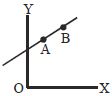
$A$ particle of mass $m$ moves in the $XY$ plane with a velocity $V$ along the straight line $AB$. If the angular momentum of the particle with respect to origin $O$ is $L_A$ when it is at $A$ and $L_B$ when it is at $B$,then
A
$L_A < L_B$
B
$L_A = L_B$
C
$L_A \ne L_B$
D
the relationship between $L_A$ and $L_B$ depends upon the slope of the line $AB$
Solution
(B) The angular momentum $L$ of a particle of mass $m$ moving with velocity $V$ relative to an origin $O$ is given by the formula $L = m \times (r \times V)$,where $r$ is the position vector of the particle.
Alternatively,the magnitude of angular momentum is given by $L = m \cdot V \cdot d$,where $d$ is the perpendicular distance from the origin $O$ to the line of motion of the particle.
Since the particle is moving along a straight line $AB$,the perpendicular distance $d$ from the origin $O$ to this line remains constant at all points on the line.
As $m$,$V$,and $d$ are all constant for the motion of the particle along the line $AB$,the angular momentum $L$ remains constant at all points on the line.
Therefore,the angular momentum at point $A$ $(L_A)$ must be equal to the angular momentum at point $B$ $(L_B)$.
Thus,$L_A = L_B$.
Alternatively,the magnitude of angular momentum is given by $L = m \cdot V \cdot d$,where $d$ is the perpendicular distance from the origin $O$ to the line of motion of the particle.
Since the particle is moving along a straight line $AB$,the perpendicular distance $d$ from the origin $O$ to this line remains constant at all points on the line.
As $m$,$V$,and $d$ are all constant for the motion of the particle along the line $AB$,the angular momentum $L$ remains constant at all points on the line.
Therefore,the angular momentum at point $A$ $(L_A)$ must be equal to the angular momentum at point $B$ $(L_B)$.
Thus,$L_A = L_B$.
0 likesView Solution
53
ChemistryMCQAIPMT · 2007
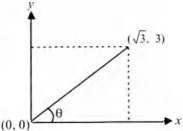
$A$ particle starting from the origin $(0, 0)$ moves in a straight line in the $(x, y)$ plane. Its coordinates at a later time are $(\sqrt{3}, 3)$. The path of the particle makes an angle of $.......^{\circ}$ with the $x$-axis.
A
$0$
B
$30$
C
$45$
D
$60$
Solution
(D) Let $\theta$ be the angle that the path of the particle makes with the $x$-axis.
From the given coordinates $(x, y) = (\sqrt{3}, 3)$,the slope of the line is given by:
$\tan \theta = \frac{y}{x} = \frac{3}{\sqrt{3}}$
Simplifying the expression:
$\tan \theta = \sqrt{3}$
Taking the inverse tangent on both sides:
$\theta = \tan^{-1}(\sqrt{3}) = 60^{\circ}$
Thus,the path of the particle makes an angle of $60^{\circ}$ with the $x$-axis.
From the given coordinates $(x, y) = (\sqrt{3}, 3)$,the slope of the line is given by:
$\tan \theta = \frac{y}{x} = \frac{3}{\sqrt{3}}$
Simplifying the expression:
$\tan \theta = \sqrt{3}$
Taking the inverse tangent on both sides:
$\theta = \tan^{-1}(\sqrt{3}) = 60^{\circ}$
Thus,the path of the particle makes an angle of $60^{\circ}$ with the $x$-axis.
0 likesView Solution
54
ChemistryMCQAIPMT · 2007
In which of the following is the hydration energy higher than the lattice energy?
A
$MgSO_4$
B
$RaSO_4$
C
$BaSO_4$
D
$SrSO_4$
Solution
(A) The solubility of ionic compounds depends on the balance between hydration energy and lattice energy.
For a compound to be soluble,the hydration energy must be greater than the lattice energy.
Hydration energy is inversely proportional to the size of the cation $(Hydration \ energy \propto \frac{1}{\text{size of cation}})$.
As we move down the group from $Mg^{2+}$ to $Ra^{2+}$,the size of the cation increases,which decreases the hydration energy.
$Mg^{2+}$ has the smallest size among the given alkaline earth metal ions,resulting in a very high hydration energy that exceeds its lattice energy,making $MgSO_4$ highly soluble in water.
For a compound to be soluble,the hydration energy must be greater than the lattice energy.
Hydration energy is inversely proportional to the size of the cation $(Hydration \ energy \propto \frac{1}{\text{size of cation}})$.
As we move down the group from $Mg^{2+}$ to $Ra^{2+}$,the size of the cation increases,which decreases the hydration energy.
$Mg^{2+}$ has the smallest size among the given alkaline earth metal ions,resulting in a very high hydration energy that exceeds its lattice energy,making $MgSO_4$ highly soluble in water.
0 likesView Solution
55
ChemistryMCQAIPMT · 2007
$A$ particle executes simple harmonic oscillation with an amplitude $a$. The period of oscillation is $T$. The minimum time taken by the particle to travel half of the amplitude from the equilibrium position is
A
$T/2$
B
$T/4$
C
$T/8$
D
$T/12$
Solution
(D) The displacement of a particle in simple harmonic motion starting from the equilibrium position is given by $x = a \sin(\omega t)$.
Given that the particle travels half of the amplitude,we set $x = a/2$.
Substituting this into the equation: $a/2 = a \sin(\omega t) \Rightarrow \sin(\omega t) = 1/2$.
Since $\sin(\pi/6) = 1/2$,we have $\omega t = \pi/6$.
Substituting $\omega = 2\pi/T$,we get $(2\pi/T) \cdot t = \pi/6$.
Solving for $t$,we find $t = T/12$.
Given that the particle travels half of the amplitude,we set $x = a/2$.
Substituting this into the equation: $a/2 = a \sin(\omega t) \Rightarrow \sin(\omega t) = 1/2$.
Since $\sin(\pi/6) = 1/2$,we have $\omega t = \pi/6$.
Substituting $\omega = 2\pi/T$,we get $(2\pi/T) \cdot t = \pi/6$.
Solving for $t$,we find $t = T/12$.
0 likesView Solution
56
ChemistryMCQAIPMT · 2007
The primary and secondary coils of a transformer have $50$ and $1500$ turns respectively. If the magnetic flux $\phi$ linked with the primary coil is given by $\phi = \phi_0 + 4t$,where $\phi$ is in webers,$t$ is time in seconds and $\phi_0$ is a constant,the output voltage across the secondary coil is.....$volts$.
A
$30$
B
$90$
C
$120$
D
$220$
Solution
(C) The induced electromotive force $(emf)$ in the primary coil is given by Faraday's law of induction: $E_P = \frac{d\phi}{dt}$.
Given $\phi = \phi_0 + 4t$,we have $E_P = \frac{d}{dt}(\phi_0 + 4t) = 4 \text{ volts}$.
For an ideal transformer,the ratio of the secondary voltage $(E_S)$ to the primary voltage $(E_P)$ is equal to the ratio of the number of turns in the secondary coil $(N_S)$ to the number of turns in the primary coil $(N_P)$: $\frac{E_S}{E_P} = \frac{N_S}{N_P}$.
Substituting the given values: $\frac{E_S}{4} = \frac{1500}{50}$.
$\frac{E_S}{4} = 30$.
Therefore,$E_S = 30 \times 4 = 120 \text{ volts}$.
Given $\phi = \phi_0 + 4t$,we have $E_P = \frac{d}{dt}(\phi_0 + 4t) = 4 \text{ volts}$.
For an ideal transformer,the ratio of the secondary voltage $(E_S)$ to the primary voltage $(E_P)$ is equal to the ratio of the number of turns in the secondary coil $(N_S)$ to the number of turns in the primary coil $(N_P)$: $\frac{E_S}{E_P} = \frac{N_S}{N_P}$.
Substituting the given values: $\frac{E_S}{4} = \frac{1500}{50}$.
$\frac{E_S}{4} = 30$.
Therefore,$E_S = 30 \times 4 = 120 \text{ volts}$.
0 likesView Solution
57
ChemistryMCQAIPMT · 2007
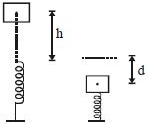
$A$ vertical spring with force constant $k$ is fixed on a table. $A$ ball of mass $m$ at a height $h$ above the free upper end of the spring falls vertically on the spring so that the spring is compressed by a distance $d$. The net work done in the process is
A
$mg(h + d) - \frac{1}{2}kd^2$
B
$mg(h - d) - \frac{1}{2}kd^2$
C
$mg(h - d) + \frac{1}{2}kd^2$
D
$mg(h + d) + \frac{1}{2}kd^2$
Solution
(A) According to the work-energy theorem,the net work done on an object is equal to the change in its kinetic energy.
In this process,the ball starts from rest at height $h$ above the spring and ends at rest after compressing the spring by distance $d$. Thus,the initial kinetic energy $K_i = 0$ and the final kinetic energy $K_f = 0$.
Therefore,the net work done $W_{net} = K_f - K_i = 0 - 0 = 0$.
Alternatively,considering the forces acting on the ball: the gravitational force does work $mg(h + d)$ and the spring force does work $-\frac{1}{2}kd^2$. The total work done is $W_{net} = mg(h + d) - \frac{1}{2}kd^2 = 0$.
In this process,the ball starts from rest at height $h$ above the spring and ends at rest after compressing the spring by distance $d$. Thus,the initial kinetic energy $K_i = 0$ and the final kinetic energy $K_f = 0$.
Therefore,the net work done $W_{net} = K_f - K_i = 0 - 0 = 0$.
Alternatively,considering the forces acting on the ball: the gravitational force does work $mg(h + d)$ and the spring force does work $-\frac{1}{2}kd^2$. The total work done is $W_{net} = mg(h + d) - \frac{1}{2}kd^2 = 0$.
0 likesView Solution
58
ChemistryMCQAIPMT · 2007
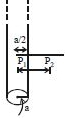
$A$ beam of electrons passes undeflected through mutually perpendicular electric and magnetic fields. If the electric field is switched off, and the same magnetic field is maintained, the electrons move
A
along a straight line
B
in an elliptical orbit
C
along a parabolic path
D
in a circular orbit
Solution
(D) When a beam of electrons passes undeflected through mutually perpendicular electric $(E)$ and magnetic $(B)$ fields, the net force on the electrons is zero. This implies that the electric force $(F_e = qE)$ is equal and opposite to the magnetic force $(F_m = qvB)$, so $qE = qvB$, or $v = E/B$.
When the electric field is switched off, only the magnetic field remains. The magnetic force acting on a moving charge in a uniform magnetic field is given by $F = q(v \times B)$.
Since the velocity vector $v$ is perpendicular to the magnetic field vector $B$, the magnetic force acts as a centripetal force, which is always perpendicular to the velocity of the electron.
$A$ constant force acting perpendicular to the velocity of a particle results in circular motion. Therefore, the electrons will move in a circular orbit.
When the electric field is switched off, only the magnetic field remains. The magnetic force acting on a moving charge in a uniform magnetic field is given by $F = q(v \times B)$.
Since the velocity vector $v$ is perpendicular to the magnetic field vector $B$, the magnetic force acts as a centripetal force, which is always perpendicular to the velocity of the electron.
$A$ constant force acting perpendicular to the velocity of a particle results in circular motion. Therefore, the electrons will move in a circular orbit.
0 likesView Solution
59
ChemistryMCQAIPMT · 2007
In a mass spectrometer used for measuring the masses of ions,the ions are initially accelerated by an electric potential $V$ and then made to describe semicircular paths of radius $R$ using a magnetic field $B$. If $V$ and $B$ are kept constant,the ratio $\left( \frac{\text{charge on the ion}}{\text{mass of the ion}} \right)$ will be proportional to
A
$\frac{1}{R}$
B
$\frac{1}{R^2}$
C
$R^2$
D
$R$
Solution
(B) The centripetal force is provided by the magnetic force.
$i.e., \frac{mv^2}{R} = qvB ......... (1)$
where $m = \text{mass of the ion}$,$v = \text{velocity}$,$q = \text{charge of ion}$,$B = \text{magnetic field flux density}$.
From $(1)$,the velocity of the ion is $v = \frac{qBR}{m}$.
The kinetic energy gained by the ion when accelerated through a potential $V$ is given by $E = qV$.
Also,$E = \frac{1}{2}mv^2$.
Equating the two expressions for energy:
$qV = \frac{1}{2}m \left( \frac{qBR}{m} \right)^2$
$qV = \frac{1}{2}m \frac{q^2 B^2 R^2}{m^2}$
$qV = \frac{q^2 B^2 R^2}{2m}$
Rearranging for the ratio $\frac{q}{m}$:
$\frac{q}{m} = \frac{2V}{B^2 R^2}$
Since $V$ and $B$ are constant,we have $\frac{q}{m} \propto \frac{1}{R^2}$.
$i.e., \frac{mv^2}{R} = qvB ......... (1)$
where $m = \text{mass of the ion}$,$v = \text{velocity}$,$q = \text{charge of ion}$,$B = \text{magnetic field flux density}$.
From $(1)$,the velocity of the ion is $v = \frac{qBR}{m}$.
The kinetic energy gained by the ion when accelerated through a potential $V$ is given by $E = qV$.
Also,$E = \frac{1}{2}mv^2$.
Equating the two expressions for energy:
$qV = \frac{1}{2}m \left( \frac{qBR}{m} \right)^2$
$qV = \frac{1}{2}m \frac{q^2 B^2 R^2}{m^2}$
$qV = \frac{q^2 B^2 R^2}{2m}$
Rearranging for the ratio $\frac{q}{m}$:
$\frac{q}{m} = \frac{2V}{B^2 R^2}$
Since $V$ and $B$ are constant,we have $\frac{q}{m} \propto \frac{1}{R^2}$.
0 likesView Solution
60
ChemistryMCQAIPMT · 2007
$ICBN$ stands for
A
International Code of Botanical Nomenclature
B
International Congress of Biological Names
C
Indian Code of Botanical Nomenclature
D
Indian Congress of Biological Names
Solution
(A) $ICBN$ stands for International Code of Botanical Nomenclature.
It is a set of rules and recommendations dealing with the formal botanical names that are given to plants.
This code is independent of zoological and bacteriological nomenclature.
The foundations of $ICBN$ were laid in the book $Philosophia$ $Botanica$,written by $C. Linnaeus$.
It is a set of rules and recommendations dealing with the formal botanical names that are given to plants.
This code is independent of zoological and bacteriological nomenclature.
The foundations of $ICBN$ were laid in the book $Philosophia$ $Botanica$,written by $C. Linnaeus$.
0 likesView Solution
61
ChemistryMCQAIPMT · 2007
$ICBN$ stands for
A
International Code of Botanical Nomenclature
B
International Congress of Biological Names
C
Indian Code of Botanical Nomenclature
D
Indian Congress of Biological Names
Solution
(A) $ICBN$ stands for International Code of Botanical Nomenclature.
It is a set of rules and recommendations dealing with the formal botanical names that are given to plants.
This code is independent of zoological and bacteriological nomenclature.
The foundations of $ICBN$ were established in the book $Philosophia$ $Botanica$,written by $C. Linnaeus$.
It is a set of rules and recommendations dealing with the formal botanical names that are given to plants.
This code is independent of zoological and bacteriological nomenclature.
The foundations of $ICBN$ were established in the book $Philosophia$ $Botanica$,written by $C. Linnaeus$.
0 likesView Solution
62
ChemistryMCQAIPMT · 2007
What is common between parrot,Platypus and kangaroo?
A
Homeothermy
B
Toothless jaws
C
Functional post-anal tail
D
Oviparity
Solution
(A) Parrots are birds $(Aves)$,while platypus and kangaroos are mammals $(Mammalia)$. All three of these organisms are homeothermic,meaning they are warm-blooded animals capable of maintaining a constant body temperature regardless of the environmental temperature.
0 likesView Solution
63
ChemistryMCQAIPMT · 2007
Passage cells are thin-walled cells found in
A
Endodermis of roots facilitating rapid transport of water from cortex to pericycle
B
Phloem elements that serve as entry points for substances for transport to other plant parts
C
Testa of seeds to enable emergence of growing embryonic axis during seed germination
D
Central region of style through which the pollen tube grow towards the ovary
Solution
(A) In roots,the endodermis is the innermost layer of the cortex.
Some of the endodermal cells present opposite to the xylem patches are thin-walled and are called passage cells or transfusion cells.
Passage cells facilitate the transfer of water and dissolved minerals from the cortex directly into the xylem and ultimately to the pericycle.
Some of the endodermal cells present opposite to the xylem patches are thin-walled and are called passage cells or transfusion cells.
Passage cells facilitate the transfer of water and dissolved minerals from the cortex directly into the xylem and ultimately to the pericycle.
0 likesView Solution
64
ChemistryMCQAIPMT · 2007
The overall goal of glycolysis,Krebs' cycle,and the electron transport system is the formation of
A
$ATP$ in small stepwise units
B
$ATP$ in one large oxidation reaction
C
Sugars
D
Nucleic acids
Solution
(A) Glycolysis,Krebs' cycle,and the electron transport system are metabolic pathways designed for the synthesis of $ATP$ through a series of controlled,stepwise reactions.
$ATP$ serves as the primary energy currency of the cell,providing the necessary energy for various biological processes.
$ATP$ serves as the primary energy currency of the cell,providing the necessary energy for various biological processes.
0 likesView Solution
65
ChemistryMCQAIPMT · 2007
Opening of floral buds into flowers is a type of
A
Autonomic movement of locomotion
B
Autonomic movement of variation
C
Paratonic movement of growth
D
Autonomic movement of growth
Solution
(D) Opening of floral buds into flowers is a type of autonomic movement of growth,specifically known as epinasty or hyponasty (a type of nastic movement).
This is a non-directional movement where the response is determined by the internal physiology of the responsive organ rather than the direction of the external stimulus.
Differential growth rates on the inner and outer surfaces of the floral parts cause the bud to open.
This is a non-directional movement where the response is determined by the internal physiology of the responsive organ rather than the direction of the external stimulus.
Differential growth rates on the inner and outer surfaces of the floral parts cause the bud to open.
0 likesView Solution
66
ChemistryMCQAIPMT · 2007
Which one of the following items gives its correct total number?
A
Floating ribs in humans $-4$
B
Amino acids found in proteins $-16$
C
Types of diabetes $-3$
D
Cervical vertebrae in humans $-8$
Solution
(A) In humans,there are $12$ pairs of ribs that form the bony lateral walls of the thoracic cage.
The first $7$ pairs are true ribs,the next $3$ pairs are false ribs,and the last $2$ pairs ($4$ ribs in total) are called floating ribs.
Floating ribs are called so because their anterior ends are not attached to the sternum or the cartilage of any other rib.
Therefore,the total number of floating ribs in humans is $4$.
The first $7$ pairs are true ribs,the next $3$ pairs are false ribs,and the last $2$ pairs ($4$ ribs in total) are called floating ribs.
Floating ribs are called so because their anterior ends are not attached to the sternum or the cartilage of any other rib.
Therefore,the total number of floating ribs in humans is $4$.
0 likesView Solution
67
ChemistryMCQAIPMT · 2007
$A$ person is having problems with calcium and phosphorus metabolism in his body. Which one of the following glands may not be functioning properly?
A
Parathyroid
B
Parotid
C
Pancreas
D
Thyroid
Solution
(A) The $Parathyroid$ gland secretes $Parathyroid$ $Hormone$ $(PTH)$,which is a peptide hormone that plays a crucial role in regulating calcium and phosphorus levels in the blood.
$PTH$ increases the level of calcium ions in the blood by stimulating bone resorption (demineralization),increasing calcium reabsorption by the renal tubules,and promoting calcium absorption from digested food in the intestine.
It also decreases the blood phosphorus level by increasing the excretion of phosphorus in the urine.
Therefore,any dysfunction in the $Parathyroid$ gland directly impacts calcium and phosphorus metabolism.
$PTH$ increases the level of calcium ions in the blood by stimulating bone resorption (demineralization),increasing calcium reabsorption by the renal tubules,and promoting calcium absorption from digested food in the intestine.
It also decreases the blood phosphorus level by increasing the excretion of phosphorus in the urine.
Therefore,any dysfunction in the $Parathyroid$ gland directly impacts calcium and phosphorus metabolism.
0 likesView Solution
68
ChemistryMCQAIPMT · 2007
Feeling the tremors of an earthquake,a scared resident of the seventh floor of a multistoreyed building starts climbing down the stairs rapidly. Which hormone initiates this action?
A
Thyroxine
B
Adrenaline
C
Glucagon
D
Gastrin
Solution
(B) When a person experiences a stressful situation like an earthquake,the body's 'fight-or-flight' response is activated.
This response is primarily mediated by the hormone $Adrenaline$ (also known as $Epinephrine$),which is secreted by the adrenal medulla.
$Adrenaline$ prepares the body for immediate physical action by increasing the heart rate,dilating the pupils,and mobilizing energy reserves,allowing the person to react quickly to the danger.
This response is primarily mediated by the hormone $Adrenaline$ (also known as $Epinephrine$),which is secreted by the adrenal medulla.
$Adrenaline$ prepares the body for immediate physical action by increasing the heart rate,dilating the pupils,and mobilizing energy reserves,allowing the person to react quickly to the danger.
0 likesView Solution
69
ChemistryMCQAIPMT · 2007
Inheritance of skin colour in human is an example of
A
Chromosomal aberration
B
Codominance
C
Point mutation
D
Polygenic inheritance
Solution
(D) The genes which individually have a small effect but collectively produce significant phenotypic expression are called polygenes.
The inheritance of these genes is called polygenic inheritance,$e.g.,$ skin colour in humans.
The inheritance of these genes is called polygenic inheritance,$e.g.,$ skin colour in humans.
0 likesView Solution
70
ChemistryMCQAIPMT · 2007
When two species of different genealogy come to resemble each other as a result of adaptation,the phenomenon is termed as
A
Divergent evolution
B
Micro-evolution
C
Co-evolution
D
Convergent evolution
Solution
(D) In convergent evolution,organisms from different ancestral lineages evolve similar traits or morphological features due to adaptation to similar environmental pressures or ecological niches. This process leads to analogous structures,such as the wings of butterflies and birds.
0 likesView Solution
71
ChemistryMCQAIPMT · 2007
The concept of chemical evolution is based on
A
Crystallization of chemicals
B
Interaction of water,air and clay under intense heat
C
Effect of solar radiation on chemicals
D
Possible origin of life by combination of chemicals under suitable environmental conditions
Solution
(D) The concept of chemical evolution,often referred to as the Oparin-Haldane hypothesis,suggests that life originated from non-living organic molecules. It proposes that the primitive Earth's atmosphere,which was reducing in nature,allowed for the synthesis of simple organic compounds from inorganic precursors through the influence of energy sources like lightning and solar radiation. These molecules eventually aggregated to form more complex structures,leading to the origin of life under suitable environmental conditions.
0 likesView Solution
72
ChemistryMCQAIPMT · 2007
The population of an insect species shows an explosive increase in numbers during the rainy season,followed by its disappearance at the end of the season. What does this show?
A
$S$-shaped or sigmoid growth of this insect
B
The food plants mature and die at the end of the rainy season
C
Its population growth curve is of $J$-type
D
The population of its predators increases enormously
Solution
(C) The population growth curve is $J$-shaped,which is characteristic of exponential growth. In this type of growth,the population density increases rapidly in an exponential fashion when resources are abundant. The population then stops abruptly or crashes when environmental resistance or limiting factors (such as the end of the rainy season) become effective suddenly.
0 likesView Solution
73
ChemistryMCQAIPMT · 2007
One of the endangered species of Indian medicinal plants is
A
Podophyllum
B
Ocimum
C
Garlic
D
Nepenthes
Solution
(A) $Podophyllum$ is an endangered Indian medicinal plant. Its dried roots and rhizomes are used in the treatment of chronic constipation and tumorous growths.
0 likesView Solution
74
ChemistryMCQAIPMT · 2007
Which one of the following pairs of organisms are exotic species introduced in India?
A
Ficus religiosa, Lantana camara
B
Lantana camara, water hyacinth
C
Water hyacinth, Prosopis cineraria
D
Nile perch, Ficus religiosa
Solution
(B) An exotic species is an organism that is not native to a particular locality and has been introduced there by human activities or other agents.
In the context of India, $Lantana$ $camara$ and water hyacinth $(Eichhornia$ $crassipes)$ are classic examples of invasive exotic species that have caused significant ecological damage.
$Ficus$ $religiosa$ (Peepal) and $Prosopis$ $cineraria$ (Khejri) are native species to India.
Therefore, the correct pair is $Lantana$ $camara$ and water hyacinth.
In the context of India, $Lantana$ $camara$ and water hyacinth $(Eichhornia$ $crassipes)$ are classic examples of invasive exotic species that have caused significant ecological damage.
$Ficus$ $religiosa$ (Peepal) and $Prosopis$ $cineraria$ (Khejri) are native species to India.
Therefore, the correct pair is $Lantana$ $camara$ and water hyacinth.
0 likesView Solution
75
ChemistryMCQAIPMT · 2007
Which one of the following is not a bioindicator of water pollution?
A
Sludge worms
B
Blood worms
C
Stone flies
D
Sewage fungus
Solution
(C) Bioindicators are organisms used to monitor the health of an environment. Sludge worms,blood worms,and sewage fungus are commonly used as indicators of organic water pollution. Stoneflies (order-Plecoptera) are generally sensitive to pollution and are often used as indicators of clean,well-oxygenated water,but they are not considered bioindicators of water pollution in the context of indicating the presence of pollutants like sewage or organic waste; rather,their absence indicates pollution.
0 likesView Solution
Vedclass Products
For Students
Vedclass Test Series
Mock tests in real AIPMT style covering Chemistry with performance analysis. 5-day free trial.
Start Free TrialFor Teachers
Exam Paper Generator
Generate Set A/B/C/D Chemistry papers from 7.5L+ questions in 2 minutes. 3 chapters free.
Try FreeFor Institutes
Online Exam Module
Run live AIPMT mock exams with unlimited students, 360° analytics & white-label branding.
See DemoFrequently Asked Questions
How many Chemistry questions are in AIPMT 2007?
There are 102 Chemistry questions from the AIPMT 2007 paper on Vedclass, each with a detailed step-by-step solution in English.
Are AIPMT 2007 Chemistry solutions available in English?
Yes. All solutions on this page are in English. You can also switch to English or Hindi using the language buttons above the questions.
Can I practice AIPMT 2007 Chemistry as a timed test?
Yes. Use the Vedclass Test Series to attempt a full AIPMT mock test covering Chemistry with time limits and instant score analysis.
Can teachers create Chemistry papers from AIPMT previous year questions?
Yes. The Vedclass Exam Paper Generator lets teachers mix AIPMT Chemistry questions and generate Set A/B/C/D papers in minutes.
For Teachers & Institutes
Build a Custom Chemistry Paper
Pick AIPMT 2007 Chemistry questions, set difficulty, and generate Set A/B/C/D in 2 minutes.