
BiologyQ51–109 of 159 questions
Page 2 of 2 · English
51
BiologyMediumMCQAIIMS · 2019
How many pyruvate molecules are produced by the oxidation of $1$ glucose molecule?
A
Two
B
Three
C
One
D
Four
Solution
(A) One molecule of glucose $(C_6H_{12}O_6)$ undergoes glycolysis in the cytoplasm.
During this process,the $6$-carbon glucose molecule is broken down into two molecules of $3$-carbon pyruvic acid (pyruvate).
Therefore,the oxidation of $1$ glucose molecule yields $2$ molecules of pyruvate.
During this process,the $6$-carbon glucose molecule is broken down into two molecules of $3$-carbon pyruvic acid (pyruvate).
Therefore,the oxidation of $1$ glucose molecule yields $2$ molecules of pyruvate.
0 likesView Solution
52
BiologyMediumMCQAIIMS · 2019
Amylopectin is:
A
insoluble in $H_{2}O$ and has $\alpha-1,4$ and $\alpha-1,6$ glycosidic bonds
B
soluble in $H_{2}O$ and has $\alpha-1,4$ and $\alpha-1,6$ glycosidic bonds
C
soluble in $H_{2}O$ and has $\alpha-1,6$ glycosidic bonds
D
soluble in $H_{2}O$ and has $\alpha-1,4$ glycosidic bonds
Solution
(A) Amylopectin is a major component of starch,which is a branched-chain polysaccharide.
It consists of a long chain of glucose units linked by $\alpha-1,4$ glycosidic bonds,with branches occurring at intervals due to $\alpha-1,6$ glycosidic bonds.
Due to its highly branched and complex structure,amylopectin is insoluble in water.
Therefore,the correct description is that it is insoluble in $H_{2}O$ and contains both $\alpha-1,4$ and $\alpha-1,6$ glycosidic bonds.
It consists of a long chain of glucose units linked by $\alpha-1,4$ glycosidic bonds,with branches occurring at intervals due to $\alpha-1,6$ glycosidic bonds.
Due to its highly branched and complex structure,amylopectin is insoluble in water.
Therefore,the correct description is that it is insoluble in $H_{2}O$ and contains both $\alpha-1,4$ and $\alpha-1,6$ glycosidic bonds.
0 likesView Solution
53
BiologyMediumMCQAIIMS · 2019
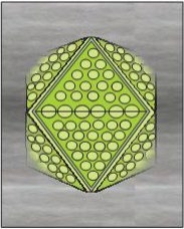
The given diagram shows an Adenovirus. Choose the correct option regarding it.
A
Adenovirus - Cause of respiratory disease
B
Bacteriophage - Tobacco mosaic disease
C
Viroid - Potato spindle tumor disease
D
Prion - Alzheimer's disease
Solution
(A) The provided diagram represents an Adenovirus. Adenoviruses are a group of viruses that typically cause respiratory infections,such as the common cold,conjunctivitis,or bronchitis. Therefore,option $A$ is the correct statement.
0 likesView Solution
54
BiologyMediumMCQAIIMS · 2019
In cockroach,which of the following statements is correct regarding the phallic gland?
A
Ejaculatory duct opens in phallic gland
B
Phallic gland stores sperms
C
Vas deferens opens in phallic gland
D
Phallic gland opens in left phallomere
Solution
(D) In male cockroaches,the reproductive system includes a mushroom-shaped gland (also known as the utricular gland). The phallic gland (or conglobate gland) is a long,sac-like structure that opens into the genital chamber through a separate aperture located near the left phallomere. Therefore,the phallic gland opens in the left phallomere.
0 likesView Solution
55
BiologyEasyMCQAIIMS · 2019
Which fat-soluble vitamin is necessary for blood clotting?
A
$A$
B
$D$
C
$E$
D
$K$
Solution
(D) The fat-soluble vitamin required for the clotting of blood is vitamin $K$.
This vitamin plays a crucial role in the synthesis of proteins needed for blood coagulation,thereby preventing excessive bleeding.
It is naturally found in green leafy vegetables,broccoli,cauliflower,liver,and eggs.
This vitamin plays a crucial role in the synthesis of proteins needed for blood coagulation,thereby preventing excessive bleeding.
It is naturally found in green leafy vegetables,broccoli,cauliflower,liver,and eggs.
0 likesView Solution
56
BiologyMediumMCQAIIMS · 2019
Choose the correct option representing the organisms belonging to their respective classes.
A
Amphibia: Frog,Salamander,Bufo,Ichthyophis
B
Reptiles: Lizard,Turtle,Hyla,Ichthyophis
C
Birds: Pigeon,Parrot,Balaenoptera,Flying fox
D
Arthropods: Apis,Ancylostoma,Laccifer,Nereis
Solution
(A) The correct option is $A$.
$1$. Amphibia includes animals like Frog (Rana),Salamander,Bufo (Toad),and Ichthyophis (limbless amphibian).
$2$. Option $B$ is incorrect because Hyla is an amphibian,not a reptile.
$3$. Option $C$ is incorrect because Balaenoptera (Blue whale) and Flying fox (Pteropus) are mammals,not birds.
$4$. Option $D$ is incorrect because Ancylostoma (hookworm) is an Aschelminthes and Nereis is an Annelid,not Arthropods.
$1$. Amphibia includes animals like Frog (Rana),Salamander,Bufo (Toad),and Ichthyophis (limbless amphibian).
$2$. Option $B$ is incorrect because Hyla is an amphibian,not a reptile.
$3$. Option $C$ is incorrect because Balaenoptera (Blue whale) and Flying fox (Pteropus) are mammals,not birds.
$4$. Option $D$ is incorrect because Ancylostoma (hookworm) is an Aschelminthes and Nereis is an Annelid,not Arthropods.
0 likesView Solution
57
BiologyMediumMCQAIIMS · 2019
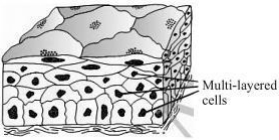
Identify the diagram and its related function.
A
Simple cuboidal epithelium - Diffusion
B
Simple squamous epithelium - Secretion and absorption
C
Compound epithelium - Protection
D
Compound epithelium - Diffusion
Solution
(C) The provided diagram shows a tissue composed of multiple layers of cells,which is characteristic of compound epithelium.
Compound epithelium is made of more than one layer (multi-layered) of cells and thus has a limited role in secretion and absorption.
Its main function is to provide protection against chemical and mechanical stresses.
Compound epithelium is made of more than one layer (multi-layered) of cells and thus has a limited role in secretion and absorption.
Its main function is to provide protection against chemical and mechanical stresses.
0 likesView Solution
58
BiologyMediumMCQAIIMS · 2019
Acidic $pH$ of muscles is due to -
A
Lactic acid
B
$CO_{2}$
C
Arginine
D
Ketones
Solution
(A) When oxygen is present in limiting conditions,the breakdown of glucose or glycogen occurs via anaerobic respiration.
This process leads to the production of lactic acid in the muscle cells.
The accumulation of lactic acid increases the concentration of hydrogen ions,which causes the $pH$ of the muscles to become acidic.
This process leads to the production of lactic acid in the muscle cells.
The accumulation of lactic acid increases the concentration of hydrogen ions,which causes the $pH$ of the muscles to become acidic.
0 likesView Solution
59
BiologyMediumMCQAIIMS · 2019
Glucose on reacting with Benedict's solution may give the following precipitates except:
A
Violet precipitate
B
Orange red precipitate
C
Brick red precipitate
D
Green/yellow precipitate
Solution
(A) Benedict's solution is a chemical reagent used to test for the presence of reducing sugars like glucose.
When glucose reacts with Benedict's solution,it reduces the copper$(II)$ ions $(Cu^{2+})$ to copper$(I)$ oxide $(Cu_2O)$.
The color of the precipitate depends on the concentration of the reducing sugar present.
- $A$ green precipitate indicates a low concentration of reducing sugar.
- $A$ yellow to orange precipitate indicates a moderate concentration.
- $A$ brick-red precipitate indicates a high concentration of reducing sugar.
- $A$ violet precipitate is not formed in this reaction; it is characteristic of the Biuret test for proteins.
When glucose reacts with Benedict's solution,it reduces the copper$(II)$ ions $(Cu^{2+})$ to copper$(I)$ oxide $(Cu_2O)$.
The color of the precipitate depends on the concentration of the reducing sugar present.
- $A$ green precipitate indicates a low concentration of reducing sugar.
- $A$ yellow to orange precipitate indicates a moderate concentration.
- $A$ brick-red precipitate indicates a high concentration of reducing sugar.
- $A$ violet precipitate is not formed in this reaction; it is characteristic of the Biuret test for proteins.
0 likesView Solution
60
BiologyMediumMCQAIIMS · 2019
Blood circulation in earthworm is:
A
Closed type
B
Open type
C
Hemoglobin is present in $RBC$
D
Oxygen not transported by blood
Solution
(A) The earthworm possesses a closed circulatory system.
In this type of circulation,the blood is confined within blood vessels and does not come into direct contact with the body tissues.
Therefore,the correct answer is $A$ (Closed type).
In this type of circulation,the blood is confined within blood vessels and does not come into direct contact with the body tissues.
Therefore,the correct answer is $A$ (Closed type).
0 likesView Solution
61
BiologyMediumMCQAIIMS · 2019
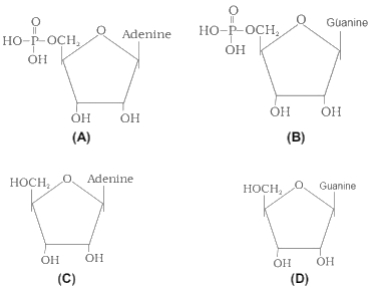
Which two are nucleotides?
A
$A \& B$
B
$C \& D$
C
$A \& D$
D
$B \& C$
Solution
(A) nucleotide consists of three components: a nitrogenous base,a pentose sugar,and a phosphate group.
In the provided image,structures $(A)$ and $(B)$ contain a phosphate group attached to the sugar-base complex,making them nucleotides.
Structures $(C)$ and $(D)$ lack the phosphate group and are therefore nucleosides.
Thus,$(A)$ and $(B)$ are the correct nucleotides.
In the provided image,structures $(A)$ and $(B)$ contain a phosphate group attached to the sugar-base complex,making them nucleotides.
Structures $(C)$ and $(D)$ lack the phosphate group and are therefore nucleosides.
Thus,$(A)$ and $(B)$ are the correct nucleotides.
0 likesView Solution
62
BiologyMediumMCQAIIMS · 2019
Myosin head separates from actin when:
A
$ATP$ hydrolysis
B
When $ATP$ releases from Actin
C
When $ATP$ releases from myosin head
D
When $ATP$ attached to myosin head
Solution
(D) During the muscle contraction cycle,the myosin head remains bound to the actin filament in a cross-bridge state. When a new molecule of $ATP$ binds to the myosin head,the affinity of the myosin head for actin decreases significantly. Consequently,the myosin head detaches from the actin filament. Therefore,the separation occurs when $ATP$ attaches to the myosin head.
0 likesView Solution
63
BiologyMediumMCQAIIMS · 2019
What is the position of the testis in Periplaneta americana?
A
$7^{\text{th}}, 8^{\text{th}}, 9^{\text{th}}$ abdominal segments
B
$5^{\text{th}}, 6^{\text{th}}$ abdominal segments
C
$8^{\text{th}}, 9^{\text{th}}, 10^{\text{th}}$ abdominal segments
D
$4^{\text{th}}, 5^{\text{th}}, 6^{\text{th}}$ abdominal segments
Solution
(D) Periplaneta americana,commonly known as the American cockroach,is a well-studied insect.
In the male reproductive system of Periplaneta americana,a pair of testes is present.
These testes are located on the lateral sides in the $4^{\text{th}}$ to $6^{\text{th}}$ abdominal segments.
Therefore,the correct position is the $4^{\text{th}}, 5^{\text{th}},$ and $6^{\text{th}}$ abdominal segments.
In the male reproductive system of Periplaneta americana,a pair of testes is present.
These testes are located on the lateral sides in the $4^{\text{th}}$ to $6^{\text{th}}$ abdominal segments.
Therefore,the correct position is the $4^{\text{th}}, 5^{\text{th}},$ and $6^{\text{th}}$ abdominal segments.
0 likesView Solution
64
BiologyMediumMCQAIIMS · 2019
Activity of phagocytosis occurs through
A
Neutrophils and monocytes
B
Basophils and monocytes
C
Eosinophils and monocytes
D
Lymphocytes and neutrophils
Solution
(A) Phagocytosis is a cellular process where specialized cells engulf and digest pathogens or debris. In the human immune system,$Neutrophils$ and $Monocytes$ are the primary phagocytic white blood cells. $Neutrophils$ are the most abundant leukocytes and act as the first line of defense,while $Monocytes$ differentiate into macrophages to perform phagocytosis.
0 likesView Solution
65
BiologyMediumMCQAIIMS · 2019
Choose the incorrect statement regarding the autonomic nervous system.
A
Acts on skeletal muscles.
B
Acts on smooth muscles.
C
Consists of ganglia formed by pre- and post-ganglionic neurons.
D
Consists of sympathetic and parasympathetic nervous systems.
Solution
(A) The autonomic nervous system $(ANS)$ is a part of the peripheral nervous system that transmits impulses from the $CNS$ to involuntary organs and smooth muscles of the body.
It does not act on skeletal muscles,as skeletal muscles are controlled by the somatic nervous system.
It is classified into the sympathetic and parasympathetic nervous systems.
Therefore,the statement that it acts on skeletal muscles is incorrect.
It does not act on skeletal muscles,as skeletal muscles are controlled by the somatic nervous system.
It is classified into the sympathetic and parasympathetic nervous systems.
Therefore,the statement that it acts on skeletal muscles is incorrect.
0 likesView Solution
66
BiologyEasyMCQAIIMS · 2019
Which of the following linkage is found in sucrose?
A
$1-2$ glycosidic linkage
B
$1-4$ glycosidic linkage
C
$1-3$ glycosidic linkage
D
$1-1$ glycosidic linkage
Solution
(A) Sucrose is a disaccharide composed of two monosaccharides: glucose and fructose.
In sucrose,the glycosidic bond is formed between the $C-1$ of $\alpha$-$D$-glucose and the $C-2$ of $\beta$-$D$-fructose.
This specific linkage is known as an $\alpha, \beta-1,2$-glycosidic linkage.
In sucrose,the glycosidic bond is formed between the $C-1$ of $\alpha$-$D$-glucose and the $C-2$ of $\beta$-$D$-fructose.
This specific linkage is known as an $\alpha, \beta-1,2$-glycosidic linkage.
0 likesView Solution
67
BiologyMediumMCQAIIMS · 2019
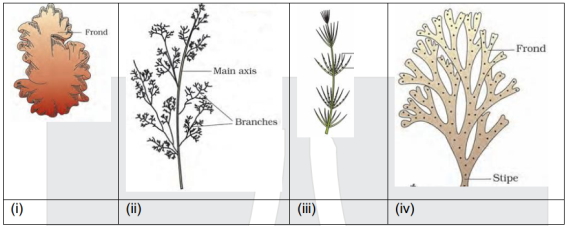
Identify the diagrams shown below:
A
$(i)$ - Porphyra,$(ii)$ - Polysiphonia,$(iii)$ - Chara,$(iv)$ - Dictyota
B
$(i)$ - Polysiphonia,$(ii)$ - Porphyra,$(iii)$ - Chara,$(iv)$ - Ectocarpus
C
$(i)$ - Laminaria,$(ii)$ - Polysiphonia,$(iii)$ - Chlamydomonas,$(iv)$ - Fucus
D
$(i)$ - Dictyota,$(ii)$ - Polysiphonia,$(iii)$ - Chara,$(iv)$ - Porphyra
Solution
(A) Based on the provided diagrams from the $NCERT$ textbook:
$(i)$ represents $Porphyra$,which is a red alga with a leafy thallus.
$(ii)$ represents $Polysiphonia$,which is a filamentous red alga.
$(iii)$ represents $Chara$,a green alga that shows a complex,plant-like structure.
$(iv)$ represents $Dictyota$,a brown alga characterized by a flattened,dichotomously branched thallus.
Therefore,the correct sequence is $(i) - Porphyra, (ii) - Polysiphonia, (iii) - Chara, (iv) - Dictyota$.
$(i)$ represents $Porphyra$,which is a red alga with a leafy thallus.
$(ii)$ represents $Polysiphonia$,which is a filamentous red alga.
$(iii)$ represents $Chara$,a green alga that shows a complex,plant-like structure.
$(iv)$ represents $Dictyota$,a brown alga characterized by a flattened,dichotomously branched thallus.
Therefore,the correct sequence is $(i) - Porphyra, (ii) - Polysiphonia, (iii) - Chara, (iv) - Dictyota$.
0 likesView Solution
68
BiologyMediumMCQAIIMS · 2019
Which hormone inhibits morphogenesis?
A
$ABA$
B
$2,4-D$
C
Jasmonic acid
D
$IBA$
Solution
(A) $ABA$ (Abscisic acid) is a plant hormone that primarily functions as a growth inhibitor.
It plays a crucial role in inhibiting morphogenesis,which is the biological process that causes an organism to develop its shape.
It plays a crucial role in inhibiting morphogenesis,which is the biological process that causes an organism to develop its shape.
0 likesView Solution
69
BiologyMediumMCQAIIMS · 2019
Which hormone increases shoot growth in callus culture?
A
Cytokinin
B
Auxin
C
Gibberellin
D
$ABA$
Solution
(A) In plant tissue culture,the ratio of phytohormones determines the differentiation of the callus.
Cytokinins are responsible for promoting shoot development and cell division (cytokinesis) in the callus.
While Auxins promote root development,a higher concentration of Cytokinin relative to Auxin induces shoot formation.
Cytokinins are responsible for promoting shoot development and cell division (cytokinesis) in the callus.
While Auxins promote root development,a higher concentration of Cytokinin relative to Auxin induces shoot formation.
0 likesView Solution
70
BiologyMediumMCQAIIMS · 2019
Match the following:
| Column-$I$ | Column-$II$ |
|---|---|
| $(i)$ Tap root | $(a)$ Sweet potato |
| $(ii)$ Adventitious root | $(b)$ Turnip |
| $(iii)$ Stem | $(c)$ Wheat |
| $(iv)$ Fibrous root | $(d)$ Potato |
A
$(i)-a, (ii)-b, (iii)-c, (iv)-d$
B
$(i)-b, (ii)-c, (iii)-a, (iv)-d$
C
$(i)-b, (ii)-a, (iii)-d, (iv)-c$
D
$(i)-d, (ii)-c, (iii)-b, (iv)-a$
Solution
(C) $(i)$ Tap root: Turnip $(b)$ - Tap roots are primary roots that grow downwards and are modified for food storage in plants like turnip.
$(ii)$ Adventitious root: Sweet potato $(a)$ - Adventitious roots arise from parts of the plant other than the radicle,such as in sweet potato.
$(iii)$ Stem: Potato $(d)$ - Potato is a modified underground stem (tuber) used for food storage.
$(iv)$ Fibrous root: Wheat $(c)$ - Fibrous root systems consist of a network of thin,moderately branching roots,commonly found in monocots like wheat.
Therefore,the correct matching is $(i)-b, (ii)-a, (iii)-d, (iv)-c$.
$(ii)$ Adventitious root: Sweet potato $(a)$ - Adventitious roots arise from parts of the plant other than the radicle,such as in sweet potato.
$(iii)$ Stem: Potato $(d)$ - Potato is a modified underground stem (tuber) used for food storage.
$(iv)$ Fibrous root: Wheat $(c)$ - Fibrous root systems consist of a network of thin,moderately branching roots,commonly found in monocots like wheat.
Therefore,the correct matching is $(i)-b, (ii)-a, (iii)-d, (iv)-c$.
0 likesView Solution
71
BiologyEasyMCQAIIMS · 2019
Which of the following statements is correct?
A
Mycoplasma is the smallest and wall-less living organism.
B
Influenza and herpes are caused by viruses having both $DNA$ and $RNA$.
C
Nostoc and Anabaena are important decomposers.
D
Methanogens are methane-producing bacteria found in wheat crops.
Solution
(A) Mycoplasma is the smallest known living microorganism and it completely lacks a cell wall around its plasma membrane. Other options are incorrect because: Influenza and herpes viruses contain either $DNA$ or $RNA$,not both. Nostoc and Anabaena are cyanobacteria (autotrophs),not decomposers. Methanogens are found in the gut of ruminants and in marshy areas,not in wheat crops.
0 likesView Solution
72
BiologyMediumMCQAIIMS · 2019
Match the Column-$I$ and Column-$II$:
| Column-$I$ | Column-$II$ |
| $(i)$ Agaricus | $(a)$ Ascomycetes |
| $(ii)$ Colletotrichum | $(b)$ Deuteromycetes |
| $(iii)$ Albugo | $(c)$ Phycomycetes |
| $(iv)$ Neurospora | $(d)$ Basidiomycetes |
A
$i-b, ii-a, iii-c, iv-d$
B
$i-a, ii-b, iii-d, iv-c$
C
$i-c, ii-b, iii-d, iv-a$
D
$i-d, ii-b, iii-c, iv-a$
Solution
(D) The correct classification of the given fungi is as follows:
$(i)$ Agaricus is a member of the class Basidiomycetes.
$(ii)$ Colletotrichum belongs to the class Deuteromycetes.
$(iii)$ Albugo belongs to the class Phycomycetes.
$(iv)$ Neurospora belongs to the class Ascomycetes.
Therefore, the correct matching is $(i-d, ii-b, iii-c, iv-a)$.
$(i)$ Agaricus is a member of the class Basidiomycetes.
$(ii)$ Colletotrichum belongs to the class Deuteromycetes.
$(iii)$ Albugo belongs to the class Phycomycetes.
$(iv)$ Neurospora belongs to the class Ascomycetes.
Therefore, the correct matching is $(i-d, ii-b, iii-c, iv-a)$.
0 likesView Solution
73
BiologyMediumMCQAIIMS · 2019
Match the Column-$I$ and Column-$II$:
| Column-$I$ | Column-$II$ |
|---|---|
| $(i)$ Viroid | $(a)$ Ramachandran |
| $(ii)$ Cell | $(b)$ Leeuwenhoek |
| $(iii)$ Virus | $(c)$ $T.O. Diener$ |
| $(iv)$ Triple helical structure of collagen | $(d)$ Ivanowsky |
A
$(i)-(c), (ii)-(b), (iii)-(d), (iv)-(a)$
B
$(i)-(a), (ii)-(b), (iii)-(c), (iv)-(d)$
C
$(i)-(d), (ii)-(c), (iii)-(b), (iv)-(a)$
D
$(i)-(c), (ii)-(d), (iii)-(b), (iv)-(a)$
Solution
(A) $(i)$ Viroid was discovered by $T.O. Diener$ in $1971$.
$(ii)$ The first living cell was observed and described by $Antonie van Leeuwenhoek$.
$(iii)$ Virus was discovered by $D.J. Ivanowsky$ in $1892$ while studying tobacco mosaic disease.
$(iv)$ The triple helical structure of collagen was proposed by $G.N. Ramachandran$.
Therefore, the correct matching is $(i)-(c), (ii)-(b), (iii)-(d), (iv)-(a)$.
$(ii)$ The first living cell was observed and described by $Antonie van Leeuwenhoek$.
$(iii)$ Virus was discovered by $D.J. Ivanowsky$ in $1892$ while studying tobacco mosaic disease.
$(iv)$ The triple helical structure of collagen was proposed by $G.N. Ramachandran$.
Therefore, the correct matching is $(i)-(c), (ii)-(b), (iii)-(d), (iv)-(a)$.
0 likesView Solution
74
BiologyDifficultMCQAIIMS · 2019
Which of the following is not found in maize seed?
A
Coleorhiza
B
Coleoptile
C
Scutellum
D
Perisperm
Solution
(D) The $Perisperm$ is the persistent nucellus that surrounds the embryo in some seeds. In maize $(Zea \, mays)$, the seed is endospermic, but it does not contain $Perisperm$. $Coleorhiza$, $Coleoptile$, and $Scutellum$ are all characteristic structures found in the monocotyledonous embryo of maize.
0 likesView Solution
75
BiologyMediumMCQAIIMS · 2019
What product is formed when $NH_{4}^{+}$ reacts with $\alpha$-ketoglutaric acid?
A
Glutamate
B
Fumarate
C
Pyruvate
D
Glutamine
Solution
(A) When $\alpha$-ketoglutaric acid reacts with $NH_{4}^{+}$ (ammonium ion) in the presence of the enzyme glutamate dehydrogenase,it undergoes reductive amination to form glutamate.
This process is a key step in the assimilation of ammonia in plants,where inorganic nitrogen is converted into organic nitrogen.
This process is a key step in the assimilation of ammonia in plants,where inorganic nitrogen is converted into organic nitrogen.
0 likesView Solution
76
BiologyMediumMCQAIIMS · 2019
Match the Column-$I$ and Column-$II$:
| Column-$I$ | Column-$II$ |
| $(i)$ Chrysophyta | $(a)$ Fungi |
| $(ii)$ Gonyaulax | $(b)$ Diatom |
| $(iii)$ Penicillium | $(c)$ Plasmodium |
| $(iv)$ Slime mould | $(d)$ Dinoflagellate |
A
$(i)-a, (ii)-b, (iii)-c, (iv)-d$
B
$(i)-b, (ii)-c, (iii)-a, (iv)-d$
C
$(i)-b, (ii)-c, (iii)-d, (iv)-a$
D
$(i)-b, (ii)-d, (iii)-a, (iv)-c$
Solution
(D) The correct matches are as follows:
$1$. $(i)$ Chrysophyta includes diatoms and golden algae,so $(i) - b$.
$2$. $(ii)$ Gonyaulax is a well-known genus of dinoflagellates,so $(ii) - d$.
$3$. $(iii)$ Penicillium is a genus of fungi (Ascomycetes),so $(iii) - a$.
$4$. $(iv)$ Slime moulds are saprophytic protists,and their aggregation is called Plasmodium,so $(iv) - c$.
Therefore,the correct sequence is $(i)-b, (ii)-d, (iii)-a, (iv)-c$.
$1$. $(i)$ Chrysophyta includes diatoms and golden algae,so $(i) - b$.
$2$. $(ii)$ Gonyaulax is a well-known genus of dinoflagellates,so $(ii) - d$.
$3$. $(iii)$ Penicillium is a genus of fungi (Ascomycetes),so $(iii) - a$.
$4$. $(iv)$ Slime moulds are saprophytic protists,and their aggregation is called Plasmodium,so $(iv) - c$.
Therefore,the correct sequence is $(i)-b, (ii)-d, (iii)-a, (iv)-c$.
0 likesView Solution
77
BiologyMediumMCQAIIMS · 2019
Polysaccharides can be tested by
A
Iodine
B
$HCl$
C
$KCl$
D
$KNO_3$
Solution
(A) Iodine test is a common chemical test used to detect the presence of starch,which is a polysaccharide. When iodine solution ($I_2$ in $KI$) is added to a sample containing starch,it forms a blue-black complex. This test is specific for starch and helps differentiate it from monosaccharides,disaccharides,and other non-starchy polysaccharides.
0 likesView Solution
78
BiologyDifficultMCQAIIMS · 2019
Which of the following integrates the nervous and endocrine systems?
A
Hypothalamus
B
Pineal gland
C
Adrenal gland
D
Thymus
Solution
(A) The hypothalamus acts as the primary link between the nervous system and the endocrine system. It receives signals from various parts of the nervous system and,in response,secretes hormones that regulate the pituitary gland,which in turn controls many other endocrine glands in the body.
0 likesView Solution
79
BiologyMediumMCQAIIMS · 2019
Which part of the neuron is responsible for the release of neurotransmitters?
A
Axon terminal
B
Dendrite
C
Cell body
D
Myelin sheath
Solution
(A) The $Axon$ $terminal$ (also known as the synaptic knob) is the distal end of the axon of a nerve cell.
It contains synaptic vesicles filled with chemical substances known as neurotransmitters.
When an action potential reaches the $Axon$ $terminal$,these vesicles fuse with the presynaptic membrane and release the neurotransmitters into the synaptic cleft via exocytosis to transmit signals to the next neuron or effector cell.
It contains synaptic vesicles filled with chemical substances known as neurotransmitters.
When an action potential reaches the $Axon$ $terminal$,these vesicles fuse with the presynaptic membrane and release the neurotransmitters into the synaptic cleft via exocytosis to transmit signals to the next neuron or effector cell.
0 likesView Solution
80
BiologyMediumMCQAIIMS · 2019
Which of the following is a characteristic of a female cockroach?
A
Presence of anal styles
B
Each ovary is made up of $8$ ovarioles
C
One pair of spermatheca is present and opens into the genital chamber
D
Genital pouch is made up of the $9^{th}, 10^{th}$ terga and $9^{th}$ sternum
Solution
(C) In female cockroaches,the reproductive system includes a pair of ovaries,each consisting of $8$ ovarioles. $A$ pair of spermatheca is present in the $6^{th}$ segment,which opens into the genital chamber. Anal styles are present only in males. The female genital pouch consists of the $7^{th}, 8^{th},$ and $9^{th}$ sterna.
0 likesView Solution
81
BiologyMediumMCQAIIMS · 2019
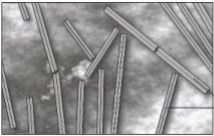
Identify the diagram.
A
Bacteria
B
Bacteriophage
C
$TMV$
D
Adenovirus
Solution
(C) $TMV$ (Tobacco Mosaic Virus) is a rod-shaped helical virus containing single-stranded $RNA$. The provided image shows the characteristic rod-like structure of $TMV$ particles.
0 likesView Solution
82
BiologyMediumMCQAIIMS · 2019
Which of the following are all Nucleotides?
A
Adenosine, Cytidilic acid, Cytosine
B
Adenylic acid, Cytidilic acid, Guanylic acid
C
Cytidine, Adenine, Adenylic acid
D
Uracil, Thymidine, Thymidylic acid
Solution
(B) Nucleotides are the fundamental building blocks of nucleic acids ($DNA$ and $RNA$).
$A$ nucleotide consists of a nitrogenous base, a pentose sugar, and a phosphate group.
$Adenylic$ $acid$, $cytidilic$ $acid$, and $guanylic$ $acid$ are all examples of nucleotides because they contain a nitrogenous base, a sugar, and a phosphate group.
In contrast, $Adenosine$, $Cytidine$, and $Thymidine$ are nucleosides (base + sugar), while $Adenine$, $Cytosine$, $Uracil$, and $Thymine$ are nitrogenous bases.
$A$ nucleotide consists of a nitrogenous base, a pentose sugar, and a phosphate group.
$Adenylic$ $acid$, $cytidilic$ $acid$, and $guanylic$ $acid$ are all examples of nucleotides because they contain a nitrogenous base, a sugar, and a phosphate group.
In contrast, $Adenosine$, $Cytidine$, and $Thymidine$ are nucleosides (base + sugar), while $Adenine$, $Cytosine$, $Uracil$, and $Thymine$ are nitrogenous bases.
0 likesView Solution
83
BiologyEasyMCQAIIMS · 2019
Which cell is found in mucus-secreting organs?
A
Goblet cells
B
Paneth cells
C
Oxyntic cells
D
Peptic cells
Solution
(A) Goblet cells are specialized glandular epithelial cells found in the lining of the respiratory and digestive tracts.
Their primary function is to synthesize and secrete mucus,which acts as a lubricant and protective barrier for the underlying tissues.
Their primary function is to synthesize and secrete mucus,which acts as a lubricant and protective barrier for the underlying tissues.
0 likesView Solution
84
BiologyMediumMCQAIIMS · 2019
Which of the following options have features corresponding to the given animals?
$Aplysia$, $Asterias$, $Antedon$, $Echinus$
$Aplysia$, $Asterias$, $Antedon$, $Echinus$
A
Water vascular system, Calcareous shell
B
Water Canal system, Calcareous shell
C
Calcareous shell, acoelomate
D
Pseudocoelomate, Water vascular system
Solution
(A) The animals $Asterias$ (Starfish), $Antedon$ (Sea lily), and $Echinus$ (Sea urchin) belong to the phylum $Echinodermata$.
$Aplysia$ (Sea hare) is a mollusk, but in the context of this specific question grouping, the features $Water \text{ } vascular \text{ } system$ and $Calcareous \text{ } shell$ (endoskeleton) are characteristic of the $Echinodermata$ group.
$Echinoderms$ possess a unique water vascular system and an endoskeleton of calcareous ossicles.
$Aplysia$ (Sea hare) is a mollusk, but in the context of this specific question grouping, the features $Water \text{ } vascular \text{ } system$ and $Calcareous \text{ } shell$ (endoskeleton) are characteristic of the $Echinodermata$ group.
$Echinoderms$ possess a unique water vascular system and an endoskeleton of calcareous ossicles.
0 likesView Solution
85
BiologyMediumMCQAIIMS · 2019
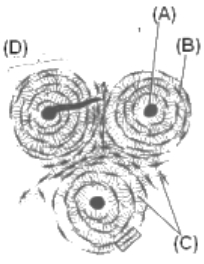
Choose the correct option for the labelling in the given diagram $(A, B, C, D)$.
A
Haversian canal,lacuna,Lamellae,Haversian system
B
Haversian canal,Volkmann's canal,Endosteum,Lamellae
C
Volkmann's canal,Lamellae,Osteocytes,Haversian canal
D
Haversian canal,Osteocytes,Lamellae,Endosteum
Solution
(A) The given diagram represents the structure of compact bone tissue.
$(A)$ points to the central Haversian canal,which contains blood vessels and nerves.
$(B)$ points to the lacuna,which is a small space containing an osteocyte.
$(C)$ points to the concentric layers of bone matrix called Lamellae.
$(D)$ represents the entire structural unit known as the Haversian system or Osteon.
$(A)$ points to the central Haversian canal,which contains blood vessels and nerves.
$(B)$ points to the lacuna,which is a small space containing an osteocyte.
$(C)$ points to the concentric layers of bone matrix called Lamellae.
$(D)$ represents the entire structural unit known as the Haversian system or Osteon.
0 likesView Solution
86
BiologyEasyMCQAIIMS · 2019
Which statement is incorrect for earthworm?
A
Two pairs of testes are present in the $10^{th}$ and $11^{th}$ segments.
B
One pair of ovaries is attached at the inter-segmental septum of the $12^{th}$ and $13^{th}$ segments.
C
It is hermaphrodite.
D
Male genital pore is present in the $14^{th}$ segment.
Solution
(D) In earthworms,the male genital pore is located in the $18^{th}$ segment,not in the $14^{th}$ segment. The $14^{th}$ segment contains the female genital pore.
0 likesView Solution
87
BiologyDifficultMCQAIIMS · 2019
Acquired immunity is mediated by which of the following?
A
Antibody formation by $T$-lymphocytes
B
Antibody formation by $B$-lymphocytes
C
$HCl$ by stomach
D
Bite by snake
Solution
(B) Acquired immunity is pathogen-specific and is characterized by memory. When the body encounters a pathogen for the first time,it produces a primary response. Upon subsequent encounters with the same pathogen,the immune system mounts a highly intensified secondary or anamnestic response. This response is primarily mediated by $B$-lymphocytes,which differentiate into plasma cells to produce specific antibodies against the causative agent.
0 likesView Solution
88
BiologyEasyMCQAIIMS · 2019
Given below are the life spans of various organisms. Find the correct option:
A
$(1)$ Fruit fly - $1$ week
B
$(2)$ Dog - $20-30$ years
C
$(3)$ Butterfly - $1-2$ months
D
$(4)$ Cat - $1$ year
Solution
(B) The average life span of a fruit fly is about $2$ weeks.
The average life span of a dog is $20-30$ years.
The average life span of a butterfly is $1-2$ weeks.
The average life span of a cat is about $12-15$ years.
Therefore, the correct option is $(2)$.
The average life span of a dog is $20-30$ years.
The average life span of a butterfly is $1-2$ weeks.
The average life span of a cat is about $12-15$ years.
Therefore, the correct option is $(2)$.
0 likesView Solution
89
BiologyMediumMCQAIIMS · 2019
Find the correct palindromic sequence for the given $DNA$ strand:
$5'ATTGCAAT3'$
$5'ATTGCAAT3'$
A
$5'AACGTTA3'$
B
$3'TAACGTTA5'$
C
$5'TAACGTTA3'$
D
$3'ATTGCAAT3'$
Solution
(B) palindromic $DNA$ sequence is a sequence of nucleotides that reads the same in the $5' \rightarrow 3'$ direction on one strand as it does in the $5' \rightarrow 3'$ direction on the complementary strand.
For the given sequence $5'ATTGCAAT3'$,the complementary strand is $3'TAACGTTA5'$.
When read from the $5' \rightarrow 3'$ direction,the complementary strand is $5'ATTGCAAT3'$,which is identical to the original sequence.
Therefore,the correct palindromic sequence is $3'TAACGTTA5'$.
For the given sequence $5'ATTGCAAT3'$,the complementary strand is $3'TAACGTTA5'$.
When read from the $5' \rightarrow 3'$ direction,the complementary strand is $5'ATTGCAAT3'$,which is identical to the original sequence.
Therefore,the correct palindromic sequence is $3'TAACGTTA5'$.
0 likesView Solution
90
BiologyEasyMCQAIIMS · 2019
Cocaine is obtained from:
A
Papaver somniferum
B
Datura
C
Atropa belladonna
D
Erythroxylum coca
Solution
(D) Cocaine is a potent stimulant drug that is extracted from the leaves of the coca plant, known scientifically as $Erythroxylum coca$.
It interferes with the transport of the neurotransmitter dopamine, leading to increased levels of dopamine in the brain, which causes euphoria and increased energy.
It interferes with the transport of the neurotransmitter dopamine, leading to increased levels of dopamine in the brain, which causes euphoria and increased energy.
0 likesView Solution
91
BiologyMediumMCQAIIMS · 2019
$A$ gene library or $DNA$ library contains a collection of:
A
$DNA$ and $RNA$
B
Any one type of gene of an organism
C
$cDNA$ only
D
All possible genes of an organism
Solution
(D) gene library or $DNA$ library is a collection of cloned $DNA$ fragments that represent the entire genome of a particular organism. It contains all the possible genes of that specific organism,which are stored in a vector for further study and analysis.
0 likesView Solution
92
BiologyMediumMCQAIIMS · 2019
Which gas is present predominantly in biogas?
A
Methane
B
Ethane
C
Butane
D
Propane
Solution
(A) Biogas is a mixture of gases produced by the microbial activity of methanogens.
Among these,methane $(CH_4)$ is the primary component.
Biogas typically contains approximately $50-70 \%$ methane,making it the predominant gas present.
Among these,methane $(CH_4)$ is the primary component.
Biogas typically contains approximately $50-70 \%$ methane,making it the predominant gas present.
0 likesView Solution
93
BiologyEasyMCQAIIMS · 2019
Which is a similar term to $Hybrid$ $vigour$?
A
Heterosis
B
Homozygosity
C
Heterozygosity
D
Homosis
Solution
(A) $Hybrid$ $vigour$ is also referred to as $Heterosis$.
It describes the phenomenon where the hybrid offspring exhibit superior qualities,such as increased growth rate,yield,and fertility,compared to their parents.
It describes the phenomenon where the hybrid offspring exhibit superior qualities,such as increased growth rate,yield,and fertility,compared to their parents.
0 likesView Solution
94
BiologyMediumMCQAIIMS · 2019
Which of the following switches off the $lac$ operon?
A
Structural gene
B
Regulator gene
C
Operator gene
D
Promoter gene
Solution
(B) The $lac$ operon is regulated by a repressor protein.
This repressor protein is encoded by the regulator gene,known as the $lacI$ gene.
In the absence of an inducer (like lactose),the repressor protein binds to the operator gene,thereby preventing $RNA$ polymerase from transcribing the structural genes.
Thus,the regulator gene is responsible for switching off the $lac$ operon.
This repressor protein is encoded by the regulator gene,known as the $lacI$ gene.
In the absence of an inducer (like lactose),the repressor protein binds to the operator gene,thereby preventing $RNA$ polymerase from transcribing the structural genes.
Thus,the regulator gene is responsible for switching off the $lac$ operon.
0 likesView Solution
95
BiologyMediumMCQAIIMS · 2019
Which of the following is incorrect?
A
Mango and coconut are drupe fruits.
B
According to Euro norm $IV$,sulphur content for petrol is $50$ $ppm$.
C
$CO_2$ and other poisonous gases cause pollution.
D
Apple is a true fruit.
Solution
(D) False fruits are fruits that derive from the ovary and other accessory parts,such as the thalamus.
True fruits develop only from the ovary.
Apple is a false fruit because its main edible part is the fleshy receptacle,not the ovary wall.
Therefore,the statement 'Apple is a true fruit' is incorrect.
True fruits develop only from the ovary.
Apple is a false fruit because its main edible part is the fleshy receptacle,not the ovary wall.
Therefore,the statement 'Apple is a true fruit' is incorrect.
0 likesView Solution
96
BiologyEasyMCQAIIMS · 2019
Which gases are responsible for increasing the temperature of the atmosphere?
A
$CO, NO_{2}, H_{2}S$
B
$CO_{2}, CO, NO$
C
$CH_{4}, CO_{2}, N_{2}O$
D
$NO_{2}, H_{2}S, CO_{2}$
Solution
(C) Greenhouse gases are responsible for the greenhouse effect,which leads to an increase in the Earth's atmospheric temperature.
Major greenhouse gases include carbon dioxide $(CO_{2})$,methane $(CH_{4})$,nitrous oxide $(N_{2}O)$,and chlorofluorocarbons $(CFCs)$.
Among the given options,$CH_{4}, CO_{2},$ and $N_{2}O$ are the primary greenhouse gases that contribute significantly to global warming.
Major greenhouse gases include carbon dioxide $(CO_{2})$,methane $(CH_{4})$,nitrous oxide $(N_{2}O)$,and chlorofluorocarbons $(CFCs)$.
Among the given options,$CH_{4}, CO_{2},$ and $N_{2}O$ are the primary greenhouse gases that contribute significantly to global warming.
0 likesView Solution
97
BiologyMediumMCQAIIMS · 2019
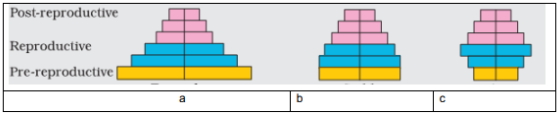
Select the correct option with respect to the given age pyramids.
A
$a$ - Expanding,$b$ - Stable,$c$ - Declining
B
$a$ - Stable,$b$ - Expanding,$c$ - Declining
C
$a$ - Stable,$b$ - Declining,$c$ - Expanding
D
$a$ - Declining,$b$ - Stable,$c$ - Expanding
Solution
(A) Age pyramids represent the distribution of various age groups in a population.
$1$. Pyramid $a$ has a wide base (large pre-reproductive population) and a narrow top,which indicates an expanding population.
$2$. Pyramid $b$ shows a relatively uniform distribution of pre-reproductive and reproductive age groups,indicating a stable population.
$3$. Pyramid $c$ has a narrow base (small pre-reproductive population) and a wider top,which indicates a declining population.
$1$. Pyramid $a$ has a wide base (large pre-reproductive population) and a narrow top,which indicates an expanding population.
$2$. Pyramid $b$ shows a relatively uniform distribution of pre-reproductive and reproductive age groups,indicating a stable population.
$3$. Pyramid $c$ has a narrow base (small pre-reproductive population) and a wider top,which indicates a declining population.
0 likesView Solution
98
BiologyMediumMCQAIIMS · 2019
Select the correct match.
| $(I)$ Interaction | $(II)$ Effect |
|---|---|
| $(a) (+, -)$ | $(P)$ Amensalism |
| $(b) (-, -)$ | $(Q)$ Commensalism |
| $(c) (-, 0)$ | $(R)$ Predation |
| $(d) (+, 0)$ | $(S)$ Competition |
A
$a-iii-S, b-ii-P, c-i-R, d-iv-Q$
B
$a-iii-R, b-ii-S, c-i-P, d-iv-Q$
C
$a-i-Q, b-iii-P, c-ii-S, d-iv-R$
D
$a-iv-Q, b-ii-P, c-iii-S, d-i-R$
Solution
(B) The interactions between species are defined by the effects on the organisms involved:
$1$. Predation $(+, -)$: One species (predator) benefits,while the other (prey) is harmed.
$2$. Competition $(-, -)$: Both species are harmed.
$3$. Amensalism $(-, 0)$: One species is harmed,while the other is unaffected.
$4$. Commensalism $(+, 0)$: One species benefits,while the other is unaffected.
Matching the given symbols:
$(a) (+, -)$ corresponds to $(iii)$ Predation $(R)$.
$(b) (-, -)$ corresponds to $(ii)$ Competition $(S)$.
$(c) (-, 0)$ corresponds to $(i)$ Amensalism $(P)$.
$(d) (+, 0)$ corresponds to $(iv)$ Commensalism $(Q)$.
Therefore,the correct match is $a-iii-R, b-ii-S, c-i-P, d-iv-Q$.
$1$. Predation $(+, -)$: One species (predator) benefits,while the other (prey) is harmed.
$2$. Competition $(-, -)$: Both species are harmed.
$3$. Amensalism $(-, 0)$: One species is harmed,while the other is unaffected.
$4$. Commensalism $(+, 0)$: One species benefits,while the other is unaffected.
Matching the given symbols:
$(a) (+, -)$ corresponds to $(iii)$ Predation $(R)$.
$(b) (-, -)$ corresponds to $(ii)$ Competition $(S)$.
$(c) (-, 0)$ corresponds to $(i)$ Amensalism $(P)$.
$(d) (+, 0)$ corresponds to $(iv)$ Commensalism $(Q)$.
Therefore,the correct match is $a-iii-R, b-ii-S, c-i-P, d-iv-Q$.
0 likesView Solution
99
BiologyMediumMCQAIIMS · 2019
The genetic codes for arginine are:
A
$CGU, CGC, CGA$
B
$CAU, CAC, CAA$
C
$AGU, AGC, AAC$
D
$GAU, GAC, GAA$
Solution
(A) The genetic code is degenerate,meaning some amino acids are coded by more than one codon.
Arginine is encoded by six codons: $CGU, CGC, CGA, CGG, AGA,$ and $AGG$.
Among the given options,the set $CGU, CGC, CGA$ correctly represents codons for arginine.
Arginine is encoded by six codons: $CGU, CGC, CGA, CGG, AGA,$ and $AGG$.
Among the given options,the set $CGU, CGC, CGA$ correctly represents codons for arginine.
0 likesView Solution
100
BiologyEasyMCQAIIMS · 2019
The 'King of Spices' is:
A
Brassica nigra
B
Piper nigrum
C
Piper longum
D
Curcuma longa
Solution
(B) Black pepper is known as the 'King of Spices'. Its scientific name is $Piper \text{ } nigrum$. It belongs to the family $Piperaceae$ and is widely used for its pungent flavor.
0 likesView Solution
101
BiologyMediumMCQAIIMS · 2019
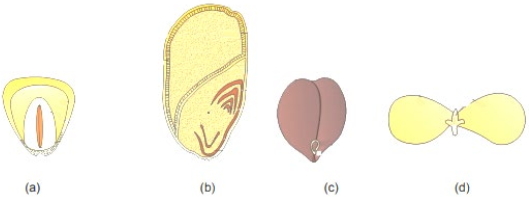
Which of the following is correct for the above diagrams?
A
$a \& b$ represent ex-albuminous seeds
B
$c \& d$ represent albuminous seeds
C
$a \& b$ represent albuminous seeds
D
$c \& d$ represent perispermic seeds
Solution
(C) The provided diagrams show different types of seeds.
Diagrams $a$ and $b$ represent monocot seeds (maize and wheat),which are albuminous (endospermic) seeds because they retain endosperm at maturity.
Diagrams $c$ and $d$ represent dicot seeds (bean and pea),which are ex-albuminous (non-endospermic) seeds because the endosperm is consumed during embryo development.
Therefore,$a \& b$ represent albuminous seeds.
Diagrams $a$ and $b$ represent monocot seeds (maize and wheat),which are albuminous (endospermic) seeds because they retain endosperm at maturity.
Diagrams $c$ and $d$ represent dicot seeds (bean and pea),which are ex-albuminous (non-endospermic) seeds because the endosperm is consumed during embryo development.
Therefore,$a \& b$ represent albuminous seeds.
0 likesView Solution
102
BiologyDifficultMCQAIIMS · 2019
Which of the following cannot be used for direct gene transfer?
A
Biolistics (gene gun)
B
Microinjection
C
Electroporation
D
Agrobacterium tumefaciens
Solution
(D) Direct gene transfer (also known as vectorless gene transfer) involves the introduction of foreign $DNA$ into host cells without the use of a biological vector.
Biolistics (gene gun),microinjection,and electroporation are all recognized methods of direct gene transfer.
Agrobacterium tumefaciens is a soil bacterium that acts as a natural biological vector (cloning vector) to transfer $DNA$ into plant cells,making it an indirect method of gene transfer.
Biolistics (gene gun),microinjection,and electroporation are all recognized methods of direct gene transfer.
Agrobacterium tumefaciens is a soil bacterium that acts as a natural biological vector (cloning vector) to transfer $DNA$ into plant cells,making it an indirect method of gene transfer.
0 likesView Solution
103
BiologyEasyMCQAIIMS · 2019
Which of the following is a correct mode of reproduction?
A
Budding in Yeast
B
Fragmentation in Spongilla
C
Zoospore in Amoeba
D
Binary fission in Hydra
Solution
(A) Yeasts reproduce asexually by a process called budding,where a small bud develops on the parent cell and eventually detaches to form a new individual.
Fragmentation is not the primary mode of reproduction in Spongilla (which uses gemmules).
Amoeba reproduces by binary fission,not zoospores.
Hydra reproduces primarily by budding,not binary fission.
Fragmentation is not the primary mode of reproduction in Spongilla (which uses gemmules).
Amoeba reproduces by binary fission,not zoospores.
Hydra reproduces primarily by budding,not binary fission.
0 likesView Solution
104
BiologyEasyMCQAIIMS · 2019
Hairy root disease of dicot plants is caused by-
A
Agrobacterium tumefaciens
B
Agrobacterium rhizogenes
C
Bacillus thuringiensis
D
Meloidogyne incognita
Solution
(B) Hairy root disease is an infectious plant disease that primarily affects dicotyledonous plants.
It is caused by the soil-borne bacterium $Agrobacterium$ $rhizogenes$.
This bacterium transfers a portion of its $Ri$ (root-inducing) plasmid into the plant genome,which leads to the proliferation of adventitious roots,commonly known as hairy roots.
It is caused by the soil-borne bacterium $Agrobacterium$ $rhizogenes$.
This bacterium transfers a portion of its $Ri$ (root-inducing) plasmid into the plant genome,which leads to the proliferation of adventitious roots,commonly known as hairy roots.
0 likesView Solution
105
BiologyMediumMCQAIIMS · 2019
Identify the correct labeling and its function from the given diagram of a developing fetus.
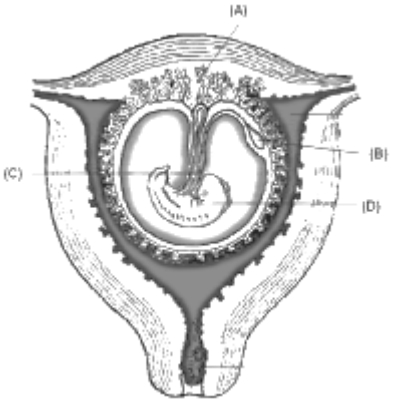
A
$A$ - Chorionic villi $\rightarrow$ Forms placenta
B
$B$ - Yolk sac $\rightarrow$ Prevents desiccation of embryo
C
$C$ - Umbilical cord $\rightarrow$ Haemopoiesis
D
$D$ - Blastocyst $\rightarrow$ Forms the embryo
Solution
(A) In the provided diagram,$A$ represents the Chorionic villi,which interdigitate with uterine tissue to form the placenta. The placenta serves as the structural and functional unit between the developing fetus and the maternal body,facilitating the exchange of nutrients,oxygen,and waste products. Option $B$ points to the Yolk sac,$C$ points to the Umbilical cord,and $D$ points to the Embryo itself. Therefore,the correct association is $A$ - Chorionic villi $\rightarrow$ forms placenta.
0 likesView Solution
106
BiologyMediumMCQAIIMS · 2019
Immune tolerance is developed by:
A
Interaction with the antigen
B
By giving antibodies
C
Present by birth
D
By giving antibiotics
Solution
(A) The prevention of the immune response against an antigen is referred to as immune tolerance.
Immune tolerance is a state of unresponsiveness of the immune system to substances or tissues that have the capacity to elicit an immune response.
It is primarily developed through the interaction of the immune system with specific antigens,which leads to the deletion or inactivation of self-reactive lymphocytes.
Immune tolerance is a state of unresponsiveness of the immune system to substances or tissues that have the capacity to elicit an immune response.
It is primarily developed through the interaction of the immune system with specific antigens,which leads to the deletion or inactivation of self-reactive lymphocytes.
0 likesView Solution
107
BiologyMediumMCQAIIMS · 2019
Which of the following were present in the prebiotic soup?
A
$Zn, Fe, Al$
B
Proteins,nucleic acids,carbohydrates,lipids
C
Vitamins
D
None of the above
Solution
(B) Oparin of Russia and Haldane of England proposed the prebiotic soup theory.
The primordial soup is a term used to describe the aqueous solution of organic compounds that accumulated in primitive water bodies of the early Earth.
According to this theory,the first form of life could have emerged $3.8$ billion to $3.55$ billion years ago in a pond or ocean from pre-existing non-living organic molecules (such as $RNA$,proteins,etc.).
The formation of life was preceded by chemical evolution,which involved the formation of diverse organic molecules from inorganic constituents.
The primordial soup is a term used to describe the aqueous solution of organic compounds that accumulated in primitive water bodies of the early Earth.
According to this theory,the first form of life could have emerged $3.8$ billion to $3.55$ billion years ago in a pond or ocean from pre-existing non-living organic molecules (such as $RNA$,proteins,etc.).
The formation of life was preceded by chemical evolution,which involved the formation of diverse organic molecules from inorganic constituents.
0 likesView Solution
108
BiologyEasyMCQAIIMS · 2019
Haploid cultures can be obtained by culturing:
A
Embryo
B
Pollen grains
C
Shoot apex
D
Root apex
Solution
(B) Haploid plants can be produced through tissue culture techniques by culturing pollen grains (microspores).
Since pollen grains are haploid ($n$ number of chromosomes),they develop into haploid plants,which are useful for plant breeding programs to create homozygous lines.
Since pollen grains are haploid ($n$ number of chromosomes),they develop into haploid plants,which are useful for plant breeding programs to create homozygous lines.
0 likesView Solution
109
BiologyEasyMCQAIIMS · 2019
$10 \%$ law of energy transfer was given by
A
Lindermann
B
Tansley
C
Stanley
D
Darwin
Solution
(A) The $10 \%$ law of energy transfer (also known as the $10 \%$ law of energy flow in an ecosystem) was proposed by Raymond Lindemann in $1942$.
This law states that during the transfer of energy from one trophic level to the next,only about $10 \%$ of the energy is stored as biomass and available to the next level,while the remaining $90 \%$ is lost as heat or used for metabolic activities.
This law states that during the transfer of energy from one trophic level to the next,only about $10 \%$ of the energy is stored as biomass and available to the next level,while the remaining $90 \%$ is lost as heat or used for metabolic activities.
0 likesView Solution
Vedclass Products
For Students
Vedclass Test Series
Mock tests in real AIIMS style covering Biology with performance analysis. 5-day free trial.
Start Free TrialFor Teachers
Exam Paper Generator
Generate Set A/B/C/D Biology papers from 7.5L+ questions in 2 minutes. 3 chapters free.
Try FreeFor Institutes
Online Exam Module
Run live AIIMS mock exams with unlimited students, 360° analytics & white-label branding.
See DemoFrequently Asked Questions
How many Biology questions are in AIIMS 2019?
There are 159 Biology questions from the AIIMS 2019 paper on Vedclass, each with a detailed step-by-step solution in English.
Are AIIMS 2019 Biology solutions available in English?
Yes. All solutions on this page are in English. You can also switch to English or Hindi using the language buttons above the questions.
Can I practice AIIMS 2019 Biology as a timed test?
Yes. Use the Vedclass Test Series to attempt a full AIIMS mock test covering Biology with time limits and instant score analysis.
Can teachers create Biology papers from AIIMS previous year questions?
Yes. The Vedclass Exam Paper Generator lets teachers mix AIIMS Biology questions and generate Set A/B/C/D papers in minutes.
For Teachers & Institutes
Build a Custom Biology Paper
Pick AIIMS 2019 Biology questions, set difficulty, and generate Set A/B/C/D in 2 minutes.