
ChemistryQ1–55 of 55 questions
Page 1 of 1 · English
1
ChemistryMCQAIIMS · 2007
In the following sequence of reactions,what is $D$?
$Toluene$ $\xrightarrow{[O]} A$ $\xrightarrow{SOCl_2} B$ $\xrightarrow{NaN_3} C$ $\xrightarrow{\text{Heat}} D$
$Toluene$ $\xrightarrow{[O]} A$ $\xrightarrow{SOCl_2} B$ $\xrightarrow{NaN_3} C$ $\xrightarrow{\text{Heat}} D$
A
Primary amine
B
An amide
C
Phenyl isocyanate
D
$A$ chain lengthened hydrocarbon
Solution
(C) The reaction sequence is as follows:
$1$. $Toluene$ undergoes oxidation to form benzoic acid $(A)$: $C_6H_5CH_3 \xrightarrow{[O]} C_6H_5COOH$.
$2$. Benzoic acid reacts with $SOCl_2$ to form benzoyl chloride $(B)$: $C_6H_5COOH \xrightarrow{SOCl_2} C_6H_5COCl$.
$3$. Benzoyl chloride reacts with $NaN_3$ to form benzoyl azide $(C)$: $C_6H_5COCl \xrightarrow{NaN_3} C_6H_5CON_3$.
$4$. Upon heating,benzoyl azide undergoes Curtius rearrangement to form phenyl isocyanate $(D)$: $C_6H_5CON_3 \xrightarrow{\text{Heat}} C_6H_5NCO + N_2$.
Therefore,$D$ is phenyl isocyanate.
$1$. $Toluene$ undergoes oxidation to form benzoic acid $(A)$: $C_6H_5CH_3 \xrightarrow{[O]} C_6H_5COOH$.
$2$. Benzoic acid reacts with $SOCl_2$ to form benzoyl chloride $(B)$: $C_6H_5COOH \xrightarrow{SOCl_2} C_6H_5COCl$.
$3$. Benzoyl chloride reacts with $NaN_3$ to form benzoyl azide $(C)$: $C_6H_5COCl \xrightarrow{NaN_3} C_6H_5CON_3$.
$4$. Upon heating,benzoyl azide undergoes Curtius rearrangement to form phenyl isocyanate $(D)$: $C_6H_5CON_3 \xrightarrow{\text{Heat}} C_6H_5NCO + N_2$.
Therefore,$D$ is phenyl isocyanate.
0 likesView Solution
2
ChemistryMediumMCQAIIMS · 2007
The correct order of bond length is:
A
$O_2 < O_3 < O_2^{2-}$
B
$O_2 < O_2^{2-} < O_3$
C
$O_2^{2-} < O_3 < O_2$
D
$O_2 = O_2^{2-} > O_3$
Solution
(A) Bond length is inversely proportional to bond order.
Bond order for $O_2$ is $2.0$.
Bond order for $O_3$ is $1.5$ (due to resonance).
Bond order for $O_2^{2-}$ (peroxide ion) is $1.0$.
Since bond length $\propto \frac{1}{\text{bond order}}$,the order of bond length is $O_2 < O_3 < O_2^{2-}$.
Bond order for $O_2$ is $2.0$.
Bond order for $O_3$ is $1.5$ (due to resonance).
Bond order for $O_2^{2-}$ (peroxide ion) is $1.0$.
Since bond length $\propto \frac{1}{\text{bond order}}$,the order of bond length is $O_2 < O_3 < O_2^{2-}$.
0 likesView Solution
3
ChemistryEasyMCQAIIMS · 2007
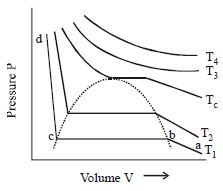
In a $P$ versus $V$ graph,the horizontal line is found in which region?
A
Gas
B
Liquid
C
Equilibrium between gas and liquid
D
Supercritical temperature
Solution
(C) Generally,most real gases show the same type of isotherm. The segment $ab$ represents the gaseous state. The line $bc$,which is a horizontal line,shows the equilibrium between liquid and vapour. The pressure corresponding to the line $bc$ is known as the vapour pressure of the liquid. The line $cd$ represents the liquid state.
0 likesView Solution
4
ChemistryMediumMCQAIIMS · 2007
Critical temperatures for $A$,$B$,$C$ and $D$ gases are $25\,^{\circ}C$,$10\,^{\circ}C$,$-80\,^{\circ}C$ and $15\,^{\circ}C$ respectively. Which gas will be liquefied more easily?
A
$A$
B
$B$
C
$C$
D
$D$
Solution
(A) The critical temperature $(T_C)$ of a gas is defined as the temperature above which a gas cannot be liquefied,regardless of the pressure applied.
It is given by the relation $T_C = \frac{8a}{27Rb}$,which implies $T_C \propto a$,where $a$ is the van der Waals constant representing the magnitude of intermolecular forces of attraction.
$A$ higher critical temperature indicates stronger intermolecular forces,making the gas easier to liquefy.
Comparing the given values: $A = 25\,^{\circ}C$,$B = 10\,^{\circ}C$,$C = -80\,^{\circ}C$,and $D = 15\,^{\circ}C$.
Since gas $A$ has the highest critical temperature $(25\,^{\circ}C)$,it will be liquefied most easily.
It is given by the relation $T_C = \frac{8a}{27Rb}$,which implies $T_C \propto a$,where $a$ is the van der Waals constant representing the magnitude of intermolecular forces of attraction.
$A$ higher critical temperature indicates stronger intermolecular forces,making the gas easier to liquefy.
Comparing the given values: $A = 25\,^{\circ}C$,$B = 10\,^{\circ}C$,$C = -80\,^{\circ}C$,and $D = 15\,^{\circ}C$.
Since gas $A$ has the highest critical temperature $(25\,^{\circ}C)$,it will be liquefied most easily.
0 likesView Solution
5
ChemistryEasyMCQAIIMS · 2007
$\Delta S_{surr}$ for an exothermic reaction is
A
always positive
B
always negative
C
zero
D
may be positive or negative
Solution
(A) The entropy change of the surroundings is given by the formula $\Delta S_{surr} = -\frac{\Delta H_{sys}}{T}$.
For an exothermic reaction,the enthalpy change of the system $\Delta H_{sys}$ is negative.
Therefore,$\Delta S_{surr} = -\frac{(\text{negative value})}{T}$,which results in a positive value.
Thus,$\Delta S_{surr}$ is always positive for an exothermic reaction.
For an exothermic reaction,the enthalpy change of the system $\Delta H_{sys}$ is negative.
Therefore,$\Delta S_{surr} = -\frac{(\text{negative value})}{T}$,which results in a positive value.
Thus,$\Delta S_{surr}$ is always positive for an exothermic reaction.
0 likesView Solution
6
ChemistryDifficultMCQAIIMS · 2007
Calculate the change in internal energy $(\Delta U)$ if $\Delta H = -92.2\, kJ$,$P = 40\, atm$,and $\Delta V = -1\, L$.
A
$-42\, kJ$
B
$-88\, kJ$
C
$+88\, kJ$
D
$+42\, kJ$
Solution
(B) Given: $\Delta H = -92.2\, kJ$,$P = 40\, atm$,$\Delta V = -1\, L$.
Using the relation: $\Delta H = \Delta U + P\Delta V$
Therefore: $\Delta U = \Delta H - P\Delta V$
First,convert $P\Delta V$ from $atm\, L$ to $kJ$ using the conversion factor $1\, atm\, L = 101.325\, J = 0.101325\, kJ$.
$P\Delta V = 40\, atm \times (-1\, L) = -40\, atm\, L$
$P\Delta V = -40 \times 0.101325\, kJ = -4.053\, kJ$
Now,calculate $\Delta U$:
$\Delta U = -92.2\, kJ - (-4.053\, kJ)$
$\Delta U = -92.2\, kJ + 4.053\, kJ = -88.147\, kJ$
Rounding to the nearest integer,we get $\Delta U \approx -88\, kJ$.
Using the relation: $\Delta H = \Delta U + P\Delta V$
Therefore: $\Delta U = \Delta H - P\Delta V$
First,convert $P\Delta V$ from $atm\, L$ to $kJ$ using the conversion factor $1\, atm\, L = 101.325\, J = 0.101325\, kJ$.
$P\Delta V = 40\, atm \times (-1\, L) = -40\, atm\, L$
$P\Delta V = -40 \times 0.101325\, kJ = -4.053\, kJ$
Now,calculate $\Delta U$:
$\Delta U = -92.2\, kJ - (-4.053\, kJ)$
$\Delta U = -92.2\, kJ + 4.053\, kJ = -88.147\, kJ$
Rounding to the nearest integer,we get $\Delta U \approx -88\, kJ$.
0 likesView Solution
7
ChemistryDifficultMCQAIIMS · 2007
If the $\Delta H_{fusion}$ of a substance is $'x'$ and $\Delta H_{vap}$ is $'y'$,then $\Delta H_{sublimation}$ will be:
A
$x + y$
B
$x - y$
C
$x / y$
D
$y / x$
Solution
(A) According to Hess's Law,the enthalpy change of a reaction is the same whether it occurs in one step or several steps.
Sublimation is the direct conversion of a solid to a vapor.
This process can be represented as a two-step process: Solid $\rightarrow$ Liquid (fusion) followed by Liquid $\rightarrow$ Vapor (vaporization).
Therefore,$\Delta H_{sublimation} = \Delta H_{fusion} + \Delta H_{vap}$.
Given $\Delta H_{fusion} = x$ and $\Delta H_{vap} = y$,we have $\Delta H_{sublimation} = x + y$.
Sublimation is the direct conversion of a solid to a vapor.
This process can be represented as a two-step process: Solid $\rightarrow$ Liquid (fusion) followed by Liquid $\rightarrow$ Vapor (vaporization).
Therefore,$\Delta H_{sublimation} = \Delta H_{fusion} + \Delta H_{vap}$.
Given $\Delta H_{fusion} = x$ and $\Delta H_{vap} = y$,we have $\Delta H_{sublimation} = x + y$.
0 likesView Solution
8
ChemistryEasyMCQAIIMS · 2007
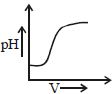
During the titration of acetic acid with an aqueous $NaOH$ solution,the neutralization graph shows a vertical line. This line indicates:
A
alkaline nature of equivalence
B
acidic nature of equivalence
C
neutral nature of equivalence
D
depends on experimental procedure
Solution
(A) In the titration of a weak acid $(CH_3COOH)$ with a strong base $(NaOH)$,the salt formed $(CH_3COONa)$ undergoes anionic hydrolysis,resulting in a basic solution at the equivalence point $(pH > 7)$.
Due to the excess of free base added beyond the equivalence point,there is a steep rise in $pH$,which is represented by the vertical portion of the titration curve.
Therefore,the vertical line in the graph indicates the alkaline nature of the equivalence point.
Due to the excess of free base added beyond the equivalence point,there is a steep rise in $pH$,which is represented by the vertical portion of the titration curve.
Therefore,the vertical line in the graph indicates the alkaline nature of the equivalence point.
0 likesView Solution
9
ChemistryMediumMCQAIIMS · 2007
The $pH$ of the solution obtained on neutralization of $40 \ mL \ 0.1 \ M \ NaOH$ with $40 \ mL \ 0.1 \ M \ CH_3COOH$ is
A
$7$
B
$8$
C
$6$
D
$3$
Solution
(B) The reaction between $NaOH$ (strong base) and $CH_3COOH$ (weak acid) produces sodium acetate $(CH_3COONa)$,which is a salt of a weak acid and a strong base.
$CH_3COOH + NaOH \rightarrow CH_3COONa + H_2O$
Since the salt undergoes anionic hydrolysis,the resulting solution is basic.
For a salt of a weak acid and strong base,the $pH$ is given by $pH = \frac{1}{2} (pK_w + pK_a + \log C)$.
Given $pK_a$ for $CH_3COOH$ is approximately $4.76$ and $pK_w = 14$,the calculated $pH$ is greater than $7$.
Therefore,the $pH$ of the solution is $8$.
$CH_3COOH + NaOH \rightarrow CH_3COONa + H_2O$
Since the salt undergoes anionic hydrolysis,the resulting solution is basic.
For a salt of a weak acid and strong base,the $pH$ is given by $pH = \frac{1}{2} (pK_w + pK_a + \log C)$.
Given $pK_a$ for $CH_3COOH$ is approximately $4.76$ and $pK_w = 14$,the calculated $pH$ is greater than $7$.
Therefore,the $pH$ of the solution is $8$.
0 likesView Solution
10
ChemistryMediumMCQAIIMS · 2007
Assertion : Mixture of $CH_3COOH$ and $CH_3COONH_4$ is an example of acidic buffer.
Reason : Acidic buffer contains equimolar mixture of a weak acid and its salt with weak base.
Reason : Acidic buffer contains equimolar mixture of a weak acid and its salt with weak base.
A
If both Assertion and Reason are correct and the Reason is a correct explanation of the Assertion.
B
If both Assertion and Reason are correct but Reason is not a correct explanation of the Assertion.
C
If the Assertion is correct but Reason is incorrect.
D
If both the Assertion and Reason are incorrect.
Solution
(D) An acidic buffer is a solution containing a mixture of a weak acid and its salt with a strong base.
$CH_3COOH$ is a weak acid,but $CH_3COONH_4$ is a salt of a weak acid $(CH_3COOH)$ and a weak base $(NH_4OH)$.
Therefore,the mixture of $CH_3COOH$ and $CH_3COONH_4$ does not form an acidic buffer.
Since the assertion is false and the definition provided in the reason is also incorrect (it should be a salt with a strong base),both the assertion and the reason are incorrect.
$CH_3COOH$ is a weak acid,but $CH_3COONH_4$ is a salt of a weak acid $(CH_3COOH)$ and a weak base $(NH_4OH)$.
Therefore,the mixture of $CH_3COOH$ and $CH_3COONH_4$ does not form an acidic buffer.
Since the assertion is false and the definition provided in the reason is also incorrect (it should be a salt with a strong base),both the assertion and the reason are incorrect.
0 likesView Solution
11
ChemistryMediumMCQAIIMS · 2007
Assertion : The equilibrium constant is fixed and a characteristic for any given chemical reaction at a specified temperature.
Reason : The composition of the final equilibrium mixture at a particular temperature depends upon the starting amount of reactants.
Reason : The composition of the final equilibrium mixture at a particular temperature depends upon the starting amount of reactants.
A
If both Assertion and Reason are correct and the Reason is a correct explanation of the Assertion.
B
If both Assertion and Reason are correct but Reason is not a correct explanation of the Assertion.
C
If the Assertion is correct but Reason is incorrect.
D
If both the Assertion and Reason are incorrect.
Solution
(C) The equilibrium constant ($K_c$ or $K_p$) has a fixed value for a given chemical reaction at a specific temperature.
However,the composition of the final equilibrium mixture (the concentrations of reactants and products) at a particular temperature is independent of the initial amounts of reactants added.
Therefore,the Assertion is true,but the Reason is false.
However,the composition of the final equilibrium mixture (the concentrations of reactants and products) at a particular temperature is independent of the initial amounts of reactants added.
Therefore,the Assertion is true,but the Reason is false.
0 likesView Solution
12
ChemistryDifficultMCQAIIMS · 2007
The largest difference in atomic radii is found in the case of which pair?
A
$Li, Na$
B
$Na, K$
C
$K, Rb$
D
$Rb, Cs$
Solution
(B) Atomic radii increase as we move down the group due to the addition of an extra energy shell.
Although the nuclear charge also increases,the effect of the addition of a new energy shell predominates.
The increase in atomic radius is most significant when moving from $Na$ ($Z=11$,$3s^1$) to $K$ ($Z=19$,$4s^1$) because the transition from the $n=3$ shell to the $n=4$ shell involves a substantial increase in shielding and distance from the nucleus compared to subsequent transitions in the group.
Therefore,the largest difference in radii is observed for the pair $Na, K$.
Although the nuclear charge also increases,the effect of the addition of a new energy shell predominates.
The increase in atomic radius is most significant when moving from $Na$ ($Z=11$,$3s^1$) to $K$ ($Z=19$,$4s^1$) because the transition from the $n=3$ shell to the $n=4$ shell involves a substantial increase in shielding and distance from the nucleus compared to subsequent transitions in the group.
Therefore,the largest difference in radii is observed for the pair $Na, K$.
0 likesView Solution
13
ChemistryMediumMCQAIIMS · 2007
The repeating unit in silicone is
A
$SiO_2$
B
$-(R_2Si-O)-$
C
$-(O-Si(R)_2-O)-$
D
$-(Si(R)-O-O-R)-$
Solution
(B) Silicones are organosilicon polymers containing $Si-O-Si$ linkages.
They are formed by the hydrolysis of alkyl or aryl substituted chlorosilanes (e.g.,$R_2SiCl_2$).
The general formula for linear silicones is $(R_2SiO)_n$,where the repeating unit is $-(R_2Si-O)-$
They are formed by the hydrolysis of alkyl or aryl substituted chlorosilanes (e.g.,$R_2SiCl_2$).
The general formula for linear silicones is $(R_2SiO)_n$,where the repeating unit is $-(R_2Si-O)-$
0 likesView Solution
14
ChemistryDifficultMCQAIIMS · 2007
Propene on hydroboration and oxidation produces
A
$CH_3CH_2CH_2OH$
B
$CH_3CHOHCH_3$
C
$CH_3CHOHCH_2OH$
D
$CH_3CH_2CHO$
Solution
(A) Hydroboration-oxidation of propene follows anti-Markovnikov addition of water across the double bond.
$3CH_3-CH=CH_2 + BH_3 \rightarrow (CH_3CH_2CH_2)_3B$
$(CH_3CH_2CH_2)_3B + 3H_2O_2 + 3OH^- \rightarrow 3CH_3CH_2CH_2OH + BO_3^{3-}$
$3CH_3-CH=CH_2 + BH_3 \rightarrow (CH_3CH_2CH_2)_3B$
$(CH_3CH_2CH_2)_3B + 3H_2O_2 + 3OH^- \rightarrow 3CH_3CH_2CH_2OH + BO_3^{3-}$
0 likesView Solution
15
ChemistryMediumMCQAIIMS · 2007
Oxymercuration-demercuration of allylbenzene $(C_6H_5CH_2CH=CH_2)$ produces:
A
$C_6H_5CH_2CH(OH)CH_3$
B
$C_6H_5CH_2CH_2CH_2OH$
C
$C_6H_5CH_2CH(OH)CH_2OH$
D
none of these
Solution
(A) Oxymercuration-demercuration is a reaction that adds $H$ and $OH$ across a double bond following Markovnikov's rule without rearrangement.
For allylbenzene $(C_6H_5CH_2CH=CH_2)$,the double bond is between the $C_2$ and $C_3$ carbons of the side chain.
According to Markovnikov's rule,the $OH$ group attaches to the more substituted carbon $(C_2)$ and the $H$ atom attaches to the less substituted carbon $(C_3)$.
The reaction proceeds as follows:
$1$. Mercuration: The alkene reacts with mercuric acetate $(CH_3COO)_2Hg$ in water to form an organomercurial intermediate.
$2$. Demercuration: The intermediate is reduced with $NaBH_4$ in $NaOH$ to replace the mercury group with a hydrogen atom.
The final product is $1$-phenylpropan-$2$-ol,which is $C_6H_5CH_2CH(OH)CH_3$.
For allylbenzene $(C_6H_5CH_2CH=CH_2)$,the double bond is between the $C_2$ and $C_3$ carbons of the side chain.
According to Markovnikov's rule,the $OH$ group attaches to the more substituted carbon $(C_2)$ and the $H$ atom attaches to the less substituted carbon $(C_3)$.
The reaction proceeds as follows:
$1$. Mercuration: The alkene reacts with mercuric acetate $(CH_3COO)_2Hg$ in water to form an organomercurial intermediate.
$2$. Demercuration: The intermediate is reduced with $NaBH_4$ in $NaOH$ to replace the mercury group with a hydrogen atom.
The final product is $1$-phenylpropan-$2$-ol,which is $C_6H_5CH_2CH(OH)CH_3$.
0 likesView Solution
16
ChemistryMediumMCQAIIMS · 2007
Which of the following species participates in the sulphonation of the benzene ring?
A
$H_2SO_4$
B
$SO_3$
C
$HSO_3^-$
D
$SO_2^-$
Solution
(B) In the sulphonation of benzene,concentrated $H_2SO_4$ (or fuming sulphuric acid,$H_2SO_4 + SO_3$) is used.
The electrophile that attacks the benzene ring is sulphur trioxide,$SO_3$.
Even in concentrated $H_2SO_4$,the active electrophilic species is $SO_3$.
The electrophile that attacks the benzene ring is sulphur trioxide,$SO_3$.
Even in concentrated $H_2SO_4$,the active electrophilic species is $SO_3$.
0 likesView Solution
17
ChemistryDifficultMCQAIIMS · 2007
Assertion : $trans-but-2-ene$ on reaction with bromine forms a racemic mixture.
Reason : $trans-$Compound in $trans$ addition forms two types of stereoisomers.
Reason : $trans-$Compound in $trans$ addition forms two types of stereoisomers.
A
If both Assertion and Reason are correct and the Reason is a correct explanation of the Assertion.
B
If both Assertion and Reason are correct but Reason is not a correct explanation of the Assertion.
C
If the Assertion is correct but Reason is incorrect.
D
If both the Assertion and Reason are incorrect.
Solution
(D) The reaction of $trans-but-2-ene$ with $Br_2$ involves $anti$ addition.
$Anti$ addition of $Br_2$ to $trans-but-2-ene$ results in the formation of a $meso$ compound (specifically,$2,3-dibromobutane$).
Since the product is a $meso$ compound,it is optically inactive and not a racemic mixture.
Therefore,the Assertion is incorrect.
The Reason statement is also incorrect as $trans$ addition to a $trans$ alkene does not necessarily form two types of stereoisomers in the manner described.
Hence,both the Assertion and Reason are incorrect.
$Anti$ addition of $Br_2$ to $trans-but-2-ene$ results in the formation of a $meso$ compound (specifically,$2,3-dibromobutane$).
Since the product is a $meso$ compound,it is optically inactive and not a racemic mixture.
Therefore,the Assertion is incorrect.
The Reason statement is also incorrect as $trans$ addition to a $trans$ alkene does not necessarily form two types of stereoisomers in the manner described.
Hence,both the Assertion and Reason are incorrect.
0 likesView Solution
18
ChemistryMediumMCQAIIMS · 2007
Assertion : Acetylene on reacting with sodamide gives sodium acetylide and ammonia.
Reason : $sp$ hybridised carbon atoms of acetylene are considerably electronegative.
Reason : $sp$ hybridised carbon atoms of acetylene are considerably electronegative.
A
If both Assertion and Reason are correct and the Reason is a correct explanation of the Assertion.
B
If both Assertion and Reason are correct but Reason is not a correct explanation of the Assertion.
C
If the Assertion is correct but Reason is incorrect.
D
If both the Assertion and Reason are incorrect.
Solution
(A) Acetylene reacts with sodamide $(NaNH_2)$ to form sodium acetylide and ammonia.
$CH\equiv CH + NaNH_2 \rightarrow HC\equiv C^{-}Na^{+} + NH_3$
This reaction occurs because the $sp$ hybridized carbon atoms in acetylene have $50\%$ $s$-character.
Due to the high $s$-character,the electrons are held more tightly by the nucleus,making the carbon atom significantly electronegative.
This increased electronegativity makes the terminal hydrogen atom acidic,allowing it to be replaced by the sodium ion from the sodamide.
Therefore,both the Assertion and the Reason are correct,and the Reason is the correct explanation of the Assertion.
$CH\equiv CH + NaNH_2 \rightarrow HC\equiv C^{-}Na^{+} + NH_3$
This reaction occurs because the $sp$ hybridized carbon atoms in acetylene have $50\%$ $s$-character.
Due to the high $s$-character,the electrons are held more tightly by the nucleus,making the carbon atom significantly electronegative.
This increased electronegativity makes the terminal hydrogen atom acidic,allowing it to be replaced by the sodium ion from the sodamide.
Therefore,both the Assertion and the Reason are correct,and the Reason is the correct explanation of the Assertion.
0 likesView Solution
19
ChemistryMediumMCQAIIMS · 2007
Inert gases are mixed in iodine vapours. Then there are . . . . . . between them.
A
$H$-bonding
B
van der Waals forces
C
Electrostatic forces
D
Metallic bonds
Solution
(B) All molecules exhibit short-range London dispersion forces,which are a type of van der Waals forces.
When inert gases are mixed with iodine vapours,these short-range London dispersion forces exist between them.
When inert gases are mixed with iodine vapours,these short-range London dispersion forces exist between them.
0 likesView Solution
20
ChemistryMediumMCQAIIMS · 2007
Assertion : $F$ is more electronegative than $Cl$.
Reason : $F$ has higher electron affinity than $Cl$.
Reason : $F$ has higher electron affinity than $Cl$.
A
If both Assertion and Reason are correct and the Reason is a correct explanation of the Assertion.
B
If both Assertion and Reason are correct but Reason is not a correct explanation of the Assertion.
C
If the Assertion is correct but Reason is incorrect.
D
If both the Assertion and Reason are incorrect.
Solution
(C) The assertion is true because $F$ is the most electronegative element in the periodic table.
The reason is false because $F$ has a lower electron affinity than $Cl$.
This is due to the small size of the $F$ atom,which leads to strong inter-electronic repulsions among the electrons in its $2p$ subshell,making it less favorable to add an extra electron compared to $Cl$.
The reason is false because $F$ has a lower electron affinity than $Cl$.
This is due to the small size of the $F$ atom,which leads to strong inter-electronic repulsions among the electrons in its $2p$ subshell,making it less favorable to add an extra electron compared to $Cl$.
0 likesView Solution
21
ChemistryMediumMCQAIIMS · 2007
Assertion : Copper sulphate solution is not stored in zinc vessel.
Reason : Zinc forms complex with $CuSO_4$.
Reason : Zinc forms complex with $CuSO_4$.
A
If both Assertion and Reason are correct and the Reason is a correct explanation of the Assertion.
B
If both Assertion and Reason are correct but Reason is not a correct explanation of the Assertion.
C
If the Assertion is correct but Reason is incorrect.
D
If both the Assertion and Reason are incorrect.
Solution
(C) Copper sulphate solution is not stored in a zinc vessel because $Zn$ is more reactive than $Cu$ and has a higher tendency to undergo oxidation,thereby displacing $Cu$ from its aqueous solution.
The chemical reaction is: $Zn_{(s)} + CuSO_{4(aq)} \to ZnSO_{4(aq)} + Cu_{(s)}$.
$Zn$ does not form a complex with $CuSO_4$. The reason provided is scientifically incorrect. Therefore,the Assertion is true,but the Reason is false.
The chemical reaction is: $Zn_{(s)} + CuSO_{4(aq)} \to ZnSO_{4(aq)} + Cu_{(s)}$.
$Zn$ does not form a complex with $CuSO_4$. The reason provided is scientifically incorrect. Therefore,the Assertion is true,but the Reason is false.
0 likesView Solution
22
ChemistryMediumMCQAIIMS · 2007
Which of the following is optically inactive?
A
B
C
D
none of these.
0 likesView Solution
23
ChemistryMediumMCQAIIMS · 2007
Assertion : Molecular nitrogen is less reactive than molecular oxygen.
Reason : The bond length of $N_2$ is shorter than that of oxygen.
Reason : The bond length of $N_2$ is shorter than that of oxygen.
A
If both Assertion and Reason and Reason are correct and the Reason is a correct explanation of the Assertion.
B
If both Assertion and Reason are correct but Reason is not a correct explanation of the Assertion.
C
If the Assertion is correct but Reason is incorrect.
D
If both the Assertion and Reason are incorrect.
Solution
$(A)$ The $N_2$ molecule contains a $N \equiv N$ triple bond, while the $O_2$ molecule contains an $O = O$ double bond.
The bond dissociation energy of the $N \equiv N$ triple bond is significantly higher than that of the $O = O$ double bond, making $N_2$ chemically inert or less reactive under normal conditions.
The bond length of $N_2$ $(109.8 \ pm)$ is indeed shorter than that of $O_2$ $(121 \ pm)$ due to the higher bond order.
Since the high bond dissociation energy (a consequence of the short, strong triple bond) is the reason for the low reactivity of $N_2$, the Reason correctly explains the Assertion.
Therefore, both $A$ and $R$ are true and $R$ is the correct explanation of $A$.
The bond dissociation energy of the $N \equiv N$ triple bond is significantly higher than that of the $O = O$ double bond, making $N_2$ chemically inert or less reactive under normal conditions.
The bond length of $N_2$ $(109.8 \ pm)$ is indeed shorter than that of $O_2$ $(121 \ pm)$ due to the higher bond order.
Since the high bond dissociation energy (a consequence of the short, strong triple bond) is the reason for the low reactivity of $N_2$, the Reason correctly explains the Assertion.
Therefore, both $A$ and $R$ are true and $R$ is the correct explanation of $A$.
0 likesView Solution
24
ChemistryMediumMCQAIIMS · 2007
Assertion : When a salt such as $NaCl$ dissolves,the $Na^{+}$ and $Cl^{-}$ ions leaving the crystal lattice acquire far greater freedom.
Reason : In thermodynamic terms,the formation of solution occurs with a favourable change in free energy,i.e.,$\Delta H$ has a high positive value and $T\Delta S$ a low negative value.
Reason : In thermodynamic terms,the formation of solution occurs with a favourable change in free energy,i.e.,$\Delta H$ has a high positive value and $T\Delta S$ a low negative value.
A
If both Assertion and Reason are correct and the Reason is a correct explanation of the Assertion.
B
If both Assertion and Reason are correct but Reason is not a correct explanation of the Assertion.
C
If the Assertion is correct but Reason is incorrect.
D
If both the Assertion and Reason are incorrect.
Solution
(C) In $NaCl$ crystal,$Na^{+}$ and $Cl^{-}$ ions are strongly held by electrostatic forces of attraction.
When the salt dissolves,these ions leave the crystal lattice and enter the solution,thereby acquiring greater freedom (increased entropy).
Thermodynamically,for a process to be spontaneous,the change in Gibbs free energy,$\Delta G = \Delta H - T\Delta S$,must be negative.
For the dissolution of $NaCl$,the enthalpy change $\Delta H$ is positive (endothermic),but the entropy change $\Delta S$ is positive,making the term $T\Delta S$ large and positive.
Since $T\Delta S > \Delta H$,the value of $\Delta G$ becomes negative,making the process spontaneous.
The reason statement claims $\Delta H$ is highly positive and $T\Delta S$ is a low negative value,which is incorrect as $T\Delta S$ is actually positive for this process.
Thus,the Assertion is correct,but the Reason is incorrect.
When the salt dissolves,these ions leave the crystal lattice and enter the solution,thereby acquiring greater freedom (increased entropy).
Thermodynamically,for a process to be spontaneous,the change in Gibbs free energy,$\Delta G = \Delta H - T\Delta S$,must be negative.
For the dissolution of $NaCl$,the enthalpy change $\Delta H$ is positive (endothermic),but the entropy change $\Delta S$ is positive,making the term $T\Delta S$ large and positive.
Since $T\Delta S > \Delta H$,the value of $\Delta G$ becomes negative,making the process spontaneous.
The reason statement claims $\Delta H$ is highly positive and $T\Delta S$ is a low negative value,which is incorrect as $T\Delta S$ is actually positive for this process.
Thus,the Assertion is correct,but the Reason is incorrect.
0 likesView Solution
25
ChemistryMediumMCQAIIMS · 2007
Among the following components of cement,which is present in the highest amount?
A
$Ca_2SiO_4$
B
$Ca_3SiO_5$
C
$Al_2O_3$
D
$Ca_3Al_2O_6$
Solution
(B) The composition of Portland cement typically includes the following major constituents:
$1$. Tricalcium silicate $(Ca_3SiO_5)$: $50-70\%$
$2$. Dicalcium silicate $(Ca_2SiO_4)$: $20-30\%$
$3$. Tricalcium aluminate $(Ca_3Al_2O_6)$: $5-10\%$
$4$. Tetracalcium aluminoferrite $(Ca_4Al_2Fe_2O_{10})$: $5-15\%$
Comparing the given options,$Ca_3SiO_5$ (tricalcium silicate) is present in the highest amount.
$1$. Tricalcium silicate $(Ca_3SiO_5)$: $50-70\%$
$2$. Dicalcium silicate $(Ca_2SiO_4)$: $20-30\%$
$3$. Tricalcium aluminate $(Ca_3Al_2O_6)$: $5-10\%$
$4$. Tetracalcium aluminoferrite $(Ca_4Al_2Fe_2O_{10})$: $5-15\%$
Comparing the given options,$Ca_3SiO_5$ (tricalcium silicate) is present in the highest amount.
0 likesView Solution
26
ChemistryMediumMCQAIIMS · 2007
Which of the following is a chain transfer reagent?
A
$CCl_4$
B
$CH_4$
C
$O_2$
D
$H_2$
Solution
(A) Chain transfer agents are substances that react with the growing polymer chain to terminate its growth,thereby initiating a new chain.
This process limits the average molecular mass of the polymer.
Among the given options,$CCl_4$ acts as a chain transfer agent in radical polymerization because the $C-Cl$ bond is relatively weak and can easily undergo homolytic cleavage to transfer a chlorine atom to the growing radical chain.
This process limits the average molecular mass of the polymer.
Among the given options,$CCl_4$ acts as a chain transfer agent in radical polymerization because the $C-Cl$ bond is relatively weak and can easily undergo homolytic cleavage to transfer a chlorine atom to the growing radical chain.
0 likesView Solution
27
ChemistryEasyMCQAIIMS · 2007
The coordination number in $hcp$ is
A
$6$
B
$12$
C
$18$
D
$24$
Solution
(B) In a hexagonal close-packed $(hcp)$ structure,each atom is in contact with $6$ atoms in its own layer,$3$ atoms in the layer above,and $3$ atoms in the layer below.
Therefore,the total number of nearest touching neighbours is $6 + 3 + 3 = 12$.
Thus,the coordination number is $12$.
Therefore,the total number of nearest touching neighbours is $6 + 3 + 3 = 12$.
Thus,the coordination number is $12$.
0 likesView Solution
28
ChemistryDifficultMCQAIIMS · 2007
The vapour pressure of pure benzene at a certain temperature is $0.850 \ bar$. $A$ non-volatile,non-electrolyte solid weighing $0.5 \ g$ is added to $39.0 \ g$ of benzene (molar mass $78 \ g/mol$). The vapour pressure of the solution then is $0.845 \ bar$. What is the molecular mass of the solid substance?
A
$58$
B
$180$
C
$170$
D
$145$
Solution
(C) Given: $p_{benzene}^o = 0.850 \ bar$,$p_{solution} = 0.845 \ bar$,$W_{benzene} = 39.0 \ g$,$M_{benzene} = 78 \ g/mol$,$w_{solid} = 0.5 \ g$.
Using Raoult's law for non-volatile solutes: $\frac{p^o - p}{p^o} = \frac{n_{solid}}{n_{solid} + n_{benzene}} \approx \frac{n_{solid}}{n_{benzene}}$ (for dilute solutions).
$n_{benzene} = \frac{39.0 \ g}{78 \ g/mol} = 0.5 \ mol$.
$\frac{0.850 - 0.845}{0.850} = \frac{0.5 / M_{solid}}{0.5}$.
$\frac{0.005}{0.850} = \frac{0.5}{M_{solid} \times 0.5} = \frac{1}{M_{solid}}$.
$M_{solid} = \frac{0.850}{0.005} = 170 \ g/mol$.
Using Raoult's law for non-volatile solutes: $\frac{p^o - p}{p^o} = \frac{n_{solid}}{n_{solid} + n_{benzene}} \approx \frac{n_{solid}}{n_{benzene}}$ (for dilute solutions).
$n_{benzene} = \frac{39.0 \ g}{78 \ g/mol} = 0.5 \ mol$.
$\frac{0.850 - 0.845}{0.850} = \frac{0.5 / M_{solid}}{0.5}$.
$\frac{0.005}{0.850} = \frac{0.5}{M_{solid} \times 0.5} = \frac{1}{M_{solid}}$.
$M_{solid} = \frac{0.850}{0.005} = 170 \ g/mol$.
0 likesView Solution
29
ChemistryDifficultMCQAIIMS · 2007
$1 \ mol$ each of the following compounds is dissolved in $1 \ L$ of solution. Which will have the largest $\Delta T_b$ value?
A
$HF$
B
$HCl$
C
$HBr$
D
$HI$
Solution
(D) The elevation in boiling point is given by the formula $\Delta T_b = i \times K_b \times m$.
Since $1 \ mol$ of each compound is dissolved in $1 \ L$ of solution,the molality $(m)$ is the same for all.
Therefore,$\Delta T_b$ is directly proportional to the van't Hoff factor $(i)$.
The van't Hoff factor $(i)$ depends on the degree of dissociation $(\alpha)$.
Stronger acids dissociate more completely in water. The acid strength order for hydrogen halides is $HI > HBr > HCl > HF$.
This is because the bond dissociation energy follows the order $HI < HBr < HCl < HF$.
Since $HI$ has the lowest bond dissociation energy,it dissociates most readily,leading to the highest number of ions in the solution.
Thus,$i$ is maximum for $HI$,resulting in the largest $\Delta T_b$ value.
Since $1 \ mol$ of each compound is dissolved in $1 \ L$ of solution,the molality $(m)$ is the same for all.
Therefore,$\Delta T_b$ is directly proportional to the van't Hoff factor $(i)$.
The van't Hoff factor $(i)$ depends on the degree of dissociation $(\alpha)$.
Stronger acids dissociate more completely in water. The acid strength order for hydrogen halides is $HI > HBr > HCl > HF$.
This is because the bond dissociation energy follows the order $HI < HBr < HCl < HF$.
Since $HI$ has the lowest bond dissociation energy,it dissociates most readily,leading to the highest number of ions in the solution.
Thus,$i$ is maximum for $HI$,resulting in the largest $\Delta T_b$ value.
0 likesView Solution
30
ChemistryEasyMCQAIIMS · 2007
$A$ catalyst
A
changes the equilibrium constant
B
lowers the activation energy
C
increases the forward and backward reactions at different speeds.
D
follows same mechanism for the reaction.
Solution
(B) catalyst provides an alternative reaction pathway with a lower activation energy $(E_a)$.
By lowering the activation energy,it increases the number of molecules that possess sufficient energy to cross the energy barrier,thereby increasing the rate of both forward and backward reactions equally.
It does not change the equilibrium constant or the overall mechanism of the reaction.
By lowering the activation energy,it increases the number of molecules that possess sufficient energy to cross the energy barrier,thereby increasing the rate of both forward and backward reactions equally.
It does not change the equilibrium constant or the overall mechanism of the reaction.
0 likesView Solution
31
ChemistryEasyMCQAIIMS · 2007
Carbon and $CO$ gas are used to reduce which of the following pairs of metal oxides for the extraction of metals?
A
$FeO, SnO$
B
$SnO, ZnO$
C
$BaO, Na_2O_2$
D
$FeO, ZnO$
Solution
(D) In the process of smelting,metal oxides are reduced by carbon or carbon monoxide $(CO)$.
For $ZnO$: $ZnO + C \to Zn + CO$.
For $FeO$: $FeO + C \to Fe + CO$.
Metals like $Zn, Fe, Pb,$ and $Sn$ are typically extracted from their oxide ores using carbon reduction (smelting). Both $FeO$ and $ZnO$ are standard examples of oxides reduced by carbon in industrial metallurgy.
For $ZnO$: $ZnO + C \to Zn + CO$.
For $FeO$: $FeO + C \to Fe + CO$.
Metals like $Zn, Fe, Pb,$ and $Sn$ are typically extracted from their oxide ores using carbon reduction (smelting). Both $FeO$ and $ZnO$ are standard examples of oxides reduced by carbon in industrial metallurgy.
0 likesView Solution
32
ChemistryMediumMCQAIIMS · 2007
$XeF_6$ on hydrolysis produces
A
$XeOF_4$
B
$XeO_2F_2$
C
$XeO_3$
D
$XeO_2$
Solution
(C) Complete hydrolysis of $XeF_6$ yields $XeO_3$.
$XeF_6 + 3H_2O \to XeO_3 + 6HF$
$XeF_6 + 3H_2O \to XeO_3 + 6HF$
0 likesView Solution
33
ChemistryEasyMCQAIIMS · 2007
The element which is the most abundant in the earth's crust is
A
$O$
B
$S$
C
$Al$
D
$H$
Solution
(A) little more than $47\%$ of the earth's crust consists of oxygen. The most common rock constituents of the earth's crust are nearly all oxides.
0 likesView Solution
34
ChemistryMediumMCQAIIMS · 2007
Cyanogen gas is obtained in the reaction:
A
$CuSO_{4(aq)} + KCN \to$
B
$K_4[Fe(CN)_6] \xrightarrow{\text{heat}}$
C
$CH_3CN + H_2O \xrightarrow{\Delta}$
D
$CH_3CONH_2 + P_2O_5 \xrightarrow{\Delta}$
Solution
(A) Among the given options,$CuSO_{4(aq)}$ and $KCN$ react to form an unstable copper $(II)$ cyanide,which rapidly decomposes to give copper $(I)$ cyanide and cyanogen gas.
The chemical equations are:
$2CuSO_{4(aq)} + 4KCN \to 2Cu(CN)_2 + 2K_2SO_4$
$2Cu(CN)_2 \to 2CuCN + (CN)_2 \uparrow$ (Cyanogen)
The chemical equations are:
$2CuSO_{4(aq)} + 4KCN \to 2Cu(CN)_2 + 2K_2SO_4$
$2Cu(CN)_2 \to 2CuCN + (CN)_2 \uparrow$ (Cyanogen)
0 likesView Solution
35
ChemistryMediumMCQAIIMS · 2007
Assertion : Ozone is an allotrope of oxygen.
Reason : Oxygen is a bluish-coloured liquid and in its singlet state,it is paramagnetic.
Reason : Oxygen is a bluish-coloured liquid and in its singlet state,it is paramagnetic.
A
If both Assertion and Reason are correct and the Reason is a correct explanation of the Assertion.
B
If both Assertion and Reason are correct but Reason is not a correct explanation of the Assertion.
C
If the Assertion is correct but Reason is incorrect.
D
If both the Assertion and Reason are incorrect.
Solution
(C) The assertion is true because ozone $(O_3)$ is indeed an allotrope of oxygen.
The reason is false. While liquid oxygen is pale blue,it is paramagnetic in its triplet state due to the presence of two unpaired electrons in its antibonding molecular orbitals. In its singlet state,all electrons are paired,making it diamagnetic,not paramagnetic.
The reason is false. While liquid oxygen is pale blue,it is paramagnetic in its triplet state due to the presence of two unpaired electrons in its antibonding molecular orbitals. In its singlet state,all electrons are paired,making it diamagnetic,not paramagnetic.
0 likesView Solution
36
ChemistryMediumMCQAIIMS · 2007
Which of the following radioisotopes is used as anticancerous?
A
$Na-24$
B
$C-14$
C
$U-235$
D
$Co-60$
Solution
(D) $Co-60$ is used as an anticancerous agent among the given radioactive isotopes.
It emits $\beta$-particles and high-energy gamma rays,which is why it is widely used in radiation therapy for cancer treatment.
It emits $\beta$-particles and high-energy gamma rays,which is why it is widely used in radiation therapy for cancer treatment.
0 likesView Solution
37
ChemistryMediumMCQAIIMS · 2007
Assertion : $SnI_4$ is an orange solid.
Reason : The colour arises due to charge transfer.
Reason : The colour arises due to charge transfer.
A
If both Assertion and Reason are correct and the Reason is a correct explanation of the Assertion.
B
If both Assertion and Reason are correct but Reason is not a correct explanation of the Assertion.
C
If the Assertion is correct but Reason is incorrect.
D
If both the Assertion and Reason are incorrect.
Solution
(A) $SnI_4$ is an orange-colored solid.
The colour arises due to the charge transfer phenomenon.
In $SnI_4$,an electron is transferred from the iodide ion $(I^-)$ to the tin center $(Sn^{4+})$ upon absorption of light,which is known as ligand-to-metal charge transfer $(LMCT)$.
This absorption of light in the blue region of the visible spectrum results in the compound appearing orange.
The colour arises due to the charge transfer phenomenon.
In $SnI_4$,an electron is transferred from the iodide ion $(I^-)$ to the tin center $(Sn^{4+})$ upon absorption of light,which is known as ligand-to-metal charge transfer $(LMCT)$.
This absorption of light in the blue region of the visible spectrum results in the compound appearing orange.
0 likesView Solution
38
ChemistryAdvancedMCQAIIMS · 2007
Assertion : Magnetic moment of $Dy^{3+}$ is highest among lanthanoids.
Reason : Orbital motion contributes to the magnetic moment.
Reason : Orbital motion contributes to the magnetic moment.
A
If both Assertion and Reason are correct and the Reason is a correct explanation of the Assertion.
B
If both Assertion and Reason are correct but Reason is not a correct explanation of the Assertion.
C
If the Assertion is correct but Reason is incorrect.
D
If both the Assertion and Reason are incorrect.
Solution
(A) In lanthanide ions,the $4f$ electrons are well-shielded from the external field by the overlying $5s$ and $5p$ electrons. Thus,the magnetic effect of the orbital motion of the electron is not quenched. Consequently,the magnetic moment must be calculated by taking into account both the spin and orbital contributions.
The magnetic moment is given by $\mu = g\sqrt{J(J+1)}$,where $g = 1 + \frac{S(S+1) - L(L+1) + J(J+1)}{2J(J+1)}$.
For $Dy^{3+}$ $([Xe]4f^9)$,the $4f$ subshell is more than half-filled. In such cases,the spin and orbital angular momenta couple to give a high total angular momentum $J$,resulting in the highest magnetic moment among lanthanoids.
Therefore,both the Assertion and Reason are correct,and the Reason is the correct explanation of the Assertion.
The magnetic moment is given by $\mu = g\sqrt{J(J+1)}$,where $g = 1 + \frac{S(S+1) - L(L+1) + J(J+1)}{2J(J+1)}$.
For $Dy^{3+}$ $([Xe]4f^9)$,the $4f$ subshell is more than half-filled. In such cases,the spin and orbital angular momenta couple to give a high total angular momentum $J$,resulting in the highest magnetic moment among lanthanoids.
Therefore,both the Assertion and Reason are correct,and the Reason is the correct explanation of the Assertion.
0 likesView Solution
39
ChemistryDifficultMCQAIIMS · 2007
Assertion : $C-O$ bond in metal carbonyls is long.
Reason : There is delocalisation of electrons from filled $d$ orbitals into the empty $\pi^*$ orbitals on the $CO$ ligands.
Reason : There is delocalisation of electrons from filled $d$ orbitals into the empty $\pi^*$ orbitals on the $CO$ ligands.
A
If both Assertion and Reason are correct and the Reason is a correct explanation of the Assertion.
B
If both Assertion and Reason are correct but Reason is not a correct explanation of the Assertion.
C
If the Assertion is correct but Reason is incorrect.
D
If both the Assertion and Reason are incorrect.
Solution
(A) In metal carbonyls,a $\pi$-bond arises from the overlap of filled $d$-orbitals on the metal with empty $\pi^*$-antibonding orbitals of the $CO$ ligand.
This back-bonding increases the electron density in the antibonding orbital of $CO$,which weakens the $C-O$ bond compared to free $CO$.
As a result,the $C-O$ bond order decreases and the bond length increases.
Therefore,both the Assertion and Reason are correct,and the Reason is the correct explanation of the Assertion.
This back-bonding increases the electron density in the antibonding orbital of $CO$,which weakens the $C-O$ bond compared to free $CO$.
As a result,the $C-O$ bond order decreases and the bond length increases.
Therefore,both the Assertion and Reason are correct,and the Reason is the correct explanation of the Assertion.
0 likesView Solution
40
ChemistryMediumMCQAIIMS · 2007
Which statement is true for ferrocene?
A
All $Fe-C$ bonds are of equal length
B
It has a sandwich-type structure
C
It was the first discovered organometallic compound
D
All of these
Solution
(D) Ferrocene,$Fe(\eta^5-C_5H_5)_2$,is a classic example of an organometallic compound.
It possesses a sandwich-type structure where the $Fe$ atom is located between two parallel cyclopentadienyl rings.
Due to the delocalization of $\pi$-electrons in the cyclopentadienyl rings,all $Fe-C$ bond lengths are equal.
It is widely recognized as one of the earliest discovered sandwich compounds,significantly influencing organometallic chemistry.
Therefore,all the given statements are true.
It possesses a sandwich-type structure where the $Fe$ atom is located between two parallel cyclopentadienyl rings.
Due to the delocalization of $\pi$-electrons in the cyclopentadienyl rings,all $Fe-C$ bond lengths are equal.
It is widely recognized as one of the earliest discovered sandwich compounds,significantly influencing organometallic chemistry.
Therefore,all the given statements are true.
0 likesView Solution
41
ChemistryMediumMCQAIIMS · 2007
During the estimation of nickel,we prepare nickel dimethylglyoxime,a scarlet red solid. This compound is . . . . . . .
A
ionic
B
covalent
C
metallic
D
non-ionic complex.
Solution
(D) Nickel dimethylglyoxime,represented as $[Ni(DMG)_2]$,is a square planar coordination compound.
It is a neutral,non-ionic complex that is insoluble in water and is used for the gravimetric estimation of $Ni^{2+}$ ions.
It is a neutral,non-ionic complex that is insoluble in water and is used for the gravimetric estimation of $Ni^{2+}$ ions.
0 likesView Solution
42
ChemistryMediumMCQAIIMS · 2007
Which of the following metal ions will form complexes with the same magnetic moment and geometry irrespective of the nature of ligands?
A
$Ni^{2+}$
B
$Fe^{2+}$
C
$Cu^{2+}$
D
$Co^{2+}$
Solution
(C) $Cu^{2+}$ ($3d^9$ configuration) forms complexes with the same magnetic moment and geometry irrespective of the nature of the ligand.
The electronic configuration of $Cu^{2+}$ is $[Ar] 3d^9$. The $3d$ subshell contains one unpaired electron.
Since the $3d$ subshell is almost completely filled,the incoming ligands cannot cause any pairing or redistribution of electrons in the $3d$ orbitals. Therefore,the number of unpaired electrons remains $1$ (magnetic moment $\mu = \sqrt{1(1+2)} = \sqrt{3} \approx 1.73 \ BM$) regardless of whether the ligand is strong or weak.
Furthermore,the geometry of $Cu^{2+}$ complexes is typically determined by the number of ligands (e.g.,square planar for $4$ ligands due to Jahn-Teller distortion),which remains consistent for a given coordination number.
The electronic configuration of $Cu^{2+}$ is $[Ar] 3d^9$. The $3d$ subshell contains one unpaired electron.
Since the $3d$ subshell is almost completely filled,the incoming ligands cannot cause any pairing or redistribution of electrons in the $3d$ orbitals. Therefore,the number of unpaired electrons remains $1$ (magnetic moment $\mu = \sqrt{1(1+2)} = \sqrt{3} \approx 1.73 \ BM$) regardless of whether the ligand is strong or weak.
Furthermore,the geometry of $Cu^{2+}$ complexes is typically determined by the number of ligands (e.g.,square planar for $4$ ligands due to Jahn-Teller distortion),which remains consistent for a given coordination number.
0 likesView Solution
43
ChemistryDifficultMCQAIIMS · 2007
Which complex absorbs the wavelength of red light?
A
$[Cu(CN)_4]^{2-}$
B
$[Cu(NH_3)_4]^{2+}$
C
$CuSO_4$
D
$Cu(CN)_2$
Solution
(B) The color of a complex is complementary to the color of the light it absorbs.
Since red light is absorbed,the complex will appear blue-green.
Among the given options,$[Cu(NH_3)_4]^{2+}$ is a well-known deep blue-colored complex,which corresponds to the absorption of red light.
Since red light is absorbed,the complex will appear blue-green.
Among the given options,$[Cu(NH_3)_4]^{2+}$ is a well-known deep blue-colored complex,which corresponds to the absorption of red light.
0 likesView Solution
44
ChemistryMediumMCQAIIMS · 2007
In the change $[Cu(H_2O)_6]^{2+} \xrightarrow{HCl} [CuCl(H_2O)_5]^+$,the colour changes from
A
blue to green
B
blue to yellow
C
blue to pink
D
pink to blue
Solution
(A) The complex $[Cu(H_2O)_6]^{2+}$ is blue in aqueous solution.
When $HCl$ is added,the $Cl^-$ ligand replaces one $H_2O$ molecule to form $[CuCl(H_2O)_5]^+$.
This substitution leads to a change in the crystal field splitting energy,resulting in a color change from blue to green/yellowish-green depending on the concentration of $HCl$.
When $HCl$ is added,the $Cl^-$ ligand replaces one $H_2O$ molecule to form $[CuCl(H_2O)_5]^+$.
This substitution leads to a change in the crystal field splitting energy,resulting in a color change from blue to green/yellowish-green depending on the concentration of $HCl$.
0 likesView Solution
45
ChemistryDifficultMCQAIIMS · 2007
In the following sequence of reactions,what is $D$?
$Toluene$ $\xrightarrow{[O]} A$ $\xrightarrow{SOCl_2} B$ $\xrightarrow{NaN_3} C$ $\xrightarrow{Heat} D$
$Toluene$ $\xrightarrow{[O]} A$ $\xrightarrow{SOCl_2} B$ $\xrightarrow{NaN_3} C$ $\xrightarrow{Heat} D$
A
Primary amine
B
An amide
C
Phenyl isocyanate
D
$A$ chain lengthened hydrocarbon
Solution
(C) The reaction sequence is as follows:
$1$. $Toluene$ undergoes oxidation $([O])$ to form $Benzoic \ acid$ $(A)$.
$2$. $Benzoic \ acid$ reacts with $SOCl_2$ to form $Benzoyl \ chloride$ $(B)$.
$3$. $Benzoyl \ chloride$ reacts with $NaN_3$ to form $Benzoyl \ azide$ $(C)$.
$4$. $Benzoyl \ azide$ undergoes $Curtius \ rearrangement$ upon heating to form $Phenyl \ isocyanate$ $(D)$ with the loss of $N_2$ gas.
Therefore,$D$ is $Phenyl \ isocyanate$.
$1$. $Toluene$ undergoes oxidation $([O])$ to form $Benzoic \ acid$ $(A)$.
$2$. $Benzoic \ acid$ reacts with $SOCl_2$ to form $Benzoyl \ chloride$ $(B)$.
$3$. $Benzoyl \ chloride$ reacts with $NaN_3$ to form $Benzoyl \ azide$ $(C)$.
$4$. $Benzoyl \ azide$ undergoes $Curtius \ rearrangement$ upon heating to form $Phenyl \ isocyanate$ $(D)$ with the loss of $N_2$ gas.
Therefore,$D$ is $Phenyl \ isocyanate$.
0 likesView Solution
46
ChemistryAdvancedMCQAIIMS · 2007
Assertion : Chloral reacts with chlorobenzene to form $DDT$.
Reason : It is an electrophilic substitution reaction.
Reason : It is an electrophilic substitution reaction.
A
If both Assertion and Reason are correct and the Reason is a correct explanation of the Assertion.
B
If both Assertion and Reason are correct but Reason is not a correct explanation of the Assertion.
C
If the Assertion is correct but Reason is incorrect.
D
If both the Assertion and Reason are incorrect.
Solution
(A) The reaction of chloral $(CCl_3CHO)$ with chlorobenzene in the presence of concentrated $H_2SO_4$ produces $DDT$ ($p,p'$-dichlorodiphenyltrichloroethane).
This reaction involves the condensation of two molecules of chlorobenzene with one molecule of chloral,resulting in the elimination of a water molecule.
The mechanism is an electrophilic aromatic substitution where the protonated chloral acts as an electrophile attacking the chlorobenzene ring.
Since both the assertion (that chloral reacts with chlorobenzene to form $DDT$) and the reason (that it is an electrophilic substitution reaction) are correct,and the reason correctly explains the mechanism of the reaction,option $A$ is the correct answer.
This reaction involves the condensation of two molecules of chlorobenzene with one molecule of chloral,resulting in the elimination of a water molecule.
The mechanism is an electrophilic aromatic substitution where the protonated chloral acts as an electrophile attacking the chlorobenzene ring.
Since both the assertion (that chloral reacts with chlorobenzene to form $DDT$) and the reason (that it is an electrophilic substitution reaction) are correct,and the reason correctly explains the mechanism of the reaction,option $A$ is the correct answer.
0 likesView Solution
47
ChemistryDifficultMCQAIIMS · 2007
Assertion : Alkyl iodide can be prepared by treating alkyl chloride/bromide with $NaI$ in acetone.
Reason : $NaCl/NaBr$ are soluble in acetone while $NaI$ is not.
Reason : $NaCl/NaBr$ are soluble in acetone while $NaI$ is not.
A
If both Assertion and Reason are correct and the Reason is a correct explanation of the Assertion.
B
If both Assertion and Reason are correct but Reason is not a correct explanation of the Assertion.
C
If the Assertion is correct but Reason is incorrect.
D
If both the Assertion and Reason are incorrect.
Solution
(C) The reaction of alkyl chlorides or alkyl bromides with $NaI$ in acetone to form alkyl iodides is known as the $Finkelstein$ reaction.
The chemical equation is: $R-X + NaI \xrightarrow{\text{acetone}} R-I + NaX$ (where $X = Cl, Br$).
In this reaction,$NaI$ is soluble in acetone,whereas $NaCl$ and $NaBr$ are insoluble in acetone.
Because $NaCl$ or $NaBr$ precipitate out of the solution,the equilibrium shifts in the forward direction according to $Le$ $Chatelier's$ principle,facilitating the formation of alkyl iodide.
Therefore,the Assertion is correct,but the Reason is incorrect because it states the solubility properties in reverse.
The chemical equation is: $R-X + NaI \xrightarrow{\text{acetone}} R-I + NaX$ (where $X = Cl, Br$).
In this reaction,$NaI$ is soluble in acetone,whereas $NaCl$ and $NaBr$ are insoluble in acetone.
Because $NaCl$ or $NaBr$ precipitate out of the solution,the equilibrium shifts in the forward direction according to $Le$ $Chatelier's$ principle,facilitating the formation of alkyl iodide.
Therefore,the Assertion is correct,but the Reason is incorrect because it states the solubility properties in reverse.
0 likesView Solution
48
ChemistryMediumMCQAIIMS · 2007
$CH_3OC_2H_5$ and $(CH_3)_3COCH_3$ are treated with hydroiodic acid. The fragments obtained after reactions are:
A
$CH_3I + C_2H_5OH$; $(CH_3)_3CI + CH_3OH$
B
$CH_3OH + C_2H_5I$; $(CH_3)_3CI + CH_3OH$
C
$CH_3OH + C_2H_5I$; $(CH_3)_3COH + CH_3I$
D
$CH_3I + C_2H_5OH$; $CH_3I + (CH_3)_3COH$
Solution
(A) The reaction of ethers with $HI$ involves the cleavage of the $C-O$ bond.
For the first ether,$CH_3-O-C_2H_5$,the reaction follows the $S_N2$ mechanism,where the iodide ion attacks the less sterically hindered alkyl group,forming $CH_3I + C_2H_5OH$.
For the second ether,$(CH_3)_3C-O-CH_3$,the reaction follows the $S_N1$ mechanism because the tert-butyl carbocation is highly stable,leading to the formation of $(CH_3)_3CI + CH_3OH$.
For the first ether,$CH_3-O-C_2H_5$,the reaction follows the $S_N2$ mechanism,where the iodide ion attacks the less sterically hindered alkyl group,forming $CH_3I + C_2H_5OH$.
For the second ether,$(CH_3)_3C-O-CH_3$,the reaction follows the $S_N1$ mechanism because the tert-butyl carbocation is highly stable,leading to the formation of $(CH_3)_3CI + CH_3OH$.
0 likesView Solution
49
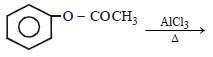
ChemistryMediumMCQAIIMS · 2007
The product obtained is/are
A
$o-$ product
B
$m-$ product
C
$o-$ and $p-$ products
D
$o-, m-$ and $p-$ products
Solution
(C) The reaction shown is the Fries rearrangement.
When phenyl esters are treated with a Lewis acid like anhydrous $AlCl_3$,they undergo rearrangement to yield a mixture of $o-$hydroxyketone and $p-$hydroxyketone.
The reaction is as follows:
$Phenyl \ acetate \xrightarrow{AlCl_3, \Delta} o-hydroxyacetophenone + p-hydroxyacetophenone$.
When phenyl esters are treated with a Lewis acid like anhydrous $AlCl_3$,they undergo rearrangement to yield a mixture of $o-$hydroxyketone and $p-$hydroxyketone.
The reaction is as follows:
$Phenyl \ acetate \xrightarrow{AlCl_3, \Delta} o-hydroxyacetophenone + p-hydroxyacetophenone$.
0 likesView Solution
50
ChemistryEasyMCQAIIMS · 2007
Benzoic acid is treated with lithium aluminium hydride. The compound obtained is
A
benzaldehyde
B
benzyl alcohol
C
toluene
D
benzene
Solution
(B) When benzoic acid $(C_6H_5COOH)$ is treated with lithium aluminium hydride $(LiAlH_4)$,it acts as a strong reducing agent.
It reduces the carboxylic acid group $(-COOH)$ to a primary alcohol group $(-CH_2OH)$.
The reaction is:
$C_6H_5COOH + 4[H] \xrightarrow{LiAlH_4} C_6H_5CH_2OH + H_2O$
Thus,the product obtained is benzyl alcohol.
It reduces the carboxylic acid group $(-COOH)$ to a primary alcohol group $(-CH_2OH)$.
The reaction is:
$C_6H_5COOH + 4[H] \xrightarrow{LiAlH_4} C_6H_5CH_2OH + H_2O$
Thus,the product obtained is benzyl alcohol.
0 likesView Solution
51
ChemistryDifficultMCQAIIMS · 2007
Assertion: Acetamide has a more polar $C=O$ group than ethyl acetoacetate.
Reason: $-\ddot{N}H_{2}$ is more electron-donating than $-\ddot{O}C_{2}H_{5}$.
Reason: $-\ddot{N}H_{2}$ is more electron-donating than $-\ddot{O}C_{2}H_{5}$.
A
If both Assertion and Reason are correct and the Reason is a correct explanation of the Assertion.
B
If both Assertion and Reason are correct but Reason is not a correct explanation of the Assertion.
C
If the Assertion is correct but Reason is incorrect.
D
If both the Assertion and Reason are incorrect.
Solution
(A) In acetamide $(CH_{3}CONH_{2})$,the nitrogen atom has a lone pair that participates in resonance with the $C=O$ group. However,the $-NH_{2}$ group is a stronger electron-donating group by resonance compared to the $-OC_{2}H_{5}$ group in ethyl acetoacetate $(CH_{3}COCH_{2}COOC_{2}H_{5})$.
Because nitrogen is less electronegative than oxygen,the lone pair on nitrogen is more readily donated into the carbonyl system,increasing the electron density on the oxygen atom of the $C=O$ bond,which makes the $C=O$ bond more polar.
Thus,both the Assertion and the Reason are correct,and the Reason is the correct explanation for the Assertion.
Because nitrogen is less electronegative than oxygen,the lone pair on nitrogen is more readily donated into the carbonyl system,increasing the electron density on the oxygen atom of the $C=O$ bond,which makes the $C=O$ bond more polar.
Thus,both the Assertion and the Reason are correct,and the Reason is the correct explanation for the Assertion.
0 likesView Solution
52
ChemistryMediumMCQAIIMS · 2007
Which of the following statements is true?
A
Trimethylamine forms a soluble compound with Hinsberg reagent and $KOH$.
B
Dimethylamine reacts with $KOH$ and phenol to form an azo dye.
C
Methylamine reacts with nitrous acid and liberates $N_2$ from aqueous solution.
D
None of these.
Solution
(C) Among the given statements,only $(c)$ is true. Methylamine reacts with nitrous acid to liberate $N_2$ gas:
$CH_3-NH_2 + HNO_2 \to CH_3OH + N_2 + H_2O$.
Trimethylamine does not react with Hinsberg reagent $(C_6H_5SO_2Cl)$ in the presence of $KOH$ because it lacks an acidic hydrogen,and it remains insoluble.
Dimethylamine reacts with Hinsberg reagent to form a sulfonamide which is insoluble in $KOH$.
Azo dyes are typically formed by the coupling reaction of diazonium salts with phenols or aromatic amines,not by simple secondary amines.
$CH_3-NH_2 + HNO_2 \to CH_3OH + N_2 + H_2O$.
Trimethylamine does not react with Hinsberg reagent $(C_6H_5SO_2Cl)$ in the presence of $KOH$ because it lacks an acidic hydrogen,and it remains insoluble.
Dimethylamine reacts with Hinsberg reagent to form a sulfonamide which is insoluble in $KOH$.
Azo dyes are typically formed by the coupling reaction of diazonium salts with phenols or aromatic amines,not by simple secondary amines.
0 likesView Solution
53
ChemistryMediumMCQAIIMS · 2007
Which of the following amines will not give $N_2$ gas on treatment with nitrous acid $(NaNO_2 + HCl)$?
A
$C_2H_5NH_2$
B
$CH_3NH_2$
C
$(CH_3)_2CHNH_2$
D
All will give $N_2$
Solution
(D) All aliphatic primary amines react with nitrous acid $(NaNO_2 + HCl)$ to form unstable alkyl diazonium salts,which decompose to liberate $N_2$ gas.
$RNH_2 + HONO \longrightarrow R-OH + N_2 + H_2O$
Since all the given options ($C_2H_5NH_2$,$CH_3NH_2$,and $(CH_3)_2CHNH_2$) are aliphatic primary amines,they all will evolve $N_2$ gas.
$RNH_2 + HONO \longrightarrow R-OH + N_2 + H_2O$
Since all the given options ($C_2H_5NH_2$,$CH_3NH_2$,and $(CH_3)_2CHNH_2$) are aliphatic primary amines,they all will evolve $N_2$ gas.
0 likesView Solution
54
ChemistryMediumMCQAIIMS · 2007
Assertion : Benzene diazonium salt on boiling with water forms phenol.
Reason : $C-N$ bond is polar.
Reason : $C-N$ bond is polar.
A
If both Assertion and Reason are correct and the Reason is a correct explanation of the Assertion.
B
If both Assertion and Reason are correct but Reason is not a correct explanation of the Assertion.
C
If the Assertion is correct but Reason is incorrect.
D
If both the Assertion and Reason are incorrect.
Solution
(C) The Assertion is correct: Benzene diazonium salts react with water upon boiling to form phenol,releasing $N_2$ gas.
The Reason is incorrect: The $C-N$ bond in the diazonium salt is indeed polar,but the reaction proceeds because the $N_2$ group is an excellent leaving group,not simply due to the polarity of the bond.
The Reason is incorrect: The $C-N$ bond in the diazonium salt is indeed polar,but the reaction proceeds because the $N_2$ group is an excellent leaving group,not simply due to the polarity of the bond.
0 likesView Solution
55
ChemistryDifficultMCQAIIMS · 2007
Assertion: $\alpha$-amino acids exist as internal salt in solution as they have amino and carboxylic acid groups in near vicinity.
Reason: $H^{+}$ ion given by carboxylic group $(-COOH)$ is captured by amino group $(-NH_2)$ having lone pair of electrons.
Reason: $H^{+}$ ion given by carboxylic group $(-COOH)$ is captured by amino group $(-NH_2)$ having lone pair of electrons.
A
If both Assertion and Reason are correct and the Reason is a correct explanation of the Assertion.
B
If both Assertion and Reason are correct but Reason is not a correct explanation of the Assertion.
C
If the Assertion is correct but Reason is incorrect.
D
If both the Assertion and Reason are incorrect.
Solution
(A) $\alpha$-amino acids contain both an acidic carboxyl group $(-COOH)$ and a basic amino group $(-NH_2)$.
In aqueous solution,the carboxyl group loses a proton $(H^{+})$ and the amino group accepts it,forming a dipolar ion known as a zwitterion or internal salt: $NH_2-CHR-COOH \rightleftharpoons NH_3^+-CHR-COO^-$.
This occurs because the acidic and basic groups are in close proximity.
Therefore,both Assertion and Reason are correct,and the Reason is the correct explanation.
In aqueous solution,the carboxyl group loses a proton $(H^{+})$ and the amino group accepts it,forming a dipolar ion known as a zwitterion or internal salt: $NH_2-CHR-COOH \rightleftharpoons NH_3^+-CHR-COO^-$.
This occurs because the acidic and basic groups are in close proximity.
Therefore,both Assertion and Reason are correct,and the Reason is the correct explanation.
0 likesView Solution
Vedclass Products
For Students
Vedclass Test Series
Mock tests in real AIIMS style covering Chemistry with performance analysis. 5-day free trial.
Start Free TrialFor Teachers
Exam Paper Generator
Generate Set A/B/C/D Chemistry papers from 7.5L+ questions in 2 minutes. 3 chapters free.
Try FreeFor Institutes
Online Exam Module
Run live AIIMS mock exams with unlimited students, 360° analytics & white-label branding.
See DemoFrequently Asked Questions
How many Chemistry questions are in AIIMS 2007?
There are 55 Chemistry questions from the AIIMS 2007 paper on Vedclass, each with a detailed step-by-step solution in English.
Are AIIMS 2007 Chemistry solutions available in English?
Yes. All solutions on this page are in English. You can also switch to English or Hindi using the language buttons above the questions.
Can I practice AIIMS 2007 Chemistry as a timed test?
Yes. Use the Vedclass Test Series to attempt a full AIIMS mock test covering Chemistry with time limits and instant score analysis.
Can teachers create Chemistry papers from AIIMS previous year questions?
Yes. The Vedclass Exam Paper Generator lets teachers mix AIIMS Chemistry questions and generate Set A/B/C/D papers in minutes.
For Teachers & Institutes
Build a Custom Chemistry Paper
Pick AIIMS 2007 Chemistry questions, set difficulty, and generate Set A/B/C/D in 2 minutes.