
A English
Measurement of Area Questions in English
Competitive Exam Quantitative Aptitude · Mensuration · Measurement of Area
407+
Questions
English
Language
100%
With Solutions
Showing 50 of 407 questions in English
101
MediumMCQ
The largest cone is formed at the base of a cube of side measuring $7 \ cm$. Find the ratio of the volume of the cone to the volume of the cube.
A
$20:21$
B
$22:21$
C
$21:22$
D
$11:42$
Solution
(D) The side of the cube is $a = 7 \ cm$.
Volume of the cube $= a^3 = 7^3 = 343 \ cm^3$.
The largest cone inscribed in the cube will have a base diameter equal to the side of the cube and a height equal to the side of the cube.
Radius of the cone $(r) = \frac{a}{2} = \frac{7}{2} = 3.5 \ cm$.
Height of the cone $(h) = a = 7 \ cm$.
Volume of the cone $= \frac{1}{3} \pi r^2 h = \frac{1}{3} \times \frac{22}{7} \times (3.5)^2 \times 7 = \frac{1}{3} \times 22 \times 12.25 = \frac{269.5}{3} \approx 89.83 \ cm^3$.
Ratio of the volume of the cone to the volume of the cube $= \frac{\frac{1}{3} \pi r^2 h}{a^3} = \frac{\frac{1}{3} \times \frac{22}{7} \times (\frac{7}{2})^2 \times 7}{7^3} = \frac{\frac{1}{3} \times \frac{22}{7} \times \frac{49}{4} \times 7}{343} = \frac{\frac{1}{3} \times 22 \times \frac{49}{4}}{343} = \frac{11 \times 49}{6 \times 343} = \frac{11}{6 \times 7} = \frac{11}{42}$.
Thus,the ratio is $11:42$.
Volume of the cube $= a^3 = 7^3 = 343 \ cm^3$.
The largest cone inscribed in the cube will have a base diameter equal to the side of the cube and a height equal to the side of the cube.
Radius of the cone $(r) = \frac{a}{2} = \frac{7}{2} = 3.5 \ cm$.
Height of the cone $(h) = a = 7 \ cm$.
Volume of the cone $= \frac{1}{3} \pi r^2 h = \frac{1}{3} \times \frac{22}{7} \times (3.5)^2 \times 7 = \frac{1}{3} \times 22 \times 12.25 = \frac{269.5}{3} \approx 89.83 \ cm^3$.
Ratio of the volume of the cone to the volume of the cube $= \frac{\frac{1}{3} \pi r^2 h}{a^3} = \frac{\frac{1}{3} \times \frac{22}{7} \times (\frac{7}{2})^2 \times 7}{7^3} = \frac{\frac{1}{3} \times \frac{22}{7} \times \frac{49}{4} \times 7}{343} = \frac{\frac{1}{3} \times 22 \times \frac{49}{4}}{343} = \frac{11 \times 49}{6 \times 343} = \frac{11}{6 \times 7} = \frac{11}{42}$.
Thus,the ratio is $11:42$.
0 likes
View Solution102
DifficultMCQ
The total surface area of a rectangular block is $8788 \text{ cm}^2$. If the length,breadth,and height are in the ratio $4:3:2$,find the length (in $\text{cm}$).
A
$26$
B
$52$
C
$104$
D
$13$
Solution
(B) Let the common ratio be $x$.
Then,length $l = 4x$,breadth $b = 3x$,and height $h = 2x$.
The total surface area of a rectangular block is given by the formula $2(lb + bh + lh)$.
According to the problem,$2(4x \cdot 3x + 3x \cdot 2x + 2x \cdot 4x) = 8788$.
$2(12x^2 + 6x^2 + 8x^2) = 8788$.
$2(26x^2) = 8788$.
$52x^2 = 8788$.
$x^2 = \frac{8788}{52} = 169$.
$x = \sqrt{169} = 13$.
Therefore,the length is $l = 4x = 4 \times 13 = 52 \text{ cm}$.
Then,length $l = 4x$,breadth $b = 3x$,and height $h = 2x$.
The total surface area of a rectangular block is given by the formula $2(lb + bh + lh)$.
According to the problem,$2(4x \cdot 3x + 3x \cdot 2x + 2x \cdot 4x) = 8788$.
$2(12x^2 + 6x^2 + 8x^2) = 8788$.
$2(26x^2) = 8788$.
$52x^2 = 8788$.
$x^2 = \frac{8788}{52} = 169$.
$x = \sqrt{169} = 13$.
Therefore,the length is $l = 4x = 4 \times 13 = 52 \text{ cm}$.
0 likes
View Solution103
MediumMCQ
In a shower,$10\, cm$ of rain falls. What will be the volume of water that falls on $1$ hectare area of ground? (in $m^3$)
A
$500$
B
$650$
C
$1000$
D
$750$
Solution
(C) Given that $1$ hectare $= 10000\, m^2$.
The height of the rainfall is $10\, cm$.
Convert the height into meters: $10\, cm = \frac{10}{100}\, m = 0.1\, m$ or $\frac{1}{10}\, m$.
The volume of water is calculated as $\text{Area} \times \text{Height}$.
Volume $= 10000\, m^2 \times 0.1\, m = 1000\, m^3$.
The height of the rainfall is $10\, cm$.
Convert the height into meters: $10\, cm = \frac{10}{100}\, m = 0.1\, m$ or $\frac{1}{10}\, m$.
The volume of water is calculated as $\text{Area} \times \text{Height}$.
Volume $= 10000\, m^2 \times 0.1\, m = 1000\, m^3$.
0 likes
View Solution104
MediumMCQ
$A$ steel sphere of radius $4 \, cm$ is drawn into a wire of diameter $4 \, mm$. Find the length of the wire in $mm$.
A
$10665$
B
$42660$
C
$21333$
D
$14220$
Solution
(C) The volume of the material remains constant when the sphere is reshaped into a wire.
Volume of sphere = Volume of cylindrical wire
$\frac{4}{3} \pi r^3 = \pi R^2 h$
Given: Radius of sphere $r = 4 \, cm = 40 \, mm$. Diameter of wire = $4 \, mm$,so radius of wire $R = 2 \, mm$.
Substituting the values:
$\frac{4}{3} \times \pi \times (40)^3 = \pi \times (2)^2 \times h$
$\frac{4}{3} \times 64000 = 4 \times h$
$h = \frac{64000}{3} \approx 21333.33 \, mm$.
Rounding to the nearest integer,the length is $21333 \, mm$.
Volume of sphere = Volume of cylindrical wire
$\frac{4}{3} \pi r^3 = \pi R^2 h$
Given: Radius of sphere $r = 4 \, cm = 40 \, mm$. Diameter of wire = $4 \, mm$,so radius of wire $R = 2 \, mm$.
Substituting the values:
$\frac{4}{3} \times \pi \times (40)^3 = \pi \times (2)^2 \times h$
$\frac{4}{3} \times 64000 = 4 \times h$
$h = \frac{64000}{3} \approx 21333.33 \, mm$.
Rounding to the nearest integer,the length is $21333 \, mm$.
0 likes
View Solution105
DifficultMCQ
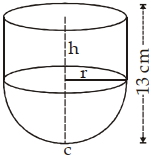
$A$ vessel is in the form of a hollow cylinder mounted on a hemispherical bowl. The diameter of the hemisphere is $14 \, cm$ and the total height of the vessel is $13 \, cm$. Find the capacity of the vessel in $cm^3$. (Take $\pi = 22/7$)
A
$321.33$
B
$1642.67$
C
$1232$
D
$1632.33$
Solution
(B) Given:
Diameter of the hemisphere $= 14 \, cm$,so radius $r = 14/2 = 7 \, cm$.
Total height of the vessel $= 13 \, cm$.
Height of the cylindrical part $h = \text{Total height} - \text{Radius of hemisphere} = 13 - 7 = 6 \, cm$.
Capacity of the vessel $=$ Volume of cylinder $+$ Volume of hemisphere
$= \pi r^2 h + \frac{2}{3} \pi r^3$
$= \pi r^2 (h + \frac{2}{3} r)$
$= \frac{22}{7} \times 7 \times 7 \times (6 + \frac{2}{3} \times 7)$
$= 22 \times 7 \times (6 + \frac{14}{3})$
$= 154 \times (\frac{18 + 14}{3})$
$= 154 \times \frac{32}{3}$
$= \frac{4928}{3} \approx 1642.67 \, cm^3$.
Diameter of the hemisphere $= 14 \, cm$,so radius $r = 14/2 = 7 \, cm$.
Total height of the vessel $= 13 \, cm$.
Height of the cylindrical part $h = \text{Total height} - \text{Radius of hemisphere} = 13 - 7 = 6 \, cm$.
Capacity of the vessel $=$ Volume of cylinder $+$ Volume of hemisphere
$= \pi r^2 h + \frac{2}{3} \pi r^3$
$= \pi r^2 (h + \frac{2}{3} r)$
$= \frac{22}{7} \times 7 \times 7 \times (6 + \frac{2}{3} \times 7)$
$= 22 \times 7 \times (6 + \frac{14}{3})$
$= 154 \times (\frac{18 + 14}{3})$
$= 154 \times \frac{32}{3}$
$= \frac{4928}{3} \approx 1642.67 \, cm^3$.
0 likes
View Solution106
EasyMCQ
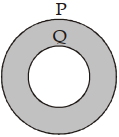
In the given figure,circle $P$ has a diameter of $2 \ m$ and circle $Q$ has a diameter of $1 \ m$. Find the area of the shaded region.
A
$\frac{3}{4} \pi \ m^2$
B
$\frac{3}{7} \pi \ m^2$
C
$\frac{3}{5} \pi \ m^2$
D
$4 \pi \ m^2$
Solution
(A) The shaded region is the area between the two concentric circles.
Radius of circle $P$ $(R)$ = $\frac{\text{diameter}}{2} = \frac{2 \ m}{2} = 1 \ m$.
Radius of circle $Q$ $(r)$ = $\frac{\text{diameter}}{2} = \frac{1 \ m}{2} = 0.5 \ m$.
Area of shaded region = Area of circle $P$ - Area of circle $Q$.
Area = $\pi R^2 - \pi r^2 = \pi(1)^2 - \pi(0.5)^2$.
Area = $\pi - 0.25\pi = 0.75\pi = \frac{3}{4} \pi \ m^2$.
Radius of circle $P$ $(R)$ = $\frac{\text{diameter}}{2} = \frac{2 \ m}{2} = 1 \ m$.
Radius of circle $Q$ $(r)$ = $\frac{\text{diameter}}{2} = \frac{1 \ m}{2} = 0.5 \ m$.
Area of shaded region = Area of circle $P$ - Area of circle $Q$.
Area = $\pi R^2 - \pi r^2 = \pi(1)^2 - \pi(0.5)^2$.
Area = $\pi - 0.25\pi = 0.75\pi = \frac{3}{4} \pi \ m^2$.
0 likes
View Solution107
EasyMCQ
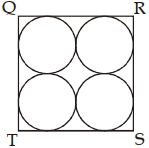
In the given figure,$QRST$ is a square. If the area of each circle is $2 \pi$,then find the area of square $QRST$?
A
$\sqrt{4} \pi^{2}$
B
$\sqrt{4} \pi$
C
$32$
D
$16$
Solution
(C) Let the radius of each circle be $r$.
Given that the area of each circle is $\pi r^{2} = 2 \pi$.
Dividing both sides by $\pi$,we get $r^{2} = 2$,which implies $r = \sqrt{2}$.
The diameter of each circle is $d = 2r = 2\sqrt{2}$.
From the figure,the side length of the square $QRST$ is equal to the sum of the diameters of two circles placed side-by-side,so the side length $s = 2d = 2(2\sqrt{2}) = 4\sqrt{2}$.
The area of the square $QRST$ is $s^{2} = (4\sqrt{2})^{2} = 16 \times 2 = 32$ square units.
Given that the area of each circle is $\pi r^{2} = 2 \pi$.
Dividing both sides by $\pi$,we get $r^{2} = 2$,which implies $r = \sqrt{2}$.
The diameter of each circle is $d = 2r = 2\sqrt{2}$.
From the figure,the side length of the square $QRST$ is equal to the sum of the diameters of two circles placed side-by-side,so the side length $s = 2d = 2(2\sqrt{2}) = 4\sqrt{2}$.
The area of the square $QRST$ is $s^{2} = (4\sqrt{2})^{2} = 16 \times 2 = 32$ square units.
0 likes
View Solution108
EasyMCQ
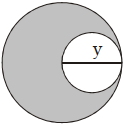
In the given figure,$y$ is both the radius of the larger circle and the diameter of the smaller circle. Find the area of the shaded region.
A
$\frac{3}{7} \pi y^{2}$
B
$\frac{3}{4} \pi y^{2}$
C
$\frac{1}{4} \pi y^{2}$
D
$\frac{1}{3} \pi y^{2}$
Solution
(B) $1$. Radius of the larger circle $(R)$ = $y$.
$2$. Area of the larger circle = $\pi R^{2} = \pi y^{2}$.
$3$. Diameter of the smaller circle $(d)$ = $y$,so its radius $(r)$ = $\frac{y}{2}$.
$4$. Area of the smaller circle = $\pi r^{2} = \pi (\frac{y}{2})^{2} = \frac{\pi y^{2}}{4}$.
$5$. The shaded region is the area of the larger circle minus the area of the smaller circle.
$6$. Area of shaded region = $\pi y^{2} - \frac{\pi y^{2}}{4} = \frac{4\pi y^{2} - \pi y^{2}}{4} = \frac{3}{4} \pi y^{2}$.
$2$. Area of the larger circle = $\pi R^{2} = \pi y^{2}$.
$3$. Diameter of the smaller circle $(d)$ = $y$,so its radius $(r)$ = $\frac{y}{2}$.
$4$. Area of the smaller circle = $\pi r^{2} = \pi (\frac{y}{2})^{2} = \frac{\pi y^{2}}{4}$.
$5$. The shaded region is the area of the larger circle minus the area of the smaller circle.
$6$. Area of shaded region = $\pi y^{2} - \frac{\pi y^{2}}{4} = \frac{4\pi y^{2} - \pi y^{2}}{4} = \frac{3}{4} \pi y^{2}$.
0 likes
View Solution109
MediumMCQ
In the given figure,if $O$ is the centre of the circle,then find the value of $y$?
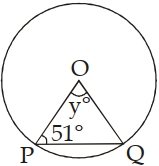
A
$78$
B
$77$
C
$76$
D
$75$
Solution
(A) $OP$ and $OQ$ are equal sides as they are radii of the circle. Hence,$\Delta POQ$ is an isosceles triangle.
Since the angles opposite to equal sides are equal,we have $\angle OPQ = \angle OQP = 51^{\circ}$.
In $\Delta POQ$,the sum of all interior angles is $180^{\circ}$.
Therefore,$y + 51^{\circ} + 51^{\circ} = 180^{\circ}$.
$y + 102^{\circ} = 180^{\circ}$.
$y = 180^{\circ} - 102^{\circ} = 78^{\circ}$.
Since the angles opposite to equal sides are equal,we have $\angle OPQ = \angle OQP = 51^{\circ}$.
In $\Delta POQ$,the sum of all interior angles is $180^{\circ}$.
Therefore,$y + 51^{\circ} + 51^{\circ} = 180^{\circ}$.
$y + 102^{\circ} = 180^{\circ}$.
$y = 180^{\circ} - 102^{\circ} = 78^{\circ}$.
0 likes
View Solution110
EasyMCQ
The length of a rectangular plot is thrice of its breadth. If the area of the rectangular plot is $7803 \ m^2$,what is the breadth of the rectangular plot? (in $m$)
A
$51$
B
$153$
C
$104$
D
$88$
Solution
(A) Let the breadth of the rectangular plot be $b \ m$.
According to the problem,the length of the plot is $3b \ m$.
The area of a rectangle is given by the formula: $\text{Area} = \text{length} \times \text{breadth}$.
Substituting the given values: $3b \times b = 7803$.
$3b^2 = 7803$.
Dividing both sides by $3$: $b^2 = \frac{7803}{3} = 2601$.
Taking the square root of both sides: $b = \sqrt{2601} = 51$.
Therefore,the breadth of the rectangular plot is $51 \ m$.
According to the problem,the length of the plot is $3b \ m$.
The area of a rectangle is given by the formula: $\text{Area} = \text{length} \times \text{breadth}$.
Substituting the given values: $3b \times b = 7803$.
$3b^2 = 7803$.
Dividing both sides by $3$: $b^2 = \frac{7803}{3} = 2601$.
Taking the square root of both sides: $b = \sqrt{2601} = 51$.
Therefore,the breadth of the rectangular plot is $51 \ m$.
0 likes
View Solution111
MediumMCQ
The ratio of length and breadth of a rectangular plot is $8:5$ respectively. If the breadth is $60\, m$ less than the length,what is the perimeter of the rectangular plot? (in $m$)
A
$260$
B
$1600$
C
$500$
D
$520$
Solution
(D) Let the length of the rectangular plot be $8x$ and the breadth be $5x$.
According to the problem,the breadth is $60\, m$ less than the length:
$8x - 5x = 60$
$3x = 60$
$x = 20\, m$
Now,calculate the length and breadth:
Length $= 8 \times 20 = 160\, m$
Breadth $= 5 \times 20 = 100\, m$
The perimeter of a rectangle is given by the formula $P = 2 \times (\text{length} + \text{breadth})$.
$P = 2 \times (160 + 100) = 2 \times 260 = 520\, m$.
According to the problem,the breadth is $60\, m$ less than the length:
$8x - 5x = 60$
$3x = 60$
$x = 20\, m$
Now,calculate the length and breadth:
Length $= 8 \times 20 = 160\, m$
Breadth $= 5 \times 20 = 100\, m$
The perimeter of a rectangle is given by the formula $P = 2 \times (\text{length} + \text{breadth})$.
$P = 2 \times (160 + 100) = 2 \times 260 = 520\, m$.
0 likes
View Solution112
MediumMCQ
Length of a rectangle is twice of its breadth. Area of the rectangle is $18 \, m^2$. What would be its perimeter? (in $m$)
A
$9$
B
$18$
C
$25$
D
$28$
Solution
(B) Let the breadth of the rectangle be $b \, m$.
Given that the length $l = 2b$.
The area of the rectangle is given by $l \times b = 18 \, m^2$.
Substituting $l = 2b$,we get $(2b) \times b = 18$.
$2b^2 = 18 \Rightarrow b^2 = 9 \Rightarrow b = 3 \, m$.
Thus,the length $l = 2 \times 3 = 6 \, m$.
The perimeter of a rectangle is calculated as $2(l + b)$.
Perimeter $= 2(6 + 3) = 2(9) = 18 \, m$.
Given that the length $l = 2b$.
The area of the rectangle is given by $l \times b = 18 \, m^2$.
Substituting $l = 2b$,we get $(2b) \times b = 18$.
$2b^2 = 18 \Rightarrow b^2 = 9 \Rightarrow b = 3 \, m$.
Thus,the length $l = 2 \times 3 = 6 \, m$.
The perimeter of a rectangle is calculated as $2(l + b)$.
Perimeter $= 2(6 + 3) = 2(9) = 18 \, m$.
0 likes
View Solution113
MediumMCQ
Length of a rectangle is twice of its breadth. Area of the rectangle is $18 \, m^{2}$. What would be its perimeter? (in $m$)
A
$16$
B
$18$
C
$12$
D
$24$
Solution
(B) Let the breadth of the rectangle be $b$ meters.
Given that the length is twice the breadth,so length $l = 2b$.
The area of a rectangle is given by the formula $Area = l \times b$.
Substituting the given values: $18 = (2b) \times b$.
$18 = 2b^{2}$.
$b^{2} = 9$.
$b = 3 \, m$ (since breadth cannot be negative).
Therefore,length $l = 2 \times 3 = 6 \, m$.
The perimeter of a rectangle is given by $P = 2(l + b)$.
$P = 2(6 + 3) = 2(9) = 18 \, m$.
Given that the length is twice the breadth,so length $l = 2b$.
The area of a rectangle is given by the formula $Area = l \times b$.
Substituting the given values: $18 = (2b) \times b$.
$18 = 2b^{2}$.
$b^{2} = 9$.
$b = 3 \, m$ (since breadth cannot be negative).
Therefore,length $l = 2 \times 3 = 6 \, m$.
The perimeter of a rectangle is given by $P = 2(l + b)$.
$P = 2(6 + 3) = 2(9) = 18 \, m$.
0 likes
View Solution114
EasyMCQ
The perimeter of a square is double the perimeter of a rectangle. The area of the rectangle is $240 \, cm^2$. What is the area of the square? (in $cm^2$)
A
$100$
B
$36$
C
$81$
D
Cannot be determined
Solution
(D) Let the side of the square be $a$ and the length and breadth of the rectangle be $l$ and $b$ respectively.
Perimeter of the square = $4a$.
Perimeter of the rectangle = $2(l + b)$.
According to the problem,$4a = 2 \times [2(l + b)]$,which simplifies to $4a = 4(l + b)$,so $a = l + b$.
The area of the rectangle is given as $l \times b = 240 \, cm^2$.
We need to find the area of the square,which is $a^2 = (l + b)^2 = l^2 + b^2 + 2lb$.
Since we only know the value of $lb = 240$,we cannot determine the value of $l^2 + b^2$ without knowing the individual values of $l$ and $b$ or their sum. Thus,the area of the square cannot be uniquely determined.
Perimeter of the square = $4a$.
Perimeter of the rectangle = $2(l + b)$.
According to the problem,$4a = 2 \times [2(l + b)]$,which simplifies to $4a = 4(l + b)$,so $a = l + b$.
The area of the rectangle is given as $l \times b = 240 \, cm^2$.
We need to find the area of the square,which is $a^2 = (l + b)^2 = l^2 + b^2 + 2lb$.
Since we only know the value of $lb = 240$,we cannot determine the value of $l^2 + b^2$ without knowing the individual values of $l$ and $b$ or their sum. Thus,the area of the square cannot be uniquely determined.
0 likes
View Solution115
MediumMCQ
What will be the area of a circle with circumference equal to $88\, cm$? (in $Sq\, cm$)
A
$154$
B
$44$
C
$616$
D
Cannot be determined
Solution
(C) Let the radius of the circle be $r\, cm$.
The formula for the circumference of a circle is $C = 2\pi r$.
Given that $C = 88\, cm$,we have $2 \times \frac{22}{7} \times r = 88$.
Solving for $r$: $r = \frac{88 \times 7}{2 \times 22} = \frac{88 \times 7}{44} = 2 \times 7 = 14\, cm$.
The formula for the area of a circle is $A = \pi r^2$.
Substituting the value of $r$: $A = \frac{22}{7} \times 14 \times 14 = 22 \times 2 \times 14 = 44 \times 14 = 616\, Sq\, cm$.
The formula for the circumference of a circle is $C = 2\pi r$.
Given that $C = 88\, cm$,we have $2 \times \frac{22}{7} \times r = 88$.
Solving for $r$: $r = \frac{88 \times 7}{2 \times 22} = \frac{88 \times 7}{44} = 2 \times 7 = 14\, cm$.
The formula for the area of a circle is $A = \pi r^2$.
Substituting the value of $r$: $A = \frac{22}{7} \times 14 \times 14 = 22 \times 2 \times 14 = 44 \times 14 = 616\, Sq\, cm$.
0 likes
View Solution116
MediumMCQ
What will be the area of a circle with circumference equal to $22 \, cm$? (in $sq \, cm$)
A
$41.2$
B
$26.4$
C
$38.5$
D
Cannot be determined
Solution
(C) Let the radius of the circle be $r \, cm$.
The circumference of a circle is given by the formula $C = 2 \pi r$.
Given $C = 22 \, cm$,we have $2 \times \frac{22}{7} \times r = 22$.
Solving for $r$: $r = \frac{22 \times 7}{2 \times 22} = \frac{7}{2} = 3.5 \, cm$.
The area of the circle is given by $A = \pi r^2$.
Substituting the value of $r$: $A = \frac{22}{7} \times (3.5)^2 = \frac{22}{7} \times 3.5 \times 3.5 = 22 \times 0.5 \times 3.5 = 11 \times 3.5 = 38.5 \, sq \, cm$.
The circumference of a circle is given by the formula $C = 2 \pi r$.
Given $C = 22 \, cm$,we have $2 \times \frac{22}{7} \times r = 22$.
Solving for $r$: $r = \frac{22 \times 7}{2 \times 22} = \frac{7}{2} = 3.5 \, cm$.
The area of the circle is given by $A = \pi r^2$.
Substituting the value of $r$: $A = \frac{22}{7} \times (3.5)^2 = \frac{22}{7} \times 3.5 \times 3.5 = 22 \times 0.5 \times 3.5 = 11 \times 3.5 = 38.5 \, sq \, cm$.
0 likes
View Solution117
MediumMCQ
The circumference of two circles is $132\, m$ and $176\, m$ respectively. What is the difference between the area of the larger circle and the smaller circle? (in $sq\,m$)
A
$1048$
B
$1076$
C
$1078$
D
$1090$
Solution
(C) Let the radii of the two circles be $r_1$ and $r_2$ respectively.
The circumference of a circle is given by $C = 2\pi r$.
For the smaller circle: $2 \times \frac{22}{7} \times r_1 = 132 \Rightarrow r_1 = \frac{132 \times 7}{44} = 21\, m$.
For the larger circle: $2 \times \frac{22}{7} \times r_2 = 176 \Rightarrow r_2 = \frac{176 \times 7}{44} = 28\, m$.
The area of a circle is given by $A = \pi r^2$.
Difference in area $= \pi r_2^2 - \pi r_1^2 = \pi(r_2^2 - r_1^2)$.
Difference $= \frac{22}{7} \times (28^2 - 21^2) = \frac{22}{7} \times (28 - 21)(28 + 21)$.
Difference $= \frac{22}{7} \times 7 \times 49 = 22 \times 49 = 1078\, sq\, m$.
The circumference of a circle is given by $C = 2\pi r$.
For the smaller circle: $2 \times \frac{22}{7} \times r_1 = 132 \Rightarrow r_1 = \frac{132 \times 7}{44} = 21\, m$.
For the larger circle: $2 \times \frac{22}{7} \times r_2 = 176 \Rightarrow r_2 = \frac{176 \times 7}{44} = 28\, m$.
The area of a circle is given by $A = \pi r^2$.
Difference in area $= \pi r_2^2 - \pi r_1^2 = \pi(r_2^2 - r_1^2)$.
Difference $= \frac{22}{7} \times (28^2 - 21^2) = \frac{22}{7} \times (28 - 21)(28 + 21)$.
Difference $= \frac{22}{7} \times 7 \times 49 = 22 \times 49 = 1078\, sq\, m$.
0 likes
View Solution118
DifficultMCQ
The cost of fencing a circular plot at the rate of $Rs. 15$ per $m$ is $Rs. 3300$. What will be the cost of flooring the plot at the rate of $Rs. 100$ per square metre? (in $Rs.$)
A
$385000$
B
$220000$
C
$350000$
D
Cannot be determined
Solution
(A) The circumference of the circular plot is calculated by dividing the total cost of fencing by the rate per meter:
Circumference $= \frac{3300}{15} = 220 \ m$.
Using the formula for circumference $C = 2\pi r$,we find the radius $r$:
$220 = 2 \times \frac{22}{7} \times r$
$r = \frac{220 \times 7}{44} = 5 \times 7 = 35 \ m$.
The area of the circular plot is given by $A = \pi r^2$:
$A = \frac{22}{7} \times 35 \times 35 = 22 \times 5 \times 35 = 3850 \ m^2$.
The cost of flooring is the area multiplied by the rate per square meter:
Cost $= 3850 \times 100 = Rs. 385000$.
Circumference $= \frac{3300}{15} = 220 \ m$.
Using the formula for circumference $C = 2\pi r$,we find the radius $r$:
$220 = 2 \times \frac{22}{7} \times r$
$r = \frac{220 \times 7}{44} = 5 \times 7 = 35 \ m$.
The area of the circular plot is given by $A = \pi r^2$:
$A = \frac{22}{7} \times 35 \times 35 = 22 \times 5 \times 35 = 3850 \ m^2$.
The cost of flooring is the area multiplied by the rate per square meter:
Cost $= 3850 \times 100 = Rs. 385000$.
0 likes
View Solution119
DifficultMCQ
The perimeter of a square is equal to twice the perimeter of a rectangle of length $8\, cm$ and breadth $7\, cm$. What is the circumference of a semicircle whose diameter is equal to the side of the square? (rounded off to the two decimal places) (in $cm$)
A
$38.57$
B
$23.57$
C
$41.46$
D
$47.47$
Solution
(A) Perimeter of a rectangle $= 2 \times (8 + 7) = 2 \times 15 = 30\, cm$.
Perimeter of a square $= 2 \times 30 = 60\, cm$.
Side of the square $= \frac{60}{4} = 15\, cm$.
Diameter of the semicircle $= 15\, cm$,so radius $r = \frac{15}{2} = 7.5\, cm$.
Circumference of a semicircle $= \pi r + d = \pi r + 2r = r(\pi + 2)$.
Using $\pi \approx 3.14159$,Circumference $= 7.5 \times (3.14159 + 2) = 7.5 \times 5.14159 \approx 38.5619$.
Rounding to two decimal places,we get $38.56\, cm$. (Note: Using $\pi = \frac{22}{7}$,$7.5 \times (3.1428 + 2) = 7.5 \times 5.1428 = 38.57\, cm$).
Perimeter of a square $= 2 \times 30 = 60\, cm$.
Side of the square $= \frac{60}{4} = 15\, cm$.
Diameter of the semicircle $= 15\, cm$,so radius $r = \frac{15}{2} = 7.5\, cm$.
Circumference of a semicircle $= \pi r + d = \pi r + 2r = r(\pi + 2)$.
Using $\pi \approx 3.14159$,Circumference $= 7.5 \times (3.14159 + 2) = 7.5 \times 5.14159 \approx 38.5619$.
Rounding to two decimal places,we get $38.56\, cm$. (Note: Using $\pi = \frac{22}{7}$,$7.5 \times (3.1428 + 2) = 7.5 \times 5.1428 = 38.57\, cm$).
0 likes
View Solution120
MediumMCQ
The breadth of a rectangular plot is $75 \%$ of its length. If the perimeter of the plot is $1050 \, m,$ what is its area (in $, m^2$)?
A
$12500$
B
$57500$
C
$62500$
D
$67500$
Solution
(D) Let the length of the rectangular plot be $L \, m$.
Given that the breadth $B = 75 \% \text{ of } L = 0.75L = \frac{3}{4}L$.
The perimeter of a rectangle is given by the formula $P = 2(L + B)$.
Substituting the given values: $2(L + \frac{3}{4}L) = 1050$.
$2(\frac{7}{4}L) = 1050$.
$\frac{7}{2}L = 1050$.
$L = \frac{1050 \times 2}{7} = 150 \times 2 = 300 \, m$.
Now,find the breadth: $B = \frac{3}{4} \times 300 = 3 \times 75 = 225 \, m$.
The area of the rectangle is $A = L \times B = 300 \times 225 = 67500 \, m^2$.
Given that the breadth $B = 75 \% \text{ of } L = 0.75L = \frac{3}{4}L$.
The perimeter of a rectangle is given by the formula $P = 2(L + B)$.
Substituting the given values: $2(L + \frac{3}{4}L) = 1050$.
$2(\frac{7}{4}L) = 1050$.
$\frac{7}{2}L = 1050$.
$L = \frac{1050 \times 2}{7} = 150 \times 2 = 300 \, m$.
Now,find the breadth: $B = \frac{3}{4} \times 300 = 3 \times 75 = 225 \, m$.
The area of the rectangle is $A = L \times B = 300 \times 225 = 67500 \, m^2$.
0 likes
View Solution121
EasyMCQ
The radius of a coin is $1\, cm$. If four of these coins are placed on a table so that the rim of each touches that of the other two,find the area of the unoccupied space between them. (in $cm^2$)
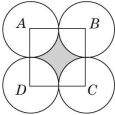
A
$0.25$
B
$0.5$
C
$1.57$
D
$0.86$
Solution
(D) Let the radius of each coin be $r = 1\, cm$.
When four such coins are placed such that each touches the other two,their centers form a square with side length $s = 2r = 2\, cm$.
The area of this square is $s^2 = (2)^2 = 4\, cm^2$.
Inside this square,there are four sectors,each with a central angle of $90^\circ$ (since it is a square).
The sum of the areas of these four sectors is $4 \times (\frac{90}{360} \times \pi r^2) = \pi r^2 = \pi(1)^2 = \pi \approx 3.14\, cm^2$.
The unoccupied space between the coins is the area of the square minus the area of the four sectors.
Unoccupied space $= 4 - \pi = 4 - 3.14 = 0.86\, cm^2$.
When four such coins are placed such that each touches the other two,their centers form a square with side length $s = 2r = 2\, cm$.
The area of this square is $s^2 = (2)^2 = 4\, cm^2$.
Inside this square,there are four sectors,each with a central angle of $90^\circ$ (since it is a square).
The sum of the areas of these four sectors is $4 \times (\frac{90}{360} \times \pi r^2) = \pi r^2 = \pi(1)^2 = \pi \approx 3.14\, cm^2$.
The unoccupied space between the coins is the area of the square minus the area of the four sectors.
Unoccupied space $= 4 - \pi = 4 - 3.14 = 0.86\, cm^2$.
0 likes
View Solution122
MediumMCQ
The radius of a circular wheel is $1 \frac{3}{4} \text{ m}$. How many revolutions will it make in travelling $11 \text{ km}$?
A
$500$
B
$1000$
C
$1500$
D
$2000$
Solution
(B) The total distance to be travelled is $11 \text{ km} = 11000 \text{ m}$.
The radius of the wheel is $r = 1 \frac{3}{4} \text{ m} = \frac{7}{4} \text{ m}$.
The circumference of the wheel is given by the formula $C = 2 \pi r$.
Substituting the values,$C = 2 \times \frac{22}{7} \times \frac{7}{4} = 11 \text{ m}$.
The number of revolutions is calculated by dividing the total distance by the circumference of the wheel.
Number of revolutions $= \frac{\text{Total Distance}}{\text{Circumference}} = \frac{11000}{11} = 1000$.
The radius of the wheel is $r = 1 \frac{3}{4} \text{ m} = \frac{7}{4} \text{ m}$.
The circumference of the wheel is given by the formula $C = 2 \pi r$.
Substituting the values,$C = 2 \times \frac{22}{7} \times \frac{7}{4} = 11 \text{ m}$.
The number of revolutions is calculated by dividing the total distance by the circumference of the wheel.
Number of revolutions $= \frac{\text{Total Distance}}{\text{Circumference}} = \frac{11000}{11} = 1000$.
0 likes
View Solution123
EasyMCQ
$A$ room is $7 \text{ m}$ long and $5 \text{ m}$ broad. The doors and windows occupy $5 \text{ m}^2$. The cost of papering the remaining part of the walls with paper $75 \text{ cm}$ wide,at ₹ $4.20$ per piece of $13 \text{ m}$,is ₹ $39.20$. Find the height of the room (in $\text{m}$).
A
$3$
B
$4$
C
$4.5$
D
$5$
Solution
(B) Let the height of the room be $h \text{ m}$.
Area of the four walls $= 2 \times (7 + 5) \times h = 24h \text{ m}^2$.
Area to be papered $= (24h - 5) \text{ m}^2$.
Width of paper $= 75 \text{ cm} = 0.75 \text{ m}$.
Area of one piece of paper $= 13 \text{ m} \times 0.75 \text{ m} = 9.75 \text{ m}^2$.
Number of pieces required $= \frac{24h - 5}{9.75}$.
Cost of one piece $= ₹ 4.20$.
Total cost $= \frac{24h - 5}{9.75} \times 4.20 = 39.20$.
$\frac{24h - 5}{9.75} = \frac{39.20}{4.20} = \frac{392}{42} = \frac{28}{3}$.
$3(24h - 5) = 28 \times 9.75$.
$72h - 15 = 273$.
$72h = 288$.
$h = 4 \text{ m}$.
Area of the four walls $= 2 \times (7 + 5) \times h = 24h \text{ m}^2$.
Area to be papered $= (24h - 5) \text{ m}^2$.
Width of paper $= 75 \text{ cm} = 0.75 \text{ m}$.
Area of one piece of paper $= 13 \text{ m} \times 0.75 \text{ m} = 9.75 \text{ m}^2$.
Number of pieces required $= \frac{24h - 5}{9.75}$.
Cost of one piece $= ₹ 4.20$.
Total cost $= \frac{24h - 5}{9.75} \times 4.20 = 39.20$.
$\frac{24h - 5}{9.75} = \frac{39.20}{4.20} = \frac{392}{42} = \frac{28}{3}$.
$3(24h - 5) = 28 \times 9.75$.
$72h - 15 = 273$.
$72h = 288$.
$h = 4 \text{ m}$.
0 likes
View Solution124
MediumMCQ
$A$ room is $7 \text{ m}$ long and $5 \text{ m}$ broad. The doors and windows occupy $5 \text{ m}^2$. The cost of papering the remaining part of the walls with paper $75 \text{ cm}$ wide,at ₹ $4.20$ per piece of $13 \text{ m}$ length,is ₹ $39.20$. Find the height of the room in $\text{cm}$.
A
$188$
B
$196$
C
$400$
D
$198$
Solution
(NONE) Let the height of the room be $h \text{ m}$.
Area of the four walls $= 2(l + b) \times h = 2(7 + 5) \times h = 24h \text{ m}^2$.
Area to be papered $= (24h - 5) \text{ m}^2$.
Width of paper $= 75 \text{ cm} = 0.75 \text{ m}$.
Length of one piece of paper $= 13 \text{ m}$.
Area of one piece of paper $= 13 \times 0.75 = 9.75 \text{ m}^2$.
Cost of one piece $= ₹ 4.20$.
Total cost $= ₹ 39.20$.
Number of pieces required $= \frac{39.20}{4.20} = \frac{392}{42} = \frac{28}{3} \text{ pieces}$.
Total area of paper $= \frac{28}{3} \times 9.75 = 28 \times 3.25 = 91 \text{ m}^2$.
Equating the areas: $24h - 5 = 91$.
$24h = 96$.
$h = 4 \text{ m}$.
Since $1 \text{ m} = 100 \text{ cm}$,the height is $400 \text{ cm}$.
Area of the four walls $= 2(l + b) \times h = 2(7 + 5) \times h = 24h \text{ m}^2$.
Area to be papered $= (24h - 5) \text{ m}^2$.
Width of paper $= 75 \text{ cm} = 0.75 \text{ m}$.
Length of one piece of paper $= 13 \text{ m}$.
Area of one piece of paper $= 13 \times 0.75 = 9.75 \text{ m}^2$.
Cost of one piece $= ₹ 4.20$.
Total cost $= ₹ 39.20$.
Number of pieces required $= \frac{39.20}{4.20} = \frac{392}{42} = \frac{28}{3} \text{ pieces}$.
Total area of paper $= \frac{28}{3} \times 9.75 = 28 \times 3.25 = 91 \text{ m}^2$.
Equating the areas: $24h - 5 = 91$.
$24h = 96$.
$h = 4 \text{ m}$.
Since $1 \text{ m} = 100 \text{ cm}$,the height is $400 \text{ cm}$.
0 likes
View Solution125
EasyMCQ
Find the area of a rhombus one of whose diagonals measures $10 \text{ cm}$ and the other $12 \text{ cm}$. (in $\text{cm}^2$)
A
$120$
B
$60$
C
$50$
D
$40$
Solution
(B) The area of a rhombus is given by the formula: $\text{Area} = \frac{1}{2} \times d_1 \times d_2$,where $d_1$ and $d_2$ are the lengths of the diagonals.
Given: $d_1 = 10 \text{ cm}$ and $d_2 = 12 \text{ cm}$.
Substituting the values into the formula:
$\text{Area} = \frac{1}{2} \times 10 \times 12$
$\text{Area} = \frac{1}{2} \times 120$
$\text{Area} = 60 \text{ cm}^2$.
Given: $d_1 = 10 \text{ cm}$ and $d_2 = 12 \text{ cm}$.
Substituting the values into the formula:
$\text{Area} = \frac{1}{2} \times 10 \times 12$
$\text{Area} = \frac{1}{2} \times 120$
$\text{Area} = 60 \text{ cm}^2$.
0 likes
View Solution126
MediumMCQ
The area of a square field is $69696 \text{ cm}^2$. Its diagonal will be equal to (in $\text{cm}$) (in $.296$)
A
$313$
B
$353$
C
$373$
D
$393$
Solution
(C) Let the side of the square be $a$.
Given that the area of the square is $a^2 = 69696 \text{ cm}^2$.
To find the side length $a$,we take the square root: $a = \sqrt{69696} = 264 \text{ cm}$.
The formula for the diagonal of a square is $d = a\sqrt{2}$.
Substituting the value of $a$: $d = 264 \times \sqrt{2}$.
Using the value $\sqrt{2} \approx 1.41421356$,we get $d = 264 \times 1.41421356 = 373.35237984 \text{ cm}$.
Rounding to the provided options,the correct value is $373.296$.
Given that the area of the square is $a^2 = 69696 \text{ cm}^2$.
To find the side length $a$,we take the square root: $a = \sqrt{69696} = 264 \text{ cm}$.
The formula for the diagonal of a square is $d = a\sqrt{2}$.
Substituting the value of $a$: $d = 264 \times \sqrt{2}$.
Using the value $\sqrt{2} \approx 1.41421356$,we get $d = 264 \times 1.41421356 = 373.35237984 \text{ cm}$.
Rounding to the provided options,the correct value is $373.296$.
0 likes
View Solution127
MediumMCQ
If the ratio of areas of two squares is $225: 256,$ then the ratio of their perimeters is
A
$225:256$
B
$256:225$
C
$15:16$
D
$16:15$
Solution
(C) Let the sides of the two squares be $a_1$ and $a_2$ respectively.
The area of a square is given by the formula $\text{Area} = a^2$.
Given the ratio of areas: $\frac{A_1}{A_2} = \frac{a_1^2}{a_2^2} = \frac{225}{256}$.
Taking the square root of both sides,we get: $\frac{a_1}{a_2} = \sqrt{\frac{225}{256}} = \frac{15}{16}$.
The perimeter of a square is given by the formula $P = 4a$.
The ratio of their perimeters is: $\frac{P_1}{P_2} = \frac{4a_1}{4a_2} = \frac{a_1}{a_2} = \frac{15}{16}$.
Thus,the ratio of their perimeters is $15:16$.
The area of a square is given by the formula $\text{Area} = a^2$.
Given the ratio of areas: $\frac{A_1}{A_2} = \frac{a_1^2}{a_2^2} = \frac{225}{256}$.
Taking the square root of both sides,we get: $\frac{a_1}{a_2} = \sqrt{\frac{225}{256}} = \frac{15}{16}$.
The perimeter of a square is given by the formula $P = 4a$.
The ratio of their perimeters is: $\frac{P_1}{P_2} = \frac{4a_1}{4a_2} = \frac{a_1}{a_2} = \frac{15}{16}$.
Thus,the ratio of their perimeters is $15:16$.
0 likes
View Solution128
MediumMCQ
$A$ man walked diagonally across a square plot. Approximately what was the percent saved by not walking along the edges?
A
$20$
B
$24$
C
$30$
D
$33$
Solution
(C) Let the side of the square plot be $a$.
Distance walked along the two edges $= a + a = 2a$.
Distance walked along the diagonal $= a\sqrt{2}$.
Distance saved $= 2a - a\sqrt{2} = a(2 - \sqrt{2})$.
Percent saved $= \frac{\text{Distance saved}}{\text{Total distance along edges}} \times 100$.
Percent saved $= \frac{a(2 - \sqrt{2})}{2a} \times 100 = \frac{2 - 1.414}{2} \times 100$.
Percent saved $= \frac{0.586}{2} \times 100 = 0.293 \times 100 = 29.3 \%$.
Rounding to the nearest whole number,the percent saved is approximately $30 \%$.
Distance walked along the two edges $= a + a = 2a$.
Distance walked along the diagonal $= a\sqrt{2}$.
Distance saved $= 2a - a\sqrt{2} = a(2 - \sqrt{2})$.
Percent saved $= \frac{\text{Distance saved}}{\text{Total distance along edges}} \times 100$.
Percent saved $= \frac{a(2 - \sqrt{2})}{2a} \times 100 = \frac{2 - 1.414}{2} \times 100$.
Percent saved $= \frac{0.586}{2} \times 100 = 0.293 \times 100 = 29.3 \%$.
Rounding to the nearest whole number,the percent saved is approximately $30 \%$.
0 likes
View Solution129
DifficultMCQ
$A$ rectangular park $60 \, m$ long and $40 \, m$ wide has two concrete crossroads running in the middle of the park, and the rest of the park has been used as a lawn. If the area of the lawn is $2109 \, m^2$, then what is the width of the road? (in $m$)
A
$2.91$
B
$3$
C
$5.82$
D
None of these
Solution
(B) Let the width of the road be $x \, m$.
Total area of the park $= 60 \times 40 = 2400 \, m^2$.
Area of the lawn $= 2109 \, m^2$.
Area of the road $= \text{Total area} - \text{Area of the lawn} = 2400 - 2109 = 291 \, m^2$.
The area of the two crossroads is given by the formula: $x(L + W - x) = \text{Area of road}$, where $L = 60 \, m$ and $W = 40 \, m$.
$x(60 + 40 - x) = 291$
$x(100 - x) = 291$
$100x - x^2 = 291$
$x^2 - 100x + 291 = 0$
Solving the quadratic equation using the quadratic formula $x = \frac{-b \pm \sqrt{b^2 - 4ac}}{2a}$:
$x = \frac{100 \pm \sqrt{(-100)^2 - 4(1)(291)}}{2(1)}$
$x = \frac{100 \pm \sqrt{10000 - 1164}}{2}$
$x = \frac{100 \pm \sqrt{8836}}{2}$
$x = \frac{100 \pm 94}{2}$
$x_1 = \frac{194}{2} = 97$ (not possible as width cannot exceed park dimensions)
$x_2 = \frac{6}{2} = 3$
Therefore, the width of the road is $3 \, m$.
Total area of the park $= 60 \times 40 = 2400 \, m^2$.
Area of the lawn $= 2109 \, m^2$.
Area of the road $= \text{Total area} - \text{Area of the lawn} = 2400 - 2109 = 291 \, m^2$.
The area of the two crossroads is given by the formula: $x(L + W - x) = \text{Area of road}$, where $L = 60 \, m$ and $W = 40 \, m$.
$x(60 + 40 - x) = 291$
$x(100 - x) = 291$
$100x - x^2 = 291$
$x^2 - 100x + 291 = 0$
Solving the quadratic equation using the quadratic formula $x = \frac{-b \pm \sqrt{b^2 - 4ac}}{2a}$:
$x = \frac{100 \pm \sqrt{(-100)^2 - 4(1)(291)}}{2(1)}$
$x = \frac{100 \pm \sqrt{10000 - 1164}}{2}$
$x = \frac{100 \pm \sqrt{8836}}{2}$
$x = \frac{100 \pm 94}{2}$
$x_1 = \frac{194}{2} = 97$ (not possible as width cannot exceed park dimensions)
$x_2 = \frac{6}{2} = 3$
Therefore, the width of the road is $3 \, m$.
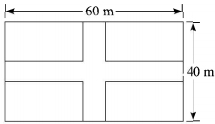
0 likes
View Solution130
MediumMCQ
The length of a rectangle is increased by $60 \%$. By what percent would the width have to be decreased so as to maintain the same area?
A
$37 \frac{1}{2} \%$
B
$60 \%$
C
$75 \%$
D
$120 \%$
Solution
(A) Let the original length be $L$ and the original width be $W$. The original area is $A = L \times W$.
The new length $L' = L + 0.60L = 1.6L$.
Let the new width be $W'$. To maintain the same area,$L' \times W' = L \times W$.
$1.6L \times W' = L \times W \implies W' = \frac{W}{1.6} = 0.625W$.
The decrease in width is $W - 0.625W = 0.375W$.
The percentage decrease is $\frac{0.375W}{W} \times 100 = 37.5 \%$.
Since $37.5 = 37 \frac{1}{2}$,the width must be decreased by $37 \frac{1}{2} \%$.
The new length $L' = L + 0.60L = 1.6L$.
Let the new width be $W'$. To maintain the same area,$L' \times W' = L \times W$.
$1.6L \times W' = L \times W \implies W' = \frac{W}{1.6} = 0.625W$.
The decrease in width is $W - 0.625W = 0.375W$.
The percentage decrease is $\frac{0.375W}{W} \times 100 = 37.5 \%$.
Since $37.5 = 37 \frac{1}{2}$,the width must be decreased by $37 \frac{1}{2} \%$.
0 likes
View Solution131
DifficultMCQ
Wheels of diameters $7\, cm$ and $14\, cm$ start rolling simultaneously from $X$ and $Y$,which are $1980\, cm$ apart,towards each other in opposite directions. Both of them make the same number of revolutions per second. If both of them meet after $10\, seconds$,the speed of the smaller wheel is.........$cm/sec$.
A
$22$
B
$44$
C
$66$
D
$132$
Solution
(C) Let $n$ be the number of revolutions per second made by both wheels.
Circumference of the smaller wheel $(d_1 = 7\, cm)$ is $C_1 = \pi d_1 = 7\pi\, cm$.
Circumference of the larger wheel $(d_2 = 14\, cm)$ is $C_2 = \pi d_2 = 14\pi\, cm$.
Distance covered by the smaller wheel in $10\, seconds$ is $D_1 = n \times C_1 \times 10 = n \times 7\pi \times 10 = 70n\pi\, cm$.
Distance covered by the larger wheel in $10\, seconds$ is $D_2 = n \times C_2 \times 10 = n \times 14\pi \times 10 = 140n\pi\, cm$.
Since they meet after $10\, seconds$,the sum of the distances covered is equal to the total distance between $X$ and $Y$:
$D_1 + D_2 = 1980$
$70n\pi + 140n\pi = 1980$
$210n\pi = 1980$
$n = \frac{1980}{210\pi} = \frac{198}{21\pi} = \frac{66}{7\pi}$ revolutions per second.
The speed of the smaller wheel is $v_1 = n \times C_1 = \left(\frac{66}{7\pi}\right) \times 7\pi = 66\, cm/sec$.
Circumference of the smaller wheel $(d_1 = 7\, cm)$ is $C_1 = \pi d_1 = 7\pi\, cm$.
Circumference of the larger wheel $(d_2 = 14\, cm)$ is $C_2 = \pi d_2 = 14\pi\, cm$.
Distance covered by the smaller wheel in $10\, seconds$ is $D_1 = n \times C_1 \times 10 = n \times 7\pi \times 10 = 70n\pi\, cm$.
Distance covered by the larger wheel in $10\, seconds$ is $D_2 = n \times C_2 \times 10 = n \times 14\pi \times 10 = 140n\pi\, cm$.
Since they meet after $10\, seconds$,the sum of the distances covered is equal to the total distance between $X$ and $Y$:
$D_1 + D_2 = 1980$
$70n\pi + 140n\pi = 1980$
$210n\pi = 1980$
$n = \frac{1980}{210\pi} = \frac{198}{21\pi} = \frac{66}{7\pi}$ revolutions per second.
The speed of the smaller wheel is $v_1 = n \times C_1 = \left(\frac{66}{7\pi}\right) \times 7\pi = 66\, cm/sec$.
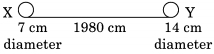
0 likes
View Solution132
MediumMCQ
$A$ man runs round a circular field of radius $50\, m$ at the speed of $12\, km/hr$. What is the time taken by the man to take twenty rounds of the field? (in $minutes$)
A
$30$
B
$32$
C
$34$
D
None of these
Solution
(B) The circumference of the circular field is given by $C = 2 \pi r = 2 \pi \times 50 = 100 \pi\, m$.
For $20$ rounds, the total distance to be covered is $D = 20 \times 100 \pi = 2000 \pi\, m$.
The speed of the man is $12\, km/hr$. Converting this to $m/s$:
$v = 12 \times \frac{5}{18} = \frac{60}{18} = \frac{10}{3}\, m/s$.
The time taken in seconds is $T = \frac{D}{v} = \frac{2000 \pi}{10/3} = 2000 \pi \times \frac{3}{10} = 600 \pi\, s$.
Converting the time into minutes:
$T_{min} = \frac{600 \pi}{60} = 10 \pi\, minutes$.
Using $\pi \approx 3.14$, $T_{min} = 10 \times 3.14 = 31.4\, minutes$.
Rounding to the nearest integer, the time taken is approximately $32\, minutes$.
For $20$ rounds, the total distance to be covered is $D = 20 \times 100 \pi = 2000 \pi\, m$.
The speed of the man is $12\, km/hr$. Converting this to $m/s$:
$v = 12 \times \frac{5}{18} = \frac{60}{18} = \frac{10}{3}\, m/s$.
The time taken in seconds is $T = \frac{D}{v} = \frac{2000 \pi}{10/3} = 2000 \pi \times \frac{3}{10} = 600 \pi\, s$.
Converting the time into minutes:
$T_{min} = \frac{600 \pi}{60} = 10 \pi\, minutes$.
Using $\pi \approx 3.14$, $T_{min} = 10 \times 3.14 = 31.4\, minutes$.
Rounding to the nearest integer, the time taken is approximately $32\, minutes$.
0 likes
View Solution133
MediumMCQ
The length of a rectangular plot is $60\%$ more than its breadth. If the difference between the length and the breadth of that rectangle is $24\, cm$,what is the area of that rectangle? (in $cm^2$)
A
$2400$
B
$2480$
C
$2560$
D
Data inadequate
Solution
(C) Let the breadth of the rectangle be $x\, cm$.
According to the problem,the length is $60\%$ more than the breadth,so the length is $x + 0.60x = 1.6x\, cm$.
The difference between the length and the breadth is given as $24\, cm$.
Therefore,$1.6x - x = 24$.
$0.6x = 24$.
$x = \frac{24}{0.6} = 40\, cm$.
Thus,the breadth is $40\, cm$ and the length is $1.6 \times 40 = 64\, cm$.
The area of the rectangle is $\text{length} \times \text{breadth} = 64 \times 40 = 2560\, cm^2$.
According to the problem,the length is $60\%$ more than the breadth,so the length is $x + 0.60x = 1.6x\, cm$.
The difference between the length and the breadth is given as $24\, cm$.
Therefore,$1.6x - x = 24$.
$0.6x = 24$.
$x = \frac{24}{0.6} = 40\, cm$.
Thus,the breadth is $40\, cm$ and the length is $1.6 \times 40 = 64\, cm$.
The area of the rectangle is $\text{length} \times \text{breadth} = 64 \times 40 = 2560\, cm^2$.
0 likes
View Solution134
DifficultMCQ
The length of a rectangular plot is $20 \ m$ more than its breadth. If the cost of fencing the plot at $₹ 26.50/m$ is $₹ 5300$,what is the length of the plot in metres?
A
$40$
B
$50$
C
$120$
D
$60$
Solution
(D) Let the breadth of the rectangular plot be $x \ m$.
Then,the length of the plot is $(x + 20) \ m$.
The perimeter of the rectangular plot is given by the formula $P = 2 \times (\text{length} + \text{breadth})$.
$P = 2 \times ((x + 20) + x) = 2 \times (2x + 20) = (4x + 40) \ m$.
The cost of fencing is given as $₹ 5300$ at a rate of $₹ 26.50/m$.
Therefore,$\text{Perimeter} = \frac{\text{Total Cost}}{\text{Rate}} = \frac{5300}{26.50} = 200 \ m$.
Equating the perimeter: $4x + 40 = 200$.
$4x = 200 - 40 = 160$.
$x = 40 \ m$ (Breadth).
Length $= x + 20 = 40 + 20 = 60 \ m$.
Then,the length of the plot is $(x + 20) \ m$.
The perimeter of the rectangular plot is given by the formula $P = 2 \times (\text{length} + \text{breadth})$.
$P = 2 \times ((x + 20) + x) = 2 \times (2x + 20) = (4x + 40) \ m$.
The cost of fencing is given as $₹ 5300$ at a rate of $₹ 26.50/m$.
Therefore,$\text{Perimeter} = \frac{\text{Total Cost}}{\text{Rate}} = \frac{5300}{26.50} = 200 \ m$.
Equating the perimeter: $4x + 40 = 200$.
$4x = 200 - 40 = 160$.
$x = 40 \ m$ (Breadth).
Length $= x + 20 = 40 + 20 = 60 \ m$.
0 likes
View Solution135
EasyMCQ
$A$ farmer wishes to start a $100 \, m^2$ rectangular vegetable garden. Since he has only $30 \, m$ of barbed wire,he fences three sides of the garden,using his house compound wall as the fourth side. The dimensions of the garden are:
A
$15 \, m \times 6.67 \, m$
B
$20 \, m \times 5 \, m$
C
$30 \, m \times 3.33 \, m$
D
$40 \, m \times 2.5 \, m$
Solution
(B) Let the length of the side parallel to the house wall be $l$ and the width of the other two sides be $b$.
The area of the rectangular garden is given by $A = l \times b = 100 \, m^2$.
The total length of the barbed wire used for three sides is $l + 2b = 30 \, m$.
From the area equation,$l = 100/b$.
Substituting this into the perimeter equation: $(100/b) + 2b = 30$.
Multiplying by $b$: $100 + 2b^2 = 30b$,which simplifies to $2b^2 - 30b + 100 = 0$.
Dividing by $2$: $b^2 - 15b + 50 = 0$.
Factoring the quadratic equation: $(b - 10)(b - 5) = 0$.
Thus,$b = 10$ or $b = 5$.
If $b = 5 \, m$,then $l = 100/5 = 20 \, m$. Checking the perimeter: $20 + 2(5) = 30 \, m$ (Matches).
If $b = 10 \, m$,then $l = 100/10 = 10 \, m$. Checking the perimeter: $10 + 2(10) = 30 \, m$ (Matches).
Comparing with the given options,the dimensions $20 \, m \times 5 \, m$ are provided.
The area of the rectangular garden is given by $A = l \times b = 100 \, m^2$.
The total length of the barbed wire used for three sides is $l + 2b = 30 \, m$.
From the area equation,$l = 100/b$.
Substituting this into the perimeter equation: $(100/b) + 2b = 30$.
Multiplying by $b$: $100 + 2b^2 = 30b$,which simplifies to $2b^2 - 30b + 100 = 0$.
Dividing by $2$: $b^2 - 15b + 50 = 0$.
Factoring the quadratic equation: $(b - 10)(b - 5) = 0$.
Thus,$b = 10$ or $b = 5$.
If $b = 5 \, m$,then $l = 100/5 = 20 \, m$. Checking the perimeter: $20 + 2(5) = 30 \, m$ (Matches).
If $b = 10 \, m$,then $l = 100/10 = 10 \, m$. Checking the perimeter: $10 + 2(10) = 30 \, m$ (Matches).
Comparing with the given options,the dimensions $20 \, m \times 5 \, m$ are provided.
0 likes
View Solution136
EasyMCQ
$A$ rectangle has width $a$ and length $b$. If the width is decreased by $20 \%$ and the length is increased by $10 \%$,what is the area of the new rectangle as a percentage of the original area $ab$?
A
$80$
B
$88$
C
$110$
D
$120$
Solution
(B) The original area of the rectangle is $A_1 = a \times b = ab$.
The new width is $a' = a - 0.20a = 0.80a$.
The new length is $b' = b + 0.10b = 1.10b$.
The new area is $A_2 = a' \times b' = (0.80a) \times (1.10b) = 0.88ab$.
To express the new area as a percentage of the original area,we calculate $(A_2 / A_1) \times 100 = (0.88ab / ab) \times 100 = 88 \%$.
Therefore,the area of the new rectangle is $88 \%$ of the original area $ab$.
The new width is $a' = a - 0.20a = 0.80a$.
The new length is $b' = b + 0.10b = 1.10b$.
The new area is $A_2 = a' \times b' = (0.80a) \times (1.10b) = 0.88ab$.
To express the new area as a percentage of the original area,we calculate $(A_2 / A_1) \times 100 = (0.88ab / ab) \times 100 = 88 \%$.
Therefore,the area of the new rectangle is $88 \%$ of the original area $ab$.
0 likes
View Solution137
MediumMCQ
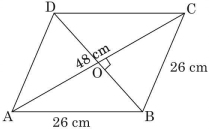
Each side of a rhombus is $26 \ cm$ and one of its diagonals is $48 \ cm$ long. The area of the rhombus is (in $cm^2$)
A
$240$
B
$300$
C
$360$
D
$480$
Solution
(D) Let the rhombus be $ABCD$ with side $AB = 26 \ cm$ and diagonal $AC = 48 \ cm$. The diagonals of a rhombus bisect each other at right angles at point $O$.
Therefore,$OA = OC = \frac{48}{2} = 24 \ cm$.
In the right-angled triangle $\Delta OAB$,by the Pythagorean theorem:
$(OB)^2 = (AB)^2 - (OA)^2$
$(OB)^2 = (26)^2 - (24)^2$
$(OB)^2 = (26 - 24)(26 + 24) = 2 \times 50 = 100$
$OB = \sqrt{100} = 10 \ cm$.
The other diagonal $BD = 2 \times OB = 2 \times 10 = 20 \ cm$.
The area of the rhombus is given by $\frac{1}{2} \times d_1 \times d_2$.
Area $= \frac{1}{2} \times 48 \times 20 = 480 \ cm^2$.
Therefore,$OA = OC = \frac{48}{2} = 24 \ cm$.
In the right-angled triangle $\Delta OAB$,by the Pythagorean theorem:
$(OB)^2 = (AB)^2 - (OA)^2$
$(OB)^2 = (26)^2 - (24)^2$
$(OB)^2 = (26 - 24)(26 + 24) = 2 \times 50 = 100$
$OB = \sqrt{100} = 10 \ cm$.
The other diagonal $BD = 2 \times OB = 2 \times 10 = 20 \ cm$.
The area of the rhombus is given by $\frac{1}{2} \times d_1 \times d_2$.
Area $= \frac{1}{2} \times 48 \times 20 = 480 \ cm^2$.
0 likes
View Solution138
MediumMCQ
$A$ circle and a rectangle have the same perimeter. The sides of the rectangle are $18 \, cm$ and $26 \, cm$. What is the area of the circle? (in $cm^2$)
A
$88$
B
$154$
C
$1250$
D
$616$
Solution
(D) The perimeter of the rectangle is given by $P = 2(l + b) = 2(18 + 26) = 2(44) = 88 \, cm$.
Since the perimeter of the circle is equal to the perimeter of the rectangle,we have $2 \pi r = 88 \, cm$.
Solving for the radius $r$,we get $r = \frac{88}{2 \pi} = \frac{44}{\pi} \, cm$.
The area of the circle is given by $A = \pi r^2$.
Substituting the value of $r$,we get $A = \pi \left( \frac{44}{\pi} \right)^2 = \pi \times \frac{44 \times 44}{\pi^2} = \frac{44 \times 44}{\pi}$.
Using $\pi \approx \frac{22}{7}$,we get $A = \frac{44 \times 44 \times 7}{22} = 2 \times 44 \times 7 = 616 \, cm^2$.
Since the perimeter of the circle is equal to the perimeter of the rectangle,we have $2 \pi r = 88 \, cm$.
Solving for the radius $r$,we get $r = \frac{88}{2 \pi} = \frac{44}{\pi} \, cm$.
The area of the circle is given by $A = \pi r^2$.
Substituting the value of $r$,we get $A = \pi \left( \frac{44}{\pi} \right)^2 = \pi \times \frac{44 \times 44}{\pi^2} = \frac{44 \times 44}{\pi}$.
Using $\pi \approx \frac{22}{7}$,we get $A = \frac{44 \times 44 \times 7}{22} = 2 \times 44 \times 7 = 616 \, cm^2$.
0 likes
View Solution139
MediumMCQ
$A$ circular ground whose diameter is $35 \ m$ has a $1.4 \ m$ broad garden around it. What is the area of the garden in square metres?
A
$160.16$
B
$176.16$
C
$196.16$
D
Data inadequate
Solution
(A) The diameter of the circular ground is $35 \ m$,so the radius of the ground $(r)$ is $35 / 2 = 17.5 \ m$.
The garden is $1.4 \ m$ broad around the ground,so the radius of the outer circle $(R)$ is $17.5 + 1.4 = 18.9 \ m$.
The area of the garden is the difference between the area of the outer circle and the area of the inner circular ground.
Area of garden $= \pi R^2 - \pi r^2 = \pi (R^2 - r^2) = \pi (R + r)(R - r)$.
Area of garden $= \frac{22}{7} \times (18.9 + 17.5) \times (18.9 - 17.5)$.
Area of garden $= \frac{22}{7} \times 36.4 \times 1.4$.
Area of garden $= 22 \times 36.4 \times 0.2 = 22 \times 7.28 = 160.16 \ m^2$.
The garden is $1.4 \ m$ broad around the ground,so the radius of the outer circle $(R)$ is $17.5 + 1.4 = 18.9 \ m$.
The area of the garden is the difference between the area of the outer circle and the area of the inner circular ground.
Area of garden $= \pi R^2 - \pi r^2 = \pi (R^2 - r^2) = \pi (R + r)(R - r)$.
Area of garden $= \frac{22}{7} \times (18.9 + 17.5) \times (18.9 - 17.5)$.
Area of garden $= \frac{22}{7} \times 36.4 \times 1.4$.
Area of garden $= 22 \times 36.4 \times 0.2 = 22 \times 7.28 = 160.16 \ m^2$.
0 likes
View Solution140
EasyMCQ
If the radius of a circle is increased by $75 \%,$ then its circumference will increase by (in $\%$)
A
$25$
B
$50$
C
$75$
D
$100$
Solution
(C) The formula for the circumference of a circle is $C = 2 \pi r,$ where $r$ is the radius.
Since $2 \pi$ is a constant,the circumference $C$ is directly proportional to the radius $r$ $(C \propto r)$.
If the radius $r$ is increased by $75 \%,$ the new radius $r'$ becomes $r + 0.75r = 1.75r$.
The new circumference $C'$ will be $2 \pi (1.75r) = 1.75(2 \pi r) = 1.75C$.
The percentage increase in circumference is given by $\frac{C' - C}{C} \times 100 = \frac{1.75C - C}{C} \times 100 = 0.75 \times 100 = 75 \%$.
Therefore,the circumference increases by $75 \%$.
Since $2 \pi$ is a constant,the circumference $C$ is directly proportional to the radius $r$ $(C \propto r)$.
If the radius $r$ is increased by $75 \%,$ the new radius $r'$ becomes $r + 0.75r = 1.75r$.
The new circumference $C'$ will be $2 \pi (1.75r) = 1.75(2 \pi r) = 1.75C$.
The percentage increase in circumference is given by $\frac{C' - C}{C} \times 100 = \frac{1.75C - C}{C} \times 100 = 0.75 \times 100 = 75 \%$.
Therefore,the circumference increases by $75 \%$.
0 likes
View Solution141
DifficultMCQ
If an equilateral triangle of area $X$ and a square of area $Y$ have the same perimeter,then $X$ is
A
equal to $Y$
B
greater than $Y$
C
less than $Y$
D
less than or equal to $Y$
Solution
(C) Let the side of the equilateral triangle be $a$ and the side of the square be $b$.
The area of the triangle is $X = \frac{\sqrt{3}}{4} a^2$ and its perimeter is $P = 3a$.
The area of the square is $Y = b^2$ and its perimeter is $P = 4b$.
Since both have the same perimeter,$3a = 4b$,which implies $b = \frac{3a}{4}$.
Now,$Y = b^2 = (\frac{3a}{4})^2 = \frac{9a^2}{16}$.
From the area of the triangle,we have $a^2 = \frac{4X}{\sqrt{3}}$.
Substituting this into the expression for $Y$,we get $Y = \frac{9}{16} \times \frac{4X}{\sqrt{3}} = \frac{9X}{4\sqrt{3}} = \frac{3\sqrt{3}X}{4}$.
Since $\sqrt{3} \approx 1.732$,we have $Y \approx \frac{3 \times 1.732}{4} X = 1.299X$.
Therefore,$Y > X$,which means $X < Y$.
The area of the triangle is $X = \frac{\sqrt{3}}{4} a^2$ and its perimeter is $P = 3a$.
The area of the square is $Y = b^2$ and its perimeter is $P = 4b$.
Since both have the same perimeter,$3a = 4b$,which implies $b = \frac{3a}{4}$.
Now,$Y = b^2 = (\frac{3a}{4})^2 = \frac{9a^2}{16}$.
From the area of the triangle,we have $a^2 = \frac{4X}{\sqrt{3}}$.
Substituting this into the expression for $Y$,we get $Y = \frac{9}{16} \times \frac{4X}{\sqrt{3}} = \frac{9X}{4\sqrt{3}} = \frac{3\sqrt{3}X}{4}$.
Since $\sqrt{3} \approx 1.732$,we have $Y \approx \frac{3 \times 1.732}{4} X = 1.299X$.
Therefore,$Y > X$,which means $X < Y$.
0 likes
View Solution142
EasyMCQ
An error of $2 \%$ in excess is made while measuring the side of a square. The percentage of error in the calculated area of the square is.....$\%$
A
$2$
B
$2.02$
C
$4$
D
$4.04$
Solution
(D) Let the side of the square be $x$.
The area of the square is $A = x^2$.
Given that the error in measuring the side is $2 \%$,the new side becomes $x' = x + 0.02x = 1.02x$.
The new area is $A' = (1.02x)^2 = 1.0404x^2$.
The change in area is $\Delta A = A' - A = 1.0404x^2 - x^2 = 0.0404x^2$.
The percentage error in the area is $\frac{\Delta A}{A} \times 100 = \frac{0.0404x^2}{x^2} \times 100 = 4.04 \%$.
The area of the square is $A = x^2$.
Given that the error in measuring the side is $2 \%$,the new side becomes $x' = x + 0.02x = 1.02x$.
The new area is $A' = (1.02x)^2 = 1.0404x^2$.
The change in area is $\Delta A = A' - A = 1.0404x^2 - x^2 = 0.0404x^2$.
The percentage error in the area is $\frac{\Delta A}{A} \times 100 = \frac{0.0404x^2}{x^2} \times 100 = 4.04 \%$.
0 likes
View Solution143
MediumMCQ
$A$ can go round a circular path $8$ times in $40$ minutes. If the diameter of the circle is increased to $10$ times the original diameter,then the time required by $A$ to go round the new path once,travelling at the same speed as before,is (in $min$)
A
$20$
B
$25$
C
$50$
D
$100$
Solution
(C) Let the original diameter be $D$ and the original circumference be $C = \pi D$.
Time taken for $8$ rounds = $40$ minutes.
Time taken for $1$ round = $40 / 8 = 5$ minutes.
Speed $v = \frac{\text{Distance}}{\text{Time}} = \frac{C}{5} = \frac{\pi D}{5}$.
New diameter $D' = 10D$.
New circumference $C' = \pi D' = 10 \pi D = 10C$.
Since the speed $v$ remains the same,the new time $T'$ required to complete $1$ round is:
$T' = \frac{C'}{v} = \frac{10C}{C/5} = 10 \times 5 = 50$ minutes.
Time taken for $8$ rounds = $40$ minutes.
Time taken for $1$ round = $40 / 8 = 5$ minutes.
Speed $v = \frac{\text{Distance}}{\text{Time}} = \frac{C}{5} = \frac{\pi D}{5}$.
New diameter $D' = 10D$.
New circumference $C' = \pi D' = 10 \pi D = 10C$.
Since the speed $v$ remains the same,the new time $T'$ required to complete $1$ round is:
$T' = \frac{C'}{v} = \frac{10C}{C/5} = 10 \times 5 = 50$ minutes.
0 likes
View Solution144
DifficultMCQ
An equilateral triangle,a square,and a circle have equal perimeters. If $T$ denotes the area of the triangle,$S$ the area of the square,and $C$ the area of the circle,then
A
$S < T < C$
B
$T < C < S$
C
$T < S < C$
D
$C < S < T$
Solution
(C) Let the perimeter be $P$. Since the perimeters are equal,we have $3a = 4b = 2\pi r = P$,where $a$ is the side of the triangle,$b$ is the side of the square,and $r$ is the radius of the circle.
$1$. Area of the equilateral triangle: $T = \frac{\sqrt{3}}{4} a^2 = \frac{\sqrt{3}}{4} \left(\frac{P}{3}\right)^2 = \frac{\sqrt{3}}{36} P^2 \approx 0.0481 P^2$.
$2$. Area of the square: $S = b^2 = \left(\frac{P}{4}\right)^2 = \frac{1}{16} P^2 = 0.0625 P^2$.
$3$. Area of the circle: $C = \pi r^2 = \pi \left(\frac{P}{2\pi}\right)^2 = \frac{P^2}{4\pi} \approx 0.0796 P^2$.
Comparing the coefficients of $P^2$: $0.0481 < 0.0625 < 0.0796$.
Thus,$T < S < C$.
$1$. Area of the equilateral triangle: $T = \frac{\sqrt{3}}{4} a^2 = \frac{\sqrt{3}}{4} \left(\frac{P}{3}\right)^2 = \frac{\sqrt{3}}{36} P^2 \approx 0.0481 P^2$.
$2$. Area of the square: $S = b^2 = \left(\frac{P}{4}\right)^2 = \frac{1}{16} P^2 = 0.0625 P^2$.
$3$. Area of the circle: $C = \pi r^2 = \pi \left(\frac{P}{2\pi}\right)^2 = \frac{P^2}{4\pi} \approx 0.0796 P^2$.
Comparing the coefficients of $P^2$: $0.0481 < 0.0625 < 0.0796$.
Thus,$T < S < C$.
0 likes
View Solution145
DifficultMCQ
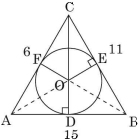
The sides of a triangle are $6\, cm$,$11\, cm$,and $15\, cm$. The radius of its incircle is
A
$3 \sqrt{2}\, cm$
B
$\frac{4 \sqrt{2}}{5}\, cm$
C
$\frac{5 \sqrt{2}}{4}\, cm$
D
$6 \sqrt{2}\, cm$
Solution
(C) Let $r$ be the radius of the incircle.
Given sides of the triangle are $a = 11\, cm$,$b = 6\, cm$,and $c = 15\, cm$.
First,calculate the semi-perimeter $s$ of the triangle:
$s = \frac{a + b + c}{2} = \frac{11 + 6 + 15}{2} = \frac{32}{2} = 16\, cm$.
Now,calculate the area of the triangle $(\Delta)$ using Heron's formula:
$\Delta = \sqrt{s(s - a)(s - b)(s - c)}$
$\Delta = \sqrt{16(16 - 11)(16 - 6)(16 - 15)}$
$\Delta = \sqrt{16 \times 5 \times 10 \times 1} = \sqrt{800} = 20 \sqrt{2}\, cm^2$.
The radius of the incircle $r$ is given by the formula $r = \frac{\Delta}{s}$.
$r = \frac{20 \sqrt{2}}{16} = \frac{5 \sqrt{2}}{4}\, cm$.
Given sides of the triangle are $a = 11\, cm$,$b = 6\, cm$,and $c = 15\, cm$.
First,calculate the semi-perimeter $s$ of the triangle:
$s = \frac{a + b + c}{2} = \frac{11 + 6 + 15}{2} = \frac{32}{2} = 16\, cm$.
Now,calculate the area of the triangle $(\Delta)$ using Heron's formula:
$\Delta = \sqrt{s(s - a)(s - b)(s - c)}$
$\Delta = \sqrt{16(16 - 11)(16 - 6)(16 - 15)}$
$\Delta = \sqrt{16 \times 5 \times 10 \times 1} = \sqrt{800} = 20 \sqrt{2}\, cm^2$.
The radius of the incircle $r$ is given by the formula $r = \frac{\Delta}{s}$.
$r = \frac{20 \sqrt{2}}{16} = \frac{5 \sqrt{2}}{4}\, cm$.
0 likes
View Solution146
MediumMCQ
$A$ square is inscribed in a circle whose radius is $4\, cm$. The area of the portion between the circle and the square is
A
$(8 \pi - 16)\, cm^2$
B
$(8 \pi - 32)\, cm^2$
C
$(16 \pi - 16)\, cm^2$
D
$(16 \pi - 32)\, cm^2$
Solution
(D) The radius of the circle is $r = 4\, cm$.
Area of the circle $= \pi r^2 = \pi \times (4)^2 = 16 \pi\, cm^2$.
Since the square is inscribed in the circle,the diagonal of the square is equal to the diameter of the circle.
Diameter of the circle $= 2 \times r = 2 \times 4 = 8\, cm$.
Let the side of the square be $a$. The diagonal of a square is $a\sqrt{2}$.
So,$a\sqrt{2} = 8$,which gives $a = \frac{8}{\sqrt{2}} = 4\sqrt{2}\, cm$.
Area of the square $= a^2 = (4\sqrt{2})^2 = 16 \times 2 = 32\, cm^2$.
The area of the portion between the circle and the square is the difference between the area of the circle and the area of the square.
Required area $= (16 \pi - 32)\, cm^2$.
Area of the circle $= \pi r^2 = \pi \times (4)^2 = 16 \pi\, cm^2$.
Since the square is inscribed in the circle,the diagonal of the square is equal to the diameter of the circle.
Diameter of the circle $= 2 \times r = 2 \times 4 = 8\, cm$.
Let the side of the square be $a$. The diagonal of a square is $a\sqrt{2}$.
So,$a\sqrt{2} = 8$,which gives $a = \frac{8}{\sqrt{2}} = 4\sqrt{2}\, cm$.
Area of the square $= a^2 = (4\sqrt{2})^2 = 16 \times 2 = 32\, cm^2$.
The area of the portion between the circle and the square is the difference between the area of the circle and the area of the square.
Required area $= (16 \pi - 32)\, cm^2$.
0 likes
View Solution147
DifficultMCQ
The area of a circle is $220 \text{ cm}^2$. The area of a square inscribed in this circle will be (in $\text{cm}^2$):
A
$49$
B
$70$
C
$140$
D
$150$
Solution
(C) Given the area of the circle is $\pi r^2 = 220 \text{ cm}^2$.
Using $\pi = \frac{22}{7}$,we have $\frac{22}{7} \times r^2 = 220$.
$r^2 = \frac{220 \times 7}{22} = 70$.
Thus,$r = \sqrt{70} \text{ cm}$.
The diagonal of a square inscribed in a circle is equal to the diameter of the circle.
Diameter $d = 2r = 2\sqrt{70} \text{ cm}$.
Let the side of the square be $a$. The diagonal of the square is $a\sqrt{2}$.
So,$a\sqrt{2} = 2\sqrt{70}$.
$a = \frac{2\sqrt{70}}{\sqrt{2}} = 2\sqrt{35}$.
The area of the square is $a^2 = (2\sqrt{35})^2 = 4 \times 35 = 140 \text{ cm}^2$.
Using $\pi = \frac{22}{7}$,we have $\frac{22}{7} \times r^2 = 220$.
$r^2 = \frac{220 \times 7}{22} = 70$.
Thus,$r = \sqrt{70} \text{ cm}$.
The diagonal of a square inscribed in a circle is equal to the diameter of the circle.
Diameter $d = 2r = 2\sqrt{70} \text{ cm}$.
Let the side of the square be $a$. The diagonal of the square is $a\sqrt{2}$.
So,$a\sqrt{2} = 2\sqrt{70}$.
$a = \frac{2\sqrt{70}}{\sqrt{2}} = 2\sqrt{35}$.
The area of the square is $a^2 = (2\sqrt{35})^2 = 4 \times 35 = 140 \text{ cm}^2$.
0 likes
View Solution148
MediumMCQ
$A$ tank is $25 \ m$ long,$12 \ m$ wide and $6 \ m$ deep. The cost of plastering its walls and bottom at $75 \ paise/m^2$ is (in $Rs.$)
A
$456$
B
$458$
C
$558$
D
$568$
Solution
(C) The tank is an open cuboid. The area to be plastered includes the four walls and the bottom.
Area of four walls $= 2(length + width) \times height = 2(25 + 12) \times 6 = 2(37) \times 6 = 444 \ m^2$.
Area of the bottom $= length \times width = 25 \times 12 = 300 \ m^2$.
Total surface area to be plastered $= 444 + 300 = 744 \ m^2$.
Cost of plastering $= 744 \times 0.75 \ Rs./m^2 = 744 \times \frac{3}{4} = 186 \times 3 = ₹ 558$.
Area of four walls $= 2(length + width) \times height = 2(25 + 12) \times 6 = 2(37) \times 6 = 444 \ m^2$.
Area of the bottom $= length \times width = 25 \times 12 = 300 \ m^2$.
Total surface area to be plastered $= 444 + 300 = 744 \ m^2$.
Cost of plastering $= 744 \times 0.75 \ Rs./m^2 = 744 \times \frac{3}{4} = 186 \times 3 = ₹ 558$.
0 likes
View Solution149
EasyMCQ
If in a triangle,the area is numerically equal to the perimeter,then the radius of the inscribed circle of the triangle is
A
$1$
B
$1.5$
C
$2$
D
$3$
Solution
(C) Let the area of the triangle be $A$ and the semi-perimeter be $s$.
Given that the area is numerically equal to the perimeter,we have $A = 2s$.
The radius of the inscribed circle $(r)$ is given by the formula $r = \frac{A}{s}$.
Substituting $A = 2s$ into the formula,we get $r = \frac{2s}{s} = 2$.
Therefore,the radius of the inscribed circle is $2$.
Given that the area is numerically equal to the perimeter,we have $A = 2s$.
The radius of the inscribed circle $(r)$ is given by the formula $r = \frac{A}{s}$.
Substituting $A = 2s$ into the formula,we get $r = \frac{2s}{s} = 2$.
Therefore,the radius of the inscribed circle is $2$.
0 likes
View Solution150
MediumMCQ
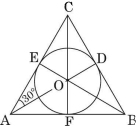
The area of the incircle of an equilateral triangle of side $42 \ cm$ is (in $cm^2$)
A
$22 \sqrt{3}$
B
$231$
C
$462$
D
$924$
Solution
(C) For an equilateral triangle with side $a = 42 \ cm$,the radius $r$ of the incircle is given by the formula $r = \frac{a}{2\sqrt{3}}$.
Substituting $a = 42 \ cm$:
$r = \frac{42}{2\sqrt{3}} = \frac{21}{\sqrt{3}} = 7\sqrt{3} \ cm$.
The area of the incircle is given by $\pi r^2$.
Area $= \frac{22}{7} \times (7\sqrt{3})^2$
$= \frac{22}{7} \times 49 \times 3$
$= 22 \times 7 \times 3$
$= 462 \ cm^2$.
Substituting $a = 42 \ cm$:
$r = \frac{42}{2\sqrt{3}} = \frac{21}{\sqrt{3}} = 7\sqrt{3} \ cm$.
The area of the incircle is given by $\pi r^2$.
Area $= \frac{22}{7} \times (7\sqrt{3})^2$
$= \frac{22}{7} \times 49 \times 3$
$= 22 \times 7 \times 3$
$= 462 \ cm^2$.
0 likes
View SolutionMensuration — Measurement of Area · Frequently Asked Questions
1Are these Mensuration questions useful for JEE and NEET?
Yes. All questions in this section are mapped to JEE Main and NEET exam patterns. Previous year questions from JEE Main, NEET, GUJCET and state-level exams are included with full solutions.
2Can I switch to Hindi or Gujarati for these questions?
Yes. Use the language tabs in the hero section or the sidebar to view the same questions and solutions in English, Hindi or Gujarati.
3How do I generate a question paper from this subtopic?
Use the Vedclass Exam Paper Generator — select the chapter and subtopic, set difficulty, and generate Sets A, B, C, D automatically. First 3 chapters of every subject are free.
Vedclass Products
For Students
Vedclass Test Series
Mock tests in real JEE/NEET style with performance analysis. 5-day free trial.
Start Free TrialFor Teachers
Exam Paper Generator
Generate Set A/B/C/D papers from this chapter in 2 minutes. 3 chapters free.
Try FreeFor Institutes
Online Exam Module
Live online exams with unlimited students, 360° analytics & white-label branding.
See DemoFor Teachers & Institutes
Generate a Mensuration Exam Paper in 2 Minutes
Select subtopic & difficulty — Sets A, B, C, D auto-generated with No Repeat logic.
First 3 chapters of every subject are free — no payment required.