
A English
Measurement of Area Questions in English
Competitive Exam Quantitative Aptitude · Mensuration · Measurement of Area
407+
Questions
English
Language
100%
With Solutions
Showing 50 of 407 questions in English
201
DifficultMCQ
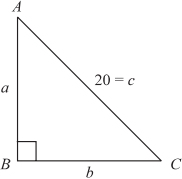
The hypotenuse and the semi-perimeter of a right triangle are $20\, cm$ and $24\, cm$,respectively. The other two sides of the triangle are
A
$16\, cm, 12\, cm$
B
$20\, m, 12\, cm$
C
$20\, cm, 16\, cm$
D
None of these
Solution
(A) Let the two sides of the right triangle be $a$ and $b$,and the hypotenuse be $c = 20\, cm$.
The semi-perimeter $s = \frac{a + b + c}{2} = 24\, cm$.
Therefore,$a + b + 20 = 2 \times 24 = 48$,which gives $a + b = 28\, cm$ $...(1)$.
By the Pythagorean theorem,$a^2 + b^2 = c^2 = 20^2 = 400$.
We know that $(a + b)^2 = a^2 + b^2 + 2ab$.
Substituting the values,$28^2 = 400 + 2ab$.
$784 = 400 + 2ab$,so $2ab = 384$,which means $ab = 192$.
Now,$(a - b)^2 = (a + b)^2 - 4ab = 28^2 - 4(192) = 784 - 768 = 16$.
Thus,$a - b = \sqrt{16} = 4\, cm$ $...(2)$.
Adding $(1)$ and $(2)$,$2a = 32$,so $a = 16\, cm$.
Subtracting $(2)$ from $(1)$,$2b = 24$,so $b = 12\, cm$.
Thus,the other two sides are $16\, cm$ and $12\, cm$.
The semi-perimeter $s = \frac{a + b + c}{2} = 24\, cm$.
Therefore,$a + b + 20 = 2 \times 24 = 48$,which gives $a + b = 28\, cm$ $...(1)$.
By the Pythagorean theorem,$a^2 + b^2 = c^2 = 20^2 = 400$.
We know that $(a + b)^2 = a^2 + b^2 + 2ab$.
Substituting the values,$28^2 = 400 + 2ab$.
$784 = 400 + 2ab$,so $2ab = 384$,which means $ab = 192$.
Now,$(a - b)^2 = (a + b)^2 - 4ab = 28^2 - 4(192) = 784 - 768 = 16$.
Thus,$a - b = \sqrt{16} = 4\, cm$ $...(2)$.
Adding $(1)$ and $(2)$,$2a = 32$,so $a = 16\, cm$.
Subtracting $(2)$ from $(1)$,$2b = 24$,so $b = 12\, cm$.
Thus,the other two sides are $16\, cm$ and $12\, cm$.
0 likes
View Solution202
MediumMCQ
The sides of a triangle are in the ratio $3:4:5$. If its perimeter is $36 \text{ cm}$,then the area of the triangle is ...... $\text{cm}^2$.
A
$57$
B
$54$
C
$56.5$
D
None of these
Solution
(B) Let the sides of the triangle be $3x$,$4x$,and $5x$.
Given that the perimeter is $36 \text{ cm}$,we have:
$3x + 4x + 5x = 36$
$12x = 36$
$x = 3$
Therefore,the sides are:
$a = 3(3) = 9 \text{ cm}$
$b = 4(3) = 12 \text{ cm}$
$c = 5(3) = 15 \text{ cm}$
The semi-perimeter $s$ is given by:
$s = \frac{a+b+c}{2} = \frac{36}{2} = 18 \text{ cm}$
Using Heron's formula,the area of the triangle is:
$\text{Area} = \sqrt{s(s-a)(s-b)(s-c)}$
$\text{Area} = \sqrt{18(18-9)(18-12)(18-15)}$
$\text{Area} = \sqrt{18 \times 9 \times 6 \times 3}$
$\text{Area} = \sqrt{2916} = 54 \text{ cm}^2$
Alternatively,since $9^2 + 12^2 = 81 + 144 = 225 = 15^2$,it is a right-angled triangle.
$\text{Area} = \frac{1}{2} \times \text{base} \times \text{height} = \frac{1}{2} \times 9 \times 12 = 54 \text{ cm}^2$.
Given that the perimeter is $36 \text{ cm}$,we have:
$3x + 4x + 5x = 36$
$12x = 36$
$x = 3$
Therefore,the sides are:
$a = 3(3) = 9 \text{ cm}$
$b = 4(3) = 12 \text{ cm}$
$c = 5(3) = 15 \text{ cm}$
The semi-perimeter $s$ is given by:
$s = \frac{a+b+c}{2} = \frac{36}{2} = 18 \text{ cm}$
Using Heron's formula,the area of the triangle is:
$\text{Area} = \sqrt{s(s-a)(s-b)(s-c)}$
$\text{Area} = \sqrt{18(18-9)(18-12)(18-15)}$
$\text{Area} = \sqrt{18 \times 9 \times 6 \times 3}$
$\text{Area} = \sqrt{2916} = 54 \text{ cm}^2$
Alternatively,since $9^2 + 12^2 = 81 + 144 = 225 = 15^2$,it is a right-angled triangle.
$\text{Area} = \frac{1}{2} \times \text{base} \times \text{height} = \frac{1}{2} \times 9 \times 12 = 54 \text{ cm}^2$.
0 likes
View Solution203
DifficultMCQ
For a triangle whose sides are $50\, m$,$78\, m$,and $112\, m$ respectively,the length of the perpendicular from the opposite angle to the side $112\, m$ is ......... $m$.
A
$45$
B
$35$
C
$30$
D
None of these
Solution
(C) Let the sides of the triangle be $a = 50\, m$,$b = 78\, m$,and $c = 112\, m$.
First,calculate the semi-perimeter $s$:
$s = \frac{a + b + c}{2} = \frac{50 + 78 + 112}{2} = \frac{240}{2} = 120\, m$.
Using Heron's formula,the area of the triangle is:
$\text{Area} = \sqrt{s(s-a)(s-b)(s-c)}$
$\text{Area} = \sqrt{120(120-50)(120-78)(120-112)}$
$\text{Area} = \sqrt{120 \times 70 \times 42 \times 8}$
$\text{Area} = \sqrt{2822400} = 1680\, m^2$.
The area of a triangle is also given by $\frac{1}{2} \times \text{base} \times \text{height}$.
Here,the base is $112\, m$ and the height $h$ is the perpendicular length.
$\frac{1}{2} \times 112 \times h = 1680$
$56 \times h = 1680$
$h = \frac{1680}{56} = 30\, m$.
First,calculate the semi-perimeter $s$:
$s = \frac{a + b + c}{2} = \frac{50 + 78 + 112}{2} = \frac{240}{2} = 120\, m$.
Using Heron's formula,the area of the triangle is:
$\text{Area} = \sqrt{s(s-a)(s-b)(s-c)}$
$\text{Area} = \sqrt{120(120-50)(120-78)(120-112)}$
$\text{Area} = \sqrt{120 \times 70 \times 42 \times 8}$
$\text{Area} = \sqrt{2822400} = 1680\, m^2$.
The area of a triangle is also given by $\frac{1}{2} \times \text{base} \times \text{height}$.
Here,the base is $112\, m$ and the height $h$ is the perpendicular length.
$\frac{1}{2} \times 112 \times h = 1680$
$56 \times h = 1680$
$h = \frac{1680}{56} = 30\, m$.
0 likes
View Solution204
EasyMCQ
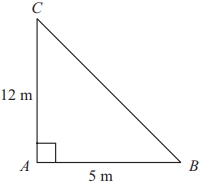
$A$ ladder is resting with one end in contact with the top of a wall of height $12\, m$ and the other end on the ground is at a distance $5\, m$ from the wall. The length of the ladder is.....$m$
A
$13$
B
$17$
C
$16$
D
None of these
Solution
(A) Let the wall be represented by $AC$ and the ground by $AB$,where $AC = 12\, m$ and $AB = 5\, m$.
The ladder is represented by the hypotenuse $BC$ of the right-angled triangle $\triangle ABC$.
According to the Pythagorean theorem,$BC^2 = AC^2 + AB^2$.
$BC^2 = 12^2 + 5^2 = 144 + 25 = 169$.
Therefore,$BC = \sqrt{169} = 13\, m$.
Thus,the length of the ladder is $13\, m$.
The ladder is represented by the hypotenuse $BC$ of the right-angled triangle $\triangle ABC$.
According to the Pythagorean theorem,$BC^2 = AC^2 + AB^2$.
$BC^2 = 12^2 + 5^2 = 144 + 25 = 169$.
Therefore,$BC = \sqrt{169} = 13\, m$.
Thus,the length of the ladder is $13\, m$.
0 likes
View Solution205
MediumMCQ
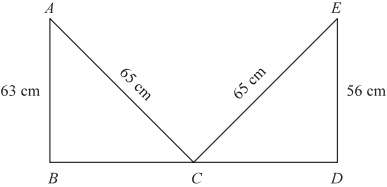
$A$ ladder is placed so as to reach a window $63 \ cm$ high. The ladder is then turned over to the opposite side of the street and is found to reach a point $56 \ cm$ high. If the ladder is $65 \ cm$ long,then the width of the street is........$cm$
A
$59$
B
$39$
C
$49$
D
None of these
Solution
(C) Let the ladder be $AC$ and $CE$,where $AC = CE = 65 \ cm$.
Let $AB = 63 \ cm$ be the height of the window on one side and $ED = 56 \ cm$ be the height of the point on the opposite side.
In right-angled triangle $\triangle ABC$,by Pythagoras theorem:
$BC^2 + AB^2 = AC^2$
$BC^2 + 63^2 = 65^2$
$BC^2 = 4225 - 3969 = 256$
$BC = \sqrt{256} = 16 \ cm$.
In right-angled triangle $\triangle CDE$,by Pythagoras theorem:
$CD^2 + ED^2 = CE^2$
$CD^2 + 56^2 = 65^2$
$CD^2 = 4225 - 3136 = 1089$
$CD = \sqrt{1089} = 33 \ cm$.
Therefore,the width of the street is $BD = BC + CD = 16 + 33 = 49 \ cm$.
Let $AB = 63 \ cm$ be the height of the window on one side and $ED = 56 \ cm$ be the height of the point on the opposite side.
In right-angled triangle $\triangle ABC$,by Pythagoras theorem:
$BC^2 + AB^2 = AC^2$
$BC^2 + 63^2 = 65^2$
$BC^2 = 4225 - 3969 = 256$
$BC = \sqrt{256} = 16 \ cm$.
In right-angled triangle $\triangle CDE$,by Pythagoras theorem:
$CD^2 + ED^2 = CE^2$
$CD^2 + 56^2 = 65^2$
$CD^2 = 4225 - 3136 = 1089$
$CD = \sqrt{1089} = 33 \ cm$.
Therefore,the width of the street is $BD = BC + CD = 16 + 33 = 49 \ cm$.
0 likes
View Solution206
EasyMCQ
If the area of a triangle with base $x$ is equal to the area of a square with side $x,$ then the altitude of the triangle is
A
$\frac{x}{2}$
B
$x$
C
$2x$
D
$3x$
Solution
(C) The area of a triangle with base $x$ and altitude $h$ is given by $\frac{1}{2} \times x \times h$.
The area of a square with side $x$ is given by $x^2$.
According to the problem,the area of the triangle is equal to the area of the square:
$\frac{1}{2} \times x \times h = x^2$
Multiplying both sides by $2$ and dividing by $x$ (assuming $x \neq 0$):
$h = 2x$
Therefore,the altitude of the triangle is $2x$.
The area of a square with side $x$ is given by $x^2$.
According to the problem,the area of the triangle is equal to the area of the square:
$\frac{1}{2} \times x \times h = x^2$
Multiplying both sides by $2$ and dividing by $x$ (assuming $x \neq 0$):
$h = 2x$
Therefore,the altitude of the triangle is $2x$.
0 likes
View Solution207
MediumMCQ
If the area of a triangle is $150 \, m^{2}$ and the ratio of the base and the height is $3:4$,then find its height in $m$.
A
$25$
B
$35$
C
$20$
D
None of these
Solution
(C) Let the base of the triangle be $3x$ and the height be $4x$.
The formula for the area of a triangle is $\text{Area} = \frac{1}{2} \times \text{base} \times \text{height}$.
Substituting the given values: $150 = \frac{1}{2} \times 3x \times 4x$.
$150 = 6x^{2}$.
$x^{2} = \frac{150}{6} = 25$.
$x = \sqrt{25} = 5$.
Therefore,the height is $4x = 4 \times 5 = 20 \, m$.
The formula for the area of a triangle is $\text{Area} = \frac{1}{2} \times \text{base} \times \text{height}$.
Substituting the given values: $150 = \frac{1}{2} \times 3x \times 4x$.
$150 = 6x^{2}$.
$x^{2} = \frac{150}{6} = 25$.
$x = \sqrt{25} = 5$.
Therefore,the height is $4x = 4 \times 5 = 20 \, m$.
0 likes
View Solution208
DifficultMCQ
The base of a triangular field is three times its height. If the cost of cultivating the field at ₹ $36.72$ per hectare is ₹ $495.72$,then find its base and height.
A
$950 \, m, 350 \, m$
B
$800 \, m, 500 \, m$
C
$900 \, m, 300 \, m$
D
None of these
Solution
(C) The cost of cultivation is ₹ $495.72$ at a rate of ₹ $36.72$ per hectare.
Area of the field in hectares $= \frac{495.72}{36.72} = 13.5 \text{ hectares}$.
Since $1 \text{ hectare} = 10,000 \, m^2$,the area in square meters is $13.5 \times 10,000 = 135,000 \, m^2$.
Let the height of the triangular field be $h = x \, m$.
Then,the base $b = 3x \, m$.
The area of a triangle is given by $\frac{1}{2} \times \text{base} \times \text{height} = 135,000$.
$\frac{1}{2} \times 3x \times x = 135,000$.
$1.5x^2 = 135,000$.
$x^2 = \frac{135,000}{1.5} = 90,000$.
$x = \sqrt{90,000} = 300$.
Therefore,height $= 300 \, m$ and base $= 3 \times 300 = 900 \, m$.
Area of the field in hectares $= \frac{495.72}{36.72} = 13.5 \text{ hectares}$.
Since $1 \text{ hectare} = 10,000 \, m^2$,the area in square meters is $13.5 \times 10,000 = 135,000 \, m^2$.
Let the height of the triangular field be $h = x \, m$.
Then,the base $b = 3x \, m$.
The area of a triangle is given by $\frac{1}{2} \times \text{base} \times \text{height} = 135,000$.
$\frac{1}{2} \times 3x \times x = 135,000$.
$1.5x^2 = 135,000$.
$x^2 = \frac{135,000}{1.5} = 90,000$.
$x = \sqrt{90,000} = 300$.
Therefore,height $= 300 \, m$ and base $= 3 \times 300 = 900 \, m$.
0 likes
View Solution209
DifficultMCQ
If the sides of a triangle are doubled,its area
A
remains same
B
is doubled
C
becomes $4$ times
D
Can't say
Solution
(C) Let the original sides of the triangle be $a, b,$ and $c$.
The semi-perimeter $s$ is given by $s = \frac{1}{2}(a + b + c)$.
The area of the original triangle is $A = \sqrt{s(s - a)(s - b)(s - c)}$.
If the sides are doubled,the new sides are $2a, 2b,$ and $2c$.
The new semi-perimeter $S$ is $S = \frac{1}{2}(2a + 2b + 2c) = a + b + c = 2s$.
The area of the new triangle $A'$ is $\sqrt{S(S - 2a)(S - 2b)(S - 2c)}$.
Substituting $S = 2s$,we get $A' = \sqrt{2s(2s - 2a)(2s - 2b)(2s - 2c)}$.
Factoring out $2$ from each term inside the square root,we get $A' = \sqrt{2s \cdot 2(s - a) \cdot 2(s - b) \cdot 2(s - c)} = \sqrt{16s(s - a)(s - b)(s - c)}$.
$A' = 4 \sqrt{s(s - a)(s - b)(s - c)} = 4A$.
Thus,the area becomes $4$ times the original area.
The semi-perimeter $s$ is given by $s = \frac{1}{2}(a + b + c)$.
The area of the original triangle is $A = \sqrt{s(s - a)(s - b)(s - c)}$.
If the sides are doubled,the new sides are $2a, 2b,$ and $2c$.
The new semi-perimeter $S$ is $S = \frac{1}{2}(2a + 2b + 2c) = a + b + c = 2s$.
The area of the new triangle $A'$ is $\sqrt{S(S - 2a)(S - 2b)(S - 2c)}$.
Substituting $S = 2s$,we get $A' = \sqrt{2s(2s - 2a)(2s - 2b)(2s - 2c)}$.
Factoring out $2$ from each term inside the square root,we get $A' = \sqrt{2s \cdot 2(s - a) \cdot 2(s - b) \cdot 2(s - c)} = \sqrt{16s(s - a)(s - b)(s - c)}$.
$A' = 4 \sqrt{s(s - a)(s - b)(s - c)} = 4A$.
Thus,the area becomes $4$ times the original area.
0 likes
View Solution210
DifficultMCQ
Two sides of a triangular field are $85 \, m$ and $154 \, m$,respectively,and its perimeter is $324 \, m$. The cost of ploughing the field at the rate of ₹ $10$ per $m^2$ is (in ₹):
A
$27720$
B
$37620$
C
$26750$
D
None of these
Solution
(A) Let the sides of the triangle be $a = 85 \, m$,$b = 154 \, m$,and $c$ be the third side.
Given perimeter $P = 324 \, m$.
So,$c = P - (a + b) = 324 - (85 + 154) = 324 - 239 = 85 \, m$.
The semi-perimeter $s = \frac{P}{2} = \frac{324}{2} = 162 \, m$.
Using Heron's formula,the area of the triangle is $\sqrt{s(s-a)(s-b)(s-c)}$.
Area $= \sqrt{162(162-85)(162-154)(162-85)} = \sqrt{162 \times 77 \times 8 \times 77}$.
Area $= \sqrt{162 \times 8 \times 77^2} = \sqrt{1296 \times 5929} = 36 \times 77 = 2772 \, m^2$.
The cost of ploughing at the rate of ₹ $10$ per $m^2$ is $2772 \times 10 = ₹ 27720$.
Given perimeter $P = 324 \, m$.
So,$c = P - (a + b) = 324 - (85 + 154) = 324 - 239 = 85 \, m$.
The semi-perimeter $s = \frac{P}{2} = \frac{324}{2} = 162 \, m$.
Using Heron's formula,the area of the triangle is $\sqrt{s(s-a)(s-b)(s-c)}$.
Area $= \sqrt{162(162-85)(162-154)(162-85)} = \sqrt{162 \times 77 \times 8 \times 77}$.
Area $= \sqrt{162 \times 8 \times 77^2} = \sqrt{1296 \times 5929} = 36 \times 77 = 2772 \, m^2$.
The cost of ploughing at the rate of ₹ $10$ per $m^2$ is $2772 \times 10 = ₹ 27720$.
0 likes
View Solution211
EasyMCQ
The area of an equilateral triangle,each of whose sides measures $2 \sqrt{3} \text{ cm}$ is
A
$5 \sqrt{3} \text{ cm}^2$
B
$4 \sqrt{3} \text{ cm}^2$
C
$3 \sqrt{3} \text{ cm}^2$
D
None of these
Solution
(C) The formula for the area of an equilateral triangle is $\frac{\sqrt{3}}{4} \times (\text{side})^2$.
Given that the side length is $2 \sqrt{3} \text{ cm}$.
Substituting the value into the formula:
Area $= \frac{\sqrt{3}}{4} \times (2 \sqrt{3})^2$
Area $= \frac{\sqrt{3}}{4} \times (4 \times 3)$
Area $= \frac{\sqrt{3}}{4} \times 12$
Area $= 3 \sqrt{3} \text{ cm}^2$.
Given that the side length is $2 \sqrt{3} \text{ cm}$.
Substituting the value into the formula:
Area $= \frac{\sqrt{3}}{4} \times (2 \sqrt{3})^2$
Area $= \frac{\sqrt{3}}{4} \times (4 \times 3)$
Area $= \frac{\sqrt{3}}{4} \times 12$
Area $= 3 \sqrt{3} \text{ cm}^2$.
0 likes
View Solution212
EasyMCQ
If the height of an equilateral triangle is $2 \sqrt{3} \text{ cm}$,then the length of its side is ...... $\text{cm}$.
A
$5$
B
$6$
C
$4$
D
None of these
Solution
(C) The formula for the height $(h)$ of an equilateral triangle with side length $(a)$ is given by:
$h = \frac{\sqrt{3}}{2} \times a$
Given that the height $h = 2 \sqrt{3} \text{ cm}$.
Substituting the value into the formula:
$2 \sqrt{3} = \frac{\sqrt{3}}{2} \times a$
Dividing both sides by $\sqrt{3}$:
$2 = \frac{a}{2}$
Multiplying both sides by $2$:
$a = 4 \text{ cm}$.
Therefore,the length of the side is $4 \text{ cm}$.
$h = \frac{\sqrt{3}}{2} \times a$
Given that the height $h = 2 \sqrt{3} \text{ cm}$.
Substituting the value into the formula:
$2 \sqrt{3} = \frac{\sqrt{3}}{2} \times a$
Dividing both sides by $\sqrt{3}$:
$2 = \frac{a}{2}$
Multiplying both sides by $2$:
$a = 4 \text{ cm}$.
Therefore,the length of the side is $4 \text{ cm}$.
0 likes
View Solution213
MediumMCQ
If the perimeter of an equilateral triangle is $12\, m$,then find its area.
A
$3 \sqrt{4}\, m^2$
B
$4 \sqrt{3}\, m^2$
C
$5 \sqrt{3}\, m^2$
D
None of these
Solution
(B) The perimeter of an equilateral triangle is given by $3 \times \text{side}$.
Given,$3 \times \text{side} = 12\, m$.
Therefore,$\text{side} = \frac{12}{3} = 4\, m$.
The formula for the area of an equilateral triangle is $\frac{\sqrt{3}}{4} \times (\text{side})^2$.
Substituting the value of the side: $\text{Area} = \frac{\sqrt{3}}{4} \times (4)^2$.
$\text{Area} = \frac{\sqrt{3}}{4} \times 16 = 4\sqrt{3}\, m^2$.
Given,$3 \times \text{side} = 12\, m$.
Therefore,$\text{side} = \frac{12}{3} = 4\, m$.
The formula for the area of an equilateral triangle is $\frac{\sqrt{3}}{4} \times (\text{side})^2$.
Substituting the value of the side: $\text{Area} = \frac{\sqrt{3}}{4} \times (4)^2$.
$\text{Area} = \frac{\sqrt{3}}{4} \times 16 = 4\sqrt{3}\, m^2$.
0 likes
View Solution214
MediumMCQ
The height of an equilateral triangle whose perimeter is $24 \, cm$ is
A
$4 \sqrt{3} \, cm$
B
$3 \sqrt{4} \, cm$
C
$5 \sqrt{3} \, cm$
D
None of these
Solution
(A) The perimeter of an equilateral triangle is given by $3 \times \text{side} = 24 \, cm$.
Therefore,the side length is $\text{side} = \frac{24}{3} = 8 \, cm$.
The formula for the height $(h)$ of an equilateral triangle is $h = \frac{\sqrt{3}}{2} \times \text{side}$.
Substituting the value of the side,we get $h = \frac{\sqrt{3}}{2} \times 8 = 4 \sqrt{3} \, cm$.
Therefore,the side length is $\text{side} = \frac{24}{3} = 8 \, cm$.
The formula for the height $(h)$ of an equilateral triangle is $h = \frac{\sqrt{3}}{2} \times \text{side}$.
Substituting the value of the side,we get $h = \frac{\sqrt{3}}{2} \times 8 = 4 \sqrt{3} \, cm$.
0 likes
View Solution215
MediumMCQ
The perimeter of a right-angled triangle is $90\, cm$ and its hypotenuse is $39\, cm$. Find its other sides.
A
$30\, cm, 10\, cm$
B
$36\, cm, 15\, cm$
C
$48\, cm, 20\, cm$
D
None of these
Solution
(B) Let the two legs of the right-angled triangle be $a$ and $b$,and the hypotenuse be $c = 39\, cm$.
Given the perimeter $P = a + b + c = 90\, cm$.
Therefore,$a + b + 39 = 90$,which implies $a + b = 51\, cm$.
From the Pythagorean theorem,$a^2 + b^2 = c^2 = 39^2 = 1521$.
We know that $(a + b)^2 = a^2 + b^2 + 2ab$.
Substituting the values: $51^2 = 1521 + 2ab$.
$2601 = 1521 + 2ab \Rightarrow 2ab = 1080 \Rightarrow ab = 540$.
Now,we have $a + b = 51$ and $ab = 540$. These are roots of the quadratic equation $t^2 - 51t + 540 = 0$.
Solving for $t$: $t = \frac{51 \pm \sqrt{51^2 - 4(540)}}{2} = \frac{51 \pm \sqrt{2601 - 2160}}{2} = \frac{51 \pm \sqrt{441}}{2} = \frac{51 \pm 21}{2}$.
$t_1 = \frac{72}{2} = 36$ and $t_2 = \frac{30}{2} = 15$.
Thus,the other two sides are $36\, cm$ and $15\, cm$.
Given the perimeter $P = a + b + c = 90\, cm$.
Therefore,$a + b + 39 = 90$,which implies $a + b = 51\, cm$.
From the Pythagorean theorem,$a^2 + b^2 = c^2 = 39^2 = 1521$.
We know that $(a + b)^2 = a^2 + b^2 + 2ab$.
Substituting the values: $51^2 = 1521 + 2ab$.
$2601 = 1521 + 2ab \Rightarrow 2ab = 1080 \Rightarrow ab = 540$.
Now,we have $a + b = 51$ and $ab = 540$. These are roots of the quadratic equation $t^2 - 51t + 540 = 0$.
Solving for $t$: $t = \frac{51 \pm \sqrt{51^2 - 4(540)}}{2} = \frac{51 \pm \sqrt{2601 - 2160}}{2} = \frac{51 \pm \sqrt{441}}{2} = \frac{51 \pm 21}{2}$.
$t_1 = \frac{72}{2} = 36$ and $t_2 = \frac{30}{2} = 15$.
Thus,the other two sides are $36\, cm$ and $15\, cm$.
0 likes
View Solution216
DifficultMCQ
The perimeter of an isosceles triangle is $306\, m$ and each of the equal sides is $\frac{5}{8}$ of the base. Find the area.
A
$3648\, m^2$
B
$3468\, m^2$
C
$3846\, m^2$
D
None of these
Solution
(B) Let the base of the isosceles triangle be $b$ and each equal side be $a$.
Given that $a = \frac{5}{8} b$.
The perimeter of the triangle is $2a + b = 306\, m$.
Substituting $a$ in the perimeter equation: $2(\frac{5}{8} b) + b = 306$.
$\frac{5}{4} b + b = 306 \Rightarrow \frac{9}{4} b = 306$.
$b = \frac{306 \times 4}{9} = 34 \times 4 = 136\, m$.
Now,$a = \frac{5}{8} \times 136 = 5 \times 17 = 85\, m$.
The area of an isosceles triangle is given by $\frac{b}{4} \sqrt{4a^2 - b^2}$.
Area $= \frac{136}{4} \sqrt{4(85)^2 - (136)^2}$.
Area $= 34 \sqrt{4(7225) - 18496} = 34 \sqrt{28900 - 18496}$.
Area $= 34 \sqrt{10404} = 34 \times 102 = 3468\, m^2$.
Given that $a = \frac{5}{8} b$.
The perimeter of the triangle is $2a + b = 306\, m$.
Substituting $a$ in the perimeter equation: $2(\frac{5}{8} b) + b = 306$.
$\frac{5}{4} b + b = 306 \Rightarrow \frac{9}{4} b = 306$.
$b = \frac{306 \times 4}{9} = 34 \times 4 = 136\, m$.
Now,$a = \frac{5}{8} \times 136 = 5 \times 17 = 85\, m$.
The area of an isosceles triangle is given by $\frac{b}{4} \sqrt{4a^2 - b^2}$.
Area $= \frac{136}{4} \sqrt{4(85)^2 - (136)^2}$.
Area $= 34 \sqrt{4(7225) - 18496} = 34 \sqrt{28900 - 18496}$.
Area $= 34 \sqrt{10404} = 34 \times 102 = 3468\, m^2$.
0 likes
View Solution217
EasyMCQ
Find the area of an isosceles right-angled triangle whose hypotenuse is $8\, cm$.
A
$32\, cm^{2}$
B
$24\, cm^{2}$
C
$16\, cm^{2}$
D
None of these
Solution
(C) In an isosceles right-angled triangle,let the two equal sides be $a$.
By the Pythagorean theorem,the hypotenuse $h$ is given by $h = \sqrt{a^2 + a^2} = a\sqrt{2}$.
Given that the hypotenuse $h = 8\, cm$,we have $a\sqrt{2} = 8$.
Thus,$a = \frac{8}{\sqrt{2}} = 4\sqrt{2}\, cm$.
The area of a right-angled triangle is given by $\text{Area} = \frac{1}{2} \times \text{base} \times \text{height}$.
Since the base and height are both $a$,$\text{Area} = \frac{1}{2} \times a^2$.
Substituting the value of $a$,$\text{Area} = \frac{1}{2} \times (4\sqrt{2})^2 = \frac{1}{2} \times (16 \times 2) = \frac{1}{2} \times 32 = 16\, cm^{2}$.
By the Pythagorean theorem,the hypotenuse $h$ is given by $h = \sqrt{a^2 + a^2} = a\sqrt{2}$.
Given that the hypotenuse $h = 8\, cm$,we have $a\sqrt{2} = 8$.
Thus,$a = \frac{8}{\sqrt{2}} = 4\sqrt{2}\, cm$.
The area of a right-angled triangle is given by $\text{Area} = \frac{1}{2} \times \text{base} \times \text{height}$.
Since the base and height are both $a$,$\text{Area} = \frac{1}{2} \times a^2$.
Substituting the value of $a$,$\text{Area} = \frac{1}{2} \times (4\sqrt{2})^2 = \frac{1}{2} \times (16 \times 2) = \frac{1}{2} \times 32 = 16\, cm^{2}$.
0 likes
View Solution218
MediumMCQ
The perimeter of an isosceles triangle is $14 \ cm$. The ratio of the lateral side to the base is $5:4$. The area of the triangle is:
A
$3 \sqrt{21} \ cm^2$
B
$2 \sqrt{21} \ cm^2$
C
$4 \sqrt{21} \ cm^2$
D
None of these
Solution
(B) Let the lateral side be $5x$ and the base be $4x$.
Since it is an isosceles triangle,the two lateral sides are equal.
Perimeter $= 5x + 5x + 4x = 14x$.
Given perimeter $= 14 \ cm$,so $14x = 14 \Rightarrow x = 1$.
Thus,the sides are $5 \ cm, 5 \ cm$,and $4 \ cm$.
Using the formula for the area of an isosceles triangle: $\text{Area} = \frac{b}{4} \sqrt{4a^2 - b^2}$,where $a = 5$ and $b = 4$.
$\text{Area} = \frac{4}{4} \sqrt{4(5)^2 - (4)^2} = \sqrt{100 - 16} = \sqrt{84} = 2\sqrt{21} \ cm^2$.
Since it is an isosceles triangle,the two lateral sides are equal.
Perimeter $= 5x + 5x + 4x = 14x$.
Given perimeter $= 14 \ cm$,so $14x = 14 \Rightarrow x = 1$.
Thus,the sides are $5 \ cm, 5 \ cm$,and $4 \ cm$.
Using the formula for the area of an isosceles triangle: $\text{Area} = \frac{b}{4} \sqrt{4a^2 - b^2}$,where $a = 5$ and $b = 4$.
$\text{Area} = \frac{4}{4} \sqrt{4(5)^2 - (4)^2} = \sqrt{100 - 16} = \sqrt{84} = 2\sqrt{21} \ cm^2$.
0 likes
View Solution219
MediumMCQ
If all the sides of a triangle are increased by $200 \%$,then the area of the triangle will increase by (in $\%$):
A
$400$
B
$600$
C
$800$
D
None of these
Solution
(C) Let the original sides of the triangle be $a, b,$ and $c$. The original area $A$ is given by Heron's formula: $A = \sqrt{s(s-a)(s-b)(s-c)}$,where $s = \frac{a+b+c}{2}$.
When each side is increased by $200 \%$,the new sides become $a' = a + 2a = 3a$,$b' = b + 2b = 3b$,and $c' = c + 2c = 3c$.
The new semi-perimeter $s'$ is $s' = \frac{3a+3b+3c}{2} = 3 \left( \frac{a+b+c}{2} \right) = 3s$.
The new area $A'$ is $A' = \sqrt{s'(s'-a')(s'-b')(s'-c')} = \sqrt{3s(3s-3a)(3s-3b)(3s-3c)}$.
Factoring out $3$ from each term inside the square root: $A' = \sqrt{3s \cdot 3(s-a) \cdot 3(s-b) \cdot 3(s-c)} = \sqrt{81 \cdot s(s-a)(s-b)(s-c)} = 9 \sqrt{s(s-a)(s-b)(s-c)} = 9A$.
The increase in area is $A' - A = 9A - A = 8A$.
The percentage increase is $\frac{8A}{A} \times 100 \% = 800 \%$.
When each side is increased by $200 \%$,the new sides become $a' = a + 2a = 3a$,$b' = b + 2b = 3b$,and $c' = c + 2c = 3c$.
The new semi-perimeter $s'$ is $s' = \frac{3a+3b+3c}{2} = 3 \left( \frac{a+b+c}{2} \right) = 3s$.
The new area $A'$ is $A' = \sqrt{s'(s'-a')(s'-b')(s'-c')} = \sqrt{3s(3s-3a)(3s-3b)(3s-3c)}$.
Factoring out $3$ from each term inside the square root: $A' = \sqrt{3s \cdot 3(s-a) \cdot 3(s-b) \cdot 3(s-c)} = \sqrt{81 \cdot s(s-a)(s-b)(s-c)} = 9 \sqrt{s(s-a)(s-b)(s-c)} = 9A$.
The increase in area is $A' - A = 9A - A = 8A$.
The percentage increase is $\frac{8A}{A} \times 100 \% = 800 \%$.
0 likes
View Solution220
MediumMCQ
$A$ plot of land is in the shape of a right-angled isosceles triangle. The length of the hypotenuse is $50 \sqrt{2} \text{ m}$. The cost of fencing is ₹$3$ per metre. The total cost of fencing the plot will be
A
Less than ₹$300$
B
Less than ₹$500$
C
More than ₹$500$
D
None of these
Solution
(C) Let the length of each equal side of the right-angled isosceles triangle be $x \text{ m}$.
According to the Pythagorean theorem,$x^2 + x^2 = (50 \sqrt{2})^2$.
$2x^2 = 2500 \times 2 = 5000$.
$x^2 = 2500$,which gives $x = 50 \text{ m}$.
The perimeter of the triangle is the sum of all sides: $P = x + x + 50 \sqrt{2} = 50 + 50 + 50 \times 1.414 = 100 + 70.7 = 170.7 \text{ m}$.
The total cost of fencing is $170.7 \times 3 = ₹512.1$.
Since $512.1 > 500$,the correct option is more than ₹$500$.
According to the Pythagorean theorem,$x^2 + x^2 = (50 \sqrt{2})^2$.
$2x^2 = 2500 \times 2 = 5000$.
$x^2 = 2500$,which gives $x = 50 \text{ m}$.
The perimeter of the triangle is the sum of all sides: $P = x + x + 50 \sqrt{2} = 50 + 50 + 50 \times 1.414 = 100 + 70.7 = 170.7 \text{ m}$.
The total cost of fencing is $170.7 \times 3 = ₹512.1$.
Since $512.1 > 500$,the correct option is more than ₹$500$.
1 likes
View Solution221
MediumMCQ
If the area of an equilateral triangle is equal to the area of an isosceles triangle whose base and equal sides are $16 \, cm$ and $10 \, cm$ respectively,then the side of the equilateral triangle is......$cm$
A
$10.5$
B
$9.5$
C
$12.5$
D
None of these
Solution
(D) The area of an isosceles triangle with base $b$ and equal sides $a$ is given by the formula: $\text{Area} = \frac{b}{4} \sqrt{4a^2 - b^2}$.
Given $b = 16 \, cm$ and $a = 10 \, cm$,we have:
$\text{Area} = \frac{16}{4} \sqrt{4(10)^2 - (16)^2} = 4 \sqrt{400 - 256} = 4 \sqrt{144} = 4 \times 12 = 48 \, cm^2$.
Let the side of the equilateral triangle be $s$. The area of an equilateral triangle is $\frac{\sqrt{3}}{4} s^2$.
Equating the areas: $\frac{\sqrt{3}}{4} s^2 = 48$.
$s^2 = \frac{48 \times 4}{\sqrt{3}} = \frac{192}{1.732} \approx 110.85$.
$s = \sqrt{110.85} \approx 10.53 \, cm$.
Since $10.53$ is not exactly $10.5$,the correct option is $D$ (None of these).
Given $b = 16 \, cm$ and $a = 10 \, cm$,we have:
$\text{Area} = \frac{16}{4} \sqrt{4(10)^2 - (16)^2} = 4 \sqrt{400 - 256} = 4 \sqrt{144} = 4 \times 12 = 48 \, cm^2$.
Let the side of the equilateral triangle be $s$. The area of an equilateral triangle is $\frac{\sqrt{3}}{4} s^2$.
Equating the areas: $\frac{\sqrt{3}}{4} s^2 = 48$.
$s^2 = \frac{48 \times 4}{\sqrt{3}} = \frac{192}{1.732} \approx 110.85$.
$s = \sqrt{110.85} \approx 10.53 \, cm$.
Since $10.53$ is not exactly $10.5$,the correct option is $D$ (None of these).
0 likes
View Solution222
MediumMCQ
If the perimeter of a right-angled isosceles triangle is $4 \sqrt{2}+4 \,m ,$ then the hypotenuse is.........$m$
A
$8$
B
$6$
C
$4$
D
None of these
Solution
(C) Let the two equal sides of the right-angled isosceles triangle be $x \, m$.
By the Pythagorean theorem,the hypotenuse $h$ is given by $h = \sqrt{x^2 + x^2} = x\sqrt{2}$.
The perimeter $P$ is the sum of all sides: $P = x + x + x\sqrt{2} = 2x + x\sqrt{2} = x(2 + \sqrt{2})$.
We can rewrite this as $P = x\sqrt{2}(\sqrt{2} + 1) = h(\sqrt{2} + 1)$.
Given the perimeter $P = 4\sqrt{2} + 4 = 4(\sqrt{2} + 1) \, m$.
Equating the two expressions: $h(\sqrt{2} + 1) = 4(\sqrt{2} + 1)$.
Therefore,the hypotenuse $h = 4 \, m$.
By the Pythagorean theorem,the hypotenuse $h$ is given by $h = \sqrt{x^2 + x^2} = x\sqrt{2}$.
The perimeter $P$ is the sum of all sides: $P = x + x + x\sqrt{2} = 2x + x\sqrt{2} = x(2 + \sqrt{2})$.
We can rewrite this as $P = x\sqrt{2}(\sqrt{2} + 1) = h(\sqrt{2} + 1)$.
Given the perimeter $P = 4\sqrt{2} + 4 = 4(\sqrt{2} + 1) \, m$.
Equating the two expressions: $h(\sqrt{2} + 1) = 4(\sqrt{2} + 1)$.
Therefore,the hypotenuse $h = 4 \, m$.
0 likes
View Solution223
DifficultMCQ
The two adjacent sides of a parallelogram are $60 \, m$ and $40 \, m$ and one of the diagonals is $80 \, m$ long. The area of the parallelogram is
A
$600 \sqrt{15} \, m^2$
B
$800 \sqrt{25} \, m^2$
C
$700 \sqrt{15} \, m^2$
D
None of these
Solution
(A) Let the sides of the parallelogram be $a = 60 \, m$ and $b = 40 \, m$,and the diagonal be $d = 80 \, m$.
The area of a parallelogram can be calculated as twice the area of the triangle formed by two sides and the diagonal.
First,calculate the semi-perimeter $(s)$ of the triangle:
$s = \frac{a + b + d}{2} = \frac{60 + 40 + 80}{2} = \frac{180}{2} = 90 \, m$.
Using Heron's formula,the area of the triangle is:
$\text{Area} = \sqrt{s(s-a)(s-b)(s-d)}$
$= \sqrt{90(90-60)(90-40)(90-80)}$
$= \sqrt{90 \times 30 \times 50 \times 10}$
$= \sqrt{1350000} = 300 \sqrt{15} \, m^2$.
The area of the parallelogram is twice the area of the triangle:
$\text{Area of parallelogram} = 2 \times 300 \sqrt{15} = 600 \sqrt{15} \, m^2$.
The area of a parallelogram can be calculated as twice the area of the triangle formed by two sides and the diagonal.
First,calculate the semi-perimeter $(s)$ of the triangle:
$s = \frac{a + b + d}{2} = \frac{60 + 40 + 80}{2} = \frac{180}{2} = 90 \, m$.
Using Heron's formula,the area of the triangle is:
$\text{Area} = \sqrt{s(s-a)(s-b)(s-d)}$
$= \sqrt{90(90-60)(90-40)(90-80)}$
$= \sqrt{90 \times 30 \times 50 \times 10}$
$= \sqrt{1350000} = 300 \sqrt{15} \, m^2$.
The area of the parallelogram is twice the area of the triangle:
$\text{Area of parallelogram} = 2 \times 300 \sqrt{15} = 600 \sqrt{15} \, m^2$.
0 likes
View Solution224
EasyMCQ
One side of the parallelogram is $14\, cm$. Its distance from the opposite side is $16\, cm$. The area of the parallelogram is........$cm^2$.
A
$234$
B
$324$
C
$224$
D
None of these
Solution
(C) The area of a parallelogram is calculated using the formula: $\text{Area} = \text{base} \times \text{height}$.
Here, the base is the side of the parallelogram, which is $14\, cm$.
The distance from the opposite side is the height (altitude) of the parallelogram, which is $16\, cm$.
Therefore, $\text{Area} = 14\, cm \times 16\, cm = 224\, cm^2$.
Here, the base is the side of the parallelogram, which is $14\, cm$.
The distance from the opposite side is the height (altitude) of the parallelogram, which is $16\, cm$.
Therefore, $\text{Area} = 14\, cm \times 16\, cm = 224\, cm^2$.
0 likes
View Solution225
DifficultMCQ
$A$ field is in the shape of a parallelogram. Its adjacent sides and one diagonal are $65 \, m$,$119 \, m$,and $156 \, m$ respectively. Find the cost of gravelling it at the rate of $₹ 10$ per $m^2$ (in $Rs.$).
A
$81400$
B
$71400$
C
$91400$
D
None of these
Solution
(B) Let the sides of the parallelogram be $a = 65 \, m$,$b = 119 \, m$,and the diagonal be $d = 156 \, m$.
The area of the parallelogram is twice the area of the triangle formed by these three sides.
First,calculate the semi-perimeter $s$ of the triangle:
$s = \frac{a + b + d}{2} = \frac{65 + 119 + 156}{2} = \frac{340}{2} = 170 \, m$.
Using Heron's formula,the area of the triangle is:
$\text{Area} = \sqrt{s(s-a)(s-b)(s-d)}$
$= \sqrt{170(170-65)(170-119)(170-156)}$
$= \sqrt{170 \times 105 \times 51 \times 14}$
$= \sqrt{12751200} = 3570 \, m^2$.
Area of the parallelogram $= 2 \times 3570 = 7140 \, m^2$.
Cost of gravelling $= \text{Area} \times \text{Rate} = 7140 \times 10 = ₹ 71400$.
The area of the parallelogram is twice the area of the triangle formed by these three sides.
First,calculate the semi-perimeter $s$ of the triangle:
$s = \frac{a + b + d}{2} = \frac{65 + 119 + 156}{2} = \frac{340}{2} = 170 \, m$.
Using Heron's formula,the area of the triangle is:
$\text{Area} = \sqrt{s(s-a)(s-b)(s-d)}$
$= \sqrt{170(170-65)(170-119)(170-156)}$
$= \sqrt{170 \times 105 \times 51 \times 14}$
$= \sqrt{12751200} = 3570 \, m^2$.
Area of the parallelogram $= 2 \times 3570 = 7140 \, m^2$.
Cost of gravelling $= \text{Area} \times \text{Rate} = 7140 \times 10 = ₹ 71400$.
0 likes
View Solution226
EasyMCQ
One side of a parallelogram is $10\, m$ and the corresponding altitude is $7\, m$. The area of the parallelogram is......$m^2$
A
$70$
B
$60$
C
$80$
D
None of these
Solution
(A) The area of a parallelogram is calculated by the formula: $\text{Area} = \text{base} \times \text{corresponding altitude}$.
Given,$\text{base} = 10\, m$ and $\text{altitude} = 7\, m$.
Therefore,$\text{Area} = 10\, m \times 7\, m = 70\, m^2$.
Given,$\text{base} = 10\, m$ and $\text{altitude} = 7\, m$.
Therefore,$\text{Area} = 10\, m \times 7\, m = 70\, m^2$.
0 likes
View Solution227
EasyMCQ
The adjacent sides of a parallelogram are $8\, m$ and $5\, m$. The distance between the longer sides is $4\, m$. The distance between the shorter sides is......$m$.
A
$4.6$
B
$6.4$
C
$8.6$
D
None of these
Solution
(B) The area of a parallelogram is given by the product of a base and its corresponding height (distance between parallel sides).
Let the sides be $a = 8\, m$ and $b = 5\, m$.
The distance between the longer sides $(8\, m)$ is given as $h_1 = 4\, m$.
Therefore,the area of the parallelogram $= \text{base} \times \text{height} = 8\, m \times 4\, m = 32\, m^2$.
Let the distance between the shorter sides $(5\, m)$ be $h_2$.
Since the area remains the same,we have $5\, m \times h_2 = 32\, m^2$.
$h_2 = \frac{32}{5} = 6.4\, m$.
Thus,the distance between the shorter sides is $6.4\, m$.
Let the sides be $a = 8\, m$ and $b = 5\, m$.
The distance between the longer sides $(8\, m)$ is given as $h_1 = 4\, m$.
Therefore,the area of the parallelogram $= \text{base} \times \text{height} = 8\, m \times 4\, m = 32\, m^2$.
Let the distance between the shorter sides $(5\, m)$ be $h_2$.
Since the area remains the same,we have $5\, m \times h_2 = 32\, m^2$.
$h_2 = \frac{32}{5} = 6.4\, m$.
Thus,the distance between the shorter sides is $6.4\, m$.
0 likes
View Solution228
MediumMCQ
The area of a quadrilateral is $420 \, m^{2}$ and the perpendiculars drawn to one diagonal from the opposite vertices are $18 \, m$ and $12 \, m$. Then,the length of the diagonal is......$m$
A
$32$
B
$24$
C
$28$
D
None of these
Solution
(C) The area of a quadrilateral can be calculated using the formula: $\text{Area} = \frac{1}{2} \times d \times (p_{1} + p_{2})$,where $d$ is the length of the diagonal and $p_{1}, p_{2}$ are the lengths of the perpendiculars from the opposite vertices to the diagonal.
Given: $\text{Area} = 420 \, m^{2}$,$p_{1} = 18 \, m$,and $p_{2} = 12 \, m$.
Substituting the values into the formula:
$420 = \frac{1}{2} \times d \times (18 + 12)$
$420 = \frac{1}{2} \times d \times 30$
$420 = 15 \times d$
$d = \frac{420}{15}$
$d = 28 \, m$.
Thus,the length of the diagonal is $28 \, m$.
Given: $\text{Area} = 420 \, m^{2}$,$p_{1} = 18 \, m$,and $p_{2} = 12 \, m$.
Substituting the values into the formula:
$420 = \frac{1}{2} \times d \times (18 + 12)$
$420 = \frac{1}{2} \times d \times 30$
$420 = 15 \times d$
$d = \frac{420}{15}$
$d = 28 \, m$.
Thus,the length of the diagonal is $28 \, m$.
0 likes
View Solution229
EasyMCQ
The area of a parallelogram is $72 \, cm^{2}$ and its altitude is twice the corresponding base. The length of the base is.....$cm$.
A
$6$
B
$8$
C
$4$
D
None of these
Solution
(A) Let the base of the parallelogram be $x \, cm$.
Given that the altitude is twice the corresponding base,so the altitude is $2x \, cm$.
The area of a parallelogram is given by the formula: $\text{Area} = \text{base} \times \text{altitude}$.
Substituting the given values: $72 = x \times 2x$.
$72 = 2x^{2}$.
Dividing both sides by $2$,we get $x^{2} = 36$.
Taking the square root of both sides,$x = 6$.
Therefore,the length of the base is $6 \, cm$.
Given that the altitude is twice the corresponding base,so the altitude is $2x \, cm$.
The area of a parallelogram is given by the formula: $\text{Area} = \text{base} \times \text{altitude}$.
Substituting the given values: $72 = x \times 2x$.
$72 = 2x^{2}$.
Dividing both sides by $2$,we get $x^{2} = 36$.
Taking the square root of both sides,$x = 6$.
Therefore,the length of the base is $6 \, cm$.
0 likes
View Solution230
MediumMCQ
The area of a parallelogram is $240 \, cm^{2}$ and its height is $12 \, cm$. The base of the parallelogram is ........ $cm$.
A
$24$
B
$20$
C
$28$
D
None of these
Solution
(B) The formula for the area of a parallelogram is given by: $\text{Area} = \text{base} \times \text{height}$.
Given that the area is $240 \, cm^{2}$ and the height is $12 \, cm$.
Let the base be $x \, cm$.
Substituting the values into the formula: $240 = x \times 12$.
To find $x$,divide both sides by $12$: $x = \frac{240}{12} = 20 \, cm$.
Therefore,the base of the parallelogram is $20 \, cm$.
Given that the area is $240 \, cm^{2}$ and the height is $12 \, cm$.
Let the base be $x \, cm$.
Substituting the values into the formula: $240 = x \times 12$.
To find $x$,divide both sides by $12$: $x = \frac{240}{12} = 20 \, cm$.
Therefore,the base of the parallelogram is $20 \, cm$.
0 likes
View Solution231
DifficultMCQ
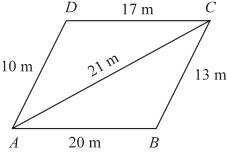
In a quadrilateral $ABCD$,the sides $AB, BC, CD, DA$ measure $20\, m, 13\, m, 17\, m$ and $10\, m$ respectively,and the diagonal $AC$ is $21\, m$. The area of the quadrilateral is ........ $m^2$.
A
$210$
B
$220$
C
$240$
D
None of these
Solution
(A) The area of quadrilateral $ABCD$ is the sum of the areas of $\Delta ABC$ and $\Delta ADC$.
For $\Delta ABC$,the sides are $a = 20\, m, b = 13\, m, c = 21\, m$.
Semi-perimeter $s_1 = \frac{20 + 13 + 21}{2} = \frac{54}{2} = 27\, m$.
Area of $\Delta ABC = \sqrt{s_1(s_1 - a)(s_1 - b)(s_1 - c)} = \sqrt{27(27 - 20)(27 - 13)(27 - 21)} = \sqrt{27 \times 7 \times 14 \times 6} = \sqrt{15876} = 126\, m^2$.
For $\Delta ADC$,the sides are $a = 10\, m, b = 17\, m, c = 21\, m$.
Semi-perimeter $s_2 = \frac{10 + 17 + 21}{2} = \frac{48}{2} = 24\, m$.
Area of $\Delta ADC = \sqrt{s_2(s_2 - a)(s_2 - b)(s_2 - c)} = \sqrt{24(24 - 10)(24 - 17)(24 - 21)} = \sqrt{24 \times 14 \times 7 \times 3} = \sqrt{7056} = 84\, m^2$.
Total area of quadrilateral $ABCD = 126\, m^2 + 84\, m^2 = 210\, m^2$.
For $\Delta ABC$,the sides are $a = 20\, m, b = 13\, m, c = 21\, m$.
Semi-perimeter $s_1 = \frac{20 + 13 + 21}{2} = \frac{54}{2} = 27\, m$.
Area of $\Delta ABC = \sqrt{s_1(s_1 - a)(s_1 - b)(s_1 - c)} = \sqrt{27(27 - 20)(27 - 13)(27 - 21)} = \sqrt{27 \times 7 \times 14 \times 6} = \sqrt{15876} = 126\, m^2$.
For $\Delta ADC$,the sides are $a = 10\, m, b = 17\, m, c = 21\, m$.
Semi-perimeter $s_2 = \frac{10 + 17 + 21}{2} = \frac{48}{2} = 24\, m$.
Area of $\Delta ADC = \sqrt{s_2(s_2 - a)(s_2 - b)(s_2 - c)} = \sqrt{24(24 - 10)(24 - 17)(24 - 21)} = \sqrt{24 \times 14 \times 7 \times 3} = \sqrt{7056} = 84\, m^2$.
Total area of quadrilateral $ABCD = 126\, m^2 + 84\, m^2 = 210\, m^2$.
0 likes
View Solution232
MediumMCQ
If the two diagonals of a parallelogram are $72 \, cm$ and $30 \, cm$ respectively,then find its perimeter in $cm$.
A
$156$
B
$164$
C
$172$
D
None of these
Solution
(A) Let the parallelogram be $ABCD$ with diagonals $AC = 72 \, cm$ and $BD = 30 \, cm$.
In a parallelogram,the diagonals bisect each other at point $O$.
Therefore,$OA = OC = \frac{72}{2} = 36 \, cm$ and $OB = OD = \frac{30}{2} = 15 \, cm$.
Since the diagonals of a rhombus bisect each other at right angles,if we assume this is a rhombus (or calculate the side length using the property of diagonals),the side length $s$ is given by $s = \sqrt{(\frac{d_1}{2})^2 + (\frac{d_2}{2})^2}$.
$s = \sqrt{36^2 + 15^2} = \sqrt{1296 + 225} = \sqrt{1521} = 39 \, cm$.
Since all four sides of a rhombus are equal,the perimeter is $4 \times 39 = 156 \, cm$.
Note: $A$ parallelogram with diagonals bisecting at right angles is a rhombus. If it is not a rhombus,the perimeter cannot be uniquely determined. Given the options,it is implied to be a rhombus.
In a parallelogram,the diagonals bisect each other at point $O$.
Therefore,$OA = OC = \frac{72}{2} = 36 \, cm$ and $OB = OD = \frac{30}{2} = 15 \, cm$.
Since the diagonals of a rhombus bisect each other at right angles,if we assume this is a rhombus (or calculate the side length using the property of diagonals),the side length $s$ is given by $s = \sqrt{(\frac{d_1}{2})^2 + (\frac{d_2}{2})^2}$.
$s = \sqrt{36^2 + 15^2} = \sqrt{1296 + 225} = \sqrt{1521} = 39 \, cm$.
Since all four sides of a rhombus are equal,the perimeter is $4 \times 39 = 156 \, cm$.
Note: $A$ parallelogram with diagonals bisecting at right angles is a rhombus. If it is not a rhombus,the perimeter cannot be uniquely determined. Given the options,it is implied to be a rhombus.
0 likes
View Solution233
MediumMCQ
If the base of a parallelogram is $(x+4)$,the altitude to the base is $(x-3)$,and the area is $(x^{2}-4)$,then the actual area is equal to (in $Sq\, units$)
A
$64$
B
$48$
C
$60$
D
None of these
Solution
(C) The area of a parallelogram is given by the formula: $\text{Area} = \text{base} \times \text{altitude}$.
Given,$\text{base} = (x+4)$,$\text{altitude} = (x-3)$,and $\text{Area} = (x^{2}-4)$.
Substituting these values into the formula:
$(x^{2}-4) = (x+4)(x-3)$
$x^{2}-4 = x^{2} - 3x + 4x - 12$
$x^{2}-4 = x^{2} + x - 12$
Subtracting $x^{2}$ from both sides:
$-4 = x - 12$
$x = 12 - 4 = 8$.
Now,substitute $x = 8$ into the expression for the area:
$\text{Area} = x^{2}-4 = (8)^{2}-4 = 64 - 4 = 60$ sq units.
Given,$\text{base} = (x+4)$,$\text{altitude} = (x-3)$,and $\text{Area} = (x^{2}-4)$.
Substituting these values into the formula:
$(x^{2}-4) = (x+4)(x-3)$
$x^{2}-4 = x^{2} - 3x + 4x - 12$
$x^{2}-4 = x^{2} + x - 12$
Subtracting $x^{2}$ from both sides:
$-4 = x - 12$
$x = 12 - 4 = 8$.
Now,substitute $x = 8$ into the expression for the area:
$\text{Area} = x^{2}-4 = (8)^{2}-4 = 64 - 4 = 60$ sq units.
0 likes
View Solution234
MediumMCQ
In a parallelogram,the lengths of adjacent sides are $12\, cm$ and $14\, cm$,respectively. If the length of one diagonal is $16\, cm$,then find the length of the other diagonal (in $cm$).
A
$24.8$
B
$20.6$
C
$22.4$
D
None of these
Solution
(B) For any parallelogram with adjacent sides $a$ and $b$ and diagonals $d_1$ and $d_2$,the parallelogram law states: $d_1^2 + d_2^2 = 2(a^2 + b^2)$.
Given $a = 12\, cm$,$b = 14\, cm$,and $d_1 = 16\, cm$.
Substituting the values into the formula:
$16^2 + d_2^2 = 2(12^2 + 14^2)$
$256 + d_2^2 = 2(144 + 196)$
$256 + d_2^2 = 2(340)$
$256 + d_2^2 = 680$
$d_2^2 = 680 - 256 = 424$
$d_2 = \sqrt{424} \approx 20.59\, cm \approx 20.6\, cm$.
Given $a = 12\, cm$,$b = 14\, cm$,and $d_1 = 16\, cm$.
Substituting the values into the formula:
$16^2 + d_2^2 = 2(12^2 + 14^2)$
$256 + d_2^2 = 2(144 + 196)$
$256 + d_2^2 = 2(340)$
$256 + d_2^2 = 680$
$d_2^2 = 680 - 256 = 424$
$d_2 = \sqrt{424} \approx 20.59\, cm \approx 20.6\, cm$.
0 likes
View Solution235
MediumMCQ
Find the perimeter of a circular plot which occupies an area of $154 \, m^{2}$ (in $m$).
A
$54$
B
$44$
C
$22$
D
$11$
Solution
(B) The area of a circle is given by the formula $A = \pi r^{2}$.
Given $A = 154 \, m^{2}$ and taking $\pi = \frac{22}{7}$:
$\frac{22}{7} \times r^{2} = 154$
$r^{2} = 154 \times \frac{7}{22}$
$r^{2} = 7 \times 7 = 49$
$r = \sqrt{49} = 7 \, m$.
The perimeter (circumference) of a circle is given by $P = 2 \pi r$.
$P = 2 \times \frac{22}{7} \times 7 = 44 \, m$.
Given $A = 154 \, m^{2}$ and taking $\pi = \frac{22}{7}$:
$\frac{22}{7} \times r^{2} = 154$
$r^{2} = 154 \times \frac{7}{22}$
$r^{2} = 7 \times 7 = 49$
$r = \sqrt{49} = 7 \, m$.
The perimeter (circumference) of a circle is given by $P = 2 \pi r$.
$P = 2 \times \frac{22}{7} \times 7 = 44 \, m$.
0 likes
View Solution236
EasyMCQ
The perimeter of a circle is equal to that of a square. Compare their areas.
A
$14: 11$
B
$25: 12$
C
$24: 7$
D
$22: 7$
Solution
(A) Let the side of the square be $x$ and the radius of the circle be $r$.
According to the problem,the perimeter of the circle is equal to the perimeter of the square:
$2 \pi r = 4x$
$x = \frac{\pi r}{2}$
Now,we compare the area of the circle $(A_c = \pi r^2)$ to the area of the square $(A_s = x^2)$:
$\frac{A_c}{A_s} = \frac{\pi r^2}{x^2} = \frac{\pi r^2}{(\frac{\pi r}{2})^2} = \frac{\pi r^2}{\frac{\pi^2 r^2}{4}}$
$\frac{A_c}{A_s} = \frac{4}{\pi} = \frac{4}{22/7} = \frac{4 \times 7}{22} = \frac{28}{22} = \frac{14}{11}$
Thus,the ratio of their areas is $14: 11$.
According to the problem,the perimeter of the circle is equal to the perimeter of the square:
$2 \pi r = 4x$
$x = \frac{\pi r}{2}$
Now,we compare the area of the circle $(A_c = \pi r^2)$ to the area of the square $(A_s = x^2)$:
$\frac{A_c}{A_s} = \frac{\pi r^2}{x^2} = \frac{\pi r^2}{(\frac{\pi r}{2})^2} = \frac{\pi r^2}{\frac{\pi^2 r^2}{4}}$
$\frac{A_c}{A_s} = \frac{4}{\pi} = \frac{4}{22/7} = \frac{4 \times 7}{22} = \frac{28}{22} = \frac{14}{11}$
Thus,the ratio of their areas is $14: 11$.
0 likes
View Solution237
MediumMCQ
The length of a rectangle is thrice its breadth and its perimeter is $96 \, m$. The area of the rectangle is......$m^2$
A
$288$
B
$442$
C
$438$
D
$432$
Solution
(D) Let the breadth of the rectangle be $x \, m$.
Then,the length of the rectangle is $3x \, m$.
The perimeter of a rectangle is given by the formula $P = 2(l + b)$.
Given that the perimeter is $96 \, m$,we have $2(3x + x) = 96$.
$2(4x) = 96 \Rightarrow 8x = 96$.
$x = 12 \, m$.
So,the breadth is $12 \, m$ and the length is $3 \times 12 = 36 \, m$.
The area of the rectangle is $\text{length} \times \text{breadth} = 36 \times 12 = 432 \, m^2$.
Then,the length of the rectangle is $3x \, m$.
The perimeter of a rectangle is given by the formula $P = 2(l + b)$.
Given that the perimeter is $96 \, m$,we have $2(3x + x) = 96$.
$2(4x) = 96 \Rightarrow 8x = 96$.
$x = 12 \, m$.
So,the breadth is $12 \, m$ and the length is $3 \times 12 = 36 \, m$.
The area of the rectangle is $\text{length} \times \text{breadth} = 36 \times 12 = 432 \, m^2$.
0 likes
View Solution238
EasyMCQ
$A$ cow is tied by a rope at the corner of a rectangular field. If the length of the rope is $14\, m$,then the area of the field which the cow could graze is.......$m^2$
A
$77$
B
$308$
C
$23$
D
$154$
Solution
(D) Since the cow is tied at the corner of a rectangular field,the area it can graze forms a sector of a circle with a radius $r = 14\, m$ and a central angle of $90^{\circ}$ (as the corner of a rectangle is $90^{\circ}$).
The area of the sector is given by the formula: $\text{Area} = \frac{\theta}{360^{\circ}} \times \pi r^2$.
Substituting the values: $\text{Area} = \frac{90^{\circ}}{360^{\circ}} \times \frac{22}{7} \times 14 \times 14$.
$\text{Area} = \frac{1}{4} \times \frac{22}{7} \times 196$.
$\text{Area} = \frac{1}{4} \times 22 \times 28$.
$\text{Area} = 154\, m^2$.
The area of the sector is given by the formula: $\text{Area} = \frac{\theta}{360^{\circ}} \times \pi r^2$.
Substituting the values: $\text{Area} = \frac{90^{\circ}}{360^{\circ}} \times \frac{22}{7} \times 14 \times 14$.
$\text{Area} = \frac{1}{4} \times \frac{22}{7} \times 196$.
$\text{Area} = \frac{1}{4} \times 22 \times 28$.
$\text{Area} = 154\, m^2$.
0 likes
View Solution239
MediumMCQ
The wheel of a scooter has a diameter of $70\, cm$. How many revolutions per minute must the wheel make so that the speed of the scooter is kept at $66\, km/h$?
A
$400$
B
$600$
C
$500$
D
$800$
Solution
(C) The speed of the scooter is $66\, km/h$.
To find the distance covered in one minute,convert the speed to $cm/min$:
Distance per minute $= \frac{66 \times 1000 \times 100}{60} = 110000\, cm/min$.
The distance covered in one revolution is equal to the circumference of the wheel:
Circumference $= \pi \times d = \frac{22}{7} \times 70 = 220\, cm$.
The number of revolutions per minute is the total distance covered in one minute divided by the distance covered in one revolution:
Number of revolutions $= \frac{110000}{220} = 500$.
To find the distance covered in one minute,convert the speed to $cm/min$:
Distance per minute $= \frac{66 \times 1000 \times 100}{60} = 110000\, cm/min$.
The distance covered in one revolution is equal to the circumference of the wheel:
Circumference $= \pi \times d = \frac{22}{7} \times 70 = 220\, cm$.
The number of revolutions per minute is the total distance covered in one minute divided by the distance covered in one revolution:
Number of revolutions $= \frac{110000}{220} = 500$.
0 likes
View Solution240
EasyMCQ
$2$ small circular parks of diameters $16 \ m$ and $12 \ m$ are to be replaced by a bigger circular park. What would be the radius of this new park,if the new park occupies the same space as the two small parks?
A
$10$
B
$15$
C
$20$
D
$25$
Solution
(A) The area of a circle is given by the formula $A = \pi r^2$,where $r$ is the radius.
For the first park,the diameter is $16 \ m$,so the radius $r_1 = 16 / 2 = 8 \ m$.
The area of the first park is $A_1 = \pi (8)^2 = 64\pi \ m^2$.
For the second park,the diameter is $12 \ m$,so the radius $r_2 = 12 / 2 = 6 \ m$.
The area of the second park is $A_2 = \pi (6)^2 = 36\pi \ m^2$.
The total area of the two parks is $A_{total} = 64\pi + 36\pi = 100\pi \ m^2$.
Let the radius of the new park be $R$. Since the new park occupies the same space,its area must be equal to the total area of the two small parks:
$\pi R^2 = 100\pi$
$R^2 = 100$
$R = \sqrt{100} = 10 \ m$.
Therefore,the radius of the new park is $10 \ m$.
For the first park,the diameter is $16 \ m$,so the radius $r_1 = 16 / 2 = 8 \ m$.
The area of the first park is $A_1 = \pi (8)^2 = 64\pi \ m^2$.
For the second park,the diameter is $12 \ m$,so the radius $r_2 = 12 / 2 = 6 \ m$.
The area of the second park is $A_2 = \pi (6)^2 = 36\pi \ m^2$.
The total area of the two parks is $A_{total} = 64\pi + 36\pi = 100\pi \ m^2$.
Let the radius of the new park be $R$. Since the new park occupies the same space,its area must be equal to the total area of the two small parks:
$\pi R^2 = 100\pi$
$R^2 = 100$
$R = \sqrt{100} = 10 \ m$.
Therefore,the radius of the new park is $10 \ m$.
0 likes
View Solution241
EasyMCQ
$A$ rectangular park is $65\, m$ long and $50\, m$ wide. Two cross paths,each $2\, m$ wide,are to be constructed parallel to the sides. If these paths pass through the centre of the rectangle and the cost of construction is ₹ $17.25$ per $m^2$,then find the total cost involved in the construction (in ₹).
A
$2265.59$
B
$1772.45$
C
$3898.50$
D
$8452.32$
Solution
(C) The length of the rectangular park is $L = 65\, m$ and the width is $W = 50\, m$.
The width of the paths is $w = 2\, m$.
The area of the path parallel to the length is $L \times w = 65 \times 2 = 130\, m^2$.
The area of the path parallel to the width is $W \times w = 50 \times 2 = 100\, m^2$.
Since the two paths intersect at the center,the intersection area is a square of side $w = 2\, m$,which is $w^2 = 2 \times 2 = 4\, m^2$.
The total area of the paths is $(130 + 100 - 4) = 226\, m^2$.
The cost of construction is $226 \times 17.25 = ₹ 3898.50$.
The width of the paths is $w = 2\, m$.
The area of the path parallel to the length is $L \times w = 65 \times 2 = 130\, m^2$.
The area of the path parallel to the width is $W \times w = 50 \times 2 = 100\, m^2$.
Since the two paths intersect at the center,the intersection area is a square of side $w = 2\, m$,which is $w^2 = 2 \times 2 = 4\, m^2$.
The total area of the paths is $(130 + 100 - 4) = 226\, m^2$.
The cost of construction is $226 \times 17.25 = ₹ 3898.50$.
0 likes
View Solution242
MediumMCQ
The area of a trapezium is $2500 \, m^2$. One of its parallel sides is $75 \, m$. If the distance between the two parallel sides is $40 \, m$,then find the length of the other parallel side in $m$.
A
$20$
B
$30$
C
$40$
D
$50$
Solution
(D) The formula for the area of a trapezium is $\text{Area} = \frac{1}{2} \times (a + b) \times h$,where $a$ and $b$ are the lengths of the parallel sides and $h$ is the height (distance between them).
Given: $\text{Area} = 2500 \, m^2$,$a = 75 \, m$,and $h = 40 \, m$.
Substituting the values into the formula:
$2500 = \frac{1}{2} \times (75 + b) \times 40$
$2500 = (75 + b) \times 20$
Divide both sides by $20$:
$125 = 75 + b$
$b = 125 - 75$
$b = 50 \, m$.
Therefore,the length of the other parallel side is $50 \, m$.
Given: $\text{Area} = 2500 \, m^2$,$a = 75 \, m$,and $h = 40 \, m$.
Substituting the values into the formula:
$2500 = \frac{1}{2} \times (75 + b) \times 40$
$2500 = (75 + b) \times 20$
Divide both sides by $20$:
$125 = 75 + b$
$b = 125 - 75$
$b = 50 \, m$.
Therefore,the length of the other parallel side is $50 \, m$.
0 likes
View Solution243
MediumMCQ
The length of a rectangle exceeds its breadth by $3 \, cm$. If the numerical values of the area and the perimeter of the rectangle are equal,then the breadth is ...... $cm$.
A
$1$
B
$2$
C
$3$
D
$3.5$
Solution
(C) Let the breadth of the rectangle be $x \, cm$.
Then,the length of the rectangle is $(x + 3) \, cm$.
According to the problem,the numerical value of the area is equal to the numerical value of the perimeter.
Area $= \text{Length} \times \text{Breadth} = x(x + 3) \, cm^2$.
Perimeter $= 2(\text{Length} + \text{Breadth}) = 2(x + 3 + x) = 2(2x + 3) = (4x + 6) \, cm$.
Equating the two: $x(x + 3) = 4x + 6$.
$x^2 + 3x = 4x + 6$.
$x^2 - x - 6 = 0$.
Factoring the quadratic equation: $(x - 3)(x + 2) = 0$.
This gives $x = 3$ or $x = -2$.
Since the breadth cannot be negative,the breadth is $3 \, cm$.
Then,the length of the rectangle is $(x + 3) \, cm$.
According to the problem,the numerical value of the area is equal to the numerical value of the perimeter.
Area $= \text{Length} \times \text{Breadth} = x(x + 3) \, cm^2$.
Perimeter $= 2(\text{Length} + \text{Breadth}) = 2(x + 3 + x) = 2(2x + 3) = (4x + 6) \, cm$.
Equating the two: $x(x + 3) = 4x + 6$.
$x^2 + 3x = 4x + 6$.
$x^2 - x - 6 = 0$.
Factoring the quadratic equation: $(x - 3)(x + 2) = 0$.
This gives $x = 3$ or $x = -2$.
Since the breadth cannot be negative,the breadth is $3 \, cm$.
0 likes
View Solution244
EasyMCQ
If the ratio of the areas of two squares is $9: 1$,then the ratio of their perimeters is
A
$9: 1$
B
$3: 4$
C
$3: 1$
D
$1: 3$
Solution
(C) Let the sides of the two squares be $x$ and $y$ respectively.
The area of a square is given by the formula $\text{Area} = \text{side}^2$.
Given the ratio of the areas is $\frac{x^2}{y^2} = \frac{9}{1}$.
Taking the square root of both sides,we get $\frac{x}{y} = \sqrt{\frac{9}{1}} = \frac{3}{1}$.
The perimeter of a square is given by the formula $\text{Perimeter} = 4 \times \text{side}$.
The ratio of their perimeters is $\frac{4x}{4y} = \frac{x}{y}$.
Substituting the value of $\frac{x}{y}$,the ratio of the perimeters is $3: 1$.
The area of a square is given by the formula $\text{Area} = \text{side}^2$.
Given the ratio of the areas is $\frac{x^2}{y^2} = \frac{9}{1}$.
Taking the square root of both sides,we get $\frac{x}{y} = \sqrt{\frac{9}{1}} = \frac{3}{1}$.
The perimeter of a square is given by the formula $\text{Perimeter} = 4 \times \text{side}$.
The ratio of their perimeters is $\frac{4x}{4y} = \frac{x}{y}$.
Substituting the value of $\frac{x}{y}$,the ratio of the perimeters is $3: 1$.
0 likes
View Solution245
DifficultMCQ
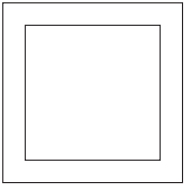
$A$ square field with side $30\, m$ is surrounded by a path of uniform width. If the area of the path is $256\, m^2$,then its width is ........ $m$.
A
$16$
B
$14$
C
$4$
D
$2$
Solution
(D) Let $x$ (in metres) be the width of the path.
The side of the inner square is $30\, m$.
The side of the outer square is $(30 + 2x)\, m$.
The area of the path is given by the difference between the area of the outer square and the area of the inner square.
Area of path $= (30 + 2x)^2 - 30^2 = 256$.
Expanding the equation: $(900 + 120x + 4x^2) - 900 = 256$.
$4x^2 + 120x = 256$.
Dividing by $4$: $x^2 + 30x = 64$.
$x^2 + 30x - 64 = 0$.
Factoring the quadratic equation: $(x + 32)(x - 2) = 0$.
This gives $x = -32$ or $x = 2$.
Since the width cannot be negative,we have $x = 2\, m$.
The side of the inner square is $30\, m$.
The side of the outer square is $(30 + 2x)\, m$.
The area of the path is given by the difference between the area of the outer square and the area of the inner square.
Area of path $= (30 + 2x)^2 - 30^2 = 256$.
Expanding the equation: $(900 + 120x + 4x^2) - 900 = 256$.
$4x^2 + 120x = 256$.
Dividing by $4$: $x^2 + 30x = 64$.
$x^2 + 30x - 64 = 0$.
Factoring the quadratic equation: $(x + 32)(x - 2) = 0$.
This gives $x = -32$ or $x = 2$.
Since the width cannot be negative,we have $x = 2\, m$.
0 likes
View Solution246
MediumMCQ
$A$ rope by which a calf is tied is increased from $12 \ m$ to $23 \ m$. How much additional grassy ground shall it graze? (in $m^2$)
A
$1120$
B
$1250$
C
$1210$
D
$1200$
Solution
(C) The area grazed by the calf is the area of a circle with the rope length as the radius.
Initial radius $(r_1)$ = $12 \ m$.
Final radius $(r_2)$ = $23 \ m$.
Additional area grazed = Area with radius $r_2$ - Area with radius $r_1$.
Additional area = $\pi r_2^2 - \pi r_1^2 = \pi(r_2^2 - r_1^2)$.
Using the identity $a^2 - b^2 = (a - b)(a + b)$:
Additional area = $\pi(23 - 12)(23 + 12) = \pi(11)(35)$.
Taking $\pi = \frac{22}{7}$:
Additional area = $\frac{22}{7} \times 11 \times 35 = 22 \times 11 \times 5 = 1210 \ m^2$.
Initial radius $(r_1)$ = $12 \ m$.
Final radius $(r_2)$ = $23 \ m$.
Additional area grazed = Area with radius $r_2$ - Area with radius $r_1$.
Additional area = $\pi r_2^2 - \pi r_1^2 = \pi(r_2^2 - r_1^2)$.
Using the identity $a^2 - b^2 = (a - b)(a + b)$:
Additional area = $\pi(23 - 12)(23 + 12) = \pi(11)(35)$.
Taking $\pi = \frac{22}{7}$:
Additional area = $\frac{22}{7} \times 11 \times 35 = 22 \times 11 \times 5 = 1210 \ m^2$.
0 likes
View Solution247
MediumMCQ
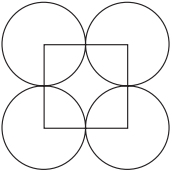
Four circular cardboard pieces,each of radius $7\, cm$,are placed in such a way that each piece touches two other pieces. The area of the space enclosed by the four pieces is.......$cm^2$.
A
$21$
B
$42$
C
$84$
D
$168$
Solution
(B) When four circles of radius $r = 7\, cm$ are placed such that each touches two others,their centers form a square with side length $s = 2r = 14\, cm$.
The area of this square is $s^2 = 14 \times 14 = 196\, cm^2$.
The space enclosed by the four pieces is the area of the square minus the area of the four quadrants of the circles lying inside the square.
Each quadrant has an angle of $90^\circ$. The total area of the four quadrants is $4 \times (\frac{90}{360} \times \pi r^2) = \pi r^2 = \frac{22}{7} \times 7 \times 7 = 154\, cm^2$.
Therefore,the required enclosed area is $196 - 154 = 42\, cm^2$.
The area of this square is $s^2 = 14 \times 14 = 196\, cm^2$.
The space enclosed by the four pieces is the area of the square minus the area of the four quadrants of the circles lying inside the square.
Each quadrant has an angle of $90^\circ$. The total area of the four quadrants is $4 \times (\frac{90}{360} \times \pi r^2) = \pi r^2 = \frac{22}{7} \times 7 \times 7 = 154\, cm^2$.
Therefore,the required enclosed area is $196 - 154 = 42\, cm^2$.
0 likes
View Solution248
DifficultMCQ
The length and breadth of a rectangular field are in the ratio $5: 3.$ If the cost of cultivating the field at $25$ $paise$ per square metre is ₹ $6000,$ then find the dimensions of the field.
A
$250 \, m, 100 \, m$
B
$50 \, m, 30 \, m$
C
$200 \, m, 120 \, m$
D
Cannot be determined
Solution
(C) The cost of cultivation is given as ₹ $6000$ at a rate of $25$ $paise$ per square metre.
Since $100$ $paise = ₹ 1,$ the rate is $0.25$ ₹ per $m^2$.
Area of the field $= \frac{\text{Total Cost}}{\text{Rate}} = \frac{6000}{0.25} = 24000 \, m^2$.
Let the length be $5x$ and the breadth be $3x$.
The area of a rectangle is $\text{length} \times \text{breadth}$.
So,$5x \times 3x = 24000$.
$15x^2 = 24000$.
$x^2 = \frac{24000}{15} = 1600$.
$x = \sqrt{1600} = 40$.
Therefore,the length $= 5 \times 40 = 200 \, m$ and the breadth $= 3 \times 40 = 120 \, m$.
Since $100$ $paise = ₹ 1,$ the rate is $0.25$ ₹ per $m^2$.
Area of the field $= \frac{\text{Total Cost}}{\text{Rate}} = \frac{6000}{0.25} = 24000 \, m^2$.
Let the length be $5x$ and the breadth be $3x$.
The area of a rectangle is $\text{length} \times \text{breadth}$.
So,$5x \times 3x = 24000$.
$15x^2 = 24000$.
$x^2 = \frac{24000}{15} = 1600$.
$x = \sqrt{1600} = 40$.
Therefore,the length $= 5 \times 40 = 200 \, m$ and the breadth $= 3 \times 40 = 120 \, m$.
0 likes
View Solution249
EasyMCQ
The cost of carpeting a room $5 \ m$ wide with carpet at ₹ $3.50$ per $m^2$ is ₹ $105$. The length of the room is ...... $m$.
A
$3.5$
B
$5$
C
$6$
D
$6.5$
Solution
(C) The total cost of carpeting is ₹ $105$ and the rate is ₹ $3.50$ per $m^2$.
Area of the carpet = $\frac{\text{Total Cost}}{\text{Rate}} = \frac{105}{3.50} = 30 \ m^2$.
Since the area of the carpet is equal to the area of the room,the area of the room is $30 \ m^2$.
Given that the width of the room is $5 \ m$.
Area of the room = $\text{Length} \times \text{Width}$.
$30 = \text{Length} \times 5$.
Length = $\frac{30}{5} = 6 \ m$.
Area of the carpet = $\frac{\text{Total Cost}}{\text{Rate}} = \frac{105}{3.50} = 30 \ m^2$.
Since the area of the carpet is equal to the area of the room,the area of the room is $30 \ m^2$.
Given that the width of the room is $5 \ m$.
Area of the room = $\text{Length} \times \text{Width}$.
$30 = \text{Length} \times 5$.
Length = $\frac{30}{5} = 6 \ m$.
0 likes
View Solution250
MediumMCQ
The length of a rectangular field is twice its breadth. If the rent of the field at ₹ $3500$ per hectare is ₹ $28000$,then find the cost of surrounding it with a fence at ₹ $5$ per meter (in ₹).
A
$6000$
B
$7000$
C
$6500$
D
$8000$
Solution
(A) Area of the rectangular field $= \frac{28000}{3500} = 8$ hectares.
Since $1$ hectare $= 10000 \text{ m}^2$,the area $= 8 \times 10000 = 80000 \text{ m}^2$.
Let the breadth be $x$ meters and the length be $2x$ meters.
Area $= \text{Length} \times \text{Breadth} = 2x \times x = 2x^2$.
$2x^2 = 80000 \implies x^2 = 40000 \implies x = 200 \text{ m}$.
Breadth $= 200 \text{ m}$,Length $= 400 \text{ m}$.
Perimeter $= 2(\text{Length} + \text{Breadth}) = 2(400 + 200) = 2(600) = 1200 \text{ m}$.
Cost of fencing $= 1200 \times 5 = ₹ 6000$.
Since $1$ hectare $= 10000 \text{ m}^2$,the area $= 8 \times 10000 = 80000 \text{ m}^2$.
Let the breadth be $x$ meters and the length be $2x$ meters.
Area $= \text{Length} \times \text{Breadth} = 2x \times x = 2x^2$.
$2x^2 = 80000 \implies x^2 = 40000 \implies x = 200 \text{ m}$.
Breadth $= 200 \text{ m}$,Length $= 400 \text{ m}$.
Perimeter $= 2(\text{Length} + \text{Breadth}) = 2(400 + 200) = 2(600) = 1200 \text{ m}$.
Cost of fencing $= 1200 \times 5 = ₹ 6000$.
0 likes
View SolutionMensuration — Measurement of Area · Frequently Asked Questions
1Are these Mensuration questions useful for JEE and NEET?
Yes. All questions in this section are mapped to JEE Main and NEET exam patterns. Previous year questions from JEE Main, NEET, GUJCET and state-level exams are included with full solutions.
2Can I switch to Hindi or Gujarati for these questions?
Yes. Use the language tabs in the hero section or the sidebar to view the same questions and solutions in English, Hindi or Gujarati.
3How do I generate a question paper from this subtopic?
Use the Vedclass Exam Paper Generator — select the chapter and subtopic, set difficulty, and generate Sets A, B, C, D automatically. First 3 chapters of every subject are free.
Vedclass Products
For Students
Vedclass Test Series
Mock tests in real JEE/NEET style with performance analysis. 5-day free trial.
Start Free TrialFor Teachers
Exam Paper Generator
Generate Set A/B/C/D papers from this chapter in 2 minutes. 3 chapters free.
Try FreeFor Institutes
Online Exam Module
Live online exams with unlimited students, 360° analytics & white-label branding.
See DemoFor Teachers & Institutes
Generate a Mensuration Exam Paper in 2 Minutes
Select subtopic & difficulty — Sets A, B, C, D auto-generated with No Repeat logic.
First 3 chapters of every subject are free — no payment required.