
A English
Measurement of Area Questions in English
Competitive Exam Quantitative Aptitude · Mensuration · Measurement of Area
407+
Questions
English
Language
100%
With Solutions
Showing 50 of 407 questions in English
1
EasyMCQ
$A$ rectangular plot is $180 \, m^2$ in area. If its length is $18 \, m$,then its perimeter is ...... $m$?
A
$28$
B
$56$
C
$360$
D
$60$
Solution
(B) The area of a rectangle is given by the formula: $\text{Area} = \text{length} \times \text{breadth}$.
Given,$\text{Area} = 180 \, m^2$ and $\text{length} = 18 \, m$.
Therefore,$\text{breadth} = \frac{\text{Area}}{\text{length}} = \frac{180}{18} = 10 \, m$.
The perimeter of a rectangle is calculated as: $\text{Perimeter} = 2 \times (\text{length} + \text{breadth})$.
Substituting the values: $\text{Perimeter} = 2 \times (18 + 10) = 2 \times 28 = 56 \, m$.
Given,$\text{Area} = 180 \, m^2$ and $\text{length} = 18 \, m$.
Therefore,$\text{breadth} = \frac{\text{Area}}{\text{length}} = \frac{180}{18} = 10 \, m$.
The perimeter of a rectangle is calculated as: $\text{Perimeter} = 2 \times (\text{length} + \text{breadth})$.
Substituting the values: $\text{Perimeter} = 2 \times (18 + 10) = 2 \times 28 = 56 \, m$.
0 likes
View Solution2
MediumMCQ
The side of a square exceeds the side of another square by $4\, cm$ and the sum of the areas of the two squares is $400\, cm^2$. The dimensions of the squares are?
A
$8\, cm$ and $12\, cm$
B
$6\, cm$ and $10\, cm$
C
$12\, cm$ and $16\, cm$
D
$10\, cm$ and $18\, cm$
Solution
(C) Let the side of the first square be $x\, cm$.
Then,the side of the second square is $(x + 4)\, cm$.
According to the problem,the sum of their areas is $400\, cm^2$:
$x^2 + (x + 4)^2 = 400$
$x^2 + x^2 + 8x + 16 = 400$
$2x^2 + 8x - 384 = 0$
Dividing by $2$,we get:
$x^2 + 4x - 192 = 0$
Factoring the quadratic equation:
$x^2 + 16x - 12x - 192 = 0$
$x(x + 16) - 12(x + 16) = 0$
$(x - 12)(x + 16) = 0$
Since the side length cannot be negative,$x = 12$.
Thus,the side of the first square is $12\, cm$ and the side of the second square is $12 + 4 = 16\, cm$.
Then,the side of the second square is $(x + 4)\, cm$.
According to the problem,the sum of their areas is $400\, cm^2$:
$x^2 + (x + 4)^2 = 400$
$x^2 + x^2 + 8x + 16 = 400$
$2x^2 + 8x - 384 = 0$
Dividing by $2$,we get:
$x^2 + 4x - 192 = 0$
Factoring the quadratic equation:
$x^2 + 16x - 12x - 192 = 0$
$x(x + 16) - 12(x + 16) = 0$
$(x - 12)(x + 16) = 0$
Since the side length cannot be negative,$x = 12$.
Thus,the side of the first square is $12\, cm$ and the side of the second square is $12 + 4 = 16\, cm$.
0 likes
View Solution3
MediumMCQ
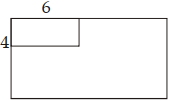
The area of the floor of a rectangular hall of length $40\, m$ is $960\, m^{2}$. Carpets of size $6\, m \times 4\, m$ are available. How many carpets are required to cover the hall?
A
$20$
B
$30$
C
$40$
D
$45$
Solution
(C) Area of the floor $= 960\, m^{2}$.
Area of one carpet $= 6\, m \times 4\, m = 24\, m^{2}$.
Therefore,the number of carpets required $= \frac{\text{Area of floor}}{\text{Area of one carpet}}$.
Number of carpets $= \frac{960}{24} = 40$.
Area of one carpet $= 6\, m \times 4\, m = 24\, m^{2}$.
Therefore,the number of carpets required $= \frac{\text{Area of floor}}{\text{Area of one carpet}}$.
Number of carpets $= \frac{960}{24} = 40$.
0 likes
View Solution4
DifficultMCQ
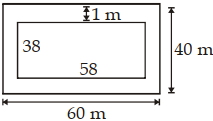
$A$ lawn is in the shape of a rectangle of length $60 \ m$ and width $40 \ m$. Inside the lawn,there is a footpath of uniform width $1 \ m$ bordering the lawn. The area of the path is ....... $m^2$.
A
$194$
B
$196$
C
$198$
D
$200$
Solution
(B) Length of the outer rectangle $= 60 \ m$.
Breadth of the outer rectangle $= 40 \ m$.
Area of the outer rectangle $= 60 \ m \times 40 \ m = 2400 \ m^2$.
Width of the path $= 1 \ m$.
Since the path is inside the lawn,the length of the inner rectangle $= 60 \ m - (1 \ m + 1 \ m) = 58 \ m$.
The breadth of the inner rectangle $= 40 \ m - (1 \ m + 1 \ m) = 38 \ m$.
Area of the inner rectangle $= 58 \ m \times 38 \ m = 2204 \ m^2$.
Area of the path $= \text{Area of outer rectangle} - \text{Area of inner rectangle}$.
Area of the path $= 2400 \ m^2 - 2204 \ m^2 = 196 \ m^2$.
Breadth of the outer rectangle $= 40 \ m$.
Area of the outer rectangle $= 60 \ m \times 40 \ m = 2400 \ m^2$.
Width of the path $= 1 \ m$.
Since the path is inside the lawn,the length of the inner rectangle $= 60 \ m - (1 \ m + 1 \ m) = 58 \ m$.
The breadth of the inner rectangle $= 40 \ m - (1 \ m + 1 \ m) = 38 \ m$.
Area of the inner rectangle $= 58 \ m \times 38 \ m = 2204 \ m^2$.
Area of the path $= \text{Area of outer rectangle} - \text{Area of inner rectangle}$.
Area of the path $= 2400 \ m^2 - 2204 \ m^2 = 196 \ m^2$.
0 likes
View Solution5
EasyMCQ
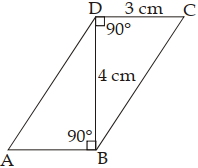
$ABCD$ is a parallelogram as shown in the figure. Find its area in $cm^2$.
A
$12$
B
$14$
C
$15$
D
$660$
Solution
(A) The area of a parallelogram is given by the formula: $\text{Area} = \text{base} \times \text{height}$.
In the given figure,the base $CD$ is $3 \text{ cm}$ and the corresponding height $BD$ is $4 \text{ cm}$.
Therefore,$\text{Area} = 3 \text{ cm} \times 4 \text{ cm} = 12 \text{ cm}^2$.
Alternatively,the parallelogram is composed of two congruent triangles,$\Delta ABD$ and $\Delta BDC$.
$\text{Area of } \Delta BDC = \frac{1}{2} \times \text{base} \times \text{height} = \frac{1}{2} \times 3 \times 4 = 6 \text{ cm}^2$.
$\text{Total Area} = 2 \times 6 \text{ cm}^2 = 12 \text{ cm}^2$.
In the given figure,the base $CD$ is $3 \text{ cm}$ and the corresponding height $BD$ is $4 \text{ cm}$.
Therefore,$\text{Area} = 3 \text{ cm} \times 4 \text{ cm} = 12 \text{ cm}^2$.
Alternatively,the parallelogram is composed of two congruent triangles,$\Delta ABD$ and $\Delta BDC$.
$\text{Area of } \Delta BDC = \frac{1}{2} \times \text{base} \times \text{height} = \frac{1}{2} \times 3 \times 4 = 6 \text{ cm}^2$.
$\text{Total Area} = 2 \times 6 \text{ cm}^2 = 12 \text{ cm}^2$.
0 likes
View Solution6
EasyMCQ
What is the area of a triangle whose sides are $9\, cm$,$12\, cm$,and $15\, cm$? (in $cm^2$)
A
$45$
B
$54$
C
$56$
D
$64$
Solution
(B) The sides of the triangle are $a = 9\, cm$,$b = 12\, cm$,and $c = 15\, cm$.
First,calculate the semi-perimeter $s$:
$s = \frac{a + b + c}{2} = \frac{9 + 12 + 15}{2} = \frac{36}{2} = 18\, cm$.
Using Heron's formula,Area $= \sqrt{s(s - a)(s - b)(s - c)}$.
Area $= \sqrt{18(18 - 9)(18 - 12)(18 - 15)}$.
Area $= \sqrt{18 \times 9 \times 6 \times 3}$.
Area $= \sqrt{2916} = 54\, cm^2$.
Alternatively,since $9^2 + 12^2 = 81 + 144 = 225 = 15^2$,it is a right-angled triangle.
Area $= \frac{1}{2} \times \text{base} \times \text{height} = \frac{1}{2} \times 9 \times 12 = 54\, cm^2$.
First,calculate the semi-perimeter $s$:
$s = \frac{a + b + c}{2} = \frac{9 + 12 + 15}{2} = \frac{36}{2} = 18\, cm$.
Using Heron's formula,Area $= \sqrt{s(s - a)(s - b)(s - c)}$.
Area $= \sqrt{18(18 - 9)(18 - 12)(18 - 15)}$.
Area $= \sqrt{18 \times 9 \times 6 \times 3}$.
Area $= \sqrt{2916} = 54\, cm^2$.
Alternatively,since $9^2 + 12^2 = 81 + 144 = 225 = 15^2$,it is a right-angled triangle.
Area $= \frac{1}{2} \times \text{base} \times \text{height} = \frac{1}{2} \times 9 \times 12 = 54\, cm^2$.
0 likes
View Solution7
EasyMCQ
What is the perimeter of an equilateral triangle whose area is $4 \sqrt{3} \text{ cm}^2$?
A
$4$
B
$3$
C
$12$
D
$7$
Solution
(C) The formula for the area of an equilateral triangle is $\text{Area} = \frac{\sqrt{3}}{4} \times a^2$,where $a$ is the side length.
Given $\text{Area} = 4 \sqrt{3} \text{ cm}^2$.
So,$\frac{\sqrt{3}}{4} \times a^2 = 4 \sqrt{3}$.
Dividing both sides by $\sqrt{3}$,we get $\frac{a^2}{4} = 4$.
$a^2 = 16$,which implies $a = 4 \text{ cm}$.
The perimeter of an equilateral triangle is $3 \times a$.
Perimeter $= 3 \times 4 = 12 \text{ cm}$.
Given $\text{Area} = 4 \sqrt{3} \text{ cm}^2$.
So,$\frac{\sqrt{3}}{4} \times a^2 = 4 \sqrt{3}$.
Dividing both sides by $\sqrt{3}$,we get $\frac{a^2}{4} = 4$.
$a^2 = 16$,which implies $a = 4 \text{ cm}$.
The perimeter of an equilateral triangle is $3 \times a$.
Perimeter $= 3 \times 4 = 12 \text{ cm}$.
0 likes
View Solution8
MediumMCQ
The circumference of a circle whose area is $24.64\, m^{2}$ is ....... $m$.
A
$17.2$
B
$17.4$
C
$17.6$
D
$18.0$
Solution
(C) Let the radius of the circle be $r\, m$.
The area of the circle is given by the formula $A = \pi r^{2}$.
Given $A = 24.64\, m^{2}$,we have $\frac{22}{7} \times r^{2} = 24.64$.
Solving for $r^{2}$: $r^{2} = \frac{24.64 \times 7}{22} = 1.12 \times 7 = 7.84$.
Taking the square root: $r = \sqrt{7.84} = 2.8\, m$.
The circumference of the circle is given by $C = 2 \pi r$.
Substituting the value of $r$: $C = 2 \times \frac{22}{7} \times 2.8 = 2 \times 22 \times 0.4 = 17.6\, m$.
The area of the circle is given by the formula $A = \pi r^{2}$.
Given $A = 24.64\, m^{2}$,we have $\frac{22}{7} \times r^{2} = 24.64$.
Solving for $r^{2}$: $r^{2} = \frac{24.64 \times 7}{22} = 1.12 \times 7 = 7.84$.
Taking the square root: $r = \sqrt{7.84} = 2.8\, m$.
The circumference of the circle is given by $C = 2 \pi r$.
Substituting the value of $r$: $C = 2 \times \frac{22}{7} \times 2.8 = 2 \times 22 \times 0.4 = 17.6\, m$.
0 likes
View Solution9
DifficultMCQ
If the radius of a circle is decreased by $20 \%$,then the percentage decrease in its area is (in $\%$)?
A
$26$
B
$32$
C
$36$
D
$53$
Solution
(C) Let the initial radius of the circle be $r$.
The new radius after a $20 \%$ decrease is $80 \%$ of $r$,which is $r \times \frac{80}{100} = \frac{4r}{5}$.
The initial area of the circle is $A_1 = \pi r^2$.
The new area of the circle is $A_2 = \pi \left(\frac{4r}{5}\right)^2 = \frac{16}{25} \pi r^2$.
The decrease in area is $A_1 - A_2 = \pi r^2 - \frac{16}{25} \pi r^2 = \frac{9}{25} \pi r^2$.
The percentage decrease in area is $\frac{\text{Decrease in Area}}{\text{Initial Area}} \times 100 = \frac{\frac{9}{25} \pi r^2}{\pi r^2} \times 100$.
Calculating this gives $\frac{9}{25} \times 100 = 9 \times 4 = 36 \%$.
The new radius after a $20 \%$ decrease is $80 \%$ of $r$,which is $r \times \frac{80}{100} = \frac{4r}{5}$.
The initial area of the circle is $A_1 = \pi r^2$.
The new area of the circle is $A_2 = \pi \left(\frac{4r}{5}\right)^2 = \frac{16}{25} \pi r^2$.
The decrease in area is $A_1 - A_2 = \pi r^2 - \frac{16}{25} \pi r^2 = \frac{9}{25} \pi r^2$.
The percentage decrease in area is $\frac{\text{Decrease in Area}}{\text{Initial Area}} \times 100 = \frac{\frac{9}{25} \pi r^2}{\pi r^2} \times 100$.
Calculating this gives $\frac{9}{25} \times 100 = 9 \times 4 = 36 \%$.
0 likes
View Solution10
MediumMCQ
If the perimeter of a semi-circular protractor is $36 \, cm$,then its diameter is ...... $cm$?
A
$6$
B
$7$
C
$7.5$
D
$14$
Solution
(D) Let the radius of the semi-circular protractor be $r \, cm$.
The perimeter of a semi-circle is given by the sum of the arc length $(\pi r)$ and the diameter $(2r)$.
Perimeter $= \pi r + 2r = r(\pi + 2) = 36 \, cm$.
Substituting $\pi = \frac{22}{7}$,we get $r(\frac{22}{7} + 2) = 36$.
$r(\frac{22 + 14}{7}) = 36 \Rightarrow r(\frac{36}{7}) = 36$.
Solving for $r$,we get $r = 7 \, cm$.
The diameter of the protractor is $2r = 2 \times 7 = 14 \, cm$.
The perimeter of a semi-circle is given by the sum of the arc length $(\pi r)$ and the diameter $(2r)$.
Perimeter $= \pi r + 2r = r(\pi + 2) = 36 \, cm$.
Substituting $\pi = \frac{22}{7}$,we get $r(\frac{22}{7} + 2) = 36$.
$r(\frac{22 + 14}{7}) = 36 \Rightarrow r(\frac{36}{7}) = 36$.
Solving for $r$,we get $r = 7 \, cm$.
The diameter of the protractor is $2r = 2 \times 7 = 14 \, cm$.
0 likes
View Solution11
MediumMCQ
The ratio of the area of the incircle and circumcircle of a square is?
A
$1:1$
B
$2:1$
C
$1:2$
D
$3:1$
Solution
(C) Let the side of the square be $x$.
The radius of the incircle $(r)$ is half the side of the square: $r = \frac{x}{2}$.
The area of the incircle is $A_1 = \pi r^2 = \pi (\frac{x}{2})^2 = \frac{\pi x^2}{4}$.
The diagonal of the square is $\sqrt{2}x$. The radius of the circumcircle $(R)$ is half the diagonal: $R = \frac{\sqrt{2}x}{2} = \frac{x}{\sqrt{2}}$.
The area of the circumcircle is $A_2 = \pi R^2 = \pi (\frac{x}{\sqrt{2}})^2 = \frac{\pi x^2}{2}$.
The ratio of the area of the incircle to the circumcircle is $\frac{A_1}{A_2} = \frac{\pi x^2 / 4}{\pi x^2 / 2} = \frac{2}{4} = 1:2$.
The radius of the incircle $(r)$ is half the side of the square: $r = \frac{x}{2}$.
The area of the incircle is $A_1 = \pi r^2 = \pi (\frac{x}{2})^2 = \frac{\pi x^2}{4}$.
The diagonal of the square is $\sqrt{2}x$. The radius of the circumcircle $(R)$ is half the diagonal: $R = \frac{\sqrt{2}x}{2} = \frac{x}{\sqrt{2}}$.
The area of the circumcircle is $A_2 = \pi R^2 = \pi (\frac{x}{\sqrt{2}})^2 = \frac{\pi x^2}{2}$.
The ratio of the area of the incircle to the circumcircle is $\frac{A_1}{A_2} = \frac{\pi x^2 / 4}{\pi x^2 / 2} = \frac{2}{4} = 1:2$.
0 likes
View Solution12
EasyMCQ
The diagonal of a square field measures $50 \, m$. The area of the square field is.........$m^2$?
A
$1250$
B
$1200$
C
$1205$
D
$1025$
Solution
(A) The diagonal of a square is given by the formula $d = a\sqrt{2}$,where $a$ is the side length of the square.
Given $d = 50 \, m$.
Therefore,$a\sqrt{2} = 50$,which implies $a = \frac{50}{\sqrt{2}} \, m$.
The area of a square is given by $Area = a^2$.
$Area = \left(\frac{50}{\sqrt{2}}\right)^2 = \frac{2500}{2} = 1250 \, m^2$.
Given $d = 50 \, m$.
Therefore,$a\sqrt{2} = 50$,which implies $a = \frac{50}{\sqrt{2}} \, m$.
The area of a square is given by $Area = a^2$.
$Area = \left(\frac{50}{\sqrt{2}}\right)^2 = \frac{2500}{2} = 1250 \, m^2$.
0 likes
View Solution13
MediumMCQ
The circumference of a circle is $176\, m$. Then,its area is
A
$2464\, m^2$
B
$2164\, cm^2$
C
$2346\, cm^2$
D
$2246\, cm^2$
Solution
(A) Given,circumference $(C) = 2 \pi r = 176\, m$.
$r = \frac{176}{2 \times \pi} = \frac{176 \times 7}{2 \times 22} = \frac{88 \times 7}{22} = 4 \times 7 = 28\, m$.
Area of the circle $(A) = \pi r^2 = \frac{22}{7} \times 28 \times 28$.
$A = 22 \times 4 \times 28 = 88 \times 28 = 2464\, m^2$.
$r = \frac{176}{2 \times \pi} = \frac{176 \times 7}{2 \times 22} = \frac{88 \times 7}{22} = 4 \times 7 = 28\, m$.
Area of the circle $(A) = \pi r^2 = \frac{22}{7} \times 28 \times 28$.
$A = 22 \times 4 \times 28 = 88 \times 28 = 2464\, m^2$.
0 likes
View Solution14
EasyMCQ
In a circle of radius $42\, cm,$ an arc subtends an angle of $72^{\circ}$ at the centre. The length of the arc is.....$cm$ (in $.8$)?
A
$52$
B
$53$
C
$72$
D
$79$
Solution
(A) The formula for the length of an arc is given by $L = 2 \pi r \times \frac{\theta}{360^{\circ}}$.
Given radius $r = 42\, cm$ and central angle $\theta = 72^{\circ}$.
Substituting the values into the formula:
$L = 2 \times \frac{22}{7} \times 42 \times \frac{72}{360}$.
$L = 2 \times 22 \times 6 \times \frac{1}{5}$.
$L = 44 \times 6 \times 0.2$.
$L = 264 \times 0.2 = 52.8\, cm$.
Given radius $r = 42\, cm$ and central angle $\theta = 72^{\circ}$.
Substituting the values into the formula:
$L = 2 \times \frac{22}{7} \times 42 \times \frac{72}{360}$.
$L = 2 \times 22 \times 6 \times \frac{1}{5}$.
$L = 44 \times 6 \times 0.2$.
$L = 264 \times 0.2 = 52.8\, cm$.
0 likes
View Solution15
MediumMCQ
An isosceles right-angled triangle has an area of $200 \, cm^2$. The length of its hypotenuse is ..... $cm$.
A
$15 \sqrt{2}$
B
$\frac{10}{\sqrt{2}}$
C
$10 \sqrt{2}$
D
$20 \sqrt{2}$
Solution
(D) Let the two equal sides of the isosceles right-angled triangle be $a$.
The area of a right-angled triangle is given by $\text{Area} = \frac{1}{2} \times \text{base} \times \text{height}$.
Since it is an isosceles right-angled triangle,the base and height are equal,so $\text{Area} = \frac{1}{2} a^2$.
Given $\text{Area} = 200 \, cm^2$,we have:
$200 = \frac{1}{2} a^2$
$a^2 = 400$
$a = 20 \, cm$.
The hypotenuse $h$ of a right-angled triangle is given by $h = \sqrt{a^2 + a^2} = a\sqrt{2}$.
Substituting the value of $a$:
$h = 20 \sqrt{2} \, cm$.
The area of a right-angled triangle is given by $\text{Area} = \frac{1}{2} \times \text{base} \times \text{height}$.
Since it is an isosceles right-angled triangle,the base and height are equal,so $\text{Area} = \frac{1}{2} a^2$.
Given $\text{Area} = 200 \, cm^2$,we have:
$200 = \frac{1}{2} a^2$
$a^2 = 400$
$a = 20 \, cm$.
The hypotenuse $h$ of a right-angled triangle is given by $h = \sqrt{a^2 + a^2} = a\sqrt{2}$.
Substituting the value of $a$:
$h = 20 \sqrt{2} \, cm$.
0 likes
View Solution16
MediumMCQ
The least number of square slabs that can be fitted in a room of $10.5 \text{ m}$ long and $3 \text{ m}$ wide is........?
A
$12$
B
$13$
C
$14$
D
$15$
Solution
(C) To find the least number of square slabs,we must find the side of the largest possible square tile that can fit perfectly into the dimensions of the room.
$1$. The side of the largest square tile is the Greatest Common Measure $(GCM)$ or Highest Common Factor $(HCF)$ of the length $(10.5 \text{ m})$ and the breadth $(3 \text{ m})$.
$2$. Convert $10.5$ and $3$ to a common unit or fraction: $10.5 = \frac{21}{2}$ and $3 = \frac{6}{2}$.
$3$. The $HCF$ of $\frac{21}{2}$ and $\frac{6}{2}$ is $\frac{\text{HCF}(21, 6)}{\text{LCM}(2, 2)} = \frac{3}{2} = 1.5 \text{ m}$.
$4$. The area of the room is $10.5 \times 3 = 31.5 \text{ m}^2$.
$5$. The area of one square tile is $1.5 \times 1.5 = 2.25 \text{ m}^2$.
$6$. The number of tiles needed = $\frac{\text{Area of room}}{\text{Area of one tile}} = \frac{31.5}{2.25} = 14$.
$1$. The side of the largest square tile is the Greatest Common Measure $(GCM)$ or Highest Common Factor $(HCF)$ of the length $(10.5 \text{ m})$ and the breadth $(3 \text{ m})$.
$2$. Convert $10.5$ and $3$ to a common unit or fraction: $10.5 = \frac{21}{2}$ and $3 = \frac{6}{2}$.
$3$. The $HCF$ of $\frac{21}{2}$ and $\frac{6}{2}$ is $\frac{\text{HCF}(21, 6)}{\text{LCM}(2, 2)} = \frac{3}{2} = 1.5 \text{ m}$.
$4$. The area of the room is $10.5 \times 3 = 31.5 \text{ m}^2$.
$5$. The area of one square tile is $1.5 \times 1.5 = 2.25 \text{ m}^2$.
$6$. The number of tiles needed = $\frac{\text{Area of room}}{\text{Area of one tile}} = \frac{31.5}{2.25} = 14$.
0 likes
View Solution17
DifficultMCQ
The length of a rectangle is $2 \, cm$ more than its breadth. The perimeter is $48 \, cm$. The area of the rectangle (in $cm^2$) is?
A
$96$
B
$128$
C
$143$
D
$144$
Solution
(C) Let the breadth of the rectangle be $x \, cm$.
Then,the length of the rectangle is $(x + 2) \, cm$.
The perimeter of a rectangle is given by the formula $P = 2 \times (\text{length} + \text{breadth})$.
Given $P = 48 \, cm$,we have $2(x + x + 2) = 48$.
Dividing by $2$,we get $2x + 2 = 24$.
Subtracting $2$ from both sides,$2x = 22$,which gives $x = 11 \, cm$.
So,the breadth is $11 \, cm$ and the length is $11 + 2 = 13 \, cm$.
The area of the rectangle is $\text{length} \times \text{breadth} = 13 \, cm \times 11 \, cm = 143 \, cm^2$.
Then,the length of the rectangle is $(x + 2) \, cm$.
The perimeter of a rectangle is given by the formula $P = 2 \times (\text{length} + \text{breadth})$.
Given $P = 48 \, cm$,we have $2(x + x + 2) = 48$.
Dividing by $2$,we get $2x + 2 = 24$.
Subtracting $2$ from both sides,$2x = 22$,which gives $x = 11 \, cm$.
So,the breadth is $11 \, cm$ and the length is $11 + 2 = 13 \, cm$.
The area of the rectangle is $\text{length} \times \text{breadth} = 13 \, cm \times 11 \, cm = 143 \, cm^2$.
0 likes
View Solution18
EasyMCQ
The cost of levelling a rectangular ground at $Rs. 1.25$ per $sq. metre$ is $Rs. 900$. If the length of the ground is $30$ $metres$,then the width is? (in $metres$)
A
$330$
B
$34$
C
$24$
D
$18$
Solution
(C) The total cost of levelling is given by the product of the area and the rate per square metre.
Total Cost = Area $\times$ Rate
$900 = \text{Area} \times 1.25$
Area = $\frac{900}{1.25} = 720 \ m^2$
Since the ground is rectangular,Area = $\text{length} \times \text{width}$.
$720 = 30 \times \text{width}$
Width = $\frac{720}{30} = 24 \ m$.
Total Cost = Area $\times$ Rate
$900 = \text{Area} \times 1.25$
Area = $\frac{900}{1.25} = 720 \ m^2$
Since the ground is rectangular,Area = $\text{length} \times \text{width}$.
$720 = 30 \times \text{width}$
Width = $\frac{720}{30} = 24 \ m$.
0 likes
View Solution19
MediumMCQ
The length of a rectangle is twice its breadth. If its length is decreased by $5\, cm$ and breadth is increased by $5\, cm$,the area of the rectangle is increased by $75\, cm^2$. Then the length of the rectangle is......$cm$.
A
$20$
B
$30$
C
$40$
D
$50$
Solution
(C) Let the breadth of the rectangle be $x\, cm$. Then,the length is $2x\, cm$.
The initial area of the rectangle is $A_1 = \text{length} \times \text{breadth} = (2x)(x) = 2x^2\, cm^2$.
According to the problem,the new length is $(2x - 5)\, cm$ and the new breadth is $(x + 5)\, cm$.
The new area is $A_2 = (2x - 5)(x + 5) = 2x^2 + 10x - 5x - 25 = 2x^2 + 5x - 25$.
Given that the area increases by $75\, cm^2$,we have $A_2 = A_1 + 75$.
Substituting the expressions: $2x^2 + 5x - 25 = 2x^2 + 75$.
Subtracting $2x^2$ from both sides: $5x - 25 = 75$.
$5x = 100 \Rightarrow x = 20\, cm$.
The length of the rectangle is $2x = 2 \times 20 = 40\, cm$.
The initial area of the rectangle is $A_1 = \text{length} \times \text{breadth} = (2x)(x) = 2x^2\, cm^2$.
According to the problem,the new length is $(2x - 5)\, cm$ and the new breadth is $(x + 5)\, cm$.
The new area is $A_2 = (2x - 5)(x + 5) = 2x^2 + 10x - 5x - 25 = 2x^2 + 5x - 25$.
Given that the area increases by $75\, cm^2$,we have $A_2 = A_1 + 75$.
Substituting the expressions: $2x^2 + 5x - 25 = 2x^2 + 75$.
Subtracting $2x^2$ from both sides: $5x - 25 = 75$.
$5x = 100 \Rightarrow x = 20\, cm$.
The length of the rectangle is $2x = 2 \times 20 = 40\, cm$.
0 likes
View Solution20
EasyMCQ
The dimensions of the floor of a rectangular hall are $4\, m \times 3\, m$. The floor of the hall is to be tiled fully with $8\, cm \times 6\, cm$ rectangular tiles without breaking the tiles into smaller sizes. The number of tiles required is:
A
$4800$
B
$2600$
C
$2500$
D
$2400$
Solution
(C) The area of the floor is $4\, m \times 3\, m = 12\, m^2$.
Since $1\, m = 100\, cm$,then $1\, m^2 = 10,000\, cm^2$.
Therefore,the area of the floor in square centimeters is $12 \times 10,000 = 120,000\, cm^2$.
The area of one rectangular tile is $8\, cm \times 6\, cm = 48\, cm^2$.
The number of tiles required is the total area of the floor divided by the area of one tile.
Number of tiles $= \frac{120,000}{48} = 2,500$.
Since $1\, m = 100\, cm$,then $1\, m^2 = 10,000\, cm^2$.
Therefore,the area of the floor in square centimeters is $12 \times 10,000 = 120,000\, cm^2$.
The area of one rectangular tile is $8\, cm \times 6\, cm = 48\, cm^2$.
The number of tiles required is the total area of the floor divided by the area of one tile.
Number of tiles $= \frac{120,000}{48} = 2,500$.
0 likes
View Solution21
MediumMCQ
The number of marble slabs of size $20\, cm \times 30\, cm$ required to pave the floor of a square room of side $3\, m$ is:
A
$150$
B
$100$
C
$25$
D
$225$
Solution
(A) Step $1$: Calculate the area of the square room.
Side of the square room $= 3\, m = 300\, cm$.
Area of the room $= 300\, cm \times 300\, cm = 90,000\, cm^2$.
Step $2$: Calculate the area of one marble slab.
Area of one slab $= 20\, cm \times 30\, cm = 600\, cm^2$.
Step $3$: Calculate the number of slabs required.
Number of slabs $= \frac{\text{Total Area of Room}}{\text{Area of one slab}} = \frac{90,000}{600} = 150$.
Therefore,$150$ marble slabs are required.
Side of the square room $= 3\, m = 300\, cm$.
Area of the room $= 300\, cm \times 300\, cm = 90,000\, cm^2$.
Step $2$: Calculate the area of one marble slab.
Area of one slab $= 20\, cm \times 30\, cm = 600\, cm^2$.
Step $3$: Calculate the number of slabs required.
Number of slabs $= \frac{\text{Total Area of Room}}{\text{Area of one slab}} = \frac{90,000}{600} = 150$.
Therefore,$150$ marble slabs are required.
0 likes
View Solution22
EasyMCQ
If the perimeter of a rectangular field is $200\, m$ and its breadth is $40\, m$,then its area is (in $m^2$):
A
$1200$
B
$2400$
C
$4800$
D
$6000$
Solution
(B) Given,perimeter of the rectangle $= 200\, m$.
The formula for the perimeter of a rectangle is $P = 2(l + b)$,where $l$ is the length and $b$ is the breadth.
$2(l + 40) = 200$
$l + 40 = 100$
$l = 100 - 40 = 60\, m$.
The area of a rectangle is given by $A = l \times b$.
$A = 60\, m \times 40\, m = 2400\, m^2$.
The formula for the perimeter of a rectangle is $P = 2(l + b)$,where $l$ is the length and $b$ is the breadth.
$2(l + 40) = 200$
$l + 40 = 100$
$l = 100 - 40 = 60\, m$.
The area of a rectangle is given by $A = l \times b$.
$A = 60\, m \times 40\, m = 2400\, m^2$.
0 likes
View Solution23
EasyMCQ
Find the area of a triangle in which base is $1.5\, m$ and height is $75\, cm$? (in $sq. cm.$)
A
$5625$
B
$5265$
C
$5635$
D
$5525$
Solution
(A) The formula for the area of a triangle is $\text{Area} = \frac{1}{2} \times \text{base} \times \text{height}$.
First,convert the base from meters to centimeters: $1.5\, m = 1.5 \times 100\, cm = 150\, cm$.
Now,substitute the values into the formula:
$\text{Area} = \frac{1}{2} \times 150\, cm \times 75\, cm$.
$\text{Area} = 75\, cm \times 75\, cm = 5625\, cm^2$.
First,convert the base from meters to centimeters: $1.5\, m = 1.5 \times 100\, cm = 150\, cm$.
Now,substitute the values into the formula:
$\text{Area} = \frac{1}{2} \times 150\, cm \times 75\, cm$.
$\text{Area} = 75\, cm \times 75\, cm = 5625\, cm^2$.
0 likes
View Solution24
EasyMCQ
Find the area of a triangle in which each side measures $8 \text{ cm}$ (in $\sqrt{3}$)? (in $\text{sq. cm.}$)
A
$2$
B
$8$
C
$16$
D
$12$
Solution
(C) The triangle is an equilateral triangle because all sides are equal ($8 \text{ cm}$ each).
The formula for the area of an equilateral triangle is $\text{Area} = \frac{\sqrt{3}}{4} \times \text{side}^2$.
Substituting the side length $a = 8 \text{ cm}$:
$\text{Area} = \frac{\sqrt{3}}{4} \times 8^2$
$\text{Area} = \frac{\sqrt{3}}{4} \times 64$
$\text{Area} = 16 \sqrt{3} \text{ cm}^2$.
The formula for the area of an equilateral triangle is $\text{Area} = \frac{\sqrt{3}}{4} \times \text{side}^2$.
Substituting the side length $a = 8 \text{ cm}$:
$\text{Area} = \frac{\sqrt{3}}{4} \times 8^2$
$\text{Area} = \frac{\sqrt{3}}{4} \times 64$
$\text{Area} = 16 \sqrt{3} \text{ cm}^2$.
0 likes
View Solution25
MediumMCQ
The perimeter of an isosceles triangle is $14 \ cm$. The lateral side and the base are in the ratio $5:4$. The area of the triangle in $cm^2$ is:
A
$\frac{1}{2} \sqrt{21}$
B
$\sqrt{21}$
C
$\frac{3}{2} \sqrt{21}$
D
$2 \sqrt{21}$
Solution
(D) Let the lateral sides be $5x$ and the base be $4x$.
Since it is an isosceles triangle,the two equal sides are $5x$ and $5x$.
The perimeter is the sum of all sides: $5x + 5x + 4x = 14x$.
Given the perimeter is $14 \ cm$,we have $14x = 14$,which gives $x = 1$.
Thus,the sides of the triangle are $5 \ cm, 5 \ cm$,and $4 \ cm$.
The semi-perimeter $s$ is calculated as $s = \frac{5+5+4}{2} = 7 \ cm$.
Using Heron's formula,Area $= \sqrt{s(s-a)(s-b)(s-c)}$.
Area $= \sqrt{7(7-5)(7-5)(7-4)} = \sqrt{7 \times 2 \times 2 \times 3}$.
Area $= \sqrt{7 \times 4 \times 3} = 2 \sqrt{21} \ cm^2$.
Since it is an isosceles triangle,the two equal sides are $5x$ and $5x$.
The perimeter is the sum of all sides: $5x + 5x + 4x = 14x$.
Given the perimeter is $14 \ cm$,we have $14x = 14$,which gives $x = 1$.
Thus,the sides of the triangle are $5 \ cm, 5 \ cm$,and $4 \ cm$.
The semi-perimeter $s$ is calculated as $s = \frac{5+5+4}{2} = 7 \ cm$.
Using Heron's formula,Area $= \sqrt{s(s-a)(s-b)(s-c)}$.
Area $= \sqrt{7(7-5)(7-5)(7-4)} = \sqrt{7 \times 2 \times 2 \times 3}$.
Area $= \sqrt{7 \times 4 \times 3} = 2 \sqrt{21} \ cm^2$.
0 likes
View Solution26
MediumMCQ
Height of an equilateral triangle is $6 \, cm$. Find its side? (in $cm$)
A
$4$
B
$3 \sqrt{3}$
C
$4 \sqrt{3}$
D
$5 \sqrt{3}$
Solution
(C) The formula for the altitude $(h)$ of an equilateral triangle with side length $(a)$ is given by:
$h = \frac{\sqrt{3}}{2} \times a$
Given that the altitude $h = 6 \, cm$.
Substituting the value in the formula:
$6 = \frac{\sqrt{3}}{2} \times a$
$a = \frac{6 \times 2}{\sqrt{3}}$
$a = \frac{12}{\sqrt{3}}$
Rationalizing the denominator:
$a = \frac{12 \times \sqrt{3}}{\sqrt{3} \times \sqrt{3}} = \frac{12 \sqrt{3}}{3} = 4 \sqrt{3} \, cm$
Therefore,the side of the equilateral triangle is $4 \sqrt{3} \, cm$.
$h = \frac{\sqrt{3}}{2} \times a$
Given that the altitude $h = 6 \, cm$.
Substituting the value in the formula:
$6 = \frac{\sqrt{3}}{2} \times a$
$a = \frac{6 \times 2}{\sqrt{3}}$
$a = \frac{12}{\sqrt{3}}$
Rationalizing the denominator:
$a = \frac{12 \times \sqrt{3}}{\sqrt{3} \times \sqrt{3}} = \frac{12 \sqrt{3}}{3} = 4 \sqrt{3} \, cm$
Therefore,the side of the equilateral triangle is $4 \sqrt{3} \, cm$.
0 likes
View Solution27
MediumMCQ
Height of an equilateral triangle is $9 \ cm$. Find its area?
A
$27 \sqrt{3} \, cm^2$
B
$36 \sqrt{3} \, cm^2$
C
$54 \sqrt{3} \, cm^2$
D
Data inadequate
Solution
(A) The height $(h)$ of an equilateral triangle is given by the formula $h = \frac{\sqrt{3}}{2} \times a$,where $a$ is the side length.
Given $h = 9 \ cm$,we have $9 = \frac{\sqrt{3}}{2} \times a$.
Thus,$a = \frac{18}{\sqrt{3}} = 6\sqrt{3} \ cm$.
The area $(A)$ of an equilateral triangle is given by $A = \frac{\sqrt{3}}{4} \times a^2$.
Substituting the value of $a$: $A = \frac{\sqrt{3}}{4} \times (6\sqrt{3})^2 = \frac{\sqrt{3}}{4} \times (36 \times 3) = \frac{\sqrt{3}}{4} \times 108 = 27\sqrt{3} \ cm^2$.
Given $h = 9 \ cm$,we have $9 = \frac{\sqrt{3}}{2} \times a$.
Thus,$a = \frac{18}{\sqrt{3}} = 6\sqrt{3} \ cm$.
The area $(A)$ of an equilateral triangle is given by $A = \frac{\sqrt{3}}{4} \times a^2$.
Substituting the value of $a$: $A = \frac{\sqrt{3}}{4} \times (6\sqrt{3})^2 = \frac{\sqrt{3}}{4} \times (36 \times 3) = \frac{\sqrt{3}}{4} \times 108 = 27\sqrt{3} \ cm^2$.
0 likes
View Solution28
MediumMCQ
Perimeter of a square and an equilateral triangle is equal. If the diagonal of the square is $12 \sqrt{2} \text{ cm}$,then find the area of the equilateral triangle.
A
$64 \sqrt{3} \text{ cm}^2$
B
$32 \sqrt{3} \text{ cm}^2$
C
$16 \sqrt{3} \text{ cm}^2$
D
$128 \sqrt{3} \text{ cm}^2$
Solution
(A) For a square,the diagonal is given by $d = a \sqrt{2}$,where $a$ is the side length.
Given $d = 12 \sqrt{2} \text{ cm}$,so $a = 12 \text{ cm}$.
The perimeter of the square is $P = 4a = 4 \times 12 = 48 \text{ cm}$.
Since the perimeter of the equilateral triangle is equal to the perimeter of the square,the perimeter of the triangle is $48 \text{ cm}$.
Let the side of the equilateral triangle be $s$. Then $3s = 48 \text{ cm}$,which gives $s = 16 \text{ cm}$.
The area of an equilateral triangle is given by $\frac{\sqrt{3}}{4} s^2$.
Area $= \frac{\sqrt{3}}{4} \times (16)^2 = \frac{\sqrt{3}}{4} \times 256 = 64 \sqrt{3} \text{ cm}^2$.
Given $d = 12 \sqrt{2} \text{ cm}$,so $a = 12 \text{ cm}$.
The perimeter of the square is $P = 4a = 4 \times 12 = 48 \text{ cm}$.
Since the perimeter of the equilateral triangle is equal to the perimeter of the square,the perimeter of the triangle is $48 \text{ cm}$.
Let the side of the equilateral triangle be $s$. Then $3s = 48 \text{ cm}$,which gives $s = 16 \text{ cm}$.
The area of an equilateral triangle is given by $\frac{\sqrt{3}}{4} s^2$.
Area $= \frac{\sqrt{3}}{4} \times (16)^2 = \frac{\sqrt{3}}{4} \times 256 = 64 \sqrt{3} \text{ cm}^2$.
0 likes
View Solution29
MediumMCQ
$A$ lawn in the form of a rectangle has a length twice its width. The area of the lawn is $\frac{2}{3}$ hectares. The length of the lawn is:
A
$100\,m$
B
$33 \frac{1}{3}\,m$
C
$66 \frac{2}{3}\,m$
D
$\frac{200}{\sqrt{3}}\,m$
Solution
(D) Let the width of the rectangular lawn be $w$ meters.
Then,the length $l = 2w$ meters.
The area of the lawn is given as $\frac{2}{3}$ hectares.
Since $1 \text{ hectare} = 10,000 \, m^2$,the area is $\frac{2}{3} \times 10,000 = \frac{20,000}{3} \, m^2$.
The area of a rectangle is $\text{length} \times \text{width} = l \times w$.
Substituting the values: $(2w) \times w = \frac{20,000}{3}$.
$2w^2 = \frac{20,000}{3} \Rightarrow w^2 = \frac{10,000}{3}$.
$w = \sqrt{\frac{10,000}{3}} = \frac{100}{\sqrt{3}} \, m$.
The length $l = 2w = 2 \times \frac{100}{\sqrt{3}} = \frac{200}{\sqrt{3}} \, m$.
Then,the length $l = 2w$ meters.
The area of the lawn is given as $\frac{2}{3}$ hectares.
Since $1 \text{ hectare} = 10,000 \, m^2$,the area is $\frac{2}{3} \times 10,000 = \frac{20,000}{3} \, m^2$.
The area of a rectangle is $\text{length} \times \text{width} = l \times w$.
Substituting the values: $(2w) \times w = \frac{20,000}{3}$.
$2w^2 = \frac{20,000}{3} \Rightarrow w^2 = \frac{10,000}{3}$.
$w = \sqrt{\frac{10,000}{3}} = \frac{100}{\sqrt{3}} \, m$.
The length $l = 2w = 2 \times \frac{100}{\sqrt{3}} = \frac{200}{\sqrt{3}} \, m$.
0 likes
View Solution30
MediumMCQ
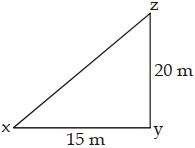
Two roads $XY$ and $YZ$ of $15 \ m$ and $20 \ m$ length respectively are perpendicular to each other. What is the distance between $X$ and $Z$ by the shortest route? (in $m$)
A
$35$
B
$30$
C
$24$
D
$25$
Solution
(D) The shortest route between $X$ and $Z$ is the hypotenuse of the right-angled triangle $\triangle XYZ$.
By Pythagoras theorem,$XZ^2 = XY^2 + YZ^2$.
Given $XY = 15 \ m$ and $YZ = 20 \ m$.
$XZ = \sqrt{15^2 + 20^2} \ m$.
$XZ = \sqrt{225 + 400} \ m$.
$XZ = \sqrt{625} \ m$.
$XZ = 25 \ m$.
By Pythagoras theorem,$XZ^2 = XY^2 + YZ^2$.
Given $XY = 15 \ m$ and $YZ = 20 \ m$.
$XZ = \sqrt{15^2 + 20^2} \ m$.
$XZ = \sqrt{225 + 400} \ m$.
$XZ = \sqrt{625} \ m$.
$XZ = 25 \ m$.
0 likes
View Solution31
DifficultMCQ
The base of a triangular field is three times its altitude. If the cost of cultivating the field at $50$ per hectare is $Rs. 675$,then what are its base and height?
A
$900 \, m$ and $300 \, m$
B
$600 \, m$ and $300 \, m$
C
$500 \, m$ and $200 \, m$
D
Cannot be determined
Solution
(A) Area of the field $= \frac{\text{Total cost}}{\text{Rate}} = \frac{675}{50} = 13.5 \text{ hectares}$.
Since $1 \text{ hectare} = 10,000 \, m^2$,the area is $13.5 \times 10,000 = 135,000 \, m^2$.
Let the altitude be $x \, m$. Then the base is $3x \, m$.
The area of a triangle is given by $\frac{1}{2} \times \text{base} \times \text{altitude}$.
So,$\frac{1}{2} \times 3x \times x = 135,000$.
$\frac{3x^2}{2} = 135,000$.
$3x^2 = 270,000$.
$x^2 = 90,000$.
$x = 300 \, m$ (Altitude).
Base $= 3x = 3 \times 300 = 900 \, m$.
Since $1 \text{ hectare} = 10,000 \, m^2$,the area is $13.5 \times 10,000 = 135,000 \, m^2$.
Let the altitude be $x \, m$. Then the base is $3x \, m$.
The area of a triangle is given by $\frac{1}{2} \times \text{base} \times \text{altitude}$.
So,$\frac{1}{2} \times 3x \times x = 135,000$.
$\frac{3x^2}{2} = 135,000$.
$3x^2 = 270,000$.
$x^2 = 90,000$.
$x = 300 \, m$ (Altitude).
Base $= 3x = 3 \times 300 = 900 \, m$.
0 likes
View Solution32
DifficultMCQ
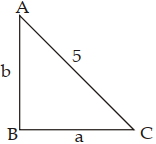
The perimeter of a right triangle is $12 \, cm$. The hypotenuse is $5 \, cm$. What are the other two sides and the area of the triangle?
A
$3 \, cm, 4 \, cm$ and $6 \, cm^2$
B
$4 \, cm, 3 \, cm$ and $12 \, cm^2$
C
$6 \, cm, 2 \, cm$ and $6 \, cm^2$
D
Cannot be determined
Solution
(A) Let the two sides of the right triangle be $a$ and $b$. The hypotenuse is $5 \, cm$.
Perimeter $= a + b + 5 = 12 \, cm \implies a + b = 7 \, cm$.
By Pythagoras theorem,$a^2 + b^2 = 5^2 = 25$.
We know that $(a + b)^2 = a^2 + b^2 + 2ab$.
Substituting the values: $(7)^2 = 25 + 2ab$.
$49 = 25 + 2ab \implies 2ab = 24 \implies ab = 12$.
Now,$(a - b)^2 = (a + b)^2 - 4ab = (7)^2 - 4(12) = 49 - 48 = 1$.
So,$a - b = 1$ (assuming $a > b$).
Solving $a + b = 7$ and $a - b = 1$,we get $2a = 8 \implies a = 4 \, cm$ and $b = 3 \, cm$.
Area of the triangle $= \frac{1}{2} \times \text{base} \times \text{height} = \frac{1}{2} \times a \times b = \frac{1}{2} \times 4 \times 3 = 6 \, cm^2$.
Perimeter $= a + b + 5 = 12 \, cm \implies a + b = 7 \, cm$.
By Pythagoras theorem,$a^2 + b^2 = 5^2 = 25$.
We know that $(a + b)^2 = a^2 + b^2 + 2ab$.
Substituting the values: $(7)^2 = 25 + 2ab$.
$49 = 25 + 2ab \implies 2ab = 24 \implies ab = 12$.
Now,$(a - b)^2 = (a + b)^2 - 4ab = (7)^2 - 4(12) = 49 - 48 = 1$.
So,$a - b = 1$ (assuming $a > b$).
Solving $a + b = 7$ and $a - b = 1$,we get $2a = 8 \implies a = 4 \, cm$ and $b = 3 \, cm$.
Area of the triangle $= \frac{1}{2} \times \text{base} \times \text{height} = \frac{1}{2} \times a \times b = \frac{1}{2} \times 4 \times 3 = 6 \, cm^2$.
0 likes
View Solution33
MediumMCQ
The area of a ring whose outer and inner radii are respectively $20 \, cm$ and $15 \, cm$ is? (in $cm^2$)
A
$440$
B
$550$
C
$565$
D
$675$
Solution
(B) Radius of outer circle $(R) = 20 \, cm$
Radius of inner circle $(r) = 15 \, cm$
$\therefore$ Area of ring $= (\text{Area of outer circle} - \text{Area of inner circle})$
$= \pi R^2 - \pi r^2 = \pi(R^2 - r^2) = \frac{22}{7}(20^2 - 15^2)$
$= \frac{22}{7}(20 + 15)(20 - 15) = \frac{22}{7}(35)(5) = 22 \times 5 \times 5 = 550 \, cm^2$
Radius of inner circle $(r) = 15 \, cm$
$\therefore$ Area of ring $= (\text{Area of outer circle} - \text{Area of inner circle})$
$= \pi R^2 - \pi r^2 = \pi(R^2 - r^2) = \frac{22}{7}(20^2 - 15^2)$
$= \frac{22}{7}(20 + 15)(20 - 15) = \frac{22}{7}(35)(5) = 22 \times 5 \times 5 = 550 \, cm^2$
0 likes
View Solution34
MediumMCQ
The minute-hand of a clock is $14 \, cm$ long. The area covered by the minute hand in $30 \, min$ is.............$cm^2$
A
$308$
B
$312$
C
$412$
D
$416$
Solution
(A) The minute hand of a clock completes a full circle $(360^{\circ})$ in $60 \, min$.
Therefore,the angle covered by the minute hand in $30 \, min$ is $\theta = \frac{360^{\circ}}{60} \times 30 = 180^{\circ}$.
The length of the minute hand is the radius of the circle,so $r = 14 \, cm$.
The area covered by the minute hand is the area of the sector formed by the angle $\theta$:
$\text{Area} = \frac{\theta}{360^{\circ}} \times \pi r^2$
$\text{Area} = \frac{180^{\circ}}{360^{\circ}} \times \frac{22}{7} \times 14 \times 14$
$\text{Area} = \frac{1}{2} \times 22 \times 2 \times 14$
$\text{Area} = 11 \times 28 = 308 \, cm^2$.
Therefore,the angle covered by the minute hand in $30 \, min$ is $\theta = \frac{360^{\circ}}{60} \times 30 = 180^{\circ}$.
The length of the minute hand is the radius of the circle,so $r = 14 \, cm$.
The area covered by the minute hand is the area of the sector formed by the angle $\theta$:
$\text{Area} = \frac{\theta}{360^{\circ}} \times \pi r^2$
$\text{Area} = \frac{180^{\circ}}{360^{\circ}} \times \frac{22}{7} \times 14 \times 14$
$\text{Area} = \frac{1}{2} \times 22 \times 2 \times 14$
$\text{Area} = 11 \times 28 = 308 \, cm^2$.
0 likes
View Solution35
DifficultMCQ
Two circles touch internally. The sum of their areas is $116\, \pi \, cm^2$ and the distance between their centers is $6 \, cm$. Then,the radii of the circles are?
A
$4 \, cm$ and $9 \, cm$
B
$5 \, cm$ and $10 \, cm$
C
$4 \, cm$ and $8 \, cm$
D
$4 \, cm$ and $10 \, cm$
Solution
(D) Let the radius of the inner circle be $r$ and the radius of the outer circle be $R$.
Given that the sum of their areas is $116 \, \pi \, cm^2$,we have $\pi R^2 + \pi r^2 = 116 \, \pi$,which simplifies to $R^2 + r^2 = 116$.
Since the circles touch internally,the distance between their centers is $R - r = 6 \, cm$.
We know the identity $(R + r)^2 + (R - r)^2 = 2(R^2 + r^2)$.
Substituting the known values: $(R + r)^2 + (6)^2 = 2(116)$.
$(R + r)^2 + 36 = 232$.
$(R + r)^2 = 232 - 36 = 196$.
Taking the square root,$R + r = 14$.
Now we have a system of linear equations: $R + r = 14$ and $R - r = 6$.
Adding the two equations: $2R = 20 \Rightarrow R = 10 \, cm$.
Subtracting the equations: $2r = 8 \Rightarrow r = 4 \, cm$.
Thus,the radii are $10 \, cm$ and $4 \, cm$.
Given that the sum of their areas is $116 \, \pi \, cm^2$,we have $\pi R^2 + \pi r^2 = 116 \, \pi$,which simplifies to $R^2 + r^2 = 116$.
Since the circles touch internally,the distance between their centers is $R - r = 6 \, cm$.
We know the identity $(R + r)^2 + (R - r)^2 = 2(R^2 + r^2)$.
Substituting the known values: $(R + r)^2 + (6)^2 = 2(116)$.
$(R + r)^2 + 36 = 232$.
$(R + r)^2 = 232 - 36 = 196$.
Taking the square root,$R + r = 14$.
Now we have a system of linear equations: $R + r = 14$ and $R - r = 6$.
Adding the two equations: $2R = 20 \Rightarrow R = 10 \, cm$.
Subtracting the equations: $2r = 8 \Rightarrow r = 4 \, cm$.
Thus,the radii are $10 \, cm$ and $4 \, cm$.
0 likes
View Solution36
MediumMCQ
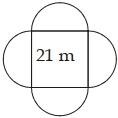
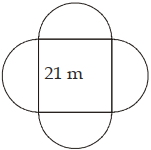
$A$ bed of roses is shaped as shown in the figure below. In the centre is a square and on each side there is a semi-circle. The side of the square is $21 \, m$. If each rose plant needs $6 \, m^{2}$ of space,then the number of plants in the bed is?
A
$190$
B
$199$
C
$201$
D
$189$
Solution
(D) The side of the square is $a = 21 \, m$.
Area of the square $= a^{2} = 21 \times 21 = 441 \, m^{2}$.
There are four semi-circles on the four sides of the square. The diameter of each semi-circle is equal to the side of the square,which is $21 \, m$.
Therefore,the radius of each semi-circle is $r = \frac{21}{2} = 10.5 \, m$.
Area of four semi-circles $= 4 \times (\frac{1}{2} \times \pi \times r^{2}) = 2 \times \pi \times r^{2}$.
Area $= 2 \times \frac{22}{7} \times 10.5 \times 10.5 = 2 \times \frac{22}{7} \times \frac{21}{2} \times \frac{21}{2} = 22 \times 3 \times 10.5 = 693 \, m^{2}$.
Total area of the bed $= 441 + 693 = 1134 \, m^{2}$.
Given that each rose plant needs $6 \, m^{2}$ of space.
Number of plants $= \frac{\text{Total Area}}{\text{Area per plant}} = \frac{1134}{6} = 189$.
Area of the square $= a^{2} = 21 \times 21 = 441 \, m^{2}$.
There are four semi-circles on the four sides of the square. The diameter of each semi-circle is equal to the side of the square,which is $21 \, m$.
Therefore,the radius of each semi-circle is $r = \frac{21}{2} = 10.5 \, m$.
Area of four semi-circles $= 4 \times (\frac{1}{2} \times \pi \times r^{2}) = 2 \times \pi \times r^{2}$.
Area $= 2 \times \frac{22}{7} \times 10.5 \times 10.5 = 2 \times \frac{22}{7} \times \frac{21}{2} \times \frac{21}{2} = 22 \times 3 \times 10.5 = 693 \, m^{2}$.
Total area of the bed $= 441 + 693 = 1134 \, m^{2}$.
Given that each rose plant needs $6 \, m^{2}$ of space.
Number of plants $= \frac{\text{Total Area}}{\text{Area per plant}} = \frac{1134}{6} = 189$.
0 likes
View Solution37
DifficultMCQ
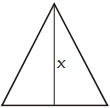
If '$x$' is the median (altitude) of an equilateral triangle,then its area is?
A
$\frac{x^{2}}{2}$
B
$x^{2}$
C
$\frac{\sqrt{3} x^{2}}{2}$
D
$\frac{x^{2}}{\sqrt{3}}$
Solution
(D) In an equilateral triangle,the median is the same as the altitude.
Let the side of the equilateral triangle be '$a$'.
The altitude (median) '$x$' is given by the formula: $x = \frac{\sqrt{3}}{2} a$.
From this,we can express the side '$a$' in terms of '$x$': $a = \frac{2x}{\sqrt{3}}$.
The area of an equilateral triangle is given by: $\text{Area} = \frac{\sqrt{3}}{4} a^2$.
Substituting the value of '$a$': $\text{Area} = \frac{\sqrt{3}}{4} \left( \frac{2x}{\sqrt{3}} \right)^2$.
$\text{Area} = \frac{\sqrt{3}}{4} \times \frac{4x^2}{3}$.
$\text{Area} = \frac{\sqrt{3} x^2}{3} = \frac{x^2}{\sqrt{3}}$.
Let the side of the equilateral triangle be '$a$'.
The altitude (median) '$x$' is given by the formula: $x = \frac{\sqrt{3}}{2} a$.
From this,we can express the side '$a$' in terms of '$x$': $a = \frac{2x}{\sqrt{3}}$.
The area of an equilateral triangle is given by: $\text{Area} = \frac{\sqrt{3}}{4} a^2$.
Substituting the value of '$a$': $\text{Area} = \frac{\sqrt{3}}{4} \left( \frac{2x}{\sqrt{3}} \right)^2$.
$\text{Area} = \frac{\sqrt{3}}{4} \times \frac{4x^2}{3}$.
$\text{Area} = \frac{\sqrt{3} x^2}{3} = \frac{x^2}{\sqrt{3}}$.
0 likes
View Solution38
MediumMCQ
$A$ wire is in the form of a circle of radius $42 \ cm$. It is bent into a square. The side of the square is? (in $cm$)
A
$33$
B
$66$
C
$78$
D
$112$
Solution
(B) The circumference of the circle is given by the formula $C = 2 \pi r$.
Given $r = 42 \ cm$,the circumference is $C = 2 \times \frac{22}{7} \times 42 = 2 \times 22 \times 6 = 264 \ cm$.
Since the wire is bent into a square,the perimeter of the square is equal to the circumference of the circle.
Perimeter of the square $= 4 \times \text{side} = 264 \ cm$.
Therefore,the side of the square is $\frac{264}{4} = 66 \ cm$.
Given $r = 42 \ cm$,the circumference is $C = 2 \times \frac{22}{7} \times 42 = 2 \times 22 \times 6 = 264 \ cm$.
Since the wire is bent into a square,the perimeter of the square is equal to the circumference of the circle.
Perimeter of the square $= 4 \times \text{side} = 264 \ cm$.
Therefore,the side of the square is $\frac{264}{4} = 66 \ cm$.
0 likes
View Solution39
MediumMCQ
How many times will a wheel of diameter $105\, cm$ rotate in covering a distance of $330\, m$? (in $revolutions$)
A
$100$
B
$110$
C
$90$
D
$105$
Solution
(A) The circumference of the wheel is given by the formula $C = \pi \times d$,where $d$ is the diameter.
Given $d = 105\, cm$,the circumference $C = \frac{22}{7} \times 105 = 22 \times 15 = 330\, cm$.
This means the wheel covers $330\, cm$ in one complete revolution.
The total distance to be covered is $330\, m$. Converting this to centimeters,we get $330\, m = 330 \times 100 = 33000\, cm$.
The number of revolutions is calculated by dividing the total distance by the circumference of the wheel:
$\text{Number of revolutions} = \frac{\text{Total distance}}{\text{Circumference}} = \frac{33000\, cm}{330\, cm} = 100$.
Therefore,the wheel will rotate $100$ times.
Given $d = 105\, cm$,the circumference $C = \frac{22}{7} \times 105 = 22 \times 15 = 330\, cm$.
This means the wheel covers $330\, cm$ in one complete revolution.
The total distance to be covered is $330\, m$. Converting this to centimeters,we get $330\, m = 330 \times 100 = 33000\, cm$.
The number of revolutions is calculated by dividing the total distance by the circumference of the wheel:
$\text{Number of revolutions} = \frac{\text{Total distance}}{\text{Circumference}} = \frac{33000\, cm}{330\, cm} = 100$.
Therefore,the wheel will rotate $100$ times.
0 likes
View Solution40
MediumMCQ
The length of a rectangle is increased by $60 \%$. By what percent would the width have to be decreased to maintain the same area? (in $\%$)
A
$37 \frac{1}{2}$
B
$60$
C
$75$
D
$120$
Solution
(A) Let the original length be $L$ and the original width be $W$. The original area is $A = L \times W$.
The new length $L' = L + 0.60L = 1.6L = \frac{8}{5}L$.
Let the new width be $W'$. To maintain the same area,$L' \times W' = L \times W$.
Substituting $L'$,we get $\frac{8}{5}L \times W' = L \times W$,which simplifies to $W' = \frac{5}{8}W$.
The decrease in width is $W - W' = W - \frac{5}{8}W = \frac{3}{8}W$.
The percentage decrease is $\frac{\text{Decrease}}{\text{Original Width}} \times 100 = \frac{\frac{3}{8}W}{W} \times 100 = \frac{3}{8} \times 100 = 37.5 \% = 37 \frac{1}{2} \%$.
The new length $L' = L + 0.60L = 1.6L = \frac{8}{5}L$.
Let the new width be $W'$. To maintain the same area,$L' \times W' = L \times W$.
Substituting $L'$,we get $\frac{8}{5}L \times W' = L \times W$,which simplifies to $W' = \frac{5}{8}W$.
The decrease in width is $W - W' = W - \frac{5}{8}W = \frac{3}{8}W$.
The percentage decrease is $\frac{\text{Decrease}}{\text{Original Width}} \times 100 = \frac{\frac{3}{8}W}{W} \times 100 = \frac{3}{8} \times 100 = 37.5 \% = 37 \frac{1}{2} \%$.
0 likes
View Solution41
DifficultMCQ
If the length and breadth of a rectangular plot are increased by $50 \%$ and $20 \%$ respectively,then the new area is how many times the original area?
A
$5/9$
B
$10$
C
$9/5$
D
$7/9$
Solution
(C) Let the original length be $x$ and the original breadth be $y$.
Original Area $= x \times y = xy$.
New length $= x + 50\% \text{ of } x = x + 0.5x = 1.5x = \frac{3x}{2}$.
New breadth $= y + 20\% \text{ of } y = y + 0.2y = 1.2y = \frac{6y}{5}$.
New Area $= \text{New length} \times \text{New breadth} = \frac{3x}{2} \times \frac{6y}{5} = \frac{18xy}{10} = \frac{9}{5}xy$.
Therefore,the new area is $\frac{9}{5}$ times the original area.
Original Area $= x \times y = xy$.
New length $= x + 50\% \text{ of } x = x + 0.5x = 1.5x = \frac{3x}{2}$.
New breadth $= y + 20\% \text{ of } y = y + 0.2y = 1.2y = \frac{6y}{5}$.
New Area $= \text{New length} \times \text{New breadth} = \frac{3x}{2} \times \frac{6y}{5} = \frac{18xy}{10} = \frac{9}{5}xy$.
Therefore,the new area is $\frac{9}{5}$ times the original area.
0 likes
View Solution42
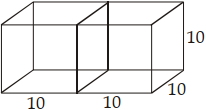
MediumMCQ
Two cubes,each of $10 \, cm$ edge,are joined end-to-end. Then,the surface area of the resulting cuboid is ...... $cm^2$.
A
$100$
B
$1000$
C
$2000$
D
$1500$
Solution
(B) When two cubes of edge $10 \, cm$ are joined end-to-end,they form a cuboid.
Length of the resulting cuboid $(l) = 10 \, cm + 10 \, cm = 20 \, cm$.
Breadth of the resulting cuboid $(b) = 10 \, cm$.
Height of the resulting cuboid $(h) = 10 \, cm$.
The surface area of a cuboid is given by the formula: $2(lb + bh + hl)$.
Substituting the values: $2(20 \times 10 + 10 \times 10 + 10 \times 20) \, cm^2$.
$= 2(200 + 100 + 200) \, cm^2$.
$= 2(500) \, cm^2 = 1000 \, cm^2$.
Length of the resulting cuboid $(l) = 10 \, cm + 10 \, cm = 20 \, cm$.
Breadth of the resulting cuboid $(b) = 10 \, cm$.
Height of the resulting cuboid $(h) = 10 \, cm$.
The surface area of a cuboid is given by the formula: $2(lb + bh + hl)$.
Substituting the values: $2(20 \times 10 + 10 \times 10 + 10 \times 20) \, cm^2$.
$= 2(200 + 100 + 200) \, cm^2$.
$= 2(500) \, cm^2 = 1000 \, cm^2$.
0 likes
View Solution43
MediumMCQ
The areas of three adjacent faces of a cuboid are $x, y$ and $z.$ If its volume is $V$,then which is true?
A
$V=x^{3} y^{2} z^{2}$
B
$V^{2}=xyz$
C
$V=\sqrt[3]{xyz}$
D
$V=\frac{x^{2}y}{z}$
Solution
(B) Let the dimensions of the cuboid be $l, b,$ and $h.$
The volume of the cuboid is given by $V = l \times b \times h.$
The areas of the three adjacent faces are given as:
$x = l \times b$
$y = b \times h$
$z = h \times l$
Multiplying these three areas together,we get:
$x \times y \times z = (l \times b) \times (b \times h) \times (h \times l)$
$xyz = l^{2} \times b^{2} \times h^{2}$
$xyz = (l \times b \times h)^{2}$
Since $V = l \times b \times h$,substituting $V$ into the equation gives:
$xyz = V^{2}$
Therefore,$V^{2} = xyz$.
The volume of the cuboid is given by $V = l \times b \times h.$
The areas of the three adjacent faces are given as:
$x = l \times b$
$y = b \times h$
$z = h \times l$
Multiplying these three areas together,we get:
$x \times y \times z = (l \times b) \times (b \times h) \times (h \times l)$
$xyz = l^{2} \times b^{2} \times h^{2}$
$xyz = (l \times b \times h)^{2}$
Since $V = l \times b \times h$,substituting $V$ into the equation gives:
$xyz = V^{2}$
Therefore,$V^{2} = xyz$.
0 likes
View Solution44
DifficultMCQ
The volume of a cylinder is $448 \pi \, cm^3$ and its height is $7 \, cm$. What are its lateral surface area and total surface area?
A
$349 \, cm^2$ and $753.286 \, cm^2$
B
$352 \, cm^2$ and $754.286 \, cm^2$
C
$353 \, cm^2$ and $755.286 \, cm^2$
D
$351 \, cm^2$ and $754.682 \, cm^2$
Solution
(B) Given: Volume of cylinder $V = 448 \pi \, cm^3$ and height $h = 7 \, cm$.
Let the radius be $r$.
The formula for volume is $V = \pi r^2 h$.
Substituting the values: $448 \pi = \pi r^2 (7)$.
$r^2 = \frac{448}{7} = 64$,so $r = 8 \, cm$.
Lateral Surface Area $(LSA)$ $= 2 \pi r h = 2 \times \frac{22}{7} \times 8 \times 7 = 352 \, cm^2$.
Total Surface Area $(TSA)$ $= 2 \pi r h + 2 \pi r^2 = 2 \pi r (h + r)$.
$TSA$ $= 2 \times \frac{22}{7} \times 8 \times (7 + 8) = 2 \times \frac{22}{7} \times 8 \times 15 = \frac{5280}{7} \approx 754.286 \, cm^2$.
Let the radius be $r$.
The formula for volume is $V = \pi r^2 h$.
Substituting the values: $448 \pi = \pi r^2 (7)$.
$r^2 = \frac{448}{7} = 64$,so $r = 8 \, cm$.
Lateral Surface Area $(LSA)$ $= 2 \pi r h = 2 \times \frac{22}{7} \times 8 \times 7 = 352 \, cm^2$.
Total Surface Area $(TSA)$ $= 2 \pi r h + 2 \pi r^2 = 2 \pi r (h + r)$.
$TSA$ $= 2 \times \frac{22}{7} \times 8 \times (7 + 8) = 2 \times \frac{22}{7} \times 8 \times 15 = \frac{5280}{7} \approx 754.286 \, cm^2$.
0 likes
View Solution45
MediumMCQ
The radius and vertical height of a cone are $5 \text{ cm}$ and $12 \text{ cm}$ respectively. Then its lateral surface area is? (in $\text{cm}^2$)
A
$202$
B
$203.1$
C
$204$
D
$204.3$
Solution
(D) Given: Radius $(r) = 5 \text{ cm}$,Height $(h) = 12 \text{ cm}$.
First,calculate the slant height $(l)$ using the formula $l = \sqrt{h^2 + r^2}$.
$l = \sqrt{12^2 + 5^2} = \sqrt{144 + 25} = \sqrt{169} = 13 \text{ cm}$.
The lateral (curved) surface area of a cone is given by the formula $A = \pi r l$.
Using $\pi \approx \frac{22}{7}$:
$A = \frac{22}{7} \times 5 \times 13 = \frac{1430}{7} \approx 204.285 \text{ cm}^2$.
Rounding to one decimal place,we get $204.3 \text{ cm}^2$.
First,calculate the slant height $(l)$ using the formula $l = \sqrt{h^2 + r^2}$.
$l = \sqrt{12^2 + 5^2} = \sqrt{144 + 25} = \sqrt{169} = 13 \text{ cm}$.
The lateral (curved) surface area of a cone is given by the formula $A = \pi r l$.
Using $\pi \approx \frac{22}{7}$:
$A = \frac{22}{7} \times 5 \times 13 = \frac{1430}{7} \approx 204.285 \text{ cm}^2$.
Rounding to one decimal place,we get $204.3 \text{ cm}^2$.
0 likes
View Solution46
MediumMCQ
Given that the volume of a metal sphere is $38808 \, cm^{3}$. Then,its radius and its surface area are?
A
$21 \, cm$ and $5544 \, cm^{2}$
B
$7 \, cm$ and $616 \, cm^{2}$
C
$14 \, cm$ and $2464 \, cm^{2}$
D
$28 \, cm$ and $5555 \, cm^{2}$
Solution
(A) The volume of a sphere is given by the formula $V = \frac{4}{3} \pi r^{3}$.
Given $V = 38808 \, cm^{3}$.
$\frac{4}{3} \times \frac{22}{7} \times r^{3} = 38808$.
$r^{3} = 38808 \times \frac{3 \times 7}{4 \times 22} = 9261$.
Taking the cube root,$r = \sqrt[3]{9261} = 21 \, cm$.
The surface area of a sphere is given by $A = 4 \pi r^{2}$.
$A = 4 \times \frac{22}{7} \times 21 \times 21 = 4 \times 22 \times 3 \times 21 = 5544 \, cm^{2}$.
Thus,the radius is $21 \, cm$ and the surface area is $5544 \, cm^{2}$.
Given $V = 38808 \, cm^{3}$.
$\frac{4}{3} \times \frac{22}{7} \times r^{3} = 38808$.
$r^{3} = 38808 \times \frac{3 \times 7}{4 \times 22} = 9261$.
Taking the cube root,$r = \sqrt[3]{9261} = 21 \, cm$.
The surface area of a sphere is given by $A = 4 \pi r^{2}$.
$A = 4 \times \frac{22}{7} \times 21 \times 21 = 4 \times 22 \times 3 \times 21 = 5544 \, cm^{2}$.
Thus,the radius is $21 \, cm$ and the surface area is $5544 \, cm^{2}$.
0 likes
View Solution47
MediumMCQ
The volume of two hemispheres is in the ratio $8:27$. What is the ratio of their radii?
A
$2:3$
B
$3:2$
C
$1:2$
D
$2:1$
Solution
(A) Let the volumes of the two hemispheres be $V_1$ and $V_2$,and their radii be $r_1$ and $r_2$ respectively.
The formula for the volume of a hemisphere is $V = \frac{2}{3} \pi r^3$.
Given the ratio of volumes: $V_1 : V_2 = 8 : 27$.
Substituting the formula: $\frac{\frac{2}{3} \pi r_1^3}{\frac{2}{3} \pi r_2^3} = \frac{8}{27}$.
Simplifying the expression: $\frac{r_1^3}{r_2^3} = \frac{8}{27}$.
Taking the cube root on both sides: $\frac{r_1}{r_2} = \sqrt[3]{\frac{8}{27}} = \frac{2}{3}$.
Therefore,the ratio of their radii is $2:3$.
The formula for the volume of a hemisphere is $V = \frac{2}{3} \pi r^3$.
Given the ratio of volumes: $V_1 : V_2 = 8 : 27$.
Substituting the formula: $\frac{\frac{2}{3} \pi r_1^3}{\frac{2}{3} \pi r_2^3} = \frac{8}{27}$.
Simplifying the expression: $\frac{r_1^3}{r_2^3} = \frac{8}{27}$.
Taking the cube root on both sides: $\frac{r_1}{r_2} = \sqrt[3]{\frac{8}{27}} = \frac{2}{3}$.
Therefore,the ratio of their radii is $2:3$.
0 likes
View Solution48
MediumMCQ
$A$ copper sphere of diameter $18\, cm$ is drawn into a wire of diameter $40\, mm$. Then,the length of the wire is......$cm$?
A
$243$
B
$343$
C
$443$
D
$972$
Solution
(A) The volume of the material remains constant when a sphere is reshaped into a wire.
Radius of the sphere $R = \frac{18}{2} = 9\, cm$.
Diameter of the wire $= 40\, mm = 4\, cm$,so the radius of the wire $r = \frac{4}{2} = 2\, cm$.
Let the length of the wire be $h\, cm$.
Volume of the sphere $= \frac{4}{3} \pi R^3 = \frac{4}{3} \pi (9)^3 = \frac{4}{3} \pi (729) = 972\pi\, cm^3$.
Volume of the cylindrical wire $= \pi r^2 h = \pi (2)^2 h = 4\pi h\, cm^3$.
Equating the volumes: $972\pi = 4\pi h$.
$h = \frac{972}{4} = 243\, cm$.
Thus,the length of the wire is $243\, cm$.
Radius of the sphere $R = \frac{18}{2} = 9\, cm$.
Diameter of the wire $= 40\, mm = 4\, cm$,so the radius of the wire $r = \frac{4}{2} = 2\, cm$.
Let the length of the wire be $h\, cm$.
Volume of the sphere $= \frac{4}{3} \pi R^3 = \frac{4}{3} \pi (9)^3 = \frac{4}{3} \pi (729) = 972\pi\, cm^3$.
Volume of the cylindrical wire $= \pi r^2 h = \pi (2)^2 h = 4\pi h\, cm^3$.
Equating the volumes: $972\pi = 4\pi h$.
$h = \frac{972}{4} = 243\, cm$.
Thus,the length of the wire is $243\, cm$.
0 likes
View Solution49
DifficultMCQ
Each edge of a cube is increased by $50 \%$. Then,the percentage increase in its surface area is (in $\%$)?
A
$125$
B
$150$
C
$175$
D
$180$
Solution
(A) Let the initial edge of the cube be $x \text{ cm}$.
The initial surface area of the cube is $S_1 = 6x^2$.
The new edge after a $50 \%$ increase is $x + 0.5x = 1.5x = \frac{3x}{2} \text{ cm}$.
The new surface area is $S_2 = 6 \left( \frac{3x}{2} \right)^2 = 6 \left( \frac{9x^2}{4} \right) = \frac{54x^2}{4} = 13.5x^2$.
The increase in surface area is $S_2 - S_1 = 13.5x^2 - 6x^2 = 7.5x^2$.
The percentage increase is $\left( \frac{\text{Increase}}{\text{Initial Area}} \right) \times 100 = \left( \frac{7.5x^2}{6x^2} \right) \times 100 = 1.25 \times 100 = 125 \%$.
The initial surface area of the cube is $S_1 = 6x^2$.
The new edge after a $50 \%$ increase is $x + 0.5x = 1.5x = \frac{3x}{2} \text{ cm}$.
The new surface area is $S_2 = 6 \left( \frac{3x}{2} \right)^2 = 6 \left( \frac{9x^2}{4} \right) = \frac{54x^2}{4} = 13.5x^2$.
The increase in surface area is $S_2 - S_1 = 13.5x^2 - 6x^2 = 7.5x^2$.
The percentage increase is $\left( \frac{\text{Increase}}{\text{Initial Area}} \right) \times 100 = \left( \frac{7.5x^2}{6x^2} \right) \times 100 = 1.25 \times 100 = 125 \%$.
0 likes
View Solution50
MediumMCQ
How many bricks,each measuring $25\, cm \times 15\, cm \times 8\, cm$,will be required to build a wall $10\, m \times 4\, dm \times 5\, m$ if $\frac{1}{10}$ of its volume is occupied by mortar?
A
$5000$
B
$5500$
C
$6000$
D
$6500$
Solution
(C) First,convert all dimensions to meters $(m)$:
Wall dimensions: $10\, m$,$4\, dm = 0.4\, m$,$5\, m$.
Volume of the wall $= 10\, m \times 0.4\, m \times 5\, m = 20\, m^3$.
Volume occupied by mortar $= \frac{1}{10} \times 20\, m^3 = 2\, m^3$.
Volume to be occupied by bricks $= 20\, m^3 - 2\, m^3 = 18\, m^3$.
Volume of one brick $= 0.25\, m \times 0.15\, m \times 0.08\, m = 0.003\, m^3 = \frac{3}{1000}\, m^3$.
Number of bricks required $= \frac{\text{Volume of bricks}}{\text{Volume of one brick}} = \frac{18}{3/1000} = \frac{18 \times 1000}{3} = 6000$.
Wall dimensions: $10\, m$,$4\, dm = 0.4\, m$,$5\, m$.
Volume of the wall $= 10\, m \times 0.4\, m \times 5\, m = 20\, m^3$.
Volume occupied by mortar $= \frac{1}{10} \times 20\, m^3 = 2\, m^3$.
Volume to be occupied by bricks $= 20\, m^3 - 2\, m^3 = 18\, m^3$.
Volume of one brick $= 0.25\, m \times 0.15\, m \times 0.08\, m = 0.003\, m^3 = \frac{3}{1000}\, m^3$.
Number of bricks required $= \frac{\text{Volume of bricks}}{\text{Volume of one brick}} = \frac{18}{3/1000} = \frac{18 \times 1000}{3} = 6000$.
0 likes
View SolutionMensuration — Measurement of Area · Frequently Asked Questions
1Are these Mensuration questions useful for JEE and NEET?
Yes. All questions in this section are mapped to JEE Main and NEET exam patterns. Previous year questions from JEE Main, NEET, GUJCET and state-level exams are included with full solutions.
2Can I switch to Hindi or Gujarati for these questions?
Yes. Use the language tabs in the hero section or the sidebar to view the same questions and solutions in English, Hindi or Gujarati.
3How do I generate a question paper from this subtopic?
Use the Vedclass Exam Paper Generator — select the chapter and subtopic, set difficulty, and generate Sets A, B, C, D automatically. First 3 chapters of every subject are free.
Vedclass Products
For Students
Vedclass Test Series
Mock tests in real JEE/NEET style with performance analysis. 5-day free trial.
Start Free TrialFor Teachers
Exam Paper Generator
Generate Set A/B/C/D papers from this chapter in 2 minutes. 3 chapters free.
Try FreeFor Institutes
Online Exam Module
Live online exams with unlimited students, 360° analytics & white-label branding.
See DemoFor Teachers & Institutes
Generate a Mensuration Exam Paper in 2 Minutes
Select subtopic & difficulty — Sets A, B, C, D auto-generated with No Repeat logic.
First 3 chapters of every subject are free — no payment required.