
A English
Measurement of Area Questions in English
Competitive Exam Quantitative Aptitude · Mensuration · Measurement of Area
407+
Questions
English
Language
100%
With Solutions
Showing 50 of 407 questions in English
151
EasyMCQ
The area of the largest circle that can be drawn inside a rectangle with sides $18 \, cm$ and $14 \, cm$ is (in $cm^2$):
A
$49$
B
$154$
C
$378$
D
$1078$
Solution
(B) To draw the largest circle inside a rectangle,the diameter of the circle must be equal to the smaller side of the rectangle.
Here,the sides of the rectangle are $18 \, cm$ and $14 \, cm$.
Therefore,the diameter of the largest circle $d = 14 \, cm$.
The radius of the circle $r = \frac{d}{2} = \frac{14}{2} = 7 \, cm$.
The area of the circle is given by the formula $A = \pi r^2$.
Substituting the value of $r$,we get $A = \frac{22}{7} \times 7^2 = \frac{22}{7} \times 49 = 22 \times 7 = 154 \, cm^2$.
Here,the sides of the rectangle are $18 \, cm$ and $14 \, cm$.
Therefore,the diameter of the largest circle $d = 14 \, cm$.
The radius of the circle $r = \frac{d}{2} = \frac{14}{2} = 7 \, cm$.
The area of the circle is given by the formula $A = \pi r^2$.
Substituting the value of $r$,we get $A = \frac{22}{7} \times 7^2 = \frac{22}{7} \times 49 = 22 \times 7 = 154 \, cm^2$.
0 likes
View Solution152
MediumMCQ
The area of a sector of a circle of radius $5 \, cm$,formed by an arc of length $3.5 \, cm$,is (in $cm^2$)
A
$7.5$
B
$7.75$
C
$8.5$
D
$8.75$
Solution
(D) Given: Radius $R = 5 \, cm$ and arc length $S = 3.5 \, cm$.
The formula for the angle $\theta$ (in radians) subtended by an arc at the center is $\theta = \frac{S}{R}$.
Substituting the values: $\theta = \frac{3.5}{5} = 0.7 \, \text{rad}$.
The area of a sector is given by the formula $\text{Area} = \frac{1}{2} R^2 \theta$.
Substituting the values: $\text{Area} = \frac{1}{2} \times (5)^2 \times 0.7$.
$\text{Area} = \frac{1}{2} \times 25 \times 0.7 = 12.5 \times 0.7 = 8.75 \, cm^2$.
The formula for the angle $\theta$ (in radians) subtended by an arc at the center is $\theta = \frac{S}{R}$.
Substituting the values: $\theta = \frac{3.5}{5} = 0.7 \, \text{rad}$.
The area of a sector is given by the formula $\text{Area} = \frac{1}{2} R^2 \theta$.
Substituting the values: $\text{Area} = \frac{1}{2} \times (5)^2 \times 0.7$.
$\text{Area} = \frac{1}{2} \times 25 \times 0.7 = 12.5 \times 0.7 = 8.75 \, cm^2$.
0 likes
View Solution153
MediumMCQ
What will be the area of a semi-$circle$ whose perimeter is $36 \, cm$? (in $cm^2$)
A
$154$
B
$168$
C
$308$
D
$77$
Solution
(D) The perimeter of a semi-$circle$ is given by the formula $P = \pi r + 2r$,where $r$ is the radius.
Given $P = 36 \, cm$,we have $(\pi + 2)r = 36$.
Substituting $\pi = \frac{22}{7}$,we get $(\frac{22}{7} + 2)r = 36$.
$(\frac{22 + 14}{7})r = 36 \implies \frac{36}{7}r = 36$.
Thus,$r = 7 \, cm$.
The area of a semi-$circle$ is given by $A = \frac{1}{2} \pi r^2$.
$A = \frac{1}{2} \times \frac{22}{7} \times 7^2 = \frac{1}{2} \times 22 \times 7 = 11 \times 7 = 77 \, cm^2$.
Given $P = 36 \, cm$,we have $(\pi + 2)r = 36$.
Substituting $\pi = \frac{22}{7}$,we get $(\frac{22}{7} + 2)r = 36$.
$(\frac{22 + 14}{7})r = 36 \implies \frac{36}{7}r = 36$.
Thus,$r = 7 \, cm$.
The area of a semi-$circle$ is given by $A = \frac{1}{2} \pi r^2$.
$A = \frac{1}{2} \times \frac{22}{7} \times 7^2 = \frac{1}{2} \times 22 \times 7 = 11 \times 7 = 77 \, cm^2$.
0 likes
View Solution154
EasyMCQ
$A$ circular park has a path of uniform width around it. The difference between the outer and inner circumferences of the circular path is $132 \, m$. Its width is.....$m$.
A
$20$
B
$21$
C
$22$
D
$28$
Solution
(B) Let the radius of the inner circle be $r$ and the radius of the outer circle be $R$.
Let the uniform width of the path be $x$.
Then,$R = r + x$,which implies $R - r = x$.
The difference between the outer and inner circumferences is given by $2 \pi R - 2 \pi r = 132 \, m$.
Factoring out $2 \pi$,we get $2 \pi (R - r) = 132$.
Since $R - r = x$,the equation becomes $2 \pi x = 132$.
Substituting $\pi = \frac{22}{7}$,we have $2 \times \frac{22}{7} \times x = 132$.
Solving for $x$: $x = \frac{132 \times 7}{2 \times 22} = \frac{132 \times 7}{44} = 3 \times 7 = 21 \, m$.
Therefore,the width of the path is $21 \, m$.
Let the uniform width of the path be $x$.
Then,$R = r + x$,which implies $R - r = x$.
The difference between the outer and inner circumferences is given by $2 \pi R - 2 \pi r = 132 \, m$.
Factoring out $2 \pi$,we get $2 \pi (R - r) = 132$.
Since $R - r = x$,the equation becomes $2 \pi x = 132$.
Substituting $\pi = \frac{22}{7}$,we have $2 \times \frac{22}{7} \times x = 132$.
Solving for $x$: $x = \frac{132 \times 7}{2 \times 22} = \frac{132 \times 7}{44} = 3 \times 7 = 21 \, m$.
Therefore,the width of the path is $21 \, m$.
0 likes
View Solution155
MediumMCQ
Find the diameter of a wheel that makes $113$ revolutions to go $2 \, km$ $26 \, decametres$. (in $m$)
A
$4 \frac{4}{13}$
B
$6 \frac{4}{11}$
C
$12 \frac{4}{11}$
D
$12 \frac{8}{11}$
Solution
(B) Let the diameter of the wheel be $x \, m$.
The circumference of the wheel is given by $\pi x \, m$.
In $113$ revolutions,the total distance covered is $113 \times \pi x$.
Given that the total distance is $2 \, km$ $26 \, decametres$.
Convert the distance into metres: $2 \, km = 2000 \, m$ and $26 \, decametres = 260 \, m$.
Total distance $= 2000 + 260 = 2260 \, m$.
Equating the distance: $113 \times \frac{22}{7} \times x = 2260$.
Solving for $x$: $x = \frac{2260 \times 7}{113 \times 22}$.
Since $2260 / 113 = 20$,we have $x = \frac{20 \times 7}{22} = \frac{140}{22} = \frac{70}{11} = 6 \frac{4}{11} \, m$.
The circumference of the wheel is given by $\pi x \, m$.
In $113$ revolutions,the total distance covered is $113 \times \pi x$.
Given that the total distance is $2 \, km$ $26 \, decametres$.
Convert the distance into metres: $2 \, km = 2000 \, m$ and $26 \, decametres = 260 \, m$.
Total distance $= 2000 + 260 = 2260 \, m$.
Equating the distance: $113 \times \frac{22}{7} \times x = 2260$.
Solving for $x$: $x = \frac{2260 \times 7}{113 \times 22}$.
Since $2260 / 113 = 20$,we have $x = \frac{20 \times 7}{22} = \frac{140}{22} = \frac{70}{11} = 6 \frac{4}{11} \, m$.
0 likes
View Solution156
MediumMCQ
Find the length of a rope by which a cow must be tethered in order that it may be able to graze an area of $9856 \, m^{2}$. (in $m$)
A
$64$
B
$32$
C
$56$
D
$28$
Solution
(C) Let the length of the rope be $l$ metres. The area grazed by the cow forms a circle with radius $l$.
Given,Area $= \pi l^{2} = 9856 \, m^{2}$.
$\Rightarrow l^{2} = \frac{9856}{\pi} = \frac{9856 \times 7}{22}$.
$\Rightarrow l^{2} = 448 \times 7 = 3136$.
$\Rightarrow l = \sqrt{3136} = 56 \, m$.
Thus,the length of the rope is $56 \, m$.
Given,Area $= \pi l^{2} = 9856 \, m^{2}$.
$\Rightarrow l^{2} = \frac{9856}{\pi} = \frac{9856 \times 7}{22}$.
$\Rightarrow l^{2} = 448 \times 7 = 3136$.
$\Rightarrow l = \sqrt{3136} = 56 \, m$.
Thus,the length of the rope is $56 \, m$.
0 likes
View Solution157
EasyMCQ
The radius of a wheel is $0.25\, m$. The number of revolutions it will make to travel a distance of $11\, km$ will be
A
$2800$
B
$4000$
C
$5500$
D
$7000$
Solution
(D) Given,radius of the wheel,$r = 0.25\, m$.
Total distance to be covered,$D = 11\, km = 11000\, m$.
The distance covered in one revolution is equal to the circumference of the wheel,which is $2\pi r$.
Let $N$ be the number of revolutions.
Then,$N \times (2\pi r) = D$.
Substituting the values: $N \times 2 \times \frac{22}{7} \times 0.25 = 11000$.
$N = \frac{11000 \times 7}{2 \times 22 \times 0.25}$.
$N = \frac{77000}{11} = 7000$.
Thus,the wheel will make $7000$ revolutions.
Total distance to be covered,$D = 11\, km = 11000\, m$.
The distance covered in one revolution is equal to the circumference of the wheel,which is $2\pi r$.
Let $N$ be the number of revolutions.
Then,$N \times (2\pi r) = D$.
Substituting the values: $N \times 2 \times \frac{22}{7} \times 0.25 = 11000$.
$N = \frac{11000 \times 7}{2 \times 22 \times 0.25}$.
$N = \frac{77000}{11} = 7000$.
Thus,the wheel will make $7000$ revolutions.
0 likes
View Solution158
MediumMCQ
If the ratio of areas of two circles is $4:9,$ then the ratio of their circumferences will be
A
$2:3$
B
$3:2$
C
$4:9$
D
$9:4$
Solution
(A) The area of a circle is given by $A = \pi r^2$,so the area is proportional to the square of the radius $(A \propto r^2)$.
Given the ratio of areas $\frac{A_1}{A_2} = \frac{4}{9}$.
Therefore,the ratio of the radii is $\frac{r_1}{r_2} = \sqrt{\frac{4}{9}} = \frac{2}{3}$.
The circumference of a circle is given by $C = 2\pi r$,so the circumference is directly proportional to the radius $(C \propto r)$.
Thus,the ratio of their circumferences is $\frac{C_1}{C_2} = \frac{r_1}{r_2} = \frac{2}{3}$.
Hence,the ratio is $2:3$.
Given the ratio of areas $\frac{A_1}{A_2} = \frac{4}{9}$.
Therefore,the ratio of the radii is $\frac{r_1}{r_2} = \sqrt{\frac{4}{9}} = \frac{2}{3}$.
The circumference of a circle is given by $C = 2\pi r$,so the circumference is directly proportional to the radius $(C \propto r)$.
Thus,the ratio of their circumferences is $\frac{C_1}{C_2} = \frac{r_1}{r_2} = \frac{2}{3}$.
Hence,the ratio is $2:3$.
0 likes
View Solution159
MediumMCQ
$A$ wire bent in the form of a circle of radius $42 \, cm$ is bent in the form of a rectangle whose sides are in the ratio of $6:5$. The smaller side of the rectangle is (in $cm$)
A
$25$
B
$30$
C
$36$
D
$60$
Solution
(D) The circumference of the circle is given by $C = 2 \pi r$.
Substituting $r = 42 \, cm$,we get $C = 2 \times \frac{22}{7} \times 42 = 264 \, cm$.
Since the wire is reshaped into a rectangle,the perimeter of the rectangle equals the circumference of the circle.
Let the sides of the rectangle be $6x$ and $5x$ (based on the ratio $6:5$).
The perimeter of the rectangle is $2(6x + 5x) = 2(11x) = 22x$.
Equating the perimeters: $22x = 264$.
Solving for $x$: $x = \frac{264}{22} = 12$.
The smaller side is $5x = 5 \times 12 = 60 \, cm$.
Substituting $r = 42 \, cm$,we get $C = 2 \times \frac{22}{7} \times 42 = 264 \, cm$.
Since the wire is reshaped into a rectangle,the perimeter of the rectangle equals the circumference of the circle.
Let the sides of the rectangle be $6x$ and $5x$ (based on the ratio $6:5$).
The perimeter of the rectangle is $2(6x + 5x) = 2(11x) = 22x$.
Equating the perimeters: $22x = 264$.
Solving for $x$: $x = \frac{264}{22} = 12$.
The smaller side is $5x = 5 \times 12 = 60 \, cm$.
0 likes
View Solution160
MediumMCQ
Among a square of perimeter $44\, cm$ and a circle of circumference $44\, cm,$ which figure has a larger area and by how much?
A
Both have equal area
B
Square,$33\, cm^2$
C
Circle,$33\, cm^2$
D
Square,$495\, cm^2$
Solution
(C) For the square:
Perimeter $= 4 \times \text{side} = 44\, cm$.
Side $= 44 / 4 = 11\, cm$.
Area of square $= (\text{side})^2 = 11^2 = 121\, cm^2$.
For the circle:
Circumference $= 2\pi r = 44\, cm$.
$2 \times (22/7) \times r = 44$.
$r = (44 \times 7) / (2 \times 22) = 7\, cm$.
Area of circle $= \pi r^2 = (22/7) \times 7^2 = 22 \times 7 = 154\, cm^2$.
Comparing the areas:
Area of circle - Area of square $= 154 - 121 = 33\, cm^2$.
Thus,the circle has a larger area by $33\, cm^2$.
Perimeter $= 4 \times \text{side} = 44\, cm$.
Side $= 44 / 4 = 11\, cm$.
Area of square $= (\text{side})^2 = 11^2 = 121\, cm^2$.
For the circle:
Circumference $= 2\pi r = 44\, cm$.
$2 \times (22/7) \times r = 44$.
$r = (44 \times 7) / (2 \times 22) = 7\, cm$.
Area of circle $= \pi r^2 = (22/7) \times 7^2 = 22 \times 7 = 154\, cm^2$.
Comparing the areas:
Area of circle - Area of square $= 154 - 121 = 33\, cm^2$.
Thus,the circle has a larger area by $33\, cm^2$.
0 likes
View Solution161
MediumMCQ
In measuring the sides of a rectangle,one side is taken $5 \%$ in excess,and the other $4 \%$ in deficit. Find the error percent in the area calculated from these measurements. (in $\%$)
A
$2$
B
$1$
C
$0.8$
D
$0.6$
Solution
(C) Let the original length be $l$ and the original breadth be $b$. The original area is $A = l \times b$.
The new length $l' = l + 0.05l = 1.05l$.
The new breadth $b' = b - 0.04b = 0.96b$.
The new area $A' = l' \times b' = (1.05l) \times (0.96b) = 1.008lb$.
The change in area is $A' - A = 1.008lb - 1lb = 0.008lb$.
The error percent in the area is $\frac{A' - A}{A} \times 100 = \frac{0.008lb}{lb} \times 100 = 0.8 \%$.
The new length $l' = l + 0.05l = 1.05l$.
The new breadth $b' = b - 0.04b = 0.96b$.
The new area $A' = l' \times b' = (1.05l) \times (0.96b) = 1.008lb$.
The change in area is $A' - A = 1.008lb - 1lb = 0.008lb$.
The error percent in the area is $\frac{A' - A}{A} \times 100 = \frac{0.008lb}{lb} \times 100 = 0.8 \%$.
0 likes
View Solution162
MediumMCQ
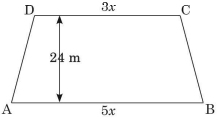
The area of a field in the shape of a trapezium is $1440 \, m^2$. The perpendicular distance between its parallel sides is $24 \, m$. If the ratio of the parallel sides is $5:3$, the length of the larger parallel side is ....... $m$.
A
$45$
B
$60$
C
$75$
D
$120$
Solution
(C) The area of a trapezium is given by the formula: $\text{Area} = \frac{1}{2} \times (\text{sum of parallel sides}) \times (\text{height})$.
Let the parallel sides be $5x$ and $3x$.
The height (perpendicular distance) is $24 \, m$.
Substituting the values into the formula:
$1440 = \frac{1}{2} \times (5x + 3x) \times 24$
$1440 = \frac{1}{2} \times (8x) \times 24$
$1440 = 4x \times 24$
$1440 = 96x$
$x = \frac{1440}{96} = 15$.
The larger parallel side is $5x = 5 \times 15 = 75 \, m$.
Let the parallel sides be $5x$ and $3x$.
The height (perpendicular distance) is $24 \, m$.
Substituting the values into the formula:
$1440 = \frac{1}{2} \times (5x + 3x) \times 24$
$1440 = \frac{1}{2} \times (8x) \times 24$
$1440 = 4x \times 24$
$1440 = 96x$
$x = \frac{1440}{96} = 15$.
The larger parallel side is $5x = 5 \times 15 = 75 \, m$.
0 likes
View Solution163
DifficultMCQ
One of the diagonals of a rhombus is double the other diagonal. Its area is $25\, cm^{2}$. The sum of the diagonals is.......$cm$
A
$10$
B
$12$
C
$15$
D
$16$
Solution
(C) Let the diagonals be $d_{1}$ and $d_{2}$.
Given that $d_{1} = 2d_{2}$.
The area of a rhombus is given by the formula $\text{Area} = \frac{1}{2} \times d_{1} \times d_{2}$.
Substituting the given values: $25 = \frac{1}{2} \times (2d_{2}) \times d_{2}$.
$25 = d_{2}^{2}$.
Taking the square root on both sides,$d_{2} = 5\, cm$.
Now,find $d_{1}$: $d_{1} = 2 \times 5 = 10\, cm$.
The sum of the diagonals is $d_{1} + d_{2} = 10 + 5 = 15\, cm$.
Given that $d_{1} = 2d_{2}$.
The area of a rhombus is given by the formula $\text{Area} = \frac{1}{2} \times d_{1} \times d_{2}$.
Substituting the given values: $25 = \frac{1}{2} \times (2d_{2}) \times d_{2}$.
$25 = d_{2}^{2}$.
Taking the square root on both sides,$d_{2} = 5\, cm$.
Now,find $d_{1}$: $d_{1} = 2 \times 5 = 10\, cm$.
The sum of the diagonals is $d_{1} + d_{2} = 10 + 5 = 15\, cm$.
0 likes
View Solution164
EasyMCQ
The area of a rhombus is $150 \, cm^2$. The length of one of its diagonals is $10 \, cm$. The length of the other diagonal is ....... $cm$.
A
$25$
B
$30$
C
$35$
D
$40$
Solution
(B) The formula for the area of a rhombus is given by $\text{Area} = \frac{1}{2} \times d_1 \times d_2$,where $d_1$ and $d_2$ are the lengths of the diagonals.
Given: $\text{Area} = 150 \, cm^2$ and $d_1 = 10 \, cm$.
Substituting the values into the formula:
$150 = \frac{1}{2} \times 10 \times d_2$
$150 = 5 \times d_2$
$d_2 = \frac{150}{5} = 30 \, cm$.
Therefore,the length of the other diagonal is $30 \, cm$.
Given: $\text{Area} = 150 \, cm^2$ and $d_1 = 10 \, cm$.
Substituting the values into the formula:
$150 = \frac{1}{2} \times 10 \times d_2$
$150 = 5 \times d_2$
$d_2 = \frac{150}{5} = 30 \, cm$.
Therefore,the length of the other diagonal is $30 \, cm$.
0 likes
View Solution165
MediumMCQ
$A$ triangle and a parallelogram are constructed on the same base such that their areas are equal. If the altitude of the parallelogram is $100 \, m$,then the altitude of the triangle is
A
$10 \sqrt{2} \, m$
B
$100 \, m$
C
$100 \sqrt{2} \, m$
D
$200 \, m$
Solution
(D) Let the base of both the triangle and the parallelogram be $b$.
Let the altitude of the triangle be $h_1$ and the altitude of the parallelogram be $h_2$.
The area of the triangle is given by $A_t = \frac{1}{2} \times b \times h_1$.
The area of the parallelogram is given by $A_p = b \times h_2$.
According to the problem,the areas are equal,so $A_t = A_p$.
Therefore,$\frac{1}{2} \times b \times h_1 = b \times h_2$.
Dividing both sides by $b$ (assuming $b \neq 0$),we get $\frac{1}{2} h_1 = h_2$,which implies $h_1 = 2 h_2$.
Given that the altitude of the parallelogram $h_2 = 100 \, m$.
Substituting this value,we get $h_1 = 2 \times 100 \, m = 200 \, m$.
Let the altitude of the triangle be $h_1$ and the altitude of the parallelogram be $h_2$.
The area of the triangle is given by $A_t = \frac{1}{2} \times b \times h_1$.
The area of the parallelogram is given by $A_p = b \times h_2$.
According to the problem,the areas are equal,so $A_t = A_p$.
Therefore,$\frac{1}{2} \times b \times h_1 = b \times h_2$.
Dividing both sides by $b$ (assuming $b \neq 0$),we get $\frac{1}{2} h_1 = h_2$,which implies $h_1 = 2 h_2$.
Given that the altitude of the parallelogram $h_2 = 100 \, m$.
Substituting this value,we get $h_1 = 2 \times 100 \, m = 200 \, m$.
0 likes
View Solution166
EasyMCQ
If every side of a triangle is doubled,the area of the new triangle is $K$ times the area of the old one. $K$ is equal to
A
$ \sqrt{2} $
B
$ 2 $
C
$ 3 $
D
$ 4 $
Solution
(D) Let the sides of the original triangle be $a$,$b$,and $c$. The semi-perimeter is $s = \frac{a+b+c}{2}$.
According to Heron's formula,the area of the original triangle is $\Delta = \sqrt{s(s-a)(s-b)(s-c)}$.
If every side is doubled,the new sides are $2a$,$2b$,and $2c$.
The new semi-perimeter $s'$ is $s' = \frac{2a+2b+2c}{2} = 2s$.
The new area $\Delta'$ is $\sqrt{s'(s'-2a)(s'-2b)(s'-2c)}$.
Substituting the values: $\Delta' = \sqrt{2s(2s-2a)(2s-2b)(2s-2c)}$.
$\Delta' = \sqrt{2s \cdot 2(s-a) \cdot 2(s-b) \cdot 2(s-c)}$.
$\Delta' = \sqrt{16 \cdot s(s-a)(s-b)(s-c)}$.
$\Delta' = 4 \sqrt{s(s-a)(s-b)(s-c)} = 4\Delta$.
Thus,the new area is $4$ times the old area,so $K = 4$.
According to Heron's formula,the area of the original triangle is $\Delta = \sqrt{s(s-a)(s-b)(s-c)}$.
If every side is doubled,the new sides are $2a$,$2b$,and $2c$.
The new semi-perimeter $s'$ is $s' = \frac{2a+2b+2c}{2} = 2s$.
The new area $\Delta'$ is $\sqrt{s'(s'-2a)(s'-2b)(s'-2c)}$.
Substituting the values: $\Delta' = \sqrt{2s(2s-2a)(2s-2b)(2s-2c)}$.
$\Delta' = \sqrt{2s \cdot 2(s-a) \cdot 2(s-b) \cdot 2(s-c)}$.
$\Delta' = \sqrt{16 \cdot s(s-a)(s-b)(s-c)}$.
$\Delta' = 4 \sqrt{s(s-a)(s-b)(s-c)} = 4\Delta$.
Thus,the new area is $4$ times the old area,so $K = 4$.
0 likes
View Solution167
MediumMCQ
The perimeter of a triangle is $30 \text{ cm}$ and its area is $30 \text{ cm}^2$. If the largest side measures $13 \text{ cm}$,then what is the length of the smallest side of the triangle? (in $\text{cm}$)
A
$3$
B
$4$
C
$5$
D
$6$
Solution
(C) Given: Perimeter $P = 30 \text{ cm}$,so semi-perimeter $s = P/2 = 15 \text{ cm}$.
Let the sides be $a, b, c$ where $a = 13 \text{ cm}$.
Perimeter $a + b + c = 30 \implies 13 + b + c = 30 \implies b + c = 17$.
Using Heron's formula: $\text{Area} = \sqrt{s(s-a)(s-b)(s-c)} = 30$.
$\sqrt{15(15-13)(15-b)(15-c)} = 30$.
$\sqrt{15 \times 2 \times (15-b)(15-c)} = 30$.
$30(15-b)(15-c) = 30^2 = 900$.
$(15-b)(15-c) = 30$.
$225 - 15(b+c) + bc = 30$.
Substitute $b+c = 17$: $225 - 15(17) + bc = 30$.
$225 - 255 + bc = 30 \implies bc - 30 = 30 \implies bc = 60$.
We have $b+c = 17$ and $bc = 60$. The quadratic equation $x^2 - 17x + 60 = 0$ gives the sides.
$(x-5)(x-12) = 0$,so the sides are $5 \text{ cm}$ and $12 \text{ cm}$.
The sides of the triangle are $5 \text{ cm}, 12 \text{ cm}, 13 \text{ cm}$.
The smallest side is $5 \text{ cm}$.
Let the sides be $a, b, c$ where $a = 13 \text{ cm}$.
Perimeter $a + b + c = 30 \implies 13 + b + c = 30 \implies b + c = 17$.
Using Heron's formula: $\text{Area} = \sqrt{s(s-a)(s-b)(s-c)} = 30$.
$\sqrt{15(15-13)(15-b)(15-c)} = 30$.
$\sqrt{15 \times 2 \times (15-b)(15-c)} = 30$.
$30(15-b)(15-c) = 30^2 = 900$.
$(15-b)(15-c) = 30$.
$225 - 15(b+c) + bc = 30$.
Substitute $b+c = 17$: $225 - 15(17) + bc = 30$.
$225 - 255 + bc = 30 \implies bc - 30 = 30 \implies bc = 60$.
We have $b+c = 17$ and $bc = 60$. The quadratic equation $x^2 - 17x + 60 = 0$ gives the sides.
$(x-5)(x-12) = 0$,so the sides are $5 \text{ cm}$ and $12 \text{ cm}$.
The sides of the triangle are $5 \text{ cm}, 12 \text{ cm}, 13 \text{ cm}$.
The smallest side is $5 \text{ cm}$.
0 likes
View Solution168
MediumMCQ
The sides of a triangle are in the ratio of $\frac{1}{2}: \frac{1}{3}: \frac{1}{4}$. If the perimeter is $52 \text{ cm}$,then the length of the smallest side is ........ $\text{cm}$.
A
$9$
B
$10$
C
$11$
D
$12$
Solution
(D) The ratio of the sides is given as $a: b: c = \frac{1}{2}: \frac{1}{3}: \frac{1}{4}$.
To simplify the ratio,multiply each term by the least common multiple $(LCM)$ of the denominators $(2, 3, 4)$,which is $12$.
$a: b: c = (\frac{1}{2} \times 12) : (\frac{1}{3} \times 12) : (\frac{1}{4} \times 12) = 6: 4: 3$.
Let the sides be $6x, 4x,$ and $3x$ centimeters.
The perimeter of the triangle is the sum of its sides,which is given as $52 \text{ cm}$.
$6x + 4x + 3x = 52$.
$13x = 52$.
$x = \frac{52}{13} = 4$.
The smallest side corresponds to the smallest ratio value,which is $3x$.
Smallest side $= 3 \times 4 = 12 \text{ cm}$.
To simplify the ratio,multiply each term by the least common multiple $(LCM)$ of the denominators $(2, 3, 4)$,which is $12$.
$a: b: c = (\frac{1}{2} \times 12) : (\frac{1}{3} \times 12) : (\frac{1}{4} \times 12) = 6: 4: 3$.
Let the sides be $6x, 4x,$ and $3x$ centimeters.
The perimeter of the triangle is the sum of its sides,which is given as $52 \text{ cm}$.
$6x + 4x + 3x = 52$.
$13x = 52$.
$x = \frac{52}{13} = 4$.
The smallest side corresponds to the smallest ratio value,which is $3x$.
Smallest side $= 3 \times 4 = 12 \text{ cm}$.
0 likes
View Solution169
DifficultMCQ
The areas of a square and a rectangle are equal. The length of the rectangle is greater than the side of the square by $5 \text{ cm}$ and the breadth is less than the side of the square by $3 \text{ cm}$. Find the perimeter of the rectangle (in $\text{cm}$).
A
$17$
B
$26$
C
$30$
D
$34$
Solution
(D) Let the side of the square be $a \text{ cm}$.
Therefore,the length of the rectangle $l = (a + 5) \text{ cm}$ and the breadth of the rectangle $b = (a - 3) \text{ cm}$.
Given that the area of the square is equal to the area of the rectangle:
$a^2 = (a + 5)(a - 3)$
Expanding the right side:
$a^2 = a^2 - 3a + 5a - 15$
$a^2 = a^2 + 2a - 15$
Subtracting $a^2$ from both sides:
$0 = 2a - 15$
$2a = 15$
$a = 7.5 \text{ cm}$
Now,calculate the dimensions of the rectangle:
Length $l = 7.5 + 5 = 12.5 \text{ cm}$
Breadth $b = 7.5 - 3 = 4.5 \text{ cm}$
The perimeter of the rectangle is $P = 2(l + b)$:
$P = 2(12.5 + 4.5) = 2(17) = 34 \text{ cm}$.
Therefore,the length of the rectangle $l = (a + 5) \text{ cm}$ and the breadth of the rectangle $b = (a - 3) \text{ cm}$.
Given that the area of the square is equal to the area of the rectangle:
$a^2 = (a + 5)(a - 3)$
Expanding the right side:
$a^2 = a^2 - 3a + 5a - 15$
$a^2 = a^2 + 2a - 15$
Subtracting $a^2$ from both sides:
$0 = 2a - 15$
$2a = 15$
$a = 7.5 \text{ cm}$
Now,calculate the dimensions of the rectangle:
Length $l = 7.5 + 5 = 12.5 \text{ cm}$
Breadth $b = 7.5 - 3 = 4.5 \text{ cm}$
The perimeter of the rectangle is $P = 2(l + b)$:
$P = 2(12.5 + 4.5) = 2(17) = 34 \text{ cm}$.
0 likes
View Solution170
MediumMCQ
The length of one pair of opposite sides of a square is increased by $5 \, cm$ on each side,the ratio of the length and the breadth of the newly formed rectangle becomes $3:2$. What is the area of the original square? (in $cm^2$)
A
$25$
B
$81$
C
$100$
D
$225$
Solution
(C) Let the side of the square be $x \, cm$.
When one pair of opposite sides is increased by $5 \, cm$,the new dimensions of the rectangle become $(x + 5) \, cm$ and $x \, cm$.
According to the problem,the ratio of the length to the breadth is $3:2$:
$\frac{x + 5}{x} = \frac{3}{2}$
Cross-multiplying gives:
$2(x + 5) = 3x$
$2x + 10 = 3x$
$x = 10 \, cm$
The area of the original square is $x^2 = 10^2 = 100 \, cm^2$.
When one pair of opposite sides is increased by $5 \, cm$,the new dimensions of the rectangle become $(x + 5) \, cm$ and $x \, cm$.
According to the problem,the ratio of the length to the breadth is $3:2$:
$\frac{x + 5}{x} = \frac{3}{2}$
Cross-multiplying gives:
$2(x + 5) = 3x$
$2x + 10 = 3x$
$x = 10 \, cm$
The area of the original square is $x^2 = 10^2 = 100 \, cm^2$.
0 likes
View Solution171
MediumMCQ
If the area of a square increases by $69 \%$,then the side of the square increases by (in $\%$)
A
$13$
B
$30$
C
$39$
D
$69$
Solution
(B) Let the original side of the square be $s$. The original area is $A_1 = s^2$.
Let the new side be $s'$. The new area is $A_2 = A_1 + 0.69 A_1 = 1.69 s^2$.
Since $A_2 = (s')^2$,we have $(s')^2 = 1.69 s^2$.
Taking the square root of both sides,$s' = \sqrt{1.69} s = 1.3 s$.
The increase in the side is $s' - s = 1.3 s - s = 0.3 s$.
Percentage increase in the side = $(0.3 s / s) \times 100 = 30 \%$.
Let the new side be $s'$. The new area is $A_2 = A_1 + 0.69 A_1 = 1.69 s^2$.
Since $A_2 = (s')^2$,we have $(s')^2 = 1.69 s^2$.
Taking the square root of both sides,$s' = \sqrt{1.69} s = 1.3 s$.
The increase in the side is $s' - s = 1.3 s - s = 0.3 s$.
Percentage increase in the side = $(0.3 s / s) \times 100 = 30 \%$.
0 likes
View Solution172
DifficultMCQ
$A$ park square in shape has a $3 \, m$ wide road inside it running along its sides. The area occupied by the road is $1764 \, m^{2}$. What is the perimeter along the outer edge of the road? (in $metres$)
A
$576$
B
$600$
C
$640$
D
Data inadequate
Solution
(B) Let the side length of the outer square be $x \, m$.
Since the road is $3 \, m$ wide and runs along the inside of the square,the side length of the inner square is $(x - 3 - 3) = (x - 6) \, m$.
The area of the road is the difference between the area of the outer square and the inner square:
$\text{Area of road} = x^{2} - (x - 6)^{2} = 1764 \, m^{2}$.
Using the identity $a^{2} - b^{2} = (a - b)(a + b)$:
$(x - (x - 6))(x + (x - 6)) = 1764$
$(6)(2x - 6) = 1764$
$2x - 6 = \frac{1764}{6} = 294$
$2x = 294 + 6 = 300$
$x = 150 \, m$.
The perimeter along the outer edge of the road is the perimeter of the outer square:
$\text{Perimeter} = 4 \times x = 4 \times 150 = 600 \, m$.
Since the road is $3 \, m$ wide and runs along the inside of the square,the side length of the inner square is $(x - 3 - 3) = (x - 6) \, m$.
The area of the road is the difference between the area of the outer square and the inner square:
$\text{Area of road} = x^{2} - (x - 6)^{2} = 1764 \, m^{2}$.
Using the identity $a^{2} - b^{2} = (a - b)(a + b)$:
$(x - (x - 6))(x + (x - 6)) = 1764$
$(6)(2x - 6) = 1764$
$2x - 6 = \frac{1764}{6} = 294$
$2x = 294 + 6 = 300$
$x = 150 \, m$.
The perimeter along the outer edge of the road is the perimeter of the outer square:
$\text{Perimeter} = 4 \times x = 4 \times 150 = 600 \, m$.
0 likes
View Solution173
MediumMCQ
The perimeter of a square is $48\, cm$. The area of a rectangle is $4\, cm^2$ less than the area of the square. If the length of the rectangle is $14\, cm$,then its perimeter is.......$cm$.
A
$24$
B
$48$
C
$50$
D
$54$
Solution
(B) Perimeter of square $= 48\, cm$.
Side of square $= \frac{48}{4} = 12\, cm$.
Area of square $= (12)^2 = 144\, cm^2$.
Area of rectangle $= 144 - 4 = 140\, cm^2$.
Given length of rectangle $= 14\, cm$.
Breadth of rectangle $= \frac{\text{Area}}{\text{Length}} = \frac{140}{14} = 10\, cm$.
Perimeter of rectangle $= 2(l + b) = 2(14 + 10) = 2(24) = 48\, cm$.
Side of square $= \frac{48}{4} = 12\, cm$.
Area of square $= (12)^2 = 144\, cm^2$.
Area of rectangle $= 144 - 4 = 140\, cm^2$.
Given length of rectangle $= 14\, cm$.
Breadth of rectangle $= \frac{\text{Area}}{\text{Length}} = \frac{140}{14} = 10\, cm$.
Perimeter of rectangle $= 2(l + b) = 2(14 + 10) = 2(24) = 48\, cm$.
0 likes
View Solution174
MediumMCQ
$A$ $2 \text{ m}$ broad pathway is to be constructed around a rectangular plot on the inside. The area of the plot is $96 \text{ m}^2$. The rate of construction is $₹ 50 / \text{ m}^2$. Find the total cost of construction (in $₹$).
A
$2400$
B
$4000$
C
$4800$
D
Data inadequate
Solution
(D) Let the length and breadth of the rectangular plot be $l$ and $b$ respectively.
Given,the area of the plot is $l \times b = 96 \text{ m}^2$.
$A$ pathway of width $2 \text{ m}$ is constructed inside the plot.
The dimensions of the inner rectangle (excluding the path) will be $(l - 4)$ and $(b - 4)$ because the path reduces the length and breadth from both sides.
The area of the path is calculated as: $\text{Area of path} = \text{Total Area} - \text{Inner Area} = lb - (l - 4)(b - 4)$.
Substituting $lb = 96$: $\text{Area of path} = 96 - (lb - 4l - 4b + 16) = 96 - (96 - 4(l + b) + 16) = 4(l + b) - 16$.
Since the values of $l$ and $b$ are not individually known,the sum $(l + b)$ cannot be determined from the given area $lb = 96$ alone.
Therefore,the area of the path cannot be calculated,and consequently,the total cost of construction cannot be determined.
Thus,the data provided is inadequate.
Given,the area of the plot is $l \times b = 96 \text{ m}^2$.
$A$ pathway of width $2 \text{ m}$ is constructed inside the plot.
The dimensions of the inner rectangle (excluding the path) will be $(l - 4)$ and $(b - 4)$ because the path reduces the length and breadth from both sides.
The area of the path is calculated as: $\text{Area of path} = \text{Total Area} - \text{Inner Area} = lb - (l - 4)(b - 4)$.
Substituting $lb = 96$: $\text{Area of path} = 96 - (lb - 4l - 4b + 16) = 96 - (96 - 4(l + b) + 16) = 4(l + b) - 16$.
Since the values of $l$ and $b$ are not individually known,the sum $(l + b)$ cannot be determined from the given area $lb = 96$ alone.
Therefore,the area of the path cannot be calculated,and consequently,the total cost of construction cannot be determined.
Thus,the data provided is inadequate.
0 likes
View Solution175
EasyMCQ
What will be the cost of gardening a $1 \text{ m}$ broad boundary around a rectangular plot having a perimeter of $340 \text{ m}$ at the rate of $₹ 10$ per square metre?
A
$1700$
B
$3400$
C
$3440$
D
Cannot be determined
Solution
(C) Let the length and breadth of the rectangular plot be $L$ and $B$ respectively.
Perimeter $= 2(L + B) = 340 \text{ m}$,so $L + B = 170 \text{ m}$.
The area of the $1 \text{ m}$ broad boundary (path) around the plot is given by the formula: $\text{Area} = 2(L + B) \times w + 4w^2$,where $w$ is the width of the path.
Here,$w = 1 \text{ m}$.
$\text{Area} = 340 \times 1 + 4(1)^2 = 340 + 4 = 344 \text{ m}^2$.
The cost of gardening is at the rate of $₹ 10$ per square metre.
$\text{Total Cost} = 344 \text{ m}^2 \times 10 \text{ ₹/m}^2 = ₹ 3440$.
Perimeter $= 2(L + B) = 340 \text{ m}$,so $L + B = 170 \text{ m}$.
The area of the $1 \text{ m}$ broad boundary (path) around the plot is given by the formula: $\text{Area} = 2(L + B) \times w + 4w^2$,where $w$ is the width of the path.
Here,$w = 1 \text{ m}$.
$\text{Area} = 340 \times 1 + 4(1)^2 = 340 + 4 = 344 \text{ m}^2$.
The cost of gardening is at the rate of $₹ 10$ per square metre.
$\text{Total Cost} = 344 \text{ m}^2 \times 10 \text{ ₹/m}^2 = ₹ 3440$.
0 likes
View Solution176
MediumMCQ
$A$ typist uses a sheet measuring $20\, cm \times 30\, cm$ lengthwise. If a margin of $2\, cm$ is left on each side and a $3\, cm$ margin on top and bottom,the percent of the page used for typing is
A
$40$
B
$60$
C
$64$
D
$72$
Solution
(C) Total area of the sheet $= 20\, cm \times 30\, cm = 600\, cm^2$.
The width available for typing $= 20\, cm - (2\, cm + 2\, cm) = 20\, cm - 4\, cm = 16\, cm$.
The height available for typing $= 30\, cm - (3\, cm + 3\, cm) = 30\, cm - 6\, cm = 24\, cm$.
Area used for typing $= 16\, cm \times 24\, cm = 384\, cm^2$.
Percentage of the page used for typing $= \left( \frac{384}{600} \right) \times 100 = \frac{384}{6} = 64\%$.
The width available for typing $= 20\, cm - (2\, cm + 2\, cm) = 20\, cm - 4\, cm = 16\, cm$.
The height available for typing $= 30\, cm - (3\, cm + 3\, cm) = 30\, cm - 6\, cm = 24\, cm$.
Area used for typing $= 16\, cm \times 24\, cm = 384\, cm^2$.
Percentage of the page used for typing $= \left( \frac{384}{600} \right) \times 100 = \frac{384}{6} = 64\%$.
0 likes
View Solution177
MediumMCQ
The difference between two parallel sides of a trapezium is $4\, cm$. The perpendicular distance between them is $19\, cm$. If the area of the trapezium is $475\, cm^2$,find the length of the parallel sides.
A
$29\, cm, 25\, cm$
B
$28\, cm, 24\, cm$
C
$27\, cm, 23\, cm$
D
$26\, cm, 22\, cm$
Solution
(C) Let the parallel sides of the trapezium be $l_1$ and $l_2$,where $l_1 > l_2$.
Given that the difference between the parallel sides is $4\, cm$,so $l_1 - l_2 = 4$,which implies $l_1 = l_2 + 4$.
The perpendicular distance (height) between the parallel sides is $h = 19\, cm$.
The area of a trapezium is given by the formula: $\text{Area} = \frac{1}{2} \times (l_1 + l_2) \times h$.
Substituting the given values: $475 = \frac{1}{2} \times (l_2 + 4 + l_2) \times 19$.
$475 = \frac{19}{2} \times (2l_2 + 4)$.
$475 = 19 \times (l_2 + 2)$.
$l_2 + 2 = \frac{475}{19} = 25$.
$l_2 = 25 - 2 = 23\, cm$.
Now,find $l_1$: $l_1 = l_2 + 4 = 23 + 4 = 27\, cm$.
Thus,the lengths of the parallel sides are $27\, cm$ and $23\, cm$.
Given that the difference between the parallel sides is $4\, cm$,so $l_1 - l_2 = 4$,which implies $l_1 = l_2 + 4$.
The perpendicular distance (height) between the parallel sides is $h = 19\, cm$.
The area of a trapezium is given by the formula: $\text{Area} = \frac{1}{2} \times (l_1 + l_2) \times h$.
Substituting the given values: $475 = \frac{1}{2} \times (l_2 + 4 + l_2) \times 19$.
$475 = \frac{19}{2} \times (2l_2 + 4)$.
$475 = 19 \times (l_2 + 2)$.
$l_2 + 2 = \frac{475}{19} = 25$.
$l_2 = 25 - 2 = 23\, cm$.
Now,find $l_1$: $l_1 = l_2 + 4 = 23 + 4 = 27\, cm$.
Thus,the lengths of the parallel sides are $27\, cm$ and $23\, cm$.
0 likes
View Solution178
MediumMCQ
If the length and breadth of a rectangular plot are increased by $50 \%$ and $20 \%$ respectively,then how many times will its area be increased?
A
$0.8$
B
$1.8$
C
$0.5$
D
$1.5$
Solution
(A) Let the original length be $L$ and the original breadth be $B$.
Original Area $A_1 = L \times B$.
New length $L' = L + 0.50L = 1.5L$.
New breadth $B' = B + 0.20B = 1.2B$.
New Area $A_2 = L' \times B' = (1.5L) \times (1.2B) = 1.8 \times (L \times B) = 1.8 A_1$.
The increase in area is $A_2 - A_1 = 1.8 A_1 - A_1 = 0.8 A_1$.
Therefore,the area increases by $0.8$ times the original area.
Original Area $A_1 = L \times B$.
New length $L' = L + 0.50L = 1.5L$.
New breadth $B' = B + 0.20B = 1.2B$.
New Area $A_2 = L' \times B' = (1.5L) \times (1.2B) = 1.8 \times (L \times B) = 1.8 A_1$.
The increase in area is $A_2 - A_1 = 1.8 A_1 - A_1 = 0.8 A_1$.
Therefore,the area increases by $0.8$ times the original area.
0 likes
View Solution179
EasyMCQ
The percentage increase in the area of a rectangle,if each of its sides is increased by $20 \%$,is.........$\%$
A
$40$
B
$42$
C
$44$
D
$46$
Solution
(C) Let the initial length be $l$ and the initial breadth be $b$. The initial area is $A_1 = l \times b$.
If each side is increased by $20 \%$,the new length $l' = l + 0.20l = 1.2l$ and the new breadth $b' = b + 0.20b = 1.2b$.
The new area is $A_2 = l' \times b' = (1.2l) \times (1.2b) = 1.44lb = 1.44A_1$.
The percentage increase in area is given by $\frac{A_2 - A_1}{A_1} \times 100 = \frac{1.44A_1 - A_1}{A_1} \times 100 = 0.44 \times 100 = 44 \%$.
Alternatively,using the formula for successive percentage change: $x + y + \frac{xy}{100} = 20 + 20 + \frac{20 \times 20}{100} = 40 + 4 = 44 \%$.
If each side is increased by $20 \%$,the new length $l' = l + 0.20l = 1.2l$ and the new breadth $b' = b + 0.20b = 1.2b$.
The new area is $A_2 = l' \times b' = (1.2l) \times (1.2b) = 1.44lb = 1.44A_1$.
The percentage increase in area is given by $\frac{A_2 - A_1}{A_1} \times 100 = \frac{1.44A_1 - A_1}{A_1} \times 100 = 0.44 \times 100 = 44 \%$.
Alternatively,using the formula for successive percentage change: $x + y + \frac{xy}{100} = 20 + 20 + \frac{20 \times 20}{100} = 40 + 4 = 44 \%$.
0 likes
View Solution180
MediumMCQ
$A$ rectangular paper,when folded into two congruent parts,has a perimeter of $34\, cm$ for each part when folded along one set of sides and a perimeter of $38\, cm$ when folded along the other set of sides. What is the area of the original paper in $cm^2$?
A
$140$
B
$240$
C
$560$
D
None of these
Solution
(A) Let $l$ and $b$ be the length and breadth of the rectangular paper.
When folded along the breadth,the new dimensions are $l/2$ and $b$. The perimeter is $2(l/2 + b) = 34$,which simplifies to $l + 2b = 34$ $....(1)$
When folded along the length,the new dimensions are $l$ and $b/2$. The perimeter is $2(l + b/2) = 38$,which simplifies to $2l + b = 38$ $....(2)$
Multiplying equation $(1)$ by $2$,we get $2l + 4b = 68$ $....(3)$
Subtracting equation $(2)$ from equation $(3)$,we get $(2l + 4b) - (2l + b) = 68 - 38$,which gives $3b = 30$,so $b = 10\, cm$.
Substituting $b = 10$ into equation $(1)$,we get $l + 2(10) = 34$,so $l + 20 = 34$,which gives $l = 14\, cm$.
The area of the paper is $l \times b = 14 \times 10 = 140\, cm^2$.
When folded along the breadth,the new dimensions are $l/2$ and $b$. The perimeter is $2(l/2 + b) = 34$,which simplifies to $l + 2b = 34$ $....(1)$
When folded along the length,the new dimensions are $l$ and $b/2$. The perimeter is $2(l + b/2) = 38$,which simplifies to $2l + b = 38$ $....(2)$
Multiplying equation $(1)$ by $2$,we get $2l + 4b = 68$ $....(3)$
Subtracting equation $(2)$ from equation $(3)$,we get $(2l + 4b) - (2l + b) = 68 - 38$,which gives $3b = 30$,so $b = 10\, cm$.
Substituting $b = 10$ into equation $(1)$,we get $l + 2(10) = 34$,so $l + 20 = 34$,which gives $l = 14\, cm$.
The area of the paper is $l \times b = 14 \times 10 = 140\, cm^2$.
0 likes
View Solution181
MediumMCQ
$A$ person $A$ takes $15 \text{ seconds}$ to cross a rectangular field diagonally walking at a speed of $52 \text{ m/min}$. $A$ person $B$ takes the same time to cross the same field along its sides (length + width) walking at a speed of $68 \text{ m/min}$. The area of the field is $....... \text{ m}^2$.
A
$30$
B
$40$
C
$50$
D
$60$
Solution
(D) Let the length of the rectangle be $l$ and the width be $w$.
Diagonal $d = \sqrt{l^2 + w^2}$.
Distance covered by $A$ diagonally $= \frac{52 \text{ m}}{60 \text{ s}} \times 15 \text{ s} = 13 \text{ m}$.
So,$l^2 + w^2 = 13^2 = 169$.
Distance covered by $B$ along the sides $= l + w = \frac{68 \text{ m}}{60 \text{ s}} \times 15 \text{ s} = 17 \text{ m}$.
We know that $(l + w)^2 = l^2 + w^2 + 2lw$.
Substituting the values: $17^2 = 169 + 2lw$.
$289 = 169 + 2lw$.
$2lw = 289 - 169 = 120$.
Area of the field $= l \times w = \frac{120}{2} = 60 \text{ m}^2$.
Diagonal $d = \sqrt{l^2 + w^2}$.
Distance covered by $A$ diagonally $= \frac{52 \text{ m}}{60 \text{ s}} \times 15 \text{ s} = 13 \text{ m}$.
So,$l^2 + w^2 = 13^2 = 169$.
Distance covered by $B$ along the sides $= l + w = \frac{68 \text{ m}}{60 \text{ s}} \times 15 \text{ s} = 17 \text{ m}$.
We know that $(l + w)^2 = l^2 + w^2 + 2lw$.
Substituting the values: $17^2 = 169 + 2lw$.
$289 = 169 + 2lw$.
$2lw = 289 - 169 = 120$.
Area of the field $= l \times w = \frac{120}{2} = 60 \text{ m}^2$.
0 likes
View Solution182
DifficultMCQ
If the length and breadth of a rectangular room are each increased by $1\, m$,then the area of the floor is increased by $21\, m^2$. If the length is increased by $1\, m$ and the breadth is decreased by $1\, m$,then the area is decreased by $5\, m^2$. The perimeter of the floor is.......$m$.
A
$30$
B
$32$
C
$36$
D
$40$
Solution
(D) Let the length and breadth of the rectangular room be $l$ and $b$ respectively.
According to the first condition:
$(l+1)(b+1) - lb = 21$
$lb + l + b + 1 - lb = 21$
$l + b + 1 = 21$
$l + b = 20$ $...(1)$
According to the second condition:
$(l+1)(b-1) - lb = -5$
$lb - l + b - 1 - lb = -5$
$-l + b - 1 = -5$
$-l + b = -4$
$l - b = 4$ $...(2)$
Adding equations $(1)$ and $(2)$:
$(l + b) + (l - b) = 20 + 4$
$2l = 24$
$l = 12\, m$
Substituting $l = 12$ in equation $(1)$:
$12 + b = 20$
$b = 8\, m$
The perimeter of the floor is given by the formula $P = 2(l + b)$.
$P = 2(12 + 8) = 2(20) = 40\, m$.
According to the first condition:
$(l+1)(b+1) - lb = 21$
$lb + l + b + 1 - lb = 21$
$l + b + 1 = 21$
$l + b = 20$ $...(1)$
According to the second condition:
$(l+1)(b-1) - lb = -5$
$lb - l + b - 1 - lb = -5$
$-l + b - 1 = -5$
$-l + b = -4$
$l - b = 4$ $...(2)$
Adding equations $(1)$ and $(2)$:
$(l + b) + (l - b) = 20 + 4$
$2l = 24$
$l = 12\, m$
Substituting $l = 12$ in equation $(1)$:
$12 + b = 20$
$b = 8\, m$
The perimeter of the floor is given by the formula $P = 2(l + b)$.
$P = 2(12 + 8) = 2(20) = 40\, m$.
0 likes
View Solution183
DifficultMCQ
The area of a triangle is $216 \, cm^{2}$ and its sides are in the ratio $3:4:5$. The perimeter of the triangle is ....... $cm$.
A
$6$
B
$12$
C
$36$
D
$72$
Solution
(D) Let the sides of the triangle be $3x$,$4x$,and $5x$.
The semi-perimeter $s$ is given by $s = \frac{3x + 4x + 5x}{2} = \frac{12x}{2} = 6x$.
Using Heron's formula,the area $\Delta$ is $\sqrt{s(s-a)(s-b)(s-c)}$.
$\Delta = \sqrt{6x(6x-3x)(6x-4x)(6x-5x)} = \sqrt{6x \cdot 3x \cdot 2x \cdot x} = \sqrt{36x^{4}} = 6x^{2}$.
Given that the area is $216 \, cm^{2}$,we have $6x^{2} = 216$.
$x^{2} = 36$,which implies $x = 6 \, cm$.
The perimeter of the triangle is $3x + 4x + 5x = 12x$.
Perimeter $= 12 \times 6 = 72 \, cm$.
The semi-perimeter $s$ is given by $s = \frac{3x + 4x + 5x}{2} = \frac{12x}{2} = 6x$.
Using Heron's formula,the area $\Delta$ is $\sqrt{s(s-a)(s-b)(s-c)}$.
$\Delta = \sqrt{6x(6x-3x)(6x-4x)(6x-5x)} = \sqrt{6x \cdot 3x \cdot 2x \cdot x} = \sqrt{36x^{4}} = 6x^{2}$.
Given that the area is $216 \, cm^{2}$,we have $6x^{2} = 216$.
$x^{2} = 36$,which implies $x = 6 \, cm$.
The perimeter of the triangle is $3x + 4x + 5x = 12x$.
Perimeter $= 12 \times 6 = 72 \, cm$.
0 likes
View Solution184
MediumMCQ
The ratio of bases of two triangles is $x: y$ and that of their areas is $a: b$. Then the ratio of their corresponding altitudes will be
A
$a x: b y$
B
$\frac{a}{x}: \frac{b}{y}$
C
$a y: b x$
D
$\frac{x}{a}: \frac{b}{y}$
Solution
(C) Let the bases of the two triangles be $b_1$ and $b_2$,and their altitudes be $h_1$ and $h_2$ respectively.
Given that the ratio of their bases is $\frac{b_1}{b_2} = \frac{x}{y}$ and the ratio of their areas is $\frac{\Delta_1}{\Delta_2} = \frac{a}{b}$.
The area of a triangle is given by the formula $\Delta = \frac{1}{2} \times \text{base} \times \text{altitude}$.
Therefore,$\frac{\Delta_1}{\Delta_2} = \frac{\frac{1}{2} b_1 h_1}{\frac{1}{2} b_2 h_2} = \frac{b_1}{b_2} \times \frac{h_1}{h_2}$.
Substituting the given values,we get $\frac{a}{b} = \frac{x}{y} \times \frac{h_1}{h_2}$.
Solving for the ratio of altitudes $\frac{h_1}{h_2}$,we get $\frac{h_1}{h_2} = \frac{a}{b} \times \frac{y}{x} = \frac{ay}{bx}$.
Thus,the ratio of their corresponding altitudes is $ay: bx$.
Given that the ratio of their bases is $\frac{b_1}{b_2} = \frac{x}{y}$ and the ratio of their areas is $\frac{\Delta_1}{\Delta_2} = \frac{a}{b}$.
The area of a triangle is given by the formula $\Delta = \frac{1}{2} \times \text{base} \times \text{altitude}$.
Therefore,$\frac{\Delta_1}{\Delta_2} = \frac{\frac{1}{2} b_1 h_1}{\frac{1}{2} b_2 h_2} = \frac{b_1}{b_2} \times \frac{h_1}{h_2}$.
Substituting the given values,we get $\frac{a}{b} = \frac{x}{y} \times \frac{h_1}{h_2}$.
Solving for the ratio of altitudes $\frac{h_1}{h_2}$,we get $\frac{h_1}{h_2} = \frac{a}{b} \times \frac{y}{x} = \frac{ay}{bx}$.
Thus,the ratio of their corresponding altitudes is $ay: bx$.
0 likes
View Solution185
DifficultMCQ
$A$ wire which when bent in the form of a square encloses an area of $484 \, cm^2$. What will be the enclosed area when the same wire is bent into the form of a circle? (in $cm^2$)
A
$462$
B
$539$
C
$616$
D
$693$
Solution
(C) Area of the square $= 484 \, cm^2$.
Let the side of the square be $a$. Then $a^2 = 484$,which gives $a = \sqrt{484} = 22 \, cm$.
The perimeter of the square $= 4 \times a = 4 \times 22 = 88 \, cm$.
When the same wire is bent into a circle,the circumference of the circle equals the perimeter of the square.
Circumference $= 2\pi r = 88 \, cm$.
$2 \times \frac{22}{7} \times r = 88$.
$r = \frac{88 \times 7}{44} = 14 \, cm$.
The area of the circle $= \pi r^2 = \frac{22}{7} \times 14 \times 14$.
Area $= 22 \times 2 \times 14 = 616 \, cm^2$.
Let the side of the square be $a$. Then $a^2 = 484$,which gives $a = \sqrt{484} = 22 \, cm$.
The perimeter of the square $= 4 \times a = 4 \times 22 = 88 \, cm$.
When the same wire is bent into a circle,the circumference of the circle equals the perimeter of the square.
Circumference $= 2\pi r = 88 \, cm$.
$2 \times \frac{22}{7} \times r = 88$.
$r = \frac{88 \times 7}{44} = 14 \, cm$.
The area of the circle $= \pi r^2 = \frac{22}{7} \times 14 \times 14$.
Area $= 22 \times 2 \times 14 = 616 \, cm^2$.
0 likes
View Solution186
MediumMCQ
The number of revolutions a wheel of diameter $40 \, cm$ makes in travelling a distance of $176 \, m$ is:
A
$140$
B
$150$
C
$160$
D
$166$
Solution
(A) The diameter of the wheel is $d = 40 \, cm$.
The circumference of the wheel is given by $C = \pi d = \frac{22}{7} \times 40 = \frac{880}{7} \, cm$.
The total distance to be covered is $176 \, m$. Converting this to centimeters,we get $176 \times 100 = 17600 \, cm$.
The number of revolutions is calculated by dividing the total distance by the circumference:
$\text{Number of revolutions} = \frac{\text{Total distance}}{\text{Circumference}} = \frac{17600}{\frac{880}{7}} = \frac{17600 \times 7}{880} = 20 \times 7 = 140$.
The circumference of the wheel is given by $C = \pi d = \frac{22}{7} \times 40 = \frac{880}{7} \, cm$.
The total distance to be covered is $176 \, m$. Converting this to centimeters,we get $176 \times 100 = 17600 \, cm$.
The number of revolutions is calculated by dividing the total distance by the circumference:
$\text{Number of revolutions} = \frac{\text{Total distance}}{\text{Circumference}} = \frac{17600}{\frac{880}{7}} = \frac{17600 \times 7}{880} = 20 \times 7 = 140$.
0 likes
View Solution187
MediumMCQ
If a wire is bent into the shape of a square,then the area of the square is $81 \, cm^2$. When the wire is bent into a semi-circular shape,the area of the semi-circle will be (in $cm^2$):
A
$22$
B
$44$
C
$77$
D
$154$
Solution
(C) The area of the square is $81 \, cm^2$.
Since the area of a square is $side^2$,the side length is $\sqrt{81} = 9 \, cm$.
The perimeter (length) of the wire is $4 \times 9 = 36 \, cm$.
When this wire is bent into a semi-circular shape,its perimeter is given by the formula $P = \pi r + 2r = r(\pi + 2)$.
Setting the perimeter equal to $36 \, cm$:
$r(\frac{22}{7} + 2) = 36$
$r(\frac{22 + 14}{7}) = 36$
$r(\frac{36}{7}) = 36$
$r = 7 \, cm$.
The area of the semi-circle is $\frac{1}{2} \pi r^2$:
Area $= \frac{1}{2} \times \frac{22}{7} \times 7^2 = \frac{1}{2} \times 22 \times 7 = 77 \, cm^2$.
Since the area of a square is $side^2$,the side length is $\sqrt{81} = 9 \, cm$.
The perimeter (length) of the wire is $4 \times 9 = 36 \, cm$.
When this wire is bent into a semi-circular shape,its perimeter is given by the formula $P = \pi r + 2r = r(\pi + 2)$.
Setting the perimeter equal to $36 \, cm$:
$r(\frac{22}{7} + 2) = 36$
$r(\frac{22 + 14}{7}) = 36$
$r(\frac{36}{7}) = 36$
$r = 7 \, cm$.
The area of the semi-circle is $\frac{1}{2} \pi r^2$:
Area $= \frac{1}{2} \times \frac{22}{7} \times 7^2 = \frac{1}{2} \times 22 \times 7 = 77 \, cm^2$.
0 likes
View Solution188
MediumMCQ
Four equal-sized circular plates of maximum diameter are cut off from a square paper sheet of area $784 \, cm^2$. The circumference of each plate is ...... $m$.
A
$0.22$
B
$0.44$
C
$0.66$
D
$0.88$
Solution
(B) The area of the square sheet is $784 \, cm^2$.
Side of the square sheet $= \sqrt{784} = 28 \, cm$.
Since four equal-sized circular plates of maximum diameter are cut from the square,they are arranged in a $2 \times 2$ grid.
The diameter of each circular plate is half the side of the square: $d = \frac{28}{2} = 14 \, cm$.
The circumference of each plate is $C = \pi d = \frac{22}{7} \times 14 = 44 \, cm$.
Converting the circumference into meters: $44 \, cm = 0.44 \, m$.
Side of the square sheet $= \sqrt{784} = 28 \, cm$.
Since four equal-sized circular plates of maximum diameter are cut from the square,they are arranged in a $2 \times 2$ grid.
The diameter of each circular plate is half the side of the square: $d = \frac{28}{2} = 14 \, cm$.
The circumference of each plate is $C = \pi d = \frac{22}{7} \times 14 = 44 \, cm$.
Converting the circumference into meters: $44 \, cm = 0.44 \, m$.
0 likes
View Solution189
EasyMCQ
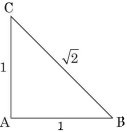
If the perimeter of an isosceles right triangle is $(6+3 \sqrt{2}) \text{ m}$,then the area of the triangle is ... $\text{m}^2$.
A
$4.5$
B
$5.4$
C
$9$
D
$81$
Solution
(A) Let the two equal sides of the isosceles right triangle be $x$.
Then,the hypotenuse is $\sqrt{x^2 + x^2} = x\sqrt{2}$.
The perimeter is given by $x + x + x\sqrt{2} = x(2 + \sqrt{2})$.
Given that the perimeter is $(6 + 3\sqrt{2}) \text{ m}$,we have:
$x(2 + \sqrt{2}) = 3(2 + \sqrt{2})$.
Therefore,$x = 3 \text{ m}$.
The area of the triangle is $\frac{1}{2} \times \text{base} \times \text{height} = \frac{1}{2} \times x \times x = \frac{1}{2} \times 3 \times 3 = 4.5 \text{ m}^2$.
Then,the hypotenuse is $\sqrt{x^2 + x^2} = x\sqrt{2}$.
The perimeter is given by $x + x + x\sqrt{2} = x(2 + \sqrt{2})$.
Given that the perimeter is $(6 + 3\sqrt{2}) \text{ m}$,we have:
$x(2 + \sqrt{2}) = 3(2 + \sqrt{2})$.
Therefore,$x = 3 \text{ m}$.
The area of the triangle is $\frac{1}{2} \times \text{base} \times \text{height} = \frac{1}{2} \times x \times x = \frac{1}{2} \times 3 \times 3 = 4.5 \text{ m}^2$.
0 likes
View Solution190
EasyMCQ
The length of a rectangular hall is $5\, m$ more than its breadth. The area of the hall is $750\, m^{2}$. The length of the hall is.........$m$
A
$15$
B
$22.5$
C
$25$
D
$30$
Solution
(D) Let the breadth of the hall be $x$ metres.
Then,the length of the hall is $(x + 5)$ metres.
The area of the rectangular hall is given by $\text{length} \times \text{breadth} = 750\, m^{2}$.
So,$x(x + 5) = 750$.
$x^{2} + 5x - 750 = 0$.
Factoring the quadratic equation: $x^{2} + 30x - 25x - 750 = 0$.
$x(x + 30) - 25(x + 30) = 0$.
$(x - 25)(x + 30) = 0$.
Since the breadth cannot be negative,$x = 25$.
Therefore,the length of the hall is $x + 5 = 25 + 5 = 30\, m$.
Then,the length of the hall is $(x + 5)$ metres.
The area of the rectangular hall is given by $\text{length} \times \text{breadth} = 750\, m^{2}$.
So,$x(x + 5) = 750$.
$x^{2} + 5x - 750 = 0$.
Factoring the quadratic equation: $x^{2} + 30x - 25x - 750 = 0$.
$x(x + 30) - 25(x + 30) = 0$.
$(x - 25)(x + 30) = 0$.
Since the breadth cannot be negative,$x = 25$.
Therefore,the length of the hall is $x + 5 = 25 + 5 = 30\, m$.
0 likes
View Solution191
EasyMCQ
The area of a rectangle is $460 \, m^2$. If the length is $15 \%$ more than the breadth,what is the breadth of the rectangular field? (in $metres$)
A
$15$
B
$26$
C
$34.5$
D
$20$
Solution
(D) Let the breadth of the rectangle be $b \, m$.
Since the length is $15 \%$ more than the breadth,the length $l = b + 0.15b = 1.15b \, m$.
The area of a rectangle is given by the formula: $\text{Area} = l \times b$.
Substituting the given values: $1.15b \times b = 460$.
$1.15b^2 = 460$.
$b^2 = \frac{460}{1.15} = 400$.
Taking the square root of both sides: $b = \sqrt{400} = 20 \, m$.
Therefore,the breadth of the rectangular field is $20 \, m$.
Since the length is $15 \%$ more than the breadth,the length $l = b + 0.15b = 1.15b \, m$.
The area of a rectangle is given by the formula: $\text{Area} = l \times b$.
Substituting the given values: $1.15b \times b = 460$.
$1.15b^2 = 460$.
$b^2 = \frac{460}{1.15} = 400$.
Taking the square root of both sides: $b = \sqrt{400} = 20 \, m$.
Therefore,the breadth of the rectangular field is $20 \, m$.
0 likes
View Solution192
MediumMCQ
The perimeters of five squares are $24 \ cm$,$32 \ cm$,$40 \ cm$,$76 \ cm$,and $80 \ cm$ respectively. The perimeter of another square equal in area to the sum of the areas of these squares is $...... \ cm$.
A
$31$
B
$62$
C
$124$
D
$961$
Solution
(C) The side length of a square is given by $s = \frac{\text{Perimeter}}{4}$.
The sides of the five squares are:
$s_1 = \frac{24}{4} = 6 \ cm$,$s_2 = \frac{32}{4} = 8 \ cm$,$s_3 = \frac{40}{4} = 10 \ cm$,$s_4 = \frac{76}{4} = 19 \ cm$,$s_5 = \frac{80}{4} = 20 \ cm$.
The sum of the areas of these squares is:
$A = (6^2 + 8^2 + 10^2 + 19^2 + 20^2) \ cm^2$
$A = (36 + 64 + 100 + 361 + 400) \ cm^2 = 961 \ cm^2$.
Let the side of the new square be $S$. Since its area is equal to the sum of the areas of the five squares:
$S^2 = 961 \ cm^2$
$S = \sqrt{961} = 31 \ cm$.
The perimeter of the new square is $P = 4 \times S = 4 \times 31 = 124 \ cm$.
The sides of the five squares are:
$s_1 = \frac{24}{4} = 6 \ cm$,$s_2 = \frac{32}{4} = 8 \ cm$,$s_3 = \frac{40}{4} = 10 \ cm$,$s_4 = \frac{76}{4} = 19 \ cm$,$s_5 = \frac{80}{4} = 20 \ cm$.
The sum of the areas of these squares is:
$A = (6^2 + 8^2 + 10^2 + 19^2 + 20^2) \ cm^2$
$A = (36 + 64 + 100 + 361 + 400) \ cm^2 = 961 \ cm^2$.
Let the side of the new square be $S$. Since its area is equal to the sum of the areas of the five squares:
$S^2 = 961 \ cm^2$
$S = \sqrt{961} = 31 \ cm$.
The perimeter of the new square is $P = 4 \times S = 4 \times 31 = 124 \ cm$.
0 likes
View Solution193
MediumMCQ
The number of marble slabs of size $20 \text{ cm} \times 30 \text{ cm}$ required to pave the floor of a square room of side $3 \text{ m}$ is:
A
$100$
B
$150$
C
$225$
D
$250$
Solution
(B) The side of the square room is $3 \text{ m}$.
Area of the room $= 3 \text{ m} \times 3 \text{ m} = 9 \text{ m}^2$.
Since $1 \text{ m} = 100 \text{ cm}$,$1 \text{ m}^2 = 10,000 \text{ cm}^2$.
Therefore,the area of the room in $\text{cm}^2 = 9 \times 10,000 = 90,000 \text{ cm}^2$.
The area of one marble slab $= 20 \text{ cm} \times 30 \text{ cm} = 600 \text{ cm}^2$.
The number of slabs required $= \frac{\text{Total area of the room}}{\text{Area of one slab}} = \frac{90,000 \text{ cm}^2}{600 \text{ cm}^2} = 150$.
Area of the room $= 3 \text{ m} \times 3 \text{ m} = 9 \text{ m}^2$.
Since $1 \text{ m} = 100 \text{ cm}$,$1 \text{ m}^2 = 10,000 \text{ cm}^2$.
Therefore,the area of the room in $\text{cm}^2 = 9 \times 10,000 = 90,000 \text{ cm}^2$.
The area of one marble slab $= 20 \text{ cm} \times 30 \text{ cm} = 600 \text{ cm}^2$.
The number of slabs required $= \frac{\text{Total area of the room}}{\text{Area of one slab}} = \frac{90,000 \text{ cm}^2}{600 \text{ cm}^2} = 150$.
0 likes
View Solution194
DifficultMCQ
The difference of the areas of two squares drawn on two line segments of different lengths is $32 \, cm^2$. Find the length of the greater line segment if one is longer than the other by $2 \, cm$. (in $cm$)
A
$7$
B
$9$
C
$11$
D
$16$
Solution
(B) Let the length of the greater line segment be $x \, cm$.
Then,the length of the smaller line segment is $(x - 2) \, cm$.
The area of the square formed by the greater line segment is $x^2 \, cm^2$.
The area of the square formed by the smaller line segment is $(x - 2)^2 \, cm^2$.
According to the problem,the difference between the areas is $32 \, cm^2$:
$x^2 - (x - 2)^2 = 32$
Using the identity $a^2 - b^2 = (a - b)(a + b)$:
$(x - (x - 2))(x + (x - 2)) = 32$
$(2)(2x - 2) = 32$
Dividing both sides by $2$:
$2x - 2 = 16$
$2x = 18$
$x = 9$
Therefore,the length of the greater line segment is $9 \, cm$.
Then,the length of the smaller line segment is $(x - 2) \, cm$.
The area of the square formed by the greater line segment is $x^2 \, cm^2$.
The area of the square formed by the smaller line segment is $(x - 2)^2 \, cm^2$.
According to the problem,the difference between the areas is $32 \, cm^2$:
$x^2 - (x - 2)^2 = 32$
Using the identity $a^2 - b^2 = (a - b)(a + b)$:
$(x - (x - 2))(x + (x - 2)) = 32$
$(2)(2x - 2) = 32$
Dividing both sides by $2$:
$2x - 2 = 16$
$2x = 18$
$x = 9$
Therefore,the length of the greater line segment is $9 \, cm$.
0 likes
View Solution195
EasyMCQ
If the circumference and the area of a circle are numerically equal,then the diameter is equal to
A
$2$
B
$4$
C
$\pi / 2$
D
$2 \pi$
Solution
(B) Let the radius of the circle be $r$.
The circumference of the circle is given by $C = 2 \pi r$.
The area of the circle is given by $A = \pi r^2$.
According to the problem,the circumference and the area are numerically equal:
$2 \pi r = \pi r^2$
Dividing both sides by $\pi r$ (assuming $r \neq 0$):
$2 = r$
Thus,the radius $r = 2$.
The diameter $d$ of the circle is $2r$:
$d = 2 \times 2 = 4$.
Therefore,the diameter is $4$.
The circumference of the circle is given by $C = 2 \pi r$.
The area of the circle is given by $A = \pi r^2$.
According to the problem,the circumference and the area are numerically equal:
$2 \pi r = \pi r^2$
Dividing both sides by $\pi r$ (assuming $r \neq 0$):
$2 = r$
Thus,the radius $r = 2$.
The diameter $d$ of the circle is $2r$:
$d = 2 \times 2 = 4$.
Therefore,the diameter is $4$.
0 likes
View Solution196
MediumMCQ
The area of a triangle whose sides are $15 \, m$,$16 \, m$,and $17 \, m$ is
A
$24 \sqrt{4} \, m^{2}$
B
$24 \sqrt{3} \, m^{2}$
C
$24 \sqrt{21} \, m^{2}$
D
None of these
Solution
(C) Let the sides of the triangle be $a = 15 \, m$,$b = 16 \, m$,and $c = 17 \, m$.
First,calculate the semi-perimeter $s$:
$s = \frac{a + b + c}{2} = \frac{15 + 16 + 17}{2} = \frac{48}{2} = 24 \, m$.
Using Heron's formula,the area of the triangle is given by:
$\text{Area} = \sqrt{s(s - a)(s - b)(s - c)}$
Substitute the values:
$\text{Area} = \sqrt{24(24 - 15)(24 - 16)(24 - 17)}$
$\text{Area} = \sqrt{24 \times 9 \times 8 \times 7}$
$\text{Area} = \sqrt{12096} = \sqrt{576 \times 21} = 24 \sqrt{21} \, m^{2}$.
First,calculate the semi-perimeter $s$:
$s = \frac{a + b + c}{2} = \frac{15 + 16 + 17}{2} = \frac{48}{2} = 24 \, m$.
Using Heron's formula,the area of the triangle is given by:
$\text{Area} = \sqrt{s(s - a)(s - b)(s - c)}$
Substitute the values:
$\text{Area} = \sqrt{24(24 - 15)(24 - 16)(24 - 17)}$
$\text{Area} = \sqrt{24 \times 9 \times 8 \times 7}$
$\text{Area} = \sqrt{12096} = \sqrt{576 \times 21} = 24 \sqrt{21} \, m^{2}$.
0 likes
View Solution197
MediumMCQ
The area of a right-angled triangle with base $6\,m$ and hypotenuse $6.5\,m$ is........$m^2$
A
$7.5$
B
$9.5$
C
$8.5$
D
None of these
Solution
(A) Using the Pythagorean theorem,the height of the triangle is given by:
Height $= \sqrt{(\text{hypotenuse})^2 - (\text{base})^2}$
Height $= \sqrt{(6.5)^2 - 6^2}$
Height $= \sqrt{42.25 - 36}$
Height $= \sqrt{6.25} = 2.5\,m$
The area of a right-angled triangle is calculated as:
Area $= \frac{1}{2} \times \text{base} \times \text{height}$
Area $= \frac{1}{2} \times 6\,m \times 2.5\,m$
Area $= 3 \times 2.5 = 7.5\,m^2$
Height $= \sqrt{(\text{hypotenuse})^2 - (\text{base})^2}$
Height $= \sqrt{(6.5)^2 - 6^2}$
Height $= \sqrt{42.25 - 36}$
Height $= \sqrt{6.25} = 2.5\,m$
The area of a right-angled triangle is calculated as:
Area $= \frac{1}{2} \times \text{base} \times \text{height}$
Area $= \frac{1}{2} \times 6\,m \times 2.5\,m$
Area $= 3 \times 2.5 = 7.5\,m^2$
0 likes
View Solution198
MediumMCQ
The length of each side of an equilateral triangle is $12\, cm$. The height of the triangle is
A
$3 \sqrt{2}\, cm$
B
$6 \sqrt{3}\, cm$
C
$6 \sqrt{2}\, cm$
D
None of these
Solution
(B) An equilateral triangle has all sides equal. Given side $a = 12\, cm$.
The formula for the height $h$ of an equilateral triangle is $h = \frac{\sqrt{3}}{2} \times a$.
Substituting the value of $a$:
$h = \frac{\sqrt{3}}{2} \times 12\, cm$
$h = 6 \sqrt{3}\, cm$.
Alternatively,using the area formula:
Area $= \frac{\sqrt{3}}{4} \times a^2 = \frac{\sqrt{3}}{4} \times 144 = 36 \sqrt{3}\, cm^2$.
Also,Area $= \frac{1}{2} \times \text{base} \times \text{height} = \frac{1}{2} \times 12 \times h = 6h$.
Equating the two: $6h = 36 \sqrt{3}$,so $h = 6 \sqrt{3}\, cm$.
The formula for the height $h$ of an equilateral triangle is $h = \frac{\sqrt{3}}{2} \times a$.
Substituting the value of $a$:
$h = \frac{\sqrt{3}}{2} \times 12\, cm$
$h = 6 \sqrt{3}\, cm$.
Alternatively,using the area formula:
Area $= \frac{\sqrt{3}}{4} \times a^2 = \frac{\sqrt{3}}{4} \times 144 = 36 \sqrt{3}\, cm^2$.
Also,Area $= \frac{1}{2} \times \text{base} \times \text{height} = \frac{1}{2} \times 12 \times h = 6h$.
Equating the two: $6h = 36 \sqrt{3}$,so $h = 6 \sqrt{3}\, cm$.
0 likes
View Solution199
DifficultMCQ
The area of a triangular lawn is $1600 \, m^{2}$. If one side is $64 \, m$ long and the other two sides are equal in length,the length of each equal side is......$m$
A
$60.37$
B
$59.36$
C
$60.36$
D
None of these
Solution
(B) Let the length of each equal side be $x \, m$.
The sides of the triangle are $x, x,$ and $64$.
The semi-perimeter $s = \frac{x + x + 64}{2} = x + 32$.
Using Heron's formula,Area $= \sqrt{s(s-a)(s-b)(s-c)}$.
$1600 = \sqrt{(x+32)(x+32-x)(x+32-x)(x+32-64)}$.
$1600 = \sqrt{(x+32)(32)(32)(x-32)}$.
$1600 = 32 \sqrt{(x+32)(x-32)}$.
$50 = \sqrt{x^{2} - 32^{2}}$.
Squaring both sides,$2500 = x^{2} - 1024$.
$x^{2} = 3524$.
$x = \sqrt{3524} \approx 59.36 \, m$.
The sides of the triangle are $x, x,$ and $64$.
The semi-perimeter $s = \frac{x + x + 64}{2} = x + 32$.
Using Heron's formula,Area $= \sqrt{s(s-a)(s-b)(s-c)}$.
$1600 = \sqrt{(x+32)(x+32-x)(x+32-x)(x+32-64)}$.
$1600 = \sqrt{(x+32)(32)(32)(x-32)}$.
$1600 = 32 \sqrt{(x+32)(x-32)}$.
$50 = \sqrt{x^{2} - 32^{2}}$.
Squaring both sides,$2500 = x^{2} - 1024$.
$x^{2} = 3524$.
$x = \sqrt{3524} \approx 59.36 \, m$.
0 likes
View Solution200
MediumMCQ
Three sides of a triangular field are $20\, m$,$21\, m$,and $29\, m$ long,respectively. The area of the field is.......$m^2$.
A
$215$
B
$230$
C
$210$
D
None of these
Solution
(C) Let the sides of the triangle be $a = 20\, m$,$b = 21\, m$,and $c = 29\, m$.
First,calculate the semi-perimeter $(s)$:
$s = \frac{a + b + c}{2} = \frac{20 + 21 + 29}{2} = \frac{70}{2} = 35\, m$.
Using Heron's formula,the area of the triangle is given by:
Area $= \sqrt{s(s - a)(s - b)(s - c)}$.
Substituting the values:
Area $= \sqrt{35(35 - 20)(35 - 21)(35 - 29)}$
Area $= \sqrt{35 \times 15 \times 14 \times 6}$
Area $= \sqrt{(5 \times 7) \times (3 \times 5) \times (2 \times 7) \times (2 \times 3)}$
Area $= \sqrt{5^2 \times 7^2 \times 3^2 \times 2^2}$
Area $= 5 \times 7 \times 3 \times 2 = 210\, m^2$.
First,calculate the semi-perimeter $(s)$:
$s = \frac{a + b + c}{2} = \frac{20 + 21 + 29}{2} = \frac{70}{2} = 35\, m$.
Using Heron's formula,the area of the triangle is given by:
Area $= \sqrt{s(s - a)(s - b)(s - c)}$.
Substituting the values:
Area $= \sqrt{35(35 - 20)(35 - 21)(35 - 29)}$
Area $= \sqrt{35 \times 15 \times 14 \times 6}$
Area $= \sqrt{(5 \times 7) \times (3 \times 5) \times (2 \times 7) \times (2 \times 3)}$
Area $= \sqrt{5^2 \times 7^2 \times 3^2 \times 2^2}$
Area $= 5 \times 7 \times 3 \times 2 = 210\, m^2$.
0 likes
View SolutionMensuration — Measurement of Area · Frequently Asked Questions
1Are these Mensuration questions useful for JEE and NEET?
Yes. All questions in this section are mapped to JEE Main and NEET exam patterns. Previous year questions from JEE Main, NEET, GUJCET and state-level exams are included with full solutions.
2Can I switch to Hindi or Gujarati for these questions?
Yes. Use the language tabs in the hero section or the sidebar to view the same questions and solutions in English, Hindi or Gujarati.
3How do I generate a question paper from this subtopic?
Use the Vedclass Exam Paper Generator — select the chapter and subtopic, set difficulty, and generate Sets A, B, C, D automatically. First 3 chapters of every subject are free.
Vedclass Products
For Students
Vedclass Test Series
Mock tests in real JEE/NEET style with performance analysis. 5-day free trial.
Start Free TrialFor Teachers
Exam Paper Generator
Generate Set A/B/C/D papers from this chapter in 2 minutes. 3 chapters free.
Try FreeFor Institutes
Online Exam Module
Live online exams with unlimited students, 360° analytics & white-label branding.
See DemoFor Teachers & Institutes
Generate a Mensuration Exam Paper in 2 Minutes
Select subtopic & difficulty — Sets A, B, C, D auto-generated with No Repeat logic.
First 3 chapters of every subject are free — no payment required.