
A English
Measurement of Area Questions in English
Competitive Exam Quantitative Aptitude · Mensuration · Measurement of Area
407+
Questions
English
Language
100%
With Solutions
Showing 50 of 407 questions in English
51
MediumMCQ
An equilateral triangle is cut up into smaller equilateral triangles with side $1/6$ of the original. Find the number of triangles thus formed?
A
$216$
B
$6$
C
$36$
D
$3$
Solution
(C) Let the side of the original equilateral triangle be $x$.
The area of the original triangle is given by $A = \frac{\sqrt{3}}{4} x^2$.
The side of the smaller equilateral triangle is $\frac{x}{6}$.
The area of one smaller equilateral triangle is $A_{small} = \frac{\sqrt{3}}{4} \times (\frac{x}{6})^2 = \frac{\sqrt{3}}{4} \times \frac{x^2}{36}$.
The number of smaller triangles formed is the ratio of the original area to the area of one smaller triangle:
Number of triangles $= \frac{A}{A_{small}} = \frac{\frac{\sqrt{3}}{4} x^2}{\frac{\sqrt{3}}{4} \times \frac{x^2}{36}} = 36$.
The area of the original triangle is given by $A = \frac{\sqrt{3}}{4} x^2$.
The side of the smaller equilateral triangle is $\frac{x}{6}$.
The area of one smaller equilateral triangle is $A_{small} = \frac{\sqrt{3}}{4} \times (\frac{x}{6})^2 = \frac{\sqrt{3}}{4} \times \frac{x^2}{36}$.
The number of smaller triangles formed is the ratio of the original area to the area of one smaller triangle:
Number of triangles $= \frac{A}{A_{small}} = \frac{\frac{\sqrt{3}}{4} x^2}{\frac{\sqrt{3}}{4} \times \frac{x^2}{36}} = 36$.
0 likes
View Solution52
MediumMCQ
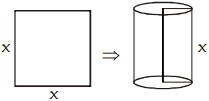
$A$ square sheet of paper is converted into a cylinder by rolling it along its length. What is the ratio of the base radius of the cylinder to the side of the square?
A
$7 \sqrt{2}: 22$
B
$7: 22$
C
$7: 44$
D
$22: 7$
Solution
(C) Let the side of the square be $x$.
When the square is rolled along its length to form a cylinder,the length of the side becomes the circumference of the base of the cylinder.
Therefore,the circumference of the base $= 2 \pi r = x$.
From this,the radius $r = \frac{x}{2 \pi}$.
The required ratio of the base radius of the cylinder to the side of the square is $\frac{r}{x}$.
Substituting the value of $r$,we get $\frac{\frac{x}{2 \pi}}{x} = \frac{1}{2 \pi}$.
Using $\pi = \frac{22}{7}$,the ratio becomes $\frac{1}{2 \times \frac{22}{7}} = \frac{7}{44}$.
Thus,the ratio is $7: 44$.
When the square is rolled along its length to form a cylinder,the length of the side becomes the circumference of the base of the cylinder.
Therefore,the circumference of the base $= 2 \pi r = x$.
From this,the radius $r = \frac{x}{2 \pi}$.
The required ratio of the base radius of the cylinder to the side of the square is $\frac{r}{x}$.
Substituting the value of $r$,we get $\frac{\frac{x}{2 \pi}}{x} = \frac{1}{2 \pi}$.
Using $\pi = \frac{22}{7}$,the ratio becomes $\frac{1}{2 \times \frac{22}{7}} = \frac{7}{44}$.
Thus,the ratio is $7: 44$.
0 likes
View Solution53
DifficultMCQ
$A$ wire when bent in the form of a circle encloses an area of $1386 \, cm^2$. What will be the enclosed area when the same wire is bent into the form of an equilateral triangle?
A
$484 \sqrt{3} \, cm^2$
B
$616 \sqrt{3} \, cm^2$
C
$308 \sqrt{3} \, cm^2$
D
$512 \, cm^2$
Solution
(A) Area of the circle $= 1386 \, cm^2$.
Using the formula for the area of a circle,$\pi r^2 = 1386$.
$\frac{22}{7} \times r^2 = 1386 \implies r^2 = \frac{1386 \times 7}{22} = 63 \times 7 = 441$.
Thus,$r = \sqrt{441} = 21 \, cm$.
The length of the wire is equal to the circumference of the circle: $C = 2 \pi r = 2 \times \frac{22}{7} \times 21 = 132 \, cm$.
When this wire is bent into an equilateral triangle,its perimeter remains $132 \, cm$.
Let the side of the equilateral triangle be $a$. Then $3a = 132$,which gives $a = 44 \, cm$.
The area of an equilateral triangle is given by $\frac{\sqrt{3}}{4} a^2$.
Area $= \frac{\sqrt{3}}{4} \times 44 \times 44 = \sqrt{3} \times 11 \times 44 = 484 \sqrt{3} \, cm^2$.
Using the formula for the area of a circle,$\pi r^2 = 1386$.
$\frac{22}{7} \times r^2 = 1386 \implies r^2 = \frac{1386 \times 7}{22} = 63 \times 7 = 441$.
Thus,$r = \sqrt{441} = 21 \, cm$.
The length of the wire is equal to the circumference of the circle: $C = 2 \pi r = 2 \times \frac{22}{7} \times 21 = 132 \, cm$.
When this wire is bent into an equilateral triangle,its perimeter remains $132 \, cm$.
Let the side of the equilateral triangle be $a$. Then $3a = 132$,which gives $a = 44 \, cm$.
The area of an equilateral triangle is given by $\frac{\sqrt{3}}{4} a^2$.
Area $= \frac{\sqrt{3}}{4} \times 44 \times 44 = \sqrt{3} \times 11 \times 44 = 484 \sqrt{3} \, cm^2$.
0 likes
View Solution54
DifficultMCQ
The surface area of a spherical part of a bowl with a flat circular detachable cover,excluding the cover,is $616 \, cm^2$. The area of the cover is $38.5 \, cm^2$. What is the volume of the bowl? (in $cm^3$)
A
$1339$
B
$1430$
C
$1570$
D
$2032.69$
Solution
(D) Let the radius of the spherical bowl be $r \, cm$.
The surface area of the hemispherical part (excluding the cover) is given by $2 \pi r^2 = 616 \, cm^2$.
$r^2 = \frac{616 \times 7}{2 \times 22} = \frac{308 \times 7}{22} = 14 \times 7 = 98 \, cm^2$.
$r = \sqrt{98} = 7\sqrt{2} \, cm$.
The volume of a hemispherical bowl is given by $V = \frac{2}{3} \pi r^3$.
$V = \frac{2}{3} \times \frac{22}{7} \times (7\sqrt{2})^3$.
$V = \frac{2}{3} \times \frac{22}{7} \times 343 \times 2\sqrt{2}$.
$V = \frac{44}{21} \times 686\sqrt{2} = \frac{44 \times 98\sqrt{2}}{3} = \frac{4312\sqrt{2}}{3}$.
Using $\sqrt{2} \approx 1.414$,$V \approx \frac{4312 \times 1.414}{3} \approx 2032.69 \, cm^3$.
The surface area of the hemispherical part (excluding the cover) is given by $2 \pi r^2 = 616 \, cm^2$.
$r^2 = \frac{616 \times 7}{2 \times 22} = \frac{308 \times 7}{22} = 14 \times 7 = 98 \, cm^2$.
$r = \sqrt{98} = 7\sqrt{2} \, cm$.
The volume of a hemispherical bowl is given by $V = \frac{2}{3} \pi r^3$.
$V = \frac{2}{3} \times \frac{22}{7} \times (7\sqrt{2})^3$.
$V = \frac{2}{3} \times \frac{22}{7} \times 343 \times 2\sqrt{2}$.
$V = \frac{44}{21} \times 686\sqrt{2} = \frac{44 \times 98\sqrt{2}}{3} = \frac{4312\sqrt{2}}{3}$.
Using $\sqrt{2} \approx 1.414$,$V \approx \frac{4312 \times 1.414}{3} \approx 2032.69 \, cm^3$.
0 likes
View Solution55
MediumMCQ
$A$ hemispherical bowl of internal diameter $54 \ cm$ contains a liquid. The liquid is to be filled in cylindrical bottles of radius $3 \ cm$ and height $9 \ cm$. How many bottles are required to empty the bowl?
A
$221$
B
$343$
C
$81$
D
$162$
Solution
(D) The internal radius of the hemispherical bowl is $R = \frac{54}{2} = 27 \ cm$.
The volume of the hemispherical bowl is $V_{bowl} = \frac{2}{3} \pi R^3 = \frac{2}{3} \pi (27)^3 \ cm^3$.
The volume of one cylindrical bottle is $V_{bottle} = \pi r^2 h = \pi (3)^2 (9) = 81 \pi \ cm^3$.
The number of bottles required is given by the ratio of the total volume of the liquid to the volume of one bottle:
$\text{Number of bottles} = \frac{V_{bowl}}{V_{bottle}} = \frac{\frac{2}{3} \pi (27)^3}{\pi (3)^2 (9)} = \frac{2}{3} \times \frac{27 \times 27 \times 27}{9 \times 9} = \frac{2}{3} \times \frac{19683}{81} = \frac{2}{3} \times 243 = 2 \times 81 = 162$.
Therefore,$162$ bottles are required to empty the bowl.
The volume of the hemispherical bowl is $V_{bowl} = \frac{2}{3} \pi R^3 = \frac{2}{3} \pi (27)^3 \ cm^3$.
The volume of one cylindrical bottle is $V_{bottle} = \pi r^2 h = \pi (3)^2 (9) = 81 \pi \ cm^3$.
The number of bottles required is given by the ratio of the total volume of the liquid to the volume of one bottle:
$\text{Number of bottles} = \frac{V_{bowl}}{V_{bottle}} = \frac{\frac{2}{3} \pi (27)^3}{\pi (3)^2 (9)} = \frac{2}{3} \times \frac{27 \times 27 \times 27}{9 \times 9} = \frac{2}{3} \times \frac{19683}{81} = \frac{2}{3} \times 243 = 2 \times 81 = 162$.
Therefore,$162$ bottles are required to empty the bowl.
0 likes
View Solution56
MediumMCQ
If half the diagonal of a square is $5 \, cm$,then the area of the square is
A
$20 \sqrt{2} \, cm^{2}$
B
$25 \, cm^{2}$
C
$50 \, cm^{2}$
D
$100 \, cm^{2}$
Solution
(C) Given that half the diagonal of the square is $5 \, cm$.
Therefore,the full length of the diagonal $d = 5 \times 2 = 10 \, cm$.
The area of a square can be calculated using the diagonal formula: $\text{Area} = \frac{1}{2} \times d^{2}$.
Substituting the value of the diagonal: $\text{Area} = \frac{1}{2} \times (10)^{2}$.
$\text{Area} = \frac{1}{2} \times 100 = 50 \, cm^{2}$.
Therefore,the full length of the diagonal $d = 5 \times 2 = 10 \, cm$.
The area of a square can be calculated using the diagonal formula: $\text{Area} = \frac{1}{2} \times d^{2}$.
Substituting the value of the diagonal: $\text{Area} = \frac{1}{2} \times (10)^{2}$.
$\text{Area} = \frac{1}{2} \times 100 = 50 \, cm^{2}$.
0 likes
View Solution57
MediumMCQ
If the side of a square is increased by $50 \%$,the percent increase in its area is: (in $\%$)
A
$50$
B
$100$
C
$125$
D
$150$
Solution
(C) Let the original side of the square be $x$.
Then,the original area $= x^2$.
If the side is increased by $50 \%$,the new side $= x + 0.5x = 1.5x$ or $\frac{3x}{2}$.
The new area $= (1.5x)^2 = 2.25x^2$ or $\frac{9x^2}{4}$.
The increase in area $= 2.25x^2 - x^2 = 1.25x^2$.
The percentage increase in area $= \frac{\text{Increase in area}}{\text{Original area}} \times 100 = \frac{1.25x^2}{x^2} \times 100 = 125 \%$.
Then,the original area $= x^2$.
If the side is increased by $50 \%$,the new side $= x + 0.5x = 1.5x$ or $\frac{3x}{2}$.
The new area $= (1.5x)^2 = 2.25x^2$ or $\frac{9x^2}{4}$.
The increase in area $= 2.25x^2 - x^2 = 1.25x^2$.
The percentage increase in area $= \frac{\text{Increase in area}}{\text{Original area}} \times 100 = \frac{1.25x^2}{x^2} \times 100 = 125 \%$.
0 likes
View Solution58
EasyMCQ
The ratio of the area of a square to that of the square drawn on its diagonal is
A
$1:1$
B
$1:2$
C
$1:3$
D
$1:4$
Solution
(B) Let the side of the square be $x$.
Then, the area of the square $= x^2$.
The diagonal of the square is given by the formula $d = \sqrt{2} \times \text{side} = \sqrt{2}x$.
The area of the square drawn on its diagonal $= (\text{diagonal})^2 = (\sqrt{2}x)^2 = 2x^2$.
Therefore, the required ratio of the area of the original square to the area of the square drawn on its diagonal is $\frac{x^2}{2x^2} = 1:2$.
Then, the area of the square $= x^2$.
The diagonal of the square is given by the formula $d = \sqrt{2} \times \text{side} = \sqrt{2}x$.
The area of the square drawn on its diagonal $= (\text{diagonal})^2 = (\sqrt{2}x)^2 = 2x^2$.
Therefore, the required ratio of the area of the original square to the area of the square drawn on its diagonal is $\frac{x^2}{2x^2} = 1:2$.
0 likes
View Solution59
MediumMCQ
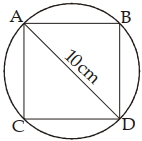
The diameter of a circle circumscribing a square is $10 \, cm$. Its sides will be
A
$5$
B
$5 \sqrt{2}$
C
$10$
D
$10 \sqrt{2}$
Solution
(B) Given diameter of the circle $= 10 \, cm$.
Since the circle circumscribes the square,the diameter of the circle is equal to the diagonal of the square.
Therefore,diagonal of the square $= 10 \, cm$.
Let the side of the square be $x \, cm$.
The relationship between the diagonal $d$ and the side $x$ of a square is given by $d = x \sqrt{2}$.
Substituting the value of the diagonal,we get $10 = x \sqrt{2}$.
Solving for $x$,we have $x = \frac{10}{\sqrt{2}}$.
Rationalizing the denominator,$x = \frac{10 \times \sqrt{2}}{\sqrt{2} \times \sqrt{2}} = \frac{10 \sqrt{2}}{2} = 5 \sqrt{2} \, cm$.
Thus,the side of the square is $5 \sqrt{2} \, cm$.
Since the circle circumscribes the square,the diameter of the circle is equal to the diagonal of the square.
Therefore,diagonal of the square $= 10 \, cm$.
Let the side of the square be $x \, cm$.
The relationship between the diagonal $d$ and the side $x$ of a square is given by $d = x \sqrt{2}$.
Substituting the value of the diagonal,we get $10 = x \sqrt{2}$.
Solving for $x$,we have $x = \frac{10}{\sqrt{2}}$.
Rationalizing the denominator,$x = \frac{10 \times \sqrt{2}}{\sqrt{2} \times \sqrt{2}} = \frac{10 \sqrt{2}}{2} = 5 \sqrt{2} \, cm$.
Thus,the side of the square is $5 \sqrt{2} \, cm$.
0 likes
View Solution60
MediumMCQ
If a square is inscribed in a circle,the ratio of the area of the circle and the square is
A
$2:1$
B
$\pi: 2$
C
$\pi: 1$
D
$11: 7$
Solution
(B) Let the radius of the circle be $r$.
Then,the diameter of the circle $= 2r$.
Since the square is inscribed in the circle,the diagonal of the square is equal to the diameter of the circle.
Diagonal of square $= 2r$.
Let the side of the square be $a$.
Then,$a\sqrt{2} = 2r$,which implies $a = \frac{2r}{\sqrt{2}} = r\sqrt{2}$.
Area of the circle $= \pi r^2$.
Area of the square $= a^2 = (r\sqrt{2})^2 = 2r^2$.
Required ratio $= \frac{\text{Area of circle}}{\text{Area of square}} = \frac{\pi r^2}{2r^2} = \frac{\pi}{2}$.
Thus,the ratio is $\pi: 2$.
Then,the diameter of the circle $= 2r$.
Since the square is inscribed in the circle,the diagonal of the square is equal to the diameter of the circle.
Diagonal of square $= 2r$.
Let the side of the square be $a$.
Then,$a\sqrt{2} = 2r$,which implies $a = \frac{2r}{\sqrt{2}} = r\sqrt{2}$.
Area of the circle $= \pi r^2$.
Area of the square $= a^2 = (r\sqrt{2})^2 = 2r^2$.
Required ratio $= \frac{\text{Area of circle}}{\text{Area of square}} = \frac{\pi r^2}{2r^2} = \frac{\pi}{2}$.
Thus,the ratio is $\pi: 2$.
0 likes
View Solution61
DifficultMCQ
Find the number of bricks,each measuring $25\, cm \times 12.5\, cm \times 7.5\, cm$,required to construct a wall $12\, m$ long,$5\, m$ high,and $0.25\, m$ thick,if the sand and cement mixture occupies $5\%$ of the total volume of the wall.
A
$6080$
B
$3040$
C
$1520$
D
$12160$
Solution
(A) $1$. Calculate the total volume of the wall in cubic centimeters $(cm^3)$:
Wall dimensions are $12\, m \times 5\, m \times 0.25\, m$.
Converting to $cm$: $1200\, cm \times 500\, cm \times 25\, cm = 15,000,000\, cm^3$.
$2$. Calculate the volume occupied by the bricks:
The mortar (sand and cement) occupies $5\%$ of the total volume,so the bricks occupy $95\%$ of the total volume.
Volume of bricks $= 0.95 \times 15,000,000\, cm^3 = 14,250,000\, cm^3$.
$3$. Calculate the volume of one brick:
Volume $= 25\, cm \times 12.5\, cm \times 7.5\, cm = 2343.75\, cm^3$.
$4$. Calculate the number of bricks required:
Number of bricks $= \frac{\text{Volume of bricks}}{\text{Volume of one brick}} = \frac{14,250,000}{2343.75} = 6080$.
Wall dimensions are $12\, m \times 5\, m \times 0.25\, m$.
Converting to $cm$: $1200\, cm \times 500\, cm \times 25\, cm = 15,000,000\, cm^3$.
$2$. Calculate the volume occupied by the bricks:
The mortar (sand and cement) occupies $5\%$ of the total volume,so the bricks occupy $95\%$ of the total volume.
Volume of bricks $= 0.95 \times 15,000,000\, cm^3 = 14,250,000\, cm^3$.
$3$. Calculate the volume of one brick:
Volume $= 25\, cm \times 12.5\, cm \times 7.5\, cm = 2343.75\, cm^3$.
$4$. Calculate the number of bricks required:
Number of bricks $= \frac{\text{Volume of bricks}}{\text{Volume of one brick}} = \frac{14,250,000}{2343.75} = 6080$.
0 likes
View Solution62
MediumMCQ
In a swimming pool measuring $90\, m$ by $40\, m$,$150$ men take a dip. If the average displacement of water by a man is $8\, m^3$,what will be the rise in water level? (in $cm$)
A
$30$
B
$50$
C
$20$
D
$33.33$
Solution
(D) The average displacement of water by one man is $8\, m^3$.
The total displacement of water by $150$ men is $150 \times 8\, m^3 = 1200\, m^3$.
Let the rise in the water level be $h$ meters.
The volume of the displaced water is equal to the area of the pool multiplied by the rise in height: $90\, m \times 40\, m \times h = 1200\, m^3$.
$3600 \times h = 1200$.
$h = \frac{1200}{3600} = \frac{1}{3}\, m$.
To convert the height into centimeters,multiply by $100$: $h = \frac{1}{3} \times 100 = 33.33\, cm$.
The total displacement of water by $150$ men is $150 \times 8\, m^3 = 1200\, m^3$.
Let the rise in the water level be $h$ meters.
The volume of the displaced water is equal to the area of the pool multiplied by the rise in height: $90\, m \times 40\, m \times h = 1200\, m^3$.
$3600 \times h = 1200$.
$h = \frac{1200}{3600} = \frac{1}{3}\, m$.
To convert the height into centimeters,multiply by $100$: $h = \frac{1}{3} \times 100 = 33.33\, cm$.
0 likes
View Solution63
DifficultMCQ
$A$ hollow spherical shell is made of a metal of density $4.9 \, g/cm^3$. If its internal and external radii are $10 \, cm$ and $12 \, cm$ respectively,find the weight of the shell. (Take $\pi = 3.1416$) (in $gm$)
A
$5016$
B
$1416.8$
C
$14942.28$
D
$5667.1$
Solution
(C) Internal radius,$r = 10 \, cm$.
External radius,$R = 12 \, cm$.
Volume of metal in the shell $= \frac{4}{3} \pi (R^3 - r^3)$.
Volume $= \frac{4}{3} \times 3.1416 \times (12^3 - 10^3) = \frac{4}{3} \times 3.1416 \times (1728 - 1000) = \frac{4}{3} \times 3.1416 \times 728 \, cm^3$.
Weight of the shell $= \text{Volume} \times \text{Density}$.
Weight $= (\frac{4}{3} \times 3.1416 \times 728) \times 4.9 = 3049.4432 \times 4.9 = 14942.27168 \, gm \approx 14942.28 \, gm$.
External radius,$R = 12 \, cm$.
Volume of metal in the shell $= \frac{4}{3} \pi (R^3 - r^3)$.
Volume $= \frac{4}{3} \times 3.1416 \times (12^3 - 10^3) = \frac{4}{3} \times 3.1416 \times (1728 - 1000) = \frac{4}{3} \times 3.1416 \times 728 \, cm^3$.
Weight of the shell $= \text{Volume} \times \text{Density}$.
Weight $= (\frac{4}{3} \times 3.1416 \times 728) \times 4.9 = 3049.4432 \times 4.9 = 14942.27168 \, gm \approx 14942.28 \, gm$.
0 likes
View Solution64
MediumMCQ
The dimensions of a field are $20 \text{ m}$ by $9 \text{ m}$. $A$ pit $10 \text{ m}$ long,$4.5 \text{ m}$ wide and $3 \text{ m}$ deep is dug in one corner of the field and the earth removed has been evenly spread over the remaining area of the field. What will be the rise in the height of the field as a result of this operation? (in $m$)
A
$1.5$
B
$2$
C
$3$
D
$1$
Solution
(D) Volume of earth removed $= 10 \text{ m} \times 4.5 \text{ m} \times 3 \text{ m} = 135 \text{ m}^3$.
Total area of the field $= 20 \text{ m} \times 9 \text{ m} = 180 \text{ m}^2$.
Area of the pit $= 10 \text{ m} \times 4.5 \text{ m} = 45 \text{ m}^2$.
Remaining area of the field $= 180 \text{ m}^2 - 45 \text{ m}^2 = 135 \text{ m}^2$.
Let the rise in the height of the field be $h \text{ m}$.
Since the earth removed is spread over the remaining area,the volume of the earth removed equals the volume of the raised layer:
$135 \text{ m}^2 \times h \text{ m} = 135 \text{ m}^3$.
Solving for $h$:
$h = \frac{135}{135} = 1 \text{ m}$.
Therefore,the rise in the height of the field is $1 \text{ m}$.
Total area of the field $= 20 \text{ m} \times 9 \text{ m} = 180 \text{ m}^2$.
Area of the pit $= 10 \text{ m} \times 4.5 \text{ m} = 45 \text{ m}^2$.
Remaining area of the field $= 180 \text{ m}^2 - 45 \text{ m}^2 = 135 \text{ m}^2$.
Let the rise in the height of the field be $h \text{ m}$.
Since the earth removed is spread over the remaining area,the volume of the earth removed equals the volume of the raised layer:
$135 \text{ m}^2 \times h \text{ m} = 135 \text{ m}^3$.
Solving for $h$:
$h = \frac{135}{135} = 1 \text{ m}$.
Therefore,the rise in the height of the field is $1 \text{ m}$.
0 likes
View Solution65
MediumMCQ
If the curved surface area of a cone is thrice that of another cone and the slant height of the second cone is thrice that of the first,find the ratio of the area of their bases. (in $:1$)
A
$81$
B
$9$
C
$3$
D
$27$
Solution
(A) Let the radius and slant height of the first cone be $r_1$ and $l_1$,and for the second cone be $r_2$ and $l_2$.
Given that the curved surface area of the first cone is thrice that of the second cone: $\pi r_1 l_1 = 3(\pi r_2 l_2)$.
Also,given that the slant height of the second cone is thrice that of the first: $l_2 = 3l_1$.
Substituting $l_2$ in the first equation: $\pi r_1 l_1 = 3(\pi r_2 \cdot 3l_1)$.
Simplifying: $r_1 l_1 = 9 r_2 l_1$.
Dividing both sides by $l_1$: $r_1 = 9r_2$,which implies $\frac{r_1}{r_2} = 9$.
The ratio of the area of their bases is $\frac{\pi r_1^2}{\pi r_2^2} = \left(\frac{r_1}{r_2}\right)^2 = 9^2 = 81$.
Thus,the ratio is $81:1$.
Given that the curved surface area of the first cone is thrice that of the second cone: $\pi r_1 l_1 = 3(\pi r_2 l_2)$.
Also,given that the slant height of the second cone is thrice that of the first: $l_2 = 3l_1$.
Substituting $l_2$ in the first equation: $\pi r_1 l_1 = 3(\pi r_2 \cdot 3l_1)$.
Simplifying: $r_1 l_1 = 9 r_2 l_1$.
Dividing both sides by $l_1$: $r_1 = 9r_2$,which implies $\frac{r_1}{r_2} = 9$.
The ratio of the area of their bases is $\frac{\pi r_1^2}{\pi r_2^2} = \left(\frac{r_1}{r_2}\right)^2 = 9^2 = 81$.
Thus,the ratio is $81:1$.
0 likes
View Solution66
DifficultMCQ
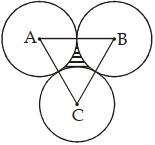
Find the area of the shaded region if the radius of each of the circles is $1\, cm$.
A
$2-\frac{\pi}{3}$
B
$\sqrt{3}-\pi$
C
$\sqrt{3}-\frac{\pi}{2}$
D
$\sqrt{3}-\frac{\pi}{4}$
Solution
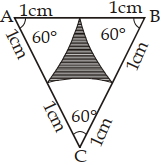
(C) The centers of the three circles form an equilateral triangle $\Delta ABC$ with each side length $a = 1 + 1 = 2\, cm$.
The area of an equilateral triangle is given by $\frac{\sqrt{3}}{4} a^2$.
Area of $\Delta ABC = \frac{\sqrt{3}}{4} \times (2)^2 = \sqrt{3}\, cm^2$.
Each interior angle of an equilateral triangle is $60^{\circ}$.
The area of a circular sector with radius $r$ and angle $\theta$ is $\frac{\theta}{360^{\circ}} \times \pi r^2$.
Here,$r = 1\, cm$ and $\theta = 60^{\circ}$.
Area of one sector = $\frac{60^{\circ}}{360^{\circ}} \times \pi (1)^2 = \frac{1}{6} \pi\, cm^2$.
Since there are three such sectors inside the triangle,the total area of the three sectors = $3 \times \frac{\pi}{6} = \frac{\pi}{2}\, cm^2$.
The area of the shaded region is the area of the triangle minus the sum of the areas of the three sectors.
Area of shaded region = $\sqrt{3} - \frac{\pi}{2}\, cm^2$.
The area of an equilateral triangle is given by $\frac{\sqrt{3}}{4} a^2$.
Area of $\Delta ABC = \frac{\sqrt{3}}{4} \times (2)^2 = \sqrt{3}\, cm^2$.
Each interior angle of an equilateral triangle is $60^{\circ}$.
The area of a circular sector with radius $r$ and angle $\theta$ is $\frac{\theta}{360^{\circ}} \times \pi r^2$.
Here,$r = 1\, cm$ and $\theta = 60^{\circ}$.
Area of one sector = $\frac{60^{\circ}}{360^{\circ}} \times \pi (1)^2 = \frac{1}{6} \pi\, cm^2$.
Since there are three such sectors inside the triangle,the total area of the three sectors = $3 \times \frac{\pi}{6} = \frac{\pi}{2}\, cm^2$.
The area of the shaded region is the area of the triangle minus the sum of the areas of the three sectors.
Area of shaded region = $\sqrt{3} - \frac{\pi}{2}\, cm^2$.
0 likes
View Solution67
MediumMCQ
Three equal cubes are placed adjacently in a row. Find the ratio of the total surface area of the new cuboid to the sum of the surface areas of the three cubes.
A
$7:9$
B
$49:81$
C
$9:7$
D
$27:23$
Solution
(A) Let the edge of each cube be $a$.
When three such cubes are placed adjacently in a row,they form a cuboid.
The dimensions of this new cuboid are: Length $(l) = 3a$,Breadth $(b) = a$,and Height $(h) = a$.
The total surface area of the new cuboid is given by the formula $2(lb + bh + lh)$.
Substituting the values: $2(3a \times a + a \times a + 3a \times a) = 2(3a^2 + a^2 + 3a^2) = 2(7a^2) = 14a^2$.
The surface area of one cube is $6a^2$. Therefore,the sum of the surface areas of the three cubes is $3 \times 6a^2 = 18a^2$.
The required ratio is $\frac{14a^2}{18a^2} = \frac{7}{9}$,which is $7:9$.
When three such cubes are placed adjacently in a row,they form a cuboid.
The dimensions of this new cuboid are: Length $(l) = 3a$,Breadth $(b) = a$,and Height $(h) = a$.
The total surface area of the new cuboid is given by the formula $2(lb + bh + lh)$.
Substituting the values: $2(3a \times a + a \times a + 3a \times a) = 2(3a^2 + a^2 + 3a^2) = 2(7a^2) = 14a^2$.
The surface area of one cube is $6a^2$. Therefore,the sum of the surface areas of the three cubes is $3 \times 6a^2 = 18a^2$.
The required ratio is $\frac{14a^2}{18a^2} = \frac{7}{9}$,which is $7:9$.
0 likes
View Solution68
MediumMCQ
The radius of a right circular cylinder is increased by $50 \% .$ Find the percentage increase in volume (in $\%$)?
A
$120$
B
$75$
C
$150$
D
$125$
Solution
(D) Let the initial radius be $r = 10$ and height be $H$.
Initial volume $V_1 = \pi r^2 H = \pi (10)^2 H = 100 \pi H$.
Since the radius is increased by $50 \%$,the new radius $r' = 10 + (50 \% \text{ of } 10) = 10 + 5 = 15$.
The height $H$ remains constant.
New volume $V_2 = \pi (r')^2 H = \pi (15)^2 H = 225 \pi H$.
The increase in volume $= V_2 - V_1 = 225 \pi H - 100 \pi H = 125 \pi H$.
Percentage increase in volume $= \left( \frac{V_2 - V_1}{V_1} \right) \times 100 = \left( \frac{125 \pi H}{100 \pi H} \right) \times 100 = 125 \%.$
Initial volume $V_1 = \pi r^2 H = \pi (10)^2 H = 100 \pi H$.
Since the radius is increased by $50 \%$,the new radius $r' = 10 + (50 \% \text{ of } 10) = 10 + 5 = 15$.
The height $H$ remains constant.
New volume $V_2 = \pi (r')^2 H = \pi (15)^2 H = 225 \pi H$.
The increase in volume $= V_2 - V_1 = 225 \pi H - 100 \pi H = 125 \pi H$.
Percentage increase in volume $= \left( \frac{V_2 - V_1}{V_1} \right) \times 100 = \left( \frac{125 \pi H}{100 \pi H} \right) \times 100 = 125 \%.$
0 likes
View Solution69
DifficultMCQ
Water flows out at the rate of $10 \, m/min$ from a cylindrical pipe of diameter $5 \, mm$. Find the time taken to fill a conical tank whose diameter at the surface is $40 \, cm$ and depth is $24 \, cm$ (in $min$)?
A
$50$
B
$102.4$
C
$51.2$
D
$25.6$
Solution
(C) Radius of the cylindrical pipe $r_p = 2.5 \, mm = 0.25 \, cm$.
Length of water column flowing in one minute $h_p = 10 \, m = 1000 \, cm$.
Volume of water flowing out in one minute $V_p = \pi r_p^2 h_p = \pi (0.25)^2 (1000) = 62.5 \pi \, cm^3$.
Radius of the conical tank $R = 20 \, cm$ and depth $H = 24 \, cm$.
Volume of the conical tank $V_t = \frac{1}{3} \pi R^2 H = \frac{1}{3} \pi (20)^2 (24) = 3200 \pi \, cm^3$.
Time taken to fill the tank $T = \frac{V_t}{V_p} = \frac{3200 \pi}{62.5 \pi} = 51.2 \, min$.
Length of water column flowing in one minute $h_p = 10 \, m = 1000 \, cm$.
Volume of water flowing out in one minute $V_p = \pi r_p^2 h_p = \pi (0.25)^2 (1000) = 62.5 \pi \, cm^3$.
Radius of the conical tank $R = 20 \, cm$ and depth $H = 24 \, cm$.
Volume of the conical tank $V_t = \frac{1}{3} \pi R^2 H = \frac{1}{3} \pi (20)^2 (24) = 3200 \pi \, cm^3$.
Time taken to fill the tank $T = \frac{V_t}{V_p} = \frac{3200 \pi}{62.5 \pi} = 51.2 \, min$.
0 likes
View Solution70
DifficultMCQ
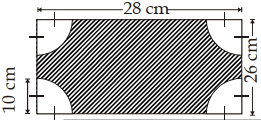
Find the perimeter and area of the shaded portion of the adjoining diagram.
A
$90.8\, cm, 414\, cm^2$
B
$181.6\, cm, 423.7\, cm^2$
C
$90.8\, cm, 827.4\, cm^2$
D
$181.6\, cm, 827.4\, cm^2$
Solution
(A) Area of the shaded portion = (Area of the rectangle) - (Area of the four sectors).
Each sector is a quadrant of a circle with radius $r = 10\, cm$. The four quadrants together form a full circle of radius $10\, cm$.
Area of the rectangle = $28\, cm \times 26\, cm = 728\, cm^2$.
Area of the circle = $\pi r^2 = 3.1416 \times (10)^2 = 314.16\, cm^2$.
Area of the shaded portion = $728 - 314.16 = 413.84\, cm^2 \approx 414\, cm^2$.
Perimeter of the shaded portion = (Sum of the straight edges) + (Sum of the arc lengths of the four sectors).
The straight edges are: $(28 - 10 - 10) + (28 - 10 - 10) + (26 - 10 - 10) + (26 - 10 - 10) = 8 + 8 + 6 + 6 = 28\, cm$.
The four arcs form a full circle circumference: $2\pi r = 2 \times 3.1416 \times 10 = 62.832\, cm$.
Total Perimeter = $28 + 62.832 = 90.832\, cm \approx 90.8\, cm$.
Each sector is a quadrant of a circle with radius $r = 10\, cm$. The four quadrants together form a full circle of radius $10\, cm$.
Area of the rectangle = $28\, cm \times 26\, cm = 728\, cm^2$.
Area of the circle = $\pi r^2 = 3.1416 \times (10)^2 = 314.16\, cm^2$.
Area of the shaded portion = $728 - 314.16 = 413.84\, cm^2 \approx 414\, cm^2$.
Perimeter of the shaded portion = (Sum of the straight edges) + (Sum of the arc lengths of the four sectors).
The straight edges are: $(28 - 10 - 10) + (28 - 10 - 10) + (26 - 10 - 10) + (26 - 10 - 10) = 8 + 8 + 6 + 6 = 28\, cm$.
The four arcs form a full circle circumference: $2\pi r = 2 \times 3.1416 \times 10 = 62.832\, cm$.
Total Perimeter = $28 + 62.832 = 90.832\, cm \approx 90.8\, cm$.
0 likes
View Solution71
DifficultMCQ
$A$ cylindrical container whose diameter is $12\,cm$ and height is $15\,cm$,is filled with ice cream. The whole ice cream is distributed to $10$ children in equal cones having hemispherical tops. If the height of the conical portion is twice the diameter of its base,find the diameter of the ice-cream cone? (in $cm$)
A
$6$
B
$12$
C
$3$
D
$18$
Solution
(A) Volume of the cylindrical container $= \pi r^2 h = \pi \times (6)^2 \times 15 = 540\pi \, cm^3$.
This ice cream is distributed equally among $10$ children,so the volume of one ice cream unit $= \frac{540\pi}{10} = 54\pi \, cm^3$.
Let the diameter of the base of the cone be $D$. Then the radius $r = \frac{D}{2}$.
The height of the conical portion is given as $h = 2D$.
The volume of one ice cream unit (cone + hemisphere) $= \frac{1}{3}\pi r^2 h + \frac{2}{3}\pi r^3$.
Substituting $r = \frac{D}{2}$ and $h = 2D$:
Volume $= \frac{1}{3}\pi (\frac{D}{2})^2 (2D) + \frac{2}{3}\pi (\frac{D}{2})^3 = \frac{1}{3}\pi (\frac{D^2}{4}) (2D) + \frac{2}{3}\pi (\frac{D^3}{8}) = \frac{\pi D^3}{6} + \frac{\pi D^3}{12} = \frac{2\pi D^3 + \pi D^3}{12} = \frac{3\pi D^3}{12} = \frac{\pi D^3}{4}$.
Equating the volumes: $\frac{\pi D^3}{4} = 54\pi$.
$D^3 = 54 \times 4 = 216$.
$D = \sqrt[3]{216} = 6 \, cm$.
This ice cream is distributed equally among $10$ children,so the volume of one ice cream unit $= \frac{540\pi}{10} = 54\pi \, cm^3$.
Let the diameter of the base of the cone be $D$. Then the radius $r = \frac{D}{2}$.
The height of the conical portion is given as $h = 2D$.
The volume of one ice cream unit (cone + hemisphere) $= \frac{1}{3}\pi r^2 h + \frac{2}{3}\pi r^3$.
Substituting $r = \frac{D}{2}$ and $h = 2D$:
Volume $= \frac{1}{3}\pi (\frac{D}{2})^2 (2D) + \frac{2}{3}\pi (\frac{D}{2})^3 = \frac{1}{3}\pi (\frac{D^2}{4}) (2D) + \frac{2}{3}\pi (\frac{D^3}{8}) = \frac{\pi D^3}{6} + \frac{\pi D^3}{12} = \frac{2\pi D^3 + \pi D^3}{12} = \frac{3\pi D^3}{12} = \frac{\pi D^3}{4}$.
Equating the volumes: $\frac{\pi D^3}{4} = 54\pi$.
$D^3 = 54 \times 4 = 216$.
$D = \sqrt[3]{216} = 6 \, cm$.
0 likes
View Solution72
MediumMCQ
$A$ tank $4 \, m$ long, $2.5 \, m$ wide, and $6 \, m$ deep is dug in a field $10 \, m$ long and $9 \, m$ wide. If the earth dugout is evenly spread over the field, the rise in level of the field will be (in $cm$):
A
$80$
B
$75$
C
$60$
D
$30$
Solution
(B) Volume of the earth dug out $= 4 \times 2.5 \times 6 \, m^3 = 60 \, m^3$.
Area of the field where the earth is spread $= (\text{Total area of field}) - (\text{Area of the tank opening})$.
Area of the field $= 10 \times 9 = 90 \, m^2$.
Area of the tank opening $= 4 \times 2.5 = 10 \, m^2$.
Area of the remaining portion $= 90 - 10 = 80 \, m^2$.
Let the rise in the level of the field be $h$.
Volume of earth spread $= \text{Area of remaining portion} \times h$.
$60 = 80 \times h$.
$h = \frac{60}{80} = 0.75 \, m$.
Since $1 \, m = 100 \, cm$, the rise in level $= 0.75 \times 100 = 75 \, cm$.
Area of the field where the earth is spread $= (\text{Total area of field}) - (\text{Area of the tank opening})$.
Area of the field $= 10 \times 9 = 90 \, m^2$.
Area of the tank opening $= 4 \times 2.5 = 10 \, m^2$.
Area of the remaining portion $= 90 - 10 = 80 \, m^2$.
Let the rise in the level of the field be $h$.
Volume of earth spread $= \text{Area of remaining portion} \times h$.
$60 = 80 \times h$.
$h = \frac{60}{80} = 0.75 \, m$.
Since $1 \, m = 100 \, cm$, the rise in level $= 0.75 \times 100 = 75 \, cm$.
0 likes
View Solution73
DifficultMCQ
An open box is made of wood $2\, cm$ thick. Its internal length is $86\, cm,$ breadth $46\, cm$ and height is $38\, cm.$ The cost of painting the outer surface of the box at $Rs.$ $10$ per $m^2$ is? (in $Rs.$)
A
$18.5$
B
$8.65$
C
$11.65$
D
$15.7$
Solution
(D) Internal dimensions: $L = 86\, cm, B = 46\, cm, H = 38\, cm.$
Since the box is open at the top and made of $2\, cm$ thick wood:
External length $= 86 + 2 + 2 = 90\, cm = 0.9\, m.$
External breadth $= 46 + 2 + 2 = 50\, cm = 0.5\, m.$
External height $= 38 + 2 = 40\, cm = 0.4\, m$ (only bottom is added).
Outer surface area of an open box $= (2 \times \text{External Height} \times (\text{External Length} + \text{External Breadth})) + (\text{External Length} \times \text{External Breadth})$.
Area $= (2 \times 0.4 \times (0.9 + 0.5)) + (0.9 \times 0.5) = (0.8 \times 1.4) + 0.45 = 1.12 + 0.45 = 1.57\, m^2$.
Cost of painting $= 1.57\, m^2 \times 10\, Rs./m^2 = 15.7\, Rs.$
Since the box is open at the top and made of $2\, cm$ thick wood:
External length $= 86 + 2 + 2 = 90\, cm = 0.9\, m.$
External breadth $= 46 + 2 + 2 = 50\, cm = 0.5\, m.$
External height $= 38 + 2 = 40\, cm = 0.4\, m$ (only bottom is added).
Outer surface area of an open box $= (2 \times \text{External Height} \times (\text{External Length} + \text{External Breadth})) + (\text{External Length} \times \text{External Breadth})$.
Area $= (2 \times 0.4 \times (0.9 + 0.5)) + (0.9 \times 0.5) = (0.8 \times 1.4) + 0.45 = 1.12 + 0.45 = 1.57\, m^2$.
Cost of painting $= 1.57\, m^2 \times 10\, Rs./m^2 = 15.7\, Rs.$
0 likes
View Solution74
MediumMCQ
$A$ rectangular tin sheet is $22 \ m$ long and $8 \ m$ broad. It is rolled along its length to form a cylinder by making the opposite edges just to touch each other. The volume of the cylinder (in $m^3$) is
A
$385$
B
$204$
C
$280 \pi$
D
$308$
Solution
(D) The sheet is rolled along its length.
Let the radius of the cylinder be $r$.
The length of the sheet becomes the circumference of the base of the cylinder.
$2 \pi r = 22 \ m$
$2 \times \frac{22}{7} \times r = 22$
$r = \frac{7}{2} \ m = 3.5 \ m$
The breadth of the sheet becomes the height of the cylinder.
$h = 8 \ m$
The volume of the cylinder is given by $V = \pi r^2 h$.
$V = \frac{22}{7} \times (3.5)^2 \times 8$
$V = \frac{22}{7} \times \frac{7}{2} \times \frac{7}{2} \times 8$
$V = 11 \times 7 \times 4 = 308 \ m^3$.
Let the radius of the cylinder be $r$.
The length of the sheet becomes the circumference of the base of the cylinder.
$2 \pi r = 22 \ m$
$2 \times \frac{22}{7} \times r = 22$
$r = \frac{7}{2} \ m = 3.5 \ m$
The breadth of the sheet becomes the height of the cylinder.
$h = 8 \ m$
The volume of the cylinder is given by $V = \pi r^2 h$.
$V = \frac{22}{7} \times (3.5)^2 \times 8$
$V = \frac{22}{7} \times \frac{7}{2} \times \frac{7}{2} \times 8$
$V = 11 \times 7 \times 4 = 308 \ m^3$.
0 likes
View Solution75
DifficultMCQ
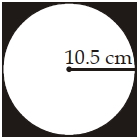
What is the area of the shaded portion if each side of the square measures $21\,cm$? (in $cm^2$)
A
$86.5$
B
$102$
C
$94.5$
D
$81.5$
Solution
(C) The area of the shaded portion is calculated by subtracting the area of the circle from the area of the square.
Given,side of the square $(a)$ $= 21\,cm$.
Radius of the circle $(r)$ $= 10.5\,cm$.
Area of the square $= a^2 = 21 \times 21 = 441\,cm^2$.
Area of the circle $= \pi r^2 = \frac{22}{7} \times 10.5 \times 10.5 = 22 \times 1.5 \times 10.5 = 346.5\,cm^2$.
Area of the shaded portion $= 441 - 346.5 = 94.5\,cm^2$.
Given,side of the square $(a)$ $= 21\,cm$.
Radius of the circle $(r)$ $= 10.5\,cm$.
Area of the square $= a^2 = 21 \times 21 = 441\,cm^2$.
Area of the circle $= \pi r^2 = \frac{22}{7} \times 10.5 \times 10.5 = 22 \times 1.5 \times 10.5 = 346.5\,cm^2$.
Area of the shaded portion $= 441 - 346.5 = 94.5\,cm^2$.
0 likes
View Solution76
DifficultMCQ
$A$ circle is inscribed in an equilateral triangle of side $8 \text{ cm}$. The area of the portion between the triangle and the circle is ...... $\text{cm}^2$.
A
$11$
B
$10.95$
C
$10$
D
$10.50$
Solution
(B) The side length of the equilateral triangle is $a = 8 \text{ cm}$.
The inradius $r$ of an equilateral triangle is given by the formula $r = \frac{a}{2\sqrt{3}}$.
Substituting the value of $a$,we get $r = \frac{8}{2\sqrt{3}} = \frac{4}{\sqrt{3}} \text{ cm}$.
The area of the incircle is $A_c = \pi r^2 = \pi \left( \frac{4}{\sqrt{3}} \right)^2 = \pi \times \frac{16}{3} \text{ cm}^2$.
The area of the equilateral triangle is $A_t = \frac{\sqrt{3}}{4} a^2 = \frac{\sqrt{3}}{4} (8)^2 = \frac{\sqrt{3}}{4} \times 64 = 16\sqrt{3} \text{ cm}^2$.
The area of the portion between the triangle and the circle is $A = A_t - A_c = 16\sqrt{3} - \frac{16\pi}{3}$.
Using $\sqrt{3} \approx 1.732$ and $\pi \approx 3.14159$:
$A = 16(1.732) - \frac{16(3.14159)}{3} \approx 27.712 - 16.755 = 10.957 \text{ cm}^2$.
Rounding to two decimal places,the area is approximately $10.95 \text{ cm}^2$.
The inradius $r$ of an equilateral triangle is given by the formula $r = \frac{a}{2\sqrt{3}}$.
Substituting the value of $a$,we get $r = \frac{8}{2\sqrt{3}} = \frac{4}{\sqrt{3}} \text{ cm}$.
The area of the incircle is $A_c = \pi r^2 = \pi \left( \frac{4}{\sqrt{3}} \right)^2 = \pi \times \frac{16}{3} \text{ cm}^2$.
The area of the equilateral triangle is $A_t = \frac{\sqrt{3}}{4} a^2 = \frac{\sqrt{3}}{4} (8)^2 = \frac{\sqrt{3}}{4} \times 64 = 16\sqrt{3} \text{ cm}^2$.
The area of the portion between the triangle and the circle is $A = A_t - A_c = 16\sqrt{3} - \frac{16\pi}{3}$.
Using $\sqrt{3} \approx 1.732$ and $\pi \approx 3.14159$:
$A = 16(1.732) - \frac{16(3.14159)}{3} \approx 27.712 - 16.755 = 10.957 \text{ cm}^2$.
Rounding to two decimal places,the area is approximately $10.95 \text{ cm}^2$.
0 likes
View Solution77
DifficultMCQ
Mid-points of a triangle containing sides $12 \, cm$,$18 \, cm$,and $26 \, cm$ are joined to each other. Find the area of the triangle formed by joining the mid-points.
A
$4 \sqrt{5} \, cm^2$
B
$2 \sqrt{7} \, cm^2$
C
$4 \sqrt{35} \, cm^2$
D
$8 \sqrt{35} \, cm^2$
Solution
(C) The semi-perimeter $(s)$ of the given triangle with sides $a = 12 \, cm$,$b = 18 \, cm$,and $c = 26 \, cm$ is calculated as:
$s = \frac{12 + 18 + 26}{2} = \frac{56}{2} = 28 \, cm$.
Using Heron's formula,the area of the triangle is:
Area $= \sqrt{s(s-a)(s-b)(s-c)} = \sqrt{28(28-12)(28-18)(28-26)}$
Area $= \sqrt{28 \times 16 \times 10 \times 2} = \sqrt{8960} = \sqrt{256 \times 35} = 16 \sqrt{35} \, cm^2$.
The triangle formed by joining the mid-points of the sides of a triangle has an area equal to one-fourth of the area of the original triangle.
Area of the new triangle $= \frac{1}{4} \times 16 \sqrt{35} = 4 \sqrt{35} \, cm^2$.
$s = \frac{12 + 18 + 26}{2} = \frac{56}{2} = 28 \, cm$.
Using Heron's formula,the area of the triangle is:
Area $= \sqrt{s(s-a)(s-b)(s-c)} = \sqrt{28(28-12)(28-18)(28-26)}$
Area $= \sqrt{28 \times 16 \times 10 \times 2} = \sqrt{8960} = \sqrt{256 \times 35} = 16 \sqrt{35} \, cm^2$.
The triangle formed by joining the mid-points of the sides of a triangle has an area equal to one-fourth of the area of the original triangle.
Area of the new triangle $= \frac{1}{4} \times 16 \sqrt{35} = 4 \sqrt{35} \, cm^2$.
0 likes
View Solution78
MediumMCQ
An oblong piece of ground measures $19$ $meters$ $2.5$ $dm$ by $12$ $meters$ $5$ $dm$. From the centre of each side,a path $2$ $meters$ wide goes across to the centre of the opposite side. Find the cost of paving these paths at the rate of $Rs.$ $12.32$ per $sq$ $meter$. (in $Rs.$)
A
$7430.68$
B
$713.04$
C
$753.26$
D
$733.04$
Solution
(D) The dimensions of the ground are $19.25$ $m$ and $12.5$ $m$ (since $1$ $dm = 0.1$ $m$).
There are two paths: one parallel to the length and one parallel to the width.
The area of the path parallel to the length is $19.25 \times 2 = 38.5$ $m^2$.
The area of the path parallel to the width is $12.5 \times 2 = 25$ $m^2$.
The intersection of these two paths is a square of side $2$ $m$,which has been counted twice. Its area is $2 \times 2 = 4$ $m^2$.
Total area of the paths $= 38.5 + 25 - 4 = 59.5$ $m^2$.
Cost of paving $= 59.5 \times 12.32 = Rs. 733.04$.
There are two paths: one parallel to the length and one parallel to the width.
The area of the path parallel to the length is $19.25 \times 2 = 38.5$ $m^2$.
The area of the path parallel to the width is $12.5 \times 2 = 25$ $m^2$.
The intersection of these two paths is a square of side $2$ $m$,which has been counted twice. Its area is $2 \times 2 = 4$ $m^2$.
Total area of the paths $= 38.5 + 25 - 4 = 59.5$ $m^2$.
Cost of paving $= 59.5 \times 12.32 = Rs. 733.04$.
0 likes
View Solution79
MediumMCQ
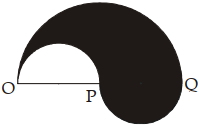
In the given figure,$OP = PQ = 14 \, cm$ and semicircles are drawn on $OP$,$PQ$,and $OQ$ as diameters. Then,the perimeter of the shaded area is . . . . . . $cm$.
A
$88$
B
$176$
C
$264$
D
$352$
Solution
(A) Given: $OP = 14 \, cm$ and $PQ = 14 \, cm$. Therefore,$OQ = OP + PQ = 14 + 14 = 28 \, cm$.
The shaded region is bounded by three semicircular arcs:
$1$. The arc of the semicircle with diameter $OQ$ (length = $\frac{1}{2} \pi \times 28 = 14\pi \, cm$).
$2$. The arc of the semicircle with diameter $OP$ (length = $\frac{1}{2} \pi \times 14 = 7\pi \, cm$).
$3$. The arc of the semicircle with diameter $PQ$ (length = $\frac{1}{2} \pi \times 14 = 7\pi \, cm$).
The perimeter of the shaded area is the sum of the lengths of these three arcs:
Perimeter = $14\pi + 7\pi + 7\pi = 28\pi \, cm$.
Using $\pi = \frac{22}{7}$,we get:
Perimeter = $28 \times \frac{22}{7} = 4 \times 22 = 88 \, cm$.
The shaded region is bounded by three semicircular arcs:
$1$. The arc of the semicircle with diameter $OQ$ (length = $\frac{1}{2} \pi \times 28 = 14\pi \, cm$).
$2$. The arc of the semicircle with diameter $OP$ (length = $\frac{1}{2} \pi \times 14 = 7\pi \, cm$).
$3$. The arc of the semicircle with diameter $PQ$ (length = $\frac{1}{2} \pi \times 14 = 7\pi \, cm$).
The perimeter of the shaded area is the sum of the lengths of these three arcs:
Perimeter = $14\pi + 7\pi + 7\pi = 28\pi \, cm$.
Using $\pi = \frac{22}{7}$,we get:
Perimeter = $28 \times \frac{22}{7} = 4 \times 22 = 88 \, cm$.
0 likes
View Solution80
MediumMCQ
The circumference of a circular field is $440 \, m$. $A$ circular path of $10 \, m$ width runs around the outside of the field. Find the cost of gravelling the path at the rate of $70 \, \text{paise}$ per square metre? (in $Rs.$)
A
$2200$
B
$3300$
C
$264$
D
Cannot be determined
Solution
(B) The circumference of the circular field is $2 \pi r = 440 \, m$.
$2 \times \frac{22}{7} \times r = 440 \, m \Rightarrow r = 70 \, m$.
The width of the path is $10 \, m$.
The radius of the outer circle is $R = r + 10 = 70 + 10 = 80 \, m$.
The area of the path is $\pi(R^2 - r^2) = \frac{22}{7} \times (80^2 - 70^2) = \frac{22}{7} \times (6400 - 4900) = \frac{22}{7} \times 1500 \, m^2$.
The rate of gravelling is $70 \, \text{paise} = 0.70 \, Rs. / m^2$.
The total cost $= \text{Area} \times \text{Rate} = \frac{22}{7} \times 1500 \times 0.70 = 22 \times 1500 \times 0.1 = 3300 \, Rs.$
$2 \times \frac{22}{7} \times r = 440 \, m \Rightarrow r = 70 \, m$.
The width of the path is $10 \, m$.
The radius of the outer circle is $R = r + 10 = 70 + 10 = 80 \, m$.
The area of the path is $\pi(R^2 - r^2) = \frac{22}{7} \times (80^2 - 70^2) = \frac{22}{7} \times (6400 - 4900) = \frac{22}{7} \times 1500 \, m^2$.
The rate of gravelling is $70 \, \text{paise} = 0.70 \, Rs. / m^2$.
The total cost $= \text{Area} \times \text{Rate} = \frac{22}{7} \times 1500 \times 0.70 = 22 \times 1500 \times 0.1 = 3300 \, Rs.$
0 likes
View Solution81
MediumMCQ
$A$ rectangular field costs $Rs. 110$ for levelling at $50$ $paise$ per square metre. If the ratio of length to breadth is $11: 5$, find the length of the field (in $m$).
A
$16$
B
$21$
C
$22$
D
$23$
Solution
(C) The ratio of length to breadth is $11: 5$.
Let the length be $11x$ and the breadth be $5x$.
The cost of levelling is $Rs. 110$ at a rate of $50$ $paise$ (or $Rs. 0.50$) per square metre.
Area of the rectangular field $= \frac{\text{Total Cost}}{\text{Rate}} = \frac{110}{0.50} = 220 \text{ m}^2$.
Since Area $= \text{length} \times \text{breadth}$, we have $11x \times 5x = 220$.
$55x^2 = 220$.
$x^2 = \frac{220}{55} = 4$.
$x = 2$.
Therefore, the length of the field $= 11x = 11 \times 2 = 22 \text{ m}$.
Let the length be $11x$ and the breadth be $5x$.
The cost of levelling is $Rs. 110$ at a rate of $50$ $paise$ (or $Rs. 0.50$) per square metre.
Area of the rectangular field $= \frac{\text{Total Cost}}{\text{Rate}} = \frac{110}{0.50} = 220 \text{ m}^2$.
Since Area $= \text{length} \times \text{breadth}$, we have $11x \times 5x = 220$.
$55x^2 = 220$.
$x^2 = \frac{220}{55} = 4$.
$x = 2$.
Therefore, the length of the field $= 11x = 11 \times 2 = 22 \text{ m}$.
0 likes
View Solution82
DifficultMCQ
The length of a rectangular plot of ground is four times its breadth and its area is $4$ hectares. How long will it take for a dog to walk around it at the rate of $3\, km/hr$? (in $min$)
A
$12$
B
$20$
C
$21$
D
$18.5$
Solution
(B) Let the breadth of the rectangular plot be $x\, m$.
Then,the length of the plot is $4x\, m$.
Given that the area is $4$ hectares. Since $1\, \text{hectare} = 10,000\, m^2$,the area is $40,000\, m^2$.
Area $= \text{length} \times \text{breadth} = 4x \times x = 4x^2$.
So,$4x^2 = 40,000$,which implies $x^2 = 10,000$,so $x = 100\, m$.
Thus,the breadth is $100\, m$ and the length is $400\, m$.
The perimeter of the rectangular plot $= 2 \times (\text{length} + \text{breadth}) = 2 \times (400 + 100) = 2 \times 500 = 1,000\, m = 1\, km$.
The speed of the dog is $3\, km/hr$.
Time taken $= \frac{\text{Distance}}{\text{Speed}} = \frac{1\, km}{3\, km/hr} = \frac{1}{3}\, \text{hours}$.
Since $1\, \text{hour} = 60\, \text{minutes}$,the time taken $= \frac{1}{3} \times 60 = 20\, \text{minutes}$.
Then,the length of the plot is $4x\, m$.
Given that the area is $4$ hectares. Since $1\, \text{hectare} = 10,000\, m^2$,the area is $40,000\, m^2$.
Area $= \text{length} \times \text{breadth} = 4x \times x = 4x^2$.
So,$4x^2 = 40,000$,which implies $x^2 = 10,000$,so $x = 100\, m$.
Thus,the breadth is $100\, m$ and the length is $400\, m$.
The perimeter of the rectangular plot $= 2 \times (\text{length} + \text{breadth}) = 2 \times (400 + 100) = 2 \times 500 = 1,000\, m = 1\, km$.
The speed of the dog is $3\, km/hr$.
Time taken $= \frac{\text{Distance}}{\text{Speed}} = \frac{1\, km}{3\, km/hr} = \frac{1}{3}\, \text{hours}$.
Since $1\, \text{hour} = 60\, \text{minutes}$,the time taken $= \frac{1}{3} \times 60 = 20\, \text{minutes}$.
0 likes
View Solution83
MediumMCQ
$A$ rectangular garden $63 \ m$ long and $54 \ m$ broad has a path $3 \ m$ wide inside it. Find the cost of paving the path at $Rs. 37/2$ per square metre (in $Rs.$).
A
$12321$
B
$11100$
C
$74000$
D
$12301$
Solution
(A) The length of the outer rectangle is $L = 63 \ m$ and the breadth is $B = 54 \ m$.
The area of the outer rectangle is $63 \times 54 = 3402 \ m^2$.
Since the path is $3 \ m$ wide inside,the length of the inner rectangle is $l = 63 - (2 \times 3) = 63 - 6 = 57 \ m$.
The breadth of the inner rectangle is $b = 54 - (2 \times 3) = 54 - 6 = 48 \ m$.
The area of the inner rectangle is $57 \times 48 = 2736 \ m^2$.
The area of the path is the difference between the outer and inner areas: $3402 - 2736 = 666 \ m^2$.
The cost of paving the path is given by $\text{Area} \times \text{Rate} = 666 \times \frac{37}{2} = 333 \times 37 = 12321 \ Rs.$
The area of the outer rectangle is $63 \times 54 = 3402 \ m^2$.
Since the path is $3 \ m$ wide inside,the length of the inner rectangle is $l = 63 - (2 \times 3) = 63 - 6 = 57 \ m$.
The breadth of the inner rectangle is $b = 54 - (2 \times 3) = 54 - 6 = 48 \ m$.
The area of the inner rectangle is $57 \times 48 = 2736 \ m^2$.
The area of the path is the difference between the outer and inner areas: $3402 - 2736 = 666 \ m^2$.
The cost of paving the path is given by $\text{Area} \times \text{Rate} = 666 \times \frac{37}{2} = 333 \times 37 = 12321 \ Rs.$
0 likes
View Solution84
EasyMCQ
$A$ drawing room is $7.5 \text{ m}$ long,$6.5 \text{ m}$ broad,and $6 \text{ m}$ high. Find the length of paper $2.5 \text{ dm}$ wide required to cover its walls,allowing $8 \text{ m}^2$ for doors.
A
$368$
B
$640$
C
$625$
D
$888$
Solution
(B) The dimensions of the room are: length $(l) = 7.5 \text{ m}$,breadth $(b) = 6.5 \text{ m}$,and height $(h) = 6 \text{ m}$.
Area of the four walls $= 2(l + b) \times h = 2(7.5 + 6.5) \times 6 = 2(14) \times 6 = 168 \text{ m}^2$.
Area to be covered by paper $=$ Total area of walls $-$ Area of doors $= 168 \text{ m}^2 - 8 \text{ m}^2 = 160 \text{ m}^2$.
Width of the paper $= 2.5 \text{ dm} = 0.25 \text{ m}$.
Length of the paper $= \frac{\text{Area to be covered}}{\text{Width of paper}} = \frac{160}{0.25} = 640 \text{ m}$.
Area of the four walls $= 2(l + b) \times h = 2(7.5 + 6.5) \times 6 = 2(14) \times 6 = 168 \text{ m}^2$.
Area to be covered by paper $=$ Total area of walls $-$ Area of doors $= 168 \text{ m}^2 - 8 \text{ m}^2 = 160 \text{ m}^2$.
Width of the paper $= 2.5 \text{ dm} = 0.25 \text{ m}$.
Length of the paper $= \frac{\text{Area to be covered}}{\text{Width of paper}} = \frac{160}{0.25} = 640 \text{ m}$.
0 likes
View Solution85
MediumMCQ
The area of a rectangular football field is $24200 \ m^2$. Its breadth is half of its length. What is the approximate minimum distance a man will cover if he wishes to go from one corner to the opposite corner? (in $m$)
A
$283$
B
$246$
C
$576$
D
$289$
Solution
(B) Let the length of the field be $L$ and the breadth be $B$.
Given that $B = L / 2$,or $L = 2B$.
The area of the rectangle is $L \times B = 24200 \ m^2$.
Substituting $L = 2B$,we get $(2B) \times B = 24200$,which simplifies to $2B^2 = 24200$.
Dividing by $2$,we get $B^2 = 12100$,so $B = \sqrt{12100} = 110 \ m$.
Then,the length $L = 2 \times 110 = 220 \ m$.
The minimum distance between opposite corners is the diagonal of the rectangle,given by $d = \sqrt{L^2 + B^2}$.
$d = \sqrt{220^2 + 110^2} = \sqrt{48400 + 12100} = \sqrt{60500}$.
$d = 110 \times \sqrt{5} \approx 110 \times 2.236 = 245.96 \ m$.
Rounding to the nearest whole number,the distance is approximately $246 \ m$.
Given that $B = L / 2$,or $L = 2B$.
The area of the rectangle is $L \times B = 24200 \ m^2$.
Substituting $L = 2B$,we get $(2B) \times B = 24200$,which simplifies to $2B^2 = 24200$.
Dividing by $2$,we get $B^2 = 12100$,so $B = \sqrt{12100} = 110 \ m$.
Then,the length $L = 2 \times 110 = 220 \ m$.
The minimum distance between opposite corners is the diagonal of the rectangle,given by $d = \sqrt{L^2 + B^2}$.
$d = \sqrt{220^2 + 110^2} = \sqrt{48400 + 12100} = \sqrt{60500}$.
$d = 110 \times \sqrt{5} \approx 110 \times 2.236 = 245.96 \ m$.
Rounding to the nearest whole number,the distance is approximately $246 \ m$.
0 likes
View Solution86
MediumMCQ
How many cubes of edge $3\, cm$ can be cut out of a wooden cube of edge $9\, cm$?
A
$216$
B
$81$
C
$27$
D
Can't be determined
Solution
(C) The volume of the larger cube with edge $9\, cm$ is $V_1 = 9^3 = 729\, cm^3$.
The volume of the smaller cube with edge $3\, cm$ is $V_2 = 3^3 = 27\, cm^3$.
The number of smaller cubes that can be cut out is given by the ratio of the volumes:
Number of cubes $= \frac{V_1}{V_2} = \frac{729}{27} = 27$.
The volume of the smaller cube with edge $3\, cm$ is $V_2 = 3^3 = 27\, cm^3$.
The number of smaller cubes that can be cut out is given by the ratio of the volumes:
Number of cubes $= \frac{V_1}{V_2} = \frac{729}{27} = 27$.
0 likes
View Solution87
MediumMCQ
$A$ sphere of $30 \ cm$ radius is dropped into a cylindrical vessel of $80 \ cm$ diameter,which is partly filled with water. If its level rises by $x \ cm$,find $x$ (in $cm$). (in $.5$)
A
$27$
B
$22$
C
$18$
D
$21$
Solution
(B) The volume of water displaced is equal to the volume of the sphere submerged in the water.
Radius of the sphere $(r_s)$ = $30 \ cm$.
Radius of the cylindrical vessel $(r_c)$ = $\text{Diameter} / 2 = 80 \ cm / 2 = 40 \ cm$.
Let the rise in water level be $x \ cm$.
The volume of the displaced water in the cylinder is given by $\pi \times (r_c)^2 \times x$.
The volume of the sphere is given by $\frac{4}{3} \pi \times (r_s)^3$.
Equating the two volumes: $\pi \times (40)^2 \times x = \frac{4}{3} \pi \times (30)^3$.
$1600 \times x = \frac{4}{3} \times 27000$.
$1600 \times x = 4 \times 9000$.
$1600 \times x = 36000$.
$x = 36000 / 1600 = 360 / 16 = 22.5 \ cm$.
Thus,the level of water rises by $22.5 \ cm$.
Radius of the sphere $(r_s)$ = $30 \ cm$.
Radius of the cylindrical vessel $(r_c)$ = $\text{Diameter} / 2 = 80 \ cm / 2 = 40 \ cm$.
Let the rise in water level be $x \ cm$.
The volume of the displaced water in the cylinder is given by $\pi \times (r_c)^2 \times x$.
The volume of the sphere is given by $\frac{4}{3} \pi \times (r_s)^3$.
Equating the two volumes: $\pi \times (40)^2 \times x = \frac{4}{3} \pi \times (30)^3$.
$1600 \times x = \frac{4}{3} \times 27000$.
$1600 \times x = 4 \times 9000$.
$1600 \times x = 36000$.
$x = 36000 / 1600 = 360 / 16 = 22.5 \ cm$.
Thus,the level of water rises by $22.5 \ cm$.
0 likes
View Solution88
MediumMCQ
Around a circular garden,a circular road is to be repaired which costs $Rs. 22176$ at the rate of $Rs. 1$ per $sq. m$. If the inner radius is $112$ $m$,find the width of the circular road in $m$.
A
$18$
B
$28$
C
$14$
D
$26$
Solution
(B) The total cost of repairing the road is $Rs. 22176$ at a rate of $Rs. 1$ per $sq. m$.
Therefore,the area of the circular road is $\frac{22176}{1} = 22176 \ m^2$.
Let the inner radius be $r = 112 \ m$ and the outer radius be $R$.
The area of the circular road is given by $\pi(R^2 - r^2) = 22176$.
Substituting the values: $\frac{22}{7} \times (R^2 - 112^2) = 22176$.
$R^2 - 12544 = 22176 \times \frac{7}{22}$.
$R^2 - 12544 = 1008 \times 7 = 7056$.
$R^2 = 7056 + 12544 = 19600$.
$R = \sqrt{19600} = 140 \ m$.
The width of the road is $R - r = 140 - 112 = 28 \ m$.
Therefore,the area of the circular road is $\frac{22176}{1} = 22176 \ m^2$.
Let the inner radius be $r = 112 \ m$ and the outer radius be $R$.
The area of the circular road is given by $\pi(R^2 - r^2) = 22176$.
Substituting the values: $\frac{22}{7} \times (R^2 - 112^2) = 22176$.
$R^2 - 12544 = 22176 \times \frac{7}{22}$.
$R^2 - 12544 = 1008 \times 7 = 7056$.
$R^2 = 7056 + 12544 = 19600$.
$R = \sqrt{19600} = 140 \ m$.
The width of the road is $R - r = 140 - 112 = 28 \ m$.
0 likes
View Solution89
MediumMCQ
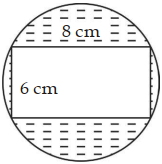
In the adjacent figure,find the area of the shaded region in $cm^2$. (Use $\pi = 22/7$)
A
$15.28$
B
$61.14$
C
$30.57$
D
$40.76$
Solution
(C) The rectangle is inscribed in the circle. The diagonal of the rectangle is equal to the diameter of the circle.
Diagonal of the rectangle $= \sqrt{6^2 + 8^2} = \sqrt{36 + 64} = \sqrt{100} = 10 \ cm$.
Therefore,the diameter of the circle $= 10 \ cm$,and the radius $r = 10/2 = 5 \ cm$.
Area of the circle $= \pi r^2 = (22/7) \times 5 \times 5 = 550/7 \approx 78.57 \ cm^2$.
Area of the rectangle $= \text{length} \times \text{breadth} = 8 \times 6 = 48 \ cm^2$.
Area of the shaded region $= \text{Area of the circle} - \text{Area of the rectangle} = 78.57 - 48 = 30.57 \ cm^2$.
Diagonal of the rectangle $= \sqrt{6^2 + 8^2} = \sqrt{36 + 64} = \sqrt{100} = 10 \ cm$.
Therefore,the diameter of the circle $= 10 \ cm$,and the radius $r = 10/2 = 5 \ cm$.
Area of the circle $= \pi r^2 = (22/7) \times 5 \times 5 = 550/7 \approx 78.57 \ cm^2$.
Area of the rectangle $= \text{length} \times \text{breadth} = 8 \times 6 = 48 \ cm^2$.
Area of the shaded region $= \text{Area of the circle} - \text{Area of the rectangle} = 78.57 - 48 = 30.57 \ cm^2$.
0 likes
View Solution90
EasyMCQ
$A$ wire is looped in the form of a circle of radius $28\, cm$. It is bent again into a square form. What will be the length of the diagonal of the largest square possible thus?
A
$44\, cm$
B
$44 \sqrt{2}\, cm$
C
$88\, cm$
D
$22 \sqrt{2}\, cm$
Solution
(B) The perimeter of the circle is equal to the circumference,which is $2 \pi r$.
Given $r = 28\, cm$,the circumference is $2 \times \frac{22}{7} \times 28 = 176\, cm$.
Since the wire is bent into a square,the perimeter of the square is equal to the circumference of the circle.
Let $a$ be the side of the square. Then $4a = 176\, cm$,which gives $a = 44\, cm$.
The diagonal of a square is given by the formula $d = a \sqrt{2}$.
Substituting the value of $a$,we get $d = 44 \sqrt{2}\, cm$.
Given $r = 28\, cm$,the circumference is $2 \times \frac{22}{7} \times 28 = 176\, cm$.
Since the wire is bent into a square,the perimeter of the square is equal to the circumference of the circle.
Let $a$ be the side of the square. Then $4a = 176\, cm$,which gives $a = 44\, cm$.
The diagonal of a square is given by the formula $d = a \sqrt{2}$.
Substituting the value of $a$,we get $d = 44 \sqrt{2}\, cm$.
0 likes
View Solution91
EasyMCQ
In a right-angled triangle,find the hypotenuse if the base and perpendicular are respectively $36015 \ cm$ and $48020 \ cm$.
A
$69125$
B
$60025$
C
$391025$
D
$60125$
Solution
(B) According to the Pythagorean theorem,in a right-angled triangle,the square of the hypotenuse is equal to the sum of the squares of the other two sides.
Let the base $b = 36015 \ cm$ and the perpendicular $p = 48020 \ cm$.
Hypotenuse $h = \sqrt{b^2 + p^2}$.
$h = \sqrt{(36015)^2 + (48020)^2}$.
We can simplify this by taking out common factors: $36015 = 12005 \times 3$ and $48020 = 12005 \times 4$.
So,$h = \sqrt{(12005 \times 3)^2 + (12005 \times 4)^2} = 12005 \times \sqrt{3^2 + 4^2}$.
$h = 12005 \times \sqrt{9 + 16} = 12005 \times \sqrt{25} = 12005 \times 5$.
$h = 60025 \ cm$.
Let the base $b = 36015 \ cm$ and the perpendicular $p = 48020 \ cm$.
Hypotenuse $h = \sqrt{b^2 + p^2}$.
$h = \sqrt{(36015)^2 + (48020)^2}$.
We can simplify this by taking out common factors: $36015 = 12005 \times 3$ and $48020 = 12005 \times 4$.
So,$h = \sqrt{(12005 \times 3)^2 + (12005 \times 4)^2} = 12005 \times \sqrt{3^2 + 4^2}$.
$h = 12005 \times \sqrt{9 + 16} = 12005 \times \sqrt{25} = 12005 \times 5$.
$h = 60025 \ cm$.
0 likes
View Solution92
MediumMCQ
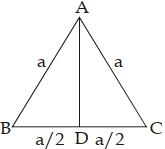
The perimeter of an equilateral triangle is $72 \sqrt{3} \text{ cm}$. Find its height in meters.
A
$0.36$
B
$0.63$
C
$0.18$
D
$0.24$
Solution
(A) Let the side of the equilateral triangle be $a$.
Perimeter of the equilateral triangle $= 3a$.
Given,$3a = 72 \sqrt{3} \text{ cm}$.
Therefore,$a = 24 \sqrt{3} \text{ cm}$.
The height $h$ of an equilateral triangle is given by the formula $h = \frac{\sqrt{3}}{2} a$.
Substituting the value of $a$:
$h = \frac{\sqrt{3}}{2} \times (24 \sqrt{3}) \text{ cm}$.
$h = \frac{3}{2} \times 24 \text{ cm} = 36 \text{ cm}$.
To convert the height into meters,divide by $100$:
$h = \frac{36}{100} \text{ m} = 0.36 \text{ m}$.
Perimeter of the equilateral triangle $= 3a$.
Given,$3a = 72 \sqrt{3} \text{ cm}$.
Therefore,$a = 24 \sqrt{3} \text{ cm}$.
The height $h$ of an equilateral triangle is given by the formula $h = \frac{\sqrt{3}}{2} a$.
Substituting the value of $a$:
$h = \frac{\sqrt{3}}{2} \times (24 \sqrt{3}) \text{ cm}$.
$h = \frac{3}{2} \times 24 \text{ cm} = 36 \text{ cm}$.
To convert the height into meters,divide by $100$:
$h = \frac{36}{100} \text{ m} = 0.36 \text{ m}$.
0 likes
View Solution93
MediumMCQ
The inner circumference of a circular track is $440 \, cm$. The track is $14 \, cm$ wide. Find the diameter of the outer circle of the track? (in $cm$)
A
$84$
B
$168$
C
$336$
D
$77$
Solution
(B) Let the radius of the inner circle be $r$ and the radius of the outer circle be $R$.
Given,inner circumference $= 2 \pi r = 440 \, cm$.
Using $\pi = \frac{22}{7}$,we have $2 \times \frac{22}{7} \times r = 440$.
$r = \frac{440 \times 7}{44} = 70 \, cm$.
The track is $14 \, cm$ wide,so the outer radius $R = r + 14 = 70 + 14 = 84 \, cm$.
The diameter of the outer circle is $D = 2R = 2 \times 84 = 168 \, cm$.
Given,inner circumference $= 2 \pi r = 440 \, cm$.
Using $\pi = \frac{22}{7}$,we have $2 \times \frac{22}{7} \times r = 440$.
$r = \frac{440 \times 7}{44} = 70 \, cm$.
The track is $14 \, cm$ wide,so the outer radius $R = r + 14 = 70 + 14 = 84 \, cm$.
The diameter of the outer circle is $D = 2R = 2 \times 84 = 168 \, cm$.
0 likes
View Solution94
EasyMCQ
The volume of a cube is $216 \, cm^3$. Part of this cube is then melted to form a cylinder of length $8 \, cm$. Find the volume of the cylinder (in $cm^3$)?
A
$342$
B
$216$
C
$36$
D
Data inadequate
Solution
(D) The volume of the cube is given as $216 \, cm^3$.
It is stated that a 'part' of this cube is melted to form a cylinder.
The term 'part' is ambiguous and does not specify what fraction or volume of the cube was used.
Since the exact volume of the material used to form the cylinder is not provided,the volume of the cylinder cannot be determined.
Therefore,the data is inadequate.
It is stated that a 'part' of this cube is melted to form a cylinder.
The term 'part' is ambiguous and does not specify what fraction or volume of the cube was used.
Since the exact volume of the material used to form the cylinder is not provided,the volume of the cylinder cannot be determined.
Therefore,the data is inadequate.
0 likes
View Solution95
EasyMCQ
Three metal cubes with edges $6\, cm$,$8\, cm$,and $10\, cm$ respectively are melted together and formed into a single cube. Find the side of the resulting cube (in $cm$).
A
$11$
B
$12$
C
$13$
D
$24$
Solution
(B) The volume of a cube with side $a$ is given by $V = a^3$.
The volumes of the three given cubes are:
$V_1 = (6\, cm)^3 = 216\, cm^3$
$V_2 = (8\, cm)^3 = 512\, cm^3$
$V_3 = (10\, cm)^3 = 1000\, cm^3$
When these cubes are melted together,the total volume $V_{total}$ of the new cube is the sum of the individual volumes:
$V_{total} = V_1 + V_2 + V_3 = 216 + 512 + 1000 = 1728\, cm^3$
Let the side of the new cube be $a$. Then:
$a^3 = 1728$
$a = \sqrt[3]{1728}$
$a = 12\, cm$
Thus,the side of the resulting cube is $12\, cm$.
The volumes of the three given cubes are:
$V_1 = (6\, cm)^3 = 216\, cm^3$
$V_2 = (8\, cm)^3 = 512\, cm^3$
$V_3 = (10\, cm)^3 = 1000\, cm^3$
When these cubes are melted together,the total volume $V_{total}$ of the new cube is the sum of the individual volumes:
$V_{total} = V_1 + V_2 + V_3 = 216 + 512 + 1000 = 1728\, cm^3$
Let the side of the new cube be $a$. Then:
$a^3 = 1728$
$a = \sqrt[3]{1728}$
$a = 12\, cm$
Thus,the side of the resulting cube is $12\, cm$.
0 likes
View Solution96
MediumMCQ
Find the curved and total surface area of a conical flask of radius $6\, cm$ and height $8\, cm$.
A
$60\, \pi,\, 96\, \pi$
B
$20\, \pi,\, 96\, \pi$
C
$60\, \pi,\, 48\, \pi$
D
$30\, \pi,\, 48\, \pi$
Solution
(A) Given: Radius $(r) = 6\, cm$,Height $(h) = 8\, cm$.
First,calculate the slant height $(l)$ using the formula $l = \sqrt{r^2 + h^2}$.
$l = \sqrt{6^2 + 8^2} = \sqrt{36 + 64} = \sqrt{100} = 10\, cm$.
Now,calculate the curved surface area $(CSA) = \pi r l$.
$CSA = \pi \times 6 \times 10 = 60\pi\, cm^2$.
Next,calculate the total surface area $(TSA) = \pi r l + \pi r^2$.
$TSA = 60\pi + \pi(6)^2 = 60\pi + 36\pi = 96\pi\, cm^2$.
Thus,the curved surface area is $60\pi\, cm^2$ and the total surface area is $96\pi\, cm^2$.
First,calculate the slant height $(l)$ using the formula $l = \sqrt{r^2 + h^2}$.
$l = \sqrt{6^2 + 8^2} = \sqrt{36 + 64} = \sqrt{100} = 10\, cm$.
Now,calculate the curved surface area $(CSA) = \pi r l$.
$CSA = \pi \times 6 \times 10 = 60\pi\, cm^2$.
Next,calculate the total surface area $(TSA) = \pi r l + \pi r^2$.
$TSA = 60\pi + \pi(6)^2 = 60\pi + 36\pi = 96\pi\, cm^2$.
Thus,the curved surface area is $60\pi\, cm^2$ and the total surface area is $96\pi\, cm^2$.
0 likes
View Solution97
MediumMCQ
$A$ silver wire when bent in the form of a square,encloses an area of $484 \, cm^{2}$. Now if the same wire is bent to form a circle,the area enclosed by the circle would be? (in $cm^{2}$)
A
$308$
B
$196$
C
$616$
D
$88$
Solution
(C) The perimeter of the wire remains constant regardless of the shape.
Let the side of the square be $a \, cm$.
Given,area of the square $= a^{2} = 484 \, cm^{2}$.
Therefore,$a = \sqrt{484} = 22 \, cm$.
Perimeter of the square $= 4a = 4 \times 22 = 88 \, cm$.
Since the same wire is used to form a circle,the circumference of the circle is equal to the perimeter of the square.
Let the radius of the circle be $r \, cm$.
Circumference $= 2\pi r = 88 \, cm$.
$2 \times \frac{22}{7} \times r = 88$.
$r = \frac{88 \times 7}{44} = 14 \, cm$.
Area of the circle $= \pi r^{2} = \frac{22}{7} \times 14 \times 14 = 22 \times 2 \times 14 = 616 \, cm^{2}$.
Let the side of the square be $a \, cm$.
Given,area of the square $= a^{2} = 484 \, cm^{2}$.
Therefore,$a = \sqrt{484} = 22 \, cm$.
Perimeter of the square $= 4a = 4 \times 22 = 88 \, cm$.
Since the same wire is used to form a circle,the circumference of the circle is equal to the perimeter of the square.
Let the radius of the circle be $r \, cm$.
Circumference $= 2\pi r = 88 \, cm$.
$2 \times \frac{22}{7} \times r = 88$.
$r = \frac{88 \times 7}{44} = 14 \, cm$.
Area of the circle $= \pi r^{2} = \frac{22}{7} \times 14 \times 14 = 22 \times 2 \times 14 = 616 \, cm^{2}$.
0 likes
View Solution98
MediumMCQ
How many metres of cloth $5\, m$ wide will be required to make a conical tent,the radius of whose base is $7\, m$ and height is $24\, m ?$ (in $m$)
A
$55$
B
$330$
C
$220$
D
$110$
Solution
(D) The slant height $l$ of the cone is given by $l = \sqrt{r^2 + h^2}$.
Given $r = 7\, m$ and $h = 24\, m$,we have $l = \sqrt{7^2 + 24^2} = \sqrt{49 + 576} = \sqrt{625} = 25\, m$.
The area of the cloth required is equal to the curved surface area of the cone,which is $\pi rl$.
Area $= \frac{22}{7} \times 7 \times 25 = 550\, m^2$.
Since the width of the cloth is $5\, m$,the length of the cloth required is $\frac{\text{Area}}{\text{Width}} = \frac{550}{5} = 110\, m$.
Given $r = 7\, m$ and $h = 24\, m$,we have $l = \sqrt{7^2 + 24^2} = \sqrt{49 + 576} = \sqrt{625} = 25\, m$.
The area of the cloth required is equal to the curved surface area of the cone,which is $\pi rl$.
Area $= \frac{22}{7} \times 7 \times 25 = 550\, m^2$.
Since the width of the cloth is $5\, m$,the length of the cloth required is $\frac{\text{Area}}{\text{Width}} = \frac{550}{5} = 110\, m$.
0 likes
View Solution99
MediumMCQ
Seven equal cubes each of side $5 \, cm$ are joined end to end. Find the surface area of the resulting cuboid? (in $cm^2$)
A
$750$
B
$1500$
C
$2250$
D
$700$
Solution
(A) When $7$ cubes of side $s = 5 \, cm$ are joined end to end,they form a cuboid.
The length $(l)$ of the resulting cuboid is $7 \times 5 \, cm = 35 \, cm$.
The breadth $(b)$ and height $(h)$ of the cuboid remain the same as the side of the cube,so $b = 5 \, cm$ and $h = 5 \, cm$.
The surface area of a cuboid is given by the formula: $SA = 2(lb + bh + hl)$.
Substituting the values: $SA = 2(35 \times 5 + 5 \times 5 + 5 \times 35)$.
$SA = 2(175 + 25 + 175)$.
$SA = 2(375) = 750 \, cm^2$.
The length $(l)$ of the resulting cuboid is $7 \times 5 \, cm = 35 \, cm$.
The breadth $(b)$ and height $(h)$ of the cuboid remain the same as the side of the cube,so $b = 5 \, cm$ and $h = 5 \, cm$.
The surface area of a cuboid is given by the formula: $SA = 2(lb + bh + hl)$.
Substituting the values: $SA = 2(35 \times 5 + 5 \times 5 + 5 \times 35)$.
$SA = 2(175 + 25 + 175)$.
$SA = 2(375) = 750 \, cm^2$.
0 likes
View Solution100
EasyMCQ
$A$ cuboid of dimension $24 \text{ cm} \times 9 \text{ cm} \times 8 \text{ cm}$ is melted and smaller cubes of side $3 \text{ cm}$ are formed. Find how many such cubes can be formed?
A
$27$
B
$64$
C
$54$
D
$32$
Solution
(B) The volume of the cuboid is given by $V_{\text{cuboid}} = \text{length} \times \text{breadth} \times \text{height} = 24 \text{ cm} \times 9 \text{ cm} \times 8 \text{ cm} = 1728 \text{ cm}^3$.
The volume of one smaller cube is given by $V_{\text{cube}} = \text{side}^3 = 3 \text{ cm} \times 3 \text{ cm} \times 3 \text{ cm} = 27 \text{ cm}^3$.
The number of cubes that can be formed is equal to the total volume of the cuboid divided by the volume of one cube.
$\text{Number of cubes} = \frac{V_{\text{cuboid}}}{V_{\text{cube}}} = \frac{24 \times 9 \times 8}{3 \times 3 \times 3} = \frac{1728}{27} = 64$.
The volume of one smaller cube is given by $V_{\text{cube}} = \text{side}^3 = 3 \text{ cm} \times 3 \text{ cm} \times 3 \text{ cm} = 27 \text{ cm}^3$.
The number of cubes that can be formed is equal to the total volume of the cuboid divided by the volume of one cube.
$\text{Number of cubes} = \frac{V_{\text{cuboid}}}{V_{\text{cube}}} = \frac{24 \times 9 \times 8}{3 \times 3 \times 3} = \frac{1728}{27} = 64$.
0 likes
View SolutionMensuration — Measurement of Area · Frequently Asked Questions
1Are these Mensuration questions useful for JEE and NEET?
Yes. All questions in this section are mapped to JEE Main and NEET exam patterns. Previous year questions from JEE Main, NEET, GUJCET and state-level exams are included with full solutions.
2Can I switch to Hindi or Gujarati for these questions?
Yes. Use the language tabs in the hero section or the sidebar to view the same questions and solutions in English, Hindi or Gujarati.
3How do I generate a question paper from this subtopic?
Use the Vedclass Exam Paper Generator — select the chapter and subtopic, set difficulty, and generate Sets A, B, C, D automatically. First 3 chapters of every subject are free.
Vedclass Products
For Students
Vedclass Test Series
Mock tests in real JEE/NEET style with performance analysis. 5-day free trial.
Start Free TrialFor Teachers
Exam Paper Generator
Generate Set A/B/C/D papers from this chapter in 2 minutes. 3 chapters free.
Try FreeFor Institutes
Online Exam Module
Live online exams with unlimited students, 360° analytics & white-label branding.
See DemoFor Teachers & Institutes
Generate a Mensuration Exam Paper in 2 Minutes
Select subtopic & difficulty — Sets A, B, C, D auto-generated with No Repeat logic.
First 3 chapters of every subject are free — no payment required.