
A English
Young's Double Slit Experiment (YDSE) Questions in English
Class 12 Physics · Wave Optics · Young's Double Slit Experiment (YDSE)
616+
Questions
English
Language
100%
With Solutions
Showing 50 of 616 questions in English
101
MediumMCQ
In a Young's double-slit experiment,interference is obtained using electron waves. The electrons are produced by an electron gun. To increase the fringe width,one must:
A
Increase the electron gun voltage.
B
Decrease the electron gun voltage.
C
Shift the slits.
D
Move the screen closer to the slits.
Solution
(B) The fringe width $\beta$ in a double-slit experiment is given by $\beta = \frac{\lambda D}{d}$.
According to the de Broglie hypothesis,the wavelength of an electron accelerated through a potential $V$ is $\lambda = \frac{h}{p} = \frac{h}{\sqrt{2mqV}}$.
Substituting this into the fringe width formula,we get $\beta = \frac{hD}{d\sqrt{2mqV}}$.
From this expression,it is clear that $\beta \propto \frac{1}{\sqrt{V}}$.
Therefore,to increase the fringe width $\beta$,the accelerating voltage $V$ must be decreased.
According to the de Broglie hypothesis,the wavelength of an electron accelerated through a potential $V$ is $\lambda = \frac{h}{p} = \frac{h}{\sqrt{2mqV}}$.
Substituting this into the fringe width formula,we get $\beta = \frac{hD}{d\sqrt{2mqV}}$.
From this expression,it is clear that $\beta \propto \frac{1}{\sqrt{V}}$.
Therefore,to increase the fringe width $\beta$,the accelerating voltage $V$ must be decreased.
0 likes
View Solution102
DifficultMCQ
In Young's double-slit experiment,the intensity at a point on the screen is $I_0/4$. Find the angular position of this point.
A
$\sin^{-1} \left( \frac{\lambda}{d} \right)$
B
$\sin^{-1} \left( \frac{\lambda}{2d} \right)$
C
$\sin^{-1} \left( \frac{\lambda}{3d} \right)$
D
$\sin^{-1} \left( \frac{\lambda}{4d} \right)$
Solution
(C) The intensity at any point on the screen is given by $I = I_0 \cos^2 \left( \frac{\delta}{2} \right)$,where $I_0$ is the maximum intensity and $\delta$ is the phase difference.
Given $I = \frac{I_0}{4}$,we have $\frac{I_0}{4} = I_0 \cos^2 \left( \frac{\delta}{2} \right)$.
$\cos^2 \left( \frac{\delta}{2} \right) = \frac{1}{4} \implies \cos \left( \frac{\delta}{2} \right) = \frac{1}{2}$.
$\frac{\delta}{2} = \frac{\pi}{3} \implies \delta = \frac{2\pi}{3}$.
The path difference $\Delta x$ is related to phase difference by $\delta = \frac{2\pi}{\lambda} \Delta x$.
$\frac{2\pi}{3} = \frac{2\pi}{\lambda} \Delta x \implies \Delta x = \frac{\lambda}{3}$.
For angular position $\theta$,the path difference is $\Delta x = d \sin \theta$.
$\frac{\lambda}{3} = d \sin \theta \implies \sin \theta = \frac{\lambda}{3d}$.
Therefore,$\theta = \sin^{-1} \left( \frac{\lambda}{3d} \right)$.
Given $I = \frac{I_0}{4}$,we have $\frac{I_0}{4} = I_0 \cos^2 \left( \frac{\delta}{2} \right)$.
$\cos^2 \left( \frac{\delta}{2} \right) = \frac{1}{4} \implies \cos \left( \frac{\delta}{2} \right) = \frac{1}{2}$.
$\frac{\delta}{2} = \frac{\pi}{3} \implies \delta = \frac{2\pi}{3}$.
The path difference $\Delta x$ is related to phase difference by $\delta = \frac{2\pi}{\lambda} \Delta x$.
$\frac{2\pi}{3} = \frac{2\pi}{\lambda} \Delta x \implies \Delta x = \frac{\lambda}{3}$.
For angular position $\theta$,the path difference is $\Delta x = d \sin \theta$.
$\frac{\lambda}{3} = d \sin \theta \implies \sin \theta = \frac{\lambda}{3d}$.
Therefore,$\theta = \sin^{-1} \left( \frac{\lambda}{3d} \right)$.
0 likes
View Solution103
MediumMCQ
In a Young's double-slit experiment,sodium light of wavelength $5890 \ \mathring A$ is used,and the angular width of the fringe is found to be $0.20^\circ$. If the angular width is to be increased by $10\%$,what is the required change in the wavelength?
A
Increase the wavelength by $589 \ \mathring A$.
B
Decrease the wavelength by $589 \ \mathring A$.
C
Increase the wavelength by $6479 \ \mathring A$.
D
No change in wavelength is required.
Solution
(A) The angular width of a fringe in Young's double-slit experiment is given by $\beta_\theta = \frac{\lambda}{d}$.
Since the angular width $\beta_\theta$ is directly proportional to the wavelength $\lambda$ (i.e.,$\beta_\theta \propto \lambda$),if the angular width is increased by $10\%$,the wavelength must also be increased by $10\%$.
Given initial wavelength $\lambda = 5890 \ \mathring A$.
The required change in wavelength $\Delta \lambda = 10\% \text{ of } \lambda = 5890 \times \frac{10}{100} = 589 \ \mathring A$.
Therefore,the wavelength should be increased by $589 \ \mathring A$.
Since the angular width $\beta_\theta$ is directly proportional to the wavelength $\lambda$ (i.e.,$\beta_\theta \propto \lambda$),if the angular width is increased by $10\%$,the wavelength must also be increased by $10\%$.
Given initial wavelength $\lambda = 5890 \ \mathring A$.
The required change in wavelength $\Delta \lambda = 10\% \text{ of } \lambda = 5890 \times \frac{10}{100} = 589 \ \mathring A$.
Therefore,the wavelength should be increased by $589 \ \mathring A$.
0 likes
View Solution104
DifficultMCQ
In a Young's double-slit experiment,the light beam consists of two wavelengths $6500 \, \mathring{A}$ and $5200 \, \mathring{A}$. The distance between the slits is $2 \, mm$ and the distance between the plane of the slits and the screen is $120 \, cm$. What is the minimum distance from the central maximum where the bright fringes of both wavelengths coincide (in $, cm$)?
A
$0.196$
B
$1.172$
C
$0.156$
D
$2.195$
Solution
(C) For the bright fringes to coincide,the position $x$ must be the same for both wavelengths:
$x = \frac{n_1 \lambda_1 D}{d} = \frac{n_2 \lambda_2 D}{d}$
This implies $n_1 \lambda_1 = n_2 \lambda_2$,where $n_1$ and $n_2$ are integers.
$\frac{n_1}{n_2} = \frac{\lambda_2}{\lambda_1} = \frac{5200 \, \mathring{A}}{6500 \, \mathring{A}} = \frac{4}{5}$
For the minimum distance,we take the smallest integer values: $n_1 = 4$ and $n_2 = 5$.
Now,calculate the distance $x$ using $n_1 = 4$ and $\lambda_1 = 6500 \, \mathring{A}$:
$x = \frac{n_1 \lambda_1 D}{d} = \frac{4 \times 6500 \times 10^{-10} \, m \times 1.2 \, m}{2 \times 10^{-3} \, m}$
$x = \frac{4 \times 6500 \times 1.2 \times 10^{-7}}{2 \times 10^{-3}} = 2 \times 6500 \times 1.2 \times 10^{-4} \, m$
$x = 15600 \times 10^{-4} \, m = 1.56 \times 10^{-2} \, m = 0.156 \, cm$.
$x = \frac{n_1 \lambda_1 D}{d} = \frac{n_2 \lambda_2 D}{d}$
This implies $n_1 \lambda_1 = n_2 \lambda_2$,where $n_1$ and $n_2$ are integers.
$\frac{n_1}{n_2} = \frac{\lambda_2}{\lambda_1} = \frac{5200 \, \mathring{A}}{6500 \, \mathring{A}} = \frac{4}{5}$
For the minimum distance,we take the smallest integer values: $n_1 = 4$ and $n_2 = 5$.
Now,calculate the distance $x$ using $n_1 = 4$ and $\lambda_1 = 6500 \, \mathring{A}$:
$x = \frac{n_1 \lambda_1 D}{d} = \frac{4 \times 6500 \times 10^{-10} \, m \times 1.2 \, m}{2 \times 10^{-3} \, m}$
$x = \frac{4 \times 6500 \times 1.2 \times 10^{-7}}{2 \times 10^{-3}} = 2 \times 6500 \times 1.2 \times 10^{-4} \, m$
$x = 15600 \times 10^{-4} \, m = 1.56 \times 10^{-2} \, m = 0.156 \, cm$.
0 likes
View Solution105
EasyMCQ
In an interference experiment,the third bright fringe is obtained using light of wavelength $700 \, nm$. What should be the wavelength of light to obtain the fifth bright fringe at the same point?
A
$500$
B
$630$
C
$750$
D
$420$
Solution
(D) The position of the $n^{th}$ bright fringe from the central maximum is given by $y_n = \frac{n \lambda D}{d}$.
Since the point of observation is the same for both cases,the position $y$ remains constant.
Therefore,$y = \frac{n_1 \lambda_1 D}{d} = \frac{n_2 \lambda_2 D}{d}$.
This simplifies to $n_1 \lambda_1 = n_2 \lambda_2$.
Given $n_1 = 3$,$\lambda_1 = 700 \, nm$,and $n_2 = 5$.
Substituting the values: $3 \times 700 = 5 \times \lambda_2$.
$\lambda_2 = \frac{2100}{5} = 420 \, nm$.
Since the point of observation is the same for both cases,the position $y$ remains constant.
Therefore,$y = \frac{n_1 \lambda_1 D}{d} = \frac{n_2 \lambda_2 D}{d}$.
This simplifies to $n_1 \lambda_1 = n_2 \lambda_2$.
Given $n_1 = 3$,$\lambda_1 = 700 \, nm$,and $n_2 = 5$.
Substituting the values: $3 \times 700 = 5 \times \lambda_2$.
$\lambda_2 = \frac{2100}{5} = 420 \, nm$.
0 likes
View Solution106
EasyMCQ
In a Young's double-slit experiment, interference fringes are obtained on a screen at a distance of $1 \, m$ using light of wavelength $6000 \, \mathring{A}$. The distance between the slits is $1 \, mm$. The fringe width is:
A
$3 \times 10^{-4} \, m$
B
$6 \times 10^{-4} \, m$
C
$3 \times 10^{-3} \, m$
D
$6 \times 10^{-3} \, m$
Solution
(B) The formula for fringe width $(\beta)$ in Young's double-slit experiment is given by: $\beta = \frac{\lambda D}{d}$.
Given values are:
Wavelength $\lambda = 6000 \, \mathring{A} = 6000 \times 10^{-10} \, m = 6 \times 10^{-7} \, m$.
Distance of screen $D = 1 \, m$.
Distance between slits $d = 1 \, mm = 10^{-3} \, m$.
Substituting these values into the formula:
$\beta = \frac{(6 \times 10^{-7} \, m) \times (1 \, m)}{10^{-3} \, m}$.
$\beta = 6 \times 10^{-4} \, m$.
Given values are:
Wavelength $\lambda = 6000 \, \mathring{A} = 6000 \times 10^{-10} \, m = 6 \times 10^{-7} \, m$.
Distance of screen $D = 1 \, m$.
Distance between slits $d = 1 \, mm = 10^{-3} \, m$.
Substituting these values into the formula:
$\beta = \frac{(6 \times 10^{-7} \, m) \times (1 \, m)}{10^{-3} \, m}$.
$\beta = 6 \times 10^{-4} \, m$.
0 likes
View Solution107
EasyMCQ
In a Young's double-slit experiment,the wavelength of light used is $5000 \, \mathring{A}$ and the fringe width obtained is $1 \, mm$. If the wavelength of light is changed to $6000 \, \mathring{A}$ while keeping the experimental setup unchanged,the new fringe width will be ........ $mm$.
A
$1$
B
$0.5$
C
$1.2$
D
$1.5$
Solution
(C) The formula for fringe width in a Young's double-slit experiment is given by $\beta = \frac{\lambda D}{d}$.
Since the experimental setup ($D$ and $d$) remains unchanged,the fringe width is directly proportional to the wavelength of light: $\beta \propto \lambda$.
Therefore,$\frac{\beta_2}{\beta_1} = \frac{\lambda_2}{\lambda_1}$.
Given: $\lambda_1 = 5000 \, \mathring{A}$,$\beta_1 = 1 \, mm$,and $\lambda_2 = 6000 \, \mathring{A}$.
Substituting the values: $\beta_2 = \beta_1 \times \frac{\lambda_2}{\lambda_1} = 1 \times \frac{6000}{5000} = 1.2 \, mm$.
Thus,the new fringe width is $1.2 \, mm$.
Since the experimental setup ($D$ and $d$) remains unchanged,the fringe width is directly proportional to the wavelength of light: $\beta \propto \lambda$.
Therefore,$\frac{\beta_2}{\beta_1} = \frac{\lambda_2}{\lambda_1}$.
Given: $\lambda_1 = 5000 \, \mathring{A}$,$\beta_1 = 1 \, mm$,and $\lambda_2 = 6000 \, \mathring{A}$.
Substituting the values: $\beta_2 = \beta_1 \times \frac{\lambda_2}{\lambda_1} = 1 \times \frac{6000}{5000} = 1.2 \, mm$.
Thus,the new fringe width is $1.2 \, mm$.
0 likes
View Solution108
MediumMCQ
In a Young's double-slit experiment,the light beam consists of two wavelengths $6500 \, \mathring A$ and $5200 \, \mathring A$. The distance between the slits is $2 \, mm$ and the distance between the plane of the slits and the screen is $120 \, cm$. Find the distance of the third bright fringe from the central maximum for the wavelength $6500 \, \mathring A$ in $mm$.
A
$0.19$
B
$1.17$
C
$1.98$
D
$2.15$
Solution
(B) The distance of the $n^{th}$ bright fringe from the central maximum is given by the formula:
$x_n = \frac{n D \lambda}{d}$
Given values:
$n = 3$
$D = 120 \, cm = 1.2 \, m$
$\lambda = 6500 \, \mathring A = 6500 \times 10^{-10} \, m$
$d = 2 \, mm = 2 \times 10^{-3} \, m$
Substituting these values into the formula:
$x_3 = \frac{3 \times 1.2 \times 6500 \times 10^{-10}}{2 \times 10^{-3}}$
$x_3 = \frac{3 \times 1.2 \times 6.5 \times 10^{-7}}{2 \times 10^{-3}}$
$x_3 = 1.17 \times 10^{-3} \, m$
$x_3 = 1.17 \, mm$
$x_n = \frac{n D \lambda}{d}$
Given values:
$n = 3$
$D = 120 \, cm = 1.2 \, m$
$\lambda = 6500 \, \mathring A = 6500 \times 10^{-10} \, m$
$d = 2 \, mm = 2 \times 10^{-3} \, m$
Substituting these values into the formula:
$x_3 = \frac{3 \times 1.2 \times 6500 \times 10^{-10}}{2 \times 10^{-3}}$
$x_3 = \frac{3 \times 1.2 \times 6.5 \times 10^{-7}}{2 \times 10^{-3}}$
$x_3 = 1.17 \times 10^{-3} \, m$
$x_3 = 1.17 \, mm$
0 likes
View Solution109
MediumMCQ
In a Young's double-slit experiment,two slits act as coherent sources of waves of equal wavelength $\lambda$ and amplitude $A$. In another experiment,the two slits are arranged to act as incoherent sources of waves of the same amplitude and wavelength. If the intensity at the central point of the screen in the first case is $I_1$ and in the second case is $I_2$,then the ratio $I_1/I_2$ is:
A
$4$
B
$2$
C
$1$
D
$0.5$
Solution
(B) For coherent sources,the resultant intensity is given by $I_{coherent} = (\sqrt{I} + \sqrt{I})^2 = 4I$.
For incoherent sources,the resultant intensity is the sum of individual intensities,$I_{noncoherent} = I + I = 2I$.
Therefore,the ratio is $\frac{I_1}{I_2} = \frac{4I}{2I} = 2$.
For incoherent sources,the resultant intensity is the sum of individual intensities,$I_{noncoherent} = I + I = 2I$.
Therefore,the ratio is $\frac{I_1}{I_2} = \frac{4I}{2I} = 2$.
0 likes
View Solution110
EasyMCQ
In Young's double-slit experiment,if the distance between the slits is twice the wavelength,the number of possible interference maxima is:
A
Infinite
B
$5$
C
$3$
D
$0$
Solution
(B) The condition for interference maxima in Young's double-slit experiment is given by $d \sin \theta = n \lambda$,where $d$ is the distance between the slits,$\lambda$ is the wavelength,and $n$ is the order of the maximum.
Given that $d = 2 \lambda$,the condition becomes $2 \lambda \sin \theta = n \lambda$,which simplifies to $2 \sin \theta = n$.
Since the maximum value of $\sin \theta$ is $1$ (at $\theta = 90^{\circ}$),the possible values for $n$ are limited by $|n| \le 2$.
Thus,$n$ can take values $-2, -1, 0, 1, 2$.
Counting these values,we have $5$ possible maxima.
Given that $d = 2 \lambda$,the condition becomes $2 \lambda \sin \theta = n \lambda$,which simplifies to $2 \sin \theta = n$.
Since the maximum value of $\sin \theta$ is $1$ (at $\theta = 90^{\circ}$),the possible values for $n$ are limited by $|n| \le 2$.
Thus,$n$ can take values $-2, -1, 0, 1, 2$.
Counting these values,we have $5$ possible maxima.
0 likes
View Solution111
MediumMCQ
In an interference experiment,interference fringes are observed on a screen when the chamber is filled with air. If the entire chamber is evacuated and observed carefully,then .....
A
Interference fringes are not observed.
B
Interference fringes become narrower.
C
The intensity of dark fringes increases.
D
The width of the interference fringes increases.
Solution
(D) The wavelength $\lambda$ of light in a vacuum is given by $\lambda = \frac{\lambda_0}{n}$,where $\lambda_0$ is the wavelength in vacuum and $n$ is the refractive index of the medium. Since the refractive index of air $(n_{air} \approx 1.0003)$ is greater than that of a vacuum $(n_{vac} = 1)$,the wavelength $\lambda$ increases when the chamber is evacuated.
Since the fringe width $\beta$ is given by $\beta = \frac{\lambda D}{d}$,where $D$ is the distance to the screen and $d$ is the slit separation,$\beta$ is directly proportional to $\lambda$ $(\beta \propto \lambda)$.
Therefore,as the wavelength increases,the width of the interference fringes increases.
Since the fringe width $\beta$ is given by $\beta = \frac{\lambda D}{d}$,where $D$ is the distance to the screen and $d$ is the slit separation,$\beta$ is directly proportional to $\lambda$ $(\beta \propto \lambda)$.
Therefore,as the wavelength increases,the width of the interference fringes increases.
0 likes
View Solution112
EasyMCQ
In a Young's double-slit interference experiment,a monochromatic beam of light is used to form fringes on a screen. When a thin mica sheet is placed in the path of one of the interfering beams,then...
A
The fringe width increases.
B
The fringe width decreases.
C
The fringe width remains unchanged,but the fringes shift.
D
The fringe pattern disappears.
Solution
(C) When a thin mica sheet is placed in the path of one of the beams,the optical path length changes,causing a phase shift. The fringe width $\beta = \frac{\lambda D}{d}$ depends only on the wavelength $\lambda$,the distance between slits $d$,and the distance to the screen $D$. Since these parameters remain constant,the fringe width remains unchanged. However,the entire interference pattern shifts towards the side where the mica sheet is placed.
0 likes
View Solution113
EasyMCQ
In a Young's double-slit experiment,the wavelength of light used is $6000 \, \mathring A$. The phase difference between the central bright fringe and the third bright fringe is .......
A
Zero
B
$2\pi$
C
$4\pi$
D
$6\pi$
Solution
(D) In Young's double-slit experiment,the condition for constructive interference (bright fringe) is given by the path difference $\Delta x = n\lambda$,where $n = 0, 1, 2, 3, \dots$ represents the order of the fringe.
The relationship between path difference $\Delta x$ and phase difference $\delta\phi$ is given by $\delta\phi = \frac{2\pi}{\lambda} \Delta x$.
Substituting $\Delta x = n\lambda$ into the phase difference formula,we get $\delta\phi = \frac{2\pi}{\lambda} (n\lambda) = 2n\pi$.
For the third bright fringe,$n = 3$.
Therefore,the phase difference is $\delta\phi = 2 \times 3 \times \pi = 6\pi$ radians.
The relationship between path difference $\Delta x$ and phase difference $\delta\phi$ is given by $\delta\phi = \frac{2\pi}{\lambda} \Delta x$.
Substituting $\Delta x = n\lambda$ into the phase difference formula,we get $\delta\phi = \frac{2\pi}{\lambda} (n\lambda) = 2n\pi$.
For the third bright fringe,$n = 3$.
Therefore,the phase difference is $\delta\phi = 2 \times 3 \times \pi = 6\pi$ radians.
0 likes
View Solution114
MediumMCQ
In Young's double-slit experiment,a thin mica sheet of thickness $12 \times 10^{-7} \ m$ is placed in the path of one of the interfering beams. It is observed that the central bright fringe shifts by a distance equal to the fringe width. If the wavelength of light used is $6 \times 10^{-7} \ m$,find the refractive index of the mica sheet.
A
$2.4$
B
$1$
C
$0.6$
D
$1.5$
Solution
(D) When a thin sheet of thickness $t$ and refractive index $\mu$ is placed in the path of one of the beams,the additional path difference introduced is $\Delta x = (\mu - 1)t$.
The shift in the central bright fringe is given by $S = \frac{(\mu - 1)tD}{d}$.
The fringe width is given by $\beta = \frac{\lambda D}{d}$.
According to the problem,the shift is equal to the fringe width,so $S = \beta$.
Therefore,$\frac{(\mu - 1)tD}{d} = \frac{\lambda D}{d}$.
This simplifies to $(\mu - 1)t = \lambda$.
Substituting the given values: $(\mu - 1) \times 12 \times 10^{-7} = 6 \times 10^{-7}$.
$\mu - 1 = \frac{6 \times 10^{-7}}{12 \times 10^{-7}} = 0.5$.
$\mu = 1 + 0.5 = 1.5$.
The shift in the central bright fringe is given by $S = \frac{(\mu - 1)tD}{d}$.
The fringe width is given by $\beta = \frac{\lambda D}{d}$.
According to the problem,the shift is equal to the fringe width,so $S = \beta$.
Therefore,$\frac{(\mu - 1)tD}{d} = \frac{\lambda D}{d}$.
This simplifies to $(\mu - 1)t = \lambda$.
Substituting the given values: $(\mu - 1) \times 12 \times 10^{-7} = 6 \times 10^{-7}$.
$\mu - 1 = \frac{6 \times 10^{-7}}{12 \times 10^{-7}} = 0.5$.
$\mu = 1 + 0.5 = 1.5$.
0 likes
View Solution115
MediumMCQ
In a Young's double-slit experiment,the fringe width is $0.2 \, mm$. If the wavelength of light is increased by $10\%$ and the distance between the slits is increased by $10\%$,then the new fringe width will be ..... $mm$.
A
$0.20$
B
$0.165$
C
$0.401$
D
$0.242$
Solution
(A) The formula for fringe width in Young's double-slit experiment is given by $\beta = \frac{\lambda D}{d}$,where $\lambda$ is the wavelength,$D$ is the distance between the screen and the slits,and $d$ is the distance between the slits.
Given initial fringe width $\beta_1 = 0.2 \, mm = \frac{\lambda D}{d}$.
According to the problem,the new wavelength $\lambda' = \lambda + 0.10\lambda = 1.1\lambda$ and the new slit separation $d' = d + 0.10d = 1.1d$.
The new fringe width $\beta_2$ is given by $\beta_2 = \frac{\lambda' D}{d'} = \frac{1.1\lambda D}{1.1d} = \frac{\lambda D}{d}$.
Since $\frac{\lambda D}{d} = \beta_1$,we have $\beta_2 = \beta_1 = 0.2 \, mm$.
Given initial fringe width $\beta_1 = 0.2 \, mm = \frac{\lambda D}{d}$.
According to the problem,the new wavelength $\lambda' = \lambda + 0.10\lambda = 1.1\lambda$ and the new slit separation $d' = d + 0.10d = 1.1d$.
The new fringe width $\beta_2$ is given by $\beta_2 = \frac{\lambda' D}{d'} = \frac{1.1\lambda D}{1.1d} = \frac{\lambda D}{d}$.
Since $\frac{\lambda D}{d} = \beta_1$,we have $\beta_2 = \beta_1 = 0.2 \, mm$.
0 likes
View Solution116
EasyMCQ
In Young's double-slit experiment,the fringe width on the screen is $0.2 \, mm$. If the wavelength of the light used is increased by $10\%$ and the distance between the two slits $S_1$ and $S_2$ is also increased by $10\%$,the new fringe width will be ....... $mm$.
A
$0.2$
B
$0.401$
C
$0.242$
D
$0.165$
Solution
(A) The formula for fringe width in Young's double-slit experiment is given by $\beta = \frac{\lambda D}{d}$,where $\lambda$ is the wavelength,$D$ is the distance between the slits and the screen,and $d$ is the distance between the two slits.
Given that the wavelength $\lambda$ increases by $10\%$,the new wavelength $\lambda' = \lambda + 0.1\lambda = 1.1\lambda$.
The distance between the slits $d$ increases by $10\%$,so the new distance $d' = d + 0.1d = 1.1d$.
The new fringe width $\beta'$ is given by $\beta' = \frac{\lambda' D}{d'} = \frac{(1.1\lambda) D}{(1.1d)} = \frac{\lambda D}{d} = \beta$.
Since $\beta = 0.2 \, mm$,the new fringe width $\beta'$ remains $0.2 \, mm$.
Given that the wavelength $\lambda$ increases by $10\%$,the new wavelength $\lambda' = \lambda + 0.1\lambda = 1.1\lambda$.
The distance between the slits $d$ increases by $10\%$,so the new distance $d' = d + 0.1d = 1.1d$.
The new fringe width $\beta'$ is given by $\beta' = \frac{\lambda' D}{d'} = \frac{(1.1\lambda) D}{(1.1d)} = \frac{\lambda D}{d} = \beta$.
Since $\beta = 0.2 \, mm$,the new fringe width $\beta'$ remains $0.2 \, mm$.
0 likes
View Solution117
MediumMCQ
In Young's double-slit experiment,if the experiment is performed in air and then in water,the fringe width will ...
A
remain the same.
B
decrease.
C
increase.
D
become infinite.
Solution
(B) The fringe width in $Y.D.S.E.$ is given by $\beta = \frac{\lambda D}{d}$.
When the experiment is performed in a medium with refractive index $\mu$,the wavelength of light changes to $\lambda' = \frac{\lambda}{\mu}$.
Therefore,the new fringe width $\beta'$ becomes $\beta' = \frac{\lambda' D}{d} = \frac{\lambda D}{\mu d} = \frac{\beta}{\mu}$.
Since the refractive index of water $\mu > 1$,the fringe width $\beta'$ will be less than the fringe width in air $\beta$.
Thus,the fringe width decreases.
When the experiment is performed in a medium with refractive index $\mu$,the wavelength of light changes to $\lambda' = \frac{\lambda}{\mu}$.
Therefore,the new fringe width $\beta'$ becomes $\beta' = \frac{\lambda' D}{d} = \frac{\lambda D}{\mu d} = \frac{\beta}{\mu}$.
Since the refractive index of water $\mu > 1$,the fringe width $\beta'$ will be less than the fringe width in air $\beta$.
Thus,the fringe width decreases.
0 likes
View Solution118
EasyMCQ
Young's experiment demonstrates that . . . . . .
A
Light consists of waves.
B
Light consists of particles.
C
Light consists of neither waves nor particles.
D
Light has both wave and particle nature.
Solution
(A) Young's double-slit experiment demonstrates the phenomenon of interference,which is a characteristic property of waves. By observing the interference pattern on the screen,it was concluded that light behaves as a wave.
0 likes
View Solution119
MediumMCQ
In a Young's double-slit experiment, the distance between two coherent sources is $0.90 \, mm$ and the distance from the sources to the screen is $1 \, m$. If the distance of the second bright fringe from the center of the central bright fringe is $1 \, mm$, find the wavelength of the light used.
A
$60 \times 10^{-4} \, cm$
B
$10 \times 10^{-4} \, cm$
C
$10 \times 10^{-5} \, cm$
D
$6 \times 10^{-5} \, cm$
Solution
(D) The position of the $n^{th}$ bright fringe from the central maximum is given by the formula: $y_n = \frac{n \lambda D}{d}$.
Given: $d = 0.90 \, mm = 0.90 \times 10^{-3} \, m$, $D = 1 \, m$, $n = 2$, and $y_2 = 1 \, mm = 10^{-3} \, m$.
Substituting the values into the formula: $10^{-3} = \frac{2 \times \lambda \times 1}{0.90 \times 10^{-3}}$.
Rearranging for $\lambda$: $\lambda = \frac{10^{-3} \times 0.90 \times 10^{-3}}{2} = 0.45 \times 10^{-6} \, m$.
Converting to $cm$: $\lambda = 0.45 \times 10^{-6} \times 10^2 \, cm = 0.45 \times 10^{-4} \, cm = 4.5 \times 10^{-5} \, cm$.
Wait, re-evaluating the calculation: $y_2 = \frac{2 \lambda D}{d} \implies 10^{-3} = \frac{2 \times \lambda \times 1}{0.9 \times 10^{-3}} \implies \lambda = \frac{10^{-3} \times 0.9 \times 10^{-3}}{2} = 0.45 \times 10^{-6} \, m = 4.5 \times 10^{-5} \, cm$.
Given the options provided, there seems to be a discrepancy. If we assume the question meant the second *dark* fringe, then $y_n = (2n-1) \frac{\lambda D}{2d}$. For $n=2$, $y_2 = 3 \frac{\lambda D}{2d} \implies 10^{-3} = 3 \frac{\lambda \times 1}{2 \times 0.9 \times 10^{-3}} \implies \lambda = \frac{10^{-3} \times 1.8 \times 10^{-3}}{3} = 0.6 \times 10^{-6} \, m = 6 \times 10^{-5} \, cm$. This matches option $D$.
Given: $d = 0.90 \, mm = 0.90 \times 10^{-3} \, m$, $D = 1 \, m$, $n = 2$, and $y_2 = 1 \, mm = 10^{-3} \, m$.
Substituting the values into the formula: $10^{-3} = \frac{2 \times \lambda \times 1}{0.90 \times 10^{-3}}$.
Rearranging for $\lambda$: $\lambda = \frac{10^{-3} \times 0.90 \times 10^{-3}}{2} = 0.45 \times 10^{-6} \, m$.
Converting to $cm$: $\lambda = 0.45 \times 10^{-6} \times 10^2 \, cm = 0.45 \times 10^{-4} \, cm = 4.5 \times 10^{-5} \, cm$.
Wait, re-evaluating the calculation: $y_2 = \frac{2 \lambda D}{d} \implies 10^{-3} = \frac{2 \times \lambda \times 1}{0.9 \times 10^{-3}} \implies \lambda = \frac{10^{-3} \times 0.9 \times 10^{-3}}{2} = 0.45 \times 10^{-6} \, m = 4.5 \times 10^{-5} \, cm$.
Given the options provided, there seems to be a discrepancy. If we assume the question meant the second *dark* fringe, then $y_n = (2n-1) \frac{\lambda D}{2d}$. For $n=2$, $y_2 = 3 \frac{\lambda D}{2d} \implies 10^{-3} = 3 \frac{\lambda \times 1}{2 \times 0.9 \times 10^{-3}} \implies \lambda = \frac{10^{-3} \times 1.8 \times 10^{-3}}{3} = 0.6 \times 10^{-6} \, m = 6 \times 10^{-5} \, cm$. This matches option $D$.
0 likes
View Solution120
DifficultMCQ
At two points $P$ and $Q$ on the screen in Young's double-slit experiment,waves from slits $S_1$ and $S_2$ have a path difference of $0$ and $\frac{\lambda}{4}$ respectively. The ratio of intensities at $P$ and $Q$ will be
A
$3:2$
B
$2:1$
C
$\sqrt{2}:1$
D
$4:1$
Solution
(B) The intensity at any point is given by $I = I_1 + I_2 + 2\sqrt{I_1 I_2} \cos \phi$. Since the slits are identical,$I_1 = I_2 = I_0$,so $I = 2I_0(1 + \cos \phi) = 4I_0 \cos^2(\phi/2)$.
At point $P$,path difference $\Delta x = 0$. Phase difference $\phi = \frac{2\pi}{\lambda} \Delta x = 0$.
Intensity $I_P = 4I_0 \cos^2(0) = 4I_0$.
At point $Q$,path difference $\Delta x = \frac{\lambda}{4}$. Phase difference $\phi = \frac{2\pi}{\lambda} \times \frac{\lambda}{4} = \frac{\pi}{2}$.
Intensity $I_Q = 4I_0 \cos^2(\frac{\pi}{4}) = 4I_0 \times (\frac{1}{\sqrt{2}})^2 = 4I_0 \times \frac{1}{2} = 2I_0$.
The ratio of intensities is $\frac{I_P}{I_Q} = \frac{4I_0}{2I_0} = \frac{2}{1}$.
At point $P$,path difference $\Delta x = 0$. Phase difference $\phi = \frac{2\pi}{\lambda} \Delta x = 0$.
Intensity $I_P = 4I_0 \cos^2(0) = 4I_0$.
At point $Q$,path difference $\Delta x = \frac{\lambda}{4}$. Phase difference $\phi = \frac{2\pi}{\lambda} \times \frac{\lambda}{4} = \frac{\pi}{2}$.
Intensity $I_Q = 4I_0 \cos^2(\frac{\pi}{4}) = 4I_0 \times (\frac{1}{\sqrt{2}})^2 = 4I_0 \times \frac{1}{2} = 2I_0$.
The ratio of intensities is $\frac{I_P}{I_Q} = \frac{4I_0}{2I_0} = \frac{2}{1}$.
0 likes
View Solution121
MediumMCQ
In Young's double-slit experiment,the slits are separated by $0.2 \, cm$ and illuminated by light of wavelength $\lambda = 5896 \, \mathring{A}$. What is the fringe width on a screen placed $1 \, m$ away from the plane of the slits? What will be the fringe width if the entire system is immersed in water (in $, mm$)? (Refractive index of water $\mu_w = 4/3$)
A
$0.365$
B
$2.254$
C
$1.345$
D
$0.295$
Solution
(D) The fringe width $\beta$ is given by the formula $\beta = \frac{\lambda D}{d}$.
Given: $\lambda = 5896 \times 10^{-10} \, m$,$D = 1 \, m$,$d = 0.2 \, cm = 2 \times 10^{-3} \, m$.
Calculating $\beta$ in air:
$\beta = \frac{5896 \times 10^{-10} \times 1}{2 \times 10^{-3}} = 2948 \times 10^{-7} \, m = 0.2948 \, mm \approx 0.295 \, mm$.
When the system is immersed in water,the wavelength changes to $\lambda_w = \frac{\lambda}{\mu_w}$.
Therefore,the new fringe width $\beta_w = \frac{\beta}{\mu_w} = \frac{0.2948}{4/3} = 0.2948 \times 0.75 = 0.2211 \, mm$.
Since the question asks for the fringe width in air as the primary value,the closest option is $0.295 \, mm$.
Given: $\lambda = 5896 \times 10^{-10} \, m$,$D = 1 \, m$,$d = 0.2 \, cm = 2 \times 10^{-3} \, m$.
Calculating $\beta$ in air:
$\beta = \frac{5896 \times 10^{-10} \times 1}{2 \times 10^{-3}} = 2948 \times 10^{-7} \, m = 0.2948 \, mm \approx 0.295 \, mm$.
When the system is immersed in water,the wavelength changes to $\lambda_w = \frac{\lambda}{\mu_w}$.
Therefore,the new fringe width $\beta_w = \frac{\beta}{\mu_w} = \frac{0.2948}{4/3} = 0.2948 \times 0.75 = 0.2211 \, mm$.
Since the question asks for the fringe width in air as the primary value,the closest option is $0.295 \, mm$.
0 likes
View Solution122
EasyMCQ
In Young's double-slit experiment, if white light is used instead of monochromatic light, then...
A
All bright fringes will be white.
B
All bright fringes will be between violet and red colors.
C
Only the central fringe will be white, and all other fringes will be colored.
D
No fringes will be observed.
Solution
(C) In Young's double-slit experiment, the path difference for the central fringe is zero for all wavelengths of white light. Thus, all colors overlap at the center, resulting in a white central fringe. For other positions, the path difference depends on the wavelength $(\Delta x = d \sin \theta = n\lambda)$, causing different colors to form fringes at different positions, resulting in colored fringes.
0 likes
View Solution123
EasyMCQ
In a Young's double-slit experiment,the fringe width is $0.8 \, mm$ when light of wavelength $6000 \, \mathring{A}$ is used,and the screen is at a distance of $2.5 \, m$. If the experiment is performed in a liquid with a refractive index of $1.6$,the new fringe width will be.....$mm$.
A
$0.5$
B
$0.6$
C
$0.4$
D
$0.2$
Solution
(A) The fringe width in air is given by $\beta_{air} = \frac{\lambda D}{d} = 0.8 \, mm$.
When the entire apparatus is immersed in a liquid of refractive index $\mu$,the wavelength of light changes to $\lambda' = \frac{\lambda}{\mu}$.
Consequently,the new fringe width $\beta_{liquid}$ is given by $\beta_{liquid} = \frac{\lambda' D}{d} = \frac{\lambda D}{\mu d} = \frac{\beta_{air}}{\mu}$.
Substituting the given values: $\beta_{liquid} = \frac{0.8 \, mm}{1.6} = 0.5 \, mm$.
When the entire apparatus is immersed in a liquid of refractive index $\mu$,the wavelength of light changes to $\lambda' = \frac{\lambda}{\mu}$.
Consequently,the new fringe width $\beta_{liquid}$ is given by $\beta_{liquid} = \frac{\lambda' D}{d} = \frac{\lambda D}{\mu d} = \frac{\beta_{air}}{\mu}$.
Substituting the given values: $\beta_{liquid} = \frac{0.8 \, mm}{1.6} = 0.5 \, mm$.
0 likes
View Solution124
EasyMCQ
In an interference pattern,the fringe width is $\beta$. If the frequency of the source is doubled,the fringe width becomes .....
A
$\frac{1}{2} \beta$
B
$\beta$
C
$2 \beta$
D
$\frac{3}{2} \beta$
Solution
(A) The formula for fringe width is $\beta = \frac{\lambda D}{d}$.
Since the wavelength $\lambda = \frac{c}{f}$,where $c$ is the speed of light and $f$ is the frequency,we can write $\beta = \frac{c D}{f d}$.
From this expression,it is clear that $\beta \propto \frac{1}{f}$.
If the frequency $f$ is doubled $(f' = 2f)$,the new fringe width $\beta'$ will be $\beta' = \frac{\beta}{2}$ or $\frac{1}{2} \beta$.
Since the wavelength $\lambda = \frac{c}{f}$,where $c$ is the speed of light and $f$ is the frequency,we can write $\beta = \frac{c D}{f d}$.
From this expression,it is clear that $\beta \propto \frac{1}{f}$.
If the frequency $f$ is doubled $(f' = 2f)$,the new fringe width $\beta'$ will be $\beta' = \frac{\beta}{2}$ or $\frac{1}{2} \beta$.
0 likes
View Solution125
MediumMCQ
In a Young's double-slit experiment,the distance between the two sources is $0.1 / \pi \, mm$. The distance between the source and the screen is $25 \, cm$. The wavelength of light is $5000 \, \mathring{A}$. The angular position of the first dark fringe is ........$^o$.
A
$0.45$
B
$1.20$
C
$0.90$
D
$1.5$
Solution
(A) The angular position of the $n^{th}$ dark fringe is given by $\theta_n = (2n-1) \frac{\lambda}{2d}$.
For the first dark fringe $(n=1)$,the angular position is $\theta = \frac{\lambda}{2d}$.
Given: $\lambda = 5000 \, \mathring{A} = 5 \times 10^{-7} \, m$,$d = \frac{0.1}{\pi} \, mm = \frac{0.1}{\pi} \times 10^{-3} \, m = \frac{10^{-4}}{\pi} \, m$.
Substituting the values:
$\theta = \frac{5 \times 10^{-7}}{2 \times (10^{-4} / \pi)} = \frac{5 \times 10^{-7} \times \pi}{2 \times 10^{-4}} = 2.5 \times 10^{-3} \times \pi \text{ radians}$.
To convert radians to degrees,multiply by $\frac{180}{\pi}$:
$\theta_{deg} = (2.5 \times 10^{-3} \times \pi) \times \frac{180}{\pi} = 2.5 \times 10^{-3} \times 180 = 0.45^o$.
For the first dark fringe $(n=1)$,the angular position is $\theta = \frac{\lambda}{2d}$.
Given: $\lambda = 5000 \, \mathring{A} = 5 \times 10^{-7} \, m$,$d = \frac{0.1}{\pi} \, mm = \frac{0.1}{\pi} \times 10^{-3} \, m = \frac{10^{-4}}{\pi} \, m$.
Substituting the values:
$\theta = \frac{5 \times 10^{-7}}{2 \times (10^{-4} / \pi)} = \frac{5 \times 10^{-7} \times \pi}{2 \times 10^{-4}} = 2.5 \times 10^{-3} \times \pi \text{ radians}$.
To convert radians to degrees,multiply by $\frac{180}{\pi}$:
$\theta_{deg} = (2.5 \times 10^{-3} \times \pi) \times \frac{180}{\pi} = 2.5 \times 10^{-3} \times 180 = 0.45^o$.
0 likes
View Solution126
EasyMCQ
In Young's double-slit experiment,monochromatic light is used to illuminate two slits $A$ and $B$. Interference fringes are obtained on a screen in front of the slits. Now,if a thick glass plate is placed in the path of light from one of the slits,then:
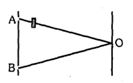
A
The fringes will disappear.
B
The fringe width will decrease.
C
The fringe width will increase.
D
The fringe width will remain unchanged.
Solution
(D) The fringe width $\beta$ is given by the formula $\beta = \frac{\lambda D}{d}$.
Here,$\lambda$ is the wavelength of the monochromatic light,$D$ is the distance between the slits and the screen,and $d$ is the distance between the two slits.
When a glass plate is introduced in the path of one of the beams,it introduces an additional path difference,which causes a shift in the entire interference pattern.
However,the parameters $\lambda$,$D$,and $d$ remain unchanged.
Therefore,the fringe width $\beta$ remains constant and does not change.
Here,$\lambda$ is the wavelength of the monochromatic light,$D$ is the distance between the slits and the screen,and $d$ is the distance between the two slits.
When a glass plate is introduced in the path of one of the beams,it introduces an additional path difference,which causes a shift in the entire interference pattern.
However,the parameters $\lambda$,$D$,and $d$ remain unchanged.
Therefore,the fringe width $\beta$ remains constant and does not change.
0 likes
View Solution127
EasyMCQ
In a Young's double-slit experiment,$92$ fringes are observed when sodium light $(\lambda = 5898 \, \mathring A)$ is used. If light of wavelength $\lambda = 5461 \, \mathring A$ is used instead,how many fringes will be observed?
A
$62$
B
$67$
C
$85$
D
$99$
Solution
(D) The angular width of the fringes or the total number of fringes observed in a given field of view is inversely proportional to the wavelength of the light used,given by the relation $n_1 \lambda_1 = n_2 \lambda_2$.
Here,$n_1 = 92$,$\lambda_1 = 5898 \, \mathring A$,and $\lambda_2 = 5461 \, \mathring A$.
Substituting the values: $92 \times 5898 = n_2 \times 5461$.
$n_2 = \frac{92 \times 5898}{5461}$.
$n_2 \approx 99.35$.
Since the number of fringes must be an integer,we consider the value to be $99$.
Here,$n_1 = 92$,$\lambda_1 = 5898 \, \mathring A$,and $\lambda_2 = 5461 \, \mathring A$.
Substituting the values: $92 \times 5898 = n_2 \times 5461$.
$n_2 = \frac{92 \times 5898}{5461}$.
$n_2 \approx 99.35$.
Since the number of fringes must be an integer,we consider the value to be $99$.
0 likes
View Solution128
MediumMCQ
In Young's double-slit experiment,one of the slits is painted such that its intensity is half that of the other slit. Then:
A
The fringe pattern will disappear.
B
Bright fringes will become brighter and dark fringes will become darker.
C
Both bright and dark fringes will become darker.
D
Dark fringes will become less dark and bright fringes will become less bright.
Solution
(D) Let the initial intensities be $I_1 = I_2 = I_0$. The maximum intensity is $I_{max} = (\sqrt{I_1} + \sqrt{I_2})^2 = (2\sqrt{I_0})^2 = 4I_0$ and the minimum intensity is $I_{min} = (\sqrt{I_1} - \sqrt{I_2})^2 = 0$.
Now,the intensity of one slit is halved,i.e.,$I_1 = I_0$ and $I_2 = I_0/2$.
The new maximum intensity is $I'_{max} = (\sqrt{I_0} + \sqrt{I_0/2})^2 = I_0(1 + 1/\sqrt{2})^2 \approx 2.91 I_0$,which is less than the original $4I_0$.
The new minimum intensity is $I'_{min} = (\sqrt{I_0} - \sqrt{I_0/2})^2 = I_0(1 - 1/\sqrt{2})^2 \approx 0.086 I_0$,which is greater than the original $0$.
Therefore,the bright fringes will become less bright and the dark fringes will become less dark (more bright).
Now,the intensity of one slit is halved,i.e.,$I_1 = I_0$ and $I_2 = I_0/2$.
The new maximum intensity is $I'_{max} = (\sqrt{I_0} + \sqrt{I_0/2})^2 = I_0(1 + 1/\sqrt{2})^2 \approx 2.91 I_0$,which is less than the original $4I_0$.
The new minimum intensity is $I'_{min} = (\sqrt{I_0} - \sqrt{I_0/2})^2 = I_0(1 - 1/\sqrt{2})^2 \approx 0.086 I_0$,which is greater than the original $0$.
Therefore,the bright fringes will become less bright and the dark fringes will become less dark (more bright).
0 likes
View Solution129
MediumMCQ
In a Young's double-slit experiment with wavelength $\lambda$,the fringe width is $\beta$. When two glass plates of thicknesses $t_1$ and $t_2$ $(t_1 > t_2)$ and refractive index $\mu$ are placed in the paths of the two light beams respectively,by what distance will the fringe pattern shift?
A
$\frac{\beta (\mu - 1)}{\lambda} (t_1 - t_2)$
B
$\frac{\beta (\mu - 1)}{\lambda} \left( \frac{t_1}{t_2} \right)$
C
$\frac{\mu \beta}{\lambda} \frac{t_1}{t_2}$
D
$(\mu - 1) \frac{\lambda}{\beta} (t_1 + t_2)$
Solution
(A) The shift in the fringe pattern due to a glass plate of thickness $t$ and refractive index $\mu$ is given by $\Delta x = \frac{\beta}{\lambda} (\mu - 1) t$.
When two plates of thicknesses $t_1$ and $t_2$ are placed in the paths of the two beams,the shift produced by the first plate is $\Delta x_1 = \frac{\beta}{\lambda} (\mu - 1) t_1$ and the shift produced by the second plate is $\Delta x_2 = \frac{\beta}{\lambda} (\mu - 1) t_2$.
Since the plates are placed in the paths of the two different beams,the net shift is the difference between the individual shifts:
$\Delta x_{net} = |\Delta x_1 - \Delta x_2| = \left| \frac{\beta}{\lambda} (\mu - 1) t_1 - \frac{\beta}{\lambda} (\mu - 1) t_2 \right|$.
Simplifying this,we get $\Delta x_{net} = \frac{\beta}{\lambda} (\mu - 1) (t_1 - t_2)$.
When two plates of thicknesses $t_1$ and $t_2$ are placed in the paths of the two beams,the shift produced by the first plate is $\Delta x_1 = \frac{\beta}{\lambda} (\mu - 1) t_1$ and the shift produced by the second plate is $\Delta x_2 = \frac{\beta}{\lambda} (\mu - 1) t_2$.
Since the plates are placed in the paths of the two different beams,the net shift is the difference between the individual shifts:
$\Delta x_{net} = |\Delta x_1 - \Delta x_2| = \left| \frac{\beta}{\lambda} (\mu - 1) t_1 - \frac{\beta}{\lambda} (\mu - 1) t_2 \right|$.
Simplifying this,we get $\Delta x_{net} = \frac{\beta}{\lambda} (\mu - 1) (t_1 - t_2)$.
0 likes
View Solution130
EasyMCQ
In Young's double-slit experiment using monochromatic light,the shape of the interference pattern on the screen is .....
A
Hyperbolic
B
Circular
C
Straight line
D
Parabolic
Solution
(A) In $Y.D.S.E.$,the locus of points having a constant path difference is a hyperbola.
Therefore,the interference fringes formed on the screen are hyperbolic in shape.
Therefore,the interference fringes formed on the screen are hyperbolic in shape.
0 likes
View Solution131
EasyMCQ
In Young's double-slit experiment, if the wavelength of light is decreased, the fringe width will .....
A
decrease
B
cannot be determined
C
increase
D
change
Solution
(A) The formula for fringe width $(\beta)$ in Young's double-slit experiment is given by $\beta = \frac{\lambda D}{d}$, where $\lambda$ is the wavelength of light, $D$ is the distance between the slits and the screen, and $d$ is the distance between the two slits.
From the formula, it is clear that the fringe width $\beta$ is directly proportional to the wavelength $\lambda$ $(\beta \propto \lambda)$.
Therefore, if the wavelength $\lambda$ is decreased, the fringe width $\beta$ will also decrease.
From the formula, it is clear that the fringe width $\beta$ is directly proportional to the wavelength $\lambda$ $(\beta \propto \lambda)$.
Therefore, if the wavelength $\lambda$ is decreased, the fringe width $\beta$ will also decrease.
0 likes
View Solution132
EasyMCQ
In Young's double-slit experiment,the distance between the two slits is $0.2 \, mm$ and the screen is $200 \, cm$ away from the slits. If the wavelength of light used is $5000 \, \mathring{A}$,find the distance of the third bright fringe from the central bright fringe in $cm$.
A
$1.67$
B
$1.5$
C
$0.5$
D
$5$
Solution
(B) The distance of the $n^{th}$ bright fringe from the central fringe is given by the formula: $x_n = n \frac{\lambda D}{d}$.
Given values are:
$n = 3$
$\lambda = 5000 \, \mathring{A} = 5000 \times 10^{-10} \, m = 5 \times 10^{-7} \, m$
$D = 200 \, cm = 2 \, m$
$d = 0.2 \, mm = 0.2 \times 10^{-3} \, m = 2 \times 10^{-4} \, m$
Substituting these values into the formula:
$x_3 = 3 \times \frac{(5 \times 10^{-7} \, m) \times (2 \, m)}{2 \times 10^{-4} \, m}$
$x_3 = 3 \times \frac{10 \times 10^{-7}}{2 \times 10^{-4}}$
$x_3 = 3 \times 5 \times 10^{-3} \, m$
$x_3 = 15 \times 10^{-3} \, m = 1.5 \times 10^{-2} \, m = 1.5 \, cm$.
Thus,the distance is $1.5 \, cm$.
Given values are:
$n = 3$
$\lambda = 5000 \, \mathring{A} = 5000 \times 10^{-10} \, m = 5 \times 10^{-7} \, m$
$D = 200 \, cm = 2 \, m$
$d = 0.2 \, mm = 0.2 \times 10^{-3} \, m = 2 \times 10^{-4} \, m$
Substituting these values into the formula:
$x_3 = 3 \times \frac{(5 \times 10^{-7} \, m) \times (2 \, m)}{2 \times 10^{-4} \, m}$
$x_3 = 3 \times \frac{10 \times 10^{-7}}{2 \times 10^{-4}}$
$x_3 = 3 \times 5 \times 10^{-3} \, m$
$x_3 = 15 \times 10^{-3} \, m = 1.5 \times 10^{-2} \, m = 1.5 \, cm$.
Thus,the distance is $1.5 \, cm$.
0 likes
View Solution133
MediumMCQ
In a Young's double-slit experiment,interference fringes are obtained on a screen placed at a certain distance from the slits using monochromatic light. If the screen is moved towards the slits by $5 \times 10^{-2} \, m$,the fringe width changes by $3 \times 10^{-5} \, m$. If the distance between the slits is $10^{-3} \, m$,find the wavelength of the light.
A
$6 \times 10^{-5} \, m$
B
$6 \times 10^{-3} \, m$
C
$6 \times 10^3 \, m$
D
$6 \times 10^{-7} \, m$
Solution
(D) The formula for fringe width is $\beta = \frac{\lambda D}{d}$.
When the screen is moved by $\Delta D$,the change in fringe width is given by $\Delta \beta = \frac{\lambda \Delta D}{d}$.
Given: $\Delta \beta = 3 \times 10^{-5} \, m$,$\Delta D = 5 \times 10^{-2} \, m$,and $d = 10^{-3} \, m$.
Rearranging the formula to solve for wavelength $\lambda$:
$\lambda = \frac{(\Delta \beta) d}{\Delta D}$
Substituting the values:
$\lambda = \frac{(3 \times 10^{-5} \, m) \times (10^{-3} \, m)}{5 \times 10^{-2} \, m}$
$\lambda = \frac{3 \times 10^{-8}}{5 \times 10^{-2}} \, m = 0.6 \times 10^{-6} \, m = 6 \times 10^{-7} \, m$.
When the screen is moved by $\Delta D$,the change in fringe width is given by $\Delta \beta = \frac{\lambda \Delta D}{d}$.
Given: $\Delta \beta = 3 \times 10^{-5} \, m$,$\Delta D = 5 \times 10^{-2} \, m$,and $d = 10^{-3} \, m$.
Rearranging the formula to solve for wavelength $\lambda$:
$\lambda = \frac{(\Delta \beta) d}{\Delta D}$
Substituting the values:
$\lambda = \frac{(3 \times 10^{-5} \, m) \times (10^{-3} \, m)}{5 \times 10^{-2} \, m}$
$\lambda = \frac{3 \times 10^{-8}}{5 \times 10^{-2}} \, m = 0.6 \times 10^{-6} \, m = 6 \times 10^{-7} \, m$.
0 likes
View Solution134
MediumMCQ
In Young's double-slit experiment,the intensity of the central maximum is $I_0$. If one of the slits is closed,the intensity of the central maximum becomes .....
A
$I_0 / 2$
B
$I_0 / \sqrt{2}$
C
$I_0 / 4$
D
$I_0$
Solution
(C) In Young's double-slit experiment,the intensity at the central maximum is given by $I_{max} = (\sqrt{I_1} + \sqrt{I_2})^2$.
Since both slits have equal intensity $I$,we have $I_0 = (\sqrt{I} + \sqrt{I})^2 = (2\sqrt{I})^2 = 4I$.
Therefore,the intensity of a single slit is $I = I_0 / 4$.
When one slit is closed,only the light from the other slit reaches the screen.
Thus,the new intensity at the center will be equal to the intensity of a single slit,which is $I = I_0 / 4$.
Since both slits have equal intensity $I$,we have $I_0 = (\sqrt{I} + \sqrt{I})^2 = (2\sqrt{I})^2 = 4I$.
Therefore,the intensity of a single slit is $I = I_0 / 4$.
When one slit is closed,only the light from the other slit reaches the screen.
Thus,the new intensity at the center will be equal to the intensity of a single slit,which is $I = I_0 / 4$.
0 likes
View Solution135
EasyMCQ
In Young's double-slit experiment,which of the following phenomena occur?
A
Only interference occurs.
B
Only diffraction occurs.
C
Both diffraction and interference occur.
D
None of the above.
Solution
(C) In Young's double-slit experiment,both interference and diffraction occur.
Diffraction occurs at the individual slits,which acts as the source of light.
Interference occurs between the light waves originating from these two slits on the screen.
Diffraction occurs at the individual slits,which acts as the source of light.
Interference occurs between the light waves originating from these two slits on the screen.
0 likes
View Solution136
EasyMCQ
Who was the first to study the phenomenon of interference of light?
A
Newton
B
Young
C
Fresnel
D
Huygens
Solution
(B) The phenomenon of interference of light was first studied by Thomas Young in his famous double-slit experiment in $1801$. This experiment provided strong evidence for the wave nature of light.
0 likes
View Solution137
EasyMCQ
In two different Young's double-slit experiments,the fringe width is the same when the ratio of wavelengths is $1:2$. If the ratio of the distance between the slits in the two cases is $2:1$,then the ratio of the distance between the slits and the screen in the two experiments is:
A
$4:1$
B
$1:1$
C
$1:4$
D
$2:1$
Solution
(A) The formula for fringe width in Young's double-slit experiment is given by $\beta = \frac{\lambda D}{d}$,where $\lambda$ is the wavelength,$D$ is the distance between the slits and the screen,and $d$ is the distance between the slits.
Given that the fringe width $\beta$ is the same in both experiments,we have $\beta_1 = \beta_2$.
Therefore,$\frac{\lambda_1 D_1}{d_1} = \frac{\lambda_2 D_2}{d_2}$.
Rearranging for the ratio of distances $\frac{D_1}{D_2}$,we get $\frac{D_1}{D_2} = \frac{\lambda_2}{\lambda_1} \times \frac{d_1}{d_2}$.
Given $\frac{\lambda_1}{\lambda_2} = \frac{1}{2}$ (so $\frac{\lambda_2}{\lambda_1} = 2$) and $\frac{d_1}{d_2} = \frac{2}{1} = 2$.
Substituting these values: $\frac{D_1}{D_2} = 2 \times 2 = 4$.
Thus,the ratio is $4:1$.
Given that the fringe width $\beta$ is the same in both experiments,we have $\beta_1 = \beta_2$.
Therefore,$\frac{\lambda_1 D_1}{d_1} = \frac{\lambda_2 D_2}{d_2}$.
Rearranging for the ratio of distances $\frac{D_1}{D_2}$,we get $\frac{D_1}{D_2} = \frac{\lambda_2}{\lambda_1} \times \frac{d_1}{d_2}$.
Given $\frac{\lambda_1}{\lambda_2} = \frac{1}{2}$ (so $\frac{\lambda_2}{\lambda_1} = 2$) and $\frac{d_1}{d_2} = \frac{2}{1} = 2$.
Substituting these values: $\frac{D_1}{D_2} = 2 \times 2 = 4$.
Thus,the ratio is $4:1$.
0 likes
View Solution138
DifficultMCQ
Young's double-slit experiment is performed with a wavelength of $550 \,nm$. If the distance between the two slits is $1.10 \,mm$ and the distance between the screen and the slits is $1 \,m$,then the distance between two consecutive bright or dark fringes is .....$mm$.
A
$1.5$
B
$1$
C
$0.5$
D
None of these
Solution
(C) The fringe width $\beta$ in Young's double-slit experiment is given by the formula: $\beta = \frac{\lambda D}{d}$.
Given values are:
Wavelength $\lambda = 550 \,nm = 550 \times 10^{-9} \,m$.
Distance between slits $d = 1.10 \,mm = 1.10 \times 10^{-3} \,m$.
Distance between screen and slits $D = 1 \,m$.
Substituting these values into the formula:
$\beta = \frac{550 \times 10^{-9} \times 1}{1.10 \times 10^{-3}}$
$\beta = \frac{550}{1.10} \times 10^{-6} \,m$
$\beta = 500 \times 10^{-6} \,m = 0.5 \times 10^{-3} \,m$.
Since $10^{-3} \,m = 1 \,mm$,we get $\beta = 0.5 \,mm$.
Given values are:
Wavelength $\lambda = 550 \,nm = 550 \times 10^{-9} \,m$.
Distance between slits $d = 1.10 \,mm = 1.10 \times 10^{-3} \,m$.
Distance between screen and slits $D = 1 \,m$.
Substituting these values into the formula:
$\beta = \frac{550 \times 10^{-9} \times 1}{1.10 \times 10^{-3}}$
$\beta = \frac{550}{1.10} \times 10^{-6} \,m$
$\beta = 500 \times 10^{-6} \,m = 0.5 \times 10^{-3} \,m$.
Since $10^{-3} \,m = 1 \,mm$,we get $\beta = 0.5 \,mm$.
0 likes
View Solution139
DifficultMCQ
Light of wavelength $6000 \, Å$ is incident on two slits. The distance between the slits is $0.1 \, cm$ and the screen is placed at a distance of $1 \, m$ from them. Find the angular position of the $10^{th}$ maximum in radians.
A
$3 \times 10^8 \, rad$
B
$3 \times 10^{-1} \, rad$
C
$6 \times 10^{-3} \, rad$
D
$3 \times 10^5 \, rad$
Solution
(C) Given: Wavelength $\lambda = 6000 \, Å = 6 \times 10^{-7} \, m$.
Distance between slits $d = 0.1 \, cm = 10^{-3} \, m$.
Order of maximum $n = 10$.
The angular position $\theta_n$ for the $n^{th}$ maximum in a Young's double-slit experiment is given by the formula $\sin \theta_n = \frac{n \lambda}{d}$.
For small angles, $\sin \theta_n \approx \theta_n$.
Therefore, $\theta_n = \frac{n \lambda}{d} = \frac{10 \times 6 \times 10^{-7} \, m}{10^{-3} \, m}$.
$\theta_n = 6 \times 10^{-3} \, rad$.
Distance between slits $d = 0.1 \, cm = 10^{-3} \, m$.
Order of maximum $n = 10$.
The angular position $\theta_n$ for the $n^{th}$ maximum in a Young's double-slit experiment is given by the formula $\sin \theta_n = \frac{n \lambda}{d}$.
For small angles, $\sin \theta_n \approx \theta_n$.
Therefore, $\theta_n = \frac{n \lambda}{d} = \frac{10 \times 6 \times 10^{-7} \, m}{10^{-3} \, m}$.
$\theta_n = 6 \times 10^{-3} \, rad$.
0 likes
View Solution140
EasyMCQ
In Young's double-slit experiment,if a metal plate of thickness $t$ is placed in the path of one of the rays,then:
A
The fringe width increases.
B
The fringes disappear.
C
The fringes shift.
D
The fringes become blurred.
Solution
(B) When a metal plate of thickness $t$ is placed in the path of one of the rays in Young's double-slit experiment,the light ray is completely blocked by the metal plate.
Since the metal is opaque,it does not allow light to pass through it.
As a result,the light from that specific source does not reach the screen.
Because interference requires two coherent sources of light to overlap,and one source is now blocked,the interference pattern will no longer be formed.
Therefore,the fringes disappear.
Since the metal is opaque,it does not allow light to pass through it.
As a result,the light from that specific source does not reach the screen.
Because interference requires two coherent sources of light to overlap,and one source is now blocked,the interference pattern will no longer be formed.
Therefore,the fringes disappear.
0 likes
View Solution141
DifficultMCQ
State two conditions for obtaining sustained interference of light. In Young's double-slit experiment,using light of wavelength $400 \, nm$,interference fringes of width $'X'$ are obtained. If the wavelength of light is increased to $600 \, nm$ and the separation between the slits is halved,find the ratio of the distances between the screen and the slits in the two arrangements if the fringe width remains the same.
A
$2$
B
$3$
C
$4$
D
$6$
Solution
(B) Conditions for sustained interference of light: $(i)$ The sources must be coherent. $(ii)$ The sources must be monochromatic.
The fringe width is given by $\beta = \frac{\lambda D}{d}$.
For the first case: $\beta_1 = \frac{\lambda_1 D_1}{d_1}$,where $\lambda_1 = 400 \, nm$.
For the second case: $\beta_2 = \frac{\lambda_2 D_2}{d_2}$,where $\lambda_2 = 600 \, nm$ and $d_2 = \frac{d_1}{2}$.
Given that the fringe width remains the same,$\beta_1 = \beta_2$:
$\frac{\lambda_1 D_1}{d_1} = \frac{\lambda_2 D_2}{d_2}$
$\frac{D_1}{D_2} = \frac{\lambda_2 d_1}{\lambda_1 d_2} = \frac{600}{400} \times \frac{d_1}{d_1/2} = \frac{3}{2} \times 2 = 3$.
Thus,the ratio of the distances is $3:1$.
The fringe width is given by $\beta = \frac{\lambda D}{d}$.
For the first case: $\beta_1 = \frac{\lambda_1 D_1}{d_1}$,where $\lambda_1 = 400 \, nm$.
For the second case: $\beta_2 = \frac{\lambda_2 D_2}{d_2}$,where $\lambda_2 = 600 \, nm$ and $d_2 = \frac{d_1}{2}$.
Given that the fringe width remains the same,$\beta_1 = \beta_2$:
$\frac{\lambda_1 D_1}{d_1} = \frac{\lambda_2 D_2}{d_2}$
$\frac{D_1}{D_2} = \frac{\lambda_2 d_1}{\lambda_1 d_2} = \frac{600}{400} \times \frac{d_1}{d_1/2} = \frac{3}{2} \times 2 = 3$.
Thus,the ratio of the distances is $3:1$.
0 likes
View Solution142
MediumMCQ
In Young's double-slit experiment,the angular width of the fringes formed on the screen is $\pi / 200$. If light of wavelength $4800 \, \mathring{A}$ is used,find the distance between the slits.
A
$1.92 \times 10^{-4} \, m$
B
$9.6 \times 10^{-5} \, m$
C
$3.84 \times 10^{-4} \, m$
D
$4.8 \times 10^{-5} \, m$
Solution
(B) The angular width $\theta$ of the fringes in Young's double-slit experiment is given by the formula: $\theta = \frac{\lambda}{d}$.
Here,$\lambda = 4800 \, \mathring{A} = 4800 \times 10^{-10} \, m$ and $\theta = \frac{\pi}{200} \, rad$.
Rearranging the formula to solve for the slit separation $d$:
$d = \frac{\lambda}{\theta} = \frac{4800 \times 10^{-10}}{\pi / 200}$.
$d = \frac{4800 \times 10^{-10} \times 200}{\pi}$.
$d = \frac{960000 \times 10^{-10}}{\pi} = \frac{9.6 \times 10^5 \times 10^{-10}}{\pi} = \frac{9.6 \times 10^{-5}}{\pi} \, m$.
Here,$\lambda = 4800 \, \mathring{A} = 4800 \times 10^{-10} \, m$ and $\theta = \frac{\pi}{200} \, rad$.
Rearranging the formula to solve for the slit separation $d$:
$d = \frac{\lambda}{\theta} = \frac{4800 \times 10^{-10}}{\pi / 200}$.
$d = \frac{4800 \times 10^{-10} \times 200}{\pi}$.
$d = \frac{960000 \times 10^{-10}}{\pi} = \frac{9.6 \times 10^5 \times 10^{-10}}{\pi} = \frac{9.6 \times 10^{-5}}{\pi} \, m$.
0 likes
View Solution143
MediumMCQ
In Young's double-slit interference experiment,the ratio of the slit widths is $1:25$. Find the ratio of the maximum to minimum intensity in the interference pattern.
A
$1:5$
B
$3:2$
C
$9:4$
D
$1:25$
Solution
(C) The intensity of light $I$ is directly proportional to the width of the slit $w$,so $I_1/I_2 = w_1/w_2 = 1/25$.
Let $I_1 = I_0$ and $I_2 = 25I_0$. Then the amplitudes are $a_1 = \sqrt{I_0}$ and $a_2 = \sqrt{25I_0} = 5\sqrt{I_0}$.
The maximum intensity $I_{max}$ is given by $(\sqrt{I_1} + \sqrt{I_2})^2 = (\sqrt{I_0} + 5\sqrt{I_0})^2 = (6\sqrt{I_0})^2 = 36I_0$.
The minimum intensity $I_{min}$ is given by $(\sqrt{I_2} - \sqrt{I_1})^2 = (5\sqrt{I_0} - \sqrt{I_0})^2 = (4\sqrt{I_0})^2 = 16I_0$.
The ratio of maximum to minimum intensity is $I_{max}/I_{min} = 36I_0 / 16I_0 = 36/16 = 9/4$ or $9:4$.
Let $I_1 = I_0$ and $I_2 = 25I_0$. Then the amplitudes are $a_1 = \sqrt{I_0}$ and $a_2 = \sqrt{25I_0} = 5\sqrt{I_0}$.
The maximum intensity $I_{max}$ is given by $(\sqrt{I_1} + \sqrt{I_2})^2 = (\sqrt{I_0} + 5\sqrt{I_0})^2 = (6\sqrt{I_0})^2 = 36I_0$.
The minimum intensity $I_{min}$ is given by $(\sqrt{I_2} - \sqrt{I_1})^2 = (5\sqrt{I_0} - \sqrt{I_0})^2 = (4\sqrt{I_0})^2 = 16I_0$.
The ratio of maximum to minimum intensity is $I_{max}/I_{min} = 36I_0 / 16I_0 = 36/16 = 9/4$ or $9:4$.
0 likes
View Solution144
MediumMCQ
In Young's double-slit experiment,the distance between the two slits is $3 \, cm$,the distance from the slits to the screen is $7 \, cm$,and the wavelength of light used is $1000 \, \mathring{A}$. Calculate the fringe width.
A
$2 \times 10^{-5} \, m$
B
$2 \times 10^{-9} \, m$
C
$0.2 \times 10^{-6} \, m$
D
$2.3 \times 10^{-7} \, m$
Solution
(D) The formula for fringe width is $\beta = \frac{\lambda D}{d}$.
Given:
Wavelength $\lambda = 1000 \, \mathring{A} = 1000 \times 10^{-10} \, m = 10^{-7} \, m$.
Distance between slits $d = 3 \, cm = 3 \times 10^{-2} \, m$.
Distance to screen $D = 7 \, cm = 7 \times 10^{-2} \, m$.
Substituting the values:
$\beta = \frac{10^{-7} \times 7 \times 10^{-2}}{3 \times 10^{-2}}$
$\beta = \frac{7}{3} \times 10^{-7} \, m$
$\beta \approx 2.33 \times 10^{-7} \, m$.
Thus,the correct option is $D$.
Given:
Wavelength $\lambda = 1000 \, \mathring{A} = 1000 \times 10^{-10} \, m = 10^{-7} \, m$.
Distance between slits $d = 3 \, cm = 3 \times 10^{-2} \, m$.
Distance to screen $D = 7 \, cm = 7 \times 10^{-2} \, m$.
Substituting the values:
$\beta = \frac{10^{-7} \times 7 \times 10^{-2}}{3 \times 10^{-2}}$
$\beta = \frac{7}{3} \times 10^{-7} \, m$
$\beta \approx 2.33 \times 10^{-7} \, m$.
Thus,the correct option is $D$.
0 likes
View Solution145
MediumMCQ
In a double-slit experiment, the angular width of a fringe for sodium light $(\lambda = 5890 \, \mathring{A})$ is $0.20^o$. If the fringe width increases by $10\%$, what is the change in the wavelength?
A
Increases by $589 \, \mathring{A}$.
B
Decreases by $589 \, \mathring{A}$.
C
Increases by $6479 \, \mathring{A}$.
D
Becomes zero.
Solution
(A) The angular width of a fringe is given by $\beta = \frac{\lambda}{d}$, which implies $\beta \propto \lambda$.
Let the initial wavelength be $\lambda_1 = 5890 \, \mathring{A}$ and initial angular width be $\beta_1 = 0.20^o$.
The new angular width is $\beta_2 = \beta_1 + 10\% \text{ of } \beta_1 = 0.20 + 0.02 = 0.22^o$.
Using the proportionality $\frac{\beta_1}{\beta_2} = \frac{\lambda_1}{\lambda_2}$, we get $\frac{0.20}{0.22} = \frac{5890}{\lambda_2}$.
$\lambda_2 = 5890 \times \frac{0.22}{0.20} = 5890 \times 1.1 = 6479 \, \mathring{A}$.
The change in wavelength is $\Delta \lambda = \lambda_2 - \lambda_1 = 6479 - 5890 = 589 \, \mathring{A}$.
Thus, the wavelength increases by $589 \, \mathring{A}$.
Let the initial wavelength be $\lambda_1 = 5890 \, \mathring{A}$ and initial angular width be $\beta_1 = 0.20^o$.
The new angular width is $\beta_2 = \beta_1 + 10\% \text{ of } \beta_1 = 0.20 + 0.02 = 0.22^o$.
Using the proportionality $\frac{\beta_1}{\beta_2} = \frac{\lambda_1}{\lambda_2}$, we get $\frac{0.20}{0.22} = \frac{5890}{\lambda_2}$.
$\lambda_2 = 5890 \times \frac{0.22}{0.20} = 5890 \times 1.1 = 6479 \, \mathring{A}$.
The change in wavelength is $\Delta \lambda = \lambda_2 - \lambda_1 = 6479 - 5890 = 589 \, \mathring{A}$.
Thus, the wavelength increases by $589 \, \mathring{A}$.
0 likes
View Solution146
MediumMCQ
$A$ laser light of wavelength $630 \, nm$ is incident on a pair of slits,and the fringe width of the interference pattern produced is $8.1 \, mm$. In another interference pattern produced by a different light,the fringe width is $7.2 \, mm$. Find the wavelength of this second light in $nm$.
A
$580$
B
$620$
C
$480$
D
$560$
Solution
(D) The fringe width $\beta$ in Young's double-slit experiment is given by $\beta = \frac{\lambda D}{d}$.
Since $D$ and $d$ are constant for the experimental setup,the fringe width is directly proportional to the wavelength: $\beta \propto \lambda$.
Therefore,we can write the ratio: $\frac{\beta_2}{\beta_1} = \frac{\lambda_2}{\lambda_1}$.
Given: $\lambda_1 = 630 \, nm$,$\beta_1 = 8.1 \, mm$,and $\beta_2 = 7.2 \, mm$.
Substituting the values: $\lambda_2 = \frac{\beta_2}{\beta_1} \times \lambda_1$.
$\lambda_2 = \frac{7.2}{8.1} \times 630$.
$\lambda_2 = \frac{8}{9} \times 630 = 8 \times 70 = 560 \, nm$.
Since $D$ and $d$ are constant for the experimental setup,the fringe width is directly proportional to the wavelength: $\beta \propto \lambda$.
Therefore,we can write the ratio: $\frac{\beta_2}{\beta_1} = \frac{\lambda_2}{\lambda_1}$.
Given: $\lambda_1 = 630 \, nm$,$\beta_1 = 8.1 \, mm$,and $\beta_2 = 7.2 \, mm$.
Substituting the values: $\lambda_2 = \frac{\beta_2}{\beta_1} \times \lambda_1$.
$\lambda_2 = \frac{7.2}{8.1} \times 630$.
$\lambda_2 = \frac{8}{9} \times 630 = 8 \times 70 = 560 \, nm$.
0 likes
View Solution147
EasyMCQ
Young's double-slit experiment is performed using green light,red light,and blue light,one at a time. The fringe widths recorded are $\beta_G, \beta_R,$ and $\beta_B$ respectively. Then:
A
$\beta_G > \beta_B > \beta_R$
B
$\beta_B > \beta_G > \beta_R$
C
$\beta_R > \beta_B > \beta_G$
D
$\beta_R > \beta_G > \beta_B$
Solution
(D) The formula for fringe width in Young's double-slit experiment is given by $\beta = \frac{\lambda D}{d}$.
For a given experimental setup,the distance between the slits $(d)$ and the distance between the screen and the slits $(D)$ remain constant.
Therefore,the fringe width is directly proportional to the wavelength of the light used: $\beta \propto \lambda$.
We know the order of wavelengths for the given colors is $\lambda_R > \lambda_G > \lambda_B$.
Since the fringe width is directly proportional to the wavelength,the order of fringe widths will be $\beta_R > \beta_G > \beta_B$.
For a given experimental setup,the distance between the slits $(d)$ and the distance between the screen and the slits $(D)$ remain constant.
Therefore,the fringe width is directly proportional to the wavelength of the light used: $\beta \propto \lambda$.
We know the order of wavelengths for the given colors is $\lambda_R > \lambda_G > \lambda_B$.
Since the fringe width is directly proportional to the wavelength,the order of fringe widths will be $\beta_R > \beta_G > \beta_B$.
0 likes
View Solution148
DifficultMCQ
In Young's double-slit experiment,the two slits are $2 \, mm$ apart and are illuminated by a mixture of two wavelengths $\lambda_1 = 12000 \, \mathring{A}$ and $\lambda_2 = 10000 \, \mathring{A}$. At what minimum distance from the common central bright fringe on the screen will a bright fringe from one interference pattern coincide with a bright fringe from the other? The distance between the slits and the screen is $2 \, m$.
A
$6$
B
$4$
C
$3$
D
$8$
Solution
(A) Given: Slit separation $d = 2 \, mm = 2 \times 10^{-3} \, m$,Screen distance $D = 2 \, m$,$\lambda_1 = 12000 \times 10^{-10} \, m$,$\lambda_2 = 10000 \times 10^{-10} \, m$.
For bright fringes to coincide,the position $x$ must satisfy: $x = \frac{n_1 \lambda_1 D}{d} = \frac{n_2 \lambda_2 D}{d}$.
This implies $n_1 \lambda_1 = n_2 \lambda_2$,or $\frac{n_1}{n_2} = \frac{\lambda_2}{\lambda_1}$.
Substituting the values: $\frac{n_1}{n_2} = \frac{10000}{12000} = \frac{5}{6}$.
For the minimum distance,we take the smallest integers $n_1 = 5$ and $n_2 = 6$.
Now,calculate $x$: $x = \frac{n_1 \lambda_1 D}{d} = \frac{5 \times 12000 \times 10^{-10} \times 2}{2 \times 10^{-3}}$.
$x = 5 \times 12000 \times 10^{-7} \, m = 60000 \times 10^{-7} \, m = 6 \times 10^{-3} \, m = 6 \, mm$.
For bright fringes to coincide,the position $x$ must satisfy: $x = \frac{n_1 \lambda_1 D}{d} = \frac{n_2 \lambda_2 D}{d}$.
This implies $n_1 \lambda_1 = n_2 \lambda_2$,or $\frac{n_1}{n_2} = \frac{\lambda_2}{\lambda_1}$.
Substituting the values: $\frac{n_1}{n_2} = \frac{10000}{12000} = \frac{5}{6}$.
For the minimum distance,we take the smallest integers $n_1 = 5$ and $n_2 = 6$.
Now,calculate $x$: $x = \frac{n_1 \lambda_1 D}{d} = \frac{5 \times 12000 \times 10^{-10} \times 2}{2 \times 10^{-3}}$.
$x = 5 \times 12000 \times 10^{-7} \, m = 60000 \times 10^{-7} \, m = 6 \times 10^{-3} \, m = 6 \, mm$.
0 likes
View Solution149
MediumMCQ
In a Young's double-slit experiment,the slit separation is $0.589 \, mm$ using sodium light. What is the angular separation between the third maximum and the central maximum? $(\lambda = 589 \, nm)$
A
$sin^{-1} (0.33 \times 10^{-6})$
B
$sin^{-1} (3 \times 10^{-6})$
C
$sin^{-1} (3 \times 10^{-8})$
D
$sin^{-1} (0.33 \times 10^{-8})$
Solution
(B) The condition for constructive interference (maxima) in a Young's double-slit experiment is given by $d \sin \theta = n \lambda$,where $d$ is the slit separation,$\theta$ is the angular position,$n$ is the order of the maximum,and $\lambda$ is the wavelength.
Given: $d = 0.589 \, mm = 0.589 \times 10^{-3} \, m$,$\lambda = 589 \, nm = 589 \times 10^{-9} \, m$,and $n = 3$.
Substituting the values into the formula:
$0.589 \times 10^{-3} \sin \theta = 3 \times 589 \times 10^{-9}$
$\sin \theta = \frac{3 \times 589 \times 10^{-9}}{0.589 \times 10^{-3}}$
$\sin \theta = \frac{3 \times 589 \times 10^{-9}}{589 \times 10^{-6}}$
$\sin \theta = 3 \times 10^{-3} \times 10^{-3} = 3 \times 10^{-6}$
Therefore,$\theta = \sin^{-1} (3 \times 10^{-6})$.
Given: $d = 0.589 \, mm = 0.589 \times 10^{-3} \, m$,$\lambda = 589 \, nm = 589 \times 10^{-9} \, m$,and $n = 3$.
Substituting the values into the formula:
$0.589 \times 10^{-3} \sin \theta = 3 \times 589 \times 10^{-9}$
$\sin \theta = \frac{3 \times 589 \times 10^{-9}}{0.589 \times 10^{-3}}$
$\sin \theta = \frac{3 \times 589 \times 10^{-9}}{589 \times 10^{-6}}$
$\sin \theta = 3 \times 10^{-3} \times 10^{-3} = 3 \times 10^{-6}$
Therefore,$\theta = \sin^{-1} (3 \times 10^{-6})$.
0 likes
View Solution150
MediumMCQ
$A$ mixture of light of wavelength $590 \, nm$ and an unknown wavelength is incident on the two slits of a Young's double-slit experiment. The central bright fringes of both lights coincide. The $3^{rd}$ bright fringe of the known wavelength coincides with the $4^{th}$ bright fringe of the unknown wavelength. Find the unknown wavelength in $nm$.
A
$393.4$
B
$885$
C
$442.5$
D
$776.8$
Solution
(C) For a bright fringe in Young's double-slit experiment,the position is given by $y = \frac{n \lambda D}{d}$.
Since the fringes coincide,their positions must be equal: $y_1 = y_2$.
Thus,$n_1 \lambda_1 = n_2 \lambda_2$.
Given: $\lambda_1 = 590 \, nm$,$n_1 = 3$,$n_2 = 4$.
Substituting the values: $3 \times 590 = 4 \times \lambda_2$.
$\lambda_2 = \frac{3 \times 590}{4} = \frac{1770}{4} = 442.5 \, nm$.
Since the fringes coincide,their positions must be equal: $y_1 = y_2$.
Thus,$n_1 \lambda_1 = n_2 \lambda_2$.
Given: $\lambda_1 = 590 \, nm$,$n_1 = 3$,$n_2 = 4$.
Substituting the values: $3 \times 590 = 4 \times \lambda_2$.
$\lambda_2 = \frac{3 \times 590}{4} = \frac{1770}{4} = 442.5 \, nm$.
0 likes
View SolutionWave Optics — Young's Double Slit Experiment (YDSE) · Frequently Asked Questions
1Are these Wave Optics questions useful for JEE and NEET?
Yes. All questions in this section are mapped to JEE Main and NEET exam patterns. Previous year questions from JEE Main, NEET, GUJCET and state-level exams are included with full solutions.
2Can I switch to Hindi or Gujarati for these questions?
Yes. Use the language tabs in the hero section or the sidebar to view the same questions and solutions in English, Hindi or Gujarati.
3How do I generate a question paper from this subtopic?
Use the Vedclass Exam Paper Generator — select the chapter and subtopic, set difficulty, and generate Sets A, B, C, D automatically. First 3 chapters of every subject are free.
Vedclass Products
For Students
Vedclass Test Series
Mock tests in real JEE/NEET style with performance analysis. 5-day free trial.
Start Free TrialFor Teachers
Exam Paper Generator
Generate Set A/B/C/D papers from this chapter in 2 minutes. 3 chapters free.
Try FreeFor Institutes
Online Exam Module
Live online exams with unlimited students, 360° analytics & white-label branding.
See DemoFor Teachers & Institutes
Generate a Wave Optics Exam Paper in 2 Minutes
Select subtopic & difficulty — Sets A, B, C, D auto-generated with No Repeat logic.
First 3 chapters of every subject are free — no payment required.